The Boston Globe, by The Boston Globe
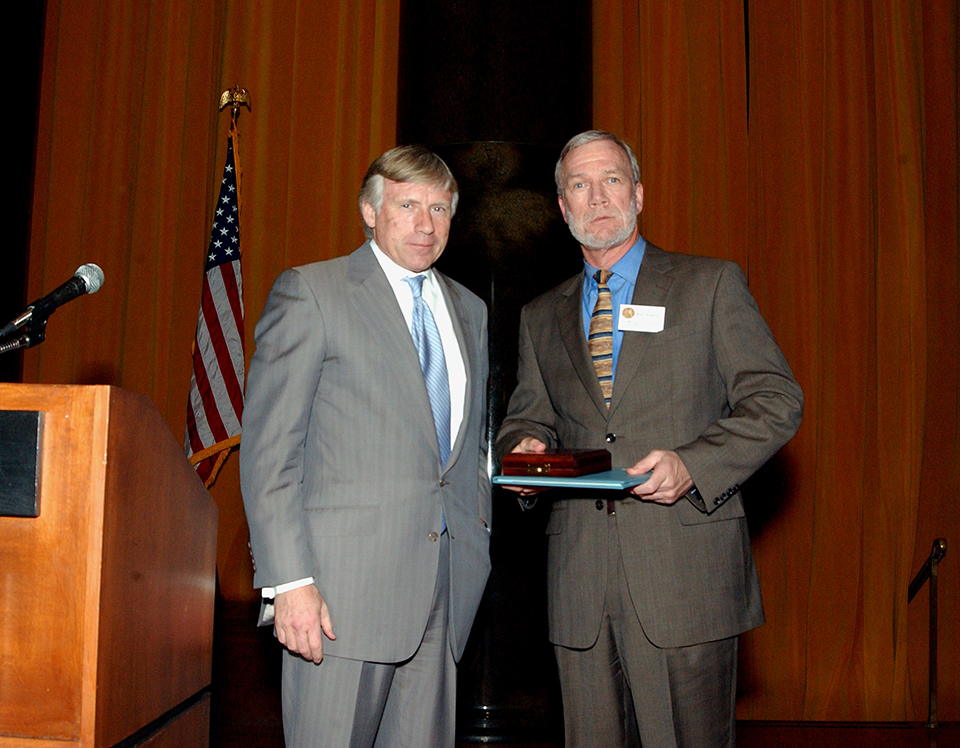
Columbia University President Lee C. Bollinger (left) presents Walter Robinson of The Boston Globe with the 2003 Pulitzer Prize in Public Service.
Winning Work
By Globe Spotlight Team
This article was prepared by the Globe Spotlight Team: reporters Matt Carroll, Sacha Pfeiffer, and Michael Rezendes; and editor Walter V. Robinson. It was written by Rezendes.
--First of two parts
Since the mid-1990s, more than 130 people have come forward with horrific childhood tales about how former priest John J. Geoghan allegedly fondled or raped them during a three-decade spree through a half-dozen Greater Boston parishes.
Almost always, his victims were grammar school boys. One was just 4 years old.
Then came last July's disclosure that Cardinal Bernard F. Law knew about Geoghan's problems in 1984, Law's first year in Boston, yet approved his transfer to St. Julia's parish in Weston. Wilson D. Rogers Jr., the cardinal's attorney, defended the move last summer, saying the archdiocese had medical assurances that each Geoghan reassignment was "appropriate and safe."
But one of Law's bishops thought that the 1984 assignment of Geoghan to St. Julia's was so risky, he wrote the cardinal a letter in protest. And for good reason, the Spotlight Team found: The archdiocese already had substantial evidence of Geoghan's predatory sexual habits. That included his assertion in 1980 that his repeated abuse of seven boys in one extended family was not a "serious" problem, according to an archdiocesan record.
And the St. Julia's assignment proved disastrous. First, Geoghan was put in charge of three youth groups, including altar boys. In 1989, he was forced to go on sick leave after more complaints of sexual abuse, and spent months in two institutions that treat sexually abusive priests.
Even so, the archdiocese returned him to St. Julia's, where Geoghan continued to abuse children for another three years.
Now, as Geoghan faces the first of two criminal trials next week, details about his sexual compulsion are likely to be overshadowed by a question that many Catholics find even more troubling: Why did it take a succession of three cardinals and many bishops 34 years to place children out of Geoghan's reach?
Donna Morrissey, a spokeswoman for Law, said the cardinal and other church officials would not respond to questions about Geoghan. Morrissey said the church had no interest in knowing what the Globe's questions would be.
Before Geoghan ever got to Weston in 1984, he had already been treated several times and hospitalized at least once for molesting boys. And he had been removed from at least two parishes for sexual abuse. In 1980, for instance, he was ordered out of St. Andrew's in Jamaica Plain after casually admitting he had molested the seven boys.
In 1981, after a year's sick leave, Geoghan was dispatched to St. Brendan's in Dorchester, with little chance he would be placed under scrutiny: His pastor for most of his 3 years there, the Rev. James H. Lane, has told friends he was never warned that Geoghan had a history of sex abuse.
In September 1984, complaints that Geoghan had abused children at the Dorchester parish prompted Law to remove him. Two months later, the cardinal gave Geoghan a fresh start at St. Julia's.
Law allowed Geoghan to stay in Weston for more than eight years before removing him from parish duty in 1993. But even that decision to recast Geoghan as a functionary at a home for retired priests did not prevent him from seeking out and molesting children, according to the multiple civil suits and criminal charges filed against the 66-year-old Geoghan.
Finally, in 1998, the church "defrocked" Geoghan, removing him from the priesthood.
Geoghan's criminal defense attorney, Geoffrey Packard, said his client would have no comment on any of the allegations against him. Geoghan's first trial on sexual molestation charges is scheduled for Jan. 14 in Middlesex Superior Court. The second, more serious set of charges are due to be tried in Suffolk Superior Court in late February. In the civil lawsuits, Geoghan has no attorney, and is not contesting the charges.
The church's likely legal defense, as Rogers hinted in July, will be that doctors deemed Geoghan rehabilitated. Church records obtained by the Globe note that Geoghan was indeed medically cleared for the St. Julia's assignment - but not until he had been at the parish for a month.
In 1984, there were still some clinicians who believed child molesters could be cured. But other specialists had long since warned Catholic bishops of the high risk that priests who had abused children would become repeat offenders.
What's more, specialists in child sexual abuse and attorneys who have represented victims said, it ought to have been apparent to the archdiocese by 1984 that someone with Geoghan's record of habitual sexual abuse should not have been returned to a parish.
"In Geoghan's case, the church defied its own most basic values of protecting the young and fostering celibacy," said A.W. Richard Sipe, a former priest. Sipe, a psychotherapist and expert in clergy sexual abuse, said he has long believed that the Catholic Church has been too slow to deal with priests who molest children.
The Spotlight Team found evidence that one of Law's top subordinates worried that Geoghan would cause further scandal at St. Julia's in Weston, where he began work on Nov. 13, 1984. On Dec. 7, Bishop John M. D'Arcy wrote to Law, challenging the wisdom of the assignment in light of Geoghan's "history of homosexual involvement with young boys."
Within the next week, two doctors cleared Geoghan for parish duty, according to an archdiocesan chronology that is in court files. It reads: "12/11/84 Dr. [Robert] Mullins - Father Geoghan 'fully recovered.' . . . 12/14/84 Dr. [John H.] Brennan: "no psychiatric contraindications or restrictions to his work as a parish priest."
The files also contain a poignant - and prophetic - August 1982 letter to Law's predecessor, the late Cardinal Humberto Medeiros, from the aunt of Geoghan's seven Jamaica Plain victims, expressing incredulity that the church to which she was devoted would give Geoghan another chance at St. Brendan's after what he had done to her family.
"Regardless of what he says, or the doctor who treated him, I do not believe he is cured; his actions strongly suggest that he is not, and there is no guarantee that persons with these obsessions are ever cured," Margaret Gallant said in her plea to Medeiros.
"It embarrasses me that the church is so negligent," Gallant wrote. Archdiocesan records obtained by the Globe make it clear why Gallant wrote her irate letter two years after the abuse: Geoghan had reappeared in Jamaica Plain, and been seen with a young boy. The records note that the next month, "Another letter from Mrs. Gallant. Why is nothing being done?"
From the Jamaica Plain case alone, the archdiocese's top officials were aware of Geoghan's attraction to young boys, and how he picked his victims: The affable Geoghan usually befriended Catholic mothers struggling to raise large families, often alone. His offers to help, often by taking the children for ice cream or praying with them at bedtime, were accepted without suspicion.
That is how 12-year-old Patrick McSorley, who lived in a Hyde Park housing project, allegedly became a Geoghan victim in 1986 - two years after Geoghan's assignment to Weston.
According to McSorley, Geoghan, who knew the family from St. Andrew's, learned of his father's suicide and dropped by to offer condolences to his mother, who is schizophrenic. The priest offered to buy Patrick ice cream.
"I felt a little funny about it," McSorley recalled in an interview. "I was 12 years old and he was an old man."
Riding home after getting ice cream, McSorley says, Geoghan consoled him. But then he patted his upper leg and slid his hand up toward his crotch. "I froze up," McSorley said. "I didn't know what to think. Then he put his hand on my genitals and started masturbating me. I was petrified." McSorely added that Geoghan then began masturbating himself.
When Geoghan dropped a shaken McSorley off at his mother's house, he suggested they keep secret what had taken place. "He said, 'We're very good at keeping secrets,' " McSorley said.
For years, McSorley has battled alcoholism and depression. And now, as the plaintiff in one of the lawsuits against Geoghan, McSorley is bitter. "To find out later that the Catholic Church knew he was a child molester - every day it bothers me more and more," McSorley says.
Many documents yet to be unsealed
The letters from Bishop D'Arcy and Margaret Gallant were among documents found by the Globe during a review of the public files of 84 civil lawsuits still pending against Geoghan. But for all Geoghan's notoriety, the public record is remarkably skeletal. That is because almost all the evidence in the lawsuits about the church's supervision of Geoghan has been under a court-ordered confidentiality seal granted to church lawyers.
In November, acting on a motion by the Globe, Superior Court Judge Constance M. Sweeney ordered those documents made public. The archdiocese appealed to the state Appeals Court, arguing that the Globe - and the public - should not have access to documents about the church's inner workings. But the appeal was denied last month. The records, including depositions of bishops and personnel files, are scheduled to become public on Jan. 26.
The cardinal and five other bishops who supervised Geoghan over the years have been accused of negligence in many of the civil suits for allegedly knowing of Geoghan's abuse and doing nothing to stop it. Never before have so many bishops had to defend their roles in a case involving sexual molestation charges against a single priest. The five, all since promoted to head their own dioceses, are Bishops Thomas V. Daily of Brooklyn, N.Y.; Robert J. Banks of Green Bay, Wis.; William F. Murphy of Rockville Center, N.Y.; John B. McCormack of Manchester, N.H., and Archbishop Alfred C. Hughes of New Orleans. Law and the five bishops have all denied the accusations in legal filings.
No American diocese has faced a scandal of similar dimensions since 1992. That year, in the Fall River Diocese, more than 100 of former priest James Porter's victims surfaced publicly with evidence that Porter's superiors - including, in the 1960s, then Monsignor Medeiros - shifted him from one parish to another as parents learned of his compulsive abuse.
Since 1997, the archdiocese has settled about 50 lawsuits against Geoghan, for more than $10 million - but with no confidential documents ever made public.
Plaintiffs in the 84 pending lawsuits are refusing to settle their claims as easily, and the church's internal documents are subject to being revealed in the litigation. So the archdiocese has moved aggressively to keep information about its supervision of Geoghan out of public view. One example: When Law was named a defendant in 25 of the lawsuits, Rogers asked a judge to impound any reference to the cardinal, arguing that his reputation might be harmed. The judge refused.
On Dec. 17, Rogers sent the Globe's attorney, Jonathan M. Albano, a letter threatening to seek legal sanctions against the newspaper and its law firm if the Globe published anything gleaned from confidential records in the suits. He warned that he would seek court-imposed sanctions even if Globe reporters asked questions of clergy involved in the case.
For decades, within the US Catholic Church, sexual misbehavior by priests was shrouded in secrecy - at every level. Abusive priests - Geoghan among them - often instructed traumatized youngsters to say nothing about what had been done to them. Parents who learned of the abuse, often wracked by shame, guilt, and denial, tried to forget what the church had done. The few who complained were invariably urged to keep silent. And pastors and bishops, meanwhile, viewed the abuse as a sin for which priests could repent rather than as a compulsion they might be unable to control.
Even Massachusetts law assured secrecy - and still does. For all the years that Geoghan was molesting children, clergymen were exempt from laws requiring most other caregivers to report incidents of sex abuse to police for possible prosecution. It was only after last summer's revelations that the archdiocese dropped its long-standing opposition to legislation adding clergy to the list of "mandated reporters." But the legislation died in committee.
Until recent years, the church also had little to fear from the courts. But that has changed, as predicted in a 1985 confidential report on priest abuse prepared at the urging of some of the nation's top bishops, Law among them. "Our dependence in the past on Roman Catholic judges and attorneys protecting the Diocese and clerics is GONE," the report said.
Since mid-December, the Globe has been requesting interviews with Law and other Church officials. But the answer was delayed until Morrissey's call late Friday, in which she said she would not even accept questions in writing. Asked if that meant the Archdiocese had no interest in knowing what the questions were, Morrissey replied: "That's correct."
In preparing this article, the Globe also sought interviews with many of the priests and bishops who had supervised Geoghan or worked with him. None of the bishops would comment. Of the priests, few would speak publicly. And one pastor hung up the phone and another slammed a door shut at the first mention of Geoghan's name.
After ordination, a record of abuse
There is no dispute that Geoghan abused children while he was at Blessed Sacrament in Saugus after his 1962 ordination. The archdiocese has recently settled claims on accusations that he did, and the church records obtained by the Globe note that Geoghan in 1995 admitted molesting four boys from the same family then. The unresolved issue in the remaining suits is whether church officials knew of the abuse at the time.
A former priest, Anthony Benzevich, has said he alerted church higher-ups that Geoghan frequently took young boys to his rectory bedroom. In news reports after accusations against Geoghan surfaced publicly, Benzevich was also quoted as saying church officials threatened to reassign him as a missionary in South America for telling them about Geoghan. Benzevich told his story to Mitchell Garabedian, who represents nearly all of the plaintiffs in the civil suits against Geoghan and church officials, according to an affidavit Garabedian filed.
But court records reviewed by the Globe show that when Benzevich appeared in Garabedian's office for a pre-trial deposition in October 2000, he was represented by Wilson Rogers 3d - the son of Law's principal attorney. Then, under oath, Benzevich changed his story. He said he was not certain that Geoghan had had boys in his room. And he said he could not recall notifying superiors about Geoghan's behavior with children.
In a recent interview with the Globe, Benzevich said he does indeed remember Geoghan taking boys to his room. He said Geoghan often sought to wrestle with young boys - and liked to dress them in priest's attire. But he repeated his sworn assertion that he does not recall notifying his superiors.
Before his deposition, Benzevich said, Wilson Rogers 3d approached him, told him the church was trying to protect him from being named as a defendant, and offered to represent him. His earlier statements to reporters, Benzevich said, had been misconstrued.
Garabedian, citing the confidentiality order, refused to discuss the Benzevich issue with the Globe. The church's financial liability in the pending suits could increase dramatically if there is evidence Geoghan's superiors knew of his abuse.
Geoghan's second assignment - in 1966 to St. Bernard's in Concord - ended after seven months, according to a detailed chronology of Geoghan's service prepared by the church which does not explain why the assignment was so abbreviated.
The pending lawsuits include accusations that Geoghan again abused young boys from several families in his next parish, St. Paul's in Hingham, between 1967 and 1974. One of his alleged victims, Anthony Muzzi Jr., said in an interview last week that in addition to his own abuse, his uncle caught Geoghan abusing his son. The uncle ordered Geoghan to leave his house, and complained to the priest's superiors at St. Paul's.
That complaint to church officials coincides with the time frame when Geoghan received in-patient treatment for sex abuse at the Seton Institute in Baltimore, according to Sipe, the psychotherapist who was on Seton's staff at the time. Sipe did not treat Geoghan.
During his assignment in Hingham, Geoghan found victims far afield, befriending Joanne Mueller, a single mother of four boys who lived in Melrose. There too, according to depositions, the priest became a regular visitor, a spiritual counselor to Mueller and a helpmate to her boys, who were between 5 and 12.
One night, she testified, her second youngest son came to her, insisting that she keep Geoghan away from him. "I don't want him doing that to my wee-wee, touching my wee-wee . . ." Mueller recalled the boy saying.
Mueller, according to her deposition, summoned her three other sons and learned that Geoghan, while purporting to be taking them out for ice cream, helping them with their baths, and reading them bedtime stories, had been raping them orally and anally. Also, Mueller said, Geoghan was insisting they tell no one. "We couldn't tell you because Father said it was a confessional," she said one of her sons told her.
Mueller testified that she immediately took the boys to see Rev. Paul E. Miceli, a parish priest at St. Mary's in Melrose who knew both Geoghan and her family.
She testified that Miceli assured her that Geoghan would be handled by appropriate church authorities and would "never be a priest again." Mueller also said that Miceli asked her to keep the matter to herself: "Bad as it was, he said, 'Just try - don't think about it. It will never happen again.' "
Miceli, until recently a member of Law's cabinet, contradicted Mueller in his own deposition. He said he did not recall her name, and never received a visit of the sort she described. But Miceli acknowledged receiving a call from a woman saying Geoghan was spending too much time with her children.
Miceli testified that the caller said nothing about sexual abuse. Nonetheless, Miceli said he drove to Geoghan's new parish in Jamaica Plain to relay the woman's concerns to Geoghan face-to-face.
Family in need was vulnerable
If Mueller had unwittingly facilitated Geoghan's access to the children in her home in Melrose, the same role was played by Maryetta Dussourd at the priest's next stop: St. Andrew's, in the Forest Hills section of Jamaica Plain, where he served from 1974 to 1980.
Dussourd was rearing her own four children - three boys and a girl - as well as her niece's four boys. In her hardscrabble neighborhood, she said in an interview, she hoped there was a priest the children could look up to. Then she met Geoghan, who oversaw altar boys and Boy Scouts at the parish.
Geoghan, she recalled bitterly, was eager to help. Before long, he was visiting her apartment almost every evening - for nearly two years. He routinely took the seven boys out for ice cream and put them to sleep at night.
But all that time, Geoghan regularly molested the seven boys in their bedrooms, Dussourd said. In some cases, he performed oral sex on them, according to court documents. Other times, he fondled their genitals or forced them to fondle his - occasionally as he prayed.
A 1994 Archdiocesan memorandum, labeled "personal and confidential," said Geoghan would stay in the Dussourd home "even when he was on retreat because he missed the children so much. He 'would touch them while they were sleeping and waken them by playing with their penises.' "
Dussourd discovered what was happening after the children finally told her sister, Margaret Gallant. Horrified, Dussourd complained to the Rev. John E. Thomas, the pastor of St. Thomas Aquinas, a nearby parish, according to court documents and accounts by Dussourd and a church official who asked that he not be identified.
Thomas confronted Geoghan with the allegations, and was taken aback when Geoghan casually admitted they were accurate. "He said, 'Yes, that's all true,' " the official recalled. It was as if Geoghan had been asked "if he preferred chocolate or vanilla ice cream."
Thomas immediately drove to archdiocesan offices in Brighton to notify Daily. In Thomas's presence that Saturday afternoon, Feb. 9, 1980, Daily telephoned Geoghan at St. Andrew's and, in a brief conversation, delivered a curt directive: "Go home," the official said.
Geoghan protested, saying there was no one else to celebrate the 4 p.m. Mass. "I'll say the Mass myself," Daily insisted. "Go home." The official said Daily drove to Jamaica Plain and said Mass.
The Rev. Francis H. Delaney, who was Geoghan's pastor at St. Andrew's, said in an interview that church officials never told him why Geoghan disappeared from the parish.
Several weeks later, Dussourd said, a contrite Thomas came to her apartment and told her that Geoghan had admitted to abusing the boys, but had excused his behavior by telling the pastor, "It was only two families."
Thomas, echoing a tack common among clerics at the time, later pleaded with Dussourd not to follow through on her threat to go public, she said. He cited the years Geoghan had spent studying for the priesthood, and the consequences for Geoghan if the accusations against him were publicized. "Do you realize what you're taking from him?" Thomas asked, according to Dussourd.
Thomas, who is now retired, declined to be interviewed.
A 1994 archdiocesan document summarizing Geoghan's recurrent problems says of the seven children: "Fr. Geoghan 'admits the activity but does not feel it serious or a pastoral problem.' "
Geoghan spent the following year on sick leave, under treatment for his compulsion, but living with family in West Roxbury. In February 1981, he was sent to his fifth parish, St. Brendan's.
Almost immediately, Geoghan was working with First Communicants, befriending young children and their parents, even taking some boys to his family's summer home in Scituate, where - parents say they later discovered - he sexually abused the youths.
Geoghan's free rein was made possible because the archdiocese said nothing to Lane, St. Brendan's pastor, about Geoghan's history, according to a teacher in the parish whom Lane has confided in.
The St. Brendan's teacher, who declined to be named, said that at first, Geoghan's willingness to spend inordinate amounts of time with children was admired. But over time, some parishioners became suspicious. "We knew something wasn't right," the teacher said. "He just zeroed in on some kids."
After two more years and more allegations of sexual abuse, Geoghan's tenure at St. Brendan's came to an abrupt end in 1984, when Lane heard complaints that Geoghan had molested children in the parish.
Lane, the teacher said, was so devastated that he broke down when he told her the news. And, she said, he was incensed that he had not been warned. "Father Lane was almost destroyed by this," the teacher said.
Lane is now retired. When a Globe reporter went to see him recently, he slammed the door shut as soon as Geoghan's name was mentioned.
Law denies he tried 'to shift a problem'
In his own defense last summer, Law wrote in the Pilot, the archdiocesan newspaper, "Never was there an effort on my part to shift a problem from one place to the next."
The cardinal's assertion followed his disclosure, in court documents, that he was informed in September 1984 of the four-year-old allegations that Geoghan had molested the seven Jamaica Plain boys. In the court filing, Law went on to say he then notified Geoghan that he was being removed from St. Brendan's and was "in between assignments."
The legal response by the cardinal, narrowly drawn in response to the lawsuit against him, omits any reference to Geoghan's molestation of children at St. Brendan's in Dorchester.
Despite his record, Geoghan was assigned to St. Julia's. And in his first two years, he was in charge of altar boys, religious education for public school youngsters and a youth group, according to the church's annual directories.
Three weeks after Geoghan arrived in Weston, Bishop D'Arcy protested the assignment to Law, citing Geoghan's problems and adding: "I understand his recent abrupt departure from St. Brendan's, Dorchester may be related to this problem."
A copy of the letter contains a redacted paragraph, an apparent reference to the Rev. Nicholas Driscoll, who confirmed last week that he had been removed from St. Julia's before Geoghan's arrival - but for alcohol and depression problems, not sexual abuse. So D'Arcy expressed concern about "further scandal in this parish." If "something happens," parishioners will feel that the archdiocese "simply sends them priests with problems."
D'Arcy urged Law to consider restricting Geoghan to weekend duty "while receiving some kind of therapy." The Globe could find no evidence that Law accepted that advice. Retired Monsignor Francis S. Rossiter, Geoghan's pastor at St. Julia's, refused to be interviewed last week. But Church records note that Rossiter was aware of Geoghan's history.
The civil and criminal allegations Geoghan faces in Middlesex and Suffolk counties suggest that he allegedly abused at least 30 more boys after Law sent him to Weston in 1984 - both before and after the half year's sick leave in 1989.
After Geoghan's 1989 return to St. Julia's, it was another 38 months before Law took him out of the parish. Three years later, Geoghan was still seeking out victims, allegedly including an altar boy donning vestments for a christening ceremony, according to the criminal charges.
The shuttling of Geoghan from one parish to another created a devastating coincidence for one family. One boy he allegedly molested is the son of a man who had been among the many sexually abused by Porter during the 1960s in the Fall River Diocese, according to Roderick MacLeish Jr., the attorney who represented the man and 100 other Porter victims.
MacLeish declined to provide any information about the family, and said a legal claim has yet to be filed over the son's treatment by Geoghan.
MacLeish, who has had substantial dealings with the Boston Archdiocese, said he remains astonished at Rogers's assertion that Geoghan's assignments were deemed safe by doctors. "No responsible clinician would have said it was safe to transfer him to another parish in light of what the church knew about his pattern of deviant behavior," MacLeish said.
© 2002, Globe Newspaper Company
By Globe Spotlight Team
This report was prepared by the Globe Spotlight Team: Reporters Matt Carroll, Sacha Pfeiffer and Michael Rezendes; and Editor Walter V. Robinson. This article was written by Pfeiffer.
--Second of two parts
The telephone call was urgent.
"There is a crisis," the Rev. Brian M. Flatley, an archdiocesan official, told Dr. Edward Messner, a psychiatrist at Massachusetts General Hospital, on Dec. 30, 1994.
Messner's notes from that day convey the gravity of the situation: "A priest had admitted abusing minors in the past and has been acting out again recently . . . police and the district attorney are involved . . . The allegations mirror what has come up before."
Six hours later, the Rev. John J. Geoghan and Messner began regular therapy sessions in which Geoghan admitted to being "drawn by affection and intimacy with boys" and, as an MGH psychologist wrote, "pointed out that his misconduct occurred, 'during a time of sexual exploration for this country.'"
In 1995 and 1996, according to court records examined by the Globe Spotlight Team, Geoghan explained why he preyed on children from poorer families: "The children were just so affectionate, I got caught up in their acts of affection. Children from middle-class families never acted like that toward me, so I never got so confused."
Moreover, court documents that include Geoghan's psychiatric records contain starkly contradictory assessments of his danger to children from different therapists. He received at least four clean bills of health between 1980 and 1990, a period when the Archdiocese of Boston assigned him three times to parishes despite his record of abuse; but prompted declarations that he was an incurable pedophile after he became a public embarrassment to the archdiocese in the mid-1990s.
For example, Messner's notes show that Geoghan told him that Flatley, whose job was to deal with priests who had molested children, had branded him "a pedophile, a liar, and a manipulator."
Collectively, the publicly filed church documents add detailed clinical evidence to what the Globe reported yesterday: Although the 1995 and 1996 psychiatric reports diagnose Geoghan with a deep-rooted sexual perversion, there were ample signs years earlier that he was unfit for parish work.
Yesterday, the Globe reported that Cardinal Bernard F. Law, during his first year in Boston in 1984, assigned Geoghan to St. Julia's in Weston even though Geoghan had been removed from his two prior parishes for molesting children. In one of those cases, in 1980, Geoghan asserted that his repeated abuse of seven boys in one family, which was disovered that year, was not a "serious" problem. That is according to a church timeline of Geoghan's career - six parish assignments in 34 years with accusations that he molested more than 130 children.
Law, after celebrating Mass yesterday at the Cathedral of the Holy Cross, reiterated the archdiocese's statement of Friday that he would not comment on Geoghan.
The documents also contain evidence that Geoghan's false denials of past sexual abuse through the 1960s and much of the 1970s helped justify a critical church decision that freed Geoghan to abuse even more children. In 1989, Geoghan was forced to take a six-month sick leave from St. Julia's after more accusations of abuse surfaced. But Law soon signed off on a decision to return him to the parish, according to church documents.
The Spotlight reports of today and yesterday are based on public documents filed in connection with 84 civil lawsuits pending against Geoghan and two criminal cases, the first of which is scheduled to go to trial in Middlesex Superior Court next Monday. The archdiocese, Law, and five other bishops are defendants in many of the pending lawsuits, charged with negligence for not properly supervising Geoghan. Already, the archdiocese has settled 50 other lawsuits, paying more than $10 million to Geoghan's victims.
The multiple accusations against Geoghan represent the largest scandal involving an American Catholic priest since the 1992 disclosure that former priest James Porter had abused more than 100 children in the Fall River Diocese in the 1960s.
The massive number of documents compiled by lawyers handling the 84 remaining civil suits have been under a confidentiality seal sought by the archdiocese. But based on a motion by the Globe, Superior Court Judge Constance M. Sweeney ordered that all the documents be made public. They are scheduled to be released on Jan. 26.
The documents already on public file detail the extent of Geoghan's lengthy treatment history and make clear the church's longtime knowledge of his misconduct.
The psychiatric documents offer added insights into Geoghan's troubled mind and the motivations behind his aberrant actions - often as explained by Geoghan himself.
Geoghan was, by his own assessment, a heterosexual. But he told Messner during his treatment sessions that his victims were usually young prepubescent boys. He said he "avoided girls," explaining, "I picked the boys because in some way they were the safest, the girls and the mothers would have been more dangerous."
The records suggest there were early warning signs.
Geoghan, who is 66, attended St. John's Seminary after graduating from Holy Cross College and was ordained in 1962. Deposition transcripts refer to correspondence from Geoghan's seminary days in which his superiors conclude he has "pronounced immaturity."
In an April 1995 session with Messner, Geoghan said that even as a newly ordained priest he would "experience arousal when there was physical closeness" with children.
In a June 1996 psychological assessment, Dr. Mark Blais, a Massachusetts General Hospital psychologist, concluded that Geoghan has a "powerful sense of emotional deprivation and emotional loneliness."
Medical evaluations of Geoghan, which repeatedly cleared him to return to parish work after incidents of sexual misconduct in the 1970s and '80s, changed dramatically in the mid-1990s. By then, complaints against Geoghan were being made with unsettling frequency, and it was clear he risked becoming an embarrassment - and financial liability - to the Church.
In December 1984, for example, a month after being reassigned to St. Julia's in Weston following his removal from St. Brendan's in Dorchester, Geoghan underwent evaluations by two separate Boston-area psychotherapists. Dr. Robert Mullins declared Geoghan "fully recovered," and Dr. John H. Brennan advised "no . . . restrictions to his work as a parish priest."
Not everyone was comfortable with the assignment. Bishop John M. D'Arcy, a popular cleric whose forthright manner rankled Law, according to a friend of D'Arcy, wrote to Law in December 1984 to question Law's decision assigning Geoghan to St. Julia's because of his history of sex abuse. He warned that placing Geoghan there might result in further scandal.
Two months later, D'Arcy was gone, transferred to a diocese in Fort Wayne, Ind., which he has headed ever since.
New allegations against Geoghan surfaced within two years, and again in 1989. But Geoghan told Bishop Robert J. Banks in March 1989 that he had "no more sexual attraction to children" and had been "chaste for five years."
But the church's own timeline of Geoghan's misconduct suggests Banks did not believe him. Within weeks, Geoghan was sent to the St. Luke Institute in Suitland, Md., where he was diagnosed with "homosexual pedophilia." The result: "Told by Bishop Banks he had to leave ministry," according to a church record.
Instead, Geoghan was put on sick leave the following month, and in August was hospitalized for three months at the Institute of Living, a Hartford treatment center, where he was discharged in November 1989, as "moderately improved." Banks agreed to send him back to St. Julia's, subject to approval by another bishop and "BFL" - Cardinal Law.
But during 1995 treatment, psychologists at St. Luke concluded that during the 1989 treatment in Hartford, Geoghan did not tell the truth about the extent of his sexual abuse of children. He denied any incidents before the late 1970s, to include long-running instances of abuse dating to 1962. And the Institute of Living's report to the archdiocese reflected Geoghan's lie.
Moreover, the records state that Bishop Banks was "unhappy" with the Institute of Living's discharge summary because it was "different from what he had understood and based his decision to allow Fr. Geoghan back to work."
A reply letter from the institute reports: "The probability that he would act out again is quite low. However, we cannot guarantee that it could not reoccur."
Yet the archdiocese was hit with more complaints in 1991, 1992, and 1994, although the 1992 accusation was dismissed by church officials as "hearsay and vague."
Law finally removed Geoghan from parish duty in January 1993.
Midway through his treatment with Messner, Geoghan was returned to St. Luke in January 1995. His diagnosis after that 10-day stay was far less optimistic than earlier judgments. "It is our clinical judgment that Father Geoghan has a longstanding and continuing problem with sexual attraction to prepubescent males," his evaluation reads. "His recognition of the problem and his insight into it is limited."
Therapists at St. Luke advised that Geoghan have no unsupervised contact with minor males and return for residential treatment, although Geoghan resisted the latter recommendation. Instead, he was sent in July 1995, to Southdown, an Ontario treatment facility, where he stayed for four to six months.
In 1996, Blais, too, submitted a pessimistic evaluation. "Treatment of such a chronic and deeply ingrained condition would need to be lengthy," he wrote.
Geoghan was removed from the priesthood in 1998.
© 2002, Globe Newspaper Company
July 21, 1954
The seminary rector at Cardinal O'Connell Seminary writes a letter saying that John J. Geoghan has a "very pronounced immaturity."
1962
Geoghan ordained.
FEB. 13, 1962 - SEPT. 27, 1966
Blessed Sacrament, Saugus
1962-1966
The Rev. Anthony Benzevich reportedly tells church officials that Geoghan brings boys into his bedroom. Benzevich later denies it. In 1995, Geoghan admits molesting four boys over 2 1/2 years while in Saugus.
SEPT. 27, 1966 - APRIL 20, 1967
St. Bernard's, Concord
No reason given for abbreviated stay in church records.
APRIL 20, 1967 - JUNE 4, 1974
St. Paul's, Hingham
About 1968
Hingham father complains to church authorities that he caught Geoghan molesting his son, one of several accusations that emerged from St. Paul's.
About 1968
Treated at Seton Institute, Baltimore.
Early 1970s
Joanne Mueller, single mother and member of St. Mary's parish, Melrose, says Geoghan molested her four young boys at this time. Mueller says she informed the Rev. Paul E. Miceli at St. Mary's. Mueller also says Miceli asked her to keep quiet. The family later sues and settles. Miceli disputes her account.
Sept. 8, 1970
Humberto Medeiros named archbishop of Boston. Appointed cardinal on March 5, 1973. Cardinal Richard J. Cushing dies Nov. 2, 1970.
JUNE 4, 1974 - FEB. 12, 1980
St. Andrew's, Jamaica Plain
1977-1978
Geoghan is accused of molesting seven boys in the extended Dussourd family. Six of the children and the mothers later file suits, which are settled.
Feb. 9, 1980
The Rev. John E. Thomas tells Bishop Thomas V. Daily that Geoghan admitted to molesting the Dussourd children. Daily calls up Geoghan and tells him to go home. Geoghan admits the abuse and says he "does not feel it serious or a pastoral problem."
Feb. 12, 1980
Placed on sick leave. Counseling ordered by Medeiros. Geoghan undergoes psychoanalysis and psychotherapy with Drs. Robert Mullins and John H. Brennan.
FEB. 25, 1981 - SEPT. 18, 1984
St. Brendan's, Dorchester
Early 1980s
Allegedly rapes and fondles Jamaica Plain boy. (Criminal counts 1 and 2 for the pending Suffolk trial.)
July 24, 1982
Dussourds complain to Daily that Geoghan met one of the molested Dussourd children at an ice cream shop in Jamaica Plain. Was allegedly also seen there with another boy.
Aug. 10, 1982
Margaret Gallant writes to Medeiros, complains that Geoghan is "still functioning," despite molesting her nephews, the Dussourds.
Sept. 17, 1983
Medeiros dies.
March 23, 1984
Bernard F. Law installed as archbishop of Boston. Appointed cardinal on May 25, 1985.
Sept. 18, 1984
Law removes Geoghan from parish after complaints he molested boys there.
NOV. 13, 1984 - JAN. 12, 1993
St. Julia's, Weston
Nov. 13, 1984
Assigned by Law to St. Julia's, where Monsignor Francis Rossiter is "aware of past allegations." Geoghan is put in charge of three youth groups, including altar boys.
Dec. 7, 1984
Auxiliary Bishop John M. D'Arcy writes to Law and complains about Geoghan's assignment to St. Julia's because of his "history of homosexual involvement with young boys."
Dec. 11, 1984
Dr. Mullins: Geoghan "fully recovered."
Dec. 14, 1984
Dr. Brennan: no restrictions on his work as a parish priest.
Feb. 26, 1985
D'Arcy appointed bishop of Fort Wayne/South Bend, Ind.
1986
Patrick McSorley of Hyde park says he is molested by Geoghan. Geoghan allegedly molests boys at the Waltham Boys & Girls Club. Bishop Robert J. Banks is told Geoghan is accused of molesting boy at a pool.
March 9, 1989
Banks learns of another 1986 accusation.
April 3-12, 1989
St. Luke's Institute, Maryland. Diagnosis: homosexual pedophilia.
April 28, 1989
Geoghan is told by Bishop Robert J. Banks he had to leave ministry.
May 24 - Nov. 17, 1989
Placed on sick leave.
Aug. 10, 1989 - Nov. 4, 1989
Treated at Institute of Living, Hartford. Called "moderately improved" on release and recommendation is that he be returned to assignment.
Nov. 30, 1989
Banks is unhappy with the Discharge Summary from the Institute for Living because it is different from what he understood and he used it to base his decision on allowing Geoghan to return to St. Julia's.
Dec. 13, 1989
Letter to Banks explaining the Discharge Summary: "The probability he would act out again is quite low. However, we could not guarantee that it would not re-occur." Return to parish OK'd.
Nov. 28, 1990
Note from Banks: "I would recommend him for parish, but decision left up to [another bishop] and BFL"-Cardinal Law.
Dec. 7, 1990
Letter from Dr. Brennan: Geoghan OK for pastoral work.
Oct. 23, 1991
Complaint about Geoghan "proselytizing" at a pool with a boy.
1993-1996
Regina Cleri residence for retired priests
April 4, 1994
Mother says Geoghan abused her son while he was at St. Paul's in Hingham. Geoghan denies the accusation.
Nov. 1994
Single mother from Waltham calls church to say Geoghan molested her four boys and made obscene phone calls to them. Placed on pre-trial probation. The case was dropped.
Jan. 16-25, 1995
St. Luke's report states: He "has a long history of pedophilic behavior ... Father Geoghan should have no interpersonal contact with male minors that is unsupervised."
1995
Geoghan allegedly molests a Weymouth boy, including at the christening of boy's sister. (Criminal counts 3 and 4 in Suffolk.)
July 29, 1996
Spends four to six months in Southdown Institute, Ontario, for therapy.
1997
Clergy personnel office
1998
Geoghan defrocked. Church settles 50 sex abuse cases against Geoghan for more than $10 million; 84 other cases pending.
Globe Staff
Sources: Court documents and medical records
© 2002, Globe Newspaper Company
By Globe Spotlight Team
This article was prepared by the Globe Spotlight Team: Editor Walter V. Robinson, senior assistant metropolitan editor Stephen Kurkjian, and reporters Matt Carroll, Sacha Pfeiffer, and Michael Rezendes. It was written by Robinson and Carroll.
Even as two successive cardinals and dozens of church officials learned of growing evidence that the Rev. John J. Geoghan could not control his compulsion to molest children, Geoghan found extraordinary comfort in his church.
In succession, Cardinals Humberto S. Medeiros and Bernard F. Law offered him their prayers, but never condemnation. Even as prosecutors closed in, Law wrote Geoghan in 1996: "Yours has been an effective life of ministry, sadly impaired by illness.... God bless you, Jack."
Bishop Thomas V. Daily, once the top deputy to both cardinals, likened Geoghan to a lost sheep. In dozens of internal communiques, Geoghan's superiors and his doctors regularly alluded to his pedophilia euphemistically. After Geoghan was removed from a Dorchester parish in 1984 for abusing children, Dr. Robert W. Mullins called the episode "a rather unfortunate traumatic experience" -- for Geoghan, not the children.
In dozens of internal communications, obtained by the Globe under court order over the objections of the Catholic Archdiocese of Boston, bishops and cardinals almost never mentioned that Geoghan had victims, although more than 130 people have since come forward charging they were abused. Their focus, instead, was on righting Geoghan and sending him on to another parish.
At times, the concern for Geoghan suggested by the documents turned to outright coddling. For instance, Geoghan was sent to Rome for a two-month sabbatical just after relatives of Geoghan victims met with Daily in August 1982 to demand that he be removed from the ministry.
And in 1989, according to his own notes, Bishop Robert J. Banks was told by a psychiatrist who had treated Geoghan: "You better clip his wings before there is an explosion. ... You can't afford to have him in a parish."
Yet a year later, Geoghan asked Law to promote him to pastor of St. Julia Parish in Weston. Even Banks said he would recommend that Geoghan become a pastor at some time.
Law picked someone else. But the Rev. Kevin J. Deeley, the church official who relayed the bad news, encouraged Geoghan to apply for another position as pastor.
At the time, Geoghan had been removed from four straight parishes between 1974 and 1989 for molesting children. In 1989, with approval from Banks and Law, Geoghan was returned to St. Julia's in Weston, where he resumed working with altar boys.
Geoghan's favorable treatment by church officials is outlined in thousands of pages of church documents and transcripts of depositions of church officials collected by lawyers in 84 civil lawsuits against Geoghan, the archdiocese, Law, and several other bishops. The archdiocese has already paid more than $10 million to settle suits by about 50 other victims. Last week, Geoghan was convicted of molesting a Waltham boy more than a decade ago. He faces two more criminal trials in Suffolk County.
Mitchell Garabedian, the lawyer who represents almost all the plaintiffs against Geoghan, said in an interview last night that the documents prove that the archdiocese acted irresponsibly in its handling of Geoghan. Even during Geoghan's years in the seminary, there were clear signs that he would become a problem priest, Garabedian said of the documents.
The documents had been under a court-mandated confidentiality order for more than a year. But acting on a motion by the Globe, Superior Court Judge Constance M. Sweeney, who is presiding over the civil lawsuits, overturned the order in November. An appeal to the state Appeals Court by the archdiocese was denied.
Donna M. Morrissey, the spokeswoman for the archdiocese, did not return telephone calls from the Globe yesterday seeking comment on the documents.
On Jan. 9, Law apologized to Geoghan's victims and for his own oversight of Geoghan after Law became archbishop of Boston in 1984. "In retrospect," Law said, his judgments about Geoghan had been "tragically incorrect."
Law's apology followed publication of a two-part Globe Spotlight series reported that Law and other church officials had shuttled Geoghan from one parish to another, even though they knew of his sexual abuse of children.
But what is striking about the documents that became public this week is the indifference of the church to the extent of Geoghan's abuse. With just one exception, the Geoghan records and the transcripts of depositions of church officials contain no hint that anyone around the cardinal urged him to remove children from Geoghan's reach until 1993.
That exception, the Globe reported on Jan. 6, occurred after Law sent Geoghan to the Weston parish in 1984. Three weeks later, Bishop John M. D'Arcy challenged the wisdom of the move in a letter to Law, saying he was worried that Geoghan might cause further scandal.
But if other bishops expressed similar concerns, it is not reflected in the documents. Daily, now the bishop of the Brooklyn diocese, acknowledged in his deposition that fear of public exposure was one of the reasons for the way Geoghan was handled.
Daily, who was for a time the top deputy to Medeiros and then Law, was asked about the words "public perception" in his notes.
Q. What does that mean?
A. I don't know. It might well have referred to the thought of scandal, if it became public, this whole thing -- I don't know. Public perception. In other words, I am underlining that because of the concern of the public reaction.
Q. Was it a policy in the archdiocese when you were in Boston to avoid scandal where possible?
A. Yes.
Q. And were these events types of events that would cause scandal for the church?
A. Yes.
That is why, Daily went on to explain, he urged the relatives of seven Jamaica Plain victims of Geoghan, all from the same extended family, to keep quiet about the abuse.
One of those relatives wrote to Medeiros after that meeting, complaining that Daily had suggested "that we keep silent to protect the boys -- that is absurd since minors are protected under law, and I do not wish to hear that remark again, since it is insulting to our intelligence."
Medeiros, in his Aug. 20, 1982, reply to the relative, which was contained in the documents made public this week, called the incidents of abuse "a very delicate situation and one that has caused great scandal."
But the cardinal wrote that, "I must at the same time invoke the mercy of God and share in that mercy in the knowledge that God forgives sins and that sinners indeed can be forgiven."
Two years later, after Law had removed Geoghan from St. Brendan Parish in Dorchester for abusing other children, Margaret Gallant wrote to the new archbishop to report that Geoghan had just recently been seen with many young boys and to urge Law to act against Geoghan.
"Our family is deeply rooted in the Church with a firm love for Holy Orders," she wrote. "We do not accuse this priest of sin, since we are all sinners, but rather we speak here of crime."
The records do not contain any evidence that Law replied to Gallant. Two months later, Geoghan was sent to St. Julia Parish in Weston.
St. Julia's parishioners were unaware of Geoghan's pedophilia. And his new pastor, Monsignor Francis S. Rossiter, assigned Geoghan to oversee the altar boys and two other youth groups, even though Rossiter had been made aware of Geoghan's past, according to the newly public church documents.
But last April, when Rossiter was questioned under oath about his knowledge, he was evasive, suggesting he wasn't told much at all.
Q. And you were told what some of his prior problems were, weren't you?
A. No. I would say no specifics were provided. Just a letter that said he was assigned.
Asked again whether he knew about Geoghan's problems when he arrived at the parish in 1984, Rossiter replied: "I really can't say."
But by then, according to the documents, Geoghan had been removed from three parishes for molesting children: St. Paul's in Hingham in 1974, St. Andrew's in Jamaica Plain in 1980, and St. Brendan's in Dorchester in 1984.
The records show that archdiocesan officials were well aware of Geoghan's problems. And so were many priests, according to a deposition by the Rev. William C. Francis. After Geoghan's removal from St. Brendan's in 1984, among priests "there was talk that he had been fooling around with kids," Francis said.
Two weeks ago, the Globe reported that a former priest who served with Geoghan in the 1960s at his first parish, Blessed Sacrament in Saugus, complained that Geoghan brought boys to his room at the rectory.
The new depositions include testimony from several priests that Geoghan had altar boys in his rectory rooms during his seven-month assignment at St. Bernard's in Concord in 1966 and 1967 and again during his abuse-ridden stay at St. Andrew's from 1974 to 1980. That assignment ended when Geoghan admitted abusing the seven boys who were related to Gallant.
At St. Andrew's, according to a deposition by Geoghan's pastor there, the Rev. Francis H. Delaney, the housekeeper told him "that Father Geoghan had some urchins up there letting them use the shower, so I confronted him on that and said, 'You know the rule,' and he denied it vehemently, but I had no proof."
All along, archdiocesan officials relied primarily on two Boston doctors, Robert W. Mullins, a general practitioner; and John H. Brennan, a psychiatrist, to treat Geoghan.
But the Globe reported last week that while Mullins is listed as providing Geoghan with psychotherapy, he has acknowledged to the Globe that he has no background in that specialty. Brennan had no other experience treating sex offenders, and two of his female patients sued him, accusing him of molesting them. Brennan settled one of the suits for $100,000. In the other case, a jury found for Brennan after a civil trial.
Geoghan, in a 1980 letter to Medeiros after he was removed from St. Andrew's, told the cardinal that he was receiving "excellent care" from "two wonderful Catholic physicians," referring to Mullins and Brennan.
Both doctors also reported to the archdiocese in December 1984 that Geoghan was fit for the Weston assignment.
But in 1989, when Geoghan was hospitalized at the Institute of Living in Hartford, the psychiatrist who treated him for pedophilia was dismissive of Mullins's earlier treatment, according to the documents.
"The patient had been seeing an internist for his psychotherapist, which was more along the line of friendly paternal chats and not really psychotherapy," Dr. Robert F. Swords wrote to Banks. Mullins has been the Geoghan family physician for more than 40 years.
The role of Banks in overseeing Geoghan is contradictory, according to the documents. It was Banks who was warned by Brennan in April 1989 that Geoghan might explode. That prompted Law to take the priest out of St. Julia's and place him in two treatment facilities over a six-month period. Banks, who had just fielded fresh complaints of abuse against Geoghan, asked him to resign, according to church documents.
Yet six months later, Banks was so unhappy with a psychiatric report from Swords describing Geoghan as a pedophile in remission that Banks sought -- and received -- a more favorable diagnosis, according to the documents.
Subsequently, Banks, who is now bishop of the Diocese of Green Bay, Wis., registered his opinion that Geoghan was fit to be a pastor. Earlier this month, Banks declined to discuss his handling of Geoghan with the Globe.
If Law ignored obvious, ominous signs about Geoghan starting in 1984, the documents provide the first evidence that as early as the 1950s, Geoghan's superiors wanted him to resign from Cardinal O'Connell Seminary in Jamaica Plain.
The documents also show for the first time the intervention of his uncle, Monsignor Mark H. Keohane.
In July 1954, the Rev. John J. Murray, the seminary rector, wrote to the Rev. Thomas J. Riley, the rector of St. John's Seminary in Brighton, that Geoghan "has a very pronounced immaturity."
"Scholastically, he is a problem," Murray wrote. While passing subjects, "I still have serious doubts about his ability to do satisfactory work in future studies," he said.
A year later, Geoghan, claiming illness, did not attend a mandatory summer camp for seminarians, after Keohane had written Riley that his nephew was going to miss the camp because he was in a "nervous and depressed state."
Riley wrote a tart response to Keohane. Keohane responded three days later, irate at the apparent suggestion by Riley that he was seeking special treatment for his nephew.
"I resent your implication that I sought favors or preferment for John," Keohane said. He also complained that Geoghan, after three years in the seminary, "is now sick, unhappy, and appears to be wrestling with his soul."
Geoghan left the seminary for a couple of years to attend the College of the Holy Cross in Worcester. He later reentered the seminary and was ordained in 1962.
Even as Geoghan's career neared its end, he won a sympathetic ear two years before he was defrocked in 1998.
In 1996, after years of allegations of sexual abuse and the more immediate prospect of criminal charges and civil lawsuits, Law's resolve in the Geoghan case appeared to waver, according to a memorandum prepared by the Rev. Brian M. Flatley, who was handling Geoghan's case for the archdiocese.
In an April 1996 memo, Flatley wrote that Law had been moved by Geoghan's own account of his troubles and had appeared sympathetic to Geoghan's request that he not be sent to a residential treatment center.
"In his recent conversation with Cardinal Law, Father Geoghan was aggressive and powerful in presenting his case," Flatley wrote. "Until I came into the conversation at the Cardinal's invitation, I sensed that Father Geoghan had made him feel uneasy."
Flatley, in a harsh evaluation that stood in contrast to earlier, more sympathetic assessments, also wrote that he believed that Geoghan "was not totally honest" with his doctors and said he could not be convinced Geoghan was "not lying again" in denying allegations that he had molested four Waltham boys.
"I see no signs that Father Geoghan has taken the steps that addicted people seem to feel are essential to recovery," Flatley wrote. "He has not joined a group, he does not attend twelve-step meetings, he has not been receiving ongoing counseling."
Two months later, in June 1996, Flatley wrote a memo to Law urging that he deal with Geoghan in a decisive manner. "I believe that Father Geoghan has deceived Doctor Messner," Flatley wrote, referring to Edward Messner, a Massachusetts General Hospital psychiatrist.
"Father Geoghan is clever," Flatley added. "He withheld information from each assessing group, only to admit a little bit more to the next tester. He is a real danger. I think he needs to be in residential care."
© 2002, Globe Newspaper Company
By Globe Spotlight Team
This article was reported by the Globe Spotlight Team: Reporters Matt Carroll, Sacha Pfeiffer, and Michael Rezendes; senior assistant metropolitan editor Stephen Kurkjian;and editor Walter V. Robinson. It was written by Robinson.
Under an extraordinary cloak of secrecy, the Archdiocese of Boston in the last 10 years has quietly settled child molestation claims against at least 70 priests, according to an investigation by the Globe Spotlight Team.
In the public arena alone, the Globe found court records and other documents that identify 19 present and former priests as accused pedophiles. Four have been convicted of criminal charges of sex abuse, including former priest John J. Geoghan. Two others face criminal charges.
But those public cases represent just a fraction of the priests whose cases have been disposed of in private negotiations that never brought the parties near a courthouse, according to interviews with many of the attorneys involved.
One law firm alone won financial settlements for its clients against at least 45 priests and five brothers from religious orders, according to the lead attorney in those cases, Roderick MacLeish Jr.
Although the settlements are secret, the church's annual directories, which list where priests are assigned, are public. From them, the Globe developed a database to track assignments of clergy, and those data strongly suggest that large numbers of priests were involved in sexual abuse cases that were settled.
The database identified 102 priests who were placed on sick leave or otherwise removed from parish assignments in the early to mid-1990s. The archdiocese settled claims of sexual abuse against at least 30 of those priests, according to public records, lawyers involved in the cases, and, in some instances, their own admissions.
The estimate of 70 is conservative, according to lawyers. It includes priests named in lawsuits, the 50 cited by MacLeish, the estimates of other attorneys who also settled cases privately, and interviews with some victims who have contacted the Globe about their settlements. Moreover, the Globe learned of about 20 other court suits where the records have been impounded.
In another sign of the extent of the clergy misconduct, including sexual abuse, the church's annual directories show that the number of priests shifted out of parishes and placed in such categories as "sick leave," "absent on leave," and "awaiting assignment" grew to 107 in 1994. That is more than three times the annual number placed in similar categories a decade earlier.
To be sure, some of those priests appear to have had other reasons to have been sidelined. Two of them, in recent interviews, insisted that they were removed for alcohol-related problems.
Of the priests who did abuse children, many were sent off to be chaplains in hospitals and prisons. But Cardinal Bernard F. Law said this month that no priest who has abused children will hold any assignment in the archdiocese. The cardinal appears to be acting on that promise. Since last week, two of the priests have said in interviews that they were recently told that they are being removed from the rolls of archdiocesan priests.
Even if no more than 70 pedophile priests were involved in settlements in the last decade, that represents an enormous drain on the church's ability to staff its churches: the Boston Archdiocese now has only about 650 active diocesan priests. There are an estimated 700 priests from religious orders stationed in the archdiocese, which is also legally liable for any sexual misconduct by them. There are about 100 religious brothers in the archdiocese.
No matter how large, the numbers are strong evidence that Law moved decisively to take sex abusers out of circulation after 1992. That was the year the archdiocese faced a flood of complaints from victims in the aftermath of the horrific 1992 sex abuse revelations against former priest James R. Porter in the Fall River diocese.
On Tuesday, the Globe asked Donna M. Morrissey, the cardinal's spokeswoman, for information about the private settlements, and the number of priests involved. By last night she had not responded to any of the newspaper's questions. But just before 8 p.m., the archdiocese announced that it had turned over to authorities the names of all priests accused of sexual abuse over 40 years. The number was not disclosed.
In interviews over the last several months, lawyers who were involved in the private cases said the church's primary objective was clear - to avoid public scandal at whatever cost. One attorney who was privy to the church's strategy said the archdiocese was so eager to keep victims from going public or taking claims to court that it even paid some dubious claims.
"The cardinal was running scared after the Porter case, so the archdiocese paid what amounted to 'hush money' to settle cases. Their motive was to avoid scandal and hope it would all go away," said the attorney, who asked that he not be identified.
In their private remarks, two other attorneys who represented victims of sexual abuse also referred to the settlements as "hush money."
One example: In the mid-'90s, the archdiocese was so fearful that Geoghan's serial pedophilia would explode into public view that it paid a $400,000 settlement for sexually explicit telephone calls Geoghan placed to children in one family, according to a lawyer who played a role in the settlement.
Attorneys and some victims said that, in individual cases, the secret settlements insisted on by Wilson D. Rogers Jr., the cardinal's lawyer, were appropriate: The settlements were arranged quickly, the victim's privacy was assured and, most important for many victims, the church pledged to keep the offending priest away from children.
But now, there is palpable unease, among some victims and lawyers, about the cumulative effect of so many secret agreements.
"I'm ashamed I took their money now," said Raymond P. Sinibaldi, who won a settlement from the church in 1995 after allegedly being abused by a priest, the Rev. Ernest E. Tourigney, at Immaculate Conception in Weymouth in the 1960s. "I should have gone and reported it to the police, or filed a lawsuit and called a press conference to announce it. If we had done that, this problem would have been exposed long ago."
"Obviously, confidentiality agreements are good for the perpetrator and his or her enablers since the secrecy allows for further wrongful acts to continue," said Mitchell Garabedian, who has already settled nearly 50 cases for Geoghan victims.
Garabedian, in his public lawsuits for 86 additional Geoghan victims, forced the archdiocese to provide him with thousands of pages of secret church records that documented how much Law and other bishops knew about Geoghan's sex abuse. But even those documents were under a court-ordered confidentiality seal until a motion by the Globe prompted the trial judge, and subsequently an appellate court, to order them made public, over the objections of the church.
However, the church was not required to produce documents for the secret agreements secured by the archdiocese, or for the publicly filed lawsuits it settled.
That means any evidence that the church had contemporaneous knowledge of sex abuse by any of the priests will remain hidden, unless it emerges in subsequent criminal cases now that Law has agreed to forward to authorities any evidence about known abusers.
In one case the archdiocese settled privately - that of former priest Robert M. Burns - archdiocesan officials knew about his history of pedophilia when they assigned him to St. Thomas Aquinas Church in Jamaica Plain in 1982, and to St. Mary's Church in Charlestown in 1985. New allegations of abuse from both parishes emerged in 1991, and Burns was removed from priestly functions.
After being treated for pedophilia in 1982, Burns was called in to see the Rev. Gilbert S. Phinn, then the director of clergy personnel. Phinn, according to sources involved with the case, instructed Burns to say nothing to his pastor about his history.
The Rev. John Thomas, the pastor who welcomed Burns to St. Thomas Aquinas, has told others that he was unaware of the issue.
Phinn, who is now pastor at St. Elizabeth's Church in Milton, said yesterday, "I prefer not to discuss it," when he was asked whether he instructed Burns not to alert his new pastor that he had a history of abusing children.
This month, the cardinal has pointed to the success of his January 1993 policy that led to a review of clergy personnel files for evidence of past complaints of abuse. Priests found to have had such complaints, and priests facing fresh charges as victims came forward, were removed from parish duty, Law said.
But the cardinal has sidestepped questions asking him how many diocesan priests were ensnared under the new rules, and left the impression that the number is minimal.
Asked at a Jan. 9 news conference to say how many priests were involved in molesting children, Law said, "I cannot estimate a number." But he said he agreed with a published estimate, in a Globe editorial that day, that it was a "small minority."
Asked again last week, Law said: "I can't say how many."
Not all of the sexual molestation cases against members of the clergy have been kept out of the public arena, though some have gone unnoticed.
In court files and other public documents, the Spotlight Team found evidence of claims - settled or pending - and in some cases criminal charges, against 19 priests and one former seminarian. Two of those priests have been removed from their parishes since October, following accusations that they molested children.
In another 20 civil lawsuits that have been settled in Middlesex, Suffolk, and Essex counties, judges took the unusual step of impounding the names of the priests and their victims. In Middlesex and Suffolk, attorneys for the Globe have filed motions asking that the impoundment orders be lifted.
But according to MacLeish, and other lawyers who have represented victims of priests, the vast majority of the cases have been settled privately, without any court action.
MacLeish, who represented more than 100 of Porter's victims in the early 1990s, said last weekend that, given the revelations in the Geoghan case, it is time for the public to know how many other priests were guilty of similar behavior.
Because of the secrecy involved, it is equally difficult to pinpoint the number of victims in the Boston archdiocese whose cases have been settled. But by most estimates, the number exceeds 200.
Since Jan. 6, when the Globe reported the extent of the church's knowledge of Geoghan's sexual abuse, several attorneys have said that they have received calls from many other people seeking help in pressing fresh claims against priests.
Robert A. Sherman, a partner with MacLeish at Greenberg Traurig law firm who represented many of the earlier victims, said yesterday that confidentiality was a major factor for the archdiocese in its willingness to settle cases.
Sherman said he does not think such secrecy agreements are good public policy on an issue of this importance. But like other lawyers, Sherman said his first obligation was to his clients. They were advised, he said, that they could sue the archdiocese in court.
"But my role was to help these victims and their families close painful chapters in their lives. For most of them, getting a check from the archdiocese and a promise that the priest would not be allowed near children again was vindication for them, an acknowledgment that they had been wronged," Sherman said.
Even though the church produced no documents in those cases, Sherman noted that the archdiocese is not legally responsible for the conduct of its priests unless they knew or should have known that the abuse was occurring.
Sherman said he believes the church's oversight failures motivated the settlements. There was, he said, "a likelihood that someone in a supervisory capacity knew or should have known that the abuse was occurring, but did nothing to stop it."
Sherman said he is grateful that Attorney General Thomas F. Reilly urged Law to turn over to authorities the names of priests involved in past acts of abuse for possible prosecution, and that Law then agreed to do so.
But for now, the identities of those removed by Law remain secret. And Sherman, like other lawyers, noted that the confidentiality clauses are binding contracts for the lawyers involved.
Nevertheless, the Globe has learned the identities of nearly 40 of the priests and former priests for whom the archdiocese has settled claims of sexual abuse. Since last Friday, four of the priests or their attorneys have acknowledged that claims against them have been settled, although three of the priests have denied any wrongdoing.
The four are Ronald H. Paquin, who admitted sexually abusing children until he was placed on sick leave in 1990 after being removed from St. John the Baptist Church in Haverhill; Jay M. Mullin, who was accused of abusing a child at St. Anthony's parish in Allston; Bernard J. Lane, who was accused of raping teenage boys at a church-run treatment center in Littleton; and C. Melvin Surette, who was accused of sexual abuse at the same Littleton facility.
Lane and Mullin, while acknowledging their accusers received settlements, denied that they were guilty of any abuse. Surette's lawyer, Michael E. Mone, acknowledged the archdiocese settled a claim against Surette, but said Surette denies the allegations.
Despite Law's attempt at a clean sweep starting in 1993, his policy that year said some offending priests might be placed back in parishes after appropriate treatment, and with proper monitoring. And the records examined by the Globe show that some of them, Mullin among them, have since had parish assignments.
But the vast majority have been effectively removed from parish service, and many of them are living unsupervised in local communities, among neighbors who know nothing about their past problems, or whether they might still pose a danger to children.
Last week, Law himself expressed that concern when he said he will notify authorities about the priests. He said he had removed all of the priests from any positions having contact with children. But, he said, the priests "still exist, and they still exist with that problem, and I don't have police powers."
David Clohessy, the national director of Survivors Network of those Abused by Priests, said the tendency by dioceses around the country to seek private settlements in cases against priests has left the Catholic public with little knowledge of the extent of the sexual abuse problem within the church.
In the Boston archdiocese, that is now changing. Even one of the priests whose abuse of children resulted in confidential settlements said he has been troubled at how the church managed to hide his problems, and those of so many other priests, from an unsuspecting public.
The priest, who like many others was removed from his parish in the early 1990s, disagrees with the view of many lawyers that Law was seeking to protect his own public image. "What they were protecting was their notion that the church is a perfect society," said the priest, who asked that his name not be used. "If the archdiocese really wanted to protect its other priests from scandal, they would have gotten those of us who abused children out of there much earlier."
© 2002, Globe Newspaper Company
Clergy identified through pending lawsuits, publicly settled lawsuits, confirmed private settlements, criminal charges, and church officials.
The Rev. Robert Barrett was sued in 1997 for molesting a boy repeatedly in 1967 and 1968 in Framingham. The case was settled in 2000. He is retired and is at McLean Hospital in Belmont.
The Rev. George C. Berthold has a pending 2000 lawsuit for sexual assault and battery. His current church assignment and address are unknown.
The Rev. Robert M. Burns served a prison term after pleading guilty to molesting a boy in his New Hampshire apartment. The archdiocese settled lawsuits charging him with abusing boys in two Boston parishes. He has been defrocked.
The Rev. Richard T. Coughlin was suspended in 1993 by the Orange County Archdiocese in California after being accused of molesting boys in a chorus. The Boston Archdiocese has paid for therapy for a man who filed a 1985 complaint that Coughlin molested him in in Stoneham and Lynn between 1958 and 1962. Coughlin left the Boston Archdiocese in 1965.
The Rev. John M. Cotter was accused by several men of sexually molesting them when they were boys in St. Theresa's Church in West Roxbury. The cases were settled by the archdiocese. He died in 1989.
The Rev. John J. Geoghan has been accused of sexual abuse by at least 130 individuals. He was convicted on one count of indecent sexual assault earlier this month and has two additional criminal trials pending. He is a defendant in about 90 remaining civil suits.
Joseph Gilpin, a former seminarian, was sued in 2001 for repeatedly abusing a Wareham boy from 1965 to 1968. The case is pending. Gilpin, who lives in Florida, denied the abuse occurred.
The Rev. Frederick L. Guthrie of St. Ann's Church in Gloucester was arrested on Nov. 6, 2001, at a Nashua ice cream stand after allegedly attempting to set up a sexual encounter with a teenage boy over the Internet. The case is pending.
The Rev. John R. Hanlon, a former pastor of St. Paul's Church in Hingham, is serving a life sentence for his 1994 conviction for the rape of a Hingham altar boy in 1980. The archdiocese settled a civil lawsuit .led by the rape victim and his brother for an undisclosed sum in 1994.
The Rev. Kelvin Iguabita of All Saints Church in Haverhill was arrested on Jan. 15, 2002, and charged with two counts of rape of a child and attempted rape and assault of a 15-year-old girl. The case is pending.
The Rev. Bernard J. Lane has had at least six sexual abuse cases settled after he was accused of raping teenage boys when he was director of a home for troubled youth in Littleton. In addition, there is one pending lawsuit. He is retired and living in Barnstead, N.H.
The Rev. Paul J. Mahan has 12 sexual molestation lawsuits pending from accusers who say they were molested while Mahan was at parishes in Dorchester and Needham from the late 1960s to the early 1980s. He was defrocked and is living in Arlington, Va.
The Rev. Richard O. Matte had a sexual abuse lawsuit settled by the archdiocese. The suit was impounded. He lives in South Dennis.
Paul E. McDonald was accused of sexually abusing a boy in the 1960s before he left the priesthood. The case was settled last year.
The Rev. Jay M. Mullin was accused of sexually molesting a boy in the early 1970s while assigned to St. Anthony's Church in Allston. The archdiocese settled the claim several years ago, and then assigned him to St. Ann's Church in Wayland. Late last year, he was removed as chaplain at St. Joseph's Manor, a Brockton nursing home. Mullin remains "unassigned" and lives in Harwich.
The Rev. Eugene O'Sullivan pleaded guilty in 1984 to having sex with an altar boy. After probation, he was assigned to four New Jersey parishes. Pastors in three of the four said they were never told about his conviction. He was recalled to Boston in 1992 and banned from priestly activity.
The Rev. Ronald H. Paquin is an admitted child molester. The archdiocese has settled at least four sexual molestation cases against him and he is in the process of being defrocked. He is living in Malden.
The Rev. George Rosenkranz was sued in 2000 for sexual abuse that allegedly occurred at Blessed Sacrament in Saugus in the 1970s. He has been on sick leave since 1990. His case is pending.
The Rev. Paul R. Shanley has had at least three cases charging him with sexually molesting teenage boys settled by the archdiocese. He is retired and living in San Diego.
The Rev. Andrzej Sujka was removed from Our Lady of Czestochowa, South Boston, on Oct. 1 after an allegation that he molested a minor.
The Rev. C. Melvin Surette was accused of sexually abusing children at the same Littleton treatment facility where Bernard J. Lane was accused of raping teenage boys. The archdiocese settled the case against Surette. He is living with a family in Peabody.
The Rev. Ernest E. Tourigney was accused of molesting two children at Immaculate Conception Church in Weymouth. Both cases were settled by the archdiocese, for $35,000 each. He is on sick leave and living in Pocasset.
The Rev. Robert Turnbull was sued in 2000 for sexually abusing a boy at Austin Preparatory School in the late 1970s and early 1980s. Turnbull is dead. The case against the school and the archdiocese is pending.
The Rev. Paul D. White, a former priest, was sued in 1998 for molesting an altar boy in the 1960s in Haverhill. The archdiocese settled the case.
© 2002, Globe Newspaper Company
By Sacha Pfeiffer
Globe Staff
"Even as emotionally distraught as I was, I remember thinking that they were very strange questions," Austin said. "But he was a priest, and I thought it was something he needed to know. Otherwise, why would he ask? I know how stupidly naive that must sound, but it's true."
Boston's Catholics had never seen a priest quite like Paul Shanley.
Handsome and charismatic, he wore his hair long, growing thick sideburns and shedding his Roman collar for plaid shirts and jeans. He openly questioned church teachings, particularly its condemnation of homosexuality, clashing often and publicly with his superiors, including then-Cardinal Humberto Medeiros.
He espoused radical views in a city deeply wedded to tradition, and his was a voice of defiance in an institution where obedience is sacred. Known as Boston's street priest in the 1960s and '70s, he created a "ministry to alienated youth" for runaways, drug abusers, drifters, and teenagers struggling with their sexual identity.
But in the parishes and counseling rooms where desperate and troubled young people sought his help, the Rev. Paul R. Shanley was a sexual predator. In interviews with four people who said they were abused by Shanley, as well as their families and lawyers who have settled at least three sexual abuse claims against him with the Archdiocese of Boston, the same stories repeatedly emerged: rape, molestation, and coerced sex in which Shanley used his power and authority to prey on those who came to him for guidance and support.
One of Shanley's victims, now 42, met him when he was 15 to discuss his difficult family life. The man, who asked not to be identified, said the session ended in a strip poker game - "to help you feel comfortable with your body," he said Shanley told him - that led to sex.
Another victim, 53-year-old Arthur Austin, who has a pending claim against Shanley, said he went to the priest for counseling after his first gay relationship ended when he was 20. He was given "access" to Shanley's body to ease the pain of the breakup, Austin said Shanley told him.
Two siblings of a third alleged victim said Shanley molested their brother, then a Stoneham teenager, at a cabin in the Blue Hills in Canton in the late 1960s. Shanley called the abuse "the Lord's work to find out who the homosexuals were," they said.
Shanley's story is among the most insidious cases of clergy sex abuse found by the Spotlight Team. The number of his victims is unclear. But in four decades as a priest, he often worked exclusively with adolescents, and his much-publicized youth ministry attracted countless young people with its counterculture mission.
Yet when family members of Shanley's victims notified top church officials of the abuse, they were met with silence - just as complaints about now-defrocked priest John J. Geoghan were ignored by the archdiocese.
Shanley, who is now 70 and lives in San Diego, has an unlisted telephone number and could not be reached for comment.
The Rev. John J. White, a retired priest in Billerica contacted by the Globe because he lived with Shanley in a house they co-owned in Palm Springs, Calif., in the 1990s, said he notified Shanley by telephone Monday that the Globe was trying to reach him. White initially denied he had owned property with Shanley - until he was told public records show otherwise.
Donna M. Morrissey, spokeswoman for the archdiocese, said the church would not comment on Shanley.
Shanley's career, which began with his ordination in 1960, included parish appointments at St. Patrick's in Stoneham and St. Francis of Assisi in Braintree, followed by the chaplaincy at Boston State College in 1969.
That same year, Shanley established a retreat house for youth workers on a 95-acre farm in Weston, Vt., and named it Rivendell after the peaceful valley in J. R. R. Tolkien's "The Hobbit."
In 1970 he launched his "ministry to alienated youth," based at St. Philip's in Roxbury. He ran the ministry for eight years, attracting wide public attention for embracing ostracized minorities and challenging the church's position on homosexuality. Photos of the dashing, shaggy-maned "Father Paul" appeared often in local papers, including the Globe. At the time, Shanley lived in an apartment on Beacon Street, where several of his victims say his abuse took place.
In 1979, Medeiros reassigned Shanley, naming him pastor of St. Jean-St. John Parish in Newton - even though in 1974, according to one of Shanley's victims, the cardinal had been notified of Shanley's abuse by the victim's mother. Shanley said publicly at the time he was removed from the youth ministry because he differed with Medeiros over the church's outreach to homosexuals.
Ten years later, he left for a "sabbatical" in California, surfacing at St. Ann Parish in San Bernardino. Another priest at the Newton church, the Rev. Daniel J. Cavanaugh, said at the time that Shanley left because of a stomach ailment.
Church directories list Shanley on "sick leave" from 1990 to 1995. Asked about Shanley's illness, White, the Billerica priest who lived with Shanley in California, said Shanley suffered from "allergies."
For three or four years in the mid-'90s, according to church directories, Shanley was acting director of Leo House, a guest house for clergy, students, and travelers in New York City. According to a lawyer knowledgeable about Shanley's case, the Boston Archdiocese ordered Shanley to leave Leo House and threatened to cut off his health insurance after learning he was still working in a setting that put him in contact with young people.
Church directories indicate Shanley is now assigned to archdiocesan headquarters in Brighton, although church officials acknowledge he is living in California.
Among those coping with the aftermath of Shanley's abuse is Austin, who said he first met Shanley in 1968 at the St. Francis rectory to talk about his breakup with his first gay lover. Shanley made "peculiar" inquiries, Austin said, about his genitalia and the details of his homosexual experiences.
"Even as emotionally distraught as I was, I remember thinking that they were very strange questions," Austin said. "But he was a priest, and I thought it was something he needed to know. Otherwise, why would he ask? I know how stupidly naive that must sound, but it's true."
Austin said Shanley offered him "access to his body" to help heal the hurt of his breakup, and told him he would shoulder the "moral responsibility" of the offer. The next day, Shanley drove Austin to the cabin in Canton, where Austin said Shanley molested him.
After that first episode, "I basically became Paul's sex slave," Austin said. "When he wanted me to service him, he'd call me up and tell me he was going to come pick me up."
As the relationship continued, Austin said he grew more confused and distraught. He broke off contact with Shanley when he was 26, but fell into a depression he says he continues to battle.
In 1998, after years of therapy, Austin reported the abuse to his pastor, who referred him to the Rev. William F. Murphy, the archdiocesan official who handled sex abuse complaints at the time. Austin said Murphy apologized for Shanley's actions and told him the church had received other complaints about Shanley.
After what Austin said was "relentless" pressure from Murphy to accept a settlement in exchange for signing a confidentiality agreement precluding him from publicly discussing the case, he refused to settle and retained Boston attorney Laurence E. Hardoon, who has filed a claim on his behalf. Hardoon has settled two additional claims against Shanley.
Reached yesterday, Murphy declined to comment on the case, but said he found Austin to be "sincere and credible."
Another Shanley victim who lives in Boston's Back Bay - the 42-year-old man who requested anonymity because of the stigma associated with sex abuse - said he met Shanley the summer after his first year of high school, in 1974.
One of five children who had spent several years in an orphanage, he said he went to Shanley's apartment to discuss his tumultuous home life and struggle growing up gay in Dorchester.
He said Shanley suggested strip poker, saying it would put him at ease with his body. They stripped, then stood before a mirror and compared their bodies. The man said the visit marked the start of a seven-year sexual relationship in which Shanley also arranged sexual liaisons for him with other men.
In a lengthy interview with the Globe, the man described his relationship with Shanley as "damaging, because oftentimes I wanted and needed to talk, and it was time for sex. I began to think sex was my worth because he was charming and handsome and respected, and that was his interest in me."
Their meetings halted abruptly later that year, in the fall of 1974, when his diary, which detailed the abuse, was found by his mother, who gave it to Medeiros. The man said Shanley later told him he had been threatened with excommunication by Medeiros.
It was not until four years later that Medeiros, who died in 1983, removed Shanley from the youth ministry. But Medeiros reassigned him to Newton.
The man - who said he felt "enormous guilt" because he believed he had damaged Shanley's career - called Shanley several months later. "He told me he wasn't supposed to see young people," the man recalled. "He said, 'Do you want to see me?' I said yeah. He said, 'OK, but you can't tell anyone."'
They met at Shanley's apartment and he said the abuse continued, lasting until the man ended the relationship when he was 23. Years of anger, depression, and heavy drinking followed, he said. Reluctant to dredge up memories of the abuse, he said he has not filed a lawsuit or contacted a lawyer.
Another Shanley victim, a Stoneham man who died in 1998, was also abused at the Canton cabin while Shanley was assigned to St. Patrick's, according to his siblings. The man's brother and sister contacted the Globe separately, one by telephone and one by e-mail, to report Shanley's abuse.
Until told by a reporter, each was unaware the other had called. Both initially said they were willing to allow their names to be published, but they later asked for anonymity at the request of their elderly mother.
After molesting the man, Shanley, despite his public support of homosexuals, would "tell him he was doing the Lord's work to find out who the homosexuals were and tell him he would burn in hell for what just happened," according to the man's brother.
Both siblings said their brother suffered severe psychological aftereffects of the abuse. But they said he refused to notify church officials or contact an attorney. "I used to tell him all the time to go to the church and a lawyer, but he wouldn't," the man's brother said. "There was probably a whole lot of shame still attached to it."
The sister of another Shanley victim, who settled with the archdiocese in 1993, said that when her brother was 11, around 1969, their mother sent him to Shanley at St. Francis after he had run away. She said Shanley abused her brother in his office, but her brother didn't reveal the abuse to her and other family members until the 1990s. "My brother thought it was a sin," she said.
Around 1995, the victim's mother told the Globe, she wrote to Law, pleading for help, but received no reply. "He never had the decency to answer it," said the mother. Because of a confidentiality agreement signed by the victim, both women requested that their names not be published.
"I feel guilty about what happened to my son because I was friendly with Paul Shanley," the mother said. "My son left home and needed counseling, so I sent him to Shanley. ... I feel guilty that I am partly responsible for this happening."
Even after Shanley left Boston, "he had the nerve to write me a letter telling me where he was in Vermont, and that any time my son wanted to come up, he could. He even told me what bus," the woman said.
She provided the Globe with a copy of a prayer written by Shanley in 1970. Titled "A Prayer for Runaways," it includes this line: "You whose friend was a prostitute, who were crucified because you ate and drank with sinners strengthen those adults who see Christ in young strangers, and preserve our migrant children from predatory adults."
© 2002, Globe Newspaper Company
By Walter V. Robinson
Globe Staff
"I feel badly that my kids may not walk back into the church again. That really bothers me," she said, "because we believe in God."
Like other victims of pedophile priests, Tom remembers vividly what happened just after he was molested in a dark corridor at Immaculate Conception School in Revere by the Rev. James R. Porter. It was 1960. He was 12. But he still recalls running.
He ran, and then he hid. Under a desk in a second-floor classroom, frozen in terror as Porter called out for him. And then he ran again, out of the school and home.
Chris was victimized about 12 years ago. He remembers struggling as the Rev. John J. Geoghan groped him in the rectory at St. Julia's in Weston before he squirmed out of Geoghan's grasp. As Geoghan yelled after him, "No one will ever believe you," Chris ran from the room. He ran from the rectory. He ran behind the church - and cowered there until his father came for him. Geoghan was right; Chris never said a word.
Now Tom and Chris have stopped running. Thomas R. Fulchino, the father, and Christopher T. Fulchino, his son, are victims of Massachusetts' two most notorious priest pedophiles - three decades apart. For their family, lightning struck twice.
Now, the Fulchino family has decided to speak out. Father and son - and Susan, wife to one victim and mother of another - liken themselves to other Geoghan victims: They represent the consequences of Cardinal Bernard F. Law's decision to knowingly send a pedophile priest to their parish.
For all of Tom Fulchino's success, and the family's affluent life in Weston, the consequences have been devastating. A year ago, Susan was hospitalized for depression for several months. Chris, who is now 25, has become a workaholic. Often, he said, he awakens from dreams about Geoghan. When that happens, no matter the hour, he gets up and takes a shower.
Tom, at Susan's prodding during a long interview last week, acknowledged that he has long been "emotionally reserved" because of his abuse at Porter's hands. But since Chris first told his parents four years ago what Geoghan did to him, Tom and Susan say Tom has become even more remote.
Father and son have much in common: Both have nightmares. Both still try to shake the sense of guilt and shame. Tom never told his parents; Chris said nothing until the day five years ago when Geoghan was publicly identified as a sex abuser.
"We were watching the TV news. I was sitting next to Mom," Chris recalled as his mother struggled to fight back tears. "And there was Geoghan, being accused of abusing all these children. And my Mom said, 'That bastard.' And I said, 'Mom, I'm one of them, one of the victims.' She just looked at me. She didn't know what to say. So we just walked upstairs, and we told my dad."
Over the past 40 years, Tom Fulchino said, he has conquered some of his own demons. Mostly, he said of that horrid moment in 1960, "You block it. You just totally put it behind Door Number 6 in your mind."
But for the last five years, Fulchino has found himself overwhelmed less by what happened to him than by the guilt he feels that a father who was wary of priests because of his own experience could have let the same thing happen to his son.
In agreeing to tell their story and be identified, the Fulchinos said they hope their story will comfort other victims. They want people to understand the emotional damage that befalls entire families when priests molest children. And they pray - Tom and Susan still pray, despite it all - that speaking out will help them too.
After learning in the last month how much Law knew about Geoghan before sending him to Weston, they decided to sue the cardinal and the bishops - the "good old boys club," Susan called them - who facilitated Geoghan's movement from parish to parish.
"Geoghan is a sick man. And he was a sick man on the loose," Tom Fulchino said. "It was up to Cardinal Law and the people to control that person. But they did nothing. They're just as responsible as Geoghan is."
Roderick MacLeish Jr. of the law firm Greenberg Traurig, who is representing the family, called their experience "a tragedy of enormous proportions."
"Those in the Archdiocese of Boston who made the decision to continue the ministry of this monster, Father Geoghan, with full knowledge of the risks involved to innocent children, need to explain to the Fulchinos and the public what possibly could have been running through their minds," MacLeish said. "These were intelligent men making incredibly misguided decisions. And families and children paid tremendous price for it."
Donna M. Morrissey, the cardinal's spokeswoman, issued a statement last night saying the church had just learned from the Globe about what she called "this latest tragedy." Morrissey pledged that the archdiocese would offer the family "full pastoral and counseling support."
"Our prayers go out to this family, as they must have endured profound suffering and trauma," she said.
It is barely a mile from the Fulchinos' Weston home to St. Julia's, where they attended Mass, where their five children went to Confraternity of Christian Doctrine classes every Sunday.
But no one from the family sets foot in St. Julia's anymore - not since the day they learned of Chris's abuse.
When he is home from his job in Maine, Chris said, he takes back roads to avoid even driving past St. Julia's. There is no church he will enter, Chris said, because every church reminds him of Geoghan.
Even so, Chris's parents said they harbor no bitterness toward Catholicism or toward the vast majority of Catholic priests. "I've always believed in the church. I believe in the Catholic faith," said Tom Fulchino, who is now 53. "I had eight years of the nuns, and eight years of the Jesuits. You can't shake it."
He is a "double Eagle," a graduate of both Boston College High School and Boston College. When he was a boy, his was such a devout family that a local priest - a "good priest," Fulchino hastens to add - was a constant visitor to his home and a fast friend to his father. He never told his parents about Porter. Had he gone to them, he said, they would not have believed something like that could have happened.
Those good priests remain in his thoughts. This scandal, Tom says, "is not just hurting the victims - it's hurting these good priests that are out there that have dedicated their whole life to working and to helping people. The way Law has handled this situation has just destroyed what these guys have done. And they work hard. And I think they're victims too."
The Fulchinos moved to Weston in 1983, wary from Tom's experience but determined that all five children would have the religious upbringing they had as children. The following year, Law dispatched Geoghan to the parish.
At the time, the Globe Spotlight Team reported last month, Law had just removed Geoghan from St. Brendan's Church in Dorchester for molesting children. And he knew Geoghan had been taken out of St. Andrew's in Jamaica Plain in 1980 after he admitted to abusing seven boys in one extended family. Back then, according to church records, Geoghan said the abuse was not "serious."
But St. Julia's parishioners knew none of this. Nor did they know why Geoghan was on sick leave in 1989 - for again molesting children. Even so, Law approved sending Geoghan back to St. Julia's.
Law "let him back in there, back into St. Julia's," Tom Fulchino said as he pondered the likelihood yesterday that his son was abused after Geoghan's 1989 sick leave.
Chris Fulchino was 13, and in the seventh grade, when Geoghan ensnared him. To this day, he remains uncertain of the precise date. But he turned 13 a month after Geoghan's 1989 return from pedophilia treatment.
On Sundays, Geoghan made the rounds of CCD classes, asking questions, sometimes passing out quarters and candy for the right answers. That Sunday, Chris had the right answer.
But Geoghan, he said, was fresh out of quarters and candy.
Chris recalls, his voice trembling, that Geoghan said, "If you come over to the [rectory] during your break, I'll have milk and cookies with you and we'll say 'Our Father.' I was like, 'Hey that's awesome!"'
In a dark room in the rectory, Geoghan was sitting in a lone red velvet chair, with two glasses of milk and chocolate chip cookies on a plastic platter. He hoisted his unsuspecting guest onto his lap, and they said the "Our Father." That was when Geoghan molested him.
Father and son remember the brute force of their attackers. "I thought I was going to die. I couldn't breathe," Tom Fulchino says of his struggle against Porter so long ago. From Chris, there is nearly an echo: "He squeezed me as tight as he could. I felt like I couldn't breathe, and I was gagging."
"The bottom fell out." That's what Tom Fulchino said happened to the family after Chris told them about Geoghan.
"Once it came out about Christopher, there was an overwhelming guilt," said Susan Fulchino. "And then I suffered a breakdown."
During an emotionally intense two-hour interview last week, Susan comforted both men, sometimes through tears. She encouraged them to speak up and resolved to reach out to other mothers whose families are victims.
Despite it all, she has kept her faith. "I feel badly that my kids may not walk back into the church again. That really bothers me," she said, "because we believe in God.
"You need to believe in something."
© 2002, Globe Newspaper Company
By Thomas Farragher
Globe Staff
For a church that celebrates mystery and often speaks in whispers, it was the most closely held secret of all.
Catholic priests were molesting children, crimes so unspeakable that the Archdiocese of Boston went to extraordinary -- and expensive -- lengths to cover up the scandal.
Settlements were confidential. Predator priests were quietly transferred or placed on leave. Details were private.
But now as the aftershocks from the abusive priests scandal continue to register across the archdiocese and the nation, startling unsuspecting parishioners, its emerging details do not surprise some former colleagues of the convicted and the accused.
Like good cops aware of precinct-house misconduct, some parish priests and pastors, steeped in the church's culture of silence, knew or suspected who some of the abusive priests were.
When the Rev. William C. Francis was asked in a deposition last year about what he knew about John J. Geoghan, the now-defrocked priest convicted of molesting a 10-year-old boy and accused of abusing 130 other children, Francis replied that there was "general talk amongst priests in the archdiocese."
"What was that general talk?" Francis was asked.
"Well, when he was removed from St. Brendan's in Dorchester [in 1984], there was talk that he had been fooling around with kids."
That grapevine gossip would be enough to trigger a formal report to authorities today, several priests interviewed for this story said. In fact, a new church policy would require priests to report accusations of sexual abuse.
But before the church's newly adopted zero-tolerance policy toward accused child molesters, its rank-and-file clerics deferred to an authoritarian institution and, they said, assumed church officials were acting to protect the children.
"We heard things," said the Rev. Robert W. Bullock, pastor of Our Lady of Sorrows Church in Sharon. "We wondered about this one or that one. He hasn't been assigned. We read that he's on sick leave and we'd wonder about that. There was like general talk and general impressions. I wonder what else we could have done."
The Rev. Vincent R. Maffei, who was pastor of St. Martha Church in Plainville in 1992 when the Rev. Jay M. Mullin was removed from that parish over an accusation of molesting a boy in Allston in 1970, said candor was not encouraged.
"It wasn't something we talked about," said Maffei. "It was the rumor mill. And then somebody went off the radar screen and you'd say, 'Oh, what's going on here?' It was kept quiet. That's the way they felt it should be handled in that day. ... It was this whole secrecy thing of trying to solve our problems quietly. That was the decision of the people in charge. And it has backfired something fierce."
Attorneys and some victims have said that, in individual cases, the secret settlements of child molestation claims insisted on by Cardinal Bernard F. Law's lawyer, Wilson D. Rogers Jr., were appropriate.
The cases were settled quickly. The victim's privacy was protected. The church promised to protect children from abusive priests.
But one effect of the secrets shared by a few was that some priests re-emerged in parishes and priestly work, serving people with no knowledge that the man in the Roman collar before them had been accused of sexual misconduct with children.
Robert L. Hughes, vice president of Brockton Hospital, said that when the Rev. David C. Murphy, 65, was named part-time chaplain there in 1997, the hospital was not notified that Murphy had been accused of at least two instances of sexual abuse.
Murphy was among six priests removed from their assignments by the Boston Archdiocese on Feb. 7.
"We were unaware of what these allegations were," said Hughes. "Since every employee here has a [criminal background] check, had this been known to us, we would have asked for additional facts. We might have come to a different conclusion. We might have been able to restrict his access to the largest pediatric services in the region."
Hughes said there is no evidence that Murphy, who was on call at the hospital on weekends, acted improperly while on assignment there.
One of the most instructive examples of how the church acted quietly to remove, and then to reintegrate a priest accused of misconduct, is that of Mullin, who was taken out of his Plainville parish in 1992 and did not return to church work for more than five years.
In a curious two-step process, Mullin's duties were gradually restored beginning in late 1997. First, he was introduced to parishioners at St. Ann Church in Wayland as "Jay Mullin" their new organist. Unexpectedly, three months later, he was wearing priestly vestments and celebrating Mass as Father Mullin.
How did the organist move from the choir loft to the altar? By Mullin's account, it happened after he met one-on-one with Cardinal Law in early 1998.
Mullin, 62, described a 55-minute meeting with Law in the cardinal's conference room, where he said they discussed their mutual interest in music and Mullin's work with the St. Ann choir.
"We were there for about almost an hour," Mullin said in a recent interview at his home in Harwich. "He finally said, 'Jay, I'm going to make you parochial vicar there.' I was thrilled. I didn't expect it. But I said, 'What about this whole thing that's been going on.' He said, 'I trust you."'
A spokesman for the archdiocese declined to comment on the details of the reassignment.
Mullin's reinstatement to the altar capped a more than five-year odyssey that began in the fall of 1992 when John B. McCormack, now bishop of the Manchester, N.H., diocese and then Law's lieutenant for clergy personnel matters, confronted Mullin with an accusation of sexual molestation of an Allston boy.
Mullin has denied the allegation, but said the archdiocese settled the claim out of court for $60,000 about five years ago, an agreement to which Mullin contributed $10,000.
Publicly, Mullin was listed as "unassigned" or on "sick leave." Privately, he was being evaluated by clinical psychologists in Maryland and in Ontario, Canada, and shuttled with other unassigned priests, some of whom Mullin said also stood accused of molestation, between church properties in Milton, Weston, and Georgetown.
"There was no ministry," Mullin said. "I was not allowed to go and do anything in parishes. We were residents and you vegetated. It was really a warehousing."
Church officials tried to persuade Mullin to leave the priesthood. When he refused, "They started to look at us in terms of, 'Well, let's get these people some meaningful occupations,"' he said.
Mullin said he compiled his resume and landed the job as organist and, later, thanks to Law's intercession, as parochial vicar in Wayland.
If St. Ann's congregation wondered where their newest priest had come from, their pastor, the Rev. Patrick J. Kelly, did not.
"They [the diocese] pointed out that allegations were made and nothing was ever proved and that he was cleared to come back, and I was glad to accept him," said Kelly, now a senior priest in residence at St. Charles Borromeo in Woburn.
Mullin said that because he had suffered a heart attack in 1993 and later tore a ligament in his knee, the explanation to parishioners that he was returning from "sick leave" was not a deception.
"I don't think there was a deliberate attempt to hide the facts," said Mullin, noting that he told some parish friends about the allegation against him. He said his duties did not put him in direct contact with children.
If the church's policy of secrecy is now a program of the past, that would be a refreshing change for priests like Bullock, who drew a distinction between confidentiality, which he said may have been warranted in some cases, and secrecy, whose consequences have rocked the archdiocese.
"There is among us all some kind of varying degree of collective responsibility that we knew, or were aware at some level of our consciousness, that there was this disorder that was present," he said during an interview at his rectory in Sharon. "And we were disinclined to make an issue out of it."
"I don't know where that disinclination comes from, but I think it comes from the way we are. There was never any encouragement for us to be anything but that. No one, as far as I know, has ever encouraged the diocesan priest to independent activity, to be creative, to stand up to authority, to have the courage of convictions, or to take risks. We were never trained to do that."
The Rev. James F. Keenan, professor of moral theology at the Weston Jesuit School of Theology, said that ethos is now changing.
"I think priests are finding that their congregations want to hear them say something and a lot of clergy are wondering how they can speak in a culture in which we're silent on a lot of issues simply because this is an authoritarian structure."
The Rev. Francis J. Cloherty, pastor of St. Patrick Church in Brockton, said he hopes one of the effects of the abusive priests scandal will be revamped clerical personnel policies, where candor will be a watchword.
"If a priest was stealing money, I have a feeling that the pastor would have been told to keep him away from the collection," said Cloherty, adding later: "How can a guy run a parish if you don't know who you're dealing with?"
Cloherty said that after receiving two complaints 20 years ago about a pedophile priest in another parish, he reported the alleged offender to the archdiocese. "The person was removed and sent off for treatment and ended up in another parish," said Cloherty.
Jay Mullin was removed and sent off, perhaps for the last time, on Dec. 1, when the chancery's personnel office removed him from his duties as chaplain at a Brockton nursing home.
Mullin said he told officials at St. Joseph's Manor that there was an allegation of molestation against him.
Sister Mary Valliere, general superior of the Sisters of Jesus Crucified, which owns the nursing home, acknowledged that Mullin told her of the accusation against him. But Thomas Brown, its chief executive officer, said he did not learn of it until Mullin was on his way out.
Brown, who praised Mullin's work, said the former chaplain's background was not disclosed to him.
"It's like a land mine waiting to go off at some future date," said Brown. "As CEO, had I known that, I probably would not have entered into an agreement with him to provide services until that was resolved."
© 2002, Globe Newspaper Company
By Michael Rezendes
Globe Staff
"That set up the perfect situation for a predator," said the letter, which identified the accused priest as the Rev. Joseph P. Byrns, now pastor at Brooklyn's St. Rose of Lima Church.
Written by New Jersey lawyer Stephen C. Rubino, the letter provided details of years of alleged abuse by Byrns, while painting a portrait of Lambert as a troubled youngster eager for affection from someone who could fill the gap left by his absent, alcoholic father.
"Fr. Byrns knew that many of his sexual needs would be satisfied by this young boy as long as he successfully groomed him with pseudo-affection and gifts, which represented to this child the love no other male figure, particularly his father, had ever given him," the letter to Daily said.
In a brief telephone interview, Byrns said he has known the Lambert family since 1969 but denied the accusations of abuse made by Lambert and his brother. "There's nothing to the story," Byrns said.
Daily, through a spokesman, said he believes Byrns but declined to comment directly.
A Belmont native and former bishop of the Palm Beach, Fla., Diocese, Daily has led the Brooklyn Diocese - which includes the borough of Queens and is the fifth largest in the nation, behind the Boston Archdiocese - since 1990.
Earlier, as a deputy to the late Cardinal Humberto Medeiros and to Cardinal Bernard F. Law, Daily played a central role in moving Geoghan from parish to parish after he and others had discovered Geoghan was a serial child molester.
Court documents show Daily knew Geoghan was an abuser as early as 1980, when a Jamaica Plain priest told him Geoghan had admitted to molesting seven boys from the same extended family.
The documents also show Daily met with members of that family, one of whom said Daily asked them to keep the abuse secret, while Geoghan was sent on sabbatical to Rome and later transferred to a Dorchester church, where he allegedly abused more children.
More recently, a spokesman for Daily said in response to questions from the Globe that Daily has reviewed the allegations made by Lambert and his older brother, Robert, but has concluded Byrns is innocent and considers the case closed.
The spokesman, Frank DeRosa, said a diocesan investigation went no further than interviews with Bryns and other church officials. "Fr. Byrns has repeatedly denied in a very strong and meaningful way that anything took place," DeRosa said. "Because he has a record of credibility, it seemed clear there was nothing to proceed with in regard to him."
DeRosa also said that limiting the investigation to conversations with Byrns was enough to comply with the diocesan policy for handling allegations of sexual abuse by priests.
But that policy, which DeRosa provided to the Globe, says allegations of clergy sexual abuse of minors will be "carefully investigated by the diocesan bishop or his delegate." The policy also says priests found to have engaged in "inappropriate behavior" that threatens the health or well-being of minors will have their assignments terminated and be sent for "immediate psychiatric evaluation."
Yet the policy is more lenient than those at some other dioceses because it says sexually abusive priests may be returned to active ministry and have contact with children "with professional psychiatric approval." It also states that restrictive measures will be taken only if "deemed appropriate by the diocesan bishop."
Lambert, for his part, said that to his knowledge no investigator working for the diocese has interviewed any of the counselors he has consulted about his abuse, or any member of his family. He said Rubino provided the diocese with copies of his psychiatric evaluations and a sworn statement by his mother, Alice, saying she learned of Lambert's abuse when Lambert was a teenager and reported it to another priest.
"As far as I'm concerned, they didn't investigate anything," Lambert said.
While growing up in St. Anastasia Parish in the Douglaston section of Queens, Timothy and Robert Lambert seemed destined to take different paths.
By the sixth grade, Timothy was a conscientious altar boy grateful for the attention from Rev. Byrns, who treated him to seats at sporting events and convinced him that he was every bit as worthy as his classmates, despite his alcoholic father.
"At school, Fr. Lambert was known as 'Little Father Byrns,' which thrilled Fr. Lambert,"' Rubino wrote in his letter to Daily.
Robert, older than Timothy by two years, was more rebellious and liable to worry his mother by staying out late. But like his younger brother, he relied on Byrns to smooth out the rough spots in his life.
"He was like a friend," Robert said by phone from his home in a Las Vegas suburb, speaking of Byrns. "I would stay out a lot at night and Fr. Byrns would appear out of nowhere and find me on the street and bring me back to the rectory and get me something to eat."
It was on a night like that, Robert said, when he was about 13 years old, that Byrns sexually molested him for the first time.
"I went up in his room like I had before," Robert said. "It was real late at night and he said, 'Just sleep here. I'll call Alice and tell her you're here.' "
Timothy Lambert said that when he was about 11 he, too, was molested by Byrns in his room at the church rectory. And the abuse escalated, he said, on a weekend trip to Niagara Falls with Byrns when they slept in the same room.
Neither Timothy nor Robert would discover that Byrns was allegedly molesting the other until decades later. But today they agree Timothy was victimized more often. Robert, for instance, said he does not remember being molested by Byrns on more than a couple of occasions during his teens. In 1974, Robert dropped out of high school to enlist in the Army.
Timothy, by contrast, said he was repeatedly molested over a three-year period that ended in 1974. In the letter to Daily, he provided specific details about the abuse, which he said left him physically injured on some occasions, and offered intimate details about Byrns, including the location of scars and his private telephone number.
The molestations came to a traumatic end, Timothy said, when he was a sophomore in high school and told Byrns he would no longer tolerate the abuse.
"I just told him, 'This is wrong,"' Timothy said. In response, he said, Byrns ordered him out of the rectory and Timothy walked home alone.
When the molestation ended, Lambert said, he never repressed the memories. Nor did he keep the experience to himself. First, he said another priest and family friend, David L. Cassato, now a monsignor in the Brooklyn Diocese, sensed something wrong and coaxed Lambert into talking about the abuse.
Then Lambert's mother said she learned of the abuse when she discovered a short note written by her son in one of his shirt pockets. A devout Catholic to this day, Alice Lambert said she confronted Byrns, who took the note from her, and then spoke with Cassato, who she said discouraged her from taking her concerns to the church pastor.
"He just said, 'They're never going to believe you,"' she said.
Timothy Lambert, who said he didn't learn his mother had spoken with Cassato until 1997, remained friends with Cassato through his own ordination in 1992 and into his life as a priest in the Metuchen (N.J.) Diocese.
After he decided to do something about the abuse he says he suffered and contacted a lawyer, Lambert said Cassato agreed to back him up by providing a sworn statement. But Cassato never followed through, Lambert said.
In a brief interview in the rectory at St. Athanasius Church in Brooklyn, Cassato refused to discuss Lambert's story. "I'm really not in a position to talk about it," he said, before retreating behind a closed door.
Lambert said he is not able to explain why he became a priest after years of being sexually abused by a clergyman. But he did describe a continuing ambivalence that both he and his brother, Robert, felt toward Byrns - perhaps the most significant male figure in their lives.
When Lambert celebrated his first Mass, in 1992, he invited Byrns to be on hand for the occasion. And when his brother was planning to get married, he asked Byrns to officiate.
Even then, Robert said, Byrns's first response was to ask about his fiancee's sexual preferences and to insinuate himself into their post-wedding plans. "He came out and did the ceremony and hooked up with another priest friend in South Dakota, and we all went to watch the Yankees and the Twins play [in Minnesota], and that was our honeymoon," Robert said. "I'm embarrassed by that now."
Specialists in child sexual abuse said it is not uncommon for victims to feel ambivalent or even positive about their molesters.
"In a lot of cases, you see kids who are abused coming from situations of extreme emotional deprivation, where the relationship in which they're abused is often their closest one, or the one where they have felt the most affection or approval," said David Finkelhor, a sociologist at the University of New Hampshire who was recently named to a Boston panel designed to help Cardinal Law prevent child sexual abuse.
Timothy Lambert, for his part, said he was in touch with Byrns as late as 1997, when he called Byrns to upbraid him for failing to attend his father's funeral and promised to do something about the sexual abuse he says he has suffered. "I said, 'I'm getting a lawyer, I'm getting therapy and this is not over,"' Lambert recalled.
After the conversation, Lambert received therapy at Guest House, a Catholic-affiliated residential treatment center in Minnesota for alcoholics, where he told a counselor that he'd been abused by Bryns. As required under Minnesota law, the counselor reported the abuse to local authorities, and to the Brooklyn Diocese.
Lambert then told his brother about the abuse and, for the first time, learned that Robert had also been allegedly molested by Byrns.
When he returned east in 1998, Lambert met with the vicar general of the Brooklyn Diocese, Monsignor Otto Garcia, and the director of clergy personnel, Monsignor John Brown, and described the abuse he said he suffered at the hands of Byrns.
Diocesan officials promised to look into his allegations and offered to pay for therapy and medication for Lambert and his brother, Lambert said. But when Lambert later asked that he and his therapist be allowed to meet with Byrns, church officials refused.
"Up to that point, I was willing to keep it all in the club," Lambert said. "I wasn't looking for money or anything. I was just looking for closure and when they said 'no' - that's when I got a lawyer."
Oddly, church officials granted a similar request by Lambert's brother and his therapist, but Robert said he withdrew his request to meet with Byrns in order to express support for his brother. "I wanted to back Timmy even though this happened to both of us," he said.
When officials in the Brooklyn Diocese learned he had retained counsel, Lambert said, they expressed their displeasure by cutting off funds for his therapy and medication - even though they continued to cover similar expenses submitted by his brother.
As DeRosa said, "When he went to an attorney, it became an adversarial thing and at that point we found it inappropriate to continue and suspended that."
According to documents provided to the Globe by Lambert, Rubino and lawyers for the Brooklyn Diocese began discussing a private settlement of Lambert's accusations against Byrns in 1999, after Rubino sent the eight-page letter to Daily detailing the allegations.
At about the same time, church lawyers were also defending the diocese in a state Supreme Court appeal filed by Susan Langford, a woman with multiple sclerosis who alleged that a priest had sexually molested her while providing spiritual counseling.
Lambert said talks over his allegations proceeded slowly until April 2000, when Rubino told him the diocese was suddenly no longer willing to negotiate what Rubino felt was an appropriate settlement. The turnabout, Lambert said, came after lawyers for the diocese prevailed in the Langford case, a ruling that strengthened the hand of New York church officials in confronting allegations of sexual abuse by clergy.
In its 3-to-1 decision, an appellate division of the New York court did not rule on whether the Brooklyn priest had molested Langford. Instead, it said that investigating whether the priest had violated his responsibility would require an impermissible inquiry into church doctrine, which is protected by the First Amendment's guarantee of freedom of religion.
The court also said that any charge that Langford had been injured by the priest was subject to the state's one-year statute of limitations.
DeRosa said the court's Langford decision had no bearing on negotiations over Lambert's allegations against Byrns. But Rubino disagreed: "In hindsight, looking at the release date of the opinion, it's clear to me that the negotiations were designed not to conclude until that opinion was published."
Today, Lambert says he will continue to press his charges against Byrns. But he is pleading his case to a bishop who is no longer listening.
"What Bishop Daily has said is, he believes in the innocence of Fr. Byrns," said DeRosa, adding that without new evidence, "the case is, in effect, closed."
© 2002, Globe Newspaper Company
By Michael Paulson and Thomas Farragher
Globe Staff
It has become the shorthand label for a sex abuse scandal that now haunts dioceses around the nation: the pedophile priest crisis.
But the vast majority of priests who sexually abuse minors choose adolescent boys - not young children - as their targets, according to lawyers and academics who study clergy sexual abuse.
Although public attention has focused on a handful of alleged serial pedophiles such as defrocked priest John J. Geoghan of Boston, those cases, in which priests became sexually involved with multiple boys and girls who have not yet reached puberty, are actually relatively uncommon.
"There have been very few instances where clergy got involved with prepubescent children," said Rev. James J. Gill, a Jesuit priest and physician who directs the Christian Institute for the Study of Human Sexuality in Chicago. "Most [abusers] became involved with adolescent males."
That pattern of abuse by priests has been seized on by some who would link the assaults to the high number of gay priests in the church. Scholars say that somewhere between 1 and 10 percent of the general population is gay, but that in the priesthood it may be as high as 50 percent. Yet many scholars say the link between homosexuality and the abuse of teenage boys is unclear.
Specialists also don't know what percentage of priests who molest boys are gay. And, they say, there are other equally important factors in the abuse of adolescent boys by priests, including the stunted psychosexual development of some priests, the access priests have to teenage boys, and the authority priests have over them.
The current crisis is forcing the church to take a more serious look at the issue of clergy sexual abuse; on Thursday the US Conference of Catholic Bishops promised to discuss a comprehensive national response to the issue during the bishop's next meeting in June. But the church has repeatedly declined to undertake its own study of the prevalence of homosexuality or sexual abuse among priests, and there is no indication that the church plans to examine the roots of the problem now.
Although they don't agree on the explanation, almost everyone who has examined the phenomenon of sexual abuse says the pattern of adolescent male victims is clear.
"Clearly the vast majority of victims were boys around 12 and 14 - that kind of range," said Robert A. Sherman, a local attorney who has represented 120 clergy sexual abuse victims over the past decade.
Roderick MacLeish Jr., a Boston lawyer, said 90 percent of the nearly 400 sexual abuse victims he has represented are boys, and three quarters of them are post-pubescent.
And the Rev. Donald B. Cozzens, a seminary rector in Ohio, wrote in his recent book "The Changing Face of the Priesthood" that, in discussions with other men who supervise priests, he came to the conclusion that "roughly 90 percent of priest abusers targeted teenage boys as their victims."
One of those targeted was Peter Isely, who was 13 when he said he was molested by a priest at a high school seminary in Wisconsin.
His history teacher, the Rev. Gale Leifeld, one day called him into his office to quiz him about the lessons of nationalism.
"He came up from his chair and came around and began massaging my shoulder," said Isely, now a psychotherapist, who ran a Wisconsin treatment center for victims of clergy abuse in the 1990s. "I had not a clue. What it felt like was that my head was being pumped with gas and my body was being pumped with gas. It was like anesthesia. He moved down by body, into my pants and began fondling me. Then he stopped like nothing happened."
Isely, a Harvard Divinity School graduate, said he confronted Leifeld about the abuse years later. Leifeld, now dead, never admitted abusing Isely, but in a 1994 deposition he acknowledged abusing others. He underwent extensive therapy at the Servants of the Paraclete center in New Mexico.
"I was convinced that it was my fault," said Isely, who said the assault led to a dramatic weight loss, a sleep disorder, and a sharp decline in his grades. "I thought there was something in me that was so evil and I didn't know what it was that was making him do this. ... Was Gale a homosexual? I don't know. What he was doing, in his mind I think, was some kind of initiation into a special experience of love. I was a boy who needed love and this was what love was to him. But it was really all coercion, force, and terror for me."
The church has in recent years tightened the requirements for entrance to seminaries, hoping to find only candidates who are suitable for ministry and willing to honor a commitment to celibacy.
Many of the priests who have been accused of abuse attended seminaries at a time when sex was barely discussed in class. But today, seminaries offer courses on human formation that are supposed to discuss candidly how priests are to manage sexual desire and live celibate lives. The Archdiocese of Boston has declined to make local seminarians or seminary professors available to discuss how this issue is handled locally.
The archdiocese says it puts potential seminarians through detailed psychological testing and criminal background checks. But experts say it is extremely difficult to identify a potential child abuser who has never previously molested a child.
The church also offers some treatment for priests with sexual problems at facilities such as the St. Luke Institute in Maryland. But the Archdiocese of Boston's new policy is that priests do not get a second chance - one substantiated allegation of sexual abuse of a minor ends a priest's career.
Sexual activity with a person under age 16 is illegal in Massachusetts, and immoral in the eyes of the Catholic Church and every other mainstream religious organization in America. And for a priest to get sexually involved with a boy he is supervising is not only a violation of the priest's vow of celibacy but also a clear abuse of power.
But there are distinctions between the abuse of small children and assaults on adolescents - law enforcement officials acknowledge the difference, and so do mental health professionals.
In Massachusetts, sexual acts with children are punished more severely if the children are young. The maximum prison sentence for indecent assault and battery on a child under age 14 is 10 years; it is five years for indecent assault and battery on older children. The maximum sentence for rape of a child under age 16 is life in prison; for rape of anyone older it is 20 years. And a recent study of federal sentencing found the higher the age of a victim of a sex crime, the lower the sentence.
The American Psychiatric Association defines pedophilia as sexual urges or behaviors toward a prepubescent child by someone who is over age 16 and at least five years older than the victim. The association does not have a formal diagnosis for people who are attracted to adolescent children, although some are now talking about calling the pathology ephebophila, or hebophilia.
"There is a fair amount of research that suggests that whether people abuse prepubescent or postpubescent children does make a difference," said David Finkelhor, director of the Crimes against Children Research Center at the University of New Hampshire. "People who abuse prepubescent children are more likely to be classic pedophiles who have a sexual orientation that does not include [attraction to] adults. They are more likely to be repetitive in their offending patterns, and they are harder to change and deter."
Finkelhor said that describing priests who get sexually involved with adolescents as pedophiles is not only technically inaccurate but misleading. "It suggests an inevitability of reoffending that may be exaggerated," he said.
Some go even further.
J. Philip Jenkins, a professor of religious studies and history at Pennsylvania State University and the author of "Pedophiles and Priests," said sexual conduct between priests and adolescent boys in some cases isn't even illegal.
"For a normal heterosexual man to be attracted to a 16- or 17-year-old girl might be a very stupid and dangerous thing in lots of ways, but most of us would not look at it and say, this person should be locked up for the rest of his life," Jenkins said. "For gay men, maybe there is going to be an attraction to 16- or 17-year-old boys. Is it stupid? Yes. Is it immoral? Yes. But it's in a very different category from pedophilia."
The role of homosexuality in the sexual abuse of teenage boys by priests is vigorously debated.
Sylvia M. Demarest, a Texas lawyer who won a $119 million jury award for former altar boys abused in Dallas in the mid-1990s, called a priesthood that some scholars have said is 50 percent gay "the dead elephant in the middle of the room" that few in the Catholic Church want to address.
At the same time, some observers theorize that some priests suffer from stunted sexual development - that their sexual feelings stopped changing when they entered the worlds of the seminary and the priesthood, or even before, so they act as if they were adolescents themselves.
"If you're exploring your sexuality and your sexuality is homosexual, where are you going to find a partner? You're going to find a partner with someone in your emotional age range," Demarest said. "This is where these guys are mentally and emotionally. I'm not a bang-on-the-drum antigay person, but people need to stop dancing around this issue."
But others caution that there is no evidence suggesting that gay men are more likely to abuse teenagers than straight men.
For example, Dr. Fred Berlin, founder of the National Institute for the Study, Prevention and Treatment of Sexual Trauma, said he is aware of no scientific data about how - or whether - the misconduct of gay priests with adolescent boys differs from that of the gay male population in general. Nor, he said, do gay and heterosexual adults appear to have different patterns of involvement with adolescents or younger children.
"There is no evidence that an adult gay male is any more likely to seek out a boy for sexual activities than would there be a likelihood of an adult heterosexual man seeking out a little girl for sexual activities," said Berlin, who, along with Finkelhor, was recently named to Cardinal Bernard F. Law's commission on preventing clergy sexual abuse.
In the general public, the majority of adolescent sex abuse cases involve female victims. So why do boys seem to be victimized more frequently than girls by priests?
Specialists say the answer is probably in part access: until recently, only boys were altar servers, for example.
"It has always been welcomed by parents when they see a priest taking a boy to a ballgame, or hunting or fishing or camping - the priest acts as a chaperone as well as companion - and conventionally, people have not raised an eyebrow," said Gill, the Chicago priest and doctor. "If a priest is taking a girl off for walks or swimming or any of these social or athletic events, there is some question. I think parents are a little more skeptical about turning girls unreservedly over to the priest for companionship."
And part of the answer may lie in the culture of the priesthood.
"The priesthood is a homosocial culture - all the values within the culture are male, and the reason there has been such a tolerance across the board of sexual activity by priests or bishops is because there is a boys-will-be-boys atmosphere," said A.W. Richard Sipe, a psychotherapist and former priest. "It's kind of a spiritual fraternity - like a college fraternity, but with a spiritual aura around it."
When you're young and vulnerable, being too close to that fraternity can sometimes be dangerous.
"This is an issue of power and it plays out with adolescent boys because they are particularly vulnerable in that part of their lives," said Arthur Austin, 53, who has a claim pending against the Rev. Paul R. Shanley, who allegedly molested numerous young people in his 20 years as a priest in Boston, when he often worked exclusively with adolescents. "Their hormones are just totally out of control. They are vulnerable to that kind of predation. They can be made confused very easily around issues of sexuality because they don't understand it themselves."
Austin added: "Catholicism is also, and has always been, a culture of deference. To be deferential to these guys is like second nature. It was almost like breathing. And they expected it from the laity."
Sacha Pfeiffer and Michael Rezendes of the Globe Staff contributed to this report.
© 2002, Globe Newspaper Company
By Ellen Barry
Globe Staff
As far as his parishioners knew, the Rev. Jay Mullin was on "sick leave," and would be absent from his Plainville pulpit until he felt better.
In truth, he had crossed over into a secretive world of church-funded psychiatry.
He flew south in 1992 to a clinic outside Washington, D.C., where a doctor flashed images of children in sexual positions and attached a device to him to measure his arousal. Accused of molesting a boy 22 years earlier, he had been ordered by Cardinal Bernard Law to spend several days at the St. Luke Institute, a Catholic psychiatric hospital in Maryland. He checked in, looked around at the priests from around the country - some who, like him, had been accused of sexual misconduct - and gradually realized how deep the problem ran.
"I wasn't aware there was any place like that," recalled Mullin, who denies the abuse charge. "Seeing all of it, I thought, the bishops know where they're sending all of us. They know the magnitude of the problem."
For decades before the case of defrocked priest John Geoghan elevated clergy sexual abuse into a national crisis, the Catholic Church was spending millions of dollars to quietly treat accused sex offenders in a constellation of psychiatric hospitals - some independent, some church-affiliated - advertised in the back pages of religious publications.
Repeat offenders
Despite the Catholic Church's attempts to provide therapy for Father John Geoghan, the pedophile spent years moving in and out of the system.
The facilities frequently used were the St. Luke Institute in Maryland; the Servants of the Paraclete centers in Jemez Springs, N.M., and St. Louis; the Institute of Living in Hartford, which featured a special clergy program; and the Southdown Institute in Canada.
Since the 1970s, psychiatrists at these facilities have treated accused priests with one-on-one therapy, feminizing hormones, and sex addiction support groups. They sent their reports to bishops, estimating the risk of a relapse, then released the priests.
Such treatment is typically paid for by the diocese, and has cost the church at least $50 million over the last 25 years, estimated A. W. Richard Sipe, a psychologist and ex-priest who treated clergy for 40 years.
A few, like Geoghan, were treated again and again, at numerous centers, and each time slid back into their predatory behavior. Victims, especially those who were molested after the priest had completed treatment, are beginning to wonder exactly what was going on inside the costly psychiatric centers.
"No institution can police itself," said David Clohessy, national director of the Survivors Network for those Abused by Priests. "If the church wants to restore trust, leaders should be more open about these treatment facilities. If chemical companies said, 'Just trust us - send us your dioxins; we'll clean them up,' the public would be wary."
The centers denied repeated requests by the Globe for visits, citing privacy rules.
Psychiatrists from Johns Hopkins University and McLean Hospital who have worked with priests at the behest of the church said they believed chuch authorities had made good-faith efforts to enlist the nation's top specialists in the slippery, ever-changing field of treating sexual disorders.
But two weeks ago, psychiatrists at the Institute of Living in Hartford accused church leaders of intentionally disregarding their clinical advice, sometimes with disastrous results. The institute, a secular psychiatric hospital situated on a leafy 35-acre campus, had developed a specialized program for treating clergy, and had been seeing a handful of priests every year.
The two-decade relationship was shaken after New York Cardinal Edward Egan cited the institute's psychiatric reports to justify his decisions to return priests to the ministry, where some reoffended. Top psychiatrists then told reporters at The Hartford Courant that church leaders had used psychiatrists' advice as cover to rush potentially dangerous priests back into ministry.
"I found that they rarely followed our recommendations," said Leslie Lothstein, director of clinical psychology at the institute. "They would put [priests] back into work where they still had access to vulnerable populations."
Lothstein's comments mark a new chapter in the relationship between the church and psychiatrists. As recently as 1952, the church was so resistant to behavioral sciences that a Vatican official declared it a sin to undergo psychoanalysis. But in treating priests, the church has leaned increasingly on psychiatry, funding six-month stays for priests even as managed care cut psychiatric stays to a week for most Americans.
It has not been a perfect collaboration. In the last few months, critics have blasted church officials for ignoring sexual abuse charges. Some insiders, like Egan, have suggested that part of the blame should be spread to psychiatrists who routinely provided them with independent evaluations.
Seven years ago, Minneapolis psychologist Gary Schoener got a call from a rattled John Roach, archbishop of Minneapolis and St. Paul. Roach asked Schoener to review records the archdiocese had received from the centers that had been treating priests: the St. Luke Institute, the now-defunct House of Affirmation, and the Servants of the Paraclete in New Mexico.
"The archbishop said, 'For God's sake, are we getting bad advice?"' Schoener recalled. "Are they using the wrong tests? Are they misinterpreting them? Is one of the centers better than the others?"
Schoener reported back a few weeks later. He had been impressed by the psychiatric reports, which he said would pass muster in secular hospitals. But he faulted the centers for accepting the church's investigations at face value, for failing to contact victims, and for leaving responsibility for follow-up to the priest's diocese. In short, the psychiatrists were working for the church. They "wanted to be liked," Schoener said.
"The mindset of these folks was to get him back there, that somehow the guy was fixable," said Schoener. "They are a key part of the mistake.
"It's not that I don't blame the church. I blame them both."
'We just get an intuition'
The treatment centers had been born in a rush of Christian compassion. On a blustery night during the depths of the Depression, the Rev. Gerald Fitzgerald heard a knock on the back door of his rectory in Brighton and gave food and a coat to a beggar who, as he walked into the dark, turned around and said he, too, was once a priest.
That was the genesis of the Brothers of the Paraclete, a religious order whose mission was to care for troubled priests. In 1947, in New Mexico, Fitzgerald opened a retreat for troubled or alcohol-abusing priests.
Sexual misconduct was not part of the mission then. When Fitzgerald was asked about treating child molesters, he recommended buying a small Caribbean island and isolating them there, said the Rev. Peter Lechner, the current servant general of the Brothers of the Paraclete. By the mid-1960s, though, the Paraclete retreat began welcoming an increasing number of pedophiles and, more commonly, ephebophiles, or adults who are sexually aroused by pubescents, usually males, Lechner said.
Throughout the 1960s, sexual disorders were treated through psychoanalysis, and the Paraclete Center lagged behind even in that. It wasn't until the 1970s that Jemez Springs began to "approach modern standards," Lechner said, with regular therapy and an in-house psychiatrist. In 1976, the Paracletes opened the first treatment center in the world for psychosexual disorders; by 1995, according to a deposition, psychiatrist Jay Feierman had consulted with 1,000 priests about sexual disorders.
"They knew more than anybody in the world," said Sylvia Demarest, a Houston attorney who later represented victims of Jemez Springs patients.
A Rocky Mountain News reporter who spent a week at the center in 1987 described an atmosphere that encouraged emotional exploration. Priests there had psychodrama therapy and role-playing, and wept together. Therapists encouraged them not to repress sexual impulses.
Feierman, the program's chief psychiatrist, complained about the church's message that a priest is "not allowed to be affectionate, he's not allowed to be in love, he's not allowed to be a sexual being."
As for the decision to release a priest, Michael Foley, codirector of the program, told the reporter it was a matter of gut feeling. "We just get an intuition that they're going to work out," Foley said.
On rare occasions, that gut feeling was wrong. Of the 2,000 priests who were treated at Jemez Springs from 1947 to 1968, 10 committed criminal acts after leaving, Lechner said. Among the "graduates" from the 1960s and 1970s were men accused of long lists of molestations, like the Rev. James Porter, Jason Sigler, the Rev. Rudy Kos, the Rev. David Holley, and Andrew Christian Anderson - some of whom molested children when the Paracletes sent them out on weekends to officiate in local parishes.
In 1993, the Paraclete center was forced to pay $525,000 and stipulate $7.6 million more from insurers to settle lawsuits with 25 plaintiffs who alleged they were molested by Porter, according to reports. They also settled with 17 plaintiffs suing Holley, who is serving a 275-year sentence for molesting children.
Bruce Pasternack, a lawyer who defended alleged victims in the Porter case, said the treatment center made New Mexico the world's "dumping ground for ecclesiastical waste." Demarest, who represented Kos's victims, still speaks with contempt of the treatment Kos received.
"I can tell you what the atmosphere was. They flew in fresh fish and special food items and they went on hikes in the mountains and they were released over the weekend into local parishes where they continued to abuse children," said Demarest. "There is not one single shred of evidence that anyone gave one whit about the victims."
In 1994, the Paraclete fathers shut down the sexual disorders treatment center in New Mexico. They would not rebuild it, although 13 sex offenders now live in the Paracletes' Vianney Renewal Center in a wooded suburb outside St. Louis.
"We closed the mother house [in New Mexico] because we had been getting a lot of publicity," said Lechner. "We like to have people come, and want to come, and we feel it's very important that they feel appropriate security."
'Better living through chemistry'
In 1981, a new kind of priest set about building a new kind of treatment center. The Rev. Michael Peterson was a psychiatrist before he converted to Catholicism and entered the priesthood.
An experienced substance abuse counselor, he established a private Catholic hospital called the St. Luke Institute. Priests with alcohol troubles checked into a blue-tiled institutional building flanked by two schoolyards in a predominantly African-American neighborhood outside Washington, D.C.
By the mid-1980s, they were joined by an increasing number of priests who had been accused of sexual misconduct. As patients like Geoghan, Kos, the Rev. Gilbert Gauthe, and Monsignor Michael Harris moved in next door, neighbors were not informed. They saw priests come and go - polite, middle-aged white men from around the country - and were told that they were "in training," said Nannie Presley, who lived across the street for 14 years. (The center relocated to a spacious campus in Silver Spring, Md., complete with three tennis courts, a handball court, and a basketball court, in 1997.)
The Rev. Stephen Rossetti, president of St. Luke Institute, refused to be interviewed for this story, saying that publicizing treatment of sexual offenders can make priests reluctant to be treated there. Less than 25 percent of St. Luke's patients are there because of sexual misconduct, he said.
Priests who arrived at St. Luke after allegations of sexual misconduct found themselves hooked up to CAT scans and electro-encephalograms to measure brain waves, working puzzles for aptitude tests, and - most controversially - stripped down for a penile plethysmograph, which measures a man's level of arousal based on the circumference of his penis. The priests nicknamed the test the "peter meter," said the Rev. Nicholas Driscoll, who was treated for depression and alcohol abuse at St. Luke for six months in 1986.
Mullin arrived for an evaluation in 1992. He still shudders when he remembers the plethysmograph, and the pleas he made to the Archdiocese of Boston to exempt him from the test. On the ride back to St. Luke Institute, he said, his driver pulled over and got out of the car so he could cry alone, Mullin said.
"They're observing me. They're videotaping it," he told a Globe reporter. "They finish up with kiddie porn, my first introduction to the whole pornographic industry. It was not a joy by any shape."
The archdiocese settled the claim against Mullin about five years ago - against his protests, he said - and reassigned him to a parish in Wayland. Last year, he was informed that his assignment at St. Joseph's Manor was terminated. He now lives in Harwich.
Patients sometimes found themselves on medications they had never heard of - they joked that St. Luke's motto was "better living through chemistry," Driscoll said. The facility was at the forefront of prescribing Depo-Provera, which inhibits sexual arousal in men, and Driscoll recalled priests who took day trips to the Library of Congress to read up on the drug and its side effects. Mullin was so alarmed by the "tranquilized" appearance of priests there that he asked to be sent elsewhere.
Geoghan, who was sent to St. Luke Institute for assessment in 1989 and again in 1995, complained to Edward Messner, his Massachusetts psychiatrist, that it was "cold, mechanistic" and occasionally "contemptuous" of the priests who visited. He preferred the Institute of Living, where he spent three months in 1989, and where therapists had focused on his grief over his father's death.
"He described his 10 days at St. Luke Institute [as] very troubling with fear, anxiety, distress, hurt," said Messner in a deposition. "The staff was confrontational and tried to get him to admit wrongdoing."
Meanwhile, the staff had its own battles to fight against bishops who questioned their open discussion of sex, said the Rev. Thomas Doyle, who befriended Peterson and coauthored with him a 1985 study of sex abuse by priests. Peterson, who was openly gay before converting to the priesthood, died of AIDS in 1987.
"He often said to me that one of the more difficult things he had to deal with were the critical questions" from bishops, said Doyle, a canon lawyer who is now an Air Force chaplain in Germany. "You have to ask them what they fantasize about when they masturbate. The bishops would be all bent out of shape. Dirty movies, they called them. Poor Doc Peterson was having a hell of a time."
Whatever the objections of bishops, St. Luke never ran out of patients. The institute's 70 beds - which St. Luke's president, Rossetti, told the Catholic News Service cost dioceses about $300 a day, - have been full since the center opened. Today, less than 3 percent of sex offenders reoffend after leaving St. Luke, Rossetti said in the same interview.
Past mistakes were the fault of mental health professionals who did not have reliable information about pedophiles, he said.
"Where does the blame lie? Blame psychology," he said.
'They kept the transgressions silent'
Psychiatrists have been mostly silent about the treatment they provided to offenders. Lothstein, from the Institute of Living, would not return phone calls for this article, nor would authorities at St. Luke and the St. John Vianney Center, which is run by the Archdiocese of Philadelphia.
Some psychiatrists have come to the defense of the church. Lechner, head of the Paraclete Center, and Dr. Donna Markham, president of Southdown Institute, both said church leaders have been forthcoming with case histories and compliant with their recommendations.
Others said even specialists may have dispensed bad advice.
"The missing link in this story as I know it is that there have been substantial efforts on the part of the church to deal with some of this through therapeutic channels," said Philip Levendusky, a Harvard Medical School associate professor and McLean Hospital psychiatrist who for two years in the late 1990s oversaw an eight-bed residential program for priests with sexual disorders. "They did go to the top of the ladder. They weren't going to facilities that would put a religious spin on [sexual disorders]. They went to really legitimate assessment facilities."
Others, though, said the church has manipulated psychiatric expertise. Sipe treated clergy at Seton Psychiatric Institute and served on the board of St. Luke Institute for two years. He said the earnest efforts of good therapists have fallen on deaf ears for three decades.
"Psychiatry and psychotherapy has been misused by the church in this crisis," Sipe said. "Bishops oftentimes did not give the whole story, but kind of dumped the priests there and just let the psychiatrists 'puzzle it out themselves.' They kept the transgressions silent under the guise of confessional material."
Then, he said, there were errors of compassion.
"Psychiatrists are kind of hopeful people," Sipe said. "As clinicians and as clergymen, we don't tend to give up on people."
© 2002, Globe Newspaper Company
By Michael Paulson
Globe Staff / Correspondent
At the southernmost end of the Americas, on the remote Chilean archipelago of Tierra del Fuego, a community is racked by allegations that a Catholic priest sexually abused children.
In Ireland, where Catholic prelates are still revered figures, a well-known bishop quit last week for failing to oust a pedophile priest; the previous week, in Poland, one of the world's most devout Catholic countries, an archbishop who once served on the pope's personal staff resigned after being accused of using an underground tunnel to make sexually harassing late-night visits to local seminarians.
Trouble for bishops
Since 1990, 14 bishops have resigned amid allegations of inappropriate sexual conduct.
Australia and Canada have been home to priest sexual abuse scandals; bishops in Belgium and France have run into legal hot water for failing to act against abusive priests. Even Italy, home to the church's headquarters, is riveted by a developing scandal in Sicily.
Nonetheless, from the perspective of many at the Vatican, there is something quintessentially American about the current clergy sexual abuse scandal, which some see as a manifestation of cultural depravity and a news media crazed by sex. The Vatican has long had a love-hate relationship with the United States, which is home to just 6 percent of the world's Catholics, and, in the face of low church attendance in Europe and broad dissent in the United States, it has targeted the developing world as the future heart of the church.
"No one [in the Vatican] thinks the sexual abuse of kids is unique to the States, but they do think that the reporting on it is uniquely American, fueled by anti-Catholicism and shyster lawyers hustling to tap the deep pockets of the church. And that thinking is tied to the larger perception about American culture, which is that there is a hysteria when it comes to anything sexual, and an incomprehension of the Catholic Church," said John F. Allen Jr., Vatican correspondent for the National Catholic Reporter.
"What that means is that Vatican officials are slower to make the kinds of public statements that most American Catholics want, and when they do make them they are tentative and halfhearted. It's not that they don't feel bad for the victims, but they think the clamor for them to apologize is fed by other factors that they don't want to capitulate to."
During a Holy Week news conference in Rome, Cardinal Dario Castrillon Hoyos noted that most of the questions on clergy sexual abuse had been posed in English, and called that fact "an X-ray of the problem."
Castrillon cited research by Philip Jenkins, a professor of religious studies at Pennsylvania State University, who argues that the problem is relatively minor. Jenkins then went on to argue in an op-ed piece in the Wall Street Journal that the clergy sexual abuse crisis is really an outgrowth of an ideological clash within the American Catholic Church.
"Questions about what the Church can or will do typically seem to assume that American Catholics represent the whole body of the faithful, which for no obvious reason finds itself under the supervision of a quirky, irascible band of elderly Europeans," Jenkins wrote. "It is salutary to recall that the United States accounts for a paltry 6 percent of the world's Catholics, and that the fastest-growing Catholic centers are all in Africa, Asia, and Latin America - areas that do not share the American fascination with clerical scandal."
A problem of prominence in the United States
Although there have been allegations of clergy sexual abuse worldwide, there is no data examining whether the problem is more acute in certain parts of the world. But clearly the issue has been most prominent in the United States, and then in Australia, Canada, and throughout the British Isles.
A Providence College psychology professor, the Rev. Joseph J. Guido, conducted a survey of superiors of an unspecified Catholic religious order and found that 83 percent of the North Americans were aware of an accusation of abuse against one of their priests, compared with 43 percent in Central America and the Caribbean and one-third in Africa, Asia, Europe, and South America. "Research suggests ... that the sexual abuse of children is a problem for the church everywhere," Guido wrote in the current issue of America magazine, a Jesuit weekly.
However, he wrote, outside North America the religious order superiors were more likely to be aware of sexual misconduct by priests with adults, rather than children. In several parts of the English-speaking world, clergy sexual abuse scandals have erupted over the last two decades, costing the church hundreds of millions of dollars and immeasurable goodwill.
Australia has been particularly hard hit by clergy sexual abuse; in 1996, after years of accusations, the Australian Catholic Bishops Conference declared, "We acknowledge with deep sadness and regret that a number of clergy and religious [nuns and brothers] have sexually abused children, adolescents, and adults who have been in their pastoral care."
A victims group, Broken Rites, lists more than 50 Australian priests and brothers who have been prosecuted for sexual crimes.
The Irish government is opening an inquiry into sexual abuse by priests after the resignation of Bishop Brendan Comiskey for failing to act against a pedophile priest. Already 50 Catholic priests have been convicted for child sexual abuse, and in February the church offered $110 million to compensate thousands of people who were sexually or physically abused as children in Catholic schools and child-care centers.
There have been some significant scandals elsewhere in the West. In France last year, a bishop was convicted of a crime for failing to report a pedophile priest to authorities. At least 14 bishops have been forced to quit over sex abuse since 1990, in most cases because of their own sexual behavior, but in three cases because they were accused of protecting priests.
In Canada, a scandal erupted in 1988 over allegations of widespread abuse of children at a Catholic orphanage, Mount Cashel, in Newfoundland. The religious order that ran the orphanage filed for bankruptcy in the face of numerous lawsuits; since then, a number of priests across the country have been accused of child abuse.
By contrast, few cases in the developing world have attracted much attention. In South Africa, the church last year began investigating allegations of abuse of children by priests and other church workers, but at the same time asserted that the issue was not as significant there as in the United States.
The church's population has increasingly been shifting to the Southern Hemisphere and the developing world, as the percentage of the world's Catholics who live in North America and Europe falls. Today, 40 percent of all Catholics live in Central and South America, 12 percent in Africa, and 10 percent in Asia. North America is home to just 9 percent of the world's Catholics, and Europe to 27 percent.
Pope John Paul II has devoted considerable attention to evangelization in the developing world and has made an effort to increase its power in the global church by creating cardinals from developing nations.
Academics and church officials familiar with the church in the Third World say the problem of clergy sexual abuse is generally not talked about there, so it is difficult to determine whether it exists to the same extent as in the United States. The academics said that priests in developing countries generally have a higher status than in the United States, and may therefore be psychologically healthier; that the church is more hierarchical outside the United States, and therefore more difficult to challenge; and that neither the news media, the legal system, nor the public culture are accustomed to robust discussions of sexual abuse.
"For good reasons and not so good reasons, issues surrounding sexuality are much more open in American society," said Mathew N. Schmalz, director of Asian Studies at the College of the Holy Cross in Worcester, who has researched Catholicism in Asia and Africa, and who argues that although celibate men are viewed as sexually aberrant in the United States, they are held in respect in Asia.
"In India you'd have gossip and rumors, but it never reaches the level of formal charges or controversies," Schmalz said.
Thomas Jayawardene, a professor of sociology at Westmont College in Santa Barbara, Calif., who has studied the Catholic Church in Asia and Europe, agreed, citing a long tradition of Buddhist celibates.
"The United States is a Protestant culture, so a married ministry is accepted and respected here, but in Asia, the celibate culture is much more accepted, and it's very difficult to question the celibate life," he said.
But Jayawardene said there is no question that clergy sexual abuse happens in Asia. "I have known clergy who have complained that their seminary rectors abused them as minors in South Asia - I know that was prevalent in South Asia," he said. "The issue is not unique to the United States, but what is unique here is that it is possible to discuss the issue in the open. In Asia, I don't think the laws are strong enough to prosecute."
AIDS causes different problem in Africa
In Africa, by contrast, celibacy has been much less accepted, and most reported sexual problems have been between priests and adult women. There was a scandal last summer after the National Catholic Reporter reported that priests had been raping nuns in parts of Africa.
The newspaper reported that the Vatican had known for seven years that priests were having sex with nuns, and in some cases raping them - apparently in part because in a continent where many people have AIDS, the nuns were viewed as safe sexual partners. In a handful of cases, nuns became pregnant and were encouraged by priests to have abortions.
The Vatican responded to the report by issuing a statement, in Italian, that did not use the words Africa, sex, or abuse.
"The problem is known, and is restricted to a geographically limited area," the Vatican said. "Certain negative situations cannot cause to be forgotten the frequently heroic fidelity of the great majority of male religious, female religious, and priests."
Scholars say the problem of priests violating their celibacy vows with adult women appears to be more significant than clergy sexual abuse of children in Africa.
"If there has been a problem in the African church related to celibacy, it is with the number of priests who are secretly married," said the Rev. Lawrence M. Njoroge, a professor of ethics at Jomo Kenyatta University of Agriculture and Technology in Kenya. "But the Catholic Church is relatively new in Africa, and many of the problems that have appeared in other parts of the world may not have revealed themselves yet. It requires time for issues to arise."
Njoroge said in Africa, it would also be difficult to have a public discussion of clergy sexual abuse. The situation is similar in much of Latin America, according to the Rev. Robert S. Pelton, a faculty fellow at the University of Notre Dame in South Bend, Ind.
"The whole world has a problem, but it gets brought into sharper perspective in the so-called First World," Pelton said. "In Latin America, it's more difficult to challenge the church, and so many people will say they're worried about their next meal and these types of concerns."
That may be changing, particularly in Chile, where there are currently at least five high-profile cases in which priests are accused of sexually abusing minors. Just this past Thursday, a leading Chilean magazine, Paula, featured a cover story on the Tierra del Fuego sexual abuse case, and the top-rated television news program "Informe Especial" featured a 90-minute report on sexual abuse by priests in Chile.
But the Chilean church has thus far declined to speak out on the issue and has been criticized for allowing accused priests to leave the country. In Tierra del Fuego, Bishop Tomas Gonzalez told the father of one abused child "we all have human weaknesses," allowed an accused church official who was not a priest to continue working, and, when the parents threatened to sue, sent the official to Argentina. And a priest who was accused of sexually molesting a 5-year-old last year was allowed to avoid criminal prosecution in exchange for returning to his native Peru and agreeing not to enter Chile for at least three years.
The reaction by the Vatican to the current uproar suggests the hierarchy sees a particularly American hue to this scandal. Pope John Paul II has been a longtime critic of various aspects of American culture, and he has directed his comments on the abuse issue at the English-speaking world - the first time he mentioned it was in 1993 in Denver, and last year he addressed it in an Internet letter to the dioceses of Oceania, which is dominated by Australia.
"A lot of people in Rome think of the Catholic Church in the United States of America as big and vigorous and rich, but morally flaccid and not very sophisticated, and a tad of anti-Americanism shows up in the Vatican," said Lawrence S. Cunningham, a professor of theology at the University of Notre Dame. "You get the impression that they think there's too much openness and too much self-revelation and too independent and feisty a press, and that a lot of this gets magnified by anti-Catholicism. There still may be in Europe a tendency to hush these issues up."
The Vatican tries to find proper framework
Although the Vatican tightly controls many aspects of local church life around the globe, down to the words used in prayer, it has largely deferred to local churches to manage clergy sexual abuse scandals. That may be changing: On a handful of occasions recently, Rome has appeared to have forced the resignation of a bishop over this issue, and late last year the Vatican issued new standards requiring that cases be reported to Rome.
But the pope's recent comments on the issue have been quite general - for example, in his Holy Thursday letter to priests this month he wrote, "As priests we are personally and profoundly afflicted by the sins of some of our brothers who have betrayed the grace of ordination."
And the only change the Vatican is now known to be contemplating in response to the clergy sexual abuse scandal is a ban on gay men as priests, which is being debated at the Vatican's Congregation for Education.
"The Vatican is a very protective world, and there's a whole way of proceeding with secrecy and denial," said the Rev. James F. Keenan, a professor of moral theology at the Weston Jesuit School of Theology in Cambridge. "I think they think that eventually this is all going to fade away."
Other theologians suggest that because of the frail health of Pope John Paul II, the Vatican will have a hard time acting on this issue.
"The Vatican is, at the moment, effectively leaderless, given the pope's serious physical impairments," said the Rev. Richard McBrien, a theologian at the University of Notre Dame.
"Given his inability to take charge of the situation, those just below him in the Vatican bureaucracy are doing everything they can to deny the scope of the crisis and to attribute it all to American decadence and greed. To do otherwise is to admit something too terrible for them to contemplate, namely that there is a systemic breakdown of immense proportions - well beyond their capacity to control it."
Globe correspondent Jonathan Franklin contributed to this report from Santiago, Chile.
© 2002, Globe Newspaper Company
RESIGNATIONS
Since 1990, 14 bishops have resigned amid allegations of inappropriate sexual conduct.
Austria
1998
Cardinal Hans Hermann Groer (Vienna)
Allegation: Molested seminarians and a priest.
Canada
1991
Archbishop Alphonsus L. Penney (St. John's, Newfoundland)
Allegation: Protecting pedophiles.
Ireland
2002
Bishop Brendan Comiskey (Ferns)
Allegation: Protecting pedophile.
1992
Bishop Eamonn Casey (Galway)
Allegation: Affair with an American woman and fathered a child by her.
Great Britain
2001
Archbishop John Aloysius Ward (Cardiff, Wales)
Allegation: Protecting pedophiles.
1996
Bishop Roderick Wright (Argyll and the Isles, Scotland)
Allegation: Fathered a child, but left town with another woman, whom he married in 1998.
Poland
2002
Archbishop Juliusz Paetz (Poznan)
Allegation: Harassed seminarians.
Switzerland
1995
Bishop Hansjorg Vogel (Basel)
Allegation: Pregnant girlfriend; he married her in 1999.
United States
2002
Bishop Anthony J. O'Connell (Palm Beach, Fla.)
Allegation: Molested a seminarian.
1999
Bishop Patrick Ziemann (Santa Rosa, Calif.)
Allegation: Priest sued him for sexual assault.
1999
Bishop Daniel Ryan (Springfield, Ill.)
Allegation: Alleged sex with male prostitutes and priests.
1998
Bishop Joseph Keith Symons (Palm Beach, Fla.)
Allegation: Molested 5 boys.
1993
Archbishop Robert F. Sanchez (Santa Fe)
Allegation: Sexual relationships with 5 women.
1990
Archbishop Eugene A. Marino (Atlanta)
Allegation: Relationship with female lay minister.
LEGAL WOES
Belgium
1998
Cardinal Godfried Danneels (Brussells)
Allegation: Held liable, fined for actions of pedophile priest. Ruling overturned on appeal.
France
2001
Bishop Pierre Pican (Bayeux-Liseux, Normandy)
Allegation: Suspended sentence for not reporting pedophile priest.
Sources: Center for Applied Research in the Apostolate, Georgetown University; news reports
© 2002, Globe Newspaper Company
By Walter V. Robinson and Thomas Farragher
Globe Staff
For more than a decade, Cardinal Bernard F. Law and his deputies ignored allegations of sexual misconduct against Rev. Paul R. Shanley and reacted casually to complaints that Shanley endorsed sexual relations between men and boys, according to an avalanche of documents that were made public yesterday.
As recently as 1997 - after the Boston archdiocese had paid monetary settlements to several of Shanley's victims - Law did not object to Shanley's application to be director of a church-run New York City guest house frequented by student travelers.
Like a priest clad in a Teflon cassock, Shanley received an extraordinary tribute from Law when he retired in 1996, not two decades after Shanley asserted in public remarks that there was no psychic harm from engaging in taboo practices like incest or bestiality.
In the Feb. 29, 1996, letter, the cardinal declared, "Without doubt over all of these years of generous and zealous care, the lives and hearts of many people have been touched by your sharing of the Lord's Spirit. You are truly appreciated for all that you have done."
Yesterday, law enforcement officials were more skeptical. Kurt N. Schwartz, chief of the criminal division under Attorney General Thomas F. Reilly, and three State Police detectives attended the 21/2-hour news conference at which the documents were unveiled by attorney Roderick MacLeish Jr. He obtained them under a court order on behalf of Gregory Ford, a Newton man who allegedly was molested by Shanley between 1983 and 1989.
"We're taking a serious look at today's developments," said Ann Donlan, a spokeswoman for Reilly. She declined to elaborate, but said the presence of a senior member of Reilly's staff "speaks for itself."
Arthur Austin, another alleged victim of Shanley who attended the news conference, expressed bitterness and dismay at the church's longtime protection of Shanley, who is now 71. "If the Catholic Church in America does not fit the definition of organized crime, then Americans seriously need to examine their concept of justice," Austin said.
The 800 pages of documents, in some major respects, are not unlike the church records, also forced into the open by court order, about former priest John J. Geoghan. In each case there was a priest known to have molested children, two cardinals and several bishops seemingly uninterested in complaints about him, and prelates who transferred him without alerting his new superiors that he was a danger to children.
In both cases, church lawyers waged legal battles to protect the documents from public release.
Geoghan is now serving a nine-to-10 year prison sentence. Shanley, because he left Massachusetts for California in 1990, is believed to be potentially vulnerable to criminal charges because the clock on the statute of limitations stopped running when he left the state.
Yesterday's documents on the sexual misbehavior of a second priest is likely to increase public suspicion that the archdiocese holds embarrassing files on others among the nearly 100 diocesan priests whose names have been turned over to prosecutors since January.
Donna M. Morrissey, the cardinal's spokeswoman, issued a statement last night declaring that the archdiocese "has learned from the painful experience of the inadequate policies and procedures of the past."
Her statement, which made no mention of the Shanley documents, said: "Whatever may have occurred in the past, there were no deliberate decisions to put children at risk."
But MacLeish, who said there are 26 known Shanley victims, called the documents astonishing for what they say about the depth of the archdiocese's knowledge of Shanley's sexual habits and for the disdain they show for his victims, many of them allegedly abused during the 1970s, when Shanley was a controversial "street priest" in Boston.
"This man was a monster in the Archdiocese of Boston for many, many years," MacLeish said. "He had beliefs that no rational human being could defend."
MacLeish, wearing a wireless microphone and narrating a computer-generated tour of some of the 818 documents handed over by the archdiocese, said warning signs about Shanley date back as early as 1967.
"All of the suffering that has taken place at the hands of Paul Shanley - a serial child molester for four decades, three of them in Boston - none of it had to happen," he said.
Before an audience of journalists, accusers' families, and parishioners from the Newton church Shanley served as curate and pastor from 1979 to 1990, MacLeish argued that Law, his predecessor, Cardinal Humberto S. Medeiros, and their top aides were complicit in covering up the church's knowledge of a molester in their midst. Letter after letter was projected onto a large screen in a Boston hotel conference room, with warnings from people who recoiled at Shanley's casual attitude about sex between men and boys, or who reported that he had masturbated one boy and identified other possible victims with names, telephone numbers, and addresses.
In rebutting a 1967 complaint that he had molested three boys, a letter from Shanley to Monsignor Francis J. Sexton denied that he had touched any of the boys. "... It is indeed a comforting prospect to realize that any allegations which might in the future be made against me involving women will be given far less credence than ordinary in the light of my presumed predilection for pederasty," Shanley wrote.
But when Shanley was finally sent for treatment in late 1993 to the Institute of Living in Hartford, after some of his victims pressed claims against the archdiocese, he admitted that he had molested boys and had also had sexual relationships with men and women.
The handwritten notes of Rev. William F. Murphy, an archdiocesan official, note that Shanley's treatment concluded that he had a personality disorder, was "narcissistic" and "histrionic" and "admitted to substantial complaints." The record cited his admissions to nine sexual encounters, four involving boys.
Whether or not church officials believed Shanley's denials in the 1960s and 1970s, there was little doubt about his controversial stance on sexual practices.
In 1977, for instance, the archdiocese was alerted by an appalled Catholic that during a public address in Rochester, N.Y., Shanley asserted that the only harm that befalls children from having sexual relations with adults is from the trauma of societal condemnation of such acts.
"He stated that he can think of no sexual act that causes psychic damage - 'not even incest or bestiality,"' according to a letter sent to Medeiros, who died in 1983.
Indeed, the records in Shanley's personnel files disclose that Medeiros wrote to the Vatican in February 1979 about Shanley's comments about sexual practices. In the letter, Medeiros called Shanley a "troubled priest."
Two months later, Medeiros was alerted by a New York City lawyer that Shanley had been quoted as making similar remarks in an interview about man-boy love with a publication called Gaysweek.
Within days, according to the church records, Medeiros removed Shanley from his street ministry, sending him to St. John the Evangelist Church in Newton, but with an admonition.
"It is understood that your ministry at Saint John Parish and elsewhere in this Archdiocese of Boston will be exercised in full conformity with the clear teachings of the Church as expressed in papal documents and other pronouncements of the Holy See, especially those regarding sexual ethics," Medeiros wrote in a letter to Shanley.
Six years later, Law promoted Shanley to pastor. And four months after Shanley became pastor in 1985, the archdiocese reacted nonchalantly when a woman alerted the Chancery that Shanley gave another talk in Rochester in which he once again endorsed sexual relations between men and boys.
In response, Rev. John B. McCormack - now the bishop of Manchester, N.H. - sent a friendly note to Shanley, a seminary classmate. In a letter signed, "Fraternally in Christ," McCormack wrote: "Would you care to comment on the remarks she made. You can either put them in writing or we could get together some day about it."
There was no evidence in the files that Shanley responded in writing. Through a spokesman, McCormack yesterday refused to comment on the documents.
Three years later, in 1988, a man complained to the archdiocese that Shanley began a sexually explicit conversation with him. But despite the evidence in the Chancery's files about earlier accusations made against Shanley, Bishop Robert J. Banks, Law's top deputy, concluded in a memo that nothing could be done because Shanley denied that the incident occurred.
It was Banks, the Globe reported yesterday, who cleared the way in 1990 for Shanley to take an assignment in a California diocese with a letter asserting that Shanley had had no problems during his years in Boston.
Banks, who is now bishop of Green Bay, Wis., said in a brief statement from his spokesman: "Obviously, I was not aware of any allegations against Father Shanley before I sent the letter."
Yesterday, Austin, who says Shanley abused him from 1968 to 1974, evoked an audible gasp when he retold a conversation he said he had with Murphy, the archdiocesan official. Austin said the conversation drove him from the Roman Catholic Church and prompted his decision to get legal help.
"He called me about three months after I had come forward in November of 1998 and said to me: 'Arthur, I'm going to have to be very careful about meeting with you.' I said, 'Why is that, Bill?' And he said to me, 'Because I've spoken to experts here at the Chancery who have told me that you are going to want from me what you wanted from Father Shanley.' "
Murphy did not return telephone calls seeking comment.
MacLeish said Murphy's response to Austin illustrates a cavalier attitude the church used toward victims. Sometimes, he said, citing one document that appears to refer to a woman who accused Shanley of being a child molester, they put telephone complainers on hold, hoping they'd go away.
In December 1989, Shanley stepped down as pastor in Newton for reasons that are not clear from the documents. He was placed on sick leave and moved to California as a part-time priest at a parish in San Bernardino. During the three years he was there, the Globe reported yesterday, Shanley and another priest from the Boston Archdiocese, Rev. John J. White, were co-owners and operators of a Palm Springs motel that catered to gay clients.
It was during that period that McCormack, who visited with both men, corresponded warmly with Shanley over Shanley's regular complaints that the archdiocese was not giving him enough financial support. He accompanied one plea to McCormack with what appeared to be a warning that reporters were calling him and there might be a "media whirlwind."
In December 1990, Law himself wrote to Shanley, granting his request to extend his sick leave for a year. Extending his "warm personal regards," Law said he was saddened to hear about Shanley's "malaise."
McCormack and Shanley also corresponded about a proposal, apparently by Shanley, to create a "safehouse" in Palm Springs where the Boston Archdiocese could send "warehoused" priests. When he heard no response, he wrote McCormack, "I assume the hesitation is about me, not the concept."
Shanley, however, moved to New York City in 1995, and took a job at Leo House, a guest house run by an order of nuns on West 23d street in Manhattan. Its guests included teenagers. A letter in the files by an unidentified archdiocesan official says that the job "was a placement of his own finding" and expresses concern that "it would be hard to defend if any public disclosure was made about it; i.e., NYC, possible questionable supervision, transient guests, young people, not of our making, etc."
Despite those concerns, Shanley remained at Leo House for nearly two more years, eventually as acting executive director. And had New York Cardinal John O'Connor not vetoed the proposal, Law was prepared to approve him becoming permanent director in 1997.
During Shanley's long-running effort to get that job, he wrote a letter of frustration to Rev. Brian M. Flatley, an aide to Law, saying he had "abided by my promise" not to tell anyone that he himself had been molested as a teenager, and when he was a seminarian, by a priest, a faculty member, a pastor, and an unidentified cardinal.
In June 1997, Law wrote a letter to O'Connor, citing "some controversy" in Shanley's past, but adding: "If you decide to allow Father Shanley to accept this position, I would not object." But Flatley never sent the letter, after learning that O'Connor ruled out the promotion.
Not long after that, Shanley moved to San Diego.
Documents:
Dec. 9, 1991: Letter from Auxillary Bishop Alfred C. Hughes to the Rev. John B. McCormack, Cardinal Law's liaison fro sexual abuse cases.
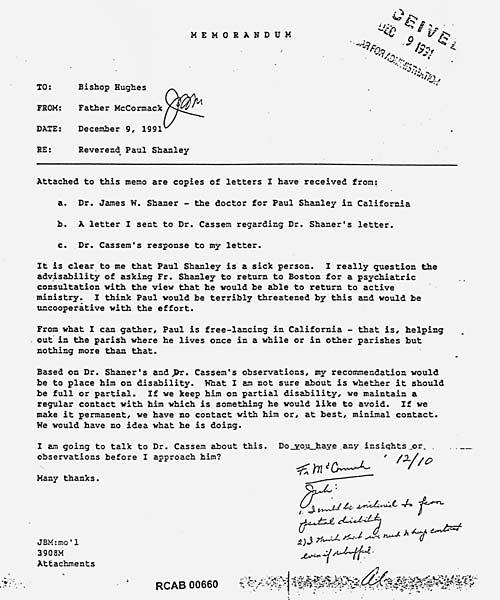
Feb. 29, 1996: Letter from Cardinal Bernard F. Law to the Rev. Paul R. Shanley.
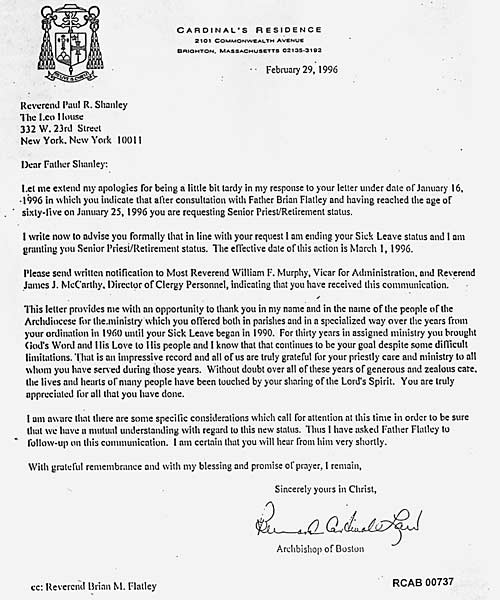
October 4, 1997: Report of the Rev. Paul Shanley's talk at a church in Rochester, N.Y., Sept. 23, 1977, in a letter from Dolores Stevens to Jeanne D. Sweeny.
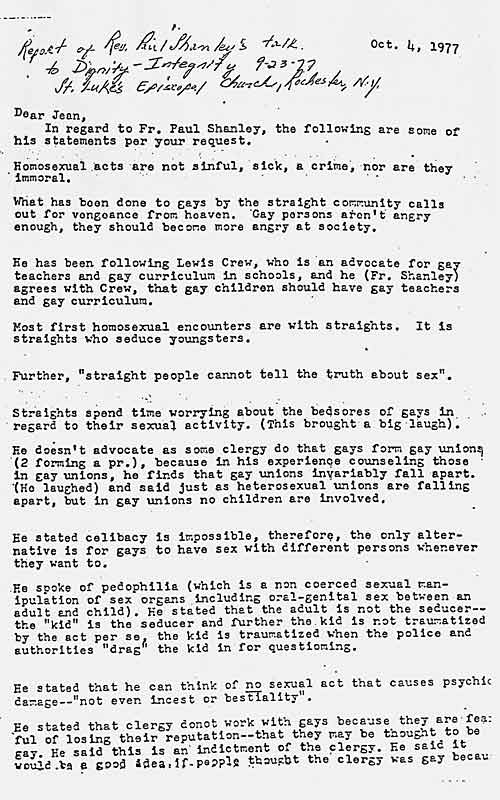
Feb. 12, 1979: Exceprts from Gayweek magazine coverage of conference on man-boy-love.
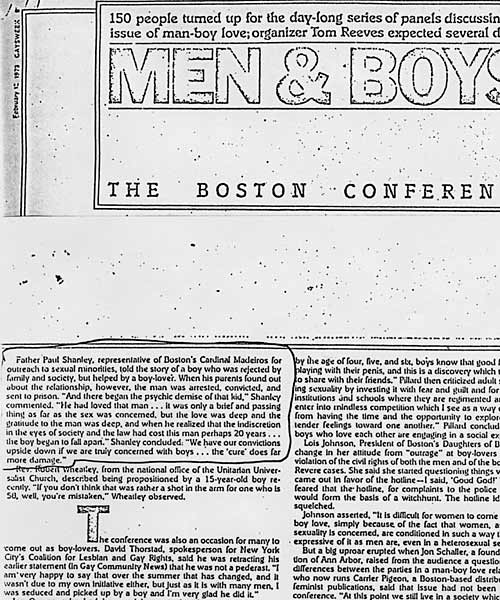
Sept. 6, 1977: Letter from the Archdioses of Boston, the Rev. William F. Murphy to the Rev. Paul Shanley.
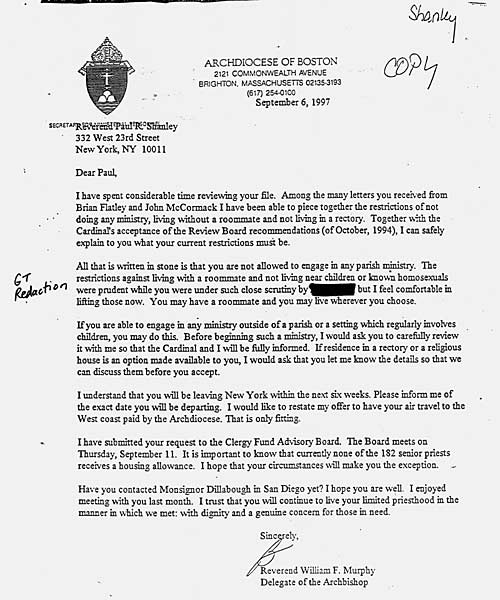
Globe Staff reporters Kevin Cullen, Sacha Pfeiffer, Matt Carroll, and Tatsha Robertson contributed to this report.
© 2002, Globe Newspaper Company
By Michael Paulson
Globe Staff
WELLESLEY - In the basement of a parish school at Saint John the Evangelist Church, a quiet revolution is brewing.
A group that started three months ago as a listening session for parishioners upset about clergy sexual abuse has grown explosively in the past few weeks, drawing about 4,200 supporters from 36 states and 19 countries.
Each Monday night, hundreds of people are packing the Wellesley Hills church, so many that they can no longer fit into the school basement, so many that the group, called Voice of the Faithful, is starting to meet several nights a week and is considering finding a new home. Hundreds of thousands of computer users are visiting the group's Web site, including some from Vatican City, and dozens of simultaneous debates and discussions are raging on the group's electronic bulletin boards.
One of Cardinal Bernard F. Law's former spokesmen has joined, as have numerous parish council members, religious education teachers, lectors, eucharistic ministers, and other church activists. A handful of nuns have begun appearing at the group's meetings, and some priests are sending supportive e-mails.
The all-volunteer group is incorporating as a nonprofit so it can raise money for Catholic causes independently from Law, is preparing to hire a full-time staff, and is working to establish chapters around the nation.
"If I had a dream of what this would look like three years from now, our enrollment would be half of the Catholics in the world, every parish would have a chapter, and every diocese, every nation, and the world would, too, and that organization would be a counterbalance to the power of the hierarchy - it would have a permanent role, a bit like Congress," said Dr. James E. Muller of Newton, president of the group. The last time Muller took on such a daunting task - preventing nuclear war between the superpowers - he shared a Nobel Peace Prize.
"My nightmare scenario is that the church successfully papers over the clergy sexual abuse problem and leaves intact an abusive power structure," he said. "That's why we're moving so fast, why we're meeting three times a week now. Because we know we have to seize the moment."
The group is animated by a simple slogan, "Keep the Faith, Change the Church," and a 25-word mission statement, "To provide a prayerful voice, attentive to the Spirit, through which the Faithful can actively participate in the governance and guidance of the Catholic Church," that took weeks of painstaking negotiation.
It started out with small gestures - a group of women from the Wellesley parish wore red jackets to the Archdiocese of Boston convocation, a gathering of parish lay leaders in March, to demonstrate their sorrow. But members are rapidly stepping up their pace, including an attempt to find a way, under the leadership of a Boston University management professor, James E. Post, to exert financial pressure on the church. The group is relying heavily on its Internet site (www.votf.org) to facilitate communication, but it has also rented the Hynes Veterans Memorial Convention Center in Boston for a July 20 convention they hope will draw 5,000 people from across the nation.
"There have always been people on the activist agenda who have wanted to change the church, either on the left or on the right, and who haven't had much impact. But this crisis has moved the broad middle of the church, people who have been pretty content and have been complacent," said Stephen J. Pope, chairman of Boston College's theology department. "There are a lot of mainstream, middle-of-the road Cathlics who are feeling called to be active in the church in a new way, and that's one of the significant elements of this crisis."
Pope addressed the group this week, along with two Nobel laureates and a victim of clergy sexual abuse. Pope urged the organization "not to be heretics, usurpers, or schismatics, but for the good of the church." He dismissed concerns expressed by Law that lay groups might provoke divisiveness, and said "the state of division already exists within the archdiocese." He said some laypeople are now contemplating the withdrawal of all financial support in an effort to pressure priests to pressure the bishops.
"I love the Catholic Church, but our fatal flaw has been the passivity of the laity," Pope said, to wide applause. "This event is finally getting laypeople off the stick, and that is valuable."
Law has sent mixed signals about his interest in supporting lay activism. He has spoken out several times in support of an increased role for the laity, but last week he attempted to squelch an effort to organize an association of parish pastoral councils. His spokeswoman, Donna M. Morrissey, did not return a telephone call yesterday seeking comment.
The obstacles to the group's influence are enormous. Neither the Vatican nor the American bishops have expressed any support for structural change in the church as a result of the clergy sexual abuse crisis, preferring to debate targeted steps to make sure that priests who molest children are removed from ministry and prosecuted. And the group faces organizational challenges as well as the danger that the public energy may not be sustainable.
The group is determined, at this stage, to avoid taking positions on controversial questions such as the ordination of women. The group is consciously trying to distance itself from a raft of liberal reform groups that have sprung up over the years and have little influence in the church, and from the handful of protest groups that have been formed in the last few months to stage demonstrations against Law.
The group's membership seems to share broad anger at the hierarchy. At a meeting several weeks ago, 94 percent of the people surveyed said Law should resign; 89 percent of those surveyed said they do not intend to contribute to the Cardinal's Appeal, an annual fund-raiser for the archdiocese's operating budget that will be held this weekend.
The group's weekly gatherings have taken on the tone of revival meetings, with a charismatic emcee, Mary Scanlon Calcaterra, who is prone to shouting things like "Praise the Lord" after someone gets up to give personal testimony.
This week, the group heard from a nun, Sister John Julie of the Sisters of Notre Dame, who told the group she was tired of seeing photos only of men in the Boston Catholic Directory.
"When I heard about Voice of the Faithful, I knew this was the new picture, and I wanted to be in this one," she said.
And the group heard from Phil Saviano, the New England director of the Survivors Network of those Abused by Priests, who said after 10 years of speaking out about his own molestation, Monday night was "the first time I have ever been asked by any group of parishioners to come say hello."
The original members were Wellesley parishioners like Luise Cahill Dittrich, a 56-year-old marketing consultant who says she was anguished when she first read about child molestation by the Rev. John J. Geoghan and thought her own son could have been a victim.
"We started as a group of heartbroken people who needed to talk," she said. "If we didn't have some mechanism for seeking justice, I don't know if I could stay in this church right now."
Dittrich said Voice of the Faithful has already succeeded by providing an outlet for upset Catholics, but she hopes it will do much more.
"We're trying to save the hierarchy from itself, from its own insularity, its own tendency to secrecy, its own medievalism, by bringing in the laity - with our ideas," she said. "They need us. They don't know how to police themselves."
Among the members of the group's steering committee is Ernest J. Corrigan, who until recently was one of Law's public relations consultants. But Corrigan is also a St. John's parishioner who has sent all four of his children to the parish school in which Voice of the Faithful now meets.
"I really believe that the cardinal ought to embrace what this organization is trying to accomplish, because it espouses many of the things that he has talked about himself, such as the need for the laity to be more involved in the life of the church," Corrigan said.
The group has tried unsuccessfully to set up a meeting with Law, and is now trying to meet with his vicar general.
"It's amazing to see the amount of people coming to these meetings and to hear their comments, and at the end of the day, it's the same message: 'We want to be heard. We want to be part of the process for change,'" said Gisela Morales-Barreto, a 48-year-old psychologist and a parishioner at Our Lady Help of Christians Church in Newton.
"I don't know what's going to happen in the end, but this is a very important time. ... these sexual abuse victims endured horrific pain and trauma, and the good that is coming out of it is people coming together to support them and look for change in the church while keeping faith alive."
© 2002, Boston Globe Electronic Publishing LLC
By Kevin Cullen
Globe Staff
When Suffolk Superior Court Judge Constance M. Sweeney ordered Cardinal Bernard F. Law to submit to questioning by lawyers for the alleged victims of convicted pedophile and defrocked priest John J. Geoghan last week, it was a legal watershed.
Law became the first cardinal in the United States to be deposed over his actions as a prince of the church.
But Law's being forced to submit to the standards of the secular world in the most Catholic metropolitan area in the nation is as much a cultural sea change as a legal one. It is the latest and most dramatic example of how much the deference traditionally shown the Catholic Church has eroded.
The cardinal finds himself embattled not simply because of his handling of miscreant priests like Geoghan, but because those with power in the secular world, most of them Catholic, have deemed it necessary and acceptable to delve into areas that local custom long treated as off-limits.
Prosecutors, judges, and politicians who once looked the other way when it came to the church's dirty laundry are now holding the cardinal and other church leaders to a higher standard.
The decline of deference has occurred throughout the United States, but it has been most dramatic in Boston, where the church is a powerful institution in the only major metropolitan area where Catholics make up more than half the population.
Most of these secular authority figures are the children, grandchildren, or great-grandchildren of immigrants who owed much to the church for giving them a foothold and a place in the New World. But in many cases, that sense of unquestioning loyalty has been replaced by moral outrage and a belief that the Boston Archdiocese put concern for its reputation and its priests ahead of concern for its most vulnerable members: children.
Growing up in a family that prayed together daily
Attorney General Thomas F. Reilly grew up in what he calls "a typical Irish Catholic family." His immigrant parents were deeply religious. Like many Irish who settled in Springfield, Bridie Reilly hailed from Dingle, a quaint harbor town in County Kerry. Mortimer Reilly, a Mayo man known as "Murty," worked for the Springfield Department of Public Works.
"We knelt down and said the rosary, as a family, every night," the attorney general remembered.
Reilly fondly recalls the Sisters of St. Joseph who taught him at Cathedral High School. His mother and a priest worked as a team to get him into a Catholic college in Canada.
"The church I grew up in cared about kids," said Reilly.
As a young prosecutor, Reilly learned of a priest who had sexually abused a child in Arlington, but he considered it an aberration. When the extent of the abuse committed by former priest James Porter in the Fall River Diocese became known in 1992, Reilly said he was shocked, but he gave the church the benefit of the doubt after Law announced a new policy to aggressively deal with allegations of abuse.
Then in January, as he read disclosure after disclosure about how church officials had moved Geoghan from parish to parish, Reilly became furious.
As he read how the cardinal sent soothing letters to Geoghan, and later to the Rev. Paul Shanley, an accused child rapist, praising their priestly careers, he recalled reading two years earlier about Sister Jeannette Normandin, a 72-year-old nun who was ousted from a South End church because she violated canon law by baptizing two boys. There was no second chance for the nun.
"And then look how they treated priests who raped children. They were raping children," said Reilly. "Where's the moral outrage?"
Besides getting mad, Reilly fired legal shots at the church, forcing Law and the archdiocese repeatedly to alter course. After the initial reports about Geoghan, the cardinal apologized for past mistakes and promised to report any future allegations against priests to the authorities - but not any accusations that had been made in the past.
Reilly said Law's response reminded him of what the cardinal had said a decade before in response to the Porter case.
"He was basically saying, `Trust us, give us the benefit of the doubt, we'll create a commission to make sure this doesn't happen again.' Well, we tried that. It didn't work."
Fighting with the Irish rebels
When Reilly spoke out against Law, Essex District Attorney Kevin M. Burke spoke with him.
Burke grew up in Malden, then moved to Beverly when he was 10. His grandparents were Irish immigrants, and his grandmother was a daily communicant. His grandfather served with the Irish rebels who fought the British for independence, and never forgave the church hierarchy's opposition.
As children, Burke and his siblings attended Mass daily during Lent. Burke looked upon priests "as separate from the rest of us, as special people, as holy people deserving our respect." But his life experience changed those views.
In 2000, when Burke's office brought charges against Christopher Reardon, a lay worker who pleaded guilty to raping and molesting children, "the church was less than forthcoming, to put it mildly," said Burke.
"But what really struck me, in communications with the archdiocese, was that there was never any concern shown for the victims. Not the slightest nod of concern for these young people whose lives were turned upside down by this abuse," he said.
The inability of church leaders to sympathize with the victims led Burke to conclude that the bishops were out of touch. Reilly came to the same conclusion as he read Law's "God bless you, Jack" letter to Geoghan. "The cardinal didn't send letters like that to the victims," Reilly said.
A week after Law insisted there were no sexually abusive priests working in the archdiocese, Reilly and Burke went public, saying that prosecutors, elected and accountable to the public, should be deciding the culpability of sexually abusive priests - not the cardinal. They said Law's zero-tolerance policy had to be retroactive to cover priests against whom allegations had been made, and which still might be prosecutable.
"I wouldn't say Tom and I speaking out made us profiles in courage as much as a reflection of the deference in society that has been eroded," said Burke.
The cardinal quickly relented. But when the archdiocese refused to turn over the information prosecutors needed to judge the merits of the cases, Reilly called together the five district attorneys who cover the archdiocese - Burke, Middlesex District Attorney Martha Coakley, Suffolk District Attorney Daniel F. Conley, Norfolk District Attorney William R. Keating, and Plymouth District Attorney Timothy J. Cruz. The prosecutors, all of them Catholic, sent a letter to the archdiocese containing a thinly veiled threat to haul church leaders before a grand jury if it didn't turn over more information. Less than 24 hours later, the prosecutors had what they wanted.
Reilly said the response from the public convinces him that ordinary people want secular authorities to be less deferential.
"Almost every day, somebody comes up to me and says, `Keep doing what you're doing,"' said Reilly.
Some believe prosecutors should be tougher
Some legal specialists say prosecutors haven't gotten tough enough. Joseph di Genova, a former US attorney in Washington, said Boston-area prosecutors are still being too soft on the church. And di Genova said Coakley compromised herself by sitting on the commission Law created in response to the scandal to explore ways to prevent abuse.
After her office filed rape charges against Shanley last week, Coakley resigned from the commission, acknowledging there was at least a perception of a conflict of interest. But she bristles at charges that she and other prosecutors are afraid to go after the church hierarchy.
"If we had the statutes, we'd prosecute anybody, including the cardinal," she said. "But the statutes are not there. We looked. Civil law provides for remedies for negligent supervision. But in Massachusetts, there are no criminal law provisions in this area."
Reilly says he has not ruled out bringing charges against Law and other church leaders.
Eight years ago, before it was fashionable, Coakley aggressively prosecuted a priest for sexual abuse. Although she lost the case, her willingness to pursue it was part of the process of challenging the prevailing attitude that priests didn't do this sort of thing.
Coakley grew up in North Adams, went to Mass at St. Joseph's Church, and to class at St. Joseph's School. Her father was a daily communicant. Her two sisters went to Catholic colleges. She sang in the choir. She sensed early on that women weren't equals in the church, but "in general, I have fond memories of my growing up in the church."
Coakley said the idea of priests sexually abusing children didn't enter her consciousness until she was in her 30s, when she began prosecuting sexual abusers.
"People expect the guy to be drooling, lurking around in a trench coat. But when I started doing these cases, it became obvious that most abusers are caretakers, respectable people who use that respectability as a cover to carry out their abuse. There was an aura around priests that protected them, and that protection extended to sexual abusers," she said.
In 1993, Coakley prosecuted a priest, the Rev. Paul Manning, for sexually abusing an 11-year-old boy in a Woburn rectory. The victim recanted, but Coakley pressed ahead, in part because Manning's chief accuser was a credible witness - another priest, the Rev. Paul Sughrue.
She lost the case, but looks back at it now as part of an educational process for her, the public, and the church. Despite his acquittal, Manning was removed from ministry by the archdiocese. Coakley said attitudes have changed dramatically in the eight years since she unsuccessfully prosecuted Manning.
"I think juries are more willing to convict," she said.
Judges also more willing to issue tough sentences
Judges are more willing to mete out severe punishment, too.
When a Middlesex County jury in February convicted Geoghan of squeezing the buttocks of a 10-year-old boy at a public swimming pool, the indecent assault charge involved was one of the less egregious acts of abuse he was alleged to have carried out over the years. But Judge Sandra Hamlin stunned some legal observers by handing down a 10-year sentence, the maximum allowed.
That sentence was much harsher than the one Judge Walter Steele gave the Rev. Eugene O'Sullivan, the first priest in Massachusetts convicted of sexual abuse, in 1984. The prosecutor, George Murphy, asked for three to five years after O'Sullivan admitted he had anally raped a 13-year-old altar boy. Steele gave the priest probation on the condition he was not allowed to work with children. The Boston Archdiocese ignored the judge by shipping O'Sullivan to a parish in New Jersey.
In 1991, when prosecutors in Western Massachusetts went to get a search warrant for the home of the Rev. Richard Lavigne, who later pleaded guilty to molesting three boys, a judge refused to give them a warrant, saying it would be outrageous for police to search the home of a priest.
"There was a lot of deference shown the church," said David A. Angier, who prosecuted Lavigne.
Judges, many of them Catholic, were complicit in the secrecy that kept the extent of the abuse hidden from public view. Between 1992 and 1996, for example, a group of judges sitting in Boston chose to impound all the records in five lawsuits involving three priests who molested children because they reasoned that, as one judge put it, "the particulars of the controversy" ought to be kept from the public. In one case, a judge impounded all the records even though the victim testified that he only wanted his identity kept from public view.
In a confidential 1985 report done for US bishops, the church began to realize its special treatment was in jeopardy. "Our dependence in the past on Roman Catholic judges and attorneys protecting the diocese and clerics is gone," the report said.
That warning came true in the person of Judge Sweeney, a Springfield native who spent 16 years in Catholic schools, the same amount of time she has spent on the bench. Last year, Sweeney decided the public interest outweighed the church's traditional First Amendment defense, siding with a motion by the Globe to unseal Geoghan's file, opening some 10,000 pages of internal church records which fueled the unfolding scandal when they were made public in January.
And when the archdiocese reneged on paying Geoghan's victims, Sweeney stunned Law's lawyers by ordering his deposition, saying the cardinal was no different than anybody else.
Abuse was hidden from public view
The deference shown by Massachusetts lawmakers, three-quarters of them Catholic, helped create a system by which predators like Geoghan could sexually abuse children with impunity, shielded by an archdiocese that had a strong incentive, and was within its legal rights, to hide the abuse from public view.
Reilly said the refusal of Massachusetts legislators to include clergy in a bill requiring police officers, teachers, doctors, and social workers to report suspected child abuse that became law in 1983 was a disastrous mistake. On May 3, Massachusetts joined 28 other states that make clergy mandated reporters. Reilly said he wonders how many children might have been left unharmed if the law had been implemented two decades ago.
Marian Walsh, a state senator from West Roxbury, may have been the cardinal's favorite lawmaker. But, after the scandal broke in January, she filed a bill that would make the way Law handled abusive priests a crime. The bill, still pending, would punish supervisors who knowingly expose children to sexual abuse.
Walsh's grandparents arrived from Ireland with little more than a steamer trunk. They worked hard to send her father to Boston College. He went on to become an obstetrician. Her mother got two degrees from Catholic colleges. The church was the family's anchor.
"Their faith was important to my parents as a couple," Walsh said. "They went on retreats. They tried hard to live their lives according to the basic tenets of the church, and my parents sacrificed a lot for the church."
Walsh had long been an admirer of Law, especially for his outspoken opposition to abortion and his work for social justice. Although some Catholic legislators were opposed to abortion, Walsh was one of the few who also sided with Law in opposing the death penalty. But she was furious when she read of what she called Law's dishonesty in handling Geoghan and other sexually abusive priests. She felt betrayed.
"I never thought that a leading facilitator for child abuse would be the church, where the church would supply the victims and hide the perpetrators," she said.
"I understand why pedophiles do what they do. I still can't understand, I still can't appreciate, how the church could do this, how sophisticated and how diabolical this was. And how the cardinal could preside over it."
After the Shanley documents were made public, Walsh became the first state lawmaker to openly call for the cardinal's resignation. When Law blamed poor recordkeeping for his failure to stop Shanley, politicians of all stripes let him have it. There had been a discernible change in the political culture of Massachusetts: The cardinal was now fair game.
As one DA sees it, church should be worried
Burke believes the erosion of the deference shown the church could lead to a "mini-Reformation."
"There's no Martin Luther here, and whether the Vatican pays attention, who knows?" he said. "But we're dealing with a medieval organization, an organization that represented authority to my grandparents and other immigrants. It was an organization that was respected because it educated them, it gave them a place in the New World, it gave them an identity.
"But with assimilation, the average Catholic's need of the church is not social or political, it's moral and spiritual. And this behavior of the church is so at odds with being moral and spiritual. The church's leaders should be worried about a lot of things, but they should be most afraid of the lack of deference now shown them.
"They should not think that once this scandal fades, people will come running back to them. I know I won't."
© 2002, Globe Newspaper Company
By Sacha Pfeiffer
Globe Staff
To many of his clients, Roderick MacLeish Jr., who estimates he has represented 400 alleged victims of sexual abuse by priests in the past decade, is nothing less than a hero.
His work on their behalf, they say, has given them a voice after years of painful silence, and has brought them a measure of long-sought justice. His public criticism of Cardinal Bernard F. Law's handling of the Boston Archdiocese's sex abuse crisis has made him one of the country's best-known clergy sex abuse plaintiff lawyers. And his newfound celebrity has resulted in dozens of new clients. But MacLeish's work and that of other attorneys who handle church molestation cases have also come under public criticism.
In the view of their detractors, MacLeish and other lawyers who now condemn church officials for covering up the crisis have contributed to that coverup by signing secret settlements that prevented the scandal from erupting into public view sooner.
In the process, they often won sizable sums of money for their clients -- and themselves, because they routinely took between 30 and 40 percent of those payments. And their financial successes have spurred copycat lawyers eager to try their hand at what has grown to become a lucrative litigation niche.
"Plaintiff lawyers settle cases confidentially all the time," said Paul J. Martinek, editor and publisher of Lawyers Weekly USA, a professional journal. "But if you know your client's been raped by a priest and you settle the case confidentially, knowing that the priest could go out and do it again, your hands aren't entirely clean."
Middlesex District Attorney Martha Coakley has also had harsh words for some attorneys who represent victims of priests, saying in an interview that "the plaintiff lawyers bear some responsibility" for keeping abuse by priests out of the public eye by settling cases confidentially.
Looking back, silence has become hard to take
Boston attorney Laurence E. Hardoon, who took on his first clergy sex abuse client in 1992 and has since handled between 20 and 30 such cases, reflected on his role in this ugly chapter with a twinge of regret.
"If we had any inkling whatsoever of the magnitude of harm that was out there, maybe we, as a joint group of plaintiff lawyers, would have tried to encourage our clients to be outspoken in many cases," said Hardoon, who formerly served as a Middlesex assistant district attorney. "It's hard not to look back and say the greater good would really have been served by the lack of secrecy earlier on."
Jeffrey A. Newman, of the Boston firm Newman & Ponsetto, has represented scores of alleged clergy sex abuse victims, and voiced a public mea culpa over his involvement in a handful of earlier cases that he settled secretly.
"Had I been more astute, I probably could have recognized the problems better," Newman said. "I just never took the time to examine them closely enough."
But MacLeish, Hardoon, Newman, and other plaintiff lawyers also say they were hamstrung by restrictive state laws that limited their ability to press charges against alleged offenders. They also blame legislators for failing, until recently, to require church officials to report suspected abuse. They and others have also pointed a finger at judges, prosecutors, and the press for being too deferential to the church over a long period of time.
They argue they were torn between their obligation to zealously represent their damaged clients, few of whom wanted their personal lives exposed in a courtroom, and the church's reluctance to settle cases without confidentiality clauses. As a result, some legal experts say, secrecy was often the only option.
"If you can get $100,000 or $500,000 for your client and the price of that is silence, the lawyer's sort of in a bind," said Andrew L. Kaufman, who teaches ethics at Harvard Law School and sits on ethics committees for the Massachusetts Bar Association and Supreme Judicial Court.
"Ultimately, it's the client who instructs the lawyer on whether to accept the offer," Kaufman said. "And as long as a confidential settlement is lawful, sometimes a lawyer's got no choice but to accept it."
The widespread use of confidential settlements has prevented the public from learning the extent of other serious problems as well, such as in cases involving product liability. It has sparked a debate in the legal profession about whether the public interest is served by such secrecy.
Because many clergy sex abuse victims struggle with substance abuse, depression, and suicidal thoughts, "it's hard to fault an attorney for settling a case in that circumstance," said David Clohessy, national director of the Survivors Network of those Abused by Priests. Clohessy wondered if some of the hostility felt toward plaintiff lawyers is an inevitable outgrowth of the anger and sense of betrayal stirred by the crisis.
"It's so horrific to think that literally dozens and dozens of priests molested hundreds and hundreds of kids, and that the princes of the church allowed this, that I think people are casting about psychologically," he said. "People want to point fingers, or at least point blame partially elsewhere."
Settlements, secrecy serve many roles
Other plaintiff attorneys offer no apologies for having settled cases in secrecy. Among them is Mitchell Garabedian, whose lawsuits against former priest John J. Geoghan set the stage for the release of thousands of pages of Boston archdiocesan files, which revealed that church officials reassigned Geoghan despite knowing about his abusive past.
Garabedian began handling clergy sex abuse cases in the late 1980s and represented his first Geoghan victim in 1994. To date, the Boston-based lawyer estimates he has represented 250 alleged victims of dozens of priests. Before filing the Geoghan lawsuits, he said, he settled about 30 clergy sex abuse cases, many in confidentiality. Yet he's since come to believe that secrecy causes victims to feel "more unnecessary guilt about the sexual molestation, even if it's years later." So he has vowed that confidentiality will not be part of any settlement in the Geoghan cases.
Still, Garabedian said he harbors no regrets about the settlements he negotiated in secrecy, often at his clients' insistence. "They were embarrassed, and many victims thought they were the only ones," he said.
But with time, his growing sense that "the decay was so deep and wide that it was almost beyond belief" motivated him to file the Geoghan lawsuits.
Jeffrey R. Anderson, a Minnesota lawyer who estimates he's represented more than 1,000 clergy sex abuse victims since taking his first church case in the early 1980s, said he has never agreed to a confidentiality clause, even if it's meant walking away from a potentially lucrative case.
"I am greatly offended by the frequency and number of confidentially settled agreements," Anderson said. By requiring confidentiality, he said, "the church overwhelms lawyers and survivors into silence and secrecy . . . and I don't like it."
Anderson's very public crusade against dioceses that conceal the abuses of predatory priests has made him the nation's most prominent clergy sex abuse plaintiff lawyer. It has also made him very wealthy; he estimates he has won more than $60 million in settlements from Catholic dioceses.
His 20 years spent battling the Catholic Church has made him more than familiar with complaints about laywers like himself.
"We get harshly criticized, but I hail that criticism and I wear it as a badge of honor," Anderson said. "The only equalizer in our system is the courage of the survivors and a few lawyers and our jury system."
Indeed, were it not for the plaintiff attorneys, many of their defenders say, clergy abuse victims would have little means of recourse.
"It should not be forgotten they are doing a job that nobody else did," said Martinek. "Nobody else brought this out and exposed it."
Matters of legality, money come into question
Plaintiff lawyers have also come under fire for publicizing church files released during litigation before knowing whether they would be admissible at trial. The result, say critics like Boston attorney Timothy P. O'Neill -- who in an interview blasted what he calls the "promiscuous public disclosure" of discovery documents -- is trial by media.
O'Neill, who has frequently represented accused priests on behalf of the archdiocese, including several named in current lawsuits, specifically mentioned "PowerPoint presentations." It is an apparent reference to the 2 1/2-hour multimedia event staged April 8 by MacLeish to publicize more than 800 pages of damaging church documents about the Rev. Paul R. Shanley.
And last month, Judge Constance M. Sweeney sharply criticized Garabedian's associate, William H. Gordon, for his role in the premature release of Law's deposition in the Geoghan case. "You blew the rule sky high here and you blew it to the detriment of the defendants," Sweeney told Gordon.
MacLeish steadfastly defends his decision to make discovery documents public, saying, "I think it's absolutely imperative people know the truth."
He said he is fiercely proud of his 10-year history of handling clergy sex abuse cases, noting that many of the 200 or so cases he settled confidentially required abusive priests to leave active service and submit to treatment.
MacLeish, who works for the Boston office of Greenberg Traurig LLP, acknowledged that he received some client referrals from Sister Catherine E. Mulkerrin, the archdiocese's former sex abuse liaison. He also conceded that he required some clients to sign paperwork specifying that although he would represent them in settlement negotiations with church officials, he would not necessarily represent them if they insisted on filing a lawsuit against the church.
But he noted that some allegations were so old they were barred by the statute of limitations from proceeding to trial, making an out-of-court settlement the sole option. He said negotiations were sometimes only a first step in investigating complaints, noting that he has filed lawsuits on behalf of scores of clergy sex abuse clients.
Furthermore, although clergy sex abuse cases have often been a cash cow for lawyers representing victims, many of them note that when the first steady trickle of allegations began in the late 1980s, it was uncertain whether the cases would be money-makers at all.
Hardoon, a member of the Boston firm Brody, Hardoon, Perkins & Kesten, said, "For every case in which I made a significant recovery, there were probably seven or eight others in which I think I made a minimal recovery or was almost working pro bono on behalf of the client."
Added MacLeish: "Are we interested in getting good cases? Of course we are, because we think we can help people. Do we take a fee because of that? Yes . . . Could I be doing trade secret litigation at $500 an hour? Yes. But I choose to do this because I want to make a difference. This is not about money, and anybody who suggests that doesn't know what they're talking about."
The handsome settlements many victims have received from the church have sparked a scramble for new business in what has proved to be a financially enriching field of the law.
Mark M. Rufo, a Nashua, N.H., personal injury lawyer, said he was recently retained by a dozen clients after running ads in several New Hampshire newspapers that listed a toll-free number for clergy sex abuse victims. "Can work for a percentage," the advertisements said.
Rufo, who never handled a church molestation abuse case before placing his ads, is unapologetic about his strategy for landing new cases.
"That's the American way," he said.
© 2002, Globe Newspaper Company
By Michael Paulson and Thomas Farragher
Globe Staff
DALLAS - The US Conference of Catholic Bishops, responding to the firestorm that has erupted over the church's frequent failure to fire sexually abusive clergy, yesterday voted to bar from ministry any priest who has ever abused a minor.
But bishops stopped short of requiring that abusers be removed from the priesthood, leaving that to the discretion of presiding bishops. Bishops did, however, agree to require themselves to report all allegations of sexual abuse of minors to public authorities.
The new policy, approved overwhelmingly on a vote of 239-13, came five months after the current scandal exploded in Boston.
It is in some ways tougher than the policy proposed by a subcommittee last week: It no longer allows some priests who committed only one act of abuse in the past to continue in ministry. But in other ways, the policy is weaker: It no longer requires that bishops ask the pope to take the ultimate step of defrocking all abusers.
And to the dismay of many church critics, as well as some bishops, the new policy does not require any action against bishops, such as Cardinal Bernard F. Law of Boston, who in the past failed to remove abusive priests from ministry. But the bishops named Governor Frank Keating of Oklahoma to a national panel that is supposed to study the church's handling of sexual abuse, and Keating said he will call for bishops who have failed to protect children to resign.
Bishop Wilton D. Gregory of Belleville, Ill., the president of the bishops' conference, who has led the nation's largest religious denomination through the greatest crisis in its history, proclaimed the new policy a success.
"From this day forward, no one known to have sexually abused a child will work in the Catholic Church in the United States," Gregory said. "... No free pass. No second chances. No free strike."
Victim advocates assailed the policy, saying they want all abusers removed from the priesthood, and not just from jobs in ministry. And they criticized the absence of measures holding bishops accountable.
"The document is the best document the church has ever put out on this issue," said David Clohessy, national director of the Survivors Network of those Abused by Priests. "Is it enough? We don't think so. Will it be implemented? We'll have to wait and see. History tells us we cannot be complacent and we cannot take these men at their word."
The policy says that any priest who has ever abused a minor will be permanently removed from ministry, and is barred from celebrating Mass publicly, wearing clerical garb, or presenting himself publicly as a priest. The abusive priest could continue to celebrate Mass privately, but is expected "to lead a life of prayer and penance." Either the offending priest or his bishop could ask the Vatican to defrock the priest, but that step would not be mandatory, and the bishops suggested they would not pursue that route, especially for priests who are old or infirm.
Much of the policy requires approval by the Vatican to become mandatory. The Vatican withheld comment yesterday on the proposal, pending a review by the Holy See.
Gregory said he expects expeditious approval, and that even before it is approved the bishops are expected immediately to begin voluntary implementation. The bishops pledged themselves to a day of prayer, fasting, and reparation on Aug. 14, and said that at their next meeting, in November, they would issue a report evaluating how well every bishop has done at putting the new requirements into place.
Under the new policy, the nation's 194 dioceses will be required to check the backgrounds of all diocesan and parish personnel who have contact with children and young people - a practice already in effect in many dioceses. And in making new assignments or transfers, bishops are now required to fully report a priest's record, including anything that might call into question his fitness for ministry.
In an effort to curb the secrecy that has characterized the church's handling of clergy sexual abuse in the past, dioceses will now be prohibited from entering into legal confidentiality agreements "except for grave and substantial reasons brought forward by the victim [or] survivor." The policy calls for church leaders to adopt practices of "transparency and openness" in dealing with the public and the news media.
The policy requires local diocesan review boards to assess allegations, and those boards must be dominated by lay people. And the policy establishes a national Office for Child and Youth Protection to help dioceses implement "safe environment" programs and produce an annual public report on how the new policy is being implemented. The office's work will be reviewed by a national board that will be headed by Keating of Oklahoma and will include attorney Robert Bennett and Illinois Appeals Court Judge Anne M. Burke, as well as victims.
"As a Catholic layman, I am horrified and angry and shocked and puzzled and amazed that such criminal, such horrific, such sinful acts could occur within my faith community," Keating said in an evening news conference in Dallas. "It is a horrific and pitiful statement ... that people who have been ordained to the ministry would do such things."
Keating's panel is supposed to commission the church's first major study of the scope of clergy sexual abuse, which is to include statistics on the numbers of perpetrators and victims. Keating said that he expects his commission to call for the resignation of bishops who protected abusive priests, an act that he called obstruction of justice.
"To suggest someone would get away in the eyes of the church is simply inconceivable to me," he said.
And it requires every diocese to establish a system to reach out to every victim of clergy sexual abuse, no matter when that abuse occurred, and to offer them counseling and other social services agreed upon by the diocese and the victim.
The bishops approved the policy after two days of debate, first privately and then publicly, and after an unprecedented session of listening to the stories of victims and criticism from lay advocates of church reform. Law did not participate in the public debate except to suggest some technical changes.
Only one bishop publicly complained about the failure to call for discipline of bishops. He said the issue of resignation of bishops should have been mentioned in the document, and pointed out that one bishop in Ireland has resigned for his failure to protect children from an abusive priest.
"My grave concern is that we have deflected the primary anger of the Catholic people from the bishops to the priests," said Bishop Joseph M. Sullivan of Brooklyn. "The reality is we were blind. We were so cowed by the fear of scandal that we did not see the real problem ... We failed."
A number of bishops thought the policy was too tough on priests, and said it violates the church's teachings of forgiveness.
"The easiest thing for the church would be to get rid of these people, but often there is a great deal of good the church can do by holding on to them while making sure they do not have access to children," said Archbishop Oscar H. Lipscomb of Mobile, Ala. "Justice to our brother priests ... seems to me part of our exercise."
Some bishops objected to reporting all allegations to state authorities, saying the church should first decide whether the allegations are credible.
"We should not abandon truth," said Bishop Thomas G. Doran of Rockford, Ill., who pointed out that church canon law has a longer history than the US Constitution. "When we do this, we rat out our priests, and I'm not in favor of that."
Bishop John T. Steinbock of Fresno, Calif., fretted about allegations "from some crazy person, which we all have in our dioceses."
But such objections were quickly shot down by the majority.
"Anything we do to seem to give ourselves wiggle room will be immensely counterproductive," said Archbishop Daniel E. Pilarczyk of Cincinnati. "It is not well advised, and may even be illegal in some places."
And Cardinal Roger M. Mahony said he has twice been falsely accused of abuse, and that "I welcome the police intervention early."
A handful of bishops opposed the policy, as did one of the church's most important thinkers, Cardinal Avery Dulles, a Jesuit priest who is a theologian at Fordham University and an honorary member of the bishops' conference.
"We are depriving people of ministry not only for heinous crimes, but also for things that might be looks and touches that might be interpreted by some court as sexual molestation," he said. "I think there are many things in the document that require further reflection."
And retired Archbishop Francis T. Hurley of Anchorage called the policy "seriously flawed."
"In many respects we have left ourselves open to charges that we sound like legislators who are getting a quick fix," he said. "We are not as sensitive to our priests as we can be."
But the group overwhelmingly supported the policy.
"We have to give very strong support to this document so we can give assurance, as much as possible, to our faithful, especially parents ... that our children and youth will be safe as much as humanly possible," said Cardinal Anthony Bevilacqua of Philadelphia. "We need strong support for this document to begin the process of healing and reconciliation, to begin to restore the credibility of the church and moral authority ... so that once again our faithful, without any embarrassment, will be able to say, 'I'm proud to be a Catholic."'
© 2002 Boston Globe Electronic Publishing LLC
By Michael Rezendes
Globe Staff
TUCSON - When Monsignor Robert C. Trupia was confronted by his superiors in 1992 with an accusation that he had sexually molested an altar boy, he replied with a pointed warning: Pursue the charge and he would go public with information about an Arizona bishop's sex life, with scandalous results for the Roman Catholic Diocese of Tucson.
Church officials thought they knew what he was theatening to reveal, that he'd had a sexual relationship with James S. Rausch, the late bishop of Phoenix, according to sealed court documents, including church records, obtained by the Globe.
But Trupia's secret was much more explosive. The documents obtained by the Globe, including a secret affidavit in a clergy sexual abuse lawsuit, allege that Rausch, Trupia, and the late Rev. William T. Byrne all had sex during the late 1970s and early 1980s with a Tucson teenager who was later given a chancery job to ensure his silence.
Trupia's explicit threat is part of the sealed evidence in 11 civil lawsuits against Trupia, Byrne, and two other priests that were settled earlier this year by the Tucson Diocese for a sum estimated at $14 million by people familiar with the details. Church officials said they plan to defrock Trupia, who was described recently by Tucson diocese spokesman Fred Allison as "an artful, manipulative, intelligent, and highly skilled pedophile."
But in a troublesome signal for American bishops who have committed themselves to tougher sanctions against abusers, the ouster of Trupia has been blocked by the Vatican's highest tribunal, which sided with Trupia after he appealed an earlier effort to suspend him. Trupia, 54, who is living in Maryland, receives a salary of $1,200 a month and health insurance. He has been removed from active ministry.
"The diocese blames Rome, Rome blames the diocese, and nothing gets done," said Lynne M. Cadigan, an attorney who represented Trupia's alleged victims in the settled lawsuits.
Evidence in the lawsuits (most of which is sealed under a court order) was reviewed by the Globe and includes an affidavit by the former teenager, Brian F. O'Connor, that was given to Cadigan two months before the settlement. Now 40, O'Connor recently provided church officials with further details of his allegations, saying that he was molested as a teenager on numerous occasions by Rausch, then passed along to Byrne and Trupia, ostensibly for drug counseling.
"I wasn't one of those angelic kids who got picked up on the altar and abused in the sacristy, but I didn't deserve what happened to me," O'Connor said in an interview. He said he was still a minor when Rausch molested him but had reached 18, the age of consent, by the time Trupia had sex with him.
Diocesan spokesman Allison declined to comment about the allegations that the bishop and two priests had molested the same teenager. The recent settlement, however, covered allegations by others against both Byrne and Trupia.
Trupia's alleged attempt at blackmail is not the first one to surface since the clergy sexual abuse scandal erupted in January. Records from the Boston archdiocese, for example, show that the Rev. Paul R. Shanley, who has been indicted on child rape charges, tried to prevent the late Cardinal Humberto S. Medeiros from ending Shanley's controversial street ministry by threatening to go public with revelations about St. John's Seminary. Years later, Shanley also wrote to a church official saying he had kept his own alleged sexual abuse by an unnamed former cardinal to himself.
Like Shanley's warnings, Trupia's 1992 attempt to intimidate Tucson Bishop Manuel D. Moreno into revoking a suspension and an order that he undergo a psychiatric evaluation is also documented by church records, including the 1995 letter written by Trupia to Moreno.
In the letter, Trupia recounts the 1992 meeting with Moreno and Moreno's chancellor and notes: "I informed you of my direct knowledge regarding another bishop's activities, which knowledge was potentially of a highly explosive and damaging nature to the Church in Arizona."
"Let me assure you again," Trupia continues in the letter, "that I would not want to be put into a position to be subpoenaed and have to testify under oath as to what I know about this other bishop. At the same time, I am growing quite weary of trying to stand between the Church in Arizona and a torrent of bad publicity that your attempted actions continue to make ever more likely."
Trupia's attorney, Stephen Shechtel, said he would not characterize the letter as blackmail. "It's Father Trupia saying, `Hey, Father Moreno, don't make me out to be the fall guy because I'm not the one who has done a lot of this stuff."'
Memories dredged up
Until recently, O'Connor was content to try to forget his youth as a heroin addict and a six-year employee of the Tucson chancery. He and his gay partner were raising an adopted son and he was busy running an auto repair business.
But late last year he was contacted by a county investigator and later by attorney Cadigan, who was representing 11 men and five of their parents in the sexual abuse lawsuits against Trupia, Byrne, and two other priests that have been settled.
On Nov. 28, 2001, O'Connor signed an affidavit for Cadigan saying that in the summer of 1979, when he was 17, Rausch picked him up on a Tucson street, had sex with him, then sent him to Trupia for counseling. O'Connor also said Trupia had sex with him before hiring him as a temporary assistant at the chancery, where Trupia was a vice chancellor in charge of the marriage tribunal.
Still, in the Globe interview, O'Connor expressed ambivalent feelings about Trupia. Trupia helped him shake his drug habit and purchase a home, he said. But as news coverage of the Tucson settlement and the national scandal exploded, O'Connor said, he grew increasingly troubled by memories of the abuse and drafted a written statement he delivered to Tucson Bishop Gerald F. Kicanas, who has been named as Moreno's prospective successor, and the Rev. Van A. Wagner, the diocese's vicar general.
O'Connor said he has not filed a lawsuit but has asked for a financial settlement of his claims.
In his written account to the diocese in April, a copy of which was reviewed by the Globe, and in several interviews, O'Connor said that when he met Rausch in 1979, the bishop, who identified himself only as "Paul," drove up beside him and offered him a ride. After getting into the car, O'Connor said, he initially resisted Rausch's offer of $50 to allow Rausch to perform oral sex on him, but eventually agreed.
Throughout the summer and fall, a period when O'Connor became addicted to heroin, Rausch contacted him for additional exchanges of sex for money, O'Connor said. Once, he said, Rausch left him alone in his car while registering for a motel room. O'Connor, rifling Rauch's glove compartment, discovered that "Paul" was really Bishop Rausch, and confronted him.
"He explained that he was only relieving stress and any number of other excuses for acting out his libido," O'Connor wrote in his statement.
By that time, Rausch was also concerned about O'Connor's drug use and, after a few additional encounters, said he wouldn't call again. But he recommended that O'Connor contact either Byrne or Trupia, a priest at the parish, for drug counseling, and said O'Connor should use Rausch's name if he reached either of them.
In a recent interview, O'Connor said that months later, in 1980, he located Trupia at Our Mother of Sorrows Church in Tucson but was referred to Byrne, the pastor, who began counseling him on a regular basis, typically at private homes in the area. More often than not, O'Connor said, he would show up high and Byrne would end the sessions by offering him a drink and then sexually molesting him.
Over the next year, O'Connor said, he stayed away from the church and grew more addicted to heroin, although he continued working temporary jobs and also sold drugs. Then, in 1981, he and some friends accepted a ride from someone O'Connor did not immediately recognize. But after climbing into the front seat, he said, he saw that it was Trupia behind the wheel.
Halting an addiction
After Trupia dropped O'Connor's friends off, O'Connor said, the young man erupted in anger over the memory of Byrne's abuse, pummeling Trupia and, when Trupia stopped, leaping from the car and slamming his fist into the side of a dumpster. "The next thing I knew he was standing over me, caressing my head and I was just sobbing," O'Connor said. "He told me, `I'm only here because you came for help and I know you didn't get it. I only want to help you."'
O'Connor said that he rejected Trupia's help but that Trupia kept returning to the neighborhood and eventually persuaded him to share a meal. Soon, O'Connor said, he was meeting Trupia daily, mapping out a plan to gradually reduce the amount of heroin he was using. When Trupia decided O'Connor was ready to stop using completely, O'Connor said, Trupia took him to St. John's College Seminary in Camarillo, Calif., in the Los Angeles Archdiocese, and stayed with him in a room until the sickness that comes with heroin withdrawal subsided.
When O'Connor was free of the drug, he said, Trupia persuaded him to begin a sexual relationship. "I felt I owed a great debt to him and he claimed to have fallen in love with me," O'Connor said in his statement. But the sex didn't last, he said. "I was getting better and I started feeling like it was a sick relationship," O'Connor explained. Still, according to O'Connor, he and Trupia remained friends, and in 1982, Trupia hired O'Connor as a temporary employee at the chancery's matrimonial tribunal. Byrne also worked there.
O'Connor said he grew increasingly troubled by his experiences with Rausch, Byrne, and Trupia. Yet his attempt to speak with Moreno was rebuffed, he said. So, he said, he arranged to meet with Moreno's predecessor, retired Bishop Francis J. Green, and told Greenthe story.
"He asked me if I would be willing to agree to keep the story quiet so as not to cause harm to the church," O'Connor said in his statement. O'Connor said Green, who died in 1995, also arranged for O'Connor - a high school dropout and a non-Catholic - to receive a full-time appointment at the marriage tribunal as "apparitor," or arm of the bishop.
At one point, O'Connor said, church officials concerned about an investigation into Trupia's activities sent O'Connor away, out of investigators' reach, on a three-month paid vacation to a rural area in the Eastern United States. O'Connor said he doesn't know who was conducting the inquiry, but court records show that O'Connor's vacation coincided roughly with a Tucson police investigation and longstanding complaints from officials at St. John's College Seminary in California that Trupia often visited with unauthorized young, male guests.
"I continued working for the diocese through 1988 when I left the diocese totally disillusioned," O'Connor said in his written statement.
Rome steps in
Although details of the legal and financial settlement between the church and Trupia's alleged victims are secret, Allison, the Tucson Diocese spokesman, did not hesitate to brand Trupia as a pedophile.
Indeed, the sealed church records show that Trupia was repeatedly accused of molesting children during his 18 years as an active priest, first in Yuma and later in Tucson, and that his abuse became so widely known that other priests referred to him as a "chicken hawk."
"He remains in total denial of his multiple and serial acts of abuse and basically cannot or will not accept any responsibility for them," Allison said.
The standoff between Trupia and the diocese began with Trupia's meeting with Moreno on April 1, 1992, after Trupia had returned from three years of study for a canon law degree at Catholic University in Washington.
According to affidavits Moreno sent to Rome, when Moreno and his chancellor, the Rev. John Alt, confronted Trupia with the allegation that he'd molested an altar boy, Trupia described himself as a "loose cannon" unfit for the priesthood. He also asked to be retired as a priest in good standing. But Moreno rejected the idea, insisting on a suspension and an order requiring him to undergo a physical and psychiatric evaluation.
Trupia, after making his threat, appealed his suspension to the Vatican and in 1997 won a favorable ruling. The ruling, a copy of which was among the sealed court documents obtained by the Globe, ordered Moreno to reevaluate Trupia's proposal to be retired in good standing, and said the diocese must reimburse Trupia for legal expenses. The ruling made no mention of the sexual abuse allegations.
On Dec. 22, 1997, Moreno protested that decision in hopes the Vatican would take a tougher stance. So far, there has been no decision.
Noting that one of Trupia's alleged victims had "threatened to go to the newspapers" and that a sexual abuse lawsuit had been filed, Moreno wrote, "I cannot take these risks with the lives of others and the patrimony of this diocese without an evaluation of Msgr. Trupia which would indicate that he is no longer a threat to the people of God."
In April 2002, after American cardinals met with the pope to discuss the scandal, the cardinals said they would propose canon law revisions that would make it easier for diocesan bishops to dismiss priests who had abused minors. The Vatican has yet to signal whether that proposal or other reforms approved by the cardinals will be adopted.
In the meantime, Allison said last week that he has no reason to believe Trupia has had the medical and psychiatric evaluation ordered by Moreno more than a decade ago. Also, he said, the dispute over Trupia's suspension remains unresolved. "It's just been sitting at the Vatican," he said.
© 2002, Globe Newspaper Company
By Walter V. Robinson and Stephen Kurkjian
Globe Staff
The Archdiocese of Boston is preparing to take the extraordinary step of filing for bankruptcy, as hopes fade for a settlement with an estimated 450 alleged victims of clergy sexual abuse, according to a senior church official and two sources close to the archdiocese.
Cardinal Bernard F. Law, who has been involved in discussions about the prospect, has yet to give his approval. But his senior advisers are united in the view that seeking protection in US Bankruptcy Court is preferable to a damaging and costly battle in state courts that might drag on for years, according to the official and the sources.
Seeking Chapter 11 bankruptcy protection would be an unprecedented and risk-laden step for the US Catholic church. It would suspend action in civil lawsuits and bar the filing of new suits while the church reorganizes its finances.
Legal specialists noted other advantages: It would force the 450 claimants into a single group in the federal court and set a time limit for the filing of new claims. And it would give the federal bankruptcy court wide latitude in overseeing a global settlement.
Moving the church's troubles into bankruptcy court -- if negotiations fail -- would amount to an admission by the archdiocese that it is liable for the claims because of its negligence, according to one of the church sources. It would also mean that Law would no longer have to answer embarrassing questions in pretrial depositions about his oversight of abusive priests, and his lawyers could stop providing plaintiffs' lawyers with damaging files about priests.
But much of the damage from court-ordered disclosures has already been done. This week, for instance, lawyers for victims will start making public the church's records on 65 priests who allegedly abused minors.
With many Catholics eager to have the victims compensated but others upset that lawyers will receive one-third or more of any settlement, bankruptcy may be an attractive option, since there is recent precedent in bankruptcy court for judges to limit the fees paid to lawyers.
One of the cardinal's advisers, who like the others spoke on condition that they not be identified, said church lawyers remain hopeful there will be an equitable settlement, overseen by mediator Paul R. Sugarman, with about 40 attorneys who represent a list of victims that continues to grow.
The attorneys for the victims have until Dec. 16 to provide Sugarman with the size of the damage award that each sexual abuse victim is claiming. Based on recent settlements, according to the estimates of lawyers on both sides, the total of all the claims could exceed $100 million.
Robert A. Sherman, an attorney at Greenberg Traurig, which represents about half of the victims, said that it is premature for the church to consider bankruptcy. Before abandoning the mediation process, Sherman said, the archdiocese needs to determine the potential damages it faces, the amount of insurance coverage it has, and its prospects for raising the difference by tapping its own assets.
"There is a stigma to bankruptcy," Sherman said. Besides, he said, "Cardinal Law has made a commitment to resolving these claims so the victims can obtain closure. For the church to file for bankruptcy would be inconsistent with his posture and would keep those wounds open."
If it opts for Chapter 11 protection, the archdiocese is unlikely to take that step until next month at the earliest, according to the sources. But the church may not find the environment much more to its liking than Suffolk Superior Court, in the view of some bankruptcy specialists.
"Bankruptcy court ought to be the last resort for any debtor," said Walter W. Miller Jr., a bankruptcy law specialist at Boston University School of Law. "When you bring in a bankruptcy judge, it may not turn out the way you want."
Janet E. Bostwick, a Boston bankruptcy attorney, said the process is designed to promote compromise. "In disputes in civil courts, it's one side takes all," Bostwick said. "But in bankruptcy court, both sides know that they're going to have to make compromises."
Miller, Bostwick, and other bankruptcy specialists said that if the church's proposed settlement is not acceptable, there is a danger for the archdiocese that the judge might accept a later and more costly proposal put forward by the claimants.
Moreover, Bostwick cited claims of serious illness in bankruptcy cases involving asbestos manufacturers as evidence that it is difficult to achieve resolution when the two sides are haggling over placing a monetary value on emotional and physical harm.
There is also a perceptual problem. One attorney, who is familiar with the church's case but uninvolved, said there will be "irretrievable damage" to the church's reputation if it has to seek protection in bankruptcy court. And it may seriously undercut fund-raising, which has already been severely hurt by the disclosures of clergy sexual abuse of minors.
Bankruptcy court would also introduce another requirement that the church may find onerous: Its closely held financial records would be available for public inspection for the first time.
Law firm said to be gathering data for filing
If the archdiocese does elect bankruptcy, the filing would be restricted to its principal corporate entity, according to the archdiocesan sources. It would not involve related organizations such as Caritas Christi, which runs the archdiocese's health-care system, or Catholic Charities, one of the state's largest providers of social services.
Last August, the Globe reported that church lawyers had consulted with one of Boston's most respected bankruptcy attorneys, Daniel M. Glosband of the law firm Goodwin Procter. At the time, Glosband was eyeing a bankruptcy filing as a "worst case scenario."
Now, however, that prospect is immediate enough that Glosband and a team of lawyers are far along in their legal analysis of the issues and immersed in gathering the facts and the documents the archdiocese would need to file a Chapter 11 petition for bankruptcy protection, according to the sources.
Underscoring the seriousness of the preparations, Goodwin Procter has retained the Rasky-Baerlein Group, a Boston public relations firm, to advise the firm on communicating the complexities of a bankruptcy filing to several audiences, including priests, parishioners, and the wider public, according to the sources. Separately, the firm has a longstanding relationship with the archdiocese: It has contracts with both Catholic Charities and Caritas Christi.
Under federal law, Chapter 11 filings are intended to gather all of the debtor's creditors under one roof with an equal chance at recovering what is due them, while also allowing the debtor to make a new, and unencumbered, start after the bankruptcy case is settled. During the Chapter 11 process, the church would continue to administer its own affairs, though not without possible oversight by the court.
According to the sources, and one of the cardinal's advisers, church officials have become more pessimistic about the prospects for resolving the claims through mediation. According to the adviser, the archdiocese's rancorous relationship with the Greenberg Traurig law firm is one factor in the gloomy outlook.
In addition, the prospect of having a US bankruptcy judge take charge became more attractive last week when Suffolk Superior Court Judge Constance M. Sweeney, who has oversight of all the cases, issued an opinion that the archdiocese believes shows she is biased against the church, an adviser to the cardinal said.
In a ruling on a subsidiary issue, Sweeney wrote that, contrary to Law's sworn testimony, the church's records contain evidence that some abusive priests were sent to new parishes despite suspicions that they were continuing to molest children.
The cardinal's adviser said he and others were troubled by what they perceive as Sweeney's animus, noting that she has said she will preside at any of the cases that may go to trial. The conclusion she reached in last week's opinion, the adviser said, is one that should be reached only by a jury.
Sources say church feels as if it has no choice
The events that brought Glosband into the case began last spring. At the time, the archdiocese was surprised by an avalanche of new claims against priests prompted by public disclosures that began in January. With the number of fresh claims at that time approaching 200, the archdiocese backed out of a tentative agreement that would have paid $20 million to $30 million to 86 people with existing claims involving abuse by defrocked priest John J. Geoghan.
In August, those 86 people settled for $10 million.
Now that the number of new claims has doubled again, even as hopes for a settlement have lessened, the archdiocese felt it had no choice but to prepare a bankruptcy filing, according to the archdiocesan sources.
Bankruptcy filings by charitable organizations are rare. And such a step by the church is without precedent. In 1997, the Dallas diocese received permission from the Vatican to file for bankruptcy after a jury awarded $119.6 million to several victims of one priest. The diocese never filed, but the threat alone prompted the victims to settle for $31 million.
Law, according to the sources, has not yet asked for the Vatican's permission, but expects that the Vatican would rule quickly.
Without a settlement, and without a bankruptcy filing, the archdiocese faces protracted litigation. And much of its substantial legal costs would drain funds from insurance coverage that might otherwise go to victims, according to one of the sources. The same source also expressed concern that a jury trial might prompt a judgment so large that other victims would be left with little chance to receive settlements of any size.
Vulnerability of property in bankruptcy at issue
The archdiocese is so cash poor that it recently mortgaged its offices and Law's residence to raise funds for operating costs, but it owns real estate with an assessed value of more than $1.3 billion, according to a Globe review of real estate records. The actual value is believed to be much higher.
Several bankruptcy specialists said there is no legal protection for those assets in bankruptcy court. The church sources, however, said the overwhelming majority of the real estate is operated by the 362 parishes in the archdiocese. They said Glosband has a strong legal argument that those properties are owned by the archdiocese in trust for the parishes and, therefore, cannot be sold to satisfy claims.
But the bankruptcy process, with its emphasis on negotiation, would give the archdiocese the incentive to make an offer that is acceptable to the pool of claimants. For the judge to accept a resolution, it must be approved by a majority of the claimants, and those voting in approval must represent at least two-thirds of the amount claimed.
If the archdiocese does file for bankruptcy, it would have 120 days to submit a plan. But as a practical matter, according to bankruptcy lawyers and the church sources, the filing itself would probably push both sides to the negotiating table right away.
By all accounts, including those of the archdiocesan sources, the church will have to come up with substantial funds of its own if the claims are to be resolved -- in mediation or, if it comes to it, bankruptcy court. The issue is: How much will the church pay, and how much will its insurers contribute?
Right now, Kemper and Travelers, the two insurance companies that provided liability coverage from 1977 to 1989, are arguing that their liability for acts of abuse that occurred during those years is limited to little more than $20 million for both companies, according to attorneys for both sides. The archdiocese, however, insists that there is more than $60 million in remaining coverage.
Herbert Weinberg, a bankruptcy attorney, said any insurance dispute would probably be resolved by the bankruptcy judge. In Chapter 11 proceedings, Weinberg said, judges "are loath to let insurance companies walk away with potential assets" without evidence that the debtor engaged in fraud.
However that issue is resolved, the archdiocese will have to contribute a large amount to any settlement. Officials familiar with the church's finances say that in the most likely scenario, the archdiocese will have to sell property. The most likely parcel: the 16-acre site in Brighton of the chancery and Law's mansion -- which Boston College wants to buy.
By the reckoning of the archdiocesan attorneys, there is the possibility that a bankruptcy judge might limit the fees of the plaintiff attorneys. For instance, if the cases were to be settled through mediation for $90 million, lawyers for the victims would receive at least $30 million of that.
In three corporate bankruptcies prompted by personal injury claims, according to the archdiocesan sources, judges held legal fees well below the one-third or more that is typical in contingency fee arrangements. Those cases involved breast implants manufactured by Dow Corning, Dalkon Shield claims against A. H. Robins Co., and a Vermont asbestos manufacturer.
Bankruptcy law specialists said there would be another incentive for the parties to reach agreement in bankruptcy court. Without an agreement, both sides would be back where they started, with Judge Sweeney regaining jurisdiction over the claims.
© 2002, Globe Newspaper Company
By Thomas Farragher and Sacha Pfeiffer
Globe Staff
Desperate to contain the burgeoning scandal in the priesthood, the Archdiocese of Boston for years dealt in secret with allegations that a priest had terrorized and beaten his housekeeper, another had traded cocaine for sex, and a third had enticed young girls by claiming to be "the second coming of Christ," newly released church records show.
In some cases, church officials - including Cardinal Bernard F. Law - reacted to the explosive charges by quietly transferring rogue priests to other parishes and treating them with a gentleness and sensitivity apparently unshaken by the heinous allegations against them.
In 1999, Law, for example, held out the prospect of a return to "appropriate" ministry to a priest who had, years earlier, told church officials that he knew one of his abuse victims had killed himself.
The reports of out-of-control clerical conduct - locked for years in secret church personnel files - became public yesterday after lawyers for alleged victims of the Rev. Paul R. Shanley made 2,200 pages of internal documents on eight priests part of their courtroom file.
They believe the mountain of paperwork, provided by the church under court order, confirms their contention that the church's mishandling of notoriously abusive priests, including the now-defrocked and imprisoned John J. Geoghan, was standard procedure. They charge that the archdiocese worked furiously to hide its problem without concern for whether the priests would, in later assignments, abuse others - as they often did.
The archdiocese, racked by scandal and pondering bankruptcy, is now faced with the public airing of an archive that describes in sometimes stunning detail how it acted when it learned of sexual attacks by some of its clergy.
Donna M. Morrissey, the spokeswoman for the archdiocese, acknowledged last night that the revelations in the documents are "truly horrendous." The archdiocese, she said, is "committed to the protection of children."
Asked whether that was the case during the years covered by the documents, Morrissey replied: "I wish the policy we have now had been in place for the last 50 years. I don't know what more I can say."
Among the disclosures in the newly released records:
- At least three women, in the late 1980s and early 1990s, charged that the Rev. Robert Meffan had sexually abused them 25 years earlier under the guise of spiritual counseling.
- The priest encouraged them to be "brides of Christ" and described himself as "the second coming of Christ," according to the files. The women said that Meffan, now retired, regularly invited them to his bedroom where he encouraged them to "link spiritual stages with sexual acts," including the fondling and kissing of genitals.
- In an interview yesterday, Meffan acknowledged the sexual contact with the girls.
- "I was trying to get them to love Christ even more intimately and even more closely," Meffan said. "They were wonderful girls".
- When the archdiocese feared the disclosure of its handling of Robert M. Burns, a former priest the church reassigned in 1982, despite knowing that he was a child molester, top aides to Law proposed public statements that would deliberately mislead the public about who was responsible for Burns's supervision. Burns, who had worked in Boston for years, was to be labeled a "priest from outside the Archdiocese of Boston."
- In 1984, clinicians recommended that the Rev. Thomas P. Forry, accused of beating his housekeeper and carrying on a long-term sexual relationship with a woman, remain at a clergy treatment center for six months. But after Law met with Forry, the priest was instead returned to his South Weymouth parish. Forry was not removed from ministry until early this year.
- And in 1999, Law told the Rev. Peter J. Frost, whose abuse had made him a candidate for defrocking, that he might yet restore his ministry because of "the wisdom which emerges from difficult experience".
This was just one of several instances in which Law sent sympathetic, reassuring notes to priests against whom there were charges of sexual assault and abuse.
"It is very clear from the documents that Cardinal Law and top diocesan officials knew far more, far earlier, about far more priests and their abusive behavior than officials have ever let on, but did so very little to protect not just innocent children, but adults, boys and girls, church employees, and regular lay people," said David Clohessy, national director of the Survivors Network of those Abused by Priests.
While the number of abusive archdiocesan priests has been known for months, the church fought efforts to divulge details of the abuse. The records released yesterday were made public only after victims' lawyers won a ruling from a judge, who bluntly criticized the church for trying to sidestep her order to produce the personnel files.
Attorneys for Greenberg Traurig, the law firm that represents about half the 450 known victims of Boston priests, selected the files released yesterday and plan to make public records on nearly 60 more allegedly abusive priests in the coming weeks. The records of more than a dozen others were made public earlier this year.
Beyond revealing that the church's crisis with sexually abusive clergy was widespread and common knowledge to church superiors, the records contain internal memos, correspondence, and personnel notes, details of which make clear why the church wanted to keep them from public view.
The church's file on the Rev. Richard A. Buntel, for example, contains allegations that his marijuana and cocaine use was so prevalent when he was at St. Joseph's Church in Malden, beginning in the late 1970s, that he had become known as "pothead." Others knew him as the "blow king of Malden."
In 1994, a Buntel victim sought a $500,000 settlement from the church. The boy's lawyer charged that two of the priest's drug dealers asked Buntel to make a pornographic film of himself sexually assaulting the teenager. The church and the victim ultimately settled the case for $55,000.
Buntel eventually admitted having sex with at least one teenager and with adult men, but when he was first confronted with allegations of misconduct in the summer of 1983, the priest denied that any problem was interfering with his priestly duties.
His response carried the day and, in August 1983, Buntel was reassigned from his Malden parish to St. Catherine parish in Westford. The transfer was made even after Bishop John M. D'Arcy raised strong questions about Buntel's fitness for ministry. It was also D'Arcy, who a year later - in 1984 - would write to Law to question the cardinal's decision to reassign Geoghan because of his history of sex abuse.
In both instances, the warnings issued by D'Arcy, who was named bishop of the Fort Wayne-South Bend, Ind., Diocese in 1985, went unheeded.
In Buntel's case, D'Arcy wrote to Bishop Thomas V. Daily that the priest's superiors were aware of Buntel's alcoholism, repeated drug use, allegations that he gave drugs to young people, and rumored "homosexual activity."
D'Arcy said he considered the charges against the priest to be credible.
"It is my conviction, as I believe it is yours as well, that we who are in the position of responsibility have the obligation to try to prevent scandal in those cases where it seems almost definite that it will occur," D'Arcy wrote Daily.
When Daily shared D'Arcy's concerns with Buntel, the accused priest grew "upset and angry" and insisted his problems were under control. And he took up his new assignment.
Buntel served in Westford until 1994, when he was again questioned about the 1983 allegation that he had provided cocaine to a 15-year-old boy in Malden, in exchange for allowing the priest to perform oral sex on him, according to a church memo. When he was confronted with that allegation, Buntel admitted the drug use. But he said he did not have sex with the boy until after his 18th birthday.
He has been on administrative leave since March 1994.
D'Arcy also tried to warn his superiors about the conduct of Forry, who escaped discipline even after a physician wrote in 1979 that the priest had beaten up his 58-year-old housekeeper. It was, the doctor wrote, his second attack on the woman, resulting in cuts and bruises and a scalp injury, as clumps of the woman's hair were yanked out by the roots in the attack.
In July 1984, Law and other top church officials learned of allegations that Forry was sexually involved with a woman. He later would be accused of sexually assaulting her son. Nevertheless, Law approved Forry's assignment as a full-time Army chaplain in 1988 without any reference to the allegations against him or a recommendation that he receive psychiatric help.
"I have every confidence that you will render fine priestly service to the people who come under your care," Law wrote.
Forry kept his position in the church until early this year, when two parishioners from Quincy alleged he had molested them.
Frost, whose active ministry ended in 1992 when he was removed from St. Anne's Church in Readville, said he met with Law in 1994. Frost by then had admitted he had sexually abused boys as far back as 1969, when he was a deacon and still a year away from ordination into the priesthood.
In a handwritten, five-page letter to Law in April 1994, Frost said he was gay and a "sex addict." He said he was abused as a 10-year-old and had learned early not to trust adult men.
"I cannot remove from my memory that one of my victims committed suicide because I would not give him an answer to his question, `How do I accept my homosexuality?' You see, I hated my homosexuality and did all I could to show I was not gay. I became an active homophobic and hated all gays, myself included," Frost wrote to Law.
But Frost, now 62, chafed against the archdiocese's refusal to allow him any public ministry and successfully fended off the recommendation that he be laicized, or formally stripped of his priestly identity. Frost could not be reached yesterday for comment.
"He has decided that everyone else is forgiven by the church except priests who have been involved in sexual misconduct," a 1995 confidential memo in Frost's file states. "... He wrote a letter to members of his family, telling them that he is gay, that accusations have been made against him, and that he will not be returning to ministry. They have been very supportive. Priests have not been supportive at all."
If his fellow priests shunned him, Frost would find support four years later, in 1999, from the upper reaches of the archdiocesan hierarchy.
"It is my hope that some day in the future you will return to an appropriate ministry, bringing with you the wisdom which emerges from difficult experience," Law wrote on April 12, 1999. "In the meantime, I want you to know that you and your family are in my prayers. I am especially sympathetic as you care for your mother. The Lord will give you a deep gratitude for the many opportunities you now have to show kindness to her.
"If I may be of particular help, Peter, please let me know."
Burns, who pleaded guilty in 1996 to sexually abusing two New Hampshire children the year before, also received a solicitous letter from the cardinal when he was removed in 1991 for molesting children, the newly released records show.
Law wrote to Burns that he was grateful "for the care you have given to the people of the Archdiocese of Boston. ... I am certain that during this time you have been a generous instrument of the Lord's love in the lives of most people you served ... Life is never just one moment or one event and it would be too unrealistic to have too narrow a focus. It would have been better had things ended differently, but such was not the case."
Law offered prayers that Burns's "courage and hope will remain strong."
The records also indicate that church officials in Boston virtually ignored a 1994 complaint against the Rev. W. James Nyhan that was lodged by a South Carolina boy, who said Nyhan abused him in 1979-1980. Without interviewing the complainant, church officials accepted Nyhan's denial and he was returned to church work.
Nyhan, pastor of St. Mary Church in Billerica, was removed from ministry in June after a Quincy man complained that Nyhan molested him repeatedly in the 1970s. A third man wrote to the archdiocese this year to report that his 1997 complaint to the archdiocese that Nyhan had molested him was ignored.
Law, who has said he never intended to "protect a priest accused of misconduct against minors at the expense of those whom he is ordained to serve," was confronted with accusations of clergy sexual abuse almost immediately after becoming archbishop of Boston in March 1984. The case of the Rev. Robert H. Morrissette, which drew Law's attention that year, was one of those earliest notices.
Law received copies of memos about complaints that Morrissette may have molested youths at St. Joseph's parish in Salem, where he was associate pastor.
According to the records, Morrissette was accused of fondling a 16-year-old boy in his rectory room at St. Joseph's. The teenager's parents were threatening to go to the police if Morrissette was not transferred.
That was not the only problem, the records show. The mother of another youth, a college student, reported that Morrissette had allowed him to spend a night in his room. A third family had alleged that there were other unspecified incidents involving Morrissette and Boy Scouts and that he had been seen at Boston gay bars.
Morrissette, who declined to comment about the records yesterday, admitted that he had run his hand up and down the leg of the 16-year-old in his rectory room, but denied he had acted inappropriately with any other youths, including the college student.
With Law's approval, his top deputies decided that the best way to deal with the allegations was to move Morrissette. He was assigned as an associate pastor at a church in Bellingham, Assumption of the Blessed Virgin Mary - 67 miles away.
Law placed no restrictions on Morrissette's work at the new church, telling him in a December 1984 letter, "I am confident that you will render fine priestly service to the People of God in Assumption parish".
In October 1993, an archdiocesan review board voted that Morrissette, then 44, should be removed from ministry and placed in counseling. Morrissette is listed in the most recent directory of priests as being assigned to the clergy personnel office.
Michael Rezendes, Matthew Carroll, Walter V. Robinson, and Stephen Kurkjian of the Globe Staff contributed to this report.
© 2002, Globe Newspaper Company
By Michael Paulson
Globe Staff
Cardinal Bernard F. Law of Boston is expected to leave Rome this weekend for an unknown destination and uncertain future, as Catholics throughout the United States struggle to repair a church deeply wounded by the clergy sexual abuse crisis that Law came to symbolize.
Pope John Paul II, in a dramatic recognition of the damage done to the church by Law's repeated failure to remove abusive priests from ministry, yesterday accepted the resignation of the longtime Roman Catholic archbishop.
The move brought an ignominious end to the tarnished career of one of America's most prominent churchmen, who had lost the confidence of many Catholic laypeople and priests after a year of brutally damaging revelations about scores of priests who over a period of decades had kept their jobs despite raping, molesting, and groping children and adolescents.
In Rome, the pope made no public comment, and the brief Vatican bulletin said nothing about the reason for Law's departure. Law issued just a brief statement of apology, and his spokeswoman said he would return to an unspecified part of the United States this weekend.
But in the United States, Catholic leaders and laity reacted with a sense of sadness and hope, stunned by the tragic ending to a once- formidable career, but relieved that the church could now endeavor to move on from a bruising debate over Law's future.
"This resignation represents a significant step forward in the healing process, for abuse victims not only in the Boston diocese, but in dioceses across the country," said Bishop William S. Skylstad, vice president of the US Conference of Catholic Bishops. "To restore trust and faith in our church, we must be held accountable. Today's action sends a strong message that all priests and bishops will be held accountable."
Law's resignation - after 11 months of apologies, explanations, and policy changes - ends an unprecedented rebellion by outraged Catholics against a man who was once the most influential American Catholic prelate, a man who had enjoyed easy access to the pope and the president, a man who wanted a legacy built on his passionate work against abortion and for Catholic-Jewish relations and his articulate explication of the church's foreign policy beliefs.
But the broader concerns stirred up by the crisis - over who can become a priest and how power is wielded within the world's largest religious denomination - remain very much alive.
And the wounds are real: Law leaves behind an archdiocese in financial and legal turmoil, with more than 500 pending lawsuits by victims of clergy sex abuse, and coffers so depleted that church officials are pondering filing for bankruptcy. Mass attendance has been falling as Catholics flee in disgust at stories of how their spiritual leaders failed to protect their children.
"The spiritual damage is incalculable," said Governor Frank Keating of Oklahoma, chairman of a national review board appointed by US bishops to monitor church compliance with their abuse-prevention policy. "How many children have dropped out of Catholic school? How many parents have declined to put their children in Catholic school? How many young people have decided not to continue religious life? How many people have left the Catholic Church? This is absolutely horrific."
As Catholics try to figure out how it happened that hundreds of priests abused thousands of children over the second half of the 20th century, frequently with little apparent repercussion on their careers, many are wondering about the nature of the Catholic priesthood, an essential component of a sacramental faith. Liberals are pushing the notion that the Catholic clergy should be opened to women, or married men, while conservatives are suggesting the priesthood be closed to gay men.
Law is now out of that debate, at least as Boston's archbishop.
"To all those who have suffered from my shortcomings and mistakes, I both apologize to them and beg forgiveness," he said in a written statement. "The particular circumstances of this time suggest a quiet departure. Please keep me in your prayers."
The pope appointed the rector of St. John's Seminary in Brighton, Bishop Richard G. Lennon, as the apostolic administrator for Boston. In that capacity, Lennon will oversee the archdiocese as the pope searches for a new archbishop - a process that could take months.
"Cardinal Law has acted forthrightly and contritely in offering his resignation to the Holy Father," said Archbishop Harry J. Flynn of St. Paul-Minneapolis, who is considered a possible successor to Law. "Let us all pray that this is another step, along with the new US bishops' Charter for the Protection of Children and Young People, that will advance the healing from this tragic chapter in the history of the Catholic Church in America."
Law, 71, is by far the highest-ranking American church official ever to lose his job as a result of scandal, and he is the first American bishop to lose his job for mismanaging sexually abusive priests. The Archdiocese of Boston, with an estimated 2 million Catholics, is the fourth-largest see in the United States, and is by tradition one of the most important.
His resignation was welcomed by laypeople and priests who had been clamoring for his departure. Over the last few weeks, the lay group Voice of the Faithful, the Parish Leadership Forum, and, most significantly, 58 priests had demanded that Law leave.
"This is a terrible day in terms of the history of the church," said James E. Post, the president of Voice of the Faithful, a group founded in February in Wellesley by Catholics unhappy with the church's handling of sexually abusive priests, "because these events have brought the church to its knees in some ways, and the departure of Cardinal Law is a symbol of all that. But it's also a day that we have to be hopeful that a healing process can begin that was not possible with Cardinal Law here."
As Catholics - who are by far the largest religious group in Eastern Massachusetts - woke up yesterday to the news from Rome, many were relieved.
"This should teach a lesson to the people in charge, to someone like him," said Emile Guerrier of Mattapan. "I think the church was really protecting themselves and they didn't really care about the children. A lot of children got hurt because of that."
Law, who has been in Rome since Sunday to discuss the crisis afflicting the Archdiocese of Boston, had spent the last 11 months trying to repair the damage done to his image and to the vibrancy of his church by the repeated disclosures that he had kept on the job dozens of priests who had sexually abused children and adolescents.
He tried to explain away his conduct as a result of insufficient understanding of the nature of sex crimes, as a result of bad advice from physicians, or as a result of bad recordkeeping. He apologized in a variety of ways. He changed the policy locally - removing more than two dozen priests from ministry this year under a new zero-tolerance policy - and supported a new national church policy on child protection.
But none of the changes were enough in the face of a year of astonishing revelations and disastrous public relations. There are now more than 500 people suing the Archdiocese of Boston, claiming to be victims of abuse by priests.
"The key development was the loss of support on the part of his priests - there were editorials, statements by leading Catholics ... and continued revelations, but the straw that broke the camel's back was that it was clear he had lost the support of his priests, and no bishop can continue then," said the Rev. Richard P. McBrien, a theologian at the University of Notre Dame. "Law's resignation is unprecedented - this is the cardinal-archbishop of one of the premier archdioceses in the whole world - being forced to resign."
The scandal, which surfaced in the early 1980s in Louisiana, arrived in Massachusetts in 1992 with widespread publicity over the case of the Rev. James R. Porter, a Fall River priest who sexually abused boys and girls in five states during the 1960s and 1970s.
At first defensive, calling sexual abuse of minors by priests "the rare exception," Law imposed a new stricter policy in Boston in 1993, but did not require that all abusive priests be ousted. This year, the scandal exploded with revelations that Law and his assistants had known that the Rev. John J. Geoghan was an alleged abuser and yet reassigned him. Over the course of the year the church has been forced to reveal that many other abusive priests were similiarly reassigned.
The scandal, which has roiled dioceses across the nation and has forced the ouster of several hundred priests, has been extraordinarily damaging to the largest and most influential religious denomination in the United States.
In Boston, the scandal has already cost the church tens of millions of dollars and the bill to settle outstanding cases could cost as much as $100 million more. Pastors here report that attendance is down and contributions are off, and the church's once-loud voice in the public square has, at least momentarily, been muted.
"This is the first bishop in the United States that has had to resign over this crisis, and he's a cardinal, so I think it sends a message to everybody, inside the church and outside the church, that the church gets it," said the Rev. Thomas J. Reese, editor of America magazine, the Jesuit weekly. "There is no more business as usual. People are going to be held responsible for what they did."
Nobody expects repairing the archdiocese to be easy.
"I hope and pray that Cardinal Law's decision to resign as Archbishop of Boston will be the catalyst for the healing that so many are searching for," said Bishop Daniel P. Reilly of Worcester. "The road to healing for all people in the archdiocese will continue to be long."
Law's resignation brings an end to a year he has described as a nightmare, and a career many had seen as a dream.
Law himself expressed relief - he reportedly had volunteered to resign in April, but was asked by the Holy See to stay on.
"I am profoundly grateful to the Holy Father for having accepted my resignation as archbishop of Boston," Law said in his statement. "It is my fervent prayer that this action may help the Archdiocese of Boston to experience the healing, reconciliation, and unity which are so desperately needed."
Born in Torreon, Mexico, where his father was stationed with the US military, Law moved frequently as a child. He was schooled in New York, Florida, Georgia, and Colombia; he graduated from high school in the Virgin Islands and listed Panama as his home at the time of his graduation from Harvard in 1953.
Law's father was Catholic, but his mother was not; a Presbyterian, she converted to Catholicism in the 1950s.
At Harvard, he studied medieval history before graduating in 1953. He was ordained in 1961 after studies at St. Joseph's Seminary in Louisiana and the Pontifical College Josephinum in Columbus, Ohio.
As a young priest in Natchez, Miss., Law was active in the civil rights movement, so much so that his life was threatened.
Ambitious, politic, and in step with the doctrinal conservatism of the church, Law rose steadily through the ranks. In 1968, he was sent to Washington, D.C., to serve as executive director of the National Conference of Catholic Bishops' Committee on Ecumenical and Interreligious Affairs.
He was appointed bishop of the Springfield-Cape Girardeau Diocese in Missouri in 1973, and was named the eighth bishop of Boston in 1984, succeeding Humberto Medeiros, who had died four months earlier. The following year, Pope John Paul II named him a cardinal, granting him the red hat that signified his role as a prince of the church.
Globe reporter Charles M. Sennott contributed from Rome and reporters Marcella Bombardieri, John Ellement, and Sacha Pfeiffer contributed from Boston.
© 2002, Globe Newspaper Company