The Blade, by Michael D. Sallah, Mitch Weiss and Joe Mahr
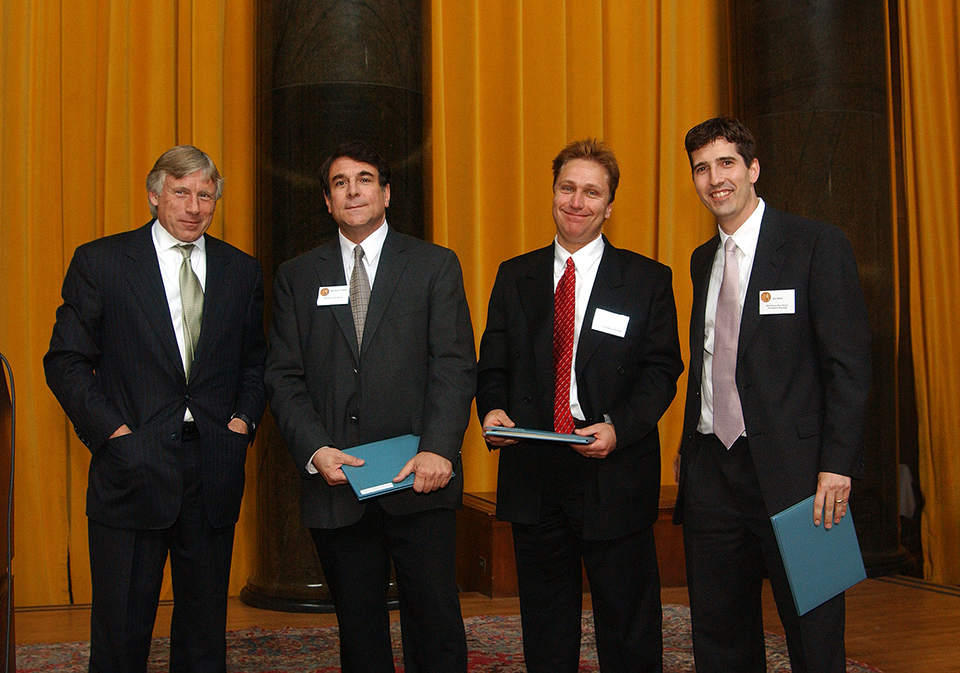
Columbia University President Lee C. Bollinger (left) presents Michael D. Sallah (second from left) Mitch Weiss (third from left) and Joe Mahr (right) with the 2004 Pulitzer Prize in Investigative Reporting.
Winning Work
By The Blade Staff Writers
It was an elite fighting unit in Vietnam - small, mobile, trained to kill.
Known as Tiger Force, the platoon was created by a U.S. Army engaged in a new kind of war - one defined by ambushes, booby traps, and a nearly invisible enemy.
Promising victory to an anxious American public, military leaders in 1967 sent a task force - including Tiger Force - to fight the enemy in one of the most highly contested areas of South Vietnam: the Central Highlands.
But the platoon's mission did not go as planned, with some soldiers breaking the rules of war.
Women and children were intentionally blown up in underground bunkers. Elderly farmers were shot as they toiled in the fields. Prisoners were tortured and executed - their ears and scalps severed for souvenirs. One soldier kicked out the teeth of executed civilians for their gold fillings.
Two soldiers tried to stop the killings, but their pleas were ignored by commanders. The Army launched an investigation in 1971 that lasted 41/2 years - the longest-known war-crime investigation of the Vietnam conflict.
The case reached the highest levels of the Pentagon and the Nixon White House.
Investigators concluded that 18 soldiers committed war crimes ranging from murder and assault to dereliction of duty. But no one was charged.
Since the war ended, the American public has been fed a dose of movies fictionalizing the excesses of U.S. units in Vietnam, such as Apocalypse Now and Platoon. But in reality, most war-crime cases focused on a single event, like the My Lai massacre.
The Tiger Force case is different. The atrocities took place over seven months, leaving an untold number dead - possibly several hundred civilians, former soldiers and villagers now say.
One medic said he counted 120 unarmed villagers killed in one month.
For decades, the case has remained buried in the archives of the government - not even known to America's most recognized historians of the war.
Until now.
Starting today and continuing over the next three days, The Blade will tell the platoon's troubling story.
© 2003 The Blade
By Michael Sallah and Mitch Weiss
Blade Staff Writers
QUANG NGAI, Vietnam - For the 10 elderly farmers in the rice paddy, there was nowhere to hide.
The river stretched along one side, mountains on the other.
Approaching quickly in between were the soldiers - an elite U.S. Army unit known as Tiger Force.
Though the farmers were not carrying weapons, it didn't matter: No one was safe when the special force arrived on July 28, 1967.
No one.
With bullets flying, the farmers - slowed by the thick, green plants and muck - dropped one by one to the ground.
Within minutes, it was over. Four were dead, others wounded. Some survived by lying motionless in the mud.
Four soldiers later recalled the assault.
"We knew the farmers were not armed to begin with," one said, "but we shot them anyway."
The unprovoked attack was one of many carried out by the decorated unit in the Vietnam War, an eight-month investigation by The Blade shows.
The platoon - a small, highly trained unit of 45 paratroopers created to spy on enemy forces - violently lost control between May and November, 1967.
For seven months, Tiger Force soldiers moved across the Central Highlands, killing scores of unarmed civilians - in some cases torturing and mutilating them - in a spate of violence never revealed to the American public.
They dropped grenades into underground bunkers where women and children were hiding - creating mass graves - and shot unarmed civilians, in some cases as they begged for their lives.
They frequently tortured and shot prisoners, severing ears and scalps for souvenirs.
A review of thousands of classified Army documents, National Archives records, and radio logs reveals a fighting unit that carried out the longest series of atrocities in the Vietnam War - and commanders who looked the other way.
For 41/2 years, the Army investigated the platoon, finding numerous eyewitnesses and substantiating war crimes. But in the end, no one was prosecuted, the case buried in the archives for three decades.
No one knows how many unarmed men, women, and children were killed by platoon members 36 years ago.
At least 81 were fatally shot or stabbed, records show, but many others were killed in what were clear violations of U.S. military law and the 1949 Geneva Conventions.
Based on more than 100 interviews with The Blade of former Tiger Force soldiers and Vietnamese civilians, the platoon is estimated to have killed hundreds of unarmed civilians in those seven months.
"We weren't keeping count," said former Pvt. Ken Kerney, a California firefighter. "I knew it was wrong, but it was an acceptable practice."
Many details of the period in question are unknown: Records are missing from the National Archives, and several suspects and witnesses have died.
In many cases, the soldiers remember the atrocities and general locations, but not the precise dates.
What's clear is that nearly four decades later, many Vietnamese villagers and former Tiger Force soldiers are deeply troubled by the brutal killing of villagers.
"It was out of control," said Rion Causey, 55, a former platoon medic and now a nuclear engineer. "I still wonder how some people can sleep 30 years later."
Among the newspaper's findings:
- Commanders knew about the platoon's atrocities in 1967, and in some cases, encouraged the soldiers to continue the violence.
- Two soldiers who tried to stop the atrocities were warned by their commanders to remain quiet before transferring to other units.
- The Army investigated 30 war-crime allegations against Tiger Force between February, 1971, and June, 1975, finding a total of 18 soldiers committed crimes, including murder and assault. But no one was ever charged.
- Six platoon soldiers suspected of war crimes - including an officer - were allowed to resign during the investigation, escaping military prosecution.
- The findings of the investigation were sent to the offices of the secretary of the Army and the secretary of defense, records show, but no action was taken.
- Top White House officials, including John Dean, former chief counsel to President Richard Nixon, repeatedly were sent reports on the progress of the investigation.
To this day, the Army's Criminal Investigation Command refuses to release thousands of records that could explain what happened and why the case was dropped. Army spokesman Joe Burlas said last week it may have been difficult to press charges, but he couldn't explain flaws in the investigation.
The Army interviewed 137 witnesses and tracked down former Tiger Force members in more than 60 cities around the world.
But for the past three decades, the case has not even been a footnote in the annals of one of the nation's most divisive wars.
Thirty years after U.S. combat units left Vietnam, the elderly farmers of the Song Ve Valley live with memories of the platoon that passed through their hamlets so long ago.
Nguyen Dam, now 66, recalls running as the soldiers fired into the rice paddy that summer day in 1967. "I am still angry," he said, waving his arms. "Our people didn't deserve to die that way. We were farmers. We were not soldiers. We didn't hurt anyone."
But one former soldier offers no apologies for the platoon's actions.
William Doyle, a former Tiger Force sergeant now living in Missouri, said he killed so many civilians he lost count.
"We were living day to day. We didn't expect to live. Nobody out there with any brains expected to live," he said in a recent interview. "So you did any goddamn thing you felt like doing - especially to stay alive. The way to live is to kill because you don't have to worry about anybody who's dead."
Battle-tested platoon drew special mission
The Quang Ngai province stretches eastward from the lush, green mountains to the sweeping white beaches of the South China Sea.
To the villagers, it was revered, ancestral land that had been farmed for generations.
To the North Vietnamese, it was a major supply line to guerrillas fighting to reunite the country.
To the U.S. military, it was an area of jungles and river valleys that had to be controlled to stop the communist infiltration of South Vietnam. Gen. William Westmoreland, commander of U.S. forces in Vietnam, created a special task force in 1967 to secure the province.
In a conflict marked by fierce guerrilla warfare, the task force needed a special unit to move quickly through the jungles, find the enemy, and set up ambushes. That role fell to Tiger Force.
Considered an elite arm of the 101st Airborne Division, the platoon - formed in 1965 - often broke into small teams to scout the enemy, creeping into the jungle in tiger-striped fatigues, soft-brimmed hats, with rations to last 30 days.
Not everyone could join the platoon: Soldiers had to volunteer, needed combat experience, and were subjected to a battery of questions - some about their willingness to kill.
The majority of those men were enlistees who came from small towns such as Rayland, Ohio, Globe, Ariz., and Loretto, Tenn.
By the time Tiger Force arrived in the province on May 3, 1967, the unit already had fought in fierce battles farther south in My Cahn and Dak To.
But this was a different place.
With deep ties to the land, the people of Quang Ngai province were fiercely independent.
In this unfamiliar setting, things began to go wrong.
No one knows what set off the events that led to the deaths of untold numbers of civilians and prisoners.
But less than a week after setting up camp in the province, Tiger Force members began to break the rules of war.
It started with prisoners.
During a morning patrol on May 8, the soldiers spotted two suspected Viet Cong - the local militia opposed to U.S. intervention - along the Song Tra Cau River. One jumped into the water and escaped through an underwater tunnel, but the other was captured.
Taller and more muscular than most Vietnamese, the soldier was believed to be Chinese.
Over the next two days, he was repeatedly beaten and tortured. At one point, his captors debated whether to blow him up with explosives, according to sworn witness statements.
One former soldier, Spec. William Carpenter, told The Blade he tried to keep the prisoner alive, "but I knew his time was up."
After he was ordered to run - and told he was free - he was shot by several unidentified soldiers.
The platoon's treatment of the detainee - his beating and execution - became the unit's operating procedure in the ensuing months.
Time and again, Tiger Force soldiers talked about the executions of captured soldiers - so many, investigators were hard pressed to place a number on the toll.
In June, Pvt. Sam Ybarra slit the throat of a prisoner with a hunting knife before scalping him - placing the scalp on the end of a rifle, soldiers said in sworn statements. Ybarra refused to talk to Army investigators about the case.
Another prisoner was ordered to dig bunkers, then beaten with a shovel before he was shot to death, records state.
The killing prompted a medic to talk to a chaplain. "It upset me so much to watch him die," Barry Bowman said in a recent interview.
One Tiger Force soldier, Sgt. Forrest Miller, told investigators the killing of prisoners was "an unwritten law."
But platoon members weren't just executing prisoners: They began to target unarmed civilians.
In June, an elderly man in black robes and believed to be a Buddhist monk was shot to death after he complained to soldiers about the treatment of villagers. A grenade was placed on his body to disguise him as an enemy soldier, platoon members told investigators.
That same month, Ybarra shot and killed a 15-year-old boy near the village of Duc Pho, reports state. He later told soldiers he shot the youth because he wanted the teenager's tennis shoes.
The shoes didn't fit, but Ybarra ended up carrying out what became a ritual among platoon members: He cut off the teenager's ears and placed them in a ration bag, Specialist Carpenter told investigators.
During the Army's investigation of Tiger Force, 27 soldiers said the severing of ears from dead Vietnamese became an accepted practice. One reason: to scare the Vietnamese.
Platoon members strung the ears on shoe laces to wear around their necks, reports state.
Former platoon medic Larry Cottingham told investigators: "There was a period when just about everyone had a necklace of ears."
Records show soldiers began another gruesome practice: Kicking out the teeth of dead civilians for their gold fillings.
Villagers resisted relocation orders
For Tiger Force, the fighting was unpredictable in Quang Ngai.
In the first three weeks of May, platoon soldiers were under frequent sniper fire as they walked unfamiliar trails.
Booby traps covered the rolling hills and beaches.
On May 15, the unit was ambushed by a North Vietnamese battalion in what became known as the Mother's Day Massacre. From 11 a.m. to 5:45 p.m., the out-manned platoon became trapped in a valley under intense fire.
By the time it ended, two Tiger Force soldiers were killed and 25 wounded.
Over the next few weeks, the platoon would change.
A new field commander, Lt. James Hawkins, joined the unit, along with two dozen replacements.
The newcomers arrived as the platoon was about to move into the Song Ve Valley.
The Army's plan was to force the villagers to move to refugee centers to keep them from growing rice that could feed the enemy. But it wouldn't be an easy assignment.
Many villagers refused to go to the centers, which the U.S. State Department criticized in 1967 for lacking food and shelter. Surrounded by concrete walls and barbed wire, the camps resembled prisons.
Though the Army dropped leaflets from helicopters ordering the 5,000 inhabitants to the centers, many ignored the orders. "They wanted to stay on their land. They took no side in the war," Lu Thuan, 67, a farmer, recently recalled.
Unlike most of the province, the valley - removed from the populated coast by narrow dirt roads - was not a center of rebellion, say villagers and historians. "We just wanted to be left alone," said Mr. Lu.
Lieutenant executed unarmed, elderly man
But no one was left alone.
The Song Ve Valley - four miles wide by six miles long - became the center of operations for Tiger Force over the next two months.
In clearing the land, the soldiers began burning villages to force the people to leave.
It didn't always go as planned.
At times, villagers would simply flee to another hamlet. Other times, they would hide.
For the soldiers, the valley became a frustrating place.
During the day, they would round up people to send to relocation camps. At night, platoon members huddled in camps on the valley floor, dodging grenades hurled from enemy soldiers in the mountains.
The lines between civilians refusing to leave and the enemy became increasingly blurred.
One night, the platoon ran into an elderly carpenter who had just crossed the shallow Song Ve River. Dao Hue, as he was known, had lived in the valley his entire life.
He was walking to his village along the banks of the river on a dirt trail he knew by heart.
On this night, he wouldn't make it home.
His shooting death on July 23 as he pleaded for his life would be remembered by five soldiers during the Army's investigation.
It would also send a message to the people of the valley that no one was safe, leading hundreds to flee.
The platoon had been patrolling the valley and set up camp in an abandoned village, where they began drinking beer delivered by helicopter. By dusk, several soldiers were drunk, reports state.
At nightfall, the platoon received an unexpected order: Move across the river, and set up an ambush. What followed was a shooting that would be questioned by soldiers long after they left Vietnam.
When Mr. Dao crossed the river, he ran into Sgt. Leo Heaney, who grabbed the elderly Vietnamese man with the gray beard.
Immediately, the 68-year-old carpenter dropped his shoulder pole with baskets on each end filled with geese.
"He was terrified and folded his hands and started what appeared to me as praying for mercy in a loud high-pitched tone," Mr. Heaney told Army investigators.
He said he realized the man posed no threat.
Sergeant Heaney said he escorted Mr. Dao to the platoon leaders, Lieutenant Hawkins and Sgt. Harold Trout. Trembling, the man continued to babble loudly, witnesses said.
Immediately, Lieutenant Hawkins began shaking the old man and cursing at him, witnesses recalled. Without warning, Sergeant Trout clubbed Mr. Dao with the barrel of his M-16 rifle.
He fell to the ground, covered with blood.
In a sworn statement to investigators, Specialist Carpenter said he told Lieutenant Hawkins the man "was just a farmer, and was unarmed."
But as medic Barry Bowman tried to treat the villager's head wound, Lieutenant Hawkins lifted the man up from where he was kneeling and shot him in the face with a Carbine-15 rifle.
"The old man fell backwards on the ground, and Hawkins shot him again," Specialist Carpenter said in a sworn statement. "I just knew he was dead as half of his head was blown off."
Lieutenant Hawkins denied the allegations in an interview with Army investigators on March 16, 1973. But in a recent interview with The Blade, he admitted killing the elderly man, claiming his voice was loud enough to draw enemy attention.
"I eliminated that right there."
But four soldiers told investigators there were other ways to silence him. In fact, the shots ultimately gave their position away, which led to a firefight.
Said Mr. Bowman: "There was no justifiable reason that the old man had to be killed."
Nearly four decades later, the villagers who found Mr. Dao's remains said they knew he was killed by U.S. soldiers.
His niece, Tam Hau, now 70, was one of the first to see her uncle's body by the river the next day.
She and another relative, Bui Quang Truong, dragged their uncle's remains to their village. "He was shot all over his body," she recalled. "It was very sad - sad for all of us."
Soldiers intensified attacks in the valley
Four days after the shooting of Dao Hue, four Tiger Force soldiers were wounded in guerrilla grenade attacks.
The platoon struck back.
Over the next 10 days, the soldiers led a rampage through the valley.
The area was declared a free-fire zone - a special designation that meant troops didn't have to seek approval from commanders and South Vietnamese officials before attacking enemy soldiers.
But Tiger Force soldiers took the words - free-fire zone - literally. They began to fire on men, women, and children, former platoon members said.
Two partially blind men found wandering in the valley were escorted to a bend in the Song Ve River and shot to death, records show. Two villagers, including a teenager, were executed because they were not in relocation camps.
While approaching a rice paddy on July 28, platoon members opened fire on 10 elderly farmers.
The image of the bodies scattered across the green expanse has long been remembered by Tiger Force soldiers and the people of Van Xuan village.
By all accounts, the farmers thought they were safe.
They were too old to serve in the military and not openly aligned with either side in the conflict, according to their relatives.
In the end, four were killed and others wounded in what several soldiers told investigators was an unjustified attack.
The order to shoot came from Lieutenant Hawkins, the officer leading the patrol, records state.
One villager recently recalled the farmers were surprised when the soldiers began firing. Kieu Trac, now 72, said he watched helplessly as his father fell in the rice field with the others.
He said he waited for hours before crawling into the field in the darkness to look for his father's body. He recalled turning over the corpses - one by one - until he found Kieu Cong, 60.
The son and his wife, Mai Thi Tai, carried his remains back to the village for burial.
The bodies of three others, Le Muc, Phung Giang, and an elderly female member of the Trang family, were later buried by relatives.
"The farmers didn't do anything ... we didn't hurt the soldiers. All they were doing was working in the fields," said Mr. Kieu, pointing to the spot where his father and the others were killed. "They thought the soldiers would leave them alone."
Another villager, Lu Thuan, who watched the attack from a nearby mountain, said he doesn't remember how many were wounded.
"Some were injured," said Mr. Lu, now 67. "They couldn't run fast enough. Others acted like they died."
Mr. Carpenter, one of the soldiers in the patrol, insists he did not fire his weapon. "It was wrong," he said in a recent interview. "There was no way I was going to shoot. Those people weren't bothering anybody."
He told Army investigators he was afraid to express his opinion. A culture had developed in the unit that promoted the shooting of civilians - with team leaders enforcing a code of silence.
Four former soldiers told investigators they didn't report atrocities because they were warned to keep quiet by team leaders.
Ken Kerney, the former private, recalled in a recent interview the briefing he received before joining Tiger Force.
"The commanders told me that 'What goes on here, stays here. You never tell anyone about what goes on here. If we find out you did, you won't like it.' They didn't tell me what they would do, but I knew. So you're afraid to say anything."
Villagers recently interviewed said they dug dozens of mass graves after the soldiers moved through the valley.
Nguyen Dam, 66, recalled the grim task of burying neighbors and friends whose bodies were left in the fields.
"We wouldn't even have meals because of the smell," the rice farmer said. "I couldn't breathe the air sometimes. There were so many villagers who died, we couldn't bury them one by one. We had to bury them all in one grave."
Platoon moved north, focused on body count
Days after the attack on the farmers, U.S. planes flew over the valley, dumping thousands of gallons of defoliants to ensure no one would grow rice there during the war.
For Tiger Force, the Song Ve campaign was over.
On Aug. 10, platoon soldiers - armed with new supplies and reinforcements - rode a truck convoy into a new area 30 miles north.
Known as the Quang Nam province, the vast landscape was covered by triple-canopy jungles and intricate, enemy tunnels.
The mission was to control the province, but not in the traditional way of winning territory.
The platoon became dragged into a battle that became a mantra of the war: body count.
The success of a battle would be measured by the number of people killed - not by whether a village was taken, according to the sworn statements of 11 former officers.
In what became one of the bloodiest periods of 1967, the Army launched a campaign on Sept. 11 known as Operation Wheeler.
The battalion commander who would lead Tiger Force and three other units was Lt. Col. Gerald Morse, who had taken over the previous month.
The 38-year-old officer was described as an aggressive, hands-on commander who rode in helicopters and kept in frequent radio contact with his units in the 1st Battalion, 327th Infantry.
Within days of taking over, Colonel Morse changed the names of the battalion's three companies - an action questioned by investigators years later.
Instead of companies A, B, and C, they were now known as Assassins, Barbarians, and Cutthroats - with a sign hoisted over battalion headquarters bearing the new names. And Colonel Morse would go by the name "Ghost Rider."
Under his command, Tiger Force was encouraged to forcefully patrol the dozens of hamlets in the province.
But the soldiers soon learned this was different from the Song Ve Valley.
It was not only home to the Viet Cong, but a far more trained and disciplined adversary: the 2nd Division of the North Vietnamese Army.
Though these enemy forces previously hid in the nearby Annamese Mountains, they were now moving toward Chu Lai, the sprawling U.S. air base that was home to Tiger Force and other units.
By early September, the enemy soldiers were setting ambushes for troops, including Tiger Force.
"We soon found ourselves face to face with the enemy," recalled William Carpenter, the former platoon specialist who now lives in eastern Ohio. "It seemed like every day we were getting hit."
Within 18 days of arriving in the new operations area, five Tiger Force soldiers died and 12 were wounded in fighting that left the remaining platoon members bitter and angry.
The platoon - broken into groups of four to six soldiers - began attacking villages with a vengeance, according to former soldiers.
"Everybody was blood thirsty at the time, saying `We're going to get them back. We're going to go back there. We're going to even the score,'" former medic Rion Causey said in a recent interview.
He said he watched as soldiers took out their aggressions on unarmed civilians who refused to leave their homes.
"I've never seen anything like it. We just came in and cleared out the civilian population," said Mr. Causey, 55, now a nuclear engineer in California. "It was a day by day by day thing."
In some cases, the Army dropped leaflets into villages warning people to go to relocation centers.
If the people didn't leave, "they would be killed," Mr. Causey said.
To cover up the shootings, platoon leaders began counting dead civilians as enemy soldiers, five former soldiers told The Blade.
A review of Army logs supports their accounts.
For 10 days beginning Nov. 11, entries show that platoon members were claiming to be killing Viet Cong - a total of 49. But no weapons were found in 46 deaths, records show.
Mr. Causey recalls a report to commanders.
"We would call in on the radio - `seven VC running from hut. Shot and killed' - Hell, they weren't running. We didn't know if they were VC."
Sgt. James Barnett told investigators he once raised concerns to Lieutenant Hawkins that Tiger Force soldiers were killing people who weren't carrying weapons.
"Hawkins told me not to worry about it," he said. "We can always get the weapons later."
During the rampage, the soldiers committed some of their most brutal atrocities, Army records show.
A 13-year-old girl's throat was slashed after she was sexually assaulted, and a young mother was shot to death after soldiers torched her hut.
An unarmed teenager was shot in the back after a platoon sergeant ordered the youth to leave a village, and a baby was decapitated so that a soldier could remove a necklace.
During the Army's investigation, former Pvt. Joseph Evans - another Tiger Force soldier - refused to be interrogated. But in a recent interview, he said many people who were running from soldiers during that period were not a threat to troops.
"They were just running because they were afraid. They were in fear. We killed a lot of people who shouldn't have been killed."
Grenades targeted civilians in bunkers
For villagers, it was a routine: Run to the underground bunkers for safety.
In every hamlet, there were shelters, supported by bamboo and brick and covered by leaves and brush.
To the civilians, it didn't matter whether the soldiers were American or North Vietnamese. They went to the bunkers when either approached.
When Tiger Force appeared on a path leading to a village 20 miles west of Tam Ky, the people scurried for cover.
Tiger Force soldiers told investigators they remembered seeing women and children crawl through the openings.
No one knows how many were inside, but it didn't matter.
When the soldiers reached the bunker entrances, they "knew what to do," Pvt. Ken Kerney told investigators.
Without trying to talk to the people below, the soldiers pulled the clips on their grenades, and dropped the explosives through the holes.
Setting up camp nearby, soldiers heard human cries coming from the underground shelters throughout the night.
But no one bothered to help.
For platoon member Charles Fulton, the night dragged on.
"We kept hearing human sounds which came from the direction of the bunkers,'' he told investigators. "They were the sounds of people that had been hurt and trying to get someone's attention to get help. Although faint, they were clear."
The bodies eventually were removed by villagers, former soldiers told investigators. No weapons were found in the bunkers, nor was there any evidence the villagers were a threat to U.S. forces, according to witness statements.
The next day, soldiers approaching the hamlet saw the bodies of women and children lining the roadway.
Soldiers achieved objective of 327 kills
Toward the end of Operation Wheeler, there was even greater motivation for killing.
An order was given via radio one day that would be remembered by seven soldiers years later.
A voice came over the airwaves with a goal for the battalion: We want a body count of 327. The number was significant because it was the same as the battalion's infantry designation: the 327th.
Three former soldiers swore under oath the order came from a man who identified himself as "Ghost Rider" - the radio name used by Colonel Morse.
Army radio logs show the goal was achieved: Tiger Force reported the 327th kill on Nov. 19.
In a recent interview, Colonel Morse, who retired in 1979, denied giving such an order, saying it was "ridiculous ... I would never have done anything like that."
During questioning by Army investigators, former Pvt. John Colligan said the order indeed was given.
In fact, he said the soldier who reached that goal "was to receive some type of reward."
Sergeant Barnett told investigators he heard the same order over the airwaves by someone who identified himself as Ghost Rider.
Three former soldiers said in recent interviews the goal was achieved in part through the killing of villagers.
Number of killings remains a mystery
No one knows how many unarmed civilians were killed by Tiger Force from May through November, 1967.
Soldiers from the platoon killed 120 villagers in one month alone, former medic Rion Causey said in a recent interview.
Former medic Harold Fischer recalled that most of the platoon were "shooting people left and right."
"We would go into villages and just shoot everybody. We didn't need an excuse. If they were there, they were dead."
While the Army substantiated 20 war crimes against 18 Tiger Force soldiers during their seven-month sweep across the Central Highlands, former soldiers described 11 more in recent interviews with The Blade, including:
- Two elderly men killed during an unprovoked attack on a hamlet near Tam Ky. One was beheaded and the other, who was wounded, was shot by medic Barry Bowman in a "mercy killing," he said.
- An elderly man shot to death by Private Colligan near Chu Lai when the soldier wanted to test a new 38-caliber handgun on a live target, Mr. Fischer said.
- Numerous villagers shot by Tiger Force members in a hamlet near Chu Lai, said former Pvt. Douglas Teeters. The villagers were waving leaflets at the troops asking to be relocated, but when enemy forces fired on the soldiers from another direction, the troops opened fire on everyone in their sight, said the former medic.
"We killed a bunch of them. I don't remember how many," he said. "But I remember when it was over, we just said the dead gooks were VC. But we knew they weren't all VC."
And most soldiers just kept quiet, even if they didn't participate.
"Remember, out in the jungle, there were no police officers. No judges. No law and order," Mr. Kerney said in a recent interview. "Whenever somebody felt like doing something, they did it. There was no one to stop them.
"So we watched and didn't say anything. We turned the other way. Looking back, it's terrible. We should have said something. But at the time, everybody's mindset was, 'It's OK.' But it wasn't OK. It's very sad."
Changing war put troops on defensive
By the end of November, the long campaign was over.
In a story in the Army newspaper Stars and Stripes, Tiger Force's Sam Ybarra was praised for the 1,000th kill of Operation Wheeler.
At a ceremony at the Phan Rang base on Nov. 27, 1967, medals were pinned on the chests of Tiger Force soldiers, including Sergeant Doyle, who ordered the execution of a farmer during the operation.
In the ensuing weeks, Tiger Force would leave the Central Highlands. By early 1968, the war was changing.
North Vietnam began its own campaign - the Tet Offensive - attacking 100 villages and cities in the south.
Tiger Force was sent to defend a base near Cambodia.
For medic Rion Causey, the war was no longer about killing civilians but defending American strongholds as the enemy moved toward Saigon.
As the base camp was overrun and soldiers were dying, he came to a grim conclusion:
"The only way out of Tiger Force was to be injured or killed."
He was right.
On March 6, 1968, he was injured, and as he was lifted by the helicopter, he recalled looking at the Tiger Force soldiers below.
"I remember just kind of saying to myself: 'God help you guys for what you did. God help you.'"
© 2003, The Blade
By Michael Sallah and Mitch Weiss
Blade Staff Writers
MY LAI, Vietnam - Just before dawn, the ritual begins.
People gather around stone statues, some whispering prayers, others crying.
Every year, hundreds of Vietnamese travel to the memorial that marks the day the soldiers swept into the tiny village before sunrise expecting to meet enemy soldiers.
Instead, the soldiers found a thriving hamlet.
In just 41/2 hours, the U.S. Army's 11th Brigade went on a rampage that shook the American military to its core.
When it was over, about 500 people lay dead - unarmed men, women, and children - some herded into a ditch and sprayed with bullets, their bloodied bodies stacked on top of one another.
Much has been written about the slaughter on March 16, 1968, that helped turn the American public against the war. The assaults spawned books and magazine articles - with stark images of women and babies in a mass grave.
Thirty-five years later, the My Lai massacre shares powerful parallels with the Tiger Force war-crime case.
Both Army units patrolled the same province. Both set up their camps in the same military base. Both carried out the same missions: search and destroy - just 10 miles apart.
But there was a key difference. Tiger Force arrived in the province six months before the 11th Brigade.
Shortly after their arrival, the Tigers began mutilating bodies, killing civilians, and executing prisoners, the soldiers later told investigators.
The atrocities, brought to the Army's attention in 1967, now raise a critical question: If the Army had reacted to those complaints, could safeguards have been in place to avert the rampage at My Lai?
Military experts say the massacre was merely the culmination of the Army's failure to take steps to stop the violence that had been growing against the people of Quang Ngai province.
There's no doubt that My Lai could have been prevented had the Army cracked down on atrocities," said Michael Belknap, a law professor and Vietnam veteran who authored the 2003 book, The Vietnam War On Trial.
"Remember, they heard rumors. They suspected some troops were out of control," he said.
Months before the arrival of Lt. William Calley's 11th Brigade unit in Quang Ngai province, Tiger Force already was establishing itself there as a rogue unit.
A review of thousands of Army records, including affidavits, battle reports, and logs, shows:
Two soldiers, Lt. Donald Wood and Sgt. Gerald Bruner, told investigators in 1974 they complained to commanders in August, 1967, that Tiger Force platoon leaders were killing unarmed civilians. But the attacks continued.
Tiger Force Sgt. Leo Heaney and two other soldiers were ordered to sign affidavits in May, 1967, that they were not mutilating bodies after a severed ear was discovered in an Army helicopter. But the platoon continued the practice of cutting off the ears of enemy soldiers and civilians.
One battalion officer, Dr. Bradford Mutchler, told investigators in 1975 that commanders were aware of rumors of Tiger Force war crimes in 1967 but did not investigate in fear of what might be uncovered.
Beyond the records, other signs existed that could have alerted the Army to Tiger Force's practices.
In 1966, journalist Ward Just wrote in the book, To What End, that one Tiger Force soldier was sending the ears of his dead enemies through the mail to his wife in the United States.
Jonathan Schell wrote articles for the New Yorker magazine in 1967, saying that soldiers from the 101st Airborne admitted to war crimes in the province but refused to provide details. The articles didn't mention Tiger Force, which was part of the 101st Airborne.
Several military historians said they had long suspected a dangerous pattern of abuse against civilians in the province - eventually culminating with the massacre at My Lai.
But they said the alleged practices had always been vague and unsubstantiated until now.
"It's something we knew was going on, but no one ever came forward with the details," said Dr. David Anderson, editor of the 1998 book, Facing My Lai.
The lead Army prosecutor in the My Lai case said he tried to get information about prior war crimes in the province.
"We had long suspected that things were getting out of hand there, but it was tough getting the South Vietnamese to cooperate," said William Eckhardt, a law professor at the University of Missouri at Kansas City.
Prosecutors wanted the information to help bolster their case that My Lai was the consequence of an out-of-control Army in the province, he said.
Experts say the Army could have reacted to complaints about Tiger Force by alerting commanders - and investigating the accusations immediately.
"That would have sent a clear message that this was not going to be tolerated," said Dr. Anderson, a Vietnam veteran.
More intensive training on war crimes and treatment of civilians could have been implemented in Quang Ngai province.
Dr. Anderson and others say the troops' exposure to international laws in 1967 was minimal: Soldiers were given a brief lecture and a pocket card with nine rules on the proper way to treat civilians.
Until the My Lai massacre, investigating war crimes in Vietnam was not a priority among commanders, records show.
In fact, the attack was covered up until an outraged veteran, Ron Ridenhour, wrote letters to congressional and military officials a year later.
After an Army probe, Calley and others eventually were charged with war crimes, including murder. Of those tried, only Calley was convicted. He was sentenced to life in prison, but his term eventually was reduced to 10 years.
After several appeals, he was paroled in 1975 after serving 31/2 years under house arrest.
His assault more than three decades ago is still considered one of the worst U.S. war atrocities of the last century.
Mr. Belknap, an Army lieutenant during the Vietnam War, said My Lai continues to be studied by military historians, but perhaps a greater understanding can be gained by looking at the events that led to the massacre.
"What [the Army] never learned - until it was too late - is that you can't just kill unarmed civilians."
© 2003 The Blade
'He had no mercy for anyone,' a fellow soldier remembers
By Michael Sallah and Mitch Weiss
Blade Staff Writers
Of the 30 war-crime allegations against Tiger Force investigated by the Army, Ybarra is named in seven, including the rape and fatal stabbing of a 13-year-old girl and the brutal killing of a 15-year-old boy.
Sam Ybarra sat in the darkness of his mother's Arizona home, sobbing.
Once a feared member of Tiger Force who boasted of shooting civilians, he was now a broken figure - haunted by images of the war.
"I would ask him: 'What's wrong? Why are you crying?'" recalled Therlene Ramos. "He would say: 'It's my life. What I did. What I did. I killed people, mama. I killed regular people. I shouldn't have. My God, what did I do?'"
His hands shaking, he would curl up on her couch, repeating the question: '"Why?" she said.
But in the end, only he could answer.
The once stocky paratrooper was a notorious suspect in the longest war-crime investigation of the Vietnam War.
Three times, investigators tried to question him about the accusations against him; three times he refused. Since he was no longer in the military, he was not legally required to comply.
But before he died in 1982, he broke down to those closest to him, say friends and relatives.
His mother, now 78, recalls consoling him.
"He would be sitting and crying. Sitting and crying. He said to me, 'I really feel bad. I asked God to forgive me for what I did for killing all those people, all those civilians, all those children. They never meant to do me any wrong.'"
Of the 30 war-crime allegations against Tiger Force investigated by the Army, Ybarra is named in seven, including the rape and fatal stabbing of a 13-year-old girl and the brutal killing of a 15-year-old boy.
Over and over, he was seen cutting off the ears of dead enemy soldiers and villagers, at times, scalping them with a hunting knife, soldiers told investigators.
Thirteen former platoon members said they were struck by the same image: Ybarra wearing necklaces of human ears.
Before he left Vietnam, he would be court-martialed and disciplined three times - removed from special forces.
By the time the investigation was under way in 1971, he was discharged and living on the San Carlos Apache Reservation in Arizona where he was raised. After years of alcohol and drugs, he died of pneumonia at 36.
Through dozens of military records and interviews, a troubling snapshot of the veteran emerges.
Born in a working-class family, he was the son of an Apache mother and Mexican father. When he was 5, his father was killed in a barroom brawl.
As he grew older, Sam Ybarra was described by relatives and friends as awkward and quiet - a chubby teenager with a short temper, especially when drinking.
He dropped out of Globe High School his junior year, and at one point, ran away from home, saying he wanted to be alone, relatives said.
By the time he was 18, he was arrested four times for underage drinking and disturbing the peace, records show.
When he wasn't getting into trouble, he was hunting and fishing on Lake Roosevelt, or cruising the dusty roads near Globe, Ariz., with his high school friend, Kenneth "Boots" Green.
In 1966, the two joined the Army on a dare, according to family members.
After arriving in Vietnam, Ybarra became a Tiger Force soldier and eventually talked his best friend into joining.
They would both gain reputations as soldiers who could be trusted in battle and cruel to villagers.
Green was accused by a fellow platoon member of torturing a gagged prisoner near Duc Pho in May, 1967, by repeatedly jabbing a knife into his neck before killing him by slashing his throat, Army records show.
Ybarra was accused by another soldier near the same village of shooting an unarmed 15-year-old boy and then severing his ears to string onto a necklace.
Five former Tiger Force soldiers, including two sergeants, told investigators that Ybarra and Green bragged about raping and killing a teenage girl after a search- and-destroy mission near Tam Ky in August.
Though the platoon often operated in small teams, the two friends always seemed to be together, said witnesses.
During a military operation on Sept. 29, 1967, the platoon was ambushed, and Green was shot in the leg. As he was dragged away by a medic, he was shot in the head and died as his friend watched.
Ybarra would never be the same, say soldiers and relatives, promising to avenge Green's death.
For the next two months, he became one of the platoon's most prolific killers, according to sworn statements of other soldiers.
During a sweep of a village near Chu Lai, he carried out a gruesome atrocity that led to the Army's investigation of Tiger Force.
Two soldiers said he decapitated an infant to remove a necklace known as a "Buddha Band" from the baby's neck.
Several soldiers said Ybarra later bragged about killing the baby.
One Tiger Force sergeant told investigators most of the soldiers feared Ybarra. "He had no mercy for anyone," James Barnett said in 1973. "This includes Vietnamese civilians, women, and children."
Medic Harold Fischer said in a recent interview soldiers had to restrain Ybarra from attacking civilians. "He would kill unarmed villagers when the opportunity presented itself, which sometimes was on a daily basis."
By 1968, Ybarra was no longer in the unit.
After several confrontations with superiors, he was sent to an artillery company. By 1969, he was court-martialed three times for insubordination and marijuana possession, records show.
He was once disciplined for refusing to go into a bunker during a rocket attack. Sgt. Buford McClure wrote in a report on March 13, 1969, that Ybarra stood defiantly in the barracks.
"He just laughed, and said, 'Everyone is getting shook up like a scared rabbit. I told you I wanted to go back to the Airborne so I can kill me some of those gooks and somebody else.'"
An Army psychologist described him as "limited, inflexible, lacking in tact and with a low frustration tolerance."
Dishonorably discharged from the Army in April, 1969, he returned to Arizona, where he moved to the reservation.
When investigators last tried to interview him in 1975, he was living in a trailer and suffering from diabetes and cirrhosis of the liver.
Intoxicated, he refused to meet with investigators at the reservation police station, reports state.
For years, he had been spending his days drinking alcohol and smoking marijuana, said Joyce Little, his former wife.
"He didn't work," she said.
His mother offered a simple explanation: He was deeply disturbed by the years he spent in Vietnam.
Army records show Ybarra weighed 185 pounds when he served in Vietnam. When he died, he was 95 pounds, said family members.
His sister, Judith Ybarra, said her brother was a "sweet boy," but when he returned from the war, "he was changed."
She and other relatives said they did not know the details of his atrocities. They, along with friends and others on the reservation, remember him as a brave soldier.
On past Memorial Days, his name has been invoked at memorial services, and local newspapers have written about his battle exploits.
But in the end, he "drank to forget about what he did in Vietnam," said his former wife.
"Maybe he was afraid of the demons, the ghosts of the people he killed, the things he did. He probably died haunted by those ghosts."
© 2003 The Blade
By Michael Sallah and Mitch Weiss
Blade Staff Writers
Army substantiated numerous charges - then dropped case of Vietnam war crimes
"No one wanted to hear about war crimes then," he said. "It would have been embarrassing."
Seven years after leaving Vietnam, James Barnett broke down.
Haunted by the killing of civilians, the former Tiger Force sergeant invited Army investigators to his home to offer a surprise confession.
He admitted to shooting a young, unarmed mother. He admitted to his platoon's cruel treatment of villagers.
He asked for immunity from prosecution, but in the end, he never needed the legal protection.
No one would.
Though the Army substantiated 20 war crimes by 18 Tiger Force soldiers committed in 1967 - with numerous eyewitnesses - no charges were filed.
An investigation that should have brought justice to the longest series of atrocities by a U.S. fighting unit in Vietnam reached the Pentagon and White House but never a court of law - or the American public.
Instead, the case was hidden in the Army's archives, and key suspects were allowed to continue their military careers.
By the time the investigation was over, a justice system that promised to prosecute war criminals ended up protecting them.
At every turn, the system failed.
An eight-month investigation by The Blade, based on thousands of military records and interviews, shows:
- Commanders knew of the platoon's atrocities in 1967 but refused to investigate.
- Soldiers went to Army commanders in 1967 to complain about the killing of civilians, but their pleas were ignored.
- Army investigators learned about the atrocities in February, 1971, but took a year to interview witnesses.
- Two Army investigators pretended to investigate while encouraging soldiers to keep quiet so they wouldn't be prosecuted.
- By the time the investigation was completed in June, 1975, six key suspects were allowed to leave the Army - escaping the reach of military prosecutors.
When the Army's final report reached commanders in 1975 for possible prosecution against four remaining suspects, investigators gave inaccurate and at times, incomplete information.
In three cases in which the final report accused people of "murder," commanders took no action.
Investigators found that five other soldiers carried out atrocities, but their names were never mentioned in the final report.
Four military legal experts who reviewed the report for The Blade questioned why the case was closed so abruptly.
"There should have been a [military grand jury] investigation of some kind done on this," said retired Lt. Col. H. Wayne Elliott, a former Army law professor. "I just can't believe this wasn't a pretty high profile thing in the Pentagon."
4 1/2 year investigation by Army began in 1971
In a story that has never been told, the elite platoon torched villages, executed prisoners, and slaughtered an untold number of unarmed civilians between May and November, 1967, according to Army records.
In recent interviews with The Blade, former platoon members say hundreds may have been killed - in violation of military law and the 1949 Geneva Conventions.
The volunteer, 45-man unit from the 101st Airborne - created in 1965 to find the enemy in the jungles - was sent to South Vietnam's Central Highlands to help stop the North Vietnamese from taking over the region.
But as the war intensified, soldiers in the platoon began to indiscriminately kill villagers.
The atrocities were kept secret until 1971, when the Army began an investigation that lasted 41/2 years - leading agents to 63 cities in the United States, Germany, Korea, and the Philippines.
More than three decades later, Army spokesman Joe Burlas said he couldn't explain the breakdowns in the longest war-crime case from Vietnam.
But one thing is clear: evidence of the atrocities reached the top levels of government.
Summaries of the Tiger Force case were forwarded in 1973 to President Richard Nixon's White House and the offices of Secretary of Defense James Schlesinger and Secretary of the Army Howard "Bo" Callaway, according to National Archives records.
Through his secretary, Mr. Schlesinger declined to comment. Mr. Callaway said he didn't remember the investigation.
Beyond the military hierarchy, there was another safeguard in place where the case could be heard.
A special U.S. panel was created in the wake of the 1968 My Lai Massacre - the killing of about 500 Vietnamese civilians by an Army unit - to review war-crime cases to prevent cover-ups.
But the panel, known informally as the Working War Crimes Group and consisting of six military officers, never met, according to four members.
More than 2,000 pages of testimony - including the 1974 confession of former platoon Sergeant Barnett - were concealed in the Army's archives for years.
Mr. Barnett, who died in 2001, summed up his platoon's actions to investigators when they visited his Tennessee home: "Most of those incidents could be classified as war crimes today."
Commanders failed to halt the atrocities
Thirty-six years ago, Capt. Carl James paid a surprise visit to the Song Ve Valley.
He expected to meet the new platoon leader to talk about supplies but instead found him standing over the corpse of an elderly farmer.
There were no weapons or enemy fire in the area.
He asked Lt. James Hawkins why he killed the unarmed man, Mr. James recalled in a recent interview.
But the platoon leader could not provide an answer.
Mr. James said he admonished the lieutenant that day in July, 1967, but never filed a complaint as required by military law.
"I thought I took care of the problem by warning him," Mr. James said.
His reluctance to notify Army officials was one of the first known failures by commanders to investigate Tiger Force's practices - and stop the killing.
Time and again, battalion leaders knew of the atrocities but failed to end them.
For example:
- Harold Austin, the former battalion commander who oversaw Tiger Force, said in a recent interview his headquarters received reports that soldiers were mutilating the bodies of dead Vietnamese in early 1967, but no investigation was conducted.
- Lt. Donald Wood and Sgt. Gerald Bruner repeatedly complained to superiors in August, 1967 about Tiger Force soldiers killing civilians, according to witness statements. But there were no investigations.
- Capt. Robert Morin told Army officials he attended an officers' party in 1967 where several officers joked about Tiger Force soldiers drowning a farmer in the Song Ve River. But again, no investigation.
Mr. Hawkins said in a recent interview he doesn't recall being reprimanded in the Song Ve Valley for killing an elderly farmer but admitted to shooting civilians who refused to move to relocation camps.
Most commanders didn't want to pursue an investigation of Tiger Force because they feared turning up war crimes, former battalion surgeon Bradford Mutchler told investigators in 1975.
"It was something that you just kept trying to sweep under the rug and forget because you really didn't want to know if it was true or not."
Investigators didn't follow their own rules
It began with a tip in 1971: A Tiger Force soldier had decapitated a Vietnamese baby.
The statement by former Sgt. Gary Coy would spark an Army investigation that would last until 1975.
Led by a field agent in Los Angeles, the case eventually utilized more than 100 agents to interview 137 people. In the years after the 1968 My Lai massacre, military officials promised to take war crimes seriously.
But an inspection of thousands of records of the Tiger Force case shows agents failed to follow their own rules.
They were supposed to investigate as soon as a complaint was filed. They were supposed to monitor key suspects. They were supposed to track down victims.
Those procedures were ignored, seriously undermining an investigation that would turn up some of the worst atrocities of the war.
At least six suspects were allowed to leave the Army during the investigation, escaping possible court-martials. The Army could have stopped their discharges while the case was pending. Three other suspects died in battle.
While suspects were allowed to leave the Army, so were witnesses. Because it took investigators a year to act on Mr. Coy's complaint, 11 soldiers were discharged and could not be forced to testify.
Other witnesses included Vietnamese civilians. But U.S. investigators failed to go to South Vietnam to track down witnesses - a practice in such cases, according to records at the National Archives.
Thirty-six years later, The Blade went to Vietnam and found 11 villagers who knew precise details of three Tiger Force atrocities.
Even when soldiers provided clear details of crimes, investigators failed to pursue the leads.
When Mr. Barnett invited investigators into his home in 1974, the former sergeant admitted to killing a mother of a 6-month-old - but said it was on the orders of his team leader, Sgt. Harold Trout.
He said he shot her with a rifle after she was given a sedative by a medic and escorted into a bunker by Sergeant Trout.
When the sergeant and woman emerged from the shelter, Mr. Barnett said, he was told by his team leader "to grease her," he told investigators.
"I didn't feel right about it," he said, "but I thought I was doing my job when I did it. It was, to me, like any other day in Vietnam."
He identified another witness, but investigators failed to question the soldier about the case, records show. Sergeant Trout refused to talk to investigators in 1973 and declined recently to talk to The Blade. The war "happened a long time ago," he said, "and there's nothing I'd really want to say now."
Beyond the breakdowns, another aspect of the case raises troubling questions about whether Army agents went out of their way to protect soldiers.
Two former Tiger Force soldiers - including a onetime murder suspect - said in recent interviews they were encouraged by investigators not to say anything - clear violations of military law.
Dan Clint, who was not a war-crime suspect, told The Blade he was contacted for a second interview during the investigation by agent Robert DeMario.
"He said, `Hey, just do me a favor. Say that you don't remember anything, so I can get the thing over with,'" Mr. Clint said.
And he obliged the agent. During his interview with Mr. DeMario on Jan. 17, 1974, Mr. Clint said he didn't see any war crimes.
But that wasn't true.
In a recent interview with The Blade, he said a Tiger Force sergeant raped a villager, and soldiers shot civilians and prisoners who posed no threat. "The killings were unrestrained," he said.
Mr. DeMario died in September, 1984.
The other former platoon soldier who said he was told not to report any war crimes was William Doyle. The former sergeant and murder suspect in the investigation said he took the agent's advice.
Records show he was interviewed on Feb. 17, 1975, in St. Petersburg, Fla., and answered "no comment" to the question of whether he knew about crimes by Tiger Force soldiers.
But in a recent interview, he said he not only witnessed the killing of unarmed villagers but committed them.
"If you wanted to pull the trigger, you pulled the trigger. If you wanted to burn a village down, you burned it down. You do whatever you wanted to do. Who's going to say anything to you?"
He refused to give the name of the investigator who told him to stay quiet. "He tipped me off to what was going on, what they were after, and what they were trying to do," said Mr. Doyle, now 70 and living in Missouri.
Final report cast doubt on key cases
Despite problems in the investigation, Army agents substantiated 20 war crimes, including murders.
That means there was enough evidence to show probable cause in those cases - critical to prosecution.
But investigators gave a different version of events to commanders.
In the 1975 final report for possible prosecution, lead investigator Gustav Apsey presented incomplete or inaccurate information about the crimes - casting doubt on key cases.
For example, no one disputed that Tiger Force soldiers fired on 10 elderly farmers in the Song Ve Valley in July, 1967.
The only debate among the four soldiers who talked to investigators was how many farmers were struck by bullets.
But in the report, Mr. Apsey inexplicably said he couldn't prove the atrocity took place.
Missing from his report were the sworn statements of four soldiers who were eyewitnesses to the event.
Spec. William Carpenter: "We killed about 10 of the farmers, then stopped firing."
Sgt. Forrest Miller: "We had received no incoming fire from the village and the people in the field, about 10 persons both male and females, were shot."
The statements of the other two were basically the same: The farmers were shot without warning.
In another major flaw in the case, Mr. Apsey concluded that unidentified soldiers were involved in the attack. But that was incorrect: Lt. James Hawkins was identified by two soldiers as leading the assault.
In fact, one said the lieutenant gave the order to fire on the farmers.
In a recent interview with The Blade, Mr. Hawkins admitted he ordered the shootings.
He claimed the farmers should have been in a relocation camp and not a farm field.
"Anything in [that area] was game. If it was living, it was subject to be eliminated."
Other cases in the final report contained inaccurate information.
Investigators interviewed four soldiers who witnessed the slaughter of women and children in three underground bunkers near Chu Lai, but the final report provided misleading information.
In that report, Mr. Apsey wrote that he didn't know whether those people killed were combatants.
But every soldier who witnessed the event told investigators the people hiding in the bunkers included women and children, and no one was carrying weapons.
One witness, former platoon Pvt. Ken Kerney, said in a sworn statement there "were no signs the people killed were linked to the enemy."
He said he watched as the children ran into the bunkers but never brought an interpreter to the entrances to order them out.
In Army records of the incident - not mentioned in the final report - Private Kerney told investigators that Tiger Force was ordered to go to the village.
As platoon members arrived, "all the people ran into the bunkers. No interpreter was available to talk to the people. But Tiger Force knew what to do."
They hurled grenades in the openings.
A search later of the bunkers "failed to show any sign of Viet Cong" activities or other links with the enemy.
Two other war-crime allegations substantiated by Army investigators were never mentioned in the final report: a shooting attack on several unarmed villagers near Chu Lai, and the killing of two partially blind men in the Song Ve Valley.
In a recent interview, Mr. Apsey said he couldn't explain why the report contained inaccurate information.
"When I think about it now, it bothers me. I screwed up. I don't know what else to say," he said. The killing of women and children in the bunkers was "a war crime. There's no doubt about it. I don't know why I wrote what I did."
He said he didn't try to compromise the investigation. "I would never have done that," he said.
He said prosecutors would have had difficulty pressing charges in most of the war crimes because too much time had lapsed and the statute of limitations had expired in some cases.
But records show that witnesses were still available to testify in 1975, and in murder cases, there is no statute of limitations.
'Political timing' cited in breakdown of probe
Though the final report contained inaccuracies, Mr. Apsey presented three murder cases to commanders for possible prosecution - one naming Tiger Force commander James Hawkins.
But even then, no charges were filed.
Not even an Article 32 hearing - the equivalent of a military grand jury - was held, the first step toward a court marital.
In the final report, Mr. Apsey wrote:
- Platoon leader Lt. James Hawkins "murdered an unarmed elderly Vietnamese man by shooting him in the head."
- Team leader Sgt. Harold Trout "murdered an unarmed wounded Vietnamese male by shooting him several times with a caliber .45 pistol."
- Former platoon Pvt. James Cogan "executed an old unarmed Vietnamese male by shooting him twice in the head with a caliber .45."
Mr. Cogan was discharged from the military by the time the final report was filed in 1975, and like so many other suspects, he was outside the jurisdiction of a military court.
Under military rules, it's up to commanding generals of each soldier to decide whether to prosecute.
Army spokesman Joe Burlas said that's what happened in this case. Commanders chose not to press charges based on the evidence.
But Mr. Hawkins said that's not what happened to him.
He said his case was decided by powers far beyond his commander, Maj. Gen. William Maddox.
In a recent interview, Mr. Hawkins said he was summoned to the Pentagon in November, 1975 - five months after the final report was completed. By his side was General Maddox.
He said they were presented a legal "brief" that stated the case was closed. He doesn't remember who showed him the document but said he recalled the contents.
"What they said was, `Yep, there's wrongdoing there, and we know about it. But basically it's not ... in the best interest of this, that, and the other to try to pursue this.' It seemed like that was the conclusion of the thing," he said.
He said the Tiger Force investigation was "a big deal, but it was kept awful quiet. This was a hot potato. See, this was after [My Lai], and the Army certainly didn't want to go through the publicity thing."
General Maddox died in 2001.
Former Sergeant Trout refused to comment on his case.
Regardless of who decided not to press charges, Mr. Burlas said the murder cases would have been difficult to prosecute for several reasons, including a lack of access to crime scenes and physical evidence.
But for several years leading to the final report, investigators could have traveled to the crime scenes in South Vietnam and interviewed witnesses.
In addition, physical evidence, such as a corpse or weapon, is not essential in these types of cases, according to military legal experts.
The lead investigator, Mr. Apsey, now retired and living in Washington state, said he doesn't know why commanders never filed charges against Mr. Trout and Mr. Hawkins.
He said part of the reason may have been because the final report was filed two years after the peace treaty was signed between the United States and North Vietnam. The report was also completed two months after the collapse of South Vietnam.
"I knew this damn thing wasn't going to go anywhere," he said. "The point is, the political timing was wrong."
Mr. Apsey said throughout his investigation his superiors were concerned about the media discovering the Tiger Force case.
"Let me tell you this: At the time, it was considered a class-one urgency," said Mr. Apsey, who added that field agents were required to interview witnesses within 24 hours of being notified.
The four experts who reviewed the final report for The Blade said the Army may have been able to successfully press charges in some allegations that were substantiated, but others would have been difficult.
William Eckhardt, the lead prosecutor in the My Lai case, said the Army may have been reluctant to bring such a case to court because of the publicity.
"Maybe their thinking was they didn't want any more My Lais," he said, adding that even that case was a challenge to prosecute because of reluctance of soldiers to testify.
"If you look at the incredible struggle that the government went through with My Lai, the fact that some of this wasn't pursued doesn't surprise me.''
But it didn't stop the Army from pressing charges in other atrocities.
Of the Army's 242 war-crimes investigations in Vietnam, a third were substantiated, leading to 21 convictions of charges ranging from beating prisoners to murdering civilians, according to a review of records at the National Archives.
Ten soldiers received prison terms ranging from 30 days to 20 years, though many sentences were later reduced.
But in the case of Tiger Force, there was no punishment. In fact, three suspects were later promoted.
Captain James, who was accused of failing to report a war crime, became a major. Mr. Trout left the Army in 1985 as a sergeant major.
Mr. Hawkins was promoted to major and went on to serve as a civilian flight instructor at Fort Rucker, Ala., after retiring in 1978.
White House kept tabs on investigation
Much is still unknown about the Tiger Force investigation.
Dozens of case records are missing from the National Archives, and the Army refuses to release its own reports, citing privacy rights of the former soldiers.
What is known is that summaries of the investigation were sent to the White House between 1971 and 1973, records show.
While President Nixon was in office, his chief counsel, John Dean, ordered the Army in May, 1971, to file weekly updates on the status of war-crime investigations - 10 cases including Tiger Force. By 1973, the reports were sent monthly.
A memo on March 2, 1973, gives a description of the case, with five suspects and other "unidentified members of Tiger Force" under investigation for crimes ranging from murder to body mutilation.
The same document was routed to the secretary of defense's office from the secretary of the Army's office.
But in June, 1973 - five months after the U.S. pullout - the Army stopped sending updates of cases to the White House.
A memo from Maj. Gen. DeWitt Smith to other Army officials noted the "news media and public interest in the subject have waned with the U.S. disengagement in Vietnam."
He went on to state the regular sending of reports "unnecessarily continues to highlight the problem monthly."
Mr. Dean, who left the White House in April, 1973, said in a recent interview he didn't recall the Tiger Force case but was not surprised the investigation was dropped. "The government doesn't like ugly stories," he said.
Former Secretary of the Army Howard "Bo" Callaway also said he did not recall the case but said he would have taken the allegations "very seriously."
"I guarantee you there'd be no sweeping under the rug."
With the Tiger Force investigation still in progress, Gerald Ford took over the presidency after the resignation of Richard Nixon in August, 1974.
Within five months, there was only one ongoing war-crime case: Tiger Force.
At the time, President Ford was urging the American public to "heal the wounds of Vietnam."
In April, 1975, North Vietnam captured Saigon, reuniting the country. By November, the Tiger Force case was closed.
A spokesman for former President Ford said he declined to comment on atrocities in the Vietnam War.
Dr. David Anderson, a Vietnam veteran who edited the book, Facing My Lai, said a new political era had begun by 1975, with economic issues overshadowing the war. "No one wanted to hear about war crimes then," he said. "It would have been embarrassing."
Blade staff writer Joe Mahr contributed to this report.
© 2003 The Blade
Michigan man turned gun on soldiers to avert shooting
By Michael Sallah and Mitch Weiss
Blade Staff Writers
After watching Tiger Force soldiers execute an unarmed villager, Sgt. Gerald Bruner did the unthinkable.
He raised his rifle with his own threat: He would kill anyone who tried to shoot any more civilians.
The soldiers backed down.
For his efforts, he was berated by a commander for turning on other soldiers - and told to see a psychiatrist.
But his actions in the village near Chu Lai in August, 1967, was the only known time a platoon member threatened to shoot one of his own to stop the brutality, Army records show.
He complained to superiors about the attack on the farmer, but nothing happened.
Seven years later, he complained to Army investigators looking into Tiger Force atrocities. Again, nothing happened.
In the end, the sergeant was unable to bring justice to a case that troubled him to his grave, said family members.
When he died of cancer in 1997, he was still bothered by the two months he spent with the platoon.
"He used to tell me that he hoped justice would come of the investigation," said his younger brother, Michael Stuckey. "He was disillusioned with what he called the zealot characters in Tiger Force. He said they often went beyond the gray area. They took their aggressions out on villagers."
Two weeks after the shooting in the village, Sergeant Bruner asked to be transferred from the platoon after watching two lieutenants scare a farmer by shooting at his feet and killing his cattle, records state. He served two more tours in Vietnam, including a stint as a sniper.
But his memories of the execution in the hamlet 36 years ago remained a powerful image for him, relatives said.
"Every time he brought up Vietnam, he would bring up the village, and what happened," said his widow, Karen Bruner of Colon, Mich.
The confrontation began after the platoon entered a clearing with a cluster of huts on the edge of the Annamese Mountains, records state.
The soldiers were greeted by smiling adults and children emerging from a hut, three soldiers told Army investigators.
The villagers were holding leaflets dropped days earlier by the Army allowing them to be evacuated from the area.
"They were happy as hell to see us," Sergeant Bruner told investigators.
But what followed was a fatal shooting that was recalled by several witnesses during the Army's investigation.
Soldiers said Sgt. William Doyle, a team leader, began asking the farmer if he had seen Viet Cong in the village.
The farmer said he would show the soldiers where the Viet Cong guerrillas were hiding, but he wanted them to escort his family to a relocation center for safety, the soldiers said.
Sergeant Doyle insisted the man tell the soldiers immediately where the enemy was located, striking the farmer in the head with a rifle. Again and again, the man pleaded for his family's protection.
Without warning, the platoon leader raised his M-16 and shot the man through his forearm.
Medic Ralph Mayhew recalled the next scene.
"The Vietnamese fell to his knees and spoke tearfully in his language. I didn't like the sight of it, so I turned away and walked away from the area."
Sergeant Doyle then ordered his men to shoot the farmer.
Moments later, the farmer's 16-year-old brother was brought to the platoon leader and was tossed to the ground next to his dead brother.
One of the soldiers pointed a 45-caliber handgun at the teenager's head, until Sergeant Bruner intervened. The boy and the rest of his family were whisked away without injury the following day.
In an interview with an investigator in February, 1974, Sergeant Bruner said he detailed the atrocity to Capt. Carl James, a battalion officer.
The captain later told investigators he recalled a conversation with Sergeant Bruner about the case, according to an Army investigator's account of the interview, but the captain refused to sign a statement.
Sergeant Bruner said he was told by an unidentified company commander "that this particular incident was being taken care of, and not to worry about it, and just to forget it ... not to talk to anyone about it."
He said the commander began yelling at him about the incident, suggesting the sergeant see a psychiatrist because of his threat to shoot fellow soldiers.
In an interview with The Blade, Mr. Doyle said the events described by witnesses "are all true."
Mr. Doyle said he tried to kill the farmer, but his gun jammed, so he ordered his men to carry out the execution. "I wanted to summarily execute him, but my gun only fired one round and it hit him in the arm.''
He said he was aware that Mr. Bruner had objected to the killing, and was critical of the former sergeant.
"Everyplace he went, he was the only one carrying goddamn Chu Hoi leaflets," he said, referring to the Army leaflets dropped in villages by helicopters that guaranteed the safety of civilians if they moved to relocation camps.
"It was like he was on a civilian-affairs program. And that wasn't our deal. We were out there to hunt and kill."
The angry exchange in the village was the last between the two men. Mr. Bruner was injured a month later after stepping on a booby trap and immediately transferred from the platoon.
He was honorably discharged from the Army in November, 1975.
He moved with his wife and daughter to Michigan, where he worked for the U.S. Veterans Administration in several capacities, including assisting veterans diagnosed with post-traumatic stress disorder.
Family members say he was pained by his memories of Vietnam, often drinking to forget.
Before he died at age 59, Mr. Bruner recorded a tape about his tours in Vietnam for a Pearl Harbor commemoration in 1988, recalling the shooting of the farmer.
In the tape, he condemned the killing.
"To me, this is what you call murder - they flat out murdered the guy."
© 2003 The Blade
1 tried to halt war crimes; the other admitted killing civilians
By Michael D. Sallah and Joe Mahr
The two elderly Vietnamese women were walking toward the soldiers when Tiger Force platoon Lt. James Hawkins ordered his men to shoot.
Quickly, another lieutenant, Donald Wood, told the men not to fire.
But the soldiers obeyed the senior ranking officer, spraying bullets at the two who were walking to their home.
It was another clash between Tiger Force's top lieutenants.
They fought over battle strategy. They fought over troop maneuvers. They even fought over enemy strength estimates.
But their loudest disputes were over the treatment of Vietnamese civilians, according to Army records and interviews.
Lieutenant Wood argued that villagers were not the same as enemy soldiers, while his counterpart believed civilians were not to be trusted, and those refusing to leave designated areas could be shot.
More than three decades later, their battles are still remembered by the former soldiers who served with them between May and August, 1967, as Tiger Force was moving deeper into the Central Highlands.
"They were like night and day - always fighting," former Spec. William Carpenter said recently.
To Mr. Carpenter, Lieutenant Wood was a soldier who "cared about people" but in the end, didn't have the power to stop the violence.
Twice, the lanky artillery observer from Findlay attempted to halt attacks on villagers in 1967, complaining to another officer and an executive officer of another battalion, he told Army investigators.
He even complained to an inspector general about the platoon, he said. But in each case, no action was taken.
In frustration, he transferred from the unit in August, 1967, as the platoon went on to kill scores of villagers over the next three months, records show.
The first altercation between the two men led to the shooting death of an elderly carpenter in the Song Ve Valley that's still remembered by villagers and soldiers.
After weeks of evacuating the valley, platoon members set up camp near an abandoned hamlet along the Song Ve River. A helicopter dropped a special supply of hot food and beer.
For most of the afternoon, Lieutenant Hawkins - a tall, burly career soldier who was known for arguing with senior officers - was drinking with his men, and by evening, they were drunk, five other soldiers swore in statements.
By nightfall, the platoon leader ordered his men to set up an ambush across the river.
That's when Lieutenant Wood tried to stop the order, arguing the soldiers had been drinking and were in no condition to meet the enemy.
But Lieutenant Hawkins ignored him.
Shortly after wading across the river, the troops encountered the unarmed elderly man who prayed for his life as he was shot and killed by Lieutenant Hawkins, soldiers told investigators. The man was later identified by villagers as Dao Hue, a carpenter who was born in the valley.
Mr. Hawkins said in a recent interview he was justified in shooting the man, saying he was "making a lot of noise" that could have given the platoon's position away.
Two other soldiers who witnessed the killing later told investigators there were other ways to quiet the man and that shooting him ended up alerting the enemy to their position.
Two weeks later, another confrontation took place between the men that led to Lieutenant Wood leaving the unit.
Shortly after the officers arrived on the outskirts of a hamlet, a Tiger Force soldier spotted two women approaching the village.
Immediately, Lieutenant Hawkins gave the order to open fire, records state.
Lieutenant Wood protested the order, saying the people were simply walking toward the soldiers. It didn't matter: The platoon leader and others fired their weapons, wounding one.
The two turned out to be unarmed, elderly Vietnamese women who were later carried away in a helicopter, reports state.
During the Army's investigation of Tiger Force six years later, Mr. Wood said he protested to the executive officer of his artillery battalion about the way Lieutenant Hawkins was treating civilians. But he said the officer told him to return to the platoon.
He also complained to Lt. Stephen Naughton, a former Tiger Force platoon leader who had been promoted.
Lieutenant Naughton, who was interviewed by Army investigators in 1974, said he received the complaint and passed it on to a colonel in the inspector general's office at Fort Bragg, N.C.
He described the call: "He told me to forget about it, that I would just be stirring things up, and hung up on me," the lieutenant told investigators.
To make sure the Army took action, Lieutenant Wood said he filed a formal statement with the same office in 1968.
But six years later, Army investigators said they couldn't find any records of the two officers' complaints nor could they track down the identities of the commanders who received them.
By the time the Army investigation was under way, Lieutenants Wood and Hawkins had left Vietnam.
While Mr. Wood was never a suspect, records show Mr. Hawkins was under investigation for murder, dereliction of duty, and conduct unbecoming an officer.
In addition to the attacks on civilians described by Lieutenant Wood, Army investigators turned up other atrocities involving Lieutenant Hawkins, including a shooting assault on 10 farmers in the Song Ve Valley, leaving four dead.
Despite the results of the investigation, no charges were filed.
In the years to follow, the two officers from Tiger Force would pursue vastly different careers.
Mr. Wood, the son of a Whirlpool engineer, became a defense lawyer in Findlay, known for driving sports cars and jumping from airplanes at community events. Married with two children, he died of a brain aneurysm in 1983 at 36.
His wife, Joyce, said he rarely talked about Vietnam, but often woke up at night "with the sweats."
"He would have these dreams. I know he was very disturbed by his years in Vietnam," she said.
Her husband refused to talk to her about the atrocities, but his son, John, now 32, said his father "went to his grave bothered by what he witnessed."
One of Mr. Wood's friends, Dr. Henry Benz, said the former lieutenant often talked to him about the people of Vietnam and how Mr. Wood tried to take the time to "really understand the people in Vietnam. He clearly took an interest."
Mr. Hawkins recalled his differences with Mr. Wood but said he still believes he had a right to fire on unarmed civilians.
"I tell you what, in any war, civilians, innocent people, get killed. Yes I can say I have seen people, farmers, whatever, getting killed," said Mr. Hawkins, who retired from the military in 1978 as a major.
As a civilian, he was rehired at Fort Rucker, Ala., as an aviation instructor to begin a second Army career, retiring in May, 2001.
He said he doesn't dwell on the past and believes everything he did was justified. "I don't regret nothing. There's nothing that I know of that I saw personally that I can say I regretted."
© 2003 The Blade
Reminders of 1967 are never far away for those in the Song Ve Valley of Vietnam
By Michael D. Sallah and Mitch Weiss
Blade Staff Writers
SONG VE VALLEY, Vietnam - Incense smoke rose over the grave as Tam Hau knelt on the grassy mound.
Hands trembling, she prayed quietly to the uncle who stumbled upon the soldiers so long ago.
Like so many others, he didn't survive.
Torn by bullets, the body of Dao Hue was found near the river, a mile from the hut he shared with his niece.
The elderly carpenter was one of the first civilians killed by Tiger Force soldiers in a chain of atrocities that forever changed the Song Ve Valley.
The reminders are everywhere: the unmarked graves along the trails, the bend in the river where the men tried to hide from the soldiers, the rice paddy where the bodies were pulled from the mud.
The stories of the troops firing on unarmed civilians in the summer of 1967 are told in schools, communal centers, and prayer services.
Elderly villagers still describe the Army helicopters dropping leaflets, warning the people to go to relocation camps.
Within days, the soldiers wearing the "chicken patches" - the eagle insignia of the 101st Airborne Division worn by Tiger Force - were rounding up families, seizing their food, and torching their huts.
Over the next six weeks, platoon members killed an untold number who refused to go to the decrepit camps, according to a Blade investigation based on Army records and interviews with more than 100 former Tiger Force soldiers and Vietnamese villagers.
To this day, the shooting deaths evoke anger in those who survived the rampage - with some people calling for the former soldiers to be prosecuted.
"The people who carried out these crimes need to be held responsible," said Vo Thanh Tien, 50, a local provincial official. "They made it very hard for the people who live along the river."
In seven months of atrocities - May to November, 1967 - a third took place in this valley in Quang Ngai province, a place so remote and timeless the effects are visible decades later.
Many villagers said they're still paying for the actions of soldiers who broke the rules of war.
"Even after 30 years, it hurts," said Ms. Tam, now 70, pointing to her stomach. "I ask myself why my uncle had to die. He did nothing wrong."
The details of his death are still recalled by people in the Hanh Tin hamlet, a cluster of huts and concrete homes with clay roofs where people share narrow dirt roads with water buffalo.
His grave is passed every day by farmers heading to the rice paddies and children walking to school.
Older villagers say they still don't understand why the man who helped build their homes was slain. "He didn't do anything," said Lu Thuan, 67. "They just shot him. No reason. Nothing."
Villagers continue to talk about 'the missing people'
The fog covering the Song Ve Valley had burned away, revealing a swath of rice paddies.
Vo Tai Can, 12, and his two friends were no longer safe.
The three had been trying to hide from the soldiers to avoid being sent to a relocation camp.
Now they were in sight of Tiger Force.
Within minutes, they were captured, the boy taken away by helicopter, his companions - partially blind men in their 20s - led to a rice paddy.
Without warning, the men were executed, Army records state, their bodies tossed into open graves.
The two civilians were among the many people killed in the valley for failing to abide by the Army's relocation order.
Thirty-six years later, no one knows how many were executed by platoon members for not leaving. Of the estimated 5,000 people who lived in the valley in 1967, some fled to the mountains, while others were forced to live in the camps.
Hundreds remain unaccounted for today.
Villagers still talk about the "missing people" - their names and where they lived, but their whereabouts are still a mystery.
It wasn't until the war ended that villagers began to realize that many would never return.
One was Vo Tai Can.
Shortly after his capture, the boy with the wide grin who often played along the dirt roads of Van Xuan village was sent to a relocation camp, said Nguyen Dam, 66, a rice farmer. But after the war, he was never seen in the valley.
Like a member of the lost generation, "he was just gone," Mr. Nguyen said. "We have no idea where he went."
Some said he was forced to live in the Nghia Hanh camp, enclosed by concrete walls and razor wire.
Mr. Nguyen said he may have been the last person in the valley to see the boy as he was being carried away in the helicopter but couldn't do anything to help.
In fear of being killed, Mr. Nguyen escaped to the mountains.
Attack on farmers defines war for many
In homes scattered across the valley are death certificates bearing the names of people killed by the Tiger Force soldiers in the summer of 1967.
For Kieu Trac, the paper is a reminder of his father's last day.
He was among 10 elderly farmers who were toiling in a rice paddy when platoon soldiers opened fire, killing four.
Years later, the attack on July 28 continues to define the war years for the people of the Song Ve Valley.
Every year, relatives pray for the victims at Buddhist ceremonies and light incense and candles at their graves.
Villagers say the assault has become the most recognized atrocity of 1967 - one they still talk about when the topic of the war arises.
The attack marked the last time anyone would openly grow crops during the war, say villagers.
But more than farming, it changed lives.
Suddenly, Kieu Trac became the head of the family - in charge of caring for his mother, four siblings, and his own young family.
"Life became harder," said Mr. Kieu, now 72.
In one brutal attack, he said, he was forced to accept responsibilities he shoulders to this day.
Every year, he gathers his family - 16 members living in the same concrete and bamboo home - to remind them of the man who taught him to farm.
Kieu Cong was a gentle provider who spent long days in the fields, with little time to share with his five children. But when he did come home, he often sat with his son and gave advice about living a moral life.
"He told me not to steal," he said, his eyes moistening. "He encouraged me to avoid the bad things in life."
His father was not a part of the guerrilla movement nor did he take sides in the war, he said.
Staring pensively at the altar with incense in his cramped living room, he pointed to his father's name on the wall, and said, "He just wanted to farm."
Rampage of 1967 changed lives forever
In the valley, part of a generation is growing up without parents and grandparents.
In nearly every home, there's a story.
The soldiers shooting farmers in the rice field. The soldiers shooting the village elder at the edge of the hamlet. The soldiers shooting the old man near the river bend.
"There were so many people dying," said Vo Thanh Tien, a communal leader.
That's why he and others say the U.S. and Vietnamese governments should investigate the atrocities committed in the valley nearly four decades ago.
Mr. Vo and others said they want to know why the Army let its troops lose control, especially among noncombatants who took no side in the war.
Unlike other areas of Quang Ngai province, the valley - connected to the coast by twisting dirt roads - was not a center of rebellion, say Vietnamese historians. For hundreds of years, the fertile basin was settled by farmers who grew rice in one of the most productive regions of the nation.
"These are people who did nothing," said Lu Thuan, who hid in the mountains to avoid being shot.
Mr. Vo said the attacks on civilians between June and August, 1967, were war crimes that Americans never publicly acknowledged.
"We think the U.S. government should take responsibility and look back at what happened during the war to these people," he said.
Records in the National Archives - mostly 1967 battalion reports - do not indicate the villagers in Song Ve Valley were hostile to U.S. troops.
Former Tiger Force platoon members said their mission was to stop the farming in the Song Ve to deprive the Viet Cong of a potential food source.
During a 41/2-year Army investigation of Tiger Force atrocities - from 1971 to 1975 - 14 soldiers said they witnessed or participated in the killings of at least nine unarmed villagers in the valley. But those are just the documented cases.
In recent interviews with The Blade, several former platoon soldiers said they fired on numerous villagers who were never counted among the dead.
Several assaults were carried out after the valley was declared a "free-fire zone" - a military designation often misinterpreted by soldiers to mean that they could fire freely on unarmed civilians. But it only allowed soldiers to attack when they received fire, and only to shoot at the enemy, not unarmed civilians.
No records were kept on the number of people killed by Tiger Force in the Song Ve Valley, said several former platoon members.
"We killed anything that walked," recalled former Sgt. William Doyle, a platoon team leader. "It didn't matter if they were civilians. They shouldn't have been there."
For young people of the valley, questions still abound over why the Army killed so many villagers.
The granddaughter of a farmer shot by Tiger Force soldiers said she is still confused over his death. "He was just a civilian. He was just a farmer," said Kieu Thi Lan, 29, a kindergarten teacher.
Like so many others who were born after the war, she said she is often reminded of her grandfather, Kieu Cong, by other family members.
Her neighbor, Nguyen Thi Que, 37, learned about the death of her mother from relatives.
She said she was 6 months old when her mother was fatally shot by a soldier in June, 1967 - her body left in a bunker.
"When I think about my mother, I get angry about the American soldiers who killed her."
Now a mother with three children, she said she often thinks about how her life could have been different if her mother was still alive. "When I look at my friends with their mothers, I get sad," she said as she stood in a rice paddy, her 9-year-old daughter playing at her side.
Even older villagers who lived through the war say they can't provide the answers.
Kneeling at the grave of her uncle, Tam Hau shook her head slowly as she talked about Dao Hue, a widower with no children.
The 68-year-old man was carrying geese to his hut after wading across the Song Ve River when he was shot to death by a Tiger Force lieutenant.
"He was a poor man," she said. "He was a kind person. He never hurt anyone. Why did they do this to him?"
© 2003 The Blade
By Michael D. Sallah and Mitch Weiss
Blade Staff Writers
By the time Tiger Force soldiers stopped firing their weapons, six people were dead, including two children.
They weren't carrying weapons, or dressed in enemy uniforms, but it didn't matter: They were living in a free-fire zone.
For Vietnamese civilians, it was a dangerous decision.
It meant they were in an area where the U.S. military could strike without warning.
No approval was necessary for soldiers to open fire or order air strikes on a specific region - or village - as long as two conditions were met: Troops had to be attacked, and their targets had to be military.
But Tiger Force didn't always follow the rules.
The slaughter of six people in the village near Chu Lai in 1967 was another reminder of the platoon's abuse of the new military policy.
Time and again, Tiger Force members turned free-fire zones into crime zones, killing unarmed men, women, and children .
Of the 30 war-crime cases investigated by the Army, 19 were reported in such zones, according to a Blade review of thousands of military records.
At least 12 times, its members entered villages and openly fired on civilians.
Beginning in the Song Ve Valley, the platoon embarked on search-and-destroy missions, following their commanders' orders: -Shoot everything that moves. And they did.
Four years later, the systematic killings of civilians would become a central issue in the Army's investigation of Tiger Force.
Records show that platoon members were twisting the definition of free-fire zones - a pervasive problem among troops in Vietnam.
While the rules were clear, Tiger Force members took the phrase literally - freely firing on civilians, records show.
Several war-crimes experts say such interpretations were a clear violation of international law, including the Geneva Conventions of 1949. No provisions in the laws of war allowed unarmed civilians to be fired on, said military legal experts
"A free-fire zone doesn't mean a free-crime zone," said Gary Solis, a former Marine prosecutor who authored the Vietnam war crimes book Son Thang. "Just because it's a free-fire zone, doesn't mean you can go in and shoot whoever you run into." Records show the commanders themselves may have been part of the problem.
Under questioning during the Army investigation, at least eight officers with authority over Tiger Force - mostly captains and majors - swore that free-fire zones gave the men the right to "kill anything that moved."
When villagers refused the Army's order to leave the Song Ve Valley, the entire basin was declared a free-fire zone. "We didn't think twice about it," recalled former Pvt. Douglas Teeters in a recent interview. "If they were civilians, what can you do? They shouldn't have been out there."
© 2003 The Blade
By Michael D. Sallah and Mitch Weiss
Blade Staff Writers
For Barry Bowman, the images return at night.
The elderly man praying on his knees. The officer pointing a rifle at the man's head.
The shot.
That piercing shot.
Before it's over, the old man drops to the ground - his body twitching in the blood-soaked grass.
Over and over, Mr. Bowman relives the execution of the Vietnamese villager known as Dao Hue.
Despite years of therapy, the former Tiger Force soldier is still deeply troubled by the brutal shooting he witnessed as a young medic in the Song Ve Valley.
He's not alone.
Of the 43 former platoon members interviewed by The Blade in an eight-month investigation of Tiger Force, a dozen expressed remorse for committing or failing to stop atrocities.
They share some of the same symptoms - flashbacks or nightmares - and over the past 36 years have sought counseling, they said.
Nine have been diagnosed with post-traumatic stress disorder, or PTSD, a psychiatric condition that can occur following life-threatening experiences.
To this day, they wrestle with memories of Tiger Force's rampage through more than 40 hamlets in the Central Highlands of South Vietnam in 1967.
Mr. Bowman, who was standing next to Mr. Dao when he was shot to death by a platoon leader, said he remains shaken by the unprovoked attack on the 68-year-old man as he prayed for mercy.
"It was devastating," he said.
For many, the images never fade.
When Douglas Teeters closes his eyes, he sees villagers being shot as they wave leaflets that guaranteed their safety.
He takes anti-depressants and sleeping pills, but he can never seem to get enough rest, he said.
Mr. Teeters is among the one-in-six Vietnam veterans - about 500,000 - who have been treated for PTSD.
Most people who overcome the disorder are able to recall horrific events without feeling the trauma. The frequency of nightmares decreases while patients gain more control over their lives.
But it can be more complicated for those who committed - or failed to stop - atrocities, clinicians say.
In addition to the trauma, they are often saddled with a strong sense of guilt that can complicate the deeper feelings of fear and isolation, says Dr. Dewleen Baker, director of a PTSD research clinic in Cincinnati.
"It's another layer that needs to be addressed," she said. "It's not that easy. How do you reconcile killing civilians? It's hard, especially when you have a core set of values."
Sometimes, patients will vacillate between justifying their acts and condemning what they did, said Dr. David Manier, a psychology professor at the City University of New York who treats veterans for PTSD.
When the attacks on villagers are executions - not shootings in the frenzy and confusion of battle - "it makes it more difficult to make sense of things," he said.
Mr. Teeters said he struggles with his own acts - the executions of captured soldiers - and the actions of former platoon members in the deaths of villagers.
"The killing haunts me every minute of my life,'' he said in a recent interview. "To survive, you had to say, 'The killing don't mean nothing.' That's how you got through it, man. But eventually, it all catches up with you.''
Former Sgt. Ernest Moreland refuses to talk about his role in the stabbing death of a detainee near Duc Pho, saying he fears he could be charged. But he said he still tries to rationalize the killing.
"The things you did. You think back and say, `I can't believe I did that.' At the time, it seemed right," he said. "But now, you know what you did was wrong. The killing gets to you. The nightmares get to you. You just can't escape it. You can't escape the past."
He is among nine of the veterans interviewed who said they turned to drugs or alcohol to ease their pain after returning from Vietnam.
"I drank too much. I got into a lot of fights," said Mr. Moreland, who now lives in Florida.
It wasn't until four years ago that he sought help. "I came very close to committing suicide,'' he said.
Another platoon soldier, Sam Ybarra, often drank for days at a time, rarely leaving his trailer in Arizona, said his relatives.
While he showed classic symptoms of PTSD, with long bouts of depression, he died in 1982 before being diagnosed. In the years after the war, he expressed remorse for killing civilians, said his mother, Therlene Ramos, 78.
"He drank to forget about what he did," she said. "He was a normal person before he went to Vietnam. When he comes back, he was an alcoholic, smoking. He was not the same person. He was alive, but dead."
Looking the other way takes a toll on veterans
Several veterans said that by the time they joined Tiger Force, the unit was steeped in practices that violated Army regulations and international law.
To survive, they felt they had to look the other way.
One of those was Rion Causey.
The 55-year-old nuclear engineer said he participated in group counseling a decade after witnessing the killing of villagers northwest of Chu Lai. "I was waking up at night with the sweats," he said.
"I didn't condemn what was going on at the time," said the former medic. "I was 19 years old, but I knew what they were doing was wrong. It was wrong."
Two others said they are remorseful for standing by while platoon members took out their aggressions on villagers.
"I regret not reporting it," said former medic Harold Fischer, now 54. "I was young. I didn't know any better."
Now living in Texas, he was with Tiger Force during the military campaign near Chu Lai. He said he knew the slaughtering of civilians was morally wrong but feared retribution from platoon members for speaking up.
"We had to live with these guys in the field," he said. "They're armed and dangerous and motivated. They have a lot of testosterone. They're young. Who knows what they would do? You get into a firefight and you may get a proverbial `To whom it may concern round.'''
Several former platoon members said they went through stages - at first disturbed by the brutality against unarmed villagers and then ignoring it. Eventually, they admitted to taking part in war crimes.
Barry Bowman, now living in Rhode Island, said he joined Tiger Force to save lives.
In one of the atrocities investigated during the Army's 41/2-year inquiry, he refused a sergeant's order to kill a wounded prisoner in the Song Ve Valley. But four months later, he said he didn't hesitate to kill an injured villager dressed in the gray robes of a Buddhist worshipper.
"It was against everything I stood for," he recently said. "My basic mission was to save people's lives as a medic and I took it that way. But then, I could steadily see that the longer I stayed in combat, the more that was changing.''
A culture existed in Tiger Force that embraced the executions of prisoners and civilians - one encouraged by officers and sergeants.
One former sergeant now being treated for PTSD said he wanted his men to kill without hesitation.
"It didn't matter if they were civilians. If they weren't supposed to be in an area, we shot them," said William Doyle, 70, of Missouri. "If they didn't understand fear, I taught it to them."
He said he and others also cut off the ears of numerous dead Vietnamese to scare enemy soldiers.
Experts say body mutilations are classic symptoms of soldiers in secondary stages of PTSD in which fear turns into anger, said Dr. Baker, who treats veterans at the Cincinnati Veterans Affairs Medical Center. "They kick into a second stage - a rage mode."
Former platoon medic Joseph Evans, who lives in Atlanta, said in a recent interview that he severed ears. "You fall into this unbelievable frustration," said Mr. Evans, 59, who has been treated for PTSD. "You're burned and you're fried and you're scared, and you do it to make light of the burden you're underneath."
Former soldier says he wants to apologize
William Carpenter said before he dies, he wants to return to the Song Ve Valley.
The 54-year-old former platoon specialist wants to go to the rice paddy where Tiger Force soldiers killed four elderly farmers.
He wants to apologize to their families.
Thirty-six years later, he said the assault on 10 farmers remains a vivid memory. "I want to tell them how sorry I am that it happened," said Mr. Carpenter, of Rayland, Ohio, who has been treated for PTSD.
Experts say one way of coming to terms with the disorder is to openly acknowledge past actions.
Mr. Carpenter said he didn't fire on the farmers but never reported the atrocity to commanders.
Like other former Tiger Force members, he said he can justify many of the aggressive acts toward villagers, but he said it's "in the middle of the night when the demons come that you remember. That you can't forget."
© 2003 The Blade
Today's training emphasizes proper dealings with civilians
By Joe Mahr
Blade Staff Writer
Lt. Col. Chris Hughes had a tough decision to make on a tense street in a southern Iraqi city, so he gave his 130 troops a set of orders that would draw international attention.
Drop to one knee. Point your weapons to the ground. And smile.
His military adversary that day was an angry Iraqi mob that had misinterpreted the troops' intentions.
To avoid a violent confrontation, he ended up marching his troops out of town and returning the next day to a much calmer populace.
To a top U.S. Army scholar on leadership, Colonel Hughes' decision is a symbol of how far the Army has come since Vietnam - just as it faces its toughest counter-insurgency operation since then.
"That kind of savvy behavior doesn't just happen by accident. It's a matter of education and training in a professional force," said Col. Tom Kolditz, who heads the department of behavioral sciences and leadership at the U.S. Military Academy at West Point.
"And without denigrating the Army we fielded in Vietnam, it was a largely conscript Army - we had the draft in place," he said. "With a professional volunteer force, you get a different product altogether."
The demographics alone show a much different fighting force.
The Army's 480,000 troop strength is a third of what it fielded at the height of Vietnam. Fifteen percent of today's soldiers are women, compared to 2 percent at the time of the Vietnam conflict.
But Colonel Kolditz and others say a key change is beyond the numbers: training regarding civilians. That can be traced to the lessons of Vietnam - particularly the 1968 My Lai massacre in which U.S. soldiers killed about 500 civilians.
In the wake of the massacre, a commission headed by Lt. Gen. William Peers issued a scathing report that criticized the unit's leadership and called the amount of training for troops on war crimes "nothing short of ludicrous."
Three decades ago, soldiers received two hours of instruction during basic training, but retired Army law professor H. Wayne Elliott said the class was viewed as a formality.
Now soldiers - and their commanders - receive training on war crimes throughout their careers.
"I don't think the Army could do much more than it is doing and has been doing for the last 10 to 15 years," he said.
It's not just classroom instruction.
Tucked into a hilly, wooded section of west-central Louisiana, Fort Polk hosts about 10 mock battles a year for various units armed with laser-shooting guns.
Often the battle plots are similar to the warfare found in Vietnam: U.S. troops helping an allied government fight off guerrilla soldiers and a power-hungry neighbor.
The training is similar in another respect, too: The scenarios include mock civilians - also equipped with laser-sensing devices to know when they've been mistakenly or unfairly shot, said Maj. Ron Elliott, a center spokesman.
"In everything we do here, civilians are a part of the battlefield," he said.
Conversely, Colonel Kolditz said, the training for fighters in Vietnam was "all tactical. There was never the creativity to inject these kinds of civilian activities into training. But the mission of the Army has changed."
Beyond fighting the traditional wars, soldiers now are deployed as peacekeepers in unstable countries.
And even the traditional wars can turn into counterinsurgencies - where guerrilla fighters often blend into the population - such as in Iraq.
In the case of Colonel Hughes' 101st Airborne battalion, they were marching into Najaf, Iraq, in April after the major fighting there had ended.
They were hoping to meet with an influential cleric to get his support for their occupation but instead were met by hundreds of chanting residents fearing the Americans were going to arrest the cleric or occupy a nearby Muslim holy site.
Colonel Hughes' decision to walk away - avoiding a potential conflict with civilians - made news across the world.
But with guerrillas in Iraq continuing hit-and-run tactics similar to Vietnam, some fearful U.S. troops have mistakenly targeted civilians.
In one case last month, troops mistakenly killed eight Iraqi policemen who were chasing highway bandits.
While such accidental killings are not the same as the executions of civilians at My Lai or by Tiger Force, it's no time to forget the lessons of either, said Brig. Gen. John H. Johns, who once taught leadership at West Point.
"Particularly in guerrilla warfare," he said, "when you don't know who the enemy is, it's easy to say, 'Kill them all. Kill them all.'"
© 2003 The Blade
About the series/ The Blade's team
The Blade's investigation began after the newspaper obtained 22 pages of classified Army records detailing atrocities by Tiger Force.
The records of the Army's Criminal Investigation Command were just the start.
Reporters reviewed volumes of research on the Vietnam War, finding no mention of the Army's investigation of the platoon's atrocities.
They inspected thousands of declassified records of the case from the National Archives in suburban Washington and obtained hundreds of additional classified documents of the case. They also interviewed dozens of former Tiger Force soldiers.
The Blade sent reporters Michael D. Sallah and Mitch Weiss, as well as photographer Andy Morrison, to the Central Highlands of Vietnam, where they found witnesses to the atrocities.
Reporter Joe Mahr joined the team as the newspaper pieced together a story the U.S. Army never wanted told.
© 2003 The Blade
Biography
Michael Sallah is The Blade's national affairs writer. Since joining the newspaper in 1989, he has covered issues from the Florida presidential election recount of 2000 to the recent sexual-abuse scandal in the Roman Catholic church.
He has won state and national awards and twice been named the Ohio Society of Professional Journalists' reporter of the year.

Mitch Weiss is The Blade's state editor. He joined the newspaper in 1998 after spending 12 years with The Associated Press, where he won state and national awards.
Since joining The Blade he reported on the subway World Series in New York in 2000 and the terrorist attacks on the World Trade Center in 2001.
Joe Mahr is a general assignment/projects reporter with The Blade. Since joining the newspaper in 2000, he has won statewide awards for coverage of Toledo's 2001 mayoral race and northwest Ohio's decades-long economic slide.