Associated Press, by Sang-Hun Choe, Charles J. Hanley and Martha Mendoza
Winning Work
By Sang-Hun Choe, Charles J. Hanley and Martha Mendoza
Associated Press Writers
"I have honestly never, ever heard of this from either my soldiers or superiors or my friends,'' said John C. Lippincott of Stone Mountain, Ga. He said he could have missed it because "we were extremely spread out.''
It was a story no one wanted to hear: Early in the Korean War, villagers said, American soldiers machine-gunned hundreds of helpless civilians, under a railroad bridge in the South Korean countryside.
When the families spoke out, seeking redress, they met only rejection and denial, from the U.S. military and their own government in Seoul. Now a dozen ex-GIs have spoken, too, and support their story with haunting memories from a "forgotten" war.
These American veterans of the Korean War say that in late July 1950, in the conflict's first desperate weeks, U.S. troops -- young, green and scared -- killed a large number of South Korean refugees, many of them women and children, trapped beneath a bridge at a place called No Gun Ri.
In interviews with The Associated Press, ex-GIs speak of 100, 200 or simply hundreds dead. The Koreans, whose claim for compensation was rejected last year, say 300 were shot to death at the bridge and 100 died in a preceding air attack.
American soldiers, in their third day at the warfront, feared North Korean infiltrators among the fleeing South Korean peasants, veterans said. "It was assumed there were enemy in these people," ex-rifleman Herman Patterson of Greer, S.C., told The AP.
American commanders had ordered units retreating through South Korea to shoot civilians as a defense against disguised enemy soldiers, according to once-classified documents found by the AP in months of researching U.S. military archives and interviewing veterans across the United States.
Six veterans of the 1st Cavalry Division said they fired on the refugee throng at the South Korean hamlet of No Gun Ri, and six others said they witnessed the mass killing. More said they knew or heard about it.
"We just annihilated them," said ex-machine gunner Norman Tinkler of Glasco, Kan.
After five decades, none gave a complete, detailed account. But ex-GIs agreed on such elements as time and place, and on the preponderance of women, children and old men among the victims. They also disagreed: Some said they were fired on from beneath the bridge, but others said they don't remember hostile fire. One said they later found a few disguised North Korean soldiers among the dead. But others disputed this.
Some soldiers refused to shoot what one described as "civilians just trying to hide."
The 30 Korean claimants -- survivors and victims' relatives -- said it was an unprovoked, three-day carnage. "The American soldiers played with our lives like boys playing with flies," said Chun Choon-ja, a 12-year-old girl at the time.
Armed with new evidence that U.S. GIs had confirmed much of their account, the Korean claimants called for a U.S. investigation into the killings.
"We hope the U.S. government will meet our demands and console the wandering souls of those who died an unfair death," the claimants said in a statement.
In the end, the Koreans have said in a series of petitions, some 300 refugees lay dead under the bridge's twin arches. About 100 others were killed in a preceding attack by U.S. Air Force planes, they say.
That would make No Gun Ri one of only two known cases of large-scale killings of noncombatants by U.S. ground troops in this century's major wars, military law experts note. The other was Vietnam's My Lai massacre, in 1968, in which more than 500 Vietnamese may have died.
From the start of the 1950-53 conflict, North Korean atrocities were widely reported. But the story of No Gun Ri has remained undisclosed for a half-century, despite sketchy news reports in 1950 implying U.S. troops may have fired on refugees.
No Gun Ri's dead were not alone. Veterans told the AP of two smaller but similar refugee killings in July and August 1950. They also told of refusing orders to fire on civilians in other cases.
Hundreds more South Koreans were killed on Aug. 3, 1950, when retreating U.S. commanders blew up two bridges as refugees streamed across, according to ex-GIs, Korean eyewitnesses and declassifed documents.
The Americans wanted to deny the crossings to the enemy, reported massing more than 15 miles away. But the general overseeing one bridge-blowing, the 1st Cavalry Division commander, had sought to stop the refugee flow as well. He told a correspondent he was sure most refugees were North Korean guerrillas.
For decades in U.S.-allied South Korea, the No Gun Ri claimants were discouraged from speaking out. After they filed for compensation in 1997, their claim was rejected by the South Korean government on a technicality.
The U.S. military has said repeatedly it found no basis for the allegations. On Wednesday, just after the AP report was released, Pentagon spokesman P.J. Crowley said, "We just have no information in historical files to lend any clarity to what might have happened in July 1950.
AP research also found no official Army account of the events.
Defense Secretary William Cohen said on Thursday that the claims could be examined if there were new evidence.
"I am not aware of any evidence that would support or substantiate those claims. But to the degree that any substantive information is forthcoming, we certainly would look at it," he told a press conference in Jakarta, Indonesia.
Speaking at press conference in Washington later Thursday, Army Secretary Louis Caldera promised a "complete and thorough review," of the allegations.
The South Korean government said it will investigate whether the survivors' claims are true or not.
"With keen attention, we'll try to verify the truth of all related things concerning the case," Foreign Ministry spokesman Chang Chul-kyun said. "Any further action will be decided after those efforts are finished."
Some elements of the No Gun Ri episode are unclear: What chain of officers gave open-fire orders? Did GIs see gunfire from the refugees or their own ricochets? How many soldiers refused to fire? How high in the ranks did knowledge of the events extend?
The Korean conflict, which ended in stalemate, began on June 25, 1950, when the communist North invaded and sent the South Korean army and a small U.S. force reeling southward toward the peninsula's tip.
American units rushed from Japan to stop the North Koreans were poorly equipped and ill-trained. The 1st Cavalry went in with little understanding of Korea. Half its sergeants had been transferred to other divisions. Teen-aged riflemen and young officers with no combat experience were thrust overnight into a hellish war, told to expect guerrilla fighting and be wary of the tens of thousands of South Korean civilians pouring south with retreating Americans.
The untested 7th Cavalry Regiment, part of the 1st Cavalry Division, reached the front July 24. Within a day many of its 2nd Battalion infantrymen were scattering in panic, tossing away weapons, at word of an enemy breakthrough nearby.
Records show that on the third day, July 26, the battalion's 660 men were regrouped and dug in at No Gun Ri, a hamlet 100 miles southeast of Seoul, South Korea's capital. Word was circulating that northern soldiers disguised in white peasant garb might try to penetrate U.S. lines via refugee groups.
The refugees who approached the 2nd Battalion's lines on July 26 were South Koreans ordered out of two nearby villages by American soldiers, who warned them the North Koreans were coming, Korean claimants told the AP.
Declassified records show that 1st Cavalry Division soldiers did move through that village area the previous three days.
As the refugees neared No Gun Ri, leading ox carts, some with children on their backs, American soldiers ordered them off the southbound dirt road and onto a parallel railroad track, the South Koreans said. Ex-sergeant George Preece remembered the way was being cleared for U.S. Army vehicles.
What then happened under the concrete bridge cannot be reconstructed in full detail five decades later. Some ex-GIs poured out chilling memories of the scene, but others offered only fragments, or abruptly ended their interviews. Over the three days, no one saw everything: Koreans were cowering under fire, and Americans were dug into positions over hundreds of yards of hilly terrain.
But old soldiers in their late 60s or 70s identified the No Gun Ri bridge from photographs, remembered the approximate dates, and corroborated the core of the Koreans' account: that American troops kept the refugees pinned under the bridge in late July 1950, and killed almost all of them.
"It was just wholesale slaughter," Patterson said.
Both Koreans and several ex-GIs said the killing began when American planes suddenly swooped in and strafed an area where the white-clad refugees were resting.
Bodies fell everywhere, and terrified parents dragged children into a narrow culvert beneath the tracks, the Koreans told the AP.
Declassified U.S. Air Force mission reports from mid-1950 show that pilots sometimes attacked "people in white," apparently because of suspicions North Korean soldiers were disguised among them. The report for one mission of four F-80 jets, for example, said the airborne controller "said to fire on people in white clothes. Were about 50 in group."
Forward controllers in light planes directed pilots to such unplanned targets in midflight. The Korean claimants say a light plane circled their area immediately before the strafing.
But ex-GIs said the strafing may have been a mistake. A company commander had called for an airstrike, but against enemy artillery miles up the road, they said.
Veteran Delos Flint remembers being caught with other soldiers in the strafing and piling into a culvert with refugees. Then "somebody, maybe our guys, was shooting in at us," he said. He and his comrades eventually slipped out.
Retired Col. Robert M. Carroll, then a 25-year-old first lieutenant, remembers battalion riflemen opening fire on the refugees from their foxholes.
"This is right after we get orders that nobody comes through, civilian, military, nobody," said Carroll, of Lansdowne, Va.
That morning, the U.S. 8th Army had radioed orders throughout the Korean front that began, "No repeat no refugees will be permitted to cross battle lines at any time," according to declassified documents located at the National Archives in Washington.
Two days earlier, 1st Cavalry Division headquarters issued a more explicit order: "No refugees to cross the front line. Fire everyone trying to cross lines. Use discretion in case of women and children."
In the neighboring 25th Infantry Division, the commander, Maj. Gen. William B. Kean, told his troops that since South Koreans were to have been evacuated from the battle zone, "all civilians seen in this area are to be considered as enemy and action taken accordingly." His staff relayed this as "considered as unfriendly and shot."
Military experts in the law of war told the AP they had never heard of such blanket "kill" orders in the U.S. military.
"An order to fire on civilians is patently an illegal order," said retired Col. Scott Silliman of Duke University, an Air Force lawyer for 25 years.
Carroll said he "wasn't convinced this was enemy," and he got the rifle companies to cease firing on the refugees. The lieutenant then shepherded a boy to safety under a double-arched concrete railroad bridge nearby, where shaken and wounded Koreans were gathered. He said he saw no threat.
"There weren't any North Koreans in there the first day, I'll tell you that. It was mainly women and kids and old men," recalled Carroll, who said he then left the area and knows nothing about what followed.
The Americans directed the refugees into the bridge underpasses -- each 80 feet long, 23 feet wide, 30 feet high -- and after dark opened fire on them from nearby machine-gun positions, the Koreans said.
Veterans said Capt. Melbourne C. Chandler, after speaking with superior officers by radio, had ordered machine-gunners from his heavy-weapons company to set up near the tunnel mouths and open fire.
"Chandler said, 'The hell with all those people. Let's get rid of all of them'," said Eugene Hesselman of Fort Mitchell, Ky. " ... We didn't know if they were North or South Koreans. ... We were there only a couple of days and we didn't know them from a load of coal."
Ex-GIs believe the order was cleared at battalion headquarters, a half-mile to the rear, or at a higher level. Chandler and other key officers are now dead, but the AP was able to locate the colonel who commanded the battalion, Herbert B. Heyer, 88.
Heyer, of Sandy Springs, Ga., denied knowing anything about the shootings and said, "I know I didn't give such an order." Veterans said the colonel apparently was leaving battalion operations to subordinates at the time.
The bursts of gunfire killed those near the tunnel entrances first, the Korean claimants said.
"People pulled dead bodies around them for protection," said Chung Koo-ho, 61. "Mothers wrapped their children with blankets and hugged them with their backs toward the entrances. ... My mother died on the second day of shooting."
Recalled machine-gunner Edward L. Daily: "Some may have been trying to crawl deeper for protection. When you see something like that and you're frightened, you start to claw."
During three nights under fire, some trapped refugees managed to slip away, but others were shot as they tried to escape or crawled out to find clean water to drink, the Koreans said.
Veterans disagreed on whether gunfire came from the underpasses.
Some, like ex-sergeant James T. Kerns of Piedmont, S.C., said the Americans were answering fire from among the refugees. Hesselman said, "Every now and then you'd hear a shot, like a rifle shot." But others recalled only heavy barrages of American firepower, not hostile fire. "I don't remember shooting coming out," said ex-rifleman Louis Allen of Bristol, Tenn.
The Koreans said the Americans may have been seeing their own comrades' fire, ricocheting through from the tunnels' opposite ends. That's possible, said Preece.
"It could actually have happened, that they were seeing our own fire. ... We were scared to death," said Preece, a career soldier who later fought in Vietnam.
On July 28, the 7th Cavalry was told to prepare to pull back again early the next morning. The final barrage still echoes in the memories of old soldiers.
"On summer nights when the breeze is blowing, I can still hear their cries, the little kids screaming," said Daily, of Clarksville, Tenn., who went on to earn a battlefield commission in Korea.
Sounds of slaughter haunt Park Hee-sook's memory, too.
"I can still hear the moans of women dying in a pool of blood," said Park, then a girl of 16. "Children cried and clung to their dead mothers."
Not everyone fired, veterans said.
"Some of us did and some of us didn't," said Flint, of Clio, Mich., the soldier who had been briefly caught in the culvert with the refugees. "... I wouldn't fire at anybody in the tunnel like that. It was civilians just trying to hide."
Kerns, a machine gunner, said he fired over the refugees' heads. "I would not fire into a bunch of women."
Once the fury subsided, Kerns said, he, Preece and another GI found at least seven dead North Korean soldiers in the underpasses, wearing uniforms under peasant white.
But Preece, of Dunville, Ky., said he doesn't remember making such a search or even hearing that North Koreans were found. None of the other veterans, when asked, remembered seeing North Koreans.
Kerns also said weapons were recovered. Hesselman said someone later displayed a submachine gun. Preece recalled only "hearsay" about weapons.
All 24 South Korean survivors interviewed individually by the AP said they remembered no North Koreans or gunfire directed at the Americans.
Secret U.S. military intelligence reports from those days, since declassified, place the North Korean front line four miles from No Gun Ri on July 26, when the refugees entered the underpasses.
Early on July 29, the 7th Cavalry pulled back. North Korean troops who moved in found "about 400 bodies of old and young people and children," the North Korean newspaper Cho Sun In Min Bo reported three weeks later.
Some ex-GIs today estimate 100 or fewer were killed. But those close to the bridge, from Chandler's H Company, generally put the total at about 200. "A lot" also were killed in the strafing, they say.
The North Koreans buried some dead in unknown locations and surviving relatives buried others, the villagers said. Because families then scattered across South Korea, the claimants said, they have the names of only 120 dead, primarily their own relatives.
The war, in all, claimed an estimated 1 million South Korean civilian casualties -- killed, wounded or missing. Almost 37,000 Americans died.
At 1st Cavalry headquarters, division commander Maj. Gen. Hobart R. Gay was told South Korean refugees were killed by North Korean troops in a crossfire at No Gun Ri, the division information officer recalled. "I think that's what he believed," said Harold D. Steward, an ex-colonel from San Diego.
Relevant unit documents say nothing about a crossfire, about North Korean soldiers killed under a bridge, or anything else about No Gun Ri.
One battalion lieutenant located by the AP said he was in the area but knew nothing about the killing of civilians. "I have honestly never, ever heard of this from either my soldiers or superiors or my friends,'' said John C. Lippincott of Stone Mountain, Ga. He said he could have missed it because "we were extremely spread out.''
The villagers say they tried to file a compensation claim with a U.S. claims office in Seoul in 1960, but were told they missed a deadline. Later, they say, Korean police warned one man, survivor Yang Hae-chan, to keep quiet about the 1950 events. But as authoritarian South Korea liberalized in the 1990s, they revived their case and sent petitions to Washington. None was acknowledged, they say.
In August 1997, a claim signed by 30 petitioners was filed with South Korea's Government Compensation Committee. Having researched histories, they pointed a finger at the 1st Cavalry.
In response, the U.S. Armed Forces Claims Service said there was "no evidence ... to show that the U.S. 1st Cavalry Division was in the area." A lower-level South Korean compensation committee said people were killed at No Gun Ri but it had no proof of U.S. involvement. In April 1998, the national panel rejected the case, saying a five-year statute of limitations expired long ago.
The AP subsequently reconstructed unit movements from map coordinates in declassified war records. They showed that four 1st Cavalry Division battalions were in the area at the time of the alleged incident.
Months of tracing veterans -- some 130 interviews by telephone and in person -- then pinpointed the companies involved. The AP also pored through hundreds of boxes of once-secret documents at the National Archives and other repositories to find pieces of the story.
The laws and customs of war condemn indiscriminate killing of civilians, even if a few enemy soldiers are among a large number of noncombatants killed, military experts note. The Korean War record shows Army courts-martial only for individual murders of Koreans, nothing on a large scale.
As for civil liability, the U.S. government is largely protected by U.S. law against foreign claims related to "combatant activities." The Korean claimants say the killings were not combat-related -- the enemy was miles away.
"We want the truth, justice and due respect for our human rights," they wrote in a 1997 petition to President Clinton.
One ex-GI objects that "a bunch of lawyers'' can't run a war.
"War is not just,'' said Norman Tinkler. "There's things that goes on that we can't comprehend, but it has to be done. And it's the individual that has to make the decision.''
But others who were there said No Gun Ri didn't have to happen. The refugees could have been screened up on the road or checked out under the bridge, Kerns and Hesselman said.
"The command looked at it as getting rid of the problem in the easiest way. That was to shoot them in a group," said Daily. Today, he said, "we all share a guilt feeling, something that remains with everyone."
The late Col. Gilmon A. Huff, who took over the 2nd Battalion from Heyer three days after the pullback from No Gun Ri, was interviewed before his death earlier this year and said he knew nothing of what happened at the bridge.
But he "heard" about refugee killings and told his men it was wrong, Huff said at his Abbeville, S.C., home.
"You can't kill people just for being there," he told the AP.
The bridge at No Gun Ri still stands today. For 49 years its concrete was deeply scarred by bullets -- until railroad workers this month patched over the holes.
AP Investigative Researcher Randy Herschaft contributed to this report.
© 1999, Associated Press
By Sang-Hun Choe
Associated Press Writer
They are old now, some in failing health. But the former Korean refugees still offer vivid descriptions of what happened here in late July 1950, of being strafed by U.S. planes and then fired on by U.S. soldiers.
Chung Koo-shik, then 16, told The Associated Press that "the planes came, raining down bombs and big bullets. The planes shrieked past repeatedly. People ran for the shrubs and trees. A lot of people died.
"Something hot dropped on my back. It was the severed head of a baby."
Lee Yoo-ja, then a 26-year-old housewife, says "dirt and gravel rained down. Oxcarts were burning ... Dead bodies and cows were everywhere, spewing blood."
Yang Hae-sook says she lost an eye in the strafing, and was herded into the No Gun Ri bridge tunnels with other survivors. She was 12.
"We thought it was safe. The tunnel I was in was packed with people. I saw people from my village and thought it was okay. Then the shooting came.
"Bullets ricocheted off the concrete and hit the people like popcorn in a frying pan. Mother wrapped me with a quilt and hugged me.
"It was shooting from both sides. When there was shooting coming from one side, we rushed to the other side. When the bullets came, we could not even raise our heads. We just dug under dead bodies."
Yang says she lost her grandmother, an elder brother and a baby brother, as well as an aunt and her husband and their two daughters, at No Gun Ri.
Park Hee-sook, who was 16, says she lost her father, mother and a sister before a U.S. soldier saved her."It was still the first day of the shooting, and after lying under corpses, I decided to crawl out," she said. "I squirmed through piles of bodies. I was all covered with blood. I stepped out and stood there and shouted the only English word I knew. I said, 'Hello! Hello!'
I just stood there and cried. "From the hill, a soldier looked at me for a while with binoculars. He beckoned me to come up the hill. Some soldiers came and looked at me without talking. One of them checked to see if I was injured. ... They later sent me to the south on a truck."
Park Sun-yong, then 25, says she was desperate by the second day in the tunnels.
"It was dusk. My 5-year-old son kept crying for food. My 2-year-old daughter had already been killed when her grandmother took her and walked outside in the hope of appealing to the soldiers.
"I crawled out with my son and climbed a hill. A terrible crackle of shooting came down and my son was hit in his thighs. Both his thighs were torn with bullets. It was strange, but my boy kept saying he wanted food and he wanted to go see his dad.
"I saw an American soldier and begged for mercy. I shouted to him that we were not bad people, not communists. But he shot at us again.
"A bullet ripped through my waist and hit my son's chest. I lay there still, my mind blank. Two soldiers came over, a fat one and a tall one. They looked down at us and talked to each other. Later more soldiers came and they wrapped my son in a white bag and buried him. They took me to an ambulance.
"That day, I saw the two faces of America."
EDITOR'S NOTE - Associated Press Writer Reid G. Miller contributed to this report.
© 1999, Associated Press
By Charles J. Hanley and Martha Mendoza
Associated Press Writers
They walked through hell together once, young men shoulder to shoulder. Now they're old and torn apart, over what to forget, what to remember, what to tell.
"Whatever happened over there, the memories I have or any of the fellows have are basically our memories. ... I don't think it's anybody's business one way or another," said Korean War veteran Royal Bollinger of Tavares, Fla.
Some ex-GIs like Bollinger, former president of an organization of 7th Cavalry Regiment veterans, objected to the Associated Press investigation of survivors' claims that U.S. forces, including 7th Cavalry troops, killed 400 South Korean refugees near the hamlet of No Gun Ri in July 1950.
The AP found ex-GIs who corroborated the accounts of the survivors, who seek a U.S. apology and compensation.
Some veterans, like Al Olsovsky of Victoria, Texas, grew heated when asked about the killings. He disclaimed any knowledge of it, but said the North Korean invaders sometimes disguised themselves as South Korean refugees or used refugee groups as shields.
"There's 8,000 of us still missing," the ex-lieutenant said, referring to U.S. unaccounted-for from the war. "Nobody seems worried about that."Other old GIs clearly knew something and felt a need to talk about it.
Everyone wants to talk about our own men who were lost. No one wants to mention shooting them South Koreans," said James T. Kerns of Piedmont, S.C., a machine gunner who was one of a dozen veterans to describe what happened at No Gun Ri for the AP.
Said Don Down of Elyria, Ohio, a 7th Cavalry squad leader, "The refugees were the ones who suffered, sad to say."
Edward L. Daily, who went into Korea a corporal and came out a lieutenant, is proud of the boots-and-saddles legacy of Custer's old regiment. But when he began writing 7th Cavalry histories in the 1980s, he also wanted to record some of the darker events, like No Gun Ri.
"The guys" - old comrades-in-arms - talked him out of it.
"You try to put things in the back of your mind because life goes on," said Daily, 68, of Clarksville, Tenn. "But as you get older, you're not as active as you were and you begin to think more about these things again."
Daily was pleased at the chance to finally fill in a historical blank. "It's been good to be able to talk about these things."
Ex-GI Norman Tinkler of Glasco, Kan., said he understood why some veterans, himself included, felt compelled to tell what happened at No Gun Ri, even if it was painful to do so.
"It's conscience," he said. "You've got to pay for your deeds sooner or later.
"That old boy upstairs is going to do the judging on it. And so if you've done wrong, you don't stand too good a chance of getting up there," he said, and then paused before adding, "I ain't figuring on making it."
© 1999, Associated Press
A chronology of the Korean conflict, sometimes called America's "forgotten war'':
1950
June 25 -- Communist North Korea invades U.S.-supported South Korea.
June 28 -- Invaders capture Seoul, southern capital.
July 5 -- First U.S. troops join battle, are driven back.
Aug. 4 -- South Korean and U.S. troops, organized as U.N. Command, withdraw into Pusan Perimeter defense line.
Sept. 15-22 -- U.S. troops come ashore far behind North Korean lines at Inchon. Pusan Perimeter forces push north to join them.
Sept. 27 -- U.N. forces recapture Seoul.
Oct. 19 -- U.N. forces capture Pyongyang, northern capital.
Oct. 25 -- Chinese army attacks U.N. Command in North Korea.
Nov. 7-Dec. 9 -- In east, U.S. Marines encircled at Chosin Reservoir fight way to sea and later evacuation. In west, U.S. Army's 2nd and 25th divisions are battered.
1951
Jan. 4 -- Chinese capture Seoul.
March 18 -- U.N. counter-offensive retakes Seoul.
July 10 -- Truce talks begin.
August-October -- Battles rage for limited front-line territory.
November -- Stalemate sets in along front.
1952
July-August -- U.S. air strikes all but destroy Pyongyang.
Oct. 8 -- Talks deadlock, are recessed.
1953
March 30 -- Talks resume.
July 27 -- Korean armistice agreement signed, continuing the division of Korea.
© 1999, Associated Press
By Sang-Hun Choe, Charles J. Hanley and Martha Mendoza
Associated Press Writers
EDITOR'S NOTE -- The Associated Press recently reported on the killings of up to 400 South Korean refugees at the hamlet of No Gun Ri during the 1950-53 Korean War. That story briefly mentioned other incidents in which, witnesses said, refugees died at U.S. hands. Here is a follow-up report on those episodes.
On a single deadly day in August 1950, six weeks into the Korean War, a U.S. general and other Army officers ordered the destruction of two strategic bridges as South Korean refugees streamed across, killing hundreds of civilians, according to ex-GIs, Korean eyewitnesses and U.S. military documents.
An old soldier recalled the critical moment at one bridge.
"I said, 'There are people!' And they said, 'You have to blow it! There's no other way!" ex-Army engineer Joseph M. Ipock of Jackson, N.J., told The Associated Press.
The AP learned of the bridge blowings and two other incidents, machine-gun and mortar attacks on refugees, while interviewing ex-GIs about what happened at No Gun Ri, South Korea, in late July 1950. In that case, as reported Sept. 29, veterans corroborated Korean accounts of hundreds of refugees killed at U.S. hands.
One bridge blowing, with its refugee deaths, was also recorded briefly in an official Army chronicle, but not until 10 years after the event.
The trail of dead civilians, many of them women and children, has been a hidden underside to a well-known chapter in U.S. military history, the southward retreat of three Army divisions into a defensible perimeter across South Korea's Naktong River in July-August 1950.
The withdrawal was often confused. The U.S. Army itself told South Korean civilians, citizens of an allied nation, to head south. But the AP found in researching declassified Army documents that U.S. commanders also issued standing orders to shoot civilians along the warfront to guard against North Korean soldiers disguised in the white clothes of Korean peasants. Military lawyers call those orders illegal.
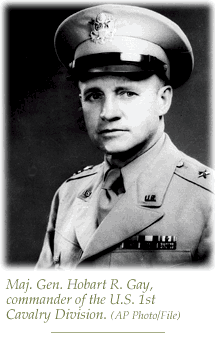
Just days into his first combat command, the 1st Cavalry Division's Maj. Gen. Hobart R. Gay told reporters he was sure most of the white-clad columns pressing toward American lines were North Korean guerrillas.
"We must find a means to hold these refugees in place," the division commander said.
Days later, on Aug. 3, 1950, Gay waited on the east bank of the Naktong River as his division retreated across the bridge at Waegwan, the last crossing open to North Korean units reported massing more than 15 miles to the west.
His troops had failed in repeated efforts to turn back the flood of refugees, even firing warning shots over their heads.
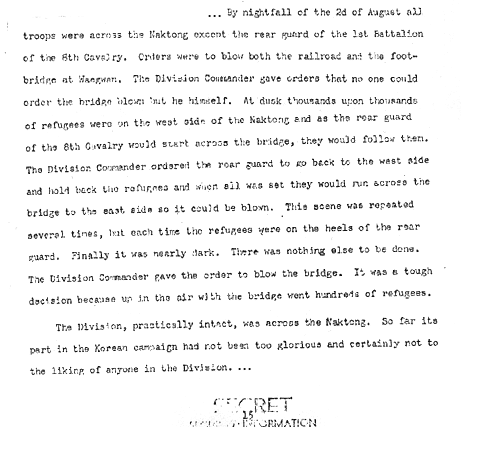
"Finally, it was nearly dark," Gay later wrote to an Army historian. "There was nothing else to be done."
Then he gave a fateful command.
[Editor's Note: Edward L. Daily says he now recognizes he could not have been at the scene and instead learned of it second-hand from soldiers who were there.]
"General Gay stood up in the front of his jeep and shouted out, 'Blow the son of a bitch!'," veteran Edward L. Daily recalled.
The pre-set charges exploded, rapid fire, shattering the supports, dropping one of the bridge's hulking spans into the muddy waters of the Naktong.
"They went right down,'' remembered ex-lieutenant Daily, of Clarksville, Tenn. ''It was like a slow-motion movie. All those refugees went right down into the river."
"It was a tough decision," Gay wrote the historian, "because up in the air with the bridge went hundreds of refugees."
The division's 1950 war diary did not report the refugees' deaths. But this later narrative by Gay, who died in 1983, led to a brief mention in an official war history published in 1960.
What happened earlier that August day, however, 25 miles downriver at the village of Tuksong-dong, has never been reported.
Ex-sergeant Carroll F. Kinsman remembers the streams of white-clad humanity shuffling across the 650-foot-long Tuksong-dong bridge -- women clutching children, old men, overloaded ox carts.
"We stayed up all that night and searched them," Kinsman, a veteran of the 14th Combat Engineers Battalion, said in an AP interview. They found no infiltrators, he said.
Retreating Americans had not yet sighted North Korean units near the river around Tuksong-dong on Aug. 3, the declassified record shows. But American officers knew the enemy would arrive eventually. Pressed by a timetable, they proved unable to keep the refugees back from the bridge, rigged for instant demolition.
Soldiers fired over the heads of those crowding across, and tried to warn them the bridge would be blown up, said the veterans, men in their 60s or 70s.
"They tried to stop the refugees from coming across and they wouldn't stop. They were abutment to abutment," ex-engineer Leon L. Denis of Huntsville, Ala., recalled in an AP interview before his death Aug. 31.
The men of Company A, 14th Engineers, had taken two days to set 7,000 pounds of explosives on the steel-girder bridge. When the detonation order came at 7:01 a.m., "it lifted up and turned it sideways and it was full of refugees end to end," said Kinsman, of Gautier, Miss.
''These people were on the bridge, and you saw the spans of steel flying and you knew they were killed,'' said ex-GI Rudolph Giannelli of Port Saint Lucie, Fla., driver for Col. Richard W. Stephens, the 21st Infantry Regiment commander who was the last officer across the bridge.
In separate AP interviews, Kinsman, Denis and Giannelli said hundreds of civilians were killed. Ipock said he could see only 30 or 40 refugees from his vantage point.
''There was people on that bridge when it went up," Ipock said. ''And during war that's the story. They're up there and they pull the plunger and that's it."
Kim Bok-jong, 73, a Korean who said he was 200 yards from the bridge, out of view around a hill, remembered that "people rushed back toward us and said many people died when the Americans blew up the bridge."
The dying did not end there, he said. Panicked refugee families stranded on the far shore tried to swim the river, Korea's largest.
"Many -- I mean many -- people drowned," Kim told the AP. "... Women with kids were exhausted before reaching the southern bank and disappeared under water. Sometimes kids were abandoned in the middle of the river."
The veterans said they don't know who gave the detonation order at Tuksong-dong. The operation was noted in the 14th Engineers report with a simple "Results, excellent."
From the bridges, the U.S. Army units moved into defensive positions along the Naktong, in what came to be known as the Pusan Perimeter. They had arrived at the river after weeks of retreat through South Korea -- and after countless, sometimes bloody encounters with refugees.
Four 1st Cavalry Division veterans told the AP that on Aug. 2, the day before the bridge blowings, they were among several dozen soldiers retreating toward the Naktong and being trailed by perhaps 80 white-clad Koreans.
In mid-afternoon, five North Korean soldiers -- disguised in white -- appeared in front of the Americans, they said. Veteran Edward L. Daily said the North Koreans opened fire and were quickly killed. Another ex-GI, Eugene Hesselman, remembered it differently, saying the intruders surrendered and were led away.
Because it was believed they came from among the refugees, said Hesselman, of Fort Mitchell, Ky., "we got orders to eliminate them (the refugees). And we mowed them all down. The Army wouldn't take chances."
Scattering too late, every man, woman and child was killed, Daily said. He and veteran Robert G. Russell said they found about 10 disguised North Korean soldiers among the dead. Hesselman said he doesn't recall that infiltrators were found.
"I didn't like to do it," said Russell, of West Fargo, N.D. "It was just pure survival at the time."
About a week earlier, a half-dozen 1st Cavalry Division veterans recounted, mortar fire was directed at possibly a few hundred refugees moving down a railroad track about 100 miles southeast of Seoul.
Americans had been ambushed the night before by North Koreans who mingled with refugees, said ex-GI James McClure. Now, he said, he spotted another white-clad group, including women and children, through his binoculars, and put in a call to a command post.
"The colonel contacted mortar and decided to kill them instead of allowing them through the line," said McClure, of Federal Way, Wash. He could not recall the colonel's name.
When the mortar fire hit, "there were legs, arms and bodies flying everywhere," McClure recounted. Veteran Henry Matthias of Baltimore said he believes about 70 refugees were killed.
Matthias said he and GIs around him didn't fire because "the North Koreans were coming in, but they were a long way away." Other ex-GIs said North Korean uniforms and weapons were found on bodies afterward.
Some officers and other Korean War veterans drew a distinction between killing civilians simply because of suspicions of enemy among them, and destroying a bridge -- a strategic necessity -- with refugees on it.
But others, looking back, said refugees on targeted bridges should have been protected -- for example, by deploying soldiers to hold them back and retrieving the soldiers later by boat.
Three days after blowing the Waegwan bridge, Gay did send boats across the Naktong, to bring over 6,000 stranded refugees from the west bank, the declassified record shows.
The North Koreans did not appear in force on the west bank between Waegwan and Tuksong-dong until Aug. 7, four days after the bridges were blown, the record shows.
From a 50-year vantage point, historians are beginning to look anew at those first desperate weeks of the Korean War.
"Civilians were in the way, their friendliness could not be counted on, they were scary and it was unclear who the enemy was," Marilyn Young, a New York University history professor, said in an interview. "The U.S. Army was taking the population as a whole as the potential enemy."
Killing of noncombatants was then -- as now -- a crime under the international law of war and the U.S. military code, military law experts note.
Although reports of North Korean atrocities were widespread at the time, possible war crimes by American troops were not an issue during the 1950-53 war, a West Point specialist noted.
''This now will change the way we look at the Korean War,'' said Gary D. Solis, a law professor at the U.S. Military Academy.
Last year the South Korean government rejected, on a technicality, a compensation claim filed by survivors of the bloodshed at No Gun Ri in July 1950. But after the AP published its No Gun Ri report, in which U.S. veterans said their unit killed a large number of refugees under a railroad trestle at that South Korean hamlet, the U.S. Army and Seoul government announced investigations.
In addition, since the Sept. 29 AP report, accounts have surfaced in South Korea and the United States of still other civilian killings at U.S. hands in the Korean War.
Those reports have yet to be corroborated. But Defense Secretary William Cohen said last week that after investigating No Gun Ri, "we'll see if there's substance to the other allegations." He did not specify what new allegations the Pentagon may look at.
AP Investigative Researcher Randy Herschaft contributed to this report.
© 1999, Associated Press
By Associated Press Staff Writers
North Korean atrocities made headlines and outraged much of the world during the 1950-53 Korean War.
Some of the first reports, in July 1950, told of captured U.S. soldiers bound and summarily executed by North Korean troops near the battle lines in southeast Korea.
In September 1950, U.S. Army units retaking Taejon, South Korea, reported finding the bodies of hundreds of Korean civilians, slaughtered in large groups and hurriedly buried before the North Koreans retreated.
A U.S. Army war crimes report later estimated the Taejon dead at 5,000 to 7,500, including businessmen, police and other government employees, and 42 American prisoners of war. Many had been severely beaten and mutilated, it said.
The North Koreans, for their part, alleged that earlier the southern government had murdered thousands of communist sympathizers around Taejon before the initial South Korean retreat from the city in July 1950.
Official U.S. sources and Western journalists reported such South Korean atrocities during the war. In one case, two South Korean army officers were sentenced to life in prison in 1951 for leading an army massacre of 187 people in a South Korean village deemed supportive of communist guerrillas.
The total number killed by war crimes in Korea remains as imprecise today as the figures for total casualties in the war.
United Nations and other sources approximate the war's South Korean civilian casualties - dead, wounded and missing - at about 1 million people, and North Korean civilian casualties at up to twice that, many of them killed or wounded in the heavy U.S. bombing campaign.
The U.S. Army, in November 1951, cited U.N. figures saying 25,575 South Korean civilians were killed during the communist occupation of South Korea. But the South Korean government later put that toll at 129,000.
As for prisoners of war, the Pentagon eventually calculated that almost 8,000 U.S. military personnel were killed or otherwise died while in the hands of the North Koreans or their Chinese allies.
Prisoners were "beaten, wounded, starved and tortured ... and-or forced to march long distances without benefit of adequate food, water, shelter, clothing or medical care," a U.S. Senate investigative subcommittee said in 1954. It condemned North Korean actions as "heinous and barbaric."
Treatment of prisoners was generally conceded to have improved, however, as the war went on.
© 1999, Associated Press
By Associated Press Staff Writers
In a now-declassified narrative sent to an Army historian Aug. 24, 1953, Maj. Gen. Hobart R. Gay described how, as 1st Cavalry Division commander in 1950, he ordered the destruction of a bridge over South Korea's Naktong River at the cost of many refugee lives. In the manuscript Gay refers to himself as "the Division Commander.''
From the U.S. National Archives, College Park, Md.
© 1999, Associated Press
By Sang-Hun Choe, Charles J. Hanley and Martha Mendoza
Associated Press Writers
EDITOR'S NOTE -- In reports this fall, The Associated Press told of the killing of South Korean refugees by the U.S. Army in 1950. The following report looks at yet another hidden dimension of the Korean conflict, air attacks on civilians.
In 1950-51, as war refugees flooded South Korea's roads, American jets repeatedly attacked groups of Koreans in civilian clothes on suspicion they harbored enemy infiltrators, according to declassified U.S. military documents and Korean and American witnesses.
Large numbers of refugees were killed in some cases, witnesses told The Associated Press. In one strike, they said, U.S. firebombs killed 300 civilians trapped in a cave.
After-mission reports from the Korean War show that U.S. Air Force pilots, flying in support of retreating U.S. troops in mid-1950, sometimes questioned their targets.
In one, pilots said a Korean group strafed at an airborne controller's instruction "could have been refugees." In another declassified report they said their target "appeared to be evacuees."
Some of those pilots, in recent AP interviews, said they did worry at times they were machine-gunning innocents.
"We were concerned, very concerned," said Air Force retiree Herman Son of St. Louis. He said it "was by no means clear on the surface who these people were."
Some ex-pilots said they remember breaking off attacks when they realized their targets were civilians. The situation was spelled out in an after-mission report six weeks into the war.
"Pilots have difficulty in determining whether personnel in enemy-held territory are noncombatants or not," reads the report by pilots in Son's 35th Fighter-Bomber Squadron. "Leaflets should be dropped on them warning them to keep out of sight or that they will be strafed."
The new information, on which the Pentagon had no direct comment, sheds light on yet another hidden side of the "forgotten war" of 1950-53, a conflict in which U.S. airpower often proved pivotal.
Previous AP articles, in September and October, cited U.S. veterans, Korean witnesses and declassified documents in reporting that hundreds of other South Korean refugees were killed by U.S. Army troops in mid-1950 as the retreating Americans struggled to defend South Korea against a North Korean invasion.
American ground commanders feared that enemy soldiers, disguised in the common white clothing of civilians, were joining South Korean refugee columns in order to penetrate U.S. lines. Documents found in declassified military archives show that some troops were ordered to shoot approaching civilians _ orders that military law experts say were illegal.
"People in white" became Air Force targets as well, according to the once-secret Air Force files examined by the AP.
"Some people in white clothes were strafed three to four miles south of Yusong," an after-mission report by four 35th Squadron pilots noted on July 20, 1950. A spotter aircraft, or controller, "said to fire on people in white clothes," the debriefing report said.
The AP located the declassified debriefings at the U.S. Air Force Historical Research Agency at Maxwell Air Force Base, Ala., and at the National Archives in College Park, Md., while investigating what happened at No Gun Ri, South Korea, July 26-29, 1950, when witnesses say U.S. warplanes killed about 100 refugees and U.S. Army troops then killed about 300 more.
Advised in advance of the AP's report on the air war, chief Pentagon spokesman Kenneth Bacon reiterated that completing the No Gun Ri probe is the first priority. "Then the department will decide if other incidents warrant further study.," he said.The AP reported in September that Army veterans confirmed their unit killed a large number of civilians at the No Gun Ri railroad bridge. The U.S. and South Korean governments immediately ordered investigations. The AP later reported hundreds of other refugees were killed in other U.S. Army operations in mid-1950.
Since the No Gun Ri report was published, the South Korean Defense Ministry has received petitions relating to at least 37 incidents in which U.S. forces allegedly killed South Korean civilians indiscriminately during the 1950-53 war, the ministry says. The petitions ask for investigations, and some for compensation. Most of those publicly reported relate to air attacks on refugees.
"I want to ask the U.S. government why," said survivor Hong Won-ki, who has petitioned Washington for an accounting of a strafing in which his parents were killed. "It was clear that we were refugees."
Witnesses say they refrained from speaking out after the war because they feared reprisals from the South Korean military, which ruled the country until 1992.
Civilian air attacks during the Korean War
Some of the reported U.S. air attacks on refugees occurred in January 1951, another period of retreat, when U.S. forces and South Korean refugees were driven deeper into South Korea by an offensive by North Korea's Chinese allies, but when American warplanes still monopolized South Korean skies.
Local villagers said American bombing and strafing killed about 300 South Korean civilians on Jan. 20, 1951, at a cave where they took refuge in Youngchun, 90 miles southeast of Seoul, South Korea's capital. The Chinese front line was several miles to the north, a U.S. Army history shows.
The area outside the cave was busy with people coming and going, villagers said. An observer plane circled and then four planes dropped incendiary bombs near the cave's entrance, setting fire to household goods just inside, they said. Most victims suffocated from smoke.
"People yelled and cried for their children," said Cho Bong-won, 64. "People choked and fell."
Earlier that week, 60 miles to the west, another 300 South Korean refugees were killed by a U.S. air attack as they jammed a storage house at the village of Doon-po, said survivor Kim In-tae, 58.
Kim, now a Presbyterian minister, said the planes bombed the location after the refugees set a fire outside to keep warm. "I woke up from the piles of corpses after three days," Kim said.
The petition from Hong Won-ki, a retired newspaper executive, describes an air attack on Yong-in, 30 miles south of Seoul, after refugees rushed outside to wave at approaching U.S. planes, and a second strafing the next day, Jan. 12, 1951, after his family left the village and trekked south with other refugees.
As American planes neared, the group crouched down with their baggage over their heads "to show that we were just refugees," said Hong, 14 at the time. But one plane strafed them, killing Hong's parents and other refugees, he said.
On Jan. 15, villagers said, planes returned to Yong-in, still crowded with refugees. They described strafings and apparent napalm attacks. "Each time a plane swooped down and sprayed bullets, about 20 or 30 people fell," said Kim Young-kyu, then 14.
A former AP war correspondent described the aftermath of a large-scale strafing around the same time, a few miles from Yong-in and possibly linked to those attacks.
Jim Becker, 74, said in an interview he saw the frozen bodies of at least 200 Koreans in civilian clothes along a road south of Seoul as he traveled north with U.S. troops on Jan. 26, 1951.
"There were women and children. It was a dreadful sight," said Becker, now chairman of Hawaiian public television.
His AP report at the time noted the U.S. military's contention that the refugee column had been strafed by American planes more than a week earlier because "intelligence learned that Chinese soldiers were hiding among them."
But no weapons could be seen, and an Air Force press officer who returned to the scene with him couldn't point to evidence of infiltrators, Becker said.
American military photographs from that area and time period show Korean civilians badly burned from U.S. napalm attacks. The photos, found by the AP at the National Archives, originally were classified for U.S. Army staff distribution only.
Other South Korean reports have surfaced about air attacks on civilians in July and August 1950, around the time of No Gun Ri, including attacks on a schoolhouse full of children and on refugees heading south near No Gun Ri a few days before the strafing and killings there.
Accounts of attacks on civilians in white in the July-August period are supported by available Air Force debriefings, the reports that intelligence officers compiled in meetings with pilots after each four-plane mission. A sampling from three missions of the 9th and 35th Fighter-Bomber Squadrons:
_"Many troops seen in river areas directly south of Yusong. Could have been refugees because much baggage was seen piled on river banks. Were strafed by order of controller. Number of people hit unknown. Some had uniforms on."
_"Strafed sand bar in river where people and foxholes were seen. People appeared to be evacuees."
_"Strafed white-shirted group in the hills just south of highway causing them to scatter and inflicting numerous casualties."
Besides attacks on tanks and trucks of the advancing enemy, the debriefings tell of strafings and rocketings of fishing boats, houses, schools and entire villages in South Korea. Sometimes controllers assigned the targets, sometimes apparently not.
The young officers who flew F-80 jets for the 35th Squadron, now mostly retired colonels in their 70s, remember their misgivings.
"It was troubling. It truly was," said Alvin L. Wimer of Salem, Ore., an F-80 pilot traced by the AP. He found he had noted his concerns in his personal log in 1950, next to a mission on which he and fellow pilots reported they "strafed 25 personnel in white civilian clothing crossing river."
"Twice we were directed to strafe these people who were dressed like civilians," Wimer said after reviewing reports on a half-dozen of his missions. "Now whether they were (civilians) or not, we have no way of knowing."
In the war's first weeks, rumors about infiltrators dressed in white "were floating around our operations ready room," he recalled.
"Sometimes we never really did know for sure, because the enemy could wear white," ex-pilot Ralph G. Hall, of Leander, Texas, said of their targets.
Robert H. Dewald said pilots were briefed to be careful to distinguish between civilians and enemy troops, but it's "very likely" refugees were strafed.
The ex-pilot specifically recalled one white-clad group in a dry riverbed. "We very well may have shot at them," said Dewald, of Fort Walton Beach, Fla.
The fuel-guzzling F-80 jets, in their first combat tryout, were flying long distances from Japan and often could spare only minutes in the target area. Dropping from 30,000 feet, the 400-mph jets depended on prop-driven controller planes at low altitudes to direct them.
But the 35th Squadron's commander in 1950 said he didn't always accept the judgment of controllers, code-named "Mosquitoes."
"I know one time a Mosquito pilot directed me to go in, but I could just tell by looking that it looked more like refugees than anything else, and I just refused to do it," said retired Col. Ray Lancaster of Stephenville, Texas.
The Mosquito unit report for July 1950 said the controllers, sometimes handling 16 fighters at once, lacked good maps and often didn't know friendly from enemy territory.
"We were ill-prepared to fight that war," said the 35th Squadron's Herman Son. "Not only in terms of equipment and personnel, but we didn't have a system and communications network to control and coordinate air and ground operations."
Ex-Mosquito pilot George F. Kroman of Cheyenne, Wyo., remembered the suspicions about "people in white" but said he never targeted them. He added, however, "I'm sure civilians were killed."
American air strikes on South Koreans quietly stirred high-level concern.
A newly declassified 1952 study said a South Korean defense official told the Air Force it should have taken South Korean officers along on combat sorties "to avoid the confusion and destruction caused by mistaken assaults."
The mission reports uncovered by the AP impart "a sense of the chaos and confusion that reigned," said the author of a new book on the Korean air war, West Point historian Lt. Col. Conrad Crane.
Military legal experts note that targeting noncombatants is forbidden by treaties and the customary laws of war, but enforcement was clearly lax in 1950. Duke University's Scott Silliman also said air warfare is a "more ambiguous combat environment" than what faced U.S. soldiers at No Gun Ri, for example.
"You can identify and perceive the difference between combatants and noncombatants more readily when you are on the ground in closer proximity than at 3,000 or 4,000 feet at 500 mph," said Silliman, a retired Air Force colonel.
To Hong Won-ki, however, what happened at Yong-in demands an investigation as much as No Gun Ri.
"I ask you to clarify what happened that tragic day of Jan. 12, 1951," Hong wrote in his Oct. 19 petition to President Clinton. "We need to make sure that this kind of tragedy does not repeat itself."
AP Investigative Researcher Randy Herschaft contributed to this report.
© 1999, Associated Press
By Sang-Hun Choe
Associated Press Writer
SEOUL, South Korea (AP) -When the American firebombs hit, hundreds of terrified refugees trapped in the cave rushed for the entrance, villagers said. But only a dozen escaped with their lives.
The "Cave of the Crying Stream," its ancient name, was filled that day with the cries of the dying, they recalled.
Survivors and other witnesses said as many as 300 civilian refugees were killed in the U.S. air attack at the cavern near Youngchoon, 90 miles southeast of Seoul, on Jan. 20, 1951, in the seventh month of the Korean War.
The victims were local villagers and refugees from elsewhere taking shelter in the 150-yard-long cave, named for the sound made by a stream that flows through it during monsoon rains. Declassified U.S. military documents show that American pilots sometimes attacked civilian-clad groups in South Korea on suspicion they harbored enemy infiltrators.
South Korean refugees poured into the Youngchoon area in January 1951 as a Chinese offensive pushed U.S. and South Korean forces deeper into South Korea. An official U.S. military history indicates the Chinese front line was several miles north of Youngchoon at the time.
In the dim light of kerosene lamps, the refugees had spread straw mats on the cave floor and huddled there with their luggage. People occasionally moved outside to prepare food. Children dashed in and out to play. From a nearby hill, Kim Ok-yi, then 25, saw an observer plane circling over the cave entrance. Then four American planes flew in and dropped bombs that "looked like fuel drums and sent columns of fire soaring when exploded," Kim said.
They may have been napalm, gasoline-gel bombs heavily used by U.S. forces in the Korean conflict.
The fire quickly spread inside, survivors said, and smoke reeking of gasoline filled the cave. People stampeded toward the narrow entrance. Parents shouted for their children. "People fell over each other. Most of them suffocated," said Cho Byong-woo, then 19. Cho was saved when his father threw him over the fire at the entrance, but he lost two uncles in the cave.
People rushing outside were then strafed by the planes, Cho said.
"An 11-year-old friend of mine, Kang-won, was running with his mother. Then a big bullet hit him. It cut his hand off and slashed his stomach like a razor. His bowels spilled out and he died on the spot," Cho said.
In an unexplained postscript, two American soldiers arrived by helicopter two or three weeks later, went inside the cave and took some photographs, villagers said.
After the bombing, local people pulled out bodies to look for family members. But most bodies remained inside, unclaimed. "When we had floods, we used to see skeletal human remains floating out of the cave," Kim said. "Those who died the tragic death in the cave are still waiting for an explanation."
© 1999, Associated Press
Biography
Since joining the AP bureau in Seoul in 1994, Sang-Hun Choe (left) has covered stories ranging from natural disasters and North-South Korean confrontations to the Asian financial crisis of 1997-98. A 36-year-old native of Uljoo, in southern South Korea, he is a graduate of Seoul's Hankuk University and a veteran of the South Korean army. Before the AP, Choe was a political reporter for the English-language Korea Herald. He has been honored with a special award from the Journalists Association of Korea for his work on No Gun Ri.
Charles J. Hanley (center), 52, has been a roving correspondent assigned to AP's International Desk in New York for most of the past two decades, reporting from more than 70 countries. He was designated an AP special correspondent in 1992. A Brooklyn native and graduate of St. Bonaventure University, he joined the AP in 1968 in Albany, New York, where he later became a political correspondent and then bureau news editor. He was AP assistant managing editor and deputy managing editor in 1987-92. Hanley served as a U.S. Army journalist in South Carolina and Vietnam in 1969-70.
Martha Mendoza (right), 33, won award for her AP investigative reporting on flaws in the federal government's wild horses program and as part of a team that examined illegal child labor nationwide. Born in Los Angeles, she is a journalism and education graduate of the University of California at Santa Cruz. She worked for the Madera Tribune, the Bay City News service and the Santa Cruz County Sentinel, all in California, before joining the AP in 1995 in Albuquerque, New Mexico. In 1997-98 she was a national writer with the AP Special Assignment Team in New York. She is currently AP's San Jose, California, correspondent.