The Seattle Times, by Eric Nalder, Deborah Nelson and Alex Tizon
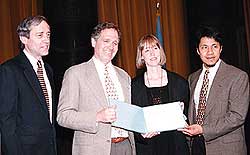
Columbia University President, George Rupp (left), presents Eric Nalder, Deborah Nelson and Alex Tizon with the Pulitzer Prize for Investigative Reporting.
Winning Work
By Eric Nalder, Deborah Nelson and Alex Tizon
Even in King County, half an hour from Planet Hollywood and NikeTown, there are Indians living in shacks as decrepit as any in Depression-era Appalachia.
If you saw how more than 100,000 Native-American families are living, you'd probably want to help them.
Children, parents and grandparents are sleeping in dilapidated cars, teetering trailers and rotting, one-room shacks. Many have no electricity, no toilets, no running water.
You probably wouldn't mind that some of your taxes are going to a federal program aimed at helping these people get into decent homes, especially because it's designed to help them help themselves.
You wouldn't mind - until you learned how millions of those dollars have been spent.
In Snohomish County, the money went to build a spacious manor for a couple making $92,000 a year.
In Oregon, it bankrolled business ventures controlled by a millionaire former professional-football player.
In Connecticut, it built houses for members of a wealthy tribe that operates one of the largest casinos in North America.
Across the nation - in tribe after tribe, state after state - the Indian-housing program is riddled with fraud, abuse and mismanagement.
That program, run by the U.S. Department of Housing and Urban Development, has distributed nearly $3 billion to tribal-housing authorities over the past five years.
During that same period, under the direction first of Republican Jack Kemp and then of Democrat Henry Cisneros, HUD has drastically cut its monitoring of how that money has been distributed and spent.
The Seattle Times spent six months visiting reservations, interviewing tribal and government officials and reviewing records to find out what deregulation has wrought.
The answer: It has turned HUD into a cash machine, spitting out dollars with few restrictions.
There is so little monitoring, in fact, that it's impossible to determine how much has been inappropriately spent. The Times found dozens of cases; there are undoubtedly more.
HUD's new policies not only open the door to corruption, but invite it.
"They are systematically destroying Indian housing as we know it," said Tony Arroyos, a housing consultant. "There is no monitoring of the pot of gold."
That pot of gold has benefited a favored few, depriving the majority in what experts say is America's worst housing crisis. Even in King County, half an hour from Planet Hollywood and NikeTown, there are Indians living in shacks as decrepit as any in Depression-era Appalachia.
This week, we'll take you around the country to witness what's happened under HUD's deregulation - and what's happened to your money.
The Times' findings are surprising high-level HUD officials.
"The picture you are painting is one, frankly, of us being asleep at the switch nationwide," said Michael Janis, second-in-command of public-housing programs. "I don't deny you have found problems and issues."
In response, HUD Secretary Cisneros has already ordered an internal investigation.
© 1996, The Seattle Times
By Eric Nalder, Deborah Nelson and Alex Tizon
At the end of a long, bending driveway, it appears: a sprawling new house in the middle of an acre and a half of trees.
At nearly 5,300 square feet, it's three times the size of the average American home. The front features a two-story decorative column bordered on one side by cedar decking and on the other by tall, arched windows and a two-car garage. In the back, a raised deck wraps around the gabled structure from end to end, with rows of view windows lining the first and second floors.
The house can't be seen from the road. And there are some who wish it wouldn't be seen at all - namely, those responsible for building it and the couple living there, who earn more than $90,000 a year.
Why? Because this secluded manor was built with tax dollars intended to help needy Native Americans.
The money came from a U.S. Department of Housing and Urban Development program to build low-cost homes for low-income tribal members.
Yet neither this house nor the income of its owners violates the program's newly relaxed rules - deregulation meant to give tribes more freedom in spending a half-billion dollars a year in aid for housing.
That freedom has come with a toll: Deregulation has opened the door to flagrant, widespread abuses at the expense of Native Americans living in some of the worst housing conditions in this country. Some 100,000 Indian families live in squalid, overcrowded dwellings, often with no plumbing or electricity.
In the absence of HUD oversight, and sometimes with the agency's encouragement, many Indian-housing authorities have veered from the core mission of providing modest housing for the poor to building showplace houses, or free houses, for the favored few and the well-connected.
From the rocky beaches of Puget Sound to the baked clay of New Mexico's mesas, from the dusty streets of the rural Otoe reservation in Red Rock, Okla., to the bright lights of the sprawling Foxwoods casino in Connecticut, opportunists have taken advantage of regulatory loopholes to create an anything-goes atmosphere.
Many of those opportunists are Native Americans who play politics and favoritism within their own tribes. Others are non-Indians - including some former HUD employees - who see the Indian-housing program as an easy mark.
The big house in the woods
There is probably no better symbol of the abuses than the big house in the woods on the Tulalip Indian Reservation, about 40 minutes north of Seattle.
The house is owned by Patti Gobin, executive director of the Tulalip Tribes Housing Authority, and her husband, Michael Alva, the agency's contracting officer. Their income of $92,319 is five times the $18,300 average income of participants in this home-ownership program.
Their house has 5,296 square feet of living space plus a 500-square-foot garage - likely the biggest single-family home ever built with HUD's Indian-housing money. The average American house is 1,800 square feet.
This enormous house was one of 18 built for Tulalip-reservation residents under the HUD program. Most of them are large enough to blend into any upscale suburban subdivision. Although none of the others is as big as the Gobin-Alva house, several are over 2,000 square feet and as big as 3,000 square feet, and three have three-car garages.
They were built with $2.5 million in tax dollars earmarked for low-income housing at the Tulalip reservation.
Among those who got these HUD houses were Gobin's daughter, one of her best friends and another member of the housing-authority staff.
Some of these homeowners could pay as little as $175 a month for their houses for 15 to 25 years, at which point they would get the deeds. They also have the option to buy the houses outright with private financing for up to $60,000 less than they cost to build.
The difference comes from taxpayers' pockets.
Designed to help low-income
The Tulalip subdivision was built under a HUD program called "Mutual Help," started in 1962 as a way to give low-income Indian families a chance to own decent, affordable houses.
Here's how it's designed to work: HUD gives Indian-housing authorities money to build houses. Low-income tribal members pay monthly installments - usually 15 percent of their household income - to the authority for a set period. The authority then uses that cash flow to keep its housing program afloat.
Without Mutual Help, many Native-American families would never have a chance to own a decent house.
Banks generally won't give home loans to reservation Indians. Most don't have the income to qualify. And even if they do, reservation land is trust land with special sovereignty status, and a bank could not foreclose on it should a loan go bad.
In the past, banks would loan money only for mobile homes and trailers, called "wheelies" by Indians because banks could wheel them away if the borrowers defaulted.
For most of three decades, Mutual Help seemed to be achieving its goals. More than 50,000 houses were built under the program, with an average size of 1,200 square feet.
"No program made such a difference on my reservation other than maybe the health clinic," said Coni Wilson, who runs the Quinault Indian Housing Authority in the tiny village of Taholah on the Olympic Peninsula.
Still, 250 Quinault members sit on a HUD waiting list, living in conditions most Americans would consider intolerable.
Wilson, who is also vice chairwoman of the Northwest Indian Housing Association, tracks carefully what other Northwest tribes do with their money from HUD. That's become especially important to her since 1992, when HUD began loosening oversight to give tribes more control of the Indian-housing program: Wilson knows that if she doesn't follow the money, it's likely no one will.
So when her colleague Patti Gobin started talking about building her dream house on the Tulalip reservation, Wilson wondered immediately where the money would come from.
Authorities were alerted
Gobin belongs to an influential family in one of Washington state's most thriving Indian communities. Blessed by strong leadership and a good location just off the I-5 corridor, the Tulalip confederation of small tribes controls 22,000 acres of lush forest and meandering shoreline west of Marysville.
When Gobin first showed Wilson her house plans, Wilson blinked at the size.
"My God, it was a 5,000-square-foot home!" Wilson said.
Afterward, the realization sank in: Gobin must be planning to build the house with Mutual Help money.
Wilson alerted two HUD officials: Dominic Nessi, deputy assistant secretary for the Office of Native American Programs (ONAP), which administers Mutual Help, and Jerry Leslie, ONAP's Northwest regional director.
Nessi, who oversees the program nationally from Washington, D.C., said he told Leslie, based in Seattle, to check it out. But Leslie says he doesn't remember talking to Nessi or Wilson about the house.
He said the Tulalip Tribes Housing Authority told his staff it was going to take advantage of the program's new flexibility to build some showcase low-income homes instead of traditional HUD boxes. The housing authority provided sample house designs but none looked exceptionally large, Leslie said.
HUD approved the $2.5 million grant and forked over money, but did little else. Under deregulation, HUD staff no longer had to make site visits, sign off on plans or otherwise keep a close watch on the money.
By the time HUD officials awoke to what Gobin and Alva were doing, the paint had dried and word had spread throughout the state's Indian community that the Tulalip agency had built an amazing house and it was OK with HUD.
Doing what so many dream of
Gobin refuses to talk about her house, referring all questions to Alva, her husband. Alva insisted that officials from HUD's Indian-housing office in Seattle knew all about the Tulalip agency's plans to build big houses.
In fact, Alva said, HUD officials held the Tulalip program up as a model.
Alva produced a September 1995 letter from John Barber, the senior adviser in the Seattle regional office, thanking Alva for giving a group of visitors a tour of the construction site.
"I hope many others, especially from the Indian Community, have a chance to see first-hand that you are doing what so many dream of," Barber wrote.
HUD architect Don Klein made an informal stop at the reservation shortly after Barber's visit. He wanted to check out the rumors of big houses for himself, and sure enough he found some. But what really gave him pause was the size of the foundation for the Gobin house.
"It was clearly for a very large structure," he said.
He alerted his bosses. But again, in the spirit of deregulation, they saw no reason to follow up.
When HUD's Northwest office finally dispatched three staff members to the development in February, there was little they could do besides stand in the mud outside the Gobin house and wonder how they were going to explain it to the public.
Under HUD's new, more relaxed rules, they were hard-pressed to identify any clear-cut violations. There are no limits on size or amenities for low-income housing. There are limits on cost, based on size and location, but they apply to the average cost per house in a development. The tribe could build as expensive a house as it wanted, so long as the cost was offset by some cheaper houses.
A staff member reported seeing water jets in some of the bathtubs in the subdivision, inspiring a two-day discussion among top HUD officials on whether Jacuzzis were suitable for federally financed low-income houses. They eventually decided the whirlpool baths were improper but could not find any regulation banning them.
The discussion reflected just how far afield the Indian-housing program had gone under the new rules.
"Under the old system, this would never have happened," Leslie said. "We would have checked the plans. We would have been monitoring it on a regular basis. That had its negatives, too. It got to the point that people didn't blink without HUD approval.
"There has to be something in between."
HUD's 'new flexibility'
HUD used to regulate Mutual Help developments closely, making calls on details from design to cost. Beginning in 1992, under HUD Secretary Jack Kemp, and continuing in 1993 under Secretary Henry Cisneros, the agency began shedding regulations.
HUD officials proclaimed a new era in which the agency would be more partner than regulator of Indian-housing authorities. It was dubbed the "new flexibility."
"It follows a general approach throughout government that relates to empowerment of local communities," said Nessi, a principal architect of the new era. "That's a major issue with tribal governments, because of their status as independent nations."
In theory, it meant local Indian officials could make more of their own decisions about how best to meet the needs of their low-income populations. In practice, though, it has resulted in a shocking lack of oversight about how half a billion dollars a year in federal aid are being spent.
HUD's new, relaxed rules do the following:
-- Dispense with the requirement that housing authorities base the sales price of homes on actual cost. Now, housing authorities can set any price they want. Although many tribes price them prudently, others have used this provision essentially to give houses away to tribal leaders.
-- Call for moderate houses but do not define "moderate." Some housing authorities are using the money to build bigger and fewer homes at a time when the need for houses is at an all-time high.
-- Allow five homes per project to go to upper-income families, even if poorer ones are waiting.
-- Allow Mutual Help homeowners to spend their own money for luxury upgrades of their houses, prompting many critics to ask why homebuyers with money to spare should get federal subsidies. Such expensive extras as Jacuzzis, decks, skylights and three-car garages are often added to already well-endowed homes.
Even with the changes, nobody in HUD's administration expected to see the program pay for a 5,300-square-foot house.
Said Nessi, the deputy assistant secretary: "We do not want to have a home like that built in this program."
Records show HUD officials tried to resolve the situation quickly, quietly, and with minimal scrutiny by their own staff and outsiders.
Leslie, the Northwest director, at first insisted Gobin and Alva pay for the house or risk losing future funding for tribal housing - a threat he now admits he probably couldn't have carried out.
Finally, Gobin and Alva agreed to pay a price based on a cost estimate from the housing authority's contract officer - who just happened to be Alva.
HUD agreed.
Leslie asked for no backup documentation, even after acknowledging Alva's conflicting interests as homebuyer and price-setter. When his staff complained that the breakdown did not include site work, planning or administrative costs, Leslie discussed it with Alva but agreed not to make an issue of it.
Alva set the price at $214,000, and HUD accepted it.
Leslie arranged a special deal for a government-insured private loan through HUD's Federal Housing Administration. The house was too big to qualify for FHA insurance as a single-family residence, so an accommodating FHA official classified it as a duplex.
Internal audit ordered
As part of the deal, Leslie called off inspection of the other large houses - some of the biggest Mutual Help houses in the country - and left it up to Tulalip officials to decide whether they were "modest."
That might have ended the matter last April if The Seattle Times had not started asking questions. Within weeks, the HUD inspector general began an audit, over objections from Leslie and his boss, Nessi.
With news of the audit, Leslie withdrew his authorization of the $214,000 sales price and warned the couple that the figure might go higher. But Alva and Gobin could not qualify for a higher loan, leaving the fate of the house in limbo.
Leslie suggested the tribe make the house a shelter for homeless teenagers, an idea that got a cool reception from the tribe and a heated one from Alva and Gobin.
Leslie offered a compromise. Alva and Gobin could pay the $214,000 upfront with the help of the FHA loan. Once a new cost appraisal was provided by the inspector general, the tribe would pay the difference.
But tribal officials didn't want fellow tribe members to know their money would be used for the big house. (Most still have no idea.) So, Leslie agreed to let Gobin and Alva cover the difference with housing-authority money, if the Tulalip tribes would donate an equal amount of money to a special fund for housing programs.
Leslie's staff wrote a memo warning against the agreement: The tribe could back out of the deal, and the inspector general's findings might be serious enough to force Alva and Gobin out of their jobs, resulting in a default that would return the problem house to HUD.
But Leslie decided to proceed. And he didn't make his accommodations in a vacuum: Nessi and other top officials weighed in all along the way. In fact, at the start, Ted Key, the second in command at HUD's Office of Native American Programs, reprimanded Leslie's staff for visiting the development site at all without clearance from tribal officials.
When Leslie wrote a position paper for tribes to clarify the proper use of Mutual Help money in light of the Tulalip controversy, he drew another reprimand from Key for being too authoritative:
"I have a hard time understanding why your staff has taken two years to understand the change in our relationship with Tribal Governments," Key wrote. "We don't 'allow' Tribes, anymore than they 'allow' HUD . . . WE ARE PARTNERS!"
Dream deal for dream house
Alva and Gobin moved into their dream house in August.
If they had had it built, like any other middle-income couple, they would have paid upward of $400,000, not including the land, according to real-estate and construction experts.
Instead, they had their home built at substantial savings by a nonprofit housing agency's in-house construction team, which is paid with money from HUD.
The inspector general is expected to set the actual cost of the house at $260,000, Leslie said. The deal with Leslie ensures they won't pay more than $214,000 - 18 percent under cost and half the market rate.
Taxpayers also remain on the hook for the federally insured FHA mortgage Alva and Gobin obtained to help pay for the house. If they default, the government has to pay off the mortgage.
In retrospect, Alva said, he and Gobin should not have built their house through the housing authority, because of their positions.
"It's appearances," he said.
But Craig Dougall, who does consulting work with Northwest tribes, recalled a conversation with Alva more than a year ago about how easy it would be to get away with building a big house, because HUD officials no longer check designs or visit construction sites until after the fact.
"I said, 'What are they going to do? Burn the house down?'" Dougall recalled.
But even Dougall was surprised by Alva's action.
"It was a theoretical discussion. I didn't expect him to do it."
© 1996, The Seattle Times
By Eric Nalder, Deborah Nelson and Alex Tizon
MUCKLESHOOT INDIAN RESERVATION -- It is not much more than a large plywood box, this house Thelma Moses calls home.
To stand outside it is to wonder how such dimensions - 10 feet by 12 feet - can enclose a life.
To stand inside is to marvel at how much she has managed to fit in: a bed, a recliner, a television, a pile of clothes, a wall of pictures, a fan, a water jug, a hot plate. From the center of the room, she is a step away from almost every object in her house.
But to use a toilet, she must step outside to a portable Sani-Can. For water, she must trudge across a littered yard to her son's trailer. For electricity, she must string together extension cords from the trailer to her house.
Moses' house is an example of what Indian-housing bureaucrats call a "substandard" dwelling. Moses herself is more plain-spoken:
"It's my shack."
She considers herself lucky
Moses, a Muckleshoot Indian, is a crinkly-eyed mother of nine and grandmother of 25 who considers herself lucky to have a house at all. She could be living under a bridge or in a car, like other Native Americans she has known. She has lived on the Muckleshoot Reservation for most of her 56 years. For the past 10, she's been waiting for a government-subsidized house.
"I've been waiting so long, I'm a senior citizen now," Moses said.
She's on a waiting list, like a hundred others in her tribe, like more than 5,000 others in the Pacific Northwest, and more than 100,000 around the country.
Native Americans in tribal areas live in some of the worst housing conditions in the nation, with vast numbers living without running water, plumbing or electricity. Often, two or three generations live in dwellings designed for two or three people. With federal dollars shrinking and the Native-American population burgeoning, officials say the Indian-housing problem has reached crisis proportions.
An estimated 40 percent of all Indians in tribal areas live in what are called substandard dwellings. Housing officials say 100,000 new homes nationwide are needed now - never mind the coming decades.
The major source of money for housing on reservations is the U.S. Department of Housing and Urban Development. Without HUD money, it's virtually impossible to get a housing loan; banks generally won't lend to reservation dwellers because the lender can't foreclose on the land if a home loan goes into default.
Most Native Americans are too poor to qualify for a loan, anyway.
Virginia Toews, a retired Indian-housing lobbyist living in Billings, Mont., explained it this way:
"Let's say you were living on the Northern Cheyenne Indian Reservation, and you decided you didn't want to live in your one-room log cabin anymore, that you wanted to live like other people do. You go to a bank to make a loan to build a home. They'll ask what do you have to mortgage, what's going to guarantee this loan? Well, you can't mortgage trust land. You say, 'I have a job that pays $18,000 a year and a family of six. The bank will say, 'Sorry, buddy.'"
Enter HUD's Native-American housing program. It's designed to give Indians a chance to build and own decent homes by providing low-cost financing for owner-occupied houses, as well as development money for affordable rental units.
On paper, the HUD program looks like a good way to help the Thelma Moseses. But in fact, tribal politics, outside opportunists and an absence of HUD oversight have left many poor people in their "shacks." Meanwhile, people in power on some reservations have used money from the program to help themselves.
Unless things change, Moses and most of the others will have to wait indefinitely.
Bleak picture in all regions
The picture is bleak in every region of the U.S.:
- In the southwest corner of Alaska, more than 2,000 Eskimo natives are on a waiting list for HUD housing. Scattered villages resemble shantytowns, with earthen-floor dwellings that have no plumbing or electricity.
- "The term most used to describe this region is 'Third World,'" said Norm Fancher, Indian-housing-authority director in Bethel. "If I had to pick one word to describe the housing need, it would be 'desperate.'"
- On the Pine Ridge Reservation in South Dakota, the housing crisis prompted the Oglala-Sioux Tribe to declare a state of emergency last December. Housing-authority director Paul Iron Cloud said 4,000 new houses are needed immediately to alleviate severe overcrowding.
- Some families are living in their cars in hopes of staying warm against winter on the plains.
- In upstate New York, at the Seneca Indian Nation, a quarter of the homes do not have water, sewer or heat. Nearly a hundred families are on a waiting list for a HUD home, and at least a hundred more are in need of homes but have not qualified to be placed on the official list.
"Most people that come into our office need housing yesterday," said housing director Bernadette Harlan. - The Navajo Nation - the country's largest tribe - has declared its housing in a crisis state, with more than 20,000 families in need of homes in Arizona, New Mexico and Utah. Of the tribe's 30,000 existing houses, 80 percent lack plumbing, electricity and telephones.
- In northeast Oklahoma, 1,000 members of the Cherokee Nation languish on a waiting list, and another 1,000 are waiting just to get on the waiting list.
Said housing-authority Director Joel Thompson: "One year, we had a thousand people on our list; HUD gave us 25 houses. I figured it out: at that pace, it would take 42 years to meet the need, assuming no one else was added to the list. If I planted pine-tree seedlings, they would reach maturity and we could turn them into lumber for new houses in that period of time."
Long waiting lists in Northwest
One need not look beyond the Northwest to find miserable conditions. A survey by the Bureau of Indian Affairs in 1993 found that 5,050 Native-American families in the Northwest were in need of new homes, and bureau officials say the need today could only be greater.
"The need per population is as great here as it is anywhere in the nation," said Coni Wilson, housing-authority director for the Quinault Indian Reservation, where more than 250 families have been waiting for HUD homes.
Among the Shoshone-Bannock Tribe in Idaho, the Klamath Tribe in Oregon, and the Lummi and Yakama tribes in Washington, at least 2,000 families are in dire need of new housing.
On the Muckleshoot reservation, the only tribal area in King County, nearly 100 people await homes, including several of Thelma Moses' relatives.
"We're all 'on the list,' as they say," Moses said.
She found herself jobless and about to be evicted from an apartment two years ago when she bought the one-room cubicle, a structure intended as an entryway for a mobile home. She paid $400 for it and has called it home ever since.
Mostly, she lives alone, but sometimes her children and grandchildren come over to watch TV and spend the night. When that happens, bodies are almost literally stacked one atop the other. Holidays are impossible.
"I don't like Christmas in my shack," said Moses, who used the word "shack" with equal parts gratitude and self-mockery. "I get depressed. There's no room for a tree."
Poverty on Muckleshoot land
The Muckleshoot Reservation is 3,840 acres of hilly, mostly rural land between the Green and White rivers outside Auburn. It is home to 3,100 Native Americans, of whom 1,200 are enrolled members of the Muckleshoot Tribe.
Hopes for the future rest heavily on the tribe's fledgling casino. But while it has provided 877 jobs for tribal members, the profits haven't yet brought housing or social services. The tribe plans to start those programs soon.
The per-capita income on the reservation is $4,000; the average education level is 10th grade; the housing stock, according to former housing director Dale Curtis, is "the most dilapidated of any Washington tribe."
Scattered along dirt roads are clusters of shacks and broken-down trailers, often connected to the water system via garden hoses. Rusty portable toilets sit between abandoned cars and appliances.
Sandra Ross lives in a trailer with her four kids, ages 4 to 8. Part of the trailer is not habitable because of water damage. Some windows are broken and covered by cellophane. The home has no running water or plumbing. Electricity comes in through an extension cord connected to a neighbor's trailer. A portable toilet sits outside the front door.
On this day, she cannot leave the house because her car has broken down. Her children crowd around a flickering television, eating cereal and drinking Coke.
"I'm just trying to get the place livable for now," said Ross, who is saving part of her welfare checks to buy a refrigerator and a heater. "Winter's coming but I'm not thinking about it. I can't think about it. I'm just thinking about getting through today."
Ross' sister, Laurie Ross, is in a similar situation, living in a roach-infested apartment in Auburn with her four children, the youngest 9 months old. In March, her 15-year-old daughter is expecting a baby, and three generations will live together in the apartment.
Ross was high on the waiting list for a HUD home, and was excited about the plan to build 65 new HUD units on the reservation. But that plan was scuttled in September when HUD - spurred by inquiries from The Seattle Times - froze its $7 million grant to the Muckleshoots and began an investigation of how the money was being spent.
In a sequence of events repeated in case after case nationally, the housing-authority executive director - in this case, a retired HUD official - made some bad business decisions and HUD failed to act on early warning signs.
By the time HUD stepped in, the Muckleshoots already had spent more than a third of the development grant - $2.5 million - with little to show for it beyond sewers, high-priced architectural drawings and a single, over-budget model house.
The investigation continues, and Laurie Ross waits.
"I want to be a responsible person. I want to raise my kids, to break this cycle we're in," she said.
"We were all so excited about getting a house. Now I feel fooled. To be promised something like that, and then to have someone come along and take it from you and then act as if it were nothing - it's hard."
© 1996, The Seattle Times
By Eric Nalder, Deborah Nelson and Alex Tizon
RED ROCK, Okla. -- Troy Warrior carries his lost dream in his pocket, on a key chain, a single shiny reminder of what should have been.
It's the key to a house he was promised under a federal program for Native Americans, a brand-new brick ranch house in the center of this village, home to the Otoe-Missouria Indians.
With financing from the federal Department of Housing and Urban Development - financing they couldn't get from traditional sources - Warrior and his wife would finally be able to afford their own home.
Last January, the couple stood smiling in the middle of the empty living room, listening to the echo of excited voices as their children explored the bedrooms where they would soon be sleeping.
But days before the move-in date, the family's plans were dashed: The house would no longer be theirs, they were told. All over town, other Otoe families on the waiting list for 20 HUD-financed houses got the same bad news.
Leaders of the tribal-housing authority had created a new list - with themselves and their relatives and friends at the top.
Then they eliminated a requirement that recipients of the houses had to pay for them - in effect, giving themselves free houses.
Benefiting from this $1.3 million scheme were the housing-authority chairman, his brother, his top administrator, board members and their families.
"I actually had the key. We were thinking this was home," said Warrior. "We'd already planned where we'd put our furniture. Then it was all taken away.
"What they did to me and my family was wrong."
Loophole in new rules
"What they did" was to take advantage of a new loophole in federal regulations, a loophole brought to the housing authority's attention by a former HUD official.
The new rules, written in 1995, give tribal-housing authorities unrestricted power to set the prices of HUD-subsidized homes. But rather than using that power to establish a sliding scale of house payments to benefit their most needy members, leaders of the Otoe and other tribal-housing authorities used it to set themselves up in new houses at taxpayers' expense.
The Otoes gave the houses away in exchange for what they called "sweat equity" - which amounted to nothing more than a commitment by the new homeowners to do their own post-construction cleanup work.
Of the 20 houses given away in Red Rock: Five went to households that weren't low-income. At least as many went to tribal members who had no minor children living with them, even though families are supposed to get priority treatment. And two went to people who already had decent homes, although others on the waiting list didn't.
All five board members got houses for themselves or family members. The board chairman and the housing-authority administrator, neither of whom has minor children, built themselves three-bedroom houses bigger than any others in the project.
These actions destroyed whatever harmony this tribe had, pitting neighbor against neighbor.
The Warriors and other jilted families cried foul to HUD, but to no avail. One family filed suit to recover its promised home, and eight others have met with an attorney to explore legal options.
"I didn't ask for a free house," said Warrior, who makes minimum wage as a school-maintenance worker. "I was willing to pay for it."
The Otoes' action, which has been duplicated by tribes in California, Arizona and Washington, not only lays waste to the dreams of families such as the Warriors, but threatens the existence of individual housing authorities. Revenues recouped from homeowners are supposed to help keep the housing authority afloat.
When housing authorities give away homes for little or nothing, they essentially give away their future and that of tens of thousands of Indians languishing on their waiting lists.
From HUD job to consultant
The Otoes were led to the loophole by Jim Cook, who went to work for the tribe's housing authority as a paid consultant two days after he retired from HUD. The housing authority gave him a two-year, $107,000 contract.
Cook confirms he showed the board members the loophole and explained how they could leapfrog others on the waiting list. He also showed them how to get around a rule against giving HUD houses to people who already own homes.
"I'm working for a different master now," he said without hesitation. "It is amazing what you can find when you read the regulations."
Cook's employment by the Otoes reflects one reason HUD's Indian-housing program is such a mess: HUD employees crossing over to help tribes get around the intent of federal laws.
Cook spent 30 years at HUD, ascending to the No. 2 position in the Oklahoma City regional office of the Indian program before retiring on Dec. 31. On Jan. 2, he went to work for the Otoes.
But long before that, he was developing a tight relationship with the tribe: He took on oversight of the housing authority, co-signed its checks, listed the Otoe address as his own in correspondence and gave himself security clearance to draw money from the tribe's grant account in the federal treasury.
In his last four months at HUD, 23 of the 24 business trips Cook took were to Red Rock, although it was just one of 30 housing authorities for which he was responsible.
He decided the Otoes needed a consultant, wrote up the bid specifications for the job and then won the contract when he retired.
Cook insists he didn't pursue the Otoe contract until his departure from HUD - even though New Year's Day was the only day between jobs.
'What we thought was best'
Red Rock is a small grid of gravel streets lined with run-down houses and a cafe - a pocket-size community along a two-lane road that connects the county seat at Perry with the Conoco plant in Ponca City.
About 300 Otoe-Missouria Indians live here, out of a total tribal enrollment of 1,600. Many others live nearby, descendants of seven clans who settled the northeast corner of Oklahoma 115 years ago after harsh winters and white settlers drove them from Nebraska.
Farmland stretches in every direction as far as the eye can see, the terrain as flat and featureless as a table top.
The red dirt yields wheat and corn - but not for the Otoes, who were hunter-gatherers, not farmers. They had neither the inclination nor know-how to raise crops.
Their primary source of income has been the Otoe bingo hall, built in the mid-1980s with great expectations it has yet to fulfill. The hall has been closed most of the year for lack of an operator.
"We don't really have any resources other than the land base," said tribal chairman Raymond Butler. "I guess we had some oil once, but not anymore."
As a result, many of the houses in Red Rock were built with HUD money and rented or sold over time to their occupants, who pay the housing authority a percentage of their monthly income.
"How do you think they feel when they hear houses are being given away?" said Butler, who has no control over the housing authority, an autonomous agency.
The officials who carried out the giveaway have not felt the need to appease Red Rock's angry residents nor to offer any explanation for their actions.
"We did what we thought was best for the people," said Claude Dailey, who recently stepped down as housing-authority chairman.
That's all he would say.
'It looks pretty bleak'
After Warrior was bumped from the housing list, he and his two sisters - who also had been bumped - drove 70 miles south to the HUD office in Oklahoma City. They met with Regional Administrator Wayne Sims and his assistant. Sims took no notes, made no copies of the family's carefully kept files and, in the end, declined to take action.
"After talking to them, I just gave up," Warrior said. "We told them everything that was happening: who was removed from the list, the executive director and chairman getting houses. They said there was nothing they could do. It was up to the housing authority and the tribe."
Sims explained HUD's inaction this way: "Since I've been here, there's always been a philosophy that these sorts of things should be handled locally. This is a program that offers tribes more autonomy."
HUD did nothing for four more months, until escalating complaints from angry tribal members finally provoked a visit. It took HUD staff barely half a day at the Otoe housing-authority office to uncover enough evidence of impropriety to demand an accounting for the changes in the waiting list and to halt any further changes.
But by then, all but eight of the 20 houses had been transferred. It's probably too late to make things right for those who lost out.
"On the surface, it looks pretty bleak," said Jack McCarty, an attorney who has met with eight of the families who were bumped. "HUD let the housing authority have this money with no controls. The damage is pretty severe."
Meanwhile, Warrior is renting a tiny cottage in Ponca City. It's a tight fit for a family with three active children, but at least it's a roof over their heads.
"I did everything I was supposed to," he said. "In the end, it didn't matter."
They visit friends and family in Red Rock, but his wife won't go near the street where their dream house is occupied by someone else. The taste of disappointment is still too bitter.
"The kids were asking a month or two later, 'When are we going to move into the house?'" Warrior said.
"What am I supposed to tell them?"
© 1996, The Seattle Times
By Eric Nalder, Deborah Nelson and Alex Tizon
The federal government showered the tiny Pleasant Point Passamaquoddy Tribe -a community of 600 in coastal Perry, Maine- with more than $7 million in low-income-housing grants over just four years.
The money flowed because the housing authority's reputation for good management won it national acclaim and high scores in the competition for funds from the U.S. Department of Housing and Urban Development.
But in the past year, the authority has been torn apart by power struggles among tribal factions and by housing officials working in their own interests. In the midst of the turbulence, the executive director has given herself a low-income house and turned it into an imposing structure known locally as "the mansion."
Here, documented by a tribal member and confirmed by the director herself, is how it happened:
- The housing-authority office has been run for the past eight years by Executive Director Pamela Francis. Her husband supervised construction crews for the agency. Together, the couple made $75,000 a year in this economically depressed community, where 100 people are on a waiting list for subsidized homes.
- In 1994 Francis moved her father from a small, two-bedroom house to a large, four-bedroom HUD-subsidized home with a breathtaking ocean view. Francis, her husband and their two children moved in with him in spring 1995. When her father died several months later, the family exercised an option to remain in the house under HUD rules. They pay the housing authority $133 a month.
- Francis bought a house from her son for $1. Then, at her request, the housing-authority board bought it from her for $85,000, relying on an estimate she provided. The housing authority sank an additional $30,000 into the house to convert it into three small apartments.
- In a separate deal, Francis persuaded the board to pay her $15,000 in relocation expenses for removing her horse, its small stable, a shed and fencing from tribal land earmarked for a low-income development. HUD officials say relocation money may be used only to move people. A family displaced by the same project received no compensation, though they had to live with relatives for three months before getting a new home.
- Francis used proceeds from those deals with the housing authority to secure an $80,000 home-improvement loan from a mortgage company that did business with her office. She and her husband supplemented the loan with insurance proceeds following her father's death and with their share of HUD rehabilitation money. They also bought supplies and appliances through the housing authority under an informal revolving-credit arrangement offered tribal members.
- The ocean-view "mansion" is now more than 3,000 square feet, by Francis' estimate. She said she did it all legally, with the blessing of her board, and in some cases, with the approval of HUD officials. She dismisses local critics as politically motivated or jealous. "Just because I was executive director, I was supposed to be destitute and homeless in the process?" she said.
HUD is sifting through housing-authority records to review these and other deals. Francis has taken a job at a HUD-funded agency providing technical assistance to tribal-housing authorities.
© 1996, The Seattle Times
By Eric Nalder, Deborah Nelson and Alex Tizon
The federal Indian-housing program is rife with mismanagement and abuse. In its six-month investigation, The Seattle Times found these examples.
WASHINGTON STATE
Tulalip
Marysville, Wash. - A $2.5 million HUD grant for low-income housing instead built luxury houses on big lots, including a 5,296-square-foot house for the housing authority's executive director and her husband, who make $92,319 a year.
Muckleshoot
Auburn, Wash. - The tribal-housing authority spent $2.5 million of a $7 million grant on a high-priced architect, overpriced model home and sewers before HUD suspended funding to investigate how the money was being spent. The money was supposed to build 65 badly needed units.
Chehalis
Oakville, Wash. - Housing officials won a federal grant of nearly $800,000 for emergency home repairs and replacement of a sewage-treatment system - then spent most of it on the custom remodeling of 10 homes.
Puyallup
Tacoma, Wash. - The tribe is embroiled in a legal battle with residents of newly purchased low-income houses after a complicated financing scheme backfired, allowing some of them to occupy their places without signing a contract or paying rent. Even though the mess is not yet sorted out, the housing authority recently received another $1.3 million.
Shoalwater Bay
Tokeland, Wash. - A $1.2 million housing grant bought a polluted, unusable piece of property and built a large home for the tribal chairman.
Yakama
Yakima, Wash. - The troubled housing authority hired a San Diego businessman as executive director in 1993. Within a year he had stolen $92,000 worth of goods and services intended for low-income Indians.
IDAHO
Nez Perce
Lapwai, Idaho - The first expenditures of a $1.8 million grant meant for low-income housing went instead to four large houses the housing authority had hoped to sell or rent to middle-income families. There were no takers, so the housing authority is stuck with them.
MONTANA
Northern Cheyenne
Lame Deer, Mont. - A 1995 spot audit discovered the housing authority had $700,000 in uninsured investments and bank accounts.
OREGON
Coquille
Coos Bay, Ore. - HUD officials are investigating indications that a former professional-football player, one-sixteenth Coquille, used some of a $7.8 million grant for improper and/or illegal purposes.
CALIFORNIA
Owens Valley
Big Pine, Calif. - The housing authority gave 78 low-income homebuyers their deeds 10 years early, refunded $350,000 in payments they'd already made and allotted $20,000 per house in HUD money for improvements. The lucky group included three housing commissioners.
ARIZONA
Fort McDowell
Fountain Hills, Ariz. - Their casino is so successful that tribal members, who get an average $3,000 a month in profit-sharing, no longer need their housing authority. So the agency is phasing itself out by selling 64 low-income houses for $1 each - forgiving roughly $1.1 million owed in monthly payments and back rent.
Pascua Yaqui
Tucson, Ariz. - The housing authority was juggling $15 million in development grants and $6 million in rehabilitation money without the staff, policies or plans to ensure it is spent properly. As a result, federal auditors say, staff and board member's families received cash to pay for improvements on their HUD-financed homes that never took place; over-income relatives of staff received low-income homes, and repair money was used for everything from deluxe refrigerators to walled patios to home-phone bills.
Hopi
Second Mesa, Ariz. - Charges of mismanagement and theft at the housing authority delayed housing projects and caused tribal strife for two years. HUD's inspector general is now investigating, and the executive director was fired in September.
NEW MEXICO
Northern Pueblos
Santa Fe, N.M. - Money intended for rehabilitation of low-income homes in disrepair went to the home of the housing-board chairman, whose salary is twice the state average. Remodeling contracts went to friends of both the board chairman and the housing authority's director.
All Indian Pueblos
Albuquerque, N.M. - An umbrella housing authority representing 10 tribes has deteriorated to a point where employees and member tribes are leaving. While the housing authority's director feuded with HUD officials, projects went on hold in a state that has some of the worst Indian housing in the nation.
COLORADO
Rocky Mountain
Denver, Colo. - Federal auditors have found a serious problem with cash controls at Indian-housing authorities throughout the Rocky Mountain district. Eleven of 12 flunked spot-checks because they had cash shortages or were highly susceptible to internal thievery.
UTAH
Southern Ute
Ignacio, Colo. - HUD gave the tribe and its housing authority more money than it could handle - eight grants totaling $6.7 million over just three years for housing, hotel renovations at its casino complex, and water and sewer lines. Long delays resulted in the money sitting idle for years although it was badly needed elsewhere.
OKLAHOMA
Otoe-Missouria
Red Rock, Okla. - The housing authority took advantage of a new loophole to give away 20 houses built with a $1.3 million grant. People on the waiting list were bounced, and the houses went to housing-authority staff, board members and their families.
Absentee Shawnee
Shawnee, Okla. - A housing-authority official divided $466,000 in HUD rehabilitation work into 27 small contracts, most of which went to four favored firms without advertised bidding.
NEBRASKA
Omaha
Macy, Neb. - The housing authority's former executive director ran a private loan business out of the office, while basic controls on agency cash and assets were lacking. For example, the son of an employee bought two trucks but never paid for them, and the authority continued to pay the insurance on the vehicles for months.
SOUTH DAKOTA
Sisseton-Wahpeton Sioux
Sisseton, S.D. - The tribal-housing authority is riddled with charges of misuse of HUD money. Meanwhile, a tribal leader has been indicted in a scandal involving excess government property.
MINNESOTA
White Earth Band of Chippewa
White Earth, Minn. - The tribal chairman and two aides were convicted in federal court in June of conspiracy, theft, embezzlement, bribery and money-laundering involving casino operations. Now HUD is discovering that housing money is missing and homes are in disrepair.
Bois Forte
Nett Lake, Minn. - HUD declared the housing authority a "high risk" 18 months ago, because tenants owed more than $100,000 in back rent on 94 housing units and a $438,370 rehabilitation project sat idle for years. But instead of getting more attention from HUD, the executive director said she has rarely seen anyone from the agency since.
WISCONSIN
St. Croix Chippewa
Hertel, Wis. - The housing authority received $5.6 million over five years, despite lacking basic financial controls. Using HUD's automated telephone-withdrawal system, the authority took nearly half a million dollars more than it needed and kept the money in a non-interest-bearing account insured for just $100,000. Development money was misspent on a variety of things, from restaurant meals to apartment buildings. The tribe also is lax in collecting monthly payments from tenants and homebuyers.
MICHIGAN
Keweenaw Bay
Chocolay Township, Mich. - A tribe won trust status for a new piece of property by telling federal regulators it was only for low-income HUD housing, then built a casino and bingo hall on subdivision land that was designated for a playground. Meanwhile, it has received $464,324 for home repairs with little to show for the money.
ALABAMA
Mowa Band of Choctaw
Mount Vernon, Ala. - The housing authority for the new, state-chartered tribe, which requires just 1 percent Indian blood, had money woes and management problems since its inception, yet HUD gave it large development grants three years running. The authority covered cost overruns on the first project with money for the second, then covered that shortfall with the third grant. By the time HUD turned off the spigot, it had poured $5.6 million into the poorly run authority.
CONNECTICUT
Mashantucket Pequot
Ledyard, Conn. - The tribe with a casino reputed to clear $1 million a day is finishing work on the last of 15 large homes financed with a $1.5 million, low-income-housing grant, even though it no longer has any low-income families.
RHODE ISLAND
Narragansett
Charlestown, R.I. - A dozen new, low-income houses sit empty a year and a half after they were built because HUD released a $3.8 million grant for the housing authority to buy and build on nonreservation land without getting the proper local, state and federal clearances.
MAINE
Pleasant Point Passamaquoddy
Perry, Maine - The housing authority's executive director sold her agency a home for $85,000, collected $15,000 for "horse relocation" and moved into her father's low-income house - using the profits to renovate and expand it into a structure commonly referred to as "the mansion."
© 1996, The Seattle Times
By Eric Nalder, Deborah Nelson and Alex Tizon
COOS BAY, Ore. -- He burst onto the scene like the 6-foot-5, 300-pound, former defensive lineman he is.
After retiring from the National Football League, Bruce Anderson had been a stockbroker, factory owner, magazine publisher and co-owner of a professional soccer team. At age 48, he was a millionaire who believed the aggression he had honed on the football field was the key to success in the business world.
In 1992, he brought that ferocity to the small coastal Oregon Indian tribe to which his grandmother had belonged.
"My goal," he said, "was to see one tribe in the country succeed."
Who could argue? Certainly not the Coquille Tribe, which allowed Anderson - one-eighth Coquille - to place himself at the helm of its economic future.
Four years later, that future is more precarious than before. And Anderson is the target of a federal criminal investigation for actions taken as head of the Coquille Indian Housing Authority.
Not coincidentally, those are the same four years in which the Department of Housing and Urban Development dramatically eased its regulation of the federal program that provides housing for poor Native Americans.
That policy change has left the program ripe for exploitation by operators who recognize that tribal status is essentially a key to HUD's cashbox.
Across the country, such consultants and entrepreneurs - some of them Indians, some non-Indians, and some, like Anderson, born-again Indians - have found ways to tap into the half-billion-dollar-a-year stream of HUD's Indian-housing program to help themselves and their friends at the expense of the neediest on Indian reservations.
Meanwhile, more than 100,000 Native Americans live in crowded, unsanitary, primitive conditions most Americans would consider intolerable.
Records and interviews indicate Anderson exaggerated the Coquilles' need for federal assistance, snatching up a third of the money available in Oregon, Washington and Idaho in 1994 and depriving other, poorer tribes.
Then, according to HUD records and some of his employees, Anderson used some of the $7.8 million - explicitly designated for low-income housing - to buy property from his wife, build a factory, develop a cranberry bog, and possibly pay construction debts for a casino. He is being investigated not only for spending taxpayers' money inappropriately, but also for allegedly lining his own pockets with it.
He did build HUD-subsidized houses, but some of those were originally designated for people making too much money to qualify for the program. And one would have gone to Anderson himself except that a HUD official convinced him it wouldn't look good to others in the tribe.
All this could have been stopped by HUD at least a year before it was. Jerry Leslie, administrator for HUD's Indian programs in the Northwest, acknowledges he received tips that should have spurred an investigation of Anderson and the housing authority.
But Leslie ignored the warning, obeying instead a 1992 directive from HUD headquarters that said tribal leaders should be given wide leeway in spending federal money.
It wasn't until February of this year that the HUD inspector general finally began investigating Anderson's activities, and the Department of Justice has since joined the probe. Independent auditors describe the Coquille operation as completely out of control.
Looking back, Leslie sheepishly shakes his head at the way he and other HUD officials were bowled over by the cocky, high-energy businessman who seemed to know so much about finance.
"He was very, very good."
Good, and intimidating.
"You've got 300 pounds of very angry football player banging his hands on the desk saying, `I'll be glad to roll your head down the hall like a bowling ball,'" said Dan Milburn, former director of the Coquille housing authority, describing his ex-boss.
Anderson admits: "I'm tough and nasty. I am." He quickly adds: "I am very fair."
Career search sends him home
Growing up in Coos Bay, then a gritty sawmill town on the Oregon coast, Bruce Anderson's Native-American heritage was deep in the background. His mother's mother was a Coquille tribal princess, but most of his ancestors - like most of his classmates - were of European stock.
Young Anderson's attention was focused not on his past but on his destiny: to be a football star. He was big enough and good enough, after playing at Marshfield High School and tiny Willamette University, to be drafted in 1966 by the Los Angeles Rams. Traded to the New York Giants, he was an NFL player of the week in October 1970 before ending his playing years in 1971 with, of all teams, the Washington Redskins.
A fan on Wall Street got Anderson started as a stockbroker. He rose to vice president of the brokerage firm before leaving the business in 1980 to found the magazine Inside Sport.
Three years later, Anderson climbed further back into the sports world by buying a portion of the Seattle Sounders professional-soccer team.
Life on the sidelines was much different than on the playing field, he found. He feuded with co-owners and fans. A Seattle Times columnist wrote that Anderson was a "menace" who had turned the team's front office into a "mutinous mess."
After losing more than $1 million, Anderson unloaded the Sounders for a dollar to a previous owner.
In 1990, he separated from his wife of 25 years and they divided up more than $3 million.
He found himself at a crossroads. After an unsatisfying trial retirement on Whidbey Island, he turned homeward, to the Coquille Tribe.
'They gave him the ball'
The Coquilles, officially disbanded in 1954, were reinstated by Congress to full-fledged tribal status in 1989. The government gave the 550 enrollees access to a wide range of federal grants, 1,000 acres of land, and the profits from a casino.
Not much happened in the first couple of years of recognition, before Anderson got involved. He recalls tribal members begging for his help; they remember him aggressively volunteering, promising he would create jobs if they left things to him.
In 1992, working out of an office in Lynnwood, Wash., 400 miles from Coos Bay, Anderson formed the Coquille Economic Development Corp. (CEDCO) to run tribal businesses. He named himself president and his son, Troy, vice president.
Anderson then obtained HUD approval to create the Coquille Indian Housing Authority, set up as an arm of CEDCO. HUD regulators didn't object to the arrangement, though housing authorities usually report directly to a tribal council and not to a company with a separate board of directors that includes outsiders.
And normally, tribal leaders handpick the boards that run housing authorities. This time, Anderson did the picking, with the tribe rubber-stamping his choices.
So it was that Anderson himself was appointed to the board as chairman, with his son, his nephew and two of his friends as directors.
CEDCO employees included Anderson's fiancee and eventual second wife, Patricia Jones, and his best friend from boyhood, businessman Carl Nelson. Neither is Native American.
"You need people you can trust," Anderson explained. "Loyalty comes first."
Tribal members were certainly loyal to him, at least at the start. The tribe and the greater Coos Bay community were wowed by Anderson; even the managing editor of the local newspaper quit his job to work for him.
"Everyone put their trust into this guy," said tribal chairman Ed Metcalf. "They gave him the ball and let him run with it."
Numbers 'phony as hell'
Run with it he did.
Anderson hired a grant writer to guide him through federal regulations. They worked 16-hour days applying for government money, driven by what one friend described as Anderson's "heart that beats like a gerbil's."
The tribe got $5.5 million from the Bureau of Indian Affairs to build an assisted-living facility for the elderly. Then, in 1994, the Coquilles won two separate HUD grants totaling $7.8 million to build 80 houses.
Coni Wilson, chairwoman of the Northwest Indian Housing Association, said she and other Indian leaders were furious that a brand-new housing authority got more than a third of the HUD money available for the region that year when other tribes had greater needs.
Anderson's bid knocked off 24 projects submitted by 19 other tribal-housing authorities. In Washington state, those included the Makah, Swinomish, Yakama, Lower Elwha, Shoalwater Bay, Port Gamble, Lummi, Tulalip, Suquamish, Skokomish and Nisqually tribes.
A 1994 HUD regulation gave preference to newly created housing authorities. However, Leslie, the HUD administrator in Seattle, took it a step further and assumed - incorrectly - that he had to give Anderson every dime he asked for.
To be sure, Anderson's grant application was impressive - although it was based on some suspect information. The application said 111 tribal families qualified for HUD-subsidized housing, meaning they had household incomes of $21,200 or less for a family of two or $26,500 or less for a family of four.
Dan Milburn, who went to work for the authority in February 1995 and became director in August of that year, says the number Anderson submitted was "phony as hell."
Among the 111, Milburn said, were people living in other states, some with six-figure incomes, "doctors, people with construction companies, people with independent businesses in Hawaii."
HUD regulations allow Indian-housing authorities to give five subsidized homes to tribal members whose incomes exceed the guidelines, but only if they cannot "reasonably" find housing elsewhere. Leslie said the practice at HUD was to ignore that restriction.
That's all the opening Anderson needed. He made a motion to his housing-authority board in July 1995 to reserve houses for four people whose incomes were well over the limit: Anderson (with assets over $1 million and earnings well over $60,000 a year), tribal chief Ken Tanner ($75,600 a year), tribal chairman Metcalf ($50,400 a year) and tribal-enrollment coordinator Sharon Parrish ($46,800 a year).
Anderson told the board these people would each get a $60,000 subsidy from taxpayers, pay only $176 a month for their new houses and pay no property taxes. Anderson was in line to get for $20,000 a house that cost $81,000 to build.
The board approved the deal. HUD likely never would have questioned it, but Leslie said he persuaded Anderson to take himself off the list when some tribal members complained.
"I just told him I thought it wasn't a good idea," Leslie said. "I couldn't have forced him off."
Tribal-council member Sheldon Chase, who makes $43,800 a year, was added to the list in Anderson's place in December.
Milburn said the new houses were Anderson's way of keeping other powerful tribal members under his influence. Anderson said he wanted the new housing project to have a mixture of higher- and lower-income people.
Asked whether he really deserved a HUD-subsidized house himself, Anderson replied: "I probably did, because I did all the work."
'Nobody questioned it'
Although he didn't get a HUD house, Anderson bought himself a Cadillac with CEDCO money, and doubled his salary to $120,000 a year, according to tribal officials. He added clauses to lease agreements that required the tribe to pay him $500,000 and his pal Nelson $100,000 if they were ever fired.
And he began playing even faster and looser with the rules, according to former employees.
One, who requested anonymity for fear of retribution, said HUD money, labor and equipment were used for work that wasn't part of the housing project - including work on Anderson's personal property.
CEDCO's other endeavors, the retirement home and the casino, were losing money or not making what was expected. A group that included former Chrysler chairman Lee Iacocca promised the tribe $16.7 million for casino development, and then cut back. There was no other source of cash.
The former staff member said she believes Anderson intended to replace the HUD money used for other purposes, but that in some cases "things never got put back."
"Nobody questioned it. Nobody checked it. Bruce was always right," said the woman, who worked closely with Anderson for two years. "I don't think, in a lot of ways, Bruce thought he was wrong."
She blames HUD for not watching Anderson more closely.
"He got used to it in the beginning, doing this and not getting caught," she said. "And I just think it became easier for him."
Not that HUD didn't have fair warning. The first alarm came in 1993 from Poo-sa-key, a diminutive Northern Plains Indian who keeps a fax machine busy in her tiny home in Bandon, 30 miles down the coast from Coos Bay.
Using informants, she peppered HUD officials with inside information from the Coquilles, "yelling right from Day One and writing everybody under the sun: `Watch the money, watch the money.' "
When Anderson found out, "Bruce would make screaming phone calls at me from his Lexus, on cellular phones," she said.
Leslie, the Northwest HUD administrator, said Poo-sa-key seemed to be a pest, but he now realizes he should have paid more attention to her. And, he admits, he should have heeded the next tipster: Seattle-based housing consultant Craig Dougall.
In late 1994, Anderson was talking with Dougall about possibly managing the Coquille housing project. While negotiating, Dougall said, Anderson asked him "to clean up some things for them." Those "things" appeared to Dougall to be rule violations and misspent HUD money.
Dougall didn't get the Coquille contract. But in a water-cooler conversation in HUD's Seattle office in January 1995, he told Leslie and other officials about what he'd heard from Anderson.
Dougall recalls telling them "to send a team down there to start repairing this before it gets out of hand and people start going to jail."
"HUD's response," Dougall said, "was they had no authority to do that."
Leslie recalls the conversation. He thinks he passed the information verbally to the office of the inspector general, the branch of HUD responsible for investigating such allegations. Officials there, though, say they never received the tip.
Dougall himself is now under federal investigation for his work advising other tribal-housing authorities.
'Dial-for-dollars' program
In late 1994, Anderson decided to go into the construction business. Rather than hiring an outside contractor to build the HUD-subsidized houses on the Coquille reservation, he would do it himself.
All he needed was HUD's permission to start construction and to withdraw the grant money from the federal treasury.
In October 1994, HUD had initiated a "dial for dollars" program that allowed housing authorities with approved grants to phone a computer, punch in a code number, and withdraw money. There was no scrutiny unless an agency overdrew its account.
Anderson got his account in December. Seeking final approval to withdraw money for the start of construction, in March 1995 he ordered staff members to work overtime, reminding them Congress was preparing to rescind grants for housing authorities that had not started construction.
When the application papers were ready in April, he chartered a private plane at taxpayer expense and hand-delivered the papers to Leslie in Seattle and to the Bureau of Indian Affairs in Portland.
In three days - a HUD record - Anderson got his notice to proceed with construction and permission to withdraw more money.
At the beginning, he took out $137,000 a month. He then increased the withdrawals to an average of $500,000 a month over a five-month period in 1995, "with no change in construction activities," according to a recent HUD report.
Auditors are still trying to trace where all the money went.
An intimidating style
In August 1995, Anderson was confronted about his activities at a tribal meeting by a young tribe member who had worked for him. Tribal leaders invited HUD representatives in to check things out, and they began to discover irregularities.
Three months later, two tribal-council members made an end run around Anderson to tell HUD officials in Seattle that he was violating the rules. Housing-authority employees also telephoned HUD, in the face of threats from Anderson.
Milburn, the former housing-authority director, said Anderson warned him more than once about letting HUD know what was going on. "And he said, `That includes getting your head ripped off your shoulders,' " Milburn recalled.
Others confirmed Anderson's intimidating tactics. Architect Karen Croyle, who worked in the CEDCO office, said he was physically rough with her and that his "uncontrollable anger" was a constant threat.
Anderson says he was a high-powered businessman unaccustomed to the world of government regulations. He says his employees had assured him that everything the housing authority was doing was legal.
"We didn't want to do it the Indian way," he said. "We wanted to do it the Wall Street way."
In the second half of 1995, two HUD representatives in Coos Bay on routine business met with housing-authority employees about their concerns. When the two began to look more closely at Anderson's activities, they found much of what the employees had complained about, and more.
Their findings were later supported by a draft audit. HUD documents indicate:
- In February 1995, Anderson's wife bought Coos Bay property for him, in her name, for $50,000. Five months later, at Anderson's request and using HUD money, the housing authority bought the property from Anderson's wife for $75,000.
- CEDCO obtained free surplus construction equipment from the federal General Services Administration, and then leased it to the housing authority for nearly $300,000. The money came from the HUD grant.
- At Anderson's urging, the housing authority purchased a Washington-based company that produced wall and floor panels and moved it to Coos Bay. Anderson spent $100,000 in HUD money to relocate the factory, then told CEDCO board members he wanted to buy it personally.
- Also at Anderson's urging, the housing authority used more than $260,000 in HUD money to build an unauthorized clinic and to develop a cranberry bog in the middle of the housing project.
- Anderson ordered a staff member to alter vouchers so that they could be paid with HUD money, the staff member said. HUD investigators are now questioning one voucher for nearly $20,000 paid to Seattle attorney Scott Crowell. Most of the work Crowell did was for the casino, though Crowell says some of his research would have indirectly benefited the housing project.
- On Anderson's orders, two companies that were owed more than $100,000 each for electrical and plumbing work on the casino were paid $60,000 for extra contracts at the housing site. Investigators are looking into whether HUD money was used to appease casino creditors.
HUD probably would have detected problems at the housing authority early on had the organization been properly audited. The law requires an annual audit of any agency receiving federal money, but that didn't happen here: In 1994, the local auditor hired by the Coquilles looked at the wrong set of books, and in 1995 he was turned away three times by CEDCO's accountant before he finally got in, only to discover that documents essential to any audit were missing.
Ron Sells, an Everett fraud examiner who specializes in tribal finances, said problems like this arise because "HUD doesn't take auditing seriously."
Finally, this year, Sells and four other audit firms were hired by the tribe to examine CEDCO's books.
What investigators found
Even after employees blew the whistle, and even after the findings of the two HUD representatives, the department did not act for months. Leslie blamed Oregon's hard winter for the delay.
Finally, in late February of this year, HUD Regional Inspector General George Tilley told Leslie to take immediate action to protect the taxpayers' money from Anderson.
In March, the tribal council took over the housing authority from the board. In May, after Anderson kicked federal investigators out of his office, the tribe suspended him with pay - the first step toward his eventual firing in September. Employees had to prevent Anderson from removing records on his way out.
Anderson sued the tribe, but a federal judge rejected the case. Anderson maintains his innocence and insists his actions were meant to help the Coquilles. He blamed the scandal on "sick and twisted lies."
His lawyer, Steven Hart of Phoenix, also accused tribal members of misrepresenting Anderson's role.
"Mr. Anderson was a man with a dream who set about trying to do something extraordinary for Native Americans," Hart said.
Meanwhile, the first HUD house on the Coquille reservation was occupied in August. The total project has been pared from 80 to 72 houses, and that number will probably decrease further if the tribe cannot repay money that was diverted for other purposes.
"We took a pretty big hit. We are trying to get well," said construction-project manager Jack Fearell.
The investigations continue, and tribal leaders worry about the future.
Bruce Anderson has left a legacy with his grandmother's people, though certainly not the one he intended: The Coquilles may have to pay HUD as much as $1.7 million to cover the problems he left behind.
© 1996, The Seattle Times
By Eric Nalder, Deborah Nelson and Alex Tizon
The Yakama Tribe's housing authority was broke.
John Sawicki was bankrupt.
What happened when they found each other is another demonstration of what the federal government's policy of deregulation has done to its Indian-housing program.
In 1993, the Yakama tribal-housing authority, which manages housing subsidized by the Department of Housing and Urban Development, was in trouble. Seventy percent of the residents of HUD housing on the Central Washington reservation were not making their house payments, and the department was threatening to give the housing authority high-risk status, which would make it tough to get future funding.
Tribal leaders went looking for an entrepreneur to rescue the program. They found Sawicki, an unemployed businessman who had been mailing out job applications from his home near San Diego for nearly a year.
The Yakamas were taken with Sawicki's resume. He hadn't mentioned his failed water-taxi, boat-yard and tourism businesses. He emphasized his "successes" and his membership on a citizen advisory board of Jack Murphy Stadium in San Diego.
He was charismatic, assertive and "seemed to understand HUD," said Clifford Moses, a member of the tribe's housing commmittee.
Sawicki was hired in September 1993 as a troubleshooter. A month later, the tribe fired the executive director of the housing authority and put Sawicki in charge, paying him an annual salary of $82,500. Additionally, he collected $2,500 a month more for travel expenses and lodging, even after he moved to the Yakima Valley.
In the year that followed, HUD investigators say, Sawicki stole $92,000 in cash and goods from the housing authority.
He overcharged for moving expenses and billed the authority for repairs to his wife's car. He dipped into housing money to buy himself luxury home appliances, a horse trailer, an irrigation system and a chicken coop. He took three housing-authority tractors worth about $15,000 and told an agency maintenance official they had been sold. Then he billed the housing authority more than $6,000 to repair them.
He kept powerful tribal members at bay by doing them favors. He ordered his employees to pay for $16,000 worth of remodeling at the HUD-subsidized home of housing-authority Chairman Gordon Queahpama, though the expenditure violated federal regulations. He moved the relative of another tribal leader ahead of others on the waiting list for a HUD-financed house and gave other tribal leaders appliances.
Sawicki wrote a note in his computer, found later by investigators, in which he said tribal leaders hit him with "daily requests for special considerations, for themselves and their relatives and friends."
All of this went on without HUD's knowledge, although it was the department's - and the taxpayers' - money. Under deregulation that began in 1992, HUD had drastically reduced scrutiny and oversight of tribal-housing authorities.
About the time Sawicki arrived, the Yakama housing program was declared a high risk by HUD, and federal officials began looking at the housing authority more closely. Department employees on higher alert didn't have to look too long before they caught on to Sawicki.
By fall 1994, both HUD and the Bureau of Indian Affairs were investigating.
Sawicki was suspended that October. A federal grand jury indicted him in January 1995; three months later, he pleaded guilty in U.S. District Court to theft of government funds. He was sentenced to 15 months in prison and ordered to pay a $15,000 fine and make $9,000 restitution.
The authority remains plagued by unpaid rents. Sawicki, now on probation, recently worked briefly at a Spokane restaurant. He declined to be interviewed.
Jerry Leslie, Northwest regional administrator for HUD's Indian-housing program, said tribes are plagued by "slick characters" like Sawicki. Yet the loose regulation policy that allows them to continue is just getting looser, he said.
© 1996, The Seattle Times
By Eric Nalder, Deborah Nelson and Alex Tizon
SILETZ, Ore. -- In this vast, rolling country along the Pacific coast, Siletz tribal member Douglas Brown has managed to squeeze all his belongings into a trailer shaped like a beetle.
It is a miniature travel trailer, circa 1960, with a rounded roof and two tiny tires. One of the tires is flat, causing the trailer to list to one side. To enter, one must pull a screwdriver from under a nearby rock, jam it into the keyhole and turn the doorknob just so.
"This is where I stay," says Brown. "Come in."
He is 54 years old, a small, round-bodied man with a face that might be described as cherubic if it were not for a stubbly day-old beard. For the past 15 years, he has worked as a chef at Timbers Restaurant and Lounge in nearby Toledo. Last year, he made $12,000.
He is one of 100 members of the Siletz Tribe on a waiting list for government-subsidized housing. He has been waiting for the past eight years. During that time, the trailer has been his home.
He might have had a new home a few years ago, except that much of the money targeted for poverty-stricken Native Americans in the Northwest in 1994 went to the Coquilles, a newly reconstituted tribe 100 miles down the coast. Federal housing officials mistakenly thought they needed to give that new tribe all the money it asked for, $7.8 million.
As it turns out, the figures on which the Coquilles' request was based were fraudulent, according to employees, and officials from the Department of Housing and Urban Development now admit much of the money was misspent while they looked the other way.
So Douglas Brown remains in his trailer.
Inside, he can barely stand up without his buzz-cut brushing against the curved ceiling. On one side of the trailer are a couple of deep shelves. He sleeps on the lower shelf, cushioned by a lumpy foam pad. Above him on the other shelf are suitcases, blankets and clothes piled in no particular order.
The other side of the trailer is crammed with the rest of his belongings - the stuff one would usually put in a hall closet or storage bin.
The trailer has no running water, plumbing or heat. In the winter, Brown sleeps under three sleeping bags and two wool blankets. For water and toilet needs, he must visit his sister's trailer, which is on the same gravel lot in the middle of town.
His sister's trailer has been condemned by the tribe. At least it had the honor of being condemned, Brown says. His trailer was not deemed worthy of inspection, since anyone can see at a glance that it would not pass any known safety test.
"There are people worse off than I am," Brown says. "I know people living on the street who are my friends. Here, it gets cold, but it doesn't leak and no one bothers me."
© 1996, The Seattle Times
By Eric Nalder, Deborah Nelson and Alex Tizon
SANTA FE, N.M. -- Not by any stretch would Jose Santiago "Jimmy" Viarrial qualify as a needy member of the Pojoaque Tribe.
He owns two late-model cars and an almost-new pickup truck. He says he makes $35,000 a year, plus as much as $10,000 from a business property.
He lives by himself in a five-bedroom adobe house - a house built with federal money earmarked for poor Native Americans.
The money is from the U.S. Department of Housing and Urban Development and administered through the Northern Pueblos Housing Authority, an umbrella agency for the Pojoaque and five other area tribes.
Jimmy Viarrial is the housing authority's chairman. And it seems that what the chairman wants, the chairman gets.
In 1993, when the authority received more than $1 million from HUD to remodel and repair subsidized houses, whose house was at the top of the list?
Viarrial's.
The agency spent $45,000 on it, installing a new roof and new kitchen appliances and adding a new water heater, furnace and wood-burning stove. The amount represented 5 percent of the total spent from the grant for remodeling houses for all the authority's six tribes.
And all for a man whose salary was almost twice the $19,600 average income of New Mexico residents.
Anna Padilla, a single mother who earns $15,000 a year, lives next door to Viarrial, in a much smaller HUD-subsidized house. When she asked for the same $4,000 cabinets that had been installed in her neighbor's kitchen, housing-authority officials said no. In fact, they said, if she wanted new cabinets, she'd have to buy them herself.
Favoritism not unusual
Favoritism and inequity are not at all unusual in the disbursal of HUD money for Indian housing, The Seattle Times has found.
Powerful tribal members routinely help themselves, their families and their friends to a disproportionate share of the HUD pie.
"When someone gets into politics - let's say on a housing board or tribal council - it's almost an unwritten rule that you place those people who are your family and friends first. That's how it works," said Virginia Toews, a retired Indian-housing lobbyist living in Billings, Mont. "It's a wonderful way of doing business, unless you don't belong to the right families. Then you're excluded."
HUD has done little to address this problem, mostly because of a decision four years ago to reduce regulation and oversight of the Indian-housing program.
Though deregulation had an honorable intent - to leave important decisions to the tribes - in case after case examined by The Times in a six-month investigation, tribal officials have taken HUD money intended for the neediest Indians and instead used it for their own gain.
So while HUD officials shoulder much of the fault for the failures of the Indian-housing program, blame must be shared by Native-American leaders who have taken advantage not only of American taxpayers in general but of their own people in particular.
Even Viarrial's sister, who says she hasn't accepted special treatment, bemoans the greed displayed by her brother and others.
"I feel like crying sometimes about the selfishness," Cordi Gomez said. "Too much taking advantage."
The Pojoaque (poe-WA-key) reservation sits nearly 8,000 feet above sea level, on a dry, brushy plateau in northern New Mexico.
Pojoaque and nearby pueblos are among the oldest towns in North America. That life could persist here for hundreds of years is remarkable, for the harsh landscape gives up little to the people.
During the Depression, everyone moved away from the Pojoaque reservation, and the federal government nearly gave the land to a neighboring tribe. At the last minute, tribal emigres returned to save their sacred soil. They survived the first summer by eating green apricots.
'Mutual Help' designed to help poor
HUD began building adobe houses here in the early 1960s. Viarrial and other tribe members obtained theirs under a HUD program known as Mutual Help, designed to help Native Americans buy houses on reservation land where banks were unwilling to finance home loans.
Under Mutual Help, residents make lease payments to HUD for 15 to 25 years, paying an amount far less than the house is worth. Then, they get ownership.
As with other tribes, there aren't enough subsidized houses to meet the need. Beverly Fierro, a 22-year-old Pojoaque resident, hoped to get a HUD house several years ago. She and her husband and child were squeezed into a one-bedroom house trailer, paying half their income for rent. She was told by a housing-authority official that she was the second-highest person on the priority list.
But as a house became available, tribal officials told Fierro she was no longer on the list - even though she had since had a second child. The house was given instead to Viarrial's daughter.
Mutual Help homebuyers pay no more than 15 percent of their monthly income toward house payments. They're expected to use some of their remaining money to keep the houses in good repair.
As years went by, though, HUD officials found that many couldn't or didn't do needed maintenance, and the houses deteriorated. So in 1991, HUD started giving tribes grants for remodeling and repair.
That money - nearly $150 million this year - has been an especially tempting target for practitioners of tribal favoritism.
The money wasn't intended to go to tribal members such as Viarrial, who make enough to take care of their homes. But on the Pojoaque reservation and others - among them, the Chehalis in Washington state - it has paid for luxuries for the well-connected.
David Perez, executive director of the Northern Pueblos Housing Authority, defends the work done on Viarrial's house. He said it was remodeled first as a test case to see how much it would cost to work on other people's houses. He couldn't recall what workmen had learned from the experiment, however, and conceded Viarrial got amenities others did not.
Perez and Viarrial dismiss grievances about favoritism as tribal infighting.
"I don't get involved in that," said Perez. "That stuff is not a priority for me."
Viarrial said of the critics: "They always have something to complain about."
In this case at least, the complaints are legitimate, says Tony Arroyos, a consultant who examined the books of the Northern Pueblos Housing Authority.
An ex-Marine, Arroyos formerly worked as a housing specialist for the U.S. Senate. In the six years he has been a consultant, Arroyos has advised a score of housing authorities.
Perez hired him in 1994 to consult on the Pojoaque home-remodeling project.
Immediately, Arroyos saw things that alarmed him. He wondered about the extensive, expensive work being done on Chairman Viarrial's home. And when he looked at the housing authority's books, he "found all kinds of funny things going on."
He was particularly concerned hundreds of thousands of dollars' worth of repair work was going to two local, non-Indian contractors - Fred Tixier and Leroy Lopez - without standard competitive bidding and without attention to HUD's mandate that preference be given to Indian-owned contracting firms.
Arroyos discovered that Tixier and Perez were longtime friends, as were Lopez and Viarrial. He found that the housing authority had hired the contractors on a house-by-house basis, rather than bundling the jobs into one large project as is traditionally done. Each contract was under $100,000, allowing the housing authority to avoid formal bidding.
The only requirement was that the authority phone two other potential bidders in an effort to get a fair price. When Arroyos checked, he found that the authority had not bothered to keep a record of calls to other bidders, as required. Staffers told Arroyos that in most cases, no one else had been contacted.
Arroyos also found that Perez had frequently paid Tixier upfront for work in progress, a violation of federal law and a potential problem because there was no guarantee the work would be completed properly. Normally, an inspector certifies that work has been done correctly before a contractor is paid.
Arroyos said Tixier did not complete some work, and other work was substandard. The housing-authority inspector had been pressured to approve the poor work, Arroyos alleged.
Perez acknowledged there were problems with Tixier's work, as did inspector Kenneth Peters. And Peters didn't deny he had been pressured to approve the work.
"Everyone (at the housing authority) knows what is going on," said Leonel Chavez, 31, former fiscal director for the housing authority's remodeling program. "A lot of them are scared for their jobs."
Chavez said Perez repeatedly ordered her to pay Tixier thousands of dollars before he even had contracts to do work. When she protested to Perez that he was violating the law, she was told to mind her own business, she said.
Chavez resigned in August 1995. Perez said he forced her to resign because she had misfiled documents, including some he claims would have shown he had obtained other bids before hiring Tixier and Lopez.
"I knew one day he would blame me," said Chavez.
Failure to follow up
In 1995, Arroyos took the Pojoaque case to HUD officials in Albuquerque: "I told HUD it is a garbage can over there."
HUD facilities-management specialist Kim Forrester was sent to the Northern Pueblos to check out Arroyos' allegations. Perez was given a month's notice of the inspection, as required by HUD procedures, so he had plenty of opportunity to get records in order. Still, Forrester found plenty to corroborate Arroyos' story.
Forrester's findings were detailed in a Feb. 26 letter to Perez from Frank Padilla, then director of HUD's Indian-program office in Albuquerque. Padilla told Perez to make corrections and politely praised the housing-authority staff for its cooperation. HUD staff members would make a follow-up visit in May to see that the authority had complied, the letter said.
But that never happened. The office ran out of travel money, Forrester said. Besides, he said, "We are not in the business of telling them (the tribes) how to do their work."
Ironically, that's what the tribe wanted. In July, concerned members of the Northern Pueblos Housing Authority board called for a full investigation of their agency by the HUD inspector general.
They were concerned about the problems raised by Arroyos, and more.
Two board members, speaking on condition of anonymity, said housing-authority tenants favored by management were wrongly paying 15 percent of net income, after taxes, for their houses rather 15 percent of pre-tax, gross income.
HUD could have discovered that by examining records, but officials at the regional office in Phoenix acknowledged they had not done an audit of the tenant payments for at least four years.
Despite the alarms raised by Arroyos and others, though, HUD did nothing. Arroyos says when he asked Padilla why, he was told:
"Tony, you know how this thing works. If I turned it in to the 'uppers,' they are not going to do anything about it. For right now, it is going to stay right here."
Padilla said he didn't recall what he had told Arroyos, but said, "What you had at the Northern Pueblos is not anything different than what you get at other housing authorities."
Padilla, who is now working in a different capacity with HUD, said he did not give the case to the inspector general because "the I.G. is just so inundated with this kind of stuff."
Records not released
Back at the Pojoaque pueblo in August, Perez told dissident members of his own housing board that if they continued to call for an investigation, their personal histories would be examined as well.
When The Times asked Perez for particular records, he promised to release them but then changed his mind, saying he would welcome a federal investigation.
The Times then filed an official request for the information with HUD Deputy Assistant Secretary Dominic Nessi, who oversees the Indian-housing program. When Nessi himself tried to get the records from Perez, he, too, was refused.
"We are having a real problem with them," said Nessi.
Perez said he will not release the records - which would show whose houses were remodeled and which contractors were contacted for competitive bids - until HUD asks for them as part of an investigation.
Meanwhile, Arroyos said he has been told by insiders that housing-authority employees had been asked to look up contractors' names in the Yellow Pages and to write up phony bid records. Perez said he knows nothing about that, and said he had found old bid records scattered in his files.
Not surprisingly, Arroyos no longer works as a consultant for the Northern Pueblos Housing Authority.
"I thought he was a friend," said Viarrial. "He actually betrayed us."
© 1996, The Seattle Times
By Eric Nalder, Deborah Nelson and Alex Tizon
Favoritism in the federal Indian-housing program isn't limited to tribes, insiders say; it extends into the government as well.
Officials of the Department of Housing and Urban Development are selective in their enforcement of rules and regulations in the program, say critics - including some people with the department.
Tony Arroyos, the housing consultant who unsuccessfully tried to persuade HUD's Albuquerque office to make a thorough investigation of apparent violations at the Northern Pueblos Housing Authority, is among those who think politics was at work.
The failure to investigate reflects an arbitrary approach not uncommon among Indian-housing officials at HUD, Arroyos said. While HUD ignored those problems, its investigators put a full-court press on another Indian-housing agency down the road.
They spent weeks digging into the books at the All Indian Pueblos Housing Authority in Albuquerque. In a toughly worded report issued in July, the investigators said the agency, among other violations, had wasted housing-repair money and had paid for work not completed.
The director of that housing authority, Mike Sisneros, was eventually forced to resign. Sisneros insisted he had inherited the problems when he took over the agency four years ago, and had publicly blamed HUD for many of them.
Asked why the Albuquerque-based housing agency was treated so differently from the Northern Pueblos agency, HUD facilities-management specialist Kim Forrester said the allegations against the All Indian Pueblos seemed more serious. Also, he said, the investigation was more convenient, with the All Indian Pueblos office just blocks from HUD's New Mexico headquarters. The Northern Pueblos office is 72 miles away.
Another explanation was inadvertently offered by a high-ranking HUD official in Phoenix.
Raphael Mecham, administrator of HUD's Southwest Office of Native American Programs, whose jurisdiction includes New Mexico, said he and Northern Pueblos Director David Perez had been friends for 13 years. He described Perez as one of the best Indian-housing leaders in the country.
In the same interview, Mecham said he deeply resented Sisneros of All Indian Pueblos because of personal attacks Sisneros had made on him and other HUD officials.
"He has written articles in Indian Country Today," a national newspaper for Native Americans. "He has taken to the press to promote his attitudes and his ideas," Mecham said.
Mecham even suggested that The Seattle Times ignore the Northern Pueblos the way his agency had.
"I don't think your story is at Northern," he said. "It's one of our better housing authorities. You should focus on All Indian."
Mecham later promised a thorough investigation of the allegations at Northern Pueblos in response to the inquiries by The Times. That investigation consisted of a half-day visit to the housing-authority office by Forrester, followed by a brief letter to The Times stating that everything was OK.
Joann Teiken, who until recently was a financial-management specialist for the Indian program, said leniency toward certain housing-authority directors and punishment of others is encouraged at the highest levels.
Teiken, who still works at HUD's Washington, D.C., headquarters but not for the Indian program, says the attitude starts with her former boss, Deputy Assistant Secretary Dominic Nessi.
"If you feel strongly about an issue and take a stand against him, against what he believes is correct, he finds ways to retaliate," said Teiken, a Native American who once worked in Washington state and who has tangled with Nessi over several issues. "If you do exactly what he wants and play like you are a good little Indian, then he strokes you good time."
Nessi denies he encourages favoritism, and dismisses Teiken as an embittered union activist.
© 1996, The Seattle Times
By Eric Nalder, Deborah Nelson and Alex Tizon
The Chehalis Tribal Housing Authority won nearly $800,000 in federal emergency assistance three years ago to fix a failing sewage system and 25 aging homes in dire need of work to make them safe.
Today, the money is gone and the houses and sewers on this Southwest Washington reservation remain desperately in need of repair.
The housing authority ran out of grant money after finishing work on just 10 federally subsidized houses. Those houses are owned by the daughter and sister of the authority chairman, the granddaughter of another board member, cousins of various board officials, and a staff member.
They received not only new roofs and insulation, but custom make-overs that included skylights, new bathrooms, fancy cabinets, oak trim and carpeting - sometimes a different color for each room. They moved walls, closets and appliances.
The authority chairman's daughter ordered at least $5,200 in extras ranging from a new doorbell to removal of entire walls. His sister got at least $4,800 in personal work that included custom cabinetry, carpeting and new bathroom accessories.
All of it was at taxpayers' expense, through the Department of Housing and Urban Development's Office of Native American Programs.
The contractor hired to bring the Chehalis houses up to code charged the housing authority $5,000 for time spent interviewing homeowners on color and design choices.
Less than $30,000 went into fixing the reservation's overflowing septic fields, though $450,000 was earmarked for it.
George Hauer, the executive director of the housing authority at the time, acknowledged the project had got away from him.
When technology troubles slowed the sewage project in the planning phase, a local HUD staff member advised Hauer to spend the money fast on something else or risk losing it to impending budget cuts, Hauer said.
The staff member has since left and denies the conversation took place. But federal auditors later found evidence to support Hauer's version. Hauer said HUD staff told him to proceed without official HUD authorization and to submit a phony budget showing sewage-system repairs.
So without a plan or bid specifications, the housing authority signed contracts to spend all the money on repairs and remodeling. Hauer said he always intended that the residents would repay the housing authority for the nonessential work. But in the rush to spend the money quickly, he said, he didn't make that clear to them.
Liz Hayden, a cousin of the housing-authority chairman, vaguely recalled being told by Hauer that her monthly payments would increase to cover the costs of remodeling.
However, she said, "It's been more than a year now and my rent never went up."
An audit late last year by the HUD inspector general's office estimated that the remodeling job averaged out to $70,000 per home.
Hauer left the housing authority last December, signing a promissory note to repay $25,000 used to cover his personal medical and legal expenses for a drunken-driving accident. He said he hasn't paid it, because he doesn't have the money.
The housing authority is taking legal action to recover the money from Hauer and has also begun billing homeowners for the custom work.
Meanwhile, the housing authority and tribe together have spent at least $50,000 in emergency money over the past 2 1/2 years for pumping to keep sewage out of the tribe's homes.
© 1996, The Seattle Times
By Eric Nalder, Deborah Nelson and Alex Tizon
"It was keep my mouth shut, or start looking for a new job."
If he had come from one of his tribe's "important" families, his problem would have been addressed instantly.
John Renville is convinced of it.
But Renville, a member of the Sisseton-Wahpeton Sioux Tribe in South Dakota, isn't important or influential. He's disabled. He's poor. And he has been openly critical of tribal leaders.
That put him on the lowest rung of the unofficial tribal ladder.
When he complained to his tribe's housing authority that he thought his government-subsidized house had a gas leak, he could get no action.
He found out later that the house indeed contained lethal levels of carbon monoxide, and that he and his children had been at grave risk for years.
Renville says it was only "by the grace of God we all survived."
Family told not to worry
The ordeal began in 1990, when Renville and his children moved into an old house built with Department of Housing and Urban Development money. The house was not in great shape: wood was rotting, shingles were falling, a sewer line was cracking, and metal on the basement furnace was badly corroding.
But rent was cheap and Renville, with a $7,000 annual income, could not be picky.
The family noticed that every winter, when the house was shuttered against the cold, they would get headaches and feel drowsy. Renville quit smoking, but that didn't help. He had been disabled years ago in a car accident, but that wouldn't explain why his son and daughter were sick, too.
In early 1994, Renville asked officials of the Sisseton-Wahpeton Housing Authority, which oversees HUD housing on the reservation, to check for a possible gas leak.
Maintenance Director Dennis Keeble told Renville not to worry about the gas smell. And though the housing authority had money from HUD to keep its houses in good repair, Renville says Keeble told him it would cost too much to find the cause of the smell.
One night after he dreamed he was dying, Renville wrote a letter to the housing authority and visited the executive director, Ron Jones.
Jones "got very mad," Renville recalled. "He said to me, `You don't have to live in these houses. If you don't like it here, why don't you get the hell out?' "
In May 1994, Renville and his children saw a public-health nurse about their symptoms. The nurse sent an Indian Health Service inspector to test the house with a dosimeter. The inspector found that carbon-monoxide fumes in the house were, at a minimum, 3 1/2 times the highest allowable level for human exposure.
The odorless gas was coming from the corroded furnace, and it had likely been that way for years. That amount and concentration of gas can kill without warning. The inspector recommended evacuating the house immediately.
Renville moved his family into a pup tent.
That happens ... every day
The housing authority found him temporary quarters, but Renville is a persistent man. He took his case all the way to HUD Deputy Assistant Secretary Dominic Nessi, the man in charge of the agency's Indian-housing program.
Officials at the Sisseton-Wahpeton Housing Authority say they would have helped Renville anyway. But after he contacted Nessi he got a new furnace and his house was fully remodeled.
"Why it had to come to me here in Washington before a housing authority handles the concerns of their own people, I don't know," Nessi said. "That happens around the country every day. You would think tribal members would help each other out."
But critics of HUD's Indian-housing program say Nessi and others in HUD share the blame. They say the 1992 decision to drastically cut back regulations and oversight of Indian-housing authorities is at the root of the trouble.
The lack of oversight opens the door to rampant favoritism, they say.
Current and former officials of the Sisseton-Wahpeton Housing Authority admit favoritism was the norm at their agency.
Jones, who has since resigned as director, says he was pressured by powerful tribal-council members to grant favors with HUD money. But he said he referred all demands for favors to an elected housing-authority board. If favors were done, he said, it was the board's fault.
"Tribal politics is vicious," Jones said.
David Selvage, who was assistant director under Jones, said he saw his boss of eight years cave to pressure. Selvage has felt the weight of the pressure himself.
Last fall, Selvage objected after the authority bought a 20-year-old trailer with a leaky roof from an employee for $13,000.
Not only was it a violation of a HUD prohibition against purchasing from employees, the trailer was bought with money intended for repairing HUD houses. Add the cost of moving and setting up the trailer, and the total bill of $19,000 was 7 percent of that year's HUD grant for rehabilitation.
When Selvage pointed out the deal was illegal, certain council members tried to prevent the news from spreading.
"Through the grapevine, people were saying basically that I needed to keep my mouth shut," said Selvage. "It was keep my mouth shut, or start looking for a new job."
But Selvage kept looking closely at the housing-authority books. He discovered that the agency's records were a mess and full of improprieties. Jones was forced to resign, and Selvage was appointed to replace him in May.
Critics say Selvage is already taking advantage of his new position: Somehow, he has been placed on an exclusive list to receive one of 27 new HUD houses being built on the reservation this year.
That rankles some because these subsidized houses are precious in a community where tribal leaders estimate 1,200 people need homes.
Selvage already owns a house in his hometown of Sisseton, and has a salary of $37,000 a year, well over the income limit for a HUD house. In addition, his wife brings in more income from her job at the tribal casino.
Also on the list for houses are five other housing-authority employees, a board member, an assistant to the tribal secretary and six other people who already have homes.
Although these actions violate the spirit of the law, they do not violate the letter of the current HUD rules under deregulation. The new relaxed rules allow for this kind of nepotism. And many of these prospective homeowners will get their HUD houses at highly discounted prices - again because of new rules that allow housing authorities to set any price they want.
The rest of the tribe can only stand back aghast and helpless, said Renville. Those who live in HUD units are afraid to speak up, he said, because "they are afraid they will be kicked out of their homes."
Asked whether the housing authority practiced favoritism, Keeble said, "that's all left up to the director."
© 1996, The Seattle Times
By Eric Nalder, Deborah Nelson and Alex Tizon
LEDYARD, Conn. -- A choir of 4,500 trilling slot machines greets the stream of customers entering the Foxwoods Resort Casino, one of the biggest gambling complexes in North America.
It's the sound of success for the Mashantucket Pequot Tribe, whose investment in gaming four years ago has turned into a billion-dollar business.
Poverty was wiped out virtually overnight when the tiny tribe opened the doors to this hotel-and-entertainment complex on its reservation in the woodsy countryside southeast of Hartford.
The tony complex features 21 restaurants, 592 hotel rooms and its centerpiece: a sprawling casino with nearly six acres of gaming tables.
The tribe's 383 members get a generous share of the multimillion-dollar profits. They won't reveal how much, but Pequot spokesman Bruce MacDonald says, "There are no low-income tribal members anymore."
However, the financial boon hasn't stopped the tribe from taking and spending a $1.5 million federal handout: a grant from the U.S. Department of Housing and Urban Development to build 15 houses for tribal members.
The money is earmarked for low-income Native Americans, and would be a godsend for the nation's many impoverished tribes.
But $1.5 million was a drop in the bucket for the Pequots, not enough to build the upscale homes its members wanted. So the tribe added a million dollars of its own to make the houses bigger and better.
How this wealthy Native-American community wound up with a federal grant for the needy is a tale of tribal chutzpah and bureaucratic complacency.
And it's another example of what The Seattle Times found repeatedly in a six-month investigation of HUD's Indian-housing program: that the department's 1992 decision to dramatically reduce oversight of the program has invited waste and abuse.
Wealthy tribe disburses grants
"The Great Spirit has not smiled on everyone in Indian Country as here," Pequot Tribal Manager Leon Jacobs said. "And there's still a great need out there."
Jacobs knows. Before he joined the Pequot management team in late 1994, he was a regional administrator for HUD's Office of Native American Programs, responsible for awarding tribal-housing grants in the East.
Now he oversees a tribe that has enough money to hand out grants of its own - $2 million to the Special Olympics and $10 million to the Smithsonian Institution, for example.
It wasn't that way in 1991, when the tribe applied to Jacobs' office in Chicago for its fourth development grant since the late 1970s. The casino was under construction, and many tribal members needed basic housing.
"At the time of the grant, there was no question of eligibility," said Jacobs, a Cheraw Indian. "But construction was long and drawn-out."
When Jacobs joined the Pequots in October 1994, the housing authority had not yet used any money from its grant, which sat reserved in a U.S. Treasury account. By then, the tribe's fortunes had already turned.
Residents of older HUD housing were buying their boxy little homes from the housing authority and adding two-story wings, two-car garages and striking architectural flourishes. The tribe used its own money to build homes for its elderly and to finance loans for its well-to-do.
Jacobs said he approached HUD officials about canceling the low-income-housing grant, because it was no longer needed.
"There was a discussion relative to returning the money," he said. "We asked, if we returned it would another tribe benefit? The answer at that time was no. It would've been money lost to Indian Country."
HUD had no authority to reassign the money to another tribe, he said. Because the money would go back to the federal government, the tribe decided to keep it.
HUD didn't try to cancel grant
The housing authority took the full $1.5 million in November 1994, and the last of the 15 houses is now under construction.
Dominic Nessi, deputy assistant secretary for the Office of Native American Programs, said he recalled an informal inquiry by Jacobs about canceling the grant. The tribe never followed through, he said.
"We'd love to get it back," he said.
But HUD officials made no move to cancel the grant on their own, although they had the opportunity.
Jacobs could have canceled it himself while still at HUD, because the tribe took so long to turn in the necessary paperwork to collect the money.
The funding agreement wasn't signed by Jacobs and the tribe until June 1994 - nearly three years after HUD approved the grant. It's still unclear whether the paperwork was in place even then. HUD officials say they can't find the usual backup documentation for the agreement.
The documentation couldn't be found at the housing-authority offices either, according to a 1994 financial audit. Among the missing records: proof that the people selected to get houses were still low-income. Despite those problems and the newfound wealth of the tribe, the audit said, HUD officials "encouraged the housing authority to draw down the funds."
Jacobs said he didn't recall the specifics but would have relied on his staff's recommendation in signing off on the funding agreement.
With an agreement in hand, the Pequots were in no hurry to collect. They had already started building the houses with their own money and hardly needed tax dollars to finish the job. They collected the full $1.5 million all at once in November 1994 after hiring Jacobs. The project was 95 percent complete.
It wasn't until a year later that a new HUD regional administrator - who has since left - sent a polite letter to the Pequots about the missing records noted in the audits.
"You may wish to revisit the questioned cost," he wrote to the housing authority. The "questioned cost" was the entire $1.5 million grant.
Jacobs said there really was nothing much HUD could have done at that point. The tribe already had the money. HUD could have blacklisted the housing authority from funding for a couple of years, but that wouldn't have mattered to the Pequots: They're now too wealthy as a group to qualify for any more money.
"This is our last project," Jacobs said. "Since the tribe was not applying for any future funding, it became moot. That was HUD's dilemma."
Not all casino income is reported
The Pequots are not the only tribe whose newfound wealth has posed a problem for HUD.
The Yavapai Apache tribe at the Fort McDowell reservation in Arizona - blessed by its close proximity to Scottsdale - has also benefited from a tremendously successful casino. The tribe decided to buy its housing authority's 64 HUD-subsidized homes and to close the agency. The tribe was willing to pay HUD for the houses, but HUD officials said they had no standing to accept money. A change in the law in 1987 vested ownership fully with the housing authority and not with HUD.
At a loss over whom to pay and how, the housing authority sold the houses to its now-prosperous members for $1 each and forgave $1.1 million in delinquencies and monthly payments - money that had been owed to the federal government.
HUD struggles to enforce income rules. Once residents move into a subsidized home, they can stay even if their incomes rise above poverty level. But their monthly payments are supposed to go up, too: Those renting HUD properties pay 30 percent of their incomes and those buying HUD homes pay 15 percent.
However, some housing authorities have been reluctant to include profit-sharing from tribal gaming when calculating residents' monthly payments. HUD contends they must. Depending on the tribe and the year, annual per-capita payments range from a couple hundred dollars to a couple hundred-thousand dollars a year.
In Wisconsin, the Lac du Flambeau tribal council passed a resolution specifically exempting gambling profits from its members' incomes for federal-assistance purposes, before HUD officials set tribal officials straight.
But other housing authorities aren't as upfront about discounting gaming income. They do it indirectly by not updating their residents' income statements as required under federal regulations.
Gaming is a growing issue in Indian housing - there are gaming operations at half the 200-plus reservations with housing authorities. HUD encourages tribes to build casinos and gives economic-development grants to help them.
The casinos have helped, but not enough to wipe out poverty in the vast majority of tribes. Most have too many members or too remote a location for gaming profits to make that kind of difference. As a result, many use a portion of their profits for community purposes, such as health clinics and housing for the elderly, instead of per-capita payments to members.
Tribes such as the Pequots, though, have literally hit the jackpot.
Jacobs predicted further success stories on other reservations, and urged a change in regulations to allow tribes whose fortunes change to donate their federal-grant money to those who need it.
History is threatening to repeat itself several miles south of the Foxwoods casino, in the same well-populated corridor between New York City and Boston.
The Mohegans, a Connecticut tribe of 1,100 members, recently opened a casino that is already drawing large crowds and an estimated $1 million a day in slot-machine revenue.
The tribe also has just won its first HUD project, a $2.2 million grant to build 15 rental houses for low-income members.
© 1996, The Seattle Times
By Eric Nalder, Deborah Nelson and Alex Tizon
Betty Tso-Yazzie's job takes her to the remotest corners of one of the most remote Indian reservations in the United States. It is home to the country's largest tribe, the Navajo Nation of the Southwest.
Tso-Yazzie determines which Navajo families most need government-subsidized housing.
Recently, she inspected the home of a family of 11 in the reservation's western region. George and Anna Betoney live with four children and five grandchildren. Tso-Yazzie described their home:
"It was built out of old railroad ties and half-inch sheets of roofing paper and scrap lumber. It's about 16 feet by 16 feet. The roof was coming off. There was a big hole. You could see daylight coming through. It had a dirt floor. Five people lived there.
"The other six lived in a little shade house attached to the main house. The roof was made of tarps. The walls were made of shower curtains and cardboard. Half of it was exposed. They might as well have been outside. The wood stove they used to cook food was outside.
"There was an outhouse. No phone, no electricity, no running water. All the water they had was stored in a 50-gallon barrel. They live about six miles from a house where they pump water.
"I was saddened by the whole thing."
Yet thousands of families on the reservation live in similar conditions. The nation's largest tribe also has the largest needs.
More than 20,000 Navajo families are in urgent need of homes, according to tribal officials. Of the 30,000 existing homes, 82 percent lack either running water, indoor plumbing, electricity or central heating. Nearly 80 percent don't have telephones.
Navajo President Albert Hale recently told a congressional subcommittee that the problem "could be characterized as a crisis."
The Navajo reservation is 17.5 million acres of sparsely populated desert spanning Arizona, New Mexico and Utah. The reservation is slightly larger than West Virginia, and is home to three-fourths of the 200,000 enrolled members.
They are among the poorest of America's rural poor, with an unemployment rate of up to 50 percent, and a per-capita income of $4,100.
The majority live in the outlying areas of the reservation, which is not near major population centers. This is the main reason the tribe has no plans to build a casino, said Ken Peterson, a Navajo official in charge of infrastructure and housing.
A 1994 referendum to build a casino failed when 55 percent voted against it. Tribe members didn't believe gaming was financially viable in their isolated desert location and didn't feel it would have any direct impact on them.
The most destitute section of the reservation is known as the "Bennett Freeze" area, named after Robert Bennett, a former Bureau of Indian Affairs commissioner.
The area, encompassing 2 million acres in the western segment, had been the subject of a decades-old boundary dispute between the Navajo and the neighboring Hopi Tribe. Because of litigation, housing officials imposed a construction freeze that lasted more than 20 years.
Some 15,000 people live there, many in conditions similar to those of the Betoneys, with patchwork homes constructed with scavenged materials.
A federal court recently awarded most of the land to the Navajos, and now the tribe is trying to "unfreeze" the area. Only last month, Navajo President Hale sent a letter to President Clinton requesting $24 million for infrastructure and housing for the region.
© 1996, The Seattle Times
By Eric Nalder, Deborah Nelson and Alex Tizon
August 1991: The U.S. Department of Housing and Urban Development awards the Mashantucket Pequot housing authority a $1.4 million grant to build 15 houses under a program for low-income Native Americans.
February 1992: The Foxwoods Resort Casino opens and quickly becomes a huge success for the tribe's members, who share in its profits.
June 1993: HUD increases the grant by $100,000 to cover some site work.
February 1994: The tribe, by now wealthy with casino proceeds, has not submitted basic documentation required before HUD releases the money. At this point, HUD has an opportunity to cancel the grant but doesn't.
June 1994: Paperwork authorizing the tribe to begin spending the money is signed by Leon Jacobs, regional administrator of HUD's Office of Native American Programs in Chicago.
September 1994: An audit of the housing authority for the year ending this month notes that most development records - including those verifying homebuyers' income - can't be found.
October 1994: Jacobs leaves HUD to join the Pequot management team. He starts as housing-authority director, then moves to tribal manager several months later.
November 1994: The housing authority withdraws its total allotment of $1.5 million from the U.S. Treasury. The project is 95 percent complete and the tribe hasn't needed a cent of HUD money to build it. Jacobs said the Pequots considered declining the grant but decided to keep it after learning it would go back to the government rather than to a needier tribe.
© 1996, The Seattle Times
By Eric Nalder, Deborah Nelson and Alex Tizon
CHICAGO, Ill. -- If federal officials had bothered to look, the clues were many.
Clue: Although the Department of Housing and Urban Development had given a Minnesota Indian tribe more than $4 million to build 50 houses for poor tribe members, only half a dozen had been built three years later.
Clue: The tribe's housing authority, which was supposed to oversee how the federal-grant money was spent, hadn't met in two years.
Clue: The tribal leader and two of his lieutenants had been charged with stealing nearly $900,000 from their tribe and its casino, and were well on their way to conviction in federal court.
But somehow, it seems, HUD didn't have a clue.
Even in the face of all this, the Midwest regional office of HUD's Indian-housing program in May gave the White Earth Band of Chippewa another $2.7 million of taxpayers' money.
"They must have been sitting on their brains," said Erma Vizenor, a Harvard-educated reformer who recently became chairwoman of the White Earth Band's housing committee.
Today, 43 houses in various stages of construction are being battered by the vicious storms that mark winter on the White Earth Indian Reservation in the lake country of northwest Minnesota. The force of the freezing ground has broken several concrete foundations.
Workmen tried to nail plywood to some of the frames, but that work stopped abruptly two weeks ago. That's when HUD officials discovered that some of the money needed to finish the job was missing: Eighty-five percent of the original $4.4 million grant has been spent and the tribe has produced only seven livable dwellings.
The vacant, damaged houses at White Earth are symbols of HUD's lax oversight of its national Indian-housing program.
They also reflect HUD's practice of sending good money after bad into troubled projects. Examples:
- In Alabama, the housing authority for a new, state-chartered tribe that required only a tiny percentage of Native American blood had money woes and management problems since its inception. Yet HUD gave the tribe, the Mowa Band of Choctaw, large development grants three years running. The authority covered cost overruns on the first project with money for the second, then covered that shortfall with the third grant. By the time HUD turned off the spigot, it had poured $5.6 million into the housing authority.
- In Rhode Island, a dozen new, low-income houses sit empty a year and a half after they were built because HUD released a $3.8 million grant for the Narraganssett Tribal Housing Authority to buy and build on nonreservation land without getting the proper local, state and federal clearances.
- In Wisconsin, the St. Croix Chippewa housing authority received $5.6 million over five years, despite lacking basic financial controls. Using HUD's automated telephone-withdrawal system, the authority took nearly half a million dollars more than it needed and kept the money in a non-interest-bearing account insured for just $100,000. Development money was misspent on a variety of things, from restaurant meals to apartment buildings.
A baffling lack of action
None of those rival the White Earth case, though, for baffling lack of action by HUD.
It wasn't until September, three months after the three White Earth leaders were convicted in federal court of stealing from the tribe's treasury, that HUD examiners finally showed up to investigate the books of the tribal-housing authority.
The examiners arrived only after the new chairman demanded they come. It was their first visit in years.
Even as HUD examiners were visiting White Earth, housing-authority workmen were using federal money to remodel a house owned by Jerry Rawley - one of the convicted tribal leaders.
The HUD officials "just let it happen," said Jim Jackson, the recently appointed chairman of the new board of the White Earth housing authority.
Interviews and records show that while some members of the White Earth Band lived in squalor, leaders made rich by the tribe's casino rewarded their friends with HUD-subsidized houses and remodeling grants, and illegally helped themselves to a lucrative HUD building contract. The director of the tribal-housing authority and his board complied with their demands.
To see the effects of all this, one need only visit Terri Fairbanks' kitchen, with its drafty windows, broken walls and hazardous electrical outlets. She lives in an old HUD-built house on the White Earth reservation. From her wheelchair, she struggles every day with three children and welfare benefits of $621 a month. Luckily, her sister Brenda comes by once in awhile to help.
The 29-year-old mother asked the housing authority for repairs, but she didn't have the kind of influence Jerry Rawley had.
Fairbanks was on a list for a new house, but was bumped for someone else. Today, she cringes at the sight of so many HUD houses going to waste on her reservation, but feels she's lucky to have what she does.
"Some people can't even get houses," she said. "There's people living two or three families in a house."
Rigging elections and getting rich
Tribal Chairman Darrel "Chip" Wadena ran the 22,000-member White Earth Band for 20 years, and financed an opulent lifestyle by stealing nearly $900,000 from his people, court records show. His closest supporters, Rawley and Rick Clark, rigged tribal ballots to assure his re-election, the court found.
Wadena was the most powerful Indian leader in the state. He visited the White House several times.
The tribal council built a casino five years ago with a $6.6 million land settlement many tribe members wanted to spend on housing and other social programs. The casino became Wadena's base, from which he rewarded himself and his friends with high-paying jobs.
Meanwhile, tribal dwellings deteriorated.
Wadena got interested in the housing authority, but mostly as a source of money and influence. He stacked the board and awarded houses to his friends and relatives.
And he put his heavy hand on Michael Heisler, who had been executive director for 15 years. Heisler admitted in a recent interview with The Seattle Times that he did whatever Wadena ordered him to do, including breaking the law.
In 1993, after HUD approved giving the White Earth Band $4.4 million to build low-income houses, Wadena ordered Heisler to award the contract to a drywall company partly owned by Wadena. Heisler, who earned $47,000 a year until he was fired recently, said he knew it was illegal to award the job without bids, but "I had to. Either that or lose my job."
Asked why HUD employees hadn't discovered the drywall-company deal, Heisler said, "Maybe they weren't looking."
Mohammed Rahmah, development director in the Chicago office of HUD's Office of Native American Programs, said, "Some of this stuff I have nightmares about."
Had Heisler refused to break the law, "he might have lost his job for a few months," Rahmah said. "But we certainly would have looked upon him more favorably."
To make matters worse, the drywall company's work was poorly done, said Jackson, the new housing-authority chairman.
"Studs on the inside walls are buckling," he said. "There are windows leaking."
HUD didn't see auditor's report
White Earth was on HUD's list of "standard" housing authorities, which, in the agency's vernacular, meant the tribe didn't need much attention.
Before HUD's move toward deregulation in 1992, federal officials would visit a construction project at a reservation as often as once a month. If Wadena had gotten a no-bid contract back then, "we would have known about it," Rahmah said.
As it was, HUD missed seeing even a private auditor's report that would have eliminated the housing authority from grant consideration and put the authority on probation. Auditor Robert Tauriainen didn't uncover any fraud in his September 1995 report to the tribe. But he did find that the debt owed to the housing authority by tenants and homeowners had risen sevenfold in the previous five years.
Rahmah said information in the report would have killed the grant and put the housing authority on "high-risk" status. But the tribe simply didn't mail the report to HUD for a year.
The new White Earth tribal chairman, Eugene "Bugger" McArthur, says HUD employees should have recognized what was going on. "They should have been the ones that blew the whistle," he said.
In September, McArthur wrote a letter to the administrator of HUD's Indian-housing programs in Chicago, flatly accusing HUD of a cozy relationship with Wadena. That finally got HUD's attention, and examiners were sent in.
The housing-authority staff members, most of whom were loyal to Wadena, barricaded themselves inside the housing-authority office, leaving only when HUD took control on Nov. 6. Most have since been fired, and the grant given to the tribe in May has been impounded.
The new leaders promise to get the housing program back on track. But this time, they're not expecting much assistance from the federal government.
"I don't know if HUD can help us at all," sighed Vizenor, the new housing chairman. "They can't even help themselves."
© 1996, The Seattle Times
By Eric Nalder, Deborah Nelson and Alex Tizon
The future of federal housing aid for Native Americans may ride on how a new law is interpreted and enforced.
The law was passed in the final 10 minutes of Congress' 1996 session. On its face, it will give tribes even more freedom in deciding how to spend tax money intended for low-income Indian housing.
That could be disastrous, given the abuses described in The Seattle Times this week. In a national investigation, The Times found that many tribal leaders have taken advantage of relaxed oversight by the U.S. Department of Housing and Urban Development to benefit themselves, their friends and their relatives at the expense of more needy Indians.
But with strong enactment and enforcement of a few key regulations, proponents say, the new law could actually work to get more money to the people who need it most. They say it will cut administrative costs, leaving more money for lumber, nails and paint.
The law takes effect Oct. 1. Between now and then, beginning next week, a group made up mostly of Native Americans will write the regulations HUD and the tribes must meet to comply with the law.
It's also possible, particularly in light of The Times' findings and an investigation promised by HUD Secretary Henry Cisneros, that the new Congress will revisit the issue and amend the law before it takes effect.
An effort to save HUD
Although the new law figures to lessen HUD's role, it was actually inspired by a congressman's wish to save the agency from oblivion.
House Speaker Newt Gingrich wanted to dismantle the agency, but Rep. Rick Lazio, a moderate Republican from New York's Long Island who chairs a housing subcommittee, persuaded the speaker to back off. He did so, in part, by proposing a complete remake of HUD.
But Lazio managed to change only the Indian-housing program.
Under Lazio's legislation, housing aid to tribes will come in the form of block grants. The tribes will determine, without HUD intervention, what housing is built and for whom, as well as how much to spend and how much to charge tenants.
Day-to-day decisions will be made by a "tribally designated housing entity," which could be a tribal council, a housing authority or a nonprofit corporation.
The language in the law pushes HUD to the sidelines. For instance, it says federal officials may call for annual audits but only as thorough "as may be necessary or appropriate," and that HUD officials will visit housing agencies but only "insofar as practicable."
Meeting on new rules next week
The people writing regulations will meet for the first time Monday through Wednesday in Scottsdale, Ariz. That meeting will be watched closely by tribal leaders across the country.
Among those watching will be Erma Vizenor, a Harvard-educated reformer working to clean up her tribe, the White Earth Band of Chippewa. Three White Earth leaders were convicted last year of stealing nearly $900,000 from the Minnesota tribe, and the tribal-housing authority was part of their empire.
Vizenor, who now chairs her tribe's housing committee, says the crooked leaders might have done even more damage had the new law been in effect.
"What our tribes need is accountability to our own people," she said. "Yes, I believe in self-determination, self-governance and sovereignty, but all of those terms do not mean crime, corruption and abuse. Those terms mean responsibility, accountability, justice and fairness."
Others are more optimistic.
Chester Carl, executive director of the Navajo Nation's housing authority, believes the new law will benefit needy Native Americans by cutting costs.
"Any time you have government oversight, you have more bureaucracy, you have more costs," he said.
Last year, HUD commissioned a study by the Urban Institute, a policy-research organization in Washington, D.C. The 264-page blueprint supports the block-grant approach but warns of perils unless restrictions are imposed in key areas.
The study says HUD should prohibit "spending very large amounts on a small number of families while the majority of those in need remain unassisted."
The block-grant program is clearly more flexible. A tribe will get a single pot of money to cover all of its housing needs rather than worrying about individual grants for different programs.
On the other hand, the report says it would be dangerous to give "full authority and responsibility for housing development" to every tribe. Some are ready for it, and some need extra training and enforcement.
"We're heading toward a very fragile time," said Ruth Jaure, executive director of the National Association of Indian Housing Councils. "How do we design a program so we don't fall into a pit? If you have a program that invites corruption, then what have you gained? We hope the legislation will have safeguards and HUD will use them."
Where reform is needed
There is some agreement among tribal leaders, housing officials and others on reforms that are needed. Some are addressed by the new law and some are not. Concerns include:
- Tribal politics. Powerful tribal leaders often force housing officials to grant inappropriate or illegal favors. HUD must protect directors from such influence and from tribal infighting, said David Selvage, executive director of the Sisseton-Wahpeton Indian Housing Authority in South Dakota.
The new law doesn't address the problem. It requires HUD resources be given, primarily to tribal members making less than 80 percent of the local median income. But without enforcement, some money will be diverted, Selvage predicted.
"You can't take people who need service and mix them with politics," said Rick Mitchell, executive director of the Penobscott Housing Authority in Maine. "It'll never work." - Accountability. HUD relies too heavily on unreliable private auditors to find abuses at Indian-housing authorities, said fraud examiner Ron Sells of Everett, who specializes in tribal accounting. HUD should hire better accountants or do the job itself, he believes.
One example of the problem, from HUD documents: A private auditor, on contract for four years with the Keweenaw Bay Ojibwa Housing Authority in Michigan, didn't report that the housing-authority board hadn't met for two years, that the books were out of date, that building projects were way behind schedule, that rental files were incorrect and that the entire tenant file for the chairman of the housing-authority board was missing.
Auditing standards were recently rewritten by HUD officials, but they aren't yet widely enforced. That should be a first step, critics say.
The Lazio legislation adds a new wrinkle: The new housing entities will review their own performances and submit annual report cards to HUD. - Investigation. HUD's enforcement agency needs more staff.
Upon learning of The Times' findings last week, Secretary Cisneros asked the HUD Inspector General's Office to investigate. But the independent, 500-person enforcement agency is straining under an enormous workload.
"Something else will have to give," said Deputy Inspector General John Connors.
His organization investigates fraud and administrative problems at HUD and at 8,800 other organizations that get HUD money. Despite a growing list of tasks, including dealing with violence at big-city housing projects, the inspector general's manpower has not increased in four years. At times, it has been cut back.
The new law doesn't provide help. - Enforcement. Tribal sovereignty makes it difficult for outsiders to take tribal leaders to task for fraud and abuse.
The new law offers some solutions: In extreme cases, HUD can rescind or reduce a grant, as long as the money hasn't already been spent. It can replace a housing agency with another organization, or sue a tribe. Of course, HUD must discover the problem in time to make a difference.
As one congressional staff member said, the new law gives good housing agencies room to operate and bad ones enough rope to hang themselves. But the hanging too often occurs after poor people have been neglected or hurt. - Public disclosure. Because of sovereignty, tribal governments don't have to release documents to the public under provisions of the federal Freedom of Information Act.
"They completely ignore you," said Ken White, a Native American legal aide who has been trying for years to obtain documents on tenant rights at the Yakama Tribe's housing agency in Central Washington.
Louis Townsend, a HUD official in Seattle, said public disclosure is the key to oversight: "Rather than issuing more regulation and restrictions, we simply need to hold the local community responsible. You do that by requiring tribal leaders to disclose their plans to membership."
The new law does require tribes to publicly distribute their housing plans and annual reviews. But it doesn't require disclosure either of backup documents that go into the reports, or of day-to-day records that reveal how a housing authority is run. - Middle-class housing. Privately financed housing is scarce on Indian reservations. Banks are reluctant to lend because they find it difficult to foreclose on Indian trust land when a borrower fails to make payments.
The new law provides some incentives for mortgage lending. That might take some pressure off HUD and the Indian-housing authorities to provide houses to higher-income tribal members.
The bill also allows Indian-housing officials to use HUD money to leverage private financing. That could produce more homes, but without proper oversight, it could also open the door to fraud. - Delinquent payments. Indian-housing authorities nationwide are crippled by backlogs of past-due rents and house payments. Some are broke as a result, and the problem makes it difficult for many to stay self-sufficient.
Forty percent of the residents of HUD-subsidized houses on reservations are behind on payments. That's more than three times the delinquency rate in regular public housing. - Critics say HUD must force tribal courts to collect the overdue bills or shut off the money. In the past five years, HUD has given more than $200 million to 42 tribes in which half the residents are delinquent on payments.
John Bowannie, one of the most notorious HUD debtors in New Mexico, said he has made only a few payments in the 18 years he has occupied his HUD house in the Cochiti Pueblo because he wasn't satisfied with the way it was built. Although he has been employed most of that time, he owes around $29,000.
His refusal to pay has directly affected Karla Duran's ability to get a HUD house at the nearby San Juan Pueblo. A mother of three with a disabled husband, Duran was told by the housing authority serving both pueblos that she would have to wait longer for a house because of the debt burden caused by such scofflaws as Bowannie.
"Other people, I guess, just messed it up," said Duran, who now lives in a leaky trailer.
HUD has been unable to collect the debt from Bowannie in part because the tribe is uncooperative and in part because the state attorney general declined to prosecute, said an attorney for the housing authority. - Training. Responsibility for planning, building and managing multimillion-dollar housing projects will fall to the tribes. But many tribes, particularly small tribes in rural areas, have housing staffs with little or no expertise.
The Urban Institute report notes that HUD offers training but says substantially more is needed. It also recommends that HUD continue to provide more supervision to the less-capable tribes than to those with proven records.
Even the tribes with the best records are concerned that if the Indian-housing program is not adequately managed, they could lose it altogether.
"We build houses cheaper than anyone in the country per unit and better than anybody in the country," said Morris Carpenter, executive director of the Mississippi Band of Choctaws in Alabama, whose housing program is widely well-regarded. "But frankly, there's a lot of housing authorities that need to have monitoring. Somebody to keep an eye on what's going on. HUD's not really doing much of a job of that."
For the Mississippi Choctaw, it's not just a matter of having talent. It's how they use it.
They received federal tax dollars to build 90 new units - but are taking advantage of their proficiency to turn the money into 105 homes.
Contrast that to the Tulalip housing authority in Washington. Instead of building more homes with the tax money it received, it built bigger ones - including a 5,300-square-foot house for the executive director.
Many say the challenge ahead, with 100,000 Native Americans in need of decent safe housing, is to design a program that will produce more projects like the Choctaw and fewer like the Tulalip.
© 1996, The Seattle Times
By Eric Nalder, Deborah Nelson and Alex Tizon
TAHOLAH, Grays Harbor County -- This is where the highway ends and Coni Wilson's world begins.
Highway 109 along the Washington coast is the only road into Taholah, heart of the Quinault Indian Reservation. It's the road Wilson has used to get to work nearly every day for more than 20 years.
That work is evident everywhere, and in fact, is responsible for much of what constitutes Taholah.
Wilson, a Quinault born and raised on the reservation, has run her tribe's housing authority for the past two decades.
Using grant money from the U.S. Department of Housing and Urban Development, she has administered the construction of more than 200 houses - roughly two-thirds of the homes on the reservation.
In the process, Wilson has forged a model of how HUD's program for poor Native Americans is supposed to work.
Under her leadership, the Quinault Indian Housing Authority has built safe, modest, low-cost homes for low-income tribal members. It has had no scandals, no unpaid debts and no indications of fraud - no small accomplishment in the current climate of HUD's Indian-housing program.
As The Seattle Times discovered in a national investigation of the program, tribal-housing authorities across the country have taken advantage of HUD's new relaxed approach to regulation. While the new policy was designed to give tribes more freedom, abuses have run rampant, with tribal officials using tax money to build themselves huge houses and to benefit a favored few at the expense of those more needy.
Not in Coni Wilson's program, whose history demonstrates that the federal Indian-housing program can work. But even Wilson is discouraged about the program these days, as she, too, gets pressure to bend rules.
Jan Engle, a senior analyst in the Seattle office of HUD's Indian-housing program, described Wilson as strict, fair-minded, and more loyal to rules than even to family.
"It didn't matter if the situation involved a relative of hers or someone else - she applied the rules the same," Engle said. "I've heard her family say that she applies the rules tougher to them."
Records show Wilson indeed has taken action against two relatives, evicting both a nephew and a cousin from HUD housing in two separate incidents for not paying rent.
Of course, her adherence to rules has made her a few enemies on the reservation. Among them are tribe members wanting undue personal benefits, and those who have run up against her uncompromising will.
Now a couple of her detractors sit on the tribe's housing board, which oversees Wilson and her staff. Her relations with the board during the past two years, she says, have been strained.
Wilson has tried to resign twice. She plans to retire in October. Publicly, she says she wants to pursue other interests. Privately, she says she's disheartened by abuses of the housing program elsewhere and by the pressure from people on her reservation.
She believes in the program, and worries for its future. Look what it did for Taholah, she will tell you. With little prompting, she'll give you a tour of the entire village and the changes she has seen.
A very ordinary town
Highway 109 winds along the Olympic Peninsula coastline, threading between lush green hills to the east and crashing surf to the west.
Wilson lives a few miles south of Taholah, off the highway, in a yellow two-story house she bought in 1977 for $43,500. Out front is her decades-old Ford pickup, powder blue and not so reliable anymore.
In good weather, she rides her bike to work. On the rainy Peninsula, most days that means she catches the 7:30 a.m. county-transit bus to Taholah.
The village sits at the mouth of the Quinault River, a green ribbon of life that has sustained the tribe for centuries. The Quinaults historically were a salmon-fishing people, numbering between 2,000 and 3,000 at the time of first contact with European explorers.
By the late 1800s, as a result of white incursion and disease, the Quinaults numbered a mere 102. For much of this century, Taholah has been little more than a subsistence settlement, a seaside collection of stick-built homes along three gravel streets.
Wilson was born and raised in one of those houses, her grandmother's, which she remembers as having "three rooms, three bare light bulbs, one cold-water faucet and an outhouse."
She likes to start the tour here, at the site of her grandmother's old house, near the old center of town, and then to walk in a widening spiral toward the newer parts of the village.
Taholah now has 700 residents living in three subdivisions, with more than a dozen paved streets, sidewalks, a sewer system, and water and electricity in every house. All these improvements were paid for by HUD.
The houses are simply designed, modest in appearance if not downright boxy, although some of the newer ones have a little more flair.
Certainly, there is nothing extraordinary about them - none of the sprawling estates, Jacuzzis and three-car garages found on other reservations. Wilson takes pride in the very ordinariness of her housing developments. They are a contrast, almost a rebuke, to the extravagances of other tribes.
At 50, Wilson is the matriarch of Indian housing in the Northwest. She knows all about abuses, including the 5,300-square-foot house built by and for her counterpart on the Tulalip Indian Reservation in Snohomish County. Her voice grows tense when she talks of it. Her jawline tightens, and her eyes seem to widen and darken at the same time, like a cat under threat.
Wilson believes that when HUD money is spent on extravagance, it's stolen from the poor.
With more than 100,000 Indian families nationwide in need of homes, including 5,000 in the Northwest, she sees no justification for diverting low-income-housing money for anything else. In her own tribe, 250 families are on a waiting list for a HUD home. The typical wait is about three years, although many wait longer.
A story of two women
The story of housing on the Quinault reservation is really the story of two women, Elizabeth Cole and Coni Wilson, mother and daughter, Bunny and Little Bunny, as close friends know them.
Before Wilson, there was Cole - the only other housing director the tribe has had. She started the program and ran it for eight years, when the first 20 HUD houses on the reservation were built. In 1976, she stepped down after suffering a heart attack.
Today, Cole lives in a small house just a few yards from the site of her mother's old house and Wilson's birthplace. At 78, she is a smaller, bespectacled version of Wilson, with the prim demeanor of a Sunday-school teacher - which for many years she was.
"That's my guide," she will tell you, pointing to a big black King James Bible on her coffee table.
When she was younger, Cole, a Pentecostalist, attended church five times a week and made sure all eight of her kids did, too.
When asked how daughter Coni has managed to keep such a tight ship at the housing authority - despite temptations to do otherwise - Cole said: "I taught all my kids to hold fast to what is right and good in the sight of God and man."
"If we didn't, she swung the belt," Wilson added.
Cole smiled a Sunday-school smile.
Wilson: "If I used HUD money to build myself a big house, first, I'd have to look at myself in the mirror. Second, I'd have to face my mother."
When Cole stepped down from the director post, Wilson - who'd been the agency's rent-collector - took over as director, but with reluctance. She says she didn't want the job but felt pressure from her mother:
"I twisted her arm, almost broke it," Cole said. "And her head, too."
That was in 1976. The rest is history, with Wilson taking the reins and not looking back. She's become not only a leader among the Quinualts, but also a regional and national advocate for Indian housing.
She's held positions on the Governor's Affordable Housing Committee, the National American Indian Housing Council and the Northwest Indian Housing Association.
Last month, she was chosen to be part of a national committee assigned to draw up the rules for a newly passed law that will dramatically change how Indian-housing money is distributed. The committee starts work next week.
"People have come to know Coni as someone who has the welfare of Indian housing at heart," said Ruth Jaure, executive director of the National American Indian Council in Washington, D.C. "She really wants to do something for her people, and it's a very sincere commitment."
A bitter departure
Twenty years, a thousand hours of lobbying, three subdivisions, miles of sewer and electrical lines, 200 houses and 12 paved streets later, Wilson is ready to call it quits.
It's been a difficult year.
The tribe is still poor. Nearly 80 percent of all tribal members earn $15,000 or less, with 80 families on the reservation making less than $5,000 annually. More than a hundred homes have serious problems with foundations, roofs or plumbing. And more than 60 families are doubling or tripling up in houses meant for one family.
So when the last batch of 20 HUD houses was built on the reservation last year, a great clamor arose over who would get them. Two new housing-board members lobbied hard to get houses for members of their own families - members who were not at the top of the waiting list.
Wilson protested.
"Some of the board members just don't understand their roles," she said. They're supposed to look after the interests of the whole tribe, not just their relatives.
There was yelling and name-calling.
Eventually the board members, who technically are Wilson's bosses, won. One board member got houses for a brother and sister; another got houses for three of her children.
HUD had no say on the matter, Wilson said. Such situations are considered part of sovereign tribal domain, and out of the federal government's jurisdiction.
Wilson turned in her resignation last December and bitterly left the reservation. But with her staff foundering without her, she returned. In April, she resubmitted her resignation, but eventually agreed to stay on until a new director is found.
Her target date to quit is Oct. 1, 1997.
At the end of her workday, Wilson catches the 4:50 p.m. bus out of Taholah. The bus passes clusters of houses. She knows every house, and every person inside. That's her work they're living in. Twenty years worth of work, affecting hundreds of lives and permanently changing the shape of her reservation.
It's enough to make a mother proud. Whatever happens, Wilson will always have that.
© 1996, The Seattle Times
By Eric Nalder, Deborah Nelson and Alex Tizon
Congress this year passed legislation that will change the Indian-housing program operated by the U.S. Department of Housing and Urban Development. House Speaker Newt Gingrich had wanted to dismantle HUD, but Rep. Rick Lazio, R-N.Y., left, instead suggested a complete remake of the agency. Lazio succeeded in changing only the Indian-housing program, under a law that will take effect Oct. 1.
Here is how the system will operate under the new law after Oct. 1:
THE MONEY: Congress will appropriate a pot of money each year for Indian housing.
WHO WILL GET IT: The money will be divided among the nation's 550 recognized tribes according to need (26 in Washington state). The formula for determining need hasn't yet been decided.
WHO WILL SPEND THE MONEY: Each tribe will appoint a "tribally designated housing entity" to spend the HUD money.
HOW THE SPENDING WILL BE CONTROLLED: Each housing entity must submit a plan to HUD describing how the money will be used. If HUD raises no objections to a plan within a 60-day review period, it automatically will be in force.
WHO WILL MAKE SURE THE MONEY IS PROPERLY USED: For the most part, the housing entity designated by the tribe will audit its own performance. Each year, the entity will send a report on its accomplishments to HUD. Annual independent audits also will be done for HUD.
WHAT IF A HOUSING ENTITY FAILS TO DO THE JOB: HUD could reduce or terminate a grant, as long as the money hasn't already been spent. HUD also could name a new entity to oversee housing for the tribe. Before making a change, there would be a hearing. The government also could sue any tribe that violated the housing rules.
WHO WILL GET HOUSING AND HOW MUCH THEY WILL PAY FOR IT: The tribe will decide who will get housing, and how much to charge for rent or for house payments. The tribe could charge different people different amounts, based on its own rules. The payments could not exceed 30 percent of a family's adjusted monthly income.
HOW THE PUBLIC WILL GET INVOLVED: The new program will rely heavily on public exposure. The tribes will be required to make public their housing plans and their annual reviews. However, they will not be required to disclose other documents affecting the program, such as bids, billings, tenant lists, etc.
WHAT ELSE WILL CHANGE: The bill will make it easier for lending institutions to provide mortgages to Indians living on tribal trust lands. Banks were reluctant to lend there in the past. That should create more housing for middle-class people who can afford mortgages.
How the Indian-housing program works now:
THE MONEY: HUD distributes more than $500 million a year in grants and subsidies to tribal-housing authorities for specific purposes, such as new-housing construction, rehabilitation, administration and economic development.
WHO GETS IT: More than 200 tribes with sanctioned housing authorities can apply for HUD money. Grants are awarded largely on the basis of need and performance.
WHO SPENDS THE MONEY: The purse-string power is vested in Indian housing-authority boards, which are appointed but otherwise not directly controlled by the tribal councils.
HOW SPENDING IS CONTROLLED: Housing authorities apply for HUD grants on a project-by-project basis. HUD reviews the applications to see whether they meet the relevant program regulations before deciding which to fund.
WHO MAKES SURE THE MONEY IS PROPERLY USED: HUD is supposed to be the watchdog, although staff cutbacks and deregulation have removed much of its day-to-day oversight.
WHAT IF A HOUSING ENTITY FAILS TO DO THE JOB: HUD can freeze funding and reclaim misspent money. In severe cases, HUD can take control of the housing authority. More typically, HUD rates the housing authority a "high risk" and provides closer supervision and technical assistance.
WHO GETS HOUSING AND HOW MUCH DO THEY PAY FOR IT: HUD regulations and local housing-authority rules determine who gets priority for housing. Tribal members pay up to 30 percent of their monthly income for rental housing or 15 percent (plus maintenance and utilities) under the homeownership program. If they want to buy their houses outright, the housing authority sets the sales price.
HOW DOES THE PUBLIC GET INVOLVED: Housing authorities must hold public hearings on major programs, including proposed new developments and comprehensive plans for rehabilitation work.
WHAT'S CHANGED: Before deregulation, HUD signed off on everything from the size to the cost of new houses, and its staff conducted regular inspections. Housing authorities provided detailed accounting of how they spent their money, and HUD had greater say in day-to-day operations.
© 1996, The Seattle Times
By Eric Nalder, Deborah Nelson and Alex Tizon
It's a tumultuous time for the nation's Indian-housing program. Scandals abound and an investigation is under way. What a time for the boss to leave town.
But that's what he did. Dominic Nessi, who directs the Department of Housing and Urban Development's Office of Native American Programs, left Washington, D.C., in a rental truck last week on a cross-country trip to Denver - site of the program's new headquarters.
Most of the people in Nessi's office departed around the same time for the Mile High City. A small group stayed behind to keep a presence in the nation's capital.
Nessi and other Indian-housing officials say the move makes perfect sense: Transfer the head office to a city closer to the bulk of the tribes. Cut down on travel. Deal with Washington by e-mail.
Many Indian leaders disagree. They say Nessi's organization already had an office in Denver; he didn't need another one. Some tribal-housing officials make frequent trips to Washington and they don't like the idea of stopping off in Denver to see Nessi. They note, too, that Nessi must commute now to deal personally with Congress and HUD.
Cost estimates of the move are hazy, but HUD's relocation experts say shifting 13 people from Washington, D.C., and other points to Denver should cost about $500,000, not including miscellaneous office-moving expenses.
Some accuse Nessi of having personal motives. Nessi and his wife lived in Denver for 10 years before he went to Washington, D.C., to take the helm of the Indian-housing program. Nessi said his wife had grown tired of the hot and humid weather in Washington and that they had wanted to move west for some time.
But Nessi insists the move isn't personal; it's part of a HUD initiative to decentralize operations. He's just the first HUD official at his level, so far, to pack up and leave.
"This was not because of what any one person wanted to do," said Michael Janis, Nessi's supervisor, second in command of public-housing programs at HUD. "This really came out of a much broader initiative looking for ways to serve our clients better."
Several tribal organizations protested when word of the pending move spread in June. The National American Indian Housing Council passed a resolution opposing it, and the Northwest Indian Housing Association said in a letter to HUD Secretary Henry Cisneros: "All tribal leaders travel to Wash. D.C. This is where business is done. What would be the advantage for them to stop off in Denver?"
Nessi blamed the criticism on a disaffected member of his staff who has since been transferred to a different HUD department.
Nessi and his supporters have persuaded several Indian-housing leaders to change their minds. Kris Anderson, president of the Association of Alaska Housing Authorities, said Nessi convinced him that Denver is more convenient.
Others remain opposed: "If you look at it nationally, Washington, D.C., is more appropriate," said Patsy Cohoe, head of the Southwestern Indian Housing Authority Association. "But, like I said, HUD does what it wants."
© 1996, The Seattle Times
By Eric Nalder, Deborah Nelson and Alex Tizon
Here are recommendations for a more effective tribal-housing program from the Assessment of American Indian Housing Needs and Program, a study commissioned by HUD from the Urban Institute:
- Attach fewer strings but rigorously enforce the rules.
- Require that funding goes mainly to low-income households that need it most.
- Impose constraints that will discourage tribes from spending large amounts of money on a small number of families.
- Phase in deregulation, so tribes with small or inexperienced staffs aren't overwhelmed.
- Bolster training and technical assistance to improve the competency of tribal-housing staffs.
© 1996, The Seattle Times
By Eric Nalder, Deborah Nelson and Alex Tizon
If you want to try to influence the future of the Department of Housing and Urban Development's Indian-housing program, here are some key people to whom you can write:
Legislators
U.S. Rep. Rick Lazio
Chairman, Subcommittee on Housing
14 Cannon House Office Building
Washington, D.C. 20515
U.S. Sen. Slade Gorton
Committee on Indian Affairs
730 Hart Senate Office Building
Washington, D.C. 20510-4701
U.S. Sen. Patty Murray
Committee on Housing and Urban Affairs
111 Russell Senate Office Building
Washington, D.C. 20510
Indian Housing Officials
Henry Cisneros
Secretary
Department of Housing and Urban Development
451 Seventh Ave. SW, Room 10000
Washington, D.C. 20410
Dominic Nessi
Assistant Deputy Secretary
Office of Native American Programs
Department of Housing and Urban Development
1999 Broadway, Suite 3390, Box 90
Denver, CO 80202
Susan Gaffney
Inspector General
Department of Housing and Urban Development
451 Seventh St. S.W., Room 8256
Washington, D.C. 20410
Jerry Leslie
Director
Northwest Office of Native American Programs
Department of Housing and Urban Development
909 First Avenue, Suite 200
Seattle, WA 98104
Ruth Jaure
Executive Director
National American Indian Housing Council
900 Second Street N.W.
Washington, D.C. 20002
Norman Nault Jr.
Chairman
Northwest Indian Housing Association
P.O. Box 156
Wapato, WA 98951
© 1996, The Seattle Times
Biography
Eric Nalder is chief investigative reporter at The Seattle Times.
Among some 50 journalism awards, he shared a 1990 Pulitzer Prize for a series of stories about oil tankers and a 1993 Investigative Reporters and Editors award for an expose on a U.S. senator. That expose was also a finalist for the Pulitzer Prize in the Public Service category. His book Tankers Full of Trouble won the 1995 Investigative Reporters and Editors book award.
He has been with The Times for 14 years and has worked as a reporter for 25 years. He was employed previously at the Seattle Post-lntelligencer and Everett Herald.
He has a journalism degree from the University of Washington, has a grown daughter and lives in Seattle with his wife.
Deborah Nelson has been a member of The Seattle Times investigative team since 1995.
She was an investigative reporter at the Chicago Sun-Times from 1985-1995. Prior to that, she worked as a staff reporter for the Daily Herald in suburban Chicago and for the Daily Chronicle in rural Illinois.
Her work has earned more than two dozen first-place honors in national, regional and local contests. She is chair and past president of Investigative Reporters and Editors, a national educational organization for journalists. I.R.E. received the John Peter and Catherine Zenger Award for its efforts on behalf of press freedom in 1995 during her tenure as president.
She has a B.S. in journalism from Northern Illinois University and a law degree from DePaul University in Chicago. She lives in Seattle with ther husband and two daughters.
Alex Tizon is a special projects writer for The Seattle Times, where he has worked for the past ten years. He has been a news and features reporter, as well as a staff writer for Pacific, The Times' Sunday magazine. He has done freelance work for CBS News and Newsweek magazine and has been published in numerous literary journals, including a literary anthology (Choosing to Emerge) published by HarperCollins in 1993.
The Times nominated him for a Pulitzer Prize in 1990 for his coverage of youth gangs and street subcultures. His work on diversity issues has been widely recognized. Last year, he was the lead writer in a series that won the Penney-Missouri Multicultural Journalism Award.
He has a bachelors degree from the University of Oregon and a master's degree from Stanford University. He lives in Seattle with his daughter.