The Orange County Register, by Staff
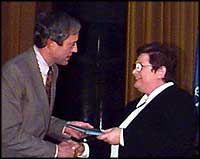
Tonnie L. Katz accepts the 1997 Pulitzer Prize in Investigative Reporting on behalf of the staff of The Orange County Register from George Rupp, Columbia University President.
Winning Work
By Susan Kelleher and Kim Christensen
The head of the internationally acclaimed UCI fertility clinic harvested eggs from an Orange County woman without her consent and gave them to another patient who delivered a baby boy about nine months later, according to medical records and interviews.
Photocopied records obtained by The Orange County Register track the 1991 harvesting of three eggs by Dr. Ricardo H. Asch, who designated they be implanted as embryos into a second patient at the University of California, Irvine, Center for Reproductive Health.
"If those allegations hold up, they would be the most serious violation of ethical trust that I am aware of in the field of reproductive technology," said Dr. Arthur Caplan, director of biomedical ethics at the University of Pennsylvania.
"There may be worse things that one could do in operating a fertility clinic, but I don't know what they are."
Asch refused to comment Thursday when contacted at his Newport Beach home. His lawyer, David Brown, later said he could not comment before examining the patient's files. Asch has denied repeated requests for interviews this week.
The center, where women from around the world have paid tens of thousands of dollars for the help of Asch and his team of specialists, is the focus of investigations by the university, state and federal authorities for alleged research misconduct by doctors there.
But the allegation of misuse of eggs resulting in a live birth presents profound new legal and ethical implications, experts say.
Photocopied records obtained by the Register show that three eggs were taken from the woman, a patient at the clinic in the early 1990s, and given to a second patient two days later. The records did not reflect whose sperm fertilized the eggs.
Such sharing of eggs, which could lessen a woman's chances of becoming pregnant, requires informed consent and involves a series of other steps, including blood testing, fertility experts say.
None of those requirements occurred, according to the woman, who learned Tuesday that she and her husband might be parents of a child they did not know existed.
"The taking of the eggs and, possibly, the sperm of my husband was done without our consent or knowledge," the woman said in a written statement to the Register.
She and her husband are professionals in their 30s and reside in Orange County. The Register is not publishing their names in an effort to protect the identity of the family. The Register has verified the birth through medical records and public documents.
The couple, who are among hundreds of people treated at the center each year, said they learned of the alleged improper donation from an anonymous phone caller late Tuesday.
"Since that time, we have had a number of conversations with numerous individuals and have learned that we were misled about the number of eggs that were removed from my body," the woman's statement read.
University of California and UCI officials refused to discuss the allegations.
"It is university policy not to comment on the content of a pending investigation," said Fran Tardiff, UCI spokeswoman.
"I have no comment," said UC President Jack Peltason, who was chancellor at UCI when Asch and Dr. Jose P. Balmaceda established their practice there in 1990, along with Dr. Sergio C. Stone.
Records show that the woman's eggs were taken during a scheduled procedure known as GIFT, or gamete intrafallopian transfer - a fertilization technique invented by Asch and Balmaceda in San Antonio, Texas, in 1984.
Biologist Teri Ord, who ran the lab at the center until leaving in September, said she did not remember the case. However, in all such cases, Ord said, she would methodically track and record the number of eggs taken from each patient.
Every step of the procedure was recorded in a handwritten log. In all, 14 eggs were extracted from the patient, according to records of the procedure.
Four of the eggs went back into the operating room, where the GIFT procedure was ready to begin, records show. Using a catheter, Asch inserted the four eggs, along with the patient's husband's sperm, back into her fallopian tubes in the hope they would meet there and form the beginnings of a child.
But then the records show that three eggs from the patient were earmarked for another woman who was coming in two days later for an in-vitro fertilization procedure. Ord verified that she made the entry on the log, and said that she would have done so only on the order of the doctor doing the procedure. Records show that the doctor was Asch.
As the patient lay in the recovery room, Asch came in and told her he had removed seven eggs, returning four to her fallopian tubes, the patient said Thursday. Asch then went into the hallway and told her husband the same news, the couple said.
Later that day, all of the remaining eggs - including the three given to another patient - were fertilized, laboratory records show. Records do not indicate whose sperm was used to fertilize the eggs frozen on behalf of the patient, or for the woman who would later get her eggs.
The patient said she was told the resulting embryos would be frozen in liquid nitrogen so they could keep trying to have a baby if the GIFT procedure was unsuccessful.
Two days later, doctors inserted a catheter into the second woman's uterus and injected three microscopic embryos, lab records show. About nine months after that, a baby was born to the second woman.
Records show the embryo implantation was performed by Asch's partner, Balmaceda, who directs the center's clinic at Saddleback Memorial Medical Center in Laguna Hills and who said he performs procedures at UCI when he is on call.
Balmaceda said Thursday that he did not recall the patient's procedure, but said that he would not have known if consent was granted.
"There is no way in hell the doctor who does the transfer knows what he's putting back unless somebody tells him," Balmaceda said.
"This did not happen in Saddleback ever," he added. Patrick Moore, his attorney, said that the doctor would not check to see the source of the eggs unless he suspected an error had occurred.
While the woman who received her eggs became pregnant, the patient whose eggs were taken had no such success.
"My husband and I were unsuccessful in conceiving a child as a result of this procedure," her statement to the Register read.
The couple subsequently did have children, after switching to another fertility doctor.
At issue in the case is whether the patient consented to "donate" eggs. Fertility experts say it is extremely rare and highly unlikely that a woman trying to achieve pregnancy herself would agree to donate eggs to another.
The patient said Thursday that she had consented to have four eggs implanted in her tubes and the remainder frozen in an embryonic state for future use.
At no time was consent granted for donation, she and her husband said.
Their contention was substantiated by a clinic employee, who saw the form on the day the eggs were gathered.
"I'm positive that she marked freezing only," said Della Morrison, who started at the clinic in 1990 and left on maternity leave last year.
"On the consent form, there's a list of options: cryopreserving, donation to another patient, research, and destruction. You can mark `yes' or `no' in a box next to each one. She marked just yes on freezing. She didn't mark the others."
Shortly after the surgery, Morrison said, Asch asked for the patient's chart. Two days later, Morrison pulled the chart and looked at the consent form.
"I was shocked," she said. "The box for donation had been marked. I was freaking out. I couldn't believe that happened."
Morrison said it was clear to her that someone had altered the chart, but she did not know who. Others also would have had the opportunity to alter the form.
About four days later, Morrison went to pull the chart to check again.
"It was gone," she said.
Because she does not have access to the laboratory and the records kept there, Morrison said she has no direct knowledge that the patient's eggs were given to someone else, or whether the patient later agreed to change her consent form.
Only Asch and Ord, the biologist, would know for certain the source of eggs and embryos, she said.
Ord, 39, who served as the clinic's lab director from 1990 until she quit last September, examined the Register's copies of the logs and said they appeared to be authentic.
She said she could vouch only for the entries made in her handwriting and that she had no way of telling if other entries had been altered. Nor did she have any way of knowing, Ord said, whether patients had given consent to donate.
"I just didn't see the charts," she said. "I don't see the consents. As far as whether it's true, not true, I don't know. I can just tell you from my end what went on in the lab."
In examining the logs, Ord said, the entries tracking the eggs from the donor to the recipient reconciled. Three went from the former to the latter, Ord said.
"I can tell you from the logs ... if that says that, that's what happened," she said.
Asked if she had any doubt, she said: "No, none."
Although internal audits in 1992 and 1993 revealed irregularities with cash controls and record keeping, the clinic came under heavier scrutiny beginning in February 1994 when auditors began looking into allegations involving "clinical, fiscal and management practice issues," the Register reported Tuesday.
Later that day, University of California Regents sued Asch, Balmaceda and Stone, alleging among other things that records had been altered or removed in an effort to hinder the investigations.
Legal papers filed with the suit allege that Asch used a Bakersfield woman's eggs for research without her permission in 1993 or 1994 - and then tried to alter records by asking her to sign a consent form just a week ago. The woman, who was not identified by name, was a former patient of Asch's.
Investigators from the National Institutes of Health inspected the clinic's records early this year to check compliance with research protocols.
When medical center administrators showed up at the clinic in January to examine records, receptionist Yvonne Alexander said, Asch spirited her into his office and handed her a piece of paper bearing about a dozen patients' names.
The list included the name of the patient whose eggs were harvested in 1991, Alexander said.
"He closed the door, and he was holding my hand," Alexander said. "He said, 'Don't tell anybody this.' He gave me a list of names, and I folded up and put it in my pocket. He gave me this list of names and asked me to find those charts before (the administrators) got to the charts."
Alexander said she located only one chart, which was not the patient whose eggs were allegedly transferred without consent. She said she did not know why Asch wanted the charts.
"I'm used to doing what he tells me to do," said Alexander, who is on leave pending a transfer to another university job. "When I pulled the one (chart), they were in the back. The phones were ringing, patients were signing in, and I was scared. I looked in the chart, and all I saw were the words `eggs transferred.' "
Since 1992, clinic employees have been contacted, some on several occasions, by university investigators from the internal auditor's department.
They questioned Morrison about a variety of things, including allegations that eggs and embryos have been taken from women without their consent and given to other women. Other employees told the Register they also had been questioned about eggs.
Morrison said that the latest investigation has been going on for at least a year.
Her last contact with a ranking official was about a month ago, shortly before UCI terminated its practice-management agreement with the clinic. The clinic is scheduled to close at the end of the month.
The constant questioning of employees made life difficult at the center, she said.
"It makes it real tough. It's real stressful. It's frustrating to work under those circumstances every day, to be questioned about your doctor and his ethics and what he does," Morrison said.
Allegations of misuse of eggs pose a variety of ethical and legal questions.
The Uniform Anatomical Gift Act says that body parts can't be taken from cadavers without consent from the people while they were living, or by their family members later.
While the act doesn't address living tissue, including gametes and embryos, a 1990 California Supreme Court ruling held that it affects living donors as well, said John Robertson, professor of law at the University of Texas and co-author of the American Fertility Society's guide to fertility technology and the law.
"They can't take it without your consent. If body parts have been removed, you have to inform them what they're doing" with them, Robertson said.
Dr. David Olive, chief of reproductive endocrinology at Yale University, said it would be impossible to prevent such abuses, regardless of the law.
"Anything can happen behind closed doors," Olive said. "That's why trust is so important."
Register staff writers Michelle Nicolosi and Tony Saavedra contributed to this report.
© 1995, The Orange County Register
By Susan Kelleher
UCI employees who complained about illegal drug sales and unauthorized transfer of patients' eggs at the Center for Reproductive Health were pressured to keep quiet or lose their jobs, according to complaints contained in documents obtained by The Orange County Register.
Those documents and interviews this week with two UCI doctors also increase the evidence that the university knew about the egg-theft allegations earlier than the university has publicly acknowledged.
In one case, a senior administrator who reported the allegations was placed on involuntary leave nine days after making the formal complaint, according to the documents. In another, UCI Medical Center officials sought to fire an employee who alleged wrongdoings at the center, according to the documents.
Neither UCI Chancellor Laurel Wilkening nor Medical Center Executive Director Mary Piccione would comment Wednesday. Both women have denied repeated requests from the Register to discuss the center.
"Your story is wrong," said Mike Kolbenschlag, a public relations consultant hired to shape the university's response to the burgeoning problem. He refused to offer any specific explanation.
A letter obtained by the Register shows that Debra Krahel - then associate director of ambulatory care - was placed on leave after bringing forth a subordinate's complaints of wrongdoing to hospital officials in July.
In a July 18 letter to UCI auditor Bob Chatwin, Krahel said she was told repeatedly by Piccione, and Piccione's assistant Herb Spiwak, to keep quiet about problems at the center.
"Mary advised me that I had loose lips and should keep the facts about Reproductive Health to myself," Krahel wrote. Krahel's letter says the conversation occurred a week after she discussed the unapproved drug issue with Spiwak.
He did not return a phone call asking for a response to Krahel's letter.
Krahel - who is no longer employed by UCI - declined comment Wednesday and referred all inquiries to her attorney, Michael Maroko. Maroko said his client reached a settlement with the university, but declined to say what was settled since no suit was filed by Krahel. A confidentiality clause in the agreement prohibits Krahel from discussing the matter, he said.
Paul Najar, staff attorney for Chancellor Wilkening, said Wednesday that he was unable to locate a copy of Krahel's settlement agreement.
Records show that Krahel was placed on administrative leave July 27.
No university officials would comment on the two-month discrepancy between the date the whistle-blower's written complaint was made and the date the university says it first learned of the charges of unapproved egg transfers.
The letters, and interviews with two physicians, provide further evidence that University of California officials knew about allegations of unauthorized human egg transfers prior to September. That's the date given in the UC Regents suit against the center and its doctors: Ricardo Asch, Jose Balmaceda and Sergio Stone.
In the July 18 letter to the UCI auditor, Krahel said she was under pressure to fire an employee who reported that the center's doctors were selling fertility drugs that were not approved for use by the U.S. Food and Drug Administration. The letter says Krahel first raised that issue with Piccione and Spiwak in January.
The letter also says a clinic employee was fearful of being fired for bringing allegations forward.
Krahel's letter said her relationship with Piccione and Spiwak deteriorated when she continued to pursue the initial allegations, and that she was transferred to a position with less responsibility. At the close of her letter, she wrote: "I am fearful that this complaint will jeopardize my continued employment, yet I am compelled to go forward." Nine days later, she was placed on administrative leave.
According to a letter, UCI placed her on leave, citing "complaints" about "job performance."
The Center for Reproductive Health now is the focus of at least seven investigations into alleged research misconduct by the center's doctor, and misuse of human embryos by Asch, a pioneering fertility specialist.
The UC Board of Regents is suing Asch, who is the center's director, and his two partners, alleging among other things that they removed or destroyed records to hinder investigators.
UCI police are conducting a criminal investigation, assisted by the Orange County District Attorney's Office. The Medical Board of California also is investigating the doctors.
The doctors have denied hindering the university's investigation or committing any criminal wrongdoing. Asch - the doctor who performed the egg harvesting procedures - has specifically denied making an unapproved patient transfer of eggs.
The fertility clinic controversy erupted two weeks ago when the Register first reported that two women's eggs were taken and transferred as embryos without their consent to other patients, who later gave birth, according to interviews and medical logs.
In amendments to the May 25 lawsuit, the Regents say the university first learned in September that the university's doctors were accused of taking eggs without permission and implanting them as embryos in other patients. The patients whose eggs were taken told the Register they wanted their eggs fertilized and frozen for future use, and did not give informed consent to donate them.
The regents' suit says the university launched an investigation in October, and found "plausible evidence that (the center) had implanted human eggs into certain patients without the consent of the donor patients." The people appointed to investigate, however, could not prove or disprove the charges because the center's doctors allegedly did not make records available, the suit alleges.
Interviews with two doctors provide additional evidence that the university was aware of the egg allegations prior to September, as stated in the regents' suit.
Pediatrician Milton Schwarz and pediatric neurologist Ira Lott said that they first heard of the allegations on Aug. 11 during a lunch with a UCI "whistleblower." Schwarz said the whistleblower was Krahel.
Anyone who makes a complaint of government misconduct is considered a whistle-blower. State law is supposed to protect people who come forward with such information.
Both men confirmed the lunch meeting by checking their appointment calendars.
Lott, who is chairman of the pediatrics department at UCI, said the whistle-blower told him she had reported allegations of improprieties to the UCI chancellor's office and that an investigation was under way.
Lott said he called Wilkening's office, and was told that the chancellor was aware of the charges. He said he also called "the regents' attorney" and was told that the matter was being investigated. He would not provide the attorney's name, nor the name of the person he spoke with in the chancellor's office.
Based on his calls, Lott said, he was satisfied the matter was being investigated appropriately.
James E. Holst, general counsel for the UC Regents, was asked about the call Lott made to that office following the lunch.
"I have nothing that I am able to say," Holst said.
Schwarz said Krahel had been working with the doctors on a project, and had requested the lunch meeting.
"The reason she met with us is to tell us why she was leaving the university," Schwarz said. Krahel, he said, said she had been placed on leave and recounted the allegations she had reported to officials.
"She said there were improprieties in the way the eggs were being kept," Schwarz said. "She said she could only tell us a certain amount of information."
The doctor said his mouth went agape at the charges, and he figured if they were true, he would soon hear about it.
"I was confident the university would do whatever was appropriate, and I still think they will do whatever is appropriate," he said.
Don E. Carlson, pediatrics administrator for the medical center, said he also attended the August lunch meeting.
"I heard the same things that Dr. Schwarz and Dr. Lott heard," he said. "What Debra said I had no way of confirming. It was second hand."
In interviews last month, a former medical assistant said she was interviewed several times by university auditors as early as 1993. She said the auditors asked about allegations that patients were being made egg donors without their consent.
Register staff writer David Parrish contributed to this report.
© 1995, The Orange County Register
By Susan Kelleher and Kim Christensen
Patients' eggs were given away without permission, and in at least one case fertilized against the patient's wishes.
Three physicians at UCI's world-renowned fertility clinic ran a renegade practice that operated with little oversight from the university and minimal attention by the doctors to basic issues such as patient consent and the tracking of human eggs, according to a confidential investigative report obtained by The Orange County Register.
The March 17 report, prepared by three University of California physicians, confirmed that in two instances - and perhaps as many as five - the clinic doctors took human eggs without consent, fertilized them and transferred the embryos to other patients.
After investigating allegations against Drs. Ricardo Asch, Sergio Stone and Jose Balmaceda, the report's authors concluded that the doctors had not involved patients in significant, life-affecting decisions, a pattern of practice that the authors described as "authoritarian."
UCI and medical center administrators also were criticized for failing to begin overseeing the Center for Reproductive Health three years sooner, when audits found there were lax cash controls and problems with insurance billing.
"Only when the whistle-blower investigation was initiated did the Medical Center and the Department of Obstetrics and Gynecology begin to oversee the practice," the authors wrote. "Their oversight should have been intensified long before the whistle-blower investigation because of the history and results of previous audits of CRH."
The university's second in command did not dispute those findings Saturday.
"We accept responsibility," said Dr. Sidney Golub, the university's executive vice chancellor. "In retrospect, it's clear we should have had a higher level of oversight. But there is a usual level of trust that faculty will behave according to the rules and will act in a responsible manner themselves."
Balmaceda's lawyer, Patrick Moore, described the clinical panel's report as "a hatchet job" that tarred all of the clinic's doctors with the allegations of embryo and egg abuse.
"There was no comment as far as I can recall to show any evidence pointing to Dr. Balmaceda ever having any knowledge that he was involved in a misdirected egg or embryo case," Moore said.
"All the clinical panel said was, 'We think it happened, so all three physicians are automatically responsible for that.' That, I think, shows that it was intended to be a hatchet job on the physicians."
Asch's attorney, Ronald G. Brower, said he could not comment on the panel's report because he had not reviewed it.
Among other things, investigators found evidence that:
Patients' eggs were given away without permission, and in at least one case fertilized against the patient's wishes.
Asch received cash from the sales of a foreign fertility drug he prescribed to his patients.
Asch left the operating room several times when patients were under anesthesia, behavior that results in patients taking longer to come out of anesthesia.
Asch and his partners blamed the clinic's problems on their staff, the report says. But the doctors conducting the investigation said they found the medical center employees "both individually and collectively, more credible than the ... physicians."
On the most serious charges -- the taking of patient eggs without consent -- the UC investigators found sufficient evidence that it occurred.
"We offered to the physicians that the allegations could be dismissed if they would permit us to interview the involved patients in their presence and confirm their consents," the report states. "However, the physicians chose not to pursue that course of action.
"The fact that the physicians were unable to locate the original charts for any of the patients alleged as unconsenting donors cannot be dismissed as coincidental," the report states.
Two patients described in the report told the Register two weeks ago that they never gave permission for their eggs to be given to other infertile couples. The Register has reported that the women who received those eggs bore children.
The doctor involved in the egg-harvesting procedures, records show, was Asch, the fertility pioneer who directed the UCI clinic from 1990 until resigning from the medical staff May 19.
The report's authors said there was substantial evidence and first-hand knowledge from the center's staff to suggest that two patients' eggs were taken without permission. There was also evidence that a third patient's eggs were taken; however, the investigators could not say with certainty whether those cases -- or two others that were reported by clinic employees -- occurred because the doctors said they didn't have patient records and refused to provide logs showing where the eggs went.
On dispensing unapproved drugs, the report said Asch sold a fertility drug that was not approved by the U.S. Food and Drug Administration. The report's authors said his explanations were not "supported, corroborated or accepted as credible."
The drug, HMG Massone, is similar to the widely used fertility drug Pergonal. UCI has said no patients were harmed.
Asch reportedly told the investigators that the vials of drugs he kept in the office had come from a patient who brought them in from Argentina for her own use, and who donated the excess to the center.
The fertility specialist also told the investigators that he didn't know about the cash paid to him by patients for the drugs and that he prescribed it only to two patients for humanitarian reasons. The investigators said Asch's explanations lacked credibility given evidence of a special filing system to keep track of the unapproved drugs and the cash due.
A medical assistant offered a more credible explanation of the drugs' origin, the report says: Asch bought them from a doctor in Argentina and carried them into the center on several occasions over a period of years.
"We find no credible evidence to support that HMG Massone was dispensed to patients for humanitarian reasons. ... In fact, the billing indicates that Dr. Asch charged patients the same amount for the HMG Massone as the FDA-approved Pergonal," the investigators wrote.
Asch also kept patients anesthetized while he attended to other activities, an allegation supported by Dr. Steven Barker, chairman of UCI's anesthesiology department, the report says.
Barker told the authors that he instituted a policy that none of Asch's patients would be put to sleep until Asch "was in the operating room, in his green and ready to begin the procedure." He did so, he said, after Asch left a patient under anesthesia and disappeared for a while. Another anesthesiologist told Barker of a similar incident, as did the operating-room nurse, the report's authors said.
Barker, who often worked in the fertility clinic, said Saturday that the report makes the allegation sound more serious than it is. Still, he thought the policy he instituted was prudent.
"In general, it is not a great idea to have patients under general anesthesia waiting for surgeons or anyone else while nothing is happening," Barker said Saturday. "It is not particularly safe, or rather, not good to be under anesthesia when you don't need to be. The longer you are under anesthesia, the longer it takes to wake up."
To minimize time under anesthesia, he said, "is just good medicine."
The report repeatedly portrays the clinic as a place where patients' needs were not always the primary concern.
The center's doctors neglected key aspects of their practice, leaving consent forms and documents for tracking human eggs to be developed and instituted by their staff, the report notes.
On the consent issue, Moore said that Balmaceda had fulfilled his obligation to fully inform patients about the risks and benefits of all procedures.
If documentation of that consent was lacking, he said, it was because UCI employees who worked at the clinic failed to perform "the administrative function" of filling out the proper paperwork.
"Physicians never see those informed consent forms," he said.
But the doctors were clearly in control of the eggs, the report states.
"Critically, (patient) consents were not routinely reviewed or made available to the embryologists, so the responsibility for directing eggs or embryos into either research protocols or for donation to other patients was that of the physicians," the report states. "The actual egg and embryo data has not been made available to us, but several of the transcribed sheets indicate (three) instances where eggs were not inseminated, but used instead for other purposes, without the documented consent of the patient."
The report was based on reviews of about 28 patient charts, interviews with 24 people, including the doctors, documents from the center, the medical center, its obstetrics and gynecology department, the UCI College of Medicine and the university's internal audit department.
Investigating the whistle-blowers' allegations were Dr. Stanley Korenman, associate dean of UCLA Medical Center, Dr. Mary Martin, director of UC San Francisco's in-vitro fertilization program, and Dr. Maureen Bocian, director of UCI's division of human genetics and birth defects.
None of the doctors could be reached for comment Saturday.
The authors said they did not find evidence that medical center administrators were inattentive to the egg allegations when they first surfaced.
An audit of the center's cash-control procedures and security was conducted by university auditors in December 1991 and January 1992, but, the report says, "there is no evidence that allegations of misappropriation of eggs was reported to the auditors."
The issue was first raised during a second audit of the center's billing and insurance practices. The audit -- conducted in November and December of 1992 -- found that one employee falsified insurance billings and stole cash from the center. During interviews with auditors, the employee alleged that Asch had taken patients' eggs without their consent, but provided no names, the report says.
"The internal auditor did not consider the employee who reported the allegation as credible because of her actions in connection with the insurance billing fraud and her demands to receive a letter of recommendation if she was terminated or she would come forward with information on the allegation," the report states. "The internal auditor viewed this as an attempt to blackmail Dr. Asch with a false accusation."
Asch raised the specter of blackmail last week when his attorney alleged that the doctor was being targeted by an extortionist. On May 24, his attorney said that a $300,000 extortion attempt by a mysterious "Dr. Malcolm X" was the force behind a series of stories in the Register about the center and its doctors.
The panel's report said that in 1992 an auditor discussed the egg-theft allegations and insurance-billing irregularities with Mary Piccione, the medical center's executive director, Dr. Walter Henry, the former dean of the College of Medicine, Regents' Deputy General Counsel John Lundberg and Asch.
The egg allegations were not included in the final report "due to the lack of evidence," the report states.
UCI officials said last week that they first learned of the egg allegation in September from a whistle-blower's attorney. The Register has reported that the allegations were made to the internal audit department in July and that a department chairman at the hospital confirmed that in August the chancellor's office was aware of the charges.
The Register reported Thursday that UCI employees who complained about illegal drug sales and unauthorized transfer of patients' eggs at the fertility clinic said they were pressured to keep quiet.
UCI recently paid nearly $850,000 to three employees who reported allegations of wrongdoing against the center. One employee was placed on leave after filing a complaint and requesting protection under state laws that make it a crime to retaliate against people who report government wrongdoing. The university said it settled the claims to protect patient confidentiality.
Register staff writer James V. Grimaldi contributed to this report.
© 1995, The Orange County Register
By Kim Christensen and Susan Kelleher
UCI fertility specialists under fire for allegedly misusing human embryos also pocketed tens of thousands of dollars in cash payments in violation of university agreements, submitted false insurance claims and charged UCI for work done while employees were at other clinics, according to outside auditors hired by the university.
In a confidential report obtained by The Orange County Register, the auditors also allege that doctors at the Center for Reproductive Health failed over a two-year period to report as much as $967,000 in funds that the University of California, Irvine, may have been entitled to share.
The audit, dated April 7 and conducted by the national accounting firm of KPMG Peat Marwick, provides the first evidence of alleged fiscal wrongdoing at the internationally renowned clinic, which is at the heart of the largest controversy in UCI history.
Dr. Ricardo H. Asch and his partners, Drs. Jose P. Balmaceda and Sergio C. Stone, have denied any wrongdoing. They have been placed on paid administrative leave from the university, and are at the center of at least seven internal, state and federal investigations.
Asch's attorney, Ronald G. Brower, said Saturday that he had not received the audit and could not comment on it.
Patrick Moore, Balmaceda's lawyer, disputed the audit's findings and blasted the report and another one conducted by a clinical panel as biased and based on incomplete or erroneous information.
"I was appalled at the lack of evidence and the lack of any analytical substance to each report," Moore said.
Stone's lawyer, Karen L. Taillon, also refuted both reports, accusing UCI officials of being "more concerned about the university's image than about truth and fairness."
"I would describe it as the Salem witch trial without the match," she said. "I think they're looking for the match, but it's just not there."
Among the latest allegations are that Asch and Stone kept at least $167,000 in cash payments, including $12,000 taken home by Asch in a single day.
The allegations arise from "whistle-blower" complaints lodged in 1994 by former clinic employees and UCI administrators. Three of them have since been paid a total of nearly $850,000 in confidential settlements by UCI, which has refused to release details of the agreements or the circumstances that led to them.
According to the audit report, however, Peat Marwick last October began an investigation of nearly a dozen specific allegations and found evidence to sustain four of them:
Asch and Stone failed to report cash income, and the clinic failed to make required payments to UCI Medical Center.
Asch and Balmaceda submitted false insurance claims.
The clinic required employees to work at non-UCI facilities, but charged the university for their time.
Asch, Stone and Balmaceda operated a nonlicensed operating room at the UCI clinic.
The Register reported in May that two women's eggs were taken in 1991 and transferred as embryos without their consent to other patients, who subsequently had children. The doctors also allegedly conducted unauthorized research on humans.
Since it opened in 1990, the clinic has drawn patients from around the world willing to spend tens of thousands of dollars for a chance at having a child.
Many paid for their procedures in cash, but according to at least four former employees, those payments were not recorded as income on logs known as "day sheets."
Instead, they were recorded as "adjustments" rather than payments, an accounting device that auditors say enabled the doctors to reduce the amount of their reportable income to the university and keep the difference.
"At the end of each day, Dr. Asch or Dr. Stone was given an envelope of cash, which they would sign for," the audit report states. "Each month the physicians split the cash amongst themselves."
Asch was given as much as $12,000 in a single day, according to one worker, who estimated that the annual cash income was as much as $300,000 per year - $50,000 to $60,000 per "series" of fertility treatments offered four or five times annually.
The doctors acknowleged taking the cash payments, saying they began doing it in 1992 when an internal audit revealed concerns about the security of money kept on the premises, the report stated.
But they denied any involvement with improper accounting practices.
"The physicians claimed to have no knowledge of how the cash payments were reported in the financial records of the practice," the report stated.
Moore said doctors began taking the cash home after a break-in at the office. All of the money was accounted for, he said.
"The cash was documented," he said. "The reason that the doctors started to take cash home at night in the first place was that $4,600 had been stolen from the office while under the care of the university. The policy of accounting for the cash and taking the cash home was so that no university employee would touch it."
When auditors checked day sheets provided by the whistle-blowers for January 1992 to December 1993, they determined that about $167,000 was collected in cash and given to the doctors.
"According to the physicians, the cash, which was taken home by the physicians - primarily Dr. Asch and Dr. Stone - was not necessarily deposited in the CRH bank accounts since it was split amongst the physicians personally," the audit report states.
Two bank accounts were maintained by the clinic. Funds were deposited into a Wells Fargo account and then transferred to an interest-bearing Shearson Lehman account, from which disbursements were made.
From January 1992 to August 1994, $5.4 million was deposited in the first account - but only $4.6 million was reported as income to UCI, according to the auditors.
They said the apparent $800,000 discrepancy might have included funds the university was not entitled to under an agreement that obligated the doctors to pay UCI about 11 percent of their professional fees.
But when investigators asked for help in sorting out the discrepancy, auditors said the doctors refused.
"We requested information from the physicians to determine the amount of collections which were not professional fee income; however, we did not receive that data," the report states.
UCI Executive Vice Chancellor Stanley H. Golub said Saturday that university officials had not determined how much is owed by the doctors.
"It's a minimum of $270,000 and could be as high as - we don't know how much because of the lack of information that they provide. That they must provide."
He described the clinic as "absolutely not a typical practice" because of its cash trade. The university instituted accounting controls in 1994 that stopped cash payments to the doctors.
Auditors said they also believe the doctors received unspecified income from other clinics - in San Diego, Las Vegas, Italy and Mexico - that should have been reported to UCI but was not.
Although their agreement with UCI states that the assessment applies to "all professional fee income, wherever earned," the doctors dispute that such income is reportable.
Moore, Balmaceda's lawyer, said the university was paid its fair share. He said he had not done his own audit of Peat Marwick's numbers, but if there was a discrepancy it could be attributed to money not subject to the university's assessments.
Moore also criticized the university for using Peat Marwick, which conducts other audits on UCI's behalf. And he said the auditors were influenced by university officials, who provided assistance.
"It'a very slipshod audit," he said.
During their investigation, auditors interviewed 31 people, including Asch, Balmaceda, Stone and at least three whistle-blowers who made allegations against them.
They also reviewed about 60 patient medical charts from the fertility clinic and the medical center, as well as billing records and documents provided by the UCI internal audit department.
"Our investigation was hampered by the lack of availability of records related to the Center for Reproductive Health," the report states. "The physicians claimed these records pertained to their private practices and did not provide us access until we made extensive, repeated and detailed requests."
The doctors refused to provide 46 billing files for patients, instead handing over sketchier records known as ledger cards, according to the report.
Despite assurances from a ranking medical center official that efforts had been made to rectify earlier problems with insurance billings, Peat Marwick auditors said they discovered otherwise.
When auditors examined records, they found most insurance billings reflected "cyst aspirations" rather than egg removals - even in some cases where patient charts listed the number of eggs removed.
Egg removals generally are not covered by insurance, but cyst removals are.
The practice of mislabeling the procedure on insurance billings had surfaced during an internal audit completed in January 1993.
An internal UCI audit completed in 1993 also noted instances of false insurance claims, including cases where the billings did not match the procedures documented in patient charts, the report stated.
"Dr. Asch admitted to having falsified the diagnosis in two instances in 1991 (which we reviewed) to obtain insurance benefits for a patient," the report states.
"We were told by Deputy Executive Director Herb Spiwak that efforts were made to correct the accuracy of billings after the 1992 internal audit and that removal of eggs were not to be billed as 'aspiration of ovarian cyst.' "
The audit noted that the issue "is a gray area within the industry" since removing an egg is medically the same as aspiration of a cyst.
"However, it is clearly inappropriate if an entirely different procedure is done," the report stated.
While they were unable to determine the extent of the false claims, auditors and a clinical panel investigating other allegations were told by medical staff that it was the accepted practice.
"Dr. Steven Barker, the chief of anesthesiology, reported to the clinical panel that 'on many occasions' anesthesiologists were instructed by Dr. Asch to write false diagnoses, e.g. substituting 'aspiration of ovarian cyst' for another procedure," the report states.
An operating-room nurse corroborated Barker's account, telling auditors that medical codes for in-vitro fertilization were "never" used, and that "all insurance billings reflect cyst removals."
Auditors also found instances of underbilling patients for egg removals. The underbilling, in which patients paid only $606 for a procedure that should have cost five times that much, did not represent false insurance claims but did reflect "a disregard for accuracy in the diagnosis, which could result in false insurance claims."
Moore said there was "absolutely no foundation" for allegations that doctors filed false claims. If such claims were filed, he said, it was the fault of university employees responsible for completing the paperwork.
Auditors said they also found evidence of falsified time-keeping.
Whistle-blowers told auditors they were required to work at locations other than UCI Medical Center, which paid their wages.
"The employees were instructed where to report by the physicians," auditors said. "According to the biologist, she was instructed to 'clock in' at UCIMC and told that the arrangement was 'worked out' with UCIMC."
Most of the the sharing of UCI employees' time involved work done at the center's Saddleback Memorial Hospital clinic, which is run by Balmaceda. UCI employees are not authorized to work there on the university's time, according to the report.
Some Saddleback employees also worked at UCI, but the reverse was more common, auditors said.
While other UCI employees spent a morning week or so at Saddleback, it was the biologists who were most often told to do it, the report states.
"In general, if a series was done at another location the biologist worked at that other location while still on the UCI Medical Center payroll. We were informed that the biologist worked principally at Saddleback for approximately three months prior to her resignation from UCIMC."
Auditors said they were unable to determine the "dollar impact" on the medical center.
When Asch and Balmaceda joined Stone at UCI in 1990, the university agreed to provide them with office space and everything else they needed - including an operating room.
Hundreds of procedures have been performed there each year, generating $3 million in "technical component" fees for the medical center.
But auditors said the operating room had one major flaw: it was unlicensed.
Medical center management did not believe a state license was required for the operating room, because surgical clinics in facilities owned or leased by physicians are excepted.
"However, surgical space in a hospital does not meet this exception and requires a separate license," auditors said.
Register staff writer James V. Grimaldi contributed to this report.
© 1995, The Orange County Register
By Michelle Nicolosi
In November, 1991, Dr. Ricardo Asch, then head of UCI's fertility clinic, placed five tiny embryos into Debbie Challender's fallopian tubes.
"You will be pregnant," she remembers Asch saying.
She'd heard it before: A decade of fertility treatments had left Debbie and her husband, John, with nothing but bad memories.
But Asch was right. This time was different. Her son, J.D., was born August 24, 1992.
"He is a miracle," says Debbie, 36. "He's a gift from God."
But the blessing has been mixed: Two weeks ago, the Challenders were given photocopies of records showing Asch took 10 of 46 eggs he harvested from Debbie and gave them to another woman. The Challenders say they did not consent. The woman also received embryos from another, unidentified source, and records show she gave birth to a boy and a girl.
Asch denies doing anything against his patients' wishes.
The Challenders are not the only patients of the world-renowned clinic who say their eggs were taken without consent, but Wednesday they decided to become the first to step forward and talk publicly about their ordeal. Fifteen days after first fingering the grainy numbers on charts that tracked the eggs, John and Debbie are haunted by a simple question about the twins: Are they ours?
John doesn't want to know. Debbie does.
And they've retained Newport Beach lawyer Theodore S. Wentworth to represent them and help them through the media circus that will surely follow their going on the record.
"The embryos they took were our children," said John, 46. "The embryos they stole, those were my children."
John said thinking about the missing children - for that is how he sees them, not as embryos, but children - keeps him awake nights. The last few days, he's been getting just three hours sleep - not enough to sustain him on his 12-hour shifts as a truck dispatcher.
He dwells on them during the daytime too: Now he does a double take any time he sees a child that looks like J.D., wondering if that might be his son, his daughter. Meeting them is his biggest fear.
And he cries daily. At first he resisted sudden sobbing fits, then, gave over to them - welcoming the tears that help him spill out the anger, the sadness, the grief, the fear.
"It helps," he said, considering the rocky hills rising over his Corona back yard. "It helps me deal with the frustration."
J.D. pedals by in a bright yellow and red plastic car, sending up a happy smile. That helps, too.
Time the couple used to spend relaxing with J.D. and his older brother J.R. - adopted as an infant eight years ago - they now spend trying to figure out how to tell their story without having the media attention destroy their lives. The London Sunday Times along with ABC-TV's "20/20" and "Nightline," Newsweek and NBC-TV's "Today" show have all been seeking them out for interviews.
Wentworth convinced them that they need to be prepared for the questions and schooled in the ways of the media. Wednesday afternoon they met with a Los Angeles media coach to learn how they look on camera and how best to phrase their thoughts for TV, magazine and newspaper reporters.
J.R. knows life may get strange, but he's still not sure why. "My dad told me about it, but I don't get it," he said.
Debbie, a stoic, private person less ready than John to share her feelings, shudders to think of the coming days.
"I'm scared," Debbie said. "For my whole life to be out in the public, I feel very nervous about it. But if it's an important enough issue, I'm willing to give it up."
The couple are going public because they want the world to know about their experience. Then doctors "are going to realize the average guy who drives a truck is going to know about it" and can't be so easily abused, John said.
The couple said they believe Asch knowingly took the eggs without their consent, and that the university knew he was doing it and tried to keep it quiet. A color photocopy of a consent form signed by the Challenders in black ink shows an "X" in a box next to the donation option - in blue ink. Both vouched for their signatures, but denied checking the box approving donation.
"They're motivated toward profit, success and fame," John said. "They're success-driven. The university has decided to turn their heads."
University officials acknowledge they should have had more oversight of the UCI Center for Reproductive Health, but said they investigated charges of egg mishandling as soon as they were brought to their attention and acted as quickly as possible.
"We never turned our heads on the allegations," said UCI spokeswoman Fran Tardiff. "We felt it would be irresponsible to contact patients about these allegations until we had some reasonable proof."
The university contacted the couple in May to discuss their case.
The clinic closed June 2 and is the subject of seven national and state investigations.
The couple said they are not going to the types of news shows and magazines that pay for stories, but to mainstream media that will get the word out to as many patients as possible.
Friends and family tell the couple they can profit from their troubles by suing; the Challenders say the money motive is the last thing on their minds.
"Money is not going to make us feel better about them," said Debbie.
"There is no compensation that will make up for it." John agreed. "This will scar me for life."
Though J.D. is her mirror image, Debbie said she is getting his DNA tested - just to be sure.
And she wants the Orange County twins tested, too. She hopes to find out they are not genetically hers.
And if they are?
"I want to see them," Debbie said. "I have this need to see them. To hold them. To know that they're OK."
John doesn't want to know.
"If the DNA testing proved they were ours and I saw them, I don't know how I would deal. I may find it more comforting not knowing. Knowing and walking away to me would be dreadful. If we go down and see these children, how can I turn my back and say I'm never going to see them anymore?"
Both say they would never take the children from a happy home. The security of the children is the most important thing, they said.
"If they're in a good home, the bottom line is that's where they should stay," John said.
The irony is that all this has happened just as their lives were becoming peaceful for the first time in years, Debbie said.
They had survived John's heart attack and loss of his trucking company in 1987, and losing a home to bankruptcy in 1994. Things had only now started to smooth out.
"I just wish it never would have happened," Debbie said. "We're happy now with our lives, the way it is. It felt like, it was all supposed to be better now."
Devout Christians, the two are daily becoming more familiar with the biblical story of Job, who endured much suffering but did not lose faith in God.
"My pastor even drew that analogy," said John, who believes it's true God is testing him "to make me stronger, to make my family stronger."
Their tiny church, family and a tight band of friends will get them over this hurdle as they have others, the couple say.
Passing each test, they all become stronger, John said, and this one will be no different.
"This is a life lesson," he said, an opportunity to teach Christian values, to put principles into practice.
"It's a life lesson for us and for the children.
"Let's hope there aren't many more."
© 1995, The Orange County Register
By Susan Kelleher
For days during fall of 1991, Budge Porter maneuvered his wheelchair through the doorways of UCI's famed fertility clinic and into the offices of Dr. Ricardo Asch.
Porter, once a college football star who ran 40 yards in 4.6 seconds, took that long to raise himself from the wheelchair. Longer still to haul himself onto the examining table and listen as a doctor said it would take two surgeries -- one for him and one for his wife, Diane -- to make them parents. The cost: more than $35,000.
"We were desperate," Diane Porter, a former San Juan Capistrano resident, said this week from her home outside Omaha, Neb. "They could have said it was $100,000 and we would have done it."
Last week, the Porters learned that Asch did more than extract Diane Porter's eggs, fertilize them in the lab with her husband's sperm and insert the embryos into her fallopian tubes.
He also, according to laboratory and medical records obtained by The Orange County Register, took four of her eggs, inseminated them with another man's sperm and reserved them for a Newport Beach woman who also was trying to get pregnant.
The Porters, whose treatment by Asch did not result in a pregnancy, said they never consented to donating their eggs.
"We wanted, absolutely, without question, every single egg that was harvested for the chance to be fertilized," said Budge Porter, 39, who was severely paralyzed after a football injury 19 years ago. "To take every fiber of Diane's being -- a cell that could create life for us -- with all the money we spent, all the problems Diane and I had faced because of my disability ... to take advantage of people who have been through hell and back is despicable."
"They couldn't steal anything more valuable to us," said Diane Porter, 33. "They stole our genetic heritage."
The Porters are the third couple to speak publicly about what the University of California, Irvine, says were unauthorized egg transfers that may have involved at least 35 patients at its Center for Reproductive Health.
Asch, who directed the fertility clinic until it was closed June 2, has repeatedly denied knowingly misusing any patient's eggs. His attorney, who was faxed copies of the Porters' clinic records, declined comment Thursday.
The records the Register has, which were authenticated by the biologist who kept them at the clinic, indicate that the Porter eggs taken for the Newport Beach woman apparently did not fertilize and become embryos.
Instead, according to clinic records, the Newport Beach woman was implanted with six other embryos: three from the eggs of Debbie Challender of Corona, and three from an unknown source. Nine months later she bore twins -- a boy and a girl -- whose parentage cannot be determined without DNA tests.
The Newport Beach couple's attorney, Steve Militzok, could not be reached for comment Thursday.
The Porters have retained Newport Beach attorney Theodore S. Wentworth, who filed suit against Asch, the doctor's two partners and UCI on behalf of the Challenders.
Almost two years ago, Diane Porter gave birth to Claire, a tow-headed girl who fills the house with babbles and smiles, and crawls up on her father's lap every night to get a piece of candy from his shirt pocket. Claire's birth was the result of in-vitro procedures performed in Omaha.
Having Claire has cushioned the shock of the egg-theft allegations. But the child also makes the Porters painfully aware of what they lost.
"Some people can't understand why we'd be so upset," said Diane Porter. "They say, `It's just a piece of tissue. What's the big deal?' "
The big deal is DNA: little bits of genetic material that tie the Porters to a legacy larger than themselves. That legacy is visible everywhere in the comfortable home they have created in a small town near Omaha.
Family photos can be seen from every chair in the living room. There are the orchards started by Budge Porter's grandfather, after whom Grosvenor "Budge" Porter is named. There are pictures of his grandfather, the only Nebraskan to be in both the state Racing Hall of Fame and the state Football Hall of Fame. There are photos of Diane Porter's family in San Juan Capistrano.
But mostly, there is football.
Three generations of Porters have played for the University of Nebraska Cornhuskers: Grove Porter, the grandfather; J. Morton Porter, the father; and the two brothers, Budge and Scott.
It was during a scrimmage in April 1976 that Budge Porter suffered a bruise on his spinal chord that left him paralyzed below the neck. He is now well-known in Nebraska as the man who fought to claim his life back, struggling through years of physical therapy to regain enough movement to walk short distances on crutches and commute daily in a van with hand controls to his job as an investment consultant.
When the Porters married six years ago, there was no question that they wanted to create a large, close Catholic family like those they grew up in.
"We might someday have all the material things we wanted, but if it was just the two of us staring at each other, what good would they do us?" Diane Porter asked. "We have such fine examples around us of what marriage and family is about."
Low-grade infections caused by Budge Porter's paralysis made it impossible for him to become a father without surgery to extract his sperm. He had two unsuccessful operations before the couple heard about Asch's clinic at UCI.
"I thought he was God," Diane Porter said.
The Porters took a second mortgage on their house and borrowed more than $10,000 from friends and family. Budge's siblings gave up money they were to inherit from their grandparents. Diane's sister, Anna, allowed the couple to charge a laparoscopic surgery on her credit card.
Budge's father flew out from Nebraska to help his son prepare for the surgery and to help care for him afterward. They stayed with Diane's parents, while Diane's mother gave her daughter the painful daily fertility-drug shots that induce the ovaries to release many eggs in a single cycle.
Ultrasound showed that Diane had as many as 60 eggs that could be harvested. Asch, she said, told her to take a special hormone shot at midnight to allow the eggs to be retrieved the next day.
But after the procedure, according to the Porters, Asch told the couple that he extracted only 22 eggs.
However, photocopied records obtained by the Register show that 26 eggs were harvested from Diane Porter, and that four of them went to the woman in Newport Beach.
The couple still has six embryos from the 1991 surgeries in storage. They wanted to save some in case the fertility technology improves.
News about the UCI egg theft allegations have kept the Porters up nights. They and their families say they feel hurt and betrayed by the doctors and UCI.
The couple, Budge Porter said, hope that by speaking out, they can warn other infertile couples to be more vigilant.
"We could have stayed perfectly happy without hearing one word of this," he said. "We are also the type of people who wouldn't want to go on without learning of this. ... Now that we know, we are the type of people who cannot let this go without a battle."
Staff researcher Penny Love contributed to this article.
© 1995, The Orange County Register
By Michelle Nicolosi and David Parrish
Seven months after uncovering evidence of egg and embryo misuse, UCI officials proposed a secret agreement in April that called for doctors at the Center for Reproductive Health to quietly resign, according to documents obtained Friday.
University of California, Irvine, officials also agreed to "waive any interest" in patient records, the clinic's frozen embryos and documents that allegedly trace egg thefts, correspondence between attorneys for the doctors and university shows.
Although Chancellor Laurel Wilkening's legal adviser at UCI, Paul Najar, attended the key April 14 negotiation session, the chancellor Friday said she was unaware of the university's offer not to publicize the resignations and said there was never an attempt by the university to cover up the scandal.
Wilkening said she did not publicize the allegations because she didn't know in April how widespread the problems were.
"I don't think that was our responsibility at the time," she said. "The doctors could have been right -- that it was just a mistake."
But at the same time, UCI was also cutting a deal to pay nearly $1 million to three clinic workers who exposed the scandal -- with the stipulation they would lose the money if they told anyone.
At various points in negotiations over the doctors' futures with the university, their attorneys' demands included stipulations the university would agree not to contact clinic patients; that the doctors would receive letters of recommendation from the university; and that the resignations did not need to be reported to the state Medical Board. State law requires that doctors who resign when facing an investigation must be reported to the board.
A March 28 resignation proposal from the center's attorney, Patrick Moore, then representing Dr. Ricardo Asch, suggests the university "furnish (the doctors) letters from (UCI Medical School) Dean Cesario and (Ob-Gyn Department) Chairman Garite about their accomplishments," and that the university keep quiet.
The talks finally broke down in late April, according to Ronald A. Goldman, a Los Angeles attorney retained by UCI.
Goldman said that after Drs. Jose Balmaceda and Sergio Stone backed out of talks, Asch wanted to continue. All the doctors have denied any wrongdoing.
Goldman said the university's offer not to publicize the proposed resignations was not a consession to the doctors.
"It was our own idea," he said. "The research investigations were pending. People might not be willing to talk if it was public. There was no particular purpose we saw" in making a statement.
But Linda Granell, then director of communications for the UCI College of Medicine, said making a statement would have served a purpose: It would have informed patients about events at the clinic, which continued to take on new patients for eight months after the university heard credible evidence of egg misuse in September 1994.
To "my repeated questions -- What are we going to do about the patients? -- the answer was `I don't know,'" Granell said.
"They didn't want to panic people. They were afraid."
University officials have steadfastly maintained that they first developed credible evidence of egg and embryo misuse in September, but believed it only involved a few cases -- "a half dozenish," said Executive Vice Chancellor Sidney Golub in a June interview.
However, at an April 14 meeting between lawyers for Asch and UCI, the university discussed 28 potential "problem" cases dealing with the obtaining of consent, said Asch attorney Ken E. Steelman. While the letters about the meeting do not mention eggs or embryos, Steelman said that was the subject of the discussion. Goldman, however, said many of those were cases in which records were missing.
Steelman wrote Goldman on April 28 asking that the university agree to protect Asch from future lawsuits. Goldman wrote back: "We are not aware of any existing claims arising out of the cases referred to in your letter."
Goldman said that at the time of the negotiations, patients were not at risk because the doctors were under investigation and the university had someone watching patients' medical records.
"My thinking was this: We didn't believe there was any imminent threat of harm to anyone," he said.
Granell recalls, "I was told to say (in a press release) the university had determined that patients were not at risk. I questioned that repeatedly, and was told patient health was not at risk. I said maybe their health was not at risk, but I really don't think I can say patients are not at risk."
The once-famed UCI fertility clinic closed June 2, shrouded in scandal. The three doctors were placed on paid leave as professors at the university. Asch has resigned from the medical staff. There are at least seven investigations into allegations of egg misuse and financial and research misconduct.
Starting in July 1994, documents show that attorney Moore had been attempting to force a quiet settlement of allegations, asking the university to stop investigations and never disclose the facts that have since come out.
In the July 26, 1994, proposal, Moore stipulated that "the university will forever terminate all inquiries, investigations, review or consideration of any of the ... issues." If asked about the investigations, the contract proposed, "the university shall state only that the disputed issues have been resolved."
Goldman said he "was hoping to resolve this without any chance of the information getting out to anyone. The response was, `No way.'"
At that time, Wilkening recalls, "I said he must be kidding."
In a Feb. 8 letter, Moore asked that "the university will not document our discussion in any way which may be subject to disclosure under the California Public Records Act," through which the Register received these and many other documents relating to the clinic.
Goldman said his response to Moore's proposals in April was that "you're just not taking this seriously enough. You don't understand how significant we think this is."
Register staff writer Ernie Slone contributed to this report.
© 1995, The Orange County Register
By Susan Kelleher and Kim Christensen
"It wasn't so much job security -- it was pregnancy security," Gray said. "I needed them to get pregnant."
Early one morning in the fall of 1991, a fresh sperm sample arrived in a sealed plastic cup at the University of California, Irvine's Center for Reproductive Health.
Clinic staffers were puzzled.
The sperm was from the husband of a former patient, Mrs. A., but she wasn't scheduled for surgery and didn't have any eggs waiting to be fertilized.
"Just keep it fresh," Dr. Ricardo Asch, the clinic's director, told a medical assistant.
That afternoon, Mrs. M came in, her ovaries swollen with eggs after painful hormone injections. Asch extracted the eggs and told lab biologist Teri Ord to set three aside for Mrs. A.
It seemed like routine surgery. But two days later, a troubled Ord walked into the operating room and posed a shocking question.
Had the woman consented to donate her eggs to another patient?
"That's when it really clicked," said medical assistant Della Morrison, who watched Ord break into tears when told the woman had not consented. "From then on, we just started figuring things out and putting it together."
In extensive interviews with The Orange County Register, Morrison, Ord and four other former employees have provided the first look inside the clinic, which closed June 2 amid allegations of egg and embryo theft, insurance fraud and other financial improprieties. They sketch a detailed portrait of life in the clinic, where an unfolding scandal has left scores of former patients wondering who and where their genetic children are.
The former employees had firsthand knowledge of the clinic's day-to-day operations. There's the lab biologist who set aside women's eggs for other infertile patients. The operating-room nurse who found handwritten reports tracking the egg swaps. The front-office admissions worker who says Asch begged her to pull patients' charts and keep the names secret when UCI officials paid a surprise visit to the clinic.
Asch, a renowned fertility specialist, and his partners, Drs. Jose P. Balmaceda and Sergio C. Stone, have denied wrongdoing and have refused requests for interviews about the allegations -- which are the subject of seven federal, state and university investigations.
Through his lawyer Friday, Asch said he had never mistreated patients or misused their eggs or embryos.
"Dr. Asch denies being involved in any nonconsensual transfers of any kind," attorney Ken E. Steelman said.
Many women desperate to have children say the physicians worked magic. Clinic employees contend, instead, that the doctors profited from a practice that abused patients and staff alike. According to the employees:
- Biologist Ord was ordered to inseminate "donor" eggs in at least 50 cases since 1986. Yet clinic workers at UCI could recall few instances in which an infertile patient consented to donate eggs.
- Women paid up to $10,000 for fertility treatments. Yet, without their knowledge, some surgical procedures were performed by foreign fertility trainees not licensed to practice medicine in the United States.
- Asch routinely kept anesthetized patients waiting up to 45 minutes in the operating room while he chatted with his horse trainer or talked tennis with a friend in Florida.
No one knows with certainty how many human eggs or embryos might have been given away without consent. University of California officials say the improper transfers involved at least 40 women. Former clinic employees say it could be twice that many -- or more.
How could it happen?
Norbert "Gil" Giltner, a former operating-room nurse, says the answer may lie in the confidence Asch instilled in prospective patients.
The message, Giltner said, was clear: Asch could get them the babies they couldn't get anywhere else.
On a typical morning, as many as 60 women, many with husbands in tow, filled a neat but sparsely appointed waiting room designed for 35. It was first-come, first-served, and some waited more than eight hours to see the doctor.
"It was chaotic, hectic, stressful," said Yvonne Alexander, who processed patient admissions. "It was just really crazy."
Many of the patients were from Orange County and elsewhere in Southern California. Others came from such far-flung locales as Japan, Africa, South America and the Middle East.
Some of the well-heeled patients showered the doctors, especially Asch, with presents. His cluttered office was filled with paintings, sculptures, leather goods, handmade rugs, neckties, candies and liquors. One couple even flew Asch and three of his employees to Venezuela for a week to celebrate their child's baptism.
To his patients, Morrison said, the native Argentine was "the great Dr. Asch."
In 1984, he and Balmaceda, then in their 30s, had developed a successful fertilization process known as gamete intrafallopian-tube transfer, or GIFT. It involved surgically removing a woman's eggs, then returning several of them to her fallopian tubes, along with drops of her husband's sperm.
Asch's fame as a fertility miracle worker spread. By 1990, he and his partners were operating two clinics in Orange County, one at Saddleback Memorial Hospital Medical Center in Laguna Hills, the other at UCI Medical Center, in a new building outfitted especially for the doctors.
But while the patients were impressed, most of the core support staff of eight were increasingly put off by their physician bosses and the way they treated patients.
Despite promised appointments, employees said, consultations and operations would be pushed back or postponed at Asch's whim. If he didn't feel like working on a weekend when he had scheduled surgery, nurse Giltner said, patients would be kept on their egg-producing medications until Monday, or turned over to another doctor.
But the greatest aggravation, and the source of most delays, the employees said, was Asch's passion for racehorses. At one time, he owned at least five thoroughbreds, which he raced at the track in Del Mar.
Though the clinic staff jokingly derided the horses as the "Alpo Express" because they lost so often, Asch had big dreams.
"He told us once that he was already famous for GIFT. Now he wanted to be famous for winning the Kentucky Derby," Giltner said.
When Asch's horse trainer, Robert Hess Jr., called the clinic, he would be put through immediately, even if patients were on the operating table, according to Sharon Gray, then the clinic's patient coordinator.
Their bodies anesthetized, their legs in stainless-steel stirrups, the women often waited a half hour or more for Asch to finish his call -- much to the chagrin of Giltner and others who bided their time in the operating room.
"Gil would come out and go, `Where is he?' " Morrison recalled. "And I'd go, `He took a phone call from Bob Hess.' And Gil would kick the wall."
Attorney Steelman called those allegations totally false.
"The only matter that ever disturbed the attention of the doctor were other medical emergencies that might have taken precedence," Steelman said. "There was never any time when patients were kept waiting because of any indifference or preoccupation with any nonmedical matters."
If there were problems with the management of the clinic, he said, it was because of UCI's lack of management.
"There was no power or authority by Dr. Asch to hire or fire any employees whatsoever," Steelman said.
Covering for Asch's absences, coping with scores of hormonally charged patients and trying to make order from the endless patient inquiries about fertility procedures and shifting surgical schedules created a special bond among the staff.
They shared war stories. And they commiserated over being subjected to the explosive temper of Stone, who former employees say belittled them and called them "imbeciles," flinging charts or pounding his fists on tables at the slightest provocation.
"They existed in an environment of fear, terror and incredible anxiety," said attorney Melanie Blum, who represents Giltner, Morrison, Gray and Alexander.
Staffers had their reasons for enduring the turmoil. Their salaries ranged from $24,000 to $80,000 and they had formed close relationships with many patients. Alexander, an aspiring singer, was meeting patients with ties to the record industry. Gray was receiving discounted fertility treatments from the doctors.
"It wasn't so much job security -- it was pregnancy security," Gray said. "I needed them to get pregnant."
Giltner, fed up, left the clinic for a year. But when a new office manager came on board, he returned to help straighten things out, he said.
When Asch was absent or distracted, Giltner and others say, foreign trainees, who worked under Asch in the clinic's fellowship program, became de facto physicians at the clinic. They performed patient ultrasound procedures, Pap smears and pelvic examinations, and assisted with surgeries.
Balmaceda, who ran the Saddleback clinic, was upset when he came to UCI one day and found foreign trainees treating patients, Morrison said.
"He said, `What in the heck is a fellow doing clinic for? I told you that fellows are not allowed to do clinic. I don't want fellows doing clinic. Get Dr. Asch,' " she recalled.
"I said, `He's in his office. You go tell him. ... I've been trying for hours to get him out here. I got 60 people in the waiting room.' "
UCI put an end to fellows practicing at the clinic after a patient sued, alleging that an unlicensed trainee had represented himself as a doctor and performed an unnecessary cervical dilation without consent.
Steelman said clinic fellows never participated in surgical procedures, although they were allowed to observe operations until the university ordered it stopped.
"They did not perform any operations or procedures without patients' permission," Steelman said.
Besides fame, the clinic brought Asch and his partners fortune -- $4.6 million from 1992 to August 1994. Auditors say the doctors took in an additional $1 million they didn't report to the university.
Despite the high cost of the fertility treatments, there was no guarantee of success. But desperate patients saw Asch as their savior.
"I pronounce you pregnant," he would tell them after performing in-vitro procedures, according to Toula Batshoun, Asch's former office manager.
At this news, "the patient would start crying because she was so happy," she said. "When (the procedure) worked, he would never let you forget it." When it didn't work, "he'd say, `Well, I didn't mean it.' "
The clinic staff learned fast that patients wanted to know everything about their eggs. Even before the anesthesia wore off, they'd ask in groggy voices about the quantity and quality of their eggs.
Afterward, they'd call repeatedly to find out whether the eggs were forming embryos, or why they weren't.
Batshoun, who did the clinic's billing for years and saw the lab sheets, said she noticed early on that some patients who started out with many eggs ended up with a paltry number of embryos.
Staffers also became suspicious when women showed up for egg or embryo implants even though they hadn't had their eggs harvested, didn't have frozen embryos and didn't have donor eggs lined up.
"When you run the back office you know who has what -- what they're doing and where they're going," said Gray, the patient coordinator. "It doesn't take too many brains."
Nearly all patients wanted any unused eggs inseminated and frozen for their future use, Morrison said. Staffers understood this was the accepted practice unless the patient -- by checking a specific box on the consent form -- requested that her unused eggs be donated or destroyed.
Gray and Morrison, who were in direct contact with the patients, said infertile women rarely wanted to donate unused eggs.
Yet Ord, the clinic's biologist, said Asch on many occasions told her in the laboratory that a patient wanted to donate.
Although Asch has since contended that any improper use of eggs or embryos would be the fault of the staff, the clinic workers say that is not plausible.
"In every way, you name it, Dr. Asch was in charge," Morrison said. "What Dr. Asch said, went. What Dr. Asch wanted, was done. Dr. Asch ran the show, period."
After Morrison and Gray learned from Ord about Mrs. M's eggs, Giltner made his own discovery.
In the recycling bin next to the office's photocopy machine, he found handwritten reports summarizing Mrs. M's operation, and embryo- and egg-tracking sheets. They showed that the Orange County woman's eggs were given to Mrs. A of Los Angeles County, who later gave birth to a boy.
With no way to formally check the donation, Giltner became a detective, stealing glances at the laboratory logs and surreptitiously pulling patient charts to check donor consent forms.
No one dared ask Asch if the woman had given oral consent to donate. (She told the Register in May that she did not.) Asking such a question, the employees said, would be tantamount to accusing him.
"I was too afraid of him," Morrison said. "I knew I'd lose my job. I didn't have proof. Who am I to accuse the great Ricardo Asch of doing something like this? Who's going to believe me?"
Still, the employees began comparing notes on patients. And it wasn't long, months perhaps, before a similar questionable egg transfer occurred. And then another, and another, and another.
"I just remember the first one, and then it was just like ... just like habit with him," Morrison said.
Over time, employees said, it became clear that Asch's selections were not random: The women he took the eggs from were attractive and usually had a lot of eggs harvested. Those who received them were rich or influential couples, sometimes Asch's friends, who needed donor eggs.
"It was always someone who had money," Morrison said. "In fact, it got to the point where we were so jaded and so disgusted, there would be a patient coming in, and I could tell you by the way she looked" if she'd become one of the patients Asch would try extra hard to help.
Ord began to question every previous union of sperm and eggs donated by infertile patients.
"You kind of started thinking, 'Well, did any of them donate?' "
How many egg "donations" did she know about?
"I could say there was more than 50," Ord said. "I remember there was quite a bit."
Clinic employees, their suspicions aroused, began taking precautions to try to minimize the damage, Gray said.
She, Morrison and Giltner paid special attention to consent forms, making sure they were filled out completely. Some patients' husbands were advised to contribute "backup" sperm so they would have enough to inseminate all eggs -- reducing the risk that unused eggs would be given to someone else.
For three years, the suspected unauthorized egg swaps were the clinic employees' secret. But that's not what they had intended.
The potential risks of unauthorized egg transfers were not lost on Giltner, who had helped open the clinic.
"What happens in 20 years when Patient X's child and her half-child meet somewhere in college in New York and decide to get married?" he wondered. "This is half-brother and half-sister. You're talking a genetic bomb."
Giltner said he first tried to alert university officials in late 1991 or early 1992. Internal auditors were looking into the clinic's handling of cash and other financial operations.
Using diagrams to illustrate the egg sheets he had found at the copy machine, Giltner sketched the alleged transfers for an auditor -- who had trouble grasping the information.
"I ended up spending about 2 hours in a conference room explaining what happened," Giltner said. "When we were all done, he just said, `I don't know what to do with this, but I'll include it in my report.' "
The egg information was not included in the final report, however, and nothing came of the meeting.
Batshoun, the former office manager, also told the auditor about egg-theft allegations. But she was under investigation at the time -- accused of and later fired for filing false forms to avoid health-insurance deductibles. Though she denied any wrongdoing, auditors concluded her allegations were not credible.
Giltner later told two other medical-center officials about his suspicions, again with no results. One left for a new job out of state; the other retired.
"I kept telling the same story, time and time again, but nobody'd listen to me," Giltner said.
It wasn't until 1994, after Giltner told his story to Debra Krahel, the medical center's ambulatory-care director, that anything happened.
They met secretly one afternoon in an unused wing of Building 29, across the street from the medical center. The room was windowless, dusty, crammed with old file boxes. Seated side by side at a folding table, they pored over the egg sheets.
What Giltner told her made her "nauseous," Krahel said. "This was not a liver or a cornea we were talking about. This was robbing someone of their biological offspring."
The clandestine meeting led to other meetings, between Giltner and another auditor who was investigating the clinic's alleged use of illegal fertility drugs.
When the auditor asked for documentation to go with the egg sheets, Giltner located the records in a cabinet in Asch's office, but didn't make copies, Giltner said.
"Two days later they're gone -- gone, gone, gone, gone," Giltner said. "Who took them, I don't know."
Based largely on a formal "whistle-blower" complaint filed by Krahel's attorney in September, UCI officials appointed a clinical panel to investigate allegations of egg theft and other medical issues.
In December 1994, medical-center officials showed up to examine patient charts. Asch pulled admissions employee Alexander into his office and handed her a handwritten list of patient charts he wanted pulled and brought to him. She immediately recognized the names as those the clinic staff members believed were involved in egg diversions.
"I was kind of shaking," Alexander recalled. "Once I looked at the list, the first three names I saw on the list, I was like, 'Oh, boy.' "
Asch, she said, was frantic, pleading with her not to show the UCI officials the list of names. " 'Don't show it to anybody. ... Don't tell anybody, don't tell anybody, please Yvonne, please Yvonne,' " she remembers him saying.
Alexander found one chart; fearful, she refused to pull the others.
Asch's lawyer said the doctor often asked employees to pull charts, but never for the purpose of concealing them.
"There was no effort to prevent UCI from inspecting them," Steelman said.
As the investigations mounted over several weeks, Asch started waiting around to debrief employees after they had talked to auditors and other investigators.
"Sometimes he'd call me at home. And I would never tell him. I just lied to him," Morrison said. "And he'd say, did he ask you this? Yeah. Did he ask you that? No. Did you tell them anything?"
The scandal exploded in May when The Orange County Register, citing medical records and interviews, reported that two women's eggs had been harvested and, without their consent, transferred as embryos to two other women who later had children.
UC officials now suspect at least 40 women were unwitting donors or recipients of eggs or embryos taken at clinics at Garden Grove, UCI and UC San Diego.
With the clinic closed, the doctors have gone their separate ways. Asch has opened an office in Santa Ana, Balmaceda remains at Saddleback and Stone has set up in Fountain Valley.
Their futures hinge on whatever actions, if any, are taken by the medical board, federal officials and others looking into the case.
As for the former employees, some have been contacted by the university, the doctors or the doctors' lawyers. All have been hounded by the media.
Batshoun, who was fired before the clinic's problems became public, wants UCI to correct the record to show that she reported the problem in 1991.
Alexander went on stress leave in February, and hopes to make a go of it as a singer.
Ord returned to Texas with her husband and two new babies. She is angry because Asch says she and lab co-workers are chiefly responsible for any egg errors.
Morrison, who had a son eight months ago after treatments at the clinic, is still on leave from the university.
Gray, who left on maternity leave in 1993, also thanks to clinic doctors, is raising her two sons in Riverside County. She is saddened that the issue has become so public and caused so much pain to former patients.
Giltner, who left the clinic before it closed, said the fertility scandal has changed his life.
When he walks into a room at UCI Medical Center, co-workers often fall silent. Or they rib him about his role, demanding to know, "Where is your whistle?"
Giltner laughs it off. Most of it, anyway. "I watch the rear-view mirrors for people following me."
The tragedy, he said, is that many of the alleged egg thefts could have been averted if UCI officials had pursued his initial suspicions.
"They had the chance, but they didn't move fast enough. They could have had it all. Could have had it all, boxed up neat and tidy," he said.
"But nobody would listen. ... Now the records are gone, the computers are gone. The trail is cold."
Register staff writer Carol McGraw contributed to this report.
© 1995, The Orange County Register
By Susan Kelleher, Kim Christensen, David Parrish, Michelle Nicolosi
"The university is operating in such a way as if it was best that these people never found out," Hayden said.
At least 60 women were unknowingly involved in illicit egg or embryo transfers by UCI fertility doctors -- nearly double the number of patients that university officials have previously acknowledged.
Interviews and records obtained by The Orange County Register provide potent new evidence that one of the biggest medical scandals in U.S. history is broader than previously believed and continues to grow.
"To find out maybe you have a 7-year-old child out there is devastating," said Renee Presson, 38, of Sacramento, who learned last week that the newly uncovered records show that four of her eggs were given in 1987 to another woman who gave birth to a boy.
The most stunning of the records is a 1994 seven-page handwritten list that tracks donations from 110 women to 93 recipients, resulting in at least 51 pregnancies and an unknown number of births -- the first document indicating that scores of patients were involved in donations.
While the list does not indicate if donations were made with consent, 27 women have said in interviews or through their attorneys they did not consent. Records including handwritten logs and partial patient charts show that their eggs were given to 28 recipients.
The Register also accounted for 28 donations that appear consensual, but was unable to reach 55 donors, leaving in question whether they had consented.
In a prepared statement released Friday, University of California, Irvine, officials said they did not have a copy of the list. However, UCI is part of a state and federal task force that obtained a copy of the list more than one month ago as part of its investigation.
"We have declined to offer information to the Register regarding the names on the list because any comments that could lead to identifying patients is a violation of their privacy, which we are legally and ethically obligated to protect," said Executive Vice Chancellor Sidney Golub.
State Sen. Tom Hayden, D-Santa Monica, said UCI officials have not been aggressive in determining who were victims of egg theft.
"It appears the scope of the problem is much larger than what has been admitted by the university," said Hayden, who chaired a Senate committee hearing last June into the scandal at UCI's Center for Reproductive Health.
"There is almost a conflict of interest here," Hayden said.
On one hand the university officials have said they are on top of the problem and have tried to minimize the public-relations problem, Hayden said, yet that prevents them from aggressively trying to determine the scope of the problem, he continued.
"The university is operating in such a way as if it was best that these people never found out," Hayden said.
Former clinic biologist Teri Ord said she prepared the list at the requests of Drs. Ricardo H. Asch and Jose P. Balmaceda, who asked her to glean the names from embryology logs kept in the lab.
One part of the list was prepared in the summer of 1994, just as UCI started official inquiries into persistent allegations of egg misuse. A second part was created about seven months later, when UCI had assigned a nurse to guard patient charts at the clinic, Ord said.
Criminal investigators have obtained the list as part of the grand-jury probe of the doctors and their practice. Federal officials involved in the investigation refused to comment.
The doctors have repeatedly denied wrongdoing and have refused requests for interviews.
The Register provided the list two weeks ago to lawyers for Asch and Balmaceda, who have been out of the country for two months. Their lawyers say Balmaceda has been in his native Chile, while Asch has been on a speaking tour abroad.
Asch's lawyer, Ronald G. Brower, could not be reached for comment despite repeated messages left at his office over the past week.
In an interview with ABC's "PrimeTime Live" to air Wednesday, Asch said he did not believe that 35 women's eggs had been stolen.
"I disagree 100 percent," he said. "I don't think ... that there's any way it could be those numbers."
But he said he did not have the medical records that would allow him "to say yes or no" whether improper transfers occurred.
"I don't really think at all it happened," he said. "And the reason I don't know is ... I don't have the records. The university took them or I don't know where they are, you know. I don't have them and I never had them. Like I don't have the biological, er, laboratory records of any sort."
Patrick Moore, Balmaceda's lawyer, said he forwarded the list to his client two weeks ago but that the doctor had not had time to review it.
Moore said he could not check the list against patient charts because federal officials had seized the records. But he said Balmaceda had never transferred eggs or embryos without patients' consent, and he cautioned that Ord's list should not be taken at face value.
"The list is not necessarily the Bible," Moore said. "It should be pointed out that the list is not necessarily accurate. Therefore, what might be listed as an unconsented donation may in fact be a consented donation."
University officials have said that as many as 35 patients were involved in the improper egg transfers at the UCI clinic and its predecessor clinic in Garden Grove.
"I could have had babies," said Barbara Parham, 41, of Fullerton, who was a patient in 1987 and learned that records show all three of her eggs were stolen. "It's too late now. The chance is gone."
One former patient whose name is on Ord's list said her husband called UCI police after the scandal broke and was told that her case was not among those under investigation. The list shows that four of her eggs were given to another patient in 1989.
"I don't feel a lot of anger. I feel sick to my stomach," said Elizabeth Shaw Smith, 46, of Tustin. "I feel they used me. They manipulated my body and stole my eggs and my money."
UCI officials said they sent letters to 24 patients for whom they had addresses and whom they believed were victims at the clinic. Only a few responded and UCI officials have refused to say how many letters were returned undeliverable.
Neither Shaw Smith nor Presson received letters from UCI, although both wondered if they were victims.
"Nobody that is trying to have their own child is going to donate eggs. No one," Presson said after learning of the new list last week. "We made it very clear that we would never donate our eggs or embryos."
Ord, who had worked with Asch since about 1982, said she created the list from the embryology logs given her by the doctors on separate occasions last year. She authenticated the photocopy obtained by the Register and interpreted the medical symbols. She said she never had access to records that would have indicated consent or lack of consent for donations.
The list contains last names of donors and recipients, some with first names or initials. It also indicates the number of eggs harvested, the number donated and, in most cases, whether pregnancy was achieved. It does not indicate the number of births, nor whose sperm was used to inseminate the eggs.
Lacking addresses, telephone numbers or other identifiers, the Register was able to contact 32 donors in person or through their attorneys.
Of those, 27 said they did not consent to donate eggs. Five said they did. The Register also determined through records and interviews that 23 others on the list were paid donors or had agreed to donate eggs to relatives.
The other 55 donors could not be reached for comment. But other patient charts and embryology logs obtained by the Register show that at least three members of that group had eggs taken, despite signing forms forbidding donation.
Fertility experts and former clinic employees have said that donations by patients are rare, mainly because women are trying to get pregnant themselves and would have no incentive to give away eggs.
Asch's attorneys contend that Ord is responsible for any improper transfers. Ord said that she did not handle patient consent forms because that task was handled by medical assistants and was not part of her job. She said Asch told her which patients' eggs to transfer.
The story goes beyond Ord's list of 110 donors. Other records obtained by the Register appear to show that three patients not on the list had their embryos given to Cornell University researchers without their consent in June 1994. Another patient says her eggs were sent without consent to a zoological researcher in Wisconsin. Former clinic employees have confirmed those unconsented transfers.
And one other woman also had her eggs taken without consent, according to patient charts, embryology logs and interviews.
Ord's records did not include names of patients treated at a clinic directed by Balmaceda at Saddleback Memorial Medical Center in Laguna Hills, where a formal egg-donation program was based, nor at a UC San Diego clinic headed by Asch. UCSD officials say five women apparently were involved in improper egg or embryo transfers there.
Allegedly unauthorized egg transfers are at the heart of at least a dozen lawsuits filed against the doctors, UCI and the University of California regents. State and federal authorities also are investigating allegations of egg theft, tax evasion, insurance fraud and research misconduct.
Asch, Balmaceda and their former partner, Dr. Sergio C. Stone, have ceased practicing in Orange County since the scandal erupted in May when the Register first reported two alleged instances of egg theft.
Asch and Balmaceda have sold their Orange County homes and have been out of the country in recent weeks. Stone still resides in Orange County.
Stone's attorney, Karen L. Taillon, said her client did not join the clinic until mid- or late 1990, so he would have had no contact with the patients on the list who received fertility treatment before that. She also noted that Stone did not routinely do egg transfers.
"Dr. Stone does not do in-vitro fertilization," she said, adding that he was kept in the dark by the university about any problems at the fertility clinic.
Some patients named on the list said they did consent to have their eggs given to others. They also spoke highly of Asch and Balmaceda, who a decade ago pioneered a fertility regimen known as gamete intrafallopian transfer, or GIFT.
"They were the nicest, the kindest and the warmest men," said Charlene "Candi" Olit, 42, of Redondo Beach.
A patient at the Garden Grove clinic in 1987, Olit and her husband had undergone surgery and inseminations for six years before turning to UCI.
After her GIFT surgery, one of the doctors came into the recovery room and asked her if she was interested in donating. She said there was no pressure.
"I said, 'If someone can have good luck with them, let them have them.' "
Several donors were listed as "sister," which clinic employees said indicated a transfer from the recipient's sibling, apparently with consent. But even some of the consensual donors had surplus eggs given without their consent to other women, records and interviews show.
Nearly all patients wanted unused eggs inseminated and frozen for their future use, especially after 1989, when the clinic's biologists had become proficient at freezing and thawing embryos, former clinic employees said.
Freezing embryos was the standard practice unless the patient -- by checking specific boxes on the consent form -- requested that her unused eggs be donated or destroyed, employees said.
Ord's donor list also included names of former patients who early on had stood behind the doctors during the fertility scandal.
Such was the case of Bill and Wanda Nagy of Anaheim Hills, who had twins with the doctors' help.
But after Wanda Nagy underwent a GIFT procedure performed by Balmaceda in May 1987, 10 of her 34 eggs were given to two other patients, the logs show.
No consent was granted, the Nagys said, and no pregnancy resulted. Still, they are left to wonder whether other of their eggs have been used to produce children they have not met.
But while they remain grateful to Asch and Balmaceda for their twins, they also feel betrayed.
"You know, you put your trust in someone and you have high hopes for them and then all of a sudden -- boom! -- it just drops," Wanda Nagy said. "You never want to believe it, and you never think it could be you. It's shocking."
Register staff writer Ernie Slone contributed to this report.
© 1995, The Orange County Register
By Orange County Register Staff
This story was reported by Register staff writers Susan Kelleher, David Parrish, Michelle Nicolosi, Ernie Slone and Kim Christensen. It was written by Christensen.
At least nine women who were anesthetized for what they believed were routine surgeries to diagnose reproductive problems instead had their eggs stolen at the world-famous UCI fertility clinics, records and interviews show.
The stolen eggs were implanted in other women and resulted in at least three births, making the donors mothers without their knowledge.
These new incidents are strikingly different from previous allegations that have engulfed the fertility clinic at the University of California, Irvine, raising the 6-month-old scandal to new levels.
Previously revealed cases involved illicit transfers from women who knew their eggs were being harvested for reproductive purposes. These most recent cases involve the theft of eggs from women who believed they were merely undergoing routine examinations.
Prior to the surgical examinations, known as laparoscopies, records show the women were given fertility drugs to stimulate egg production, drugs so powerful and potentially harmful that medical experts said they should not have been used under those circumstances.
UCI doctors told patients that their eggs could only be used for testing, not to help them achieve pregnancy.
"It is completely and utterly unjustifiable," said Dr. Arthur Caplan, director of biomedical ethics at the University of Pennsylvania.
"It's like picking someone's pocket, except that it's much worse because you're stealing their reproductive material while they're present for the crime."
Dr. Ricardo H. Asch and his partner, Jose P. Balmaceda, have denied wrongdoing.
UCI officials say they have no direct knowledge of the thefts, but stepped up efforts to contact patients after The Orange County Register reported last Saturday that at least 60 women -- nearly double the number the university had acknowledged -- were involved in illicit egg transfers. The nine laparoscopy patients are among those 60.
"If this is true it would appear to fit the pattern of unethical conduct by the doctors," Chancellor Laurel L. Wilkening said Friday.
Interviews and records show that the nine alleged egg thefts occurred during diagnostic laparoscopies -- surgical procedures in which a tiny optical instrument is inserted into the abdomen to examine reproductive organs for conditions that might cause infertility.
The nine women were on a handwritten list of 26 names under the heading "laparoscopy." Three others said they gave consent. The Register was unable to reach the remaining 14 women on the list, which a former clinic biologist said she prepared in 1994 at the doctors' request.
At least two of the nine women who appear to have had eggs stolen said they did not know that any eggs had been harvested during the operations until they were shown records by the Register.
Others did know, but said they were told by doctors that their eggs were removed only to be examined or tested in an effort to solve their infertility problems.
"I never consented to give eggs to anyone -- ever," said Pamella Kaoud, 42, who resides in the Riverside County community of Nuevo.
In January 1989, Kaoud was a patient at the UCI clinic at AMI/Garden Grove Medical Center. She said she knew that Balmaceda harvested eggs during her laparoscopy, but believed they would be used only in "scientific tests" to determine why she wasn't getting pregnant.
However, records show that a total of nine eggs -- including some taken from Kaoud during her laparoscopy and others from a second patient -- were implanted in a third woman. Records indicate no pregnancy resulted.
Kaoud and her husband were trying desperately to have a child at the time and would never have agreed to donate eggs to someone else, she said.
Instead, she said, they ordered the destruction of all eggs not used for her medical diagnosis.
"I would consider it a sin to give a baby away to somebody else," said Kaoud, has two children from a previous marriage and two from her current one.
The UCI clinic closed in June amid state and federal criminal investigations of egg theft, research misconduct, mail fraud and tax evasion.
A second clinic, directed by Balmaceda at Saddleback Memorial Hospital Medical Center, also has closed.
Asch's lawyer, Ronald G. Brower, did not return phone calls Friday.
Patrick Moore, who represents Balamaceda, said he would be unable to fully investigate the allegations because patient records have been seized by authorities.
Dr. Sergio Stone, who joined Asch and Balmaceda's partnership when the clinic moved from Garden Grove to the grounds of the UCI Medical Center in Orange in 1990, also has denied wrongdoing.
His lawyer, Karen L. Taillon, declined comment Friday but has said in previous interviews that Stone's practice did not include egg transfers.
Both Asch and Balmaceda have sold their Orange County homes and left the country in late summer. Asch, a native of Argentina, has been on a lecture tour in Europe and reportedly opened a practice in Mexico. Balmaceda has returned to his native Chile to be with his family, his lawyer has said.
In their absence, the scandal has grown dramatically from the two cases of alleged egg theft first reported by the Register in May.
Records and interviews now show that at least 60 women, including the laparoscopy patients, were unknowingly involved in illicit egg or embryo transfers by UCI fertility doctors.
On Wednesday, after repeatedly denying that they had access to an embryologist's records indicating additional cases of egg theft, UCI officials admitted that their lawyers had overlooked the documents since receiving them in early October.
The documents apparently include former clinic biologist Teri Ord's seven-page handwritten list of more than 200 patients referred to in the Register's reports, UCI officials said.
The list tracks donations from 110 women to 93 recipients, reflecting at least 51 pregnancies and an unknown number of births. It does not show whether patient consents were obtained, but at least 28 "donors" have told the Register they did not consent.
Most of the women who said they did not consent were patients whose eggs were being harvested for their own use during assisted-reproduction procedures that cost thousands of dollars and had made Asch and Balmaceda famous and wealthy.
Kaoud and other laparoscopy patients said in interviews that they were told they were given potent fertility drugs to stimulate their ovaries to see if the drugs would work, or so their eggs could be tested.
But prescribing fertility drugs to create eggs not intended for implantation has never been a standard practice, according to pharmaceutical manufacturers and other fertility specialists.
Doctors sometimes give fertility drugs to see if a woman will produce enough eggs to make an in-vitro fertilization or GIFT procedure worthwhile. If the woman produces too few eggs, the doctor may cancel the cycle without ever retrieving the eggs, said Dr. Richard Paulson, who heads the University of Southern California fertility clinic.
But there are no circumstances under which a doctor would take eggs just to look at them, Paulson said, because little can be determined by such an examination. The best way to see if an egg is good is to implant it, he said.
"The proof of the pudding is in the eating. The proof of the egg is whether they implant," Paulson said.
He said fertility doctors retrieve eggs from a patient for one purpose: to try to get the woman pregnant.
Most of the women whose eggs were taken during laparoscopies said they were given Pergonal, a widely prescribed fertility drug with potentially serious side effects.
The pamphlet that accompanies the drug states that after taking Pergonal, some women have suffered acute respiratory distress syndrome, stroke, ovarian cysts, abdominal pain, fever, chills, joint pains, nausea, headaches, malaise, vomiting, diarrhea, bloating, body rashes and heart palpitations.
"In rare cases ... complications ... have resulted in death," the pamphlet states.
While women who are trying to become pregnant are willing to take such risks, fertility specialists and a spokeswoman for the drug's maker, Serono Laboratories, said they have never heard of the drug being used to produce eggs not intended for implantation.
"Perganol would be used in a procedure where you are trying to get a patient pregnant -- period," said Gina Cella, a Serono spokeswoman.
Balmaceda's lawyer, Moore, said he could not comment on the allegations of misuse of fertility drugs without the patient records.
"To evaluate that, you have to determine whether Dr. Balmaceda was the one who prescribed the Perganol," Moore said.
Patients who have since found out that records show their eggs were given away said trying to achieve pregancy with eggs harvested during laparoscopies was not presented as an option.
"We said 'Can we use these for ourselves?' We were told no" by Asch, said the husband of an Orange County nurse who had a diagnostic laparoscopy in 1989. "It was a flat no, period."
The Register has agreed not to publish the names of fertility patients who request anonymity to protect medical confidentiality and familial privacy.
In addition to the nine patients who said they did not consent to donate their eggs, two said they did consent -- but only because doctors misled them.
Ashley MacCarthy of Irvine said that in 1989 Asch persuaded her to donate by saying her 15 eggs would go to women who did not have the money for the expensive fertility procedures. But she said she recently learned from UCI that her eggs were sold to other patients.
Now she wonders if the famed fertility specialist had a profit motive for putting her on the fertility drugs.
"I feel like I was just an egg factory for Dr. Asch," said MacCarthy, 39.
A second woman said she was prescribed Pergonal and consented to donate her eggs because doctors told her that using them herself was not an option. A third consenting donor said she did not recall being given fertility drugs.
Another Orange County woman, who wound up adopting children after her fertility treatments were unsuccessful, said Asch also prescribed Perganol for her and told her it was necessary to check the viability of her eggs.
"This was done as a diagnostic procedure -- period," she said of the 1987 laparoscopy, explaining that she did not consent to donate.
Records show, however, that three of her eggs were given to another Orange County woman, who had a child.
"They put me under just to take my eggs," she said. "That's really scary. "
In many cases, the scandal has deeply shaken not only the women whose eggs were taken, but their spouses as well.
"We have been raped on a genetic level," said the nurse's husband.
'They have literally taken my children from me, or the possibility of those children. We were robbed of that extra chance to have children."
© 1995, The Orange County Register