The Miami Herald, by Staff
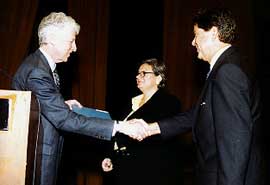
Columbia University Provost Jonathan R. Cole (left) presents Judy Miller and Alberto Ibarguen, of The Miami Herald, with The 1999 Pulitzer Prize for Investigative Reporting.
Winning Work
By Joseph Tanfani and Karen Branch
Herald Staff Writers
QUESTIONS OF VOTE FRAUD
A flood of absentee ballots proved decisive in the November race for Miami mayor. Former Mayor Joe Carollo would have won outright on Nov. 4 were it not for Mayor Xavier Suarez's lopsided advantage in absentees.
Now, the Florida Department of Law Enforcement is investigating allegations of widespread absentee vote fraud. There have been two arrests: a part-time Suarez volunteer, on charges of agreeing to buy phony ballots from an undercover agent, and a 92-year-old former produce peddler who gathered dozens of questionable ballots.
In its continuing investigation of possible election fraud, The Herald has reported that:
- The produce peddler witnessed a ballot cast in the name of a dead man -- Manuel Yip, who died four years ago and is buried in a pauper's grave.
- At least 40 possibly fraudulent absentee votes came from homes linked to supporters of Miami Commission Chairman Humberto Hernandez in Little Havana and the Roads.
- The mother of a onetime Suarez aide may have pressed elderly food-stamp recipients into voting for him.
- Some inner-city voters were paid $10 apiece to vote absentee.
One day before the Miami mayoral runoff election, a stream of poor and homeless people flowed to a back lot at St. John Baptist Church in Overtown. They weren't there to pray.
A man with a wad of cash was paying for votes. As word spread, dozens of people boarded vans, headed downtown and cast absentee ballots -- in exchange for $10 each.
Thomas Felder took the money.
"I had no choice. I was hungry that day," said Felder, who is out of work and broke. "You wanted the money, you were told who to vote for -- 212, Suarez." That was Miami Mayor Xavier Suarez's number on the runoff ballot.
"I did it to get paid, that's all," said Mary Ludlow, 32, who lives in a run-down apartment building on Northwest First Place that overlooks a flooded and trash-strewn roof.
She said she was told to vote for Suarez, and did.
A dollars-for-votes operation was in full swing in Miami's inner city during last November's mayoral election, a Herald investigation shows.
In independent interviews with The Herald, 14 voters and witnesses outlined the same basic vote-buying operation at the church lot in Overtown, though not all said they were told to vote for Suarez.
Voters were driven in white vans and beat-up cars to County Hall, where the Miami-Dade elections department was accepting absentee ballots in the Nov. 13 runoff between Suarez and former Mayor Joe Carollo.
When they came back to the church lot, they got their payoff: a $10 bill peeled off the top from a stack stashed in a recruiter's pocket.
The operation was hard to miss, witnesses said.
"It was about 300 or 400 people. God, yeah, they were coming all day," said Ellis S. Dunning Jr., who lives in an apartment that overlooks the church lot. He said he, too, took the $10.
The Herald located five people who said they received $10 to vote during the operation at 1328 NW Third Ave.
Three voters said they were told to vote for Suarez, although one of them declined to say whether he pocketed any cash.
One woman said she learned about the absentee operation from a Carollo operative and voted for Carollo -- although she would not say whether the vote-buyer at the church gave her instructions.
The two other $10 voters said they don't recall receiving instructions on how to vote.
CASH MAN IDENTIFIED
'Pop' Hoskins says he saw no one buying votes
Five witnesses identified a man they said was handing out cash or taking down names: Jeffrey "Pop" Hoskins, 34. Hoskins admitted he has participated in "two or three" $10-a-vote operations in the past -- but denied any involvement in November's vote-buying scheme.
A basketball coach for the Overtown Optimists, Hoskins said he was at adjoining Gibson Park that day. He said he didn't see anybody trading cash for votes.
"I'm not going to be a scapegoat for anyone," he said. "Everybody's trying to cut me, and for what? I didn't do anything. There's people getting something, but it's not me."
He refused to say which candidates were involved in the cash-for-votes operations he assisted in the past.
"It exists. It always exists. You go to Liberty City, Coconut Grove -- everybody knows about the $10. If they say they didn't, they're lying.
"In Overtown, $5 could get you a vote," said Hoskins, who called himself a veteran of "15 to 25" campaigns. "Everybody else did it. Everybody who's ever run."
Both the Suarez and Carollo campaigns said they had nothing to do with the vote-buying operation.
"I'm shocked. I really am," said Irby McKnight, an Overtown activist who helped run Suarez's campaign. "I don't operate like that."
"I think that's a terrible thing," McKnight said. "Black people died for the vote, and there's not enough money to buy mine. If you do that, you should go to prison, because you are weakening our democracy."
"We ran a crystal-clear campaign," Carollo said. "There's nobody from our side that put up any money. I know the kind of campaign we ran -- we run it as straight as anyone can run it."
State law makes it a third-degree felony to pay someone to vote for a candidate. It's a misdemeanor violation for a voter to sell his or her vote.
JUST BEFORE THE RUNOFF
Campaigns focused on inner-city votes
The Overtown vote-buying operation came a day before the Nov. 13 runoff, at a time when the mayoral campaigns were desperate to drum up support in Miami's black neighborhoods.
Campaign professionals said many black voters lost interest in the elections the week before, when veteran politician Arthur E. Teele Jr. easily won election to a seat on the Miami City Commission. Teele represents predominantly black District 5, which includes Overtown.
Both Suarez and Carollo are white Cuban Americans.
"The people in this community didn't care, not at all," who won the mayoral election, said McKnight, the political consultant who spearheaded Suarez's campaign in Overtown. "A lot of people said, 'I'm not going to vote for anybody but Teele.' It didn't matter who was mayor."
Despite that apathy, the number of absentee votes from Overtown rose in the mayoral runoff.
On Nov. 4, when Teele and opponent Pierre Rutledge were on the ballot, 48 people living within a half-mile of the St. John church voted absentee, election results show.
For the Nov. 13 race, that number rose to 75.
Election records show that none of the five who sold their votes cast ballots in the Nov. 4 primary. Several told The Herald they turned out only because of the $10 offer.
"You're trying to make 10 bucks, you know?" said Dunning, the man who lives in an apartment overlooking the church lot. "Ten bucks is ten bucks." He said he took the money but received no instructions on how to vote.
'ABUSING' THE SYSTEM
Sites for early voting will now be cut back
For years, the elections department has set up a number of early voting sites around Miami-Dade where people can cast ballots a week or more before Election Day. Those votes are counted as absentees, since they are cast outside a voter's home precinct.
James Kohanek, assistant elections supervisor, said campaigns are "abusing" that system by busing in voters who could easily vote at the polls.
All of the sites except the county building will be shut down in future elections, he said.
"It was set up as a convenience for the voter, and all it turned out to be was an abuse by candidates," Kohanek said.
Miami-Dade election administrators have long heard reports of vote-buying in Dade.
"You always hear it, but you never see it, and no one has ever brought any proof," Kohanek said.
In separate interviews, each of the five voters and nine witnesses interviewed by The Herald gave similar descriptions of the vote-buying operation:
"I went over there because I saw all the people and thought they were giving out food," said Bobby Hobbs, 70, still covered with dust from his job as a $5.14-an-hour day laborer. He said he was driven to County Hall in an old blue Chevrolet sedan, voted, and returned to the church lot in a van.
"They gave us $10, if I'm not talking too much," said Hobbs, who lives in a rooming house in the shadow of the elevated Metrorail tracks. "I wasn't going for no money. I was just trying to help people. I wanted to vote to try to help straighten this place up."
Hobbs said he did not remember anyone telling him to vote for either Carollo or Suarez. He said the people paying for votes assured him he wasn't doing anything wrong.
"I always try to do things right," he said. "I don't read or write so good."
HOW TO GET A RIDE
Voters had to show they were registered
Once voters arrived, someone asked to see their voter registration card and asked for their Social Security number.
"You had to show your card before you got a ride," Felder said.
Once they proved they were registered to vote, they were taken to County Hall at 111 NW First St., where the elections department had set up its usual early polling place in the lobby.
All of the voters said rides were provided in an unmarked white van, supplemented by a light blue sedan and other vehicles as the crowd grew in midafternoon.
"It was a party," Felder said. "Everybody needed money. You don't make that much in an hour, and here you could make $10 in 15, 20 minutes."
"I didn't give a damn who won or lost," Felder said. "They're not going to do anything for me, either way."
Most of the voters said two men seemed to be running the operation: a stocky, well-dressed white man who carried documents, possibly a voting roll, and talked on a cellular phone, and a black man who checked voter cards and doled out the $10 bills.
Shown his photo, two voters -- Felder and Lola Chapman, 55 -- identified Hoskins -- the Overtown Optimists basketball coach -- as the man who gave them the money. Mary Ludlow, the woman who said she was paid $10 to vote for Mayor Suarez, described a man who fits Hoskins' description: muscular, with two gold front teeth.
Ludlow's sister, Sonya Calderon, said she saw Hoskins handing out money, but said she did not take any -- although Ludlow said in a previous interview that her sister did.
Dunning said Hoskins took down his name, but he was paid by a white man. Hobbs, shown a picture of Hoskins, did not recognize him. He said he was paid by someone else.
THE WORD SPREADS
Witness: 'Homeless men were out there voting'
As word spread, the crowd grew. By midafternoon, it was large enough to attract attention throughout the neighborhood.
Mary Duncan, 55, noticed the milling crowd when she dropped by the Chinese restaurant in front of the church parking lot about 3 p.m.
"Homeless men were out there voting," she said. "I saw them -- some white man and some colored men -- and they all were in the churchyard. I didn't get $10. But I heard from the men that that's what they were getting. I saw them giving out the $10."
Donald Knowles, manager of the city-owned Gibson Park that adjoins the church property, said the vote-buying operation was obvious. All day, he said, two unmarked white vans came and went, ferrying crowds of people, including homeless men and women with young children.
Shown a picture of Hoskins, he said that was the man who was doling out the money.
"He had a little stack," Knowles said. "He reached in and gave them whatever came out of his pocket. No checks -- cash. He just took it off the top and just handed it to them."
Knowles said he jokingly called out: " 'Hey, you need any more help?' And he said, 'No, man, you got a job. You don't need any of this.'"
A well-dressed, middle-aged white man stood just inside church property, Knowles said, supervising the operation.
"He was standing right at the entrance of the church parking area, inside the gate," Knowles said. "It was like he didn't want to be on city property doing whatever he was doing, because he stayed inside that gate."
Church representatives said they didn't notice anything. "From my understanding and from what I know, no one used church grounds for politics," said the Rev. Henry Nevin.
BOTH CAMPAIGNS SEEN
Two candidates' signs reportedly at church lot
Some voters and witnesses said both campaigns were represented at the church lot that day.
Knowles, the park manager, said he saw a number of people leaving the lot carrying Carollo campaign signs.
Another voter said she saw campaign signs for both candidates.
"There were people there with signs for Mr. Suarez and Mr. Carollo," said Geraldine Haywood, 52. She said she got a ride from the church but no one offered her any money.
Chapman said she heard about the rides from a woman living in her complex: Elsie Hubbard, a paid operative for Carollo and a longtime member of the St. John church. She would not say whether Hubbard told her about the $10 payoff.
Chapman said she voted for Carollo. Afterward, Hubbard's son -- Hoskins -- paid her the $10, she said. Hubbard also hired her to hold Carollo campaign signs at the polls the next day.
"I got $10 for going out to go to vote and $50 to hold the signs," said Chapman, who was unemployed at the time. "They got a lot of people to go down there and vote like I did. . . . I could use the money."
Chapman, who has since landed a job as a school-crossing guard, said she also was paid $10 to vote in another election two years ago. She could not recall the name of the candidate.
Hubbard said she knew nothing about the vote operation outside her church and never instructed anyone to go there.
"Whoever said it told a lie, and I would overlook my Christianity and kick their [rear]," she said.
"Why should I do that, when everything you need to vote is right here at the Culmer Center?" said Hubbard, referring to the nearby county-run community center that serves as a voting precinct.
Like Felder and Ludlow, voter David McPhee Sr. said operatives at St. John suggested he vote for Suarez. Asked whether he received $10, he abruptly ended the interview.
"I don't want to talk about that," he said angrily.
CHECKING IT OUT
Suarez campaign worker says he gave no rides
The Suarez campaign sent someone to the church lot when it heard about the gathering crowd -- but only to see what was going on, said McKnight, the Suarez campaign coordinator in the area.
McKnight said he sent campaign worker Andre Marshall to check things out.
McKnight said Marshall told him the Carollo camp was providing rides to its own poll workers so they could vote before Election Day.
However, in an interview with The Herald, Marshall said he assumed that the church was providing the rides to assist voters. He said he directed some people to go there.
"I told voters about it," said Marshall, an unemployed single father of four who once worked as an office aide to Suarez and who now hopes to land a city job. "I said: 'Hell, go on, get your free ride.' Personally, I didn't give any rides from St. John's."
Marshall said he is a friend of Hoskins -- the man identified by several people as the one paying and recruiting voters outside St. John -- and has worked with him on past campaigns. He said he saw Hoskins at the church on Nov. 12, but did not see him or anybody else paying voters.
"Nobody I told to go down there got any money," he said. "And I don't believe any money was exchanged. I didn't see anybody get paid."
Hoskins at first said he didn't work for either Carollo or Suarez.
"I didn't work for any campaign," he said Tuesday, in an interview at his dilapidated apartment complex on Northwest Second Avenue. "People make accusations every day."
He later said he volunteered one morning for Suarez during the nine-day runoff campaign in November. Hoskins also was paid for one day's work on the Carollo campaign on the Miami primary election day, Nov. 4.
Hoskins, shaken after a first visit by Herald reporters, said he called Mayor Suarez's chief of staff and campaign manager, Jorge Alvarez. He said he did not know Alvarez but got his name and number from a friend, whom he would not identify.
"This has been very unsettling for me. I got Jorge Alvarez because I wanted to get in touch with someone to get some names [of those involved in the vote-buying operation]," Hoskins said. "Alvarez hung up on me. He said he knew nothing about it."
Alvarez said he did not know Hoskins and did not remember getting such a phone call.
"There are campaign workers at the last minute who want to get involved and work the polls. This might have been someone who didn't get paid," Alvarez said. "I have gotten calls from people I never heard from before demanding payment. And, quite frankly, they [tick] me off."
In an era when Hispanic votes dominate Miami politics, Hoskins said vote-buying in black precincts has become passé.
"These 50 votes you get out of Overtown, they don't really count for s---," Hoskins said. "Nineties politics doesn't really dictate it. It's real dirty now.
"Do what you got to to win -- that's what Miami politics is about."
© 1998, The Miami Herald
Herald Special Report
Voting where you live is a bedrock principle of elections...
You don't have to live in the city of Miami to vote there.
Even though that's against the law.
Dozens of voters cast ballots for Miami mayor and commissioners last November even though their homes are miles outside city limits, a two-month Herald investigation has found.
A Homestead janitor did it. So did a Miami Beach widow, a Kendall anti-porn activist and a high school teacher from Miramar -- in Broward County.
The Herald, after reviewing just 3 percent of the votes in the Nov. 4 election, has so far found 105 illegal votes for Miami's mayor and commissioners.
Of those, 68 votes came from people who lived outside the city. State law says that citizens cannot vote in a city election unless they actually live there.
Other illegal votes came from people who live in Miami, but outside the commission district where they have their voting registration -- also disallowed by state law.
"The only people who should be able to vote on issues that affect their government are those who have a direct stake in the election," said Mike Cochran, assistant general counsel of the state Division of Elections.
But records show that many had been voting for years, in election after election -- canceling the votes of real Miami residents and taxpayers in the process.
The non-resident voters include:
- Alicia Santa Cruz, 69, a Havana-born widow who has lived in Miami Beach for the past 13 years -- and voted in the city of Miami all the while."I know I shouldn't be doing it," Santa Cruz says. "But I don't want to forget my people, my blood."
- The Hernandez clan of Flagami on Miami's western edge. They pile into a van and head to the Kinloch Park Middle School to vote every election day. "It's a tradition," Onelio Hernandez says. "The important things we do as a family together," adds his niece, Olga Hernandez Marco. But Onelio and Olga live in Coral Gables, not Miami. Olga moved out of Miami nine years ago. "Well, if it's against the law, we'll have to change next time," Onelio Hernandez said.
- Willie Darby, 53, who moved to an apartment on Palm Avenue in Hialeah six months ago. He still cast a ballot from his old address in Miami's commission District 3. He changed his registration to Hialeah after being interviewed by The Herald. "I've always felt more in tune with things in Miami than anywhere else," Darby said. He bristled when asked if he thought he could be breaking the law. "Look, I'm an American citizen and I feel you don't violate the law when you vote," he said. "It's my right as an American citizen."
A MATTER OF PRINCIPLE
Voting by non-residents also violates state law
Voting where you live is a bedrock principle of elections, a guarantee that a city's leaders are chosen by the people who are affected most -- those who have to pay the taxes and live with the services.
State elections law also enshrines that fundamental rule, saying that voters must be registered at their legal residence, and must live within the borders of a town to vote there. It's a third-degree felony for an ineligible voter to "willfully" cast a ballot.
In Miami, that law is routinely ignored.
The Herald already has reported widespread irregularities among the 4,740 absentee ballots cast in Miami's Nov. 4 primary election -- out-of-Miami residents registering at phony addresses, forged signatures and at least one ballot cast in the name of a dead man. The Florida Department of Law Enforcement is investigating and has made three arrests.
The Herald's investigation also shows that not all of the illegal votes were on absentee ballots. Dozens of ineligible voters came and voted at the polls, public records show.
On Feb. 9, Miami-Dade Circuit Judge Thomas S. Wilson Jr. will hear a lawsuit by ex-Mayor Joe Carollo, alleging that absentee ballot fraud was so pervasive that he should be declared the winner. Carollo won the Nov. 4 election at the polls but was forced into a runoff by Xavier Suarez's 2-1 advantage in absentee voting. Suarez won the runoff and went on to become the city's first strong mayor.
The voting irregularities also have attracted the attention of the Miami-Dade elections department and a special state Senate subcommittee crafting legislation that would tighten election rules.
"The allegations of vote fraud have always been out there, but I believe they are much worse this year," said David Leahy, Miami-Dade elections supervisor.
A VARIETY OF EXCUSES
Some preferred Miami's exciting brand of politics
Non-resident voters gave all kinds of excuses for continuing to vote in Miami: Traffic. Tradition. Love of Miami's blood-and-guts politics. Some say they voted for Miami Mayor Xavier Suarez, others for former Mayor Joe Carollo. All of them interviewed for this story said they had no connection to the campaigns.
Some say they were just too busy to change their registration. And some say they believed they really lived in the city.
Pedro and Lillian Roque moved out of Miami more than 10 years ago to a house at 13382 NW Second Ter. in unincorporated Dade west of Sweetwater. That's at the edge of the Everglades -- 13 miles from their old precinct.
On Election Day, the Roques drive for a half-hour into the city to vote at their old precinct, Iglesia Bautista Resurreccion at Southwest 27th Avenue and 23rd Street.
The Roques say they thought they were still eligible to vote in Miami elections because "Miami" is the address on their mail.
But Lillian Roque also said: "When we moved, I couldn't vote for the people I liked here."
Whatever their reasons, illegal voters have one thing in common: No one has to worry much about being caught.
Leahy says his office -- overwhelmed by the volume of Dade voters, hamstrung by laws meant to encourage voting -- is all but "helpless" to enforce residency rules. Voting is more or less on the honor system, he said.
SAFEGUARDS LACKING
The law is on the side of nonresident voters
When people register or change their address, elections workers simply take them at their word. By law, they can't ask for identification. There are more legal safeguards against a teenager buying a six-pack of beer at a convenience store.
"Currently as the law stands, there isn't much that we can do about it," Leahy says. "We don't know how big the problem is, but the potential problem is very real."
Leahy says the department sometimes stumbles across non-resident voters, if mail comes back as undeliverable or if the elections staff finds a change of mailing address.
But the department does not purge them from the roll.
For instance, the elections department found out last February that Santa Cruz, the Miami Beach widow, had apparently changed her mailing address. She was put on inactive voter status. But Santa Cruz was allowed to vote anyway when she showed up at the polls last November.
Leahy says the new "motor-voter" law meant to encourage voter registration does not allow him to remove such inactive voters. And he says a mailing will catch only people who need a reminder to change their voting registration.
"It's meant to catch those who just don't understand the process," Leahy said. "It's not going to catch those who want to beat the system.
"You've got a perfect opportunity for fraud."
A DEMOCRATIC PROCESS?
Home for some voters is outside the county
For real Miami residents -- who pay some of the highest property taxes in South Florida -- this means their decisions are being diluted by a steady stream of out-of-town votes.
"It really bothers me. You have people coming into Miami and affecting the democratic process when they don't know what's going on," said Kenneth Merker, a Northeast Miami community activist and former mayoral candidate.
"The system is unfairly being manipulated to our detriment."
Some out-of-town voters don't even live in Miami-Dade County.
One example is Horace Givens Jr., a social studies teacher at MacArthur South Alternative School at 11035 SW 84th St. Givens -- a political science major in college -- is registered to vote at his aunt and uncle's house on Northwest 47th Street. But records show he lives across the county line -- in Miramar.
Givens did not respond to three letters and six phone messages.
Dario Moreno, a political science professor at Florida International University, says the spectrum of bad votes in Miami runs the gamut from organized fraud by campaign operatives to the missteps of confused innocents.
"For some, they are really into Miami politics, Cuban-American politics," Moreno said. "They listen to the radio stations, they care about the people, they're related to a candidate. They care dearly -- or they want a favor.
"Things have gotten so sloppy in Miami -- even if you put the best spin on it, if people are making innocent mistakes, it's still wrong and it still undermines the system," Moreno said.
A FAMILY'S EXPERIENCE
Six voted from one house, but some didn't live there
One example is the Diaz family of Morningside. Six adults voted from the same house -- yet only one of them lives there, according to son Osvaldo Diaz Jr., who did not vote. Two sisters and a brother-in-law voted from the Morningside address even though they live in Miami Shores, records show. The family patriarch, Osvaldo Diaz Sr., said he splits his time between Miami and Miami Beach.
Property records show that Diaz Sr. still owns the Morningside home and has his homestead exemption there.
"I have two houses," said Diaz Sr., a Little Havana surgeon, reached by phone at the Beach condo. "I have the right to live anywhere. That is my right." Asked if he preferred to vote in Miami, the doctor said: "Absoluto."
He said he supports Suarez. His wife and daughter contributed a total of $450 to Suarez's campaign, using the address of Diaz's clinic.
Jorge Antonio Miranda, a 50-year-old civil engineer employed by Recchi America, lives in West Dade but votes out of his parents' house at 5310 SW Second St. Miranda said that's where he registered when he became a U.S. citizen, and he never changed it. He still owns half the house.
"I visit my parents all the time . . . and to be honestly true, I like following the Miami politics, and that's why I never changed my address," Miranda said. "Very dynamic, like the old-fashioned Cuban politics."
Another fan of Miami politics: David Mariano Cruz, son of postman Mariano Cruz, who lost in his bid last November to unseat Miami Commissioner Willy Gort.
Cruz, a Miami-Dade bus driver, says he has lived in a North Miami condominium for eight years -- while keeping his address at his parents' home on Northwest 26th Street in Allapattah. He says it's convenient because the polling place is near the bus headquarters where he works.
"I live in North Miami, but 99 percent of the time I'm there at my parents' house," he said. "I've always voted in Miami, ever since I was 18."
CONVENIENCE A FACTOR
For some outsiders, it's easier to vote in Miami
Rene and Georgina Espinosa kept their Little Havana registration even after they moved to a Flagler Street trailer park in West Dade, just east of Sweetwater. Carollo fans, they said they wanted to make sure they could be counted in his corner.
"I think he was doing a good job," Georgina Espinosa said.
For some of the non-Miami members of the Miami electorate, the big lure of voting in Miami wasn't politics. It was convenience:
- Eduardo Diaz, 64, moved out of Miami to a trailer park in Homestead more than a year ago. But he kept his old voting address at Southwest Eighth Street and 32nd Avenue because the polling place is a lot closer to his job. He's a window washer at Miami International Airport. "I work at the airport, so that's why I vote there," said Diaz, who said he was a Carollo supporter. Diaz said he's voted only twice since becoming a citizen.
- Elida Morffi-Ricard is registered to vote at St. Michael's Catholic Church at 2987 W. Flagler St., where she works as a receptionist. It's convenient -- there's also a precinct at the church. But she says she really lives on Genoa Street in Coral Gables.
- Emie Cook, who lives in Carol City in far northwest Dade, said she's going to keep her mother's Liberty City home as her voting address -- whether it's legal or not.
"I am not going to change my address," she said. "Too much rigamarole."
ILLEGAL? YOU DON'T SAY!
'I thought I was a Miami resident,' one voter said
Some pleaded ignorance.
"I thought I was a Miami resident," said Maria Emma Castro de Garzon of unincorporated West Dade, who says she voted for Suarez. "When I write down my address, I write down 'Miami, Fla.'"
Her home is 3.1 miles west of the Miami border.
Former Miami City Manager Howard Gary violated the rules, too. Gary voted in District 3, where he lived for 27 years, even though he now lives in a condo in District 2.
"It was just an oversight on my part," said Gary, an investment banker and potential government witness in the unrelated Operation Greenpalm corruption probe. "I failed to change from one city district to another after I moved. That's all."
Andre Whittle, basketball coach at the Academy for Community Education alternative school, has lived in Carol City, part of unincorporated Northwest Dade, for five years. He voted from his mother's Miami home last November.
"I live in Carol City, but I never knew that you have to vote in the city where you live," Whittle said.
Moreno, the FIU political scientist, believes many voters are in fact innocently confused about the county's two-tier system of government. For instance, every Miami-Dade voter can vote for the office of county executive mayor, while only people who live within a city's borders can vote in city elections.
"The boundaries here are sometimes anti-commonsensical," he said. "Some of the irregularities are just people who are ignorant and are uninformed of just what they're supposed to be voting on."
TELLTALE SIGNATURES
Voters sign at the polls, next to official address
Yet Leahy, the elections supervisor, points out a contradiction in the stories of blissful ignorance: When voters show up at the polls, the precinct worker asks them if they still live at the address on their voter registration.
They sign the voter book right next to that address -- though Leahy says that doesn't count as a legal oath.
Still others offer no reason at all:
Locksmith Peter Pick, with his wife Eldy, voted out of an apartment building they own in Little Havana. The Picks are longtime activists who work to protect the neighborhood where they really live: Snapper Creek in Kendall.
Corporate records list Peter Pick as president of the Snapper Creek Park Lake Association, a homeowners group. Eldy Pick played a leadership role in a 1991 neighborhood effort to chase away an adult video store.
They would not speak to a reporter who visited their Kendall Drive home and asked for an explanation of the residency issue.
"It's none of your business. Get off my property," Peter Pick said.
Records show that a ballot was cast in the name of Marjorie Share, who now lives in Surfside -- not the address where her vote came from, an apartment house in Miami's commission District 3.
She phoned a reporter after a letter was left at her Surfside apartment.
"I haven't voted in five years," she said. "I don't know where you're getting your information from." She says someone must have stolen her vote.
"Somebody took my name. They could do that, you know. I used to live in that area."
She and her husband offered differing explanations of why she could not have voted on Nov. 4. Her husband, Jorge Enriquez, said she didn't vote because she was in bed with asthma that day. In the background, Share said no, she was working.
"She was in bed and working," Enriquez said.
Elections department records show she did vote.
ONE COMMUTER'S BLUES
Traffic is 'awful,' so he votes where he can
Several out-of-Miami voters said they thought they were doing their civic duty.
Julian Manduley, 43, says he's just another harried commuter, driving from his house in Kendall to his job as a purchasing executive at a Knight Ridder office in Coral Gables. Knight Ridder owns The Miami Herald.
"The traffic going west is awful," he said. "By the time I pick up the kids and get home, it's too late to vote."
His solution: He registers on Southwest 10th Avenue, home of his in-laws, Isabel and Eugene Tuero.
"No, I didn't know it was illegal," he said. "I mean, in the paper and everywhere, they were saying, 'Vote. Vote.' So I voted."
SIDEBAR: QUESTIONS OF VOTE FRAUD
In its continuing investigation of possible fraud in the Miami mayoral election last November, The Herald has reported that:
- Manuel Yip, who died four years ago, voted by absentee ballot. He had also voted three other times since his burial in a pauper's grave.
- Alberto Russi, the produce peddler who allegedly witnessed the dead man's ballot, also witnessed 70 other absentee ballots. At least three ballots witnessed by Russi were cast in the names of residents who say they didn't vote.
- At least 40 possibly fraudulent absentee ballots came from homes linked to supporters of Miami Commission Chairman Humberto Hernandez, who was appointed by Mayor Xavier Suarez to investigate the Florida Department of Law Enforcement's inquiry into voter fraud.
- Homeless and poor people were rounded up outside St. John Baptist Church in Overtown and paid $10 to vote.
- Three elderly voters who live outside Miami, including a 96-year-old Hialeah Gardens woman, said someone cast ballots in their names.
- Former food stamp worker Conchita Minagorri gathered dozens of votes from food stamp recipients for whom she still helps cut red tape.
Some voters said they were pressured to vote for Suarez; others said they didn't know who the candidates were. Minagorri's son, Manuel ''Mickey'' Minagorri, was hired by Suarez immediately after the election, but he resigned when the state attorney ruled that the hiring violated the city charter.
THIS ARTICLE IS BASED ON REPORTING BY THESE HERALD STAFF WRITERS:
Karen Branch, Tyler Bridges, Alfonso Chardy, Manny Garcia, Rick Jervis, John Lantigua, Marika Lynch, Patricia Maldonado, Maria Morales, Sandra Marquez Garcia, Connie Prater, Ken Rodriguez, Frances Robles, Joe Tanfani and Andres Viglucci. Joe Tanfani and Manny Garcia wrote the story. Herald Research Editor Dan Keating handled computer analysis and Researcher Elisabeth Donovan provided research assistance.
© 1998, The Miami Herald
Herald Special Report
In their zeal to win, some campaign workers for Miami Mayor Xavier Suarez and Commissioner Humberto Hernandez teamed up in a mad dash to gather votes across Miami last fall, often trampling election laws in the process, a Miami Herald investigation has found.
The campaign workers used a variety of tactics: They registered people to vote at addresses where they didn't live. They punched voters' absentee ballots without permission. They cast ballots in the names of people who insist they did not vote. They cast questionable ballots themselves.
And they signed dozens of ballots as witnesses, even though they weren't present when the voters signed the envelopes, as state law requires.
Among the campaign workers collecting and witnessing questionable ballots were members of Hernandez's family and his closest aides.
Some supporters of Suarez and Hernandez described in interviews how they engaged in dubious electioneering.
Alfredo Perez said Hernandez campaign workers moved his voter registration to an address in the commissioner's district, even though he did not live there.
Miriam Mor said a top Hernandez aide told her to witness ballots for a couple who lived far outside Miami -- in West Dade. Mor later changed her story: "My memory improved."
Zunilda Menendez, who worked for both campaigns and was paid $858 by Hernandez, acknowledged she never met most of the people whose absentee ballots she signed as witness -- including two questionable ballots.
"I got a pile of absentee ballots from Humbertico's father at the campaign headquarters on Flagler and he said, 'Here, you can sign those,' " Menendez said.
Suarez and Hernandez denied any wrongdoing, as did Hernandez's father.
"There was no organized conspiracy in this election from either camp. Any wrongdoing that has been found was unintentional, as far as I know," Hernandez said.
"You guys have not found enough to say this was widespread. Fraud is fraud. We shouldn't allow one fraudulent vote. But it wasn't substantial, and it shouldn't overturn the election."
Suarez would not grant an interview, but issued a brief statement saying he ran a clean campaign.
"I urge The Miami Herald to concentrate on substantive matters affecting the city," Suarez said. "The constant emphasis on the election is tiresome, to put it mildly."
Absentee ballots decided the November mayor's race. Nearly 12 percent of the 44,000 votes cast came from absentee voters, the largest proportion of any race in city history.
Absentee requests
Suarez forced incumbent Joe Carollo into a runoff by collecting twice as many absentee votes in the Nov. 4 election. Nearly 40 percent of those ballots cast citywide came from Hernandez's Commission District 3, where his campaign ran an aggressive absentee-ballot operation.
So many requests for absentee ballots poured into the Miami-Dade County elections department that it had to print new ones to keep up with demand. With little oversight, bad votes went largely unchecked.
In the scramble, some people say, their votes were stolen.
"I was taken advantage of," said Ada Perez, 70, who was tracked by a Hernandez operative she could not name at a hospital, where she was recovering from a severe stroke just before the Nov. 4 election.
Perez, a Little Havana resident who wanted to vote for then-incumbent Joe Carollo, described how the operative badgered her to vote for Suarez, then finally took her ballot and punched it for her. Whose number was punched? She doesn't know.
The witness name on her ballot is Jorge L. De Goti, Hernandez's 29-year-old chief of staff. De Goti was out of town and could not be reached for comment.
"My vote was stolen," Perez said, her eyes welling with tears. "They know our eyesight is not good and we are not well. What kind of person would take advantage of the elderly?"
Manuel Ramudo, 87, said somebody who brought him Suarez campaign literature punched his ballot when he wasn't looking. When Ramudo complained, he said the man told him: "You've already voted."
The witness name on the ballot: Miguel Amador, a Suarez campaign volunteer arrested by state investigators for allegedly offering to buy three absentee ballots. Amador's lawyer "vehemently" denied his client punched Ramudo's ballot.
A criminal investigation by the Florida Department of Law Enforcement has so far produced two other arrests of campaign aides, including Hernandez's law-office secretary and Alberto Russi, a 92-year-old former produce vendor who allegedly witnessed a ballot for a dead man. Agents say they expect to make more arrests soon.
Start of trial
Carollo has sued to overturn the election, alleging that Suarez benefited from widespread ballot fraud. The nonjury trial begins Monday.
After checking just over 3 percent of ballots cast on Nov. 4, including both absentee and at the polls, The Herald has documented 173 invalid votes. Carollo fell short of winning the first round outright by just 155 votes.
The Herald investigation found only a handful of questionable ballots linked to other campaigns. The most serious claim against the Carollo campaign was made by Juana Riera, who said Carollo volunteer Jorge Diaz grabbed her ballot and punched it while her back was turned. Diaz vehemently denies the allegations.
Working together
During the fall campaign, Suarez and Hernandez supporters worked hand in hand to gather votes. At least a dozen people were actively soliciting votes for both candidates. A couple of those workers were paid by both campaigns. When some voters called Suarez headquarters to have their ballots picked up, Hernandez workers wound up signing them as witnesses.
"There is no question that people who were working for me were supporting Suarez. And people working for Suarez were supporting me," Hernandez said.
After the election, Suarez appointed Hernandez, who is awaiting trial on bank-fraud and money-laundering charges, to chair the commission. And some campaign workers who helped gather illicit votes have been hired for city jobs and named to city boards.
One common campaign tactic: registering out-of-town or out-of-district voters at homes in District 3, thus making them eligible to vote for both Suarez and Hernandez.
Hernandez supporter Alfredo Perez recounted in an interview how campaign workers recruited him to cast a bad ballot a month before the Nov. 4 election.
"I approached Humberto Hernandez's father because I've known him for years, from way back in Cuba when I was a police sergeant in Havana and Humbertico's grandfather was a councilman in Cuba, and I told him that I was ready to help with the campaign in anything they needed," said Perez, who lives outside District 3.
"He thanked me, and eventually a campaign worker asked me for my voter registration card. They took it away and later called me to fill out some forms to change the registration to an address within Humberto Hernandez's district -- 1601 SW Second Ave."
"The Hernandez campaign is the one that supplied that address. I don't know who lives there or how they came up with it," Perez said. "But I understood that it was an address that was convenient to the campaign."
At the campaign workers' behest, Perez said, he also registered his sister at the same address, though she, too, lives outside the district.
Perez said he didn't hear about the ballot again until the campaign called and asked him to come over to sign it.
Hernandez Sr. said he had "no recollection" of Perez and denied his story.
"Despite what anybody might claim, I have never switched anybody's address," he said.
That District 3 address where Perez's voter card landed was also used by a paid Suarez campaign worker, Christina Mansourou.
Public records show that Mansourou, 21, lives with her grandparents outside District 3, at 2801 SW 17th St. But all three voted inside Hernandez's district.
Mansourou switched her voter registration to the district Oct. 17, then switched it back to Southwest 17th Street in December, elections records show. Mansourou, found at her out-of-district home, declined to comment.
Three more possibly bad ballots were cast from the same address where Mansourou's grandparents were registered to vote during the election. None of those three voters live there, either, public records show -- for a total of eight bad ballots at these houses.
Another Suarez supporter linked to a questionable ballot is former department-store chief executive officer Oscar Gaetan, who was hired as a $48,000-a-year special mayoral assistant after the election.
His son, Jason, voted at the polls from his father's Coconut Grove house. But records show that Jason Gaetan lives in a Coral Gables townhouse that he and his wife bought in December 1996.
Jason Gaetan did not answer a note requesting comment. His father said his son and daughter-in-law were living with him while their home was renovated. Coral Gables city records, however, show no building permits for the home in all of 1997.
Gaetan resigned his city job last month.
Denies wrongdoing
Suarez, who recently told a state Senate subcommittee that he personally oversaw his absentee-ballot operation, said his campaign workers did nothing wrong.
"I reiterate . . . that our campaign did everything properly and within the law," he wrote in his statement to The Herald, stressing that he has cooperated with the Senate inquiry and the criminal investigation. "The focus should be on Mr. Carollo and his incredible war chest, not on my modestly funded, grassroots campaign."
If any bad ballots were cast by people linked to the Suarez campaign, they were the result of "human error," said the mayor's chief of staff, Jorge Alvarez.
"For you to characterize it as fraud is just grossly unfair," Alvarez said.
Many of the questionable ballots identified by The Herald can be linked directly to the Hernandez campaign.
Questionable ballots were collected, cast by or witnessed by Hernandez's father, two of his aunts, and his baptismal godfather, Juan Balsera.
Hernandez's father played a key role in the campaign, raising funds and directing some of the day-to-day operations. He also helped pull in other volunteers, including 62-year-old Andres Manso, a fellow officer in the Association of Salesmen and Merchants of Florida, a nonprofit group whose Flagler Street office served as campaign headquarters.
Manso's name appears as witness on three bad Miami ballots, including those of an elderly couple, Gloria and Cipriano Alvarez, who live in Hialeah and said they never voted. In an earlier story, The Herald said Russi witnessed those ballots.
"The thing is under investigation right now," Manso said. "I cannot talk to you until after the investigation is finished. Now, it's impossible."
The elder Hernandez voted from his son's home on South Miami Avenue, but public records indicate Hernandez Sr. lives on Red Road in Coral Gables. Commissioner Hernandez said his father divided his time between the two homes last fall.
The elder Hernandez witnessed three absentee ballots himself, including one cast by Luis Valdes, who registered to vote at his father's apartment -- in a government high-rise for the elderly. Valdes is 32.
Neighbors on both sides of the apartment said Valdes doesn't live there. Public records show he lives at an apartment in North Bay Village, where he has a two-year lease. Valdes did not respond to a letter requesting an interview.
His father, Luis Valdes Sr., insisted his son lives with him at the Robert King High elderly complex. So did Hernandez's father.
"The neighbors don't matter. His father says he lives there, which means he lives there," the elder Hernandez said in a phone interview.
Hernandez also said he could not recall giving any unwitnessed ballots to Zunila Menendez, the campaign worker who says he did.
Menendez said she didn't think she was doing anything wrong when she signed the ballots.
"I was on the phone when Humbertico's father approached and said, 'Will you please do me a favor? Can you sign these ballots as witness?' I told him, 'Yes, I will,' I took them and signed them and continued handling the calls. So I never really looked at the names."
Two of the ballots that Menendez said Hernandez gave her to sign are questionable. One was cast by a woman registered to vote in Hernandez's district but who lives outside the city in West Kendall, according to public records.
The other vote was cast by Aleida Perez Vera, an 81-year-old woman who said Commissioner Hernandez picked up her ballot at her Little Havana apartment. She wanted to vote for Carollo, but said Hernandez quickly snatched the ballot and punched it, then would not let her examine it.
"He told me, 'Look, it's already punched.' I couldn't even see the hole because it's so tiny. He might have voted for Suarez, for all I know. Next time, I punch it myself."
The elections department disallowed the ballot because her signature on the ballot envelope did not match the signature on file.
Hernandez said he never punched anyone's ballot.
"I guarantee you that didn't happen," Hernandez said, adding he was too busy campaigning to collect absentee ballots. "I didn't even want to get my hands on those things."
Other Hernandez relatives also can be linked to questionable ballots:
- Emma Arce, Hernandez's aunt, voted from an address in District 3. The homeowner there said she doesn't know Arce. Records place Arce at the elder Hernandez's Coral Gables home. Arce said she "sometimes" sleeps at the District 3 house, in a room rented by her sister.
- Juan Balsera, the commissioner's godfather, appears as witness on the District 3 ballot of a woman who lives in District 1. The woman, Olga Hernandez, said she did not vote. "I didn't go to vote and I didn't fill out any absentee ballot. I don't know this man Balsera," she said. Balsera did not respond to a letter seeking comment.
- The name of another Hernandez aunt, Aracely Lasseville, appears on the ballot of Ana Obregon, whose family is close to the commissioner. Obregon and five relatives cast ballots for Hernandez from a rental property they own but did not live in.
Lasseville's husband, John Lasseville, is Hernandez's political mentor and chief campaign strategist. Aracely Lasseville said she could not recall signing Obregon's ballot. "I don't know her,'' Aracely Lasseville said. "I could have signed it. I don't remember." - Maria Narcisa Gomez, 79, another Hernandez relative, cast a ballot from the District 3 home of a longtime Lasseville employee, Jose Felix Noguerol, according to election records. Visited twice, he insisted Gomez lived there but was out. A neighbor said she doesn't, and that her name went up on the mailbox around the time of the election. Her ballot was witnessed by Aracely Lasseville. Gomez's name also appears as a witness on at least 21 ballots. The signatures on those ballots often differ radically. Several of those voters questioned by The Herald said someone else had actually picked up the ballots.
Aracely Lasseville insisted Gomez, her relative, lives at her voting address, but was "in hiding from all this" and unavailable for an interview.
Shown three samples of ballots purportedly signed by Gomez, Lasseville said it was apparent someone was signing her name to the ballots: "Those are not her signatures. They're not even close."
Family friends joined in the hunt for absentee ballots.
A principal operative
One of the principal operatives in the drive was Jose Joaquin De Goti, 56, an elementary school teacher and the father of the commissioner's chief of staff.
His name appears as witness on a ballot from an out-of-city voter. Aurora Mendiola voted from an apartment over an auto-repair yard on West Flagler Street.
"There must be a mistake," said Manuel Barcia, who operates Rainbow Auto Repair. "She could not have voted from here because she does not live here."
Mendiola did not respond to notes left at her Westchester home.
In addition, 10 possibly fraudulent ballots were cast from homes owned or formerly occupied by members of the De Goti family. Two of those votes came from Rodolfo and Evelyn Herbello, a Miami police sergeant and his wife, who records show live in West Dade.
Those ballots were witnessed by Mor, 50, a longtime Hernandez supporter who worked on his campaign. In an initial interview, she said she had never met the Herbellos. She said Jose De Goti brought her to a house in District 3 to sign the ballots. Only "elderly people" were present, she said. The Herbellos are in their 30s.
"I never met these people," Mor said, pointing to copies of the two ballot envelopes. 'He handed me the ballots and said, 'Sign here.' And I did."
Mor changed her story the next day, saying the Herbellos came in to the campaign office to get their ballots signed.
"My memory has improved," she said. "I've done nothing wrong," she added later.
De Goti also collected -- but did not sign -- the ballots of two elderly people who share a house down the street from his Roads home.
Maria Luisa Vazquez -- who said she is an acquaintance of Carollo's mother -- said she asked De Goti to punch her ballot for Carollo and Hernandez. But she realized after the election that the number he punched was actually Suarez's, not Carollo's.
Eloy Sanchez, who shares a house with Vazquez, said De Goti grabbed his ballot before he could punch it and said he would fill it out at home.
"I didn't vote," Sanchez said. "He took it."
At De Goti's home, a woman turned off the lights Thursday night and said the family was out of town until the following week. She said she had no way of contacting them.
Two people who voted in District 3 live in Tampa. Their votes are linked to Russi, the vegetable vendor arrested by the FDLE. A prolific campaign volunteer who says he worked for both Hernandez and Suarez, Russi rounded up more than 90 ballots, including those of:
- Zonia Gonzalez and Leslie Perez, who live in Tampa. Leslie Perez said she and her mother live "on and off" in Miami. Gonzalez's father, Santiago Hernandez, said the two left his house and moved north before the election.
- Lucas and Violeta Trujillo and their son, Alberto, who are registered to vote at a house down the street from Russi's home in the Roads. Alberto Trujillo said he and his parents moved out of the house five years ago and don't vote. The tenant who rents the Trujillo house, George Saenz, said Russi came by one day and picked up the Trujillos' unpunched ballots. The Trujillos say they never gave Russi permission to take their ballots.
Some of the campaign workers who participated in questionable voting practices were hired by the city shortly after the election.
Jorge De Goti became Hernandez's $48,000-a-year chief of staff.
Others, including Jorge De Goti's brother, serve on city boards. Paris Obregon, who has acknowledged casting a ballot from an address where he doesn't live, is Hernandez's appointee on the Planning Advisory Board.
Still others work for agencies that often vie for city money. Rafael Cabezas, director of the Allapattah Community Business Development Authority, witnessed ballots that voters said were actually picked up by others. Cabezas' group received $50,000 from the city last year. He declined to comment.
Some also got checks from the campaigns.
On Nov. 7, the Suarez campaign wrote a $300 check to Gabriel Sanchez, a campaign worker. But The Herald traced that money to Gabriel Garcia, a 20-year-old campaign aide who was also paid $240 by the Hernandez campaign.
Garcia -- who previously worked for Hernandez at City Hall -- landed a $21,000 clerk job in the city budget office after the election.
Garcia's own vote was suspect. He cast a ballot from a house in District 3, although public records show he lives elsewhere in the city.
Garcia was on vacation last week and could not be reached for comment.
Suarez campaign treasurer Jeffrey Bartel could not explain why the check was issued in the wrong name. "I think it looks as odd as you do," he said.
SIDEBAR: HOW IT SHOULD BE DONE
An absentee ballot comes with (1) instructions, (2) an envelope to return the ballot and (3) a cardboard punchcard, which is the actual ballot counted by computer at the elections office.
You vote by punching out a numbered circle on the punchcard. The instructions list which numbered spots are for which candidates.
Once the ballot is punched, you place it inside the return envelope and seal the envelope. You then print your name on the back of the envelope and sign it. The signature goes across the flap of the envelope to show that it was closed when it was signed.
A witness then has to sign the ballot and write his or her address under the signature.
SIDEBAR: WHAT WENT WRONG
- Voters said the campaign workers misled them about which hole to punch for which candidate.
- Voters said they signed their unsealed absentee ballot envelope before punching the ballot. The ballot was then taken by someone else or voluntarily handed over, allowing someone else to vote in that person's name by punching the ballot.
- Ballots were cast by ineligible voters who live outside the city of Miami or in different City Commission districts than where they voted.
- Voters said they didn't vote and don't know how a ballot was cast in their names. They say the signatures on the ballots are forgeries.
- People signed as witness without seeing the voter sign the envelope, eliminating the confirmation that the ballot was cast by the actual voter.
THE AUTHORS I This article is based on reporting by these Herald staff writers: Karen Branch, Tyler Bridges, Alfonso Chardy, Manny Garcia, Lisa Getter, Rick Jervis, John Lantigua, Marika Lynch, Sandra Marquez Garcia, Patricia Maldonado, Connie Prater, Ken Rodriguez, Joe Tanfani and Andres Viglucci. It was written by Viglucci, Tanfani and Getter. Herald Research Editor Dan Keating and Getter handled computer analysis and Researcher Elisabeth Donovan and Annabelle DeGale provided research assistance.
© 1998, The Miami Herald
By Karen Branch, Dan Keating and Elaine DeValle
Herald Staff Writers
You vote where you live, right? Well, maybe not -- if you work for the city of Miami.
A Herald comparison of city personnel files and voter registration records found 14 city employees who commute to work -- and also commute to the polls.
They live in places including West Dade, Opa-locka, Carol City, even Broward County. All cast ballots in city of Miami precincts anyway on Nov. 4th.
The Herald also turned up eight other employees who live in Miami but voted in commission districts where they do not live.
State law is plain: Voters must vote from their legal residence. It's a crime -- a third-degree felony -- for any "ineligible" voter to "willfully" cast a ballot.
But it's a tough law to enforce.
"The way the law is written right now, we rely on the individual's honesty for . . . legal residency," said Gisela Salas, the county's assistant elections supervisor. "No provision in the law gives us the authority to go beyond what they're telling us.''
Explanations vary
Asked for explanations for the aberrations, city-employee voters came up with everything from silence and ignorance to the bizarre.
- Juan Pascual, promoted since the election to run the General Services Administration, said he was living at his in-laws' Miami home Nov. 4, and not in the Westchester home where he claims a homestead exemption. "I live on the beach, I live at my in-laws' house and I live here," said Pascual, reached at the Westchester home. He said he voted for ex-Miami Mayor Joe Carollo and for District 1 Commissioner Willy Gort. "At the time of the election, I lived in my in-laws' house." The in-laws say otherwise. Pascual's mother-in-law, Noreida Polo, told a reporter that Pascual and her daughter "used to live here when they were first married, but haven't for a long time.''
- Alicia U. Perez, an account clerk in the police department, claims a homestead exemption on a home west of Sweetwater. But she voted from her in-laws' home in Little Havana.
"I work in the city and I live there on weekdays," Perez said when reached on a weekday night at home west of Florida's Turnpike. "I have two houses." Besides claiming a homestead exemption at her West Dade home, Perez registered her car there. And she listed the same address as her home in city personnel records.
Similar scenarios
Such was the case with other city employees:
- Rene Alfonso, an engineer in the Information Technology Department and a campaign volunteer for Commissioner Humberto Hernandez, claims a homestead exemption in far West Dade. He lists the same home address in city personnel files. Yet he voted from a home in Hernandez's district, where the residents have never heard of him. Alfonso did not respond to requests for an interview.
- Kha D. White, an administrative assistant in the police department, voted at a Liberty City precinct in Commission District 5, even though she claims a homestead exemption in Opa-locka. The residents at White's voter-registration address said she used to live across the street, but moved away years ago. White did not respond to requests for an interview.
- Luis Casanueva, a mechanic with the fire department, claims a homestead exemption in Commission District 1. He cast a ballot at an old address in District 3. "I moved here two years ago," a sheepish Casanueva said at his home in Allapattah, miles from the Little Havana address where he used to live with his wife's aunt and uncle. "I have three kids, I'm working on the house, I take classes at Miami-Dade at night. I didn't have time to change my registration, but I will. It was for negligence, not for any other reason. I'm not into politics."
- Juan Jose Rodriguez, a city golf-course worker, bought a house in Broward County last March. But in November, he voted in Miami Commission District 3. Reached at his home in Hollywood, Rodriguez said, "I moved here four months ago, but I haven't changed my voter registration. I voted in the Orange Bowl for Suarez and I voted for, what's-his-name... Humberto. Now I won't vote there anymore."
- Avery Lee Washington, a city parks worker, lives in Carol City in the northernmost stretches of unincorporated Miami-Dade. He cast a ballot in his old Miami precinct, south of Liberty City. "I used to live in the city of Miami," Washington said from his Carol City townhome. "I moved from there to here about a year ago. I just never changed my voter registration. That'll be my last time voting in the city."
- Rafael Cobian, a city marina facility attendant, lists his home address in city files at Park Towers Apartments, a subsidized housing complex in Commission District 2. Cobian voted from an East Little Havana address in the District 3 election. State records show that Cobian bought a used car and registered the title to the Park Towers address on Oct. 30, five days before he voted in an East Little Havana precinct. A reporter reached Cobian via intercom at Park Towers. Or, at least, the man who answered the call said he was Cobian. When the reporter identified herself, he said: "Cobian doesn't live here."
Reminded he had just identified himself as Cobian, he said, "Cobian's at work," and disconnected the intercom. - For the past four years, city garbage collector Robert Jean-Baptiste listed his address in city records as a home in unincorporated Miami-Dade County between El Portal and Hialeah. But he voted Nov. 4 at a District 5 precinct in Miami's Lemon City neighborhood. Family members reached at his address in unincorporated Miami-Dade acknowledged he lived at that address outside the city. Jean-Baptiste did not respond to requests for an interview.
Tip of the iceberg?
While The Herald found 22 city employees such as Jean-Baptiste who voted Nov. 4 in precincts where they do not live, the number may be much higher.
The reason: Although personnel records of municipal employees are public documents, state public records laws exempt from public view the home addresses of police officers, firefighters, code enforcement inspectors and any of their family members who also happen to hold a municipal job.
Police officers alone comprise one-third of Miami's 3,000-plus work force, and thus, neither The Herald nor the public can compare home addresses to voter-registration addresses.
But in the case of city employees such as Cristina Fernandez, city personnel records do reveal a story different from voter records.
Fernandez, wife of WWFE radio talk-show host Carlos D'Mant, voted from the home of her husband's aunt in Miami, the city where she earns her living as an administrator with the mini-city halls program known as Neighborhood Enhancement Teams.
Candidates bought ads
Campaign finance records show that WWFE received plenty of ad revenue during the city election season. Then-Miami Mayor Joe Carollo spent $10,455 in a three-week span for radio ads and programs on the station. Commissioner Hernandez -- who ran in the district where Fernandez voted -- plunked down $3,020 for campaign ads and programs on WWFE.
The Herald found Fernandez at a home in unincorporated Miami-Dade, west of the Palmetto Expressway. It's the address she lists as her own in city personnel files, on her driver's license and in state motor vehicle registration records.
"I live somewhere near here, but I don't wish to make a comment," Fernandez said.
Alicia Perez, the police department account clerk who voted from her in-laws' home, had plenty to say:
"If I lose my vote in the city because of this, they can just take away the [voter's] card, because I'm not going to vote here," Perez said from the residence where she claims a homestead exemption on Southwest 124th Avenue. "I will just never vote again. Because that's where I want to vote, not here. That's where my property is and where my interests are."
© 1998, The Miami Herald
Herald Special Report
Under a century-old law, felons and people deemed "mentally incapacitated" can petition the clemency board in Tallahassee to restore their civil rights. Convicts must complete their prison term as well as their parole or probation.
More than 100 convicted felons -- muggers and con artists, drug traffickers and a few killers -- voted in the Miami election last November even though they had lost their right to vote.
A flasher voted. He fatally beat his cellmate. A pot-smoking jailer voted. He helped two inmates escape. A convicted ex-Miami detective voted. He covered up the murder of a drug dealer. And a homeless, crack-addicted thief voted. His voting address: the apartment next to the place he burglarized.
The Herald counted 105 ineligible felon ballots in last November's mayoral election. But a three-week Herald study reveals no evidence that any candidate recruited the ex-convict vote.
The only thing that keeps felons from voting in any election is an honor system. And when it comes to weeding felons from the registration books, the system simply doesn't work.
Records show about 2,800 ineligible felons registered to vote in Miami-Dade alone.
Statewide, voter fraud by felons is already common -- and growing more pervasive as more and more convicts leave prisons.
The youngest and the oldest who voted in Miami's mayoral election are 21-year-old Dionisio Santana, a former car thief, and 72-year-old Pablo Fundora, who was convicted of concealing a weapon. They agree: They had no idea they were committing a crime by voting.
"Sincerely, I didn't know," Fundora says.
The law is clear: It's a crime -- a felony -- for any convicted felon to "willfully" cast a ballot.
Ruth Dunwoody, 52, who pleaded no contest to welfare fraud, professes ignorance, too. "I probably forgot to mark the box that asked if I was a convicted felon," says Dunwoody, jailed for five months in 1990. "No one brought it to my attention."
'Need for review'
The office of Miami-Dade Circuit Court Clerk Harvey Ruvin is responsible for identifying convicted felons for removal from the voting rolls. "There's a pressing need for a full systemic review of the process," Ruvin says.
Ruvin also wonders how many votes are cast by noncitizens who tell clerks that they are U.S. citizens.
Under a century-old law, felons and people deemed "mentally incapacitated" can petition the clemency board in Tallahassee to restore their civil rights. Convicts must complete their prison term as well as their parole or probation.
In interviews, many felons express remorse. They deny deliberately breaking the law. Calling themselves believers in the democratic process (71 percent are registered as Democrats), some insist they paid the price for their crimes and don't deserve any more punishment.
"Isn't voting the right and responsible thing to do?" asks Terrence Patterson, 31, a onetime tough guy who feels empowered by the ballot. "I thought the whole point was to get us back into society.
"If I did something wrong by voting, and exercising my rights as an American, then I'll be the first person to tear up my card and say I was wrong."
Faulting the system
Other felons blame the system for allowing them to cast illegal ballots.
"How is it possible?" asks 31-year-old Juan Borges, an accomplice in a 1992 robbery, "that they'd allow me to vote if it's not legal?"
No matter how haphazard or confusing the system is, "ignorance is not an excuse," says Carolyn Snurkowski, Florida's assistant deputy attorney general for criminal appeals. A conviction is a conviction. "Even if there are special conditions, it's still a conviction," she adds.
Felons have been voting illegally for years, but the practice didn't get much attention until recent allegations of organized absentee-voter fraud.
Miami-Dade County election supervisor David Leahy says much of the breakdown occurs because his clerks -- while they can remove names from the current voter rolls -- don't keep a list of convictions for future reference.
That shortcoming allowed Patterson, for example, to register two years after his latest conviction. And Borges' grandma says that a couple of years after his legal problems, she innocently persuaded him to vote and get involved in the political process. "It's my fault," she says. "If I'd known it was a bad thing to do, I wouldn't have done it.''
On the voter registration form is a check-off box stating the applicant is not a felon. One felon says he filled it in.
"I don't remember if I even read it," says another, Julio Morina, 43. He registered in August 1996. "Is that a crime?"
Nobody asked him
Michael Cooke, a onetime crack addict now working as a janitor and going to school, credits divine intervention. After a horrific three-month stint in the county jail, Cooke vowed last year to become a productive member of society.
Living in a homeless shelter, he registered to vote in March 1997, then later changed his address to the apartment next door to the one police accused him of burglarizing. He says he left the convicted-felon box blank -- and no one asked him if he was a felon.
A drug rehabilitation counselor asked Cooke, once known as Cool Breed, how he managed to register. "You haven't even been reinstated as a citizen yet," Cooke quoted him as saying.
"I guess I just did it," the 46-year-old Cooke replied. "I must be blessed."
More than half of the illegal felon voters registered after their convictions, records show. Dozens of others were able to vote because of criminal-justice snafus.
This is how the system is supposed to work: Every month, Metro-Dade Circuit Court sends a list of convicts to county election clerks, who strip the names from the voter rolls. But the lists are incomplete, to say the least.
Crossing the border
For one thing, they don't contain the names of convicts from circuit courts outside Dade -- not even from Broward County. In last November's mayoral race, that glitch allowed at least 10 people convicted in Broward to vote in Dade.
"If someone is on the books to vote, then why not vote?" asks Barbara White, mother of 27-year-old Felix White. A onetime cashier with a bobcat tattoo on his left arm, Felix White was convicted of robbing a couple in a restaurant parking lot in Sunrise. "I don't understand the system," his mom says. "The election people are going about this the wrong way."
Like the out-of-county felons, those from out ofstate fall through a "huge black hole," clerk Ruvin says. That's what happened with Kappuzine Avant, 29, a former fugitive. She was convicted in South Carolina of a 1990 cocaine-trafficking conspiracy. Her name never turned up for removal from the registration rolls.
Then there's a whole separate set of undetected felons: people convicted in federal courts.
It wasn't until January 1995 that the U.S. attorney's office in Miami began notifying election clerks of federal convicts.
Though he hasn't voted, Abel Holtz, the millionaire convicted banker who had a tennis complex named after him in Miami Beach, is still on the Dade rolls. And Pablo Camacho, the Miami undercover detective convicted in the coverup of a drug dealer's death, cast a ballot in the November mayoral election. For whom, he won't say.
"My case is still under appeal," Camacho says. "Until it's final, I guess I retain everything."
Appeals don't matter
Prosecutors say Camacho is mistaken, noting that if felons could vote while waiting for appeals, the right would go to Death Row inmates. Although a 1977 ruling backs him up, the latest Florida opinion, written in 1995, disqualifies a felon from voting -- upon conviction, not after appeals.
What does Camacho think of that? "It wouldn't be fair," he says. "I would have heard from the elections department. They would ask you to surrender your card."
Last week, the U.S. attorney's office vowed to look into ways to plug holes in the system. One possibility: a central database of disenfranchised felons. "We're examining what loopholes there may have been," says Silvia Pinera-Vazquez, a spokeswoman for the U.S. attorney's office.
State election officials in Tallahassee say they hope to create such a database within 60 days -- a recommendation seconded by Circuit Court Clerk Ruvin.
On Tuesday, after inquiries by The Herald, Ruvin's clerks discovered more than 7,000 felons whose names were never reported to Dade election officials. Records show that five of them voted in the Miami election last November.
A computer slip-up, Ruvin explains.
Addresses differ
Some felons slipped up twice. Not only did they vote, but they voted from addresses where they don't live.
Donald Spence, 41, a former thief with bleeding ulcers and probation violations dating back to 1975, registered from his mother's senior center apartment complex. He says he uses it as his mailing address. His mom, 77-year-old Leonora Edwards, says she's partly to blame because she encouraged him to register. "He thought he was doing the right thing," she says.
"Take my rights from me," Spence adds. "But don't mess with my mother."
In addition to different addresses, some felons use different birth dates, different Social Security numbers and different identities.
Eladio Hernandez, a 59-year-old painter, says he is not the Eladio Hernandez who shot a man in the leg 17 years ago. But his voting application record carries the same Social Security number as the conviction record.
When Hernandez accepted a plea bargain, Judge John Tanksley asked: "Do you understand when the court adjudicates you guilty you will be a convicted felon under the laws of the state and as such you give up certain rights: the right to vote?. . . Do you understand that?"
"Yes," Hernandez replied.
Absentee votes cast
Nine felons voted absentee, among them Ruth Dunwoody, who says voting "makes a difference. It's the only way to be heard around here."
Prosecutors and election officials admit the law disqualifying felons can lead to serious disparities. A soft judge with a heavy caseload may stop short of entering a formal judgment against a child molester, allowing him to continue to vote. But a pot smoker nailed by a hanging judge might lose his voting rights because of the felony conviction.
What's more, judges in crowded Miami-Dade courts accept plea bargains involving serious crimes that anywhere else in the state might result in convictions and a loss of voting rights.
"There are inequities," says Janet Keels, coordinator of the Office of Executive Clemency in Tallahassee.
Records show that about half of the ineligible felon-voters were convicted more than a decade ago, some of relatively trivial offenses, such as possession of small amounts of marijuana and cocaine, illegal lottery sales, or acts that they say were part of growing up.
Terrence Patterson's crimes aren't exactly youthful indiscretions. Once, he threatened to kill a former boss, flashed a steak knife at a woman and swiped breakfast from the jail kitchen. But since his last conviction in 1994, he says he "started over fresh and clean."
"If the system has a glitch," Patterson says, "it's not my fault."
'I didn't know'
Nineteen years after Eduardo Alonso wounded a man with a knife, he turned his life around and thought he had put his felony behind him. "I thought everything was OK," says the 71-year-old motel owner, a registered Republican. "I didn't know I lost my voting rights because of the sentence. Having known it, I would not have voted. It's not very important to me."
In addition to knifers and muggers, felon-voters include stalkers and confidence men (and women). Nelson Torres, 44, a former corrections officer, cast an ineligible ballot. In 1985, police say, he let two inmates escape in exchange for two grams of coke.
And Irving Perez, an insurance agent, registered to vote in 1976 and never stopped -- even after his conviction in 1995. He got 20 years of probation for swiping tens of thousands of dollars from an elderly church woman.
"I know I'm not allowed to carry a gun," says Perez, 55. "But voting is not something they made clear to me."
Felons themselves disagree on which voters the state should disqualify. "It depends on what the person did," says Dunwoody, the woman convicted of welfare fraud. "I mean, I'm not a killer."
Some are. James Joy III, 35, an ex-flasher, got eight years in 1993 for pummeling to death a cellmate on the psychiatric floor of the county jail. He cast a bad ballot.
Received voter card
One night in 1989, Jorge Alfredo Gomez, a factory worker, drank too many beers at a party, passed out at the wheel, and ran over a homeless derelict sleeping on a bus bench. He went to jail for seven months. Sitting in a darkened living room, his face covered with stubble, surrounded by pictures of his family, Gomez covers his face and expresses regret.
"I had no idea I was voting illegally," says Gomez, 44, a native of Guatemala who became a U.S. citizen after his jail term. "I filled out the forms and they gave me the card. . . . I had a voting card, so I voted."
According to state records, about one of four felons successfully completes the clemency process. It's often cumbersome and time-consuming.
Holtz, the former banker, says he filled out the paperwork himself and is waiting for a decision from Tallahassee. Daniel Gunder, 31, a former coke user, couldn't wait. He petitioned for restoration of his civil rights a month before the mayoral election, but he voted without his restoration certificate, according to clemency clerks in Tallahassee.
"I thought that the fact that I went to vote without a problem meant that my right had been automatically restored," Gunder says.
Two people acquitted of crimes by reason of insanity did receive clemency and certificates restoring their voting rights.
'A pioneer citizen'
Sitting in his tidy one-bedroom apartment, 81-year-old Leonard Sands holds back tears as he talks about the two men he shot dead. He was convicted of killing one in 1973, then was acquitted, by reason of insanity, of a second death 17 years later.
"I'm a pioneer citizen," says Sands, who lets the neighborhood kids play with his plastic spider. "I was born and raised here. I served in the war. I've been a taxpayer all my life."
Another person with restored rights is Mary Johnson, 73. After 17 months 10 days in the county jail for a 1975 manslaughter conviction, she waited two years for her rights. Today she keeps a picture of Jesus on the wall, is an activist Democrat who works at the polls, and proudly displays her certificate.
She's not wild about either Miami mayoral candidate. "They're both crooks," she says.
© 1998, The Miami Herald
By Joseph Tanfani, Karen Branch and Manny Garcia
Herald Staff Writers
"Miami has been through too much scandal," Molina said then. "The residents need a mayor they can trust."
A campaign volunteer and key adviser for Miami Mayor Xavier Suarez oversaw a vote-buying operation in Overtown during last November's mayoral election, witnesses told The Herald and state investigators.
Raymond Molina, a former mayoral candidate who is now a close Suarez adviser, supplied the cash and personally kept watch over the $10-a-vote scheme at St. John Baptist Church last Nov. 12, two witnesses said.
One witness is Jeffrey "Pop" Hoskins, 34, who allegedly recruited homeless and poor voters from the streets of Overtown to vote absentee the day before the runoff. In a sworn statement to state investigators, Hoskins said Molina promised him $500 cash and a city job if he helped round up Suarez votes.
Hoskins was arrested by the Florida Department of Law Enforcement on Friday on felony vote-buying charges. The FDLE is examining Molina's role, prosecutors said.
But Molina said he was not at the Overtown church on Nov. 12 and never paid anyone for votes. Molina said he did pay Hoskins $150 out of his own pocket on Nov. 13 -- Election Day -- for putting up Suarez signs and buying food for campaign workers, but that's all.
"It doesn't make any sense to pay anyone. How can you guarantee they're going to vote?" Molina said Friday. "Ridiculous. Completely ridiculous. The Suarez campaign has never had any money to pay anybody."
Suarez adamantly denied that his campaign was involved in buying votes. He said Molina supported his campaign, but was not involved in campaign operations.
"As in other cases and allegations during the last four months, I am absolutely certain that no campaign funds were used for any other purpose other than contemplated in the law," the mayor wrote in a statement. He declined a request for an interview.
The FDLE began investigating Hoskins after The Herald reported the cash-for-votes scheme Jan. 11. Five witnesses said they saw Hoskins taking down the names of voters who showed up to get rides to an absentee voting station at County Hall, or paying $10 to people after they returned.
Hoskins, in a sworn statement to investigators a month ago, acknowledged that he participated in the operation. He said Molina hired him and supplied the cash, according to sources familiar with his statement.
Hoskins and his lawyer, Jason Grey, declined to comment.
VOTER TELLS STORY
She identifies Molina as supplier of money
One $10 voter also told The Herald she saw Molina in the church's back lot, staying in the background, occasionally handing money to Hoskins. She said Hoskins paid her and told her to vote for Suarez.
When shown a photograph of Molina, voter Sonya Calderon said, "That's him."
"He had a van that said `Suarez' on it. He was standing by it.... It was parked inside the church [property] on the back lot," she said, adding that she gave the same account to state investigators. "He'd give him [Hoskins] some money to come back with.
"It was all about the money. Ten dollars in 10 minutes," Calderon said. "Yeah, I took the money. I wasn't going down there for free."
Another $10 voter, Bobby Hobbs, was shown a half-dozen photos by The Herald. He discounted the others and pointed to one of Molina: "He looks something like that."
But two other witnesses said they did not see Molina at the church.
Molina told The Herald he met Hoskins through a paid Suarez campaign worker, Andre Marshall, who said Hoskins could help with signs and fliers during the runoff election. He paid them $150 each.
About a month ago, Hoskins called him and demanded another $150, Molina said.
"I said, 'Yeah? Where am I going to get the money? Xavier hasn't reimbursed me for anything,'" Molina said, explaining that he has not asked Suarez for reimbursement.
PAYMENTS UNREPORTED
Molina: It wasn't Suarez campaign money
The payments made by Molina do not show up on Suarez's campaign reports, as required by law. Molina admitted the oversight.
"It's not Xavier's campaign money," he said. "He doesn't know I did it."
Molina said he did not keep a calendar during the campaign so he didn't know where he was Nov. 12, the day of the vote-buying operation. But Molina said he is certain he was nowhere near the St. John church.
"This is somebody's agenda," Molina said. "I would have to be a magician to understand what is behind this.
"You don't know who you're dealing with when you're in a campaign," he said. "All the cockroaches come out of the sewers."
Jorge Alvarez, Suarez's chief of staff and campaign chairman, said that Hoskins never did any work for Suarez, and that Molina was not directly involved in the mayor's campaign.
"Raymond got involved in the end of the day. He was not in the inner circle. He was someone who latched on toward the end," Alvarez said.
Molina, now serving as Suarez's unpaid economic liaison, accompanied the mayor on a taxpayer-funded trip to Washington, D.C., Feb. 10-12. He was part of a delegation that met with federal housing administrators to discuss ways to bring economic development to Miami's inner city.
Molina said he hopes to become a paid consultant working for Suarez, trying to lure new companies and federal dollars into the city. He said he'd like to be paid $120,000 a year. He already has an office in the city's Riverside Center and is negotiating with companies interested in relocating to Miami.
Molina, 61, is a public affairs consultant and former real estate developer. He has lobbied in Washington for an umbrella anti-Castro group called Cuban Unity. He spent two years in one of Cuba's most notorious prisons, El Principe, for his part in the Bay of Pigs invasion.
A MAYORAL CANDIDATE
Judge's ruling forced Molina from the race
Molina ran for mayor last year but was forced to leave the race because a judge ruled he had not lived in the city long enough.
Last Oct. 10, he announced he would give up his legal fight to get on the mayoral ballot and would throw his support behind Suarez, a candidate he said had the "vision and integrity" to restore the city.
"Miami has been through too much scandal," Molina said then. "The residents need a mayor they can trust."
In his statement, Suarez said Molina had little to do with his campaign.
"Mr. Molina was involved in only one operation in regards to my campaign. That operation concerned a reception given in the Wynwood area a few days prior to November 4, 1997," Suarez wrote.
"Other than that operation, Mr. Molina acted as an adviser on matters affecting the Nicaraguan community and the Nicaraguan-American media in Miami. Neither I nor my campaign staff involved him in any operation in the area of Overtown on election day."
But Molina had a different account. He said he was something of a free agent for Suarez -- working independently to coordinate volunteers in northwest Miami neighborhoods like Allapattah, Wynwood, Little Haiti and Overtown.
Molina also was often photographed with Suarez at rallies and was a spokesman in paid ads for Suarez on Spanish-language radio.
Molina was first tied to the vote-buying operation by Hoskins.
HOSKINS' ROLE
Witnesses placed him at the vote-buying scene
In interviews with The Herald before the Jan. 11 story, Hoskins had denied taking part in the operation behind St. John church -- though he said he had worked in cash-for-votes schemes in "two or three" other campaigns.
But Hoskins said he was near the church that day and saw the crowd. He said he later heard that Molina was responsible for the operation.
"The only name I could get was Molina," Hoskins said. "He was a big Suarez backer." Later that day, The Herald showed him a dated photo of Molina with a mustache.
"That looks a lot like him -- but he didn't have a mustache," Hoskins said. Molina, in fact, was cleanshaven during the campaign.
In that earlier interview, Hoskins said he had worked as an unpaid volunteer for Suarez during the runoff. He said he was paid for one day's work during the Nov. 4 primary by then-Mayor Joe Carollo's campaign.
But in the Jan. 11 Herald story, five witnesses said Hoskins was directly involved in the $10-a-vote scheme: He checked voting cards, wrote down names on a clipboard, and paid off voters when they returned from the absentee field station.
Most voters and other witnesses told The Herald that a white man seemed to be overseeing the operation, though he kept his distance -- standing near the van and talking on a cellular phone.
Two witnesses said the white man they saw was not Molina. Others said they were not sure.
"It's definitely not any of these guys," said Donald Knowles, manager of the city-owned Gibson Park next to St. John church, when shown a group of pictures that included Molina. "This guy was young, I would say no more than his early 40s. Tall, slender. It looked like he worked out."
Mary Ludlow, one of the $10 voters, told The Herald she saw two white men at the scene. Hoskins also has told investigators there was a second white man accompanying Molina that day, though investigators have not been able to confirm his identity.
MEETING INVESTIGATORS
Hoskins gives statement outlining the scheme
After the Jan. 11 story, defense attorney Grey took Hoskins to meet with state investigators. Against Grey's advice, Hoskins gave a statement outlining the scheme:
"Do you want to make $500?" Hoskins said Molina asked him. The deal: Hoskins would get $500 cash for helping to distribute literature and recruit voters, and a city job later if Suarez won.
Hoskins said the St. John operation seemed like a spur-of-the-moment idea. In his statement to investigators, he said Molina found him on Nov. 12 and told him to come along to the church -- never telling him he was intending to pay voters.
Hoskins' job was to ask people for ID cards and make sure they were qualified to vote -- then refer them to Molina, who would take some of them aside and talk to them quietly, out of Hoskins' earshot.
The voters would get into the van for a ride to County Hall, where elections department staffers were accepting early ballots in the mayoral runoff. Those votes were counted as absentees, since they were cast outside the voters' home precinct.
When the van came back, Molina asked the returning voters to describe the scene at County Hall as proof they entered the absentee polling place, Hoskins said.
Hoskins said Molina didn't trust him with the money. Molina would dole out the $10 bills to Hoskins one or two at a time, and Hoskins would in turn hand them to voters. Three voters said Hoskins -- not Molina -- told them to vote for Suarez.
HANDLING THE CASH
Hoskins says he didn't tell anyone how to vote
In his statement to the FDLE, Hoskins admitted handing over the cash but insisted he did not tell anybody how to vote.
Hoskins told investigators that Molina got worried when word spread through the neighborhood and too many people started showing up.
Hoskins got worried, too. He still had not received his $500, and the money was running out. He said Molina told him he didn't have it all and would have to pay him later. Hoskins cursed Molina and walked off.
Hoskins described the votes-for-dollars scheme as a failure.
"It was a minor sort of thing that didn't pan out," said one source familiar with Hoskins' statement.
Both Hoskins' attorney and the FDLE said they could not talk about Molina.
"We are conducting an ongoing criminal investigation and have been talking to numerous people," said Doyle Jourdan, the FDLE's regional director in Miami. "Citizens have been cooperating. We can't really comment further."
"There's a pending investigation," attorney Grey said. "It would be inappropriate for me to comment at this time."
Alvarez, Suarez's chief of staff, expressed surprise at the allegations against Molina. He said Molina is a respected member of the community and the people making the claims lack credibility.
"This would not be admitted in a court of law," Alvarez said Friday afternoon. "You are trusting the word of street people."
Alvarez said the mayor has been trying to find Hoskins for several days and requested the help of retired Miami police officer Charles Wellons, a campaign coordinator, to track him down.
"We needed to find this guy to ask him what he said about the votes being bought," Alvarez said. He said Suarez wants to get to the bottom of the vote buying.
Two days after the St. John operation, Molina was part of the crowd at Miami City Hall celebrating Suarez's swearing-in. At the time, he said Carollo's complaints about absentee voter fraud were just sour grapes.
"We ran the cleanest campaign ever in Miami," Molina said. "Mayor Suarez is known for running clean campaigns, and we did everything by the book. That is why we were so successful. I personally witnessed it."
© 1998, The Miami Herald
By Andres Viglucci
Herald Staff Writer
The staff of a publicly funded inner-city redevelopment agency collected questionable absentee ballots last fall as part of an effort to increase its clout at Miami City Hall, a Herald investigation has found.
All five employees of the Allapattah Business Development Authority -- a private, nonprofit agency that has received about $2 million in loans and grants from the city since 1990 -- engaged in an unusual all-out effort to help the campaigns of Xavier Suarez and Humberto Hernandez.
The vote-gathering came at a time when ABDA staffers and an affiliated consultant were lobbying for an infusion of city money to embark on new housing projects in Allapattah and expand their reach into the adjacent neighborhoods of Model Cities and Wynwood. Those projects had been stymied while Mayor Joe Carollo occupied the mayor's seat on the City Commission.
ABDA employees collected and witnessed absentee ballots at all hours -- including during the business day -- before the controversial Nov. 4 election, interviews with dozens of voters indicate. Employees of nonprofits are barred from engaging in political activity during work hours under federal and state rules.
ABDA staffers witnessed nearly 100 absentee ballots, according to election records. After visiting 47 of those voters, The Herald found 14 ballots that were questionable or possibly fraudulent.
In some instances, The Herald found, ABDA staffers used the dubious tactics that a judge cited last month in tossing out the Nov. 4 vote:
Some witnessed ballots from people who live outside city limits or in a commission district other than the one where they voted. Some signed ballots as witnesses even though they weren't present when the voters signed the envelopes, as state law requires. One voter whose ballot was witnessed by an ABDA staffer said it was punched without her permission.
ABDA executive director Rafael Cabezas declined to comment and would not allow his staff to be interviewed.
"I don't wish to speak of any of these things with The Herald," Cabezas said, adding only: "It has been many years of sacrifice and struggle. My satisfaction is in doing my duty and helping those who have nothing."
Staff defended
ABDA Chairman Peter Bernal, an unpaid volunteer who leads the agency's board of directors, said he was unaware of the extent of staffers' involvement in the November campaign. But he defended Cabezas and staffer Alberto Martinez Echenique, both of whom he said he has known for many years.
"They're very honorable persons and would never do anything wrong. I can vouch for them," said Bernal, a businessman who writes a freelance opinion column for El Nuevo Herald.
Bernal, who said he was not involved in the November elections, said ABDA employees are free to campaign on their own time. But he said he was concerned by the possibility that some did campaign work on agency time, which could jeopardize its funding.
"They're supposed to know that rule very clearly," Bernal said, promising to look into the matter. "So far we have nothing we need to be embarrassed about and I hope to keep it that way."
City: Agency gets results
ABDA builds affordable housing and helps small businesses take root and grow in impoverished neighborhoods. Such groups need commission votes to get grants and loans for salaries and projects.
Competition is stiff for the small pool of city funds, most of it federal money. In the coming fiscal year, for instance, the city has $12.7 million available in Community Development Block Grants -- and $63 million in requests from nonprofits.
City officials say the group is funded because it produces results. The agency has been especially successful in coordinating the renovation of scores of run-down storefronts, ranking at the top of the city's annual evaluation. The group is also developing three low-cost condominium projects.
"Allapattah has had a perception that you don't want to go there, it's dirty and you'll get robbed. They're very involved in changing that perception," said Eddie Borges, head of the city's Allapattah Neighborhood Enhancement Team office.
"Face it, they're political animals. They're powerful as far as this community goes. But they have never come to me demanding anything."
ABDA's administrative budget of about $200,000 comes almost entirely from city, Miami-Dade County and State of Florida grants. That money pays for overhead and staff salaries: $44,000 for Cabezas, a businessman who has owned several gas stations, and pay ranging from $32,000 to $19,500 for his subordinates. The agency is now in line for public financing for its most expensive development, a $3.5 million condo project.
ABDA staffers' intense involvement in the November elections was motivated in part by old political rivalries and alliances. Executive director Cabezas and fellow ABDA staffer Martinez Echenique are Bay of Pigs veterans with longstanding ties to Hernandez's father, also a Bay of Pigs vet.
Fiscal scrutiny
Mayor Joe Carollo, on the other hand, had been on the opposite side of the political fence from Cabezas. After a long absence from politics, Carollo returned to the City Commission in 1995 by defeating Hernandez and then-commissioner Victor De Yurre -- the candidate supported by Cabezas.
When Carollo became mayor in a special election, he put ABDA under scrutiny, along with other nonprofits, asking city staffers to justify the expenditure of city money on the groups while Miami was in fiscal crisis.
City administrators concluded the agency was using its money appropriately. But ABDA leaders began running into obstacles at City Hall.
Commissioner Willy Gort, who represents Allapattah, said the disbursement of city funds was sometimes held up, putting some agency projects in peril.
"Items were deferred," said Gort, who said he did not know who was to blame. "One time ABDA came to me because they had the foundations poured on a project and were having trouble getting their money from the city to continue."
Another example, Gort said: ABDA requested $75,000 from the city for a project to improve traffic flow at the giant Allapattah produce market.
Project shelved
Commissioner Tomas Regalado, then Mayor Carollo's close ally, questioned the need for the money and helped essentially table the project.
Then ABDA deputy director Angel Gonzalez got nowhere with a request for $100,000 to start a new nonprofit development agency in Wynwood and Model Cities. City administrators found out his partners in the venture -- including Carlos Martell, a contractor and close Hernandez ally who has done extensive consulting work for ABDA -- had failed to pay back earlier loans.
When the elections rolled around, ABDA staffers threw themselves into campaigning for Suarez and Hernandez. Hernandez had been suspended from office after a federal bank-fraud indictment but was trying to regain his seat.
Agency director Cabezas made frequent pitches for the pair on Spanish-language radio. Administrative assistant Xiomara Pacheco volunteered at Hernandez headquarters.
Most of the ballots collected by ABDA employees came from Hernandez's Little Havana district. Allapattah is within another district.
The names of all five staffers appear on questionable ballots, election records show:
* Cabezas witnessed the ballots of a dozen voters. Five of them said someone else had picked up their ballots and insisted they never met Cabezas.
* Pacheco witnessed five ballots, including that of Alfredo Perez. Perez told The Herald that Hernandez campaign workers changed his registration from the district where he lives so he could vote for their candidate. Pacheco declined to comment.
Tampa resident voted
* Angel Gonzalez -- the ABDA deputy and Hernandez's appointment to the city code enforcement board -- appears as the witness on 38 absentee ballots. One of them was cast by a Tampa resident. Gonzalez didn't return phone calls.
* Business development specialist Antonio Gonzalez is listed as witness on 13 ballots, including that of Yvette Garcia. She and her husband, Esteban Garcia, voted from his parents' home in Hernandez's district. But the couple owns a home and claims a homestead tax exemption in West Kendall. Reached at the home, Yvette Garcia hung up on a reporter. Antonio Gonzalez didn't return phone calls.
* ABDA staffer Martinez Echenique's name appears as witness on the ballot of Margarita Moran of Little Havana. She says Echenique and another man from the Hernandez campaign came to her apartment to pick up her ballot. They never gave her a chance to punch it, she said. Echenique didn't return phone calls.
"We were sitting here and talking. They put the ballot in the envelope and they sealed it," Moran said. "I said to them, 'But I didn't punch it.' They said to me, 'Yes, you did.' But I'm sure I didn't, sure, sure, sure."
Herald staff writer Alfonso Chardy contributed to this report.
© 1998, The Miami Herald