Philadelphia Daily News, by Barbara Laker and Wendy Ruderman
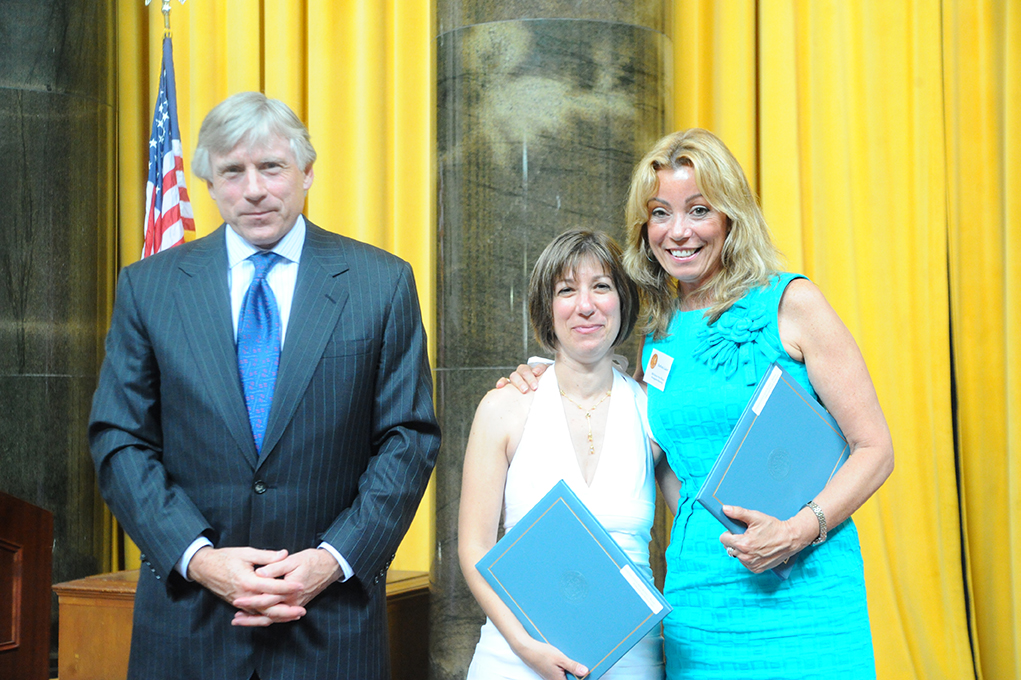
Lee C. Bollinger, President of Columbia University, presents a 2010 Investigative Reporting prize to Wendy Ruderman (center) and Barbara Laker (right) of the Philadelphia Daily News.
Winning Work
By Barbara Laker and Wendy Ruderman
VENTURA MARTINEZ FEELS like he has a target on his back. On the city's toughest streets, where vengeance rules, drug dealers warn him that he's a dead man.
At home, Martinez peeks out windows and listens for sounds of a hit man, lurking in darkness, ready to pull the trigger. When outside, he darts his head from shoulder to shoulder, wondering if this is the day he'll get whacked.
"Going to work in the morning is hell," Martinez sobbed. "Coming home from work is hell. I'm thinking that somebody is gonna...pop me from behind."
For seven years, Martinez has worked as one of the city's most productive police informants, bringing down more than 200 drug and gun dealers.
But Martinez now says that some of the police jobs were tainted, rooted in lies and motivated by power, greed and money. He says he admitted fabricating evidence to the FBI, the police Internal Affairs Bureau and the Police Advisory Commission. Martinez's admission could reopen and potentially overturn hundreds of cases, legal experts say.
Martinez, 47, claims that he and Officer Jeffrey Cujdik, a narcotics cop, lied about evidence in at least two dozen cases to gain illegal entry into homes and make arrests, for which Martinez got paid. Martinez says he did it for money, to bring down drug dealers, and because he and Cujdik were tight.
The Police Department pays confidential informants like Martinez for making drug buys or providing information that leads to drug and gun arrests. Martinez alleges that he paid at least $20,000 in informant cash to Cujdik for rent. Between Sept. 1, 2005, and Jan. 30 of this year, Cujdik rented a three-bedroom Kensington house to Martinez, his common-law wife and their two young children, according to court testimony and a lease agreement.
Cujdik, 34, leased his house to Martinez despite a police regulation that says relationships between an officer and an informant must remain professional and objective, and that no personal relationship should jeopardize the integrity of the department.The FBI and police Internal Affairs launched an investigation into Martinez's allegations. Chief Inspector Anthony DiLacqua, who confirmed the Internal Affairs probe, said Cujdik was placed on desk duty and his police-issued gun taken late last month. FBI officials declined comment.
In response to a list of questions from the Daily News, Cujdik's attorney, George Bochetto, wrote that the allegations against his client are based upon "a self-serving series of fictionalizations by professional liars, felons, and drug addicts." He added: "When the hard facts are put on the table, your story falls apart and your questions become empty vessels of naivete."
Court records show that Cujdik used Martinez to help arrest nearly 200 alleged drug dealers and take 127 guns off the street since 2003.
But the close tie between Martinez and Cujdik was severed in October after a drug dealer discovered Martinez's identity and learned that he lived in Cujdik's house.
Cujdik moved to evict Martinez and his family, leaving him nowhere to go and no money to relocate. As drug dealers called him a rat, leaving cheese at his front door, he turned to the Daily News, the FBI and Internal Affairs, in hopes of finding protection.
Ventura Martinez knows the drug world because he lived it. He started selling cocaine at 17 in West Kensington. "In a day I would make, like, $500 in, like, two hours," he said.
He got busted for selling cocaine in 1994. Because he cooperated with the cops, he cut a deal — five years' probation and six years' house arrest.
Martinez, son of a cop and brother of a crack addict, said that he stayed clean for several years, working at an auto-detail shop. But, in February 2003, he lost his job and had no money to buy a birthday present for his 16-year-old daughter.
"I was, like, 'I'm tired of this. I'm going to go out and do what I got to do.'"
He started selling marijuana, pocketing about $800 a week. He worked about three months as a street-corner dealer when Cujdik and another narcotics officer drove up to A and Ontario streets.
"When he got out of the car, I already knew he was a cop," Martinez said. "I was like, 'Oh, snap.'"
The cops told him he was done. Then they made him an offer, Martinez said. He could get 25 years to life because he got caught selling while on probation.
Or he could work with the cops.
He began his life as a confidential informant — CI #103 began.
He worked with Cujdik several times a week. "We built a relationship. We were tight," said Martinez, whose children called Cujdik "Uncle Jeff."
Cujdik, a 12-year veteran of the force, comes from a law-enforcement family.
His father is a retired Philly cop; his brother is a narcotics cop who is married to an assistant district attorney.
Cujdik is one of the most active officers on the force: He nearly doubled his $55,389 salary in 2007, earning $49,026 in overtime, city payroll records show. Most police officers earn overtime from time spent in court testifying.
"He's an outstanding police officer and I know him to be honorable and very diligent," said Cujdik's former supervisor, Lt. Joseph Bologna, who declined to comment about Martinez's allegations, saying, "I don't know anything about that, ma'am."
"He's an excellent police officer, a straight shooter, a hard worker, an all-around good guy," said Richard Eberhart, a former police officer who worked with Cujdik about four years before he left the department in 2006. Together, Eberhart and Cujdik own J&R Dunk Tank Rentals LLC, in Bensalem.
Eberhart, 39, said that he knew Martinez and considered him to be a reliable informant who provided accurate information. "He was Jeff's CI. ...Jeff never complained about him."
Martinez said that he often gave Cujdik details about drug dealers, ticking off names, addresses and the drugs they sold. Other times, Cujdik took Martinez to unfamiliar homes in which police suspected drug dealing. There, Cujdik instructed Martinez to make a drug buy. And when he did, Cujdik was able to get a search warrant for the house.
Martinez said that he quickly earned Cujdik's trust and respect. "I did things that [cops] couldn't do," he said. "For you to go into a home and buy straight from a drug dealer and have guns stuck in your face, thinking that you're a cop ...it was dangerous.
"The adrenaline of actually being there and doing it," he said, "and then walking out, thinking, 'Man, I did this buy, I got these guys. They were supposed to be untouchable.'"
The Police Department, through Cujdik, paid Martinez cash for the jobs, generally $100 for each gun, $150 or $200 for a big drug seizure, $200 for a job involving both guns and drugs, Martinez said.
But starting in 2005, the line between right and wrong got blurry, Martinez alleged.
If Martinez couldn't score drugs out of a house because a drug dealer was leery of him, Cujdik sometimes told him to buy elsewhere, Martinez alleged. Then in the application for a search warrant, Cujdik would say that the drugs came from the house.
Legal experts say that the scenario, if true, would call into question dozens of drug cases.
"This could reverse convictions and expunge criminal records," said Dr. Lawrence Sherman, director of the Jerry Lee Center of Criminology at the University of Pennsylvania.
If evidence to gain access to a house is based on a lie, "the fruit of the tree is poisoned," Sherman said. "You can't lie to get in a home. Not in America. Even if they were guilty and drugs were found in the house, we have to play by the rules."
Martinez estimated that he and Cujdik fabricated drug buys in at least 24 cases. Martinez provided examples:
In March 2005, Martinez knocked on the door of Caesar Marquez's home, on Howard Street near Cambria, in West Kensington, asking for "6 dope," the street term for heroin.
Marquez refused to sell, claiming that he didn't know what Martinez was talking about. So, according to Martinez, Cujdik asked him where he could buy heroin nearby.
Martinez knew about a house a block away, on Mutter Street between Cambria and Somerset, and bought heroin there. The police report in the case says that CI #103 (Martinez) bought six packets of heroin from Marquez on Howard Street and "walked directly" back to Cujdik's car.
The court granted a search warrant and cops seized three bundles of heroin and six clear plastic baggies of cocaine. Marquez, 23, is serving a two- to four-year sentence.
In October 2006, Martinez told Cujdik that he couldn't make a drug buy from a home on Lycoming Street near 7th, in Hunting Park, because he knew the homeowners.
Cujdik instructed Martinez to buy a $20 bag from a local bar that had been raided in the past for drug sales, Martinez alleged.
In the application for the search warrant, however, Cujdik wrote that police watched Martinez buy the $20 bag from the home of Hector Soto.
Cujdik led a raid in which police found 16 grams of cocaine in Soto's bedroom. Soto, 61, pleaded guilty to selling cocaine and is serving one to eight years in state prison.
"He knew something funny was going on," said Soto's wife, Lucy, in a recent interview.
Her husband suspected that he had been set up, but didn't know what happened, she said.
In October 2008, Cujdik asked Martinez to make a buy from the house of an alleged heroin dealer, Nelson Carrasquillo.
Martinez told Cujdik that he knew Carrasquillo and didn't want to make a buy. Carrasquillo lived with his sister on Arbor Street, off Allegheny Avenue, in Kensington. Martinez knew him as "Po-Po," and claimed that he stored heroin in the basement.
So Martinez purchased a $130 bundle of heroin at E and Ontario, instead of from Carrasquillo.
The application for a search warrant filed by Cujdik says that on Oct. 28, 2008, police watched Martinez go inside Carrasquillo's house and leave with roughly .36 grams of heroin.
The next day, Cujdik raided Carrasquillo's house and found several bundles of heroin, the search warrant says.
Carrasquillo, 22, is in jail awaiting a court hearing on drug charges. His attorney, Guy Sciolla, declined to comment.
Carrasquillo's sister, who asked that her name not be used, said that her brother told her that the cops made things up. "I believe him," she said recently.
Martinez said that he regrets turning on his friends.
"I feel like I betrayed a lot of people," he said. "There's actually people sitting in jail because of me."
Martinez said that he knew it was wrong, but claimed that Cujdik rationalized it. "He said it doesn't matter how we do it,...as long as we find something in there," Martinez said.
Besides, Martinez reasoned, the informant money enabled him to pay Cujdik rent.
Martinez moved into Cujdik's rental house in September 2005, according to a lease agreement that listed the rent amount as $300 a month.
Bochetto, Cujdik's attorney, said that the lease lists one tenant: Sonia Naome Durecout. Martinez has lived with Durecout since 2003. They share two children, and he refers to her as his "common-law wife."
"Everything was under my name, but I personally never dealt with [Cujdik]," Durecout said.
And Cujdik signed a document, submitted by Durecout to the state Department of Public Welfare, listing Martinez as a "household member" and Durecout's "husband." The document, obtained by the Daily News, is dated Oct. 22, 2008.
Eberhart, the former police officer, said he knew that Cujdik rented a home to Martinez. Eberhart said he had been in the house "half a dozen" times.
"That was his business," Eberhart said. "It was up to him. Would I have done that? Probably not, but who am I to judge?"
"I thought he [Cujdik] was helping him out," he said. "It didn't seem inappropriate at the time, but looking back, maybe it was."
Cujdik initially told Martinez that the rent was $300 a month, but immediately upped it to $700, Martinez said.
Martinez told him he couldn't afford it.
"He said, 'Listen, don't worry about it. You're going to work with us. You're gonna pay me through that,'" Martinez said.
And if informant payments weren't enough to cover the rent, Cujdik had another idea to make up the difference, Martinez said.
Cujdik told Martinez that he would feed him tips to call the Police Department's Gun Recovery and Reward Information Program, known as GRRIP, which provides cash for anonymous tips that lead to the recovery of illegal guns, Martinez claimed.
If a tip proves legit, a member of the Citizens Crime Commission of the Delaware Valley, an organization that administers GRRIP, arranges to meet the tipster on a street corner with a cash-filled envelope.
In July 2006, Martinez told Cujdik about two brothers who allegedly stored drugs and guns in their Frankford homes. Cujdik obtained search warrants for both homes and police seized 60 rifles and handguns.
Martinez said that he expected the Police Department to pay him $6,000, or $100 for each gun. But Cujdik initially gave him only $2,500. Later, Cujdik took back $2,000 for "rent money," Martinez alleged.
Durecout, who was seated on the couch at the time, said that she was surprised as she watched Cujdik count out the money and return $500 to her husband.
"He said he was keeping the rest for rent," Durecout said. "We thought it was gonna be for upcoming months' rent, but it wasn't."
Cujdik returned the following month, looking for his $700, Durecout said.
Martinez had hoped to get additional money from the Crime Commission for the 60 guns. But when he met up with the GRRIP representative, only $500 was in the envelope. He called Cujdik to complain.
Martinez said that two cops pulled up in a car while he was talking to Cujdik on his cell phone.
"I said, 'Jeff, these two officers just pulled up.' He said, 'Shut the phone off. Shut the phone off,'" Martinez said.
The cops took him to Internal Affairs, where three officers, including then-bureau Chief Inspector William Colarulo, grilled him about his relationship to Cujdik, Martinez said.
"They asked me, 'Out of all the GRRIPs you call up, does Jeff get a cut out of this?'" Martinez said. "I was like, 'No. No. No.' I denied everything."
According to Martinez, Colarulo told him that he couldn't "double dip," or get money for gun seizures through the Police Department and through GRRIP.
"Anything that happened when I was in Internal Affairs is confidential," Colarulo said recently. "I can't comment one way or another."
Martinez said that he returned the $500 in GRRIP money.
Four months later, in November 2006, Martinez and Cujdik made a case against a drug dealer that eventually would sever their close bond.
An informant twice purchased marijuana from Raul Nieves, 30, according to the police report.
Based on these buys, police obtained a search warrant and raided two homes and an SUV in North Philly associated with Nieves and his father, and recovered marijuana and packets of cocaine, crack cocaine and drug paraphernalia.
Nieves hired Center City attorney Stephen Patrizio and told him that there was no second drug buy.
Through Patrizio, Nieves hired a private investigator to review all search warrants involving Cujdik and "CI #103."
The search warrants "were so similar it just smelled," Patrizio said. "They were more like canned search warrants."
Patrizio was denied a request to know CI #103's identity.
So the private investigator found him — leaving a home owned by Cujdik. The investigator snapped photos of him walking down the front steps.
"We realized then there was way too much going on here," Patrizio said.
At an October 2008 hearing in which Patrizio asked to subpoena CI #103, Patrizio said, he put Cujdik on the stand and asked him about the informant.
Patrizio showed him the photo that the investigator had taken.
"You recognize the house that the informant is coming out of, correct?" Patrizio asked, according to the court transcript.
The prosecutor objected.
Patrizio asked him to identify the house.
"I own that house," Cujdik testified.
Patrizio asked again for Cujdik to confirm that the man was CI #103.
Again, the prosecutor objected.
But Patrizio was permitted to subpoena Martinez.
The investigator served Martinez with the subpoena at an auto-detailing shop where he worked. His stomach lurched when he saw that the document listed his name and address.
Rattled and frightened, Martinez called Cujdik, telling him that the subpoena listed his home address. "He said, 'Don't talk on the phone. Don't talk on the phone,'" Martinez said.
The next day, Martinez lost his job. The owners of the auto-detailing shop knew Nieves and didn't want a "snitch" working for them, according to Martinez. A few days later, Martinez came home after job-hunting to see a for-sale sign outside the house.
He called Cujdik, who told him he had to move out. He was selling the house.
"'You gotta leave out of the house because I don't want Internal Affairs to find out that you're living there,'" Martinez said that Cujdik told him. "'If they find out that you are living there, the conflict of interest alone is gonna kill me.'"
Nieves pleaded guilty to possession with the intent to deliver a controlled substance. All other charges were dropped. His recommended sentence is 11 to 23 months, with credit for time served, and two years probation.
With their relationship exposed, Cujdik moved to cut ties with Martinez.
On Dec. 4, Cujdik deactivated Martinez as a confidential informant, said Inspector Bob Snyder of the Narcotics Field Unit.
Five days later, he filed papers to evict Martinez and his family from the house he rented to them.
They met in Courtroom B of Landlord-Tenant Court on Jan. 6. Timothy Thompson, a detective with Internal Affairs, sat in the back of the courtroom. When asked later by a reporter why he was there, he declined to comment.
Martinez told Judge Bradley K. Moss that he was Cujdik's CI. Turning to Cujdik, Martinez said, in a quivering voice, "You were a good friend to me, man."
Moss said Martinez needed to pay Cujdik $1,612 in total — $1,200 in rent, $350 in attorney fees and $62 for nonpayment.
Outside the courtroom, Cujdik said he was puzzled why a reporter was taking notes. "I'm Jeff Cujdik, the landlord," he said. "I'm not here as a police officer."
He said that he was evicting them because they didn't pay rent. "They haven't paid rent in months...I'm just going through the eviction process."
Last month, Cujdik apparently had a change of heart. Martinez said Cujdik called him and said, "'Look, find a place and I'll pay for it.'" Later Cujdik went to the house he rents to Martinez and handed Durecout $1,000 in cash and a letter for her to sign.
"I'm giving you $1,000 cash to vacate the property....By accepting this $1,000 you agree to vacate...by no later than January 31," Cujdik wrote in a Jan. 23 letter he signed.
Bochetto said his client was advised by a "landlord-tenant specialist" to pay Durecout to leave "rather than incur the lengthy delay and considerable expense involved in a forcible eviction."
Martinez, Bochetto wrote, has "an obvious ax to grind...because he lost his position as an informant."
Martinez moved his family to a one-bedroom apartment on Jan. 30. "I can't take this anymore. I'm really scared," Martinez said. "I just want this to be over." *
© 2009, Philadelphia Newspapers
By Barbara Laker and Wendy Ruderman
Local and federal law enforcement have launched a task force to investigate allegations that a narcotics cop and his informant lied about drug buys so the cop could get search warrants and raid people's homes.
The task force, which includes investigators from the FBI, police Internal Affairs and the city Inspector General's Office, will review cases made by Officer Jeffrey Cujdik and his longtime informant, Ventura Martinez. Specifically, the probe will focus on Cujdik's methods of making drug busts, officials said.
In an exclusive Daily News report on Monday, Martinez alleged that Cujdik, 34, sometimes ordered him to buy drugs elsewhere when he was unable to score a buy from a targeted house. Cujdik then lied in search-warrant applications, saying he had seen Martinez purchase drugs from the house, Martinez said.
The task force was announced at a news conference yesterday featuring Mayor Nutter, Police Commissioner Charles Ramsey and FBI Special Agent in Charge Janice Fedarcyk.
Fedarcyk said the partnership "will allow us to ferret out exactly what was done and the manner in which it was conducted." Ramsey called the allegations "very serious."
"We have an obligation to the public and to everyone to maintain the integrity of this department," Ramsey said. "And that's what we are doing here." Mayor Nutter applauded the decision.
"We think high ethical standards matter in the entire city, but especially in the Philadelphia Police Department," Nutter said. "We take these matters and any of these allegations very seriously . . . If any of these allegations are true, we will take, I'm sure, the swiftest action."
Cujdik's attorney, George Bochetto, yesterday said there's no truth to the allegations. He characterized Martinez as a "professional liar" with zero credibility.
"I do think that given the news reports and given what's being said, that the mayor and police commissioner have an obligation to investigate," Bochetto said.
But, Bochetto added, "It is crystal- clear that there is no independent evidence of anything other than what this professional liar has had to say."
While Ramsey said the investigation focuses on Cujdik, a high-ranking police official has said investigators are looking at officers who made arrests with Cujdik and at least six other police-paid informants who worked with him.
With the probe widening, prosecutors have been forced to delay criminal cases of alleged drug dealers arrested by Cujdik. At least one trial and four other pending criminal cases were put on hold this week after the Daily News story broke.
Ramsey acknowledged the far-reaching ripple effect.
"Obviously, we're concerned because of the impact it could have on cases and things of that nature," he said.
The Internal Affairs Bureau started to investigate the case in December, after Martinez told an officer about his work with Cujdik, Ramsey said.
Last month, police took Cujdik's gun and badge. A 12-year veteran and one of the busiest cops in the Narcotics Field Unit, Cujdik is on desk duty and has been relieved of his "police powers," Ramsey said.
His status may change as the investigation continues, he added.
Besides Cujdik's search warrants and drug busts, the task force will examine allegations that Cujdik violated police rules that require cops to keep an arms-length relationship with informants.
Cujdik rented a house to Martinez and his family from September 2005 through Jan. 30, documents and court testimony show. Bochetto, however, said the lease agreement was between Cujdik and Sonia Naome Durecout. Martinez lives with Durecout and their two children and considers her his "common-law wife."
"You have to have a professional relationship," Ramsey said. "It should not be a personal relationship. Everything has to be totally above board. There are policies and procedures in place regarding that sort of thing. We want to make sure those policies are being followed by everyone.
"If we find there's some inappropriate relationship, then we'll take whatever steps are warranted based on what we find."
Confidential informants like Martinez are paid by police to make drug buys and for tips that lead to drug and gun arrests.
Martinez alleges that he paid Cujdik more than $20,000 in informant cash for rent. Cujdik moved to evict Martinez and his family after a drug dealer learned Martinez's identity and home address.
Scared for his life, Martinez called the Daily News, Internal Affairs and the FBI in hopes of getting protection, he said.
Both the city and the feds have a witness-protection program, but Martinez said they've yet to offer it to him.
"We are going to look at all avenues with this investigation, but it would be premature to outline exactly what our steps are going to be," Fedarcyk said.
"Obviously, ensuring the safety of individuals involved in this investigation will be paramount."
© 2009, Philadelphia Newspapers
By Barbara Laker and Wendy Ruderman
OFFICER JEFFREY Cujdik was the first cop to burst through the front door, gun drawn.
Lady Gonzalez froze. Terror gripped her five young children as Cujdik and eight other narcotics cops stormed the Kensington home.
" 'Where are the guns?! Where are the drugs!' " Cujdik shouted during the December 2007 raid, Gonzalez said. "I didn't know what they were talking about."
Then things got worse. Gonzalez said that one of the cops - not Cujdik - pulled up her shirt and bra and fondled her breasts.
The raid was prompted by a drug buy at the house three days earlier, according to a search warrant.
A police informant bought a packet of cocaine from Gonzalez's husband, Albert Nunez, on their front porch while Officer Robert McDonnell watched, according to the warrant.
But that informant, Ventura Martinez, now says that the search warrant was based on a lie: He never bought drugs from Nunez.
Cujdik is at the center of a joint federal and local investigation that arose after Martinez claimed in a Daily News article that Cujdik told him to lie about some drug buys so that the officer could obtain search warrants to enter homes of suspected drug dealers.
Nunez's case - one of hundreds under scrutiny - could thrust McDonnell into the burgeoning probe.
Cujdik and McDonnell worked together in the Narcotics Field Unit. Cujdik is now on desk duty, his gun and badge taken, police said.
Reached last night, McDonnell politely declined to comment.
In an exclusive interview with the Daily News earlier this month, Martinez - known as Confidential Informant #103 - said that both he and Cujdik were driven in part by financial gain.
The Police Department paid Martinez for drug buys and for tips leading to arrests. Martinez said that he gave at least $20,000 in informant cash to Cujdik for rent on a Kensington house that Martinez and his family leased from Cujdik between September 2005 and Jan. 30 of this year.
Cujdik's attorney, George Bochetto, has said the allegations are untrue and are based on the word of a "professional liar."
Last week, Nunez's attorney, Jeremy Ibrahim, filed a motion aimed at getting Martinez on the witness stand. Ibrahim cited the Daily News articles and said that "a dark cloud has been cast over the law and Constitution."
"Both Mr. McDonnell and Informant #103 are suspect," Ibrahim wrote in his motion. A judge has yet to rule.
Martinez told the Daily News that he wasn't even with McDonnell on the day of the alleged drug buy from Nunez. At an earlier court hearing, McDonnell said that he had "eyes on the informant" the entire time.
Martinez said that not all his jobs were tainted. In a recent interview, he said that he didn't buy any cocaine on Nunez's block, but he did buy marijuana at a house a few doors down.
"That's a good job," Martinez said, explaining that Cujdik gained access to that house legitimately.
Nunez, 32, a truck driver, is accused of drug dealing after Cujdik discovered 47 packets of cocaine in a teddy bear during the raid that frightened his wife, Lady Gonzalez, according to court testimony.
"They used my name to get in there," Martinez said.
Nunez admits he had a small amount of marijuana, which police found in a kitchen cabinet, but insists he never had or sold cocaine.
"I do smoke marijuana - that I do," Nunez said last week. "I'm not going to lie about that."
The cocaine? "I was like, 'Get out,' " Nunez said. "I couldn't believe it. I got five kids. I love them to death. I wouldn't keep stuff like that in the house."
Nunez's wife was home alone with the kids when police raided the house. One cop took her kids, crying and screaming, to a neighbor's house.
Another cop, whom Gonzalez described as average height and "husky," led her into a small room off the kitchen. She heard other cops stomping around upstairs, she said.
He asked her if she had any tattoos. She told him she had one on her lower back. " 'I want to see,' " she said that he told her.
He pushed her jeans down to reveal the "crack of my ass" and a tattoo of the Puerto Rican flag, she recalled. " 'Mmm, a Puerto Rican,' " he said, according to Gonzalez, 29, a block captain.
He spun her around, unzipped her blue jacket, and lifted up her shirt and bra, she said.
"He totally just touched my breasts," she said. "I just thought it was wrong. . .I was scared. I was in a panic. . .I thought he was going to rape me."
The cops ransacked the tidy house for more than three hours, she said. They didn't find anything more than her husband's dime bag of weed. But Cujdik decided to check the back room off the kitchen one last time, she said.
"As soon as he went back there, he said, 'I got it!' " Gonzalez said.
He emerged with a teddy bear that he said contained a small pouch secreted inside. That pouch contained 47 packets of cocaine.
Police also seized $560 from a bedroom dresser, McDonnell testified.
Gonzalez and Nunez swear they had roughly $1,000, mostly in large bills, that they'd squirreled away for rent and Christmas presents.
The cop who allegedly fondled her took a house key, Gonzalez said. " 'I'll come back,' " Gonzalez said he warned her. " 'We'll come back every day, every night, until we find [Nunez].' "
Police also seized Nunez's truck. Neighbors told the Daily News that hours later they saw two cops from the raid riding in Nunez's white truck with its unmistakable gray flames painted on the hood, music blaring.
Gonzalez said that she had been reluctant to talk about the alleged sexual assault but changed her mind.
"It's gotta come to a stop because I might not be the first one and I might not be the last one," Gonzalez said.
"I think of him. I dream of him. I can't get his face out of my head. Still, till this day, I think he's going to come back."
She said that she chose not to report the incident to Police Internal Affairs because she didn't think they'd believe her and might even retaliate.
"I don't trust them," she said as she wiped a tear from the corner of her eye.
"I'm sorry, but why am I going to report this to a police officer when a police officer stood in front of me and molested me?" she asked.
Nunez said that he's pained when he thinks about what happened to his wife and children. "It makes me want to cry," he said.
"If you're going to be a cop, do it professionally," Nunez said. "You're saying guys out here are the bad guys, but what are you?
"What are you?"
© 2009, Philadelphia Newspapers
By Wendy Ruderman and Barbara Laker
ON A SWELTERING July afternoon in 2007, Officer Jeffrey Cujdik and his narcotics squad members raided an Olney tobacco shop.
Then, with guns drawn, they did something bizarre: They smashed two surveillance cameras with a metal rod, said store owners David and Eunice Nam.
The five plainclothes officers yanked camera wires from the ceiling. They forced the slight, frail Korean couple to the vinyl floor and cuffed them with plastic wrist ties.
"I so scared," said Eunice Nam, 56. "We were on floor. Handcuffs on me. I so, so scared, I wet my pants."
The officers rifled through drawers, dumped cigarette cartons on the floor and took cash from the registers. Then they hauled the Nams to jail.
The Nams were arrested for selling tiny ziplock bags that police consider drug paraphernalia, but which the couple described as tobacco pouches.
When they later unlocked their store, the Nams allege, they discovered that a case of lighter fluid and handfuls of Zippo lighters were missing. The police said they seized $2,573 in the raid. The Nams say they actually had between $3,800 and $4,000 in the store.
The Nams' story is strikingly similar to those told by other mom-and-pop store owners, from Dominicans in Hunting Park to Jordanians in South Philadelphia.
The Daily News interviewed seven store owners and an attorney representing another. Independently, they told similar stories: Cujdik and fellow officers destroyed or cut the wires to surveillance cameras. Some store owners said they watched as officers took food and slurped energy drinks. Other store owners said cigarette cartons, batteries, cell phones and candy bars were missing after raids.
The officers also confiscated cash from the stores - a routine practice in Narcotics Field Unit raids - but didn't record the full amount on police property receipts, the shop owners allege.
In one case, the officers failed to document about $8,200, and in another, about $7,000, the store owners said.
In all eight cases, Cujdik applied for the search warrant and played a key role in the bust. The store owners were charged with possessing and delivering drug paraphernalia, specifically the tiny bags. In the cases that have been settled, judges sentenced the store owners to probation or less.
As for those broken surveillance cameras, officers have "no reason to cut camera wires or destroy cameras," said a high-ranking Philadelphia police official, who requested anonymity. "None whatsoever."
"It would look like they're trying to hide something," the official said. "It would look like they don't want to be on the surveillance camera themselves."
George Bochetto, an attorney representing Cujdik, said the store owners' allegations are false.
"Now that the Daily News has created a mass hysteria concerning the Philadelphia Narcotics Unit, it comes as no surprise that every defendant ever arrested will now proclaim their innocence and bark about being mistreated," Bochetto wrote in an e-mail to the Daily News.
"Suffice it to say, there is a not a scintilla of truth to such convenient protestations."
"They didn't do the right thing," said Moe Maghtha, who helps run his father's South Philly tobacco shop, which was raided in December 2007. "You're not allowed to sell those bags, OK. Just take them out. You don't have to rob my store and steal cigarettes."
At least three former police informants who worked with Cujdik told the Daily News that he often gave them cartons of cigarettes.
"When he raided a corner store, he'd give me cigarettes," said Tiffany Gorham, a former Cujdik informant.
Cujdik is at the center of an expanding federal and local probe into allegations that he lied on search-warrant applications to gain access to suspected drug homes and that he became too close with his informants. He rented a house to one and allegedly provided bail money to Gorham.
After a Daily News report detailing the allegations, authorities formed a special task force, composed of FBI agents and police Internal Affairs officers, to investigate.
The store owners' allegations of theft and damage to surveillance cameras could implicate, in addition to Cujdik, at least 17 other officers and three police supervisors, all in the Narcotics Field Unit.
"Taking property and not reporting it and not returning it - that's a crime," said Witold "Vic" Walczak, legal director of the state's American Civil Liberties Union.
"It's like this unregulated little band of rogue cops, is what it sounds like," Walczak said.
The store owners typically had thousands of dollars in cash on hand at the time of the raids. The money came from lottery, cigarette and phone-card sales. They also used cash to pay wholesale grocery vendors and store rent or mortgages, they said.
Luciano Estevez, 39, a Dominican who co-owns the J R Mini Market in West Philadelphia, which was raided in August 2008, told the Daily News that he had about $9,000 in the store, but the police property receipt documented about $800, he said.
"They take money and don't write it down. They [are supposed to be] the law," Estevez said. "Taking money like that, I don't think that's right. We pay a lot of taxes."
Estevez, who came to the United States in 1985, is a lot like other store owners who were interviewed by the Daily News - immigrants who live here legally and have no prior criminal records in Philadelphia. They commonly open their shops just after dawn and close long after dark.
"I believed in the American dream. I still do," said Emilio Vargas, who owns the building that houses the Dominguez Grocery Store, on Potter Street in Kensington, which was raided in March 2007.
"I believed that if you work hard, you get ahead. But everything changed after this," said Vargas, 29, who came to the U.S. from the Dominican Republic in 1996.
"I never had a drug in my hands. I never been in trouble. I used to believe in justice in America. I don't know now. It makes me question the justice system."
During the raid, Vargas said, Cujdik and fellow squad members confiscated $700 in phone-card money that he kept in a cigar box, $1,500 in a bag to pay vendors, $200 in the cash register and $1,400 from his pocket to pay the mortgage - totaling $3,800. The police property receipt that the officers filed, however, reports that only $1,456 was seized.
"They opened the fridge doors and took juices - energy drinks," Vargas said. "They emptied it."
A judge dismissed all charges against Vargas after ruling that prosecutors failed to present their case in a timely fashion, according to court records.
Rattled by the ordeal, Vargas said he now works in another grocery store, far from the rundown Kensington neighborhood of the Dominguez Grocery.
"I didn't want to go back," he said. "It was too much for me. I didn't want anything like that to happen again."
The store owners interviewed said they paid hundreds of dollars in bail and legal fees after their arrests. They lost thousands more because their stores were shuttered for periods of days or weeks.
"All my store was messed up," said David Nam, 62. "I found my wallet and my keys thrown on the floor. . . . Cigarette boxes all over floor. I think of this and get a headache."
His son, Steven Nam, said he found chocolate-bar wrappers on the floor.
"While they [the cops] were walking around, they helped themselves to Snickers and drank sodas," he said.
The ACLU's Walczak, who handles police-misconduct and immigration-rights cases, said foreign store owners who struggle with English are "easy targets" of police abuse because they're not likely to file complaints or "raise a fuss."
"[The officers] seem to be preying on what is a particularly vulnerable population," Walczak said. "It's really sad."
Danilo Burgos, president of the city's Dominican Grocery Store Association of more than 300 members, said one member recently alleged that police cut video-camera wires and stole $5,000 while searching his store. The store owner told Burgos that he didn't want to report it.
"Most of these people just want to earn a decent living and go on about their business," Burgos said.
And many Dominicans often are afraid to speak up because they come from a country where police are notoriously corrupt.
"Back home, police get away with everything, including murder," Burgos said.
"They fear something similar could happen to them here."
Moe Maghtha, who moved to the United States from Jordan in 1999, said his father's experience with Cujdik and the other narcotics officers has left him too scared to operate his South Philly tobacco shop.
"If he sees cops now, he freaks out," Maghtha said. "My dad never been in jail. My dad never been in trouble. Now he's like a little kid that got bit by a dog. He won't go out."
Maghtha, 23, said he had to give up his job as a satellite-dish technician to take over his dad's store. Maghtha's father, 53, recently suffered heart problems and did not want to be interviewed or allow his name or the name of his store to appear in this article.
The raid on the Maghtha shop happened on the afternoon of Dec. 7, 2007. Maghtha's father had just finished tallying about $14,000 in cash. Maghtha said he was on his way to the store to relieve his father, who'd planned to deposit the cash at a nearby bank.
Maghtha said he arrived just after Cujdik and six other officers had burst into the shop. The officers told Maghtha to stay outside. He watched through the window as an officer used wire cutters to clip wires to all four security cameras in the shop, Maghtha said.
The officer, who wore a navy blue jacket and a baseball cap, kept his head down as he cut the wires so the camera wouldn't capture his face, Maghtha said.
Police arrested Maghtha's father for selling little bags that he had ordered from a local tobacco wholesaler.
When Maghtha opened the store a few days later, he couldn't see the floor because of the mounds of dumped coffee grinds, candy wrappers and crushed cigarette cartons, he said.
Nearly 40 cartons of Newports were missing, Maghtha said.
The officers left a copy of the property receipt, prepared by Cujdik and signed by Cpl. Mark Palma, which stated that the officers seized $7,888.
Palma did not return a phone message yesterday.
"My dad said, 'There is no way, because I know how much money I had that day. I had counted it all up so I can take it to the bank and pay the wholesaler,' " Maghtha said.
Last August, a judge found Maghtha's father guilty of possessing and selling drug paraphernalia and sentenced him to nine months' probation, court records show.
He appealed the case - and then narcotics officers came back.
On Nov. 6, 2008, 11 months after the first raid, officers returned, alleging that they witnessed three people buying drugs from Maghtha's dad at the shop.
Police found no drugs in the store during the raid, court documents show.
"My dad never seen drugs in his life. He don't know what drugs look like," Maghtha said.
Maghtha and his uncle contend the officers raided the store to retrieve video footage from the first raid.
Maghtha had saved images on a shop computer of an officer, wearing a baseball cap, clipping the wires during the December 2007 raid, he said.
When the cops returned, an officer put a gun to the head of Maghtha's father and demanded the video, said Maghtha's uncle, Abdallah Sarhan.
"The first question that he asked was, 'Where is the videotape?,' " said Sarhan, 33, who was helping out at the store that evening.
The same officer then slapped Maghtha's father across the face, Sarhan said.
"I said, 'You don't have the right to slap him. Why you touch his face?' " Sarhan said. "I never, ever, ever in my life see something like this."
Four days after the raid and the arrest of Maghtha's father, he re-opened the store and discovered the computer that controlled the video surveillance system was gutted, Maghtha said.
"They took everything from the computer - the hard drive, the DVR card, the DVD and CD-ROM player," Maghtha said.
Maghtha's father was charged with drug dealing. The case is pending.
Most store owners interviewed for this report said that when the plainclothes cops barged through their doors, they believed they were being robbed at gunpoint.
Sirilo Ortiz said that on the evening of Nov. 1, 2007, he had emerged from the basement of Lycomings Grocery in Hunting Park to see a gun barrel pointed at his face.
After Cujdik and his squad members burst into the store, they cut the wires to the surveillance camera with wire cutters, he said, then looted the store.
Ortiz, 39, who came to the U.S. from the Dominican Republic in 1996, had owned the store just five days.
One cop took a Black & Mild, a slender cigar, from the shelf and started to smoke, said Ortiz, speaking in Spanish through an interpreter.
The officers took three brown boxes from his kitchen and loaded them with food, he said.
"It was like they was shopping," said Maria Espinal, who was working in the kitchen and saw the cops take boxes stuffed with packaged goods.
The cops put a gun to Espinal's head, too, she said, before identifying themselves as police. "I thought I was going to die," she said.
Ortiz said he had about $500 in his pocket and $700 in the cash register. But the police recorded taking a total of only $918 on property receipts.
Ortiz said he took a plea deal and served six months' probation and 25 hours of community service for selling the tiny plastic bags.
He was so depressed and anxious, he lost 25 pounds and could no longer work in the store, he said.
"I couldn't take it no more," said Ortiz. "Every time someone opened the door, I thought something bad would happen."
He gave the store to his brother and now drives a cab.
"Cops are supposed to take care of people and do the right thing," Ortiz said. "I don't trust them anymore. You're supposed to trust the police, but they're the ones you can't trust.
"They weren't supposed to be the ones."
© 2009, Philadelphia Newspapers
By Wendy Ruderman and Barbara Laker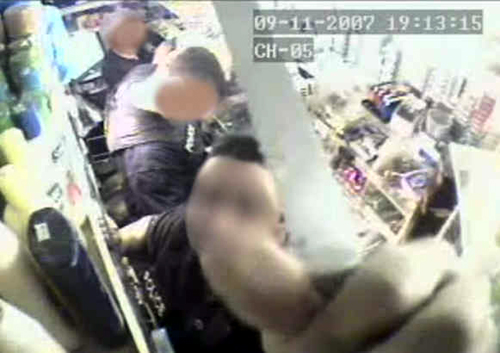
A still image taken from a security-camera backup system video shows a hand with a knife reaching to cut the cord to a camera during a police raid of a West Oak Lane store. The camera was positioned behind the front counter.
THE NARCOTICS officers knew they were being watched on video surveillance moments after they entered the bodega.
Officer Jeffrey Cujdik told store owner Jose Duran that police were in search of tiny ziplock bags often used to package drugs. But, during the September 2007 raid, Cujdik and fellow squad members seemed much more interested in finding every video camera in the West Oak Lane store.
"I got like seven or eight eyes," shouted Officer Thomas Tolstoy, referring to the cameras, as the officers glanced up. "There's one outside. There is one, two, three, four in the aisles, and there's one right here somewhere."
For the next several minutes, Tolstoy and other Narcotics Field Unit officers systematically cut wires to cameras until those "eyes" could no longer see.
Then, after the officers arrested Duran and took him to jail, nearly $10,000 in cash and cartons of Marlboros and Newports were missing from the locked, unattended store, Duran alleges. The officers guzzled sodas and scarfed down fresh turkey hoagies, Little Debbie fudge brownies and Cheez-Its, he said.
What the officers didn't count on was that Duran's high-tech video system had a hidden backup hard-drive. The backup downloaded the footage to his private Web site before the wires were cut.
Although Duran has no video of the alleged looting, he has a 10-minute video that shows the officers using a bread knife, pliers, milk crates and their hands to disable the surveillance system.
The officers didn't "touch the money with the system looking," said Duran, who came to the United States from the Dominican Republic 15 years ago and has no prior criminal record in Philadelphia.
They touched "the money after they destroy all the system," he said.
Duran, 28, of South Jersey, a technology buff, said that he was upset that the officers had wrecked his $15,000 surveillance system.
"That was his main complaint - that they destroyed his surveillance system," Duran's attorney, Sonte Anthony Reavis, said last week. "I believed him."
Duran's video bolsters allegations by eight other Philadelphia store owners who said that Cujdik and other officers destroyed or cut wires to surveillance cameras. Those store owners also said that after the wires were cut, cigarettes, batteries, cell phones, food and drinks were taken. The Daily News reported the allegations March 20.
The officers also confiscated cash from the stores - a routine practice in drug raids - but didn't record the full amount on police property receipts, the shop owners allege.
Six more store owners or workers, including Duran, contacted the Daily News after the March 20 article. All six described similar ordeals involving destroyed cameras and missing money and merchandise.
The officers arrested the stores' owners for selling tiny bags, which police consider drug paraphernalia. Under state law, it's illegal to sell containers if the store owner "knows or should reasonably know" that the buyer intends to use them to package drugs.
Duran alleged that the officers seized nearly $10,000 in the raid on his store, on 20th Street near 73rd Avenue. He said that the money included a week's worth of profits and cash to pay his three employees.
The property receipt filed by the officers said that they had confiscated only $785.
Told of the new allegations, George Bochetto, an attorney representing Cujdik, said that he stood by his earlier response:
"Now that the Daily News has created a mass hysteria concerning the Philadelphia Narcotics Unit, it comes as no surprise that every defendant ever arrested will now proclaim their innocence and bark about being mistreated.
"Suffice it to say, there is a not a scintilla of truth to such convenient protestations."
Police Commissioner Charles Ramsey said that he's disturbed by the store owners' allegations.
"It's pretty serious and I want to get to the bottom of it," Ramsey said last week.
Cujdik is at the center of an expanding federal and local probe into allegations that he lied on search warrants to gain access to suspected drug homes and became too close with his informants.
Ramsey said that Duran's video now "needs to be made part of this larger investigation."
The video also calls into question the validity of the search warrant that enabled the officers to raid Duran's store.
In a search-warrant application, Officer Richard Cujdik - Jeffrey Cujdik's brother - wrote that he "observed" a confidential informant enter Duran's store to buy tiny ziplock bags at about 4:30 p.m. on Sept. 11, 2007.
The informant left the store two minutes later and handed two bags to Richard Cujdik, according to the search-warrant application.
Two-and-a-half hours later, at about 7 p.m., the Cujdik brothers and four other officers, including Tolstoy, Thomas Kuhn, Anthony Parrotti and squad supervisor Sgt. Joseph Bologna raided the store.
The Daily News watched the time-stamped Sept. 11 surveillance footage between 4 and 5 p.m.: Not a single customer asked for or bought a ziplock bag.
"At the time, I had no reason to question the validity of the warrant," said Reavis, Duran's attorney.
When told by the Daily News that no bags were sold during that time frame, Reavis expressed shock.
"That's manufacturing evidence," Reavis said. "If the basis for the search warrant is a lie, that's perjury. It's illegal. It's criminal on the officer's part."
Richard Cujdik also wrote in the search-warrant application that the same informant had bought ziplock bags from Duran twice before - on Sept. 5 and 6, 2007. Duran said he was unable to locate the footage from those days.
The Daily News attempted to contact each of the officers who took part in the raid. Except for Bochetto's response on behalf of Jeffrey Cujdik, none returned messages seeking comment.
The footage from the day of the raid is crystal-clear:
Duran is chatting on his cell phone in front of the cash register when the officers enter the store. With gun drawn, Tolstoy is in the lead. Most of the officers are wearing vests or shirts with the word "Police."
Tolstoy handcuffs Duran. The officers ask routine questions: Does Duran have a gun? Does anyone live on the second floor? Are there dogs in the basement?
Then Sgt. Bologna looks up and waves his finger toward the ceiling: "Whaddya got, cameras over there? . . . Where are they hooked up to?"
In fact, every officer seems fixated on the surveillance system.
"Where's the video cameras? The cassette for it?" Richard Cujdik asks.
"Does it record?" Jeffrey Cujdik quickly adds.
Officer Kuhn then steps up on a milk crate that he had placed underneath a ceiling camera and struggles to reach it. "I need to be f---ing taller," Kuhn mumbles as another officer laughs.
"You got a ladder in here, Cuz?" Kuhn asks Duran.
"Yo," Tolstoy calls out from behind the register. "Does this camera go home? Can you view this on your computer, too?"
"I can see [at], yeah, home, yeah," Duran replies.
"So your wife knows we're here, then?" Tolstoy asks.
"My wife? No. She not looking the computer right now," Duran says.
"Hey, Sarge . . . Come 'ere," Tolstoy shouts out.
Bologna ambles over to the front counter.
Jeffrey Cujdik leans in and whispers, "There's one in the back corner right there."
"It can be viewed at home," Tolstoy says.
As the others talk, Officer Parrotti reaches up to another camera in front of the register. He pulls the wire down and slices it with a bread knife taken from the store's deli.
"OK. We'll disconnect it," Bologna assures Tolstoy. "That's cool."
Meanwhile, Parrotti's hand covers the camera lens and he appears to yank the camera from the ceiling.
The screen goes black.
"They could watch what's happening at the store at your house?" Bologna asks.
The audio cuts out.
There is footage of Kuhn looking for a camera outside the store and of Richard Cujdik searching Duran's white van. In the audio portion of the video, Richard Cujdik asks Duran, "Is that your - whose white van is that?"
Then Richard Cujdik simply asks for the keys and heads outside. The search warrant for the store makes no mention of a van. The Daily News could not find a search warrant for the van in court records.
The officers arrested Duran on misdemeanor charges of possessing and selling drug paraphernalia, specifically tiny ziplock bags.
The next day, while Duran was in jail, his brother-in-law Anthony Garcia entered the store, which had been locked after the officers left.
The place was trashed, Garcia said. Goods had been knocked off shelves onto the floor. The oven and deep fryer were left on and the refrigerator door was left open, spoiling the food inside.
"It looked like they were having a party in there," he said. "There was a lot of money missing."
Garcia said that Duran's van was left unlocked with the keys in the center console.
The initial police report says that the officers "also recovered in the store . . . eight (8) overhead cameras." The officers, however, do not list the cameras on any property receipt or state why they took them, according to police documents.
During the raid, Jeffrey Cujdik told Duran that he was seizing the cameras and computer monitor "as evidence because you're selling drug paraphernalia. So we gotta get rid of it. . . . You got yourself on video selling drug paraphernalia."
Duran's cameras, however, were digital and contained no tape and, therefore, no evidence.
Commissioner Ramsey said that he couldn't think of any official reason for police officers to cut camera wires.
He said that the officers could confiscate surveillance equipment, including the cameras, if they believed that the footage provided evidence connected to the drug-paraphernalia case. But, Ramsey added, the officers must include the equipment on a property receipt and explain why they had confiscated the cameras.
"You wouldn't just cut it and take it, because that's somebody's private property," Ramsey said.
During the raid, Richard Cujdik told Duran that the ziplock bags were illegal. Duran tried to explain that he bought the store fully stocked and the bags were already inside.
"OK, it don't matter," Richard Cujdik told him. "You should know your business."
In February 2008, Municipal Court Judge James M. DeLeon sentenced Duran to nine months' probation after he pleaded "no contest" to the charges. He paid $5,000 in attorney's fees.
And Duran, who was renting the first floor that housed the store, lost his lease. The building owner said that Duran had to leave to prevent the city from taking the building in forfeiture, Duran said.
He now operates a grocery in Camden County, but remains angry about the raid.
"That's not fair, what they did to me," Duran said. "That's no way to treat me when they don't know me.
"You work 18 hours [a day] and they come in and do that?"
© 2009, Philadelphia Newspapers
By Barbara Laker and Wendy Ruderman
THE POLICE Department's elite Narcotics Field Unit is supposed to go after big fish - kingpins who package mounds of drugs behind closed doors.
But Officer Jeffrey Cujdik and the officers who worked with him spent a lot of time shooting fish in a barrel.
Day after day, they busted mom-and-pop store owners, most of whom were immigrants with no criminal records, on misdemeanor charges for selling little ziplock bags, which police say are used to package crack cocaine and marijuana.
In six months alone, Cujdik's squad and another squad, which included his brother, Richard, raided 22 bodegas, boutiques, tobacco shops and other stores for drug paraphernalia, according to a Daily News analysis of search-warrant applications between July and December 2007.
That number is seven times more than the unit's 10 other squads combined. Those 10 squads - made up of more than 100 officers - raided only three stores during the same period.
The Daily News over the past three weeks has uncovered allegations leveled by 15 store owners that Cujdik, his brother, and officers who worked with them, destroyed or cut wires to surveillance cameras during the raids. Once the cameras went dark, thousands of dollars in cash and merchandise disappeared, contend the store owners, all of whom were arrested. Their stores were left in shambles. Before the officers left and locked the stores, they allegedly helped themselves to snacks, drinks and cigarettes, and left refrigerator doors open, spoiling the food inside. They swept merchandise from the shelves onto the floor, the merchants said.
Police Commissioner Charles Ramsey said that officers target merchants who sell the ziplock bags because the sales hurt the quality of life in the neighborhood by attracting drug dealers.
"It's a law and unless the law changes, it's enforceable," he said.
"The issue is whether the conduct of the police officers was appropriate. If it's found to be not appropriate, well, then we'll take care of it," he added.
Jeremiah Daley, who headed the Police Department's narcotics division from 1998 to 2002, said paraphernalia cases were not a priority during his tenure.
In fact, his officers had only a handful of such cases during those five years, he said.
"The main focus of the Narcotics Field Unit was to investigate violent drug-related organizations and neighborhood drug traffickers inside residential and commercial properties," Daley said.
The lopsided number of raids conducted by the two squads for which the Cujdik brothers worked, coupled with the store owners' allegations, has triggered concern as to the officers' priorities and motives.
"Rogue cops were using [the law] as an excuse to harass, intimidate, steal from, and destroy your store and hurt your business," said Curtis Rider, whose Pearl of Africa store on South Street was among the 22 raided.
"They really wanted to just come in and get game [steal]. It was a nightmare."
A local criminologist characterizes store owners like Rider as "easy targets."
"These guys are low-lying fruit for a crooked cop," said Patrick Carr, a sociology professor at Rutgers University who specializes in ways to combat crime and drugs.
"By all accounts, these cops are not playing by the rules . . . The number of raids that took place, it just reeks like last month's fish," he said. "There's no altruism in what they're doing. It's naked self-interest."
Jeffrey Cujdik is at the center of an expanding federal and local probe into allegations that he lied on search-warrant applications to gain access to suspected drug homes and became too close with his informants. Investigators are now looking at other officers who worked with Cujdik, as well as the store owners' allegations.
Cujdik, who has not been charged with any wrongdoing, has been placed on desk duty and has been forced to surrender his police-issued pistol. His attorney maintains that Cujdik is innocent.
By law, it's illegal to sell any kind of container if the merchant knows "or should reasonably know" that the buyer intends to use it to package drugs.
Some of the 22 cases against the store owners were thrown out. In others, the merchants pleaded guilty to the misdemeanors. Still others were found guilty in court, but all got probation and fines or lesser penalties.
Their cases took months to weave through an overburdened court system, guzzling hundreds of thousands in taxpayer dollars.
Of the 22 cases, the officers said they found drugs in only three stores. In two of the three stores, the officers found minuscule amounts of marijuana - 0.5 and 0.3 grams, worth $5 or less. In both cases, a judge threw out the drug charge, citing lack of evidence, court records show.
In the third case, Officer Richard Cujdik and fellow squad members found 11 pounds of marijuana, worth $51,050, in the basement of a Logan record store. A judge sentenced the 65-year-old store owner, a first-time offender, to probation, court records show.
Despite one big drug bust out of the 22 raids, the officers spent hours raiding stores, sometimes hitting two in one afternoon.
On Sept. 19, 2007, Richard Cujdik and his squad raided two stores within 45 minutes. Six officers participated in both raids. Police used the same confidential informant - identified in court documents as #142 - to buy little bags, according to the search-warrant applications.
The buys were made as little as 15 minutes apart.
Officers obtained search warrants based on alleged ziplock-bag buys made by #142 in nine raids conducted by Richard Cujdik's squad during that six-month period in 2007.
At least one buy made by #142 has been called into question.
Richard Cujdik wrote in a search-warrant application that he had observed informant #142 enter a West Oak Lane grocery store to buy tiny ziplock bags at about 4:30 p.m. on Sept. 11, 2007.
The Daily News watched the time-stamped surveillance footage from that store between 4 and 5 p.m. and not a single customer asked for or bought a zip-lock bag.
At about 7 p.m., the Cujdik brothers and four other officers raided the store. They disabled the surveillance cameras, but didn't know store owner Jose Duran was capturing the raid on video because he had a hidden backup hard-drive.
The video, which was obtained by the Daily News and can be seen on philly.com, shows Cujdik and fellow squad members using their bare hands or a bread knife and pliers to disable Duran's surveillance system.
Although there is no video of the alleged looting, Duran alleges that the officers seized nearly $10,000 in the raid, but the property receipt filed by the officers said they confiscated only $785.
Two other raids during the same six months that did not involve the Cujdiks or their fellow squad members were very different.
For example, officers did not cut the camera wires when they raided Rivas Grocery on Ruscomb Street in Logan in July 2007, according to store owner Jose Duran (no relation to the West Oak Lane merchant). "They did not destroy," he said.
His attorney, Raymond Driscoll, said Duran did not fault the way the officers handled themselves.
"He had no complaints about their conduct in the store, how the raid was conducted or how he was treated in any way," Driscoll said. "He just didn't think he did anything wrong, and he was surprised to be taken to jail."
The next month, a raid of an Oxford Circle gas station was generated by neighbors' complaints. Officers documented an extensive investigation, according to the search-warrant application. The raid resulted in drug arrests after officers reported seeing marijuana buys nearby.
Rider, whose Pearl of Africa store on South Street sells primarily jewelry and artifacts, said the bags were for sale for about a month before the raid and only a few had been sold. He called them "jewelry bags."
"In no way did I think that I was going to be convicted over some jewelry bags," said Rider, 43, who was sentenced to probation. "It's just utterly ridiculous . . . It's almost the equivalent of getting locked up for selling knives, and police saying it's murder paraphernalia.
"The post office sells little bags for stamps, but of course it's not drug paraphernalia," Rider said. "It's only drug paraphernalia when you get [the little bags] from a store owned by Latino, African-American or Asian store owners."
© 2009, Philadelphia Newspapers
By Wendy Ruderman and Barbara Laker
RED FLAGS were everywhere. Something wasn't right.
Search-warrant applications read like form letters. A confidential informant made drug buys across the city, sometimes just minutes apart, defying the laws of physics. And narcotics officers worked alone with their informants, violating a Police Department rule.
Yet police brass apparently failed to notice.
Again and again, supervisors in the Philadelphia Police Narcotics Field Unit signed off on cookie-cutter applications for search warrants, which are now the subject of an expanding FBI and police Internal Affairs Bureau investigation.
"I think supervisors dropped the ball," said David Rudovsky, a prominent civil-rights attorney who specializes in police misconduct cases.
The scandal erupted in February when the Daily News detailed allegations that narcotics Officer Jeffrey Cujdik lied on search-warrant applications to gain access to suspected drug homes.
The Feb. 9 article launched a Daily News series, "Tainted Justice," that also delved into allegations that Cujdik and other officers disabled surveillance cameras during raids of stores that sold little ziplock bags, which police consider drug paraphernalia. After the officers cut or yanked camera wires, thousands of dollars in cash and merchandise went missing after the store owners were arrested, the merchants contend.
"These cops robbed us with a badge," said Anh Ngo, 25, whose family grocery store in the Lower Northeast was raided in September 2008.
She blames the supervisors. "They were the leaders of the pack," Ngo said.
After the officers left her store, she said, about $12,000 in cash disappeared.
Narcotics enforcement is ripe for corruption because officers handle large amounts of cash and drugs, legal experts say.
So the Police Department has procedural safeguards: A supervisor must review and approve all applications for warrants, officers must never meet an informant without another officer present, and at least two officers should conduct drug surveillances.
Yet supervisors and officers often disregarded those rules, a Daily News review of hundreds of search warrants found.
In several cases, officers worked alone with informants and were the only ones to watch drug buys. Yet supervisors approved those search-warrant applications.
"You can have the best rules in the world, but if you don't enforce them and apply them and supervise, they [the rules] won't mean very much," said Rudovsky, who teaches constitutional criminal procedure at the University of Pennsylvania Law School.
Cpl. Mark Palma, a narcotics-squad supervisor, was apparently not bothered when Officer Richard Cujdik, Jeffrey's brother, worked alone on a three-day surveillance job in September 2007.
Palma approved a search-warrant application for Jose Duran's West Oak Lane grocery store, based on Richard Cujdik's assertion that he watched a confidential informant - CI #142 - enter the store to buy ziplock bags three times.
The validity of that search warrant is now in question.
For the last buy, Richard Cujdik wrote that he "observed" CI #142 enter Duran's store at about 4:30 p.m. on Sept. 11, 2007. Yet the Daily News watched the time-stamped Sept. 11 surveillance footage of the store between 4 and 5 p.m., and no one asked for or bought a ziplock bag.
Sgt. Joseph Bologna supervised the ensuing raid, part of which was captured on video. The Daily News obtained the video and posted it on its Web site, philly.com.
The video shows Bologna directing officers to "disconnect" camera wires. They do so with pliers and a bread knife. Bologna makes no effort to stop Richard Cujdik when the officer searches Duran's van, allegedly without a warrant.
Duran alleges that officers seized nearly $10,000 in the raid but documented taking only $785.
As part of the joint federal and local probe, Richard Cujdik was put on desk duty earlier this month. His brother, Jeffrey, the initial focus of the probe, remains on desk duty and was forced to give up his police powers and service weapon. His attorney has said that Jeffrey Cujdik had done nothing wrong. No officers have been charged in the investigation.
Meanwhile, Bologna has since been promoted to lieutenant. Now a supervisor at the 1st Police District in South Philadelphia, Bologna declined comment.
Four months after the September 2007 raid on Duran's store, CI #142 - one of the busiest informants in the city - would become the subject of an FBI investigation.
In early 2008, nearly a year before the Daily News began its "Tainted Justice" series, Assistant Public Defender Bradley S. Bridge contacted the FBI and sounded an alarm, according to a hearing transcript obtained through the courts.
Bridge questioned whether CI #142 was a real person. He didn't understand how this informant could make drug buys in different parts of the city on the same day within a short time span, and in two instances, at the exact same time, court records show. Bridge declined comment.
The FBI launched a six-month investigation into the narcotics officers who worked with CI #142.
Four FBI agents reviewed more than 300 cases involving CI #142. They also examined phone records of the officers and the informant, and conducted surveillance.
"We established that 142 did exist," FBI Special Agent Thomas Scanzano told Bridge in a closed Aug. 14, 2008, hearing before Common Pleas Judge Ellen Green-Ceisler.
Scanzano told Green-Ceisler that the FBI found no evidence of corruption. He attributed the simultaneous drug buys by the same informant to this: "People's watches could be off a minute or two." Scanzano added that the buys appeared to occur within blocks of each other.
When Green-Ceisler asked him if officers used #142 in an unethical way, Scanzano replied: "It didn't amount to criminal charges. I don't know. I don't want to comment on the ethics of the police officers, whether they're doing the right thing or not. In the end, it didn't raise a red flag."
Even so, the questions raised by Bridge at the time should have made police brass more vigilant, said Rudovsky, the attorney.
"It just appears to me . . . that the department internally did not continue to do the kind of oversight that they should have been doing," he said.
Now the FBI is once again looking at #142 as well as at least five other informants.
One of them is Ventura Martinez, known as CI #103, who worked with Jeffrey Cujdik for seven years.
Martinez has alleged that in at least two dozen cases, Cujdik instructed him to buy drugs elsewhere after he was unable to buy from the targeted house, Martinez told the Daily News.
Then, Cujdik allegedly lied in the subsequent search-warrant applications, saying that Martinez had bought drugs from the targeted house.
Cujdik had rented a home to Martinez and his common-law wife. Martinez alleged that Cujdik sometimes, when the rent was due, slapped his informant number on surveillance jobs that he didn't do. The Police Department pays informants for making drug buys and for information leading to drug and gun arrests.
Many of Jeffrey Cujdik's search warrants read alike, often using stock phrases to describe jobs with Martinez, a Daily News review found.
In at least five cases in which Martinez now says that he didn't make the drug buy, Cujdik wrote that he observed the drug suspect "looking from the front door" or "looking from the front porch" as CI #103 left the house.
Last fall, Cujdik's relationship with Martinez unraveled after an alleged drug dealer, Raul Nieves, discovered Martinez's identity and learned that he lived in Cujdik's house.
Stephen Patrizio, Nieves' attorney, decided to examine Cujdik's search warrants and found them troubling.
"When I started to read two or three of these [search warrants], I thought, 'This is crazy,' " Patrizio said.
"It was so apparent," he said. "I have 20 search warrants and they all read the same. The superiors don't even read them. If they did, they'd think, 'Holy mackerel!' . . . It's absolutely cookie-cutter."
A copy of every search warrant goes to the captain of the narcotics unit for review. Christopher M. Werner, captain of the Narcotics Field Unit from 2002 to May 2008, declined comment, citing the open probe.
The department has a history of scandal surrounding narcotics enforcement.
In the mid-1990s, six officers went to jail for faking search warrants, robbing and wrongly arresting dozens of drug suspects.
That dark police chapter, known as the 39th District scandal, led to a legal settlement between civil-rights groups and the city. The agreement, which lapsed in 2004, required narcotics supervisors to do random interviews with informants and with people whose properties were searched.
It's unclear whether this was ever done.
William Blackburn, who oversaw the Narcotics Bureau as chief inspector from 2002 to May 2008, did not return phone calls from the Daily News.
In July 2002, about four months after Blackburn became head of narcotics, Ellen Green-Ceisler, then director of the Police Integrity and Accountability Office, found glaring problems in the narcotics unit.
Green-Ceisler wrote in a scathing 59-page report that the Police Department had failed to implement adequate controls against corruption.
She expressed concern about "boilerplate" search-warrant applications, saying that their fill-in-the-blank nature made it "virtually impossible" for her to determine if the officers had followed police policy.
"Weak supervisory oversight [is] a key ingredient in corruption scandals," noted Green-Ceisler.
She recommended rotating supervisors to prevent them from becoming too chummy with subordinates.
Jeremy Ibrahim, an attorney representing a Kensington woman who claims she was sexually assaulted by a male officer during a raid on Dec. 14, 2007, said that supervisors are supposed to be team leaders. Instead, they often act like team members.
"The role of a supervisor is lost," he said. "Oversight is blurred or nonexistent. It's like the fox is guarding the henhouse."
Last month, Ibrahim's client, Lady Gonzalez, filed a civil lawsuit that blames supervisors for failing to prevent a male officer from fondling her breasts during the raid.
Cpl. Palma supervised the raid. He did not return phone messages from the Daily News.
Seven months after their Lower Northeast store was raided, Anh Ngo and her family are still trying to find out what happened to about $12,000 that disappeared from their store.
They said that they never received a property receipt. The officers left behind only a copy of the search warrant, which notes that they seized cash but doesn't list the amount.
Palma was the supervisor who signed the warrant as a witness to the cash seized.
The raid, on Sept. 16, 2008, began when Richard Cujdik, with his hand on his gun, banged on the door that led to an enclosed space near the cash register, Anh Ngo said.
"Open up, mama-san," Cujdik yelled, using the derogatory term for a female supervisor in Southeast Asia, typically related to sex work, Ngo said. "Do you guys sell bags here?"
Ngo's mother, Jenny Lu, who manages the family store, was behind the cash register.
After the officers shattered the cameras with sledgehammers, they climbed upstairs to the apartment where Ngo and her mother often stayed, Ngo said.
"That's where they found most of our money," Ngo said. "They flipped over our mattresses."
Her mom had squirrelled away more than $10,000 under the bed, mostly in small bills. "She's like a hamster when it comes to money," Ngo said.
"A lot of Asian people, they don't like to put money in the bank," added Anh's brother, Kong, 24. "They like to keep it in their pillows."
The 5-foot-1, 110-pound Lu, who had no criminal record, was hauled off to jail for selling little ziplock bags. When Kong opened the store after the officers left, the floor was littered with candy wrappers, sunflower seeds and cigarette butts, he said.
The Ngos said that the store was in shambles, despite a police directive that says: "Unnecessary damage or destruction of personal property by police during a search is strictly prohibited and WILL result in severe disciplinary action."
Lu, 52, was entered into a special program for first-time offenders and her record is expected to be expunged. The city is attempting to seize the store property, but the forfeiture case remains in limbo because of the FBI investigation.
"What they did to the store wasn't right," said Lu, using Anh as an interpreter. "It was so wrong. The most heartbreaking thing was that when they raided my store, they took my money.
"I sit here and I cry every night because of what they did."
© 2009, Philadelphia Newspapers
By Barbara Laker and Wendy Ruderman
HER BACK PRESSED against the wall, Dagma Rodriguez stood in a dark bedroom as Officer Thomas Tolstoy moved closer. She trembled in fear.
It was just after 5 p.m. on April 3, 2008, during a drug raid on the West Kensington rowhouse where she lived. Tolstoy had ordered her into the room, telling her that he needed to talk, she said.
"He started rubbing my breasts, rubbing my nipples," said Rodriguez, a 33-year-old mother of three. "I was so scared. My legs wouldn't stop shaking."
Rodriguez said she grabbed Tolstoy's wrists to try to make him stop. He didn't, she said.
" 'You've got some big t--s. I love these t--s. I bet you've got big bras. What size are you?' " she said he asked. " 'Can I see them? Let me see them.' "
"I said, 'No! No!' I was so nervous, I started crying. He told me to shut the f--- up . . . . He kept rubbing me and I started crying more."
Rodriguez is one of at least three women, including Lady Gonzalez, of Kensington, who say they were fondled and groped by an officer. Rodriguez and Gonzalez later identified the officer as Tolstoy. Police sources say that Tolstoy is also the focus of an investigation into the third woman's complaint.
Rodriguez and Gonzalez have lodged separate complaints with the Police Internal Affairs Bureau.
On May 20, Tolstoy became the fourth officer to be taken off the street in connection with an expanding FBI and Internal Affairs investigation into allegations of police misconduct.
That alleged misconduct was first reported by the Daily News in February with complaints about Narcotics Field Unit Officer Jeffrey Cujdik, Tolstoy's fellow squad member. One of Cujdik's informants told the Daily News that Cujdik sometimes lied on search-warrant applications to get into suspected drug homes.
The scandal expanded in March after the Daily News reported that Cujdik, Tolstoy and other officers disabled surveillance cameras during raids of mom-and-pop stores that sold tiny ziplock bags, which police consider drug paraphernalia. After the officers cut or yanked the wires, thousands of dollars in cash and merchandise went missing, the merchants said.
Now the probe has widened further to include allegations that Tolstoy, 35, abused women during drug raids. The women came forward independently of one another and don't know each other.
Tolstoy has been placed on desk duty, taking reports of minor crimes over the phone, said Internal Affairs Chief Inspector Anthony DiLacqua.
Tolstoy had to relinquish his police-issued weapon "due to an Internal Affairs investigation," said DiLacqua, who declined to elaborate.
Asked whether Tolstoy is under increased supervision, DiLacqua replied, "In a sense, yes. He's not in the field. His supervisor could be sitting two or three desks down.
"Until we investigate further, we don't want him taking police action," DiLacqua said. "We don't want to expose the city to other accusations or to any liability or risk."Tolstoy, a 10-year veteran of the force who has received at least four commendations for his work, did not return phone calls from the Daily News.
Jeffrey Cujdik's attorney, George Bochetto, has said that his client has done nothing wrong and that the accusations against him are lies.
No officer has been charged with a crime.
Two women speak out
Rodriguez and Gonzalez, neither of whom has a criminal record, told remarkably similar stories in separate interviews with the Daily News.
In both cases, Tolstoy asked the women whether they had any tattoos before he allegedly touched their breasts. No drugs or weapons were found on them.
Initially, neither woman was able to positively identify her alleged assailant.
Internal Affairs investigators had shown them a series of about 80 photographs of officers, some clearly dating back years, the women said.
The sheer number and outdated images made it impossible for them to identify Tolstoy, the women said.
"I felt like they were hiding him," Rodriguez said.
Gonzalez's attorney, Jeremy Ibrahim, a former city prosecutor, said that the typical number of images used in a photo array is seven.
"To show 80 photos that are outdated is not a legitimate investigative technique," said Ibrahim, who accompanied Gonzalez to Internal Affairs. "It's clearly unfair to the victim.
"The process almost seemed as though it was designed to help conceal the identity of the assailant," he said, "rather than provide the victim a fair opportunity to identify her assailant."
DiLacqua would not comment about the number of photos shown to the women, but said investigators "want to get an ID."
Each woman quickly identified Tolstoy when a video of a grocery-store raid was shown to them. They viewed the videoseparately and without suggestive prompting by reporters.
In the video, first posted on the Daily News Web site, philly.com, on March 30, Tolstoy is among six officers seen and heard in a September 2007 raid of a West Oak Lane grocery store.
"That's him," Rodriguez said, as she covered her mouth and sobbed the instant she saw Tolstoy on the screen.
"I'm 150 percent sure," she said. "I'll never forget that face. Never. I don't erase people's faces. Especially not that one."
Gonzalez, when she saw the video, was just as certain.
"Oh, my God, that's him," she cried, as soon as she saw Tolstoy on the video. "My heart is racing right now. Just to see him come through that door [on the video] like that makes me shake all over. It brings back a lot of bad memories."
Gonzalez recognized Tolstoy by voice alone. "That's him talking right now. I know it. It still disgusts me."
She said that after seeing the video she told the Special Victims Unit and Internal Affairs investigators that she had identified Tolstoy.
Yet, Gonzalez said that she still worries that Tolstoy will return to her house, because he had taken her keys during the raid and threatened that he would come back. Gonzalez had her locks changed.
"He told me he's coming back," Gonzalez said. "I worry about that every day. People worry about criminals out there doing stuff. People shouldn't have to worry about cops. He doesn't deserve to wear the police badge. If he did it to me, he'll strike again."
Both women told attorneys, friends and neighbors what happened to them, long before they spoke to the Daily News.
Rodriguez, alone in that dark bedroom with an officer forcing himself on her, emerged shaken and sobbing.
Angel Castro, who lived next door to Rodriguez, said he saw Rodriguez crying on the porch after the officers left.
"She looked so lost and sad," Castro said. "I asked her if she was OK. She told me, 'No.' . . . She told me an officer touched her breasts. He was feeling up on her, rubbed up on her.
"It was the look on her face," he said. "It was like she was reliving it all over again."
Rodriguez said that when the cops burst through the door in the early evening of April 3, 2008, her fiance, Armando Souverain, was cooking chicken on the stove.
"'What are you doing - killing cats?' " one of the officers asked her, Rodriguez said.
The officers took everyone in the house - her three children, four nephews and Souverain - outside, except for her.
Rodriguez said that Tolstoy turned to her and said, " 'Let's go upstairs and talk.' "
That's when he told her to stand against the wall as he fondled her breasts, she said.
"'Don't cry. Shut up. Be quiet,' he kept telling me," she said.
Another officer, apparently hearing her sobs, walked upstairs. " 'Is everything all right?' " he asked, according to Rodriguez.
Tolstoy then removed his hands from her breasts, she said.
Rodriguez fell to the floor, gasping for breath. "I think he would have raped me if no one had come in," she said.
"I couldn't breathe. I got heart problems. I told him I needed my heart pills.
"He turned to me and said, 'Take your s--- pills.' "
Rodriguez said that she has not been the same person since that day.
"I feel disgusted, so sick. He made me feel like a pig. I keep asking why this happened to me."
Rodriguez, Souverain and her children moved shortly after the raid. The West Kensington house is now abandoned and boarded up.
During the raid, Souverain was arrested on drug charges. Police said that they found a little more than 3 ounces of marijuana in the house and a firearm, which Souverain and Rodriguez describe as a hunting rifle. The case is pending.
Souverain said that while he was locked up after the raid, Rodriguez told him what Tolstoy had allegedly done to her.
"I went off," Souverain said. "I was in jail and there was nothing I could do but punch the walls. All I could think of was that he could go back and do something more.
"Anytime she sees a cop or hears a siren, she gets nervous," he said. "When the kids get close to her chest, she doesn't like it. She doesn't want to be touched by me.
"She's just not the same."
Neither is Lady Gonzalez.
A raid in Kensington
Gonzalez was at home with her five young children on Dec. 14, 2007, when Tolstoy, Cujdik and seven other narcotics cops stormed her Kensington house.
The raid was prompted by a drug buy at the house three days earlier, according to a search-warrant application. The document said that a police informant had bought a packet of cocaine from Gonzalez's husband, Albert Nunez, on the front porch, while Officer Robert McDonnell watched.
But the informant, Ventura Martinez, told the Daily News that the search warrant was based on a lie: He never bought drugs from Nunez. Nor was he with McDonnell that day, Martinez said.
McDonnell is one of the four officers, including Cujdik and Cujdik's brother Richard, who have been placed on desk duty as a result of the joint FBI and Internal Affairs probe.
During the raid, one cop took Gonzalez's kids, crying and screaming, to a neighbor's house.
Gonzalez said she heard cops stomping around upstairs when another officer, who identified himself to her as "Tom," led her into a small room off the kitchen.
"He tells me to get my back against the wall. He asks me if I had any tattoos," she said.
She showed him the small ladybug on her wrist. He asked her if she had one on her lower back, she said.
She told him that she did. He asked to see it, she said.
"I then lifted up my shirt a little bit so he could see the tattoo of the Puerto Rican flag," she said.
He then pushed her jeans down to reveal "the crack of my ass," she said. " 'Mmmm, a Puerto Rican,'" he said, according to Gonzalez.
He spun her around, unzipped her blue jacket and lifted up her shirt and bra, she said.
"He totally just touched my breasts," she said. "I was scared. I was in a panic. I didn't know what to do. I thought he was going to rape me."
When the officers were heard coming down the steps, Tolstoy took his hands off her and told her to go to the kitchen, she said.
Nunez, Gonzalez's husband, admits that he had a small amount of marijuana, which police found in a kitchen cabinet. He insists that he never had nor sold cocaine.
The officers ransacked the house for more than three hours, Gonzalez said. They didn't find anything more than her husband's dime bag of weed, until Jeffrey Cujdik decided to check the back room off the kitchen one last time, Gonzalez said.
He emerged with a teddy bear that he said contained a small pouch that held 47 packets of cocaine.
Nunez, a truck driver, is accused of drug-dealing. His case is pending.
Gonzalez has filed a civil lawsuit against the nine officers who participated in the raid. The suit, filed in federal court, seeks more than $600,000 in damages and attorneys' fees.
The city has filed a motion to put the case on hold. "Due to the possibility of criminal charges being filed, the individual defendant officers cannot be compelled to testify at a deposition due to possible Fifth Amendment concerns," Assistant City Solicitor Armando Brigandi wrote in a May 4 filing.
Gonzalez said she was outraged that superiors didn't immediately remove Tolstoy from the street after she told Internal Affairs investigators that he had molested her.
Cop had been investigated
Internal Affairs has investigated Tolstoy before.
He was taken off the street from Oct. 16, 2008, until Jan. 12, 2009, DiLacqua said.
Tolstoy was restricted to desk duty at narcotics headquarters, but was permitted to keep his police-issued weapon.
Tolstoy was put back on the street "because the direction of the investigation led us to believe it was OK at the time," DiLacqua said.
DiLacqua declined to say what had prompted the October 2008 removal of Tolstoy, but sources familiar with the case say it happened after a woman complained of sexual misconduct.
The Daily News was unable to find the woman who sparked the Internal Affairs investigation. But Daily News reporters knocked on doors or made calls to roughly 100 homes raided by Tolstoy and fellow squad members in 2007 and 2008, and found at least 12 women who said the officers degraded and demeaned them.
Denise Thompson, 48, of West Philadelphia, said an officer, whom she described as white and stocky with brown hair, took her alone to an upstairs bedroom when a house on Redfield Street was raided last August.
"He asked me what my chest size was," said Thompson, who was wearing a white low-cut dress at the time of the raid. "I said, 'What has that got to do with anything?' "
"I thought it was sexual harassment," she said.
In a June 2008 raid of a Northeast Philly home, a female occupant said that four male officers barreled into her bedroom, even though her husband had told them she was upstairs asleep, naked.
The woman, then 30, did not want her name made public because she was embarrassed and afraid. She said she gripped the bed covers to her chest when one of the officers, whom she described as white, with a big belly, scruffy brown hair and a small goatee, forcibly yanked them from her.
"I kept telling him, 'I'm not dressed. I'm not dressed,' " said the woman. "But he was adamant about getting the covers off. The way he ripped my covers off, it was like vicious. I thought something was going to happen."
She reached for her clothes and turned to dress with her back to the cops, but the officer who pulled the covers ordered her to turn around. She stood naked before them. She was so scared that she put her clothes on inside out, she said.
The officers sent the woman downstairs, where she said she heard them chuckling in her bedroom. After they left, she found her personal items, including what she called "sex toys," strewn around the room. An item of her lingerie - a black leather teddy - had been taken from a drawer and laid out on top of her dresser, she said.
"It was creepy," she said. "They didn't physically touch me, but I felt violated."
She said that she never complained to Internal Affairs because she feared retaliation.
Police arrested her 35-year-old husband for allegedly selling a small amount of prescription pills. The case is pending. The woman was not charged. The couple has no prior criminal record.
"I'll never get that day out of my head," the woman said. "Ever since this happened, I don't sleep. I'm not comfortable in my house . . . I felt like all my dignity had been stripped from me."
© 2009, Philadelphia Newspapers
By Barbara Laker and Wendy Ruderman
BURLY narcotics officer yanked down the young woman's underwear as they stood in the doorway of her second-floor Frankford apartment, she said.
The officer - one of 10 who participated in a drug raid of the apartment downstairs - allegedly jammed his fingers into her vagina. When she tried to pull away, he grabbed her hard enough to rip her shirt, she said.
The penetration of his fingers was so forceful that she began to bleed. She said she thought he had scratched her - or worse, caused internal damage.
A few hours later, she ended up at Episcopal Hospital. Nurses ordered a rape kit and alerted the police Special Victims Unit.
That night, Oct. 16, 2008, the woman didn't know the name of the officer.
But the police Internal Affairs Bureau had a hunch:
Officer Thomas Tolstoy was immediately taken off the street.
"Despite the lack of photo identification at the scene, there was other information that caused us to narrow the scope," said Internal Affairs Chief Inspector Anthony DiLacqua. "We had evidence presented to us that gave us reason to look at [Tolstoy] more closely than other officers."
Women allege abuse
Tolstoy's alleged victim, "Naomi," is an intensely private 24-year-old woman.
She has never been charged with or convicted of a crime. The Daily News convinced her to talk about the night she says she wants to forget.
At her request, the newspaper agreed to use a false name - Naomi - to protect her privacy and because she's terrified of retaliation. She has had so many threatening phone calls - telling her not to talk - that she has repeatedly changed her phone number, she said.
She said she went to the hospital after the assault simply to "get checked out."
"I felt nasty after it," she said with a grimace. "I didn't know where his hands had been. I felt like with the force he used, like he scratched me."
Naomi is one of at least three women who say Tolstoy fondled, groped or sexually violated them during drug raids.
Lady Gonzalez, 29, of Kensington, and Dagma Rodriguez, 33, of West Kensington, have alleged that Tolstoy stroked their breasts during raids. The Daily News reported their allegations on June 1. Videos of their accounts were posted on the Daily News Web site at philly.com.
None of the three women has a criminal record. The women don't know each other and spoke with the Daily News independently only after reporters tracked them down.
Tolstoy, 35, a 10-year-veteran of the force who has been with the Narcotics Field Unit since December 2002, is one focus of a growing FBI and police probe into allegations of police misconduct.
The alleged misconduct was first reported by the Daily News in February with complaints that Tolstoy's fellow squad member, Officer Jeffrey Cujdik, sometimes lied on search-warrant applications to get into suspected drug homes.
In March, the Daily News reported that Cujdik, Tolstoy and other officers disabled surveillance cameras during raids of bodegas and smoke shops that sold tiny ziplock bags, which police consider drug paraphernalia. After the officers sliced or yanked the wires, thousands of dollars in cash and merchandise went missing, the merchants said.
Now the probe has grown to include allegations that Tolstoy abused women during raids.
Naomi said a detective from Internal Affairs called her on June 4 to ask if she "wanted to press charges and go to court."
She told him no.
"I just want it to go away," Naomi said. "Most days I wish I had never gone to the hospital."
"The Police Department should take away his badge," said Naomi's boyfriend, Raheem, 23, who was at the Frankford apartment during the October raid. The Daily News is withholding Raheem's last name to protect Naomi's identity.
"They're supposed to serve and protect. But this officer violated her as a woman. He touched on her and threatened her," said Raheem, who wasn't arrested during the raid.
"It wasn't right."
Through the police public-affairs department, Tolstoy declined a request for comment. Chief Deputy City Solicitor Craig Straw said he could not comment because of the ongoing investigation.
Naomi's assault
The evening of Oct. 16 was unseasonably warm. Naomi and Raheem were preparing to go out. She had just stepped out of the bathtub when she heard a loud boom in the downstairs apartment. She quickly put on a blue jean miniskirt and a pink and white, spaghetti-strap shirt.
She headed downstairs from her second-floor apartment to see what was going on. She was met by a group of officers with the Narcotics Field Unit barreling up the steps.
The officers took her and her boyfriend downstairs. They handcuffed them with plastic restraints.
They questioned the couple about the alleged drug dealer in the downstairs apartment. Naomi repeatedly told them she didn't have any drugs and was just renting the upstairs apartment.
Naomi said that Tolstoy turned to her and told her he wanted to talk with her upstairs. The nine other officers who participated in the raid remained downstairs.
"I kept telling him we weren't doing anything wrong. We were half-way upstairs and he told me to be quiet. He just wanted to talk," Naomi said.
Raheem said police kept him downstairs, where he lost sight of Naomi. No one was home in the downstairs apartment, where police found a gun and drugs, according to the search results listed in the warrant.
Once upstairs, alone with Naomi, Tolstoy removed her plastic handcuffs, she said. He asked her if she knew anyone who sold crack cocaine in the area. She told him she didn't.
"He was frustrated," she said. "Then he said, 'OK. You're going to get locked up.' "
"Are you sure you have nothing in your room?" she said he asked. "I said, 'I have nothing, officer. I'm sure.'"
"He said, 'I have to see for myself.'"
She said she told him he could look at anything.
"I thought he was going to search all over the apartment. But he said he wanted to look inside my shirt."
"I told him I had no bra on. He said, 'That's OK.' "
"I lifted up my shirt. I was really scared. . . . I didn't want to ask too many questions."
"He went to grab my chest and lifted them [her breasts] up like a caress-type thing. He didn't say anything. I knew he wasn't supposed to be touching me like this.
"Then he said he needed to lift up my skirt and look in my underwear," she said.
She said she repeatedly asked him if he could call a female officer or take her to one.
"He said if he took me in, I would get locked up on drug charges," she said.
Naomi again told him that she didn't have any drugs, but Tolstoy threatened to jail her for the drugs found in the downstairs apartment, she said.
"He made me feel like a dummy, like I don't know better," she said. "I was so scared."
"I lifted up my skirt and he told me he'd have to see in my underwear. I pulled down my underwear slightly just so he could see I had nothing there," she said.
"He attempted to pull them down more and I told him I felt uncomfortable with that. He told me to be quiet," she said.
Then he thrust at least two fingers in her vagina, she said.
"I was trying not to look in his face," she said. "I thought that I wouldn't feel anything if I didn't look at his face."
But nothing could take away the pain. It felt like he he had scratched or damaged her vaginal wall, she said.
"He told me if I could be quiet, he would release me and I could go."
She said she feared he wouldn't stop.
"I thought he was going to try to have sexual intercourse with me. I backed up," she said.
She said he pulled away from him and tried to cover herself, pulling up her underwear and pushing down her skirt. He threatened to put her back in handcuffs, she said.
"I told him I didn't want him to touch me like that," she said.
Tolstoy then moved towards her, she said.
"He went to grab me and I told him to stop," she said. "He broke the strap of my shirt when he grabbed me."
Tolstoy then looked rattled, according to Naomi.
"It was like he stopped because he would have to explain how he broke the strap," she said.
She said he told her what to say:
"If they ask you how your strap broke, you tell them you always tie it and it just came loose."
No arrests were made.
The hospital, the threats
"I went upstairs and saw that her strap was broken," Raheem said. "I asked her if she was all right and she said the cop was touching her. She looked nervous and frightened. She was real upset."
Naomi told him that she was bleeding.
"She said that [the officer] had his hand down there and it hurt," Raheem said.
They walked to nearby Frankford Hospital. She told the emergency room staff that she felt "uncomfortable - down there" and didn't want to give details.
"I was just too embarrassed to tell anybody," she said.
Yet nurses immediately suspected that she had been sexually assaulted, she said.
"'I know there is something going on,'" she said the nurse told her.
The staff called uniformed cops, who took Naomi and Raheem to Episcopal Hospital, where the police Special Victims Unit is situated, Raheem said.
Nurses ordered a rape kit and alerted SVU investigators - standard hospital policy.
Investigators bagged her ripped shirt and underwear as evidence. They told her they'd run DNA tests.
Investigators took her back to her apartment, which was in shambles. The TV and her cell phone were smashed. The mattress was flipped over and dresser drawers were pulled out, both Naomi and Raheem said.
She was too afraid to stay there. She called a girlfriend and asked if she could spend the night, she said.
Two days later, Naomi said, she was walking near her apartment when two uniformed officers in a patrol car stopped her. They handcuffed her, threw her in the back of the cruiser and warned her to recant her account of what happened Oct. 16.
Then they let her go. One officer told her, " 'You'll be seeing me around,' " she said.
Terrified, she called her mom from a pay phone and together they went to the 15th Police District in the Northeast.
"But I didn't have a name. They told me they had thousands of police officers," she said.
She and her mother left, frustrated and angry. She moved from the apartment.
Then the phone calls started.
Too scared to complain
Naomi's phone rang at all hours from "restricted" or "unavailable" numbers.
She said the callers said things like, Drop it. . . . Don't say nothing. . . . We know where you're at. . . . We'll find you.
She and her mother changed their phone numbers several times, she said.
Still, the calls kept coming.
Naomi said she suspected the callers were police officers.
She became afraid to leave home.
Then sometime around Thanksgiving, two investigators came to her mom's South Jersey house. Naomi happened to be there. Her mother, through relatives, declined to be interviewed for this article.
The investigators sat the women down and told them they had some evidence linking an officer to the alleged assault, Naomi said.
They asked her to consider pressing criminal charges, she said.
She said she was too scared, not just of the officer who assaulted her, but of his friends.
She knew that filing criminal charges was no guarantee that he'd get locked up, she said.
"I didn't want to walk down the street and worry what would happen," she said.
Raheem said he understood her decision.
"They threatened her. . . . They were police officers and they had her cell-phone number and her address," Raheem said. "She had nowhere to escape to."
DiLacqua, of police Internal Affairs, said Naomi's case remains open.
"We continue to explore possible DNA evidence," he said.
"At this point in time we don't have a confirmed link. Some forensic testing is done and some is continuing," DiLacqua said. "There's a series of tests that have to be done. At this point in time, there's no confirmation or elimination.
"We haven't given up hope of finding a forensic link," he added. "We're still exploring it."
On Jan. 12 - three months after the alleged assault - police brass put Tolstoy back on the street.
"At that point, there was no further evidence that had been developed and we had difficulty in locating [Naomi]," DiLacqua said.
"She ceased to cooperate with us and went south on us," he said. "We had ID issues and we still had no DNA."
Asked about the threatening phone calls that Naomi said she received, DiLacqua replied: "I have no comment on that."
An Internal Affairs investigator and an FBI agent showed up at Naomi's apartment last week and asked questions about her assertion that two officers stopped her two days after the raid, threatening and handcuffing her, according to Naomi.
Tolstoy out of action
Last month, on May 20, police brass again put Tolstoy on desk duty and this time took his service weapon.
DiLacqua declined to give a specific reason.
"If other information looks bad, if it starts to look more serious, we have to ratchet up. . . .'" he said. "That's what happened. Based on other information, we ratcheted up."
From Jan. 12 to May 20, Tolstoy participated in 30 drug raids, according to a Daily News review of search warrants.
During that time, Internal Affairs received no new complaints from women about Tolstoy, DiLacqua said.
Naomi, Lady Gonzalez and Dagma Rodriguez say they are sure that Tolstoy is the officer who groped or sexually assaulted them.
All three women immediately identified Tolstoy after watching a video of a grocery-store raid that included six officers. The women viewed the video separately and without suggestive prompting by reporters.
In the video, first posted on the Daily News Web site, at philly.com, on March 30, Tolstoy is among six officers seen and heard in a September 2007 raid of a West Oak Lane grocery store.
"I'm positive. I know that's the guy who did that to me," Naomi said, while watching the video.
Just seeing his face churned up renewed anger and shame, she said.
She has been in therapy the past five months. Her mom pays for the twice-weekly sessions.
Naomi said she's trying to work through "what triggered in my mind that night."
"You could call it rape, but it wasn't rape. But it did something to my personality.
"It just affected everything."
© 2009, Philadelphia Newspapers
By Wendy Ruderman and Barbara Laker
No sexual relationships. No gifts. No "social, financial or business" dealings. No undocumented meetings or telephone conversations.
Those are just a few of the rules spelled out in a new police directive that places tighter controls on officers and their confidential informants.
The directive - issued Sept. 11 - comes in the wake of a Daily News series detailing allegations that narcotics officer Jeffrey Cujdik improperly rented a house to one informant, provided cash to bail another out of jail, and gave gifts, including cartons of cigarettes, to at least three informants.
"One of the things that [the new directive] does is eliminate the idea of an officer using poor discretion," said William M. Johnson, executive director of the Police Advisory Commission, a city-funded watchdog agency. "It's telling officers, 'Don't do this. Don't do that.' That comes across very clearly."
He added, "It's designed to act as a safeguard against the conduct we've been reading about in the newspaper."
Police Commissioner Charles Ramsey was unavailable for comment yesterday.
The 22-page directive replaces a shorter, vaguely worded and less-stringent policy implemented in October 1986.
The stricter rules for officers and informants is the latest step in an ongoing effort to prevent police misconduct and root out corruption within the Police Department's narcotics units.
Earlier this year, Ramsey split up the officers in Cujdik's squad and appointed a chief integrity officer to scrutinize drug investigations that use informants.
Cujdik is at the center of an FBI-led probe into allegations that he became too close to his informants and lied on search-warrant applications to gain access to suspected drug homes. Cujdik allegedly told informants to make drug buys elsewhere if they couldn't make a buy from the targeted house.
A Daily News review of search warrants revealed that many read like form letters and, in some cases, confidential informants made drug buys across the city, just minutes apart, defying the laws of physics.
Four officers - Cujdik, his brother Richard Cujdik, Robert McDonnell and Thomas Tolstoy - remain on desk duty pending outcome of the investigation. Dozens of criminal cases are in legal limbo as a result. No officer has been charged criminally.
Under the new police directive, Chief Integrity Officer Alice Mulvey will review all search warrants and all interactions between officers and informants to look for any red flags.
The new policy includes a specific and lengthy list of do's and don'ts between officers and informants. The old one merely directed officers to remain professional and objective when using informants, stating that "no personal relationship" should jeopardize the integrity of the department.
The new policy also calls for increased supervision of officers and informants, whom the Police Department pays for making drug buys or providing tips that lead to drug and gun arrests. And it makes clear that supervisors will be held accountable for any policy violations. Among the changes:
- The officer's immediate supervisor must be advised whenever an officer and informant meet, including the location, time and duration of the meeting. The officer must contact the supervisor when the meeting is over.
- The officer must document all contact, including phone conversations, with a confidential informant.
- All payments to confidential informants must be witnessed by a supervisor - sergeant or higher. A lieutenant must be present for payments from $100 to $500. The unit commanding officer must be present for payments exceeding $500.
- All pay vouchers and contact forms must be signed by the informant, officer, witnessing officer and supervisor, and then hand-delivered the next working day to the integrity-control officer.
- Supervisors must meet quarterly and in person with confidential informants.
Privately, a few narcotics officers groused that the new directive is unrealistic and will bury them in paperwork and make it harder to enlist informants. John McNesby, president of Lodge 5 of the Fraternal Order of Police, did not return two phone calls seeking comment.
Johnson, of the advisory commission, said that the new policy does seem ambitious and that the task of implementing, sustaining and monitoring it would be a challenge.
"I don't expect it to be a panacea," he said. "It's not going to be a cure-all, but it does set some clear guidelines as to the relationship between officers and confidential informants."
© 2009, Philadelphia Newspapers
Biography

Barbara Laker, a native of Kent, England, came to the United States when she was 12. She graduated from the University of Missouri Journalism School in 1979. She worked for the Clearwater Sun, Atlanta Journal-Constitution, the Dallas Times-Herald and the Seattle Post-Intelligencer before joining the Philadelphia Daily News in 1993. At the Daily News, she has been a general assignment reporter, assistant city editor and investigative reporter.
Wendy Ruderman, 40, born in Cane Place, NY and raised in Cherry Hill, NJ, has been a newspaper reporter for more than 15 years. After graduating from Western Maryland College (now McDaniel College) with a bachelor’s in communications in 1991, she landed her first journalism job as editor of a small weekly newspaper, The Williamstown Plain Dealer, where she wrote nearly all the articles, took and developed most photos in the newspaper’s darkroom, edited and managed freelancers, and “pasted up” the paper each week on “blue lines.” She left the Plain Dealer in 1993 and joined the public relations staff at WHYY-TV and 91 FM in Philadelphia, where she helped publicize PBS and NPR programs, including "Fresh Air with Terry Gross.” Ruderman then earned a master’s from Columbia University Graduate School of Journalism in 1997. She went on to cover both administrations of governors Christie Whitman and James McGreevey, working in the statehouse bureau of The Trenton Times, Associated Press and Bergen Record. From 1997 through 2002, Ruderman aggressively covered Trenton and broke several major stories about racial profiling by the New Jersey State Police. In December 2002, The Philadelphia Inquirer hired her as a staff writer. She joined the Philadelphia Daily News in 2007.