The Center for Public Integrity, by Chris Hamby

Lee C. Bollinger, President of Columbia University (left), presents the 2014 Investigative Reporting Prize to Chris Hamby of The Center for Public Integrity.
Winning Work
By Chris Hamby
BECKLEY, W.Va. — The stately, wood-paneled chamber in the federal building here unsettled Gary Fox and his wife, Mary. Fox was used to the dusty caverns of the mines in the southern part of the state, where he’d spent more than 25 years working underground in the heart of Appalachian coal country. They had never been in a courtroom before.
It had been at least 15 years since Fox first noticed signs of black lung disease. It started with shortness of breath. Then a cough that yielded black mucus. By 1999, his symptoms convinced him to apply for federal benefits. A doctor certified by the U.S. Department of Labor examined him and diagnosed the most severe form of the disease, known as complicated coal workers’ pneumoconiosis. The government ordered his employer, a subsidiary of behemoth Massey Energy Co., to begin paying him monthly benefits, but, as is almost always the case, the company appealed.
Gary and Mary now found themselves visitors in a foreign world — one populated by administrative law judges who must make sense of reams of medical evidence, sophisticated legal arguments and arcane rules; coal-company lawyers who specialize in the vagaries of the system and know how to attack claims; and doctors who consistently find cause to diagnose almost anything but black lung.
Among the most prominent denizens of this world are the attorneys in the federal black lung unit of the law firm Jackson Kelly PLLC. For almost two centuries, the firm has served the coal industry. It is the go-to place for many of the industry’s giants when they want to beat back a miner’s claim for benefits.
Jackson Kelly, with offices throughout Appalachia, as well as in Denver and Washington, D.C., defends companies accused of polluting the environment, marketing dangerous drugs or discriminating against workers. It helps corporations avoid regulations, drafts bills and lobbies legislators. Its bailiwick, though, is mining. U.S. News & World Report recently named it the nation’s top firm in mining law. Jackson Kelly’s name is on the lips of clinic workers, miners and lawyers throughout Appalachia and is emblazoned atop an office overlooking the Monongahela River in Morgantown, W.Va.
Now, with government scientists documenting a resurgence of black lung disease, the firm’s legal strategy — including, the Center for Public Integrity found, a record of withholding evidence — could have significant consequences for sick miners and their families.
On this September morning in 2000, in the courthouse named for longtime Sen. Robert C. Byrd, an experienced Jackson Kelly attorney sat at one table. At the other, Gary and Mary sat alone, having tried unsuccessfully to find a lawyer. This imbalance is not uncommon, as claimants’ attorneys have fled the federal black lung system in recent decades. Time and money are on the side of the coal company, which can hire scads of experts and drag cases out for years or decades. Miners’ lawyers are legally barred from charging claimants any fees, and the payoff, in the rare event of a win, is relatively meager.
Tall, lean and stoic, Fox, then 50, answered the judge’s questions with quiet deference — “Yes, sir” and “No, sir.” His brief testimony, along with the report from the examination paid for by the Labor Department, constituted virtually his entire case. Then it was Jackson Kelly’s turn. Exhibit after exhibit became part of the record — medical reports, depositions, résumés of eminent doctors who’d reviewed the evidence.
More important, however, was what didn’t make it into the record. Two years earlier, doctors had removed a suspicious mass from Fox’s lung. The purpose had been to rule out cancer, which the hospital’s pathologist had done. There is no evidence he looked for signs of black lung, or even that he knew Fox was a miner. Unknown to Fox, however, Jackson Kelly had obtained the slides of his lung tissue and sent them to two pathologists in its usual stable — doctors whose opinions typically supported the firm’s case.
This time Jackson Kelly didn’t get the answer it wanted. Both pathologists wrote reports indicating the mass likely was complicated black lung — a finding that, if credited by the judge, automatically would have won the case for Fox.
The firm’s lawyers could have accepted the opinions of the doctors they’d relied on so many times before. They could have conceded that Gary’s case had merit and agreed to pay him and Mary $704.30 a month, allowing him to escape the dust destroying his lungs. Even if they chose to fight the claim, they could have allowed their experts to see all of the pathology reports as they formed their opinions.
None of that is what the lawyers at Jackson Kelly did. Instead, the firm withheld the reports; Fox, the judge and the firm’s own consulting doctors had no idea they existed. In the months that followed, a team of Jackson Kelly lawyers built a case around the hospital pathologist’s report and its vague diagnosis of “inflammatory pseudotumor.” They encouraged the court and their own consulting doctors to view the report as the sole, definitive account of what Fox’s lung tissue revealed. Even one of the doctors retained by Jackson Kelly originally thought Fox had black lung. After being given the pathologist’s report, he changed his mind.
Relying heavily on the pathology report, a judge denied Fox’s claim for benefits in 2001, leaving him few options. He had a family to support, and he needed health insurance because Mary had a chronic illness. He went back to the mine, his health deteriorating. For years, no one but the firm knew of the powerful evidence that he had the severe disease and should get out of the mine’s dusty atmosphere immediately.
What happened to Gary Fox was not the result of a rogue attorney or singular circumstances. It was part of a cutthroat approach to fighting miners’ claims that Jackson Kelly has employed to great effect for decades, an investigation by the Center for Public Integrity has found. Some of the firm’s tactics go beyond aggressive advocacy, crossing into unethical behavior, according to current and former judges, lawyers and state disciplinary officials. As a result, sick and dying miners have been denied the modest benefits and affordable medical care that would allow them to survive and support their families.
The role of lawyers in orchestrating sophisticated legal strategies to defeat claims for benefits is just the first chapter in the story of a system in which well-paid specialists thrive as miners struggle, the Center’s yearlong investigation, Breathless and Burdened, found. Coal companies rely on a cadre of doctors with prestigious affiliations, including a unit at the nation’s top-ranked hospital, to trump the opinions of miners’ physicians. Experts for hire continue a century-old tradition: denying scientific evidence that black lung can assume different appearances in different people, locking an entire class of sick miners out of the benefits system.
Jackson Kelly, documents show, over the years has withheld unfavorable evidence and shaped the opinions of its reviewing doctors by providing only what it wanted them to see. Miners, often lacking equally savvy lawyers or even any representation, had virtually no way of knowing this evidence existed, let alone the wherewithal to obtain it.
In the rare cases in which miners’ lawyers have pushed for access to these materials and a judge has ordered disclosure, Jackson Kelly has fought back aggressively, arguing that it has the right to withhold them. The firm has asked higher courts to intervene and accused judges of bias. It has defied court orders, knowing administrative law judges have no contempt powers to enforce their commands, or conceded the case rather than turn over evidence.
In published decisions, judges have called the firm’s defenses of its actions “ludicrous” and “flimsy at best.” “This is pretty shocking,” a current judge wrote of Jackson Kelly’s behavior in a 2009 email obtained by the Center. “It appears to represent a long-standing pattern of misconduct.”
Still, judges generally haven’t been receptive to arguments that Jackson Kelly’s handling of a particular case is symptomatic of anything broader or that disciplinary action is warranted.
Fox’s case, still unresolved, could change that. A judge deemed Jackson Kelly’s actions in the case a fraudulent scheme that threatened the integrity of the judicial system. A split appeals court vacated that ruling, and the decision is now on appeal. After the Center contacted the West Virginia Office of Disciplinary Counsel and asked whether action would be taken, the office opened investigations into three Jackson Kelly lawyers who were involved in Fox’s case. To date, they have not been charged with any wrongdoing.
The judge who denied Fox’s claim in 2001, Edward Terhune Miller, recently retired and, in an interview with the Center, learned what had been shielded from him more than a decade earlier. His eyes widened, and, for a moment, he was speechless.
“I’m utterly dumbfounded,” he said. “I just cannot conceive of attorneys doing that. … That’s really misleading the court. It’s misleading the witnesses. It’s tainting the witness testimony.”
Jackson Kelly’s general counsel, on behalf of the firm and the individual attorneys contacted by the Center, declined repeated interview requests and would not discuss specific cases or general practices. In court filings, the firm has argued that there is nothing wrong with its approach and that its proper role is to submit the evidence most favorable to its clients.
A spokesman for Alpha Natural Resources, which purchased Massey Energy and is now opposing Fox on appeal, declined to comment on the case while it is ongoing.
Until now, Jackson Kelly’s conduct in black lung cases has remained largely buried in voluminous files that are confidential because of the private medical and financial information they contain.
Over the past year, however, the Center has identified key cases and obtained written permission from miners or their surviving family members to view their entire case files. These 15 files span 40 years and include hundreds of thousands of pages. The Center also reviewed the limited publicly available information on dozens more of the firm’s cases.
These documents reveal a struggle that has been waged out of public view for more than three decades between a handful of lawyers representing miners and the nationally prominent firm. In at least 11 of the cases reviewed by the Center, Jackson Kelly was found to have withheld potentially relevant evidence, and, in six cases, the firm offered to pay the claim rather than turn over documents as ordered by a judge.
Other workers’ compensation programs use a panel of independent medical experts, and some judges have suggested rules requiring both sides to disclose all of their medical evidence. Such suggestions have fallen flat in the federal black lung system, where fights over evidence play out on a case-by-case basis.
The integrity of the program created more than 40 years ago is arguably more important now than in years. Government researchers have documented a revival in the disease since the late 1990s, and the number of claims filed with the Labor Department has increased in recent years. After decades of decline in the disease’s prevalence, government surveillance now indicates that more than 6 percent of miners in central Appalachia are afflicted with black lung, which is increasingly affecting younger miners and taking a new, more aggressive form. Researchers suspect this is an undercount.
Though conditions have improved since landmark 1969 legislation, today’s roughly 85,000 U.S. coal miners face new dangers posed by an increasingly toxic mixture of dust generated by advanced machines that rapidly chew through coal and rock. For an average wage of about $25 an hour, they risk explosions, rock falls, fires and disease.
In the past five fiscal years, the Labor Department has issued initial decisions in more than 23,000 claims, and the proportion of miners who win their cases remains low. During the 2012 fiscal year, about 14 percent of claims led to an award by the Labor Department at the initial level. The real number, after appeals, is likely lower, though no definitive statistics are available.
Coal companies appeal almost every award, and this is when lawyers like those at Jackson Kelly typically develop mounds of evidence. Even if a miner prevails before a judge, the decision must get past an administrative appeals board with a record of vacating awards, often for highly technical reasons. Four of the board’s five members were appointed under the Reagan or George W. Bush administrations.
The administrative court system, originally meant to benefit miners, has evolved into a byzantine maze of seemingly endless litigation with its own rules and peculiarities that can befuddle even experienced lawyers. Much more than in civil court, the balance of power is tipped in favor of defendants, and cases receive little outside scrutiny.
Fewer than one-third of miners have a lawyer at the initial stage of their cases, Labor Department statistics show. Coal companies and their insurers, however, are almost always represented by lawyers who specialize in black lung claims.
As perhaps the preeminent federal black lung defense firm, Jackson Kelly’s legal strategy offers a window into an opaque, highly technical world that touches thousands of lives each year. In the cases reviewed by the Center, the firm has argued that its tactics are entirely proper. Lawyers and judges have said the behavior revealed in these known cases likely has occurred on a widespread basis. “They played hardball,” recently retired judge Daniel Leland told the Center, calling the firm's approach “an all-out effort to win every case.”
But in Gary Fox’s case, events unfolded that the firm’s lawyers may not have anticipated. Unlike many miners, Fox eventually would connect with a tenacious lawyer — a carpenter-turned-clinic-worker-turned-attorney practicing out of his home in rural southern West Virginia. These two men would challenge the powerful firm. Even as coal dust consumed his lungs and he waited for a transplant he hoped would save his life, Fox planned to fight.
I. Discovery
Good money, at a price
Gary Nelson Fox almost never missed work. Not when he had a fever of 103 degrees. Not when falling rock shattered his ankle. Not when he’d work days on end partially submerged in dank water, arriving home soaking wet each night, or when he’d contort his 6-foot-2-inch frame to work in openings just a few feet high, stooping or crawling for nine-hour shifts.
He’d grown up poor, and he wanted a more comfortable life for his family. Mining was the best money around.
Born in 1950, he eventually earned a GED and finished two years of college. In 1970, he was shipped to Vietnam, where he drove a tractor-trailer for the Army. After sheet metal crushed his foot, he was sent home. In 1972, he married Mary Lynn Smallwood, whom he'd met before deploying overseas. Four years later, they had a daughter, Terri.
Fox worked for a few years driving a truck for companies like Coca-Cola and Beckley Oil. In 1974, he went underground, signing up with Itmann Coal Co. For some 13 years, his main job was to control a continuous mining machine, which uses a spinning drum head studded with teeth to tear through coal seams, generating clouds of dust. When he went to work for Birchfield Mining Co. in 1987, he switched to roof bolting. After a new area was carved out of the earth, he was among the first in, using a machine to drive rods into the unstable rock above and pin it to higher, more secure rock. He continued bolting when he went to work for the Massey subsidiary Elk Run Coal Co. in 1993.
For most of his 30-plus years underground, he worked in the jobs that expose miners to the highest concentrations of dust, commanding higher pay and posing greater risk of developing black lung. Six-day weeks were the norm.
He pushed Terri to excel in school and to learn to take care of herself. When she turned 16, she wasn’t allowed to drive until she could change the tires and oil herself. They put brakes on the car together. Fox encouraged her to go to college, and she would graduate with a nursing degree and no student loans.
He relished time with Mary and Terri, rarely discussing his job. “His family came first,” Mary recalled. “He didn’t bring work home.”
Sunday was family day. “Don’t ever think that you’re going to go do something with your friends or anything,” Terri recalled. Maybe they’d go to a state park or drive south to Gatlinburg, Tenn., for breakfast. Travel was impulsive, and the specifics weren’t especially important.
“If I needed a new pair of shoes, most girls would go out with their moms or go out by themselves. All three of us went,” Terri said, laughing. “Everybody thought we were strange, but we were a very, very close family.”
Greater financial security had its price. Aside from Sundays, Fox rarely got to spend time with his family. Though he avoided discussing the hazards of his job, they often occupied Mary’s thoughts. “When somebody calls your house in the middle of the night when your dad is at work, it sends a shiver up your spine until you realized it was a wrong number or something,” Terri recalled.
By the 1980s, subtle but troubling signs began to appear. Fox grew tired more easily, and his breathing became labored. He kept a spit cup in his truck for the black phlegm he coughed up. “If he’d blow his nose,” Mary recalled, “it would be black.”
Pressing for answers
In the years leading up to Fox’s first claim, glimpses of Jackson Kelly’s tactics began to surface. That was, in large part, because of John Cline, a soft-spoken but tenacious man who would eventually become Fox’s lawyer.
A native of East Aurora, N.Y., a small town near Buffalo, Cline came to southern West Virginia in 1968 at 22 to work for Volunteers in Service to America, combating poverty in the coalfields. Also a carpenter and electrician, he spent most of the next two decades as a contractor building homes mainly for poor people who qualified for a government low-interest loan program.
In 1987, he joined the New River Health Association in Scarbro, W.Va., one of a group of nonprofit clinics that provide miners health care and advice on filing a claim. By the early 1990s, he was taking cases on his own as a lay representative, helping miners who couldn’t find a lawyer navigate the system’s complexities.
Cline entered the world of federal black lung benefits at a time when many who traditionally had helped miners were getting out. Changes to the law in 1981 had made winning benefits much more difficult. The influence of the United Mine Workers union was waning.
One of the peculiarities of the federal black lung system is the virtual nonexistence of the discovery process — both sides exchanging evidence they develop. Documents that would be disclosed routinely in civil court — reports prepared by experts or information on financial ties between a defendant and its witnesses, for example — are not commonly requested in black lung cases. Even when they are, a judge may opt not to compel disclosure.
Cline soon found himself in the middle of the nascent fight over what information had to be turned over. In 1995, he became the lay representative for Calvin Cline, a retired miner who was no relation to John. Calvin had worked 30 years underground, sometimes spending hours on his stomach clawing out coal in openings less than three feet high. By 1979, he could no longer keep up; he could barely breathe. When John took over his case, Calvin had been fighting for 15 years and had just suffered his second loss to Westmoreland Coal Co., which had hired Jackson Kelly. A Westmoreland spokesman declined to comment on particular cases or the benefits system generally.
John asked the court to force the firm to turn over any evidence it had withheld previously. The request lacked the polish of a seasoned lawyer, but it revealed a street-smart skepticism. In an attached affidavit, he said he’d almost never seen a case in which Jackson Kelly didn’t submit X-ray readings by Dr. Jerome Wiot, a radiologist at the University of Cincinnati who had helped establish the criteria for identifying black lung on films and was a favorite of the firm because, in judges’ eyes, his opinion often trumped all others. Despite his revered status, he had a narrow view of what black lung looked like on film, setting the bar for diagnosis very high and reliably benefiting coal-company defendants.
In Calvin’s case, Jackson Kelly had submitted numerous X-ray readings, but none from Wiot.
Jackson Kelly responded with indignation, but not explicit denial. “There is absolutely no proof that the Employer consulted with [Wiot] in this case,” lawyer Ann Rembrandt wrote in a response brief.
When the case went to the highest appeals court in the administrative system, the Benefits Review Board, Cline felt out of his league as a non-lawyer and enlisted the aid of a kindred spirit and fellow New York native, attorney Robert Cohen.
Years earlier, Cohen had begun unraveling Jackson Kelly’s strategy. Of the formal written questions Jackson Kelly was serving on his clients, one stood out: Do you have any medical evidence or expert reports that you haven’t already submitted? When he asked the same question, the firm refused to answer. He’d touched off a fight that continues today.
Though Jackson Kelly’s argument has evolved somewhat over the years, it has been essentially the same since at least 1990: Any doctor’s report that the firm chose not to submit was “attorney work product” — protected from discovery under a privilege meant to shield lawyers from having to disclose their personal impressions and informal communications with potential witnesses while preparing a case. The firm filed briefs outlining this argument in virtually every case reviewed in detail by the Center.
To Cohen and Cline, this argument seemed plainly wrong. The documents they wanted were not lawyers’ notes and correspondence with consultants, but formal reports written by doctors the firm had retained. They were no different than the reports that did end up in evidence, it seemed to them; the firm just didn’t like what these reports said.
Calvin’s case provided an opportunity for the review board to address the dispute. Labor Department lawyers filed a brief siding with Cohen, writing that the firm “has the obligation to disclose all evidence developed, whether favorable or unfavorable.”
In a landmark decision in October 1997, the review board agreed for the most part. The board concluded that a miner could obtain any withheld reports by meeting a series of requirements — essentially that the evidence be vital to the case and unobtainable by other means. But this left the decision of whether a miner had met the requirements up to individual judges, who would arrive at differing conclusions in the years that followed. Jackson Kelly has tweaked its arguments, and it continues to fight disclosure today.
In Calvin’s case, Jackson Kelly had to turn over any evidence it had withheld, and John’s hunch proved correct. Not only had the firm consulted Wiot, but he had had written reports interpreting numerous X-rays and a CT scan as consistent with complicated black lung. In 2008, Jackson Kelly would abandon its appeals. After 28 years, Calvin had his benefits. Two years later, he died.
Just months after the board’s decision, Cline made another discovery. By April 1998, retired miner William Harris had been trying to win benefits for 18 years. His most recent employer, Westmoreland Coal Co., had hired Jackson Kelly. When Cline began representing him in September 1997, an item’s conspicuous absence jumped out.
In Harris’ previous claim, some doctors had read X-rays as complicated black lung; others hadn’t. Wiot, who has since died, had testified that it was a “judgment call” whether the disease had reached the complicated stage. He believed it hadn’t, but a CT scan should remove any question, he’d said. CT scans are considered more accurate than X-rays because they allow doctors to see finer detail.
Harris underwent the scan, and the judge credited the negative reading of Jackson Kelly’s expert, a radiologist at Johns Hopkins, over the positive reading of Harris’ expert. Harris lost.
Why hadn’t Jackson Kelly gotten Wiot to read the CT scan? Cline wondered. After all, they’d stressed Wiot’s interpretation of the X-rays, and the judge had found that he “may be the preeminent radiologist in the country” when it came to identifying black lung.
For seven months, Cline pushed for Jackson Kelly to turn over any reports it had on Harris. Finally, he decided on an end-run. He faxed a request directly to Wiot’s secretary asking for the doctor’s interpretation of Harris’ CT scan, guessing that one existed. He soon got the response: a report finding the scan consistent with complicated black lung. Jackson Kelly had, in essence, stressed the importance of Wiot’s X-ray readings when they supported the firm’s case, then withheld his opinion of the more useful test when it didn’t.
The judge ordered Jackson Kelly to turn over any other documents it had on Harris. Instead, the firm conceded, agreeing to pay Harris benefits. Harris took the deal, ending his claim without finding out what else Jackson Kelly may have had in its files.
Cline and Cohen had uncovered some troubling signs, but just what they meant — and what to do about them — was not yet clear.
II. Denial
'All of the evidence'
To someone unacquainted with the federal black lung system, the claim that Gary Fox filed in May 1999 might have seemed fairly simple. He had more than 25 years of heavy exposure to disease-causing dust, virtually no history of smoking cigarettes and many of the typical signs of black lung. A doctor certified by the Labor Department had performed breathing tests and taken X-rays, concluding that he had the complicated form of the disease.
But federal black lung cases are almost never simple. Lawyers like those at Jackson Kelly thrive on medical uncertainty and alternative explanations for the miner’s apparent illness. A lone piece of evidence may provide the fuel, gaining strength in the self-reinforcing spread from one doctor’s opinion to the next.
Thus it was with the pieces of lung tissue that had been surgically removed from Fox in 1998. Pathology is considered the best way to diagnose black lung, but it’s not available in many cases. In Fox’s case, Jackson Kelly took what could have been a damning piece of evidence and turned it into the centerpiece of its case.
There is no evidence that Fox grasped the significance of the pathology or connected the surgical removal of the mass to black lung. During his testimony in September 2000, Fox made only a passing reference to the surgery, which he told the judge had been to remove “a tumor.” Even recently, when asked about it, Mary said, “All I know is it wasn’t cancer.”
The report from the hospital pathologist, who is now dead, mentions the surgery’s purpose — to rule out cancer — and his diagnosis of “inflammatory pseudotumor,” essentially a mass that looked like a tumor but probably was caused by some unknown inflammatory disease. The pathologist didn’t mention the possibility of black lung, or that he had any information about Gary’s job or risk for the disease.
Jackson Kelly clearly grasped the importance of the pathology. Unknown to Fox, the firm sent the slides of lung tissue to Drs. Richard Naeye and Raphael Caffrey, both of whom had decades of experience identifying black lung and were among a small group of pathologists that Jackson Kelly used frequently.
This time, however, Naeye found that the mass appeared to be attributable, at least in part, to the dust Fox had breathed for decades. Caffrey was even clearer, concluding, “this lesion most likely represents complicated pneumoconiosis.”
Yet when the firm submitted evidence to its chosen pulmonologists — doctors who render a diagnosis incorporating the evidence provided to them — the reports by Naeye and Caffrey were nowhere to be found. Instead, Jackson Kelly allowed its group of four pulmonologists to believe that no interpretation other than the hospital pathologist’s existed.
Dr. Gregory Fino, under this impression, began his report, “I have reviewed all of the medical records that you have been able to develop regarding the above-referenced Black Lung claimant.”
In depositions, the firm’s lawyers deftly guided its experts, asking variants of the same question: Does the pathology report call into doubt a diagnosis of complicated black lung? The question more or less dictated the answer: Yes.
Pulmonologist James Castle acknowledged that he had originally diagnosed black lung, but changed his mind because of the hospital pathologist’s report.
Wielding the pathology as a cudgel to deal the final blow, Douglas Smoot, a senior attorney in the firm’s black lung unit, sought to discredit the doctor who had evaluated Fox for the Labor Department and had based his diagnosis solely on his own examination.
“Do you think that [the Labor Department-certified doctor] would have been aided by having all of the biopsy medical evidence at his hand when he reviewed this case?” Smoot asked Castle during a deposition.
“I think that he would have,” Castle answered, unaware of the bitter irony of the exchange, “and I would certainly hope so, because all of the evidence, as I’ve outlined, clearly indicates that this is not complicated disease.”
Administrative Law Judge Miller made it clear that the pathology report was vital in his decision to deny Fox’s claim. The report, he wrote, “proved the large mass in the miner’s right lung to be a pseudotumor and neither cancer nor complicated pneumoconiosis.”
In a recent interview, Miller said knowing of the reports by Naeye and Caffrey would have changed the case dramatically. “I frankly think that, when you get to that point and you are offering evidence of a certain kind and you know material is there which clearly makes that evidence false or incomplete — you just don’t do that; that’s wicked,” he said.
Without a lawyer, Fox didn’t even try to appeal. Meanwhile, Mary was battling her own health problems. “I had to have insurance at the time,” Mary recalled. “And that’s really all he knew to do, was mining.” He went back to work.
A pattern emerges, out of sight
Case by case, the evidence of a pattern in Jackson Kelly’s conduct grew. It remained out of sight, amassing in confidential files.
For example, there was Clarence Carroll, who, during a battle with Jackson Kelly that lasted more than two decades, went from a 195-pound retired miner who enjoyed walks and line-dancing with his wife to a 112-pound skeleton tethered to an oxygen tank. Jackson Kelly, it turned out, had withheld X-ray readings by doctors, again including Wiot, who had found evidence of complicated disease.
But it was the firm’s handling of another potentially problematic opinion in Carroll’s case against his employer, Westmoreland Coal Co., that revealed particular finesse. Reading a series of X-rays is regarded as more accurate than reading a single X-ray because it allows the doctor to view the progression of the disease. Jackson Kelly made this exact argument in Carroll’s case when it submitted readings by some of its doctors.
But when one of its radiologists interpreted a series as showing complicated disease, the firm withheld the report. Instead, it went back to the same doctor two years later and showed him only the final film in the series. This time, he said the disease had not yet reached the complicated stage; Jackson Kelly won the case.
In other words, the firm had withheld a report that, according to its own argument, was more accurate and instead submitted a less accurate report more favorable to its case. After Cline filed a motion asking the judge to order Jackson Kelly to turn over any other evidence it might have, the firm conceded the case. Carroll died within three years.
Norman Eller
Courtesy of the Eller family
There was Norman Eller, a retired miner and deacon at the Baptist church near his home in Slab Fork, W.Va., who eventually lost the breath to sing in the gospel choir or mow the lawn during his decade-long fight with Jackson Kelly, which had been hired by his employer, Elk Run Coal Co. A CT scan proved vital in his case.
The morning of a deposition by Jackson Kelly’s chosen pulmonologist, the firm gave the doctor a report interpreting the scan. It referenced the scan’s “limited” nature but said there was no evidence of black lung. During the deposition, Jackson Kelly attorney Mary Rich Maloy trained the doctor’s attention on the report, and he incorporated it into his opinion, which the judge credited in denying Eller’s claim. Jackson Kelly argued in its closing brief that the CT scan, also interpreted by another doctor as “incomplete” but negative for black lung, showed that Eller didn’t have the disease.
What Jackson Kelly didn’t disclose was a third reading of the CT scan — this one by Wiot — that stated explicitly just how “limited” the scan was. Because key portions weren’t there, Wiot wrote, “evaluation for the presence or absence of pneumoconiosis cannot be made.” In other words, according to Wiot, the scan was useless — not the strong evidence for the lack of disease that Jackson Kelly had claimed.
The firm eventually would drop its appeals in May 2010. Eller died eight months later.
And there were the widows.
In two cases examined by the Center, Jackson Kelly waited until a miner who was receiving benefits died, then not only fought his widow’s claim as a surviving beneficiary but also filed to reopen the miner’s claim, arguing that he never had black lung or wasn’t disabled by it. In other instances, the firm made similar arguments but did not seek to invalidate the earlier victory.
In one case in which Jackson Kelly did try to turn a dead miner’s previous win into a loss, the review board ruled that the firm’s attempts to undercut the widow’s claim by challenging anew the miner’s earlier case were an attempt to “circumvent the law.” The U.S. Court of Appeals for the Fourth Circuit called the firm’s motives in doing so “patently improper.” Jackson Kelly defended its actions as “proper” in a court filing.
In two other cases, Jackson Kelly fought the widow for years before conceding the case after a judge ordered the firm to turn over any evidence it was withholding.
“You think, ‘They can’t do that,’ ” said William DeShazo, the son of one of the widows. “But they did do that. … So they start throwing the paperwork at my mom, and I think they hope for one of two things: You run out of resources, or you can’t find a lawyer to help you.” Cline eventually agreed to represent DeShazo’s mother, LaVerne, who has undergone a series of strokes since her husband’s death.
Jackson Kelly’s approach — folding rather than turning over any undisclosed evidence it had — was eerily reminiscent of the end to Harris’ case five years earlier, and, since then, Cline had seen the firm’s strategy play out numerous times. Jackson Kelly would shop for evidence, he argued, then withhold unfavorable opinions, knowing there was little chance they would be discovered. In the rare cases in which the firm had been ordered to turn over withheld documents, it sometimes had conceded. This occurred in six cases reviewed in detail by the Center.
In theory, these cases are wins for the miners, but the strategy also benefits Jackson Kelly. The firm doesn’t have to reveal documents that could show it chose to fight despite having strong evidence the miner had black lung. The tactic also prevents the miner from uncovering reports that might show he was diagnosed with the disease at an earlier date, entitling him to back pay for accumulated benefits. And it allows the firm to argue in a widow’s claim that the miner never had black lung.
“My concern,” a judge wrote in a 2005 email obtained by the Center, “is … that for an attorney to circumvent an inquiry into his alleged misconduct, all that he has to do is concede liability.”
Meanwhile, Jackson Kelly showed a willingness to defy court orders and to attack judges whose rulings it didn’t like. In a pair of cases before Administrative Law Judge Fletcher Campbell in 2004, the firm refused to answer questions about its financial relationships with doctors it enlisted.
“This honorable tribunal does not have the authority to issue sanctions for failure to comply with an order compelling discovery,” attorney Kathy Snyder pointed out in one case.
In one case, Jackson Kelly argued that Campbell’s actions, including an order granting a discovery motion, amounted to bias. When a judge in another case raised the possibility of the miner’s lawyer filing a discovery request, Jackson Kelly demanded he recuse himself. He did, and the case was reassigned to a different judge.
Campbell, now retired, said the information being requested of Jackson Kelly was perfectly reasonable.
“In any federal district court, this would be a no-brainer,” he said. In the federal black lung system, however, things weren’t so clear. In a number of cases reviewed by the Center, judges denied the requests of miners’ lawyers for withheld documents or information.
In some cases, miners’ lawyers asked judges to reprimand or penalize Jackson Kelly. But even as the firm’s defiance of court orders and withholding of evidence recurred, it faced few repercussions, and there was no general recognition among judges that individual instances were part of a larger litigation strategy.
'Gary, you need to get away'
The complicated form of black lung that many doctors diagnosed in Gary Fox has another, more descriptive name: progressive massive fibrosis. The small scars laden with coal dust that characterize the simpler form coalesce into large masses. By this point, the march of the disease cannot be stopped. The scarring can spread, turning the lungs black and shriveled. It is irreversible, incurable and fatal.
When a miner shows signs of the disease, it is vital that he get out of the dusty atmosphere. In 2000, Fox transferred to a mining job that was not underground, but, even above ground, the dust was inescapable. After losing his claim, he worked five more years at the mine as his health worsened.
Mary was struggling with her own illness, and Gary tried to support her. “If I got bad news and cried, he’d crawl into bed and cry with me,” Mary recalled.
She could see him withering. No longer could he cut the grass or climb steps. He couldn’t walk far before his breathing became labored and he had to stop.
Co-workers saw it, too. One, who asked not to be named because he is pursuing his own claim and fears retaliation, recalled coming upon Fox in the bathhouse in the throes of a coughing fit day after day.
“Gary, you need to get away,” he told Fox after one spell. “The dust is killing you.”
“Yeah,” Fox replied. “I know.”
III. Decision
A familiar pattern — and an opportunity
Gary Fox and John Cline met in January 2007. Two months earlier, Fox finally had decided he couldn’t go on working; he retired and filed a second claim for benefits. The doctor who examined him for the Labor Department knew Cline and had suggested Fox contact him.
Cline found Fox quiet and thoughtful. Though he was only 56 years old, Fox clearly was struggling to breathe just from a couple of hours of conversation. In the past two years, he’d lost about 40 pounds. The Labor Department-certified doctor again had diagnosed complicated black lung, and this time he’d noted a severe decline in Fox’s lung function.
The case instantly aroused Cline’s suspicions. He had finished law school just five years earlier, but he’d seen Jackson Kelly in operation for much longer. To him, the lack of pathological evidence generated by the firm was a red flag. He told Fox he thought it was likely the firm had reports about his lung tissue that it had never revealed. A week later, the two talked again. Cline took the case.
Within days, he served Jackson Kelly with formal written questions, asking for any evidence not turned over. When Jackson Kelly attorney Ann Rembrandt refused, Cline filed a discovery motion with the judge, Thomas Burke. Rembrandt gave the firm’s standard response, fine-tuned over the years, claiming that any reports it chose not to submit were privileged.
Burke sided with Cline.
Jackson Kelly continued to fight, filing motions asking Burke to reconsider and asking the review board to intervene. The board declined, and Judge Burke again ordered Jackson Kelly to turn over evidence by August 4, 2008.
The deadline arrived, but the firm didn’t produce any documents. Instead, it conceded the case.
By now, Cline knew the strategy well. In past miners’ claims, he’d tried to keep the case alive, to force Jackson Kelly to turn over the evidence it had withheld, to expose just what information the firm had and when it had it. He hadn’t been successful.
There was reason to believe this time might be different. But first, he and Fox had an unenviable choice to make.
A legal tipping point
In the years leading up to Fox’s retirement and second claim, there were signs that perceptions might be shifting among the administrative law judges who hear black lung cases. That was, in large part, because of Elmer Daugherty.
A retired miner who had worked more than 30 years underground, most of that time for Westmoreland Coal Co., Daugherty had tried multiple times to win benefits, losing each time. When he filed again in 2000, he was 75, with an 8th-grade education and no lawyer to represent him.
At Jackson Kelly’s request, he underwent an examination by Dr. George Zaldivar. The report that Zaldivar gave the firm included a narrative, an X-ray reading and the results of lung-function tests. The narrative portion was a potential problem for the firm; it diagnosed Daugherty with complicated black lung. Because the report was from an exam, not a re-reading of existing evidence, Daugherty would know it existed; the firm couldn’t withhold the entire thing. Instead, attorney Smoot removed the narrative portion and submitted the rest — a pile of forms and graphs that mean little to someone without the training to interpret them.
In 2004, however, attorney Cohen agreed to represent Daugherty, and he uncovered what Smoot had done. When Cohen raised the issue at a hearing, Jackson Kelly lawyer Dorothea Clark began to defend the firm’s actions.
Administrative Law Judge Michael Lesniak cut her off. “[T]he point is, is that you withheld the report, Ms. Clark,” he said. “And I could only assume that you didn’t like what it had to say, so instead of paying the claim, you withheld the report. … These are the sort of things we have to stop. And you can’t win at any cost.”
In the following months, Jackson Kelly continued to insist it had done nothing wrong. The head of the black lung unit, Bill Mattingly, argued, for example, that the firm hadn’t actually taken apart the report because, although the narrative and technical findings had come in the same envelope, they weren’t “attached.”
Cohen contended Jackson Kelly’s actions were part of a longstanding pattern. “[C]laimant suspects that this conduct has been applied on a widespread basis and may be responsible for the loss of black lung benefits by hundreds, if not thousands, of other claimants during the 30 year period that the Department of Labor has had jurisdiction to adjudicate cases under the Black Lung Benefits Act,” he wrote in a December 2004 court filing.
Lesniak ordered Jackson Kelly to turn over any other evidence it had. The firm refused. He referred the case to a federal district court, which has contempt powers. That court concluded it didn’t have jurisdiction but made it clear that it “in no way approves the conduct of Jackson Kelly lawyers.” It referred the case to the West Virginia Office of Disciplinary Counsel.
The firm mounted a vigorous defense, paying a former administrative law judge to testify that there was nothing wrong with its actions. Ultimately, Smoot’s license was suspended for one year. The West Virginia Supreme Court of Appeals called his actions “deceitful, dishonest” and “an affront to justice that simply cannot be tolerated.” The court also found that Smoot “lacks remorse and has refused to acknowledge the wrongful nature of his conduct.”
Three other Jackson Kelly lawyers — Mattingly, Clark and Snyder — were investigated but not sanctioned. Nonetheless, a panel of the Lawyer Disciplinary Board said it was “deeply troubled by the act of disassembling Dr. Zaldivar’s report,” which the three had defended but apparently had not participated in, and warned them, “[V]iolations of discovery orders in the future will evidence a pattern of behavior” inconsistent with good faith.
The case created a stir within the Office of Administrative Law Judges. The judge in charge of the black lung program sent an email praising Lesniak for “protecting the ethics and integrity of our court process.” Another judge credited Lesniak with exposing “the unethical and unconscionable conduct of an attorney for Jackson & Kelly.”
The Daugherty case was not isolated. Jackson Kelly had done essentially the same thing to miner Charles Caldwell almost a decade earlier, documents obtained by the Center show. Zaldivar had examined Caldwell and written a report diagnosing complicated black lung. Another lawyer at the firm appears to have done the same thing Smoot would do years later — removed the narrative and submitted the rest.
After the Daugherty case, the tone appeared to have shifted with some judges. Lesniak’s words in a 2005 order evidenced growing concern: “I assume, then, I can expect more of the same from Jackson Kelly PLLC. … I find [the firm’s] defense of this practice … to be ludicrous.”
Culmination of longstanding battles
The progression of complicated black lung can be rapid and shocking. Gary Fox’s decline began in 2008 as he and Cline were in the midst of their fight against Jackson Kelly. He and Mary spent most of their time in Pittsburgh, hoping the University of Pittsburgh Medical Center could find a suitable candidate for a lung transplant.
Terri worked as a nurse in Morgantown, W.Va., and called her parents every day. “He couldn’t even carry on a conversation on the telephone,” she said of her father. “He would get winded.”
One day, a fire alarm went off at the house where he and Mary were staying in Pittsburgh. “He couldn’t get down the steps. He had to slide down on his butt,” Mary recalled. “He could not walk down.”
By Christmas, Fox was on oxygen full-time, gaunt and pale. He was frequently hospitalized with respiratory infections he couldn’t shake. Nurses told Mary he wouldn’t sleep when he was alone in the intensive care unit. “He was scared to go to sleep,” she recalled. “He’d jerk and wake up and see if I was still there. He thought that he would die in his sleep.”
He managed to stay in contact with Cline. When Jackson Kelly conceded, the two had a decision to make: Would they take the assured benefits or push for Jackson Kelly to reveal any evidence it had?
Other miners had reached this point and settled, exhausted from years of fighting. In some cases, judges had considered the claim finished once the firm folded, denying requests to keep the case alive.
There were risks to continuing to push. Though Cline had strong suspicions, there were no guarantees Jackson Kelly actually had withheld evidence, let alone that it would be helpful. Perhaps the firm was fighting disclosure not because there was anything damning in Fox’s case but because it wanted to preserve the right to withhold evidence in other cases. Suppose the judge ordered disclosure and there was nothing useful. Fox could lose.
Even assuming Jackson Kelly had withheld pathology reports in Fox’s earlier claim, the only way to reopen that case and seek benefits dating back to the time of those readings would be to accuse the firm of “fraud on the court.” This was an almost impossibly high bar to clear. Even using perjured testimony or fabricated documents wouldn’t qualify. Cline would have to prove that Jackson Kelly had carried out an elaborate scheme that undermined the integrity of the system. And he, one man practicing out of his home, would have to do it against a large, savvy law firm.
“It’s a big-deal allegation,” Cline said recently. “And if I was wrong, then I’ve gone out on a limb. … I lost a fair number of nights’ sleep.”
He discussed the options with Fox, leaving the choice to him. Gary and Mary talked it over and made a decision. “We wanted to press on so they wouldn’t do it no more,” Mary said recently. “We knew what we had gone through and what we were going through, and he just thought, if it could help somebody else out, we needed to press on.”
For weeks, Cline traded blows with Jackson Kelly. Eventually, Burke ordered the firm to turn over any evidence it had withheld. On the day the judge had set as a deadline, attorney Ann Rembrandt faxed a set of documents to Cline and Burke. Included were the pathology reports of Drs. Naeye and Caffrey, emerging from Jackson Kelly’s files after eight years.
Now on the defensive, Rembrandt argued that Jackson Kelly had done nothing wrong. The firm had no legal duty to disclose the reports to Fox, the judge or its own experts, she wrote in a brief. The firm’s lawyers didn’t know which doctors were right, just that they had different opinions, she said. Jackson Kelly, she wrote, “was free to make the litigation decision to use whichever opinion best supported its defense of the case.”
On Feb. 9, 2009, Burke issued a decision that had been decades in the making.
“Despite knowledge of the role pathology evidence played in the case, Employer continued to conceal the more probative reports of Drs. Caffrey and Naeye while emphasizing, and encouraging reliance upon, the report of [the hospital pathologist],” he wrote. “When Claimant’s counsel attempted to bring evidence of Employer’s conduct to light, Employer engaged in a course of conduct designed to conceal its actions; first denying the presence of the reports, then conceding liability to prevent their disclosure.”
Burke agreed with what Cline had been arguing for years. “Surely, Employer must recognize a duty to provide accurate evidence to its expert witnesses,” he wrote. “An expert’s report cannot be considered to be solely a reflection of the evidence selected and provided by a party. If such were the case, an expert medical opinion could never be accepted as a reliable diagnosis.”
The opinion was a repudiation of Jackson Kelly’s aggressive approach to what is essentially a workers’ compensation program, not high-stakes civil litigation with multi-million-dollar verdicts. “Employer’s ‘zealous’ representation strategy instills uncertainty and cynicism into a program intended to compensate miners disabled from black lung disease,” Burke wrote.
Overall, he determined, Jackson Kelly’s behavior amounted to “fraud on the court.” Burke reopened Fox’s previous claim and awarded benefits dating to 1997. As it turned out, the firm also had withheld an X-ray reading by one of its radiologists finding complicated black lung on an X-ray taken the year before Fox’s biopsy, justifying an even earlier entitlement date in Burke’s view. For the moment, it was an unprecedented win for Fox and Cline.
Today, that victory is uncertain. Jackson Kelly appealed, and the review board ruled in a split decision that the firm’s actions had not reached the extraordinarily high level of “fraud on the court.” The case is now before the U.S. Court of Appeals for the Fourth Circuit. Jackson Kelly contends it had no legal duty to disclose all of the evidence it developed, while Cline argues that the firm nonetheless had an ethical duty not to mislead Fox, the court and its own experts. The appeals court’s decision could have profound implications not just for the Fox family, Cline and Jackson Kelly, but for generations of miners.
A last fight for breath
Less than two months after Burke’s decision, Fox was admitted to the University of Pittsburgh Medical Center with a cough, breathlessness and chest pain. He had severe pneumonia, and the struggle to breathe strained his heart, which began to fail.
Easter Sunday came. Terri cooked a big meal and took it to the hospital, but Gary could barely eat. Doctors pulled Mary and Terri aside and asked, “What do you want done for him?”
Terri thought, Why do I want him to sit here and suffocate to death? They told the doctors to do all they could. “I was in complete denial,” Terri recalled. “I really thought that he was going to get better and he was going to get the transplant and everything was going to be OK.”
On Tuesday, April 14, 2009, Mary had an appointment with an eye doctor. “Just go,” Terri told her. “He’s going to be fine.” Terri’s husband, a cardiologist, came to stay with her and Gary.
At 2 p.m., his blood pressure dropped suddenly. Monitors sounded, and doctors ran into the room. At first, he responded to drugs, then his heart rate spiked.
When Mary returned, staff told her she couldn’t go to Gary’s room. She ignored them. Gary had needles in his chest and a tube in his throat. Doctors beat his chest violently in a final attempt to bring him back.
“They worked on him for a little over an hour,” Terri said. “I was afraid of [my mom] seeing all that because it’s pretty traumatizing. It’s something that I’ve done several times, but when you see your own parent there lifeless and not responding at all …. I had to pull my mom back and tell her that it had been over an hour and, even if something did happen, that he wasn’t ever going to be the same person.”
At 3:34 p.m., the doctors stopped.
“I was there through the whole thing — them working on him and him dying right in front of me,” Terri recalled. “I still have nightmares.”
Now she thinks of all the things her father never got to see. She married in September 2009, five months after his death, walking down the aisle alone. Gary had desperately wanted a grandchild. After he died, Terri gave birth to a boy, Luke. Friends comment on the dimple that appears on Luke’s left cheek when he smiles; it reminds them of Gary’s.
The family shared a love of West Virginia University Mountaineers football. Terri went to every home game, and Gary went when he wasn’t working. They’d park a few blocks from the stadium and walk. For the last few years of Gary’s life, Terri noticed he’d have to stop and catch his breath. She started dropping him off next to the stadium.
In September 2009, Terri went to a game for the first time without her father, who had been buried with his WVU hat a few months earlier. The Mountaineers won 33-20. Terri just cried.
After his death, doctors opined that Gary’s breathing problems caused his heart to fail, killing him. When a pathologist performed the autopsy, he saw extensive scarring and dark masses in his lungs.
It was undoubtedly complicated black lung. It always had been.
By Chris Hamby, Brian Ross and Matthew Mosk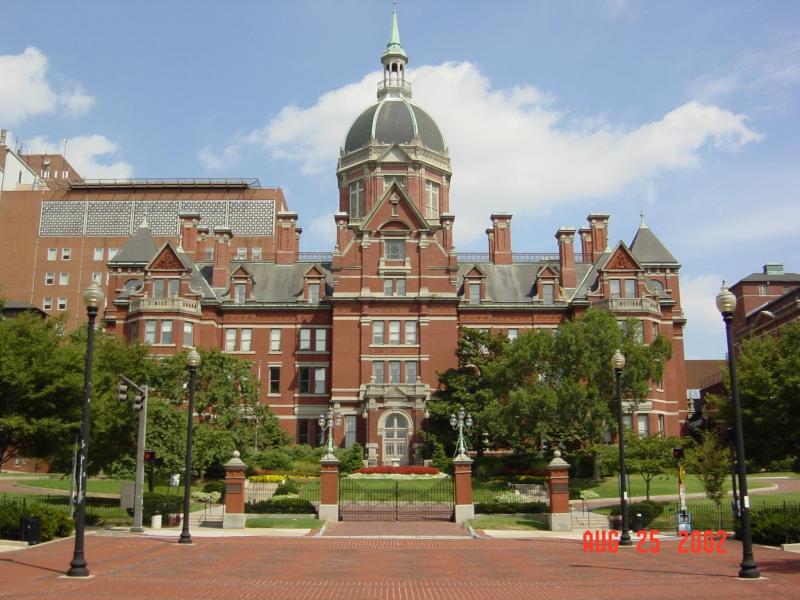
Johns Hopkins Hospital (Wikimedia Commons)
GLEN FORK, W.Va. — Across Laurel Creek and down a dirt road in this sleepy valley town is the modest white house where Steve Day grew up. For more than 33 years, it was where he recuperated between shifts underground, mining the rich seams of the central Appalachian coalfields and doing his part to help make Peabody Energy Corp. the nation’s most productive coal company. Now, it’s where he spends most days and nights in a recliner, inhaling oxygen from a tank, slowly suffocating to death.
More than a half-dozen doctors who have seen the X-ray and CT images of his chest agree he has the most severe form of black lung disease. Yet his claim for benefits was denied in 2011, leaving him and his family to survive on Social Security and a union pension; they sometimes turn to neighbors or relatives for loans to make it through the month.
The medical opinions primarily responsible for sinking his claim didn’t come from consultants-for-hire at a private firm or rogue doctors at a fringe organization.
They came from a respected household name: the Johns Hopkins Medical Institutions.
The Johns Hopkins University often receives attention for its medical discoveries and well-regarded school of public health, and its hospital recently was ranked the nation’s best by U.S. News and World Report.
What has remained in the shadows is the work of a small unit of radiologists who are professors at the medical school and physicians at the hospital. For 40 years, these doctors have been perhaps the most sought-after and prolific readers of chest films on behalf of coal companies seeking to defeat miners’ claims. Their fees flow directly to the university, which supports their work, an investigation by the Center for Public Integrity and ABC News has found. According to the university, none of the money goes directly to the doctors.
Their reports — seemingly ubiquitous and almost unwaveringly negative for black lung — have appeared in the cases of thousands of miners, and the doctors’ credentials, combined with the prestigious Johns Hopkins imprimatur, carry great weight. Their opinions often negate or outweigh whatever positive interpretations a miner can produce.
For the credibility that comes with these readings, which the doctors perform as part of their official duties at Johns Hopkins, coal companies are willing to pay a premium. For an X-ray reading, the university charges up to 10 times the rate miners typically pay their physicians.
Doctors have come and gone from the unit over the years, but the leader and most productive reader for decades has been Dr. Paul Wheeler, 78, a slight man with a full head of gray hair and strong opinions.
In the federal black lung system, cases often boil down to dueling medical experts, and judges rely heavily on doctors’ credentials to resolve disputes.
When it comes to interpreting the chest films that are vital in most cases, Wheeler is the coal companies’ trump card. He has undergraduate and medical degrees from Harvard University, a long history of leadership at Johns Hopkins and an array of presentations and publications to his credit. In many cases, judges have noted Johns Hopkins’ prestige and described Wheeler’s qualifications as “most impressive,” “outstanding” and “superior.” Time and again, judges have deemed him the “best qualified radiologist,” and they have reached conclusions such as, “I defer to Dr. Wheeler’s interpretation because of his superior credentials.”
Yet there is strong evidence that this deference has contributed to unjust denials of miners’ claims, the Center found as part of a yearlong investigation, "Breathless and Burdened." The Center created a database of doctors’ opinions — none previously existed — scouring thousands of judicial opinions kept by the Labor Department dating to 2000 and logging every available X-ray reading by Wheeler. The Center recorded key information about these cases, analyzed Wheeler’s reports and testimony, consulted medical literature and interviewed leading doctors. The findings are stark:
- In the more than 1,500 cases decided since 2000 in which Wheeler read at least one X-ray, he never once found the severe form of the disease, complicated coal workers’ pneumoconiosis. Other doctors looking at the same X-rays found this advanced stage of the disease in 390 of these cases.
- Since 2000, miners have lost more than 800 cases after doctors saw black lung on an X-ray but Wheeler read the film as negative. This includes 160 cases in which doctors found the complicated form of the disease. When Wheeler weighed in, miners lost nearly 70 percent of the time before administrative law judges. The Labor Department does not have statistics on miners’ win percentage in all cases at this stage for comparison purposes.
- Where other doctors saw black lung, Wheeler often saw evidence of another disease, most commonly tuberculosis or histoplasmosis — an illness caused by a fungus in bird and bat droppings. This was particularly true in cases involving the most serious form of the disease. In two-thirds of cases in which other doctors found complicated black lung, Wheeler attributed the masses in miners’ lungs to TB, the fungal infection or a similar disease.
- The criteria Wheeler applies when reading X-rays are at odds with positions taken by government research agencies, textbooks, peer-reviewed scientific literature and the opinions of many doctors who specialize in detecting the disease, including the chair of the American College of Radiology’s task force on black lung.
- Biopsies or autopsies repeatedly have proven Wheeler wrong. Though Wheeler suggests miners undergo biopsies — surgical procedures to remove a piece of the lung for examination — to prove their cases, such evidence is not required by law, is not considered necessary in most cases and can be medically risky. Still, in more than 100 cases decided since 2000 in which Wheeler offered negative readings, biopsies or autopsies provided undisputed evidence of black lung.
In an interview, Wheeler held strongly to his views. In his telling, he is more intellectually honest than other doctors because he recognizes the limitations of X-rays and provides potential alternative diagnoses, and he is adhering to a higher standard of medical care by demanding biopsies to ensure patients get proper treatment.
“I’ve always staked out the high ground,” Wheeler said.
The university defended Wheeler, saying in a statement he “is an established radiologist in good standing in his field.”
University officials questioned the findings by the Center and ABC, requesting extensive documentation, which the news agencies provided. After initially promising responses, officials at Johns Hopkins did not answer most questions but instead provided a general written statement.
“To our knowledge, no medical or regulatory authority has ever challenged or called into question any of our diagnoses, conclusions or reports resulting from the … program,” the statement said.
After the Center and ABC again posed questions about documents showing that judges and government officials had challenged the opinions of Wheeler and his colleagues on numerous occasions, university officials sent the same statement again.
That statement also said, “In the more than 40 years since this program’s inception, [Johns Hopkins radiologists] have confirmed thousands of cases to be compatible with [black lung].”
In some cases reviewed by the Center and ABC, Wheeler opined that an X-ray could be compatible with black lung but that another disease was more likely, ultimately grading the film as negative.
The news organizations asked the university how many times he had provided a truly positive reading; Johns Hopkins officials would not answer or clarify what they meant by “compatible.”
Judges at varying times have called Wheeler’s opinions “disingenuous,” “erroneous,” “troubling” and “antithetical to … regulatory policy,” court records show.
One judge dedicated an entire section of his ruling to the Johns Hopkins specialists. Wheeler and two colleagues “so consistently failed to appreciate the presence of [black lung] on so many occasions that the credibility of their opinions is adversely affected,” Administrative Law Judge Stuart A. Levin wrote in 2009.
“Highly qualified experts can misread x-rays on occasion,” he wrote, “but this record belies the notion that the errors by Drs. Wheeler [and two colleagues] were mere oversight.”
But, to discredit his readings and award benefits to a miner, as Levin did, judges must identify a logical flaw or some other reason not to give his opinion greater weight than those of other doctors. Former judges said they knew certain doctors almost never found black lung, but said they were barred from taking these experiences in other cases into consideration. In four cases reviewed by the Center, judges who have questioned Wheeler have seen their decisions vacated by an appeals board.
Retired judge Edward Terhune Miller, who often saw Wheeler’s opinions in cases before him, said he sometimes was compelled to deny claims even when he had serious doubts about the opinions of coal-company experts from Hopkins and elsewhere. Miners often were unable to provide enough evidence to overcome these opinions, and he wasn’t allowed to take his personal knowledge of doctors’ tendencies into account. “That’s one of the frustrations in the process,” said the former judge. “There’s no doubt about it.”
Wheeler said he is sure miners who don’t have black lung are being wrongfully compensated. “They're getting payment for a disease that they’re claiming that is some other disease,” the doctor said.
He takes issue with a law passed by Congress in 1969 that was crafted to lessen the burden of sick miners while limiting coal companies’ liabilities. Benefit payments for a miner start at just over $600 a month and max out at about $1,250 monthly for a miner with three or more dependents. Because these caps are low and miners are presumed to be at a particular risk for the disease, the system does not require they prove their cases beyond all doubt. Still, miners must show that they have black lung and that, because of it, they are totally disabled. About 85 percent of claims are denied at the initial level.
“I think if they have [black lung], it should be up to them to prove it,” Wheeler said. To him, this means undergoing a biopsy. If miners don’t submit to the procedure, he said, it suggests they may be afraid the results will show they have something other than black lung.
Biopsies are rarely necessary to diagnose the disease and can put the patient at risk, according to the American Lung Association, the National Institute for Occupational Safety and Health (NIOSH), the Labor Department, a paper published by the American Thoracic Society and prominent doctors interviewed by the Center.
Told his higher standard of proof, which he maintains is ordinary medical practice, is not required by law, Wheeler held firm.
“I don’t care about the law,” he said.
‘Victimized twice’
To people in the southern West Virginia town of Glen Fork, he is “Steve” — longtime miner, father of three, Vietnam veteran. To Dr. Paul Wheeler, from his vantage 400 miles away, he was “Michael S. Day Sr.,” 58, another referral from corporate defense firm Bowles Rice LLP.
Wheeler has never been in a coal mine or met Steve Day. His opinion, though, proved crucial in Day’s case.
In 2004, after more than three decades in jobs that exposed him to high levels of dust, Day’s breathing worsened to the point his doctor urged him to get out of mining. In January 2005, he filed a claim for federal black lung benefits.
The Labor Department pays for a medical examination by a doctor from an approved list. Day unwittingly chose a doctor who commonly testifies for coal companies, yet even this physician diagnosed the most advanced stage of complicated black lung.
Then the opinions from Johns Hopkins began arriving.
A CT scan interpretation by Dr. John Scatarige, who is no longer at the university: Large masses in the lungs, probably tuberculosis, or maybe a fungal disease, or cancer. Black lung unlikely.
Two X-ray readings by radiologist William Scott Jr., with the university since the early 1970s: Large masses in the lungs, probably tuberculosis. Black lung unlikely.
And, most vitally, three X-ray readings and a CT scan interpretation by Wheeler: Large masses in the lungs, probably tuberculosis, histoplasmosis or a similar disease. Black lung unlikely.
Peabody subsidiary Eastern Associated Coal Corp.’s chosen pulmonologist to review the evidence, Dr. Robert Crisalli, originally found black lung but changed his opinion after seeing Wheeler’s interpretations. He adopted most of Wheeler’s views and testified, “The basis for the conclusions primarily centers around the imaging, including the CT scans.”
Day lost.
A spokesman for Peabody spinoff Patriot Coal Corp., which now owns the subsidiary that employed Day, declined to comment, as did a spokesperson for Peabody.
Like many miners, Day relied primarily on the opinion of the doctor who examined him for the Labor Department and the records from his treatment over the years. He was at a distinct disadvantage, squared off against the radiologists at Johns Hopkins.
In determining Day didn’t have black lung, the Johns Hopkins experts relied on the same criteria they have recited in countless cases reviewed by the Center. Put simply, the white spots that show up on film must have a particular shape, appear in a specific area of the lung and follow a specific pattern.
At the Center’s request, a physician not involved in the case, Dr. John E. Parker, reviewed Day’s X-rays and CT scans taken between 2003 and 2012. Parker worked at NIOSH for 15 years, much of the time as director of the X-ray surveillance program and the program to certify qualified readers. He is now chief of pulmonary and critical care medicine at the West Virginia University School of Medicine, and travels the world teaching doctors to read X-rays in seminars, many for NIOSH and the American College of Radiology.
Parker was told only Day’s name, age, number of years mining and the fact that the interpretation of the films was disputed.
His clear-cut conclusion: Complicated black lung. “Based on my findings in reviewing this case, and the classic nature of the medical imaging and history, I am deeply saddened and concerned to hear that any serious dispute is occurring regarding the interpretation of his classically abnormal medical imaging,” Parker wrote. “If other physicians are reaching different conclusions about this case … it gives me serious pause and concern about bias and the lack of scientific independence or credibility of these observers.”
Told later that Day had lost his case, Parker was taken aback.
“It breaks my heart,” he said. “This man has been victimized twice — once by the conditions that allowed him to get this disease and again by a benefits system that failed him.”
Johns Hopkins experts help defeat hundreds of claims
The Center’s review of thousands of cases suggests there are many more men like Day. Since 2000, miners have lost more than 800 cases after at least one doctor found black lung on an X-ray but Wheeler read it as negative. This includes 160 cases in which other doctors saw the complicated form of the disease.
George Hager, for example, worked in the mines for 37 years, and three doctors saw complicated black lung on his X-rays and CT scan. Three Johns Hopkins radiologists, including Wheeler, saw something else — perhaps tuberculosis or histoplasmosis. The judge noted the affiliation of the Johns Hopkins doctors and their “superior qualifications.” Hager lost.
Douglas Hall’s 27 years underground came to an end at the advice of his doctor; he couldn’t walk 100 feet without struggling for breath. Four doctors read his X-rays as complicated black lung, but, again, three Hopkins radiologists, Wheeler among them, graded them as negative, finding tuberculosis or histoplasmosis more likely. Though tests for both diseases came back negative, Hall lost.
Keith Darago initially won twice. Three doctors saw complicated black lung on his X-rays and CT scans, and Administrative Law Judge Linda Chapman rejected attempts by the three Johns Hopkins radiologists to attribute the masses on the films to tuberculosis or a similar disease, particularly given Darago’s negative tuberculosis test and lack of history of any other disease.
But the Benefits Review Board, the highest appeals court in the administrative system, vacated the award of benefits twice and, at the coal company’s lawyers’ request, referred the case to a different judge. This time, the judge found the evidence on film to be a wash. Darago lost.
Some miners or their surviving family members continue to file claims, occasionally winning after their disease worsens or they die. Others simply give up, tired of fighting.
“I think it’s a bad deal,” said Rodney Gibson, another miner whose case followed a similar pattern. All the evidence of complicated black lung he presented wasn’t enough. “They come out with a way of getting around it somehow,” he said.
‘Not using the system properly’
Wheeler flips a switch, and a tall panel hums to life, emanating a white glow in the dark corridor where the Pneumoconiosis Section, as the group of Johns Hopkins radiologists is known, does its work. Papers bearing the letterhead of prominent corporate defense law firms sit at work stations, and stacks of folders in a storage closet have names of firms and coal companies written in Sharpie on their sides.
Wheeler places a series of chest X-rays against the panel and describes what he sees.
Small white spots obscure much of the lungs on one film, but they don’t have the centralized “birdshot pattern” he’s looking for. “I’d classify it as compatible with coal workers’ pneumoconiosis,” he says. “But I’d also say it certainly could be or more likely is histoplasmosis.”
He moves to films showing large white masses. One doesn’t have small spots surrounding it and is “pretty high [in the lung] — I would call it out of the strike zone,” he says. He again suspects the fungal infection. “If you want to bet against histoplasmosis, you're going to lose an awful lot,” he says.
These X-rays, however, are not disputed films in a benefits case. They are the standard X-rays that the government says show pneumoconiosis — a family of disease that includes black lung and asbestosis, but not histoplasmosis, tuberculosis and similar illnesses. When reading for pneumoconiosis, government-certified readers are supposed to place the unknown X-ray next to these films; they are classic cases meant to be standards for comparison.
Wheeler questions this and says the classification system has “some quality issues.” He adds, “These are not proven.”
Experts like Wheeler must pass an exam every four years to retain their government certification. If a doctor were to classify these films as negative during that exam, the physician very likely would fail, said David Weissman, director of NIOSH’s Division of Respiratory Disease Studies, which sets the standards for how readings should be performed.
Wheeler, however, has continued to pass the exam for decades, most recently this April.
The form used in the U.S. and many other countries for interpreting X-rays contains boxes to grade what’s on the image and a comments field for further explanation. If spots appear on the X-ray, a reader is supposed to mark their size and shape, and then explain which diseases seem more or less likely.
When he reads X-rays for coal companies, however, Wheeler doesn’t do this. If he sees spots on the film but thinks another disease is more likely than black lung, he marks the film as negative. He typically describes the abnormalities in the comments section, explaining why they don’t meet his criteria for finding black lung. In case after case reviewed by the Center, his comments were almost identical.
Weissman said this approach is simply wrong.
“You’re supposed to grade what’s there,” Weissman said. “You’re not supposed to alter what the grade is based on what you think the underlying cause is. That’s not using the system properly.”
In a statement, university officials said the radiologists “adhere to the clinical standards of diagnosis noted in the guidelines” put forth by the International Labor Organization, upon which NIOSH relies.
Wheeler said he is being more responsible than other doctors by providing multiple possible diagnoses. He often grades the film as negative but says in the comments section that black lung is possible, but unlikely.
The practical effect of Wheeler’s readings: To rule out black lung. Judges may consider the comments he writes, but the key, in comparing Wheeler’s readings with others, is the negative numerical grade he assigns.
In depositions, he sometimes goes further to eliminate black lung as a cause of a miner’s failing health. “He doesn’t have [black lung],” he said in a 2004 case, for example. “[I]n no way is this [black lung],” he said in another.
Weissman said NIOSH often hears that some certified readers interpret X-rays the way Wheeler does and that others over-diagnose diseases. “It’s pretty frustrating sometimes when we hear of people that do well on the exam and then go out in the real world and do other things,” he said. “Absolutely that is a concern.”
The agency’s authority, he said, doesn’t go beyond education, training and administering the exam. People with complaints should contact the state medical board, he said.
No, by the numbers
There is an unmistakable pattern in Wheeler’s readings. The Center identified more than 1,500 cases decided since 2000 in which Wheeler read at least one X-ray; in all, he interpreted more than 3,400 films during this time.
The numbers show his opinions consistently have benefited coal companies:
- Wheeler rated at least one X-ray as positive in less than 4 percent of cases. Subtracting the cases in which he ultimately concluded another disease was more likely, this number drops to about 2 percent.
- In 80 percent of the X-rays he read as positive, Wheeler saw only the earliest stage of the disease. He never once found advanced or complicated black lung. Other readers, looking at the same images, saw these severe forms of the disease on more than 750 films.
- Where other doctors saw black lung, Wheeler saw tuberculosis, histoplasmosis or a similar disease on about 34 percent of X-rays. This number shoots up in cases in which others saw complicated black lung, which is so severe it triggers automatic compensation. In such cases, Wheeler attributed the masses in miners’ lungs to these other diseases on two-thirds of X-rays.
Asked if he stood by this record, Wheeler said, “Absolutely.”
“I have a perfect right to my opinion,” he added. “I found cases that have masses and nodules. … In my opinion, those masses and nodules were due to something more common.”
When his views are questioned, Wheeler often shares anecdotes. He tells the story of performing an autopsy during his residency on a woman thought to have breast cancer; his examination revealed undetected tuberculosis. Other common stories include his father’s severe illness from histoplasmosis and a colleague’s bout with the infection after spending a rainy night in an abandoned chicken coop.
In a case decided in 2010, a doctor disputed Wheeler’s narrow view of black lung, and the miner’s lawyer asked Wheeler during a deposition whether he could cite medical literature to support his views.
“I don’t think I need medical literature,” Wheeler replied.
In a 2009 letter submitted in another case, Wheeler questioned two doctors who read X-rays as positive for black lung and wrote that he and a colleague who had provided opinions in the case “are clinical radiologists at one of the two or three best known hospitals in the world.”
The judge was not impressed. “This self-serving, egotistical diatribe is unwarranted and very unprofessional,” he wrote.
Wheeler took a similar approach in a recent interview, challenging the views of any doctor, judge or organization — including the Labor Department, NIOSH and the International Labor Organization — that contradicted his. He said he’s never been told an interpretation of his was wrong and he’d admit a mistake only if a biopsy or autopsy showed black lung — and was performed by a pathologist with “proper credentials.”
“I know my credentials,” he said. “I'd like to make sure that the people proving me wrong … have … credentials as good as mine.”
Proof in the tissue
In fact, tissue samples from miners’ lungs have proven Wheeler wrong again and again.
The pathologists providing the interpretations were enlisted by the coal company in many cases, and they often came from well-regarded academic medical centers, such as Washington University in St. Louis and Case Western Reserve University, where Wheeler himself was a resident. Some helped write widely accepted standards for diagnosis of black lung with pathology and have been frequent experts for companies defending claims.
Wheeler’s readings were negative even in some cases in which the company conceded the miner had black lung and chose to fight the claim on other grounds.
When clear pathology evidence did exist in cases reviewed by The Center, it tended overwhelmingly to show that the doctors who had found black lung — not Wheeler — were correct.
The American Lung Association, NIOSH, the Labor Department and a paper published by the American Thoracic Society say black lung usually can be diagnosed with an X-ray, knowledge of the miner’s exposure to dust and studies of lung function. Biopsies, which Wheeler insists are “very safe,” are invasive, risky and usually unnecessary, government officials and doctors said.
Still, of the cases in which Wheeler submitted at least one negative reading, miners or their surviving family members submitted evidence from a biopsy or autopsy in more than 280 cases, a Center analysis found. Contrary to Wheeler’s contentions, the pathology did not resolve most cases. In about half, the tissue evidence proved inconclusive or was disputed.
Of the remaining cases, 75 percent revealed undisputed evidence of black lung. In the other cases, the tissue did not show evidence of the disease, but, as the law states, this doesn’t mean the miner didn’t have black lung — only that it wasn’t present on the piece of lung sampled.
In the cases in which pathology showed Wheeler was wrong, other X-ray readers saw black lung 80 percent of the time, and no interpretations outside of Johns Hopkins existed in another 12 percent.
Most times, then, only Wheeler and his Johns Hopkins colleagues failed to see black lung.
Diagnosis after death
Sometimes miners had to die to prove they had black lung.
George Keen worked 38 years in the mines and tried for 22 years to win benefits. At least two physicians interpreted his X-rays and CT scans as showing complicated black lung. Wheeler and his colleague Scott read them as negative — probably tuberculosis, they said. Keen lost.
Three years after the most recent X-rays and CT scans read by Wheeler were taken, Keen died. The company’s chosen pathologist agreed the autopsy revealed complicated black lung.
John Banks, who started loading coal by hand at 17, had multiple claims denied. More than a half-dozen doctors saw black lung; Wheeler suspected cancer. When Banks died, pathologists looking at his lung tissue debated whether the disease had reached the complicated stage, but both sides agreed: He had black lung.
Emily Bolling suffered through much the same experience with her husband, Owen, who spent most of the last six years of his life on oxygen but wasn’t able to win benefits.
“They would keep hiring more doctors and more doctors to read his X-rays, and we had just one,” she said.
Wheeler read a 2002 X-ray as negative. Owen died in 2003, and two pathologists found that the autopsy showed black lung, allowing Emily to win her widow’s claim. “It seems awful, but that’s what it took,” she said recently. “It’s just wrong.”
Illene Barr is trying to win benefits following the 2011 death of her husband, Junior, who worked 33 years doing some of the dustiest jobs in the mines. In his final years, his health progressively worsened. “He loved to do things around the house,” Illene recalled. “He had a garden. But he became so short-winded he couldn’t do any of that. He ended up basically just sitting on the deck.”
He lost claims in 2008 and 2010 after Wheeler read X-rays as negative, saying histoplasmosis was much more likely.
“We just couldn’t believe that it was happening,” Illene said.
Four months after Wheeler’s most recent opinion that Junior likely was suffering from the bird-and-bat-dropping disease, he died. Pathologists for both sides saw black lung on the autopsy. Illene’s benefits case is pending.
The Wheeler standard
Wheeler learned the strict criteria he applies from his mentor, Dr. Russell Morgan, a revered figure at Johns Hopkins. In the early 1970s, Morgan helped NIOSH develop the test to qualify as a “B reader” — a doctor certified to read X-rays for black lung and similar diseases. Wheeler served as one of his test subjects. The radiology department bears Morgan’s name, and he went on to become dean of the medical school.
Morgan testified for companies defending a wave of lawsuits over asbestos-related disease. Wheeler testified before Congress in 1984, arguing that false asbestos claims were rampant and that plaintiffs should prove their cases by undergoing a biopsy. He asserted that similar problems existed in the black lung compensation system.
There is general acknowledgement now that X-ray evidence was misused in some asbestos claims. The black lung benefits system of today, however, is a different universe.
In some asbestos claims, plaintiffs won large verdicts or settlements, and lawyers got rich. For black lung, the payouts are comparatively meager — the maximum monthly payment, for miners with three or more dependents, is about $1,250 — and few lawyers will take cases because the odds of winning and ultimate compensation are low. Settlements are not allowed, and miners have to prove total disability caused by black lung, not just show a minimally positive X-ray.
Wheeler continues to express concerns similar to those he voiced in 1984. “It comes down to ethics,” Wheeler said. “If you think it's appropriate for somebody with sarcoid to be paid for [black lung] because he has masses and nodules — do you think that's appropriate? I don't think so.”
After Morgan’s death, Wheeler took over the “Pneumoconiosis Section.” Asked if he viewed himself as the coal industry’s go-to radiologist, Wheeler said: “Dr. Morgan was the go-to guy. … I've replaced him … in the pneumoconiosis section, yes. … I can view myself as the doctor for a number of companies, not just coal companies.”
In depositions and during the recent interview, Wheeler has insisted he is relying on the criteria Morgan taught, praising his predecessor as an innovator and genius. His criteria, however, do not comport with mainstream views on black lung.
“When you take this very strict view, where you put in all these rules, none of which are a hundred percent, what will happen is you’ll wind up excluding people that have the disease,” NIOSH’s Weissman said.
According to medical literature and experts consulted by the Center, black lung does not always fit the narrow appearance Wheeler requires. Shown a text, for example, that says the disease may affect one lung more than the other, Wheeler said: “I don't know where they get this idea. … It's not what Dr. Morgan taught me.”
In fact, the statement comes from the standards established in 1979 by the College of American Pathologists. The report was compiled by a group of eminent doctors, including some who have testified regularly for coal companies.
Doctors interviewed by the Center said they had seen many cases of black lung that did not fit Wheeler’s standards. “You’ll see a variety of different presentations,” said Dr. Daniel Henry, the chair of the American College of Radiology’s task force on black lung and similar diseases. “The image can vary.”
In one case decided in 2011, NIOSH got involved at the request of the doctor who examined the miner for the Labor Department. Multiple doctors had diagnosed complicated black lung, but Wheeler had read X-rays as negative. The spots on the X-rays didn’t follow the pattern he wanted to see, he’d said; histoplasmosis was more likely.
Two NIOSH readers, however, saw complicated black lung on the film, and Weissman wrote a letter saying Wheeler’s views “are not consistent with a considerable body of published scientific literature by NIOSH.” The miner won his case.
Assumptions and ‘bias’
A pair of assumptions shapes Wheeler’s views in ways that some judges and government officials have found troubling.
Former miner Gary Stacy’s struggle for benefits lays bare the effects of these beliefs.
When he filed for benefits in 2005, Stacy was only 39 years old, yet three doctors believed his X-rays and CT scans showed complicated black lung. He had worked for almost 20 years underground and had never smoked.
Wheeler, however, read two X-rays as negative. He wrote that Stacy was “quite young” to have complicated black lung, especially since the 1969 law required federal inspectors to police dust levels. Histoplasmosis was much more likely, Wheeler thought.
A judge denied Stacy’s claim in 2008, and it would take years of fighting and a rapid decline in his breathing before he won.
In reaching his conclusions about the cause of the large masses in Stacy’s lungs, Wheeler drew upon beliefs that pervade his opinions: Improved conditions in mines should make complicated black lung rare; whereas, histoplasmosis is endemic in coal mining areas.
In case after case, Wheeler has said complicated black lung was found primarily in “drillers working unprotected during and prior to World War II.”
Wheeler’s contention contradicts a series of published studies by NIOSH researchers showing that the prevalence of black lung actually has increased since the late 1990s and that the complicated form increasingly is affecting younger miners. Wheeler contends these peer-reviewed studies aren’t conclusive because they have not been confirmed by pathology.
Gary Stacy is the kind of miner NIOSH says it now sees more often. Just 47 today, he appears trim and healthy, but a few minutes of conversation reveal a different reality. His sentences are interrupted by hoarse gasps for breath.
Stacy now undergoes pulmonary rehabilitation to prepare for a lung transplant. As his illness worsened, the evidence became overwhelming, and his employer agreed to pay benefits.
The fact that nothing in Stacy’s medical history indicated he’d suffered from histoplasmosis or tuberculosis didn’t prevent Wheeler’s readings from being credited in the 2008 denial. Someone could be exposed, show no symptoms and still develop masses that remain after the infection has fizzled out, Wheeler often has said.
This is theoretically possible, said doctors consulted by the Center, including an expert on histoplasmosis at the Centers for Disease Control and Prevention. But, doctors noted, in cases with masses as large as the ones Wheeler often sees on film, the patient likely would show symptoms and have some record of the disease in his medical history.
NIOSH’s Weissman said the two diseases should rarely be confused on film. “The appearance of [black lung] is different from the typical appearance of … histoplasmosis,” he said. “That shouldn’t be hard, in general, to make that differentiation.”
Wheeler’s main alternative suggestion once was tuberculosis, but he has switched to suggesting histoplasmosis more often. “Well, initially, I thought TB was … causing these things,” he said in an interview. Yet many of those cases, he now believes, “very likely were [histoplasmosis].”
Could he be wrong again? “I could be,” he said. “But I'd like to be proven wrong with biopsies.”
In written opinions, judges have said Wheeler’s assumptions seem to have “affected his objectivity” and “inappropriately colored his readings.” Another wrote in 2011 that Wheeler had a “bias against a finding of complicated [black lung] in ‘young’ individuals.”
In some cases, judges have questioned Wheeler’s demands for biopsy proof and his speculative suggestions of other diseases. “The reasonable inference to be drawn from Dr. Wheeler’s report and testimony is that he does not accept a diagnosis of [black lung] based on x-ray or CT scan alone,” one judge wrote in 2010.
Another judge succinctly summarized Wheeler’s opinion: “I don’t know what this is, but I know it’s not [black lung].”
Scraping to get by, struggling to breathe
Steve Day’s wife, Nyoka, sleeps lightly. Most nights, they re-enact the same scene.
Steve sleeps upright in a recliner; if he lies flat, he starts to suffocate. Nyoka lies in bed in the next room over, listening to his breath and the hiss of the machine pumping oxygen through a tube in his nose. She waits for the sound — a faint gasp.
“I hurry in here, and I bend him over and say, ‘Steve, cough,’ ” she said. “He’ll try and get by without having to cough because it hurts. And I make him cough. I’ll scream at him, ‘Cough!’ ”
What finally comes up is often black. They’ve made it through another night.
This is not the life they envisioned when Steve returned from Vietnam and they eloped. Both of their fathers had worked in the mines, and both had black lung. Before they got married, Steve made Nyoka a promise: He’d never go to work in the mines.
It wasn’t long before he changed his mind, persuaded by his father. “He said that’s the only way you can make good money,” Steve recalled of the job that, in good years, earned him as much as $55,000 or $60,000. He worked just about every job underground. For much of his career, he ran a continuous mining machine, which rips through coal and creates clouds of dust.
“When he came out of the mines, all you could see was his lips, if he licked them,” Nyoka recalled. “He was black except around his eyes.”
After 33 years in the mines, he thought the cause of his breathing problems was obvious. So did his doctor, who is treating him for black lung.
The reports from Johns Hopkins floored Steve and Nyoka. There was nothing in his medical records to suggest he’d ever had tuberculosis or histoplasmosis, let alone a case so severe that it left behind multiple nodules and masses, including one occupying almost a third of one of his lungs.
Steve scowls at the mention of Wheeler’s name. “The more I talk about him the madder I get,” he said. “And the madder I get, my blood pressure shoots up.”
Administrative Law Judge Richard Stansell-Gamm determined, based on the opinions of Wheeler and the pulmonologist who adopted most of Wheeler’s findings, that Day had not proven he had black lung. The judge didn’t come to any conclusions about what caused Day’s severe illness.
He lost his case on May 31, 2011, and, three days later, the Labor Department sent Day a letter demanding $46,433.50. The department had originally awarded Day’s claim in 2005 and started paying benefits from a trust fund because the company’s lawyers had appealed. Now that the initial award was overturned, the department wanted reimbursement for what it paid out during the six years it took for the case to reach a conclusion.
The department eventually waived the so-called “overpayment” after Day submitted documentation showing he had to support, to varying degrees, eight other people with only Social Security and a union pension.
“Each person of age tries to help but overall it isn’t enough to survive on without borrowing,” he wrote the department. “It has been very humiliating to have to do so, when everyone knows that I worked my life away from my children and my wife, in order to end up on full time oxygen for a company who isn’t (decent) enough to acknowledge the damage ‘their’ job done to my body, my life, and my family.”
Day has not given up hope of winning benefits, but, if he files again, he could find himself again having to overcome the opinions of Wheeler and his colleague at Johns Hopkins.
As he almost always does, Wheeler testified in Day’s case that he should undergo a biopsy. Parker, the former NIOSH official who examined Day’s X-rays and CT scans, said he’d advise against a biopsy because the risk of complications for someone with Day’s level of disease is too great.
That leaves just one way, in Wheeler’s opinion, to disprove him. Steve and Nyoka have already discussed it. “I done told her, ‘If something happens to me, have an autopsy done on my lungs,’ ” Steve said.
Since he lost his case, Day’s breathing has declined. He began full-time oxygen a year ago, but decided against a lung transplant. At 67, with his health problems, he likely would not be a good candidate.
Miners have developed a crude measure for how damaged their lungs are based on how upright they need to be to sleep.
“You start out with one pillow,” Nyoka said. “Then you go to two pillows. Then three pillows, and that’s supposed to be your top. Well, he went through that, and he got to where he couldn’t breathe. So he got in the recliner, and he’s just lived in that recliner for …”
“Years,” Steve interjected, staring out the window toward the tree-lined hillside.
“And now the recliner,” Nyoka said. “It’s not enough.”
Editor’s note: Brian Ross and Matthew Mosk work for ABC News. Retired judge Edward Miller’s daughter is employed by the network. The Center contacted him before ABC News joined the reporting for this story.
By Chris Hamby
Johns Hopkins is not the only university where doctors frequently appear as coal-company witnesses in federal black lung benefits cases, but the Baltimore institution appears to be a special case.
Other schools require doctors to perform such consulting on their own time and limit the hours they spend doing it. There is a line, albeit a sometimes fuzzy one, between the doctor’s opinion as a consultant and as a university representative.
Experts at schools including the University of Cincinnati, Washington University in St. Louis and Case Western Reserve University submit opinions that often favor coal companies, but this consulting is not part of their work for the university.
At Johns Hopkins, no line exists. It is part of the doctors’ jobs to provide interpretations for coal companies, who are willing to pay top dollar for a report from one of these doctors.
Lawyers who represent miners said the doctors they use charge between $65 and $100 to read an X-ray. Johns Hopkins charges $100 to read an X-ray with no abnormalities; the rate rises to $750 if there are markings to be interpreted, as in the bulk of black lung cases, said Dr. Paul Wheeler, the longtime leader of the section. When the doctors testify, they charge $600 an hour, he said.
Earlier this year, Wheeler said during a deposition the fee for an X-ray with abnormalities was $500. When the Center for Public Integrity asked Hopkins which amount — $500 or $750 — was correct, university officials declined to answer.
The university said the fees from deposition testimony go to a scholarship fund while the fees from X-ray readings go to the radiology department.
University representatives refused to say how much money Hopkins receives from coal companies, but said the radiologists in its Pneumoconiosis Section review between 2,000 and 3,000 possible black lung cases a year. These doctors also read films in cases other than black lung benefits claims, and provide interpretations to companies that want to monitor the health of their workers. It is unclear whether the number of cases referenced by the university includes all of this work or only black lung cases; university representatives did not answer a request for clarification.
During a deposition in a case decided in 2009, a doctor no longer at the university testified that radiologists received bonuses for being “productive.” The physician could not be reached for comment. Wheeler said he didn’t know how his salary or bonuses were calculated.
In a statement, referencing its doctors’ status as government-certified X-ray interpreters, or “B Readers,” the university said: “There are no financial incentives associated with this program for our B-readers or the radiology department. There are no bonuses or other salary supplements paid to doctors related to the volume of examinations read, expert testimony, or other aspects of the B-reader program at Johns Hopkins.”
By Chris Hanby
Ted Latusek has black lung disease. For almost two decades, his breathing has been so bad he’s been considered totally disabled. Even his former employer, the coal giant Consol Energy, does not dispute those points.
Nineteen years after he first filed for federal black lung benefits, however, his case remains unresolved. What’s really causing his impairment, doctors testifying for Consol contend, is a completely different and unrelated disease. To win his case, the former miner must show that his disability is caused by black lung.
Though parts of his lungs show the dark nodules typical of the classic form of black lung, all doctors agree that his biggest problem is elsewhere, in the parts of his lungs that show severe scarring with a different pattern.
His case file, spread in piles, covers a conference table, but all of the medical reports, depositions, hearings, briefs and rulings center on one question: What caused the abnormal scarring that has consumed large portions of his lungs?
The fight over the answer to that question goes to the heart of the newest battle in a longstanding war between companies and miners. Latusek’s legal tussle is the signal case in the latest effort by the coal industry to deny emerging scientific evidence and contain its liabilities, a strategy that has played out repeatedly over more than a century and locked multitudes of miners out of the benefits system, the Center for Public Integrity found as part of the yearlong investigation, "Breathless and Burdened."
Consol has hired radiologists, pathologists, pulmonologists and a statistician to examine Latusek, write piles of reports and attack a growing body of medical literature. His disease, they maintain, is a rare illness that appears in the general population and causes lung damage with the appearance seen in Latusek. The cause is unknown, but, they say, it definitely isn’t coal mine dust.
Yet medical evidence increasingly has shown his pattern of scarring to be a previously unrecognized form of black lung.
Broad recognition of the illness’ connection to coal mine dust could have significant financial implications for coal companies. The Center identified more than 380 benefits cases decided since 2000 in which the miner had evidence of this atypical presentation, and studies have shown the disease pattern to be present in at least 15 percent of some groups of miners examined.
Since Latusek first filed his claim in 1994, research increasingly has shown that coal and silica — the toxic mineral in much of the rock in mines — can cause the pattern of scarring he has. Government researchers at the National Institute for Occupational Safety and Health (NIOSH) and the National Institutes of Health (NIH), as well as other independent doctors, have linked the pattern to coal mining.
“It’s certainly related to their work,” said David Weissman, head of NIOSH’s division of respiratory disease studies. “We’re confident of that.”
Yet, while other variants of black lung are defined explicitly in Labor Department regulations, Latusek’s form is not, and doctors paid by the coal industry continue to testify that there is no evidence of any connection between mining and this form of disease. This leaves the complex medical issue to be argued case by case in the benefits system, which is often ill-equipped to address emerging science and typically favors coal companies and the well-paid consulting doctors they enlist.
A Labor Department spokesman said the agency doesn’t think a regulation formally recognizing the form of disease as a type of black lung is necessary. Current rules, the spokesman noted, allow miners to attempt to prove a relationship between their work and this variety of illness.
Experts interviewed by the Center, however, argued that explicitly stating such a relationship would lessen miners’ burden, pointing to a previous rulemaking as a model. In hundreds of cases reviewed by the Center, miners with a disease pattern like Latusek’s have faced particular challenges in proving their cases.
Latusek, a coal miner’s son who grew up in an area of northern West Virginia dominated by Consol, has won four times before an administrative law judge, but appeals courts have vacated or reversed the decision each time.
Consol did not respond to requests for comment.
While courts have grappled with the complexities his case presents, Latusek’s health has deteriorated. He has gone on oxygen and endured a lung transplant. The doctor who originally treated him on referral from Consol has testified against him twice, and many of the industry’s go-to consultants have weighed in.
Yet he and his lawyer — the daughter of a coal miner who has toiled more than half her career on Latusek’s case despite rules barring her from collecting a cent in fees until the case closes — press on.
“I know my case is going to set a precedent,” Latusek said.
There is nothing in mining that makes it insanitary, and any insanitary conditions which may exist are doubtless closely related to the rum shop.
--John Fulton, engineer and coal industry representative, 1901
“Black lung” is not just one disease. Rather, it is a blanket term for a variety of lung diseases caused by breathing coal dust. As science has implicated coal dust as the cause of an increasing array of medical problems during the past century, coal companies have resisted, knowing broader recognition of the true effects of mining coal could place them on the hook for compensating more sick miners.
The coal industry’s reaction to the potential expansion of its liabilities has followed a familiar pattern. For more than a century, the industry has sought to keep a narrow definition of black lung.
In the early 20th century, coal companies and sympathetic doctors argued that coal dust was harmless and actually protected miners’ lungs from tuberculosis.
Since then, scientific advances have shown that breathing coal dust can harm different people in different ways.
One miner might develop the black nodules characteristic of coal workers’ pneumoconiosis, the classic form of black lung. Another might find the air sacs in his lungs destroyed — emphysema — or the lining of his airways irritated and blocked — chronic bronchitis.
As the effects of coal dust have gained broader recognition, the industry in each instance eventually has had to accept the evidence. But, while these fights about classification have played out, sick miners have found it difficult, if not impossible, to win benefits.
Today, miners again are facing this strategy of denial and containment, this time over the pattern of scarring seen in the lungs of Latusek and hundreds of other miners with cases decided since 2000. In virtually all of the more than 380 cases identified by the Center, a doctor testifying for the coal company — or, in many cases, multiple doctors — blamed some variant of the disease idiopathic pulmonary fibrosis, known as IPF, or a similar illness. This is the same scarring of unknown cause that Consol’s doctors say Latusek has.
Miners lost more than 60 percent of these cases. Even when judges awarded benefits, the decision often hinged on an issue other than recognition of the abnormal disease appearance as black lung. Numbers on the success rate of miners at this level in all cases were not available for comparison.
In many cases, judges credited coal company experts and reached medical conclusions that flatly contradict the views of NIOSH and NIH. Judges must rely on whatever evidence a miner can produce, and finding doctors who can rebut the vehement assertions of the company’s experts can be a challenge.
The particulars of Latusek’s case offer a rare and nearly ideal opportunity to isolate the key question that could affect the claims of many other miners: Does coal mine dust cause his form of disease? Latusek never smoked. He doesn’t have an autoimmune disease. He never underwent radiation treatment or took certain toxic drugs. He has no family history of the disease.
In other words, doctors can’t blame his illness on these other potential causes. What he does have is a history of intense exposure to the potent mixture of dust generated by the most powerful machinery of modern mining.
There are no healthier men anywhere than in the mining industry.
--Coal Age, trade journal, 1915
Latusek’s path to the mines was undeterred by the warnings of his father, who worked underground. “He never wanted me to go to the mines,” Latusek said. “He knew how dirty and dusty and dangerous it was.”
Aside from mining, though, there weren’t many well-paying jobs in the area of northern West Virginia, near the town of Fairview, where Latusek and his older sister grew up. Consol’s mines dotted the landscape, tapping the rich Pittsburgh coal seam; the company remains one of the nation’s top five coal producers today.
Latusek worked from the time he was 13, shedding his boyhood shyness as he carried out groceries from the local market and chatted up customers.
He breezed through high school, but found himself unprepared for the more rigorous workload at nearby Fairmont State University, especially with the two jobs he was working. After two years, he dropped out and went full time for a utility company that dug ditches and installed the power lines feeding into Consol’s mines.
When he was laid off, he applied to work for Consol. In September 1970, he went underground, handling a variety of jobs. “I worked there about three months, and then Uncle Sam said it was my time to go,” he recalled
Drafted into the Army, he received training in electronics and ended up stationed as a technician at a satellite communication site in New Jersey. He narrowly missed being sent to Vietnam. In July 1971, he married Donna, whom he’d met while at Fairmont State, and, six years later, they would have a daughter, Jennifer.
In December 1972, he returned to the mines. He quickly ascended the ranks, becoming a maintenance foreman and eventually longwall coordinator. This meant that, at 29, he was in charge of a crew running the massive moneymaking machine. A longwall’s spinning shearer can hollow out mountains in little time. Consol made sure everyone knew the value of production, Latusek said: Every minute the machine wasn’t running cost the company $12,000.
He took pride in motivating his crew, keeping his own logs of production and comparing them with those of other shifts. “We actually outmined the other crews two to one,” he said.
Before long, he was promoted again; the company placed him in charge of all the longwalls at two mines. He sometimes would travel to Great Britain to see the factories that manufactured the machines, and he was always on call, once working 78 straight days. Another time, he spent virtually an entire week underground, coming up for a couple of hours a day to shower, eat and sleep.
At times, he lived in clouds of dust, he recalled. The roof would cave in, and his crew would have to cut through rock for days on end. Or the exit would be blocked by falling rock, rendering any attempt at ventilation pointless. “A lot of times, you couldn’t see your hand in front of your face,” he recalled.
Latusek’s health problems first began to surface in 1989. He was short of breath, and he coughed constantly. A company physical turned up “one area of concern,” as Consol’s doctor put it, in 1990. The company referred him to a specialist, Dr. Joseph Renn III.
Latusek didn’t know it at the time, but Renn frequently testified for coal companies defending black lung claims. He would later abandon his private practice and start a consulting firm, working almost exclusively for companies defending claims of occupational lung disease.
Renn diagnosed IPF. The reasoning behind the diagnosis is one that Renn and other doctors have repeated in case after case: Black lung causes round scars concentrated in the upper lungs. Latusek had irregularly shaped scars concentrated in his lower lungs, a pattern characteristic of IPF and related diseases. This conclusion absolved Consol of responsibility for his serious lung problems.
Though Latusek continued to work, the amount of oxygen in his blood continued to drop; his lungs couldn’t transfer what he breathed in to his bloodstream. He struggled with any exertion and wheezed, especially when he was around dust.
While visiting a mine in Scotland in 1993, he had a moment of panic. He had to crawl 1,000 feet in an opening about four-and-a-half feet high. Halfway across, he lost his breath. “It felt like somebody had put a bag over my face,” he recalled. When he got back to West Virginia, he had another episode while walking the steep stairs exiting the mine.
Latusek, in an interview and in court testimony, recalled a conversation with Renn in which the doctor said there wasn’t much else he could do and he would likely die in a few years. Renn said privacy rules barred him from discussing Latusek’s case, but he added that it is standard practice for him to discuss potential outcomes with patients.
In a legal filing, Consol’s lawyer challenged Latusek’s recollection, saying there was no mention of a prognosis in Renn’s reports.
Not ready to give up, Latusek asked if there was anyone who could help him. Renn referred him to National Jewish Health in Denver, widely regarded as one of the nation’s top centers on lung disease. Latusek began flying to see Drs. Constance Jennings and Cecile Rose.
Jennings had studied IPF and similar diseases while at NIH, and, when she first examined Latusek, she wasn’t sure that she actually was looking at a case of the disease. It was 1993, and there had been little work on the potential connection to coal dust, but she had her suspicions.
In the report on her initial examination of Latusek in October, she noted that he had evidence of both classic black lung and IPF, then posed the question that would reshape his case: “Are the two processes related?”
We are not informed of any occupational diseases in the mining industry.
--Ralph Crews, coal industry lawyer, before a federal panel, 1920
“Someone could say peanut butter causes pneumonia,” Dr. Gregory Fino said in a February 1997 deposition. “Well, show me in the literature that there is a statistically increased incidence of that occurring, and then I will not prescribe peanut butter to anybody.”
Peanut butter was, in his analogy, coal dust, and pneumonia was the pattern of scarring in Latusek’s lungs. Fino was adamant that the medical literature showed no connection between the two.
“I can’t tell you what caused the idiopathic pulmonary fibrosis,” he testified. “I can tell you what hasn’t caused it: coal mine dust employment and coal mine dust inhalation.”
In recent decades, Fino has been perhaps the most high-profile among the cadre of doctors who testify regularly for coal companies. When a miner files a claim, he is entitled to an exam by a doctor from an approved list paid for by the Labor Department, but he also must submit to an exam by a doctor of the company’s choosing.
Consol chose Fino to examine Latusek.
Fino was the industry’s go-to doctor in the most recent battle over the definition of black lung. When the Labor Department proposed rules in 1997 to expand the list of illnesses potentially caused by breathing coal dust to include such diseases as emphysema and chronic bronchitis, the National Mining Association enlisted Fino.
Along with a biostatistician, he wrote a lengthy critique of the studies relied on by the Labor Department and said, “There is much bad science or loose terminology in these proposed regulations.” In 2000, the agency finalized the rules, rebutting Fino’s arguments in detail.
Fino and other doctors had testified regularly that smoking, not coal dust, caused these diseases that obstructed miners’ airways. The approach by Fino and other doctors in Latusek’s case was much the same — attack the science linking the disease to coal dust, identify an alternative cause.
Renn, for example, said of black lung and IPF, “There’s no literature that relates the two.”
Dr. W.K.C. Morgan, a veteran of previous battles over the definition of black lung dating to the 1960s, testified, “I think this is just wishful thinking.”
Consol’s lawyers hired a statistician to poke holes in the studies introduced into evidence by Latusek’s lawyer, Sue Anne Howard.
Unlike many miners, however, Latusek had a tenacious lawyer and doctors with impressive credentials on his side, too.
Howard has represented sick miners since she began practicing law in 1982. The first black lung case she handled was her father’s. She won, then watched him “die of black lung by inches,” she recalled. As the hours spent on Latusek’s case have amassed — time for which she’s been barred from collecting any fees — she’s tried to support her practice with other cases.
Jennings and Rose from National Jewish had become convinced that Latusek’s disease was caused by his job. They acknowledged that the science was still emerging but laid out a rationale for their conclusion. The way his disease struck early, then smoldered for years, was very abnormal for IPF, they said, and a tissue sample showed tiny mineral particles in the area of his scarring. Consol’s pathologists disputed this assessment of the biopsy evidence.
In a June 1997 decision, Administrative Law Judge Daniel Leland awarded benefits to Latusek. Consol’s lawyers appealed, and, though the Benefits Review Board upheld Leland’s decision, the U.S. Court of Appeals for the Fourth Circuit vacated the award in a divided opinion in 1999.
Referencing the studies introduced by Howard, the majority wrote, “At best, the articles offered tepid support for Dr. Jennings’s, Dr. Rose’s, and the [administrative law judge’s] conclusion.” The judges noted that Consol had more doctors on its side, and wrote, “Although we do not advocate counting the votes of various medical experts to reach a conclusion … [w]e believe that such a disparity of opinion merits attention.”
The dissenting judge chastised his colleagues for overstepping their authority and substituting their views of the medical evidence for those of the administrative law judge. “All we have here,” he wrote, “is a situation where two or three more experts on one side dispute the findings of two or three fewer experts on the opposing side.”
A 2002 law review article by Washington and Lee University Professor Brian Murchison singled out the decision as a “particularly disturbing” example of “judicial intrusion.”
The ruling sent the case back to the same administrative law judge for reconsideration. The case dragged on, with the judge awarding benefits twice more, before it again arrived at the Fourth Circuit. Again, the majority questioned the medical evidence, this time reversing the award. And again, the dissenting judge — not the same one as in the prior ruling — blasted his colleagues for overreaching. Nonetheless, the 2004 decision ended Latusek’s first claim.
Latusek was devastated. “My goal in life was to outlive Consol, to live long enough to know that I beat them in this case,” he said recently. “I thought that I had. I was on cloud nine. And then it goes to the Fourth Circuit Court, and they take it all away from me.”
It doesn’t matter what the damn thing is called. The man can’t work, he’s disabled.
--Dr. I. E. Buff, cardiologist and advocate for miners, 1969
If Consol’s doctors were right, Latusek should have been dead before his case even reached the appeals court. Studies have shown patients with IPF typically die within five years of the onset of the disease. Latusek had first shown signs in 1989. Consol’s experts acknowledged this was unusual but said it wasn’t unheard of for some people to survive longer.
His age also raised questions. IPF rarely strikes people younger than 50. Latusek was 39 when his disease appeared.
Both of these characteristics — earlier onset and longer survival — were not unique to Latusek, as it turns out. Though this presentation would be abnormal for IPF in the general population, there is evidence that it is not unusual for certain people: miners.
As Latusek’s case progressed, scientific interest in IPF grew. “Few lung disorders have seen a renewed investigative focus like IPF,” according to a 2003 report prepared by a group of doctors for the American Thoracic Society.
The lungs have a limited number of ways to respond when they come under attack. One response is the pattern of scarring in the lower lungs that often is diagnosed as IPF. But there are many diseases that cause essentially the same pattern and have a defined cause.
Increasingly, research has identified more causes of this pattern. Thus, people with a disease that previously would have been classified as IPF now are diagnosed with a more specific illness.
One prominent cause that has emerged in recent research: occupational dust exposure. Studies have linked the IPF pattern of scarring to breathing fine particles of everything from metal and cotton to coal and silica.
The phenomenon does not appear to be new. A 2012 study by NIOSH epidemiologist Scott Laney and former NIOSH official Lee Petsonk noted that research showing an IPF pattern in miners dated to 1974 but had been largely overlooked. Addressing the often-repeated view about the typical appearance of black lung — one that would exclude an IPF pattern — they wrote, “the scientific foundation for this expectation is unclear.”
Analyzing 30 years of X-rays from the agency’s surveillance program, roughly half had a discernible pattern affecting only certain areas of the lungs in certain ways, they found. Of these, a striking 30 percent showed a pattern similar to Latusek’s.
As researchers have looked more closely, they’ve seen that evidence of the disease’s connection to coal mining — like the disease itself — appears to have been there all along. Studies in the 1970s and 1980s noted the pattern on X-ray and in tissue samples of coal miners. A 1988 study found the pattern on autopsies of between 15 percent and 18 percent of miners in South Wales and West Virginia and noted that the miners’ disease had struck earlier and progressed more slowly than IPF.
The most recent edition of a key medical textbook on lung diseases, released in 2005, describes the appearance of the pattern in miners and says, “It is important to be aware of this entity as many cases are inadvertently diagnosed as idiopathic pulmonary fibrosis.”
Earlier this year, a group of doctors described the pattern as a recognized form of black lung in a paper for an American Thoracic Society journal. “The spectrum of lung disease associated with coal mine dust exposure is broader than generally recognized,” the physicians wrote.
Doctors testifying for coal companies counter that this body of research is far from conclusive, saying it fails to show a direct causal relationship. And, they say, the studies failed to control for other potential causes, including smoking, or were skewed because participants were not randomly selected. Some of the same doctors made similar arguments in the 1990s about evidence connecting coal mine dust to diseases such as emphysema and chronic bronchitis.
“There’s no doubt that we need to learn more,” NIOSH’s Weissman said, “but the excess burden that you see in coal miners is much above what you would see in the general population. Even if we don’t know all of the exact details about how coal miners get that, I think it’s pretty clear that it’s associated with the unique exposures that they have.”
Former NIOSH official and current West Virginia University professor Petsonk said the evidence of the connection is becoming overwhelming. “It’s coming to the point where it will just not be controversial,” he said.
The current norm is the contest of physician's reports. If this exercise ever had a fresh, truth-seeking outlook, it has long since faded.
--Circuit Judge K. K. Hall, U.S. Court of Appeals for the Fourth Circuit, dissenting opinion, Grizzle v. Picklands Mather & Co./Chisolm Mines, 1993
A different story, however, is playing out in the benefits system. Just in cases decided since 2000, miners showing this pattern of disease have lost at least 236 times, a Center review of hundreds of cases found.
The administrative law judges who decide cases can find themselves in a difficult situation when a miner with a disease pattern like Latusek’s files a claim. A miner may not have access to a doctor who can argue persuasively — or who even knows — that the pattern can be caused by coal mine dust. Coal companies, on the other hand, have no shortage of doctors who argue emphatically and in great detail that there is no connection.
In several cases reviewed by the Center, the doctor who examined the miner on behalf of the Labor Department noted the IPF pattern but apparently didn’t consider the possibility it was caused by his work. In other cases, doctors offered equivocal opinions that, while perhaps scientifically responsible, were overwhelmed by the certainty expressed by company doctors.
In a pair of cases, for example, Dr. Donald Rasmussen, who typically testifies for miners, expressed basically the same view: The patient had evidence of an IPF pattern, which has many possible causes but is much more common in coal miners. This, combined with his breathing impairment and exposure history, made it likely that dust was the cause of his scarring.
One judge considered Rasmussen’s opinion “logical” and “well documented” and awarded the miner benefits. The other judge found it “not persuasive” and “not sufficient evidence of causation,” denying the miner benefits.
Coal company doctors, on the other hand, often provide categorical statements. In a case decided in 2004, Dr. Lawrence Repsher attacked the miner’s doctor, saying, according to the judge’s paraphrase, “Dr. James made up a heretofore nonexistent disease that apparently only Dr. James recognizes.”
In a case decided in 2007, Dr. George Zaldivar testified, “[Black lung] never has been linked with this kind of impairment and abnormality.” Dr. Kirk Hippensteel testified in a case decided in 2008, “It is a disease of the general public that isn’t precipitated by some … exposure to something like coal dust, silica dust.”
Each time, the miner lost.
Read such statements by coal company doctors, NIOSH’s Weissman responded, “Well, goodness, that would be a surprise to me.”
Former administrative law judge Edward Terhune Miller said he handled some cases in which a doctor testifying for the company called the miner’s disease IPF.
“I don’t like it,” he said. “When the doctor says, ‘I don’t know what it is, but it’s definitely not X,’ and he’s coming from a known direction, I confess I take it with a grain of salt. Now, whether or not in a written decision I can deal with it in some effective way is another question entirely because I’m not allowed to say, ‘That’s not a reasoned analysis.’ ”
Indeed, judges are barred from substituting their medical opinions for those of witnesses. They need the miner to present evidence to overcome the company doctors’ statements — a steep climb in a system where claimants are typically overmatched.
Before the Labor Department issued regulations in 2000 explicitly stating that diseases such as emphysema and chronic bronchitis can be caused by coal mine dust, company doctors frequently testified that these illnesses were never attributable to work in the mines.
Since 2000, most have changed their views. If they stick to their previous dogmatic assertions, a judge can give the opinion no weight. Doctors still can argue that smoking is a more likely cause in a particular case, but they cannot say coal dust is never a possible cause.
Miners’ lawyers say this has made it easier to win some cases, and numerous doctors interviewed by the Center said the Labor Department should issue rules to recognize explicitly that an IPF pattern can be caused by coal mine dust.
A Labor Department spokesman said such a regulation would be unnecessary because miners already can try to prove a link between the pattern and their dust exposure. Nonetheless, experts interviewed by the Center argued that formal recognition would set ground rules and help miners who didn’t have access to highly qualified experts who could attempt to draw such a connection.
“The law favors standards,” said Howard, Latusek’s lawyer. “Right now, with respect to [this form of disease], we have no standards. … It just becomes, unfortunately, many times a matter of which doctor writes a better report, not which doctor offers the right opinion.”
Experts hired exclusively by either party tend to obfuscate rather than facilitate a true evaluation of a claimant’s case.
--U.S. Court of Appeals for the Sixth Circuit, Woodward v. Director, OWCP, 1993
Latusek was unconscious for the entirety of his 35th wedding anniversary. He awoke the next day, July 4, 2006, with a tube in his throat. He was confused, panicked. He tried to pull the tube out, but his arms were strapped down.
For two days, machines aided his breathing. When doctors removed the tube, they told him to take a deep breath.
“It was magic,” Latusek recalled. “I’d never felt air go in so easy. It was a beautiful feeling. I could actually breathe in deep. For years, I couldn’t do that.”
He had a new lung, thanks to an organ donor in Connecticut and a team that battled a malfunctioning airplane and torrential storm to get it to him.
The past few days had been frenzied. Latusek and his wife were in Pittsburgh to celebrate their anniversary. They were in bed at a hotel when someone from the hospital called at 12:15 a.m. — a lung had become available.
Throughout the morning and into the next day, nurses and doctors prepared him as they waited for the lung to arrive. At 7:30 p.m., they wheeled him into the operating room.
The lung, however, wasn’t there. It was supposed to be coming by plane, but the aircraft’s door wouldn’t close. It was moved to a helicopter, which was grounded en route by bad weather. An ambulance finally got the lung to Pittsburgh, and doctors worked throughout the night.
Latusek still had one bad lung, but he could breathe on his own again. For about a year, he’d needed an oxygen tank. Tests showed his lung function continued to decline.
His deteriorating health had put his pursuit of benefits on hold. On his behalf, Howard had filed a petition to modify the previous denial in January 2005, but, as his transplant grew imminent, progress had slowed.
As he recovered from the surgery, his case began to inch forward again. This time, Howard was armed with advances in scientific knowledge thanks to renewed interest in IPF.
Jennings had left National Jewish, so Latusek began to see Dr. James Dauber at the University of Pittsburgh Medical Center. He was director of a hospital unit that specialized in treating diseases such as IPF. Yet he, too, became convinced that Latusek’s scarring was caused by dust in the mines.
“In the last ten years, our thinking about [IPF and similar diseases] has undergone a tremendous transformation,” he testified in 2011. Rose noted in a deposition a few months later, “There’s a huge body of science that has emerged since 1995.”
Consol had no trouble finding experts who maintained the studies were preliminary and flawed.
Renn again insisted his former patient had a disease of unknown cause. By now, he was doing only consulting work and, according to his testimony five years earlier, charging $700 an hour. Asked during a deposition if Latusek’s scarring was related to breathing coal mine dust, Renn testified, “There is absolutely no scientific literature that would support that statement.”
He has given similar opinions in at least 30 cases decided since 2000, a Center analysis found. In an interview, Renn, who is winding down his consulting work and preparing to retire, said he now believes it is possible for coal mine dust to cause a pattern like that seen in IPF. He said he has made such a diagnosis, though he wasn’t sure when or how many times. The Center was unable to find any of these diagnoses in court records.
In the past decade, Dr. David Rosenberg has emerged as a primary consultant for coal companies and one of its staunchest debunkers of science related to the connection of coal mine dust and IPF. Rosenberg is an assistant clinical professor at Case Western Reserve University and is affiliated with the University Hospitals system in Cleveland.
In a 2012 deposition, Rosenberg described the volume of his work for coal companies, and conservative estimates of his fees approached $1 million a year. He testified he didn’t know how much he earned from the industry, but that it was “obviously a significant amount.”
In Latusek’s case, as in others reviewed by the Center, Rosenberg went study by study, critiquing each. One failed to control for smoking, he said. Others weren’t designed properly. Overall, the studies raised hypotheses but offered no proof of a causal relationship.
His conclusions went further. “We know that coal mine dust exposure doesn’t cause this condition,” he testified.
Rosenberg has offered a similar opinion in more than 60 cases decided since 2000, the Center found. In these cases, the miner lost about 60 percent of the time. Rosenberg did not respond to calls and emails requesting an interview.
Fino, who examined Latusek some 15 years earlier, was not involved in his second claim. In a recent interview, he said he didn’t recall the case but now believes it is possible that a disease pattern like Latusek’s could be caused by coal mine dust.
“I did change my opinion,” Fino said. “I go by what the medical literature says.”
He said he has made this diagnosis in some cases. The Center’s review of hundreds of court decisions did not identify any such cases, but did find about 100 decided since 2000 in which he diagnosed IPF or a similar disease.
In May 2012, Administrative Law Judge Thomas Burke awarded benefits, crediting Latusek’s doctors and the studies supporting their claims. This August, however, the Benefits Review Board delivered another setback. It upheld most of Burke’s decision but remanded the case, saying he needed to offer a better explanation of why he didn’t credit the opinions of two of Consol’s doctors.
The first priority and concern of all in the coal mining industry must be the health and safety of its most precious resource — the miner.
--First sentence of the 1969 Federal Coal Mine Health and Safety Act
Latusek has endured countless complications and indignities during his two-decade fight for benefits. Some drugs made his hair fall out or caused rectal bleeding. Others have caused severe depression and destroyed his kidneys, which will require a transplant in a few years.
A devout Methodist, he sees possible meaning in his suffering. What he can’t shake is a deep sense of betrayal.
For Consol, he put in 60- or 70-hour weeks regularly, sometimes more. The team he supervised in the 1980s brought out, on average, about $70,000 worth of coal per shift, he estimated. He’s undergone three knee operations and had two fingers reattached after machinery sliced them almost completely off.
He still has the article from a company publication highlighting a cost-saving discovery he’d made and pictures of him examining machinery for Consol in England or posing with fellow members of a mine rescue team. His email address still begins “Longwall.”
“I was loyal to the company,” he said, “but the loyalty wasn’t there for me.”
In 1994, after the company received a letter from Latusek’s doctors saying he needed to be moved to an above-ground job because of his health, his managers offered him a personnel job. It would have meant a longer drive and 40-percent pay cut, he recalled.
“I felt like somebody just put a knife in my gut,” he said. “I told my wife: ‘I can take the lung disease because a lot of that’s my problem. I went in that mine and ate that dust and knew better. I should have known better, but I thought I was invincible. But I always thought Consol would take care of me.’ ”
Now, his case is before an administrative law judge once more, likely to return to the Fourth Circuit court — a trip that could take years.
“If I live long enough to win this case and others that deserve it are awarded benefits because of it,” he said, “the suffering I went through would be all for the good.”
By Chris Hamby
GRUNDY, Va. — The digital clock on the sign for the Buchanan General Hospital read 7:57 a.m. when Dr. Gregory Fino pulled into the parking lot in a red Porsche Cayenne. He walked past muddy trucks and beat-up sedans with bumper stickers that read “Friends of Coal” or “The Heartbeat of America” and entered a brick clinic building.
Inside, on a chilly morning last February, miners filled one of the waiting rooms and spilled into the hallway. There were about 15, many accompanied by family members, and each had an 8 a.m. appointment. Some had come from West Virginia or Kentucky to this small town in the southwestern tip of Virginia.
They were all here for the same reason: They had filed for black lung benefits, and now they had to undergo an exam by a doctor of the coal company’s choosing. For these men, like so many others, the companies had chosen Fino.
For decades, Fino has been one of the go-to doctors for coal companies. Like others in this group, Fino travels regularly to examine groups of miners. Every couple of months, he drives from Pittsburgh to Grundy and examines an average of 20 to 22 miners over two days, he estimated recently.
In 2012, he examined 204 miners, all of them on behalf of coal companies, he said. He also reviews evidence and provides reports about miners he hasn’t examined. Asked why he virtually always performs his work for coal companies, not miners, he said: “You’d have to ask the claimant’s side. I’ll say it like it is.”
Fino declined to say what he charges. Other doctors have testified in recent years that they charge up to $2,500 per exam, including preparation of a written report, and as much as $700 an hour to review records or testify in depositions. The Labor Department would not disclose how much it pays doctors to examine miners.
Fino has drawn enmity from miners and their lawyers. The National Mining Association enlisted him to critique scientific studies linking coal dust to diseases such as emphysema and chronic bronchitis, even when the classic form of black lung wasn’t present. Fino questioned such a connection and concluded there was no evidence that coal dust could cause disabling cases of these illnesses. The Labor Department, rebutting his statements, finalized a rule in 2000 recognizing these diseases as manifestations of black lung.
In 1999, the Kentucky Board of Medical Licensure discovered that Fino was conducting exams in a motel room in Pikeville without a license to practice in the state. Fino said recently he thought he had a valid license. When he applied for one, the board asked him to withdraw the application or face a formal complaint.
Fino is not on the list of doctors certified to examine miners on the Labor Department’s behalf, but other doctors who testify regularly for coal companies are. A miner could unwittingly choose to be examined by one of these physicians. Dr. George Zaldivar, for example, frequently testifies for coal companies but may appear to be a convenient choice to miners living near his practice in Charleston, W.Va. Zaldivar did not respond to messages requesting an interview.
Dr. Lawrence Repsher, who also has testified regularly for coal companies, is also on this list. In 2009, he examined a miner in an Arkansas motel room but didn’t have a license to practice in the state, the Center for Public Integrity found. Asked about the exam, Labor Department officials said they weren’t aware of it. Repsher, who told the Center that he retired a few months ago, said he didn’t recall the case or whether he was ever licensed in Arkansas, but acknowledged that he had occasionally performed exams in motel rooms.
Fino said there was nothing inappropriate about conducting exams in motel rooms, such as at the Landmark Inn he used. Barred from Kentucky, though, he moved just across the border to the rural hospital on Slate Creek in this small Appalachian mining community.
After initially objecting to a reporter’s presence at one of the exams in February, Fino called the law firm that had retained him, returned and said, “I have nothing to hide.”
9:11 a.m.
Retired miner Roger Potter heard his name called. A short but sturdily built man with a mustache and wispy brown hair streaked gray, Potter had worked underground for more than 35 years. Now 68, he was struggling to breathe, and he hoped to avoid going on oxygen for as long as possible.
An X-ray of his chest taken in September 2012 showed widespread scarring, according to two radiologists. Their readings supported the opinion of the doctor who examined Potter for the Labor Department: He had the advanced form of disease known as complicated coal workers’ pneumoconiosis.
In the waiting room, he had no illusions about what was going to happen. “They said he’d probably turn me down,” he said of Fino, expressing a sentiment echoed throughout the waiting room all morning. “He turns everybody down.”
Fino told the Center his own records show that, of the miners he has examined during 2012 and the first half of 2013, he’s found about 20 percent disabled at least in part because of black lung. If these opinions aren’t showing up in court records, he said, it is because lawyers don’t submit them — something he can’t control.
When Potter was called back, Fino, 61, with a ring of short gray hair, sat behind a desk in a small office. He went through the form Potter had filled out, asking him questions and tapping at an Apple laptop.
“Do you smoke?” Fino asked — a crucial question, as cigarettes are a favorite alternative explanation for many doctors testifying for coal companies.
“No,” Potter said.
“Did you ever smoke?”
“No.”
“Do you wheeze?”
“I wheeze so bad at night I scare myself.”
After about 10 minutes, Fino took Potter to an examining room next door, listening to his chest with a stethoscope.
This typically is the end of Fino’s involvement in the patient’s day. Because a reporter was present, he insisted on being called when Potter was about to undergo his exercise test, saying he wanted to be able to answer any questions that arose.
10:32 a.m.
Potter sat at a stationary bike with a hospital technician and Fino watching. A few minutes earlier, he’d undergone an X-ray, then had blood drawn from his wrist.
The exercise test is an important, and sometimes controversial, portion of the exam. To win a claim, it is not enough for a miner simply to have black lung. He must prove that it has caused him to become totally disabled. One way to prove that is to show that his lungs aren’t able to transfer enough oxygen to his bloodstream.
The technician is supposed to draw blood from the wrist — something even hard-bitten miners describe as painful — while the patient is exercising. If the analysis reveals oxygen levels below a threshold number, the miner is considered disabled.
The key, however, is to draw the blood during exercise, as Labor Department regulations require. For every second the miner stops exerting himself, the oxygen level can rise, making a disabled person seem healthy.
That’s why many doctors — including Dr. Donald Rasmussen, who frequently examines miners for the Labor Department — insert a catheter into the miner’s wrist. A technician then can easily attach a cartridge to extract blood periodically without having to re-stick the miner.
Fino doesn’t do this, saying he doesn’t want to risk tearing or blocking the artery. The result, however, can be an awkward attempt by the technician to find the artery as a miner is pedaling or a race to get blood drawn as an exhausted miner slows or stops.
As Potter pedaled, Fino and the hospital technician encouraged him. They needed him to reach 50 revolutions per minute. After a few minutes, Potter began to struggle. As he slowed, the technician managed to grab his wrist, then stick the artery. Potter grunted.
Other miners have described undergoing similar testing during a Fino exam that they contend may have masked the extent of their disability. Tim Lafferty said the technician told him to slow his pedaling and found the artery only after three or four attempts.
“I said, ‘I thought it was supposed to be done while you were pedaling,’ ” Lafferty recalled telling the technician. “And he just looked at me.”
Ronnie Kern said his exercise test was a walk down the hallway that included multiple stops to avoid other patients. The technician didn’t try to draw blood until he was back and sitting down, he recalled.
“She stuck that needle in there, and she busted my artery,” Kern said. “And I mean blood was squirting everywhere. It scared her.”
After a few minutes, another technician got a sample drawn, he said. Fino pointed to the results of the test as proof that Kern wasn’t disabled. Two other doctors who examined him used catheters and found that his oxygen levels dropped to disabling levels during exercise.
11:15 a.m.
Another way to prove disability is through a series of lung-function tests known as spirometry. Among miners, this testing is despised.
Potter was no exception. He bit down on a green mouthpiece with a tube leading to large machine. At the technician’s command, he sucked in a deep breath, then blew out violently. A line on the computer screen nearby shot up, then slowly descended as the technician urged Potter to keep blowing. Finally, he stopped and gasped for breath, his face red.
Doing this even once for miners with lung problems is draining. They must do it multiple times to ensure the study is valid. If they stop blowing too soon or don’t blow out hard enough, they have to do it over.
This series of tests measures a variety of things, such as the amount of air a miner can blow out in one second and the total amount of air he can expel from his lungs. This helps detect if the lungs are unable to expand fully or if the airways are blocked.
The torturous nature of these tests is one of the reasons — along with the low success rate — the Labor Department believes frivolous black lung claims are rare. The agency wrote in a 2000 regulation, “The complete pulmonary evaluation … includes difficult tests, and the Department does not believe that a miner would deliberately subject himself to that testing if he did not truly believe that he met the Act’s eligibility criteria.”
Months later, Potter had yet to receive Fino’s final report. A Labor Department official awarded him benefits, but the company has appealed.
1:30 p.m.
Miners filled a small waiting room with about a dozen chairs in the section of the hospital where the testing was performed. Potter had gone home, but many miners’ exams remained unfinished.
“This is pitiful,” retired miner Chuck Simpson said, frustrated with the slow progress.
At 50, Simpson walks with a cane; his legs and back were crushed when a mine roof caved in. After 26 years of mining, he needs oxygen full time. He wore a plaid shirt, jeans and a goatee, and a pony tail hung out back of his hat, which read “Joy” — a favorite manufacturer of continuous mining machines, which Simpson used for years to tear through coal seams.
“We’ve killed ourselves for them, and the company has moved on,” Simpson said. “Now they’re fighting us tooth and nail. It ain’t right.”
The men tried to pass the time with stories of the mines. Despite the destruction the work had wrought on their bodies, many romanticized their days enshrouded in dust.
The hours dragged on, and reminders of their current station filled the void. Some hacked and wheezed. Periodically, a technician would enter the waiting room to draw blood from a miner’s wrist. The others looked away.
One man arrived in a wheelchair, hooked up to an oxygen tank. A technician told him to remove the tube and let his oxygen level drop to where it would be otherwise before they performed the tests. For about an hour, the life seemed to drain from him. He curled up, head buried in his hands.
Yells and gasps were audible from the room where the lung-function testing took place, separated from the waiting room by only a door. The miner clearly was struggling. He’d been at it for more than 20 minutes. The technician spurred him on.
Between coughs, one sentence was clear: “I’m blowing as much as I can.”
Everyone in the waiting room heard it, but no one spoke. Some miners shook their heads. Most just stared at the ground.
By Chris Hamby, Brian Ross and Matthew Mosk
Johns Hopkins Medicine has suspended its black lung program pending a review in response to a Center for Public Integrity-ABC News investigation revealing how medical opinions from doctors at the prestigious hospital have helped coal companies thwart efforts by ailing mine workers to receive disability benefits.
“Following the news report we are initiating a review of the [black lung X-ray reading] service,” said a statement issued late Friday by Johns Hopkins Medicine. “Until the review is completed, we are suspending the program.”
Hopkins’ decision came as United States senators from coal country announced they have begun working on new legislation to address “troubling concerns” raised in this week’s reports.
“This new report raises a number of troubling concerns,” said a statement from U.S. Sen. Robert P. Casey, D-Pa. Friday. “It is imperative that miners receive fair treatment and are not victimized at any point in the system. I am working closely with Senator (Jay) Rockefeller to develop new legislation to address this problem.”
Rockefeller called the treatment of coal miners a “national disgrace” in an interview with ABC News.
At the center of the program is the work performed by Dr. Paul Wheeler, who heads a unit at Johns Hopkins Hospital where radiologists read X-rays of coal miners seeking black lung benefits. Wheeler found not a single case of severe black lung in the more than 1,500 cases decided since 2000 in which he offered an opinion, a review by the Center and ABC News found. In recent court testimony, Wheeler said the last time he recalled finding a case of severe black lung — a finding that would automatically qualify a miner for benefits under a special federal program — was in "the 1970's or the early 80's.”
Officials with the United Mine Workers, the labor union that represents coal miners, expressed outrage at the Center-ABC News report and called on the federal agency that oversees the nationwide network of doctors who read X-rays in black lung cases to prohibit Wheeler from further involvement in black lung cases.
“Whatever penalties or punitive actions that can be taken with respect to Dr. Wheeler should be,” said Phil Smith, the spokesman for the union. “But whatever they are, they will pale in comparison to the pain and suffering he has caused thousands of afflicted miners. There is no penalty which will make up for that.”
In an interview for the news reports, Wheeler stood by his opinions. “I’ve always staked out the high ground,” Wheeler said.
Earlier Friday, Johns Hopkins Medicine posted a statement on its website saying the hospital was “carefully reviewing” the media report and the top-ranked hospital’s black lung unit.
The news report triggered a vocal response from lawmakers and advocates for miners, who expressed outrage at the challenges the coal workers were confronting when trying to obtain the monthly disability payments from their employers.
“This scathing report lays bare for the public something miners and their families in the coal fields have known for decades,” said Richard Trumka, president of the AFL-CIO, and a former president of the union’s affiliate, the United Mine Workers. “Even with my years of experience in the mines and as a union leader, knowing full well that coal companies have been cheating miners since the day coal was hand loaded and weighed … I was sickened and angered” by the report.
“You don’t have to be a doctor at Johns Hopkins to know black lung disease when you see it,” said Trumka, who noted that his father died from the disease.
By Chris Hamby, Brian Ross and Matthew Mosk
U.S. senators are crafting legislation to reform the black lung benefits program, using a series of reports by the Center for Public Integrity and ABC News as a guide, Sen. Robert Casey said Monday.
“The system didn't work” for ailing miners, Casey said. “Their government failed them as well as their company failing. So we have, I think, an abiding obligation to right this wrong.”
The reports revealed how lawyers and doctors retained by coal companies have played a key role in helping defeat the benefits claims of miners sick and dying of black lung disease.
Casey, D-Pa., said he is working with Sen. Jay Rockefeller, D-W.Va., to identify gaps in a bill previously introduced by Rockefeller and to strengthen the legislation to better protect miners.
The U.S. Labor Department is helping the senators with the bill, the department's top lawyer said Monday.
Meanwhile, government and union officials kept the pressure on Johns Hopkins Medicine, which announced Friday it was suspending its program of reading X-rays for black lung, pending a review, in response to the Center-ABC investigation. Doctors in a unit at Johns Hopkins Hospital have amassed a long record of reading coal miners' X-rays as negative for severe black lung, the Center-ABC probe found.
The leader of the unit, Dr. Paul Wheeler, has been involved in more than 1,500 cases decided since 2000 but never found the severe form of black lung that automatically triggers benefits. Wheeler has defended his work, saying he is following standard medical practice.
The government agency that certifies doctors to read X-rays for black lung issued a statement Monday saying it was “deeply disturbed” by the findings of the Center-ABC investigation. The agency, the National Institute for Occupational Safety and Health (NIOSH), said efforts to address the problems raised in the reports should emphasize “accuracy and mainstream views and minimize the impact of outlying views.”
“In light of the recent troubling reports, NIOSH applauds the decision of the Johns Hopkins School of Medicine to investigate its [black lung X-ray reading] service and offers whatever assistance we can provide,” the agency wrote.
The union representing miners called for an investigation of doctors in the Johns Hopkins unit. Daniel Kane, the international secretary treasurer of the United Mine Workers of America and a former miner himself, also demanded cases involving Wheeler be reopened.
“I'd like to see the truth come out,” he said. “I'd like to see the wrongdoers in this system exposed for what they've been doing. More than anything, I'd like to see the miners fairly compensated.”
Casey also suggested a second look at cases in which miners may have been wrongfully denied benefits. “I think we should examine ways to reopen cases,” he said.
The black lung benefits program was set up in the late 1960s to recognize the unique health risks faced by coal workers. It was supposed to provide financial support if a miner became too sick to work. But in recent years, after coal companies have appealed awards to miners, fewer than 10 percent of applicants have been granted benefits.
Solicitor of Labor Patricia Smith called that track record unacceptable. She said the Labor Department will monitor how administrative law judges weigh medical opinions, saying they should examine a doctor’s credibility, not just credentials. The opinions of Wheeler and his colleagues have been key in many cases largely because of their affiliation with the prestigious institution and their backgrounds.
“What I need to look at is whether there’s a legal problem,” labor official Smith said. “I’m going to be thinking about that long and hard.”
Before the news reports, Johns Hopkins defended the unit's X-ray readings in black lung cases; it has since said it takes "very seriously the questions raised" in the reports, suspending the program pending a review.
Casey said the overall findings of the Center-ABC investigation were disturbing. “It just shows us there's a lot more work to do,” he said. “There's a real sense of frustration when you see we haven't made nearly as much progress as we thought we were making before having read this report.”
By Chris Hamby, Brian Ross and Matthew Mosk
Two U.S. congressmen have called on the Labor Department’s inspector general to investigate whether doctors and lawyers, working on behalf of coal companies, have helped improperly deprive hundreds of mine workers of disability benefits they should have received after contracting black lung disease.
“I look forward to learning the results of your investigation as I work with my colleagues to assess legislative reforms to prevent the benefits claims process from being gamed by coal companies, their lawyers, and their doctors,” said U.S. Reps. George Miller, D-Calif., and Joe Courtney, D-Conn., in a letter to the inspector general.
The Nov. 7 letter says the congressmen will seek “to ensure that those who have been improperly denied benefits will have another opportunity at securing fair treatment.”
Miller is the ranking Democrat on the House committee overseeing labor issues.
The press for an inquiry cites a series of reports by the Center for Public Integrity and on ABC News describing how lawyers and doctors hired by the coal industry have played a crucial role in beating back claims for benefits from miners sick and dying of black lung. Fewer than 10 percent of coal miners who apply for the benefits, which range from just over $600 a month to about $1,250 a month, ultimately have received them, Labor Department numbers show.
And, the request comes as Democratic Sens. Robert Casey (Penn.) and Jay Rockefeller (W.Va.) have begun looking into possible legislative action to address the issues raised in those reports, which revealed how powerful — and sometimes surprising — forces have helped the industry defeat claims.
Public records examined by the Center and ABC showed that the leader of a unit at Johns Hopkins Medicine that read X-rays for black lung, Dr. Paul Wheeler, was involved in more than 1,500 cases decided since 2000 — but never found the severe form of the disease that automatically triggers benefits in those cases. Wheeler has defended his work, saying he is following standard medical practice.
Johns Hopkins announced last week that it was suspending its black lung program, pending a review, in response to the news reports.
The congressmen also asked the inspector general to investigate the actions of lawyers who withheld key evidence in black lung cases.
The Center documented how Jackson Kelly PLLC, perhaps the most prominent black lung defense firm, has a long record of shielding evidence generated by physicians, chosen by the firm, that indicated a miner had black lung. Jackson Kelly said it acted properly in filing evidence that supported its cases.
Sen. Joe Manchin, D-W.Va., also has called for an examination of Jackson Kelly’s actions, without mentioning the firm by name. “If these reports are true … they should be punished by the appropriate authorities to the fullest extent of the law,” he said in a statement.
The disability payment program now facing scrutiny was set up by Congress in the late 1960s to address the large number of coal miners who were becoming disabled by black lung disease, a progressive illness caused by dust in the lungs that is often fatal. Recent reports from government researchers suggest that after years of decline, the disease is back on the rise.
In an interview, a senior Labor Department official said she is disappointed the system may be failing miners, and the agency is helping lawmakers with possible legislative solutions.
“I think that if there's a problem with certain doctors who for whatever reason shouldn't be giving evidence in these cases, that's an issue that Congress has to address,” said Solicitor of Labor M. Patricia Smith.
Smith was asked whether it was acceptable that so few coal miners were able to obtain the black lung benefits.
“No that's not acceptable,” she replied, “and we need to work with these new amendments to see if that actually helps improve the situation.”
Government and union officials expressed concerns about the role doctors at Johns Hopkins Medicine played in seeing coal miner appeals for benefits turned down.
The government agency that certifies doctors to read X-rays for black lung issued a statement Monday saying it was "deeply disturbed" by the findings of the Center-ABC News investigation. The agency, the National Institute for Occupational Safety and Health (NIOSH), said efforts to address the problems raised in the reports should emphasize "accuracy and mainstream views and minimize the impact of outlying views."
"In light of the recent troubling reports, NIOSH applauds the decision of the Johns Hopkins School of Medicine to investigate its [black lung X-ray reading] service and offers whatever assistance we can provide," the agency wrote.
Dear Judges,
It is difficult to imagine someone more voiceless or whose suffering is more silent than the Appalachian coal miner. Hidden away in the hollows of southern West Virginia, eastern Kentucky and southwestern Virginia are the men and women who live and die for coal, who spend lifetimes underground and see the fruits of their labors enrich others and deliver cheap energy, who suck in dust and don’t complain as it blackens their lungs and chokes off their breath.
This world inspired Breathless and Burdened, a yearlong Center for Public Integrity investigation exposing how eminent doctors and lawyers, working at the behest of the coal industry, have helped deny sick and dying miners the meager benefits and affordable medical care they need to survive.
The series laid bare the cutthroat tactics, including the withholding of evidence, the industry’s go-to law firm has employed for decades to defeat worker claims. It shone a light on a little-known corner of the hallowed grounds of the Johns Hopkins Medical Institutions: a unit of doctors who long have been the industry’s experts of choice. These doctors, the Center revealed, consistently have provided opinions crucial to defeating miners’ claims, even as evidence proved their methods unsound and their conclusions wrong.
The investigation prompted immediate impact. Two days after the Center’s report, Johns Hopkins suspended its black lung program, pending a review; using the stories as a guide, U.S. senators began crafting legislation to reform the benefits system; and members of Congress pressed for an investigation by the Labor Department’s inspector general.
To tell the stories, Center for Public Integrity reporter Chris Hamby obtained hundreds of thousands of previously confidential documents, created the first-ever database of doctors’ opinions and traversed the hills of central Appalachia, visiting rural clinics and sitting with miners in their homes as they gasped for breath or inhaled oxygen from a tank.
Told against the backdrop of the lives of men like Gary Fox and Steve Day, miners denied benefits despite powerful evidence of their illness, the stories showed the human costs of coal companies’ vigorous efforts to defeat virtually every claim for benefits, which start at just over $600 a month.
Breathless and Burdened grew out of Hamby’s time in the coalfields, reporting for a previous project about the surprising resurgence of black lung disease, and continued the Center’s years-long effort to expose threats to blue-collar workers. Though black lung often is seen as a relic of a past era of mining, government numbers show incidence of the disease has been on the rise since the late 1990s, and, in recent years, the number of miners filing benefits claims has increased.
Traveling throughout Appalachia, Hamby encountered hopelessness among miners and horror stories about the compensation program created to help them. He turned his attention to this obscure federal benefits system, a rarely scrutinized realm with its own rules and wrinkles. Were significant numbers of sick and dying miners being wrongfully denied benefits? To answer the question, Hamby immersed himself for a year in a world of legal and medical complexities.
Exposing the behavior of the preeminent black lung defense law firm, West Virginia-based Jackson Kelly PLLC, required piercing the veil of confidentiality surrounding benefits claims. Only the judge’s final decision is public; everything else is protected by privacy laws. Hamby identified key cases, then connected with miners or their survivors. Most signed waivers opening their files. They felt what had happened to them was wrong and wanted their stories told.
Included among the stacks of previously secret documents was evidence the firm had kept from miners. Over decades of coal company defense work,
Jackson Kelly withheld reports showing miners suffered from severe black lung disease, a practice that helped deprive sick workers their benefits. Jackson Kelly said it was simply presenting evidence to support its case, but, following Hamby’s inquiries, West Virginia disciplinary officials opened investigations into three of the firm’s lawyers.
The series’ second installment revealed how thousands of opinions by doctors at Johns Hopkins have helped the coal industry defeat miners’claims. No data existed on the medical opinions in black lung cases, and the information was scattered in various formats throughout judges’ decisions. Hamby spent months creating a unique database of cases. The results were striking.
Dr. Paul Wheeler, the longtime leader of the Johns Hopkins black lung program, had not once reported seeing severe black lung on X-rays in more than 1,500 cases decided since 2000. Yet other doctors examining the same films repeatedly saw the disease. In the rare cases in which pathology evidence – tissue samples considered more reliable than films the doctors saw – existed, it overwhelmingly supported a diagnosis of black lung, proving Wheeler wrong.
Months into the reporting, the Center shared its findings with the ABC News investigative unit, whose broadcasts help reach a wider audience. ABC produced a 10-minute “Nightline” segment focusing on the unit at Johns Hopkins, building from the Center’s work and airing the evening of the Center’s publication of part two.
The third installment explored the next battleground in black lung cases, exposing the coal industry’s denial of science related to an emerging form of the disease.
In addition to the swift impact, Breathless and Burdened spurred a push for lasting change. “We have, I think, an abiding obligation to right this wrong,” said U.S. Sen. Robert Casey, among the lawmakers crafting reform legislation. “There's a real sense of frustration when you see we haven't made nearly as much progress as we thought we were making before having read this report.”
The series has spread throughout rural clinics and law offices, and attorneys are seeking to use it in ongoing cases or to reopen previously denied claims.
Calls and emails from miners and their advocates poured in. After Johns Hopkins suspended its black lung program, one lawyer wrote the Center: “Most very effective public health professionals go their entire careers without something this dramatic occurring. Never have I approached the knockout punch you delivered ... and getting one of the largest institutions in the world to take notice. Hard to believe.”
Miner Steve Day, who lost his claim primarily because of the opinions from doctors at Johns Hopkins, has filed a new claim for benefits. Told that the venerable institution would not be able to weigh in on his case, he expressed hope, for the first time in years.
“Thank you,” he said, “for all the coal miners.”
Sincerely,
Bill Buzenberg
Executive Director
Biography

Chris Hamby's reporting on the environment and labor has been recognized with awards from the National Press Foundation, the White House Correspondents’ Association, the Society of Professional Journalists and the National Association of Science Writers, among others. He has twice been a finalist for the Livingston Award for Young Journalists, as well as a finalist for awards from Harvard University, Investigative Reporters and Editors, the Society of Environmental Journalists and the Scripps Howard Foundation. His work includes computer-assisted reporting, and he previously worked at the National Institute for Computer-Assisted Reporting’s database library. He has a master’s degree in journalism with a concentration in investigative reporting from the University of Missouri and a bachelor’s degree in journalism from the University of Richmond. In 2010, he completed a yearlong examination of a controversial murder case, supported in part by an investigative reporting fellowship. His writing about policy, politics, the criminal justice system and public health has appeared online and in newspapers and magazines.