Staff of The Cincinnati Enquirer
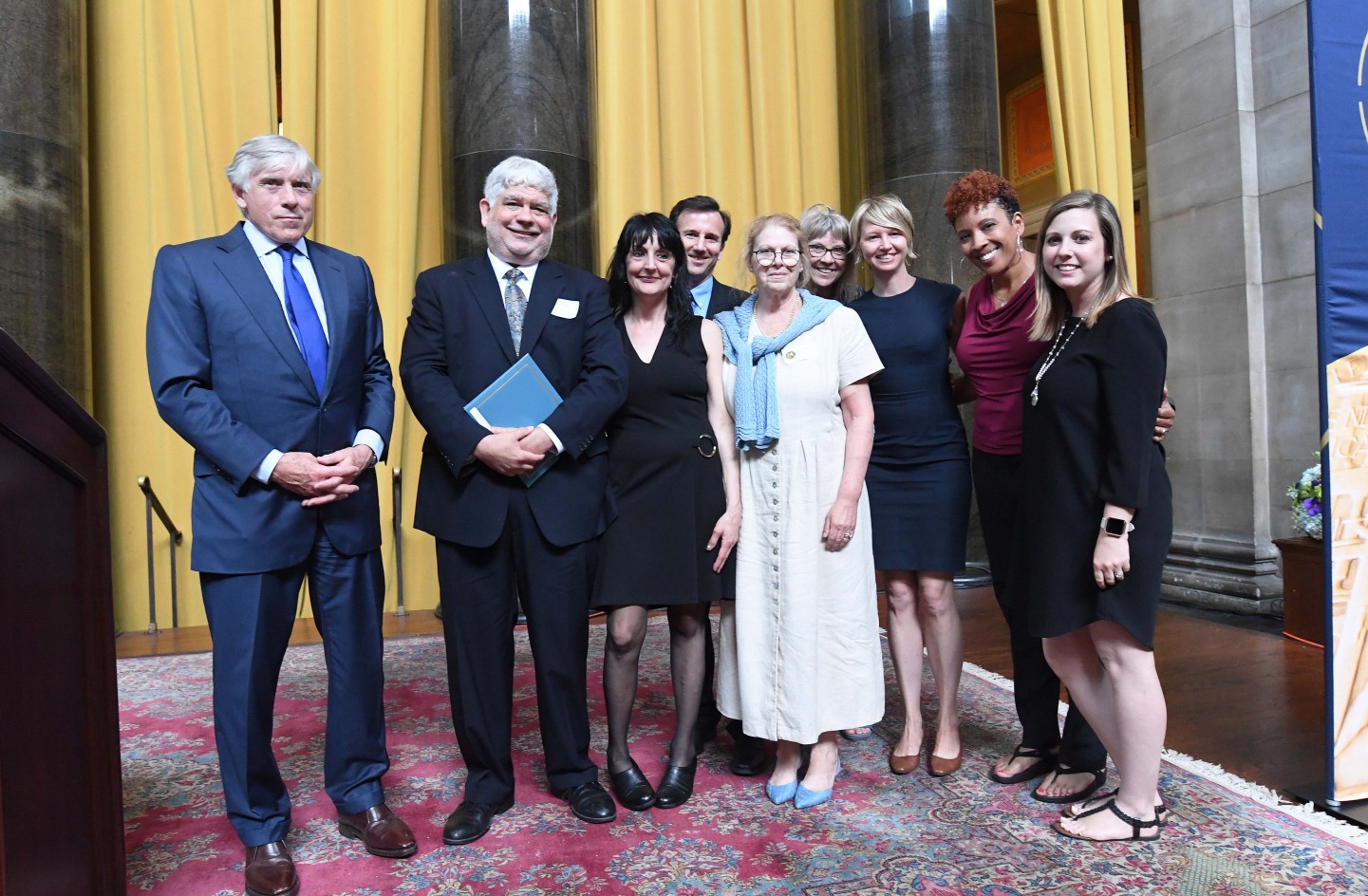
Staff members from The Cincinnati Enquirer (including Peter Bhatia [left], Terry DeMio [first from left], Dan Horn [second from left], Amy Wilson [third from left], Carrie Cochran [fifth from left] and Cara Owsley [sixth from left]) accept the 2018 Pulitzer Prize for Local Reporting from Columbia University President Lee Bollinger. (Photo: Eileen Barroso/Columbia University)
Winning Work
The scourge of heroin addiction has been a topic of news coverage in Cincinnati, Northern Kentucky, and the Midwest for years. As our region has suffered more and more, and as the toll of overdose has grown, the epidemic has attracted a huge amount of coverage from The Enquirer, Cincinnati.com, and other media.
Two years ago Terry DeMio, who was already covering the topic as part of her duties at The Enquirer, became perhaps the only reporter nationwide devoted to full-time coverage of opioid addiction. Her distinguished reporting over that time has brought into sharp relief the costs of addiction, the personal toll it takes on families and individuals, and the increasing percentage of time first responders must devote to addiction-caused emergencies.
Despite her award-winning work, Terry -- and her colleagues in the newsroom -- knew we needed to do more to truly document the impact of heroin here. That led to this 20-page special section and online presentation today.
The work assembled here took weeks and months of planning and, during a week in July, more than four dozen reporters and photographers spread out across the metro area to document the heavy burden of heroin here. Our colleagues at the Media Network of Central Ohio – 10 news sites across the middle of the state from Chillicothe to Port Clinton – also participated and versions of this work are appearing in those papers today as well.
DeMio and reporter Dan Horn assembled the story from the feeds of their fellow reporters. Enquirer writing coach Amy Wilson led the planning effort and edited the work you are reading today. Video editor Amanda Rossmann, photo editors Cara Owsley and Liz Dufour, and our staff of talented videographers and photojournalists produced the photography and the videos you can view on Cincinnati.com. The pages were designed by Rebecca Markovitz.
We undertook this work – spreading our staff throughout courtrooms, jails, treatment facilities, finding addicts on the streets and talking to families who have lost love ones – to put the epidemic in proportion. It is massive. It has a direct or indirect impact on every one of us. It doesn’t discriminate by race, gender, age or economic background. Its insidious spread reaches every neighborhood, every township, every city, regardless of demographics. And it is stressing our health-care systems, hospitals and treatment capacity.
We set out to do this project to not to affirm or deny differing views on the cost of battling addiction and its impact. Rather, we set out to understand how it unfolds day in and day out. I believe you will find what we found to be staggering. In the weeks ahead, The Enquirer will build on this effort, devoting more attention to actions our communities can take to make a difference against heroin’s horrible impact.
Hence the title of this ongoing project: “Heroin: Reclaiming Lives.”
We are grateful to St. Elizabeth’s Hospital system for underwriting this work. Its support helped make this special section possible and will facilitate more work on this topic later this fall.
As always, thank you for your readership of The Enquirer and Cincinnati.com.
Peter Bhatia
Editor and Vice President, The Cincinnati Enquirer and Cincinnati.com
Ohio editor, the USA TODAY Network