Tampa Bay Times, by Michael LaForgia, Cara Fitzpatrick and Lisa Gartner
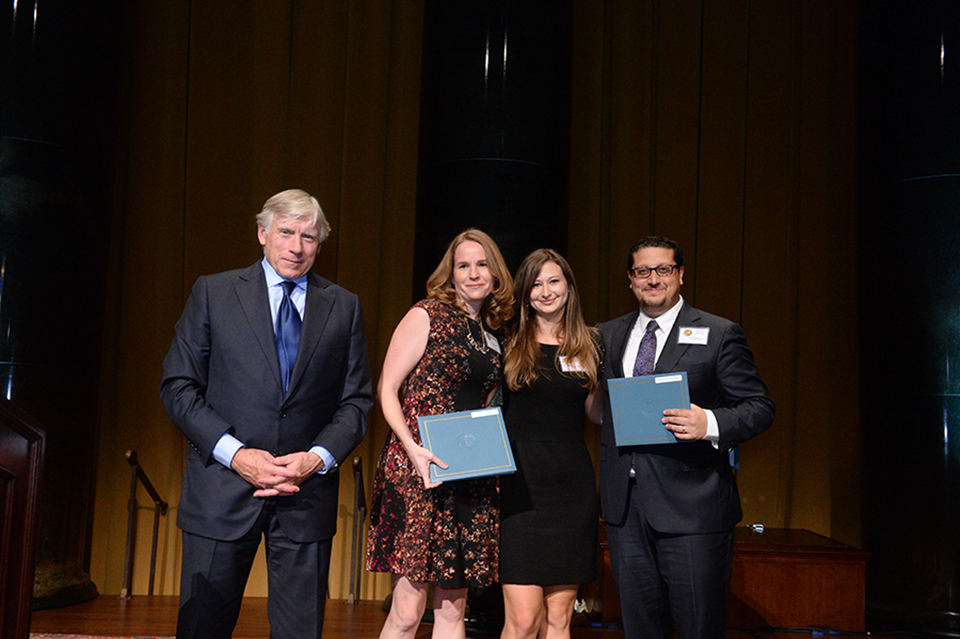
Columbia University President Lee C. Bollinger (left) presents the 2016 Local Reporting Prize to (left to right) Cara Fitzpatrick, Lisa Gartner and Michael LaForgia of the Tampa Bay Times.
Winning Work
By Nathaniel Lash
By Cara Fitzpatrick, Lisa Gartner and Michael LaForgia
Photographs by Dirk Shadd
Publication dates reflect print editions.
By Lisa Gartner and Michael LaForgia
Photographs by Dirk Shadd
By Cara Fitzpatrick, Michael LaForgia and Adam Playford
Photographs by Dirk Shadd
Written by Lisa Gartner
Designed by Martin Frobisher
Developed by Alexis N. Sanchez
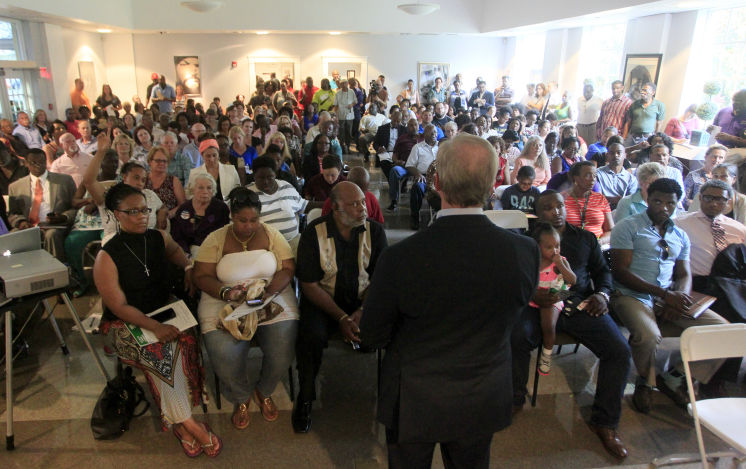
A Pinellas district event to address low-performing schools in south St. Petersburg draws a standing room only crowd, many of whom are skeptical about improvement plans.
By Lisa Gartner and Michael LaForgia
Photos by Dirk Shadd
Superintendent Mike Grego on Friday sought to reassure members of the city's black community in the wake of a Tampa Bay Times investigation that traced the district's role in resegregating five elementary schools and then turning them into some of the worst in Florida.
Speaking to a standing-room-only crowd of more than 150 parents, grandparents, community leaders and school employees, Grego described the steps he already has set in motion to improve the schools, including steering them more money and adding classroom aides, social workers and mental health counselors.
Some in the audience were skeptical.
"Stop coming and telling me stuff that makes me feel good," said Deveron Gibbons, a member of the board of trustees at St. Petersburg College. "You keep coming down here and telling me about your plan. Include these people in your plan. It's time to include us."
Echoing others in the crowd, Gibbons asked Grego why it took a newspaper series to get district leaders to visit St. Petersburg. "If your intent is to help this community, why did you not come here first?"
"It appears to me that this meeting was called as a means of damage control," said another audience member, retiree Moses Holmes. "What's the plan to help these kids?"
Retired teacher Myrna Starling, who taught at Maximo Elementary for 29 years, called on the district to shake up the student enrollment plan and once again bus students out of south St. Petersburg. She said airports, movie theaters and stores are no longer racially segregated.
"So why are we accepting black schools?" she said, referring to the School Board's vote to abandon integration in 2007. "Why have we had 7 or 8 years of this craziness?"
For his part, Grego repeatedly acknowledged the district's role in creating problems in the schools — Campbell Park, Fairmount Park, Lakewood, Maximo and Melrose — but urged the crowd to look forward instead of backward. "We have to stay together, and we have to stay united, and we have to begin to trust one another," Grego said.
Held at the Dr. Carter G. Woodson African American Museum on Ninth Avenue S, the meeting was billed as a chance to discuss the district's "solutions for low-performing schools."
Also present were St. Petersburg Mayor Rick Kriseman and School Board members Renee Flowers, Linda Lerner and Carol Cook. Not present at the meeting were Peggy O'Shea, who was traveling Friday, and Ken Peluso, who was recovering from surgery. Terry Krassner and Janet Clark also were not at the meeting. They didn't return calls for comment ahead of the forum.
The meeting came in the aftermath of "Failure Factories," a Times investigation that exposed the district's role in creating five of Florida's worst schools in the county's black neighborhoods.
The first installment showed that the five schools all were average in 2007, when the School Board voted for neighborhood schools. In the next eight years, they became the most segregated schools in the county — and their failure rates became among the highest in the state.
The second installment, published online Friday, revealed that violence and disruptions have spiraled out of control in the schools while district leaders neglected programs that would have made them safer.
Before the meeting, in their first public comments since the series began, three School Board members defended the district while expressing a willingness to consider new ways of improving the schools.
Lerner, the board chairwoman, said she wanted to study what other districts were doing to aid black children. Peluso pointed to solutions already in the works. O'Shea said she was open to considering a new student enrollment plan. "It is time to have more creative discussions," O'Shea said.
The forum was the latest move by a district seeking to reassure the county's black community.
After the Times series began, district officials launched a public relations campaign outlining efforts to improve the schools. They posted a documentary-style video on the district website that touted the schools' "sense of pride and belonging."
In spite of those efforts, leaders across the area are expressing outrage.
On Wednesday, State Rep. Darryl Rouson, D-St. Petersburg, called on the state Attorney General's Office to investigate whether the Pinellas school system has discriminated against black students.
On Tuesday, U.S. Rep. Kathy Castor, D-Tampa, asked the U.S. Department of Education to review whether Pinellas is equitably funding its most segregated schools, calling the situation a "crisis."
By Lisa Gartner, Michael LaForgia and Nathaniel Lash
Photos by Dirk Shadd
By Cara Fitzpatrick and Michael LaForgia
Photos by Dirk Shadd
By Cara Fitzpatrick, Lisa Gartner and Michael LaForgia
Photos by Dirk Shadd
Photos and multimedia by Dirk Shadd
Multimedia editing by Tracee Stockwell
Developed by Alexis N. Sanchez
January 25, 2016
To the Judges:
Just five days after the Tampa Bay Times published “Failure Factories,” the opening of its investigation into the re-segregation of Pinellas County schools and the neglect of black students, the superintendent stood before a meeting of angry parents and grandparents. He told the crowd things weren’t so bad, or at least were getting better.
Audience members shook their heads in disgust. “Stop coming and telling me stuff that makes me feel good,” said one community leader. A retiree stood up and quieted the room with a simple, poignant question: “What’s the plan to help these kids?”
For years, the people in charge of Pinellas County schools blamed abysmal black academic performance on poverty. They excused it as the natural state of things, saying it was no different than the challenges faced by any other school system across the nation.
Nothing could be further from the truth. The Tampa Bay Times investigation found that in just the past seven years, school leaders – through their actions, their neglect and a blind-eye to the consequences of both – created five of the worst schools in Florida. Compared with black students in urban and rural communities poorer and socially rougher, the kids in well-to-do Pinellas fared badly, the Times found.
A team of Times reporters spent 18 months analyzing millions of rows of data on black student performance and behavior. The reporters embedded in historically black neighborhoods for months to chart the personal stories of hundreds of students and teachers from the schools. Then they interviewed top officials and gathered documents from the 20 largest school systems in Florida to compare them to Pinellas County.
That deep journalistic dive revealed the genesis and consequences of the problem. School leaders abandoned integration. Then, when five schools became overwhelmingly black and poor, the district neglected the schools until they essentially became “failure factories.” The power of the stories and digital graphics was their clarity:
Pinellas County has the highest concentration of black student failure in all of Florida.
Black students here get the least qualified teachers, go to school on the most violent campuses and are far more likely to be suspended for minor infractions.
The school board broke promises of money and resources. Then as black children started failing at outrageous rates, as overstressed teachers walked off the job, as middle class families fled en masse — the board failed to act and refused to embrace the best practices underway in school districts across the state.
No Times investigative series in recent memory has led to so much action in such a short time.
U.S. Sen. Bill Nelson and U.S. Rep. Kathy Castor called for an investigation into the district’s use of federal Title I dollars. That investigation is underway.
U.S. Secretary of Education Arne Duncan read the series, flew to St. Petersburg and met with many of the families mentioned in the stories. He publicly chastised the School Board, accusing the district of “educational malpractice.” He has vowed to follow-up.
Despite a largely defensive posture toward the stories, school officials, acknowledged the broader issues and have taken the following actions:
1) The school board hired a turnaround specialist at a salary of $100,000 specifically responsible for improving the schools and ensuring they get attention and resources.
2) The district announced plans to convert three of the schools into magnet programs to improve diversity and attract better teachers.
3) The district said it will expand the ranks of teacher’s aides and committed to direct more resources to training and recruitment.
There was widespread reaction outside the school district offices, as well. Local businesses including the Tampa Bay Rays baseball team turned out in force to help, investing thousands of dollars and hundreds of volunteer hours in the struggling schools.
Maybe most importantly, the Times’ journalism has brought new light to the consequences and subtleties of structural racism. Too many people wrote off the five schools as just a sad social fact of life. The Times didn’t settle for that.
I am very proud to submit Failure Factories for your consideration.
Sincerely,
Neil Brown
Biography
Michael LaForgia is a reporter on the investigations team at the Tampa Bay Times.
In 2014, he and Times reporter Will Hobson won the Pulitzer Prize for Local Reporting for stories that revealed Hillsborough County was paying tax dollars to house the homeless in squalor.
He joined the Times in 2012.
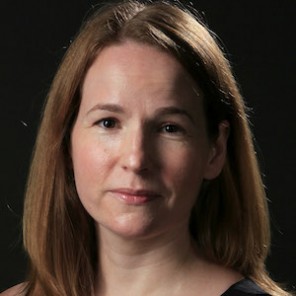
Cara Fitzpatrick joined the Tampa Bay Times in 2012 and is an education reporter. She grew up in Washington State and graduated from the University of Washington and Columbia University.

Lisa Gartner covers Pinellas County Schools, colleges and universities. Before joining the Times in 2013, Lisa covered D.C. Public Schools for The Washington Examiner. Herself a product of Florida public schools, Lisa grew up in Palm Beach County. She attended Northwestern University after purchasing a very heavy coat.