Sara Ganim and members of The Patriot-News Staff
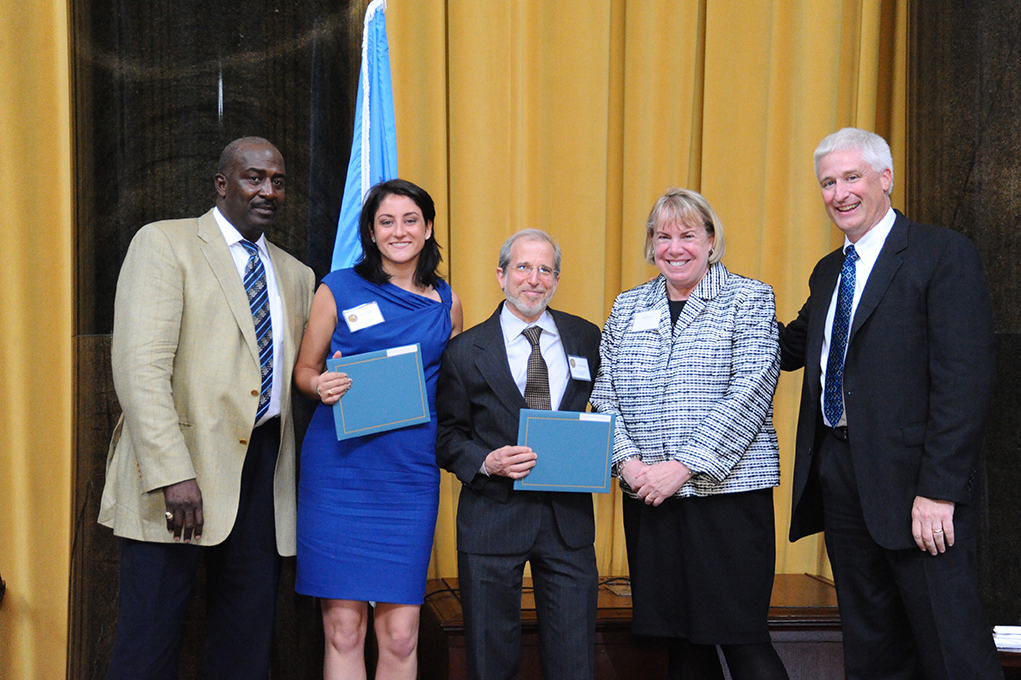
Gregory Moore (left), co-chair of The Pulitzer Prize Board, presents the 2012 Local Reporting Prize to (left to right) Sara Ganim, David Newhouse, Cate Barron and Mike Feeley of The Patriot News, Harrisburg, Penn.
Winning Work
Paterno among those called to testify after teen alleges he was indecently assaulted by former defensive coordinator
By Sara Ganim
Penn State football legend Jerry Sandusky is the subject of a grand jury investigation into allegations that he indecently assaulted a teenage boy.
According to five people with knowledge of the case, a grand jury meeting in Harrisburg has been hearing testimony for at least 18 months about the allegation, which was made in 2009 by a 15-year-old from Clinton County.
The teen told authorities that Sandusky had inappropriate contact with him over a four-year period, starting when he was 10.
Penn State coach Joe Paterno, athletic director Tim Curley and retired university Vice President and Treasurer Gary Schultz were among those who appeared before the grand jury in January at the attorney general’s Strawberry Square office complex, according to a person with knowledge of the investigation. Attempts to reach the three for comment were unsuccessful.
It is not clear whether university President Graham Spanier has testified and he declined comment on the matter when questioned earlier this week.
At one time, Sandusky was considered Paterno’s likely successor. During his 32 years on the sidelines, the State College man was credited with turning Penn State into Linebacker U., producing such pro football greats as Jack Ham and LaVar Arrington.
Sandusky, 67, retired from Penn State shortly after the Alamo Bowl in December 1999. In his 2000 autobiography, “Touched: The Jerry Sandusky Story,” he says he decided to leave after he “came to the realization I was not destined to become the head football coach at Penn State.”
He spent the next 11 years focused on running The Second Mile, a nonprofit he founded in 1977 that reaches 10,000 Pennsylvania youths a year through summer and year-round camp programs. The charity was honored by President George H.W. Bush in 1990 as a “Point of Light.”
Last fall, Sandusky announced that he was retiring from day-to-day involvement in the charity to spend more time with family and handle personal matters.
Since then, rumors of misconduct by Sandusky have lit up Internet comment threads and message boards that are normally havens for Penn State football fan chatter.
Repeated efforts to reach Sandusky over several weeks to comment on the investigation have been unsuccessful. He has not responded to phone calls and other attempts to reach him at his home or through attorney Joseph Amendola in State College.
As is standard policy, the attorney general’s office would neither confirm nor deny whether a grand jury was meeting about Sandusky.
The 2009 investigation
The allegations against Sandusky surfaced in 2009, when he was volunteering as an assistant high school football coach at Central Mountain High School in Clinton County.
It was there the 15-year-old student told school officials that Sandusky had touched him inappropriately while they were alone in a gym.
John DiNunzio, Keystone Central School District’s interim superintendent at the time, said the boy’s mother reported the incident to the school principal and head football coach. At that point, DiNunzio said he was notified.
DiNunzio said he never spoke to the mother or the child. He said the principal and coach told him the boy alleged the “inappropriate” incident happened while the two were alone in a room on wrestling mats.
“It was strictly a touching type of situation,” DiNunzio said of the allegations.
DiNunzio, who is now interim superintendent with the Bellefonte Area School District, called Clinton County Children and Youth Services. Once it left his desk, he says, he never heard a word from police.
“It’s been a hush-hush situation,” DiNunzio said. “I’ve actually called [the school] — they’ve said they heard nothing about it.”
According to sources, the boy told Children and Youth Services that Sandusky had indecent contact with him several times over four years
Children and Youth Services investigated the boy’s story and sent the case to Clinton County District Attorney Michael Salisbury. His office forwarded it to Centre County, where the incidents were alleged to have taken place.
Then-Centre County District Attorney Michael Madeira transferred the case to then-state Attorney General Tom Corbett in March 2009. Corbett, now governor, declined comment through his spokesman.
Kelly Hastings, current superintendent of Keystone Central School District, said she has no first-hand knowledge of the report and that no documents from the school have been subpoenaed by police.
DiNunzio, who has had a long career in education, said he was shocked when he heard the allegation and surprised that he was not contacted again.
“No one has ever called me about it in any way shape or form,” he said.
When Sandusky quit as a volunteer in 2009 with Central Mountain High School, he told officials there he was leaving to devote more time to The Second Mile, DiNunzio said. Sandusky retired from The Second Mile about a year and a half later.
Second Mile Executive Director Dr. Jack Raykovitz, wrote in an email: “While we are aware of the rumors circulating regarding Mr. Sandusky, we believe it would be inappropriate to respond to rumors. Futher ... I am aware of no investigation of The Second Mile or our programs.”
A Second Mile Board member, who asked not to be named, said Sandusky informed the board of the allegations against him and the investigation. At that point in time, Sandusky distanced himself from the kids but continued fundraising for the organization for a period of time before he finally retired, the board member said.
“We all know there’s an investigation going on,’’ the board member said.
Earlier allegation
Two months ago, state police at Rockview in Centre County began calling witnesses to a May 1998 report by Penn State University police detailing an earlier allegation of inappropriate contact against Sandusky by another boy.
According to several sources, that boy, who was 12 at the time, alleged he and Sandusky were showering in the football building on Penn State’s campus when the incident took place.
The boy’s mother told The Patriot-News she was specifically instructed by state police at Rockview not to speak with a reporter. Her name is being withheld by The Patriot-News to protect the identity of her son.
No charges were ever filed against Sandusky.
According to sources close to the investigation, the boy told police in 1998 that Sandusky had showered with him in a locker room of the Lasch Building — home to the football program — during a tour. The boy claimed Sandusky washed his body during the shower, sources said.
As part of the May 1998 investigation, police had the boy’s mother call Sandusky to her State College home and confront him while they hid in another room, according to sources.
Another boy, now an adult in the armed forces, was named as a witness in the 1998 Penn State police report and has been contacted by state police, his wife confirmed.
When reached by phone, his mother said she took her son to Penn State police for questioning in 1998 but didn’t listen to the interview. She said she never asked her son what happened.
Retired Penn State Police Officer Ron Schreffler handled the 1998 case. When approached recently, Schreffler said he couldn’t comment and asked a reporter, “How did you see that report?”
While the grand jury has been hearing testimony, Sandusky has been devoting time to fundraising for The Second Mile.
In January, the organization received the go-ahead from Centre County commissioners to apply for a $3 million state grant to pay for an $8.5 million learning center on 60 acres near the University Park Airport.
The facility would eventually include housing for up to 100 children.
Sandusky’s devotion to the program was the reason he gave for turning down job offers for football head coaching jobs at Temple University and the University of Maryland
In his autobiography, Sandusky wrote, “Any time you deal with young people, there will be extreme highs and lows. There have been moments of frustration, despair and heartache.”
In 2007, the statute of limitations for sex crimes against minors was extended so that police have until the alleged victim’s 50th birthday to file charges. That applies to any alleged victim of child sex abuse who turned 18 on or after Aug. 27, 2002.
Patriot-News staff writers Jan Murphy and Bob Flounders contributed to this report.
PSU football legend, charity founder faces charges of sex crimes
By Sara Ganim
Jerry Sandusky’s public persona was almost perfect — a revered Penn State football defensive coordinator who helped lead the team to two national titles then dedicated himself to bettering kids through his charity and in his personal life.
On Friday, the state attorney general’s office indicted Sandusky with 40 charges of sex crimes against boys — some dating to Sandusky’s coaching days at Penn State.
The indictment follows an almost-three year investigation by the attorney general that started in early 2009, when a Clinton County teen boy told authorities that Sandusky had inappropriately touched him several times over a four-year period.
“I just got goosebumps, seriously,” said the mother of one victim after the filing Friday. “I just lived with this for so long, and it killed me when people talked about him like he was a God, and I knew he was a monster.”
The charges included 21 felony counts and 19 misdemeanors. They are: 7 counts of involuntary deviate sexual intercourse of someone under 16, 1 count of aggravated indecent assault of someone under 16, 5 counts indecent assault of someone under 16, 3 counts of indecent assault of someone under 13, 8 counts of unlawful contact with a minor, 8 counts of corruption of minors and 8 counts of endangering the welfare of children.
The offense dates include 1995, 1996, 1998, 2000, 2002 and 2005.
The charges were placed on the state court website Friday afternoon, likely by accident. By 5 p.m., they were removed from the site, but the papers appeared again later in the evening. Paperwork that detailed the charges was not filed.
Details of the indictment are expected to be released Monday. Sandusky had not been arrested late Friday night.
Attempts to reach Sandusky at home were unsuccessful. Messages left with his attorney were not returned.
In March, his attorney said that Sandusky denied all of the allegations brought against him and was looking forward to proving his innocence.
Attempts to reach Penn State head coach Joe Paterno and university officials were also unsuccessful Friday.
The attorney general’s office did not return repeated phone calls. And Gov. Tom Corbett, who was attorney general when the investigation began, would not comment, his spokesman said.
At one time, Sandusky was considered Penn State head coach Joe Paterno’s likely successor. During his 32 years on the sidelines, the Centre County resident was credited with turning Penn State into Linebacker U.
Sandusky retired from Penn State shortly after the Alamo Bowl in December 1999, and he began devoting all of his time to running The Second Mile, a children’s charity he founded in 1977.
Sandusky’s devotion to the charity was the reason he gave for turning down head football coaching jobs at Temple University and the University of Maryland.
Last fall, Sandusky retired from day-to-day involvement with The Second Mile, saying he wanted to spend more time with family and handle personal matters.
Investigation
When the criminal investigation began in 2009, Sandusky was a volunteer football coach for the Keystone Central School District in Clinton County.
A then-15-year-old student told investigators that Sandusky had abused him several times over a four-year period, starting when he was 10.
The Centre County district attorney, citing a conflict of interest, passed the case on to the attorney general’s office.
A grand jury was convened, and the investigation that followed included testimony from the likes of Paterno, Athletic Director Tim Curley, and interim Vice President for Finance and Business Gary Schultz. The Patriot-News broke the story of the investigation in March, shortly after that testimony.
Thousands of pages of documents were subpoenaed from Penn State University and from The Second Mile.
As part of the investigation, authorities went back and took a second look at a report filed to Penn State police in 1998 that alleged Sandusky inappropriately touched a 12-year-old boy as they showered together during a tour of the football locker room.
Another boy, now an adult in the armed forces, was named as a witness in the 1998 Penn State police report and has been contacted by state police, his wife confirmed. When reached by phone this year, his mother said she took her son to Penn State police for questioning in 1998 but didn’t listen to the interview. She said she never asked her son what happened.
Police investigated that report in May 1998, and then-District Attorney Ray Gricar never pursued charges.
A member of law enforcement who was in the room with Gricar said the DA was told about the report, and had two police officers hide in the mother’s home while Sandusky came to her house to talk about what happened.
The meeting, according to the source, was Sandusky’s idea.
“That mother said to the police, ‘He’s coming over to explain what happened to me,’¤” the source said. “Ray and the detectives decided that they would go to the house to find out what was going on — to hear what he had to say.”
A few days later, Gricar got a report back from police.
“Ray said ‘I’ll be in touch,’ and he called the chief or supervisors for those detectives. I don’t know what he said, but I know that no investigation or charges were pursued from that point on,” the source said.
By June 2, the report was labeled “unfounded” by Penn State police, and the case was closed.
The Penn State police officer who led that investigation, Ron Schreffler, is now retired. When approached in March, Schreffler said he couldn’t comment and asked a reporter, “How did you see that report?”
Gricar disappeared in 2005 and was declared dead earlier this year.
Among those who testified was the mother of Sandusky’s youngest adopted son, a boy he met through The Second Mile, took in as a foster child and later legally adopted as an adult.
Matt Sandusky’s mother, Debra Long, told The Patriot-News that she had raised concerns about the behavior of her son and Sandusky once her son went to live with the Sandusky family in 1995.
“We tried to stop it back then,” Long said. “We were dragging it to the court system all the time and we couldn’t prevent it. It upsets me, because these kids didn’t need to go through this.”
'Told different things’
Rumors about Sandusky’s conduct began swirling on message boards and football websites soon after he retired from his post at the Second Mile in August 2010.
The grand jury investigation generated a roller coaster of speculation, even for the victims.
“I’ve been told different things and nothing ever came to pass,” one mother said. “Personally I just thought he was going to get away with it again.”
In 1998 her son and a second boy told their stories to police, but no charges came of the incident.
She says she felt there were a few people trying to help her son, and many others who were not.
“I feel guilty, because I didn’t come forward way back a long time ago and I should have,” she said. “I knew my son would be vilified. It was about protecting my son.”
She said hearing that there were more victims following her son’s case was even more heartbreaking.
Having multiple victims is not unusual in sex cases, said Tina Phillips, director of training for the Pennsylvania Family Support Alliance. And a case with multiple victims almost always takes longer to investigate, partly because they usually don’t all come forward together.
“If there are multiple victims, then sometimes they feel safer to tell what happened to them,” Phillips said. “A lot of times victims will have been told by the perpetrator, ‘No one will ever believe you. People will take my side, not yours.’ Then, other people see that people are listening and they’ll want to come forward and back that story up.”
The Second Mile
Second Mile charity officials say they were shaken by the allegations and charges, but insist their priority will remain in helping kids.
“That is why we have many policies and procedures designed to protect the children involved in our programs, including employee and volunteer background checks, training and supervision,” said President and CEO of the Second Mile, Jack Raykovitz, in a statement released Friday afternoon. “As a result, other than occasional bumps and bruises, we have never had an incident impact the safety, health or well-being of children during our programs, and we will continue to do everything in our power to maintain the trust placed in us by the families and professionals with whom we partner to keep that record intact.”
But can they really survive this?
“It will put a black eye on everything, even though it doesn’t reflect what we do for the children we serve, in the communities we serve,” said Mark Everest, a member of The Second Mile’s south-central board of directors for more than 15 years.
The organization now has to reach out to the community to remind people of all the good work it has done for decades, Everest said.
“What The Second Mile was designed to do is help underprivileged kids, and that has never strayed, even through all this stuff with Jerry,” Everest said. “The organization is solid, and what it stands for is solid. I hope the public judges us on that.”
The State College-based charity has seven branches across Pennsylvania. Its advertising says it reaches more than 280,000 kids each year.
The majority of those are through its sports trading card program called Nittany Lions Tips, which features motivational messages from Penn State athletes.
But the organization also has a leadership institute, provides counseling services, foster family support and early intervention programs.
Direct services to more than 6,000 kids and their families, according to their fliers, plus 2,500 counselors, each reaching about 115 with the TIPS prevention program.
“We work very hard in The Second Mile and it should have no influence in it,” said Dottie Huck, a member of the organization’s state board of directors.
Speaking personally, Huck said Sandusky has “done some wonderful things in his lifetime and we should try to help him. ... We all make little mistakes in our lives.”
In his autobiography, “Touched: The Jerry Sandusky Story,” the football legend talked about what he called his personal law, “Jer’s Law.”
“I allowed myself to be mischievous, but I didn’t let it get to the point that someone would be intentionally hurt,” he wrote. “I swore I would tell the truth if I was ever caught doing something wrong.”
Staff writers Jan Murphy and Jeff Frantz contributed to this report.
By Sara Ganim
He was the last victim, that we know of, to come forward.
But in many ways, he was the first.
He was one of the first with enough courage to say something. To stick around for three years while police and a grand jury talked to dozens of people and combed through thousands of documents.
To hang on emotionally.
To take a stand against a Goliath. A legend. A man that some saw as a god.
He was the first to be believed. Authorities even call him Victim One.
The mother of the Clinton County boy is telling her family story. It’s a story that launched a three-year grand jury investigation that resulted in sexual assault charges against former Penn State defensive coordinator Jerry Sandusky, allegedly involving eight boys.
“I’m very proud of him,” the mother said of her son, on the brink of adulthood and at the heart of what some are calling the biggest scandal in college sports.
“He’s a brave kid,” she said. “And his major concern in the whole thing was for anybody else. That was his big thing. He said, ‘I just don’t want this to happen to anybody else.’”
And now he knows that he’s not alone.
Ten years before he came forward, another child, now 24, had also spoken up. He wasn’t believed. Allegations he made against Sandusky about touching during a shared shower at Penn State in 1998 never resulted in charges.
Sandusky, through his attorney, denies all the charges. Attorney Joe Amendola, said Sandusky attributes the allegations to troubled kids who are acting out.
“I’m so upset,” said the mom of the 24-year-old, who authorities are calling Victim Six. “My son is extremely distraught, and now to see how we were betrayed, words cannot tell you. To see that Graham Spanier is putting his unconditional support behind Curley and Shultz when he should be putting his support behind the victims, it just makes them victims all over again.”
She’s talking about the perjury and failure-to-report charges filed against former Penn State athletic director Tim Curley and resigned Vice President of Business and Finance Gary Schultz.
Prosecutors allege the administrators ignored a 2002 report from a graduate assistant — identified by sources as Mike McQueary — that he saw Sandusky having sex with a young boy in a shower.
McQueary, now an assistant coach for the Nittany Lions football team, went to his father first, then to coach Joe Paterno.
“I don’t even have words to talk about the betrayal that I feel,” said the mom of Victim Six. “[McQueary] was a grown man, and he saw a boy being sodomized ... He ran and called his daddy?”
As media from around the country descended on Happy Valley on Monday to dig into the allegations and the details of a possible cover-up, the two mothers decided to talk to The Patriot-News.
Both said they don’t want their sons’ stories to get lost in the scandal.
Victim One
Victim One met Sandusky through the Second Mile — a charity for needy children that Sandusky started — and quickly got drawn into his world of big-time college football: gifts, trips, sporting events, and hanging out with a guy who seemed to be loved by everyone.
But his mother said it came at a price.
The Patriot-News will not identify either women or their sons in keeping with our policy not to name victims of sexual assault. The mother of Victim One specifically asked that other media respect her request for no more interviews.
She brought the psychologist who has been helping her son cope with the trauma to the interview.
Almost from day one, psychologist Michael Gillum has met regularly with the boy and counseled him through the protracted police investigation.
A few weeks before her son broke down and confessed to a principal at Central Mountain High School in Clinton County that he was being molested by Jerry Sandusky — a volunteer football coach at his high school — his mother began to suspect something was wrong.
First, it was because her son was acting out. When she grounded him, she said Sandusky demanded he be able to “take care of it.”
“I said, ‘No way, he’s my kid,’” she said.
Then, her son began asking her about an online database for “sex weirdos.”
“You don’t want to just accuse people of that,” the mother said. “I called the school principal and the guidance counselor and said, if nothing else, he’s taking my son out of classes. He’s leaving the school with him. ... So I asked them to call him into the office and ask [my son] how he felt.
“They did call him to the office that day and I remember [the principal] was in tears and she said, ‘You need to come here right away.’”
Her son, then 15, broke down and told them what happened.
“They told me to go home and think about what I wanted to do, and I was not happy,” she said. “They said I needed to think about how that would impact my son if I said something like that. I went home and got [my son] and we came to [Children and Youth Services] immediately.”
Officials at Central Mountain High School have said they immediately reported the abuse, and Attorney General Linda Kelly praised them for doing the right thing.
The boy’s story would evolve over the next few weeks as he was interviewed by police. That’s not atypical for sex cases involving teens, Gillum said.
“It’s essentially peeling back the layers of an onion,” Gillum said. “Because it’s so humiliating. It’s so much mental anguish. ... They typically want you to know something inappropriate happened, then there was a progression where boundaries were violated.”
But sometimes it takes time for the victim to get it all out.
That’s something Sandusky’s attorney Joe Amendola points to in defense.
He said it appears someone coaxed this victim into embellishing his story because it changed from groping to more graphic sex acts.
Gillum called it a typical defense tactic.
"They will imply ... that I must have led the witness,” he said. “But when you’re specialized in children and adolescent child abuse, you’re trained to make sure you wouldn’t compromise the evidence.”
Victim Six
Victim Six cried when he read the 23-page grand jury presentment released Saturday, his mother said. And not for himself.
“He had no idea how bad it was,” she said. “He was lucky. He only had that one contact with him.”
It allegedly happened in May 1998, following a tour of the football locker rooms. Her son and another boy, both 11, shared a shower with Sandusky.
When he got home he said, ‘If you’re wondering why my hair is wet, we took a shower together,’ and ran into his room, his mom recalls.
She called police.
But after a six-week investigation that included the mother confronting Sandusky in her home as police listened in the other room, Sandusky was cleared.
Then-Centre County District Attorney Ray Gricar decided there wasn’t enough evidence.
“And you’re going to tell me that Spanier and Paterno weren’t informed of something that was that huge that Ray Gricar was in on it but Spanier was kept in the dark?” she said. “I’m just not that stupid. I’m so upset I just can’t believe it.”
Paterno’s son, Scott, has said that lawyers for Penn State assured him his father was never told about the 1998 report — investigated by university police.
It’s unclear from the presentment if Spanier knew. However, Schultz, who was in charge of the police force, acknowledged knowing about it.
When the mother confronted Sandusky, he said: “I understand. I was wrong. I wish I could get forgiveness. I know I won’t get it from you. I wish I were dead,” according the presentment from the grand jury.
An investigator for Children and Youth Services broke the news to the mother: It was all a big mistake, the mother said she was told. The police officer who investigated won’t comment. Neither will the former police chief.
“Jerry Sandusky admitted to my face, he admitted it,” the mother said. “He admitted that he lathered up my son they were naked and he bear-hugged him. If they would have done something about it in 1998, and then again in 2002 — there was two chances they dropped the ball and I think they should all be held accountable.”
Her son, she said, can’t stop thinking about Victim One.
“That poor child,” she said. “My heart is like breaking for this boy and his family. And what about all the boys we don’t know about? They could have all been saved.”
The only semblance of comfort their family has had in the last three days is from community support.
“At last, my family and I are believed,” she said. “Because they tried to make my son and the other boy out to be liars.”
Every day was a struggle
Finding the courage to come forward was supposed to be the hardest part.
“We expected you just arrest people who do stuff like that,” Victim One’s mom said. “We didn’t realize it was going to be this difficult and take this long.”
The three-year investigation eventually ended with a grand jury finding that Sandusky had eight victims — two of them had long-term relationships with Sandusky and six involved shared showers in Lasch Building at Penn State, which houses the football program.
“I am upset that it took this long, but I also realize that the more people they find, the less impact it’s going to have on my son ... and it’s only going to help everybody else,” the mom said.
Hearing that he wasn’t alone was a challenge of emotions for her son.
“He wasn’t happy that it happened to somebody else,” she said.
But in a way, there was some relief: more chance that he would be believed.
It was very hard to keep their cool, to keep the allegations a secret, and not talk to anyone. But they did it.
When the arrests were announced Saturday, and the family learned that two Penn State officials had known about a prior incident and didn’t report it to police, she flipped out.
“I’m infuriated that people would not report something like that,” she said. “I still can’t believe it. I’m appalled. I’m shocked. I’m stunned. There’s so many words. I’m very mad. They could have prevented this from happening.”
Her son has accused Sandusky of four years of abuse, and it started not long after Curley and Schultz were notified of a abuse report in 2002.
The attorney general has said their inaction allowed Sandusky to molest this boy.
His mom said he knows that.
“He’s very angry,” she said. “I just can’t fathom how anybody could do that. When I read the indictment, I was very shocked that there was so many people that didn’t do anything ... and there had to be more people covering it up, I think, for him to get away with it for this long.”
When her son first came forward, every day was a struggle. There was this overwhelming feeling of deception. Sandusky was supposed to be a role model.
“In the beginning, it was extremely upsetting. I was so shocked. It got so bad we didn’t know what to do,” she said. “[He] is really, really afraid of Jerry. He told me numerous times when he started backing away from him, you just can’t tell him no. I said, why not?”
Her son replied, “You just don’t do that.”
“His attorney was saying how these disadvantaged children, you can’t trust them ... because they come from low income. I don’t think that has any bearing on anything,” she said. “I was warned that is what this basically would be about, because kids in The Second Mile are basically disadvantaged.”
In the first page of their presentment, grand jurors noted that, too. They accused Sandusky of using the charity to find his victims, “many of whom were vulnerable due to their social situations.”
“Obviously it’s a price that the brave victim pays,” Gillum said.
To get help:
- If you suspect child abuse, call Childline: 800-932-0313.
- If you are a victim seeking counseling, you can find a trained abuse psychologist through the Pennsylvania Psychological Association: www.PaPsy.org, or 717.232.3817.
And when did they know it?
By Sara Ganim
What did they know and when did they know it?
The Jerry Sandusky child sex abuse case has already cost the jobs of football coach Joe Paterno and university President Graham Spanier. State and federal investigators continue to unravel the case and might bring additional charges.
More than one tip has already come into the tipline that police have set up for potential victims.
But in the end, it’s going to come down to credibility. Stories contradict each other. Grand jury testimony clashes.
Who was telling the truth? Who was trying to keep the truth silent?
And what part did that silence play in the fact that Sandusky is alleged to have sexually assaulted young boys for 10 years after the first boy stepped forward?
In early 2010, before The Patriot-News broke the story of the Sandusky investigation, the newspaper confronted Spanier and asked him if he was aware of a grand jury investigation into Sandusky. His answer was no.
By his own testimony before the grand jury, Spanier knew as early as 2002 that Sandusky and a young boy had been witnessed “horsing around” by a staff member in the locker room of the football building.
It’s not clear if Spanier also knew about a six-week investigation by his university’s police force that centered around similar touching in a shower in 1998 that never led to charges.
However, now-resigned Vice President Gary Schultz, who was in charge of the campus police in 1998 and in 2002, did know about both reports, and in his grand jury testimony, he acknowledged that they were similar — they both involved young boys and allegations of sexual misconduct in a shower at the football building.
Right now, the case against Schultz and Athletic Director Tim Curley — both charged with perjury and failure to report a crime — hinges mainly on the word of that eyewitness, then-graduate student Mike McQueary. McQueary is now a Penn State assistant football coach.
McQueary is a guy who once stepped in and broke up a player-related knife fight in a campus dining hall — a fight police admit could have been very ugly. But this week, he is getting blasted by the public for doing too little.
That same public sentiment led to an abrupt exit for legendary coach Paterno and Spanier.
But if gossip, rumor and speculation have been rampant this week about Spanier, Paterno and McQueary, the facts are more complicated — and much more disturbing.
EARLY CONCERNS
The earliest documented report of possible abuse at the hands of Sandusky is in 1995, when his now-legally adopted son was still a teenage foster child in his home.
The adoption file for Matt Sandusky, who had a different name at the time, contains letters of concern from his mother to children and youth officials and to a Centre County judge.
Matt’s biological mother, Debra Long, testified before the grand jury.
Matt, 33, is not one of the victims in the grand jury presentment, but he did testify before the grand jury.
Sandusky’s attorney, Joe Amendola, said Long is upset with Sandusky for helping her son and her allegations are not based in fact. Matt went to live with the Sandusky family after he was caught setting fire to a barn in 1995.
Children and Youth Services placed him with the Sandusky family at Jerry Sandusky’s request. He knew Matt through The Second Mile.
In his book, “Touched: The Jerry Sandusky Story” several pages are devoted to Matt.
“He became an instant challenge for me,” Sandusky writes.
Debra Long was allowed to visit her son only one-half day per month after he went to live with the Sanduskys.
About four months after he went to live with Jerry, Matt attempted suicide with a girl who was also staying at Sandusky’s house.
“The probation department has some serious concerns about the juvenile’s safety and his current progress in placement with the Sandusky family,” wrote Terry L. Trude, a school-based probation officer, days after the suicide attempt.
The letter, addressed to Centre County Judge David Grine, also said Long was concerned about Matt’s safety and mental condition, and asked that Matt go to a different foster family.
Trude finally recommended that Matt’s placement in the Sandusky house be reviewed within two months.
The night of the suicide attempt, Matt wrote a letter to the probation officer dealing with his case.
It read, in part: “I would like to be placed back with the Sanduskys. I feel that they have supported me even when I have messed up. They are a loving caring group of people. I love both my biological family and the Sandusky family.”
The day Jerry Sandusky was arrested, Matt brought his kids over to Jerry’s house. The mother of Matt’s children almost immediately went to court to prevent future visits. A judge’s order now prevents Sandusky from having unsupervised contact or overnight visits with his grandchildren.
THE FIRST VICTIM TO ASK FOR HELP
The travesty and tragedy of botched attempts to investigate Jerry Sandusky began in 1998.
Though the grand jury indictment includes four previous victims, an 11-year old boy in 1998 was the first to come forward. He is called Victim Six in the grand jury presentment.
The boy told police that Sandusky had showered naked with him. A second boy was in the showers at the time, but did not testify before the grand jury.
Then-Centre County District Attorney Ray Gricar set up a sting in the mother’s home. Sandusky had requested to meet with the mom, and Gricar had officers hide in another room and listen to their conversation.
One of those officers was Detective Ron Schreffler, the lead investigator in the case.
According to the presentment, Sandusky asked the mom for forgiveness.
“I understand. I was wrong. I wish I could get forgiveness from you. I know I won’t get it from you. I wish I were dead,” Sandusky said.
Gricar knew the results of the sting before he made his decision not to prosecute.
The Centre County Office of Children and Youth Services also was investigating that case.
Investigator Jerry Lauro said this week he didn’t feel there was enough evidence for abuse charges solely based on interviews with the boys.
“At that time, the information that we had wasn’t sufficient enough to substantiate a case,” Lauro said. “I don’t want [the mother)] to think we didn’t believe their kid back then. We did, but we didn’t have enough.”
Lauro said Schreffler never told him the details of Sandusky’s confession at the victim’s house.
“I remember my last conversation with him concerning him hiding in that room,” Lauro said. “He didn’t tell me details. All he said was, ‘There’s nothing to it — we’re going to close our case.’ And I said, ‘That’s fine, I’m going to close my case, too.”
They never had another call regarding Sandusky, Lauro said.
Gricar disappeared suddenly in 2005. He remained missing and was declared dead earlier this year. Tony Gricar, family spokesman, said his uncle had developed a “bitter taste” for the football program and Paterno.
“So, I wouldn’t imagine he’d give favorable treatment to anyone associated with the team for any reason,” he said.
Schreffler has repeatedly declined to comment on the case.
According to the presentment, Lauro testified that he and Schreffler interviewed Sandusky. Sandusky admitted hugging the boy in the shower and admitted it was wrong, Lauro testified.
WHAT JANITORS SAY THEY SAW
Another golden opportunity to report and investigate Sandusky for child sexual abuse came just two years later, in 2000.
A group of janitors were cleaning the locker rooms late at night in the Penn State football building.
One of them, Jim Calhoun, witnessed Sandusky in a shower performing a sex act on a young boy who was pinned up against a wall, according to the grand jury report.
A second janitor, Ronald Petrosky, witnessed a boy leaving hand in hand with Sandusky after Petrosky heard the shower running.
The grand jury presentment calls them Victim Two and Victim Eight.
Calhoun approached Petrosky, crying and very upset. He told Petrosky what he’d seen and said it was something he would never forget.
All of the employees working that night were relatively new, and decided to tell Calhoun how he could report the incident, according to the grand jury presentment. There is no record that he or any of the others did that.
Twice that night, Petrosky testified that he saw Sandusky slowly drive through the parking lot of the football building. The first time was two or three hours after it happened, and the second was very early in the morning, between 2 a.m. and 3 a.m.
Calhoun was a temporary employee who left the job after about eight months.
He has dementia and won’t be able to testify. Attorney General Linda Kelly said that should not hurt the investigation because they have other witnesses.
However, Sandusky’s attorney says he’ll try to stop the prosecution of both cases because the alleged victims themselves have never been identified.
WHAT DID McQUEARY SAY?
Two years later, there was yet another missed opportunity.
And this is the incident that, according to testimony, eventually involved Paterno and Spanier.
This is the second case, in which the victim hasn’t been identified.
It was about 9:30 at night on a Friday before spring break. McQueary testified that he came to the football building in order to drop off a pair of new sneakers and pick up recruiting tapes. Instead, he testified that he walked in on Sandusky sexually assaulting a boy, estimated to be about 10 years old, in the shower.
McQueary testified that the boy was pinned with his hands against the shower wall — just like Jim Calhoun had seen two years earlier — as Sandusky stood behind him.
McQueary was shocked. Both Sandusky and the boy — who remains unidentified — saw him, he testified.
Instead of taking action to stop what he was watching, McQueary testified that he left immediately and told his father. The next morning, McQueary said, they went to see Paterno.
And what did McQueary say?
We don’t know. The grand jury presentment that has been given to the public, simply says that McQueary “reported what he had seen.”
According to Paterno’s testimony, McQueary told the coach he had witnessed Sandusky “fondling or doing something of a sexual nature” to the boy.
Two days after the report was released, Paterno issued a statement saying he wanted to correct the impression left by the presentment.
Even though Paterno himself had told the grand jury that McQueary saw “something of a sexual nature,” Paterno said this week that he had stopped the conversation before it got too graphic. Instead, he told McQueary he would need to speak with his superior, Athletic Director Tim Curley, and with Schultz.
That meeting did not happen for 10 days.
What was said at that meeting is in dispute.
McQueary testified he told the men in specific detail exactly what he’d seen, and what he testified to before the grand jury.
Curley and Schultz say nothing criminal was described. Instead, Curley says, it was characterized as “inappropriate conduct” or “horsing around.
Schultz said it seemed like “not that serious.”
But Schultz also admitted to the grand jury that McQueary had reported seeing “inappropriate sexual conduct” between the older man and the young boy, and possibly Sandusky “inappropriately grabbing the young boy’s genitals.”
Neither man called the police. Instead, they decided to tell former President Graham Spanier.
Spanier testified that he was only told there was “horsing around” in the shower — between Sandusky and a boy. And that had made a member of Curley’s staff “uncomfortable.” Spanier told the grand jury he didn’t hear that the incident was sexual.
Spanier never asked to speak with McQueary.
Spanier signed off on their decision to ban Sandusky from bringing children from his charity, The Second Mile, into the Penn State football building.
The ban, Curley admitted, was unenforceable.
And in fact, Sandusky attended Second Mile football camps with kids on other Penn State campuses as recently as 2008.
What about The Second Mile itself? Second Mile President Jack Raykovitz was told about the incident and the ban in 2002, the report says.
Raykovitz, too, never contacted the police.
When Raykovitz testified before the grand jury, he said Curley had merely told him an employee was “uncomfortable” about seeing Sandusky in the locker room shower with a boy, but that an internal investigation revealed no wrongdoing.
“At no time was The Second Mile made aware of the very serious allegations contained in the grand jury report,” Raykovitz said in a statement after the indictments. Raykovitz’s statement said the new details “bring shock, sadness and concern,” but said they had no indication any of the alleged abuse happened within charity programs and events.
According to the grand jury, then, here is how McQueary’s eyewitness account became watered down at each stage:
McQueary: anal rape.
Paterno: something of a sexual nature.
Schultz: inappropriately grabbing of the young boy’s genitals.
Curley: inappropriate conduct or horsing around.
Spanier: conduct that made someone uncomfortable.
Raykovitz: a ban on bringing kids to the locker room.
When The Patriot-News first reported details of the investigation in March, Raykovitz said he was assured by prosecutors that The Second Mile and its programs were not targets of the investigation.
Kelly will only say that the investigation is ongoing. However, Gov. Tom Corbett — who as attorney general began the Sandusky investigation — said Thursday night that the new attorney general will look into what The Second Mile knew.
Sandusky retired from the charity in August 2010. Raykovitz has said recently that Sandusky had no contact with children in the program after November 2008, when Sandusky notified them that he was under investigation.
MOTHER'S SUSPICIONS
The alleged victim who finally kicked off a full-scale investigation — the one that led to Sandusky’s indictment — came forward in late 2008. He was a freshman at Central Mountain High School, where Sandusky was a volunteer football coach.
In an interview with The Patriot-News, the boy’s mother said that she began to suspect something was wrong when her son asked about a database for “sex weirdos” and when Sandusky began demanding to discipline her child.
She called school administrators, and voiced concern about Sandusky taking the boy out of class without permission.
The principal decided to ask her son if anything was wrong.
The boy broke down, confessing that Sandusky was abusing him, the mother said.
But there were earlier signs.
When a grand jury convened in 2009, two school officials testified that they had witnessed strange behavior from Sandusky while he was spending time at the school.
First, the football coach, Steve Turchetta, characterized Sandusky as being very controlling with Second Mile students, and often was alone with them. That included the alleged victim in this case.
Turchetta also testified that Sandusky could be “clingy” and “needy” when a boy would try to distance himself.
And the wrestling coach, Joe Miller, said he walked in on Sandusky lying face to face in physical contact with a boy on a wrestling mat one night in 2007 or 2008.
Miller also testified that Sandusky jumped up and said, “Hey, Coach, we’re just working on wrestling moves.”
Miller also noticed that Sandusky and the boy frequently hung out and often used the wrestling room.
Sandusky was barred from the school as soon as this victim made allegations against him, and Kelly praised the school district for acting appropriately.
The mother has told The Patriot-News she was upset to hear the district being commended.
“They told me to go home and think about what I wanted to do, and I was not happy,” she said. “They said I needed to think about how that would impact my son if I said something like that. I went home and got [my son] and we came to [Children and Youth Services] immediately.”
SO MANY CHANCES MISSED
1995.
1998.
2000.
2002.
2008.
These dates spanning 13 years share two common threads that run through the entire grand jury presentment. At each stage, boys voiced concern or pain or alarm at the conduct of Jerry Sandusky — or adults witnessed behavior they found troubling or alarming.
And at each stage, other adults dismissed, minimized or failed to act upon those concerns.
It remains to be seen whether any of these actions, or the statements behind them, are a matter for the courts. For now, only two things are certain:
Many of the accounts in this tragic and tangled history conflict with one another.
And everyone cannot be telling the truth.
Why did it take 3 years for charges?
By Sara Ganim
STATE COLLEGE, Pa. -- Investigations are not perfect. They are fluid beings that change and evolve. And a complex probe involving multiple victims, dozens of witnesses and thousands of pages of documents can sometimes take three years.
Former Penn State football coach Jerry Sandusky was indicted on 40 counts related to child sex abuse, in an investigation launched in late 2008.One of the most frequent questions has been: Did the investigation need to take that long?
The grand jury presentment alleges that Sandusky victimized eight boys as young as 7 years old, from as far back as 1994.
But 15 months had gone by before officials added enough manpower to find that out.
There were earlier chances to bring him to the attention of law enforcement. Clues seem to have been ignored in 1995 and 1999; an alleged victim came forward in 1998; and adults allegedly witnessed sexual assaults by Sandusky in 2000 and 2002.
Then in 2008, Victim One came forward and was believed. Sandusky met the Clinton County boy through The Second Mile, the charity for kids he had founded in 1977.
At the time, Sandusky was a volunteer football coach at Central Mountain High School and had frequent contact with the boy there.
The boy’s mother brought him to school officials and he told them about the alleged abuse.
According to the grand jury presentment, the boy — who was then in his early teens — alleged that Sandusky had forcibly performed oral sex on him more than 20 times, and forced him to perform oral sex on Sandusky.
The grand jury account is chilling.
At first, the case shuffled through the legal system. It was referred from Clinton County to Centre County, where the crimes were alleged to have taken place. In March 2009, then-Centre County District Attorney Michael Madeira transferred the case to then-Attorney General Tom Corbett’s office, citing a conflict of interest.
Despite the fact that Sandusky might continue to have contact with young boys through The Second Mile, despite the explosive possibility that a legendary Penn State coach might have committed repeated sexual assaults, only one state trooper was assigned to the case.
A grand jury began looking at the case in Harrisburg, but the investigation centered around only the one alleged victim and one set of incidents of abuse.
Finally, in fall 2010, the attorney general’s office began to supervise the case.
One of the first things that happened was the discovery of a 1998 report in the files of the Penn State police.
In that case, a Second Mile boy now known as Victim Six had also come forward to authorities. He told them that Sandusky had allegedly soaped up the boy in the Penn State locker room showers, hugged him from behind and said, “I’m going to squeeze your guts out.”
Then-Centre County District Attorney Ray Gricar set up a sting in the mother’s home. Sandusky had requested to meet with the mom, and officers hid in another room. According to the presentment, Sandusky ask the mom for forgiveness.
“I was wrong. I wish I could get forgiveness from you. I know I won’t get it from you. I wish I were dead,” Sandusky said.
Gricar never brought charges.
Ray Gricar disappeared in 2005 and was declared dead earlier this year. The lead investigator in his disappearance told The Patriot-News last week that there was no evidence relating Gricar’s fate to the Sandusky case.
The 1998 report was a huge crack in the investigation. It demonstrated that Sandusky had been accused of child sex abuse before — in fact, 10 years before.
Also in late 2010, Mike McQueary, an assistant football coach, was interviewed about the alleged rape of a boy he’d seen in the Penn State locker room in 2002.
Suddenly there were three alleged victims. It was an early indication of the case’s scope.
MORE INVESTIGATORS, MORE VICTIMS
State Police Commissioner Frank Noonan — who took office in January — increased the number investigators to eight, including five from the state police and three from the attorney general’s office.
“He did move it forward, absolutely,” said state police spokeswoman Maria Finn said. “He was very familiar with the case and believed it was necessary to increase the resources (and) investigators. It was also a time when the case was picking up steam with more leads.”
Quickly, the investigation took off and they discovered new victims.
Interviewed for this story, Corbett spokesman Kevin Harley said he believed the information on the number of investigators initially involved in the case was wrong. The Patriot-News has the information from sources with reliable knowledge of the investigation.
“It was completely mishandled,” one source close to the investigation told The Patriot-News. “I know these investigations take time, some of them, but someone should have been on this day and night from the beginning because of the severity” of the allegations.
It wasn’t until early 2011 that The Second Mile — which Attorney General Linda Kelly said Sandusky used to find his victims — was officially notified by authorities of a child abuse investigation, according to The Second Mile.
Sandusky had already been barred from participating in Second Mile activities with kids. Why? Because Jerry Sandusky himself volunteered to Second Mile officials that he was under investigation more than two years earlier, in November 2008.
When The Patriot-News broke the story of the investigation in March of this year, officials from the Clinton County school district where Sandusky had allegedly spent time with Victim One had still not been subpoenaed.
Penn State Coach Joe Paterno, Athletic Director Tim Curley and Vice President Gary Schultz did not testify before the grand jury until February 2011.
Second Mile CEO Jack Raykovitz testified in April 2011.
Investigators never asked the lead detective in the Ray Gricar case for the prosecutor’s files.
Gricar’s former staff members were not interviewed until after March 2011.
And Jerry Sandusky’s home was not searched until this summer — two and half years after the investigation began.
“Assuming Sandusky was aware, for a few years, of the investigation, then he would have had plenty of time to destroy potentially incriminating evidence,” said Beth Karas, a former prosecutor, and current correspondent for "In Session" on the truTV network.
Karas said she also can’t think of a reason why they wouldn’t warn The Second Mile about the investigation much earlier.
“If they were taking the allegation seriously, and of course they were, then it seems the children of Second Mile should be of paramount concern,” she said. “At a minimum, I would think they inquired of Second Mile about Sandusky’s role there, as of the time the investigation began, and whether he had contact with children.”
MISSING ATTENTION TO DETAILS
Then there were the minor fumbles that showed a lack of attention to details.
In September, at least one witness was subpoenaed to appear before the grand jury during a week when Harrisburg was threatened by major flooding from the Susquehanna River. The night before scheduled testimony, the witness was put up in a Harrisburg hotel with no emergency contact information. Later, the witness was evacuated with no way to contact officials.
After fending for themselves overnight, the witness was told in the morning their testimony had been canceled because of the weather.
Then there is a dispute about attorney Wendell Courtney.
Schultz told the grand jury that the 1998 allegations were reviewed by Courtney, who was then university counsel. The presentment points out that Courtney was also counsel for The Second Mile at the time.
Courtney told The Patriot-News that is wrong. He said he it was for about a year in 2009 when he served as counsel for both.
Finally, there was the way that the indictments came out.
On Friday, Nov. 4, charges that had been brewing for nearly three years were filed by accident.
Plans were in the works to arrest Sandusky Nov. 7 and have Attorney General Kelly hold a major press conference. Instead, the charges were posted prematurely on the Pennsylvania state court website while Sandusky was on a family vacation in Ohio.
The Patriot-News, which had been closely following the investigation, first reported the charges on PennLive.com. As word spread, police scrambled to find Sandusky and get him to an arraignment arranged hastily for the following day.
It is unclear who made the mistake. The attorney general’s office says they did not do it, and neither did the state police. Finn said they believe the error can be traced back to the district judge’s office.
Victim One’s mother said she was furious. Years after her son had come forward, after many months of frustration and being kept in the dark, the family was never warned of the coming firestorm.
Victim Six and his family were blindsided as well, his mother said.
Nils Frederiksen, spokesman for Kelly, has said they will look into how that information was released.
Whatever the reason, it ended an investigation that, for nearly three years, had sent victims and witnesses on a stomach-churning emotional roller coaster.
“We expected you just arrest people who do stuff like that,” Victim One’s mother said. “We didn’t realize it was going to be this difficult and take this long.”
By Sara Ganim, Jeff Frantz and Donald Gilliland
STATE COLLEGE — One of the biggest questions surrounding the Jerry Sandusky child sex abuse scandal has been whether anyone at his charity, The Second Mile, suspected anything.
The Patriot-News has learned that, in 2008, Second Mile executive Katherine Genovese told a person in authority that the charity already had concerns about Sandusky and certain boys.
That conversation is said to have occurred in late 2008 around the same time that a Clinton County boy came forward with detailed allegations of sexual abuse. He became Victim One in the grand jury investigation.
Genovese, the vice president of development, is married to Jack Raykovitz, who resigned Sunday as Second Mile CEO.
Raykovitz and Genovese were paid more than $233,000 combined by the charity last year, according to tax records.
Between September 2001 and August 2010, Raykovitz’s salary increased 40 percent. During the same period, his wife’s salary rose 55 percent, tax records show.
People are asking The Second Mile who knew what and when.
In response, the charity’s board of directors — the ones sticking with the organization — hired former Philadelphia District Attorney Lynne Abraham to conduct an internal investigation.
Abraham will be in charge of finding out how much employees knew and how much was shared about the sexual assaults that have been alleged in a 23-page grand jury presentment, interim CEO David Woodle said.
Raykovitz’s departure and Abraham’s investigation came as cracks in the charity organization started to show.
Members of the state and regional boards have quit. Major corporate donors have said they will stop giving.
A former official said the entire organization is in jeopardy. Former board members are already discussing a new charity to fill The Second Mile’s role.
Abraham’s investigation is now the fourth —along with Penn State, the attorney general and the U.S. Department of Education — to examine the allegations of child sex abuse and widespread cover-up.
Gov. Tom Corbett has said the attorney general’s grand jury investigation is now looking at what The Second Mile did and didn’t do.
“We’ve put in this internal investigation at our own initiative to review all the events up to this date and talk to everybody,” Woodle said.
Woodle, vice chairman of the board of directors, would only say Raykovitz stepped down for the good of the organization. He would not say what Raykovitz might have told the board about an alleged incident on Penn State’s campus in 2002 that was never reported to police.
When he was asked about any concerns expressed by Genovese about Sandusky in 2008, Woodle had no comment.
Genovese is still working for the organization, Woodle said. Repeated attempts to contact Genovese by phone at her home on Monday were not successful.
When asked if he had ever heard allegations against Sandusky before 2008, Woodle, 56, said the full history will be detailed in Abraham’s investigation.
Corporate donors pull support
As the charity copes with the crisis, it has reached out to the major corporate donors that have funded the bulk of its work.
The responses have not been good, said to Thomas J. Schimmer, who resigned from charity’s south-central board of directors last week.
“A number of the major donors have already indicated they would not continue [giving] pending the results of the investigation,” he said.
Highmark Foundation and Highmark BlueShield contributed more than $270,000 to The Second Mile in the past five years.
“We won’t be giving to The Second Mile for the foreseeable future,” said Aaron Billger, spokesman for Highmark and Highmark Foundation.
Bank of America and Bank of America Foundation contributed more than $275,000 to The Second Mile in the past five years.
Bank of America spokesman T.J. Crawford said the company was “completely shocked and appalled” by the allegations against Sandusky. “In light of the horrific nature of the current situation and the historic ties between The Second Mile and its founder, we are re-evaluating our continued involvement.”
“We are suspending all philanthropic and volunteer contributions until we know more,” said Crawford.
Not everyone is pulling their support.
“We’re sticking with The Second Mile,” said Monica Jones, spokeswoman for Sheetz.
Sheetz contributed more than $70,000 to The Second Mile in the past five years. The company’s executive vice president of marketing, Louie Sheetz, sits on the board of directors for The Second Mile. He and other Sheetz family members have made individual donations.
Jones said the company supports many organizations that help underprivileged children in Pennsylvania communities, and “we continue to believe in the core mission of The Second Mile.”
The Hershey Co. contributed more than $112,000 to The Second Mile in the past five years.
“We are monitoring the situation closely,” spokesman Kirk Saville said.
The Second Mile raised approximately $17 million between 2002, when the charity was notified by Penn State that Sandusky had been banned by the university from bringing Second Mile youths on campus, and late 2008, when Sandusky stepped away from the programming aspects of the charity because he was the target of a new investigation.
That removal was a quiet one. His $57,000 consulting fee ended. His column in the charity’s newsletter was turned over to staff profiles. He stepped down from the board of directors.
‘We’re going to retool’
At least seven members of the organization’s south-central board of directors have resigned in the last week, Schimmer said. He expects more will quit in the coming days.
“I was not happy with the sequence of events and notifying members of our organization,” he said.
Schimmer said he was unaware who knew what at the state board level or when they knew it.
“We in the south-central board were not notified of the existence of any allegations prior to the formation of the grand jury,” Schimmer said. “At that point, it was simply an allegation and everybody was in disbelief.”
He knows the public perception of The Second Mile is that the organization was filled with people loyal to Sandusky. Most people on the regional boards, he said, did not know Sandusky. They might have seen him at functions, but few had a close relationship with him.
The former board members, however, were committed to the kids and The Second Mile’s mission. That’s why, he said, some former members will start a new organization.
“One way or another, we’re going to retool, rebrand and continue to carry the flag for these kids,” Schimmer said. “We have to. There’s no one else there for them.
“These are innocents. They cannot be viewed as expendable or collateral damage because of what might happen in the courts.”
Several state board members have moved on, Woodle said, though he was not sure how many.
The Second Mile continues to provide a few programs, he said, mostly after-school activities. They will continue, Woodle said, under the supervision of the program directors.
Determining the future
While The Second Mile will be “transparent” with what it learns and the future of the charity, Woodle said he thought it is unlikely the charity will release a report of Abraham’s findings.
Sandusky founded The Second Mile in 1977 for youngsters from broken homes and troubled backgrounds, building it into an organization that helped as many as 100,000 children a year through camps and fundraisers.
Sandusky hasn’t been involved with programs involving children since he told the board he was under investigation in 2008. He stepped away from the charity altogether in 2009.
As the internal investigation continues, Woodle said, the charity will talk to the children who participated in its programs and the donors who fund them. Then, he said, it will decide if The Second Mile has a future.
“A scenario says your brand is so broken you can’t make it happen,” he said.
“A scenario says maybe you can recover because you have such great programs. A scenario says maybe you can figure out how to work with someone else. All of those things we will review as we plan how to go forward.”
In the end, he said, it’s more important for the work to continue than the charity itself.
PSU and charity are so closely tied, one’s fate affects the other
By Donald Gilliland, Jeff Frantz and Sara Ganim
The Penn State Nittany Lion mascot wore a Second Mile T-shirt.
There’s no more striking image of the bond that existed between the university and the kid’s charity founded by Jerry Sandusky.
The charity was one of President George H. W. Bush’s "Thousand Points of Light." Now, its founder faces massive charges of child sexual abuse in a scandal that decimated the leadership and reputation of Penn State.
Gov. Tom Corbett has said the attorney general’s investigation is now looking at what The Second Mile did — or didn’t do.
The Second Mile and Penn State were locked in an embrace so tight that the fate of one inevitably impacts the other.
The charity basked in the imprimatur of Penn State. Sandusky ran it at the same time he was the Nittany Lions’ greatest defensive coach. Joe Paterno served as master of ceremonies at its biggest fundraiser. Penn State players helped with fundraising.
When Sandusky announced his retirement in 1999, saying he wanted to spend more time with The Second Mile, Paterno called him "a person of great character and integrity." That’s all the validation many people needed.
At that time, The Second Mile had an annual budget of $894,000 and just over $1 million in the bank. It now has an annual budget of $2.4 million and almost $9 million in the bank.
At a university that makes a production of inducting graduates into the alumni "family," those who wanted to be philanthropic turned easily to The Second Mile. It was seen as a Penn State "family" business.
Nearly all the top employees at the charity had Penn State degrees.
The son of Penn State’s board chairman served on the Second Mile’s board. More than three-quarters of the current Second Mile board are Penn State alumni.
Penn State students served as interns at The Second Mile, soliciting donations from local businesses for charity events, and received university course credit for doing so.
Penn State football players volunteered for The Second Mile. And The Second Mile featured Penn State players on inspirational sports cards it distributed to children in 421 of Pennsylvania’s 500 school districts.
It was great public relations for Penn State’s athletic program. More than 1 million sets of cards were distributed.
Teachers and school counselors used them as rewards for good behavior. One school counselor told The Second Mile in 2007: "The students know when new cards should be arriving and ask for them. Some of the kids will do special things to gain cards for their collection."
Penn State’s Prevention Research Center partnered with The Second Mile to study the effectiveness of its programs. The center’s director, Mark Greenberg, recently joined the charity’s board of directors.
BIG DONORS
The Second Mile board has close — and very lucrative — ties to the university.
Dorothy "Dottie" Huck and her husband, Lloyd, are big Penn State donors. In total, the Hucks have given the university more than $20 million.
Lloyd Huck, a former chairman of the board at Merck, sits on the Penn State board of trustees. Dottie Huck sits on the board of The Second Mile. In the last five years, the Hucks gave more than $21,000 to The Second Mile, and Merck gave at least another $8,000.
"I think the function of The Second Mile has been good for many, many children," Lloyd Huck told The Patriot-News on Tuesday. "We think the organization — which doesn’t include Jerry Sandusky — is still doing very much good."
Huck noted that his wife works with the kids as well as serving on the board.
"We think the money we contributed has gone to a good cause, and we don’t regret giving it," he said.
Huck pushed back against the idea that the two organizations were tied. "As a trustee at Penn State, I am not aware of any close working relationship," he said.
Obviously, he said, the university community provided many volunteers to the charity. And he admitted that the two did benefit by sharing a mutually good reputation.
Going forward, Huck said, "We just have to wait and see as things develop. ... There’s an awful lot of things we don’t know."
The late William A. Schreyer, former CEO of Merrill Lynch and former chairman of Penn State’s board of trustees, gave more than $58 million to the university. Schreyer’s daughter, DrueAnne, has served on The Second Mile board of directors since at least 1997.
In the last five years, The Schreyer Foundation and DrueAnne have donated more than $224,000 to The Second Mile.
Attempts to contact DrueAnne were unsuccessful.
Similar donor connections between the charity and the university are numerous, and that’s no coincidence. Sandusky cultivated the connection.
And since 2006, Bonnie Marshall has helped The Second Mile with its fundraising. Before working with The Second Mile, Marshall spent 10 years directing fundraising and alumni development for Penn State’s College of Liberal Arts.
People such as the Hucks and the Schreyers were donating to The Second Mile "long before I got there," Marshall said Tuesday. "I in no way brought donors with me."
She has been employed full-time as vice president of development for The Second Mile since 2008.
"The process of cultivating and stewarding donors is certainly one I brought and probably upgraded," Marshall said.
While at Penn State, her fundraising was focused entirely on big donors. She knew how to keep the connections open and the conversation flowing.
But when Marshall moved to The Second Mile, she said, it was more than that.
"It was back to small shop fundraising," she said, like she’d done in the years before Penn State: hosting events, an annual appeal, applying to foundations and corporations.
The Second Mile "certainly has a much wider donor base than just Penn State," Marshall said.
But Penn State alumni were critically important to the charity, particularly the football alumni. Sandusky coached 10 All-America linebackers, giving Penn State the nickname "Linebacker U."
The theme of The Second Mile’s annual "Celebration of Excellence" fundraiser four years ago was "A Salute to Linebacker U."
But sometimes it was difficult to tell who was saluting whom. "Several generations of former Penn State linebacking greats" were there to raise money for Sandusky’s charity.
John Skorupan, who played from 1970 to 1972, told The Patriot-News: "I think all of us would do anything for Jerry. He’s been an important part of our lives, in growing up and maturing and through our NFL careers."
"If Jerry or The Second Mile call, we’re going to come," he said.
People paid to eat dinner and listen to football legends. When those legends took the podium, they paid homage to Sandusky and The Second Mile.
Former NFL player and ESPN commentator Jon Ritchie, who did not attend Penn State but knew Sandusky well, said he would go to Second Mile benefits and speak. "Every time I was up there, I was just pouring out the way that I felt about Jerry," Ritchie said recently on ESPN. "My reality was that Jerry Sandusky was Mother Teresa."
Ritchie was not alone.
In 2004, Sandusky took the pulpit during Sunday morning service at Grace United Methodist Church in Hummelstown and told the congregation: "My parents reached out to people who were handicapped or rejected by society and made them feel special. ... I wanted to do the same." Congregation members said they found him inspirational.
A CELEBRITY AURA
For members of the Penn State "family," the roles of coach, father figure and icon were not always distinguishable. "When I first retired from professional football," Ritchie said, "my first thought was, ‘I should call Jerry and see if he’ll let me join The Second Mile.’ "In 2004, NFL greats Lydell Mitchell and Franco Harris — former Penn State teammates under Sandusky — helped to raise money for The Second Mile through charity golf tournaments.
Harris, who helped the Pittsburgh Steelers win four Super Bowls in the late 1970s, posed for photos on the golf course with Louis Sheetz and his nephew. Sheetz was representing the charity’s newest corporate sponsor, his convenience-store chain Sheetz Inc.
The football stars not only helped The Second Mile attract donors by lending their celebrity aura to its functions, but they donated money themselves.Mitchell and Harris run Superbakery Inc., which sells nutritional doughnuts to school districts in all 50 states. Superbakery has donated to The Second Mile every year since 2005.Former NFL head coach Dick Vermeil was master of ceremonies for the charity’s "Celebration of Excellence" fundraiser in 2000. Vermeil Enterprises Inc. has been a contributor to The Second Mile multiple times since then.
INTERNAL INVESTIGATION
The university, meanwhile, basked in a certain afterglow of goodwill from being so closely related to the charity.
It opened its campuses for Second Mile summer camps.
In 2002 — the same year the university barred Sandusky from bringing boys to the locker rooms — it sold 40 acres of land to The Second Mile to build a "Center for Excellence."
According to the Centre Daily Times, the charity was allowed to purchase the land for "$151,500 less than a Pittsburgh man paid for it in 1990" — and $15,470 less than the deed says Penn State paid for it in 1999.
University officials contend the deed is inaccurate, and that they sold the property to The Second Mile for the same price they paid for it.
Either way, Penn State strengthened its "brand" through Second Mile programs and events.
The Nittany Lion mascot in the Second Mile T-shirt was a regular feature — both at fundraisers and at programs for the children.
But prosecutors now say running the charity gave Sandusky "access to hundreds of boys, many of whom were vulnerable due to their social situations." They say Sandusky invited certain boys to join him at Penn State games, tailgate parties and workouts, after which he would shower with the boys and allegedly sexually assault them.
They also allege that Sandusky brought victims with him to Penn State bowl games, traveling and staying in hotels with the team. Prosecutors say Penn State officials were aware of this when an allegation was brought to them in 2002, but did not notify law enforcement.
Penn State officials did notify The Second Mile, according to the grand jury. In fact, the university supposedly banned Sandusky from bringing Second Mile boys into the football locker room, though a top official admitted the ban was "unenforceable."
Charity officials have said they were merely told an employee was "uncomfortable" about seeing Sandusky in the locker room shower with a boy, and that an internal investigation revealed no wrongdoing.
Sandusky continued his Second Mile activities and fundraising after the 2002, and received an annual consultant fee of $57,000 from the charity.
The Second Mile raised approximately $17 million between 2002 and late 2008, when new charges surfaced and Sandusky quietly stepped away from the charity’s programs.
The Patriot-News has learned that in 2008, Second Mile executive Katherine Genovese told a person in authority that the charity already had concerns about Sandusky and certain boys.
That conversation is said to have occurred around the same time that a Clinton County boy came forward with detailed allegations of sexual abuse. Genovese, Second Mile’s vice president of development, is married to Jack Raykovitz, who resigned on Sunday as Second Mile CEO.
Even after 2008, Sandusky continued fundraising and Penn State continued to send its Nittany Lion mascot to help out.
In 2009, when the mascot posed for photos next to Sandusky and Second Mile donors on a golf course in Chester County, Sandusky was already under investigation by the grand jury. It had been eight months since he’d told the Second Mile board that he was facing allegations of child abuse.
Penn State University and its "family" continued to support The Second Mile through 2010.
The university donated money to the charity last year, as did the Penn State Altoona Campus, the Penn State Milton S. Hershey Medical Center and the Lake Erie chapter of the Penn State Alumni Association.
The Patriot-News donated more than $2,000 to The Second Mile in 2010.
A host of alumni continued to make donations.
One, remarkably, did not.
Over the years, Jerry Sandusky and his wife had consistently donated at least $1,000 back to the charity they founded.
Last year, they stopped.
For people around the world, the university and its team go hand in hand
By Ivey DeJesus
Big College Football. They call it that for a reason.
The money is colossal, and it’s not just revenue from tickets and TV contracts.
Penn State football lures tens of thousands of new students each year, and deep-pocketed alumni ensure donations keep rolling in.
This economic engine rivals profit margins of major U.S. corporations — generating $72.7 million in gross revenue and $53.2 million in profit last year.
It sells key chains, T-shirts, golf bags, jewelry, hot dogs and ice cream.
On football Saturdays, State College becomes the third-largest city in Pennsylvania — swelling from a population of 42,000 to 250,000 overnight.
Hotels and restaurants for miles around book months in advance. Locals avoid the roads, yielding to those bound for the game. More than 100,000 will fill Beaver Stadium, along with another 100,000 or so who tailgate in the parking lot.
The financial foothold testifies to an efficient program, but the mythical status runs deeper.
Deeper than Joe Paterno’s 409 wins — the most ever in Division I college football — and 24 bowl victories.
Deeper than the simple blue and white uniforms devoid of emblems or names (except, of course, the Nike swoosh), a nod to the bygone notion that the players on the field are, first and foremost, a team.
Deeper than the audacity of Paterno, who in 2004 amid a dismal 4-7 season put his ranking superiors in place. Then-President Graham Spanier and then-athletic director Tim Curley had gone to Paterno’s house to collect his resignation. “Not yet,” replied a legendary coach who is celebrated on campus by a three-credit class and a life-size bronze statue. College football’s winningest coach would decide the right time. He sent them on their way.
And deeper than the pathos and tears shed in the last two weeks as a child sex abuse scandal involving one of the program’s storied characters, former defensive coach Jerry Sandusky, tarnished the once-sterling reputation of Penn State football.
To understand the mythical quality bestowed on this program, consider the fable of the American abroad.
Two summers ago, Penn State University professor of sports history Mark Dyreson, on a visiting fellowship at a Japanese university, collected two of his boys at the Tokyo airport. The Dyresons always dress their four children in Penn State jerseys when they travel. It’s easier to keep track of them.
“Walking across the airport, five people stopped us to say, ‘We are Penn State,’ ” Dyreson said. “Penn Staters are all over the world. They are so proud of their university and see these kids in Penn State jerseys. That is the identity of Penn State, for better or worse.”
In a country whose nascent collegiate football program draws few spectators to remote fields, Keio University had selected its two American fellows carefully: A constitutional scholar who could espouse on American jurisprudence, and Dyreson, who could talk not just sports, but the American sport: Penn State football.
“Everyone in Japan knows who Joe Paterno is,” Dyreson said. “This crotchety old coach — we talked about how powerful Paterno is in this town, in the university, in the state. He’s arguably the most powerful person on campus.”
Paterno’s reign came to an abrupt and stunning end last week, ousted along with Spanier amid the firestorm of the allegations and ongoing investigation.
EXPECT TO TALK FOOTBALL
A nation riveted by the scope and implications of such a gruesome blemish has spent the last two weeks invoking the football program and making the nuanced suggestion that no matter how grave the scandal, the storied run, the legacy of the program would endure.
To appreciate what football means to this onetime cow college, outsiders have to peel through the layers of visceral experiences.
“When you walk back into that stadium, it’s as if you never left,” said Kim Strong, a 1985 alumna who never missed a home game and, in her freshman year, a leg bound in a cast, hobbled nearly three miles to Beaver Stadium for a game.
“It’s a feeling of pride. A feeling of something that’s indicative of your school that you are all together, all one,” said Strong, a former adviser to the Daily Collegian and director of advertising and client solutions for The Patriot-News.
Football reigns unrivaled for the first half of the academic year.
“In the fall semester, everyone is just all hyped up about football season,” said John Malowany, a freshman from Rockland, N.Y., majoring in energy business finance. “And then when it’s over, it dies down. It’s kind of amazing how it changes from everyone being pumped up for Saturdays to, ‘Now what are we going to do?’¤”
Betrayal of the blue-and-white is unheard of.
“If you say something bad or see something pop up in the news, everyone stops and turns,” said Andrew Tucker, a sophomore and biology major from Red Hill. “It’s almost like writing a new DNA, you have to turn and listen to it.”
Even students who could care less about the game fall into the hypnotic experience.
“There are a lot of people who don’t love it, but at a school this size that is so well known for football, it is largely, not frowned upon, but looked at funny for not being more interested in football,” said Angelica Ross, a senior from Pittsburgh.
Anyone who has ever worked in an office with more than one Penn State alumnus — anyone who attended say Maryland, Syracuse or Iowa universities — knows the near obsessive hype graduates bestow on their football program.
Outsiders often mistake the hype as silly, even cultlike. But for people in the inner circle — regardless of whether they attended — the Penn State football program engenders epic emotions.
“There’s a feeling of — this is my tribe; we move together,” Strong said. “You’re watching a football game with people who are corporate lawyers, hugely successful entrepreneurs, and you are just Joe Schmoe, but you are all one and all cheering for the same thing.”
Football has even hijacked the admissions process.
“If you are from the outside looking in, people aren’t going to say you go to Penn State for the education,” Tucker said. “They are going to say you go to Penn State for the football. It does really put a social gradient in it. If you go to a school like Mansfield or Kutztown, people won’t talk to you about football, but instead ask you what you go for. If you say you go to Penn State main campus, you are pretty much expected to know the football and talk about the football.”
Football takes a backseat to nothing on campus.
“Sports in general do,” Ross said. “There are so many celebrations that happen after a win or after a loss on campus because of sports. You don’t pour out into the streets and say, ‘Hey, I got an A on this paper.’ It’s just the culture of Penn State.”
PART OF AN IDENTITY
Blame location — a rural outpost designated in 1855 by its founding fathers — for catapulting Penn State football to mythical levels.
“When you’re driving in to State College from Interstate 80 on 99 as you come around one bend, you see Beaver Stadium. It’s a visual that is like, ‘Wow. That is Happy Valley,’ ” said Mark Brennan, 1987 graduate and now editor of FightOnState.com, which devotes about 90 percent of its coverage to the football program and football recruiting.
“It’s like seeing a giant monument in the middle of an otherwise rural scene. There’s mountains and stuff so you don’t see it 20 miles away, but as you weave your way through and come into town, I would say three or four miles away it pops out and you say, ‘Oh my gosh. Look at the size of that!’¤”
Temple and Pittsburgh have football teams, but in the midst of bustling, urban centers filled with people of all ages, their campuses lend a different experience.
Penn State is populated primarily by college students — and no matter where you go, you are surrounded by college students.
“It’s very isolating. That feeling of being together is a very empowering and exciting feeling, and when you go back even when your 47 years old, you still feel that,” Strong said. “There’s an energy and excitement because there isn’t a pro football team next door and there isn’t a river walk or casino down the street. This is it. There’s Peachy Paterno at the Creamery and things built around Penn State football that make you feel more entrenched with that.”
The Philadelphia Eagles and Pittsburgh Steelers have a foothold; Penn State football has an advantage.
America has regionalized sports. New York Giants fans are primarily going to be drawn from across New York.
It’s different with powerhouses like Penn State.
“With a college program, every year, you are getting thousands of new fans coming into your town, your stadium that will for the rest of their lives have a connection with your program. Especially a football program like Penn State’s,” said Brian Nelson, vice president of the 16W Marketing, a Rutherford, N.J., firm that represents big names like Howie Long, Cal Ripken and Phil Simms.
“When you think of Penn State, you immediately think of those fans who are so attached to that program because they spent time at the university or spent time going to the games. They are going to be fans all their lives through thick and thin.”
Penn State football is boosted by the largest alumni association in the world, its tentacles reaching into the circles of elite and renowned institutions.
“Heck, we have subscribers in the military,” Brennan said. “We have subscribers in submarines.”
Penn State football picked up the baton from Ivy League schools that, in the latter half of the last century, had made college football the emblem of college community and status.
Major League Baseball was king then, but only a select few cities had teams.
Penn State was poised to rule the mid-Atlantic region, luring the faithful from areas that had no flagship teams.
“For so many people in the state of Pennsylvania who never went to Penn State, they care about Penn State because of its football program. They feel connected to it. It’s part of their identity to the state,” Dyreson said.
TV PROMOTES THE LEGEND
The rise did not happen in a vacuum. Over the last 25 years, TV has endeared the Nittany Lions to new generations of fans.
“If you look back at the attention Division I got in 1975 it was vastly different than now largely because of the money, the TV contracts,” said Terry Hartle, senior vice president of the American Council on Education. “Money drives a lot of things at colleges and universities and has certainly driven the vast expansion of intercollegiate football and basketball.”
Football reigns at Ohio State, the University of Michigan and the University of Nebraska to name a few. But Penn State football is different.
“The difference is Penn State had such an extraordinary reputation for running a first-class program that produced a championship-caliber team as well as having a high graduation rate,” Hartle said.
John Skorupan, a former Penn State linebacker who played between 1970 and 1972, said cable television secured his alma mater into the national sports consciousness.
“It wasn’t near as big. I played in front of 60,000 people,” said Skorupan, a business administrator for an engineering firm and supervisor for Cranberry Twp. just outside Pittsburgh.
“If you look at sports in general, with ESPN, with 24/7 coverage and all these stations out there covering sports, football, golf, rugby — it’s entertainment. It’s not just football. It’s not just Penn State. In general, athletics has become so big because of TV.”
ESPN debuted in 1979. Just as the network became indispensable to sports fans, Penn State football reached its pinnacle, winning national championships in 1982 and 1986.
TV was the perfect medium to propel an already legendary coach to deity status.
“You’ve seen it happen in certain places where there’s a beatification of a college football coach based on his accomplishments and longevity, but probably nowhere to the extent that’s happened at Penn State,” said Michael Smith, who covers college sports for SportsBusiness Journal. “Paterno’s influence is not just as a football coach but really the face of the university.”
Paterno commanded a generous salary, bolstered from the belief among administrators that he and Penn State football generate hundreds of millions of dollars on and off the field.
His dominion was not without peccadilloes.
Penn State football players have been known to step outside the law.
LaVon Chisley, a defensive end booted off the team in 2005, is serving a life sentence for murder.
In March, Sports Illustrated published a report detailing which schools in its Top 25 rankings had the most arrests. Penn State tied for fourth — with 16 players on the 2010 opening day roster who had been charged with a crime.
The pedestal roost remained firm.
The players might have been behaving badly, but the program did things by the book.
Penn State is among four universities not to have ever been cited by the NCAA for major infractions.
“It means a little more when you have that reputation on a college campus as opposed to professional sports,” Smith said. “That’s part of the romantic notion of college sports. You have the old-school reminiscence of amateur sports and doing it the right way. But we are constantly reminded it’s not always the case.”
Now the NCAA is investigating the university. The NCAA has told Penn State it will examine how school officials handled the child sex abuse scandal, along with “Penn State’s exercise of institutional control over its intercollegiate athletics programs.”
'A LOSS OF INNOCENCE'
For many, one simple truth will endure. Once a Penn State football fan, always a Penn State football fan.
“It was the best four years of my life,” Skorupan said.
King football will continue to reign, at least on campus.
“Football is Penn State,” said math major Alex Rives, a junior from Bethlehem. “It’s not supposed to be bigger than the university, but at times it becomes bigger.”
A crisis such as this becomes part of the fabric of a university, Hartle said. It doesn’t go away, but eventually, after a rough period, the university weathers it.
In the short term, the storm rages. Sports pundits and analysts across the country continue to suggest what has in Penn State history been an unthinkable: that the team forfeit the rest of the season and the championship bowls.
Reaction from the inner circle has been swift and unequivocal. Penn State President Rodney Erickson has said that the team should indeed go to a bowl game.
“The people playing now have nothing to do with it,” Skorupan said.
Whether the Penn State football stock commands the same clout in business circles remains to be seen.
Corporate sponsors — especially new ones — might be hesitant to partner with the football team, particularly depending on the outcome of the investigation and any court trials, Nelson said.
Penn State football fans like to believe they are better — morally — than other college football fans, Dyreson said.
At the heart of that conviction is the belief that what set Paterno and the team apart was that it felt like a close-knit family.
That analogy strikes at the heart of the very thing that could tear the family apart.
“Where does child sex abuse regularly occur? In families,” Dyreson said. “It’s not the stranger in the trench coat. It’s our favorite uncle. It’s our grandfather. To turn in a beloved member of your family, to expose the dark underside of your family to the public, we know it’s easy to be on the outside looking in.”
Penn State football will forever be a character in a storybook turned dark legend, a protagonist — even if unwittingly — in a scandal poised to rank as the worst scandal in the history of athletics. Its core transcends tattoos and cheating. Even, up until now, the darkest scandal in American sports history: the 1919 Black Sox scandal.
“It was a scandal that touched Americans because in the years after World War I, there was a perception of a loss of innocence,” Dyreson said. “But even that scandal was about grown men and gambling. This one gives a whole new meaning to, ‘Say it isn’t so, Joe.’ Talk about a loss of innocence.”
Correspondent Alexander Angert, sports editor at The Daily Collegian at Penn State University, contributed to this report.
A family friend testified to the grand jury that the graduate assistant told him he did not see sexual activity in the shower.
By Sara Ganim
STATE COLLEGE -- Minutes after Mike McQueary says he stumbled upon something between Jerry Sandusky and a boy in a Penn State shower in 2002, he went to his father’s State College home seeking advice.
There, Dr. Jonathan Dranov, a family friend and colleague of McQueary’s father, sat with the then 28-year-old graduate assistant and listened to his very first account of what he had seen, a source told The Patriot-News.
According to the source with knowledge of Dranov’s testimony before the grand jury, it went like this:
McQueary heard "sex sounds" and the shower running, and a young boy stuck his head around the corner of the shower stall, peering at McQueary as an adult arm reached around his waist and pulled him back out of view.
Seconds later, Sandusky left the shower in a towel.
That account is different from the hand-written statement obtained by The Patriot-News that McQueary provided for investigators when he was interviewed in 2010.
It’s also different than the summary of his grand jury testimony in the 23-page initial grand jury presentment.
In both of those accounts, McQueary says he witnessed Sandusky sodomizing a boy as he stood with his hands against a shower wall.
McQueary says the pair turned and looked at him before he left.
However, Dranov told grand jurors that he asked McQueary three times if he saw anything sexual, and three times McQueary said no, according to the source.
Because of that response, the source says, Dranov told McQueary that he should talk to his boss, head football coach Joe Paterno, rather than police.
The next day Paterno and McQueary talked, and Paterno’s response to the conversation was widely scrutinized when the grand jury presentment was made public in November.
Paterno said graphic detail, such as rape, was never mentioned to him. But public outcry led to his firing five days after Sandusky was charged.
But more importantly than public opinion, Mike McQueary’s story is a key element to all the criminal cases involved in the Sandusky scandal.
His witness testimony was the only evidence of an assault in 2002 presented to grand jurors, and his detailed account is the reason that perjury charges were filed against two ousted Penn State officials. Both said they were told only about horseplay that made McQueary uncomfortable, while McQueary testified he told them explicit details about a rape.
Repeated attempts to reach McQueary over the past month for comment have been unsuccessful. McQueary was placed on leave after receiving death threats as a result of his testimony about allegations against Jerry Sandusky from people who believe he did not do enough to stop the alleged assault.
Friday, former Athletic Director Tim Curley and Vice President Gary Schultz will face a preliminary hearing on charges of perjury and failure to report a crime.
The case against them is dependent on the premise that McQueary’s testimony is more credible than theirs. Saturday, attorneys for Curley and Schultz issued this statement in response to Dranov’s testimony:
"We have not seen the grand jury transcript, so it would be imprudent to comment on its content. But, if this information is true, and we believe it is, it would be powerful, exculpatory evidence, and the charges against our clients should be dismissed."
His testimony might also be important on Tuesday to the case against Sandusky.
Vowing to prove his innocence, Sandusky and his attorney, Joe Amendola, are sure to point out the inconsistencies in McQueary’s statements at a preliminary hearing in Bellefonte. Sandusky has been charged with more than 50 counts and maintained his innocence.
Since charges were filed Nov. 4, several variations of McQueary’s story have come out publicly.
His grand jury testimony says he heard slapping noises and saw a boy being sodomized by Sandusky.
His hand-written statement to police says, "I did not see insertion. I am certain that sexual acts/the young boy being sodomized was occurring." He says the whole incident lasted about a minute.
In an email he sent to friends following the firing of Joe Paterno, he says "I made sure it stopped," something not mentioned in the grand jury testimony or police statement.
And now Dranov’s testimony describes a new scenario.
About two months after the incident McQueary describes in March 2002, Dranov and McQueary’s father, John, both physicians, had an unrelated meeting scheduled at Penn State with Gary Schultz, Dranov told the grand jury, according to the source.
Curious about how the story ended, Dranov inquired about what ever happened to Sandusky.
According to a source with knowledge of his testimony, Schultz told him then-university President Graham Spanier had met with Sandusky.
That’s something that isn’t mentioned in the grand jury presentment.
Spanier, who was forced to resign the same night Paterno was fired, testified before the grand jury that he had signed off on a decision to ban Sandusky from bringing children to the locker rooms in the future; however, Spanier, Curley and Schultz all deny they were ever informed a sexual assault occurred that night.
Attempts to reach Dranov were unsuccessful.
Sandusky, through Amendola, has offered yet another version of what happened in the showers. He doesn’t deny there was a boy showering with Sandusky that night, but Amendola says the child was surfing in the shower — horsing around — and never saw McQueary come into the locker room.
Instead, Amendola says, a few days later Sandusky was contacted by Curley, told that someone felt uncomfortable about what they’d seen, and Sandusky gave the name and phone number of the boy to Curley to help clear up the situation.
The grand jury report points out that no effort was made to contact the boy.
Of all the officials questioned in the Sandusky child sex abuse scandal, only one admitted to knowing of two alleged incidents — Gary Schultz
By Donald Gilliland, Jeff Frantz and Sara Ganim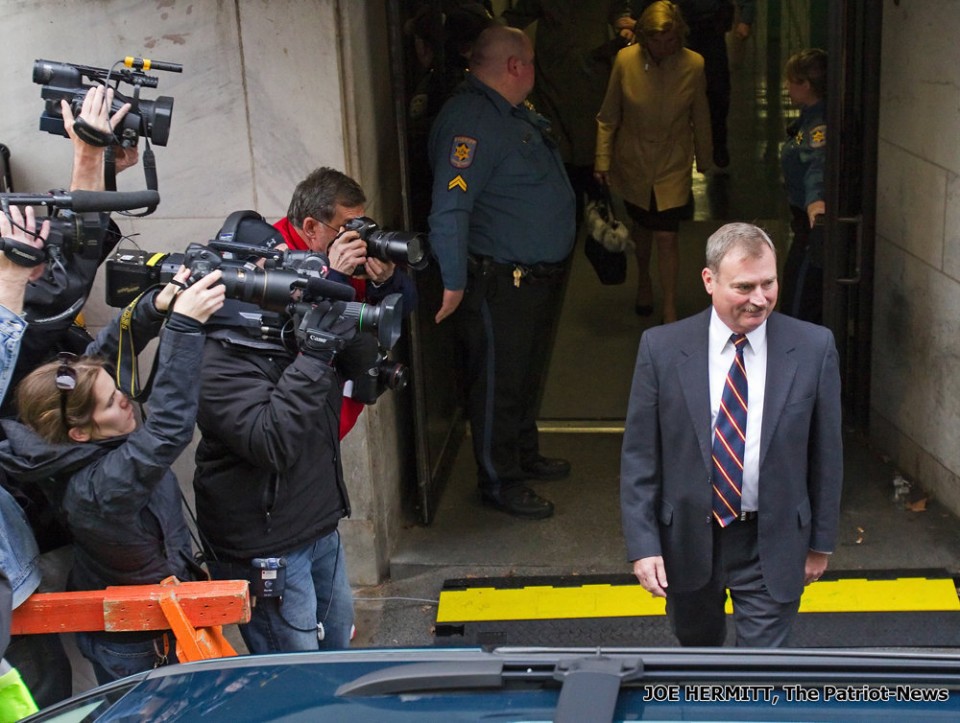
Former Penn State vice president Gary Schultz leaves the Dauphin County Courthouse after the preliminary hearing for Schultz and Penn State Athletic Director Tim Curley on charges related to the Jerry Sandusky child sex abuse case. JOE HERMITT, The Patriot-News
It was fairly clear to those listening to testimony on Friday in Dauphin County court that many people knew about child sex abuse allegations against Jerry Sandusky in 2002.
Mike McQueary. His father, John McQueary. State College doctor Jonathan Dranov.
Penn State’s revered football coach Joe Paterno. Athletic Director Tim Curley. Vice President Gary Schultz. President Graham Spanier. Jack Raykovitz, the former CEO of Sandusky’s charity,The Second Mile.
But during the hearing on perjury and failure-to-report charges against Curley and Schultz, it also became very clear that just one of those figures knew this wasn’t the first time that someone made accusations against Sandusky.
And that was Schultz.
One of the little-mentioned witnesses during the preliminary hearing was Tom Harmon, the former Penn State University police chief, whose sole purpose on the stand was to link Schultz to the 1998 case and explain that his department was kept in the dark about the similar 2002 allegation.
It’s becoming obvious that Schultz is now a focus of the public argument about moral responsibility to do more — the same that led to the ousters of Paterno and Spanier.
In the court of law, the felony perjury charge is a much bigger deal — it carries a seven-year sentence.
But in the court of public opinion, the summary failure to report — which has the same consequences of a traffic ticket — has been much more of a focus.
Schultz, the only official to admit to knowing about two alleged incidents instead of one, is emerging as a key figure of blame in the prosecution’s case.
What Schultz knew, said
Harmon, now retired and living in Pittsburgh, took the stand as the second witness Friday and testified that he remembers four phone calls with Schultz in 1998 about allegations that Sandusky hugged a boy during a shower in the Penn State football locker room.
During the last conversation, Harmon said, he told Schultz that former District Attorney Ray Gricar reviewed the facts and determined no charges would be filed.
Harmon also said Schultz, who was his boss, never told him about what was reported in 2002, but if he would have known, “We would have investigated and notified the DA,” he testified.
By contrast, only a small portion of the testimony was about the perjury case against his co-defendant, Curley.
McQueary testified that Curley and Schultz sat down with him and listened to him recount what he had seen in the shower that night — Sandusky standing with his front pressed up against the back of a boy about 10 years old. It’s McQueary’s word against theirs about the extent of the detail.
A Dauphin County district judge ruled Friday after the daylong hearing that the state has enough evidence to go to trial against Curley and Schultz.
The hearing testimony seemed lopsided, weighed heavily against Schultz.
Only Schultz sat down with John McQueary and Dranov, weeks after the 2002 incident was reported by graduate assistant Mike McQueary, now an assistant coach, and was told for a second time that something very sexual happened, according to testimony.
Only Schultz, head of the campus police department, knew about a weeks-long investigation four years prior, involving Sandusky, a boy and the same locker room as the one where McQueary told him he witnessed a sexual assault.
Only Schultz told the grand jury that state Children and Youth Services was involved in the 2002 case, when there is no record that the agency was ever told.
Only Schultz told grand jurors that he believed Sandusky had grabbed the boy’s genitals during some kind of horseplay.
McQueary testified that by talking to Schultz, he believed he had notified police of what he’d seen in 2002, because Schultz was in charge of campus police.
Why no follow-ups?
After deciding that Sandusky should be banned from bringing kids to campus following the 2002 report by McQueary, Curley is the one who made the call to The Second Mile, telling Raykovitz that there had been an internal investigation into Sandusky.
Raykovitz apparently did not tell the charity’s board, and former members became the latest to publicly defend themselves Monday.
Police detective Ronald Schreffler and Pennsylvania Children and Youth Services investigator Jerry Lauro, both involved in the 1998 case, have blamed Gricar for not pursuing that case.
No one can ask Gricar why the case wasn’t prosecuted, because he has been missing for seven years and has been legally declared dead.
Schreffler listened in as Sandusky gave a seeming confession to the mother of a boy who was allegedly touched by Sandusky during a shower in 1998, according to a grand jury report. Schreffler said Monday he would never question Gricar’s judgment.
However, Schreffler would not discuss why he didn’t revisit the case after Gricar left office.
McQueary, when testifying Friday, was asked a similar question about the 2002 incident he reported.
He said, absolutely, he believed he observed a crime.
So, why didn’t he follow up? His answer was that he quietly disagreed with Penn State’s decision.
The inaction is sure to be a big part of Sandusky’s defense.
Sandusky is facing more than 50 charges of child sex abuse involving 10 victims. He waived a preliminary hearing last week and faces trial in Centre County Court. He has maintained his innocence and plans to fight the charges.
While McQueary’s graphic testimony about seeing a boy being assaulted in a shower late at night in March 2002 was compelling, Sandusky’s attorney, Joe Amendola, has pointed out that his reaction doesn’t match the description of what he saw.
“If anyone is naive enough to think for a minute that Tim Curley, Joe Paterno and Gary Schultz and Spanier, the university president, were told by Mike McQueary that he, Jerry Sandusky, was having anal sex with a 10-year-old looking kid in a shower room on Penn State property and their response was simply to tell Sandusky ‘don’t go in the shower anymore with kids,’ I suggest you dial 1-800-REALITY.”
Schultz’s attorney: It makes no sense
A similar argument was made by Schultz’s attorney, Tom Farrell, at the preliminary hearing.
It makes no sense, he argued, that McQueary, his father, Paterno, Schultz and Curley would all decide not to call police if something so heinous was really described back in 2002.
And, through questioning of Harmon, he showed that Schultz did nothing to shape the 1998 investigation.
“He never gave you instructions as to how to enforce the law?” Farrell asked Harmon.
“He did not.”
“Did he ever interfere with you enforcing the law?”
“He did not.”
He continued.
“And he let the investigation run its course?”
“Yes.”
“The investigation was closed because it was determined that no crime had occurred?”
“Correct.”
Curley was never told about the 1998 investigation, Harmon testified. So far, there’s no indication Spanier knew about it, either.
Scott Paterno, the son of the legendary former coach, has said he’s been assured by university counsel that his father knew nothing about the 1998 report.
Earlier, on the stand, Harmon said he talked to Schultz once a week or so.
“Did Schultz ever talk to you about this incident?” prosecutor Bruce Beemer asked.
“He did not,” Harmon said.
Biography

Sara Ganim, who hails from South Florida, graduated from Penn State University with a degree in journalism in 2008. Even before she graduated, in 2007, she went to work for the Centre Daily Times in State College as the paper's crime reporter. In 2009, she received a tip about allegations against former Penn State coaching legend Jerry Sandusky. Between covering crime and other stories in a newsroom of six reporters, she began to develop the sources to piece the story together. Meanwhile, she won a Keystone Press Award and a Pennsylvania Bar Association award for other investigative stories. In January 2011, Ganim came to The Patriot-News where she worked nearly full-time on the Sandusky story, which was published three months later. After the story exploded in November, Ganim used her network of sources to continue to lead national coverage of the scandal.