Chicago Sun-Times, by Frank Main, Mark Konkol and John J. Kim

Lee C. Bollinger, President of Columbia University (left), presents the 2011 Local Reporting prize to (l-r) Mark Konkol, Frank Main and John J. Kim of the Chicago Sun-Times.
Winning Work
59 hours
By Mark Konkol and Frank Main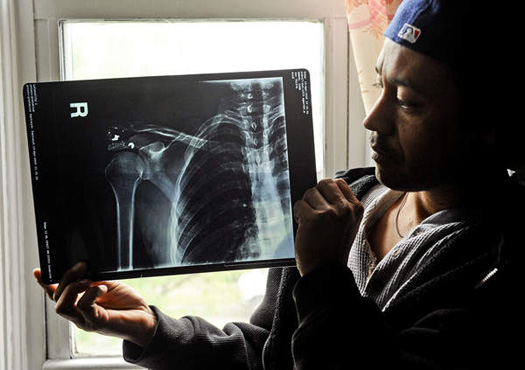
Jose Bravo, shot in 2008, holds an X-ray showing the bullet in his right shoulder. (Rich Hein/Sun-Times)
It’s told by the wounded, the accused and the officers who were on the street during a weekend in April 2008 when 40 people were shot, seven fatally.
Two years later, the grim reality is this: Nearly all of the shooters from that weekend have escaped charges.
“You don’t go to jail for shooting people,” says Dontae Gamble, who took six bullets that weekend, only to see his alleged shooter walk free.
“That’s why motherfuckers think they can get back on the streets and kill again. You feel me?”
So far, not one accused shooter has been convicted of pulling the trigger during those deadly 59 hours from April 18-20 of that year, a Chicago Sun-Times investigation has found.
Only one suspected triggerman — a convicted armed robber caught with the AK-47 he allegedly used to blow away his boss — is in jail awaiting trial.
Three other victims said they know who shot them but refused to testify. And after Gamble took the witness stand against the guy who he says shot him, a judge ruled Gamble wasn’t credible because of his criminal record and found the suspect not guilty.
Six murders from that 2008 weekend remain unsolved. And time’s running out to catch the bad guys who shot 29 other people that weekend because there’s a three-year statute of limitations on aggravated batteries with firearms.
Odds are, most of those cases will remain unsolved. The Chicago Police Department’s batting average for catching shooters has fallen to an alarmingly low level.
Detectives cleared 18 percent of the 1,812 non-fatal shootings last year. They were slightly better in catching killers — 30 percent of murders were cleared in 2009.
But here’s the catch: When police “clear” a case, that doesn’t always mean a suspect got convicted — or even charged.
Sometimes police seek charges against a suspect, but the state’s attorney won’t prosecute without more evidence. Other times, the shooter is dead, or the victim refuses to testify after identifying the shooter. Cops call those “exceptional” clearances.
Police don’t include the number of exceptional clearances in their annual report to the FBI. The Sun-Times obtained the data through the Freedom of Information Act.
Even though detectives cleared 18 percent of non-fatal shootings last year, almost half of those were cleared exceptionally, the records show. That means more than 90 percent of those gunmen weren’t charged
And that has a real impact on street violence.
“The certainty of punishment is very, very low in Chicago, and that’s going to embolden people,” said defense attorney Thomas Needham, who was a top legal adviser to former police Supt. Terry Hillard. “It’s going to lead to less fear by the people who are going to consider shooting. That’s very alarming.”
It was just after 9 o’clock on April 19, 2008. The sun had set, and the temperature had dropped to 64 degrees as a family barbecue rolled into Saturday night in the backyard of a home at 109th and Green Bay in the neighborhood called East Side
While his cousin painted car parts in the garage, Jose Bravo stood outside it, leaning against the cool brick, smoking a Marlboro.
Just a month before, Bravo had moved from Woodland, Calif., to the East Side — once an enclave of white steelworkers and cops that’s now mostly Hispanic and troubled with gangs and crime. The Spanish Vice Lords have claimed the blocks near 109th and Green Bay as their turf, spray-painting graffiti on the street signs and fending off rivals with gunfire. They call it “Buckk City.” Buckk is street slang for fight.
By contrast, Woodland, Calif., was a relatively peaceful Sacramento suburb that didn’t have big problems with street gangs — or steady jobs for guys like Bravo.
Bravo, who’s married with two kids, knew the East Side could be a violent place. His family had warned him about that. But there was a job waiting for him in the produce section of a suburban supermarket.
“I was afraid to come here because I knew there were gangs,” the 36-year-old said in Spanish. “But I had to come for the work.”
It turns out his fear was justified.
On the night of the barbecue, he took a drag on his cigarette and heard a Nextel phone chirp across the street. Then, gunshots. The first shot — a 9mm blast — hit Bravo and shattered his right shoulder. One shot severed the cable TV wire overhead.
Bravo saw the guy who pulled the trigger under the glow of the street light. He was a Latino kid, no more than 17, wearing a black hoodie and blue jeans that had writing down the side. The teenage shooter didn’t say a word.
Bravo ran into the garage. His shoulder burned.
“I fell to one knee,” he said. “Intense pain.”
Bravo’s family pressed towels on his gushing bullet wound as they waited for paramedics and police.
He still doesn’t know why the teen opened fire.
“I guess I got my welcome to Chicago,” Bravo said.Bravo kept souvenirs: the 9mm slug that struck him and a piece of bone that blasted out of his shoulder like shrapnel.
On the day Bravo was shot, beat cops picked up a teenage gang-banger with the street name “Chops.” He was running along 106th Street toward the Calumet River bridge when the officers saw him ditch a bag of weed behind a van, according to a police report.
The officers arrested him for having drugs. At the station, Chops told police he was watching a ninja cartoon and playing video games at a friend’s house. He denied shooting Bravo.
Later, witnesses at the barbecue picked Chops out of a police lineup. At the hospital, Bravo also identified Chops from a photo array, but he told detectives he didn’t want to prosecute. Bravo feared for his life.
“He felt that if [he] proceeded to press charges against the person arrested by police, that this same individual could possibly get out of jail early and come back to [shoot] him again,” Detective David Cavazos wrote in the police report.
Bravo’s case became one of two shootings that police cleared exceptionally from that weekend — without charges. Bravo said he now regrets not helping police and prosecutors put Chops in prison.
“It would have been a lot easier to press charges if I didn’t have my whole family here. If I did that, then maybe they keep coming, keep shooting up the house,” Bravo said through an interpreter. “If I didn’t live around here and was walking by and got shot, I would have put charges on him.”
All the time, cops and prosecutors encounter victims like Bravo who are reluctant to identify their shooter. To make it easier for them to talk, law enforcement officials offer to relocate families
“The main thing we are doing is making them think of the community and not just themselves. Sometimes that’s a hard sell,” said Brian Sexton, a top official in the Cook County state’s attorney’s office. “We will move their family, but a lot of times they have roots in the community, and their kids are going to school in the neighborhood. Even when we move people, often they will go back to the same neighborhood in a few months.”
Bravo didn’t ask to move from East Side, but he did ask for compensation from the Illinois attorney general’s victim compensation program.
If he had agreed to prosecute Chops, the program would have picked up most, if not all, of his debt related to his shooting. The victim compensation program pays up to $27,000 to victims, but there’s one big catch to collect the cash: Victims must cooperate with the police. Last year, 5,917 victims applied for help statewide; 505 were denied because they wouldn’t testify.
“Our office struggles with denying compensation to victims who refuse to cooperate out of fear,” said Cara Smith, a deputy attorney general. “But those are the rules.”
Bravo’s silence has cost him dearly. All he has to show for taking that slug is $15,000 in medical bills he can’t afford to pay
And Chops is still out on the street.
Say He’s not ‘Willie the Rat’
‘I could be Willie the Rat, but I don’t care about s--- like that,” Willie Brown said while rolling a joint near Sheridan and Wilson in the Uptown neighborhood.
Brown is 28. He lives in a run-down high-rise and walks with a limp because he got shot in the leg.
He said he was a bad kid, a teenage Vice Lord and stickup man who did prison time for robbing a corner store with a toy pistol in 2003 while high on weed and angel dust. He had the munchies that day and was looking to steal “wam wams and zoom zooms” — prison talk for snacks — when a police officer saw the gun poking from Brown’s waistband and arrested him. He was paroled in 2007.
On April 18, 2008, Brown took a bullet in his upper right thigh outside 1012 W. Sunnyside. He was the 10th person to get shot on that bloody April 2008 weekend.
“That was a horrific moment,” Brown said.
He says he saw the guy who shot him.
Heck, he even talked to the alleged shooter, Darnell Robinson.
Brown was on his way to buy beer about 11:30 p.m. that Friday when Robinson and his brother stopped him in the street.
Robinson supposedly asked, “What is you?” — street slang for “What gang are you in?
Brown said he told them about his past Vice Lords affiliation.
Robinson said he was in the “Taliban” before he started shooting, according to Brown
Police arrested Robinson, who was 31 at the time and had been behind bars for residential burglary and selling drugs. Brown identified Robinson as the shooter, and the case headed for a trial.
Robinson, who claimed he was innocent in jailhouse interviews with the Sun-Times, sat in Cook County jail for 13 months until prosecutors had to let him go because Brown changed his story several times
Why did Brown’s story change? Because “my momma told me to,” he said.
“I did it so he could go home. I’m not no stool pigeon,” Brown said, recounting his story while scarfing down McNuggets at a McDonald’s in Uptown.
“I don’t have anything against him — it’s like he never shot me. I wouldn’t want to see the mother****** sitting in jail because that [jail] is hell. I spared that dude. That’s all I did. I did it for my mom.”
Brown said he sometimes bumps into Robinson on the street.
“I talked to the guy. He said he was sorry. I said, ‘Forget about it. Don’t worry about it.’ . . . I feel like I should have forgiven [him] for they know not what they do. He needs to be happy and thank God like I did. Everybody should go by that code.”
And in that moment — as Brown talked about forgiveness as his brand of nonviolent street justice — Robinson walked into the McDonald’s with two friends.
“There he is. That’s him right there!” Brown said.
The accused shooter and the victim awkwardly shook hands and hugged — each assuring the other, “We cool.”
Robinson nervously asked if reporters at the table were police officers. Robinson said repeatedly that he didn’t shoot Brown, but he wouldn’t talk more about it unless he was paid $30. Then he disappeared down Wilson Avenue, heading east toward the lake.
Brown said he and Robinson have a simple understanding: “Don’t fuck with me. I won’t fuck with you.”
‘You know you shot me, man’
Even when police catch a bad guy, a victim cooperates and prosecutors bring charges, shooters sometimes go free.
Dontae Gamble knows all about it.
On April 19, 2008, Gamble was shot six times outside Chicago’s Grill and Sub on Chicago Avenue in East Garfield Park.
“Dude came up and tried to rob me,” Gamble told the Sun-Times. “I got to wrestling, fighting with him, and he pulled that gun and got to shooting, and I got to running.”
Gamble scrambled across Chicago Avenue — running west toward Drake — as the bullets kept coming.
“Got me in the lung, in my back, two times in my arm, two times in my leg. And he caught me a couple times that were grazes,” he said, lifting his shirt to show his scars. “I thought I was going to die. I blanked out, and I think I died and came back to life.”
Gamble said he was shot over a drug deal that went bad.
The suspected shooter’s girlfriend asked Gamble to sell her marijuana.
He came back with a sack of weed, but the woman suddenly didn’t want it.
That’s when Gamble got into it on the corner with her boyfriend, known on the street as “Blow.”
Blow started to pull out a revolver, so Gamble punched him hard in the face, staggering him. Gamble ran. He looked back and saw a flash from the pistol’s barrel, heard a loud bang and felt the first bullet pierce his right side, according to Gamble.
When police picked up Blow — then 18 years old — Gamble identified him as the shooter in a photo array shown to him in his hospital bed. Gamble wrote “he shot me” on the suspect’s picture, according to court records.
Gamble told investigators he recognized Blow from the rough streets of the West Side — along a stretch of Chicago Avenue where dope dealers “ain’t nothing but killers . . . and they ain’t playing no games.”
Growing up, Gamble hung out on the corners with guys who “turned him out” as a youngster and got him started in the marijuana and heroin trade. In 2006, Gamble went to prison after getting busted delivering dope to undercover police officers. Blow had a rap sheet, too, arrested as a juvenile in 2006 for heroin possession and stealing a car while he attended Crane High School.
When it came time to face his alleged shooter from the witness stand, Gamble said he had no trouble fingering Blow. It was a defining moment for Gamble, who said other guys from the neighborhood would have resisted “snitching” and get their own revenge on the street
“He tried to kill me. Other people say they’re not going to testify. . . . Somebody’s trying to take your life, you have to stand up for it. That’s being a man. This is something he knows he did. And I’m in court saying, ‘You know you shot me, man.’ ”
But then, Blow’s girlfriend took the witness stand and offered up a surprise alibi.
The girlfriend — who has a conviction for retail theft and had visited Blow in jail five times before the trial — told the judge Blow got into her car as gunshots were still going off, and he wasn’t firing them.
That’s a detail she didn’t share with police when interviewed after the shooting, according to court records.
In the end, Cook County Judge John Fleming decided Gamble wasn’t a credible witness due to his criminal past. And Blow walked away a free man.
“It basically comes down to the word of uncorroborated, basically words of a convicted felon as to who the shooter was,” Fleming said at the end of the bench trial. “I don’t think there’s enough beyond a reasonable doubt on just the evidence that I have. I have to find him not guilty.”
Police, prosecutors and public defenders acknowledge that when bad guys get shot, they don’t come across as sympathetic — or believable — witnesses. Shooting victims in Chicago are almost as likely to have a long rap sheet as the shooters. In 2008, 72 percent of murder victims and 91 percent of accused killers had arrest histories, according to police statistics.
But Gamble — now a janitor with two kids — said the court should have considered him a victim and disregarded his criminal past.
“That’s kinda crazy, you know. I’m not the one on trial. This man shot me and tried to kill me,” Gamble said. “I saw this man shooting me. I’m right there, feel me?”
Gamble also said authorities should have done a better job of investigating, putting together a stronger case and getting their facts straight since a judge might not believe a guy like him
Gamble said the justice system doesn’t care as much about catching shooters when the victim has a rap sheet — an assertion detectives strenuously deny, although they do admit it’s more gratifying to catch an innocent person’s shooter than a criminal’s.
“They can catch a motherfucker running a stop light,” Gamble said. “They don’t ever miss that. They can catch a drug dealer, but can’t catch no killers, no rapists and all that, man. Not around here.”
Three faces of the problem
Jose Bravo, Willie Brown and Dontae Gamble — all men who survived bullets during this one violent weekend in Chicago — are faces of a real problem.
When victims won’t cooperate or have shaky credibility on the witness stand, the overwhelming odds are the people who shot them won’t go to prison.
Law enforcement officials say that fact has become the single biggest hurdle they fae in slowing street violence.
It leaves known shooters on neighborhood streets to pull the trigger again.
Police Know it. Prosecutors know it.
And more than anything the shooters know it.
© Chicago Sun-Times
59 hours
By Mark Konkol and Frank Main
On an alarmingly bloody weekend in April 2008 -- a weekend so violent it put Chicago on the national news -- Angel Ramirez was the last to die.
The burly 26-year-old whom friends called “Buttercup” was next door to his buddy’s house in a gang-infested corner of Little Village where a birthday party was breaking up.
It was 10:25 p.m. A blue light glowed atop a police surveillance camera across from the party as a gray Chevy Impala slowly crept down 21st Street.
Someone in the back seat unloaded a flurry of shots. One bullet hit Angel in the face. He collapsed on the broken front stoop and died an hour later at Mount Sinai Hospital on April 20, 2008.
Angel was a hardworking muffler shop manager who counted cops among his best friends.
He wasn’t a gang member, but this still was a gang-related shooting, police say.
Satan Disciples were aiming at Latin Kings. They even bragged about it on Facebook.
Angel -- whose murder anchored a 2008 Chicago Sun-Times series on the 59 hours of gunshots that hit 40 people that weekend, killing seven -- was an innocent caught in the line of fire.
Days after he was killed, it looked like police would quickly catch his killer.
The detectives found the car used in the drive-by and talked to the owner.
They watched the surveillance video.
They identified a suspect.
But no one has been charged with Angel’s murder.
Police “told me they would do as much as possible to find the ‘responsibles.’ They would do their job,” Angel’s mother, Felipa Ramirez, said. “For me, I put everything in God’s hands.”
HIGH HOPES
When it comes to murder in Chicago, sometimes there’s a frustrating reality for police: Even when you think you got ‘em, you ain’t got ‘em.
In 2008, Angel’s slaying was one of 342 unsolved murders.
Police cleared 33 percent of murders that year, the department’s second-lowest single-year homicide clearance rate since 2004.
Detectives say a code of silence among witnesses -- and even victims -- is making it hard to solve murders, especially gang-related ones.
“The clearance rate will go up if witnesses come forward,” Chief of Detectives Thomas Byrne said. “There is more pressure on people now not to snitch than there was traditionally.
“Although the clearance rate is an indicator of how well we are doing, the detectives that I have encountered are some of the hardest working and fair people I have met on the job,” Byrne said. “They put a lot of time and effort into these cases. They are starving for people to come forward.”
Like most of the other shootings during that weekend in 2008, reluctant witnesses have kept police from making an arrest in Angel’s murder, even though detectives have identified the suspected shooter.
Witnesses are key because the physical evidence, including video from the blue-light camera, wasn’t strong in Angel’s murder.
The camera showed Angel and his friends standing outside the house before the shooting.
Then, the camera automatically panned away.
“It was facing a different direction during the shooting,” Detective Roberto Garcia said. “It’s too bad. The street light could have illuminated the inside of the vehicle. The camera might have caught an image of the shooter.”
Even so, detectives were able to track down the car through interviews. The owner said he lent his Impala to the suspected shooter a few blocks away from the murder.
“He was not telling the whole truth,” said Garcia, who suspects the owner was driving the Impala during the shooting.
While in police custody, the car owner threatened to kill himself and was admitted to a hospital for psychiatric care.
“He was released without charges,” Garcia said.
The detectives were unable to identify a woman they think was in the passenger seat during the shooting.
They weren’t empty-handed, though.
One witness, Robert White, identified the driver and the shooter, a Satan Disciples member who was in the back seat.
Detectives believe the shooter was targeting two Latin Kings standing near Angel that night in the 2800 block of West 21st.
The detectives learned the suspected shooter and driver were at a Satan Disciples party before Angel was killed. The shooter returned to the party after the slaying, Garcia said.
“We have ID’d several individuals at the house party, but they are not cooperating,” Garcia said.
Then, another bad break.
White -- the key witness -- became a murder victim, too.
In September 2008, the ex-boyfriend of White’s girlfriend allegedly burst into her apartment, fatally shooting White and stabbing her.
Angel’s case isn’t cold, though, Garcia said.
“There are people in the neighborhood who have knowledge but have not come forward,” he said. “We hope they will see the light and come forth.”
Or, Garcia said, someone may get in trouble with the law and use information about Angel’s killing as a bargaining chip.
If any of that happens, police are ready.
“Our suspect is in custody, waiting for trial on other, unrelated cases. He is a strong suspect,” Garcia said. “I still have high hopes.”
SILENCE IS A KILLER
Ultimately, time is on investigators’ side.
Unlike other crimes, there’s no statute of limitations for murder, so detectives keep pursuing cold cases.
The clearance rate for murders hit a low-water mark of 30 percent for 2009. But in coming years, that figure will climb as more of 2009’s killings are solved. Last year, for instance, detectives solved 95 murders from prior years.
“If there is a gun left at the scene, or a hat, we are looking for DNA or prints, and that may slow the progress of the investigation,” said Byrne.
“I know the detectives want a solid case. We are not going to compromise the integrity of the case to rush people into getting people charged. If that means our homicide clearance rate is a little lower than a year ago or five years ago, so be it. We strive to present the best case possible.”
But with budget woes, there are fewer detectives to investigate those cases.
This year, about 1,060 detectives are on the job, with nearly 270 vacancies -- about 20 percent below budgeted strength, city records show.
The number of detectives has been shrinking since at least 2004, when there were 155 vacancies and a 15 percent shortage. The city hasn’t held a class to promote new detectives since 2007.
That leaves a lot to do for a short staff.
And getting physical evidence linking a shooter to a murder isn’t as easy as it appears on TV.
There often isn’t a bullet casing, blood evidence or a shred of clothing left behind to help identify a shooter through DNA.
When detectives do find forensic evidence at the scene, linking it to an offender is a difficult and lengthy process.
And even though there are thousands of surveillance cameras in Chicago, they’re not always working. And when they are, they aren’t always pointing in the right direction, or the images aren’t always clear, as in Angel’s murder, police said.
Then there are the recent court cases that have created more hurdles for detectives.
Responding to a civil rights lawsuit, the department in 2004 started requiring detectives to charge suspects within 48 hours of their arrest or let them go.
And a 2007 court decision requires detectives to tell witnesses they have the right to leave the police station at any time, even if they haven’t provided any information.
So when a witness -- or even a victim -- won’t talk, that’s big trouble.
“The lack of cooperation from the witnesses is far and above the biggest issue in clearing these [shootings],” Harrison Area Cmdr. Anthony Riccio said. “It allows killers to walk the neighborhoods.”
FIGHTING AGAINST VIGILANTE JUSTICE
Of all the shootings on the weekend when Angel was killed, only one is heading for trial.
The witnesses, in that case, were police officers.
Bennie Teague is in Cook County Jail on charges that he murdered his boss, Marcus Hendricks, on April 18, 2008.
Teague covered his face with a T-shirt that day, marched into a plumbing office near 115th and Halsted in the Roseland neighborhood, and killed Hendricks with an AK-47, police say.
A few hours later, after a shoot-out with three police officers, Teague was found hiding under a porch of a house. Police said they found the assault rifle there, too.
Detectives are still hunting for the killers of that weekend’s five other murder victims: 18-year-old cousins Melvin Thomas and Rhonell Savala in the part of South Shore that some call “Terrortown,” retired steel worker Ricardo Sanchez in South Chicago, paroled felon Michael Giles in Garfield Park, and former gang-banger Raul Lemus in Chicago Lawn.
Meanwhile, Angel’s family continues to wait for justice.
The wait hasn’t been easy.
When Gonzalo Ramirez saw his fun-loving older brother dead in the hospital, he immediately wanted revenge.
“I saw him passed away on a gurney. I saw his body, and I already knew who did it. It was the Disciples. I thought, ‘I’m gonna get ahold of a gun,’ “ Gonzalo Ramirez said. “But my mom told me, ‘I don’t need to lose another son.’ She was crying. That stopped me from doing anything.”
Angel’s mother, Felipa Ramirez, said she continues to pray that her son’s murder is solved.
She even prays for the shooter.
“I lost my son, but he [the shooter] is lost in the world,” she said. “Whatever they do to him, it will not bring my son back.”
She denounced the desire for revenge that even her middle son felt after Angel was killed.
“That’s not worth it because they’re destroying families,” she said. “They want to take the law in their own hands, but they don’t realize they are the problem.”
Police said the revenge factor is big on the street and a major obstacle to solving murders, especially gang murders.
Witnesses often clam up because they want to “take care of business” themselves.
‘BE A MAN’
Angel hasn’t been forgotten.
His mother said her niece and Angel’s best friend, Temo Perez, have named their babies after him.
Customers at Diaz Mufflers still come in and ask his brother Gonzalo, “Where is the husky guy?”
And his other brother, Roberto, a linebacker on his high school football team, thinks of Angel all the time.
“Before games, I pray to Angel to help me to sack the quarterback,” Roberto said. “I tell him to watch over me. I ask him for guidance.”
Gonzalo prays for a break in the silence that keeps Angel’s killer from justice.
“I just wish someone would step up and be a man like my brother.”
© Chicago Sun-Times
59 hours
By Mark Konkol and Frank Main
At Gene’s Playmate Lounge at Cermak and Kildare, you can’t have a drink unless you’re at least 25 years old.
Young guys who might be packing pistols can get a cold beer somewhere else, owner Gene Payton said.
Playmate regulars spend late nights there talking about the shootings popping off on this gang-infested corner of Lawndale that locals call K-Town, where you can get a bag of heroin for 10 bucks behind the auto repair shop across the street.
Neighbors are still talking about the triple homicide on June 19 that sparked retaliatory shootings that left at least two people wounded.
It was part of Father’s Day weekend -- from June 18 to June 20 this year -- when 54 people were shot in Chicago. Ten people died, including a toddler.
One of the murder victims in K-Town was Waseem Smith.
Even a guy in a wheelchair parked outside a corner liquor store thinks he knows why Smith took a bullet to the head: revenge for killing Darrell Brown on Halloween night. Police believe that’s true, too.
It seems like a lot of people saw Smith kill Brown when a bar fight spilled onto Cermak, Brown’s sister Darcita said.
But no one -- not even Brown’s closest friends -- would snitch on the shooter.
Why? Well, K-town is a small place.
“It’s easy for shooters to get away. No one will talk. Shooters know everybody. Even if they catch a shooter all the other people behind them make sure other people don’t talk,” Darcita Brown said. “From Kolin to Kildare and all the other streets between, it’s street code. That’s what people live by.”
Not much has changed since April 2008, when 40 people were shot on a weekend that was nearly as bloody as Father’s Day this year.
The shootings are still senseless. The witnesses are still silent. The bad guys are still out for revenge.
And police are still struggling to put the shooters behind bars.
After reviewing the aftermath of the violent 59 hours from April 18 to April 20, 2008, a Chicago Sun-Times analysis found that only one suspected shooter is heading to trial. Four other cases collapsed because the victim refused to testify against the shooter or the victim wasn’t deemed a credible witness.
That’s part of a pattern in Chicago: Most shooters don’t get charged with pulling the trigger. Last year, fewer than one in 10 non-fatal shootings resulted in charges.
So the question remains: How can the police catch shooters when almost nobody wants to snitch on them?
‘NO-SNITCH’ CODE
Reluctant witnesses have always been a problem for police and prosecutors. But today, the “no-snitch” code on the street is worse than ever, Cook County State’s Attorney Anita Alvarez said.
During her nearly four years as a gang prosecutor, witnesses regularly recanted their identification of shooters on the witness stand. These days, more witnesses -- and even victims -- are refusing to get involved in the initial stages of a shooting investigation, Alvarez said.
Detectives often arrive at crime scenes only to be stonewalled by crime victims themselves, such as a young man who refused to identify his shooter moments before he died on the West Side earlier this year. “I ain’t telling you s---,” the man told officers, and then died.
Gang-bangers often want to handle justice themselves, Alvarez said. So getting shooters off the street requires a change in the no-snitch culture.
One solution: detectives started videotaping witness statements in a pilot program launched last year in the police station at Grand and Central to keep them from changing their story -- or “flipping” -- later on.
It also makes for more convincing evidence, Alvarez said. The experiment was successful and now detectives are videotaping witnesses in all five of the city’s detective headquarters, Alvarez said.
NEW CRIME-FIGHTING WEAPONS
Since 2003, Chicago Police officials have been “putting cops on the dots,” or using computer-generated intelligence to deploy officers to crime hot spots.
Also, the police department is relying increasingly on electronic surveillance such as court-ordered telephone overhears to catch criminals talking about their deeds.
Law enforcement officials say those strategies are one reason murders have declined significantly since the 1990s.
This year, violent crime has decreased by more than 10 percent compared to 2009 -- except for homicide, which is up about 1 percent compared to the same period last year.
But Chicago’s violent-crime rates remain much higher than other big cities.
In 2009, there were 16 murder victims per 100,000 residents in Chicago. That’s at least double the murder rates in Los Angeles and New York City, which were eight per 100,000 and six per 100,000, respectively. And when it comes to robbery and aggravated battery, Chicago’s rates dwarf those of L.A. and New York, according to FBI statistics.
This summer, Chicago has seen the worst two-month run of fatal gun violence against the city’s police in 40 years. Three officers have been murdered. Two of the suspected shooters had lengthy arrest records. Police are hunting for the killer of the third officer, Michael Bailey.
“They got laws on the books they just don’t enforce the right way. And these sons of a b------ don’t feel any remorse. They don’t fear any g--d----- consequences, because there are no consequences,” retired Police Officer John Holmes said July 18 when Bailey, whose widow is Holmes’ cousin, was murdered outside his Park Manor home.
In fact, records show that nearly half the people sentenced for unlawful use of a weapon receive probation in the Cook County courts. Last year, 2,264 people were sentenced for unlawful use of a weapon. Of them, about 54 percent got prison time and the rest got probation or some form of punishment other than prison, such as boot camp or court supervision, court records show.
To make sure gang-bangers get locked up, prosecutors have started to wield a new law-enforcement weapon -- the so-called Valadez law, named for slain Chicago Police Officer Alejandro Valadez. One of the three men charged in Valadez’s June 2009 murder was on probation for aggravated unlawful use of a weapon, a gun possession charge.
The new law requires prison time for street gang members convicted of possessing a loaded gun in a public area.
Alvarez said the mandatory prison time is a recognition by legislators that too many people charged with felony gun possession violations were getting probation or having their cases dismissed. More than 90 people have been charged under the Valadez law, which Gov. Quinn signed in December.
“What we are seeing in the Valadez law is that we are getting guilty pleas,” Alvarez said. “They are getting time and they are [often] pleading guilty instead of going to trial.”
Julio Martha, 25, was the first gang-banger convicted under the Valadez law. Martha is a self-admitted La Raza gang member with the tattoos to prove it. He was on parole for aggravated battery with a firearm when gang officers arrested him in the Pilsen neighborhood Feb. 7 after spotting him with a loaded blue steel 9mm semi-automatic pistol.
A jury found Martha guilty on May 19. He was sentenced to 10 years in prison.
Other potential shooters are taking notice, a top law-enforcement source said. An ongoing wiretap recorded gang-bangers warning fellow gang members that the Valadez law could land them in prison for packing a gun.
“The offenders have been talking about it,” the source said. “They were talking about the effects of the law . . . that you’re going to go to jail.”
REBUILDING TRUST
The fractured relationship between many Chicagoans and law enforcement remains an obstacle in catching shooters.
“The distrust of law enforcement is out there in many communities,” Alvarez said. “We have seen the effects of Burge [the Chicago Police commander convicted in federal court June 28 for lying that he never tortured suspects in the 1970s and 1980s.] They don’t trust the system. They don’t trust the police. And as a result, you have less people willing to cooperate.”
Mending that relationship won’t be easy.
Alvarez opened a third Community Justice Center this month -- a move investigators hope will elicit more cooperation from witnesses.
The Chicago Police Department also is redoubling efforts to make regular citizens their eyes and ears on the street.
Ron Holt, a cop who was recently appointed to head Chicago’s community policing program, said neighbors need to break from the “psychological grip” bad guys have on their community and start cooperating with police.
“If you allow the evil and the monsters to compel you to live in fear, then they win,” he said.
Holt, whose 16-year-old son Blair was gunned down on a CTA bus in 2007, said rebuilding the bond between police and neighborhood folks starts with bridging the gap of mistrust.
“Unfortunately, there always will be bad apples, rotten apples on the tree [in a police department]. One of my missions is to let citizens know the majority of police in the street are honest and trustworthy,” Holt said. “They’re not aberrations, not people from Mars. These people are from the neighborhood.”
"IT’S CRAZY”
On the bulletproof-glass window at the counter of a K-Town liquor store near where her son Darrell Brown was slain, Diane Brown posted an open letter to the neighborhood.
It’s still taped to the window, written in street slang in the voice of her dead son, who friends knew as “D-Boy.”
“I’m asking any and everybody please help get justice for me and my fam,” the letter states. “If it was you that got hit that night, I would stand for you all. Can you do the same for me? . . . Please stand up for me and tell the detectives whatever you know. I love you all.”
No one said a word.
Instead, someone got a gun on Father’s Day and killed Waseem Smith -- the guy who police suspect took D-Boy’s life.
It’s still too early to tell if police detectives will “exceptionally” clear Darrell Brown’s murder.
That’s often how murders are cleared when the only suspect in a shooting is killed before he can be charged. It puts an end to the police investigation, but it does little to deter more shootings.
When a killer gets killed before a jury can convict him, it’s not good for anybody in Chicago.
At least that’s what Darrell Brown’s mother thinks.
“If you tell me that killing the guy who killed my son is justice, I don’t want that kind of justice,” Diane Brown said. “I wanted who did it put away, locked away. I wish it wouldn’t have happened. I want justice for my son, but I don’t want bloodshed. I don’t want anyone to go through what I went through.”
And what she keeps going through.
On the day Waseem Smith was murdered, Diane Brown’s other son was a victim of gun violence.
Pierre Brown, who was younger than Darrell, was shot and wounded while walking to a store.
“I’m sick and tired of the violence. I’m tired of it,” she said. “It’s just not right. It’s crazy.”
© Chicago Sun-Times
Cop asks: Do you know who shot you? He replies: 'I know. But I ain't telling you..'
By Frank Main
Robert Tate wasn’t ever going to snitch -- not even when it came to his own murder, according to the Chicago Police.
Tate, 17, was shot in the chest as someone approached him on a West Side sidewalk on the evening of April 12, police say. Seeing that Tate was wounded badly and probably wouldn’t make it, an officer asked: Do you know who shot you?
“I know,” Tate told him. “But I ain’t telling you shit.”
That’s according to Harrison Area Police Cmdr. Anthony Riccio, who said the murder investigation is focusing on a possible shooter -- even though Tate took his secret to the grave.
“Unfortunately it’s almost a culture among the drug dealers and gang members, that code of silence, that ‘don’t snitch’ mentality that they not only have when they’re witnesses, but also when they’re the victims,” Riccio said.
But Tate’s mother Cynthia Washington doesn’t buy it.
She doesn’t know how her son -- a “very respectful child” -- could have told police anything as he lay dying on the scene in the 900 block of North Avers.
“Why wouldn’t he tell them who shot him?” Washington wondered.
Riccio responded that Tate was lucid as he spoke to the officer, then died as paramedics tried to save him.
Riccio said it’s commonplace for shooting victims whose wounds aren’t life-threatening to refuse to cooperate. Just last week, a 22-year-old gang member was on a bicycle in the 500 block of East 88th when he was shot in the thigh. He didn’t even want to report the shooting after he was taken to Stroger Hospital.
“But I have never seen anyone take it to the grave,” Riccio said.
Police think Tate was killed because of his involvement in the drug trade in Humboldt Park.
“One of the things from people on the street was that he was ripping off [drug] buyers,” Riccio said. “When that happens, of course, the buyers take their business elsewhere, and it affects the drug trade.”
So detectives think Tate was killed because he was hurting business. They’re reviewing surveillance video from police “blue-light cameras” in the area to identify the shooter, Riccio said.
Tate was “in and out” of Nancy B. Jefferson High School, housed in the Cook County Juvenile Detention Center, a Chicago Public Schools spokeswoman said. He had 14 arrests for drugs, weapons and car theft on his rap sheet; a tattoo that read “Make Money or Die;” and a nickname: “C Murder.”
“I didn’t give him that name,” his mother said.
“He was a good young man who loved his mom,” added a friend, Tasha Porter. “Neighborhoods like this are tough to grow up in.”
But one detective also said the motto in neighborhoods like Tate’s is: “Snitches get stitches.”
And Tate is the most extreme example, police say, of the “no-snitching” mind-set they say is making it increasingly difficult to solve murder cases in Chicago. Indeed, the Chicago Police Department’s murder-clearance rate dipped from 58 percent to 54 percent last year.
If Tate had talked before he died, police say, his statement most likely could have been used in court. In a practice dating back centuries, a “dying declaration” -- a statement from a dying crime victim naming the killer -- is typically allowed in criminal cases, even though the defendant won’t have the opportunity to cross-examine his accuser.
In one notable case, in 1999, 24-year-old Michelle Monachello of Glendale Heights was stabbed, doused with gasoline and set afire in DuPage County. A neighbor called 911 and, as he tried to reassure Monachello, she said, “I’m going to die” and then told him, “My boyfriend -- he set me on fire.” The boyfriend, Artarius Jett, got life in prison based in part on what Monachello said before she died.
In recent years, police and community groups have been ratcheting up a campaign urging people to report suspects in crimes -- despite fears of retribution, fear of the police and fear of being labeled a snitch.
Last year, the Rev. Michael Pfleger of St. Sabina Catholic Church on the South Side put up 20 billboards across the city that read: “Shoot or kill our children? You will be caught.” The billboards offered $5,000 rewards for information leading to the conviction of criminals who shot or killed “our children” and urged people to call in anonymously with tips.
Chicago Police now have their own campaign called “Silence Kills.” They’re asking people to text-message anonymous tips to 274637 or call the police anonymously.
They’re urging people to do just that in Robert Tate’s case -- even though the teenager wouldn’t do it for himself.
© Chicago Sun-Times
Chatham | Middle-class area near where cop was slain tops city in major crimes
By Frank Main and Art Golab
The most violent part of Chicago? It’s a section of Chatham, the largely middle-class, African-American neighborhood on Chicago’s South Side that has long been a bastion of black lawyers, cops, plumbers and other professionals, a Chicago Sun-Times analysis has found.
“I am very, very surprised,” said the Rev. Marc Robertson, 48, a Chatham homeowner for the last eight years.
“Almost overnight, we’re at the top of violent crime?”
An unwanted spotlight was cast on Chatham last week, when Thomas Wortham IV, an off-duty Chicago cop, was shot to death by robbers trying to steal his new motorcycle as he left his parents’ home.
But the current epicenter of violence in Chicago sits five blocks north of there -- what the Chicago Police Department calls Beat 624.
The department divides the city into beats, 279 in all. And Beat 624 ranks No. 1 among them in violent crime for the first three months of 2010, according to the Sun-Times analysis, which takes into account the total number of major violent crimes reported -- all of the murders, sexual assaults, robberies, aggravated batteries and aggravated assaults in every police beat.
Beat 632, where Wortham was killed, ranked 17th.
“We have seen a spike in violent crime,” said Maryellen Drake, executive vice president of the Chatham-Avalon Park Community Council. “It’s like a cancer. And it’s spreading. We are trying to find out how to stop it. It’s really becoming ugly for us out here.”
Perhaps even more surprising, the analysis shows that three of Chicago’s traditionally highest-crime police districts -- Englewood on the South Side and Austin and Harrison on the West Side -- didn’t have any beats in the top 25.
The safest beats in the city? That’s a tie:
• Beat 1814 on the North Side, bordered by Fullerton on the north, Sedgwick on the west, North Avenue at the south and Lake Michigan to the east.
• And three Far Northwest Side beats: Nos. 1611, 1612 and 1621.
Each of those beats posted only two violent crimes in the first three months of the year.
Beat 624 is bordered by 75th on the north, 80th on the south, King Drive on the west and Metra’s railroad tracks on the east. It also covers parts of the Grand Crossing and Avalon Park neighborhoods. But police say the violence is concentrated in a 24-block chunk of the beat, mainly along a spine of crime -- 79th Street, one of the South Side’s main east-west routes.
Twenty-eight of the beat’s 66 violent crimes were robberies. Two were murders, two were sexual assaults, and the rest included shootings, beatings and stabbings.
Police Cmdr. Eddie Johnson did his own analysis of the department’s Gresham District when he took over there in 2008 and determined that 624 was “our worst beat.”
“Our public violence -- robberies and shootings -- was extremely high, so I created a violence-suppression team, with a sergeant and eight officers,” Johnson said.
He also formed a bicycle team whose officers are focusing on Beat 624, and he has assigned two foot-patrol officers to 79th and Cottage Grove, at the hub of crime.
Officers “have driven robberies down about 60 percent on that beat,” Johnson said. “[Crime] is still higher than you want it to be. But, as bad as it is, we are seeing success.”
Police sources said the department plans to deploy citywide crime-fighting units this summer to problem areas in Beat 624. Other citywide gang and narcotics units regularly operate in the Gresham District, the sources said.
Still, community leaders, retired cops, shopkeepers and others who live and work there said they believe the Police Department is understaffed in the Gresham District, emboldening the crooks in Beat 624.
“Every once in a while, the police walk down 79th Street and intimidate the gang-bangers,” said Robert Smith, who works at a Chatham pawn shop near 79th and Langley. “It’s not enough.”
Drake said she thinks Johnson is doing a good job as commander but needs more manpower. Several ex-cops, who agreed to speak only on the condition of anonymity, said beat officers, tactical officers and gang officers have been shifted from the district to work in citywide units.
“They took the best and most aggressive kids, and what you have left is officers who are inexperienced or old-timers,” one retired, formerly high-ranking police official said. “A lot of them are in one-man cars. They’re not as willing to get out and deal with these knuckleheads.”
Many of those “knuckleheads” -- according to Ald. Freddrenna Lyle (6th), Robertson and others -- are coming to the area from Chicago Housing Authority buildings that the city has demolished in recent years in a massive effort to improve housing conditions for the poor.
“With the dismantling of public housing, we have an influx of people who don’t share the same values,” Robertson said. “When you have that kind of element that comes in to a community of stability, that can be very disruptive.”
Johnson, the police district commander, said hot spots in Beat 624 such as 79th and Cottage Grove are “very transient because you have a lot of apartments there. A lot of the people who migrated there don’t share the values of the longtime Chatham residents. It’s creating a problem. It’s two sets of morals clashing.”
Lyle said “crime has moved as housing patterns have moved. [But] there’s been no real acknowledgement that crime has moved with the migration of people” tied to the “Plan for Transformation” that demolished CHA high-rises.
Robertson said that when older Chatham residents retire and move these days, many of them rent out their homes rather than sell them because of the soft real estate market. And many of those renters don’t mow their yards, take care of the homes or respect neighbors’ right to peace and quiet, he said.
Drake, from the Chatham-Avalon Park Community Council, said many retired Chatham residents -- the “government city workers, the white-collar workers, the police officers, the firemen, ‘Joe the plumber’ and ‘Sam the bus driver’” -- had jobs in the city and were active in the neighborhood. But their children -- people in Drake’s age group -- often commute to the suburbs, return home at 7 p.m. and don’t have time to volunteer, she said.
“We are reaching out to that group to get them to participate,” she said.
Community activists also are focusing on businesses they think help to incubate the crime -- and trying to shut them down.
One target is a liquor store in the heart of Beat 624 -- on Cottage Grove near 79th. Robertson and Drake said they hope a CVS or Walgreens drugstore can move into the space currently occupied by the liquor store, which they view as a hangout for gang members and other criminals.
“It’s a derelict corner,” Robertson said. “That would get rid of the criminal element that’s there.”
Others say they would support installing “blue-light” police surveillance cameras in the neighborhood, despite the stigma those carry. One of those people is a west suburban woman who grew up near Beat 624 and passes through it to visit her elderly mother in the old neighborhood. She said her mother feels the need to have a security system, a pit bull and a gun for protection.
“I have family members who are scared to death to go out at night,” said the woman, who asked that her name not be used for fear of putting her mother in danger. “Back in the day, we could walk to the bus and the grocery store and feel relatively safe.
“Now, we have to fight back.”
Contributing: Fran Spielman
© Chicago Sun-Times
A bullet left Martrell, 4, partially paralyzed -- no snitching code lets suspect walk streets
By Frank Main
Martrell Stevens has made great strides since an errant bullet left him partially paralyzed two years ago at the age of 4.
He can swim, take steps with the aid of a walker and play wheelchair basketball.
But the wheels of justice have ground to a halt. The shooter remains free. Witnesses know who committed the crime, but one of them won’t cooperate with detectives, said Martrell’s mother, LaKeesha Rucker.
“I don’t understand this no-snitching thing,” she said. “That guy is still out there saying ‘I put people in wheelchairs. That’s what I do.’ “
On May 23, 2008, Martrell was sleeping in the front seat of his mother’s sport-utility vehicle when a bullet ripped through his right side, missing his heart by an inch. The bullet struck his spine and punctured a lung. He has endured multiple surgeries to remove bullet fragments.
Rucker said she believes the shooting stemmed from an argument across the street from her mother’s home in the 6400 block of South Bishop in the Englewood neighborhood. The shooter returned to the block after arguing with a teenage girl and her father that day, Rucker said. The suspect started yelling at Rucker’s brother-in-law, who was standing outside but wasn’t involved in the original quarrel.
The 26-year-old suspect shot and wounded her brother-in-law in what Rucker believes was a case of mistaken identity. Then he aimed at Rucker and fired.
At the time, Martrell was buckled into the front seat while Rucker was putting his older brother and younger sister into the car. Rucker sped away to safety and wasn’t aware Martrell was shot until she saw blood bubbling from his mouth.
“He’s lucky to be alive,” she said.
The suspect, a convicted armed robber with more than 20 arrests, has been spotted in the same area recently.
One witness has identified the man as the shooter and police believe they have enough evidence for charges, police spokesman Roderick Drew said. But the Cook County state’s attorney’s office wanted more evidence, Drew said. Another witness refused to cooperate with police, stalling the case, he said.
The statute of limitations for non-fatal shootings is three years. So police have until May to bring charges.
“We will look at this case again,” Drew said.
Since the shooting, Mar-trell has grown stronger. While his upper body is fully functional, he has limited control of his lower body. He plays wheelchair basketball and swims in a program through the Rehabilitation Institute of Chicago. He has a special bicycle. And when equipped with leg braces and special shoes, he can use a walker.
But he can’t wash himself and still suffers other medical complications from the shooting. And it’s difficult getting him into the bathroom and down the stairs because their home is not equipped with ramps and wide doors.
The emotional damage continues, too.
“He asks questions like, ‘Why did he do this to me?’ and ‘Why am I the one he put in a wheelchair?’ “ Rucker said.
This fall, Martrell returned to second grade at Dumas Technology Academy at 67th and Ellis near his South Shore home.
Dumas became compliant with the Americans With Disabilities Act this year, allowing him to return. New concrete ramps were built, an elevator was installed, bathroom doors were widened and lunchroom tables can now accommodate a wheelchair.
“It wasn’t done just for Martrell, but this was a concern for us,” Dumas Principal Macquline King said. “We’re glad to have Martrell back.”
King said she remembers when Martrell was shot. She saw a report on TV that a child was wounded, but because it happened miles away in Englewood she didn’t think it was one of her students. She was officially notified the next day and visited Martrell in the hospital.
“The children drew pictures about violence. It was very sad. It was a real-life lesson about guns,” King said.
One morning last week, Martrell got up at 5:30 as usual. His mother, who works as a janitor, dressed him in his school uniform. He ate cornflakes and watched “SpongeBob SquarePants.”
After 7 a.m., his mother helped Martrell down the front stairs and he waited for her to load the SUV with his wheelchair and walker. His siblings, LaWilliam, 9, and Kamisha, 3, got into the vehicle with him.
Dumas employee Darnell Frazier met them outside school. He rolled Martrell to the lunchroom where he sat by himself sipping milk until the rest of his classmates filed in. Martrell gave a thumbs down to the ham-and egg breakfast, which he didn’t touch.
Many of the students still don’t know why he uses a wheelchair. “I don’t tell them because it’s a secret,” he whispered.
Before the first bell, Frazier wheeled Martrell to the playground, where he watched older boys play softball.
When Martrell went to class, he sat in the front row.
Several times his hand shot up when teacher Juanita Martin asked a question.
“He is fitting in,” Frazier said. “Nobody is treating him any different. He is pretty independent and wants to do things on his own.”
Still, his mother said no child should experience what Martrell has endured.
“Kids are getting hurt and no one wants to come forward,” she said. “If you can’t protect your kids, who can you protect?”
Area 5 Homicide | Inside a Chicago Murder
By Frank Main
"I think we have a fresh one, guys.”
Sgt. Sam Cirone had barely spoken the words, and he was out the door of Area 5 Homicide at Grand and Central.
Detectives Tony Noradin and Don Falk were right behind. They grabbed their bulletproof vests off brass hooks on a wall and headed to their unmarked cruiser.
Noradin was tapping the steering wheel when the first details crackled over the police radio:
The victim: Loreto Miguel . . . Shot in the head at 22:07 hours — 10:07 p.m. . . . Happened at 2936 W. Palmer on the Northwest Side . . . Transported to Norwegian American Hospital . . . Pronounced dead there at 22:27 hours.
Noradin hit the gas.
“Told you it was gonna be tonight,” he said to Falk as the blue flashing lights on their Ford Crown Vic lit up the balmy summer night of July 15, 2009.
Windows down, the A.C. off, tie flapping in the wind, Noradin steered to the address where a crime scene — and another of the mysteries that fill their working lives — awaited.
Each of the detectives was clad in crisp button-down shirt and tie. Each had two pens clipped to a shirt pocket. And there was a handgun and silver star on their belts. It all screamed: homicide detective. On the street, everyone knows that look. When the detectives ride into a crime-ridden neighborhood, shouts of “yo, homicide!” greet them.
Their attire is a sign of respect for the grieving families — and also of their status as members of the most elite of the Chicago Police Department’s detective ranks.
Partners since 2007, Noradin and Falk together have investigated more than 30 murders. They’ve solved about half. It’s not enough for them, or their victims’ families. But it’s good: Last year, fewer than a third of the city’s 461 murders were closed.
For four months, a Chicago Sun-Times reporter and photographer shadowed the partners and got a glimpse of what they’re up against in a city where nobody sees anything and the murder rate, though declining over the past decade, still outpaces New York and Los Angeles.
‘Two eyeballs’
Sgt. Cirone beat his detectives to the murder scene — a sidewalk on Palmer Street east of Humboldt Boulevard near Logan Square. A church, St. Sylvester’s, stood across the street, and Palmer Square, a leafy park, was just to the west.
From their apartment windows, neighbors gawked.
Waist-high yellow police tape kept the curious away.
A smaller triangle of red tape stretched from a wrought-iron fence to a Toyota Corolla and back, encircling a pool of blood on the sidewalk where Loreto Miguel’s head rested on the pavement until the ambulance whisked him away.
The red tape told even the beat cops: Stay out. To keep any evidence from getting trampled, only the forensic investigators and homicide detectives could step inside here.
Cirone walked up to Noradin and Falk and head-nodded to the back seats of two squad cars.
“You have two ‘eyeballs,’ ” Cirone said. “They look like yuppies, legit.”
Noradin approached one of the cars and Falk the other. The witnesses were shaken. One was crying. But both talked. They’d heard shots. One saw the killer pull the trigger but didn’t know him, had never seen him before.
Noradin and Falk stepped away to talk with another detective who tallied up what they had so far:
Loreto Miguel, a known gang member, was coming back to his neighborhood from the lakefront. He and another known gang member walked north on Humboldt Boulevard, past the church, and crossed Palmer Street. A dark-skinned man on a bicycle shouted something at Loreto, then fired a single shot into the back of his skull from just a few feet away. Loreto, a cell phone in his hand, crumpled onto the sidewalk, his blood and his life quickly ebbing.
Noradin nodded at the dry recital of the facts. He jotted notes on one of the “general progress report” forms he carries around in a blue-vinyl folder emblazoned with the star of the Chicago Police Department logo.
A patrol officer said there were two surveillance cameras in the area. Noradin and Falk, as the lead detectives on the case, would check later with the building owners to see if the cameras had captured the killing.
Other detectives joined them to fan out and ask neighbors if they’d seen or heard anything. Nobody had.
The forensic investigators — just like the ones you see on TV — snapped photos to capture the scene.
As soon as they shot their last picture, somebody radioed the fire department for a “wash down” of the blood.
One of the witnesses turned to Noradin and asked, quietly, “Could someone make sure I get home safely?”
“Of course,” the detective said, and he escorted the witness through the police tape.
Falk, always upbeat, offered his take of things so far: “We’re ahead of the game. Usually at this point, we’re trying to get someone to say anything. Most people don’t stick around. We already have two good witnesses.”
‘At home . . . I’m Sherlock Holmes’
When it comes to remembering faces, Noradin is better than his partner. Falk is better at names.
When they’re heading to a crime scene, Falk scans for cars before they go through the red lights. When he says “clear,” Noradin goes.
Noradin is better with a computer than a lot of the detectives. When a less-experienced detective wants to know how to search for a suspect’s prior addresses, Noradin is the go-to guy.
Falk is the joker. Like a lot of cops, he makes cracks at crime scenes to ease the tension. One time, the partners got a call: body parts in an alley. Inside a garbage can, they found a heart, lungs, stomach and intestines. It stank like five-day-old fish. Neighbors who came over to check it out got sick. Some of the detectives there smoked cigars to try to mask the stench. It turned out to be from an animal.
“If it’s a deer, we should call it ‘Jane Doe,’ ” Falk joked.
Noradin, 48, is a tournament-level bowler who once rolled a perfect game — 300. He worked at a car dealer before joining the department at the ripe old age of 31. “I brought some maturity to the job,” he said.
Falk, 42, joined the department soon after college. He’s married, with four young kids — and likes telling Noradin about the hobby he shares with them: raising geckos. When his kids act up, he employs his interrogation skills on them, putting them in separate rooms and interviewing them until he gets the truth.
“At home,” Falk said, “they think I’m Sherlock Holmes.”
Noradin and Falk are both alums of city high schools — Taft and Lane Tech — and Falk went on to graduate from the University of Illinois at Chicago with a degree in criminal justice.
But they got their real schooling working as street cops on the West Side. Noradin was a patrolman in the Austin District and Falk in the Grand-Central District. They learned the language of the gang-bangers they’d lock up:
† A “lick” — a robbery.
† “Get little” — walk away.
† “Go-fasts” — the blue lights on a squad car.
† And “blew his noodles back” — shot in the head.
These days, they spend a lot of time on the street but also a lot of time back at Area 5 Homicide. In the office, they spend hours on reports — and fixing each other’s writing.
“This says, ‘The gun was in his hand,’ ” Noradin told his partner one day. “Which one? Do we know?” And later: “This sentence is a little choppy.”
“We’re careful,” Falk said. “People say we write pretty good reports.”
As homicide detectives, the partners have become accustomed to dealing with death. But even as patrol officers, they’d haul dead bodies to the morgue.
“It sounds cold-hearted,” said Falk, “but death is just part of the job — like driving a car.”
These same detectives also will say “God bless you” when someone sneezes and hold doors for people who come in to the police station. And they’ll leave their squad car gassed-up and clean for the next detectives — unlike the car that was left for them with a half-smoked cigar in the ashtray on the day Loreto Miguel was killed.
Victim No. 42
The partners finished up at the scene just after midnight. Then, it was time to go to the hospital to identify their victim.
“I’m running out of gas,” said Noradin, who’d gotten only a few hours of sleep because he’d had to be in court early that morning.
While other detectives interviewed Loreto’s friends back at Area 5 Homicide, Noradin and Falk crowded into a stuffy room in Norwegian American Hospital on North Francisco with the two forensic investigators on the case.
Loreto’s body, covered in white, blood-specked sheets, lay on a wheeled, stainless-steel bed.
Noradin snapped on a pair of latex gloves.
He started his inspection at Loreto’s feet, and worked his way up to his head.
He lifted the sheet to expose an “Orchestra Albany” gang tattoo on Loreto’s left ankle. “Crazy Life” was tattooed on his right ankle.
Noradin held up Loreto’s limp left arm, which was tattooed with “Sacramento.” “Lyndale” was inked on his right arm.
Sacramento and Lyndale — an intersection two blocks from where he was killed in the Palmer Square neighborhood. “Their turf,” said Noradin.
Loreto’s face remained covered as the forensics guys took his hands into theirs to fingerprint him. Then, they took wipes to his hands to clean away the black ink.
Noradin walked to the other side of the bed and uncovered the 5-foot-2 teenager’s baby face. He gently took Loreto’s head into his hands and tilted it to examine the entry wound — a gory hole at the back of his head, behind the right ear.
Blood was still leaking from a hole in his left eyebrow where the skin had been ripped outward by the bullet.
“Looks like he was shot in the back of the head,” Noradin said. “Exited above his eye.”
The forensic guys photographed Loreto’s head and his tattoos. Then, they lifted Loreto into a black body bag. Noradin zipped it up.
Falk itemized the clothes that Loreto wore on the last day of his life: Ecko Unlimited blue jeans; white T-shirt; red-black-and-gray Nikes.
The detectives stepped out and closed the door. Noradin waved over a nurse.
“Could you have him cleaned up a little bit before the family views the body?” he asked.
Minutes later, Loreto’s relatives got there. Outside the room where his body lay, they hugged each other and wailed in grief.
In the next room over, a woman had just given birth. Her newborn cried.
The detectives left.
“I need some fresh air,” Noradin said, leaving other detectives to talk with the family.
He and Falk stopped at a Dunkin’ Donuts for coffee at 2:30 a.m. and headed back to Area 5 Homicide. Back at the office, Falk ripped off his tie as soon as they walked in; Noradin, as usual, kept his on. They worked until 8 a.m. typing their initial reports.
After they left for home, a sergeant went up to the erasable-marker board on the wall behind Noradin’s desk that listed every murder on the Northwest Side so far in 2009. He added Loreto’s name to the list.
He was victim No. 42.
Next to the number, the sergeant printed Loreto’s name in red, all in capital letters.
Red: unsolved.
Soon, Loreto’s parents would show up at the station to demand: Why didn’t the police have their son’s killer yet?
© Chicago Sun-Times
Area 5 Homicide | Inside a Chicago Murder
Murdered teen's parents seek answers: 'My son wouldn't listen to us'
By Frank Main
The parents of murder victim No. 42 of 2009 on Chicago’s Northwest Side came into the Area 5 Homicide office for the first time one week after their teenage son was shot and killed on a sidewalk in Palmer Square.
Loreto Miguel’s mother and father had the same questions the parents of a teenage murder victim always have:
Do you know who did this?
When are you going to arrest someone?
Why haven’t you arrested anyone yet?
No matter that 17-year-old Loreto was a known gang member and had been out with other gang members or that his murder was thought to be a gang killing.
“Is anyone arrested?” Efran Miguel, the father, asked Detectives Tony Noradin and Don Falk in Spanish.
Falk was matter-of-fact.
“No one is in custody,” he told Miguel and his wife, Francisca.
And he offered nothing more. It was still early in the investigation, at a point when homicide detectives suspect everyone. Even a victim’s own family might know something. And any edge might help. Hundreds of people are killed in Chicago each year. Some killings go unsolved. Only a third of the 461 murders in Chicago the year that Loreto Miguel was gunned down were “cleared” by the police.
Efran Miguel sat with his wife in the plastic chairs the detectives had placed in front of their desks at Area 5 Homicide, in the police station at Grand and Central.
He wore a blue cap bearing a picture of the Virgin of Guadalupe that he removed and cradled in his hands, a T-shirt emblazoned with the words “Chicago, Illinois” and a look of deep concern. His brown eyes scanned the walls of the beige, cinder-block room, stopping for a moment at the erasable-marker board on which the names of each of the year’s homicide victims on the Northwest Side were written, along with a number. Loreto was No. 42. Noradin and Falk needed to make him more than a number to solve his killing.
Falk began by prompting the couple: Tell us about your son.
So Efran Miguel did. He had moved his family to Chicago seven years earlier, from Mexico, landing first in Palmer Square, the largely Hispanic neighborhood near Sacramento and Fullerton where Loreto’s life ended on the sidewalk at West Palmer and North Humboldt Boulevard on July 15, 2009.
Miguel, who was working as a busboy at a restaurant, saw that it was a dangerous place. So he moved his family to the South Side to try to get his son away from the gangs in Palmer Square.
But the Miguels couldn’t keep their son away from the neighborhood and the friends there he liked to smoke and drink with.
“I said, ‘These guys really aren’t your friends,’ ” the father told the detectives. “I feel really bad because my son wouldn’t listen to us.”
Noradin and Falk listened. They’d heard it before, too often, from other parents with other sons lost to violence.
Miguel told them his son had gone to Darwin Elementary — a few blocks from where he was killed — but dropped out at just 14.
Darwin was the birthplace of the gang with the unlikely name of Orchestra Albany, so named because the school is on Albany Avenue and some of the gang’s founders back in 1971 were members of the school band.
It was Loreto’s gang. He had worked part time at a McDonald’s, unloaded boxes of fruit from trucks and had other odd jobs. But mostly he spent his time hanging out in Palmer Square with other Orchestra Albany gang members.
“Nobody wants to say anything, these friends of his,” Loreto’s mother said.
Falk printed out photos of some of the teenagers the detectives knew Loreto was with the night he was killed and spread them out for the parents to look at. Mixed in were pictures of others they knew hadn’t been with him.
Francisca Miguel studied the photos and picked out several kids. Falk told her they were the ones who had been with her son. “They’ve been in my home,” the mother said, shaking her head.
Then, she and her husband stood to leave. They had arrangements to make to bury their son.
“Gracias,” they said as one to the detectives.
“Thank you,” Falk said.
‘He wanted to be buried in the United States’
More than 50 people packed Caribe Funeral Home near Armitage and Kedzie for Loreto Miguel’s funeral. It was a hot day. The air conditioner was straining.
Loreto’s body was in a slate-gray casket. He was dressed in a white suit and a white cap. A white carnation had been placed on his breast.
Young men in black T-shirts and denim shorts stood over the open casket. Most knew Loreto from Palmer Square.
“This was his home, not the South Side,” said Loreto’s 14-year-old brother, Jose. “My dad worked day and night. My brother felt alone and joined a gang to find friends outside the house.
“My brother was arrested three times and got sent to juvenile detention. He served out his probation by living with my parents on the South Side. But once probation was over, he was coming back to the neighborhood here.”
Jose gestured toward his brother in the casket. He said his brother didn’t identify with their parents’ Mexican heritage. He loved hip-hop music and video games and was totally American.
“He said if he was going to die, he wanted to be buried in the United States and not in Mexico.”
Two weeks after Loreto Miguel’s murder, Noradin and Falk pulled into an alley in their unmarked blue car. An old man there was spray-painting a garage door to try to cover up gang graffiti. But through the fresh white paint you could still read the letters “LLK.” Latin Lover Killer.
“This stuff fresh?” Noradin asked
The man nodded. “They got no respect, these kids around here,” he said.
‘It was a little bike’
Around the same time, Noradin and Falk went to see a guy who lives near where Loreto was killed.
He told them he was sitting on his bed at the time, near a window, and saw a dark-skinned man — black, maybe — riding a bicycle south on Humboldt Boulevard. No face. Just his short, curly hair and the bike.
“It was a little bike, not big,” he said.
Maybe something, maybe not. Sometimes, a seemingly small thing can turn out to be a big deal in a murder case.
“You never know,” Noradin said.
He and Falk had been working on the case for two weeks now. They had two credible witnesses and a few bits that might help. But, to their disappointment, they had learned that surveillance cameras they hoped might have captured the shooting weren’t working. And no one seemed to have any idea who killed Loreto — not even the friend who was standing next to him when he was gunned down. On the day of the murder, he had told the detectives he wouldn’t be able to identify the shooter. Nor did he have any idea why Loreto was killed.
The detectives knew he wasn’t telling everything he knew. They figured he didn’t want to be known as a “trick” — someone who cooperates with the cops. It’s a wall they run up against often. “No-snitching” is a basic tenet of gang life, even if it would involve nothing more than giving up the name of a rival gang member. You snitch, you take a beating, or worse.
So, for now, the detectives decided, it was time to step away, work on other cases, and see what chatter police gang investigators might pick up.
“A lot of times, if we don’t get the bad guy within the first 48 hours, we wait for things to develop,” Noradin said.
‘I want justice’
A few weeks after Loreto’s murder, his parents and brother came back to Area 5 Homicide. This time, the father kept his hat on his head, fidgeted with one of the detectives’ business cards and asked, through a translator, “Have you detained anyone in this case? It’s been days, and we have heard nothing.”
The truth was that the investigation was at a standstill. The detectives had moved on to new shootings.
“We don’t have any developments to report,” Noradin told the family.
Efran Miguel asked the detectives to give him the cell phone his son had in his hand when he was killed.
“I want to look through his phone,” the father said, “to see if any of his friends can supply us with information.”
The friend who was with Loreto when he was killed, Efran Miguel said, “El sabe todo.”
He knows everything.
“We don’t believe everything he told us was true,” Falk acknowledged.
Loreto’s brother Jose broke in, confirming what the detectives had heard: “My brother told me they were at war — the OAs wanted to take over Latin Lovers’ territory.”
Someone in his brother’s gang knew who the shooter was but “was going to take care of it himself,” he said.
Efran Miguel stood.
“I want justice and will not stop bothering you until I get it,” he said.
Again, Falk agreed: “We want justice, too.”
© Chicago Sun-Times
Area 5 Homicide | Inside a Chicago Murder
Sometimes puzzle pieces fit, but not in this case
By Frank Main
On the streets of the Northwest Side and inside Area 5 Homicide, one thing is usually a given: Detectives Tony Noradin and Don Falk do not curse. They don’t even raise their voices.
“There’s no need introducing more stress into the job than we already have,” Falk said.
But Aug. 31, 2009, wasn’t a usual day. Noradin and Falk were interviewing a teenager who was there when his friend Loreto Miguel was shot in the back of the head and killed on a sidewalk in the Palmer Square neighborhood on July 15, 2009. And they thought the friend — now jailed in an unrelated case — wasn’t telling them all he knew.
He kept changing his story and repeating that he didn’t know of any trouble between his and Loreto’s gang — called Orchestra Albany — and a rival gang, the Latin Lovers, which the detectives knew by now was a lie.
“Don’t give us this b - - - - - - - that you don’t know because you do,” Noradin exploded. “You haven’t told us anything in 25 minutes. You’re holding back. You haven’t told us s - - -!”
Then, Falk: “If you were shot and killed instead of Loreto, would you want him to cooperate with us?”
The friend fiddled with his blue jail slippers and tan jail uniform.
“I don’t know,” he said, almost bored. “I guess.”
They grilled him for an hour but were getting nowhere. They decided to send him back to the Cook County Jail, where he was being held in a robbery that he and fellow gang members were charged with pulling a few weeks after Loreto’s murder.
“Let him think on it,” Falk said to Noradin.
They still had another witness, a bystander who had seen the killer and should be able to identify him — if they could find him. What they needed was a name.
Another case solved
Detectives know there are some cases they might never solve. Others, though, come together quickly.
That’s what happened on another case Noradin and Falk had investigated a couple of months before Loreto Miguel’s murder. In two weeks, they arrested three people and closed the case.
“All the puzzle pieces fell into place,” Falk said.
The victim, Michael Norton, 55 — the owner for decades of Norton’s Sweet Shop at Cicero and North — had been tied up, robbed and shot to death in his store on May 14, 2009. The Glen Ellyn man had inherited the shop from his father, a retired Chicago cop, and wasn’t afraid of anyone. In 1991, he shot two men who tried to rob him at the store, killing one of them. He put in safety glass around the cashier’s counter after that but didn’t leave the neighborhood, where he was a popular figure, lending money to some of his customers when they were in need and sponsoring a few of them in Alcoholics Anonymous after getting sober 20 years before.
When Noradin and Falk found out that Norton was the brother of an Oak Park Police officer, “That got our attention,” Noradin said.
It’s not that they pursue one killer with less vigor than another based on who the victim was, he said.
But he said, “Here was a 55-year-old guy with a daughter — trying to make a living on the West Side. You can’t help but feel for the guy.”
‘It’s frustrating’
Loreto Miguel wasn’t nearly as sympathetic a victim. He was a teenage gang member whose own friends and fellow gang members didn’t act like they cared whether his killer ever got caught.
Still, Noradin and Falk kept at the case.
They thought they had come close to closing it once, too, but for some bad luck. About a month after Loreto was killed, one of the witnesses the detectives had interviewed on the day of the shooting caught a glimpse of the killer, spotting him near the murder scene at Palmer and Sacramento.
But the witness, scared, waited till the next day before letting the detectives know.
“It’s frustrating,” Falk said. “We could have been out on the street and picked him up.”
Months would pass, and the witness never spotted the man again. It was as if he had vanished.
Now, Noradin and Falk needed Loreto’s friend’s cooperation. And they had an idea how to get it. Falk headed to the South Side, to the spotless, Spartan apartment where Loreto’s parents lived. There was a poster on the front door of the late Pope John Paul II. Falk asked: Would they come to the police station? He needed their help to get their son’s friend to help them find his killer.
“Claro,” Loreto’s father said.
Of course.
Sometimes, a surprise confession
Falk and Noradin hadn’t needed any help to get witnesses to cooperate when they investigated the murder of sweet shop owner Michael Norton.
A woman who lived on the second floor of Norton’s building told the detectives she was waiting for a pizza and saw a van circling his store. She recognized the driver as Beatrice Rosado, another tenant.
The detectives, now armed with the name of the possible getaway driver, went home to catch some sleep after working 15 hours, and two other detectives, James Adams and Stephen Czablewski, picked up the case and followed a hunch. They ran Rosado’s name through a police database as a victim, rather than as an offender. Sure enough, she had filed a domestic-abuse report against her boyfriend, Elvin Payton.
The detectives took a mug shot of Payton to their witnesses, who identified him as one of the men who had run from the store after Norton was shot.
Now, the detectives had the names and photos of two suspects. They also had a red-light camera video of the possible getaway vehicle.
Rosado and Payton turned themselves in after the police went to see their families, but they denied they were involved in the murder. Still, Payton agreed to take a polygraph. The detectives told him his answers were “deceptive.”
And Payton — of all things — started confessing.
“I was in shock,” Falk said. “I think he was relieved to tell his story after being on the run for a week.”
Payton implicated Rosado, saying they decided to rob Norton figuring the “old man wouldn’t fight back.”
Then, he dropped a bombshell: His accomplice inside the store wasn’t a ponytailed man, as the witnesses had reported, but, instead, a woman, Kerry Masterson.
Witnesses picked Payton and Rosado out of lineups. Rosado gave a videotaped confession, and prosecutors OKd murder charges against her and Payton. Five days later, Masterson turned herself in. Witnesses picked her out of a lineup, and she, too, was charged with murder.
Payton, 27, pleaded guilty and got 47 years in prison. Rosado, 25, also pleaded guilty and got 22 years in prison. Masterson, 24, is in jail, awaiting trial.
“It’s always satisfying,” Falk said of closing a case with murder charges. “It doesn’t matter if the victim is innocent or has been arrested 40 or 50 times.”
‘You’re a man, right?’
It was now 38 days since Loreto Miguel’s murder, and his mother, father and younger brother were back at Area 5 Homicide for the third time.
The mother and father sat in the same plastic chairs they had sat in before. The son stood behind them and massaged his mother’s shoulders.
After a few minutes, the detectives came in, bringing Loreto’s friend from Orchestra Albany and that fateful night in Palmer Square. They sat him in a swivel chair facing the family. He looked like a scared little kid, not a hardened gang member with a rap sheet showing 20 arrests already.
Loreto’s mom looked into the eyes of her son’s friend. “I think you know who killed my son,” she told him. “Are you scared of the person who did this to my son?”
“No,” he said sheepishly.
Detective Juan C. Morales, translating the parents’ comments from Spanish to English, asked him: “You are a man, right?”
He shrugged. “Yeah,” he said.
And suddenly, for the first time, the detectives sensed he might help them.
“If you saw a picture of [the killer], could you identify him?” Noradin asked.
“Probably,” he said. “Yeah.”
The friend went on to give a few details about the suspect and what he had shouted at the murder scene — something that only the killer and the witness would know.
It was something, even if Noradin and Falk still didn’t think he had told them all he knew.
The Miguel family left, and Noradin asked Loreto’s friend: “Why didn’t you tell us this stuff yesterday?”
“I feel different because the family was here,” he said.
‘Back to square one’
Though they were pleased to get something, finally, from the friend, Noradin and Falk still were far from an arrest. A few months passed, and a fresh lead turned up. They learned that a dark-skinned man on a bike was suspected of riding up to a man named Michael Hernandez and shooting him to death on Aug. 12, 2009 — a few weeks after Loreto was killed.
The 31-year-old suspect wouldn’t talk to the detectives who were handling the Hernandez case. He was charged with a weapons violation while the Hernandez investigation continued.
The shooting happened about a mile south of where Loreto Miguel had taken a bullet in the back of the head. Noradin and Falk decided to look at whether the 31-year-old man might have been involved in Loreto’s murder, too.
On Nov. 17, 2009, Noradin and Falk took the suspect from jail back to Area 5 to see if one of their witnesses could identify him as Loreto’s killer.
“Why am I going to Area 5?” the suspect asked.
“You’ll find out when you get there,” Falk told him.
At the station, the detectives told the man he was going to stand in a lineup and needed to change out of his jail uniform.
He asked for cigarettes. Noradin gave him a couple of Newports. He also asked for food from McDonald’s: a 10-piece Chicken McNugget meal and a double cheeseburger.
“He’s jonesing for a cigarette,” Noradin said after leaving the room. “OK, let’s go feed our boy.”
After he ate, the man changed into the street clothes he was wearing when he was arrested.
The suspect, who’s African American, stood in a row of men of similar height, race and weight who had been brought over from the lockup at another police station.
The witness — the bystander who had seen the killer shoot Loreto — inspected the row of men through a window.
“Have you ever done a lineup?” Noradin asked the witness.
“No.”
“They can’t see you through the glass,” Noradin assured the witness.
“OK.”
“Take your time looking at them. If he’s not in there, he’s not in there. If he is, he is. I’ll tell you when to talk and not to talk.”
“All right. Got it.”
The witness looked at the men and made clear, immediately, with a head shake “No” — that the killer wasn’t one of those in the lineup.
“I appreciate your coming in here,” Noradin said.
The witness left, and Noradin and Falk returned to the homicide office.
“The witness said the guy absolutely is not in that room,” Noradin said. “Actually, this is good. There was no hesitation.”
Noradin had snapped a Polaroid photo of the men in the lineup. He placed it in a manila envelope, put the envelope on his desk and turned to Falk.
“Back to square one,” Noradin said.
Postscript
A year has passed since Noradin and Falk held that lineup. They have solved six murders since then — all of them now listed in blue on the erasable board in the Area 5 Homicide office.
Blue — for cleared.
But Loreto’s name is still on the board, too, in red — unsolved. His murder is among the 30 percent of killings that went uncleared last year in Chicago.
“I still have a lot of hope that Loreto’s case will be cleared,” Falk said, “one day.”
© Chicago Sun-Times
Biography

Frank Main has been a staff reporter for the Chicago Sun-Times for more than a decade, covering the police beat and doing investigative projects. His recent projects have focused on the "no-snitching" code, the Russian mafia, gangs in the military and the sale of consumers' telephone calling records. His 23-year journalism career has taken him to war zones in the Persian Gulf, Bosnia and Colombia. He also covered the aftermath of the Sept. 11, 2001, terror attacks and Hurricane Katrina. Main is a graduate of Emory University and the Medill Graduate School of Journalism at Northwestern University. He lives in Chicago's west suburbs with his wife and their two sons.
Mark Konkol - a Chicago South Sider "troo and troo" and lifelong White Sox fan - writes about Chicago and its people as a general assignment and feature reporter and blogger for the Chicago Sun-Times. In a 16-year reporting career, he's also covered Chicago City Hall, transportation, Cook County government, courts and city neighborhoods and characters. An alum of Western Illinois University, Konkol previously worked for the Daily Southtown on Chicago's Southwest Side.

John J. Kim has been a staff photographer for the Chicago Sun-Times since February 2004. Previously, Kim worked for five years for the Oakland Tribune and its sister publications in the San Francisco Bay area. Kim was born in Busan, Korea, which he, his parents and his three older brothers left for the United States when he was 7 years old. By the time he was 8 years old, he had gained full command of English, which he credits largely to watching "Sesame Street" every weekday for month after month. He graduated from the University of Illinois in 1997 with a degree in communications.