The Miami Herald, by Debbie Cenziper

Columbia University President Lee C. Bollinger presents Debbie Cenziper with the 2007 Pulitzer Prize in Local Reporting.
Winning Work
In the nation's least affordable city, the Miami-Dade Housing Agency:
The dirt lot that cost taxpayers $764,000 sits on a grungy corner just outside Miami, strewn with slashed tires and beer cans and an official white sign, now covered by weeds, announcing Miami-Dade's promise to the poor:
Riverside Homes. Miami-Dade Housing Agency Funded Project.
By Debbie Cenziper
Here, behind a sagging chain-link fence, developer Oscar Rivero promised to build 24 houses for low-income families. Across town he promised 54 more, but that lot, too, is barren, occupied only by a contractor who uses the spot to hose down cement trucks.
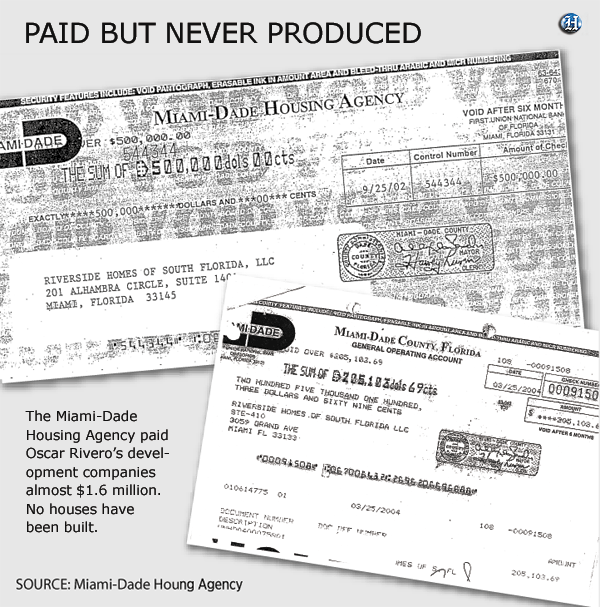
For these two affordable housing projects, the Miami-Dade Housing Agency paid Rivero's development companies almost $1.6 million -- but not a single house was built.
It was the beginning in a series of illfated government deals that shook the foundation of public housing in one of the poorest and most distressed communities in the nation.
In the past five years, the Miami-Dade Housing Agency squandered millions of dollars on failed projects, pet programs and insider deals even as thousands of families languished in rotting and unsafe homes.
Aided by the agency's longtime director, a cadre of developers made out, raking in millions of dollars for homes that have never been built. From Little Havana to Liberty City, they took the money but left only empty lots, with broken baby cribs and bags of trash where houses had been promised.
Overall, the Housing Agency pledged more than $87 million to put up 72 developments for the poor, including apartments, houses and complexes for the elderly. The expected payoff: more than 8,300 new homes.
It was the centerpiece of the most ambitious affordable housing push in decades, and desperately needed in a county with a hurricane-battered housing stock, runaway home prices and a workforce stunted by stagnant wages.
But about 40 percent of the projects funded between 2003 and 2005 have been canceled. Others are delayed for months, even years.
Only 14 projects less than one-fifth of what was pledged have actuallybeen completed.
Worse: Even when houses were built, some developers under the watch of the Housing Agency bypassed the poor and sold to real estate investors who turned quick profits.
"That's terrible," said former U.S. Rep. Carrie Meek of Liberty City, who sponsored breakthrough legislation that created Miami-Dade's affordable housing construction fund. "I wanted to leave a legacy in this community. This undermines it."
Bus drivers, nurses' aides and construction workers suffered no place to live, no help from the government.
Ozie Porter saved $5,000 earning $10.44 an hour as a cafeteria cook. At 54, the longtime public housing resident is ready to buy her first house.
She found a rare three-bedroom priced for low-income buyers at $179,000 and took a tour in late spring, sweeping into the foyer under a crystal chandelier.
"Can you imagine," Porter asked, "walking through that front door every day?"
She turned to the builder, but the news wasn't good: More than 100 families were lined up to buy the house.
Porter pleaded: "Don't do that to me."
CASH MACHINE: LOTS OF MONEY SPENT BUT FEW HOMES BUILT
The Miami Herald spent seven months investigating every major building program at the Housing Agency, examining hundreds of project files, federal records, invoices, budgets, construction correspondence and government databases.
At every step, The Miami Herald found, the agency became an unchecked cash machine for developers and consultants and its own leaders and failed the families it was meant to serve. Consider: Rodriguez
• The Housing Agency paid more than $12 million to developers who promised dozens of houses but built only two, and years later, never returned the money.
• In some of those cases, the Housing Agency allowed developers to take the cash without signing loan documents or pledging land as collateral, leaving taxpayers on the hook with no easy way to recoup the money.
• Longtime Housing Agency Director Rene Rodriguez ordered some of the payments even though projects were barely off the drawing boards and nowhere close to construction, a breach of fundamental county policy that put millions of dollars at risk. In one case, Rodriguez even delivered $1.5 million to a nonprofit group he was overseeing as president and chairman.
"It shouldn't have happened. There is no question," said Cynthia Curry, senior advisor to County Manager George Burgess.
• The agency diverted another $5 million money earmarked by state law to build homes for the poor to pay for a new office building complete with a $287,000 bronze sculpture of stacked teacups called Space Station that was shipped from Italy.
• County auditors have not acted in at least five years to ensure that the money was spent properly, though millions of dollars were riding on risky projects. Making matters worse: The Housing Agency, one of the nation's largest, acknowledges its computer files are flawed, with projects and money that disappear from one report to the next.
• Beyond the spending, the Housing Agency repeatedly allowed developers to miss construction deadlines on badly needed buildings. On 12 projects alone, delays stretched a total of 13 years with costs rising and the poor sometimes forced to make up the difference in higher home costs.
• One of the agency's most high-profile projects replacing dilapidated public housing in Liberty City with 411 new homes is so marred by mismanagement that only three houses have been built in six years. More than $22 million has been spent while 800 poor families have been forced to relocate.
Keionta Mcrae, 11, has moved with her family twice since she left Liberty City five years ago. She dreams of a house with a pink bedroom. She lives in a house where rats eat through the floors.
"If I had my own room," said Keionta, who lives in a crumbling rental just down the street from Miami's chic Design District, "it would never get dirty."
• Meanwhile, developers entrusted with building new homes for the poor in Miami-Dade's most troubled neighborhoods have sold instead to real estate investors and wealthy buyers who netted big profits.
Investors Fredricka Trapp and her son Clifton bought nine houses built for the poor in Florida City, then sold them to a string of investors, reaping $175,000 in 14 months.
Said Clifton Trapp, who pleaded guilty last month to attempted cocaine trafficking in Miami-Dade: "It was a good investment."
WEALTH AND POVERTY: MIAMI IS NATION'S LEAST AFFORDABLE CITY
Miami's skyline glistens with sleek buildings, its suburbs with terra cotta estates, but for thousands of poor families who scrape by in the city's underbelly, home is a cramped rental apartment on the outskirts of town.
With pockets of intense poverty and an immigration rate that no other community has seen since New York in the first decade of the 20th century, Miami is the nation's least affordable city, The Miami Herald's analysis of census numbers shows. Here, Fernando Santana gets by earning $3 for every pineapple he sells from the back of his truck parked on a dusty corner of Little Havana.
The Housing Agency was supposed to become a vital lifeline to residents like Santana and to thousands of families hunting for a safe, clean, stable place to live. It is an agency flush with land and money.
In 1983, Miami-Dade became the first county in Florida to pledge construction loans to developers willing to build affordable homes. The money would come from taxes paid on commercial property sales.
The surtax program, fueled by tens of millions of dollars, was a lifesaver for some families. Between 2003 and 2005, some 2,600 homes were built.
But in 2002, the Housing Agency began engaging in a risky practice: Funneling surtax money to developers long before they started construction.
The advances for at least 11 major building projects over four years undermined the county's ability to produce housing and recoup loans from deadbeat developers.
County officials say the practice violated the Housing Agency's own policy, which prohibits cash advances so taxpayers' dollars aren't lost on projects that end up dead. to protect taxpayer dollars from d, "In no event shall the county provide advance surtax funding to the developer."
Yet, in one of the most questionable cases, the agency under orders from director Rodriguez cut a $500,000 check to Rivero's development company for a project never built: Riverside Homes, off Northwest 85th Street on the fringes of Little Haiti.
The money was transferred even though records show Rivero had not started construction, did not have builders' risk insurance to protect the county from liability and had not paid the required $10,000 commitment fee to the Housing Agency.
"We had never done it like that before," said Tawana Thompson, who has run the construction loan program for nine years.
Thompson said her boss, Rodriguez, ordered a series of advances. She said the Housing Agency usually requires receipts, invoices and canceled checks documenting payments to contractors for construction before any money is paid.
The advances stopped when Rodriguez left the Housing Agency in 2004. Rodriguez did not return The Miami Herald's calls.
Today, four years after the Housing Agency advanced Rivero $500,000 and later paid another $264,000 the lot that was supposed to have "big, family-size units" has become a dumping ground with an expired building permit notice from Miami-Dade County tacked to the fence.
"They've been saying they were going to build something here for years," said Miguel Gonzalez, who lives across the street in a freshly painted yellow house.
Even with that project stalled, the Housing Agency gave Rivero's company $816,000 in 2004 for another building venture in Little Havana. Instead of spending the money on construction, however, records show Rivero told the Housing Agency he was going to use most of the tax dollars to pay down private debt.
Rivero, 36, an attorney and chairman of the Miami Parking Authority, is part of a small group of developers and consultants involved in some of the Housing Agency's most questionable projects.
In a written response to The Miami Herald, Rivero said, "The developments are progressing and I have full intention of repaying the funds allocated with all applicable interest.''
But that hasn't happened. Rivero's loans are in default; the county filed suit this month.
Besides the $1.6 million, the city of Miami's Department of Community Development paid Rivero's company $530,000 for one of the two stalled building projects. The city's program is run by Barbara Gomez-Rodriguez, Rene Rodriguez's wife. They are now divorcing.
Rivero's development company was paid $530,000 for one of his two stalled building projects from the city of Miami's Department of Community Development, run by Barbara Gomez-Rodriguez, Rene Rodriguez's wife. They are now divorcing.
While the money flowed to Rivero's projects, some staffers at the Housing Agency raised a series ofconcerns.
In late 2005, after Rivero requested another $179,000 for Riverside Homes, Housing Agency loan officer Ana Sofia Rodriguez wrote in an e-mail, "The draw request is composed of soft costs only, again . . . construction for the project has not progressed as proposed."
She questioned the way Rivero planned to use the money:
• Reimbursing his own law firm and development group $9,000.
• Paying a general contractor $73,000 when no homes had been built.
• Making an $8,000 interest payment on another outstanding Housing Agency loan, essentially using Housing Agency money to pay back the same agency.
"This is a tragic case of wasted time and money, neither of which Miami-Dade County can afford," said Sushma Sheth of the Liberty Citybased Miami Workers Center.
And the dollars have continued to flow, with Rivero awarded money again this year for three new projects.
The County Commission approved them in a sweeping package with money for dozens of other builders. Earlier this year, as the Housing Agency prepared to squash the projects, Rivero relinquished the money.
$5 MILLION ADVACED FOR AGENCY OFFICES
One of the most questionable recipients of surtax money is the Housing Agency itself.
State law is clear: The money can be used only to build or rehabilitate housing for the poor.
Yet when the Housing Agency wanted a new headquarters in 2003, it dipped into the surtax fund to put $5 million into the project. Three years later, nothing has been built.
The Housing Agency also has tapped into surtax money to cover budget cuts, partly because it doesn't receive any money from the county's general fund.
In 2005, when the federal government slashed the agency's funding, the Housing Agency drew on surtax dollars to cover a $9.6 million budget shortfall.
With the approval of county commissioners, officials promised to pay the money back over 10 years, saying no construction project will lose out.
"We didn't worry," said Housing Agency Finance and Administration Director John Topinka. "We know from experience that it takes several years for [building] projects to be completed."
Other questionable expenses taint the program.
Just this year, the agency got permission to use surtax money to pay $830,000 to a consultant for another two years of management for one of the Housing Agency's most delayed and troubled projects: the rehabilitation of the Scott/Carver public housing, which after six years is a wasteland of boarded-up buildings.
In another program, the Housing Agency used surtax money to pay a for-profit real estate company $50,000 to run "homebuyer education" workshops for the poor. But The Miami Herald found the agency paid thousands of dollars for people who said they had no idea their names were being used.
Another $200,000 went to the local Black Business Association for helping minorityowned contractors become certified with the county. But the association double-billed the Housing Agency, The Miami Herald found.
All the while, the Housing Agency has allowed building projects to linger for years through repeated delays.
Case in point: In 2001, the agency awarded the Allapattah Business Development Authority $1 million to help finance the construction of 30 townhomes on a bustling corner just off the Airport Expressway.
Five years later, the project still isn't done.
The nonprofit group, known as ABDA, got the money even though its last affordable housing project, Ralph Plaza 1, was delayed by lawsuits, liens and a contractor who was jailed in an unrelated kickback scheme.
So far, the Housing Agency and its board have allowed ABDA to repeatedly push off the due date for its new project, Ralph Plaza II. ABDA also has proposed raising the price of its town houses from $112,000 to $145,000, passing on the costs to the poor.
In all, it's taken ABDA a decade to build the 44 apartments that'sabout four a year.
With so many affordable housing projects delayed or dead, advocates for the poor question why the county hasn't stepped in sooner. County Manager Burgess made a series of changes in recent months, but problems have festered for years.
"It's disgusting," said Lida Rodriguez-Taseff, an attorney who has represented low-income families with housing disputes.
The worst part, she said: "Nobody blinks an eye."
Staff writer Susannah Nesmith and database editor Tim Henderson contributed to this report.
© 2006 The McClatchy Company
A nonprofit received $16 million and land but finished just one affordable housing project
By Debbie Cenziper
But like the rest of the nonprofit's projects, Sunset Pointe is delayed.
In a rundown office in the shadows of the Palmetto Expressway, a novice developer with a skeletal staff and a string of stalled projects is raking in millions of dollars to build homes for the poor.
Over five years, the MDHA Development Corp. received $16 million from Miami-Dade County, dozens of vacant lots, the deed to an apartment complex, county office equipment, loaner cars and staff time worth almost $500,000.
But of 17 affordable housing projects, the nonprofit has produced just one: a 100-unit apartment complex for the elderly that was months delayed and riddled with building breakdowns.
For that single, bungled project, the nonprofit is scheduled to receive a $900,000 developer's fee.
And the money keeps coming: The County Commission recently awarded the nonprofit another $2.5 million.
The flow of taxpayer dollars to the fledgling nonprofit is among the most troubling examples of what's gone wrong with public housing in Miami-Dade, and how politics and connections trump sound business judgment and fundamental county policy.
Since its founding, the nonprofit has been on the receiving end of an open checkbook, courtesy of the Miami-Dade Housing Agency and the County Commission.
Time and again, commissioners funneled money and land to the nonprofit through the Housing Agency, which bent the rules to deliver the cash quickly, no strings attached.
But instead of building badly needed homes for the poor, the nonprofit struck deals that benefited well-connected developers, former Housing Agency employees, a board member's business partner and a county commissioner's troubled social service agency, an investigation by The Miami Herald has found.
Consider:
County commissioners overlooked established developers to approve more than $30 million in loans to the nonprofit even as its projects were floundering.
In charge of delivering the money, the Housing Agency transferred nearly one-third or $9.5 million for five building projects that years later still haven't produced any homes.
The advances violated one of the agency's most basic policies: no money until construction begins.
Complicating matters, the Housing Agency paid the money without demanding that the nonprofit sign loan documents, leaving the county with no collateral. "What if they don't do the project? I have nothing," said Tawana Thompson, who oversees the Housing Agency's construction loan program.
In one case, the Housing Agency wired $4 million to the nonprofit for unspecified "elderly housing projects." Four years later, the nonprofit hasn't even found land to start building. The money has not been returned.
The nonprofit's key connection came from its first president and chairman, Rene Rodriguez, who had pull at the Housing Agency. He was running it while at the same time leading the nonprofit, a dual role established by county officials.
As the Housing Agency's director, Rodriguez ordered a series of payments to the nonprofit over the objections of his staff.
Under Rodriguez's leadership, the Housing Agency also loaned the nonprofit cars, office space, equipment and staff time. When the Housing Agency sent a bill earlier this year to be reimbursed for $496,000, the nonprofit refused to pay.
The County Commission and Housing Agency gave the nonprofit land, too: more than 60 county-owned lots. The Housing Agency department head who until recently oversaw land transfers was Emma Duffie, wife of the nonprofit's longtime board member, Alben Duffie.
While the Housing Agency was delivering money, the nonprofit was striking questionable deals. In 2004, it shelled out $750,000 to partner on a building project with developer Oscar Rivero, even as he struggled with two other troubled housing projects. So far, the new project has never materialized.
Rivero was no stranger to the nonprofit. He and Duffie, the nonprofit's longtime board member, are among the investors involved in the construction of an office complex for the Housing Agency.
The year after the nonprofit paid the $750,000, Rivero, board chairman at the Miami Parking Authority, approved a parking garage deal for Duffie's development company.
The nonprofit defends its decisions and track record.
"The [nonprofit] is proud to have, in just a few years of operation, 10 projects under way for approximately 640 additional affordable housing units in Miami-Dade County," Executive Director Maria de Pedro-Gonzalez wrote in a letter to The Miami Herald.
But records and interviews show almost every project has been steeped in what builders call predevelopment, with permitting, zoning and financing issues. The nonprofit now has just one project under construction, but the work is being handled largely by its for-profit development partner.
When The Miami Herald contacted nonprofit Vice President Allen Fuller, he said he had no idea that projects were so far behind.
"That's shocking to me," he said. "They're still stuck in predevelopment?"
WARD TOWERS: STATE-OF-THE-ART APARTMENTS PLANNED
Fearing that Miami's runaway home prices were stranding the low-income elderly in homes they couldn't afford, county commissioners in 2000 took a bold step: They created a private nonprofit to build a state-of-the-art apartment building.
With 100 apartments, Ward Towers would be the first public housing complex built in Miami-Dade since the mid-1970s.
To help pay for it, the county decided to apply for affordable housing dollars from the state. Government agencies aren't eligible, so commissioners created the MDHA Development Corp. to do it.
The nonprofit would oversee the construction of Ward Towers and become its owner. But within months, the nonprofit morphed into one of the busiest developers in Miami-Dade.
Again and again, county commissioners tossed projects to the group, bypassing a slate of experienced developers never given the chance to bid for the work.
There was the Pinkston Drive building project: $2 million.
Smathers Plaza: $3 million.
Senator Villas: $2.8 million.
Gran Via Apartments: $4.5 million.
Though the nonprofit was new, it had one crucial asset: connections.
When the nonprofit was created, county staff members chose its leaders. There was no competitive process, and years later, there is no paperwork to track how the appointments were made. Named to the board: then-Assistant County Manager Barbara Jordan, Rodriguez, Deputy Housing Agency Director Alphonso Brewster, lobbyist Duffie and Florida International University Professor Pamela Elfenbein.
County officials said the idea was to create a quasigovernment development group that would act as an arm of the Housing Agency.
In reality, they created a private entity with a direct pipeline to some of the most powerful officials in Miami.
With Rodriguez as the county's top housing official and president of the newly formed nonprofit, it was poised to benefit from the Housing Agency's staff, equipment, and most importantly, the county's pot of money for affordable housing.
It began with a simple request.
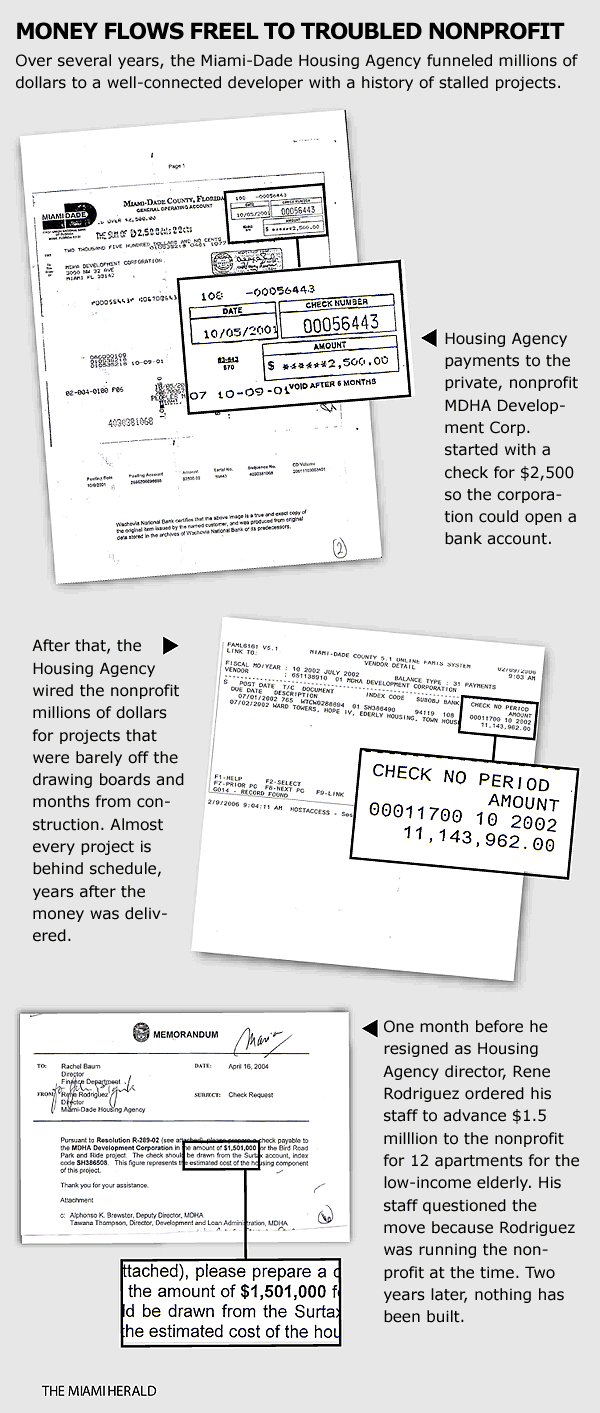
In 2001, Rodriguez directed the Housing Agency to cut a check for $2,500 so the nonprofit could open a bank account.
Over the next few months, Rodriguez would direct two more transfers worth $3 million, in part, to cover unexpected costs at Ward Towers -- the nonprofit's lone, troubled project.
In 2004, records show, he ordered the agency to advance $1.5 million to the nonprofit for another project, a 12-unit apartment complex for the elderly. That directive and others like it would cross a line that would put taxpayers' money at risk with few people even aware of it.
The agency's own affordable housing contract states, "In no event shall the county provide advance... funding to the developer."
The contract also demands that developers submit detailed invoices and receipts before any money is disbursed. In this case, the nonprofit submitted a 15-word letter to the Housing Agency and walked off with $1.5 million.
The single sentence: "This serves as a request and invoice for $1,501,000 on behalf of MDHA Development Corp."
That was in April 2004. So far, nothing has been built.
NO LAND, NO PLANS: ELDERLY'S NEED CITED IN $6 MILLION TRANSFER
One of the most questionable advances came in 2002, when the Housing Agency forwarded $6 million to the nonprofit for little more than a lofty idea: the development of three housing projects for seniors.
"Demand for elderly affordable housing is critical at the national and local levels, primarily because people live longer," county commissioners wrote in the resolution authorizing the money.
The nonprofit had purchased no land to build on. Yet the money was transferred, free and clear, with no loan documents ever signed. Housing officials, in fact, couldn't have gotten documents even if they had bothered to ask because the nonprofit didn't own any land to put up for collateral.
Other developers must provide stacks of paperwork, much like a home closing, showing land title, proof of building insurance, names of architects and contractors and financial statements. The Housing Agency records a mortgage against the property. Even then, the agency generally doesn't transfer money before construction.
Not so with the nonprofit, which, four years after receiving the $6 million, still hasn't found land for two of the three projects. Gonzalez
"Nothing has materialized," said Executive Director de Pedro-Gonzalez.
The nonprofit continues to hold on to the $4 million earmarked for the two projects.
Brewster, who replaced Rodriguez as head of the Housing Agency, demanded last year that the nonprofit return $1 million so another developer could launch a project. Nonprofit officials refused, saying that's an order that can only come from the County Commission.
DECISIONS QUESTIONED
STAFFER SAYS SHE LISTENED TO BOSS
Thompson, who helped handle the cash advances and contracts as head of the Housing Agency's construction loan department, said she questioned the decisions but ultimately succumbed to Rodriguez, her boss. She said Rodriguez directed the agency to forward the money.
"We didn't close any of those loans," she said. "The director, I assumed he had the authorization. He directed that the funds be transferred to the Development Corp."
Rodriguez did not respond to The Miami Herald's calls and letters requesting interviews.
In correspondence to his staff at the Housing Agency, however, Rodriguez justified the transfers by citing the resolutions passed by the County Commission. Those resolutions called for the "allocation and transfer'' of funds, but did not specify when the money should be paid.
Enter the Housing Agency, which simply advanced much of the money in violation of its own policies and over staff objections.
Assistant County Attorney Terrence Smith, who has overseen legal matters at the Housing Agency for six years, said he was not consulted about the transfers. He also said he was unaware that money changed hands without signed loan documents.
"That's left entirely up to the department," he said.
Jordan, now a county commissioner who served on the nonprofit board when it was created, said she did not know when money was wired. But she said county staff members assumed construction would start immediately.
"It's really a dismal report when you look at the fact that construction has not started," she told The Miami Herald. "We have a serious problem."
In all, the County Commission approved more than $30 million in loans for the nonprofit. Of that, the Housing Agency transferred $16 million: Most went to the advances in question, the rest to Ward Towers, the nonprof it's only completed building project.
In recent months, the Housing Agency has refused to give the nonprofit the rest of the money until projects have started and loan documents are signed.
What happened to the $9.5 million in advances is largely unclear: In five years, the county manager and County Commission have never demanded an audit.
'SOFT' COSTS: WHERE MONEY WENT IS STILL UNCLEAR
The Miami Herald's review of the group's accounting reports and project files shows tens of thousands of dollars went to "soft'' costs and salaries not construction:
After Rodriguez resigned from the nonprofit's board in 2004, he stayed on as a $5,500-a-month consultant. Over seven months, he collected almost $40,000.
The nonprofit in 2005 gave Executive Director de Pedro-Gonzalez, who had worked at the Housing Agency under Rodriguez, a $120,000-a-year annual salary. The nonprofit also agreed to $700 a month for insurance and a car allowance, and $150 a month as an "executive benefit."
That same year, the nonprofit paid $25,000 to Rivero, the troubled builder, to draft forms used for competitive bidding. At least $15,000 was paid to Masvidal Partners, run by Raul Masvidal. Masvidal is a developer and business partner to Duffie, the nonprofit's longtime board member.
Another $2,000 was paid to the nonprofit Black Business Association, also headed by Duffie, for a table at two annual galas.
Overall, architects took in more than $700,000; lawyers, more than $200,000; accountants, more than $45,000.
The payments came at a time when most of the projects taken on by the nonprofit were falling behind, delayed by permitting or zoning problems, land shortages, funding gaps and negotiations with co-developers, according to the nonprofit.
"It takes a lot to develop affordable housing," de Pedro-Gonzalez said.
Said the nonprofit's attorney, Mitchell Bierman, "Actually, the track record is stellar to have completed one project and have another one under construction."
But the nonprofit's struggles have affected hundreds of Miami-Dade residents, including Marta Bido, who worked for decades as a bookkeeper until muscular dystrophy forced her off the job. At 53, she collects disability, but her rent is $650 and going up every year.
From a friend, Bido learned about a new building by the nonprofit called the Gran Via Apartments.
She called the nonprofit and signed up. But construction hasn't started more than three years later, though County Commissioner Joe Martinez staged an upbeat groundbreaking in 2004.
Nonprofit Executive Director de Pedro-Gonzalez said a co-developer was recently selected for the project, which so far has been awarded $4.5 million from county commissioners.
SUNSET POINTE: AFTER TWO YEARS, LOT STILL EMPTY
Even as its projects fell behind, the nonprofit in 2004 took on another: Sunset Pointe Apartments.
Board members decided to partner with Rivero, who was already struggling with two other affordable housing projects that were months behind schedule.
Sunset Pointe called for a 46-unit complex for the elderly in South Miami with all the amenities "normally associated with affordable housing properties developed by [Rivero]." It would be built across from a rundown public housing complex, offering residents a chance to move into newer homes.
Despite Rivero's track record, the nonprofit kicked in $750,000 to a newly formed Sunset Pointe limited liability company.
"It was to ensure the project got done," de Pedro-Gonzalez said.
Rivero told the nonprofit he would use the money, in part, to repay a $284,000 loan his development group had made to the new company; the rest would help pay for the land.
But like the rest of the nonprofit's projects, Sunset Pointe is delayed. Zoning issues are to blame, de Pedro-Gonzalez said.
Rivero would not answer specific questions about the project, but said in a written statement that Sunset Pointe and his other projects "ideally would be closer to completion at this time, however, extenuating circumstances ... have delayed the delivery of units."
The lack of progress and unquestioned deals mystify other developers.
"There is a political clique, and if you're not in that clique, you're just like everyone else in town and you follow the rules," said longtime developer Jerry Flick, who is building affordable homes on inner-city urban lots. "But if you're in that clique, you profit."
© 2006 The McClatchy Company
The 100-unit Ward Towers finally opened, but after months, the facilities are incomplete and its promised services lacking.
By Debbie Cenziper
Every morning, residents of the newly opened Ward Towers hike along four-lane 54th Street for hot meals at an apartment complex down the road.
"Bingo signs," says 78-yearold resident Emilio Quilico. "That's all I see."
Six years ago, Miami-Dade set out to build a state-of-theart assisted-living facility for the low-income elderly, a 100unit building that was supposed to be a gleaming addition to a county desperate to put seniors into homes they could afford.
To pull off the project, the Board of County Commissioners created the private nonprofit MDHA Development Corp. to apply for state funding, oversee the project and become the building's new owner.
But delays, contractor disputes and building breakdowns have hounded the nonprofit's only new building, even as county commissioners continued to funnel the group more money and land.
Among the problems at Ward: The state denied an assisted-living license, citing a failure to provide proof of firesafety and health department inspections.
That curtailed plans to provide a host of services to residents, including meals.
Miami-Dade fire rescue twice cited the building for safety hazards, such as the failure to maintain a sprinkler system and fire alarm panel.
Miami-Dade Housing Agency inspectors found dozens of flaws bad caulking, broken counters, waterstained drywall, shoddy paint jobs, damaged ceilings, missing fire extinguishers.
After a payment dispute, contractor Delant Construction walked off the job, leaving the therapeutic pool unfinished, a barren, messy reminder of all that's gone wrong with the $18 million project.
Noting piles of construction debris in the pool area and materials stored outside, the Housing Agency wrote to the nonprofit last year: "This unsafe condition . . . is an accident waiting to happen."
Yet amid the problems, the county last fall moved 50 seniors into the troubled building.
Ward Towers had received a certificate of occupancy but was still fraught with problems, including the construction concerns and fire violations.
Last November, in fact, Housing Agency construction manager Alberto Perdigon warned the nonprofit that 22 percent of the air-conditioning units in the five-story apartment building were malfunctioning.
He also noted that rainwater had seeped through the windows.
"Some of the damages, to name a few, were popcorn ceiling finish detaching from concrete ceiling, water-damaged drywall and loose vinyl flooring tiles caused by standing water inside the units," he wrote in a letter to the nonprofit.
The rush to fill Ward Towers had more to do with money than easing the county's housing crunch.
In May 2005, Ward Towers was empty, and the nonprofit estimated it was losing $30,000 for every month the building, already more than a year behind schedule, wasn't filled.
"The way we are going," corporation Executive Director Maria de Pedro-Gonzalez wrote in an e-mail to the Housing Agency, "all the profits will be depleted by the time the facility is operational. . . . It is imperative that we start moving people in IMMEDIATELY."
In all, the nonprofit was to receive a $900,000 developer's fee, plus $4.1 million to close out the project and pay off construction bonds but only after the building was fully occupied for three months.
Today, years after the project began, the still-unfinished Ward Towers is filled.
Problem is, the residents fear they're about to get kicked out.
The Housing Agency filled Ward Towers with elderly people who needed a place to live but not necessarily assisted-living services.
The only way to pay for meals, adult day care, transportation, nursing and personal-care services is by tapping into government funds for assisted-living residents.
A contractor has been hired to oversee those services at Ward Towers. And so has an organization to run the commercial kitchen: the James E. Scott Community Association, whose president is County Commissioner Dorrin Rolle.
De Pedro-Gonzalez acknowledges that once Ward Towers is licensed, frail residents will be brought in and current residents moved to other public housing.
That includes Jose Lopez, who has been waiting for months to use the library, pool and cafeteria.
"They put us in here and now, in a few months, they say we have to move? This is too much stress," Lopez said. "They used us, like some kind of an experiment."
© 2006 The McClatchy Company
In Liberty City, the Miami-Dade Housing Agency has left a wasteland where families once lived
By Debbie Cenziper
In a town house where stray bullets left pockmarks on the walls, where the doors are locked tight and the windows covered with steel bars, 5-year-old Alex Bruce eyed his blue scooter and asked, "Can I ride?"
Just two years ago, his mother tore the skin off her hands pushing Alex through the door as bullets flew through their Liberty City neighborhood. So on this bright afternoon in April, Andrea Williams took one look at the scooter, parked in the living room, and told her son, "Maybe later."
Williams had hoped to be out of here by now.
Once she was part of the most high-profile building project ever taken on by the Miami-Dade Housing Agency, with a name that suited its mission: HOPE VI.
Armed with a $35,million grant from the U.S. government, the Housing Agency set out to transform one of Miami's most distressed neighborhoods by replacing rundown, barracks-style public housing along Northwest 22nd Avenue with 411 houses offering poor families a shot at homeownership.
Williams and hundreds of others would be relocated while homes were built, then offered a chance to buy them at affordable prices.
But instead of putting up houses, the Housing Agency spent millions of dollars on architects and project managers, staggering overhead costs and payments to a consultant who double-billed the county, an investigation by The Miami Herald found.
Six years later, almost half of the money is spent, and more than 800 families displaced.
They thought they would come home to a reborn community.
But now there is no community.
In six years, just three houses have been built, leaving a dusty and deserted wasteland in the heart of Liberty City, with block after block of boarded-up buildings and mounds of rubble where generations of families once lived.
Worse: Dozens of people who moved from the area no longer can be found.
The Miami Herald traced 250 families and found that more than one-third no longer live at the addresses the Housing Agency considers current. Some are simply gone, with no forwarding addresses, lost by a system that vowed to watch over them.
"It's so disappointing," said Williams, 23, a mother of two who earns $8.25 an hour working nights in a home for the disabled. She was forced to leave the home she grew up in only to move a few miles away to another public housing complex, where earlier this month a 9-year-old Sherdavia Jenkins was shot and killed playing on the front stoop.
"I really thought I'd be able to get a house by now," Williams said. "Nobody in my family has ever had that before."
While Williams waited for construction to start, the Housing Agency botched its bid for state affordable housing money and lost out on $2,million. It overpaid landlords who took in displaced families. In other cases, it failed to provide rent subsidies to newly relocated residents, leaving them at risk of eviction.
While cutting checks, the federal government produced just two monitoring reports in six years, even after the Housing Agency missed development deadlines and spent so much money early on that federal officials worried about the "apparent front loading" of administrative costs.
In January, the U.S. Department of Housing and Urban Development finally warned the Housing Agency that the $35,million grant was "at risk."
"Progress," wrote HUD's Miami office chief, "cannot continue at this snail's pace."
Elizabeth Ogden, who manages the project for the Housing Agency, acknowledges delays but said the program is on track.
"We've made tremendous strides, and we're certainly moving forward," she said.
But problems persist.
Though the Housing Agency has spent more than $22 million so far in both federal and local dollars, it did not offer developers construction money to actually build the houses promised in the first phase of the project.
One developer who stepped forward later backed out, causing more delays. The Housing Agency eventually asked Miami Habitat for Humanity to build 52 homes. The three houses built so far were delivered free by Habitat.
But Habitat, hoping to have the homes built by January 2008, has no idea where the construction money will come from.
"I hate to use the word desperate," said Habitat executive director Anne Manning.
REVIVAL PROMISED: RIOTS SCARRED CRIME-RIDDEN AREA
Williams grew up among crack dealers and alleyway gamblers, teenagers who stole cars and stripped them down at night in the dimly lit streets of Scott Homes, Florida's largest public housing development.
Police chased suspects through the breezeways. Families battled rats and roaches in rundown apartments built in 1954.
Rioting in 1980, triggered after the acquittal of white police officers in the beating and killing of an unarmed black motorist, left a scarred community.
But it was also a community with roots and history, a place where Dorothy Perry opened her home to local kids and taught them to sing anti-drug rap songs, where longtime resident Leon Fulton planted a lush rose garden and thicket of palms to spruce up the neighborhood.
In this torn, troubled place, with a poverty rate four times greater than the Miami region as a whole, the Housing Agency vowed an unprecedented revitalization.
The construction of new homes, which would replace Scott Homes and the nearby 96-unit Carver Homes, was supposed to start no later than 2002 and end by April 2005. Promised in countless community meetings and home-buyer workshops were 251 affordable homes and 160 new public housing units.
But the biggest mistake, critics say, came first: The Housing Agency decided to handle the project in-house.
Hundreds of project files, e-mails, contracts, budgets, construction correspondence and senior staff meeting notes reviewed by The Miami Herald expose the agency's missteps.
In 2001, the agency hired a relocation company for $2 million. But for four months, records show, the company failed to offer counseling and housing referrals to the hundreds of families about to be displaced from their homes.
An even bigger problem bubbled up once the referral work began. In a county already struggling with a widespread affordable housing shortage, there simply weren't enough places for families to go.
The Housing Agency made no move before launching HOPE VI to open up housing for the 800-plus families who were about to be displaced.
Some families were so worried about where they'd end up that they refused to leave the neighborhood, living for months in empty buildings where vandals stole the pipes and fixtures.
Many knew of residents who already had bounced from place to place after leaving Scott Homes, including 22-year-old Lakia Davis, who moved three times, the last from an apartment where sewage seeped into the shower every time her neighbor flushed the toilet.
The remaining residents of Scott Homes also heard the Housing Agency wasn't making required rental payments on time, putting newly relocated families at risk of eviction. The problem was documented by HUD in a 2003 monitoring report.
"Everyone knew that once you moved, the Housing Agency forgot about you," said Mary Reese, who lived in the complexes for 20 years and was among the last to leave.
In March 2001, when county commissioners questioned the pace of the project, then-County Manager Steve Shiver publicly assured them that HOPE VI was "very much under way."
But an in-house Housing Agency report just five months later told a different story.
"At present," the report said, "there has been little or no progress made in the relocation of families."
HOPE VI
AGENCY, MANAGER DIFFER ON APPROACH
In 2001, the Housing Agency hired the Atlanta-based H.J. Russell for $2.5,million, adding another layer of management to the ailing project.
The agency at the time already had assigned 14 people to HOPE VI, racking up hundreds of thousands of dollars in overhead. Now, H.J. Russell would provide "overall program management."
H.J. Russell officials said they thought they would come in and take over the program, much like they've done in other cities with identical projects. The company would oversee a single team of contractors, architects and engineers.
But the Housing Agency couldn't decide how to tackle the job, said Paul Perdue, H.J. Russell's Miami program executive. Plans shifted constantly. H.J. Russell had little to say about who was hired and how the work would be done, he said.
Eventually, the Housing Agency decided to break the project into phases, raising costs and delaying construction. Instead of leveling all the buildings at once, for example, some would go first and others later.
"Here again, don't ask me why. We weren't involved in this decision," Perdue said.
Instead, H.J. Russell has been paid largely for a side project: the painting and landscaping of existing homes in Liberty City, which raised the cost of the program.
The Housing Agency has touted the beautification program as a success, with more than 500 homes fixed up. But one-fifth of the $2.5,million spent went to three consultants, including H.J. Russell.
One consultant, the local Black Business Association, double-billed the Housing Agency for months, The Miami Herald found. So did H.J. Russell, a problem that company officials say they caught and later fixed.
The Housing Agency also had problems with its architect, Neil Hall, hired for $2.6,million to design the new community.
Hall had studied similar HOPE VI projects nationwide. After meeting with community members in Liberty City, he proposed building a neighborhood that not only would include homes, but also shops, parks, pools, clubhouses, libraries and theaters amenities that sustain a community.
The Housing Agency resisted, according to Hall and others involved in the project.
"They asked me to choose between being an architect and being an advocate, and I couldn't separate the two," Hall said. "This was something our community desperately needed."
Perdue said the Housing Agency balked because there wasn't enough money, and officials figured extra features could be added later.
"I don't do what I want to do. I do what the plan says to do and what I'm instructed to do by the Housing Agency," Perdue recently told The Miami Herald. "I don't know if we got that same level of cooperation by the architect.
In 2004, the Housing Agency terminated its contract with Hall.
"That was a delay," said Perdue. "We had to start again."
Adding to the tension was a class-action lawsuit filed on behalf of Scott/Carver residents, alleging the project discriminated against black families by forcing them to move with little hope of being able to afford one of the proposed new houses.
In a 2002 letter to HUD requesting more time to start construction, then-Housing Agency Director Rene Rodriguez largely blamed delays on the lawsuit, saying, "Opponents have gone along way to try to block the project."
The lawyers who filed the suit don't buy it. They tried to get an injunction to stop the Housing Agency from tearing down buildings, but were denied in 2002 and again on appeal in 2003.
The demolition of buildings didn't start until 2004 and is still incomplete.
Rodriguez could not be reached for comment, nor did he respond to a certified letter sent to his home requesting an interview.
MORE FUNDS SOUGHT: ALMOST $22M LATER, STILL NO NEW HOMES
As delays mounted, the Housing Agency requested more money from HUD, largely to cover shortfalls in its administration budget.
To date, almost $15,million from the federal grant has been spent on the project, plus $7,million in local funds . money set aside to build homes for the poor.
Ogden, who is running the program at the Housing Agency, said money paid for architects, engineers, environmental surveys, water and sewer hookups, and demolition.
"There is so much that goes into seeing something tangible," he said.
But records show much of the money went to overhead, overtime, office supplies, fringe benefits and consultants, so much so that HUD raised concerns about the level of spending in correspondence to the Housing Agency. Just this year, county commissioners gave the Housing Agency another $830,000 in surtax funds to pay H.J. Russell for additional services and two more years of program management.
Now, six years into a project that's years from completion, HUD officials are growing restless.
"The time has long ago passed when we could simply blame the delays on the ongoing legislation. The clock has continued to tick and the federal funds provided through HUD [have] continued to flow to your agency without tangible results," HUD Miami chief Karen Cato-Turner wrote to the Housing Agency in January.
Today along bustling 22nd Avenue, dozens of faded yellow buildings still stand amid overgrown grass and downed tree branches, on streets filled with trash, in a neighborhood that has been destroyed.
There's only one thing now that reminds Andrea Williams of home: a sign shaded for years by an old tree in the middle the road, a few blocks from where she grew up. It says: Welcome to the James E. Scott Housing Community.
Miami Herald researcher Monika Leal and database editor Tim Henderson contributed to this report.
© 2006 The McClatchy Company
Homes intended for low-income buyers have instead been snapped up by investors and others who flip them for a profit
By Debbie Cenziper
Tookes was not told the house was built for the poor, argued her attorney, Dacia Riley.
In a county seized by one of the most dramatic affordable housing shortages in the nation, developers entrusted with government land and money to build homes for the poor have sold instead to real estate investors, wealthy buyers or families who turned quick profits.
Jesse Jones pocketed $21,000 after he sold his new three bedroom in less than a month to a Broward County investor.
Fredricka Trapp and her son Clifton did even better: They made $175,000 in 14 months selling nine houses built for the poor in Florida City.
Said Clifton Trapp: "I basically just spread the word .... It's not like it was a killer deal or anything."
So far, the Miami-Dade Housing Agency hasn't tried to stop them.
The "flipping'' of homes for the poor is among a string of problems that taint an innovative program launched by county commissioners five years ago to bring new life to abandoned lots scattered across Miami-Dade County.
The idea seemed deceptively simple: giving developers government land and in some cases construction loans in exchange for houses that poor families could afford.
Since 2001, developers promised to build more than 580 houses. But only 190 homes one-third of what was promised have been delivered. And not all the homes have been sold to needy families.
Kenya Tookes just snagged a house at a reduced price of $180,000. On the sales contract, obtained by The Miami Herald, Tookes declared herself a first time buyer, a requirement of the program even though she owns four other houses valued at more than $700,000 in total.
"She swindled me," said developer Elena Diaz de Villegas, who said she didn't realize until after the sale that Tookes owns other homes.
Tookes' response to The Miami Herald: "Talk to my lawyer."
For years, the Housing Agency not only overlooked the flipping of properties, but also allowed widespread delays and red tape to overtake the program.
Miami's working poor paid a stiff price, shut out at a time when the county's home prices soared to some of the highest levels in the nation. At the same time, other crucial Housing Agency building projects were derailed by insider deals and chronic mismanagement.
Burned by the breakdowns: Ozie Porter, who several years ago started hunting for a house in the program but was blocked by waiting lists and developers who never built what they promised.
When she started her search, the houses were selling for just under $100,000, the maximum price allowed by the Housing Agency. Now the cap has been raised to $225,000 and Porter is no longer sure she can afford a house.
"Everything has gone up," said Porter, who managed to save $5,000 for a down payment on a cafeteria cook's salary while living in public housing for the past 16 years.
"All I want to do is get into a house. I want a green yard. I've never had that before."
Known as infill housing, Miami-Dade's land program has drawn national recognition, honored with awards and praised by politicians. But The Miami Herald's investigation found:
Not once has the Housing Agency confiscated a lot from deadbeat developers, even though dozens of lots are still empty and the land is supposed to revert back to the county in 12 months if no construction starts.
County inspectors in recent years have levied more than $65,000 in fines against developers for everything from illegal dumping to shoddy lot maintenance to failing to haul off industrial waste. Still, the Housing Agency didn't intervene in pushing construction forward.
The Housing Agency gave out land but never bothered to make sure developers could build on it. When even well-intentioned developers complained they couldn't start construction because of red tape everything from old liens to zoning problems the agency largely ignored them.
Meanwhile, the Housing Agency shrugged off the single-most-important goal of the program helping the poor by failing to ensure that the new houses were sold to low-income buyers.
Instead, officials left the oversight to developers, who stood to profit more quickly by selling to buyers with easy access to cash.
"Unacceptable," said Cynthia Curry, senior advisor to County Manager George Burgess. "It's an abused situation and it's one clearly that the county has to take control over. There was a lack of monitoring on the Housing Agency's part and that lack of oversight obviously cost us."
FAST, EASY MONEY: INVESTORS SNAP UP HOUSES FOR THE POOR
In at least 14 cases, The Miami Herald found, houses built for the poor were sold to real estate investors, buyers who owned more than one property or families who flipped the houses for a quick profit.
Housing Agency rules stipulate that buyers must be low-income, first-time homeowners. The guidelines also state the houses must be sold at an affordable price and remain that way for 10 years, meaning that if a buyer sells before then to someone who is not qualified, the Housing Agency can potentially take back the property.
But the Housing Agency never bothered to ensure its guidelines were enforced, nor did it place restrictions in deeds before the developers took control of the land.
In 2002, the for-profit Citywide Development received a $1 million loan from the Housing Agency to build 70 in fill houses. But Citywide sold at least 11 to real estate investors.
One was Clifton Trapp and his mother Fredricka, who bought nine of the houses and sold them to five other investors over the course of 14 months, earning a profit of $175,000. Combined, the five investors own property valued at more than $2 million.
"We didn't know anything about it being low-income," said Clifton Trapp, of Pembroke Pines, who owns at least 10 houses.
Citywide defends the sales, saying homes were sold to unqualified buyers because it already had paid back the $1 million loan to the Housing Agency.
"We were out from under the requirements," said Diaz de Villegas.
But records show many of the houses were sold weeks or even months before the loan was paid off. Either way, Housing Agency officials say, Citywide signed a contract in 2002 promising the "units approved under this agreement must be occupied by low to moderate-income families." Citywide got the loan over other developers in a competitive process.
"That was supposed to be affordable housing period," said Housing Agency construction loan chief Tawana Thompson
Diaz de Villegas said Citywide has built dozens of affordable homes in Miami Dade.
"This was only one of my cases," she said. "It's blood, sweat and tears building affordable housing. I've always been very careful about selling to affordable housing people."
But records show Citywide just sold another house in the infill program to Tookes, who owns four other homes.
Tookes was not told the house was built for the poor, argued her attorney, Dacia Riley.
"It seems to me that maybe the checks and balances were not made in this case, and now that it has been determined that she was not a firsttime home buyer, people are going on the offensive," Riley said.
But Tookes signed a sales contract claiming she was a first-time buyer.
Said Riley: "The [fine print] is so small."
In some cases developers unintentionally sold to buyers who profited off the program: Youth in Action Center, a Miami nonprofit, sold a $140,000 house to Jesse and Lukesha Jones in January. The couple flipped it weeks later.
Broward County resident Julio Cortez took over their mortgage and paid the Joneses $21,000 after hiring an appraiser to access the house's market value.
Youth in Action executive director Linda Stevenson said she had no idea the buyer was going to resell the house at a profit.
"If you knew what we went through to build that house, just to sell it to them for $140,000," she said. "This makes me angry. We have honest people who need homes."
In 2005, Personal Paradise Developers sold a house to Deney and Katherine Navarro for $153,900. The couple qualified as low income and even received a second mortgage from the Housing Agency.
Seven months after they bought the house, the Navarros sold for $207,000 reaping a $53,100 profit.
The new owners, Roger Perez and Maria Hernandez, earn less than $30,000 between them and said they were unaware the house had been flipped and the price hiked by 35 percent.
"It gets frustrating when you do it for affordable housing and this happens," said Personal Paradise president Octavio Castellanos when he was told of the sale by The Miami Herald.
Curry, with the county manager's office, wants the Housing Agency to keep better track of the sales by requiring closing statements, copies of contracts and proof of income for all buyers. She recently moved the infill program out from under the Housing Agency to the county's General Services Administration.
"We have to flip this," she said. "The program lost its way."
FREE LAND: LOTS WERE SADDLED WITH LIENS, PROBLEMS
Other problems disrupted the program: The Housing Agency gave land freely to groups with no track record or building expertise. The Miami Herald found more than 20 nonprofit and community groups benefited from the program, but never produced a single home.
But there were problems even with experienced developers.
The county set up an infill housing committee to ensure developers were given lots suitable for building. But the committee, overseen by the Housing Agency, regularly passed along lots saddled with tax liens and other problems.
Housing officials admit that about 70 percent of the lots weren't "clean'' or ready for building. But the committee approved them anyway. Some lots were too small for a single-family house and needed zoning exemptions, which can take months. Others needed to tap into water and sewer lines.
The lots also came with costly liens from old violations, such as illegal dumping, that developers inherited when they took control of the land. That caused problems because developers can't get banks to approve loans or the county to issue building permits until the liens are gone a snag that can all but halt construction.
The for-profit Fortex Construction was forced to pay off $80,000 in liens before the county would approve building permits, draining the company's profits on houses that already were being built for cheap
"It's just all this existing red tape that has been there forever that is hard to fight," said Jose Perez de Corcho, a civil engineer with Fortex Construction.
Finally, the Housing Agency last year persuaded the county to change its policy and waive the liens in advance of construction.
The program remain in flux, but county officials say they are trying to find ways to speed up construction.
On a quiet street just east of Interstate 95, longtime local developer Jerry Flick has been trying to build a 1,200square-foot three-bedroom.
He got the lot four years ago but couldn't build on it because of lingering liens from the city of Miami, delaying the project by a year. Then he discovered inadequate sewer lines.
Flick spent $6,500 removing a fallen Banyan tree overturned by Hurricane Wilma last fall. Every two months, he spends $200 clearing debris that's dumped onto the lot; sometimes he's too late and is slapped with a fine.
Overall, Flick has spent more than $20,000 on attorneys, fees, permitting and expenses not including the cost of building the home. The infill program should have been better planned before the land was distributed, he said.
"I think there are some people who just get so frustrated they don't know what to do and let the lot sit there," said Flick, who finally has started construction on the house. "We've got a bunch of dead lots out there. It's hurt everybody."
Miami Herald staff writers Susannah Nesmith and Jason Grotto, and Herald researcher Monika Leal contributed to this report.
© 2006 The McClatchy Company
Oscar Rivero got millions but didn't build badly needed homes for Miami's poor
By Debbie Cenziper
Oscar Rivero, son of a Hialeah bus driver, charged onto Miami's affordable- housing scene four years ago with spectacular promises to build houses for poor families who have languished for years in crumbling and unsafe homes.
He amassed an elaborate web of properties, pledging 24 units on the banks of a canal north of Miami; 54 in a midrise in Little Havana; 42 on a tree-lined corner of South Miami.
That was just the beginning.
With his lofty plans and key connections to County Hall power brokers, Rivero quickly became a favored developer of local housing agencies, collecting nearly $3 million in public money.
A rising businessman and former aide to then-County Commissioner Alex Penelas, Rivero hobnobbed with political elites and snared coveted spots on public boards. While his business ventures seemed limitless, so did his personal life. He smoked fine cigars and drove luxury cars.
But the ultimate symbol of his newfound success is rising on a tree-shrouded street just beyond Coral Gables.
There, the boy raised in a concrete-block house in working-class Hialeah is building an 11,000-square-foot estate that includes a wine cellar, library, billiard room, elevator, pool, spa and fountain -- plus a grand foyer, three stories high, fixed with Mediterranean columns and a spiral staircase.
It is Oscar Rivero's dream house.
And it is the only thing he has managed to build in the past four years.
Today, the land where Rivero promised dozens of homes for the poor is still vacant, cordoned off by fences -- eyesores in already distressed neighborhoods. Rivero hasn't delivered a single house even though he's held on to millions of dollars in public money -- while buying personal properties and an office for more than $4.9 million.
In all, Rivero and his wife purchased five houses in the past two years in South Miami, plus the estate. One of Rivero's companies also bought a $1.2 million office building in Coral Gables where he would oversee his growing enterprises.
Now, Rivero is at the center of a scandal rocking county government and a community desperately in need of decent housing for the working poor.
Miami-Dade prosecutors are poring over his financial records to track how he spent the public dollars. Rivero is scrambling to come up with cash -- he's put up three houses for sale and is borrowing from banks and family members, records and interviews show.
So far, Rivero has returned $1.5 million, about half of what he owes.
But State Attorney Katherine Fernández Rundle says the return of money does not absolve Rivero and other developers if public funds were used fraudulently.
In a written statement, Rivero said his housing projects were blocked by obstacles that threaten many affordable housing developers, such as labor shortages and rising construction costs.
"What has happened in the last four weeks is heartbreaking to me," he said in a statement released by his lawyer, Lilly Ann Sanchez. "The years of hard work are being overshadowed by unfounded allegations questioning my integrity and intentions. . . .
"I love this community. I believe it's all our responsibility to provide affordable housing for the neediest among us and it was my full intention to do my part to the best of my abilities."
But community leaders and housing advocates are incensed. At rallies organized after The Miami Herald's recent investigation revealed a cadre of developers have not repaid the Housing Agency for houses never built, protesters have held up pictures of Rivero as emblematic of all that's gone wrong in public housing.
"The harm is so deep," said lawyer Jorge Luis Lopez, who was chief of staff to Penelas when Rivero was an aide in the office. "Sometimes people believe they are above the law."
"They're not -- and they need to be held accountable."
CLASSIC MIAMI STORY
In many ways, Rivero's rise and fall is a classic Miami story of an ambitious developer who benefited from the loose controls of a chronically mismanaged government agency flush with cash and rife with cronyism.
He was born in 1970 in Hialeah, home to thousands of working-class Cuban exiles who settled in tiny homes and got jobs in garment shops, warehouses, bakeries and family-owned cafeterias.
Rivero's father drove a bus for Miami-Dade Transit. His mother worked for minimum wage behind a sewing machine in a factory.
Interviews with friends, business associates and former classmates paint a snapshot of a young man who desperately wanted a richer, larger, more exciting life.
As a teenager in the 1980s, he was exposed to the fevered street politics of Hialeah, a breeding ground for some of Miami's most powerful politicians. He worked on the campaigns of state Sen. Roberto Casas, and later Casas' young protégé, Penelas, on the Hialeah City Council.
After graduating from Hialeah High in 1987, he went on to Florida International University and joined Sigma Phi Epsilon fraternity, where he was introduced to Cuban Americans who came from wealthier places like Coral Gables and Kendall. Some of those frat brothers are his business and political associates today.
During his college years, Rivero landed a $550-a-week job as a junior aide to Penelas, then a county commissioner -- a connection that would serve him for years and introduce him to the key County Hall figures now involved with Rivero in the unfolding housing scandal.
Penelas declined to comment.
In 1993, Rivero left Miami to finish law school at Florida State University, returning in 1995 to take a job at the powerhouse firm Adorno & Zeder.
"Oscar was bright . . . and really wanted to be involved in the community," said lawyer-lobbyist George Knox, one of Rivero's mentors at the firm.
Rivero was never far from County Hall: In 1996, he led a group of 45 twenty-somethings who launched IMPACT Miami, a coalition of young professionals from a cross-section of Miami's cultures and races. The group held a splashy kickoff attended by Penelas and other county luminaries on the steps of the downtown courthouse.
"There was nothing for us unless you joined an establishment group like the Chamber of Commerce, where you're just another little voice or a segmented ethnic group like the Latin Builders," Rivero, then 26, said at the time.
"Divisions aren't getting us anywhere. I hate to say it, but our elders have messed it up. We're coming together now for the betterment of the whole community."
MAKING A NAME
Affable and energetic, Rivero began making a name for himself in political circles, applying for gubernatorial appointments and contributing to candidates for offices ranging from obscure Statehouse seats to the U.S. Senate.
In 2000, Rivero himself landed in public office, becoming a board member at the Miami Parking Authority, run by longtime friend Art Noriega. The job for the first time gave Rivero the power to approve multimillion-dollar government contracts.
As chairman, he would vote for contracts for business partner Alben Duffie's development company and a security firm that employs County Commission Chairman Joe Martinez as executive director, The Miami Herald found.
In the summer of 2001, Gov. Jeb Bush selected Rivero to join then-Attorney General John Ashcroft in the back of the Versailles restaurant in Little Havana to dine with a small group that included legislators, lobbyists and activists to hash out issues affecting the Cuban community.
This year, he even was appointed to Miami's prestigious Orange Bowl Committee.
"[Rivero] was a young kid who played politics," said former Hialeah City Councilman Evelio Medina. "He grew up in the system, basically building relationships and ties with different people. He created his destiny that way."
Emboldened by his new connections, Rivero, who had opened his own law firm, began laying the foundation for what was to become his new career. He had long represented developers in affordable housing; now he was becoming one.
KEENLY AWARE
"I am keenly aware of the need for such housing," he wrote in a 1999 application seeking a spot on an affordable housing study commission in Tallahassee. "In addition, I am interested in furthering such development and ensuring [projects] are developed in the proper manner."
He never got the job.
In 2001, at age 31, Rivero formed his own development company. He also landed a spot on the county's Housing Finance Authority, which provides tax-exempt bonds for affordable housing. His sponsor: newly elected County Commissioner Rebeca Sosa.
"They told me he was an attorney, a respected person," said Sosa, who said she cannot recall who recommended Rivero.
Immediately, Rivero drew controversy.
He began pushing to fund Ward Towers, an elderly housing complex being developed by the Miami-Dade Housing Agency and the nonprofit MDHA Development Corp., created a year earlier by county commissioners.
At the time, Housing Finance Authority Executive Director Patricia Braynon said she was puzzled at Rivero's insistence to release the cash. The Housing Agency hadn't even supplied cost schedules, appraisals and other crucial paperwork -- all required before money is doled out.
What she didn't know at the time was that two of Rivero's associates were on the receiving end of the deal, Braynon said.
One was Rene Rodriguez, who had been appointed to lead the Housing Agency in 1996 under Penelas, then the county's influential mayor and Rivero's former boss. Rodriguez was not only the director of the Housing Agency, but president of the county-funded Development Corp.
Rivero's other tie to the deal: Duffie, a longtime county employee and board member of the Development Corp.
Ward Towers was a proposed $16 million project, with millions earmarked for architects, consultants and general contractor Delant Construction. When completed, the Development Corp. was slated to receive a $1 million developer's fee.
"Oscar Rivero was the only one fighting for this," Braynon said. "The board kept saying that this was not our process."
Eventually, the Housing Agency provided the necessary paperwork and Ward Towers received $8 million in bonds.
A year after he joined the Housing Finance Authority, Rivero left to become a member of the Miami-Dade Expressway Authority, appointed by Bush.
"That was the last I heard of him," Braynon said.
But it wasn't the last time Rivero, Rodriguez and Duffie would strike controversial housing deals.
In fact, with Rodriguez at the helm of the Housing Agency, Rivero quickly became a player at a department brimming with tens of millions of dollars from Miami-Dade's affordable housing construction fund.
In 2002, Rivero created a company called Riverside Homes of South Florida and promised to build 24 houses along a canal in a poor neighborhood in the shadow of Interstate 95.
He told the Housing Agency in his application for the money, "Riverside Homes is ready to proceed NOW!"
The first check: $500,000, dated Sept. 25, 2002. Records show Rodriguez ordered the payment even though the move violated Housing Agency policy, which prohibits advances to developers who have not started construction. At least two Housing Agency administrators say they objected, but Rodriguez wouldn't budge. Rodriguez and Rivero had been golfing buddies.
"The circles are very tight there, in government," said Lopez, Penelas' former chief of staff. "There's a line that often gets crossed."
Money continued to flow to Riverside Homes, with the Housing Agency sending three more payments for a total of $360,000, including the most recent allotment of $96,000 in December.
That money came just months after a Housing Agency staffer warned that no work had begun on Riverside Homes -- three years after the first $500,000 was paid.
"The project has not started," the Housing Agency's Alberto Diaz wrote. "Work stopped after land clearing."
Despite the setbacks with Riverside, another one of Rivero's companies -- this one called Rivers Development Group -- received $816,000 from the Housing Agency for the proposed 54-unit Las Rosas Apartments in Little Havana.
Again, the money was paid before construction started. Again, the project never materialized.
In Rivero's four-year run with the Housing Agency, which continued even after Rodriguez resigned in mid-2004, he pitched at least five more projects and was approved for $4.9 million, records show. But the projects went nowhere, contracts were canceled, and the money was never spent.
Overall, however, Rivero's companies collected almost $1.7 million for Riverside Homes and Las Rosas -- both now dead.
While Rivero was wheeling and dealing, he was living in a Brickell Avenue condo, attending political bashes and teeing off at charity golf tournaments. In 2003, he met Yvette Aleman, an engineer from a prominent Cuban-American family. They married a year later and bought the land for their 11,000-square-foot estate.
At the same time, Rivero was broadening his business base, turning to three new agencies for affordable housing money. One of them was the city of Miami, which paid $530,000 in 2005 for the Las Rosas project.
"It was a promising, feasible project," said Barbara Gomez-Rodriguez, who runs Miami's Department of Community Development. She is married to Rene Rodriguez from the county Housing Agency. They are now divorcing.
Rivero also tapped the county's Office of Community and Economic Development and was awarded a total of $750,000 in 2003 and 2004 for Riverside Homes.
Finally, Rivero turned to the MDHA Development Corp., founded by Rene Rodriguez, with Duffie as a longtime board member.
Rivero and Duffie had worked and invested together in earlier ventures, partnering in at least two development projects at Metrorail stations, The Miami Herald found.
Rivero convinced the Development Corp. to contribute $750,000 for a 46-unit project called Sunset Pointe Apartments in South Miami.
As the dollars poured in for his affordable housing ventures, Rivero and his wife bought six houses between 2004 and 2006, including the estate property, records show.
$7M IN MORTGAGES
In all, they racked up more than $7 million in mortgages, credit lines and construction loans on the six properties. In late December, Rivero and a partner also purchased the $1.2 million office condo in Coral Gables.
But his affordable housing projects were unraveling -- delayed by zoning, permitting and other issues, Rivero maintained.
The Housing Agency began demanding its money back. So did the city of Miami, which learned four months after Rivero received the $530,000 that he no longer could build the elderly rental complex because of rising construction costs.
Finally, his failed projects were detailed in July by The Miami Herald, sparking a public outcry.
The county Office of Community and Economic Development canceled its $750,000 award to Riverside Homes with no money paid. Meanwhile, prosecutors subpoenaed Rivero's bank and land records to trace the money.
Rivero's attorney said he took out a personal bank loan to build the estate.
Scrambling for cash in recent weeks, Rivero put three houses up for sale and struck a deal to sell the land for the proposed Sunset Pointe Apartments. He upped his mortgage on another condo property by $412,000.
On a recent afternoon, just days before Rivero started returning the public's money, he came to the door of his new office when reporters visited.
He said he didn't want to talk about his problems, insisting he wouldn't be portrayed fairly by the media, but would be able to defend himself against legal challenges.
Behind him was a modernist painting hanging in the foyer of a man dressed in a sharp tuxedo, smoking a cigar.
Next to it: the well-known picture of a woman in white robes -- holding the scales of justice.
© 2006 The McClatchy Company
Prosecutors said affordable-housing developer Oscar Rivero stole the public's money to buy himself a house in South Miami. He was arrested late Saturday.
Oscar Rivero, the developer at the center of Miami's sweeping affordable housing scandal, was arrested late Saturday on charges he spent at least $736,000 in public money meant for the poor to buy himself a South Miami house, plus appliances, pool, a termite inspection -- even a $3,000 insurance policy.
The money was supposed to pay for 54 houses for the low-income elderly in Little Havana.
But 14 days after the Miami-Dade Housing Agency cut Rivero a check for $806,000 in November 2004, he wired the bulk of the money to a title company to buy his 3,600-square-foot house in cash, according to an arrest warrant signed by Miami-Dade Circuit Judge Stan Blake.
Prosecutors charged Rivero, a 36-year-old lawyer and civic leader, with two first-degree felonies: grand theft and committing an organized scheme to defraud. If convicted, he would serve a minimum of 21 months in state prison.
MORE CHARGES LIKELY
Prosecutors say they are still examining Rivero's financial and property records and more charges are likely. They are also tracking deals struck by other affordable-housing developers, several with ties to Rivero.
Rivero surrendered to law enforcement agents late Saturday at the Miami-Dade Public Corruption Investigations Bureau, where he arrived in a black Mercedes C240 and was immediately searched and cuffed. He was then taken to the Turner Guilford Knight Correctional Center, where he is being held on $1 million bail, with the special condition that he prove the money used to post bail was not obtained fraudulently.
"It's repugnant that Rivero, who knew the desperate need for housing for the poor, instead stole the money to build his own castle," said State Attorney Katherine Fernandez Rundle, whose office has been investigating along with the Miami-Dade police public corruption unit.
Rivero's attorney, Lilly Ann Sanchez, said in a written statement, "Mr. Rivero is an outstanding member of the community whose hard work earned him the respect of his peers, the public and even Florida's governor."
Sanchez added that Rivero has so far returned $1.5 million of the public's money, including the money that was supposed to go to the Little Havana affordable housing project. Prosecutors, however, say the return of public money does not absolve fraudulent acts.
The case against Rivero will be prosecuted by Richard Scruggs, special assistant to the state attorney for public corruption.
MISSPENDING EXPOSED
Rivero's arrest comes 34 days after The Miami Herald published an investigative series that exposed widespread misspending at the Housing Agency, which in recent years paid a group of developers, including Rivero, more than $12 million for affordable houses that were never built.
Overall, the newspaper found, Rivero's companies received almost $1.7 million from the Housing Agency for projects now scrapped. Though he held on to the cash for years, the county only recently filed suit to recoup the money.
Rivero's projects also received $530,000 from the city of Miami and $750,000 for the county-funded, nonprofit MDHA Development Corp., run by Rivero's business partner and longtime friend.
In four years, he has not built a single house for the poor.
Instead, Rivero started buying a series of personal properties and an office for more than $4.9 million, The Miami Herald found, including the home prosecutors now say he purchased with the public's money.
That house is about a mile from an 11,000-square-foot estate that Rivero and his wife have been building in the High Pines neighborhood wedged between Coral Gables and South Miami. The house comes with an elevator, billiard room, wine cellar, four-car garage, pool, spa and fountain.
WIRED PAYMENTS
During their investigation of his current home, prosecutors discovered that Rivero wired the $711,000 payment for the house to First Colonial Title Services -- a company operated by another affordable-housing developer, Reynaldo Diaz. The firm did the title work to help Rivero buy the three-bedroom South Miami house.
Diaz and Rivero have done business before, records show.
A mortgage lender, Diaz provided both himself and Rivero with a required "letter of intent" promising private financing so they could qualify for Housing Agency loans in 2002.
Diaz was loaned $940,000 to build 28 houses for the poor, but delivered only two. He recently struck a settlement with the county to repay the money. Diaz could not be reached for comment late Saturday.
Prosecutors say Rivero not only used the Housing Agency's money to buy his current home, but also spent at least $25,000 for windstorm insurance, a swimming pool, marble, granite, architectural fees, windows and renovations. Records show Rivero paid at least $6,000 for renovations to the house to Civic Construction, the same general contractor he was allegedly using to build homes for the poor.
"We will continue to investigate diligently to identify and arrest those who have schemed to deny housing to those most in need of it in our community," said Maj. Michael Trerotola, who heads the corruption unit.
Rivero spent Saturday night in jail and is expected to spend tonight there as well. He is scheduled to appear before a judge Monday morning for a bail hearing.
© 2006 The McClatchy Company
At the helm of the Miami-Dade Housing Agency, Rene Rodriguez steered millions of dollars toward developers who didn't deliver -- and paved the way for a lucrative future for himself.
By Debbie Cenziper
It was a triumphant night for Rene Rodriguez, nationally esteemed director of the Miami-Dade Housing Agency, who pumped hands and posed for pictures at a packed celebration marking the county's 20-year push to build homes for the poor.
Standing alongside builders and politicians at a hotel on Biscayne Bay two years ago, Rodriguez praised the unique county tax created in 1983 to pay for the "dreams of homeownership" for thousands of families.
But while lauding the county's "surtax" fund - the first of its kind in Florida - he was quietly steering millions of dollars from the coveted program to a small circle of developers who have yet to produce the projects they promised.
All the while, Rodriguez was paving the way for a lucrative future of his own.
Just weeks after the party, he retired from government and set up shop as a consultant.
Over the next two years, he was paid tens of thousands of dollars from at least seven developers who had received construction money from the Housing Agency when Rodriguez was director - including Oscar Rivero, charged by the state attorney with using the agency's money to buy himself a South Miami house.
Now Rodriguez is at the heart of the most sweeping criminal investigation ever of the Miami-Dade Housing Agency.
The state attorney's office is combing through hundreds of documents to analyze Rodriguez's spending at the agency, his ties to developers and the money he was paid after he retired.
Some of the payments came from Citywide Development, which received a $1 million loan from the agency to build for the poor, but ended up selling some houses to real estate investors who flipped them for profit - a breach of county policy. Citywide acknowledges paying Rodriguez for more than a year, with installments as high as $5,000 a month.
Another payment for $50,000 came from Rivero, whose development companies received $1.7 million for projects never delivered. Rivero's attorney, Lilly Ann Sanchez, would not comment.
Rodriguez not only took money from builders but formed a development company in late 2004 with Nestor Plana - whose assisted-living firm was awarded the contract at the county's newest public housing complex. Plana said he paid Rodriguez "several thousand dollars a month" for more than a year to develop housing for the elderly, but no deals were ever struck.
It's not illegal for former county employees to do business with companies that have received government money and contracts - Rodriguez even sought a county ethics opinion that cleared the way for him to do the work.
But after years of questionable spending with Rodriguez at the helm of one of the nation's largest housing agencies, investigators want to determine whether Rodriguez and others manipulated the system for personal gain.
One piece of evidence: files from the hard drive of Rodriguez's home computer detailing some of his business transactions. His estranged wife, city of Miami housing director Barbara Gomez-Rodriguez, acknowledges she turned over the information.
Her lawyers, Jose Quiñon and Javier Perez-Abreu, say they want a complete list of Rodriguez's consulting clients and earnings. Several of the companies that paid Rodriguez received city of Miami housing dollars - deals that Gomez-Rodriguez now fears will be called into question.
"This has been a nightmare," she said.
Rodriguez, 54, has avoided the spotlight in recent months even as news stories, a grand jury investigation and government studies detailed widespread failures at the agency he left behind. The scandal has sparked countywide protests, the removal of seven employees and dozens of policy changes at the Housing Agency.
Rodriguez did not respond to requests for an interview, including two letters sent to his Miami Beach home. A call to his attorney was not returned.
The sudden fall of the former housing chief whose career spanned three decades in government has stunned local leaders.
EARLY CAREER
"I don't really remember any negatives about this guy," said former County Manager Armando Vidal, who appointed Rodriguez to lead the agency in 1996. "That's why his behavior is so surprising."
Rodriguez got his start as a draftsman, preparing maps and inspecting property for the county's building and zoning department.
At the same time, he studied psychology at Florida International University and eventually earned a master's degree in public administration.
In 1977, he took a job at the Housing Agency, nicknamed little HUD, to help develop services for public housing residents. He earned solid reviews, but was one of hundreds of bureaucrats in a massive agency.
By the mid-1980s, however, Rodriguez began to cultivate connections in government that would allow him to tap the upper echelons of political power in Miami-Dade.
He got involved in the county's Federation of Hispanic Employees. It was a turbulent time, with Hispanic workers claiming discrimination and hiring disparities in a county that had undergone dramatic demographic changes.
Rodriguez moved to the forefront of the debate, which pitted county employees against then-County Manager Sergio Pereira, Dade County's first Hispanic manager.
'HE BETRAYED US'
In July 1987, the group appealed to the County Commission on behalf of Hispanic workers. But when Rodriguez took the podium, he unexpectedly supported Pereira.
"I've seen some major steps taken," he told the commission. "The administration warrants more credit."
The turnaround outraged members of the federation.
"He betrayed us," said Armando Morcate, a federation founder.
The speech marked the beginning of Rodriguez's rise in government. In fact, records show, he received his first big promotion after Pereira in 1988 formed a spinoff agency, called the Department of Special Housing Programs, to manage rent subsidies. Rodriguez was named director of administration and later deputy director.
"I didn't need a deputy director," said Mario Marti, a county veteran who ran the program. "We had the department moving very well, but Rodriguez wanted to go upward and upward."
When Marti retired in 1995, County Manager Vidal appointed Rodriguez interim director. He was largely considered a capable and creative administrator with an interest in developing assisted living programs for the elderly.
But those who knew him said Rodriguez could be brash and at times dismissive, touting his political connections, particularly Alex Penelas, who became Miami-Dade mayor in 1996 - the year that would change the course of public housing in Miami-Dade.
A SHOWDOWN
While Rodriguez moved up the ranks at Special Housing Programs, the county's other housing agency - the Department of Housing and Urban Development - was enjoying unprecedented success.
The agency had been on HUD's list of troubled programs since the mid-1980s for decrepit public housing. But director Greg Byrne - whose 1992 appointment was praised by tenants and county leaders - had helped reorganize. He introduced a maintenance program, acquired hundreds more housing units and launched countywide repairs.
But in 1996 just before Penelas became mayor, County Manager Vidal decided to merge the two housing programs, pitting Rodriguez and Byrne for the top job. In May, Vidal offered Byrne the job of deputy director, second in command.
It was widely known that Rodriguez was close to County Hall power brokers, including Penelas, Byrne said.
"They decided who they wanted to run it," he recalled, "and they didn't choose me."
Byrne quit. He's now at the Department of Housing and Urban Development in Washington, D.C.
Political veterans remember Byrne as a proven housing administrator.
Then-Dade state attorney Janet Reno, who had sued the Housing Agency in 1987 to force repairs, noted the improvements under Byrne's leadership. "It seems somebody made a mistake in losing him," she recalled.
In May 1996, Rodriguez became director of what is now known as the Miami-Dade Housing Agency, in charge of more than 700 employees, a $270 million budget - and a vital surtax fund fueled by tens of millions of tax dollars.
THE NATIONAL STAGE
In charge of the massive agency, Rodriguez became a high-profile leader.
He got involved in the Washington, D.C.-based Council of Large Public Housing Authorities, testified about funding issues before Congress and gained recognition nationwide for the development of the first public housing assisted living facility, Helen Sawyer Plaza.
He earned stellar evaluations, receiving a bump in pay between 1999 and 2004 by more than 50 percent to $173,800, records show.
"He knew how to think outside the box," said former Assistant County Manager Barbara Jordan, now a county commissioner.
In 1987, Rodriguez had married Gomez-Rodriguez after they ran into each other in a divorce lawyer's office. They later bought two homes, a four-bedroom in Miami Lakes and a Miami Beach condo on Collins Avenue.
All the while, key Housing Agency programs were in shambles, records and interviews show.
Hundreds of public housing units stood wrecked and empty while thousands of families waited for a decent place to live. The new "infill housing" program - which gave developers cheap government land in exchange for homes for the poor - wasn't delivering. The widely touted HOPE VI program launched in 2000 to revitalize public housing in Liberty City suffered from repeated delays.
Behind the scenes, top administrators at the Housing Agency were growing worried: Again and again, Rodriguez made controversial calls involving the county's surtax program. Among them:
In 2002, he funneled $8 million to a nonprofit created by the county, the MDHA Development Corp., for four projects that remain unbuilt. Rodriguez was playing a dual role at the time: He was president of the nonprofit while leading the Housing Agency, a conflict that troubled his staff.
He endorsed a plan to spruce up homes in Liberty City using hundreds of thousands of surtax dollars. Brought into the project: the nonprofit Black Business Association, whose president was Alben Duffie - Rodriguez's associate and fellow board member at the MDHA Development Corp.
For months, The Miami Herald found, the BBA double-billed the Housing Agency through a series of questionable invoices. Though he was BBA president, Duffie insisted he was not involved in the program.
In 2000, Rodriguez pushed to use $5 million from the surtax fund - money earmarked for the poor - for a new Housing Agency headquarters in South Miami. Head of the development team: Penelas advisor Raul Masvidal, with limited partners including Duffie and Rivero, the developer charged with using housing money to buy his own house. No headquarters was ever built, and investigators are tracking the $5 million.
In 2002, Rodriguez ordered the Housing Agency to advance a total of $5 million in construction loans to six developers that included Rivero and Rivero's associate, Reynaldo Diaz - even though Diaz had no land on which to build. Also given a loan was Citywide Development, which later put Rodriguez on the payroll.
The developers promised to build dozens of houses, but delays dogged the program. Four years later, five of the developers were in default of the loans. Yet for months the Housing Agency turned the other way: The county didn't sue to recover the money until this year.
The moves occurred under the noses of county leaders, who for years failed to question the flow of dollars even though the Housing Agency violated basic protocol at least 10 times by paying developers before construction had started.
Rodriguez made other controversial calls, too, including naming Emma Duffie, wife of associate Alben Duffie, interim director of the agency's infill housing program.
Rodriguez's successor, Alphonso Brewster, made the promotion permanent in 2005 even though a search committee had ranked her eighth out of nine top contenders.
Brewster removed Emma Duffie this year, the program in disarray. She could not be reached for comment.
IN THE PRIVATE SECTOR
In April 2004, Rodriguez retired - drawing $114,000 from unused sick and vacation time, plus a $60,000-a-year pension.
After he left, he submitted a letter recommending longtime deputy Brewster for the top job - even while serving on the committee engaged in a national search for a new director. Meanwhile, Rodriguez started his own consulting company.
In some cases, he was hired by developers who have regularly delivered affordable housing. He received $20,000 over four months from Pinnacle Housing Group, for example, to work on a deal in Broward County. Pinnacle officials said Rodriguez brought 30 years of experience to the table.
"We thought he could be a good resource for us," said Pinnacle's David Deutch.
Other developers that hired Rodriguez, including the Cornerstone Group, Lewis Swezy and Salomon Yuken, also came through with county housing projects.
At the same time, however, Rodriguez gained work from developers who failed to produce the projects they promised, including Rivero and the MDHA Development Corp., which paid Rodriguez almost $40,000 over seven months after he resigned from the corporation's board.
At Citywide Development, Elena Diaz de Villegas said the company hired Rodriguez to help with complex housing deals but cut ties after more than a year with no deals forged.
In September, Rodriguez shuttered his company.
Meanwhile, as the criminal probe unfolds, the county manager's office has been tightening policies and building safeguards at the Housing Agency.
"[Rodriguez] got so much power," said Marti, the longtime housing administrator. "I don't know how the county allowed that to happen."
KEY PEOPLE
SERGIO PEREIRA
Rodriguez became known in county government in 1987 by supporting the then-county manager in a dispute with Hispanic workers.
ALEX PENELAS
Housing Agency staffers said it was widely known that Rodriguez was connected to County Hall power brokers, including the former Miami-Dade mayor.
OSCAR RIVERO
Rivero, one of Rodriguez's golfing buddies, has been charged with using Housing Agency money to buy himself a house.
ALBEN DUFFIE
Duffie was a fellow board member at the nonprofit MDHA Development Corp. Under Rodriguez, the Housing Agency advanced the nonprofit millions for projects still not built.
RAUL MASVIDAL
Masvidal headed the development team for a new Housing Agency office that hasn't been built. Under Rodriguez, the agency gave the project $5 million.
BARBARA GOMEZ-RODRIGUEZ
Rodriguez's estranged wife, the City of Miami housing chief, wants a full accounting of consulting deals Rodriguez forged after he retired from the Housing Agency.
KEY FINDINGS
The Miami Herald's ongoing investigative series, 'House of Lies,' found that in the past five years:
The Housing Agency doled out more than $12 million to developers who pledged to build homes for the poor, but never delivered.
The agency diverted $5 million earmarked for affordable housing to build a new headquarters - complete with a $287,000 bronze sculpture of stacked teacups shipped from Italy. The $5 million has still not been recovered.
Top county officials received explicit warnings for years of mismanagement in the Housing Agency, yet continued to approve questionable proposals while failing to track the flow of cash to troubled projects.
Some developers who put up affordable homes sold them to investors or wealthy buyers instead of the poor.
Miami Herald staff writers Larry Lebowitz, Luisa Yanez and Manny Garcia contributed to this report.
© 2006 The McClatchy Company
A Miami Herald review of housing documents depicts a history of inaction at the highest levels of county government
By Debbie Cenziper
Three weeks after scandal rocked the Miami-Dade Housing Agency, the man in charge of county government stood before an angry crowd of housing advocates and promised a clean sweep.
"We didn't hide it," County Manager George Burgess assured the group on a steamy afternoon in August. "We reported it to law enforcement. We reported it to our auditors. And that is what we will continue to do."
But the push to rescue the nation's sixth-largest housing agency came too late.
For years, top county leaders received explicit warnings of widespread problems, yet greenlighted controversial proposals and failed to track the flow of cash from an agency flush with public money, The Miami Herald found.
The lapses in oversight occurred at every level -- from the county manager to his top aides to county commissioners -- giving housing administrators an unchecked ability to forge dubious deals and advance millions of dollars to a handful of developers for houses never built. The breakdowns derailed a desperately needed affordable housing program and left thousands of poor families without decent places to live.
A review of hundreds of e-mails, records, calendars, letters, government reports and County Commission resolutions chronicles years of neglect and stalled reforms.
Consider:
More than two years ago, a former Housing Agency construction manager alerted Burgess in a certified letter to conflicts and misspending at the nonprofit MDHA Development Corp., along with other concerns. Burgess responded by saying he would "cooperate with any governmental or law enforcement agency" but did not press for an inquiry.
For months, no one investigated -- even though the nonprofit raked in millions of tax dollars without delivering the homes it promised.
Complaints during the past three years to the county manager's office, commissioners and others about rampant red tape in the Housing Agency's infill housing program -- which provides government land to developers who build for the poor -- were largely brushed aside without significant fixes. So were warnings about mismanagement of the rent-subsidy program, which last December became the subject of a scathing federal investigation that found exposed wires, leaks and decrepit conditions in housing for the poor.
In the past five years, county commissioners approved numerous building projects for their districts, even showing up for celebrated groundbreaking ceremonies, but failed to call for an investigation into why so many projects were routinely falling behind schedule or dying altogether.
Then-Assistant County Manager Tony Crapp, Burgess and the County Commission approved questionable proposals pitched by the Housing Agency, including spending $5 million on a new Housing Agency headquarters in 2003 -- even though the money came from a fund for the poor. Nothing was ever built, and the developer for months faced questions about how the public's money was spent, but the county manager only recently called the project off. "What have we been doing? This needs to get resolved!" Burgess wrote in an e-mail to two of his top staff members in mid-July, just days before The Miami Herald published a four-part investigation exposing a string of botched housing deals, including the delayed office complex. "We know we are going to firmly deal with [the developer]," Burgess wrote. "I really don't want to read about the problem we know exists and are addressing in The [Miami] Herald before we take action. I am beginning to think that will happen."
Despite the complaints, the county manager did not order an audit of the Housing Agency's construction records, which showed more than $12 million in payments to developers for houses not delivered. There also was no request for the state attorney's office or the inspector general to investigate, according to the agencies.
PROBLEM'S HISTORY
To be sure, the problems at the Housing Agency started several years before Burgess became manager in June 2003. His predecessor, Steve Shiver, said he did not suspect anything unusual, adding that in one of the nation's largest counties, problems can escape notice.
"With an organization that large, it's very difficult as a manager to have your hand on all of it," Shiver said.
But the manager is Miami-Dade's top administrator, with wide latitude and a staff to establish checks and balances. In the case of the Housing Agency, questionable deals were struck for years.
Burgess said he responded to the crisis in housing as soon as he discovered problems. He said his assistant county manager, Tony Crapp, did not provide accurate accounts of the workings of the Housing Agency.
"He was basically presenting an everything-is-A-OK scenario," Burgess said. "I wasn't being presented with there being dire needs in housing."
Crapp said he, too, was kept in the dark: "I cannot relay what I don't know."
But housing advocates say county leaders should have demanded answers and responded to warnings, particularly because Miami-Dade suffers from one of the nation's most severe affordable-housing shortages.
Said Florida Legal Services attorney Charles Elsesser: "Everyone in the world knew the Housing Agency was messed up."
ACTION BEGINS
Burgess said he began to take serious steps to overhaul the Housing Agency in February -- more than two and a half years after he became county manager.
He reassigned Crapp and hired former Assistant County Manager Cynthia Curry to examine the Housing Agency's operations.
Then, for the first time, Burgess ordered two audits -- one on the troubled MDHA Development Corp., the subject of the complaint in 2004, and the other on the stalled plan to build a new Housing Agency headquarters. While those reviews were under way, Curry started to study the agency's programs, writing recommendations to speed up construction and to stem the flow of money to troubled developers.
But it wasn't until July -- when The Miami Herald began to publish its investigative series -- that Burgess ultimately cleaned house by ousting top managers of the Housing Agency, including the chief of the construction-loan program.
Since then, the county manager has pitched a top-to-bottom overhaul of the agency, called for criminal investigations, conducted a national search for a new director, stationed investigators at the Housing Agency, transferred authority of the construction fund to the county's Finance Department, recommended fines and jail sentences for developers who violate county rules, and pushed for more money for 11 construction projects promising 1,400 houses.
"Would it have been nice to do it sooner?" Burgess said. "It's triggered by when I'm getting information."
Yet trouble loomed for years with little action from county government.
MANY SIGNS
In recent years, warnings have landed at the manager's door, records show. Others went to the mayor and county commissioners.
March 2004: "We need your help. The INFILL HOUSING PROGRAM is not working," developer Jerry Flick wrote to Burgess and other county leaders, including Commissioners Joe Martinez, Katy Sorenson and Dennis Moss, describing the obstacles that developers face when trying to build affordable homes on government land.
September 2004: "This system sums up a blank check provided by taxpayers," wrote former Housing Agency construction manager Juan Pintado, who had been fired by the county two years earlier. Pintado allegedly threatened a co-worker, although a hearing examiner recommended his reinstatement and his job evaluations were above par.
Pintado wrote to Burgess -- sending a copy of the complaint to Miami-Dade Inspector General Christopher Mazzella and others -- urging an investigation of the nonprofit MDHA Development Corp.
The nonprofit's first president: Rene Rodriguez, who also was head of the Housing Agency.
As the Housing Agency director, Rodriguez ordered a series of payments to the nonprofit, along with loans of county cars, office space, equipment and staff. To date, the nonprofit has completed just one project.
"In plain, everyday language," Pintado said about his complaint, "I think it ended up as toilet tissue."
March 2005: "Why is it taking so long for me to get into a home? Please help me," teacher's aide Alfreda Martin wrote to Mayor Carlos Alvarez, who forwarded the letter to Burgess. Martin spent three years trying to buy a home through the Housing Agency but never got one.
Now, with prices rising, she's not sure whether she can afford to buy anymore.
May 2005: "I am appalled at the .... unhelpfulness of agency employees and am sorry that taxpayer monies are being spent in such an inefficient way," landlord Gina Gallagher wrote to Burgess, complaining of delayed Housing Agency payments for families involved in the subsidized-rent program.
Said developer Flick: "Issues just seemed to fade away."
MAYOR'S ROLE
Mayor Alvarez said he tried for months to track the programs and flow of money at the Housing Agency. He said he demanded a report from then-Assistant County Manager Crapp and Housing Agency officials in July 2005 but never got what he wanted.
Alvarez said he asked Burgess to step in. In recent months, the county released reports about the agency's construction fund, infill housing program and other projects, confirming widespread problems.
"I am just as frustrated as everybody else," said Alvarez, who was elected in 2004. 'I would ask, 'What's the problem? Why aren't we building more?' I couldn't get any answers."
County Commissioner Sorenson said she also asked for a status report from the Housing Agency, appealing last year to Crapp and to then- Housing Agency Director Al Brewster. Like Alvarez, she said she finally approached Burgess about the delayed response.
"I kept getting vague answers" from the Housing Agency, she said.
CHANGE OF LEADERSHIP
Burgess said that was precisely what he experienced, too, and responded by transferring Crapp in February and hiring Curry to clean up the agency.
But for more than two years, Crapp served directly under Burgess and oversaw housing even as warnings and complaints landed at County Hall.
Crapp, a 15-year county employee, made few demands of the Housing Agency, according to county employees, developers and housing advocates.
Crapp said he tried but that he was unsuccessful at getting answers from longtime Housing Agency Director Rodriguez, who for several years violated county policy by advancing money to developers -- including his own nonprofit.
"You'd ask for [information] and you'd ask for it again," Crapp said. "That was the way things went."
Yet, Crapp raved about Rodriguez's performance in a 2004 evaluation, saying Rodriguez provided "outstanding, visionary leadership."
DIFFERENT STORY
When Rodriguez retired in 2004, Burgess wrote to county commissioners: "Rene is a nationally recognized leader in the field of affordable housing and has served with great distinction." Burgess even appointed Rodriguez to the search committee responsible for identifying a new Housing Agency director. Burgess ultimately hired an insider -- Rodriguez's longtime deputy, Brewster, whom Burgess removed in April after 18 months on the job.
Part of the problem, community leaders and housing advocates say, was simply that the county manager did not put the Housing Agency in the hands of solid administrators.
Sorenson said she became so concerned about Crapp's leadership that she confronted Burgess.
'I would complain about [Crapp's] performance, and [Burgess] would say, 'Oh, you know I think he's doing a good job,"' Sorenson said. "I think it took a while for [Burgess] to understand why there was a problem."
Said Burgess: "You don't always have the perfect team overnight."
Critics say Burgess should have raised more questions earlier by calling for audits and regular reviews. Instead, the Housing Agency ordered its own audits by a local accounting firm.
Those audits -- which cost a total of $475,000 from 2003 to 2005 -- said little about the problems brewing inside the agency. One audit declared that the Housing Agency was "transforming and creating new housing choices and opportunities for Miami-Dade County residents."
In recent interviews, two county commissioners acknowledged that the commission bears some responsibility for the gaps in supervision.
"There's no excuse for something like this to happen," said County Commissioner Rebeca Sosa.
Said Commissioner Barbara Jordan: "There is plenty of blame to go around. Too many things went wrong."
STILL HOUSE-HUNTING
The breakdowns had an impact on thousands of families, including Martin, the teacher's aide who wrote to the mayor last year.
She has been looking for a house since 1998, when she started to attend self-sufficiency workshops at the Housing Agency and saved $5,000 for a down payment
She found a $75,000 house promised by a developer participating in the Housing Agency's infill housing program and put down a $1,000 deposit. Three years passed, but the house she reserved was never built.
Martin called legislators, county commissioners, the Housing Agency and a lawyer, and eventually pulled her money out. She is still seeking to buy -- only now with rising prices, she may not be able to afford a house.
"I feel I deserve answers to what went wrong with the Miami-Dade Housing Agency program," wrote Martin, 53.
Four weeks later, then- Housing Agency Director Brewster responded on behalf of the county, sending a four-paragraph letter that advised only that Martin could still participate in the Housing Agency's programs.
The letter said simply: "I commend you for your efforts to be a part of the American Dream."
© 2006 The McClatchy Company
The Gordons wait for decent housing in a crumbling complex overcome by rats, leaks and mold.
By Debbie Cenziper
The eviction notice came on a scorching Thursday in May when Ingrid Gordon, mother of two, had $350 in the bank, a stack of past-due utility bills in the mailbox, and nothing but leftover chicken in the refrigerator.
Then the air conditioner broke.
As heat choked her one-bedroom apartment in Opa-locka, Gordon begged the landlord for repairs. Her 3-year-old son and her infant granddaughter, who lives with the family, both need a breathing machine for asthma.
A week passed, but the air conditioner wasn't fixed. As the temperature soared, the baby cried for hours in a motionless infant swing that would have rocked if Gordon had had the money to replace the batteries.
Here in Apartment 217, in a crumbling housing complex overcome by rats, leaks and mold, the Gordons wait for a decent place to live.
They hold spot No. 18,286 on Miami-Dade's waiting list for a government voucher to help pay rent on the private market, a list that until recently hadn't budged in two years. To date, more than 41,000 families are lined up, leaving the Gordons with almost no chance of getting help anytime soon.
Up and down the hallways, others are in similar straits. They are hairdressers, maids, handymen, cooks -- low-wage earners struggling to pay rising rents in a county that has mismanaged every high-profile push in recent years to build homes for the poor.
Between 2003 and 2005, the Miami-Dade Housing Agency awarded millions of dollars to build 72 affordable housing developments, which would have opened doors for Gordon and her neighbors. But delays and dead deals stifled construction.
The failures came in a community with an old and decrepit housing stock, and new homes that typically cost about $380,000 -- out of reach for an overwhelming majority of families. Public housing is scarce: Since 1992, the Housing Agency has demolished more than 1,400 aging units and sold another 600.
Gordon, a nursing assistant, spends more than half of her take-home pay to lease an apartment more the size of an efficiency than a one-bedroom. This is what she gets for $600 a month: splintered ceilings, exposed pipes, walls stained brown from roof leaks, and worst of all, the broken air conditioner.
Her son watches Elmo in front of a dusty fan, a nebulizer strapped to his head.
"It's just horrible living like this," Gordon said.
Down the hall, in Apartment 329, leaks in the walls and ceilings have forced Shemika Carter, 20, and her 4-month-old son out of their home.
On a May morning, rain pounding outside, water covered the floors and soaked her furniture. Her clothes reeked of mildew, so she balled them up into two bags and headed for the trash bin.
A hairdresser, Carter pays $600 a month for the apartment. "I cannot believe I'm living like this," she said.
Records show the building is owned by 2405 Property Holdings of Hallandale Beach. Property manager Dora Bonilla said the company recently bought the building and is fixing the roof. But there are other problems.
In Apartment 327, the ceiling is cracked. 220, the rats gather at sunset in a nest below the balcony. 326, the kitchen walls are filthy, stained from years of leaks and neglect.
Yet for these families and thousands of others, there is no place else to go.
Standing in her bedroom, where she and her husband sleep with their son, daughter and baby granddaughter, Gordon hopes only that her family is not pushed out to the street. Her husband Robert cleaned construction sites until a pinched nerve forced him off the job.
With one income and a $600 rent payment, the family can't keep pace. Friends have loaned them money to cover the electric bill. The children live on sandwiches.
But they are two months behind on rent. In early May, they found an eviction notice tacked to their door.
Even in a place where rodent droppings soil children's sneakers, Apartment 217 is, at least, home.
"We're hoping, wishing, praying, to get some help," Robert Gordon said, pacing his steamy apartment. "Right now, it's just about survival."
Miami Herald database editor Tim Henderson contributed to this report.
© 2006 The McClatchy Company
Biography

Debbie Cenziper has been a member of The Miami Herald's investigative team for more than four years. Her 2005 investigation, picked up by more than 300 media outlets worldwide, exposed how the federal government's multibillion-dollar weather-tracking system regularly fails hurricane forecasters and endangers lives. The White House and Congress allotted more than $30 million for new forecasting equipment. The series was a Pulitzer Prize finalist for explanatory reporting.
Her 2004 series on Florida's flawed system for restoring civil rights to ex-felons prodded Gov. Jeb Bush to approve historic changes that instantly made an estimated 300,000 Floridians eligible to regain their voting rights.
A year-long series in 2003 on Miami's botched, $6 billion school-construction program prompted the resignation of the district's construction chief and other top officials.
Before joining the Herald in 2002, Cenziper spent seven years at The Charlotte Observer in North Carolina, writing about violent deaths in mental hospitals, high-stakes testing, the state's troubled medical examiner's system and prescription drug abuse.
She is a 1992 graduate of the University of Florida.