The Wall Street Journal, by The Wall Street Journal
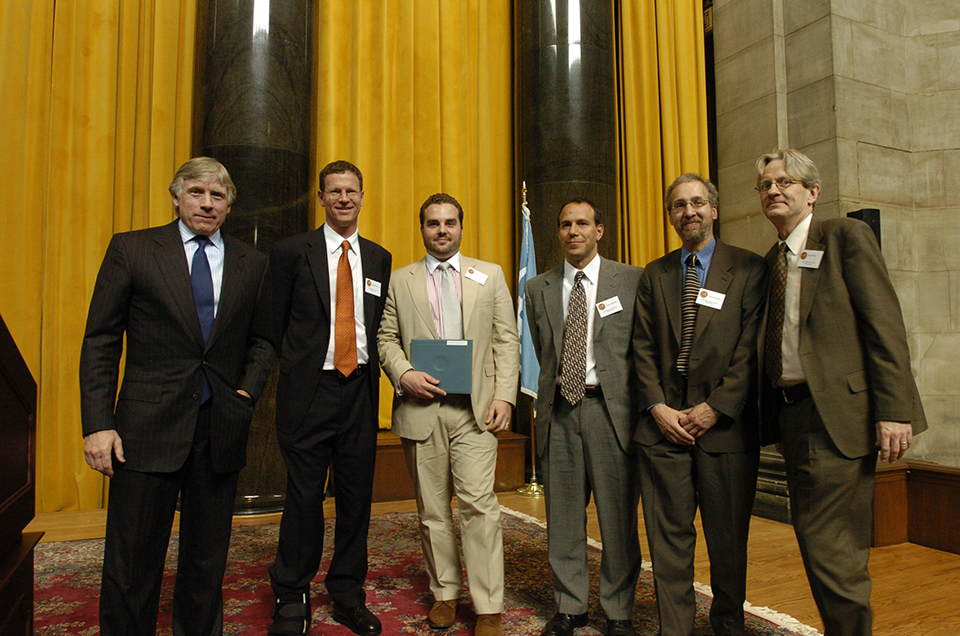
Columbia University President Lee C. Bollinger (left) presents Mark Maremont, Charles Forelle, James Bandler, Steve Stecklow and Gary Putka of the The Wall Street Journal, with the 2007 Pulitzer Prize for Public Service.
Winning Work
Some CEOs reap millions by landing stock options when they are most valuable. Luck -- or something else?
On Oct. 13, 1999, William W. McGuire, CEO of giant insurer UnitedHealth Group Inc., got an enormous grant in three parts that -- after adjustment for later stock splits -- came to 14.6 million options. So far, he has exercised about 5% of them, for a profit of about $39 million. As of late February he had 13.87 million unexercised options left from the October 1999 tranche. His profit on those, if he exercised them today, would be about $717 million more.
On a summer day in 2002, shares of Affiliated Computer Services Inc. sank to their lowest level in a year. Oddly, that was good news for Chief Executive Jeffrey Rich.
His annual grant of stock options was dated that day, entitling him to buy stock at that price for years. Had they been dated a week later, when the stock was 27% higher, they'd have been far less rewarding. It was the same through much of Mr. Rich's tenure: In a striking pattern, all six of his stock-option grants from 1995 to 2002 were dated just before a rise in the stock price, often at the bottom of a steep drop.
Just lucky? A Wall Street Journal analysis suggests the odds of this happening by chance are extraordinarily remote -- around one in 300 billion. The odds of winning the multistate Powerball lottery with a $1 ticket are one in 146 million.
Suspecting such patterns aren't due to chance, the Securities and Exchange Commission is examining whether some option grants carry favorable grant dates for a different reason: They were backdated. The SEC is understood to be looking at about a dozen companies' option grants with this in mind.
The Journal's analysis of grant dates and stock movements suggests the problem may be broader. It identified several companies with wildly improbable option-grant patterns. While this doesn't prove chicanery, it shows something very odd: Year after year, some companies' top executives received options on unusually propitious dates.
The analysis bolsters recent academic work suggesting that backdating was widespread, particularly from the start of the tech-stock boom in the 1990s through the Sarbanes-Oxley corporate reform act of 2002. If so, it was another way some executives enriched themselves during the boom at shareholders' expense. And because options grants are long-lived, some executives holding backdated grants from the late 1990s could still profit from them today.
Mr. Rich called his repeated favorable option-grant dates at ACS "blind luck." He said there was no backdating, a practice he termed "absolutely wrong." A spokeswoman for ACS, Lesley Pool, disputed the Journal's analysis of the likelihood of Mr. Rich's grants all falling on such favorable dates. But Ms. Pool added that the timing wasn't purely happenstance: "We did grant options when there was a natural dip in the stock price," she said. On March 6, ACS said that the SEC is examining its option grants.
Stock options give recipients a right to buy company stock at a set price, called the exercise price or strike price. The right usually doesn't vest for a year or more, but then it continues for several years. The exercise price is usually the stock's 4 p.m. price on the date of the grant, an average of the day's high and low, or the 4 p.m. price the day before. Naturally, the lower it is, the more money the recipient can potentially make someday by exercising the options.
Which day's price the options carry makes a big difference. Suppose an executive gets 100,000 options on a day when the stock is at $30. Exercising them after it has reached $50 would bring a profit of $20 times 100,000, or $2 million. But if the grant date was a month earlier and the stock then was at, say, $20, the options would bring in an extra $1 million.
A key purpose of stock options is to give recipients an incentive to improve their employer's performance, including its stock price. No stock gain, no profit on the options. Backdating them so they carry a lower price would run counter to this goal, by giving the recipient a paper gain right from the start.
Companies have a right to give executives lavish compensation if they choose to, but they can't mislead shareholders about it. Granting an option at a price below the current market value, while not illegal in itself, could result in false disclosure. That's because companies grant their options under a shareholder-approved "option plan" on file with the SEC. The plans typically say options will carry the stock price of the day the company awards them or the day before. If it turns out they carry some other price, the company could be in violation of its options plan, and potentially vulnerable to an allegation of securities fraud.
It could even face accounting issues. Options priced below the stock's fair market value when they're awarded bring the recipient an instant paper gain. Under accounting rules, that's equivalent to extra pay and thus is a cost to the company. A company that failed to include such a cost in its books may have overstated its profits, and might need to restate past financial results.
The Journal's analysis raises questions about one of the most lucrative stock-option grants ever. On Oct. 13, 1999, William W. McGuire, CEO of giant insurer UnitedHealth Group Inc., got an enormous grant in three parts that -- after adjustment for later stock splits -- came to 14.6 million options. So far, he has exercised about 5% of them, for a profit of about $39 million. As of late February he had 13.87 million unexercised options left from the October 1999 tranche. His profit on those, if he exercised them today, would be about $717 million more.
The 1999 grant was dated the very day UnitedHealth stock hit its low for the year. Grants to Dr. McGuire in 1997 and 2000 were also dated on the day with those years' single lowest closing price. A grant in 2001 came near the bottom of a sharp stock dip. In all, the odds of such a favorable pattern occurring by chance would be one in 200 million or greater. Odds such as those are "astronomical," said David Yermack, an associate professor of finance at New York University, who reviewed the Journal's methodology and has studied options-timing issues.
Options grants are made by directors, with details often handled by a compensation committee. Many companies make their grants at the same time each year, a policy that limits the potential for date fudging. But no law requires this.
Until last year, UnitedHealth had a very unusual policy: It let Dr. McGuire choose the day of his own option grants. According to his 1999 employment agreement, he is supposed to choose dates by giving "oral notification" to the chairman of the company's compensation committee. The agreement says the exercise price shall be the stock's closing price on the date the grants are issued.
Arthur Meyers, an executive-compensation attorney with Seyfarth Shaw LLP in Boston, said a contract such as that sounded "like a thinly disguised attempt to pick the lowest grant price possible." Mr. Meyers said such a pact could pose several legal issues, possibly violating Internal Revenue Service and stock-exchange listing rules that require directors to set a CEO's compensation. "If he picks the date of his grant, he has arguably set a portion of his pay. It's just not good corporate governance."
UnitedHealth called the process by which its grants were awarded "appropriate." It declined to answer specific questions about grant dates but noted that on all but two of them, grants were made to a broad group of employees.
William Spears, a member of UnitedHealth's compensation committee, said the October 1999 grant wasn't backdated but was awarded concurrently with the signing of Dr. McGuire's employment contract. Mr. Spears said a depressed stock price spurred directors to wrap up negotiations and get options to management. The board revised terms of the employment contract last year and will start making stock-option grants at a regular time each year, Mr. Spears added.
The SEC's look at options timing was largely prompted by academic research that examined thousands of companies and found odd patterns of stock movement around the dates of grants. One study was by Erik Lie of the University of Iowa. He found that share prices generally fell before option grants and rose afterward, with the result that recipients got options at favorable times. He concluded this was so unlikely to happen by chance that at least some grant dates had to have been filled in retroactively.
Another possible explanation for big rises in stock prices following grants is that executives knew favorable company news was coming and timed the grants just before it. But academics think timing for company news is a less likely explanation for the patterns, given the consistency of the stock climbs after grant dates. Also, for many of the companies the Journal examined, no obvious company news followed closely upon the option grants.
It's also possible companies sometimes award options after their stock has taken a fall and seems to them to be undervalued. In point of fact, the companies can't possibly know what the stock will do next, but that doesn't mean they might not feel confident enough about a recovery to think they are hitting a favorable time to grant options.
The use of stock options surged in the late 1990s as young firms that had bright prospects but little revenue used them to attract and pay executives. As dot-com and telecom shares exploded, stock options became a source of vast wealth.
They also grew controversial. Critics worried that big options grants tempted executives to do whatever it took to get the stock price up, at least long enough to cash in their options. At the same time, during a general bull market, the options sometimes richly rewarded executives for stock buoyancy that had little to do with their own efforts.
At Mercury Interactive Corp., a Mountain View, Calif., software maker, the chief executive and two others resigned late last year. Mercury said an internal probe found 49 cases where the reported date of options grants differed from the date when the options appeared to have been awarded. The company said it will have to restate financial results. The SEC is still looking at Mercury, said someone familiar with the situation.
Analog Devices Inc. says it reached a tentative settlement with the SEC last fall. It neither admitted nor denied that it had misdated options or had made grants just before releasing good news that would tend to push up the stock. The Norwood, Mass., computer-chip maker tentatively agreed to pay a $3 million civil penalty and re-price some options. CEO Jerald Fishman tentatively agreed to pay a $1 million penalty and disgorge some profits. Analog didn't make him available for comment. The company said it will not restate its financial records.
In some instances, backdating wouldn't be possible without inattentive directors, securities lawyers say. At one company the SEC is looking at, lawyers say, it appears that someone picked a favorable past date for an option grant and gave it to directors for retroactive approval, perhaps counting on them not to notice. In another case, the lawyers say, a space for the grant date appears to have been left blank on paperwork approved by directors, or dates were later altered.
Until 2002, companies didn't have to report option grants until months later. The Sarbanes-Oxley law, by forcing them to report grants within two days, left less leeway to retroactively date a grant.
The new rule reduced stock patterns suggestive of backdating, but didn't eliminate these altogether, according to a study by M.P. Narayanan and H. Nejat Seyhun of the University of Michigan. They found that companies report about a quarter of option grants later than the two-day deadline -- and that such delayed reporting is associated with big price gains after the grant dates. It is a pattern Mr. Narayanan calls "consistent with backdating."
Before the stricter rules, Brooks Automation Inc., a semiconductor-equipment maker in Chelmsford, Mass., gave 233,000 options to its CEO, Robert Therrien, in 2000. The stated grant date was May 31. That was a great day to have options priced. Brooks's stock plunged over 20% that day, to $39.75. And the very next day it surged more than 30%.
A June 7 Brooks report to the SEC covering Mr. Therrien's May options activity made no mention of his having gotten a grant on May 31, even though the report -- which Mr. Therrien signed -- did cite other options-related actions he took on May 31. Not until August was the May 31 grant reported to the SEC.
It wasn't the only well-timed option grant he got. One in October 2001 came at Brooks stock's lowest closing price that year, once again at the nadir of a sharp plunge. The Journal analysis puts the odds of such a consistent pattern occurring by chance at about 1 in nine million.
Mr. Therrien, who stepped down as CEO in 2004 and retired as chairman this month, didn't return messages seeking comment. Chief Financial Officer Robert Woodbury said Brooks is "in the process of revamping" practices so grants come at about the same time each year. Mr. Woodbury, who joined in 2003, said no one at Brooks would be able to explain the timing of Mr. Therrien's grants.
The highly favorable 2000 grant also benefited two others at Brooks -- the compensation-committee members who oversaw the CEO's grants. Although Brooks directors typically got options only in July, that year a special grant was awarded just to these two directors, Roger Emerick and Amin J. Khoury. Each got 20,000 options at the low $39.75 price. By the time of their regular July option-grant date, the stock was way up to $61.75, a price far less favorable to options recipients.
Mr. Emerick, a retired CEO of Lam Research Corp., declined to be interviewed. Mr. Khoury, the CEO of BE Aerospace Inc. in Wellington, Fla., didn't return messages left at his office.
Another company, Comverse Technology Inc., said Tuesday that its board had started a review of its past stock-option practices, including "the accuracy of the stated dates of options grants," following questions about the dates from the Journal. The announcement reversed a prior Comverse statement -- given a week earlier in response to Journal inquiries -- saying all grants were made in accordance with applicable laws and regulations.
The Journal's analysis spotlighted an unusual pattern of grants to Kobi Alexander, chief executive of the New York maker of telecom systems and software. One grant was dated July 15, 1996, and carried an exercise price of $7.9167, adjusted for stock splits. It was priced at the bottom of a sharp one-day drop in the stock, which fell 13% the day of the grant and then rebounded 13% the next day.
Another grant, on Oct. 22, 2001, caught the second-lowest closing price of 2001. Others also corresponded to price dips. The odds of such a pattern occurring by chance are around 1 in six billion, according to the Journal's analysis.
Before Comverse announced its internal probe, John Friedman, a member of the board's compensation committee, said directors had noticed the scattered nature of the grants -- eight between 1994 and 2001 fell in six different months -- but management assured them there were valid reasons. Mr. Alexander, the CEO, didn't return phone calls.
This week, Comverse said that, as a result of the board's review of its options grants, it expects it will need to restate past financial results.
Propitious option timing can help build fortunes even at companies where the stock doesn't steadily rise. Shares of Vitesse Semiconductor Corp., although they zoomed in the late 1990s, now rest at about the level of a decade ago. But Louis R. Tomasetta, chief executive of the Camarillo, Calif., chip maker, reaped tens of millions of dollars from stock options.
Mr. Tomasetta got a grant in March 1997 that, adjusted for later stock splits, gave him the right to buy 600,000 shares at $5.625 each. The date they were priced coincided with a steep fall in Vitesse's stock, to what turned out to be its low for the year. He pocketed $23.1 million in profit when he exercised most of these options between 1998 and 2001. Had the grant come 10 days earlier, when the stock price was much stronger, he would have made $1.4 million less.
In eight of Mr. Tomasetta's nine option grants from 1994 to 2001, the grants were dated just before double-digit price surges in the next 20 trading days. The odds of such a pattern occurring by chance are about one in 26 billion.
Alex Daly, a member of the Vitesse board's compensation committee, said a review of the grants found "nothing extraordinary" about their timing, and "absolutely no grants have been made to anyone, least of all the CEO, that are out of sequence with our normal grant policy." Vitesse's finance chief, Yatin Mody, said the grants were "reviewed and approved" by the compensation committee, "and the exercise price set as of the date of the approval, as documented by the related minutes." He declined to provide a copy of those minutes. Mr. Tomasetta said the grants were "approved by the board and the price set at the close of the day of approval."
At ACS in Dallas, Mr. Rich helped turn a small technology firm into one with more than $4.4 billion in annual revenue and about 55,000 employees. ACS handles paperwork, accounting and data for businesses and government agencies. It is a major outsourcer, relying on global labor. "It is a pretty boring business," Mr. Rich told the University of Michigan business school in 2004, "but there is a lot of money in boring."
While most of Mr. Rich's stock-option gains were due to rises in ACS stock, the exceptional timing of grants enhanced his take. If his grants from 1995 through 2002 had come at each year's average share price, rather than the favorable dates, he'd have made about 15% less.
An especially well-timed grant, in which Mr. Rich received 500,000 options at $11.53, adjusted for stock splits, was dated Oct. 8, 1998. This happened to be the bottom of a steep plunge in the price. The shares fell 28% in the 20 trading days prior to Oct. 8, and rose 60% in the succeeding 20 trading days.
ACS's Ms. Pool said the grant was for Mr. Rich's promotion to CEO. He wasn't promoted until February 1999. Ms. Pool said there was a "six-month transition plan," and the Oct. 8 option grant was "in anticipation" of his promotion.
Mr. Rich would have fared far worse had his grant come on the day ACS announced his promotion. The stock by then was more than twice as high. The grant wasn't reported to the SEC until 10 months after the stated grant date. Ms. Pool said that was proper under regulations in place at the time.
A special board committee oversaw Mr. Rich's grants. Most years, its sole members were directors Frank Rossi and Joseph O'Neill. Mr. Rossi declined to comment. Mr. O'Neill said, "We had ups and downs in our stock price like any publicly traded stock. If there were perceived low points, would we grant options at that point? Yes."
Mr. Rich said grants were made on the day the compensation committee authorized them, or within a day or so of that. He said he or Chairman Darwin Deason made recommendations to the special board committee about option dates.
Mr. Rich, who is 45 years old, resigned abruptly as ACS's chief executive on a Thursday in September to "pursue other business interests." Again, his timing was advantageous. In an unusual separation agreement, the company agreed to make a special payment of $18.4 million, which was equal to the difference between the exercise price of 610,000 of his outstanding stock options and the closing ACS stock price on the day of his resignation.
But the company didn't announce the resignation that day. On the news the next Monday that its CEO was departing suddenly, the stock fell 6%. Mr. Rich netted an extra $2 million by cashing in the options before the announcement, rather than on the day of it.
Mr. Rich said ACS signed his separation agreement on Friday, using Thursday's price for the options payout. He said it waited till Monday to release the news because it didn't want to seem "evasive" by putting the news out late Friday.
--George Anders contributed to this article.
© 2006 Dow Jones & Company, Inc
Once Seen as a Reform, They Grew Into Font of Riches And System to Be Gamed
Open Spigot: Reload, Reprice, Backdate
Eugene Isenberg is the little-known chief executive of a modest-sized oil-services company in Houston. But he stands out in one way: He is among the highest-paid corporate executives in history. In the past 19 years, he has pocketed more than $450 million.
The key to this wealth: stock options, in abundance. His employer, Nabors Industries Ltd., has lavished more than 25 million options on him over the years.
They became lucrative partly because of Nabors's generally rising stock price, but also because of some controversial moves that gave the options more punch. When Nabors's stock fell below the price at which the options could be exercised, temporarily making them worthless, Nabors let him trade in some of his options for new ones with lower exercise prices. And when Mr. Isenberg cashed some options in, Nabors "reloaded" him, replacing those he'd exercised with the same number of new ones.
Stock options were hailed two decades ago as a remedy for runaway executive pay. Academics, politicians and investors, tired of seeing CEOs pocket big money for a so-so job, pushed to have stock options become a primary method of compensating executives. Options -- granting the right to buy stock tomorrow at today's price -- would pay off only if the company's stock went up. To advocates they were the ideal carrot, an incentive for good work that aligned executives' interests with those of shareholders.
That happened -- sometimes. But at many companies, options morphed into the biggest executive bonanza yet, pouring out cash like a stuck ATM, and sorely disappointing those who thought options would moderate executive pay.
Instead of replacing big bonuses, options became an additional form of pay slathered on top of already-generous packages. Employers doled out options in ever-growing numbers, in part because, until recently, accounting rules meant companies didn't have to treat this largess to executives as an expense. And like Nabors, some used repricing, reloading and other tactics that made it even easier for executives to score huge hauls.
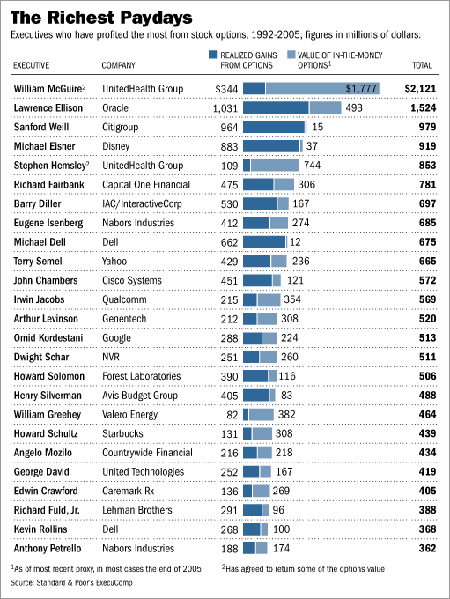
This year, options practices exploded in one of the biggest corporate-fraud scandals in decades. Some companies and executives stole from shareholders, by pretending that options had been issued earlier than they really were, at more favorable prices. At least 130 U.S. corporations are under investigation for possible backdating of option grants. Some have admitted to it. More than 60 executives and directors of public companies have lost their jobs so far, 17 of them chief executive officers. After probable backdating was exposed at giant insurer UnitedHealth Group Inc., the CEO had to resign and give up about $200 million of stock-options value. The company said it will have to restate past earnings by as much as $1.7 billion.
Nabors's Mr. Isenberg offers an example of the huge wealth CEOs have gained through stock options. Now, some of his option grants appear to raise questions about how they were dated. A number came on days when the stock hit its lowest close for the month or the quarter. At other companies, a series of low-price grants has been a pattern that has suggested possible dating problems. At the least, the favorable grant dates added to Mr. Isenberg's mammoth options gains.
A spokesman for Nabors said its legal department did an internal review and found "no irregularities in its grant practices." Nabors showed internal documents to The Wall Street Journal that the company said provide evidence the grants were properly dated. Some of the documents bolster that assertion. The spokesman, citing Mr. Isenberg's record in lifting Nabors from a company in bankruptcy court to one with a market value of more than $9 billion today, also said that "Nabors strongly believes that Mr. Isenberg is appropriately compensated."
The backdating scandal at scores of companies shows one way stock options, once seen as an executive-pay reform, have often been distorted by corporate officials and their consultants. Nell Minow, a longtime corporate-governance advocate, calls backdating "just another in an endless and unstoppable series of mechanisms to subvert the purpose of stock options." A vocal proponent of options in the early 1990s, Ms. Minow now regrets that stance. "Options became completely disconnected from shareholder interests," she says. "I grossly underestimated the capacity of corporate boards and corporate managers to circumvent the principles we established."
From 1992 to 2001, the average value of option grants to CEOs of S&P 500 companies soared nearly tenfold, according to data compiled by Kevin J. Murphy of the University of Southern California. The result was that options, which in 1992 made up less than a quarter of the average CEO's pay, by 2001 provided more than half of pay packages -- packages that were much larger. Companies have started doling out fewer options in the past few years, but grants remain far more generous than a decade ago.
In 1985, Miami financier Victor Posner pulled down $12.7 million, putting him atop lists of best-paid CEOs that year. Last year, 393 executives earned more than that, thanks largely to gains from exercising options, according to Standard & Poor's ExecuComp, which tracks executive pay at about 1,800 public companies. The top 2005 earner was Barry Diller of IAC/InterActiveCorp., with $295 million, nearly all from options.
Defenders of options, who remain numerous, say options shouldn't be judged by a few giant packages. Many companies have given out options judiciously, say defenders, some of whom attribute rising executive pay to tight competition for top managers. Others say stock options have helped to foster innovation, by giving young but cash-poor companies a currency with which to attract talent.
Some supporters of options even give them partial credit for the long bull market that began in 1982, figuring that options help focus top executives on the key issue for shareholders: the stock price. Frederic W. Cook, a New York compensation consultant, calls the stock option "the most perfect equity derivative that's ever been invented: It's simple, elegant, easily understood, and it gives you a little piece of the action."
Popular Demand
Stock options usually give recipients a 10-year window to buy the company's stock at the price when the options are granted. If someone gets options when the stock trades at $50 and it goes to $75, the holder can cash out at the $50 "exercise price" -- also called a "strike price" -- and nail a $25 profit on each option. Options usually don't "vest," or become exercisable, for at least a year after they're granted.
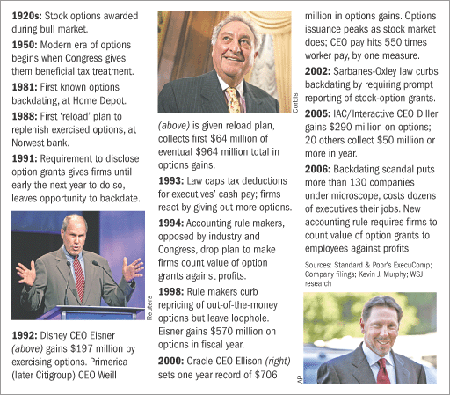
Stock options appeared at least as early as the 1920s, says Carola Frydman, an assistant professor of finance at Massachusetts Institute of Technology who has studied the history of executive pay. The modern era began in 1950, when Congress, reversing a court ruling, gave options substantial tax advantages over ordinary income. By the middle of that decade, they accounted for nearly a third of CEO compensation at large industrial companies.
"In the 1950s, they called it the period of stock-option opulence," says Ms. Frydman. "They didn't know what was coming."
After losing popularity during the weak stock market of the 1970s, options surged back into favor in the late 1980s. One reason was public fury over mammoth executive paydays for bosses with just average performance. In an influential 1990 Harvard Business Review article, Mr. Murphy and Michael C. Jensen said the problem was executives were paid like "bureaucrats" instead of entrepreneurs. They called for giving "big rewards for superior performance and big penalties for poor performance."
"We were suggesting people shift from salaries to stock options to put more pay at risk," Mr. Murphy says today. But "that's not what companies ended up doing. They layered on massive amounts of options on top of the rest."
The bandwagon got two big boosts from an unlikely source: Congress.
First, it passed a law, pushed by President Clinton, seeking to rein in executive pay by limiting the tax break for it. The 1993 law said companies couldn't deduct yearly compensation of more than $1 million for any one of their top five officers.
But it exempted certain kinds of pay linked to performance, which included stock options. Companies rushed to restructure pay plans to grant more options. In 1994, the first year the law was in effect, the value of option grants to CEOs at S&P 500 firms leapt by 45% on average, according to Mr. Murphy, and nearly doubled again over the next two years.
The 1993 law "deserves pride of place in the Museum of Unintended Consequences," said Christopher Cox, chairman of the Securities and Exchange Commission, this fall.
Then in 1994, Congress helped beat back a proposed rule requiring companies to treat a stock-option grant as an expense and deduct it from profits. The plan, backed by the SEC and accounting rule makers, sparked intense corporate opposition. Congress stepped in to fight it, and after a long battle, the accounting rule makers caved. They issued a watered-down rule saying all that companies had to do was disclose in a footnote what options would have done to their profits, had the proposal passed.
Meanwhile, Congress left alone an older law that gave companies a tax deduction whenever stock options were exercised. Under that rule, which applied to the most common type of option given to executives, the employer can deduct a dollar from its income for tax purposes for every dollar of option gains pocketed by employees.
With rules like these, "what wasn't there to like about a stock option?" says Paula Todd, a compensation expert at consulting firm Towers Perrin. "You could grant them in unlimited amounts, with no expense, and claim a tax deduction. [Companies] would pay their dry cleaners if they could with stock options."
Better Than Average
Soon, other forces spurred companies to give executives ever more stock options. One was the "Lake Wobegon effect," named for the mythical Minnesota town in radio host Garrison Keillor's world where all the children are above average. Many boards believed their chiefs should be paid at least as much as the average in their industry, and often more. That attitude had the effect of pushing this average up, year after year.
Another force largely escaped notice because it seemed benign. This was a tendency by companies to grant top executives the same number of options each year, or more, even if the stock price had risen. During a bull market, doing so kept raising the value of pay packages.
Consider an executive who is granted a million options when the stock is at $20. If it's 50% higher a year later, the executive can reap a $10 profit per option, or $10 million.
But now the stock is at $30. If the executive again gets a million options, and the stock again rises 50%, the executive's profit is $15 million, not $10 million. In order to give this executive an option grant of merely the same value in year two as in year one, the year-two grant would have to contain far fewer options.
Directors had a hard time telling a CEO they were cutting the number of options because the stock had risen. Ms. Todd says the CEO's reaction would be, "I worked to get the stock price up, and my next grant is smaller and has a higher strike price?'"
Exxon awarded CEO Lee Raymond a similar number of options yearly from 1993 through 1999 -- 800,000 to 900,000, adjusted for later stock splits. Over that period, the stock rose sharply. The rise meant the value of the 1999 grant was $8.5 million, or six times that of the 1993 grant, by ExecuComp's tally. The calculation used a standard formula for valuing options known as "Black-Scholes," which sets a value for a grant at the time it's given by estimating how much gain it will someday bring the recipient.
An Exxon Mobil Corp. spokesman said the grants were made by a panel of outside directors and based partly on the size of grants to top executives elsewhere. After 2001, Exxon replaced options grants with restricted stock, a different form of compensation that the board said was "more effective in aligning executives' interests with those of shareholders." Mr. Raymond retired a year ago.
At times, the value of options companies doled out has been equal to a large share of their profits. Retailer Abercrombie & Fitch Co. gave CEO Michael Jeffries 4.66 million options in 1999, a grant ExecuComp valued at $120 million. The firm's 1999 net income was $150 million.
Abercrombie didn't actually have to shell out $120 million when it gave the options to Mr. Jeffries, of course. But it incurred an obligation to issue 4.66 million shares someday at the 1999 price. And this obligation didn't have to be reflected as an expense on the company's income statement.
A spokesman for Abercrombie said the grant had a "delayed vesting" feature "intended to incentivize Mike Jeffries to remain with the company...and to continue to generate exceptional financial results." Under him, the stock has risen more than 750% since it began trading in 1996. Mr. Jeffries is eligible to exercise the big 1999 grant now, and if he did so would reap about a $120 million profit.
The options-issuing frenzy reached a peak in 1999 and 2000. Dot-com companies, some with little other way to pay employees, handed out options like confetti. Thousands of people made fortunes on stratospheric rises in the stocks of tech firms, some of which didn't exist a couple of years later. Meanwhile, some "old economy" companies, trying not to lose top people to Silicon Valley, cranked up their own options generators.
In mid-2002, Alan Greenspan testified to Congress about what was then a tech and telecom bust, and about a wave of corporate scandals at firms like Enron, WorldCom and Tyco International. The Federal Reserve's then-chairman spoke of an "infectious greed" that seemed to grip some in business, for which he partly blamed "poorly structured" stock options. Giant grants "perversely created incentives to artificially inflate reported earnings in order to keep stock prices high and rising," he said. "The incentives they created overcame the good judgment of too many corporate managers."
Moving the Goal Post
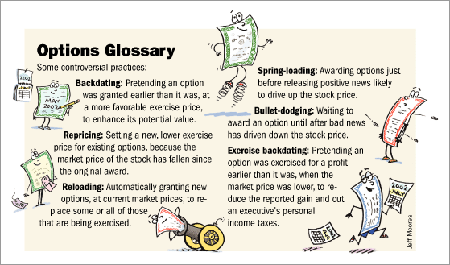
When stock prices failed to rise, some companies changed the rules. If the share price fell well below stock options' exercise price, they simply lowered that price. Companies defended the move by saying options far "under water" or "out of the money" no longer served as incentives to executives to perform well.
Critics of repricing say it subverts the fundamental options purpose of aligning managers' and shareholders' interests. Since shareholders can't get a refund on a stock they bought that has fallen, the critics say, why should executives be able to do something similar?
Repricings "basically ensure that the manager gets paid no matter what. It takes a lot of risk out of the whole thing," says David Yermack, a New York University professor who studies executive pay.
About 11% of companies repriced options at least once between 1992 and 1997, according to research by Chandra Subramaniam, an associate professor of accounting at the University of Texas at Arlington. Borland Software Corp. did it eight times in the decade ended in 1998. System Software Associates Inc. repriced the same options five times in 1996 and 1997 as its stock kept plunging, Mr. Subramaniam says. In a paper published in 2004, he and his co-authors calculated that repricings padded executives' pay by an average of nearly $500,000 each.
In 1998, a change in accounting rules crimped repricing somewhat. Companies now had to take a hefty charge against earnings if they put new exercise prices on existing options. But there was a loophole. If they canceled the old options, waited six months and issued new ones at a lower price, there was no penalty.
As tech stocks collapsed in the early 2000s, directors rushed to shore up options stranded out of the money. At computer-chip maker PMC-Sierra Inc., the company stock peaked at $245 a share in March 2000, then plunged below $10. Many shareholders fell hard.
The boss had a softer landing. Between September 2002 and March 2003, the company repriced 1.6 million of CEO Robert Bailey's options, slashing the exercise price on some all the way to $5.95 from $52.375. Mr. Bailey has cashed out about a third of the repriced options, for profits of $4.86 million, more than eight times what he'd have made if they hadn't been repriced. PMC-Sierra confirmed the figures but had no other comment.
Lock and Reload
In the late '80s and early '90s, companies found another way to goose stock-option grants: "Reload" them.
Normally, options disappear when exercised. But with a reload plan, a person who exercises options automatically gets replacements. Typically the replacements number fewer than the options exercised. They carry the same expiration date but a different exercise price -- the current market price.
Reload plans are supposed to encourage executives to hold stock in their company, says Mr. Cook, the pay consultant, who invented them. To get a reload, executives exercising options generally must do so not with cash, but with stock. That is, they must hand in existing shares whose value equals the cost of exercising the options. Since executives can't do that unless they own shares, they have an incentive to be shareholders of the company and to hold onto new shares obtained when they exercise options.
Critics decried reloads as abusive, a kind of option replication machine that enriched top managers -- while diluting other stockholders' ownership as the number of shares outstanding rose.
The first reload plan appeared in the late 1980s. By 1999, according to Mr. Cook's firm, nearly a fifth of large companies were offering them.
The king of reloads was Sanford Weill, who retired in April as chairman of Citigroup Inc. with an options fortune largely based on a single grant reloaded many times. In 1992, shareholders of his company, then called Primerica Corp., were asked to approve a reload plan. Deep into the legalese, on page 17, was a clause that would prove extremely lucrative for Mr. Weill: The reload plan applied to previously issued options, including a giant grant Mr. Weill got in 1986.
The plan initially also had an unusual element. Any options issued as a result of reloads wouldn't expire on the options' old expiration date, but could carry a new 10-year term.
Not long after the plan was adopted, Mr. Weill exercised nearly all of his original 1986 options, for a gain of more than $60 million. He then received replacements for most of them, restarting the clock with 10 more years to run. Year after year Mr. Weill exercised some of the replacements, each time getting more new options -- some of which he then exercised, once again getting more replacement options, and so forth.
From 1992 through the end of last year, Mr. Weill racked up total option profits of $964 million, roughly $870 million of which came from the original 1986 options and their generations of reloaded progeny. Shareholders did extremely well, too. As of yesterday, the stock of Citigroup and its predecessors was more than 30 times the price in the 1986 public offering of Mr. Weill's original company.
A Citigroup spokesman, Michael Hanretta, said Mr. Weill's options were so valuable because the company "created superior shareholder value." Mr. Hanretta also noted that employees couldn't activate the reload feature unless the stock had risen 20% from the time an option was granted, and at various times Mr. Weill was required by company policy to hold onto all or most of his shares.
Reloads have died out in recent years, after new accounting rules made them too costly to issue. A separate 2000 rule also made it financially prohibitive to add a reload feature retroactively -- eight years after Mr. Weill got that benefit.
Other rule changes have also helped slow the options express. Besides a 2002 requirement for prompt disclosure of grants, a new accounting rule means companies must record an expense when they make an options grant, and reduce profits accordingly. Many companies have cut back on options, and some have stopped awarding them at all, often replacing them with grants of shares.
Deep Well
Over the years, few corporate executives have availed themselves more thoroughly of what options have to offer than Nabors's Mr. Isenberg.
Still chief executive at the age of 77, Mr. Isenberg lives in the Breakers resort complex in Palm Beach, Fla., and commutes to Nabors's U.S. headquarters in Houston. A generous donor, he has helped found a school in New York for children with learning disabilities and given millions to the University of Massachusetts at Amherst, which has named its business school after him.
Mr. Isenberg worked at Exxon for 13 years and then headed a small steel company, settling into early retirement after that firm was sold in 1982. He was persuaded to rejoin the business world by his friend Martin Whitman, a prominent New York investor, whose fund had taken control of a troubled oil-services company called Anglo Energy. Mr. Isenberg invested some of his own money and in 1987 took the helm of what was soon renamed Nabors Industries.
Early on, Mr. Isenberg personally lent the company $5 million when it wanted to make an acquisition but lacked funds, Nabors says. It was the first in a series of deals that "made the company," said the Nabors spokesman, Denny Smith.
From a regional player, Nabors grew into one of the world's largest contract oil and gas drillers, with yearly revenue of $3.6 billion. Its stock has risen at a lush 21.7% compound annual rate since early 1987, although it has underperformed the Dow Jones Oil Equipment and Services Index in the past five years.
An employment contract Mr. Isenberg got when Nabors emerged from bankruptcy entitled him to an annual bonus equaling a percentage of the company's cash flow above a threshold. Nearly two decades later, Nabors is long out of bankruptcy but has continued to renew this unusual percentage-of-cash-flow deal, albeit with less-generous formulas.
Rather than accept all his bonuses, Mr. Isenberg in many years declined part of them in favor of stock options. By Nabors's reckoning, his option grants were worth tens of millions of dollars in some years. Mr. Smith, the spokesman, said this acceptance of options instead of cash meant Mr. Isenberg was placing a big chunk of already-earned pay "at risk, in alignment with shareholder interests." Mr. Isenberg still received substantial cash bonuses, of as much as $3 million in a year, and sometimes was given additional options.
For a time, Nabors operated under an options "reload" plan. It was a generous one: Instead of replacing only a portion of options that were exercised, it replaced them one-for-one. Mr. Isenberg could cash in options and take profits yet still have just as many options as before, though with higher exercise prices.
In another atypical feature, the replacement options sometimes had new terms of 10 years, making them even more valuable. Nabors says it stopped reloads before 2000. But in that year it gave Mr. Isenberg a "special award" of 2.4 million options, in lieu of a reload on 4.7 million options that he exercised for a $122 million gain. (Share figures in this article aren't adjusted for a recent two-for-one stock split.)
In 1998, amid an industry slump, Nabors's stock sank sharply. Some of Mr. Isenberg's options were "under water." The board repriced them. In exchange for giving up a fourth of his old options, he got new ones carrying a more favorable exercise price.
"The repricing was designed to restore incentive value to the option packages," said Nabors's Mr. Smith. He said repricing was widely available to employees. As it happened, Mr. Isenberg made less money by accepting the repricing deal and giving up some of his options than if he had held on, Mr. Smith said.
Following a single grant from its genesis shows how the various maneuvers can pile up profit.
Mr. Isenberg received a grant of 1.8 million options dated in Sept. 23, 1991. He exercised them in 1996 and 1997, pocketing about $24 million in profits.
Normally, that would have been the end of these options. But Nabors reloaded Mr. Isenberg, replacing his exercised options with a similar number -- which had 10 more years to run.
Then in 1998, amid the stock downturn, Nabors repriced the reload options.
Mr. Isenberg cashed in most of them in 2000 and gave the rest to a family member in 2002. His total profit from a single grant -- reloaded, extended and repriced: about $54 million, not including the gift.
The CEO's overall stock-option gains, both realized and not yet cashed in, came to $685 million at the end of last year, says S&P ExecuComp -- putting him 8th on its list of big winners from 1992 to 2005.
Mr. Isenberg also has benefited from some good timing of his option grants. The Sept. 23, 1991, award was dated on the day Nabors's stock touched its lowest closing price of that month, $5.
But it isn't clear when the price was actually set. Company documents suggest the grant price may actually have been determined many months earlier, on another day when the stock closed at $5. Moreover, the grant was contingent on a new Isenberg employment contract -- which other documents indicate wasn't signed until well after Sept. 23, when the stock was higher.
For a grant of a million options dated Dec. 4, 1995, another monthly low, Nabors produced no minutes of a compensation-committee meeting. Instead, a memo seven weeks later said there had been a discussion on Dec. 4 of Mr. Isenberg trading in part of his bonus for options. The memo said the idea first would be run by a consultant, suggesting the grant wasn't made final until weeks after the stated Dec. 4 award date.
In all, of 11 new option grants to Mr. Isenberg between 1991 and 2002, two were dated at quarterly lows in the Nabors stock price and five more at monthly lows. The odds against such a fortunate pattern occurring by chance are long.
Nabors's Mr. Smith, in a written reply to questions, rejected any notion that any backdating might have been involved. Nabors let the Journal review dozens of pages of documents at its Houston offices that Nabors says support the conclusion that the low-price grants were actually made on the fortunate dates. For four of the seven grants dated at monthly or quarterly lows, Nabors showed compensation-committee minutes saying that meetings were held on those dates and options granted. For another monthly-low grant, it showed committee minutes saying a meeting was held the day after a grant, with the grant made "effective" the previous day.
In mid-2002, a federal law required executives to report option grants within two days after they're made, instead of having weeks or months to do so, a change that sharply cut the potential for backdating. Since mid-2002, none of Mr. Isenberg's four option grants came at monthly stock lows.
Mr. Smith noted that before June 2002, Nabors was registered in Delaware, and directors could meet on short notice. Nabors then became a Bermuda-registered company. Mr. Smith said that since then it has had most board meetings outside the U.S., with options awarded at meetings "scheduled long in advance."
Mr. Isenberg has received compensation "beyond expectations," Mr. Smith said, because of Nabors's prosperity. The spokesman said Nabors is discussing a restructuring of Mr. Isenberg's future pay arrangement. Meanwhile, he has voluntarily cut the bonus he's entitled to in half.
© 2006 Dow Jones & Company, Inc
Chip Industry's KLA-Tencor Among Firms With Grants Before Stock-Price Jumps
A 20 Million-to-One Shot
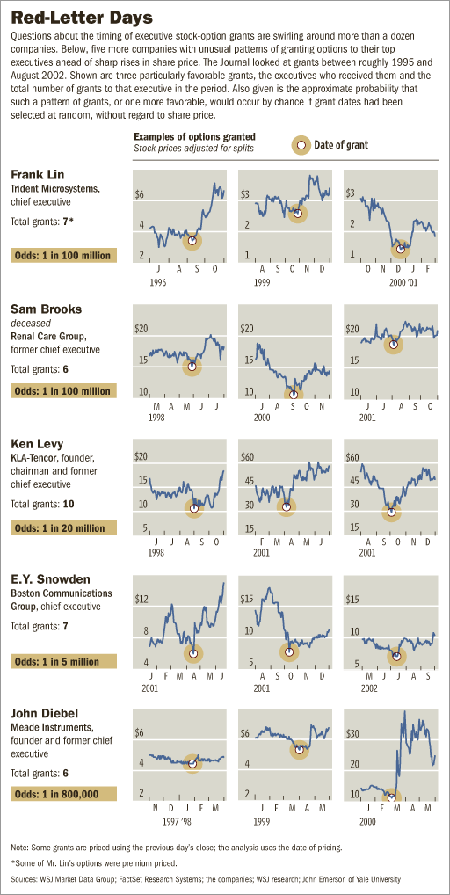
In 2001, KLA-Tencor Corp., a leading semiconductor-equipment maker, granted its top executives, including Chairman Ken Levy, two batches of stock options. They arrived on unusually fortunate days for the executives: The first dated at the share price's first-half low; the second at its second-half low.
In all, Mr. Levy received 10 grants from KLA-Tencor and its predecessor company between 1994 and 2001 -- all preceding quick runups in the share price; an analysis by The Wall Street Journal found the probability that that pattern occurred merely by chance is tiny -- around one in 20 million.
Mr. Levy and company executives didn't return repeated phone and email messages.
Over the past two months, questions about the timing of executive options have rocked more than a dozen companies, leading to probes by board committees, securities regulators and federal prosecutors. Ten executives or directors at these companies have left their posts in recent weeks.
Now a fresh statistical examination by the Journal has turned up five additional companies, including KLA-Tencor, with highly improbable patterns of options grants, similar to those of some companies already facing scrutiny from federal authorities.
The newly identified companies span the U.S. and do everything from making telescopes to running dialysis clinics. One is Boston Communications Group Inc., a prepaid-wireless-technology provider, which in three out of five years gave grants to senior executives priced on the very day when its stock was at annual lows.
The five companies are noteworthy for nearly always awarding top executives option grants dated just ahead of a sharp rise in the company's share price. The dates also were often at the bottom of steep dips in the share price. The statistical analysis doesn't prove any wrongdoing. It is possible that the sharp rises after grants result from luck, a sense of market timing or some other factor. But the repeated grants before sharp stock gains raise the question of whether the grants were actually awarded later, then backdated to the more favorable time, or otherwise gamed.
The federal options probe has already tamped down share prices of companies under scrutiny and triggered yet another wave of suspicion about misbehavior in the executive suite. Backdating "represents the ultimate in greed," says Arthur Levitt, a former chairman of the Securities and Exchange Commission. "It is stealing, in effect. It is ripping off shareholders in an unconscionable way."
The methodology used by the Journal to detect highly improbable grant patterns was reviewed by David Yermack, an associate professor of finance at New York University's Stern School of Business, and by Erik Lie, an associate professor of finance at the University of Iowa. Both scholars have studied options timing. John Emerson, an assistant professor of statistics at Yale University, developed a computer program to calculate probabilities for the grants.
Mr. Lie, who wrote a watershed academic paper suggesting that options backdating could be pandemic, believes that scores more companies could come under the microscope. His data on thousands of option grants show that, on average, shares perform far better than normal in the periods after option dates. The aberration is so large, Mr. Lie says, that backdating or some other means of grant timing "must be widespread."
Last week, the U.S. Attorney for the Southern District of New York issued subpoenas to a half-dozen companies. Two more companies disclosed they had received inquiries from the SEC, which is examining at least 20 companies for potential backdating or other manipulation of options timing.
Wall Street analysts are sifting through securities filings for signs of fortunately timed options, figuring that disclosure of a problem, or even the specter of one, is likely to send shares of a company reeling. Several companies already caught up in the probe have said they will need to restate years of past financials to account for additional expense from granting underpriced options. UnitedHealth Group Inc., the giant Minnetonka, Minn.-based insurer, says it may need to restate three years of financial results, pulling down net income by as much as $286 million over the period.
Of the companies that are under scrutiny, one has fired three executives, and three resigned from another. At a third, Power Integrations Inc., the chairman and the finance chief resigned, and at Brooks Automation Inc. two directors stepped down.
Stock options have long been a popular carrot to dangle before top executives, giving them a stake in improving the shareholders' lot. The idea: The executives make money only if the share price rises. Typically, options for top executives can be granted only by the board or its compensation committee, and are supposed to carry a "strike," or exercise, price equal to the market value at the time the options are approved by directors. A recipient sometimes must wait a year or more for the option to "vest," then can cash out the option if the share price is above the option's strike price.
Instant Paper Profit
But backdating -- deliberately moving the grant date earlier, to a more beneficial time when the price was lower -- in effect gives the executive an instant paper profit, undermining the incentive purpose of options. Companies caught backdating risk disclosure and securities-fraud violations. Executives who perpetrate such a scheme can face wire fraud and other criminal charges.
It isn't yet clear how backdating may have been carried out. Grants typically are approved in writing by directors, and it's possible that in some cases documents were altered. Vitesse Semiconductor Corp. has fired three executives over the "integrity of documents" related to options. It's also possible that executives took advantage of directors' inattentiveness to secure retroactively priced grants, or directors may have knowingly approved a grant carrying an earlier date.
Most of the unusual options grants appear to have occurred from the mid-1990s through August 2002, when the Sarbanes-Oxley corporate-governance act tightened disclosure requirements, curtailing the potential for retroactively dated grants. Many companies, including some of the largest, grant options around the same time every year -- say, at the board's first-quarter meeting -- thus curbing the potential for backdating. Most of the unusually favorable grants occurred at companies that don't have a fixed schedule for doling out options.
Under accounting rules that were long in effect until recently, issuing a below-market option should trigger extra compensation expense, reducing a company's net income. Companies that failed to record that expense may have to restate their financial results, in some cases going back many years. Backdating also could run afoul of complex tax laws, requiring companies and individual to pay back taxes and penalties.
KLA-Tencor was formed from the merger of two major suppliers of semiconductor equipment. It is a powerhouse in the specialized and expensive gear used by the world's largest chipmakers to test the quality of their complex production systems. It has a market value of about $9 billion. Based in San Jose, Calif., KLA-Tencor has generated a fortune for Mr. Levy, the founder of one of its predecessors.
The company has assured shareholders -- whose holdings in the company get diluted each time an option is exercised -- that its option grants serve an important incentive purpose. "Stock options are granted at market price on the date of grant and will provide value to the executive officers only when the price of the Company's Common Stock increases over the exercise price," KLA-Tencor's compensation committee members wrote in a report filed with the company's 2002 proxy statement.
KLA-Tencor's 2001 stock chart looks a bit like a "W," with sharp drops in April and October. Mr. Levy and other top executives were granted options dated at the very bottom of each dip. One grant carried an exercise price of $29.31; the other, $32.75. KLA-Tencor shares now trade around $45, which means the options could be yielding millions in gains.
But had either 2001 grant come a bit more than a month later, it would have carried an exercise price closer to $50, yielding zero potential profit today.
It wasn't the only time that KLA executives, including Mr. Levy, former CEO Kenneth Schroeder and current chief Rick Wallace, received propitious grants. Grants to Messrs. Levy and Schroeder in 1998 and 2000 also were dated at that year's lowest closing price.
The 1998 grant proved lucrative for the executives. Mr. Levy has reaped at least $6 million from cashing out options issued then, while Mr. Schroeder has pocketed at least $10 million. Mr. Levy didn't return phone or email messages. Neither the company's chief financial officer nor a company spokeswoman returned several messages seeking comment. Mr. Schroeder couldn't be reached to comment.
Among the other companies flagged by the Journal's analysis: Meade Instruments Corp., which makes telescopes familiar to amateur and professional astronomers. The Irvine, Calif., company, whose products are sold at Wal-Mart Stores Inc. outlets and elsewhere, had sales of $112 million in the fiscal year ended February 2005.
Two at Yearly Lows
Between 1998 and 2002, founder John Diebel received six option grants. Two were dated at yearly-low closing prices. Another tied for a quarterly low. Immediately after one particularly well-timed grant, dated March 3, 2000, at the lowest closing price of that year, shares more than tripled over the next 20 trading days.
A statistical analysis indicates that the likelihood of a pattern as favorable, or more favorable, than Mr. Diebel's if grant dates had been chosen randomly -- without regard to share price -- is about one in 800,000.
Mr. Diebel said he was more concerned with building the business than executive compensation, and says that he made only about $60,000 on his options. "Not to seem cavalier," he said, "I never worked for money."
He said that given the "high level of integrity with which the company has been run and the quality of its legal advice both inside and outside the company, I would be shocked if there was any inappropriate activity with regard to Meade's granting of stock options."
The company's general counsel, Mark Peterson, said he believed all options were granted "in compliance with the terms and conditions" of the company's incentive plan and were in accord with applicable SEC rules and regulations. Mr. Peterson said he did not believe that options had ever been granted below fair market value at Meade. He also said the company to the best of "my knowledge has never granted options in order to take advantage of material nonpublic information."
All six of the companies named in a March article by the Journal, using the same statistical methodology, are facing government probes. Several, including UnitedHealth, Comverse Technology Inc. and Affiliated Computer Services Inc. have admitted to past problems with the option-grant process, and may restate earnings. Jabil Circuit Inc., of St. Petersburg, Fla., denied any problem with backdating.
The new analysis found that grants dated before sharp stock run-ups were also frequently enjoyed by E.Y. Snowden, chief executive of Boston Communications. In seven grants from 1998 to 2002, Mr. Snowden received options dated at the year's lowest close three times, with one of those three tying for the yearly low. Two others were dated at quarterly lows. (The first grant, not dated at a low point, was issued on the same day Mr. Snowden signed his employment agreement as CEO, according to the company's proxy.) The Journal estimates that the probability of Mr. Snowden's pattern occurring by chance is around one in five million.
Paul Gudonis, a director who sits on the company's compensation committee, said the grants "corresponded to compensation-committee meetings." Officials at Boston Communications, whose prospects have dimmed of late following the loss in May last year of a patent case, declined to comment. Mr. Snowden didn't return messages. The options currently can't be exercised for profit, because the company's share price has tumbled in recent years to below where it was when they were granted.
Well-Timed Grants
Renal Care Group Inc., a Nashville-based company that offers dialysis services to tens of thousands of patients at hundreds of facilities, also shows a pattern of seemingly well-timed options. Between 1997 and 2002, it made six grants to top executives, including CEO Sam Brooks and No. 2 executive Gary Brukardt. Shares posted double-digit gains in the 20 trading days following five of the grant dates -- twice rising more than 30%. One grant landed on the year's low, and two others were dated at quarterly lows. The Journal's analysis puts the odds of the executives' pattern occurring if the dates had been chosen by chance at about one in 100 million.
Earlier this year, Germany-based Fresenius Medical Care AG bought Renal Care for $3.5 billion. Mr. Brukardt, who remains an executive of Fresenius, couldn't be reached for comment. A Renal Care spokeswoman declined to comment. Mr. Brooks died in 2003. The executives received grants with strike prices ranging from about $9 to about $19, adjusted for splits, from 1997 to 2002. Fresenius paid $48 a share to buy the company.
Douglas Chappell, former general counsel for Renal and a lawyer now with Fresenius, said Mr. Brooks would typically schedule compensation-committee meetings to coincide with low points in the company's stock price. Asked how Mr. Brooks could anticipate rises in the price time after time, Mr. Chappell said that Mr. Brooks's knowledge of the industry was such that he knew when a recovery was likely after a downturn. "It was inconceivable that there was backdating," Mr. Chappell said, "but it was not inconceivable that Mr. Brooks was looking to spread the wealth" by picking dates when the stock price was low.
Grants at Trident Microsystems Inc., a chipmaker in Sunnyvale, Calif., also preceded sharp run-ups. Each of seven grants between 1995 and 2001 to chief executive Frank Lin were dated ahead of a double-digit rise in share price over the next 20 trading days. That's all the more remarkable because between 1995 and 2001, Trident shares were generally heading down; indeed, they lost nearly 80% of their value between the time of Mr. Lin's first grant in 1995 and the last in 2001.
A 67% Leap
One grant, dated Dec. 20, 2000, came ahead of a 67% leap. The day tied for the lowest closing price of the year. According to the Journal's analysis, the odds of the seven-grant pattern having come by chance were around one in 100 million.
Trident's shares have been hot lately, thanks to strong demand for fancy televisions that Trident helps equip, such as flat-panel and high-definition sets. Mr. Lin realized $44 million by exercising options between July 1, 2005, and March 31, 2006. The options' value were enhanced by Trident's rising share price -- and by the fortuitous pricing of the options.
An outside lawyer for Trident, John Howard Clowes, said the company's normal option-granting time is late July to October. He said the December 2000 grant followed by two days a meeting in which shareholders approved additional shares for the company's option plan. Mr. Clowes said the board approved the grant, either at a meeting or through written consent, on Dec. 20. He said Mr. Lin declined to comment. Mr. Clowes declined to comment about the other grants.
John Edmunds, Trident's chief financial officer, said in an email yesterday that the company had referred the options-timing issue to the audit committee of its board. As for Mr. Lin's recent options gains, Mr. Edmunds said that the CEO had held all the grants more than seven years, including during a difficult time for Trident, and that the vast majority of his gains came from the recent surge in the company's stock price, not from the specific timing of any grant. "This was not a circumstance where someone got rich quickly or easily or made a lot of money simply because of the timing of the grant," Mr. Edmunds said.
Mr. Lie, of the University of Iowa, believes that only a small minority of the companies that may have engaged in backdating or grant-timing will turn up such extreme patterns. Those that may have moved grants by only a few days or weeks, to secure a small advantage, are unlikely to be flagged by statistics.
Among the companies with several highly unusual grants but not a stark overall pattern is B/E Aerospace Inc., a Wellington, Fla., maker of aircraft interiors. The company came under investor scrutiny late last week because its chief executive, Amin J. Khoury, was one of two directors who abruptly resigned from the board of Brooks Automation, a company caught up in the backdating probe.
Seven Years of Restatements
Brooks Automation has said it will likely need to restate some seven years of earnings because of option problems. It is under investigation by the SEC. Mr. Khoury and the other director who resigned were on the company's compensation committee in 2000, and were the only directors to have received a favorably priced grant with the same date as the options granted to Brooks Automation's CEO. Brooks Automation said Mr. Khoury and the other director resigned voluntarily, so that management and the board wouldn't be distracted by past events as they wrestle with the current situation.
But B/E Aerospace has its own history of unusually priced grants to Mr. Khoury. He received a grant priced on Dec. 17, 1997, at the lowest price of the second half of that year. Some other grants were priced at monthly or quarterly lows, though still others came at unremarkable times. Mr. Khoury couldn't be reached over the weekend, and he did not return messages last week.
Friday, following Mr. Khoury's resignation from the Brooks Automation board, shares in B/E Aerospace dropped 10% as investors fretted about possible repercussions for Mr. Khoury and his own company. In an interview Saturday, B/E Aerospace's finance chief, Tom McCaffrey, said all that company's grants were dated at the time they were approved by directors, and that the actions at Brooks Automation were "absolutely irrelevant" to B/E Aerospace.
© 2006 Dow Jones & Company, Inc
U.S. Accuses 3 Ex-Executives At Comverse Technology Of Long-Running Scheme
Dating Game
Scrambling to Avoid Detection
According to an affidavit by a Federal Bureau of Investigation agent, unsealed in Brooklyn, N.Y., the call to a Comverse director set off a furious chain of events inside the company that culminated yesterday in criminal charges against Mr. Alexander and two other former executives. Federal authorities alleged the trio were key players in a decade-long fraudulent scheme to manipulate the company's stock options to enrich themselves and other employees.
After the March 3 phone call from a Wall Street Journal reporter, the FBI affidavit said, Mr. Alexander and the other two executives, former chief financial officer David Kreinberg and former senior general counsel William F. Sorin, attempted to hide the scheme. Their actions allegedly included lying to a company lawyer, misleading auditors and attempting to alter computer records to hide a secret options-related slush fund, originally nicknamed "I.M. Fanton." It wasn't until a dramatic series of confessions later in March, the affidavit said, that the executives admitted having backdated options. The trio resigned in May.
The criminal and civil charges leveled against the former executives mark an escalation in the widening federal investigation into whether some companies doctored stock options to benefit insiders. More than 80 companies are being investigated so far. The Comverse case is the first in which authorities allege that top executives personally benefited. The three former executives personally gained a total of more than $8 million from the backdating scheme, the FBI affidavit estimated.
The 50-page affidavit and a related civil complaint filed by the Securities and Exchange Commission offer an unusually detailed account of how a blatant backdating scheme allegedly went on for years in the top ranks of a large corporation. The SEC alleged that Mr. Alexander looked back at Comverse's past stock trading and cherry-picked dates for the options grants when the price was low, making the options more valuable. Mr. Sorin then allegedly misled members of the board compensation committee by getting them to sign paperwork with the prior grant dates already filled out, the government charged.
Stock options, which have become the primary form of compensation for many top executives, give recipients the right to buy the company's stock at a certain exercise or "strike" price. They typically are set at the stock's fair-market value at the time of the grant, giving recipients an incentive to make the stock rise and profiting them only if it does. Manipulating grants to give a lower strike price effectively hands recipients potential for additional profit. It also can cause a raft of accounting and tax problems, not to mention criminal or civil liability for those responsible.
Officials from the Justice Department, SEC and FBI announced the charges in Washington. "When options are backdated to a time when the share price was lower, and without honest disclosure, those options are simply theft from shareholders," said Deputy Attorney General Paul McNulty.
Messrs. Kreinberg and Sorin surrendered to FBI agents yesterday morning and appeared before a federal magistrate in Brooklyn in the afternoon. They entered no pleas, and bond was set at $1 million each. Lawyers for the two men declined to comment after the hearing.
Mr. Alexander's whereabouts weren't clear, and a warrant has been issued for his arrest. Justice Department officials declined to say whether they knew where Mr. Alexander was or whether he was considered a fugitive. An attorney for Mr. Alexander, Keith Krakaur, declined to comment on the federal charges.
The SEC alleged that the backdating scheme led Comverse to overstate its profits from 1991 through 2005. The company has admitted to accounting problems and said it will restate financial results. In a statement yesterday, Comverse said it had cooperated fully with federal authorities and would continue to do so.
Officials said Comverse provided the government with information obtained during internal investigations, and that they expected those charged would challenge the admissibility of statements made to company lawyers.
Mr. Alexander is a dual citizen of the U.S. and Israel. Prosecutors moved to seize more than $45 million in assets held in accounts at a New York financial institution after they alleged he recently wired $57 million to Israel. Prosecutors in court papers alleged that the transfers were "designed to conceal the tainted funds from U.S. authorities."
According to the SEC, the backdating scheme stretched back to 1991, when Comverse was a scrappy player challenging much larger rivals in the telecommunications industry.
The company had its roots more than a decade earlier, when Mr. Alexander, son of the head of Israel's national oil company, moved to the U.S. after studying economics. In the late 1970s, he worked as an investment banker while earning a business degree at night.
He and an Israeli engineer hatched the idea of starting a voice-mail technology company, according to a 1990 article about Mr. Alexander in Newsday. Based in New York, Comverse eventually became a world leader in the field, making software and hardware systems behind the voice-mail services for corporate, government and wireless phone networks. It now has more than 5,000 employees and about $1.2 billion in annual revenue.
Some say the company reflects the exacting personality of Mr. Alexander, who served in an elite unit in the Israeli army. "He's a tough guy, a tough person. The company took on his toughness," said Mark McIlvane, a former Comverse marketing executive. He added that Mr. Alexander kept a tight rein on costs during the early days of the company, even objecting if employees rented too large a car.
A finance and strategy specialist, Mr. Alexander, 54 years old, was able to propel Comverse ahead by securing important contracts with "Baby Bells" and overseas phone companies. In 1997, Comverse, then big in Europe, expanded in the U.S. by buying a competitor. Comverse became a family affair for the Alexanders, with Mr. Alexander's father, sister and brother-in-law, a co-founder, serving at various times on the board.
Mr. Sorin, 56, is one of Mr. Alexander's closest associates. He has been with the company since 1984, having served as a director and corporate secretary. The Harvard Law-educated attorney reviewed and signed the company's annual reports, and also drafted and reviewed its proxy statements and stock-option plans, the government said.
Mr. Kreinberg, 41, who joined in 1994, had been at the company's auditor, Deloitte & Touche LLP. He became chief financial officer in 1999.
As is the practice at many companies, the compensation committee of the board approved stock-option grants at Comverse. Approvals weren't official, according to federal authorities, until the committee members voted on them or signed documents indicating their assent. The SEC said Comverse's option grants came whenever Mr. Alexander chose to set the process in motion. According to federal authorities, he would look over recent trading in the stock and pick a day when the price had dropped, pretending the options had been awarded on that date, which would be more favorable to options recipients. After 1998, Mr. Kreinberg also helped with the date-selection process, the government asserted.
It said Mr. Sorin, who was responsible for interactions with the compensation committee, in effect tricked it. Mr. Sorin first would call committee members to say options-granting paperwork was on its way. He or an assistant would send members written "consent" forms to approve the grants, which bore the selected dates and said the options were to be granted "as of" those dates, the SEC said.
The account said committee members would sign the forms, which didn't contain any place for them to indicate when they signed -- the only date on the forms being the earlier date that had been chosen. "This was done to conceal the true date of the grant," the FBI affidavit stated. In some cases, it said, directors didn't sign the forms until weeks or months after the purported grant date.
In the affidavit, FBI special agent Kevin Riordan said two compensation-committee members told him they assumed the "as of" date on the consent forms they later received was the day Mr. Sorin had called them. It was not, the affidavit said, adding: "No corporate action whatsoever occurred on the 'as of' dates." The FBI agent added in his affidavit that the two committee members told him they didn't realize the grant carried a lower trading price and that they "did not intend to grant in-the-money options."
One member of the compensation committee for an extended period was Mr. Alexander's sister, Shaula Yemini. She described a similar practice as the other two committee members, the affidavit said.
All told, the SEC said at least 26 stock-option grants were backdated in this way from 1991 to 2001.
A grant dated July 15, 1996, appears at first blush to be a feat of remarkable timing. That day, Comverse shares closed at $23.75; the grant carried that "exercise price," entitling recipients to potentially profit from any rise above that level. That date is the bottom of an icicle-like dip in Comverse's stock chart; shares jumped 13% the next day and by the end of the year had reached more than $37.
Mr. Alexander received 100,000 options, nearly a quarter of those granted. The SEC said options were distributed "company-wide."
The grant really wasn't made that date, the SEC asserted, but instead, Mr. Alexander picked the date after "looking back at Comverse's trading history." The agency said directors' consents were likely signed two months later, around Sept. 10, though as usual the signatures weren't dated. The stock closed at $36.50 on Sept. 10, so Mr. Alexander's 100,000 options dated July 15 carried $1.275 million more in potential profit than if they had borne the Sept. 10 price.
As Comverse expanded, so did its option grants. In one dated Oct. 18, 1999, the company gave out 3.8 million options at an exercise price of $93 per share -- on a date later selected by Messrs. Alexander and Kreinberg, according to the SEC. The agency said Mr. Sorin didn't send the consent forms to directors until Nov. 23, 1999, by which time the stock price was above $127.
The difference meant $130 million in extra potential profit to the 1,633 grant recipients, the SEC calculated, with the extra potential amount for Mr. Alexander alone at $10.7 million.
A slush fund was formed in 1999, during the frenzied run-up of tech stocks, according to the FBI affidavit. Its purpose, authorities said: to hide extra options that Mr. Alexander could dole out to favored employees, particularly to keep them out of the arms of competitors.
The slush fund was initially called "I.M. Fanton" in the company's computer system, the affidavit said. The name, according to the affidavit, was the brainchild of an unnamed assistant, who dreamed it up after seeing "Phantom of the Opera." The person apparently thought better of the name, the affidavit said, and later changed it to "Fargo," after a Coen Brothers black comedy about bumbling criminals.
The government alleged that Messrs. Alexander and Kreinberg populated the slush fund with options by telling the assistant to create dozens of phony employee names to be mixed in with real people on the list of options presented to directors for approval. The assistant merged first and last names of acquaintances to make the bogus names, the affidavit said. Hundreds of thousands of options were thus approved with no real recipient, the government said.
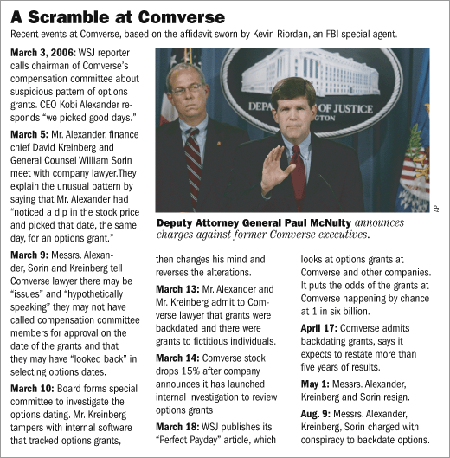
In 2001, Messrs. Alexander and Kreinberg told the assistant to give 10,000 options apiece to 25 more fake employees, the affidavit said. The board unknowingly approved these, too.
In August 2000, Messrs. Alexander and Kreinberg directed the transfer of 48,000 slush-fund options to an Israeli executive displeased with his pay, the affidavit said, adding that Mr. Alexander also directed that the "vesting period" of the options be changed so the executive could cash them out immediately. The executive did, making an instant $2 million, the affidavit said.
In doing its 2001 audit, Deloitte asked for documentation related to stock-option grants. According to the SEC, Mr. Kreinberg instructed an assistant to give the auditors a computer printout of grants but remove a page relating to the Fargo slush-fund options.
On the first Sunday in March, Messrs. Alexander, Kreinberg and Sorin gathered with another company lawyer at Comverse's offices to discuss the Wall Street Journal inquiry, the government said. The Journal's call in early March was occasioned by a remarkable pattern in the eight grants to Mr. Alexander between 1994 and 2001. All but one were dated just before a sharp run-up in company shares; the Journal's analysis figured that the odds of the grant dates falling as they did purely by chance was around one in six billion.
According to the FBI affidavit, Mr. Alexander denied to the company lawyer that there'd been backdating, stating that he had noticed a dip in the stock price and decided that very day to grant the options. Messrs. Alexander, Kreinberg and Sorin stuck with that account for several days.
After meeting with their own lawyers, the three began to backtrack, the government said. In a later meeting with an in-house lawyer, the trio said there might be "some issues" because "hypothetically speaking," phone calls to the compensation committee weren't made on the dates of the grant, according to the affidavit. It added that Messrs. Alexander and Kreinberg "importuned" the in-house lawyer "to handle the internal investigation personally instead of hiring independent counsel." The next day, Comverse's board formed a special committee to investigate the matter.
Around the same time, according to the FBI, Mr. Kreinberg told a Deloitte partner the company's options grants were legal and blamed any discrepancies on a prior chief financial officer. The FBI affidavit called the statements "lies." Mr. Alexander later defended the backdating on the ground that everyone in high technology was "doing it" and Comverse stock was going crazy, the affidavit said.
As company lawyers in March continued to press Messrs. Alexander and Kreinberg about the options' unusual timing, Mr. Kreinberg apparently realized the slush-fund options might be a problem, the affidavit said. Around March 10, the same day the board committee was formed, he used an assistant's password to change the date when the phantom account had been closed. He changed it to a day in 2002 when lots of activity occurred, so that investigators would be less likely to detect it, the affidavit said.
But Mr. Kreinberg apparently realized that his actions would leave a computer trail, the affidavit continued, and tried to reverse the change. Calling himself an "idiot," he asked an assistant to make a minor change to every account record, to cover up his tampering, the FBI affidavit stated.
Comverse's stock traded at $19.37 on the Nasdaq market yesterday, down 15 cents on the day but off about 35% since the options problem surfaced in March. The shares had reached a stock-split-adjusted price of more than $121 in early 2001.
--Ben Winograd and Chad Bray contributed to this article.
© 2006 Dow Jones & Company, Inc
Converse CEO Kobi Alexander Buys a Golf-Course Home, Invests in Auto-Body Shop
Executive Retreat
Fighting Extradition to U.S.
WINDHOEK, NAMIBIA -- Wolfgang Balzer, general manager of the Hotel Thule, now realizes there was something unusual about the Israeli family who checked in this summer for a month, identifying themselves as the Jacobs.
Saying they were planning on settling here, they didn't use credit cards and paid their bill in advance. The husband, who usually kept to himself, became extremely agitated when CNN wasn't available for a few days on their television.
"I personally thought he was a lawyer or something and he was going to work here," the hotel manager says. He learned otherwise in late September.
That's when it emerged that the husband was Jacob "Kobi" Alexander, a fugitive wanted in the U.S. on fraud charges related to stock-options backdating. The former chief executive of Comverse Technology Inc., a New York software company, had skipped out on the chance to begin talks with U.S. prosecutors that his own New York lawyers had initiated, according to a person familiar with the discussions.
He was arrested at U.S. prosecutors' request on Sept. 27 during lunch with his wife at a country club, even though Namibia has no extradition treaty with the U.S. A Namibian bank regulator had noticed large transfers to Mr. Alexander's local account and tipped off U.S. authorities. Mr. Alexander already had received a two-year work permit under his own name, even though he used an alias at the hotel. The Namibian government asked him to invest $43 million to help qualify for permanent residency.
Life on the lam has been full of bizarre twists for Mr. Alexander, a 54-year-old Israeli citizen and wealthy ex-CEO who abandoned his family's life in Manhattan for this remote, arid spot in southern Africa.
He was released from jail six days after his arrest on $1.4 million bail, a record amount in this country. Now he continues to live here, out in the open, sometimes buying ice cream in a local mall for his three children. If extradited and convicted in the U.S., he faces up to 25 years in prison. While his team of local lawyers has been fighting extradition, he appears to be trying to settle in Namibia for the long haul.
He has bought a house that backs onto a golf course, put his children into private school here, and invested in local businesses including an auto-body repair shop called Monarch Panelbeaters. One of his new business partners is a former Namibian military official linked to a scandal involving a collapsed asset-management company.
Yesterday, Mr. Alexander won at least five more months in Namibia. In a closed-door meeting, a local magistrate scheduled a three-day hearing on the extradition request to begin next April 25. "Nothing will happen until April," Johnny Truter, the Namibian government's prosecutor, said afterward.
He added that even if the ex-CEO loses the case, the appeals process could allow him to stay here for years.
Mr. Alexander, dressed for court in an open-necked blue sport shirt and dark sports jacket, declined to comment for this story. One of his attorneys, Rudi Cohrssen, said, "Things will get clearer in April."
Mr. Alexander's new life in Namibia marks one of the most unusual chapters in the stock-options backdating scandal, which has embroiled more than 130 companies, cost the jobs of more than 50 top executives and directors and led to more than $5 billion in financial restatements. Mr. Alexander is accused in a 35-count criminal indictment of engaging in a fraudulent scheme to backdate Comverse options to days when the stock was trading at low points, generating millions of dollars in extra compensation for himself and other executives.
Prosecutors say that Mr. Alexander realized $138 million from options whose grant dates were backdated. They allege he misled auditors and shareholders and used fictitious names to generate thousands of backdated options that were parked in a secret slush fund, dubbed "I.M. Fanton" (an apparent reference to "Phantom of the Opera"), and awarded to favored employees. The indictment also charges him with witness tampering by allegedly offering millions of dollars to a Comverse executive, whom people familiar with the matter have identified as former chief financial officer David Kreinberg, "to falsely take sole responsibility for the fraud scheme."
Mr. Kreinberg and Comverse's former general counsel, William Sorin, recently pleaded guilty for their roles, naming Mr. Alexander as the scheme's mastermind. The timing of Mr. Alexander's option grants was first reported by The Wall Street Journal in March, sparking investigations by the Securities and Exchange Commission and the Justice Department. Comverse announced on May 2 that Mr. Alexander had resigned as CEO amid an internal probe of backdating.
Mr. Alexander visited Windhoek, Namibia's hilly, picturesque capital, alone in early July, Mr. Truter says. He began signing documents to invest in land here and then returned to Israel, where he was vacationing with his family. The initial trip "was obviously just preparations for coming with his family," Mr. Truter said.
But Mr. Alexander's lawyers in New York also were approaching federal prosecutors. In a July 21 phone conversation, prosecutors for the Eastern District of New York in Brooklyn suggested that Mr. Alexander return to the U.S. as a show of good faith. Federal authorities agreed to meet him at John F. Kennedy International Airport in New York but not to arrest him. They offered to begin negotiations on July 31.
Mr. Alexander appeared to agree. He provided evidence that he was booked on an El Al flight that would arrive in New York on July 28. But on July 27, he flew instead from Israel to Frankfurt, and disappeared. Prosecutors now believe Mr. Alexander was deceiving his own lawyers. He also attempted to wire $12 million out of the U.S. around July 31. He had already transferred $57 million to Israel, before the U.S. froze $48 million of his assets.
Robert Morvillo, a lawyer for Mr. Alexander in New York, said attorneys had approached prosecutors "to better understand what the allegations were, and to develop a presentation or arguments that this was not an appropriate criminal case." He declined to comment on other matters, saying they were already described in government papers.
After Mr. Alexander failed to return, prosecutors filed a criminal complaint under seal, charging him and the two other former Comverse executives with fraud. They unsealed it on Aug. 9.
By then, Mr. Alexander and his family were ensconced in two adjacent, ground-floor rooms at the Hotel Thule, which from its dining room offers a dramatic view of the dry, craggy hills that surround Windhoek. With the exception of a weekend journey to a famous Namibian safari park, hotel manager Mr. Balzer says the family spent most days in the city, traveling in a chauffeured van that picked them up each morning. Mr. Alexander's wife, Hana, sometimes would ask him questions about local schools upon their return. One of the two boys often kicked a soccer ball in the parking lot, he said, and the other son and the couple's daughter played hide-and-seek.
Mr. Alexander paid in advance for the family's two, $143-a-night rooms through a local travel agent, Namibia Travel Connection, which had booked them under the name Jacobs, Mr. Balzer says. The fact that Mr. Alexander avoided using a credit card caused some complications: At one point, Mr. Balzer says, the agency said Mr. Alexander would pay his own bills going forward. Then the hotel was told one of Mr. Alexander's lawyers, Richard Metcalfe, would cover any charges. Later, the travel agency called back and said it would take care of them after all, and did.
Mr. Metcalfe didn't return phone calls seeking comment. A man and woman at the travel agency, which operates out of a private house behind a gate, declined to comment.
Mr. Balzer recalls that when CNN, the American news channel, stopped working on the hotel's television screens, "That stressed [Mr. Alexander] out completely. He was complaining about it badly." Because it was a weekend, it couldn't be fixed for a couple of days, frustrating Mr. Alexander further.
Mr. Balzer says he assumed that the hotel guest was monitoring developments of the Israeli war then being fought in Lebanon. But he now suspects Mr. Alexander had a different concern: whether U.S. authorities were closing in.
That wouldn't come for a few weeks. In the meantime, Mr. Alexander didn't waste any time establishing his family's new life in Namibia, a former German colony that later fell under the rule of South Africa. Previously known as South West Africa, it gained independence in 1990 after decades of armed struggle. A tourist destination for wildlife lovers, it recently generated headlines when actors Angelina Jolie and Brad Pitt came here for the birth of their daughter.
After visiting several private schools, the Alexanders enrolled their children in an international school. Mr. Alexander bought a 2006 Toyota Land Cruiser for $107,000, he said in a sworn affidavit filed in Namibian court. He said he paid $543,000 for a two-story, beige stucco house whose backyard faces Windhoek's only golf course and country club.
Mr. Alexander hired a full-time security guard to stand outside the front of the house, which is part of a small development of 57 homes behind a guarded, locked gate. A basketball hoop hangs over the garage, and a satellite dish sits on the roof.
On Aug. 29, court records show, the Namibian Ministry of Home Affairs and Immigration issued Mr. Alexander a two-year work permit, just a day after his lawyer, Mr. Metcalfe, filed an application. Mr. Alexander also applied for permanent residency. The ministry said in a letter it will consider the residency application provided he submits plans to transfer and invest $43 million in the country. The Namibian official who signed the letter couldn't be reached for comment.
Mr. Truter, the local prosecutor, said foreigners essentially can "buy" work permits in Namibia by promising to invest in the country. "If you have a lot of money to invest, they will give it to you," he said.
Mr. Alexander said in his affidavit last month that he already had transferred more than $17 million to banks in Namibia from Israel and had invested about $1.6 million in various land deals, including a low-income housing project on the coast.
He also has invested $843,000 in Monarch Panelbeaters, the local auto-body shop, which he said was owned by "previously disadvantaged Namibians" who were saddled with debt and cash-flow problems, according to the affidavit. He called it "an example of a successful locally owned and operated business."
Under Namibian law, foreign investors must find local partners to invest with. Mr. Alexander's partners include Brigadier Mathias Shiweda, whom he described as "a well known Namibian business personality." Mr. Shiweda, a former Namibia Defense Force official who remains in charge of a state-owned military hardware manufacturer, is well known here. He's also the subject of some controversy. Last year, he was linked to a scandal in which Namibia's Social Security Commission invested and lost $4.3 million in an asset-management company that collapsed.
According to local news accounts, at an inquiry, Lazarus Kandara, the head of the collapsed firm, named Mr. Shiweda among the shareholders, and as one of several recipients of a commission from the management company in connection with another deal. A few days later, Mr. Kandara died in what Namibian police ruled a suicide. Mr. Shiweda later testified that he received no money from the firm. He declined to comment for this story.
By late August, U.S. authorities had tracked down Mr. Alexander to Namibia. But they were in a legal bind because Namibia has no extradition treaty with the U.S. American authorities had to ask Namibia's president, Hifikepunye Pohamba, to issue a formal proclamation adding the U.S. to a list of countries that fall under the country's extradition act. Although the president issued the document on Aug. 31, it wasn't published until Sept. 27, when it took effect. "We had to lay low before they changed their law and we could arrest him," said one U.S. official.
At a bail hearing on Oct. 2., Mr. Alexander presented the sworn affidavit that challenged his arrest, saying he had acted above board, and discussed his investments in the country. "While in Namibia I have used my own name openly and publicly in all my encounters and ventures with government officials and private individuals alike," he said. "I entered Namibia openly and lawfully, and I have not in any manner tried to hide my whereabouts from anyone."
To the surprise of Namibian prosecutors, a local magistrate agreed to release Mr. Alexander on bail. The release was unusual. A German citizen living in Namibia has been fighting extradition here for four years, and has spent all of that time in jail.
Mr. Truter says Mr. Alexander offered to surrender his Israeli passport and post $700,000 bail if he was released. The government asked for double that amount, and he agreed, Mr. Truter said, adding it was a record amount for bail. Dennis Khama, a government attorney who handles extradition cases, said the government has appealed Mr. Alexander's release, although no date has been set for a hearing. "Litigation can go on and go on and go on," Mr. Khama said. "There's no way of stopping that."
Mr. Khama says the fact that Mr. Alexander isn't a U.S. citizen should have no effect on whether he ultimately is extradited, nor should his investments in Namibia. But one issue may be whether stock-option backdating is a crime in Namibia, he added, noting that hasn't yet been decided. Mr. Cohrssen, Mr. Alexander's attorney, said: "There are many arguments" Mr. Alexander's defense team can make.
The arrest of the Israeli citizen had reverberations in the country's tiny Jewish community, especially when his bail hearing was scheduled for Oct. 2 -- which happened to be Yom Kippur, the holiest day in the Jewish calendar. Zvi Gorelick, a retired Namibian-born entrepreneur who offers kosher safari tours and performs some rabbinical functions, said he received calls from Namibia and Israel asking him to help Mr. Alexander get out of jail.
Mr. Gorelick said he quickly began "thinking like a Jew: I must get him some kosher food." But he learned that Mrs. Alexander was bringing her husband food in jail.
He said the Jewish community was divided over the fate of Mr. Alexander, though most have never met him. "On one hand you feel, 'Let's give the guy a break. He's going to bring money into the economy.' But on the other hand, you say, 'We don't need another dishonest person. There's enough dishonest people in the country,'" he said. He added that Mr. Alexander must be presumed innocent.
At the Windhoek Country Club Resort, some guests have also gotten wrapped up in Mr. Alexander's case. Sam Shapiro, owner of a fish company called Mazel Dagim in Monsey, N.Y., shook his head over Mr. Alexander's bid to stay in Namibia. "If you're asking me, it's the wrong choice to come here," he said, adding, "It's not New York, where there are movies, you can go to concerts."
James Bandler in Boston contributed to this article.
© 2006 Dow Jones & Company, Inc
Among Jolts in Internal Probe of UnitedHealth's McGuire Was Key Director's Conflict
By Charles Forelle and James Bandler
Bad Options
Board Sentiment Slowly Shifted
Over the past 15 years, the board of UnitedHealth Group Inc. couldn't have been more supportive of its chairman and chief executive, William McGuire. Directors lavished close to $2 billion in compensation on him, counting stock options, as he built UnitedHealth into one of the country's largest health insurers.
Some directors moved with him in social and charity circles. "We're so lucky to have Bill," director Mary Mundinger said earlier this year. "He's brilliant."
Last week, Dr. McGuire left his job, following a vote by the same board to dump him. It acted unanimously in October after concluding that his explanations for a pattern of unusually well-timed stock-option grants didn't add up. Dr. McGuire thus became one of the biggest casualties in the options backdating scandal, which so far has swept away more than 60 corporate officials, including 16 CEOs.
How did one of America's most pliant boards turn on its star chief executive? Dr. McGuire's support slowly leached away over the course of a six-month internal investigation. Documentation that could support his defense was sparse. A board-ordered statistical analysis undercut his arguments. And his closest board ally was sidelined by a conflict of interest that unsettled other directors. In the end, directors felt pressure after their lawyer told them federal regulators appeared likely to charge the UnitedHealth chief.
Now, Dr. McGuire and the board are girding for tense negotiations over how much of his giant cache of stock options, many still unexercised, he'll be able to take with him. He has already agreed to surrender about $200 million of those options' value, and people close to the situation say the company hopes to get back at the very least $250 million more. He is still likely to end up with more than $1 billion, although last week a federal judge hearing a shareholder lawsuit temporarily barred him from exercising any options or receiving any retirement pay.
Dr. McGuire's lawyer, David Brodsky, said, "While neither a lawyer nor accountant, Dr. McGuire believed that the processes by which options were granted were transparent, appropriate and approved. Indeed, experts who reviewed these processes never raised concerns at the time about the stock options program." Dr. McGuire himself declined to be interviewed.
Dr. McGuire's troubles began in March, when The Wall Street Journal published an article raising questions about exceptional patterns of stock-option grants at a number of companies, including UnitedHealth. In three separate instances, the article found, Dr. McGuire had received options at UnitedHealth stock's lowest closing price of the year.
That made them especially valuable, since options typically convey a right to buy the employer's stock in the future at the price on the grant date. The formula means a recipient can profit only if the stock rises. But it turns out many companies cheated by granting options on one date and pretending they had been issued earlier, when the stock was cheaper. Besides Dr. McGuire's grants at yearly lows, a number of his other grants were dated just before price runups.
After the article, Dr. McGuire initiated an internal investigation. In early April, the board formed a special committee. It hired William McLucas, a former Securities and Exchange Commission enforcement director, now at the law firm of Wilmer Cutler Pickering Hale & Dorr.
At the outset, Dr. McGuire could draw on a big reservoir of goodwill from directors. A former pulmonologist, he helped coordinate care when the wife of one director, William Spears, fell ill. Dr. McGuire's family foundation and the company gave generously to charities some directors were involved with. And directors had made millions from their UnitedHealth options as the stock soared more than 50-fold during Dr. McGuire's tenure. That enormous rise accounted for most of the millions Dr. McGuire earned.
Of 10 outside directors, the CEO had strong support from at least four: Mr. Spears, a New York money manager and friend; Ms. Mundinger, dean of Columbia University's nursing school; Thomas H. Kean Sr., a former New Jersey governor and chairman of the 9/11 commission; and Gail Wilensky, a specialist in health-care policy. The first three had served on the compensation committee during much of the period under scrutiny, making their own conduct an issue in the internal probe.
But Dr. McGuire's core allies would have little role in shaping the investigation. That fell to the special committee, led by James Johnson, a former chief of mortgage giant Fannie Mae who recently served as an adviser to Sen. John Kerry's presidential run. Also on the panel was Douglas Leatherdale, a former chief of insurer St. Paul Cos., and Richard Burke, a founder and retired CEO of UnitedHealth, who was friendly with Dr. McGuire. The committee closely supervised the lawyers and accountants doing the actual digging. Other directors were filled in later and less frequently.
Key Question
Complicating matters was that the board had given Dr. McGuire broad latitude to issue options to subordinates as well as to a right to choose when he wanted option grants to himself made. After picking a date, he had to get approval from the compensation committee. The key question the WilmerHale lawyers faced: Did the board committee really approve Dr. McGuire's grants on the dates reflected in company regulatory filings? Or might they have been backdated to low-price days that would make them more lucrative?
Directors asked for records to show the options were approved on recorded grant dates. Management came up largely empty-handed. Some minutes of compensation-committee meetings were missing. Others didn't mention approval of any grants near a period in question.
In interviews with the WilmerHale lawyers and in phone calls with directors, Dr. McGuire said he hadn't backdated anything but, rather, had chosen to receive grants when the stock was low after a decline, according to people briefed on the conversations. He expressed disappointment that there wasn't more corroboration and that underlings hadn't kept proper paperwork.
Dr. McGuire also stated that as a man of high ethical standards, he wouldn't have fabricated anything. He said that after picking a date for his grants, he would seek approval from Mr. Spears, head of the compensation committee, or occasionally another panel member.
The main person who could verify this account was Mr. Spears. He told the board's lawyers that while he recalled conversations with Dr. McGuire, he couldn't be sure when they actually took place. Phone records showed the two talked frequently, often around the times of some grants, but these records proved little because the two were close friends.
Mr. Spears's value as a witness soon suffered a blow. The money manager told the lawyers he had handled more than $55 million of the McGuire family's fortune and had accepted a $500,000 investment in his own business from Dr. McGuire.
Mr. Spears maintained he had disclosed this conflict of interest to the board before. Two 1999 documents supported that account: an email and an executive's handwritten meeting minutes. But among the directors, only Mr. Kean thought it was possible he could recall having been told of the relationship, say people familiar with the matter; the others said they had no idea.
Many directors were "incredulous" when they learned of the financial tie at a meeting in the spring, according to someone who was there when the board was briefed. While directors felt Mr. Spears was honest, the entanglements tainted any defense he might have made of Dr. McGuire. Aware of fellow directors' feelings, Mr. Spears stayed on the debate's sidelines in later meetings, says someone familiar with the gatherings.
Dr. McGuire expressed frustration that his reputation was being hurt by a scandal he considered hyped. "He indicated that this was way blown out of proportion and unfair," says Irwin Redlener, a friend and co-founder of the Children's Health Fund, a not-for-profit group UnitedHealth supported.
On June 25, Mr. McLucas brought some compelling data to the board's special committee. His presentation showed that grants were regularly dated at or near the stock's lowest prices for the quarter, a suspicious pattern. Later, directors learned that after the mid-2002 passage of new federal rules requiring almost immediate disclosure of option grants, there wasn't a single quarter in which the large grants customarily given to top executives were dated at a quarterly low.
The point: After rules had made backdating impossible, Dr. McGuire's purported ability to pick propitious grant dates vanished. That juxtaposition wounded a key line of defense and "made everyone in the room sit up and focus," says one person close to the situation.
Mr. Johnson was becoming convinced the CEO would have to depart. The former Fannie Mae chief was well aware of how negative perceptions can hurt a company. In a 2004 accounting scandal that brushed close to him, Fannie Mae suffered a stock-price decline, congressional grilling and the loss of its chief executive at the time. One person recalls Mr. Johnson saying in June or July that it was unlikely Dr. McGuire would be able to survive.
On July 11, directors convened for a regular meeting in Minneapolis. Dr. McGuire made a pre-emptive move. He sent directors a five-page memo suggesting a series of steps to deal with the options problem, say people familiar with its contents. He said the board could reprice any tainted options, name a chief administrative officer to remedy deficient record-keeping and make other changes to processes. Deep in the memo, Dr. McGuire said he would be ready to leave if the board thought that was in the company's best interest.
The board didn't want to act before the full scope of the problem was known. It took no action.
In late August the lawyers running the probe made another unsettling finding. In late 1999, the board had approved new options for Dr. McGuire and others to replace a batch that were temporarily worthless. That is, their exercise price was higher than the current stock price because of a stock decline after they were issued. In granting the replacements, the company had suspended, rather than canceled, the old ones, largely for accounting reasons.
Mr. McLucas learned that in August 2000, the suspended options had been reactivated, meaning that the recipients, including Dr. McGuire, effectively got a huge second helping. For Dr. McGuire, the profit embedded in the extra options -- the difference between their exercise price and UnitedHealth's market price -- is now around $250 million. The maneuver skirted disclosure requirements and potentially violated accounting rules, WilmerHale lawyers concluded.
Mr. McLucas brought the issue to the special committee and eventually to other directors. Lawyers later said two directors recalled some discussion in 2000 of reactivating suspended options for other employees, but no compensation committee member recalled intending such a lucrative award for Dr. McGuire himself. "Alarm bells were going," says a person close to the board.
Skirmish Over Math
Meanwhile, a side skirmish broke out over math. The Wall Street Journal's analysis had found that the odds of Dr. McGuire's highly favorable pattern of awards occurring by chance were one in 200 million or greater. Some directors, including Ms. Mundinger, who has a doctorate in public health, criticized the Journal's methodology. The result was a lengthy statistical discussion among directors that resolved little.
After word reached directors that Dr. McGuire had hired a statistics firm to help him rebut the Journal's findings, the WilmerHale lawyers decided to bring in their own numbers experts. In a board meeting on Oct. 2, the lawyers presented an analysis from a firm called Lexecon Inc. It said there were many ways to crunch the numbers, each yielding different probabilities. But all the odds were very long. In the end, Dr. McGuire never presented statistical data to directors.
By early October, the investigative work was all but finished. A squadron of lawyers and accountants had plumbed millions of pages of documents and conducted interviews with more than 80 witnesses. After discussing Mr. McLucas's findings, special-committee members agreed that the situation was serious and the CEO's departure was a likely outcome.
It fell to Mr. Burke, the former UnitedHealth CEO, to travel to Minnesota to tell his old comrade the bad news. But to the surprise of some committee members, Mr. Burke proposed a solution short of Dr. McGuire's departure. He suggested the CEO temporarily step aside until the options tempest calmed, according to people familiar with the matter. Dr. McGuire rejected the idea out of hand, two people close to the situation say. If the board wanted him to leave, he said, he'd leave.
Outside directors set Friday, Oct. 13, as the day for a critical meeting at WilmerHale's Washington offices. The agenda: a review of the investigative report and a discussion of Dr. McGuire's fate. At that point, some directors hadn't yet made up their minds.
The meeting began around 10 a.m. in a large room filled with directors and their lawyers. Directors not on the special committee received the 14-page report for the first time that morning, a person close to the board says. The strongly-worded report concluded it was likely that backdating had occurred and that Dr. McGuire played a central role. Citing the CEO's claim that he didn't backdate any stock options, the report dryly said, "Certain facts run contrary to this assertion."
The report didn't suggest any complicity by directors on the compensation committee. It said it "might have been better" if they had paid more attention to the granting process and asked more questions.
Seated around the conference-room table, the directors took about a half hour to read through the report. No one spoke.
Directors asked Mr. McLucas for his assessment. According to several people, he said that he thought it was likely the SEC would bring charges against Dr. McGuire, and that the agency could seek to bar him from serving as an officer or director of a public company.
Mr. McLucas told directors they should make their decisions based on Dr. McGuire's conduct. But he also said they would be in a difficult spot if they voted to keep him and the SEC sought a short time later to remove him. UnitedHealth has since given the results of its probe to federal prosecutors and the SEC, neither of which has taken action.
At about 4 p.m., a subdued Dr. McGuire addressed directors. He spoke somberly, without notes, for about 40 minutes, talking about how much the company meant to him and how proud he was of its success. He said he believed he had acted ethically and appropriately, say people familiar with the meeting. "I apologize to everyone for putting the company through this trauma," one person recalls him saying.
Some directors couldn't meet his gaze. "It was an anguishing event," said another person in the room who had been close to Dr. McGuire.
Dr. McGuire's lawyer, Mr. Brodsky, of Latham & Watkins, made a brief presentation, saying the WilmerHale report had given short shrift to evidence of his client's innocence. Mr. Brodsky, a former federal prosecutor, said the CEO's money-management relationship with Mr. Spears had been properly disclosed, citing a company lawyer's 1999 email saying "the full board" had been apprised of financial conflicts.
Mr. Brodsky also contested the report's treatment of a McGuire memo that counted against him. In it, the CEO wrote to the compensation committee on Oct. 22, 1999, about a grant that "should be awarded." Despite his use of the future tense, this stock-option grant ultimately bore an earlier date: Oct. 13, the day the stock closed at its lowest price that year. Mr. Brodsky called this meaningless. He said the memo was a rewrite of an earlier draft, and Dr. McGuire merely hadn't fixed the verb tenses.
Dr. McGuire and his lawyer left the room, and directors asked Mr. McLucas for his impression of the defense. "I don't think there's anything we've heard that would change our assessment," one person recalls the lawyer saying.
Directors took no action that Friday. On Sunday, the board had scheduled a meeting in Minnesota. Exhausted, they changed plans and convened instead in Washington. Dr. McGuire didn't attend.
Mr. Spears, the compensation-committee member who managed some of Dr. McGuire's money, arrived at the meeting. He then submitted his own resignation from the board and left.
At the meeting, directors took a vote on a 14-step plan to deal with the options issue. It included Dr. McGuire's immediate departure as chairman and his resignation as chief executive by Dec. 1. The vote was unanimous. Mr. Burke traveled to Minnesota to deliver the news.
Later, several directors called Dr. McGuire to express their gratitude for his service and their sadness over the way things had ended. Dr. McGuire was distressed, said a person familiar with one of these conversations. "He continues to believe he did nothing wrong, which makes it all the more painful."
Last Thursday was the last day Dr. McGuire reported to his 10th-floor office. A private man, he left that day without emotional goodbyes. Said one person close to the matter, "He slipped out without anyone noticing."
© 2006 Dow Jones & Company, Inc
As stocks sank after the attacks, scores of companies rushed to issue options to top officials. Some reaped millions.
By Charles Forelle, James Bandler and Mark Maremont
On Sept. 21, 2001, rescuers dug through the smoldering remains of the World Trade Center. Across town, families buried two firefighters found a week earlier. At Fort Drum, on the edge of New York's Adirondacks, soldiers readied for deployment halfway across the world.
Boards of directors of scores of American companies were also busy that day. They handed out millions of bargain-priced stock options to their top executives.
The terrorist attack shut the U.S. stock market for days. When it reopened Sept. 17, stocks skidded more than 14% over five days, in the worst full week for the Dow Jones Industrial Average since Germany invaded France in May 1940. But for recipients of options, the lower their company's stock price when options are awarded the better, since the options grant a right to buy shares at that price for years to come. The grants set recipients up for millions of dollars in profit if the shares recovered.
A Wall Street Journal analysis shows how some companies rushed, amid the post-9/11 stock-market decline, to give executives especially valuable options. A review of Standard & Poor's ExecuComp data for 1,800 leading companies indicates that from Sept. 17, 2001, through the end of the month, 511 top executives at 186 of these companies got stock-option grants. The number who received grants was 2.6 times as many as in the same stretch of September in 2000, and more than twice as many as in the like period in any other year between 1999 and 2003.
Ninety-one companies that didn't regularly grant stock options in September did so in the first two weeks of trading after the terror attack. Their grants were concentrated around Sept. 21, when the market reached its post-attack low. They were worth about $325 million when granted, based on a standard method of valuing stock options.
The 91 companies included such corporate icons as Home Depot Inc., Black & Decker Corp. and UnitedHealth Group Inc. It included two companies directly touched by the tragedy. Merrill Lynch & Co., across the street from the Twin Towers, lost three employees. On Sept. 24, Merrill granted its president options to buy more than 750,000 shares, at a price 15% below the pre-attack level. At Teradyne Inc. in Boston, an employee delayed a business trip until Sept. 11 to attend a son's soccer game and died on American Flight 11. Teradyne that month gave its CEO more than 600,000 options at a price enabling him to buy stock at 24% below its pre-attack level.
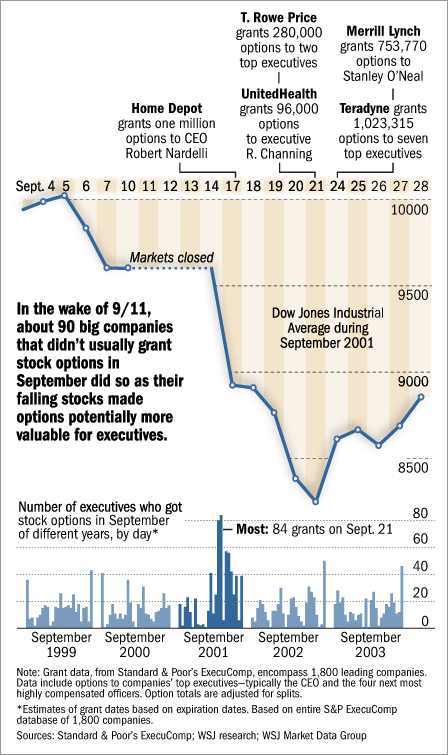
At Stryker Corp., a Michigan maker of orthopedic products, onetime stock-option-committee member John Lillard said he didn't regret the decision to award options nine days after the attack. "If you believe the company is going to do well, and here is an external event that is affecting the market and you've made a decision to reward executives, you go ahead with it," Mr. Lillard said. "Life goes on."
There's nothing illegal about granting options after the market plunges. But acting so quickly after a national tragedy drove down stocks shows the eagerness of some companies to increase their executives' potential wealth. These grants also offer important new fodder for an already fractious debate over what constitutes the proper use of options in executive compensation.
Dozens of companies are under investigation for possibly backdating option grants to a day when the stock was lower, a practice that could mean the companies have made false disclosures and perhaps reported financial results incorrectly. Other companies are being investigated on suspicion of timing options grants ahead of good corporate news.
The multiple options grants after 9/11 raise a different question: Did companies take unseemly advantage of a national tragedy?
Some companies say they issued options to capture the new more favorable prices as a way of calming and motivating managers rattled by the terrorist attacks and the ensuing economic fears. Others say their granting of options at that time had nothing to do with the Sept. 11 events. Some say that mid- or late-September meetings of the compensation committees of their corporate boards had been scheduled weeks in advance. Companies note that for all they knew, their stocks might have gone lower still in succeeding weeks.
Stock options were originally designed to align executives' incentives with the goals of shareholders, encouraging recipients to work hard to improve their companies' stock price. When those options are granted at favorable prices, executives get some of their gain free -- that is, they get a chance to buy in an unusual dip below the price many investors have paid.
Black & Decker, the tool maker, wasn't in the habit of giving options to its very top executives in September. Proxy filings, which typically list grants to the companies' five highest-paid executives, indicate Black & Decker hadn't given them options in September since at least 1994. But on Sept. 21, 2001, with the stock down nearly 20% in the wake of the attack, directors granted hundreds of thousands of options to the top five executives and 37 others.
Black & Decker said the grants came about because the board had been worried for months about the departure of some key employees. It thus had decided to defer options grants to top executives, normally given in April, until it could come up with a retention plan, a spokesman said. That it completed this retention program with stock-option grants 10 days after the attack was coincidence, the spokesman said.
Nolan Archibald, Black & Decker's chief executive, received options to buy 200,000 shares. If cashed out today, they would bring him a profit of about $9 million. While most of that is due to the overall performance of the company and its stock, it's about $1.4 million more than it would be if the grant had been based on the stock price just before 9/11.
"It did not bother the board that it was at an advantageous strike price, because that helped the retention aspect," said Black & Decker's spokesman, Roger Young. He called the propitious timing "water under the bridge." The company didn't make Mr. Archibald available for an interview.
In the first days after the attack, with the stock market shut down, American government and business leaders scrambled to reassure investors and soften a blow they knew would come when the market reopened the following Monday. Famed investor Warren Buffett appeared on CBS's "60 Minutes," saying he "won't be selling anything." Vice President Dick Cheney, on NBC's "Meet the Press," urged the financial community not to be disrupted. Companies lined up to invest cash in their own shares, often trumpeting their decisions in patriotic tones.
Minutes after the bell rang Sept. 17 at the New York Stock Exchange, New York Mayor Rudy Giuliani, who'd attended the solemn reopening ceremony, told CNBC, "Everybody should step up to the plate right now and show the strength of the American economy." He added: "We depend on this. A lot of jobs and the future of America and the world rests on what happens here."
The market fell nonetheless. And on that Monday, Home Depot broke with a regular pattern of issuing stock options in February and made a huge grant to its chief executive, Robert Nardelli. The grant permitted Mr. Nardelli, for the next 10 years, to buy one million Home Depot shares at that tumultuous September day's closing price of $36.20 a share. This was 10.7% below the Sept. 10 closing price of $40.55.
The following day, Home Depot gave more grants: 50,000 options to each of four other executives, all of whom had already received options earlier in 2001. With Home Depot shares now trading at about $34, the options are currently out of the money.
In a written statement, Home Depot said its directors "approved a special equity award" on Sept. 17 and 18 "to retain the key executives necessary to drive the transformation of the company."
Mr. Nardelli, however, had come to Home Depot only nine months earlier, at which time he'd been given a mammoth grant of 3.5 million stock options, at a higher exercise price. Two of the other four managers to whom Home Depot gave post-attack retention grants had joined earlier that year, and had received options when they arrived.
Home Depot's compensation committee at the time was led by John L. Clendenin, a former chief executive of BellSouth Corp. He didn't return calls seeking comment. Other members of the board committee at the time declined to comment, didn't return calls or couldn't be reached.
At Merrill Lynch in downtown Manhattan's World Financial Center, many of the thousands of staff members fled during the attack. They were later dispersed to sites in New Jersey, New York and Connecticut while Merrill's damaged offices were rebuilt.
A Sept. 24 grant of 753,770 options to Merrill's E. Stanley O'Neal, then president and chief operating officer, came at $39.80, 15% below the Sept. 10 closing price. Merrill stock now trades at more than $67 a share. Mr. O'Neal's potential profit from the grant is $5 million greater than it would have been had the grant come on Sept. 10.
A Merrill spokesman said the options award was directly tied to Mr. O'Neal's promotion in July 2001, and that records show the September grant date was the first time the board's compensation committee had had an opportunity to meet to approve the one-time grant.
Robert Luciano, who then headed that committee, was emphatic that Merrill hadn't timed its option grants to hit lows in the stock price. Attempting to do so, he said, would undermine the purpose of options: motivating employees to improve a company's performance. "It's a locked-in gain. It makes no sense," Mr. Luciano said. "That's why I think it is unconscionable."
Of the grant to Mr. O'Neal in September 2001, Mr. Luciano said, "I don't think we timed it to coincide with the tragedy. Gamesmanship like that gives a bad look to the whole process. I just don't tolerate it."
The Merrill spokesman said Mr. O'Neal, now CEO and chairman, wasn't involved in the decision to award the grant that day. "We had dead employees and people spread out over three states," said the spokesman, Jason Wright. "The last thing he was thinking about was getting paid. He had other things to do."
Mr. Wright said that Mr. O'Neal had a strong sense that Merrill's stock would fall further following the grant, as the company was poised to undergo a major restructuring. "If anything, he thought, 'Thanks a lot, guys,' " for options that would soon be under water. As it happened, Merrill shares rose steadily in the months following the grant, but then slid in 2002.
The terror attack was rough on many financial-services firms. Mutual-fund provider T. Rowe Price saw its stock fall 27% in the week trading resumed. On Sept. 21, the stock's low for the year, the firm gave stock options to two senior officers. That included 160,000, adjusted for stock splits, to James A.C. Kennedy, who is slated to become president later this year or early next year.
T. Rowe Price Chairman and President George Roche said after checking meeting minutes that the option grants were approved at a morning conference on Sept. 21. Mr. Roche said the company doesn't try to time its options grants to price fluctuations and wasn't trying to hit a low with its 2001 grant. He said there would be little point in doing so because "you didn't know that there wasn't going to be a second round of attacks" that would further depress the stock. The grants "had nothing to do with 9/11," Mr. Roche said, adding that the firm customarily awards options in the second half of the year.
Richard L. Menschel, who headed the T. Rowe Price executive compensation committee in September 2001, said he vaguely recalled option grants to some senior executives that month at "what seemed to me a particularly attractive price." Mr. Menschel, a former Goldman Sachs executive, declined to comment on whether he thought that was appropriate.
In any case, the mutual-fund firm's Mr. Kennedy said he didn't think companies that gave stock options to executives at the time were capitalizing on the tragedy. He likened the grants to him and others to decisions by individual investors to buy stocks. "People who have faith in humanity and believe that the world is not coming to an end, are they taking advantage? No, they are stepping up." It was an "ugly time and a lot of people panicked," Mr. Kennedy said. This was a chance "to get up there and swing the bat."
Some of the post-9/11 grants were extraordinarily well-timed, hitting the exact low for the period. At least six of the companies that granted options dated after the attack are under investigation in the wider options-timing probe. That raises the question of whether some grants that appear to have been granted in the post-attack period were actually made later, then backdated.
UnitedHealth, which granted stock options dated shortly after the terror attack, also faces investigations of its other options practices by the Securities and Exchange Commission and federal prosecutors. The former CEO of one UnitedHealth unit, R. Channing Wheeler, received option grants dated on quarterly lows for four straight years, 1999 through 2002. In September 2001, UnitedHealth gave Mr. Wheeler 96,000 options, adjusted for later stock splits, priced at the managed-care company's post-9/11 quarterly low. UnitedHealth declined to comment and Mr. Wheeler didn't return calls.
On UnitedHealth's compensation committee in September 2001 were New York investor William Spears, Columbia University nursing dean Mary Mundinger and former New Jersey Gov. Thomas Kean -- later head of the federal commission that investigated Sept. 11 intelligence failures. Mr. Kean and Ms. Mundinger didn't return calls, while Mr. Spears declined to comment.
Among many U.S. companies that offered charitable aid, as the nation reeled in the days after the attack, was Apollo Group Inc., a for-profit education provider that runs the University of Phoenix. "The employees of Apollo offer their condolences and concern to the victims, their families and the rescue teams affected by this unthinkable tragedy," said John Sperling, chairman, in announcing on Sept. 18 that Apollo would donate $1 million to the Twin Towers Fund.
Three days later, Apollo's board granted Mr. Sperling and four other top executives a total of 536,000 stock options. They also received options to buy 513,000 shares of an Apollo subsidiary, which later were converted to parent-company options. The price at which the Apollo options could be exercised was the stock's lowest close in the 2001 second half. By the end of the year, the stock was 29% higher. Mr. Sperling currently is sitting on a paper profit of about $12 million from his post-9/11 options. He hasn't yet exercised any, according to regulatory filings.
"I would agree that it was fortuitous timing for the receiver of the grant," said John R. Norton III, a member of the Apollo board's compensation committee. But, he said, "there's nothing illegal about issuing an option when the stock is at a low point," adding that in any case there's no way of knowing what a stock will do over the next 60 or 90 days.
Mr. Norton continued: "I know what you're getting at -- that right after the World Trade Center, when the world went to hell, we issued stock options on the low that enriched people in a manner that could be suspect. That's not true. I don't know why we issued those at that particular time."
Apollo is also among the companies under federal investigation for the possibility of options timing problems. Apollo said it believes it has complied with all applicable laws and done no backdating. But it said the company and Mr. Sperling would have no comment on the September 2001 options until its own review of its practices is complete.
Todd Nelson, who was Apollo's chief executive in September 2001, cashed in most of his options from that month for a profit of more than $14.4 million. He didn't return calls seeking comment.
Some companies that granted options at post-attack lows favorable to their executives said the moves were necessary to retain rattled employees. "We did it because people were shaken and we wanted to give them some incentives to stay focused," said David Strohm, a director of Internet Security Systems Inc., which gave several executives options dated Sept. 28. "We really wanted to say to people: 'We believe in the company, you have a great opportunity.' " The grants enabled the executives to buy stock in the Atlanta company for $9.11 a share, which proved to be the lowest closing price in its history.
In some cases, executives appear to have been instrumental in picking their own post-9/11 grant dates.
At Teradyne, Chairman and CEO George Chamillard received 602,589 options on Sept. 24, 2001, after the terror attack and business woes had driven Teradyne's stock price down by nearly one-fourth. That was four times the number he received the prior year. A spokesman for the maker of electronic test equipment said the grants followed the company's normal process: The chairman calls compensation-committee members and suggests it would be a good time to issue stock options. If the committee agrees, it approves them.
In a later securities filing, Teradyne said part of Mr. Chamillard's grant was a one-time award of 300,000 options "in recognition of his additional responsibilities as Chairman since May 2000."
The head of the Teradyne board's stock-option committee at the time, Patricia S. Wolpert, declined to comment. Other committee members either didn't return calls or couldn't be reached.
Teradyne spokesman Tom Newman said that at the time of the attack, the company was in distress. It had begun layoffs just hours before the first plane hit the WTC north tower, had cut the pay of higher-paid staffers, and had promised remaining employees they would soon be getting a special options grant. He said it made sense to give Mr. Chamillard and other top officers their annual grants at the same time it doled out the special awards to rank-and-file employees, adding that the timing had nothing to do with Sept. 11.
In hindsight, Mr. Newman said, "maybe we should have done something separately ... and delayed" the large grant to Mr. Chamillard. The prior year, Teradyne had awarded options to top officers in late October. Mr. Chamillard still holds his post-9/11 options, which show no current paper profit because Teradyne's stock is about half the price at which they were awarded.
The spokesman said Mr. Chamillard wouldn't be available for an interview because "I don't want to put him in the position of answering how does he feel about potentially benefiting from the 9/11 tragedy."
At Stryker, in Kalamazoo, Mich., post-9/11 stock-option grants to several executives appear to have been initiated by the chairman and CEO at the time, John W. Brown. They were dated Sept. 20, 2001, at the bottom of a sharp "V" pattern in the share price.
Mr. Brown would "periodically tell us if he thought the stock was attractive," and then the board would decide whether to award options, said Mr. Lillard, the former member of Stryker's stock-option committee. "We didn't just sit down after Sept. 11th and say, 'Gee, how can we take advantage of this?' " Mr. Lillard said. Besides, he added, no one could have known whether the stock would rebound immediately or continue to slide.
Mr. Brown said that for the past 10 to 12 years, the company, to compensate for a relatively small number of options given to executives, has tried to "pick what we think would be the low point of the year. That's what we're gunning for."
Stryker's option grant came on the lowest closing stock price for the second half of the calendar year. Mr. Brown said he believes that he called both members of the stock-option committee on Sept. 20 to recommend they choose that day to grant options. He added that he couldn't remember a time when the board didn't follow his advice.
Mr. Brown said that while he didn't remember the details of the 2001 grant, "that was the year of 9/11. I'm sure that the market hammered us and that was the reason I was doing it at that time."
Mr. Brown, still chairman but no longer CEO, said he could understand how it might strike some as unseemly to give executives stock options so soon after a catastrophe. "That would be a legitimate point, I suppose," he said.
He added that in retrospect, he probably wouldn't have advised that the grant be given. Today, Mr. Brown said, Stryker gives its grants during a relatively narrow period in the spring.
Mr. Brown said he hasn't exercised any of the September 2001 options. If he did so today, he'd make a profit of about $2 million.
© 2006 Dow Jones & Company, Inc
Directors' Ties Can Complicate Job of Assuring the Public Investigation Is Thorough
Interested Parties
Sorting It Out at UnitedHealth
The board of UnitedHealth Group Inc. met on May 1 to deal with questions about unusually well-timed stock-option grants to top executives such as Chief Executive William McGuire. The gathering heard a briefing from a lawyer who was running UnitedHealth's internal probe of how the options were dated.
One director whose recollections would be important to the investigation was Thomas H. Kean, a former New Jersey governor who had served on the compensation committee that approved options grants.
The same day as the board meeting, some UnitedHealth directors and executives were supporting a campaign by Mr. Kean's son for a U.S. Senate seat from New Jersey. Some of them attended a fund-raiser for Tom Kean Jr. that day, in UnitedHealth's home state of Minnesota. It isn't clear whether Dr. McGuire and his wife attended, but each donated $2,000 to the cause. So did Richard T. Burke, who sits on a special board committee that is overseeing the options investigation. All told, UnitedHealth-affiliated donors have contributed $25,000 to the campaign.
The donations were just one instance of overlapping relationships and potential conflicts of interest that exist at some companies conducting investigations of their own stock-option practices. The various relationships don't necessarily mean board members can't be fully objective. But governance experts warn that, at the least, the ties are likely to hinder public confidence in the thoroughness of some of the inquiries.
These internal probes are important in the unfolding scandal over the dating of stock-option grants. Options are meant to pay off for an executive only if the stock price rises from its level when they are granted. If it is found that a company played around with grant dates so that options showed a paper profit from the start, the company may face a range of knotty problems, from allegations of false disclosure to the need to restate past financial results. In recent weeks former executives of two companies, Brocade Communications Systems Inc. and Comverse Technology Inc., have faced criminal charges.
With options under scrutiny at more than 80 companies so far, regulators and prosecutors haven't the resources to conduct full-blown forensic probes of every company. They often rely on companies' own internal inquiries to do the initial digging that helps authorities decide whom to pursue most vigorously. In addition, the companies themselves rely on these internal probes, either to show the public they've been diligent or to defend against shareholder suits.
In these probes, "if the government catches wind of issues affecting independence, they will naturally be more skeptical and less trusting of the process and the results," said W. Scott Sorrels, an Atlanta attorney who has conducted investigations for corporate boards in the past. Mr. Sorrels, not speaking of any particular firm, said: "We advise companies to avoid any appearance of impropriety so you don't have the situation blow up in your face six months down the road after the investigation is done."
At UnitedHealth, a spokeswoman said neither the company, directors nor executives would comment on potential conflicts of interest. Efforts to reach directors separately drew no response or were referred to the company. UnitedHealth has hired former Securities and Exchange Commission enforcement chief William McLucas to conduct the board probe.
When the donations to the Kean Senate campaign were described to former SEC Chairman Harvey Pitt, he said they struck him as "ill-advised and strange" and something that could be seen as an attempt to influence a witness because of the senior Mr. Kean's role on the compensation committee. A spokeswoman for the Kean campaign said the fund raising came at a "UnitedHealth breakfast" hosted by Minnesota Republican Sen. Norm Coleman, and there was absolutely no effort to curry favor with the elder Mr. Kean. The former New Jersey governor didn't return calls seeking comment.
UnitedHealth shows a variety of ties among directors or between directors and executives. One director is a trustee of a nonprofit to which Dr. McGuire and his wife gave $4 million from their family foundation, while another is a former head of that charity's board. Another director appears to manage money for the foundation, according to its tax filings. And Mr. Burke, who is on the special committee investigating options grants, was himself a member of the board committee that made options grants for a time in the early 1990s.
At Linear Technology Corp., some directors got options on the same beneficial dates as executives. Typically, directors' and executives' option grants occur on different cycles. Robert Swanson, Linear's chairman, said directors and executives receive options at pre-set cycles that sometimes coincide. A Louisiana pension fund that is suing Linear over its options-dating practices claims that directors can't fairly judge whether there was any impropriety because they got options on the same dates.
The suit, filed in state court in Santa Clara County, Calif., by Louisiana Municipal Police Employees' Retirement System, alleges that Linear sustained substantial harm because of the executive and directors' actions. Linear is a semiconductor company in Milpitas, Calif.
Mr. Swanson said two independent directors are overseeing the internal investigation. While acknowledging that the two probably received some of the option grants in question, he said the directors could fairly evaluate what happened. He said the facts would show there was no impropriety, adding that the board was "aware of everything we did. Nobody is having amnesia."
Mr. Swanson said that to assist the board, Linear is using one of its regular outside law firms, the prominent Silicon Valley firm of Wilson Sonsini Goodrich & Rosati. Some legal experts say a truly independent corporate probe would use a law firm with which the company has had no prior ties. Mr. Swanson said it would be "kind of an admission something's wrong if you have to go outside." A Wilson Sonsini spokeswoman said the firm isn't conducting an independent review but is representing Linear in its dealings with prosecutors, regulators and litigants.
At Affiliated Computer Services Inc., a technology outsourcer in Dallas, the board is probing a pattern of unusually well-timed options grants to former Chief Executive Jeffrey Rich and others. The grants allowed Mr. Rich to earn millions of dollars in profits. His grants often were dated just ahead of steep rises in the company's stock. A March analysis by The Wall Street Journal found that the likelihood of such propitious grant dates occurring by chance was approximately one in 300 billion. The grants are under scrutiny by federal authorities as well.
Whereas many companies mounting an internal probe ask a small committee of independent directors to oversee it, ACS has put its entire seven-member board in charge of the process, assisted by outside legal counsel. So the oversight group includes board Chairman Darwin Deason. Mr. Deason both received some of the options in question and had a role in their timing, the company has said. ACS says its four member audit committee also is monitoring the situation.
Of the six other directors overseeing the probe, two received some of the well-timed options in question. Two others, who are outside, independent directors, were on the compensation committee that approved grants. The remaining two directors, also independent, are men with whom Mr. Deason has had various past ties.
One is J. Livingston Kosberg. He and Mr. Deason go way back. In the late 1980s, the two were entangled in the collapse of a Texas savings-and-loan institution of which Mr. Kosberg was chairman. In winding up the matter, ACS paid a fine and Mr. Kosberg also paid money to federal regulators. Neither was charged with wrongdoing.
In 1998, Mr. Kosberg joined the board of a company that ACS spun off, Precept Business Services Inc. Mr. Deason was the controlling shareholder of Precept and Mr. Kosberg served on its compensation and audit committees.
Precept filed for bankruptcy protection in 2001. In a lawsuit in federal bankruptcy court in Dallas, a bankruptcy trustee criticized Precept directors for allowing Mr. Deason and relatives of his to -- as the trustee put it -- "systematically loot" the company. The suit, singling out Mr. Kosberg and other directors for particular criticism, alleged that the publicly held company had picked up the tab for a range of Deason-family personal expenses, from country-club memberships and luxury cars to cosmetic surgeries, maids, bodyguards, dry cleaning and limousine service.
Both Mr. Deason and Mr. Kosberg settled with the trustee, Mr. Deason for more than $3 million. He didn't return a call seeking comment. An ACS spokesman said that Mr. Deason continues to deny the trustee's looting allegations and that Mr. Deason personally guaranteed more than $2 million in Precept loans and ultimately bore their cost.
Mr. Kosberg, in an interview, said the Precept board functioned well and "there was no looting." As for the S&L collapse, Mr. Kosberg said he didn't remember the details. "We all walked the plank," he said. He said his relationship with Mr. Deason over the years has been "pure business" and sometimes "strained."
Mr. Kosberg said the ACS board would sort out the stock-options issues: "I know what an independent board is and what a crony board is, and I'm confident that this is an independent board that has the willingness and ability to turn over every rock." He said he is confident in the company's integrity and believes regulators probing for any wrongdoing will "come up empty."
The seventh director of ACS, Dennis McCuistion, a professional speaker, consultant and television producer, also has had longstanding ties to ACS and Mr. Deason. ACS invested $25,000 in a partnership Mr. McCuistion set up to produce a TV show in the late 1980s, said people familiar with the situation, and Mr. Deason later was on the board of a nonprofit television company started by the director. Mr. McCuistion also consulted for one of Mr. Deason's earlier companies, but the people familiar with the matter said any business involvement between the two men ended 17 years ago.
ACS, after being asked by The Wall Street Journal in January about its past options grants, initially said there were no problems. The board later launched its internal probe, calling on its longtime outside legal counsel, Baker Botts LLP, to lead the effort.
In May, the company reported some preliminary findings: While some options grants may have been given incorrect dates, no officer or director had engaged in any intentional backdating, and any accounting adjustments were likely to be minor.
Earlier this week, ACS backtracked from that statement, too, saying investors shouldn't rely on its disclosures about the preliminary findings. ACS said it had hired two more outside law firms to help with the probe.
A company spokesman said ACS has directed lawyers to "do whatever is necessary to objectively reach all the facts." The spokesman said all of the independent directors meet the New York Stock Exchange standards for independence and added: "To suggest that the investigation will be anything other than thorough and objective would be inaccurate and grossly unfair."
At UnitedHealth, which is under both criminal and civil investigation at the federal level, an internal board inquiry has been in progress since at least April. The CEO, Dr. McGuire, is widely praised for molding UnitedHealth into a major force in health insurance in his 15 years as the helm, during which the share price has soared. But questions have been raised about his large option grants, which as of the end of 2005 showed gains from unexercised options of about $1.8 billion. Each of the 12 grants Dr. McGuire got between 1994 and 2002 was dated just before a run-up in the share price, a statistically extraordinary pattern.
In May, the company said the board's review had found some problems with past option grants and that the company might have to restate financial results for the prior three years. The announcement left unanswered questions, including whether any options had actually been backdated and whether anybody in top management or the board had been involved. This week, UnitedHealth said it was delaying filing its second-quarter report over the options issue.
As with any probe of options grants, investigators are likely to be keenly interested in the history of interactions between major recipients such as Dr. McGuire and the compensation-committee members who approved the grants. UnitedHealth has described those members as independent. A close look shows various ties between them and Dr. McGuire or UnitedHealth -- ties that don't necessarily compromise their independence under regulatory standards but that might raise questions about how arms-length they could be. A July article in BusinessWeek noted some of the connections between UnitedHealth directors and management.
One longtime UnitedHealth comp-committee member, William G. Spears, is a money manager with the New York firm Spears Grisanti & Brown LLC. The firm appears to manage money for Dr. McGuire's family foundation. In tax filings covering two recent years, the foundation put the name of Mr. Spears' firm atop a list of its securities transactions. A partner in the firm, Christopher Grisanti, said privacy regulations barred him from saying whether the foundation was a client. Mr. Spears didn't return messages seeking comment.
Another longtime member of the health insurer's compensation panel is Mary O. Mundinger, dean of the Columbia University nursing school. Ms. Mundinger has championed the idea that nurse practitioners can provide high-quality primary care, and in the mid-1990s she shepherded a pioneering project to create a nurse-practitioner clinic in New York. The support of health insurers was critical to getting patients to use it, and UnitedHealth was among several insurers to sign on. In media interviews at the time, UnitedHealth officials spoke approvingly of her project.
Three UnitedHealth board members serve on a special committee that is overseeing the internal investigation of stock-options grants. One of them, James Johnson, is a trustee and another, Douglas Leatherdale, a former board chairman of the University of Minnesota Foundation, a university fund-raising arm. The family foundation of Dr. McGuire, who attended college in Texas, made a $4 million gift to the University of Minnesota Foundation earlier this year to support scholarships and mentoring.
Mr. Burke, the third member of the board committee overseeing the internal probe, is UnitedHealth's founder and a former chief executive. Proxy filings indicate that his wife received stock options as a UnitedHealth employee.
© 2006 Dow Jones & Company, Inc
Evidence Suggests Recipients Of Some Stock-Option Grants Manipulated Exercise Dates
By Mark Maremont and Charles Forelle
New evidence suggests that corporate executives may have found another way to manipulate their stock options, this time to cheat on their income taxes.
In a paper that began circulating in recent days, a Securities and Exchange Commission economist concludes there is strong statistical evidence that executives manipulated the exercise dates of their options as part of a tax dodge. And a review of corporate filings turns up some companies with startling options-exercise patterns.
The new information could open another front in the options-backdating scandal. Backdating already has sparked the broadest corporate-fraud probe in decades, with more than 130 companies under investigation by federal authorities. So far, attention has focused on the practice of retroactively selecting favorable dates to grant options. The new wrinkle involves rigging the dates on which options are exercised, sometimes years after they're granted.
The tax dodge related to options, however, almost certainly involves fewer executives than are caught up in the furor over the backdating of grants. (See related article4.)
The reason it can be tempting to backdate the exercise of options lies in the way the Internal Revenue Service treats different types of income for tax purposes. Options, a common part of executive pay packages, give the recipient the right to buy a company's stock at a fixed price in the future. That price, known as the strike price, is usually the stock's market price on the day the options were granted.
About three-quarters of the time, executives immediately sell the shares they buy when they exercise options. Under IRS rules that typically apply, those executives must pay ordinary income tax, as well as payroll taxes, on the difference between the stock's value on the date the option was exercised and the option's strike price. The highest federal marginal income tax rate is 35%.
But for a variety of reasons, including corporate rules that require top managers to own a certain amount of stock, some executives don't sell immediately. Those who hold the shares for at least a year pay a much lower capital-gains tax -- currently 15% -- on any profit between the time they exercise and when they eventually dispose of the shares. That lower rate gives the executive an incentive to exercise the options at a relative low point for the stock: The move reduces the amount of money that would be owed at the ordinary income tax rate, and shifts the difference so it is potentially taxed at the much-lower capital gains rate.
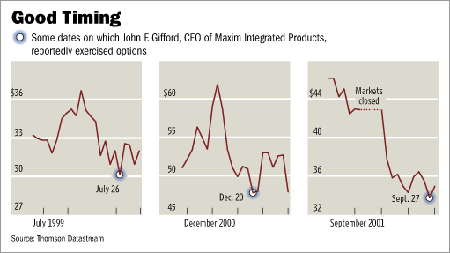
Consider an executive who holds options on 100,000 shares with a strike price of $10. If he exercises and sells when the price is $20, he realizes $1 million in income and must pay $350,000 in income taxes.
If he instead can claim an exercise price of $16, he lowers his income tax to $210,000. If he then sells a year later and the stock is at the same price of $20, he pays $60,000 in capital-gains levies, for a total tax bite of $270,000. In other words, he has the same $1 million gain but saves $80,000 in taxes. The problem arises if the executive misrepresents when the exercise occurred to claim a lower exercise price.
Determining which executives or companies might be involved is difficult, and it's impossible to know what information they may have included in their tax returns. But some executives have exhibited unusual timing in their options exercises.
At Maxim Integrated Products Inc., a Sunnyvale, Calif., chip maker, chief executive John F. Gifford exercised options and held shares seven times between 1997 and 2002, according to regulatory filings and insider-trading data from Thomson Financial. In all but one case, Mr. Gifford's reported exercise date was the very day the stock reached its lowest closing price of the month. After the Sarbanes-Oxley corporate-reform law took effect in 2002, drastically reducing the opportunity to backdate by tightening reporting requirements, his fortunate timing vanished.
Maxim is facing investigations by the SEC and federal prosecutors in California over its option-granting practices. A special committee of directors is also probing the matter.
Chuck Rigg, a Maxim vice president, said the company is "looking into" questions about Mr. Gifford's options exercises, but said initial data don't indicate any problems. Mr. Rigg added that the company used an outside broker to handle options exercises. "There's not a way you can backdate that," he said. Mr. Gifford didn't respond to requests for comment.
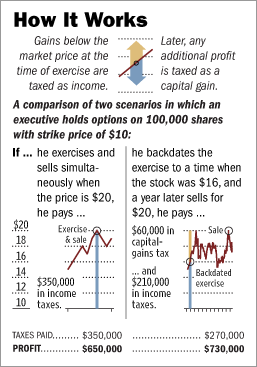
At Royal Gold Inc., a Denver-based mining concern, Chairman Stanley Dempsey exercised options and held shares 12 times between 1997 and 2001, according to regulatory filings and Thomson data. Ten of those trades ostensibly came on a day when the stock was equal to its monthly low. The stock was thinly traded, and in some cases, there were several days each month when the stock closed at the same low price.
Karen Gross, Royal Gold's corporate secretary, said the company had informed the board of The Wall Street Journal's inquiry about the exercises, and has "begun looking into the matter." Mr. Dempsey didn't return a phone call seeking comment.
Academics have looked before at the issue of option-exercise timing, but studies were largely inconclusive. However, new research by SEC economist David Cicero suggests that some executives may have cut their income-tax burden by pretending their options were exercised on a prior day, when the company's stock was trading at a lower price. That would likely be a fraud under federal tax laws.
"The Cicero paper appears to be very well done," said David Yermack, a finance professor at New York University's Stern School of Business who has studied options issues. "It's strong evidence that executives were manipulating their exercise dates, similar to the way they were manipulating their award dates."
Mr. Cicero, who is also a doctoral candidate at the University of Georgia, examined more than 40,000 transactions between 1996 and 2005, and zeroed in on the subset of exercises in which the executive exercised and held on to the resulting shares.
The patterns he found in that subset are stark: Before the tightening of reporting requirements in 2002, shares on average fell 1.3% in the 20 trading days prior to the reported exercise date. In the next 20 days, they rose 4.8%. In other words, on average, executives were exercising options during a noticeable trough in the market price. After Sarbanes-Oxley, the phenomenon vanished.
Mr. Cicero wrote that the "striking stock price pattern" is "highly suggestive" of some type of timing, and said "backdating is difficult to rule out." Mr. Cicero didn't name any individual executives or companies.
He stressed in the paper, which is in draft form, that the views were his own, not those of the SEC.
An SEC spokesman, John Heine, declined to comment on the Cicero study. But he noted that the agency's enforcement director, Linda Thomsen, testified in a U.S. Senate hearing in September that the SEC is investigating exercise backdating as well as backdating of option grants.
Mr. Yermack said he also has been studying the issue, along with Erik Lie of the University of Iowa and Randall Heron, of the University of Indiana. Messrs. Lie and Heron are widely credited with the first academic research that suggested backdating of option grants could be widespread.
Although preliminary, their new research found that 13% of the exercises by CEOs who followed an "exercise-and-hold" strategy and didn't immediately report the actions to the SEC came at their stock's lowest price of the month. That percentage is nearly three times as great as would be expected if CEOs were exercising on random dates, Mr. Yermack said, and is highly suggestive that some were backdating exercises to avoid taxes.
The team of three professors also found that the phenomenon greatly diminished after Sarbanes-Oxley, which required executives to report option exercises to the SEC within two days. Before that, they had until the 10th day of the next month to report, which critics say provided a wide enough window to allow backdating to occur. The findings of a potential new options-fraud maneuver come even as Sarbanes-Oxley is coming under attack as being too harsh.
The phenomenon of option-exercise manipulation isn't new. An executive of Symbol Technologies Inc. pleaded guilty to tax-fraud charges in 2004 in connection with the practice, and Mercury Interactive Corp. has said former executives engaged in it. But it has largely remained under the radar as the scandal over option-grant backdating has snared headlines.
Alan L. Dye, a securities attorney at Hogan & Hartson LLP in Washington, said there are scant external checks to prevent backdating if an executive exercises an option and doesn't immediately sell the stock in the open market. "All the documentation is internal paperwork," he said. "Like any internal paperwork, unless good controls are in place, they can be misdated."
Michael D. Webb, the former CEO of EPIX Pharmaceuticals Inc., exercised options and held shares on 11 occasions between 1997 and 2002, according to filings and Thomson data. On six of those occasions -- including the last five in a row -- his reported exercise date corresponded to the lowest closing price of the month. The other five dates were also relatively favorable: Two on the second-lowest closing price of the month, and none any worse than the seventh-lowest.
Mr. Webb left EPIX, which is based in Cambridge, Mass., last year. In an interview, he said he wouldn't be able to answer any questions about his options timing without consulting transaction records, which he said he didn't have available. He declined to discuss how EPIX handled option exercises. A spokeswoman for EPIX declined to comment, citing "significant changes in management" that made it difficult to research past events.
Last week, a person familiar with the matter said a special committee of Comverse Technology Inc. directors began looking into whether the company's former CEO, Kobi Alexander, may have improperly altered exercise dates for his options. Mr. Alexander is in the African nation of Namibia fighting extradition to the U.S., where he faces criminal fraud charges related to the backdating of his option grants.
The unusual timing of a 1998 option exercise by Mr. Alexander was noted in a Nov. 27 report by Gradient Analytics Inc., a Scottsdale, Ariz., research firm. The report was distributed to clients including hedge funds and mutual-fund money managers. The full Gradient report, which the firm hasn't released publicly, also raises questions about option exercises at other companies.
© 2006 Dow Jones & Company, Inc
Investigation Finds Evidence Options Were Backdated;
Board Plans to Meet Sunday
By Charles Forelle and James Bandler
William McGuire, chairman and chief executive of UnitedHealth Group Inc., faces mounting boardroom pressure to leave the giant health insurer after an internal probe found evidence that stock options were improperly backdated to benefit insiders, people familiar with the matter said.
Dr. McGuire's fate, along with that of general counsel David Lubben, could be decided at a board meeting scheduled to take place Sunday, these people said.
Directors received a detailed briefing on the results of the months-long internal probe Friday in Washington. The probe was conducted by law firm WilmerHale. The meeting included a lengthy presentation by Dr. McGuire and his attorney.
UnitedHealth, one of the nation's largest health insurers with a market value of $66 billion, is among the most prominent of the more than 100 companies caught up in the stock-options scandal. Dr. McGuire has been among the highest-paid executives in U.S. corporate history, amassing an enormous, options-based fortune over his 15 years running UnitedHealth. At the end of 2005, his unexercised cache of options was valued at $1.78 billion, far and away the largest sum held by any U.S. executive, according to Standard & Poor's ExecuComp.
Also at risk are several directors on UnitedHealth's 12-member board who served on its compensation committee during the period when the improperly dated grants were awarded, the people familiar with the situation said. Some past compensation-committee members include former New Jersey Gov. Thomas H. Kean, New York money-manager William Spears and Columbia University nursing-school dean Mary Mundinger. None of the directors could be reached for comment.
As of Friday, people close to the situation said, many board members had decided Dr. McGuire would have to depart. But they cautioned that the situation is fluid, and directors are wrestling with a difficult and complex decision.
Another person close to the situation said Dr. McGuire has insisted that he always believed the grant dates were picked based upon an actual meeting, either in person or over the phone, even though the compensation committee didn't formally approve the grants until after the grant's stated date. This person added that there were problems with the record-keeping to document grants at UnitedHealth, and that parties involved had "faint recollections" about what happened.
At the same time, while Dr. McGuire is a highly regarded leader of the company, directors know that executives, and possibly UnitedHealth itself, face the prospect of civil action from the Securities and Exchange Commission in the options matter. The matter also is being probed by federal prosecutors in Manhattan and by Minnesota's attorney general.
At issue in the UnitedHealth case and others are questions about whether stock options were improperly backdated. Options are designed to give recipients the opportunity to profit if the company's share price rises in the future. Grants typically are structured so that the recipient can buy shares later at the stock's market price on the day the option was granted, called the exercise price. Backdating involves pretending that the grant was awarded on an earlier day, when the share price was particularly low, giving the recipient a chance at extra profit.
A spokeswoman for UnitedHealth declined comment.
During his tenure at the helm of UnitedHealth, Dr. McGuire has year after year received giant grants of options. In many of those years, the purported dates were suspiciously fortunate. Between 1994 and 2002, he received 12 grants, each dated just before a sharp rise in the company's share price. Three grants -- in 1997, 1999 and 2000 -- were dated on the day of the stock's lowest closing price of the year.
A Wall Street Journal analysis published in March found that the odds of such a fortunate pattern of dates occurring if the dates were chosen at random were infinitesimal -- less than one in 200 million. The company said at the time that its granting process was "appropriate," but the article spurred the internal investigation as well as probes by authorities.
Until recently, some people familiar with the matter said, Dr. McGuire's chances of surviving the options investigation seemed fairly high. These people said the options problems -- which the company had previously indicated would likely cause it to restate financial results -- appeared confined to sloppy bookkeeping. But the WilmerHale probe concluded that the issues ran deeper and included backdating of option grants, said people familiar with its findings.
A spokeswoman for WilmerHale declined comment.
The climate surrounding backdating has darkened in recent days. This past week, 10 corporate officials, including four CEOs, left their posts amid options problems at their companies. Earlier this month, Apple Computer Inc. said Fred Anderson, a director who was a former finance chief at the company, had resigned from its board following a probe that identified 15 instances of backdating. Apple said its iconic CEO, Steve Jobs, knew about backdating at the company, but wasn't aware of its accounting implications.
Dr. McGuire, a Texas native and a pulmonologist by training, quit clinical practice in the 1980s to stake his claim in the bustling business of health insurance. His employer was bought by UnitedHealth, and Dr. McGuire arrived in Minnesota and established himself as a star. By 1991, he was CEO.
By many measures, Dr. McGuire holds a place among the most successful corporate executives of the modern era. UnitedHealth shares have risen about 50-fold during his tenure.
The massive grants of stock options, meanwhile, have yielded him hundreds of millions of dollars in profit, the cornerstone of a large fortune. He hasn't been the only beneficiary; No. 2 on the Standard & Poor's ExecuComp list of executives with the greatest value in options was Stephen Hemsley, Dr. McGuire's top lieutenant at UnitedHealth, who had a fortune of somewhat less than half of Dr. McGuire's stake.
Dr. McGuire benefited handsomely from the munificence of the UnitedHealth board's compensation committee, which -- in addition to the options -- granted him generous salaries and bonuses and a hefty retirement deal. "We're so lucky to have Bill," Ms. Mundinger, a longtime compensation-committee member, told the Journal earlier this year. Of his rising pay, she said: "He needs to be compensated appropriately so that his business model has believability in the market."
The largest grant Dr. McGuire received came in 1999, entitling him to purchase 1.825 million shares of the company's stock. Adjusted for several splits that have occurred since then, it is equivalent to 14.6 million shares. He so far has exercised only about 5% of the options, and his profit on the shares remaining would be about $600 million if cashed in today.
But the grant's timing, in October of that year, raises eyebrows: It was dated at the stock's lowest point all year.
In March, Mr. Spears, the UnitedHealth director, told the Journal that the 1999 grant wasn't backdated to that propitious time. Rather, he said, the low price encouraged directors and Dr. McGuire to wrap up negotiations over a new employment agreement.
What would happen to Dr. McGuire's outstanding grants should he have to depart isn't clear. In April, with questions swirling about backdating, Dr. McGuire said he and other senior executives would no longer take options.
© 2006 Dow Jones & Company, Inc
The operator of job-search Web site Monster.com frequently granted options to top executives dated ahead of sharp run-ups in its share price, raising questions about whether the grants were backdated or otherwise timed to boost their value to the recipients.
The findings, gleaned from securities filings made by New York-based Monster Worldwide Inc., come amid a widening scandal over the timing of executive options. About 40 companies have been caught up in inquiries concerning possible backdating. The Securities and Exchange Commission is investigating at least two dozen companies, and federal prosecutors in several districts have issued subpoenas to about 20.
Late Friday, for-profit education provider Apollo Group Inc. said its board would hire an outside firm to review its options practices. And arts-and-crafts retailer Michaels Stores Inc. last week said its board had initiated a review of past options grants.
An option gives its holder the right to buy shares at an exercise, or strike, price -- typically the market value of a company's stock on the date of the award. Any subsequent rise in the market price of the shares allows the option holder to cash in the option and pocket the difference between the exercise and market prices.
Monster's securities filings show it made seven options grants between 1997 and 2001 to James J. Treacy, who became its No. 2 executive before leaving the company in 2002. One was dated at the stock's lowest closing price of 1997, and three others carried the lowest closing prices of various quarters. Other senior executives and employees also received grants with some of those dates.
A Wall Street Journal analysis puts the odds at about one in nine million that a pattern of grants as favorable or more favorable than Mr. Treacy's would have occurred if the dates were selected randomly, without regard to stock price.
That so many of the Monster grants were dated at low points just ahead of run-ups raises the question of whether the grants were approved at some other time but backdated to take advantage of the earlier, lower prices. Options are intended to reward executives for pushing up the price of their company's stock; backdating undermines that incentive by giving executives potential profits that aren't linked to performance.
Mr. Treacy, who has since left Monster, said that, like any other employee, he had no involvement in the options-granting process, which he said was "all in the purview" of the board's compensation committee and Andrew McKelvey, Monster's founder and chief executive. He said he believes the dates were "the days that the comp committee and Andy granted" the options.
Mr. McKelvey, who himself never received options from the company, said he is "completely responsible," as the company's most senior executive, for option grants to everyone else. He said Monster has begun a review to determine why the grants were often priced at lows. "To date there is nothing that we see in terms of backdating or improprieties," he said, stressing that the review wasn't complete. Monster's board has also begun a review.
Mr. McKelvey said his practice at the time was to draw up a list of executives and employees to receive options, with input from managers, and send it to the compensation committee for approval. After that, "I don't know what the mechanics were."
At Apollo Group, which runs the University of Phoenix, the acting executive chairman, John Sperling, received five grants between 1995 and 2001. One, in January 2000, carried an exercise price equal to the year's lowest closing price. Another, in December 2000, was at the fourth quarter's low. Another carried the lowest closing price of 2001's second half. Other senior Apollo executives also received options on those dates.
Mr. Sperling founded Apollo and was its chairman until 2004. He also was president or chief executive at various times before August 2001. Apollo officials didn't return numerous calls and emails seeking comment. The company has a market value of about $9.3 billion.
Apollo shares fell 3.1% Thursday and Friday, after a Lehman Bros. analyst issued a report calling the company's options-granting practices "highly questionable." The analyst, Gary Bisbee, said it was impossible to tell definitively whether Apollo had backdated options. But he said further scrutiny by the SEC or other government bodies "is a real risk to consider."
Apollo said on Friday that its management "believes that it has complied with all applicable laws" and hadn't backdated options. The company said it would hire the outside firm to "review and confirm these conclusions."
Prior to the company's statement, John R. Norton III, chairman of the compensation committee of Apollo's board, said in an interview Thursday: "Our option policies are clean and straightforward. We never backdated options. Never once." Mr. Norton added that hearing about other companies that may have backdated options "just blew me away." He said he was amazed at the lengths some executives would go "to steal from the shareholders." Yesterday, Mr. Norton said he didn't have time to comment further.
One possible explanation for some of Apollo's fortuitous grants: The company may have been "news timing," issuing grants just ahead of or after market-moving news. The December 2000 grant was dated just two trading days before the company issued better-than-expected quarterly earnings. The stock zoomed up from a split-adjusted $14.84 on the date of the grant to $20.89 the day after the earnings were released.
Although the legality of issuing options ahead of good news isn't clear, the SEC took a dim view of the practice in a case last year. Microchip maker Analog Devices Inc. said it reached a tentative settlement with the commission after an investigation of, among other things, just such a practice. The proposed settlement would conclude that the company "should have made disclosures in its proxy filings to the effect that [it] priced these stock options prior to releasing favorable financial results."
Another Apollo grant, in December 1998, came just after the stock slumped sharply on investor concerns following another release of quarterly earnings.
Option grants are governed by strict accounting and tax principles that call for unfavorable treatment of options that are "discounted" -- that is, granted with a strike price less than the market value at the time of grant. Nothing is inherently wrong with granting a discount option, but a company that does so must disclose it and heed the accounting and tax consequences. An option that is backdated to a date with a lower market price is effectively a discount option that may have skirted these consequences.
Several companies under options scrutiny have indicated they will be restating their financial results. Executives who knowingly took an active role in a backdating scheme for personal enrichment could face criminal fraud charges.
The Senate Finance Committee tomorrow is scheduled to hold a hearing at which a senior Justice Department official has been asked to testify about the legal issues surrounding options backdating, including the status of federal investigations in the area.
Though the fortuitously timed grants at Monster and elsewhere suggest that backdating may be involved, it isn't clear exactly how the grants landed on the favorable days. Luck may have played a role. It is also possible that some companies engaged in news timing.
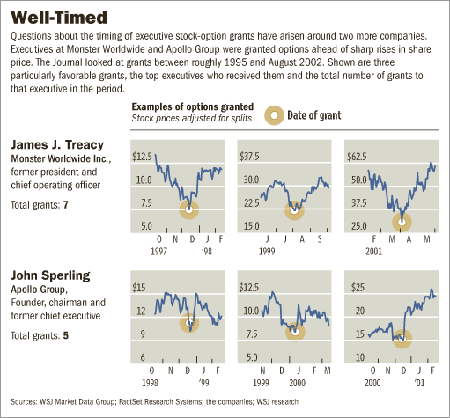
Among the eyebrow-raising grants at Monster is one dated April 4, 2001, at the nadir of a steep but short-lived decline in Monster's share price and the lowest closing price of the first half of 2001. Shares leapt 67% in the 20 trading days following that date. Mr. McKelvey said that grant was broad, covering some 2.2 million options to many employees.
Several directors, including members of the compensation committee, also received the favorable April 2001 grant, which carried a strike price of $30.63. The grant was in addition to the regular nonemployee directors' grant, which came in June and carried a strike price of $61.82, filings show.
Given Monster's current stock price of $42, the April grant is "in the money" and can be cashed in for profit. The June grant can't.
Mr. McKelvey says he had long been parsimonious with board compensation, and that directors "complained" at a 2000 meeting that they weren't paid enough. It was decided that they be included in the next broad-based grant -- the well-timed April 2001 issuance.
Another unusual grant, on Dec. 12, 1997, was dated at the bottom of a sharp dip in Monster's share price and ahead of a rapid recovery. Dec. 12 was the lowest closing price of the second half. And it wasn't the only well-timed grant in 1997: Top executives also received an option dated Jan. 6 -- the lowest closing price of the year.
Mr. Treacy said he didn't notice the favorable strike prices at the time. "I was busy working, and there was a lot to do and a lot of moving parts and a family to get home to," he said.
He also said that not all of his grants were unusual. A 2001 grant came before a fall in share price, and another grant was dated on the same day the company publicly announced his promotion to president. He left the company in 2002, but remained on the board until 2003.
Mr. Treacy never exercised any of his options while he was an executive. As part of his separation agreement, the company allowed him to keep them after he left. He cashed some out for the first time in December, he said. Asked how much he made on the transaction, Mr. Treacy said he doesn't have to disclose the sum. "I did OK," he said. "But I waited a long time."
© 2006 Dow Jones & Company, Inc
Until 2003, Microsoft Corp. was among corporate America's most generous issuers of stock options to employees. It also, it turns out, routinely maximized gains for recipients by setting prices for the options at the stock's monthly lows.
Among other favorably dated grants, Microsoft awarded options at monthly lows each July from 1992 to 1999, with varying dates. The software giant also routinely issued options to new employees at the stock's lowest closing price in the 30 days after they joined.
Those practices, which Microsoft ended in 1999 after seven years, amounted to a variation of backdating of the options, since they couldn't be priced at the low for a month until the month was over. That approach to compensation -- retroactively locking in a low price at which an options holder can buy stock -- has become the subject of a widening series of inquiries at other companies by federal authorities.
Unlike many of those companies, Microsoft voluntarily stopped the practice and disclosed it. In a news release issued on July 19, 1999, the company said it was ending the monthly-low policy and taking a $217 million charge.
But many details of its options dating haven't been widely known, even though the company disclosed the charge. At the time it disclosed the monthly-low practice, Microsoft was getting more attention for its mounting profits and a looming federal antitrust trial.
Moreover, filings show Microsoft granted an option to at least one executive that same month, dated July 30, 1999 -- the lowest price of the month. A later grant to directors was dated Jan. 31, 2000, the lowest price of that month. Additional grants to several executives were dated March 6 and April 24 of that year, again both monthly lows. Several other grants around that time weren't dated at monthly lows.
The details raise questions about how Microsoft began the practice, what prompted it to end it -- and whether the way the world's most prominent technology company dated options grants influenced other firms.
In a statement, Larry Cohen, general manager of corporate communications for Microsoft, said: "We have never participated in the practice of backdating stock options. Prior to 1999, we had a program of providing the lowest grant price to all employees during the 30 days after the grant was issued. This was and still is perfectly legal. Seven years ago, we discontinued this practice to further align our stock-option program with standard business compensation practices. We believed then and now that our financial statements were consistent with U.S. Generally Accepted Accounting Principles."
Greg Maffei, Microsoft's chief financial officer from 1997 to early 2000, said the company has "always been a leader in trying to show investors the cost" of options and other compensation. "I don't know how the 30-day policy evolved," Mr. Maffei said. "When it became clearer to us that it was not in compliance with GAAP, we took a charge and we fully revealed our policy and changed it on a go-forward basis."
During the 1990s, stock options became a popular method of paying and providing incentives to executives and rank-and-file employees, especially at technology firms, which often don't have cash to pay high salaries in their early days. Options give employees the chance to buy shares at a set price for a certain period. The idea is that they will see gains only if shares rise.
Typically, options for top executives are granted only by a company's board or its compensation committee. They carry a "strike," or exercise, price equal to the market value at the time the options are approved by directors. A recipient usually must wait a year or more for the option to "vest," then can cash out the option if the share price is above its strike price.
Backdating is deliberately moving the grant date earlier, to a more beneficial time when the price was lower. In effect, it gives the recipient an instant paper profit, undermining the incentive purpose of options.
Companies caught backdating risk disclosure and securities-fraud violations. Failing to disclose backdated or other discounted options to shareholders can violate federal securities laws. Executives who perpetrate such a scheme can face wire-fraud and other criminal charges. Companies found to have improperly backdated also could face accounting, tax and legal troubles.
John Coffee, director of the Center on Corporate Governance at Columbia Law School, said Microsoft's policy undermined the pay-for-performance spirit of stock options. Executives could have had a "perverse desire" to see the stock go down between July 1 and July 31 or in the 30 days following the start date for new hires, he said.
Prof. Coffee described the practices at Microsoft as "forward-dating" rather than backdating because the grants were dated at the lowest price following July 1. But whether forward-dating or backdating, he called the practice a bad one. "This ironically relates pay to poor performance," he said.
Prof. Coffee said he doubted that there would be any federal sanctions against Microsoft for actions that were disclosed seven years ago, but that "it might be embarrassing."
Microsoft was generous in awarding options to employees before halting the practice in 2003. Between its fiscal 1993 and fiscal 2000, it issued options covering what would now amount to about three billion shares, adjusting for stock splits.
Founder and Chairman Bill Gates, who was chief executive during the 1990s, and Steve Ballmer, CEO since January 2000, didn't receive any of those options. In 1992, however, three of the five best-compensated executives received grants equal to about 140,000 shares, each priced at $68, the stock's low price in July. The stock's highest closing price that month was $74.
In 1993, two of the company's top five executives received a total of 90,000 options, dated at that July's low share price of $37. The next year, a senior executive received a grant of 150,000 options at $47.75, the low price that July; the stock had reached $51.50 by the end of the month. That meant the executive stood to make $562,500 in additional profit by receiving options tied to the low instead of at the end of the month.
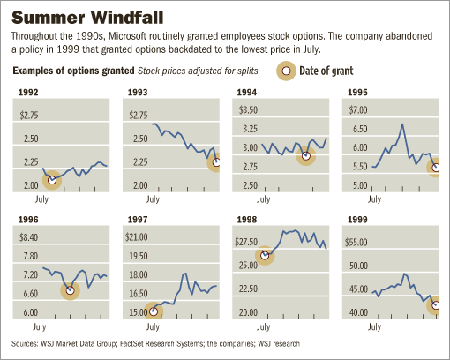
In its 1999 news release, Microsoft said, "Historically, exercise prices of grants of [options] were struck at the lowest price in the 30 days following July 1." The practice, it said, is "no longer employed." It later repeated this disclosure in its annual report to the Securities and Exchange Commission.
A person familiar with the matter said the July-low practice was approved by Microsoft's longtime auditor, Deloitte & Touche LLP. Deloitte and Microsoft consulted about ending the practice before making the 1999 change.
A Deloitte spokeswoman declined to comment on the company's advice to Microsoft. Deloitte currently is locked in a messy legal fight with a former client that claims that the auditor gave its blessing to a similar program.
In a lawsuit filed in 2003 in a California state court, Micrel Inc. alleges that Deloitte signed off on an arrangement in which the company would set the strike price for employee stock options at the stock's lowest price during the 30 days after a grant of options was approved. Deloitte later reversed its stance after a change in the partner supervising Micrel's audit, according to Micrel's suit. The firm then required Micrel to restate results for the three years in which it valued stock options in this way, which caused Micrel's profits to suffer. Deloitte has denied Micrel's charges.
In its proxy disclosures to shareholders covering executive compensation, Microsoft doesn't appear to have mentioned the options-dating policy. In the proxy covering the years ending June 30, 1990, and June 30, 1991, Microsoft said all options were "granted at fair market value on the date of grant," listing a few exceptions. The next year's proxy said "all options granted to officers and substantially all options granted to all other employees were granted at fair market value on the date of grant."
The next year, the language shifted somewhat, saying "option exercise prices are generally at the market price when granted." Similarly, Microsoft executive-disclosure forms filed with the SEC often said options were granted "on the date and at the price indicated."
--Robert A. Guth contributed to this article.
© 2006 Dow Jones & Company, Inc
Former Brocade Employees Tell Of Ad Hoc Part-Time Jobs And Altered Hiring Dates
By Steve Stecklow
Setting the Date
A Smashing-Pumpkins Show
At the high-tech company Brocade Communications Systems Inc., employees received an unusual request from human-resources managers in 2002: Alter the employment records of several executives to make it seem they joined the company later than they really did.
The reason for this strange request was to give their stock options more value.
The executives had received options when they joined. But with the tech bubble then fast deflating, Brocade's stock price had fallen below the price at which the options could be exercised. With a change in start date, the options could be replaced with some that carried a later date when the price was lower. That would enhance their value, since options give recipients the right to buy shares at the stock's price when they're granted.
This episode, related by two former employees, is part of a detailed picture of what went on inside one company caught up in the stock-options scandal. The events at Brocade, according to nine former employees and to company documents, involved not only altered start dates but a one-man options committee and a technique for influencing options grant dates through part-time employment.
It's a pattern of options practices that has drawn the attention of federal prosecutors. They are considering bringing criminal charges against a former Brocade chief executive, Gregory L. Reyes, says a person familiar with the situation -- in what would be the first criminal case in the spiraling scandal over the timing of options. The Securities and Exchange Commission also is considering civil charges in the matter, according to people familiar with the SEC probe. Mr. Reyes denies any wrongdoing.
So long as Brocade's stock was on the rise, employees wanted their options to be dated sooner, not later, since an earlier date would carry a lower exercise price. So to make it seem that employees had begun their careers at Brocade sooner, ex-employees say, the company would offer them temporary part-time employment from the moment they agreed to join, but before they actually did.
Several former employees described the offer to work part-time as a charade: Few actually worked any hours prior to starting full-time, other than making a few phone calls. New recruits were told, "We want you to start part-time -- wink-wink, nod-nod," says one former employee. "This was not a secret. Everybody knew about it."
A Brocade letter offering to employ Antonio Canova, who eventually became chief financial officer, was dated Nov. 13, 2000. It told him he'd get options for 180,000 shares with a grant date of "the first date of your employment." According to documents on file with the SEC, the letter went on to say: "To accelerate your on-boarding with Brocade, we extend to you the opportunity to join us on a part-time basis" of up to four hours per week prior to joining full-time. Mr. Canova, who has since left Brocade, couldn't be reached for comment.
Brocade, based in San Jose, Calif., is a data storage networking firm with just over 1,300 employees. It provides storage switches that are a sort of virtual traffic cop, allowing storage devices to be interconnected. A close look inside Brocade reveals some of the questionable practices now being exposed in the unfolding stock-options scandal. It also suggests why the scandal has engulfed so many Silicon Valley technology companies.
During the tech mania of the late 1990s and early 2000s, many firms were short of cash but high on promise. They used options as their primary lure and currency during the height of the boom. Pressure grew to make this currency as valuable as possible.
But any manipulation of stock-option grant dates can mean that a company has made false disclosures in the past -- a violation of federal law -- and perhaps has reported financial results incorrectly. Among dozens of companies now under federal investigation for options practices such as backdating them to low-price dates, several firms have already restated their financial results.
Brocade was early to do so. After an internal probe, the company twice restated past results, the first time in January 2005. The changes were significant. For example, Brocade originally reported a profit of $67.9 million in the year ended Oct. 28, 2000. In restatements, that became a loss of $951.2 million.
The company also relieved Mr. Reyes of his CEO duties and eventually terminated him.
Mr. Reyes was a tough manager who was known for firing questions at any employee who passed him by without making eye contact. Intensely competitive, he could make crude remarks about Brocade's competitors, referring to the main one, McData Corp., as "McDoodoo."
In a Halloween ritual at the company, employees would gather in a courtyard while Mr. Reyes stood on a chair, made a speech about the need to smash the competition, then took a baseball bat and shattered a pumpkin with "McData" carved on it. Another Reyes specialty: He sometimes startled staffers by chewing tobacco during meetings and spitting into a Styrofoam cup or empty mineral water bottle.
Mr. Reyes's lawyer says his client never personally benefited from options practices that have been questioned. "Financial gain is always the motive in securities fraud cases, and here, there was none," said the lawyer, Richard Marmaro. "There is not even an allegation of self-enrichment. Nor is there any evidence of criminal intent."
Mr. Reyes received several of his own options grants on highly favorable days, raising a question whether the dates might have been manipulated. One grant was dated Oct. 1, 2001, when Brocade closed at its lowest point of the year, after the Sept. 11 terror attacks had hurt the entire market. Two other awards to Mr. Reyes came at monthly stock lows.
Mr. Reyes said the board's compensation committee chose the dates, not him. Two members of the committee in that period, Neal Dempsey and Seth D. Neiman, didn't return calls. Records show Mr. Reyes never exercised any options he received after the company went public in 1999, though he sold hundreds of millions of dollars worth of shares received before the Brocade initial public offering.
Mr. Reyes spent much of his boyhood in Silicon Valley in a family of high-tech entrepreneurs. His father, Gregorio Reyes, had left Cuba in 1958 to study engineering in the U.S. and became a highly successful tech executive. An uncle, George Reyes, is Google Inc.'s chief financial officer.
The younger Mr. Reyes arrived at Brocade in mid-1998 as its new 35-year-old CEO. It was a small private company with only about 120 employees at the time.
He set out to expand Brocade fast. By 2000, the goal was to recruit 200 new employees every quarter. Not in a position to pay big salaries, Brocade instead held out the lure of stock options, offering even low-level employees a possibility of riches if the share price rose enough. It did: From a stock-split-adjusted price of $2.375 at the IPO in May 1999 it hit $133 on Oct. 23, 2000 -- a rise of roughly 56-fold.
Stories spread of Brocade employees making millions from stock options. "You had a lot of candidates very interested in Brocade because they knew Brocade from the stock," said Aleina McCarver, a former Brocade recruiter.
The process of granting stock options was cumbersome because the compensation committee met only every three months. Mr. Reyes said he wanted to speed it up so he could recruit better in those hectic days in Silicon Valley. The board gave him authority to approve options by himself, including their exercise prices.
He said the idea was supported by Larry W. Sonsini, one of the most prominent attorneys in Silicon Valley, who was then a Brocade director. A spokeswoman for his law firm, Wilson, Sonsini, Goodrich & Rosati in Palo Alto, said that one-person stock-option committees are legal under the laws of Delaware. That's where Brocade is incorporated. "One-person stock-option committees were adopted during a time of intense competition for hiring and retaining employees and the ability to act quickly was critical," said the spokeswoman for the law firm.
New hires were often granted options on the day they signed an "offer letter," even though they couldn't start for weeks because of the need to give notice to a current employer. But in October 1999, then-Chief Financial Officer Michael Byrd told Mr. Reyes that draft changes in accounting rules meant that new hires had to be working at a company to get options, according to internal email reviewed by The Wall Street Journal.
Part-Timers
Mr. Byrd recommended that new hires who couldn't start at once be given a chance to work up to four hours a week to qualify. Mr. Reyes said executives believed the part-time status also would help deter recruits from jumping to rivals before they had even started full-time.
An attorney for Mr. Byrd, who's no longer at Brocade, said, "Mike Byrd has been characterized as a witness in the government's investigation and has never been designated as a subject or target of that investigation. As the matter is the subject of ongoing civil litigation, Mr. Byrd does not believe it would be appropriate for him to comment on the allegations surrounding Mr. Reyes."
This process didn't always work out quite as planned. Mr. Canova's offer letter from Brocade, for instance, indicated that the future chief financial officer would get a batch of options as soon as he signed on. He agreed to become a part-time worker on Nov. 13, 2000. In the letter, he indicated that he would move to full-time status on Dec. 11, by which time the stock was up nearly 9%.
However, Brocade's stock sank in mid-December, erasing any potential gain for any options that would have been issued on either of those two dates. Records indicate that Brocade eventually resolved this problem by pricing the options for Mr. Canova not on Nov. 13 and not on Dec. 11 but on Dec. 21. The price that day was the bottom of the sharp price drop, and the lowest close of the second half of the year.
The difference between a Brocade option granted on his full-time start date of Dec. 11 and one on Dec. 21 would have meant $15.9 million more in profit for Mr. Canova had Brocade's stock price recovered and stayed up long enough for the options to "vest," or become exercisable. Instead, it stumbled, and Mr. Canova didn't reap any gain from the grant, according to securities filings.
Bradley Morgan, a former Brocade director of systems engineering, said she disagreed with the policy of making new hires part-time employees for options reasons. She said she hired 81 people for her department and didn't let any start part-time and get options early. "I just didn't think that was ethical," she said. "Some of the people had already been there through the start-up procedure and had given their body and soul, and I just didn't think people should come on and get the benefit of that."
Mr. Reyes said that he didn't recall ever having been made aware of her concerns and that he wasn't involved in details of how the part-time program was implemented.
At some point, former human-resources employees say, Brocade shifted to a procedure where a compensation committee determined a common grant date and exercise price for a whole group of new employees. The committee, however, consisted solely of Mr. Reyes.
One ex-employee said that a list of about 65 new hires would be submitted to the committee via Stephanie Jensen, then vice president of human resources. She would return with a printout, initialed by Mr. Reyes, listing closing prices for every day since the previous grant date. One date -- often close to the lowest, and several weeks in the past -- would be highlighted in yellow and be used as the grant date for the group, the ex-employee said.
Mr. Reyes said that he didn't pick grant dates based on the lowest share prices on any printouts, but rather selected dates when he believed the share price was relatively low. Ms. Jensen couldn't be reached for comment.
The fizzling of the tech boom kept many employees from benefiting from stock options. Though insiders sold more than $1.2 billion of Brocade stock from August 1999 to the end of 2000, according to Thomson Financial, hardly any came from options granted after the IPO. Only one top official exercised options after Brocade went public.
By February 2001, with the Internet boom fading fast, Brocade shares began falling sharply. Employees who hadn't exercised stock options or hadn't been there long enough for them to vest began to grumble. Brocade had given some employees large loans secured by stock options that were now worthless.
Offer Letters
It was around mid-2002 when a small group of staffers in human resources was asked to push forward the "start dates" of about five executives, several former employees said. One said Ms. Jensen inquired about how the company's database systems and backup tapes stored employee data. This former worker told of later being given folders, one at a time, containing revised offer letters of jobs for these executives. The new letters were dated several months after the original ones, so that options given when the executives came aboard could carry later dates, when the price was lower.
The former worker said he agreed to change the dates for two or three executives but then declined to change any more. He said Ms. Jensen told him he didn't have to continue. According to another person with knowledge of the episode, a supervisor changed the remaining records.
Mr. Reyes said he had no knowledge of such an incident. The company said it had "no comment related to the question of improprieties."
The unraveling of the options-granting practices began in late October 2004 with a call to Mark Cochran, then Brocade's general counsel. According to people familiar with the matter, the call was from an attorney for Dan Cudgma, a former Brocade sales executive who left in 2002.
Mr. Cudgma had received a $1.2 million loan from Brocade that was secured by his house in Needham, Mass., and never repaid. In April 2004, Brocade began court proceedings to foreclose on the house. Mr. Cudgma's attorney suggested in the October phone call that if Brocade did so, Mr. Cudgma would complain to the SEC that his stock options had been backdated, say people familiar with the situation. Mr. Cudgma didn't return calls seeking comment. Mr. Cochran declined to comment.
According to the people familiar with the matter, Mr. Cochran reported the conversation to the Palo Alto law firm where Mr. Sonsini, the director, was a partner. It contacted the board's audit committee, which brought in another law firm and a team of forensic accountants. After nine weeks, in January 2005, Brocade said the probe had determined that options granted under the part-time program were "incorrectly accounted for."
Brocade also said that it expected to restate some financial results because of its stock-option granting practices, including giving grants to employees who hadn't started working yet or were on a part-time basis.
Mr. Reyes prepared a short speech to defend himself to the board. "My actions as they relate to the issues at hand were always based on attracting and retaining top talent, which is one of the most important aspects of a CEO's job," he said in the speech on Jan. 7, 2005. "The majority of the issues ... deal with a period of time where hiring and retaining the best people was perhaps the most important thing I could do for the company." He went on to blame two high-level subordinates for "making many administrative errors with an embarrassing level of sloppiness" that he said he had not known about.
Brocade restated results on Jan. 24, 2005, and then again later. Buried in the January announcement was the disclosure that after six years, Mr. Reyes was stepping down as chief executive, but would remain as a consultant. "They never asked me to do a single thing" as a consultant, he said. Last July, the company terminated him.
Though Mr. Reyes never exercised any options, he sold at least $380 million of shares received before Brocade's IPO. Over time he bought a 12,000-acre California ranch and hunting grounds, an Alaskan fishing lodge, a stake in the San Jose Sharks hockey team, a 10,000-square-foot home in Saratoga, Calif., and more than a half-dozen cars including a Porsche and a Ferrari.
Mr. Reyes and Brocade are defendants in a suit by the Arkansas Public Employees Retirement System, filed in federal court in San Francisco by Bradley E. Beckworth of the law firm of Nix, Patterson & Roach LLP in Daingerfield, Texas. The pension fund says it lost nearly $2 million on Brocade stock and the suit alleges that Brocade defrauded investors through its options-granting practices. Mr. Reyes denies the allegations. Brocade has filed a motion to dismiss the suit.
© 2006 Dow Jones & Company, Inc
Darwin Deason spends lavishly and attracts scrutiny. Now he battles an options scandal.
By James Bandler and Charles Forelle
Passing out 'Hustle' cards
Darwin Deason built a vast fortune in the computer-services industry, and he has used it to live well. He vacationed in his sprawling Palm Desert, Calif., compound next to a private golf course. He remodeled his 14,000-square-foot penthouse apartment in Dallas. He appeared in a Vanity Fair photo spread aboard his 205-foot yacht in Monte Carlo's harbor with a drink in one hand and his bikini- and stiletto-clad companion in the other.
An Arkansas farm boy who never went to college, Mr. Deason grew rich by spotting a way to help companies and governments pinch pennies. He was an early player in the big movement to outsource routine office chores like processing the payroll. Affiliated Computer Services Inc., the company he built, helped pioneer the business of shipping office work to places with cheap labor like Mexico and Guatemala.
Now he is in the spotlight again, caught up in the billowing national scandal over backdating of stock options. Although Mr. Deason, who retired as CEO in 1999 and is still ACS's chairman, received two option grants dated on extremely favorable days, two internal probes didn't find evidence that Mr. Deason knew about or took part in any backdating. But federal officials are looking at his conduct and that of other ACS figures, according to someone familiar with the matter.
The backdating scandal has focused attention on CEOs from corporate giants like UnitedHealth Group Inc. to small firms. But few have the colorful history of Mr. Deason, 66, or his record of bouncing back from controversy.
In the late 1980s, regulators accused ACS of using options on its stock in a sweetheart deal with savings-bank executives. ACS paid a fine but went on to grow phenomenally. In the process it became a $5 billion company. Mr. Deason holds around $420 million worth of ACS shares.
Years later, a bankruptcy trustee alleged that Mr. Deason looted another firm, spending its money on plastic surgery, dry cleaning and ranch expenses. Mr. Deason paid $3.75 million to settle, though he now denies the allegations.
This spring the scandal over backdating of stock options enveloped ACS, prompting questions as to whether it had enriched executives at shareholders' expense. A preliminary probe found no intentional misdating. A second said there was indeed backdating, and blamed four people. ACS's two top executives lost their posts.
Among the unanswered questions: How Mr. Deason, who founded ACS and was CEO and head of the compensation committee through much of the backdating era, could have been unaware if such an egregious infraction was occurring.
Mr. Deason declined several requests for an interview. Through a spokesman, he denied any impropriety. His role in the matter was "exhaustively investigated," the spokesman said, and "there was no misconduct found."
Friends and business associates describe Mr. Deason as a talented leader. "He could run General Motors," said Thomas Rouse, who helped Mr. Deason found ACS in the 1980s and was an executive there. He said Mr. Deason was a demanding but fair boss -- "If he needed to kick your butt, he did" -- but was disciplined and an expert negotiator.
He has parlayed his success into an ostentatious lifestyle. Besides the giant yacht, Mr. Deason, who has been divorced four times, favors travel on well-equipped private jets. His penthouse apartment in Dallas has three wet bars.
"Darwin likes things big," said Larry North, a Texas friend who owns a health-club chain. "You look at the boat, you look at the penthouse, you look at the limo -- by golly, if his name is associated with it, he wants it to be the best."
Mr. Deason grew up near Rogers, Ark. His father raised chickens, hay and grapes. His mother was religious and strict. Relatives remember the young Darwin as good at math but mischievous and independent. He played high-school football, his spokesman said, but quit in his senior year because he preferred to hang out with friends and chase girls.
"Darwin was always pretty much a rebel," getting in trouble for drinking, skipping school and general hell-raising, said a cousin, Ann Kistler, who added that "he was meaner than crud." Mr. Deason's spokesman said the cousin's memory is accurate.
A day after he got out of high school, Mr. Deason left Arkansas with $50 and a 1949 Pontiac, heading for the nearest big town with "tall buildings and concrete streets," his spokesman said. That was Tulsa, Okla. He got a job at Gulf Oil, then moved to MTech Corp., a Dallas data-processing firm where he eventually rose to CEO. When it was sold in the late 1980s, he was rich. But he was restless, and within days was raising money to start ACS.
Its birth in 1988 led to a scandal. Mr. Deason made an arrangement with officials of a local thrift institution called Gibraltar Savings. Gibraltar and a related thrift bought around half of the newly formed ACS. They gave ACS a contract to handle their computer services. As part of the deal, the head of Gibraltar, J. Livingston Kosberg, and other thrift officials personally got options to buy ACS shares. When the savings associations later failed, federal regulators claimed the thrift executives had drained their assets by overpaying ACS.
The regulators also focused on the options ACS gave to the thrift executives. "They're trying to take a small part of the transaction and make it look like some big bribery deal," Mr. Deason complained to theDallas Morning News at the time. His spokesman says Mr. Deason "vigorously defended" the deal, which he said had been approved beforehand by state regulators. But ACS settled the matter in 1991, paying a $500,000 fine while neither admitting nor denying any wrongdoing.
Mr. Kosberg, a politically active Texas businessman, made a payment to federal regulators in a settlement. As part of ACS's settlement with regulators, Mr. Kosberg was removed from the company's board.
The firm Mr. Deason founded grew rapidly. After going public in 1994, it expanded into processing insurance claims and child-support payments and storing mortgage documents. It performs back-office work for the E-ZPass highway toll system.
Mr. Deason was an exacting chieftain. Former managers say a 7 a.m. start to the workday wasn't unusual, and he sometimes scheduled meetings at 6 a.m. so they wouldn't cut into selling time.
He often began his own day with a 5 a.m. workout at one of Mr. North's gyms, in the tony Highland Park part of Dallas. Mr. Deason's home reflects the same sort of discipline he exerted in business, say people who have seen it. His cars get cleaned at least twice a week. The house staff knows to place Coke cans in his refrigerator just so, labels facing out.
Mr. North, who besides his gym business sold a diet regime through an infomercial called The Great North American Slimdown, says, "I've never seen a closet, even in the movies, like his: Every shoe in place, all the jeans pressed and way folded on the hanger. I bet if you took one tie off the rack he would notice it."
ACS gave employees "Hustle cards" with Mr. Deason's sayings. "Remember, good things come to those who are patient, but normally they're the leftovers from those who Hustle," read one card, with a picture of a stern Mr. Deason. On the back were "The Darwin Principles," such as "Hard work solves (almost) everything" and "Loyalty is a two-way street."
ACS still uses Hustle cards. Chief Executive Lynn Blodgett keeps one in his wallet. "Darwin is a salesman. He always believed in doing more for the customer than the competition would do," says Mr. Blodgett, who got his post in November after the backdating scandal forced out his predecessor.
A decade after the scrape involving the thrift executives, Mr. Deason faced controversy again. This time it involved a onetime ACS subsidiary called Precept Business Services, which had a grab bag of operations such as limousine services and business supplies. ACS spun it off as a separate company in 1994. Mr. Deason controlled it. One of its main customers was ACS. Precept later became a public company, with Mr. Deason as chairman.
It ran into trouble and filed for bankruptcy protection in 2001. A court-appointed federal bankruptcy trustee alleged that both before and after it was a public company, Precept paid for Deason-family personal expenses such as bodyguards, sports tickets, liquor and car maintenance.
Precept owned the giant penthouse apartment Mr. Deason lived in and let him have it rent-free, the trustee said, spending $1.5 million to renovate and furnish it with a Jacuzzi, a grand piano and 16 television sets. Just before going public, Precept sold him the apartment for what the trustee said was nearly $1 million below appraised value.
As a public company, Precept paid expenses at a Texas ranch used by the Deason family, including utility bills, taxes and ranchhand wages, according to invoices and other documents reviewed by The Wall Street Journal. The trustee made similar allegations. In bankruptcy court, the trustee alleged a "looting" of a public company that was "a private piggy-bank" for the Deason family.
Mr. Deason paid $3.75 million to settle the trustee's claims. His spokesman, Michael Buckley, said the allegations were "outrageous and in almost every case inaccurate, unproven and untrue." He said Mr. Deason personally guaranteed more than $2 million in Precept loans and ultimately bore their cost. He said Mr. Deason can't respond to particulars because he doesn't have the relevant records. He settled to avoid legal costs that would have been even higher, said the spokesman.
A Louisiana businessman who sold his business-forms company to Precept in 1998 for Precept stock is still seething over the deal, which he says cost him $13 million when Precept stock lost its value. "They raped the company," said the businessman, Joseph D. Greco, calling Mr. Deason "probably the worst son-of-a-bitch I ever met."
Mr. Greco said Mr. Deason cares only about himself. "He's had all these face-lifts. He's got skin stretched so tight it's going to blow his nostrils out. Every tooth is crowned. It looks like a surrender flag when he smiles." Mr. Deason's spokesman said Mr. Deason laughed when told about the comment.
Mr. Greco described an early encounter with Mr. Deason, at a directors' meeting before Precept ran into trouble. Mr. Greco said Mr. Deason, gazing at him and another new director, Robert Bazinet, asked: "Ya'll been married before? I'll bet my wife is younger than your wife." Mr. Greco said he told Mr. Bazinet afterward, "This guy is nuts!"
Mr. Bazinet agrees that Mr. Deason was "very proud that his wives were very young." He said Mr. Deason "had one rule: He wouldn't date a woman younger than his son." Mr. Deason's current companion, at 39, is younger than both of his sons.
Mr. Deason's spokesman said it's unlikely the conversation took place because Mr. Deason considered both Mr. Greco and Mr. Bazinet "dishonest and unethical" men who "grossly misrepresented the financials" of their businesses before selling them to Precept. He said Mr. Greco failed to disclose that his sales force had threatened to quit en masse if Mr. Greco's firm was sold to Precept. They did quit after the sale, driving the business's revenue to nearly zero, the spokesman said. Mr. Greco denies misrepresenting anything, as does Mr. Bazinet, who says the accusation is "bogus."
In 1999, before Precept's bankruptcy, Mr. Deason handed over the CEO job at ACS to his deputy, Jeffrey Rich. Mr. Deason's gym workouts moved to mid-morning. Still chairman, he began spending six to eight months a year out of Dallas, sometimes at his Palm Desert home, which he sold two years ago. Recently he has lived for about half the year aboard his yacht, the Apogee, often cruising the Mediterranean or Caribbean.
ACS thrived under Mr. Rich. Its share price surged, even during the tech-stock crash of 2000-2001, as clients were bitten by the outsourcing bug. The rapid growth later eased, and ACS also faced a number of contract disputes and government investigations.
In one, the Alberta Department of Justice charged early this year that a Canadian unit of ACS bribed Edmonton police officials to try to get a contract renewed. Documents filed by the Royal Canadian Mounted Police said ACS paid for travel and sports tickets for police officials. ACS said it believes its subsidiary has "valid defenses." The company also said it doesn't believe it has "an unbalanced number of disputes or government investigations" for a company its size.
ACS's problems with stock-options backdating started in March. A Wall Street Journal article identified the company as one of several that awarded options at improbably beneficial times. Options -- which typically convey a right to buy shares later at the price when the options are given -- are more lucrative if given on days when the stock price is low. Grants to Mr. Rich, chief executive from 1999 to late 2005, were dated at lows with such regularity that a Journal calculation put the odds of it happening by chance at one in 300 billion. Mr. Rich called it "blind luck."
ACS launched an internal investigation. In early May, it said a preliminary probe had found some options-dating problems but no "intentional backdating" by any director or officer.
A week after its probe exonerated officials, ACS, whose shares trade on the New York Stock Exchange, received a subpoena from federal prosecutors in Manhattan. In addition, ACS lawyers heard that regulators in Washington weren't happy the probe had been done by the company's usual outside lawyers. Mr. Deason decided there should be a second investigation. He hired Bracewell & Giuliani LLP, the firm of former New York Mayor Rudolph Giuliani. "Give us your toughest guy," Mr. Deason said, according to his spokesman.
The law firm sent Marc Mukasey, a former prosecutor who had nailed Colombian drug traffickers. Among the option grants to be reviewed was one to Mr. Deason in 1998. It was especially lucrative: dated on the day ACS's stock closed at its lowest point all year. A second grant to Mr. Deason, in 2002, was dated the day the stock hit a quarterly low. Mr. Deason told Bracewell lawyers he knew nothing of any backdating.
Unlike most executives, Mr. Deason has never exercised any ACS options. He currently holds unexercised options with potential profit of about $15 million, though not all of them can be cashed out immediately. His spokesman said it would have been easy for Mr. Deason to "lavish" himself with hundreds of millions of dollars worth of options, but he didn't because he is a "shareholder- obsessed founder."
Among the four directors who oversaw this probe was Mr. Kosberg, the thrift official whom banking regulators once ordered off the ACS board. ACS had brought him back in 2003, saying his appointment would improve the board's independence.
A director said the board pushed hard to find out what happened, asking Mr. Mukasey at least a dozen times whether Mr. Deason had any involvement in the backdating.
The Bracewell & Giuliani lawyers faced hurdles. Mr. Rich was no longer an employee and chose not to talk to them. Also, the lawyers had difficulty assessing certain pre-2000 documents because of the lack of metadata -- tell-tale clues embedded in electronic documents that help investigators determine when they were actually created. For later documents, they found electronic traces indicating some had been created after the date they bore and then backdated.
ACS announced the probe's results last month, saying it implicated four people in backdating: Mr. Rich; his successor as CEO, Mark King; the ACS finance chief, Warren Edwards; and an unnamed employee. Lawyers for Messrs. King and Edwards have said their clients had acted in good faith, fully cooperated and engaged in no "intentional misconduct." A lawyer for Mr. Rich declined to comment.
ACS said the probe found Mr. Deason had been closely involved in initiating option grants. It said that when the stock price seemed low to him, he would contact a director on the compensation committee and an executive to suggest it was time to grant options, and then Mr. Rich, Mr. King or Mr. Edwards would pick the exact dates -- often retroactively.
Addressing Mr. Deason's 2002 option grant, ACS said investigators "could not conclude" it was backdated. ACS didn't address the 1998 grant bearing the lowest price of the year.
When Bracewell & Giuliani's Mr. Mukasey presented his findings to some ACS directors at the law firm's Dallas office, Mr. Blodgett, ACS's new CEO, says Mr. Deason clearly was pained by the allegations against his protégés: "I watched his eyes. And it was killing him." Directors agreed the implicated executives still employed had to leave.
Messrs. Deason and Blodgett took a limousine to ACS's headquarters. They went to the 10th-floor office of Mr. King, who was CEO, to tell him and Mr. Edwards, the chief financial officer, that they must go. Mr. Deason wasted little time delivering the bad news, says Mr. Blodgett. Nonetheless, "it's the hardest thing he has ever been through," Mr. Blodgett said. "It would not be overstating it to say he was devastated."
© 2006 Dow Jones & Company, Inc
Some CEOs reap millions by landing stock options when they are most valuable. Luck -- or something else?
By Charles Forelle and James Bandler
Five senior officers at two well-known Silicon Valley companies became the latest corporate casualties of the stock-options backdating scandal, adding to a toll that is likely to continue to rise as companies wrap up probes of their internal practices.
In the latest actions, Shelby Bonnie, founder and chief executive officer of Web publisher CNET Networks Inc., and George Samenuk, chairman and CEO of computer-security vendor McAfee Inc., stepped down following internal probes that found use of options backdating. So far, some two dozen executives or directors have been fired or suspended or have resigned amid options probes. Among them are top officials of Apple Computer Inc., Web-site operator Monster Worldwide Inc. and software maker Comverse Technology Inc., whose former CEO is facing extradition proceedings in Namibia.
Experts said more departures are likely. More than 100 companies are under investigation for options backdating, and scores of them are still conducting internal probes. Many would like to finish them in time to make disclosures during quarterly earnings reporting, which will be heavy in the next several weeks. The companies face pressure to finish because they may not be able to tally their earnings without knowing whether they will need to record charges for any improper options discovered by the probes.
Many companies have already said they won't meet securities-filing deadlines for the quarter, leaving them at risk of delisting, costly fights with bondholders entitled to timely financial statements, and potentially greater liability in any options-related civil actions by shareholders.
Charles Elson, director of the John L. Weinberg Center for Corporate Governance at the University of Delaware, said he believes more people will lose their jobs. "It is a fundamental breach of trust to your investors," he said.
Backdating amounts to pretending that an option was granted earlier than it actually was, at a beneficial time when the share was trading at a low price. Since options entitle their recipients to profit from a rise in price, claiming the grant occurred at a time of low prices could give the recipient a running start to extra profit.
At a minimum, backdating generally involves accounting and disclosure violations. It can also constitute fraud. U.S. attorneys in more than a half-dozen jurisdictions are probing at least 50 companies. Five former executives of two companies are facing federal criminal charges for their alleged participation in backdating schemes.
Firing an executive doesn't necessarily get a company off the hook with regulators or litigious shareholders, but can be held up as a sign of good faith. The actions at CNET and McAfee underscore how seriously some corporate boards are taking options manipulation. Taken with other recent dismissals, they are establishing a precedent that separating executives from the company is a prudent response to options problems.
Getting rid of someone can be a double-edged sword, though. "The SEC [Securities and Exchange Commission] and the Department of Justice expect crisp remedial measures, so termination of a wrongdoing executive typically helps the company in the eyes of those regulators," says Michael Young, a lawyer at Willkie Farr & Gallagher. "Unfortunately, it can hurt in the defense of subsequent class-action litigation to the extent that plaintiff's lawyers infer that the departed executive did something wrong."
The McAfee departures suggest also that some boards, guided by outside lawyers conducting the probes, are taking a stern view of responsibility. Mr. Samenuk joined McAfee in January 2001, long after manipulations there apparently started. President Kevin Weiss, whose firing was announced yesterday, joined the company in October 2002.
In a statement, Mr. Samenuk expressed "regret" that some of the problems "occurred on my watch." Mr. Weiss couldn't be reached. Exactly what Messrs. Samenuk and Weiss did that precipitated their departures isn't known; a McAfee spokeswoman said the men were "implicated in the options backdating" but declined to elaborate.
Exactly who will go and who will stay at the scores of companies being investigated is difficult to discern. An executive's fate, of course, depends strongly on what evidence a review finds. But how that evidence is treated can vary from company to company.
Apple Computer threaded the needle last week when it discussed superstar CEO Steve Jobs's role in backdating at the company. Apple's disclosure said Mr. Jobs knew some grants were backdated; earlier, the company said he received a problematic grant. But Apple also said last week that Mr. Jobs wasn't aware of the accounting implications of backdating and didn't get any grants he knew were backdated, implying that any troublesome grant he received was manipulated for his benefit but was backdated without his knowledge. Apple's relatively terse disclosure didn't spell out exactly who did what.
Mr. Jobs apologized and remains with the company, which laid the blame on two unnamed former executives. Apple director Fred Anderson, a former finance chief, resigned from the board.
Bed Bath & Beyond Inc., the specialty retailer, said Tuesday that its review had found rampant backdating, concluding that "almost all annual grant dates" for several years were likely selected "with some hindsight." At a time when many corporate disclosures about backdating are opaquely written, the company's statement was frank and detailed, laying out how many grants the company believed were backdated and giving a sketch of how the process worked.
What's more, Bed Bath & Beyond said, the co-chairmen and chief executive had responsibility for picking the dates; the men themselves benefited from the low prices. But the board committee probing the options offenses concluded that no one had "engaged in willful misconduct." No top executives have departed Bed Bath & Beyond because of options misdeeds.
Mr. Young, the Willkie Farr attorney, says that in investigations of matters like options backdating, board committees try to probe deeply an executive's state of mind. "When somebody is deliberately doing something wrong, and misrepresenting the consequences, then you've got dishonesty in the ranks," says Mr. Young. That, he says, is dealt with harshly. What to do can be a tough call, he says, with "those whose involvement was gray."
San Francisco-based CNET said its review, conducted by law firm Davis Polk & Wardwell and led by a special committee of directors, found "instances of backdating" from the company's initial public offering in 1996 through "at least 2003." Even though CNET said its review didn't conclude that any of these people "engaged in intentional wrongdoing," Mr. Bonnie, General Counsel Sharon Le Duy and human-resources head Heather McGaughey all "bear varying degrees of responsibility." They all resigned and agreed to have any improper options repriced so that they wouldn't continue to benefit from the backdating.
CNET also said directors will reprice improper options; a company spokeswoman says the repricing affects "all members of the board of directors, to varying degrees depending on their length of service."
It isn't clear exactly which grants were backdated, though some raise suspicion. In 2000, CNET granted options to Mr. Bonnie and two other top executives with purported dates that coincided with the stock's lowest closing price in April. Other executives got options dated at October's low price. One received both favorable dates.
Melinda Haag, a lawyer for Ms. Le Duy, said her client neither knew about nor participated in any intentional misdating of options. "Sharon has always acted with integrity with regard to CNET's stock-option grant process and in all other regards," Ms. Haag said. "Given that she was a senior officer for part of the time at issue, however, Sharon recognized that her resignation would best help the company move forward."
An attorney for Mr. Bonnie couldn't be reached for comment.
Ms. McGaughey, a former Time Inc. manager, joined CNET in 1998 as vice president of human resources. She became senior vice president in 2000. "Ms. McGaughey is deeply saddened by the events that have happened at CNET," said her lawyer, Leigh A. Kirmsse. "She believes that in the end her name will be completely cleared of any wrongdoing whatsoever."
Kirk Hanson, executive director of the Markkula Center for Applied Ethics at Santa Clara University, said companies are operating in a climate that places great weight on the integrity of senior-most executives.
Mr. Hanson said he believes a senior executive who initiated or authorized backdating should leave his position.
"If a CEO who is tainted remains in place, a very unfortunate signal is given to the organization that irregular practices will be tolerated or even applauded," Mr. Hanson said. "This is not a question of whether the CEO is indictable; it is a question of whether the CEO is a credible leader of integrity."
© 2006 Dow Jones & Company, Inc
Ex-CEO Scrushy Often Received His Payouts at Low Price Points, Review of Company Filings Shows
Richard Scrushy, the former chief executive of HealthSouth Corp., repeatedly received stock options dated at low points in the company's stock price, a review of securities filings shows, raising questions about the company's options-granting practices.
Patterns of hitting frequent lows in options pricing have also turned up at a number of companies facing probes by federal regulators or prosecutors seeking to learn if the grants were backdated to make them more advantageous to recipients. Some two dozen companies are under federal scrutiny, and about a dozen executives or directors at some of those companies have left their posts in recent weeks.
Mr. Scrushy is long gone from HealthSouth, fired by its board in 2003 after accounting fraud brought the rehabilitation-hospital company to the brink of bankruptcy. More than a dozen subordinates pleaded guilty to participating in the $2.7 billion fraud. At his trial last year, Mr. Scrushy was acquitted of all 36 counts against him.
But his legal troubles aren't over. The Securities and Exchange Commission has a civil lawsuit against him, and he is standing trial in a bribery case. HealthSouth and Mr. Scrushy are engaged in drawn-out hostilities: The company is suing him for his alleged role in the fraud, and he is suing the company for wrongful termination.
A HealthSouth spokesman declined to comment on the circumstances surrounding the particular option grants but said the company has "left the investigation of criminal and possible criminal activities at HealthSouth to the relevant authorities. The new management and the new board continue to cooperate thoroughly in these matters."
Mr. Scrushy said in a statement that all HealthSouth options while he was chairman and CEO "were granted on the day of a regularly scheduled board meeting, generally for the closing price as of that day" and "we were acutely aware of the legal requirements" governing options. "They were never backdated."
Stock options give an executive the opportunity to profit if the company's share price makes advances. As they are typically structured, an option is granted with a "strike price" set at the market value of the stock on the date of grant. If shares rise, the executive makes money. If they don't, he doesn't.
Mr. Scrushy apparently never exercised any of the unusually timed options between 1995 and 2002, although he did exercise a large number of options granted earlier. Upon his firing, the company declared all his outstanding options forfeited. In his suit, Mr. Scrushy is trying to get back his options and other kinds of compensation.
Any trouble with the timing of the past option grants could complicate Mr. Scrushy's recoupment efforts and could rattle the company as it seeks to emerge with new management from the shadow of the scandal. Other companies swept up by options trouble have said they may need to make large restatements of financial results to reconcile their books and tax filings for improperly dated options.
The pattern of 11 grants Mr. Scrushy received between 1995 and 2002 is improbably fortuitous. Two carried the lowest closing price of the year in which they were granted. Three more were dated at quarterly lows. An additional grant was dated at a monthly low, at the bottom of a sharp V in share price.
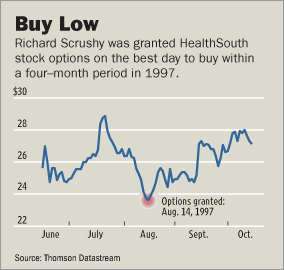
A Wall Street Journal analysis, using a methodology that looks only at postgrant-date price appreciation, finds the odds of Mr. Scrushy's grant pattern having occurred by chance is around one in 10,000. That's a low probability, but it doesn't rise to the level of significance of 11 other executive's patterns examined by the Journal in recent months using the same methodology. Many of the 11 companies that issued these grants are now facing federal scrutiny or have launched internal inquiries or both.
There are a number of possible explanations other than backdating for Mr. Scrushy's pattern of low-price grants, among them sheer luck. It's also possible the grants were issued at times when executives felt the shares were undervalued, hoping to profit from appreciation. Grants could also have occurred just before stock-moving news, increasing the likelihood that they happened to have come at low points.
A number of Mr. Scrushy's grants are noteworthy for their good timing. He received 800,000 options dated Feb. 29, 2000, with an exercise price of $4.875, the stock's closing price that day. The options entitled him to profit on any appreciation above that price. As it turns out, $4.875 was the stock's lowest closing price all year. Two months after the grant date, the shares were 65% higher. By the end of the year, they had reached above $16.
Mr. Scrushy's grant in 1995 was apparently dated June 6, securities filings suggest, the date of the company's annual shareholder meeting. The grant carries the closing price of June 5, the year's lowest close.
The mechanics of options mean executives have much to gain from lower strike prices. A strike price just a dollar lower on a grant of a million options means, potentially, an extra million dollars in profit. Backdating an option grant to yield a better strike price vitiates the incentive purpose of the grant, effectively letting an executive profit after the fact from stock movements -- a luxury of hindsight no regular investor could ever possess. Backdating can cause accounting and tax problems for the company, and could open up an executive for fraud charges.
John S. Chamberlin, a former HealthSouth director who served on the HealthSouth compensation committee from 2000 to 2002, said the committee followed strict protocols in its option grants. Mr. Chamberlin says he believes the effective grant dates of the options matched the days when the options were approved by the compensation committee. "When I was on the compensation committee, everything was handled appropriately," says Mr. Chamberlin. "There was no finessing of anything....To my knowledge, there was no backdating," Mr. Chamberlin says. "No backdating at all, or shooting for lows."
But Mr. Chamberlin said he doesn't recall the board approving options more than once a year, and at scattershot times in other years. Mr. Chamberlin said during his time on the committee, options were usually granted in the first quarter of the year, on the same day as the company's board meeting. He says he can't recall why options were granted in November 2001, on a date that was the quarterly low for the HealthSouth share price.
"If there had been any backdating or changing of the dollar values, I'm sure we would have noticed it," Mr. Chamberlin said. "I'm confident that wasn't done."
Mr. Chamberlin said it would have been reckless for executives who were involved in other fraud at HealthSouth to backdate options because it would have been detected by the board. "I just think those who were involved in the fraud felt that was too great a risk to play around with that," he said.
A grant dated Aug. 14, 1997, came the same day Mr. Scrushy confirmed that HealthSouth was interested in buying pieces of a rival's operations. That day -- the low for the third quarter -- was also the day HealthSouth filed its quarterly report.
In January 2002, HealthSouth shares declined sharply after the Justice Department joined a former employee's lawsuit. They hit what turned out to be the low for the quarter on Feb. 4 -- another date for Mr. Scrushy's options. That day, he reassured investors the suit was without merit.
© 2006 Dow Jones & Company, Inc
Top Post Will Go to Hemsley As Options Scandal Claims Highest-Profile Casualty Yet
By James Bandler and Charles Forelle
Although couched in careful language, the 14-page WilmerHale report suggests that Dr. McGuire misled lawyers conducting the probe of the options grants at issue.
The scandal over backdated stock options claimed one of corporate America's most successful chief executives, William McGuire of UnitedHealth Group Inc., who agreed to leave the giant health insurer after an internal probe concluded that the stock-option grants that have brought him a huge fortune were likely manipulated.
The probe's findings, released yesterday, provided a detailed picture of how stock-option backdating worked at the company, offering glimpses of cronyism and a culture in which vast sums of compensation were handed out with few controls or written records. Among the troublesome option grants detailed in the report was a massive 1999 award to Dr. McGuire that ranks among the most lucrative ever.
UnitedHealth said Dr. McGuire would immediately relinquish the chairman's post and step down as CEO by Dec. 1. Also leaving is William G. Spears, a member of the board's compensation committee who had deep financial entanglements with Dr. McGuire, which were undisclosed to investors, and David Lubben, the company's general counsel.
With the UnitedHealth departures, more than 30 top corporate officials will have lost their posts in the wake of the options-manipulation investigations that have engulfed more than 100 U.S. companies over the past several months. Dr. McGuire is the fifth CEO in the past week to depart in the still-burgeoning scandal.
Dr. McGuire will be replaced as chief executive by his longtime lieutenant, Stephen Hemsley. The probe, conducted by the law firm of Wilmer Cutler Pickering Hale & Dorr, found that Mr. Hemsley received backdated grants, but largely cleared him of a major role in their creation. Richard T. Burke, a director and former UnitedHealth CEO, was named nonexecutive chairman.
At the end of last year, Dr. McGuire's cache of unexercised options was valued at $1.78 billion, a sum far greater than any other U.S. corporate chieftain. Yesterday, UnitedHealth said he agreed to have all of the options issued to him from 1994 through 2002 repriced, likely cutting tens of millions in dollars from their value. But the company left open other financial arrangements with Dr. McGuire, and the exact terms of his departure are likely to be the subject of intense negotiations.
UnitedHealth, which is based in Minnetonka, Minn., and has a market capitalization of $66 billion, also is being investigated by the Securities and Exchange Commission, by federal prosecutors in New York, and by the Minnesota attorney general.
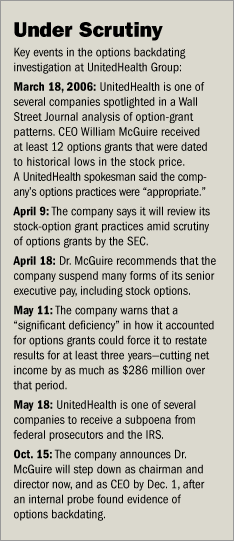
The probe by WilmerHale was headed by William McLucas, a former director of the enforcement division of the SEC. It examined 29 of the largest options grants at UnitedHealth over a 12-year period, and concluded that most likely were backdated to benefit insiders.
Options are designed to give recipients the opportunity to profit if the company's share price rises in the future. Grants typically are structured so that the recipient can buy shares later at the stock's market price on the day the option was granted, or the exercise price. Backdating involves pretending that the grant was awarded on an earlier day, when the share price was particularly low, giving the recipient a chance at extra profit.
Although couched in careful language, the 14-page WilmerHale report suggests that Dr. McGuire misled lawyers conducting the probe of the options grants at issue. To the end, Dr. McGuire insisted that year after year he actually did call or otherwise contact a compensation-committee member to set an options grant in motion on what, in hindsight, turned out to be a wildly favorable day.
"Certain facts run contrary to this assertion," the WilmerHale report says, citing memoranda Dr. McGuire wrote on or after the purported grant dates referring to possible grants in the future tense. The report also takes a skeptical view of the circumstantial evidence presented by Dr. McGuire to document that the compensation-committee notifications did in fact take place.
Dr. McGuire's lawyer, David M. Brodsky, declined to comment on the WilmerHale report. A spokesman for Mr. Spears also declined to address it, saying only that Mr. Spears was proud of his 15-year service on the UnitedHealth board. Mr. Lubben couldn't be reached for comment.
The lawyers conducting the probe also noted that of the 27 grants between 1994 and August 2002 under review, eight were given at the lowest price of the quarter in which they were dated, and another eight were either at the second-lowest or third-lowest price of the quarter. It was the improbability that such fortunate dates were chosen by chance -- the essence of Dr. McGuire's contention -- that helped persuade the board that he needed to leave the company, according to a person close to the situation.
The 29 grants examined in depth in the report covered 85% of all the options granted in the 12-year period. Of those 29, WilmerHale's Mr. McLucas said there were "relatively few instances in which there is either direct or circumstantial evidence to establish that a grant date was selected on that particular day." The first written evidence of a grant in the company's files often appeared weeks after the grant date, and in at least one case, a month later.
The WilmerHale report prominently cites a March 18 article in The Wall Street Journal that focused on options-grant patterns at UnitedHealth and other companies and suggested that the unusual patterns were indicative of possible backdating. The report says the Journal article prompted an SEC inquiry, and also the hiring of WilmerHale to do the probe. The Journal's analysis found that the odds were infinitesimal -- about 200 million to one -- that Dr. McGuire's grant pattern at UnitedHealth occurred by chance.
In the mid-1980s, Dr. McGuire quit clinical practice as a pulmonologist, or lung specialist, to hitch himself to the health-insurance boom. He presided over stratospheric growth at UnitedHealth -- the company's stock rose some 50-fold during his tenure. He is credited with savvy investments in technology, smart deal making and a visionary strategy that turned the company into a powerful force in American medicine.
Along the way, he appears to have paid close attention to stock options.
Year after year while at the helm of UnitedHealth, Dr. McGuire received giant option grants. In many of those years, the purported dates were suspiciously fortunate. Between 1994 and 2002, he received 12 grants, each dated just before a sharp rise in the company's share price. Three grants -- in 1997, 1999 and 2000 -- were dated on the day of the stock's lowest closing price of the year.
The WilmerHale report, which is far more detailed than disclosures made by other companies embroiled in the stock-option scandal, concludes that Dr. McGuire selected the dates for options awarded to employees below the rank of top executive by signing "CEO certificates." They were "typically executed subsequent to the date on the certificate," the report says.
For grants to top executives, he was "central to the options process," the report says.
The troubles with the 1999 grant, which is dated Oct. 13, the very day of the stock's lowest closing price that year, appear to have been central to Dr. McGuire's ouster. The grant, which was composed of three slices, covered some 1.825 million options; that's the equivalent of 14.6 million options today, taking into account subsequent stock splits. Excluding the small piece he has already cashed out, it is valued at some $600 million at today's prices.
The report says that the grant was likely backdated. A one-million-share slice was issued supposedly in connection with Dr. McGuire's 1999 employment agreement, which the report says wasn't signed until December. Another chunk of the option was referred to by Dr. McGuire in the future tense in a memorandum dated as late as Oct. 22.
The anticipated repricing of the 1999 award from the year's low point to the year's high point -- some 60% higher -- will cost Dr. McGuire about $50 million.
The probe found that the director heading up the negotiations over the 1999 grant, Mr. Spears, had financial entanglements with Dr. McGuire. Starting in 1992, Mr. Spears served as a trustee for two of Dr. McGuire's children's trusts, according to the report. For more than a decade, Mr. Spears also acted as an investment manager for Dr. McGuire and his family, with the amount of McGuire family money under the firm's management hitting $55 million in 2006, the report found. In addition, in June of 1999, Dr. McGuire invested $500,000 in Mr. Spears's money-management firm, it said.
Mr. Spears and Dr. McGuire say they thought the board was aware of the money-management relationship, according to the report. An email uncovered during the investigation that appears to have been sent from the general counsel, Mr. Lubben, to an outside lawyer, outlined the relationship and stated that there had been a disclosure to the full board of the "conflict."
But there is no documentation to confirm that the disclosure took place then, the report says. No director recalled being told about the money-management relationship or the investment in Mr. Spears's firm before the 1999 contract negotiations. And the directors told the WilmerHale lawyers that they first learned of Dr. McGuire's investment in Mr. Spears's firm after they were told of it by investigators.
As for Mr. Lubben, the report blames the legal department, headed by him, for shoddy record keeping. The report states that most of the compensation committee minutes are either "entirely silent" on the matter of stock-option discussions or make vague, incomplete or misleading references to what happened.
The lack of records may pose a challenge to federal investigators who may seek to rebut Dr. McGuire's claims that actual meetings or conversations occurred when he said they did.
Mr. Hemsley, Dr. McGuire's successor, has also amassed a sizable options-related fortune. Dr. McGuire is far and away No. 1 on a list of executives ranked by outstanding options value, according to the ExecuComp database of more than 1,500 companies; Mr. Hemsley is No. 2, comfortably ahead of the next-ranked executive.
A looming question is what will happen to the valuable grants that Dr. McGuire hasn't yet cashed out. The total is less than $1.78 billion today, in part because of a recent decline in UnitedHealth's share price, and in part because Dr. McGuire cashed out a small fraction of his options in February, reaping $124 million in profit.
The news release issued yesterday by UnitedHealth characterized Dr. McGuire's departure as stepping down. Exactly what that means will be key to determining what he will reap. His employment contract allows him in some cases to maintain at least a portion of his option grants for years after he leaves, depending on how the departure is characterized.
In a statement, Dr. McGuire said he "decided to retire" after 15 years at the insurer's helm. "In light of the recently completed investigation, I have determined that it is in the best interests of the company that I assist Steve Hemsley in an orderly transition to succeed me as CEO," he said.
UnitedHealth said it was "engaged in discussions with Dr. McGuire concerning the terms of his departure from the company, including other options issues and financial benefits." If those discussions aren't amicably concluded, that could set the stage for acrimonious litigation. If Dr. McGuire were allowed to exercise all his outstanding options, UnitedHealth would issue him shares covering about 2% of the company -- a move sure to rankle shareholders. The company faces a litany of litigation already from shareholders.
© 2006 Dow Jones & Company, Inc
The Wall Street Journal asked Erik Lie, an associate professor of finance at the University of Iowa who has studied backdating, to generate a list of companies that made stock-option grants that were followed by large gains in the stock price.
The Journal examined a number of the companies, looking at all of their option grants to their top executive from roughly 1995 through mid-2002. Securities-law changes in 2002 curtailed the potential for backdating a grant. Executives typically receive option grants annually.
Mr. Lie and other academics say a pattern of sharp stock appreciation after grant dates is an indication of backdating; by chance alone, grants ought to be followed by a mixed bag of stock performance -- some rises, some declines.
To quantify how unusual a particular pattern of grants is, the Journalcalculated how much each company's stock rose in the 20 trading days following each grant date. The analysis then ranked that appreciation against the stock performance in the 20 days following all other trading days of the year. It ranked all 252 or so trading days in a given year according to how much the stock rose or fell following them.
For instance, Affiliated Computer Services Inc. reported an option grant to its then-president, Jeffrey Rich, dated Oct. 8, 1998. In the succeeding 20 trading days -- equal to roughly a month -- ACS stock rose 60.2%. That huge gain was the best 20-trading-day performance all year for ACS. So the Journal ranked Oct. 8 No. 1 for ACS for 1998.
It is very unlikely that several grants spread over a number of years would all fall on high-ranked days.
But all six of Mr. Rich's did. Another of his option grants also fell on the No. 1-ranked day of a year, March 9, 1995. Two grants fell on the second-ranked day, those in 1996 and 1997. In 20 02, his options grant was on the third-ranked day of the year, and in 2000, his grant came on the fourth-ranked day.
If a year has 252 trading days, the probability of a single options grant coming on the top-ranked day of that year would be one in 252. The chance of it coming on a day ranked No. 8 or better would be eight in 252.
The analysis then used the probability of each grant to figure how likely it is that an executive's overall multiyear grant pattern, or one more extreme than the actual pattern, occurred merely by chance. The more high-ranked days in the pattern, the longer the odds and the more likely it is that some factor other than chance influenced those dates. Two companies said they did use something other than chance -- they made grants on days when they thought the stock was temporarily low. This could explain results that differ somewhat from chance, but it wouldn't account for the extreme patterns of consistent post-grant rises.
John Emerson, an assistant professor of statistics at Yale, reviewed the methodology and developed a computer program to calculate the probabilities for all of the executives' grants except those to UnitedHealth CEO William McGuire. Because the number of his grants and complexity of his pattern made a computational method infeasible, the Journal used an estimate for his probability that Mr. Emerson said is conservative. Mr. Emerson said the figures for all six executives surpass a standard threshold statisticians use to assess the significance of a result.
For Mr. Rich's grants, the Journal's methodology puts the overall odds of a chance occurrence at about one in 300 billion -- less likely than flipping a coin 38 times and having it come up "heads" every time.
Exceedingly long odds also turned up in the Journal's analysis of grant-date patterns at several other companies. "It's very, very, very unlikely that they could have produced such patterns just by choosing random dates," said Mr. Lie.
David Yermack, an associate professor of finance at New York University, reviewed the Journal's methodology and said it was a reasonable way to identify suspicious patterns of grants. But Mr. Yermack also said the odds shouldn't be thought of as precise figures, largely because they depend on assumptions in the method used to determine which grant dates are more favorable than others.
Because nobody actually authorizing the grant on a given day could have known how the stock would do in the future, the Journal's analysis used post-grant price surges as an indication of possible backdating. Academics theorize that the most effective way to consistently capture low-price days for option grants is to wait until after a stock has risen, then backdate a grant to a day prior to that rise.
The decision to look at 20 trading days after each grant was arbitrary. But Messrs. Yermack and Lie said it was a reasonable yardstick to detect possible backdating. Using a longer period, such as a year, wouldn't be a good way to spot backdating of a few days or weeks because the longer-term trading would overwhelm any backdating effect.
The 20-day price rises don't present an immediate opportunity to profit, since options can't usually be exercised until held a year or more. But when the options do become exercisable, they'll be more valuable if they were priced when the stock was low.
© 2006 Dow Jones & Company, Inc