Detroit Free Press Staff, and notably Jim Schaefer and M.L. Elrick

Lee C. Bollinger, President of Columbia University (left), presents a 2009 Local Reporting prize to (l-r) M.L. Elrick, Jim Schaefer and David Zeman of the Detroit Free Press.
Winning Work
Romantic exchanges undercut denials by mayor, chief of staff
By Jim Schaefer and M.L. Elrick
Detroit Mayor Kwame Kilpatrick and his chief of staff lied about their relationship last summer at a police whistle-blower trial that has cost the cash-strapped city more than $9 million, according to records obtained by the Free Press.
The false testimony potentially exposes them to felony perjury charges, legal experts say.
Kilpatrick and chief of staff Christine Beatty denied during testimony in August that they had a sexual relationship. But the records, a series of text messages, show them engaged in romantic banter as well as planning and recounting sexual liaisons.
The messages are also at odds with the pair's trial testimony that they did not fire Deputy Police Chief Gary Brown in 2003, an ouster that led him to sue. The text messages show Beatty recalling the "decision that we made to fire Gary Brown."
The newspaper examined nearly 14,000 text messages on Beatty's city-issued pager. The exchanges, which the Free Press obtained after the trial, cover two months each in 2002 and 2003.
The Kilpatrick-Beatty relationship and Brown's dismissal were central to the whistle-blower suit filed by Brown and Harold Nelthrope, a former police officer and mayoral bodyguard. The two cops accused Kilpatrick of retaliating against them because of their roles in an internal affairs investigation of the mayor's security team -- a probe that potentially could have exposed the affair.
The Free Press sought interviews with Kilpatrick and Beatty, but they declined.
Late Wednesday, the mayor released a statement that said the text messages were "profoundly embarrassing" and "reflect a very difficult period" in his life.
"My wife and I worked our way through these intensely personal issues years ago," he wrote.
The mayor's statement did not address his or Beatty's trial testimony.
The text messages cover a range of issues, from the daily minutiae of city business to political gossip to the latest doings on "American Idol." Kilpatrick and Beatty, both 37, exchanged personal messages almost daily, including romantic notes.
"I'm madly in love with you," Kilpatrick wrote on Oct. 3, 2002.
"I hope you feel that way for a long time," Beatty answered. "In case you haven't noticed, I am madly in love with you, too!"
Other texts contain sexual content, like this exchange on April 8, 2003:
Beatty: "And, did you miss me, sexually?"
Kilpatrick: "Hell yeah! You couldn't tell. I want some more. "
SkyTel, the Mississippi-based company that provided text devices to the city, confirmed the existence of messages to the Free Press.
The city has tried since 2004 to keep the text messages under wraps. It fought in court to keep them from being provided to the legal team for the former cops and went to court this month in an effort to kill a subpoena issued in a Free Press suit to learn more about the settlement.
If Kilpatrick and Beatty are found to have committed perjury, they could face up to 15 years in prison under state law.
Peter Henning, a professor of criminal law at Wayne State University, said "there is a basis to raise a question whether this is perjury." He added that proving perjury is difficult. "It's rare that you get a question that is so clear that it is obviously perjury," he said.
He added that prosecutors may initiate an investigation on their own.
Maria Miller, a spokeswoman for Wayne County Prosecutor Kym Worthy, declined comment Wednesday.
Wayne County Circuit Judge Michael Callahan, who oversaw the whistle-blower trial, was shown excerpts of text messages Wednesday. It was the first time he had seen them.
He said he is unlikely to take action, given that the case has been settled, but would cooperate if a prosecutor decides to investigate.
"If it happened during the case, they would feel the fury of my wrath, but it's over," Callahan said. "Now, I wish I had seen the messages."
Kilpatrick, a lawyer, could also face discipline if the state Attorney Discipline Board finds he lied in court.
Lying under oath is one of the worst sins a lawyer can commit -- akin to stealing a client's money, legal experts said.
"It's literally the equivalent of the death penalty for a law license," said Michael Schwartz, former administrator of the Michigan Attorney Grievance Commission, which investigates lawyers.
The head of the grievance commission, Robert Agacinski, declined to say Wednesday if he would investigate.
Beatty, a Wayne State law student, may face hurdles to obtaining a law license if she lied to or deceived a court.
Mike Stefani, the lawyer for the former cops, said he was not surprised the mayor's testimony was contradicted by the text messages.
"I know he perjured himself," Stefani said. "And I was maintaining that throughout the trial."
Taxpayers hit
The costly settlement of the whistle-blower suit was a financial blow to a city that is struggling to provide services to residents and is selling assets to raise money.
Kilpatrick balked at early efforts to settle the 2003 suit and continued to fight even after his attorneys learned in 2004 that the damaging messages might eventually surface in the case.
In June of that year, a mediation panel urged the city to pay Brown and Nelthrope $2.25 million to drop the suits. The city and Kilpatrick rejected the recommendation. So did the cops, although Stefani, their lawyer, said the city never made a settlement offer over the next three years.
At the trial last summer, the mayor and Beatty denied a romantic relationship. Both were married at the time of the text messages; Beatty later divorced.
Stefani asked Beatty the following question when she was on the stand Aug. 28:
"During the time period 2001 to 2003, were you and Mayor Kilpatrick either romantically or intimately involved with each other?"
Rolling her eyes, Beatty answered: "No."
Kilpatrick testified for more than three hours the next day.
Stefani asked him: "Mayor Kilpatrick, during 2002 and 2003 were you romantically involved with Christine Beatty?"
Kilpatrick's response: "No."
The messages show otherwise: They arranged trysts in area hotels and on business trips and exchanged messages that were unmistakably sexual.
The Free Press is not publishing some of those exchanges because of their explicit nature.
"I've been dreaming all day about having you all to myself for 3 days," the mayor wrote on Oct. 16, 2002. "Relaxing, laughing, talking, sleeping and making love."
During the trial, Kilpatrick bristled when testifying about speculation that he and Beatty were lovers.
"I think it was pretty demoralizing to her -- you have to know her -- but it's demoralizing to me as well," he said. "My mother is a congresswoman. There have always been strong women around me. My aunt is a state legislator. I think it's absurd to assert that every woman that works with a man is a whore. I think it's disrespectful not just to Christine Beatty but to women who do a professional job that they do every single day. And it's also disrespectful to their families as well."
Times of conflict
The dates covered by the text messages are significant because they surround two controversial periods of the mayor's first term in office.
The first batch -- September through October 2002 -- book-ends the purported date of a never-proven wild party at the Manoogian Mansion, the city's mayoral residence. Nelthrope mentioned rumors of strippers and an assault at the alleged party to internal affairs investigators. The second batch -- April-May 2003 -- covers the weeks before and after Brown's ouster as head of internal affairs. Brown had wanted to investigate Nelthrope's allegations.
The text messages suggest Kilpatrick and Beatty intended to fire Brown, even though they and their lawyers said in court they meant only to remove him from his post overseeing internal affairs.
"He was not fired," Kilpatrick testified. "My understanding is he could go back to lieutenant ... but I think Mr. Brown chose to retire."
The text messages, however, use "fire" to describe Brown's departure. On May 15, 2003, Beatty wrote to Kilpatrick: "I'm sorry that we are going through this mess because of a decision that we made to fire Gary Brown. I will make sure that the next decision is much more thought out. Not regretting what was done at all. But thinking about how we can do things smarter."
Kilpatrick replied: "It had to happen though. I'm all the way with that!"
Personal history
Beatty and Kilpatrick have been friends since attending Detroit Cass Technical High School together in the mid-1980s. Beatty has run all of his election campaigns, including his winning bid for state representative in 1996. He has praised her as an indefatigable and tough negotiator who helped the city wrest concessions from labor unions.
But she has also been a source of controversy. One notable example came in 2004, after Detroit police pulled her over for allegedly speeding.
The cops say she pointedly asked them: "Do you know who the (expletive) I am?" before calling Detroit Police Chief Ella Bully-Cummings. Beatty later acknowledged calling the chief from her cell phone, but denied pulling rank on the officers. She was never ticketed.
Kilpatrick also has been a longtime friend of Lou Beatty, who was married to Christine Beatty until their 2006 divorce.
At the trial in the whistle-blower suit, Kilpatrick testified: "Lou Beatty grew up three houses down from me. We played on the same Little League team. He played football with me, yes, at Cass Tech. ... At 6 o'clock he'll be coaching my sons."
In Washington
In 2002, among their intimate text conversations, Kilpatrick and Christine Beatty planned a clandestine meeting in the mayor's Washington hotel room during the Congressional Black Caucus annual legislative conference.
Beatty asked the mayor, on Sept. 12, 2002, if she could "come and lay down in your room until you get back?"
The next morning Kilpatrick, referring to his bodyguards, wrote: "They were right outside the door. They had to have heard everything."
Beatty replied: "So we are officially busted!"
"Damn that," Kilpatrick responded. "Never busted. Busted is what you see!"
The text traffic appears to lend credence to allegations made by Walt Harris, a former mayoral bodyguard who filed his own whistle-blower suit. Harris said he was punished for supporting Nelthrope's reports of wrongdoing by Kilpatrick and his bodyguards.
His lawsuit claimed, among other things, that Beatty met alone with the mayor in Kilpatrick's hotel room during the Washington trip in 2002.
Kilpatrick later told reporters Harris was making up stories to get money from the city.
On May 14, 2003, Kilpatrick and Beatty traded text messages about another late-night tryst in a Washington hotel. The next day, Kilpatrick stood on the steps of the Manoogian Mansion and spoke of his devotion to family and God amid a frenzy of news reports that Brown was fired for looking into rumors of the Manoogian party.
The verdict
In September, a Wayne County jury concluded Brown and Nelthrope were victims of retaliation and found in their favor, awarding Brown $3.9 million and Nelthrope $2.6 million.
Kilpatrick's public response was: "I'm absolutely blown away at this decision, and I know Detroiters are, too."
The next morning, on Sept. 12, Kilpatrick told a WJLB-FM (97.9) radio audience why he had refused to settle the case.
"I thought that the people of the city of Detroit needed to have an opportunity to hear the truth, they needed to see me sit in the chair," he said. "They saw that." He vowed an appeal.
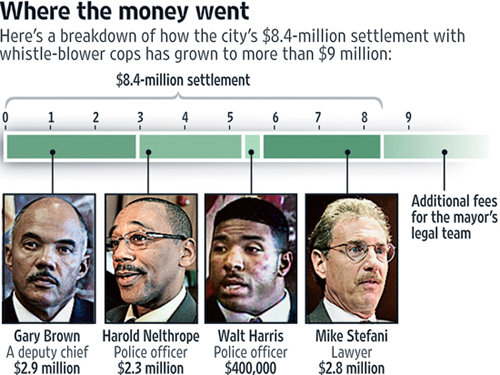
Then, in October, Kilpatrick abruptly settled the case, as well as the suit brought by Harris, for a combined $8.4 million. Legal costs have pushed the total to more than $9 million.
"Since the verdict," Kilpatrick told residents in a statement, "I've listened to pastors, business leaders and so many Detroiters who genuinely love and care about me and this city. I've humbly concluded that a settlement ... is the correct decision for my family and the entire Detroit community."
Kilpatrick's decision to settle pleased Detroit City Council members, who swiftly approved the deal.
Harris received $400,000. Records show Kilpatrick could have settled that case two years ago for $100,000 -- but he rejected the mediators' recommendation.
Because they were sued in their roles as city officials, Kilpatrick and Beatty did not personally have to pay the costs from the $9-million legal fight.
Staff writers David Ashenfelter, Zachary Gorchow and Todd Spangler contributed to this report.
© 2008, Detroit Free Press
By Jim Schaefer
The text messages showing that Detroit Mayor Kwame Kilpatrick and his chief of staff lied under oath about their relationship have been the subject of a fierce legal battle since 2004.
The attorney for two former Detroit police officers who sued the city first subpoenaed the messages three years ago in an effort to show that his clients were punished for their involvement in an internal affairs investigation that might have uncovered an improper relationship.
But before the attorney could receive transcripts from SkyTel - the company that supplied text-messaging pagers to city officials - the mayor's attorneys sought to block their release. Wayne County Circuit Judge Michael Callahan ruled the transcripts should be sent directly to him and shared with attorneys only if the messages contradicted Kilpatrick's and Christine Beatty's testimony.
The judge did not see the text messages.
At the trial last August, the ex-cops' lawyer, Mike Stefani, assuming the judge had received them, asked Kilpatrick and Beatty a series of questions about whether they had been involved in a romantic relationship. After his questioning, he asked the judge whether he could now use the text messages to discredit Beatty's and Kilpatrick's testimony. Callahan responded that he never received them and told Stefani to subpoena the records again.
SkyTel officials confirm they released the subpoenaed records. But they never surfaced at the trial.
In October, Kilpatrick agreed to settle the litigation for $8.4 million.
Afterward, the Free Press asked the city for all records relating to the settlement, under the state Freedom of Information Act. The city provided a settlement agreement, but the paper sued the city for additional records it contended were related to the deal.
In addition, the Free Press sent a subpoena to Skytel's headquarters in Jackson, Miss., seeking the text records Stefani first tried to get in 2004.
The city went to court in an effort to kill the newspaper's subpoena. City attorney Ellen Ha, in an e-mail to Free Press attorney Herschel Fink, also tried to get the Free Press to promise that it would not "seek to obtain ... records by any other means" until the judge had made a ruling.
The Free Press refused.
In seeking the records, the Free Press explored numerous avenues, eventually obtaining the text messages independent of the subpoena. The newspaper cross-referenced the text messages with the mayor's private calendar and credit card records from that period to verify events in some messages.
M.L. Elrick contributed to this report.
© 2008, Detroit Free Press
Kilpatrick, Beatty mixed business with pleasure
By M.L. Elrick and Jim Schaefer
Detroit Mayor Kwame Kilpatrick used city funds at times to cover personal travel expenses with chief of staff Christine Beatty as they rendezvoused across the United States during their affair, records obtained by the Free Press show.
In November 2002, for instance, the mayor and Beatty planned a getaway to Denver. The mayor charged the city for an airline ticket and rental car, the records show. His official appointment calendar described his time off this way: "Gone Fishing!!!"
The significance of that trip and others came into focus after the Free Press revealed secret text messages last week that showed Kilpatrick and Beatty lied under oath about their relationship during a police whistle-blower trial that cost the cash-strapped city more than $9 million.
The trips raise questions about the extent to which Kilpatrick and Beatty used city funds to further their affair. Some of their liaisons clearly occurred while they were on city-related business. But the line between official business and pleasure was often blurred, the records show.
Some of the text messages reveal the two of them musing about other romantic getaway possibilities, including to Houston, West Virginia and "the islands."
Kilpatrick and Beatty each remained in seclusion Saturday night. Their whereabouts were not known, and they have been unavailable for comment since the Free Press reported Thursday on the text messages and false testimony.
The report prompted Wayne County Prosecutor Kym Worthy to begin an investigation into whether they committed perjury or other crimes in connection with their actions in the police whistle-blower case.
Maria Miller, a spokeswoman for Worthy, said Saturday that the office would not comment about the travel expenses.
"We won't discuss details of any open and active investigation," Miller said. "However, all relevant details will be examined.
Details of the trip
The text messages cover two time periods -- September and October 2002, and April and May 2003. They were subpoenaed as part of a lawsuit brought by two former cops against the mayor and the city. The mayor settled the suit and another case for $8.4 million. Legal costs pushed the cost past $9 million.
The Free Press uncovered details of the Colorado trip by cross-referencing the text messages with city credit card records and a copy of Kilpatrick's appointment calendar.
On Oct. 24, 2002, the text messages show, Kilpatrick wrote to Beatty: "I just made my reservation."
Beatty responded: "You made it Denver? Leaving when and returning when?"
Kilpatrick: "Denver. Nov. 7th-8:57 flt Return Nov. 10th-11:25am flt arrive 4:11."
Beatty: "…Should I take the same flight?"
Kilpatrick: "Yes."
City credit card records and a flight itinerary for the mayor show Kilpatrick charged $283 on Oct. 25 for a round-trip flight to Denver on Northwest Airlines. Records indicate the mayor's police bodyguards -- at least one of whom accompanies the mayor on out-of-town business trips -- did not go to Denver.
The credit card records and a receipt from Hertz show that Kilpatrick rented a car in Denver to drive to Vail, about 90 miles away. The cost was $357.
A credit card statement shows the mayor used his city credit card to reserve a room at the Sonnenalp Resort, which TripAdvisor.com rates as the No. 1 hotel among the 35 in Vail. It is unclear how Kilpatrick paid for his room. Records show he initially put $336.49 on his city card, but received a credit Nov. 9. On the statement is a hand-written notation that says, "Paid for this there."
The charges match up with the mayor's appointment calendar, which shows that on Nov. 6, 2002, the day before the flight, the mayor had eight appointments. But from Nov. 7 through Nov. 10 -- a Thursday, Friday, Saturday and Sunday morning -- the calendar simply says, “Hold for Mayor Gone Fishing!!!”
The calendar also shows that the mayor was scheduled to return on Sunday, Nov. 10, to deliver the keynote address at the United Negro College Fund Annual Alumni Council Dinner at Cobo Hall.
Mayoral spokesman James Canning said Saturday he did not know whether the mayor reimbursed the city for the rental car or airline ticket and he did not know the purpose of the trip. Canning would not say whether he had spoken to the mayor.
Spending questioned before
The mayor’s spending of city money has come under criticism in the past and was the focus of several Free Press stories that described extravagant meal tabs, expensive stays at posh hotels and spa visits, among other things.
Joe Harris, who examined Kilpatrick's credit card usage while serving as Detroit's auditor general until leaving in 2005, said Saturday that the amount taxpayers apparently paid for the Colorado getaway was not as important as what it symbolized.
"You're not talking about a ton of money, you're talking about a disregard for the limited resources of the city," he said.
Harris lost to Kilpatrick and Gil Hill in the 2001 mayoral primary. Kilpatrick has dismissed Harris’ criticisms as politically motivated.
Business and pleasure
In comparing the text messages and other city records, the Free Press found that Kilpatrick used his city credit card for apparent personal expenses while on official business. Beatty was a frequent companion.
In September 2002, the mayor charged $474 to his city credit card at a chic Washington dance club, Dream, while there with Beatty. The two were in town for the Congressional Black Caucus annual legislative conference. The mayor in that case repaid the city two weeks later.
But five months earlier, when he spent $472 at the same club, he did not pay the money back until the newspaper sued for the records three years later under the Michigan Freedom of Information Act.
During the September trip that year, Kilpatrick and Beatty traded intimate text messages and arranged to meet in the mayor’s hotel room.
Beatty asked the mayor whether she could "come and lay down in your room until you get back?"
The next morning, Sept. 13, Kilpatrick, referring to his bodyguards, wrote: "They were right outside the door. They had to have heard everything."
Beatty replied: "So we are officially busted!"
"Damn that," Kilpatrick responded. "Never busted. Busted is what you see!"
In 2005, after the Free Press reported on his questionable use of his city credit card, Kilpatrick wrote the city a check for $8,879.41 to reimburse for some expenses. He had charged more than $210,000 to the credit card during his first 33 months in office.
Kilpatrick did not specify what expenses the reimbursement covered, and record-keeping was so sketchy that it is difficult to tell how Kilpatrick reached that figure.
Harris had estimated that the mayor charged $50,000 in personal expenses to the city's MasterCard.
© 2008, Detroit Free Press
By David Ashenfelter and Joe Swickard
A Wayne County judge Wednesday released the last of the secret documents showing how Detroit Mayor Kwame Kilpatrick and his city-paid lawyers schemed to conceal text messages that could result in perjury charges against him and his former chief of staff, Christine Beatty.
Circuit Judge Robert Colombo Jr. handed out the documents hours after the Michigan Supreme Court unanimously refused to hear the mayor's appeal, saying, in effect, the public has a right to see settlement agreements when public funds are involved.
Kilpatrick had appealed a Feb. 5 ruling by Colombo ordering the release of all documents in the scandal in response to a Free Press lawsuit.
The documents released Wednesday contradict the mayor's initial claims that an $8.4-million settlement in two police whistle-blower lawsuits was driven by advice from friends, advisers and ordinary citizens. They show that Kilpatrick and his city-paid attorneys -- Samuel McCargo, Valerie Colbert-Osamuede and Wilson Copeland II -- made the deal to hide the text messages.
The documents reveal "a gigantic fraudulent scheme was imposed on the city, and a lot of people are going to have a lot of explaining to do," said Larry Dubin, a University of Detroit Mercy law professor. "If this happened in a private corporation rather than a city, some of the lawyers would be looking for new jobs -- if they still had their legal licenses."
The documents show the mayor discarded the original Oct. 17 version of the settlement agreement after the Free Press asked for the document with a Freedom of Information Act request. A second agreement -- split into two parts -- was then concocted to conceal the text messages, which show that the mayor and Beatty lied under oath last summer when they said they did not have a sexual relationship. The messages also show they gave misleading testimony about firing one of the three cops involved in the whistle-blower suits.
The public agreement showed how much money the ex-cops would get. The other one -- the confidential side deal -- swore the ex-cops and their lawyer to secrecy about the text messages under threat of forfeiting most of their settlements and legal fees.
"The ruse was designed to conceal evidence of perjury," Free Press lawyer Herschel Fink said.
He called the documents' release a victory for the City Council and Detroit taxpayers, who were kept in the dark about the side agreement. The settlement topped $9 million with legal costs.
Colombo also released a 196-page transcript of a deposition with the ex-cops' lawyer, Mike Stefani. In it, Stefani said the mayor's lawyers initially refused to settle the suits on Oct. 17 when they met in a court-ordered session to resolve how much he would be paid after winning a $6.5-million jury verdict for two of the cops the previous month.
When the negotiations broke down, Stefani said, he handed the facilitator an envelope to give to the mayor's lawyer. The envelope contained a request Stefani planned to file the next day with the trial judge to justify his fees. The motion indicated that he had the text messages.
Stefani said lawyers for the mayor and from the city's Law Department then reversed course and agreed to settle that lawsuit and a still-pending suit involving another cop.
The Free Press revealed the text messages last month.
Detroit Law Department chief John Johnson Jr. said he was disappointed with the Supreme Court ruling.
"Opening up settlement information to public view will most certainly put a chilling effect on parties trying to settle cases," he said. "This ruling discourages the city from entering into the time-honored and cost-effective process of mediation."
Legal experts have said Johnson's reasoning doesn't apply to lawsuits settled with public funds.
Councilwoman Sheila Cockrel was incredulous to learn that the mayor and the Law Department failed to disclose the Oct. 17 settlement document before the council voted to settle the suits.
"It is deeply, deeply troubling," she said. "It's unprecedented in my experience on the council to have this kind of apparent deception by the corporation counsel's office."
Stefani said he is "glad that the public has all the facts."
Peter Letzmann, former city attorney for Troy and a former lawyer in the Detroit Law Department, said Kilpatrick "should hire a national-class criminal lawyer. He has really put himself in harm's way -- with the Detroit Board of Ethics, with the prosecutor, he might even have some federal criminal liability. And his law license could be in jeopardy."
The mayor is being investigated for possible perjury charges by Wayne County Prosecutor Kym Worthy. The ethics board is reviewing the issue.
Wednesday's Supreme Court decision came two weeks after a similar decision by the Michigan Court of Appeals.
"There is no FOIA exemption for settlement agreements," the high court said in a 2-page ruling, referring to the state Freedom of Information Act. "Moreover, a public body may not contract away its obligations under the FOIA."
Free Press Editor Paul Anger said he was pleased. "This is complete vindication for the idea that public officials cannot lie under oath and go behind closed doors in secrecy to make decisions with so much public money in the balance," he said.
Staff writers Zachary Gorchow, Ben Schmitt, Bill McGraw and Jim Schaefer contributed to this report.
© 2008, Detroit Free Press
Full story now told of mayor's hidden deal
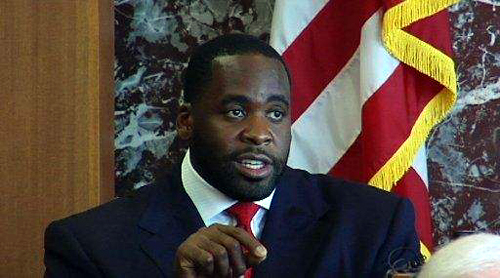
Mayor Kwame Kilpatrick denied a sexual affair with his chief of staff. (Detroit Free Press)
Samuel McCargo stood alone in a parking lot, legal papers in hand, confronted by his client's lies.
The lawyer for Detroit Mayor Kwame Kilpatrick had just pored over documents he'd received in a sealed envelope from Mike Stefani, McCargo's courtroom adversary in a highly charged police whistle-blower case.
The lawyers had spent the morning of Oct. 17 at a Detroit law office with other city attorneys haggling over Stefani's efforts to collect legal fees after winning the trial. It had been a mundane meeting until now -- when McCargo saw what was in the envelope.
It was a court motion from Stefani, rife with excerpts of explicit text messages between the mayor and his chief aide, Christine Beatty. The messages showed, beyond a doubt, the pair had lied at the trial when they denied a sexual affair.
McCargo asked to see Stefani outside the ornate Woodward Avenue law offices of Charfoos & Christensen.
Stefani walked outside and found McCargo. His face, Stefani would recall later, was ashen.
"I had no idea," McCargo said, according to Stefani's deposition, which was made public Wednesday.
Then, in a shaky voice: "Have you filed this?"
Not yet, Stefani replied.
McCargo then asked: "Can you stay here awhile while I try to get ahold of the mayor?"
It's now clear what happened next: The mayor settled the cases of three ex-cops for $8.4 million that very day.
This is the tale behind that deal, one that can now be told in full with the release Wednesday of the last batch of secret settlement records. They show, as never before, how Kilpatrick and lawyers on the city's defense team embarked on an ill-fated scheme to conceal the damaging text messages from public view.
It was a simple deal, money for documents. And no one was to ever speak of it again.
It's a story about a sealed envelope, a mayor's about-face, lies and secret deals. It's a story that may yet result in the filing of criminal charges, and the end of political careers.
It's the story behind the text-message scandal.
The trial
The jury was unanimous last Sept. 11.
The 11 men and women who sat through the trial agreed with Stefani's claim that Kilpatrick retaliated against his clients, ex-cops Gary Brown and Harold Nelthrope, that the mayor punished them for their roles in a police internal affairs investigation into misdeeds by Kilpatrick's police bodyguards.
Nelthrope, a former member of the mayor's security team, had made the allegations to internal affairs in 2003. Brown was a deputy chief who oversaw the investigation. When Kilpatrick found out about it, he fired Brown, ending the probe.
Nelthrope said he felt so threatened after he reported his allegations that he had to take a permanent stress-leave. Both men claimed in their lawsuit that Kilpatrick had a motive to retaliate: The mayor feared the investigation would expose his extramarital affairs, including sexual liaisons with Beatty.
During the trial in August, Kilpatrick testified for three hours, denying he fired Brown, and calling claims of philandering preposterous. The mayor also told the jury it was a shame that successful women like Beatty had to endure whispers that they had slept their way into their positions. Their relationship, Kilpatrick testified, was platonic and professional.
But the jury didn't buy it, and awarded the former cops $6.5 million. Kilpatrick told reporters he was shocked.
"I am absolutely blown away at this decision," he said, "and I know Detroiters are, too."
He suggested that the composition of the jury, mostly white and suburban, played a role. And he vowed an appeal.
Stefani, though, was not through with the mayor.
He had been trying to obtain the text messages since 2004. Every time he sent a subpoena to SkyTel, the Mississippi company that leased text-transmitting devices to the city, Kilpatrick's lawyers filed court papers to foil his efforts.
Finally, that year, Wayne County Circuit Judge Michael Callahan allowed Stefani to subpoena the text messages, but the judge wanted them sent directly to the court. That way, Callahan reasoned, the potentially explosive information would be under his control. The text messages could be used at the trial only if they contradicted testimony.
Stefani admitted in the Free Press deposition, taken on Jan. 30, that he assumed the judge had the messages, but never checked. Stefani also accused the city of shenanigans, saying that someone from the city privately called SkyTel and told it not to send the messages.
During their August trial testimony, Stefani peppered the mayor and Beatty with questions about whether they were lovers, part of Stefani's effort to show jurors why the pair would want to derail a police investigation by firing the cops.
Stefani asked the judge if the messages contradicted Kilpatrick's and Beatty's testimony.
Callahan responded that he didn't have the messages, and didn't know if he had ever received them. He told Stefani to subpoena them again.
It took two attempts, Stefani said in his deposition. The first time, SkyTel told him the 5-year-old text messages were no longer available because the company had a new owner. Undeterred, the lawyer tracked down his original contact at the company from 2004, a man who no longer worked at SkyTel. He said the current Skytel officials just didn't know where to look.
Armed with the new information, Stefani tried again. His subpoena this time succeeded, but not before the trial ended.
On Oct. 5, a FedEx overnight envelope from SkyTel arrived at his Royal Oak office. Inside, Stefani found a CD with the text messages burned on it.
He finally had the messages. Too late for the trial, but perhaps not too late to be put to good use.
An impasse, a break
On Stefani's calendar was an Oct. 17 meeting with lawyers for the city and the mayor to negotiate Stefani's legal fees. As the winner of a whistle-blower case, Stefani was allowed to bill his costs to the losing side. They agreed to meet at Charfoos & Christensen, a neutral site where they could argue over fees with the help of a referee, known as a facilitator.
For nearly three hours, lawyers negotiated through the referee, a former judge from Flint. Stefani said the talks centered mainly on fees, but he kept pushing defense lawyers toward a settlement of the case, one that would allow both sides to avoid years of appeals.
But city lawyers consistently refused. Sensing they were at impasse, Stefani said he produced a sealed envelope and handed it to the facilitator.
"The facilitator said, 'What's in this envelope?' " Stefani recalled in his deposition. "And I said, 'I've got' -- irrefutable is the word I used -- 'irrefutable proof that the mayor and Beatty perjured themselves.' ...
"And he said to me, 'You know, you have to be careful. You don't want to tie -- you don't want to, like, threaten to release this information if they don't settle.' And I said, 'I'm not doing that. I only want you to tell them that this is a motion,' and he gave it to them. And he coached me on not saying anything else."
The motion, as Stefani described in the deposition, was labeled "supplemental motion for attorney fees," a dreary title for a document that was nothing short of explosive.
In it, he justified his proposed fees in the case by detailing the work his staff had put into checking the truthfulness of Beatty's and Kilpatrick's testimony. As evidence his efforts were worthwhile, he disclosed the contents of several text messages between Kilpatrick and Beatty that conflicted with their trial testimony. Stefani quoted liberally from sometimes sexually graphic exchanges.
McCargo spent roughly 45 minutes reading the document. It was then that he asked to have Stefani meet him alone, away from the other lawyers, in the parking lot.
According to Stefani, McCargo quickly reached his client, the mayor, at an airport.
Kilpatrick decided immediately to settle.
Sidebar: WHAT ABOUT THE TEXT MESSAGES?
They weren't included in the documents unsealed Wednesday.
The Free Press obtained them and reported on them last month.
The mayor and his legal team have access to a copy that was placed in a safe-deposit box.
SkyTel, the text message company, is under court order to preserve its copies. It has not been ordered to provide copies to anyone else.
A series of pacts
Negotiations picked up. The city's top lawyer was summoned. Corporation Counsel John Johnson Jr. has acknowledged being "personally" involved that day, but told the Free Press earlier this month he went only to approve the amount of the payout, and did not even read the agreement that was crafted.
He insists he knew nothing about the text messages, or efforts to conceal them that day, until he read about them in the Free Press in January.
Stefani said the facilitator left around 4 p.m. Lawyers for both sides hammered out the terms of the settlement, at first scratching out a draft on a legal pad. Later, they all headed to Stefani's Royal Oak office to tweak the agreement and type it up. By about 8:15 p.m., the deal was complete, he said.
The document, released Wednesday after the Free Press sued to get it, called for Stefani to turn over the text messages to the mayor.
In return, the mayor and city agreed to pay $8 million to Brown, Nelthrope and Stefani. An additional $400,000 was paid to Walt Harris, another former Kilpatrick bodyguard who had a separate whistle-blower case pending against Kilpatrick. Legal costs drove the total taxpayer cost to more than $9 million.
McCargo, city staff lawyer Valerie Colbert-Osamuede and Wilson Copeland II, a Detroit lawyer hired by the city, all signed the agreement. McCargo signed for the mayor.
"It is a contract. Signed, sealed and delivered," Stefani said in his deposition.
But there was an out. The deal gave each side a deadline to reject the deal. Kilpatrick had until Oct. 27.
The next day, on Oct. 18, Kilpatrick announced the surprise settlement, explaining that soul-searching led him to drop his planned appeal.
"Since the verdict, I've listened to pastors, business leaders and so many Detroiters who genuinely love and care about me and this city," Kilpatrick said in a statement. "I've humbly concluded that a settlement ... is the correct decision for my family and the entire Detroit community."
That same day, Johnson, the city's lawyer, and Colbert-Osamuede, his chief assistant, urged the City Council to approve the $8.4-million settlement, saying it was in the best interest of the city.
The eight-page confidential memo to the council that Colbert-Osamuede wrote, and Johnson approved, said nothing about the text messages. Colbert-Osamuede, for her part, would later deny in court she had any knowledge of a secret agreement.
The council, eager to end the litigation, approved the settlement Oct. 23.
Meanwhile, the Free Press had filed a Freedom of Information Act request to see the settlement deal.
As Stefani described later, that was a problem for Kilpatrick and his lawyers. By honoring the newspaper's request, as he was bound to do under state law, the mayor would be tipping the Free Press to the concealed text messages.
So Kilpatrick took steps to remedy the problem.
Ten days after approving the agreement, Kilpatrick rejected it, without any public announcement or explanation.
Stefani explained why in his deposition: "My understanding was that the reason they rejected the Oct. 17 settlement agreement was that they had received a Freedom of Information Act and it dawned on somebody that they didn't want the text messages referenced in the settlement agreement."
Kilpatrick's rejection set the stage for an official response by the city to the newspaper's request to see the settlement documents.
City lawyer Ellen Ha sent the Free Press a letter dated Oct. 29 rejecting the paper's request. Ha's explanation: No settlement documents existed.
With the newspaper's request sidestepped, the parties began crafting a new deal, one designed to avoid public disclosure of the texts.
By Nov. 1, they had a new settlement in writing. But now there were two parts. The first was an agreement, scrubbed clean of any text message references, that could be released publicly. The second part, labeled "Confidentiality Agreement," purported to be a private pact among Stefani, his clients and Kilpatrick and Beatty, who indicated they signed the deal as private individuals, not public servants.
This side agreement was never released to the Free Press, or shared with the City Council.
Under the secret deal, Stefani and the former cops would have to pay back the settlement money if they ever spoke of the text messages.
And with their terms signed in writing, both sides agreed to stash the text messages for temporary safe-keeping until the settlement money was paid.
The parties settled on a Comerica Bank branch across the street from Detroit's municipal center. They leased a safe-deposit box -- No. 323. Each side had its own key. They agreed in writing not to access the box outside the presence of the other side.
The text messages remained tucked inside until at least Dec. 5, the day after final payment of the $8.4 million went to Stefani and his clients.
Soon after, Stefani said in his deposition, he sent his son to turn over his key to one of the mayor's lawyers.
And that was supposed to be the last anyone ever heard of Mayor Kwame Kilpatrick's text messages.
© 2008, Detroit Free Press
Ferguson: Report is 'fishing expedition'
By M.L. Elrick, Jennifer Dixon and Jim Schaefer
A close friend of Detroit Mayor Kwame Kilpatrick won millions of dollars in city contracts while secretly consulting with the mayor's top aide, according to records and text messages obtained by the Free Press.
The text messages, from 2002 and 2003, show that Kilpatrick and Christine Beatty, his chief of staff at the time, provided their friend Bobby Ferguson inside information on potential projects, discussed whether he would be in or out of certain jobs and helped Ferguson get paid promptly when he urgently needed a check from the city.
Ferguson and firms he partnered with have collected at least $45 million in contracts since Kilpatrick took office in 2002. In at least one instance, the mayor was directly involved in discussions about Ferguson's bid strategy.
"Awarding contracts to supporters and friends is problematic," said Peter Henning, a Wayne State University professor and ex-federal prosecutor. "If there's benefit being derived from it, then that's a classic case of public corruption."
Ferguson said he got the contracts on merit.
"I work hard for everything I do," he said Friday after reviewing text messages. "Nobody's never given me anything."
In a statement released Saturday night, Ferguson called the Free Press report a "fishing expedition grounded purely on circumstantial anecdotes and unrelated half-truths that attempt to connect purely unrelated issues for purposes that do not involve the truth or the facts."
Kilpatrick's spokeswoman, who was also shown text messages involving Ferguson on Friday, did not provide a response from the mayor. Beatty's legal advisors said she did nothing improper.
George Jackson, the city's top development officer, said Saturday he was not aware of any political interference with contract decisions made by the city's various development agencies.
"This is a completely public and transparent process," he said.
Since Kilpatrick took office in 2002, Ferguson's business dealings with the city have broadened. He took a key role in an agency leading the downtown redevelopment effort.
His companies -- which have generally received solid marks for their work and have been among the lowest bidders on projects -- have been involved in some of Detroit's signature developments, including Comerica Park, Ford Field, renovations at Cobo Center and the Book-Cadillac Hotel restoration downtown..
Text messages from Beatty's city-issued pager show that Ferguson communicated directly and repeatedly with her about pending projects. The Free Press did not find any other vendor with such access to Beatty in her text message records.
But Beatty's attorney, Jeffrey Morganroth, said Beatty spoke with other contractors face-to-face or on the phone.
"It just so happened that Mr. Ferguson, in addition to having phone conversations and in-person meetings, had her text pager and would text her from time to time."
One exchange, on April 16, 2003, took place after a board meeting of the Downtown Development Authority, the agency charged with reinvigorating the city's core business district. Beatty and Ferguson both served on the board.
Beatty sent this message to the mayor about an unspecified vendor:
"So," she wrote, "he's a front?"
"No question," Kilpatrick responded.
Beatty then wrote: "Who put all of these black folks in the deal?"
It's unclear who they were talking about, or what contract was discussed. But the term "front" is typically used to describe the illegal practice of a having a minority group bid on a contract set aside for minority-owned firms when the actual group seeking the contract is not minority owned.
Jay Stewart, executive director of the Better Government Association, a civic watchdog group in Chicago, said the conversation about the front is troubling.
"When the word 'front' is used in context of minority contracts, that's a huge, huge red flag," Stewart said. "There is no bigger red flag."
Beatty then messaged the mayor about a deal under discussion and asked, "Why not Bobby in this?"
"Bobby," Kilpatrick responded, "wanted to strategically lose a major bid."
Board appointments
The Downtown Development Authority is one of several quasi-governmental city agencies that award millions of dollars in contracts to improve downtown and other parts of Detroit.
Each agency is governed by a board of mayoral appointees -- usually business and civic leaders who have the power to award contracts. Kilpatrick appointed Ferguson to two boards: the DDA and the Brownfield Redevelopment Authority. Ferguson said he left both boards after being charged with assault in 2005.
The Free Press interviewed dozens of people familiar with the work of these agencies and reviewed thousands of pages of meeting minutes, contracts and court records. While the newspaper found no contract resulting from Kilpatrick's April 2003 text messages, experts said the exchanges between Kilpatrick and Beatty could be interpreted as an effort by the mayor to improperly steer business to a friend.
"Sharing information in advance ... would certainly violate the contracting rules," Henning said. "And it's certainly a crime."
At one point, Ferguson and his partners received a $21-million water department contract even though another company bid $2.5 million less and was repeatedly recommended for the job by the department's bid evaluation committee.
While it's not uncommon for vendors like Ferguson to win contracts from officials who share social or political ties, the text messages obtained by the Free Press reveal a singular relationship between Ferguson and Beatty.
Experts said the cozy relations between the mayor, his top aide and Ferguson were rife with potential ethical conflicts.
"In a city where the economy is struggling, where there's so many needs that are unmet ... that there are any questions about the way money is being spent is very discouraging," said Judy Nadler, a government ethics expert at the Markkula Center for Applied Ethics at Santa Clara University. "It's important for people to understand that this money belongs to the public and it needs to be spent wisely and it needs to be spent in an absolutely transparent way."
The text messages involving Ferguson are from the same trove -- covering September-October 2002 and April-May 2003 -- that are at the center of the text-messaging scandal that has enveloped Kilpatrick. The messages, first reported by the Free Press in January, show the mayor and Beatty lied at a police whistle-blower trial last summer when they denied a sexual affair and sought to mislead jurors when they denied firing an officer who ran internal affairs and wanted to investigate the mayor's security team.
Beatty resigned days after the report. Kilpatrick has denied acting illegally and vowed to stay on the job, promising to bring more economic development to Detroit.
Wayne County Prosecutor Kym Worthy, who is investigating their testimony, obtained a copy of the text messages. She is expected to announce this week whether she will file perjury or other charges. Worthy would not say whether her office is reviewing any city contract dealings cited in the messages.
Friends since 1996
Ferguson has said he and Kilpatrick met around 1996, just after Kilpatrick launched his political career in the state Legislature.
"He was a state rep, and my office was in his district," Ferguson said in a 2006 deposition. Kilpatrick's office needed help transporting elderly residents during a snowstorm. Ferguson said someone in Kilpatrick's office "asked us to go push the snow and we did, and didn't charge them."
The two became tight friends, attending black-tie events, riding motorcycles and shooting pool together.
When Kilpatrick became Detroit's youngest elected mayor in 2002, he chose Ferguson to help direct the city's cleanup efforts. Ferguson donated heavy machines and manpower to the mayor's Motor City Makeover, an annual volunteer cleanup.
Ferguson had worked for the city before his friend was elected mayor, taking in roughly $8 million for his work on city-related projects from late 1999 through 2001. Since then, however, the Free Press has identified at least $45 million in city contracts through his businesses and firms that partnered with his businesses. These figures do not include all subcontracts and do not account for every city department for which his companies have done work. Ferguson continues to work for the city.
In his statement, Ferguson said the volume of Ferguson Enterprises' city work has actually decreased under Kilpatrick. Under the Archer administration, Ferguson said, his company was awarded several major projects including Compuware, Waterworks Park, and the temporary MGM Grand Detroit casino.
Waymon Guillebeaux, a vice president of the Detroit Economic Growth Corp., which provides staff to the Downtown Development Authority and similar agencies, said Ferguson's company and a second firm now get most of the agencies' demolition work.
He praised Ferguson's people for providing solid bid estimates, saying they "know what they're doing. They know how to price a job and we don't get a lot of change orders" that raise the cost of a project.
Ferguson, though, has downplayed his success.
In a May 2006 deposition stemming from a suit against Ferguson, he said he hadn't had much luck getting city work.
"We bid on a lot of jobs but we ain't won a lot," Ferguson testified. "We won I think two years ago a water main job; it's on the west side of Detroit. We haven't won much, I mean."
He was testifying in a lawsuit by Kennedy Thomas, an employee whom Ferguson pistol-whipped in 2005.
Last year, a civil court jury awarded Thomas $2.6 million for his injuries.
Ferguson was charged with felony assault in the attack, but the mayor stuck by him, visiting his friend at the Wayne County Jail, where Ferguson served 10 months after pleading guilty.
Xcel's first bid
Ferguson landed a series of city-related contracts shortly after Kilpatrick took office.
On Feb. 26, 2002, the Detroit Building Authority held a meeting to hire a construction manager to oversee renovations at Cobo Center. Representatives of 16 companies showed up. It is unclear whether Ferguson attended.
Within days, Ferguson incorporated a company called Xcel Construction Services and then bid on the project with White Construction Co.
The White/Xcel joint venture received the second-best score among 10 bidders and, on April 18, the DBA board -- which included Beatty -- awarded the joint venture a $1.3-million contract.
That same month, a contractor constructing Ford Field hired another Ferguson company, Ferguson Enterprises Inc., to install storm drainage systems and sewers.
Text messages from this period show Ferguson eagerly courted Beatty for information.
"Chris," he wrote on Oct. 8, 2002, "I know you are busy but I need Sam rates, from DBA," an apparent reference to a veteran DBA contractor.
Eight days later came another request: "Chris the contracts didn't help me, I need a copy of sam invoices, thank you."
Beatty did not write back.
The next day, he tried again: "Chris, I know your real busy and probably don't think I need this ****, the contracts from sam didn't help I need a copy of sam invoice for payments and his propsals, thank you."
Beatty replied, "Call me at the office."
Contractors who do business with the building authority told the Free Press they have never heard of Sam rates.
But Sam Chagois, a construction manager whose contract with the DBA began to dry up shortly after Ferguson sent his messages, records show, told the paper he thinks he knows what Ferguson was up to.
"He's trying to figure out how I bill this stuff and how I figure out my prices to get the work," Chagois, now living in Las Vegas, said of Ferguson.
Quinette King, the DBA's former director, called Chagois a first-rate project manager.
"He was detailed, thorough and made sure the contractors produced," she said.
Morganroth said Ferguson was helping the agency become more efficient.
"I believe they asked Mr. Ferguson and some others to help them analyze whether this outside consultant was necessary and whether this expense was reasonable," he said. "And they terminated it."
When Ferguson grew anxious about DBA payments, he turned again to Beatty.
"I need to get the Excel\White JV check from you and mayor please, please," he wrote on Oct. 29, 2002.
Beatty: "The one for $500,000?"
He wrote back to recount unpaid work from the summer, adding, "I need it real bad."
After investigating, Beatty wrote back that the mayor's office received the check about a week before and told Ferguson: "For it to be said that the Mayor's office is holding the payment is ********! I just told Ayanna this same thing. I'm ******!"
Ayanna Benson is executive director of the building authority. Kilpatrick appointed Benson, who is his cousin, to the post in July 2002.
A few minutes later, Ferguson replied that he just got a call.
"We can pick the check up," he wrote, "thank you."
Nadler, the ethics expert, said Ferguson's pleas to Beatty to help him secure payment for his work are unusual.
"Generally, that's not the way the system works," Nadler said. "Those kinds of details are not handled by the mayor's chief of staff, but by someone in finance, someone in anothr administrative role.
"I would be concerned about any kind of involvement that the chief of staff would have related to contracts," Nadler said. "There are very strict rules around contracting."
Nadler said there is also a question of fairness.
"Does everyone have the same access, the ability to go to the chief of staff?"

Like family
A day later, Beatty and Ferguson discussed another project, this one more personal.
In a message on Oct. 30, 2002, Beatty asked him how much she owed Ferguson for the driveway he poured at her Detroit home.
"Ya know ya my sister," he replied. "Family don't worry about **** like money."
"I know we are family," Beatty replied. "But I just don't want to have something that big hanging out there."
The messages don't say whether Beatty ever paid Ferguson or, if she did, how much she paid. On Friday, Ferguson declined comment about the exchange. His statement Saturday said Ferguson Enterprises "has never provided any service to any public official as a precondition to winning any... public bids."
A public official who benefits personally from favors done for a contractor can be prosecuted under federal law, which treats such acts as a form of bribery.
Morganroth said Saturday he could not reach Beatty to find out if she paid for the driveway. But he said he saw no problem with the deal.
"I believe the work was done before she was a city official," he said, adding that even if it was done after Beatty became Kilpatrick's chief of staff, "I don't believe it would be a problem if it's not tied to anything else."
The following April, Ferguson asked Beatty whether bond money was available to renovate the Detroit Historical Museum. Voters had previously approved $20 million in bonds for expansion.
"It's not in any budget. But I believe the project is still going," Beatty replied by message.
"Thank you," Ferguson wrote. "When you get confirmation don't forget about your bruh."
Her response: "Never."
Messages at a meeting
Another deal that reflects the close working relationship between Ferguson and Beatty is their 2003 text messages involving the long-shuttered Book-Cadillac Hotel.
Midway through a May 7, 2003, DDA board meeting -- when the pair continued to serve on the board -- members prepared to vote on a $146-million deal to restore the downtown historic building.
"You need to recuse yourself from the vote, not abstain," Beatty advised Ferguson in a text message.
"Art told me to abstain don't have a contract yet ... just playing it safe, deal not complete yet," he replied, referring to Art Papapanos, an agency employee.
"Cool," she wrote back, "just checking.''
He abstained. The deal went to Historic Hospitality Investments LLC.
However, on the day the vote was taken, a company related to Historic Hospitality had already settled on hiring Ferguson Enterprises as a subcontractor to gut the hotel's interior and remove environmental contaminants, according to records obtained by the Free Press from DDA files.
The minutes of the meeting show no indication that Ferguson told fellow board members he would get a piece of that contract. But George Jackson, president and chief executive of the Detroit Economic Growth Corp., said that it was well known by the DDA board that Ferguson was a bidder on the Book-Cadillac.
Morganroth said Beatty's advice was appropriate.
"It's not telling him how to vote, it's telling him if there's any possibility of him having an interest, he should recuse himself and not vote," he said.
Patricia Paruch, a Troy lawyer who specializes in municipal law, said that if Ferguson knew he was going to pick up a piece of the Book-Cadillac contract when the vote was taken, he was required under state law to disclose his interest in the deal, not simply abstain from voting.
"Not all public officials understand that abstaining is not enough," she said. "They have a legal duty to tell people the details, and you have to tell them in public so it's in the public record, and in enough time in advance so they can develop an opinion about the matter based on those facts."
Peter Letzmann, a professor at Grand Valley State University and a former municipal attorney, said a public official who has an interest in a contract should not only disclose it, but abstain from discussions "in the deliberative process."
"You disclose as early as you possibly can," Letzmann said. "You should put it on the record so at some future date you are insulated from criticism."
Letzmann said contractors who invest thousands of dollars to prepare a bid, only to find out later that the playing field was not level, may decide not to participate in future bids.
"Good companies," he said, "aren't going to play these ... games."
© 2008, Detroit Free Press
She says it's perjury; he vows a fight
By Jim Schaefer and M.L. Elrick
Kwame Malik Kilpatrick, once heralded as the bright future of the city that reared him, instead became the first sitting Detroit mayor to face criminal charges -- eight felony counts, the fallout from a text message scandal.
Wayne County Prosecutor Kym Worthy, in a 23-minute speech Monday that was more stern civics lesson than announcement, likened the 37-year-old mayor's actions to an unrepentant child's. She then read a 12-count complaint charging perjury, conspiracy to obstruct justice, obstruction of justice and misconduct in office against Kilpatrick and Christine Beatty, his former chief of staff who announced her resignation in January.
"Even children understand that lying is wrong," Worthy said in a news conference covered live on national television. "Honesty and integrity in the justice system is everything. That is what this case is about."
Kilpatrick, in his own news conference in his office shortly after Worthy's, reaffirmed he would not resign -- his stance since the Free Press broke the scandal in January. He said he expected "full and complete vindication" of the charges.
The mayor, reading from a prepared statement, said he was "deeply disappointed" but not surprised by Worthy's decision. "This has been a very flawed process from the very beginning," he said. "I look forward to complete exoneration once all the facts surrounding this matter have been brought forth. In the meantime, I will remain focused on moving the city forward."
Others questioned whether that's possible.
"We are experiencing a constitutional crisis in the city of Detroit," Councilwoman Sheila Cockrel said. "There's just a constellation of issues here that threaten the city. ... This is beginning to sound more and more like Watergate."
The mayor's mother, U.S. Rep. Carolyn Cheeks Kilpatrick, issued a statement saying she was "disappointed with the Wayne County prosecutor's decision."
"We must allow the process to run its course," she said. "I hope all involved will allow this case to be tried in a court of law."
Does Worthy have a strong case?
"Yeah, I think that's probably the case, but it's a long way from the signing of a warrant to the announcement of a jury verdict," said Birmingham criminal lawyer Robert Harrison. "A lot of things can happen."
Where it all began
The charges stem from a Free Press investigation that showed Kilpatrick and Beatty lied last summer in a police whistle-blower trial when they denied having a sexual relationship, and gave misleading testimony about the firing of Deputy Police Chief Gary Brown.
On Jan. 23, the newspaper published excerpts from nearly 14,000 text messages from 2002 and 2003 that contradicted the pair's testimony. The text messages were sent and received on Beatty's paging device, which was leased by the city and paid for with city funds.
Monday afternoon, Kilpatrick and Beatty, arriving in separate vehicles, turned themselves in at the Wayne County Sheriff's Office in Westland to be booked on the charges. They were fingerprinted, their mug shots taken, and then released. The news media were kept far away. Both are expected back today for arraignment in Detroit's 36th District Court.
The charges against Kilpatrick are conspiracy to commit obstruction of justice, obstruction of justice, two counts of misconduct in office and four counts of perjury. Beatty faces seven similar charges.
Perjury, the most serious, is punishable by up to 15 years in prison. The conspiracy, obstruction and misconduct in office charges each carry penalties of up to 5 years in prison upon conviction.
'People's lives were ruined'
In her news conference, which brought much of metro Detroit to a standstill, Worthy said Kilpatrick ruined the lives of three former police officers who were connected to an investigation of his family, then used $8.4 million in tax money to buy their silence when he learned their lawyer had obtained text messages showing he and Beatty lied at trial.
"Some have suggested that the issues before us are personal or private," Worthy told about 50 reporters and camera crews packed into her office in the Frank Murphy Hall of Justice. "Our investigation has clearly shown that public dollars were used, people's lives were ruined, the justice system was severely mocked, and the public trust trampled on."
Worthy said her investigation continues into the conduct of other people, whom she would not name, and said there could be more charges. She also said she has been in contact with U.S. Attorney Stephen Murphy, but did not know whether a federal investigation is under way in Detroit.
The Free Press' Freedom of Information Act lawsuit to obtain settlement documents, which Kilpatrick fought all the way to the Michigan Supreme Court, exposed a secret agreement the mayor and his city-paid attorneys engineered after the trial. Documents showed the mayor approved the payout of the $8.4 million to the three former cops after they agreed to surrender text messages and never speak of them again. Their lawyer obtained the messages under subpoena after the whistle-blower trial ended last September.
Worthy says probe was hampered
Worthy chastised other, unnamed city officials for hindering her investigation, saying her office had to appeal to the state Supreme Court and the local courts for assistance at some point in her two-month effort. She would not elaborate because she has used investigative subpoenas, which are confidential, in seeking certain information from the city.
Among the records being sought are officials' appointment calendars and credit card receipts, according to a person familiar with the investigation who did not want to be identified because of the official secrecy surrounding it.
Worthy accused city officials and city lawyers of trying to "drag their feet and drag our investigation out forever." The city's top lawyer, John Johnson Jr., and Patricia Peoples, a cousin of Kilpatrick's who is a human resources deputy director, are due in court Friday to show why they should not be held in contempt for their alleged failure to cooperate with Worthy's probe.
Shortly after Worthy's 11 a.m. announcement, Kilpatrick appointees streamed into the mayor's suite on the 11th floor of city hall to meet with him.
The meeting appeared to be brief, and appointees walked out while dozens of reporters and photographers waited to be admitted to the mayor's main conference room.
One of the appointees, John Prymack, who runs the Greater Detroit Resource Recovery Authority, said Kilpatrick's message was simple: "Do your job, just do your job. ... Focus on your job.''
Minutes later, Kilpatrick appeared with his lawyer Dan Webb of Chicago.
Webb said he advised Kilpatrick not to resign.
"This man, my client, the mayor, is entitled to his day in court," Webb said. "If this mayor is required to resign his public office before that jury trial, that means he is going to be punished prematurely before he gets his day in court."
Webb said he would seek to block what so far has been the linchpin in the scandal -- the text messages exchanged between
Kilpatrick and Beatty and subsequently released by SkyTel, the city's communications provider -- from being introduced at the trial.
He said federal law bars the release of such texts in civil cases, and so the prosecution's obtaining of them is tainted.
Peter Henning, a Wayne State University professor and ex-federal prosecutor, disputed that and added that the question of whether SkyTel should have released the messages is now irrelevant.
"The prosecutor obtained them properly," he said. "Maybe the cat should have never gotten out of the bag, but it is. ... The prosecutor got them."
Webb clearly wasn't basing his entire defense on deep-sixing the text messages. He said that even if the messages are introduced, Kilpatrick's testimony "is not a perjury case" because the questions asked at trial were too ambiguous.
"After a jury has heard actual evidence in court," Webb said, "the mayor will be found not guilty, and he will be exonerated of each and every one of these charges."
Webb also accused Worthy of "selective prosecution," saying he could not find one other instance in which her office has charged a witness in a civil case with perjury.
Webb said he is not being paid by taxpayer dollars, but refused to say from what account Kilpatrick is paying him.
Reaction from D.C. to Detroit
On Capitol Hill on Monday afternoon, little was heard from the rest of Michigan's congressional delegation. The state's senior senator, Carl Levin -- a Democrat and former Detroit City Council member -- refused to comment. So did most other key members of the state delegation, including Democratic Rep. John Dingell of Dearborn, the longest active member of the House, and House Judiciary Chairman John Conyers, a Detroit Democrat whose wife, Monica Conyers, is a member of the City Council.
Only two -- Democratic Sen. Debbie Stabenow and Rep. Candice Miller, a Harrison Township Republican -- issued statements. Stabenow called the charges "very disturbing," saying she hopes the matter is quickly resolved.
Miller said Worthy put "everyone ...on notice that no one is above the law."
Brown, who successfully sued Kilpatrick with former police bodyguard Harold Nelthrope, declined to comment, saying he may become a witness.
Nelthrope said: "Kym Worthy is a woman of integrity and morals. That's all I have to say."
John Bennett, a Detroit cop who runs a blog called Detroit Uncovered that has been highly critical of Kilpatrick for years, said the number of charges shocked him.
"Kym Worthy gave the mayor a lecture," Bennett said, "and then she spanked him."
Staff writers Zachary Gorchow, Bill McGraw, Ben Schmitt, David Ashenfelter, Suzette Hackney, Amber Hunt and Todd Spangler contributed to this report.
THE 12 COUNTS:
Count 1. Kilpatrick and Beatty. Conspiracy to obstruct justice. 5-year felony.
Count 2. Both. Obstruction of justice for firing former Deputy Chief Gary Brown, interfering with his investigation and committing perjury to hide the firing and the mayor and Beatty’s extramarital affair. 5-year felony.
Count 3. Both. Misconduct in office by firing Brown and interfering with his criminal investigation of the mayor and his security team and committing perjury to conceal his relationship with Beatty. 5-year felony.
Count 4. Kilpatrick only. Misconduct in office for authorizing an $8.4-million settlement of the Brown and Harold Nelthrope whistle-blower lawsuit and a similar suit by another officer to hide the existence of incriminating text messages. 5-year felony.
Count 5. Kilpatrick only. Perjury for testifying last Aug. 29 that he didn’t fire Brown or know Brown was investigating him. 15-year felony.
Count 6. Kilparick only. Perjury for testifying Aug. 29 that he didn’t have an affair with Beatty. 15-year felony.
Count 7. Beatty only. Perjury for testifying Aug. 28 that Brown wasn’t fired and that she didn’t know he was investigating the mayor or the rumored Manoogian party. 15-year felony.
Count 8. Beatty only. Perjury for testifying Aug. 28 that she didn’t have a romantic or sexual relationship with Kilpatrick. 15-year felony.
Count 9. Kilpatrick only. Perjury for lying in a notarized statement June 26, 2003, about the circumstances surrounding Brown’s dismissal. 15-year felony.
Count 10. Kilpatrick only. Perjury for lying in a notarized statement Oct. 11, 2004, about circumstances of Brown’s removal. 15-year felony.
Count 11. Beatty only. Perjury for lying in a notarized statement Dec. 9, 2003, that she didn’t know Brown was investigating the Manoogian party before his dismissal or the circumstances of his removal. 15-year felony.
Count 12. Beatty only. Perjury for lying in a notarized statement on Dec. 9, 2003 that she wasn’t aware of mayor’s philandering. 15-year felony.
What the charges mean:
Conspiracy to obstruct justice is the mutual planning to commit an illegal act, or to commit a legal act in an illegal manner. It also carries a possible $10,000 fine.
Obstruction of justice can be charged for tampering with evidence or withholding information or evidence. Unlike most other crimes in Michigan, an obstruction sentence can be served consecutively to prison terms for other crimes. For most crimes, the sentences are served concurrently. It also can carry a $5,000 fine.
Misconduct in office is a common-law felony. Michigan courts have said the crime covers "corrupt behavior by an officer in the exercise of the duties of his office or while acting under color of his office." Corruption can be shown where there is intention or purposeful misbehavior or wrongful conduct pertaining to the requirements and duties of office, the courts have said. It also carries a possible $1,000 fine.
Perjury is deliberately lying under oath. Under Michigan law, perjury can be charged for any lies; it does not have to be about an important matter. The law covers sworn testimony both inside and outside court. The statute does not list a fine.
(Research by Joe Swickard/ Detroit Free Press.)
© 2008, Detroit Free Press
Mayor's office defends hires; totals excessive, critics say
By: M.L. Elrick, Jim Schaefer and Kristi Tanner
As Detroit Mayor Kwame Kilpatrick cut thousands of city jobs, one group has fared well -- the mayor's own friends and family.
A Free Press examination of city records shows that at least 29 people with close connections to the mayor have been appointed by Kilpatrick to city jobs since he took office in 2002. That's a significant departure from Detroit's last three mayors, who appeared to have hired far fewer family members or friends.
Of those with ties to Kilpatrick, at least eight are relatives. The jobs held by friends and family range from secretarial positions to department heads.
Among those Kilpatrick appointed to city jobs are two relatives of Christine Beatty -- the mayor’s former chief of staff with whom he carried on an affair.
Many of these appointees prospered, even in Detroit's bleak economy. On average, longtime appointees within the mayor's office with family or personal connections to the mayor or Beatty saw a 36% salary jump from 2002 to 2007.
There is nothing illegal about appointing friends or relatives to city jobs -- politicians from mayors to presidents routinely give government jobs to relatives or trusted friends.
What's notable about Kilpatrick's hires is the sheer volume of such appointments. These appointees do not undergo the same competitive application process as civil service employees.
Kilpatrick spokeswoman Denise Tolliver, who did not respond to a request for comment from the mayor, said all mayoral hires are well-qualified and that friends and relatives make up less than 1% of the overall workforce. She noted a tradition of such hiring in Detroit.
"The City of Detroit has a favorable reputation among local citizens of hiring relatives of employees," she wrote in an e-mail Friday. "Some city departments have third and fourth generations of city employees."
Beatty's attorney, Mayer Morganroth, said he wasn't surprised by the number of family and friends Kilpatrick has in public service because the Kilpatricks are a political family.
As for Beatty, Morganroth said, "You got a couple relatives that work in the city. But I have to tell you, I got a law firm and three of the members are my children. ... Am I not supposed to hire them? I can trust them."
By comparison
In contrast to Kilpatrick, former Mayor Dennis Archer said he hired two relatives into political positions in his eight years as mayor. Coleman A. Young, who served for two decades, had a handful of family and friends on the payroll, Bob Berg, Young's former spokesman, recalled Saturday. Roman Gribbs, mayor from 1970 to 1974, said he didn't hire any friends or relatives.
When told Friday how many Kilpatrick had hired, Gribbs said: "Amazing, just amazing. That's all I can say."
Although there is no evidence to suggest some appointees are not doing their jobs, others have faced legal and ethical problems. At least two Kilpatrick relatives lied on their résumés about their college credentials -- yet remain on the city payroll.
Another hire, a childhood friend of the mayor, had a job driving convicts to pick up highway trash before Kilpatrick hired him as an assistant; he now represents the mayor as a voting member on the city's pension board.
"I have no recollection of any mayor that has had that many people, however talented, on the payroll," said Councilwoman Sheila Cockrel, who has worked in City Hall off and on since 1978. Noting that some appointees have performed well, she added, "There's the issue of appearance. ... It is excessive and beyond acceptable boundaries, in my judgment."
'It's all connections'
The friends and family who received jobs are known as political appointees, so called because they are hired directly by the mayor and serve at his pleasure. At a given time, the mayor may have 100 or so appointees among 13,000 city workers.
Beatty, who left her $142,813-a-year post in January after the Free Press published damaging text messages between her and the mayor showing they lied under oath at a police whistle-blower trial last summer, previously has defended the mayor's appointments.
"A lot of people think we rolled into these jobs because of who we know," Beatty said in a 2004 interview on WMXD-FM (92.3). She said Kilpatrick hired only qualified people who impressed him, and suggested critics held a double-standard.
"If this were the Kennedys," she said, "we would be celebrated."
Union activist John Riehl said Friday that Kilpatrick has stocked his office with cronies while cutting workers who deliver services to citizens.
"We think it's kind of a clubhouse," said Riehl, president of one of the city's largest union locals. "It's not a matter of skill, it's all connections."
Pals, family spared layoffs
Since Kilpatrick took office in 2002, Tolliver acknowledged he has cut more than 4,000 workers from the payroll of the financially troubled city -- including firefighters and nearly 1,000 police officers.
Tough bargaining by Kilpatrick and Beatty coupled with an unforgiving economy also have forced city workers to pay more for health care and accept smaller raises. Riehl said the water department workers he represents as president of the American Federation of State, County and Municipal Employees Local 207 saw only two raises since Kilpatrick took office: 2% in 2003 and 2% in 2004.
Yet for well-connected appointees who have worked for the mayor since 2002, average salaries jumped 36%. The figure might have been higher, except some Kilpatrick friends -- including Beatty -- were hired near the top salary of $140,000, leaving little room to grow under the city's guidelines.
Among the biggest gainers were Beatty's half-sister, April Edgar, whose salary jumped 86% -- from $38,000 to $70,500 -- between 2002 and 2007, and one of the mayor's cousins, Ajene (Ace) Evans, whose salary rose 77%, from $32,500 to $57,500. Both also received promotions.
Edgar declined to comment, referring calls to the mayor's spokespeople. Evans did not return calls.
Tolliver, the mayor's spokeswoman, wrote of the raises: "It seems that the increases you are questioning were due to additional training and additional education which led to promotions as well as some departmental changes."
Riehl, informed of the figures, said: "No city worker gets that kind of increase."
Kilpatrick's hiring practices prompted the City Council to amend Detroit's ethics ordinance in 2006 to require employees to disclose if they are related in certain ways to elected officials. None of the mayor's relatives covered by this ordinance have filed disclosure forms, based on the ethics board's response to a Free Press Freedom of Information Act request.
"It's additional evidence of the fundamental disregard for the rule of law that permeates this administration," Cockrel said Saturday.
The Free Press established appointees' family ties using marriage certificates, legal and census records and interviews. Friendships were established through interviews, media accounts and public records. The city has declined to produce résumés of some appointees, though the newspaper previously obtained some under the Freedom of Information Act.
Additionally, the newspaper provided a list of friends and family members to the mayor's office Thursday evening. The Free Press left some names out of this report based on objections from the administration.
Kilpatrick's friendship with several appointees has been well chronicled. For example, Beatty and Derrick Miller, who became Kilpatrick's chief administrative officer making $140,001 in 2002, have been among Kilpatrick's best friends since high school. Miller previously worked for Kilpatrick's mother, U.S. Rep. Carolyn Cheeks Kilpatrick. He has since left the mayor's office.
Even with Beatty's and Miller's departures, several of Kilpatrick's friends still hold senior positions.
Jeffrey Beasley -- a fraternity brother of Kilpatrick's at Florida A&M University -- was appointed city treasurer. As treasurer, Beasley, who said he has a master's of business administration from Florida A&M, also serves on the city's two pension boards.
Longtime Kilpatrick friend DeDan Milton, the former driver for the Wayne County prisoners on trash detail, represents the mayor at pension board meetings. Milton evaluates multimillion-dollar deals and casts votes on investments, Milton told the Free Press. The city has repeatedly refused to release a copy of Milton's résumé. He graduated from Wayne State University last month.
"There's going to be naysayers," said Milton, the mayor's executive assistant. He said he will "just continue to stay focused on the job the mayor assigned me to do."
He and his brother, Kandia Milton, who replaced Beatty as chief of staff earlier this year, are childhood friends of Kilpatrick's. Their mother, Sandra Ramsey, who helped care for the mayor when he was a child, also is on the city payroll.
The best person for the job?
Two public policy experts said hiring relatives and friends is not inherently unethical, but can be problematic.
"As long as it's a political appointment and the person serves at the pleasure of the official, and it's public, there's nothing worrisome about that at all," said Mark Carl Rom, who teaches ethics at Georgetown University's Public Policy Institute. "If he screws up," however, "the public can, and should, judge him harshly."
John Chamberlin, who teaches a graduate course called Values, Ethics and Public Policy at the University of Michigan's Gerald R. Ford School of Public Policy, said hiring family could raise conflicts.
"People wonder, 'Are we hiring the best person for the job, or someone who has political connections?' " he said. "The seeds of suspicion get sown and, after a while, people wonder whether taxpayers are getting the best bang for their buck."
Trouble comes, the experts agreed, when appointees with connections receive privileges not accorded to others.
"If they have problems," Rom said, "you've got to get rid of them."
Still on the payroll
Two years ago, Kilpatrick learned that two relatives in his office lied on résumés.
The mayor appointed uncle Ray Cheeks in 2002 to a job running Detroit's six neighborhood city halls at a salary of $89,000. The offices hand out bus and zoo passes, handle dog licenses and help residents and local groups navigate the city's bureaucracy.
His résumé, which the Free Press obtained under the state public records law, lists a bachelor's degree in business administration from Western Michigan University. The university, however, said Cheeks attended from 1970-72, but has not received a degree.
The management of the neighborhood city halls during Cheeks’ tenure as director drew criticism from Detroit Auditor General Loren Monroe. Without naming Cheeks, Monroe found that from 2002 to 2006, the director did not "adequately review expenditures … to ensure that expenditures were appropriate." Monroe’s audit also alleged that money was misappropriated. In a response to the audit, Kilpatrick’s cousin Akua Bragg-Porter, who succeeded Cheeks as director, wrote that a deputy director was fired for misappropriating more than $146,000.
Cheeks is now an executive assistant to the mayor, with 2007 records showing he made $93,503. One of the mayor's receptionists said Cheeks would not speak to the Free Press and referred calls to a mayoral spokesperson.
Cheeks' daughter, Nneka Cheeks, was hired in 2002 as an assistant to the mayor at a salary of $50,500. She claimed on her résumé that she attended Michigan State University for three years. The university has said she "has never been admitted ... nor has she ever been enrolled in courses."
In 2006, Nneka Cheeks was promoted to an executive assistant post with the mayor -- and received a 23% raise. In 2007, city records showed she made $62,025.
Nneka Cheeks did not return a call seeking comment.
"In most employment situations, lying about your credentials is cause for dismissal," Chamberlin said. "Generally, it would at least sidetrack your career in a significant way."
Kilpatrick's staff used tax dollars to hire a private investigator to check the background of potential mayoral appointees -- including their educational credentials..
That contract -- for $10,000 -- went to Theo Smith, a friend of Kilpatrick's cousin, Patricia Peoples, in 2001 as the mayor prepared to take office.
Peoples is now the city's deputy director of human resources. In 2007, her salary was $114,255.
She recently made news when a Wayne Circuit Court judge threatened to charge her with contempt for refusing to turn over documents sought by prosecutors in the criminal investigation of Kilpatrick and Beatty.
In 2003, Kilpatrick tapped Nneka Cheeks to help straighten out the mayor’s office petty cash fund from which three city employees had pilfered. Two of them were Cass Tech classmates and friends of Kilpatrick, Beatty and Miller. In 2004, Nneka Cheeks filed for bankruptcy -- among her expenses were a new Lexus RX 300. Kilpatrick’s staff has defended her handling of the petty cash fund.
Misty Evans and Lisa Stokes, who attended Cass Tech -- and were part of the mayor's circle of friends -- avoided jail time by agreeing to repay more than $40,000. Then-Auditor General Joe Harris put the theft from the fund as high as $196,000.
Stunning résumé not a must
Some relatives of Kilpatrick and Beatty came to their jobs with modest résumés and then received promotions.
Ajene Evans, Kilpatrick's cousin, saw his salary increase by 77% between 2002 and 2007, as he rose from staff secretary to manager of the Southwest Detroit Neighborhood City Hall.
Kilpatrick first hired Evans as a secretary. The résumé on file with the city says he received a high school GED in 1999 while working in the kitchen and greeting customers at a Romulus restaurant. He had two other short-lived jobs before joining Kilpatrick's first mayoral campaign in 2001, where his résumé says he organized efforts to boost voting among young people.
City records show Beatty’s half-sister, April Edgar, has fared well since Kilpatrick hired her as a secretary for the Detroit Building Authority in 2002.
Her salary increased 86% -- from $38,000 to $70,500 -- from 2002 to 2007, when she was listed as an executive assistant to the mayor.
Still, some appointees with no apparent connection to Kilpatrick have fared well, too.
Rosalind Worthy's earnings rose 52%. Worthy went from executive secretary making $34,522 in 2002, to administrative assistant making $52,500 in 2007.
And no appointee -- friend or not -- enjoyed a bigger increase than the 163% LaTonya Wallace-Hardiman experienced from 2002 to 2007.
She went from a $32,500 staff secretary, to an executive assistant making $85,501.
© 2008, Detroit Free Press
He steered funds as state rep
By Dawson Bell, Jim Schaefer and M.L. Elrick
The year before he was elected Detroit mayor in 2001, state Rep. Kwame Kilpatrick steered state grants to two Detroit nonprofit agencies that in turn agreed to pay $175,000 of the grant money to a company owned by Kilpatrick's wife, according to records obtained by the Free Press.
One grant was to a nonprofit formed by Kilpatrick's friend Bobby Ferguson and the other was to a group run by the Rev. Edgar Vann, who then was Kilpatrick's pastor.
The state eventually terminated half of Ferguson's $500,000 grant, citing inappropriate spending, including buying a house, and failure to document how the money was being spent.
By then, Ferguson's firm had paid $100,000 to a company called U.N.I.T.E. Co. Inc. that Carlita Kilpatrick, the mayor's wife, incorporated in July 2000. Carlita Kilpatrick is listed as the president of U.N.I.T.E. on the incorporation papers. No other names are listed. U.N.I.T.E.'s incorporation papers were filed three weeks after Ferguson's nonprofit faxed its grant application to state officials from Kwame Kilpatrick's office at the Capitol.
Vann's program had agreed to pay U.N.I.T.E. $75,000 from its grant, but paid only $37,500, said the then-executive director of the program, after state officials raised objections about the propriety of compensating Carlita Kilpatrick's company with a state grant her husband helped secure. Vann praised the work his nonprofit has done in Detroit.
The two grants were among 82 totaling $18 million that the Legislature and then-Gov. John Engler approved in June 2000 for a program to enhance the arts, culture and quality of life across Michigan. At the time, the economy was booming and the state was awash in tax revenues.
Steering grants to friends or even family is not illegal unless there's a kickback.
Mayor praises wife's work
Kilpatrick's office issued a statement to the Free Press late Friday afternoon praising work with the grants.
"The First Lady's U.N.I.T.E., which did excellent work in the schools by providing nonviolent education, mentoring young girls, and coaching basketball, provided all of its services with a high amount of dignity and respect," the statement said. "The teachers, principals and students who participated in the program can all attest to U.N.I.T.E.'s great work."
Bobby Ferguson was unavailable for comment this week, an aide said. Ferguson did not respond to voice mails or e-mails. Ferguson's wife, Marilyn, also could not be reached. Ferguson's attorney, Avery Williams, sent the Free Press an e-mail Saturday, saying: "We hope that good press would not be in the business of soliciting stories from regulatory officials on ancient matters and thereby creating controversy where there should be none!"
Dan DeGrow, the state Senate majority leader involved in the negotiations that created the grants, learned details of Kilpatrick's role this week from the Free Press. He said what Kwame Kilpatrick did was "flat-out wrong."
"We would never have gone along with it if we had known about it," said DeGrow, referring to Republicans who controlled state government at the time.
Judy Nadler, a professor of government ethics at Santa Clara University in California, agreed.
"The bottom line is that what you can do in a privately held company or family business you can't do in the public sector," Nadler said. "It's wrong. It undermines public trust. It's not fair to competitors. It's not fair to the public."
Kilpatrick's statement did not address the question of whether it was proper to steer a grant to his wife and friends.
Regardless of how anyone would rate Carlita Kilpatrick's work, it is unlikely that either grant would have been approved had state officials known that the wife of the state representative who pushed through the grants was directly benefiting, Department of Management and Budget spokeswoman Leslee Fritz said this week.
DeGrow, along with several state budget officials who spoke on the condition they not be identified, said they weren't made aware Carlita Kilpatrick would get a six-figure subcontract.
Kilpatrick's role in getting state grants that brought business to his wife comes to light as the embattled mayor is facing eight felony charges of perjury and other offenses in connection with a text message scandal. The City Council moved last week to begin a process to remove the second-term chief executive from office.
State learns of subcontracts
Months after the grants were issued, state budget officials learned that Ferguson's Detroit Three Dimensional Community Development Corp. (Detroit 3D), and Vann's Vanguard Community Development Corp. had subcontracted with Carlita Kilpatrick.
Detroit 3D, headed by Ferguson and his wife, Marilyn, paid $100,000 to Carlita Kilpatrick's consulting firm, U.N.I.T.E., to provide eight months (at $12,500 per month) of character education and conflict resolution skills to students in unspecified Detroit schools.
The money came from a $250,000 grant issued to Detroit 3D in September 2000 to provide unspecified help to young people and senior citizens. Detroit 3D was to get another $250,000 in 2001.
Carlita Kilpatrick became a conflict resolution consultant after moving to Detroit in the mid-1990s, after graduating from Florida A&M University, where she met her future husband.
The Ferguson project was described vaguely in the grant application as a way to "provide a wide scope of services to residents who do not have access or knowledge of many services available to them."
More than two years after the Detroit 3D grant was approved, and after state officials repeatedly pleaded with the company to provide evidence of what it was doing with the money, then-budget director Don Gilmer canceled the second $250,000 installment.
In a letter to Ferguson's wife, Gilmer said he concluded that the initial $250,000 had been spent for unauthorized purposes and that Detroit 3D had failed to document other spending.
"I am not comfortable that the intended purpose of this grant has been met, and, therefore, believe the release of any additional funds would not be in the best interests of the State of Michigan," he wrote.
Among the 82 grants, the one to Detroit 3D was the only one that lost money for poor performance, state budget officials said.
Invoice sought $200 an hour
The second grant earmarked by Kilpatrick went to Vanguard Community Development Corp. for programs promoting the arts on the north side of Detroit. Vanguard received two installments of $150,000 each from the state. State officials said there were fewer concerns about that grant.
Donna Givens Williams, who at the time was the executive director of Vanguard, said this week the nonprofit paid Carlita Kilpatrick's company using other money it had raised, once state regulators raised concerns about using state money to pay U.N.I.T.E.'s invoice -- signed by Carlita Kilpatrick -- for $75,000.
The invoice based the contract payment, in part, on getting $200 an hour for developing a curriculum for character education and alternatives to violence.
She said a program on conflict resolution that Carlita Kilpatrick proposed for Sherrard Elementary in Detroit never got off the ground. Williams blamed the school administration for rejecting the program, not Carlita Kilpatrick.
Williams said she hired Carlita Kilpatrick after she was introduced to her by her husband, then a state representative. Williams said Kwame Kilpatrick did not force her to make the hire.
"I met her, I liked her," Williams said. "She did some work. It probably wasn't $37,500 worth of work ... there were a lot of challenging circumstances that weren't her fault. ...
"If I had felt she wasn't committed, I would have had a real issue."
Tutoring and housing
Vann said his nonprofit has provided cultural education, tutoring and housing in a desolate patch just east of New Center in Detroit.
"We have great programs at Vanguard," he said. "We're very proud of it."
Vanguard's grant application also was submitted Aug. 31, 2000 -- just one day before a news release from Engler's office announced the approval of the 82 projects from a field of 550 applicants. The release said that "due to the high level of interest, there were many worthy projects that did not receive funding."
On June 22, 2000, Kwame Kilpatrick, then the second highest ranking Democrat in the state House, wrote to then-State Budget Director Mary Lannoye and thanked her for giving consideration to the Detroit 3D and Vanguard grants. Neither nonprofit had submitted grant applications at that point.
"These organizations are doing excellent work," Kilpatrick wrote.
Kilpatrick's two projects, especially Detroit 3D, stood out among the grants for their lack of detail on how the money would be spent, according to state budget officials who reviewed the applications.
Under "project description," the Vanguard application said it planned to use the grant "through the Aspire Community Arts Program" for training low-income Detroit residents in the performing arts. They said they would do performances at Vann's Second Ebenezer church and the now-closed Sherrard school, near I-75 north of I-94.
Tutoring and mediation
In preparing Detroit 3D's application, Marilyn Ferguson wrote that it would provide "peer mediation" and "tutoring for the youth," and "meals and assistance" for poor senior citizens.
After issuing the grant, budget officials tried repeatedly to verify that the promised work was done.
After the first $250,000 payment to Detroit 3D in September 2000, state records show the next contact with the company came when a letter from Marilyn Ferguson, who at this point was signing correspondence Marilyn Johnson (her maiden name), arrived in June 2001 at the state budget office. The letter assured that the first $250,000 has been utilized, and requested the next installment.
Marilyn Ferguson cited the same language from earlier correspondence in trying to explain what her nonprofit was doing with the money. "The first half of the grant was used to begin Conflict Resolution, Peer Mediation and Self-Esteem Workshops in the community elementary schools," she wrote.
Detroit 3D also had purchased a duplex to house homeless senior citizens, she wrote.
The letter was accompanied by what appears to be an adding machine slip with a column of figures totaling $249,435.89, and copies of checks to various companies and a bank draft for $100,000 to U.N.I.T.E.Carlita Kilpatrick's company.
No more money
On Aug. 24, 2001, state budget official Philip Alderfer replied in a letter that the next $250,000 would not be released until Johnson explained why expenditures had apparently been made for "purposes outside the scope of the grant."
Four months later, having not heard from Johnson, Alderfer's successor asked again for documentation and notifyed Detroit 3D that if the company didn't produce something by Jan. 15, the budget office would "seek recovery of these funds."
The final correspondence in the Detroit 3D file is from Gilmer on Nov. 14, 2002, informing Detroit 3D that the second installment would not be forthcoming.
"I am not comfortable that the intended purpose of this grant has been met," Gilmer said.
In a telephone interview earlier this month, Gilmer said he couldn't recall the specific grant. But by November 2002, the outlines of the still-acute state budget crisis were becoming clear, he said.
"We were looking for any money we could find," Gilmer said. Cutting off Detroit 3D was probably not a tough call, he said.
At the same time, the state did not seek recovery of what it said were misspent funds. By then, state Rep. Kwame Kilpatrick was Mayor Kwame Kilpatrick.
© 2008, Detroit Free Press
Mayor admits guilt, resigns from office
By Jim Schaefer, M.L. Elrick, Joe Swickard and Ben Schmitt
Mayor Kwame Kilpatrick -- who once said God chose him to lead his hometown and pledged to Detroiters "I would never quit on you" -- resigned Thursday, bringing an ignominious end to what once seemed like a career without limits.
In a standing-room-only Detroit courtroom, Kilpatrick pleaded guilty to felony charges in his perjury case and no contest in his assault case, ending his steadfast refusal to resign amid a scandal that only grew in intensity over the past eight months.
"I lied under oath," Kilpatrick told Wayne County Circuit Judge David Groner, almost echoing the Free Press headline in January that sparked the mayor's text message scandal.
Under the terms of his deal, Kilpatrick will spend four months in jail, forfeit his law license and his pension from the state Legislature, pay up to $1 million in restitution and serve 5 years of probation. He will leave office Sept. 18 and has promised not to run for office while on probation.
Until he leaves, Detroit will be run by an admitted felon.
"Sometimes standing strong means stepping down," Kilpatrick said Thursday night in a speech from his office as staff members and supporters surrounded him. Although he was at times contrite, he criticized Gov. Jennifer Granholm for initiating removal proceedings and referred to Ken Cockrel Jr. as an interim mayor facing challenges more daunting than any he faced as City Council president.
But after months of denials and finger-pointing at political enemies and the media, Kilpatrick placed blame for his fall on his own broad shoulders.
"I want to emphasize tonight that I take full responsibility for my own actions, for the poor judgment that they reflected," he said. "I wish with all my heart that we could turn back the hands of time and tell that young man: 'Make better choices.' But I can't."
In court Thursday morning, Kilpatrick admitted in a hurried monotone that he lied under oath in a police whistle-blower trial last year and in an earlier deposition in the case in denying he had an extramarital affair with Christine Beatty, his then-chief of staff.
"I did so with the intent to mislead the court and jury, to impede and obstruct the disposition of justice," he said.
Granholm, who suspended her historic hearing Thursday in which she might have removed Kilpatrick, called the scandal and guilty plea "a profound reminder to us all."
"When a public official violates that sacred trust, the violation and its consequences affect more than that individual. If affects us all."
Kym Worthy, the Wayne County prosecutor, insisted on jail time during plea negotiations that began about two weeks ago. Kilpatrick had held out for no jail time, but his options -- and leverage -- diminished this week with Granholm's ouster hearing.
"Responsibility taken without consequence is no responsibility at all," Worthy said in defending her stance.
Kilpatrick's hearing had been set for 9 a.m., but the plea itself was delayed for more than 90 minutes as attorneys on both sides scurried into side rooms and the judge's chambers to fine-tune details of the agreement. One hitch that stalled negotiations a day earlier, according to prosecutors, was that Kilpatrick wanted a work-release provision in his sentence, but he ultimately acquiesced to straight jail time.
If he behaves in jail following his Oct. 28 sentencing, he will emerge in about 100 days.
Fallout begins
His plea in court carried an edge. The mayor smiled when he entered the courtroom, then jousted with reporters, seemingly in a good-natured manner. When it came time to admit guilt before the judge, Kilpatrick couldn't resist an editorial comment.
Groner asked whether he realized by pleading guilty that he was giving up his right to be presumed innocent.
"I think I gave that up a long time ago, your honor," Kilpatrick said. Then adding, "Yes."
Even as he pleaded no contest to an assault charge filed by the attorney general, Kilpatrick shook his head as the allegations that he pushed a sheriff's detective were read.
In the end, Kilpatrick also pleaded guilty to two counts of obstructing justice by perjuring himself. His pleas in the separate criminal cases came after his codefendant Beatty, looking drawn, asked for a week to negotiate a deal.
Kilpatrick's wife, Carlita Kilpatrick, attended the hearing. It was the first time she had attended a hearing with Beatty.
Kilpatrick shook Beatty's hand at one point, then later kissed his wife twice on the cheek. He left through a side door with his lawyers. His wife exited at the main courtroom door, wading through a gauntlet of reporters.
Kwame Kenyatta, one of the first council members to call for Kilpatrick to leave, called the plea "sad, but historic."
"This will go down in our history as a mayor who fell from grace and had to resign and admit in open court and in front of the world that he obstructed justice and that he lied to the citizens of the city of Detroit," he said. But "this is Detroit. This is Motown. This is a city that has come back many, many times before."
Police Chief Ella Bully-Cummings immediately announced her resignation. By afternoon, Sharon McPhail, Kilpatrick's outspoken general counsel, followed suit, though she did not say when she would leave. Cockrel called a news conference to announce he is prepared to become mayor.
"I want you to know that I need your input, your support and your prayers," he said.
The backstory
The scandal began in January, when the Free Press published excerpts of text messages exchanged between the mayor and Beatty on city-issued paging devices. The messages showed he and Beatty lied under oath last year during a police whistle-blower trial. Their messages contradicted their testimony that they did not have a sexual relationship and showed they gave misleading statements about the firing of one cop, Gary Brown.
Perhaps even more explosive, however, was a secret deal the newspaper unearthed in a Freedom of Information Act lawsuit that Kilpatrick fought all the way to the state Supreme Court. The newspaper won access to a settlement agreement that showed Kilpatrick approved a deal in the whistle-blower suit with Brown and two other ex-cops who sued him. In it, Kilpatrick agreed to pay the ex-cops $8.4 million, in part because they had obtained transcripts of his incriminating text messages. The ex-cops agreed to turn them over to the mayor and never speak of them again.
Despite the deal, the Free Press obtained copies of the messages and published excerpts Jan. 23.
Kilpatrick fled the city to his Florida home and returned several days later for a televised apology from his church, with his wife at his side. "I would never quit on you. Ever," the mayor told Detroiters.
In the ensuing months came other indelible scenes.
There was McPhail, denying the existence of a secret settlement deal, even as judges ordered records unsealed.
There was Kilpatrick hiring a stable of high-priced out-of-state lawyers and public-relations consultants.
There was his State of the City speech in March, when he injected race into the scandal, accusing the news media, including the Free Press, of a "lynch mob mentality" and thundering that he'd never been called "nigger" more times than in recent days.
In July, Kilpatrick seemed to worsen his own cause, claiming Worthy's case against him was "going to hell," then shoving a sheriff's deputy into his partner when they tried to serve a subpoena on his friend.
In the end, amid growing calls for his resignation from business leaders and religious figures who earlier remained mum, it took a team of local lawyers to negotiate the plea deal, hammered out over the last two weeks.
Those lawyers and Wayne County Assistant Prosecutor Robert Moran started the day at the Cadillac Place state office building, where they met for about 45 minutes with Granholm, who was set to hold Day 2 of testimony in her hearing. She suspended the hearing, making a speech about healing before doing so.
"I would ask us all to pray for this city, to uplift this community and its citizens, to see this as an opportunity to build a great city and region together, city and suburb, east and west, north and south," Granholm said.
Late Thursday, it remained uncertain where Kilpatrick, his wife and three young sons would go from here.
The timetable for the family's exit from the mayoral mansion was unclear.
Kilpatrick's mother has a large home on LaSalle Boulevard in Detroit. The mayor's sister, Ayanna, lives next door.
Brown, the former cop, said he was finally satisfied.
"When you admit to wrong, it's the first step toward accepting your responsibility and accountability for your actions," Brown said. "He said it -- whether he meant it or not is another thing."
© 2008, Detroit Free Press
Biography

Jim Schaefer, a graduate of Ohio State University, is an award-winning investigative reporter at the Detroit Free Press. His work has included sexual abuse among clergy, sports investigations and projects focusing on former Detroit Mayor Kwame Kilpatrick. In 2007, Schaefer led a year-long deep dive into a national overdose epidemic involving a synthetic heroin called fentanyl. The drug, clandestinely made in Mexico, killed more than 1,000 people in the United States, including nearly 300 in metropolitan Detroit. The newspaper’s investigation, published as a one-day special section, earned the Nancy Dickerson Whitehead Award for Excellence in Reporting on Drug and Alcohol Problems.
With partner M.L. Elrick, Schaefer has covered the former mayor of Detroit since 2002. Their reporting on Kilpatrick’s early scandals earned them the Clark Mollenhoff Award for Investigative Reporting in 2005. In 2008, Schaefer and Elrick uncovered nearly 14,000 text messages that showed Kilpatrick and his then chief of staff had perjured themselves in court. In addition, through a successful Freedom of Information Act lawsuit fought all the way to the Michigan Supreme Court, the reporters proved the mayor had authorized the payout of millions in tax dollars, in part, to cover up his misdeeds. The reporters’ work earned them six other national awards in 2008-09, including the George Polk Award for Local Reporting, the Associated Press Managing Editors Public Service Award and the Worth Bingham Prize for Investigative Reporting.
Schaefer began his career at the Free Press as a copy editor, but switched after a year to cover night cops in the city. He also worked as a page designer, video game critic and is the author of a Sunday feature interview of quirky people. He spent more than three years as an investigative producer for Detroit’s ABC affiliate, WXYZ-TV (Channel 7).
Schaefer, 44, is married with three children.

M.L. Elrick, 41, is an award-winning newspaper and television investigative reporter
Elrick started his career in 1992 at the Concord Monitor, where he covered New Hampshire government and politics. In 1997, he became enterprise reporter at the Daily Southtown in Chicago. He came to the Free Press in 1999 as the obituary writer, then covered Macomb County courts and government and Detroit City Hall. In 2006, he became an investigative reporter at WDIV-TV (Channel 4), the NBC affiliate in Detroit. Elrick returned to the Free Press in 2007 as an investigative reporter.
Elrick also has worked as adjunct professor of journalism at Wayne State University in Detroit and briefly, as an adjunct at his alma mater, Michigan State University. While working on his bachelor's degree in journalism at MSU, he started the university Reporter-Intelligencer, a weekly tabloid with a circulation of 10,000.
He is married and has two children.