The New York Times, by Staff

Lee C. Bollinger, President of Columbia University (left), presents the 2009 Breaking News Reporting prize to (l-r) Danny Hakim, William Rashbaum and Joe Sexton of The New York Times.
Winning Work
By Danny Hakim and William K. Rashbaum
The Times broke the story of Spitzer's involvement with prostitutes at 1:58 p.m. It was updated with new exclusive details throughout the day. By day's end, more people had visited nytimes.com than any prior day in its history, including 9/11.
ALBANY - Gov. Eliot Spitzer, who gained national prominence relentlessly pursuing Wall Street wrongdoing, has been caught on a federal wiretap arranging to meet with a high-priced prostitute at a Washington hotel last month, according to a law enforcement official and a person briefed on the investigation.
The wiretap captured a man identified as Client 9 on a telephone call confirming plans to have a woman travel from New York to Washington, where he had reserved a hotel room, according to an affidavit filed in federal court in Manhattan. The person briefed on the case and the law enforcement official identified Mr. Spitzer as Client 9.
Mr. Spitzer, a first term Democrat, today made a brief public appearance during which he apologized for his behavior, and described it as a “private matter.” He did not address his political future.
“I have acted in a way that violates my obligation to my family and violates my or any sense of right or wrong,” said Mr. Spitzer, who appeared with his wife Silda at his Manhattan office. “I apologize first and most importantly to my family. I apologize to the public to whom I promised better.”
“I have disappointed and failed to live up to the standard I expected of myself. I must now dedicate some time to regain the trust of my family.”
Before speaking, Mr. Spitzer stood with his arm around his wife; the two nodded and then strode forward together to face more than 100 reporters. Both had glassy, tear-filled eyes, but they did not cry.
As he went to leave, three reporters called out, "Are you resigning? Are you resigning?", and Mr. Spitzer charged out of the room, slamming the door.
The governor learned that he had been implicated in the prostitution inquiry when a federal official contacted his staff Friday, according to the person briefed on the case.
The governor informed his top aides Sunday night and this morning of his involvement. He canceled his public events today and scheduled the announcement for this afternoon after inquiries from The Times. The governor’s aides appeared shaken before he spoke, and one of them began to weep as they waited for him to make his statement at his Manhattan office.
The Republican state party and a leading Republican legislator called for the governor to step down. James Tedisco, a Republican Assemblyman from Schenectady who has clashed loudly and publicly with Mr. Spitzer, called on the governor to step down if the allegations are true. “The governor who was going to bring ethics back to New York State, if he was involved insomething like this,” Mr. Tedisco said, “he’s got to leave. I don’t think there’s any question about that.”
As questions swirled about the Governor’s political future, a swarm of reporters gathered outside the office of Lt. Gov. David Paterson, who by law would become governor if Mr. Spitzer resigns. But his staffers provided no information.
The man described as Client 9 in the affidavit arranged to meet with a prostitute who was part of the ring, Emperors Club VIP, on the night of Feb. 13. Mr. Spitzer traveled to Washington that evening, according to a person told of his travel arrangements.
The affidavit says that Client 9 met with the woman in hotel room 871 but does not identify the hotel. Mr. Spitzer stayed at the Mayflower Hotel in Washington on Feb. 13, according to a source who was told of his travel arrangements. Room 871 at the Mayflower Hotel that evening was registered under the name George Fox.
The law enforcement official said that several people running the prostitution ring knew Mr. Spitzer by the name of George Fox, though a few of the prostitutes came to realize he was the governor of New York.
Mr. Fox is a friend and donor to Mr. Spitzer. Asked in a telephone interview Monday whether he accompanied Mr. Spitzer to Washington on Feb. 13 and Feb. 14, Mr. Fox responded: "Why would you think that? I did not.”
Told that the Room 871 at the Renaissance Mayflower Hotel was registered in Mr. Fox’s name but with Mr. Spitzer’s Fifth Avenue address, Mr. Fox said, "That is the first I have heard of it. Until I speak to the governor further, I have no comment."
Federal prosecutors rarely charge clients in prostitution cases, which are generally seen as state crimes. But the Mann Act, passed by Congress in 1910 to address prostitution, human trafficking and what was viewed at the time as immorality in general, makes it a crime to transport someone between states for the purpose of prostitution. The four defendants charged in the case unsealed last week were all charged with that crime, along with several others.
Mr. Spitzer had a difficult first year in office, rocked by a mix of scandal and legislative setbacks. In recent weeks, however, Mr. Spitzer seemed to have rebounded, with his Democratic party poised to perhaps gain control of the state Senate for the first time in four decades.
Though his signature issue was pursuing Wall Street misdeeds, as attorney general Mr. Spitzer also had prosecuted at least two prostitution rings as head of the state’s organized crime task force.
In one such case in 2004, Mr. Spitzer spoke with revulsion and anger after announcing the arrest of 16 people for operating a high-end prostitution ring out of Staten Island.
“This was a sophisticated and lucrative operation with a multitiered management structure,” Mr. Spitzer said at the time. “It was, however, nothing more than a prostitution ring.”
Albany for months has been roiled by bitter fighting and accusations of dirty tricks. The Albany County district attorney is set to issue in the coming days the results of his investigation into Mr. Spitzer’s first scandal, his aides’ involvement in an effort to tarnish Majority Leader Joseph L. Bruno, the state’s top Republican.
On the second floor of the capitol, aides and staffers to Mr. Spitzer knew something was wrong Monday morning, as Mr. Spitzer’s schedule began to change and planned meetings and appearances were canceled. But Mr. Paterson, the lieutenant governor who would succeed Mr. Spitzer in the event of a resignation, only learned of the allegations at midday, from an aide to the governor. The rest of the executive chamber was formally informed at a 6 P.M. general staff meeting, said one official who was present, where Richard Baum, the governor’s top aide, made no mention of a resignation and urged his colleagues to keep their heads down and continue as best they could with the day-to-day work of state government.
Under the state constitution, should Mr. Spitzer resign, Mr. Paterson, the lieutenant governor would serve the remainder of the Governor’s term.
Mr. Paterson’s current office would remain unfilled until the 2010 election, as the constitution makes no provision for filling a vacancy in the lieutenant governor’s office. Under those circumstances, Joseph L. Bruno, is the Republican majority leader and temporary president of the state senate, would "perform all the duties of the lieutenant-governor" until a new one is elected in 2010.
Those duties include acting as governor when the nominal office-holder is out of the state. Moreover, should Mr. Spitzer resign and if Mr. Paterson were unwilling or unable to take his place, Mr. Bruno would become acting governor—a possibility that would hold special irony, given the vicious and ongoing battles between Mr. Bruno and Mr. Spitzer over the last year.
© 2008, The New York Times
By The New York Times
Eliot Spitzer's journey from Harvard Law School to the highest office in New York state was marked by drive, ambition and a string of successful prosecutions as the state's attorney general. But as governor, he stumbled repeatedly and faced humiliation after being linked to a prostitution ring.
© 2008, The New York Times
By Michael Powell and Mike McIntire
He stands close to ruin’s precipice, this tireless crusader and once-charmed politician reduced to a notation on a federal affidavit: Client 9.
The ascent and descent of Eliot Spitzer’s career have been dizzying. He was the brainy kid who graduated from Princeton and Harvard Law School and became an avenging state attorney general, hunting down Wall Street malefactors with a moralistic fervor that sounded pitch-perfect. Everywhere he found “betrayals of the public trust” that were “shocking” and “criminal.”
Then he ran for governor in 2006 and seized a vast electoral mandate. Reformers chortled at the thought of this young bull with a national reputation stomping about the calcified halls of Albany.
Mr. Spitzer cast himself, self-consciously, as the alpha male, with a belief in the clarifying power of confrontation. Long predawn runs, fierce basketball games: He did nothing at half-speed. “Listen, I’m a steamroller,” he told a State Assembly leader in his first days as governor, adding an unprintable adjective into the mix for emphasis.
Soon enough, his enemies and even admirers and friends came to affix another adjective to his name: reckless. So often the new governor seemed to accumulate enemies for sport, to threaten rivals with destruction when an artful compromise and a disingenuous slap on the back might do just as well.
“I am not naturally suited to this job,” he told a reporter recently, and perhaps he knew more than he was letting on.
The tawdry nature of his current troubles — to be caught on tape arranging a hotel-room liaison with a high-priced call girl, according to law enforcement officials — shocked even his harshest critics, though not all were surprised that he would risk so much.
“Here’s a guy who won an overwhelming electoral landslide and has inflicted fatal wounds on himself publicly and privately,” said Douglas A. Muzzio, a political scientist at Baruch College and a student of the state’s politics. “I’m not a psychologist, but this is just utterly, completely reckless.”
In fact, Mr. Spitzer’s path through public life has at times resembled a blindfolded dash along the political I-beam.
He was not the first politician to burn with a moral fervor; but he sometimes failed to recognize that his own footsteps could fall in ethically dodgy territory. In 1994, he denied — and later acknowledged — secretly borrowing millions of dollars from his father to finance an unsuccessful run in the Democratic primary for state attorney general. Mr. Spitzer the prosecutor might have pursued this sort of behavior as possibly illegal.
The Republicans complained, yet he sidestepped questions and won election to the office four years later.
As attorney general, his ambition, intelligence and energy were palpable. And his timing was impeccable. A gilded, stock-fed decade was winding down, and a torrent of too-easy cash had eroded the financial controls inside many investment banks, brokerages and insurance companies.
Mr. Spitzer cast himself as Wall Street’s new sheriff and took off at full gallop after his quarry. To his young lawyers, he offered his standard advice: “If you’ve got it, do it.” If they could turn old laws to new, even unintended purposes, so much the better.
His mastery of this style of justice was evident. Employing aggressive tactics, threatening to crush his opponents, his office extracted vast civil settlements from defendants eager to avoid criminal indictment.
But his style wed toughness to what looked to some like bullying. He hurled curses at the targets of his investigations, and sometimes at colleagues perceived as too slow or too questioning of his tactics.
During an argument at a conference, he nearly came to blows with the California attorney general, according to a magazine article. And Wall Street rank left him largely unimpressed.
John C. Whitehead, the former chairman of Goldman Sachs, wrote in The Wall Street Journal of taking a phone call from Mr. Spitzer. The attorney general, Mr. Whitehead said, had launched into a tirade, threatening him with “war” over his public criticism of a case.
“I was astounded,” Mr. Whitehead wrote. “No one had ever talked to me like that before. It was a little scary.”
Few on Wall Street expressed much sorrow at Mr. Spitzer’s predicament on Monday. In particular, friends of Richard A. Grasso, the former chairman of the New York Stock Exchange and a favorite Spitzer piñata, recalled that Spitzer aides had circulated allegations, never substantiated, that Mr. Grasso had had an improper relationship with his secretary.
But in his own view, Mr. Spitzer was a warrior in wartime. He had come to symbolize public revulsion with Wall Street’s excesses, and most voters seemed willing to extend him the benefit of the doubt.
He also initiated popular attacks on subprime mortgage brokers and gun manufacturers, and issued a report concluding that the New York City police were twice as likely to stop blacks and Latinos as whites on suspicion of carrying weapons — a finding that enraged Mayor Rudolph W. Giuliani.
And Mr. Spitzer was a careful custodian of his own image, cultivating editorial boards and magazine editors. He might be intense and sometimes profane, but he sold these traits as the necessary downside of his crusading style. So he became the “new Untouchable” or, in Time magazine, the “tireless crusader.”
So great was his public acclaim that his path to the governor’s mansion already seemed clear when he launched his campaign in Buffalo to the sounds of Tom Petty’s “I Won’t Back Down.” The symbolism was clear and his language was characteristically unyielding.
He promised a cleaning of the governmental stables, vowing to sweep out “unqualified cronies,” stamp out “pay-to-play politics” and impose leadership on a leaderless statehouse.
His assurance never faded, even as he walked up the steps of the Capitol to be inaugurated on a frigid January morning in 2007.
“Like Rip Van Winkle,” he told his audience, “New York has slept through much of the past decade while the rest of the world has passed us by.”
Alas for Mr. Spitzer, his shiv-in-the-kidney style, which served him so well in facing down skittish bankers and mutual fund executives, met its match in Albany. He relied — too often, said some — on his tough-talking crew from the attorney general’s office, and tended to speak loudly when he might better have listened.
“He’s got such a fabulous mind,” said a strategist who had worked closely with the governor on past campaigns and spoke on the condition of anonymity. “But he’s not a listener. His dramatic flaw is that he only wants to talk about his ideas.”
Time and again, Mr. Spitzer began as the hunter and finished as the hunted. He would curse at legislators, who would in turn leak damaging word to reporters or hold up crucial legislation.
The Republican leader of the State Senate, Joseph L. Bruno, a wily, white-haired 78-year-old former Army boxer, tossed jab after jab at the 48-year-old governor. Mr. Spitzer, opined Mr. Bruno, is a “spoiled brat” prone to tantrums. And when it was revealed that just weeks into Mr. Spitzer’s term, the governor’s staff had used the state police to try to prove that Mr. Bruno misused a state helicopter for political trips, the Senate leader played the near-perfect victim.
“Straight talk,” Mr. Spitzer told a reporter last fall, “is perhaps something that comes too naturally to me.”
Of course, the governor offered that epiphany not long after he had picked a fight with yet another politician, Mayor Michael R. Bloomberg, who had opposed the governor’s plan to offer driver’s licenses for illegal immigrants. With little prompting, the governor had thrown down denunciations striking for their righteous dudgeon.
The mayor, he said, “is wrong at every level — dead wrong, factually wrong, legally wrong, morally wrong, ethically wrong.”
© 2008, The New York Times
By William K. Rashbaum
The rendezvous that established Gov. Eliot Spitzer’s involvement with high-priced prostitutes occurred last month in one of Washington’s grandest hotels, but the criminal investigation that discovered the tryst began last year in a nondescript office building opposite a Dunkin’ Donuts on Long Island, according to law enforcement officials.
There, in the Hauppauge offices of the Internal Revenue Service, investigators conducting a routine examination of suspicious financial transactions reported to them by banks found several unusual movements of cash involving the governor of New York, several officials said.
The investigators working out of the three-story office building, which faces Veterans Highway, typically review such reports, the officials said. But this was not typical: transactions by a governor who appeared to be trying to conceal the source, destination or purpose of the movement of thousands of dollars in cash, said the officials, who spoke on condition of anonymity.
The money ended up in the bank accounts of what appeared to be shell companies, corporations that essentially had no real business.
The transactions, officials said, suggested possible financial crimes — maybe bribery, political corruption, or something inappropriate involving campaign finance. Prostitution, they said, was the furthest thing from the minds of the investigators.
Soon, the I.R.S. agents, from the agency’s Criminal Investigation Division, were working with F.B.I. agents and federal prosecutors from Manhattan who specialize in political corruption.
The inquiry, like many such investigations, was a delicate one. Because the focus was a high-ranking government official, prosecutors were required to seek the approval of the United States attorney general to proceed. Once they secured that permission, the investigation moved forward.
At the outset, one official said, it seemed like a bread-and-butter inquiry into political corruption, the kind of case the F.B.I. squad, known internally by the designation C14, frequently pursues.
But before long, the investigators learned that the money was being moved to pay for sex and that the transactions were being manipulated to conceal Mr. Spitzer’s connection to payments for meetings with prostitutes, the official said.
Then, with the assistance of a confidential informant, a young woman who had worked previously as a prostitute for the Emperor’s Club V.I.P., the escort service that Mr. Spitzer was believed to be using, the investigators were able to get a judge to approve wiretaps on the cellphones of some of those suspected of involvement in the escort service.
The wiretaps, along with the records of bank accounts held in the names of the shell companies, revealed a world of prostitutes catering to wealthy men. At the center was the Emperor’s Club, which arranged “dates” with more than 50 beautiful young women in New York, Paris, London, Miami and Washington.
But its finances moved through the shell companies — the QAT Consulting Group, QAT International and Protech Consulting — which held bank accounts into which clients wired their payments, according to court papers in the case.
One of the booking agents, a woman named Temeka Rachelle Lewis, 32, told a client that wiring his payments to QAT Consulting was safe because it would show up “like as a business transaction,” according to an affidavit filed in federal court the case.
But the transactions proved to be anything but safe for Mr. Spitzer, who, aides said on Monday, was weighing possible resignation.
Last week, Ms. Lewis was one of four people charged by federal prosecutors in Manhattan with operating the prostitution ring. Also arrested were Mark Brener, 62, who is accused of heading the operation; Cecil Suwal, 23, who is said to have managed it day to day; and Tanya Hollander, 36, who worked part time as a booker.
The affidavit, which was unsealed on Thursday when the four were arrested, details the secretly recorded conversations that officials said captured Mr. Spitzer’s efforts to arrange a Washington meeting with a prostitute on Feb. 13. It also describes the young woman’s report to the booking agent on her encounter with the governor, shortly after it was concluded.
The affidavit does not name the governor, nor does it name any of the other 10 men described as having purchased sex through the operation. Instead, it refers to them by number, with Mr. Spitzer, according to two law enforcement officials, listed as Client 9.
Mr. Spitzer’s cited rendezvous with the prostitute on Feb. 13 occupies five pages of the 47-page affidavit. The document recounts parts of a half-dozen conversations Client 9 had with Ms. Lewis, the booking agent, in the roughly 24 hours leading up to his meeting with the prostitute at the Mayflower Hotel.
They discussed whether his deposit would cover the young woman’s travel expenses, whether his payment had arrived — apparently by mail or overnight courier — and how she would be admitted to the hotel room he had reserved in Washington. At one point, when the booker tells him it will be a woman who went by the name Kristen, Client 9 said, “Great, O.K., wonderful,” according to the affidavit.
During the last conversation, he asked Ms. Lewis to remind him what Kristen looked like.
The conversations, according to the affidavit, were among more than 5,000 telephone calls and text messages that the federal authorities intercepted during the course of the investigation into the prostitution ring, which began last October. Investigators also seized more than 6,000 e-mail messages, bank records, and travel and hotel records, and conducted physical surveillance.
Almost lost in the tumult of the governor’s statement and the possibility of his resignation were the original allegations against the defendants said to have operated the ring.
Two of them, Mr. Brener and Ms. Suwal, are still held at the Metropolitan Correctional Center in Lower Manhattan, and on Monday their lawyers were still focused on their clients’ problems, not Mr. Spitzer’s.
Mr. Brener’s lawyer, Jennifer L. Brown, said her client “is anxious to have his day in court for a full airing of these charges and he’s looking forward to defending himself.”
Daniel S. Parker, a lawyer for Ms. Suwal, recalled that his client had, as all the defendants, entered a plea of not guilty at her arraignment on Thursday. He said Monday that she was entitled to the presumption of innocence.
“What the governor chooses to state or admit to is the governor’s business,” he said.
© 2008, The New York Times
By Alan Feuer and Ian Urbina
It was after 9 on the night before Valentine’s Day when she finally arrived, a young brunette named Kristen. She was 5-foot-5, 105 pounds. Pretty and petite.
This was at the Mayflower, one of Washington’s choicer hotels. Her client for the evening, a return customer, had booked Room 871. The money he had promised to pay would cover all expenses: the room, the minibar, room service should they order it, the train ticket that had brought her from New York and, naturally, her time.
A 47-page affidavit from an F.B.I. agent investigating a prostitution ring described the man at the hotel as “Client 9” and included considerable detail about him, the prostitute and his payment methods. But a law enforcement official and another person briefed on the case have identified Client 9 as Eliot Spitzer, the governor of New York.
Kristen, having already passed through the lobby, with its wing chairs and its gilded half-clad cherubs, arrived in a small room in a quiet corner of the “Club Floor,” a special wing for V.I.P.’s. A king-size bed commanded the floor. Two photos — of the Capitol and the Washington Monument — hung beside a wood-framed mirror.
As soon as she came in, Kristen called her boss, Temeka Lewis, who was the booking agent for the Emperor’s Club V.I.P., an online prostitution ring, the affidavit said. Ms. Lewis told her that the client had arrived. He was headed for the room.
An assignation of more than an hour ensued, according to the affidavit, which was unsealed Thursday morning in Federal District Court in Manhattan.
Room 871 had been booked under the name of George Fox, a pseudonym that Client 9 had been using, and one by which several people in the ring knew him, according to a law enforcement official. However, a few of the prostitutes had recently come to realize who the man really was, the official said.
The affidavit said Client 9 contacted the Emperor’s Club last month, requesting an appointment on Feb. 13 at 9 or 10 p.m. The appointment was to be in Washington, and he sent along what appears to have been a deposit of cash by mail.
Apparently, it was not his first time using the service. The affidavit captures the almost mundane financial back-and-forth prior to the meeting, quoting Ms. Lewis as telling her boss, Mark Brener, the owner of the ring, that Client 9 had a $400 or $500 credit to his name and wished to use it toward his next appointment.
When Ms. Lewis spoke to the client on Feb. 12, the affidavit said, she told him that his deposit had not yet arrived and asked if he had sent it to a business known as QAT.
“Yup, same as in the past,” the client said. “No question about it.”
After these initial matters were discussed, Ms. Lewis reached out to Kristen, the affidavit said, writing in a text message: “If D.C. appt. happens u will need 2 leave NYC @ 4:45 p.m.” The next day she sent along a possible itinerary: Amtrak’s Train No. 129 departed Pennsylvania Station at 4:25 p.m. and arrived in Washington at 7:40.
Minutes after sending this text message, Ms. Lewis took another call from Client 9 and told him that his “package” had arrived. In a prior conversation, Client 9 had already told her that he had booked a room and had paid for it in his own name; now he asked who was coming. Ms. Lewis told him it would be Kristen and, according to the affidavit, he responded: “Great, O.K., wonderful.”
Still, there were some “payment issues” to discuss. Ms. Lewis asked if he could give Kristen “extra funds” at the appointment and the client said that he would see what he could do. The agency did not like models to handle money for future meetings, Ms. Lewis said, but this time they would make an exception so they wouldn’t have to go through it again.
The Mayflower sits on Connecticut Avenue, in the heart of power Washington, a fixture in political circles nearly from the day it opened in 1925. J. Edgar Hoover used to lunch there. Franklin Delano Roosevelt stayed there while writing his 1933 inaugural address.
At 7:50 on the night of his appointment, Client 9 called Ms. Lewis, and they discussed how Kristen could get into the room discreetly. Client 9 was not going to be there when Kristen arrived and, according to the affidavit, Ms. Lewis said she would have preferred that Kristen not have to give a name at the desk. In the end, they reached a tentative solution for her to avoid the desk: The client would leave the hallway door ajar and leave a key inside the room for her to use.
Ms. Lewis told the client that his balance was $2,721 and that he could pay an additional $2,000 — apparently for future appointments. He said he wasn’t sure that he could find a bank machine that would give him that much money, but he would try. He asked Ms. Lewis to remind him what Kristen looked like and she told him, according to the affidavit, “an American, petite, very pretty brunette, 5 feet 5 inches, and 105 pounds.”
The appointment was originally booked for four hours and, as Client 9 made his way toward the room, Ms. Lewis asked Kristen to send her a text message when he left. Kristen sent her a message at 12:02 a.m., the appointment having lasted more than an hour.
When she called Ms. Lewis, they discussed the client’s reputation as a “difficult” man who sometimes asked the prostitutes “to do things you might not think were safe,” Ms. Lewis said. But Kristen, according to court papers, was prepared: “I have a way of dealing with that,” she is quoted as having told Ms. Lewis. “I’d be like, Listen, dude, you really want the sex? ...You know what I mean.” The fact was that Kristen liked him, though, and told Ms. Lewis that he wasn’t all that difficult.
“I mean, it’s just kind of like ... whatever ... I’m here for a purpose,” the affidavit quotes her as saying. “I know what my purpose is. I am not a ... moron, you know what I mean.”
Ms. Lewis complimented Kristen on her sang-froid, telling her, “You look at it very uniquely, because ... no one ever says it that way.”
After that, they discussed her train ride home. And her share of the cash.
Correction: March 15, 2008
An article on Tuesday about the night that Gov. Eliot Spitzer of New York spent with a prostitute named Kristen in a Washington hotel, as detailed in an affidavit filed as part of a federal investigation of a prostitution ring, included incorrect information from the affidavit about an Amtrak train referred to in a text message as a possible itinerary for Kristen’s trip from New York to Washington. Train No. 129 leaves Pennsylvania Station at 4:25 p.m., not 5:39, and arrives in Washington at 7:40 p.m., not 9. (The later timetable applies to Train No. 193.)
© 2008, The New York Times
Wife Said to Urge Fighting On
By Danny Hakim and Ian Urbina
State government remained paralyzed on Tuesday as Gov. Eliot Spitzer, reeling from revelations that he had been a client of a prostitution ring, was engaged in an intense legal and family debate about whether to resign or, as aides said his wife was urging, to stay on.
Mr. Spitzer did not emerge from his apartment on Fifth Avenue between 79th and 80th Streets in Manhattan, as Albany remained roiled and riveted by the deepening crisis.
The day began with anticipation that the departure of Mr. Spitzer, a first-term Democrat, was imminent and that Lt. Gov. David A. Paterson would assume his job. But it ended with the New York political world in a suspended state, as cries — even from fellow Democrats — grew louder for the governor to step down. Several aides said they expected him to resign on Wednesday, but none knew for certain what would happen.
According to aides, the governor also contemplated the possibility of impeachment charges and the legal ramifications of not resigning. But he was faced with little support among Democrats in the Legislature, with whom he has had an often contentious relationship.
“An impeachment proceeding would force Democrats to either abandon him or defend him,” said one leading Democrat. “They would abandon him.”
Mr. Paterson said he had not heard from Mr. Spitzer since about noon on Monday, and did not know whether he would soon be sworn in as the state’s 55th governor.
“The governor called me yesterday,” said Mr. Paterson, who was driven to the Capitol on Tuesday and pondered going inside before deciding to avoid the swarm of journalists. “He said he didn’t resign for a number of reasons, and he didn’t go into the reasons, and that’s the last I’ve heard from him.”
Asked whether preparations for a transition were under way, the lieutenant governor said: “No one has talked to me about his resignation, and no one has talked to me about a transition.”
Mr. Spitzer cut himself off from all but the most senior members of his staff. His lawyer, Michele Hirschman, was reaching out to federal prosecutors to try to strike a deal in hopes of avoiding charges.
Close aides to the governor suggested on Tuesday that the mood in the Spitzer home was tense, with the governor’s wife, Silda Wall Spitzer, recommending that he not step down, but they cautioned that the situation could change at any time.
The revelation of Mr. Spitzer’s involvement with the high-end prostitution ring gripped the nation, and more than 70 reporters and photographers clustered outside the governor’s Upper East Side high-rise, separated from the building by a metal barricade erected by the police.
Three helicopters whirred overhead as tourists atop passing double-decker buses snapped pictures of the scene.
Mr. Spitzer’s patronage of the prostitution agency, Emperor’s Club V.I.P., came to light after prosecutors charged four people with operating the service. They said the governor was intercepted on a federal wiretap arranging payments and an encounter with a prostitute in a Washington hotel room last month. The affidavit referred to a Client 9 and did not identify Mr. Spitzer by name, but law enforcement officials said that Client 9 was the governor.
Investigators reviewing the scope of Mr. Spitzer’s involvement with prostitutes said on Tuesday that just in the past year he had had more than a half-dozen meetings with them and had paid tens of thousands of dollars to the ring, one law enforcement official said.
A person with knowledge of the service’s operations said that Mr. Spitzer had begun meeting with the prostitutes of the Emperor’s Club about eight months ago and had had encounters in Dallas as well as Washington. A law enforcement official said Mr. Spitzer also had an encounter with a prostitute in Florida. On some trips of several days’ duration, Mr. Spitzer scheduled more than one visit with a prostitute, this person said.
In his Washington visit with the prostitute, Mr. Spitzer is said to have used an alias to book one of his rooms at the Mayflower Hotel, the name of a close friend, the financier George Fox.
Mr. Fox released a statement yesterday that said he was surprised and disappointed by Mr. Spitzer’s misuse of his name. “There is absolutely no connection between Mr. Fox and the governor’s alleged activity beyond the unauthorized use of his name,” the statement said.
Authorities were seeking the testimony of the woman known as Kristen, who worked for the Emperor’s Club service and is identified in the criminal complaint as having met with the governor last month in Washington, people briefed on the case said.
The woman is said in the complaint to have typically charged $1,000 an hour.
After her encounter with Client 9, the prostitute told the booker for the agency that it had gone well, and the booker told her that he, in an apparent reference to Client 9, sometimes asked the women “to do things that, like, you might not think were safe.”
Two of the defendants from the escort service were still being held in federal custody on Tuesday. Two other employees, who have been released, declined to discuss their work for what has become a highly publicized business.
“We are too early in this complex investigation for me to make any comment,” said Marc Agnifilo, the lawyer representing one of the bookers, Temeka Lewis.
Mr. Spitzer, who has three daughters, offered a general apology to his family and the people of New York on Monday, but did not address the specific allegations. He said he needed to repair his relationship with his family and decide what was best for the state, but he declined to take questions and his appearance lasted just over a minute.
“I have acted in a way that violates my obligations to my family and violates my, or any, sense of right and wrong,” the governor said. “I apologize first and most importantly to my family. I apologize to the public to whom I promised better.
“I have disappointed and failed to live up to the standard I expected of myself. I must now dedicate some time to regain the trust of my family.”
Despite his expression of contrition, the drumbeat of calls for his resignation became louder, as some Democrats joined in.
Asked if Mr. Spitzer should resign, Darrel J. Aubertine, a newly elected Democratic senator from upstate New York, who got a big boost from the governor’s political operation in his recent campaign, responded: “If the facts remain the way they are, yes.
He added, “I’m just disappointed, terribly disappointed.”
Representative Kirsten Gillibrand, a freshman Democrat in a swing district north of New York City, expressed sympathy for the governor’s family, but said his staying in office would be untenable.
“If these serious allegations are true, the governor will have no choice but to resign,” she said.
In Albany, the business of government gave way to fevered whispers and speculation about what happens next. And no one seemed to know.
“It’s sort of a theater of the absurd,” said Senator Liz Krueger, a Manhattan Democrat. “Everybody is still a bit shellshocked.”
As the governor pondered his decision, Assemblyman James N. Tedisco, a Republican and the Assembly minority leader, said he would begin moving to have Mr. Spitzer impeached if the governor did not step down within 48 hours.
Reporting was contributed by Jo Becker, Cara Buckley, Russ Buettner, Nicholas Confessore, Lisa W. Foderaro, Kate Hammer, C. J. Hughes, Andrew Jacobs, Serge F. Kovaleski, Trymaine Lee, Jennifer Mascia, Mike McIntire, Jeremy W. Peters, Michael Powell and William K. Rashbaum.
Correction: March 14, 2008
A front-page article and picture caption on Wednesday about the paralysis in New York State government as Gov. Eliot Spitzer deliberated whether to resign referred imprecisely to the address of his Manhattan apartment, where he spent the day with family members and advisers. It is on Fifth Avenue between 79th and 80th Streets; it is not “at Fifth Avenue and 80th Street.”
© 2008, The New York Times
By Nina Bernstein
As New York’s attorney general, Eliot Spitzer had broken up prostitution rings before, but this 2004 case took on a special urgency for him. Prosecuting an international sex tourism business based in Queens, he listened to the entreaties of women’s advocates long frustrated by state laws that fell short of dealing with a sex trade expanding rapidly across borders.
And with his typical zeal, he embraced their push for new legislation, including a novel idea at its heart: Go after the men who seek out prostitutes.
It was a question of supply and demand, they all agreed. And one effective way to suppress the demand was to raise the penalties for patronizing a prostitute. In his first months as governor last year, Mr. Spitzer signed the bill into law.
Now the human rights groups, which credit him with what they call the toughest and most comprehensive anti-sex-trade law in the nation, are in shock. Mr. Spitzer stands accused of being one of the very men his law was designed to catch and punish.
“It leaves those of us who worked with his office absolutely feeling betrayed,” said Dorchen Leidholdt, director of Sanctuary for Families Legal Services, one of the leaders of the coalition that drafted the legislation.
The law, which went into effect Nov. 1, mainly deals with redefining and prosecuting forms of human trafficking, which Governor Spitzer called “modern-day slavery.” It offers help to the women who are victims of the practice, rather than treating them as participants in crime.
But it also lays the groundwork for a more aggressive crackdown on demand, by increasing the penalty for patronizing a prostitute, a misdemeanor, to up to a year in jail, from a maximum of three months.
That was a key shift in approach for New York State, and one the governor and his top aides seemed to support wholeheartedly, said Ken Franzblau, now director of the law’s implementation at the State Division of Criminal Justice Services. Generally, the law and its enforcers focus on pimps and prostitutes, and treat customers as an afterthought.
“If you eliminate the demand, you eliminate the problem,” said Mr. Franzblau, who worked for years with Equality Now, a women’s advocacy and human rights group that had long urged prosecution of the Queens sex tourism business operating as Big Apple Oriental Tours.
“In fact, the demand is really the lower-hanging fruit,” he added. “The johns are really afraid of being caught. The idea is that if we get some real penalties, and get D.A.’s to insist on them, we really could create a deterrent to this.”
For Equality Now, and a core of high-profile supporters that included Gloria Steinem and Representative Carolyn B. Maloney, the Big Apple Oriental Tours case was a frustrated seven-year campaign for prosecution that became a turning point. Even after Mr. Franzblau posed as a would-be customer, gathering what was described as “smoking-gun evidence,” the Queens district attorney, Richard A. Brown, declined to prosecute.
Mr. Brown maintained that under state law he had no legal jurisdiction over acts of prostitution that took place in Thailand and in the Philippines, even if those acts were being promoted by a travel business operated in New York.
Mr. Spitzer disagreed. Newly re-elected as attorney general, he began an investigation, slapped the business with a civil action that shut down its Web site, and in February 2004, won a grand jury indictment of the two operators in Dutchess County, where they lived. He proclaimed it the first criminal charge against a sex tourism business based in the United States.
But the case stalled, and despite another indictment in 2005, it has yet to reach trial.Efforts to clarify and overhaul New York’s penal code on prostitution and human trafficking seemed stuck in legislative gridlock.
“We had tremendous difficulty trying to get this law passed, year after year,” said Taina Bien-Aimé, executive director of Equality Now. “Our only hope was for Eliot Spitzer to be elected governor.”
“He understood,” she added. “He got it, unlike hundreds of other politicians and law enforcement officials that we talked to.”
She and Ms. Leidholdt said the governor put his muscle behind the legislation, detailing top aides to work with sponsors of piecemeal bills that had languished, to consult with a coalition of human rights and women’s groups, and to lobby labor unions whose support was won through provisions addressing the trafficking and exploitation of workers.
Peter Pope, one of Mr. Spitzer’s point people on the bill, declined to comment through the governor’s press secretary, Errol Cockfield.
The law explicitly made sex tourism and its promotion a crime, resolving the jurisdictional debate that had mired the Big Apple prosecution for so long. But more important, Ms. Bien-Aimé said, it demonstrated a comprehensive approach to the larger issues.
“One of the goals of the human trafficking law was the acknowledgment that demand is a critical factor in sex trafficking,” she said. “And as a result of that, it increased the penalties for patronizing a prostitute across the board, whether or not the person is trafficked.”
Too often, Ms. Bien-Aimé maintained, the public imagines a huge divide between the kind of glamorous call girl depicted in a movie like “Pretty Woman,” and the lurid, violent world of trafficked women in a film like “Eastern Promises.” But they are all part of a commercial sex industry that buys women’s bodies, she said, citing studies that put the average age of entry into prostitution in the United States at 14.
“There’s no sliding scale in the exploitation of women,” she said. “Either you exploit a woman in the commercial sex trade or you don’t.”
Because Mr. Spitzer seemed to agree, she said, “he was our hero.”
© 2008, The New York Times
By Serge F. Kovaleski and Ian Urbina with Benjamin Weiser
She left a broken home on the Jersey Shore at 17 and came to New York City to work the nightclubs as a rhythm and blues singer. Now, at 22, she is the unwitting, and as yet unseen, star of the seamy drama that is the downfall of Gov. Eliot Spitzer of New York.
Kristen, the prostitute described in a federal affidavit as having had a rendezvous with Mr. Spitzer on Feb. 13 at the Mayflower Hotel in Washington, has spent the last few days in her ninth-floor apartment in the Flatiron district of Manhattan. On Monday, she made a brief appearance in federal court, where a lawyer was appointed to represent her. She is expected to be a witness in the case against four people charged with operating a prostitution ring called the Emperor's Club V.I.P.
In a series of telephone interviews on Tuesday night, she said she had slept very little over the past week, with all the stress of the case.
''I just don't want to be thought of as a monster,'' the woman said as she told the tiniest tidbits of her story.
Born Ashley Youmans but now known as Ashley Alexandra Dupré, she spoke softly and with good humor as she added with significant understatement: ''This has been a very difficult time. It is complicated.''
She has not been charged. The lawyer appointed to represent her, Don D. Buchwald, told a magistrate judge in court on Monday that she had been subpoenaed to testify in a grand jury investigation. Asked to swear that she had accurately filled out and signed a financial affidavit, she responded affirmatively.
A person with knowledge of the Emperor's Club operation confirmed that the woman interviewed by The New York Times was the woman identified as Kristen in the affidavit. Mr. Buchwald confirmed various details of Ms. Dupré's background but would not discuss the contents of the affidavit.
Ms. Dupré said by telephone Tuesday night that she was worried about how she would pay her rent since the man she was living with ''walked out on me'' after she discovered he had fathered two children. She said she was considering working at a friend's restaurant or, once her apartment lease expires, moving back with her family in New Jersey ''to relax.''
She did not say when she had started working for the Emperor's Club, or how often she had liaisons arranged through the ring. Asked when she met Governor Spitzer and how many times they had seen each other, Ms. Dupré said she had no comment.
As of Wednesday morning, Ms. Dupré's MySpace page recounted her ''odyssey to New York from New Jersey through North Carolina, Miami, D.C., Virginia and Austin, Texas;'' public records show that she lived in Monmouth County, N.J., in 2001, and in North Carolina in 2003. She owns a company, created in 2005, called Pasche New York, which her lawyer said was an entertainment business designed to further her singing career.
Music is her first love, and on the MySpace page, Ms. Dupré mentions Patsy Cline, Frank Sinatra, Christina Aguilera and Lauryn Hill among a long list of influences, including her brother, Kyle. (She also lists Whitney Houston, Madonna, Mary J. Blige and Amy Winehouse as her top MySpace friends.) In the interview, she said she saw the Rolling Stones perform at Radio City Music Hall on their last tour after a friend gave her two tickets. ''They were amazing,'' she said.
On MySpace, her page says: ''I am all about my music and my music is all about me. It flows from what I've been through, what I've seen and how I feel.''
She left ''a broken family'' at age 17, having been abused, according to the MySpace page, and has used drugs and ''been broke and homeless.''
''Learned what it was like to have everything and lose it, again and again,'' she writes. ''Learned what it was like to wake up one day and have the people you care about most gone.
''But I made it,'' she continues. ''I'm still here and I love who I am. If I never went through the hard times, I would not be able to appreciate the good ones. Cliché, yes, but I know it's true.''
Ms. Dupré's mother, Carolyn Capalbo, 46, said that after her daughter finished sophomore year in high school, Ms. Dupré moved to North Carolina. ''She was a young kid with typical teenage rebellion issues, but we are extremely close now,'' Ms. Capalbo said in a telephone interview Wednesday.
In 2006, Ms. Dupré changed her legal name, according to records in Monmouth County Superior Court, from Ashley R. Youmans to Ashley Rae Maika DiPietro, taking her stepfather's surname since she regarded him as ''the only father I have known.'' But in the interview, she referred to herself as Ashley Alexandra Dupré, which is how she is known on MySpace.
On the Web page is a recording of what she describes as her latest track, ''What We Want,'' a hip-hop-inflected rhythm-and-blues tune that asks, ''Can you handle me, boy?'' and uses some dated slang, calling someone her ''boo.''
''I know what you want, you got what I want,'' she sings in the chorus. ''I know what you need. Can you handle me?''
Her MySpace biography says she started singing professionally after a musician she was living with heard her singing the Aretha Franklin hit ''Respect'' in the shower and burst into the bathroom with his lead guitarist. She says she toured and recorded with them, then moved to Manhattan in 2004 and ''spent the first two years getting to know the music scene, networking in clubs and connecting with the industry.
''Now it's all about my music, it's all about expressing me.''
In the affidavit, the woman the Emperor's Club called Kristen is described as ''an American, petite, very pretty brunette, 5 feet 5 inches, and 105 pounds.'' She apparently was booked at about $1,000 an hour, placing her in the middle of the seven-diamond scale by which the prostitutes were paid up to $4,300 an hour.
Ms. Capalbo said that she was ''shell-shocked'' when her daughter called in the middle of last week and told her she had been working as an escort and was now in trouble with the law. She said she was not sure that Ms. Dupré realized who Mr. Spitzer was when he was her client.
''She is a very bright girl who can handle someone like the governor,'' Ms. Capalbo said. ''But she also is a 22-year-old, not a 32-year-old or a 42-year-old, and she obviously got involved in something much larger than her.''
© 2008, The New York Times
By Michael Powell and Nicholas Confessore
The beginning of the end came on Monday morning, as Eliot Spitzer rode south through Manhattan in his black S.U.V. with his wife, Silda, still not sure if he would resign as governor of New York.
He was a headstrong and temperamental politician, but no fool. He told family and friends the night before that he could not survive this scandal. But by the time he arrived at his office on Monday, he decided only to acknowledge the obvious — that his behavior was deeply troubling — and he apologized to his family and the public.
Then he returned to his apartment and to a blur of passionate talks with advisers and friends, his wife and, eventually, three criminal defense lawyers, one of whom was an old acquaintance from his days as state attorney general. He had revealed his failings to his wife only the night before, but surprisingly she counseled him to hold fast and resist resignation.
Mr. Spitzer’s mentor and friend, Lloyd Constantine, also urged the governor, in person and by telephone, to make no concessions.
But others, particularly those aides who hailed from the political realm in Albany and were privately furious with the governor, recognized a maze with no good place to go. Mr. Spitzer’s statement Monday momentarily left state legislators slack-jawed. By Monday evening, Republicans began talking impeachment. And Democrats offered little comfort for a beleaguered governor.
By Tuesday, he was leaning toward resignation, and that night, he decided it was all over.
Just six days separated the federal court arraignment of one man and three women on charges of running an online prostitution ring from the governor’s ashen-faced announcement that he would surrender his office after just 14 months. Several aides spoke about the events and deliberations that preceded his resignation on the condition of anonymity.
He spent Wednesday morning attending to the trappings of political demise, picking the suit he would wear, and writing the remorseful statement he would read to a national TV audience.
A Curious Vice Case
The scandal unfolded in an innocuous fashion. The press release was e-mailed to reporters on Thursday morning, shortly after 11 o’clock: “Manhattan U.S. Attorney Charges Organizers and Managers of International Prostitution Ring.”
At first glance, the case seemed routine, and the suspects elicited no gapes of surprise: A man and three women arrested on charges of running a pricey, on-line escort business, known as Emperor’s Club V.I.P.
Marshals escorted the defendants into the courtroom, before Magistrate Michael H. Dolinger of the Federal District Court in Manhattan. Mark Brener, 62, accused of being the ringleader, looked to be dressed in the same black shirt he had been arrested in. Cecil Suwal, 23, was charged with being the operation’s day-to-day manager.
Temeka Rachelle Lewis, 32, and Tanya Hollander, 36, were accused of being the service’s booking agents. Ms. Lewis and Ms. Hollander were released on bail; Mr. Brener and Ms. Suwal remain in the Metropolitan Correctional Center, the federal jail in Lower Manhattan.
No one had talked of the escort ring’s inner workings, and certainly no one mentioned the governor’s name. Just one fact piqued interest for some in the room: The lead prosecutor on the case was Boyd M. Johnson III, the chief of the public corruption unit of the Manhattan United States attorney’s office.
Later that day, reporters at The New York Times learned of the unusual presence of three lawyers from the corruption unit, including the boss of that division and an F.B.I. agent from one of the bureau’s public corruption squads. The public corruption units often look at the conduct of elected officials.
Within hours, the reporters were convinced that a significant public figure was involved as a client of the prostitution ring.
A Final Bit of Routine
Eliot Spitzer’s Friday schedule reflected the everyday workings of a politician’s life: an announcement in southern Manhattan, a gala at the Hilton Hotel. But sometime that day, a person familiar with the case says, the government informed Mr. Spitzer or his advisers that he had been identified as a client of a prostitution ring. Other aides to the governor say they are not sure that he was notified.
By Friday, The Times was confident that the official was Mr. Spitzer. The next day a reporter was sent to the governor’s apartment building, just south of the Metropolitan Museum of Art on Fifth Avenue, to see if Mr. Spitzer was meeting with senior staff members. That day, he took a long run in Central Park and, with his wife, walked his dogs.
Late Saturday afternoon, the governor hopped an Amtrak train to Washington, changing into a white-tie tuxedo in the train’s restroom. The Gridiron Dinner is one of those sometimes painful, sometimes amusing semibacchanals in which reporters, publishers, celebrities and politicians pretend that politics is a grand fellowship.
Mr. Spitzer rarely shrinks from a camera, and those who saw him that night say he was ebullient, talking politics with one person after another.
But Lee M. Miringoff, director of the Marist Institute for Public Opinion, a polling operation, remembers thinking that the governor seemed a touch off. “There was more edge than usual,” Mr. Miringoff said of the conversation with Mr. Spitzer. “I couldn’t get the answers out before the next question came.”
Midday Sunday, The Times sent an e-mail message to the governor’s communication’s director, Christine Anderson, requesting the governor’s travel records for the week of Feb. 11, 2008, specifically Feb. 11 through Feb. 15. The message also requested the names of all the hotels he stayed at, where he traveled, flight records and any available records of receipts billed to the state.
Ms. Anderson peppered The Times with questions and alerted the governor’s staff that a story was apparently breaking. Ms. Anderson assumed that an article was being prepared related to a continuing investigation into efforts by Mr. Spitzer’s aides to discredit Joseph L. Bruno, the Senate majority leader.
That night, around dinnertime, Richard Baum, Mr. Spitzer’s top aide, received a phone call at his home in upstate New York. The governor asked him to drive to Manhattan immediately.
Late that night, the governor told his wife, Mr. Baum and his friend, Lloyd Constantine, an almost incomprehensible tale: He was a client of a high-priced prostitution ring; he had been caught on a federal wiretap; The Times had requested records for the date of an alleged tryst with a prostitute in Washington.
The atmosphere was alternately charged and funereal. Mrs. Spitzer and Mr. Constantine, the governor’s senior adviser, counseled hanging tough. The governor, though, seemed convinced that he was finished.
Hoping for Survival
The governor returned to his apartment after his abbreviated statement Monday, where he played host to his sister Emily, Mr. Baum, Mr. Constantine, Michele Hirshman, who was his lawyer and a top aide when he was state attorney general, and his friends, George and Pam Fox. So close was Mr. Spitzer with Mr. Fox that he had used his name as his alias when checking into the Mayflower Hotel in February for his liaison with the prostitute.
Mr. Fox said that this use of his name came as a complete surprise.
His friends continued to argue that this was a storm he might survive if he just held on. Meanwhile, Mr. Baum telephoned the governor’s senior aides early on Monday morning and told them the news. There was shock, tears, and no small amount of anger. The governor’s public image, his power as a politician, was built upon a foundation of moral rectitude; this felt like betrayal.
The end loomed Tuesday. Some Republicans were calling for impeachment, and newspaper editorial boards were firing broadsides demanding his resignation. Ms. Hirshman, a lawyer with the law firm Paul, Weiss, Rifkind, Wharton & Garrison, traveled down to the United States Attorney’s office to discuss the evidence of Mr. Spitzer’s involvement with the prostitution ring.
Aides differ on whether Ms. Hirshman sought to negotiate a plea agreement for Mr. Spitzer. Ms. Hirshman did not return calls. By late Tuesday, the governor had decided to resign the next morning. Even at that late hour, Mr. Constantine urged him to fight on, aides say.
The next day, he again got in the black S.U.V. with his wife and traveled to his office to announce his resignation. The man who had promised to awaken Albany from a long slumber left behind a government shattered. Top aides are left wondering about their next jobs, and the state faces a mountainous budget deficit.
Mr. Spitzer spoke in the sorrowful past tense used by those exiting public life involuntarily: “I am deeply sorry that I did not live up to what was expected of me.”
© 2008, The New York Times
Felled by Sex Scandal, He Says His Focus Is on Family
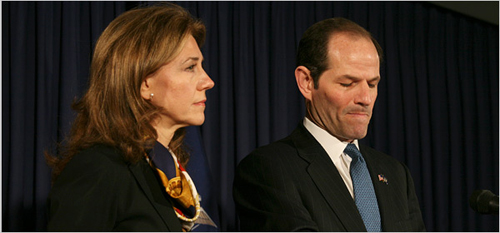
Gov. Eliot Spitzer, with his wife, Silda Wall Spitzer, at his side, announced his resignation. (Tyler Hicks/The New York Times)
Gov. Eliot Spitzer, whose rise to political power as a fierce enforcer of ethics in public life was undone by revelations of his own involvement with prostitutes, resigned on Wednesday, becoming the first New York governor to leave office amid scandal in nearly a century.
The resignation will be effective on Monday at noon. Lt. Gov. David A. Paterson, a state legislator for 22 years and the heir to a Harlem political dynasty, will be sworn in as New York’s 55th governor, making him the state’s first black chief executive.
Mr. Spitzer announced he was stepping down at a grim appearance at his Midtown Manhattan office, less than 48 hours after it emerged that he had been intercepted on a federal wiretap confirming plans to meet a call girl from a high-priced prostitution service in Washington, leaving the public stunned and angered and bringing business in the State Capitol to a halt.
With his wife, Silda Wall Spitzer, at his side, Mr. Spitzer, a Democrat, said he would leave political life to concentrate on healing himself and his family.
“Over the course of my public life, I have insisted — I believe correctly — that people regardless of their position or power take responsibility for their conduct,” he said. “I can and will ask no less of myself. For this reason, I am resigning from the office of governor.
Mr. Spitzer, 48, spoke in a somber but steady voice, softening his usual barking tone. He took no questions. His wife, in a dark suit and a brightly colored scarf, looked off to the side, occasionally glancing up to reveal deep circles beneath her eyes.
Though he came into office last January with a sweeping electoral mandate for change, Mr. Spitzer’s time as governor was marked by fierce combat and costly stumbles. He faced a scandal last year after members of his staff used the State Police to disseminate damaging information about his chief Republican rival, Joseph L. Bruno, the leader of the State Senate.
Since Monday, Mr. Spitzer has been consumed with crisis, trying to salvage his marriage and his career and avoid federal charges stemming from the case.
A man defined by ambition and relentlessness, Mr. Spitzer appeared to struggle with the decision to relinquish power. On Tuesday afternoon, Mr. Spitzer instructed his staff to contact the office of Sheldon Silver, the speaker of the Assembly and a fellow Democrat, to see if an impeachment vote could be avoided.
But it was clear during the discussions that it was hopeless, with many Democrats prepared to abandon him.
During his remarks, which lasted less than three minutes, Mr. Spitzer did not address the pending criminal investigation, and it remained unclear what legal issues, if any, Mr. Spitzer will face.
The United States attorney investigating the case issued a statement shortly after the resignation saying that his office does not have any arrangement with the governor.
In Albany, some of Mr. Spitzer’s staff members were clearing out their desks as Mr. Paterson and his top aides prepared to move into the executive offices. Charles O’Byrne, a longtime assistant to Mr. Paterson, is replacing Richard Baum as the governor’s top aide. Most other top Spitzer loyalists were expected to depart.
Mr. Spitzer’s resignation was accompanied by relief, shock and a sense of the surreal. Legislative leaders from both parties voiced condolences to Mr. Spitzer’s wife and three daughters and welcomed Mr. Paterson.
Mr. Bruno, who had once called Mr. Spitzer “a spoiled brat,” shunned fiery language on Wednesday.
He said he hoped Mr. Spitzer’s ignominious fall would force lawmakers to focus more intently on addressing the state’s financial crisis, and he declined to say how Mr. Spitzer’s departure might affect the fight for control of the State Senate this year.
“I’m going to leave it to the governor and his family to sort out how they deal with present circumstances and the future,” Mr. Bruno said at a morning news conference. “And frankly, I have them in my prayers.”
Many Democrats on the floor of the Assembly seemed almost jovial in the hours after Mr. Spitzer resigned. Some admitted privately that they were happy that the contentious and sometimes scolding governor was being replaced by Mr. Paterson, a likable lawmaker comfortable with the customs of Albany. Mr. Paterson will have to adjust quickly: The deadline for passing next year’s budget is March 31.
Mr. Spitzer had never seemed completely at ease in the hallways of the Capitol, and as this week’s crisis engulfed him, few in the state’s political establishment came forward to offer support. And since Monday, the governor had disappeared from public view, retreating to his Fifth Avenue apartment for what associates described as agonizing deliberations with his wife, lawyers and a handful of close friends.
The son of a wealthy real estate investor, Mr. Spitzer was educated at Princeton University and Harvard Law School and worked as a prosecutor in the Manhattan district attorney’s office before being elected New York’s attorney general in 1998.
It was there that Mr. Spitzer built a reputation as a prosecutorial avenger, bringing some of Wall Street’s biggest names to heel and pressuring banks, insurance companies and brokerage houses to pay defrauded investors huge settlements and to adopt tighter regulations.
The audacity of Mr. Spitzer’s vision and his combative style made him a reviled figure on Wall Street. But to millions of Americans who felt swindled in an age when executive salaries and the income gap between rich and middle class were rapidly growing, Mr. Spitzer was viewed as a guardian against corporate excess.
He was so successful at using the relatively limited office of the state attorney general to redress the regulatory failures of the federal Securities and Exchange Commission that he was swept into the governor’s office in a landslide. Some of Mr. Spitzer’s admirers mused that he might one day be the first Jewish president.
And as he stepped to the podium shortly after 11:30 a.m. on Wednesday, some Wall Street traders watched gleefully as his career came to an abrupt end.
Elsewhere, Mr. Spitzer’s departure stirred other emotions. Susan B. A. Samuel of South Ozone Park, Queens, said she was proud that New York would have its first black governor.
“I’m very proud to say that he’s a brother,” said Ms. Samuel, who is black. “I’m very excited. It is kind of a sweet sorrow.”
Mr. Paterson, who asked Mr. Spitzer to delay his departure until Monday so he could be sworn in before a joint session of the Legislature, issued a brief statement offering condolences to the Spitzers and promising to quickly turn his attention to governing.
“It is now time for Albany to get back to work as the people of this state expect from us,” Mr. Paterson said.
Mr. Spitzer becomes the first New York governor to resign since 1973, when Nelson A. Rockefeller stepped down to devote himself to a policy group, and the first to be forced out since William Sulzer was impeached in 1913 over a campaign contribution fraud.
On Wednesday, Mr. Spitzer ended his remarks by pledging to return to public service outside the political realm, after a period of atonement with his family.
He invoked a common aphorism to make a final nod toward the enduring American belief in the possibility of redemption. “As human beings,” he said, “our greatest glory consists not in never falling, but in rising every time we fall.”
The Governor's Resignation Speech
Following is a transcript of Eliot Spitzer's resignation speech, as recorded by The New York Times:
In the past few days I have begun to atone for my private failings with my wife, Silda, my children and my entire family. The remorse I feel will always be with me. Words cannot describe how grateful I am for the love and compassion they have shown me.
From those to whom much is given, much is expected. I have been given much: the love of my family, the faith and trust of the people of New York, and the chance to lead this state. I am deeply sorry that I did not live up to what was expected of me. To every New Yorker, and to all those who believed in what I tried to stand for, I sincerely apologize.
I look at my time as governor with a sense of what might have been, but I also know that as a public servant, I, and the remarkable people with whom I worked, have accomplished a great deal. There is much more to be done, and I cannot allow my private failings to disrupt the people's work. Over the course of my public life, I have insisted, I believe correctly, that people, regardless of their position or power, take responsibility for their conduct. I can and will ask no less of myself.
For this reason, I am resigning from the office of governor. At Lieutenant Governor Paterson's request, the resignation will be effective Monday, March 17, a date that he believes will permit an orderly transition.
I go forward with the belief, as others have said, that as human beings, our greatest glory consists not in never falling, but in rising every time we fall. As I leave public life, I will first do what I need to do to help and heal myself and my family. Then I will try once again, outside of politics, to serve the common good and to move toward the ideals and solutions which I believe can build a future of hope and opportunity for us and for our children.
I hope all of New York will join my prayers for my friend, David Paterson, as he embarks on his new mission, and I thank the public once again for the privilege of service. Thank you very much.
© 2008, The New York Times