Las Vegas Sun, and notably the courageous reporting by Alexandra Berzon
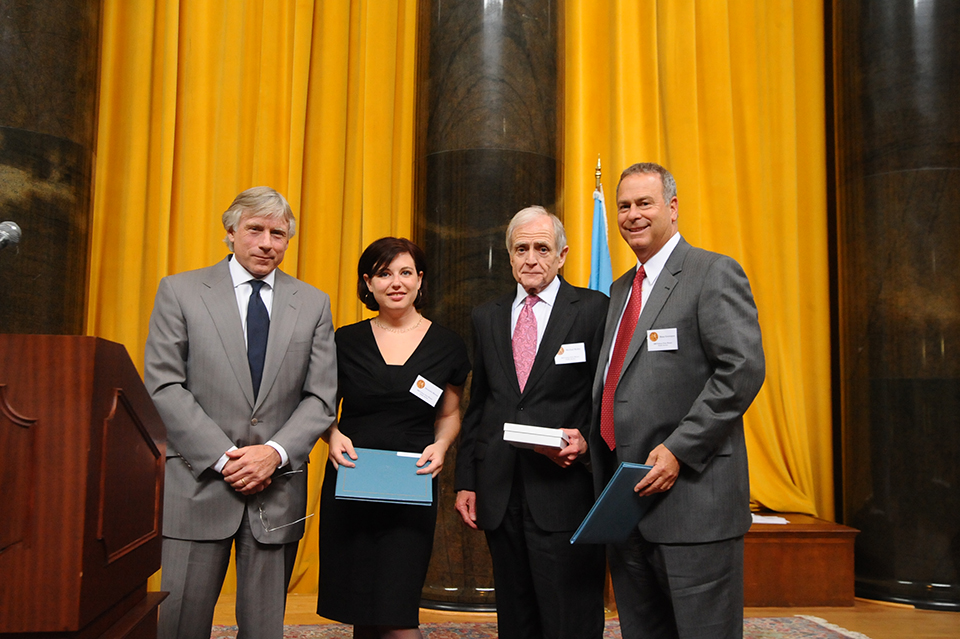
Lee C. Bollinger, President of Columbia University (left), presents the 2009 Public Service prize to (l-r) Alexandra Berzon, Michael Kelley and Brian Greenspun of the Las Vegs Sun.
Winning Work
Amid pressure to finish massive projects, 9 men have died in 16 months
The luxurious casino Cesar Pelli designed for CityCenter is morphing day by day into the soaring blend of curves and glass the architect envisioned. But on Oct. 5, it was still an unrecognizable shell of steel columns and shiny corrugated metal.
About 20 cranes would have been in the sky that day, the ground a maze of trucks and equipment and thousands of tradesmen stacked above one another inside building frames where work went on around the clock. They were busy building a casino and six adjacent high-rise structures, the most expensive private commercial development in U.S. history.
It was here that Harold Billingsley found himself 59 feet above the ground floor, walking in his brown ironworking boots on uneven temporary decking. He was heading to pick up extra bolts for his crew, his family believes. He stumbled.
Ordinarily, he would simply have fallen onto the decking. But at this exact moment in that exact spot, the decking contained a 3-by-11-foot hole that state investigators later said should not have existed.
Ironworkers wear safety harnesses for times like this. An attached cable is supposed to stop a plunge. Billingsley’s was not attached.
Safety regulations called for a temporary floor or netting no more than two stories down, a last chance to break his fall. None existed.
The man friends called “Rusty” for his fiery red hair fell to his death.
His was the fourth construction fatality at CityCenter, adding to what had already become a disturbing trend up and down the Strip. In the shadows of the cranes, steel and concrete upon which Las Vegas has pinned its addiction to growth, a body count has emerged. Nine construction workers have died in eight accidents since the end of 2006 at the towers that are redefining the Las Vegas skyline — Trump, CityCenter, Cosmopolitan, Fontainebleau and Palazzo. That’s as many deaths in 16 months as were reported during the entire 1990s building boom on the Strip. This time, the list of fatalities includes a safety engineer whose job was to find and correct safety problems on the work site.
“There’s no excuse for having that many people die,” said Emmitt Nelson, a construction safety expert based in Houston who consults for contractors and for the building industry’s Construction Industry Institute.
Investigators for the Nevada Occupational Safety and Health Administration found troubling patterns of safety violations: failure to ensure that workers are properly trained, allowing workers to use faulty equipment and leaving workers exposed to falls by not covering over or guarding gaping holes or not placing temporary planks or netting below.
Those are surprising mistakes for large, experienced construction companies, say experts eager to determine the reasons.
The federal OSHA office in San Francisco is considering an investigation as part of its oversight of Nevada OSHA, and the District Council of Ironworkers for the Nevada region is working with unions and contractors to review safety issues.
Mark Ayers, president of the Building and Construction Trades Department, a Washington, D.C.-based, arm of the AFL-CIO that oversees many trade unions, is awaiting permission from Perini Building Company Inc., the general contractor on CityCenter and other Strip projects, to send in a team of safety experts in search of answers.
“Something is inherently wrong, but we don’t know what it is yet,” Ayers said.
The tradesmen working on the Strip, however, do have an answer. Ask some of the tens of thousands of them and they will say: The pace and scope of the construction is dizzying. It’s all so much, so fast.
The workers describe construction sites that are crowded with equipment and people, combined with consistent — though often unstated — pressure to do everything at top speed.
While chugging after-work drinks at a bar nearby or chatting with buddies outside a union hall, workers sometimes wryly and nervously refer to the CityCenter site as “CityCemetery” or “CemeteryCenter.”
“The whole system is clogged up like I-15,” said an ironworker who identified himself as a union steward at CityCenter. “There are traffic jams, so that makes you less productive and makes you nervous. Then you hurry up because you’re trying to be a productive employee. Just like how when you speed on a freeway you have less time to react, when you hurry on the job you have less time to correct that mistake.”
Even boom-boom Las Vegas has never attempted anything as ambitious as the $30 billion-plus in projects under way on the Strip. Leading the way is MGM Mirage’s $8 billion CityCenter, a project so massive that it has no clear parallel in the United States: Six high-rise buildings going up simultaneously. Next door, the same general contractor, Perini, is erecting the two towers of Cosmopolitan at a cost of more than $3.5 billion.
MGM Mirage has promised it will finish the entire CityCenter project by the end of 2009, opening, remarkably, on the same day. The adjacent Cosmopolitan, spearheaded by developer Ian Bruce Eichner, is set to open at roughly the same time. Todo all that — and avoid costly penalties contractors typically face in Strip construction projects if they miss a deadline — the pace has been relentless.
Perini is a giant U.S. company whose most recent insurance industry safety ratings are slightly better than average, according to research provided by Southwest Contractor, an industry trade magazine.
Perini refused repeated requests from the Sun to answer questions, even after MGM Mirage joined in asking its contractor to do so. The company insisted in a statement that it follows strict safety practices and requires its numerous subcontractors to do the same.
MGM Mirage spokesman Alan Feldman said the gaming giant has reviewed and discussed every injury at CityCenter with Perini.
“We’re very concerned about safety in anything we do, whether it’s a room remodel or something as enormous and complex as CityCenter,” Feldman said. “For the number of people on the site and the amount of activity going on, we can be very proud of the fact that we have a very safe environment in which to work.”
Construction safety experts interviewed by the Sun say the deaths and the violations investigators found suggest contractors aren’t taking enough safety precautions. They also find fault with Nevada OSHA for not forcefully upholding safety laws.
A review by the Sun found that Nevada OSHA discovered numerous violations by contractors in each death, but the agency then watered down or entirely withdrew its citations after meeting with the contractors.
The Sun’s review also found that trade unions in Las Vegas are not seeking aggressive OSHA enforcement. Unlike some unions in other parts of the country, Nevada locals do not insist on representing workers’ interests by joining in OSHA’s meetings with contractors.
The investigation into Billingsley’s death is an example.
Nevada OSHA cited Billingsley’s employer, subcontractor SME Steel Contractors, because Billingsley’s safety harness was not suitable for use and the decking had several improper holes, including the one he fell through. (OSHA did not cite the company for violating the regulation that requires decking or netting two floors below steel erection work. A 2002 federal OSHA ruling makes such a failure a minor violation if a company is making sure workers attach their safety harnesses.)
The agency fined SME $13,500.
After delivering those findings and citations, however, OSHA administrators met alone with representatives of SME. The victim’s family was not invited. His union, Ironworkers Local 433, could have attended but did not.
At the meeting, SME argued that Billingsley was solely responsible for his death.
OSHA reversed itself and agreed, withdrawing all findings of employer error.
Current and former federal OSHA officials and other job safety experts told the Sun they find the decision troubling. Only rarely should OSHA withdraw citations in fatal accident cases, they say.
“This is not a reflection of OSHA policy. This is counter to policy,” said Alan Traenkner, who monitors Nevada OSHA as the director of analysis and evaluation for the federal Department of Labor office in San Francisco.
“It should be the employer’s burden of proof,” Traenkner said. “It’s our responsibility to conduct an investigation where we come up with facts and make the proper determination, and if the employer contests that, it should go to the review board.”
Frank Strasheim, former regional administrator at the San Francisco office, said Nevada OSHA should not have simply withdrawn the citations. “You don’t back away on a fatal investigation unless the employer presents evidence that shows you’re totally in the wrong,” Strasheim said.
Instead, investigators should either reopen the investigation or force the contractor to appeal. “It’s better if it’s decided in court than to just give it away,” Strasheim said.
To safety advocates, the risk is clear.
“When you remove a citation, it doesn’t do anything to send a message to the employer or other employers that there are serious consequences for serious violations of the law,” said Peg Seminario, director of safety and health at the AFL-CIO. “So then the enforcement scheme doesn’t prevent future occurrences.”
•••
On Dec. 5, 2006, the parking structure of the Trump International Hotel & Tower, 1.5 miles north of CityCenter, was typical of construction sites up and down the Strip: crowded with equipment and workers.
Laborers were relying on tub-shaped scooters known as “Georgia buggies” to carry wet concrete to the spots where it would be poured. Normally, the workers would use concrete pumper trucks, but they couldn’t get to the trucks because they were blocked in by other equipment on the congested site.
So workers drove the buggies, one of which proved confounding. It seemed to have a mind of its own that day.
An employee using the buggy on the sixth floor was startled when it suddenly jerked backward as he squeezed the accelerator handle, and he hit another worker. Instead of reporting the injury or retiring the buggy, the worker drove it to the floor below and handed it off to Isidro Pelayo, a 39-year-old foreman everyone called “Willie.”
The worker told Pelayo the buggy “just wasn’t feeling right.” One wheel was shaky. Be careful.
It didn’t take long for Pelayo to bump into another worker with the buggy and start complaining himself about the annoying piece of equipment.
Another worker suggested he quit using it. No one knows whether Pelayo heard that. Maybe he decided to pick up more concrete. Or maybe he was trying to drive the buggy out of the way so that it couldn’t hurt anyone else.
Either way, Pelayo, standing at the buggy’s controls, suddenly backed into an elevator shaft guarded by a plywood wall. As the wood flew up, the buggy hung over the edge, the engine still on. Suddenly it jerked up, and Pelayo fell into the elevator shaft and 70 feet down, followed by a piece of plywood.
Nevada OSHA’s investigation found that workers should not have been using the buggy.
Its brakes, accelerator and transmission fan blades were all in bad shape, the agency said. The investigation also found that no one was checking the buggy daily to make sure it was safe to use, that it hadn’t been maintained properly, and that Pelayo had not been adequately trained to operate it. Plus, OSHA had found the previous May that Pelayo’s employer, Perini, was not training laborers to operate the buggies, and it had required Perini hold the training. The company offered no proof that it had complied.
The underlying problem? According to Nevada safety inspectors, Perini had sacrificed safety in the rush to finish the job.
“Employer set safety culture to fail by allowing unsafe equipment use and not enforcing training,” OSHA Chief Administrative Officer Tom Czehowski wrote. “Foreman (deceased) was a member of management and placed productiveness before safety, just as the employer has.” Three violations he cited carried total fines of $18,900.
That rebuke of Perini’s “safety culture” was OSHA’s most strongly worded public statement regarding recent Strip construction. But at the informal conference with Perini at which Czehowski blasted the company’s safety culture, he also agreed to withdraw one fine and downgrade another, reducing fines to $8,300.
Pelayo’s death was the first in the string of fatalities over the past 16 months. The others that followed, in addition to Billingsley, were of:
Angel Hernandez, 24, and Bobby Lee Tohannie, 40:
On Feb. 6, 2007, the two carpenters were working the swing shift at Vdara Tower at CityCenter, assigned to help remove two aluminum structures inside an elevator shaft that were used as molds for concrete called concrete forms. Together the forms weighed 7,300 pounds. Their supervisors, running late, were not briefed by their morning counterparts on the status of the job.
A supervisor, assuming the forms were secured inside the shaft, ordered them disconnected from a crane, which was needed for another job. Once disconnected, however, the forms collapsed on Hernandez and Tohannie.
Norvin Tsosie, 36:
On Aug. 2, 2007, the apprentice fell from a 30-foot wall at Fontainebleau, a site overseen by Turnberry West Construction. Working for subcontractor Nevada Prefab Engineers, he and his team were on top of the wall trying to straighten a column that was slightly tilted. The column was connected to a cable with an untested, improvised hook. It broke under pressure, causing the workers to tumble off the wall.
Tsosie’s safety harness was useless because it was attached to the same cable. The other workers were attached to a more secure point. They were injured but survived.
Harvey Englander, 65: The veteran operating engineer and Perini employee was greasing an elevator Aug. 9, 2007, at the Pelli Tower at CityCenter when he was struck by a counterweight from an adjoining lift and killed.
Michael Hanson, 42: The laborer working for Taylor International Corp. was using a pry bar Nov. 26, 2007, to remove temporary concrete slabs at Palazzo when his foreman raised a slab with a forklift. A piece of the slab struck Hanson on the head and he fell backward.
David Rabun Jr., 30: An ironworker, Rabun was replacing bolts in a steel beam inside an elevator shaft at the Cosmopolitan on Nov. 27, 2007. He attached his safety harness to the beam because it was the only anchor available. Netting or a temporary floor should have been in place two stories below. Neither was. The beam broke free. Rabun fell four stories.
Michael Taylor, 58: The Perini safety engineer died Jan. 14, 2008, at the Cosmopolitan. No one saw what happened, but investigators believe he fell five floors when a corner iron post that helped hold up a guardrail system collapsed. The corner posts are usually held in place by support pieces called kickers, welded to the bottom, but one of the steel subcontractors had removed the kickers to install a beam and had not replaced them.
That string of Strip deaths is unusual, safety experts say, and U.S. Bureau of Labor Statistics numbers tend to support their opinions, although using those statistics to draw conclusions is tricky.
Nationally, Labor statistics show that in all forms of construction, about 13 deaths occur per 100,000 workers a year. With four deaths among no more than 5,000 workers at CityCenter last year, that project appears to have a much higher than average number of deaths. (A similar comparison for the entire Strip could not be made because estimates of the total construction workforce vary wildly.)
Although those figures are the only ones available for measuring construction death rates, statisticians at the Bureau of Labor Statistics caution that comparing CityCenter or any individual project with the national average is statistically invalid.
Aside from fatalities, Perini’s adjacent CityCenter-Cosmopolitan sites have had near misses and frightening accidents, such as when a 25-foot-tall wall fell and injured several workers, all of whom survived, and when a CityCenter crane hit a Cosmopolitan crane.
In fact, at least a dozen crane incidents, including collisions, have occurred at CityCenter, according to Greg McClelland, a representative of the Ironworkers Labor Management Cooperative Trust who has been looking into safety issues at CityCenter and other Strip projects. At least one of those was caused by unwanted voice traffic coming through over the radio system, McClelland said. The others he attributes to “lack of planning.”
“There’s just way too much stuff going on at once,” McClelland said.
•••
Modern Las Vegas has always built at full speed, with contractors facing whopping penalties for missing deadlines and reaping bonuses for finishing early. But until the current boom, casino developers generally built hotel projects in phases.
In 1999, for example, Las Vegas Sands opened the doors to the first part of its master plan — the Venetian. In 2003, the company completed the adjacent Venezia. This year it unveiled Palazzo next door. And under construction now: a 400-unit condo tower.
MGM Mirage and others now are building differently. At CityCenter, MGM Mirage is building six high-rise towers, a casino, a convention center, a retail mall and all related parking structures and interior roadways — in just three years.
Not only is the center expected to make a splash as the biggest single-day opening of anything in Vegas history, but it means tourists and residents who bought high-rise condos can move about the property without dodging machinery or strolling past plywood walls.
“You only have a chance to make a first impression once,” said Feldman, the MGM Mirage spokesman. “Inviting people to a construction site is not the best way to go about it. We’ve seen some projects in Las Vegas attempt to do this and they invariably suffer initially either because you’re not able to get the full scope and scale or because it’s just inconvenient or disruptive.”
Keeping that same-day promise creates a convergence of construction challenges — on-site congestion, deadlines, inexperienced workers and exhaustion.
“The complexity of this project means that it requires an understanding of safety that is even larger and more involved than anything that anyone working there has ever had to deal with to this point,” Feldman said.
Workers say they are paying the price for that new level of complexity.
“They’re jamming way too many people on the site,” said a general ironworker foreman at CityCenter who wished not to be identified so that he could speak freely.
“What used to happen is we would erect a building and no other crafts would be underneath, but now there are crafts driving buggies, and the electricians and concrete people are coming in underneath,” the foreman said.
“You don’t have as many places to put key materials down,” he continued. “Everyone is fighting for real estate. You’re just asking for someone to make an error.”
After three months at CityCenter, ironworker Stephan Basden, 31, requested work at a smaller project. He said he was impressed with the safety precautions taken by his employer, subcontractor SME, which had several safety engineers on the site. But he found it all too rushed.
“Everyone was always going so fast,” Basden said.
Union representatives say inexperienced workers such as Basden and out-of-town workers who are not familiar with Las Vegas construction have made safety more difficult to achieve.
More than 25 percent of ironworkers in Las Vegas are apprentices with less than four years of experience, said McClelland of the Ironworkers Labor Management Cooperative Trust. Two of the three ironworkers who died on the Strip last year were apprentices.
Another factor is exhaustion.
Laborers put in as many as 70 hours a week because there’s money to make and subtle pressure to work extra hours. A 2005 study funded by the National Institute for Occupational Safety and Health found that working more than eight hours a day increased injury rates.
Outside safety experts say that all of these factors fit the profile of a zone susceptible to injuries and fatalities.
“The presence of more people around doing more things hinders the ability to move around frequently, and that creates more pressure,” said John Gambatese, an associate professor of civil, construction and environmental engineering at Oregon State University. Gambatese is an expert in construction safety and used to teach at UNLV. “It means that if you delay, you’re going to be delaying somebody else, and that would cause a ripple effect.”
Research into those dynamics is fairly new and there is not a lot of concrete evidence yet, Gambatese said.
But it rings true to many in Las Vegas.
“I know from experience that when you’re working a lot of hours you almost become a zombie, a robot, you’re just there going through the motions, and that is the time you really have to be careful and make sure and watch what’s around you,” said John Christiansen of Sheet Metal Workers Local 88.
But safety experts for both labor and industry maintain the deaths were hardly a foregone conclusion. Contractors should have the ability to oversee fast, multitowered projects that are not only fatality-free but injury-free, they say. They key is setting the right tone and putting the right policies in place.
“This is a dangerous business and it’s risky, but our philosophy is that zero accidents are possible, and we see it done,” said Rusty Haggard, an analyst for the Construction Industry Institute, an organization made up of large contractors and property owners. (Perini is not a member.)
“When you get into multiple high-rise casino projects, that makes everything more complicated, which just means you have to do more planning on the front end of the project,” Haggard said.
Perini declined to offer many specifics about its safety policy or to be interviewed directly. Two subcontractors whose workers were among the fatalities, Nevada Prefab Engineers and SME Steel Contractors, did not respond to requests for interviews.
In an e-mailed statement, Perini safety director Lisa Kane reported that Perini employs 38 safety professionals in Las Vegas, most at Cosmopolitan and CityCenter. Subcontractors have also hired their own safety personnel, Kane said.
Kane attributed some of the difficulties in part to the “exponential growth in the Las Vegas market,” which brought in many out-of-state workers. Kane also said that Perini has an outside safety consultant to recommend improvements.
“Management is fully engaged in meeting those challenges by promoting safety from the top,” Kane said in the statement. “Management regularly schedules on-site safety meetings with field personnel to personally send the message that they care about safety and want to hear their concerns or recommendations. Perini Building Company is committed to providing the safest work sites possible for our employees and contractors, continually striving to make improvements in order to promote an injury-free work environment.”
CityCenter developers never expected their enormous and complicated project would be free of accidents.
“It would be great if we could be incident free. That’s everyone’s objective, but I don’t think that’s realistic,” said Feldman of MGM Mirage. “I think when you’re dealing with human beings there’s too much potential for individual error. I think everyone has to work together to try to minimize the possibility of an incident.”
Joe Taylor, director of Southern Nevada Laborers-Employers Cooperation and Education Trust, a joint organization of the laborers union and contractors, said Perini has taken “a number of safeguards to help quell the rash of accidents. They have gotten such a bad reputation for all the bad things that have happened, and nobody sees the good that they are doing. It’s the size of the job, the amount of equipment, the long hours, the amount of workers that is causing this.”
•••
In early February, little more than two months after his son fell four floors to his death at Cosmopolitan, veteran ironworker David Rabun eased into a booth at the Dew Drop Inn, a bar not far from the union hall. Bartenders kept the coffee flowing while union buddies munched on doughnuts that someone had placed on a long wooden table in the center of the cavernous room.
With crinkled eyes and a wry smile that allows him to transition quickly between laughing and crying, Rabun, 60, unloaded a stack of photos on the table. He leafed through a folder that held a scrapbook of his son’s death: newspaper clippings, important phone numbers.
Rabun had come out of retirement to work at CityCenter so that he could qualify for health benefits to get elective surgery. CityCenter was the easiest work to come by, and working the steel beams so close to where his son died would be cathartic, he thought, almost like therapy.
His first day proved tough. Rabun sat in on a safety meeting that Perini requires new workers to attend. “The instructor said you better pay attention if you don’t want someone to have to go to the morgue to pick out your body,” Rabun recalled. “I just lost it.” He left the meeting.
Finding some refuge later that day at the bar, Rabun remembered how delighted he was two years ago when his son, David Rabun Jr., decided to come join him in the Las Vegas ironworking world from Texas, where Rabun was raised apart from his father.
“I said if you’re going to do this crap, do it with your daddy,” Rabun said. “Your daddy is famous here.”
Rabun also thought he could protect his son in some way.
The younger Rabun, 30, found work at the Cosmopolitan.
His father attempted retirement and worried about his son, who complained the job at Cosmopolitan was going too fast and was too crowded. He told his father that sometimes there weren’t safe places for him to tie his safety harness.
“I told him, ‘Don’t ever tie yourself to the piece of steel that you’re balanced on,’ ” Rabun said. “I said, ‘Slow down. There are other jobs.’ I told him there are other people here he could work for.”
On Nov. 27, his son was balancing on a steel beam inside an elevator shaft. He hooked his safety harness to the same beam. A temporary floor was supposed to be in place no more than two stories below. It wasn’t.
The beam came loose. Rabun fell four floors, wearing his useless safety harness and plummeting far beyond the point where the temporary flooring should have stopped him. His father can’t shake the image.
“He wanted to stay there, because of the overtime,” Rabun said.
© 2008 Las Vegas Sun
After meeting with employer only, it often reverses finidngs, cuts fines
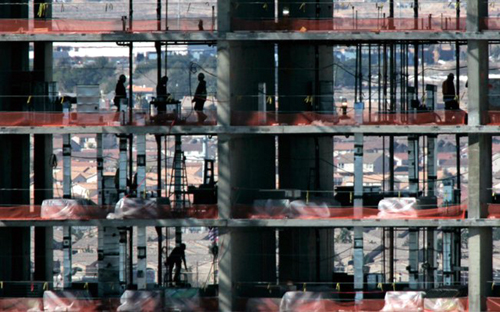
MGM Mirage CityCenter project includes a casino and six high-rise buildings, all to open in 2009. Four men have died in accidents on the site since work began. (Steve Marcus, Las Vegas Sun)
Hundreds of construction workers signed a 10-foot long memorial poster for the family of Harold Billingsley after the 46-year-old ironworker plunged to his death at CityCenter last year.
Four months later, on a night in February, relatives unrolled the poster at the home of his sister, Monique Cole, and her husband. Cole placed Billingsley’s brown leather boots and sticker-covered construction helmet on the kitchen table. The family had gathered to talk to a reporter.
“It feels like they rendered my brother’s life valueless,” Cole said, crying as she recalled the Nevada OSHA conclusion that Billingsley’s employer bore no responsibility for his death. “You assume all the right things are in place until you’re faced with it.”
Nevada Occupational Safety and Health Administration conducted a one-month investigation after Billingsley fell 59 feet to his death. The conclusion: SME Steel Contractors, Billingsley’s employer, had violated safety laws by leaving the hole in an unfinished temporary floor. Also, his safety harness wasn’t working properly.
“The foreman was on site, aware of the progress of the work and the area where the employee was working,” OSHA inspectors wrote. “With reasonable diligence the hazard could have been detected and prevented.”
Another thing could possibly have saved his life. OSHA regulations call for a net or a temporary floor every two floors below employees working on steel erection. Billingsley, however, plummeted nearly twice that far because neither was in place.
OSHA issued three citations carrying fines totaling $13,500. But then SME met privately with the agency in what’s known as an informal conference. No family was invited. Billingsley’s union local did not send a representative.
Without offering any additional documented evidence, the company blamed Billingsley. He wasn’t supposed to be in the area, it said, contradicting the findings of the investigation.
OSHA withdrew the citations.
Billingsley now bore sole responsibility for his death.
Cole was mystified. “The everyday Joe Carpenter is not aware of how fallible the system is,” she said.
Her husband, George, sat at the kitchen table of their sprawling Sunrise Mountain home thumbing through an OSHA report he had been given by the reporter. A retired ironworker, he once owned a subcontracting business that had been cited by OSHA.
Cole knew the trick, he said. Blame the worker.
If someone dies at a Nevada construction site and OSHA points the finger at poor safety procedures, the agency often will relent during informal sessions with the contractors, he said.
Then he added: He knew all along that the agency would clear SME.
His wife looked up in disbelief. If you knew the fines were going to be dismissed, she asked, why didn’t you tell me?
“I knew it would upset you,” he said.
•••
A Sun examination of OSHA accident documents related to nine recent construction fatalities on the Strip shows that investigators found serious safety violations in the cases, but the agency often did not follow up with aggressive enforcement. Instead, after meeting privately with contractors, the agency withdrew or reduced fines.
Government and private safety experts outside of Nevada as well as the families of the accident victims told the Sun they are surprised and disturbed by OSHA’s conduct after the fatalities.
Frank Strasheim, a former regional administrator in the federal OSHA office in San Francisco, and other experts say they have seen many citations removed by federal and state OSHA offices elsewhere — but rarely in cases involving deaths.
“My rule of thumb has always been that you hold the line on a fatality,” Strasheim said. “A fatality is the worst possible thing.”
If employers offer statements that contradict elements of the initial investigation, OSHA administrators should reopen the investigation rather than quickly overturn citations, he said. Strasheim and others said that a pattern withdrawing citations could indicate that Nevada OSHA is either doing a bad job in its initial investigations, or is overusing a provision in OSHA laws that allows the agency to reverse itself if it thinks the findings won’t hold up under review.
Here is how Nevada OSHA handled the eight cases in addition to Billingsley:
• Harvey Englander, 65, a veteran operating engineer and employee of construction giant Perini Building Company Inc., who died Aug. 9, 2007, when struck by the counterweight of a manlift, or elevator, at CityCenter.
OSHA found that Perini violated six safety laws.
The findings were withdrawn.
• Angel Hernandez and Bobby Lee Tohannie, carpenters killed Feb. 6, 2007, when crushed inside an elevator shaft at CityCenter by 7,300-pound structures that support poured concrete.
OSHA found the site’s general contractor, Perini, did not make sure the forms were properly secured and did not train employees in the proper removal of the forms. The agency fined Perini $14,000.
At an informal conference between OSHA and Perini, an OSHA administrator withdrew one violation and left the other intact, for a total fine of $7,000.
• Isidro “Willie” Pelayo, the worker killed when a buggy jerked and threw him down an elevator shaft at Trump on Dec. 5, 2006.
OSHA found that Perini had failed to train employees in the use of buggies and had not maintained them properly or checked to see whether they were safe. Three violations carried $18,900 in total fines. At the informal conference, OSHA agreed to withdraw one fine and downgrade another, reducing fines to $8,300.
• Michael Hanson, a laborer working for Taylor International Corp. at Palazzo, who was killed when a piece of a concrete slab raised by a forklift struck him in the head on Nov. 26, 2007. The investigation found that using the forklift to remove concrete was common at the Palazzo even though that use is forbidden by the forklift manufacturer and by OSHA. The agency found one violation and fined Taylor $6,300.
At the informal conference, OSHA reduced the fine to $3,780.
• Michael Taylor, 58, a Perini safety engineer at Cosmopolitan. He died Jan. 14, 2008 after apparently falling five floors when a corner iron post that helped hold up a guardrail system collapsed.
In the investigation, OSHA found that Reliable Steel, a subcontractor, had not replaced key support pieces and hadn’t properly welded the posts. It was inevitable the post would malfunction in time, the investigator wrote. OSHA also found that Reliable Steel was underreporting injuries in its required injury logs. The agency issued four citations for fines totaling $2,850.
Reliable Steel has contested the citations, and OSHA will hold the informal conference in April.
• Norvin Tsosie, 36, who fell from a wall at Fontainebleau on Aug. 2, 2007.
OSHA fined his employer, Nevada Prefab Engineers, $17,925 for 10 violations for allowing workers to use makeshift materials that hadn’t been tested, and for not making sure that safety harnesses were properly attached.
The subcontractor did not contest the findings.
• David Rabun Jr., 30, an ironworker at Cosmopolitan. He fell four floors on Nov. 27, 2007, while replacing bolts in a steel beam inside an elevator shaft.
OSHA found that Rabun’s employer, Schuff Steel, had violated six safety laws, including not making sure the steel he was working on was secure, and not putting a net or decking underneath him. Schuff Steel was asked to pay $12,150.
OSHA held an informal conference with Schuff on Feb. 27. That came after the Sun repeatedly asked the agency about its handling of earlier cases and after federal OSHA officials, responding to newspaper inquiries, expressed dismay to the Sun regarding the state agency’s actions.
For the first time involving a Strip fatality during the current building boom, OSHA stood by the original findings and did not make a deal with the employer. The case will most likely be appealed to an OSHA review panel.
So why would Nevada OSHA remove or reduce citations following the other fatalities?
In some states, OSHA departments favor easy, expedient resolutions, said Celeste Monforton, a lecturer at George Washington University’s School of Public Health and Health Services, who used to work at federal OSHA.
“They would rather make the thing go away,” Monforton said. “If you can make it go away by an informal settlement, where the company comes in and says we’re going to put in a good safety program and do all these things, for the sake of bureaucratic expediency OSHA might rather close the case and go on to the next investigation. That’s how these things go away.”
When a case is sent to a review board, the company isn’t required to immediately correct safety problems at the work site. For that reason some OSHAs try to settle cases so glaring safety problems are cleaned up quickly, Monforton and other experts say.
But that doesn’t appear to have been as much of an issue here. In Billingsley’s case, for example, all of the specific violations cited by OSHA had been corrected even before the citations were issued.
Greg McClelland, a representative of the Ironworkers Labor Management Cooperative Trust, said the pattern in Nevada indicates that OSHA is trying to work cooperatively with employers to improve safety.
“A lot of people think OSHA needs to be cracking heads and making people pay, but the problem with that is that it nurtures an adversarial relationship, and you get more resistance from companies,” McClelland said. “It’s better if companies buy in to the program.”
A sign that Nevada OSHA may have adopted that approach is the existence of a safety expert in OSHA’s consultation and training division — outside of the enforcement process — working to help Perini evaluate and correct safety problems at CityCenter, according to a person who works for the agency and was told not to speak to the media.
Another factor that may be at work in Nevada is limited resources.
If employers contest a citation and OSHA doesn’t work out a settlement during an informal conference, the agency has to either reopen the investigation or defend the findings before a review panel. That takes time and staff — two things in short supply at Nevada OSHA.
A paucity of safety engineers in the state and nationally has made it tough for the agency to retain investigators, who are quickly lured by more lucrative jobs as on-site safety experts at construction companies, including on the Strip.
Elisabeth Shurtleff, spokeswoman for Nevada OSHA’s parent agency, the Business and Industry Department, said that for the Las Vegas area, it has 25 budgeted positions for inspectors. Five of those are vacant.
The number of inspector positions for Las Vegas did not increase from 2001 to 2007, even though the number of employees in all occupations grew by 200,000 to 927,000, and most of the agency’s funding comes from workers’ compensation assessments, not general taxes, which means employers pay the costs.
The 20 Las Vegas area inspectors make random workplace visits and inspect a site every time someone calls to complain about a possible infraction, in addition to conducting investigations of big accidents. Even if all the positions were filled, OSHA would need 27 years to pay a single visit to each workplace in the state, according to the AFL-CIO.
Perini Building Co. alone has kept OSHA pretty busy. The contractor was inspected 25 times in 2006 and 2007 on its large casino projects in Las Vegas. OSHA issued the company citations for 38 violations, 17 of which were withdrawn at informal conferences.
As small as the Nevada staff is, however, an AFL-CIO nationwide study found that last year Nevada OSHA had done more inspections per workplace than any state except Oregon.
•••
Veteran operating engineer Harvey Englander, 65, had decided CityCenter would be his last job. His wife, Susan, said he spoke to her often about how he and his co-workers spotted safety violations but were too intimidated by their prickly foreman to speak up.
He decided he would work only until Susan retired from her job as a respiratory therapist.
Last August, he was lubricating a cage that carries workers between the ground and upper floors. The lift was one of two that worked in tandem, each off a counterweight. As he worked, the adjoining lift traveled up to pick up workers and its counterweight came down, killing Englander.
He wasn’t supposed to be the one greasing the machinery, Susan said in an interview. But his boss had come down hard on workers after being told that it wasn’t being lubricated often enough. Englander started greasing it daily — more than it required.
OSHA investigator Nicholas La Fronz spent two months after Englander’s death interviewing employees and Perini bosses, and reviewing the company’s training manuals and videotapes. La Fronz found a variety of safety problems on the site that he thought contributed to the death:
• Manufacturer safety rules posted on the machinery say passengers shouldn’t be transported on the lift until after a daily inspection is complete. But operators of the lift told La Fronz, “When it’s busy you have to just get started running the lift because there are a lot of people waiting, and you do your inspection later in the shift when things slow down.”
• Larry Tucker, the operating foreman, said he told workers that only the car being greased needed to be shut down and locked out. The manufacturer’s safety rules, however, require locking out both cars when either lift is being greased to eliminate any chance they will be put to use.
• Englander’s employer knew he was greasing the lift too often.
• Workers did not know the lift was to be locked with a padlock while being greased.
La Fronz found six violations, all rated “serious.” Three carried the maximum penalty of $7,000. Three others did not call for fines.
OSHA safety manager Jimmie Garrett signed the findings and sent them to Perini.
On Nov. 28, one month after the original citations were issued, three Perini safety professionals and a Perini attorney met with La Fronz and Garrett in an informal conference.
No one from Englander’s family was invited. The operating engineers union did not send a representative.
The $21,000 in fines wouldn’t have been the most pressing issue for Perini, a company that made $4.6 billion in revenue last year.
Contractors fight citations because fines can become hefty if the violations are repeated, because they want to have a clean record when applying for new jobs and because insurance companies will balk if too many citations pile up, said Frank Keres, a construction risk consultant who works with insurance companies, contractors and owners.
At the meeting, Perini argued:
• One of the citations referenced the wrong OSHA law.
• The company had trained Englander on the safe operation of the manlift, and had demonstrated that to the inspector. (La Fronz had included in his report documentation showing the company had completed a checklist of training topics but had concluded it was not adequate.)
• The rules were posted in the cab of the car. (La Fronz documented that but dismissed it as insufficient.)
After the conference, Garrett wrote a report placing all responsibility for the death on Englander. Although he had signed off on La Fronz’s findings, Garrett now wrote: “The deceased did not follow the instruction posted in the personnel hoist. No one was aware that the employee had decided to do maintenance on the personnel lift while the other personnel lift was operating. This error resulted in the employee’s death.”
Garrett removed all citations. The report contained no supplemental documentation to support the decision.
Garrett refused to answer the Sun’s questions about the informal conference. La Fronz did not respond to phone messages.
OSHA spokeswoman Shurtleff refused to allow the Sun to interview anyone at the agency, citing its policy.
Construction safety experts say OSHA’s original case against the company could have been upheld.
“If the regulation requires a lockout of the machinery, then the company is responsible for that,” said Steven Hecker, a senior lecturer in environmental and occupational health services at the University of Washington who has written extensively on construction safety.
Even if Perini had posted rules inside the manlift, “OSHA should have been able to say, ‘You clearly didn’t ensure that your procedures were adequately followed,’ ” Hecker said. “This should not have been grounds for voiding a citation like that.”
Dale Kavanaugh, a federal OSHA administrator in Seattle, said his department takes a conservative approach when fatalities are involved.
“How do you explain to a widow that it’s her husband’s fault that he’s dead?” Kavanaugh said. “We don’t want to be in that position.”
•••
Six months after her husband died, Susan Englander sat on a couch surrounded by antiques she and her husband had collected on weekends.
Englander clutched a small book in which she had scribbled the names and numbers of lawyers, Harvey’s co-workers and anyone else she was in touch with after the accident. She had to hire a lawyer to speed up the delivery of her workers’ compensation benefits, which come to about $1,500 a month for life, unless she remarries.
Perini representatives — she calls them “the pencil pushers” — came by right after Harvey died, and their business cards are stapled in the book.
Midway through the investigation, Susan sensed OSHA wouldn’t do enough. The case inspector told her there would be a meeting where the company could contest citations, outside the formal appeals process.
“I said, ‘Wait a minute. Either they did it or they didn’t do it. How can you change things?’ He said, ‘That’s just the process.’ ”
So Englander tried another tack. She thought she could make Perini or another contractor on site pay for unsafe conditions by suing them.
No lawyer would take her case.
Here’s why: Workers’ compensation law requires employers to pay dependents of killed workers a portion of their salaries. In exchange, the law shields employers from liability on the work site.
Nothing short of proving beyond a reasonable doubt that an employer targeted the employee and wanted him dead will usually cut it in state courts, said Nevada lawyer Craig Kenny, an expert in workplace accident law.
“Basically, you have to prove that it was an intentional act, that the supervisor came and hit them over the head with a shovel,” Kenny said.
Some lawyers instead go after manufacturers, who are not shielded by workers’ compensation laws.
The widow of Willie Pelayo, the worker killed when a buggy jerked and threw him down an elevator shaft at Trump, sued Perini for creating an unsafe workplace. A court threw it out. So she has sued the manufacturer of the buggy, Miller Spreader.
But both Englander’s and Billingsley’s families say that suing a manufacturer wouldn’t accomplish what they want — to force contractors to make workplaces safer.
Englander is resigned. “It seemed a waste of my emotions,” she said. “I have to move on. It just doesn’t seem that there’s any way to reach these people.”
Billingsley’s sister, Monique Cole, called many personal injury lawyers in the phone book before she found someone who would even agree to meet with her.
“Lawyers tried to tell us that we should say it was a manufacturer’s problem, but that has nothing to do with what this issue is about,” Cole said. “We want someone on the site to take responsibility. We want to make sure his death wasn’t in vain.”
After Billingsley died, Cole received a check in the mail from SME’s workers’ compensation carrier, AIG, to cover funeral expenses. Billingsley had no dependents to receive additional benefits. The check was for $3,942.29.
•••
Fred Toomey is on the same mission as Cole and Englander.
Toomey was the business agent for the Ironworkers Local 433 Las Vegas branch for 15 years in the 1970s and ’80s. He said when he ran the union here, he often shut down projects or threatened to shut them down over safety violations. He thinks unions could be doing more to find and fix safety problems on work sites.
After he heard that Billingsley fell 59 feet with nothing underneath him, Toomey rushed from his home in Pahrump to the union hall.
“I said, ‘What in the hell is going on?’ ”
He said Chuck Lenhart, the current business agent, said, “It’s the man’s fault.”
“He took me on the job and we walked around,” Toomey said. “We went up 60 feet. Chuck says, ‘See, this is his fault. He should have tied off to this cable, and then he wouldn’t have fallen.’
“I said, ‘Wait just a minute. This is 60 feet up in the air ... It’s supposed to be completely decked over every 30 feet.”
OSHA regulations call for decking every two stories or 30 feet, whichever is shorter, as a precaution against falls. (Toomey once fell and was saved by decking 30 feet below.)
In 2002 federal OSHA issued a new interpretation. A violation would be considered minor as long as workers are required to use their safety harnesses.
Later that day, Toomey fired off a letter to the union that chastised union foremen and superintendents for not keeping the workplace safe. He also said union stewards and other workers should be more active in reporting safety violations and demanding they are fixed.
Lenhart dismisses the complaints. In an interview in his office a few months later, Lenhart repeated what he had told Toomey the day Billingsley died.
The accidents that have befallen ironworkers are the unfortunate result of mistakes by the men who died, Lenhart said.
“As far as I can see everything looks good out there,” he said. “My contractors, they’re performing in a workmanship-like manner. What you see is just a result of the sheer number of man-hours.”
Lenhart also described Toomey’s concerns as the those of someone who is out of touch.
“The way he did things and way things should be done are two different things,” Lenhart said. “This is not 1985, and things in the industry have gotten safer and we have a lot more people working in the area.”
Asked about the union local’s decision not to attend the informal conferences between Nevada OSHA and contractors, Lenhart said: “That’s between OSHA and the company. We’ve never been invited.”
In fact, unions can join the conferences.
OSHA regulations require employers to post notification of the proceedings in the workplace, which should allow union stewards to find out about them, and employee representatives are allowed to attend the conferences.
Some OSHA offices do not strongly enforce that rule, said Seminario of the AFL-CIO.
But she recommends unions make the effort to find out about and attend informal conferences because, she said, they can offer an important balance against the employer perspective.
“They’ll definitely provide more oversight, particularly in a fatality case,” Seminario said. “I think you would end up with a stronger input and insistence on maintaining (the citations). You would get penalties that at some level are commensurate with the violations and will provide some deterrent from future violations.”
For example, when Peter Dooley, now a workplace safety consultant, served as a health and safety expert for the United Auto Workers in Michigan, he attended many informal conferences.
“Anytime a worker died, we would have a separate investigation that would be complementary to what OSHA did, but much broader and much more comprehensive,” Dooley said.
“From the union perspective, we would want to know why was this workplace being managed in such a way that could allow something like this to happen, and what could have been done to prevent this,” he said.
“The company has to know there’s going to be challenges to just a one-sided story, and it sends the message to OSHA that they have to be listening to both sides.”
Many of the building trade unions in Las Vegas say they’re trying to create safer work sites outside of government regulation and without disrupting their cooperative relationship with employers.
•••
When Harold Billingsley’s brother-in-law owned the subcontracting business Uriah Enterprises, he happily took work at places such as Circus Circus, Luxor and Monte Carlo. Like everyone else, George Cole said, he would forego some safety measures in the rush to finish a project on time and avoid the penalty for being late.
“You would get complacent about safety rules, because the job gets put on a schedule and no matter what happens you have to get it done,” he recalled last month in the interview at his home. “So you would drive men harder. You take shortcuts. Everyone turns a blind eye.”
Until someone got hurt, everyone was happily working and making good money.
When there was an accident or some other infraction, Cole negotiated with OSHA to whittle down the citation as far as he could.
“You work each one of those citations, work them until they’re gone, and what kind of incentive is that to change your practices?” Cole said. “I saved our company lots of money. I just kept fighting them.”
In the early 1990s, Cole encouraged Billingsley to quit his job as a bus mechanic and go into ironwork. Rusty was an “adrenaline junkie,” Cole said. So a profession that involved balancing on high beams was a good fit, and he started working for Cole.
Billingsley started last year at the Cosmopolitan, sometimes working as much as 70 hours a week. He skipped out of the usual family gatherings because of work.
A few weeks before he died, Billingsley stopped by the Coles’ house while he was out walking his dogs, and he and George Cole shared beers outside. He told Cole that he had quit Cosmopolitan to work at CityCenter.
His job at Cosmopolitan — to precisely align support columns — was just a little scary, a little dicey. He didn’t feel safe, Cole said Billingsley told him.
On Oct. 5, Cole received a phone call from a buddy working a crane at CityCenter. The friend had heard Billingsley’s name over the radio.
Cole rushed to the site and waited until he heard the news. Then he made the difficult call to his wife.
And his perspective shifted.
Four months later, as he sat with his wife Monique, he heard her say that she had always assumed companies such as the ones her husband owned or her brother worked for would be punished for safety shortcuts that endangered workers.
George Cole looked across the kitchen table and the couple locked eyes.
“Yeah, I see the irony now,” he said.
© 2008 Las Vegas Sun
Fast pace, union complacency and soft oversight imperil worker safety
Nine men have died since late 2006 while helping to transform the look of the Las Vegas Strip.
The men, construction workers, died in accidents while taking part in a building boom whose pace is frenzied.
No single answer for why so many people have died can be given. But the rush to finish is a contributing factor cited by workers. Another likely factor is an oversight system that is clearly softer on safety than it should be.
The deaths, and contributing reasons for them, are being examined during an ongoing Sun investigation by reporter Alexandra Berzon.
One reason why the pace is so furious is that phased construction has been largely supplanted by the idea that it all should be done at once — so that opening nights will showcase the project’s complete splendor. This has not only hastened work schedules, but has also overloaded work areas with people and equipment. After interviewing several workers, Berzon summed up their impression: The pace and scope of the construction is dizzying. It’s all so much, so fast.
The nine workers were killed in eight accidents at the Trump, CityCenter, Cosmopolitan, Fontainebleau and Palazzo work sites.
Whenever something highly unusual happens, such as nine fatal accidents in 16 months, patterns are analyzed to help in determining the cause.
One pattern uncovered by Berzon involves the Nevada Occupational Safety and Health Administration. The agency would cite safety violations contributing to deaths on the job, but later, in private meetings with the contractors, would often withdraw the citations or water them down.
An example is the death of Harold Billingsley, who on Oct. 5 fell through a hole that shouldn’t have been in the flooring while working 59 feet above the ground floor of what will be the CityCenter casino. After a monthlong investigation, Nevada OSHA cited Billingsley’s employer, SME Steel Contractors, for safety violations.
Later, in a private meeting with Nevada OSHA, SME officials argued that Billingsley was solely responsible for his death. The state agency agreed and the citations were withdrawn.
The kind explanation here is that Nevada OSHA is working cooperatively with contractors to improve safety by dangling a carrot rather than wielding a stick.
But there is another possible explanation for Nevada OSHA’s lack of aggressiveness — limited resources. Nevada OSHA has 25 inspector positions for the Las Vegas area, where 927,000 people are employed. And five of the 25 positions are unfilled.
Such a small staff may play a role in reaching agreements during conferences with employers. If there is no agreement, the agency must open another investigation or appear before a review panel. Either option requires time and staff.
Nevada OSHA declined to comment for the Sun’s series, but other experts said citations issued in fatal accidents should rarely, if ever, be withdrawn.
The pattern reported by Berzon is “not a reflection of (federal) OSHA policy,” said Alan Traenkner, who monitors Nevada OSHA as a director in the San Francisco office of the Department of Labor.
Another oddity reported by Berzon after probing the nine deaths is that Nevada OSHA’s post-citation conferences were between only OSHA and the employer.
No union officials availed themselves of their right to attend the conferences to ensure that fairness prevailed for the dead workers’ families and workers in general.
Berzon interviewed the business agent for Ironworkers Local 433, Chuck Lenhart. She reported his stated belief that the accidents that have befallen ironworkers are the unfortunate result of mistakes by the men who died.
“As far as I can see everything looks good out there,” Lenhart said. “My contractors, they’re performing in a workmanship-like manner. What you see is just a result of the sheer number of man-hours.”
Asked why a union representative isn’t attending the conferences, he said, “That’s between OSHA and the company.”
But during a meeting Friday of 200 ironworkers at their union hall, Berzon reports, there was agreement among union stewards that they will now participate in the citation conferences.
What Berzon revealed in her series is a perfect storm in which all construction workers caught up in the Strip’s accelerated boom are facing excess risk.
Nevada OSHA is clearly understaffed and of the mind-set to rarely assess major penalties for safety violations, and it appears the state Legislature won’t intervene anytime soon. Assemblyman John Oceguera, D-Las Vegas, chairman of the Commerce and Labor Committee, told Berzon he expects legislation addressing Nevada OSHA to come before his committee during the Legislature’s 2009 session, which begins Feb. 2.
Additionally, there is a question about the effectiveness of contractor-employed on-site safety engineers. Berzon quoted one as saying, “Most of us are (at our companies) because it is mandated to have safety people, not because we have any clout. I’m constantly telling the project managers we need to slow the pace down, but they say the owners won’t let us do that.”
Given the serious issues uncovered by Berzon, we believe immediate action should be taken, rather than waiting for the 2009 Legislature.
Nine deaths are a more than sufficient reason for the state, through the Legislature or the governor’s office, to convene a task force charged with reviewing the safety plans of contractors working on the Strip, and how those plans are being overseen and enforced.
Mark Ayers, president of the Washington, D.C.-based Building and Construction Trades Department, an arm of the AFL-CIO, told Berzon, “Something is inherently wrong, but we don’t know what it is yet.”
We’d better find out, soon.
© 2008 Las Vegas Sun
After Strip building site deaths, some workers want more safety demands from unions, but press too hard and they may be jobless
The 70-odd ironworkers working at the Fontainebleau construction site were fed up with dangerous conditions.
In July, they stopped working in the unsafe areas and persuaded their union, Irownworkers Local 433, to negotiate with the contractor to correct several specific safety problems: They wanted a caged elevator, not an open lift, to ride to higher floors. They demanded installation of a promised cable so they could attach their safety harnesses. They wanted the safety net, then balled up somewhere on the site, stretched beneath workers, where it belonged.
Work resumed after three days, but dangerous practices continued. Three days later, the contractor relied on a makeshift hook that state investigators later said should never have been used.
The hook broke. Apprentice Norvin Tsosie fell to his death, becoming one of nine workers who, the Las Vegas Sun has reported, died in construction accidents on the Strip in the past 16 months.
Workers had failed to force a subcontractor, Nevada Prefab Engineers, to make the site safe. But they tried — and persuaded their union to back them up. By most accounts, that hasn’t happened often on the $32 billion in projects under way on the Strip.
In a town where powerful service unions, including the Culinary Union and the Service Employees International Union, pride themselves as being wary adversaries of management, construction trade unions have shown reluctance to confront contractors over safety. That often leaves workers themselves as the last resort.
The Sun reported two weeks ago that safety has been overlooked in the rush to build on the Strip. (The owner and contractors involved at the Fontainebleau did not respond to calls for comment.)
Investigators for Nevada’s Occupational Safety and Health Administration have found a troubling pattern of contractor safety violations on the massive, complicated and fast-paced projects, including failure to ensure that workers are properly trained, allowing workers to use faulty equipment and leaving workers exposed to falls by not covering or guarding gaping holes or not placing temporary planks or netting below.
Despite that, the state agency has exercised lax oversight, often withdrawing citations during informal meetings with contractors.
Some workers believe their unions could be more aggressive with management, especially at a time when union locals say they are growing rapidly.
“Here in Las Vegas, as far as the need for union workers goes, we have leverage like you can only dream of,” said a union steward who spoke to the Sun on the condition that he would not be identified. “If we stand up over safety, imagine how much attention we would get and how much work would not be happening.
“The next project is always bigger than the last, but (the contractors) have to listen to us if we do it right.”
But unions say they are already diligent about safety. “If we really thought these sites were off the beaten track we’d pull our guys,” said Marc Furman, president of the Southwest Regional Council of Carpenters. Furman said accidents are inevitable in a high-risk environment. “There are all these safety meetings, and (the contractors) are really doing the best they can.”
The carpenters union lost two members in an accident at CityCenter last year.
Laborers International Union Local 872 also lost two workers. Union official Joe Taylor, who is executive director of the Laborers-Employers Cooperation and Education Trust, a training center, said that if laborers exercise their rights to stop working in an unsafe environment and take their concerns to their union, it puts the responsibility on the company.
But neither Taylor nor an organizer for the union who spoke to the Sun could recall any time that workers joined together to stop working in unsafe areas.
David Montgomery, professor emeritus of history at Yale University, said the go-easy approach by union locals follows a decadelong trend of accommodation among the country’s building trades.
As national construction firms have squeezed many local contractors out of work, union locals have lost much of their leverage, Montgomery said. Their biggest fear is that the giant national contractors will build with nonunion workers, so the unions try to maintain tight relations with those contractors.
The workers share that concern. “You don’t have to be fired. You just have to not be hired tomorrow,” said Jim Platner, an associate director of the Center for Construction Research and Training, the research arm of the AFL-CIO’s Building and Construction Trades Department. “Workers are unlikely to support an action that will make them lose a mortgage payment.”
Worker militancy is commensurate with the amount of work in a given market, Platner said.
“If this is the only show in town — and you’ll have to travel or be on the call list for the next month — people hesitate to be very militant,” Platner said. “It’s more economics than politics.”
Platner said the construction industry also has less labor-management tension because many union members have also been contractors. “There is a fair number who go back and forth,” he said. “That changes people’s perspectives a little bit.”
When problems do arise, the union’s avenues for action are limited by contracts that include no-strike clauses and federal labor law prohibiting so-called “secondary boycotts,” or the picketing of a job site by a particular craft.
Individual workers can by law refuse to work in unsafe conditions — but those who do often find themselves fired for other reasons, members and labor leaders say.
“You got to remember there’s a fantasy world and a real-life world,” said Frank Migliaccio, director of safety and health for the Ironworkers International Union. “The real-life world is, I didn’t fire you because you refused to work, I fired you because you came back to work three minutes late from lunch. And what recourse would you have?”
Despite that, labor experts say unions in Las Vegas should be proactive. They could increase training at joint labor-management trusts, lobby owners to demand safety-conscious designs, and work with contractors to improve training for foremen and supervisors.
“I think the unions have a lot of work to do to get their own members — foremen, journeymen and apprentices — moving in the same direction,” Platner said.
So far, much of the union response to accidents on the Strip has centered on safety training.
After laborer foreman Willie Pelayo backed a malfunctioning buggy into an elevator shaft in December 2006, for example, the laborers union bought a buggy and began training workers on its use, Taylor said.
But some within the labor movement want more fundamental changes. They are trying to change the safety culture.
The ironworkers union, for example, has begun meeting monthly with construction company safety engineers and OSHA representatives to air safety concerns.
And this month the AFL-CIO’s research arm, the Center for Construction Research and Training, will meet with Steve Ross, head of the Southern Nevada Building and Construction Trades Council, and representatives of Perini Building Company, the largest general contractor on the Strip, to talk about root causes of safety violations at CityCenter.
That approach was prompted by Mark Ayers, president of the building trades arm of the AFL-CIO, who became concerned about the number of construction deaths in Las Vegas. Ross did not return calls from the Sun seeking comment.
Unions are also starting to consider becoming more heavily involved in OSHA investigations, a process they had, until recently, mostly chosen to sit out.
In February 2007, then-Nevada OSHA inspector Randy Schlecht arrived at CityCenter after two carpenters died when crushed by two heavy pieces of aluminum. It seemed clear that speed, miscommunication among supervisors, and a lack of training had led to the tragedy.
But Schlecht had a tough task ahead. He was up against construction giant Perini, and he knew his agency tended to tread lightly when going up against Strip contractors. He thought the carpenters union could help provide some balance.
Schlecht said that on that first day, he met with several representatives of the carpenters union.
“We’re talking about two people dead,” he said. “With their help, not only do I have the regulations and the code in my favor. If I get the union behind me, too ... now we have strength.”
But Schlecht said the carpenters union declined to become involved.
Furman, of the carpenters union, said he does not recall speaking with Schlecht.
As with every other union that represents a worker who died on the Strip recently, the carpenters did not attend the informal conference during which OSHA whittles away citations. Union heads say they did not know they could attend the conferences until the Sun began reporting on the process.
But they also said they have little faith in the agency and see institutional reform at OSHA as more important than individual negotiations.
“There should be fair representation of your members,” Platner said. “You ought to be out there swinging the bat. But I can understand why they’d be frustrated with the system. They’re thinking, ‘Why play the game if it’s fixed?’”
© 2008 Las Vegas Sun
After involvement of Gibbons appointee, violations, fines in case of Orleans workers’ deaths were reduced
By Alexandra Berzon
State safety officials sharply reduced violations and fines against the Orleans for its role in two worker fatalities last year after one of Gov. Jim Gibbons’ top political appointees became involved in the investigation, the Sun has learned.
The reduction removed a tough but rare finding of willful disregard for safety that would have permanently marred the record of the owner of the Orleans, Boyd Gaming Corp., and could have exposed the company to costly lawsuits or fines in the future.
To reduce the citations, the Nevada Occupational Safety and Health Administration negotiated a series of maneuvers that broke significantly from normal department procedures. Boyd is a major contributor to Gibbons election campaigns.
The case so angered Boyd’s safety manager, Don Barker, and OSHA inspector John Olaechea, who investigated the accident, that both men quit their jobs.
The head of Nevada OSHA, Tom Czehowski, said this week that never in his seven years at the agency has he seen other state officials insert themselves into an OSHA case.
An OSHA spokeswoman confirmed Thursday that Boyd had asked one of Gibbons’ appointees to become involved. She is Mendy Elliott, director of the Business and Industry Department, which includes OSHA.
Elliott, in turn, reached out to a top official in Gibbons’ office, Dianne Cornwall, his chief operating officer. A third state official, Roger Bremner, the administrator for the Industrial Relations Division, which directly oversees OSHA, was also uncharacteristically involved in the case.
Boyd representatives and the state officials involved told the Sun this week they had done nothing remotely improper, and said the case was a victory for the state because it was able to push Boyd to complete a major overhaul of its safety procedures.
Gibbons received at least $45,000 from Boyd Gaming and related interests in his 2006 race for governor and nearly $40,000 in his congressional campaigns dating to 1996.
The Sun reported last month that OSHA has repeatedly withdrawn or reduced citations against construction companies in cases stemming from nine construction deaths on the Las Vegas Strip over the last 16 months. The Orleans deaths were not included in the Sun’s investigation at that time because they involved maintenance employees, not workers involved in the $32 billion building boom under way on the Strip.
The Orleans accident occurred Feb. 2, 2007. While attempting to fix a pipe that was causing a sewage backup, Orleans plumber Richard Luzier fell into a manhole. Engineer Travis Koehler entered to save him. Both lost consciousness.
A third employee, David Snow, went down to save the other two and also became unconscious. Luzier and Koehler died at the scene. Snow recovered after spending several weeks on life support.
Based in part on information from Barker, who at the time was Boyd’s environmental health and safety manager, OSHA found that company officials were warned by their employees and by OSHA itself about the dangers of not having a safety plan for problems that arise with the manholes. The company failed to correct the problem swiftly, OSHA investigator Olaechea determined.
The case has since drawn the attention of federal OSHA, which has oversight responsibility for state OSHA programs. Acting on a complaint from the mother of Koehler and from another person involved in the investigation, the federal OSHA regional office in San Francisco is now investigating the way the state OSHA resolved the Orleans case. Results are expected in the coming weeks.
Frank Strasheim, former regional administrator for the San Francisco office, said that occasionally an OSHA department will bring in higher-ranking officials and work out unusual settlements. That happens if OSHA is concerned that its case is too weak and the company will not fix glaring safety problems while the case goes through a drawn-out review process, he said.
The outcome of this case leaves glaring questions, Strasheim and others said.
Former Gov. Kenny Guinn, a two-term Republican whom Gibbons succeeded, told the Sun: “You would hope that the normal process would take care of all situations. It’s difficult to have individual people involved who are not working there, who are not the inspector and haven’t seen the situation.
“There are pretty good procedures written forth and the inspector puts together recommendations and they should follow that,” Guinn said.
Asked about the case this week, Boyd spokesman Rob Stillwell said higher state officials became involved because they wanted Boyd to agree to the “historic safety program. They wanted to address their relationship with the casino industry.”
Stillwell said company officials never interfered with the investigation. He also said he didn’t believe the company had asked any political appointees to become involved in the case.
Gibbons Press Secretary Ben Keickhefer said the governor was never directly involved, and that his office never put pressure on OSHA. Keickhefer also said there was no direct contact between anyone at Boyd and the governor’s office regarding the case.
Elliott through a spokesperson did not respond to requests for comment.
Bremner, who oversees OSHA and reports to Elliott, said Elliott never put pressure on him or the department to decide the case a certain way.
OSHA’s initial investigation of the Orleans tragedy lasted six weeks. Afterward, inspector Olaechea wrote to his bosses that he believed the case clearly warranted “willful citations,” which means the employer knew about the safety problem and didn’t fix it.
Particularly damaging to Boyd was a series of e-mail, memos and statements from company safety engineer Barker. He told OSHA he knew that confined spaces, such as the sewage pit the employees fell into, were dangerous and that the Orleans and other Boyd properties didn’t have programs for training workers on how to deal with those risky spaces.
Barker’s e-mail showed he had discussed the problem with company officials but they took no prompt action.
Also damaging were several recent OSHA citations against Boyd for identical violations at the company’s California and at Gold Coast properties.
Olaechea wrote his findings on March 13, 2007. “Boyd Corporate had knowledge and failed to act,” Olaechea concluded. “That is the exact definition of a willful (by indifference).”
The burden of proof for willful citations is very high, and such citations are rare in the state.
Olaechea’s supervisors at OSHA, including agency head Czehowski, agreed to proceed with Olachea’s determinations.
But the case proceeded slowly.
At some point, Boyd asked Elliott to become involved, according to Elisabeth Shurtleff, a spokeswoman for Elliott’s department.
In turn, Elliott briefed Cornwall, the governor’s chief operating officer, about the case, Cornwall told the Sun.
In May, Elliott transferred Czehowski out of OSHA to become interim director of the Taxicab Authority. Last month, however, Elliott transferred Czehowski back to OSHA, where he again heads the agency.
The Orleans case was resolved while he was gone.
After his transfer, the Orleans file sat largely idle for months on the desk of Czehowski’s replacement, Steve Coffield, according to a person familiar with the case. Drafts of the report occasionally passed back and forth between him and Olaechea. During that time, OSHA did depose several Boyd officials under oath to shore up extra support for the case under the expectation Boyd would appeal the charges.
Time, meanwhile, began to run out.
By law, OSHA has six months to complete its investigations. After that, any citations issued could be considered invalid.
Elliott’s involvement caused some delay in scheduling a meeting to close the case, Shurtleff said.
Barker, the Boyd safety manager, said in an interview the company was aware that drawing out the process beyond the deadline could weaken OSHA’s clout in the case.
Barker said Boyd officials were fearful of “willful” citations that would make it appear they had negligently created unsafe working conditions for employees, and that the finding could lead to higher fines if they were to be cited again by OSHA.
“There was no question in my mind that this was a willful negligent act,” he said. He accused the company of trying to prevent him from keeping e-mail that could prove damaging against Boyd.
Boyd spokesman Stillwell said the company had no strategy and made no effort to impede the investigation. The company opposed the willful citations because “they didn’t accurately reflect the company’s policy. We go to great lengths to provide a safe work environment for all our workers, and (the willful citations) just weren’t true,” Stillwell said.
Eventually, before the case was resolved, Barker quit the company. He now works for a construction company.
The six-month deadline elapsed Aug. 2. Five days later, a closing conference was held at Elliott’s office in the state building downtown. A Boyd representative had agreed to allow citations to be issued beyond the six months.
Those at the meeting included Olaechea, Boyd representatives, OSHA administrators and Elliott.
Olaechea presented the findings of willful violations. According to a person familiar with the investigation, Boyd representatives disagreed and sought another opportunity to discuss the findings.
Usually at that point, a state investigator issues the citations anyway and instructs the company that it can appeal.
Instead, the talks ended, only to resume at some point soon afterward without Olaechea, who has since left the state and could not be reached for comment.
Involved in the negotiation were Coffield, Elliott and Bremner, whose of Industrial Relations Division oversees OSHA and reports to Elliott.
Bremner told the Sun he made the final decision to overturn the citations.
The “willful” violations were reduced to “serious.” Fines of about $400,00 were cut to $185,000, still among the largest in state history.
But to reach that level, the department had to engage in another odd maneuver.
OSHA law caps fines for a willful violation at $70,000 and for a serious violation, at $7,000 — too low to reach the $185,000 total. So the state once again went outside of normal procedures, attaching $23,000 to each of the eight serious violations, plus other fines.
In the settlement, Boyd agreed to a completely revamp its safety procedures at its properties. OSHA agreed to provide safety training, a service normally reserved for small companies that don’t have the resources of the gaming giant.
But the deal also reduced the reach of OSHA inspectors on all Boyd properties for at least two years. Regular inspections will not be allowed. Only investigations stemming from complaints, referrals or accidents can take place, as is standard when a company is undergoing OSHA consultation and training.
Strasheim, the former federal OSHA official, and others interviewed by the Sun said they are baffled by the circumstances and terms of the Orleans settlement.
Strasheim also said he had never heard of an OSHA department allowing a six-month investigative period to run out, then negotiating a settlement. He also said he did not understand the state’s decision to provide safety training for so large a company.
The family members and victims in the case are determined to understand what happened at OSHA in the course of those six months.
“My grief has turned back into anger,” said Debi Fergen, the mother who filed a complaint to federal officials. “I just didn’t want my son’s case to be swept aside as not important.”
Snow, who spent seven weeks in the hospital, is back working at Sam’s Town, another Boyd property. But he suffers periodic panic attacks. He and his wife Kelly spend spare time searching for a lawyer willing to take on Boyd.
“Finding an attorney willing to go the distance has been the ordeal,” Snow said. “The attorneys are basically telling us that because of worker’s comp law, we can’t do anything.
“They say that if OSHA wouldn’t have changed the wording then we might have a lawsuit, if they had stuck to their guns and cited them” for willfull violations.
Sun reporters Alex Richards and Cy Ryan contributed to this story.
© 2008 Las Vegas Sun
Missing here: Big Apple’s expanded role in oversight, outrage over deaths
Two months ago, after a string of tragic construction fatalities shook New York, Mayor Michael Bloomberg gave an address to the city’s building inspectors.
“Your job is to save lives,” Bloomberg said. “That means that it’s your duty to make sure that anyone reporting to any construction job ... shouldn’t have to worry about going home safely that night.
“And let me make it as clear as I can: Simply shrugging your shoulders and saying, ‘Well, after all, construction work is a dangerous occupation,’ is behavior that will not be tolerated from anyone.”
In Clark County, where 10 construction workers have died in accidents on the Las Vegas Strip in the past 17 months, no one has uttered words as forceful as Bloomberg’s. But last week, local officials did begin to question whether government could do more to protect workers. New York City is one place they can look for answers.
Clark County Commissioner Chris Giunchigliani and Las Vegas City Councilman Steve Ross said Thursday they will bring together representatives of the construction industry and government officials to discuss safety. (The Strip is in unincorporated Clark County, south of Las Vegas city limits.)
“I’m looking for some concrete recommendations about what local governments can do,” Giunchigliani said.
The lesson from New York is that Clark County has options, even if vast distinctions exist between the politics, government structure and building density of the two urban areas.
Unlike cities and counties in Nevada, New York does not leave workplace safety issues to state or federal OSHAs exclusively. Instead, the city asserts its own authority to inspect construction work sites, order safety improvements and shut down projects that fail to comply.
After a series of construction accidents, including a crane collapse in Manhattan that killed seven people in March, the city’s Department of Buildings Commissioner Patricia Lancaster resigned in the face of intense criticism from elected leaders, despite her efforts to improve safety over the years. She told The New York Times the fatalities had been “wrenching.”
In Southern Nevada, until Giunchigliani and Ross spoke up, local officials had said little about the rash of deaths on the Strip.
The only response from Nevada’s elected leaders came from state legislators who said they would call hearings when the Legislature reconvenes next year to review the conduct of Nevada OSHA. The Sun reported in March that Nevada OSHA has levied only small fines on contractors for violations contributing to the deaths. In some cases, citations have been withdrawn altogether.
Local government leaders saw no role for themselves in the issue, in part because local governments in Nevada have no responsibility for workplace safety. That task falls exclusively to Nevada OSHA, which works with limited staff and budget to inspect every work site in the state.
Clark County did begin recently to push building inspectors to investigate building code violations more aggressively during construction. But the codes they enforce do not regulate construction safety. Rather, they ensure that buildings are safe once completed — that they do not contain structural flaws, fire hazards and so on.
As Development Services Department spokeswoman Dawn Rivard said, “When inspectors go out to inspect a building, they’re worried about the safety of occupants or future occupants of that structure.”
Giunchigliani says she wants to consider expanding those duties. “We’ve allowed as a local government a pressure to be put on jobs where safety is not as prominent or discussed, and it’s a weakness,” Giunchigliani said. “That’s something we need to look at.”
New York City faced that issue long ago. As in Nevada, New York state’s OSHA has limited reach.
“OSHA doesn’t have the resources to contend with the problem” of commercial construction safety in New York City, said Joel Shufro, executive director of the New York Committee of Occupational Safety and Health, a workplace safety advocacy organization. “What happens here is that in the guise of public safety, the buildings department has been able to deal with what is a gaping hole.”
The term “guise of public safety” is an important detail. OSHA law bars local governments from usurping state OSHA oversight of workplace safety.
New York City derives its authority over workplace safety from its broad responsibility for public safety. In densely built New York, a construction accident could very well harm not only a worker but also someone walking down the street or in a building next door.
But more specifically, “the Building Department has taken the interpretation of the public to mean that construction workers are defined as the public,” said Lou Coletti, president of the Building Trades Employers Association, an organization that represents union contractors in New York. “It hasn’t always been that way, but the code is written so broadly the buildings commissioner has almost close to police powers when you talk about construction.”
That interpretation translates into a variety of city laws and enforcement tactics. Although the Building Department has been criticized as too weak, historically corrupt and inconsistent, it nonetheless provides more stringent oversight than exists in Las Vegas.
New York City construction safety inspectors are required to visit high-rise construction sites at least once a week looking for safety hazards and violations. The city requires that every high-rise construction project have a safety manager, and requires safety training for every job superintendent covering such issues as fall protection.
After the recent construction crane accident, the city inspected every similar crane in the city, and after workers died from a series of scaffolding falls, the city inspected every scaffold and created a task force to draft new scaffold rules.
The city issues fines for safety violations. Even more threatening to contractors, New York inspectors can stop work at job sites for weeks. That can cost contractors on a major project $250,000 a day or even more, Coletti said.
The threat pushes contractors and unions to pay more attention to worker safety, construction safety experts say.
“We had a joint meeting this winter between the New York City building trades unions and our contractors and that was a major topic this year,” said Jim Melius, an administrator of the New York State Laborers’ Health and Safety Trust Fund. “We were talking about how we improve safety to avoid these costly shutdowns.”
Although New York City is perhaps the most active local government on workplace safety issues, AFL-CIO Safety and Health Director Peg Seminario said other cities and counties are considering ways to assist and strengthen their states’ OSHAs.
“They could be having eyes and ears on the ground,” Seminario said. “Nothing would prevent that from happening at all.”
Clark County could try to establish that worker safety and public safety can be the same thing. Although the Strip is not nearly as densely developed as Manhattan, the county could argue that construction sites could put some members of the public at risk, including building inspectors who enter the work sites, legal experts said.
County Counsel Mary Ann Miller said such an ordinance theoretically would enable the county to become involved in overseeing worker safety. “We have the authority to adopt and enforce a building code, so if certain safety measures were necessary to enforce the building code, we could do that,” Miller said.
Another legal option Miller and others cited would be to direct county building inspectors to find and report safety violations to OSHA itself, effectively multiplying the state agency’s reach.
Legal jurisdiction aside, a big obstacle to local safety enforcement in Nevada appears to be money. If the county is to help police workplace safety in any meaningful way, it would likely need more inspectors. “It would take a different focus and a different mandate,” County Commissioner Bruce Woodbury said. “Our building department is stretched thin.”
But Commission Chairman Rory Reid said he wants to at least consider asking inspectors to take a somewhat more proactive approach to construction safety.
“I think one thing we need to do is make sure we’re coordinating with those that have a direct responsibility in this area, and I’m not sure how we do it,” Reid said.
“We’re all laymen,” Reid said. “I’m not a construction expert. I need somebody who knows more than me to tell me what role the county can play to make construction safer.”
New York construction safety officials say they’re happy to take calls.
© 2008 Las Vegas Sun
Union: OSHA weakens its standards with challenge-proof ‘directives’
By Alexandra Berzon
Prompted by circumstances surrounding the deaths of construction workers on the Las Vegas Strip, the International Association of Ironworkers is questioning federal safety regulators over their decision not to enforce several safety laws.
The union says the federal Occupational Safety and Health Administration has issued directives that undermine its safety regulations, including one that had been in place for decades — a requirement that contractors provide temporary decking or netting below workers to catch them if other safety measures fail.
The federal agency determined the decking, which can be cumbersome for contractors, is unnecessary if workers attach their safety harnesses. OSHA spelled out that interpretation in a directive to field officers in 2002.
The union says the decking is a necessary added precaution. “The dangers are too great, the injuries too serious, and fatalities too numerous to say we don’t need a backup,” said Ron Gladney, general counsel for the ironworkers union.
Statistics the international has gathered show that OSHA’s interpretations could be contributing to an increase in fatalities in recent years. The union says that in 2005, after word got out to contractors that OSHA was no longer requiring contractors to provide decking or netting below employees, union ironworker fatalities nationwide rose from five or six a year to between 14 and 19. In the first four months of 2008, the union has counted 11 deaths.
The international’s decision to question OSHA further thrusts the union into the complicated politics of modern construction safety.
OSHA in recent years has issued interpretations of long-standing safety requirements that, in some cases, effectively change or abolish those requirements without public review, critics argue. For nearly three decades after OSHA was created by a Democratic Congress and signed into law in 1972 by a Republican president, the agency issued what are known as compliance directives to instruct field officers in enforcement of OSHA laws.
But in the past decade, OSHA’s construction standards division began using compliance directives more broadly. They were used to interpret safety standards and to tell employers which standards could lead to safety violations.
Employers see those directives as positive steps to help them understand the intentions of OSHA law, said Chris Williams, director of safety for Associated Builders & Contractors, a trade group.
“Like anything written by government, OSHA regulations are full of words that can be confusing, and compliance directives are meant to clarify what they mean,” Williams said.
But labor advocates say the use of directives to interpret or change the meaning of construction safety standards is improper. The directives do not go through the same public review as the standards themselves did.
“A party can challenge a standard within 60 days when it’s issued, but with compliance directives you don’t have the right as a worker or union to challenge it, and it becomes a way of changing the rule,” said Peg Seminario, AFL-CIO’s director of safety and health.
The Ironworkers international has been reluctant to challenge those interpretations forcefully, fearing that OSHA would respond by weakening standards. The debate over the decking requirement illustrates the union’s wary approach.
After the Las Vegas Sun wrote about lax enforcement of safety requirements involved in the deaths of nine construction workers on the Las Vegas Strip, local Las Vegas union business agent Chuck Lenhart sent a letter to Nevada OSHA challenging the agency’s failure to enforce the decking standard.
Union officials then drafted a strong letter for the president of the international, Joseph Hunt, to send to the U.S. Labor Department secretary. A copy of the draft obtained by the Sun shows that it focused on one of the Las Vegas workers whose death served as a case study in the Sun’s stories, ironworker Harold Billingsley.
On Oct. 7, Billingsley fell 59 feet through a hole in a floor at MGM Mirage’s CityCenter project. The contractor, Perini Building Co., had not provided decking or netting at least two floors or 30 feet below Billingsley, as called for by federal OSHA regulations.
But in keeping with the federal OSHA directive, Nevada OSHA inspectors did not cite Perini for the failure.
After drafting its strong letter to the labor secretary, union leaders decided not to send it. They were concerned that OSHA would react by abolishing the decking standard, according to one person involved with the union’s decision.
The international’s approach now is to discuss the issue with representatives from Congress and the Labor Department, Gladney said. Committees in the House and Senate are looking into issues of workplace safety.
The union also intends to raise the subject at a meeting in Las Vegas with OSHA administrators, contractors and policymakers, Gladney said. That meeting, as yet unscheduled, is being arranged by Clark County Commissioner Chris Giunchigliani and Las Vegas City Councilman Steve Ross.
The union also takes issue with an OSHA directive about the use of connecting studs on steel beams. The union contends the directive creates a tripping hazard that causes falls.
But the decking standard is of the most concern in Las Vegas. In 2001, OSHA published new steel erection standards that had been negotiated over many years in an advisory committee made up of business and labor representatives.
According to an ironworker representative on the committee who did not want his name used, a contractor suggested abolishing the existing decking standard. The idea was quickly dismissed as unacceptable by labor advocates.
The next year, however, OSHA issued its directive interpreting the decking requirement. The directive said that a violation of the decking provision would be considered insignificant and that employers would not be cited as long as they ensured that workers used safety harnesses.
“The way we look at it, any type of fall protection is an option,” said Dale Kavanaugh, an administrator for federal OSHA who has worked extensively on the standards. “It was never intended to provide two different forms of fall protection.”
Other safety officials disagree. Decking or netting is necessary to provide extra protection to workers, said Larry McCune, principal safety engineer for California’s state OSHA office, known as Cal/OSHA.
About half of all states, including Nevada, have OSHA departments. State OSHAs are required to be at least as effective as the federal agency. Cal/OSHA thinks it would violate that requirement by adopting the federal agency’s 2002 interpretation of the decking standard.
“When the federal directive came out, we didn’t amend our standard to follow them because our standard is more effective and we don’t have the authority to interpret the standard to allow something that would be more hazardous and substantially weakens the standard,” McCune said.
© 2008 Las Vegas Sun
Public, union pressure had mounted following Strip construction deaths
By Alexandra Berzon
Nevada will begin requiring contractors to place temporary flooring or safety netting beneath employees working on high-rise projects, the state Occupational Safety and Health Administration announced Friday.
The ironworkers union had increased pressure on the agency to require the safety measure after the Las Vegas Sun’s recent series of reports about the deaths of construction workers on the Strip.
The requirement, effective Aug. 1, marks the first state policy change in response to the deaths.
“Considering the unprecedented levels of construction that are currently taking place, particularly on the Las Vegas Strip, we are pleased to be able to implement stronger regulations to protect workers,” Tom Czehowski, Nevada OSHA’s chief administrative officer, said in a news release announcing the change.
In the past 18 months, 10 workers have died on Strip construction sites amid the ongoing $32 billion building boom. Two of those were ironworkers whose falls could have been stopped short if decking or netting had been in place.
Federal safety laws enforced locally by Nevada OSHA have long required that employers provide safety netting or temporary flooring to catch workers who fall. Those rules remained official law even after new steel erection standards were adopted in 2001 after many years of negotiation involving labor and industry representatives.
But in 2002, federal OSHA issued a directive that said the agency would not enforce the requirement for netting or flooring if employers required workers to wear safety harnesses, which are attached to cables that workers tie off from above.
Federal OSHA maintains that the two forms of protection are redundant and unnecessary, and Nevada OSHA had abided by the decision in its wholesale adoption of all federal compliance directives.
But in the decision announced Thursday, Nevada OSHA concluded that this particular interpretation had weakened safety standards by increasing fall distances, raising the possibility of injuries from falling objects and making it more difficult for rescuers to reach the upper levels of high-rise buildings in an emergency.
California reached the same conclusion and chose to ignore the 2002 federal interpretation.
Nevada’s decision came in response to several entreaties from the ironworkers union, including a letter last month from Chuck Lenhart, business agent for Ironworkers Local 433, asking for enforcement of the safety flooring requirement.
Last week, AFL-CIO Executive Secretary-Treasurer Danny Thompson and several representatives of the ironworkers union met with Czehowski, who later sought and received the cooperation of contractors through the Associated General Contractors, a trade organization.
At the federal level, the International Association of Ironworkers union has met with representatives of the federal Labor Department and Congress regarding the policy.
Though in Las Vegas the focus of attention has been on the decking standard, the union had also asked federal and Nevada OSHA officials to review a section of the directive that abandoned enforcement of a standard for placement of connecting studs on steel beams. The union says enforcing the standard would help prevent tripping hazards.
On Friday, Nevada OSHA said it would start enforcing the original standards for connecting studs rather than follow the federal interpretations.
“It’s a big deal that Nevada OSHA rescinded these directives,” said Greg McClelland, a safety expert for the Ironworkers Western District Council, which oversees Nevada. McClelland has been involved in the discussions with Nevada OSHA.
“This specific issue has been a fight between the Ironworkers International and the federal government since this compliance directive was first issued. I would hope other states would now make changes too. I hope this is the pebble in the pond.”
© 2008 Las Vegas Sun
Union leaders: We’ll picket until contractor meets demands for increased safety
By Alexandra Berzon
Construction workers shut down MGM Mirage’s CityCenter at midnight Monday, walking off the job to protest safety conditions at the $9.2 billion project.
Workers also began picketing outside of CityCenter, holding signs that read, “unsafe job site.”
Union leaders said workers will picket the site until the general contractor, Perini Building Company, agrees to take steps to improve safety. Work usually goes on around the clock at CityCenter, the largest private commercial development in U.S. history.
A rash of fatal construction accidents on the Las Vegas Strip has shaken workers and caught the attention and concern of national labor leaders, safety experts and elected officials. But until Monday, many local union leaders had been reluctant to express concerns publicly about safety. That changed after Saturday’s death of Dustin Tarter, a 39-year-old operating engineer from Boulder City.
Tarter became the sixth worker to die at CityCenter and the ninth to die in a year and a half on sites overseen by general contracting giant Perini Building Co. In all, 11 workers have died on Strip projects in that period.
Tarter, who worked as a crane oiler for Dielco Crane Service, was crushed Saturday morning when he got stuck between the counterweight of the crane and the track of the crane.
Union leaders said Monday afternoon they were prepared to take action if Perini did not agree to their demands by midnight. At a news conference, rows of leaders from most of the local building trades unions stood behind Steve Ross, head of the Southern Nevada Building and Construction Trades Council, as he announced that union leaders had voted unanimously to demand that Perini take three steps. They want the company to agree to pay for additional safety training for workers, allow national union researchers to examine root causes of safety problems on the site, and allow union leaders full access to the work site.
“It’s time to stop talking about worker safety and time to start putting into place policies that are going to improve worker safety on this job site,” Ross said.
Talks between Perini and unions broke off sometime before 9 p.m. Monday. Perini representatives did not return calls from the Sun.
Ross and Steve Redlinger, a Building Trades consultant, said Perini had already agreed informally to the group’s demands but had not followed through.
“There was a tacit agreement that these things would be no problem, but the problem is in the follow-up,” Redlinger said.
The Las Vegas Sun reported in March that state safety regulators found that a pattern of contractor safety violations contributed to deaths on numerous Strip construction sites. Those violations included inadequate training of workers, the use of faulty equipment and failure to cover holes in decking or place temporary safety floors or nets beneath workers to break any falls.
Many of those findings were later overturned during informal conferences between employers and Nevada Occupational Safety and Health Administration administrators. Contractors succeeded in arguing that the workers themselves were responsible for or contributed to their deaths.
The deaths have prompted discussions at union halls, contractor offices and construction sites.
Many workers say speed is the main underlying cause: Crowded work sites, pressure to finish work quickly and fatigue from extensive overtime lead to unsafe conditions, they say.
That view was discussed by union leaders at the building trades council meeting Monday, according to a union official involved in the discussions.
“Contractors will do things that are not safe to accelerate schedules,” said the source. “We can train and train and train our workers but it all boils down to scheduling on the subsite and we’re tired of the response from the general contractor, which says it’s the owner’s mandate. It’s not acceptable. We want to look at every issue.”
MGM Mirage spokesman Alan Feldman said Monday that safety problems are attributable to workers not following procedure.
“It seems to us that there are a lot of safety programs, a lot of safety instruction, safety seminars and meetings, safety officers and signage,” said Feldman, who called Tarter’s death “a very tragic reminder of the need for all workers to follow safety rules.”
Details surrounding Tarter’s death were still unclear Monday, and OSHA would not comment on its investigation. Tarter’s employer, Dielco Crane Services, also declined to comment.
Tarter was born and raised in Boulder City and construction ran in the family, said Ryan Walters, his half-brother and a member of Laborers Local 872. Dustin’s father, Richard, was a plumber-pipefitter who died in a construction accident in San Diego about 10 years ago, Walters said.
The last month has been particularly hard on the family. Dustin’s brother, Richard, died on May 8 in a motorcycle accident. He was a union carpenter who had worked at CityCenter and most recently at Echelon.
Walters described his half-brother as an avid outdoorsman who loved riding his Harley-Davidson motorcycle, boating on Lake Mead, hunting, fishing and skiing. “He loved life in general,” Walters said. “He was very loving, caring and he loved his family.”
The action from the local unions following Tarter’s death comes after months of outspoken concern from Mark Ayers, the head of the AFL-CIO’s Building and Construction Trades Department, as well as researchers with the department’s research center, the Center for Construction Research and Training.
Ayers contacted Ross several months ago after becoming worried about the spate of deaths at CityCenter. Ayers suggested that Ross negotiate with Perini to allow the organization’s researchers to examine the site and the circumstances surrounding the accidents for root causes of safety problems.
But progress stalled as attention from local leaders turned to ensuring that all workers at CityCenter take a ten-hour OSHA class in safety. Many have already taken the course through their apprenticeship program.
Last month, Ayers met with Ross in Las Vegas to again offer the local Council his group’s services to evaluate safety at CityCenter. According to Redlinger, Perini said it would agree to the safety training and to allow the researchers to access the site, but the company did not follow through on a formal agreement.
Construction safety in Las Vegas, as well as in New York City, is expected to be a major topic of conversation at a closed retreat this week that Ayers is holding with the presidents of member building trades unions, and the group plans to come up with an action plan.
“Almost every death on a construction site is preventable,” Ayers said in a statement Friday following the fatal crane accident in New York City.
Sun reporter Michael J. Mishak contributed to this story.
© 2008 Las Vegas Sun
Strip construction sites are safer after unions, regulators get tougher
After union leaders showed some backbone Monday over the issue of worker safety at Strip construction sites, and after the builder quickly agreed to their demands, messages were sent that we hope were heard by all unions and by all builders.
The message for builders was that even the biggest projects, providing thousands of workers with needed jobs, are not immune from walkouts if safety issues arise and no one adequately deals with them.
The message for unions was that in matters of life and death, they must not hesitate to show their strength — all of it — if those matters are not getting resolved.
The backbone that was shown Monday by the Southern Nevada Building and Construction Trades Council came in the form of the union alliance’s ultimate weapon — a walkout.
It was called after the Las Vegas Sun’s ongoing series on worker safety by reporter Alexandra Berzon brought to light details of 10 deaths in Strip construction accidents over the past 18 months.
And it was called two days after yet another worker was killed, bringing to six the number of construction deaths on the largest Strip project, MGM Mirage’s $9.2 billion CityCenter being constructed by Perini Building Co.
Altogether, nine workers have been killed in recent months on projects overseen by Perini.
As Berzon reported Tuesday, union leaders had been reluctant — until Monday — to express concerns publicly about safety. Yet they had the power to take action much earlier. And they should have, even if it meant straining relations with a builder that has a long history of providing union jobs.
On Monday afternoon, union leaders affiliated with the Building and Construction Trades Council called a news conference to announce they were prepared to take action if Perini did not agree to their safety demands by midnight. When the time expired and they weren’t satisfied with Perini’s response, they called a walkout, shutting down work on CityCenter and Cosmopolitan, a casino and condo project.
Within a day, the union leaders’ demands had been met and workers were back on the job. The demands included that Perini ensure all workers receive 10 hours of safety training, that the company allow national experts to assess safety at the construction sites and that all union officials would be granted full access to the sites.
This is the second notable gain for construction workers since Berzon’s safety series began. She wrote at the outset, in March, that trade unions often acquiesced when the Nevada Occupational Safety and Health Administration either forgave or watered down fines assessed contractors after fatal accidents.
Neither the unions nor the state OSHA are so forgiving anymore. Also, Berzon wrote about Nevada OSHA’s automatically aligning itself with a federal ruling stating that fail-safe netting or flooring was no longer needed several feet under high-rise construction workers if they wore safety harnesses. At least two of the workers who died recently might have been saved if such precautions had been taken.
On Friday, Nevada OSHA said it would once again, beginning Aug. 1, begin requiring that safety feature.
What has been demonstrated over the past few weeks is that contractors can elevate safety to its rightful top priority. To ensure the priority remains, however, workers, their unions and government regulators must remain diligent — and prepared to use their full powers at the first sign that safety standards have slipped.
© 2008 Las Vegas Sun
Experts think changes can be made before Strip projects are completed
The union walkout last week to protest unsafe working conditions at the CityCenter and Cosmopolitan construction sites began to pay off this week as labor safety experts and federal OSHA inspectors started to descend on Las Vegas.
Their mission is to find ways to improve safety and end a string of fatalities that top federal workplace safety chief Ed Foulke said has gone on too long, according to union representatives who met privately with him in Las Vegas this week. Foulke, director of the federal Occupational Safety and Health Administration, was in Las Vegas for a safety professionals conference.
Eleven construction workers have died in the past year and a half on the Strip. Eight of those were at CityCenter and the Cosmopolitan, projects that are adjacent and have the same general contractor, Perini Building Co.
Perini has agreed to allow the union safety experts, from an arm of the AFL-CIO Building and Construction Trades Department full access to the site. That agreement was part of a deal negotiated with the Southern Nevada Building and Construction Trades Council to end last week’s walkout.
As another outcome, the safety experts from the Center for Construction Research and Training will coordinate 10 hours of safety training during work hours for about 4,000 workers at CityCenter and the Cosmopolitan.
Unclear at the moment is whether the unprecedented attention to Strip construction practices can yield changes rapidly enough to have an effect on the projects, which are scheduled for completion in late 2009. The building trades safety team will try to move quickly enough to recommend changes at CityCenter and the Cosmopolitan, said Pete Stafford, director of the safety center.
The safety experts said their assessment could also be of value for future projects in the same mold as the multitowered CityCenter, which, at a cost of $9.2 billion, is unprecedented in the United States.
MGM Mirage, owner of CityCenter, is developing a similarly monumental project in Atlantic City known informally as CityCenter East.
Stafford plans to send a team from the trades council’s safety center to Las Vegas next week to begin the assessment of root causes of problems at CityCenter and the Cosmopolitan. The safety center is associated with the National Institute of Occupational Safety and Health, a federal government research arm of the Centers for Disease Control and Prevention.
“We can step back and look at what’s happened and what are the lessons learned, and try to mitigate,” said Stafford, who was in town this week to meet with Perini.
Among other activities, the safety center will most likely analyze injuries to look for patterns and recommend specific actions that could prevent those kinds of accidents, said Jim Platner, an associate director at the safety center. They also may look at safety culture and management systems and make recommendations there as well.
The idea is to ensure there’s concrete scientific evidence behind the recommendations, Platner said.
The reports will be given to the local building trades unions and to Perini. But what happens next is out of the safety center’s hands.
“Ideally, Perini will actually respond to the recommendations, but realistically they’re not going to agree in advance to respond to recommendations they haven’t seen yet,” Platner said.
Stafford said that in his initial meeting with Perini on Wednesday, the company indicated it was open to the safety center’s recommendations.
“They said anything we could do and find that would help them, they were very up for that,” Stafford said.
Ultimately it will be up to the local building trades unions to ensure Perini carries out recommendations. Unions will intervene if they need to, said Steve Redlinger, a building trades spokesman.
“We view this as a starting point,” Redlinger said. “There may be things in this assessment that are uncovered. If they make recommendations we will act on them, and if we need to have another negotiation we will sit down with Perini about additional safety. We are interested in protecting workers as much as we possibly can.”
The first concrete action will be to provide the 10 hours of OSHA-certified safety training for all CityCenter workers who have not already had it.
Some local unions, including the laborers, have already begun requiring that all workers in Las Vegas show proof they have received the training.
Carrying out the training requirement has also been a priority for Steve Ross, Southern Nevada Building Trades secretary-treasurer and Las Vegas City Council member.
“If the contractor is doing its part, it still comes down to the worker,” Ross told the Sun several weeks ago. “I believe workers will be more likely to be familiar with the job site, with the challenges, from going through that class, and they’ll be more likely to wear personally protective equipment.”
Ross plans to push for a state law next year that would require OSHA 10 training for all construction workers in the state. A few states, including Massachusetts and Rhode Island, require such training for all workers on public construction projects, Platner said.
Safety experts view OSHA 10 training, which covers general work site issues, including fall protection, electrical hazards, and trenches, as valuable in curtailing injuries and fatalities. Research on the effect of safety training in construction is still preliminary, but at least one published study, conducted in 2004 by a researcher for the safety center, has shown that training can reduce workers’ compensation claims for injuries.
Safety training can not only tell workers how to better protect themselves but should also make it more likely they’ll speak up to management to air concerns, safety experts say.
But they insist that it’s only one piece of the puzzle. More important, they say, is commitment from management to safety as the top priority on a project.
“A whole consistent system that values safety is better, but any kind of training is better than no training,” said Rosemary Sokas, a professor in the School of Public Health at the University of Illinois at Chicago. Sokas has written extensively on training and has studied the safety center’s training programs.
“You want to make sure every single person on a construction site has basic information, the very obvious stuff that everybody should know about,” Sokas said. “But it’s also really important to have the commitment from management made very evident, so it’s not just lip service, so they’re not just saying in the classes that safety is important, but then saying, ‘We have to get this done today.’ ”
© 2008 Las Vegas Sun
Thousands of people die each year while toothless OSHA can do little to protect them
Steelworker Harold Billingsley was walking on uneven decking last year at the massive CityCenter project on the Strip when he fell 59 feet to his death.
Inspectors from the Nevada Occupational Safety and Health Administration found that Billingsley’s employer, SME Steel Contractors, had violated safety laws. Billingsley’s safety harness wasn’t working properly, and the hole he fell through should not have existed. The contractor had not provided a safety net or floor that would have broken his fall.
Writing that “with reasonable diligence the hazard could have been detected and prevented,” inspectors issued three citations with fines totaling $13,500.
But SME Steel Contractors contested the citations, saying Billingsley wasn’t supposed to be in the area. It blamed him for his own death.
Despite what inspectors found, OSHA supervisors agreed with the contractor and waived all the citations and the fines. Sadly, it was no surprise. The tragic lesson in Billingsley’s death is this: Laws passed to protect workers provide meager fines and punishments, and violators are typically allowed to escape with few, if any, penalties.
Under federal law, the maximum fine for the most serious safety violations, such as a worker death caused by an employer who willfully ignored hazards, is $70,000. Oddly, federal law punishes other violations much more severely. For example:
• The Agriculture Department can issue a fine of up to $130,000 under the Fluid Milk Promotion Act.
• A violator of the Clean Air Act can be fined $270,000.
• Fishing companies can face a $325,000 fine under the South Pacific Tuna Act.
OSHA fines not only pale in comparison, they are negotiable. Agency officials meet with the companies they fine and routinely discount, if not waive, the penalties when challenged. As a result, the fines are little more than a nuisance. Last year the median final fine issued by OSHA in a worker fatality case was a mere $3,675.
The law should act as a deterrent to shoddy practices that leave workers vulnerable to injury, but what deterrence is there when a company knows a fine can be negotiated away?
That has been patently clear with the shocking number of worker deaths on the Las Vegas Strip and the crane failures in New York City. Fines of a few thousand dollars don’t register on multibillion-dollar construction projects. They only add insult to a worker’s injury.
The House Education and Labor Committee will hold a hearing Tuesday on a bill designed to improve workplace safety by raising fines and penalties. The bill would raise the minimum fine in a worker fatality to $50,000 and allow prosecutors to file felony charges against employers whose repeated and willful actions lead to a worker injury or death. Now such offenses are misdemeanors, punishable by six months in jail.
Those are certainly improvements, but Congress should be looking to do much more, as it did in the wake of the Enron and WorldCom scandals. In 2002 lawmakers passed the Sarbanes-Oxley Act to protect investors, and under it, executives of public companies who lie to investors can face 25 years in prison and up to $5 million in fines. As a result, American corporations have drastically changed the way they do business.
In the same way, lawmakers have an opportunity to send a strong message on safety in the workplace and protect workers by giving OSHA the enforcement tools it needs to prevent further workplace deaths.
For instance, OSHA inspectors should have the power to immediately shut down a dangerous job site, and fines and penalties should be increased significantly to be real deterrents and make companies pay close attention to worker safety.
Also, lawmakers should find ways to minimize the agency’s ability to negotiate fines. House committee members will hear from George Cole, Billingsley’s brother-in-law, and they should listen closely. A retired steelworker, he once ran a contracting business and learned to cut corners on safety practices because he could always fight OSHA and get his fines reduced or waived. Now he wonders, “What kind of incentive is that to change your practices?”
OSHA needs a significant overhaul. It doesn’t have enough people to do the job, and safety standards used by the agency are antiquated, in some cases predating the agency’s creation nearly four decades ago. And the agency’s staffing has left it struggling to investigate emerging workplace hazards such as combustible dust and carcinogens.
Congress will have to act if anything is to get done this year. The Bush administration has blocked new safety regulations and pulled back others in its efforts to placate its supporters in industry. Business interests have decried enforcement measures as “criminalizing” safety, so the Bush administration has taken a kinder, gentler approach. The agency now focuses on building “partnerships” with companies it inspects.
In the meantime, more than 5,000 workers die every year and millions more are injured on the job. And the Bush administration’s record? Since 2000, the number of workers killed by falls, equipment, fires and explosions has increased.
Bush administration officials try to dismiss the numbers, claiming most accidents happen because of worker error. They conveniently omit the fact that worker error is often compounded by poor safety practices. Harold Billingsley might have fallen on his own, but a safety net or a full floor below him could have saved him.
It should be common sense, not just a requirement, to have a net below. Industry officials often dismiss such measures as redundant, considering steelworkers are supposed to wear safety harnesses. But redundancies are common in good safety programs — that’s why car manufacturers are mandated to provide both seat belts and air bags.
Lawmakers should consider what other redundancies could be required to prevent more deaths. They should be talking about whether workers in dangerous and high-risk jobs should have limitations on the number of hours they can work in a week to prevent accidents caused by fatigue. They should also look at how the pace of work, such as the torrid construction schedule for Strip resorts, affects worker safety.
Industry officials often argue that the cost of adding safety measures is too high. Yet studies have repeatedly demonstrated that companies can reap huge rewards with an investment in safety. American corporations lose billions of dollars each year in productivity and see insurance and disability costs increase because of needless injuries.
It is tragic that people continue to be injured in preventable accidents on the job while the Bush administration and its supporters needlessly fret about the cost of regulation. Congress should ignore such small-minded opposition and focus on the real cost: thousands of workers dying because the agency designed to protect them doesn’t.
© 2008 Las Vegas Sun
House committee testimony 'raises very, very serious' concern at state, federal levels
By Alexandra Berzon and Lisa Mascaro
Retired iron worker George Cole, brother-in-law of Harold Billingsley, testifies Tuesday before a U.S. House committee investigating enforcement of safety regulations by the Occupational Safety and Health Administration. Billingsley died last year after falling 59 feet at the CityCenter construction site in Las Vegas. (Maisie Crow/special to The Sun)
Washington — Citing the deaths of 10 workers on the Las Vegas Strip, a House panel will hold a hearing to review construction safety standards and the conduct of government agencies responsible for overseeing workplace safety.
California Democratic Rep. Lynn Woolsey said the workforce protections subcommittee she leads plans to hold a hearing this summer to investigate the federal Occupational Safety and Health Administration’s regulations of the construction industry.
“What’s happening in Las Vegas and other major cities, including New York ... there’s this need to move faster” so that the buildings are completed by deadlines, Woolsey said. “It’s taking its toll and it’s killing or injuring our workers — all so some big buildings can get built quickly.”
The Las Vegas Sun has reported that construction workers on the Strip say pressure to work faster during the current $32 billion building boom forces them and their bosses to take shortcuts, often at the expense of safety. Ten workers have died in Strip construction projects in the past 17 months.
Those deaths and others elsewhere raise a question, Woolsey said. “Do we need to change the regulations or do we need to make sure the regulations are being followed?”
Woolsey’s subcommittee will review the adequacy of OSHA safety standards in the construction industry. Her panel falls under the House Education and Labor Committee led by fellow California Rep. George Miller, a strong advocate of OSHA reforms. The staff of Miller’s committee “has been monitoring the situation in Las Vegas,” a spokesman said.
“The failure to adequately protect these workers is a direct result of an agency that doesn’t dedicate enough resources to inspect most job sites nor the political will to hold employers accountable when they put workers at risk,” committee spokesman Aaron Albright said. “Our committee has seen similar patterns all across the country.”
On the Senate side, the health and labor committee led by Sen. Edward Kennedy, D-Mass., is examining whether regulators are being aggressive enough in enforcing existing safety standards and in punishing contractors who disregard those standards.
Kennedy and Woolsey have introduced identical bills to increase penalties on employers for workplace safety violations. The bills have been introduced in past congressional sessions but had little traction until Democrats rose to power in 2007.
Democrats take issue with what they see as the Bush administration’s preference for a voluntary industry approach to safety, which they say has left federal OSHA operating at less than full speed.
The agency has issued relatively few new safety standards under the Bush administration, and has withdrawn or moved slowly on issuing construction standards to regulate workplace safety, congressional aides and labor union representatives say.
Another issue is the size of fines for violations and OSHA’s budget for enforcement, both of which have failed to keep pace with inflation.
Kennedy said in a brief interview last week that the problems in OSHA lie with “both the substance and the process.”
“The substance is completely inadequate in terms of the penalties, and the failure to enforce it in a vigorous and substantial way,” Kennedy said.
The Protect America’s Workers Act, as the Kennedy and Woolsey bills are called, would increase fines on employers for workplace safety violations and give workers greater recourse for appeal. It would also raise criminal penalties for the first time since the original act was approved in 1970, imposing felony prison terms of up to 10 years on repeat offenders.
The legislation also would create a new minimum financial penalty for worker deaths. The Sun reported that in many of the Strip construction deaths, Nevada OSHA has reduced or even completely withdrawn findings of wrongdoing by contractors.
For example, after an ironworker fell 59 feet to his death, Nevada OSHA imposed $13,500 in fines for safety failures by the contractor. But after meeting with the contractor, OSHA withdrew all citations and fines.
The legislation would still let companies negotiate over citations. But if a violation were upheld, employers would face a minimum fine of $20,000 when deaths occur from serious workplace violations or $50,000 for deaths due to willful violations.
Nevada Democratic Rep. Shelley Berkley said she had been reluctant to support increases in fines without broader OSHA overhauls to ensure the agency would have the funding it needs to do its job. But she signed on to the bill last week “given the situation in Nevada and the seriousness of the problem,” she said in an interview.
“OSHA has been flatlined since this administration took over,” Berkley said. “How many people have to die at a construction site ... before you realize you can’t continue like this and pretend to the American public that you’re actually protecting them?”
Nevada’s Republicans in Washington, Reps. Jon Porter and Dean Heller and Sen. John Ensign, declined to comment for this story.
Senate Majority Leader Harry Reid, D-Nev., has announced that his office will join in a meeting with developers, labor representatives and OSHA officials to ensure that safety standards are being followed and enforced. That meeting is being put together by Steve Ross, a Las Vegas city councilman who also heads the local building and construction trades council.
Reid’s office said the senator thinks “Congress needs to look at the entire situation — that includes compliance and enforcement of existing regulations — and expand both where necessary,” a spokesman said.
Construction industry groups and key Republican lawmakers think any legislation to bolster fines moves the agency in a wrong direction, toward penalizing violators rather than working with contractors to prevent accidents from happening.
Kelly Knott of the Associated General Contractors, the industry’s major trade organization, said in an e-mail that her group focuses on preventing workplace accidents through training grants and encouragement, including annual worker safety awards.
“Protecting America’s Workers Act does not incorporate measures for preventing accidents and instead focuses on action following a tragedy,” she wrote.
Wyoming Sen. Mike Enzi, a former business owner who is the ranking Republican on the Senate health and labor committee, thinks the Democratic-backed bill is “more punishment than prevention,” his spokesman said.
“Senator Enzi’s concern about this is not so much that he is against adjusting penalties and fines,” spokesman Craig Orfield said. “He wants to bring something to the table that’s going to encourage safer practices to prevent accidents in the first place.”
Enzi has introduced an alternative measure in past sessions of Congress and may do so again this year.
Although the political climate in Washington has shifted toward greater oversight by Congress of the administration in this and other areas, the Protect America’s Workers Act still faces a long road. No Republicans have signed on to support it.
One Republican committee aide said Republican leadership is committed to holding the line on pro-union bills and sees them as a way to define differences between the two parties in an election year.
Woolsey said part of her interest in pressing forward is to lay the groundwork for the next administration, which she thinks will be a Democratic one more willing to make reforms.
Democratic presidential front-runner Sen. Barack Obama is a strong supporter of the bill, saying OSHA has not been successful under the Bush administration, an Obama spokesman said. Obama thinks “OSHA must have the requisite authority to impose meaningful penalties for noncompliance, particularly in the case of serious, repeat, and egregious violations,” his spokesman wrote by e-mail.
New York Sen. Hillary Clinton, Obama’s rival for the Democratic nomination, was an early backer of the bill and said in a campaign interview with a union that “too many workers are injured on the job and too few workers are protected by OSHA.”
Sen. John McCain’s voting record in the Senate has been less friendly to union-backed worker protection measures. His office said it would be unable to comment for this story.
On a related issue, Woolsey is behind a bill that passed the House last year requiring OSHA to issue new rules limiting worker exposure to diacetyl, a chemical used in food flavorings linked to severe lung disease known as “popcorn lung” because it first arose in workers at factories producing microwave popcorn.
That bill passed largely along party lines, although among Nevada representatives, Porter joined Berkley and other Democrats in voting for it. Heller voted against.
© 2008 Las Vegas Sun
U.S. agency says it would not have weakened citations in Orleans deaths
Federal workplace safety officials have raised “significant concerns” about the way Nevada resolved an investigation of a double fatality at the Orleans last year.
Concluding a lengthy review of the Nevada Occupational Safety and Health Administration’s conduct, federal OSHA officials said their investigators would have conducted the investigation differently, and would not have downgraded the citations against the Orleans’ owner, Boyd Gaming, as Nevada OSHA did.
The citations were weakened after a top official in Gov. Jim Gibbons’ administration became involved in the case, a highly unusual step that is under investigation by the state attorney general.
The federal OSHA findings are detailed in a five-page letter the agency sent to the family of one of the victims, Travis Koehler. The agency said the letter, obtained by the Sun, is similar to one sent to Nevada OSHA.
“Taken individually, the irregularities in this case generally appear minor,” said the letter to the family, written by Ken Atha, regional administrator of federal OSHA’s district office in San Francisco, which monitors Nevada. “When reviewed in their entirety, however, we believe that the handling of this case raises some significant concerns.”
The accident occurred Feb. 2, 2007. Orleans worker Richard Luzier entered a manhole to fix a sewage backup problem and was overcome by fumes. A fellow worker, Koehler, entered the manhole to try to save him. He, too, lost consciousness. A third worker, David Snow, entered and also was overcome.
Luzier and Koehler died. Snow recovered after weeks on life support.
In an extensive investigation, Nevada OSHA investigators found that Boyd Gaming officials had not taken safety precautions despite being warned by employees and by OSHA about the dangers of not having a safety plan for problems that arise with the manholes.
OSHA inspector John Olaechea concluded, “Boyd corporate had knowledge and failed to act. That is the exact definition” of the criteria for a willful citation.
But then the case went through a series of last-minute negotiations that included direct involvement by Mendy Elliott, Gibbons’ appointed head of the Business and Industry Department, which includes Nevada OSHA.
Nevada OSHA reduced both the severity of the citations, downgrading them from “willful” to “serious,” and the fines attached — from about $400,000 to $185,000 — and enrolled Boyd in a state safety consulting program that exempts the company from regular OSHA inspections for several years.
Olaechea and Boyd Gaming health and safety manager Don Barker quit in protest over the outcome.
Nevada OSHA and Boyd Gaming representatives have insisted no inappropriate irregularities occurred in the course of the investigation.
Afterward, Koehler’s mother, Debi Fergen filed a complaint with the federal office. The complaint, known as a CASPA, compels the federal agency to investigate.
In its review, the agency found that Nevada OSHA had downgraded the citations on advice of the department’s attorney, John Wiles, who made the recommendation following last-minute settlement discussions with Boyd Gaming officials. Wiles has said he concluded the willful citations could be tough to defend in court.
Federal OSHA found that “while the investigation file in this case contained considerable evidence to support a willful classification, there is also evidence to the contrary.”
Atha wrote, “Since substantially similar violations were cited previously at another Boyd Gaming property in Nevada, Federal OSHA likely would have classified them as repeat, if not willful, violations.”
That statement surprised Chris Lee, a former deputy regional manager at the San Francisco federal OSHA office, when told about it by the Sun on Monday. Lee had worked on earlier drafts of the letter before he retired. He had grown concerned that the final version would not come out as strongly against Nevada OSHA’s conduct as he thought it should.
He said Monday that he was heartened to hear the letter had become more critical of Nevada OSHA.
“I think that’s a significant finding,” Lee said. “I don’t recall that we’ve ever said something along those lines. To say they wouldn’t have done it that way clearly implies (fed OSHA is) concerned about what happened and wants to make sure procedures would preclude it from happening again.”
Fergen, too, was pleased by the finding that Nevada OSHA could have issued stronger citations.
“Maybe they were afraid to fight it, but you know what, they could have tried,” Fergen said.
Among the additional findings by the federal agency:
• The state did not violate any laws by delaying the issuance of citations beyond the six-month time period required for an investigation, but it should nonetheless consider changing procedure to hold a conference with the employer sooner in the investigation process, as federal OSHA does, so that hazards can be fixed sooner.
• The unprecedented involvement of top department officials in the investigation was in accordance with state law, but could have been avoided.
Nevada OSHA said Elliott and Roger Bremner, director of the Industrial Relations Division, involved themselves in the case because OSHA’s top official, Tom Czehowski, had been temporarily moved to head the taxicab authority. Czehowski had been reassigned by Elliott, who has since transferred him back to OSHA.
The federal agency said the state could have handled it differently and recommended that Nevada OSHA consider revising its procedures to ensure that “senior professional staff who are familiar with the investigation and conversant with technical compliance issues are available to participate in the resolution of significant and complex cases whenever possible.
“In this case, for example, Nevada could have made (Czehowski) available for a brief period in order to assist in the resolution of this high profile, double-fatality accident case.”
• Language in the settlement with Boyd may have been too ambiguous, implying that Boyd would be exempt from all OSHA inspections during the years it is receiving safety consultation services from the state. That would be contrary to federal law.
The federal agency said, “Nevada should carefully consider the appropriateness of the use of consultation as a tool in future settlement agreements.”
The federal government has limited authority over the agency run by Nevada, which is among those states that operate their own OSHAs. But the federal government does have the authority to review individual cases to find out whether a state agency followed its own procedures, and to ensure that a state OSHA is at least as effective as the federal agency.
Atha said he has asked Nevada OSHA to respond within 30 days and to review and revise the state’s procedures to make sure they meet the “effectiveness” criteria.
Fergen plans to send Atha’s letter to the district attorney’s and state attorney general’s offices to try to trigger further investigations.
A spokeswoman for the attorney general said Monday the investigation into the involvement of top department officials in the case is still under way.
The district attorney has said he would not investigate criminal charges in a workplace incident unless asked to by Nevada OSHA.
The Sun contacted the Business and Industry Department for a response Monday. The agency did not reply, but within an hour the department had sent word of the request to Boyd Gaming, through several attorneys.
Boyd spokesman Rob Stillwell then called the Sun to inquire. Stillwell said the company did not have a copy of the letter and could not respond.
© 2008 Las Vegas Sun
Analyses fault resort contractor for hazards, congestion, lax follow-up after accidents
For the past year, Perini Building Co. has said repeatedly it is doing everything it can to create safe work sites at CityCenter and Cosmopolitan, the giant Strip construction projects where the deaths of eight workers in a year and a half have sparked widespread concern.
Now, two stinging reports say there’s more the general contractor can and should do.
Perini sends mixed messages about the importance of safety to workers, avoids finding the root causes of accidents and instead places full blame on workers, and is perceived by some workers as placing scheduling concerns ahead of safety, according to the studies, issued by the Center for Construction Research and Training with assistance from the National Institute for Occupational Safety and Health.
The reports from worker surveys and visits conducted in August paint a picture of a site dangerously congested with workers who fear falling debris, feel pressured by supervisors to ignore safety in the rush to finish a job, suffer from heat and exhaustion and don’t always have access to drinking water, get in arguments with workers of other trades because of scheduling conflicts, and often don’t wear basic personal protective gear — particularly safety glasses.
“Noncompliance with basic (personal protective equipment) requirements is indicative of a poor safety culture, an ineffective safety program, and lack of supervisor/foreman understanding of their responsibility for safety,” researchers wrote.
Safety concerns at the massive Strip construction sites were amplified after six workers died at MGM Mirage’s $9.2 billion CityCenter project and two died at the adjacent $3.5 billion Cosmopolitan between February 2007 and June 2008. Both projects are overseen by Perini. Together they are without peer among private commercial projects in their level of complexity, cost, speed and number of workers in proximity.
The research was the result of an agreement reached between the Southern Nevada Building Trades Council and Perini after a one-day worker walkout over safety in June. That job action followed a Sun investigation that found a pattern of safety oversight problems at Strip construction sites, based on a review of accident reports from the Occupational Safety and Health Administration and interviews with safety experts, union officials and workers. They complained to the Sun about the rush to get the massive project completed, leading to site congestion, worker fatigue and other factors that undermine safety.
Perini allowed the safety researchers to walk the site, talk to workers and managers and conduct a limited review of documents in August.
The researchers saw for themselves safety issues at the site, watching as a crane operator left his cab, stepped onto an external ledge of an unguarded platform with no fall protection or hard hat and grabbed a tag line to assist an ironworker and glazier hang a corner piece of curtain wall on the 54th floor of the Aria building. A Perini safety staff member told the crane operator to get back in his cab. But the observers, all construction safety experts, were disturbed that Perini didn’t appear to have a policy to warn others against making the same mistake, or a practice to better understand the worker’s motivation.
That extra step of finding and acknowledging root causes of safety breakdowns seemed to the researchers a missing link in safety practices at CityCenter and Cosmopolitan.
Understanding how safety problems arise out of efficient construction “can lead to ‘teachable moments’ for the individuals involved and valuable insights for safety program management,” the report states.
Similar patterns were found in preliminary results of a safety-climate survey, designed by the researchers, of 1,904 workers who attended a safety training class in July and August.
In addition to those two reports, both obtained by the Sun, the center has also provided Perini with an audit of fall hazards conducted by researchers from West Virginia University. The research will culminate in a final safety climate survey report to be issued in December.
Representatives of both Perini and the Southern Nevada Building and Construction Trades Council declined to comment until they had more time to review the reports. Center for Construction Research and Training Executive Director Pete Stafford said he won’t comment until the center has heard back from Perini, which he expects to happen next week.
Perini has maintained in past interviews and statements that individual worker mistakes caused fatalities and injuries and said there is no pattern of problems. It has ramped up a series of marketing campaigns to educate workers about the importance of following safety rules. The company maintains “zero tolerance” for safety violations and fires workers who do not follow safety rules, executives say.
But in laying out a series of examples and recommendations, the new reports caution the company not to rely on that approach alone.
“It appeared that the safety program philosophy emphasized enforcement and discipline for workers who did not follow rules and policies (as opposed to holding supervisors and contractor management responsible),” the report states.
Researchers emphasized points where management could do a better job of taking responsibility for safety. For example, they found through safety-meeting minutes that 47 percent of the safety personnel who were supposed to attend a particular safety meeting did not show up, apparently without consequences. The patterns of problems raised at safety meetings did not always appear to be reviewed and addressed by management, the report states.
Researchers also observed safety personnel tell workers to fix safety problems such as leaking oil or electrical cord trip hazards, instead of involving management and supervisors.
“This is not conducive to a successful safety program,” they wrote.
Also of concern, researchers found that the company’s accident investigations are conducted by the foremen who oversees the crew involved in the incident rather than a more impartial person who could investigate whether the foreman’s conduct had contributed to the accident.
Perini’s accident investigation reports also omit many possible key root causes of accidents including bad supervision, design issues, schedule and production pressure, training problems, factors caused by multiple contractors sharing the same workspace, fatigue, inadequate maintenance or inspection, faulty procedures, language problems, or coordination issues.
The researchers warned against the “natural tendency” to blame errors and accidents on individual workers without looking into “latent conditions such as time pressure, understaffing, inadequate equipment, fatigue, inexperience, unworkable procedures, or unanticipated conditions.”
Perini was faulted for not following up with subcontractors after accidents or tracking accidents across the job site to learn whether certain contractors on the site have suffered a particularly problematic pattern of injuries.
The researchers who attended a daylong safety orientation for new hires said the workers were given indirect messages that undermine safety. For example, Perini told workers to report safety problems when they see them, but didn’t explain how or to whom, according to the report.
They noted that a Spanish translator stopped translating just 15 minutes into the orientation, even though about 30 percent of the workforce doesn’t speak English.
Nor was there mention at the orientation about fatalities at the site.
“Not discussing the previous site fatalities contradicts messages about commitment, openness, and the importance of communicating about safety and health problems,” the report states.
Researchers recommended that Perini not only tell new hires about the fatalities, but also circulate detailed information about accidents among workers so that they can dispel rumors and prevent reoccurrence of the same problems.
For some workers, the message that Perini places a priority on safety does not appear to be internalized.
In the survey of nearly 2,000 workers, more than one-third said they believe Perini considers job schedules and deadlines more important than safety and 59 percent said they can’t do their job safely because of other trades being in their way. Thirty-nine percent of workers believe Perini does not solicit safety feedback from workers, 30 percent believe the safety staff does not follow up on safety problems, and 23 percent report they sometimes ignore a hazard, work around it and don’t report it because of time pressure.
“I used to be a good person and not look the other way, but now I must or I won’t have a job,” one worker said in an open-ended question at the end of the survey.
Workers and supervisors told the researchers that work site congestion, coupled with scheduling problems, created tensions among the trades and more risk of injury from falling objects.
“Workers don’t care what happens to the other workers, because of the ill will that has developed,” one worker said.
The report stated, “One sheet metal worker said he’s been working in the trade for over 20 years, that this was the first job he’s been on where he really worried that he might get injured, due to what other trades were doing that he had no control over.”
A sheet metal foreman said that “scheduling and pressure from top management were responsible for the safety incidents that have occurred” and described an incident where someone on his crew could have been seriously injured by a piece of iron grating installed by ironworkers that fell onto the area where they work.
“He believes the pressure to get work done was responsible for the go-ahead to work below the ironworkers while they were installing the grating,” the report said.
On the other hand, some workers told researchers they observed the site is getting safer over time.
In June and July, OSHA conducted a comprehensive inspection of the site. Some workers said that Perini “was trying to do the right thing regarding safety” and “emphasized that before OSHA showed up the situation was a lot worse.”
Yet, on Aug. 14, the researchers said they observed a near-miss incident with a vehicle at an excavation project in which the swing radius of a backhoe extended beyond the controlled work zone and into areas of vehicular and pedestrian traffic.
WORKERS EXPRESS CONCERNS OVER SAFETY
Open-ended questions at the bottom of a survey taken by nearly 2,000 workers at CityCenter and Cosmopolitan provoked a range of concerns. Among them:
On housekeeping
* Portable toilets are not emptied often enough.
* Water isn’t replenished frequently enough.
* Not enough trash receptacles. Trades don’t clean up after themselves before the next one comes in.
On communication
* Concern about job loss if trade-offs are made to favor safety over production.
* Better scheduling is necessary so that each trade has the time to complete its work without interference from other trades.
* Remediation of problems identified by workers isn’t done in a timely fashion.
* Safety people preach safety, but in their absence general foremen and superintendents start yelling for production. They care more about their bonuses than for the people who work for them.
* The only time safety is a priority is when OSHA visits the site.
* If safety concerns are reported, workers get punished for holding up progress, or laid off. “I used to be a good person and not look the other way, but now I must or I won’t have a job.”
On safety and injury hazards
* Holes in floor often are not covered and properly marked.
* Small debris, wood, nails and metal clippings falling from higher floors.
* There aren’t enough safety people.
* Perini seems satisfied with the illusion of safety: A Perini safety person walked up a damaged ladder, stepped over a hole and sent a guy home for not wearing safety glasses. The next day the ladder was still damaged and the hole was not covered.
On health hazards
* Insufficient ventilation.
* Complaints about exhaust, fumes and dust are unaddressed.
* Workers get sick from the heat.
© 2008 Las Vegas Sun
Lawmakers should get past politics and take occupational health and safety seriously
In the recent construction boom on the Las Vegas Strip, 12 workers were killed in industrial accidents during a 19-month period. The deaths highlighted a serious problem in the nation’s workplace health and safety laws and regulations.
The Las Vegas Sun’s editorial board worked for several months to investigate the issue, conducting in-depth interviews with a wide range of experts and reviewing thousands of pages of documents. These included congressional transcripts from the creation of the Occupational Safety and Health Act of 1970, scientific studies, reports, publications and historic documents dating to the late 1800s.
The result is a five-part series of editorials that explores the problems with, and potential fixes to, America’s worker safety system.
Congress held emotionally charged hearings this year in the wake of the rash of construction deaths on the Las Vegas Strip and the series of crane failures in New York City.
Democrats and labor leaders excoriated the federal Occupational Safety and Health Administration, the federal agency commissioned to protect workers. They called for changes in the agency and improved regulations.
Republicans and business leaders tried to downplay any connection between government oversight and the tragedies. They said new regulations would be burdensome to small business and cost too much money.
In the past, hearings on worker safety issues have ended at that point, with no one willing or able to cross the philosophical and political divide over government regulation. These hearings, however, provided a much-needed boost to legislative proposals that could make an enormous difference to construction workers in Las Vegas, crane operators in New York and indeed, employees across the country.
With a new administration about to take office and a renewed public concern about safety, the Democratic-controlled Congress stands on the cusp of a true overhaul of OSHA.
But to make needed changes, Democrats will have to have the spine for it. The path to overhaul OSHA has been littered with ill-fated legislation drawn up by lawmakers who failed to understand the perilous politics surrounding the agency that go back to its beginning.
A little history:
The Occupational Safety and Health Act of 1970 created OSHA and its sister agency that oversees mine safety. Before signing it, President Richard Nixon praised the bipartisan support of the bill and added that the legislation exemplified “the American system at its best.”
But the legislative history shows a different story. It is a primer of political horse trading and gamesmanship, as the House and Senate passed significantly different versions of the bill.
House and Senate negotiators hammered out a compromise in several trying sessions. Critics in the House tried to stop the bill and led a raucous debate that ended only after Speaker Pro Tem Carl Albert of Oklahoma ordered the sergeant at arms to corral members and close the doors.
The bill passed by a large margin, but the compromises required created an unwieldy law that would make it difficult for OSHA to do a credible job in even the best of circumstances.
The mission of the agency is incredibly broad, and perhaps impossible. It is charged with regulating two areas — safety, such as fall protections at work sites, and health, such as air quality and chemicals. But it has never received the money or the freedom to do the job because of rancor in Congress.
OSHA’s first years of existence entrapped the agency in the political tumult, leaving it with a legacy of fear of political ramifications for its actions.
In 1972, a year after the agency came to life, the first OSHA administrator, George Guenther, was called before a congressional committee to explain how his nascent agency could move more quickly. By 1974, members of Congress were publicly complaining about the agency’s lack of speed in creating complex standards. Yet by 1976, President Ford created a task force to study government deregulation, starting with OSHA. By 1979 a group of lawmakers was openly campaigning to kill the agency.
Before OSHA could celebrate its 10th birthday, then-Sen. Richard Schweiker, a moderate Republican from Pennsylvania who had supported the agency’s creation, said it had become “perhaps the most despised federal agency in existence.”
Members of Congress have repeatedly put riders on OSHA bills that stop work on new regulations, and industry groups have worked to derail the agency with court challenges and sophisticated lobbying campaigns. Various presidential administrations have tried to gut or dismantle the agency.
The agency has been further hobbled by the legislation that created it, which set out an overly complicated regulatory process for OSHA to follow to create a health or safety standard. Because the process can take years and millions of dollars to complete, the agency has managed to create only 36 major health standards, covering a fraction of the known toxins and carcinogens in workplaces.
Instead of creating its own independent standards, the agency largely relies on industry standards it was mandated to adopt in the early 1970s. Many of those, based on scientific studies done in the 1950s and ’60s, haven’t been updated since.
Sadly, what has been lost in the political battle has been the safety of American workers. Although worker deaths have been cut in half in the past 37 years, nearly 5,500 workers still died last year on the job. The Labor Department says about 4 million Americans are injured at work each year, and many public health experts say the number of injuries is vastly underreported. The real number could be as high as 13 million people, or nearly a tenth of the American workforce.
The deaths and injuries have meant more than pain to the individuals involved. They have put a burden on taxpayers, who end up footing the bill through disability payments or increased insurance costs.
OSHA is an agency that was destined to fail and, after nearly 40 years, lawmakers should see worker safety for what it is — a public health crisis that costs America billions of dollars a year. It is time to make OSHA an agency that really is America at its best.
© 2008 Las Vegas Sun
After President George W. Bush took office, the Occupational Safety and Health Administration quickly felt the effects of the administration’s anti-government bent.
In its first two years, the Bush administration pulled 22 items off the agency’s regulatory agenda, its working list of proposed safety and health rules.
The administration cut several proposals that would have increased safety in the construction industry, which is a concern in Las Vegas. During boom times, more than 10 percent of the Las Vegas workforce has been employed in construction.
After Bush took office, OSHA ended work on plans that would have increased protection for workers on scaffolding, as well as a requirement that would have added protection for workers on residential construction projects. The agency also shelved a mandate to make construction companies participate in safety programs designed “to reduce the incidence of occupational deaths, injuries, and illnesses.”
In pulling the items, the administration cited “resource constraints and other priorities.”
The Bush administration’s only real priority has been to prevent the agency from doing its job. It has stopped OSHA from updating old regulations or writing new ones, changed rules already on the books and gutted the agency’s budget. In doing so, the administration has left workers in jeopardy of injury and death.
For example, for years the danger of dust and fumes from the metal beryllium has been well known, but in 2001 the administration backed off a plan to update OSHA’s standard, which was based on the back-seat calculations of two government scientists riding in a taxicab in 1948.
The dust and fumes created in the production of beryllium components typically used by the aerospace and defense industries can cause an incurable, debilitating lung disease if inhaled in even the smallest amount.
Ignoring clear scientific evidence that OSHA’s standard allows workers to be exposed to dangerous levels, the Bush administration said it needed “a substantial amount of information” before it could proceed.
But that is, sadly, nothing new for the Bush administration, which has had to be dragged to court before issuing standards. OSHA has issued only four major health and safety standards under President Bush. Two of those originated with the Clinton administration and another came in response to a court order. No other presidential administration, including Gerald Ford’s abbreviated term, has issued fewer standards.
Instead, the Bush administration has been an obstacle to worker safety. It recently tried to enact a rule that would make it even more difficult for OSHA to pass regulations. And the administration has worked to undo existing health and safety requirements, most notably in the construction industry.
In 2002 the agency issued a memo to inspectors explaining how to enforce an updated standard that mandated that workers at heights above 30 feet wear and attach a harness and have a floor or safety net below them. The directive, though, told inspectors that either safeguard was sufficient, in apparent deference to construction companies that complained about the time and cost of laying even a temporary floor below workers.
That directive was followed by Nevada OSHA, a state agency that enforces safety and health standards here.
Two of the 12 workers who died in a rash of accidents on the Las Vegas Strip in 19 months fell to their deaths from higher than 30 feet and could have been saved by a floor or a safety net.
Before he resigned this fall, federal OSHA administrator Edwin Foulke defended the agency’s directive, telling a congressional committee the standard was “redundant.” Since the directive was issued, the national ironworkers union has seen an increase in the number of fatal falls. In 2004, when the directive had been fully circulated, nearly half of the structural steel workers who died on the job in 2004 fell to their deaths. According to the Labor Department, falls accounted for 70 percent of structural steel workers’ deaths last year.
Of course, regulation is no good without strong enforcement, and the Bush administration has made sure there is neither. The agency doesn’t have the resources to come within a shadow of its lofty mission, as stated in law, to “assure safe and healthful working conditions for working men and women.”
In 1975 federal OSHA was responsible for overseeing safety in nearly 4 million workplaces that employed nearly 68 million workers. The agency had a budget of $102 million (roughly $411 million in today’s dollars) and 2,435 full-time positions, or one OSHA employee for every 1,621 workplaces.
In 2006 the agency’s workload had grown to nearly 8.8 million workplaces that employed nearly 134 million people. Yet its $472 million budget had 2,165 full-time positions, or one OSHA employee per 4,057 workplaces.
Under the Bush administration, the agency’s staff has been cut by 10 percent and its budget hasn’t kept up with inflation.
The bottom line is that the current administration has left millions of working families in jeopardy of suffering a workplace tragedy. The next administration and Congress must act forcefully to change that, realizing that the working men and women of this nation are in harm’s way.
© 2008 Las Vegas Sun
In the recent construction boom on the Las Vegas Strip, 12 workers were killed in industrial accidents during a 19-month period. the deaths highlighted a serious problem in the nation's workplace health and safety laws and regulations.
The Las Vegas Sun's editorial board worked for several months to investigate the issue, conducting in-depth interviews with a wide range of experts and reviewing thousands of pages of documents. These included congressional transcripts from the creation of the Occupational Safety and Health Act of 1970, scientific studies, reports, publications and historical documents dating to the late 1800s.
The result is a five-part series of editorials that explores the problems with, and potential fixes to, America's worker safety system.
By the Labor Department’s count, on average, 15 people are killed each day on the job and about 11,000 suffer occupational illnesses or injuries.
Labor Department officials and business interests crow about the numbers because, they say, the numbers are declining.
Many economists and safety experts question that claim, noting that the government fails to count millions of injuries every year.
Regardless, just taking the official numbers, can it really be a success that more than 5,400 people are killed every year on the job and more than 4 million are injured?
For years safety advocates and labor unions have complained about the failure of the Occupational Safety and Health Administration and for years little has been done about it.
“It’s not like somebody is opposed to protecting workers on the job,” says Joseph Dear, who ran OSHA in the early 1990s. “It’s ‘How do you do that?’ ”
That question has largely stalled Congress because of the polarized factions in the debate. There has been little common ground between business interests, which have worked against government regulation and enforcement, and union and health advocates, who want to see government take an active role protecting workers.
As a result of the tension, OSHA has become a bureaucratic quagmire, where regulations take a decade or more to make and where priorities consistently shift.
As well intended as the attempts to correct the problem have been, they have been barely incremental, in deference to the political volatility over worker safety.
In the latest effort to improve OSHA, Democrats have introduced a bill in the past two sessions of Congress called the Protecting America’s Workers Act. The bill has been hailed as a good step toward improving worker safety because it would raise fines and stiffen penalties. That is certainly needed, but the bill fails to address the systemic problems of OSHA that have kept the agency from truly protecting workers. Congress should be working toward a complete overhaul of the agency to better protect the working public. There are several areas Congress should address:
• Budget: OSHA has never had an adequate budget to handle its task of setting health and safety standards, much less to enforce them. Congress should make a financial commitment to the agency, whose budget hasn’t kept up with the rate of inflation, to give OSHA the money it needs.
• Regulation: Decades of adverse court decisions and political changes have left the agency hobbled. It takes years and millions of dollars to set a basic safety or health standard. Any new law should peel back the regulatory hurdles, give the agency clear guidance and allow it to reasonably set necessary standards to protect workers.
• State OSHA: Under the current law, states are allowed to have their own agencies, outside of federal purview, as long as they uphold federal OSHA’s minimal standards. That provision is predicated on the hope that state agencies can be more innovative and responsive in dealing with local industries. But of the 24 states, including Nevada, that have their own agencies, only California and Washington are said to come close to the ideal. The rest have been pale imitations of what was supposed to be. State legislatures pay little attention to them, either in providing oversight or money to supplement their federal funding. And federal funding for state programs hasn’t kept up with the rate of inflation. Congress should either find a way to provide oversight and additional money or end the state programs.
• Philosophy: OSHA’s enforcement role has been under fire since the agency came to life in 1971. Safety advocates want a watchdog; business interests want a toothless watchdog. Business groups have advocated the agency’s “voluntary partnership” programs, which give companies protection from most fines and citations. Studies of the partnership programs have shown that they don’t succeed without strong enforcement efforts. OSHA has to provide a deterrent, but its only weapons now are meager penalties and fines. Inspectors should have the power to shut down a dangerous work site, and the agency’s penalties should be dramatically increased — including making criminal those willful violations of safety laws that result in injury.
• Standards: The agency has failed to set regulations for hundreds of toxins, hazards and other dangers because it does not have the staff or the budget to do the job. As a result, tens of thousands of people are sickened every year after being exposed to hazardous chemicals and toxins. OSHA both makes the rules and enforces them, and those dual duties have split the agency and its focus. Congress should turn standard-setting over to the National Institute for Occupational Safety and Health, which develops information on handling of toxic substances and issues recommendations on health and safety standards.
• Statistics: It is well accepted by leading economists and experts that the federal government’s statistics for injuries and illnesses are grossly underreported. The Labor Department’s system of collecting numbers fails to count millions of injuries each year and some experts say the number of occupation injuries could be as high as 13 million annually. With all of those injuries, it looks as if OSHA is doing much better than it really is. Congress should mandate a full accounting of the numbers.
Overall, the health and safety system is inadequate, and it will take a huge political effort to make the necessary changes.
Over the past eight years, the Bush administration’s policies have been wildly biased toward business interests at the expense of workers’ health and safety.
Congress should see that the cost of such policies has been too great in any way it can be measured — human life, pain and suffering, and the economic drain on taxpayers and businesses.
The Obama administration and the Democratic Congress will need to stand firm against business interests, such as the U.S. Chamber of Commerce, that have fought worker safety laws and falsely say the cost of safety programs hurts businesses and the economy. Good health and safety programs actually save money for businesses and taxpayers.
The real measurement of a health and safety program, however, is not in dollars and cents. As Joseph Dear, the former head of OSHA, puts it:
“A success in health and safety means nothing happens. A mother or father goes home. That’s so good.”
Indeed. And that’s what lawmakers should focus on: helping more mothers and fathers go home unharmed.
© 2008 Las Vegas Sun
Union safety rep says all involved have contributed to improvement
By Alexandra Berzon
Twelve workers died in accidents at Strip construction sites during the first 18 months of Las Vegas’s current building boom — an average of one death every six weeks.
In the past six months, not one worker has died.
To those involved in construction in Las Vegas, the six months since the death June 16 of Lyndal Bates at Boyd Gaming’s Echelon is a reason to celebrate: Las Vegas had developed a nationwide reputation for unsafe conditions.
At MGM Mirage’s CityCenter and the adjacent Cosmopolitan, eight workers fell or were crushed to death. Four more died at other Strip sites — the Fontainebleau, Palazzo, Trump and Echelon.
The Las Vegas Sun documented many of those deaths in stories throughout the spring, reporting that a combination of lax government oversight and a rush to build quickly and as inexpensively as possible contributed to poor safety conditions. That was especially true at CityCenter and Cosmopolitan, projects run by the same general contractor, Perini Building Co.
Industry and union representatives say that since those reports, a series of events appears to have improved safety. Though the sites are certainly not accident-free, the long span without a fatality provides some indication, they say.
“There’s a marked difference,” said Greg McClelland, an Ironworkers union safety representative who has run a monthly meeting since last year involving contractors and union leaders.
“There’s been a palpable effort by all parties. It’s not just Perini, but everyone has really taken stock.”
Pressure to improve came from a variety of sources throughout the spring and early summer.
Workers shut down the $9.2 billion CityCenter site for a day in June; both houses of Congress held hearings on construction safety that included testimony about bad working conditions in Las Vegas; federal and state workplace safety agencies stepped in to review safety conditions on the Strip, and state and local officials met with unions and contractors to discuss safety improvements and government oversight.
“From the management on down, there’s greater emphasis placed on safety now,” said Steve Holloway, vice president of the local chapter of Associated General Contractors, which represents about 700 contractors.
“Safety is so much about culture, about environment,” Holloway said. “If management from top down is concerned, then employees are going to be concerned about safety. And if they’re concerned and conscious, then there are fewer accidents, and that’s what’s happening at CityCenter and other sites.”
External forces also undoubtedly played a role, say union and industry representatives.
The deteriorating economy stalled some projects begun during the current $32 billion boom on the Strip. Others moved forward into their final phases.
Construction at Cosmopolitan and at CityCenter, the largest private commercial development in the nation, is beginning the final year in a three-year construction schedule, with glass skins now enveloping most of the nine high-rise buildings on the adjoining sites.
Contractors say the evolution of those projects combined with the slowing pace of others eased some conditions that increase the risk of fatalities, such as congested sites, shortage of skilled workers, and fatigue from overtime on sites operating around the clock.
Those were also among the problems workers told the Sun they feared were contributing to unsafe working conditions at CityCenter — which they had begun to call “CityCemetery” — and other sites.
In some cases following fatalities, Nevada’s Occupational Safety and Health Administration also found a correlation between a breakdown of safety procedures and the sheer speed of construction.
OSHA found that contractors repeatedly failed to ensure workers were properly trained, allowed them to use faulty equipment and left them exposed to falls by not covering or guarding holes in decking or placing temporary planking or netting below to break the fall of anyone who slipped.
But fundamentally changing the culture of safety here seemed improbable to many involved in the construction industry.
Perini said it was doing everything it could to create a safe work site. The sheer size of the projects, it argued, meant it was more likely workers would make fatal mistakes.
“It’s not going to happen, not in this city,” one safety director at a large general contractor said at the time, speaking on condition that he would not be identified. “It’s push, push, push.”
Today, that safety director says OSHA has gotten tougher to deal with, less likely to make deals with contractors after it cites them.
Deadlines still rule on the work site, however. And workers — and contractors — still violate a lot of safety rules, he says.
“We all have the tendency to hire the cheapest subcontractors you can get, and safety is not part of the equation,” he said. “We end up with issues on that and we just have to stay on top of them.”
By all accounts, the first major impetus for change came from the workers themselves.
On June 3, three days after Dustin Tarter became the sixth worker to die at CityCenter, the local building trades unions announced they would walk off the job sites of CityCenter and Cosmopolitan to protest unsafe conditions.
The walkout marked a sudden reversal by the unions. Until then, the same leaders had been reluctant to express public concern over safety and to pin the accidents not on the contractors but on mistakes by workers.
After the walkout, unions won concessions they had more or less been promised by Perini: to have all workers take 10 hours of safety training and to allow safety researchers onto the site.
Even as Perini’s injury rates dropped this year — although they remain higher than national averages — the company said it had not made changes in its safety practices in reaction to events.
But union officials involved in safety at Perini projects maintain there has been a notable difference since the walkout.
“I do believe that it opened eyes and made the contractors and the owners very much aware of our genuine concern for worker safety,” said John Christiansen, business manager of Sheet Metal Workers Local 88. “The old way of doing things, to continue the course regardless of the cost, changed dramatically. Safety is now more well thought out in the day-to-day procedures.”
That’s translated into increased attention from Perini, said McClelland of the Ironworkers union.
“They claim they’ve always had a safety culture but yet we saw the training, we saw the participation in safety meetings, we saw the addition of more safety managers, we saw more people being fired and removed from the project because of safety violations,” he said.
Government officials also became involved. Committees in the U.S. Senate and House plan to push legislation in the next Congress to overhaul federal OSHA, whose oversight drew harsh criticism in hearings.
As California Democratic Rep. George Miller, chairman of the Education and Labor Committee said, “The No. 1 tool in the arsenal — fines — continues to get waived,” citing the reporting by the Sun that had found Nevada OSHA levied fines against contractors after fatal accidents but withdrew those fines after contractors protested.
“This raises very, very serious questions about the state enforcement and what federal government ... has the ability to do under the current law,” Miller said.
Nevada OSHA appears to have taken some steps. The agency teamed up with federal OSHA to conduct comprehensive inspections of CityCenter and Cosmopolitan. The review found 42 serious safety violations and 67 minor violations.
Nevada OSHA also has gotten tougher in assigning blame for accidents. The agency refused to back down from its findings in the four fatalities that occurred in the weeks after the Sun’s first stories appeared.
Yet as the massive Strip projects enter their final year, questions remain.
Over the summer, the Center for Construction Research and Training, a building trades-affiliated research group, was granted full access to CityCenter and Cosmopolitan sites to conduct safety studies as part of the union agreement that ended the walkout.
The group found that Perini was sending mixed messages about the importance of safety to workers, avoiding finding the root causes of accidents and instead placing full blame on workers, and is perceived by some workers as placing scheduling concerns ahead of safety, according to two studies. (Two more have yet to be released.)
The group recommended moves that Perini management could make to address safety.
The company has not issued a formal response to the reports. It refused to comment for this story. Some people involved say Perini representatives have indicated that they intend to follow at least some of the suggestions and may be open to continuing to receive guidance from the construction research center.
“Even if you thought you were doing everything you could, you can always be improving what you’re doing,” said Pete Stafford, executive director of the center. Stafford said he could not comment on specifics of the report until he receives a response from Perini.
“Somewhere along the line, from the CEO down to rank and file guy on deck, that’s a lot of levels there, and you think you’re doing everything, you think you have good safety culture at the top, but by the time it gets to the bottom that’s not necessarily the case,” Stafford said.
© 2008 Las Vegas Sun
Biography

Alexandra Berzon began working for the Las Vegas Sun as a business reporter in 2007. She has also worked as a reporter for Red Herring, a technology magazine, the Anchorage Daily Newsand the San Antonio Express-News.
Berzon, 29, received an undergraduate degree in urban studies from Vassar College in 2001. She graduated from the University of California at Berkeley Graduate School of Journalism in 2006.
As a student at Berkeley, Berzon reported for Salon.com, NPR’s Living on Earth, and American Public Media’s American Radio Works. Her radio work dealt with a community of South Pacific islanders who had emigrated to Auckland, New Zealand because of fears of sea level rise from global warming. The broadcasts were part of a multi-part series that won the George Polk Award for Radio Reporting in 2007.
Berzon’s stories on construction safety at the Sun were awarded the 2008 Story of the Year, News Feature of the Year and First Amendment awards by the Nevada Press Association.
She grew up in Berkeley, CA, where her parents are lawyers and her mother is a judge on the U.S. Ninth Circuit.