Milwaukee Journal Sentinel, by Raquel Rutledge

Lee C. Bollinger, President of Columbia University, presents the 2010 Local Reporting prize to Raquel Rutledge of the Milwaukee Journal Sentinel.
Winning Work
Phantom caretaking, fake jobs used to defraud taxpayer-funded system
By Raquel Rutledge
On paper Angela Hale is a child-care provider.
She reported taking care of the same five kids seven days a week while their mom supposedly worked at a lawn-care service, even in the winter months.
The government paid Hale more than $30,000 last year for her child-care business.
It appears the government got duped. Hale didn't care for the kids at times she said she did, nor did the mom legitimately work, the Journal Sentinel found.
The newspaper spent four months investigating the $340 million taxpayer-financed child-care system known as Wisconsin Shares and uncovered a trail of phony companies, fake reports and shoddy oversight.
The program was designed to give low-wage working parents assistance with child care, encouraging them to get and keep jobs, rather than stay on welfare. While the need in many of the 34,000 cases is genuine, the system allows child-care providers and parents to easily con the system, capitalizing on children for public cash.
The Journal Sentinel focused on the five Wisconsin counties with the highest number of subsidized child-care recipients - Milwaukee, Dane, Racine, Kenosha and Brown counties.
Among the findings:
• Counties accept almost anything as proof of employment for parents seeking child-care assistance. Notes from employers, phone conversations, checks stubs - all of which are easily fabricated - serve as sufficient proof. As a result payments are sometimes approved based on bogus jobs.
• Caseworkers sign off on child-care arrangements that defy the imagination. In one instance, child-care funding was approved for 85 hours a week even when children were in school all day. If the statements were to be believed, the children would almost never be home. In another case, a woman was granted child-care assistance to work 236 of 238 days, including the day she gave birth to her seventh child.
• Regulators seldom revoke licenses for fraud and are slow to act even when they have strong evidence. In at least two cases, government officials suspected that providers were falsifying documents for three years before finally moving to shut down the child-care operations. Prosecutors have filed only one child-care fraud case in the past five years.
"When you consider the nature of the scheme, it's just so easy to do," said David Feiss, a Milwaukee County assistant district attorney. "Frankly if you kept it to a small scale and were satisfied to keep it to a grand a week, I don't know how you would ever get caught."
State and local officials admit that when providers are caught billing for hours children are not actually in their care, it's typically treated as an error rather than as a crime.
And no parent has ever been criminally charged for fraudulently enrolling a child, prosecutors in the five counties said.
It's impossible to know the scope of the swindling. The state hasn't completed a full audit of the program since 2001.
In addition, the state and local governments declined to release much of the information needed to reveal the inner workings of the scams - removing any possibility for the public to hold the government accountable.
To be able to tell this story, the Journal Sentinel reviewed about 2,500 pages of public records, conducted spot checks and obtained from sources thousands of additional pages of state and county documents that regulators refused to release.
Even with access to only a limited number of cases, the Journal Sentinel was able to identify nearly $750,000 in suspicious child-care disbursements.
In some ways, the scam is simple. All it takes is three players: an employer, a child-care provider and a parent.
Nobody has to lift a finger to get the money, other than to fill out fraudulent papers.
Easy money?
Katria Wright is a 33-year-old mother of seven from Racine who first began receiving child-care assistance in 1997, a few years after she gave birth to her first child.
In August 2006, Wright told Racine County workers she got a job with Strictly Cuts, a small lawn-care service in Kenosha - a move that kept her qualified for publicly funded child care.
The lawn-care service is owned by Frank Alfano. His longtime live-in friend, Angela Hale, is a certified child-care provider.
Alfano, 47, and Hale, 38, live on a quiet cul-de-sac in northern Kenosha County.
It was a perfect setup, it seemed. Alfano could say he employed Wright, and Hale could say she took care of Wright's kids. It would be easy money.
Alfano claimed Wright worked for him "about 40 hours a week or more," second shift Monday through Friday as well as all day Saturday and Sunday, according to documents and an interview with Alfano.
Working second shift and on the weekend allowed her to be eligible for more public funds for child care because none of her children would be in school those hours.
Alfano said Wright made $6.25 per hour - 25 cents below the legal minimum wage, according to documents. The wage rate itself should have disqualified him as an eligible employer, according to state policy. It should have at least raised a red flag.
But it didn't.
The county approved 47 hours a week for each of Wright's five children who qualified at the time to attend child care. Wright's oldest child was nearly 13 and would soon be too old for taxpayer-financed child care.
The state began paying Hale more than $1,600 every two weeks.
Hale filed paperwork stating she cared for the children while Wright worked seven days a week. That work schedule included New Year's Eve, New Year's Day and the day Wright gave birth to her seventh child. She also reportedly worked for the lawn-care service every day for more than a full week after the birth of her daughter, according to documents Hale filed with the county.
Wright took just two days off during a nearly eight-month period, according to records.
Alfano said Wright did "odds and ends," helped take care of his elderly mother and put Strictly Cuts brochures on people's doors late in the evenings in hopes of drumming up business. He said she worked second shift because his lawn-care crew did the job earlier in the day.
Alfano wrote checks to Wright, and she used the check stubs to provide the county with proof of her employment.
Alfano drives a white pickup truck displaying a "Strictly Cuts" logo with lawn-care equipment in the bed. He said he services more than 120 properties a week and also does some snowplowing in the winter. Alfano said he has another job doing construction in Illinois during the week.
Yet, the Wisconsin Department of Revenue has no record of taxes filed for Strictly Cuts, and Alfano's 2007 filing showed he paid nothing in net taxes. In addition, he never reported Wright's income to the state - all facts that should have led workers to question whether Strictly Cuts is legitimate and whether Wright really worked there.
In addition, Alfano does not carry worker's compensation, according to the Department of Workforce Development, which should disqualify him as an eligible employer of a Wisconsin Shares client.
Racine County workers approved the expenditures anyway.
Ownership denied
The Journal Sentinel watched Hale come and go from her house on four days on which she would later report to the county that she was caring for Wright's children.
During that week, Wright's children never got dropped off at Hale's house at the times the mother was supposed to begin working. On the final day, Journal Sentinel reporters confronted Hale.
"She's apparently running late," Hale said of Wright.
Hale, who filed Chapter 7 bankruptcy in April, then hurried away from her house saying she was going to get her own children some snacks. When she returned, Hale said there was a death in her family and that she couldn't talk any more.
Wright, who was convicted in 2005 of selling cocaine, did not answer her door - although children were seen in the house. When reached by phone, she refused to comment other than to ask "How do you know this? How do you know where my children are?"
A couple weeks after the Journal Sentinel questioned the trio, Wright told Racine County caseworkers she no longer works for Alfano. In a follow-up interview, Alfano denied even owning Strictly Cuts. He also said the IRS was on his case and that he was splitting town.
By then, the state had already paid out nearly $85,000.
Racine County officials declined to comment on specific cases raised by the Journal Sentinel. They touted the benefits of the taxpayer-financed program while acknowledging the system has shortcomings.
"It's a good system," said Dawn Ramsey, child-care coordinator and a supervisor of the financial and employment planners who process applications. "It's helped a lot of people. But like any other system there is fraud involved."
Launched with W-2
Wisconsin Shares was launched in 1997 in tandem with the state's overhauled welfare-to-work program, known as W-2 or Wisconsin Works, which was lauded by some at the time as a national model for moving people off welfare rolls into productive jobs.
One of the big obstacles to welfare recipients entering the work force had been the cost of child care. Low-wage jobs wouldn't even cover the cost of care in some cases.
"These are families who would be unable to work if they didn't have the assistance," said Charity Eleson, executive director of the Wisconsin Council on Children & Families, a nonprofit advocacy organization that has been studying W-2 and the Wisconsin Shares programs since their inception.
Without child-care assistance, parents have been forced to leave their children in locked cars or in other unsafe situations, Eleson said.
"This particular program is so essential for working poor families," she said.
Under the Wisconsin Shares program, the state pays the cost of child care for lower-income families by making payments directly to the child-care provider chosen by the parent. To be eligible, a family of four can earn no more than $3,268 a month in gross income, roughly what a licensed practical nurse or an administrative secretary might make.
The program now covers child-care costs for more than 60,000 kids, up from about 47,000 in 2003 - a 28% jump.
Nearly two-thirds of the funding comes from federal Temporary Assistance for Needy Families and other federal block grants. The state pays the rest.
In 2007, the Wisconsin Shares program ran an $18 million deficit, forcing state legislators to tap into the general fund to cover the costs. In August alone, the state paid $43.7 million to providers - $6 million more than in any other month in the program's history.
Despite a deepening recession and the state's jobless rate recently hitting a 22-year high, state officials say more people are entering the work force, driving up demand for child care. However, state and county officials don't track the types of jobs parents are getting.
And in reality, they can't even say if the jobs are authentic.
"Anybody can buy a set of checks and have them printed up," said former Milwaukee police Detective Djordje Rankovic, who spent nearly a year investigating a child-care provider recently charged with bilking the system out of more than $360,000. "It's easy to do."
State officials say county workers aren't trained tax experts and do the best they can to verify the information.
"We don't want to be onerous," said Jim Bates, a program analyst for Wisconsin Shares. "But we want to see valid receipts, not just take their word."
Yet questionable receipts and other dubious documents slip through, the Journal Sentinel found.
Consider the case of Perry Adult Daycare. In February 2008, a mother of five submitted a note signed by the owner of the company claiming she would work for the day care business.
The note was not on any official letterhead and contained more than a half-dozen spelling, grammar and punctuation errors. It stated that the mom would work third shift and be paid in cash. It listed a phone number that was out of service. The state had no record of such a company, and no listing was found in searches of other public documents.
Caseworkers approved child-care funding.
It's unclear exactly how long payments based on the alleged employment continued, but the approval cost taxpayers at least $733 per week, according to documents.
The money keeps flowing even when the validity of some of the cases is clearly in question.
Suspected of fraud
Caseworkers believed Talisha Burkhart, a 26-year-old mother of six, was likely lying about her job and where she lived.
In fact, Racine County caseworkers suspected Burkhart of fraud for three consecutive years - in 2006, 2007 and again in 2008. But payments continued for her six children to attend child care.
Her employment form "is very suspicious," a caseworker wrote in June 2006. In addition, the worker noted it appeared that Burkhart was living in the same house as her child-care provider, records show.
That alone should have automatically disqualified her for aid, according to state rules. When the caseworker called the provider and Burkhart, she "got conflicting stories" and reported her findings to a supervisor.
Yet soon after, the county approved 45 hours per week of child care for each of Burkhart's children, a move that cost taxpayers nearly $48,000 a year in payments to Burkhart's providers.
Burkhart claimed to work for a company called FSG Financial Services Group on Sunset Blvd. in Waukegan, Ill.
The landlord at the location, however, said there is no such company in his building and never has been. Illinois state regulators have no record of the company. The phone number Burkhart listed - a cell phone number - played a recording stating, "The person you are trying to reach is not accepting calls at this time."
In April 2007, Burkhart claimed she would be working second and third shift at the same phantom company. She had her child-care hours increased to 85 hours a week for each child - costing taxpayers $1,713 per week, or nearly $90,000 annually.
It's unclear what Burkhart would have done for the company. Cenkeshia Gray, a relative of Burkhart and her new child-care provider, said she works in telemarketing somewhere in Racine.
"If she's not working and I've been taking care of her kids, I'm going to kick her ass," Gray said.
Gray said she started taking care of the children in September, but documents contradict her story, showing she was paid for allegedly caring for the children seven months earlier.
Gray said the children - ages 5 to 11 - come to her house at about 10:30 p.m. She said four of them sleep in one queen-sized bed and two on the couch. She said county workers approved the sleeping arrangements, although county officials said they had no records on the matter.
County workers also repeatedly complained that Burkhart wasn't providing proper proof of residency and that mail sent to her would be returned. They had a difficult time reaching her by phone. Burkhart listed at least 10 different phone numbers in the past two years.
In July 2007 and again in August 2008, a caseworker referred her case for a fraud investigation, but payments to the providers continued.
Asked by the Journal Sentinel about her job, Burkhart angrily replied: "I work. I work. It's 50,000 child-care providers around here. Now why am I the only person that you're coming over here to talk to? My auntie's a child-care provider, my uncle's a child-care provider, cousins are child-care providers, everybody's a child-care provider around me, but this is the only person that I know ya'll have talked to."
She then slammed the door.
Burkhart is linked with two Social Security numbers, and the Department of Revenue cannot locate tax records for her for 2006 or 2007.
She was convicted of a felony in 2007 for forging checks.
Days after the Journal Sentinel questioned Burkhart, she told caseworkers she no longer works at FSG.
The Journal Sentinel came across two other women who received child-care funding based on spurious jobs beginning in May when they claimed to work third shift for a Wauwatosa-based cleaning company called Global Cleaning Services - owned by Bridget West.
In December when the Journal Sentinel contacted West, she denied owning the company.
"I don't even have a cleaning business," West said. "I don't know what you're talking about."
It's unclear what, if any, involvement West had in the arrangement. However, it appears she knew the women claiming to be her employees.
The day after the Journal Sentinel contacted West, the two women called their caseworkers and said the company had closed, according to case documents.
Total taxpayer dollars spent: $22,000.
Watching possible cheaters
Once fraudulent cases slip through front-line workers, it's difficult for counties to catch them.
Proving that parents and providers are cheating the system sometimes requires watching them, becoming familiar with the children, charting their whereabouts and comparing it to what they later report on attendance and sign-in sheets. It's a costly and time-consuming undertaking.
"I don't know that law enforcement will ever have the resources necessary," said Feiss, the Milwaukee County assistant district attorney.
Wisconsin Shares clients aiming to scam the system often claim to work second or third shifts, according to front-line workers. That would generally mean a 2 p.m. or 11 p.m. start. That makes it difficult for county workers to check on them.
The number of people flocking to the program doesn't make oversight any easier.
In Dane County, the number of cases of economic support, which includes Wisconsin Shares, soared to more than 23,000 last year - up 77% from five years earlier. The number of workers processing the cases has stayed about the same, said Sara Shackleton, who was associate division manager for economic support before retiring in December. The county recently had gone six months with no fraud investigator, she said.
Kenosha, Racine and Brown counties have seen their number of cases jump as well.
"Worker caseloads are ridiculous," said Mark Quam, director of Brown County Human Services. "There's constant pressure of pushing stuff through as fast as you can. They're always under the gun."
In Milwaukee County, five workers were tasked in 2007 with scouring mounds of forms, receipts and other documents. Their mission: to troll for fraud within more than 109,000 cases of medical and food stamp assistance, as well as within Wisconsin Shares.
The county added five more members to the team in 2008 to focus strictly on child-care fraud. The unit investigated more than 300 cases of potential child-care subsidy fraud last year. Eight licenses in Milwaukee County were revoked by the state as a result, but no criminal charges were filed, county officials said.
While state and county regulators have authority to revoke licenses and certifications, they seldom do. From 2003 to 2007, state regulators revoked fewer than 10 licenses for suspected fraud. Counties, meanwhile, shut down two providers based on fraudulent billing to Wisconsin Shares.
In one case, inspectors showed up multiple times at A Step Above the Rest Child Care Academy in Milwaukee in March and April. They found nobody there.
The owner later reported full attendance of children on forms submitted to the county on those same days. Milwaukee County suspended the center's participation in Wisconsin Shares for six months, but caseworkers later concluded they didn't have enough evidence to shut down the child-care center. The center was paid more than $46,000 in subsidies from 2006 through 2007.
In a Madison case, regulators in 2004 and again in 2006 found that the owner of Small Wonders Preschool was falsely claiming children were in attendance. The center was allowed to continue operating until September 2007, raking in more than $23,000 in improper payments.
And a provider in Marinette County filed phony attendance reports 47 times - beginning in 2004 - before having her license to run Early Years suspended. She was allowed to voluntarily close in 2007.
Most often, discrepancies in paperwork and other suspected deceit are treated as mistakes, according to state and local officials. In those cases, the counties seek repayment of the funds. In 2007, the state determined it had overpaid providers about $1.4 million. "Provider error" made up 916 of the 1,031 overpayment cases.
"Fraud is a much higher threshold," said Dan Harris, administrator for the Division of Early Care and Education with the state Department of Children and Families.
Pursuit of fraud charges requires coordination by state and local authorities, including police detectives or sheriff's deputies, county workers and district attorneys.
The goal of the state is not to shut down providers, Harris said.
"The philosophy we try and take through the licensure of child-care providers is to help providers come into compliance with the rules," he said.
Not much incentive
Some officials familiar with Wisconsin Shares say there's not much incentive to police the program. Much of the funding comes from federal block grants.
The federal government spends more than $5 billion on child-care development grants every year. That doesn't include other assistance that goes toward child-care subsidies.
An annual audit is mandated by the federal government but requires only a listing of how money was spent. It does not examine program integrity.
The state hasn't completed a full-program audit since 2001. And as for Milwaukee County's oversight: "We typically wouldn't go in and audit what's essentially a state program," said Doug Jenkins of the county Department of Audit.
In 2007, state representative Robin Vos (R-Racine) co-sponsored legislation giving counties incentives to crack down on fraud. Neither the state nor officials with Milwaukee County could say how the incentive program has worked.
"I think they're being incredibly generous when they say someone filled out a time sheet for 20 kids and they were never there," Vos said. "Is that error or is that fraud?"
© 2009 Milwaukee Journal Sentinel
Sisters get $540,000 from state mostly for watching each other's kids, and it's perfectly legal
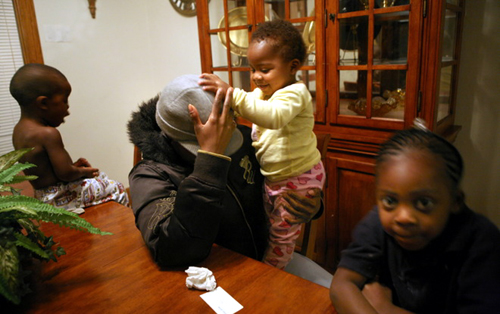
Torneshia Simmons sits with three of her children in her Racine home on Dec. 18. Simmons first became an approved provider and received Wisconsin Shares money in 2002. Her sister Shanta McKinney first received child-care subsidies in 2003. (Kristyna Wentz-Graff)
The two-story house on 17th St. looks typical of the working-class homes on Racine's west side. Three bedrooms, one bath. Assessed by the city at $122,000.
Yet inside, a young woman has tapped into a home-based money-making operation that netted her and her three sisters more than half a million in taxpayer dollars since 2006.
And they did it with the blessing of the state.
All four had been in-home child-care providers. Collectively they have 17 children. For years, the government has paid them to stay home and care for each other's children.
Nothing illegal about it under the rules of Wisconsin Shares, the decade-old child-care assistance program designed alongside Wisconsin's welfare-to-work program.
"It's a loophole," said Laurice Lincoln, administrative coordinator for child care with the Milwaukee County Department of Health and Human Services. "Do we have concerns about it? Yes, it can be a problem. But if it's allowed, it's allowed. We really can't dispute it."
The Journal Sentinel spent four months investigating the $340 million taxpayer-supported program and uncovered an array of costly problems - including fraud. But the investigation also revealed a system rife with lax regulations that have paved the way for abuse by parents and providers.
Consider:
• Sisters or other relatives can stay home, swap kids and receive taxpayer dollars. The four Racine sisters took in as much as $540,000 in taxpayer dollars in less than three years, mostly to watch each other's kids.
• Rules allow parents to be employed by child-care providers and enroll their children at the same place. At some centers, children of employees make up the majority of kids in day care. In one Milwaukee location, an employer and parents are accused of teaming up to bilk the system out of more than $360,000.
• Child-care subsidy recipients have been allowed to work for almost any type of business. Payments were made when moms claimed to work ironing a man's shirts, drying fruit and selling artwork they made during art class.
• The government pays for child care while parents sleep. Counties have no way to monitor whether parents are actually sleeping while their kids are in day care.
"We're not being good stewards of taxpayer dollars," said state Rep. Robin Vos (R-Racine) who introduced legislation in 2007 to try to crack down on child-care related fraud. "We have a system where there's a whole lot of finger-pointing going on and in between, a whole lot of fraud happens."
The state published new rules in November - a month after the Journal Sentinel began asking questions - yet three of the five counties with the majority of Wisconsin Shares cases were unaware of the new requirements until contacted by the newspaper.
Caring for family
Torneshia Simmons, a 28-year-old single mother of five, sat at her dining room table at her 17th St. house in December surrounded by her children - all under the age of 9. The younger ones climbed on her and tried to snatch the hat off her head as she explained how she and her three sisters have been caring for each other's kids for years.
"I've been doing child care for my family since I was like 14," she said. "I've been watching their kids before I had kids, after I had kids, I've been watching all my friends and family's kids."
Simmons first became an approved provider and received Wisconsin Shares money in 2002. Her sister Shanta McKinney first received child-care subsidies in 2003. Other sisters Tumina Ransom and Temeshe Brown got into the business in 2006 and 2007, according to state regulators.
For a while, Simmons took care of Ransom's and Brown's kids, she said. Then last summer her 2-year-old son was found wandering around outside unsupervised. The county shut down her child-care operation.
She said she now has another job that keeps her qualified for government-supported child care.
But when asked for details about her work, the answers got fuzzy.
First she said she worked at a clothing store called Get Fitted, Family Owned on Washington Ave. She said she worked second and third shift. A few minutes later she said she worked part time and the store was simply called Family Owned.
It's unclear what she would be doing working third shift at a retail clothing store.
And when the Journal Sentinel contacted the co-owner of Get Fitted, Carey Collins, he said Torneshia Simmons doesn't work there and never has. He didn't recognize Simmons' name. And his store closes at 8 p.m.
The Journal Sentinel could find no record of a clothing store called Family Owned. The Racine Area Manufacturers and Commerce and the state Department of Financial Institutions couldn't either. Simmons didn't list an address or phone number on documents filed with Racine County. Nor did the documents contain a federal tax identification number - all facts that should have raised the suspicion of Racine county workers.
Yet workers approved funding for Simmons' kids to be in her sisters' care 75 hours per week, costing taxpayers a weekly total of $1,283.
Simmons, who filed Chapter 7 bankruptcy in 2007, claims her children now go from McKinney's Racine house to Brown's house in Kenosha at about 11 p.m. McKinney, who has three young children of her own, and Brown, who has five, drop off or pick up the kids, she said.
But rules prevent providers from caring for more than six children at a time - depending on their ages - so for Brown to care for Simmons' five children, she would have to take her own kids elsewhere at 11 p.m.
Documents show Ransom is authorized to take care of Brown's kids.
Ransom, McKinney and Brown declined to comment or didn't respond to attempts to contact them.
Simmons said she's not concerned that the arrangement could interfere with her children's sleep. They go to bed whenever they want anyway - usually around 11:30 p.m. or midnight, she said.
State officials say such a situation is out of their control.
"Even though it might not appear to be in the best interest of the children, we don't have any authority to regulate that," said Jim Bates, a program analyst for Wisconsin Shares.
The government spends $66,716 a year on child care for Simmons' kids. That's 75% more than the average Wisconsin worker earned in 2007.
The full extent of the caregiving relationships is unclear in records, but it appears the sisters frequently change the arrangements.
Racine County officials declined to comment on the four sisters.
Nobody knows how often any of the roughly 34,000 Wisconsin families who receive child-care assistance take advantage of regulations allowing siblings to care for each other's kids. Neither the state nor the counties track that data.
But the Journal Sentinel discovered it's not the only rule that's especially prone to abuse.
Often-necessary perk
Providers and parents are also exploiting the rule that allows parents to become employees of the child-care center where they enroll their children, documents show.
The provision is common in the child-care industry. It provides an often-necessary perk for a typically low-wage job, professionals in the business say. However, if not properly monitored, providers and parents can team up to easily defraud the system.
In October, the Milwaukee County DA's office filed charges against the owner of Tender Moments Day Care Center on W. Capitol Drive.
The complaint alleges the owner, Shartavia Adams, and her mother, Bernice Watson, bilked the system out of more than $360,000 from September 2006 through October 2007. It was the first time in the last five years that prosecutors in southeastern Wisconsin have brought charges of suspected child-care fraud. And it is the largest such case in Milwaukee County history.
"There's no reason to believe that was an isolated case," said David Feiss, a Milwaukee County assistant district attorney who is prosecuting the case.
Watson and Adams allegedly recruited women to work at the day care center. The women would then enroll their children in the center - bringing in roughly $150 to $220 per week per child. The children seldom attended and their mothers rarely worked, according to the complaint. But Adams billed the state more than $2 million in 2006-'07.
As one state worker put it in a memo to colleagues, Bernice Watson is "known in the child-care community as the 'day-care pimp.' "
Watson and Adams have pleaded not guilty. Both declined to talk to the Journal Sentinel.
The Wisconsin Department of Revenue could not locate tax records for Adams in 2006 or 2007.
It's difficult to say how often this type of situation occurs, because full-blown investigations are rare. It is, however, typical for some of the bigger child-care centers to employ the parents of the children enrolled, legitimately or otherwise.
Kuddle Kare on W. Lisbon Ave. was authorized to care for 35 children in any given shift. Last summer, 28 children at the center belonged to 11 mothers who were listed as Kuddle Kare employees. The center shut down in July when a baby died after being left in the owner's car all day. The mom was a former employee of the center, who wasn't at the center when the tragedy occurred.At two of Bessie's Kiddie Kollege's four Milwaukee locations, nearly half of the kids authorized for care are children of employees. Bessie's took in $2.4 million from the state in 2006-'07.
And at Dreamland Child Care on N. Teutonia Ave., at least 50 of the 170 children enrolled belong to employees of the center. The state has paid $3.4 million to the center in the last two years, records show.
Dreamland owner Cassandra Holley said there's nothing fishy about it. She doesn't require her employees to enroll their children at her center. In fact, she used to have a policy forbidding employees to enroll their kids because it was too distracting to workers and upsetting to the children. But then some of her longtime staffers started having babies and urged her to change the policy.
"They work in different departments&ensp.&ensp.&ensp.&enspand the center is big enough to accommodate - without them working with their children," said Holley, who has owned her child-care business for 21 years.
Nothing in the regulations prohibits parents from working at a child-care center and enrolling their children there.
In fact, it makes good sense in some cases, said Paula Lucey, former director of Health and Human Services for Milwaukee County.
"Many women entering the work force off of W-2 have limited skills, so a child-care provider could be an ideal place to work," Lucey said.
Still, it should raise red flags when the ratio of workers to children is disproportionately high, said Djordje Rankovic, a former Milwaukee police detective who spent a year investigating the Tender Moments case.
"There's something wrong," Rankovic said, speaking generally. "You don't need that many people employed."
Milwaukee County investigators expect to take action soon in a case where all the children at a day care center belong to mothers who work at the center. The whole arrangement is fraudulent, regulators said.
Rankovic is convinced a good chunk of the state's 5,600 child-care providers that receive taxpayer subsidies are stealing from the system.
"I think it's just rampant through the whole state, if not the country," he said. "It's so easy to do, and there's nobody really monitoring it."
Paid to sleep
State and county regulators admit nobody is monitoring another provision that allows parents to get paid to sleep. The provision was designed to allow parents with young children to work third-shift jobs and sleep in the daytime.
Front-line county workers say more and more people are taking advantage of the rule - despite a drop in manufacturing jobs that offer third-shift opportunities.
Regulators can't confirm or dispute the assertion because neither the state nor counties systematically track how many people using the program work third shift or how many hours they authorize for children to be in day care while their parents sleep.
Even if they knew how many hours were authorized, regulators admit there's no way to ensure parents use the hours properly.
"It's a hard thing to monitor," said Bates, the state analyst. "It could certainly lend itself to abuse."
System's other pitfalls
Other pitfalls in the program stem from regulations that have allowed parents to work for just about any type of business and qualify for publicly supported child care.
Payments to child-care providers have been made based on women claiming to work ironing a man's shirts a few hours a week, selling amateur artwork and dehydrating fruit - all jobs that are difficult for county workers to verify, according to front-line workers.
"Let's say you set up a hair-braiding business and you do it one hour a week, you are good," said Vos, the state lawmaker from Racine.
In November - more than a month after the Journal Sentinel first began asking the state about oversight of Wisconsin Shares - the Department of Children and Families published a new child-care policy manual spelling out how counties should verify employment.
It detailed requirements that employers must have federal tax identification numbers and carry worker's compensation, along with other provisions.
Yet in December, Brown, Kenosha and Dane counties said they were unaware of the new regulations and had not been following them.
"I don't have a clue about that," said Sara Shackleton, associate division manager for economic support with Dane County, when asked about two of the new requirements. Shackleton retired in December.
© 2009 Milwaukee Journal Sentinel
State unable to collect overpayments to providers in child-care subsidy program
By Raquel Rutledge
The state has overpaid day care providers at least $13.7 million in recent years - including millions of dollars spent on bogus child care that was never delivered, according to the state's own records.
When regulators have tried to collect the misspent taxpayer-funded money, parents and providers have stiffed the state to the tune of $6.4 million, the Journal Sentinel has found.
A four-month Journal Sentinel investigation published last month detailed a lack of regulatory controls within the $340 million Wisconsin Shares child-care subsidy program - a system prone to abuse and fraud that can go undetected.
Even with lax oversight, state regulators have identified millions of dollars that should not have been paid to providers.
Collecting the money has been another matter.
State officials say that in many cases their hands are tied, making it difficult to go after providers and parents who owe money. The state has no system to collect from providers that go out of business.
"They are essentially dead to us," said Henry Wilde, deputy secretary of the state Department of Children and Families. "There has to be some statutory changes. And that's our next step."
The state shut down 20 providers suspected of fraud in the last five years who owed $1.3 million. More than $1.2 million of that amount has gone uncollected.
Consider the case of Sarah Wiley-Jorgensen and her two day care centers in Eau Claire County called Great Beginnings.
Wiley-Jorgensen was licensed by the state in 2001 to care for eight children in her home. In 2003, the state began warning her to keep better attendance records. The warnings continued for five years - even through 2007, as she opened a second center and received a license to care for 24 more kids.
In January 2008, the state went back and began reviewing months of Wiley-Jorgensen's records, comparing the hours she billed the state with the attendance records she was required to keep at the centers.
What they found amounted to one of the largest cases of overpayments in state history, records show.
In one eight-month period, Wiley-Jorgensen appeared to have overbilled the state by $103,575, regulators calculated. The state didn't believe she was actually caring for the number of kids she claimed in her reports.
"On a number of occasions ....you submitted false claims for children under the Wisconsin Shares child-care subsidy program," regulators wrote in a letter to Wiley-Jorgensen.
In March, regulators revoked her two licenses. Now the Eau Claire County district attorney is investigating.
Wiley-Jorgensen said she was simply guilty of poor record-keeping.
"I messed it up," Wiley-Jorgensen said. "I regret that to the utmost. I should have had a sign-in and sign-out sheet. .... I wasn't the best businesswoman. But I am not a bad person or fraud."
She added that she was in no position to pay back the money.
"I don't know how you're going to get blood out of a turnip," she said.
Consider discrepancies
Overpayments to child-care providers occur for various reasons. Providers bill for hours they didn't actually take care of children, for example, or they bill for more children than their license or certification allows. Sometimes providers don't keep accurate attendance logs.
Parents also can trigger improper payments when they take children to day care but don't go to work. Sometimes they don't report their income accurately or disclose who is living in their home - both factors in qualifying for publicly funded child care. Regulators blame parents for more than 75% of uncollected overpayments on the books.
The amount of money misspent by the state is probably much higher because spurious cases slip through the system undetected. With only limited access to records, the Journal Sentinel identified about $750,000 in suspicious payments to child-care providers as part of the newspaper's initial two-part "Cashing in on Kids" series.
But states and counties seldom consider discrepancies in paperwork by parents or providers to be fraudulent. Instead, they are most often treated as mistakes and called overpayments.
When overpayments are discovered, state regulators have several ways to collect from parents who have abused the system. Regulators can intercept tax refunds, including earned income credits and homestead credits.
Beginning in 2007, regulators started to go after personal income, including wages. And just this month, they added the ability to file tax liens on property.
Still, parents collectively owe more than $4.8 million that can't be collected using any of these methods, records show. That's because most of these parents don't own property or aren't earning income.
"We keep them on the books for 20 years and ... if someone comes up for air and gets a tax refund or starts getting wages legally, we're going to find them," said Wilde, of the Department of Children and Families. "I don't know what the odds are, but we're still seeking those payments."
Providers shut down
To get money repaid by providers that are still in business, the state withholds a percentage of Wisconsin Shares money until the debt is repaid.
That's rare, however. It happens about a third of the time and accounts for less than $250,000 of the money owed.
More often, providers get shut down or go out of business, leaving the state out of luck. More than 300 of the 521 providers who owe money fall into that category.
State regulators are working to link each child-care business to an individual owner so they can go after the owner's personal income should the business close. They hope to have the system ready by the end of the year.
"What we have in place is insufficient," said Reggie Bicha, secretary of the Department of Children and Families.
The state sends three notices reminding providers of their debt. If the providers fail to respond, the collection process typically ends, officials said.
Tender Moments Child Care center on W. Capitol Drive got three notices - and ignored them all. State officials say the center owes $850,000 that it received in overpayments.
Under the rules, the state has no way to recover the money. The owner of Tender Moments, Shartavia Adams, and her mother, Bernice Watson, face criminal charges accusing them of recruiting women to work at the center and enroll their children.
The women didn't work and the kids didn't attend, officials allege. But Adams billed the state roughly $200 per child, every week for about a year. The Milwaukee County district attorney filed fraud charges against the pair last fall. Watson and Adams are due back in court next month.
In another Milwaukee County case, regulators have been unable to collect nearly $73,000 from Nicole Cares Family Child Care Center on N. 34th St.
Nicole Mills, owner of Nicole Cares, was granted a license in January 2008 to care for eight children. In June, county caseworkers reviewed her paperwork. They found Mills had been billing the state for children who were not in her care.
Like the Tender Moments case, Mills also employed women specifically to help qualify them for the child-care subsidy. The women didn't actually work, the kids didn't actually attend, but Mills billed the state, records show.
State regulators revoked her license in September. Mills has yet to repay a penny. She could not be reached for comment.
Federal mandate
Federal regulators were warned about a lack of oversight within the child-care subsidy program almost five years ago.
The U.S. General Accounting Office cautioned regulators in 2004 that the system was vulnerable to abuse.
About two-thirds of the money spent on Wisconsin Shares comes from the federal Child Care and Development Fund and Temporary Assistance for Needy Families.
The federal Administration for Children and Families "has no oversight activity concerning the issues of improper payments or management of the roughly $8.5 billion in (federal) funds spent on child care," staffers in the Child Care Bureau wrote in 2004.
Federal regulators in 2007 mandated that states report how often they overpay child-care providers.
Wisconsin's report isn't due until June.
"The whole thing is ridiculous," said Cindy Jaeger, a former Milwaukee County worker.
Jaeger spent the last decade working for the county's program integrity unit, building cases against people suspected of bilking the system.
Jaeger said more collection tools will certainly help. But she said the problems can't be solved until county workers and leaders place a higher priority on stopping fraud.
"Nobody cares," said Jaeger, who left the Department of Human Services in December to have hip-replacement surgery and decided not to return.
Learning from Oklahoma
If the state is looking for ways to recoup more of its money, it can learn from Oklahoma.
Regulators in that state recover about 90% of overpayments, said Lisa Henley, director of Oklahoma's electronic payment systems. The state slaps huge fines on providers intentionally overbilling the system. It also does a better job collecting from owners of child-care businesses that draw overpayments.
"You have to be serious about it," Henley said. "I look at it like, 'This was not your money. It belongs to the taxpayers and we're going to go after it.' "
Taxpayers in Wisconsin will likely never see the nearly $46,000 in overpayments to 4 Family Child & Development Center on N. 21st St.
State regulators found "serious violations of attendance records" in 2005-'06 by the owner of the day care center, Tamarah Geter. In addition, Geter failed to report the income of her employees to the state.
"The behavior and actions of Tamarah Geter in submitting billing for low-income child-care assistance without documentation of services provided is indicative of unsound business practices and raises serious concerns about Ms. Geter's ability to operate a licensed child care center," regulators wrote in a notice of revocation in 2006.
Geter said her sign-in/sign-out sheets were accidentally thrown out.
"I had just taken the initiative to clean out my closet and drawers to organize my paperwork from the previous year and get some well needed paint work done," she wrote in a letter to state regulators.
"I had no idea that sign-in and sign-out sheets had to be kept present in the center for a certain period of time, so when my employees threw some of them away as they were cleaning, I really did not know that the consequences would be so severe."
Geter could not be reached for comment.
State cuts funding to center run by wife of Lock, looks into another
By Raquel Rutledge
Several years before she opened her Milwaukee day care center, Shalanda Lock went by the name "Pleasure." Police and prosecutors say she danced in strip clubs and sold sex across the Midwest.
They say she was the madam, lining up hookers and prostituting herself, while pumping the proceeds into a criminal empire led by her husband, Michael Lock, the featured subject in this week's Journal Sentinel series, "The Preacher's Mob."
State regulators who licensed Shalanda Lock's Nuk Nuk's Childcare Development Center at 3800 W. Vliet St. learned of nearly a dozen pending prostitution charges against Lock in 2007, just months after they first licensed her.
But Lock was allowed to continue running the center and collected nearly $380,000 in taxpayer money from Wisconsin Shares, the state program that subsidizes child care for low-income working families.
She stayed in business even as regulators learned she had abused or neglected her children.
The state cut off Lock's public funding this week after questioning by the Journal Sentinel.
The accused prostitute isn't the only Milwaukee day care provider tied to convicted crime boss Michael Lock.
Nicole Brown, owner of Jasmine's Learning House near N. 35th and W. Congress streets, admitted using her day care center to falsify employment records as part of Lock's scheme to defraud mortgage lenders. Records and interviews show she may also be scamming the Wisconsin Shares program.
At the time of the federal indictment in 2007, Brown and other participants in the scheme had spurred lenders to advance more than $2 million in loans based on fraudulent representations.
Brown pleaded guilty and was convicted in 2008. She is awaiting sentencing.
But that hasn't interfered with her day care operation. Brown took in more than $1.1 million in taxpayer money from 2006 to '08 and is on pace to make at least $400,000 in 2009 if her billing continues as it has in recent weeks.
State regulators initially revoked her day care license, saying "her actions and criminal activity are directly and substantially related to the care of children and activities of a center."
The charges raise concerns about her ability to conduct business in an "ethical and honest manner and constitute proper grounds for revocation of her license to operate Jasmine's Learning House," regulators wrote in a December 2007 letter.
Yet in July 2008 they reversed the decision and allowed her to reopen with a few conditions. The main one forbids her from allowing any of the people involved in the scheme from being on the day care premises.
Brown's cooperation with federal investigators on the mortgage fraud case also factored into the decision to allow her to reopen, said Erika Monroe-Kane, spokeswoman for the state Department of Children and Families.
"We worked out an arrangement that would provide her business an opportunity to move forward in consideration of the role that she played as being a whistleblower and being forthcoming in assisting the investigation," Monroe-Kane said.
Brown's role in verifying employment information was critical to Lock's mortgage fraud scheme. Without it, buyers never would have qualified for loans.
Brown defended her actions in the mortgage fraud scheme, saying she was only trying to help a friend.
"I got involved in something that I didn't know what I was getting involved in and unfortunately for me, I have to suffer the consequences," she said. "It wasn't like I set out to maliciously take this money, because I didn't."
Brown said she didn't get any money out of the deal.
But it now appears all might not be legitimate with her day care business.
Brown typically bills for at least 49 children in attendance - more than half of whom are scheduled to be at her center after school, according to state records. Yet on two recent afternoons, workers shut off the lights, locked up the center and left at 4:30 p.m. No after-school children were anywhere to be found.
When stopped outside her center, Brown said the van had broken down and that's why there were no children there. But a Journal Sentinel reporter spotted a van picking up six infants and toddlers from Jasmine's and leaving around 4:30 p.m.
Other claims by Brown raise suspicion.
Brown says that only three of her workers have children enrolled in her center. She said she has nine to 10 workers on the payroll.
Yet documents show that at least 10 women who reportedly work there have 32 children enrolled.
Such an arrangement is a red flag that providers could be scamming the system, regulators and prosecutors say.
"We are monitoring, we are looking at her child-care center," said state spokeswoman Monroe-Kane.
In February, Brown was cited for 38 rule violations, from filthy conditions to not keeping proper paperwork. She has been repeatedly cited throughout her years of operation with not keeping accurate attendance reports.
Still, state regulators say her day care business is not their top priority.
"When you look at it from a data perspective, what we see is not placing it at the top of our list," Monroe-Kane said.
Shalanda Lock, too, had her license revoked in December 2007 once the state learned of pending criminal charges. And, like Brown, Lock was allowed to continue operation while her appeal was pending.
She remained open even as regulators realized in August 2008 that they never should have licensed her in the first place. Child welfare workers in Milwaukee had determined in 2002 that Lock had abused or neglected her children.
The federal Drug Enforcement Administration raided her home and found a machine gun with bullets sitting on the kitchen counter along with a live hand grenade. Both were accessible to the children. State licensors didn't catch the abuse because Lock went by the name of Shalanda Mason before she was married.
State rules prohibit anyone with a child abuse background from becoming a day care provider unless they have completed a rehabilitation program. Lock never did.
Repeated attempts to reach Lock at Nuk Nuk's and by phone were unsuccessful.
Just this week, Milwaukee County, in conjunction with state regulators, shut down Lock's authorizations to care for any children receiving subsidized care.
"We have taken the action that we can," said Monroe-Kane.
Regulators say a slew of changes are under way internally and legislatively that will make shutting down providers like Lock and Brown far easier.
State Sen. Robert Jauch (D-Poplar) said the Department of Children and Families clearly needs new tools to deal with corrupt providers. In the past, the department has focused on ensuring children were safe, and regulators have been too trusting, he said. Jauch is convinced the new rules and laws will cut fraud substantially.
"It would have been nice to do this earlier and sooner, but we have the information and are taking the appropriate steps now," said Jauch, chairman of the Committee on Children and Families and Workforce Development.
Rep. Tamara Grigsby (D-Milwaukee) said it's obvious to her as well that significant reforms are needed.
"The main thing is we simply haven't had enough oversight of this program up until now," said Grigsby, who chairs the Assembly Committee on Children and Families. "If they (providers) have proven themselves to be an unscrupulous business person....I think that should be an immediate red flag. We should have been looking at that a long time ago."
© 2009 Milwaukee Journal Sentinel
People with serious convictions are getting licenses, hundreds of thousands in state funds
By Raquel Rutledge
A couple of days before Thanksgiving in 1996, Lisa Johnson took her 12-year-old foster daughter to the basement, pulled out an extension cord and whipped her with it, repeatedly.
Johnson turned on some music and cranked up the volume to drown out the girl's cries. Still, other foster children in the house later told Milwaukee police that they could hear the girl beg for mercy.
"I swear to God, Mama, I will be good," the children reported hearing.
Good - meaning she would never chew gum in school again.
Johnson, now 42, was charged with felony child abuse and in 1997 pleaded guilty to battery and domestic abuse. Her foster license was revoked.
Yet three years later, she opened a certified day care center in Milwaukee County called Planting Seeds.
And as of April 2009, she had taken in more than $430,000 from the taxpayer-supported Wisconsin Shares child-care program, while running a center with numerous violations and recurring problems.
Johnson's story isn't that unusual. The Journal Sentinel found that child abusers and people who have committed other serious crimes are becoming licensed child-care providers and are earning hundreds of thousands of dollars through the Wisconsin Shares system. Nearly 500 child-care providers in Wisconsin with criminal records have received funding from the state in the first half of 2009 alone, according to a computer analysis by the Journal Sentinel.
The $350 million-a-year program subsidizes child-care costs for roughly 35,000 low-income working families. But the system has been easily scammed by parents and providers.
In addition to posing a potential safety risk to the state's neediest children, some criminals appear to be conning the child-care system, doctoring attendance records, the Journal Sentinel found.
It's difficult to gauge the full scope of child abusers in the system because even when police and child-welfare workers find substantiated cases, not all abusers are criminally charged. And when they have been charged, many of the details are considered private information. To tell this story, the Journal Sentinel reviewed thousands of pages of public documents and obtained from sources dozens of additional documents that state and county regulators refused to release.
State regulators typically conduct background checks on a child-care provider every two years, when the provider's license needs to be renewed. If a provider commits a crime in the interim, the person is supposed to report it to regulators. The state does not run systemwide criminal-activity scans of providers.
"That makes me nervous," said Beverly Anderson, executive director of Ebenezer Child Care Centers and co-chairwoman of the Milwaukee Child Care Alliance. "I certainly hope someone is taking a look at this."
Nothing in the regulations prohibits people convicted of crimes from getting into the child-care business. There is no permanent ban, no matter what crime has been committed. If the crimes are directly related to children or are considered serious, the child-care providers need to prove to regulators that they have been rehabilitated before they are eligible. Even those convicted of homicide or sexual assault can qualify, as long as they can convince a three- or four-member panel that they are fit to operate a center.
Proving rehabilitation
That's what Lisa Johnson did after her domestic abuse conviction. She told state and county panel members in July 2000 that she was going through a stressful time when she beat her foster child. Her husband had just been killed in a car accident, according to a hearing transcript. She said the girl was the most difficult of her four foster children, and the child had been shouting obscenities at her teachers the day of the beating.
"I guess I allowed a lot of anger to build up within myself," she told the panel. "I know what I did was wrong, and I'm not trying to minimize it....And I do take full responsibility."
Johnson also acknowledged that it was not the first time she had whipped the girl with an electrical cord. But Johnson said she had since taken parenting classes that taught her it was not the proper way to discipline a child.
"I have changed," she said.
The panel was convinced. A few days later, the state Department of Health and Family Services issued a letter informing her, "You have demonstrated sufficient evidence to support rehabilitation approval."
Milwaukee County certified her as a day care provider, and a year later, she became licensed by the state with the stipulation that she take two anger management classes or consult with a mentor.
In subsequent years, she was cited repeatedly for numerous violations, including not keeping proper attendance records and not taking the biennial training classes on child abuse and neglect, but she had not been cited for abusing children.
State regulators revoked Johnson's license in April after questioning by the Journal Sentinel. The reason: She owed the Department of Revenue more than $5,700 in back taxes. Johnson did not pay the taxes or appeal within the required 30 days and was officially shut down May 14, according to Erika Monroe-Kane of the state Department of Children and Families.
But in an interview last week, Johnson said she had not lost her license and continues to operate her day care center. She said she was not aware of any back taxes and had never been notified by the state of any revocation.
In fact, she received nearly $2,000 in child-care subsidies June 6 for care delivered in the last two weeks in May, state records show.
State regulators said they sent the revocation letter by certified and regular mail but don't follow up with a phone call or visit.
"If the letter sent through the regular mail is not returned, the presumption is that this was received," Monroe-Kane wrote in an e-mail to the Journal Sentinel. "We expect that once a business has received a closure notice, they will cease operations. In our experience, it would be rare that a center continue to operate after this."
After her interview Wednesday with the newspaper, Johnson contacted the state and paid her back taxes. Monroe-Kane said Thursday that Johnson's day care license will be reinstated.
'This lady is really bad'
A lack of oversight and lax rules allow people whom the state has warned to stay away from day care centers to become licensed child-care providers.
In 2003, Willie Kohlheim was licensed by the state to care for up to eight children at his home on N. 17th St. Regulators granted Kohlheim the license with one stipulation: His wife, Pamela, would not be allowed on the premises.
Pamela Kohlheim had been denied certification to run a child-care business by Milwaukee County the prior year.
"This lady is really bad," a county worker warned in an e-mail to state regulators about Willie Kohlheim's pending license in 2002.
Pamela Kohlheim's history includes arrests, charges or convictions for various crimes such as dealing drugs and writing bad checks. She also was accused of threatening to kill Willie Kohlheim's ex-girlfriend. She was sentenced to 90 days in the House of Correction and 18 months' probation in 2002 for violating a domestic abuse order.
The state Department of Health and Family Services determined that Pamela Kohlheim had "exhibited past behavior that establishes a pattern of criminality." Her conduct gave regulators "concern for the health, safety and welfare of children," Cinda Jones, regional licensing chief with the state, wrote in the stipulation letter.
There were other red flags. Willie Kohlheim had a full-time job for 17 years, making it difficult for him to run a child-care center on the side.
"This lady will probably be doing the care. That is scary!!" a county worker wrote in an e-mail to the state.
But Willie Kohlheim claimed he was separated from his wife. He guaranteed she would not be involved in the day care center.
The state licensed Willie Kohlheim.
Soon after, complaints began rolling in. Parents and employees reported in 2004 and 2005 that Pamela Kohlheim actually was running her husband's business while he worked elsewhere.
In fact, the state's own documents show he earned nearly $75,000 in 2004 and 2005 working for Metz Baking Co. Those same years, the state paid him about $175,000 for reportedly taking care of children.
Other complaints at the time claimed that Pamela Kohlheim offered parents employment and kickbacks if they would enroll their children. Employees told inspectors that the Kohlheims billed for kids not in attendance and left older kids in charge while they stayed in their bedroom.
Sometimes, the Kohlheims fought in front of children, kicking over furniture, punching each other and using obscenities, employees said.
In the midst of it all, Willie Kohlheim received more than $725,000 from the Wisconsin Shares program from 2003 to 2008.
And then, in 2008, instead of shutting down the day care center, the state licensed Pamela Kohlheim to care for up to 31 children at a new Milwaukee day care center called From Up Above on N. Humboldt Blvd.
Throughout the year, as she received public funding, Pamela Kohlheim repeatedly was cited by the department for not keeping accurate attendance reports, not properly supervising children, keeping or serving leftover milk and old food, not cleaning the diaper changing area, leaving dangerous materials within reach of children and other violations.
Inspectors visited her center 13 times in 2008, mostly in response to complaints, records show.
Also that year, the Kohlheims filed restraining orders against each other, with both claiming that one had threatened to kill the other. The court granted the injunctions.
Yet the Kohlheims still qualified to care for kids.
In that one year alone, Pamela Kohlheim received more than $540,000 from Wisconsin Shares.
Billing suggests scam
And if December's billing is indicative of earlier months, the money was spent on what police and regulators consider a likely scam.
All 19 children for whom Pamela Kohlheim charged the state that month belonged to employees of the center. Authorities say that type of situation often indicates fraud. Parents would not need to show up for work, under those circumstances, if they were just taking care of their own kids.
In December, Pamela Kohlheim voluntarily closed her center with the hopes of reopening a smaller center in her home.
She was denied a license in February when she reapplied. State regulators now are considering legal options to recover some of the $540,000 she received in 2008.
Regulators can't say why Pamela Kohlheim went from being barred from her husband's business to being licensed to run her own center.
"I don't want there to be any confusion about our opinion of the service they were providing," Monroe-Kane said. "This is not a quality center, and as result they no longer have a license."
Willie Kohlheim voluntarily closed his business in 2008, shortly after Pamela Kohlheim opened hers. He reapplied in January of this year for a new child-care license. The state Department of Children and Families denied his application May 29, weeks after the Journal Sentinel began asking questions.
New rules being put in place or considered by lawmakers will make it easier for regulators to shut down providers like Willie and Pamela Kohlheim more swiftly, Monroe-Kane said.
State-county miscues
Poor communication between state and local agencies allows some providers to remain in the system when they shouldn't.
In the case of Patricia Carter-Lee, the state and Milwaukee County were aware of accusations that she had abused a child. Yet they failed to communicate, and Carter-Lee's home-based business, Joy's Day Care Center on N. 25th St., kept on chugging.
In April 2002, regulators with the Bureau of Milwaukee Child Welfare investigated accusations that Carter-Lee hit one of her foster children with a belt.
Carter-Lee was certified by the county to provide day care for as many as six children. She also was licensed by the state to care for eight children.
State regulators suspended her day care license immediately during the investigation.
Carter-Lee and her husband, Terry Lee, denied physically punishing their foster children, records show. They did, however, admit to using belts, paddles and their hands to "whoop" their own children.
Still, an attorney with the state division of appeals wasn't convinced that Carter-Lee was a threat to children. Attorney Brian Schneider ordered that the suspension be rescinded. There were no allegations that Carter-Lee abused children in the day care, Schneider reasoned.
"I question whether there is imminent danger to the day care children, even with the investigation pending," Schneider wrote.
Then in July 2002, when county welfare workers concluded their investigation and found the allegations to be substantiated, Milwaukee County regulators yanked her child-care provider certification.
The state allowed her to keep her child-care license.
It's unclear if the state was aware of the county's findings. The state declined to release some of the documents that would explain exactly what transpired, citing confidentiality laws.
There was another allegation of child abuse against Carter-Lee in 2001 that was unsubstantiated. And one in 1997 that was substantiated by local child welfare workers but overruled years later by a state administrative law judge.
It's also unclear whether state regulators knew that Milwaukee County had revoked her child-care certification.
Carter-Lee did nothing to clue in state regulators. In fact, records show, she lied repeatedly on her license renewal applications. On four separate occasions, she denied that she had ever had a certification revoked.
Repeated violations
Over the years, Carter-Lee expanded her business, collecting more and more Wisconsin Shares funding. In 2008, she brought in nearly $125,000. By April 2009, she was on pace to make more than $140,000.
All the while, state regulators have cited her repeatedly for not keeping accurate attendance records. She also has been cited for inadequate training of her staff, failure to serve proper meals to children and other serious rule violations.
In 2003, her day care center was investigated for reported sexual abuse of a child. Milwaukee child welfare workers could not substantiate the allegation, according to records.
In 2005, someone complained that kids were left alone in Carter-Lee's van in the parking lot of a Dollar Store for 20 minutes, records show. A state inspector at the time, Mark Mitchell, confronted Carter-Lee a week later. She denied the allegation.
"Not able to substantiate," Mitchell wrote in his report.
Regulators suspected her of fraudulent billing in 2007. And that same year, she admitted that all the children in her care belonged to people who worked for her center.
In April, she was cited for 18 rule violations, including not keeping accurate attendance reports, state records show. Regulators issued yet another warning in May.
That hasn't stopped Carter-Lee.
When the Journal Sentinel stopped by her house last month, she had two children in her care. She usually bills for between 16 and 24 kids per day. She said the others wouldn't be coming that day because her husband had jury duty and couldn't pick them up.
None of her employees was available to help, either, she said. She said she wrote a letter to parents notifying them that they would have to find other arrangements. But she could not find a copy of the letter.
She said she has never abused a child at her day care center.
"I ain't going to whip no day care kids," she said. "That ain't my responsibility."
Still around kids
Sometimes, it's not the provider who commits the crime or abuse, but someone who lives in the house and is around the children in the day care center.
Regulators with Milwaukee County revoked Rodney Bowman's child-care provider certification in 2003, based on criminal arrests for battery in 1994, 1998 and 2002.
"You have established a pattern of behavior that could put day care children at risk," the revocation letter states.
Bowman had run his home-based operation, called Milwaukee's Finest Child Care, for two years out of a house on W. Galena St., around the corner from a day care of the same name run by his mother, Fannie Bowman. Fannie Bowman's business also is based in her home.
Within weeks of his license revocation, Rodney Bowman moved in with his mother, according to court records and interviews with the Bowmans.
He lived there while he had been convicted of felony drug dealing and violating a domestic abuse order. Documents show he lived there in 2006, when he was charged with felony child abuse, and in 2007, when he was convicted of criminal trespassing and violating another domestic abuse order. That same year, he also was found guilty of obstructing an officer.
Rules require home-based day care providers to disclose the names of all individuals living in their homes. And day care providers are restricted from having certain types of felons, such as convicted drug dealers, living in the home where they care for kids, unless they've received approval from regulators.
Fannie Bowman told the Journal Sentinel that her son moved out a couple of months ago but that it was no secret that he lived there all those years. State regulators knew it all along, she said.
"He had to live somewhere," she said. "He was always here when they (state inspectors) came around."
Rodney Bowman was at his mother's house while she cared for children when the Journal Sentinel stopped by last month.
He said he regretted having drugs in his mother's house and said he had learned from his mistakes. He said all the other criminal charges against him were fabricated by a former girlfriend.
Over a two-year period, Fannie Bowman was cited by the state for violating rules nearly 30 times - including not keeping accurate attendance records. In January, regulators issued an enforcement order warning her to comply with transportation, safety and record-keeping rules, records show.
State regulators said they were never notified by Fannie Bowman that Rodney Bowman was living in her home.
Fannie Bowman collected $46,000 from the state's subsidized child-care program in 2008. She is on pace this year to double her income from the program.
Ben Poston of the Journal Sentinel staff contributed to this report.
Some who have previous records
Nearly 500 child-care providers collecting Wisconsin Shares money have criminal records. They include:
LaToya Robinson, who was found guilty of a felony for fraudulent use of public-assistance funds in 2004. She still runs a day care center in Madison and has collected nearly $3,800 in subsidies so far this year.
Synthia Bruce, who was convicted in 2003 and again in 2004 of disorderly conduct. In January 2009, Bruce was charged with battery, criminal damage to property and disorderly conduct. That has not stopped her from running her Racine day care center and collecting more than $17,000 in public child-care funding this year.
Christina Froemel, who was charged with felony battery and disorderly conduct in 2006. The Hayward woman pleaded guilty to a misdemeanor and continues to run Wee Care Day Care. She has received more than $10,000 from Wisconsin Shares this year.
Tougher law may be on the way
Changes in the law would give regulators the ability to suspend Wisconsin Shares payments if providers are convicted of a felony or misdemeanor that relates to the operation of a business. They could also cut off payments if they suspect a person has intentionally violated any rules of the Wisconsin Shares program.
The legislation, which is expected to be voted on later this month, also forbids providers from caring only for the children of their employees. If approved, it would limit the percentage of employees' children enrolled at centers to 40%.
The state is launching a new fraud unit in the coming months. State inspectors will then be able to move quickly when they suspect fraud.
In addition, regulators plan to assign some of their inspectors to second and third shifts, when many of the problems occur. Inspectors also will be trained to spot potential fraudulent activities.
"We're doing business differently in terms of how we connect the dots," said Henry Wilde, deputy secretary of the state Department of Children and Families.
© 2009 Milwaukee Journal Sentinel
Regulators ignored red flags while woman ran lucrative day care business
Officials at all levels pass the blame, share the blame
By Raquel Rutledge
Sue Meyers sat at her desk in May and authorized more than $700 a week in state child-care subsidies so a convicted cocaine dealer could go to work in a day care center.
Perhaps the Racine County caseworker didn't know that the woman, Katria Wright, was also under criminal investigation for scamming the same taxpayer-financed child-care program out of thousands of dollars.
Wright's name was well known to supervisors, investigators and others in the office. Indeed, her subsidy payments stopped in January after the Journal Sentinel exposed how she had defrauded the system by claiming hours she never worked at a lawn care business.
Yet with Meyers' approval, she was back in the system, again tapping the publicly funded Wisconsin Shares program.
Meyers, who retired in July, did not return calls seeking comment. Officials in Racine responsible for the subsidy program wouldn't say how it happened.
While unscrupulous parents and providers steal from the system, government officials - from caseworkers and data-entry clerks to lawmakers and Gov. Jim Doyle - share the blame.
They haven't stopped it.
A Journal Sentinel investigation has found the failures of the $350 million program are fueled by a confluence of factors from bureaucratic malaise to negligence and corruption.
County and state regulatory offices are set up in such a way that bureaucrats can easily shirk responsibility. County workers who do aggressively weed out fraud say they are not supported by their supervisors or state regulators and are sometimes harassed for their efforts.
And, the political will to actually clean up the program appears questionable, with Doyle and legislators promising fixes but failing to follow through.
The names of the scammers in this story might be familiar. Their cases have been detailed by the Journal Sentinel in an ongoing series "Cashing in on Kids," exposing how parents and child-care providers pilfer the system. The new names belong to the bureaucrats and officials who signed off on the spending or stood by as the state sank millions of taxpayer dollars into the pockets of swindlers.
The newspaper reviewed thousands of pages of public documents and documents supplied by whistleblowers that state and local governments refused to release. Interviews were conducted with dozens of past and current regulators, lawmakers, child-care providers and working parents who rely on public assistance.
The newspaper found:
• Single child-care cases are often handled by as many as six or seven different workers, many of whom fail to take ownership when problems emerge. Not only are the workers not accountable, in some cases those who have signed off on bogus child-care applications wind up being promoted. The state protects caseworkers from public scrutiny by not disclosing who makes what decisions.
• County workers say they don't get proper training and have to figure out how to pursue fraud on their own. Those who do aggressively chase suspicious cases report being punished and even fired for their efforts.
• State officials promised a major overhaul of the system earlier this year yet quickly sidelined some of the key components. While Doyle and lawmakers added fraud investigators at the state level, they trimmed the budget for county fraud workers by more than 60%, ignoring reports that show every dollar spent in this area pays for itself several times over.
• Doyle and lawmakers have given a seat at the reform table to the American Federation of State, County and Municipal Employees - a powerful union and top campaign contributor - which now represents child-care providers. In June, the state approved a measure that gave providers and their union even more leverage.
Critics say the problems are obvious.
"It's like you see there's a big hole in the bottom of a bucket but everyone just stands there and wonders why there is leaking," said state Rep. Robin Vos (R-Racine), a member of the Joint Finance Committee.
The state has taken some steps to combat fraud in recent months following the first installments of the "Cashing in on Kids" series.
Legislators have toughened up some of the laws. Regulators have tweaked some rules. And more changes are in the pipeline, said Angela Russell, a spokeswoman for Doyle and the Department of Children and Families.
"To say that we're not doing enough is inaccurate," Russell said. "We've come so far. ....We're improving the system day to day."
Still the Journal Sentinel continues to uncover millions of dollars in misspent money. As reported Sunday, the newspaper found one day care provider reaped nearly $3 million from the taxpayer-funded child-care program while regulators ignored evidence indicating she was a cheat.
Latasha Jackson continued to collect from the program designed for the poor until Thursday. Regulators revoked her license after learning the Journal Sentinel was preparing to publish a story on the case.
Lax oversight in D.C.
While line workers such as Sue Meyers sign off on the sometimes shady payments, the problems start 800 miles away in Washington, D.C.
Congress authorizes roughly $5 billion a year for child-care subsidies. But little is done at the federal level to account for the spending.
The federal dollars, which make up more than two-thirds of total funding in Wisconsin, are distributed through block grants.
Federal regulators say it's up to the states to watch for fraud. In many states, including Wisconsin, regulators then pass the bulk of the task down to the counties, which have little financial incentive to hunt for fraud.
"Counties are managing money, that if they spend it unwisely, doesn't really affect county government very much," said David Edie, an early-education policy analyst for the Wisconsin Council of Children & Families.
The federal Office of Management and Budget considers the child-care assistance program at high risk for fraud, according to a 2009 report from the Administration for Children and Families.
Some states report they make improper child-care payments as often as 35% of the time. In June, after reviewing 276 random child-care authorizations from last year, Wisconsin reported 11% of its payments were made without workers properly verifying information or otherwise following protocol.
A state audit ordered in the wake of the newspaper's first report on fraud in the program in January, conservatively estimated the state misspent nearly $20 million on the program last year alone.
In 2006, Wisconsin regulators acknowledged in a federal survey about fraud prevention that they weren't doing much to secure the system from parents and providers who are prone to cheat.
Two key U.S. senators who sit on the Subcommittee on Children and Families, which oversees child-care funds, declined to discuss the issue. Both Sen. Christopher Dodd (D-Conn.), chairman of the Subcommittee on Children and Families, and Sen. Lamar Alexander (R-Tenn), a ranking member, turned down repeated requests for an interview.
Dodd issued a written statement suggesting he takes accusations of fraud seriously. Meanwhile, Wisconsin's senators Russ Feingold and Herb Kohl, both Democrats, offered brief written comments saying fraud within the program is alarming and disappointing. Neither accepted responsibility for flaws in the federal system.
Some report no fraud
Accountability dissipates further down as the state relies heavily on counties to spot fraud. Many counties haven't reported any cases of child-care recipient fraud for years. For instance, Fond du Lac, Dodge, La Crosse, Manitowoc, Shawano and Walworth counties haven't found a parent defrauding the program in at least four years, according to information from state officials.
Investigators who consistently find fraud in their counties say investigators elsewhere simply haven't been looking.
Part of the problem stems from the fact that front-line county workers share eligibility and authorization duties for individual cases. No one worker is responsible for a single case. A mother who needs child care, for example, can report a change in income to one worker one week and talk to another worker about a new baby the following week.
The system prevents workers from becoming familiar with the cases and lessens the odds of them spotting discrepancies in client information.
Here is but one example:
A half dozen county workers in Racine processed the paperwork for Talisha Burkhart, a 27-year-old mother of six who was seeking child-care assistance.
From 2006 to 2008, three different workers suspected Burkhart of scamming the system. One worker considered Burkhart's employment form suspicious. Another reported that Burkhart's husband lived in the home, which could have disqualified her from the program. A third worker, noting mail continued to be returned from Burkhart's address, questioned her residency.
All reported their findings to a supervisor or fraud investigator, according to documents obtained by the Journal Sentinel.
Despite their suspicions, another worker, Rose Verdiguel, repeatedly approved 45 hours a week or more for child care for each of Burkhart's kids.
In March of 2007, Verdiguel approved an increase to 85 hours per week for Burkhart's children - most of whom were in school at the time - to go to day care. Burkhart told Verdiguel she was working two shifts at what the Journal Sentinel found was a bogus job.
The authorizations and payments continued even after another worker questioned the veracity of the jobs.
It's unclear if Verdiguel read the comments from other caseworkers and was aware of the many red flags in Burkhart's file. Verdiguel declined to be interviewed.
Instead of getting in trouble for letting the money flow to a suspected scam artist, Verdiguel was promoted to child-care coordinator earlier this year.
Racine County officials would not disclose her salary because she is technically the employee of a company that the county contracts with to complete the work. Earlier this month, after the Journal Sentinel raised questions about Verdiguel, county officials eliminated her position.
There's no way for the public to know exactly what came out of the fraud referrals on Burkhart. The two Racine County investigators, Dean LandVatter and Jennifer Wickey, did not return phone calls or e-mails and Racine officials declined to release documents that would explain the outcomes.
It appears not much of anything was done to stop the fraud. Payments totaling $138,000 continued until January when the Journal Sentinel wrote about Burkhart and others.
The Racine County district attorney's office has been investigating Burkhart but has not filed criminal charges. Mike Nieskes, the district attorney, declined to comment.
In Milwaukee County, more than 200 workers can access and make decisions about any of the roughly 15,000 child-care assistance cases in the county. In at least one instance, county officials suspect corruption by one of their former workers.
Doris Alexander worked in the child-care division and is now under criminal investigation for allegedly accepting bribes for authorizing bogus child-care arrangements for a friend's day care, according to David Feiss, assistant district attorney.
Alexander was outed by former day care provider Bernice Watson, who was convicted of using Tender Moments Child Care Center to defraud the program out of more than $350,000. Watson was sentenced in June to five years in prison.
Watson said Alexander approved children for care at Tender Moments without following requirements, according to a sentencing memorandum. She then would ask for loans from Watson. Watson said the loans were never repaid. She also said she took Alexander out for numerous lunches and paid the bill.
Alexander could not be reached for comment.
Work undermined
County workers who do aggressively go after fraud say they end up being undermined by supervisors or the state.
In interviews with eight current or former county child-care workers in southeastern Wisconsin, six told the Journal Sentinel they had been reassigned, fired or harassed for actively pursuing potentially fraudulent child-care cases. Most did not want the details of their situations to be published out of concern it could identify them.
Elisa Romero isn't worried anymore.
It's been more than two years since Milwaukee County eliminated her job as assistant to the director of the Department of Health and Human Services. She had been with the county for 20 years and worked in the child-care certification and enforcement division for about eight years.
Romero provided dozens of e-mails that showed she repeatedly raised concerns over the years about the lack of background checks on providers, and poor communication within the department and between the county and the state. She alerted her co-workers to cases where providers continued to get paid long after their licenses were revoked. In one instance, a provider was paid $10,000 in 2000 after her certification was revoked, Romero found.
"It doesn't do us any good to spin our wheels and revoke people if they are still being paid in the system," she wrote in an e-mail to her then-supervisor Dick Buschmann.
She also questioned the process of referring fraud cases to the district attorney's office after finding a husband and wife stole thousands of dollars from the Wisconsin Shares program.
"We have identified $39,000 that was obtained under false pretenses that we are recouping," she wrote in a 2001 e-mail to Buschmann and another supervisor, Jackie Rice. "This case is very well documented and should be referred to the DA for review."
Buschmann replied that Romero was overstepping her bounds.
"The decision to recoup any overpayment is a civil not a criminal determination. It is not an automatic basis for criminal prosecution..... It is not a certifier's role to make direct referrals to the DA," Buschmann wrote.
Romero also expressed concern when Rice - a supervisor - shortened the revocation period of a provider who inspectors found left 21 children in the care of her 13-year-old daughter and hid several kids in her attic. Instead of revoking the provider for one year, Rice cut the time to four months, a move she had no authority to make, according to documents.
"Jackie reinstates these folks as fast as we close them down," Romero warned in another e-mail.
Romero said her outspoken determination cost her her career.
"They wanted me to be quiet," she said. "I could not keep quiet. When I saw all of these children in day care and saw all the providers that were abusers. I could not sit on things.
"It's a political system," she said. "When you do make noise like that, they take it upon themselves to move you so you won't have the voice to advocate. They put you in a box, like locking you in a closet, and they cut you off from the world. You can no longer function because you've lost all your connections."
Buschmann, who retired in 2002, said the work environment did not discourage fraud detection. There were a small percentage of providers defrauding the program and the systems were designed with the assumption that most people abide by the rules, he said.
"I'm not aware of any case that was not handled properly," he said.
Romero and the other county workers interviewed for this story said they did not receive adequate training to spot fraud and doubted the state was serious about cracking down.
"Here's the joke," said one county worker who did not want to be named because she still works for the government. "(The state) opened all the people we shut down."
Child-care providers can go through the county to become certified if they want to care for up to six children. Those who want to care for more need state licensure.
State officials denied requests from the Journal Sentinel to spend time with or interview licensers. The state also refused to release records that would link caseworkers to the decisions they made involving child-care subsidies.
Promises not kept
Politicians have vowed to close the spigot to corrupt parents and providers, but their actions have not matched their promises.
In February, three weeks after the Journal Sentinel first exposed fraud in the system, Doyle pitched a plan that would link subsidy payments to the quality of care a center offered. By March, he had quietly scratched the idea from his budget.
In explaining the change, he and cabinet members said the rating system must be designed first and then, in future years, the quality could perhaps be tied to subsidy payments. They said the new system remained the governor's "philosophical goal."
Then in June, members of the Joint Finance Committee - many of whom had also promised fixes - cut funding to set up the quality rating system.
State Rep. Tamara Grigsby (D-Milwaukee) said repeatedly that the program needed an overhaul. But when it came time to vote on the matter, Grigsby said she couldn't support the child-care rating system because she didn't have enough details.
Regulators asked legislators to toughen up the laws to make it easier to cut off devious child-care providers and parents. The draft language of one bill gave regulators the authority to discontinue public funding if they suspected a provider had "intentionally or egregiously" violated any rules of the program.
Grigsby's office sent a memo to the drafters of the legislation, changing the wording to "intentionally and egregiously," offering more protection for providers.
Grigsby, whose district has the third highest number of child-care providers in Wisconsin, said she was simply trying to ensure the policy was balanced.
"From talking to providers in the community, in particular union providers, there was an agreed upon sentiment that there should be some evidence of intent," Grigsby said.
Doyle eventually vetoed the watered-down language when it was sent to his desk, but Grigsby's actions to weaken the legislation caught the attention of other lawmakers.
State Rep. Mark Gundrum (R-New Berlin) said Democratic lawmakers from Milwaukee are obstructing any meaningful changes to the program.
"They are so trying to do everything to prevent providers from having the microscope on them," he said.
Lawmakers are no longer the only ones at the table when it comes to making changes.
In 2006, Doyle issued an executive order that allowed the roughly 7,000 in-home child-care providers in Wisconsin to unionize. The American Federation of State, County and Municipal Employees now has about 2,500 providers as dues-paying members.
In the past two years, that union's political action committee has given $8,600 to lawmakers with key control over child-care regulation. At the same time, the PAC gave more than $25,000 to the Democratic Party.
This spring, during budget hearings, the union lobbied against the quality rating system unless the state included funding for providers to make improvements to their programs. It didn't.
Lawmakers granted a union wish in the budget, when they included child-care providers in the Wisconsin Employment Peace Act, giving them permanent collective bargaining rights.
At a public hearing in August, AFSCME lobbyist John Grable acknowledged his organization has been working closely with lawmakers on proposed changes to the system.
Budget issues
At the same time officials are giving child-care providers more influence, local fraud investigators say their recent actions are shortsighted and jeopardize the ability to spot those scamming the system.
In February, Doyle touted additional funding for five new state investigators to troll for child-care fraud. But as of early August the positions still had not been filled. And, the overall budget disbursed to counties for fraud detection in public assistance programs - which includes child-care recipients - continues to be cut.
It's expected to drop more than 60% to $200,000 next year. The reduction will directly affect the number of investigations and amount of money recouped, fraud investigators say.
When it comes to detecting fraud, every dollar spent discovering and preventing fraud saves $6 to $7, according to figures supplied by fraud workers.
Fraud investigators in Wisconsin found $6.8 million in public assistance fraud in 2008 and won't uncover nearly that next year considering the cuts, said Deborah Vanderboom, president of the Wisconsin Association on Public Assistance Fraud.
"The only logical conclusion to be made is that Wisconsin's agencies have no intent to ensure the proper use of taxpayer funds," Vanderboom, a Waukesha County sheriff's detective, wrote in a July letter to Doyle's cabinet members who head the social services departments.
Vanderboom said the child-care program in particular has been susceptible to fraud since its inception.
She recalls sitting in a meeting of fraud investigators in 1997 and suggesting simple ways the state could prevent fraud. State officials instructed them not to investigate child-care providers, she and another worker at the same meeting said.
"They said 'We need these providers. We're trying to get women out to work,' " Vanderboom said. "I got up and walked out of the presentation. I was disgusted."
Ben Poston of the Journal Sentinel staff contributed to this report.
$138,000 - How Missed Red Flags Grew Costly in Racine County
For years, Racine County workers suspected Talisha Burkhart, a 27-year-old mother of six, was scamming the Wisconsin Shares program. At least three caseworkers, who are not named in records, raised their concerns with supervisors - while another continued to OK the funding.
* June 13, 2006: Caseworker 1 finds Burkhart's employment form is "very suspicious;" Caseworker 2 finds Burkhart is living with her child-care provider, a violation of program rules. Worker reports finding to supervisor.
* Sept. 13, 2006: Caseworker Rose Verdiguel approves funding for 45 hours of care each week per child.
* Sept. 28, 2006: Caseworker 2 again questions Burkhart's address and employment.
* March 20, 2007: Verdiguel re-approves 45 hours of child care.
* April 17, 2007: Verdiguel approves an additional 40 hours of care per week, to 85 hours per child, despite the fact the most of Burkhart's children are in school.
* April 19, 2007: Caseworker 2 questions whether Burkhart actually works second and third shift at the same company.
* April 27, 2007: Caseworker 3 notes that Burkhart has not provided check stubs for employment verification.*
* July 5, 2007: Caseworker 1 writes "I'll check into referring this case for fraud."
* Nov. 7, 2007: Verdiguel re-approves 85 hours of child care for Burkhart's six kids.
* Feb. 8, 2008: She again re-approves 85 hours of child care for Burkhart's six kids.
* June 21, 2008: Caseworker 3 questions Burkhart's residency. Mail is being returned from her address.
* Aug. 22, 2008: Caseworker 3 sends case to fraud investigator Jennifer Wickey.
* January 2009: Burkhart's child-care subsidy ends after the Journal Sentinel publishes a story about her and others conning the system. Cost to taxpayers: More than $138,000.
Source: Department records, Journal Sentinel research
© 2009 Milwaukee Journal Sentinel
Links between day care centers, traffickers common
By Raquel Rutledge
By the Numbers
(This entry component will be re-posted as the new pulitzer.org continues to evolve.)
Lock used at least 4 centers for illicit ends
By Raquel Rutledge
Michael Lock's criminal machine spanned drug dealing, robbery, prostitution and mortgage fraud and was backed up with brutal violence.
But the Milwaukee crime boss also had ties to other businesses, including at least four child-care centers. Police say those tax-funded operations were used by Lock to advance his criminal enterprise.
Lock relied on Hickman's Academy of Excellence, a major recipient of Wisconsin Shares funding, to shelter some of his illicit activities, according to police who worked on the case.
Lock leased his cell phones from Hickman's Academy so the phones would not be traced to him, said Thomas Dineen, a veteran Milwaukee police detective. While the phone records were critical to the case against Lock, the fact that Hickman's Academy leased phones to Lock was not central to the investigation.
Police never pursued criminal charges against Hickman's Academy or its owner, Bennie Hickman.
"That would have taken us another year," Dineen said.
Lock was the subject of a five-part Journal Sentinel series in May detailing how his criminal operation grew for years while he eluded law enforcement. Last year, he was convicted of two murders and other crimes. He is serving multiple life sentences without the possibility of parole.
Indeed, Lock isn't Hickman Academy's only tie to drug dealing. Algie Hickman, who works for the company, was charged in March with selling cocaine and marijuana. He's due in court later this month.
Bennie Hickman, the center's owner, said Algie Hickman is her brother-in-law and said he was - and still is - a van driver for her company.
She said she doesn't know Michael Lock and couldn't remember anything about leasing cell phones to him.
"I'm not sure about that," she said.
Her attorney, Brad Hoeschen, said Bennie Hickman's son, Rodney Hickman, was an acquaintance of Michael Lock and leased Lock the phones without his client's knowledge. It's unclear over what period of time the phones were leased, but the arrangement was in place in 2000, police discovered.
Rodney Hickman no longer works at Hickman's Academy, and the company no longer leases phones, Hoeschen said.
Bennie Hickman operates two centers, one near N. 64th St. and W. Capitol Drive, and the other on N. 51st St. They are licensed to care for a total of 237 children. All told, Hickman's Academy has collected more than $12 million from the Wisconsin Shares program since 1999.
The Capitol Drive facility has been cited for more than 100 rule violations since August 2008, including repeat violations for not keeping accurate attendance records.
In October, state regulators revoked Hickman's Academy's license, but the centers remain open during an appeal. Hickman's Academy collected nearly $22,000 on Dec. 8 for the prior two weeks of providing child care. An appeal hearing is scheduled for March.
The state Department of Children and Families is in the midst of a crackdown on providers suspected of fraud and other crimes. It's unclear if the license for Hickman's Academy was revoked as part of that effort.
"Hickman's is an old and good day care facility that appears to be caught up in the zealousness of the department," Hoeschen said.
State regulators said Friday that they were unaware that Hickman's Academy had leased phones to Lock. They did not provide details about the revocation of its license. They did say Hickman's Academy is also under investigation for its collection of Wisconsin Shares subsidies.
Linked to others
Aside from Hickman's Academy of Excellence, Lock was also linked with Nuk Nuk's Childcare and Development Center on W. Vliet St., which was owned by his wife, Shalanda Mason Lock, and Jasmine's Learning House on N. 35th St., owned by Nicole Brown.
Regulators shut down those centers earlier this year when the Journal Sentinel published stories that highlighted problems.
Shalanda Lock faces 10 counts of prostitution, and regulators determined they never should have licensed her in the first place because Milwaukee County had found she had neglected her children. Michael Lock's state probation records indicate that he was involved in his wife's day care operation, but it's unclear to what degree.
Brown and her center were involved in Michael Lock's mortgage fraud case. Brown admitted she falsified employment records so people could qualify for home loans.
Meanwhile, Lock's mother, Thelmer Lock, also runs a child-care center. Thelmer Lock's center, Pretty's Child Care on W. Villard Ave., has received more than $293,000 from the Wisconsin Shares program since 2006.
According to testimony in one of Michael Lock's criminal trials, Lock kept guns and money at his mother's home, which is attached to her child-care center.
The state pays her roughly $800 every month to care for two of Lock's children.
Reporter John Diedrich contributed to this report.
© 2009 Milwaukee Journal Sentinel
Biography
Raquel Rutledge is an investigative reporter assigned to the Public Investigator team focusing on consumer issues, but has spent the past year uncovering widespread fraud in Wisconsin’s child-care subsidy program. She also has written about doctors failing to test children for lead poisoning, risky levels of mercury in sushi, and a furniture store owner who swindled customers out of thousands of dollars while avoiding state scrutiny. Before joining the Public Investigator team, she wrote about a variety of topics, from ethanol to Iraq, as a general assignment reporter. She exposed dishonest mechanics and dirty gasoline during a 2005 investigation that saved car owners in Milwaukee untold thousands of dollars. A graduate of the University of Wisconsin-Milwaukee, Rutledge joined the Milwaukee Journal Sentinel staff in 2004 from the Colorado Springs Gazette, where she spent nearly seven years covering education, the military and city hall.