Star Tribune, by Brad Schrade, Jeremy Olson and Glenn Howatt

Lee C. Bollinger, President of Columbia University (left), presents the 2013 Local Reporting prize to (left to right) Brad Schrade, Jeremy Olson and Glenn Howatt of the Star Tribune.
Winning Work
More Minnesota children are dying in day care, mostly at in-home providers.
By Brad Schrade, Jeremy Olson and Glenn Howatt
Robert Fletcher vividly remembers the call that changed his family forever.
It was a May morning four years ago -- just a few hours after his wife, Amanda, had dropped off their infant son for his second day at a new day care. Now Amanda was on the phone, sobbing hysterically, with the news that Blake was dead.
Their child-care provider had placed Blake facedown in a playpen at her home for his nap -- a violation of safety training -- and then had checked him only once or twice over a period of 2 1/2 hours. When medics arrived, the 3-month-old baby had been lifeless for some time.
"His face imprints were left in that playpen,'' Fletcher recalls."He basically didn't have a chance.''
Blake Fletcher's death devastated his parents and their friends in Park Rapids. It also reveals the serious infant sleep hazards that persist across Minnesota's network of licensed family child-care providers, a system of 11,100 small facilities serving some 91,000 children.
A Star Tribune examination of hundreds of public records shows that the number of children dying in child care has nearly doubled in the past five years -- reaching the rate of one per month. Nearly all the deaths have occurred at in-home providers (also known as family care), and most involved a child sleeping. The newspaper's investigation also found more unsafe-sleep citations, such as lack of training or children in unsafe sleep positions, at in-home settings than at large child-care centers.
The Department of Human Services (DHS), the state's top child- care regulator, is treating the rise in deaths as a public health crisis.
"It's huge," said DHS Inspector General Jerry Kerber. "It makes it clear that something has got to be done. What that something is, I think, is going to take the work. ... It's completely unacceptable."
Using a state licensing website, the Star Tribune reviewed 217 licensed family homes and 185 child-care centers that have been cited since July 2010 for violations of state regulations. Some 20 percent of these family homes were cited for having children in unsafe sleeping positions -- such as sleeping on open beds or in mechanical swings -- or sleeping with heavy blankets that present suffocation hazards. About 12 percent of the child-care centers were cited for such violations.
Large centers were cited more often for unsafe cribs, usually sheets that were too tight or too loose, but the number of workers without required safe-sleep training was much higher at in-home settings.
On Friday, in the wake of the Star Tribune's questions, Kerber issued a statewide memo highlighting the "significant increase" in infant deaths in family child care and the need for providers to follow safe-sleep practices. The memo, which is being sent to all family child- care providers and county regulators, confirmed that many deaths have involved providers who failed to follow safe practices. Kerber also noted cases in which providers gave "misleading information" to investigators and failed to meet training requirements.
A family's dilemma
In handouts to parents, Jacqueline Beavers touted her credentials as a child-care provider: training in CPR and infant safety, even liability insurance to protect the children in her care.
Those assurances quickly came apart for the Fletchers when their son died.
Weeks later, they learned that Beavers had placed Blake on his stomach in a bedroom, even though training requires providers to lay infants on their backs to reduce the risk of death while sleeping. She also failed to check on Blake every 15 minutes -- a best practice taught to providers.
"It's hard to explain the pain you go through," Amanda Fletcher said. "Death is one thing. But your child -- they are not supposed to go."
The trauma from that moment can still feel overwhelming. The lasting grief almost tore apart the Fletchers' marriage. Four years later, Amanda takes antidepressants.
The Fletchers' tragedy started with a dilemma faced by thousands of working parents across Minnesota. Just weeks after Blake was born, in February of that year, Amanda was making plans to return to her $9-an-hour job as a medical records clerk.
"It's kind of the American way," she said. "You have the baby, you stay home with them and then you are back to work to support your family."
So they began looking for child care. They weighed cost, convenience and availability of providers in Park Rapids.
They found that a local child-care center would charge $120 per month more than in-home providers. That's not unusual in Minnesota, where the average annual cost of infant care in a center is $12,900, third-highest in the nation.
At in-home providers, which serve three in five of the Minnesota children in licensed child care, the cost is a more modest $7,350. No other state has such a wide disparity between homes and centers, a financial reality that forces some families to cross centers off their lists.
The Fletchers chose a local in-home provider. But within weeks after Blake started, the woman told them she had too many infants. That sent them searching for a backup. They called as many as 20 providers on the Hubbard County licensing list. All were full. Beavers was the first provider who had an opening for an infant.
When the Fletchers arrived at her home, Beavers showed her credentials, including a document saying she carried liability insurance. Later, after Blake's death, the Fletchers said they learned that her insurance policy had expired months earlier.
"Our son would probably still be here today had she followed the proper guidelines and told us she didn't have insurance," said Robert Fletcher. "He wouldn't have been left there and he wouldn't have been laid facedown in a playpen."
Charges never filed
Beavers, who had operated the facility out of her home since 2003, did not respond to requests for an interview.
Records show she had no prior licensing violations. After Blake's death, the state revoked her license and shut her business down because placing him on his stomach violated safe-sleep guidelines.
Police investigated, but charges were never filed. Initially, the Fletchers say, investigators suspected SIDS. The term, short for sudden infant death syndrome, implies that babies die of unknowable causes.
But as the investigation proceeded, the medical examiner reached a different conclusion. The immediate cause was listed as unknown, but "sleeping facedown in the playpen" was the lone contributing condition, according to the death certificate.
Because Beavers lacked insurance, there was little money to be recouped, and the Fletchers couldn't find an attorney to take their civil case. They feel justice was never served.
Beavers' attorney, John Valen, said the case was "tragic" and that Beavers was distressed and upset by the death, but didn't feel responsible for it. Still, police records show, months later she was waking up in the middle of the night with bad dreams.
"We never believed she was the cause of death of the child," Valen said.
Lone adult
Just because an infant dies does not mean that a provider did something wrong. But Minnesota's child-care case files include some troubling incidents.
Last year, a 2-month-old in Rochester was found facedown on an adult bed and later died; authorities ruled it a case of neglect by the child- care provider. A few months later, a 3-month-old was found facedown at a child- care home in Prior Lake and died at the hospital. Just months after that, a provider in Eagan, who was operating an overcrowded facility, placed a 3-month-old to sleep facedown on a blanket on the floor. When the child was found dead, the provider reportedly tried to mislead investigators.
State officials have begun a review of the deaths and intend to give the Legislature recommendations early next year. About 40 percent of the deaths have resulted in a licensing sanction against the child- care provider.
Leaders in Minnesota's family child- care industry reject any suggestion that the disparity in deaths reflects quality problems unique to licensed in-home facilities.
Katy Chase, executive director of the Minnesota Licensed Family Child Care Association, characterized the rise in deaths as "a very slight increase." She said fewer than 1 percent of providers ever have serious safety problems or deaths.
Chase acknowledged, however, that providers need additional training and says the state's 87 counties need to enforce day- care regulations more consistently.
"No death is allowable," she said. "A death devastates the family, devastates the community, devastates the provider. ... We want to make it better."
Chase said the sheer number of licensed family providers -- more than 11,000 statewide, compared to more than 1,500 licensed centers -- also makes it difficult to establish consistent safety practices. "That's the critical difference," she said.
In addition, she said, family providers are small businesses that operate on tight budgets and have trouble paying for extra training and credentials.
Efforts to increase training and raise standards have been met with resistance by lawmakers and providers. "The problem is a climate of not wanting any more regulation, [of] seeing safety and health education as interfering with the family," Chase said.
The absence of safe-sleep training that inspectors found at in-home settings is particularly troubling, experts say, because there is often only one provider watching children at any given time.
A child's safety largely depends "on the training and the goodwill of the provider," said Beverly Schmalzried, a researcher for Child Care Aware of America. "When the provider isn't aware of the dangers of unsafe sleeping practices, then he or she probably isn't going to follow" best practices.
The public often views unexplained infant deaths as random and "unavoidable" events, said Schmalzried, whose group, based near Washington, D.C., is a national leader in childcare research.
But, she said, many deaths could be prevented if providers were better trained and more diligent in following safe sleeping practices.
Minnesota requires SIDS and safe-sleep training for child- care providers every five years. Sometimes, however, that's not often enough to address new research or changing practices.
A shift in the law
Minnesota has tried for more than a decade to reduce the number of deaths in childcare settings. The record shows setbacks as well as progress.
In 2000, a national study examined sudden infant death syndrome in 11 states; Minnesota stood out with the highest percentage of SIDS deaths occurring in child- care facilities -- fully 40 percent.
Change came quickly. In 2001, the state began requiring all licensed providers to get training in SIDS prevention. The results were dramatic: The number of deaths in child- care settings dropped significantly within a year.
Dr. Rachel Moon, a pediatrician and SIDS researcher at the Children's National Medical Center in Washington, said she is surprised to learn that child- care deaths are on the rise again in Minnesota.
"It's very concerning," said Moon, who conducted the 2000 study. "Minnesota had done this amazing job of training people and getting the word out that babies need to be on their backs. ... They had seen this nice decline in the number of deaths in child care. It makes me wonder: What is going on and why is this?"
One factor may be a change in state safe-sleeping standards enacted by the Legislature five years ago.
In 2001, along with the new training requirement, state regulators started requiring parents to obtain a doctor's note before their providers could place an infant to sleep on his or her stomach.
In 2007, DHS officials tried to get that provision explicitly written into law. When the request reached the Capitol, some lawmakers blasted it as government overreach, saying instead that common sense and parental judgment would do.
"Often times people talk about Minnesota being the nanny state," said Rep. Mary Liz Holberg, R-Lakeville, speaking on the House floor during the 2007 debate. "Here's a perfect example of the nanny state."
The Legislature ultimately passed a bill making it easier to veer from safe-sleeping standards. Instead of a doctor's note, a parent's approval is now all it takes for a licensed provider to place a child on his or her stomach for a nap.
Kathleen Fernbach, director of the Minnesota Sudden Infant Death Center, said the change sent the wrong message. She wonders if it has contributed to the rise in deaths. She also worries that the safe-sleep campaign in Minnesota, which had success at reducing SIDS deaths, has lost momentum.
"The campaign has been going on for nearly 20 years. We all get casual about things,'' she said. "We need to reenergize the campaign."
'Priceless treasures'
Of the six Minnesota children who have died this year in licensed child- care settings, all were at in-home care. Three of the facilities have been temporarily shut down and another was indefinitely closed. In each of the cases, county licensors believed their environments posed "an imminent risk of harm" to children.
In an Anoka County case, an infant died after a provider with a history of violating safe-sleep practices failed to place him to sleep on his back. The cause of death was later determined to be a rare heart condition, but regulators still cited the provider for failing to follow safe-sleep practices. The facility's license remains temporarily suspended.
In a separate case in Scott County, 3-month-old Grant Maloney died after the provider at Kare 'n' 4 Kids swaddled him and placed him down for a nap, police and death records show.
The provider, Karen Patricia Johnson, put Grant down for a nap about 10:30 a.m., propping up his head with a pillow because he had acid reflux, police records show. Over the next half hour, while vacuuming her house, Johnson checked on Grant every 10 or 15 minutes.
At about 11 a.m., a sign-language instructor arrived to give a lesson to the older children, and Johnson again checked on Grant, who was still resting on his back.
When Johnson checked him again at 11:30 a.m., she found him on his stomach, with his head against the pillow and his face in the crib. She picked Grant up and found blood coming from his nose. CPR failed to save him. His death was listed as an accident, but the autopsy listed "probable positional asphyxia" as the cause.
Johnson did not return phone calls seeking comment. Her license remains suspended and the county has recommended that her facility be closed.
A parent who turns to Johnson's website today will find it emphasizes peace of mind for parents and her training in CPR and first aid, and a recent nomination as county provider of the year. The closing line of her online biography underscores the stakes at thousands of childcare facilities across Minnesota:
"I know what an honor it is to be entrusted with the safety and well-being of your most priceless treasures -- your children."
By Jeremy Olson, Brad Schrade and Glenn Howatt
When care providers take too many children, dangers multiply. Several sites of child-care deaths had been cited for capacity violations.
Beverly Greenagel was supervising 18 children -- six more than the law allowed -- on the day that Dane Ableidinger died in her care.
She watched from her kitchen window as some of the kids hurled water balloons in the back yard. Her assistant, an untrained 12-year-old, played video games with other children in a downstairs room next to where Dane slept.
Neither one saw the 3-month-old struggling to lift his head from the folded blanket on the floor where he had been placed on his stomach for a nap. An hour passed before the helper peeked in and saw the infant's face embedded in the flannel blanket. She rolled him on his side and screamed.
"Oh, um," the panicked girl said in a 911 call. "There's a baby dead."
In the weeks that followed, detectives and child-care regulators identified a series of errors by Greenagel. But in many ways, all the mistakes traced back to one overriding problem -- Greenagel simply had too many kids in her care.
Dane's death last Aug. 18 illustrates a dangerous and at times deadly problem in Minnesota's licensed family child-care facilities: overcrowding. A Star Tribune investigation of licensing violations and child-care deaths shows that eight of 52 deaths since 2007 occurred in licensed homes that had been cited for capacity violations, either before or at the time children died.
In some cases, providers were so preoccupied with other children that they didn't monitor babies who died in their sleep. In others, the capacity violations were warnings of trouble to come.
"If you only have one person with 13 kids and there's a fire, how is that person going to be able to get all of those 13 kids out?'' said Ollie Smith, executive director at Child Care Aware of America, a watchdog group that researches day-care quality and state child-care policies. "How is that person going to oversee a child that is ... going into the kitchen and getting a bottle of Clorox ... when the rest are off doing something else?"
In response to the Star Tribune's investigation, the state this month issued stronger safety guidance to licensed family homes and warned of stiffer penalties for capacity violations.
"Any time a place is over capacity, it's immediately risky, in our minds," said Jerry Kerber, inspector general for the Minnesota Department of Human Services.
Baby in a closet
Some providers ignore capacity rules because more children mean more money. Others wind up in dilemmas when parents drop off children at unscheduled times, or have new babies and want them in day care with their siblings.
Providers often ask county licensors for exceptions in the summer, when the children of visiting friends or relatives put them over capacity, said Helen Washington, who directs inspections of licensed family homes in Hennepin County.
Still, state records examined by the newspaper reveal startling capacity violations -- and cases where providers used lies and deceit to cover them up.
When an inspector showed up at Lynn Birchem's day care in Cottage Grove last December, Birchem tried to hide her capacity violation by tucking one infant in a bouncy seat into a closet and propping a bottle in the baby's mouth.
More than an hour passed before the inspector found the baby.
In another case, provider Cindi Tomlinson told an inspector on an October 2007 visit that she had one infant in her care. On searching the house in Fairmont, Minn., the inspector found a second infant, surrounded by blankets on a bed, who put her over capacity.
Inspectors returned to Tomlinson's home on Sept. 7, 2010, and again found her caring for too many children. This time, they had been summoned because 3-month-old Ainsley Eytcheson had died there.
A coroner eventually ruled that Ainsley died in her sleep from a bronchial infection, and the state didn't fault Tomlinson for the death. But regulators still shut down her day care, in part because it was over capacity.
Ainsley's parents still wonder what might have prevented her death, and whether fewer children would have given Tomlinson time to check on their daughter and save her.
"Our infant daughter needed almost constant care," said Marcus Eytcheson, Ainsley's father. "She obviously didn't get it."
'Tragic example'
Beverly Greenagel, too, had a history of capacity violations; she was cited in 1984 and 1994.
On the day Dane Ableidinger died, Greenagel was in charge of five school-age children, eight preschoolers, two toddlers and three infants, records show. It was the day of her popular "water wars" event for children, and she had prepared by asking a 12-year-old former client to help out. By law, helpers must be 13 or older. But even if the girl had been a year older, or a fully trained adult, Greenagel still had too many infants and toddlers.
Greenagel did not return phone calls from the Star Tribune to explain why she accepted the care of so many children or why she put Dane to sleep on his stomach on a bedroom floor -- a violation of longstanding policies requiring that infants sleep on their backs in cribs.
But in a ruling last November on Greenagel's license, Administrative Law Judge M. Kevin Snell offered a hypothesis. He noted that one child had just awakened from a nap; that freed up a crib, but its sheet was soiled. Snell speculated that Greenagel put Dane on the floor because she "knew she couldn't supervise the other 17 children properly while she was changing a crib sheet."
The judge called the death a "tragic example of why the laws and rules on licensed capacity" exist.
In Minnesota, with few exceptions, a lone in-home caregiver can have a maximum of three infants and toddlers when caring for a total of 10 children, or two infants and toddlers when caring for 12 children total.
Detecting violations can be difficult. County inspectors count children in licensed homes, but those homes are inspected only once every year or two, unless there are complaints.
In some counties, inspections often take place in the same month each year, giving providers time to prepare.
Operators of federally funded child- care nutrition programs are required to help by reporting violations they see when they provide dietary training at licensed homes.
Kerber said legislation passed last month might help identify more day cares that are over capacity, because it requires them as of 2013 to record when children come and go from their care.
Tighter limits?
Even when caregivers operate within Minnesota's rules, however, some child-safety advocates believe that's not good enough. In a 2011 report on state child- care policies, Child Care Aware of America faulted Minnesota for setting capacity limits too high. The group urged all states to cap licensed homes at eight children, with only two infants or toddlers when older children are present.
Fifteen states are more stringent than Minnesota, limiting licensed homes to two infants or toddlers or fewer.
Oklahoma is often held up nationally for its child-care licensing and oversight. The state caps the total number of children in licensed family care at seven, if there's an infant present and just one adult. Higher caps increase the risk to children, said Kristi Simpson, Oklahoma's statewide licensing coordinator.
"If you are a small home and you have space for seven kids, and you have 14 kids, that's a recipe for disaster," Simpson said.
Minnesota regulators are reviewing whether the state's capacity limits are too high, and considering tougher penalties.
Serena Gragert questioned capacity limits in Minnesota after 2008, when her 7-week-old son, Alexander, died in day care. Her Brooklyn Park provider was not faulted for the death, but Gragert still wonders if her former " day-care lady" was too busy with other kids to monitor her son. Nobody had checked on him for 90 minutes before he was found not breathing.
"People that are enforcing these need to [see what it is like to] have 10 kids in their care," said Gragert, whose Baby Angels Foundation supports parents who lose infants to unexplained deaths. "I think 10 for one person is a lot."
'Completely illegal'
Among in-home facilities cited by the state for licensing violations since 2009, the Star Tribune found more than 70 homes where the problem was too many children. One provider was in charge of 18 kids when a toddler wandered into the street and was nearly hit by a car. Another, with 12 children in her care, left one at a restaurant and didn't realize it until hours later when the parent arrived at her home for pickup.
Katy Chase, the state's top advocate for in-home child- care providers, noted that overall, the number of capacity violations is small, compared with the 11,500 licensed daycare homes. Still, she added, "It's completely illegal to be over capacity."
Her group, the Minnesota Licensed Family Child Care Association, takes part in the federal child-care food program and sends workers each year on more than 2,000 trips into homes to provide dietary training and to spot violations.
Minnesota's 1,500 licensed child- care centers -- bigger facilities, with more employees -- also have been cited for staffing violations. Several have been fined since July 2010, often when they had workers covering infant rooms while also staffing rooms for toddlers or older children. But of two deaths reported since 2007 in licensed centers, neither was linked to staffing.
The risk created by too many children might be greater in family child- care settings, where one provider can get spread thin by a large number of children, said Richard Chase, who has conducted several child- care studies for St. Paul-based Wilder Research. "The caregivers are there alone,'' he said, "whereas they're never going to be alone at a center."
Bloody blanket
Beverly Greenagel had been a licensed child- care provider since 1976. She had won commendations from mayors and governors. Nevertheless, investigators believe she took several steps to cover up her errors immediately after discovering Dane's death in her home.
While her helper called 911, Greenagel held the infant with her left arm, folded the blanket with his blood spots on it, and stacked it with other blankets, state records show.
When she heard the helper tell the 911 operator that the child was dead, records suggest she rushed to take the phone.
"No, it's not dead," she said. "Well, he rolled over and bumped his head."
Greenagel later told investigators she had put the boy to sleep on his back in a crib and that only 14 children were in her care. As a detective took the young helper for questioning, Greenagel stepped between them and, according to court documents, "whispered words to the effect of, 'Remember, I put [him] down to nap in a crib.'"
These allegations only add to the pain of Dane's parents, Stephanie Ableidinger, a hair stylist, and Mac Ableidinger, a postal worker. Stephanie has suffered stress-induced seizures in her grief.
The Ableidingers declined to discuss details of the tragedy for this story. They have been quietly creating a website and a public campaign to educate parents on researching child-care options. Legislation in Dane's memory is being considered at the State Capitol, perhaps to increase unannounced inspections or to reduce capacity limits.
On April 28, in memory of their son's first birthday, they held a toy collection party at the Eagan Civic Arena to benefit sick and abused children. After collecting nearly 300 toys, the Ableidingers returned home, released balloons from the party into the spring sky, and said a prayer for the safety of other children.
Minnesota lags in posting data on licensing problems, safety violations.
By Brad Schrade and Jeremy Olson
Critical safety and inspection records that families could use to identify incompetent child- care providers are often inaccessible to parents or withheld mistakenly by local regulators, a Star Tribune investigation has found.
That breakdown weakens accountability across Minnesota's system of 11,100 licensed, in-home day cares and leads some parents to unwittingly place their children in harm's way.
In one case, a Washington County provider was cited by local inspectors for three safety violations in 2005 and again in 2011 after an infant died in her care. Yet even today, the state website on child- care providers shows no licensing problems for her facility. Parents would have to call the Washington County licensing office to get those records -- and many parents don't know that's an option.
In another case, a child-care provider from Glyndon, Minn., was cited by county inspectors in June 2010 and January 2011 because three children had suffered injuries while in her care. None of that information was online in March 2011, when a new infant in her care suffered a skull fracture. State regulators then deemed her facility so dangerous that they shut it down.
The provider was "simply overmatched when trying to provide care to so many young children and to keep those children safe," an administrative law judge later wrote.
These lapses came to light as the newspaper examined licensing violations and death certificates in connection with a rise in Minnesota child- care deaths over the past five years. The number of deaths has nearly doubled in that period, reaching nearly one per month, with virtually all the deaths occurring at small, in-home child- care settings.
Since 2002, the state has issued more than 700 licensing actions against in-home childcare providers still operating today. Yet only about one-third of those violations are posted on the state's website, apparently because the others occurred before the online tool was created.
In a sprawling day-care system that ranges from devoted, highly skilled providers to those with troubled safety records, access to public licensing documents can be crucial for parents trying to distinguish safe settings from dangerous ones.
Inspection reports, for example, can give parents an expert's assessment on everything from whether providers change diapers correctly to whether they watch children carefully, said Ann Dryden Witte, a Wellesley College professor who has studied child- care safety and public records."It's detailed information," she said. "It's what you want to know if you're a parent.Some 24 other states provide those records on public websites. The lack of comparable online records in Minnesota is a serious failing, according to Child Care Aware of America, a national watchdog organization on child- care safety and quality. We think it's a huge common sense thing," said Grace Reef, the organization's policy chief. "It's really important for parents that they know as much as they can before they decide to leave their child with someone. State officials say they recognize the need for more information online about in-home providers and plan to start making more records available in the next year.
County vs. state
The information gaps stem in part from Minnesota's two-tier system for regulating childcare providers.Large child-care centers -- about 1,500 facilities, most of them with many employees -- are licensed and inspected by state regulators from the Department of Human Services (DHS). In 2010, the state created a website where it posts "negative actions," such as fines or suspensions for severe violations, and "correction orders," which stem from regular inspections and allow centers to limit penalties if they fix deficiencies in their care. By contrast, small licensed family day cares -- 11,100 providers who generally operate in their own homes -- are inspected by county authorities. Major penalties against these homes, such as suspensions, are posted on the state website. But correction orders issued by county inspectors are not. They are kept in county offices and posted in the providers' homes for two years after the violations. Reef says Minnesota could prevent injuries and deaths if it posted inspection reports and resulting correction orders online because they reveal problems that often lead to bigger, more dangerous violations in troubled facilities.
"In some of the child death situations, which are always tragedies," she said, "you look back and you see that, 'Wow, in previous inspections they had been cited for some serious things.'"Even when parents know to call their local county licensing offices, they might be denied access to certain inspection details or facts about deaths and serious injuries. That's because Minnesota's 87 counties have different standards for releasing licensing records to parents. Some counties use a restrictive interpretation of Minnesota's public-records law and guard information so closely that even basic facts, such as when a child- care facility was last inspected, will not be disclosed to the public. Some county regulators admit that these policies can leave parents with incomplete information. They urge parents to double-check with providers about licensing problems they've had. "One thing we always talk to parents about ... is that they really need to use their best judgment and go a lot on instinct when they are talking with providers," said Shona Buesgens, a supervising social worker with the Scott County licensing office. Assistant Anoka County Attorney Nancy J. Norman, who fields data practices requests, acknowledged that counties have different interpretations of state public-records law as it applies to in-home providers. She said she understands why parents and the public would want access to licensing records, but she also said state law is not clear."It's so muddy," she said. "There's a lot left to interpretation. Some other counties are distraught about how much we're releasing. They believe the statute doesn't encompass it.
Powerful tool
Posting inspection and complaint reports online is standard practice for states that rank well nationally for in-home child- care quality, according to a report by Child Care Aware of America. Oklahoma and Washington, ranked one and two, post such data; Kansas moved up to No. 3 this year after an overhaul to its system that included an online system for families to see licensing history and compliance reports. Giving parents access to licensing records can improve the quality and safety of a state's child-care system, said Witte, the Wellesley researcher. She conducted the only known U.S. study examining the impact of online child-care inspection reports. Witte compared licensing activity and child- care quality in Broward County, Fla., in 2000, when inspection reports weren't online, and in 2001, when they were posted. She found that inspections and sanctions increased the year that reports were publicized online and that the measurable quality of child care improved as well. It's likely that public reporting motivated inspectors to look harder for problems because they knew their reports would be seen and pushed providers to improve their care, she said.
A father didn't know
Jerry Kerber, inspector general at DHS, agreed that there are shortcomings on the state's website and acknowledged that if parents don't pay attention to its disclaimers, the licensing information collected on in-home providers could be misleading.Kerber blamed a lack of consistency in the state's 87 counties for certain serious violations not coming to the attention of DHS regulators. Kerber said that in the next year, his agency will begin posting some county correction orders for in-home day cares.
When you find the most serious ones that were not easily available to parents,supports the goal we have to post this type of information," he said. Luke Davis didn't know about the correction orders that had been issued to a day-care home in Washington County before his 3-month-old son died last year.
He described his provider as caring and competent, and he isn't sure the information would have led to a different home. The family still doesn't know exactly why its son died. Even so, Davis wishes some authority, either police or licensing officials, had shared information about the four correction orders issued following his son's death. "It's information that should have been provided," he said. "It's information a parent searching for answers should have."
By Jeremy Olson, Brad Schrade and Glenn Howatt
Home-based child-care providers operate with lighter regulation than large child-care centers.
Deborah Stenseng had an unusual way of comforting infants in her home day care. When they got fussy or wouldn't take a bottle, the Duluth woman opened her shirt and had them suckle on her breast, even though she wasn't lactating or breast-feeding children of her own.
Worse, Stenseng deceived some parents about the practice and defied others who asked her not to do it with their children, regulators later concluded. Eventually, a complaint reached St. Louis County authorities, who shut down Stenseng's day care in January and revoked her license in April. "Serious personal boundaries ... were crossed," licensing officials concluded.
Though extreme, Stenseng's case reflects an inherent problem in licensed family child care -- a problem that may be linked to a recent increase in child care deaths in Minnesota. Operating with minimal training, spotty inspections and inconsistent rule enforcement from one county to another, home-based providers can engage in practices that range from inappropriate to dangerous as they care single-handedly for as many as a dozen children.
Minnesota has some of the leanest training requirements in the nation for in-home child care, according to a Star Tribune review of licensing data. Providers don't need high school diplomas or child development expertise to get licensed. Inspections are required only every two years, and one watchdog group estimates that Minnesota's ratio of inspectors to providers is among the nation's lowest.
The risk is that low standards result in low quality, said Amie Lapp Payne, who wrote an influential 2011 report for the National Association for Regulatory Administration on child- care safety. "If it isn't a regulatory requirement, they aren't going to do it," she said.
Even with lax standards, thousands of Minnesota day- care providers nurture children skillfully, with no deaths or safety violations. But a review of public records shows that the rules allow substandard operators to stay in business and place children at risk.
One former provider in Delano, for example, shoved a child's face into a pool of urine on her floor in early 2010 after discovering that the child had had a toileting accident. Documents show that the woman pressed hard enough to bruise the child's forehead.
Other providers dunked children in water, put hot sauce on their tongues, or grabbed or hit them hard enough to break bones. Altogether, the newspaper found 70 cases of corporal punishment since 2007 -- even though it is forbidden under state law.
In the last decade, the Legislature has considered raising training and safety standards for home child care several times. But lawmakers have repeatedly hedged, out of concern that higher standards would increase costs or represent government intrusion for these small businesses.
Even the Minnesota Licensed Family Child Care Association, which represents small, in-home providers, has encountered resistance when seeking more funding so that providers could be mentored by experienced colleagues.
"[It's] the idea that, 'Why do people who are taking care of little kids need this?' "said Katy Chase, the association's executive director. "There's just a feeling we're born able to properly care for children."
The result is a two-tier child- care system: Roughly 1,500 large child- care centers with more employees, higher training requirements and inspections by Minnesota regulators; and about 11,100 small in-home day cares, where providers often operate in isolation with little support and scrutiny.
'Adults get worn down'
Reviewing licensing documents and death records, the Star Tribune found that 82 of 85 deaths in licensed child care since 2002 have taken place in homes, not centers. The number of deaths has nearly doubled in the past five years.
One of the few researchers to examine the causes of child-care deaths nationally said the absence of oversight increases risks for children.
Julia Wrigley, a sociologist at the City University of New York, found a higher rate of deaths in the nation's licensed home day cares than in centers. She concluded that large childcare centers are safer because they have multiple workers on hand to monitor children and stop co-workers from making mistakes.
"Adults can get worn down. They can get distraught and frustrated and these all can be risk factors when caring for a lot of little kids," she said. "If you have other adults there ... they can ensure that safe standards are maintained."
A Star Tribune review of 1,100 disciplinary actions issued since 2007 against Minnesota licensed day- care homes showed that the isolation of providers can play a significant role. More than 300 sanctions resulted from lapses in child supervision -- often because providers were spread thin.
In Rochester in 2010, a provider confined two preschoolers to a basement for seven hours (keeping one in a 4-foot-square pen) to keep them away from a furnace repair man. At a Rose Creek day care last fall, a 1-year-old was left unattended and wandered two blocks away to a hardware store.
Tighter enforcement?
To aid providers who are struggling with safety and quality, advocates believe Minnesota needs tougher standards and enforcement.
Many child deaths reviewed by the Star Tribune involved providers who didn't follow even basic safe-sleeping rules. At least 10 deaths since 2007 involved infants placed to sleep on their stomachs -- a clear violation of guidelines -- or on unsafe surfaces. Several deaths involved napping infants who weren't checked for long periods of time -- in one case three hours.
The state requires that in-home providers and center workers be within sight or hearing of sleeping infants. But only at child- care centers are workers required, in most cases, to visually check sleeping infants every 15 minutes.
In Kansas, which overhauled its child-care rules in 2010, in-home caregivers must check on sleeping children every 15 minutes. It is one of at least six states that require inhome providers to observe children during their nap times.
In a May 3 letter to family providers, Minnesota Department of Human Services Inspector General Jerry Kerber said his agency would examine the "vast differences" in death figures between centers and licensed homes, and whether additional training or supervision is needed.
In addition, some advocates believe Minnesota needs better day-care inspections. Child Care Aware of America, a research and watchdog group, estimates that Minnesota has one county inspector for every 150 family child care homes -- 10th worst in the nation.
Actual rates vary widely by county. In Anoka County, three inspectors have caseloads of more than 200 providers and aren't able to spend as much time with individual providers as they would like.
"If we're really wanting to know what's going on in a home, the best way ... is to be there in person, eyeball to eyeball," said Evelyn Nelson, who supervises the Anoka office. "We don't have the people power to do that."
In 26 states, inspections occur at least once a year, with 14 states inspecting in-home providers twice a year or more, according to Child Care Aware of America's survey. Four states inspect at least quarterly, including Wyoming, where there is an inspector for every 66 home child care providers.
Better training?
Better training of child care providers also can improve the quality of care, according to several research studies.
Minnesota requires in-home providers to be trained in first aid and CPR before they are licensed, but no training in child development is required until after they open. The state's requirement of eight hours of annual training was 33rd lowest among 42 states that license small child care homes, according to Child Care Aware.
Wisconsin requires at least 40 hours of initial training, including child development, and then 18 hours annually.
"We think [training] increases the likelihood children will be safer in care," said Grace Reef, Child Care Aware's public policy director. "But it's also about healthy [child] development."
Responding to the Star Tribune's ongoing investigation, state regulators recently recommended increased training in safe sleep positioning and CPR.
Yet proposals to increase training can face political resistance. In 2006 Minnesota increased its annual training requirement from six hours to eight after lawmakers opposed increasing the total to 12
"Conservatives railed against ' the nanny state,' " said John Hottinger, a former DFL state senator who sponsored the training bill.
Some legislators remain skeptical of more regulation. "It never ends. We add regulation on regulation, training on training," said Rep. Steve Gottwalt, R-St. Cloud. "Unless you've got real good evidence that six hours results in 'X' amount of better safety for kids, then why not 12 hours? Why not 36 hours? Why not require day-care providers to have a master's degree?"
Training isn't a cure-all, Wrigley said. Her deaths study concluded that the environment of family child care was more problematic than a lack of education. And Stenseng, the provider who lost her license because she used breast-suckling to control behavior, had college training in psychology and social work.
Stenseng said she created her own licensed child care because she was dissatisfied with options for her children and wanted to create a facility that supported alternatives such as cloth diapers, attachment parenting and extended breast-feeding. She disagreed with the state report, arguing that most parents were aware of her "comfort nursing" practice. "To them," she said, "it was a very natural fit" with their parenting philosophies.
Katy Chase of the Family Child Care Association believes providing more mentors would raise child- care quality. Public funding covers mentoring for only five providers a year, she noted.
Payne, the author of national child- care guidelines, said ultimately it's up to states to ensure safety at home-based day care.
"This is their house," she noted. "But is it safe enough for kids? That's the bottom-line question."
Laws limit accessibility, but the penalties are uneven
By Brad Schrade and Jeremy Olson
Child-care providers operating out of their homes have been cited for gun-related violations at least 20 times since 2006, according to records reviewed by the Star Tribune.
The tally is another measure of the regulatory gap in Minnesota between home-based and center-based care.
At a home in Bloomington last June, for example, children witnessed a relative of the provider wield a gun during a violent argument; a St. Paul day care provider pulled a gun in 2008 and threatened a person at her home; a child at a Duluth home reportedly used a gun in 2006 to make threats toward another child.
At Minnesota's 1,500 licensed child-care centers, guns are banned. Violators can face felony prosecution, with up to five years in prison and a $10,000 fine. The last known gun incident at center-based care occurred in 2004, according to the state Department of Human Services (DHS).
At home-based day care, by contrast, guns are restricted during business hours and must be unloaded and locked away. Penalties are uneven. Some providers who leave guns accessible in their homes are given correction orders but no fines.
In addition, parents who depend on licensed in- home providers are often in the dark about the presence of firearms because state law does not require providers to disclose whether they have guns in their homes.
"There are people who ... very strongly defend that right to have a gun in their home," said DHS Inspector General Jerry Kerber. "From our perspective, if they are going to have a gun in their home while they are providing child care, they absolutely must do it in a safe manner."
Several incidents uncovered by a Star Tribune investigation involved family members or acquaintances of the day care provider. In a 2008 incident at a Lakeville home, someone living at the provider's home set off an improvised explosive device that partially tore off two of the person's fingers. When police arrived at the home after the 4 a.m. blast, they discovered bomb-making materials and a shotgun.
Many of the violations involve providers who leave guns accessible to children. In 2010, a day care provider in Hector, Minn., left a gun propped against the wall of a bedroom where children slept. A provider in a Bloomington home was cited in 2008 and again in 2010 for leaving guns accessible to children in her garage.
Three states -- Michigan, Massachusetts and Pennsylvania -- require in- home providers to notify parents if there are guns in the house, according to a 2008 study by the National Association for Regulatory Administration.
Kerber said his agency will review Minnesota's disclosure policies after questions were raised by the Star Tribune.
Staff writer Glenn Howatt contributed to this story.
Incidents most common at in-home day care.
By Brad Schrade and Jeremy Olson
More than 65 children have been sexually abused in Minnesota child-care facilities since 2007 in cases often linked to supervision failures by in-home providers, a Star Tribune investigation has found.
In most cases the abuse was committed by older children in day care or a son of the day-care provider -- not by an adult, according to a review of hundreds of pages of state licensing records and law enforcement reports.
In December 2009, for example, the teenage son of a St. Cloud provider was charged with repeatedly sexually assaulting a 5-year-old girl who napped in his room. In January 2011, a child-care operator in Benson, Minn., was reprimanded by state officials for failing to supervise a 13-year-old who was accused of exposing himself to a 4-year-old during a back-yard game of hide-and-seek. A month later, a Chaska provider lost her license after her 15-year-old son was accused of sexually assaulting a preschool girl while they were alone in a playroom.
Records suggest that state and county regulators took action when notified of allegations -- suspending operators' licenses or permanently shutting down day cares in more than 80 cases since 2007.
Nonetheless, the cases reflect a pattern of risk revealed by the Star Tribune's ongoing investigation of Minnesota's in-home day-care system. The dangers that surface in inspection records -- sleep deaths, household hazards, sexual abuse -- are most common in the same kind of child-care setting: a private home, where failures in judgment or supervision by a lone provider can put children in danger.
The Star Tribune's review of sex abuse cases has prompted state officials to take a closer look at their records, which show a clear pattern of abuse occurring when child-care providers failed to monitor what was happening in their homes.
"We know enough to know we have to do something about it," said Department of Human Services Inspector General Jerry Kerber. "Supervision [failure] leads to not only sexual abuse, but children wandering away -- serious injuries that children are experiencing in the homes.''
State officials are also now considering a tougher approach to sex-abuse training for child-care operators. The state has encouraged providers to take abuse-prevention training since 2004, but records maintained by Kerber's agency show that only a tiny fraction of Minnesota's 11,000 in-home, or family, child-care providers have actually taken the safety training.
The records also show that sexual abuse, like child-care deaths analyzed by the newspaper, is much more common at in-home day-care facilities than at large child-care centers. At child-care centers, licensing records show one case of substantiated sexual abuse since 2007; that involved a student helper in a child-care center at Hennepin Technical College who was caught in possession of cellphone pictures of partly clothed children in a bathroom. State officials investigated 51 other complaints at child-care centers. Two were listed as "concerning" but not proven; the other investigations fell apart because the children couldn't repeat claims of abuse or because security camera footage or day-care workers contradicted them. None of the cases at centers involved claims of children abusing other children.
Cory Woosley says the risk of sex abuse can be overlooked because parents and providers are often blinded by common stereotypes about child predators.
"Most people say [the predator is] a man in a trench coat in the park,'' said Woosley, a training director with the Minnesota Child Care Resource and Referral Network.
In reality, research shows that 40 percent of child sex abuse is committed by other children or adolescents.
"It's not the man in the trench coat -- it's your neighbor, it's the older boy on the bus,'' Woosley said. "It is an eye-opener to people."
That misunderstanding creates unique risks at in-home day cares, where children of widely varying ages are often mixed together, and where the provider's own children and relatives often mingle with children in care.
Minnesota requires child-care providers to allow criminal background checks on anyone 13 or older living in their homes. But enforcement records suggest that a failure of background checks is seldom to blame for the sex abuse incidents; many young perpetrators simply don't have criminal records.
A promising strategy
Five years ago, Scott County had a spate of sex abuse allegations that alarmed county officials.
As they analyzed the cases, inspector Nancy Berndt says, regulators noticed two patterns: The providers' own children were usually the accused, and the misconduct was preventable.
The devastation for children and parents left a deep impact on Berndt, but she also remembers how the incidents rattled providers. Recalling one whose son was accused, Berndt said: "It was earth-shattering to this woman to think what her son may have or may not have done."
To alert child-care providers to the risks, Berndt helped design a safety course, "My Child Wouldn't Do That." It warns them that they could easily lose their businesses and find their own children facing criminal penalties.
Since the training took effect in 2010, sex abuse allegations in Scott County have fallen off, from about two each year to none in 2011 or 2012.
"What's very interesting is the feedback we get from providers" said Shona Buesgens, supervisor of the county's child-care licensing office. "One said: I'll never let my 15-year-old kid downstairs again with day-care kids without me."
Carrie Speikers, who worked in child-care centers for 14 years before opening her own home day care in 2004, found the course wonderful but "scary." Speikers, who has five children of her own, placed their bedrooms off limits to all children in care and bought an extra remote monitor. She also sat her own kids down for a family meeting to reinforce the importance of boundaries and the concept of good touch/bad touch.
"It made me really step back and think," Speikers said. "Every decision I make in the course of a day can affect so many families' lives, children's lives, my life, my family's life."
Since 2004 the state of Minnesota, too, has encouraged child-care providers to take a special training course on sex abuse prevention. But it has never made the training mandatory, and the take-up rate is modest. Records show that 483 family child-care providers have taken the course -- out of roughly 11,000 in the state -- along with 169 day-care center workers.
Kerber said that isn't good enough, and that the state is considering making training mandatory.
"People don't want to believe ... that their child would ever do something like that," Kerber said. "The kind of training necessary for those [providers] has to be very direct.''
Lasting scars
Sex abuse in day care remains uncommon, considering that Minnesota has roughly 141,000 children in licensed care in a typical year.
To determine how often it occurred, and under what circumstances, the Star Tribune reviewed hundreds of licensing citations covering the last five years. State records showed 77 cases of sexual abuse: Of those, 11 involved boyfriends, spouses or relatives who were not licensed caregivers; three involved adults who were licensed providers; 49 named other children as the abusers.
The newspaper's tally of 65 victims is conservative because some incidents involved multiple but unspecified numbers of child victims. The count also omitted children who were victims of indecent exposure and cases where day-care children engaged in sexual contact and there was no clear perpetrator or victim. In six cases, the abuse did not involve a child in care. In five others, it was unclear if the victim was in child care or not.
The emotional impact of sexual abuse can be profound and enduring, said Libby Bergman, executive director of the Family Enhancement Center in Minneapolis.
Child victims are less likely to talk about abuse, she said, but can manifest their ordeal through stress, nightmares, flashbacks and anxiety. In one of the Scott County cases, police reports show, a child victim who never liked baths suddenly wanted to take two or three a day.
"Every time a child is sexually abused there is the potential for lifelong emotional and, as we're finding out now, physical impacts," Bergman said. "It really has a huge ripple effect in the family and the community."
More than 700 home centers have been shut since 2002 for violations ranging from drinking to domestic violence.
By Brad Schrade and Jeremy Olson
Child sex abuse and dangerous infant sleep practices, two hazards documented in an ongoing Star Tribune investigation, have prompted regulators to shut down dozens of licensed in-home day cares in Minnesota, but they are hardly the only violations that turn up in state licensing records.
The newspaper found 760 instances since 2002 when regulators closed down licensed home day cares, including cases where inspectors found providers sleeping or drinking on the job, physically abusing children, cramming too many children into their homes, and children wandering away because providers failed to monitor where they were.
Just last May, a child in a St. Paul home day care lost five toes after being run over by a riding lawn mower.
The suspensions are uncommon and don't necessarily reflect the quality of care provided by roughly 11,000 licensed home providers across the state.
But they do reveal a unique reality for in-home day care. Any environmental hazards or family problems present in the home can spill over into the day-care operation and place children at risk.
Since 2007, regulators have suspended the licenses of 13 providers because known sex offenders were living in their homes. In the past three years, 19 providers had their licenses suspended because of domestic altercations, some of which occurred in front of the day-care children, records show.
Fourteen cases of suspected criminal activity in the day-care home have resulted in suspensions since 2010. Just last year, there were two fights involving guns while children were in the day cares.
The problems in family child care are distinct from the challenges in larger child-care centers and underscore the need for constant supervision, said Jerry Kerber, the inspector general of the state Department of Human Services. Providers need to make sure children aren't getting into areas of the house that might have power tools or weapons, for example, or left alone with other household members who aren't approved caregivers. one with other household members who aren't approved caregivers.
"From our perspective, we need to do a better job to emphasize the need to supervise children," Kerber said. "Even five minutes, one minute -- it doesn't take long for these events to happen."
Supervision was a problem last May when the child in St. Paul was injured by a lawn mower. The provider had allowed children in her care to ride on the back of the lawn mower. One of the kids fell off and the adult operating the mower backed over the child's leg and foot. Doctors later amputated the child's injured toes.
State investigators faulted the provider and took away her license for serious maltreatment and failing to properly supervise children in her care. When the incident occurred, she was in a separate part of her yard gardening, records show.
In another case from earlier this year, a pair of children at a day- care home in Marshall, Minn., suffered injuries -- with at least one of the children suffering physical abuse -- over the course of months. And in Albert Lea last May, a trio of children arrived at their day- care home after school to find their provider missing. The provider later said she had forgotten the children would be in her care that day.
Two years earlier, the same provider had been cited for maltreatment when a toddler was found with an open bottle of bleach. Regulators had fined her $1,000 after that incident but allowed her to continue to operate until the incident this year, which led to her license being revoked.
Data editor Glenn Howatt contributed to this report.
Results could hold lessons for Minnesota, other states.
By Brad Schrade
OVERLAND PARK, KAN. - Armed with an iPad and a sense of mission, Kathy Griffin patrols the leafy streets of this Kansas City suburb, on the lookout for child-care providers who put kids at risk.
A day-care inspector with Johnson County, she is an amiable mix of teacher, coach and enforcer -- dropping in unannounced, advising providers who ask for help and correcting those who go astray.
Griffin works the front lines of child-care regulation in Kansas, a state that confronted safety lapses five years ago and now receives national accolades from child advocates. In 2007, young children were dying at the rate of one per month in Kansas child-care facilities. A determined effort by grieving parents and frustrated regulators resulted in sweeping changes. So far this year, just one child has died. "I think it's made providers more accountable," Griffin says.
As Minnesota grapples with its own troubled record -- child-care deaths have doubled in the past five years, often in cases with egregious safety violations -- Kansas offers one example of a path to reform.
Just two years ago, a national watchdog group ranked Kansas 41st in the country for regulation of in-home child care. This year, the state shot to third.
"Kansas is a good example of advocates coming together, largely led by parents, working in a bipartisan way in a very conservative state to get some basic protections for children," said Grace Reef, policy chief for Child Care Aware of America, which produced the rankings. "The way it all came together in Kansas, I really think it was historic."
Haunting image
You can't travel far in Kansas child advocacy circles without hearing about Lexie Engelman or seeing a picture of the adorable 1-year-old in pigtails holding a bright red ball. The photo sits in offices of lawmakers and on desks of advocates in Topeka. A sketch of the image hangs in her parents' bedroom at their home in Overland Park, where today Bryan and Kim Engelman are raising the younger brother and sister Lexie never had the chance to meet.
The photo was taken at a family gathering in Minnesota in July 2004, a month before the toddler died from injuries she suffered on her third day at a home day care in a Kansas City suburb. Left unsupervised on the lower level of the home, the little girl became trapped between a playpen and a wall and suffered injuries from asphyxiation that proved fatal.
Bryan and Kim grieved for months, but over time discovered that Lexie's death reflected broader failures. Kansas' day-care system suffered from lax supervision, poor provider training and weak state enforcement. Some facilities were never inspected, and licensing records were often inaccessible to curious parents.
Like Minnesota today, Kansas kept many of its inspection reports buried in government files, not online for public scrutiny. And like several Minnesota families, the Engelmans learned after it was too late that the woman caring for their child had a history of violations. They grew determined to fix the problems.
"Dealing with loss, we chose to do something proactive and try to help others," said Bryan, who grew up in the Twin Cities suburb of Rosemount and met Kim when they were undergraduates at St. Cloud State University.
A pattern emerges
For years, nobody tracked how many children were dying in Kansas day-care facilities. Rachel Berroth stumbled across that fact almost by accident in 2007, when she started charting deaths in her job for the Kansas Department of Health and Environment (KDHE), the state's chief child-care regulator. Eventually, Berroth turned the project into her master's thesis at Kansas State.
Building on Berroth's Excel spreadsheet, the agency rewrote its investigative procedures and began tracking detailed information from death scenes. The initial data was alarming.
In many of the deaths, providers had placed infants in unsafe sleep positions for naps, such as on their stomachs or in adult beds. The children were often sleeping in remote parts of the providers' homes with doors closed -- left unchecked for long periods. In Kansas' death cases, the data showed, the average time between nap checks was 48 minutes.
Many of the same lapses turn up today in Minnesota.
In Kansas, regulators scoured the patterns for critical clues to improving safety. "It's getting to the truth," said Berroth, now the director of KDHE's Bureau of Family Health. "That's what our forms and our standardized investigation did for us. We got to the nitty gritty and the detail."
A feeling of betrayal
State regulators had tried for years to tighten up Kansas' system, introducing or supporting various bills in the state legislature. Each year, the results were the same -- the bills went nowhere.
Then, in the spring of 2009, an 18-month-old toddler named Ava Patrick died on her first day at an overcrowded day care in Johnson County, not far from the Engelmans' home.
Frustrated by another tragedy, the couple sent their state senator a pointed e-mail. "This time it's in your backyard," it read. "Are you going to do something?"
Ava's parents, Steve and Alecia Patrick, were angered to learn that their provider had a history of complaints and violations. Her state licensing file ran to hundreds of pages. "We had a feeling of betrayal and being lied to," said Alecia Patrick.
A month later, Ava's parents met the Engelmans, and the couples organized agrassroots group with an eye toward reforming the system. In July 2009, theycreated a Facebook group, "Safe Children in Child Care." Within hours, they had 78 members. That fall, a child advocacy group, Kansas Action for Children, joined them to help lobby at the Capitol.
After months of debate, testimony and political wrangling, Lexie's Law passed and was signed into law in the spring of 2010. The Engelmans and Patricks made as many as three dozen trips to Topeka in those months to testify and press lawmakers.
Parent activism may be one factor that has set Kansas apart from Minnesota.
"What really made the difference was having parents who lost a child visible at the statehouse," said Shannon Cotsoradis, president and CEO of Kansas Action for Children. "Having lawmakers have to look at those parents in the gallery, I think it just raised the stakes. ... It was much harder to vote no."
Reforms take hold
Two years later, Kansas is still implementing Lexie's Law, but changes have reverberated across the state.
Regulators now inspect all 7,000 child-care facilities at least once a year, including a segment of small in-home facilities that used to be inspected only if officials received a complaint. The law also raised education requirements for providers and spells out expectations in certain critical areas, such as supervision and safe sleep practices. For example, providers in Kansas now must check on sleeping infants at least every 15 minutes and can't have children napping behind closed doors.
This year, the state launched a new website containing inspection reports -- filed digitally by regulators such as Griffin -- giving parents easy access to safety and quality data.
Some providers initially balked at the changes, viewing them as an insult to good practitioners and a regulatory overreach that seemed to criminalize their profession. Yet today, many have accepted the law, even if they still have quibbles with the implementation.
"It did help make things safer for the kids," said Dianne Echohawk, an in-home daycare operator for 37 years. "I think [ the changes] are all good. I think there could have been a gentler hand that put them in place."
Emily Edwards, a veteran provider in Topeka, said she went into the new training thinking there was nothing she could learn. But in each course, she said, she has picked up new knowledge, such as research showing that infants tend to be at greatest risk in the first days at a new day care.
"I learned amazing things," Edwards said. "Now the first week or two after I get a new baby, I'll be so much more observant."
Sen. Laura Kelly, a Democrat who led a bipartisan effort on Lexie's Law in the Senate, said its explicit language gives providers clear guidance and fosters consistency across a sprawling system operating in 105 counties.
Kelly said it's too early to tell the full impact of the law, but she says the early indicators are encouraging.
"Just putting the spotlight on this really helped our providers and our provider support groups,'' Kelly said. "They just had a better idea what they should do."
Care providers fear indiscriminate crackdown as state weighs tougher rules.
By Brad Schrade and Jeremy Olson
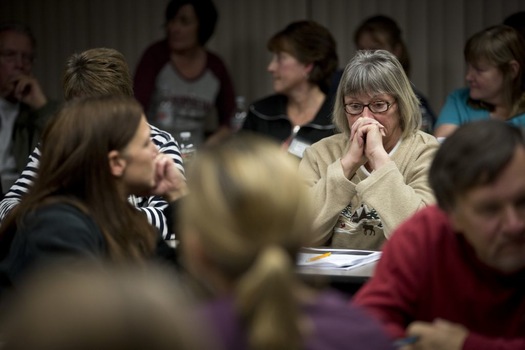
Linda Tautges of Brainerd listened to a discussion during a Crow Wing County Family Child Care Association meeting.
Dorothy Sayre has run a home day care for three decades and has always tried to put kids' safety first.
But this fall, after she saw a state proposal to crack down on child- care providers, she began to worry that the state was taking safety too far, in ways that could put people like her out of business.
"I was appalled," she told colleagues at a meeting with state regulators in St. Cloud last month. "Why are they throwing us under the bus?"
Sayre's fears reflect the rising unease and anger among Minnesota's 11,000 home daycare providers as they brace for the prospect of tougher state oversight in response to recurring infant deaths and safety infractions.
In e-mails, petitions and public hearings, many providers are girding for a fight when the Legislature convenes in January, and their opposition could complicate an ambitious effort to make child care safer in Minnesota.
Among the tougher proposals are higher staffing levels at home day cares and stiffer penalties for facilities that violate safe-sleep guidelines.
Many providers acknowledge that a rising number of infant deaths in Minnesota child care is troubling. But they argue that indiscriminate new rules would only raise costs for parents and force good providers to shut down. The state should focus on sites that have had problems, they say, not meddle with those that have good track records.
"Everyone's main priority is the children," said Mary Ksiazek, a leader of the Ramsey County Family Child Care Association. "We understand that. But don't make us the scapegoat."
As they work to improve safety, state regulators must strike a careful balance: how to reduce deaths and safety violations without overburdening child- care providers, who are critical players in the state economy and essential to thousands of Minnesota families.
"If I'm concerned about the welfare of our youngest children, then I have to be concerned about the people who take care of them," said Commissioner Lucinda Jesson of the state Department of Human Services (DHS). "So if I want good things for kids, I've got to make sure we have a really good, solid family day- care provider network."
Sharp increase in deaths
A report by the state's "mortality review" panel last summer followed a Star Tribune investigation that identified a sharp rise in child- care deaths in Minnesota since 2007. Children have been dying in licensed home day cares at a rate of roughly one per month for the last five years, the newspaper found. Nearly half the infant deaths since 2002 involved violations of safe-sleep rules; investigators also found overcrowding and poor supervision in some cases.
The rise in deaths surprised state officials, who responded this spring with warning memos to providers and county regulators. But authorities are still struggling to convince many in the provider community, a loose-knit group of sole proprietors -- many with long experience and strong opinions.
Providers say there could be other explanations for the rise in deaths, apart from safety problems in their profession. They serve lower-income families, they say, whose children are more at-risk than those from families that can afford more costly center-based care. At a public meeting this fall, one provider's husband said the number of deaths didn't seem high considering the thousands of children in care.
"There still are some people who are doubting the science here," said DHS Inspector General Jerry Kerber.
At a public hearing with providers last month, Kerber tried to dispel that skepticism. Minnesota has 91,000 children in licensed in-home care, also known as family child care, versus 60,000 receiving care in larger centers. Of the 86 deaths since 2002, 83 occurred in family child care.
"There's almost 28 times as many deaths," Kerber said. "There's disproportionate representation. I think we can all agree."
The reaction of day- care operators saddens parents like Robert Fletcher, who lost his 3-month-old son, Blake, after a Park Rapids child- care provider ignored safe-sleep guidelines and placed the infant facedown for a nap in 2008.
"There has to be something done," Fletcher said. "This has been a long time coming. This is just people resisting change."
'Above and beyond'
To providers such as Joan Finley, a crackdown on the entire industry seems unfair and counterproductive.
In 15 years running her Apple Valley day care, Finley has never been cited for a safety violation. Her training and adherence to safe-sleep standards exceed state requirements.
By 10 a.m. one recent morning, she had taught nine preschoolers about Pilgrims, helped the children draw fall harvest pictures, broken up fights over sharing fireman hats, prepared a snack of berries and bananas, and brought out musical instruments for a dance -- all while an assistant coaxed a fussy infant to nap.
Providers who have learned to manage the daily challenges of child care, she said, shouldn't be penalized with onerous rules or required to take fewer children.
"It just really stinks for [those of] us who have gone above and beyond," she said. "I need to support myself and family, and I already run a top-notch program."
Other providers blame a faulty regulatory system, arguing that state and county budget cuts have led to fewer inspectors and inspections in some counties.
While the state is on pace to shut down a record number of home day cares for safety hazards this year, providers argue that this is a symptom of the problem. Inspectors no longer visit as often, they argue, or help head off problems before they become crises.
"Maybe one of the reasons there are more deaths now is that people rely on the fact that someone isn't coming out every six months to check on them," said Kristine Beckfeld of Coon Rapids, who closed her home day care in August partly because of growing frustrations with state regulation.
Providers also complain that enforcement decisions differ from county to county, inspector to inspector, and they harbor a deep mistrust of the state.
"You're dealing with, for lack of a [better] term, the big ugly dog -- DHS," day- care operator Mike Jay said at a provider organizing meeting in Brainerd in early November.
Balancing act
Among providers, the review panel's most controversial recommendation is to cut the number of children that any one adult can watch. The current ratio ranges from 10 to 12 children per provider. Under certain scenarios, the recommendation would slash that ratio in half -- dramatically cutting providers' income.
At least one national study found some deaths in child care involved providers caring for too many children. But a survey by the Minnesota Licensed Family Child Care Association found that nearly 90 percent of providers didn't think a lower ratio would help. Fewer paying families, they argue, would force them to close or raise prices.
Both are significant concerns in a state with some of the nation's most expensive center-based child care. Home-based care offers a more affordable alternative, and is sometimes the only care available in rural areas. But the state has already seen a 17 percent drop in family child- care providers since 2003.
DHS officials say none of the recommendations is final and that they don't plan to pursue reduced child-to-adult ratios this year.
Providers don't oppose all reforms. Finley, for one, supports increased training, a requirement that providers carry liability insurance and additional enforcement of safe-sleep practices. The state requires eight hours of training per year; she estimates she completes more than 60 hours of training every year.
Others want clearer guidance from state and county licensors along with more inspections -- and an enforcement system focused on fixing problems, not fixing blame.
"The only way you are going to get that is to form a ... partnership with providers, so we can look at DHS as a resource and not a monster," said Kathy Stevens, a longtime provider near Brainerd. "I'm scared to death of them."
Agency officials say they want broad support for any proposals they take to the Legislature. But in addition to skepticism from providers, they have received little support from a persuasive group -- parents.
In Kansas, parents provided crucial momentum for child-care reforms at the state Legislature two years ago. Infant deaths have subsequently declined in that state.
Jesson said providers, parents and inspectors can all help reduce safety risks.
"First thing we need to do is have providers follow the rules we already have," she said. "There are a number of situations where that's not happening. We need parents to be more aware of the safe-sleep practices and get more involved. We need to do a better job with training our licensors, so we are sending a consistent message to providers."
One proposal, introduced earlier this year, would require a doctor's note if parents want their provider to depart from safe-sleep guidelines. Minnesota required that before 2007, but the Legislature loosened the rule that year. Coincidence or not, the number of child- care deaths has increased since then.
The author of that proposal, Rep. Patti Fritz of Faribault, said she will pursue the bill again in the next legislative session, but hasn't decided on other reforms. She cautioned against trying to "fix" everything at once. The unease among providers doesn't surprise her.
"This is democracy," she said. "Nothing is ever just a slam dunk. This is their livelihood."
Dear Judges:
Children were dying in Minnesota daycares at a rate of nearly one per month for five years, and yet state regulators and industry leaders had overlooked the spike in deaths until the Star Tribune uncovered the problem.
Many cases were linked to violations of basic state guidelines - covering either infant safe sleep practices or day care overcrowding - and many deaths were preventable. Virtually all the deaths were occurring in licensed day care homes, which operate under a more lax set of regulations than the state's large child care centers.
As they probed into state and county records, reporters Brad Schrade, Jeremy Olson and Glenn Howatt laid bare a pattern of chronic safety breakdowns across Minnesota's system of 11,000 licensed in-home daycares. The reporters found Minnesota has some of the weakest training and supervision rules in the nation as well as inconsistent enforcement.
They discovered hundreds of cases where provider actions harmed children or put them at risk. There were patterns of sex abuse, gun violence, supervision failures and corporal punishment. One child suffered a bruised forehead when an in-home provider shoved their face in a pool of urine after a toileting accident. Another child lost five toes after a neglectful day care operator allowed kids to play on a riding lawn mower.
Many important licensing records that would enable parents to identify problem child care providers were inaccessible to the public. As a result, the Star Tribune built and posted its own online search tool to help parents research their providers.
Astonishingly, many of the newspaper's findings were news to virtually everyone in Minnesota's child care industry. The response by state authorities was rapid and sustained.
Two days before publication of the first major installment of the series, the state Department of Human Services responded with an emergency bulletin to child care providers and county inspectors, urging better adherence to safe-sleep guidelines. The next week, a state lawmaker introduced legislation to tighten safety rules for infants sleeping in child care. After the second installment appeared, county prosecutors indicted a suburban child care provider for felony manslaughter in the death of a 3-month-old boy who was featured in the story.
In September, a state child mortality panel issued a special report reviewing dozens of child care deaths, a report that confirmed every finding of The Star Tribune series and included policy recommendations tailored to the lapses exposed in the series. As 2012 drew to a close, the state's top child care regulator was preparing legislation for this year's session of the Minnesota Legislature.
Minnesota ranks among the most expensive states in the country for center-based care. The sobering backdrop to the series is that while home day care is demonstrably more dangerous to children than center-based care, it is also the only viable option for thousands families who cannot afford centers. Home daycares care for 60 percent of the kids in child care in Minnesota.
The newspaper devoted nine months and thousands of hours of resources to this project. The reporters filed dozens of public records requests, conducted scores of interviews and used extensive computer- assisted analysis. They overcame restrictive state records laws that had helped keep these problems in the shadows. Regulators had overlooked the increase in child care deaths, in part, because the state had no formal tracking system or public reporting requirements.
The stories had a significant impact across our state. The pace of child care deaths in Minnesota has slowed significantly since we began our work. Parents are more aware of hazards to look for in child care. Providers are engaged in a statewide discussion about the reform proposals facing their industry and regulators are more vigilant in their efforts. ft may not be overstating the case to say this Star Tribune series is saving the lives of the youngest Minnesotans.
Sincerely,
Nancy Barnes
Editor and Senior Vice President
Biography

Brad Schrade is an investigative reporter at The Star Tribune where he has worked since 2010. Before moving to Minneapolis, he was an investigative reporter and editor at The Tennessean in Nashville where he worked for 10 years. His work has been honored in state, regional and national contests. He was part ofThe Tennessean staff that was a finalist for the Pulitzer Prize in breaking news in 2011 for coverage of massive flooding in Nashville. His 2011 investigation of Minnesota’s care of elderly and vulnerable adults exposed system breakdowns and led to tougher laws against abusive caregivers. He has investigated corruption in the Tennessee Highway Patrol, the spread of gangs to rural and suburban communities, and loopholes that allowed violent criminals to carry guns. He is a native of Atlanta and previously worked for The Atlanta Journal-Constitution and The Augusta (Ga.) Chronicle. Schrade was a Knight-Wallace journalism fellow at the University of Michigan in 2007-2008. He is a graduate of the University of Georgia where he studied history as both an undergraduate and graduate student. His master’s thesis examined the civil rights movement. He lives with his wife and son.

Jeremy Olson is the children and families reporter for the Star Tribune of Minneapolis, Minn., and has covered social and medical issues in Minnesota since 2005. His Star Tribune stories have prompted solutions to a variety of social problems, from erroneous prescriptions of psychotropic drugs to children, to Minnesota’s alarming rate of children re-entering foster care. As the health care reporter for the St. Paul Pioneer Press, he earned a Premack Public Affairs Journalism Award for his investigation of the suicide of a schizophrenic patient in a drug trial, and organized a mess of state pharmacy records into a searchable on-line database of pharmaceutical company payments to Minnesota doctors. Olson’s investigations for the Omaha World-Herald, where he worked from 1999 to 2005, uncovered abuses of undocumented meatpacking workers, a dangerous lack of supervision when residents performed surgeries at VA medical centers, and rising teen suicide rates in Nebraska’s small towns. He co-wrote a series on foster care deaths in Nebraska that earned a Casey Medal for Meritorious Journalism. Olson completed health care journalism fellowships offered by the Markle Foundation/New York Times and The Poynter Institute and produced a series on long-term care in 2009 as a Kaiser Media Fellow. He has degrees in print journalism and English from the University of St. Thomas, St. Paul, Minn., and started his newspaper career at The Beacon News of Aurora, Ill. Olson is married and has two children, ages 11 and 9. He writes a daily Daddy-O blog for the Star Tribune on thorny issues of parenting and family life.

Glenn Howatt has been with the Star Tribune since 1990 and has been the newspaper’s computer-assisted reporting editor since 2006. He had been a health care reporter for the newspaper. He has won awards for being part of a reporting team that exposed a prominent Minnesota oncologist who gave unnecessary treatments to dying cancer patients and for another story on the lack of attention given to nursing home deaths caused by falls. He was a co-recipient of the 2011 Gerald Loeb Award for Distinguished Business and Financial Journalism and the 2011 American Bar Association's Silver Gavel Award for a series of articles on the debt collection industry. The investigation revealed how the justice system has become an arm of the private collection industry. He holds a master’s of science degree from the University of Illinois at Urbana-Champaign, where he studied urban geography. He also has a journalism master of arts degree from the same institution where he specialized in the use of Census data by newspapers. He has had journalism fellowships at the University of Nevada-Reno for business reporting, the University of Mississippi for nonprofit reporting and the University of Maryland College Park for reporting on children.