Tampa Bay Times, by Will Hobson and Michael LaForgia
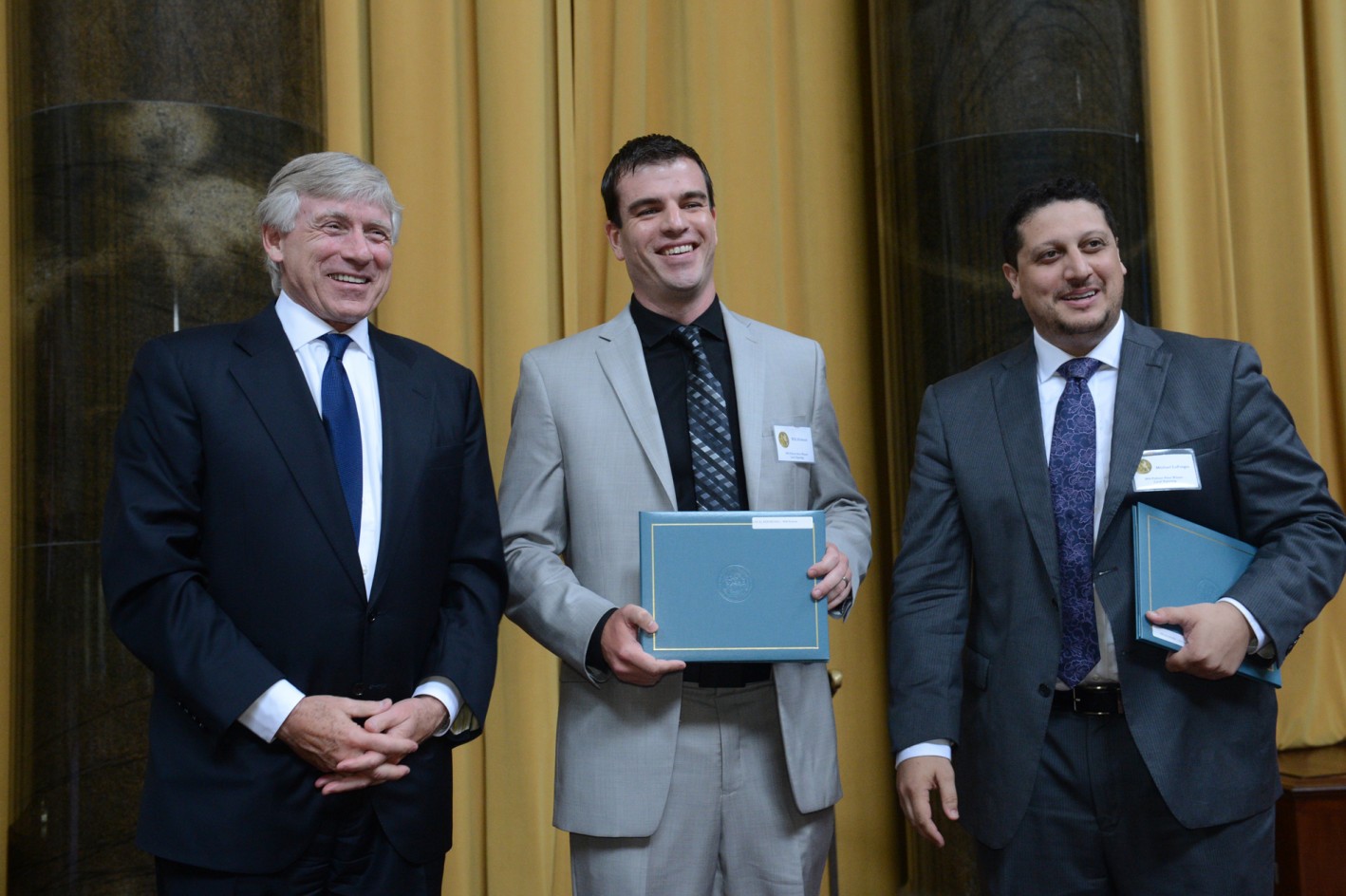
Lee C. Bollinger, President of Columbia University (left), presents the 2014 Local Reporting Prize to Will Hobson (center) and Mike LaForgia of the Tampa Bay Times.
Winning Work
Tenants are moved out of five mobile homes deemed unfit.
By Will Hobson and Jamal Thalji
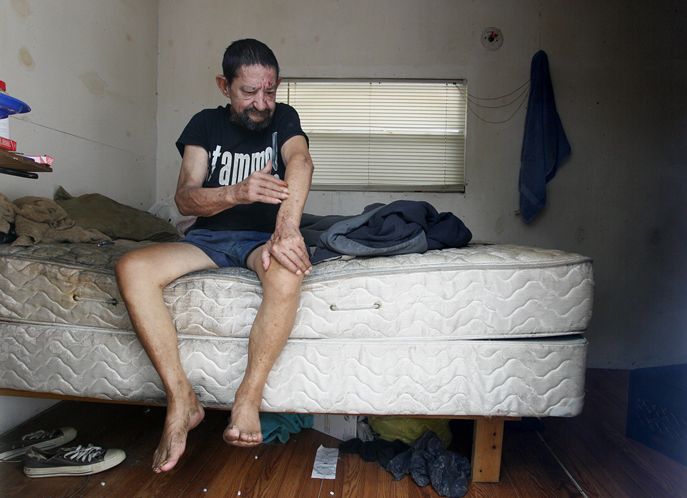
Victor Gonzalez, 67, brushes bites Saturday in the insect-infested room he rents at 106 W. Stanley St. in Tampa. (Daniel Wallace/Times)
TAMPA — William A. "Hoe" Brown, chairman of the Tampa Port Authority and a prominent Republican fundraiser, has been running an illegal rental property that Tampa's code enforcement director calls "deplorable" and "not fit for human habitation."
"It's shocking. People shouldn't have to live like that," said Jake Slater, Tampa's director of neighborhood empowerment, who termed the squalor among the worst he's ever seen.
Slater visited the Seminole Heights property Monday, and his staff returned Tuesday to tell tenants their apartments — in five split, singlewide mobile homes Brown illegally placed last year behind his office at 106 W Stanley St. — were unfit for habitation.
Code staff offered to connect the tenants with social service agencies. But Brown decided to reimburse the seven tenants — who range in age from 4 to the upper 60s — hundreds of dollars in back rent in exchange for accepting short-notice evictions.
Brown declined interview requests this week, instead releasing statements through spokeswoman Beth Leytham. He accepted blame for the property's condition and apologized, but said he'd only become aware of problems in May.
Code enforcement notified Brown the mobile homes violated zoning rules in late April, Slater said. Brown disputed assertions by tenants that he had refused to deal with a roach infestation.
"He is trying to make things right," Leytham said. "He has been up since 6 a.m. He is refunding their rent. We're not just throwing them out. We are driving them to motels. We are driving them to friends. We are doing everything we can to make it right, and to help those in transition."
A bizarre scene unfolded Tuesday in the neighborhood, the day after a Tampa Bay Times inquiry prompted Slater's visit. Brown, 55, who has led local fundraising efforts for GOP candidates including presidential hopeful Mitt Romney, U.S. Rep. Connie Mack and Florida Attorney General Pam Bondi, sat at a table inside his business office with a stack of $100 bills, tenants said, peeling off $1,500 each as compensation for nearly three months' rent.
Outside, tenants who had not yet been paid — many of them with criminal records — threatened to fight each other while Brown's employees towed away the mobile homes. All five homes were removed Tuesday, Leytham said. By removing them, Brown brought the property into zoning compliance, officials said, and thus will probably not be fined.
Leytham said all the tenants refused Brown's offers to connect them with social services.
Tenant after tenant told the same story Tuesday morning: Lured to the property by signs advertising furnished apartments for $550 a month to people on public assistance, only to find subdivided mobile homes, infested with bugs.
Through a trust, Brown owns three parcels at the corner of N Florida Avenue and W Stanley Street, including a small motel. Collectively, the properties have long been a problem, neighbors say, regularly bringing visits from law enforcement.
"That's actually why we're selling," said Joyce Harris, 50, who has lived in the neighborhood for 26 years. Her home is next to Brown's office. When she saw the mobile homes pulled onto the property last year, she asked her husband how that could be legal.
It isn't, said Thom Snelling, city director of planning and development. In Tampa, only mobile home parks are zoned for mobile homes.
Brown said, through Leytham, he thought the homes were legal until a zoning change in May.
Snelling disagreed.
"That's the craziest thing I've ever heard," he said. The mobile homes could also violate city building rules, Snelling said.
"I don't know, because he never came in to get anything permitted," Snelling said.
As chairman of Port Authority's governing board, an unpaid position, Brown helps oversee a $15.1 billion economic engine that supports more than 80,000 jobs. Last year he helped select the Port of Tampa's new CEO, one of the most important economic development jobs in Tampa Bay.
As chairman, Brown runs the board's monthly meetings, reviews port finances, questions staff about port business and votes on deals involving millions of public dollars.
While holding a position that requires attention to detail, Brown says he was unaware of the living conditions just feet behind his own business office
When a Times reporter visited Saturday, the stench in 67-year-old Victor Gonzalez's apartment — a mix of human and insect waste — was overpowering. Gonzalez had open wounds on his forehead — a result, he said, of scratching at bugs — and said he did not notice the smell.
"It's all right," he said of his roughly 200-square-foot apartment. "Where else could I go?"
Monday, a friend said she was taking him to St. Joseph's Hospital. But no one by that name was there Tuesday, a hospital spokeswoman said.
The building at 106 W Stanley is home to the only business Brown listed on his application to the port authority: J.B. Carrie Properties Inc. Brown has been president and owner since 1987.
The financial disclosure form he filed with the state last year offers scant information about his finances: No dollar amounts quantify his rental income or investments from a family partnership. He listed ownership of 15 commercial and residential properties, in the Tampa, Orlando and Gainesville areas. He and his wife, Chris, live in a two-story, 2,600-square-foot brown brick home in South Tampa that records show was purchased in 2003 for $485,000.
In 2008, Brown was appointed to the Tampa Port Authority board by former Gov. Charlie Crist. In 2011, Gov. Rick Scott re-appointed him. Brown serves on the boards of Visit Tampa Bay, Hillsborough's tourism agency, and the Tampa Bay Sports Commission. In 2012, he was unanimously selected chairman of the Port Authority and was elected Hillsborough County's Republican Party state committeeman.
His tenants are familiar with the campaign signs — several have been used to cover smashed windows on the property.
As men towed mobile homes away Tuesday, Michael Gabriel came running up, screaming for them to stop. They didn't. Gabriel, 46, moved there in November. On May 1, he said, a neighbor broke into his apartment. Gabriel jolted him with a "home-made Taser" — a cane with a live, stripped wire wrapped around it.
"I'm a felon, so I can't have a firearm," explained Gabriel. "I'm an electrician by trade."
Gabriel was then arrested on charges of aggravated battery with a deadly weapon and possession of a controlled substance (oxycodone and methamphetamine), according to records. He was jailed until June 15. When he was released, he said, Brown told him he owed $1,600 in rent.
Gabriel called Brown several names Tuesday morning outside the property until Leytham summoned him into the office. When Gabriel came back, he held a wad of 15 $100 bills.
"I like her," Gabriel said of Brown's spokeswoman. "She's fair. Bill, I think is a snake. … What a surreal day."
News researcher John Martin contributed to this report. Will Hobson can be reached at [email protected] or (813) 226-3400.
CORRECTION: This article has been updated to reflect that William A. "Hoe" Brown, 55, left the Trinity Cafe's board of directors in December. Brown is 55 years old. Earlier versions were incorrect about Brown's status on the cafe's board and gave an incorrect age.
A county agency sent the homeless — and more than $600,000 —to “Hoe” Brown and his dilapidated dwellings.
By Will Hobson
The only thing worse than the daily morning sickness that sent Sharmel Troupe shuffling from friends' couches to bathrooms last year was the fear that, when her baby came, the infant would be homeless.
Troupe, then 30, was nine months pregnant when she and her boyfriend, an unemployed construction worker, ran out of friends willing to put them up. They turned to Hillsborough County government for help.
A caseworker for the county's Homeless Recovery agency told them of a place where they could stay while looking for something more permanent.
The place was a bug-infested corner of a converted garage owned by William "Hoe" Brown, 55, a prominent Republican fundraiser and then-chairman of the Tampa Port Authority.
Troupe didn't like the look of it but stayed. After all, the county was paying — $388 for Troupe and her 34-year-old boyfriend, Ryan Gormley, to stay for three weeks.
Their rent check was part of more than $600,000 in public money Homeless Recovery has paid Brown since 1998 to provide housing for the poor, county records show.
Homeless Recovery caseworkers sent clients to the well-connected GOP fundraiser until this summer, when the Tampa Bay Times revealed Brown was housing tenants in squalor, prompting his resignation from the port's board and from several other public posts.
Managers of Homeless Recovery said they do not have the staff to inspect properties where the agency pays to house its clients. Brown is one of dozens of landlords they deal with.
The managers said the agency does not refer clients to specific properties, and they've never gotten a complaint about Brown's property. Neither is true, according to hundreds of emails reviewed by the Times.
County workers routinely sent clients to Brown's Seminole Heights properties, where instances of violence, drug use, prostitution and other crimes have been chronicled in public records since at least 2005.
Last week, Hillsborough County Administrator Mike Merrill agreed to, then canceled, an interview with the Times about Homeless Recovery. Friday evening, he sent a memo to county commissioners informing them of sweeping changes he planned for the agency.
Homeless Recovery will get audited. The agency will be moved to a different county department. And the county will ensure that properties are up to code before approving rent payments.
"My commitment to you and to our citizens is to improve the administration of this program so that we may better help those who depend upon us," he wrote.
• • •
Every weekday, the line starts before dawn outside the squat, yellow building in west Tampa for Homeless Recovery, whose mission is to help people become self-sufficient and find housing they can afford.
As the sunrise illuminates downtown skyscrapers in the distance, the people, many of them just released from shelters, wait to meet with caseworkers who can arrange food vouchers, bus passes and rental assistance. The agency helped 2,600 clients last year, and this year has a $1.2 million budget — $806,500 in county money, the rest in federal grants — and a full-time staff of 12.
Since at least 1998, the agency has provided a steady income for Brown, county records show: an average of $40,000 per year, topping $60,000 in 2001, and dipping to $17,500 last year.
In interviews with the Times, Homeless Recovery manager Jim Silverwood and his supervisor, Sam Walthour, adamantly maintained the agency doesn't refer clients to specific properties.
Clients eligible for help, they say, are told to find places that accept county vouchers. The agency has strict rental limits — from $360 per month for one person to $610 for a family of six or more, plus $125 per month for utilities.
If clients end up living in squalor, they say, it's because that's all that's available for people with credit problems, and sometimes criminal records, who can't afford security deposits.
"There's not enough affordable housing," Silverwood said, "and it's very hard to find landlords who are willing to work with those individuals."
Others in Tampa's social service community agree. The federally funded Tampa Housing Authority has 9,000 families on its waiting list for rental assistance.
"The more programs we have that provide rental assistance, the better," said Margaret Jones, the agency's director of assisted housing. "There's just not enough to go around."
Silverwood acknowledged there may have been a few occasions over the years when caseworkers sent people to Brown's properties at the corner of N Florida Avenue and W Stanley Street.
When caseworker Susan Ketterer made the call last October about openings there, Sharmel Troupe said, she seemed familiar with the man who answered.
"It seemed like she dealt with him a lot," Troupe said. "She knew, right off hand, he would take families."
• • •
Brown and Homeless Recovery employees have exchanged hundreds of emails since Jan. 1, 2010, according to records. Brown routinely emailed them, advertising vacancies. It was not a one-sided conversation.
With subject lines like "any openings, please?" and "sending a family right now," scores of emails show caseworkers repeatedly sent clients to him.
In one case, an employee wrote a letter to Brown about a homeless family of three. Dated April 18, it told Brown the county would cover their rent.
"It is too important we secure this safe haven for them," wrote Sara Pisani, senior case manager.
The family was Aaron Thorn and Kayla Costa and their baby boy, Kaden. The haven Brown provided, according to other tenants and Thorn's mother, was a mobile home behind Brown's office. The county paid Brown $555 for rent and utilities for May.
In July, Tampa code enforcement director Jake Slater called the conditions inside that mobile home and others "deplorable" and "not fit for human habitation."
Thorn and Costa did not reply to phone calls and Facebook messages. They are in New Jersey working for a carnival, according to Samantha Thorn, Aaron's mother. She held 2-year-old Kaden on her hip last month as she discussed her surprise when she visited her son and grandson and found them in the dilapidated mobile home.
"I mean, they had a child for Christ's sake," she said.
Just because caseworkers sent clients there, Silverwood said, it doesn't mean his agency referred them to Brown.
"Ultimately it is the client's choice as to whether they want to stay at a place or not," he wrote in an email to the Times.
• • •
It was a bad pregnancy. Troupe had hyperemesis gravidarum, she said, a condition marked by intractable nausea that sent her to the hospital several times.
She spent much of the time she lived on Brown's property in bed. She needed to stay hydrated, so Gormley ran out regularly for water, juice, whatever she could keep down.
It was a crowded apartment. Nothing separated bedroom from bathroom. When the shower ran, the whole place steamed up. Gormley's head poked above the shower door. As a joke, he sometimes waved to Troupe as he showered.
To combat bugs, he bought caulk. He sealed some of the crevices they crept through at night. He didn't want to use too many pesticides, since Troupe was pregnant.
There was less Gormley could do about the temperature. One of their neighbors controlled the air conditioning for the whole structure. It always seemed too hot or too cold. When the month was up, Gormley and Troupe agreed, they were leaving.
They did not see Brown the first week they lived there. They dealt with Vincent Angel.
Angel lived there rent-free, he told tenants, for the work he did for Brown. Angel drank heavily, tenants said, and often fought with his girlfriend. His name appears in several Tampa police reports. Here's a typical one, for Brown's office on Aug. 4, 2006:
Angel's girlfriend told police she came home to find Angel smoking crack with a prostitute. After the prostitute left, Angel threw a full beer bottle at her (it missed), grabbed her hair and slapped her. Angel was arrested on a battery charge, which was later dropped.
Angel treated Troupe and Gormley well, though. In the middle of the month, Angel introduced them to their landlord, Brown. Brown told Gormley that if the couple were going to stay the next month, they would owe more than Homeless Recovery's voucher. Brown wanted $185 per week.
"It was in no way worth paying $185 a week to live in that box," Gormley said.
• • •
Troupe and Gormley lived in one of three illegal apartments in Brown's converted garage. A few feet away stood five mobile homes split into an additional 10 illegal rentals. Next door is his 13-unit, extended-stay motel.
Since 2005, Tampa police have logged 453 calls for incidents and other activity at Brown's motel and office.
There was one homicide, when a tenant started a fight with a neighbor, who then stabbed him to death and claimed self-defense. Two drug overdoses. Four visits by an officer looking for a registered sex offender or predator, although police records don't show if one was ever found there
The remaining calls are reports of an array of assaults, thefts, drug crimes, domestic disputes, and disturbances caused by the intoxicated and mentally ill.
Room 9 of Brown's motel is mentioned in a 2005 city code enforcement report.
"Stove shocks you when you try to use it, sewage backing up into the shower, windows will not open throughout the entire hotel, no smoke detectors," an inspector wrote
The property was brought into compliance a few months later.
In August 2009, a Tampa officer saw a baby in Room 12 and called child protective services.
"She felt the room that the child was living in was unsafe and dirty for the child," the report states.
In September 2011, Brown emailed Homeless Recovery about money he said he was owed for a family that stayed in his motel. A caseworker emailed Silverwood that the family never stayed there. They left because they felt it was not safe.
The family was the Tripletts — Brandon, his pregnant wife, Kemisha, and their 1-year-old daughter, Ameeyah. Reached by phone last week in their new home in DeLand, they instantly remembered the place.
"It looked like a crack and prostitute house," said Brandon Triplett, 25.
The room smelled of mold, marijuana and a chemical Triplett couldn't place. It burned his eyes. The mattress was seeped in dirt and human filth. They found a nearby church where they could stay. Triplett never doubted his decision to leave that day, even though his family was homeless.
"I had a baby," he said. "I wouldn't dare let my child be in that environment."
Thursday, Brown released a statement through his spokeswoman. "I have provided stable housing … to folks struggling with very serious personal issues who would have otherwise ended up sleeping on street corners or under bridges," it said. "Once aware of property maintenance matters, I attended to them as quickly as possible."
Brown's name appears in some police reports. In January 2008, a woman angry at being evicted chased him around the property with a gardening tool. After Brown retreated to his office, a witness told police, the woman carved deep scratches in his Jeep.
The woman made an interesting choice in the weapon she used to attack Brown, who had acquired his unique nickname when, as a youngster, he had trouble saying "hold" or "hold me." She had chased Brown around with a hoe.
• • •
In December 2011, Brown noticed something odd
"I have not heard from you or anyone at Homeless Recovery for awhile," he wrote a caseworker. "Just thought I would check and see if there were any problems?"
Silverwood replied.
"Bill, we have had some complaints by potential clients that the units were not properly cleaned."
In interviews, Silverwood repeatedly said his agency never received complaints about Brown's properties. When provided a copy of this exchange with Brown, Silverwood said he had forgotten about it.
A few weeks after that email, Silverwood visited the property. "I had seen better and I had seen worse," he said of its condition.
In May, Silverwood emailed employees to stop making "placements" at Brown's property. Someone in another county department thought Brown's motel was not zoned properly.
A few weeks later, the County Attorney's Office found there was no zoning issue. Homeless Recovery was approved to resume paying Brown.
In the midst of this, Brown emailed a caseworker.
"After 30 years the zoning now becomes a problem," he wrote. "Sometimes dealing with government is too hard — as if the county has people knocking the doors down to lease apartments. Oh well we will see."
Caseworker Ketterer replied: "hope you can get it straightened out … we need you guys!"
A month later, Ketterer emailed Brown again.
"Bill, so glad you are back!!!!" she wrote June 21. "I asked about it and they gave me official word yesterday and do you have any openings right now??? thank you for hanging in there."
Three weeks later, after an inquiry from the Times, Tampa's code enforcement office condemned the five mobile homes behind Brown's office. Four days later, Brown quit the port board.
The day Brown resigned, all seven Hillsborough County commissioners received an email about Homeless Recovery's relationship with him.
It was sent by Ven Thomas, director of the Family and Aging Services department, which included Homeless Recovery.
"Clients were NOT referred," the email said. "Clients eligible for rent assistance seek their own living accommodations."
Thomas told commissioners her department was revising procedures and might require landlords to "attest that their properties are up to code."
A few days later, an aide to Commissioner Kevin Beckner replied: "Rather than have slumlords 'attest' that their properties are up to code, why not have them pay for an annual inspection and have our people determine that? Just a thought."
In his memo Friday, Merrill said Homeless Recovery would be moved to a different department, no longer under Thomas' oversight.
• • •
Troupe's water broke on a bus, Oct. 20. A few hours later, Jada Gormley was born. At 6 pounds, 8 ounces, she cried at first, then quieted when she saw her father. Her parents brought Jada home to Brown's garage for about a week, then moved to a better apartment.
Gormley had gotten a job at a mechanic's shop, and Homeless Recovery had found them a better apartment a few miles away.
A few months later, the shop closed. Gormley was again out of work. He has been in and out of homeless shelters this year. Troupe and Jada have stayed with relatives until recently, when Gormley got a job landscaping. He can afford $185 per week, enough for a room in a small motel on Nebraska Avenue, not far from Brown's motel.
Gormley and Troupe didn't know until this summer who Brown was. They thought the man who had haggled with them over rent lived in the building he called his office. When told her former landlord was a member of Tampa's political elite, a man who helped host black-tie dinners for the state's top Republican lawmakers, Troupe was surprised.
Gormley wasn't.
"That's how the world works," he said. "That's how the rich stay rich."
Times staff writer Michael LaForgia and news researcher John Martin contributed to this report.
Homeless Recovery’s records make it hard to track if Hillsborough landlords housed anyone.
By Will Hobson and Michael LaForgia
TAMPA — Hillsborough County has poured millions of tax dollars over the past 20 years into a program meant to cover rent for homeless people.
A computer system tracks rent checks paid each month under the Homeless Recovery program. The system, though, does not record the addresses where tenants are supposed to be living.
As a result, Hillsborough officials acknowledged, they have no way to verify where tenants stayed in a given month without hand-checking each case file, a process they estimated would take hundreds of hours.
County spokeswoman Lori Hudson confirmed the records-keeping gap this week to the Tampa Bay Times, which has for weeks sought a list of rental properties that have housed clients of the embattled Homeless Recovery agency.
Hudson said the record-keeping flaw is hampering efforts to review basic details about thousands of rent payments made over the years. County officials have been trying to piece together two separate databases to compile the information.
"We're talking about dueling, different systems, and that's what we're dealing with," Hudson told the Times on Wednesday. "That's the challenge in all of this, is the antiquated system."
Homeless Recovery was created in 1989 to help the homeless get into housing. The agency — which has a $1.2 million budget, including $806,500 in county money — came under scrutiny after the Times reported on Sept. 8 that case workers sent people to the squalid, makeshift mobile home park owned by William "Hoe" Brown, a prominent Republican fundraiser and former chairman of the Tampa Port Authority.
Homeless Recovery sent clients, including families, to live in tiny, dilapidated, bug-infested mobile homes and a garage Brown illegally rented out behind his office. Homeless Recovery's managers said they did not have the resources to inspect rental properties where they sent clients.
Three employees have left the county since the Times story. Homeless Recovery's manager resigned and his supervisor was fired. Another county employee who worked with the agency was fired after an investigator found he had lied about earning $1,200 through the program as a landlord.
County Administrator Mike Merrill pledged this month to start inspecting rental properties before their owners could earn county dollars. Dozens of other Homeless Recovery clients are living in substandard housing, according to Merrill. He said problems in the agency were "systemic" but offered no details.
Last week, county commissioners voted to have the county's auditor investigate Homeless Recovery. Record-keeping problems will be one focus of the audit, Hudson said.
When informed of the problems this week, several county commissioners decried the shoddy record-keeping.
"It's outrageous that tax dollars were spent and records were not kept . . . in a way that they could be quickly or easily accessed for transparency and accountability," Commissioner Victor Crist said.
In August, the Times requested detailed payment records from the county to assess conditions at other properties that have gotten Homeless Recovery money. The list that was provided was riddled with errors. In many cases, it listed houses and apartment complexes as belonging to the wrong owners.
In subsequent interviews, county officials said it would cost thousands of dollars and take weeks of poring through its records system to find the addresses.
The county intends to replace the flawed computer system by the end of the year, Hudson said.
Merrill has declined to speak to the Times about Homeless Recovery until the county's audit, which could stretch into 2014, is complete.
By Michael LaForgia and Will Hobson
TAMPA — Hillsborough County has paid millions of dollars to house homeless people, including veterans, the mentally ill and families with small children, in filthy, crime-ridden slums across the city, a Tampa Bay Times investigation has found.
For years, the poor have lined up at the county's door for help, and county caseworkers have responded by sending them to hazardous and neglected places. There, they were forced to breathe moldy air, step over unmopped puddles of human waste or sleep on mattresses infested with bedbugs.
At one home — a converted 1920s orphanage on Tampa's N Florida Avenue — county officials arranged for children to stay alongside sex offenders, pill addicts and tenants so disturbed they defecated on the floor.
In another, residents lived among roaches that swarmed in every room, skittering across bathroom soap dishes and crawling over toothbrushes.
These conditions have been chronicled for years in government records, which include complaints from appalled tenants and advocates. But instead of demanding repairs or permanently halting payments to negligent landlords, county officials have continued steering public money to owners of barely habitable homes, the Times review found.
During the past five years, Hillsborough County's Homeless Recovery program has paid for space in more than 600 buildings clustered in Central Tampa and along blighted stretches of the city's north side.
To learn what life was like inside these places, the Times identified the 20 landlords who got the most government money and closely examined their properties. Reporters visited each building, interviewed residents and reviewed hundreds of pages of police reports, code enforcement documents and other public records. Among the findings:
• Police or sheriff's deputies have visited the rentals more than 5,500 times since 2009 — the equivalent of once every eight hours, every day, for roughly five years straight.
• They heard reports of more than 300 assaults and 150 thefts and dealt with more than 160 people in the midst of mental breakdowns. They chronicled 22 suicide attempts and eight deaths.
• At least five government agencies recorded serious problems at several homes over the years. But with no prescribed standards, the county continued subsidizing ramshackle rental units across Tampa. Even the most basic safety concerns — including shoddy electrical wiring and failing smoke detectors — have continued with no repercussions for the landlords responsible.
• A quarter of the $4.3 million the county spent in the past five years has gone to landlords whose buildings are hotbeds of crime and drug use, or whose properties repeatedly failed basic health and safety inspections.
A half-dozen landlords contacted by the Times said a certain amount of crime and messiness is inevitable when working with the homeless, who often suffer from addiction or mental health problems.
"I believe that we're doing good work for the community. I really do," said John Watson, owner of the Good Samaritan Inn, formerly a popular destination for Homeless Recovery clients. "We're always trying to improve things here and make them better."
As part of a county program founded in 1989, officials have paid private landlords hundreds of thousands of dollars a year while taking virtually no steps to ensure the rooms provided were safe.
That the county was paying for dangerous housing first came to light last month, when the Times reported that William "Hoe" Brown, the politically connected former chairman of the Tampa Port Authority, had collected more than $600,000 to house the poor in squalid complexes, including an illegal, makeshift trailer park behind his Tampa office.
In response, county leaders fired Sam Walthour, the program's top administrator and last week recommended shutting down Homeless Recovery and outsourcing its programs to local nonprofits.
The county also ordered an in-house audit of the program and sent code enforcement officers to inspect hundreds of buildings that house the homeless on the taxpayer dime.
As of mid October, they had visited 85 properties and encountered many of the same problems uncovered by the Times. One in three of the homes initially failed to meet basic health and safety requirements, officials reported.
County leaders declined to comment for this story, but County Administrator Mike Merrill sent a memo to commissioners Friday ahead of its publication. In it, he noted his staff is "making great headway" to address problems but cautioned they won't be fixed overnight.
"It is important to know that our constituents have the facts surrounding past mismanagement" of the Homeless Recovery program, he wrote. "However, it is equally important that constituents have confidence that current management is taking swift corrective action."
Bedbugs and sex offenders
County officials over the years have paid for hundreds of needy men and women to live in a sprawling, 68-bedroom boarding home on N Florida Avenue.
Private rooms at the place, the Good Samaritan Inn, go for as little as $400 a month. People willing to bunk down with other tenants pay $11 a night.
It's one of the most affordable places to stay in the rapidly gentrifying neighborhoods that surround downtown Tampa.
During the past five years, the county — which paid $360 per month for a single person and up to $610 for families of six or more — has sent the property's owner $350,000 to house the homeless there and on four other properties, records show.
Built as an orphanage in 1922, Good Samaritan is one of the few places in the city that accepts all comers, including homeless families with small children.
It's also a magnet for crime calls and a perennial target of health and safety inspectors, who have flagged hazards since the 1980s.
Records show that assaults, fights and violent outbursts from tenants occur there about once every eight days.
The floors are coated in grime, the walls dirty and scuffed, the bathrooms sometimes smeared with excrement.
But the problems haven't stopped Hillsborough County caseworkers from steering people there.
It's where they sent Edward Mullen, 44, last fall when his job as an electrician fell through, and he suddenly had nowhere to sleep with his wife and three small children. "It was the most disgusting, deplorable environment you could imagine," Mullen said, recalling the syringes he saw on the bathroom floor.
It was where they sent Tim Little, 43, who lost his job just as his girlfriend's medical bills were piling up in July. An ex-Marine, Little said he was afraid to sleep there. "I'm a grown man, and I was nervous," he said.
And it was where they sent Julie Clark, 52, an out-of-work gas station cook who moved her family to Tampa to be closer to her parents.
Beginning in December 2011, Clark and her then-13-year-old son, Jacob, spent seven months at the rooming house in a state of mounting unease. One night a few weeks into their stay, Clark said, she watched bedbugs stream in under the door and burrow into their mattresses. She and her son wore long sleeves at night, stuffed newspaper under the door and splashed their beds with poison, but nothing worked. "Jacob and I were eaten alive," Clark said.
More frightening than the bugs, though, were Clark's new neighbors.
One day, as she walked the hallways of the 20,000-square-foot compound, Clark passed a sign staff had taped to a tenant's door.
"We have taken away Miss T's knives," it began, according to Clark.
"But stay away from her. Don't talk to her. Don't knock on her door."
Clark said another resident would urinate in the hallways, and urine would pool on the floor and flow under the doors into people's rooms. On Easter Sunday in 2012, the woman defecated on the ground during a meal served by a local church, Clark said.
Clark began refusing to let her son leave the room alone.
On weekends and when he wasn't in school, they spent long days at the library. Anything to get away, Clark said.
Then she overheard another resident talking about rapists and child molesters. A security guard confirmed that they lived there. He told her she had the right idea in keeping Jacob close.
Records show city police made 14 visits to check on sex offenders who listed Good Samaritan as their home address during the time Clark stayed there with her son.
Clark said nobody with the county had warned her.
Not all former residents had bad things to say about the home.
Sidney Gardner, 59, stayed there for two months in 2011. "There wasn't a complaint I had that wasn't resolved," said Gardner, who regularly returns to the rooming house to lead a Bible study. "There's an adage I once read that said, 'I knew a man who complained he had no shoes until he met a man who didn't have any feet.' Where else are (the homeless) going to go?"
The owner of the Good Samaritan, Watson, bought the property in 1985 and has worked with the county to house the poor there ever since.
A real estate investor and entrepreneur who once owned a chain of waterbed stores, Watson said he runs the home as a spiritual ministry for the poor.
"If I were in this strictly for the money, I would have sold it," Watson said, noting that he has been operating at a loss for the past few years.
In an interview with the Times, he attributed problems at the home to tight margins and to the nature of taking in the homeless.
"We tend to take people that nobody else would take," Watson said.
He acknowledged an ongoing problem with bedbugs and said he spends at least $500 a month on insecticide treatments.
He also acknowledged that sex offenders have lived at the home, but said the Good Samaritan has a policy forbidding pedophiles. If he finds out that a tenant has been convicted of molesting a child, he kicks them out, he said.
Asked about the sign seen on Miss T's door, Watson laughed. "That was a joke," he said.
"She still lives here, but she's harmless," he continued. "She's never stabbed anyone. She's just threatened."
Watson pointed out that some of his tenants have lived at the Good Samaritan for 10 years or longer. One has been there since the '80s, he said.
"If this is such a horrible place," he said, "why do I have so many people who want to live here?"
Other places, other problems
Many of the same problems at Good Samaritan have plagued other rentals paid for by the county, according to the Times' review of the 20 top-paid landlords.
Police have visited each of a dozen of their buildings 100 times or more since 2009, records show.
Code enforcement officers flagged a third of the properties at least once in the past five years for unhealthy conditions, including outbreaks of mold and infestations of bedbugs, cockroaches or rats.
Eight of the buildings were found to be dangerously crowded, to have leaky ceilings or crumbling walls, faulty wiring or malfunctioning plumbing.
At FSJ Rooming House on N Nebraska Avenue, where the owners have collected $10,000 a month from the county over the past five years, tenants have sold drugs and beaten one another with bricks and heavy plastic lawn chairs.
At Hoe Brown's converted motel on N Florida Avenue, an elderly resident died and lay decomposing for two weeks. He was noticed missing only because his rent check was late.
Noraima Torres said mold spores hung so heavy in the air at 13711 Inoma St., a few miles north of Brown's property, that it sickened her and her teenage son, who has asthma. It prompted trips to the emergency room, she said. "I had to move because we were constantly sick," she said. "I am still sick to this day due to that apartment."
A combination of factors has kept county clients living in bad conditions year after year.
The money paid by Homeless Recovery has lagged far behind subsidized housing rates set by the federal government. In 2013, the United States paid $582 in subsidies for an efficiency apartment in Hillsborough County, compared with $360 paid by the county to house a single person.
What's more, rent checks from the county often have arrived late, landlords and advocates said.
At the same time, Homeless Recovery didn't have the money to inspect every property it rented, and county leaders say the program's managers never asked for a funding increase.
And the government agencies that documented problems in the homes, including Tampa police, the Hillsborough County Sheriff's Office and city code enforcement, didn't regularly share information with Homeless Recovery workers.
Ignoring warnings
From the start, the county's Homeless Recovery program had no policies requiring homes to meet standards.
As a result, the county never made a practice of reviewing police reports or health and safety records before cutting checks.
The county's handling of the Good Samaritan illustrates the hands-off approach it took.
City of Tampa code enforcement officers have been called to the rooming house 13 times in the past five years. They recorded complaints of leaky ceilings, mold, feral cats, roaches and, within the past two years, bedbugs and biting flies.
But the county had no arrangement to review results of inspections done by city code enforcers.
Meanwhile, Good Samaritan's landlord, Watson, wasn't paying his property taxes — something an employee of another arm of county government pointed out to Homeless Recovery in July. Still, the county kept renting from the home until last month, when it ordered caseworkers to move any clients they had housed there.
Payments continued even in the face of urgent complaints from advocates and tenants.
Michael Doyle was volunteering for the local St. Vincent de Paul Society in July 2012 when he first voiced concerns about Good Samaritan.
He told officials he had watched as parents screamed or wept because they couldn't bear to keep their children there — but had no place else to go. He described the bedbugs and scenes of families going to sleep with insecticide dripping down the walls.
He said he even met with county officials, including Ven Thomas, the director of the county's Family and Aging Services department, in July 2012. Nothing ever came of it, he said.
This summer, a representative of the Homeless Coalition of Hillsborough County sent a note to Jim Silverwood, who then was head of the Homeless Recovery program. It noted concerns about the rooming house.
"I realize that Good Samaritan Inn is not the greatest place in the world but they do house an awful lot of individuals that otherwise would be homeless," Silverwood replied in a July 17 email to a manager at the coalition. He added that if coalition officials had concerns, they should inform the city of Tampa, where the rooming house is located.
Silverwood, who resigned in September, declined to comment.
Even concerns voiced by the tenants that the county was supposed to be helping went unaddressed.
Clark, who stayed at the Good Samaritan with her son last year, said she complained to the county. So did Edward Mullen and his wife, Helena, after their children — ages 6, 4 and 3 — woke up at the boarding home covered in angry red bedbug bites.
Nothing ever came of their complaints, they said.
"One night is too long to be in a place like that," Helena Mullen said. "That should not be an option for a family. There's no way the county should be putting people there.
"They should burn the Samaritan down," she added. "You've got nothing but bad in there."
Times researcher John Martin contributed to this report.
They were homeless, sick, even on the verge of death. But Hillsborough County sent them to live in squalor at a facility that wasn’t licensed to provide care.
By Michael LaForgia and Will Hobson
Bay Gardens Retirement Village seemed to get worse every year.
In 2005, state inspectors found filthy, reeking bathrooms, a raccoon living in the ceiling and a patient whose genitals had been bitten by ants.
In 2007, they discovered a demented man, smeared in his own filth, plucking at his colostomy bag in a stinking, roach-infested room.
In 2009, cutting tools and toxic chemicals lay within easy reach of mental patients. The hallways smelled of cat urine and echoed with an intermittent beeping — the sound of batteries dying in the building's smoke detectors.
After issuing 18 fines in five years, the state in 2010 stripped Bay Gardens of its assisted living license, citing a long history of endangering and neglecting its patients.
That hasn't stopped Hillsborough County from sending the needy there on the taxpayer's dime.
A Tampa Bay Times investigation has found that county officials steered scores of sick and dying homeless people to Bay Gardens even though it isn't licensed or equipped to care for them.
Public records and interviews with more than a dozen former tenants show that the home became a regular stopover for people with disabilities, terminal illnesses or profound mental or physical ailments.
One resident had a doctor's written orders not to bathe or use the bathroom without supervision.
Others sent by the county struggled to walk or couldn't control their bladders or bowels.
A few were so sick they died within months of moving in.
All of them spent their days at Bay Gardens unaided or forced to depend on untrained staff for help.
Even so, the county referrals kept coming.
Since 2011, Hillsborough County's troubled Homeless Recovery program has sent at least 130 ailing men and women to Bay Gardens, at a cost to taxpayers of more than $260,000.
County officials have acknowledged systemic shortcomings within the Homeless Recovery program, which was founded in 1989 to get the indigent off the streets.
On Friday, County Administrator Mike Merrill responded to the the facts laid out in this story by sending a memo to commissioners.
He wrote that his staff was unable to review the cases identified by the Times because of the way the county's records were kept.
He noted that an internal audit — prompted by previous stories in the Times — was already under way.
"What we are finding raises grave concern," Merrill wrote. "We have dedicated significant resources to solving these problems. Unfortunately I cannot tell you that they are all solved or even that they are all known."
Bay Gardens' owner and administrator, Elsa Thomas, said the business has operated as a legitimate independent living home since losing its assisted-living license in 2010.
She said conditions in the home only rarely were as bad as depicted in inspection reports and don't reflect the positive things that happen there every day.
"We're not warehousing people," Thomas said. "The people who live here are cared about and cared for."
Times reporters who visited this month found clean common areas and hallways that smelled of disinfectant. Facing scrutiny by the county, Bay Gardens failed two recent code inspections, but passed a third in October after fixing exposed wiring and holes in the walls.
Even so, experts in assisted living said Bay Gardens' practice of taking in the sick and dying, paired with former tenants' accounts of life there, paint a picture of a business operating on the edge of the law.
Worse, said advocate Brian Lee, is the notion that a county program designed to help desperate people was placing them in a hazardous, unlicensed home.
The people the county sent to Bay Gardens are in "immediate jeopardy of harm," said Lee, executive director of Families for Better Care, a group that advocates for better conditions in nursing and assisted living homes. "This needs to be investigated and taken care of immediately."
Straddling the line
The state forced Bay Gardens out of the assisted living business in 2010.
Instead of closing the 25,000-square-foot complex, the owners found a way to take in even more sick people.
Florida's Agency for Health Care Administration enforces strict rules for assisted living facilities, requiring regular inspections as part of licensing.
Unburdened by those inspections, Bay Gardens expanded from 81 beds to 101, putting as many as four people in a room. It began working with hospitals and aid agencies that pay small sums to house the poor.
One of them was the county's Homeless Recovery program.
Today, Bay Gardens exclusively takes in men and women with medical problems, Thomas said.
According to Thomas, the key difference between Bay Gardens and an assisted living facility is this: All of her current residents are totally independent.
They need no help dressing, bathing or taking medicine, she said. They don't need the monitoring that patients in assisted living are supposed to get.
"We kind of bridge the gap between living on your own and living in an ALF," Thomas said. "We do not help them in any way with activities of daily living."
But Hillsborough County sheriff's reports, interviews with former residents and visits to the home tell a different story. Several people sent to Bay Gardens by Homeless Recovery in the past three years have straddled the line between dependence and self-sufficiency.
Two were so overweight they had trouble doing simple tasks. Two were severely bipolar. Two had spinal injuries from car crashes. One was a terminal alcoholic with hepatitis, liver disease, colitis and a colostomy bag. One had Stage 4 colon cancer
Five former tenants told the Times they saw employees of Bay Gardens hand out prescription drugs, something that, under state law, only should happen at licensed facilities.
They said the job most often fell to one employee — the janitor.
"There's a little nurse's office there," said Curtis Kingcade, 58, whose blood-clotting disorder led the county to place him in the home three years ago. "Sometimes they would lock certain people's medicine up there. They would give people pills."
Gina Abella, 50, who was sent to the home in March 2012, said she regularly saw residents sitting in full diapers. "Some of them were filthy. Some of them people are in really bad condition," Abella said, "not being cleaned up, their diapers not being changed."
When Abella got there, one resident suffered from dementia so severe he didn't know the year or who the president was, according to a nurse's evaluation described in a sheriff's report.
The 53-year-old strayed from the home one day in March 2012.
Police found him 12 hours later wandering Temple Terrace.
Other signs that residents need help literally are hanging on tenants' doors.
On a recent visit, a Times reporter saw a warning tacked up at the entryway to one room: Fall Risk. Recurrent grand mal seizures.
In her interview with the Times, Thomas said the home turns away people who need constant medical care and does not operate as an assisted living facility. She said former residents who reported seeing staff hand out medications likely mistook visiting nurses for employees.
Former tenant Dane Bowen, though, said he was sure of what he saw during his 18 months at Bay Gardens.
The 48-year-old with severe bipolar disorder said the place was full of people whose health problems should have landed them in assisted living. "Everything from bad heart problems to torn ligaments, broken arms and legs or serious mental illnesses," said Bowen, who now lives in Plant City. "I've seen people who were just straight nuts going there. And every one of them was sent by Homeless Recovery."
'Totally distraught'
David Husted worked for 20 years at the same carwash on N Dale Mabry Highway.
It wasn't glamorous work, but he made enough to house himself and his 12-year-old daughter in a modest Egypt Lake apartment. He was able to afford a yellow Dodge pickup, its window decorated with the names of his three kids.
That ended in the summer of 2012, when Husted's failing health made it impossible for him to work a full shift. At 53, he lost his job and his apartment, and he sent his daughter to live with her stepsister in Philadelphia.
Then he walked into Hillsborough County's Homeless Recovery office, penniless and desperate for help.
When he met with a caseworker, Husted weighed more than 350 pounds. He was diabetic, and his joints hurt so bad he could barely walk. He was taking 17 prescription drugs, medical records show.
The county could have paid to send Husted to an assisted living facility, where trained staff would have been on hand 24 hours a day. He might have gotten a care plan that called for blood sugar monitoring, exercise or a restricted diet.
Instead, they sent him to Bay Gardens, a cheaper alternative, where workers are neither certified nor screened.
The decision saved the county more than $300 a month.
But it meant Husted had to live in a corner of a cramped, filthy room already occupied by three other men. He kept his pills by his bedside in a jumble of Ziploc bags and balanced his possessions on furniture held together by bungee cords.
He coped by eating pizzas and hot wings in his room. Relatives who visited were appalled.
Husted's brother-in-law, Robert Jordan, said he called Homeless Recovery more than 20 times to complain but never got through to a caseworker. He said he left several messages requesting better care.
"He needed medical attention," Jordan said. "He could barely walk. He was crying all the time. He was totally distraught."
As his health got worse, Husted wrote letters to his youngest daughter. In one, he promised to find a job so they could live together again.
But on March 9, eight and a half months after Husted moved to Bay Gardens, his heart gave out.
His roommates found him dead in his bed.
Later, a family friend drove to Bay Gardens to pick up Husted's things. He said he found them in a trash bag mixed with garbage.
Rifling through it, he found a bus pass, some dirty clothes and the letter — never mailed — that Husted had written to his daughter.
Sent by the county
The county sent other people to Bay Gardens who were just as sick as Husted.
Eva Harrell, 54, was diabetic, stricken with heart problems and so overweight she couldn't walk more than a few dozen steps at a time.
Dane Bowen, the bipolar resident who saw employees handing out medication, had an active case of tuberculosis in his eyes. "I wasn't contagious, but they wanted me to keep a lid on it," he said of his county caseworker and the staff at Bay Gardens.
Loretta Houck, 46, was admitted in October 2012 with a history of seizures and a diagnosis of hepatitis C, asthma, brain lesions, hypertension and rheumatoid arthritis. She died at Bay Gardens a month later of heart failure.
It's unclear how county employees decided where to send sick homeless people.
County spokeswoman Lori Hudson has said they had no written policies to follow when deciding whether to put clients in Bay Gardens or in licensed assisted living facilities.
The two top managers who oversaw the troubled program aren't around to answer questions: One resigned in September and the other was fired.
Five people sent to Bay Gardens by Homeless Recovery told similar stories about how the county assessed their health.
All of them said they were required to show records that proved they had a medical problem. Most said they were told an outside nurse reviewed the paperwork. One said it was the head of Homeless Recovery himself who made the final call.
Then they said they got a bus pass to the home, north of E Fowler Avenue near the University of South Florida.
Christopher Scruggs, 45, a diabetic with serious memory problems, was recovering from a MRSA infection in late 2011 when he got his ticket to Bay Gardens. He said his county caseworker told him he was going to an assisted living facility. "She told me I'd be taken care of," he said.
Instead, he was hospitalized four times in the following weeks, in each case because he forgot to take his medication.
A change of staff
The founder and first owner of Bay Gardens was Tampa cardiologist Kiran Patel, the multimillionaire and philanthropist who made his fortune in managed care. Patel hired an experienced administrator who refused to cut corners.
But he sold Bay Gardens in the late 1990s to John Varughese, a fellow doctor. Patel financed the deal himself, agreeing to accept repayment over time, records show.
That's when the trouble started.
Varughese fired the home's administrator of 10 years and died soon after of a heart attack. That left running the home to his wife, Ramani Thomas, whose prior business experience included operating a convenience store.
Even so, Ramani Thomas and her daughter, Elsa, apparently remained on solid financial footing. In 2008, they bought a sprawling, waterfront house in a tony subdivision in New Tampa. It was 5,500 square feet, had six bedrooms and seven and a half baths and cost $600,000, records show.
At the same time, though, Bay Gardens' spotless inspection reports were giving way to a string of citations for serious problems. In 2010, the business lost its license.
The home has continued to house the sick and disabled, only now they are not in the care of trained nursing assistants.
Today, the night manager is 51-year-old Kathryn Fuller, a Homeless Recovery client. She lives at Bay Gardens and runs the kitchen during the day. Sometimes she looks in on residents at night.
On a Saturday in August 2012, she called sheriff's deputies and demanded they pick up a drunken resident who was breaking furniture in his room. Instead of jail, they took him to a hospital. He wasn't drunk, a nurse told the deputies, according to a report. He might have been having a stroke, she said.
The day manager has his own problems. George Thomas, Ramani Thomas' 34-year-old son, has been arrested 24 times since 1997 on charges ranging from theft to aggravated stalking.
In 2011, he pleaded guilty to three counts of felony battery involving a 16-year-old girl.
At Bay Gardens, he has a history of drinking and causing problems.
In 2006, state regulators documented complaints about him from residents and employees alike. They said he propositioned tenants for sex, offered them drugs and berated staff members until they cowered in back rooms, neglecting the tenants who needed attention.
The state responded with an emergency order barring Bay Gardens from admitting new patients. Regulators lifted the moratorium only after the mother agreed in court records never to let her son near residents or staff again.
Now that the home is unlicensed, George Thomas is around tenants all the time.
He was arrested at Bay Gardens in July 2011, accused of kicking a wheelchair-bound man in the face. The charge later was dropped.
George Thomas denied kicking the man and said he has never mistreated residents.
"I have 100 people out there who do care about me," he said. "The truth is, you're never going to make everyone happy."
George Thomas was there to greet Keith Reck when the county sent him to Bay Gardens in June 2012.
In another life, Reck had been a successful car salesman. He had had a wife and a daughter and had delighted in his fishing poles, his football memorabilia, his flat-screen TVs.
By the time he got to Bay Gardens, though, the 55-year-old was helplessly ill. An alcoholic with liver cancer, colitis and a colostomy bag, Reck might have gotten extra attention at a licensed assisted living facility.
Instead, he passed the time at Bay Gardens driving back and forth to convenience stores, buying booze. His roommate found him dead in his bed about three months after he moved in.
When Jamie Reck, his 28-year-old daughter, walked into Bay Gardens that October, she said she felt heartsick. She scanned the grimy floors, the dazed and shuffling tenants, the stray cats and the black handprints marring the walls, and she tried to picture her father there.
"He was really weak from being sick," the daughter said. "I honestly feel like him being there killed him, because it kind of just broke his spirit."
Times researchers Caryn Baird and John Martin contributed to this report.
What is assisted living?
Assisted living facilities offer supervision for people who can largely live on their own but need help with key daily tasks, including eating and bathing. To legally operate an assisted living facility in Florida, a home must be licensed and have staff on hand 24 hours a day. Only licensed facilities can provide certain kinds of care, including handing out medication.
Homeless Recovery
Hillsborough County's homeless assistance program pays for several types of housing.
Assisted living facilities
$715 a month
Tenants get close supervision and assistance with basic daily tasks.
Boarding homes
$550 a month
Tenants live without assistance but get three meals a day provided by the facility.
Rooming houses
$380 a month
Tenants live without assistance and share rooms. They have access to a kitchen but provide and prepare their own food.
Hillsborough placed a family in squalid housing, and then recouped the assistance after disability payments kicked in.
Salvation for Sam Cruz Jr. and his family came from the unlikeliest of places: his tiny, disabled 4-year-old son.
Driven into homelessness when Cruz lost his job, the child, his parents and his five brothers and sisters turned to Hillsborough County for help. The county's Homeless Recovery program placed them in a cramped, bug-infested trailer that leaked when it rained.
In February 2012, the family found a ticket out.
They were told that Sammie Cruz III's hearing problems entitled him to monthly disability payments from the federal government. Backdated to when he applied for aid, the first check would be $2,700 — more than enough for the Cruz family to move somewhere better.
But instead of allowing the deaf 4-year-old to keep his money, county officials took most of it away from him.
They said it was repayment for the help Homeless Recovery had given his family.
It is common practice for local government agencies that help the poor to claw back aid from recipients who later qualify for federal disability checks.
But what happened to the Cruz family is another example of how Hillsborough County has harmed the homeless while trying to help them.
Over the past four months, the Tampa Bay Times has chronicled lax oversight and poor management that led to hundreds of homeless people being sent to housing that could not pass basic safety inspections.
For years, veterans, the disabled and families with small children have been forced to live among sex offenders or in cramped, bug-infested spaces.
In exchange for the substandard housing, many who qualified for federal disability were forced to give back thousands of dollars as repayment.
In at least a few cases identified by the Times, that wiped out any hope of moving somewhere else.
After the county took $2,000 from Sammie Cruz's federal back payment, his family couldn't afford to leave the dilapidated trailer where the children regularly woke with termite wings in their hair.
Eventually, the county stopped helping with their rent. The family was homeless again in less than a year.
"I wouldn't have had a problem repaying them if they'd sent us to a place that was livable," said Cruz Jr., 28. "I felt like I was robbed."
In an interview Thursday, Hillsborough County Administrator Mike Merrill said what happened to the Cruz family is representative of systemic problems within the Homeless Recovery program. County officials will close the program by the end of the year, and they plan to turn operations over to several nonprofits.
"This whole thing is shocking to me," he said. "I'm not proud of what we've done."
'Desperately wrong'
Homeless advocates and experts in government welfare programs say Hillsborough County's program was set up to fail.
Before seeking to recoup costs from disability checks, the county did not try to find safe, permanent housing for the homeless. It did not require properties housing the homeless to pass inspections.
As a result, Hillsborough County officials sent the homeless to live in squalid slums, then charged many of them thousands of dollars for staying there.
"The county is doing something desperately wrong," said Ray Cebula of Cornell University's Employment and Disability Institute.
In 1974, the federal government set up a system to encourage local governments to provide aid for disabled people who were waiting to get federal money.
The program essentially lets people borrow local tax dollars with the promise to pay it back when they get approved for federal help.
Before they get financial aid, clients sign contracts promising to repay the money if they or someone in their immediate family qualifies for federal disability.
In Hillsborough County, even families like the Cruzes, who faced the prospect of being homeless again, were required to pay. The county has no policies that allow caseworkers to make exceptions on who signs a repayment contract.
And once the contract is signed, it's too late.
The process of garnishing federal disability checks is automated by computer, leaving local governments unable to choose who gets charged or how much.
"I don't have that flexibility," said Gene Earley, director of Hillsborough Health Care Services. "As much as I might like to have it, I don't."
That is especially problematic in Hillsborough County. Because of the way the county runs its homeless program, people in need can face huge bills.
In 2010, the most recent year for which records were available, only 10 of Florida's 67 counties clawed back money from the needy, according to a Social Security Administration document.
Of those, only Hillsborough and Palm Beach counties used it to cover rent for housing they arranged for the homeless.
Rental assistance can be more expensive than other kinds of aid, including emergency funds for food or utility bills that many other counties provide.
In Palm Beach, officials cover rent for disabled homeless people and recoup money for it. But the county only places people at licensed assisted-living facilities that have been inspected by county staff, according to Claudia Tuck, director of the County Division of Human and Veteran Services.
Many other counties, like Miami-Dade and Pinellas, have turned over their homeless programs to nonprofit organizations, which by law can't garnish federal disability money from the people they help.
If the Cruz family had become homeless in Pinellas, about 25 miles from where they first got evicted, they would not have been asked to repay the help they got. Pinellas County sends the chronically homeless to a county-funded shelter.
Families get sent to the Family Services Initiative, a public/private partnership funded through a special taxing district. The program spends about $900,000 a year helping needy families, and sends homeless families to approved shelters or hotels that have been inspected.
Family Services Initiative relies solely on tax revenue to help the homeless.
"No one's asking for any other money from anyone," said Marcie Biddleman, executive director of the Pinellas County Juvenile Welfare Board. "Certainly not a client."
Trapped in squalor
In the past five years, the county department that includes the Homeless Recovery program has taken back more than $1.3 million from 885 needy people, records show.
That figure includes repayments from Homeless Recovery clients and from people helped by other county programs.
Instead of using the money it recouped from Homeless Recovery clients to help more poor people, the county pumped it back into its general-purpose coffers, according to Earley, the manager who oversees the reimbursements.
Sammie Cruz and his family were just one set of clients who had to pay back the county when their government check came in.
When Curtis Kingcade turned to Homeless Recovery in 2011, he thought his caseworker was arranging housing with medical care. Kingcade, 58, had just had two toes amputated because of a blood-clotting disorder.
Instead of sending him to an assisted living facility, the caseworker sent Kingcade to Bay Gardens Retirement Village, a dirty and perennially troubled unlicensed care home. When Kingcade later qualified for federal aid, he said, the county took about $5,000 of $6,400 in back payments.
"I thought it was supposed to be money, as it added up, to better myself," Kingcade said. "It was a big shock."
Earl Gadson, 57, wound up at the Good Samaritan Inn in 2010, when he showed up at the county asking for help.
The county paid his rent for nine months until he qualified for federal aid in 2011 because he is epileptic.
He didn't get a cent from his first check, he said, written for $6,000 to cover months of back payments.
The lawyer he hired to qualify for the benefit took $1,500. Hillsborough County took the rest to cover his stay at the rooming house.
Gadson still lives at Good Samaritan. At night, he lines the door to his small room with a towel, to keep the bugs out. He'd like to move, but he can't afford it.
"I'm stuck," Gadson said. "And I'm going to be stuck."
Lawrence Toomey, 60, lives at the Good Samaritan in a roughly 100-square-foot room with his cat, Poo. A former private investigator and cook, Toomey walked through Homeless Recovery's doors in 2009, he said. His caseworker sent him to the troubled rooming house on N Florida Avenue.
He said he was attacked by roommates twice in his first year there, once with a knife. He qualified for federal aid in May 2011, because of a digestive ailment. He was due a lump sum of about $10,000. But after his lawyer took $2,500 and the county took its cut, he said, he was left with barely enough to cover groceries and another month at the Good Samaritan.
More than two years later, he's still there. He lives month to month on roughly $700 in federal aid, and whatever he can make in a few shifts working concessions at the Tampa Bay Times Forum.
He doesn't know how he'll ever save enough to move to a decent place.
"The system is set up, once you become homeless, you can't get out," Toomey said. "As long as you keep the homeless off the streets, as long as you keep them where no one can see them … nobody cares."
Back on the brink
Nearly two years after the county took their money, the Cruz family is no closer to stability.
Sam Cruz hasn't worked since a temporary warehouse job in June. A high school graduate who has taken a variety of manual labor jobs over the years, he applied recently at Home Depot, McDonald's and Checkers.
His girlfriend, Melanie Bortz, 32, stays home to care for their children.
Today, the family is together under one roof, in a two-bedroom duplex not far from the Homeless Recovery office in West Tampa.
But the Cruzes fear it won't be long before Sammie has to again pack up his favorite toys, a three-foot castle and an orange dragon, and move on to the next place.
The home they rent was recently bought in a foreclosure auction, and Cruz said the new owner is threatening to raise their $540 rent.
Their only income is Sammie's $710 monthly disability check, food stamps, and $50 a week Cruz earns selling plasma. They expect to have to find another house soon.
When things get really bad, Cruz and his girlfriend do what they have to. They've spent the night in abandoned houses or in a friend's car.
During those times, they send Sammie and his siblings to stay with their grandmother. It has happened so often that the children associate seeing relatives with losing their home.
With his family in one place, Sammie is flourishing.
Lately he has devoured the books his kindergarten teacher gives him. His favorite is Green Eggs and Ham.
"I think he likes it because his name is in it," his mother said. "Sam-I-Am."
Sammie used to go days without talking, but now he's speaking up more.
He has learned to ask his parents for the things that keep him occupied, like video games or a chance to ride his scooter.
But when his parents tell him he's going to visit relatives, there's only one question on his mind.
He asks it nervously, not believing the answer.
"Am I coming home?"
Times researcher John Martin contributed to this report.
Hillsborough leaders were warned numerous times about problems in a homeless program.
By Michael LaForgia and Will Hobson
As Hillsborough County's Homeless Recovery program was unraveling in September, County Administrator Mike Merrill blamed a pair of misguided middle managers.
They were at fault, he said, for a program that sent the homeless to live in a squalid, illegal trailer park off Florida Avenue.
They no longer worked for the county, Merrill told commissioners on Sept. 18.
But they weren't the only county leaders who were warned of problems and allowed them to continue.
A Tampa Bay Times review of thousands of county emails shows that the county attorney, the deputy county administrator over social services and three department heads received urgent warnings about Homeless Recovery and took no immediate action.
The warnings included graphic descriptions of bad conditions inside a county-funded boarding home and an alert that lax financial controls meant the county might be subsidizing slumlords.
County leaders could have called for health and safety inspections or an audit of the program's finances. Instead, the program continued to operate as it had before.
Merrill said no one told him about the problems. He said he first learned of them on Sept. 8, when a Times story detailed county payments to the politically connected former chairman of the Tampa Port Authority — who housed the homeless in the trailers and in filthy, bug-infested apartments.
Right away, Merrill ordered inspections, launched an audit of the Homeless Recovery program and fired division head Sammie Walthour, who had been on the job about 13 months.
But high level administrators share blame for the program's failures, Walthour told the Times.
"The leadership has to take some responsibility for this," Walthour said. "Instead of throwing those frontline workers and managers under the bus."
Walthour said problems within the county's Homeless Recovery program developed over decades and showed the county's longstanding disregard for helping the homeless.
The county's unwillingness to take on homelessness is especially significant in the Tampa Bay area, advocates say. The region has had some of the highest rates of homelessness in the nation, and the federal government singled it out in 2012 as one of 10 places in America in need of extra money and attention.
In an interview with the Times, Merrill acknowledged that county leaders missed opportunities to head off problems in the housing program. He said internal scrutiny in the run-up to the scandal focused more on the program's finances than on the quality of the places it was sending the homeless.
Merrill has acted as county administrator for the past four years, but he said he only became aware of the area's homelessness problem when the federal government approached the county two years ago. "For the first couple of years, the issue of homelessness was not on my radar at all," he said.
Now it's a priority, he said. In the short term, the county already has rolled out reforms to Homeless Recovery. Officials moved people out of the worst properties identified by the Times. Merrill transferred the program to a different department. And he plans to shutter it by Tuesday and hand it off to nonprofits.
Unheeded warnings
The Times reviewed emails and county records from the months leading up to the housing scandal and found several red flags that went unheeded.
First came a warning from the county's accounting department.
In May, a manager wrote a detailed memo about payments to William "Hoe" Brown, the former Port Authority chairman who ran the makeshift trailer park on Florida Avenue.
Ray Reed sent his memo on May 15 to Debbie Benavidez, head of the county's Fiscal and Support Services department.
The memo cautioned that Brown's property might be just one of many dangerous places the county was sending its homeless.
The county wasn't properly vetting the properties, and it "may be aiding in providing payment for potentially substandard or not properly inspected housing," Reed wrote.
The memo climbed the county ranks until it reached County Attorney Chip Fletcher, emails show.
The county temporarily halted payments to Brown while its lawyers reviewed the memo, but Fletcher's office ultimately gave the go-ahead for them to resume.
Fletcher didn't respond to a request for comment.
Still, after reading Reed's memo, the county ordered no inspections of the scores of other Homeless Recovery properties or additional scrutiny of the program.
Merrill said that was a mistake. "It's clearly not something I'm proud of or happy with, and it was a missed opportunity," he said.
Two months later, the Times published its first story about Brown's squalid trailers, where the living space was cramped, crawling with insects and rank with the smell of human waste.
City code enforcers immediately descended on Brown's property. The top inspector described the conditions as among the worst he had ever seen.
Next came signs that the county's social services division was operating without enough financial oversight.
Earlier this year, the county launched an investigation into Reginald Earl, a county employee who had collected money from Homeless Recovery as a landlord.
On June 25, the final report landed on the desk of Ven Thomas.
As director of the county's Family and Aging Services department, Thomas was in charge of seven divisions ranging from social services to Head Start to the county health plan and veterans affairs.
The report she received showed that two caseworkers had authorized payments to Earl knowing he was a county employee. Both later told an investigator they saw nothing wrong with the arrangement.
In accepting county rent payments of about $1,200, Earl — who managed federal grants in the same division that housed Homeless Recovery — violated the county's conflict of interest policy, the report concluded. He was fired three months later.
Though the caseworkers had signed off on payments that broke county rules, the inquiry didn't lead to changes in how the housing program handled payments to landlords.
A third warning came in on Aug. 18, when a volunteer for the local St. Vincent de Paul Society and an outspoken advocate for the area's poor wrote an urgent email to Thomas.
In it, Michael Doyle called for changes in the way the county handled the homeless. He decried its continued use of the "deplorable" Good Samaritan Inn — a dirty, crime-ridden rooming house profiled by the Times in October.
"Where is Family and Aging Services in all this?" Doyle wrote. "Our vulnerable neighbors deserve far better from us."
Still, the county sent no inspectors to the Good Samaritan. Payments to the home's owner continued.
Thomas told the Times that a review of Homeless Recovery's policies was under way when she got the report on Earl and the email from Doyle.
But it wasn't finished when the housing scandal broke, she said. "Sometimes things aren't as instantaneous as we all would like, but it was all under review," Thomas said.
Other recipients of Doyle's Aug. 18 message included Deputy County Administrator Sharon Subadan and Paula Harvey, head of the county's affordable housing department.
Harvey took over Homeless Recovery in September after Merrill moved the program to her department.
Steps not taken
A half dozen homeless advocates and former county employees contacted by the Times said it's not surprising that concerns about the homeless program went unaddressed in Hillsborough County.
"I don't think we have a very good record on homelessness," said Candy Olson, a Hillsborough County School Board member and former head of the county's Homeless Coalition. "I think it's time and past time that we get this cleaned up."
Hillsborough is the largest county in a region where rates of homelessness have soared. But Hillsborough's leaders — including county commissioners — have yet to take the concrete steps to fight homelessness that officials in other counties have taken.
They haven't helped to open a homeless shelter or commissioned a study to find solutions.
For years, the Homeless Recovery program has reflected that neglect, advocates and former county employees said.
Frontline caseworkers generally were unqualified, poorly trained and overburdened, emails and county records show. None was a licensed social worker. One spent weeks asking for basic instruction in how to do his job but never got it, he complained in an email in 2010.
The rates the county paid for rentals were so low that they practically guaranteed homeless clients would live in slums, and they hadn't been raised in at least 10 years, Walthour said.
The county has trimmed funding for its social services division in three of the past four years, devoting only a fraction of the minimum amount experts say is required to run an effective housing program.
And aside from the efforts of the Homeless Recovery office, the county in recent years has offered only one other major initiative to house the homeless: a "housing first" strategy that shelters the indigent in clean, safe apartments. But of the roughly 11,000 homeless people in the Tampa Bay area, the program can serve only 24.
Meanwhile, the county's other major action on homelessness was to push an anti-panhandling measure that critics said criminalized the poor and put them even further out of sight.
It was just another sign that leaders within Hillsborough County have refused to acknowledge a crisis, said Robert Marbut, a paid consultant who has drawn up strategies for addressing homelessness in Pinellas and other Florida counties.
"The approach has been to put your head in the sand and don't deal with the problem, whereas in every other county around — Sarasota, Manatee, Charlotte, Pinellas, Pasco — there are honest and sincere efforts being made to work on the problem," Marbut said. "It is just sad to see what it's come to be, when so many people have reached out to try to talk to the leadership within the county and within the city."
A damaged system
When Sammie Walthour started as head of social services for Hillsborough County, in July 2012, he found the division in total disrepair.
Homeless Recovery and the other programs had no written policies or strategic goals, and many of their workers were misguided, Walthour told the Times.
Case managers largely followed their own rules. They didn't have a good grasp of their jobs, and they were more concerned with spending the money in their budget than on finding ways to help the homeless so they didn't end up back on the streets.
Disabled people got rent money for months and sometimes years, with no clear plan to help them become self-sufficient.
Walthour said Ven Thomas and other leaders knew of the problems.
He said they acknowledged them when they hired him. "Certainly, they pointed to some areas of concern," Walthour said.
"When you see a system as damaged as the division, it took a long time for that to happen," he added. "That didn't happen overnight. It took a lot of neglect."
Walthour, a 24-year veteran of Miami-Dade County government, said he planned to rebuild the division from the ground up. He started by creating the division's first written mission statement, policies and procedures. He said he sought to enroll case managers in a certification course and cut back on the number of disabled homeless people whose rent the county would cover month after month. He said he wanted to launch scholarship and family counseling programs to target the roots of homelessness.
Despite what he saw as early progress, county leaders held Walthour responsible when the Times story on county payments to Hoe Brown broke.
Days later, he was called out of a meeting and told to see his boss, Thomas, on the 26th floor of the county building.
Walthour was told to resign or be fired.
Nowhere to turn
It's unclear what form Hillsborough County's homeless program will take in the coming months.
The county is shuttering Homeless Recovery and plans to hire nonprofit organizations to run a new version of the program.
Merrill, the county administrator, said he's watching the process closely. In the past two months, he has met with advocates and joined the board of the Tampa Hillsborough Homeless Initiative, a collaboration between government and businesses aimed at ending homelessness.
Merrill said the county has renewed focus, and he's hopeful about what it can accomplish.
Nonprofits are supposed to take over Homeless Recovery by Jan. 23.
In the interim, people on the streets are struggling to find help.
On sagging stretches of Nebraska Avenue and up and down Florida Avenue, some of them are suffering more than usual. They say they aren't sure where to go now that Homeless Recovery is closing.
Among them is Richard Walsh, 58, who has lung disease, hepatitis C and bipolar disorder. Homeless Recovery turned him away a few weeks ago, he said, and now he's sleeping in a tent in the woods by the Gandy Bridge.
Another is Tara Thomas, who called Homeless Recovery earlier this month and was told it couldn't help her. On the nights that followed, the pregnant, 30-year-old mother of three loaded her children into a Chrysler Pacifica minivan and drove until she found a well-lighted parking lot. She laid a blanket over the back seat, settled down with a cup of coffee and kept watch over her sleeping kids, ages 4, 3 and 1. Her fourth child is due in March.
Chris Anderson, 38, did two tours in Iraq with the U.S. Army's 1st Cavalry Division. The single father of twin 8-year-old girls lost his job this summer as a cook at Lee Roy Selmon's on W Boy Scout Boulevard, and, facing homelessness, was put up temporarily in a house owned by his church. Anderson said he called county officials for help and was told they were out of money.
He said he never has been homeless before, but the experience for him has revealed something telling about this community: To be penniless and desperate here is to be at the mercy of a broken way of doing things.
"I don't know how to fix it," Anderson said. "I just know there has to be a better way."
It started with a phone call from a homeless man - the kind of tip that dribbles into newsrooms every day and often gets ignored.
Check out the Tampa Port Authority Chairman, the caller said. He operates a squalid, makeshift trailer park for homeless people, and he's gotten away with it for years.
With only that to go on, a pair of Tampa Bay Times reporters dug into an unknown business sideline of William "Hoe" Brown, the port chairman who is also one of Tampa Bay's most prominent Republican fundraisers. What followed was a series of explosive revelations that exposed Brown's slumlord practice and much more. With old-fashioned tenacity, reporters Will Hobson and Michael LaForgia laid bare decades of dysfunction and neglect within Hillsborough County government. In the process they brought down a shameful, exploitive public housing operation and ensured better living conditions for hundreds of homeless people.
The backdrop is important: the federal government recently singled out the Tampa Bay region for having some of the highest rates of homelessness in the nation. Hobson and LaForgia found that, in the name of getting the homeless off the streets, county officials were paying millions of dollars to slumlords to house them in filthy, crime-ridden dumps. In one case, our reporters revealed that the county was sending sick and dying homeless people to an assisted living facility so dangerous the state had taken its license. The home had continued to operate, in apparent violation of state law, almost entirely thanks to the flow of customers paid for by the county.
The management of the program was so broken that in one case the county thought it best to recoup rent money by taking a family's federal disability checks received to help their deaf 4-year-old boy.
Tracking down and staying in touch with homeless victims was arduous. Tying the slumlords to the money took hours upon hours of source and records work. To witness things that private landlords didn't want the Times to see, the reporters visited filthy boarding homes and rooming houses late at night, in some cases at personal risk.
Hobson and LaForgia obtained confidential records from county employees and only through persistence convinced reticent county workers to answer questions.
When it came time to publish, we had the goods. Within a few months of the Times' first story, the Port Authority chairman's hazardous trailers were shuttered, and he had resigned his job. Three county managers had been fired or forced to resign. The county dispatched code enforcement officers to examine scores of unchecked properties. In one case, homeless clients were immediately removed from a horrific rooming house. At least two wide-ranging government investigations are under way.
Today, Hillsborough County has acknowledged the problems and announced that it will shut down the homeless program and turn the funding and operations over to local nonprofits. It is the most significant reform of its social service programs in the past 20 years.
For their doggedness in rooting out government dysfunction and for sticking up for people who were too weak to stick up for themselves, we are proud to nominate Will Hobson and Michael LaForgia for the Pulitzer Prize in Local Reporting.
Sincerely,
Neil Brown
Editor and Vice President
Biography
Will Hobson covers crime, law enforcement and general assignment in Hillsborough County for the Tampa Bay Times.
Born in Miami and raised outside Philadelphia, the Boston College alumnus joined the Times in 2011 after stints at the Philadelphia Inquirer, Panama City News-Herald and Daytona Beach News-Journal. He lives in Tampa with his wife, Alex.

Michael LaForgia is an investigative reporter for the Tampa Bay Times.
He joined the newspaper in 2012. Before that, he spent six years as a reporter for The Palm Beach Post, where he covered gang wars, Florida's prescription painkiller crisis and abuses within state juvenile jails. A graduate of the University of South Carolina, he grew up in Summerville, S.C.