
Finalist: The Record, by Rebecca D. O'Brien and Thomas Mashberg

For their jarring exposure of how heroin has permeated the suburbs of northern New Jersey, profiling addicts and anguished families and mapping the drug pipeline from South America to their community.

Nominated Work

May 5, 2013

A rising death toll offers tragic proof of heroin’s reach across North Jersey
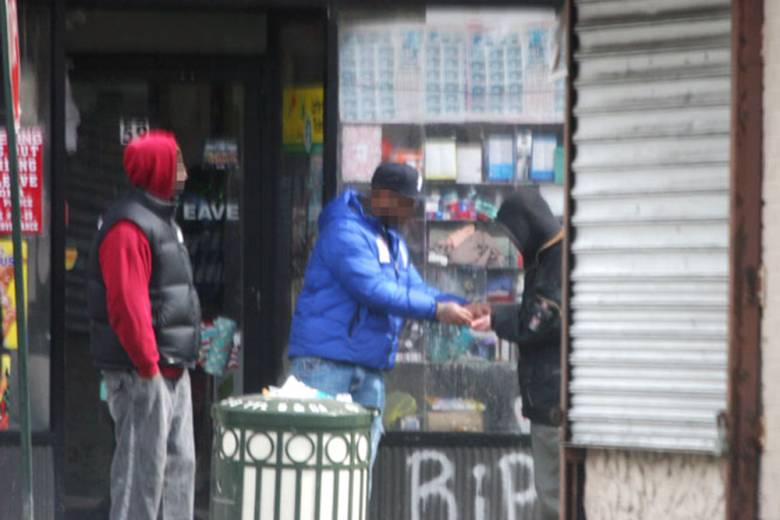
A surveillance photo taken in Paterson during the heroin investigation. (Bergen County Prosecutor's Office)

By Rebecca D. O'Brien

After several arrests and stints of sobriety, a baby-faced 22-year-old man vowed last August he was “gettin’ straight.” A month later, he died of a heroin overdose in his grandfather’s Paramus home, Bergen County’s 12th fatal overdose in three months.

On Feb. 8, a 21-year-old volunteer firefighter from Glen Rock died under his parents’ roof, just 24 hours after he had left rehab.

And in March, two months after being arrested on car burglary charges, a 20-year-old self-trained magician died of a heroin overdose in his father’s Montvale home.

Since the beginning of 2011, heroin has claimed at least 50 lives in Bergen County. It has its grasp on hundreds more.

Once, they were talented athletes, promising students, happy siblings. Now they drive into Paterson, a hub of the regional drug trade, several times a week to buy bundles of heroin, risking violence, arrest and death to sustain $300-a-week addictions.

They snort or inject it on highway shoulders, at home in towns such as Wyckoff, Ringwood or Fair Lawn. Many young addicts live with their parents, dependent on the family’s money and shelter as they stash hypodermic needles and slender glassine bags of heroin in their childhood bedroom.

Most got hooked through pills — prescription painkillers such as Oxycontin and Opana — procured legally through a doctor, swiped from bathrooms or shared by friends. But heroin, at $5 per bag, is far cheaper, potent and widely available.

“It is an absolute epidemic,” said Bergen County Prosecutor John L. Molinelli, who led a multi-jurisdictional task force to crack down on North Jersey’s heroin trade over the past four months. “These kids have no idea what they’re getting into.”

Public health data confirm what local authorities across the United States have known for several years: Heroin use is on the rise, particularly among suburban youth. Between 2007 and 2011, the number of heroin users nationwide increased dramatically, from 373,000, to 620,000, according to federal data, while the number of heroin-dependent young adults more than doubled, from 53,000, to 109,000, between 2009 and 2011, according to the National Survey on Drug Use and Addiction.

In New Jersey, a wave of heroin addiction in affluent communities has been accompanied by a spike in reported overdoses and drug-related crime and death. Bergen County is no exception: In 2011 and 2012 combined, the Prosecutor’s Office counted 130 heroin-related overdoses, 38 of which were fatal, a steep increase from prior years.

The recent increase in heroin use in New Jersey has many layers, officials say. The state’s massive ports and highways are conduits for South American heroin. The drug flowing onto New Jersey streets is at least five times more pure than it was several decades ago, which makes ingestion easier — it can be snorted — and addiction more rapid.

But above all, heroin addiction is believed to have its roots in what public health officials have called an “epidemic” of prescription painkillers, which are readily prescribed and highly addictive. Chemically and metabolically, painkillers based on oxycodone are nearly identical to heroin, to such a degree that they are often conflated in emergency room reports and public health data.

“Heroin is much more commonplace than it’s been in years,” said Ellen Elias, director of the Center for Alcohol and Drug Resources in Hackensack. “We see it all around. It seems like the population in which heroin is most prevalent is that 18- to 25-year-old population.”

Last October, the Bergen County Medical Examiner’s Office reported “an alarming spike” in heroin-related deaths. But trouble had been brewing for months: Police blotters in quiet towns have been thick with drug arrests, young adults caught with hypodermic needles and bags of dope. In the past few months alone, six arrests of Wayne residents. Five of Garfield. Two of Fair Lawn. And many, many more.

In Paterson, a strained police force struggled to keep pace with addicts pouring into the city, across the Passaic River, to buy heroin. Paterson cops reported arresting a Bergen County resident “every other day,” according to an internal report from the Bergen County Prosecutor’s Office.

The war on drugs is waged not just in the homes of affluent Bergen County families, but in the streets of Paterson, where effects of heroin demand take the form of gang activity and criminality.

“The drug trade has successfully destroyed, ravaged, our community and communities across our nation,” said Laquan Hargrove, director of the Paterson Youth Services Bureau. “The war on drugs, we are losing it.”

Hargrove said he has seen the reach of gangs extend in recent years to nearly every corner of the city, nearly every age group. “These kids are exposed to the whole spectrum of the gang lifestyle,” Hargrove said. “Its crime, its violence, they are exposed to the drug trade, they are exposed to it all.”

On a recent afternoon in Paterson, heroin was being sold openly on the street mere blocks from a public school. In March, Bergen County detectives arrested a midlevel dealer after he dropped his child off at school, part of his morning routine.

Most of the gang activity reported by the Bergen County Prosecutor’s Office was attributed to the Bloods, a national gang with strong offshoots in Newark, Camden and Paterson.

Paterson’s needle exchange program, intended to provide junkies with clean needles to lessen the spread of disease, has reported a steep increase in 18- to 28-year-old members. So has the Bergen County homeless shelter, as young addicts — having exhausted the patience and resources of their parents and local police — are kicked out of their homes.

Police across Bergen County have seen spikes in shoplifting, home invasions, burglaries and armed robberies, “localized crimes” to get money for drugs. Addicts were showing up at open houses hosted by real estate agents, scouring strangers’ medicine cabinets for prescription pills.

“Even if you’re not seeing the use, you’re going to see the crime from it,” said Detective Brian Huth of the Ramsey police. “The faces that are getting arrested for heroin, they pop up in commercial burglaries all through our areas. We are all affected by it.”

As a father and a police officer, Huth has been alarmed by what he said is a cavalier attitude teenagers take toward prescription drugs, from Ritalin to Ambien to oxycodone.

Eric Richter, a 20-year-old from Franklin Lakes who now lives in Kinnelon, got addicted to heroin through oxycodone. “It started with pills,” said Richter, who was arrested in February on possession charges. “It slowly progressed.”

Richter vowed he would never do heroin, but his pill addiction was too expensive to sustain. He was soon spending hundreds of dollars a day just to function. “Heroin was already around me, because there were a lot of people I know that did heroin.” By the beginning of 2013, he was snorting several bags a day.

Officials say parents are often unaware of the risks of prescription drug abuse and are loath to admit that their child has a heroin habit. In February, an 18-year-old from Ramsey died from the effects of Ambien, Xanax and carisoprodol, a muscle relaxant.

“Everybody has a hand in this,” Huth said. “They are just normal kids that just fall into this lifestyle. I see them start a lot younger.”

In March, Paramus police arrested a 14-year-old girl after she bought heroin at a local house known for drugs and parties — she had asked her mother to drive her to “a friend’s house” at 1 a.m., police said, claiming to have left behind her hat. Questioned by a detective, she shrugged and said, “It makes me feel good.”

“It is not getting better,” said Deputy Police Chief Ken Ehrenberg in Paramus, which has seen five overdose deaths from heroin or Oxycontin in the past 16 months. “It’s starting to ramp up."

Local police departments see death coming before the families or the addicts do.

Huth knows certain addresses by heart, the houses of frequent burglars who steal to feed their habit or where emergency responders have revived unconscious addicts with shots of Narcan, which counteracts the effects of opiates. Cops watch as mischievous 18-year-olds become tattered, desperate 20-year-olds, and they know it is only a matter of time.

“The kids using oxies in high school will sustain for a while, then they fall off,” Ehrenberg said. “It starts as snorting, ends as shooting. And then there’s a good chance they’re dead.”

There was the 24-year-old former Don Bosco baseball player caught shooting heroin into the arm of a former Ramsey football captain in the back seat of a car in Elmwood Park. The 24-year-old granddaughter of a former Bergen County judge. The 23-year-old son of an Allendale doctor. A 46-year-old former local cop, who sustained an injury on the job that led to an addiction to pills, which soon gave way to heroin.

In contrast to the dealers, many of whom were arrested in “buy and grabs” in Paterson, or swept up in nighttime raids, most of the addicts were brought in for what detectives call “interdiction” — tough-love intervention sessions with Prosecutor’s Office detectives. Parents were often called, even for non-juveniles. In stark, windowless rooms in the detectives’ bureau, as users began to go through withdrawal, the shakes and sweats of “dope sickness,” addicts and families often confronted the reality of their addiction for the first time.

Some of those arrested became confidential informants — introducing undercover detectives to dealers who have been swept up in arrests throughout Paterson. Others detoxed at Bergen Regional Medical Center in Paramus; a few headed to private rehabs out of state.

But many relapse almost immediately. In February, a 21-year-old from Franklin Lakes sneaked out of her family home and was back on the streets of Paterson less than 24 hours after she was arrested, detectives in the Prosecutor’s Office said.

“People don’t understand the drive behind that addiction,” said Lt. Tom Dombroski, a leader of the Bergen prosecutor’s task force. “There’s something in their brain, and once that drive is there — there will always be triggers that put them back in the need mode. Heroin is like medicine for some of these people.”

Lyn, a 24-year-old heroin addict from Tenafly, says she cannot function without her daily doses of the drug.

“The one time you try it, you get sucked in,” Lyn said. She started experimenting with pills two years ago; after a month in rehab last spring, she turned to heroin. She was recently arrested on possession charges, but continues to inject up to 10 bags a day, worth $40 — for this reason, she asked to be referred to only by her middle name.

She has exhausted her parents’ patience, and her own savings; she has sold off cameras and laptops, and has shoplifted, “anything to get money so I can buy the drug.”

Heroin addiction is a constant state of unfulfilled need — an addict will forever be “chasing the dragon’s tail,” the elusive reclaiming of that first experience, a rush of euphoria and analgesia. It is a deeply physical, private drug, not what you take to go party, but what you take to escape.

“You used to think of heroin user in a dark alley with a needle sticking out of his arm,” said Special Agent Doug Collier with the New Jersey office of the Drug Enforcement Agency. Back in the 1970s, Collier said, street heroin was maybe 6 or 8 percent pure — today, the DEA data show heroin purity levels in New Jersey at 40 percent, down from a 2005 peak of 70 percent.

“Heroin has never gone away,” Collier said, “Now, you can snort it, and it’s chic, it’s in vogue, it’s fueled by opioids. The stigma of a needle is not there. We have seen 18- to 25-year-olds hooked because of trying a narcotic painkiller, and when that source runs out, why not buy a bag of heroin?”

May 6, 2013

Pills open door to heroin, arrests, overdoses

By Rebecca D. O'Brien

At 21 years old, Graham Dooner has the same wit and easy charisma that kept him on the edge of trouble as a student at Ridgewood High School. He cracks jokes, he drops lines like “ipso facto” into conversation, he could talk for hours about the history of the labor movement in Paterson.

But nearly two years of intravenous heroin use have consumed the body of this 6-foot, 4-inch former varsity athlete. His pale arms are lined with track marks, slender yellow bruises from daily injections. Beneath his Knicks cap and a mop of reddish hair, ­Dooner’s handsome face is gaunt and clammy, haunted by a bluish pallor and spotted with sores. His yellowed teeth are worn along the edges.
 
“With shooting heroin, people say it is something they would never, never, ever do,” Dooner said. “But, I mean, things change in a flash, especially when you are addicted to opiates. Your levels — your ‘I won’t go past that line’ — they quickly diminish.
 
“It’s sad. It really is,” Dooner said. “Eventually, it becomes you need it just to be yourself, you know what I mean?”
 
Like many addicts in and around North ­Jersey, Dooner has ex­perienced a near-fatal overdose, fights with drug dealers and police, and multiple arrests.
 
Dooner’s latest arrest was in March. Between mid-January and mid-April, he and 89 others were arrested in Bergen and Passaic counties and charged with heroin possession, as part of a large task force operation led by the Bergen County Prosecutor’s Office. That figure, roughly one arrest per day, does not include repeat offenders — Dooner was arrested twice in the same week. The addicts flocked to Paterson from towns across Bergen and Passaic counties, from as far south as Princeton and as far north as Rockland County, N.Y. More than two-thirds of those arrested over the past four months were under age 30, with high school degrees and middle-class families.
 
Most told the same story: A casual relationship with pills, particularly painkillers, in their late teenage years led to a full-blown heroin addiction, a need that tugged on their every cell, demanding every waking moment.
 
They include a 25-year-old from Tenafly who has shoplifted and sold off her belongings to support her addiction; a 20-year-old from Franklin Lakes, who hid his painkiller and heroin habit from his fiancée for years; a 21-year-old woman from Rockland County whose addiction was so powerful she found her way to Paterson on Christmas Day, looking for a high.
 
Most, including Dooner, now face third-degree possession charges, which can later be expunged. They are unlikely to see jail time.
 
Dooner and his friends experimented with drugs in high school, mostly marijuana and the occasional pill. But his troubles really started, Dooner said, with a lacrosse injury his senior year. He was prescribed Percocet, then stronger painkillers. Once those stopped, he stole the drugs prescribed to his mother after she had back surgery.
 
“At that point, I was playing sports again, and I was taking opiates just to get through ballgames,” Dooner said. “None of my friends knew. It was a coping thing, a maintenance thing. It was almost mental — I thought I had to do this, to play in my games or to perform.”
 
For several years, the widespread abuse of ­prescription painkillers has alarmed public health experts and law enforcement officials. Prescriptions for Oxycontin, Percocet and other popular brand-name drugs based on the painkiller oxycodone have soared in recent years: In 2009, 257 million prescriptions for opioid painkillers — derived, like heroin, from the opium poppy — were dispensed nationwide, almost one per person, according to a 2011 White House report. 
 
In New Jersey in 2010, enough prescription painkillers were dispensed to medicate every state resident — there are nearly 9 million — at standard dosage rates for a month, according to data from the Centers for Disease Control and Prevention.
 
“It’s easy to get your hands on some sort of opioid,” said Ellen Elias, director of the Center for Alcohol and Drug Resources in Hackensack. “I think that many parents may be unaware of what the risks are in terms of how kids are accessing these pills. I believe prescriptions are written too frequently.”
 
These painkillers are, for many, a gateway to heroin, their chemical cousin. Heroin addicts in North Jersey tend to start their addiction stories with variations on the same line: “In my town, pills are everywhere.” They describe a suburban teenage culture that treats pill-popping the way many in their parents’ generation treated marijuana — casual, commonplace, a rite of passage.
 
Ramsey has seen several fatal heroin overdoses in recent years, Detective Brian Huth said. Like many, he placed some of the blame on pills.
 
He recalled picking up a 21-year-old Allendale woman — a heroin addict, he said, whom River Edge cops had caught several times hawking stolen goods at the local pawnshop. “She told me, ‘My generation sees pills differently than you do,’ ” Huth said. “That stuck with me. She’s absolutely right. They all started seeing the pills as OK.”
 
Dooner graduated from high school in the spring of 2010 with an addiction to painkillers and admission letters to several colleges. He chose the drugs.
 
Oxycontin has for years been the nation’s most popular oxycodone-based painkiller, bringing in at least $3 billion in annual sales. In 2010, responding in part to costly legal cases and public pressure, Purdue Pharma introduced a new version of Oxycontin that was more difficult to abuse: The new Oxies could no longer be crushed or dissolved and were slower to take effect.
 
The change appeared to stem abuse of that drug, but it also had unforeseen consequences — it soon became clear that addicts were simply substituting other opioid painkillers, particularly heroin, which was cheaper and widely available. A study published in 2012 by the New England Journal of Medicine showed that heroin use among surveyed Oxycontin addicts nearly doubled after the 2010 reformulation.
 
“When they changed the formula to something that was abuse-proof, the pills started disappearing from the streets,” said Eric Richter, 20, whose heroin addiction began last winter after years of prescription drug abuse. Richter, who is from Franklin Lakes but now lives in Kinnelon, said he used to buy pills from a dealer on Route 46. “They were weaker, you couldn’t crush them.”
 
It was easier to find “blues,” 30mg Roxicodone (known as “roxies”), Richter said — but they cost up to $30 a pill, and he needed more of them to “feel something.” Every day, Richter hid his daily dose of five or six pills in strategic places around the Franklin Lakes home he was then sharing with his fiancée, Jessica.
 
Richter held down a job at the family business, but was often late. “I wouldn’t be able to wake up in the morning,” he said.
 
“When you first start doing something, you think you’re just having fun,” Richter said. “Then you’re like — I need this. That’s basically how it starts.”
 
Richter said in April that he had never injected heroin and was now clean, taking college courses online. But the addiction cost him dearly: Between the pills and the heroin, Richter estimates he had spent more than $45,000 on drugs over the past year and a half. He and his fiancée, who said she only found out about his addiction after his February arrest, have moved back in with his mother. 
 
Changes in pharmacology weren’t the only thing that accelerated Graham Dooner’s addiction. In 2011, Dooner and his mother and brother left Ridgewood for Fair Lawn. He was now within just a few miles of abundant, cheap heroin.
 
“What really helped the progression to street drugs, to heroin, was moving to Fair Lawn,” Dooner said.
 
Route 4 cuts through southern Fair Lawn, turning into Broadway before it goes over the Passaic River into neighboring Paterson, one of many access points along a porous border.
 
Not that anything could stop an addict. “If Paterson was flooded, they’d swim,” said Lt. Tom Dombroski of the Bergen County Prosecutor’s Office. “The geography is not good. It’s like a gambler living in Atlantic City.”
 
Shortly after moving to Fair Lawn, Dooner said, he snorted heroin for the first time with a friend of his older brother. A few months later, Dooner’s girlfriend, who was an intravenous user, shot him up. It felt like a “warm blanket,” Dooner said, an embrace of contentment.
 
“The first time I shot up, it’s kind of like the first time you ever did the drug, which is really what everybody is after — they’re after that first time,” Dooner said.
 
But the first high was followed by a first arrest, in October 2011. “Once that happens, you know, I start getting down on myself,” Dooner said. “ ‘What kind of kid am I?’ It almost ­becomes easier to keep doing it once you get arrested because you get so down on yourself.”
 
For young users, coming to terms with addiction and a first-time arrest can seem insurmountable.
 
“I just think of all the things I could have done at this point in my life,” said A.C., a slender, doe-eyed 21-year-old from Rockland County. 
 
A.C. was arrested in March, in Elmwood Park, after buying a brick of heroin in Paterson — 50 bags, roughly a gram, the amount of powder in a packet of Sweet’n Low.
 
Sitting in a stark interview room in the Bergen County Prosecutor’s Office with a detective and a reporter, A.C. was beginning to get sick: It had been several hours since she sniffed some heroin, and she was going through withdrawal. Makeup was smeared under her eyes, and she was sweating, itchy and nauseated. A.C. crossed and uncrossed her legs, played with her cellphone, and avoided eye contact with Sgt. David Borzotta, who was seated across from her wearing a sweat shirt and jeans.
 
“I never, ever thought this would happen to me,” said A.C., who asked that her full name not be used because she hoped to cooperate with the police as a confidential informant.
 
“My group of friends — my real friends — they don’t know anything,” A.C. said. “My drug friends are acquaintances.” A.C., who dropped out of high school because of her pill addiction, said she knew several people who died of pill or heroin overdoses.
 
Since turning to heroin a year and a half ago, A.C. had not gone a day without it, and was snorting around 20 bags a day, roughly $80 worth of heroin. She swore she would “never, ever” inject it, but Borzotta raised an eyebrow incredulously — injecting brings a much faster, powerful high.
 
A.C. said, with an embarrassed smile, that she had driven to Paterson to buy heroin on Christmas Day. She pleaded with Borzotta not to call her parents.
 
“If you’re not addicted, you don’t understand,” A.C. said.
 
“I’ve spoken to about a thousand of you,” Borzotta said, shaking his head. “I understand. This is not a life.
 
“Here’s the deal with heroin,” Borzotta said, leaning forward to look A.C. in the eyes. “It leads to jail or death. This was your first arrest. There will be more. And some cops won’t be nice. You have got to get control of this.”
 
A.C. nodded.
 
As he left the room, Borzotta sighed.
 
“Sometimes, I feel like I’m talking to dead people.”
 
A handful of those arrested for possession by the county task force were students, often taking online classes or attending nearby community colleges. Others held down full- or part-time jobs, or worked freelance — particularly in food services and construction.
 
A large number of them lived at home with parents who provide security and financial support, and were neither working nor in school — like A.C., who said she and her mother fight about her drug habit.
 
“Kids get bored,” said John, a 20-year-old from Rockland County. “A huge factor is boredom.” 
 
John was arrested with A.C. in March. The two used to date, and remain close friends, he said. John started using pills at age 14, stealing OxyContin from his terminally ill father, and has been using heroin on and off for more than two years. 
 
John was sweating, too, but was not as sick as A.C., in the neighboring interview room. He was animated, swearing with abandon as he spoke about the thrills of having sex on heroin, and his determination to quit.
 
“When I get home tonight, I’m going to drink a few Mike’s Hard Lemonades, take a ZzzQuil, and watch some television,” John said. “I’m going to make up an excuse for where I was, to tell my mother.”
 
John lives at home with his mother, who thinks he is clean, he said. She gives him cash, though John also said he has savings from odd construction jobs and inheritance. He estimated that he spends $30,000 a year on heroin, not including the cost of gas for daily trips between Rockland County and Paterson. 
 
John said his habit worsened after local jobs ran dry.
 
“Typically, when you have recessions, people resort to other things to entertain themselves, just like alcohol use grows in recessions,” said Jerome King, who heads the Well of Hope center in Paterson. 
 
The center’s syringe access program — which provides free, clean hypodermic needles for drug users — has a membership of roughly 2,500 and the numbers are climbing, particularly among young women from the Passaic and Bergen suburbs, King said.
 
When the program started five years ago, women made up just 10 percent of the members. Now, that number is nearly 40 percent, even as use among men continues to climb. 
 
“Most women who use heroin are introduced by their boyfriends,” King said.
 
Of the 90 names released last Thursday by the Prosecutor’s Office for heroin possession, 17 were women. Police also say young women are increasingly using heroin.
 
Lyn, 25, was among them. After her arrest in February, she continued to inject heroin, and for this reason asked to be identified by her middle name. 
 
When Lyn began experimenting with pain­killers two years ago, she was taking classes at a local college and living with her parents in Tenafly. Among her friends, pills were widespread — she knew two kids with sickle-cell anemia, Lyn said, who sold their painkillers to peers — and Lyn was soon addicted.
 
One day last spring, Lyn said, she came home to find her mother in the kitchen with a police officer. “They said, ‘You’re going to rehab, or you’re going to jail,’ ” Lyn said.
 
The 30-day stint in rehab got Lyn off the pills, but it poisoned her relationship with her mother.
 
“My mother is a definite trigger for me,” she said.
 
She moved out of her parents’ home and stopped going to school. Then she began using heroin, she said. “I just wanted to have that feeling again,” Lyn said. “I was around people who were doing it, so it was hard, being around those people. I should have distanced myself, but I didn’t.”
 
Heroin, like other opiates, dulls pain — it brings a trance-like calm, along with a rush of euphoria. For this reason, users say, heroin is a solitary drug. Lyn called it “a relief.” 
 
Now, she can’t get out of bed without it. When she uses, she feels healthy, she showers, she puts on makeup, does her nails, she said.
 
“A lot of people want to get away from the troubles and problems they’re having,” Lyn said. 
 
She said she wants to quit. “It’s a miserable life, a miserable existence,” Lyn said. “Two years have gone by, and where did they go? Once you abandon yourself, that drug will never give you a rest.”
 
Withdrawal from heroin, which can begin within hours of last use, comes with intense physical symptoms: cold sweats, aches, extreme discomfort. The fear of detox, Lyn said, “would push me to ­continue to do it, to go to Paterson at night, and do those things that in my right mind is not a good idea.”
 
Lyn drives down to Paterson with her fiancé, who is also an addict — the two live together in Elmwood Park. “It’s definitely not a safe scenario,” she said. Her fiancé has been shot at, she said.
 
This is not an uncommon occurrence, police say. When addicts run out of cash, they hand over electronics or jewelry as temporary payment to their dealers. If they return later to retrieve their goods, there can be violent confrontations.
 
Dooner has twice had a gun drawn on him, he said with a small amount of pride. He said he also takes pride in the fact that he has never stolen anything to support his habit — “I’ve always been a little more business-minded,” he said.
 
When Dooner started shooting heroin in 2011, he said he was working nights at a bar in downtown New York City, bringing in hundreds of dollars a week. 
 
Every hour, he slipped into the bathroom to shoot heroin, sometimes mixed with cocaine, he said. His boss knew, Dooner suspects, since trickles of blood sometimes ran down his arm, “if I got sloppy.”
 
He would take the train home to New Jersey in the early morning hours, stopping in Paterson to buy drugs.
 
Dooner became close with high-level dealers in Paterson, and eventually began to cut pure heroin and sell it for them in Bergen County, keeping some cash for himself. His addiction accelerated. By the time he went to rehab, last October, he said he was injecting 30 to 40 bags of heroin a day, roughly two-thirds of a gram, which is — he readily acknowledges — an “insane amount” of heroin. 
 
Despite the agony of withdrawal (he said he would “rather cut off a toe” than go through it again), Dooner liked the structure of rehab; he wrote daily in a journal and was happy with the “clarity” of his thoughts. 
 
He was surprised to find that most of the people in his group were young heroin addicts like himself; many seemed to live a double life, with addict friends and “real” friends.
 
But he picked up heroin again shortly after he got out. “You wake up and it’s just this urge, this voice in your head, telling you, you need this to be normal,” Dooner said.
 
One night last December, Dooner shot up at home while waiting for a friend to come over for a Knicks game. 
 
His friend found Dooner unconscious on the sofa, a needle sticking out of his right forearm.
 
Dooner has been arrested three times, but he’s talked his way out of at least five other “tight spots,” he said. “Once you get to that level, |you are a master at deception, a master at manipulation.”
 
Richter, in April, was seeing a therapist, working full time, and going to meetings, he said. His fiancée, Jessica, said she was “watching him all the time.”
 
“I have clarity,” Richter said. “You feel better. You’re not depressed.”
 
Dooner, like Lyn, said he “can’t see myself” as a junkie at age 30. 
 
“I’ve always had this feeling — I think everything is going to work out just fine, as much as what has happened to me should tell me otherwise,” Dooner said. 
 
“I still tell that to myself. Sometimes, I don’t want to admit how much work it takes.”
 
He plans go back to school in the fall. But before that can happen, he has to deal with his addiction — and the charges he faces for drug possession.
 
May 7, 2013

Parents face the agony — and brutal choices — of a child’s heroin addiction

By Rebecca D. O'Brien

When death came for Mark MacMillan, it was on the floor of the family bathroom, where the 18-year-old had retreated to shoot heroin a day after leaving rehab.
 
It came with the familiar wave of euphoric tranquility, then a nod and a tumble to the floor.
 
It came as his 83-year-old grandfather — who had been like a father to Mark, his male role model in a single-parent household — burst in, dragged him to his bedroom, and performed CPR.
 
It came as Mark’s 14-year-old sister, Ginny, shielded their 11-year-old brother, who has autism, from the sight of the needle, the whirl of sirens, their older brother’s blue limbs, the grim scene playing out in their Allendale home.
 
It came faster than Mark’s mother could drive home from her waitressing job, and despite her screams and prayers over her son’s lifeless body.
 
It came when Susan MacMillan’s eldest son — who just months ago had tearfully begged her for help — lost his battle with heroin.
 
It was a brief battle, and a quick death, but it came with warnings, and with lessons.
 
Support groups tell parents of addicts that they have to set boundaries. But that refrain rings hollow to MacMillan. 
 
“There are no boundaries with heroin,” MacMillan said. “You can take their keys away. You can take their car away. You can take their money away. You can do everything. They will find a way. You cannot stop it. Love cannot stop it. Nothing can stop it. Only they can stop it themselves.”
 
Officials, counselors and families alike point to several overlapping causes behind the surge in heroin addiction in New Jersey: powerful prescription painkillers and doctors who over-prescribe them, inadequate resources for young addicts, an influx of high-quality heroin from South America, an ill-equipped criminal justice system.
 
But they also point to parents, who often don’t acknowledge the presence of the drug in their communities or recognize the warning signs of a child in the grip of an addiction. And even if parents do spot the problem, how much they can do to break their child free of heroin’s grasp is debatable.
 
Parents say they face an impossible choice: to shelter and nurture a child through a cruel, all-consuming addiction — even as they lie, steal and become unrecognizable — or to cut them loose. Heroin may know no boundaries, but neither does parental love.
 
“How do you let go of a child? How?” MacMillan said, sitting in her back yard on a sunny spring morning. “You get to the point where you want to throw that child out, but then you get worried that one day, you’re going to get a phone call, and they’re going to be dead in the street. And you’re worried when they’re in the house, because they could hide anything anywhere. You just worry.”
 
Since the beginning of 2011, more than 50 people have died in Bergen County of heroin overdoses. In that span, more than 1,800 Bergen County residents have been admitted to hospitals and state-registered facilities for heroin- or opiate-related emergencies or treatment. More than 30 percent of those admitted have been under age 25. 
 
There have been hundreds of non-fatal overdoses and drug-related crimes across Bergen County in the past two years, authorities said, many of which go unreported. Because of heroin’s chemical similarity to opiate painkillers such as oxycodone, public health data often group the two together. 
 
Some parents knew nothing of their child’s drug abuse until an arrest or an overdose. Some ignored it; others became entangled: Police have seen some parents drive their children to Paterson to buy drugs or get clean syringes at the needle exchange. Some are unwilling to watch their kids go through withdrawal. Others have been manipulated into believing that the needles are for someone else.
 
A Montvale woman whose son died last August after battling a heroin addiction for six years described endless legal bills and court fees, theft, lies, costly rehabs, false hope, relapses.
 
“Did we enable him? Absolutely,” said Margaret, who asked to be identified only by her middle name because of the emotional impact on her family. “We didn’t give him drugs — we gave him another chance, another chance, another chance. According to tough love, you’re supposed to stop a million times before we did. But you can’t … as long as I really did have a son, I was never going to turn my back on him.”
 
Margaret and Susan MacMillan said they felt profoundly helpless as their sons, growing more sick and more ashamed, cycled in and out of rehab and the courts. The families grappled with insurance companies that would not cover the costs of medical care, and the paucity of affordable, effective treatment options. In communities that did not seem to want to acknowledge the presence of heroin, they felt alone.
 
“I have seen the depths of hell,” said Margaret, who spent the bulk of her retirement savings to rehabilitate her child.
 
Many of the young adults who have died in Bergen County of heroin-related overdoses since the beginning of 2011 were living at home with their parents — as did many of the 90 charged with possession in recent months as part of a county investigation into the surge of heroin addiction among suburban youth.
 
Last week, the Bergen County Prosecutor’s Office announced the arrests of 115 people on heroin possession and distribution charges, the culmination of a four-month task force that aimed to stem demand for the drug and shed light on the regional heroin trade. One element of the task force was interventions with addicts and their parents.
 
“With parents whose children are addicted, if you’d spoken with them four years earlier, when their kids were dabbling in other drugs like pot or alcohol, they would say, ‘This is what kids do,’ ” said Ellen Elias, director of the Center for Alcohol and Drug Resources, in Hackensack. “For some kids, that’s where they stop. For other kids, it’s really not.”
 
Parents often cannot see the progression from casual drug use, specifically the non-medical use of prescription painkillers, to full-blown addiction, Elias said.
 
“It’s not until these parents are in a situation where they have to sleep with a wallet under their pillow, or all their jewelry is gone, that they realize their child has a problem,” Elias said.
 
Mark MacMillan was a restless kid who liked to catch frogs and fix up cars. “He was all boy,” his mother said.
 
As a teenager, he was prone to dark moods, and got into trouble with local police for “horsing around,” Susan MacMillan said. But in his senior year of high school, Mark’s behavior grew more erratic, and his depression deepened. His mother knew he was smoking cigarettes, drinking beer, using marijuana. 
 
“I was viewing that, in a way, as pretty average for a 17-year-old boy,” MacMillan said. “I was not informed enough to realize that he entered a harsh arena.” She now suspects that Mark had discovered painkillers, and was transitioning to heroin.
 
Many signs of heroin or opiate addiction are remarkably similar to what might be described as typical teenage behavior: moodiness, casual deception, withdrawal from family, a loss of interest in old hobbies and friends, sleeping late, trouble in school.
 
“Then I started finding things,” MacMillan said: rubber bands, empty plastic bags, hypodermic needles stashed around in his bedroom. After she found an old tourniquet under Mark’s mattress, she confronted him — and he confessed to shooting heroin.
 
“It’s bad,” Mark told his mother, she said. “I can’t not shoot heroin.”
 
In the spring of 2011, Mark graduated from high school — his mother called it “the happiest day of my life.” But his addiction was escalating. He stole money, and sold car parts salvaged from scrap heaps to buy heroin in Paterson. MacMillan tried to get him on Suboxone, which is used to treat opiate addiction, but he refused. 
 
In the end, the only way MacMillan got Mark to detox was by turning him over to the courts, she said. “He was getting in more and more trouble, which was putting a lot of pressure on him and actually making him more depressed, which was actually making him use more,” MacMillan said. “Part of me felt that the negative reinforcement was not helping him, it was making him worse.”
 
MacMillan secretly made arrangements to have Mark remanded to a rehab facility.
 
“I had to lie to my poor son,” MacMillan said.
 
But when they appeared in court for an evaluation, and the judge asked MacMillan if she could handle Mark at home for 72 hours while they found him a bed, she lost her nerve. “I could not say no in front of my son. He was crying — like a 3-year-old — hanging on to me.” MacMillan began to cry as she recalled his plea. “Ÿ‘Please, Mommy,’ that’s all he would say. So I finally said ‘Yes, I’ll take him home.’Ÿ” 
 
But the judge read her body language, MacMillan said, and remanded Mark to jail. When they put him in holding, he began to go through withdrawal — he collapsed, and was taken to the hospital, where he got so sick he became dehydrated. He was shuffled between hospitals before authorities found him a bed at a rehab facility in Summit.
 
“The judge said he should remain there 21 to 28 days, followed by intensive outpatient rehab at Bergen Regional,” MacMillan said. He was released after only six days, a much shorter duration than ordered, something MacMillan suspects occurred because of insufficient health care coverage. MacMillan was sporadically employed at the time, with her children covered by New Jersey Family Care, which provides insurance for lower-income families.
 
On the way home from rehab, Mark told his mother about plans for the future — he wanted to go to technical school and community college, and open a custom auto shop.
 
“When I picked him up from rehab, he was my Mark again,” MacMillan said. “I was so happy.”
 
But hope quickly gave way to the reality of addiction.
 
That night, she said, he told her he was going to a Narcotics Anonymous meeting. Instead, he used heroin. The next day, August 26, Mark injected himself with the fatal dose.
 
“I drove home as fast as humanly possible,” MacMillan said. “I knew he was going. I just screamed, and screamed, and screamed — ‘Please wake up.’Ÿ”
 
Nearly two years later, MacMillan describes Mark’s death as a call to arms. A forceful and outspoken woman, she has dedicated herself to raising awareness of the addiction that killed her son.
 
She has started a foundation, Team MacMillan, that works to support addicts and their families, and she recently joined roughly 1,000 others in a “human chain” in Wanaque, an anti-heroin rally.
 
“Going to the rally in Wanaque showed me that I am not alone, and that all of us, every parent, needs to get together,” MacMillan said. “The ignorance has to stop.”
 
That ignorance, or denial, about the spread of heroin and its allure among teenagers troubles officials like Doug Collier, a special agent at the Drug Enforcement Administration in New Jersey. “I think that’s the biggest thing that stuck out to me as a DEA agent,” Collier said. “When I talk to parents, they are in denial. The three most dangerous words are, ‘Not my kid.’Ÿ”
 
Detective Brian Huth of Ramsey has spoken with parents of addicts who refuse to believe their kid is using heroin. 
 
“Denial is a real enemy here, the parental attitude,” Huth said.
 
“Parents seem to be more permissive,” Huth said. “They are permissive with parties, kids partying in the basement while parents are upstairs. It all leads to the attitude that this stuff is OK. Parents seem to think they can quietly shuffle their kid off to rehab. Most of the time, they relapse.” 
 
Collier, a member of a state task force on heroin and opiate addiction, has observed that parents struggle to admit a child has a problem even after an overdose.
 
“They don’t want to believe that it’s heroin,” Collier said. “It’s really difficult, for every parent.”
 
Part of the problem is stigma, Collier said: Many parents think of heroin as a dirty drug, used in dark alleys. “We have 18-, 19-year-olds that come from affluent families,” Collier said. “They don’t wake up and become heroin addicts. It doesn’t just happen that way. It crosses all boundaries. I’ve seen the richest of the rich, and the poorest of the poor.” 
 
Another problem is shame.
 
“People don’t want to talk about it, because there’s this whole image of ‘I’m supposed to have it together,’Ÿ” Elias said. “Honestly, I think that a lot of people don’t see how it affects them, in their families and in their communities and schools. I don’t think people are aware of the fact that there is a problem. Those who are experiencing it aren’t really talking about it.” 
 
The state task force, which is expected to release a report in the coming weeks, heard testimony from dozens of former addicts and parents who have lost children to heroin or opiate overdoses. Their stories have remarkable parallels — teenagers who experimented with pills, then turned to heroin. Some had conquered their addictions; others were lost.
 
Last July, Abby Boxman of Freehold testified about her son, Justin, a star football player who died of a heroin overdose in 2011 at age 21.
 
Boxman and her husband knew Justin drank alcohol and smoked marijuana, she told the panel, “as parents, you know, we brushed off things,” she said. In his senior year of high school, Justin began to change. He got suspended, lost interest in sports, and starting hanging out with a different group of kids. 
 
He left for college with an addiction to opiates, failed most of his classes, and came home after a semester. Over the next two years, Boxman said, “we became involved with the chaotic life of addiction; you know, the stealing, accidents, tickets, lying, loss of friends, loss of jobs.” As Justin’s addiction progressed to heroin, the family fought with insurance companies that would only cover two days of rehab.
 
“He really tried to keep himself sober,” Boxman said. “But early in 2011 was when we really realized, my husband and I actually admitted to ourselves, that our son was an addict, and I think the worst part of this whole epidemic is really admitting that. Because, as a parent, you know, you do everything that you possibly can to protect your kid. You do everything.”
 
Boxman still struggled to use the word “heroin” in her testimony.
 
“The epidemic of opiates is stronger than the love that a mother has for a child,” Boxman said.
 
Margaret had only one child, but for six years, she lived with two different versions of her son. “There was Mr. Drugs, and there was my son,” Margaret said. “You mean nothing to Mr. Drugs. You are not his mother. You are in his way, or her way, to get drugs.”
 
Margaret’s son began using heroin at age 19, when he left college to recover from a traumatic injury. Margaret said it took months for her to realize that her son was using hard drugs.
 
“It sounds dumb, but I didn’t realize it was so bad,” Margaret said. “He was so freaking functional. He graduated from high school, he went off to college.”
 
Driven by his addiction, Margaret’s son used his father’s Social Security number, pulled money off family credit cards, sold his mother’s jewelry and household electronics. “They have phenomenal ways of raiding your bank account,” Margaret said. “You come in with the groceries, and the next thing you know, the money in your wallet is gone.”
 
Margaret and her husband burned through their savings, spending hundreds of thousands of dollars on rehab — all out of pocket, until the Affordable Care Act allowed them to put their adult son on their insurance. His body was covered in sores and scars. He overdosed 11 times; on three occasions, his father revived him. At his peak, he was shooting up to 15 bags of heroin a day in the basement apartment of the family home.
 
“There is a point in time when parents or loved ones don’t want to hear it anymore,” Margaret said. “We have been hurt too much.” Margaret said she stopped attending group therapy sessions and retreated to the horror of her household. “I really got to the point where I said, ‘This is not my problem. I didn’t cause it. I can’t cure it. I can’t change it.'
 
Last spring, Margaret’s son came home clean from his sixth stint in rehab — Mr. Drugs was gone. “This last time, he was his same wonderful self,” Margaret said. The family went on vacation together. “I had so much hope. I had no expectations. I had hope. We both said, ‘Our kid is back.’
 
Two months later, at age 25, he died in his bed. His death was never ruled a heroin overdose, but the years of abuse had taken their toll. Margaret suspects his heart gave out in his sleep.
 
“He tried so hard,” Margaret said. “He did not want to be what he was. Nobody wants to be an alcoholic or a drug addict. Nobody aspires to this.”


May 8, 2013

Focus is on treatment for low-level offenders

By Rebecca D. O'Brien

The scene could have played out in dozens of inner cities nationwide over the past 50 years: As kids poured out of Paterson School 6 into the bustling streets of the city’s 4th Ward, a weary-eyed 17-year-old boy, his arms covered in tattoos and his face spotted with acne, left his apartment and approached a sedan idling on the corner.
 
His customer was waiting with a wad of $20 bills, and the boy quickly reached for bundles of heroin tucked in his pocket But the buyer — an undercover narcotics detective, sitting next to a reporter invited for a ride-along — asked about getting more. “Yeah, yeah,” the boy said, increasingly anxious, “What do you want?”
 
“A brick,” the detective said. “Tomorrow?”
 
Before the boy could reply, a van pulled up, three officers jumped out and took him down on the pavement; as he was cuffed, one cop cradled the boy’s wincing face, pressed against a storm drain.
 
This is a street-level view of drug busts that have taken place across New Jersey over the past few months. Between January and April, Bergen and Passaic authorities combined to confront drug traffickers and distributors in Paterson. They performed interventions with addicts and their families. They did it in hopes that their large-scale task force would send a message to the rising number of young heroin users across the region.
 
The moves are emblematic of a renewed effort to crack down on a heroin scourge that is spreading beyond the street corners of cities like Paterson out to leafy suburbs, the very middle-class communities once thought to be immune to the ravages of the drug. The breadth of heroin addiction in New Jersey has spurred a response that seems to have political momentum. Many hope it is strong enough to make a dent in a problem that has seen 50 deaths in Bergen County since the beginning of 2011, chronic gang violence in Paterson, countless overdoses and dozens of arrests.
 
“We could do this every day,” said Steven Cucciniello, chief of detectives at the Bergen County Prosecutor’s Office, which recently concluded a large task force operation to address the rise of heroin in North Jersey. “It could just go on forever.”
 
New Jersey is a hub of East-Coast heroin trafficking, officials say. But the soaring popularity of prescription painkillers — often a precursor to heavier drug use — along with cheap, easy-to-buy, high-quality heroin, has strengthened the drug’s grasp, particularly among suburban youth. 
 
For decades, the “war on drugs” in New Jersey has been fought in fits and spurts, a patchwork of buys, busts and task forces. It has been fought by families, doctors and police on highways, in courtrooms and in private homes. 
 
Now, officials are thinking in different directions.
 
The moves are small, but meaningful. They involve law enforcement, new treatment protocols, grass-roots campaigns and efforts to increase awareness about heroin addiction. 
 
And although past efforts have had limited success, there is hope that a new push, if it has enough backing, could help stem a heroin problem that has long been rooted in cities like Paterson, Newark and Camden. 
 
“It is a very interesting time,” said Ellen Elias, director of the Center for Alcohol and Drug Resources in Hackensack. “It has set off a lot of activity.”
 
Much of this momentum can be seen in new state initiatives.
 
Governor Christie has charged the Governor’s Council on Alcoholism and Drug Abuse with creating a Blueprint for a Drug Free New Jersey by 2020. The council’s task force on opiate and heroin addiction is expected to release recommendations in the coming months. 
 
The Department of Human Services’ Division of Mental Health and Addiction Services has funded coalitions across the state seeking to curb underage drinking, abuse of prescription drugs, illegal drugs, and new and emerging drugs, such as “bath salts.”
 
Bergen is one of the three counties selected for a $2.5 million pilot program to expand drug courts, part of a law signed last year by Christie that would require drug treatment for low-level offenders who would otherwise serve jail time.
 
And last Thursday, Christie signed a good Samaritan law that provides immunity to those who report or assist in helping those who have overdosed on drugs.
 
“Our preconceived notions regarding gateway drugs, drug addiction and drug enforcement must be revisited,” Philip Degnan, executive director of the state Department of Investigation, told the task force last year. 
 
“We can’t remain wedded to the old distribution motto that we know. We now live in a state where non-medical use of prescription pills serves as an entree to heroin addiction.”
 
Frank Greenagel Jr., a counselor who oversees recovery housing — a resource for students who are recovering addicts — at Rutgers University, has witnessed a dramatic increase in the number of students recovering from heroin and opiate addictions. In 2009, there was just one; the following year, there were eight.
 
Last fall, 15 of the 36 students in rehabilitation housing were recovering from opiates or heroin — and still more live in off-campus housing, he said. For more than a decade, Greenagel has counseled teenagers as young as 14 who are abusing prescription drugs and heroin.
 
“This age group is just getting pummeled,” he said. Greenagel, who also served on the state opiate and heroin task force, wants to see stronger, more dramatic reform of drug policy at the state and federal levels.
 
Greenagel said the task force report, in its effort to push small-scale, feasible policy measures, may find larger problems — such as the abuse of prescription medications that can lead to heroin addiction and the lack of insurance options for addicts seeking treatment — tougher to solve.
 
“I really think we have an obligation to address some of that right now, even if it’s unpopular,” Greenagel said.
 
The push for some of that is already under way. On Monday, an Assembly panel approved legislation requiring health insurers in the state to provide the same levels of coverage for a broad array of mental illnesses and substance abuse addictions as they do for treating other diseases.
 
“Mental illness and substance abuse can affect the entire spectrum of a person’s life, from their interpersonal relationships, to their ability to obtain employment and even their disposition towards violence,” said Assemblywoman Valerie Vainieri Huttle, D-Englewood, a co-sponsor of the bill. “With so much at stake, we must provide a clear path to treatment that will enable those suffering to live happier, more productive lives.”
 
If the bill becomes law, inpatient and outpatient programs, including detoxification treatment, would be covered under state-sponsored health benefits plans.
 
Insurance companies often deny coverage for mental health and addiction programs, Greenagel said — a concern that was echoed by many families of addicts.
 
Grass-roots organizations, particularly those with parents of current and former heroin and opiate addicts, have been behind many recent drug policy successes. 
 
Take the good Samaritan bill, which Christie had originally vetoed. 
 
The governor changed his mind, he said, after hearing from advocacy groups and parents.
 
“It was the parents who put pressure on us as legislators, and on the governor,” said Assemblywoman Connie Wagner, D-Paramus. “It came from the people.” 
 
Wagner, whose son struggled with heroin addiction and is now eight years clean, said she senses a sea change ahead in how the state manages addiction. “It needs to be treated, not punished,” she said. “We have to tackle this problem from all angles.” 
 
Last year, the state task force heard testimony from a woman identified only as Emily H., a West Milford 19-year-old who was addicted to heroin by the age of 16, by way of prescription painkillers. When she was arrested in Fair Lawn in 2009, she was injecting 20 bags a day and dealing to support her habit.
 
“I didn’t want to go away,” Emily said. “I didn’t want to stop.” She was sent to an Essex County juvenile detention center and entered treatment in August 2009.
 
“My two-month mark, it hit me where I was like, ‘You know what? I actually want to do this,’ ” Emily said. “ ‘I want to change my life.’ ”
 
She settled in Lodi with a new boyfriend, and enrolled at Bergen Community College. “How did I live a life like that?” Emily said. “I thought I was on top of the world. I was digging my grave.” Now, she said, “I feel great.”
May 6, 2013

Addicts suffer from shortage of drug treatment space

By Rebecca D. O'Brien

Three months after fleeing a Florida rehabilitation center, Amanda, a 24-year-old from Woodcliff Lake, was using heroin again. She stole her grandmother’s credit card, bought thousands of dollars worth of electronics and sold them in Paterson for drugs.
 
Which is how Amanda’s parents came to spend a Friday evening this July driving across New Jersey, their strung-out daughter in the back seat, looking for a facility that could treat her.
 
“We called eight or nine places,” Amanda’s father, James, recalled. “Nobody had a bed. Nobody.”
 
Insurance wouldn’t cover detoxification in an emergency room, rehabilitation clinics wouldn’t take her until she was clean, but every detoxification unit had dayslong waits for admission, James said. At a hospital in Summit, James encountered hallways full of “moaning and groaning” addicts waiting for beds and insurance clearance, he said. James was told at the front desk that if he paid cash, there might be a bed for Amanda the next morning.
 
A friend gave Amanda some Suboxone, a drug used to treat opioid addiction, so she could spend the night at her parents’ house. The next morning, they found a facility in Kearny that could take her.
 
Amanda’s story is typical. As heroin and prescription painkillers ravage parts of the state, at least a third of New Jersey addicts seeking treatment cannot get it. A shortage of treatment facilities, coupled with high costs and insurance hurdles, leaves tens of thousands each year without adequate or timely care, and their families scrambling for help. In 2009, the latest year for which state figures are available, at least 30,000 adults and 15,000 adolescents were turned away from treatment.
 
Thousands more do receive treatment, only to cycle in and out of emergency rooms and rehabilitation programs, their inpatient stints cut short by insurance plans, lack of cash, or relapse. Even the most comprehensive insurance plans tend to limit coverage of inpatient care to 14 days or less, leaving families to choose between paying thousands of dollars out-of-pocket for the standard 28-day treatment or pulling an addict out of care.
 
“There is without doubt a treatment shortfall in this state,” said Dan Meara of the National Council on Alcoholism and Drug Dependence, who estimated that some places turn away half those seeking treatment. “There is not enough funding, and there are not enough beds.”
 
And the situation is growing worse, placing a burden on the state’s hospitals and criminal justice system. Over the past five years, the number of emergency room visits for behavioral health issues has nearly doubled — much of that increase attributed to substance abuse. The number of drug-induced deaths is also on the rise, with hundreds throughout the state and thousands nationwide dying from prescription painkiller and heroin overdoses.
 
This surge, coupled with concern over crime and violence associated with drug addiction and mental illness, has spurred the federal government into action. Health care reform is expected to extend substance abuse treatment benefits to 62.5 million more Americans by 2020. And on Friday, the Obama administration announced regulations that will require insurance companies to cover addiction and mental health care in the same way physical illnesses are covered.
 
But it will take time for these regulations, which do not extend to Medicaid managed-care plans, to become part of the health care system, which is fraught with delays in all areas of treatment. With addiction — when even small gaps in treatment can mean relapse or death — these interruptions are demoralizing, terrifying and sometimes fatal.
 
In New Jersey, middle-class families may be hit hardest by the cost of addiction treatment. They often do not qualify for public services that serve the uninsured and indigent, and which can be more rigorous than private rehabilitation. Nor can they afford to pay out-of-pocket for treatment, which can cost more than $1,000 a week for private inpatient care.
 
“The middle class is the one that gets squeezed,” said Frank Greenagel Jr., recovery counselor at Rutgers University and chairman of a state task force on heroin and opiate addiction. “They have insurance, but maybe insurance doesn’t cover it all.”
 
Even families like Amanda’s that have resources — financial stability, good insurance, patience — find that it is extremely difficult to break the grip of addiction. By this summer, Amanda’s 27-year-old brother had already been through eight facilities, from California to Maine, for his addiction to prescription painkillers and heroin. James, who asked that the family’s last name not be published because of privacy concerns, has estimated that he has spent $400,000, not including travel and legal expenses, on his children’s addictions. They went through treatment centers so often that they now gets “alumni” discounts.
 
Take Judy Castiglione of Jefferson: She is $90,000 in debt after three years of trying to keep her son William off heroin. “Finding an open bed was almost impossible,” she said, and insurance rarely paid for it. In the meantime, she said, she was “Crazy Mom”: She had GPS built into her son’s car, monitored his phone and wound through downtown Paterson in a white minivan, armed with a baseball bat, searching for dealers.
 
Or Joe Sardonia, who works for the Monmouth County Parks Department, who said caring for his 20-year-old daughter, a heroin addict, has left him frustrated and broke.
 
“In most cases, when my daughter wanted help, she couldn’t get it,” Sardonia said. 
 
And then there is Kim Kaupp of Mendham: Kaupp pretended to be his son, Jack, while on the phone with the insurance company, claiming to be high in order to secure treatment. Jack Kaupp died at age 26 in February 2012: His father found him in a Morris Plains welfare hotel, a needle in his arm.
 
Their stories, along with interviews with dozens of parents, clinicians and authorities, portray a broken treatment system that often compounds the misery of addiction. They show the challenges that New Jersey and the United States face in translating policy into effective and affordable care.
 
But there are also success stories: programs that work, addicts now sober. Officials at Bergen County public services try to find a bed for any resident who needs it. State officials are mobilizing to stem the tide of addiction. For the parents whose children have turned a corner, this is cause for hope and cautious optimism.
 
The path to recovery begins with detoxification. But even as more New Jersey residents — particularly suburban young adults — are seeking help for heroin and opiate addiction, fewer hospitals offer treatment.
 
Bergen Regional Medical Center now has the only designated detoxification facility in the county; its 54 beds are almost always full, with 12 to 18 new patients arriving each day, said Thomas Rosamilia, vice president for behavioral health services.
 
“There is nothing harder than sending somebody home without a bed,” he said. “You never know if they’re going to come back.”
 
The number of behavioral health cases in New Jersey emergency rooms jumped from 289,851 in 2007, to 521,518 in 2012 — an 80 percent increase, said Kerry McKean Kelly of the New Jersey Hospital Association. “The physicians and nurses in our ERs will tell you pretty consistently that substance abuse is a major contributor to the overall growth.”
 
Emergency rooms will stabilize patients and release them even though the patients have limited access to further treatment, Kelly said. Statewide, families and clinicians alike report that long-term inpatient and outpatient treatment programs often cannot take them.
 
“At that point, once you’re clean, where do you go?” said Sue Debiak, coordinator of the Bergen County Office of Alcohol and Drug Dependency. “It is astounding to me that people can’t get help. People are driving around looking for a place to put their son. You don’t see hospitals closing diabetes or cancer care services.”
 
From July 2009 to July 2010, state-licensed treatment facilities admitted 78,313 patients. In the 12 months before July 1, 2013, that number was nearly 85,000. Some 45 percent were for heroin and opiate addiction, more than any other drugs.
 
At the same time, the state’s expanding drug court program — which aims to treat, rather than incarcerate, certain drug offenders — is sending more people into mandatory care, further increasing the squeeze in publicly funded treatment centers. Officials say the 102 state treatment facilities may be near a saturation point.
 
Jennifer Kaupp said finding a bed for her son, Jack, was a “full-time job.” The Kaupps spent upward of $300,000 on a “merry-go-round” of treatments for Jack, maybe 10 percent of which was covered by insurance. 
 
“They know you are desperate, they know you will do anything,” said Jennifer Kaupp. “You are watching your kid kill himself.”
 
In the end, the Kaupps let Jack go — he spent his last months homeless, moving between shelters and charity facilities.
 
“The professionals said you cannot keep enabling him,” Kim Kaupp said. “Just let him hit bottom, and he’ll eventually come back.”
 
“But he never did,” said Jennifer Kaupp.
 
Judy Castiglione still weeps when she remembers reporting her son, William, to the police. And how he cried out for her as he was led down the driveway in handcuffs. “Part of me regrets it because now he has a felony record,” Castiglione said. “But part of me doesn’t because I think he would be dead today.”
 
The criminal justice system is now seen as the best way to get somebody into treatment, parents say — especially drug courts, which are tough and thorough.
 
“In New Jersey, the only way to get help is if you commit a crime,” said James, whose son is now in the drug court program. 
 
Part of the disconnect between insurers and treatment stems from the nature of addiction, clinicians say. Mental illness is poorly understood and politically sensitive. And addiction, in particular, is replete with undertones of morality, responsibility, entitlement. Success in treatment can be difficult to measure, and relapse is common. 
 
From the parents’ perspective, insurance companies perpetuate a cycle of ineffective treatments, James said. “They keep paying for you to stay two weeks, 20 times, instead of sending you away for six months. He gets out, big hugs, doing OK, goes back to work. Two weeks later, relapse.”
 
Insurance companies have seen a “heavy trend toward opiate use in the Northeast,” said Mary Mcelrath-Jones of UnitedHealthcare, adding that the insurer was working to “increase access to effective evidence-based treatments.”
 
“We always err towards as much rehabilitation as possible in the environment that most closely mirrors the environment in which the person will live,” said Susan Millerick, a spokeswoman at Aetna. An addict may need in-patient treatment, “but to the extent that we can get them home or community-based and provide them with support, then that’s typically what will be covered.”
 
But that goes against the counsel of addiction experts, treatment programs and families themselves, who say long-term treatment that removes addicts from their environment is often most effective. 
 
Addiction care is also expensive.
 
“There has to be a check on the appetite for coverage,” Ward Sanders, president of the New Jersey Association of Health Plans, said. “You can’t just close your eyes and say this is appropriate coverage — coverage would be unaffordable for everybody.”
 
A rehabilitation center told Joe Sardonia that his daughter needed long-term residential care; but insurance would only cover intensive outpatient, he said. “It appears that they do their best to get people out of rehabilitation as soon as possible,” he said. “She wasn’t home 24 hours before she overdosed.”
 
Sardonia said he understands that both sides have financial concerns.
 
“I get it,” said Sardonia, who has already spent $20,000 on treatment. “But it just doesn’t seem like the program is set up so that there is a degree of success.
 
“Economically, it’s a nightmare,” he added. “Emotionally, it’s a nightmare.”
 
As the Affordable Care Act aims to reshape treatment nationally, Governor Christie, an advocate for drug courts and substance abuse treatment, recently announced that the state-employee benefit program would provide for mental health parity, including addiction coverage.
 
But despite moves to expand coverage, there remains a statewide shortage of facilities and qualified clinicians. And after addicts are released, they often cannot find housing, employment or education — barriers that sometimes challenge sobriety.
 
“Every time he went to rehab, and got out, now what?” Jennifer Kaupp said. “There is no care for these people after they go through these programs.”
 
The Kaupps, like many parents, fear that an entire generation of young adults will be lost to opiate addiction. They estimate that their area has buried a half-dozen people Jack’s age in the past few years. This year, Bergen County has lost more than 20 people to overdoses. Ocean County has seen nearly 100 heroin- and prescription pill-related deaths so far in 2013.
 
But there are many more casualties of the statewide epidemic of heroin and prescription-painkiller abuse. Sardonia’s daughter recently moved into a halfway house but has few prospects for the future. 
 
“She has no money of her own, no resources, no education, no job,” Sardonia said. “It’s sad, it’s very sad.”
 
James said his two children are now in recovery; his son recently landed a new job in New York. “There is hope, because I’ve seen it,” James said. September was the first month in three years he had not paid a bill for rehab.
 
William Castiglione is now living in a group home for recovering addicts and has been clean for more than 60 days, he said. “Some days it’s easy, some days it’s not,” Castiglione said. Today, Castiglione has a broad, muscular build; at the height of his addiction, he said, he weighed 135 pounds.
 
Castiglione has seen the insides of jail cells and rehab facilities from Florida to New Jersey. In the end, he said, it’s not the location that matters — it’s the addict’s desire to get clean. 
 
“Jail is just as good as a rehab, if you’re ready,” Castiglione said. “If not, the best place in the world isn’t going to make you stop.”
December 22, 2013
In May, The Record reported on the toll that heroin is taking on North Jersey suburban young adults, whose addictions often begin with use of prescription painkillers like Oxycontin and Percocet and end in arrests, overdoses and death. This added toll compounds the persistent problem faced by cities like Paterson, which bear not only the burden of addiction, but also the violence that results from the heroin trade. Prisons, emergency rooms and rehabilitation facilities have been overwhelmed by the impact of heroin in North Jersey.
 
In this follow-up three-part series, we look at the sophisticated pipeline that pumps highly potent heroin into the state, the factory-like drug mills that spread the heroin onto the streets, and the measures law enforcement officials and legislators are taking to cope with this epidemic.

Drug’s surging popularity draws cutting mills to suburbs

By Rebecca D. O'Brien and Tom Mashberg

The case began on a quiet suburban street in North Bergen, in the attic of a vinyl-sided Cape Cod, where in October 2008 investigators discovered 6 kilos of pure, uncut heroin wrapped with white packing tape, concealed in a blue Reebok duffel bag. Scattered throughout the Cottage Avenue house — above the refrigerator, tucked inside a love seat, in the master bedroom closet — was more than $2.7 million in cash. The man renting the house was Mario Villaman-Puerta, a 32-year-old Mexican citizen who had been deported several years earlier after a cocaine distribution conviction in Illinois. He was arrested along with another man.
 
Five years later, that investigation, dubbed Operation Shut Down by the Drug Enforcement Administration, has reached from the suburbs of North Jersey to the poppy farms of Colombia, exposing a 5,000-mile international narcotics network that connects the Cottage Avenue stash house to a Colombian drug-trafficking organization that supplies Mexico’s powerful and violent Sinaloa cartel with cocaine and heroin for distribution in the United States.
 
Ten days ago, the head of that Colombian organization, Jorge Milton Cifuentes-Villa — considered one of world’s most powerful drug kingpins — was extradited to the United States to face charges stemming from Operation Shut Down, a DEA official confirmed.
 
Authorities say the Cifuentes family has close ties to Joaquín “El Chapo” Guzmán Loera — the notorious and elusive leader of the Sinaloa cartel, which dominates drug trafficking in the Western Hemisphere. Guzmán’s criminal network brings hundreds of tons of cocaine, heroin, crystal methamphetamine and marijuana into the United States each year.
 
A large quantity of these drugs ends up in New Jersey, which is confronting a dramatic rise in addictions to prescription painkillers and their opiate cousin, heroin. It is no coincidence that New Jersey has the most potent street-level heroin in the country — a typical dose, sold for $5 in waxy glassine envelopes, is about 50 percent pure, 10 times as potent as heroin was in this area three decades ago. 
 
In 2012, nearly 800 people died from overdoses involving heroin, morphine or opiate painkillers in New Jersey, according to the state Medical Examiner’s Office. Heroin alone accounted for an average of one death every day. Officials say that number could be rising. This year, Ocean County alone has reported 100 heroin and opiate overdoses.
 
Two dozen deaths in Bergen County in 2012 involved heroin; 25 others involved morphine and opiate painkillers. Figures for 2013 are not yet available. Across North Jersey, towns from Allendale to West Milford have reported a sharp increase in heroin overdoses, drug-related crimes and deaths.
 
“Look at where we are located — we are the crossroads of the Northeast,” said Gerard McAleer, former special agent in charge for the DEA in New Jersey and now chief of detectives for the Middlesex County Prosecutor’s Office. At least 90 percent of New Jersey’s heroin comes from Colombia, officials said, an increasing amount of it traveling overland from Mexico in tractor-trailers, dozens of kilos at a time. With more than 13,000 trucks crossing into the U.S. from Mexico every day, according to federal transportation statistics, along with 62.7 million personal cars each year, authorities say stopping so much contraband is nearly impossible.
 
“Look at the numbers for border crossings, how many trucks come through,” McAleer said, expressing a frustration echoed by city, county, state and federal officials. “It is the proverbial needle in a haystack.”
 
While it is possible to connect a single fatal overdose to a local dealer, connecting the source of that heroin up the chain of distribution and production to drug-trafficking organizations takes years. Such a case requires coordination among multiple authorities, reliable informants, wiretaps and, of course, luck.
 
After starting in North Bergen, Operation Shut Down led to one of the largest seizures of heroin on U.S. soil — 75 kilos, along with 84 kilos of cocaine, seized at a Palisades Park warehouse in July 2009. That raid led to the discovery of 8.3 tons of cocaine in Ecuador and finally to the arrests of several members of the Cifuentes crime family of Colombia.
 
Operation Shut Down is still open, and Guzmán remains at large with a $5 million bounty on his head. But interviews with law enforcement officials and investigators familiar with the case, along with an examination of court documents, DEA material made available for review, and dozens of similar cases, show how modern heroin traffickers derive millions by delivering the drug, as the DEA saying goes, “from the farm to the arm.”
 
Six years before the breakup of the North Bergen stash house, Mario Villaman-Puerta, a heavy-set man with a furrowed brow and a heart-shaped tattoo on his arm, was deported to Mexico after serving several years in prison for a 1997 cocaine distribution conviction in Illinois, according to court documents. In May 2008, Villaman-Puerta reentered the United States illegally and took up residence at 7306 Cottage Ave. in North Bergen, a modest house with a detached garage.
 
There, around the corner from North Bergen High School, authorities said, Villaman-Puerta directed a large-scale drug trafficking and money laundering operation that extended into New York City and down the East Coast.
 
The operation was tied closely to New York City, drawing regular traffic to the Cottage Avenue home, which soon caught the attention of the DEA’s Newark office. In October 2008, agents set up surveillance on the house, joined by a camera crew from the Spike TV network filming the second and final season of its reality series “DEA,” which followed federal drug investigations in Detroit and New Jersey.
 
The agents suspected the home was being used to keep cash for the operation and did not expect to find drugs — it is unusual to keep the supply and revenue in the same place. 
 
“You target the money because it’s like punching somebody in the throat,” one agent told the cameras. “They can’t breathe. It shuts everything down. Dope, marijuana, heroin, cocaine, it all grows in the ground. You lose a shipment, you just grow some more.”
 
But losing money upsets the entire supply chain.
 
Agents had been monitoring the Cottage Avenue home for days, but things began to heat up in the early evening of Oct. 29 when a white Ford Windstar minivan with New York plates stopped at the house, lingered for an hour, then headed to the Bronx. There, on the corner of Jerome Avenue and 183rd Street, a man waved down the van using a lighted cellphone, exchanged backpacks through an open door and quickly darted into the subway while the van sped off.
 
The next day, agents followed Villaman-Puerta and an associate as they drove from Cottage Avenue to Union City to have lunch at El Mole Poblano, a Mexican restaurant on New York Avenue. But the men picked up the tail and began driving in circles, trying to get away. 
 
Agents detained Villaman-Puerta and his associate and searched the van. Finding nothing, the agents returned to Cottage Avenue with a search warrant. That’s where they found the 6 kilos of heroin in the attic, more than $2.7 million stuffed in duffel bags and concealed throughout the house, two vacuum sealers and shoeboxes filled with rubber bands and plastic for packaging drugs.
 
Caught cold with drugs and money, and given his past, it seemed likely that Villaman-Puerta was headed for a long-term stay in a federal prison.
 
But nothing is simple in the world of drug prosecution, and pieces don’t always fall into place. For one thing, agents and prosecutors are always looking to turn lower-level conspirators against those above them. And seemingly minor elements of an investigation can lead to unexpected consequences. 
 
Federal prosecutors in Newark had decided early on that they would not pursue cases captured on the Spike TV series, in part out of wariness about the live filming of drug investigations, but also because the show’s producers would fight efforts to turn over outtakes that lawyers needed to present the full case.
 
That put Villaman-Puerta in state court, where he pleaded guilty to a minor drug charge. The only federal charge brought against him was an immigration offense for illegal reentry. He pleaded guilty to that charge as well.
 
If it weren’t for a pre-sentencing report that described the nature of his crimes, Villaman-Puerta might have faced only a two-year sentence on the immigration charge.
 
“The government will note that Mr. Puerta is the luckiest man in this room right now,” Assistant U.S. Attorney Eric Kanefsky told the court at the sentencing, explaining his office’s policy when dealing with Spike TV.
 
The luck was short-lived.
 
U.S. District Judge Joseph Greenaway expressed “outrage” that “someone who was involved in a drug transaction of that magnitude [and] is here illegally, is subject to a penalty that in my judgment appears minor.”
 
Greenaway ignored the sentencing guidelines and sent Villaman-Puerta away for 75 months on the immigration charge, noting that he had indicated to his probation officer that he would likely return to the United States if deported again to Mexico.
 
“Looking at Mr. Villaman’s past drug involvement, his current drug involvement, his desire to return to the United States yet again, if he is deported, leads one to come to the conclusion that he is literally incorrigible,” Greenaway said. Villaman-Puerta is currently in federal prison in Virginia.
 
Perhaps the most important outcome of the Villaman-Puerta case was not his six-year sentence, but the exposure of a wholesale heroin and cocaine distribution network reaching from New York City to North Jersey to Georgia to the Southwest and eventually into Mexico and South America. It is unknown whether anyone involved in the North Bergen stash house provided information to the authorities, but the cash, the pedigree of the drugs, along with wiretaps and the other evidence gathered in the bust provided road maps that led further into the international operation.
 
In the months after the North Bergen bust, Rafael Villagrana-Arreola, known as “Raffa,” emerged on investigators’ radar.
 
Sent to North Jersey from Georgia by a Mexican cartel in 2009, Raffa found a home in Woodland Park, according to an investigator on the case. He also bought a car that was built by a body shop on Dyckman Street in Manhattan — complete with hidden compartments to conceal drugs, court records show.
 
“There’s body shops that these certain guys go to” that specialize in outfitting cars with concealed compartments, or traps, said Lawrence Williams, a detective with the New Jersey State Police. “They’ll pay between $5,000 and $10,000 for a good trap.”
 
Raffa then went to work, using a false identity to set up a warehouse in an industrial area of Palisades Park, where he could receive shipments of drugs from Mexico, DEA records and court documents show.
 
Setups like this are increasingly common as Mexican cartels seek to make inroads into the U.S. drug market and create their own internal distribution networks to better control the pipeline and keep a tighter grasp on profits. Kilos of heroin are smuggled directly from the border to cartel-run mills in New Jersey, which cut and package it for delivery to local criminal groups, including gangs like the Bloods and Latin Kings, who sell it on the street.
 
One widely cited Department of Justice report from 2011 said Mexican cartels had “transnational criminal operations” in more than 1,000 U.S. locations in 2010. That figure has since been disputed, but state investigators said it was unusual, and alarming, to see Mexican cartel operatives on the ground in New Jersey.
 
Soon, Raffa made contact with Rafael Vargas-Aguilar, who lived in the Los Angeles area, to make arrangements for a shipment of drugs from Mexico, according to a DEA report. 
 
In July 2009, investigators followed Raffa from his Palisades Park warehouse, a nondescript building on Commercial Avenue with loading bays, to the Ramapo service plaza on the New York Thruway, a few miles north of the New Jersey border, where he met with Vargas-Aguilar and Alberto Nieto Jr., another Southern California native, DEA investigators said.
 
The two men had arrived in an old motor home, which they had driven from California, according to an investigator who worked on the case. Raffa got into the motor home and, with Nieto, drove to the Commercial Avenue warehouse; investigators watched as the pair began to open a compartment in the vehicle, then moved in on them, the reports said.
 
Nieto and Raffa were arrested at the scene; Vargas-Aguilar, who left the service area separately, was captured later that day at a New Jersey motel. 
 
Concealed in compartments in the motor home were nearly 160 kilos of what investigators at first believed to be cocaine. Days later the lab results came back: it was 84 kilos of cocaine and 75 kilos of nearly 100-percent-pure South American heroin. The heroin, valued by authorities at $62,000 a kilo, was worth nearly $5 million wholesale; the cocaine, valued at $32,000 a kilo, an estimated $2.7 million. On the street, the drugs would have been sold for much more. 
 
It was the largest drug seizure in New Jersey history and the fourth largest nationally. The three men were indicted on federal distribution charges in September 2009, in New York’s Southern District.
 
The following month, acting on information gathered during the investigation, 8.3 tons of cocaine was seized in Ecuador, and the packaged drugs, which were on their way from Colombia to Mexican traffickers, matched the cocaine seized in Palisades Park, according to a DEA investigator involved in the operation. The investigator said that some of that 8.3 tons was likely heroin — not all of the packages were tested and heroin is often packed along with cocaine shipments from Colombia, the investigator said.
 
Raffa pleaded guilty; court records indicate he was released from federal prison in April. Nieto pleaded guilty and was sentenced to 84 months in jail, plus supervised release. Vargas-Aguilar’s case was not prosecuted, according to court documents, without explanation.
 
The vast majority of the heroin that arrives in New Jersey and New York is grown and processed in Colombia. The remote, mountainous poppy fields that produce the raw opium, federal and international officials say, are the domain of guerrilla groups and armed cartels that combine brutal violence with farming and creative smuggling tactics to feed the American appetite for heroin.
 
Years ago, most South American heroin was brought to the northeastern United States through the Caribbean, several kilos at a time, by plane or boat. Human carriers are still common: They wear the heroin in their shoes, strapped to their bodies, or take the risk of ingesting packaged heroin to avoid detection on airplanes. “Swallowers” are trained by cartels to swallow up to 60 10-gram packages of pure heroin, squeezed into the fingers of rubber surgical gloves or condoms that are sealed with hot wax. These pellets are coated with olive oil or cooking oil and tied tight with waxed dental floss to insulate them from stomach acids.
 
But today, much of New Jersey’s heroin follows a well-worn route overland from Mexico. Mexican cartels use the U.S. highway system to channel their goods in wholesale batches, concealed in hidden compartments in tractor-trailers or in legitimate shipments, to a ready network of regional distributors.
 
Vehicles bearing 20 kilos of heroin at a time have been stopped in the Northeast, federal and local officials say. Trucks have several routes: some take Interstate 95 north, others travel across the country from Southern California or hole up in Chicago, a major hub of narcotics trafficking, before heading to New Jersey.
 
New Jersey arrest records from the past decade show that men of Dominican descent make up the vast majority of suspects arrested for possession of a kilo or more of heroin. International drug trafficking organizations often make use of local distribution networks, particularly organized crime groups within immigrant communities — the large Dominican population in North Jersey, the Bronx and northern Manhattan, officials say, is home to some of this criminal element. Dozens are facing indictment, dozens more have been sentenced and investigators say a large number have escaped major jail time or simply been deported home after becoming confidential informants.
 
Stopping it all from crossing into New Jersey “just isn’t possible,” said Carl Kotowski, special agent in charge of the DEA’s New Jersey division. The state has one of the busiest turnpikes in the nation, enormous amounts of freight arriving at its northern ports by sea and air, and bridges and tunnels linking it directly to parts of New York City, where heroin is also plentiful.
 
Seizures of heroin along the Southwest border increased 232 percent between 2008 and 2012 — 1,855 kilos in 2012, up from 558 in 2008, according to federal seizure data.
 
The 8.3 tons of cocaine seized in Ecuador — tied to the July 2009 bust in Palisades Park — was en route from Colombia to Mexico, for distribution in the United States, officials said.
 
Investigators began to close in on the Cifuentes family, a Colombian drug trafficking and money laundering organization, and in particular its leader Jorge Milton Cifuentes-Villa. In 2011, the U.S. Treasury Department froze his assets under the federal kingpin act.
 
In 2008, Cifuentes-Villa had met with several co-conspirators, including a DEA informant, in Ecuador to discuss “transporting tons of cocaine to Mexico, and eventually to the United States,” according to a 2011 federal indictment in New York.
 
The Cifuentes family has long been entrenched in Colombia’s drug trade — Jorge Milton’s brother was a pilot for Pablo Escobar, the Colombian drug lord who died in 1993 — and in recent years the family has served as the main supplier of cocaine and heroin to the Sinaloa cartel, with direct ties to Guzmán, officials say.
 
After the Ecuador bust, Cifuentes-Villa’s sister, Dolly Cifuentes-Villa — suspected of laundering money for the organization — was caught on a wiretap discussing the seizure with a co-conspirator, according to the 2011 indictment, which names both siblings. 
 
Dolly was arrested in 2011 and extradited to the U.S. a year later.
 
Jorge Milton, fleeing authorities, lived in disguise for more than a year in a Venezuelan village — he even married a local woman, according to Colombian news reports. Local suspicions were aroused after he made multiple calls a week at a village phone — Colombian investigators later said they traced the calls to Guzmán’s Sinaloa cartel, the largest drug organization in the world. Cifuentes-Villa was arrested in Venezuela in November 2012.
 
Ten days ago, Cifuentes-Villa was among a group of prisoners extradited to the United States, where he is expected to face charges in New York’s Southern District, a DEA official confirmed.
 
The extradition connected links in a chain that began in the non-descript house in North Bergen and reached across multiple borders, involved millions in illicit trade and drew in conspirators like Villaman-Puerta, Raffa, Vargas-Aguilar and the Cifuentes siblings. 
 
But the greatest prize of all is Guzmán, who continues to elude authorities.
 
There are multiple unsealed indictments in U.S. federal court for Guzmán, including cases in New York, Texas and Illinois. In July 2009, a grand jury in New York’s Eastern District indicted Guzmán as part of a vast cocaine trafficking conspiracy. The indictment outlined an operation of tremendous reach and power, involving corrupt local police and politicians in Mexico and South America, “a large-scale narcotics transportation network” that brought “multi-ton quantities of cocaine from South America, through Central America and Mexico, and finally into the United States.”
 
A Chicago indictment, which covers a period from 2005 through 2008, implicates Guzmán and the Sinaloa cartel in a wholesale heroin and cocaine distribution scheme that brought thousands of kilos of drugs up from Colombia through the interior of Mexico to Chicago, where it moved to other parts of the country, including New York and New Jersey. 
 
Operation Shut Down opens one window into the underground drug trafficking networks that have made New Jersey a mecca for pure heroin. According to state and federal statistics compiled by The Record, more than 1,000 kilos of heroin have been seized in New Jersey since 2004. 
 
The seizures result from lengthy investigations with operation names like “Dismayed,” “Honeycomb,” “4th Down” and “Jumpstart.” They involve multiple state and federal agencies, generate splashy press releases, and have led to hundreds of arrests, indictments and prison terms. But investigators acknowledge that they make barely a dent in the New Jersey pipeline — they don’t even know how much heroin gets into the state.
 
“We only know what we get,” said Timothy P. McMahon, a special agent with the DEA’s New Jersey division.
 
In fact, traffickers may see the loss of heroin through seizures, busts, thefts by rivals and the occasionally ghastly accident — like a heroin pellet breaking open in the digestive tract of a human carrier — as an inevitable inconvenience.
 
“The shippers are making so much money that even when we catch them, it’s a write-off to them, it’s the cost of doing business because of the greater demand,” said Bergen County Prosecutor John L. Molinelli. “We continue to try to get those big cases because they tend to have a greater impact from a long term, as a greater deterrent. You continue to do it because you have to. There is always somebody ready to step up.”
 
Still, at the end of the day, major local suppliers like Mario Villaman-Puerta know that when they get arrested in operations like Shut Down — and lose large batches of heroin go to the police — they and family members are in debt to cartel leaders and their criminal networks. This adds urgency and violence to an illicit trade, amid a growing epidemic of addiction.
 
In cities like Paterson, diminished police forces struggle to keep up with the steady flow of suburban addicts driving into blighted neighborhoods for heroin, let alone manage the drug trade and the gang activity that thrives alongside it. Parks there are often littered with used needles and empty heroin envelopes.
 
But in places like Fort Lee, Elmwood Park and North Bergen, where heroin mills have begun to pop up, residents “don’t realize there are so many illegal guns and so much heroin” in their communities, said Steven Cucciniello, chief of detectives for the Bergen County Prosecutor’s Office.
 
And while the supply may be hard to quantify, demand is terrifyingly easy to measure. Some users can go through dozens of $5 doses a day. A street dealer can burn through several kilos a week.
 
Sgt. Brian Polite of the New Jersey State Police put it simply: “There is certainly enough demand to soak up that supply.”
 
Funding for this project was provided by the George Polk Grants for Investigative Reporting at Long Island University. 


December 23, 2013
In Sunday’s Part One of The Record’s three-part series on the heroin trade in North Jersey, we focused on the pipeline that delivers blocks of pure heroin from Colombia through Mexico and into the United States. Today we look at the local nerve centers of the state’s dope-peddling industry — the dozens of sites around New Jersey where heroin is transformed into tens of thousands of tiny doses to be sold to opiate addicts from all walks of life.

Inside suburban drug mills, a grimy, lucrative business

By Tom Mashberg and Rebecca D. O'Brien

New Jersey drug agents have seen plenty of bizarre sights when busting heroin mills, the sunless, foul-smelling assembly lines where laborers spend hours on end grinding up raw heroin and spooning it into $5 street bags.

They’ve seen trash bags filled with coffee grinders that fried out after being used thousands of times to pulverize the drugs into sniffable powder; they’ve confiscated tens of thousands of tiny glassine envelopes stamped with cheeky brand names like Barack Obama, DEA and Lady Gaga; and they’ve seized Build-A-Bear stuffed animals sliced open at the belly to reveal freshly smuggled wads of the raw narcotic. They’ve walked in on middle-aged drug packagers clad only in underwear — to prevent stealing — and surgical masks — to keep them from getting high from the airborne powder.
 
But for local investigators, one case stands out: an April 2011 raid on a new suburban two-family home on Grandview Place in Fort Lee, a quiet green cul-de-sac near the George Washington Bridge, less than 1,000 feet from a school. There, investigators found a woman at a kitchen table, stamping glassine bags filled with heroin while her preschool-age daughter sat nearby eating cereal. She was among a dozen Dominican immigrants who had been bused in from the New York City overnight by minivan to work the 12-hour shifts needed to meet what cops call “a ravenous demand” for opiate drugs.
 
“They can make a lot of money doing these jobs,” sometimes up to $500 a day to work at a table, said Lawrence Williams, a top state police detective who oversees North Jersey’s anti-drug unit. “The people who run them are very smart and organized and they like steady workers.”
 
Heroin mills have become a major focus of the state police and other law enforcement officials who are trying to get drugs off the streets of North Jersey. But the micro-factories are relatively easy to set up and often difficult for authorities to identify. In recent years, more and more have cropped up in quiet suburban neighborhoods around North Jersey, in places like Fort Lee and Ridgefield Park and Maywood, a development that alarms the authorities, who believe the best way to disrupt supply is to kill off the mills.
 
They are the linchpin of the heroin trade, where a cartel’s raw product meets local distributors. It is there where the stakes are the highest, because there is so much product and so much cash. A kilo of raw heroin worth $70,000 wholesale, received by a local cartel contact in the United States, is processed at mills into at least $140,000 worth of doses, parceled out in bulk to mid-level distributors, whose workers sell it on the streets. It is a delicate supply chain and while the return on investment is great, so is the risk.
 
Breaking a drug mill like the one on Grandview Place takes weeks of coordinated work by multiple law enforcement agencies, according to Williams and a dozen other drug investigators interviewed. Participants include the state police, Drug Enforcement Administration agents, detectives from Bergen and Passaic
 
counties and sometimes out-of-state groups like the Pennsylvania State Police, or the Office of the Special Narcotics Prosecutor for New York City.
 
Such was the case when the red-brick Grandview Place site was blitzed on April 29, 2011. The leads that led to the raid were generated on the Manhattan side of the George Washington Bridge, according to New York officials. The bridge has become a key artery for New York heroin wholesalers looking for quiet places in the North Jersey suburbs to set up mills and process their wares.
 
Leads often come from confidential informants looking to bargain their way out of long prison terms by turning on confederates. From time to time, a tip comes from a rival mill operator looking to put a competitor out of business.
 
And sometimes tips are pure chance. One former federal agent recalled a case in which a trash collector told investigators about a house where dozens of coffee grinders were regularly put out with the trash. Sure enough, the house was a heroin mill.
 
The Grandview Place mill was first identified after New York agents saw a minivan routinely collecting Dominican immigrants from a street corner in the Washington Heights section of Manhattan. Investigators followed the van to Fort Lee and watched as it pulled into the garage of a clean-looking, three-story house with windows covered by black trash bags.
 
In the raid that followed, 10 workers were arrested, including the mother of the young girl eating cereal, who was charged with child endangerment. Agents seized 5.5 pounds of unprocessed heroin, $50,000 in cash and all the usual trappings of a small-scale heroin processing operation.
 
The presence of Dominican mill workers was not unusual. When Colombian cartels began funneling heroin and cocaine into the United States, through the Caribbean, some Dominicans in the U.S. were brought into the drug trade. Today, even as more of North Jersey's heroin comes over the border from Mexico, drug trafficking organizations continue to recruit heavily among large Dominican populations in the suburbs of North Jersey and in Manhattan.
 
Bridget G. Brennan, the special narcotics prosecutor for New York City, said mill operators hire from the Dominican communities because they would be unlikely to break the code of silence, for fear of retribution against them and their families.
 
“This keeps the operation very tight,” she said.
 
Heroin processors choose non­descript rented residences like the Grandview Place home because they can comfortably run 24-hour-a-day operations without drawing the attention of neighbors or police for several months before moving on to a new space.
 
Inside, workers sat at a 6-foot-long table methodically folding thousands of glassine envelopes filled with heroin and taping them shut. Cans of Red Bull energy drink were near at hand to keep them going during hour after hour of the tedious work, authorities said.
 
At a separate table, the men in charge of the mill used sieves and pestles to stir ground heroin with milk powder. Two men with tiny spoons filled the empty glassine envelopes with a minute dose — enough for a high that will last about an hour. The bags were stamped with logos from McDonald’s, Adidas, Best Buy and Budweiser, authorities said.
 
While Paterson remains a hub for heroin processing and sale, authorities say more mills like the one on Grandview Place are invading the suburbs. And it’s not just a matter of convenient geography and cheap, secure real estate. The trend is intimately connected to the recent sharp increase in opiate addictions among middle-class New Jersey residents. The demand is there, and the supply has followed.
 
Until a few years ago, state police in North Jersey were focused more on cocaine than heroin. Then, in 2007 — as prescription pill addiction and heroin abuse began to rise nationally — a heroin mill was uncovered in a residential area of Elizabeth, a two-family home operating as a full-scale assembly line. It was “emblematic,” Williams said, signaling a shift in heroin packaging to the suburbs.
 
State police and New Jersey DEA agents have broken up more than 50 mills over the past decade — about half of them in suburban locations — and seized a combined total of about 1,000 kilos of raw heroin, according to an analysis of data provided by both agencies.
 
Generally, pure heroin arriving in New Jersey is collected by a distributor, often with ties to Mexican or Colombian syndicates and to local criminal elements, who bridges the divide between South American producers and dealers.
 
“Once it comes into New Jersey or New York, the heroin will be parceled out to table-top operations,” said Gerard McAleer, who led the Newark’s DEA office from 2006 to 2010 and is now chief of detectives for the Middlesex County Prosecutor’s Office.
 
Given limited resources, New Jersey officials have made breaking up the table-top operations a priority. More and more this means going beyond the streets of Paterson, a hub of regional heroin trafficking, to the small-town streets in Bergen, Hudson or Essex counties, where the idea of a heroin mill next door is as unimaginable as it is chilling.
 
Handfuls of these mills are uncovered every year in North Jersey:
 
In December 2005, DEA agents seized 4.5 pounds of heroin and $150,000 in cash from an apartment in Ridgefield Park.
 
In June 2010, a kilogram of heroin and paraphernalia were found in an Elmwood Park house where 10 workers packaged the drug for street sales.
 
In January 2011, five men were arrested and 2 kilos of heroin were seized from a mill in West New York.
 
In December 2011, investigators found a heroin mill in Belleville operating under the oversight of an Elizabeth street gang and seized 2 kilos.
 
In December 2012, officials found $6 million worth of heroin and crystal methamphetamine in a suburban home in Cliffside Park, less than 1,000 feet from an elementary school. A New York man was arrested with 2 kilos of heroin packed into the soles of his shoes and strapped around his waist, and 16 more pounds of the drug were found inside ready to be milled.
 
In May, a tiny mill on South Elm Street in Maywood was raided and a backpack-toting heroin dealer arrested as horrified neighbors watched. Inside the tidy ranch-style home, investigators seized 85 bricks — more than 4,200 doses — of heroin.
 
“Our philosophy here is to target the source of the supply,” Williams said. “It’s like gasoline. It comes into this country in different ways — on barges, trains, trucks. We hit the refineries of the heroin trade. If you knock out a refinery, there’s going to be a supply issue.”
 
But table-top operations like the one on Grandview Place in Fort Lee are nimble, well-managed businesses run on tight budgets with an eye for security.
 
“You have to know what you’re doing to set up a mill,” Williams said.
 
The goal is a consistent product that addicts can depend on.
 
“If you put a beat package out there on the street, you will go out of business,” Williams said. “It is the purest form of capitalism.”
 
Peddling heroin in New Jersey is “astonishingly profitable,” as one law enforcement official put it. A mill operator can make a $40,000 to $60,000 profit from 1 kilo.
 
Here’s how, according to police experts:
 
A kilogram of pure heroin, straight from South America, is worth $60,000 to $80,000, wholesale; in heroin mills, this pure kilo is ground to a fine powder, cut with diluents such as baby formula or milk powder and measured into individual doses.
 
Most heroin sold to users in New Jersey is about 50 percent pure, 10 times as strong as it was several decades ago.
 
Once diluted, a kilo makes about 50,000 single doses, or “decks,” weighing 0.02 gram a piece — about what would fit on a salt spoon — and packaged in small glassine envelopes.
 
Those decks are folded into thirds, stamped with a brand mark, and organized into groups of 10, called “bundles.” Five bundles make a “brick,” and each brick is wrapped with colorful magazine pages to make the product look sexy.
 
The process results in 1,000 bricks — or 50,000 doses — of street-ready heroin from the original kilo. The owner of the table then sells the bricks wholesale for $125 to $150 a brick ($2.50 to $3.00 a deck) to a large-scale heroin distributor who, in turn, sells smaller amounts of bricks to street dealers.
 
A mill operator who sells all of his bricks rakes in $125,000 to $150,000. Factoring in his original $60,000 to $80,000 investment, plus $10,000 for labor costs, $10,000 for items like rent and gasoline, and $1,000 for materials still leaves a profit margin of $39,000 to $64,000 per kilo.
 
“If a good-sized mill puts out 2,000 bricks a week … you are talking an easy $100,000 of profit a week for the mill owner,” one state official said.
 
Mill work is far from glamorous. Police describe raids on apartments where the air is saturated with the stench of heroin and sweat.
 
The materials generally include a handful of electric coffee grinders — Krups is the brand of choice, considered more durable, according to state police. Tables often have glass tops, so nobody can slip product into their pockets. Then there are the small glassine envelopes, stamps, scales, sealable plastic bags and magazines to wrap their bricks in.
 
Heroin stamps change frequently, but they are usually names with cultural currency — like LeBron James or Versace. There was a time when stamps identified a brand, a certain dealer or mill. But now mills, like the one on Grandview Place, will have 20 stamps at a time: It is part of the business model and for security. This makes it hard to find the source of a cache of drugs, or even the source of a single fatal overdose.
 
“You have to have street criminal intelligence,” said Bergen County Prosecutor John L. Molinelli, whose office has pursued murder charges against people who supply heroin to somebody that results in death. “You couldn’t do it based merely on the stamp, because stamps are so common now.”
 
Key to the trade is anonymity: Local processors use false names and third-party cars. The sites are temporary places of business, managed by somebody with connections to the cartel and to local criminal networks, and staffed by part-time workers working 12-hour shifts. Some mills go the extra mile, providing their staff with showers, cots and takeout.
 
Mills keep ledgers, scrawled in haphazard code, detailing the supply, the workers, who enters and leaves, who owes what to whom. Inside, the workers have distinct jobs: one measures the heroin with a small spoon, a “stamper” brands each package.
 
Mill workers, often poor immigrants, earn $300 to $500 a day, depending on their task or experience level.
 
“It’s dangerous and unhealthy just going into these places,” a police official said.
 
Take, for instance, heroin extraction labs found in Roselle in 2006. There a chemist used methylene chloride, a volatile and toxic industrial solvent, to extract heroin from the plastic lining of luggage sent from Colombia. The heroin was converted into a semi-liquid form, passed through a strainer, then put into an oven and cooked into a solid. Afterward it was ground into powder.
 
Once the heroin has been packaged, it is sold in large quantities to criminal organizations, including street gangs, for sale in cities and suburbs. This is the level of the drug trade most familiar to Americans — local drug lords, corner hustlers and their clientele. It is also where the vast majority of arrests take place.
 
Several recent busts demonstrated the scale and nature of these drug organizations.
 
Between 2010 and 2011, Passaic County, Paterson police and the DEA arrested more than 170 people as part of a sweep of gangs in Paterson — including members of the Fruit Town Brims, a branch of the Bloods street gang that operated in the 4th Ward of Paterson. They had weapons, all sorts of drugs and cash. According to the 2012 indictment, the Fruit Town Brims were selling roughly $50,000 a week worth of heroin, cocaine, ecstasy and marijuana in the city’s 4th Ward.
 
In October, a Paterson investigation uncovered a drug ring run by members of the Sex Money Murda branch of the Bloods; many of the street-level dealers arrested had hundreds of bags of heroin and abundant cash reserves on them. The police also arrested 17 buyers, mostly young adults from the surrounding suburbs.
 
Paterson is a regional hub for the drug trade, drawing customers from New York and Pennsylvania as well as Bergen and Passaic counties. Thousands of bricks, each made up of 50 doses, are sold on the streets of Paterson each week.
 
“You’ll see street-level and mid-level distribution, selling 200 bricks at a time,” said Hector Carter at the Bergen County Prosecutor’s Office.
 
The city’s 4th Ward is also a hub of gang activity, with branches of Bloods, Crips and Latin Kings, sometimes doing business together. Gangs still run much of the street-level sales of heroin in Paterson. But the control is often loose: there are independent dealers, freelancers, seasonal workers, officials said. Some people might be merely affiliated with a gang, others might be freelancers.
 
In November 2012, state investigators dismantled an organization that pumped millions of dollars’ worth of heroin out of mills in Paterson. The investigation, called “Operation Dismayed,” uncovered a network led by Segundo Garcia, 36, of Prospect Park and Wilfredo “Willie” Morel, 39, of Paterson. The two men obtained heroin in large quantities and oversaw its processing — supplying kilos of the drug each week to other suppliers and large-scale dealers in North Jersey, New York, Pennsylvania, and Washington, D.C.
 
During the bust, investigators searched several houses in Paterson, seizing 3 kilos of bulk heroin, a kilo of cocaine, another kilo of heroin packaged for sale, and $255,000 in cash, according to authorities.
 
The state Attorney General’s Office estimated that the group “moved” or sold 2 kilos of raw heroin each week. Garcia, a Dominican national, served five years in federal prison for drug dealing beginning in 2000 — he was deported, but reentered the U.S. illegally and allegedly established his distribution network in Paterson.
 
That network had roots in Paterson, Prospect Park, Jersey City and New York, according to the July 2013 indictment. The raw heroin was manufactured into doses at mills for local distribution on a “routine and almost daily basis,” according to the indictment. The heroin was then transported using two taxi drivers, who also moved members of the enterprise and packages of cash around New Jersey, according to the indictment. So-called “managers” then distributed the heroin to street-level dealers.
 
Garcia pleaded guilty to first-degree possession charges this month and faces up to 15 years in prison; he had originally been charged with the first-degree crime of leading a narcotics trafficking network, which carries a possible life sentence.
 
Once the drugs get to the street level, it is up to the local dealers to move their product. Dealers send out blast text messages to their regular customers from disposable “booster” phones, devices purchased without a contract that can be discarded. Or they simply wait for the line of cars coming in from the suburbs.
 
Some come to Paterson to buy in bulk, returning to their suburban towns to resell the heroin and turn a profit. In Paterson, one brick will go for around $140.
 
In Hackensack, Englewood and Teaneck, a brick can go for more than $200, Carter said. Or entrepreneurial dealers might buy in bulk in Paterson, then sell in the suburbs of North Jersey — Tristan Rodas, an 18-year-old from Glen Rock, was arrested twice this year for allegedly selling Paterson heroin to local users, taking a profit. Carter said some suburban distributors have gang affiliations.
 
As state officials noted in a July report called “Scenes From an Epidemic,” advances in technology and the growth in demand among suburban users means that “a bag of heroin is now only a text message away.”
 
Funding for this project was provided by the George Polk Grants for Investigative Reporting at Long Island University.
December 24, 2013
By Rebecca D. O'Brien
 
As the scourge of heroin addiction spread across New Jersey, they came forward to tell their stories.
 
Parents who returned home to find their grown children dead, with needles in their arms. Local police confronting spikes in crimes committed by desperate addicts. Clinicians struggling to keep pace with the growing need for treatment.
 
These stories — unflinching, painful and emotional — galvanized a state task force created by Governor Christie to confront what it described as “the No. 1 public health crisis in New Jersey … the skyrocketing use of heroin and other opiates.” 
 
Their testimony and suggestions, born out of front-line experience, were broad and were never presented as cure-alls. But they provided a battle plan to confront the growing crisis: 800 deaths in 2012, thousands more addicted, and no apparent way to stem the steady supply of illicit narcotics haunting New Jersey.
 
More than a year since the hearings ended, however, the task force’s 98-page report languishes in Trenton.
 
Commissioned in 2012 by the Governor’s Council on Alcoholism and Drug Addiction, the report recommends strong oversight of the practices of prescribing drugs, expanded treatment options and new drug education campaigns.
 
The lack of action on the report, a draft of which was obtained by The Record, has led some task force members to wonder whether their work, instead of being a blueprint for reform, will become simply the doings of another well-intended committee scuttled by bureaucracy and lack of political will.
 
“I don’t think anybody is sitting down and reviewing this,” said Paul Ressler, a task force member whose son Corey died of a drug overdose. “It’s just kind of on hold. And for all the work that was done, all the time.”
 
Christie’s office said the governor was waiting for a completed report, while the interim executive director of the Governor’s Council said it was waiting for the governor to appoint full-time leadership in order to complete the report. Last week the heroin and opiates task force disappeared from the Governor’s Council website; there is scarcely any mention of the task force, its hearings or its report.
 
The report lays out stark data: a 700 percent increase in opiate-related admissions to substance abuse programs over the past decade; a 25 percent increase in heroin-related deaths among New Jersey 18- to 25-year-olds in the past year, many of whom got hooked after experimenting with prescription painkillers.
 
“The modern-day substance abuse culture in New Jersey has changed in ways that will no doubt shock those who never before considered the possibility that they or their loved ones would ever become addicts, much less heroin addicts,” reads the report. “Many people today do not understand, for example, how a bottle of pills stored in a household medicine cabinet can be linked by a surprisingly short route to heroin that is purchased from street dealers.”
 
The trend has alarmed authorities, prompting new measures to target street-level dealers, to protect good Samaritans who assist overdose victims, and to encourage the safe dispensing and disposal of prescription pills. The state Attorney General’s Office created an opiates task force focused on heroin and pills, pushed to expand the state’s prescription monitoring program, and revoked controlled substances licenses for negligent doctors. Legislative sessions and task forces have been called, bills introduced and signed, but broad reform — to say nothing of the cultural shifts that many say will be necessary to stem opiate addiction — has proved elusive.
 
“It is time to confront our demons,” the report says. “Our state needs an intervention.”
 
The heroin and opiate task force was set up in March 2012 by the Governor’s Council, a group made up of political appointees and state leaders that was charged with producing a “Blueprint for a Drug-Free New Jersey — 2020.”
 
They gathered research and logged hours of testimony, including from dozens of parents who spoke candidly about their young adult children, once thriving students, athletes, employees gripped by opiate addiction, cycling in and out of rehab facilities, hospitals, and prison; many had died from overdoses.
 
Megan Dumont-Parisi told the story of her son, Patrick, who died in December 2011 at age 21 of a prescription drug overdose at Fairleigh Dickinson University. 
 
Teddy, a young addict from Cherry Hill, was kicked out of the military because of a prescription painkiller addiction; both his parents had lost their jobs and could not afford treatment.
 
“We are kind of one of those families that has fallen through the cracks,” Teddy’s father told the task force.
 
Patty DiRenzo’s son Sal was found dead from a heroin overdose in a car in Camden in September 2010 — he had been turned away from countless rehabilitation centers and emergency rooms.
 
Task force members, including former Gov. James E. McGreevey, First Assistant Attorney General Tom Calcagni and numerous addiction care specialists, expressed alarm at the gaps in the system laid bare during their hearings: lack of education in school districts; paltry insurance coverage for addiction care despite federal laws requiring it; lack of available beds in rehabilitation facilities, many of which appeared to be failing to provide basic services or threw out patients after less than two weeks.
 
The report urges the Legislature to make the state’s prescription-monitoring program a real-time database that would be mandatory rather than voluntary for Garden State physicians. It also urges medication-assisted treatment, removing zoning board restrictions to building more drug rehab facilities and bolstering education and awareness programs.
 
“We understand that there is a draft report, and we look forward to reviewing the findings and recommendations when it is presented to the Governor’s Office in its final form,” said Christie spokesman Michael Drewniak, who described the governor as “passionate about drug treatment and addiction issues.”
 
Celina Gray, acting executive director of the Governor’s Council on Alcoholism and Drug Addiction, said the report “will be released in final form once we have permanent leadership in place at GCADA.” 
 
In the meantime, Gray said, “GCADA will continue to address opiate abuse through its Alliance to Prevent Alcoholism and Drug Abuse, and in partnership with stakeholders across the state.”
 
Ressler said he was “not happy” with the Governor’s Council, whose leadership, he said, seemed disorganized and disengaged.
 
“I don’t think much attention has been paid to the organization,” Ressler said. “We are out there trying to do stuff, and everything we try to do gets blocked.”
 
Ressler said he had reached out to Christie’s office and received no response. “It’s really frustrating,” he said. 
 
Frank Greenagel Jr., a recovery counselor at Rutgers University and the task force chairman, also expressed frustration with the delays.
 
“If you’ve had the experience I’ve had, you talk to people about these problems and the people nod their head and say, ‘Yes, good idea,’ and then nothing ever comes of it,” Greenagel said in September, pledging that this task force would be different.
 
In a statement last week, Greenagel expressed disappointment in the report’s delay.
 
“We wanted to inject a sense of urgency about heroin and prescription painkillers,” Greenagel said. “I understand and appreciate the several interests and stakeholders involved in this process, and that these things take time. It is my hope that the Report of the Task Force will be released sooner rather than later, but the release is the executive branch’s prerogative.”
 
Officials already have started to address some of the issues confronted by the task force. In July, the New Jersey Senate Oversight Committee held a three-hour hearing to discuss insurance coverage and access to substance abuse treatment. In August, Christie moved to create parity in the state’s mental health and substance abuse treatment benefits for those covered by state health insurance.
 
The Overdose Protection Act, signed by the governor in May, grants criminal immunity to people who call for help when somebody is overdosing or who administer naloxone, an antidote that can prevent overdose death.
 
That good Samaritan law, coupled with Christie’s 2012 expansion of drug courts, seemed to mark a significant shift in the state’s drug policy. Calcagni, who has spearheaded many of the state’s reform efforts, has called it “a more enlightened law enforcement approach,” reflecting the importance of “saving lives over making arrests.”
 
Still, arrests remain the primary tool of law enforcement. County prosecutors have dusted off a decades-old statute that allows them to pursue murder charges against people who supply fatal doses of drugs; Bergen County has charged at least three people in the past 15 months with “strict liability” for drug-induced death.
 
Earlier this year, the Bergen County Prosecutor’s Office arrested 90 people on possession charges, part of a months-long initiative to draw attention to suburban users going into Paterson for heroin. Two dozen others were booked on an array of distribution charges.
 
Local police departments, too, have pursued aggressive enforcement tactics. In the first nine months of 2013, Glen Rock police made 200 drug arrests — 70 related to heroin. Many of these were addicts driving through town on their way out of neighboring Paterson.
 
State and federal officials have also started going after doctors and prescribers, an attempt to stem the abuse and illegal sale of prescription painkillers.
 
And there are other initiatives under way: 
 
--In July, the State Commission of Investigation released a report on painkillers and heroin addiction, focusing on shady medical practices pumping out prescription painkillers. The commission blamed a lax regulatory environment that allowed corrupt prescribers and pharmacies to operate with impunity, profiting from the exploding demand for opioids. 
 
--In the past three months, the state Attorney General’s Office Division of Consumer Affairs has announced moves to strip at least 17 doctors, including several from North Jersey, of their authority to prescribe controlled substances; several pharmacies also have lost their ability to dispense controlled drugs. Most of the doctors were convicted in state or federal courts in connection with illegally prescribing prescription drugs, particularly painkillers.
 
“There is widespread recognition among us that doctors need to commit to be part of the solution,” Calcagni said in September. “And that we’ve got to do something about reining in the prescribing practices of doctors.”
 
--In May, the Division of Consumer Affairs and the Board of Pharmacy created a set of “best practices” for securing prescription drugs and preventing drug “diversion” and abuse. The guidelines relate primarily to security — keeping controlled substances locked away, installing video surveillance — but also encourage pharmacies to be on the alert for indiscriminate prescribers, forged scripts and drug-seeking customers. 
 
--The Attorney General’s Office has expanded the state’s Project Medicine Drop; since its launch in November 2011, more than 12,000 pounds of discarded medication has been recorded at 66 locations statewide.
 
--The state’s Prescription Monitoring Program, a database created two years ago as a way for doctors and prescribers to track sales of controlled substances, has been touted as an answer to New Jersey’s opiates problem. As of last week, the program had data on 28.5 million prescription sales for controlled dangerous substances or human growth hormone, and had been used in almost 700 investigations.
 
But only about 15 percent of the state’s 60,000 eligible doctors, prescribers and pharmacists are taking part in the program; some doctors have bristled at efforts to constrain their practices; others say they do not prescribe enough controlled substances to make it worth their while. Making the prescription monitoring program mandatory is one of the central recommendations of the Governor’s Council task force on heroin and opiate use. 
 
The task force report says that for years New Jersey has had “a glut of comparatively inexpensive, high-purity heroin,” and attributes the recent “surge in heroin abuse” to the broad availability of prescription drugs. “There are simply more people lawfully using these prescription substances today than in years past.”
 
State Sen. Ray Lesniak in September introduced a bill that would limit insurance coverage of opioid drugs in the absence of a written treatment plan, abundant medical oversight and drug testing. He concedes the bill was “rigid” but says it was an attempt to “start a conversation.” Andrew Kaufman, a New Jersey Medical School anesthesiologist on the board of the state Society of Interventional Pain Physicians, said the group was working with Lesniak’s office to shape new guidelines.
 
Lesniak said: “The doctors’ groups are effective, to the extent that some feel that any restriction on their practice of medicine, they oppose any restriction, and they are just going to have to get over that. Every profession has bad actors and needs oversight and regulation. You are dealing here with a loaded weapon — opioids are loaded weapons. We have to make sure that we have controls. There’s no doubt that we currently do not.”
 
But in a state that is seeking to position itself in the business community as “the Medicine Chest of the World” — according to the HealthCare Institute of New Jersey, a lobbying group, the medical industry contributed $26 billion to the state economy in 2012 — and that is thick with doctors and pharmaceutical groups, meaningful reform of prescribing practices will be an uphill battle.
 
Similarly, in a densely populated region with so many points of entry, so many highways, so much traffic, stemming the flow of illicit narcotics into cities and suburbs is nearly impossible.
 
And despite the rising death toll, many residents remain indifferent to the ripple effects of drug addiction in their communities: not just deaths, but emergency room visits, property crime, drags on economic activity.
 
“It is a fact of human nature, people who are directly affected by a crime tend to be more involved,” Bergen County Prosecutor John L. Molinelli said. “With heroin, yes, we have a huge addiction problem; yes, a lot of people are dying; and yes, the costs — even directly back to the taxpayers — attributed to it is substantial, but they don’t see it. The domino effect is extraordinary, but the average person, unless directly affected by drug abuse, does not hold it in a very high priority.”
 
Staff Writer Tom Mashberg contributed to this article. Funding for this project was provided by the George Polk Grants for Investigative Reporting at Long Island University.

Winners

Prize Winner in Local Reporting in 2014:

Will Hobson and Michael LaForgia

For their relentless investigation into the squalid conditions that marked housing for the city's substantial homeless population, leading to swift reforms. Local Reporting

Finalists

Nominated as finalists in Local Reporting in 2014:

Joan Garrett McClane, Todd South, Doug Strickland and Mary Helen Miller

For using an array of journalistic tools to explore the "no-snitch" culture that helps perpetuate a cycle of violence in one of the most dangerous cities in the South.

The Jury

Cate Barron(Chair )

vice president of content

Leona Allen

deputy managing editor

Laura Norton Amico

CEO/editor

Fred Kalmbach

managing editor

Mike Leary

editor

Janice Touney

executive editor

Alan White

editor

Winners in Local Reporting

Frank Main, Mark Konkol and John J. Kim

For their immersive documentation of violence in Chicago neighborhoods, probing the lives of victims, criminals and detectives as a widespread code of silence impedes solutions.

Raquel Rutledge

For her penetrating reports on the fraud and abuse in a child-care program for low-wage working parents that fleeced taxpayers and imperiled children, resulting in a state and federal crackdown on providers.

2014 Prize Winners

Donna Tartt

A beautifully written coming-of-age novel with exquisitely drawn characters that follows a grieving boy's entanglement with a small famous painting that has eluded destruction, a book that stimulates the mind and touches the heart.

Annie Baker

A thoughtful drama with well-crafted characters that focuses on three employees of a Massachusetts art-house movie theater, rendering lives rarely seen on the stage.

Alan Taylor

A meticulous and insightful account of why runaway slaves in the colonial era were drawn to the British side as potential liberators.

Megan Marshall

A richly researched book that tells the remarkable story of a 19th century author, journalist, critic and pioneering advocate of women's rights who died in a shipwreck.