Finalist: The New York Times, by Sarah Maslin Nir
Nominated Work
New York’s Salon Boom Thrives on the Exploitation of Underpaid, Unprotected Workers
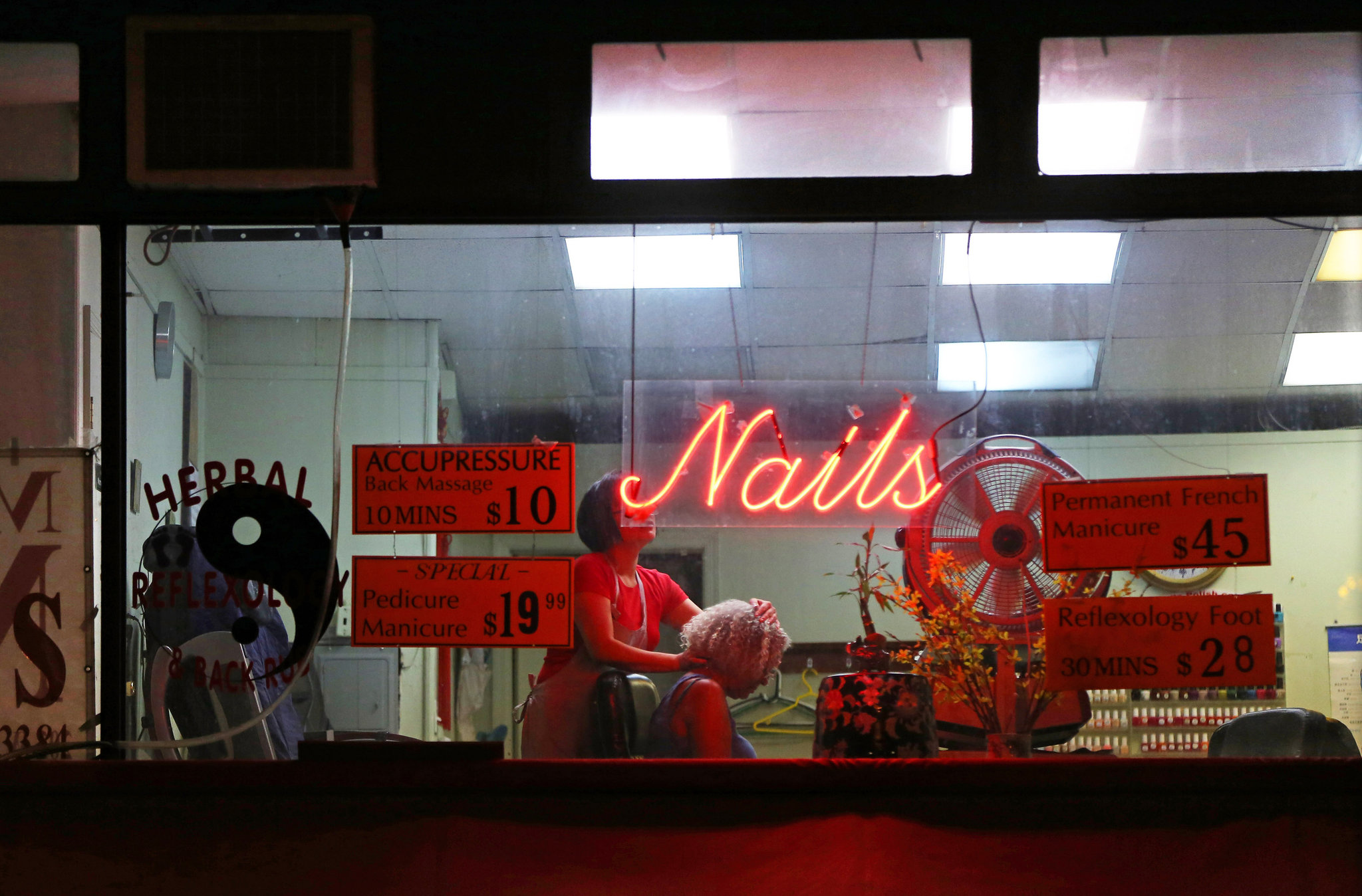
At May's Nails Salon on West 14th Street in Manhattan, a customer gets a neck massage while her nails dry. (Nicole Bengiveno/The New York Times)
By Sarah Maslin Nir
The women begin to arrive just before 8 a.m., every day and without fail, until there are thickets of young Asian and Hispanic women on nearly every street corner along the main roads of Flushing, Queens.
As if on cue, cavalcades of battered Ford Econoline vans grumble to the curbs, and the women jump in. It is the start of another workday for legions of New York City’s manicurists, who are hurtled to nail salons across three states. They will not return until late at night, after working 10- to 12-hour shifts, hunched over fingers and toes.
On a morning last May, Jing Ren, a 20-year-old who had recently arrived from China, stood among them for the first time, headed to a job at a salon in a Long Island strip mall. Her hair neat and glasses perpetually askew, she clutched her lunch and a packet of nail tools that manicurists must bring from job to job.
Tucked in her pocket was $100 in carefully folded bills for another expense: the fee the salon owner charges each new employee for her job. The deal was the same as it is for beginning manicurists in almost any salon in the New York area. She would work for no wages, subsisting on meager tips, until her boss decided she was skillful enough to merit a wage.
It would take nearly three months before her boss paid her. Thirty dollars a day.
Once an indulgence reserved for special occasions, manicures have become a grooming staple for women across the economic spectrum. There are now more than 17,000 nail salons in the United States, according to census data. The number of salons in New York City alone has more than tripled over a decade and a half to nearly 2,000 in 2012.
But largely overlooked is the rampant exploitation of those who toil in the industry. The New York Times interviewed more than 150 nail salon workers and owners, in four languages, and found that a vast majority of workers are paid below minimum wage; sometimes they are not even paid. Workers endure all manner of humiliation, including having their tips docked as punishment for minor transgressions, constant video monitoring by owners, even physical abuse. Employers are rarely punished for labor and other violations.
Asian-language newspapers are rife with classified ads listing manicurist jobs paying so little the daily wage can at first glance appear to be a typo. Ads in Chinese in both Sing Tao Daily and World Journal for NYC Nail Spa, a second-story salon on the Upper West Side of Manhattan, advertised a starting wage of $10 a day. The rate was confirmed by several workers.
Lawsuits filed in New York courts allege a long list of abuses: the salon in East Northport, N.Y., where workers said they were paid just $1.50 an hour during a 66-hour workweek; the Harlem salon that manicurists said charged them for drinking the water, yet on slow days paid them nothing at all; the minichain of Long Island salons whose workers said they were not only underpaid but also kicked as they sat on pedicure stools, and verbally abused.
Last year, the New York State Labor Department, in conjunction with several other agencies, conducted its first nail salon sweep ever — about a month after The Times sent officials there an inquiry regarding their enforcement record with the industry. Investigators inspected 29 salons and found 116 wage violations.
Among the more than 100 workers interviewed by The Times, only about a quarter said they were paid an amount that was the equivalent of New York State’s minimum hourly wage. All but three workers, however, had wages withheld in other ways that would be considered illegal, such as never getting overtime.
The juxtapositions in nail salon workers’ lives can be jarring. Many spend their days holding hands with women of unimaginable affluence, at salons on Madison Avenue and in Greenwich, Conn. Away from the manicure tables they crash in flophouses packed with bunk beds, or in fetid apartments shared by as many as a dozen strangers.
Ms. Ren worked at Bee Nails, a chandelier-spangled salon in Hicksville, N.Y., where leather pedicure chairs are equipped with iPads on articulated arms so patrons can scroll the screens without smudging their manicures. They rarely spoke more than a few words to Ms. Ren, who, like most manicurists, wore a fake name chosen by a supervisor on a tag pinned to her chest. She was “Sherry.” She worked in silence, sloughing off calluses from customers’ feet or clipping dead skin from around their fingernail beds.
At night she returned to sleep jammed in a one-bedroom apartment in Flushing with her cousin, her cousin’s father and three strangers. Beds crowded the living room, each cordoned off by shower curtains hung from the ceiling. When lights flicked on in the kitchen, cockroaches skittered across the countertops.
Almost all of the workers interviewed by The Times, like Ms. Ren, had limited English; many are in the country illegally. The combination leaves them vulnerable.
Some workers suffer more acutely. Nail salons are governed by their own rituals and mores, a hidden world behind the glass exteriors and cute corner shops. In it, a rigid racial and ethnic caste system reigns in modern-day New York City, dictating not only pay but also how workers are treated.
Korean workers routinely earn twice as much as their peers, valued above others by the Korean owners who dominate the industry and who are often shockingly plain-spoken in their disparagement of workers of other backgrounds. Chinese workers occupy the next rung in the hierarchy; Hispanics and other non-Asians are at the bottom.
The typical cost of a manicure in the city helps explain the abysmal pay. A survey of more than 105 Manhattan salons by The Times found an average price of about $10.50. The countrywide average is almost double that, according to a 2014 survey by Nails Magazine, an industry publication.
With fees so low, someone must inevitably pay the price.
“You can be assured, if you go to a place with rock-bottom prices, that chances are the workers’ wages are being stolen,” said Nicole Hallett, a lecturer at Yale Law School who has worked on wage theft cases in salons. “The costs are borne by the low-wage workers who are doing your nails.”
In interviews, some owners readily acknowledged how little they paid their workers. Ms. Ren’s boss, Lian Sheng Sun, who goes by Howard, at first denied doing anything wrong, but then said it was just how business was done. “Salons have different ways of conducting their business,” he said. “We run our business our own way to keep our small business surviving.”
Many owners said they were helping new immigrants by giving them jobs.
“I want to change the first generation coming here and getting disgraced, and getting humiliated,” said Roger Liu, 28, an immigrant from China, seated inside the salon he owned, Relaxing Town Nails and Spa in Huntington Station, N.Y. As he spoke last summer, an employee, a woman in her 50s, paced the salon, studying a scrap of paper scribbled with the steps of a pedicure, chanting them to herself quietly in Chinese.
It was her first week working in a salon, she said. Mr. Liu was not paying her.
Compelled to work endless hours just to get by, the manicurists live lives that unspool almost entirely within the walls of their salons. An underground economy has sprung up in Flushing and other city neighborhoods where salon workers live, to help them cope. On weekdays, women walk from door to door like Pied Pipers, taking nail salon workers’ children to school for a fee. Many manicurists pay caregivers as much as half their wages to take their babies six days a week, 24 hours a day, after finding themselves unable to care for them at night and still wake up to paint nails.
Jing Ren usually spent days sleeping in her slim pallet a few feet from the bed of her 24-year-old cousin, Xue Sun, also a manicurist. She had no time to make other friends.
She eventually started taking English classes, hoping to grasp onto a new life, but she feared the gravitational pull of this one.
“I would feel petrified,” she said, “thinking that I’ll be doing this for the rest of my life.”
Low Prices, Low Pay
As far as small businesses go, it is relatively easy to open a nail salon.
Just a few thousand dollars is needed for things like pedicure chairs with whirlpool baths. Little English is required, and there are few licensing hoops to jump through. Many skip them altogether. Overhead is minimal: rent and some new bottles of polish each month — and the rock-bottom wages of workers.
Beyond the low barriers for entry, manicurists, owners and others who have closely followed the nail industry are hard pressed to say definitively why salons have proliferated.
In the 1990s, nail polish brands began to market more directly to consumers, helping to fuel demand, according to Nails Magazine. Polishes also became more sophisticated; they last longer and are easier to remove.
Census data show the number of salons in New York surged through the 2000s, far outstripping the rest of the country. Growth dimmed slightly during the recession, as lacquered nails remained an affordable treat for many, before climbing again.
But as nail salons have mushroomed, it has become harder to turn a profit, some owners said. Manicure prices have not budged much from 1990s levels, according to veteran workers. Neither have wages.
With their gleaming glass fronts, the salons seem to display their inner workings as transparently as a department store displays a holiday window. But much of how salons operate and how workers are treated is kept deliberately opaque to the outside world.
Among the hidden customs are how new manicurists get started. Most must hand over cash — usually $100 to $200, but sometimes much more — as a training fee. Weeks or months of work in a kind of unpaid apprenticeship follows.
Ms. Ren spent almost three months painting on pedicures and slathering feet with paraffin wax before one afternoon in the late summer when her boss drew her into a waxing room and told her she would finally be paid.
“I just burst into laughter unconsciously,” Ms. Ren said. “I have been working for so long while making zero money; now finally my hard work paid off.”
That night her cousins threw her a party. The next payday she learned her day wage would amount to under $3 an hour.
Step into the prim confines of almost any salon and workers paid astonishingly low wages can be readily found. At May’s Nails Salon on 14th Street in the West Village of Manhattan, where a photo of the singer Gwen Stefani with a manicurist hung on the wall, new employees must pay $100, then work unpaid for several weeks, before they are started at $30 or $40 a day, according to a worker. A man who identified himself as the owner, but would give his name only as Greg, said the salon did not charge employees for their jobs, but would not say how much they are paid.
At Sona Nails on First Avenue near Stuyvesant Town, a worker said she made $35 a day. Sona Grung, the owner of Sona Nails, denied paying below minimum wage, yet defended the practice, particularly of underpaying new workers. “When a beginner comes in, they don’t know anything, and they give you a job,” she said. “If you work in a nail salon for $35, it’s very good.”
Nail salon workers are generally considered “tipped workers” under state and federal labor laws. Employers in New York are permitted to pay such workers slightly less than the state’s $8.75 minimum hourly wage, based on a complex calculation of how much a worker is making in tips. But interviews with scores of workers revealed rates of pay so low that the so-called tip calculation is virtually meaningless. None reported receiving supplemental pay from their bosses, as is legally required when their day’s tips fall short of the minimum wage. Overtime pay is almost unheard-of in the industry, even though workers routinely work up to 12 hours a day, six or even seven days a week.
Inside the hive of the salon, there are typically three ranks of workers. “Big Job” employees are veterans, experts at sculpting false nails out of acrylic dust. It is the most lucrative salon job, yet many younger manicurists avoid it because of the specter of serious health issues, including miscarriages and cancer, associated with inhaling fumes and clouds of plastic particles. “Medium Job” workers do regular manicures, while “Little Job” is the category of the beginners. They launder hot hand towels and sweep toenail clippings. They do work others do not want to do, such as pedicures.
More experienced workers usually earn $50 to $70 per day, sometimes even $80. Their pay, though, still typically amounts to significantly less than minimum wage, given their long hours.
In the poorer pockets of the city, at low-traffic salons in the Bronx and Queens, many workers are not paid a base wage at all, only a commission.
Nora Cacho was paid about 50 percent of the price of every manicure or lip wax she did at a Harlem shop that was part of a chain, Envy Nails. She frequently earned about $200 for each 66-hour workweek — about $3 an hour. In sandal season, if she was lucky, she left the shop with slightly more — $300 each week, she said. On snowy days, Ms. Cacho, who is part of a class-action lawsuit against the chain, would return home with nothing. The chain’s lawyer did not respond to requests for comment.
Ms. Cacho, who is from Ecuador, initially saw the industry as her financial salvation, as do many other immigrants. But what seems a way up usually gives way to a grinding existence.
Salon workers describe a culture of subservience that extends far beyond the pampering of customers. Tips or wages are often skimmed or never delivered, or deducted as punishment for things like spilled bottles of polish. At her Harlem salon, Ms. Cacho said she and her colleagues had to buy new clothes in whatever color the manager decided was fashionable that week. Cameras are regularly hidden in salons, piping live feeds directly to owners’ smartphones and tablets.
Qing Lin, 47, a manicurist who has worked on the Upper East Side for the last 10 years, still gets emotional when recounting the time a splash of nail polish remover marred a customer’s patent Prada sandals. When the woman demanded compensation, the $270 her boss pressed into the woman’s hand came out of the manicurist’s pay. Ms. Lin was asked not to return.
“I am worth less than a shoe,” she said.
An Ethnic Caste System
As the throngs of manicurists gather in Flushing, Queens, every morning, the patter of “good mornings” is mostly in Chinese and Spanish, with the occasional snatches of Tibetan or Nepali. Korean is hardly ever heard among these workers heading to salons outside New York City, many of them hours away.
But to the customer settling into the comfort of a pedicure chair in Manhattan, it can seem as if nearly the entire work force is Korean.
The contrast stems from the stark ethnic hierarchy imposed by nail salon owners. Seventy percent to 80 percent of salons in the city are Korean-owned, according to the Korean American Nail Salon Association.
Korean manicurists, particularly if they are youthful and attractive, typically have their pick of the most desirable jobs in the industry — shiny shops on Madison Avenue and in other affluent parts of the city. Non-Korean manicurists are often forced into less desirable jobs in the boroughs outside Manhattan or even farther out from the city, where customers are typically fewer and tips often paltry.
In general, Korean workers earn at least 15 percent to 25 percent more than their counterparts, but the disparity can sometimes be much greater, according to manicurists, beauty school instructors and owners.
Some bosses deliberately prey on the desperation of Hispanic manicurists, who are often drowning under large debts owed to “coyotes” who smuggled them across the border, workers and advocates say.
Many Korean owners are frank about their prejudices. “Spanish employees” are not as smart as Koreans, or as sanitary, said Mal Sung Noh, 68, who is known as Mary, at the front desk of Rose Nails, a salon she owns on the Upper East Side.
Ms. Noh’s salon sits behind the construction barricades of the Second Avenue subway line. Perhaps as a result, she employs a handful of Hispanic women. (Less lucrative shops on out-of-the-way streets or on the second stories of buildings tend to be more diverse.) Ms. Noh said she kept her Hispanic manicurists at the lowest rung of work. “They don’t want to learn more,” she said.
Ethnic discrimination imbues other aspects of salon life. Male pedicure customers are despised by many manicurists for their thick toenails and hair-covered knuckles. When a man comes into the store, almost invariably a non-Korean worker is first draft for his foot bath, salon workers said.
Ana Luisa Camas, 32, an Ecuadorean immigrant, said that at a Korean-owned Connecticut salon where she worked, she and her Hispanic colleagues were made to sit in silence during their entire 12-hour shifts, while the Korean manicurists were free to chat. “For two years I suffered from headaches,” she said. “It was just the stress that was killing me.”
Lhamo Dolma, 39, a manicurist from Tibet who goes by Jackey, recalled a former job at a Brooklyn salon where she had to eat lunch every day standing in a kitchenette with the shop’s other non-Korean workers, while her Korean counterparts ate at their desks.
“Their country people, they are completely free,” she said in an interview in her house in Queens, seated on a low settee beneath her household’s Buddhist shrine. She began to cry. “Why do they make us two different?” she said. “Everybody is the same.”
A Scared Newcomer
There was a bright blue Siamese fighting fish in a Mason jar in a corner of the one-bedroom apartment where Ms. Ren lived with her cousin and four other adults. It rested on a table made from a broken cabinet door. Its name was July, after the month she was told she would finally earn a wage.
It was a rare moment of accomplishment for Ms. Ren, now 21, in her early days in New York City. She had holed up indoors for weeks after arriving, too scared to go outside.
She wished she could be like her older cousin and roommate, Ms. Sun, who emerged from their apartment in Flushing each morning looking more like her customers than a manicurist, in bargain-store imitations of Hermès and Chanel. Ms. Sun woke up early each morning to steam her outfit — even her denim shorts — so that all traces of their grim quarters stayed shut up behind the apartment door.
When business at the salon began to slow in late 2013, Ms. Sun, who goes by Michelle, had an idea. She hopped a cheap bus south to Florida, a place she knew little about other than that it was always warm. She figured sandals — and pedicures — were year-round staples. She wandered from shop to shop until she found work.
Upon her return in spring 2014, Ms. Sun was upset to find Ms. Ren nearly a shut-in. Ms. Sun cajoled her younger charge to call salons listing openings online, taking the phone from her when she was too scared to speak to shop owners.
The day after, Ms. Ren stood on the corner of Franklin Avenue and Kissena Boulevard, her lunchbox in hand, waiting for a van to deliver her to her new salon — where, she did not know.
At Bee Nails, the salon in Hicksville, Ms. Ren fumbled even the most simple tasks at first, overwhelmed by nerves. She spent her days making piles of paper twists to swaddle pedicured toes, or cleaning up nail clippings. Her hands trembled when she tried to paint even her own nails in the break room. She refused to join the other Little Job workers for practice sessions, watching shyly.
A week in, her first manicure was on a man. His girlfriend sat next to him, whispering to him about the manicurist’s shaking hands. Ms. Ren said later her hands only shook harder.
“I tried to calm down on my way back in the van — it’s a long trip and quiet,” she said. “I told myself that I have to prove that I’m capable of conquering all these difficulties and make it.”
At home she stayed up late practicing manicures on her cousin and drafted careful ledgers of her expenses. Her sole income was a few dollars a day in tips, but she was meticulous, tabulating each banana and even her first ice cream from a chiming truck. Beside a doodle of a cone, she wrote “$1.50.” Next to it, in English: “It’s good!”
By October, Ms. Ren had mostly tamed her anxiety. One Sunday morning, as a visitor watched, she sat balanced froglike on a small stool as she hoisted up the feet of a woman in a pink Juicy Couture track suit, deftly scratching off calluses with a roughened foam brick. The woman scrolled on her phone and picked at her cuticles. She addressed Ms. Ren once, when she warned the manicurist of a blister on her heel. Every so often, Ms. Ren sent a nail polish bottle or cuticle nipper flying, but she covered up her error with a titter and useful English phrases her boss encouraged her to practice. “So sorry,” she whispered.
Some evenings, Ms. Sun’s father, a line cook in Manhattan, would whip up elaborate meals of soft-shelled turtle and taro for the young women that reminded them of home. At night, he tucked them into bed with words of encouragement, before drawing closed the wall of curtain that separated his bed from theirs. Try to think of customers’ feet as pig’s feet, he would urge. Don’t they love that Chinese delicacy when he makes it?
As the cold set in, a time of year when many bosses fire much of their salon staff, Ms. Ren grew anxious again. On slow days, she was sent to stand beside the highway in front of the salon in her green uniform bib, waving fliers. A customer review on the salon’s Yelp page described it as “basically a sweatshop,” and she felt it. Sometimes, she spent entire days dusting hundreds of individual plastic boxes of customers’ personal nail tool kits.
“I felt what I had to do was so pointless,” she later said.
Behind the Mercedes
A gold pendant embossed with Chinese characters and entwined with red thread hangs on the door of a two-story house in Center Moriches, on Long Island, about an hour’s drive east from where Ms. Ren works in Hicksville. A wide creek that empties into Moriches Bay lies on the other side of the street. A Mercedes-Benz sport utility vehicle parks in the driveway.
It is the home of the owner of Nail Love, a salon in a nearby shopping center. The charm on the door invokes financial prosperity for the house’s inhabitants. But the lives of the half-dozen manicurists who bunk in the basement are anything but prosperous.
They are employees of Nail Love. Their dimly lit warren is a barracks provided by the salon’s owner, a common arrangement for workers in salons outside commuting distance from New York City. It saves owners money and sometimes even turns a profit. In some other such situations, workers must pay rent to their bosses.
Nail salon owners are often the success stories of their immigrant communities. Some owners rose from the ranks of manicurists themselves. In interviews, many owners expressed a vision of themselves as heroic, shouldering the burden of training workers and the risk of employing people who are not legally permitted to work in the United States. Fees extracted from new workers like Ms. Ren are proper compensation for the inconvenience of providing training, they said. Several owners said they felt betrayed when their workers quit or sued.
“They don’t stop to think how difficult it is nowadays to keep the door of our business open to service people,” Romelia M. Agudo, the former owner of a Park Slope salon, Romy’s Nails, wrote in an affidavit asking a judge to dismiss a lawsuit by two of her employees who said they were underpaid and denied lunch breaks.
Many owners defended their business methods as the only way to stay afloat.
Ansik Nam, former president of the Korean American Nail Salon Association, said that in the early 2000s, scores of owners held an emergency meeting at a Korean restaurant in Flushing, hoping to prevent manicure and pedicure prices from sagging further. He said no agreement was reached.
The association’s current president, Sangho Lee, declined a request to address issues of underpayment. So many owners do not pay minimum wage, he said, that he believed answering any questions would hurt the industry.
Tucked between the hand dryers of NYC Nail Spa on the Upper West Side, where the beginners’ wage is $10 a day, the grim math of the nail salon industry is seemingly laid bare on a neatly typed sign, urging customers in broken English to tip well: “Less tips make us hard to hire good workers, or we have to pay higher wages to hire them, which might also cause a raise on the price.”
In an interview, the owner’s wife, who would give only her first name, Hwu, said the salon’s sales exceeded $400,000 a year but there were significant expenses as well, like rent and payroll. Speaking at the salon in February, shortly after her husband dropped her off in their Cadillac S.U.V., she said some of her beginners were not paid $10 a day. She pointed to a male manicurist on his first day on the job: If he did not show promise, she said, he would not be paid at all.
The owners of Iris Nails, a chain with shops in Manhattan and Brooklyn, had seven stores that generated sales of $8 million per year, according to a 2012 article in Korea Daily, a Korean-American newspaper. At the two Iris salons on Madison Avenue on the Upper East Side, longtime workers described starting out at wages of $30 and $40 a day. The owners did not respond to requests for comment.
The contrast between owners’ and workers’ lives can be stark.
Sophia Hong, who owned Madison Nails in Scarsdale, N.Y., prides herself on her art collection, including at least one work by Park Soo Keun, a Korean artist who had a painting sell for nearly $2 million at Christie’s in 2012. The art hangs in her home in Bayside, Queens, one of several properties she owns, according to property records, including a Manhattan apartment in a luxury building overlooking Columbus Circle. In 2010, she was sued by an employee at her Scarsdale salon for failing to pay overtime. The case was settled. Ms. Hong declined to comment.
In rare instances when owners have been found guilty of wage theft, salons have often been quickly sold, sometimes to relatives. The original proprietors vanish, along with their assets, according to prosecutors. Even if they do not, collecting back wages is difficult. Owners can claim they do not have the means to pay, and it is often impossible to prove otherwise, given how unreliable salons’ financial records are.
Despite winning a landmark court award of over $474,000 in 2012 for underpayment, six manicurists from a chain of Long Island salons under the name Babi have so far received less than a quarter of that, they said. The chain’s owner, In Bae Kim, said he did not have the money, even though records show he sold his house for $1.13 million and a commercial property for $2 million just before the trial.
Mr. Kim was arrested last year by the state attorney general’s office on charges of harassing a manicurist at the worker’s new job. He pleaded guilty to disorderly conduct on Jan. 3 and was sentenced to time served — eight days in jail.
Lack of Investigations
During the nearly three months Ms. Ren worked unpaid in the Long Island nail salon, like many manicurists, she had no idea that it was against the law, or that the $30 day wage her boss finally paid her was also illegally low. As an immigrant, she felt happy to have any work at all, she said, and scared to complain. Furthermore, who would listen?
The Labor Department is the New York State agency responsible for monitoring wage violations. An examination by The Times of the department’s enforcement database dating from 2008, obtained under the state’s Freedom of Information Law, found the department typically opens two or three dozen nail salon cases a year across the entire state. According to census data, there were more than 3,600 nail salons in the state in 2012, the most recent year for which figures were available.
The department opened a vast majority of these cases in response to worker complaints, as opposed to initiating its own investigations, the data shows.
A team of investigators regularly performs undercover sweeps of businesses suspected of breaking the law, but the agency had never conducted a sweep of nail salons until last year, said Christopher White, a spokesman for the Labor Department. He declined last month to say more about the salons in the operation or the violations found, because the investigation had not yet been closed. But a review of the 37 cases opened in 2014 showed that almost one-third of them involved shops from a single chain, Envy Nails, the one facing a class-action lawsuit from its workers.
When the department does investigate a salon, more than 80 percent of the time the agency finds workers have been unpaid or underpaid and tries to recover the money, The Times’s analysis showed.
The department declined to make anyone available to discuss its investigative work on the record. It took nine months of repeated inquiries from The Times for the department to turn over part of its enforcement database.
Only a small number of the workers interviewed by The Times said they had ever seen an investigator, from any government agency, at their salon.
Among the Labor Department’s 115 investigators statewide — 56 are based in New York City — 18 speak Spanish and 8 speak Chinese, essential tools for questioning immigrant workers to uncover whether they are being exploited. But just two speak Korean, according to the department. Department officials say all of their inspectors have access to interpreting services.
When investigators try to interview them, manicurists are frequently reluctant to cooperate, more so than in any other industry, according to a Labor Department official involved who spoke on the condition of anonymity because the official was not permitted to talk with reporters. “It’s really the only industry we see that in,” the person said, explaining that it most likely indicated just how widespread exploitation is in nail salons. “They are totally running scared in this industry.”
Manicurists are also required to be licensed, but this is another area where enforcement is lax. There are nearly 30,000 licensed nail technicians in the state, according to the New York Department of State, but numerous manicurists work without licenses. Licenses are frequently fabricated, bought and sold.
Manicurists say that even when government agencies do check on their employers, evasion is easy.
Lili, a manicurist from Ecuador who is picked up every morning in Flushing near Ms. Ren, laughs when she recalls the time state inspectors visited the Westchester County salon where she works. Spotting them, her boss barked for all the unlicensed workers — there were 10 — to hustle out the back door.
“So we left, we got in the car, and we took a spin around the neighborhood,” said Lili, who declined to give her surname because she is in this country illegally. “Twenty, 30 minutes later we returned. After they’d gone. We put our uniforms back on and we returned to work.”
No Refunds
This past fall, Ms. Ren’s parents arrived from China. Work had dried up for her mother, an insurance saleswoman, and father, a sometime chef, and they missed their only child. The visitors stuffed the one-bedroom with a total of eight bodies before Ms. Ren, her mother and her father had to move out. The manicurist packed up her pet fish, and the family installed itself a few blocks down Union Street in a dank basement apartment, where for $830 a month the three share one bedroom.
At work Ms. Ren earned a raise, lifting her spirits. She now made $40 a day.
Inspired by her cousin, who had enrolled again in English classes, Ms. Ren signed up as well in October, three days a week. School, she hoped, would be a way out of a job she had come to loathe, but some days her hands ached too much to go to class — she could not hold a pencil. Other days she was just too tired.
Around the time her first semester of English classes wrapped up, Ms. Ren asked for another raise. It was then she learned there are actually two price lists at her salon. One is for customers. The other is jotted down in a hidden-away notebook and lists the prices employees must pay the owner to learn new skills: such as $100 for eyebrow waxing, $100 to learn how to apply gel and cure it with ultraviolet light. A raise would require a new skill — her boss suggested eyebrows and gel — and the cash fee.
She was in the nail salon van when her boss told her of the fee, as he drove her to a different Long Island salon he owns. He shuttles employees between the two shops, depending upon which is busiest. An iPad propped on the dashboard played video feeds from both salons. Ms. Ren responded to the new fee with uncharacteristic furor.
Her boss relented: He would give her a 50 percent discount. She refused.
“I already paid when I first came,” she said. “Now I’m an employee and have been here for so long. Why do I still have to pay to pick up new skills?”
In an interview, Mr. Sun, Ms. Ren’s boss, said the fees were “deposits” so employees did not leave with their new skills for another salon, and were eventually refunded. Ms. Ren said she never got back the $100 she had paid.
For weeks after the van ride, she dreamed of quitting. But there was another semester of English classes in the spring, and though her parents pledged to help support her, they could not do it alone.
The final affront was a red envelope embossed in gold, a traditional Lunar New Year gift her boss placed in her hands in February, the Chinese character for happiness and luck gleaming from the paper. She opened it to find just $20.
She quit on March 8. Her boss said nothing; one colleague hugged her goodbye. After 10 months she had made about $10,000, she said.
Last month, she found a $65-a-day job at another nail salon.
By then, her parents had also found work. Her father is a cook at a restaurant.
Her mother? She became a manicurist, for $30 a day.
Reporting was contributed by Sarah Cohen, Jiha Ham, Jeanne Li, Yuhan Liu, Julie Turkewitz, Isvett Verde, Yeong-Ung Yang and Heyang Zhang, and research by Susan C. Beachy.
Manicurists Tell of Suffering and Tragedy
By Sarah Maslin Nir
Each time a customer pulled open the glass door at the nail shop in Ridgewood, Queens, where Nancy Otavalo worked, a cheerful chorus would ring out from where she sat with her fellow manicurists against the wall: “Pick a color!”
Ms. Otavalo, a 39-year-old Ecuadorean immigrant, was usually stationed at the first table. She trimmed and buffed and chatted about her quick-witted toddler, or her strapping 9-year-old boy. But she never spoke of another dreamed-for child, the one lost last year in a miscarriage that began while she was giving a customer a shoulder massage.
At the second table was Monica A. Rocano, 30, who sometimes brought a daughter to visit. But clients had never met her 3-year-old son, Matthew Ramon. People thought Matthew was shy, but in fact he has barely learned how to speak and can walk only with great difficulty.
A chair down from Ms. Rocano was another, quieter manicurist. In her idle moments, she surfed the Internet on her phone, seeking something that might explain the miscarriage she had last year. Or the four others that came before.
Similar stories of illness and tragedy abound at nail salons across the country, of children born slow or “special,” of miscarriages and cancers, of coughs that will not go away and painful skin afflictions. The stories have become so common that older manicurists warn women of child-bearing age away from the business, with its potent brew of polishes, solvents, hardeners and glues that nail workers handle daily.
A growing body of medical research shows a link between the chemicals that make nail and beauty products useful — the ingredients that make them chip-resistant and pliable, quick to dry and brightly colored, for example — and serious health problems.
Whatever the threat the typical customer enjoying her weekly French tips might face, it is a different order of magnitude, advocates say, for manicurists who handle the chemicals and breathe their fumes for hours on end, day after day.
The prevalence of respiratory and skin ailments among nail salon workers is widely acknowledged. More uncertain, however, is their risk for direr medical issues. Some of the chemicals in nail products are known to cause cancer; others have been linked to abnormal fetal development, miscarriages and other harm to reproductive health.
A number of studies have also found that cosmetologists — a group that includes manicurists, as well as hairdressers and makeup artists — have elevated rates of death from Hodgkin’s disease, of low birth-weight babies and of multiple myeloma, a form of cancer.
But firm conclusions are elusive, partly because the research is so limited. Very few studies have focused on nail salon workers specifically. Little is known about the true extent to which they are exposed to hazardous chemicals, what the accumulated effect is over time and whether a connection can actually be drawn to their health.
The federal law that regulates cosmetics safety, which is more than 75 years old, does not require companies to share safety information with the Food and Drug Administration. The law bans ingredients harmful to users, but it contains no provisions for the agency to evaluate the effects of the chemicals before they are put on shelves. Industry lobbyists have fought tougher monitoring requirements.
Industry officials say their products contain minuscule amounts of the chemicals identified as potentially hazardous and pose no threat.
“What I hear are insinuations based on ‘linked to,’” said Doug Schoon, co-chairman of the Professional Beauty Association’s Nail Manufacturers Council on Safety. “When we talk about nail polish, there’s no evidence of harm.”
Health advocates and officials disagree, pointing to the accumulated evidence.
“We know that a lot of the chemicals are very dangerous,” said David Michaels, the assistant labor secretary who heads the federal Occupational Safety and Health Administration, which oversees workplace safety. “We don’t need to see the effect in nail salon workers to know that they are dangerous to the workers.”
So many health complaints were cropping up among the mostly Vietnamese manicurists in Oakland, Calif., that workers at Asian Health Services, a community organization there, decided on their own to investigate about a decade ago.
“It was like, ‘Oh wow, what’s happening in this community?’” said Julia Liou, who is now the health center’s director of program planning and development and a co-founder of the California Healthy Nail Salon Collaborative. “We are seeing this epidemic of people who are sick.”
The organization helped form a coalition in California that pushed for restrictions on chemicals used in nail salons, but the cosmetics industry succeeded in blocking a ban.
In recent years, in the face of growing health concerns, some polish companies have said that they have removed certain controversial chemicals from their products. But random testing of some of these products by government agencies showed the chemicals were still present.
Some states and municipalities recommend workers wear gloves and other protection, but salon owners usually discourage them from donning such unsightly gear. And even though officials overseeing workplace safety concede that federal standards on levels of chemicals that these workers can be exposed to need revision, nothing has been done.
So manicurists continue to paint fingertips, swipe off polish and file down false nails, while absorbing chemicals that are potentially hazardous to their health.
“There are so many stories but no one that dares to tell them; no one dares to tell them because they have no one to tell,” Ms. Otavalo said in an interview on a day off from the Ridgewood salon, babysitting for her colleague’s developmentally disabled son, Matthew. (Ms. Otavalo left her job at the salon a few months ago.) “There are thousands of women who are working in this, but no one asking: ‘What’s happening to you? How do you feel?’ We just work and work.”
‘They Cannot Breathe’
The walls of Dr. Charles Hwu’s second-story office in Flushing, Queens, are decorated with Chinese calligraphy, gifts from patients he has cared for from cradle to adulthood. Over his decades as an internist in this predominantly Asian enclave, Dr. Hwu has repeatedly encountered a particular set of conditions affecting otherwise healthy women.
“They come in usually with breathing problems, some symptoms similar to an allergy, and also asthma symptoms — they cannot breathe,” he said during a break between patients this winter. “Judging from the symptoms with these women, it seems that they are either smokers, secondhand smokers or asthma patients, but they are none of the above. They work for nail salons.”
In interviews with over 125 nail salon workers, airway ailments like those in Dr. Hwu’s office were ubiquitous. Many have learned to simply laugh them off — the nose that constantly bleeds, the throat that has ached every day since the manicurist started working.
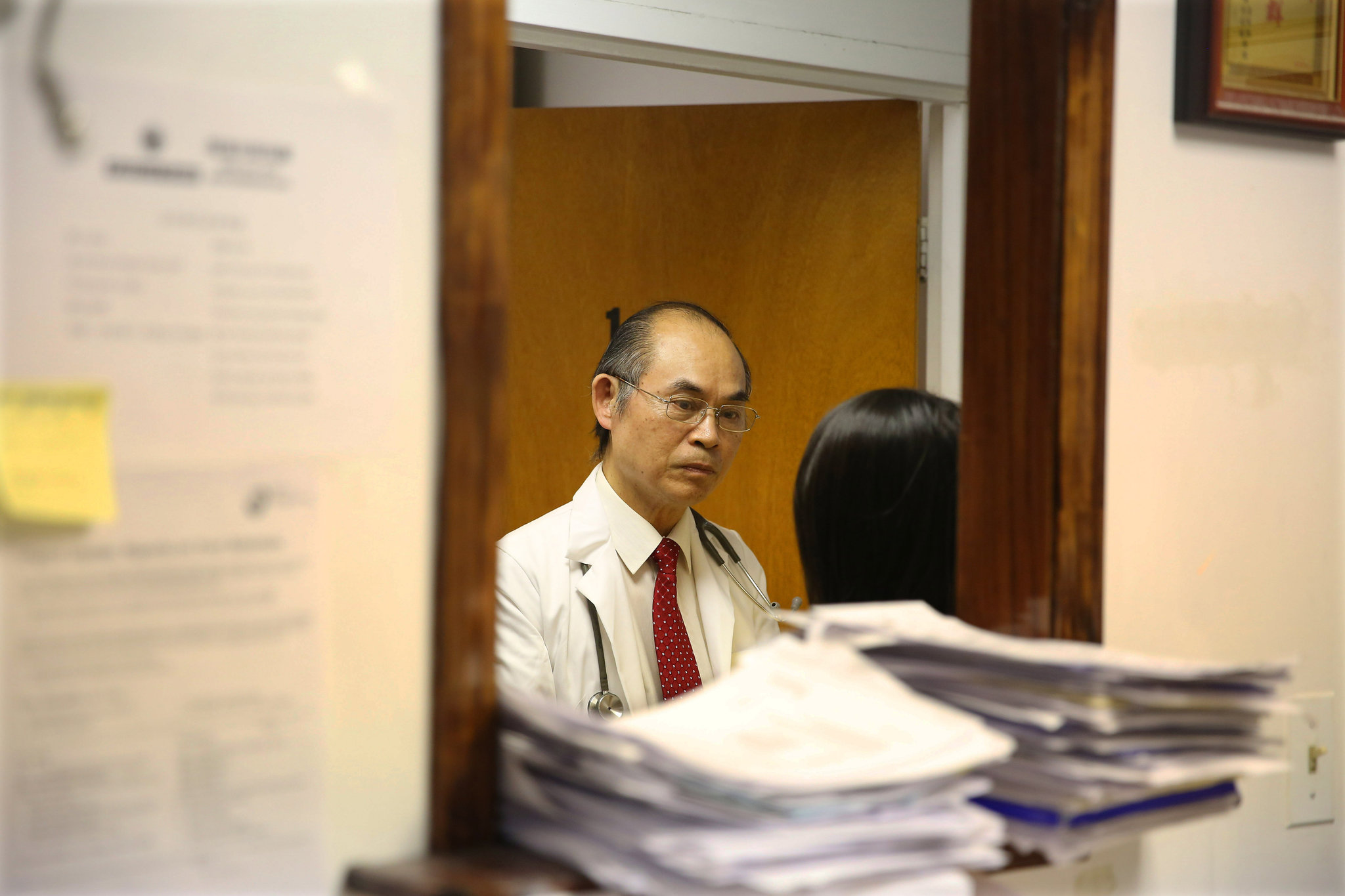
Dr. Charles Hwu, in Flushing, Queens, has noticed a particular set of symptoms among the nail salon workers he treats: “They come in usually with breathing problems, some symptoms similar to an allergy, and also asthma symptoms — they cannot breathe.” Nicole Bengiveno/The New York Times
In the nail salon she owned in Mill Basin, Brooklyn, Eugenia Colon spent years molding sometimes 30 sets of talonlike nails a day in a haze of acrylic powder, ignoring a persistent cough that grew more pronounced over time. She was found to have sarcoidosis, an inflammatory disease, in her lungs. In scans, they appeared as if covered with granules of sand, streaked by tiny scars.
The doctor who diagnosed her condition asked Ms. Colon what she did for a living. When she told him, he was frank: As she beautified other women, she inhaled clouds of acrylic and other dust, tiny particles that gouged the soft tissue of her lungs.
“We made money off it, but was it worth it?” Ms. Colon, 52, now an aesthetician in a Manhattan spa. “It came with a price.”
Of the 20 common nail product ingredients listed as causing health problems in the appendix of a safety brochure put out by the Environmental Protection Agency, 17 are hazardous to the respiratory tract, according to the agency. Overexposure to each of them induces symptoms such as burning throat or lungs, labored breathing or shortness of breath.
A 2006 study published in the Journal of Occupational and Environmental Medicine that included more than 500 Colorado manicurists found about 20 percent of them had a cough most days and nights. The same examination showed those who worked with artificial nails were about three times as likely to get asthma on the job as someone not in the industry.
Skin disorders are also omnipresent among nail salon workers. Many of the chemicals in nail salon products are classified by government agencies as skin sensitizers, capable of provoking painful reactions.
Some veteran manicurists say they can recognize one another on the street: They have the same coffee-colored stains on their cheeks. Certain cosmetic color additives — particularly a type of brilliant red — have been shown by researchers to cause such skin discoloration.
When Ki Ok Chung, a manicurist who worked in salons for almost two decades, had her fingerprints taken in the early 2000s for her United States citizenship, she made an upsetting discovery: Her prints were almost nonexistent. They had to be taken seven times. She says constant work with files, solvents and emollients is responsible.
“I realized my fingerprints had been disappearing,” she said.
Today, she cannot touch hot or cold dishes without searing pain.
Even as the weather warmed into spring last year, Zoila Calle, a manicurist, then 22, who worked in Harlem, wore wool gloves indoors and out. Underneath were black pustules so painful she could not grasp a polish bottle or text on her phone. It was the second time her hands had erupted in the warts, a common occurrence for nail salon workers. While customers often fret about salon hygiene, it is manicurists who appear truly at risk, suffering through endless fungal infections and other skin diseases from the blur of hands and feet they touch every day.
“It’s a beautiful industry, it makes people feel better,” Ms. Colon, who owned the salon in Mill Basin, said in an interview, a faint wheeze just audible behind her ready laugh. “But if a lot of people knew the truth behind it, it wouldn’t happen. They wouldn’t go.”
Miscarriages and Warnings
In a way, Ms. Rocano, one of the manicurists in the Ridgewood salon, felt herself lucky. Her colleagues seated on either side of her had each lost a pregnancy last year, hoped-for babies whom they separately described exactly the same way: “Like losing a dream.”
She, however, has her toddler, Matthew.
A dark-haired bundle with amber skin when he was born, Matthew was an infant laden with his mother’s hopes. Holding him in her arms, she was reminded of the daughter she had left behind in Ecuador and still has not seen in more than six years. This time, she felt, she could do right by her child.
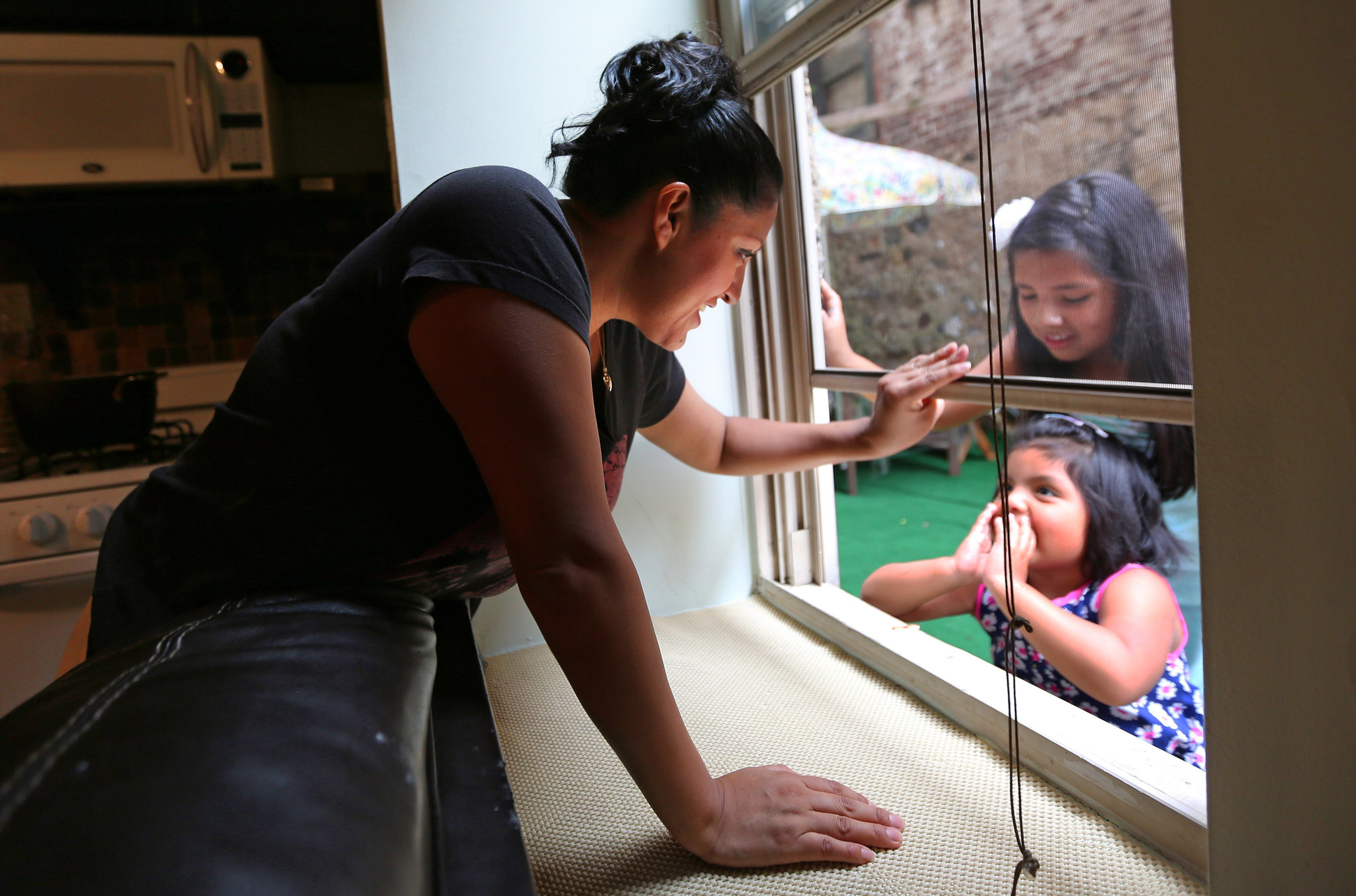
Nancy Otavalo with her daughter, 4, at bottom of window, and her niece. Nicole Bengiveno/The New York Times
Yet as he grew, something seemed off. His legs were weak; they buckled when he tried to stand. By age 3 he still could not say his name. In visits to her pediatrician, she learned that Matthew was delayed on almost every measure, both physically and cognitively.
At one point, his doctor asked her what she did for a living. When she told him, he asked how long she had worked in the nail salon while pregnant. Six months, she responded.
The doctor told her, “When babies are forming in your womb, they absorb everything, and if they are exposed to anything, it can cause them harm,” she recalled.
On a day five years ago, a doctor gave a similar warning to the manicurist who works at the table to Ms. Rocano’s right, as she sat in the obstetrics unit at Wyckoff Heights Medical Center in Brooklyn. There she learned she had miscarried a third time.
“I went to the hospital, and I told him, ‘I’m a manicurist,’” said the woman, who declined to give her name because she wanted her medical history to remain private. Her doctor urged her to change jobs. “The chemicals are not healthy for your lungs, your liver, and sometimes they begin cancer,” she recalled. “I was laughing. I said, ‘Who is going to pay my bills?’” She has since miscarried twice more.
In scientific circles, the three chemicals in nail products that are associated with the most serious health issues are dibutyl phthalate, toluene and formaldehyde. They are known as the “toxic trio” among worker advocates.
Dibutyl phthalate, called DBP for short, makes nail polish and other products pliable. In Australia, it is listed as a reproductive toxicant and must be labeled with the phrases “may cause harm to the unborn child” and “possible risk of impaired fertility.” Starting in June, the chemical will be prohibited from cosmetics in that country. It is one of over 1,300 chemicals banned from use in cosmetics in the European Union. But in the United States, where fewer than a dozen chemicals are prohibited in such products, there are no restrictions on DBP.
Toluene, a type of solvent, helps polish glide on smoothly. But the E.P.A. says in a fact sheet that it can impair cognitive and kidney function. In addition, repeated exposure during pregnancy can “adversely affect the developing fetus,” according to the agency.
Formaldehyde, best known for its use in embalming, is a hardening agent in nail products. In 2011, the National Toxicology Program, part of the United States Department of Health and Human Services, labeled it a human carcinogen. By 2016, it will be banned from cosmetics in the European Union.
Cosmetics industry officials say linking the chemicals to manicurists’ health complaints amounts to faulty science.
Dibutyl phthalate, toluene and formaldehyde “have been found to be safe under current conditions of use in the United States,” said Lisa Powers, a spokeswoman for the Personal Care Products Council, the main trade association and lobbying group for the cosmetics industry.
“The safe and historical use of these ingredients is not questioned by F.D.A.,” she continued.
In reality, the responsibility for evaluating the safety of the chemicals as they are used in cosmetics is left with the companies themselves.
Even while insisting they are safe, some polish companies have voluntarily begun to remove certain chemicals from formulations. By 2006, several prominent brands had announced their products would no longer contain any of the three. The new products were labeled “3-free” or “5-free,” referring to the number of chemicals that are ostensibly no longer in them.
But a 2010 study by the F.D.A. and another in 2012 by the California Environmental Protection Agency’s Department of Toxic Substance Control found in random tests that some products, even ones labeled “3-free” or “5-free,” in fact contained those very chemicals.
It was from routine community outreach trips to local nail salons in Oakland that Ms. Liou and her colleagues from Asian Health Services, as well as Thu Quach, a research scientist, became alarmed: Almost all of the manicurists interviewed had health complaints; some were terribly ill.
Dr. Quach, with the Cancer Prevention Institute of California, set out to conduct a health survey of nail salon workers in Alameda County, which includes Oakland.
The stories poured in.
Le Thi Lam, a Vietnamese immigrant who came to the United States in 1988 after fleeing the Communist government in her country, was among the first. She had started out in a Sacramento nail salon, becoming proficient in acrylic nails, sculpting them all day long from a slurry of solvent and plastic polymers.
In 1991, she learned she had a thyroid condition. She had also developed asthma. She quit, too sickened to work and concerned about the chemicals she was handling. But she soon returned, unable to find another job with her limited English. Ten years later, she had breast cancer.
“I know that manicurists like me are also going through the same things and having major health problems,” she said, seated in a conference room at Asian Health Services last summer, a blouse hiding a red scar from her breastbone to her armpit. “But they still hang on to their jobs to earn their living.”
Dr. Quach kept going with her research, undertaking several other studies. One found manicurists had an increased risk for gestational diabetes and for having undersize babies. Another, looking at cancer, found no correlation. Both studies were hampered by data limitations. Mostly, they point to the need for further study.
“What we know is what’s reported by the women again and again: that there is something here,” Dr. Quach said. “Those chemicals they are dealing with are chemicals that we know people react to, and we are hearing the stories from these workers that they are reacting to them. It’s all there.”
‘Fox Guarding the Henhouse’
The regulation of chemicals in nail products is dictated by the Federal Food, Drug and Cosmetic Act of 1938. The part of the law that deals with cosmetics totals just 591 words.
The Food and Drug Administration explains the limitations it faces under the law on its website: “Cosmetic products and ingredients do not need F.D.A. premarket approval, with the exception of color additives.” It continues, “Neither the law nor F.D.A. regulations require specific tests to demonstrate the safety of individual products or ingredients.” In addition, “The law also does not require cosmetic companies to share their safety information with F.D.A.”
In 1976, the cosmetics industry itself established the Cosmetic Ingredient Review, a panel that is supposed to “review and assess the safety of ingredients used in cosmetics in an open, unbiased and expert manner,” according to its website. But the panel is financed entirely by the Personal Care Products Council, the industry lobbying group. The panel’s offices are also in the same building in Washington as the products council.
Even so, Ms. Powers said the panel was independent. She is the official spokeswoman for the industry lobby, but all questions to the review panel were handled by her.
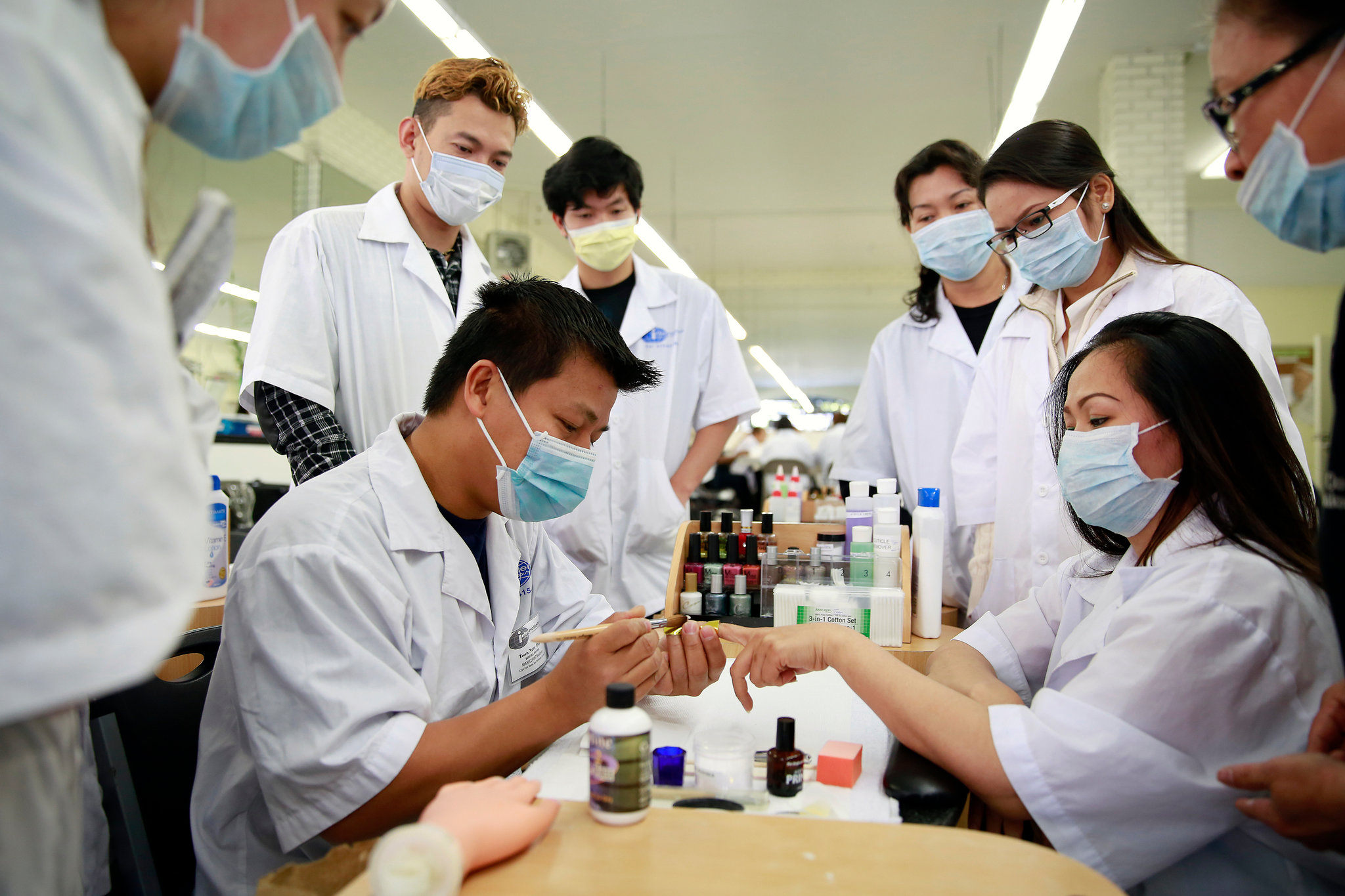
Toan Ngoc Do, left, a manicurist student, worked on the nails of a fellow student, Tien Dang Thuy, during a class at the International College of Cosmetology in San Francisco last May. Ramin Rahimian for The New York Times
Since its founding, the panel has reviewed only a small fraction of the substances in use in cosmetics today. Among them were dibutyl phthalate and toluene; the panel determined that they are safe the way they are used in nail products — on nails, not skin.
“It’s a classic case of the fox guarding the henhouse,” says Janet Nudelman, the director of program and policy at the Breast Cancer Fund, which has argued for more stringent regulation. “You’ve got an industry-funded review panel that’s assessing the safety for the very industry that’s funding the review panel.”
There have been efforts in recent years to overhaul the 1938 law and more strictly regulate cosmetic chemicals, but none made headway in the face of industry resistance. Since 2013, the products council, just one of several industry trade groups, has poured nearly $2 million on its own into lobbying Congress.
After talks between the cosmetics industry and the F.D.A. broke down last year, Michael R. Taylor, the agency’s deputy commissioner for foods and veterinary medicine, rebuked the industry in an unusual open letter for pushing a measure that would have declared a wide range of potentially dangerous chemicals safe “without a credible scientific basis” and others safe that are known to pose “real and substantial risks to consumers.”
Ms. Powers said the letter mischaracterized the industry’s stance. “The law was created or passed in 1938,” she said. “Nobody is saying that we shouldn’t look at that now and say: ‘Is it a contemporary approach? Does it need to bring us into the 21st century?’ We all agree to that. But that doesn’t make for a sexy headline.”
The council, in fact, said it supported a bipartisan bill introduced in April by Senators Dianne Feinstein, Democrat of California, and Susan Collins, Republican of Maine, that would broaden F.D.A. oversight of cosmetics, including giving the agency recall ability. But some health advocates said the bill would continue to permit the industry to largely regulate itself; it would also pre-empt states’ abilities to create stronger rules.
The Occupational Safety and Health Administration is the federal agency that sets chemical exposure limits in workplaces. The studies that have examined the chemical exposure levels for manicurists have found them to be well below these standards. Health advocates say the safety administration’s standards are badly out of date and flawed.
Even Dr. Michaels, the head of the safety administration, said his agency’s standards needed revision. Currently, he said, workers “can be exposed to levels that are legal according to OSHA but are still dangerous.”
The agency makes illustrated pamphlets warning manicurists about the chemical hazards they face and urges them to wear gloves and ventilate their shops. These steps and others become mandatory when exposure limits are exceeded. But in practical terms, with the standards set so high, salons are free to do nothing. Dr. Michaels said the agency was hamstrung by its own cumbersome rule-making process.
“Every worker has the right to come home safely at the end of every day,” Dr. Michaels said. “They shouldn’t be coming home and getting sick.”
The debate over the chemicals has also unfolded at the state level. In 2005, lawmakers in California proposed banning DBP from cosmetic products sold or manufactured in the state. Industry lobbyists flooded the State Capitol (some bearing gift baskets of lipstick and nail polish), spending over a half-million dollars fighting the ban, according to state records. Some of the country’s best-known cosmetics companies — Estée Lauder, Mary Kay and OPI, among others — weighed in against it. The bill ultimately failed. A much more limited measure passed — over the industry’s objections — that required cosmetics companies to disclose certain hazardous chemicals to the California Department of Public Health.
Blocked by an industry with deep pockets, the California advocates say they had to scale back their goals. They introduced a grass-roots program that officially recognizes “healthy nail salons,” those that carry “greener” products and that ventilate. The New York City Council held a hearing this month on a measure that would establish a similar voluntary program.
Today, out of several thousand salons in California, however, there are just 55 salons in the program.
One of them is Lulu Nail Spa, a tiny salon with a dusky rose wall and white-leather pedicure chairs in Burlingame, Calif. The shop earned the designation in May by switching certain products, using gloves and opening the doors to sweep out fumes. The owner, Hai Thi Le, a Vietnamese immigrant, said she hoped the new decal she placed on her window would draw green-minded customers.
But she did not make the changes just for business. As a young woman working in her brother’s nail shop, Ms. Le said she breathed in so much acrylic powder that when she kissed her husband after work, he complained her breath smelled of solvent and plastic dust.
Standing in the Breeze
On her days off from the salon in Ridgewood, Queens, Nancy Otavalo ran for a time an ad hoc day care center at her home a few blocks away with her sister, another manicurist. The sisters would pick up salon workers’ children after school for a fee, entertaining them in the basement apartment the sisters shared with their families.
Matthew, her colleague’s son who can barely speak, got special treatment, spending time curled on the gleaming black leather couch — bought with tips — that is the centerpiece of her home.
After Ms. Otavalo miscarried last year, she lay for hours on the same black leather couch, in silence, the lights darkened, unable to summon the willpower to get up.
A week after a procedure to remove the fetus at Woodhull Medical Center in Brooklyn, she rose, put on the lavish makeup her sister says makes her feel confident and went back to work at her manicure table.
Clients who stopped by for their weekly manicures knew nothing about what happened; everything appeared the same.
Except every so often, after Ms. Otavalo had painted the last stroke of top coat on a customer’s hand, she scraped back her chair and walked to the front of the shop. She pulled open the salon’s glass door to stand in the breeze for a while.
Reporting was contributed by Jiha Ham, Yuhan Liu, Julie Turkewitz, Isvett Verde, Yeong-Ung Yang and Heyang Zhang, and research by Susan C. Beachy.
Readers Ask About the Exploitation of Nail Salon Workers
For 13 months, Sarah Maslin Nir investigated the workplace conditions in nail salons in the New York City area, discovering that manicurists are routinely underpaid and during their workdays, use nail and beauty products that could cause serious health conditions. Ms. Nir answered readers’ questions on Monday, during a Facebook Q. and A., on how she reported the two-part series, “Unvarnished”; what steps government agencies are now taking; and how consumers can help.
The questions and answers below have been edited and condensed.
Workers’ rights
Q. Brittany Harris: Over the weekend, I stopped in my normal salon and asked one of the workers if she gets paid. She said she does not, but she did say she gets to keep her tips. Now I feel torn. I could probably help this woman by continuing to go there and giving big tips. But that would also be contributing to the larger problem by keeping these salons in business. What do you recommend?
A. I experienced this myself, and there is no easy answer. But your manicurist is being deprived of a wage, and the employer is engaging in illegal behavior. The Labor Department has a hotline for anonymous tips (1-888-469-7365).
Q. Marianna Pataki McMahon: I would like to know if all manicurists need a license in New York. If so, how do they pass the licensing requirements without being aware of their rights as workers, the hazards of the job without speaking at least some English? Are there OSHA laws that protect these workers? Are they ever enforced?
A. Yes, they must be licensed. The process requires proof of 250 hours of training courses or the equivalent experience, a physical, a written test and practical exam. But this is another area where enforcement is lax, according to my research. There are nearly 30,000 licensed nail technicians in the state, according to the New York Department of State, but we found that numerous manicurists work without licenses. Licenses are frequently fabricated, and bought and sold. I believe the ones who have licenses are more aware of their rights, but many do not, and are not.
Health concerns
Q. Pat Beckmann Wilson: Are there any polishes available that do not contain DBP, toluene or formaldehyde chemicals? I avoid artificial nails but do not want to contribute to the problems for manicurists with these polishes either.
A. Many companies say that their products do not contain these chemicals. But no premarket oversight exists over what goes into these products, because of the way federal law is written, so you have to take the company’s word for it. There have been tests that show that even some of these “free” products contain the ingredients.
Q. Bonnie Burt: Would having the manicurists wear masks and gloves help protect them?
A. Gloves would definitely help with skin irritation and fungal infections manicurists suffer from, according to experts, but occupational health experts say that those hospital-style masks do little to ward off the chemicals. Gov. Andrew M. Cuomo announced emergency measures to protect manicurists, and mandatory gloves and masks are one of the steps, making New York State, I believe, the first in the country to do so.
Government intervention
Q. Duncan McGonagle: I’m of the opinion that this industry needs to be letter graded just like the restaurant industry. Because they have such a powerful lobby, the measure is defeated every time it’s introduced in the City Council. How do you feel about this important issue?
A. The letter-grade bill appears to focus almost solely on the health-related issues that may affect the consumer, like cleanliness. My investigation appeared to show that it is manicurists who appear truly at risk, suffering through endless fungal infections and other skin diseases.
Q. Michael Strauss: Do you think the crackdown Cuomo announced will lead to many of these illegal immigrants’ leaving the salons and entering other off-the-books enterprises? Cuomo says they won’t check immigration status, but that seems to be difficult for the Labor Department or Immigration to ignore now that they know where to look.
A. I spoke to the governor’s office about this, and they said that to their knowledge — though I haven’t verified this — there is no record of Immigration’s ever pursuing people following an investigation into their employer’s not paying them fair wages.
Reporting the series
Q. Linda Cronin-Gross: How did you get the workers to trust you enough to reveal such very personal and potentially damaging info about themselves?
A. I worked with fabulous translators and reporters who interpreted our interviews. We would spend a lot of time not asking the questions we wanted answers to, just listening. The workers wanted to tell their stories, because they never had been able to. Quiet listening and respect built trust.
Q. Katie Fallon: Were you threatened by any salon owners or thrown out of any salons?
A. I was thrown out of some salons, but something more interesting happened. Often when interviewing salon owners in Korean with the help of my translators, the interviewee would turn to them and say, in Korean, “Don’t tell her what I’m about to tell you.” They would appeal to the fact that they were from the same homeland, and ask for us not to write the story. Of course, as any good translator would do, my translator would immediately say to me: “He just said, ‘Don’t tell her what I’m about to tell you.’”
For 13 months, Sarah Maslin Nir investigated the workplace conditions in nail salons in the New York City area, discovering that manicurists are routinely underpaid and during their workdays, use nail and beauty products that could cause serious health conditions. Ms. Nir answered readers’ questions on Monday, during a Facebook Q. and A., on how she reported the two-part series, “Unvarnished”; what steps government agencies are now taking; and how consumers can help.
The questions and answers below have been edited and condensed.
Workers’ rights
Q. Brittany Harris: Over the weekend, I stopped in my normal salon and asked one of the workers if she gets paid. She said she does not, but she did say she gets to keep her tips. Now I feel torn. I could probably help this woman by continuing to go there and giving big tips. But that would also be contributing to the larger problem by keeping these salons in business. What do you recommend?
A. I experienced this myself, and there is no easy answer. But your manicurist is being deprived of a wage, and the employer is engaging in illegal behavior. The Labor Department has a hotline for anonymous tips (1-888-469-7365).
Q. Marianna Pataki McMahon: I would like to know if all manicurists need a license in New York. If so, how do they pass the licensing requirements without being aware of their rights as workers, the hazards of the job without speaking at least some English? Are there OSHA laws that protect these workers? Are they ever enforced?
A. Yes, they must be licensed. The process requires proof of 250 hours of training courses or the equivalent experience, a physical, a written test and practical exam. But this is another area where enforcement is lax, according to my research. There are nearly 30,000 licensed nail technicians in the state, according to the New York Department of State, but we found that numerous manicurists work without licenses. Licenses are frequently fabricated, and bought and sold. I believe the ones who have licenses are more aware of their rights, but many do not, and are not.
Health concerns
Q. Pat Beckmann Wilson: Are there any polishes available that do not contain DBP, toluene or formaldehyde chemicals? I avoid artificial nails but do not want to contribute to the problems for manicurists with these polishes either.
A. Many companies say that their products do not contain these chemicals. But no premarket oversight exists over what goes into these products, because of the way federal law is written, so you have to take the company’s word for it. There have been tests that show that even some of these “free” products contain the ingredients.
Q. Bonnie Burt: Would having the manicurists wear masks and gloves help protect them?
A. Gloves would definitely help with skin irritation and fungal infections manicurists suffer from, according to experts, but occupational health experts say that those hospital-style masks do little to ward off the chemicals. Gov. Andrew M. Cuomo announced emergency measures to protect manicurists, and mandatory gloves and masks are one of the steps, making New York State, I believe, the first in the country to do so.
Government intervention
Q. Duncan McGonagle: I’m of the opinion that this industry needs to be letter graded just like the restaurant industry. Because they have such a powerful lobby, the measure is defeated every time it’s introduced in the City Council. How do you feel about this important issue?
A. The letter-grade bill appears to focus almost solely on the health-related issues that may affect the consumer, like cleanliness. My investigation appeared to show that it is manicurists who appear truly at risk, suffering through endless fungal infections and other skin diseases.
Q. Michael Strauss: Do you think the crackdown Cuomo announced will lead to many of these illegal immigrants’ leaving the salons and entering other off-the-books enterprises? Cuomo says they won’t check immigration status, but that seems to be difficult for the Labor Department or Immigration to ignore now that they know where to look.
A. I spoke to the governor’s office about this, and they said that to their knowledge — though I haven’t verified this — there is no record of Immigration’s ever pursuing people following an investigation into their employer’s not paying them fair wages.
Reporting the series
Q. Linda Cronin-Gross: How did you get the workers to trust you enough to reveal such very personal and potentially damaging info about themselves?
A. I worked with fabulous translators and reporters who interpreted our interviews. We would spend a lot of time not asking the questions we wanted answers to, just listening. The workers wanted to tell their stories, because they never had been able to. Quiet listening and respect built trust.
Q. Katie Fallon: Were you threatened by any salon owners or thrown out of any salons?
A. I was thrown out of some salons, but something more interesting happened. Often when interviewing salon owners in Korean with the help of my translators, the interviewee would turn to them and say, in Korean, “Don’t tell her what I’m about to tell you.” They would appeal to the fact that they were from the same homeland, and ask for us not to write the story. Of course, as any good translator would do, my translator would immediately say to me: “He just said, ‘Don’t tell her what I’m about to tell you.’”
After Expose of Mistreatment, a Crackdown in New York State and a New Law
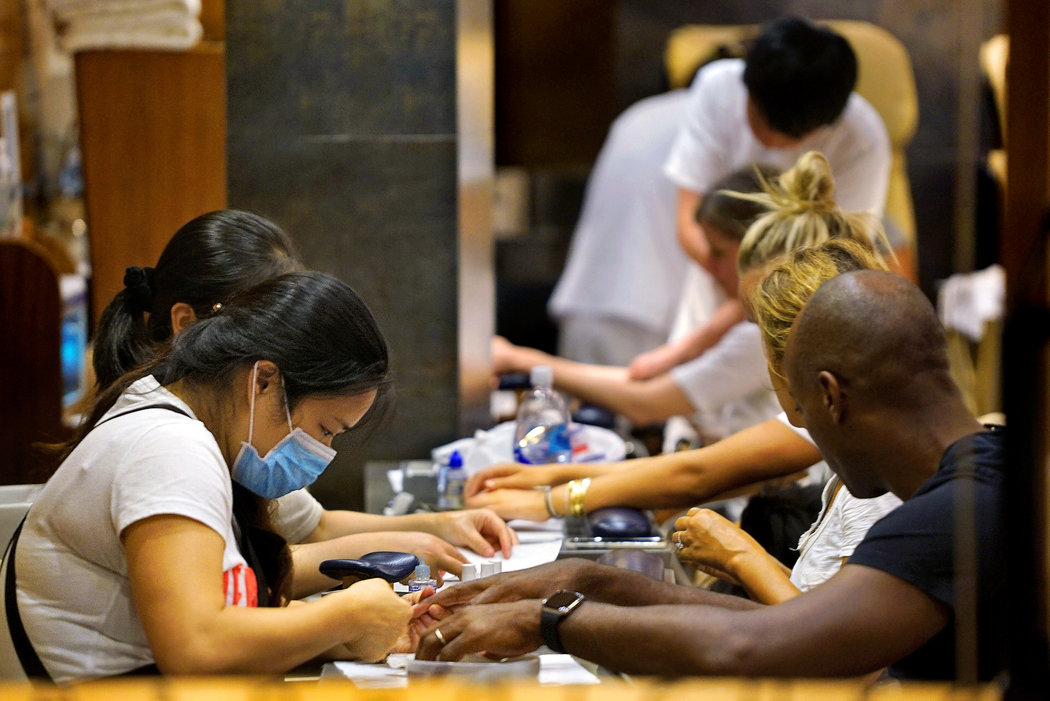
A nail salon in the Village this week. Nicole Bengiveno/The New York Times
By Sarah Maslin Nir and Paige Pagan
At the Westchester County nail salon where Anna Patricia Moreno works, the owner has started allowing manicurists to take lunch breaks.
For Peng Xu, a manicurist at a salon on Long Island who goes by Chris, pay has increased to about $8 an hour from $6, and, for the first time, he is being paid for overtime.
But at Flower Nail & Spa, on Madison Avenue on Manhattan’s Upper East Side, workers say their hours have been cut back, apparently to ensure their boss does not have to pay them more for overtime.
Two months after a New York Times investigation into rampant labor abuses at nail salons and the dangers posed by the chemicals manicurists work with, there have been major shifts in the industry on several fronts. A multiagency task force set up by the administration of Gov. Andrew M. Cuomo has inspected some 755 salons, issuing 1,799 violations, according to state officials. At a ceremony in the Bronx on Thursday morning, Mr. Cuomo signed into law a measure that overhauls how the industry is licensed and how bad actors are punished.
But a survey of 100 Manhattan nail salons, as well as interviews with more than a dozen workers and owners in and around New York, suggests changes across the industry have been uneven.
More than 40 percent of the salons surveyed by The Times did not have on display the state’s newly required workers’ bill of rights, which outlines information on minimum wage and where employees can go for labor complaints.
Under newly issued state rules, gloves must now be worn by manicurists when they are handling things like cotton balls soaked in nail polish remover, and goggles when they pour acetone and other chemicals. Respirator masks — not the paper hospital-style mask that is commonly seen and is considered ineffective at combating chemical exposure — must be made available for workers to use when buffing or filing nails, or when sculpting acrylic nails. But the survey found gloves being used at just 15 percent of salons. When The Times observed masks in use at about two dozen salons, just three of them were employing the required respirator-style ones.
Yet many manicurists say life has improved, in tangible and intangible ways. Most concretely, for some, compensation has gone up. Mr. Xu, the Long Island manicurist whose pay went up to $8 an hour, said he had noticed an array of changes at his salon, including workers’ wearing of gloves, masks and sometimes even goggles.
“Our salary is getting close to the standard level of minimum wage,” he added. “And it feels good.”
Other workers are reveling in new freedoms, including a previously unheard-of luxury in many salons: a lunch break.
“Even if we were hungry, they wouldn’t let us eat,” said Ms. Moreno, 39, the Westchester manicurist, referring to the owners of her salon, as she waited for a van in Flushing, Queens, to take her to work. “The boss would say, ‘No, no, no, so busy!’ One client and then another, and then another, and then another. Sometimes we couldn’t even take a sip of water.”
“Now, it’s different,” she said. “If we want to eat, we just say: ‘I’m going to eat.’ And she says to the client: ‘Can you wait five minutes for her? She needs lunch.’ And now the clients understand.”
But in some corners of the city, attempts to stamp out exploitation have led to some unintended consequences. At Flower Nail & Spa on the Upper East Side, workers said they cheered at first when their boss began to let them leave at closing time, instead of squeezing in latecomers for an evening manicure.
What initially seemed like a boon, however, soon emerged as something else. Manicurists are limited now to working just four days in what workers say appears be a move by their employer to avoid violating labor laws that require extra fees for overtime hours. So, these days, while they may make it home for dinner, some manicurists are taking on second jobs.
“I know the article tried to help us to work less, with higher pay and get good benefits, from good owners,” said an employee who works at Flower Nail and a second salon in Westchester, and who declined to give her name. “But for some employees it created a worse situation.”
Flower’s owner did not respond to a request for comment.
Notably, the survey, which was similar to one conducted a year ago, also showed that prices of manicures and pedicures had remained largely unchanged. In other words, it does not appear that owners are increasing prices so they can pay their workers more.
State regulators, however, have clearly been clamping down on the industry. Besides the several hundred inspections that have been conducted by the new state task force, the Labor Department has opened investigations in response to 63 complaints of unpaid or underpaid workers in the last month. In the past, the department typically opened only two or three dozen nail salon cases a year across the state in response to complaints.
The task force’s random inspections are continuing, officials said. Before The Times’s investigation, there had been only one previous state sweep of nail salons, which occurred last year and included raids of 29 businesses. The sweep took place a month after The Times inquired about the Labor Department’s enforcement record on salons.
But some workers have bridled at the new rules. Some workers and bosses say the protective gear is uncomfortable and a turnoff to customers. Several said they had been storing the equipment in the drawers of their manicure tables, with no intention of actually using it, just in case an inspector dropped in. Mikyoung Lee, 46, who manages Mforu Nails on Second Avenue near 88th Street, said she did not believe the gear was even necessary.
“It’s too much; we can’t wear this all the time,” Ms. Lee said. “Our job is not that dangerous a job.”
The state has actually pulled back on one of the new health rules. Officials initially decreed that the respirator masks had to be worn by manicurists working with acrylic powder; now the masks just have to be available. Frank Sobrino, a spokesman for the governor’s office, said there was concern the masks would present health complications for people with respiratory problems.
State officials have so far held a half-dozen information sessions for workers and owners on the new rules, including one recently in Flushing that was attended by 500 people. The city’s Department of Consumer Affairs has also been visiting salons to educate them on regulations. Officials there said they will have visited some 2,900 salons by early August.
“A large part of this is about getting to the workers, that they get the information and understand that these resources are available to them,” said Alphonso B. David, the governor’s counsel. “That’s one of the biggest challenges.”
Some of the hardest to quantify changes in the industry have involved the customers themselves. In the weeks after the publication of The Times’s investigation, customers would frequently ask the people doing their nails if they were being mistreated, salon owners and workers said. Such lines of inquiry have now died down, they said. But many customers are still tipping more — some manicurists said tips are up by 5 to 15 percent — and in cash, in an effort to make sure their manicurist gets and keeps it.
Some patrons have gone further, choosing to stay away from salons entirely. Ellen Killoran, a journalist from Brooklyn, said she had ended her ritual of a weekly manicure, as had some of her friends. She said she was unwilling to patronize an unethical shop but was unable to tell which salons were operating in accordance with the law.
“We are not going to know which salons, in particular, are violating labor law and which are not,” Ms. Killoran said. “I’m not comfortable with too much of a gray area.”
Just how many others have made similar decisions is difficult to say. But June, which marks the advent of sandal weather, the industry’s biggest season, was unusually slow for many shops.
“My business has been struck severely,” said Rong Gao, the owner of Shangri-La Nails & Spa on the Upper East Side, who says abusive salons are the exception. She is considering closing her shop because she is barely able to afford the rent of approximately $10,000 a month. “The salon industry is hit hard this time.”
Reporting was contributed by Jiha Ham, Yuhan Liu, Ileana Najarro and Julie Turkewitz.
By Sarah Maslin Nir
In a packed hall in the Bronx a few months ago, Ron Kim, a New York State assemblyman, stood clutching a ceremonial pen in his left hand, the other extended into the crowd as labor advocates, politicians and immigrant rights workers thronged to shake it. Gov. Andrew M. Cuomo had just used the pen to sign into law a bill protecting nail salon workers from labor abuses and potentially dangerous chemicals. It was a measure that Mr. Kim, who represents the mostly Asian enclave of Flushing, Queens, had spent a painstaking summer helping to craft.
Less than a month later, however, Mr. Kim, a Democrat, began to publicly question the law — particularly a provision designed to protect workers from wage fraud. He soon became one of the statute’s most vociferous critics.
As it turns out, while Mr. Kim’s position on the law was evolving, nail salon owners, previously a largely disconnected group, were rapidly organizing. They started a sophisticated effort to fight the law. And, behind the scenes, they funneled tens of thousands of dollars in political donations to Mr. Kim.
Other elected officials and civic groups have expressed concerns about the statute, which passed the State Legislature after The New York Times published a two-part series in May on abuses in the industry. They argued the law was discriminatory and overly burdensome on immigrant-run businesses, and contended it unfairly lumped responsible nail salon owners in with those who are mistreating workers.
But Mr. Kim came to play a critical role in the owners’ battle, helping them strategize and connecting them to a lobbying firm where he used to work. Among the firm’s first tasks was to help with public relations around a lawsuit filed by the owners challenging the legality of portions of the law.
There is clearly a political upside in the nail salon fight for Mr. Kim, who in interviews covered by the Korean-language press has alluded to his hope that the issue will help mobilize Asian-American voters and in that way strengthen his position in the Assembly. More tangibly, Mr. Kim’s campaign coffers are swelling.
At a fund-raiser for Mr. Kim in July, co-hosted by the president of the Korean American Nail Salon Association, Sangho Lee, nail salon owners donated nearly $25,000, according to Korean-language newspaper articles and campaign finance records. Mr. Kim’s financial involvement with the nail salon industry, and the group’s hiring of professional lobbyists, was reported by Crain’s New York last month.
A few days after the fund-raiser, Mr. Kim stood on the dais at the bill signing, thanking the governor for letting him take the lead on the nail salon law. In articles in Korean-language newspapers around that time, Mr. Kim said he had successfully worked to soften some of the bill’s more stringent measures and expressed pride in what he had accomplished.
But in the weeks after the signing, Mr. Kim’s comments turned negative, focusing on the requirement that nail salon owners buy a wage bond, a form of insurance meant to ensure that workers who successfully sue for wage theft are paid. Mr. Kim has challenged the availability of the bonds, their price and how quickly salons were required to obtain one.
Now, his main complaint has become that nail salon owners are being unfairly singled out. He said he had always believed the wage bonds would be required not just for nail salons, but all “appearance enhancement” businesses, a broader category that includes hair dressers, waxing parlors and others. His argument mirrors one detailed in a lawsuit filed in September by the Korean American Nail Salon Association and a newly formed group, the Chinese Nail Salon Association of East America.
“I genuinely did not think they were applying it to only nail salons,” Mr. Kim said in an interview.
State officials, however, said they were puzzled by Mr. Kim’s current stance.
“I am confused that he is confused,” said Alphonso B. David, the chief counsel for the governor, a Democrat.
Mr. David said the government was clear throughout the process that the wage bond requirement would apply only to nail salons. “Anyone who suggests we have been otherwise has either been blind to the materials we have issued, or is actively disingenuous,” he said.
Mr. David raised questions about Mr. Kim’s motivations: “We advanced a piece of legislation that we think is going to protect workers that have been historically abused and exploited — we, including Mr. Kim. He was supportive up until recently. Why is it that view has changed?”
In mid-September, Mr. Kim made a point of returning a $5,000 donation from the Korean nail association, as well as $2,000 given to him by the Chinese nail association.
“I didn’t want to give any impression to anybody that I did this because they were at one point donating to my campaign,” Mr. Kim said, “even though I don’t think that there was anything illegal in what that was.”
But he has kept money given to him individually by salon owners. Campaign finance records show that at least $17,000 in contributions that appear to be from the July fund-raiser came from salon owners, including present and past leaders of the Korean nail salon association. The donations that have come in since then are not yet publicly available. In an interview, Mr. Kim said he did not know the affiliations of the industry donors, even though several donations in July were from salons themselves, and labeled in records, in one example, as “Think Pink Nails I Inc.” In response to questions, Mr. Kim said that his staff would be looking into whether more money should be returned.
On the same day Mr. Kim returned the Chinese and Korean trade associations’ donations, the organizations hired the Parkside Group, a lobbying firm where Mr. Kim worked in 2012. The move was made at the assemblyman’s recommendation, according to Donald Yu, the director of the Korean nail salon association: “He said that in order to do the lawsuit, you also need to hire a P.R. firm to do press conferences and to get the articles into newspapers and radio and TV.”
In an interview, the assemblyman said hiring Parkside was just one of a number of recommendations he had made to the owners’ group, and that he frequently makes recommendations to constituents.
As the nail salon groups have ramped up their campaign against the new regulations, the organizations’ stature has grown, too. The Korean nail association had previously relied mainly upon modest dues, but now, almost every day, checks are arriving at its battered upper-story office in Flushing, adding tens of thousands of dollars to its war chest, its leaders said.
At least two other groups of nail salon owners have coalesced, organizing largely through WeChat, a popular messaging app. One, calling itself U.S. Nail Salons Management Center Inc., urged Chinese-owned shops around the city to close in protest of the new regulations on Aug. 25.
Joseph Lin, a real estate agent and community activist who is not affiliated with the industry, joined that group, and rallied another spinoff group. He said he was inspired to join the fray after walking past a nail salon that had shut in protest over Labor Day weekend and seeing a flier on its window.
Mr. Lin said he saw a chance for Chinese immigrants in the city to find their political voice. He helped lead nail salon protests in September at City Hall and several demonstrations in front of the New York Times Building. He has also been using the protests as a vehicle to encourage Chinese-Americans, in the nail salon industry and outside it, to register to vote. In an interview, Mr. Lin pointed to the fact that in a recent protest, which drew several hundred participants, many were not involved in the nail salon industry at all. The fight, he said, is now about so much more than nail salons.
As for Mr. Kim, his battle against the law has helped raise his profile, in particular among the city’s tightly knit community of Korean small-business owners, a group from which, he likes to point out at rallies and meetings, he too hails. His family owned a nail salon, among other businesses.
In recent weeks, he has been distributing fliers criticizing the wage bond, and calling for owners to report to him any trouble with the special information hotlines the government has set up. He is now drafting fixes to the law, which he says will reduce the burden on law-abiding nail businesses. Good and reputable shops, Mr. Kim said, are paying the price for the behavior of unscrupulous business owners. Forcing everyone to buy the insurance, he believes, is unfair in the absence of data from the government on how widespread the labor abuses are, or whether nail salons are any worse than other businesses.
Dick Dadey, the executive director of the Citizens Union, a government watchdog organization, said it was not unusual to tweak laws, but he was troubled by the timing of Mr. Kim’s push.
“Corrections are always needed when enacting public policy,” he said, “but it just doesn’t look right that this new bill is coming on the heels of strong financial support from the nail salon owners.”
With their patina of luxury, nail salons would seem to be unlikely sweatshops. But that is exactly what Sarah Maslin Nir, a metro reporter for The New York Times, and her team of translators found during 13 months of reporting. In her two-part investigation, “Unvarnished,” Maslin Nir revealed a secret world of exploited workers, hidden in plain sight of most New Yorkers.
Nail salons have become ubiquitous in the United States. But nowhere are they as concentrated as in New York City, where they are on practically every street corner. Toiling inside are rows of anonymous women, almost invariably immigrants from Asia or Latin America, waiting literally hand and foot on their customers.
Maslin Nir found workers who routinely work six or seven days a week, 10 or 11 hours at a time, for wages far below the minimum wage. They are subjected to a rigid racial and ethnic caste system that dictates not just pay but how they are treated. They endure other mistreatment, like having their tips docked as punishment for minor transgressions, constant video monitoring by owners, even physical abuse.
In an age of inequality, nail salon workers are potent symbols. Many spend their days holding hands with women whose affluence is inconceivable to them, only to crash at night in flophouses packed with bunk beds.
As was true in garment factories a century ago, working in nail salons may be hazardous to manicurists’ health. Worker after worker told of miscarriages and cancer, breathing problems and painful skin diseases. The culprit, they believed, was the chemicals they worked with. Maslin Nir reported that a growing body of scientific research linked the ingredients in nail products to serious health problems. Yet the chemicals are governed by a decades-old federal law that lets them reach the market untested. Industry lobbyists have fought tougher monitoring requirements.
To reach the people who mattered most, the salon workers, Maslin Nir suggested that The Times translate both articles into Korean, Chinese and Spanish. When the series was published last May, nearly five million people read the articles. Times social media editors say it was the first time that a Times headline — “The Price of Nice Nails” — trended worldwide on Twitter.
Gov. Andrew M. Cuomo immediately issued emergency measures to protect manicurists, and convened a multiagency task force to address exploitation in the industry. City employees visited more than 1,000 salons, informing manicurists of protections under the law. Several months later, Cuomo signed a law enshrining stricter industry regulations. Other states, including New Jersey and Connecticut, stepped up their regulation as well.
And an untold number of customers began re-evaluating their grooming habits, some vowing to give up “mani-pedis,” others tipping more, in cash.
Lauren Kirchner, a senior reporting fellow at ProPublica, captured the extraordinary response to “Unvarnished” for the blog Longreads. She said she couldn’t “remember another investigation that had as much widespread and immediate impact as this one.” She cited the swift governmental response but also a “subtler impact” in the form of “some real soul-searching among New Yorkers about the ethics of indulging in cheap luxuries.”
The series was a triumph of old-school muckraking. Nearly every weekday morning for five months,
Maslin Nir and her translators visited pickup spots in Flushing, Queens, where workers waited to be driven to salons. They approached hundreds of manicurists. Many were fearful, but Maslin Nir sat down with more than 100 and went to extraordinary lengths to glimpse their lives.
Though the interviews formed the backbone of her story, Maslin Nir also pored over lawsuits, OSHA records and a database of state Department of Labor investigations that took eight months to obtain.
She contacted more than 50 doctors in Flushing to ask about their experiences treating manicurists. She reviewed lobbying records of industry groups and plowed through stacks of scientific research.
As many journalists know, the more damning the reporting, the stronger the blowback, especially in investigations that earned as much attention as “Unvarnished” did.
Though the work received very little pushback initially, nearly three months later The New York Review of Books published an online piece questioning the articles. It was written by Richard Bernstein, a former Times reporter who, with his wife and sister-in-law, owns two day spas. In late October, Reason, a libertarian publication skeptical of government regulation, posted a series that also challenged “Unvarnished.”
Initially, Margaret Sullivan, The Times’s public editor, said she found Bernstein’s arguments unconvincing and was “glad to see Times editors rebut the complaints strongly.” James Warren, a former Chicago Tribune managing editor, wrote on Poynter.org that The Times had responded with “understated, convincing force. This may not be a very close call.”
After the Reason series, however, Sullivan wrote in a new post that she felt the Times investigation “went too far in generalizing about an entire industry.” She also said, about the chemicals story, that the “scientific evidence does not appear to fully support the impression created by the piece.”
But Reason’s reporting was superficial at best, largely confined to salon owners, many of whom had been accused of exploiting their workers. And both of the experts Reason quoted in its piece criticizing
Maslin Nir’s investigation into the dangers posed by the chemicals in nail products were officials for industry trade associations.
Top-ranking editors at The Times spent hours examining the critiques line by line. They found no significant errors; the findings of “Unvarnished” held up to scrutiny. In December, The Columbia Journalism Review published a 3,500-word examination of the series’ impact on workers that validated many of its findings and praised it for providing “a kind of nuance that’s often missing from social justice narratives.”
We have no wish to duck any of the criticism of “Unvarnished.” Indeed, we have acknowledged that in a few places we could have toned down the language. But we are proud to say that under the hot spotlight directed at these two articles, their findings have held solid. In the Supplementary portion of this entry, you will find an exhaustive section with our refutations of the criticism, as well as a summary of our continuing reporting on the industry, which shows an industry still struggling with abiding by the law.
“Unvarnished” unmasked a sweatshop industry operating under a sheen of beauty parlor glamour. It has withstood all the challenges. We proudly nominate Sarah Maslin Nir for the Pulitzer Prize for Local Reporting.