The New York Times, for reporting led by Jodi Kantor and Megan Twohey, and The New Yorker, for reporting by Ronan Farrow
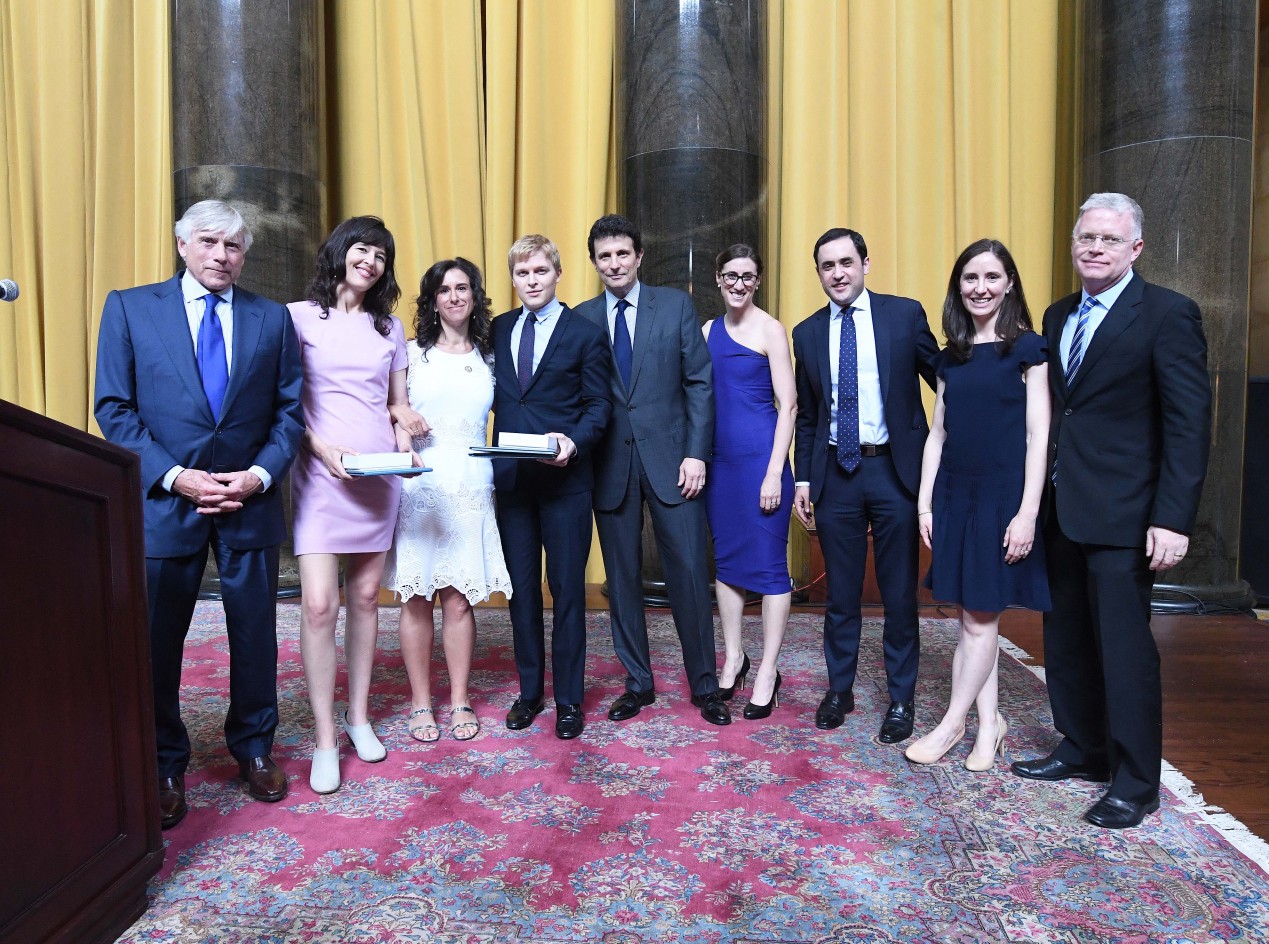
Staff members from The New York Times and The New Yorker (from left: Megan Twohey, Jodi Kantor, Ronan Farrow, 1994 General Nonfiction winner David Remnick, Deidre Foley-Mendelssohn, Michael Schmidt, Emily Steel and 1996 International Reporting winner David Rohde) accept the 2018 Pulitzer Prize for Public Service from Columbia University President Lee Bollinger (far left). (Photo: Eileen Barroso/Columbia University)
Winning Work
By Jodi Kantor and Megan Twohey
Two decades ago, the Hollywood producer Harvey Weinstein invited Ashley Judd to the Peninsula Beverly Hills hotel for what the young actress expected to be a business breakfast meeting. Instead, he had her sent up to his room, where he appeared in a bathrobe and asked if he could give her a massage or she could watch him shower, she recalled in an interview.
“How do I get out of the room as fast as possible without alienating Harvey Weinstein?” Ms. Judd said she remembers thinking.
In 2014, Mr. Weinstein invited Emily Nestor, who had worked just one day as a temporary employee, to the same hotel and made another offer: If she accepted his sexual advances, he would boost her career, according to accounts she provided to colleagues who sent them to Weinstein Company executives. The following year, once again at the Peninsula, a female assistant said Mr. Weinstein badgered her into giving him a massage while he was naked, leaving her “crying and very distraught,” wrote a colleague, Lauren O’Connor, in a searing memo asserting sexual harassment and other misconduct by their boss.
“There is a toxic environment for women at this company,” Ms. O’Connor said in the letter, addressed to several executives at the company run by Mr. Weinstein.
An investigation by The New York Times found previously undisclosed allegations against Mr. Weinstein stretching over nearly three decades, documented through interviews with current and former employees and film industry workers, as well as legal records, emails and internal documents from the businesses he has run, Miramax and the Weinstein Company.
During that time, after being confronted with allegations including sexual harassment and unwanted physical contact, Mr. Weinstein has reached at least eight settlements with women, according to two company officials speaking on the condition of anonymity. Among the recipients, The Times found, were a young assistant in New York in 1990, an actress in 1997, an assistant in London in 1998, an Italian model in 2015 and Ms. O’Connor shortly after, according to records and those familiar with the agreements.
In a statement to The Times on Thursday afternoon, Mr. Weinstein said: “I appreciate the way I’ve behaved with colleagues in the past has caused a lot of pain, and I sincerely apologize for it. Though I’m trying to do better, I know I have a long way to go.”
He added that he was working with therapists and planning to take a leave of absence to “deal with this issue head on.”
I am a 28 year old woman trying to make a living and a career. Harvey Weinstein is a 64 year old, world famous man and this is his company. The balance of power is me: 0, Harvey Weinstein: 10.— From Lauren O’Connor‘s memo
Lisa Bloom, a lawyer advising Mr. Weinstein, said in a statement that “he denies many of the accusations as patently false.” In comments to The Times earlier this week, Mr. Weinstein said that many claims in Ms. O’Connor’s memo were “off base” and that they had parted on good terms.
He and his representatives declined to comment on any of the settlements, including providing information about who paid them. But Mr. Weinstein said that in addressing employee concerns about workplace issues, “my motto is to keep the peace.”
Ms. Bloom, who has been advising Mr. Weinstein over the last year on gender and power dynamics, called him “an old dinosaur learning new ways.” She said she had “explained to him that due to the power difference between a major studio head like him and most others in the industry, whatever his motives, some of his words and behaviors can be perceived as inappropriate, even intimidating.”
Though Ms. O’Connor had been writing only about a two-year period, her memo echoed other women’s complaints. Mr. Weinstein required her to have casting discussions with aspiring actresses after they had private appointments in his hotel room, she said, her description matching those of other former employees. She suspected that she and other female Weinstein employees, she wrote, were being used to facilitate liaisons with “vulnerable women who hope he will get them work.”
The allegations piled up even as Mr. Weinstein helped define popular culture. He has collected six best-picture Oscars and turned out a number of touchstones, from the films “Sex, Lies, and Videotape,” “Pulp Fiction” and “Good Will Hunting” to the television show “Project Runway.” In public, he presents himself as a liberal lion, a champion of women and a winner of not just artistic but humanitarian awards.
In 2015, the year Ms. O’Connor wrote her memo, his company distributed “The Hunting Ground,” a documentary about campus sexual assault. A longtime Democratic donor, he hosted a fund-raiser for Hillary Clinton in his Manhattan home last year. He employed Malia Obama, the oldest daughter of former President Barack Obama, as an intern this year, and recently helped endow a faculty chair at Rutgers University in Gloria Steinem’s name. During the Sundance Film Festival in January, when Park City, Utah, held its version of nationwide women’s marches, Mr. Weinstein joined the parade.
“From the outside, it seemed golden — the Oscars, the success, the remarkable cultural impact,” said Mark Gill, former president of Miramax Los Angeles when the company was owned by Disney. “But behind the scenes, it was a mess, and this was the biggest mess of all,” he added, referring to Mr. Weinstein’s treatment of women.
Dozens of Mr. Weinstein’s former and current employees, from assistants to top executives, said they knew of inappropriate conduct while they worked for him. Only a handful said they ever confronted him.
Mr. Weinstein enforced a code of silence; employees of the Weinstein Company have contracts saying they will not criticize it or its leaders in a way that could harm its “business reputation” or “any employee’s personal reputation,” a recent document shows. And most of the women accepting payouts agreed to confidentiality clauses prohibiting them from speaking about the deals or the events that led to them.
Charles Harder, a lawyer representing Mr. Weinstein, said it was not unusual to enter into settlements to avoid lengthy and costly litigation. He added, “It’s not evidence of anything.”
I am a professional and have tried to be professional. I am not treated that way however. I am sexualized and diminished.— From Lauren O’Connor‘s memo
At Fox News, where the conservative icons Roger E. Ailes and Bill O’Reilly were accused of harassment, women have received payouts well into the millions of dollars. But most of the women involved in the Weinstein agreements collected between roughly $80,000 and $150,000, according to people familiar with the negotiations.
In the wake of Ms. O’Connor’s 2015 memo, some Weinstein Company board members and executives, including Mr. Weinstein’s brother and longtime partner, Bob, 62, were alarmed about the allegations, according to several people who spoke on the condition of anonymity. In the end, though, board members were assured there was no need to investigate. After reaching a settlement with Mr. Weinstein, Ms. O’Connor withdrew her complaint and thanked him for the career opportunity he had given her.
“The parties made peace very quickly,” Ms. Bloom said.
Through her lawyer, Nicole Page, Ms. O’Connor declined to be interviewed. In the memo, she explained how unnerved she was by what she witnessed or encountered while a literary scout and production executive at the company. “I am just starting out in my career, and have been and remain fearful about speaking up,” Ms. O’Connor wrote. “But remaining silent is causing me great distress.”
In speaking out about her hotel episode, Ms. Judd said in a recent interview, “Women have been talking about Harvey amongst ourselves for a long time, and it’s simply beyond time to have the conversation publicly.”
A Common Narrative
Ms. Nestor, a law and business school student, accepted Mr. Weinstein’s breakfast invitation at the Peninsula because she did not want to miss an opportunity, she later told colleagues. After she arrived, he offered to help her career while boasting about a series of famous actresses he claimed to have slept with, according to accounts that colleagues compiled after hearing her story and then sent on to company executives.
“She said he was very persistent and focused though she kept saying no for over an hour,” one internal document said. Ms. Nestor, who declined to comment for this article, refused his bargain, the records noted. “She was disappointed that he met with her and did not seem to be interested in her résumé or skill set.” The young woman chose not to report the episode to human resources personnel, but the allegations came to management’s attention through other employees.
Across the years and continents, accounts of Mr. Weinstein’s conduct share a common narrative: Women reported to a hotel for what they thought were work reasons, only to discover that Mr. Weinstein, who has been married for most of three decades, sometimes seemed to have different interests. His home base was New York, but his rolling headquarters were luxury hotels: the Peninsula Beverly Hills and the Savoy in London, the Hôtel du Cap-Eden-Roc near the Cannes Film Festival in France and the Stein Eriksen Lodge near the Sundance Film Festival.
Working for Mr. Weinstein could mean getting him out of bed in the morning and doing “turndown duty” late at night, preparing him for sleep. Like the colleague cited in Ms. O’Connor’s memo, some junior employees required to perform those tasks said they were disturbing.
In interviews, eight women described varying behavior by Mr. Weinstein: appearing nearly or fully naked in front of them, requiring them to be present while he bathed or repeatedly asking for a massage or initiating one himself. The women, typically in their early or middle 20s and hoping to get a toehold in the film industry, said he could switch course quickly — meetings and clipboards one moment, intimate comments the next. One woman advised a peer to wear a parka when summoned for duty as a layer of protection against unwelcome advances.
Laura Madden, a former employee who said Mr. Weinstein prodded her for massages at hotels in Dublin and London beginning in 1991, said he had a way of making anyone who objected feel like an outlier. “It was so manipulative,” she said in an interview. “You constantly question yourself — am I the one who is the problem?”
“I don’t know anything about that,” Mr. Weinstein said.
Most women who told The Times that they experienced misconduct by Mr. Weinstein had never met one another. They range in age from early 20s to late 40s and live in different cities. Some said they did not report the behavior because there were no witnesses and they feared retaliation by Mr. Weinstein. Others said they felt embarrassed. But most confided in co-workers.
Ms. Madden later told Karen Katz, a friend and colleague in the acquisitions department, about Mr. Weinstein’s overtures, including a time she locked herself in the bathroom of his hotel room, sobbing. “We were so young at the time,” said Ms. Katz, now a documentary filmmaker. “We did not understand how wrong it was or how Laura should deal with it.”
Others in the London office said the same. “I was pretty disturbed and angry,” said Sallie Hodges, another former employee, recalling the accounts she heard from colleagues. “That’s kind of the way things were.”
The human resources operation was considered weak in New York and worse in London, so some employees banded together in solidarity. “If a female executive was asked to go to a meeting solo, she and a colleague would generally double up” so as not to be alone with Mr. Weinstein, recalled Mr. Gill, the former president of Miramax Los Angeles.
Many women who worked with Mr. Weinstein said they never experienced sexual harassment or knew of anyone who did, and recalled him as a boss who gave them valuable opportunities at young ages. Some described long and satisfying careers with him, praising him as a mentor and advocate.
But in interviews, some of the former employees who said they had troubling experiences with Mr. Weinstein asked a common question: How could allegations repeating the same pattern — young women, a powerful male producer, even some of the same hotels — have accumulated for almost three decades?
“It wasn’t a secret to the inner circle,” said Kathy DeClesis, Bob Weinstein’s assistant in the early 1990s. She supervised a young woman who left the company abruptly after an encounter with Harvey Weinstein and who later received a settlement, according to several former employees.
Speaking up could have been costly. A job with Mr. Weinstein was a privileged perch at the nexus of money, fame and art, and plenty of his former assistants have risen high in Hollywood. He could be charming and generous: gift baskets, flowers, personal or career help and cash. At the Cannes Film Festival, according to several former colleagues, he sometimes handed out thousands of dollars as impromptu bonuses.
Mr. Weinstein was a volcanic personality, though, given to fits of rage and personal lashings of male and female employees alike. When a female guest of his had to wait for a hotel room upgrade, he yelled that Ms. O’Connor would be better off marrying a “fat, rich Jewish” man because she was probably just good for “being a wife” and “making babies,” she wrote in her memo. (He added some expletives, she said.) His treatment of women was sometimes written off as just another form of toxicity, according to multiple former employees.
In the fall of 1998, a 25-year-old London assistant named Zelda Perkins confronted Mr. Weinstein. According to former colleagues, she and several co-workers had been regularly subjected to inappropriate requests or comments in hotel rooms, and she was particularly concerned about the treatment of another woman in the office. She told Mr. Weinstein that he had to stop, according to the former colleagues, and that she would go public or initiate legal action unless he changed his behavior.
Steve Hutensky, one of Miramax’s entertainment lawyers, was dispatched to London to negotiate a settlement with Ms. Perkins and her lawyer. He declined to comment for this article.
Ms. Perkins, now a theater producer in London, also declined to comment for this article, saying that she could not discuss her work at Miramax or whether she had entered into any agreements.
Months after the settlement, Mr. Weinstein triumphed at the Oscars, with “Life Is Beautiful” and “Shakespeare in Love” winning 10 awards. A few years later, Mr. Weinstein, who had produced a series of British-themed movies, was made a Commander of the British Empire, an honorary title just short of knighthood.
‘Coercive Bargaining’
For actors, a meeting with Mr. Weinstein could yield dazzling rewards: scripts, parts, award campaigns, magazine coverage, influence on lucrative endorsement deals. He knew how to blast small films to box office success, and deliver polished dramas like “The King’s Speech” and popular attractions like the “Scary Movie” franchise. Mr. Weinstein’s films helped define femininity, sex and romance, from Catherine Zeta-Jones in “Chicago” to Jennifer Lawrence in “Silver Linings Playbook.”
But movies were also his private leverage. When Mr. Weinstein invited Ms. Judd to breakfast in Beverly Hills, she had been shooting the thriller “Kiss the Girls” all night, but the meeting seemed too important to miss. After arriving at the hotel lobby, she was surprised to learn that they would be talking in his suite; she decided to order cereal, she said, so the food would come quickly and she could leave.
Mr. Weinstein soon issued invitation after invitation, she said. Could he give her a massage? When she refused, he suggested a shoulder rub. She rejected that too, she recalled. He steered her toward a closet, asking her to help pick out his clothing for the day, and then toward the bathroom. Would she watch him take a shower? she remembered him saying.
“I said no, a lot of ways, a lot of times, and he always came back at me with some new ask,” Ms. Judd said. “It was all this bargaining, this coercive bargaining.”
To get out of the room, she said, she quipped that if Mr. Weinstein wanted to touch her, she would first have to win an Oscar in one of his movies. She recalled feeling “panicky, trapped,” she said in the interview. “There’s a lot on the line, the cachet that came with Miramax.”
Not long afterward, she related what had happened to her mother, the singer Naomi Judd, who confirmed their conversation to a Times reporter. Years later, Ashley Judd appeared in two Weinstein films without incident, she said. In 2015, she shared an account of the episode in the hotel room with “Variety” without naming the man involved.
In 1997, Mr. Weinstein reached a previously undisclosed settlement with Rose McGowan, then a 23-year-old-actress, after an episode in a hotel room during the Sundance Film Festival. The $100,000 settlement was “not to be construed as an admission” by Mr. Weinstein, but intended to “avoid litigation and buy peace,” according to the legal document, which was reviewed by The Times. Ms. McGowan had just appeared in the slasher film “Scream” and would later star in the television show “Charmed.” She declined to comment.
Increased Scrutiny
Just months before Ms. O’Connor wrote her memo, a young female employee quit after complaining of being forced to arrange what she believed to be assignations for Mr. Weinstein, according to two people familiar with her departure. The woman, who asked not to be identified to protect her privacy, said a nondisclosure agreement prevented her from commenting.
Soon, complaints about Mr. Weinstein’s behavior prompted the board of his company to take notice.
In March 2015, Mr. Weinstein had invited Ambra Battilana, an Italian model and aspiring actress, to his TriBeCa office on a Friday evening to discuss her career. Within hours, she called the police. Ms. Battilana told them that Mr. Weinstein had grabbed her breasts after asking if they were real and put his hands up her skirt, the police report says.
The claims were taken up by the New York Police Department’s Special Victims Squad and splashed across the pages of tabloids, along with reports that the woman had worked with investigators to secretly record a confession from Mr. Weinstein. The Manhattan district attorney’s office later declined to bring charges.
But Mr. Weinstein made a payment to Ms. Battilana, according to people familiar with the settlement, speaking on the condition of anonymity about the confidential agreement.
The public nature of the episode concerned some executives and board members of the Weinstein Company. (Harvey and Bob Weinstein together own 42 percent of the privately held business.) When several board members pressed Mr. Weinstein about it, he insisted that the woman had set him up, colleagues recalled.
Ms. Battilana had testified in court proceedings against associates of former Prime Minister Silvio Berlusconi of Italy who are accused of procuring women for alleged sex parties, and the Italian news media also reported that, years ago, Ms. Battilana accused a septuagenarian boyfriend of sexual harassment, a complaint that was apparently dismissed. Ms. Battilana did not respond to requests for comment. Her lawyer, Mauro Rufini, could not be reached for comment.
After the episode, Lance Maerov, a board member, said he successfully pushed for a code of behavior for the company that included detailed language about sexual harassment.
Then Ms. O’Connor’s memo hit, with page after page of detailed accusations. In describing the experiences of women at the company, including her own, she wrote, “The balance of power is me: 0, Harvey Weinstein: 10.”
She was a valued employee — Mr. Weinstein described her as “fantastic,” “a great person,” “a brilliant executive” — so the complaint rattled top executives, including Bob Weinstein. When the board was notified of it by email, Mr. Maerov insisted that an outside lawyer determine whether the allegations were true, he said in an interview.
But the inquiry never happened. Mr. Weinstein had reached a settlement with Ms. O’Connor, and there was no longer anything to investigate.
“Because this matter has been resolved and no further action is required, I withdraw my complaint,” Ms. O’Connor wrote in an email to the head of human resources six days after sending her memo. She also wrote a letter to Mr. Weinstein thanking him for the opportunity to learn about the entertainment industry.
Rachel Abrams and William K. Rashbaum contributed reporting. Grace Ashford contributed research.
By Ellen Gabler, Megan Twohey and Jodi Kantor
Hope Exiner d’Amore said Harvey Weinstein raped her in a hotel room in the 1970s, when he was a young concert promoter in Buffalo. Cynthia Burr said that during this time, he assaulted her in an encounter that began in an elevator and ended with forced oral sex in a hallway. Ashley Matthau, a dancer with a bit part in one of his movies, said that in 2004, he pushed her down on a bed and masturbated while straddling her. Days later, she said, he paid her to remain silent.
Three weeks after complaints of sexual harassment and misconduct by Mr. Weinstein were first reported in The New York Times, women from different continents, fields and generations have come forward with allegations of rape, sexual assault and groping. New accounts include one previously undisclosed settlement with Mr. Weinstein and expand the time frame of alleged wrongdoing to the 1970s.
Together, the accounts provide a widening tally of alleged abuses, and illustrate the toll on women who say they felt ashamed and isolated as they watched the Hollywood producer walk red carpets, pile up Oscars and showcase his ties to prominent figures.
“This has haunted me my entire life,” said Ms. Exiner d’Amore, now 62, who was in her early 20s at the time of the alleged rape.
She and three other women who spoke to The Times described Mr. Weinstein as inappropriate and unrelenting. Some said that he used the pretext of work to lure them to hotels, that he touched them or forced them into unwanted sexual activity and that he wouldn’t stop when they said no.
Ms. Matthau, the dancer who reached a settlement with Mr. Weinstein, said she was willing to break its confidentiality clause even if it meant that he might pursue legal damages. “I want to do my part to help bring this to light so it doesn’t happen with other people in Hollywood or anywhere else,” she said in an interview.
The allegations add to those previously documented in The Times, The New Yorker and elsewhere.
Last week, the actress Dominique Huett filed a lawsuit claiming that in 2010, Mr. Weinstein forcibly performed oral sex on her. The same day, Mimi Haleyi, a former production assistant of Mr. Weinstein’s, appeared at a news conference in New York accusing him of the same behavior in 2006.
The New York Police Department is conducting a wide-ranging investigation of allegations against Mr. Weinstein. Detectives with expertise in old cases are reviewing complaints that have come through the department’s hotline, according to a law enforcement official who spoke on the condition of anonymity.
In New York, the statute of limitations for prosecuting rape and other sex crimes depends on the force alleged and the charges considered, but it can range from two years to no time restrictions for the most serious offenses. Ms. Burr, the woman involved in the hallway encounter in the 1970s, said that she contacted the New York police in recent weeks and that they told her the alleged assault had happened too long ago to be prosecuted.
Women have also spoken to law enforcement authorities in London, Los Angeles and elsewhere in the United States. The London police are investigating three sexual assault cases involving Mr. Weinstein, ranging from the 1980s to 2015.
Mr. Weinstein’s spokeswoman, Sallie Hofmeister, said in a statement that “any allegations of nonconsensual sex are unequivocally denied by Mr. Weinstein.”
Cynthia Burr
For 40 years, Cynthia Burr has almost never talked about the time she met Mr. Weinstein.
But she didn’t forget how he greeted her in the lobby of a beautiful old building in New York City. How he tried to kiss her in the elevator. And how, she said, he unzipped his fly and forced her to perform oral sex in a hallway.
“It was just him and me alone,” she said. “I was fearful I didn’t have the wherewithal to get away.”
It was the late 1970s, and Ms. Burr was an actress in her early 20s. Mr. Weinstein was in his mid-20s and a “real up-and-comer,” Ms. Burr remembers. Her manager said they should meet.
After the encounter, she recalls feeling ashamed. “The way he forced me made me feel really bad about myself,” she said. “What are you going to do when you are a girl just trying to make it as an actress? Nobody would have believed me.”
Ms. Burr, now 62, went on to build a career in Hollywood. She appeared in “Scarface” and the first two “Lethal Weapon” films, and in soap operas and other television shows.
Eventually, she told her husband, now deceased, and a close friend, Lee Chavez, what had happened. Mr. Chavez confirmed that she had told him her account about 10 years ago.
“I’m really sad for everybody, but I’m really glad it’s out in the open,” Ms. Burr said about learning of the other allegations against Mr. Weinstein. “I finally felt like I had a voice.”
Hope Exiner d’Amore
Ms. Exiner d’Amore had worked for Mr. Weinstein for just a few weeks when he asked if she’d like to take a trip to New York City. Both of them were in their 20s, living in Buffalo in the late 1970s.
She was working for Mr. Weinstein’s concert promotion company, Harvey and Corky Productions, doing odd jobs. She was interested in film, so when Mr. Weinstein asked if she wanted to come to New York City to meet with people in the industry, she agreed.
When they got to the Park Lane Hotel, Mr. Weinstein went to the check-in desk while she waited elsewhere in the lobby, Ms. Exiner d’Amore recalled. He returned and said there had been a mistake with the reservations; there was only one room. They would have to share.
“I gave him a look like that was ridiculous,” she recalled. But she ultimately agreed, assuming it was harmless. When she got into bed that night, she said, he slipped in next to her, naked.
“I told him no. I kept pushing him away. He just wouldn’t listen,” Ms. Exiner d’Amore said. “He just forced himself on me.” She said he forcibly performed oral sex and intercourse on her.
She did not tell her boyfriend, feeling ashamed, but she did confide in her next-door neighbors in Buffalo. She did not specifically say she was raped, but the couple, David and Irene Sipos, told The Times that they remembered her being extremely upset and crying when she told them about Mr. Weinstein and the hotel room.
After the trip, Ms. Exiner d’Amore said, Mr. Weinstein kept asking her out and offered her credit cards to go on shopping sprees. She declined. Within three or four weeks, she was fired.
“It was a relief,” she said. “I hated being there.”
Ms. Exiner d’Amore never went into the film industry. She got a job administering an undergraduate program at Cornell, and later moved on to jobs in fund-raising.
Ashley Matthau
Ashley Matthau said that Mr. Weinstein was aggressive with her the moment they met in 2004. She was in Puerto Rico performing in “Dirty Dancing: Havana Nights” when Mr. Weinstein visited the set. As soon as he saw her, she said, he began pressuring her to come to his hotel room for a private meeting. Ms. Matthau, who then went by her maiden name, Anderson, said she tried to brush him off, explaining that she was engaged. She said he persisted.
When the cast broke for a meal, Ms. Matthau told some production members that Mr. Weinstein was being pushy and she was afraid. No one offered to help, she said, and when she returned to the set, Mr. Weinstein instructed her to get into a car.
“‘Don’t worry,’” Ms. Matthau, now 36, remembers him saying as they sat in the back seat. “‘Nothing is going to happen. We’re just going to discuss future projects.’”
She said they went to his hotel room, where talk quickly became sexual: Mr. Weinstein told her that he had helped launch the careers of high-profile actresses who had slept with him, and that she should consider doing the same. When she declined, Mr. Weinstein pushed her onto the bed and fondled her breasts, she said. He then stripped, straddled her and masturbated on top of her.
“I kept telling him, ‘Stop, I’m engaged,’ but he kept saying: ‘It’s just a little cuddling. It’s not a problem. It’s not like we’re having sex.’ ”
Back in California days later, Ms. Matthau tearfully told her fiancé, Charles Matthau, a general description of what had happened. Mr. Matthau said in an interview that he was outraged. With his encouragement, Ms. Matthau retained John S. West, a partner in the law firm of Gloria Allred, who has a record of taking on powerful men.
Soon, Ms. Matthau recalled, she and Mr. West met at the Peninsula Beverly Hills with Mr. Weinstein and Daniel M. Petrocelli, who had represented high-profile clients including Jeffrey Skilling, the chief executive of Enron.
The experience, she said, was chilling. She had attended a couple of parties at the Playboy Mansion, and Mr. Petrocelli said she would be painted as promiscuous if she went public with her accusation against Mr. Weinstein.
“‘We’ll drag you through the mud by your hair,’” she recalled the lawyer saying. Mr. Petrocelli declined to comment.
Going up against such powerful men felt like more than she could handle. Ms. Matthau said she agreed to enter into a more than $100,000 settlement with Mr. Weinstein in exchange for a legally binding promise never to speak of the allegations again.
Lacey Dorn
Lacey Dorn moved to New York City in 2011, soon after graduating from Stanford University, where she had helped create two documentaries. Ms. Dorn, then 22, was introduced to Mr. Weinstein at a New York Film Festival party
A few weeks later, Ms. Dorn attended a Halloween party at the Gramercy Park Hotel and ran into Mr. Weinstein, who asked for her email. He wanted to talk about her career over lunch, she said.
“Great meeting you,” he wrote in the subject line of an otherwise blank email sent to her at 12:26 a.m.
On her way out of the party, Ms. Dorn said goodbye to Mr. Weinstein. As she turned her back to him, he grabbed between her legs, touching her buttocks and crotch through her clothes.
“I was so naïve, I didn’t say anything. And he didn’t say anything either,” she said. “I just got out of the party as fast as possible.”
Ms. Dorn said she never heard from Mr. Weinstein and never spoke to him again. Ms. Dorn said that when she told friends what had happened, many seemed to shrug it off as if it were a “rite of passage,” an acknowledgment of how “awful” the entertainment business could be.
Al Baker, Katrin Bennhold and Stephen Castle contributed reporting. Grace Ashford contributed research.
Host Said to Pay Out $32 Million in Case on Harassment
By Emily Steel and Michael S. Schmidt
Last January, six months after Fox News ousted its chairman amid a sexual harassment scandal, the network’s top-rated host at the time, Bill O’Reilly, struck a $32 million agreement with a longtime network analyst to settle new sexual harassment allegations, according to two people briefed on the matter — an extraordinarily large amount for such cases.
Although the deal has not been previously made public, the network’s parent company, 21st Century Fox, acknowledges that it was aware of the woman’s complaints about Mr. O’Reilly. They included allegations of repeated harassment, a nonconsensual sexual relationship and the sending of gay pornography and other sexually explicit material to her, according to the people briefed on the matter.
It was at least the sixth agreement — and by far the largest — made by either Mr. O’Reilly or the company to settle harassment allegations against him. Despite that record, 21st Century Fox began contract negotiations with Mr. O’Reilly, and in February granted him a four-year extension that paid $25 million a year.
Interviews with people familiar with the settlement, and documents obtained by The New York Times, show how the company tried and ultimately failed to contain the second wave of a sexual harassment crisis that initially burst into public view the previous summer and cost the Fox News chairman, Roger Ailes, and eventually Mr. O’Reilly, their jobs.
In January, the reporting shows, Rupert Murdoch and his sons, Lachlan and James, the top executives at 21st Century Fox, made a business calculation to stand by Mr. O’Reilly despite his most recent, and potentially most explosive, harassment dispute.
Their decision came as the company was trying to convince its employees, its board and the public that it had cleaned up the network’s workplace culture. At the same time, they were determined to hold on to Mr. O’Reilly, whose value to the network increased after the departure of another prominent host, Megyn Kelly.
But by April, the Murdochs decided to jettison Mr. O’Reilly as some of the settlements became public and posed a significant threat to their business empire.
Early that month, The Times reported on five settlements involving Mr. O’Reilly, leading advertisers to boycott his show and spawning protests calling for his ouster. About the same time, the O’Reilly settlements arose as an issue in 21st Century Fox’s attempt to buy the European satellite company Sky.
In addition, federal prosecutors who had been investigating the network’s handling of sexual harassment complaints against Mr. Ailes had asked for material related to allegations involving Mr. O’Reilly, according to an internal Fox email obtained by The Times.
“Their legal theory has been that we hid the fact that we had a problem with Roger,” Gerson Zweifach, Fox’s general counsel, wrote in the email, referring to the prosecutors and Mr. Ailes, “and now it will be applied to O’Reilly, and they will insist on full knowledge of all complaints about O’Reilly’s behavior in the workplace, regardless of who settled them.”
He warned the Murdochs that they should expect details from the January settlement to become public. Six days later, Mr. O’Reilly was fired.
In a statement, 21st Century Fox said it was not privy to the amount of the settlement and regarded Mr. O’Reilly’s January settlement, which was reached with a 15-year Fox News analyst named Lis Wiehl, as a personal issue between the two of them.
Regarding Mr. O’Reilly’s contract extension, the company said Fox News “surely would have wanted to renew” Mr. O’Reilly’s contract, noting that “he was the biggest star in cable TV.”
It emphasized that provisions were added to the new contract that allowed for his dismissal if new allegations or other relevant information arose. “The company subsequently acted based on the terms of this contract,” the statement said.
In an interview on Wednesday, Mr. O’Reilly, at times combative and defiant, said there was no merit to any of the allegations against him. “I never mistreated anyone,” he said, adding that he had resolved matters privately because he wanted to protect his children from the publicity.
“It’s politically and financially motivated,” he said of the public outcry over the allegations against him, “and we can prove it with shocking information, but I’m not going to sit here in a courtroom for a year and a half and let my kids get beaten up every single day of their lives by a tabloid press that would sit there, and you know it.”
He declined to specifically address questions about the settlement with Ms. Wiehl or any others.
Mr. O’Reilly’s lawyer, Fredric S. Newman, described his client’s relationship with Ms. Wiehl as an 18-year friendship in which she at times gave him legal advice.
Asked about the allegation of a nonconsensual sexual relationship, a representative for Mr. O’Reilly, Mark Fabiani, said that 21st Century Fox was “well aware” Ms. Wiehl had signed a sworn affidavit “renouncing all allegations against him,” adding that after receiving the document Fox News offered Mr. O’Reilly “a record breaking contract.”
Lawyers for Ms. Wiehl, Jonathan S. Abady and O. Andrew F. Wilson of the firm Emery Celli Brinckerhoff & Abady, declined to comment.
Details of the settlement and how the company handled the O’Reilly situation emerged from interviews with two people briefed on the agreement and several others familiar with the dispute; all of them spoke on the condition of anonymity to discuss sensitive private negotiations. The Times also viewed a copy of a document partly outlining the agreement and other documents related to the dispute, and received answers to written questions from 21st Century Fox.
The disclosure of Ms. Wiehl’s settlement follows a wave of public accusations against the Hollywood studio mogul Harvey Weinstein, which has increased scrutiny of sexual harassment in the workplace. The Times reported this month that Mr. Weinstein had reached at least eight settlements with women, most of whom received between $80,000 and $150,000.
Ms. Wiehl’s $32 million deal dwarfs other previously known sexual harassment settlements at Fox News. The largest of those was the $20 million payout the former host Gretchen Carlson received after she sued Mr. Ailes in July 2016.
The settlement with Ms. Wiehl was more than three times the amount of any of Mr. O’Reilly’s previously known deals; in 2004, he had settled a lawsuit with a producer, Andrea Mackris, for about $9 million. Publicly known harassment settlements involving Mr. O’Reilly have totaled about $45 million.
Claims Covering 15 Years
A graduate of Harvard Law School, Ms. Wiehl started making regular appearances on Mr. O’Reilly’s show in 2001, when she joined Fox News as a legal analyst. During a segment in September of that year, Mr. O’Reilly announced that Ms. Wiehl had landed a job at the network and said she owed him.
“Hey, you know, Lis, I got you this job,” he said. “You know that?”
“I know you did, I know,” she replied.
“So you owe me,” Mr. O’Reilly said. “You owe me big.”
“No, no, no,” Ms. Wiehl said.
Mr. O’Reilly also made suggestive remarks to Ms. Wiehl on the air. During one segment on his radio show in 2005 about a strip club, he suggested that she learn how to dance for a $10,000 tip.
Ms. Wiehl last appeared on Mr. O’Reilly’s show on Dec. 20, 2016. On Jan. 2, Mr. O’Reilly received a draft of a lawsuit Ms. Wiehl was threatening to file outlining her allegations of sexual harassment, and 21st Century Fox received a copy of the complaint soon afterward.
Both Mr. O’Reilly and 21st Century Fox were at critical junctures. If the allegations became public, they would not only embarrass Mr. O’Reilly and harm his career, but could jeopardize his yearslong custody battle with his ex-wife. A hearing was set for later that month, when Mr. O’Reilly’s lawyers planned to argue that he should be given more time with his son, according to two people familiar with the dispute.
At Fox News, Ms. Kelly had just announced that she was leaving the network for NBC. Her departure made Mr. O’Reilly’s presence in the prime-time lineup even more crucial, with his show pulling in top ratings and generating hundreds of millions of dollars in revenue.
Mr. Newman told 21st Century Fox that Mr. O’Reilly considered it a personal matter and that he would resolve it on his own. Mr. Newman handled the negotiations with lawyers for Ms. Wiehl.
After a few days of negotiation, Mr. O’Reilly and Ms. Wiehl reached a deal, according to a copy of the term sheet for the agreement that was sent anonymously to The Times and confirmed by the people briefed on the settlement. Dated Jan. 7, it called for Ms. Wiehl to be paid over a period of time to ensure her silence. In return, she agreed not to sue Mr. O’Reilly, Fox News or 21st Century Fox. And all photos, text messages and other communications between the two would be destroyed.
Ms. Wiehl signed an affidavit, dated Jan. 17 and obtained by The Times, stating that the two sides had resolved their dispute and that she had “no claims against Bill O’Reilly concerning any of those emails or any of the allegations in the draft complaint.” In the affidavit, she said she had worked as a lawyer for Mr. O’Reilly and was serving in that capacity when he sent her “explicit emails that were sent to him.”
In response to questions about why he sent sexually explicit material to Ms. Wiehl, Mr. O’Reilly said that during his time at the network, he had been sent threatening messages almost every day, including some that had obscene material. To deal with this problem, Mr. O’Reilly said, he set up a system in which the material would be forwarded to his lawyers so they could evaluate whether he needed to take any legal action. Mr. O’Reilly said Ms. Wiehl was among those lawyers.
Although the matter had been settled confidentially, Mr. O’Reilly’s lawyers were concerned about keeping the dollar figure secret. Mr. Newman provided the company with a document that informed them of the deal but did not include the dollar figure.
The company said Mr. Newman made clear that it would not be told the financial terms because Mr. O’Reilly thought the company “leaked sensitive information.”
In February, Mr. O’Reilly received his new contract, with a salary increase to $25 million, from about $18 million. It’s not clear who initiated negotiations for the extension. Mr. Newman says Fox News pushed to renew the contract; the company says the negotiations were bilateral.
“It was Fox News that wanted to renew Bill O’Reilly because of the Megyn Kelly defection,” Mr. Newman said, adding that Mr. O’Reilly was a wealthy man who had no need for extra money. The company said it would have renewed his contract whether Ms. Kelly stayed or left.
Mr. Fabiani, Mr. O’Reilly’s representative, said that he was concerned that 21st Century Fox’s statements about Mr. O’Reilly were designed to hurt his brand.
“Up to this point, Fox News and Mr. O’Reilly have had a constructive business relationship — with Fox News even running ads for his new book on their air,” Mr. Newman said. “We hope that all the leaks coming out of Fox are not designed to hurt Bill O’Reilly in the marketplace.”
‘A Critical Development’
In mid-April, after The Times revealed five of Mr. O’Reilly’s settlements, the public scrutiny was creating more problems for Fox, and the company started an investigation into his behavior. On April 13, Mr. Zweifach, the company’s general counsel, notified the Murdochs about a new document request from federal prosecutors investigating the network.
“We have had a critical development in the O’Reilly matter,” Mr. Zweifach wrote in an email, which was delivered anonymously to The Times. (The company declined to comment on the email.)
In the email, Mr. Zweifach explained to the Murdochs that the government request for all documents related to sexual harassment allegations against Mr. O’Reilly would “clearly call for the production of the Wiehl materials.”
Mr. Zweifach said 21st Century Fox could try to challenge the request by telling prosecutors that the case had not been settled by the company, so shareholder money was not involved. But he added that there was “virtually no chance that they will back off.”
“The fact that it seems like a bogus theory of federal securities law disclosure will not stop them from exploring it,” Mr. Zweifach added.
The public outcry, advertising boycott and federal inquiry were not the only issues weighing on the Murdochs. The bid for the Sky satellite company was a high priority for the elder Mr. Murdoch, an acquisition he considered important to his legacy.
Mr. O’Reilly’s settlements arose as an issue at an April 18 meeting between 21st Century Fox executives and the British regulators who were reviewing the company’s bid, according to a government report on the meeting. The report said regulators were “concerned that board members regarded Mr. O’Reilly’s settling cases personally as somehow a point in his favor.”
A day after the meeting with regulators, while Mr. O’Reilly was on vacation in Italy, he was dismissed. He left the network with a $25 million payout.
In a statement provided this past week, the company said: “21st Century Fox has taken concerted action to transform Fox News including installing new leaders, overhauling management and on-air talent, expanding training, and increasing the channels through which employees can report harassment or discrimination.” It added that “these changes come from the top.”
The company’s bid for Sky remains under regulatory scrutiny.
In response to questions from The Times, the company said that it had “complied fully” with document requests from the United States attorney’s office and that “it would be inappropriate to comment on a pending investigation other than to reiterate that we are cooperating fully.”
In recent weeks Mr. O’Reilly has made several public appearances to promote a new book. He said on the “Today” show that he never sent a lewd text or email to a Fox News employee, that his conscience is clear and that “a political and financial hit job” brought him down.
“This is horrible, it’s horrible what I went through, horrible what my family went through,” Mr. O’Reilly said in a raised voice at the end of the interview with The Times. “This is crap, and you know it.”
By Melena Ryzik, Cara Buckley and Jodi Kantor
In 2002, a Chicago comedy duo, Dana Min Goodman and Julia Wolov, landed their big break: a chance to perform at the U.S. Comedy Arts Festival in Aspen, Colo. When Louis C.K. invited them to hang out in his hotel room for a nightcap after their late-night show, they did not think twice. The bars were closed and they wanted to celebrate. He was a comedian they admired. The women would be together. His intentions seemed collegial.
As soon as they sat down in his room, still wrapped in their winter jackets and hats, Louis C.K. asked if he could take out his penis, the women said.
They thought it was a joke and laughed it off. “And then he really did it,” Ms. Goodman said in an interview with The New York Times. “He proceeded to take all of his clothes off, and get completely naked, and started masturbating.”
In 2003, Abby Schachner called Louis C.K. to invite him to one of her shows, and during the phone conversation, she said, she could hear him masturbating as they spoke. Another comedian, Rebecca Corry, said that while she was appearing with Louis C.K. on a television pilot in 2005, he asked if he could masturbate in front of her. She declined.
Now, after years of unsubstantiated rumors about Louis C.K. masturbating in front of associates, women are coming forward to describe what they experienced. Even amid the current burst of sexual misconduct accusations against powerful men, the stories about Louis C.K. stand out because he has so few equals in comedy. In the years since the incidents the women describe, he has sold out Madison Square Garden eight times, created an Emmy-winning TV series, and accumulated the clout of a tastemaker and auteur, with the help of a manager who represents some of the biggest names in comedy. And Louis C.K. built a reputation as the unlikely conscience of the comedy scene, by making audiences laugh about hypocrisy — especially male hypocrisy.
After being contacted for an interview this week about the on-the-record accusations of sexual misconduct — encounters that took place over a decade ago — Louis C.K.’s publicist, Lewis Kay, said the comedian would not respond. “Louis is not going to answer any questions,” Mr. Kay wrote in an email Tuesday night.
Neither Louis C.K. nor Mr. Kay replied to follow-up emails in which the accusations were laid out in detail, or to voice messages or texts. On Thursday, the premiere of Louis C.K.’s new movie “I Love You, Daddy,” was abruptly canceled, and he also canceled an appearance on “The Late Show With Stephen Colbert.”
The stories told by the women raise sharp questions about the anecdotes that Louis C.K. tells in his own comedy. He rose to fame in part by appearing to be candid about his flaws and sexual hang-ups, discussing and miming masturbation extensively in his act — an exaggerated riff that some of the women feel may have served as a cover for real misconduct. He has all but invited comparison between his private life and his onscreen work, too: In “I Love You, Daddy,” which is scheduled to be released next week, a character pretends to masturbate at length in front of other people, and other characters appear to dismiss rumors of sexual predation.
At the same time, Louis C.K. has also boosted the careers of women, and is sometimes viewed as a feminist by fans and critics. But Ms. Goodman and Ms. Wolov said that when they told others about the incident in the Colorado hotel room, they heard that Louis C.K.’s manager was upset that they were talking about it openly. The women feared career repercussions. Louis C.K.’s manager, Dave Becky, was adamant in an email that he “never threatened anyone.”
For comedians, the professional environment is informal: profanity and raunch that would be far out of line in most workplaces are common, and personal foibles — the weirder the better — are routinely mined for material. But Louis C.K.’s behavior was abusive, the women said.
“I think the line gets crossed when you take all your clothes off and start masturbating,” Ms. Wolov said.
‘You Want to Believe It’s Not Happening’
Ms. Corry, a comedian, writer and actress, has long felt haunted by her run-in with Louis C.K. In 2005, she was working as a performer and producer on a television pilot — a big step in her career — when Louis C.K., a guest star, approached her as she was walking to the set. “He leaned close to my face and said, ‘Can I ask you something?’ I said, ‘Yes,’” Ms. Corry said in a written statement to The New York Times. “He asked if we could go to my dressing room so he could masturbate in front of me.” Stunned and angry, Ms. Corry said she declined, and pointed out that he had a daughter and a pregnant wife. “His face got red,” she recalled, “and he told me he had issues.”
Word quickly reached the show’s executive producers, Courteney Cox and David Arquette, who both confirmed the incident. “What happened to Rebecca on that set was awful,” Ms. Cox said in an email, adding that she felt “outrage and shock.”
“My concern was to create an environment where Rebecca felt safe, protected and heard,” she said. They discussed curtailing the production. Ms. Corry decided to continue with the show.
“Things were going well for me,” Ms. Corry said in the statement, “and I had no interest in being the person who shut down a production.”
A fifth woman, who spoke on condition of anonymity to protect her family’s privacy because she has not been publicly linked to the incident with Louis C.K., also has disturbing memories about an incident with the comedian. In the late ’90s, she was working in production at “The Chris Rock Show” when Louis C.K., a writer and producer there, repeatedly asked her to watch him masturbate, she said. She was in her early 20s and went along with his request, but later questioned his behavior.
“It was something that I knew was wrong,” said the woman, who described sitting in Louis C.K.’s office while he masturbated in his desk chair during a workday, other colleagues just outside the door. “I think the big piece of why I said yes was because of the culture,” she continued. “He abused his power.” A co-worker at “The Chris Rock Show,” who also wished to remain anonymous, confirmed that the woman told him about the experience soon after it happened.
Ms. Schachner, a writer, illustrator and performer, admired Louis C.K.’s work. They had met in the comedy scene; Ms. Schachner’s former boyfriend was a comedy writer who had worked with Louis C.K. In 2003, when she called Louis C.K. with an invitation to her show, he said he was at work in an office as a writer on the series “Cedric the Entertainer Presents,” she recalled.
Their conversation quickly moved from the personal — Louis C.K. had seen photos of her on her boyfriend’s desk, he said, and told her he thought she was cute — to “unprofessional and inappropriate,” Ms. Schachner said.
She said she heard the blinds coming down. Then he slowly started telling her his sexual fantasies, breathing heavily and talking softly. She realized he was masturbating, and was dumbfounded. The call went on for several minutes, even though, Ms. Schachner said, “I definitely wasn’t encouraging it.” But she didn’t know how to end it, either. “You want to believe it’s not happening,” she said. A friend, Stuart Harris, confirmed that Ms. Schachner had described the call to him in 2003.
For years afterward, Ms. Schachner said, she felt angry and betrayed by an artist she looked up to. And she wondered what she could have done differently. “I felt very ashamed,” she said.
A Run-In, Then Fears About Speaking Out
During Ms. Goodman and Ms. Wolov’s surreal visit to Louis C.K.’s Aspen hotel room, they said they were holding onto each other, screaming and laughing in shock, as Louis C.K. masturbated in a chair. “We were paralyzed,” Ms. Goodman said. After he ejaculated on his stomach, they said, they fled. He called after them: “He was like, ‘Which one is Dana and which one is Julia?’” Ms. Goodman recalled.
Afterward, they ran into Charna Halpern, the owner of influential improv theaters in Los Angeles and Chicago, where Ms. Goodman and Ms. Wolov performed, and relayed what had happened. “I didn’t know what to do, I didn’t know what to tell them to do,” said Ms. Halpern. Ms. Goodman and Ms. Wolov decided against going to the police, unsure whether what happened was criminal, but felt they had to respond in some way “because something crazy happened to us,” Ms. Goodman said.
Hoping that outrage would build against Louis C.K., and also to shame him, they began telling others about the incident the next day. But many people seemed to recoil, they said. “Guys were backing away from us,” Ms. Wolov said. Barely 24 hours after they left Louis C.K.’s hotel, “we could already feel the backlash.”
Soon after, they said they understood from their managers that Mr. Becky, Louis C.K’s manager, wanted them to stop telling people about their encounter with Louis C.K. Lee Kernis, one of the women’s managers at the time, confirmed on Thursday that he had a conversation in which he told Mr. Becky that Louis C.K.’s behavior toward the women had been offensive. Mr. Kernis also said that Mr. Becky was upset that the women were talking openly about the incident.
Mr. Becky denied making any threats toward the women. “I don’t recall the exact specifics of the conversation, but know I never threatened anyone,” he wrote by email on Thursday. Ms. Halpern and Robert Schroeder — Ms. Goodman and Ms. Wolov’s agent at the time — said that the pair told them that they felt they had been warned to stop talking.
Mr. Becky arguably wields even more power in comedy than Louis C.K. He represents Kevin Hart, Aziz Ansari, Amy Poehler and other top performers, and his company, 3 Arts, puts together programming deals for nearly every platform.
Ms. Goodman and Ms. Wolov moved to Los Angeles shortly after the Aspen festival, but “we were coming here with a bunch of enemies,” Ms. Goodman said. Gren Wells, a filmmaker who befriended the comedy duo in 2002, said the incident and the warning, which they told her about soon after Aspen, hung heavily over them both. “This is something that they were freaked out about,” Ms. Wells said.
In the years since, Ms. Goodman and Ms. Wolov have found some success, but they remained concerned about Mr. Becky and took themselves out of the running for the many projects he was involved in. Though their humor is in line with what he produces, “we know immediately that we can never even submit our material,” Ms. Wolov said.
Private Acts, Public Jokes
Jokes about masturbation have been a regular part of Louis C.K.’s stage shows. In one bit, he complains about not being able to find a private place in his house to do it. “I’m on the streets now,” he says, “I’ve got nowhere to go.” In another bit he laments being a prisoner of his perversions. “Just the constant perverted sexual thoughts,” he says, then mimes masturbating. “It makes me into a moron.”
Tig Notaro, the comedian whose Amazon series, “One Mississippi,” lists Louis C.K. as an executive producer, is one of the few in the fiercely insular comedy world to speak out against him. Her career received a huge boost when he released her 2012 comedy album, about her cancer diagnosis. But their relationship has crumbled and she now feels “trapped” by her association with him, she wrote in an email.
Her fear is that “he released my album to cover his tracks,” she said. “He knew it was going to make him look like a good guy, supporting a woman.” Ms. Notaro said she learned of his reputation after they sold the series to Amazon, and a recent story line is a fictional treatment of the alleged masturbation episodes.
“Sadly, I’ve come to learn that Louis C.K.’s victims are not only real,” she said by email, “but many are actual friends of mine within the comedy community,” like Ms. Corry, who confided in her, she said.
In his forthcoming film, about a television writer whose teenage daughter is wooed by a Woody Allen type, one character aggressively mimics masturbating in front of others. The content has raised eyebrows. Given the rumors surrounding Louis C.K., the movie “plays like an ambiguous moral inventory of and excuse for everything that allows sexual predators to thrive: open secrets, toxic masculinity, and powerful people getting the benefit of the doubt,” Joe Berkowitz wrote in Fast Company.
Yet in an interview with The Times in September at the Toronto film festival, where “I Love You, Daddy,” was shown, Louis C.K. dismissed stories of his alleged sexual misconduct as “rumors,” and said the notion that the masturbation scenes referred to them never occurred to him. “It’s funny, I didn’t think of that, ” he said.
Apologies With Troubling Implications
In private, though, he appears to have acknowledged his behavior.
In 2009, six years after their phone call, Ms. Schachner received a Facebook message from Louis C.K., apologizing. “Last time I talked to you ended in a sordid fashion,” he wrote in the message, which was reviewed by The Times. “That was a bad time in my life and I’m sorry.” He added that he had seen some of Ms. Schachner’s comedy and thought she was funny. “I remember thinking what a repulsive person I was being by responding the way that I did,” he wrote.
Ms. Schachner accepted his apology and told him she forgave him. But the original interaction left her deeply dispirited, she said, and was one of the things that discouraged her from pursuing comedy.
In 2015, a few months before the now-defunct website Defamer circulated rumors of Louis C.K.’s alleged sexual misconduct, Ms. Corry also received an email from Louis C.K., which was obtained by The Times, saying he owed her a “very very very late apology.” When he phoned her, he said he was sorry for shoving her in a bathroom. Ms. Corry replied that he had never done that, but had instead asked to masturbate in front of her. Responding in a shaky voice, he acknowledged it and said, “I used to misread people back then,” she recalled.
The call confounded her, Ms. Corry said: not only had he misremembered the incident, which made her think there were other moments of misconduct, he also implied she had done something to invite his behavior. “It is unfair he’s put me or anyone else in this position,” Ms. Corry said.
Ms. Goodman and Ms. Wolov said that with other allegations swirling around the entertainment world, they could no longer stay silent. “Because of this moment, as gross as it is, we feel compelled to speak,” Ms. Goodman said.
Ms. Notaro said she was standing in support of those with the courage “to speak up against such a powerful figure,” she said, “as well as the multitude of women still out there, not quite ready to share their nightmares.”
William K. Rashbaum contributed reporting.
By The New York Times Editorial Board
Bill O’Reilly’s ouster from Fox News Wednesday — nine months after similarly lurid charges of sexual harassment forced the resignation of Roger Ailes, the Fox chief executive — has opened another window into sexual abuse of women at Fox and in the workplace generally.
The serial nature of the alleged abuse, as well as Fox’s response to it, is also a reminder that exposing wrongdoing is no guarantee of change.
When Fox said on Wednesday that it was severing ties with Mr. O’Reilly after a “thorough and careful review of the allegations,” it neglected to note that the scrutiny was not prompted by the allegations themselves — which the company already knew about — but by the defections of dozens of advertisers from “The O’Reilly Factor” and a drop in the company’s stock price. Fox heaped praise on Mr. O’Reilly in announcing his departure. In all, the company has paid at least $85 million to resolve sexual abuse scandals involving Mr. Ailes and Mr. O’Reilly. Of that sum, as much as $65 million went to the two men, in the form of exit pay.
That’s not deterrence, let alone true accountability. It is, however, a good illustration of the entrenched reality of practices that have discounted, demeaned and derailed women’s work lives for decades. Those practices include not only sexual harassment, but also persistent disparities in pay and promotion, as well as structural impediments — in child care, scheduling and other workplace policies.
Those barriers to women are no secret. Their injustice is obvious. Yet they continue:
PAID LESS FOR BEING FEMALE The days are long gone when objective factors, like experience, for example, could even remotely justify women’s relatively low pay. On average, women today make 22 percent less per hour than men, even after controlling for experience, education and location. The gap persists even after controlling for the fact that black and Hispanic workers have historically had lower wages. Women even make less than men in jobs they dominate, like nurse practitioner and preschool or kindergarten teacher. Women not only make less than similarly educated men, but the gap tends to widen as the education level rises.
Reaching the top of the corporate ladder does not improve the situation. Among top earners in corporate America — at the 95th percentile of the wage distribution — women earn 74 cents for every dollar their male peers make.
The dynamics at the lower rungs of the pay scale are even more disturbing. There is rough parity among the very lowest-paid workers, because the minimum wage helps to ensure equal pay at the bottom — with one glaring exception. “Tipped” workers, two thirds of whom are women, are still paid the federal subminimum tipped” wage of $2.13 an hour in most states, a level unchanged since 1991. One result is poverty, with recent typical pay-plus-tips for these workers hovering around $9 an hour. Another result is sexual harassment, as economically vulnerable women tolerate abuse. The restaurant industry employs 7 percent of women but accounts for nearly 40 percent of harassment claims filed with the Equal Employment Opportunity Commission. Those figures almost certainly understate the problem. As the scandals at Fox have demonstrated, women are often reluctant to speak out about sexual harassment, for fear of retaliation and in the misplaced hope that they can preserve their jobs by avoiding or defusing the situation. If highly paid women in glamorous media jobs feel that way, imagine what it’s like for women living paycheck to paycheck.
SKIPPED OVER FOR PROMOTION Across all levels at companies, women are 15 percent less likely than men to be promoted, a recent study by McKinsey and LeanIn.org found. At that rate, it would take more than a century to achieve gender parity in the executive ranks. The study also captured what appeared to be a tendency of companies to talk up their focus on gender diversity, without doing much. A vast majority of companies reported that gender diversity was a top priority for the company’s chief executive, but less than half of employees thought their company was doing what it took to actually improve diversity.
Women are nowhere near parity in the boardrooms of big American companies, either. They hold about one in five board seats, and serve mostly on “softer” committees dealing with corporate responsibility and human resources, according to recent research summarized by Bloomberg View.
Will more Fox-style debacles change that? The summary cited research showing that corporations with higher percentages of female board members suffered fewer governance-related controversies and outperformed those with lower percentages. Still other research shows that decision making improves when it involves both men and women.
SPEAK OUT AND THEN WHAT? The question is how to bridge the gulf between what women deserve and what they’re getting. Waiting for the male bosses in corporate America to get the message clearly isn’t working. One tack, adapted from the Fox scandals, would be to speak out through concerted efforts on social media about specific workplace injustices. It is not illegal for employees to talk to one another about how much they are paid, though companies have retaliated against employees who do so, and cultural taboos inhibit such conversations. But social media has amplified the power of speaking out, while reducing opportunities for companies to retaliate in secret.
Advocating to reform labor laws on the state level is another route, especially in the face of Congress’s prolonged inability to act decisively. Currently, for example, a handful of states do not have a separate subminimum tipped wage.
Unions are also needed, because pay gaps tend to be narrower in unionized workplaces. Workers would have to embrace unions, and corporations would have to allow union organizing without interference, which is a long shot, but likelier in the face of public pressure.
There will always be an important role for lawsuits and legislative changes, though lawsuits are often not an option for women who aren’t wealthy, and legislative progress, especially in this conservative and polarized time, is unlikely. Besides, to date, they have only gotten women so far — and there is so much further to go.
By The New York Times Editorial Board
Has America at last reached a turning point on sexual harassment? Watching the events of the past three weeks, one can hope.
In the wake of Harvey Weinstein’s sudden and overdue expulsion from Hollywood for his serial predation, hundreds of long-silent women are calling out powerful, influential men at a remarkable clip and accusing them of sexual misconduct: Roy Price, the head of Amazon Studios; the film director James Toback; the literary critic Leon Wieseltier; the restaurateur and celebrity chef John Besh; and the political commentator Mark Halperin, to name just a few.
Several of these men have accepted some degree of responsibility for their behavior. Former President George Bush, now 93 and using a wheelchair, apologized last week after multiple women said he groped them and whispered a crude joke during photo ops. He described it as an “attempt at humor.”
Let’s not forget — let’s not ever forget — Bill Cosby, Roger Ailes and Bill O’Reilly, three giants of American popular culture who treated women despicably for decades, and paid a price, whether through criminal prosecution, public humiliation, job loss or forking out tens of millions of dollars in hush money. #MeToo, indeed.
This reckoning is all to the good, even if it is far too late. It feels as though a real and lasting transformation may be afoot — until you remember that this isn’t the first time women have sounded the alarm.
Remember Anita Hill, who told a firing line of skeptical senators the story of constant harassment by her boss, Clarence Thomas, more than 25 years ago. The lawmakers, every one of them male, seemed less concerned with the alleged misconduct of a Supreme Court nominee than that a woman would drag such a tawdry subject into the halls of Congress. While Ms. Hill’s brave testimony prompted a sharp rise in sexual-harassment claims, she was vilified in public; nearly twice as many Americans said at the time that they believed now-Justice Thomas’s account of what happened over hers.
Remember former President Bill Clinton, whose popularity endures despite a long string of allegations of sexual misconduct and, in one case, rape — all of which he has denied. Mr. Clinton did eventually admit to the affair with an intern, Monica Lewinsky, that nearly toppled his presidency, but he pointed out that it was not illegal.
Then, of course, there’s the current occupant of the Oval Office, who won the election only weeks after the public heard him brag about grabbing women’s genitalia, and who once said that if his daughter were ever sexually harassed at work, she should go find a new job. That president leads a party intent on passing laws that would re-establish gender norms and hierarchies from the middle of the last century (Defund Planned Parenthood! No abortions after six weeks!) — making it harder for women to attain the social equality and economic independence that would go a long way toward reducing sexual harassment in the workplace.
In other words, even the highest-profile opportunities to change America’s endemic culture of sexual harassment, which is overwhelmingly, though not exclusively, committed by men against women, can somehow be lost or swept away. How do we keep that from happening again?
And how do we ensure that progress filters down to average American workplaces, where sexual harassment occurs all the time but rarely gets media attention? The answer is part cultural, part economic and part legal.
The most conservative estimates say 25 percent of women have experienced sexual harassment at work, although the real number is surely much higher, since only a small fraction of such behavior is ever reported. As many as 90 percent of workers who are harassed never file a formal complaint, according to a 2016 report by the Equal Employment Opportunity Commission, which receives more than 12,000 complaints of sex-based harassment each year.
The reasons for this silence are obvious: Women fear retaliation, indifference or disbelief if they speak up. If it’s hard for rich and famous people, so many of whom kept silent in the face of Mr. Weinstein’s well-known depredations, imagine how much harder it is for someone with no political or economic power. But the Weinstein saga also illustrates what a difference it can make when women join together — and men join with them — to confront harassers openly.
HOW TO CHANGE THE CULTURE The key is to foster work environments where women feel safe and men feel obliged to report sexual harassment. “People need to be afraid not just of doing these things, but also of not doing anything when someone around them does it,” Sheryl Sandberg, the chief operating officer of Facebook, told The Times’s Nicholas Kristof last week. “If you know something is happening and you fail to take action, whether you are a man or a woman — especially when you are in power — you are responsible, too.”
But speaking up only goes so far if employers don’t make reporting harassment easy or the consequences for harassers swift and clear. Treating sexual harassment seriously is essential, not to protect against liability or to safeguard the bottom line, but because it’s wrong for anyone to have to endure harassment at work. (Though it sure helps when liability and the bottom line are at stake, too.)
Some of the nation’s largest companies are moving in the right direction. For example, McDonald’s, Burger King, Aramark and Walmart have signed on to a program requiring their tomato growers to adhere to a code of conduct that prohibits sexual harassment and assault of farmworkers, and provides a clear system for the growers’ 30,000 workers to file complaints. Fourteen businesses are part of the program; many more should join.
IT’S ABOUT POWER AND MONEY Sexual-harassment culture is tied directly to the economics of the workplace. Since harassment is about power, it’s no surprise that it thrives in industries where women are systematically kept out of powerful roles — and paid less for doing the same work as men. (This may help explain why sexual-harassment cases make up nearly half of all harassment complaints from the private sector, but less than 10 percent of those from employees of the federal government, where women have more opportunities to rise to positions of authority.)
Too often, male harassers use their economic power to silence women, as Mr. Weinstein and Mr. O’Reilly did repeatedly, offering them hefty payments in return for signing nondisclosure agreements. If employers were more responsive and harassment cases were easier to pursue in the courts, there would be fewer of these settlements, which can be good for individual women but allow the predatory behavior to continue unchecked.
One compromise could be to require businesses to report how many sexual-harassment claims they settle every year, or even how many complaints they receive. This would at least give prospective employees a chance to assess how bad the problem is at a given company, and could lead to greater public scrutiny in more extreme cases.
LEGAL BARRIERS The Supreme Court ruled in 1986 that sexual harassment violates Title VII of the Civil Rights Act, which prohibits workplace discrimination on the basis of sex, race, religion and other protected classes. Twelve years later, it made employers liable for supervisors’ harassment of workers. But in 2013, the court stepped backward, ruling that employers are liable only for racial or sexual harassment by a supervisor who has the power to fire a worker or prevent his or her promotion. In a 5-to-4 ruling, with only male justices in the majority, the court held that employers are not automatically liable for harassment by the larger number of supervisors who don’t have that power, even if they control all other aspects of a worker’s daily activities.
In her dissent, Justice Ruth Bader Ginsburg said the decision ignored the realities of the modern workplace, and the “particular threatening character” of a supervisor’s power and authority, even one not vested with the power to fire. A worker who confronts a harassing supervisor risks “receiving an undesirable or unsafe work assignment or an unwanted transfer. She may be saddled with an excessive workload or with placement on a shift spanning hours disruptive of her family life.”
Congress could and should overturn that ruling today by passing a law that reinstates the broader and more realistic definition of a supervisor. But good luck with that; Capitol Hill can’t even keep its own house in order. Representative Jackie Speier of California, who said she was sexually assaulted years ago when she was a congressional staff member, told Politico on Thursday that the compliance office tasked with handling harassment complaints is “toothless,” and said that Congress has been “a breeding ground for a hostile work environment for far too long.”
This may turn out to be the year when the tide finally turned on sexual harassment. The elements for a permanent cultural shift are certainly in place. More women have entered the work force, and the pay gap with men is closing, though not fast enough. More women than men are graduating from college; more are earning advanced degrees; and increasing numbers are managers, though the proportions of women still become thinner and thinner the higher in management you look. And, crucially, the internet and social media have opened a door to instant communication and community support that didn’t exist before, helping women feel less isolation and shame about their experiences, and more confident that speaking out will have a positive result.
In the end, though, the most lasting change will have to come from men, who are doing virtually all the sexual harassing. Boys must be raised to understand why that behavior is wrong, teenagers need to be reminded of it and grown men need to pay for it until they get the message.
By Michelle Goldberg
On Friday evening the MSNBC host Chris Hayes sent out a tweet that electrified online conservatives: “As gross and cynical and hypocritical as the right’s ‘what about Bill Clinton’ stuff is, it’s also true that Democrats and the center left are overdue for a real reckoning with the allegations against him.” Hayes’s tweet inspired stories on Glenn Beck’s The Blaze, Breitbart and The Daily Caller, all apparently eager to use the Clinton scandals to derail discussions about Roy Moore, the Republican nominee for the United States Senate in Alabama who is accused of sexually assaulting minors.
Yet despite the right’s evident bad faith, I agree with Hayes. In this #MeToo moment, when we’re reassessing decades of male misbehavior and turning open secrets into exposes, we should look clearly at the credible evidence that Juanita Broaddrick told the truth when she accused Clinton of raping her. But revisiting the Clinton scandals in light of today’s politics is complicated as well as painful. Democrats are guilty of apologizing for Clinton when they shouldn’t have. At the same time, looking back at the smear campaign against the Clintons shows we can’t treat the feminist injunction to “believe women” as absolute.
Writing at Crooked.com, Brian Beutler warns that in future elections, right-wing propaganda will exploit the progressive commitment to always taking sexual abuse charges seriously. It’s easy to imagine an outlet like Breitbart leveraging the “believe women” rallying cry to force mainstream media coverage of dubious accusations.
The Clinton years, in which epistemological warfare emerged as a key part of the Republican political arsenal, show us why we should be wary of allegations that bubble up from the right-wing press. At the time, the reactionary billionaire Richard Mellon Scaife was bankrolling the Arkansas Project, which David Brock, the former right-wing journalist who played a major role in it, described as a “multimillion-dollar dirty tricks operation against the Clintons.” Various figures in conservative media accused Bill Clinton of murder, drug-running and using state troopers as pimps. Brock alleges that right-wing figures funneled money to some of Clinton’s accusers.
In this environment, it would have been absurd to take accusations of assault and harassment made against Clinton at face value. On Monday, Caitlin Flanagan, perhaps taking up Hayes’s challenge, urged liberals to remember some of what Clinton is said to have done. “Kathleen Willey said that she met him in the Oval Office for personal and professional advice and that he groped her, rubbed his erect penis on her, and pushed her hand to his crotch,” Flanagan wrote, recalling the charges Willey first made in 1998. It sounds both familiar and plausible. But Willey also accused the Clintons of having her husband and then her cat killed. Must we believe that, too?
Similarly, there are reasons to be at least unsure about Paula Jones’s claim that Clinton exposed himself to her and demanded oral sex. Jones was championed by people engaged in what Ann Coulter once proudly called “a small, intricately knit right-wing conspiracy” to bring down the president. She described “distinguishing characteristics” of Clinton’s penis that turned out to be inaccurate. Her sister insisted to Sidney Blumenthal, then a New Yorker writer, that she was lying. Should feminists have backed her anyway? I’m still not sure, but the evidence was less definitive than that against Harvey Weinstein, Trump or Moore.
Of the Clinton accusers, the one who haunts me is Broaddrick. The story she tells about Clinton recalls those we’ve heard about Weinstein. She claimed they had plans to meet in a hotel coffee shop, but at the last minute he asked to come up to her hotel room instead, where he raped her. Five witnesses said she confided in them about the assault right after it happened. It’s true that she denied the rape in an affidavit to Paula Jones’s lawyers, before changing her story when talking to federal investigators. But her explanation, that she didn’t want to go public but couldn’t lie to the F.B.I., makes sense. Put simply, I believe her.
What to do with that belief? Contemplating this history is excruciating in part because of the way it has been weaponized against Hillary Clinton. Broaddrick sees her as complicit, interpreting something Hillary once said to her at a political event — “I want you to know that we appreciate everything you do for Bill” — as a veiled threat instead of a rote greeting. This seems wildly unlikely; Broaddrick was decades away from going public, and most reporting about the Clinton marriage shows Bill going to great lengths to hide his betrayals. Nevertheless, one of the sick ironies of the 2016 campaign was that it was Hillary who had to pay the political price for Bill’s misdeeds, as they were trotted out to deflect attention from Trump’s well-documented transgressions.
And now they’re being trotted out again. It’s fair to conclude that because of Broaddrick’s allegations, Bill Clinton no longer has a place in decent society. But we should remember that it’s not simply partisan tribalism that led liberals to doubt her. Discerning what might be true in a blizzard of lies isn’t easy, and the people who spread those lies don’t get to claim the moral high ground. We should err on the side of believing women, but sometimes, that belief will be used against us.
By Lupita Nyong'o
I have been following the news and reading the accounts of women coming forward to talk about being assaulted by Harvey Weinstein and others. I had shelved my experience with Harvey far in the recesses of my mind, joining in the conspiracy of silence that has allowed this predator to prowl for so many years. I had felt very much alone when these things happened, and I had blamed myself for a lot of it, quite like many of the other women who have shared their stories.
But now that this is being discussed openly, I have not been able to avoid the memories resurfacing. I have felt sick in the pit of my stomach. I have felt such a flare of rage that the experience I recount below was not a unique incident with me, but rather part of a sinister pattern of behavior.
I met Harvey Weinstein in 2011 at an awards ceremony in Berlin, while I was still a student at the Yale School of Drama. An intermediary introduced him to me as “the most powerful producer in Hollywood.” As an aspiring actress, I was of course eager to meet people in the industry but cautious about strangers, and the intentions of men in general. So I tried to vet this famous producer by asking my dinner-table companions what they knew of him. A woman who was a producer herself cautiously advised me to “keep Harvey in your corner.” She said: “He is a good man to know in the business, but just be careful around him. He can be a bully.” And so I exchanged contacts with him in the hopes that I would be considered for one of his projects. I wanted to keep things professional, so I made a point of referring to him as “Mr. Weinstein.” But he insisted that I call him by his first name. In this first encounter, I found him to be very direct and authoritative, but also charming. He didn’t quite put me at ease, but he didn’t alarm me, either.
Not long after we met in Berlin, Harvey wrote to me inviting me to attend a screening of a film — a competitor’s film similar to one he had produced. He said we would be watching it with his family at his home in Westport, Conn., which was not far away from New Haven, where I was living at the time. He would send a car to pick me up. I accepted the invitation.
The driver and I met Harvey in the little town of Westport, where he informed me that we would be having lunch at a restaurant before getting to his home. I did not think much of this. It was a busy restaurant, and as soon as we sat down he ordered a vodka and diet soda for himself. I asked for a juice. Harvey was unimpressed with my choice and told the waiter to bring me a vodka and diet soda instead. I declined and said I wanted the juice. We went back and forth until finally he turned to the waiter and said, “Get her what I tell you to get her. I’m the one paying the bill.” I smiled and remained silent. The waiter left and returned with a vodka and diet soda for me. He placed it on the table beside my water. I drank the water. Harvey told me that I needed to drink the vodka and diet soda. I informed him that I would not.
“Why not?” I remember him asking. “Because I don’t like vodka, and I don’t like diet soda, and I don’t like them together,” I said. “You are going to drink that,” he insisted. I smiled again and said that I wouldn’t. He gave up and called me stubborn. I said, “I know.” And the meal proceeded without much further ado. In this second encounter with Harvey, I found him to be pushy and idiosyncratic more than anything.
We got to his home after lunch and I met his domestic staff and his young children. He took me on a brief tour of the house before he rounded us all up in the screening room to watch the film. He had just produced a similar film of his own, but everyone was raving about this rival version.
I settled in for the film, but about 15 minutes in, Harvey came for me, saying he wanted to show me something. I protested that I wanted to finish the film first, but he insisted I go with him, laying down the law as though I too was one of his children. I did not want another back-and-forth in front of his kids, so I complied and left the room with him. I explained that I really wanted to see the film. He said we’d go back shortly.
Harvey led me into a bedroom — his bedroom — and announced that he wanted to give me a massage. I thought he was joking at first. He was not. For the first time since I met him, I felt unsafe. I panicked a little and thought quickly to offer to give him one instead: It would allow me to be in control physically, to know exactly where his hands were at all times.
Part of our drama school curriculum at Yale included body work, using massage techniques on one another to understand the connection between body, mind and emotion, and so I felt I could rationalize giving him one and keep a semblance of professionalism in spite of the bizarre circumstance. He agreed to this and lay on the bed. I began to massage his back to buy myself time to figure out how to extricate myself from this undesirable situation. Before long he said he wanted to take off his pants. I told him not to do that and informed him that it would make me extremely uncomfortable. He got up anyway to do so and I headed for the door, saying that I was not at all comfortable with that. “If we’re not going to watch the film, I really should head back to school,” I said.
I opened the door and stood by the frame. He put his shirt on and again mentioned how stubborn I was. I agreed with an easy laugh, trying to get myself out of the situation safely. I was after all on his premises, and the members of his household, the potential witnesses, were all (strategically, it seems to me now) in a soundproof room.
Earlier Harvey had sent the driver to the store to buy a boxed collection of “The No. 1 Ladies’ Detective Agency,” an HBO show that he had produced. This was the project he thought I would be right for, he said. (I later found out that the show had not been on the air for some time.) As I prepared to leave his home, he presented it to me. He wanted me to check it out and let him know what I thought. He would be in touch about it. I left for New Haven with his driver.
I didn’t quite know how to process the massage incident. I reasoned that it had been inappropriate and uncalled-for, but not overtly sexual. I was entering into a business where the intimate is often professional and so the lines are blurred. I was in an educational program where I was giving massages to my classmates and colleagues every day. Though the incident with Harvey had made me uncomfortable, I was able to explain and justify it to myself, and shelve it as an awkward moment. His offer to me to be a part of the HBO show was a very attractive one and I was excited about it, especially as I would be graduating in another year. I didn’t know how to proceed without jeopardizing my future. But I knew I would not be accepting any more visits to private spaces with Harvey Weinstein.
I decided to invite Harvey to come to a production I was in at school. Perhaps that way he would really see what I had to offer, and he would see my colleagues, too. He accepted the invitation, but the night of the production, he sent a message saying he had been caught up in New York and would be unable to attend. He would make it up to me. So when I received an official invitation to a staged reading of his new Broadway show, “Finding Neverland,” I was not surprised. I was still debating whether I should accept his invitation, and so I responded saying I was not certain that I could make it because of my school schedule. He responded with exactly the words I needed to hear: Come with whomever you want to come with. And so I invited two of my trusted male friends.
We attended the reading, and afterward Harvey invited us all to a restaurant for dinner with his comrades and collaborators. He sat me next to him, and another actress sat across from me. He had my friends sit at a different table. The talk was shop the whole time and Harvey held court with ease. He was charming and funny once more, and I felt confused about the discomfort I had previously experienced. I looked at the actress who I was informed had just worked with him on a project, searching her face for any sort of indication that she too had been made to feel uncomfortable by this powerful man, but of course I saw nothing. We did not stay very long because we had to catch a train back to New Haven. My friends had been equally charmed by Harvey. He knew when to turn it on if he wanted something. He was definitely a bully, but he could be really charming, which was disarming and confusing. I left feeling that perhaps he had learned my boundaries and was going to respect them.
A couple of months later, I received an email from Harvey, inviting me again to New York for a screening of “W.E.” After the screening, we would have drinks in TriBeCa. I then received a phone call from one of his male assistants to arrange my transportation. Feeling more confident about the new sense of boundaries that we had established in our last meeting, I attended the screening on my own this time. Afterward, as planned, his male assistant arranged for me to get to the Tribeca Grill, where Harvey would be joining us. I met a female assistant when I arrived there. I was expecting that it would be a group of us, as it had been for the reading, but she informed me it would just be Mr. Weinstein. She would sit with me until he arrived. She seemed on edge, but I could only imagine how stressful it was to work for a man who had so much going on.
Harvey arrived and the assistant immediately disappeared. We ordered drinks and starters. Again he was offended by my nonalcoholic beverage choice but he didn’t fight me on it as hard. Before the starters arrived, he announced: “Let’s cut to the chase. I have a private room upstairs where we can have the rest of our meal.” I was stunned. I told him I preferred to eat in the restaurant. He told me not to be so naïve. If I wanted to be an actress, then I had to be willing to do this sort of thing. He said he had dated Famous Actress X and Y and look where that had gotten them.
I was silent for a while before I mustered up the courage to politely decline his offer. “You have no idea what you are passing up,” he said. “With all due respect, I would not be able to sleep at night if I did what you are asking, so I must pass,” I replied.
His whole demeanor changed at that point. “Then I guess we are two ships passing in the night.” I had never heard that saying before, so I remember asking him what it meant. “It means just that,” he said. “We are two ships going in two different directions.”
“Yes, I guess we are.”
“So we are done here,” he said. “You can leave.”
We got up, having not eaten anything, and he led me out of the restaurant. My heart was beating very fast. A cab was hailed for me. I said I would take the subway (I could not afford a cab at the time), but he handed me some money and told me not to be silly, take the cab. Before I got in, I needed to make sure that I had not awakened a beast that would go on to ruin my name and destroy my chances in the business even before I got there.
“I just want to know that we are good,” I said.
“I don’t know about your career, but you’ll be fine,” he said. It felt like both a threat and a reassurance at the same time; of what, I couldn’t be sure.
I did not see Harvey again until September 2013 when I was in Toronto for the premiere of “12 Years a Slave,” the first feature film I was in. At an after-party, he found me and evicted whoever was sitting next to me to sit beside me. He said he couldn’t believe how fast I had gotten to where I was, and that he had treated me so badly in the past. He was ashamed of his actions and he promised to respect me moving forward. I said thank you and left it at that. But I made a quiet promise to myself to never ever work with Harvey Weinstein.
Not long after I won the Academy Award in 2014, I received an offer to play a role in one of the Weinstein Company’s forthcoming films. I knew I would not do it simply because it was the Weinstein Company, but I did not feel comfortable telling this to anybody. I turned down the role, but Harvey would not take no for an answer. While at Cannes, he insisted on meeting with me in person. I agreed to do it only because my agent would be present. In the meeting, he was honest about intending to persuade me to do his movie. I told him I simply did not feel it was a role I needed to play. He said he was open to making it bigger, more significant, maybe they could add a love scene. He said if I did this one for him, he would do another one for me — basically guaranteeing backing a star-vehicle film for me. I ran out of ways of politely saying no and so did my agent. I was so exasperated by the end that I just kept quiet. Harvey finally accepted my position and expressed that he still wanted to work with me at some point. “Thank you, I hope so,” I lied.
And that was the last of my personal encounters with Harvey Weinstein. I share all of this now because I know now what I did not know then. I was part of a growing community of women who were secretly dealing with harassment by Harvey Weinstein. But I also did not know that there was a world in which anybody would care about my experience with him. You see, I was entering into a community that Harvey Weinstein had been in, and even shaped, long before I got there. He was one of the first people I met in the industry, and he told me, “This is the way it is.” And wherever I looked, everyone seemed to be bracing themselves and dealing with him, unchallenged. I did not know that things could change. I did not know that anybody wanted things to change. So my survival plan was to avoid Harvey and men like him at all costs, and I did not know that I had allies in this.
Fortunately for me, I have not dealt with any such incidents in the business since. And I think it is because all the projects I have been a part of have had women in positions of power, along with men who are feminists in their own right who have not abused their power. What I am most interested in now is combating the shame we go through that keeps us isolated and allows for harm to continue to be done. I wish I had known that there were women in the business I could have talked to. I wish I had known that there were ears to hear me. That justice could be served. There is clearly power in numbers. I thank the women who have spoken up and given me the strength to revisit this unfortunate moment in my past.
Our business is complicated because intimacy is part and parcel of our profession; as actors we are paid to do very intimate things in public. That’s why someone can have the audacity to invite you to their home or hotel and you show up. Precisely because of this we must stay vigilant and ensure that the professional intimacy is not abused. I hope we are in a pivotal moment where a sisterhood — and brotherhood of allies — is being formed in our industry. I hope we can form a community where a woman can speak up about abuse and not suffer another abuse by not being believed and instead being ridiculed. That’s why we don’t speak up — for fear of suffering twice, and for fear of being labeled and characterized by our moment of powerlessness. Though we may have endured powerlessness at the hands of Harvey Weinstein, by speaking up, speaking out and speaking together, we regain that power. And we hopefully ensure that this kind of rampant predatory behavior as an accepted feature of our industry dies here and now.
Now that we are speaking, let us never shut up about this kind of thing. I speak up to make certain that this is not the kind of misconduct that deserves a second chance. I speak up to contribute to the end of the conspiracy of silence.
Lupita Nyong’o is an actor, director and producer.
By Ronan Farrow
1.
Since the establishment of the first studios, a century ago, there have been few movie executives as dominant, or as domineering, as Harvey Weinstein. He co-founded the production-and-distribution companies Miramax and the Weinstein Company, helping to reinvent the model for independent films with movies including “Sex, Lies, and Videotape,” “The Crying Game,” “Pulp Fiction,” “The English Patient,” “Shakespeare in Love,” and “The King’s Speech.” Beyond Hollywood, he has exercised his influence as a prolific fund-raiser for Democratic Party candidates, including Barack Obama and Hillary Clinton. Weinstein combined a keen eye for promising scripts, directors, and actors with a bullying, even threatening, style of doing business, inspiring both fear and gratitude. His movies have earned more than three hundred Oscar nominations, and, at the annual awards ceremonies, he has been thanked more than almost anyone else in movie history, ranking just after Steven Spielberg and right before God.
For more than twenty years, Weinstein, who is now sixty-five, has also been trailed by rumors of sexual harassment and assault. His behavior has been an open secret to many in Hollywood and beyond, but previous attempts by many publications, including The New Yorker, to investigate and publish the story over the years fell short of the demands of journalistic evidence. Too few people were willing to speak, much less allow a reporter to use their names, and Weinstein and his associates used nondisclosure agreements, payoffs, and legal threats to suppress their accounts. Asia Argento, an Italian film actress and director, said that she did not speak out until now—Weinstein, she told me, forcibly performed oral sex on her—because she feared that Weinstein would “crush” her. “I know he has crushed a lot of people before,” Argento said. “That’s why this story—in my case, it’s twenty years old, some of them are older—has never come out.”
On October 5th, the New York Times, in a powerful report by Jodi Kantor and Megan Twohey, revealed multiple allegations of sexual harassment against Weinstein, an article that led to the resignation of four members of the Weinstein Company’s all-male board, and to Weinstein’s firing.
The story, however, is complex, and there is more to know and to understand. In the course of a ten-month investigation, I was told by thirteen women that, between the nineteen-nineties and 2015, Weinstein sexually harassed or assaulted them. Their allegations corroborate and overlap with the Times’srevelations, and also include far more serious claims.
Three of the women—among them Argento and a former aspiring actress named Lucia Evans—told me that Weinstein had raped them, forcibly performing or receiving oral sex or forcing vaginal sex. Four women said that they had experienced unwanted touching that could be classified as an assault. In an audio recording captured during a New York Police Department sting operation in 2015, Weinstein admits to groping a Filipina-Italian model named Ambra Battilana Gutierrez, describing it as behavior he is “used to.” Four of the women I interviewed cited encounters in which Weinstein exposed himself or masturbated in front of them.
Sixteen former and current executives and assistants at Weinstein’s companies told me that they witnessed or had knowledge of unwanted sexual advances and touching at events associated with Weinstein’s films and in the workplace. They and others described a pattern of professional meetings that were little more than thin pretexts for sexual advances on young actresses and models. All sixteen said that the behavior was widely known within both Miramax and the Weinstein Company. Messages sent by Irwin Reiter, a senior company executive, to Emily Nestor, one of the women who alleged that she was harassed, described the “mistreatment of women” as a serial problem that the Weinstein Company had been struggling with in recent years. Other employees described what was, in essence, a culture of complicity at Weinstein’s places of business, with numerous people throughout his companies fully aware of his behavior but either abetting it or looking the other way. Some employees said that they were enlisted in a subterfuge to make the victims feel safe. A female executive with the company described how Weinstein’s assistants and others served as a “honeypot”—they would initially join a meeting along with a woman Weinstein was interested in, but then Weinstein would dismiss them, leaving him alone with the woman. (On October 10th, the Weinstein Company’s board issued a statement, writing that “these allegations come as an utter surprise to the Board. Any suggestion that the Board had knowledge of this conduct is false.”)
Virtually all of the people I spoke with told me that they were frightened of retaliation. “If Harvey were to discover my identity, I’m worried that he could ruin my life,” one former employee told me. Many said that they had seen Weinstein’s associates confront and intimidate those who crossed him, and feared that they would be similarly targeted. Four actresses, including Mira Sorvino and Rosanna Arquette, told me they suspected that, after they rejected Weinstein’s advances or complained about them to company representatives, Weinstein had them removed from projects or dissuaded people from hiring them. Multiple sources said that Weinstein frequently bragged about planting items in media outlets about those who spoke against him; these sources feared similar retribution. Several pointed to Gutierrez’s case: after she went to the police, negative items discussing her sexual history and impugning her credibility began rapidly appearing in New York gossip pages. (In the taped conversation, part of which The New Yorker posted online, Weinstein asks Gutierrez to join him for “five minutes,” and warns, “Don’t ruin your friendship with me for five minutes.”)
Several former employees told me that they were speaking about Weinstein’s alleged behavior now because they hoped to protect women in the future. “This wasn’t a one-off. This wasn’t a period of time,” an executive who worked for Weinstein for many years told me. “This was ongoing predatory behavior toward women—whether they consented or not.”
It’s likely that the women who spoke to me have recently felt increasingly emboldened to talk about their experiences because of the way the world has changed regarding issues of sex and power. Their disclosures follow in the wake of stories alleging sexual misconduct by public figures, including Donald Trump, Bill O’Reilly, Roger Ailes, and Bill Cosby. In October, 2016, a month before the election, a tape emerged of Trump telling a celebrity-news reporter, “And when you’re a star, they let you do it. You can do anything. . . . Grab ’em by the pussy. You can do anything.” This past April, O’Reilly, a host at Fox News, was forced to resign after Fox was discovered to have paid five women millions of dollars in exchange for silence about their accusations of sexual harassment. Ailes, the former head of Fox News, resigned in July, 2016, after he was accused of sexual harassment. Cosby went on trial this summer, charged with drugging and sexually assaulting a woman. The trial ended with a hung jury.
In the Times piece, Weinstein made an initial effort at damage control by partly acknowledging what he had done, saying, “I appreciate the way I’ve behaved with colleagues in the past has caused a lot of pain, and I sincerely apologize for it.” In an interview with the New York Post, he said, “I’ve got to deal with my personality, I’ve got to work on my temper, I have got to dig deep. I know a lot of people would like me to go into a facility, and I may well just do that—I will go anywhere I can learn more about myself.” He went on, “In the past I used to compliment people, and some took it as me being sexual, I won’t do that again.” In his written statement to the Times, Weinstein claimed that he would “channel that anger” into a fight against the leadership of the National Rifle Association. He also said that it was not “coincidental” that he was organizing a foundation for women directors at the University of Southern California. “It will be named after my mom and I won’t disappoint her.” (U.S.C. has since rejected his funding pledge.)
Sallie Hofmeister, a spokesperson for Weinstein, issued a new statement in response to the allegations detailed here. It reads in full: “Any allegations of non-consensual sex are unequivocally denied by Mr. Weinstein. Mr. Weinstein has further confirmed that there were never any acts of retaliation against any women for refusing his advances. Mr. Weinstein obviously can’t speak to anonymous allegations, but with respect to any women who have made allegations on the record, Mr. Weinstein believes that all of these relationships were consensual. Mr. Weinstein has begun counseling, has listened to the community and is pursuing a better path. Mr. Weinstein is hoping that, if he makes enough progress, he will be given a second chance.”
While Weinstein and his representatives have said that the incidents were consensual, and were not widespread or severe, the women I spoke to tell a very different story.
2.
Lucia Stoller, now Lucia Evans, was approached by Weinstein at Cipriani Upstairs, a club in New York, in 2004, the summer before her senior year at Middlebury College. Evans, who is now a marketing consultant, wanted to be an actress, and although she had heard rumors about Weinstein she let him have her number. Weinstein began calling her late at night, or having an assistant call her, asking to meet. She declined, but said that she would do readings during the day for a casting executive. Before long, an assistant called to set up a daytime meeting at the Miramax office in Tribeca, first with Weinstein and then with a casting executive, who was a woman. “I was, like, Oh, a woman, great, I feel safe,” Evans said.
When Evans arrived for the meeting, the building was full of people. She was led to an office with exercise equipment in it, and takeout boxes on the floor. Weinstein was there, alone. Evans said that she found him frightening. “The type of control he exerted—it was very real,” she told me. “Even just his presence was intimidating.”
In the meeting, Evans recalled, “he immediately was simultaneously flattering me and demeaning me and making me feel bad about myself.” Weinstein told her that she’d “be great in ‘Project Runway’ ”—the show, which Weinstein helped produce, premièred later that year—but only if she lost weight. He also told her about two scripts, a horror movie and a teen love story, and said one of his associates would discuss them with her.
“At that point, after that, is when he assaulted me,” Evans said. “He forced me to perform oral sex on him.” As she objected, Weinstein took his penis out of his pants and pulled her head down onto it. “I said, over and over, ‘I don’t want to do this, stop, don’t,’ ” she recalled. “I tried to get away, but maybe I didn’t try hard enough. I didn’t want to kick him or fight him.” In the end, she said, “he’s a big guy. He overpowered me.” She added, “I just sort of gave up. That’s the most horrible part of it, and that’s why he’s been able to do this for so long to so many women: people give up, and then they feel like it’s their fault.”
Weinstein appeared to find the encounter unremarkable. “It was like it was just another day for him,” Evans said. “It was no emotion.” Afterward, he acted as if nothing had happened. She wondered how Weinstein’s staff could not know what was going on.
Following the encounter, she met with the female casting executive, who sent her the scripts, and also came to one of her acting-class readings a few weeks later. (Evans does not believe that the executive was aware of Weinstein’s behavior.) Weinstein, Evans said, began calling her again late at night. She told me that the entire sequence of events had a routine quality. “It feels like a very streamlined process,” she said. “Female casting director, Harvey wants to meet. Everything was designed to make me feel comfortable before it happened. And then the shame in what happened was also designed to keep me quiet.”
Evans said that, after the incident, “I just put it in a part of my brain and closed the door.” She continued to blame herself for not fighting harder. “It was always my fault for not stopping him,” she said. “I had an eating problem for years. I was disgusted with myself. It’s funny, all these unrelated things I did to hurt myself because of this one thing.” Evans told friends some of what had happened, but felt largely unable to talk about it. “I ruined several really good relationships because of this. My schoolwork definitely suffered, and my roommates told me to go to a therapist because they thought I was going to kill myself.”
In the years that followed, Evans encountered Weinstein occasionally. Once, while she was walking her dog in Greenwich Village, she saw him getting into a car. “I very clearly saw him. I made eye contact,” she said. “I remember getting chills down my spine just looking at him. I was so horrified. I have nightmares about him to this day.”
3.
Asia Argento, who was born in Rome, played the role of a glamorous thief named Beatrice in the crime drama “B. Monkey,” which was released in the U.S. in 1999. The distributor was Miramax. In a series of long and often emotional interviews, Argento told me that Weinstein assaulted her while they were working together.
At the time, Argento was twenty-one and had twice won the Italian equivalent of the Oscar. Argento said that, in 1997, one of Weinstein’s producers invited her to what she understood to be a party thrown by Miramax at the Hôtel du Cap-Eden-Roc, on the French Riviera. Argento felt professionally obliged to attend. When the producer led her upstairs that evening, she said, there was no party, only a hotel room, empty but for Weinstein: “I’m, like, ‘Where is the fucking party?’ ” She recalled the producer telling her, “Oh, we got here too early,” before he left her alone with Weinstein. (The producer denies bringing Argento to the room that night.) At first, Weinstein was solicitous, praising her work. Then he left the room. When he returned, he was wearing a bathrobe and holding a bottle of lotion. “He asks me to give a massage. I was, like, ‘Look, man, I am no fucking fool,’ ” Argento told me. “But, looking back, I am a fucking fool. And I am still trying to come to grips with what happened.”
Argento said that, after she reluctantly agreed to give Weinstein a massage, he pulled her skirt up, forced her legs apart, and performed oral sex on her as she repeatedly told him to stop. Weinstein “terrified me, and he was so big,” she said. “It wouldn’t stop. It was a nightmare.”
At some point, she stopped saying no and feigned enjoyment, because she thought it was the only way the assault would end. “I was not willing,” she told me. “I said, ‘No, no, no.’ . . . It’s twisted. A big fat man wanting to eat you. It’s a scary fairy tale.” Argento, who insisted that she wanted to tell her story in all its complexity, said that she didn’t physically fight him off, something that has prompted years of guilt.
“The thing with being a victim is I felt responsible,” she said. “Because, if I were a strong woman, I would have kicked him in the balls and run away. But I didn’t. And so I felt responsible.” She described the incident as a “horrible trauma.” Decades later, she said, oral sex is still ruined for her. “I’ve been damaged,” she told me. “Just talking to you about it, my whole body is shaking.”
Argento recalled sitting on the bed after the incident, her clothes “in shambles,” her makeup smeared. She said that she told Weinstein, “I am not a whore,” and that he began laughing. He said he would put the phrase on a T-shirt. Afterward, Argento said, “He kept contacting me.” For a few months, Weinstein seemed obsessed, offering her expensive gifts.
What complicates the story, Argento readily allowed, is that she eventually yielded to Weinstein’s further advances and even grew close to him. Weinstein dined with her, and introduced her to his mother. Argento told me, “He made it sound like he was my friend and he really appreciated me.” She said that she had consensual sexual relations with him multiple times over the course of the next five years, though she described the encounters as one-sided and “onanistic.” The first occasion, several months after the alleged assault, came before the release of “B. Monkey.” “I felt I had to,” she said. “Because I had the movie coming out and I didn’t want to anger him.” She believed that Weinstein would ruin her career if she didn’t comply. Years later, when she was a single mother dealing with childcare, Weinstein offered to pay for a nanny. She said that she felt “obliged” to submit to his sexual advances.
Argento told me that she knew this contact would be used to attack the credibility of her allegation. In part, she said, the initial assault made her feel overpowered each time she encountered Weinstein, even years later. “Just his body, his presence, his face, bring me back to the little girl that I was when I was twenty-one,” she told me. “When I see him, it makes me feel little and stupid and weak.” She broke down as she struggled to explain. “After the rape, he won,” she said.
In 2000, Argento released “Scarlet Diva,” a movie that she wrote and directed. In the film, a heavyset producer corners Anna, the character played by Argento, in a hotel room, asks her for a massage, and tries to assault her. After the movie came out, women began approaching Argento, saying that they recognized Weinstein’s behavior in the portrayal. “People would ask me about him because of the scene in the movie,” she said. Some recounted similar details to her: meetings and professional events moved to hotel rooms, bathrobes and massage requests, and, in one other case, forced oral sex.
Weinstein, according to Argento, saw the film after it was released in the U.S., and apparently recognized himself. “Ha, ha, very funny,” Argento remembered him saying to her. But he also said that he was “sorry for whatever happened.” The movie’s most significant departure from the real-life incident, Argento told me, was how the hotel-room scene ended. “In the movie I wrote,” she said, “I ran away.”
Other women were too afraid to allow me to use their names, but their stories are uncannily similar to these allegations. One, a woman who worked with Weinstein, explained her reluctance to be identified. “He drags your name through the mud, and he’ll come after you hard with his legal team.”
Like others I spoke to, this woman said that Weinstein brought her to a hotel room under a professional pretext, changed into a bathrobe, and, she said, “forced himself on me sexually.” She told him no, repeatedly and clearly. Afterward, she experienced “horror, disbelief, and shame,” and considered going to the police. “I thought it would be a ‘he said, she said,’ and I thought about how impressive his legal team is, and I thought about how much I would lose, and I decided to just move forward,” she said. The woman continued to have professional contact with Weinstein after the alleged rape, and acknowledged that subsequent communications between them might suggest a normal working relationship. “I was in a vulnerable position and I needed my job,” she told me. “It just increases the shame and the guilt.”
4.
Mira Sorvino, who starred in several of Weinstein’s films, told me that he sexually harassed her and tried to pressure her into a physical relationship while they were working together. She said that, at the Toronto International Film Festival in September, 1995, she found herself in a hotel room with Weinstein, who produced the movie she was there to promote, “Mighty Aphrodite,” for which she later won an Academy Award. “He started massaging my shoulders, which made me very uncomfortable, and then tried to get more physical, sort of chasing me around,” she recalled. She scrambled for ways to ward him off, telling him that it was against her religion to date married men. (At the time, Weinstein was married to Eve Chilton, a former assistant.) Then she left the room.
A few weeks later, in New York City, her phone rang after midnight. It was Weinstein, saying that he had new marketing ideas for the film and asking to get together. Sorvino offered to meet him at an all-night diner, but he said he was coming over to her apartment and hung up. “I freaked out,” she told me. She called a friend and asked him to come over and pose as her boyfriend. The friend hadn’t arrived by the time Weinstein rang her doorbell. “Harvey had managed to bypass my doorman,” she said. “I opened the door terrified, brandishing my twenty-pound Chihuahua mix in front of me, as though that would do any good.” When she told Weinstein that her new boyfriend was on his way, he became dejected and left.
Sorvino said that she struggled for years with whether to come forward with her story, partly because she was aware that it was mild compared with the experiences of other women, including Sophie Dix, an actress she spoke to at the time. (Dix told me that she had locked herself in a hotel bathroom to escape Weinstein, and that he had masturbated in front of her. She said it was “a classic case” of “someone not understanding the word ‘no.’ . . . I must have said no a thousand times.”) The fact that Weinstein was so instrumental in Sorvino’s success also made her hesitate: “I have great respect for Harvey as an artist, and owe him and his brother a debt of gratitude for the early success in my career, including the Oscar.” She had professional contact with Weinstein for years after the incident, and remains a close friend of his brother and business partner, Bob Weinstein. (She never told Bob about his brother’s behavior.)
Sorvino said that she felt afraid and intimidated, and that the incidents had a significant impact on her. When she told a female employee at Miramax about the harassment, the woman’s reaction “was shock and horror that I had mentioned it.” Sorvino appeared in a few more of Weinstein’s films afterward, but felt that saying no to Weinstein and reporting the harassment had ultimately hurt her career. She said, “There may have been other factors, but I definitely felt iced out and that my rejection of Harvey had something to do with it.”
5.
In March, 2015, Ambra Battilana Gutierrez, who was once a finalist in the Miss Italy contest, met Harvey Weinstein at a reception for “New York Spring Spectacular,” a show that he was producing at Radio City Music Hall. Weinstein introduced himself to Gutierrez, who was twenty-two, remarking repeatedly that she looked like the actress Mila Kunis.
Following the event, Gutierrez’s modelling agency e-mailed her to say that Weinstein wanted to set up a business meeting as soon as possible. Gutierrez arrived at Weinstein’s office in Tribeca early the next evening with her modelling portfolio. In the office, she sat with Weinstein on a couch to review the portfolio, and he began staring at her breasts, asking if they were real. Gutierrez later told officers of the New York Police Department’s Special Victims Division that Weinstein then lunged at her, groping her breasts and attempting to put a hand up her skirt while she protested. He finally backed off and told her that his assistant would give her tickets to “Finding Neverland,” a Broadway musical that he was producing. He said he would meet her at the show that evening.
Instead of going to the show, Gutierrez went to the nearest police station and reported the assault. Weinstein telephoned her later that evening, annoyed that she had failed to appear at the show. She picked up the call while sitting with investigators from the Special Victims Division, who listened in and devised a plan: Gutierrez would agree to see the show the following day and then meet with Weinstein. She would wear a wire and attempt to extract a confession or an incriminating statement.
The next day, Gutierrez met Weinstein at the bar of the Tribeca Grand Hotel. A team of undercover officers helped guide her through the interaction. On the recording, which I have heard in full, Weinstein lists actresses whose careers he has helped and offers Gutierrez the services of a dialect coach. Then he presses her to join him in his hotel room while he showers. Gutierrez says no repeatedly; Weinstein persists, and after a while she accedes to his demand to go upstairs. But, standing in the hallway outside his room, she refuses to go farther. In an increasingly tense exchange, he presses her to enter. Gutierrez says, “I don’t want to,” “I want to leave,” and “I want to go downstairs.” She asks him directly why he groped her breasts the day before.
“Oh, please, I’m sorry, just come on in,” Weinstein says. “I’m used to that. Come on. Please.”
“You’re used to that?” Gutierrez asks, sounding incredulous.
“Yes,” Weinstein says. He adds, “I won’t do it again.”
After almost two minutes of back-and-forth in the hallway, Weinstein finally agrees to let her leave.
According to a law-enforcement source, Weinstein, if charged, would most likely have faced a count of sexual abuse in the third degree, a misdemeanor punishable by a maximum of three months in jail. But, as the police investigation proceeded and the allegation was widely reported, details about Gutierrez’s past began to appear in the tabloids. In 2010, as a young contestant in the Miss Italy beauty pageant, Gutierrez had attended one of Prime Minister Silvio Berlusconi’s infamous “Bunga Bunga” parties. She claimed that she had been unaware of the nature of the party before arriving, and she eventually became a witness in a bribery case against Berlusconi, which is still ongoing. Gossip outlets also reported that Gutierrez, as a teen-ager, had made an allegation of sexual assault against an older Italian businessman but later declined to coöperate with prosecutors.
Two sources close to the police investigation of Weinstein said that they had no reason to doubt Gutierrez’s account of the incident. One of them, a police source, said that the department had collected more than enough evidence to prosecute Weinstein. But the other said that Gutierrez’s statements about her past complicated the case for the office of the Manhattan District Attorney, Cyrus Vance, Jr. After two weeks of investigation, the D.A.’s office decided not to file charges. The office declined to comment on this story but pointed me to its statement at the time: “This case was taken seriously from the outset, with a thorough investigation conducted by our Sex Crimes Unit. After analyzing the available evidence, including multiple interviews with both parties, a criminal charge is not supported.”
“We had the evidence,” the police source involved in the operation told me. “It’s a case that made me angrier than I thought possible, and I have been on the force a long time.”
Gutierrez, when contacted for this story, said that she was unable to discuss the incident. Someone close to the matter told me that, after the D.A.’s office decided not to press charges, Gutierrez, facing Weinstein’s legal team, and in return for a payment, signed a highly restrictive nondisclosure agreement with Weinstein, including an affidavit stating that the acts he admits to in the recording never happened.
Weinstein’s use of such settlements was reported by the Times and confirmed to me by numerous people. A former employee with firsthand knowledge of two settlement negotiations that took place in London in the nineteen-nineties recalled, “It felt like David versus Goliath . . . the guy with all the money and the power flexing his muscle and quashing the allegations and getting rid of them.”
6.
The Times story disclosed a complaint to the Weinstein Company’s office of human resources, filed on behalf of a temporary front-desk assistant named Emily Nestor in December, 2014. Her own account of Weinstein’s conduct is being made public here for the first time. Nestor was twenty-five when she started the job and, after finishing law school and starting business school, was considering a career in the movie industry. On her first day in the position, Nestor said, two employees told her that she was Weinstein’s “type” physically. When Weinstein arrived at the office, he made comments about her appearance, referring to her as “the pretty girl.” He asked how old she was, and then sent all of his assistants out of the room and made her write down her telephone number.
Weinstein told her to meet him for drinks that night. Nestor invented an excuse. When he insisted, she suggested an early-morning coffee the next day, assuming that he wouldn’t accept. He did, and told her to meet him at the Peninsula hotel in Beverly Hills, where he was staying. Nestor said that she had talked with friends in the entertainment industry and employees in the company who had warned her about Weinstein’s reputation. “I dressed very frumpy,” she said.
Nestor told me that the meeting was “the most excruciating and uncomfortable hour of my life.” After Weinstein offered her career help, she said, he began to boast about his sexual liaisons with other women, including famous actresses. “He said, ‘You know, we could have a lot of fun,’ ” Nestor recalled. “ ‘I could put you in my London office, and you could work there and you could be my girlfriend.’ ” She declined. He asked to hold her hand; she said no. In Nestor’s account of the exchange, Weinstein said, “Oh, the girls always say no. You know, ‘No, no.’ And then they have a beer or two and then they’re throwing themselves at me.” In a tone that Nestor described as “very weirdly proud,” Weinstein added “that he’d never had to do anything like Bill Cosby.” She assumed that he meant he’d never drugged a woman. “It’s just a bizarre thing to be so proud of,” she said. “That you’ve never had to resort to doing that. It was just so far removed from reality and normal rules of consent.”
“Textbook sexual harassment” was how Nestor described Weinstein’s behavior to me. “It’s a pretty clear case of sexual harassment when your superior, the C.E.O., asks one of their inferiors, a temp, to have sex with them, essentially in exchange for mentorship.” She recalled refusing his advances at least a dozen times. “ ‘No’ did not mean ‘no’ to him,” she said. “I was very aware of how inappropriate it was. But I felt trapped.”
Throughout the breakfast, she said, Weinstein interrupted their conversation to yell into his cell phone, enraged over a spat that Amy Adams, a star in the Weinstein movie “Big Eyes,” was having in the press. Afterward, Weinstein told Nestor to keep an eye on the news cycle, which he promised would be spun in his favor. Later in the day, there were indeed negative news items about his opponents, and Weinstein stopped by Nestor’s desk to be sure that she’d seen them.
By that point, Nestor recalled, “I was very afraid of him. And I knew how well connected he was. And how if I pissed him off then I could never have a career in that industry.” Still, she told a friend about the incident, and he alerted the company’s office of human resources, which contacted her. (The friend did not respond to a request for comment.) Nestor had a conversation with company officials about the matter but didn’t pursue it further: the officials said that Weinstein would be informed of anything she told them, a practice not uncommon in businesses the size of the Weinstein Company. Several former Weinstein employees told me that the company’s human-resources department was utterly ineffective; one female executive described it as “a place where you went to when you didn’t want anything to get done. That was common knowledge across the board. Because everything funnelled back to Harvey.” She described the department’s typical response to allegations of misconduct as “This is his company. If you don’t like it, you can leave.”
Nestor told me that some people at the company did seem concerned. Irwin Reiter, a senior executive who had worked for Weinstein for almost three decades, sent her a series of messages via LinkedIn. “We view this very seriously and I personally am very sorry your first day was like this,” Reiter wrote. “Also if there are further unwanted advances, please let us know.” Last year, just before the Presidential election, he reached out again, writing, “All this Trump stuff made me think of you.” He described Nestor’s experience as part of Weinstein’s serial misconduct. “I’ve fought him about mistreatment of women 3 weeks before the incident with you. I even wrote him an email that got me labelled by him as sex police,” he wrote. “The fight I had with him about you was epic. I told him if you were my daughter he would have not made out so well.” (Reiter declined to comment for this article, but his lawyer, Debra Katz, confirmed the authenticity of the messages and said that Reiter had made diligent efforts to raise these issues, to no avail. Katz also noted that Reiter “is eager to coöperate fully with any outside investigation.”)
Though no assault occurred, and Nestor left after completing her temporary placement, she was profoundly affected by the experience. “I was definitely traumatized for a while, in terms of feeling so harassed and frightened,” she said. “It made me feel incredibly discouraged that this could be something that happens on a regular basis. I actually decided not to go into entertainment because of this incident.”
7.
Emma de Caunes, a French actress, met Weinstein in 2010, at a party at the Cannes Film Festival. A few months later, he asked her to a lunch meeting at the Hôtel Ritz, in Paris. In the meeting, Weinstein told de Caunes that he was going to be producing a movie with a prominent director, that he planned to shoot it in France, and that it had a strong female role. It was an adaptation of a book, he said, but he claimed he couldn’t remember the title. “But I’ll give it to you,” Weinstein said, according to de Caunes. “I have it in my room.”
De Caunes replied that she had to leave, since she was already running late for a TV show she was hosting—Eminem was appearing on the show that afternoon, and she hadn’t written her questions yet. Weinstein pleaded with her to retrieve the book with him, and finally she agreed. As they got to his room, she received a telephone call from one of her colleagues, and Weinstein disappeared into a bathroom, leaving the door open. She assumed that he was washing his hands.
“When I hung up the phone, I heard the shower go on in the bathroom,” she said. “I was, like, What the fuck, is he taking a shower?” Weinstein came out, naked and with an erection. “What are you doing?” she asked. Weinstein demanded that she lie on the bed and told her that many other women had done so before her.
“I was very petrified,” de Caunes said. “But I didn’t want to show him that I was petrified, because I could feel that the more I was freaking out, the more he was excited.” She added, “It was like a hunter with a wild animal. The fear turns him on.” De Caunes told Weinstein that she was leaving, and he panicked. “We haven’t done anything!” she remembered him saying. “It’s like being in a Walt Disney movie!”
De Caunes told me, “I looked at him and I said—it took all my courage, but I said, ‘I’ve always hated Walt Disney movies.’ And then I left. I slammed the door.” She was shaking on the stairs going down to the lobby. A director she was working with on the TV show confirmed that she arrived at the studio distraught and that she recounted what had happened. Weinstein called relentlessly over the next few hours, offering de Caunes gifts and repeating his assertion that nothing had happened.
De Caunes, who was in her early thirties at the time, was already an established actress, but she wondered what would happen to younger and more vulnerable women in the same situation. Over the years, she said, she’s heard similar accounts from friends. “I know that everybody—I mean everybody—in Hollywood knows that it’s happening,” de Caunes said. “He’s not even really hiding. I mean, the way he does it, so many people are involved and see what’s happening. But everyone’s too scared to say anything.”
8.
One evening in the early nineties, the actress Rosanna Arquette was supposed to meet Weinstein for dinner at the Beverly Hills Hotel to pick up the script for a new film. At the hotel, Arquette was told to meet Weinstein upstairs, in his room.
Arquette recalled that, when she arrived at the room, Weinstein opened the door wearing a white bathrobe. He said that his neck was sore and that he needed a massage. She told him that she could recommend a good masseuse. “Then he grabbed my hand,” she said. He put it on his neck. When she yanked her hand away, Weinstein grabbed it again and pulled it toward his penis, which was visible and erect. “My heart was really racing. I was in a fight-or-flight moment,” she said. She told Weinstein, “I will never do that.”
Weinstein told her that she was making a huge mistake by rejecting him, and named an actress and a model who he claimed had given in to his sexual overtures and whose careers he said he had advanced as a result. Arquette said she responded, “I’ll never be that girl,” and left.
Arquette said that after she rejected Weinstein her career suffered. In one case, she believes, she lost a role because of it. “He made things very difficult for me for years,” she told me. She did appear in one subsequent Weinstein film—“Pulp Fiction.” Arquette believes that she only got that role because of its small size and Weinstein’s deference to the filmmaker, Quentin Tarantino. (Disputes later arose over her entitlement to payment out of the film’s proceeds.) Arquette said that her silence was the result of Weinstein’s power and reputation for vindictiveness. “He’s going to be working very hard to track people down and silence people,” she explained. “To hurt people. That’s what he does.”
There are other examples of Weinstein’s using the same modus operandi. Jessica Barth, an actress who met him at a Golden Globes party in January, 2011, told me that he invited her to a business meeting at the Peninsula. When she arrived, he asked her over the phone to go up to his room. Weinstein assured her it was “no big deal”—because of his high profile, he simply wanted privacy to “talk career stuff.” In the room, she found that Weinstein had ordered champagne and sushi.
Barth said that, in the conversation that followed, Weinstein alternated between offering to cast her in a film and demanding a naked massage in bed. “So, what would happen if, say, we’re having some champagne and I take my clothes off and you give me a massage?” she recalled him asking. “And I’m, like, ‘That’s not going to happen.’ ”
When she moved toward the door to leave, Weinstein lashed out, saying that she needed to lose weight “to compete with Mila Kunis,” and then, apparently in an effort to mollify her, promising a meeting with one of his female executives. “He gave me her number, and I walked out and I started bawling,” Barth told me. (Immediately after the incident, she spoke with two people; they confirmed to me that she had described her experience to them at the time.) Barth said that the promised meeting at Weinstein’s office seemed to be purely a formality. “I just knew it was bullshit,” she said. (The executive she met with did not respond to requests for comment.)
9.
Weinstein’s behavior deeply affected the day-to-day operations of his companies. Current and former employees described a pattern of meetings and strained complicity that closely matches the accounts of the many women I interviewed. The employees spoke on condition of anonymity because, they said, they feared for their careers in Hollywood and because of provisos in their work contracts.
“There was a large volume of these types of meetings that Harvey would have with aspiring actresses and models,” one female executive told me. “He would have them late at night, usually at hotel bars or in hotel rooms. And, in order to make these women feel more comfortable, he would ask a female executive or assistant to start those meetings with him.” She was repeatedly asked to join such meetings, she said, but she refused.
The executive said that she was especially disturbed by the involvement of other employees. “It almost felt like the executive or assistant was made to be a honeypot to lure these women in, to make them feel safe,” she said. “Then he would dismiss the executive or the assistant, and then these women were alone with him. And that did not feel like it was appropriate behavior or safe behavior.”
One former employee told me that she was frequently asked to join for the beginning of meetings that, she said, had in many cases already been moved from day to night and from hotel lobbies to hotel rooms. She said that Weinstein’s conduct in the meetings was brazen. During a meeting with a model, the former employee said, he turned to her and demanded, “Tell her how good of a boyfriend I am.” She said that when she refused to join one such meeting, Weinstein became enraged. Often, she was asked to keep track of the women, who, in keeping with a practice established by Weinstein’s assistants, were all filed under the same label in her phone: F.O.H., which stood for “Friend of Harvey.” She added that the pattern of meetings was nearly uninterrupted in her years of working for Weinstein. “I have to say, the behavior did stop for a little bit after the groping thing,” she told me, referring to Gutierrez’s allegation to the police. “But he couldn’t help himself. A few months later, he was back at it.”
Two staffers who facilitated these meetings said that they felt morally compromised by them. One male former staffer noted that many of the women seemed “not aware of the nature of those meetings” and “were definitely scared.” He told me that most of the encounters that he saw seemed consensual, but others gave him pause. He was especially troubled by his memory of one young woman: “You just feel terrible because you could tell this girl, very young, not from our country, was now in a room waiting for him to come up there in the middle of the day, and we were not to bother them.” He said that he was never asked to facilitate these meetings for men.
None of the former executives or assistants I spoke to quit because of the misconduct, but many expressed guilt and regret over not having said or done more. They talked about what they believed to be a culture of silence about sexual assault inside Miramax and the Weinstein Company and across the entertainment industry more broadly.
10.
Weinstein and his legal and public-relations teams have conducted a decades-long campaign to suppress these stories. In recent months, that campaign escalated. Weinstein and his associates began calling many of the women in this article. Weinstein asked Argento to meet with a private investigator and give testimony on his behalf. One actress who initially spoke to me on the record later asked that her allegation be removed from this piece. “I’m so sorry,” she wrote. “The legal angle is coming at me and I have no recourse.” Weinstein and his legal team have threatened to sue multiple media outlets, including the New York Times.
Several of the former executives and assistants in this story said that they had received calls from Weinstein in which he attempted to determine if they had talked to me or warned them not to. These employees continued to participate in the article partly because they felt that there was a growing culture of accountability, embodied in the relatively recent disclosures about high-profile men such as Cosby and Ailes. “I think a lot of us had thought—and hoped—over the years that it would come out sooner,” the former executive who was aware of the two legal settlements in London told me. “But I think now is the right time, in this current climate, for the truth.”
The female executive who declined inappropriate meetings told me that her lawyer advised her that she could be liable for hundreds of thousands of dollars in damages for violating the nondisclosure agreement attached to her employment contract. “I believe this is more important than keeping a confidentiality agreement,” she said. “The more of us that can confirm or validate for these women if this did happen, I think it’s really important for their justice to do that.” She continued, “I wish I could have done more. I wish I could have stopped it. And this is my way of doing that now.”
“He’s been systematically doing this for a very long time,” the former employee who had been made to act as a “honeypot” told me. She said that she often thinks of something Weinstein whispered—to himself, as far as she could tell—after one of his many shouting sprees at the office. It so unnerved her that she pulled out her phone and tapped it into a memo, word for word: “There are things I’ve done that nobody knows.”