The Post and Courier, by The Post and Courier
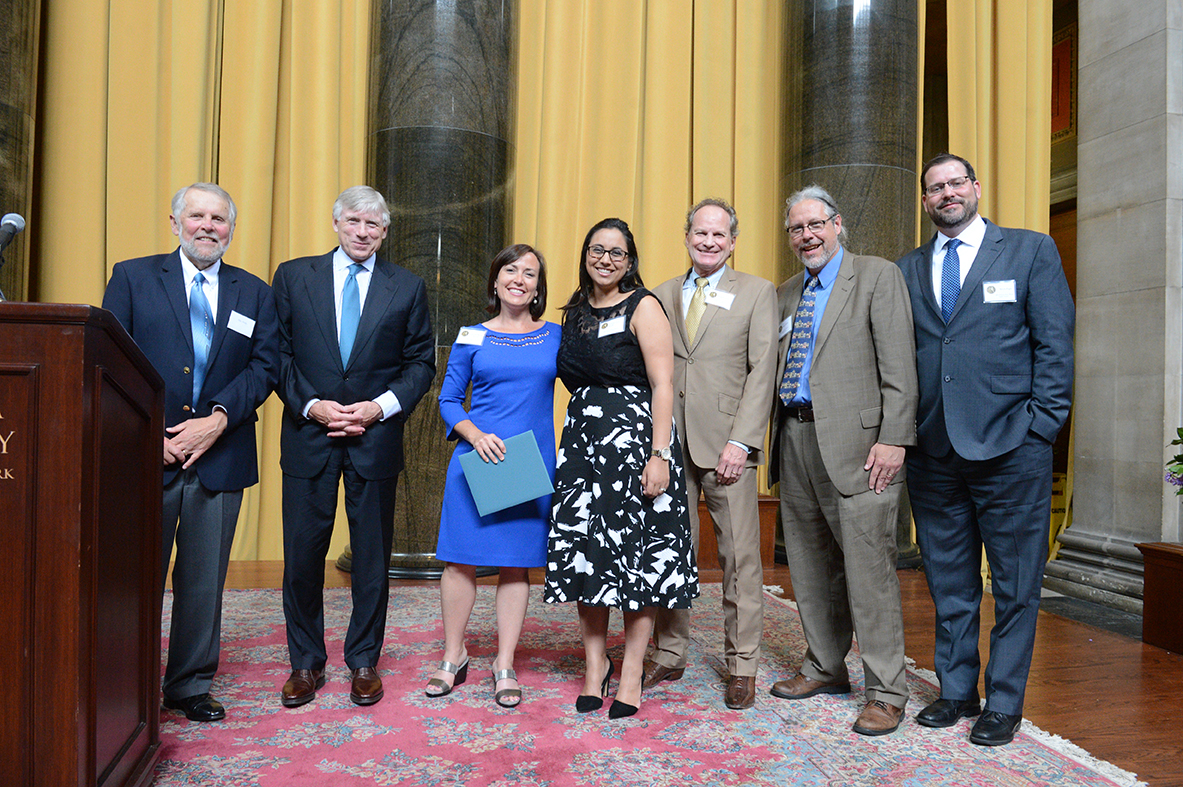
Mike Pride, Pulitzer Prize Administrator (left), and Lee C. Bollinger, President of Columbia University (second from left), present the 2015 Public Service Prize to Jennifer Berry Hawes, Natalie Caula Hauff, Doug Pardue, Glenn Smith and Mitch Pugh (left to right) of The Post and Courier.
Winning Work
Lexington County unit strives to break the cycle of violence
Jan. 23, 2015
To the judges for the Pulitzer Prize for public service:
On Jan. 13, South Carolina’s attorney general joined powerful lawmakers, prosecutors and police in a “call to action” to enact long-needed reform to the state’s domestic violence laws. The goal: to end the bloodshed that has made the state one of the nation’s deadliest for women.
“This is the year we will make a difference,” House Speaker Jay Lucas told a crowd that packed the Statehouse Rotunda. “This is the year we finally will pass a comprehensive bill.”
His words came just six months after a dozen reform bills on domestic violence died in the Legislature for lack of action, unable to muster enough interest to warrant up-or-down votes. This had been the fate of such bills for a decade.
What was the difference between this year and the past 10 years? In August, The Post and Courier published a five-part series, “Till Death Do Us Part,” which shamed lawmakers into action by exposing South Carolina as a state where more than 300 women had died in a decade’s time while its leaders did little to stem the violence. It’s a state where domestic abusers face a maximum of 30 days behind bars for brutalizing a wife or girlfriend but up to five years in prison for cruelty to a dog.
The series revealed numerous failings, including limited police training, inadequate laws, a lack of punishment, insufficient education for judges, a dearth of victim support and traditional beliefs about the sanctity of marriage that keep victims locked in the cycle of abuse. These factors combine in a corrosive stew that has made South Carolina one of the deadliest states in the nation for women at the hands of men since rankings began 17 years ago. The state topped the list three times and never fell from the deadliest 10.
From the beginning of our reporting, we worked to show domestic violence was not a problem isolated to a particular group or economic class. We took care to highlight victims and stories that demonstrated domestic abuse was a societal problem, cutting across all walks of life and generations.
We also realized there could be no foundation for change without understanding. So we worked to counter misconceptions about why victims stay with their abusers and why batterers brutalize the ones they love. We took pains to explain the many factors – generational, cultural, economic, psychological – that drive abuse, and the hurdles many women face in order to leave destructive relationships.
Reporting on the series began in September 2013 when the Violence Police Center in Washington, D.C., ranked South Carolina No. 1 in the nation in the rate of women killed by men. We formed a team of four reporters to take a deep look at why this was so and what could be done to reduce the carnage.
With computer training, financial assistance and advice from the Center for Investigative Reporting, the team compiled the first-ever database of those killed over the past decade, using police reports, court records, criminal rap sheets and other documents to plot the locations of killings, determine what had happened and look for commonalities and trends. We also studied conviction rates and plea deals, something our state judicial system does not track.
We knew some might question our findings or challenge the conclusions reached, so we took a position of utter transparency. Online, we linked every fact and statistic in the stories to the studies, reports and other source material from which they were derived. We made our database available to readers to check our methodology and run their own calculations. We did the same with court records and other electronic data we used. The result: We did not receive a single complaint about the accuracy or fairness of our report.
To the contrary, “Till Death Do Us Part” already has prompted swift and potentially sweeping action to curb our state’s staggering death toll from domestic violence. Both chambers of the Legislature quickly moved to draft comprehensive reforms to the state’s domestic violence laws that include tougher penalties and a firearms ban on convicted abusers. Legislators have fast-tracked these bills and have pledged to see them through to up-ordown votes.
Republican Gov. Nikki Haley has pledged support for the gun ban, and announced in December that she would form a statewide task force to work on curbing the state’s culture of abuse. Haley said she would formally create the taskforce by the end of this month. The state’s attorney general pledged to put more prosecutors in the field to handle domestic violence cases, and authorities in the Charleston area formed the state’s first domestic violence fatality review team to look for ways to prevent future killings.
The newspaper has written more than 40 follow-up stories to keep the issue before the public and lawmakers. Our entry package includes some of these follow-up stories as supplemental material to show the impact of the series on lawmakers and the public. The actual PDF entry includes a page showing thumbnails of the way the stories were presented in the newspaper followed by pages in two-column format for reading.
We nominate “Till Death Do Us Part” and reporters Doug Pardue, Glenn Smith, Jennifer Hawes and Natalie Caula Hauff for the Pulitzer Prize for a distinguished example of meritorious public service by a newspaper.
Sincerely,
Mitch Pugh
Executive Editor