Los Angeles Times, by Los Angeles Times
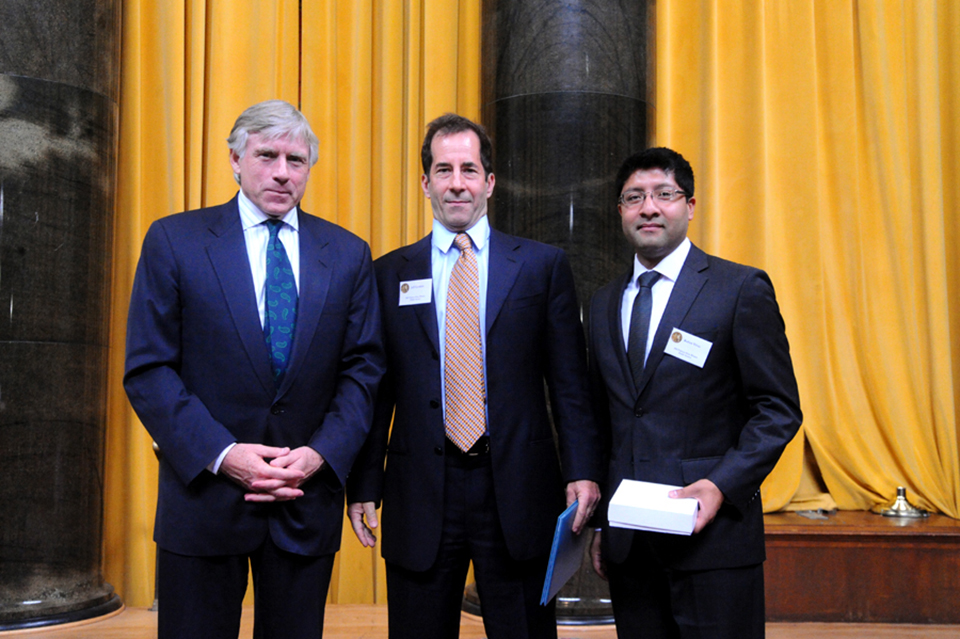
Lee C. Bollinger, President of Columbia University (left), presents the 2011 Public Service prize to Jeff Gottlieb (center) and Ruben Vives (right) of the Los Angeles Times.
Winning Work
Bell isn't a big town, or a wealthy one. But some of its top officials are paid two or three times as much as their counterparts elsewhere.
By Jeff Gottlieb and Ruben Vives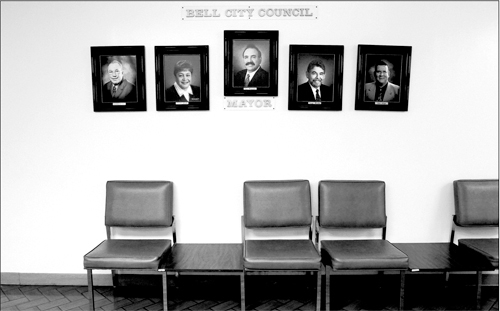
WELL PAID: Portraits of Bell's City Council members and mayor hang inside City Hall. The Los Angeles County District Attorney is investigating council salaries -- about $100,000 a year for part-time work.
Bell, one of the poorest cities in Los Angeles County, pays its top officials some of the highest salaries in the nation, including nearly $800,000 annually for its city manager, according to documents reviewed by The Times.
In addition to the $787,637 salary of Chief Administrative Officer Robert Rizzo, Bell pays Police Chief Randy Adams $457,000 a year, about 50% more than Los Angeles Police Chief Charlie Beck or Los Angeles County Sheriff Lee Baca and more than double New York City's police commissioner. Assistant City Manager Angela Spaccia makes $376,288 annually, more than most city managers.
Top officials have routinely received hefty annual raises in recent years. Rizzo's contract calls for 12% raises each July, the same as his top deputy, according to documents obtained under the California Public Records Act.
Rizzo, who has run Bell's day-to-day civic affairs since 1993, was unapologetic about his salary.
"If that's a number people choke on, maybe I'm in the wrong business," he said. "I could go into private business and make that money. This council has compensated me for the job I've done."
Spaccia agreed, adding: "I would have to argue you get what you pay for."
Bell Mayor Oscar Hernandez defended the salaries. "Our city is one of the best in the area. That is the result of the city manager. It's not because I say it. It's because my community says it."
Hernandez and other council members said the city was near bankruptcy when Rizzo came aboard 17 years ago. Since then, they said, he has put Bell on sound financial footing, with its general fund nearly tripling to about $15 million.
"Our streets are cleaner, we have lovely parks, better lighting throughout the area, our community is better," Hernandez said. "These things just don't happen, they happen because he had a vision and made it happen."
Bell made headlines in recent weeks when the city of 37,000 agreed to take over operations of the neighboring city of Maywood, which fired most of its employees and disbanded its police department when it could not obtain insurance.
Located about 10 miles southeast of downtown Los Angeles, Bell has a population that is about 90% Latino and 53% foreign-born. Its per capita income is about half that for the U.S.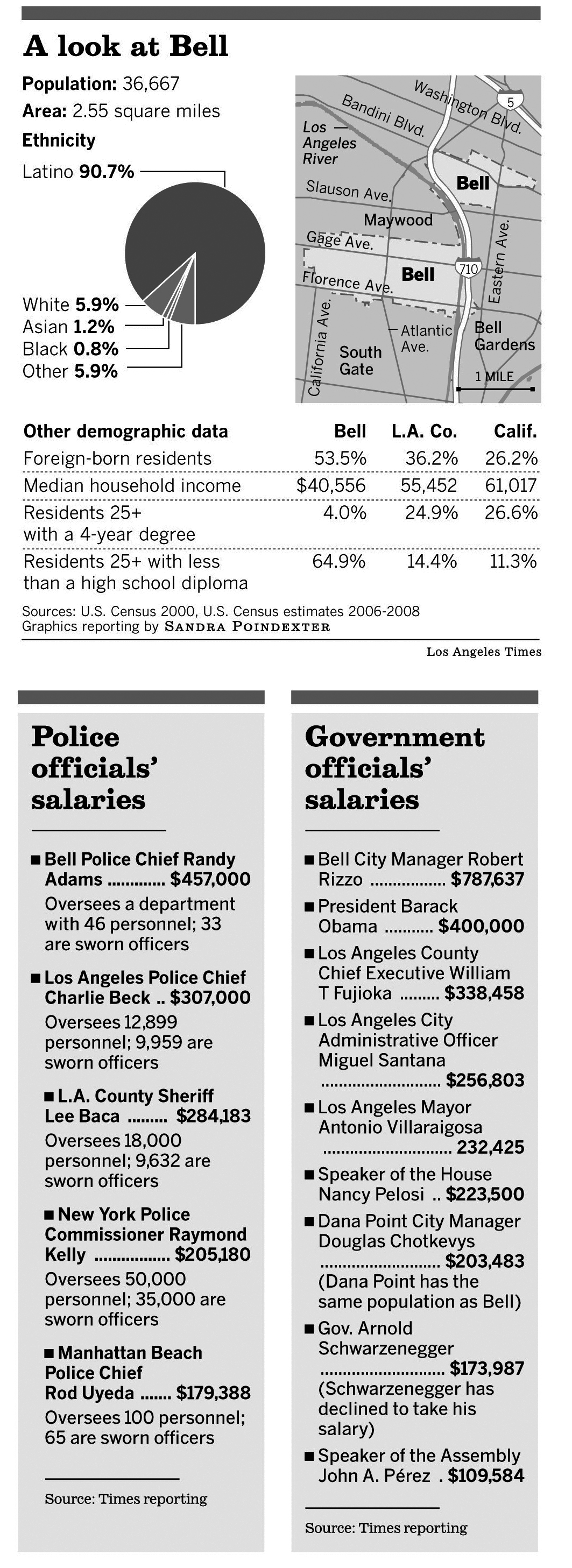
Experts in city government said they were amazed at the salaries the city pays, particularly Rizzo's. "I have not heard anything close to that number in terms of compensation or salary," said Dave Mora, West Coast regional director of the International City/County Management Assn., and a retired city manager.
By comparison, Manhattan Beach, a far wealthier city with about 7,000 fewer people, paid its most recent city manager $257,484 a year. The city manager of Long Beach, with a population close to 500,000, earns $235,000 annually. Los Angeles County Chief Executive William T Fujioka makes $338,458.
The salaries do not appear to violate any laws, said Dave Demerjian, head of the Los Angeles County District Attorney's Public Integrity Division. State law governs how much city council members can be paid, but not the amounts that council members decide to pay administrators, Demerjian said.
The district attorney is investigating Bell over the hefty compensation of its City Council members — about $100,000 a year for part-time positions. Normally, council members in a city the size of Bell would be paid about $400 a month, Demerjian said.
The council has increased its compensation by paying members for serving on a variety of city agencies, including the Community Redevelopment Agency, the Community Housing Authority, the Planning Commission, the Public Financing Authority, the Surplus Property Authority and the Solid Waste and Recycling Authority.
Demerjian said city records show each council member receives $7,873.25 per month for sitting on those boards
Records indicate that the boards of those agencies perform little work and that board meetings take place during council meetings, though the names of some of the agencies seldom appear.
In some years, the council would hold separate meetings for those agencies, and they would sometimes last no more than a minute. On July 31, 2006, four agencies each met for one minute. On March 3, 2008, the redevelopment agency meeting was called to order at 7:21 p.m. and adjourned at 7:22 p.m.
Councilman Luis Artiga, who was appointed to the council 15 months ago to fill an unexpired term, said he had no idea how much he would be paid. When he received his first check, he thought it was "a miracle from God."
Artiga, who is pastor of Bell Community Church, said he uses about half his salary to pay the church's mortgage.
Rizzo received his bachelor's degree from UC Berkeley and a master's in public administration from Cal State East Bay.
Council members hired Rizzo in 1993 from the High Desert city of Hesperia as interim chief administrative officer with a starting salary of $72,000 a year. By September 2004, he was being paid $300,000 a year. Ten months later, his salary jumped 47% to $442,000.
His salary continued climbing $52,000 a year until July 1, 2008, when Rizzo received his usual salary increase and signed an addendum to his contract that gave him a 5% raise in September and guaranteed 12% increases each July.
His last raise was $84,389.76. Next July, he will receive a $94,516 pay hike.
Rizzo defended his salary and that of his staff and the council by saying they don't receive car or cellphone allowances and must pay their own way to out-of-town conferences.
However, according to their contracts, Rizzo, Spaccia and Adams can be reimbursed for their expenses. Bell council members are also eligible for reimbursements as board members of several city commissions, according to city resolutions.
Adams, who said he spent $6,000 of his own money to buy furniture for his office, was hired after retiring as the police chief in Glendale. His salary of $215,304 more than doubled when he took the job in Bell.
Spaccia was hired July 1, 2003, at $102,310. A year later, she was making $130,000. She currently earns $376,203 and gets the same 12% annual increases as Rizzo.
Spaccia has been on leave since February while serving as acting city manager for Bell's troubled neighbor Maywood, with her salary being paid by Bell's taxpayers.
"We have a neighbor in trouble," said Rizzo, a short heavy-set man with reddish-brown hair. "If your neighbor's yard is messed up, it brings down your property values. Is it a unique situation? Definitely."
On top of his salary, Rizzo recently received an added boost — the council voted to give him an extra week's vacation. He now gets five weeks.
© 2010 Los Angeles Times
Tiny turnout approved change allowing city to avoid state salary limits.
By Jeff Gottlieb
The highly paid members of the Bell City Council were able to exempt themselves from state salary limits by placing a city charter on the ballot in a little-noticed special election that attracted fewer than 400 voters.
Since passage of the measure, salaries for council members — part-time employees — have jumped more than 50%, from $61,992 a year to at least $96,996. The Los Angeles County district attorney has opened an inquiry into whether the salaries are lawful.
A state law enacted in 2005 limits the pay of council members in "general law" cities, a category that includes most cities in Southern California. That law was passed in reaction to the high salaries that leaders in South Gate had bestowed on themselves earlier in the decade.
But the year that law passed, the Bell City Council authorized a special election with only one item on the ballot — a measure calling for Bell to convert to a "charter" city. The move was billed as one that would give the city more local control. The ballot language included no mention of the effect the change would have on council members' salaries.
All five council members signed the ballot statement in favor of Measure A. It also was backed by City Manager Robert Rizzo, according to a council member in office at the time. Rizzo "sold the idea to me," former Councilman Victor Bello said. Council members subsequently signed off on contracts that have boosted Rizzo's pay to $787,637 annually, making him probably the highest paid city manager in the country. No one filed an argument against the measure, according to documents obtained by The Times.
Rizzo has not returned calls to his cellphone or messages.
The salaries paid by Bell have prompted growing scrutiny after The Times last week revealed that top city administrators were receiving high compensation. In addition to Rizzo, the assistant city manager and the police chief both earn far more than their counterparts in most other cities.
The charter measure passed, 336 to 54, with the votes in favor amounting to less than 1% of the city's population of roughly 40,000. The majority of the ballots, 239, were absentee votes. The special election cost Bell $40,000 to $60,000, city officials said.
Some council members insisted that the ballot measure was not motivated by a desire to increase salaries — but did not cite any other ways the charter changed how Bell did business.
"The idea of a charter is it gives a city flexibility, it gives us independence," said then-Mayor and current Councilman George Mirabal. "It enabled us to create our own vision for the future. That was the way I look at it then and now."
David Demerjian, who heads the D.A.'s Public Integrity Division, expressed skepticism of that position. "What explanation is there for why the city becomes a charter city," he asked. "Becoming a charter city certainly would give them the opportunity not to comply with that statute."
Former Councilman Bello said "the way I understood it, we would have better control of governing ourselves. We were told we would make a little more money, but I didn't know we were going to get that much money."
Records show that Bello, who resigned from the council last year, has continued to be paid for sitting on four city boards. According to resolutions the council approved in June 2008, commissioners must be council members.
Assemblyman Hector De La Torre (D-South Gate), who wrote the state law limiting council members' pay, said he did so because of the surreptitious pay raises he had seen in his city.
"Then lo and behold, I find out a couple months later, Bell is doing an end run around it," he said. "The timing of this is clearly suspect." De la Torre's bill was signed into law by Gov. Arnold Schwarzennegger on Sept. 6, 2005, and it became law Jan. 1, 2006.
State law sets the limit on council pay for a city with Bell's population at $400 a month and limits the amount of money council members can receive for sitting on boards and commissions to $150 a month for each board.
Bell's charter says its City Council members are to receive the same salaries as their counterparts in general law cities of the same size. In fact, they receive $150 for serving on the council.
But the City Charter bypasses the limits that state law would impose on pay for boards and commissions. Bell council members receive the bulk of their salaries as payments for sitting on the Planning Commission, the Surplus Property Authority, the Public Finance Authority, and the Solid Waste and Recycling Authority, at least $7,873.25 monthly.
City minutes indicate that those boards do little work. Board meetings in Bell are supposed to take place during council meetings, although their names seldom appear in council minutes.
When the boards held separate meetings, they sometimes lasted a minute. "That's why I wanted to limit stipends," De la Torre said. "That whole point of it was to say you couldn't pay ridiculous sums of money for going in and saying 'aye' and leaving."
De La Torre estimated that if Bell were not a charter city, its council members would be paid $10,000 to $12,000 a year.
In a letter responding to questions from Demerjian, Bell Assistant City Atty. William Priest, of the firm Best, Best and Krieger, said the city was following its charter regarding council pay.
"The charter imposes no such limits with respect to their compensation for their service as members of the City's other commissions and boards," Priest wrote.
The council members said in their argument in favor of Measure A that the state had taken $30 million in tax revenues from Bell over the previous 15 years.
© 2010 Los Angeles Times
While top officials drew big checks, the city cut jobs and spending on police and other services.
By Kim Christensen, Scott Gold and Hector Becerra
At the same time that top Bell officials were receiving some of the fattest municipal salaries in the nation, the city cut spending on police, social services, and parks and recreation, according to interviews and records reviewed by The Times.
While City Manager Robert Rizzo was receiving more than $700,000 a year, Rosario Torres was laid off from her $9-an-hour job preparing children for kindergarten.
"They tell you they don't have the money to pay you, and you think 'OK, I understand, they just don't have the money,' " Torres said. "But I never imagined they were making so much money themselves. It's incredible."
The cuts underscore questions about how Bell handled its finances in recent years. City officials have defended Rizzo's high salary, saying his leadership allowed Bell to avoid many of the cuts and financial problems surrounding cities have faced amid the recession.
Rizzo told The Times earlier this month that Police Chief Randy Adams was brought in to turn around a department riddled with problems. The city had enough money to pay Adams $457,000 a year, yet it had earlier reduced funding for officer training, such as quarterly sessions at the firing range.
Details of the cuts came from interviews and from Bell's Comprehensive Financial Report for fiscal year 2009, the latest available.
The report shows that community services, including social services and recreation programs, were cut by 21%, or $593,438, while public safety took a 3.7% hit, or $228,888. Police training was whacked by 58%.
The salaries of Rizzo, Adams and Assistant City Manager Angela Spaccia are equal to about 10% of Bell's $15.9-million general fund budget.
The report provides a less rosy picture of Bell's finances than the one city officials have offered in recent weeks. While Bell has a balanced budget, it has also faced significant belt-tightening.
Mayor Oscar Hernandez has defended Rizzo's salary, citing "15 years of balanced budgets" and the transformation of Bell into a "model of financial prudence."
Earlier this month, in an interview before the scandal broke, Hernandez, Rizzo and Councilman Luis Artiga boasted about the city's services, parks and sound financial footing. Rizzo said that no full-time employees had been laid off and that there were no furloughs.
Gilbert Jara, head of the Bell Police Officers Assn., said the cuts included layoffs of some non-sworn employees, and have had other ill effects.
"Every year we are supposed to update our training," Jara said. "It has now gotten down to where they give us a CD to watch and say, 'OK, that's your training.' We watch a CD for three or four hours and that's it."
Officers are supposed to get quarterly firing-range training but "are lucky to get there once a year," he said. Many of the department's 24 authorized positions are left perennially unfilled, he said, and officers drive patrol cars "with like 200,000 miles on them."
Jara said Adams seemed more interested in forming a multi-city police authority in southeast Los Angeles County than in fixing the department he was hired to run last July.
Bell officials' high salaries, which include $376,288 a year for Spaccia and about $100,000 for all but one of the part-time City Council members, shocked city workers and just about everyone else in town when The Times reported the figures earlier this month.
The ensuing public outrage prompted the resignations last week of Rizzo, Adams and Spaccia, and sparked calls for the ouster of Hernandez and three of his fellow council members. Only Councilman Lorenzo Velez, who is paid a fraction of what his colleagues get, has eluded public scorn.
Rosario Torres said she wasn't surprised when she was laid off in December 2008. The city had been axing workers and cutting programs for children and adults, she said.
Torres had been working in a Parks and Recreation program preparing children for kindergarten for about a year when she and several other part-timers were laid off.
"She said they just didn't have the money to pay us," Torres said. "There was no other explanation."
Miguel Sanchez, 33, worked for Parks and Recreation from September 1994 to December 2008, when he and more than a dozen others were laid off due to budget cuts, he said.
Sanchez said he earned about $10.50 per hour. He wore several hats, teaching basic computer classes and working at the Bell Community Center on Pine Avenue, mostly on weekends if the space was being rented out for a birthday party or other event. Mostly, he ran an afterschool program at Woodlawn Elementary School.
Between 30 and 70 children attended the program depending on the time of year, he said, and were offered a variety of programs, including help with homework and arts and crafts.
Just before Christmas 2008, City Hall eliminated the program and two others. After he got laid off, a supervisor asked Sanchez to return to Woodlawn after the holidays to break the news to the children.
"I refused," he said. "I didn't have the heart to tell the kids."
In 1984, the shoe company where Del Villanueva had worked for 20 years went bankrupt, forcing him into retirement at 60 — a little earlier than he had planned.
As the years passed, he got antsy and began volunteering for children's programs and community centers in and around Bell, where he lived. In 2005, at the age of 80, he accepted a job at Bell City Hall to do maintenance at city parks and help run the afterschool program at Woodlawn.
The job paid a little over $9 an hour, but "there was a lot of satisfaction" and "parts of the job that were worth a lot more than money," he said.
"It was very greatly needed," he said. "You have to understand the basics. It's a very important thing in a kid's life."
Like Sanchez, Villanueva lost his job when the program was cut.
About the same time, the city scaled back other recreation programs, including a baseball league and city-sponsored cheerleading program.
Carlos Parra, 43, said he took a squad of about 10 girls in 2000 and within eight years turned it into a thriving cheerleading program of about 160 boys and girls. The Bell Sapphires traveled from San Diego to Las Vegas and won championships for the city, Parra said.
On Christmas Day in 2008, Parra learned that he was to be laid off.
"It makes me sad, and mad," he said. "I live alone, a single person, I have to pay my rent, I'm barely making it through life — and they're sitting on their butt making all that money."
Times staff writers Jeff Gottlieb and Paloma Esquivel contributed to this report.
© 2010 Los Angeles Times
Homes of the same value in richer cities are taxed at a much lower rate.
By Kim Christensen and Paloma Esquivel
The small working-class city of Bell not only paid officials the highest salaries in the state: Residents also pay the highest property tax rates of all but one of Los Angeles County's 88 cities, county tax records show.
The records appear to confirm complaints by Bell residents who have expressed outrage that they seemed to be paying excessive taxes at the same time the city was paying its top administrator nearly $800,000 and council members were paying themselves nearly $100,000.
"They're robbing us of our money," said Juan Madrid, 64, who has owned his tidy yellow home with peach trim on Walker Avenue for about 30 years
Like other residents of this largely immigrant city of about 39,000, he has watched as his property taxes have climbed in the last few years while the value of his home has slumped.
All county property owners pay 1% general property tax, along with special or direct assessments levied by their municipalities. The countywide average of all tax rates is 1.16%, or $11.60 for every $1,000 of assessed value.
The rate in Bell is 1.55%.
That means the owner of a home in Bell with an assessed value of $400,000 pays about $6,200 in annual property taxes. The owner of the same house in Malibu, whose rate is 1.10%, would pay just $4,400.
Bell's property tax rate is nearly 50% greater than those in such affluent enclaves as Beverly Hills, Palos Verdes Estates and Manhattan Beach, and significantly higher than just about everywhere else in the county, according to records provided by the county auditor-controller's office at The Times' request.
The only place with a higher rate than Bell's is the City of Industry — but it has only 21 residential parcels that are affected. Bell has 2,065 single-family homes and 1,568 residential rentals, according to city documents, which include 522 commercial-industrial properties in a total assessed valuation of $1.4 billion.
The Times reported earlier this week that the city had cut spending on police and community services, even as it continued to raise salaries for City Manager Robert Rizzo, Assistant City Manager Angela Spaccia and Police Chief Randy Adams to some of the highest in the nation.
Rizzo was paid $787,637 a year, Adams' salary was $457,000 and Spaccia's was $376,000. All three resigned amid public uproar after The Times reported the amounts earlier this month.
Their salaries and Bell's hefty property taxes contrast sharply with city residents' financial standing. Median household income in Bell, just southeast of Los Angeles, is $40,556 — well below the countywide average of $57,152.
The city's tax rate is due to a combination of factors, records show: among them, bond debt for municipal improvements such as a sports complex now under construction and a "retirement tax" approved by local voters in 1944 that put property owners on the hook for some of the cost of municipal employees' pensions.
Since 2006, county records show, those local taxes have doubled. So have direct assessments for trash collection, sewer maintenance and other services.
In 2005, Bell voters approved a measure that adopted a City Charter, a move that allowed council members to get around state limits on their salaries. It is unclear what bearing, if any, that had on raising property taxes.
Revenue from the tax increases went to designated funds or services and did not directly pay for administrators' salaries. But by freeing money from the city's general fund, the higher taxes appear to have made the outsized salaries more feasible for the small city.
For at least 20 years before 2007, the retirement tax — formally known as a Post-retirement Benefits Fund-Pension Obligation — had stayed at the same rate of 0.187%.
In 2007, two years after the city issued nearly $10 million in bonds to finance a loan to cover its unfunded pension liability, the City Council passed a resolution calling for a series of hikes over the next three years. The current rate is 0.277%, or half again what it was three years ago.
The council also passed a resolution that year nearly doubling assessments for services including refuse collection, which went from $14.71 a month for a single-family residence to $26.48 a month.
And this year, a 0.09% assessment kicked in to cover the $15-million debt on a sports complex that is planned to include a soccer field, baseball stadium and a gym at a projected cost of $10 million to $15 million, as well as other improvements including a library and performing arts center. Taxpayers' assessments for the improvements, which voters approved several years ago, will increase over the next two years, records show.
And that's not all.
The city's most recent comprehensive annual financial report, for the fiscal year ended June 2009, suggests the retirement tax will continue to go up. It says Bell has thus far "opted to assess below the authorized amount" it can assess to pay for pensions.
"In the future, the City intends to gradually increase the tax levy to the full amount required to meet the City's pension costs," according to the report, which noted that the city's general fund now loans money to the retirement fund to cover costs.
The Times has previously reported that Rizzo could become the state's highest-paid pensioner, receiving an annual benefit of roughly $600,000.
His two colleagues also appear to be in line for large pensions, although the state's pension board has said no benefits will be paid until investigations into Bell's actions are completed.
Even as their bills grew , many in town thought they were in the same tax boat as property owners elsewhere.
"I didn't realize we were so unique here in this little community," said Dorothy Danna, 68, a widow who has lived in Bell for 40 years and is losing her home to foreclosure. "I thought everyone paid as much as we did. . . . That does not make me very happy."
Danna's total property tax bill rose from about $3,000 in 2005 to about $4,000 this year, while the assessed value during that time has grown at a significantly smaller rate.
She blames her foreclosure more on an ill-advised adjustable-rate refinancing than on the unpaid back taxes that have piled up with her delinquent house payments.
But it still makes her see red to think she was footing so much of the bill for a city government that lavished money on the people who were supposed to be running it wisely.
"I sure hope they all get what they deserve," she said.
© 2010 Los Angeles Times
Bountiful time off and fully paid healthcare sent his compensation to dizzying heights.
By: Jeff Gottlieb and Ruben Vives
Former Bell City Manager Robert Rizzo, whose $787,637 salary prompted widespread outrage, received an unusually lucrative package of benefits that increased his annual compensation to more than $1.5 million, according to city records reviewed by The Times.
Rizzo's benefits package for this year, which covers time off, retirement and medical and other types of insurance, shows he was entitled to vacation and sick leave that totaled more than 28 weeks a year.
Bell's interim city attorney said Saturday that Rizzo's compensation package raised serious questions and that the city planned to investigate who approved the perks and whether they are legal.
"It appears Rizzo was getting an inordinate amount of hours of vacation and sick benefits and being paid for it," said James Casso of the law firm Meyers Nave. "We're looking to see when it was approved, whether it was approved at a City Council meeting and who approved it."
Compensation experts said Rizzo's benefits package is far above the norm.
"This is extraordinary, it is outlandish and in absolutely no way represents" normal compensation for city managers, said Dave Mora, West Coast regional director of the International City/County Management Assn. and a retired city manager. " 'Extreme' is a kind word."
The revelations come as the L.A. County district attorney's office and California attorney general's office are investigating high salaries received by Rizzo and other top city administrators as well as City Council members, four of whom earned nearly $100,000 a year before cutting their pay two weeks ago.
Details about Rizzo's full compensation are contained in city records requested by The Times under the California Public Records Act. Rizzo did not return calls seeking comment.
The documents provided by the city set Rizzo's total annual compensation at $1,540,299.96, which included some unspecified benefits.
Casso said city officials were still trying to understand the compensation agreement. The documents appear to show that Rizzo was to receive 107 vacation days and 36 sick days a year. The documents don't specifically say he would be paid for each of these days, but they list his total compensation for vacation and sick time at $386,786 a year.
The documents show the city would pay $48,996 annually into Rizzo's deferred compensation plan. Bell also paid $20,496 into Rizzo's 457 plan, which is similar to a 401(k) for government employees. These retirement funds were in addition to his public employee pension. The city also paid his contribution to the public pension.
A Times analysis estimated that Rizzo would collect an annual pension of more than $600,000 upon retirement.
According to Rizzo's contract, the city was supposed to pay the full amount of his 457 plan in the first 10 days of the year, meaning he could benefit from an entire year of interest or investment gains. The city paid both his health insurance and any medical bills not covered by insurance.
It's normal for city administrators to receive vacation and sick days, solid medical coverage and contributions to retirement accounts.
But there is evidence Rizzo's deal was exorbitant.
For example, the total compensation of Arcadia's city manager went from $220,000 to $272,000 when benefits and deferred compensation were added, according to city records. In Redondo Beach, the city manager's total compensation went from $211,000 to $254,000 when benefits were added, according to city records.
Mora said that although Rizzo was receiving the same types of benefits other city officials receive, he appeared in many cases to be getting much more generous benefits. Rizzo "seems to have every potential benefit, and it's taken at the max," he said.
Two council members expressed shock Saturday when told about Rizzo's total compensation, insisting they had no idea how much he was earning.
Councilman Luis Artiga said he was "ashamed" after being told of the numbers. "I'm disgusted, I'm sick and I feel like crying," he said.
Councilman Lorenzo Velez added: "I feel like I've been raped, my insides have been gutted out."
On Friday, the city released documents showing that several department heads were earning more than $200,000, including two whose total compensation topped $400,000. Documents obtained by The Times also show that the city had made payments of more than $100,000 each to two officials in addition to their reported compensation.
Rizzo stepped down three weeks ago along with two other top city officials after The Times revealed their salaries.
The newly reviewed records show that when the benefits package is added, Assistant City Manager Angela Spaccia's $376,288 salary more than doubles, to $845,960. Police Chief Randy Adams' pay jumps from $457,000 to $770,046 annually.
Spaccia was to have received $188,640 in vacation and sick pay and Adams $76,428, the records show. Adams, according to his contract, was to have received lifetime medical benefits for him and his family.
Spaccia declined to comment. Adams said he was accumulating sick time and vacation days in a usual manner but was not being paid extra for the days.
Times staff writers Sam Allen and Abby Sewell contributed to this report.
© 2010 Los Angeles Times
A 2007 hike is deemed illegal. $2.9 million collected will go to schools.
By Kim Christensen, Ruben Vives and Evan Halper
The city of Bell illegally raised its property taxes in 2007 and must immediately give up $2.9 million it has collected since then, state Controller John Chiang said Friday.
Chiang ordered Bell to immediately reduce the "retirement tax" rate, which its City Council increased in 2007 to cover rising pension costs for its employees. The reductions will apply to the next round of property taxes due in November, said Jacob Roper, a spokesman for Chiang.
"Taxpayers should not have had to pay that money," Roper said.
The controller's finding appears to confirm longstanding complaints from Bell property owners that they were being overtaxed. The Times reported last month that Bell officials collected huge paychecks, that the city had cut police and other services and that its property owners were paying higher tax rates than all but one city in Los Angeles County.
The owner of a home in Bell with an assessed value of $400,000 will save about $360 a year because of the cut, an official with the Los Angeles County auditor-controller's office said Friday.
But Bell residents won't be getting a tax refund. According to state law, the nearly $3-million overpayment cannot be refunded to taxpayers and must instead go to schools in the city, Roper said.
Chiang's order marked the latest twist in a scandal that broke last month when The Times reported that the working-class city of about 39,000 was paying its administrators and police chief the largest municipal salaries in the state, if not the country, with City Manager Robert Rizzo making nearly $800,000 a year.
On Friday, some Bell residents said they were angry about being overtaxed but that they found the controller's findings vindicating.
"As a resident and property owner I am very outraged," said Ali Saleh, co-founder of the Bell Assn. to Stop the Abuse. "This proves all the complaining we have done about the high taxes is true."
Bell resident Huitzil Arenas, 43, agreed, adding: "I'm very angry.... They stole money from the people."
Bell's interim city manager, Pedro Carrillo, said Friday that auditors from the state controller's office discovered the overcharge Thursday night. The City Council is expected to vote on a resolution Monday that will lower the tax rate, he said, and Bell will repay the $2.9 million from a $5-million reserve fund.
"We haven't determined what the fiscal impact of this is yet," he said.
The focus of Chiang's action Friday is a so-called retirement tax, which was approved by local voters in 1944 and made property owners responsible for some of the cost of municipal employees' pensions.
For at least 20 years prior to 2007, the retirement tax had stayed at the same rate of 0.187%.
In 2007, the City Council passed a resolution calling for a series of increases over the next three years. The current rate is 0.277%, or roughly 50% higher than it was three years ago.
On Friday, Chiang ordered the rate rolled back to 0.187%.
Roper, the controller's spokesman, said the amount of property tax that residents can be assessed for pension costs are capped by the tax code to the rate Bell applied in 1984. Increases the City Council set in motion starting in 2007 are illegal, he said.
Roper said the controller's office is unaware whether the property tax increase was implemented concurrently with increased pension benefits for local officials, or if it was intended to be used to cover existing contracts.
The former officials' salaries and Bell's hefty property taxes contrast sharply with city residents' financial standing. Median household income in Bell, just southeast of Los Angeles, is $40,556 —- well below the countywide average of $57,152.
The district attorney and state attorney general have launched investigations into the high pay, as well as allegations of voter fraud and improper property transactions.
Carrillo and interim City Atty. Jamie Casso said they are intent on getting to the bottom of the property tax issue and other alleged improprieties.
"This is why we've been working with the state controller and our city attorney," Carrillo said. "And that is to fix whatever is broken — and it seems we are finding a lot of that."
He also said the city is exploring options for making rebates to residents for their retirement tax overpayment.
All county property owners pay a 1% general property tax, along with special or direct assessments levied by their municipalities. The countywide average of all tax rates is 1.16%, or $11.60 for every $1,000 of assessed value.
Bell's total property tax rate is 1.55%.
That means the owner of a home in Bell with an assessed value of $400,000 pays about $6,200 in annual property taxes. The owner of the same house in Malibu, whose rate is 1.10%, would pay just $4,400.
Bell's high tax rate is due to several factors, records show, including bond debt for municipal improvements such as a sports complex now under construction. Since 2006, county records show, Bell's local taxes have doubled, as have direct assessments for trash collection, sewer maintenance and other services.
Even with the retirement tax cut, Bell's overall rates will remain higher than many cities in the county, in part because of a 0.09% assessment that kicked in this year to cover the bond debt, which was approved by voters.
Revenue from the tax increases went to designated funds or services and did not directly pay for administrators' salaries. But by freeing money from the city's general fund, the higher taxes appear to have made the outsized salaries more feasible for the small city.
Miguel Sanchez, 33, said he paid $5,403 in property taxes in 2009, up from $4,866 the year before.
"It was hitting us hard," Sanchez said. "We knew our property taxes in Bell were high. But I'm very upset about this. Enraged really."
Times staff writer Jeff Gottlieb contributed to this report.
© 2010 Los Angeles Times
Some who worked with him in Bell and elsewhere over the years came to know him as a calculating risk taker.
By Paul Pringle, Corina Knoll and Kim Murphy
The lifestyle that Robert Rizzo enjoyed during his run as Bell city manager included a stable full of thoroughbreds, among them a gelding named Depenserdel'argent — French for "spend money."
And Rizzo had plenty to spend, with an annual compensation package that swelled to $1.5 million in one of Los Angeles County's poorest cities.
Rizzo, who resigned last month after The Times disclosed his base salary of nearly $800,000, has held title to about three dozen horses since his pay began soaring, according to thoroughbred industry databases.
He conducted his racing business through at least three firms he launched and bought a $930,000 ranch in 2004 in Auburn, Wash., southeast of Seattle, a getaway from his similarly valued home in Huntington Beach, state and county records show.
Today, his devotion to the pari-mutuel game helps bring into focus the man people say they came to know — the calculating risk-taker who has become a poster boy for government excesses.
Rizzo himself remains defiant, saying he did nothing wrong. On a recent morning at his ranch, he sought to justify his salary — the subject of civil and criminal investigations — by remarking that although it might look astounding, it wasn't so dramatic, considering his length of service.
"Yeah, the money went bad," he said. "But when you think about it, the 17 years I been there, that's $250,000 a year."
Some former and current Bell officials and business leaders, many of whom had heard only rumors about Rizzo's equine sideline, say he increasingly displayed the manner and habits of a high-rolling horse player, with a weakness for Cadillacs, expensive cigars and alcohol.
"I always thought he was living beyond his means the last two or three years," said Bell Chamber of Commerce President Ricardo Gonzalez. "All of a sudden, this was a person I didn't know."
Bell was the second posting that ended under a cloud for Rizzo. He left his previous job managing Hesperia after City Council members accused him of funneling city improvement funds to salaries, according to a former city official who requested anonymity for fear of alienating ex-colleagues. Local news reports also said he and other officials might have abused their city credit cards.
But that was 18 years ago and Rizzo, who had denied the allegations in Hesperia, began to maintain a lower profile in Bell. Colleagues say he was shy to the point of reclusiveness, hugging the wall at business mixers and avoiding speaking engagements.
Over time, by providing large salaries and other perquisites to his allies, Rizzo gambled that his huge paydays would never come under harsh scrutiny, said people who have worked with him.
With Rizzo at the helm, four of the five current City Council members were paid just under $100,000 a year for part-time duties; Police Chief Randy Adams made $457,000; and Assistant City Manager Angela Spaccia pulled down $376,000.
Rizzo's attorney, James Spertus, said faulting his client for the salaries and perks that he and the others received is unfair because the council approved them.
"This wasn't a Bob Rizzo fiefdom," Spertus said.
Like Rizzo, Adams and Spaccia had lucrative benefits packages. In addition, Rizzo signed city documents that authorized loans to Spaccia and dozens of other employees, in amounts that exceeded $100,000 in some cases.
Interim Bell City Atty. Jamie Casso said his office is investigating the legality of the loans. He said he has yet to find any records that verify that the council had approved the loans or the salaries.
Under Rizzo's leadership, in circumstances that are unclear, the city bought property owned by Mayor Oscar Hernandez and a social services organization headed by former Councilman George Cole, who is known as the political "godfather" of Bell, city and county records show.
Bell also paid $4.6 million last year for an auto-parts store owned by another ex-councilman and power broker, Pete Werrlein, who said the city got a good price, based on offers he received from retail developers.
In 2006, Bell spent more than $1 million on a law firm that employed Rizzo's soon-to-be second wife, attorney Eugenia Chiang, during three months of that year, city records show. And he had a horse-owning partnership with Dennis Tarango, a private contractor who serves as Bell's planning director, according to racetrack listings.
Tarango did not return calls from The Times.
Short and rotund, the 56-year-old Rizzo took to quoting tough-guy lines from "The Sopranos," and tolerated no challenges to his expanding authority at City Hall, Bell insiders say.
"He likes to be in control," said former Councilman Victor Bello, who told of quarreling with Rizzo over the Werrlein deal and other matters before stepping down last year.
"You don't talk back to him — that's the way it goes," Bello said.
People acquainted with him through racing, however, describe a very different Rizzo. They say he is a friendly and unassuming man who cherishes his horses more than he does the modest purses they win.
"He impressed me as being a very caring person," said Mary Lou Griffin, a Buckley, Wash., thoroughbred breeder who took on one of Rizzo's mares, Peter's Jewel, for foaling and raised a couple of its offspring.
Washington horse trainer Mike Chambers said Rizzo is "not flamboyant in any direction." The two had just been out to dinner, and Chambers paid.
"You'd never know he had a cent," Chambers said.
Bell workers say Rizzo often was kind to his subordinates, inquiring after their families, granting them leaves to tend to sick relatives and extending them city reimbursements for tuition. "He could act like he was your father," said one employee, who requested anonymity because she does not want to be associated with Rizzo.
Others say they feel betrayed. George Bass was one of the former Bell council members who hired Rizzo in 1993, at a salary of $72,000, which the city considered a bargain.
"I don't know what happened to the Bob Rizzo I knew," Bass said. "I am angry."
He said their relationship soured after Rizzo shrugged off Bass' objections to a pending property deal by bragging that he had the other four council members in his corner. Tensions between them worsened after he cast the lone vote against a raise for Rizzo, Bass said.
Over the ensuing years, Rizzo spent less and less time on the job and grew guarded about city finances, holding fewer meetings on the budget, say Gonzalez and Werrlein.
"In retrospect, you start seeing that everything was a secret," Gonzalez said.
Rizzo's trips to the secluded, 10-acre ranch in Washington became more frequent, city employees and his neighbors say. The spread unfolds around a simple but elegant main house and has well-groomed paddocks and an elaborate exercise circle for the horses. It's a short ride from Emerald Downs, where Rizzo's steeds compete when they're not running at Golden Gate Fields in Berkeley and occasionally elsewhere.
After a reporter knocked on the front door of the ranch house on a recent morning, Rizzo initially refused to answer, staying behind closed shutters. Then he emerged and barked, "You're trespassing."
A moment later, he apologized and said his lawyer had prohibited any interviews.
Standing barefoot in black shorts and T-shirt, near a knee-high jockey statue with "Rizzo" painted on it, he complained of being vilified after toiling so hard for Bell, a job he says ended his first marriage and caused him to gain 150 pounds.
"I gotta tell you, I've been raped by newspaper," he said.
Rizzo's journey to the genteel Washington countryside had its beginnings in Civil Service obscurity.
Thirty years ago, after earning his bachelor's in political science at UC Berkeley and a master's in public administration at Cal State Hayward, and following a stint as a $7.50-an-hour softball umpire, the Bay Area native began his career as an administrative aide in Rancho Cucamonga, where he became assistant city manager five years later. Some of his underlings there remember him as intimidating and standoffish.
"He kept to the people with position and power," said Loyd Goolsby, who worked for the city's building department. "He didn't spend any time with day-to-day employees. He didn't want people to be running up to him and start asking a bunch of questions."
After eight years in Rancho Cucamonga, Rizzo moved to Hesperia as the newly incorporated city's first manager, with a salary of $76,000.
"He was very impressive," said Howard Roth, one of the Hesperia council members who hired Rizzo. "None of us had ever started a city before, and he seemed to know what he was talking about."
Rizzo and his first wife, Sheila, settled in Hesperia with their two daughters. He scored points quickly by finding revenue opportunities for the High Desert city, former co-workers say. They recall that Rizzo had visions of turning the dusty, working-class town into a thriving center of commerce; sometimes, they said, he would court developers with rides in a sheriff's helicopter to survey building sites.
In the beginning, Rizzo made flapjacks at community breakfasts and hosted the staff Christmas party. He also liked to golf and follow horseracing.
But Rizzo could make people bridle.
"He was pretty authoritative in his style and demeanor," said Rob Zuel, Hesperia's planning director at the time. He said Rizzo had persuaded the rookie council members to let him manage as he saw fit, even if it meant managing them as well, a pattern that Bell employees say would carry over to their city. "They were the sheep and he was the herder of the sheep," Zuel said.
After a year, the council raised Rizzo's salary to $83,750. The next year brought another bump, to $95,000. In mid-1991, Rizzo's contract was amended so that if he was fired, he would receive up to two years of severance pay, according to city records.
But some council members eventually questioned Rizzo's work. They suspected him of using money allocated for city improvements to finance staff pay increases, said the former Hesperia official who asked not to be named.
Rizzo subsequently resigned, signing an agreement that paid him more than $108,000 over nine months for consulting services and required him, his wife and the council members to keep the terms confidential, city records obtained by The Times show.
"He received an exorbitant amount of money, and in my opinion, it was a gift of public funds," said Gene Helsley, former president of the Hesperia Chamber of Commerce.
An audit of the city's finances reported that more than $7 million in unspecified transactions had not been fully documented during Rizzo's administration and that restricted funds had been used for general fund operations.
Rizzo painted a different picture of the events leading to his departure. In a 1993 deposition given for a federal lawsuit filed by a former city employee, Rizzo said he was punished because the council had resisted adopting modern standards of city governance, such as strict code enforcement. He also said he had received death threats.
"I knew the council could be vindictive, very, very vindictive. So I basically said…'I need to get out of here,'" Rizzo added in the sworn statement. "This place just is — you know, has driven me to the wall. I can't do any more here.'"
Seventeen years later, Bass, the former Bell councilman, said he regrets that he and his fellow council members did not look more carefully into Rizzo's professional background before hiring him.
In his application letter, Rizzo wrote, "The city of Bell is of particular interest to me because I have the experience and ability to work with the City Council and community to continue the city moving positively toward the next century."
The letter highlights his service in Hesperia, with no mention of any dispute with the council.
"We didn't know about those specific problems," Bass said.
Rizzo fit in nicely in Bell, winning praise from his elected bosses for righting the cash-starved city's fiscal course by restructuring bonds that teetered on default and taking other measures to firm up the bottom line. He seeded youth programs and kept the parks spruced up. And he embarked on an ambitious program of buying properties through city housing and redevelopment authorities, with the stated goal of improving them.
Some of the purchases now raise questions. One in particular, a bond-financed acquisition in 2006 of land near the 710 Freeway, has proved ill-advised because the city can't afford to pay off the $35-million debt, The Times has reported.
According to Bass and Werrlein, Rizzo also became a friend of Bruce Malkenhorst Sr., who made more than $900,000 in 2005 as Vernon's city administrator and has been indicted on charges of misappropriating public funds.
Malkenhorst, who has pleaded not guilty, said in an interview that he had not talked to Rizzo much in the last four years or so. "Who's to judge?" he said when asked about the criticism of Rizzo's pay.
He said that the two mainly saw each other at golf tournaments and that Rizzo had not sought his advice on Bell's finances. "Bobby had his own ideas on what to do," Malkenhorst said.
Bass, a retired Vernon fire chief who had clashed with Malkenhorst over labor policies there, said he did not like it that Rizzo socialized with his fellow city boss. "I was still close to Bob then, and my constant recommendation to him was to stay away from Bruce Malkenhorst," Bass said.
Until his salary became public, Rizzo continued to dominate his city. At ex-Councilman Cole's urging, former and current employees say, Rizzo helped the city stage a successful election — barely 400 of Bell's 40,000 residents voted — to transform the town from a general law municipality into a charter city. The election was scheduled soon after a 2005 state law capped council salaries for general law cities.
Council members have denied that pay had anything to do with the election, but their salaries shot up after the switch to charter status, and Rizzo's employment contracts ballooned. Casso said available city records indicate that Rizzo's salary was divided among several titles he held, such as head of the housing and public finance authorities; no single giant figure appeared under the city manager designation. Spertus said he believed the council and a former city attorney opted to structure the pay that way.
Meanwhile, Rizzo divorced Sheila in 2001 and married Chiang six years later. The 35-year-old Chiang, who did not respond to interview requests, started a marketing company in 2007, with Rizzo serving as secretary, state records show. The couple have a young daughter.
Rizzo's horseracing interests kept pace. Auburn neighbors say he runs his horses in Washington and Berkeley because the stable fees were too steep at closer-to-home Santa Anita and Del Mar.
At Emerald Downs, track officials and trainers said Rizzo has generally bought relatively inexpensive horses. Listed as the owners of most are three California companies he has formed — Rizzo Racing Stable Inc., R.A. Rizzo Inc. and Golden Aggie Ranch Inc., according to Bloodstock Research Information Services and Equibase Co., databases on racing.
It could not be determined how much he has spent on his thoroughbreds, because many sales are private. From 2004 through this month, Equibase figures show, the horses owned by Rizzo's firms have collectively earned about $678,000, less than half his total take in Bell this year.
Folks who know him from the pastures of Auburn and the races at Emerald Downs say he loves his sojourns there and dotes on his horses almost as much as he does on his wife and daughters.
"He's very much a homebody," said Donna Rose, who runs a bed-and-breakfast down the road from the Rizzos in Auburn. "He is a very nice man that puts his family in a position of big importance."
In March of this year, Rizzo's life away from Bell City Hall took a bad turn. He was arrested in Huntington Beach on suspicion of drunk driving. Police say he had a blood-alcohol level of 0.28%, 31/2 times the legal limit. He has pleaded not guilty, and a counselor informed the court that Rizzo has been in treatment for alcohol abuse.
The pending DUI case charted a downward trajectory. Four months later, after his salary made headlines, Rizzo announced his retirement in the face of a public outcry. Investigators soon were seizing records at City Hall. A former Bell police sergeant sued the city around the same time alleging he was forced out for complaining about election fraud and other official misconduct on Rizzo's watch.
In his suit, James Corcoran further claims that a secretary told him she had been sexually assaulted by a drunken Rizzo. Corcoran accuses city officials of trying to cover up the alleged assault, which purportedly occurred 10 years ago. Former city employees say Rizzo denied the allegations. Casso said he could not comment on the suit because he hasn't seen it.
Spertus said Rizzo wants to put the uproar in Bell behind him and reach a severance agreement with the city. He said his client should be cleared by the pending investigations.
"Is he in jeopardy? To me, on the merits, no," Spertus said. "But in the court of public opinion, yes. That's because of the witch hunt that is now unfolding."
© 2010 Los Angeles Times
Authorities say the practice discourages gangs, but changes are being reviewed.
By Paloma Esquivel
As city administrators' salaries were rocketing upward in Bell and council members' stipends were among the highest in the state, the city went on an aggressive push to increase municipal revenue by impounding cars in the city, police officers say.
Officers in this poor, largely immigrant community were pushed to have more cars towed and, at one point, were given what some patrol officers said amounted to a daily quota. Several officers said they were reprimanded when they failed to find cars to tow and were warned that City Hall jobs could be at risk if impounds did not accelerate.
At the same time, the city charged one of the highest impound release fees in the area and benefited from an agreement with a single towing company, from which it collected additional fees every time a car was impounded.
"It really changed our culture," said police Sgt. Art Jimenez. "Rather than being police officers and being proactive looking for crime, we were out there looking for vehicles to impound."
Capt. Anthony Miranda, who has helped lead the department since Chief Randy Adams resigned in July, said that officers were never given a quota but that in 2009 they were given a daily goal of towing two cars, writing three moving violation tickets and making one arrest. He said the goal was to make the city an undesirable place for gang members by cracking down on traffic enforcement.
Impounding cars, usually because the drivers are unlicensed, has been a steady revenue stream in Bell for years. In the last fiscal year, the city expected to make more than $770,000 from release fees, which would amount to between 2,000 and 2,500 impounds per year. The previous year, the department made more than $834,000.
The city charges unlicensed motorists a $300 fee to release the car; those charged with driving under the influence are charged $400. The number does not include costs imposed by the impound lot, which starts with a $104 base fee and increases $27 per day.
By contrast, Simi Valley, which has a population three times Bell's, brings in about $61,000 a year from impound fees and charges $77 to release impounded cars, officials said. In unincorporated Los Angeles County, drivers pay $93 to get a vehicle released. The amount, experts said, is meant to recoup costs involved in towing the vehicle, not to make a profit for the city. In all three areas, additional fees for towing and storage are paid directly to the towing company.
In Bell, towing and storage fees were compounded by an agreement with Bell Tow Service Inc. that allowed the city to collect a separate fee of 10% per impound, which generated tens of thousands of dollars per year.
The enforcement policy may have been aimed at gang members and undesirables, but it put a heavy burden on others too. Dr. Mary Romo was among those who said she witnessed the effect of the aggressive towing practice on the community.
Her patients, some pregnant or in need of medical attention, had their cars towed and impounded so frequently while en route to her office or the hospital that she started keeping track, adding names, dates and ticket information to a folder she kept next to her patients' medical files. She said she complained to the city but never got an answer.
"This is a real problem. It's not just my patients, it's everybody in the community that's suffering," said Romo, an obstetrician and gynecologist. "It's a poor community."
The result of the crackdown on impounds was a Police Department heavily focused on traffic enforcement, often to the exclusion of other problems, officers said.
For some, the emphasis on impounds meant patrol time was spent pulling over drivers for small infractions in the hope they would turn out to be unlicensed. Although officers didn't look exclusively for immigrants, it was clear that the majority turned out to be illegal immigrants, Owens said. Undocumented immigrants cannot obtain driver's licenses.
"We developed an intuition" for unlicensed drivers, said Officer Kurt Owens. "We'd look for younger guys in their 20s and 30s, guys with junkier cars, broken lights, loud music or tinted windows. Sometimes it was a car that stopped 50 feet before an intersection if they spotted you. They'd cross themselves or touch their religious figures."
Owens, a 23-year department veteran, filed lawsuits last year in federal and state court saying he was punished for refusing to go along with a department-mandated quota for impounds, tickets and arrests. The suits were settled in his favor last week, Owens said.
The emphasis on impounds started early in the decade and fluctuated slightly under the direction of a rotating cast of police chiefs but always remained a key part of the job, officers said.
"It got really bad in 2008, 2009," Jimenez said. "They weren't hiding it. They were directly asking for these impounds. Some officers were being called in and asked to impound cars. They would keep these stat sheets on us and it would say how many arrests, how many cites we've written throughout the week, month and year.
"In these stat sheets the number they were really looking for was impounds.... That's not the way police work should be measured," he said.
Officer Gilbert Jara, president of the Bell Police Officers Assn., said officers were called in and told to increase impounds.
"If you weren't doing a specific amount of activity regarding impounds, they would call you in and tell you, 'Why are your stats low? Pick them up.' So you'd go around and do your business and start picking them up.... That was the mentality. A cop would feel like that was his job now."
One police official, who asked that his name not be used, said that in early 2009 he was called to a meeting with a police captain and told he would be held personally responsible if impounds did not go up.
James Corcoran, a former Bell police officer who has filed a wrongful-dismissal suit against the city, complained to city leaders in 2009 that the department was towing cars to generate revenue. The majority of vehicles that were seized were not a danger to the community, he said.
Miranda, the captain, said officers were never pressured to focus only on impounds, but he said the department stressed traffic enforcement as a crime-reducing strategy.
"The thought was that if gang members and drug dealers knew there was a high probability of being stopped in Bell, they'd stay away," he said. "And it would improve traffic safety and pedestrian safety."
"If you're very aggressive on traffic, you'll have high impounds," Miranda said.
The goal set in early 2009 of three moving citations, two impounds and one arrest per day were not a quota but a recommendation, and the department quickly abandoned the strategy, Miranda said.
In the aftermath of the city's upheaval, Miranda said the department is moving away from traffic-oriented policing and is looking into reducing impound fees, he said. He has also recommended that the city stop contracting with a single tow company, a practice he said is unusual.
"At this point," Miranda said, "we're comfortable with what we're doing as far as our traffic accident rates. And we really want to regain the public's trust."
© 2010 Los Angeles Times
Eight are held in scandal the D.A. calls 'corruption on steroids'
By Jeff Gottlieb, Ruben Vives and Jack Leonard
Eight current and former Bell city leaders were arrested Tuesday on charges of misappropriating more than $5.5 million from the small, working-class community as prosecutors accused them of treating the city's coffers as their personal piggy bank.
The charges follow months of nationwide outrage and renewed debate over public employee compensation since The Times reported in July that the city's leaders were among the nation's highest paid municipal officials.
Among those charged was former City Manager Robert Rizzo, who led the way with an annual salary and benefits package of more than $1.5 million.
Prosecutors accused him of illegally writing his own employment contracts and steering nearly $1.9 million in unauthorized city loans to himself and others. He was booked into Los Angeles County Jail and was being held on $3.2-million bail.
"This, needless to say, is corruption on steroids," said Los Angeles County Dist. Atty. Steve Cooley in announcing the charges.
Cooley described Rizzo as the "unelected and unaccountable czar" of Bell, accusing him of going to elaborate lengths to keep his salary secret. Prosecutors alleged that Rizzo gave himself huge pay raises without the City Council's approval.
"This was calculated greed and theft accomplished by deceit and secrecy," Cooley said.
Rizzo's attorney, James W. Spertus, said the charges came as no surprise and were politically motivated by Cooley, who is running for California attorney general.
"The allegations are mistaken," Spertus said. "They are factually untrue in many readily provable ways."
Cooley denied that his campaign played any part in the decision to file charges.
At a news conference, Cooley accused City Council members of failing to oversee Rizzo's actions, saying that they instead had collected more than $1.2 million in total pay since 2006 for presiding over city agency meetings that never occurred or lasted just a few minutes.
Many city residents greeted news of the charges with joy.
"Finally the crooks are going to suffer what the city suffered for many years," said Carmen Bella, a longtime Bell activist.
About two dozen Bell residents gathered outside City Hall to celebrate. One man used a bullhorn to broadcast the Queen rock song, "Another One Bites the Dust," while others laughed, cheered and applauded.
But at least one resident wondered what would happen to his embattled city.
"Who's going to call the shots?" asked Hassan Mourad, 32. "That's the most important thing right now."
The Los Angeles County Board of Supervisors voted Tuesday to urge state Atty. Gen. Jerry Brown to ask a judge to hand over day-to-day management of the city to a court-appointed official.
Last week, Brown filed a lawsuit against the city that accused Bell leaders of secretly plotting to enrich themselves and conceal their lucrative compensation. The suit seeks to remove three City Council members from office and force city officials to refund hundreds of thousands of dollars in back salaries.
The only person named in Brown's suit who was not arrested Tuesday was Bell's former police chief, Randy Adams. Asked why Adams' large salary did not lead to his arrest, Cooley said, "Being paid excessive salaries is not a crime ... to illegally obtain those salaries is a crime."
Cooley said Tuesday morning's arrests were without incident, except that district attorney's investigators used a battering ram to enter Mayor Oscar Hernandez's home in Bell when he was slow to open the front door.
Investigators led a handcuffed Rizzo, 56, from his Huntington Beach home about 10:15 a.m. Wearing a dark blue polo shirt and black slacks, Rizzo declined to comment to a reporter about the charges.
The other city officials arrested were council members Teresa Jacobo, Luis Artiga and George Mirabal; former council members George Cole and Victor Bello; and former Assistant City Manager Angela Spaccia.
Hernandez's attorney, Stanley L. Friedman, said his client is innocent. Attorneys for the others could not be reached for comment.
The defendants are expected to appear in court Wednesday to enter pleas. Cooley said prosecutors plan to ask a judge to ensure that the origin of any bail money does not come from illegal activity.
Interim Bell City Manager Pedro Carrillo released a statement Tuesday saying that the charges marked a sad day for the city and showed that Rizzo and Spaccia "were at the root of the cancer that has afflicted the City of Bell."
In a tearful interview the day before his arrest, Artiga said he accepted blame and put too much trust in Rizzo. Speaking at his office at Bell Community Church, where he is pastor, Artiga said he was delighted when he first learned how much his salary as a councilman was going to be.
"I thought God had answered my prayers, but it was a trap from the devil," he said.
According to the criminal complaint, a district attorney's investigator interviewed Bello, the former councilman, in March and learned that the city paid council members nearly $100,000 for the part-time jobs.
The district attorney's office submitted a request to Rizzo for documents showing pay for council members but received incomplete records, the criminal complaint said. Prosecutors said they used grand jury subpoenas to collect 60,000 pages of city records as part of their investigation.
Rizzo and other top city officials stepped down soon after The Times reported their salaries.
As city officials were reaping a financial bonanza, Bell property owners were paying one of the highest tax rates in the county, The Times found. A state audit concluded that the city illegally overcharged residents and businesses by $5.6 million in taxes and fees. And, The Times reported, Rizzo gave city loans to more than 50 city officials, including himself.
Rizzo also used nearly $95,000 in city funds to repay loans he took from his personal retirement account without authorization from the City Council, according to a draft report from the state controller.
Cooley compared the investigation to "peeling layers of an onion. Each time a piece is pulled away, another piece is uncovered."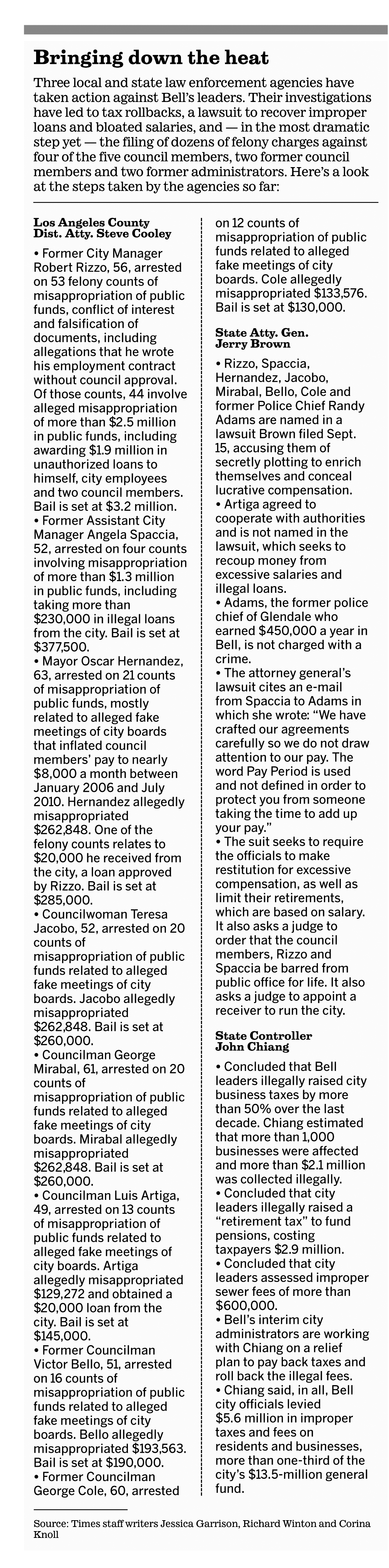 Bell's woes became a symbol of government excess at a time of increasing unemployment, budget deficits and electoral disenchantment. Rizzo, who cut a larger-than-life figure outside Bell as well as inside, stood at the center of the scandal.
His lifestyle included owning a stable of thoroughbreds, among them a gelding named Depenserdel'argent -- French for "spend money." In the face of public criticism, Rizzo remained defiant, defending his salary by citing his years as city manager since 1993.
Amid widespread outrage, City Council members significantly slashed their pay. State lawmakers passed a raft of measures aimed at curbing pay and pension excesses that now await Gov. Arnold Schwarzenegger's signature.
Federal prosecutors are investigating whether the city violated the civil rights of its predominantly Latino immigrant population with selective enforcement of traffic laws and code violations.
County prosecutors said their investigation is continuing.
"We have finished the first leg of what will likely be a marathon to try to restore the integrity of government in Bell," said Jennifer Lentz Snyder, assistant head deputy of the district attorney's Public Integrity Division.
If convicted, the current City Council members would be forced to give up their seats. Cooley said they could also face substantial prison time.
Rizzo is charged with 53 criminal counts that include misappropriating public funds, conflicts of interest and falsifying public records to keep his lucrative salary secret.
Those false document charges involve five contracts dated September 2008, when Rizzo was making about $632,700 annually. The contracts kept his salary the same but changed how he was paid. Rather than receiving his entire salary from his job as city manager, the new contracts meant that he would be paid from several city agencies.
The same month Rizzo created the contracts, Bell resident Roger Ramirez filed a request under the California Public Records Act for the salaries of the city manager, the mayor and council members. The city gave Ramirez a memo providing false salaries, prosecutors allege. The memo said Rizzo received $15,478 a month -- or $185,736 a year -- and the mayor and council members were paid $673 a month, about $8,000 a year. Council members actually made about $92,000 annually.
Cooley faulted the City Council for failing to oversee Rizzo, saying that the elected officials "provided no checks and no balances." Council members each had taken more than $100,000 in stipends since 2006 for sitting on city commissions that rarely met or met for just minutes at a time, the criminal complaint said.
"They used the tax dollars collected from the hard-working citizens of Bell as their own piggy bank," Cooley said, "which they then looted at will."
Rizzo is also charged with giving unauthorized city-funded loans to himself and numerous others, including Spaccia, Hernandez, Artiga and former police chiefs Michael Chavez and Andreas Probst.
Among other recipients was the Steelworkers Old Timers Foundation, a senior citizens group run by then-Councilman Cole, which received $72,000 in 2005.
Cooley said several factors allowed corruption to flourish in Bell, including a lack of civic participation by residents and little scrutiny from the media until the recent Times' stories.
"The electorates of these cities have to be involved if they truly care about their city," he said. "That was not the case in this instance."
Times staff writers Hector Becerra, Paloma Esquivel, Jessica Garrison, Corina Knoll, My-Thuan Tran, Richard Winton, Rong-Gong Lin II and Alexandra Zavis and Daily Pilot staff writer Joseph Serna contributed to this report.
© 2010 Los Angeles Times
By Jeff Gottlieb, Richard Winton and Ruben Vives
Then-Bell City Manager Robert Rizzo gave city loans of nearly $400,000 to two businesses without public discussion, approval from the City Council or collateral to back the loans, according to documents reviewed by The Times.
One of the loans, $300,000 to a local Chevrolet dealer in 2008, is the subject of a court fight because the dealer went out of business within a year of receiving the loan, having repaid nothing.
Although other cities sometimes lend money to local businesses for economic development, Rizzo granted the loans in a highly unusual way, with no statement of economic benefit to the city -- a step that is commonplace in municipal loans.
The second loan was given in 2005 to the Steelworkers Old Timers Foundation, a senior citizens group run by George Cole, who was on the Bell City Council then. It is unclear whether the $72,000 loan was repaid. After saying that he would discuss the loan, Cole did not return calls seeking comment.
Several experts said the secret loans violated basic tenets of municipal government and appeared to violate Bell's charter, which requires that all contracts be approved by the City Council.
"This is a complete breakdown of checks and balances," said veteran municipal lawyer Michael G. Colantuano. "It's plainly illegal."
The loan to the Chevrolet dealership marked the second time its owner, Randy C. Sopp, had received money from Bell. The city granted Sopp a $500,000 loan when he moved his dealership into Bell in 1990, according to court records. It is unclear whether Sopp paid any of that loan back. In 2006, the city agreed to "forgive the outstanding loan," the court documents show, and the dealership said it would try to stay in Bell.
The loans offer new evidence of the sway Rizzo held over the small, working-class city. Rizzo stepped down this summer following 17 years as Bell's city manager after The Times revealed that he was making an annual salary of $787,637, a figure that rose to more than $1.5 million when additional benefits were included.
The Times has previously reported that Bell gave employees and two councilmen loans totaling nearly $1.5 million, a program that public finance experts said was unheard of. City officials have not found evidence that the council approved the loans. That loan program also appears to have been run by Rizzo, who himself received $160,000 in loans.
James Spertus, Rizzo's attorney, said his client was authorized to make loans under a resolution the council passed in early 2006 that allowed Rizzo "to manage the affairs of the city without council approval."
Jamie Casso, Bell's interim city attorney, said that he could find no such resolution in the city's records and that giving the city administrator such sweeping powers would have violated the City Charter.
Some cities, he said, pass ordinances that allow the city manager to sign off on routine expenses, "but a loan of almost any kind to almost anyone of city money is so extraordinary that I can't understand why it was not taken to the council."
Sopp's attorneys either declined to comment or did not return calls. Sopp did not return calls or respond to a message left at his Palos Verdes Estates home.
A review by The Times found no mention in council or redevelopment agency minutes or agendas of the May 2008 loan to Sopp.
Council members Teresa Jacobo and George Mirabal and then-council member Cole said in interviews that they didn't remember approving the loan to Sopp.
Records show that when the loan was due for repayment, Rizzo extended it for seven months without going to the council or informing the public.
Shortly before Rizzo stepped down, the city negotiated a settlement with Sopp that would have ended the lawsuit over the loan. Details of the settlement were not disclosed. But Bell's new city management team put the settlement on hold, saying they had questions about the loan.
"I haven't seen anything that indicates the council voted on this transaction or on the settlement that involves this transaction," Casso said. "My client would have to approve it in open session. That hasn't happened."
Giving a loan to a car dealer is not unusual for cities, particularly during the recession. Both Victorville and Norco, for example, have approved aid to dealers in recent years.
The deal between Bell and Sopp Chevrolet was quite different, though: There was no public notice or discussion; Bell gave the loan not to a business or corporation but directly to Sopp, identified in loan documents as "business owner"; the dealership is not mentioned in the two-page promissory note that was signed May 28, 2008; and the loan was extended until June 30, 2009.
The loan documents did not give the city the right to look at the dealership's financial records, and a document attached to the loan shows that its sales tax revenues had dropped 20% in the last year.
According to the lawsuit Bell later filed against Sopp, the loan was provided after Sopp approached Rizzo, telling him the dealership was in jeopardy of failing.
Little is known about the loan to the Steelworkers Old Timers Foundation. Documents don't explain the reason for the loan or why it would be in the city's interest.
In addition to the loan, Bell gave a city contract worth $38,000 a month to the group to provide Dial-A-Ride services for senior citizens. Cole said last month that the group has held the Dial-A-Ride contract for 15 years and considered the price the city was paying to be fair.
The documents say the loan, which had 4% interest, would be repaid by the city's reducing its monthly payment for the Dial-A-Ride service.
Casso said he has been unable to find council approval of the Old Timers Foundation loan in a preliminary look through Bell's files.
Times reporters also reviewed agendas and minutes and were unable to find any public notice of the loan.
Casso also said he's found no analysis by the city of potential conflicts of interest given Cole's dual roles as head of the foundation and a City Council member.
"We believe there should have been," he said.
© 2010 Los Angeles Times
City officials imposed arbitrary charges -- tens of thousands a year -- for permits or unmet sales-tax goals.
By Paloma Esquivel and Robert J. Lopez
For at least a decade, officials in Bell arbitrarily required some businesses to make payments to the city totaling tens of thousands of dollars annually, in at least one case threatening a business owner with closure if he failed to comply, according to interviews and records reviewed by The Times.
The practice, which experts on municipal law say was unprecedented and may be illegal, underscores the lengths to which Bell's officials went to bring in revenue during the last decade, some of which went to pay the unusually large salaries of city officials. State auditors already have concluded that Bell levied unlawful taxes and fees on its residents, most of whom earn relatively low incomes. The city also imposed one of the highest property tax rates in Los Angeles County.
Bell's former city administrator, Robert Rizzo, and seven other current and former officials were charged by Los Angeles County prosecutors earlier this fall with multiple counts of corruption, mostly related to efforts to conceal their outsized salaries. All have pleaded not guilty. Rizzo was set to earn roughly $1.5 million in compensation this year, The Times has previously reported.
The payment scheme affected at least 15 businesses, mostly small operations that include restaurants, tire shops, auto detailers and a market.
In some cases, merchants were directed to make thousands of dollars in annual payments as part of conditional use permits granted by the city. Others were required to guarantee thousands of dollars in sales tax revenue for the city each year. If their sales failed to measure up to projections, they were told to pay the difference, according to city records and interviews.
There do not appear to be any city guidelines explaining why certain businesses were targeted or how officials calculated how much to charge.
In one instance, a tire shop owner paid at least $144,000 over a four-year period, according to city records. Another tire shop owner was required to pay $13,000 a year. Yet the very next permit approved by the city for an auto repair shop did not require the owner to pay any annual fees, records show. One auto dealer had to guarantee the city $80,000 a year in sales taxes or pay the difference.
The fees were computed by Rizzo in a program overseen by then-city planning director Dennis Tarango, the records indicate. Rizzo's attorney would not comment for this article, and Tarango did not return calls.
In interviews, some owners said they felt intimidated or pressured to agree to the terms if they wanted to do business in the city. Some who fell behind on their payments said the only way to appeal was to show up at City Hall and try to negotiate with Rizzo or his assistants. Others said the fees forced them to leave town.
"Willie Salazar said he sold his tire shop in 2004 after he was told he owed $16,000.
John McClendon, whose Orange County law firm has represented Southern California cities for more than 20 years, said Bell's system for charging business "is more than unusual. It's unique.... It's the first time I've heard of such a thing,"
Dan Selmi, a professor at Loyola Law School and former state deputy attorney general who reviewed some of the permits for The Times, offered a similar judgment. "You don't extract minimum amounts of revenue from a conditional use permit. And doing it selectively is unbelievable. That's doubly bad," he said.
Selmi and other attorneys said conditional use permits typically require developers to pay for improvements such as better parking or additional street lights that a city is required to make in order to accommodate a new project.
In the cases reviewed by The Times, the fees were not used for such improvements.
James Casso, Bell's interim city attorney, said cities can levy charges on businesses or developers if "there is a clear, quantifiable loss of revenue for the city." But city records show that the fees were levied on owners who developed vacant lots. In one case, a fee was levied when a business was simply changing ownership.
The fees levied on Salazar's business, All Day Tire on Florence Avenue, illustrate how the program affected several business owners over a decade.
Salazar came to town in the late 1990s hoping to transform an abandoned gas station into a successful tire store. According to the account he gave in interviews with The Times, which he also has told investigators for the district attorney's office and the FBI, he met with Rizzo at City Hall to talk about opening the business.
Rizzo asked how much profit he might bring in, saying he needed money to pay the city's police and fire departments, according to Salazar. He proposed that Salazar pay $13,000 a year. Salazar said he left without making a commitment.
City records show that in August 1999, a $13,000 annual fee was included in the tire store's conditional use permit. The document was signed by Chris Daglas, the owner of the property on which the tire shop was situated. The fee was cited in a memo from Tarango to Rizzo.
In 2001, Salazar got a bill saying he owed $16,250 for "in lieu of sales tax" fees dating to 2000, according to a copy of the document reviewed by The Times. Salazar said he ignored the bill, and a few months later was summoned to City Hall to meet with Rizzo.
Salazar said he told Rizzo that business was bad. They negotiated a settlement of two $3,000 payments to be paid to the city of Bell. Salazar kept one check stub for $3,000 paid in May 2002, which is marked, misspelling the city administrator's name, "per conversation with Rizo," according to a copy reviewed by reporters.
When Salazar sold the store a couple of years later, the city did not put a lien on the business for the thousands of dollars he had not paid.
George Sahagun, who bought the business from Salazar in 2004, said in an interview that his first knowledge of the payments demanded by Bell came three years later, when city officials told him he owed $39,000 for three years of unpaid fees, city records show.
Sahagun called Daglas, the property owner, who had a meeting with city officials in December 2007, records show. Sahagun and Daglas have both described their encounters with city officials to the district attorney's investigators.
At City Hall, Daglas was told he owed $104,000 for fees not paid since 1999, when his conditional use permit was approved. Daglas said in an interview that he was surprised to learn that Ricardo Gonzalez, Bell's former director of Business Development and Relations, was ready to negotiate.
Daglas said he recalled Gonzalez's leaving the room several times to get approvals before they finally settled on $30,000 to clear the debt and payments of $6,000 a year going forward. In an interview with The Times, Gonzalez said he was consulting with Rizzo, who approved the final settlement.
The settlement was presented to Daglas as an addendum to the conditional use permit approved eight years earlier. According to the Bell City Charter, only the council can change such an agreement.
Daglas wrote a check that day for $20,000 and later made two more payments for $5,000 each, records show. In September 2009, he sent a check for $6,000 and apologized for being late, saying "times are very tough."
© 2010 Los Angeles Times
The city collected hefty fines, without court input, and seized vehicles over alleged compliance issues.
By Robert J. Lopez and Paloma Esquivel
The city of Bell extracted tens of thousands of dollars from plumbers, carpet cleaners, even people scavenging for bottles and cans, by seizing vehicles for alleged code violations and then pressuring the owners to pay arbitrary fines.
In hundreds of cases, city officials created documents that looked like official court papers declaring individuals were making a payment to the city as part of a "civil compromise." Normally, such cases would be reviewed by a judge to ensure that they had been settled fairly. But the vast majority of these cases do not appear to have been presented to a court. Times reporters reviewed 164 cases, roughly one-third of those located in the city's records, and found only three that were filed. All three were dismissed.
The practice took place for at least eight years until The Times inquired about it recently. Interim Chief Administrative Officer Pedro Carrillo, who said he had been unaware of the scheme, has now stopped it and said code enforcement officials were no longer impounding vehicles. He also said he is looking into allegations that some confiscated property disappeared.
"It stinks, honestly," he said. "I see no pattern in these things. It just seems targeted."
Experts said Bell's practice was unheard of elsewhere and legally questionable on at least two grounds: the failure to have a judge review the "settlements" and the seizure of property, which was often done on the grounds that cars, trucks and other goods were evidence needed for investigations that do not appear to have taken place.
The reason for requiring a judge's involvement is that "it's done in open court. There's a certain integrity there," said Maureen Siegel, senior assistant Los Angeles city attorney.
Mark Sellers, former Thousand Oaks city attorney, said that for a code-enforcement officer to say: "'I'm going to confiscate your vehicle because you were digging for cans and bottles'" amounts to "depriving that person of an important property right without due process."
Those cited include a husband and wife passing out handbills, a taxi driver dropping off a customer, a woman selling mangoes and a homeless man picking up bottles. The fines varied widely, with amounts ranging from $25 to $1,000, plus a promise to pay an additional $1,000 for any future violation of the Bell municipal code. One person caught selling strawberries paid $75. Another paid $200, according to the records.
One of those snared was plumber Frank Santiago. Three years ago, a Bell resident called Santiago to check out a leaking kitchen pipe. He found nothing wrong and was backing his van out of the driveway when a code enforcement officer pulled up and blocked his way, the plumber recalled.
The officer wanted to know if Santiago had a license to do plumbing in Bell. Santiago said he told the officer he hadn't even pulled out any tools, but the officer cited him anyway and towed the van. Santiago and a supervisor showed up the following day at City Hall to settle the matter and were directed to pay for licenses for all 10 vehicles in the company fleet. In all, they paid $2,200 in fines and fees, according to records and interviews.
"They were just trying to get money one way or another," Santiago said. "What they did wasn't right."
READ THE DOCUMENT: See how Bell created documents that looked like official court papers.
The program is a prime example of the aggressive efforts that officials in one of Los Angeles County's poorest cities were making to raise revenue, some of which was used to help pay the large s alaries of top officials. State auditors already have concluded that Bell levied unlawful taxes and fees on its residents. The Times previously reported that city officials demanded tens of thousands of dollars in fees from business owners and pushed police officers to meet a daily quota on impounding cars. Those programs are being investigated by authorities.
Bell's former city administrator, Robert Rizzo, and seven other current and former officials were charged by Los Angeles County prosecutors this fall with multiple counts of corruption, mostly related to efforts to conceal salaries as high as the $1.5 million Rizzo was set to earn this year. All have pleaded not guilty.
Records show the citations, impounds and settlements were overseen by Eric Eggena, who served as city prosecutor and head of code enforcement. Eggena, who earned $421,402 annually, was fired in October after he was identified as one of the city's top-paid officials.
Eggena did not respond to requests for comment.
Thousands of pages of documents reviewed by The Times revealed more than 450 code-enforcement cases involving civil compromises.
In each, the person cited for violations signed documents titled "Superior Court of The Southeast/North Judicial District," referring to the courthouse in Huntington Park. Although most of the individuals had been cited for code infractions, the documents stated that they were agreeing to pay a fine to settle a "criminal action."
And while the justification for impounding property was that it was needed as evidence for an investigation, many of the cases reviewed by The Times were settled within hours of the citation, and many of the people cited admitted their violations at the scene. There were no reports showing that any evidence was gathered from the impounded cars. In addition to the fines, the city charged a $400 release fee and received additional money from the tow yard depending on how long a car had remained there.
A number of those caught up in the enforcement efforts were struggling to get by. Bell resident Alfredo Moreno, 73, was laid off three years ago from his job as a packer at a Norwalk market. Since then, he has collected bottles and cans to survive, waking up at dawn to scour streets and alleys. On a good day he makes between $10 and $15.
In April, he was scavenging when a code enforcement officer cited him for "unauthorized collection" of recyclable material, records show. His 1999 Ford van was impounded as evidence.
Moreno said the enforcement officer gave him two choices: He could settle the matter by paying a fine at City Hall or go to court. "He told me 'If you pay later, it will be more expensive,'" Moreno recalled.
Two weeks later, Moreno came to City Hall and signed his civil compromise, which was approved and signed by Eggena, records show. The fine was $50. After borrowing money from his children, he also paid $500 to retrieve his van.
A Spanish speaker, Moreno said he didn't understand the document and did not challenge it. Moreno expressed the helplessness that many in Bell felt over the city's aggressive efforts to raise money — and the difficulty they faced in getting anyone to work on their behalf.
"What can I do against them?" he said of the city. "Nothing."
In some cases, city records do not indicate whether seized property — including couches, kitchen utensils and an ice cream cart — actually was returned.
Carrillo, the city administrator, said code enforcement officers told him Eggena took control of some property, and they don't know what happened to it. Prosecutors are investigating allegations that seized property disappeared, according to investigative reports reviewed by The Times.
One such case involved Alfonso Lewis Booker, who pulled into a gas station parking lot in a rented new Cadillac on a Friday in 2008 to sell silver- and gold-plated jewelry. He had just started doing business, he said, when he was spotted by a code enforcement officer.
Booker was cited for illegal vending, and his rented car was towed. City records show that 58 gold- and silver-plated watches, rings, chains, medallions and bracelets were also seized.
Booker recalls the officer gave him the number of someone in City Hall to settle the matter. When he called, he said the man told him to bring $200 to get his jewelry back. He went to City Hall with the money 11 days later, records show.
He signed a civil compromise but said he never got his jewelry back. Documents released by the city include no receipt showing that the items were returned.
"They said I waited too long to do that," Booker said. "They wouldn't give it back."
Times staff writers Corina Knoll and Ruben Vives contributed to this report.
© 2010 Los Angeles Times
Property owners overpaid $621,737 in levies that were raised in 2007, state says.
By Kim Christensen
The city of Bell assessed property owners for sewer fees without getting required voter approval, according to the state controller's office, marking the second time auditors have found that taxpayers in the working-class city were overcharged.
In a letter to the city obtained by The Times on Thursday, Controller John Chiang said Bell property owners overpaid $621,737 in fees that were illegally increased in 2007. The hike tacked on about $20 per parcel for each of the last three years' tax bills.
The finding comes several weeks after auditors found taxpayers were overcharged $2.9 million for a "retirement tax" to fund city employee pensions. The city, which made national headlines when The Times revealed that top city officials were among the highest-paid in the state, has the second-highest property tax rate of any city in Los Angeles County.
After the salary scandal surfaced in July, scores of residents protested at City Council meetings, saying they believed that their taxes were too high. Many residents said they had noticed assessments on their tax bills that they didn't understand or were never fully informed about.
Bell officials initially were "in full agreement with our finding," Chiang wrote. But they later "suggested that the property tax levy in question may not have required a vote of property owners" and requested more time to research it.
"I urge you to quickly complete your review so that, if the increased levy was indeed an unallowable assessment, the City of Bell will have sufficient time to reduce the assessment for FY 2010-11," he wrote, referring to tax bills due in November.
Interim City Manager Pedro Carrillo declined to discuss the matter pending the city's review, which he said could be completed as early as Friday.
"We just want to make sure we get it right before we make any public statements," he said. "Obviously we are going to fix it if it is incorrect. We will roll out a solution if need be."
If the city concludes the assessment was legal, it will have to prove its case to the controller, Chiang wrote. Nothing in the documents from Bell so far would justify the increase, he said.
Even if Chiang's finding holds up, it is unclear if taxpayers will get their money back because the state Constitution does not spell out a remedy for overcharged assessments in prior fiscal years.
However, Chiang told city officials that if taxpayers were overcharged, the city should either refund the money or use it to offset future assessments.
For the sewer assessment, property owners have paid as much as $33.12 per parcel since 2007, the controller said; the maximum allowable is $12.70.
The controller's office is one of several outside agencies that have been brought in to investigate the city since the salary scandal broke. Both the L.A. County district attorney's office and the California attorney general's office are looking into allegations of financial irregularities and voter fraud.
Chiang's previous finding of a tax overcharge has led to likely relief for residents. Although it initially appeared that the overpayment would be directed to public schools in the city, a bill to refund the $2.9 million to property owners has cleared the Legislature and is awaiting the governor's signature.
It is one of several legislative reforms launched since The Times reported in July that the city of about 39,000 was paying its administrators and police chief the largest municipal salaries in the state, with then-City Manager Robert Rizzo making nearly $800,000 a year.
Chiang's findings appear to confirm Bell property owners' longstanding complaints of being overtaxed. All county property owners pay a 1% general property tax, along with special or direct assessments levied by their municipalities. The countywide average of all tax rates is 1.16%, or $11.60 for every $1,000 of assessed value.
Bell's total property tax rate is 1.55%. But even after the rate is reduced in November, to reflect the reduction of the retirement tax, the city southeast of downtown Los Angeles will still have a higher rate than many others in the county.
Bell's high tax rate is due to several factors, records show, including bond debt for municipal improvements, including a sports complex now under construction. Since 2006, county records show, Bell's local taxes have doubled, as have direct assessments for trash collection, sewer maintenance and other services.
Revenue from the tax increases went to designated funds or services and did not directly pay for administrators' salaries.
But by freeing money from the city's general fund, the higher taxes appeared to have made the outsized salaries more feasible for the small city.
© 2010 Los Angeles Times
Levies on business licenses were raised without voters' OK, state auditors say.
By Kim Christensen, Ruben Vives and Paloma Esquivel
State auditors Thursday said they had found a third instance in which the city of Bell collected taxes illegally, bringing to $5.6 million the amount owed to taxpayers and raising questions about how the struggling town will balance its books.
In a letter to Bell officials, state Controller John Chiang said the city had failed to get the required voter approval as it hiked business license taxes by more than 50% over the last decade. The exact amount overcharged is unknown, but Chiang estimated it at more than $2.1 million. More than 1,000 businesses were affected, he said.
Chiang's auditors previously found that Bell had illegally raised a "retirement tax" to fund pensions, costing taxpayers $2.9 million, and assessed improper sewer fees of more than $600,000. In all, auditors' findings of tax and assessment overcharges amount to $5.6 million, or more than one-third of the city's $13.5 million general fund.
City officials said Thursday the latest finding was a financial setback and that they were working with state officials to form "a relief plan" to deal with refunds and the loss of future revenue from lowering taxes that were illegally raised.
"Today's finding is another potential problem for us," interim City Administrator Pedro Carrillo said, adding that the immediate effects are unclear. Carrillo said he would consider "any and all means" to balance the budget but declined to say if layoffs or cuts to city services were imminent.
The working-class city of about 39,000 drew national attention this summer when The Times reported that its top officials were among the highest-paid public employees in the country.
A subsequent Times analysis of county records showed that Bell also had the second-highest property tax rate among Los Angeles County cities. Even with a rollback of the retirement tax, Bell will still have a higher rate than many cities in the county, records show.
The auditors' findings underscore property owners' longstanding complaints that they were overtaxed. After the salary scandal broke in July, throngs of residents protested at City Council meetings, decrying assessments on their tax bills that they said they didn't understand or were not fully informed about.
Alberto Alvarado owns Nuevo Mundo Super Market, a meat market and bakery across from City Hall that's been in his family for nearly 50 years. Over the last decade, he said, he has complained to the city not just about rising business license fees but about trash, water and sewer charges and other city fees he said make it difficult for businesses to survive.
"I know it's not like this in other cities," he said in Spanish. "Walk down Gage …. You'll see how the businesses have closed. It's like the city wants us to close."
Sadas Cortes, who owns Lidia's Bargain, a new-and-used clothing store just down the street on Gage Avenue, said business owners had tried to ask city officials about the fees over the last few years but "they would just blow us off."
"That's the whole problem," he said. "We don't know what's legal and what's not. We're going by what the city told us."
The city will immediately draft a resolution to lower business license taxes, Carrillo said, and also plans to suspend new payments for those who have overpaid in the past. He said he did not know if such a moratorium would satisfy the controller's demand for refunds but that giving the money back would deplete Bell's reserves.
The city expects to refund the $2.9 million in overpaid retirement taxes from its estimated $5 million in reserves. But Carrillo said he hopes to avoid draining that fund by having to also return all $2.1 million in business tax overcharges disclosed Thursday.
Carrillo said he was in discussions about it with Chiang's office, whose team of auditors he has been working with for weeks at City Hall.
Auditors are also looking into whether any state or federal funds were misused and into who audited and approved the tax hikes.
The Los Angeles County district attorney and the state attorney general also are investigating Bell. On Wednesday, Atty. Gen. Jerry Brown announced a civil lawsuit against eight Bell officials and council members, accusing them of fraud and misuse of public funds.
© 2010 Los Angeles Times
A state report says he received $95,000 in public money to repay loan to himself. His lawyer denies it.
By Ruben Vives and Jeff Gottlieb
Apparently acting without City Council approval, Bell spent nearly $95,000 to repay loans that then-City Manager Robert Rizzo made to himself from his retirement accounts, a draft state audit reviewed by The Times shows.
The auditors found no evidence that council members even knew about the repayments, which occurred in 2008 and 2009.
"We found the city's system of internal control to be nonexistent, as all financial activities and transactions revolved around one individual, the former chief administrative officer, who had complete control and discretion over how city funds were used," the auditors wrote.
State law prohibits a city from giving public funds to a person solely for private benefit.
Robert Weisberg, codirector of the Stanford Criminal Justice Center, said that if city funds were used to repay loans without legal basis — as the draft audit alleges — "it would be a pretty classic case of federal wire fraud."
But Rizzo's attorney said his client had done nothing wrong or illegal.
"Mr. Rizzo was paying off his own loans with his own money, he was not using public funds," attorney James Spertus said. "I do know, and I confirmed with Mr. Rizzo, the loans were paid with salary and declared as income on his taxes, and it was done with city approval.???"
The report, based on a review by state auditors of Bell records, portrays a different picture. "Public funds were used to repay [Rizzo's] personal loans, apparently without authorization," the audit says.
The full audit by Controller John Chiang's office is expected to be released this week. Chiang's office had previously found that Bell illegally overcharged residents and businesses by $5.6 million in various taxes.
The latest findings come as the Los Angeles County district attorney's office and state and federal authorities continue to investigate Bell, where high salaries earned by Rizzo and other top officials have sparked widespread outrage. The Times reported last month that Rizzo was set to earn more than $1.5 million in 2010. Additionally, he gave loans totaling $1.6 million to more than 50 city officials, including himself.
Councilman Luis Artiga, who reviewed portions of the draft audit, said Monday he was outraged by Rizzo's actions.
"This man's intentions were to milk and exploit this community to take advantage of the innocence of this community," Artiga said. He added that he and the rest of the City Council are partly to blame for not better overseeing Rizzo's actions.
Rizzo had borrowed money out of his retirement accounts in 2004 in two $50,000 chunks, according to city records The Times obtained under the California Public Records Act.
Bell had a program that allowed certain city officials to receive loans — a practice that had previously been flagged by state auditors as problematic. Their findings underscore concerns raised by outside experts that Bell had engaged in a highly unusual pattern of city funds being loaned to employees without any public notice or apparent City Council approval.
Documents obtained by The Times last month show that former Assistant City Manager Angela Spaccia received three loans totaling more than $300,000. Lourdes Garcia, the administrative services manager, obtained two loans for $177,500; and Annette Peretz, Bell's director of community services, got a $95,000 loan. The loans were all signed by Rizzo and appeared to be given with vacation and sick pay used as collateral.
Councilmen Artiga and Oscar Hernandez each received a $20,000 loan. Neither reported the loans on financial disclosure forms, which is required under state law.
In addition to the retirement funds, Rizzo received two city loans of $80,000, officials said.
After The Times disclosed the loans, city officials said they were suspending the loan program and were trying to determine how many of the loans were repaid.
L.A. County Dist. Atty. Steve Cooley has said his office is examining whether the various financial transactions in Bell amounted to thefts of public funds. The office is also looking into allegations of voter fraud and whether the high salaries earned by Rizzo and others were legal.
Last week, California Atty. Gen. Jerry Brown filed a lawsuit against current and former Bell city leaders demanding that their pay contracts be nullified and that they pay back some of their salaries and pension benefits. Artiga was not one of those named in the lawsuit and he said he's working with investigators.
Rizzo and other top city officials stepped down in July after the salary scandal broke. City Council members — who were earning nearly $100,000 a year — significantly slashed their pay.
Officials from Chiang's office and Bell Interim City Administrative Officer Pedro Carrillo would not comment on the draft audit.
© 2010 Los Angeles Times
Robert Rizzo seemed right for the town -- until he became an 'unaccountable czar.'
By Christopher Goffard
The new boss kept his office spartan and impersonal, the walls stripped of photos, the desk conveying no hint of his life beyond the red-brick walls of City Hall.
It was 1993, a bleak, recession-bit year, and Robert Rizzo arrived in Bell trailing the vague whiff of scandal. His last city administrator job, in the high desert city of Hesperia, had ended badly, with accusations that he'd steered city improvement funds toward salaries.
But the Bell officials who hired him did not dig deeply into his past. They needed someone fast, and Rizzo, then 39, came cheap. His starting salary was $78,000, which was $7,000 less than his predecessor had made.
"He was willing to work for the least amount of money," said then-Councilman Rolf Janssen. "That was what attracted me and several other council members."
Now Rizzo and seven other Bell leaders past and present are charged with looting more than $5.5 million from one of the county's poorest municipalities. It is a hydra-headed scandal that has spawned seven federal, state and county investigations and transformed a forgotten suburb into a synonym for rogue governance. It has resonated as a morality tale in which Rizzo is cast as a greed-crazed, cigar-chomping puppet master who cheated his way to an $800,000 salary and a 10-acre horse ranch.
How Rizzo evolved from an obscure civil servant into what a prosecutor called an "unelected and unaccountable czar" may never emerge in granular focus. But the broad contours are clear. Ambition and opportunity aligned in a place that allowed him to be both ever-present and invisible.
The normal checks and balances, from a robust local press to engaged civic groups, had largely vanished before or during Rizzo's long reign as city administrator. And the grim climate in which he arrived made him seem, for a time, like the man Bell needed.
Had he retired six or seven years ago, he might have been remembered as a reclusive technocrat who saved the city from financial ruin and made it purr. People talked about how pretty the parks were, how efficiently trash was removed, how swiftly gang graffiti was painted over.
Just last year, a police captain named Anthony Miranda ordered T-shirts for Neighborhood Watch participants imprinted with a prideful description of the 21/2-square-mile city: La perla del sureste.
The pearl of the southeast.
"We believed it," he said. "Compared to our neighbors, Bell was the place to be."
--
In the immense geographic chasm between downtown Los Angeles and Orange County, Bell is one of those places the tour books skip entirely -- the freeway-culture equivalent of flyover country, a smudge of urban gray.
Rizzo's touches are everywhere: a big skateboard park, a miniature golf course, pristine playing fields. In a place both cramped and crime-wary, the parks are stringently fenced, squeezed between tenements or beside busy streets. At an open-air gym along Gage Avenue, people breathe the exhaust of passing traffic as they pant atop stationary bikes.
Like other cities in southeastern L.A. County, Bell flourished as a white middle-class enclave during the Cold War manufacturing boom. There was a local newspaper, the Industrial Post, and a host of active social service groups: Kiwanis and Rotary clubs, Masonic and Moose lodges.
The decay of the region's industrial spine in the 1970s and '80s -- the closure of tire, auto and steel plants -- left thousands without the well-paying jobs that built the area. This coincided with a massive influx of Latinos, many of them undocumented.
The service groups withered. Voter participation became "abysmal," said John Bramble, who was city administrator in 1990, a year when 669 votes -- in a city of 34,000 -- could win a City Council seat. Only five or six people showed up for neighborhood meetings. Bramble said he would meet with a handful of World War II-generation seniors at a burger place to talk about city business, but age and illness thinned their numbers.
"Things started to deteriorate," Bramble said.
By 1993, Bell's fortunes were at a low ebb. The California Bell Club -- once the state's largest poker parlor and the source of $2 million in annual revenue for the city -- had closed. At City Hall, council members could feel the springs under their patched leather seats.
The Industrial Post, in existence since 1924, went under. Jay Price, the beloved 78-year-old mayor, an institutional fixture who had joined the council in the 1950s, died of heart failure. And Bramble announced that he was leaving for a job in Colorado.
Interviews with potential replacements began immediately, though the city didn't have the money for an exhaustive search.
Bramble recalled that interest in the city administrator's position was scant.
"I don't think people were willing to take a job where you were constantly cutting. That was the story of my last three years in Bell," he said. "My guess is they were happy to have anybody."
--
Rizzo quickly developed a reputation as a micromanager who meant to save the cash-strapped city by pinching every penny. He laid off workers and contracted out services. He gave an expensive-to-maintain bridge to the neighboring city of Vernon. He installed cheaper, brighter streetlights.
At the Police Department, squad cars racked up 200,000 miles instead of being replaced after 100,000. New cars received drab gray door emblems instead of multi-colored ones.
Janssen, the former councilman, said Rizzo put the city on stable financial footing and took a keen interest in its image. He made sure plenty of hot dogs were available at city events and insisted that every child, not just the stars, receive a trophy in the soccer and baseball leagues.
He lived near the ocean in Huntington Beach, 30 miles from the city he ran, and seemed to shrink from personal attention, reluctant to mix even as president of the Chamber of Commerce. In the fraternity of local city managers, he was rarely seen.
Diminutive and rotund, Rizzo was self-conscious about his appearance. Behind his back, people called him the Penguin, a reference to the "Batman" villain. He liked to mention his bachelor's degree from UC Berkeley and said that everything he'd achieved was the result of dogged effort.
Under Rizzo, people began saying the city looked better than it had in years. Marial Sanders, a real estate agent and property manager in Bell, said prospective homebuyers sometimes told her they were torn between Bell and nearby Downey, a much bigger city. "I thought, 'Wow, Bell has come so far, we're being compared to Downey.' "
Only rarely did Rizzo draw attention to himself, as on one election night at City Hall. People who were there recall that he had too much to drink. Peter Werrlein, a former mayor who had served prison time for holding a hidden interest in the poker club, said he confronted him.
"You're drunker than a hoot owl," Werrlein recalled telling Rizzo. "You're going home."
When Rizzo tried to argue, Werrlein said, he got the city administrator's attention by striking him across the face with a half-open hand. "I whacked him and said, 'Let's go.' I think he knew I'd reached the end of my patience."
To some, the plainness of Rizzo's office spoke to his willingness to make sacrifices along with the city.
When Police Chief Michael Trevis asked why he didn't hang photos, however, he said he got a different explanation. "When you put things up, you're telling people you're comfortable," Trevis recalled Rizzo saying. "I want people to know I can leave at a moment's notice."
In his stark office, the sole reflection of his personality was a little television on which he followed the stock market. "It was always on," Trevis said. "That's Bob. We were not used to that, but we were broke, we were busted, and it took a numbers guy."
Once, he said, Rizzo invited him to look at budgetary pie charts. They showed that although the Police Department swallowed more than half the city budget, it generated less than 10% of the revenue.
"He said, 'You guys are costing me this and you're only bringing in that? You're not holding your own,' " Trevis said. He said Rizzo encouraged officers to write more tickets and impound cars, and he monitored which cops were "earning their way." He said Rizzo justified the tactic with a veiled threat: "Hey, if we don't do this, we might not have a Police Department.' "
Trevis said he believed revenue-oriented policing was unethical, and he waged "passive resistance" against it. He said the climate of constant layoffs lent camouflage to Rizzo's steady accumulation of power.
"It started to be anyone who disagreed with him, they were not around much longer," Trevis said. "Bob is of the belief that people are either assets or liabilities, and if you are a liability, he will find a way to jettison you."
Travis said Rizzo found grounds to get rid of him in 2002: He had violated his contract by taking outside security work without permission. "He found out and he twisted me," Trevis said. "As one of the guys told me, 'When we saw he could get to you, he could get to any of us.' "
Bell Police Sgt. Art Jimenez, a 12-year veteran of the department, described Trevis as "the last chief to say no to Rizzo."
The chief's ouster was followed by a deeper power shift in 2003, as council veterans Janssen and George Bass -- pillars of the old guard -- left office. In their place came two of Rizzo's future co-defendants, George Mirabal, who ran a mortuary, and Oscar Hernandez, owner of a corner grocery.
Whether by chance or design, Rizzo found himself with an increasingly free hand. More than anyone, it was Hernandez who came to symbolize the new, more manipulable City Council. A former farmworker, he had emigrated from Mexico in his teens. With only an elementary school education, he could barely read the papers that passed across his desk at City Hall. And yet he became Rizzo's go-to man, prosecutors say, putting his signature to complex documents and to papers that obscured the city administrator's increasingly hefty salary.
Though Rizzo's office remained threadbare, his private lifestyle was acquiring a majesty undreamed of in the working-class city he ran. His salary jumped from $250,000 in 2002 to $300,000 in 2004, the year he bought a lavish horse ranch in Washington state. Few in Bell knew it, but he had become a breeder of thoroughbreds.
Then, on a sleepy day after Thanksgiving in 2005, a little-noticed election was held. The single question on the ballot: whether to turn Bell from a general law city into a charter city. By some accounts, it was a change Rizzo had aggressively pushed.
Passing with just 336 yes votes, the measure lifted salary caps on council members, who went on to approve further dramatic pay raises for Rizzo and for themselves.
His salary jumped to $442,000 that year. It kept climbing until, by last summer, Rizzo was making nearly $800,000, with a benefits package that brought his annual compensation to $1.5 million. He had brought in an assistant, Angela Spaccia, who was paid nearly $400,000 a year, and a police chief, Randy Adams, who collected $457,000.
Council members, for their part, were making nearly $100,000 a year in part-time positions that in most small cities paid a few hundred dollars a month.
Meanwhile, police were impounding cars at a furious clip, looking for broken taillights and missed turn signals as a pretext to pull drivers over. In a city where an estimated half of the residents are illegal immigrants, unlicensed drivers were easy to find. Bell charged them $300 to get their cars back. Fearing deportation, they were unlikely to complain.
"That was the reason we were able to do it for so long. And when they did complain, there was no one to complain to," Jimenez said. "There were single officers impounding eight cars a day. It was out of control. If they weren't impounding cars, they felt like they weren't working."
Earlier this year, before the scandal broke, Rizzo crashed into a neighbor's mailbox while attempting to pull into his own driveway, and police found him with a blood-alcohol level more than three times the legal limit. He pleaded guilty and was sentenced to a first-offender alcohol-awareness program.
Now, he and his assistant, along with six current or former council members -- Hernandez, Mirabal, Teresa Jacobo, Luis Artiga, George Cole and Victor Bello -- are charged with bilking the city out of millions of dollars.
Rizzo declined to be interviewed for this story. His lawyer, James Spertus, said the corruption charges are unfounded and that his client did much good for the city while earning comparatively little for years.
"He took over a city that was deeply in the red," he said. "Rizzo made five-figure salaries until the late 1990s. It was way below the median for his position."
Trevis, the former chief, now speaks nostalgically about the city he remembers. There were big-city problems such as gangs and graffiti, but he regarded Bell as a "little Mayberry," a tight-knit and friendly place.
Most of those swept up in the scandal are people he's known for years. He recalled how he'd steer hungry people to the church on Gage Avenue where Artiga, its pastor, had a reputation for feeding them. How Hernandez gave groceries on credit to people who couldn't pay. How Mirabal, the funeral director, buried people at deep discounts so their families wouldn't have to hold car washes to raise the money.
Trevis thinks he knows what went wrong in Bell. It was the same thing, he said, that sometimes happens to happy families that come into a big inheritance.
"They got poisoned with money," he said.
--
In Bell, purging the remnants of the Rizzo era has become an obsession, one that can assume strange, even ritualistic forms. Bell's merchants have rebelled against the Chamber of Commerce, where Rizzo was a longtime member of the board. The organization came to be seen as an extension of his power.
On a recent night, hundreds of merchants crowded into a banquet hall to inaugurate an alternative, the Bell Business Assn. They took turns detailing the abuses they had suffered at the hands of City Hall: arbitrary fees, long waits for permits and the ever-present threat of code enforcement to deter potential complaints.
The association's first president, tire shop owner Jose Vazquez, compared Rizzo's management of the city to the Mafia: "This is like 'The Sopranos.' "
In a place where so many feel betrayed, a renewed commitment to fair dealing seemed the need of the moment, and so the association's first directors were asked to step forward. Up came the men and women who run the tire and bail bond shops, the boxing gym, the meat market and the restaurants. They crowded the stage and raised their right hands, solemnly promising to perform their duties honestly.
At one point, Anthony Miranda, the acting police chief, took the stage and announced that the Police Department had made more changes in the last three months than in the previous six years.
"When we come out of this, we're not going to be gold or silver -- we're gonna be titanium as a community!" Miranda said. "Untouchable!"
Cheers greeted his speech. The reception was chillier for interim City Administrator Pedro Carrillo, who has moved his furniture into Rizzo's old office, hung the bare walls with pretty satellite pictures of the city and promised openness and accountability.
The people of Bell, he told the crowd, would rise together or fall together. The remark elicited boos. From a different speaker, it might have rung out as inspirational, a call to solidarity. But many in the audience didn't trust Carrillo. He had worked at City Hall under Rizzo, after all, and reminded too many people of his ghost.
© 2010 Los Angeles Times