Sun Sentinel, by Sun Sentinel

Lee C. Bollinger, President of Columbia University (left), presents the 2013 Public Service prize to Sally Kestin and John Maines of the Sun Sentinel.
Winning Work
Speeds reaching 90-130 mph are common among police
Even when there’s no emergency, even when they’re off duty
Punishment is rare, despite crashes and deaths
By Sally Kestin and John Maines
We've all seen it, and now there's proof: Police officers sworn to uphold our traffic laws are among the worst speeders on South Florida roads.
A three-month Sun Sentinel investigation found almost 800 cops from a dozen agencies driving 90 to 130 mph on our highways.
Many weren't even on duty — they were commuting to and from work in their take-home patrol cars.
The extent of the problem uncovered by the newspaper shocked South Florida's police brass. All the agencies started internal investigations.
"Excessive speed," Margate Police Chief Jerry Blough warned his officers, is a "blatant violation of public trust."
The evidence came from police SunPass toll records. The Sun Sentinel obtained a year's worth, hit the highways with a GPS device and figured out how fast the cops were driving based on the distance and time it took to go from one toll plaza to the next.
Speeding cops can kill. Since 2004, Florida officers exceeding the speed limit have caused at least 320 crashes and 19 deaths. Only one officer went to jail — for 60 days.
A cop with a history of on-the-job wrecks smashed into South Florida college student Erskin Bell Jr. as he waited at a red light in Central Florida three years ago, hitting him at 104 mph. Bell is now severely brain-damaged.
"Every day, you pray for a miracle,'' said his father, Erskin Bell Sr. "Had this officer's behavior been dealt with, maybe he would not have run into our son.''
Law enforcement officers have been notoriously reluctant to stop their own for speeding, and the criminal justice system has proven no tougher at punishing lead-foot cops, records show.
That sense of impunity infuriates many Floridians. Those concerns erupted in October, when a state trooper clocked Miami Police Officer Fausto Lopez driving 120 mph through Broward County on his way to a moonlighting job.
"They think that they have carte blanche. Who's going to catch them? Who's going to do anything about it?" said state Sen. Steve Oelrich, a Gainesville Republican and former sheriff.
"Something needs to be done."
It's hard to drive more than a few days on Florida's Turnpike or Interstate 95 without witnessing a squad car from a different city rocket by in the fast lane. But just how many cops were flooring it, and how often, remained a mystery — until now.
The Sun Sentinel uncovered the answers by digging into the officers' toll records. The findings:
• 793 transponders assigned to police agencies from Miami-Dade to Palm Beach counties showed evidence of speeding — and habitual speeding by some officers.
• One out of five police cars hit speeds above 90 mph.
• Total high-speed incidents: 5,100 in a 13-month period.
• Most of the high speeds — 96 percent — were between 90 and 110 mph.
• Many of the officers did not appear to be rushing to save lives or fight crime. More than half of the high-speed incidents involved city cops outside their jurisdictions, many of them driving regular routes most likely to or from work.
In Broward County, cops from a half-dozen departments — Davie, Fort Lauderdale, Margate, Pembroke Pines, Plantation and Sunrise — were clocked going above 90 mph at least once outside the cities where they work.
"If we have officers who are not responding to an emergency and they're driving to or from work at 100 mph, I have a problem with that, and so does the chief," said Plantation Police Detective Robert Rettig. "If an officer is found in violation, they'll be disciplined."
Sheriff's deputies also drove at excessive speeds but their countywide jurisdiction makes it harder to tell whether they were working.
Almost 30 percent of the transponders assigned to the Palm Beach County Sheriff's Office showed speeds above 90 mph, mostly within the county. The Sheriff's Office is investigating and will discipline deputies found speeding without justification, a spokeswoman said
At the Broward Sheriff's Office, 18 percent of the transponders registered speeds above 90 and as high as 122 mph, the SunPass analysis found. Sheriff Al Lamberti ordered his commanders to determine what the deputies were doing and whether the speeds were justified, said spokesman Jim Leljedal. The deputies included a supervisor and K-9 officers, who are frequently called to emergencies, he said.
Driver Vince Martinelli of Lake Worth sees it all the time: Cops speeding past him on the turnpike.
"I'm going 70, and they go flying by me,'' he said. "These are policemen who live in Palm Beach County and work in Broward County."
Cops drove the fastest from late at night to 6 a.m., when shifts change and traffic is lightest.
Miami officers were among the most chronic speeders, with 143 of them driving over 90 mph — all outside city limits, the SunPass analysis found. More than 50 Miami cops broke 100 mph — one more than 100 times.
"How disturbing," said Miami Police Maj. Jorge Colina. "Clearly it's a problem we need to deal with."
The Miami cop who drove the fastest on the turnpike hit 125 mph one morning about 4 a.m. The speed leader on the Gratigny Expressway reached 117 mph and drove over 100 mph on 36 days.
At the Miami Beach Police Department, 54 officers drove over 90 mph as far away as Palm Beach County, the analysis found. Many hit speeds over 100 mph.
Some of the speeding could be justified if the cops were off-duty and called into work for an emergency, said Raymond Martinez, Miami Beach's assistant police chief. But he said some may speed simply because they know they can.
"I really don't have an explanation for what goes through an individual's mind to think they can go 100 mph without consequences,'' Martinez said. "Is it because they're in a marked car and another agency isn't going to stop them? Maybe."
Speeding on the job
Some on-duty cops clearly drove much faster than allowed even for the most serious emergencies, the Sun Sentinel found.
Florida law allows officers to exceed the speed limit for an emergency, as long as they can do it safely. Most South Florida police agencies, including the sheriff's offices in Broward and Palm Beach counties, do not set a cap on how fast cops can drive to a call.
At the Miami-Dade Police Department, a countywide agency, officers are required to stay within 20 mph of the speed limit even in the most serious emergencies, such as responding to shootings, according to department policy. That means a top speed of 75 to 90 mph, depending on the highway speed limit.
That policy is not always followed, the Sun Sentinel found: More than 270 Miami-Dade cops drove over 90 mph and as fast as 115 mph.
"That is very disturbing,'' said Maj. Nancy Perez, the department's spokeswoman. "Speeding is a big problem. It's a big problem not only for us but for every other police department.''
A former road patrol officer, Perez said she understands "the urgency to get to either a citizen that is calling the police or assisting another officer.''
"But still, it has to be done with a conscious mind of what could happen not only to you, but you could also cause an accident and hurt someone else," she said
Florida Highway Patrol troopers drove the fastest among the cops examined, at speeds as high as 130 mph, according to the SunPass records. FHP began an internal review of the Sun Sentinel's analysis to determine whether the troopers were off-duty or working, and if so, what they were doing at the time.
Troopers will be held accountable if their actions did not contribute to a "safe driving environment," said FHP Capt. Mark Brown, an agency spokesman.
FHP policy requires troopers to obey the speed limit unless they're chasing a law breaker. Then they're expected to stay within 15 mph of the limit but can go faster if they can drive safely and "the gravity of the situation so warrants.''
"If somebody goes by at 120," Brown said, "we can't go 85 to catch him.''
Policing their own
The internal police investigations prompted by the Sun Sentinel will take several weeks to complete. Spokesmen said unnecessary speeding, on or off duty, will be punished.
"We write speeding tickets. ... It's not very prudent to be out violating the very laws that we enforce,'' said Miami Police Maj. Delrish Moss. "We'll investigate … and we'll take the appropriate action.''
Police have only recently begun to seriously address a problem that they acknowledge has persisted for years.
Last fall, Miami police began undercover radar stings of their officers, nabbing a dozen on one stakeout, Colina said. The department is now considering going so far as to equip police cars with "governors" that prevent the engines from exceeding a certain speed. They may consider GPS devices that track a vehicle's location and speed by satellite.
Fort Lauderdale police are one of the few South Florida departments currently using GPS in patrol cars to monitor and discipline officers for speeding, though most of the punishments have been written reprimands. "We take it seriously because it's been an issue,'' said Police Chief Frank Adderley.
GPS is also coming soon to patrol cars in Miami Beach. "My first and foremost thing is stopping the behavior,'' Martinez said.
The Miami-Dade Police Department holds driver training courses and posts signs in its parking lots urging officers to drive safely. One reason: It's not just civilians who are victims of speeding cops. In 2009, Miami-Dade police buried one of their own — Giovanni Gonzalez, a 23-year-old rookie who rear-ended a dump truck while driving nearly 100 mph for no apparent reason.
"It's very heart-wrenching when you have to go to a memorial or a remembrance and look at these families destroyed with questions: 'Why is this happening?''' Perez said. "We don't have an answer for them.''
Editorial Assistant Charlie Grau contributed to this report.
Miami cop Fausto Lopez hit triple-digit speeds on his way to and from work
By Sally Kestin and John Maines
The cop clocked at 120 mph on Florida's Turnpike last fall offered the trooper a familiar explanation: He was late for work.
Miami Police Officer Fausto Lopez was often in a hurry, a Sun Sentinel investigation found. Commuting from his home in Coconut Creek to Miami, he routinely blew through Broward County at speeds law-abiding citizens can only dream of driving.
In the year before his Oct. 11 traffic stop, Lopez averaged at least 90 mph on 237 days.
He hit speeds of 100 mph or higher on 114 days, an analysis of SunPass transponder records shows.
Lopez, 36, stood out as the most frequent speeder of all the cops whose toll records were examined by the Sun Sentinel.
His attorney, William Matthewman, of Coral Springs, said he would have to verify the analysis before commenting.
“Officer Fausto Lopez is a good driver,'' he said.
“Certainly, he at no time has put any member of the public in any type of danger.''
The unusual traffic stop that led to a charge of reckless driving against Lopez ignited intense emotions among his fellow officers, and some defended him on Facebook and police blogs. But many South Floridians cheered, happy to see a cop for once held to the same traffic laws they must obey.
Lopez's lawyer accused the media of whipping up controversy.
“He was not going 120 mph as claimed,'' Matthewman said in a December interview. “Was he going a little too fast? Very possibly so. I think that this is a minor incident that's been completely blown out of proportion by the media.''
Lopez routinely drove at least 25 mph over the speed limit on his two-county commute to and from work, the analysis of the SunPass data shows.
On Sept. 9, he averaged 120 mph on one stretch of his drive, and 18 other times topped 110 mph.
Lopez drove faster on his way home in the overnight hours. On his normal route, he took the turnpike north from the Golden Glades interchange past the Cypress Creek toll plaza to the Sawgrass Expressway, where he exited after the Deerfield Beach toll.
At the speed limit of 65 mph, the drive takes 26 minutes. One day Lopez made it in a little more than 14 minutes — thanks to an average speed of 117 mph.
About 1 a.m. on Sept. 30, Lopez averaged 114 mph from Golden Glades to Cypress Creek, and 112 mph from Cypress Creek to Sawgrass Deerfield. The following night, he averaged 115 and 110 mph on the same stretches. His highest average speed was 120 mph.
Lopez joined the Miami Police Department in February 2006. Nine months later, he was cited for careless driving after rear-ending a car in his personal vehicle, but that case was dismissed.
Before becoming a cop, Lopez had one speeding ticket, in 1999, for going 88 mph in a 65-mph zone, according to his driving record. After he got a badge, Lopez sped with seeming impunity — until Oct. 11.
Late for his off-duty job at a school in Miami, Lopez blew by Florida Highway Patrol Trooper Jane Watts in his patrol car on the turnpike near Commercial Boulevard. She followed him for seven minutes and later wrote in a report that he was darting in and out of lanes at speeds exceeding 120 mph.
“This is not a first-time occurrence with y'all,'' Watts told Lopez after pulling him over. “Y'all come from that way all the time, this Miami police car, and we never catch it.''
Lopez apologized and tried to explain he was running late.
“With all due respect ...,'' he said, but Watts cut him off.
“You don't respect me, sir,'' she said. “You don't respect these people out here.''
The exchange was captured on Watts' dashboard camera, and video of the traffic stop went viral. Cops lined up to take sides.
Some criticized Lopez for speeding, but many came down against the trooper for drawing her gun on a fellow officer and handcuffing him. Blog attacks on Watts got nasty and personal, and someone smeared human feces on another FHP trooper's car.
Lopez has pleaded not guilty to reckless driving, a misdemeanor.
Miami Police Maj. Delrish Moss said he could not comment on the case. The Police Department will decide whether action against Lopez is warranted once the reckless driving charge against him is resolved in court, he said.
“Speeding is a big concern for us,'' Moss said. “That's why we have a policy in place. That's why we take disciplinary action when we find that people are violating our policy.''
In the days following the traffic stop, Lopez slowed down but still drove in the 80s and twice averaged 96 mph, the SunPass analysis shows.
He eased up on the gas pedal after Oct. 28, when news of his traffic stop aired in South Florida and beyond. In November and December, according to SunPass data, Lopez's top average speed on his commute was 77 mph.
Victims were killed or maimed but cops were spared prison
By Sally Kestin and John Maines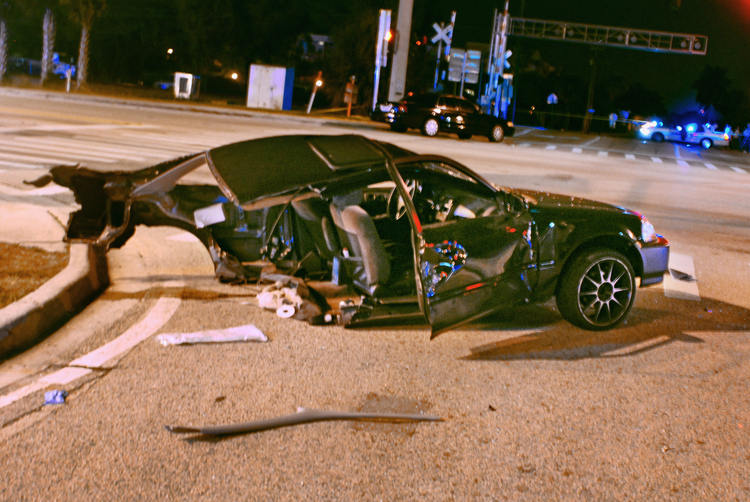
Broward Sheriff's Deputy Frank McCurrie broad-sided this Honda Civic on Jan. 23, 2010, shearing the car in half and killing passenger Cara Catlin, a 14-year-old Oakland Park high school freshman. McCurrie, who investigators say was driving nearly 90 mph in a 45-mph zone, is awaiting trial on charges of vehicular homicide and reckless driving. (Broward State Attorney's Office, Courtesy)
As the 21-year-old driver pulled toward the intersection, the approaching headlights glinted only faintly in the distance.
"They were very far away,'' Heather Meyer said later. "I didn't even know what kind of car it was.''
In that oncoming car: Broward Sheriff's Deputy Frank McCurrie, racing to aid a fellow officer with a traffic stop. McCurrie hit the gas, accelerating from 24 to 87 mph in 24 seconds, and reached Meyer just as she turned left off Dixie Highway in Oakland Park.
The deputy's Ford Crown Victoria T-boned the Honda Civic with such force it sliced the car in two behind the front seats. The front spun clockwise for more than 30 feet while the mangled rear hurtled into a swale 70 feet away.
"I couldn't see very well because I was bleeding from my eye,'' Meyer told investigators.
"But I remember I was the only person in the car afterwards.''
Meyer's 14-year-old stepsister, Cara Catlin, had been in the back seat. They found her body 37 feet from the point of impact.
And that traffic stop McCurrie was speeding to?
A burned-out tag light, sheriff's records show.
The rookie deputy was fired. Now 23, he awaits trial on charges of vehicular homicide and reckless driving.
Catlin, a Northeast High School freshman known for her ever-present smile, was the youngest of at least 21 Floridians killed or maimed by speeding cops since 2004, the Sun Sentinel found.
The newspaper's analysis of the state's worst high-speed cop crashes revealed:
• Many officers were not racing to a crime scene — they were responding to routine calls, speeding for no valid reason or just rushing to work.
• Speeding cops are often spared severe punishment in the criminal justice system. Cops found at fault for fatal wrecks caused by speeding have faced consequences ranging from no criminal charges to a maximum of 60 days in jail.
• Inside many police agencies, speeding isn't taken seriously until it results in tragedy. Even then, some cops are disciplined but stay on the job — and the road.
• The dead include seven police officers who crashed at speeds up to 61 mph over the legal limit.
Brain-damaged for life
Cara Catlin, 14, was in the back seat of this car, hit by a Broward sheriff's deputy going 87 mph. (Sun Sentinel/File photo)
The police officer who plowed into a college student at 104 mph had a troubled on-the-job driving history.
Erskin Bell Jr., 20, had been living in Fort Lauderdale and studying to be an air traffic controller at Miami-Dade College when he went home to Ocoee, near Orlando, for Thanksgiving in 2008.
He and a friend were stopped at a red right when Altamonte Springs Police Officer Mark Maupin smashed into them from behind.
Maupin was traveling 104 mph at the moment of impact and even faster just before, when he lost control of his Chevrolet police cruiser in a curve, records show. He was on-duty, but wasn't in pursuit or even responding to a call, dispatch records and radio communications indicate
"He was going 130 in his police car just to see how fast it would go,'' said Bell's attorney, Nathan Carter of Orlando.
The crash crushed the Honda Civic. The impact was so great, Carter said, Bell's "brain stem literally separated from the base of his skull."
Bell was left severely brain-damaged. Now 23 and bedridden, he lives at home under 24-hour care.
"He is not responsive at all,'' said his father, Erskin Bell Sr. "There's nothing he can do for himself other than just opening his eyes.''
The older Bell works for a legal services company in South Florida during the week and said he regularly sees speeding police. "It makes me angry," he said, "when I see a cop fly by me doing 90 to 95.''
Maupin, now 52, could not be reached for comment.
His superiors had plenty of warning about his driving long before he crashed into Bell.
Maupin had been involved in previous on-the-job accidents and found at fault in at least one. He also had been reprimanded for speeding at night with no headlights as a joke on a fellow officer.
Maupin suffered a head injury in the crash with Bell. His bosses warned him to be careful while their investigation into the crash proceeded.
Yet three days after Maupin returned to work, he drove more than 100 mph to catch a speeder outside his patrol area. His bosses suspended him, internal affairs records show.
Then came the results of the internal investigation into the Bell crash: Maupin's driving that night was "absolutely unreasonable, unsafe and void of any due caution.'' Maupin resigned.
FHP cited him for failure to use due care and not wearing his seat belt. His punishment: loss of his driver's license for 90 days.
A death, but no trial
The cop who hit and killed a 65-year-old woman out for a morning walk faced no criminal charges. And his speeding ticket? Dismissed
Brevard Sheriff's Deputy Vincent Marino-Vitani was speeding to work at 65 mph — 25 mph over the limit — when he hit Henrietta Strong, of Cocoa, in September 2010, according to the Florida Highway Patrol.
The FHP ticketed Marino-Vitani for speeding, but never presented evidence in court that he was driving the car that hit Strong, said the deputy's lawyer, Brian Onek of Melbourne.
"They ... never got his supervisors to verify that he was assigned to the car,'' said Strong's daughter, Amie Walker of Cocoa.
Records from Marino-Vitani's own department showed the deputy radioed dispatchers that he'd been in an accident and requested paramedics.
Brevard Judge Kelly McKibben ruled that "other than the fact that the defendant was on scene, there was no evidence to prove that he was the driver of the vehicle.''
Marino-Vitani almost escaped consequences at work as well. An internal investigation initially concluded the crash was unavoidable, but a supervisor spoke up with concerns about the deputy's speeding that morning. The Sheriff's Office suspended Marino-Vitani for a week and revoked his take-home car for six months.
The deputy, 46, did not respond to a message seeking comment.
Strong's family circulated a petition and wrote the judge and FHP, but never could hold Marino-Vitani accountable for her death. Had the driver not been a cop, "the outcome would have been totally different,'' Strong's daughter told the Sun Sentinel. "We don't feel like any justice was done.''
Habitual speeder
Fort Lauderdale Police Officer Alexander Griss could have spent up to 15 years in prison for a June 2006 crash that killed a pedestrian. Instead, he got two months in a county lockup.
He may be the only Florida cop to serve time for a fatal high speed crash since 2004.
Griss' shift had just ended; it was about 5:20 a.m. He barrelled down Federal Highway at 92 mph, more than twice the speed limit, and slammed into Althea Tobias McKay as she crossed the street at Southeast 21st Street in Fort Lauderdale.
A police analysis of the computer in Griss' car found the officer had "routinely and egregiously violated the posted speed limits'' before the crash, driving off duty as fast as 118 mph.
Griss was fired and charged with felony vehicular homicide.
The jury never learned of his past speeding, and convicted him of misdemeanor reckless driving.
The decision restricted Broward Circuit Judge Ilona Holmes to a maximum sentence of 90 days in jail.
She opted for 60.
"We gave you a car, a badge and a gun, and that was to protect and defend the citizens, not to continue with a penchant for a lead foot,'' the judge told Griss at his July 2010 sentencing.
A tearful Griss apologized to McKay's relatives
"I can't even begin to imagine what your family has gone through,'' he said at his sentencing. "I know how hard it's going to be on me for the rest of my life. This was a tragic accident. I know what I did was wrong.''
Griss, 28, did not respond to a phone message left with his father.
Another case falls apart
A Greenacres police officer found to be speeding for no justifiable reason crashed his cruiser and killed another driver.
His criminal case? Dropped.
Officer Gary Chan was driving 83 to 92 mph on a road with a 45-mph speed limit when he hit Azinta Thompson, 69, as she attempted a left turn in February 2009, according to a Florida Highway Patrolreport. Thompson, of Lake Worth, died from her injuries
Chan was on his way to retrieve a wallet that had been stolen from a car. He had no reason to speed because he wasn't responding to an emergency, an FHP investigation found.
"It appears, based on the damage and other evidence, that the defendant was traveling at a speed in excess of 70 mph,'' a prosecutor wrote in a court filing.
Chan was charged with felony vehicular homicide, but prosecutors later dropped the case. Two witnesses said he was going so fast he forced them off the road just before the crash, but two others reported that he wasn't speeding.
"In light of the fact that the state cannot prove the speed...the state is unable to proceed on the criminal charges,'' the prosecutor wrote.
Chan, 40, could not be reached for comment. Greenacres fired him in August 2009 for conducting a traffic stop outside the city in his personal vehicle.
Among them: Sgt. Adam Rosenthal, beloved by fellow officers at the Delray Beach Police Department, where he was known as the "gentle giant'' for his tall stature and heart of gold.
Rosenthal, 39, died Feb. 17, 2011 when he crashed his cruiser into a palm tree west of Boca Raton on his way to work. Late for a morning briefing, Rosenthal was going 70 mph in a 45-mph zone and may have been distracted, turning on the computer in his patrol car just before the 6:15 a.m. crash, an investigation concluded.
A witness told investigators he thought Rosenthal was in a chase because he was going "really, really fast.''
The 16-year veteran, who lived in Parkland, left a wife and four children.
98 mph, no lights or siren
Ginger Murphy's father was broadsided by a Jacksonville sheriff's officer chasing a car with windows tinted too dark.
"I look at the police in a different way now,'' Murphy said.
Matthew Ogden, 86, was killed in January 2009 as he turned left to pick up lunch at a Kentucky Fried Chicken. Speeding with no lights or siren, Officer Marcus Kilpatrick hit speeds of 98 mph in a 40 mph zone on a road with an elementary school and a shopping plaza.
"He was going so fast, nobody would have had a chance,'' Murphy said.
Asked by internal affairs investigators if he thought it appropriate to be driving so fast for a "minor trafficviolation,'' Kilpatrick responded, "In retrospect, no, not at all.''
Jacksonville Undersheriff Frank Mackesy said at a news conference that "running those speeds on a window tint violation, if you ask any police officer, they would tell you that that's unreasonable. We all know better.''
Kilpatrick, now 32, was fired and charged with culpable negligence. He pleaded no contest and was sentenced to one year of probation and 100 hours of community service.
"It was just so senseless,'' Murphy said. "It was such a shock when I got the call that it was a policeman that hit him.''
An avid hunter and family chef famous for his fudge at Christmas, Ogden was "so-called retired, but he was always doing something,'' his daughter said.
A former construction business owner, Ogden volunteered for a community program building houses for the poor. He read to schoolchildren and marched with the Shriners in parades, proud of his service as a World War II veteran, Murphy said
"We've never been completely happy since that happened. We all try,'' she said. "It was just so tragic, so traumatic.''
101 mph in a neighborhood
Collier Sheriff's Cpl. Jesse Todd was racing to join a pursuit of burglary suspects in March 2011 when he hit a car, killing 21-year-old Andrew Rakes of Naples.
Crash investigators estimated his speed at 101 mph on a road with a speed limit of 45.
Prosecutors declined to file criminal charges. While the deputy's speed "in hindsight appears excessive,'' prosecutors wrote, that alone was not enough to justify a charge of vehicular homicide, and Rakes pulled in front of the deputy. Todd was issued a traffic citation for operating an emergency vehicle unsafely, and pleaded not guilty.
Rakes had been on his way home from working out, and was excited about a big date that weekend — his first.
His family later learned that in 2007, Todd been involved in another fatal crash while speeding. Todd was driving 25 mph over the speed limit with no lights or siren on his way to a robbery near Naples. The call was downgraded about 30 seconds before he hit and killed Felix Beltran.
The sheriff blamed the crash on Beltran, who was drunk and turned his car into the deputy's path
Todd received a written reprimand and 12 months of probation — not for the crash but for failing to inform a supervisor he was responding to the robbery call
"For this guy to kill one person is just outrageous,'' said Rakes' stepfather, Thomas Bell of Naples.
Neither Todd, 30, nor his attorney could be reached for comment. A sheriff's spokeswoman said the deputy has been reassigned to monitor inmate visits.
Many cops consider speeding with impunity as a job perk
By Sally Kestin, John Maines and Dana Williams
A police badge in Florida is a license to speed.
A Sun Sentinel investigation revealed troubling practices: Police officers are not cited for speeding like ordinary motorists; off-duty speeding routinely goes unchallenged unless someone complains; and punishment can be as slight as a verbal or written reminder to obey the speed limit.
"If you have a badge, you can do anything on the roads,'' said Tallahassee lawyer Lance Block, who sued the Broward Sheriff's Office on behalf of a Sunrise man badly injured by a speeding off-duty deputy.
The reason? A culture among cops who seem to regard driving fast as an entitlement, and an atmosphere of tolerance by their supervisors.
As many as one in five South Florida cops hits excessive speeds on our roads, the Sun Sentinel's analysis of SunPass data found.
"If you have police officers doing 100 mph, they're just being irresponsible not only to themselves and their family but to the community,'' said Robert Pusins, a retired major with the Fort Lauderdale Police Department. "The problem is the attitude . . . 'because we can.'''
Even in their personal vehicles, officers can easily "badge their way out'' of getting tickets, former cops told the Sun Sentinel. The same professional courtesy extends to family members, the ex-cops said, speaking on condition of anonymity.
Badges imprinted with "police officer's son or daughter'' are available online for as little as $12.95.
320 crashes, only 37 cited
Such solidarity leads to special treatment, the Sun Sentinel found.
At least 320 law enforcement officers across Florida were involved in crashes from 2004 through 2010 that were blamed on the officers' speeding. But only 37 — 12 percent —were ticketed, an analysis of crash reports shows.
By contrast, 55 percent of other motorists who were speeding when they crashed received a citation.
Among the officers ticketed: Eric Plescow, a Coral Gables officer who was going 96 mph on Interstate 75 in Sunrise in October 2010, when he lost control at a curve, veered into another lane and caused a three-car crash, according to the Florida Highway Patrol.
Plescow pleaded no contest to failure to use due care and paid a $130 fine. He is still with the police department.
Florida law allows police officers to exceed posted speeds in an emergency as long as they don't endanger lives or property. But in more than half the crashes involving speeding cops, the officers were not in emergency mode or a pursuit, according to the crash reports reviewed by the Sun Sentinel.
In some cases, cops given an apparent pass for speeding have gone on to cause tragic crashes.
Broward Sheriff's Deputy Christopher Thieman, running late for work, slammed into Eric Brody of Sunrise in 1998, leaving the 18-year-old in a coma for six months and impaired for life. Four years earlier, Thieman injured another motorist while driving his patrol car at least 20 mph over the speed limit but wasn't ticketed, said Block, the lawyer who represents the Brody family.
Thieman was going as much as 25 mph over the speed limit when he hit Brody, records show.
But a sheriff's investigation blamed the teenager for improperly turning left in front of the deputy.
"The only one who was written up was Eric,'' Block said.
'Above the law'
Even police union reps who defend their officers' driving say more needs to be done to stop unncessary speeding.
At the Miami Police Department, where the Sun Sentinel found excessive speeding by more than 140 cops, "we had an administration that was kind of lax on discipline,'' said Armando Aguilar, president of the Miami Fraternal Order of Police.
"Somebody dropped the ball,'' said Aguilar, who also is vice president of the Florida FOP. "It's important to make sure that now that we know about it, to curtail it and let them know there will be severe discipline if it continues.''
State Sen. Steve Oelrich of Gainesville, a former Florida sheriff, said speeding isn't taken seriously by many police agencies.
Too often, the penalty for cops caught driving too fast is a slap on the wrist, he said.
"What are the consequences? Generally, there's none, except those few times when they get killed or hurt or kill somebody else,'' Oelrich said.
Citizens frustrated
Citizens who have tried to hold speeding cops accountable came away feeling like the officers got a break.
Scott Spizman of Plantation reported a Davie police car he saw tailgating at high speed on Florida's Turnpike in December 2009 near Boca Raton, miles outside the cop's jurisdiction.
"He was putting people's lives in danger,'' Spizman told the Sun Sentinel.
An internal affairs investigation confirmed Officer Erik Stuehrenberg topped more than 100 mph not just that day but on two other dates that investigators checked. The officer lost his take-home car for 10 days.
"If we got caught doing 100 mph, we'd be facing a big fine,'' Spizman said. "I'd have my insurance going up.''
Asked about Stuehrenberg's punishment, the Davie Police Department issued a one-sentence statement: "The facts of the case demonstrate that we take this seriously.''
At other South Florida police agencies, only a handful of officers have been disciplined for speeding — five Palm Beach sheriff's deputies in all of 2011, internal affairs records show.
One deputy had a police dog in his patrol car and was going more than 90 mph on his way to work.
Another drove 85 mph with inmates in the vehicle. Their discipline ranged from verbal counseling to the 30-day loss of a take-home car.
The Fort Lauderdale Police Department disciplines officers for speeding based on GPS data from their vehicles but punishment is typically a written reprimand.
A dozen Fort Lauderdale cops have been caught driving 80 to 100 mph, mostly off duty. All were reminded to obey traffic laws. One received a more severe penalty: Sgt. William Lauginiger, who drove 86 to 98 mph 10 times during a six-week period, all while off duty, got a one-day suspension.
'No one is policing them'
James Andersen of Coral Springs said police agencies must be more diligent about policing their own speeding, a problem apparent to many South Florida motorists.
"All you gotta do is drive down I-95, drive down I-75 or the turnpike,'' said Andersen, a retiredbusinessman who commuted to Miami for years. "It wouldn't take you 15 minutes to find an officer speeding. I'm talking about people doing 20, 30 miles over the speed limit.''
In February 2011, Andersen followed a Hollywood police officer outside his jurisdiction and videotaped the police cruiser reaching 86 mph as he headed south on the Sawgrass Expressway. The speed limit is 65.
The police supervisors who reviewed the video concluded that while it showed the car hit 86 mph at one point, the officer averaged 76 mph and was "traveling with the flow of traffic,'' records show.
Though Andersen provided the car's ID number, there was no proof who the driver was, the investigation concluded. No action was taken.
"This is the typical smoke screen that they put up,'' Andersen told the Sun Sentinel. "They police themselves, so effectively no one is policing them.
Sen. Oelrich, the former sheriff, regularly sees police officers speeding for no valid reason.
"The motoring public, they think these people are going somewhere. I know better,'' said Oelrich, a Republican who has also served as a St. Petersburg cop and Florida Department of Law Enforcement agent. "It's a culture thing, and it needs to be modified.''
Key to that cultural revolution is eradicating "the cavalier attitude that this is part of our accepted rite of passage,'' Oelrich said. "It's got to be a combination of education, training and discipline, and it's got to start at the top.''
Police chiefs and sheriffs need to make safe driving a high priority, he said. Word from the top must become "we're going to drive like we expect our citizenship to drive,'' Oelrich said. "We have to get the supervisors to buy into that, and they've got to enforce it.''
So what to do to a cop caught driving 100 mph off duty?
"That's three days off without pay, and the next time it's termination,'' Oelrich said.
Available technology like GPS devices makes it easy to monitor officers' driving and catch speeders, but few police agencies in Florida now use it.
"It's got to come that we take this seriously,'' Oelrich said. "It wouldn't be too minor to say it's got to be a movement to make this happen. We are going to drive safely and enforce the laws that we are sworn to uphold.''
By Sally Kestin and John Maines
Late for work and speeding, an undercover cop led Florida Highway Patrol troopers on an 18-mile chase through Palm Beach County before stopping, then expected some professional courtesy.
"You're not gonna put handcuffs on me. I'm a cop,'' Palm Beach County Sheriff's Deputy Carlos Lisboa said, according to a statement from one of the pursuing troopers.
The dramatic December 2009 chase, recorded on Trooper Doug Maliszewski's dashboard camera, sums up the attitude some in law enforcement have toward speeding and the traffic laws they're paid to enforce.
The incident began when Maliszewski clocked Lisboa, who was late for his 2 p.m. shift, going 92 mph on Florida's Turnpike in Jupiter.
On his way to join an undercover team conducting surveillance in Boynton Beach, Lisboa was driving an unmarked Dodge Journey SUV.
The trooper pulled in behind Lisboa with his siren wailing, but rather than stop, the deputy flashed the blue and red lights in the rear window of the SUV and kept going — for 13 minutes.
One of Lisboa's supervisors later told sheriff's investigators he instructed Lisboa by radio to "pull the fuck over,'' but that the deputy said he couldn't because he'd been stopped before for speeding and feared a confrontation.
"There's gonna be a fight. I'm gonna kick this guy's ass," Lisboa said, according to the supervisor.
About three minutes into the chase, Lisboa again flashed the blue and red lights, but Maliszewski stayed on his tail. The trooper later said there had been a rash of drivers impersonating cops so he always stopped those vehicles to check the driver's identity
Other FHP units joined Maliszewski in the pursuit. When Lisboa finally pulled over around Southern Boulevard in central Palm Beach County, four troopers surrounded the SUV with guns drawn and repeatedly ordered him out of the car.
Lisboa held his badge out the window before being pulled out and handcuffed.
"The suspect began shouting that he was a deputy and working with the feds on a high-profile case,'' Maliszewski wrote in a report. "The suspect was now threatening me that I would lose my job for stopping him.''
Lisboa told the troopers he couldn't pull over because he was on a stakeout. His boss, Sgt. Michael Custer, later disputed that.
"He was not following anybody,'' Custer told the FHP. "We had one target we were looking for that day, and he was not on the turnpike.''
After confirming Lisboa was a sheriff's deputy, the troopers removed his handcuffs. He was formally arrested later on a felony charge of fleeing to elude a law enforcement officer and resisting an officer, a misdemeanor.
In March, Lisboa pleaded guilty to misdemeanor reckless driving and was fined $50 plus court costs, a total of $506. The Sheriff's Office suspended him for 30 days without pay and revoked his take-home car for a year
Lisboa did not respond to a message seeking comment.
In a March 2010 statement to internal affairs investigators, he said he had been pulled over before by FHP and the Martin County Sheriff's Office and always complied immediately. He denied telling a supervisor that he was "tired of these guys fucking with me.''
"Looking back on it, I should have just got out of the car and put my hands on my head and called it a day,'' he said. "But I was upset. I couldn't believe this was happening.''
The Sun Sentinel set out to document and quantify the problem of speeding police last fall. Obtaining and analyzing the data took two months.
Reporters shared their findings with police departments and sheriff’s offices, and requested their reactions and explanations.
The newspaper approached state transportation officials in November and asked for SunPass toll records for 16 South Florida police agencies. The officials initially refused, but ultimately agreed that police officers’ transponder readings are public. SunPass provided toll records from 3,915 transponders registered to the law enforcement agencies.
Each record contained the date, location and time that a vehicle passed through a toll plaza from October 2010 through November 2011. The times are synchronized with the U.S. Naval Observatory’s master clock in Washington D.C.
Reporters measured the distance between toll plazas by driving the routes with a satellite-based GPS receiver that’s manufactured by Garmin and accurate to within nine feet.
Some less-traveled routes were measured on Google Maps, which in tests produced the same results as the Garmin.
Average speeds were then calculated based on the distance and time it took a vehicle to go from one toll plaza to the next.
The Sun Sentinel focused on the fastest driving, using a cutoff of 90 mph or higher — speeds that most motorists would consider excessive. Many more cops routinely drove 80 to 90 mph on toll roads, well above the maximum 70 mph speed limit.
The findings are a partial picture of police driving habits. Many of the most well-traveled routes and interstates in South Florida are not toll roads, and therefore have no SunPass readings.
Also, not all police cars are equipped with department-issued transponders. At the Broward Sheriff’s Office, for instance, most road deputies have personal SunPass accounts, and those records were not available because they are not public record.
Coral Springs was one of four police agencies with no speeds above 90 mph. The three others — Boynton Beach, Delray Beach and Miramar — each had six or fewer transponders, so data were limited.
None of the agencies disputed the analysis, but Miami Beach police questioned the top speed identified on one of their vehicles and said the car was not capable of going that fast. Said the department’s assistant chief, Raymond Martinez: “We feel overall that the picture that is painted is a clear picture.”
-- Sally Kestin and John Maines
By Jon Burstein
Fallout from a Sun Sentinel investigation of speeding cops widened Monday as the Florida Highway Patrol confirmed 31 troopers received oral reprimands for driving at excessive speeds and another 17 troopers are still under internal investigation.
In addition to the reprimands, the 31 troopers also are required to attend a four-hour ethics course, said FHP Capt. Nancy Rasmussen. Some attended the training Monday; the rest are scheduled to take the course Tuesday.
FHP opened the internal inquiries after the Sun Sentinel used toll records to identify 5,100 instances of officers from a dozen South Florida police agencies driving above 90 mph during a 13-month period, often outside their jurisdictions. Many of those officers did not appear to be responding to calls.
Among the officers examined by the Sun Sentinel, FHP troopers drove the fastest, with speeds as high as 130 mph, according to SunPass records. FHP policy requires troopers, tasked with keeping Florida's roadways safe, to obey the speed limit unless they are responding to an emergency call.
FHP made available Monday a list of its law enforcement officers who were disciplined and where and when they sped, but did not detail how fast they were going or whether they were on duty. Of those disciplined, three are corporals and two are sergeants.
"From day to day, they need to be going the speed limit," Rasmussen said. "[The Sun Sentinel stories] brought an awareness back to it because we've had that policy set in stone forever. We expect our troopers to follow policy, and based on the investigation, it showed some of them weren't following policy."
There have been no indications that any of the troopers are fighting the investigations' findings, Rasmussen said. The oral reprimand will stay on each trooper's record for a year, and future infractions could result in a written reprimand, followed by a suspension.
Rasmussen said the 17 cases pending are not necessarily more severe, it's just that FHP has never had so many investigations come in at once before.
FHP is the fourth law enforcement agency to punish officers for speeding as a result of the Sun Sentinel investigation in February:
A Sunrise internal affairs investigation found four officers and three detectives hit excessive speeds at least once without good reason. Discipline ranged from a warning to the six-month loss of a take-home car.
Nine Plantation police officers lost their take-home cars for two days to more than three months
Seven Margate police officers also lost the use of take-home cars from one day to 37 days.
A number of other law enforcement agencies have internal investigations pending.
The Miami Police Department has yet to announce any discipline for Fausto Lopez, the officer who pleaded no contest to misdemeanor reckless driving for traveling more than 100 mph to an off-duty job. He was sentenced to 100 hours of community service and ordered to pay $3,300 in court costs.
Lopez was the most frequent speeder in the Sun Sentinel investigation, routinely topping 100 mph. He slowed to near-legal speeds only after video of an FHP trooper pulling him over in October made national news
Miami officers were among the most chronic speeders, with 143 of them driving over 90 mph — all outside city limits, the Sun Sentinel found.
The Davie Police Department has asked four officers, including a major and a captain, to explain why they were speeding as far away as Palm Beach County.
Consequences of police speeding can be serious. Officers exceeding the speed limit in Florida have caused at least 320 crashes and 19 deaths since 2004, the Sun Sentinel found.
Officer who led chase suspended
By Sally Kestin
In the most sweeping crackdown on police speeding yet, Miami's top cop announced on Monday that he is taking action against 36 of his officers for driving off duty at speeds sometimes exceeding 100 mph.
The first wave of disciplinary action includes South Florida's most notorious speeder in uniform, Officer Fausto Lopez. The six-year police veteran is being suspended for a month and will lose his take-home car for three months for leading a state trooper on a high-speed chase through Broward County in October.
Lopez's headline-generating traffic stop prompted a Sun Sentinel investigation that found widespread off-duty speeding by officers at a dozen South Florida departments. All began internal investigations.
"What the Sun Sentinel has done is a service to all police agencies because if they did not know they had a speeding problem, now they do,'' said Miami police Chief Manuel Orosa. "I, like most chiefs around, if you ask them everybody's going to tell you, 'We didn't know it was this bad.' ''
The chief said he plans to fire one or more officers identified by the newspaper as habitual speeders and is equipping 40 police vehicles with GPS devices to make sure the worst offenders slow down. "The individuals that are in your report will be the first ones to get them,'' Orosa said.
The Sun Sentinel's investigative series, published in February, used SunPass toll records to determine how fast cops were driving and found almost 800 hit speeds above 90 mph in a 13-month period. Miami officers were among the worst speeders, driving up to 55 mph over the speed limit outside city limits.
"For the most part, everything was off duty,'' the chief said. "Everybody needs to understand — our police officers — that unless you're at work and you have to speed to an emergency, you're a regular citizen. Coming to and from work, you're expected to abide by all the laws and do everything you're supposed to, like anybody else.''
The number of Miami cops being disciplined in the speeding crackdown is the largest to date. The tally of South Florida officers punished now stands at 94, including 31 Florida Highway Patrol troopers, nine cops from Plantation, seven each in Sunrise and Margate, and four from Davie.
Like the other agencies, Miami police conducted their own investigation to verify the SunPass speeding incidents, including measuring the distances between toll booths. Orosa described the extent of the problem that emerged as a eye-opener for him.
"It keeps me wondering as to what were they thinking when they were going over 80, 90 mph, day in and day out,'' he said. "That's really astonishing.''
Miami police internal affairs investigators focused on a three-month period and developed a matrix for punishment based on the number of violations. Discipline is being handed out in three waves, starting with occasional speeders — one to three offenses — and working up to the most egregious violators, dubbed by Orosa as "frequent fliers.''
The first 10 already have been informed of their punishment — from reprimands up to a two-week loss of their take-home cars. Discipline will get progressively more severe, including "forfeiture of hours'' with resulting loss of pay, and termination, the chief said.
The police department is withholding the names of the officers affected until disciplinary proceedings are complete in the next few weeks.
"So far, the officers seem to be accepting responsibility,'' said Maj. Jorge Colina, who oversees internal affairs.
Lopez, the cop who brought on the speeding scrutiny, for now is only being punished for the Oct. 11 highway run-in with FHP Trooper Jane Watts. She followed the uniformed Lopez on Florida's Turnpikeas he drove his patrol car to a second job at speeds of more than 100 mph.
The trooper pulled Lopez over at gunpoint and handcuffed him. Video of the traffic stop went viral and provoked a feud between Miami police and FHP.
Lopez, 36, was charged with misdemeanor reckless driving. He pleaded no contest in Broward County court in April and was sentenced to 100 hours of community service.
Lopez still faces departmental punishment for habitually speeding on his commute between Miami and his home in Coconut Creek.
The Sun Sentinel analysis of SunPass records showed he regularly drove to and from work at speeds above 100 mph and as fast as 120 mph in the year before he was pulled over. His lead foot made him the most frequent speeder of all the police officers the newspaper examined.
Asked if Lopez will lose his job over the speeding, the police chief said, "Stay tuned.''
Lopez's attorneys could not be reached for comment Monday.
Miami's police brass are hoping the crackdown sends a message to all police officers that they are not above the law.
"It can't be, 'Do as I say, not as I do,' '' Colina said. "This is one of the things to show the public that we're certainly going to do the right thing and we're going to hold our officers accountable.''
Since becoming chief last fall, Orosa has instituted radar stings to catch speeders on his force. The number of violators has dwindled.
Across Florida, at least 19 people, including seven cops, have died in crashes caused by police speeding since 2004.
"We've been lucky,'' Orosa said. "I would like it to remain that way, even if we have to enforce our own rules on our own people.''
44 detectives hit 90 mph or more at least 400 times
By Sally Kestin
Forty-four Miami-Dade Police detectives who drove 90 mph or faster more than 400 times while on and off duty are being disciplined in the widest-ranging result to date of the Sun Sentinel's investigation of police speeding.
The Miami-Dade cops, at the wheels of unmarked vehicles, drove faster on duty than policy permits even in the most serious emergency, said Maj. Nancy Perez, a department spokeswoman. About half of the time, they were speeding off duty.
The officers will receive a "counseling'' acknowledging the violation, and 39 are losing their take-home cars for a month. Most will also have to attend an eight-hour driver safety training course.
"All law enforcement officers must be fully aware of the ethical responsibilities of their position and must strive constantly to live up to the highest possible standards of professional policing,'' James Loftus, director of the countywide department, said in a statement.
The crackdown follows a Sun Sentinel investigative series published in February that found South Florida police officers blatantly violating the laws they're sworn to uphold, driving at excessive speeds often while commuting to and from work.
Using SunPass toll records, the investigation revealed almost 800 cops from a dozen agencies drove 90 to 130 mph at least once over a 13-month period. Many were habitual speeders.
Police conducted their own investigations to verify the newspaper's results. A total of 138 officers have now been punished, including 36 from the city of Miami, 31 Florida Highway Patrol troopers and 27 cops from four departments in Broward -- Plantation, Sunrise, Margate and Davie.
The epidemic of police speeding has infuriated South Florida motorists, who called it a double standard for officers who write tickets yet ignore the law when they're behind the wheel. And until now, cops largely got away with it, racing to and from work in police vehicles, unlikely to be pulled over by one of their own.
The clampdown is being cheered by ordinary drivers, happy to see cops finally held accountable. But public opinion is mixed over whether the punishment is enough.
The most severe discipline has come in Miami, where the police chief has said one or more officers will be fired.
Most of the speeding cops are losing take-home cars for anywhere from a few days to six months. And the consequences for some are as slight as a reprimand – the equivalent of a slap on the wrist, some South Florida motorists have complained.
Ordinary drivers caught going 90 or 100 mph would likely be fined and face an insurance rate hike and points on their driver's license. Police officers "should be at least subject to the same consequences as every other driver on the road who breaks the law,'' said Mel Pollock, a Boca Raton retiree.
Police brass say the punishment is appropriate.
"Anyone in this country can speed, and you don't lose your job,'' Miami police Chief Manuel Orosa said in an interview this month. "But in police work, if you speed you're open to losing your job.''
Even a reprimand stays on an officer's record and is taken into account for future violations and promotions, said the chief's head of internal affairs, Maj. Jorge Colina.
"It's not as easy as going to court and paying a fine and that's that,'' said Colina, who led his department's speeding investigation. "On the surface, it may not seem like it's a lot, but in fact it is.''
Charles Miller of Davie, a retired Miami-Dade Police captain, called the discipline a necessary first step. Responsible driving needs to be drilled in to officers starting with recruits in the police academies, and supervisors must keep constant watch to stop unnecessary speeding, he said.
"The bottom line is that those same officers who would stop you and I for speeding have no business violating the same traffic laws that they enforce on a daily basis, yet they do it far too frequently,'' Miller said. "For far too long, this has been a significant problem and the results in terms of injuries, deaths, lawsuits and ruined careers are staggering.''
Doug Spence, manager of a Pompano Beach electrical contractor, said he believes the message is finally sinking in: "Hey guys, you're not above the law.''
Spence said he has frequently witnessed police speeding on his weekly travels between Central and South Florida
"I see it all the time – an out of area police officer just flying down the road,'' he said. "You know he's not going to a call.''
But Spence and some other drivers believe there's been a perceptible change in behavior since the crackdown on speeding, and not just among police.
"I have noticed a great improvement on the roads,'' said Jean Feuillet, a Fort Lauderdale real estate agent. "Now that cops are driving at or around the speed limit, drivers are slowing down a bit.''
Cop regularly drove 100 mph in patrol car
By Sally Kestin
South Florida's most notorious speeding cop has been fired.
Miami police Officer Fausto Lopez signed a termination letter and was formally relieved of duty Thursday. He's been home collecting a paycheck since mid-July, when internal affairs investigators recommended he be fired for habitually flying through Broward County in his patrol car.
Lopez, 36, became the poster child for police speeding nearly a year ago, when his early morning commute to a moonlighting job made national news. Running late and weaving his police cruiser through traffic on Florida's Turnpike, Lopez whizzed by a state trooper, who flipped on her lights and chased him at speeds she said exceeded 120 mph.
The Oct. 11 high-speed pursuit — caught on the trooper's dashboard camera — went viral and prompted a Sun Sentinel investigation of police speeding in February. Using SunPass toll records, the newspaperfound almost 800 cops from a dozen South Florida agencies drove their cruisers above 90 mph during the previous year, mostly while off duty.
Lopez stood out as the most frequent speeder, regularly averaging more than 100 mph on his drive between Miami and his home in Coconut Creek. Miami police conducted their own investigation and confirmed Lopez's speeds.
His termination letter refers to disgraceful conduct and lists eight policies or regulations he violated. "You are herby notified that you are terminated as a police officer effective [Thursday] for having failed to fulfill your obligation as an employee of the department,'' said the letter from Chief Manuel Orosa.
Lopez had worked for the department six years and was paid $52,000 a year. He has 15 days to appeal his termination to a civil service board. Lopez could not be reached, and calls to the Miami Fraternal Order of Police president were not returned.
Miami police declined to comment. In an interview with the Sun Sentinel in June, the chief said he could not understand why his officers felt entitled to speed off duty in their police cruisers.
"It keeps me wondering as to what were they thinking when they were going over 80, 90 mph, day in and day out,'' Orosa said. "That's really astonishing.''
Lopez's firing caps a tumultuous year for the officer described by supporters as a hard-working family man. The October traffic stop by Florida Highway Patrol Trooper Jane Watts resulted in a misdemeanor reckless driving charge against Lopez and a 1-month suspension at work.
He pleaded no contest in the criminal case, was ordered to perform 100 hours of community service and has no criminal record.
His well-publicized traffic stop set off a feud among Miami cops and FHP troopers, with accusations flying on police blogs. Posters personally attacked Watts, and someone smeared feces on another trooper's patrol car.
Watts, through her attorney, declined to comment Friday. Lopez never spoke publicly about the incident or his penchant for speeding.
His termination will not preclude him from getting a job at another police department. Habitual speeding is not a reportable violation to the state commission that certifies officers, a spokeswoman has said.
Lopez received the harshest punishment handed out to South Florida's speeding cops. In all, 158 state troopers and officers were disciplined as a result of the Sun Sentinel investigation, most of them receiving a reprimand and losing their take-home cars for up to six months.
Ten of Lopez's fellow officers at the Miami Police Department were recommended for suspensions, prompting a charge by the police union president that the department was being unusually severe.
New data show excessive speeding dropped 84% since investigation
By Sally Kestin and John Maines
The trend is dramatic and definite: South Florida cops have slowed down big time.
The Sun Sentinel examined new SunPass data and found police speeding has dropped significantly since the newspaper published its "Above the Law" investigative series in February.
The investigation found nearly 800 officers from a dozen agencies averaging 90 to 130 mph between highway tollbooths. Many of those lead-foot cops were speeding to and from work.
SunPass toll records for the same agencies from mid-February through October show an 84 percent drop in high-speed incidents over the same period last year, the Sun Sentinel has calculated.
"It seems like the message has been received by South Florida law enforcement to slow down," Margate Police Chief Dana Watson said.
The records show excessive speeding by cops to and from work in their take-home cars virtually ended in late spring as police departments began disciplining officers based on the newspaper's investigation.
In Broward County, cops became much more mindful of the speed limit. Officers from Davie, Plantation and Sunrise hit speeds over 90 mph a total of only 10 times, compared to 160 times last year.
A SunPass transponder assigned to a Pembroke Pines officer who had been commuting through Miami-Dade County as fast as 105 mph never registered a speed above 79 mph.
In Fort Lauderdale and Margate, no cop with a transponder drove above 90 mph after the Sun Sentinel investigation, according to the records
High-speed incidents overall fell to 495, down from 3,179 during the same period in 2011.
Some South Florida commuters have noticed.
"I see them speeding a little bit, but not to the extent they were before," said Scott Spizman of Plantation, who drives 100 miles a day to and from his job in West Palm Beach. "It seems a lot safer out there."
The new trend captured by the data shows:
• Cops at 11 of the 12 law enforcement agencies examined in the Sun Sentinel series slowed down in 2012. (For the 12th, the Miami-Dade Police Department, SunPass records are no longer available.)
• Only one in 13 police cars registered speeds above 90 mph, compared to one in four last year.
• Habitual speeding stopped. Cops are no longer pushing the speedometer past 95 or 100 mph day in and day out.
Leaders in South Florida law enforcement welcomed the change. They say off-duty speeding and speeding in non-emergencies is not only dangerous and deadly — but also erodes citizens' confidence in police fairness.
"It's something that I continue to remind them of,'' said Watson, Margate's chief. "We're here to uphold the law, and we're expected to abide by it.''
One cop, rampant speeding
It was one Miami cop's blatant disregard for speed limits a year ago that brought scrutiny of the driving habits of all South Florida law enforcement officers.
Running late for his moonlighting job one morning in October 2011, Miami Police Officer Fausto Lopez, of Coconut Creek, blew past a state trooper on Florida's Turnpike, reaching speeds of 120 mph as he weaved in and out of pre-rush hour traffic.
The subsequent Sun Sentinel investigation, using SunPass records to calculate cops' average speeds from one tollbooth to the next, confirmed what South Florida drivers had witnessed for years: Lopez was hardly the only police officer taking advantage of the badge and patrol car to ignore the very traffic laws they are supposed to enforce.
The Sun Sentinel found cops routinely drove at speeds unthinkable to most drivers, averaging in the mid 90s to more than 100 mph on long stretches of the turnpike and other expressways with tollbooths. The problem was no doubt far more widespread since SunPass doesn't record the movements of cops driving on Interstate 95 or other toll-free roads.
Local law enforcement agencies responded by launching their own investigations, confirming that many officers found racing along the highways weren't fighting crime — they were just going to and from work.
Those internal investigations so far have led to disciplinary actions against 163 officers and state troopers, most receiving a reprimand and losing their take-home cars from a few days to six months.
Miami Police suspended 10 officers and fired Lopez after the Sun Sentinel documented that his high-speed commute on the day he was stopped by a Florida Highway patrol trooper was no exception. He had been averaging at least 90 mph between Miami and his Broward County home nearly every workday in the year before, toll records showed.
One of the most noticeable turnarounds this year has come in Lopez's own department.
Before publication of "Above the Law,'' 115 Miami Police transponders registered speeds of 90 mph or higher a total of 1,408 times — all outside the city limits.
Since the series, incidents of high-speed driving by Miami cops clocked outside their jurisdiction dropped by 90 percent, and virtually ceased by the end of April. Since then, just three transponders hit 90-plus speeds a total of four times, all while heading south through Broward in the early morning hours.
"I am very pleased that it has decreased so much,'' said Miami Police Maj. Jorge Colina, who led the internal affairs investigation into speeders on his force. "We're hoping it's an institutional change that's lasting.''
Speeding by Miami Beach cops, who had been accustomed to driving more than 25 mph above the limit to and from work, dwindled to almost nothing. In the months following the Sun Sentinel series, Miami Beach cars logged above 90-mph speeds just 11 times, compared to 625 over the same period in the previous year.
Sheriff's deputies in Broward and Palm Beach counties, along with the Florida Highway Patrol, cover larger areas so it's more difficult to tell from their toll records whether they're commuting or responding to an emergency. But speeding is down even at those agencies, with South Florida troopers showing a 75 percent decline in speeds above 90 mph, SunPass data show.
Police speeding had not been taken seriously by many South Florida agencies for years, going unchallenged unless someone complained, and punishment was as slight as a reminder to obey the speed limits. It took videotape gone viral of Lopez being pulled over and the newspaper's analysis of SunPass records to force an official reassessment and acknowledgment of the problem.
"Thank God for the power of the press, because I don't think it would have happened without the public being aware,'' said Lance Block, a Tallahassee lawyer who represented the family of a Sunrise teen permanently impaired by a Broward sheriff's deputy speeding to work in 1998.
Culture may be changing
Speeding kills, and crashes above 90 mph can be catastrophic. In "Above the Law," the Sun Sentinel found that 21 Floridians, including a high school freshman from Oakland Park, had been killed or maimed by speeding cops from 2004 through 2010. Since the series, the death toll has climbed by at least two.
A 51-year-old North Florida woman died in February after her car was struck by an FHP trooper who lost control of his Crown Victoria on the curve of a road with a speed limit of 55 mph. Data from the trooper's cruiser showed he was going 102 mph in the seconds before the crash — responding to a call of someone throwing rocks from an overpass, an FHP spokesman said.
A 45-year-old man attempting to cross the street in his wheelchair died in February after being hit by a St. Petersburg police officer. Though on duty, the officer was not on a call and had no reason to be driving his cruiser 21 mph over the speed limit, police brass concluded.
The officer and the trooper were both fired.For too long, current and former officers told the Sun Sentinel, many cops dismissed the dangers of excessive speeding and considered it a right conferred by the badge.
"A lot of these people are going home, or they're going to meet somebody for a hamburger,'' said Steve Oelrich, a former sheriff and state senator. "They're doing it because they can.'' Oelrich said the public needs to remain vigilant and report police speeding, part of what he calls an "ingrained culture'' within law enforcement.
The backlash against the state trooper who pulled over the Miami cop last year, from name-calling on blogs to cops looking up her personal information in police databases, demonstrated the depths of the brotherhood and the attitude that speeding is an entitlement that comes with the job.
But the latest SunPass data is evidence the culture may finally be changing. I think the message was sent and received,'' said Miami's Colina. "It now falls on us to make sure the message isn't forgotten.''
Erskin Bell of Central Florida hopes the slow-down will spare another family the pain he's known since his son, a college student living in Fort Lauderdale, was nearly killed in 2008 by a police officer driving 104 mph for no reason.
Erskin Bell Jr. is severely brain-damaged and requires round-the-clock care. "I think it's great news that they have started to slow down,'' Bell said. "Great for everyone's sake.''Said Block, the lawyer: "If it saves one life, it's worth it.''
To the judges:
An off-duty Miami police officer pulled over by a Florida state trooper for driving 120 mph in the fall of 2011 confirmed what many South Floridians had long observed: cops are among the worst speeders on the road.
But evidence had been anecdotal, until Sun Sentinel reporters figured out that the digital footprint left by cops – highway toll records – could prove just how dangerous their driving had become. The reporters’ innovative use of these public records, never before accessed by the media, documented:
Extreme speeding by off-duty police officers was not occasional – it was rampant.
The speeds were not slightly over the limit. Cops were often hitting 100, 120, even 130 mph.
Even when speeding cops caused crashes, punishment was rare.
Above the Law is the result of a three-month investigation that mined SunPass toll records from 12 South Florida police agencies. Reporter Sally Kestin and database specialist John Maines found nearly 800 cops who reached speeds of 90 to 130 mph over the previous year, many of them while off-duty.
Their three-part series, published in February, found that Florida officers driving at high speeds – and often in non-emergencies – had caused at least 320 crashes since 2004, killing or maiming 21 people. Victims included a 14-year-old girl killed by a sheriff’s deputy who was speeding to a routine traffic stop, and a college student left brain-damaged by an officer going 104 mph for no apparent reason. Only one speeding cop went to jail – for 60 days.
The series produced immediate results. Each of the police agencies began internal investigations. So far:
163 officers from nine departments have been disciplined.
The Miami cop in the traffic stop was fired after the Sun Sentinel reported he regularly drove off-duty in his patrol car at speeds of more than 100 mph.
10 other Miami officers were suspended for up to two weeks.
Cops across South Florida lost their take-home cars as punishment.
One city began installing GPS in its police cruisers to catch speeding cops.
Another started monitoring officers’ driving with a device that activates whenever they exceed the speed limit.
Another city is now using the same method the Sun Sentinel employed – checking officers’ toll records.
“What the Sun Sentinel has done is a service to all police agencies because if they did not know they had a speeding problem, now they do,” said Miami Police Chief Manuel Orosa.
Perhaps most important, South Florida cops have slowed down. In a December 2012 follow-up story, the newspaper examined a new set of toll records and found a dramatic change: an 84 percent drop in excessive speeding.
Above the Law generated an overwhelming reader response and set online records for page views. Some readers submitted their own videos of speeding cops they caught in the act and many others called or wrote to thank the Sun Sentinel for highlighting a long-standing danger with indisputable evidence. “Thank you for making the roads safer and forcing these guys to slow down,’’ wrote reader Peter Cook.
Other media praised the series. The Sun Sentinel’s chief competitor, the Miami Herald, published three editorials. CBS News and South Florida television stations aired stories on the investigation, and journalism web sites hailed the series as “brilliant’’ and “stunningly clever.’’
“This is the rare work of investigative reporting that not only clearly exposed a wrong, but quickly spurred efforts to set things right,’’ proclaimed the Florida Center for Investigative Reporting.
Getting these stories was not easy. State toll operators initially refused to provide the data but ultimately released 1.1 million toll transactions. But the data told only times and locations. To determine speed, distances between the toll booths had to be measured. Using a portable GPS device, Kestin and
Maines drove each leg of the toll highways, logging more than 2,500 miles over three counties. To examine wrecks caused by police speeding, reporters analyzed 1.7 million crash records and reviewed hundreds of police and court documents. A database of speeds that they created and posted was so innovative the Florida Highway Patrol and the Miami Police Department sent investigators to the newsroom to learn how to replicate it.
Other online elements enhanced the stories. A photo gallery of speeding cops and their victims conveyed the disastrous consequences of police speeding, and videos showed some of the actual incidents. One video candidly captured a police official’s surprise when he learned that a stack of reports handed to him by the reporter weren’t the speeding records for all of the police departments
included in the investigation – they were just those of cops in his own department.
We hope you will consider Above the Law for the Pulitzer Prize for public service.
Sincerely,
Howard Saltz
Editor