Charleston Gazette-Mail, by Eric Eyre
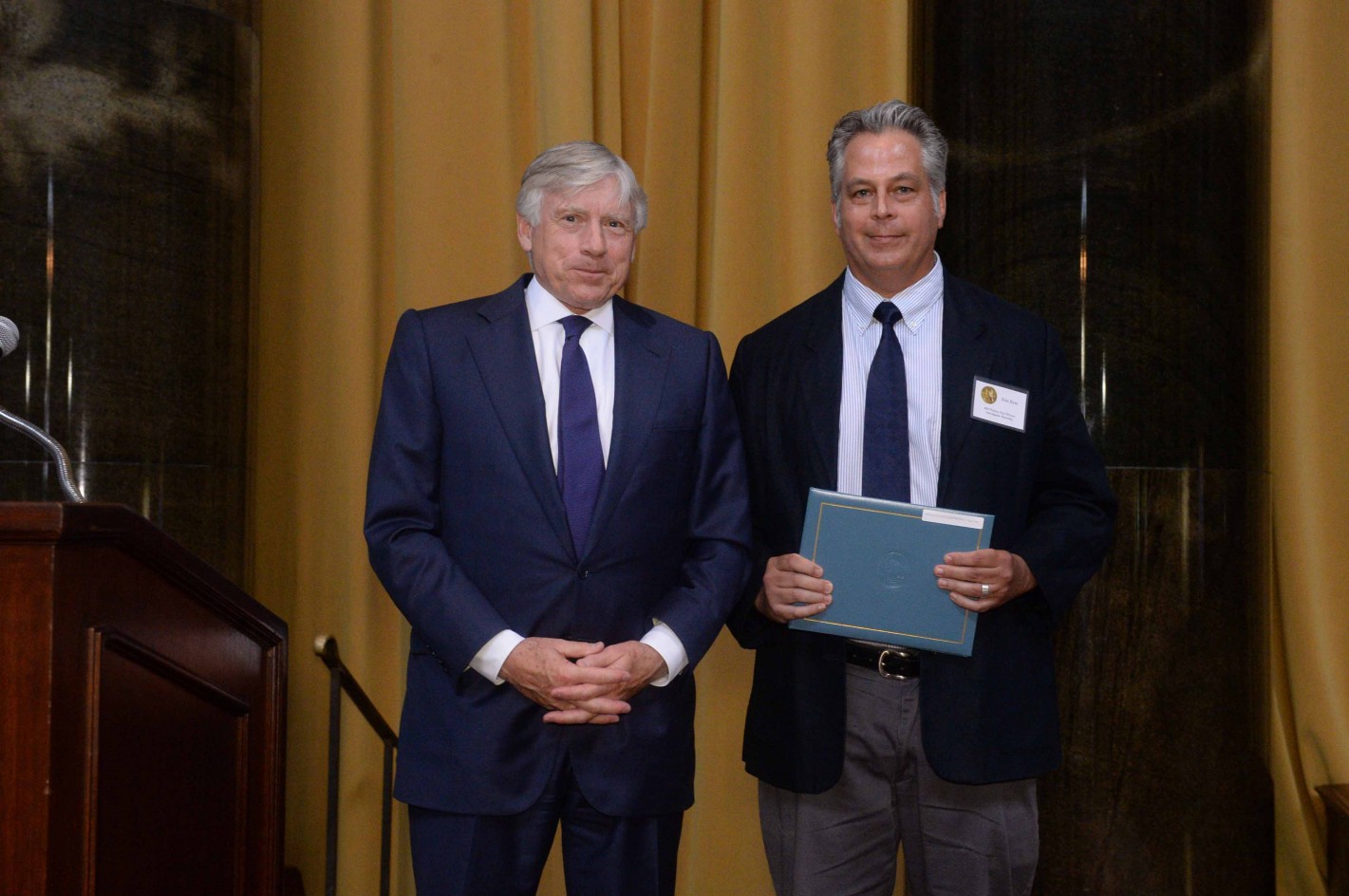
Eric Eyre of the Charleston (WV) Gazette-Mail accepts the 2017 Pulitzer Prize for Investigative Reporting from Columbia University President Lee C. Bollinger.
Winning Work
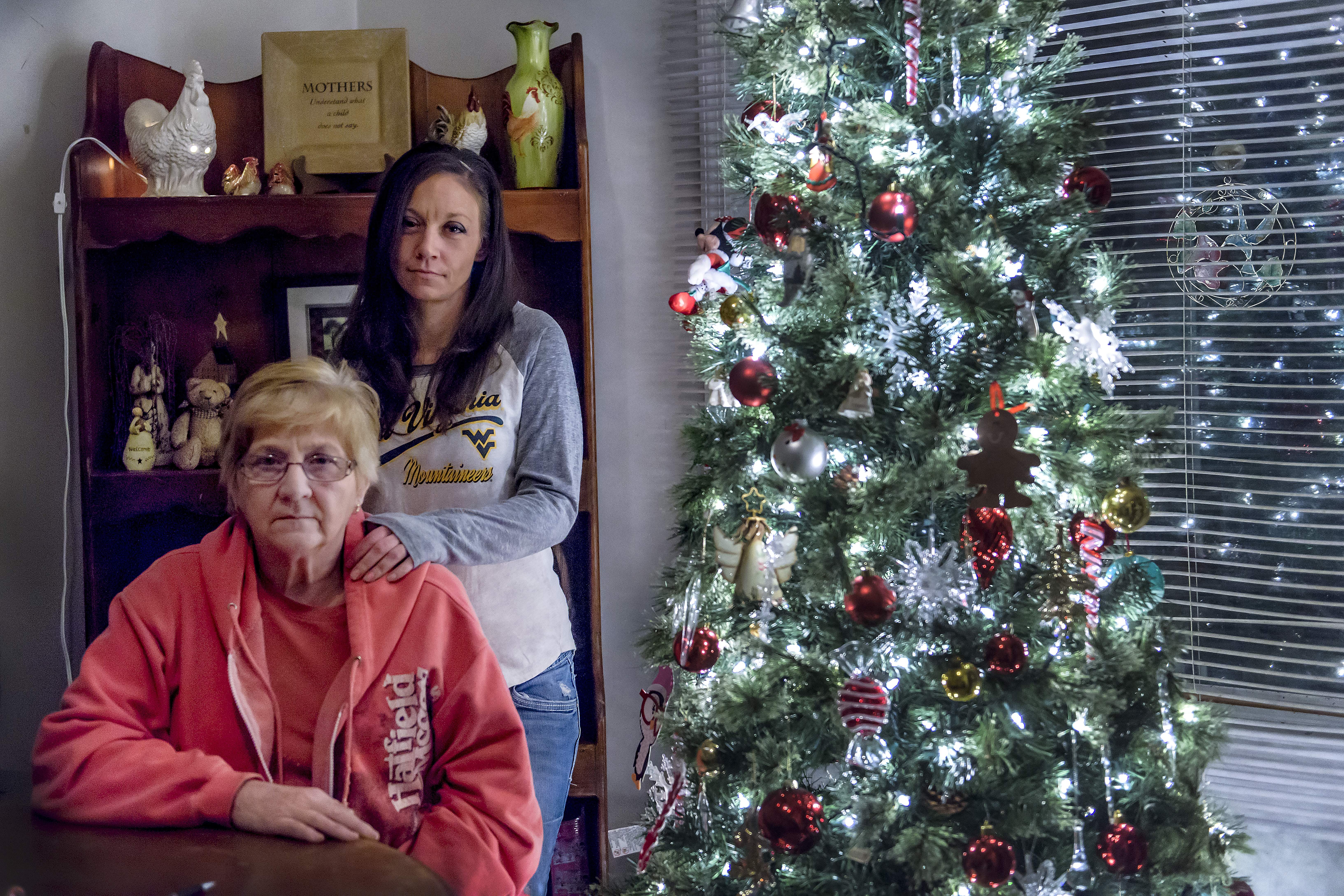
Kay Mullins (left) and Tiffany Vincent, mother and daughter of Mary Kathryn Mullins, pose for a portrait in the dining room of the house where they both live and where Mary Kathryn died of a drug overdose on Dec. 23, 2015. Over the years, Kay has helped raise her granddaughter Tiffany, who has also battled drug addiction, and her great-granddaughters, Kylie and Madyson. (Sam Owens/Gazette-Mail)
By Eric Eyre
Follow the pills and you'll find the overdose deaths.
The trail of painkillers leads to West Virginia's southern coalfields, to places like Kermit, population 392. There, out-of-state drug companies shipped nearly 9 million highly addictive — and potentially lethal — hydrocodone pills over two years to a single pharmacy in the Mingo County town.
Rural and poor, Mingo County has the fourth-highest prescription opioid death rate of any county in the United States.
The trail also weaves through Wyoming County, where shipments of OxyContin have doubled, and the county's overdose death rate leads the nation. One mom-and-pop pharmacy in Oceana received 600 times as many oxycodone pills as the Rite Aid drugstore just eight blocks away.
In six years, drug wholesalers showered the state with 780 million hydrocodone and oxycodone pills, while 1,728 West Virginians fatally overdosed on those two painkillers, a Sunday Gazette-Mail investigation found.
The unfettered shipments amount to 433 pain pills for every man, woman and child in West Virginia.
“These numbers will shake even the most cynical observer,” said former Delegate Don Perdue, D-Wayne, a retired pharmacist who finished his term earlier this month. “Distributors have fed their greed on human frailties and to criminal effect. There is no excuse and should be no forgiveness.”
The Gazette-Mail obtained previously confidential drug shipping sales records sent by the U.S. Drug Enforcement Administration to West Virginia Attorney General Patrick Morrisey's office. The records disclose the number of pills sold to every pharmacy in the state and the drug companies' shipments to all 55 counties in West Virginia between 2007 and 2012.
The wholesalers and their lawyers fought to keep the sales numbers secret in previous court actions brought by the newspaper.
The state's southern counties have been ravaged by a disproportionate number of pain pills and fatal drug overdoses, records show.
The region includes the top four counties — Wyoming, McDowell, Boone and Mingo — for fatal overdoses caused by pain pills in the U.S., according to CDC data analyzed by the Gazette-Mail.
Another two Southern West Virginia counties — Mercer and Raleigh — rank in the top 10. And Logan, Lincoln, Fayette and Monroe fall among the top 20 counties for fatal overdoses involving prescription opioids.
While the death toll climbed, drug wholesalers continued to ship massive quantities of pain pills.
Mingo, Logan and Boone counties received the most doses of hydrocodone — sold under brand names such as Lortab, Vicodin and Norco — on a per-person basis in West Virginia. Wyoming and Raleigh counties scooped up OxyContin pills by the tens of millions.
The nation's three largest prescription drug wholesalers — McKesson Corp., Cardinal Health and AmerisourceBergen Drug Co. — supplied more than half of all pain pills statewide.
For more than a decade, the same distributors disregarded rules to report suspicious orders for controlled substances in West Virginia to the state Board of Pharmacy, the Gazette-Mail found. And the board failed to enforce the same regulations that were on the books since 2001, while giving spotless inspection reviews to small-town pharmacies in the southern counties that ordered more pills than could possibly be taken by people who really needed medicine for pain.
As the fatalities mounted — hydrocodone and oxycodone overdose deaths increased 67 percent in West Virginia between 2007 and 2012 — the drug shippers' CEOs collected salaries and bonuses in the tens of millions of dollars. Their companies made billions. McKesson has grown into the fifth-largest corporation in America. The drug distributor's CEO was the nation's highest-paid executive in 2012, according to Forbes.
In court cases, the companies have repeatedly denied they played any role in the nation's pain-pill epidemic.
Their rebuttal goes like this: The wholesalers ship painkillers from drug manufacturers to licensed pharmacies. The pharmacies fill prescriptions from licensed doctors. The pills would never get in the hands of addicts and dealers if not for unscrupulous doctors who write illegal prescriptions.
In other words, don't blame the middleman.
“The two roles that interface directly with the patient — the doctors who write the prescriptions and the pharmacists who fill them — are in a better position to identify and prevent the abuse and diversion of potentially addictive controlled substance,” McKesson General Counsel John Saia wrote in a recent letter released by the company last week.
But the doctors and pharmacists weren't slowing the influx of pills.
Cardinal Health saw its hydrocodone shipments to Logan County increase six-fold over three years. AmerisourceBergen's oxycodone sales to Greenbrier County soared from 292,000 pills to 1.2 million pills a year. And McKesson saturated Mingo County with more hydrocodone pills in one year — 3.3 million — than it supplied over five other consecutive years combined.
Year after year, the drug companies also shipped pain pills in increasing stronger formulations, DEA data shows. Addicts crave stronger pills over time to maintain the same high.
“It starts with the doctor writing, the pharmacist filling and the wholesaler distributing. They're all three in bed together,” said Sam Suppa, a retired Charleston pharmacist who spent 60 years working at retail pharmacies in West Virginia. “The distributors knew what was going on. They just didn't care.”
'She just got hooked'
Mary Kathryn Mullins' path of dependence took her to pain clinics that churned out illegal prescriptions by the hundreds, pharmacies that dispensed doses by the millions and, on many occasions, to a Raleigh County doctor who lectured her about the benefits of vitamins but handed her prescriptions for OxyContin.
“She'd get 90 or 120 pills and finish them off in a week,” recalled Kay Mullins, Mary Kathryn's mother. “Every month, she'd go to Beckley, they'd take $200 cash, no insurance, and the pills, they'd be gone within a week.”
Mary Kathryn Mullins' addiction, her mother said, started after a car crash near her home in Boone County. Her back was hurting. A doctor prescribed OxyContin.
“She got messed up,” Kay Mullins said. “They wrote her the pain pills, and she just got hooked.”
Kay Mullins has a hard time talking about the 10 years that followed, all the lies her daughter told to cover her addiction, stealing from her brother, the time she shot herself in the stomach in an attempt to end her life.
Mary Kathryn Mullins would go to dozens of doctors for prescriptions. She was a “doctor shopper.”
Her mother can't recall most of the doctors by name. She said she believes the doctor who talked to her daughter about vitamins was recently in the news after being charged with prescription fraud. Many rogue pain clinics have been shut down in recent years.
“She'd go to his house in the woods for prescriptions,” Kay Mullins said.
There also were stops at multiple pharmacies in Madison, Logan, Beckley and Williamson. Mary Kathryn Mullins always would find a way to get pills. She kept most for herself, but sometimes she sold them to others, her mother said.
“It tore my family up,” said Kay Mullins, who works at a flower shop in Madison. “You don't sleep. One time she would be OK, and you think she would come out of it, but then something else happens.”
Last December, Mary Kathryn Mullins' hunt for pain pills led her to South Charleston. A doctor prescribed her OxyContin and an anti-anxiety medication, her mother said. A pharmacy in Alum Creek filled it.
Two days later, she stopped breathing in her bed. Her brother, Nick Mullins, a Madison police officer, responded to the 911 call. He tried chest compressions, but he could not revive his sister.
At age 50, Mary Kathryn Mullins was dead.
After the funeral, her mother had one last thing to do. She found an appointment reminder card for Mary Kathryn Mullins' next scheduled visit to the doctor who wrote her final prescription. She dialed the phone number of the doctor's office and spoke to the receptionist.
“I told her my daughter was there Dec. 20,” Kay Mullins recalled. “I said, 'Y'all wrote these prescriptions, and she's gone Dec. 23. I just wanted to let you know she won't be back.'”
Drug wholesalers made billions
In the drug distribution industry, they're called the “Big Three” — McKesson, Cardinal Health, AmerisourceBergen — and they bear no resemblance to the mom-and-pop pharmacies that ordered massive quantities of the drugs the wholesalers delivered in West Virginia.
The Big Three wholesalers together are nearly as large as Wal-Mart, with total revenues of more than $400 billion. Their revenues account for about 85 percent of the drug distribution market in the U.S.
Between 2007 and 2012 — when McKesson, Cardinal Health and AmerisourceBergen collectively shipped 423 million pain pills to West Virginia, according to DEA data analyzed by the Gazette-Mail — the companies earned a combined $17 billion in net income.
Over the past four years, the CEOs of McKesson, Cardinal Health and AmerisourceBergen collectively received salaries and other compensation of more than $450 million.
In 2015, McKesson's CEO collected compensation worth $89 million — more money than what 2,000 West Virginia families combined earned on average.
“What's most remarkable is that the boards of the companies are paying the CEOs as if they were innovators and irreplaceable entrepreneurs, when in fact they are just highly paid middlemen, betting on market consolidation and ever-rising drug prices,” said Ken Hall, international secretary-treasurer of the Teamsters union.
Last month, the Teamsters sent a letter to McKesson board members urging them to investigate allegations raised by Morrisey in a lawsuit he filed against the company earlier this year. The complaint alleges McKesson “flooded” West Virginia with pain pills and gave bonuses and commissions to employees based on sales of highly addictive prescription drugs. The Teamsters' pension funds hold a stake in McKesson.
In a letter to the Teamsters released by McKesson last week, the company denied it gave incentives to executives and other personnel for sales of controlled substances.
McKesson added Morrisey's lawsuit assigns blame to drug wholesalers for West Virginia's opioid crisis “without acknowledging the role played by doctors, pharmacists and the regulatory agencies that oversee doctors and pharmacists.”
“McKesson's shipments were in response to orders placed by these registered entities,” the company's chief lawyer wrote. “Thus, McKesson lawfully shipped controlled substances to registered pharmacies.”
A spokesman for AmerisourceBergen suggested health experts and law enforcement authorities would be better able to comment on whether there's a link between pain-pill volumes and overdose deaths.
Cardinal Health said it shipped 3.4 billion doses of medication in West Virginia between 2007 and 2012. So hydrocodone and oxycodone sales made up about 17 percent of the company's shipments.
“All parties including pharmacies, doctors, hospitals, manufacturers, patients and state officials share the responsibility to fight opioid abuse,” said Ellen Barry, a spokeswoman for Cardinal Health.
In Southern West Virginia, many of the pharmacies that received the largest shipments of prescription opioids were small, independent drugstores like ones in Raleigh and Wyoming counties that ordered 600,000 to 1.1 million oxycodone pills a year. Or they were locally owned pharmacies in Mingo and Logan counties, where wholesalers distributed 1.4 million to 4.7 million hydrocodone pills annually.
By contrast, the Wal-Mart at Charleston's Southridge Centre, one of the retail giant's busiest stores in West Virginia, was shipped about 5,000 oxycodone and 9,500 hydrocodone pills each year.
Firms shipped stronger pain pills
At the height of pill shipments to West Virginia, there were other warning signs the prescription opioid epidemic was growing.
Drug wholesalers were shipping a declining number of oxycodone pills in 5 milligram doses — the drug's lowest and most common strength — and more of the painkillers in stronger formulations.
A DEA agent warned Morrisey's aides about the disturbing trend in January 2015, according to an email released by the attorney general in response to a Freedom of Information Act request from the Gazette-Mail.
Between 2007 and 2012, the number of 30-milligram OxyContin tablets increased six-fold, the supply of 15-milligram pills tripled and 10-milligram oxycodone nearly doubled, the DEA records sent to Morrisey's office show.
In the email to Morrisey, DEA agent Kyle Wright said the higher-strength oxycodone pills were commonly abused.
The DEA agent sent Morrisey's office a separate email about hydrocodone shipments to the state. West Virginia pharmacies were mostly buying 10-milligram hydrocodone tablets — the most potent dosage at the time.
Once hooked on painkillers, addicts typically demand higher and higher doses.
Chelsea Carter, a recovering 30-year-old addict who now works as a therapist at a drug treatment center in Logan County, remembers crushing, snorting and injecting OxyContin — always wanting the strongest pills she could get her hands on. She once shot up with eight to 10 doses of oxycodone, passed out and woke up with the needle still stuck in her arm.
“You're turned on to this potent substance, and your tolerance grows,” said Carter, who quit using pills in 2008, the day she went to jail after taking part in a theft ring that sold stolen goods for painkillers.
“When they handcuff you, and you walk through the doors, and you're in an orange jumpsuit and they slam the doors behind you, that's when you wonder, 'is two to 20 years worth it for one OxyContin?'” Carter said. “That's when I hit my knees and prayed, 'Lord, if you ever bring me out of this, I'll never touch another drug again.'”
The addicted come to see Carter at the clinic just off Main Street in downtown Logan. They want to get off pain pills or heroin — a street drug causing more and more overdose deaths in West Virginia every year.
They talk to Carter, eight to 10 of them a day. They've lost children, parents, grandparents. They've lost homes. They're tired of living that way.
Carter listens and tells them her story, how every day she wakes up and makes a decision not to use pills.
“I've buried a lot of friends from drug addiction,” Carter said. “I don't want to bury another one.”
Her trail follows the direction of hope.
Gazette-Mail staff writer Andrew Brown contributed to this story.
By Eric Eyre
Tucked in the West Virginia Code of State Rules, you'll find a three-sentence regulation designed to keep in check the flow of prescription pills into the state.
The rule directs wholesale distributors to set up systems to identify “suspicious” orders for highly addictive narcotics. It requires the wholesalers to report those questionable orders to the pharmacy board.
And the regulation spells out what orders should be flagged: those “of unusual size, orders deviating substantially from a normal pattern, and orders of unusual frequency.”
But the rule, which has the force and effect of state law, wasn't on the pharmacy board's radar when the pain pills were pouring into Southern West Virginia. And the drug companies, for years, ignored it.
“It's not been an item that's ever been enforced by the board,” said David Potters, the pharmacy board's executive director.
Between 2001 and June 2012, the pharmacy board received just two reports — both from Cardinal Health. Since then, more than 7,200 reports about suspicious drug orders have been faxed in.
What changed? On June 26, 2012, former Attorney General Darrell McGraw filed lawsuits against Cardinal Health, AmerisourceBergen and a dozen other wholesalers. The lawsuits alleged the companies shipped an excessive number of pain pills to West Virginia — and failed to report suspicious orders from pharmacies. The complaint put a spotlight on the reports.
Two days later, Cardinal Health started faxing a steady stream of reports — about 40 a month — to the pharmacy board. McKesson Corp. waited until March 2015 to start sending in its reports on drug orders it deemed suspicious — a year after West Virginia Attorney General Patrick Morrisey started investigating the drug company.
The rule about suspicious orders doesn't dictate what the pharmacy board is supposed to do with the reports. So the board shelved them — every one.
The pharmacy board didn't investigate. It never contacted the wholesalers or pharmacies. It didn't pass the reports along to law enforcement authorities.
So pharmacies could order scores of powerful painkillers at will with no scrutiny — at least from state regulators.
At Tug Valley Pharmacy in Mingo County, for instance, sales orders for the painkiller hydrocodone jumped from 820,000 pills in 2007 to more than 2.4 million in 2008 and more than 3 million in 2009, U.S. Drug Enforcement Agency records show. But the increases didn't prompt wholesalers to send a single suspicious order report about Tug Valley to the pharmacy board those years.
Two weeks ago, the Gazette-Mail inspected the reports, which are stored in two banker's boxes at the board office. The agency doesn't keep track of the number of suspicious order reports on file.
A hand count showed Cardinal Health submitted at least 2,428 reports, while McKesson identified 4,814 suspicious orders from West Virginia pharmacies. Masters Pharmaceuticals turned in 10 reports, and Smith Drug Co. filed one report.
Cardinal Health submits its reports monthly — a single page for every suspicious order. McKesson faxes in spreadsheets that list hundreds of suspicious orders from pharmacies across the state.
Nine months of Cardinal Health reports were missing from the board's file.
“They were apparently never filed and lost,” Potters said in an email to the Gazette-Mail.
After paying scant attention to the rule for years, the pharmacy board voted unanimously last week to send letters to drug wholesalers, asking them to report suspicious orders. The board plans to forward the reports to Morrisey's office.
“We need to work this,” said pharmacy board President Dennis Lewis. “We're going to work on it hard.”
The board had never publicly discussed the reporting requirement until Monday. And there's no record that the board ever notified the distributors of the suspicious order rule.
“For many years, the board didn't really want suspicious order reports,” said Rebecca Betts, a lawyer for drug wholesaler H.D. Smith Drug Co., at last week's meeting.
The DEA also requires drug wholesalers to report suspicious orders. The West Virginia rule was copied almost word for word from the DEA's rule.
The rule doesn't specifically name wholesale distributors. It refers to “registrants.” The DEA registers drug wholesalers and pharmacies. The pharmacy board licenses both.
“I think the rule was poorly written,” Potters said. “It should have said 'wholesaler.'”
The drug companies have racked up huge fines for failing to report suspicious orders in other states.
In 2008, McKesson agreed to pay a $13.2 million fine to settle claims it failed to report hundreds of suspicious orders from internet pharmacies that sold drugs online to customers who didn't have legal prescriptions.
During a corporate earnings call shortly after the company paid the fine, McKesson CEO John Hammergren said, “As you are probably aware, diversion of controlled substances has been an industry issue. Nothing is more important to our industry than the safety and integrity of our drug supply chain.”
But seven years later, with Hammergren still CEO, McKesson was back in hot water for the same offense. The drug company paid a $150 million fine and suspended operations at four warehouses to settle a federal investigation into McKesson's suspicious order reporting practices.
The DEA also has sanctioned Cardinal Health for not reporting suspicious orders.
In 2008, the company paid a $34 million fine for failing to report suspicious sales of hydrocodone — sold under brand names like Lortab. In 2012, the DEA suspended Cardinal Health from shipping painkillers and other drugs from its Lakeland, Florida, warehouse for two years. The federal agency said Cardinal Health did not report suspect orders from four Florida pharmacies.
The distributors have denied any wrongdoing. Spokeswomen for McKesson, Cardinal Health and AmerisourceBergen declined to comment on the suspicious order reports last week.
In court cases, drug wholesalers have railed against the DEA.
The DEA won't let the distributors see their competitors' drug shipments to pharmacies — sales data that could identify drugstores that place painkiller orders from multiple suppliers.
The DEA also turned down a request to mask wholesalers' names and release pill orders from pharmacies, according to the companies. Records about doctors who write prescriptions and patients who receive opioids also are off limits to distributors, even though the state pharmacy board tracks that information in a database.
“Wholesalers don't know what other wholesalers are doing, so we're getting multiple suspicious order reports from one pharmacy from multiple wholesalers,” said Vaughn Sizemore, a deputy attorney general who's helping the pharmacy board figure out what to do with the reports.
At the meeting last week, Sizemore suggested the pharmacy board change its rules and require drug wholesalers to send suspicious order reports directly to the attorney general. State lawmakers would have to approve the change.
Morrisey, who represented Cardinal Health and lobbied for the drug wholesale industry in Washington, D.C., before taking office in 2013, has already put West Virginia pharmacies on notice about their role in the state's prescription drug epidemic.
Earlier this month, Morrisey filed suit against Larry's Drive-In Pharmacy in Boone County, alleging the store “blindly” filled suspicious prescriptions and dispensed an “extraordinary” number of pain pills — 10 million doses in 11 years.
McKesson has submitted 34 reports about drug orders at Larry's to the pharmacy board this year, the Gazette-Mail found during its hand count. The pharmacy board has never asked wholesalers whether they fill drug orders they've reported as suspicious. Nor has the board checked with the pharmacies it regulates.
“We've never gotten that detail,” Lewis said.
Gazette-Mail staff writer Andrew Brown contributed to this report.
By Eric Eyre
Over five years, the nation's largest drug wholesalers flooded notorious “pill mill” pharmacies in West Virginia's smallest towns and poorest counties with hundreds of thousands of painkillers, according to court records the companies had sought to keep secret for more than a year.
The prescription drug distributors shipped large quantities of oxycodone and hydrocodone tablets to small towns like War, Kermit, Oceana, Van and Crab Orchard, supplying mom-and-pop pharmacies that filled prescriptions from doctors, some of whom were later convicted of federal crimes.
Some examples: H.D. Smith Drug Wholesale Co. sold 39,000 pain pills over two days to two Mingo County “sham” pharmacies located within four blocks of one another, according to allegations in the court records. Another prescription drug distributor, Top Rx, shipped more than 300,000 tablets of hydrocodone — known better under brand names like Lortab and Vicodin — over four years to a McDowell County pharmacy in the town of War, population 808. That amounts to 350 hydrocodone pills per person in War.
“The distribution of vast amounts of narcotic medications to some of the smallest towns and unincorporated rural areas of our state should have set off more red flags than a school of sharks at a crowded beach,” said Delegate Don Perdue, D-Wayne. “In this case, perhaps the most unfortunate aspect was that the sharks controlled not only the distribution of the drugs, but the warning flags as well.”
On Monday, Boone County Circuit Judge William Thompson ordered the release of previously sealed court documents that include details about the companies' pill shipment records to specific pharmacies in Southern West Virginia.
Thompson's ruling follows a Charleston Gazette-Mail motion to unseal a revised complaint that's part of a state lawsuit. The complaint alleges the firms shipped an excessive number of pain pills to West Virginia between 2007 and 2012, helping to fuel the state's ongoing prescription drug problem.
The drug companies repeated their request to keep the court records under wraps Monday morning. They've been fighting the release of the pain-pill shipment numbers since January 2015.
“Our position is, this is proprietary data,” said A.L. Emch, a Charleston lawyer, who represents AmerisourceBergen Drug Corp., one of the companies being sued by the state. “No good reason exists at this point to disclose that information.”
The judge disagreed, and two hours later he ordered the release of the court records.
Thompson redacted, or blacked out, pill shipment information for seven drug wholesalers that have reached settlement agreements with the state. Six of those companies agreed to settle with the state over the past two weeks — after the newspaper filed its motion to intervene.
The court records released Monday include pill shipment records supplied by the prescription drug wholesalers and the U.S. Drug Enforcement Administration to lawyers representing the state Attorney General's Office, Department of Health and Human Resources, and the state Department of Military Affairs and Public Safety.
The documents show that over the five-year span:
- AmerisourceBergen, the nation's third largest drug distributor, shipped 60.9 million hydrocodone pills and 26.6 million oxycodone tablets to West Virginia. That's 33 hydrocodone pills and 15.5 oxycodone pills for every man, woman and child in West Virginia.
In 2009 alone, AmerisourceBergen supplied 149,000 hyrocodone pills, or 12,400 tablets a month to a single pharmacy in Williamson, Mingo County, according to the state's lawsuit. Three doctors who wrote prescriptions at that pharmacy were indicted on federal charges the following year.
Over two days in 2012, AmerisourceBergen also shipped 8,000 hydrocodone pills to a “drive-in” pharmacy in Boone County.
The company issued a statement Monday.
“At AmerisourceBergen, we are committed to the safe and efficient delivery of controlled substances to meet the medical needs of patients,” said Lauren Moyer, a company spokeswoman. “We work diligently to combat diversion and are working closely with regulatory agencies and other partners in pharmaceutical and healthcare delivery to help find solutions that will support appropriate access while limiting misuse of controlled substances.”
- Drug wholesaler H.D. Smith shipped 12.4 million hydrocodone pills and 3.2 million oxycodone tablets to West Virginia.
In January 2008, the company distributed as many as 157,400 hydrocodone tablets to Hurley Pharmacy, a “pill mill” in Williamson, according to the lawsuit complaint released Monday. The complaint characterizes the one-month shipment as “suspicious … and a gross violation of the [company's] legal duty not to distribute controlled substances being used for non-legitimate purposes.”
- Masters Pharmaceuticals supplied 1.5 million hydrocodone pills and 859,000 oxycodone pills to pharmacies in West Virginia.
Between December 2011 and May 2012, Masters distributed 11,400 oxycodone, hydrocodone and morphine pills to a pharmacy in the Boone County town of Van, which has 211 people. That amounts to 63 pills for each Van resident per day.
The lawsuit also spotlights Masters' shipments to pharmacies in rural areas of Raleigh, McDowell, Logan, Putnam and Marshall counties.
“The foregoing distributions were supplied to entities with a population base which could in no legitimate way consume the volume of drugs being distributed,” the complaint alleges.
- Top Rx shipped 1.7 million hydrocodone tablets to West Virginia. The lawsuit doesn't list the company's oxycodone numbers.
The bulk of Top Rx's painkiller shipments went to Wayne and McDowell counties, places designated by state and federal authorities as “high-intensity drug-trafficking areas,” according to the lawsuit.
The state's complaint — initially filed by former Attorney General Darrell McGraw in 2012 and inherited by his successor Patrick Morrisey the following year — alleges the drug companies turned a blind eye to the suspicious prescription drug orders by West Virginia pharmacies and profited from the state's pain-pill epidemic.
West Virginia has the highest drug overdose death rate in the nation, and the deaths are climbing. Oxycodone and hydrocodone are the most widely abused prescription painkillers, and contribute to more overdose deaths in the state than any other drug.
West Virginia spends more than $430 million a year on problems caused by prescription drug abuse, according to the state's lawsuit.
In previous filings, the drug wholesalers have said raw pill counts can be misleading. The companies argue that their total distribution numbers, and the percentage of sales of controlled substances compared to all drugs, would put the shipping records in better context.
Biography
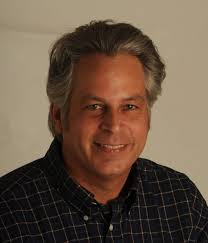
Eric Eyre is a statehouse reporter for the Charleston (W.Va.) Gazette-Mail. He joined the newspaper in 1998, after working as an intern at the St. Petersburg Times. At the Gazette-Mail, he has covered education, health and business. Eyre's work has won several national awards, including the Investigative Reporters & Editors (IRE) Medal, Fred M. Hechinger Grand Prize in Education Reporting from the Education Writers Association, National Headliners Award, Society of American Business Editors and Writers award, Gerald Loeb Award for business writing, and an Association of Health Care Journalists award. He also was the recipient of a Kaiser Family Foundation fellowship. His investigative stories have mostly spotlighted issues in rural West Virginia communities. A native of Broad Axe, Pa., Eyre graduated from Loyola University of New Orleans and received a master's degree from the University of South Florida while on a Poynter Fund Fellowship.