The New Yorker, by Hilton Als

As Pulitzer Prize Administrator Mike Pride (left) looks on, Hilton Als of The New Yorker accepts the 2017 Pulitzer Prize for Criticism from Columbia University President Lee C. Bollinger.
Winning Work
By Hilton Als
All this talk about diversity—in newspapers, on college campuses, at the Oscars—can be hard on a liberal white guy. How’s a sensitive Caucasian man—no Trumpite—supposed to deal with so much political climate change, so many “other” demands? Take women, for instance. They want equal pay. Shouldn’t they be in line for restitution, too? Then you have people of color lobbying for fair representation—whatever that means. And there’s the L.G.B.T. community, and—on and on. It’s enough to make you want to hand in your rhythm-challenged-dude card and light out for the territories, someplace where you can forget yourself. But you can’t, because you’re white, a stigmatized presence in a world that associates you with incomprehension, callousness, and a sort of confused humanity, if it sees you as human at all.
In Danai Gurira’s fantastically well-realized “Familiar” (at Playwrights Horizons), the first white guy we see is Chris (Joby Earle), a human-rights activist, who, in his overly eager desire to be “inclusive”—or included—aims to achieve the impossible: to make up for all the death and destruction that white men have brought to people everywhere, but especially to the Zimbabweans who lived under colonial rule, like the parents of his fiancée, Tendi Chinyaramwira (Roslyn Ruff). Chris is a thin, curly-haired boy-man who wants to do right by Tendi in their marriage, which starts tomorrow. But you get the feeling, once you meet his betrothed, that Chris’s caring is just emotional chump change to her; a successful lawyer, Tendi is all about accruing power in this cold world. When she deigns to smile, it’s tight and lasts only a second; she has no time to spare, and is anxious to seal the deal with Chris so that she can move forward with the life she has planned—with a little help or insistent “inspiration” from her mother, Marvelous (Tamara Tunie).
Tendi, who has just had her hair braided, in a halfhearted nod to her African heritage, embodies her mother’s dreams of passing in this country. Her younger sister, Nyasha (Ito Aghayere, by turns comedic, furious, and touching), isn’t so confident. She wants to connect with her family’s past, but when she tries to talk to her mother about a recent trip to Zimbabwe Marvelous more or less brushes her off. Sporting flip-flops and a T-shirt, her hair a bit wild, Nyasha is a natural beauty and an artist, the opposite of her older sister, who wears elegant brown boots and walks with purpose through what is, to her, a calculable and thus manageable world.
There’s another sibling about, too—Marvelous’s sister Margaret (Melanie Nicholls-King). In order to survive her relationship with the strong-willed Marvelous, Margaret has put up certain defenses; she’s funny, caustic, and relatively nonjudgmental. (Nicholls-King’s characterization is exceptional; she inhabits, and loves, this sometimes wounded, sometimes chirping bird.) You can tell, by their joking tenderness with each other, that this unmarried aunt is Nyasha’s buoy in a turbulent familial sea. But although Margaret wears a luxurious weave, in counterpoint to her nieces’ plainer locks (Gurira’s insights into what hair means in black culture are shrewd and subtle), it sits on her head like a hat meant to cover up the personal sadness she has experienced, as well as all that she has failed to achieve professionally—according to Marvelous, at least. One way that Margaret copes with her regret is by walking over to the breakfront and silently pouring herself a little red wine: self-medication may be a habit.
A family gathering for a wedding is such an old dramaturgical trope that I usually blank out when I come across it. The story rarely varies. The bride will fall for her sister’s best friend, while the drunken groom sleeps with his high-school sweetheart because she’s his “home”—the only person who really understands him. I steeled myself against such conventions as Gurira’s play got under way and predictable situations were trotted out, such as the toothsome, self-consciously liberal Chris showing up moments after Marvelous’s other sister, a strict Africanist named Anne (Myra Lucretia Taylor, who knows that she has a job to do and does it), deplanes from Zimbabwe. You get the picture: First World meets Third, white versus black, and so on.
I’m sure that Gurira, an accomplished actress herself (she’s best known for her work on AMC’s “The Walking Dead”), knew that her story risked falling into cliché unless she did what she so brilliantly does here: stay within the reality of the characters and their voices. Working in a naturalistic comedic tradition that black female playwrights such as Lorraine Hansberry and Alice Childress helped shape, Gurira has a nearly unerring ear for how to make popular theatre without compromising authenticity. Born in Iowa in 1978, Gurira grew up in Zimbabwe from the age of five. (Her parents moved back a few years after the country gained its independence.) Gurira returned to the U.S. for college, and began writing in order, she has said, to get stories out into the world which reflect her own experiences and encounters. Her 2009 play “Eclipsed,” about women suffering and surviving during Liberia’s second civil war, premièred at the Public in 2015 and moved uptown earlier this year, with the first all-black, all-female cast ever to play on Broadway. In a recent essay, Gurira wrote that she sees herself as a “cultural schizophrenic.” She added, “Sometimes these two radically different cultural identities merge in me . . . sometimes they fight each other.” Like any first-class playwright, Gurira has an innate talent for externalizing her many selves, allowing them to speak without crowding one another or becoming trite.
In “Familiar,” she shows us an immigrant experience that we know relatively little about—what it’s like to be African in the American heartland—and she avoids exoticizing any of the women, who find both discord and love in one another, as the old world settles, in unsettling ways, into the new. Anne argues for traditional African marriage customs, but Tendi doesn’t want to deal with that archaic nonsense; plus, she’s a Christian, a “white” religion. Chris is more coöperative. He brings his brother, Brad (Joe Tippett), to the Chinyaramwira home to help fulfill at least part of the ceremony.
Gurira, like her director, the committed and never emotionally uninteresting Rebecca Taichman, has an incredible sense of comedy and how it plays against pathos. But Tippett takes it to another level; he is one of the best actors I’ve seen in ages. His Brad is so natural in his masculinity and in his bemused willingness to help without understanding much, except what he’s attracted to—which is to say, after a while, the skeptical and then flirtatious Nyasha—that you start to laugh even before he speaks a line. Unlike Chris, Brad is no high achiever, but he doesn’t apologize for his presence, either. He’s a little too familiar with Anne at first, and when he has to backtrack and pay appropriate respect it’s like watching someone on a suddenly fast-moving treadmill—you don’t want him to fall off, especially since he makes a game out of staying on. That’s Brad: a sport, in the best sense of the word, and a kind of guileless hero, a pure soul in a world of complicated spirits.
Ruff is a decent performer, too, but over and over she has been cast as a priggish black woman swimming in recrimination. In the past performances I’ve seen, she has lacked both a sense of humor and a rapport with her male co-stars. Taichman tries to loosen her up here, but all Ruff can do is what she always does, which is rage at the indignity, perhaps, of being black in a largely white medium. Gurira has given her a powerful character to play, filled with dash and flawed capability. Instead of listening to her own pain, Ruff should listen to what Gurira has to say, and to the compassion and joy that inform how she says it.
By Hilton Als
How can someone ever truly know the work of another?” So says the irrepressible publisher Mrs. Bubis (played by the irrepressible Janet Ulrich Brooks) to Jean-Claude Pelletier (Lawrence Grimm) and Manuel Espinoza (Demetrios Troy), two academics she is entertaining smartly in her Hamburg home. The French Pelletier and the Spanish Espinoza, one tall, the other dark, have travelled from their respective countries to meet the great woman. Actually, the flirtatious Mrs. Bubis may not be that great, but she has an aura of greatness, if only by association: she’s responsible for putting out the work of the elusive postwar German writer Benno von Archimboldi, as was her late husband. Pelletier and Espinoza became obsessed with Archimboldi as students, and it’s exciting and frustrating for them to hear about him from his former associate: Archimboldi left so little biographical information behind. Still, his life as an artist is on full display in his fiction, which inspires any number of fantasies in the minds of his readers, including these feverish academics, who treat Mrs. Bubis’s sitting room as a kind of shrine.
This amusing, slightly unholy trinity is the invention of the late Chilean writer Roberto Bolaño, in his long, alternately phantasmagoric and reportorial novel “2666,” adapted, with incredible care and a certain amount of pride, by Robert Falls and Seth Bockley, who also co-directed the show (at the Goodman, in Chicago). In the novel, Bolaño asks the same question as Mrs. Bubis, but with a twist: How much can we know about any life, beyond its metaphors—its myths, its storytelling, its lies?
Bolaño was born in Santiago in 1953, the son of a schoolteacher and a truck driver and occasional boxer. Beside his more robust father, Bolaño was awkward, thin, and bookish, in a culture that valorized machismo. As a teen-ager, he moved to Mexico, where he dropped out of school and eventually found work as a journalist. In 1973, inspired by socialist change at home, he went back to Chile, only to be arrested, along with other intellectuals, after Pinochet’s right-wing coup. (Rescue came in the shape of two former classmates, now prison guards, who orchestrated his release.) In the late seventies, Bolaño settled in Spain, where he supported himself as, variously, a bellhop and a garbage collector. Often writing at night, he produced some two dozen books of fiction and poetry before his death, from liver failure, in 2003. “2666” was published the following year. One wonders less what he would have made of the present adaptation of his nearly nine-hundred-page novel than how he might have incorporated the process of adapting “2666” into his own work: a dominant theme in Bolaño’s fiction is alchemy—how some thing or person can metamorphose into a completely different element or being.
“2666” is divided into five “books.” The first, “The Part About the Critics” (which Falls and Bockley retitled “The Part About the Academics”), strikes me as the strongest, in its ability to balance the fantastic with absurd realism—the absurd part being how love rubs up against our attraction to, and need to challenge, power. Falls and Bockley open the play at a conference somewhere in Europe; Pelletier and Espinoza, dressed in the drab, ill-fitting clothing of underpaid tenure-track scholars, are arranging several tables into a dais. Each describes how the other first came across Archimboldi’s work, as more scholars of the German master’s œuvre are introduced, including the beautiful British academic Liz Norton (Nicole Wiesner) and the Italian Piero Morini (Sean Fortunato). The colleagues become friends, and friendly rivals, united by their admiration for a writer whose own work is rarely quoted. The absence of Archimboldi’s texts only makes him loom larger in the audience’s imagination, just as the fact that none of the academics share a language—and all had to learn Archimboldi’s in order to read him—hovers over the proceedings, reminding us that the drama being enacted is partly about language itself.
To all that, “2666” adds the confusion of love and desire. Pelletier and Norton hook up, and then she turns, in a fit of pique, to Espinoza. Norton isn’t seeking only sex or attention; she wants to extract some kind of revenge for the way her work is sometimes trivialized in the academic world because she’s a woman. When Espinoza and Pelletier fight over her, she points out that it’s their male urge to compete and possess that fucks them up. She says, “All because of some patriarchal obsession over how many lovers I have at any given time? Who cares?” Still, Pelletier can’t help identifying with his gender. At one point, somewhat ruefully and tenderly, he describes Espinoza’s feelings for Norton, which he sees as a mirror to his own:
First, the need to be near Liz Norton struck sometime before he got back to his apartment in Madrid. By the time he was on the plane he’d realized that she was the perfect woman, the one he’d always hoped to find, and he began to suffer. Second, among the ideal images of Norton that passed through his head as the plane flew towards Spain, there were more sex scenes than I had imagined.
In Bolaño’s world, what is imagined is equal to what is enacted; reality is provisional. Although Falls and Bockley do a fine job of making that clear, it’s not an inherently dramatic point of view: naturalistic plays like this always argue, ultimately, for realism. And, as the five-and-a-half-hour piece goes on, accumulating fantasies, characters, and scenes of violence—Part IV, “The Part About the Crimes,” for instance, describes a series of killings of women in Mexico and how the murders went unsolved for years, probably because the victims were female—it becomes more traditional, too, despite the many storytelling styles that Falls and Bockley employ. (Some sections are narrated in the first person, some in the third, and there are a number of devices, including video and sound, which—with one boringly dodgy exception, when a stereotypical angry black male voice plays over the loudspeaker—don’t seem slick or trendy, because, as a whole, the piece is guileless.) I don’t know if the collaborators felt constricted by the Bolaño estate or by the text, but the entire script would have opened up if they’d forgone the American penchant for the linear narrative and used Bolaño’s fantastical elements as a jumping-off point from which to dream their own version of “2666.”
Instead, we get an overload of plot, and, by the end of the spectacle, the story feels resolved, wrapped up, depthless. That’s when we meet Hans Reiter (Mark L. Montgomery). A hapless former German soldier, Hans became Archimboldi the way anyone becomes an artist: through the accidents of history and culture. Watching the final act, I thought back to Part I, the part in which the play’s themes are most successfully demonstrated. The academics are defined by conflicts that are dramatic, without being dramatic themselves. They’re smart but emotional lunkheads, too aware that the world doesn’t prize their brand of thinking. They defend themselves and their marginalization by being smug to “lesser” outsiders when they can. On a visit to London, Pelletier and Espinoza cuddle with Norton in the back seat of a taxi, while the taxi-driver (Adam Poss) looks on. When Norton suggests that he’s lost, the driver says, “The labyrinth of London disorients me.” Noting that he’s quoting Jorge Luis Borges, Norton, ever the persnickety academic, challenges him; she wants to top him with her knowledge, or be topped by his presumed lack of cultivation. Others, before Borges, observed the same thing, she says, Dickens, for one, and Robert Louis Stevenson. The driver, who knows this is a putdown, puts Norton down in the only way a man can—by turning her sexuality into a negative, saying, “In my country, there is a word for what she is.”
Pelletier and Espinoza are soon beating the man nearly to death, their prejudices punctuating their punches. “Shove Islam up your ass,” Espinoza shouts. “This one is for Salman Rushdie!” Literature as an occasion for hate, a hate crime as an occasion for the academic to exercise his power as a “real” man: like the best of Falls and Bockley’s “2666,” this scene shows, rather than tells, what Bolaño, that gawky, sensitive son of machismo’s brutalities and bigotry, saw everywhere—force winning out over dialogue, no matter how carefully rendered.
By Hilton Als
When Kurt Weill, Ira Gershwin, and Moss Hart put together the musical “Lady in the Dark,” in 1940, Freud was big. The great man’s thinking had yet to come under wide attack, and psychoanalysis—at least, here in America—was still a relatively new phenomenon, a science for the privileged. Liza Elliott, the protagonist of the musical, who runs a fashion magazine called Allure, has lots of power but no outward oomph. Depressed and anxious, she works with her analyst to figure out why she, an arbiter of taste, can’t take her own editorial advice and swathe herself in furs and delicious self-regard. As her story is revealed through troubled dreams, it turns out that Daddy and the other men who rejected Liza early on are responsible for all that drabness and repression. Once she gets to the bottom of it all, Liza becomes a happier, more fulfilled person. When Hart wrote the book for the musical, he himself was in analysis (he struggled with his homosexuality), and he was enough of a showman to know that Freudianism would be a nifty shortcut for turning the spotlight on character, especially on the conundrum of feeling “different.”
Since those days, the vocabulary of analysis has entered the mainstream, and the therapeutic process has found a place in any number of musicals. At the same time, Freud’s lessons and ideas have been diluted, or tossed out altogether, and if Liza needed help today she might find herself turning to a therapist not for analysis but for hugs and positive reinforcement. Although there are no therapists onstage in “Dear Evan Hansen” (directed by Michael Greif, at the Music Box, with music and lyrics by Benj Pasek and Justin Paul, and a book by Steven Levenson), the show, which has a long stretch of brilliance, is ultimately undone by pop psychology, the kind of therapy that recommends “closure” as a way of dealing with the past, and “healing” as a means of recovering from what cannot be recovered from: the death of a loved one, the death of innocence.
Evan (Ben Platt) is seventeen and in high school. Wearing a striped short-sleeved shirt, he sits on his bed and pecks away at a computer, only somewhat hindered by the hard white cast on his left arm. As he types, FaceTimers, iChatters, Facebookers, and Tweeters are projected onto walls and scrims all around him, but the person Evan is writing to is in the room. He doesn’t have many friends and, on the advice of his therapist, he addresses supportive letters to himself:
Dear Evan Hansen. Today is going to be an amazing day, and here’s why. Because today all you have to do is be yourself. (Beat.) But also confident. That’s important. And interesting. Easy to talk to. Approachable. But mostly be yourself. That’s the big, that’s No. 1. . . . (Beat.) Also, though, don’t worry about whether your hands are going to get sweaty for no reason and you can’t make it stop no matter what you do, because they’re not going to get sweaty so I don’t even know why you’re bringing it up, because it’s not going to happen.
But the truth is that it’s happening now—the fear and the anxiety that mark his days. Shyness causes his shoulders to hunch up, and he avoids eye contact with any interlocutor, even his mother, Heidi (Rachel Bay Jones), a nurse, who is rearing him alone and takes night classes, in the hope of advancing their lives. She’s never home, or never home for long, and her only child lets his resentment out in quick verbal jabs. Recently, Evan fell out of a tree. It’s unclear what he was doing up there, but something tells us that he wanted to hurt himself—as a way of asking for care or attention. Now he holds his broken arm like a baby that he does and doesn’t love, just as he does and doesn’t love the world. (Part of what makes Levenson’s script so good, at least for the first half of the show, is that he doesn’t explain where Evan’s father is, or give us much of Heidi’s background. Jettisoning the backstory allows the actors to convey as much of it as they can through behavior, rather than through exposition.)
Evan is an easy mark for bullies like Connor Murphy (Mike Faist). Tall, long-haired, his nails varnished black, Connor is just the kind of “bad boy” who gets the girls excited, but he’s a lone wolf. His rage puts people off; his ego, large and splintered, slashes away at any sort of kindness, and any perceived slight is a major insult. When Evan is hanging out one day with his sort-of friend, Jared Kleinman (the well-cast Will Roland), a jokester, Jared makes light of something, and Connor reacts by striking Evan, pushing him to the ground. Evan can’t retaliate, because he’s in love with Connor’s sister, Zoe, and doesn’t want to betray the bonds of her family, especially when he doesn’t feel that he has one. (Admiring Zoe from afar, Evan sings a lovely ballad, “Waving Through a Window,” which may remind you a bit of the resonant “Suddenly Seymour,” from “Little Shop of Horrors,” another musical about an outsider.)
The provocations pile up. One day, Connor pockets a letter that Evan left in the printer in the school computer room. Wait. Was Evan writing about Zoe? Connor’s sister? Incredulous, and convinced that Evan’s desire is evidence of some kind of plot against him, Connor refuses to return the letter and tells Evan that he’s a sick creep for having written it in the first place. Maybe Connor is less protective of Zoe than he is jealous of Evan’s words. Unlike Evan—a born writer and, like many young writers, a fantasist—Connor is an artist without a medium, and, since he has no love to give, he can’t feel the love that his distracted and overindulgent parents try to impart. All Connor wants to feel or dish out is rejection. Or perhaps rejection is the only thing that allows him to feel. In any case, Connor crosses a line, and, in the aftermath of his actions, the musical becomes a profound evocation of how the need to belong can be as ugly as the need to exclude.
Ben Platt’s characterization of Evan is almost beyond belief, one of those supersonic performances that make you sit up in your chair and wonder if you’re actually hearing and seeing what he’s doing. Like his near-contemporary Cynthia Erivo, over in “The Color Purple,” Platt introduces a new level of reality not just to the musical but to Broadway, and you worry for him: How can he survive that level of intensity? How can we?
If “Dear Evan Hansen” had been performed without an intermission, the holes in the formulaic second half might have been less obvious. Act II doesn’t so much diminish Platt’s performance as smudge it a little, like a beautiful charcoal drawing that’s been handled too much. What keeps us watching is how Platt plays Evan’s greed for popularity: with his unctuousness, his dishonesty, and his wounds, Evan is like an entitled nebbish, slightly oily around the edges, which isn’t the same thing as vulnerability. (He can’t believe he didn’t have to fall out of a tree to be noticed.) During these moments—which recall the writer Jean Stafford’s extraordinarily funny and horrible evocations of avaricious children—Evan is that punk you knew in school who would do anything to succeed, especially when it came to telling people what they wanted to hear. In the process, Evan himself gets pretty adept at bullying and rejecting. (Platt and Jones are shattering in a scene in which Evan rejects Heidi in favor of a “normal” family—but then the cruelty of the moment gets schmaltzed up with songs like “So Big / So Small,” Heidi’s version of “Rose’s Turn.”)
It would have been amazing if Levenson had continued to dig into Evan’s awfulness. Instead, he takes side trips into tired knee-jerk liberalism and therapeutic healing. (One of the more uncomfortable moments in the show is when Alana, a black character, played by Kristolyn Lloyd as a P.C. bully, screams about her invisibility. Levenson and the others are trying to keep up with the times and diversify, but why does it have to feel so forced and tired?) Evan confesses his deceit and makes it clear that all he wanted, really, was to be loved, because of, well, that absent daddy, that inattentive mommy, and the nastiness of the world. With that false move, the show’s creators risk destroying what’s so spikily fascinating about Evan. Still, until the second act, and despite it, Platt gives a performance that binds us to him in the way that Holden Caulfield, that other teen with a voice, did—especially when he said, “It’s funny. Don’t ever tell anybody anything. If you do, you start missing everybody.”
By Hilton Als
Theatre—the best of it—is primarily a literary art; even a script that doesn’t have much dialogue is still bound by some kind of narrative. While directors and choreographers such as Judith Malina, Pina Bausch, Elizabeth LeCompte, and Robert Wilson put a lot of thought and energy into destabilizing texts—making verbiage just one sound in a landscape of visual and aural experimentation—storytelling, or, more specifically, the question of how to tell a story, is still a driving force in their work. Are words meaningful in and of themselves, these artists seem to ask, or are they valuable to an audience only when attached to plot? A number of productions around town right now raise similar questions, if unwittingly, since they’re helmed not by visionaries but by directors whose job it is to make conventionally structured entertainment exciting. “Oslo” (at Lincoln Center’s Mitzi E. Newhouse) is a good, if overlong, piece of journalism-theatre—you know, a play that’s been “ripped from the headlines” or the history books, presumably to add heat and immediacy to the proceedings—but it has moments of strangeness that suggest what might have been had the playwright, J. T. Rogers, and his director, Bartlett Sher, been more interested in taking risks.
Where are we? Oslo, for the most part, in 1992 and 1993. Mona Juul and Terje Rød-Larsen (played by Jennifer Ehle and Jefferson Mays, both of whom are killer in their roles) are forty-something Norwegian professionals, charming, erudite, full of talk. Not that they aren’t cognizant of when not to talk. After all, they’re diplomats, of a sort: Mona is an official in the Norwegian Foreign Ministry, and Terje is a social scientist. The couple play host to everyone in the theatre, including the audience. Mona does most of the social heavy lifting, filling us in on another couple, who have come to call—Norway’s foreign minister, Johan Jørgen Holst (T. Ryder Smith), and his wife, Marianne Heiberg (Henny Russell, a standout in a small role), who works for Terje. The conversation turns to Israel, the wine flows, and tempers flare—inevitable, given how sad and frustrating the Israeli-Palestinian conflict is. Will it ever be resolved? Is it a metaphor for all the conflicts in the world?
It was during this early scene—in which a sort of pantomime is enacted beneath Ehle’s beautiful voice and Mays’s restrained, often comic excitability—that I thought that Rogers and Sher might be on their way to making something that was more reflective of the times than the “truth,” a dissonant opera of talk and movement, lies and evasions and beliefs: the stuff of politics. But that isn’t, ultimately, Rogers’s kind of writing. Although he mixes fact and fiction (the real Terje’s daughter went to school with Sher’s daughter, and that connection was what got the project started), he uses reality not to buoy his imagination but to shore up a “Family of Man”-type plea to end war and hate.
After a while, we learn that, through some trick of faith and will, Terje and Mona were largely responsible, behind the scenes, for the discussions that led to the 1993 Oslo Accord, between the Israelis and the Palestine Liberation Organization. Their view was that, if they could entertain officials from both sides in an informal setting (while pulling them off the world stage), the arguments would dissipate and the two factions would come to an agreement about how to live together peacefully. Once all this is laid out, the predictable stuff starts piling up. The Israelis shout. The Palestinians shout. Meanwhile, images projected on the back wall of the stage illustrate how the hate continued during these secret negotiations: Israelis killed Palestinians; Palestinians killed Israelis. Sher’s characterizations can be a little weird sometimes—and not good weird. He plays up the Norwegian self-possession against all that hot-blooded Middle Eastern behavior, and, in his hands, both sides become stereotypes. (Luckily, Ehle and Mays are so attuned to the reality of their characters that they sidestep most of the dramaturgical mess, with the charm of a beautiful woman scraping shit off her heel.)
Before you know it, Bill Clinton is looking on as Yitzhak Rabin and Yasir Arafat stand smiling, shaking hands. That wasn’t the end of the story, of course, and, as the actors gather onstage, projections tell us what we already know: that the killing didn’t stop. Years pass, the dead accumulate, and Sher and Rogers drive home “Oslo” ’s ultimately banal point: that tolerance sometimes, just sometimes, begins with the nicest people.
When Wilson, LeCompte, and other game changers take narrative apart and put it back together (or not), they’re also playing with what’s at the heart of storytelling: human beings and, often, the split between the “real,” or private, self and the public self—that creature who is, by definition, a lie, because society is a fiction. “Small Mouth Sounds,” by Bess Wohl (directed by Rachel Chavkin, at the Pershing Square Signature Center), is a fiction about lies. The play itself is inauthentic, because Wohl is writing not in her own voice but in one that owes much to the playwright Annie Baker. Indeed, “Small Mouth Sounds” feels like a shadow version of Baker’s magnificent 2009 work, “Circle Mirror Transformation,” in which amateur performers try to connect to one another in an acting class in Vermont. Wohl’s play is about six characters—or “characters”—who try to connect to themselves, their guru, and one another, during a silent retreat in upstate New York. (Parts of the play also resemble the opening moments of Paul Mazursky’s 1969 film, “Bob & Carol & Ted & Alice.”)
The stage is a long rectangle that protrudes into the audience. A man, Jan (sweetly played by Max Baker), is sitting on a raised section, quietly waiting for the retreat to begin. Enter Joan (Marcia DeBonis) and her lover, Judy (Quincy Tyler Bernstine), a sleek businesswoman dressed in black, toting luggage. Joan holds a Starbucks cup. With her hair piled on her head, and large, Louise Nevelson-like jewelry, she is a big woman who, according to the script, is a sex educator and a therapist. Still, she could use a lesson in mindfulness: when she hears the Teacher’s voice, she starts to laugh, and, when other members of this spiritual expedition enter late, she can barely contain her mirth. Her job may require her to be sensitive, but she’s not, not really. She wears her toughness like another piece of baroque jewelry: it can hurt, and eventually it hurts Judy.
Wohl uses the retreat to reveal how social convention cracks when real intimacy is required. The flighty Alicia (the phenomenal Zoë Winters) eats potato chips noisily as the group settles in for a night in the woods, while Rodney (Babak Tafti, free and humorous), the most self-consciously enlightened member of the group, does yoga and burns incense. Naturally, the two hook up, though Rodney is married and Alicia is trying to get over an unrequited love. Winters plays her anguish from the inside. Holding up a phone and listening to her ex’s voice-mail greeting over and over, Alicia opens and closes her mouth, not making a sound. She’s a bleached-blond version of the figure in Munch’s “The Scream,” silently wailing at an uncomprehending universe.
Winters is able to believe in the play without being distracted by what distracted me: its cynicism. At one point during the retreat, the Teacher (Jojo Gonzalez) gives a couple of the characters a chance to talk. Ned, an angry guy in a knit cap (played by an interesting young actor named Brad Heberlee), stands in a pin spot and tells the Teacher, and thus the universe, that he made the trip here because his brother has been sleeping with his wife. Looking out into space, Heberlee is like a child lost in Hansel and Gretel’s forest of witches and failed love. But what is love, in Wohl’s world? An emotion with falseness at its very core?
Most post-Tennessee Williams drama is about reality intruding on the various illusions that keep our lives going. Wohl made a good joke of this in her fine book for the underrated 2015 musical “Pretty Filthy,” but she seems to lack what J. T. Rogers has too much of in “Oslo”: the belief that we’re capable of great love and inspiration in the midst of anger and pettiness. Stuff happens in “Small Mouth Sounds,” but nothing and no one is transformed. When one of the characters reveals, at the end of the play, that he doesn’t speak English, that he has been at the retreat not for what was said but for the experience, we realize that that is where theatre must begin in order for it to matter: with a certain degree of ready openness, at least when it comes to telling this or any other kind of story.
By Hilton Als
Although the civil-rights movement did a lot to change how black life was dramatized on the American stage in the fifties and sixties, white composers and lyricists often still rely on familiar tropes when it comes to representing black women in musicals. This is not surprising. American musicals are, for the most part, about boys, or boyish pursuits and aspirations—the fantasy of freedom and resolve—and those dreams have little to do with the reality of most black women’s lives. Still, some politically committed theatre artists have fought to bring different kinds of stories to the musical form, and to liberate black female stars from the bondage of playing “black,” rather than embodying a complete character. Diahann Carroll gave it her all as Barbara Woodruff, a model whose race was not a plot point, in Richard Rodgers’s 1962 piece, “No Strings.” But that show was unusual, and remains so. In 1967, Betty Comden, Adolph Green, and Jules Styne poured their liberal hipness and guilt into “Hallelujah, Baby!,” which tells the story of Georgina (played, in the original production, by Leslie Uggams, who won a Tony for her performance). Georgina is a kind of archetype: a young indomitable black woman who survives the Great Depression, the Second World War, and show-biz racism without aging or relinquishing her dream of becoming a star. When Uggams sang “Being Good Isn’t Good Enough,” at the end of the first act, she knew what she was talking about—she was, after all, a black actress trying to make it on Broadway in the sixties:
Being good won’t be good enough.
When I fly, I must fly extra high
And I’ll need special wings, so far to go
From so far below.
Close your eyes, and little has changed, dramaturgically speaking, in the forty-eight years between the time that Georgina dreamed her dream and that Celie, a poor, obscure, and blighted black woman, living in the early-twentieth-century South, embraces her own view of life’s dreams and realities in “The Color Purple” (at the Bernard B. Jacobs). Near the end of the show, the formerly spiritually and mentally shackled Celie steps into her glory, intoning:
Dear God, Dear Stars, Dear Trees, Dear Sky . . .
God is inside me and everything else
That was or ever will be.
I came into this world with God
And when I finally looked inside, I found it,
Just as close as my breath is to me.
Celie’s paean to being harks back to another song of survival—the classic chant “i found god in myself /& i loved her / i loved her fiercely,” from Ntozake Shange’s 1976 choreopoem, “for colored girls who have considered suicide / when the rainbow is enuf.” But is survival, wrapped up in an “indomitable spirit” shawl, the only story that black female characters get to tell on Broadway? It takes a director with John Doyle’s visionary capabilities to dispense with the “Mamba’s Daughters” aspect of Celie’s story and, instead, exercise empathy, critical distance, and an openness to lives and cultures other than his own. (Doyle’s direction is much more intimate and nuanced than that of Gary Griffin, who helmed the show’s 2005 Broadway première.) By not falling prey to the story’s periodic sentimentality, Doyle, who is Scottish, has created a theatrical world that’s fresh, vital, and unexpected. The twenty-eight-year-old English actress Cynthia Erivo is central to his work. Her Celie is not a noble survivor but a stubborn, intelligent force, who is well aware of her own wit and wariness.
The 1982 novel “The Color Purple,” by Alice Walker, was inspired, in part, by a story that Walker’s sister told her, about a love triangle involving their grandfather. (Walker, who grew up in rural Georgia in the forties and fifties, was the eighth child of a sharecropper and a domestic.) The book begins as a series of letters that Celie writes to God, because, apart from her sister, Nettie, she has no one else she can talk to in their rustic, isolated world. (Nettie is wonderfully played onstage by Joaquina Kalukango.) Repeatedly raped by her stepfather, who takes her babies away as soon as they’re born, Celie spends her days sidestepping pain and trying to find order in a harsh, disorderly world. More or less sold off as an adolescent to Mister (Isaiah Johnson, who never hams up the villainy), a farmer who needs a wife to take care of his children, Celie describes her nuptials this way:
Dear God, I spend my wedding day running from the oldest boy. He twelve. His mama died in his arms and he don’t want to hear nothing bout no new one. He pick up a rock and laid my head open. The blood run all down tween my breasts. His daddy say Don’t do that! But that’s all he say.
Celie has no defenders, and thus no love until Shug Avery (Jennifer Hudson) appears on the scene. The problem is that Shug is Mister’s longtime mistress, an itinerant blues singer who believes in the pleasure that Celie has been denied. The intimacy between the two women is hard-won: Shug is defensive about her relationship with Mister, and Celie resents having to take care of yet another person in his life. (He brings the ailing Shug to stay at their house.) But, through the caring, Celie and Shug bond. Marsha Norman wrote the lean and sensitive stage adaptation, and it’s a measure of her insight when it comes to a play’s shape that she draws out what’s essential to the story: female friendship—and how it can be sabotaged by poor self-perception.
Eventually, Mister’s goofy eldest son, Harpo (Kyle Scatliffe), finds love in the meaty arms of the outspoken Sofia (Danielle Brooks), who will not be suppressed. When Harpo admits that he can’t control his wife, Celie, her eyes hardened by experience and lack, suggests that he beat her. It’s a shocking moment of betrayal, but why wouldn’t Celie betray another woman? Time and again, she has been betrayed and beaten because she’s a woman. As Doyle directs it and Erivo plays it, Celie is mystified by the women around her who manage not to be subjugated survivors. She disapproves of them, and wants to be like them, and doesn’t understand them. All of this adds up to eros. Erivo portrays Celie’s complications with an astonishing emotional readiness and purity; she has no truck with the standard Broadway bombast. She’s a little girl with a big voice, who, like the young Judy Garland, doesn’t really know how to pretend: what she has to offer is her authenticity. Erivo knows why a song works, and how to make it better. (The music and the lyrics are by Brenda Russell, Allee Willis, and Stephen Bray.) She emotes, but never with attention-grabbing affect. Whether she’s singing or simply waiting and watching, Erivo elevates the musical to a level that is unusual both on and off Broadway. She tells the truth, and we want to go wherever it takes her. (Hudson, unfortunately, is a lacklustre Shug. Performing alongside Erivo or the fantastic Brooks, she’s a cipher, a voice without a soul.)
Walker’s novel falters about halfway through. Celie reads some letters from Nettie—which Mister hid from her—and learns that her children, who she thought were dead, were adopted. This discovery helps Celie find her own voice (“I may be black. I may be ugly. But I’m here”) and no doubt gives her the courage to move to Tennessee with Shug, where she designs trousers for women. Walker’s writing is, at times, a little heavy-handed—pants as a symbol of female independence—and Steven Spielberg mistook that heaviness for seriousness when he adapted the book for his 1985 film.
Doyle doesn’t weigh us down with all that; he relies on the actors’ performances to tell us what to feel and when. Demonstrating the skill and imagination he showed in his revivals of “Sweeney Todd” and “Company,” in 2005 and 2006, respectively, Doyle also rejects the Broadway vogue for dramatic stage pictures. Around the set, which he designed, there are wooden walls with chairs attached to them. The chairs are a motif: they’re the pews in Celie’s church, and the seating at the juke joint that Harpo opens near Mister’s house. Celie, a churchgoer who ultimately builds a temple of the self, sets foot in Harpo’s place only once—to watch Shug perform. Love is always a great spectacle, and it’s especially satisfying when directors like Doyle and stars like Erivo understand that, and something more: black or white, male or female, theatre-makers and audiences are united in their interest in what makes people people.
By Hilton Als
Here we go again, back to that terrible summer house in New England, which is yet another depressed character in Eugene O’Neill’s unsurpassable “Long Day’s Journey Into Night” (now in a Roundabout Theatre Company revival, at the American Airlines). Much is made of the house’s poor, cramped furnishings and its shabby location by Mary Tyrone (Jessica Lange), who longs for a real home, if only she knew what that was. For most of her adult life, Mary has lived in hotels with her husband, James Tyrone (Gabriel Byrne), an actor who tours year-round—which is why he thinks of their summer abode near the Long Island Sound as a stable resting place, one that he and Mary can share with their sons, thirty-three-year-old Jamie (Michael Shannon) and twenty-three-year-old Edmund (John Gallagher, Jr.). The house is enveloped in fog and heat, but that’s to be expected at this time of year: it’s August, 1912. And the outside elements only reinforce the purgatorial air in which the Tyrones are adrift; even when they go out for a spell, they trail a cloud of dashed hopes and regrets. When they return, they drink or shoot up, in order to make their pipe dreams seem more real, while dulling, somewhat, their jumpy sensitivity.
By the time we meet them, the Tyrones, gutted by the past, are living compromised lives, as we all do. James grew up in Ireland, in abject poverty; he cannot forget or forgive its brutalities. Instead of risking further impoverishment as an artist, while still a relatively young man he bought the rights to a play that scored a big success; he has grown old performing in that warhorse, sacrificing his artistry for cash. Not that he hasn’t needed cash. After a difficult delivery with Edmund, Mary was prescribed morphine. Soon she was hooked, and though at the beginning of the play she has just returned from a cure, she’s starting to use again, and, like all addicts, she’s as turned on by the lies she tells as by the synthetic high she pursues with a vengeance.
One thing that no drug can buffer is the nearly unbridled contempt Mary feels for her older son, Jamie, a mediocre actor in thrall to the bottle and to prostitutes, who give him what he needs and all he can take: temporary comfort. (Edmund is not immune to these forms of self-medication, either.) When Jamie was seven and ill with the measles, Mary told him not to go near his baby brother, Eugene; he disobeyed, and Eugene died of the virus. Mary blames Jamie both for his brother’s death and, indirectly, for her own problem. Blame is just one of the weapons this family of tireless warriors level at one another. The Tyrones may lack a proper home, but they don’t lack words or stories made out of words—stories whose point is usually how much death there is in their living.
The epic Gothic gloom that surrounded the writing and eventual première of “Long Day’s Journey Into Night” is recalled with beauty and tact in the director José Quintero’s underappreciated 1974 memoir, “If You Don’t Dance They Beat You.” Quintero describes how, after he mounted the legendary Off-Broadway revival of O’Neill’s “The Iceman Cometh,” starring Jason Robards, in 1956, the playwright’s widow, Carlotta Monterey, handed over the play that O’Neill, who died in 1953, hadn’t wanted produced in his lifetime: although O’Neill had written “Long Day’s Journey,” in “tears and blood,” in 1941, he had locked the manuscript away. By the time Quintero staged it, Carlotta was half mad with memories of “Gene,” and, like the Tyrones, unwilling to let go of the past.
In the second act, as Mary ruthlessly feeds her addiction, recriminations and regrets make up a large part of the conversation between husband and wife. When James pleads with Mary to forget the past and move on, Lange looks at Byrne as if he’d lost his mind. “Why?” her Mary asks. “How can I? The past is the present, isn’t it? It’s the future, too.” What James sees in Mary, even now, is the girl he fell in love with decades ago—the shy, probably easily amused convent girl, who had so much more to offer than her beauty. He knows her—and she knows and loves him—but his knowledge of her terrifies her. As Carson McCullers wrote, being someone’s beloved can be intolerable: the lover is always trying to see you, to strip you bare, and what could be worse for an addict?
I have been in love with James and Mary since I started reading plays; I was barely a teen-ager when I first picked up O’Neill’s script and followed his family, in every sense of the word, into that awful home, listening to them talk, talk, talk. But it took me some time to understand that “Long Day’s Journey” is the greatest American play that pretends to realism. Its action is driven less by events that take place in the world than by those which emerge from the waters of fatalism. Like Walt Whitman and Billie Holiday, other great American artists who told stories rooted in their emotional history—stories broadened by craft, observation, and the ability to articulate the ineffable—O’Neill wrested his tale from his own heart, with cunning and fortitude.
Lange has all of that, too. I don’t want to call hers a definitive performance, because that would imply that her Mary is a kind of fly in amber—which is the last thing you think as you watch her jump from flirtatiousness to maternal concern, from junkie selfishness to contempt for male self-regard, from deviousness to the sting of loss. I’ve always had a deep admiration for Katharine Hepburn’s interpretation in Sidney Lumet’s extraordinary 1962 film of the play. Hepburn was never better than when using her face like a Kabuki mask to express Mary’s hurt; her downcast eyes and lips spoke volumes on top of O’Neill’s volumes. Obviously, Hepburn was helped by the camera; Lumet could zoom in on the rage and deceit. Because Lange is onstage—in medium shot, as it were—she has to call on different tools. First, there’s her voice. Her mellifluous, murderous sound—the way she raises her voice without raising her eyes, because she doesn’t want anyone to see her dope-dilated pupils—is a lesson in the power of intonation as a form of emotional expressiveness. Then, there’s her body. Lange is entirely free onstage, because she’s sure of her craft, of how to move when moving in for the kill or just trying to show interest in someone other than herself. (Particularly chilling is Lange’s understanding of how dope makes the skin itch; she scratches at her neck subtly to show us what Mary feels.) At the same time, Lange isn’t dying to be seen. She turns to look out the window or keeps her face averted whenever Mary feels trapped or is planning a new lie. Lange forces us to listen more acutely to what Mary is saying, to register how her body language contradicts her brazen imagination.
The director, Jonathan Kent, handles Lange’s genius the way it should be handled—by stepping to the side, letting you see that it’s there but not interfering. (His only real flaw is the set, which is pitched at an angle, thus limiting the audience’s view.) Of course, Lange’s performance wouldn’t be possible without her co-stars, who clearly love her without necessarily being up to her level. (Gallagher, Jr., is the least interesting; he relies on a ruffled adorableness to see him through, but it’s out of synch with the seriousness of the other actors. He’s in a musical, while they’re in a tragedy.) Byrne is a suitable partner, not inspired but not uninspired, either, and he illuminates aspects of James that I never fully felt before: his status as an immigrant, a perennial outsider, and his role as an enabler—in effect, James is paying for everyone’s addictions in more ways than one. Shannon doesn’t connect very well during the first part of the nearly four-hour evening, but, as Mary turns against Jamie, he finds his character, a man who’s trying to be a man, if only he can get beyond his desire to be infantilized by a mother who long ago abandoned him. Mary and Jamie are the realists in the family. They know who they are, while James and Edmund just want the world to be different. It’s thrilling to watch Shannon go toe to toe with Lange as Mary deteriorates and grows chemically stronger, and as day lapses into night, in that house, which is miraculously—despite the wreckage within—still standing.
By Hilton Als
I have so many complicated responses to David Harrower’s 2005 play, “Blackbird” (at the Belasco), that trying to separate what I feel about the subject tangentially and what Harrower achieves in his meaningful ninety-minute drama is hard to do. In fact, I don’t think my account of the play can be entirely objective, not least because of Michelle Williams’s performance, which resonates in ways you, too, might find difficult to handle, especially if you’ve ever known and cared for anyone like Una, the complex and charged twenty-seven-year-old woman the actress plays with ardor and ambition.
Lights up: the interior of a modern office building, gray in color and atmosphere. A fiftyish man named Ray (played by Jeff Daniels, with a distractingly clenched jaw) is leading someone by force down a hallway. That’s Una. There’s a look of twisted triumph on her face. She is clad, rather incongruously, in heels—no stockings—a patterned summer dress, and a red parka; she wants to be seen and not seen, or, perhaps, she wants her excruciatingly thin physique to be manhandled. Isn’t that what men do when a woman has value? Appraisingly pinch and toss their female property about? As Ray pulls her down the corridor, we wonder if she’s related to him, somehow. Maybe she’s his too fun-loving daughter. Or a randy relative who just left the club and needs cab fare home. We don’t know; all we know is that Ray needs to speak to her—alone.
The couple settle, uneasily, at a long table in a break room that is littered with waste: old sandwich and candy wrappers, an overflowing garbage can. A vending machine is upstage left. (Scott Pask and Brian MacDevitt are responsible for the dispiriting décor and lighting, respectively, and it all works.) Though the room probably smells of disinfectant, there’s no effective way to clean up this germ-filled, no-exit world. For Ray right now, Una is another kind of germ or virus—one that has resurfaced from his noxious past. He thinks he has the strength to fight her off, but no sooner has their battle begun than he has an allergic reaction to something and starts rubbing his eyes. Una, expressing annoyance and concern, tells him to stop. “They hurt,” Ray counters. Una, who’s extremely intelligent, asks, “Are you allergic to me?” It’s a rhetorical question, but, actually, yes: Ray is allergic to the person he was when Una was a child.
Now she’s a young woman with light hair and white skin, who breathes in hard through her nose, perhaps snorting back a little coke drip, given her frizzed-out energy: she can’t sit or stand still. Her speech is halting, as if she were trying to watch her words; she wants to make sense even as she’s jumping out of her skin, demanding to know how Ray chose his new name, Peter—that’s the name given in the trade magazine where she saw a photograph of him—and what is this company he’s working for? Folding in on himself in his white shirt and dark trousers, looking heavier by the minute, Ray tells Una, under his breath, that his job has something to do with dentistry and pharmaceuticals. Anyway, what do the particulars matter?
Turns out it’s been fifteen years since they last saw each other. They were lovers then. At the time that they were “together,” Una was twelve, and Ray, a neighbor, was a grown man. The revelation is shocking, because sex between adults and minors is always shocking, like the discovery that a lovely patch of green is surrounded by pools of throw-up: adults are meant to protect children, not fuck them. “Blackbird” would be a lot easier to take if we could say that Ray had raped Una, but the relationship was as consensual as a relationship with a kid can be when you’re not a kid. This play is not a variation on—the most obvious example—“Lolita”: there’s nothing comedic or brilliant about Ray, and Una was never a cool number, capable of using one older man to get to another. She, along with her naked trust, was abandoned, and she wants to know why that was so; her redoubtable will has brought her to this ugly place, where Ray now works. A functionary with a soft middle, he wants no part of Una, though he desires every part of her, including, perhaps, her sometimes hate-filled eyes and her abuse. He also has a nagging sense that he deserves whatever she dishes out, even revenge, which Una can’t serve cold. Her love is too hot.
Una’s a wreck, stuck in a girl’s body, speaking and acting like an adult, trying still to be what Ray desired long ago: a child who knew her own mind, or seemed to, at least when it came to him. She remembers every moment of Ray’s leaving her, and when she tells the story you know that she has lain awake night after night, for years, recounting it to herself, because there was no Ray to talk to. (All spurned lovers want to describe their hurt to the people who left them. That’s the only audience that matters.) This is Una’s chance to tell Ray, and she seems almost to study her words as they tumble out of her mouth and over to the man who was the object of her affection and probably always will be. Una is as much in love with the reality of Ray as she is with his abandonment. Watching Williams work is like seeing a figure from a documentary perform a fictional reënactment of her own life. She shifts between the two realities—what’s true in the world and what’s true onstage—without ever losing sight of her partner. She has control and, even more interesting, no control over where the role carries her.
The director, Joe Mantello, who also organized the 2007 Off Broadway staging, which starred Daniels and Alison Pill, has a weakness for emphasizing the issues in “issue plays.” (He even did this as an actor, when he performed in George C. Wolfe and Joel Grey’s Broadway staging of Larry Kramer’s “The Normal Heart,” in 2011.) Mantello is a director version of Lillian Hellman, enthralled by his own sense of moral outrage. Fortunately for us, Williams’s performance goes beyond his rather limited purview, but Daniels’s doesn’t; he vacillates between soliciting the audience’s sympathy—letting us know that Ray himself thinks he’s a creep—and trying to rise to Williams’s daring and nonjudgmental embodiment of her not easily assimilable character.
In a monologue, Una describes the last time she and Ray were lovers. They had sex in a hotel room in a seaside town, then Ray went out to get cigarettes. He never came back. Una searched the town for him:
I walked past houses
getting further from the water.
I walked ten steps, ran ten.
You’d be at the next corner, the next.
Any moment.
And every car was you.
The houses stopped.
I was at the end of the town.
I looked out into the darkness.
I’d gone too far.
As Una talked, songs played in my mind, like a kind of soundtrack. First, George W. Meyer and Arthur Johnston’s plaintive 1926 ballad “I’m a Little Blackbird Looking for a Bluebird”:
Never had no happiness
Never had no fun caress
I’m just a little o’ beat up humanity …
Blue as anyone can be
Then the Beatles’ 1968 rendition of “Blackbird”:
Blackbird singing in the dead of night
Take these broken wings and learn to fly
All your life
You were only waiting for this moment to arise.
Harrower has the focus of a songwriter, and his exquisitely wrought monologues are like odes to Una and Ray’s power struggles, desires, and elisions. Eventually, we discover how the two kept missing each other in that seaside town, and how, subsequently, Ray was brought up on charges and imprisoned—hence his name change and his fear that he will be exposed as a sex offender. But Harrower doesn’t leave it at that. He raises the ante on his characters’ complications, exposing the damage they’ve suffered not only at each other’s hands but at their families’ hands as well.
Former lovers are fixed in memory, that’s a given, but how much do we try to conform to their memory of us when we run into them again? Una still wants to be Ray’s little girl, and when an actual little girl shows up to collect him from work—she’s the daughter of his current lover—Una’s rage and jealousy and self-awareness are like more lines of cheap, cut coke that she’s flushed into her already compromised system. They pass through her body like poison. And then like love. And then like a combination of both.
Down and out in Eugene O’Neill’s “Hughie.”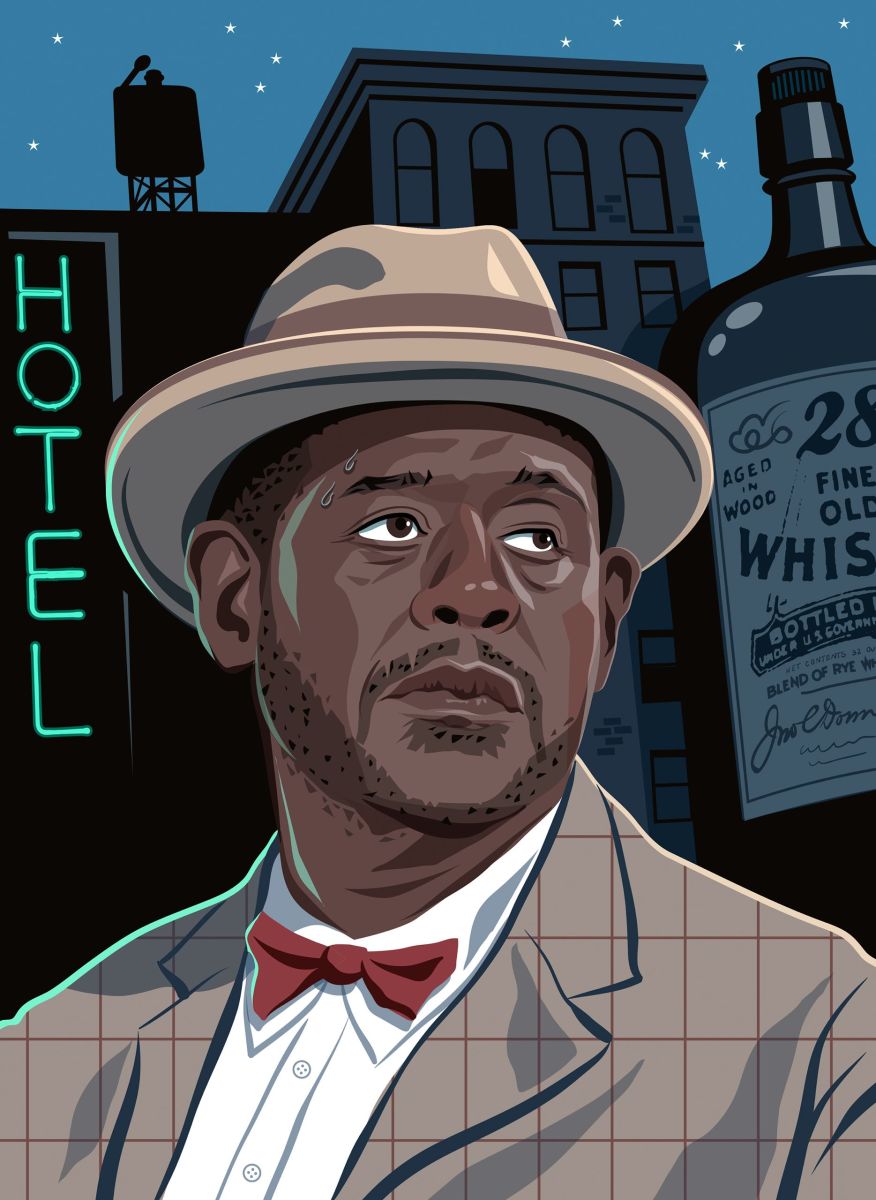
Forest Whitaker stars in O’Neill’s last one-act play. (Illustration by Ben Kirchner)
By Hilton Als
I'm always somewhat surprised to discover how many of the writers and thinkers I’ve admired over the years grew up reading Eugene O’Neill with a passion equal to my own. For years, I thought of O’Neill, who spoke so deeply to my adolescent self, as a kind of private pleasure. So I experienced something of a jolt when, in 2006, Joan Didion told me, during an interview, that as a girl she’d read all O’Neill’s works in one summer, captivated by his theatricality. Mike Nichols, in a 2016 PBS “American Masters” program, described how much O’Neill meant to him, too. What impressed me, as I watched Didion’s and Nichols’s eyes light up at the thought of those maddening sexist, racist, restless, complicated, and important dramas, was how little either of them had in common stylistically with O’Neill’s raw imperfections. And yet they responded to his narratives in their souls, as did I. O’Neill’s words made me feel that working with your imagination was a noble calling somehow, and that any kind of story could work onstage if you strongly believed it belonged there. Even when reading his mystifyingly bad works, such as “The Fountain” (written 1921-22) or “Lazarus Laughed” (1926) or “Dynamo” (1928), I was in O’Neill’s corner, fascinated by the way he illuminated his invented worlds with hysteria.
Of course, my interest in the art was inseparable from my interest in the artist—that melancholy boy with Black Irish looks, who grew up in a drama of his own. His father, James, was the headliner, a ham actor, whose matinée-idol posturing and self-delusion prompted his brilliant son to run away and cook up a new kind of realism—fuelled by European-influenced ideas about angst and hopped up on the American vernacular. And then there was the high drama that his mother, Mary Ellen, a morphine addict, indulged in. O’Neill’s beloved older brother, James, Jr., or Jamie, inherited both forms of helplessness. An alcoholic sometime actor, he died in 1923, at the age of forty-five, but his depression, his wry humor, and his anguished relationship with his mother live on in a number of O’Neill’s characters, including James Tyrone, Jr., in “A Moon for the Misbegotten” (1941-43) and “Long Day’s Journey Into Night” (1941-42).
In 1942, while working on those masterpieces, O’Neill also wrote his last one-act play, “Hughie” (in revival at the Booth, under the noteworthy direction of Michael Grandage). It was a period of personal turmoil. The playwright was fifty-three; his career was in decline. (From 1934 to 1946, O’Neill had no new plays produced.) In the midst of the war, writing seemed to him a trivial activity, the commercial theatre meaningless. More or less estranged from his children—he had no real gift for intimacy, just a near-obsessive drive to be close to women he’d rejected or who’d rejected him—O’Neill was also beginning to show signs of the brain disorder that led to his death, in 1953, at sixty-five. Nevertheless, “Hughie” signalled an upswing in his artistic life. This hour-long song was intended to be one in a series of eight one-act plays, titled “By Way of Obit,” in each of which a character would tell another about someone who had died. “Via this monologue, you get a complete picture of the person who has died—his or her whole life story—but just as complete a picture of . . . the narrator,” O’Neill said. “And you also get, by another means—use of stage directions, mostly—an insight into the whole life of the person who does little but listen.”
And listen the Night Clerk does—even before Erie Smith (Forest Whitaker) enters and starts talking about Hughie, who preceded the Night Clerk in his job. Sitting on a stool, facing the audience, the Night Clerk (played by Frank Wood, who is immense in a constricted part) “stares acquiescently at nothing” and listens. We hear what he seems to be listening to, not for: the car horns and footfalls of midtown Manhattan in 1928. It’s approaching 4 a.m., what James Baldwin called the “devastating hour”: the day “is indisputably over; almost instantaneously, a new day begins, and how will one bear it?” The Night Clerk bears it by letting sound, atmosphere, time run through him like sand through an hourglass.
Erie bears it in another way. Our first sight of him tells us everything, or everything he wants his audience to know, which is how he treats the world—as spectators, potential pals he needs to win over in order to feel right in his mind. Entering through a heavy door, upstage center, Erie is tall, with rounded shoulders and a slightly shambling walk; he looks as though he were caving in on himself while trying to remain upright, spiritually and otherwise. We recognize him, or ourselves, in his effort to be sprightly, upbeat—to make life something other than what it is—even, or especially, in places like this dark, sad hotel lobby, which might as well be on the edge of the world. (Christopher Oram and Neil Austin, who have done a mighty job with the set and the lighting, respectively, have made the lobby look like a way station, the next-to-last stop before the elevator to the gallows.)
Catching sight of the new Night Clerk, Erie smiles a broader smile—it’s part of his mask—and introduces himself. He’s been on a drunk precipitated by Hughie’s death, he says. Now the alcohol is wearing off, and perhaps reality is settling in just a little, and Erie stands at the center of what “Hughie” is about (in addition to O’Neill’s nostalgia for the slang of the era): how you can be held captive by the guilt you feel at being alive. In any case, Erie is delighted that the hotel has replaced the “young squirt they took on when Hughie got sick. One of them fresh wise punks. Couldn’t tell him nothing.” It’s probably fair to assume that that clerk put up a wall against Erie’s verbiage, and that Erie didn’t take the rejection well. Now he’s been given another chance to talk, to win a guy over and maybe love him, just as he loved Hughie, who was his anchor in a sea of booze and loneliness. When the Night Clerk mentions that his last name is Hughes—as was Hughie’s—Erie gets excited, but then the Night Clerk points out that they weren’t related. “No, that’s right,” Erie replies. He continues:
Hughie told me he didn’t have no relations left—except his wife and kids, of course. Yeah. The poor guy croaked last week. His funeral was what started me off on a bat. Some drunk! I don’t go on one often. It’s bum dope in my book. A guy gets careless and gabs about things he knows and when he comes to he’s liable to find there’s guys who’d feel easier if he wasn’t around no more. That’s the trouble with knowing things.
That last sentence, such an honest response to one’s own consciousness, slays us in the way that only O’Neill can; its subjectivity, its credibility remake the world for us, framing it with a proscenium and peopling it with Whitaker and Wood. Together and separately, they’re more than fine actors; they’re poets equal to O’Neill’s poeticism. But this appreciation may be delayed. In fact, I wasn’t sure what I thought of the show until a few days after I’d seen it. Perhaps, while watching, I was on guard against the possibility of O’Neill’s occasional mawkishness interfacing with Whitaker’s. But later, closing my eyes, I remembered Whitaker’s light-colored suit and his gracefulness, which works in counterpoint to his outsized frame. For years, I didn’t respond to Whitaker as much as I wanted to. In film after film, he played what I called Negro yearning: he was always on the outside looking in, especially at love. At times, this stance felt to me like special pleading. And I wasn’t sure about his authenticity. Unlike many of his contemporaries, Whitaker didn’t eschew sentimentality; in fact, he often hid behind it. Neil Jordan tempered that tendency in “The Crying Game” (1992), not by casting Whitaker against type but by making his type—his sensitivity and awkwardness—seem sexy to his transsexual partner. In “Panic Room” (2002), David Fincher revealed how attractive Whitaker could be when his performance as a thug had hints of melancholia and tenderheartedness without being subsumed by them. But in other films, such as “A Rage in Harlem” (1991) and “Bird” (1988), in which he starred as the jazz legend Charlie Parker, there was too much hazy nostalgia for Whitaker’s softness to sink into. He was a junkie Teddy bear. Grandage, like Jordan and Fincher, emphasizes what’s most interesting about Whitaker—his emotional accessibility, his curiosity about his own pain and that of the society that surrounds him—but he doesn’t make Erie a nostalgic figure. There’s critical distance here; Erie is a white character played by a black man, and the complications inherent in that casting keep the production contemporary and important.
Nothing significant happens in “Hughie” except theatre—and the creative lives of its actors. As Erie stands beside his new hope, the Night Clerk, while bent low, internally, by grief, Whitaker may remind you of Charles Laughton, another actor who was uncertain in his body and made a style out of trying to mask it, too.
Life, death, and telling all, in “Duat,” “A Life,” “The Front Page,” and “Falsettos.”
By Hilton Als
Contemporary performers who write their own material seldom escape the trap of having written their own material. The impulse to perform—to write with your body in front of others—is different from the push it takes to author a script, which requires that you dream alone. A number of monologuists, including Wallace Shawn, Spalding Gray, Karen Finley, and Anna Deavere Smith, started producing diverse, substantial work decades ago, but many of the younger performers who’ve tried to follow suit have failed to understand that one’s “I” is rarely enough—or, in some cases, can be entirely too much. Often, writer-performers confuse the actor’s desire to be seen, to be “exposed” before an audience, with expository writing that’s shapeless because it insists on telling all. This is solipsism, not theatre (or, at least, not interesting theatre).
The gay performer Daniel Alexander Jones is filled with good will and charm. Tall, honey-colored, and intelligent, he is best known for his drag alter ego Jomama Jones, a black American singer who left racism behind—or so she thought—to live in Europe, where she acquired a new accent and a siddity way of thinking and moving. Watching Jomama, one is reminded of Josephine Baker in Le Vésinet or Tina Turner post-Nutbush, living in Swiss comfort. She’s a construction with flashes of realness—in her soothing but powerful voice, we hear the girl she once was and the star she always longed to be. Jomama is just one of the performers in “Duat” (a Soho Rep production, at the Connelly), a play that tries to show us who Daniel Alexander Jones is behind the wigs and the makeup, by telling the story of his youth in Massachusetts in the eighties and how culture—in the form of Zora Neale Hurston, Diana Ross, and others—helped shape him.
“Duat” is a complicated piece whose ideas are too big to work onstage. One gets the sense that Jones and his director, Will Davis, didn’t want to leave anything out of this overstuffed production, for fear that Jones would never have another chance to recount his past. First, we’re in Daniel’s bedroom, with the performer and two versions of his younger self, played especially well by Jacques Colimon (a sexy, knowing scamp) and Tenzin Gund-Morrow. We hear about Jones’s multiracial background, his first gay love affair, and how he started to make art. That’s all fine, but when Jones stages a pageant of his favorite Egyptian deities—as a way of illustrating the inspiration for his spangled diva, Jomama? I couldn’t say—the piece derails. Jones calls his work “Afromysticism,” and he has a scholar’s love of black art, but everything gets further confused in the second part of the show, where Jomama appears as a version of a schoolteacher who was nice to Jones when he was a boy. Now his two younger selves will be part of a talent show at, I believe, the school Jones attended, where Colimon’s character falls in love with a man who looks not unlike the man with whom Jones had his first sexual experience, and—well, on and on. In a program note, Jones writes that “Duat” marks the first time that the two halves of his performing self—Daniel and Jomama—have come together, but wouldn’t the nearly two-and-a-half-hour spectacle have been more accessible if he’d limited his story to one person? In “Duat,” Jones is dramaturgically at war with his most inspired creation, one that benefits from the freedom of his imagination, not from the limitations of his “truth.”
The fifty-four-year-old playwright Adam Bock says that he’s proud to be identified as gay; it describes who he is. We’ve come a long way since Tennessee Williams and Edward Albee had to dance around the question, both in their lives and in their work, where they used increasingly strained metaphors to describe their inner queerness. There’s nothing strained about Bock’s new play, “A Life” (at Playwrights Horizons); it has the rightness and the finality of a poem by the gay Alexandria-born master C. P. Cavafy. Like Cavafy, Bock is interested in loneliness, and how it fills up the room after love is gone.
The fortyish Nate Martin (David Hyde Pierce, giving one of those performances that take you over, moment by sensitively explicated moment) lives in a small New York City apartment. There’s a sofa, a desk, some books on a shelf—Richard Sewall’s “The Life of Emily Dickinson,” for one. No clutter. And there’s nothing cluttered about Nate, either; he has a boy’s agility, and, like a boy, he’s charming (and occasionally tiresome) in his need—his desire—to tell us about himself. Nate does this by recounting his many love affairs. Using astrology as a tool, he tries to figure out why none of them worked out, why he was dumped or did the dumping. As he talks, his voice hovers somewhere between hope and despair, self-assertion and doubt. Whatever it takes to live—ego? determination? blind faith?—Nate doesn’t have it. He’s the kind of guy people strain to remember over late-night drinks, long after he’s gone; he’s a faded sketch even before he dies. That he does die comes as a surprise, but not as big a surprise as the loss we feel when this genial fellow is silenced. Bock builds on that silence in the scenes that follow—from the discovery of the body by Nate’s friend Curtis (the nuanced Brad Heberlee) to the funeral parlor—with sounds, words, and movements that seem strange, as if perceived from underwater.
The director, Anne Kauffman, doesn’t try to make the script more than it is; she helps to reveal the subtleties and the weirdness at its heart. Hyde Pierce and the rest of the cast are ideal collaborators for what Bock and Kauffman want to convey, which includes the feeling one gleans from these lines in Cavafy’s “Remember, Body”:
Body, remember not just how much you were loved,
not just the beds where you have lain,
but also those longings that so openly
glistened for you in the eyes,
and trembled in the voice—and some
chance obstacle arose and thwarted them.
Nate’s sister, Lori (Lynne McCollough, who plays multiple roles), says at Nate’s funeral that one reason he wanted to move to New York was that he loved the theatre. Then she makes a lame sort of jazz-hands gesture, and you laugh, because it brings to mind all those guys who love Liza and Meryl and Patti LuPone. I don’t know if Sherie Rene Scott, who plays Mollie Malloy in the outstanding revival of Ben Hecht and Charles MacArthur’s 1928 comedy, “The Front Page” (at the Broadhurst), is a gay icon yet, but I doubt she’ll escape being one after this show, which has a surfeit of fantastic actors, who give the production everything they’ve got. The director, Jack O’Brien, who utilizes the best of what Broadway has to offer—a big stage, a solid budget, slick production values—has not only created a milieu in which the performers can shine; he allows them the space to establish their characterizations. (The set designer, Douglas W. Schmidt, working with Ann Roth on costumes and Brian MacDevitt on lights, has created a hyperstylized and yet still believable world.) The cast is large, and it takes a director of O’Brien’s skill to keep all those hoops in the air without losing sight of the story, or of the internal lives of the characters—who are newspapermen, for the most part.
Hildy Johnson (John Slattery) is trying to get out of the game, despite the pressure from his boss, Walter Burns (Nathan Lane), who wants to keep Hildy on the job, because Hildy’s the best. Hildy is drawn back into journalism, against his better judgment, when a beleaguered worker named Earl Williams (John Magaro) escapes from prison on the eve of his execution. Williams had one friend in this world, Mollie, a casual acquaintance who earns her living walking the streets. One gets the feeling that Mollie’s hair, under her cloche hat, is always damp with perspiration; she’s anxious, a doll melting in the rain of her own sadness and hysteria. When the newspapermen twist her concern for Earl into something from Page Six, her words—“I never said I loved Earl Williams and was willing to marry him on the gallows”—resonate both as a plot point and as a portrait of innocence; Mollie’s a literalist, because she has so little to hang on to, except the truth of her feelings.
Although Scott has relatively few scenes, she does a lot to make the play we’re watching credible, with her perfectly tuned but not overwhelming theatricalism. She believes in Mollie, believes in the machine-clatter of her voice and her tendency to look away, like a hurt dog waiting to be struck again, as she hopes for love among writers who are less interested in the truth than in their own cynicism.
I wonder what Scott would have done with the hideously cheap sentiment that makes “Falsettos” (at the Walter Kerr) one of the most dishonest musicals I have ever seen. Originally produced on Broadway in 1992, the piece is made up of two one-acts, which were first given life Off Broadway a few years earlier. Directed by the frequent Stephen Sondheim collaborator James Lapine (he co-wrote the book with William Finn, who is responsible for the music and lyrics), this more than two-and-a-half-hour show begins in 1979: Marvin (Christian Borle) is leaving Trina (Stephanie J. Block), with whom he has a son, Jason (Anthony Rosenthal), because he’s gay, and in love with Whizzer (the always attractive Andrew Rannells). Trina goes to a shrink named Mendel (Brandon Uranowitz)—whom Marvin also sees at the beginning of the play—and falls in love with and eventually marries him. The second part of the show is set in 1981; Marvin and Whizzer broke up, but are now back together, still family, of a sort. When Whizzer contracts aids and lies dying, Trina, Mendel, and Jason realize that they’re part of the family, too. What can you do with a show that opens with a song called “Four Jews in a Room Bitching,” and uses aids to endow it with seriousness? The rot at the center of “Falsettos” is slathered in self-congratulation. Finn and Lapine use Jews, AIDS, and so on to rope in a particular audience, which is then held captive to their seemingly endless array of self-referential songs and weak humor. They queer the complications in difference.
Lynn Nottage and Suzan-Lori Parks make the recognizable unrecognizable—which is to say, they make it art.
By Hilton Als
When I was a boy, I went to shows—plays, concerts, recitations—with my older sister Bonnie. This was in Brooklyn, in the early nineteen-seventies. The venue we liked best was the East, in Crown Heights, which had been established, in part, in response to the Black Arts Movement, which was itself founded in reaction to the death of Malcolm X. In those days, anti-honky fever was high, and, just as I flinched when I encountered racial slurs in books or on TV, I backed away from the militancy of the plays I saw at the East and elsewhere. Watching those spectacles, I wondered why, if whiteness was supposed to be rendered powerless on a black-owned stage, it was still dictating the action. I didn’t know then that what I was looking for was diversity, stories about how America made all Americans, in their male, female, queer, colored, white, and misshapen glory.
Aside from the gay male postwar writers I revered as a teen-ager (Tennessee Williams, Edward Albee, mid-to-late William Inge), the playwrights I learned the most from were women of color. I never entirely forsook the theatre I saw as a kid—agitprop grows out of agitation, and that’s interesting, too—but what I discovered, as I read and saw works by Alice Childress, Adrienne Kennedy, and Ntozake Shange, then Suzan-Lori Parks, Lynn Nottage, and, most recently, Dominique Morisseau, was that there was, and is, a broader perspective out there, one in which “the man” wasn’t the entire issue: being was. Those women playwrights of color made the recognizable unrecognizable—which is to say, they made it art.
What also struck me about these playwrights was that they invariably wrote in one of two ways: either their work was highly stylized and poetic, a dreamscape of the soul, or it was naturalistic and conventionally structured, with political overtones. The fifty-two-year-old Nottage is a master of the latter voice, and Parks, who is fifty-three, has dominated the former since her first full-length play, “Imperceptible Mutabilities in the Third Kingdom,” opened, in a small Brooklyn theatre, in 1989, and changed everything. Both artists have productions in New York just now, and each raises fascinating questions about how black theatre has evolved since the Black Arts Movement, and why so many black plays are naturalistic or fantastic, with little, if any, absurdism in between. Perhaps black life is absurd enough already; there’s no need for theatre to dress it up.
In her best work, Nottage offers a powerful critique of the American attitude toward class, and how it affects the decisions we make, including whom to love and how. “Sweat” (at the Public) has fraternity at its heart, but also the violence and the suspicion that can result from class aspirations. The play is set, primarily, in 2000—several scenes take place eight years later—in a bar in Reading, Pennsylvania. The bartender at this dark, funky joint is the white, salt-and-pepper-haired Stan (James Colby), who walks with a limp—he lost a leg in a factory accident years ago. His Colombian bar back, Oscar (Carlo Albán), is quiet but watchful, the target of occasional casual racism. Stan likes Oscar, and he steps in from time to time to put down the put-downers. Stan is a father figure to his patrons, too, but he lets his parental guard slip when a woman named Tracey (Johanna Day) enters in a leather jacket, red hair flying, in the opening scene.
It’s Tracey’s birthday, and she wants to shake off the tedium of the day with her pals from the steel-tubing factory where she works—the hard-drinking Jessie (Miriam Shor) and the high-voiced, trying-to-keep-pain-at-bay Cynthia (Michelle Wilson), who is black. You can feel Tracey’s need to be alive in a non-work environment, because what else is there for vibrant women like her and Cynthia but the pulsating moments after work at a deadening job? Still, it’s work that links the women, just as it bonds Tracey’s son, Jason (Will Pullen), and Cynthia’s kid, Chris (Khris Davis), who are also employed at the factory. The bar is a home away from home for all of them, a place where they can momentarily forget how life has failed them. (As with any American play set in a bar, Eugene O’Neill’s “The Iceman Cometh” hovers over the action, like a ghost.)
Eventually, Cynthia’s man, Brucie (John Earl Jelks), turns up to tell her that he’s sober now. But how can she believe what she’s heard so many times before? Brucie has picked her clean, emotionally and financially. Tracey’s in her corner—she wants Brucie to shut up and shove off—and in this perfectly written scene Nottage shows us how being defended and looked after by a friend is everything when you have so little control anywhere else.
But the bonds of friendship are tested when Cynthia becomes a foreman at the plant and huge changes occur: the new owners want the workers to take a buyout. What should Cynthia do? Betray her ambition by stepping down, or stay with a company that is forcing her friends and her child into unemployment? It’s an ingenious move on Nottage’s part to confront Cynthia with the conundrum of class aspirations, to give the black woman power over the white. Implicit in Nottage’s characterization is Cynthia’s fear that she’s less real, less black, because of her promotion, because of her desire to rise above what she was meant to be.
The workers go on strike. Unemployment breeds distrust and hatred. Jason attacks Chris, then turns on Oscar, because the scabs are Hispanic, like him. The director, Kate Whoriskey, stages this and the ensuing disasters with clarity and verve. Watching Jason, a powerless white man, try to reclaim power is terrifying, and Pullen combines confusion, force, doubt, and fear in such a way that you can’t avert your eyes.
Nottage and Whoriskey spent a great deal of time in Reading, interviewing factory workers and survivors—if that’s the word—of the economic downturn. You can hear the region in Nottage’s lines; the people there got into her bones. A kind of alchemy occurs in her rhythms, in the way a character’s lines jump on or sidestep another character’s emotions. Those emotions are harrowing, particularly in the scenes set in 2008, when we see where the economic devastation and chaos have left Tracey and Cynthia. Not to mention Oscar and the physically ruined Stan, who have both experienced a reversal of fortune but are still working together, partly because of their long-term bond and partly because, one imagines, it takes a long time for the formerly oppressed to understand how to make the world their own—that is, completely different.
The failure to make things different is at the heart of Suzan-Lori Parks’s 1990 work “The Death of the Last Black Man in the Whole Entire World AKA The Negro Book of the Dead” (at the Pershing Square Signature Center). This exceptional production is directed by a great new talent, Lileana Blain-Cruz, whose work, earlier this year, on Alice Birch’s “Revolt. She Said. Revolt Again,” was equally impressive; Blain-Cruz drew out the theatricality in Birch’s opaque text, thus bolstering the actors for the big game of performance. Parks has had no better director since Liz Diamond, who staged many of her early productions.
Parks loves metaphors, and the idea of something being both itself and something else entirely. Indeed, her work is the best support I know for an assertion made by Zora Neale Hurston, in her still startling 1934 essay “Characteristics of Negro Expression”:
The Negro’s universal mimicry is not so much a thing in itself as an evidence of something that permeates his entire self. And that thing is drama. . . . His interpretation of the English language is in terms of pictures. One act described in terms of another. Hence the rich metaphor and simile.
The overlong full title of “The Death of the Last Black Man” tells us what it’s about, but not what it’s really about, which is language—the rich sound and implications of black English. The play, which borrows elements from Adrienne Kennedy and Ntozake Shange, not to mention Samuel Beckett’s “Krapp’s Last Tape” and Ishmael Reed’s “Mumbo Jumbo”—Parks is the premier hoodoo artist of the stage—tells the story of Black Man with Watermelon (Daniel J. Watts), who is married to Black Woman with Fried Drumstick (Roslyn Ruff). (Previously, Ruff has been used by white directors to represent versions of the indomitable angry black woman; it’s a measure of Blain-Cruz’s strength as a director that we get to see Ruff act here, rather than be a symbol.) Various characters—Prunes and Prisms (the wonderful Mirirai Sithole) and Lots of Grease and Lots of Pork (Jamar Williams), for instance—take the stage individually but also move en masse: they are ideas about blackness clustering together, then separating, like beautiful molecules, as we learn that Black Man with Watermelon is, in fact, dead.
Black Woman with Fried Drumstick tells the audience, “Yesterday today next summer tomorrow just uh moment uhgo in 1317 dieded thuh last black man in thuh whole entire world. Uh! Oh. Don’t be uhlarmed. Do not be afeared. It was painless. Uh painless passin.” But Black Man’s death wasn’t actually painless, because no death is. What Parks is saying—and not saying—is that the marginalization of black men means that their lives can be trivialized and forgotten if there is no one around to remember them. Parks wants to remember them, and her effort to engage the politics of black male bodies recalls aspects of the Black Arts Movement, if at a distance. The black man who dies and lives to tell the tale in her play is not an Everyblackman (though Blain-Cruz makes a case for that by showing us a series of wrongful deaths—a lynching, an electrocution). He is Parks’s attempt to understand the black men she’s known—which is to say, the men in her family. It’s disorienting for a young colored girl to see her father, say, reduced to the world’s small vision of him, especially when he looms so large in her own life and imagination. I don’t know if Parks had that experience, but it’s more than likely that she did. Had my sister seen this stage poem, she would have recognized—somewhere in all that language that stands upright, topples over, then stands back up again, like any number of black men we’ve known—the life of the black man who helped make us but got lost when it came to trying to love us, or himself.
Biography

Hilton Als became a staff writer at The New Yorker in 1994 and a theatre critic in 2002. He began contributing to the magazine in 1989, writing pieces for The Talk of the Town.
Before coming to The New Yorker, Als was a staff writer for the Village Voice and an editor-at-large at Vibe. Als edited the catalogue for the 1994-95 Whitney Museum of American Art exhibition “Black Male: Representations of Masculinity in Contemporary American Art.” His first book, The Women, was published in 1996. His most recent book, White Girls, a finalist for the National Book Critics Circle Award in 2014, discusses various narratives of race and gender. In 2016, he was a finalist for the Pulitzer Prize in Criticism.
In 1997, the New York Association of Black Journalists awarded Als first prize in both Magazine Critique/Review and Magazine Arts and Entertainment. He was awarded a Guggenheim for creative writing in 2000 and the George Jean Nathan Award for Dramatic Criticism for 2002-03.
In 2009, Als worked with the performer Justin Bond on “Cold Water,” an exhibition of paintings, drawings, and videos by performers, at La MaMa Gallery. In 2010, he co-curated “Self-Consciousness,” at the VeneKlasen/Werner gallery, in Berlin, and published “Justin Bond/Jackie Curtis.” In 2015, he collaborated with the artist Celia Paul to create “Desdemona for Celia by Hilton,” an exhibition for the Metropolitan Opera’s Gallery Met.
Als is an associate professor of writing at Columbia University’s School of the Arts and has taught at Yale University, Wesleyan, and Smith College. He lives in New York City.