The New Yorker, by Emily Nussbaum
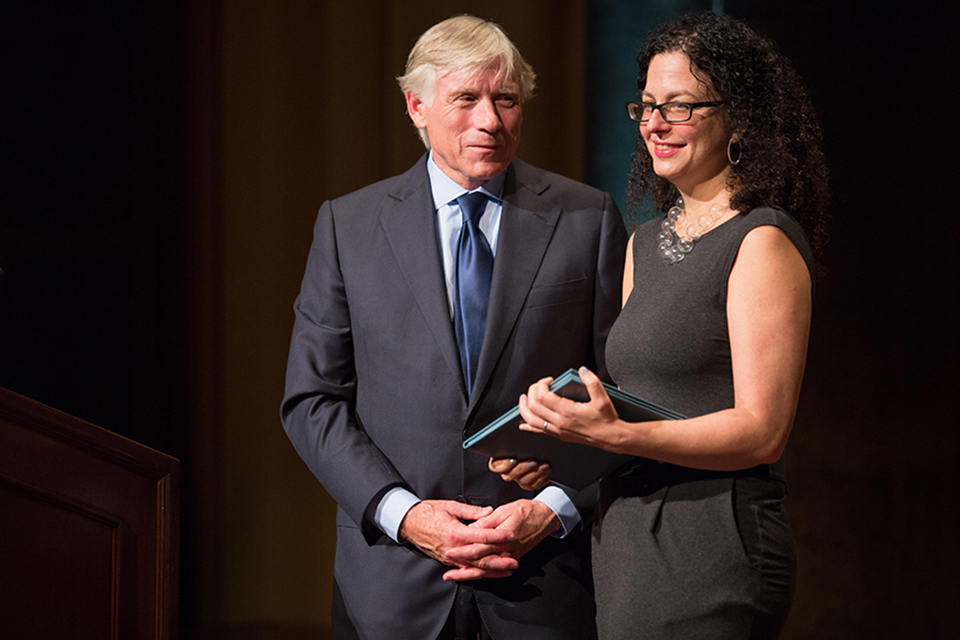
Columbia University President Lee C. Bollinger presents the 2016 Criticism Prize to Emily Nussbaum of The New Yorker.
Winning Work
Joan Rivers was a survivor of a sexist era: a victim, a rebel, and, finally, an enforcer.
By Emily Nussbaum
Six months before Joan Rivers died, last year, she went on the “Howard Stern Show”: two old friends, serial offenders, knocking down targets. They talked about Mayor Bill de Blasio. (“Rich against the poor!” she sneered.) Stern asked her opinion of Woody Allen, with whom Rivers had come up in the club scene, in the early sixties. “I think he’s brilliant. What Woody does in his private life is his private life. You want to be a pedophile, be a pedophile. I like . . . what’s her name? Ping-Pong. The wife. She wears yellow too much. Too matchy-matchy.”
Then, abruptly, Rivers changed the subject, to a topic more divisive than class warfare or Woody Allen: Lena Dunham’s body. “Let me ask you something!” she said. “Lena Dunham. Who I think is, again, terrific. How can she wear dresses above the knee?” Stern said that what he loved about Dunham was that “she doesn’t give a shit.” “Oh, she has to,” Rivers insisted. “Every woman gives a shit.” When Stern and his co-host described funny scenes from “Girls” of Dunham in a bikini, Rivers nearly sputtered: “But that’s wrong! You’re sending a message out to people saying, ‘It’s O.K., stay fat, get diabetes, everybody die, lose your fingers.’ ” In a passionate rasp, she made her case. Dunham was a hypocrite for doing Vogue, she said, because it showed that she cared about being pretty. Stern was another hypocrite, for his “tits and ass” jokes, for his hot second wife—would he have married Dunham? Stern said that he thought Rivers would “rejoice” in the younger woman’s freedom. “But don’t make yourself, physically—don’t let them laugh at you physically,” Rivers pleaded, sounding adrift. “Don’t say it’s O.K. that other girls can look like this. Try to look better!”
The discussion felt oddly poignant: Joan Rivers’s reflexive emphasis on marriage and weight, her hard-bitten advice for surviving in a man’s world, seemed almost naïve in the context of Dunham’s fourth-wave-feminist exhibitionism. (Why would Dunham want to marry Stern?) The “Girls” creator was violating the rules that Rivers built her life on—was hemmed in by, protested, and enforced, often all at the same time. From the nineteen-sixties on, Rivers had been the purveyor of a harsh Realpolitik, one based on her experience: looks mattered. If you got cut off from access to men and money—and from men as the route to money—you were dead in the water. Women were one another’s competition, always. For half a century, this dark comedy of scarce resources had been her forte: many hands grasping, but only one golden ring. Rivers herself had fought hard for the token slot allotted to a female comic, yet she seemed thrown by a world in which that might no longer be necessary. Like Moses and the Promised Land, she couldn’t cross over.
A devotee of rude candor, Joan Rivers had always blown a raspberry at the concept of “too soon.” After her husband, Edgar, committed suicide, she said she’d scattered his ashes at Neiman Marcus, so she could visit five times a week. Days after the Twin Towers fell, she called her friend Jonathan Van Meter and invited him to “Windows on the Ground.” According to the loving profile he wrote of her in New York, she had a pillow that read “Don’t Expect Praise Without Envy Until You Are Dead.” And for decades Rivers proclaimed (sometimes bitterly, but also proudly) that when she died she’d be sanctified, like her hero, Lenny Bruce. That prophecy has come true; since her death, in September, at eighty-one, she’s been celebrated as a trailblazer, a pioneer for female comics. The 2010 documentary “Joan Rivers: A Piece of Work” cast a glow over Rivers’s later years, emphasizing her fantastic work ethic and how, after a series of devastating losses—when Johnny Carson blackballed her, her talk show was cancelled, and Edgar died—she’d stubbornly refused to fold, taking any gig she could get, high or low. (In one of the best scenes, Rivers riffles through her zingers, thousands of which are stored in silver file drawers with labels such as “Pets” and “Politically Incorrect,” “New York” and “No Self Worth.”)
That admiring portrait was true, but it obscured a more complicated reality: in “A Piece of Work,” there are plenty of Holocaust jokes, and some hilarious elder-sex bits, but not a single fat joke, although for many decades jokes about female bodies were Rivers’s specialty. There is no “Fashion Police,” and no red-carpet routine, no mention of the night Rivers said, when the twenty-two-year-old Kate Winslet was nominated for an Academy Award, that the actress’s fat arms had sunk the Titanic. Was that a joke or an insult? A message to Winslet or to other girls watching? (Try to look better!) This was the harder-to-handle part of Rivers’s legacy, her powerful alloy of girl talk and woman hate, her instinct for how misogyny can double as female bonding. In many ways, Joan Rivers was the first Real Housewife: she was brazen, unapologetically materialistic, a glamorous warrior in an all-female battleground—a gladiator. To honor her, as both a role model and a cautionary tale, you can’t airbrush that out.
When I first noticed Joan Rivers, she looked like the enemy. This was in the early eighties, at the height of her fame. She was Johnny Carson’s permanent guest host at the time—warm to his cold, abrasive yet charismatic, with a brash engagement with the audience. (Her trademark line: “Can we talk?”) I was a teen-age comedy nerd, into “SCTV” and Tom Lehrer, obsessed with Woody Allen and David Letterman. I was eager for female role models, of whom there were only a handful, other than Gilda Radner and the mysterious Elaine May, no longer on the scene. Yet Rivers terrified me. Glamorous in her Oscar de la Renta dresses and her pouf of blond hair, she was the body cop who circled the flaws on every other powerful woman—she announced who was fat, who had no chin, who was hot but, because she was hot, was a slut or dim. She made it clear that if you rose to fame the world would use your body to cut you down. The fact that she was funny made her more scary, not less: “What’s Liz Taylor’s blood type? Ragú!” I laughed, then hated myself for laughing.
But, if Rivers was chilling to me, I was a prig about her. Among other things, I didn’t understand much about the forces that shaped her—or that, during her own ascent, she hadn’t been an insult comic at all but part of a new wave of sixties experimental standups. Born in 1933, Joan Molinsky was the child of a doctor and his status-obsessed wife, who bought a fancy house in Larchmont as a “picture frame” for their two daughters. (The kitchen was painted pink, to be more flattering when they brought boys home.) In the early fifties, when Rivers was a chubby freshman at Connecticut College, that mating ground for Wasps (she later transferred to artsy Barnard), a blind date picked her up at her dorm. When she came downstairs, her date turned to his friend and said, in disgust, “Why didn’t you tell me?” Such rejections seared into Rivers a lifelong identity as a “meeskite”—an ugly girl—even after she slimmed down, bobbed her nose, and became, in society’s terms, attractive. Later, in 1973, she turned the anecdote into a TV movie, “The Girl Most Likely . . . ,” in which a former fat girl murders the men who rejected her.
In her gritty first memoir, “Enter Talking,” published in 1986, she describes her path as a Pilgrim’s Progress of heartbreak and ambition. She dumped her first love, a poet, for an early marriage—to the “right” kind of guy—that failed. She lived at home through her twenties, commuting into Manhattan in a beat-up Buick, dreaming of being a serious actress, “J. Sondra Meredith.” Instead, she took sleazy gigs as a strip club m.c., as Pepper January: Comedy with Spice. She bombed, twice, on the “Tonight Show” with Jack Paar. She stole routines; agents shunned her. Once, after a promising gig, her parents encouraged her to perform at their Westchester country club. She flopped so aggressively that the Molinskys sneaked out through the kitchen. Her father called her a “tramp”; Rivers ran away. For months, she was homeless; with the help of her Brooklyn boyfriend, she shacked up at midtown hotels, ducking the bill, fixing her face at Grand Central. Eventually, exhausted, she slunk back to her teen-age bedroom.
Then, when she was nearly thirty, Rivers’s act finally began to click, creatively. During a stint at Second City, in Chicago, in 1961, she introduced a character named Rita, a desperate, needy, aging single girl. Back in Greenwich Village, in dingy clubs like the Duplex, she experimented with this autobiographical material, raw stories of bad dates and shame about her body. She dished about birth control, her affair with a married man, and her gay friend, Mr. Phyllis. Her closing line was “My name is Joan Rivers and I put out.” When she saw a Lenny Bruce performance, she was electrified, struck by a routine in which he called the audience “niggers” and “kikes”; outrageousness, she thought, might be “healthy and cleansing.” One night, when Rivers bombed, Bruce sent her a note: “You’re right and they’re wrong.” She tucked it into her bra as a talisman, until she made her début with Carson, in 1965, her big break at last.
In those early years, her act was self-loathing, in the tradition of older female comics—she’d blow up her cheeks and hold out her arms, mocking herself as fat—but it also had an edge of empowerment. “The whole society is not for single girls, you know that?” she shouted, in 1967, on “The Ed Sullivan Show.” “A girl can’t call. Girl, you have to wait for the phone to ring, right? And when you finally go on the date, the girl has to be well dressed, the face has to look nice, the hair has to be in shape. The girl has to be the one that’s bright and pretty, intellig— A good sport. ‘Howard Johnson’s again! Hooray, hooray.’ ” She waggled her arms in fake enthusiasm, repulsed by her phoniness. “I’m from a little town called Larchmont, where if you’re not married, and you’re a girl, and you’re over twenty-one, you’re better off dead. It’s that simple, you know? And I was”—her voice became a growl—“The. Last. Girl. In. Larchmont. Do you know how that feels? . . . Twenty-one. Twenty-two. Twenty-four.”
In the Times, in October, 1965, Charles L. Mee praised Rivers as one of the New Comedians, who had broken away from Borscht Belt shtick. “The style is conversational, suited to television ‘talk’ programs,” Mee wrote. “It may take the form of Bill Cosby’s colloquial stories or Woody Allen’s self-analysis or Mort Sahl’s intellectual nervosities. But it is not Jack Benny. Benny may be a tightwad on stage and a philanthropist off. Not so with the new comedians. They write their own jokes and are expected to live them offstage as well as on.” Funky authenticity was her generation’s fetish. But Rivers’s act also worked because of her look. “Female comics are usually horrors who de-sex themselves for a laugh,” Eugene Boe wrote, in Cue, in 1963. “But Miss R. remains visibly—and unalterably—a girl throughout her stream-of-consciousness script.” In 1970, the Times published a trend piece about stylish comediennes—titled “The Funny Thing Is That They Are Still Feminine”—in which Rivers claimed that she dressed simply for strategic reasons: “That way you’re less of a threat to women.” Onstage and on TV, she had a girl-next-door cuteness, a daffiness and a vulnerability, that lent a sting to her observations: if this nice Barnard coed, in her black dress and pearls, saw herself as a hideous loser, clearly the game was rigged.
As the rare female New Comedian, Rivers’s persona also hit a nerve, playing as it did off a contemporary slur, the Jewish American Princess. In 1959, Norman Mailer had published a notorious short story, “The Time of Her Time,” in which a bullfighter gives a Jewish college girl her first orgasm by means of sodomy and the phrase “dirty little Jew”; the same year, Philip Roth published “Goodbye, Columbus,” with its iconic Princess, Brenda Patimkin. In 1971, Julie Baumgold wrote a cover story for New York, at once disdainful and sympathetic, called “The Persistence of the Jewish American Princess,” portraying the type as a spoiled girl who wouldn’t cook or clean. Obsessively groomed, the JAP has been crippled by her mother, who refuses to let her daughter call herself ugly. She’s “the soul of daytime drama,” waiting for a rich man to save her: “Clops and blows come from Above, but still she expects. It isn’t mere hope; it is her due.”
Rivers took that sexist bogeywoman and made it her own, raging at society from inside the stereotype: she was the Princess who did nothing but call herself ugly. She vomited that news out, mockingly, yearningly, with a shrug or with a finger pointed at the audience. “Arf, arf,” she’d bark, joking that a rapist had asked if they could just be friends. A woman I know used to sneak into the TV room, after her parents fell asleep, for the illicit thrill of seeing another woman call herself flat-chested. If Rivers’s act wasn’t explicitly feminist, it was radical in its own way: she was like a person trapped in a prison, shouting escape routes from her cell.
From the sixties to the eighties, Johnny Carson was, for aspiring comics, the model of a scarce resource: to get to the big time, you had to make it with Johnny. But Carson, notoriously, didn’t like female comics. In Yael Kohen’s “We Killed: The Rise of Women in American Comedy,” from 2012, the show’s talent coördinator Patricia Bradford recalls the atmosphere: “They hired women over their dead bodies. They just didn’t want them there.” Even popular comediennes—Totie Fields in the sixties, Elayne Boosler in the eighties—couldn’t get traction. “I don’t ever want to see that waitress on my show again,” Carson told his booker about Boosler, when she was considered a top standup, the peer of Jerry Seinfeld.
Yet, back in 1965, Joan Rivers had slipped through the eye of that needle: she was funny enough, feminine enough, new enough, traditional enough, just right. It was a trick she never forgot—after years of struggle, she’d become, in her eyes, Carson’s daughter. The gig was a mercy booking: the “death slot,” the last ten minutes. In her black dress and pearls, Rivers was introduced not as a standup but as that rarity a “girl writer.” She did “Last Girl in Larchmont”; she told a story about her wig being run over on the West Side Highway. When the segment ended, Johnny wiped tears from his eyes and said, on camera, “God, you’re funny. You’re going to be a star.”
Within days, it was true: she got press, she got gigs, she got famous. Months later, she married Edgar, a British producer to whom she’d been introduced by Carson, just days after they met. For sentiment’s sake, she wore that same outfit on the night of her final appearance with Carson on the “Tonight Show,” in 1986, to plug “Enter Talking,” which was dedicated “To Johnny Carson, who made it all happen.” But, behind the scenes, she was insecure: among other developments, she had seen an NBC document that listed ten men as potential Carson replacements. Two weeks after her appearance, Carson learned that Rivers had signed to do a competing show on Fox. She called to explain; he hung up. He never spoke to her again. Two of Carson’s successors at the “Tonight Show,” Jay Leno and Conan O’Brien, honored the ban, and she didn’t appear on the show again until Jimmy Fallon broke the spell, six months before her death.
Still, for more than twenty years, Carson and Rivers had bantered, with him serving her the straight lines—“But don’t you think men really like intelligence?”—and her lobbing back the punch line: “No man has put his hand up a woman’s dress looking for a library card.” It was a heavenly match: their ideas about men and women were congruent, like Lego bricks. At first, she worked her single-girl material: “Looks matter!” Then she tried a streak of softer, Erma Bombeck-like material, exploring subjects like housework and breast-feeding. (One of her early books was a pregnancy guide.) In both iterations, she rarely criticized other women, other than the fun slut “Heidi Abromowitz” and abstract rivals, like the airline stewardesses who, in one of Rivers’s routines, cater only to men.
Then, in 1976, Rivers had a new breakthrough: she saw Elizabeth Taylor on the cover of People. As she wrote in “Still Talking,” the 1991 sequel to “Enter Talking,” she realized that “nobody had dared say about this icon, ‘She’s a blimp,’ dared admit that you could stamp Goodyear on her and use her at the Rose Bowl.” When Rivers tried Liz-is-fat gags, the audience exploded. If she cut them, they’d shout requests. “We women were furious when the most beautiful of all women let herself go,” Rivers wrote. “If she became a slob, there was no hope for any of us.”
These crude gags—about Liz, Christie Brinkley, Madonna—became her hottest material, on Carson and in front of Vegas crowds, as Rivers plugged into tabloid culture. Liz Taylor puts mayonnaise on aspirin! When she pierces her ears, gravy comes out. In “Enter Talking,” which she wrote well into her Hollywood era, Rivers never mentions her Liz Taylor jokes. But in “Still Talking,” five years later, she makes a case for these gags as a cathartic form of women’s humor. “I never look at the men in the audience, never deal with them,” she wrote, describing appearances in Las Vegas. It’s wives who get it: stay-at-home moms who wish they’d married rich; middle-aged women who love Rivers’s bitter blurt about how Jane Fonda had the perfect body and her husband left anyway. Rivers is explicit about her aim, which is not just to entertain but to educate: she wants fat girls to know that “they need to pull it together,” to resist their mothers’ dangerous lies about inner beauty. “If Blanche DuBois took stock and said, ‘This is where it’s at, and I’m going to get rid of these schmatte clothes and get me a nice pants suit, and look smart here, with a pocketbook and a hat’—she would have been all right.”
There’s a sympathetic way to view these routines: Rivers wanted women to be savvy, not naïve, about what the opposite sex was really like. She was a fiery pragmatist—another tagline was “Grow up!” During the seventies and eighties, she shared this message with the popular magazine editor Helen Gurley Brown, another skinny meeskite (although she called herself a “mouseburger”), the cheerful Machiavelli to Rivers’s angry Hobbes, who, in Cosmopolitan and her books, offered practical tips on how to thrive in a sexist world, albeit as a mistress rather than as a wife. For both women, there was little use in trying to change, or even reason with, men: you just needed to find a way to get their attention, then harness their power as your own.
At the end of her Vegas act, Rivers would offer to reward a woman in the audience with a ficus tree—she’d drag it across the stage, struggling, as the orchestra watched but refused to help. She describes the moment in “Still Talking”: “I say, ‘Fucking liberation. We did it to ourselves.’ Women love that line. I am raging out like King Lear—Queen Lear—screaming into the wind, screaming for all us women.”
“Michelle Obama is a tranny.” “What’s Adele’s song, ‘Rolling in the Deep’? She should add ‘fried chicken.’ ” All her life, Rivers defended even the most rancid zingers as a way of puncturing Hollywood puff, saying what we really thought—“punching up.” Stars could take it, Rivers argued. (“You don’t think so?” she said to Playboy, in 1986. “Jackie Onassis, with her eyes on either side of her head like E.T., is not fair game? With her $38,000,000?”) It’s boring to be offended, more boring than a bad joke. But, watching “Fashion Police,” Rivers’s celebrity panel, with its “twat” gags, I’d get queasy, the way I’ve felt at a bad bachelorette party: Is this how we bond?
Still, other times I get it. Among women, the pugilistic brutality can be delicious, the fun of using these goddesses (or Bachelorettes, or Housewives) as shorthand: conduits for taboo emotions like envy, disgust, fear, the anxiety of falling short. By most accounts, by the time Rivers died she was less embattled than she had been after Edgar’s death, when she struggled with bulimia and depression. She was close to her daughter and grandson, to the comics she’d mentored, to the gay men who dug her diva vibe, to the many who “got” and loved her. When I saw Rivers’s famous face, I’d wonder if part of the appeal of plastic surgery wasn’t the surgery itself. When it’s over, you’re new, whether you’re beautiful or not; you’ve made the battle visible, instead of pretending there was no battle. In her 2009 book, “Men Are Stupid . . . and They Like Big Boobs,” she put it straight: “It’s the way things are, accept it, or go live under a rock.” Or, as the women in my family told me, in Yiddish, “You’ve got to suffer for beauty.”
As a teen-ager, Rivers looked much like the teen-age Dunham: she was pudgy, with a beaming grin and friendly eyes. But the caption she wrote for the picture of her in “Enter Talking” reads, “The thirteen-year-old fat pig, wishing she could teach her arms and hips to inhale and hold their breath.” That makes me sad. But, then, she wasn’t wrong about the world that girl was walking into. Look at the male comics who were her peers at the Duplex: Bill Cosby, Woody Allen, and Mort Sahl, who became a devout anti-feminist. Look at Johnny Carson, or at Jerry Lewis, who is still repelled by female comics. In “Still Talking,” there’s a passage in which Rivers expresses her disgust “that the public buys the hypocrisy of the men revered as national institutions.” And yet her humor was rarely directed at men: these were jokes by women, for women, at women. There’s no reality series making fun of the men who wrecked Wall Street, but there is one, a hilarious one, adored by female viewers, devoted to their catfighting, parasitic, bedazzled wives.
There’s a poem by Sharon Olds called “The Elder Sister.” In it, the narrator talks about how much she used to hate her sister, “sitting and pissing on me.” But then she learned to see that the harsh marks on her older sister’s face (her wrinkles, the frown lines) were “the dents on my shield, the blows that did not reach me.” Her sister had protected her by being there first—not with love “but as a / hostage protects the one who makes her / escape as I made my escape, with my sister’s / body held in front of me.”
Maybe that’s true of Rivers: her flamboyant self-hatred made possible this generation’s flamboyant self-love, set the groundwork for the crazy profusion of female comics on TV these days, on cable and network, cheerleading one another, collaborating and producing and working in teams, as if women weren’t enemies at all. (Everywhere but in late-night TV: decades after Carson, there are still ten men on that list.) Rivers came first—and if her view darkened, if she became an evangelist for the ideas that had hurt her the most, she also refused to give in, to disappear. “I would not want to live if I could not perform,” she once said. “It’s in my will. I am not to be revived unless I can do an hour of stand-up.” That’s its own kind of inspiration. We can celebrate it without looking away.
The strange allure of Robert Durst and “The Jinx.”
By Emily Nussbaum
In “The Jinx,” a six-episode HBO documentary series, the director Andrew Jarecki investigates Robert Durst, multiple-murder suspect, Manhattan real-estate scion, and shark-eyed master of the throwaway epigram, emerging with evidence that might actually put him in jail. This isn’t the first time Jarecki has suggested that Durst might be guilty: in 2010, he directed “All Good Things,” a feature, in which Ryan Gosling commits every bad act that Durst has been accused of, plus a few bonus ones, like the implied bludgeoning of a lovable husky. “All Good Things” wasn’t much good, maybe because it was inspired by the facts of Durst’s life, few of which seem plausible as fiction. This is a man, after all, who, long after the mysterious disappearance of his first wife, Kathie, fled to Galveston, Texas, disguised himself as a mute woman, and then, while out on bail for the murder of a neighbor—whose corpse Durst dismembered with a bow saw—was arrested for shoplifting a chicken-salad sandwich at a Wegmans. (At the time, Durst had thirty-eight thousand dollars in his car.)
But if “All Good Things” got a thirty-two-per-cent rating on Rotten Tomatoes, it impressed the one critic who counted. Upon its début, Durst—who was independently wealthy, out of prison, and in no clear need of further publicity—contacted Jarecki and agreed to be interviewed. I haven’t seen the finale of “The Jinx,” so you’ll have to discern for yourself whether this decision was worth it for Durst. For Jarecki, it paid off in spades. “The Jinx” is wickedly entertaining: funny, morbid, and sad, at once exploitative and high-minded, a moral lasagna of questionable aesthetic choices (including reconstructions of ghastly events) and riveting interviews (of Durst, but also of other eccentrics, like his chain-smoking-hot second wife). The series acts as an extension of the legal process and as a type of investigative journalism. For viewers, however, it’s primarily a noir striptease, flashing revelations one by one—a method with proven appeal to viewers who like to feel both smart and titillated. Guilty as charged.
Clearly, I’m not alone, judging by the smash success of “Serial,” a podcast hosted by N.P.R.’s Sarah Koenig, which examined the case of Adnan Syed, who was convicted, in 2000, of the murder of his ex-girlfriend. The creators of “Serial” were, in turn, inspired by “The Staircase,” from 2004, an eight-part TV series about the trial of the novelist Michael Peterson, who was accused of killing his wife; it was filmed by the French director Jean-Xavier de Lestrade, who added a two-hour addendum in 2012. In the past several decades, true-crime documentaries have emerged as a kind of secondary appeals system, among them Errol Morris’s “The Thin Blue Line”; the three “Paradise Lost” movies; and the damning “Deliver Us from Evil,” in which Amy Berg got a pedophile priest to confess. The first two got their subjects out of prison; the second helped put the priest back in.
These projects have an afterlife online, where amateur detectives reinvestigate both the crimes and the documentaries themselves. Look up “The Staircase” and you’ll discover critiques of its filmmaker’s bias and, also, strangely convincing theories suggesting that an owl killed Michael Peterson’s wife. “Serial,” too, had its critics, but part of the appeal of the podcast was its transparency: Koenig placed her anxieties center stage, even when this risked making her appear credulous or uncool. Jarecki, who wears a goatee so sketchy that it might as well be another suspect, could easily seem like a questionable figure, given his slick ability to plug his films as studies in ambiguity (his others include “Capturing the Friedmans” and “Catfish,” which he produced). He’s a showman, for sure, but he wins our trust with a few wise choices, among them folding in enough material about two victims—Kathie and Susan Berman, an old friend of Durst’s, who was shot execution style in Los Angeles—that they become more than chalk outlines. Yet, perhaps inevitably, the most watchable participants are the bad apples.
This is particularly true of Durst. He’s an indelible character, mesmerizing in his strangeness: he’s parchment-skinned, blinky-eyed, lizardlike, but he has a quality of fragility, too, along with a disarming, if often peevish, directness. When he feels misunderstood, a Larry David-like querulousness creeps into his voice. He answers questions about whether he hit Kathie (yes, he did—but, hey, it was the seventies) with a candor that no sane or diplomatic individual would use. Maddeningly, this makes him seem open, even when he’s almost certainly lying. Much of the pleasure of watching “The Jinx” is simply being immersed in the stubborn illogic of Durst’s world view, which is often less cagey than surreal. Asked why he lied to the police about his behavior on the night that Kathie disappeared, Durst explains that he thought that if he offered up a false alibi (one easily exposed) he’d be left alone. Then again, he wasn’t wrong: one of the lessons of “The Jinx” is that you don’t need to be a brilliant criminal to get away with a terrible crime. You just need a cop who never follows up, plus the money for a legal team that’s savvy enough to play to the sensibilities of a Texas jury.
There is, of course, a queasy undercurrent to any show like this: we’re shivering at someone else’s grief, giggling at someone else’s crazy. Many of the best documentaries have this ugly edge, which may be why we cling to the idea that their creators (or, at least, those not named Werner Herzog) are as devoted to truth as to voyeurism. (Documentarians don’t get paid enough to do it for the money.) Yet it’s impossible not to laugh at the camp solemnity of this speech, from a Galveston detective: “Nobody deserves to be killed. Their head cut off. Their arms cut off. Their legs cut off. And packaged up. Like garbage.” When asked whether he purposely shaved his eyebrows while on the run, Durst’s response is impeccable as both humor and logic: “How do you accidentally shave your eyebrows?” At times, the moral of “The Jinx” seems to be that an air of dry wit, however inappropriately leveraged, is likely to win you allies.
It’s illuminating to compare the methods of “All Good Things” with those of “The Jinx”: both show footage of Durst as a happy child, swimming with his mother, and the adult Durst saying, “She died a violent death.” In “The Jinx,” the footage is wrenching because it’s real: the voice-over is audio from the Texas trial, played over grainy home movies. Then these images (scored with eerie singing saw) segue into an explicitly reconstructed flashback, which shows Durst’s mother’s suicide: a grotesque image, jolting the viewer with its tackiness. The transition was unsettling enough to make me wonder whether those home movies, too, were a reconstruction. At the same time, there was something useful about the coarseness, which was Jarecki’s own “tell.” It was a reminder that everything in a documentary is contrived, even one with a fancy HBO imprimatur. The most sincere people still know that they’re talking to a camera.
Against this Barnum-like theatricality, spontaneous gestures stand out. There’s a poignant scene in which Durst is found not guilty of his neighbor’s murder: he turns to his lawyer and says, uncertain, “Did they say ‘not’?” The most unsettling example comes in the fourth episode, when Jarecki suggests that he and Durst take a break from discussing his testimony in Texas. Durst has confirmed that his lawyers hinted that he could answer specific questions about the dismemberment with “I don’t know”; that way, he’d sound less coldhearted. As soon as the filmmaker leaves the room, Durst, who is still wired for audio, lowers his head and mutters a sentence to himself. “I did not knowingly, purposely lie,” he says, and then pauses, considering, to add a word: “I did not knowingly, purposely, intentionally lie. I did make mistakes.”
Durst was rehearsing the interview, the way one might rehearse one’s testimony—but does that make him seem more guilty or just more realistic about documentaries? His lawyer tells him that his microphone is hot. Durst is fascinatingly unconcerned. He says again, “I never intentionally, purposefully lied. I made mistakes.” Then, with the shrug of an honest man, he adds what might be the tagline for the series: “I did not tell the whole truth. Nobody tells the whole truth.”
The bright-pink resilience of “Unbreakable Kimmy Schmidt.”
By Emily Nussbaum
The credit sequence for “Unbreakable Kimmy Schmidt” is a variation on a familiar viral meme: an excitable trailer-park resident gets interviewed on local TV, only to have his words Auto-Tuned into a catchy jingle. The witness describes a bizarre rescue: four women emerge from a concealed bunker where they’ve been held captive for years by the “weird old white dude” next door—the leader of a doomsday cult. “Unbreakable!” the resident shouts, waving his arms, flooded with emotion. “They alive, dammit. But females. Are strong as hell.”
At once crude and affecting (and impossible to get out of your head), the clip operates as shorthand for the show itself, the first post-“30 Rock” series to be produced by Tina Fey and Robert Carlock. Like its opening credits, “Kimmy Schmidt” is a peculiar, propulsive mashup of tabloid obsessions, a sitcom about one of the “Indiana mole women,” Kimmy Schmidt, who was kidnapped by the Reverend Richard Wayne Gary Wayne in eighth grade. She then endured—the show strongly implies—pretty much what you’d imagine. When Kimmy escapes, however, she doesn’t look wrecked: instead, her expression is pure sunshine, a toothy grin of astonishment and delight. In her intractable optimism, she shares something with another Indiana native, Leslie Knope, from “Parks and Recreation,” except that this is a Leslie Knope who has been to Hell.
In the first episode, Kimmy and her fellow-captives appear on the “Today” show, where they’re offered an “ambush makeover” and gift bags, then sent off with a cry of “Thank you, victims!” As the van heads out, Kimmy makes a run for it. Rather than go back to her home town, she decides, she’ll reinvent herself in Manhattan: she’ll get a job, an apartment, and a life in which no one sees her as damaged goods. She finds a batty landlady, played by Carol Kane, and an outrageous roommate, Titus Andromedon (played by Tituss Burgess, who played D’Fwan on “30 Rock” ’s “Real Housewives” parody, “Queen of Jordan”); she also finds a boss, Jacqueline Voorhees (Jane Krakowski), an Upper East Side trophy wife, whom Kimmy initially mistakes for another captive—because, after a face peel, Jacqueline isn’t allowed to step outside her gated town house. “Is that your reverend?” Kimmy asks, seeing a portrait of Jacqueline’s husband. “Did he peel your face? Do you need help?” She does need help, actually: Kimmy becomes her assistant.
Fey and Carlock sold the show to NBC, under the title “Tooken,” but the network eventually passed—at which point Netflix stepped in, committing to two seasons. In the context of cable comedy, “Kimmy Schmidt” is a very odd bird. Plenty of ambitious series do dark material, but they match their insides to their outsides: they’re dramedies, like “Getting On,” or indie-inflected auteurist shows, like “Louie” and “Girls”; sometimes they’re caustic satires, in the tradition of the original British version of “The Office.” “Kimmy Schmidt,” on the other hand, is network bright. It’s all neon pink and Peeps yellow, energized by the Muppet-like intensity of Ellie Kemper’s performance as Kimmy and packed, like “30 Rock,” with surreal zingers. At times, it resembles a Nickelodeon tween show—which is just how its heroine might imagine her own life. Yet, without any contradiction, it’s also a sitcom about a rape survivor.
The show doesn’t address sexual violence head on; it’s possible to watch without dwelling on the details. But Kimmy’s ugly history comes through, in inference and in sly, unsettling jokes about trauma, jagged bits that puncture what is a colorful fish-out-of-water comedy. The backstory that emerges combines elements from a number of familiar tabloid stories: those of Katie Beers (abducted from her abusive family, kept in an underground bunker), Elizabeth Smart (snatched from her bedroom by a self-styled messiah), Jaycee Dugard (abducted from her front yard), and the three women who were rescued two years ago in Cleveland, after having been beaten and raped for years by Ariel Castro. At times, the story feels inspired by Michelle Knight, one of Castro’s victims, who wrote a memoir called “Finding Me.” Like Kimmy, Knight had no family to go back to; her upbringing was a horror. But, to judge from newspaper profiles, she has not merely survived the abuse—she’s resilient and downright giggly, a fan of karaoke and dancing, angels and affirmations. It’s a powerfully girlish model of human toughness.
Kimmy’s vision of the good life has exactly that vibe: she wants to enjoy what she’s missed out on. Roaming around New York, she binges on candy, like a crazed toddler. She buys sparkly sneakers. Peppy and curious to the point of naïveté, she acts as if she’d learned about life from sitcoms—she gets into a love triangle, she goes back to school, she’s eager for every party. But there’s also something tense and over-chipper about Kimmy’s zest, an artificial quality that even the cartoonish characters around her can sense is “off.” Yes, there was “weird sex stuff” in the bunker, she blurts out to her roommate. She has an unexplained Velcro phobia. At night, she wakes up from a fugue state and finds herself rinsing off a knife in the shower or attacking her roommate. (“This isn’t the Chinatown bus!” Titus tells her. “You can’t just choke people who are sleeping.”) When Kimmy decides to take things to “the next level” with her new boyfriend, she mashes his face with the heel of her palm and tries to overpower him. She marvels, “All the stuff I thought I knew was way wrong.”
This is rare material for a sitcom. But it’s not unusual for modern television, which has been experiencing an uptick in stories about sexual violence—a subject once reserved for Lifetime and “Law & Order.” Here’s a partial list of dramas in which at least one central character has been raped: “Game of Thrones,” “House of Cards,” “Mad Men,” “American Horror Story,” “Outlander,” “The Americans,” “The Fall,” “The Fosters,” “Scandal,” “Top of the Lake,” “How to Get Away with Murder,” and “Switched at Birth.” You could call this a copycat phenomenon, but I’d argue that better roles for actresses made it happen: when women’s lives are taken seriously, sexual violence is going to be part of the drama.
For some critics, these recurrent rape stories seem cheap and exploitative—a way to show violent sex in the guise of social commentary or, in other cases, to insert a sad backstory to justify a woman’s harshness. There are definitely examples of this: a scene on “Game of Thrones” last season in which an evil brother overpowered his evil sister (who was also his evil lover—this is “Game of Thrones” we’re talking about) was so incoherently conceived that it couldn’t separate kink from assault. But what’s striking is that most such plots, in genres from camp melodrama to domestic fiction, are skillfully handled. Well-drawn characters like Mellie Grant, on “Scandal,” Elizabeth Jennings, on “The Americans,” and Callie Jacob, on “The Fosters,” may be rape survivors, but that’s not where their stories stop. They’re more than their worst day.
In Kimmy’s sparkliest dreams, that’s how she hopes the world will see her, too. Like many newbie sitcoms, “Kimmy Schmidt” stumbles, at times, to find its tone—and, with thirteen episodes launched at once, it doesn’t have the freedom to rejigger itself. A few characters flop, such as Kimmy’s Gomer Pyle-ish stepdad. While jokes about race were a strength of “30 Rock,” in “Kimmy Schmidt” they have a lower hit rate. Titus, an effervescently gay, black failed actor from Mississippi, pulls off every daring gag. (He also gets the best subplots, including a truly silly music video called “Pinot Noir,” meaning “black penis.”) But Kimmy’s Vietnamese boyfriend, Dong, is bland, and one of her fellow-hostages, a Latina maid, is a cipher. As Arthur Chu wrote in a sharp essay for Slate, the problem isn’t that the show’s hackier ethnic jokes are rude; it’s that they’re not rude enough—they don’t explode stereotypes with real daring and specificity.
When it comes to jokes about trauma, however, the show takes more risks. Kimmy buries her P.T.S.D. attacks in a SoulCycle-like class, only to find that she has submitted to another cult. She dates a Second World War veteran, since he’s the perfect shrink: he’s too senile to remember what she tells him. In one of the show’s funniest episodes, Kimmy and Jacqueline bond over their desire to hide any sign of sadness—an “outside in” philosophy. When Kimmy is disturbed by seeing her first selfie, Jacqueline takes her to her plastic surgeon, played by a deranged Martin Short, his face perverted into gargoyle features. Dr. Grant (pronounced Franff) is fascinated by Kimmy’s appearance: “Absolutely no sun damage, but you’ve clearly experienced a tremendous amount of stress. Are you a coal miner? Submarine captain? Because you have very distinct scream lines. Where did those come from, I wonder.”
In the pilot, Titus tells Kimmy to go home to Indiana; he’s trying to protect her. “Protect me from what?” she snorts. “The worst thing that ever happened to me happened in my own front yard.” The line echoes an incident from Fey’s life: at five, in her family’s yard, she was slashed by a mentally ill stranger, leaving her with a scar—a distinctive but not defining feature. It’s not the type of experience that you’d think would inspire comedy, but that’s the key to “Kimmy Schmidt” ’s ambition: by making horrible things funny, it suggests that surviving could be more than just living on. It could be a kind of freedom, too.
By Emily Nussbaum
Once upon a time, before “The Sopranos” broke the monopoly, PBS was America’s primary source for prestige television. With little competition, the network perfected that brand, as exemplified by “Masterpiece Theatre,” an oracular phrase used without irony and with a kind of innocence. The network’s costume dramas might let you commune with genius, the logo hinted: they’d improve and elevate you, like a lecture at the 92nd Street Y. But, as TV drama grew out of its insecurities, the PBS lineup, despite small charmers, like “Call the Midwife,” began to seem stufy, snoozy, and rather silly, an artifact of a time when the medium had to put on airs. “Wolf Hall,” the BBC adaptation of two Booker Prize-winning novels by Hilary Mantel, looked ominously like the same old, same old: a costume drama set in sixteenth-century England, scored to classical music, starring actors with faces like romantic ruins—yet another relic wheeled out of the vault.
Instead, the show’s deliberately paced six hours turn out to be riveting, precisely because they are committed, without apology or, often, much explanation, to the esotericism of their subject matter. (“Riveting” is what you call shows like this when you enjoy them; “dense” is what you say when you don’t.) Once I got comfortable with hitting Pause and consulting Wikipedia as needed, I found the series beginning to expand and deepen, intensifying with each episode. As it happens, “Wolf Hall” matches up perfectly with a more modern style of quality TV, since it’s a portrait of a dark, conflicted antihero—Thomas Cromwell (Mark Rylance), a shrewd fixer of the Tudor era. Like so many of TV’s strategic geniuses, from Don Draper to Francis Underwood, Cromwell was a class jumper: the abused son of a Putney blacksmith, he transformed himself into a worldly man, a sort of internationalist MacGyver. At once a financial whiz, a legal genius, and a hard-knuckled mercenary, Cromwell could “draft a contract, train a falcon, draw a map, stop a street fight, furnish a house and fix a jury,” Mantel writes. In the book, Cromwell’s mentor and father figure, Cardinal Wolsey, describes him as “rather like one of those square-shaped fighting dogs that low men tow about on ropes,” but the TV Cromwell is less a thug than a surgeon, severing Henry VIII from his first wife, England from Rome, and, eventually, Anne Boleyn from her head. He’s a hero not because he’s virtuous but because he has no illusions, unlike his mirror self, the preening idealist Thomas More, a torturer and a religious fanatic who insists that he’s the good guy.
Mantel’s books “Wolf Hall” and “Bring Up the Bodies” are embedded in Cromwell’s cautious, clever, pragmatic consciousness, which makes them virtuoso psychological portraits rather than action-packed potboilers. Any adaptation must flip Mantel’s story inside out, rendering it external, and the director Peter Kosminsky and the screenwriter Peter Straughan don’t fall into some obvious traps, like revealing Cromwell’s thoughts via voice-over, by now a television cliché. They also don’t go in for much exposition or explicitly libidinal kicks, à la Showtime’s “The Tudors,” rarely showing us the sex that’s on every character’s mind. Instead, we are privy to something realistically ugly: a hellscape of gossip, dominated by old men making mean remarks about the miscarriages of potential queens.
Instead, Kosminsky doubles down on the most alien qualities of the period, using hypnotic closeups and quietly formal frames, presenting burnished, candlelit images that resemble paintings from the era, along with some of the more memorable hats in TV history. The viewer is forced to reckon with the setting’s luxurious airlessness, its high-risk intimacies, in which eye contact and ill-conceived jokes are as treacherous as any war with France. Cromwell lingers on the periphery, like the world’s most dangerous therapist: he observes, and calculates, and shuts up while everyone else babbles and confesses. (In the later episodes, as the dominoes begin to fall, Cromwell bears some resemblance to “Breaking Bad”’s Mike Ehrmantraut, another manly fixer with a poker face.)
The main plot features a long-con revenge scenario, as Cromwell, in the course of many years, seeks to avenge the shabby treatment of Wolsey—although, oddly, this surrogate-father dynamic is the one relationship that doesn’t quite translate from the book, despite the likable performance of Jonathan Pryce as Wolsey. In service of this story line, Kosminsky uses one rather cheesy visual motif: repeated flashbacks to a carnival at which masked nobles cruelly mock Wolsey, the sort of “Remember this?” flashback that has become way too common in recent TV dramas, from “The Newsroom” to “Empire.” (If you can trust us to keep this many people named Thomas straight, you can trust us to remember a motivating incident from only two episodes back.)
But such small weaknesses are outweighed by the potency of other relationships, which feel rich and terrifying—the Tower of London looms behind even the most innocent chitchat. There’s the Frogand-Toad companionship of Cromwell and More (the terrific Anton Lesser), two philosophical rivals who trade undermining remarks but share a long history and a mutual respect. There’s the fragile closeness of Cromwell and Henry, who is played by Damian Lewis as a strutting, lusty paranoiac, a mercurial jock who gradually degenerates into his worst self. Best of all, there’s the peculiar afnity between Cromwell and the ambitious Anne Boleyn (Claire Foy), a knight’s daughter who has convinced the King that she’s his soul mate, despite the opposition to their relationship from almost every other person on the planet, from the Queen, the Pope, and More to the impressively high proportion of the British population that views her as a demonic floozy.
Although Rylance gives a skilled performance, the surprise center of “Wolf Hall” is the wonderful Foy, who plays Anne as a gambler who knows that her body is her currency. Pearls framing her cleavage, eyes narrowed, chin high, she seems eternally aware that she’s being watched, because she’s stuck inside a truly insane system, a reproductive panopticon in which all that matters is the illusion of virginity and the emergence of a male heir, as wombs are traded like unstable derivatives. At moments, she’s the ultimate Rules Girl (“She’s selling herself by the inch,” her sister, Mary, notes). Yet she’s also legitimately seductive, witty, and tough—you can see Cromwell admiring her even when she drives him mad. “I was always desired,” she explains at one point. “But now I’m valued, you see? And that’s different.”
In one scene, the fixer and the aspiring queen stand side by side at a window, and he allows himself a brief reverie: as she lifts her face in profile, unmoving, he strokes her neck—a moment that doubles as an erotic fantasy and a death threat. Then the fantasy ends, and the two gaze down at the courtyard, watching Thomas More resign from his position as Lord Chancellor, a ceremonial moment that they know will have huge repercussions. “Soon you’ll have friends everywhere,” Anne remarks, as they negotiate who should take More’s place. It’s a cold arbitration, yet the scene is peculiarly playful, all smiles of recognition, glances, and warm grins—two policy wonks playing chess.
“So that’s it? More is out?” Anne says.
“Shall we go down?”
Cromwell bursts out laughing, and says, “You can’t resist it.”
“No more can you,” she says. Then Anne reaches over to place her jewelled hand on his. Maybe it’s seduction, but it looks like game recognizing game.
HBO’s “The Casual Vacancy” is another British-made literary adaptation about sexual hypocrisy and class snobbery, this one set in a modern English village called Pagford. Based on J. K. Rowling’s first novel for adults, it opens with the sudden death of a progressive councilman, Barry Fairbrother, who advocates for social services, like a methadone clinic. Before Barry has even been buried, his seat becomes the focus of competition among three local candidates: a gormless rich boy, an even more gormless school administrator, and a malevolent bully who is nothing but gorm. The town may be picturesque, with its cobblestones and its ancient abbey, but it’s full of Babbitts and vipers, junkies and yuppies, and, in Rowling’s biting portrait, there’s no way to escape the small-town claustrophobia. Once the town’s teens begin to post their parents’ secrets online, the repercussions are dire, even without the option of beheadings.
Sarah Phelps’s screenplay performs major surgery, not just in plot but in tone: it excises the saddest bits of Rowling’s book, making it about thirty-five per cent less tragic. Phelps also trims characters, turns strangers into family members, and simplifies the plot, which in the book deals with the rather abstruse question of whether to rezone a poor community adjacent to Pagford. In the TV show, a pair of venal richies (Michael Gambon and Julia McKenzie, having a blast) scheme to turn a quietly useful community center into a lucrative destination spa. The result is a warmer story, streaked with satire rather than marinated in it. Perhaps the greatest contribution comes from the performance of someone who barely appears: Rory Kinnear (best known as the Prime Minister in the pig episode of “Black Mirror”), whose Barry is a poignant, meaningful figure, a do-gooder whose loss is real for the town’s most vulnerable residents.
Also excellent is Abigail Lawrie, as Krystal, the Anne Boleyn of Pagford. In her first scene, Lawrie, in short shorts, eyes flashing, struts into a large room full of mocking schoolmates, upending her audience with bravado. To the town elders, Krystal is merely the skank daughter of a junkie. She seduces sons; she sinks property values. But, in the course of three episodes, we begin to see the world through her eyes, and this change, rather than making the story treacly, makes it angrier, earning any agitprop. We’re living in an age of political dramas, many of which celebrate the dream of lifting the scepter, the thrill of a conspiracy that goes all the way to the top. There’s something refreshing about this story’s furious smallness, which treats an addict’s need for food and transportation with the seriousness of some regal jock’s Italian divorce.
The raucous feminist humor of “Inside Amy Schumer.”
By Emily Nussbaum
“I really need to stop making so many white girls,” God, played by Paul Giamatti, groans, on Comedy Central’s “Inside Amy Schumer.” In this sketch, the blond ditz “Amy Schumer”—a self-lacerating version of the comedian who plays her—finds out that she’s got herpes from a hookup. Her irritated Creator notes that this is the first time she’s prayed to him in years. Schumer explains that she’s a role model now, and that young girls shouldn’t see her buying Valtrex. God says he’ll have to destroy a village in Uzbekistan to cure her; she’s cool with that. However, she refuses his demand that she stop drinking. “Can I just blow you?” she whines. “I’m gay,” he says, disgusted.
Raunchy, rough, a destabilizing mixture of daffy and caustic, Schumer’s series débuted under the radar, in 2013. A blend of standup routines, mostly about sex; person-on-the-street interviews, also about sex; and satirical sketches, the series had an unusually high hit rate for a new comedy show. But this spring is clearly Schumer’s breakout moment. She’s on the cover of Entertainment Weekly, in a parody of the poster for “American Beauty,” blond curls splayed, lying on a bed of minibar liquor bottles rather than rose petals. In July, her romantic comedy “Trainwreck,” directed by Judd Apatow (who has unexpectedly blossomed into female comedy’s fairy godfather), will début. The show’s new season, its third, has a higher profile, too: it’s more star-studded and also more overtly political. The show has always had feminist streaks; now it’s letting the roots grow out. The first episode, which aired two weeks ago, yielded two viral hits, one a perfect “Friday Night Lights” parody, in which Josh Charles plays a football coach who outrages his town with a “no raping” rule, the other a sketch about Hollywood
double standards called “Last Fuckable Day,” starring Tina Fey, Julia Louis-Dreyfus, and Patricia Arquette.
Both skits were timely and also very funny. (“Football Town Nights,” in particular, was a sharp interrogation of football culture, featuring earnest jocks so confused about the coach’s new rule that they pepper him with questions like “But what if my mom’s a D.A. and won’t prosecute?”) That said, there’s a risk to Schumer’s rise—when you’re put on a pedestal, the whole world gets to upskirt you. Now comes the hype, the lash and the backlash and the backlash to the backlash, the hero worship and the red-hot fury—no pressure, Amy Schumer! It’s happened again and again to the new wave of female TV creators, the Tinas and Mindys and Lenas, whose fans want role models as well as artists—a demand that many female comics embrace but that’s rarely required of men. (Louis C.K., whose show is having a terrific rebound season, doesn’t owe his fans anything except comedy.) And yet it’s hard to deny the effectiveness of the speech Schumer gave at a Ms. Foundation event last year, in which she described, in raw detail, a cruddy college sexual encounter. It woke her up to how far she’d sunk—and the way that the world’s focus on “fuckability” can throw her right back into self-hatred. “I say if I’m beautiful. I say if I’m strong,” she told the audience, delivering a sort of mission statement for her show, where she dredges the wreckage of that younger self.
There’s nothing new about comedy with a feminist bent: one of my most prized possessions is a humor collection called “Titters,” whose cover features a busty woman in a tight T-shirt. Published in 1976, and edited by the few female writers of “Saturday Night Live,” it was the “first collection of humor by women,” with contributors ranging from Phyllis Diller to a pre-Huffington Arianna Stassinopoulos. Like many classic humor anthologies, it’s largely dated and dumb, aside from some bits that are hilariously mean. (If you think feminist infighting is new, check out the parody of Nora Ephron’s “small breasts” essay, which turns that body part into “sharp elbows.”) But it’s a useful relic of a time when feminists were libelled as humorless, a smear that persists. The truth is, the madcap polemicists of the seventies, from Bella Abzug to Valerie Solanas, with her notorious man-hating “SCUM Manifesto,” were often outrageously funny, using gonzo cracks to express their anger. Anti-feminists have always disguised their insults as jokes. (“Can’t you take a joke?”) But a joke can be the slickest response: an expression of savoir-faire in the face of hatred.
Comedy with a message can also easily turn didactic—or, worse, smug. Luckily, Schumer’s show feels built to withstand this pressure, even as it expands its reach, touching on subjects like reproductive rights and equal pay. (Credit is due to the show’s writers, including Jessi Klein, Tig Notaro, and Schumer’s sister, Kim Caramele.) This is mainly because of the grotty, chaotic persona that Schumer has developed, allowing her to poke just as hard at young single women, in their blinkered vanity, as she does at the toxic messages that surround them. In Schumer’s standup, she’s one of them: “sluttier than the average bear,” a binge drinker who knows that blacking out isn’t cute anymore. Her target is the ugliness of urban heterosexual hookups: Plan B, money shots, and other hassles of the age. In this iteration, she’s smart but self-destructive, the sadder-but-wise girl, who knows how easily
desperation can masquerade as freedom.
In contrast, the girl whom Schumer satirizes in her sketches, in many permutations, is brutally clueless. She’s the subject of every op-ed on “girls today”—a needy narcissist, all bravado and entitlement. This Amy is the “dumb slut” and the “whiny white girl.” She’s the bad bridesmaid, the chick who gives out blow jobs like handshakes, who is so obsessed with taking the perfect selfie that she hires a team of stylists. She’s the type that a friend of mine once nicknamed the Whoo! Girl—we’d see her at Coyote Ugly with her posse, yelling “Whoo!,” fake-twerking, then weeping at 3 A.M. (Don’t ask me what I was doing at Coyote Ugly at 3 A.M.) In some of these sketches, that alternate Amy is a self-obsessed monster, but in others she’s vulnerable. In one brilliant early routine, she gets a booty-call text, and keeps writing and deleting replies, from “I am so lonely all the ti—” and “I would love another shot at giving you a blo—” to “Tell me what all my remotes do.” (When the guy sends a dick pic, she replies, “I love pugs!!! Is it a rescue?”) When she’s a secret agent, her code name is Butterface. When she agrees to appear in a children’s animated film, her character turns out to be a meerkat with exposed labia, who defecates onscreen. Her only line is a growled “Wooorms.”
This self-mockery could turn into masochism, but somehow it never does, in part because the sharpness of the jokes is itself a form of self-assertion. In the first season, Amy recommends “porn from a woman’s P.O.V.,” then shows footage with angles staring up a guy’s nostril; in another sketch, she announces that, as a feminist, she’s hosting a gang bang (sponsored by “Sea Spray”), “to prove that women aren’t objects.” A murderously funny ad for plastic surgery asks, “Don’t you owe it to yourself to look like you fell into a tank of chemicals while fighting Batman?” Such sketches are aimed at a degrading culture, but they also explore women’s gameness to prove that they are, to quote one recent sketch, “cool with it.” Some of the best scenes involve circles of female friends, such as one in which the women are so competitively self-deprecating that when one of them accepts a compliment all the others commit suicide.
This subject matter isn’t Schumer’s alone, of course. It would be easy to put her in a category with female comedians who talk dirty: the brilliant Sarah Silverman; that defiantly dead-souled essentialist Whitney Cummings; Lena Dunham, our era’s op-ed magnet; the satirical narcissist Mindy Kaling; the funky Laverne & Shirley of “Broad City,” Abbi and Ilana; the flamboyant boozehound Chelsea Handler. They follow in a tradition that extends back to Mae West and Moms Mabley, and outward to comic artists like Aline Kominsky-Crumb and Julie Doucet, creators inspired by female abjection. Such comparisons are often a trap: they suggest that women artists exist only in the context of one another, and must be compared, so that some may be deemed insufficiently radical. Louis is a drunken slut, too, after all. But there’s something to be said for an “All boats rise” moment, which makes this material the default, not the exception. The haters (an actual set of people—I’ve met them) dismiss Schumer’s act as “guy humor,” talking dirty to please men. But graphic sex talk gets Schumer to uncomfortable places, including rare candor about the underside of a porn-soaked world. There are moments when Schumer’s comedy verges on Dworkinesque, nailing some girls’ willingness to eat shit, just to be liked.
Even better, just as she hits the mainstream, Schumer is increasing the number of her targets. The most ambitious material in this season’s first three episodes is a half-hour, black-and-white parody of the movie “Twelve Angry Men.” It begins as a reboot of an earlier sketch, in which an all-male focus group debates whether Amy is hot enough for TV, but soon it dives deeper. An amazing cast, including Jeff Goldblum, Vincent Kartheiser, Kumail Nanjiani, and a fuming Giamatti, begins by rating Amy’s looks, but as the conversation expands the men begin to fight about the roots of sexual attraction, the rise of female comedy, and just whose tastes count as normal.
This somehow leads to duelling dildos, which replace the knives from the movie. By the end, the sketch feels like it’s an investigation of the fury of men online, the ones who fill every comment thread about Schumer—or any other female comic—with scathing judgments. It’s a comedic method as old as grade school: she’s rubber, they’re glue.
David Letterman’s last weeks
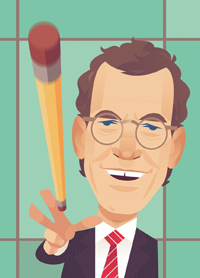
His show included stars, but they were never the point—the charge came from the bits. (Ilustration by Stanley Chow)
By Emily Nussbaum
On May 7th, two weeks before the end of “Late Show with David Letterman,” on CBS, the host delivered one of his final lists, “Top Ten Surprising Facts About Sesame Street.” The entries, every one a harsh gem, rifed on a documentary about the actor who played Big Bird, but they also satirized the way that the media had recently been strip-mining Letterman’s decades on television, seeking revealing nuggets. No. 9: “The earliest Muppets were made from hollowed-out animal carcasses.” No. 2 got a huge, rolling, in-on-it laugh from the audience: “Oscar the Grouch slightly nicer since announcing May 20th retirement.” The No. 1 fact about “Sesame Street”? “There’s also a guy working the puppeteer.”
His show included stars, but they were never the point—the charge came from the bits. (Ilustration by Stanley Chow)
For more than thirty years, David Letterman has been the guy working the talk-show host. But he’s never hidden how tricky it is to move those levers, which has been his appeal to fans: in a job made for smoothies, he’s kept showing us his flaws, those spikes of anger and anxiety, almost despite himself. Now that Letterman’s a flinty codger, an establishment figure, it’s become difficult to recall just how revolutionary his style of meta-comedy once felt. But back when I was sixteen, trapped in the snoozy early eighties and desperate for something rude and wild, Letterman seemed like an anarchist. His manner suggested that TV could puncture the culture, rather than prop it up. My friends, particularly the guys, became his acolytes, quoting his catchphrases (“They pelted us with *rocks* and *garbage*”) and copying his deadpan affect. All of us imprinted like ducklings on his persona, the nice guy with the mean streak, making the world safe for smart comedy.
The truth is, the show that Letterman oversaw in those early years was a far lighter, freer, more strange and cerebral and surreal project than it eventually became. It began as the brainchild of Dave and his girlfriend at the time, the comedy writer Merrill Markoe, who was the show’s first head writer. She invented one-ofs, like Dog Poetry, and perennial segments, like Stupid Pet Tricks. (They considered doing Stupid Baby Tricks, but worried about the legal implications.) The pair, who were together for a decade, met at the Comedy Store, in Los Angeles. Their aesthetics were different—Markoe was a Berkeley art-school graduate, while Letterman was an Indiana frat boy who had majored in television and radio—but they shared an ironic mind-set, a suspicion of show-biz sycophancy, and a desire to break formulas, during a period when the medium had hardened, and taken on a Vegas-y, old-Hollywood
heaviness. In 1980, pulling from earlier experimentalists, like Ernie Kovacs and Steve Allen, they built a daytime talk show on NBC, full of oddball pranks, which bored housewives but won over college kids. When it flopped, the network was nevertheless eager to keep Dave on the schedule, so it bumped Tom Snyder and gave him Snyder’s slot, at 12:30 A.M.—this was before TiVo and Hulu, when you had to stay up late to catch the funky stuff. Within two years, he was a hero to wiseacres everywhere.
On the surface, the early Letterman resembled his mentor, the icy superstar Johnny Carson: he was apolitical, he was Midwestern, he had a repressive manner and lanky college-boy looks. (Don’t let the gap-toothed grin fool you. Squint, and Letterman is Harrison Ford.) But he vibrated with a contradictory charisma: he had a discomfort with back-patting and schmoozing, an odd characteristic for a man whose longtime dream job was TV host.
In a sense, Letterman was a bridge between two eras of male superstars. Like the white-guy comedians of the seventies, Bill Murray and Chevy Chase and Steve Martin, he was a smart-ass, a trickster. And yet, even in 1982, when “Late Night with David Letterman” premièred, he presaged something else,
an obsession with what was authentic, the kind of preoccupation that would dominate the nineties, inflecting figures like David Foster Wallace and Kurt Cobain, famous men who were desperate for rock-star fame and then flamboyantly and publicly hated the stuff once they got it. Like Holden Caulfield, Letterman was on the defense against looking like (or being) a phony, looking like (or being) a sellout, and curdling into a Hollywood jerk. In 1984, in a Playboy interview, Letterman talked about what a drag it was to meet Andy Rooney and realize that his act wasn’t an act: Rooney “doesn’t just appear to be a nasty curmudgeon, he is a nasty curmudgeon.” Already, Letterman had a melancholy vision of what fame could turn you into, if you let your guard down: “I hate the notion that celebrities deserve to be treated with some kind of deference.”
The early “Late Night” included stars, but they were never the point. The charge came from the bits, the “remotes,” the pranks—a circus of eccentricity, from the monkey-cam to Chris Elliott climbing out from beneath the bleachers. Regulars included Larry (Bud) Melman, an elderly character actor who was both mocked and adored. One episode was filmed, for no reason, with a camera that rotated three hundred and sixty degrees. The goal was surprise, which often involved Letterman doing slapstick with a proto-“Jackass” bent. My primal memory of the show is of Dave, in a Velcro suit, getting tossed up onto a wall from a catapult—although, when I looked at a clip recently, I saw that my fond memories had exaggerated a mere mini-trampoline. The suit wasn’t the joke, though. The joke was Letterman, who isn’t zany but polite, asking the Velcro representative questions about this revolutionary substance. On the wall, immobilized, he quietly deadpans, “There’s very little I can do from this position.”
It was a prescient zinger. Once Letterman became truly famous, the captain of a giant machine that demanded ratings, it was harder to stay nimble. Over the decades—through the bruising “late-night wars” with Jay Leno, past a sex scandal (handled with refreshing bluntness) and a heart attack, and into his late-curmudgeon era on CBS—Letterman has occasionally seemed at risk of dissolving, Cheshire Cat style, into his grin, glasses, and cigar. His influence spread so wide that his innovations became clichés. Once the Internet arrived, he never mastered the viral clip. Pop culture often seemed
to bore him. He stayed inside more. Fame made it harder to play games with strangers, the way that a niche cable host, like the latter-day Lettermans Billy Eichner and Eric Andre, might. But, even as his teen acolytes grew up to become his cable competition, Letterman retained an itchy, mercurial self-consciousness, and an inability to fake it with strangers—in a genre devoted to snake-oil synergy, he remained a lousy salesman.
Long before Letterman labelled himself Oscar the Grouch, Cher famously called him an “asshole,” sensing, not incorrectly, his bias against her kind of glitz. But when you watch the whole interview, which aired in 1986, Cher is the one who comes of like a jerk, jabbing the host before he’s done anything wrong. Then Letterman reacts beautifully. He shifts his jaw, he grins, he runs his hand over his forehead. He rattles his page of questions, saying, “No, we’ve got a lot of great stuff here”—rattle, rattle—“really good stuff here. A lot of really interesting, provocative kind of things.” He continues, “What do you mean, ‘Is this as good as it gets?’? Like, what would have been a better thing to say to you?” Cher doubles down: if Letterman doesn’t like a guest, it shows, she says. What flares up between them feels like chemistry, something amazing—and this was the quality he had with many of his more eccentric guests, from Andy Kaufman and Pee-wee Herman to the funny women whom he clearly appreciated, like Amy Sedaris. Even with Cher, Letterman doesn’t get ruder; instead, his voice softens, as he tries to bond over their age (both were around forty). Somewhere in there, he proves her wrong: there’s value, and there’s dynamism, in a host who can’t quite hide what he hates and what he loves.
Most television shows—even dark or cynical ones—find a way to go out warmly. But in the final weeks of “Late Show with David Letterman” the approach was to resist, at every turn, any hint of sentiment. The show featured a cavalcade of wry, dry introverts and cerebral performers, from Steve Martin to Barack Obama; outrageous types, like Martin Short and Nathan Lane, satirizing Hollywood smarm; and Don Rickles and Howard Stern, lobbing put-downs. Letterman remarked to Martin that their friendship dated back to the daytime show. “I was on the show,” Martin responded. “But that doesn’t make us friends.” The conversation went on like that, a knife fight with icicles, the insults indistinguishable from parodies of insults. Four days later, Lane sang a corrosive ditty with lines like “I get no joy from all the joy I provide. I’m just like you, Dave—yeah, I’m dead inside.”
The most successful of these self-designed roasts came from Tina Fey, who honored Dave’s anti-show-biz aesthetic with a bridge-burning rant about the “jerk parade” at the Met Gala, and then responded to Letterman’s compliments on her looks by tugging of her glittery blue gown. “The next time you see me, I’ll be playing charades in a Slanket,” she joked. “This is my last time wearing a fancy dress on a talk show and conforming to gender norms out of respect for you.” Beneath her dress were elaborate Spanx and a leotard, reading “BYE DAVE!”
Irony can be as cloying as gushiness, in excessive doses. And, truthfully, for a fan seeking closure, the harsher of these routines were sometimes hard to watch. (“They pelted us with rocks and garbage.”) It was a relief when Ray Romano showed up, weepy and grateful, comparing Dave’s retirement to “the day the music died.” Romano shared pictures of his family, including three dogs, to which Letterman cooed, sweetly, “Doggies!” Romano said, “They’re all rescue dogs, so if it’s not for you: dead, dead, dead.” Sentimental, you bet. But a welcome taste of sweetness, after so many decades playing defense.
The savory spectacle of “Hannibal.”
By Emily Nussbaum
I stopped watching “Hannibal” in Season 1, after a corpse was carved into a cello, its vocal chords splayed like strings, then “played.” I stopped watching again when Dr. Frederick Chilton, played by the redoubtable Raúl Esparza, got his guts tugged out of his abdomen, like red-sauced linguini, while he was still conscious. I stopped watching when an acupuncturist drove a needle through an eyeball, and again when a man’s leg was roasted and fed to him. Each time, the decision felt like a sane and, maybe, ethical position. Enough nihilism, enough torture, I thought. Enough serial killers glamorized as artists and geniuses.
But that righteous high never lasted. I kept sneaking back, peeking through my fingers—a glimpse here, a binge there—either numbing myself or, depending on one’s perspective, properly sensitizing myself. Gradually, my eyes adjusted to the darkness. By midway through Season 2, “Hannibal” felt less
like a blood-soaked ordeal than like a macabre masterpiece, pure pleasure and audacity. With hints of David Cronenberg and Michael Mann, David Lynch and Stanley Kubrick, it has a formal ambition that is rare for television. It reflexively turns the ordinary into the alien and vice versa. Corpses pile onto a nightmarish totem pole; bees pour out of eye sockets; men swallow songbirds whole. Over time, patterns emerge, revealing an uneasy meditation on intimacy, the vulnerability of the human body, and the power of art—its ability to make us crave something we thought we’d find disgusting.
It’s possible, of course, that I love the show because it confirms my worst suspicions about food culture. For those who haven’t seen “The Silence of the Lambs” or read Thomas Harris’s novels, from which the story is adapted, the basic plot is this: Hannibal Lecter, played with waxwork hauteur by Mads Mikkelsen, is a brilliant psychiatrist who commits hideous murders. He takes “trophies” from the bodies—a liver here, a heart there—then cooks and serves them to unwitting guests. (Most episodes feature dazzling cooking montages, notorious for making viewers hungry, then making them feel guilty.) His justification is that he “eats the rude,” like David Chang, but with slightly less rigid ethical boundaries. Hannibal is quite a catch: he plays the harpsichord and the theremin, he’s a natty dresser, and he knows his Dante. By day, he’s a libertarian life coach for his patients’ Jungian shadows, often manipulating lesser serial killers into covering his tracks—in this universe, as on “Dexter,” serial killers are as common as daisies.
Hannibal’s opposite number—his love interest, basically—is the tetchy, delicate Will Graham. Played by the sad-eyed Hugh Dancy, Will is a criminal profiler for the F.B.I. whose pathological empathy is far more crippling than Hannibal’s lack of the stuff. When he visits a murder scene, he enters a
fugue state and becomes the killer, imagining the crime while murmuring the show’s mantra: “This is my design.” The two men circle each other seductively—best friends and homoerotic nemeses, client and therapist—each getting inside the other’s head, sometimes literally. Last season ended with Hannibal gutting Will with a kitchen knife after stroking his cheek—a moment of symbolic penetration that sent the show’s fans, self-proclaimed Fannibals, into raptures. This season, the third, Hannibal gave Will, who survived, a valentine: a man’s corpse that he had pulverized, then sculpted into the shape of a human heart and displayed in a church, like a holy relic.
None of this is treated even mildly realistically, and yet it’s not exactly camp, either. As the show’s creator, Bryan Fuller (the wizard behind the dreamlike “Wonderfalls” and “Pushing Daisies”), has suggested, “Hannibal” is a show that regards spectacle with a sort of worship. When “Hannibal” began, it mimicked the structures of network cop procedurals, but the show has long since shed that carapace, not unlike the way Hannibal shrugs of what he calls his “person suit,” the demeanor that lets him pass for normal. In a recent interview on RogerEbert.com, Fuller explained that, when he hires directors for the series, he tells them, “This is not an episode of television. This is a pretentious art film.” His willingness to risk looking outré and avant-garde (on NBC, of all places!) is part of a larger trend on television, inflecting series that range from “American Horror Story” to “True Detective,” “The Leftovers,” “The Returned,” “The Strain,” and “The Knick.” Some of these shows are better than others, but they all live and die by their devotion to that old Freudian concept of “the uncanny.” Among that company, “Hannibal” stands out for its ability to risk absurdity and self-seriousness, only to emerge with something gloriously strange and profound, in the realm of opera and poetry. When Will examines that heart sculpture, for instance, it folds open, ventricles falling to the floor, and then walks toward him on twisted, black, nightmare legs, transforming into a demonic elk.
And, despite the gore, there’s a disarming fairy-tale quality to the world of “Hannibal,” in part because the murders, with few exceptions, lack the misogynistic underpinnings of real-life serial killings, or even the snappy kink of Harris’s books. No one is raped on “Hannibal,” even in a fantasy; instead, the victims get repurposed as mushroom farms. When female characters get hurt—whether they’re shot or shoved out a window or, in one case, sliced finely, like garlic—there’s little gendered sadism to the act. Graphic sexual violence isn’t inevitably exploitative; sometimes it’s a welcome force for realism. But, in the arms race of suffering on television, “Hannibal” ’s elision works as a small, idealistic promise to viewers: while anything can happen, that one thing won’t.
Murder, on the other hand, is up for grabs—and treated with brazen disrespect. On “Hannibal,” corpses are fungible art supplies, like clay or oil paint, in sequences in which bodies are stitched into frescoes or twisted into grotesque displays. Skin is stretched into wings, corpses are bent into apiaries, belladonna is planted in heart cavities. It would be easy to see such choices through a cynical lens, as shock effects: Nietzsche is peachy, but sicker is quicker. It certainly makes the show a tough one to recommend to strangers. But these images coalesce into metaphors for mortality and loss. A teacup breaks and then comes back together; we see that it’s like a skull shattering, which in turn reflects a grieving man’s wish for time to go backward. Tears are stirred into Martinis. A woman’s corpse is sewn into a horse’s womb, and after she’s cut out the doctors feel a heartbeat in her torso; they slice her open and a live blackbird flies out. Symbols overlap eerily, as senses do in synesthesia: a heartbeat is a clock tick is a drumbeat. The arch dialogue has the same multiplicity, with ordinary idioms taking on sinister resonance, from “the one that got away” to “the devil you know.” “You smoked me in thyme,” one victim remarks, as he’s served a dish of himself, with typically shrewd double meaning.
In one of last season’s most spectacular scenarios, a black male corpse is discovered in the river, coated in resin. The man had escaped from an art project built by a serial killer Hannibal had never met: he’d torn himself out of a mural comprising dozens of corpses, of varying skin tones—racial diversity reinterpreted as pigment, people reduced to brushstrokes. When Hannibal climbs a ladder to the top of a corn silo, he looks down and sees a pattern: from above, the curled bodies form an eye. The image suggests outrageous ideas: one eye gazing at another, God at his creation, his creation back at God, through the open pupil of the building’s roof. Hannibal calls down to the killer, “I love your work.”
The scene was so outlandish that it made me laugh out loud. It also felt like a reminder of the show’s own double consciousness about what it means to watch from a distance, to admit that we’re voyeurs who enjoy foie gras and veal. (There are moments when one suspects the show is sponsored by PETA.) For anyone who watches modern television, Hannibal may seem familiar: he’s another middle-aged male genius with a fetish for absolute control, like Don Draper and Walter White and Dr. House and Francis Underwood. Astrologically speaking, he’s a Sherlock with Lucifer rising. But, mainly, Hannibal suggests the fantasy of the uncompromising television auteur: he’s the perfectionist who cares only that every detail of his vision be realized, no matter what sacrifices that might require. This is his design.
As Season 3 begins, the show has entered a state of feverish theatricality, adding frame upon frame, underlining its own artificiality: in one flashback, Hannibal recites the magic words “Once upon a time,” and a red velvet curtain fills the screen. A fugitive from justice, Hannibal has fled to Europe, where he’s been riding motorcycles, sipping champagne, killing people in order to steal their curatorial positions, and posing as man and wife with his former therapist, Bedelia Du Maurier (the deliciously chilly Gillian Anderson, speaking so low that their scenes are like whisper contests). It’s not entirely clear whether Bedelia is his hostage or his co-conspirator. “Observe or participate?” he asks, after he bludgeons a man with a bust of Aristotle in front of her. “Are you at this very moment observing or participating?” “Observing,” she whispers, a tear streaking her face. It’s one of many exchanges that seem designed to challenge the viewer’s role but also to suggest that we should stop fooling ourselves. Bedelia doesn’t hurt anyone, but she is too curious to look away. Like anyone who can’t stop watching Hannibal, she’s decided that what he offers is too good not to have a taste.
Home truths on “Show Me a Hero” and “Orange Is the New Black.”
“Show Me a Hero,” which David Simon began working on before he made “The Wire,” finds beauty in daily struggles.
By Emily Nussbaum
In a scene midway through HBO’s “Show Me a Hero,” one that functions as a metonym for the series, a Yonkers city councilman named Hank Spallone—played with toothpick-chewing gusto by Alfred Molina—and a photographer drive through the Schlobohm housing projects. They’re hunting for images to inflame voters: lurid proof that poor black people come from “another culture.” But their presence also changes what they see. When their sedan lingers, two giggly teen-age girls go silent, then shoot their middle fingers up in defiance. Click goes the camera. Meanwhile, a weary older woman walks by, lugging groceries. The photographer raises his lens—but then doesn’t bother.
Written by David Simon and Bill Zorzi, directed with unshowy simplicity by Paul Haggis, and based on the excellent nonfiction book by Lisa Belkin, “Show Me a Hero” is an attempt to refocus that picture—to find beauty in daily struggles and civic courage, not in bad-boy fantasies. The six-episode miniseries, set in the nineteen-eighties and nineties, is a dramatization of the battle to desegregate Yonkers, punctuated by swigs of Maalox. As anyone who followed the real-life story knows—don’t Google it if you don’t want spoilers—it has one happy ending and one very sad one. (The title comes from F. Scott Fitzgerald: “Show me a hero, and I’ll write you a tragedy.”) It’s the latest effort by Simon, the creator of “The Wire” and “Treme,” to forge an effective model for the message drama, with plots torn not from the headlines but from the op-ed page. Well cast, solidly structured, and emotionally stirring, the show is as sincere as the Bruce Springsteen songs that make up its score, a ballad of pragmatism with a passionate heart. And, no, that’s not code for “boring.” The series builds and deepens, stanza by stanza, and then it soars.
To a large degree, this is because of Oscar Isaac, who plays Nick Wasicsko, in a star performance agile enough to elevate scenes that might veer into agitprop. When “Show Me a Hero” begins, Wasicsko, a former cop, a flirt in a thick Pacino mustache, gets picked by the Democrats to run for mayor, challenging the incumbent, who lost support over a judicial decree to build low-income housing. Wasicsko tells voters that he’ll fight the ruling, then wins big, becoming the nation’s youngest mayor. Only then must he face facts: any court appeal is doomed, and, anyway, would bankrupt the city. Somehow, he needs to make this unpopular plan work.
Right away, the white residents who elected Wasicsko turn against him. Civic meetings boil over into near-riots. Former supporters spit in his face. They rock his car, then shatter the windshield—and these scenes, filmed in the locations where the events the show is based on occurred, feel wild and kinetic, placing us right in the action. But Wasicsko barrels forward. What begins as practicality evolves into spiny principle: he’s a dreamy realist, a civic puzzle-solver, which proves to be its own kind of idealism. He builds bridges as they get wiped out. As his troubles increase, Wasicsko’s eyes become wells of need: he’s diligent, canny, a good listener, but he’s hooked on adoration.
The show’s wonkiest policy debates are also its liveliest scenes, as the white men who run the city wheedle to get that mysterious force worshipped by Donald Trump: leverage. In one scene, the city planner Oscar Newman (Peter Riegert, in an Amish beard) proposes scattering just a few town houses within each white neighborhood, to discourage the “criminal element.” An A.C.L.U. lawyer (the appealingly shaggy Jon Bernthal—few shows have made such a nostalgic case for men’s hair of the eighties) calls this racist. Newman doubles down, citing research. “Public-housing residents are no different than any other renters,” he argues later. “They will jealously guard and maintain what’s theirs.” He fights for specific features, like front yards facing the street. It’s clear that Simon and Zorzi are in Newman’s camp, which favors make-it-work facts over ideology, but the show also respects the debate’s prismatic quality: the judge has his priorities, as does HUD, as do the politicians hedging career bets. Even the bigoted residents, who cloak their fears in talk of property values, are flawed, human, and, in a few cases—as with one resident, played with warm humility by Catherine Keener—capable of change. It’s a dark take on politics, but a bright one on democracy.
If the show has a weak spot, it’s in the depiction of Schlobohm, with its grim canyons of drug dealers and struggling families. In the first few episodes, we get glimpses of four black and Latina women, all single mothers: a teen-ager with a criminal boyfriend; a laborer yearning for the kids she left behind in the Dominican Republic; a young widow; and an elderly health aide gone blind (the terrific LaTanya Richardson Jackson). The performances are solid, the real-life details affecting, but the stories feel stiff, disjointed, their peripheral quality underlined by aesthetic choices. (Springsteen dominates, while hip-hop leaks through doors.) It’s only once we get to the housing lottery that these plots click: there’s uneasy power in a shot of the women’s closed faces beside their kids’ open giddiness, praying for a Golden Ticket, even if that means living among strangers who hate them. It’s an ugly numbers game, but it’s the only one in town.
In interviews, Simon likes to call himself the “PBS of HBO.” And, truly, there’s something beautiful and Wasicsko-esque about his dogged desire for TV drama to reflect the best values of journalism. (He’s been working on “Show Me a Hero” since before “The Wire,” as the subject matter has become ever more relevant.) In an era of sociopaths and conspiracies that go all the way to the top, “Show Me a Hero” is less a breakthrough experiment than a refreshing throwback, echoing certain of the grittier, now forgotten network series of TV’s early decades, such as the social-worker procedural “East Side / West Side.” Simon’s shows are unashamed of their mission to educate and to illuminate, and, if advocating for them can make a critic feel as if she were hawking a standing desk, so be it.
But Simon is wrong to suggest that, for viewers, the choices are Yonkers or zombies. The truth is, progressive politics are experiencing a TV boom these days—a revival of the medium’s do-gooder legacy—but they’re often nested in genres taken less seriously: comedies, shows aimed at women and teens, sci-fi. Take CBS’s deceptively procedural-shaped “The Good Wife,” which has explored, with surprising granularity, the risks of N.S.A. surveillance and the insidious effects of big money on Democratic politics. Or ABC Family’s teen soap “The Fosters,” so sharp on judicial issues for kids in the foster system. TV’s most nuanced explorations of health care are on BBC’s “Call the Midwife,” set among Anglican nurse-midwives after the Second World War, and HBO’s mordant black comedy “Getting On,” about a geriatric ward corroded by for-profit funding. The most vivid critique of capitalism since “The Wire” was HBO’s humane “Enlightened”; later, in an entirely different genre, USA’s sizzling dystopia “Mr. Robot” picked up that radical thread. These shows make left-wing arguments without the signifiers of TV seriousness: realism, male protagonists, big-name Hollywood directors.
The most striking example is Jenji Kohan’s women’s-prison series, “Orange Is the New Black,” which is so tonally perverse that the Emmys can’t figure out whether it’s a comedy or a drama. The third season, currently streaming on Netflix, is both a scathing denunciation of the privatization of the prison system and a voice of advocacy for labor unions—though you’ll rarely hear it described that way. With its scenes of shower sex, “Orange Is the New Black” has got the side eye from those who prefer their prison politics straight, so to speak. The characters are demographic cousins of the women on “Show Me a Hero,” but they’re blown up, not life-size. Still, the show’s themes are right out of the Marshall Project: solitary confinement; the joke of a “job fair”; financial corruption, which leaves inmates literally flooded with excrement (a story that reflects a prison where the show is filmed); untreated mental illness; and the fraught “compassionate release” policy of removing elderly inmates. As Simon’s shows do, “Orange Is the New Black” draws from nonfiction: one plot, about a mother and daughter, feels inspired by Adrian Nicole LeBlanc’s “Random Family.” But the series rejects realism, mining instead an outrageousness that verges on the vaudevillian.
The third season begins, in a few early, atypically weak episodes, as the Litchfield Prison is taken over by an outside company, a data-driven corporation of Amazonian proportions. Only gradually do we see the effects of the profit motive. Untrained guards are hired for cheap, while experienced ones become temps. The food is replaced with sickening gruel. “Orange,” too, has a brutal lottery scene, in which inmates are randomly assigned to a garment sweatshop. Most provocatively, the show draws parallels between the inmates and the guards, who are trying to unionize.
The season’s richest story—a slow-motion collision between the Latina cook Gloria and the trans black hairdresser Sophia—was, on the surface, highly intimate and domestic, a story of mothers clashing. But “Orange” is always, damningly, about how institutions crush the illusion of the individual. In the season’s final episodes, Sophia winds up in solitary, punished “for her own protection.” You could tell her tragic story in many styles, bleak or arch, mythic or hyperrealist, and each of these approaches would be valuable, and provocative, in its own way. Authenticity is a useful goal, but it can take many forms. As anyone who has used Instagram knows, the no-filter option is also a filter.
What advertising does to TV.
By Emily Nussbaum
Ever since the finale of “Mad Men,” I’ve been meditating on its audacious last image. Don Draper, sitting cross-legged and purring “Ommmm,” is achieving inner peace at an Esalen-like retreat. He’s as handsome as ever, in khakis and a crisp white shirt. A bell rings, and a grin widens across his face. Then, as if cutting to a sponsor, we move to the iconic Coke ad from 1971—a green hillside covered with a racially diverse chorus of young people, trilling, in harmony, “I’d like to teach the world to sing.” Don Draper, recently suicidal, has invented the world’s greatest ad. He’s back, baby.
The scene triggered a debate online. From one perspective, the image looked cynical: the viewer is tricked into thinking that Draper has achieved Nirvana, only to be slapped with the source of his smile. It’s the grin of an adman who has figured out how to use enlightenment to peddle sugar water, co-opting the counterculture as a brand. Yet, from another angle, the scene looked idealistic. Draper has indeed had a spiritual revelation, one that he’s expressing in a beautiful way—through advertising, his great gift. The night the episode aired, it struck me as a dark joke. But, at a discussion a couple of days later, at the New York Public Library, Matthew Weiner, the show’s creator, told the novelist A. M. Homes that viewers should see the hilltop ad as “very pure,” the product of “an enlightened state.” To regard it otherwise, he warned, was itself the symptom of a poisonous mind-set.
The question of how television fits together with advertising—and whether we should resist that relationship or embrace it—has haunted the medium since its origins. Advertising is TV’s original sin. When people called TV shows garbage, which they did all the time, until recently, commercialism was at the heart of the complaint. Even great TV could never be good art, because it was tainted by definition. It was there to sell.
That was the argument made by George W. S. Trow in this magazine, in a feverish manifesto called “Within the Context of No Context.” That essay, which ran in 1980, became a sensation, as coruscating denunciations of modernity so often do. In television, “the trivial is raised up to power,” Trow wrote. “The powerful is lowered toward the trivial.” Driven by “demography”—that is, by the corrupting force of money and ratings—television treats those who consume it like sales targets, encouraging them to view themselves that way. In one of several sections titled “Celebrities,” he writes, “The most successful celebrities are products. Consider the real role in American life of Coca-Cola. Is any man as well-loved as this soft drink is?”
Much of Trow’s essay, which runs to more than a hundred pages, makes little sense. It is written in the style of oracular poetry, full of elegant repetitions, elegant repetitions that induce a hypnotic effect, elegant repetitions that suggest authority through their wonderful numbing rhythms, but which contain few facts. It’s élitism in the guise of hipness. It is more nostalgic than “Mad Men” ever was for the era when Wasp men in hats ran New York. It’s a screed against TV written at the medium’s low point—after the energy of the sitcoms of the seventies had faded but before the innovations of the nineties—and it paints TV fans as brainwashed dummies.
And yet there’s something in Trow’s manifesto that I find myself craving these days: that rude resistance to being sold to, the insistence that there is, after all, such a thing as selling out. Those of us who love TV have won the war. The best scripted shows are regarded as significant art—debated, revered, denounced. TV showrunners are embraced as heroes and role models, even philosophers. At the same time, television’s business model is in chaos, splintered and re-forming itself, struggling with its own history. Making television has always meant bending to the money—and TV history has taught us to be cool with any compromise. But sometimes we’re knowing about things that we don’t know much about at all.
Once upon a time, TV made sense, economically and structurally: a few dominant network shows ran weekly, with ads breaking them up, like choruses between verses. Then came pay cable, the VCR, the DVD, the DVR, and the Internet. At this point, the model seems to morph every six months. Oceanic flat screens give way to palm-size iPhones. A cheap writer-dominated medium absorbs pricey Hollywood directors. You can steal TV; you can buy TV; you can get it free. Netflix, a distributor, becomes a producer. On Amazon, customers vote for which pilots will survive. Shows cancelled by NBC jump to Yahoo, which used to be a failing search engine. The two most ambitious and original début series this summer came not from HBO or AMC but from a pair of lightweight cable networks whose slogans might as well be “Please underestimate us”: Lifetime, with “UnREAL,” and USA Network, with “Mr. Robot.” That there is a summer season at all is a new phenomenon. This fall, as the networks launch a bland slate of pilots, we know there are better options.
A couple of months ago, at a meeting of the Television Critics Association, the C.E.O. of FX, John Landgraf, delivered a speech about “peak TV,” in which he lamented the exponential rise in production: three hundred and seventy-one scripted shows last year, more than four hundred expected this year—a bubble, Landgraf said, that would surely deflate. He got some pushback: Why now, when the door had cracked open to more than white-guy antiheroes, was it “too much” for viewers? But just as worrisome was the second part of Landgraf’s speech, in which he wondered how the industry could fund so much TV. What was the model, now that the pie had been sliced into slivers? When Landgraf took his job, in 2005, ad buys made up more than fifty per cent of FX’s revenue, he said. Now that figure was thirty-two per cent. When ratings drop, ad rates drop, too, and when people fast-forward producers look for new forms of access: through apps, through data mining, through deals that shape the shows we see, both visibly and invisibly. Some of this involves the ancient art of product integration, by which sponsors buy the right to be part of the story: these are the ads that can’t be fast-forwarded.
This is both a new crisis and an old one. When television began, it was a live medium. Replicating radio, it was not merely supported by admen; it was run by them. In TV’s early years, there were no showrunners: the person with ultimate authority was the product representative, the guy from Lysol or Lucky Strike. Beneath that man (always a man) was a network exec. A layer down were writers, who were fungible, nameless figures, with the exception of people like Paddy Chayefsky, machers who often retreated when they grew frustrated by the industry’s censorious limits. The result was that TV writers developed a complex mix of pride and shame, a sense that they were hired hands, not artists. It was a working-class model of creativity. The shows might be funny or beautiful, but their creators would never own them.
Advertisements shaped everything about early television programs, including their length and structure, with clear acts to provide logical inlets for ads to appear. Initially, there were rules governing how many ads could run: the industry standard was six minutes per hour. (Today, on network, it’s about fourteen minutes.) But this didn’t include the vast amounts of product integration that were folded into the scripts. (Product placement, which involves props, was a given.) Viewers take for granted that this is native to the medium, but it’s unique to the U.S.; in the United Kingdom, such deals were prohibited until 2011. Even then, they were barred from the BBC, banned for alcohol and junk food, and required to be visibly declared—a “P” must appear onscreen.
In “Brought to You By: Postwar Television Advertising and the American Dream,” Lawrence R. Samuel describes early shows like NBC’s “Coke Time,” in which Eddie Fisher sipped the soda. On an episode of “I Love Lucy” called “The Diet,” Lucy and Desi smoked Philip Morris cigarettes. On “The Flintstones,” the sponsor Alka-Seltzer ruled that no character get a stomach ache, and that there be no derogatory presentations of doctors, dentists, or druggists. On “My Little Margie,” Philip Morris reps struck the phrase “I’m real cool!,” lest it be associated with their competitors Kool cigarettes. If you were a big name—like Jack Benny, whom Samuel calls “the king of integrated advertising”—“plugola” was par for the course. (Benny once mentioned Schwinn bikes, then looked directly into the camera and deadpanned, “Send three.”) There were only a few exceptions, including Sid Caesar, who refused to tout brands on “Your Show of Shows.”
Sponsors were a conservative force. They helped blacklist writers suspected of being Communists, and, for decades, banned plots about homosexuality and “miscegenation.” In Jeff Kisseloff’s oral history “The Box,” from 1995, Bob Lewine, of ABC, describes pitching Sammy Davis, Jr., in an all-black variety show: Young & Rubicam execs walked out, so the idea was dropped. This tight leash affected even that era’s version of prestige TV. In “Brought to You By,” Samuel lists topics deemed off limits as “politics, sex, adultery, unemployment, poverty, successful criminality and alcohol”—now the basic food groups of cable. In one notorious incident, the American Gas Association sponsored CBS’s anthology series “Playhouse 90.” When an episode called “Portrait of a Murderer” ended, it created an unfortunate juxtaposition: after the killer was executed, the show cut to an ad with the slogan “Nothing but gas does so many jobs so well.” Spooked, American Gas took a closer look at an upcoming project, George Roy Hill’s “Judgment at Nuremberg.” The company objected to any mention of the gas chambers—and though the writers resisted, the admen won.
This sponsor-down model held until the late fifties, around the time that the quiz-show scandals traumatized viewers: producers, in their quest to please ad reps, had cheated. Both economic pressures and the public mood contributed to increased creative control by networks, as the old one-sponsor model dissolved. But the precedent had been established: when people talked about TV, ratings and quality were existentially linked, the business and the art covered by critics as one thing. Or, as Trow put it, “What is loved is a hit. What is a hit is loved.”
Kenya Barris’s original concept for the ABC series “Black-ish,” last year’s smartest network-sitcom début, was about a black writer in a TV writers’ room. But then he made the lead role a copywriter at an ad agency, which allowed the network to cut a deal with Buick, so that the show’s hero, Dre, is seen brainstorming ads for its car. In Automotive News, Buick’s marketing manager, Molly Peck, said that the company worked closely with Barris. “We get the benefit of being part of the program, so people are actually watching it as opposed to advertising where viewers often don’t watch it.”
Product integration is a small slice of the advertising budget, but it can take on outsized symbolic importance, as the watermark of a sponsor’s power to alter the story—and it is often impossible to tell whether the mention is paid or not. “The Mindy Project” celebrates Tinder. An episode of “Modern Family” takes place on iPods and iPhones. On the ABC Family drama “The Fosters,” one of the main characters, a vice-principal, talks eagerly about the tablets her school is buying. “Wow, it’s so light!” she says, calling the product by its full name, the “Kindle Paperwhite e-reader,” and listing its useful features. On last year’s most charming début drama, the CW’s “Jane the Virgin,” characters make trips to Target, carry Target bags, and prominently display the logo.
Those are shows on channels that are explicitly commercialized. But similar deals ripple through cable television and the new streaming producers. FX cut a deal with MillerCoors, so that every character who drinks or discusses a beer is drinking its brands. (MillerCoors designs retro bottles for “The Americans.”) According to Ad Age, Anheuser-Busch struck a deal with “House of Cards,” trading supplies of booze for onscreen appearances; purportedly, Samsung struck another, to be the show’s “tech of choice.” Unilever’s Choco Taco paid for integration on Comedy Central’s “Workaholics,” aiming to be “the dessert for millennials.” On NBC, Dan Harmon’s avant-garde comedy, “Community,” featured an anti-corporate plot about Subway paid for by Subway. When the show jumped to Yahoo, the episode “Advanced Safety Features” was about Honda. “It’s not there were just a couple of guys driving the car; it was the whole episode about Honda,” Tom Peyton, an assistant V.P. of marketing at Honda, told Ad Week. “You hold your breath as an advertiser, and I’m sure they did too—did you go too far and commercialize the whole thing and take it away from it?—but I think the opposite happened. . . . Huge positives.”
Whether that bothers you or impresses you may depend on whether you laughed and whether you noticed. There’s a common notion that there’s good and bad integration. The “bad” stuff is bumptious—unfunny and in your face. “Good” integration is either invisible or ironic, and it’s done by people we trust, like Stephen Colbert or Tina Fey. But it brings out my inner George Trow. To my mind, the cleverer the integration, the more harmful it is. It’s a sedative designed to make viewers feel that there’s nothing to be angry about, to admire the ad inside the story, to train us to shrug off every compromise as necessary and normal.
Self-mocking integration used to seem modern to me—the irony of a post-“Simpsons” generation—until I realized that it was actually nostalgic: Jack Benny did sketches in which he playfully “resisted” sponsors like Lucky Strike and Lipton tea. Alfred Hitchcock, on “Alfred Hitchcock Presents,” made snide remarks about Bristol-Myers. The audience had no idea that those wisecracks were scripted by a copywriter who had submitted them to Bristol-Myers for approval.
A few weeks ago, Stephen Colbert began hosting CBS’s “Late Show.” In his first show, he pointed to a “cursed” amulet. He was under the amulet’s control, Colbert moaned, and thus had been forced to “make certain”—he paused—“regrettable compromises.” Then he did a bit in which he slavered over Sabra hummus and Rold Gold pretzels. Some critics described the act as satire, but that’s a distinction without a difference. Colbert embraced “sponsortunities” when he was on Comedy Central, too, behind the mask of an ironic persona; it’s likely one factor that made him a desirable replacement for Letterman, the worst salesman on late-night TV.
During this summer of industry chaos, one TV show did make a pungent case against consumerism: “Mr. Robot,” on USA Network. A dystopian thriller with Occupy-inflected politics, the series was refreshing, both for its melancholy beauty and for its unusually direct attack on corporate manipulation. “Mr. Robot” was the creation of a TV newcomer, Sam Esmail, who found himself in an odd position: his anti-branding show was itself rebranding an aggressively corporate network, known for its “blue sky” procedurals—a division of NBCUniversal, a subsidiary of Comcast.
“Mr. Robot” tells the story of Elliott Alderson, corporate cog by day, hacker by night, a mentally unstable junkie who is part of an Anonymous-like collective that conspires to delete global debt. In one scene, Elliott fantasizes about being conventional enough for a girlfriend: “I’ll go see those stupid Marvel movies with her. I’ll join a gym. I’ll heart things on Instagram.” He walks into his boss’s office with a Starbucks vanilla latte, the most basic of beverages. This sort of straightforwardly hostile namecheck is generally taboo, both to avoid offending potential sponsors and to leave doors open for their competitors. Esmail says he fought to get real brands in the story, citing “Mad Men” as precedent, as his phone calls with the network’s lawyers went from “weekly to daily.”
Were any of these mentions paid for? Not in the first season—although Esmail says that he did pursue integrations with brands, some of which turned him down and some of which he turned down (including tech companies that demanded “awkward language” about their features). He’s open to these deals in Season 2. “If the idea is to inspire an interesting debate over capitalism, I actually think (depending on how we use it) it can help provoke that conversation even more,” he said. As long as such arrangements are “organic and not forced,” they’re fine with him—what’s crucial is not the money but the verisimilitude that brands provide. Only one major conflict came up, Esmail said, in the finale, when Elliott’s mysterious alter ego screams in the middle of Times Square, “I’m no less real than the fucking meat patty in your Big Mac.” Esmail and USA agreed to bleep “Big Mac”—“to be sensitive to ad sales,” Esmail told me—but they left it in for online airings. Esmail said he’s confident that the network fought for him. “Maybe Comcast has a relationship with McDonald’s?” he mused. (USA told me that the reason was “standards and practices.”)
“Are you asking me how I feel about product integration?” Matt Weiner said. “I’m for it.” Everything on TV is an ad for something, he pointed out, down to Jon Hamm’s beautifully pomaded hair—and he argued that a paid integration is far less harmful than other propaganda embedded in television, such as how cop shows celebrate the virtues of the state. We all have our sponsors. Michelangelo painted for the Pope! What’s dangerous about modern TV isn’t advertisers, Weiner told me; it’s creatives not getting enough of a cut of the proceeds.
Weiner used to work in network television, in a more restrictive creative environment, until he got his break, on “The Sopranos.” Stepping into HBO’s subscription-only chamber meant being part of a prestige brand: no ads, that gorgeous hissing logo, critical bennies. The move to AMC, then a minor cable station, was a challenge. Weiner longed for the most elegant model, with one sponsor—the approach of “Playhouse 90.” But getting ads took hustle, even in a show about them. Weiner’s description of the experience of writing integrations is full of cognitive dissonance. On the one hand, he said, wistfully, he didn’t realize at first that he could say no to integrations. Yet he was frustrated by the ones he couldn’t get, like attaching Revlon to Peggy’s “Basket of Kisses” plot about lipstick. Such deals were valuable—“money you don’t leave on the floor”—but it was crucial that the audience not know about them, and that there be few.
The first integration on “Mad Men,” for Jack Daniel’s, was procured before Weiner got involved; writing it into the script made him feel “icky.” (Draper wouldn’t drink Jack Daniel’s, Weiner told me.) Pond’s cold cream was a more successful fit. But he tried to impose rules: the sponsor could see only the pages its brand was on; dialogue would mention competitors; and, most important, the company couldn’t run ads the night its episode was on the air. Unilever cheated, Weiner claimed—and AMC allowed it. The company filmed ads mimicking the “Mad Men” aesthetic, making the tie with the show visible. If viewers knew that Pond’s was integrated, they wouldn’t lose themselves in the story, Weiner worried.
In the end, he says, he did only three—Heineken was the third (an integration procured after Michelob backed out). I naïvely remarked that Jaguar couldn’t have paid: who would want to be the brand of sexual coercion? “You’d be surprised,” he said. Jaguar didn’t buy a plug, but the company loved the plot—and hired Christina Hendricks to flack the car, wearing a bright-red pantsuit.
Weiner had spent the Television Critics Association convention talking up “Mr. Robot” and he told me that he was “stunned” by Esmail’s show, which he called American TV’s “first truly contemporary anti-corporate message.” Then again, he said, “show business in general has been very good at co-opting the people that bite the hands that feed them.” NBCUniversal was wise to buy into Esmail’s radical themes, he said, because these are ideas that the audience is ready for—“even the Tea Party knows we don’t want to give the country over to corporations.”
Weiner made clear that Coke hadn’t paid for any integration; he mentioned it a few times. Finally, I asked, Why not? “Mad Men” ended in a way that both Coke and viewers could admire. Why not take the money? Two reasons, he said. First, Coca-Cola could “get excited and start making demands.” But, really, he didn’t want to “disturb the purity of treating that ad as what it was.” Weiner is proud that “Mad Men” had a lasting legacy, influencing how viewers saw television’s potential, how they thought about money and power, creativity and the nature of work. He didn’t want them to think that Coke had bought his finale.
There is no art form that doesn’t run a three-legged race with the sponsors that support its production, and the weaker an industry gets (journalism, this means you; music, too) the more ethical resistance flags. But readers would be grossed out to hear that Karl Ove Knausgaard had accepted a bribe to put the Talking Heads into his childhood memories. They’d be angry if Stephen Sondheim slipped a Dewar’s jingle into “Company.” That’s not priggishness or élitism. It’s a belief that art is powerful, that storytelling is real, that when we immerse ourselves in that way it’s a vulnerable act of trust. Why wouldn’t this be true for television, too?
Viewers have little control over how any show gets made; TV writers and directors have only a bit more—their roles mingle creativity and management in a way that’s designed to create confusion. Even the experts lack expertise, these days. But I wonder if there’s a way for us to be less comfortable as consumers, to imagine ourselves as the partners not of the advertisers but of the artists—to crave purity, naïve as that may sound. I miss “Mad Men,” that nostalgic meditation on nostalgia. But embedded in its vision was the notion that television writing and copywriting are and should be mirrors, twins. Our comfort with being sold to may look like savvy, but it feels like innocence. There’s something to be said for the emotions that Trow tapped into, disgust and outrage and betrayal—emotions that can be embarrassing but are useful when we’re faced with something ugly.
Perhaps this makes me sound like a drunken twenty-two-year-old waving a battered copy of Naomi Klein’s “No Logo.” But that’s what happens when you love an art form. In my imagination, television would be capable of anything. It could offend anyone; it could violate any rule. For it to get there, we might have to expect of it what we expect of any art.
*An earlier version of this article misstated the title of Trow’s essay.
The actor who fought to integrate early TV
By Emily Nussbaum
Racial diversity on television is in a state of rapid acceleration. In 2012, when “Scandal” débuted, starring Kerry Washington as a Capitol Hill fixer, it was the first network drama to feature a black female lead in thirty-eight years—a shameful milestone. The same fall, “The Mindy Project,” on Fox, made a brown girl the madcap heroine of a sitcom, not her best friend. Just three years later, “Scandal” faces off with “Empire”; “Black-ish” and “Fresh Off the Boat” have helped rebrand ABC as “the diversity network”; Aziz Ansari’s “Master of None” struts on Netflix; the Latina-centric “Jane the Virgin” lights up the CW; and Priyanka Chopra plays the lead on “Quantico.” There has been an especially remarkable migration of black actresses from movies to TV, among them Taraji P. Henson, Viola Davis, Angela Bassett, Gabourey Sidibe, Lorraine Toussaint, and Gabrielle Union. There is also a deluge of new talent on shows like Netflix’s “Orange Is the New Black,” one of several series that have opened the floodgates for performers who were long denied rich, complex central roles.
Hollywood, television included, is still run by white decision-makers, mostly men. The recent season of “Project Greenlight,” on HBO, made explicit how resistant to race talk Hollywood can be, a stifling culture of bros bonding with mirror versions of themselves. Behind-the-scenes numbers have barely shifted, particularly for directors. And yet TV is evolving rapidly. Much of this is due to a prominent new set of creative figures, among them Ansari and Kaling, Shonda Rhimes and Kenya Barris, Lee Daniels and Larry Wilmore, Nahnatchka Khan and John Ridley, Dee Rees and Mara Brock Akil, who don’t merely perform but run the show. Even newer is the increasing bluntness of many creators. When Viola Davis won an Emmy for Best Actress, for ABC’s “How to Get Away with Murder,” she gave a bold and unapologetic speech in which she quoted Harriet Tubman and declared, “The only thing that separates women of color from anyone else is opportunity. You can’t win an Emmy for roles that are simply not there.”
This is thrilling and long overdue. But it’s also a phenomenon that could easily recede, as it has many times before after periods of progress: in the early fifties, when television was brand-new; in the seventies, the era of “Roots” and Norman Lear; and again in the early nineties, post-Cosby, when black sitcoms thrived. One observer understood this ephemeral quality more than most: P. Jay Sidney, an African-American actor who built a four-decade career in television, all the while protesting network racism, in what Donald Bogle’s book “Primetime Blues” recounts as a “one-man crusade to get African-Americans fair representation in television programs and commercials.” Sidney is a footnote in history books, while other activists of his era are heroes. But he was there when the medium began, appearing on TV more than any other black dramatic actor of the time. Even as his résumé grew, Sidney picketed, he wrote letters, he advocated boycotts, he taped interactions with executives, lobbying tirelessly against TV’s de-facto segregation. In 1962, he testified before the House of Representatives. Nothing made much headway; he grew disgusted and disaffected. By the time Sidney died, in Brooklyn, in 1996, he had largely been forgotten, a proud loner who never got to see his vision become reality. “People today benefit from things that were sacrificed years ago,” his ex-wife Carol Foster Sidney, who is now eighty-seven, told me. “And they haven’t a clue.”
Sidney was born Sidney Parhm, Jr., in 1915 in Norfolk, Virginia, and grew up in poverty, in an era of public lynchings and Jim Crow. His mother died when he was a child; his father moved the family to New York, then died when his son was fifteen. According to a 1955 profile, titled “Get P. Jay Sidney for the Part,” he was a “difficult” child who landed in foster care but excelled academically—he graduated from high school at fifteen, then went to City College for two years, dropping out to enter the theatre. A lifelong autodidact, he is described by those who knew him as a guarded, sardonic figure, eternally testing those around him against an intellectual ideal. But even during the Depression he got jobs: he was in Lena Horne’s first stage play, in 1934; in the forties, he appeared in “Carmen Jones” and “Othello.” In a photograph taken at a campaign event for Franklin D. Roosevelt, Sidney is a dapper bohemian with a clipped beard. He also built a radio career, producing a series called “Experimental Theatre of the Air,” which, in a radical move, cast voices without regard to racial categories. Sidney collected his press clippings in a binder, which is saved at the New York Public Library’s Schomburg Center.
As the country came out of the Depression, and the civil-rights movement began, progress for black actors may have seemed possible. When television emerged, in the forties, it was a low-status but experimental medium, suggesting tantalizing opportunities for innovators. Yet a newspaper article from the mid-fifties, headlined “TV’S NEW POLICY FOR NEGROES,” depicts Sidney as the “single exception” to the exclusion of black dramatic actors. In TV’s infancy, the article laments, “The video floodgates were expected to be thrown open to experienced Negro actors. It never happened.”
“I had a whole goddamned career of ‘Yassuh, can I git ya another drink,’ ” Sidney said.
“I had a whole goddamned career of ‘Yassuh, can I git ya another drink,’ ” Sidney said.
CREDIT PHOTOGRAPH FROM SCHOMBURG CENTER / NEW YORK PUBLIC LIBRARY
Racial diversity on television is in a state of rapid acceleration. In 2012, when “Scandal” débuted, starring Kerry Washington as a Capitol Hill fixer, it was the first network drama to feature a black female lead in thirty-eight years—a shameful milestone. The same fall, “The Mindy Project,” on Fox, made a brown girl the madcap heroine of a sitcom, not her best friend. Just three years later, “Scandal” faces off with “Empire”; “Black-ish” and “Fresh Off the Boat” have helped rebrand ABC as “the diversity network”; Aziz Ansari’s “Master of None” struts on Netflix; the Latina-centric “Jane the Virgin” lights up the CW; and Priyanka Chopra plays the lead on “Quantico.” There has been an especially remarkable migration of black actresses from movies to TV, among them Taraji P. Henson, Viola Davis, Angela Bassett, Gabourey Sidibe, Lorraine Toussaint, and Gabrielle Union. There is also a deluge of new talent on shows like Netflix’s “Orange Is the New Black,” one of several series that have opened the floodgates for performers who were long denied rich, complex central roles.
Hollywood, television included, is still run by white decision-makers, mostly men. The recent season of “Project Greenlight,” on HBO, made explicit how resistant to race talk Hollywood can be, a stifling culture of bros bonding with mirror versions of themselves. Behind-the-scenes numbers have barely shifted, particularly for directors. And yet TV is evolving rapidly. Much of this is due to a prominent new set of creative figures, among them Ansari and Kaling, Shonda Rhimes and Kenya Barris, Lee Daniels and Larry Wilmore, Nahnatchka Khan and John Ridley, Dee Rees and Mara Brock Akil, who don’t merely perform but run the show. Even newer is the increasing bluntness of many creators. When Viola Davis won an Emmy for Best Actress, for ABC’s “How to Get Away with Murder,” she gave a bold and unapologetic speech in which she quoted Harriet Tubman and declared, “The only thing that separates women of color from anyone else is opportunity. You can’t win an Emmy for roles that are simply not there.”
This is thrilling and long overdue. But it’s also a phenomenon that could easily recede, as it has many times before after periods of progress: in the early fifties, when television was brand-new; in the seventies, the era of “Roots” and Norman Lear; and again in the early nineties, post-Cosby, when black sitcoms thrived. One observer understood this ephemeral quality more than most: P. Jay Sidney, an African-American actor who built a four-decade career in television, all the while protesting network racism, in what Donald Bogle’s book “Primetime Blues” recounts as a “one-man crusade to get African-Americans fair representation in television programs and commercials.” Sidney is a footnote in history books, while other activists of his era are heroes. But he was there when the medium began, appearing on TV more than any other black dramatic actor of the time. Even as his résumé grew, Sidney picketed, he wrote letters, he advocated boycotts, he taped interactions with executives, lobbying tirelessly against TV’s de-facto segregation. In 1962, he testified before the House of Representatives. Nothing made much headway; he grew disgusted and disaffected. By the time Sidney died, in Brooklyn, in 1996, he had largely been forgotten, a proud loner who never got to see his vision become reality. “People today benefit from things that were sacrificed years ago,” his ex-wife Carol Foster Sidney, who is now eighty-seven, told me. “And they haven’t a clue.”
Sidney was born Sidney Parhm, Jr., in 1915 in Norfolk, Virginia, and grew up in poverty, in an era of public lynchings and Jim Crow. His mother died when he was a child; his father moved the family to New York, then died when his son was fifteen. According to a 1955 profile, titled “Get P. Jay Sidney for the Part,” he was a “difficult” child who landed in foster care but excelled academically—he graduated from high school at fifteen, then went to City College for two years, dropping out to enter the theatre. A lifelong autodidact, he is described by those who knew him as a guarded, sardonic figure, eternally testing those around him against an intellectual ideal. But even during the Depression he got jobs: he was in Lena Horne’s first stage play, in 1934; in the forties, he appeared in “Carmen Jones” and “Othello.” In a photograph taken at a campaign event for Franklin D. Roosevelt, Sidney is a dapper bohemian with a clipped beard. He also built a radio career, producing a series called “Experimental Theatre of the Air,” which, in a radical move, cast voices without regard to racial categories. Sidney collected his press clippings in a binder, which is saved at the New York Public Library’s Schomburg Center.
As the country came out of the Depression, and the civil-rights movement began, progress for black actors may have seemed possible. When television emerged, in the forties, it was a low-status but experimental medium, suggesting tantalizing opportunities for innovators. Yet a newspaper article from the mid-fifties, headlined “TV’S NEW POLICY FOR NEGROES,” depicts Sidney as the “single exception” to the exclusion of black dramatic actors. In TV’s infancy, the article laments, “The video floodgates were expected to be thrown open to experienced Negro actors. It never happened.”
“We took it for granted that we would be the last hired if hired at all and the first fired,” Ossie Davis recalled, in “The Box,” Jeff Kisseloff’s oral history of television. “And that we would wind up doing the same stereotypical crap that we did on Broadway.” “Amos and Andy” was typical fare. In the late fifties, Davis participated in a TV boycott in Harlem, in which black viewers turned off their sets one Saturday night. But it was Sidney’s rabble-rousing that had a direct influence on Davis’s career: “He used to walk around with a sign, accusing the broadcast industry of discriminating against black folks. As a response to P. Jay’s accusations, CBS didn’t give him a job, but they gave me one.”
From 1951 on, Sidney made a living on TV, getting a few notable roles, including Cato, Hercules Mulligan’s slave and fellow-spy, in “The Plot to Kidnap General Washington,” in 1952. For two years, he appeared as one of two African-American soldiers on “The Phil Silvers Show”—a casting move protested by Southern stations. (The writers ignored them.) Over time, he amassed roles on more than a hundred and seventy shows, as well as a lucrative sideline in voice-over work and advertisements. (He played the onscreen role of Waxin Jackson for Ajax.) But the majority of his parts were walk-ons: doormen, porters, waiters. “I had a whole goddamned career of ‘Yassuh, can I git ya another drink, sir?,’ ” he told Kisseloff. “But I did what was available. I did not mix feelings with the fact that I needed money to live.”
With each setback, Sidney grew more frustrated, according to Foster Sidney, who married Sidney in 1954. Foster Sidney was the daughter of a dentist, educated at Howard University, a member of the Washington, D.C., African-American élite. She had persuaded her family to let her move to New York to be a French translator but dreamed of being an actress. Foster Sidney recalls, “He knew I had these aspirations, but he said, ‘One actor in the family.’ I, timid little thing, said, ‘Yes, dear.’ ” Their marriage was contentious, with Sidney resenting Foster Sidney’s “bourgeois” background; they separated, and had no children, but did not divorce until 1977. (In later years, Foster Sidney returned to acting, a period she calls “ten years in Heaven.”)
Nonetheless, Foster Sidney supported her husband’s activism, marching with him, as did a few other friends, including Sidney’s lawyer and close friend Bruce M. Wright—who later became a flamboyant activist judge, derided as Turn ’Em Loose Bruce for his opposition to racist bail policies. Even in freezing January, Sidney picketed CBS, the advertising agency BBDO, and other places, passing out flyers. He bought ads in the Times advocating a boycott against the sponsor Lever Brothers, which used black talent only in ads aimed at blacks. “It was his life,” Foster Sidney said. “There was nothing else he wanted.”
Sidney was particularly impatient with actors who hesitated to join his protests for fear of alienating their employers. “I didn’t give a shit about jobs for blacks,” he told Kisseloff. “I was concerned about the image of black people in television.” As early as 1954, he was writing to the Footlights and Sidelights column in the Amsterdam News, encouraging a write-in campaign, noting that “by not including Negroes in at least approximately the numbers and the roles in which they occur in American life, television and radio programs that purport to give a true picture of American life malign and misrepresent Negro citizens as a whole.”
In 1962, he testified before the House, arguing against “discrimination that is almost all-pervading, that is calculated and continuing.” He described two-faced producers, who used a nepotistic, friend-of-a-friend hiring approach, saying, “for most white people, Negroes are not actors, or doctors, or lawyers—not really—but are rather, all members of a secret lodge, domiciled in Harlem or some other Colored Town—all knowing each other and all experts on one another.” In 1967, Variety reported that Sidney had quit a job on “As the World Turns,” protesting the soap opera’s policy of not offering black actors contracts, as it did white actors. In 1968, he was quoted in the Times on whether the representation of black people in ads had improved. “It was like a man who’s been gravely ill with a temperature of 104 if it drops to 102 it’s better,” he said. “But, if the question is, ‘Has the progress been commensurate with the need?’ The answer is ‘No.’ ”
He also picketed David Susskind. A producer and talk-show host, Susskind was a famous liberal, but when he produced a show about American history that omitted blacks Sidney targeted his office. After Susskind died, Claude Lewis recounted Sidney’s confrontation with Susskind in the Philadelphia Inquirer. “You’re killing me,” Susskind said. “I mean to,” Sidney replied. “You talk that good stuff on TV, but you don’t practice what you preach. We’re here to say you’re a phony. If you really want to be the decent guy you pretend to be, you’ll offer opportunities to talented Negro performers, just as you do to whites.” When Susskind told Sidney that he would “earn an ulcer,” Sidney replied, “Mr. Susskind, I don’t get ulcers. I give ulcers. I’m on this line, not to win parts for me, but for others who deserve them.” A few years later, he appeared in a Susskind production, the gritty and iconoclastic social-justice procedural “East Side/West Side,” along with James Earl Jones and Cicely Tyson. The series was cancelled after one season.
Tom Scott, a younger actor and a model—he was one of the first African-Americans to be hired by Ford—picketed with Sidney. The two men talked nightly, strategizing; Scott was inspired by his friend’s savvy. When he couldn’t get press coverage, Scott recalls, Sidney had a female friend call the police and tell them, “There’s a nigger out there with a knife!” The cops showed up—and, with them, the media.
Yet, as the years passed, the door stayed locked. TV was still run by white people, emphasizing white stories. Sidney had bought a brick house in the Prospect Lefferts Gardens neighborhood of Brooklyn, where he retreated. In 1988, the Amsterdam News lamented the minuscule presence of black TV producers and writers, adding that Sidney’s activism had had as much effect as “ice cubes at the South Pole.” Sidney made one last significant TV appearance, in the TV movie “A Gathering of Old Men.” But in some ways little had changed: in his final movie, “A Kiss Before Dying,” in 1991, he played a bellman.
Foster Sidney lost touch with her ex-husband after their divorce; so did Scott and Lewis. But someone must have known him—the person who saved a document, labelled “ephemera,” that showed up at the Schomburg Center. On the envelope is scrawled “P. Jay Sidney memoir.” Inside is a fifteen-page handwritten account of Sidney’s life, on lined yellow paper, ending with a description of his death, from prostate cancer. It’s unclear who the author is, but the narrative is a raw and intimate confession, seemingly notes for a book. It’s possible that this is the project Sidney mentioned in a 1946 playbill, in a bio that describes him writing a book whose title is underlined at the top of these pages, “Memoirs of an American Untouchable.”
Written in the third person, the document swings wildly in tone; it’s laceratingly self-critical at some points, grandiose at others. It recounts Sidney’s father’s warnings: never to trust white people or women, never to be dependent. It ruminates on the cruel tumult of Sidney’s romantic life, but also on his longing, never-fulfilled, for an intellectual soul mate. He rails against institutions: the Catholic Church, Hollywood, even the civil-rights movement, which he felt made black people complacent. To the end, the document says, Sidney was rankled by a world that thought small. He had picketed for “black actors to be portrayed as respected people,” but an award he won honored only “his fighting to get black actors work on TV—just work, any old part. (This was not his aim at all! No one understood. He became very discouraged.)”
By all accounts, Sidney grew irascible with age: Lewis describes him as having become so sensitive that he saw slights everywhere. But there was a moment when Sidney believed that TV might someday reflect African-Americans in their full humanity. In a speech Sidney gave at a National Freedom Day dinner, in Philadelphia in 1968, he laid out this vision, with wit and elegance. The “bad image” of blackness, he said, was “like the air we breathe, and that makes it harder to recognize.” While African-Americans were accepted as “entertainers” for whites, only on dramatic shows might they be seen as “real people with real problems and real feelings.” White-centered programs “imply, insinuate, suggest—and I will use this word in the special way that possibly only Negroes will understand—they signify” that African-Americans were not truly citizens. Black audiences absorbed this message, too, learning to discount their own power—their economic leverage, especially. Sidney’s speech urged viewers to demand their place onscreen. Read today, it feels like a map to a world always just beyond the horizon.
To the Pulitzer Judges
As The New Yorker's critic, Emily Nussbaum has become indispensable to our understanding of how television reaches us in all facets of our lives. In the last twenty years, television has become the dominant cultural product of our age--it reaches us everywhere, and has replaced movies and books as the thing we talk about with our friends, families and colleagues. As Nussbaum writes in "The Price is Right," her groundbreaking exploration of advertising on TV, "Those of us who love TV have won the war. The best scripted shows are regarded as significant art--debated, revered, denounced." In Nussbaum, we finally have a critic who approaches television with a love both passionate and cerebral, free of condescension but unwilling to cheerlead for an industry that often goes awry.
Nussbaum's gives weighty appraisals to the shows most often admired--"Mad Men," "Breaking Bad," "The Jinx"--but she makes no secret of finding artistry and new perspectives in series that often don't attract serious critical attention. She writes of "Buffy the Vampire Slayer" that it was "the comic-book-inflected series that made me into a television critic." She attacks the critical consensus that rewards shows for looking like Hollywood films: "Shows that look fantastic, like "House of Cards," get unearned prestige, even when they're empty suits. Shows made on a budget, or collaboratively, or on off-brand channels for teen-agers, get the side eye." It's a radical reappraisal of how we've been taught to view television.
Nussbaum writes definitive portraits of the people everyone's talking about. Her sensitive reappraisal of the legacy of Joan Rivers, "Last Girl in Larchmont," concluded that Rivers succeeded in a man's world partly by reinforcing its harsh guidelines. Of a late appearance by Rivers, Nussbaum writes that she "fought hard for the token slot allotted to a female comic, yet she seemed thrown by a world in which that might be no longer necessary. Like Moses and the Promised Land, she couldn't cross over." Nussbaum also mines the depths of television's forgotten history, as in her masterful excavation of the life of P. Jay Sidney, an African-American actor who appeared on TV more than any other black dramatic actor of his time, all the while protesting network racism. "Even as his resume grew," Nussbaum writes, "Sidney picketed, he wrote letters, he advocated boycotts, he taped interactions with executives, lobbying tirelessly against TV's de facto segregation."
In her ambition and scholarly depth, Nussbaum has brought a new rigor to TV criticism. But it's her wit and her ability to convey why you should love a show as much as she does that makes her a joy to read. As she writes, "That's what happens when you love an art form. In my imagination, television is capable of anything."
Sincerely,
David Remnick
Biography

Emily Nussbaum has been the television critic for The New Yorker since 2011. She has written about “The Good Wife,” “Girls,” “Mad Men,” and “Scandal,” among other shows. Previously, she worked at New York for seven years, editing the Culture Pages (and creating the Approval Matrix) and writing both features and criticism. She won a 2014 National Magazine Award for Columns and Commentary.