The Boston Globe, by Wesley Morris
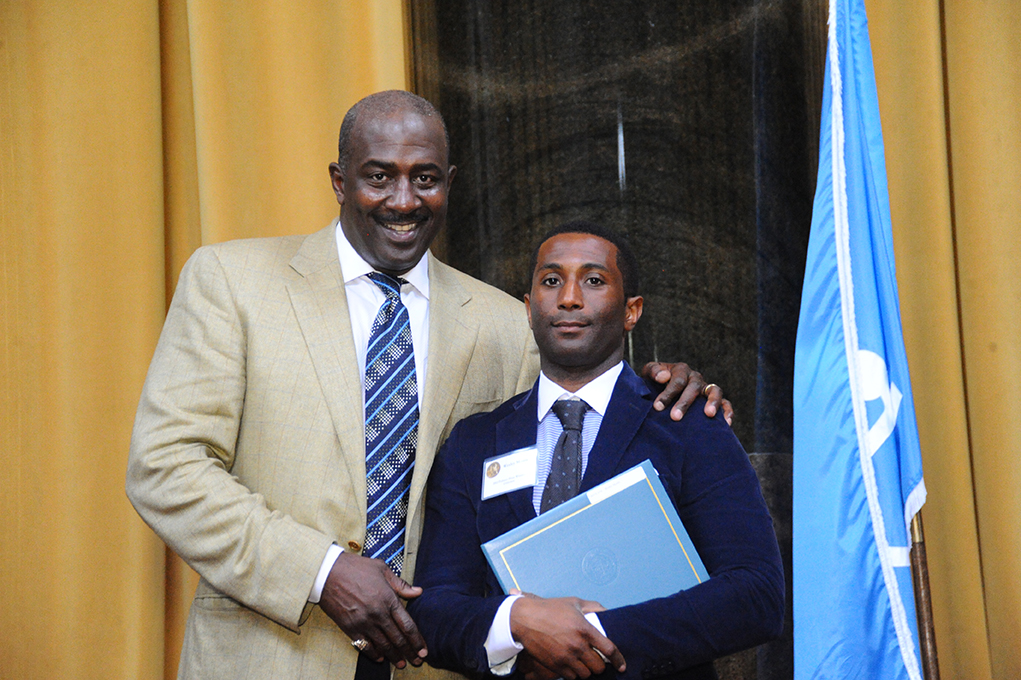
Gregory Moore (left), co-chair of The Pulitzer Prize Board, presents the 2012 Criticism Prize to Wesley Morris of The Boston Globe.
Winning Work
By Wesley Morris
(Two and a half stars.)
Three summers ago, I went to visit a friend in West Texas. She took a group of us to a restaurant in a big, well-appointed country house. At some point during the meal, one of us saw something alarming. A ceramic statue of a squat black woman was propping open a door. It was the sort of figurine that sums up a particular strain of race in America. The owner was a tall white woman who looked 50 in a very young way. When I asked her about the statue, her face lit up. "Oh, mammy," she said. "Isn't she wonderful?"
I don't know what kind of racist craziness we expected her to express, but that wasn't it. I was the lone black person in our group, which also included only one native Southerner, and as a confrontation brewed between this woman and the young people in her restaurant, I watched her defiance turn into something else. "Mammy is strong," she kept saying. "Mammy raised me." We saw a loaded insult. She SAW an emblem of welcoming. We were mad. And our anger broke her heart.
This pretty much captures the cognitive dissonance of watching "The Help": One woman's mammy is another's man's mother. What can you do? It's possible both to like this movie − to let it crack you up, then make you cry − and to wonder why we need a broad, if sincere dramatic comedy about black maids in Jackson, Miss., in 1962 and '63 and the high-strung white housewives they work for. The movie is too pious for farce and too eager to please to comment persuasively on the racial horrors of the Deep South at that time.
Ads mostly feature the white actors in various tizzies, using accents wide as a boulevard. It's "Tin Magnolias." Meanwhile, the heart of the film itself belongs to Aibileen Clark (Viola Davis) and Minny Jackson (Octavia Spencer), the two very different maids and best friends at the center of the story. Aibileen is stoic. Minny is defiant. But the movie, like the extremely popular Kathryn Stockett novel it's based on, uses the civil rights movement to suggest that the help could use some help. And so a young white woman named Skeeter Phelan (Emma Stone) finds herself writing a controversial book in the words of the maids who work in the homes of her girlfriends.
The movie wants us to know that both sets of women are in tough spots. When Skeeter's friend and the film's queen bee, Hilly Holbrook (Bryce Dallas Howard), insists that a separate bathroom for the maids enhances the value of one's house, it also puts social pressure on women like Skeeter and Hilly's former classmate, Elizabeth Leefolt (Ahna O'Reilly), who employs Aibileen, to build one. Meanwhile, the maids, who talk anonymously to Skeeter in Aibileen's little shack, don't want to lose their jobs for doing so.
Jackson is a small enough place that when Minny does something entertainingly awful to Hilly and loses her job working for Hilly's dithering mother (Sissy Spacek), she has to sneak a job on Jackson's outskirts, working for Celia (Jessica Chastain), a five-and-dime Marilyn Monroe who's thrilled that skeptical Minny actually wants the job of maintaining her enormous house.
Skeeter's expose is meant to empower both the subjects and the author, but "The Help" joins everything from "To Kill a Mockingbird" to "The Blind Side" as another Hollywood movie that sees racial progress as the province of white do-gooderism. Skeeter enjoys all the self-discovery and all the credit. She cracks the mystery of her missing childhood maid (Cicely Tyson). She finds a career at a moment in which women rarely had them. And she changes the lives of a couple of dozen black women whose change is refracted primarily through her. Skeeter's awakening is a seemingly risk-free reassurance, just as Hilly's Hanna-Barbera villainy is a kind of delight. The meaner she gets the bigger and higher her hair goes.
The novel made a lot of people feel good. It was sneaky. Stockett wrote tolerably in Aibileen and Minny's voices − in a way that keeps black vernacular inside dignified English, and avoids the literary dehumanization that Toni Morrison has written about. But as much as the book was about race and class, it was really about how feminism empowered Skeeter, and Stockett, to address other injustices.
Tate Taylor, a childhood friend of Stockett, adapted and directed the movie. He applies a thick coat of gloss to most scenes. It's hard not to imagine what trouble the passive, largely absent husbands of these bigoted women are up to off-screen. The death of the civil rights activist Medgar Evers is reported on television, so white supremacy is in the air, but the movie would have us believe that the racism of the time was the stuff of bridge clubs. Indeed, the meanest male in the movie is the abusive, mostly unseen black husband who, in a poorly made sequence, comes after Minny.
Taylor opts for vibrancy. He encourages every actor's performance to take up as much room in a scene as it can. Allison Janney plays Skeeter's self-conscious, marriage-obsessed mother, and she comes as close to "Mama's Family" as one can get without being Vicki Lawrence or Carol Burnett. Playing to the back of the house works better for Chastain, whose breathy dingbat is a universe away from the beatific mother she played in "The Tree of Life." She and Spencer create great comedy out of the social science fiction of their relationship, and their scenes are the best in the movie. We've never seen this before: two stereotypes forging new human ground together. Minny shows Celia she can be a good wife, and Chastain's surprise is like a joke whose punch line you're happy to keep forgetting.
Davis goes the opposite direction. She's a character actor lost in another role. This one is tough. She's asked to be serious and thoughtful amid assorted offenses. But you can tell it's the back story of Aibileen's murdered, college-bound son she's clinging to. It was an inspired idea to give her gold caps and show her once without her wig. Few women keep a movie tethered to earth just by folding their hands and staring at another actor. Her touch is soft, though. She could pin a corsage on you with a sword.
And yet here's the question you ask as you watch a black actor in 2011 play a white lady's maid, decades and decades after that was the only job a black woman in Hollywood could get. What went through the minds of Davis, Spencer, and Aunjanue Ellis, who plays Hilly's maid, as they put on those uniforms and went to work? What went through the minds of the extras? A movie now about black maids in the 1960s can try to reconfigure all black maids in the movies. But it's an uphill climb that only the playwright Lynn Nottage has even come close to managing.
"The Help" comes out on the losing end of the movies' social history. The best film roles three black women will have all year require one of them to clean Ron Howard's daughter's house. It's self-reinforcing movie imagery. White boys have always been Captain America. Black women, in one way or another, have always been someone's maid. These are strong figures, as that restaurant owner might sincerely say, but couldn't they be strong doing something else? That's the hardest thing to reconcile about Skeeter's book and "The Help" in general. On one hand, it's juicy, heartwarming, well-meant entertainment. On the other, it's an owner's manual.
By Wesley Morris
(Two and a half stars.)
In 1973's "Badlands," Malick was thinking loosely about the 1950s. In 1978's "Days of Heaven," he was thinking about the 1910s. In "The Thin Red Line," it was 1942. And at the start of the 21st century, with "The New World," he was rethinking the 17th. Malick barely dips a toe in 2011. "The Tree of Life" is about both the dawn of time and the appearance of its suspension.
...And on the eighth day, Terrence Malick took over. He, too, created heaven, earth, ocean, and the firmament. The bang was big. It was beautiful. It was abstract, expressionist, and microbial. Great spurts of lava turned kaleidoscopic with rage. Clouds of natural gas billowed up like mastodons. Amniotic corkscrews torpedoed through water. A dinosaur lay felled beside a creek. Bubbles slid along wet earth like prehistoric pucks idling between air-hockey points. Sometimes the soundtrack swelled with Mahler. Sometimes it just swelled with silence. Occasionally, the swelling was ponderous. "Brother. Mother," someone whispered, "It was they who led me to Your door."
Which is to say that "The Tree of Life" is a collection of conversations that lost souls and true believers have with themselves while keeping their heads to the sky. But the movie is church via the planetarium. It's as if Malick set out to paint the Sistine Chapel and settled for a dome at the Museum of Natural History. The movie heaves with ambition and accomplishment. It kneads together into a single cinematic loaf the start of the universe, the activities of a Texas family in the 1950s, and several beach-bound, New Age promenades.
Behold the stupendous imagery (a soaring biplane, a woman blissfully levitating above her front lawn), the superb musical selection, the subtle jut of Brad Pitt's jaw. Could a work of art be more handsome? Could it be more borderline profound? This movie weighs so much, yet contains so little. It's all vault and little coin.
"The Tree of Life" begins with a quotation from the Book of Job. Job and his friends have been debating the power of God. The Lord speaks, in order to assert His divinity. Rather than prepare us for a work of tremendous struggle and random suffering at the hands of God, Malick carries on in a mood of artistic selfdefense. He seizes on man's lack of appreciation for the creative act (well, the movie did just win the Palme d'Or at the Cannes Film Festival, which is a separate matter). Still, rather than align himself with poor Job, Malick identifies with God. The movie is an act of hubris: Can you feel it? Can you understand it? Can you top it?
Yet what's crucial to Malick's force as filmmaker is that his hubris is free of arrogance. He continues to create the illusion of innocence. Seeing God is a privilege that humbles and awes him. That's hardly a simple achievement. I imagine that one of the reasons Malick has made just five films in 38 years is that he feels he can work only when the spirit moves him. The grandeur of his imagery − whether it's this new film or his four previous ones ("Badlands," "Days of Heaven," "The Thin Red Line," and "The New World") − seems to be in the service of or in deference to a higher power. The reason the Book of Job feels like such a self-mischaracterization is that Malick has always seemed to be a Genesis man. Each of his movies imagines a despoiled Eden. This is the first to embrace paradise found. But it may just be that Malick's strongest mode isn't existential contentment. It's eco-social dismay.
"The Tree of Life" is rooted in Malick's Texas boyhood. Jack (Hunter McCracken) − the truculent version of him that appears in the film − is nurtured by the abundance of his mother's love and bewildered by the complexity of his father's. The mother is a housewife (Jessica Chastain) who loves her three boys without condition. The father (Pitt) works in aeronautics, and his affection is entirely conditional. She tries to instill a relationship with God − once, she points to the sky and tells the boys, "That's where God lives." The father tries to establish fear of his authority and instill a sense of masculinity. The disappointment in Pitt's face when the sons fail to demonstrate a proficiency in learning to fight is the most human expression he's ever made. With mom, they zoom around the house. With dad, they're ambivalently in awe. Before you're with the heavenly father, you have to put up with the earthly one. If he's not asking whether you love him, he's making you open and close the screen door 50 times.
These scenes gently occur in and around their home and along the family's quiet but eventful street, and they fall like confetti. It's quite a show. But when it's over, all you have is a pile of scraps. The domestic life lacks the wonder of the celestial stuff. To represent birth, Malick presents the pedestrian metaphor of a child swimming free from a sunken house. Making the mother a mystic and the father an industrialist creates a fine dichotomy. But Jack grows into an architect, played in a few cutaways by Sean Penn, who rides elevators and wanders a skyscraper. He looks miserable, like a man whose punishment for choosing the wrong path is this Ayn Rand afterlife.
No tension comes from these images. They accumulate but they don't build. It looks as if the many scenes of young Jack at play with his brothers and friends will amount to something, that his witnessing one of his brothers making a musical connection with their father might solidify into a kind of Abel-and-Cain resentment. It's for naught, since Malick has so steadily liberated himself from narrative that not even allegory interests him.
The scenes of boys rumbling through yards and houses and fields, throwing stones at glass, strapping frogs to toy rockets, simply holding each other as they weep in grass, come on likeremembered dreams as opposed to dreams themselves. (Charles Burnett and David Gordon Green are two filmmakers who've framed child's play as a holy rite. Green did so in seeming tribute to Malick and Burnett.) In "The Tree of Life," the rush and flutter of images have the heft of important memories but lack the reverie of great slumbers. Jean Cocteau made opium dreams. With David Lynch, the dreams are psychotically alive. "Days of Heaven" and "The Thin Red Line" operate at such high levels of evocative reverie that you want to drape them with "do not disturb" signs.
"The Tree of Life" could use a disturbance. When Chastain hovers above the lawn or a chair appears to move itself, it's a declarative moment, not a supernatural or metaphysical one. This doesn't feel true of the planetarium stuff. That's all full of wonder. The scenes on the beach purport to be about the search for meaning. But with people staring at and caressing each other as the tide comes in, with a commedia dell'arte mask sinking in the sea, it feels like Rapture kitsch.
The movie dares you to wonder whether Malick has completely lost touch with reality. That's a trick. He has never appeared to harbor a direct interest in our times. In 1973's "Badlands," Malick was thinking loosely about the 1950s. In 1978's "Days of Heaven," he was thinking about the 1910s. In "The Thin Red Line," it was 1942. And at the start of the 21st century, with "The New World," he was rethinking the 17th. Malick barely dips a toe in 2011. "The Tree of Life" is about both the dawn of time and the appearance of its suspension. Shots of skyscrapers imply modernity without really engaging it − it could be now, it could be 3035.
People already feel protective of this movie and of Malick, who's 67, as if his purity couldn't withstand scrutiny: He's a visionary and an artist, and those are dying traits in major American moviemakers now. Shouldn't that suffice? That reverence also dramatizes the downside of standing at some visionaries' feet: You don't always see what they see. When Malick presents a great conclusive boreal splotch, some will perceive in it Stanley Kubrick's climactic star child from "2001." Some will detect God. Some will have the distinct impression that they've just been spritzed at the big cologne counter in the sky. That feels right. It's Terrence Malick's Obsession.
By Wesley Morris.
(Three stars.)
Is there a star as determined as Tom Cruise to show how hard he works? Is there one as desperate to show how hard he's working for us?
We're now in an age of such control that smoothness and the illusion of ease have taken over the movies. Ryan Gosling's performance in "Drive" encapsulates the vogue for a kind of touchless action-hero and all that he does: the appeal of his grace and clenched jaw, the erasure of sweat and strain. I love Gosling and the less archly styled Jason Statham. But Cruise is laughing at them. Cruise will clench his jaw until his teeth shatter − do you think he cares that he just had his man-braces removed? For a paying audience to watch him save the world, he'd have his entire mouth reconstructed. Silly me. I almost typed "pretend to save the world," but isn't that the difference between Cruise and everybody else? There's no "cut" for him.
We might have given up on Cruise. The runty cockiness, the intense asexuality, the general relentlessness, the sprinting − lord, the sprinting: so passe. But Cruise hasn't given up on himself. "Ghost Protocol" is the fourth "Mission: Impossible" in 15 years, and his decision to keep making these ridiculous movies − this one's "A Tom Cruise Production" − doesn't feel desperate. It feels like a workout. For him. For us. For whoever on the set was responsible for saying, "Tom, that's a union job" or "Mr. Cruise, we have stuntmen to run along the surface of that skyscraper and fling themselves inside."
But Cruise knows we've come to see him accomplish the absurd. We've come to see him do the mission-impossible. We want to believe that that's him in that sandstorm chasing down a Russian guy with nuclear-bomb codes. That's him leaping from the ledge of a building and onto a speeding delivery truck. Who else would it be? Cruise, of course, leaves nothing to chance. The cheap high point of these movies always involves someone's false face being ripped off only to reveal another face. Conveniently, the machine that molds and paints the masks malfunctions at a crucial point in "Ghost Protocol," meaning Cruise can revel in the glory of seeming to kick and chop his own way through another exercise routine − I mean, "scene."
The director is Brad Bird, the Pixar writer and director, making the sort of blatantly boxoffice-oriented movie that the characters in his more dignified animated hits − "The Incredibles" and "Ratatouille" − might roll their eyes at. But "Ghost Protocol" is far from a disgrace. He handles his first time with flesh and broken bones with confidence and patience. I haven't seen the script, which is credited to Andre Nemec and Josh Appelbaum. But it appears that Bird has seen the previous three movies and demanded clarity from Nemec and Appelbaum, who both wrote for the old ABC spy series "Alias." They've transferred the absurdity of that show to this movie, in a way that's heightened and easy to follow.
It's not logic you want in a movie like this − somebody blows up the Kremlin, somebody's a "nuclear extremist," somebody hovers above the blade of a giant fan, and it takes nearly two hours for a man to notice that Paula Patton is extremely beautiful. What you want is navigability. You just have to understand why Cruise's indestructible superagent, Ethan Hunt, and Hunt's new team − Simon Pegg, Jeremy Renner, and Patton − are hopping from Moscow to Dubai to Mumbai (aside from global commercial domination, of course), and we do. Bird's guidelines for the plot appear to have been: Can the parents who like my other movies stay with this one?
In its way, the movie has old-Hollywood elegance. The scope and sets are vast, tall, and cavernous, but Bird scales down for spatial intimacy. There are speeding sedans and barreling foot chases, but he doesn't rely on them. (The best passage in the movie features two men leaping the shifting levels of a sleek tower full of parked cars.) Bird seems to prefer the challenge of wringing comic suspense from a couple of actors, some gadgets, and a situation. There's a lovely, stressfully funny sequence in which Cruise and Pegg nudge a projected scrim down a corridor. There's also a nifty one that requires Renner, who's loose, self-mocking, and not going for too much, to do the sort of hovering that Cruise has apparently outsourced to newcomers.
Bird also really punches up the ensemble playing. I imagine one of the upsides of being the director of nonhuman beings is that you're trained to respond to characters as much as stars. "Ghost Protocol" is littered with Pegg's throwaway lines and facial expressions. Vladimir Mashkov, as a Russian intelligence agent, has a good time failing to catch Hunt. Léa Seydoux is a killer assassin with a great sense of chic. Michael Nyquist goes from his virtuous part as Mikael Blomkvist in the Swedish version of "The Girl With the Dragon Tattoo" to a charismatic Euro-baddie. And, in Mumbai, the Bollywood star Anil Kapoor makes a late bid, as a randy moneybags, to walk off with the film. But who is he kidding? No one steals anything from Tom Cruise.
Cruise's only true peer is Mel Gibson. But Gibson has always had a kind of terrifying lunacy. Whether he's playing Hamlet or his "Lethal Weapon" psychopath, he's ready to die in a way that makes some psychological sense. Cruise never seems crazy. There's nothing psychological about him. He just seems exasperated to discover that people think they can actually beat him. Villainy is an affront both to mankind and his ego.
Over time, all his talent has become secondary to his masochistic vanity. He's the sort of messiah who'll nail himself to the cross. It should be pathetic, but, after all these years, I still wear a Cruisifix close to my heart. This is a man who, at this point, could be phoning it in, selling chocolate ice cream on billboards in a Paris metro station. He could be on QVC. He could be in "New Year's Eve." But watching him appear to risk his life about 25 times (for our salvation!), you're forced to concede that the entire point of "Mission: Impossible − Ghost Protocol" is just how not in "New Year's Eve" Tom Cruise is.
By Wesley Morris
(Three and a half stars.)
Sometimes a movie knows you’re watching it. It knows how to hold and keep you, how, when it’s over, to make you want it all over again. Nicolas Winding Refn’s “Drive” is a work of swift, brutal violence, but it’s not the violence − a viciously stomped head, say, or the way a shotgun blast sounds like a bomb − that’s sexy. It’s the confidence to bring off the violence without appearing to break a sweat, to blatantly steal from Michael Mann without fear of being hauled off to movie jail, to deliver a hero whose signature jacket isn’t leather. It’s a white, quilted Starter number with a giant gold and orange scorpion embroidered on the back. On anyone else, it’s a garment that says “karate parent.” On Ryan Gosling, the embroidery’s an advertisement for a poison sting − from both Gosling and Refn.
Gosling’s an actor whose cool, under these circumstances, conflates Steve McQueen’s cockiness with James Dean’s drama. He plays a loner getaway car driver in Los Angeles, and amasses enough small gestures (a tensing jawline, a flexing fist crinkling in a leather glove, the slight shifts of the toothpick parked in a corner of his mouth) to create a character out of a gaming avatar. The movie has you from its nearly wordless opening sequence, which, just through crisp staging and superb editing, tells us everything we need to know − about what’s going on, what the stakes are, and how immaculately the Driver intends to run his business. It takes half the movie for that jacket to stain.
The lighting in that introductory sequence and beyond seems to come exclusively from street lamps, store fronts, and dashboards. The synth of Cliff Martinez’s score does for this movie what Tangerine Dream did for Mann’s “Thief”: keep the suspense tap open. There’s a handful of well deployed songs by Kavinsky, Desire, and the Chromatics. It’s electronic music that situates you in LA both 25 years ago and five minutes from now.
Not much after that first job, there’s a cut to Gosling in a cop’s uniform. It’s a gag. This guy is also a Hollywood stunt driver, and when, after work, he finds himself sharing an elevator with the terminally sad-looking woman down the hall, Irene (Carey Mulligan), then having a look at her broken-down car in a supermarket parking lot, there’s reason to suspect he’s still on the set. Irene has a cute son (Kaden Leos) who’s among the closest things live-action has to rival Japanese animation. Irene also has a cute husband (Oscar Isaac), who’s in prison, and soon to be released. Before he gets out, the Driver, Irene, and the kid spend their days looking at each other. The long drags these three take on each others’ faces approximate the panels in some comic books.
The bond among them makes it impossible for the Driver to resist a new job that will help the husband erase a debt he owes to a gangster. It’s worth noting that the screenplay − by Hossein Amini, adapted from James Sallis’s novel − has anticipated what we’re tempted to think: The husband first name is “Standard.” But that job − a pawnshop robbery − occasions another outrageous, alarming couple of set pieces that climax in a motel room and feature two gunshots that made me feel as if my head had just been blown off. The violence here is exciting but it isn’t cheap, either.
That job lands the Driver in boiling water with two very different but closely connected gangsters, played by Ron Perlman and Albert Brooks. Brooks wears nice shirts and has had his hair straightened in a way that lends him a new, low-rent gravitas. He embraces his killer menace so much you believe him − it’s a part Bill Murray would have had as much fun with but would have been less of a shock to see. Brooks’s character, Bernie Rose, says he produced movies in the 1980s, action movies, pretty much like this one. He also happens to be the same man who just put several hundred grand into a race car to be driven by the Driver for the Driver’s boss (Bryan Cranston) at an auto repair shop. Regarding the news that the Driver is also a mechanic: Apparently, this is how much crime doesn’t pay?
Nonetheless, Refn even magnetizes the cliches. Is Irene worth everything the Driver risks for her and the kid? Only in the movie playing in his head. “Drive” is not much about other movies. It’s about Refn’s perception of the movieness in life. The director is a 40-year-old Dane, who, before this, had made a handful of strong, visual, mood-oriented films − a crime trilogy called “Pusher”; “Bronson,” a grand character study of a flamboyantly psychotic English inmate; a dreamy Viking epic called “Valhalla Rising.” They were all uneven, but they’ve earned Refn a cultish devotion that this movie is likely to expand exponentially.
He has a big, thick style. It’s impasto filmmaking and it benefits from a conventional script and an established genre. In “Drive,” Refn finds about a half-dozen ways to disturb with the combination of utter stillness and grisly violence. When a man has his hand manically hammered backstage at a strip club, the dancers sit topless and look on with the detachment that you imagine Refn used to film the scene. He’s described “Drive” as a fairy tale, which sounds disingenuous (Refn is sure to become as notorious for his statements to the press as his countryman Lars von Trier). But he’s not wrong. “Drive” has moments of magic, in which he dares to nudge the tiniest bit at the limits of time and space. In one elevator ride, the second before the Driver beats a man senseless, he steals a moment of romance that, impossibly, lasts for an eternity. Nothing. A kiss. Then stomp-stomp-stomp. The absurdity is exhilarating. The exhilaration is absurd. This is such a visually muscular movie that you have to laugh at the bravado. If he wants the job, Refn could become a hero to a generation of kid moviegoers the way Tarantino did for a previous one: as a controversial pop-artist.
There will be those who’ll say they liked this movie better when it was “Thief,” Jean-Pierre Melville’s “Le Samouraï ,” Walter Hill’s “The Driver,” or any very good Hong Kong action thriller. But Refn’s version produces a similar high. A friend who hated “Drive” complained that it’s a European telling us what he thinks American movies are: Kiss kiss bang bang. I see her point. We do more than kiss and bang. But this is just a genre Europe − OK, the French − used to excel at and no longer do. Refn won the director’s prize at Cannes in May, and France’s enthusiasm suggests what they’re missing from their movies. Meanwhile, “Drive” confirms that the smooth, blunt Refn is exactly what’s been missing from ours.
By Wesley Morris
In 2006, I bought a white MacBook from the Apple Store at the CambridgeSide Galleria. The kid who delivered the box looked me in the face, smiled, shook my hand, and said, "Congratulations from Apple on your new MacBook!" No one in the history of my buying anything − pies, socks, t-shirts, books directly from their authors − had ever welcomed me to a club. Not with so much earnestness and gusto and teeth.
Oh: and it was a computer. Made in China. That, of course, is the miracle of Apple. I wasn't thinking about factory conditions. I wasn't even buying a computer. I was a buying a lifestyle upgrade. I was buying a piece of Steve Jobs and what Steve Jobs knew to be true of me, what he knew to be true of most of us.
We don't like computers.
Computers are scary. They're nightmares to fix, lose our stuff, and, on occasion, they crash, producing the blue screen of death. Steve Jobs knew this. He knew that computers were bulky and hernia-inducing and Darth Vader black. He understood the value of declarative design. He was the Ernest Hemingway of technology.
Jobs removed the fear and essentially hid the computer: the iPod (computer as record crate), the MacBook (computer as personal office), the iPhone (computer as lifeline), the iPad (computer as, well, we're still figuring that out). He took computers and turned them into something to play with and love. He turned them into toys. And he turned us into worshippers and fans. He also made us more confident with technology.
Jobs died on Wednesday after battling pancreatic cancer, and it seemed to suck the air out of a world already being roiled by bad news. What was striking about his death − the day after Apple unveiled a new iPhone − was that Jobs didn't simply touch our lives. When he died, he was still in the act of changing them. That's what separated him from the other chief executives. He always looked like he was working. For us.
His suit was a pair of jeans and a black mock turtleneck. No matter how much of him remained mysterious, his passion, as he put it, for "making something wonderful" was obvious. In 15 years, wonderful changed the world.
That's why, in a moment of mounting public contempt for executives and corporations, people are building shrines for Jobs. Protesters have been rallying on Wall Street and around Boston, disgusted by the gulf between us and them. We don't know what chief executives do. We just know how much they make. Jobs was endearing because, while he was rich, he didn't make money; he made a product of utmost tactility. During a time of economic recession and high unemployment, he was a not-entirely-incidental beacon of optimism: His last name was Jobs.
That optimism changed the movies, too. In 1986, Jobs bought an animation house that became Pixar, and in 1995, Pixar released "Toy Story," the first full-length, fully computeranimated movie. This frontier made us nervous. No more hand-drawn animation? But most Pixar films are better than most live action films.
At Apple, Jobs elevated the repairman to rock star. They aren't techies or members of a Geek Squad. Openly, proudly, they're "geniuses." Even if they aren't, really, they're geniuses to us.
As much as Apple is a company, it never strikes the culture as a corporation. What Apple uses and creates has been bad for landfills, the designers of album covers, brick-and-mortar anything, and attention spans. Yet Apple maintains a high approval rating, particularly in relation to, say, Microsoft, which, despite having a philanthropic chief executive, has never succeeded in giving itself a human face. In the Mac vs. PC ads, Apple bills itself as the antidote to Microsoft. To love Apple wasn't to sell out. It was to buy in. Most people use PCs, but Apple has the mindshare.
There are better electronic devices for reading, but none is as sexy as the iPad. And standing beneath the white light of an Apple store is like standing on a Stanley Kubrick movie set. His "2001: A Space Odyssey" predicted Jobs and a future where technology was our friend. Kubrick, of course, didn't like what he saw. And occasionally, I have my doubts.
Through my window, I sometimes see a couple on their sofa in front of the television with their MacBooks. There's a sad scene in Miranda July's recent breakup movie "The Future," in which a couple does a version of the same thing. Some nights, I'm in that relationship, too. The most terrifying sequence in Pixar's "WALL-E," more or less about two gizmos in love, is the way man has evolved into a dumpling obsessed with his screen. It was a vision of the future that occasionally feels like now.
We don't know whether Jobs's revolution has enhanced or ruined us. Are we smarter or ruder? More efficient or more indolent? More creative or more consumerist? It's impossible to remember a before. We are our screens now. Which is to say that Jobs is the quintessential visionary. Without leaving civilization entirely, how can we see around what he saw? Would we even want to now?
By Wesley Morris
Sidney Lumet's chief preoccupation wasn't art. It was right and wrong in the American city, nearly always in New York. Lumet died Saturday morning. He was 86, and made his first film in 1957, in his early 30s, after having spent most the 1950s directing television − serious television. That first movie was "12 Angry Men," and has there been a more sincerely volcanic movie about the law − or a family of addicts ("Long Day's Journey Into Night"), police corruption ("Serpico"), bank robbery ("Dog Day Afternoon"), TV ("Network"), or a botched heist ("Before the Devil Knows You're Dead")?
Mostly, he dealt with crime and corruption (political, psychological, ethical). But those senses of order and propriety kept him away from pulp and out of the gutter. He was trying to answer questions that transcend conventional film genres. He wasn't interested in pure evil − or pure goodness, either. Lumet brought to life all sorts of venality and desperation in the genre of "New York." He was in a unique position to do so. He came to the movies when Hollywood was transitioning from the 1940s and '50s comforts of the soundstage and of moral tidiness to a wilder, more visceral realism that was inextricable from the madness roiling the country in the 1960s and '70s. Lumet was perfect for that change. He brought together an old-fashioned moral sensibility and on-location authenticity. He was the most reliable you-are-there American director of the '70s.
Lumet was born in Philadelphia, to a couple of Yiddish actors, but he lived most of his life in New York. He knew and loved the city, and was drawn to its problems and the possibility of solving them, if only in fiction. Even better, he knew the people. Character, of course, is what separates a Lumet picture from many other directors' − the way circumstances, urban and otherwise, bring out in a person something you didn't see coming. His movies, for instance, could be buffets of cutaways to the stoic, nonplussed, or terrified faces of bit players and extras.
His best films − from 1973's "Serpico" on down − are set in New York, and when the Mount Rushmore of great New York directors is made, the selection committee might have a tough time figuring out whose head goes alongside Martin Scorsese's, Woody Allen's, and Spike Lee's. Cassavetes? Warhol? I'd vote for Lumet − if only for the warm, illustrative opening montage of "Dog Day Afternoon," which skips around New York looking for an electric sort of trouble and finds it in a car full of bank robbers. But there is much more where that came from − both in that movie and in most of Lumet's.
Lumet might have also become the most influential American director of the last 50 years. Consciously or not, his movies' vitality − the exhilaration of, say, "12 Angry Men," "The Pawnbroker," "Serpico," "Dog Day Afternoon," "Network," "Prince of the City," "The Verdict," and "Q&A" − is in the DNA of other movies and TV. In 2007 alone, the year of "Before the Devil Knows You're Dead," you could sense Lumet coursing through the paranoia-driven corruption thriller "Michael Clayton" and haunting the brotherly divide of "We Own the Night" and, to some extent, "American Gangster," not to mention the fraternal playground of the "Ocean's" movies and the half-jolly, half-dismayed human touch Spike Lee used for 2006's "Inside Man." (When I met with Lumet a couple of years ago, he told me Lee called to warn him that some of that touch was indeed Lumet's.)
In fact, mass-media culture has finally gone so bonkers that "Network," which Lumet directed from Paddy Chayefsky's nuclear bomb of a script, now seems beyond timeless. One of the great movie satires has become simply the way we live. Who else do we thank for Glenn Beck?
There Lumet is in "Law & Order" and pretty much any long-form television show − "Homicide: Life on the Streets," "The Sopranos," "The Wire," "The Shield," "Damages," even "The Good Wife." A great show like "The Wire" didn't have the hubris Lumet did − or, rather, it had a reverse hubris. Things were a mess, and "The Wire" said there's nothing we can do to stop it. Lumet knew the world he worked in was inherently corrupt, but he took advantage of the power of artistic license in order to confer upon the morass a kind of justice. Dick Wolf, David Simon, David Chase, and the other serious-minded television auteurs all appear to have attended the Sidney Lumet Academy for Mining Art from Life.
That moral tidiness, Lumet's attempts to impose order, seemed to contradict the social and political mayhem he oversaw. What you could feel at work in the latter going of "Serpico" and "Power" and "The Verdict" was the taming, episodic influence of the 1950s television where he cut his teeth. If the movies often fell short of greatness, Lumet seemed fine settling for very goodness in the name of dramatizing some larger problem. More than once in his great 1996 autobiography, "Making Movies," Lumet said you don't see good style, you feel it. Which might account for why so many actors considered him an actor's director. For starters: Al Pacino, Faye Dunaway, Peter Finch, Paul Newman, River Phoenix, Armand Assante, Philip Seymour Hoffman, Ethan Hawke, and all those great bit players. Lumet's style was more godlike. He was conducting human lighting bolts.
When his movies worked (and some that didn't now do, more so than they seemed to years ago), they achieved a deceptive, organic intimacy. That was ironic since what we were watching, particularly during his great run in the 1970s, was a kind of public street theater. The hugeness of any of his subjects seemed manageably life-size. Even his most molten actors seem caught on film by a man who happens to be Sidney Lumet. There's something loosely documentary-like in that trait − cool, observational transparency. Lumet also believed in process and systems (his nonfiction corollary would seem to be Frederick Wiseman).
That detachment comes, in part, from shooting other people's screenplays. It's so true that Lumet wasn't a visualist in the veins of Scorsese or Lee, or a populist the way Steven Spielberg is; or an astute comedian like Allen, Hal Ashby, or Paul Mazursky. In conversation, Lumet could be funny. But humor was scarce with him. A new Lumet release inspired groaning from certain critics about bad technique and crude staging. That doesn't feel true now. The circumstantial chaos seems to produce the visual chaos. Polish upstages the grit. The camera is dynamic − wide shots; close-ups; hand-held photography; long, still takes − but it's not a character, per se. It's a tool. In a fully functioning Lumet picture, the acting and the writing are alchemized. You're forced to suspend your awareness that they're separate ingredients − you're no longer watching an actor perform in a screenplay that a camera has filmed. You're watching the ultimate synthesis.
This probably sounds like what any decent movie director should be able to do, but with Lumet the difference was beguiling. Realism just seems real. It's not only a movie. It's urban snapshots − swelling with swinging moods and colliding personalities. Those shifts and clashes were crucial with Lumet. His movies are generously full of tonal complexity.
Take "Network." The movie Chayefsky wrote is a satirical melodrama. Loosely, the satire is of television entertainment and the end of civilization. The melodrama, in part, involves the network employees who program and resist programming junk. The film's achievement is the way those two seemingly disparate genres come together off the page onto a movie screen. The movie is darkly funny about the politics of entertainment and the politics of politics. But it's also a movie about the lust for power and the power of lust. It gives us black radicals, Marxist talk, a kidnapping, statistics, and many, many meetings.
"Network" is a movie of high ideas, and another director might have let them speak for themselves while letting Chayefsky's outrage intimidate and shame either us or the actors. Lumet, though, boldly turns up the volume on the performances. They're as stratospheric as the ideas, and a stereophonic effect is achieved. When his movies didn't work, all you got was mono. Either Lumet had been let down by an actor he believed in but who was obviously wrong for a part − Sharon Stone in his remake of Cassavetes's "Gloria," or Vin Diesel giving everything he had in "Find Me Guilty" − or, in the case of a romantic comedy such as "Just Tell Me What You Want" or a drama such as "Power" ("Network" for political campaigns), because he couldn't find a way to produce stereo.
For a man whose movies were both as concrete-and-asphalt and as socially and politically active as Lumet's were, he never dealt with race or class or the civil rights movement in the manner one might expect: head on. He shaped movie-star narration and newsreel footage into 1970's enormous special-event documentary "King: A Filmed Record ... From Montgomery to Memphis," but the featured lightning bolts were out of his hands.
For a number of years, Lena Horne was Lumet's mother-in-law. So it would seem he had personal anecdotal evidence of the assorted scourges of race. The most hilarious scenes in "Network" involved the leaders of the Black Power movement cutting deals for their primetime show. Lumet never found another script that would free him to mock the economic prerogatives of radicalism − nor, for that matter, did he find any script about race or black life as good as the ones he had that were simply about life. Anyway, "New Yorker" constitutes a race in itself.
However, Lumet did make "The Wiz," the 1978 all-black musical version of "The Wizard of Oz" that would seem to have nothing to do with his larger body of work. But it's much more a Lumet movie than "Murder on the Orient Express" or "Equus." Its funked-out version of New York was a wonderland in which Diana Ross − with the help of Michael Jackson, Nipsey Russell, and Ted Ross − tries to find her way back home to Harlem. So it's also an allegory for what was, at the time, the public's perception of Ross's blackness.
"The Wiz" is the dreamiest, druggiest thing Lumet did. It's also one of the most affectionate. The long shots of the production numbers were loving, as were those close, beautifully lit opening scenes set in the brownstone Dorothy shares with her parents. It's true that Glinda the Good Witch was light-skinned and her nasty sister, Evillene (the priceless Mabel King), was dark-skinned. But Horne played Glinda, so you could also argue that, rather than reinforcing the ancient skin-color value system that brought Horne too much grief, Lumet was just an ingenious son-in-law.
That was my first Lumet movie, and the only one for which I don't have enough fingers to count how many times I've seen it. I spent my childhood calling "The Wizard of Oz" the white "Wiz." Lumet's version wasn't a hit. It wasn't especially great or even very good, but it has the heart, soul, grit, and feeling that binds Lumet's movies to each other. As a fantasy, it felt authentically fantastical. Before the movie's best number ("A Brand New Day"), Evillene is flushed down her throne. And you get the sense that justice, in Lumet's world, has, once again, been served.
By Wesley Morris
(Two stars.)
When "Scream 3" arrived in 2000, Bill Clinton was still in the White House, most cellphones could make only calls, reality television was a novelty, and Lady Gaga was just some girl named Stefani from the Upper West Side. Everything's changed in the intervening 11 years, but, sadly, not the "Scream" franchise, which has coughed up a needless fourth installment that coasts on the winking ironies and Teflon self-awareness of its predecessors. I don't need to tell you "Scream 4" is unnecessary. The movie spends most of its running time in a state of antic self-justification, explaining how the slasher-genre rules that the series so cleverly enumerated now mean nothing because, as explained by one of the new movie's horror nerds, audiences are tired of the old rules. Now they expect something different: a reboot.
But Kevin Williamson, who wrote 75 percent of the franchise, and Wes Craven, who's directed all of it, don't appear to know what different entails. Craven continues to work in the manner of lousy action movies as opposed to landmark horror. If one body is kicked down a flight of stairs, wrestled to the floor, or hurled through glass, they all are. Yes, Mr. Craven, you've earned your stage-combat merit badge. Craven's understanding of the genre he helped commercialize now appears to boil down to putting jarring noise on the soundtrack and having the actors loiter near doors the way, in football, some unmanned receivers try to get a busy quarterback's attention: Dude, I'm open! Craven no longer appears to be directing a cast of characters. Collectively, they're a knife block.
No one more so than the hilariously hard-to-kill Sidney Prescott (Neve Campbell). For reasons I'm not sure even she gets, Sidney returns to the small California town where nutjobs took her mother, father, boyfriend, and pretty much anyone else she ever spoke to or looked at, but gave her a hit horror franchise ("Stab") she didn't want. She's come back to promote her moist new book, while her sensation-addicted frenemy, the tabloid-TV reporter Gail Weathers (Courteney Cox), is struggling to write another one. The discovery of two dead, formerly pert coeds means Sidney gets to protect her cousin, Jill (Emma Roberts), from the latest stuntpeople wearing hooded ghost-face masks.
Sidney is one of the strangest characters to appear in an American movie. She continues to come back to this bloody primal scene and every time the death toll rises, she can't believe it's happening again. Campbell seems too smart a woman for this be a problem of intelligence. It's more a matter of pathology: Will this be the movie I don't survive? Campbell applies her unique battle-weary poise to everything from donkey-kicking approaching assailants to sipping mugs of tea.
The movie's overpopulated with potential victims and suspects − Mary McDonnell, Anthony Anderson, Adam Brody, Marley Shelton, Rory Culkin, on down. The best of them is Hayden Panettiere, who plays Jill's best friend and wears her hair short and swept back. Panettiere has a tough, dignified glamour you rarely see in a slasher-movie blonde. She and the underused Cox are the only two who appear to be enjoying themselves.
The first two movies were horror films having a caffeinated conversation with its audience about the genre's cliches. Their high-wire act was fun: Could a scary movie mock itself and still scare? The limited fun of the third, which Ehren Kruger wrote, was watching the series cannibalize itself. "Scream 4" has a smart beginning, featuring Anna Paquin and Kristen Bell, and one well-delivered line at the end that would have brought down the house in a better movie.
But Williamson appears to be at a loss for what he'd like to say with a fourth "Scream" beyond "ka-ching." Eleven years ago Williamson was a still in-demand writer and producer. He had an annoying way with sentence construction, but his verbose young people became the model for lots of the verbose young people we're still stuck with. Where would the CW be without him? "Scream 4" feels like the work of people who haven't noticed how much popular culture and the horror genre have changed since the first "Scream" arrived in 1996. Despite some topical gags about social media and Channing Tatum's erstwhile abs, the new movie feels so two decades ago. Yes, there's a big speech at the end about how dirt-cheap fame has become in 2011. It sounds desperate nonetheless. You'd believe it a lot more were it delivered by a Kardashian.
By Wesley Morris
(Two stars.)
Robert Pattinson has the face of a film-noir dupe. It's a face that is searching and open and kind. It's a face that a certain type of woman might want to fool because, in its intensely oldfashioned kindness, the face says, "I love you. Fool me." This isn't what girls and their aunts and their mothers − the so-called, so obsessed "Twi"-hards − see in that face. What they see, as it glitters, pales, and smolders with 100 years of undead solitude, is a projection that makes them whisper: "Bite me."
That antique nature of Pattinson's face gets an antique setting in "Water for Elephants," a beautiful and boring movie set in a traveling circus during the Great Depression. Pattinson is liberated from the brooding, computer-generated action and noise of the "Twilight" movies and put beside Reese Witherspoon, the "Inglourious Basterds" Oscar-winner Christoph Waltz, scores of extras, and an elephant the size of a twobedroom apartment. It remains unclear whether Pattinson is any kind of actor, but it wouldn't be premature to declare that, at the very least, he's not the bad kind.
Pattinson plays Jacob Jankowksi, a Cornell veterinary student who's left homeless after his Polish immigrant parents are killed in an automobile accident. He hops aboard a moving train that belongs to the Benzini Brothers circus and assumes the job of animal doctor. Death provides a natural occasion for The Face to do its melancholy thing. Instead, Pattinson uses the movie to give his smile some exercise. Jacob sees Marlena (Witherspoon), the pretty, gaunt acrobat with a platinum bob who stars in the circus's horse show, and rather than think as I did − she should be eating that horse, not riding it − he simply falls in love.
It's the movie-ish ease with which Jacob succumbs that allows you to notice how ripe for exploitation he is. The veteran screenwriter Richard LaGravenese adapted the movie from a popular, unabashedly sentimental 2007 novel by Sara Gruen. It's not "Double Indemnity." But every time Jacob is in a room with Marlena and her brutally possessive husband, the circus's owner, August (Waltz), or when she sways with Jacob to R-rated Bessie Smith, you feel he's being conned.
With all due respect to the casting process, this feels like a trio that tested better in an executive's office than on a movie set. It's that lack of chemistry that makes you think a scheme is brewing. Why else would one of them want anything to do with the other two? They wind up lavishing attention on the elephant. Her name is Rosie, she's played by Tai (check her out on Twitter!), and in creating, then shattering the illusion that she's just a big, dumb beast, Tai gives the best performance in the movie. (It's a photo finish with Hal Holbrook, who plays an older, chattier Jacob.)
The director Francis Lawrence also made "I Am Legend" and is an accomplished maker of music videos. (He put Britney Spears in a top hat and tails for her "Circus" clip.) But this movie sags when it wants to lilt.
The camera, costumes, and art direction do everything right. Too much so. The movie strips away both the grand weirdness of the circus and the dire desolation of the Depression. Diane Arbus and Dorothea Lange are exchanged for Vanity Fair.
The movie maintains a manufactured glossiness that seems more 1920s than 1930s. And in Jacob's striving infatuation for a wispy blond Venus, it's not a circus performer he sees when he looks at Marlena. It's F. Scott's Fitzgerald's Daisy. All along the "fool me" had been saying something else: "I thought this was `Gatsby'."
By Wesley Morris
(Four stars.)
There comes a point in your moviegoing life where you look at the screen and then you look at the world and you ask, "What is going on?" You want the movies to show you the chaos and mess and risk and failure that are normal for a lot of us. Generally, the movies hide all of that.
Sometimes you don't want to escape. You want to connect with a movie that's really about something, to listen to a filmmaker talk things out, to watch him amp everyday life without calling attention to his turning up the sound.
You want to see a guy contemplate getting dressed; open a box of Nikes, then put it away; maybe get stoned; head to a friend's dinner party, then go out to a Nottingham club where he'll meet another guy, take him home, and spend the next day and a half getting to know him so well that, come Sunday, he's in love. You want to see intimacy and sex, yes. But you want to experience the way intimacy compounds sex until it begins to sprout feelings. What you want is "Weekend," one of the truest, most beautiful movies ever made about two strangers.
The writer, director, and editor Andrew Haigh uses a realism that extends entirely from the point of view of Russell (Tom Cullen), who's kind-eyed and openly gay but conservatively so. He doesn't discuss his relationships. When he makes an early exit from that dinner party and heads to the nightclub where he finds himself drawn to a little guy in a small, dark T-shirt, he doesn't tell anyone where he's going. His sense of privacy amounts to gentlemanly decorum. But it's compromised and challenged the moment the man the T-shirt was wearing, Glen (Chris New), awakes the morning after and asks Russell to speak into his tape recorder about the night before. It's for some willfully provocative art project − the type of stunt we'll all be talking about when Steve McQueen's sex-addiction drama "Shame," with Michael Fassbender, opens later this year.
Haigh is more interested in quiet emotional surprise than erotic shock. Glen expects Russell to be lewd. He's full of sweetness, instead. "I thought you were out of my league," Russell says, and Glen's face goes blank. Haigh has paired two opposites. Glen takes chances (he's days away from art school in Portland, Ore.). Russell, it seems, takes none (he works as a swimming pool lifeguard). Glen instigates and foments. Russell retreats. The movie explores the gray area between their differences. They have a lot of help. Saturday night, these two drink and do a lot of drugs − innovatively, it must be said. Neither is as wasted as he probably should be, but the idea is that all the cocaine and alcohol allows each man to be less inhibited about who he really is.
The achievement of both the acting and its direction is that neither man remains a stranger to us. Cullen and New are London stage actors, and their transparency makes their emotional achievement easy to take for granted. But these are two intelligent, startlingly subtle performances.
People have said that part of the reason "Weekend" works is that it's not about a gay relationship, per se, but just about relationships. Yes, but mostly no. Men and women talk, as they have since the dawn of the movies, about the particulars of being men and women. But at a bar we overhear Glen tell someone that the culture has been set up to make heterosexuality the dominant norm, which more or less means that the only way to understand other relationships is by determining who's the man, who's the woman, or who's Seth Rogen.
Haigh has seen (and edited) a lot of films, and this one, consciously and amazingly, borrows from romance plots right down to the beat-the-clock finale. "Weekend" dramatizes a conversation the movies never have: two homosexual men debating each other over what kind of gay to be, working out their emotional damage politically. Is marriage a human right or a compromise? Is Russell's decorum actually just a form of shame? Is Glen's lasciviousness?
This is a story specifically about the gay predicament of love in a straight culture. It's about the harmonization of Glen's radicalism (he's the kid who comes out on Mother's Day) and Russell's neutrality, how exposure to one changes the other. It's possible to leave this movie astounded that two men can have these conversations and still want to hold each other. But Russell and Glen's emotional nudity is their balm and bond. The excitement is that you sense a director trying a rare expansion of the conversation the movies can have about love and sex and life. We have to talk about last night in order to figure out how we'd like to spend tomorrow.
Biography
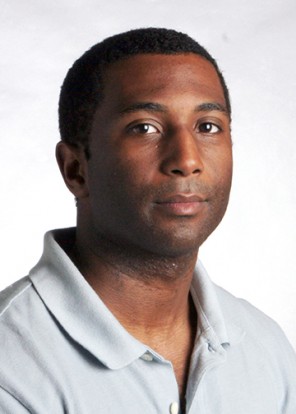
Wesley Morris is a film critic at the Boston Globe. Previously, he wrote about film for the San Francisco Examiner, and, later, the San Francisco Chronicle. His writing appears in Film Comment, Slate, Ebony, and Grantland. He’s also a regular contributor on NPR. He was born in Philadelphia in 1975. He is a graduate of Yale University. He lives in Boston.