The Washington Post, by Sarah Kaufman
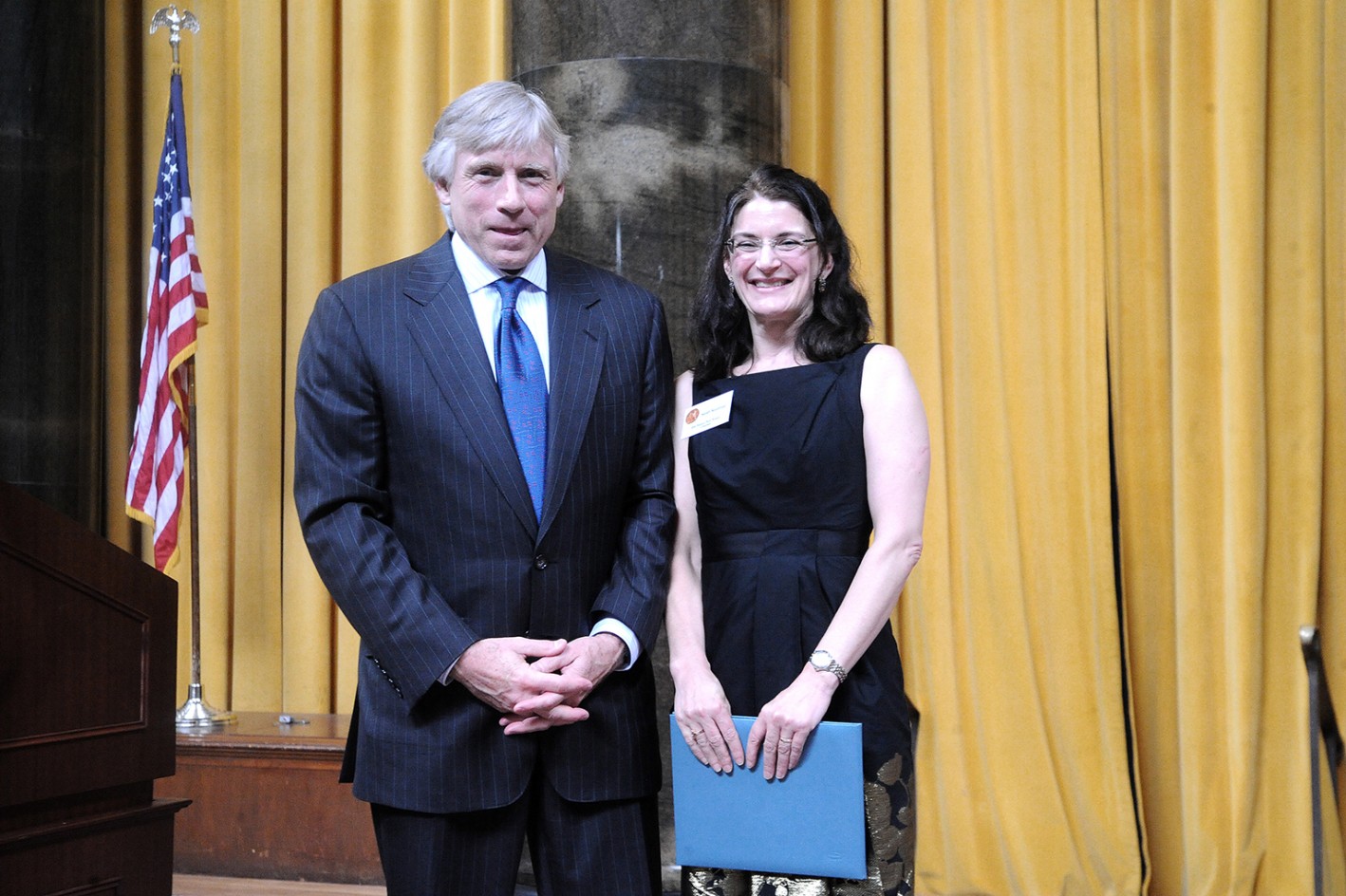
Lee C. Bollinger, President of Columbia University, presents the 2010 Criticism prize to Sarah Kaufman of The Washington Post.
Winning Work
Magic spells, poisons, potions and enchantments may be frequent plot devices at the ballet, but the art form itself is under a bewitchment of its own making. It's the Curse of Balanchine.
We are cursed with George Balanchine, cursed with an overload of his ballets as well as with the ubiquity of the sinewy style he favored, his preference for plotless works on a naked stage, his taste for fast, skinny, emotionally guarded dancers.
Maybe that doesn't sound so bad -- after all, that, in a nutshell, is what ballet looks like in this country. But it wasn't always so. Before Balanchine's dominating influence, in the early to middle years of the last century, ballet was more of a lively American folk art -- cavorting to music by Aaron Copland and Virgil Thomson -- than the highbrow prize of the connoisseur it became after Balanchine swept in, bringing Bach and Stravinsky with him.
Ballet started out here on a decidedly human scale: It nosed around gas pumps (Lew Christensen's "Filling Station"), sailing ships (Eugene Loring's "Yankee Clipper") and farm folk (Catherine Littlefield's "Barn Dance"). Its subject was the life of the times, and, in concise half-hour works, it centered on personalities: ranch hands, servicemen, outlaws and murderers.
Seen any of them onstage lately?
Balanchine's avant-garde creations knocked ballet sideways, changing it forever. But here's the problem: In his wake, ballet's range of expression has narrowed, not expanded. Gone, in new work, is theater, spectacle, satire, flesh-and-blood characters, the ache of real life, the escape offered by a sharp, piercing little story. Now more than ever, American ballet, artistically speaking, is a homogeneous entity. We are a thoroughly Balanchine nation.
That's pretty impressive considering that the New York City Ballet co-founder created his last work in 1982 and died a year later. Today, Balanchine isn't merely a legend -- he's a hot property. His ballets circle the globe, and in the United States are being danced by chamber-size and larger troupes alike, from the Richmond Ballet to American Ballet Theatre.
Balanchine's ubiquity creates a particular problem for Washington. The Kennedy Center presents more touring companies than any other venue in the country and, with other local stages in the picture, conditions are ripe for overload. In the past six months alone, audiences have seen the annual Balanchine-heavy runs by New York City Ballet and the Suzanne Farrell Ballet, along with Balanchine works danced by ABT and the San Francisco Ballet. This week at the Harman Center, the Washington Ballet essays "Rubies," an excerpt from Balanchine's "Jewels."
From a marketing standpoint, this is not a surprise. Balanchine is the blue-chip stock of ballet. And unlike a lot of blue-chip stocks nowadays, it is still a stable investment. As the old saying goes, no one ever got fired for buying IBM -- or for licensing a Balanchine work. After all, who can argue against the visual and musical joys behind his innovations in the speed, virtuosity and urbane glamour of ballet?
Look at the man's background: Balanchine, born in 1904, created his streamlined, stretchy, leggy style by merging old-school Russian technique with modern-art principles and the sex appeal of the Broadway chorus line. He was a product of St. Petersburg's famed Mariinsky Theatre, whence would later come Rudolf Nureyev and Mikhail Baryshnikov. Serge Diaghilev made him chief choreographer of his Ballets Russes -- the trendsetting troupe of expatriate Russians who counted Picasso, Miró and Stravinsky among their collaborators. After it folded, Balanchine landed in New York in 1934, where he founded the School of American Ballet, now the nation's top ballet school. He dabbled in choreography for movies and musicals before launching the group that in 1948 became New York City Ballet.
All of those experiences -- the high-art chic, the showbiz, the forceful physicality of Russian ballet and the broken lines and fragmentation that Picasso and Stravinsky were exploring -- surface in Balanchine's work. The bulk of his ballets are abstract, musically driven "pure dance." Even his few narrative pieces are little concerned with reality. Most of his works evoke a cool, purified, distant universe. And always, refinement: He loved tutus and tiaras ("Theme and Variations," 1947), showgirl legs on untouchable goddesses ("Concerto Barocco," 1941) and bracing simplicity. His ballets costumed only in leotards and tights ("Agon," 1957) had the angular, dramatic shock of a Mies van der Rohe house.
Of the more than 400 ballets Balanchine created in his 79 years, roughly 75 are still actively performed. And they are, for the most part, so exquisite it's hard to complain about seeing them over and over. Who can tire of the radiant stasis in "Serenade," the spacious, deconstructed architecture of "The Four Temperaments," the mass precision of "Symphony in C"?
But his aesthetic is so firmly established that it's crowding out other forms of thinking. One need only look at K Street to see how completely commercial architecture has fallen captive to Bauhaus and the pared-down art of poured concrete, turning its back on decorative detail and human scale. Ballet, too, has to break out of the Balanchine box.
Here's how the art form has been reduced: Balanchine's emphasis was on swift, sharp movement and on the body creating long, thin lines, the better to show off his choreography. He demanded greater flexibility and attack than had been seen before in classical dancers, with the legs slicing higher, jumps soaring, turns whizzing. As his aerodynamic style became the norm, so have those dancers with powerful technique and the greyhound proportions best suited to the revealing attire Balanchine liked (another trend he set). Meanwhile, a different kind of dancer, one who may be deliciously expressive and move like an angel but is rounder or shorter-limbed -- well, she's gone.
Balanchine, with his focus on the legs, cared little for "epaulement," literally "shouldering," or the harmonious use of the upper body, shoulders and neck. It's become a rather old-fashioned notion nowadays -- a flourish that adds to the life and warmth a dancer projects. English choreographer Frederick Ashton, a contemporary of Balanchine's, prized it, as does Russian and Danish training. Epaulement softens up the squareness of ballet, giving a dancer a responsiveness that is so subtle, you may not realize why you've fallen for someone who has it. But you never forget it when you see it -- as in American Ballet Theatre's Cuban-born Xiomara Reyes, so approachable you can all but hear her purr. But it's not a highly valued asset in today's speed- and technique-driven dancers.
Balanchine's streamlining of the dancer also extended to the content and look of his productions. Gone, under Balanchine, are the folk heroes, the common men and women. Gone is any kind of story, really; his brand of "neoclassical" ballet turns on atmosphere, musical response, pattern. There may be notes of spirituality, wit or romance, but his work is more about the body, less about the person. And the body -- the dance object -- needs no fixed realm. With some exceptions -- the woods of "A Midsummer Night's Dream," the drawing room of "Liebeslieder Walzer" -- Balanchine's ballets exist on a bare stage. This emptiness represented a whopping change to what had been a richly theatrical art form.
Let me be clear: The Balanchine aesthetic looks splendid. But what he started has spread to the whole of American ballet. A generation of choreographers fanned out after Balanchine, following his lead. Among the results: William Forsythe's splayed, cranked-open limbs; Twyla Tharp's musical dissections and layers of counterpoint; Christopher Wheeldon's clean geometry. With Balanchine disciples directing companies around the country and his school grooming dancers in his aesthetic, it's hard to name a choreographer who hasn't been swayed by the sleek Balanchine look and pure-dance approach.
Some of the post-Balanchine work has been interesting, much of it has not. But ballet has not become richer.
The art form is suffering through a dearth of daring and imagination. Critics and audiences alike have been complaining about a prolonged fallow period. Yet the artistic sclerosis didn't just happen. One inescapable reason for it is Balanchine's dominance, overshadowing other avenues of creativity -- for instance, the one-act short-story ballets that almost no one creates anymore.
Today, new ballets come in two forms, either the plotless 20-to-30-minute piece or the evening-long, three-act "story" ballet. These full-lengths treat familiar tales -- "Dracula," "Peter Pan" -- with mixed results, or rework the time-tested "Swan Lakes" and "Sleeping Beauties." Most ballet companies perform one or two a year -- they are expensive to create but they sell the most tickets. Do they really tell a story? Typically, no. If you don't already know the plot, you are sunk. The narrative rarely unspools through either the dancing or the gesture-speak of mime, because today's choreographers, steeped in abstraction, are not storytellers. And today's dancers are not actors, for the same reason. The storytelling tradition in ballet has virtually dried up.
A glance at history shows that it wasn't always this way. With the centenary of the founding of the Ballets Russes a week away, it's good to remember that the one-act dance-drama was a Ballets Russes staple. It was, in fact, key to building ballet audiences in this country.
These were works such as Michel Fokine's "Sheherazade" and Vaslav Nijinsky's "Afternoon of a Faun." Balanchine also contributed a host of mini-dramas, such as the biblical parable "The Prodigal Son."
The one-act drama continued to thrive long after Diaghilev's troupe disbanded, with choreographer Antony Tudor arriving here from England in 1939 to help establish Ballet Theatre (which later became ABT). With such box-office hits as his fiercely distilled "Pillar of Fire," a tale of repression and shame in small-town society, as well as Agnes de Mille's ranch romance "Rodeo" and Jerome Robbins's shore-leave caper "Fancy Free," ballet became a living, modern force in this country. The public knew nothing of the full-length "Swan Lakes" and "Sleeping Beauties" yet to arrive from the Old World -- and even after those three-act works gained an audience here, the short-story form was a big part of ballet repertoires.
ABT was a storehouse of these one-acts, into the 1970s and '80s. Yet it's rare for a choreographer even to attempt this form now.
What does Balanchine have to do with that? There have been, to be sure, other factors at work. The demise of the one-act ballet parallels the waning of the short story in literature, and a trend in fiction away from character-driven realism. The human psyche was being probed in all areas of the arts in the 1940s and '50s -- in ballet as well as in film, painting, music, writing -- and that interest gradually gave way to irony, angst, distortion and all the other postmodern trappings. But there can be no question that in ballet, Balanchine radically changed the fashion. Champions of one-acts see the physical excitement Balanchine ignited onstage as having helped condemn the slower-burning dramatic works to the margins.
"First and foremost is Balanchine creating all of those non-narrative works that were pure dance, abstract, neoclassicism and whatnot," says Sally Brayley Bliss, trustee of the Tudor estate. Admittedly, she has a personal stake in this discussion. But "not putting down Balanchine," she continues, "I think it was easier to copy Balanchine than to copy Ashton, Tudor and Robbins." Citing the preparation the last three put into their narrative works -- the research, people-watching and painstaking experiments at getting ballet to mean something -- she says, "It's harder to choreograph something narrative than anything else."
Wheeldon agrees. "It's kind of easy to rely on the physical beauty of dancers these days without having to find a way to tap into the human condition or without finding a way to express anything," he says. "It's a trap a lot of choreographers fall into. I've fallen into it myself."
Wheeldon's plotless works have focus, a certain logic -- you can understand how one section leads to another -- and often there is a lyrical, even romantic, depth of feeling. Still: "I'm slightly resistant to storytelling, because I don't want to end up with ballets that look like ballets of years gone by. I guess it's finding a language of storytelling that would successfully convey to a modern audience. . . . I hope in the next few years to put some stories up onstage with Morphoses," he says, referring to his company. "But story ballets take time and money, neither of which we have."
They also take dancers who can deliver more than rapid-fire steps and 6 o'clock extensions. Even choreographers interested in story have a hard time finding dancers who can act. Mark Morris has created brilliantly etched, believable character works for his modern dance group. But they aren't for the ballet troupes who hire him, he says.
"Most [ballet] dancers in general aren't comfortable anymore as actors. It's not required of them," Morris says. In fact, it's in the modern dance world that you'll find the imaginative storytelling that ballet used to value -- from Morris, Paul Taylor, Bill T. Jones and others.
How do we break the Curse of Balanchine? One thing's for sure: It won't happen by waiting for Prince (or Princess) Charming to kiss it away.
What's needed is the antidote to all curses: Ballet has to get its humanity back. Telling a story may be viewed as unhip in our postmodern age, but human cravings don't subside just because artistic manifestos tell them to. We'll always love stories, especially when they're about us. Look at Tudor's "Lilac Garden," in which a woman must give up the man she loves for the one she doesn't: Done right, it's not a dramatization of Edwardian society, it's a heartbreak happening now. It's so real, it hurts to watch. Choreographers ought to study the old masters, particularly Tudor and Ashton, whose entwinement of movement, drama and feeling are unmatched.
So much post-Balanchine ballet is about nothing beyond itself -- about the ideal, not the real. Enough of the less -- bring back the more. Pile it on a little (or a lot): Delve into the full, complicated knot of human experience. Give us textile indulgences, the eye-filling backdrop, the set design that captures the imagination.
You find those now almost exclusively in the full-lengths. But that's not where the choreographic creativity lies -- the new-made story ballets are largely unwatchable yawns, and rewriting classics doesn't stretch the art. Why not invest in a luxuriously appointed evening of short stories? Hire a dramaturge or a theater director for fine tuning. And think outside the box: Turn to a logical but perplexingly untapped source like Matthew Bourne -- the hugely successful British choreographer who turned "Edward Scissorhands" and "Swan Lake" into nonspeaking, all-movement musical-theater sensations.
Russian choreographer Alexei Ratmansky's "Concerto DSCH," which New York City Ballet performed here in March, is the most provocative recent exemplar of human relationships explored in ballet. It was by no means a narrative, but it had true characters and a palpable sense of drama, and you believed in his jittery, dark-shadowed world the moment the curtain went up. Having just begun his tenure as ABT's artist-in-residence, perhaps Ratmansky will take a shot at refreshing that company's dramatic origins.
Think what a spell-breaker that could be.
By Sarah Kaufman
"North by Northwest," Alfred Hitchcock's sprawling 1959 thriller that takes us to the top of Mount Rushmore by way of a near-miss with a killer crop-duster, begins with the basics. A man is walking down a corridor.
But because the man is Cary Grant, the moment is anything but ordinary. He has us at the first step: that long, brisk stride and its driving rhythm, a ticktock pace that telegraphs purpose, clarity and elegant efficiency. We watch him stroll out of an elevator toward the street, dictating correspondence to the secretary at his side. He's not some stiff, starchy suit. There's a relaxed, easy give in Grant's body as he moves, and as he leans toward his secretary while he speaks to her -- he's so very pleased with his own labors, and yet so exquisitely courteous to his assistant. A nice guy, and smooth as whiskey, too. He's getting further under our skin with every move.
What Grant's character, advertising executive Roger Thornhill, is actually saying in this scene isn't nearly as important as his movement. It's the movement that hooks us. It always does. Intuition? Training? Astute directors? Whatever its source, Grant knew a timeless truth: There is nothing we watch so keenly as the human body in action, because the way it moves tells a story.
The art of moving well, call it kinetic acting, has nearly vanished from movies today. I don't mean among dancers on the big screen -- that's a different subject altogether -- but among actors. The attention to physical expression, to one's carriage and gestures and their dramatic and emotional implications, has faded. I'm talking about a sense of grace. About acting that involves a meaningful motor impulse. A signature style of moving, bigger than just body language or bits of what actors call "business" -- lighting a cigarette, picking up a drink. Think of Gary Cooper's quick, impatient stride across town to the church in "High Noon," when he thinks he'll be able to round up a posse among the worshipers, folks to join his fight against a group of killers. And then his stiff, pained walk back to town after he fails to find help. He doesn't say a word, but the heaviness he feels is right there in his legs. You ache watching him.
A person's way of moving through space tells us something on a base, primitive level. It's animal to animal. It's something so subtle you may not consciously notice it, but when an actor moves honestly and with intention, your eye will follow him anywhere.
The trouble is, you don't see it that much. The buzz around this year's Oscar favorites got me thinking about how the artistic trend in acting has gone from the external to the internal. We're in the age of the close-up. Realism and psychological truth rule, and you find them in facial expression, in the little muscles around the eyes. The focus has tightened. Sure, there's gobs of emphasis on sexy bodies, but the body as an expressive instrument just isn't much in the picture.
Perhaps this is because actors aren't formally trained in dance and movement much anymore, as they were in the early years of filmmaking. There's also the invasion of psychoanalysis, and the rise of Method acting starting about a half-century or so ago, with its emphasis on emotion, interior motives and lots of mental preparation. Actors started questioning the precise blocking of action -- the choreography of the scene -- that was so prized by Grant, Cooper, Carole Lombard, Katharine Hepburn and other stars going back to the 1930s and '40s. For that era, physical elegance signaled inner elegance. Actors today seek more of a warts-and-all approach.
Cary Grant, Nonpareil
But kinetic acting is wrongly overlooked. It has an undeniable power over an audience. Consider Grant -- and you needn't only take my word on his greatness. He's been famously deconstructed in Pauline Kael's sharp-eyed essay "The Man From Dream City." And film historian David Thomson, writing in his "Biographical Dictionary of Film," describes Grant as "the best and most important film actor in the history of the cinema." Grant's dark beauty, cultured diction and gift for comedy are unmistakable. But what I find most fascinating about him -- and I believe it's the reason he is as watchable now as he was all those decades ago -- is his physical grace, an effortlessness that borders on the surreal.
It's always there, in every role, in the way he walks, the way he slips a hand into his pocket, the way he stands, with his shoulders melting just a bit toward the co-star his character is invariably secretly in love with.
Grant's art was all about physical expressiveness and emotional understatement. He never did musical comedy per se -- no Donald O'Connor-style routines (though you can imagine much of the sophisticated slapstick in the screwball comedy "Bringing Up Baby," in which Grant teamed with Kate Hepburn, set to music and a song). But you could say Grant is one of the great musical comedy stars of the 20th century. Like the very best dancers -- think of the versatile perfectionists Fred Astaire, Gene Kelly and even the ballet star Mikhail Baryshnikov -- Grant based each role on an array of physical details. He got into acting that way; the Cockney kid named Archie Leach left England for America as a member of a troupe of acrobats. After he went to Hollywood and became Cary Grant, the acrobat's love of physical play, his feline reflexes and reckless courage stuck with him.
In his early films (take "Singapore Sue" of 1932, for one -- Grant plays a skirt-chasing sailor), he comes across as blocky and stiff. His delivery is corny and over-eager. Later, as he refined his athlete's energy and channeled it into a smoother physical bearing, his acting relaxed.
Revisit "His Girl Friday" (1940), one of filmdom's most perfect creations, directed by Howard Hawks. Sparks between newspaper editor Walter Burns (Grant) and his ex-reporter and ex-wife Hildy Johnson (Rosalind Russell) pop the whole way through, but in one scene Grant's nuanced physical maneuvering is particularly marvelous. Seated over a polite lunch with his former bride (for whom he still pines) and her new fiance, Bruce (Ralph Bellamy), Walter aims to show Hildy just how foolish her fantasy of impending domestic bliss sounds.
"Ah yes, a home with Mother," he enthuses -- then there's a smothered chortle and a little roll of his shoulder -- "and in Albany, too!" It's a picture of devastating mockery, but so slight and slippery that Bruce doesn't notice. Hildy does, and we do, too. Grant orchestrates the moment perfectly. With every move leading up to it, he's drawn our eye to his shoulders, squeezing them together slightly, not relaxed until now, this instant, when that little action that starts in his neck and trickles across the top of his suit jacket shouts out loud and clear that Hildy is making a stupid mistake. It's not flamboyant, there's nothing self-indulgent in that gesture, and it's over in a wink -- but it reveals the calculating trickiness as well as the feelings of his character. That liquid, nearly imperceptible roll of a muscle hangs there like an echo, a ripple in the airwaves, a shiver in the emotional current that encircles Grant and Russell and us.
Grant "accepts performance as a physical act, not just an emotional one," says film scholar Jeanine Basinger, chair of Wesleyan University's film studies department. Grant crafted his roles through movement, she says, "the way a dancer understands the role can be believable only through the physicality of it. It's not just vocal, or emotional, but head-to-toe physical."
Think of the yearning vulnerability in his posture as he leans in to trade barbs with Hepburn, playing another ex-wife who still owns his heart, in "The Philadelphia Story" (1940). What his lips can't say, his body whispers -- he stands too close, inclining toward her, yielding in the middle like a surrendering wolf flashing its underbelly. In the scene where he barges into her house just before her marriage to another man, Grant shows how much he wants to reclaim her with that long stride that eats up the space between them, propels him right up to her. His effort to follow (so microscopically beseeching; we get it, though she doesn't) as she backs away becomes a brief tango of pursuit.
Hitchcock was a master at exploiting Grant's elegance, and "North by Northwest" is the definitive study of Grant in motion. Here, in fact, is film as modern ballet. There is that churning, driving Bernard Herrmann musical score. And the story unspools in a classic ballet structure, moving from the simple to the complex in the buildup of athletic images, revolving around brilliantly restrained duets and -- most delicious of all -- Grant's stylized bravura solo turns that explode with drama and emotion. This is the film, after all, where that nice ad exec runs for his life from a crop-duster, his gait pinched and strained to show us how bewildered and trapped he feels; he makes a splayed-out, elegantly finessed dive into the dust that a Baryshnikov would envy, and later arcs spectacularly backward, up on his toes, even, from Eva Marie Saint's gunshots. All the comedy, tension and romance, the racing pace and the plot twists register on that lean, alive body.
The Modern Actors
There are no Cary Grants today. But there are a few actors who engage us with performances of luscious physical awareness. Sean Penn's liberating, joyous mobility in "Milk" is a sterling example. (More on this later.) Rarer still, there are those kinetic actors who throughout a career convey a sense of physical intelligence, as Grant had.
Tom Cruise, for one. "Valkyrie" may not be a showcase for his athletic intensity. But whether it's vanity or art, he pays attention to his physical form in his movies. Particularly when he's running. His mad dashes in so many movies have become something of a joke, but the truth is nobody looks better in a sprint than Cruise did in "Mission: Impossible III" (that helicopter in pursuit -- a nod to "North by Northwest"?). There's a blazing efficiency in his stride: relaxed shoulders, no extraneous movements. Well-coordinated limbs translate into a deadly coordinated purpose of mind.
The ever-relaxed, deadpan Bill Murray is another Grant offshoot. He delivers a Grant-like sense of comfort in his own skin in the masterfully underplayed "Lost in Translation," which is essentially a movie about energy. There's the jangly buzz of Tokyo's night life, and the somnolent unease that brings together Murray and Scarlett Johansson. But it's not just sleeplessness that joins this pair of misfits who meet at a hotel. It's that their motors run at the same leisurely rpm. It's through his slowness, his unhurried, unfussy elegance and languid physicality that Murray creates a character we can trust, who comes across as confident, humble and wise.
Denzel Washington has an especially pronounced sense of elegance, which gives the hostage negotiator he plays in Spike Lee's "Inside Man" an extra dimension of truth. He's so solid and calm, with that loose stride and its soft jazz-cafe rhythm -- you might actually trust him, even if you were a psychopath. This is a fascinating film to watch from the point of view of the body, how bodies (those of the hostages in a bank heist) are dehumanized and robbed of their individuality, and how the characters who seek to control the situation carry themselves. Jodie Foster is a supremely kinetic actor; in her role as a high-powered, behind-the-scenes operator of shadowy origins she conveys deadly sureness with a cold, unyielding physicality. She's as tightly cocked as a revolver. Watch the firm, deliberate cadence of her stroll as she lets Christopher Plummer know who's boss, and you figure she could put your eye out with one of her high heels as smoothly as she takes another step.
To me, it's a woman who is most like Grant today. Cate Blanchett, who interestingly enough plays a dancer in "The Curious Case of Benjamin Button," has long struck me as an actor with a dancer's energy. There is a reined-in elegance about her, a sense of explosiveness carefully under wraps, which gives her an active presence even when she's not moving. With that comes firm self-possession and a watchful intensity, even in so small a role as that of the elf queen Galadriel in "The Lord of the Rings: The Fellowship of the Ring." She seems to float as she descends the stairs in her midnight scene, breastbone high, a slight arch in her back. She communicates a mystical depth in that taut, gliding physical presence.
There is unlikely to be a return to the prevalence of kinetic acting that you see in the old movies, when stars male and female bewitched us with the transcendent glory of how they moved across the screen. Emotional truths have long trumped physical truth. The emotion-driven Method acting espoused by New York's influential Actors Studio in the 1940s and '50s arose in answer to the more formal, traditional style of meticulously crafting a role, and it rejected accepted standards of bearing and grace. The camera zoomed in close, the actor's face became the canvas. Characters became more emotionally "real," and also more static.
Before Method acting came into vogue, "American acting was much more in line with English acting, where physical grace was a very important thing," says Thomson, the historian. "Approximately with Marlon Brando, we suddenly get physical gracelessness."
"We're still very much in the vogue of the Actors Studio," he continues. "The search for inner truthfulness, abandoning elegance and clarity. . . . We're into a style of more awkward personal truths."
Enter slumping and mumbling, exit agility. "From Here to Eternity" (1953) is a neat example of the split. On the one hand, you have Burt Lancaster -- onetime athlete and trapeze artist, body cut from stone, forever hot under the collar. Like Grant, Lancaster's acting was rooted in the physical, how his characters moved. (Lancaster didn't have Grant's range, though. He had the power but not the tenderness.) In "From Here to Eternity" he takes the physical to a combustible extreme; his 1st Sgt. Warden is all raw animal power.
Compare Lancaster with his co-star, the young Method actor Montgomery Clift, whose Pvt. Prewitt is freighted with the past, self-absorbed, just this side of a head case. Obsessed with personal truth. Now, remember Lancaster's roll in the surf with Deborah Kerr -- one kiss, one wave, destined to crest forever in American loins? To hell with truth; they wanted contact. They were the body; Clift, the brooding loner, was the soul.
This is why "Milk" is so interesting. There's a graceful sweep to this film, directed by Gus Van Sant, which echoes the uninhibited expressiveness and the deeply sensual nature of the gay community that it portrays. Penn, the psychologically driven Method actor, is a revelation; his portrayal of San Francisco City Supervisor Harvey Milk, the doomed politician, is thoroughly, exuberantly, juicily physical. And honest. Penn doesn't overplay it; there's nothing swishy here. But to watch him wield his newfound expressiveness -- the outgoingness and vulnerability in his upper body, the little fillips in his hips -- feels like a luxury, and you realize what so many other films are missing: the body with the soul. The physical awareness that Cary Grant perfected. Acting you feel as well as see. And along with it, the stories the body tells.
© 2009, The Washington Post, Inc.
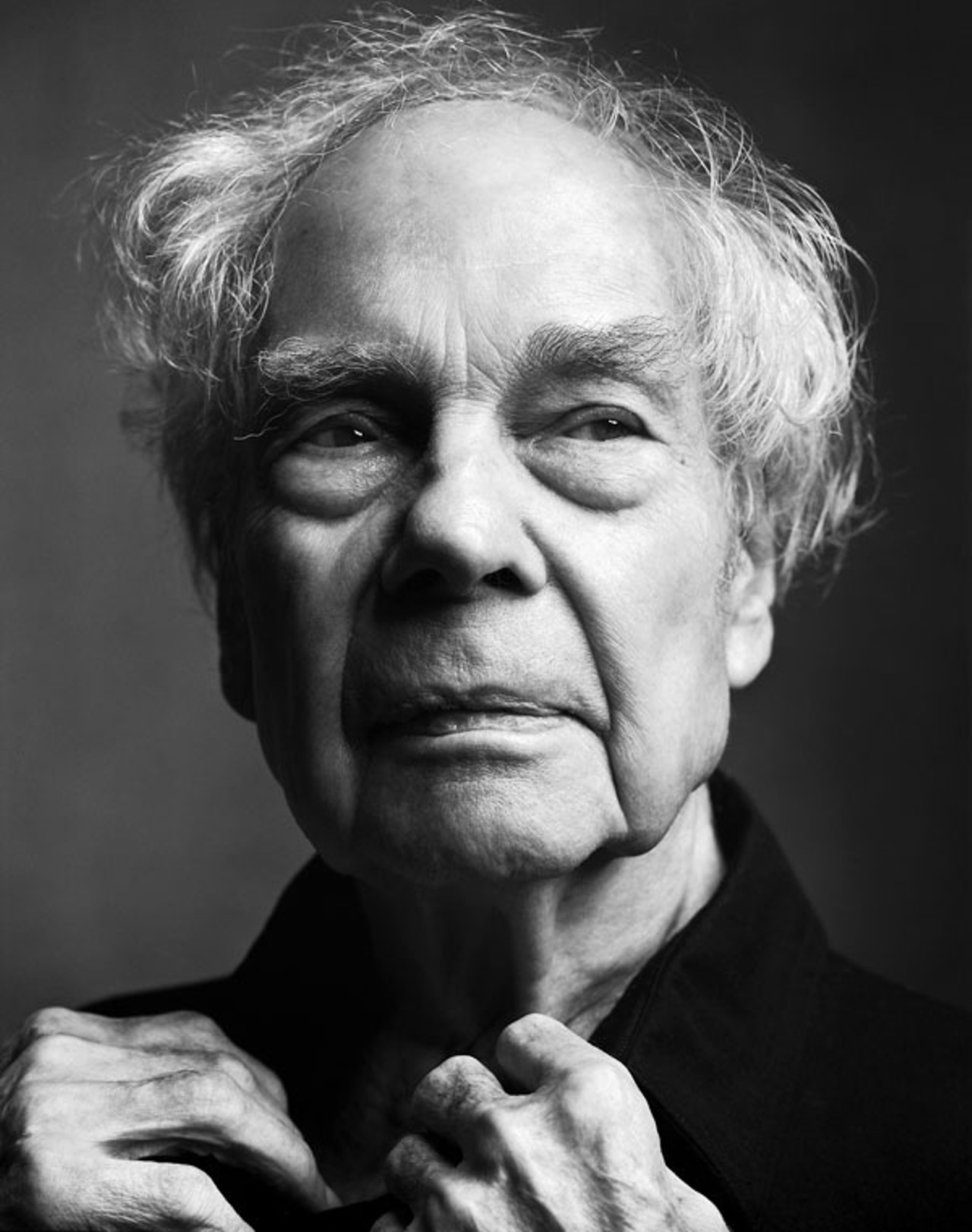
Merce Cunningham earlier this year. In his creations, music and dance needn't be entwined. (Mark Seliger-AP)
As of exactly two weeks ago, the Merce Cunningham Dance Company could still drive audiences to a near-revolt, with a performance at Wolf Trap leading to cheering, a few boos and a shouting match between two men with incompatible reactions.
If you can't appreciate it, just leave! bellowed one to the other.
But with the death of the 90-year-old Cunningham on Sunday, his work -- as revolutionary and provocative as it is -- may be swiftly reduced to a memory.
He also brought computer software (choreographing with a program he helped design), motion-capture technology and even the iPod into live performance -- in a 2006 work called "eyeSpace," Cunningham lent out pre-loaded iPod Shuffles, for the audience to shuffle at will during the dancing.
Innovative rock groups Radiohead and Sigur Ros turned themselves into pit bands for him, and in creating sets for him, giants such as Andy Warhol, Robert Rauschenberg and Jasper Johns eagerly relegated themselves to the background. Cunningham, a gentle man, was a great roaring lion of a choreographer.
His boundary-busting helped forge modern dance into a vital and exportable American art form. Give him a tradition and he torched it: He ripped music and dance apart -- his dancers didn't know what music they'd be dancing to until opening night. Even the sets, costumes and lighting for his works were often created independently of one another. He had a gambler's lust for Lady Luck, using "chance operations" -- tossing dice or a coin -- to set the order of sections of a dance, or to determine which piece of music would be played first.
One of the great artists of the 20th century, Cunningham was as experimental and globally influential in his world as James Joyce, Stravinsky and Picasso were in theirs. But unlike books, music and paintings, Cunningham's nearly 200 dances are at risk of extinction.
It's a problem unique to the dance world. As mourned as he is, Michael Jackson didn't leave this kind of heartache to his fans: Coming generations will still be singing "Billie Jean" and watching the "Thriller" video. But concert dance such as Cunningham created needs to be seen live to be experienced.
The problem is, the company Cunningham founded in 1953 does not plan to go on without him. If it can raise enough money, the troupe will embark on a final two-year international tour and then fold. As of Monday, a little more than $2.5 million of a needed $8 million had been raised for the tour, archiving efforts and other expenses, according to Trevor Carlson, executive director of the Merce Cunningham Dance Foundation.
Without his dancers, Cunningham's work is all too likely to succumb to modern dance's tragedy of evanescence.
The only museum dance has for displaying its creations is the stage. And the best curators are ballet companies, which essentially stockpile works by different choreographers -- performing "The Nutcracker" as well as ballets by, say, Twyla Tharp and Jerome Robbins -- and readily absorb older dances into their repertoires. But the much younger field of modern dance, barely a century old, has grown up around cult figures. These rebels and individualists -- Martha Graham, Cunningham, Paul Taylor, among others -- wanted little to do with one another. Like fashion houses, the choreographers launched their companies as vehicles for their own work. Christian Dior didn't display Ralph Lauren in his shop, nor did Graham want a Taylor piece taking up her time in the spotlight.
The largest exception to this is the Alvin Ailey American Dance Theater, which has become a thriving, internationally touring repertory company for works by mostly African American artists. But it didn't have to drastically retool itself after Ailey died in 1989. He hadn't had a problem with sharing while he was alive -- his troupe frequently danced other works besides his own.
All too often, modern-dance choreography becomes orphaned once its creator dies because the field does not have a catchall, a repository for its lost children. The idea of a national modern-dance repertory company has come and gone over the years -- raised most recently by New York City Ballet's ballet master in chief Peter Martins, who tried to get one started in 2004 -- but has never taken hold.
"Financing is the biggest problem," says Douglas Sonntag, dance director for the National Endowment for the Arts. Even without a recession, modern dance has historically been underfunded. "And there are the artistic fights, the people who adore Merce and despise Paul Taylor, for instance."
Then there is the artistic promiscuity built into the field. Modern dance has a disastrously roving eye -- it's always after a hot new premiere. Because of its hunger for the next rebel with the next radical statement, the field of modern dance is more likely to abandon established works such as Cunningham's than, say, the ballet world is with its choreographers. (Cunningham did create work for a few ballet companies, and they are the best hope for carrying on some of his gentler pieces -- say, 1958's "Summerspace," with its meditative piano score and feeling of quiet attentiveness.)
But these aren't the only strikes against the longevity of Cunningham's art.
All dance is, uniquely and sadly, an ephemeral art form. It lacks a good system of self-preservation other than continuous performance, with one generation of dancers teaching the steps to the next. Even though videotaping and written notation methods are now commonly used to record some productions -- what if the dancers made a mistake? What if the camera angle misses the dancers in the back row? No technology tops the labor-intensive oral tradition as the best means for capturing a choreographer's intentions, use of music and so many other details that go into the live art and are kept in dancers' memories, rather than in reference material. Under Cunningham's Living Legacy Plan, rights to his works will be made available. But with no group of professional dancers charged with performing them, the most likely to seek these rights are college dance departments looking for a teaching exercise.
"Why do we have to throw away the old stuff? No other art form does it," says Janet Eilber, artistic director of the Martha Graham Dance Company. "If Merce's works are truly relegated to historic reproductions at the university level, and are not danced with the full-on professional power of people who have been trained in that genre, they won't really exist in their full artistic power. And I think that's depressing."
The reality is that Cunningham's death and the eventual self-destruction of his company may be as good as consigning his works to the dustbin. Fans might as well envision black edges all around Cunningham's works now -- the glorious creation myth that is "Sounddance," with its fierce, cyclonic score; "XOVER," a final collaboration with painter Rauschenberg, and a meditation on eternity. Cunningham loved the randomness of life that he represented in his work with the toss of a coin. But in a field ill-suited to keeping its history alive, too much is now being left up to chance.
© 2009, The Washington Post, Inc.
By Sarah Kaufman
Come the twilight of the year, the deathless "Nutcracker" begins its march across American stages, bearing tidings of comfort and joy.
Oh, goody.
Yet to those of us who despair of its pervading tweeness and wish ballet had something better to do at this time of year than endlessly reminisce like a sweet, whiskery auntie, it bears some bad news, too. "The Nutcracker's" stranglehold is all but squeezing ballet dry.
The tyranny of "The Nutcracker" is emblematic of how dull and risk-averse American ballet has become.That warm and welcoming veneer of domestic bliss in "The Nutcracker" gives the appearance that all is just plummy in the ballet world. But ballet is beset by serious ailments that threaten its future in this country: American dancers are less likely than ever to hold the top rank in American companies. African Americans have dismal prospects of inclusion -- of all of the nation's performing arts, none is more segregated than ballet. And the companies are so cautious in their programming that they have effectively reduced an art form to a rotation of over-roasted chestnuts that no one can justifiably croon about.
Let's start with "The Nutcracker's" role in all this. No other ballet has been performed by more companies, danced by more dancers or seen by more Americans. This season marks the 65th anniversary of the country's first full-length production, by the San Francisco Ballet. It wasn't such a smash hit back then, but certainly over the past half-century "The Nutcracker" has become the category killer in ballet, what "The Night Before Christmas" is to American poetry -- the most known, the most quotable. Tchaikovsky's tunes seem to toot around every corner this time of year, while attending the ballet has become a secular ritual, a tinseled micro-Mecca for thousands of families.
Starting Tuesday, Washington audiences can see the version of the ballet that's credited with launching the national "Nutcracker" obsession: George Balanchine's 1954 account, originally created for the New York City Ballet. The Pennsylvania Ballet will perform its Kennedy Center premiere.
Because "The Nutcracker" can turn a profit, it can account for as much as half of a ballet company's total annual performances. Chances are, the other, non-"Nutcracker" half of a company's season relies on a couple of standards and too few new works of consequence. And most companies cannot bring in enough funding to exist without relying on "Nutcracker" sales.
This all sounds pretty Scroogish, but I'll be straight with you: While I have grown tired of "The Nutcracker," I don't hate it. I don't discount that the ballet brings great happiness to many -- even, off and on, to a critic. What I do regret is "The Nutcracker's" ubiquity, the way it stifles any other creative efforts in dance during the holiday season. Most of all, I regret its necessity as an income source.
Money problems weigh on ballet like a stone around its neck: salaries, rent, costumes, toe shoes, insurance, musicians, storage and so on. Debt is a big factor in all the conservative programming out there.
But the main problem is this: Ballet suffers from a serious lack of confidence that is only growing more and more paralyzing.
Plie it safe
There were moments throughout the 20th century when ballet was brave. When it threw bold punches at its own conventions. First among these was the Ballets Russes period, when ballet -- ballet -- lassoed the avant-garde art movement and, with works such as Michel Fokine's fashionably sexy "Scheherazade" (1910) and Leonide Massine's Cubist-inspired "Parade" (1917), made world capitals sit up and take notice. Afraid of scandal? Not these free-thinkers; Vaslav Nijinsky's rough-hewn, aggressive "Rite of Spring" famously put Paris in an uproar in 1913.
Later on William Forsythe, in works such as "Steptext" (1985) and "In the Middle, Somewhat Elevated" (1987) shattered ballet's pretty lines and spiked his works with an acid edge, and showed us that ballet wasn't only about decorum and accepted ideals of beauty.
Where are this century's provocations? Has ballet become so entwined with its "Nutcracker" image, so fearfully wedded to unthreatening offerings, that it has forgotten how eye-opening and ultimately nourishing creative destruction can be?
The last time I heard real rumblings of discomfort at the ballet around here was in 1984, at the Kennedy Center, when American Ballet Theatre premiered "Field, Chair and Mountain," by experimental modern-dance choreographer David Gordon. It involved a lot of metal folding chairs and a pastoral panoramic backdrop that unspooled as the dancers picked their way regally around the furniture. It was more quirky than brilliant, but it forced you to look at a consummate ballerina like Martine Van Hamel in a new light. For reasons I still puzzle over, this was one of her best roles; she came across as all the more witty and above-it-all surrounded by the gray and ordinary.
And it drew a few boos! Some audience members walked out. You felt you were at the center of something, at that hot spot of friction between expectation and result that meant an artist had scored an upset.
Nowadays, the shaky economics of ballet drive the field continuously toward a standardized repertoire. And so, aside from a program or two of inexpensively produced short works, most companies rely on a rotation of "Swan Lakes," "Sleeping Beauties" and "Don Quixotes," familiar full-length ballets consistently on view throughout the country. And "The Nutcracker." Could any book publisher, fashion house, automaker or, for that matter, symphony orchestra reasonably expect to exist with so little to offer?
But there are signs of some cooling on "The Nutcracker." Kennedy Center President Michael Kaiser says that "in a lot of communities I see the interest starting to wane, particularly because of costs. It's a very serious issue."
When costs go up and donors are tapped out, ticket prices rise, Kaiser says. Audiences get more choosy, less adventurous.
Now think about the dancers. If you are a ballet dancer in America, chances are you will spend a good chunk of your career cycling through various "Nutcracker" roles. Maybe you start out at a small troupe, and you want to move on to a larger one. At the audition you might find yourself competing against European or maybe Cuban dancers who have trained in well-established academies, and, coming from outside our "Nutcracker" vortex, they're experienced in various dance styles and roles. Who stands to get hired?
Eurocentric values
A 2006 survey by the service organization Dance/USA found that among the two dozen largest ballet companies in the nation, 54 percent of principal dancers were foreign-born, and 46 percent of soloists. It's a different story for entry-level corps dancers, 89 percent of whom were U.S.-born. American dancers fill out the bottom rungs, but in the premier positions their numbers don't hold up against the Russians, Japanese, Spanish, French and Cubans.
To be sure, ballet doesn't have a terribly long history here. Also, there is still a mystique to the foreign dancer. An international roster is a marketing plus.
But the outsourcing of ballet stars is a troubling trend nonetheless. We're producing an inauthentic domestic art. What's American about ballet in America? The field lacks commitment to its own dancers. Rather than groom someone unknown and untested, directors want a star now, stage-ready, tonight. One who already knows the roles, as ballet in this country rests on the standard, European-derived full-lengths.
The European repertoire returns me to the issue of diversity.
In 1968, when Arthur Mitchell decided to found Dance Theatre of Harlem as a separate-but-equal black ballet company, Mitchell had been New York City Ballet's only African American principal dancer. Today, City Ballet still has only one African American principal dancer. And compared with the rest of the field, which seldom elevates black dancers (particularly women) to the top rank, it's at the peak of racial diversity.
The absence of African Americans in ballet companies is not only a pressing equal-opportunity issue. It's also an artistic issue. What better way to demonstrate how an Old World art has been reinvigorated on these shores than by showcasing a broad range of dancers -- of all colors -- in it? Instead, ballet directors are communicating some disturbing views: American dancers in general are somewhat second-best, and African Americans in particular are not part of their vision.
But why not make an artistic statement with a mix of races, and use the spectrum of humanity deliberately, in a provocative way? Why not harness differences to evoke the America of today, or what we might become if only we had the imagination of an artist?
Balanchine once talked of seeking equal numbers of black and white dancers. Nothing came of that plan, but black choreographer Donald Byrd sees vestiges of an African American aesthetic in at least one of Balanchine's strikingly modern masterpieces.
" 'The Four Temperaments' is very black in terms of the impulse of it," says Byrd. "The thrusting hips. I always think of black girls. The feeling is very funky."
Ellicott City native Alicia Graf, 30, was one of Dance Theatre of Harlem's leading ballerinas until the company folded in 2004. Elegantly proportioned and dazzling to watch, she found no other ballet offers and joined Alvin Ailey American Dance Theater. She sees diversity as fertile ground for American ballet to stake its individuality.
Keep it real
"Americans, we're very physical and athletic in our dancing, but artistically, where are we going? I think race could have a huge, positive impact on that vision," she says. "In looking for new directions and innovative ways of moving, you also have to look at innovative ideas of what your company looks like, and the different pools from where you draw your talent. I would like for artistic staffs to look beyond what they're used to. It's all very safe."
There's nothing more boring than safe, pretty art. Nothing feels less relevant. Ballet needs to think bigger. Yes, money is tight, but ballet here has gotten itself into trouble by aspiring to opera-house prestige without the more stable budgets of its European counterparts. To survive into the future, I think the average ballet company would do better to downsize, aim for excitement, stir the pot -- and drop the full-length ballets, which are better left to the few larger, richer operations. All sorts of creative possibilities might open up if "The Nutcracker" weren't needed as an anchor. Just imagine what might happen if some bomb-thrower took a chance on personnel, built a roster that looks like America and blew up the whole notion of dull, comfortable conformity.
Ballet in this country ought to demonstrate that when the art form came across the Atlantic it was transformed by the journey -- and is transforming still.
Wouldn't it be remarkable if we saw that onstage? If "Nutcracker's" dreamscape could give way to art that looks and feels real?
By Sarah Kaufman
With their squeezed-tight knees and vigorously swinging backsides, the ushers do Usher one better.
Wearing pink dresses and dark glasses, the bridesmaids swivel and high-step down the aisle with deadpan gyrations, like voguers from the House of Honeymoon. The groom turns a somersault and coolly spins off to the altar, adjusting his tie.
And when the bride makes her entrance, white satin churning as she shifts into hip-slinging overdrive, pumping her bouquet in the air to the beat of Chris Brown's "Forever," she gets the standing ovation she deserves.
From the cheering guests in this rocking St. Paul, Minn., church on June 20, it wasn't just a show of respect. It was a shout-out of R-E-S-P-E-C-T, in a profound way.
In the latest dispatch from the Internet badlands, another meta-moment: Jill Peterson and Kevin Heinz's dancing wedding procession -- yes, they and their attendants (seven bridesmaids, five groomsmen, four ushers) all boogied down the aisle, fabulously -- which after less than five days on YouTube snagged 1.75 million hits, the latest ordinary-folks-with-talent stunner to hit the Web.
At this wedding, the party got started well before any vows, rings and kisses were exchanged. Here is the entrance of the wedding party turned into a wedding par-tay, a cakewalk down the aisle, a processional gone phenomenal. No wonder it migrated around the world after the couple, both 28, posted it on YouTube: www.youtube.com/watch?v=4-94JhLEiN0. Millions of eyes recognized it as something special -- from the linebacker-size groomsmen's seam-splitting moves to the slow-motion group tableau at the altar to the sheer uninhibited happiness of it all that pops off the screen like champagne blowing its cork.
Among the video's fans were the producers of NBC's "Today" show, who put the couple on the air Friday morning -- Jill with a delightful made-for-TV smile, Kevin donning a heartland-anti-chic look in an argyle sweater vest and horn-rimmed glasses. The whole wedding party is slated to give a command performance of their aisle style on Saturday's show, which starts at 7 a.m.
Peterson danced growing up and told Meredith Vieira and Matt Lauer that she "loved dance as a way to express yourself and share joy."
And that's exactly what's behind the enormous response to their video. It's all about the joy.
We all know what we're supposed to do at weddings: Look on politely as a matchy-matchy parade of friends makes its slooooow way down the aisle to Pachelbel's Canon in D. Try not to giggle. Rise for the bride.
But, by dancing their entrances and sending that upbeat, physical energy right back out to their guests, the Peterson-Heinz wedding turns the rote behaviors into spontaneous reactions. Of course the guests watch attentively as the wedding party bobs in. You can bet not a single child had to be shushed at that point. This was no longer a display of bad posture and dyed-to-match pumps -- it was an uplifting swell of celebration with a beat. The bride -- unescorted, we note; so independent! -- was and wasn't the center of attention. The true focus was on the unified, wordless but palpable emotions of her whole support system.
It plugs us in to something deeply human. Dancing is how so many cultures have celebrated weddings for eons. Okay, maybe not exactly like this, with the ushers turning their programs into confetti, with one groomsman thrusting a stray flower between his teeth and flinging himself into a handstand, with two of the bridesmaids clasping hands and doing a little riff on swing dancing.
Jill and Kevin claimed to have only had one rehearsal and said the whole group contributed to the choreography. They did an amazing job of it. It builds in force right up until the crowning moment: the pas de deux, where Kevin takes his bride's arm and they glide in step toward the beaming minister, capturing what Fred Astaire and Cyd Charisse knew in their sweet "Dancing in the Dark" number from the film "The Bandwagon." There's nothing so intimate as a slow stroll. After everyone's bouncing, that short walk together was terribly moving.
This procession explodes a lot of assumptions: that church weddings are square and Minnesotans are squarer, that shaking booties and solemn vows don't go together. (It also puts a new luster on Brown's song, which must be appreciated by the pop star turned pariah, who pleaded guilty last month to assaulting his girlfriend in February.)
More important, this ceremony went deeper than behaviors. It elicited all the right feelings, in the way that good dancing transfers energy and emotion to its audience. In the way they moved -- and were able to corral their friends and family into the act -- the couple told us a lot about themselves, and about their bond.
This didn't look like a reluctant groom being dragged to the altar, nor a micromanaging bridezilla who had locked down every detail. They were open to music and movement and untucked shirts and sweat, and they gave to their guests what had to be the best party favor of all. An actual party.
Maybe we'll see the Heinz ensemble next on "So You Think You Can Dance." Maybe Jill and Kevin will go on to choreograph for the Vikings cheerleaders, or start up a wedding-planning business. Maybe not.
Whatever their future, they did with that performance what great dancers can do. They pulled us all into their story.
© 2009, The Washington Post, Inc.
By Sarah Kaufman
Michael Jackson and the moonwalk will be forever linked, the man inseparable from his slipperiest and subtlest move. It's no wonder that surreal step became his signature. What more perfect expression could there be of this most elusive celebrity, of the mystery that has always surrounded him? In the thundering melee of a live concert, amid a singularly strange life, Jackson would underscore his cool remove with a shift into reverse, coasting backward across the stage, step by gliding step, as if on a cushion of air. With his dancing, Jackson left behind everything mundane, messy and predictable.
"I don't know who you could really put next to him," said ballet star Mikhail Baryshnikov, reached yesterday in Madrid. "To imitate somebody like Michael Jackson is impossible. Why bother? You just relax and admire."
Jackson was a perfectionist, and could relate to other perfectionists. Baryshnikov got to know him through Elizabeth Taylor, who would "drag him to see me dance," Baryshnikov said, when he was at American Ballet Theatre and later when performing in the White Oak Dance Project, his modern-dance company. They would talk about ballet -- Jackson had a lot of questions, he recalled, "like a 12-year-old" -- and he would ask about working with choreographers. He told Baryshnikov that choreographers would suggest ideas to him, but that he created his own dances. What Baryshnikov remembers most about Jackson, he said, was "not even his turns or his grabbing his crotch. Just his simple, bouncy walk across the stage, that was what was most beautiful and arresting, swinging his hips, kicking his heel forward. That's to me what he is: that superior confidence in his body as a dancer. You wanted to say, 'Wow, this guy, what a cat; he can really move in his own way.' "
That walk was his own, but Jackson absorbed some of his other moves from his forebears. He didn't invent the moonwalk, for instance -- tap dancers stretching back at least to the 1940s thrilled audiences with what was called the backslide -- but he perfected it. He didn't invent that swift twist of a spin, or the art of punctuating a lyric or a backbeat with a punch of his pelvis. But as with every other element of his incomparable showmanship, he perfected those moves and made them his own. No pop star brought dance to the stage the way Jackson did. Not for him to draw aside and let backup dancers take the spotlight while he crooned. He was always the soloist, a Gene Kelly breaking out of a song to tell us a story with his steps.
What was that story?
If his life played out on an operatic scale, Jackson's art was at its essence exquisitely personal. As the Jackson 5's kid singer, he paid sweet tribute to James Brown, mimicking so many of his moves -- the tight, prancing, swiveling footwork and the spin that started with a craning neck and the sharp crank of the shoulders. Dancing came astonishingly easy to him, and that joy in moving, that honey-smooth musical response, was as much a part of his appeal as his girlish voice. But as his fame grew, the abandon you saw on "American Bandstand," on the early "ABC" and "I Want You Back" performances, dropped away. The dance style that Jackson honed into a corporeal autograph is one not of physical or emotional release -- it's not flashy or overblown. It's a statement of fierce, obsessive control, and in the way only the best of the best can do it, he made it look supremely easy.
Not that Jackson couldn't do flashy. In a typical number -- take "Billie Jean," for example -- he snaps and shudders with a force that could transfer up to the highest stadium rows. He also had a pantherlike grace, the square shoulders of an athlete carried serenely, with a walk like poured syrup. His understanding of costume glamour -- the jackets that nipped in at the waist, setting off those lean hips and legs -- and his embrace of the flamboyant marked him as one of the great showmen of the ages, but his moves set him apart on another level still.
He tapped into the zeitgeist with his songs, forging a reconciliation of everything -- race, sex and even age. (The boy who danced like a man became the man who somehow still lived like a boy.) But if his songs were pure pop, cemented to their disco-soul-ballad-shake-your-booty era, his dancing was timeless. You read his humanity in it. And his strength. We'll likely never know what motivated his weirder choices -- the surgeries, the home life, the child companions -- but nowhere did his inner life become more visible than in his dancing.
Did fame straitjacket him? Look at the video for "Dangerous," where he leads an army of look-alike Company Men, in their severe suits and narrow ties. He's a marvel of precision, joints popping and snapping like machinery. Somehow, it brings Irish step dancing to mind, the upper body rigidly repressed while the legs soar. Jackson added his own twist: those watch-my-crotch moves. The show nearly always centered on the crotch, even if he wasn't wearing a golden codpiece. Jackson has had an immeasurable influence on countless pop stars; among today's hitmakers, Ne-Yo and Usher come first to mind. But the essential difference is in the movement quality. Usher is more relaxed, with those rolling shoulders. He's comfortable in his own skin.
You couldn't say that about Michael Jackson. He looked easy in his youth, but later there was only a managed ease. Or maybe it's that with Jackson comfort came to mean focus, control, physical assurance. You saw it in the simplest moves, like that skimming walk. He could turn it on and turn it off, but he never let us in. Inscrutable, silent, he has always escaped us, as surely as the moonwalk pulled him away, head down, sliding backward into darkness.
© 2009, The Washington Post, Inc.
By Sarah Kaufman
Melissa had the nano-dress, the spiked heels, the hiccupping rhythm. Even so, something was wrong with her cha-cha.
The judges on "So You Think You Can Dance" knew where the fault lay. Melissa is, by training, a ballet dancer, and those polite hips and her tea-at-the-Ritz posture had gotten in her way. No amount of sequins or daringly exposed skin could make up for the fact that her cha-cha needed a mojito. More heft, more hips, more Havana.
Her feet were "sliding all over the place." One judge said her legs were turned out too much; another said her feet turned in too far. Even her lips came under fire: They were too pursed.
"When you try and be sexy, you don't have to go over the top," cautioned Nigel Lythgoe, one of the regular judges and the show's executive producer. (Imagine, someone trying to tone down the sex on Fox TV.)
Melissa Sandvig was cut the next night, and rightly so. She had stumbled in the twin tests of technique and expression, getting it wrong -- albeit by the slimmest of degrees -- exactly where this show, episode after episode, so often gets it right.
With its fifth-season finale starting Wednesday and wrapping up Thursday, Fox's "So You Think You Can Dance" is more of a runaway hit than ever. For the first time in its brief history, it will also air in the fall, returning Sept. 9, so fans won't have to wait until next summer to see more young hopefuls tackle two-minute duets in a range of dance styles as they vie for the title "America's Favorite Dancer." Fox is clearly looking for a knockout when it goes toe-to-toe against ABC's "Dancing With the Stars."
I wish Fox all the best, because "SYTYCD" is the superior dance show. It honors the art of dance much more than it gets credit for doing. For all its TV-land glitz -- the skimpy frocks, the shirtless men, the sappy pop tunes -- there is a certain honesty about this show. It stems from the primacy of the dancer's work ethic.
Focusing on the efforts of trained dancers rather than those of sorta-celebrities and adventurous athletes, "SYTYCD" offers an education, teaching viewers that the dance profession is not about pampered divadom, nor does it rest on achieving a look or aping a style. While "Dancing With the Stars" is about faking it -- which nondancer can best acquire the look of a dancer without having paid a dancer's dues -- "SYTYCD" is about the real thing.
Which is why Jeanine Mason, a raven-haired jazz and hip-hop dancer sporting purple tail feathers and just a soupcon of a top, was in for some finger-wagging on a recent episode when she failed to achieve that rolling, deep-in-the-hips quality of the samba.
"You're going to have to be hot not only with the way that you look, but with the way that you dance," counseled sharp-eyed judge Mary Murphy, a former ballroom champion who can be counted on for the most astute observations about style, substance and the art of dancing.
Art -- on TV? On Fox? The show's popularity in a mass medium and on a network that hyped celebrity boxing makes it tempting to dismiss "SYTYCD" as mere dance candy, dipped in shallow camera-glam and thick with wow-factor to please a nation that's been on a ballroom bender for the past few years. But the TV screen is a natural frame for dancing. As the most visual of the performing arts, dance is ideally suited to television. PBS discovered this in the three decades during which, on its "Dance in America" and "Great Performances" series, it regularly broadcast the best in concert dance -- the big ballet companies, the most experimental modern dance, choreographers such as George Balanchine, Twyla Tharp and Katherine Dunham.
But with diminished corporate sponsorship and a priorities shift to more mass-market fare (pop concerts, travelogues and no end to self-improvement shows), the days of elite dance over the airwaves are all but over. Dance on PBS has dwindled to an annual "Nutcracker" broadcast and little else.
Televised dance has now come full circle, returning to the commercial realm that gave it a boost back in the 1960s, when NBC's "Bell Telephone Hour" gave Balanchine's New York City Ballet a Friday night audience far eclipsing its live-performance subscribers.
Even such a snob as Balanchine might not be so shocked at the turn broadcast dance has taken. He loved flamboyance and sexiness as much as the next guy; yards of leg, crotch-centric poses and body-baring outfits weren't exactly unknown in his ballets at Lincoln Center. Nor was firecracker technique. The kind of physical bravado you see throughout the duets and solos on "SYTYCD" is part of a deeply rooted trend in the world of ballet. The culturati may find a difference between a ballet star's corkscrewing leaps and the TV dancers who backflip as if they've been shot out of a cannon or jump like jack-in-the-boxes, but they're all part of the same tradition in dance. You can trace it back to noble origins, starting with the galvanizing athleticism on view in the first U.S. tours of Moscow's Bolshoi Ballet in the late 1950s.
And consider this stunner at the end of "SYTYCD'S" hour-long results show Thursday: Lythgoe worked in a lament for the dance world's loss of "the great avant-garde choreographer Merce Cunningham," who had died a few days before, on July 26. Cunningham, a giant among 20th century artists, is revered by connoisseurs the world over, but coming from the niche world of modern dance, his is hardly a name you hear on network TV. I thought I'd fall over when Lythgoe saluted him.
Yet perhaps I shouldn't have been so surprised. More and more, the art-world of dance and the reality-TV-disco-ball-world of dance are merging on "SYTYCD." True, there's an abundance of hard sell here, a few too many aggressively splayed-out, punched-up dance routines that rocket from pose to pose, instead of unspooling a cohesive, subtler dynamic statement. But frequently I've been captivated by artistry in both the choreography and the dancing.
Take Broadway-style dancer Evan Kasprzak, one of the four finalists: Small in stature, he can devour space when he moves and his rubbery face is full of theatrical expression. He's also musical and can toss off miracles of gravity-daring balances. As guest judge Debbie Allen once gushed at him, he can "handle a big woman" (many of his partners have towered over him) -- and he looks like a shoo-in for a musical theater career.
And then there's Kayla Radomski, a tall jazz and contemporary dancer whose world-class cheekbones and long, quick legs amplify her glamour quotient. She dances big, arcing from corner to corner and giving her disco bumps the same silky conviction as her reverse turns in the Viennese waltz.
What's fascinating about "SYTYCD" is how it spotlights old-fashioned dance values: discipline, following orders, teamwork and perfecting an aesthetic through a mix of hard work, innate ability and imagination.
Sandvig, the ballet dancer, moved with unusual clarity, each step etched in space. Her duet with Ade Obayomi (who was also cut after last week's call-in voting) in choreographer Tyce Diorio's jewel of a piece about a woman battling breast cancer was especially poignant, expressing courage, despair, support and resolve.
But in the end, Sandvig didn't possess the versatility the show demands, with contestants judged in such disparate styles as hip-hop, bollywood, disco, ballroom and Latin dance. Ballet dancers are trained to tuck their buttocks under and to pull up out of their hips and abdomen. For them, swinging the pelvis in the cha-cha or dropping their weight into the floor in hip-hop is like asking a soprano to growl the blues. Similarly, hip-hop dancers often struggle with the intricate footwork of the quickstep, or with any dance style that benefits from softness in the upper body (as most of the social dances do).
"SYTYCD" asks for an extreme version of versatile, but it is an authentic asset. Versatility is the buzzword in the dance world today -- the major dance companies, American Ballet Theatre, Alvin Ailey American Dance Theater and so on, are all looking for dancers who can dive into a varied repertoire. "SYTYCD" kicks it up a notch. The diversity of styles these dancers are asked to master -- if only for a few minutes at a time -- is unheard of in the professional world.
Versatility doesn't come from mimicking steps -- each dance form has its own vocabulary and its own aesthetic. In hip-hop, for example, attitude matters, a defiance that enhances raw, weighty physical power. Obayomi found it in on one episode, impressing the experts of the form: "You have a real dirty kind of groove about yourself," raved Lil C, a krumper on the judges' panel that night. "This time you just sat in it."
The point he was making is absolutely valid: In moves from the urban alleyways as much as in the waltz, doing it right means being able to express the proper emotional tone, the core human intention.
The show could improve, however. The music for the routines is mediocre at best, drawn from "American Idol" winners and the pulpiest hitmakers. The special guests who drag out the Thursday results show are frequently not so special. Why no one in power cried out "for God's sake, no!" when Katie Holmes was booked to lip-sync and preen in a "tribute" to Judy Garland on the show's 100th episode is beyond justification. I suppose L.A. was fresh out of real dancers with star power?
Last season saw an artistic high point when several Alvin Ailey dancers performed an electrifying excerpt from the group's signature crowd-pleaser "Revelations." "SYTYCD" should do this routinely -- use its visibility to promote quality professional performances, and by doing so, it might lead viewers to seek out the art form on the live stage as well as on the dial. That would only broaden "SYTYCD's" base.
In many ways, the mass media are losing sight of the masses by pushing at the limits of their own idioms. Special effects threaten to overwhelm the movies. Television aims lower and lower -- and reality TV has yet to meet a low to which it can't sink. But despite its flaws, to its great credit "SYTYCD" has managed to stay personal and human-scale.
With the loss of Cunningham, Balanchine and other visionaries who have defined the world of concert dance, it remains to be seen how meaningfully the art form will be included in 21st century highbrow culture. But with the rise of popular dancing on TV -- and thanks to Lythgoe, Murphy and their colleagues -- dance's place in pop culture seems secure, at least for now.
And by the way, my money's on Kayla.
© 2009, The Washington Post, Inc.
By Sarah Kaufman
The 18th century looks especially sexy in Mark Morris's "Mozart Dances" -- lots of decolletage and slim britches. Very Gothic romance. The music of the age gets undressed, too: Morris's dancers raise the temperature on three Mozart piano pieces with a luscious outpouring of earthy release and existential reflection that chases away all images of powdered wigs and polite aristocracy.
The undressing is more than an image -- it's the whole concept in this evening-length affair, which the Mark Morris Dance Group performed Thursday in a rare visit to the Kennedy Center, which continues tonight. (The troupe dances nearly every year at George Mason University, which Morris, ever the populist, says he likes because of its cheap seats for students. His group was last at the Kennedy Center in 1999.) Morris's chief interest here isn't a brainy dissection of musical structure, nor does it seem to be to match Mozart's virtuosic brilliance with his own. Instead, Morris takes us quickly into the emotional center of the music, where in each of these unrelated compositions -- the Piano Concerto No. 11 in F, K. 413; the Sonata in D for two pianos, K. 448; and the Piano Concerto No. 27 in B-flat, K. 595 -- light and dark reside side by side.
Mozart is not a popular choice among choreographers. Even George Balanchine, who spoke adoringly of the man, used his music sparingly (and then, he tended toward the cooler, crystalline works, as in his "Divertimento No. 15"). It's puzzling, when you think about all the dance airs Mozart wove into his pieces, but it could be that in a larger sense his music doesn't suit the relatively tight, compact sweep of dance phrasing. Maybe the dancing can't keep up with music this rich -- those cadenzas get too hot, the finales too complex and prolonged. Morris had to thread this needle in the final section of "Mozart Dances" -- titled "Twenty-Seven," accompanied by the Concerto No. 27 -- and it eluded him in the end, as the musical excitement built and built, but the series of solos his dancers unleashed in response looked thin. Still, you rooted for this crazily ambitious work to succeed -- a full-evening modern dance work and live music! And it mostly does.
One of the key pleasures comes from the warmth that Morris pours into the dancing. In the first section, "Eleven," (named for the Piano Concerto No. 11), Martin Pakledinaz's neo-boudoir costumes enthusiastically amplify the female assets, with see-through frocks over black push-up bras and blocky briefs. The women look bosomy and broad-bottomed, but their dancing is strictly plain Jane, cold and wary. In her solo, Lauren Grant, a small dancer who dominates the stage, is the antidote.
Morris has given Grant plum roles before -- most recently, she was Juliet's nurse in his "Romeo and Juliet" -- and she all but stole every scene she was in. In Grant's stage-filling energy and magnetism Morris seems to see something necessary and vital. She has a contented air of grace here, grandly taking up space, opening her arms wide to us. The other women are harder, almost boring, but bit by bit they thaw as they pick up Grant's theme.
There's a sense of ballet's lightness throughout this section. Morris tosses in brief passages of light, fast petit allegro and an especially welcoming gesture -- the arms sweeping open as if to say, "This is all for you" -- that is so identified with the romantic-era ballet style of Danish master August Bournonville. You're moved by the generous outgoingness of the movements; Morris gives us a view of ballet from its uncomplicated beginnings, before it was tensed up by technique.
"Double," accompanied by the sonata for two pianos, is a darker piece, anchored by the tranquil and unrelenting melancholy of the Andante movement, yet even as the dancers take us into its depths, they finish with an image of the communal circle that feels like an eternal balm. "Twenty-Seven," with its swiftly skipping finale, feels like May. It's especially poignant, and hopeful, in a hard winter.
© 2009, The Washington Post, Inc.
By Sarah Kaufman
The snotterati love to pooh-pooh Pilobolus, the troupe of acrobatic dancers known for their intricate human pile-ups that play with illusion and reality, producing elephants or sea creatures from bodies stuck together like globs of clay. The sniffing started when Pilobolus found a way to monetize its art (in TV ads, at the Oscars and the Olympics) in a way few others in the marginalized world of modern dance have.
Lately, the nearly 40-year-old group has gained far less attention for live performances such as its exhilarating show Saturday at the Kennedy Center. What was new here were the collaborations: a shadow-play piece created with puppeteer Basil Twist that sparked true wonder from the most elemental aspects of dance -- the body, the imagination and good lighting -- and a dreamscape created with Israeli artists Inbal Pinto and Avshalom Pollak involving lots of chairs and a deeply moving misfits love story.
Pilobolus, founded by a group of jocks and hippies who hooked up in a Dartmouth dance class in 1971, has become a brand. Its visually grabbing mode of shape-shifting has widespread appeal and can even sell things, along the lines of the performance-art trio Blue Man Group, which zoomed from the niches to stints on "The Tonight Show" and Intel ads. Celebrities are praised for smart business practices that lead to marketing and merchandising opportunities, but for some reason we're suspicious when an arts organization exhibits the same skill.
It is fair to examine, however, how branding affects the art. Has success caused Pilobolus to lose focus?
Not on the evidence presented at the Eisenhower Theater. While Pilobolus's past touring shows have been heavy on the unsubtle crowd-pleasing antics and sophomoric physical humor (booger jokes, wedgies), those who have written the company off as a flashy fragment of its formerly experimental self must now be the ones tied up in knots. This was the most intriguing Pilobolus program in years, and it contained two works that surprised in ways you don't often see on the brainier end of the dance spectrum.
What made those pieces, "Darkness and Light" and "Rushes," work was smart teamwork. Twist is the most prominent of New York's art puppeteers and has worked with numerous dance groups as puppets have become an ever-more-popular dance prop. It's a good fit: Pilobolus has always incorporated a puppeteer's sense of play, and its most recognizable creative strategy -- making huge, fantastical silhouettes out of entwined bodies lit against a screen -- is itself a form of shadow puppetry.
This was the technique used in "Darkness and Light," one of the troupe's newer works. First, we see the reality: The curtain rises on seven dancers in a frozen tableau, crouching together holding an array of bright lights. Then, the illusion: A white screen lowers, hiding the dancers from us. Against this new backdrop, we see projections of shadowy fetal shapes, butterflies, jellyfish, protean bubbles with orifices that wink as they float by. We know the dancers are making these images, but a willful not-knowing takes over. It feels like pure magic.
Then the screen lifts, and we again see the dancers. But the sense of fantasy continues, as they gather around one man, Jun Kuribayashi, shining their lights up on him so his shadow looms, godlike, behind them -- transformed in size, in status and in our perception. It's a tribute to the artist as conjurer. By extension, it seems to me, it's also a look at how reverence in general is made up of part reality and part illusion.
"Rushes" (2007) was dancier, combining Pilobolus's standard athleticism with the loose, snapping, rag-doll style of movement typical of Pinto and Pollak's work. There was a screwy logic to this piece, which united a beer-hall polka with sounds of rushing water and the slithery trumpeting of Miles Davis. There was a stumbling grace -- dancers bumping into one another, fidgeting on their chairs. At one point they grab a bunch of chairs and swirl them around, two by two, in an improbably fluid reel. At the end, one man, who has become the outcast, cradles a woman who has been tripping all over herself and carries her as if he's proudest nerd in the world. He's walking on the chairs, which the others align under his feet as if they're carrying out a frantic bucket brigade, passing ones from the end forward, etc. Here was another idealistic view, of the dance company as a hive, as a utopia, servicing the least among them.
To me, Pilobolus embodied a large part of what the best in contemporary dance is all about: discovery. Making something new with the same standard body parts the rest of us have.
Pilobolus perfected the element of surprise, and this is what I've always loved about them, because the first thing I'm looking for in a dance performance is the unpredictable. I don't want to see the next move coming. Novelty is far from enough, though; there needs to be a concept, a structure, visual markers that tell us the choreographer has something interesting to say, that he or she is going to offer some intensification of human experience, or a beneath-the-surface exploration of some musical, spiritual or emotional dimension. Serious art offers more than tricks -- it offers ideas. These were in abundant supply at the Eisenhower.
Hopefully, the group will stick to fruitful partnerships and continue to make provocative work as well as clever TV spots. But it's not the democratization and widespread appeal of a group -- or its ability to make money -- that determines its artistic merit. It's the art, and on this program, Pilobolus didn't have a problem with that.
© 2009, The Washington Post, Inc.
By Sarah Kaufman
Alexei Ratmansky's "Concerto DSCH" contains enough whirring, propulsive energy to power a small town. At the Kennedy Center Opera House on Friday, it spilled over the audience in waves, sucked us into dusky depths and then flung us back again on the beach. If you felt giddy but a bit unsteady at its close, you weren't alone.
The New York City Ballet performed Ratmansky's piece as part of the third triple bill it offered during its run here last week. Premiered just last year, it makes a ringing statement that ballet is going to get a lot more interesting on these shores.
Ratmansky, schooled in Russia, spent nearly a decade dancing in the West (at the Royal Danish Ballet and Canada's Royal Winnipeg Ballet) before becoming director of the Bolshoi Ballet. But his true calling is choreography, and he left Moscow at the end of last year to freelance. He recently signed on to be American Ballet Theatre's artist in residence -- the best dance news in some time.
There is an endlessly restoring force in "Concerto DSCH" that's almost unbearable to experience. First, consider the great momentum of its music, Dmitri Shostakovich's Piano Concerto No. 2, conducted with powerful clarity by Faycal Karoui (who drew marvels from the New York City Ballet Orchestra all evening), with Susan Walters on piano. The work's title derives in part from Shostakovich's initials in the German spelling (D.Sch.). But the essential strength is Ratmansky's bottomless imagination. How seamlessly he knit bravura passages -- Joaquin De Luz tearing through space -- with the gentle lyricism of Wendy Whelan in a pas de deux with Benjamin Millepied. And how naturally he combined that couple's burgeoning romance with an ensemble that wasn't prettily framing them, in standard ballet style, but was engaged in its own restive dancing at the same time.
There are two or three stories going on here at once: the couple's love story; a trio (Ana Sophia Scheller, Gonzalo Garcia and De Luz) as bouncy as puppies; and an ensemble that watches them both somewhat skeptically and seems to be having its own issues getting along. The sheer exuberance and inventiveness of the dancing is astonishing, but what I found most interesting is the modern-dance sensibility Ratmansky brings to this work. By that I don't mean steps -- for example, the flexed feet or grinding hips that so many contemporary choreographers throw into a ballet to loosen up its squareness, or because they've run out of ideas about how to use classical dance. The modern-dance aspect that strikes me here is Ratmansky's use of simple human behaviors. When they're not dancing, the members of the ensemble sometimes stand at the back and fidget. A brief quarrel might erupt, told through dark looks, and one dancer might push another to the ground. As Whelan and Millepied begin a melancholy movement with an unsettled pas de deux, a couple of the dancers sit casually on the stage and watch them, as if they're at a concert in the park.
At this and other moments, I was reminded of Paul Taylor, especially in wistful works such as his "Sunset," where romance fades almost imperceptibly among a group of young lovers. This is a uniquely contemporary interest, teasing out the unspoken shifts of mood in human relationships. This is what was so revolutionary about Antony Tudor's ballets from the 1930s and '40s, which rejected showy technique in favor of quietly evocative gesture -- a style that ultimately influenced modern dance more than ballet.
But here, Ratmansky combines the quiet gesture and the showy technique in one work with absolutely coherent logic. "Concerto DSCH" is big and small at the same time. It feels like life, only vastly more intense. You hated for it to end.
Peter Martins's "Barber Violin Concerto," a work for two couples (Teresa Reichlen and Albert Evans, Megan Fairchild and Ask la Cour), contains some delightful moments, but coming on the heels of the Ratmansky, its occasional awkwardness was magnified. It looks in parts like a patchwork of characters from George Balanchine ballets -- the commanding, capricious ballerina tipped off-balance, the fleet-footed soubrette. Among its strengths Friday were soloist Kurt Nikkanen's crystalline violin in the concerto for which the work is named (Op. 14) and the sterling debuts by Reichlen and Fairchild.
Reichlen (a hometown heroine, from Clifton, Va.) had an especially illuminating run here, stepping in earlier last week for an injured Sara Mearns in "Brahms-Schoenberg Quartet" and having a featured role in "Slice to Sharp." With her leggy height and knowing air, she easily stands out; she is a confident, uncomplicated dancer who looks you square in the eye. But the Martins piece also brought out something more ethereal in her, a suspect innocence underlying that creamy legato.
Balanchine's sweeping "Symphony in Three Movements" completed this program, with all the showgirl glamour and orchestral muscle (courtesy of Stravinsky, no less enamored of spectacle than Balanchine) you could possibly pack into 20 minutes. But my heart belongs to "Concerto DSCH," a work that begs additional viewings. And who knows when that will be possible.
Ballet as achingly beautiful and mysterious as this leaves you with a bit of anxiety. Dance vanishes as it lives. Sometimes this can't happen fast enough; we've all sat through performances we hated. But if we're talking about a work of rare intelligence and vision, dance's evanescence hurts as much as it thrills. You've just fallen in love, and suddenly the train whistle blows. This past week, with "Chaconne," "Vienna Waltzes," "Mercurial Manoeuvres" and, especially, "Concerto DSCH," New York City Ballet caused a surprising, and wonderful, amount of heartache.
© 2009, The Washington Post, Inc.
Biography
Sarah Kaufman has been The Washington Post’s dance critic since 1996. Before then, she was a regular Post freelancer. In the early 1990s, Kaufman lived in Munich, Germany, where she was a translator and wrote on culture for English-language journals. In the 1980s, she worked at the Buffalo News and the Daily Herald in Arlington Heights, Ill.
For The Post, Kaufman has written extensively on all forms of dance, including football. She won a Missouri Lifestyle Journalism Award for Arts and Entertainment Reporting for her examination of the decline in ballet programming at the John F. Kennedy Center for the Performing Arts. In 2000, Kaufman broke the story about the lack of copyright protection for Martha Graham’s choreography. Kaufman was the first journalist to challenge the ownership claims of Graham’s heir, disclosing evidence that many of Graham’s most important works were in the public domain. A court ruling corroborated her reporting. Kaufman’s writing has also been published in “Balanchine: Celebrating a Life in Dance” (Tide-Mark Press, 2003).
Kaufman was born in Austin, Tex., in 1963 and raised in Washington, D.C. She holds a master’s degree in journalism from Northwestern University and a bachelor’s degree in English from the University of Maryland, where she studied poetry with Reed Whittemore. She lives with her husband and three children in Takoma Park, Md.