The Boston Globe, by Mark Feeney
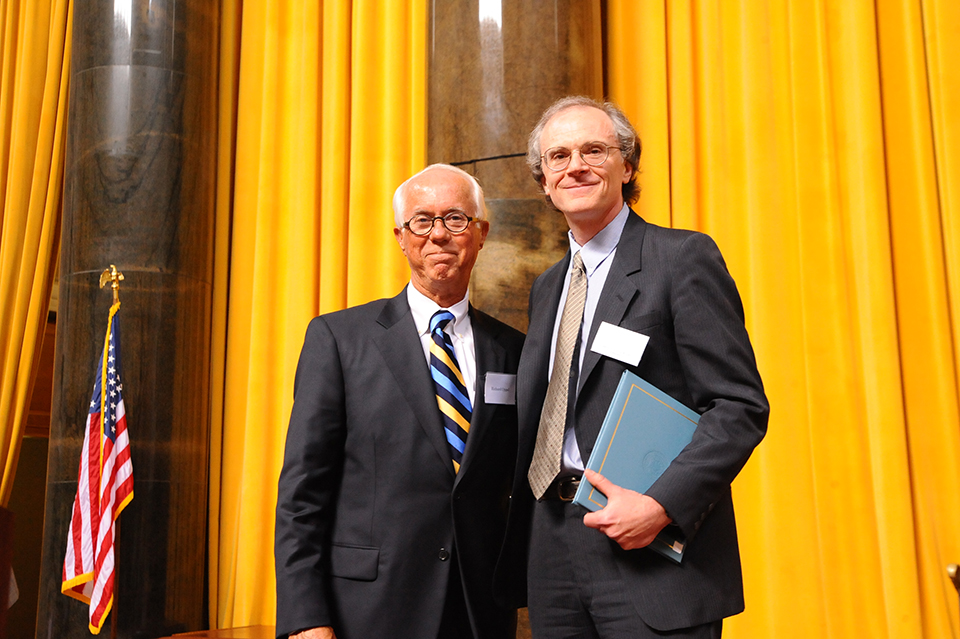
Richard Oppel, Pulitzer Board co-chair (left), presents the 2008 Pulitzer Prize in Criticism to Mark Feeney of The Boston Globe.
Winning Work
By Mark Feeney
We live our lives horizontally. What verticality we do know - via leap or stair, elevator or airline - is by comparison severely limited. We can rise, but for only so long. What goes up really must come down, especially when it's us. Among the many virtues of "To Fly: Contemporary Aerial Photography," the marvelous exhibition that runs at the Boston University Art Gallery through Oct. 28, is that it lets us look down from on high as long as we like without ever having to worry about the descent.
Aerial photography has a history almost as old as the medium itself. Is there a more famous commentary on picture-taking than Daumier's satiric 1862 lithograph "Nadar Raising Photography to the Level of Art"? It shows the celebrated photographer hunched over his camera in a hot-air balloon. The aerial photographer's means of ascent have changed vastly since. Included among the 48 images in "To Fly" are photographs taken from satellites and lunar orbiters. What hasn't changed is the appeal and fascination of being high in the sky with a guy.
"Guy" should be construed loosely, of course. Three of the 13 photographers in the show are female. Marilyn Bridges's quartet of images from Egypt powerfully convey the immense scale of the pyramids and of Karnak, the vast temple of the pharaohs, letting us fully appreciate their dominance of the landscape. Bridges also playfully marries the solid and the insubstantial, as vast shadows extend from or cover the funerary architecture and its ground-burdening bulk.
The insubstantial takes on sumptuous guise in Barbara Bosworth's four "Untitled Aerial Views," from her series "Rising." Looking from above rather than below, these black-and-white cloud studies are (quite literally) the obverse of Alfred Stieglitz's celebrated cloud studies, "Equivalents." Bosworth's clouds are equivalent to nothing. They are what they magnificently, eerily are.
Terry Evans's views of the interface between Chicago and Lake Michigan testify to the curious effect color can have when seen from on high: It diminishes rather than monumentalizes. Call it the Tinkertoy effect. It's equally evident in Esteban Pastorino Diaz's shots of the Greek island of Skopelos and Olivo Barbieri's oversized images of Las Vegas. One of them, dominated by the Luxor hotel, with its black-glass pyramid and ersatz Sphinx, amusingly chimes with Bridges's actual Egypt. So does a Landsat 5 color image of the Luxor region.
Monumentality is front and very much center in Bradford Washburn's stunning views of Alaskan mountains and glaciers. So, too, with Frank Gohlke's images of Mount Saint Helens months after its eruption. They're pure visual kapow.
Aerial views can often also abstract. Showing irrigation pivots and a Nevada test site blast crater, Emmet Gowin conjures up a geometry of mystery: dark, vaguely sinister circles that dominate the landscape. Alex MacLean's view of two-family houses in Somerville could almost be a textile pattern. And his "Dryland Farming Field Near Shelby, Montana" presents great rolling curves of green, like flattened sine waves or a Sean Scully canvas rotated 90 degrees and made verdant.
The most famous image in the show is "Earthrise - Apollo 8," taken by astronaut William Anders in December 1968. It's not only the ultimate aerial photograph. It also offers a rebuke, however unintended, both to yahoos on the right who rage against government funding of the arts and elitists on the left who seem to think the more transgressive the artist the more deserving he or she is of taxpayer dollars. Who'd have thought that what may well be the greatest piece of US-funded public art - that is to say, the work that best combines enduring cultural value with an aesthetic enrichment of the most individuals' lives - originated not with the National Endowment for the Arts but NASA? Sometimes aerial photography can fly very high indeed.
By Mark Feeney
There aren't all that many candidates for favorite American painter. Winslow Homer? Norman Rockwell? Andrew Wyeth? Factor in artistic achievement, and none of them -- not even Homer -- quite rivals Edward Hopper. Note the size of the crowds at the Museum of Fine Arts for the large Hopper retrospective that runs through Aug. 19. A great American artist, Hopper may be as close as we have to the Great American Artist.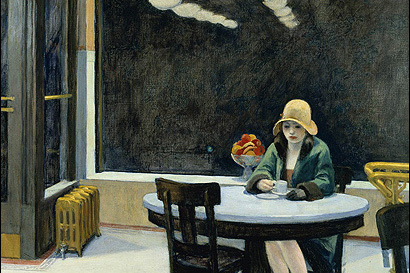
Hopper's figures sit in unmistakably American space, as in "Automat." (Michael Tropea/courtesy of MFA)
The sources of his popular appeal are obvious enough: immediate accessibility; a subtle yet vivid color sense; familiar, but not too familiar, subject matter; a fondness for picturesque settings, like New York, Maine, Cape Cod; even a whiff of prurience (not until Hugh Hefner would the American female bosom be so celebrated).
Yet there's another aspect to Hopper's art that would seem to undercut his popularity. It's the quality that's most unmistakably "Hopperesque" in his paintings, equally apparent in "Nighthawks" and "New York Movie" and "Early Sunday Morning," all his best-known, best-loved work. Call it loneliness.
That loneliness is both what's most and least American about Hopper. It's least so because loneliness is not exactly a selling word. In a society that proclaims all men are created equal, the individual's apartness indicts that society. "America is a vast conspiracy to make you happy," John Updike once wrote. Loneliness foils the conspiracy.
Of course, a nation that prides itself on rugged individualism has to keep a place of honor for solitude. So we have Natty Bumppo striding through primeval forests, Ahab brandishing his harpoon, John Wayne walking out that door at the end of "The Searchers." Theirs is the Promethean apartness of outsize loners.
What Hopper reflects is something quite different, the unheroic loneliness of everyday people, people like you and me: ushers, secretaries, apartment dwellers. The Hemingway hero, another paragon of American individualism, is in control of his apartness. Hopper's people are not. It's imposed on them by the circumstances of life. Their plight reminds us that individualism without ruggedness simply means being alone -- alone even when, as in Hopper's "Room in New York," someone else is there.
"E pluribus unum," one out of many, bespeaks a citizenry coming together, uniting into something larger. What haunts the American imagination is the possibility of one lost among many, the individual trapped in his or her own solitude. American society, Alexis de Tocqueville wrote in Democracy in America, "throws [the individual] back forever upon himself alone and threatens in the end to confine him entirely within the solitude of his own heart." What's most American about Hopper is his bearing witness to that threat.
Confinement can take many forms. Hopper may have no peer in depicting American loneliness, but he was not himself alone in doing so. Walker Evans's surreptitiously taken photographs of New York subway riders in the '30s are Hopper's people seen in (literal) black and white. Willy Loman could have wandered into Death of a Salesman from a Hopper canvas. Some of the most arresting photographs in Robert Frank's "The Americans" share not only Hopper's sense of melancholy but the way space can enclose rather than liberate.
Film noir swarms with Hopper figures -- not the names above the title (whose moody apartness is exalted), but much farther down in the credits -- like so many little tears in the fabric of society. Think of Elisha Cook Jr.'s Wilmer, in "The Maltese Falcon," or Jonesie in "The Big Sleep." Or Thelma Ritter, eking out a purgatorial existence peddling neckties and shrugging at the prospect of her own murder in "Pickup on South Street."
Hopper's closest artistic counterpart isn't visual but verbal: the lyrics of Lorenz Hart . Hart's songs are marvels of dazzling, intricate wit -- except for the ones that express a bleakness otherwise anathema to Tin Pan Alley. Only their voicelessness keeps Hopper's people (the women especially) from breaking into "A Ship Without a Sail" or "Ten Cents a Dance." "I work at the Palace ballroom," Hart's taxi dancer sings, "but gee that palace is cheap/ When I get back to my chilly hall room, I'm much too tired to sleep."
Neither of those songs is a showstopper. That, too, is in keeping with Hopper. What's most terrifying about the apartness of his people is its matter-of-factness. There's nothing symbolic or allegorical about their isolation. It's simply there, like the dirt that gets under your fingernails, the shadows that sunlight casts. "All I wanted to do was paint sunlight on the side of a house," Hopper once said. There are no shadows quite like Hopper shadows: as solid, as accusatory.
The anomalousness of his 1921 etching "Night Shadows," which is in the MFA show, is instructive. A man, seen from an angle high above, walks down a wide sidewalk, alone but for his trailing shadow. A canopied building looms over him. The figure is puny, dwarfed by his surroundings. Neither heroic nor realistic, he is instead Everyman, lost in the looming city. Formally, the etching has considerable interest (the way Hopper uses the sweep of hatchings, for example, to heighten a sense of anxiety). Emotionally and thematically, it verges on bathos.
There's nothing bathetic in classic Hopper. There he maintains a balance between individual and setting, a balance that helps account for the sense of unemphatic desperation. Always, he locates his people in space (an unmistakably American space -- another bond with Frank's photographs). His people are, in fact, defined less by their personal characteristics -- a great portraitist Hopper was not -- than by their location: not who they are but where they are.
Regardless of whether it's a Maine lighthouse or a New York sidewalk, the "where" Hopper paints is almost always barely populated. His friend, the artist Guy Pene du Bois, described Hopper's New York as "a noiseless architectural world." Rather than teem and roar, his city seems on the verge of evacuation. There's the empty sidewalk of "Drug Store," the solitary customer in "Automat," the nearly deserted theater of "New York Movie."
Even in the country, where one might expect solitude to feel natural, it can seem oppressive. The man by himself alongside the gasoline pumps in "Gas" appears unsettlingly out of place (he's wearing a tie and vest, so he can't be an attendant -- yet neither does he have a car). The nocturnal lighting in "Rooms for Tourists" is far more spectral than hospitable.
The moodiness of that lighting is unusual for Hopper. He generally prefers strong, clean illumination -- ocean light, incandescent light -- without veiling. What's striking about this is that Hopper's paintings have a quality of stillness that's inseparable from the sense of solitude they convey. The great painters of stillness -- Vermeer, Chardin -- are so unlike Hopper in the softness of their light and the sense they communicate of their subjects' somehow being outside of time. The people in Vermeer and Chardin are suspended in light, as in a fine amber. Hopper's are pinned against it. Nor is there anything timeless about Hopper's figures; time imprisons them. So much of their sadness has to do with that imprisonment. "I Didn't Know What Time It Was," another Lorenz Hart lyric, could be their dirge, their anthem.
That special Hopper solitariness has never quite left us. The Beach Boys' "In My Room" is Hopper with three-part harmony turned inside out. We get the subject's perspective and hear how isolation can be solace as well as confinement. (Don't laugh at pairing the Beach Boys and Hopper. Cape light is very much akin to California light, and Hopper traveled extensively in the West in his later years. Mightn't the dejection of the usherette in "New York Movie," with her long figure and flowing blond hair, arise from her being a California girl in the wrong place at the wrong time?)
In Eric Fischl's paintings, Hopper's people have moved to the suburbs and shed their sexual inhibitions. Neither the natural nor artificial light in Philip-Lorca diCorcia's photograph "Hartford" -- it's in diCorcia's show currently at the Institute of Contemporary Art -- is anything like Hopper's, but that man looking off into space could step into a Hopper canvas and fit right in. Or just look down any crowded sidewalk -- all those people listening to their iPods, talking on their cellphones, isolating themselves from everyone around them -- it's Hopper on parade.
Ultimately, Hopper took his concern with human isolation to its logical conclusion. The last work in the MFA show chronologically is "Sun in an Empty Room," from 1963. Ostensibly, it's a study in light, volume, and form. The light that seems to emerge from beneath the canvas's narrow palette of buff and dark goldenrod makes the painting seem closer to a Mark Rothko than "Nighthawks" or "New York Movie." Yet in this verging on abstraction a kind of emotional summing up is being offered, too. The sunny room, a place meant for human habitation, is empty not just of objects but also people.
By Mark Feeney
NEW YORK --The name is as it should be. Jeff Wall's photographs are just that, wall photographs: the pursuit of murals by other means.
Most of the 40 pictures that make up his namesake exhibition, which runs at the Museum of Modern Art through May 14, are very big: some as large as 8 feet by 10 feet.
Photographic bigness, at least around Boston, seems on the March. Last year, there was Laura McPhee's "River of No Return " at the Museum of Fine Arts. Edward Burtynsky's "China Series" is currently showing at the Tufts University Art Gallery. And Martin Schoeller's "Close Up" is at the Griffin Museum of Photography in Winchester.
Wall's pictures are bigger than any of those. They have the scale of history paintings in the grand tradition, imposing visual edifices meant to overwhelm viewers even more, perhaps, than provoke or delight them. Instead of battles and coronations, he trades in subjects of a more routine sort: beans on a table, patrons waiting to enter a nightclub, a man whose milk is captured in mid-spill.
Wall isn't just pursuing murals by other means, but the very course of art history. With these mighty pictures, he asserts photography's claim as rightful heir to the primacy painting has held among the visual arts since the Renaissance. His style isn't painterly. He's about as Pictorialist as Weegee. But the references to, and rivalry with, painting are unmistakable.
"Staining bench, furniture manufacturer's, Vancouver," could be an Anselm Kiefer in a world without impasto. The gorgeous austerity of the rows of white wall slats in "Sunken Area" puts almost any Minimalist canvas to shame. "Rainfilled Suitcase" and "The Flooded Grave" -- a picture as striking as its title -- are Dada creations, pure and not so simple. (Wall, who was born in 1946, wrote his master's thesis in art history on Dada in Berlin.)
Wall doesn't ignore the documentary impulse that has driven most photographers since the medium began. He clearly cherishes the unemphatic lushness of his native Vancouver, as in "Coastal Motifs" or "The Old Prison." Note the incongruity of the latter title, though. Even when recording, he's subverting. The documentary impulse is at best subsidiary -- as it has become for most painting since the invention of photography. Wall sees both media as playing by the same rules. Any presentation of a common, external reality in Wall's pictures is incidental to the presentation of his own artistic vision.
One obvious form Wall's diffidence toward the documentary takes is the frequent staging of what he shoots. His is no snapshot aesthetic. The only decisive instant for him is when everyone acknowledges being in position and ready to pose. That eruption of milk was arranged for the camera's convenience. Meteorology determines, but did not initiate, the kite-like lofting of paper in the marvelous "A Sudden Gust of Wind (after Hokusai)." It's another artist, David Lynch, who's called to mind by the warm-and-fuzzy creepiness of "A ventriloquist at a birthday party in October 1947."
Wall has been deeply influenced by film. His work can be seen as massive film stills no less than as here-and-now history paintings. Most of the pictures are transparencies shown in lightboxes. Looking at them, it's as if we're watching plasma-screen TVs on freeze frame. The earliest pictures in the show date from 1979, so it's not as if Wall intended the effect. Reacting to art's present, he managed to anticipate technology's future.
Wall has spoken of his profound regard for cinematic Neorealism, a regard borne out in the mundane subject matter of so many of his pictures. Neorealism is a black-and-white genre, of course, and Wall's affinity for its content clashes with his general reliance on color. There's a rich tension between the near-irresistible appeal of Wall's chromatic palette and the sheer dailiness of a picture like "A view from an apartment." The use of that indefinite article is telling. There's a ravishing particularity in Wall's colors that's often at war with the generic nature of his content. It's a war he may or may not win, but he enjoys waging it.
There are four black-and-white photographs in the show, and they bear out how important color is for Wall. The pictures look drained and dead, blanched in deed as well as fact. They also look unnervingly like Photorealist canvases, perhaps the slyest Wall rejection of photography's junior-partner status.
Not all of Wall's pictures are big. "After 'Spring Snow' by Yukio Mishima, chapter 34" is a "mere" two feet by two feet. But bigness predominates, with two main viewing consequences.
One is the ease of picking out details and fastening on them: The box of Crayolas in a photograph of a man making an anatomy drawing, the handsomely veined bar of soap in "Diagonal Composition" (a nicely Constructivist title, no?), the look on the face of the afflicted party in "Insomnia."
For all that man's visible anguish, one has little real feeling for him. This is the other consequence of the scale of these pictures: a consistent, and consistently unnerving, sense of distance. They're so big that, as the old saw has it, you feel as though you could walk right into them. But the emotional distance you'd feel walking down a Vancouver street -- not meeting the eye of passersby, keeping to yourself -- is the same distance experienced in front of these photographs. It's so natural to stare at the people in a work of art -- they so completely accept our gaze -- and that is no small part of art's pleasure. Jeff Wall's pictures don't work that way. They make us avert our gaze even as we look at them. His pictures' bigness makes us feel small.
© 2007 The New York Times Company
By Mark Feeney
If Annie Leibovitz were any hotter these days, Vanity Fair would have to assign her to take a self-portrait.
Leibovitz, 57, has long been our most celebrated celebrity photographer. Her best-known pictures -- a naked John Lennon curled up, fetuslike, against a clothed Yoko Ono; a naked, and very pregnant, Demi Moore -- are among the best-known of the past 40 years (which is roughly how long she's been photographing).
Leibovitz has lately reached a new level of public recognition. She was on the cover of Newsweek in October. A retrospective of the last 15 years of her work is currently at the Brooklyn Museum of Art, kicking off a multiyear tour that ends at London's National Portrait Gallery. The accompanying book, A Photographer's Life, is a bestseller -- at $75, no less.
Now another medium is paying Leibovitz homage. Tonight PBS' "American Masters" airs "Annie Leibovitz: Life Through a Lens." It is, in effect, an infomercial. To be sure, it's an infomercial for a quality product, but it's still an infomercial -- for a family firm, as it were. The documentary was written, photographed, and directed by Barbara Leibovitz, Annie's sister.
A rangy, restless woman, Leibovitz is highly engaging. She combines an intimidating physical presence with a wholly unintimidating personality. As Gloria Steinem nicely puts it in the documentary, "She is the tallest and the most authoritative uncertain person I've ever seen." It's a striking contrast with Leibovitz's longtime companion, the late writer Susan Sontag, who looms through much of the documentary like a ghostly superego.
The daughter of a career Air Force officer, Leibovitz went to the San Francisco Art Institute to study painting. She took a photography workshop there, bringing some of her pictures to a new magazine calledRolling Stone. Thus did rock 'n' roll find its unofficial court photographer. As Leibovitz says tonight, "Imagine everything you can possibly do on tour with the Rolling Stones, and I did it." In 1983, she went to work for Vanity Fair. Neither she, nor celebrity, has been quite the same since.
The documentary makes no real effort to separate Leibovitz's artistry (which is large) from her celebrity (which is vast). The closest thing to serious commentary comes when photography critic Vicki Goldberg remarks, "People do talk about... [Leibovitz's] story portraits. It's a story that's one sentence long. I really do think of them mostly as one-liners."
More representative is Rolling Stone editor Jann Wenner's describing the Lennon portrait as "an overwhelming artifact, the Pieta of our times." Or there's Hillary Rodham Clinton saying Leibovitz "has been a major chronicler of our country, what we care about, what we think about."
Presumably, Clinton was interviewed because Leibovitz has photographed her, though Clinton has nothing insightful to say about the experience (unlike Keith Richards and Arnold Schwarzenegger, who are among the many celebrities who sing Leibovitz's praises tonight).
The real reason Clinton is included is because she's famous and important. The assumption is that her fame and importance rub off on Leibovitz. Clinton, in turn, presumably found time in her schedule to talk about something she knows nothing about on the assumption Leibovitz's fame and importance will rub off on her. Circularity is the first principle of celebrity: I'll scratch your back if you'll photograph mine.
Anna Wintour, the editor of Vogue, explains it to us this way. "In today's world, which is so celebrity driven, being able to use Annie as one of our star photographers is a huge, huge plus for us. If you ring up Nicole Kidman and say 'Joe Smith is going to photograph you next month,' a big yawn. If you ring up and say Annie Leibovitz wants to photograph you, she'll be there that night, with bells on."
Leibovitz's own bells are something to see. We get to observe her shooting Kirsten Dunst in Versailles, George Clooney and Julia Roberts in New York, the Donald Trumps in Palm Beach, and so on. It's all quite glamorous and interesting, if also kind of empty. Minus the A-list names, and reverential tone, you might think you were watching E!
By Mark Feeney
In Don DeLillo's novel "Libra," a CIA operative assigned to write an agency history of the Kennedy assassination comes to realize that"his subject is not politics or violent crime but men in small rooms." Men in small rooms (women, too) are also Philip-Lorca diCorcia's subject. Some 120 of his color photographs, spanning more than three decades, make up a rich retrospective that opens today at the Institute of Contemporary Art. It runs through Sept. 3.
"Small" is a relative term, of course. Each picture in diCorcia's "Heads" series of street portraits is 4 feet by 5 feet, and those in his "Lucky Thirteen" series, about pole dancers, are even bigger.
"Room" is a relative term, too. Some of diCorcia's best-known photographs are of street scenes, and he's photographed exteriors the world over, from Salonika to Singapore to Wellfleet. Yet even these works have a faintly claustral quality, a rare capacity for conveying confinement. DiCorcia's city scenes remind us that a street is, in effect, a large open-air room; and his exterior shots are cut off by the frame conceptually no less than they are physically.
DiCorcia, a Hartford native who went to the School of the Museum of Fine Arts, got a master's of fine arts at Yale. His graduate thesis posited two types of filmmakers: those whose work exists as part of a world beyond what's on the screen (Renoir and Truffaut, for example), and those who present a world that seems to have no existence beyond the frame (such as Fritz Lang and Hitchcock). It's the second to which diCorcia's photography declares its allegiance.
A cinematic quality has long been noted in his work, as if his images were stills in search of some ultimate director's cut. DiCorcia has a significant body of fashion and editorial work, none of it included in the show. It's easy to see how his style lends itself to such assignments. He often arranges his photos, and even his spontaneous pictures can feel staged. As Peter Galassi, photography curator at the Museum of Modern Art, has written, diCorcia presents "suspended moments in unfolding narratives."
There's an abiding stillness to diCorcia's work. Lang and Hitchcock banished any world beyond the frame -- but at least another would come along 1/24th of a second later. For diCorcia, the banishment is total. No image precedes the one we see, and none follows. In that singularity lies much of the fascination of diCorcia's work, as well as its tendency to unsettle.
There's one significant exception to this rigorous discreteness: his "Hustlers" series, from the early '90s, consisting of portraits of male prostitutes in Hollywood. It's the titles that make the connection to the rest of the world. They include each man's name, age, hometown, and how much he charges his johns (diCorcia paid the subject the same fee to sit for him). As a photographer, diCorcia's concerns are artistic, not moral; but he's not such an aesthete as to reduce these men to just their boy-toy builds and thousand-mile stares.
Their portraits are contaminated versions of classic movie star publicity shots -- except that rather than lounging glamorously by a pool or tennis court, these men sit in a laundromat or convenience store, looking louche, ravaged, or both. In one portrait,"Eddie Anderson; 21 years old; Houston, Texas, $20," the subject is in the background, visible through the window of a coffee shop, a hamburger resting on the counter in the foreground. DiCorcia's composition is implicit but unmistakable: Here are two pieces of meat waiting to be consumed.
DiCorcia shoots exclusively in color. Color can do many things for a photograph. The two most basic are imparting a greater quantity of information and a heightened quality of emotional expressivity. Another is allowing for richer gradations of texture. For the most part that aspect of color has little appeal for diCorcia. Texture can obscure meaning and redirect emotion. Instead, he shoots with often-stunning precision. Such clarity, in his hands, can verge on accusation (the plastic covering part of that hamburger could be a shroud).
Such preciseness of detail helps diCorcia make the surreal seem normal. You have to look extra hard to notice the frequent oddity in his pictures. Doesn't everyone on the subway carry a goldfish ("Igor")? Why shouldn't a woman taking a bath keep a sock on ("New Haven")?
Yet you don't have to look hard to sense the oddity even in ostensibly normal images. DiCorcia's best-known early picture, "Mario," shows his brother in profile looking into a refrigerator. What could be more ordinary? Yet diCorcia has lit it so that Mario could be staring into a sepulchre, or Ali Baba's cave. Or there's the way he manages to make the lavishly decorated Christmas tree and wrapped presents (wrapped presence?) in "Hartford," from 1978, seem creepy in the extreme.
This supernatural sense is a corollary of enclosure. With space cut off, everything allowed within the frame assumes a greater weight of meaning. Again and again, profane content somehow seems to take on a sacred aspect.
The emblematic diCorcia image -- not just self-contained, but otherworldly in its mundaneness -- may be another "Hartford," from 1979. It's part of his series "A Storybook Life," comprising 76 pictures taken from throughout his career and sequenced purely in terms of content and form, rather than date, subject, or location. (They're also printed smaller than the rest of the show, 16 inches by 20 inches. This makes sense as a way to distinguish "A Storybook Life" from the other series. But one can't help but regret the shrinkage. DiCorcia's images are so precise and detailed -- so strong -- they're at their best big.)
A man wearing a tie and white dress shirt stares out an open window. A dusk sky is visible in the upper corner of the picture, above neighboring rooftops. Yet the man looks straight ahead, ignoring the beautiful twilight. We ignore it, too, drawn to the room's honeyed glow. In his early work especially, diCorcia plays with artificial light sources: flashbulbs, televisions, even that light inside the family refrigerator. Here it's a table lamp that transforms the room and transfixes our gaze. It's almost as if diCorcia were taunting the viewer. Look beyond the frame? You won't even look outside this room.
By Mark Feeney
During the many years between the rise of Jim Crow and the dwindling away of the civil rights movement, the "race man" was a sustaining concept in the African-American community. The race man was an individual of great personal accomplishment who was aware of himself as both explicitly representative of his fellow African-Americans and implicitly subversive of white American racism. Duke Ellington and Jackie Robinson may be the two most famous examples.
Charles "Teenie" Harris, who photographed them both, was a race man, too. Forty of Harris's images are on display in an absorbing show at Gallery Kayafas, in the South End. It runs through Dec. 29.
Over the course of a very long career, Harris took some 80,000 photographs - most of them while working for The Pittsburgh Courier. That it was the Courier Harris worked for is significant. For many years, the newspaper had the largest circulation of any black publication in the United States.
That may sound surprising. One thinks of Harlem and the South Side of Chicago as the capitals of African-American culture. But Pittsburgh's black ghetto, the Hill (most notably recorded in the plays of August Wilson and the novelist John Edgar Wideman's "Homewood" trilogy), was a thriving community. How thriving? Earl Hines, Roy Eldridge, Billy Strayhorn, and Art Blakey all hailed from Pittsburgh.
So Harris was in an ideal position for a photojournalist: a varied and richly interesting community to document and a large audience to follow his work. Visiting celebrities welcomed Harris's attention - and the space it would bring in the Courier. Included in the Kayafas show are pictures of Robinson, Joe Louis, Louis Armstrong, and a young Charlie Parker (performing with an equally young Dizzy Gillespie and nearly as young Billy Eckstine).
There's also a photograph of John F. Kennedy delivering an outdoor speech. The Courier's circulation ensured that Harris's subjects were not restricted by any color line. It was, in fact, Pittsburgh Mayor David L. Lawrence who gave Harris his nickname, "One Shot," a tribute to the photographer's knack for quick composition and unwillingness to waste film.
The keenness of Harris's eye is very much evident here. He had a fondness for tableaux: centering his subjects, showing them frontally, even when they're not consciously posed - as in "The School Patrol Guard" or "Little Girl and Her Dog in Newstand." That's true even when his subject isn't a person, like "The Roosevelt Theatre in the Pittsburgh Hill District."
Of course, the sum of person and place is community, and community was Harris's abiding concern. There's a sense of shared life in all these pictures - a sharing among the people in them, a sharing between those people and the photographer. So often Harris's subjects look at the camera, as well they might. These are proud, forthright individuals: not in-your-face, but not about to look down or away either.
Harris's subjects look right back at him even in situations where he clearly hadn't intended it (you can see how often One Shot had to shoot on the fly). Those looks presumably sprang from a feeling of alliance, even complicity, between artist and subject. In the magnificent "Four Elderly Women on a Swing at Lemington Home," Harris shoots the sitters diagonally. Yet the last woman on the right has shifted around to face the lens. She knew she had nothing to hide - just as Harris knew he had much to show.
Harris was sociologist as well as artist. So many of these pictures involve church, workplace, or leisure: people going about their daily lives, and those lives lived together. More than that, Harris's pictures convey an awareness of something being at stake. However indirectly, a statement is being made about the value of these people. Sometimes the statement is anything but indirect, as in a pair of protest photographs from the 1960s. But as with any gifted artist, neither direction nor indirection matters so much as execution. Ultimately, Harris's pictures aren't about life in black America in a particular time and place, or even life in America in that time and place. They're about life. Race man that he was, Harris had a noble agenda. He was too good an artist to be limited by it.
© 2007 The New York Times Company
By Mark Feeney
Something astonishing happened over the second two-thirds of the 19th century and first decade of the 20th, something so unprecedented as to come almost immediately to be taken for granted. It was, quite simply, this: Optics and engineering combined to reinvent seeing. One would have to go back to Lascaux and the first cave paintings to find a comparable shift in visual perception.
The most obvious form this reinvention took was the motion picture. Yet the movies only marked the culmination of a decades-long series of developments that included dioramas and flip books (the latter was patented as recently as 1868), such rudimentary devices for projecting motion as the zoetrope and thaumatrope, and the photographic motion studies of Eadweard Muybridge and Etienne-Jules Marey. For the first time, duration entered visual representation.
"Bliss was it in that dawn to be alive," Wordsworth wrote of the French Revolution, and a comparable sense of blissfulness -- wonder, too -- informed that era of visual revolution. It is the altogether splendid achievement of "Picture Show," which runs at the Photographic Resource Center at Boston University through May 6, to grant us some glimmers of what that reinvention might have felt like.
The aim of this show of contemporary art is to re-create the enchantment viewers experienced when first encountering these visual marvels a century and more ago. The PRC gallery, curator Leslie K. Brown writes, has been made over into"a space somewhere between a cabinet of curiosity, carnival spectacle, and an early motion picture theatre." An even better analogy might be to the interior of one of Joseph Cornell's boxes. There's the same sense of sly magic and delicate otherworldliness.
Certainly, Erica von Schilgen's "mechanical collages," as she calls them, are close kin to Cornell's assemblages. That said, they are very much their own imaginative creations. "Mon Petit Espace" is an old printer's drawer inhabited by a gathering of dolls, each of whom moves when a hand crank is turned. In "Always, Just Beyond Reach," a set of outstretched hands can never quite reach a set of pretty flowers. Futility has rarely been so sweetly appointed. It's as if Laura Ashley were hosting a garden party in honor of Tantalus and Zeno.
Olivia Robinson seeks in her work, as she memorably puts it, "an animated intimacy.""Imbalanced Ambivalence" is at once sculpture, video art, and serenade. A handsome wooden case contains within it a video screen. When the viewer turns a crank, the sound of an accordion is heard and scenes of a nurse putting her uniform on can be seen. (One of von Schilgen's works plays a rinky-tink rendition of "As Time Goes By." "Picture Show" is a sonic treat, too.)
The cherrywood handsomeness of Robinson's box is but one example of how often many of the objects in "Picture Show" are as pleasing, and compelling, as the moving images they encase. That's true of the nobly cracked and chipped wooden housings for several of the little Muybridge-like movies Steve Hollinger has assembled. And it's supremely true for Deb Todd Wheeler's installation"Ludicrum: naturalia, artificialia, scientifica." She has built a modern-day phenakistoscope, a primitive animation device in which images spaced along a wheel give the viewer an impression of continuous motion when the wheel is spun. It is a glorious thing of wood, steel, and brass, at once elegant and robust. If a movie is ever made of William Gibson's novel The Difference Engine, Wheeler should have dibs on the art direction.
In a league by itself is Hans Spinnermen's "The Dream of Timmy Bumblebee." It consists of an impressive contraption of metal and glass that looks not unlike an immobilized, Jenny Craig version of Robbie the Robot from "Forbidden Planet." Projected within it is a film of a bumblebee in flight. The film is incidental to the rather majestic monstrosity of Spinnermen's creation, which is on loan from le Musee Patamecanique, in Bristol, R.I.
The exhibition concludes with a display of historical visual devices, everything from trompe l'oeil cards to a vintage View-Master. Their presence underscores how happily "Picture Show" has located itself at the intersection of technology and imagination. Held in conjunction with this year's Boston Cyberarts Festival, which runs today through May 6, it makes one wonder how the current state of visual innovation will be regarded a century and more from now. Will our great-grandchildren look back on this first decade or so of the World Wide Web as being equivalent to so many digital dioramas and virtual View-Masters?
© 2007 The New York Times Company
By Mark Feeney
There's a moment in "Ball of Fire" (1941) that gives Barbara Stanwyck her due. A chorus girl on the lam, she somehow winds up in a house inhabited by eight bachelor encyclopedia-writers. (Don't ask.) The only female they regularly see is their housekeeper. One look at Stanwyck, and her finger starts to wag. "That is the kind of woman," she declares, "that makes whole civilizations topple." It comes as no surprise, and a considerable relief, when Stanwyck later slugs her and locks the old bat in a closet.
Tomorrow would be Stanwyck's 100th birthday (she died in 1990). This is cause for celebration for anyone who loves movies -- or strong, smart, unillusioned women. How strong? Samuel Fuller wanted to direct her in an Evita Peron biopic. How smart? After meeting her, Ernest Hemingway wrote to Maxwell Perkins about her "good tough Mick intelligence." How unillusioned? In "Clash by Night" (1952), a shocked Paul Douglas finds her in a bar in broad daylight and asks how often she drinks whiskey in the morning."Only when I have a cold," Stanwyck says, with an irony so flat it could be a pancake in Kansas.
Over the course of nearly six decades (from "Broadway Nights" in 1927 to "The Colbys" on television in 1986) Stanwyck forged one of the great Hollywood careers. She may never have attained the exalted status of Garbo or Davis or either Hepburn. But that's part of Stanwyck's enduring appeal. Exaltation was never on her to-do list.
Instead, she always meant business. This was a woman who put her lipstick on without a mirror. When asked what would happen if it smeared, she said, "Then the makeup man fixes it. That's his job. We all have jobs." Even when she was wearing couture, her sleeves seemed rolled up. No screen goddess would ever ask, as she does in "Golden Boy" (1939), "You mean, I look like I been kicked around?" And of no screen goddess could you be so sure she would kick right back. The Brattle Theatre knew what it was doing in calling its Stanwyck series, which runs over the next seven Tuesdays, "Maybe I Am Just a Dame."
Many of Stanwyck's early titles testify to her forthright dame-ness: "Ladies of Leisure" (1930), "Illicit" (1931), "Ten Cents a Dance" (1931), "Forbidden" (1932), "Shopworn" (1932), "Ladies They Talk About" (1933), "Gambling Lady" (1934),"A Lost Lady" (1934). Excessive virtue was not part of her persona, and her most frequent facial expression was a near sneer. It was fate that she should share a screen with that other great sneerer, Elvis Presley, in "Roustabout" (1964).
Yet notice how many of those titles include"lady" or"ladies." So much of Stanwyck's staying power had to do with a consistent tension between street-smart style and aristocratic bearing. She never put on airs -- she didn't have to."Let us be crooked, but never common," Charles Coburn urges Stanwyck in "The Lady Eve" (1941). Exactly right. Onscreen she had an innate authority. Somehow Stanwyck could always square often low down behavior with surprisingly high-flown diction. (She came from Brooklyn, but her vowels didn't.) The contradiction was right there in her name. Barbara Stanwyck, which sounds like a minor Edith Wharton character, was born Ruby Stevens: commonplace surname preceded by a jewel.
Stanwyck could have been the star of her own life story, it was that rough and tumble. She was 4 when her mother died. Her father then abandoned Stanwyck and her older siblings. She quit school at 13 and went to work wrapping packages at a New York department store. "The plain wrapping, not the fancy," she liked to say.
She figured the money would be better working on stage than behind a counter. "I was a dancer," Stanwyck would later say, "not a great one but I knew my left from my right." Right there you have the Stanwyck tone: terse, knowing, with a soupcon of snarl. At 15, she got a small part in the "Ziegfeld Follies." "I was in the 16th row of the chorus and wore a beaded thing and occasionally sat on an elephant." Increasingly prominent acting roles earned her a screen test.
Stanwyck had poise and a sense of barely throttled urgency that the camera feasted on. It was her manner, far more than her appearance, that audiences responded to. "Well, I'm not exactly ugly," she says to Fred MacMurray in "Remember the Night" (1940). She certainly wasn't. Yet Stanwyck was no conventional beauty, either. True, she had a chorine's gams and never lost her trim dancer's figure. (In "Roustabout," the 57-year-old Stanwyck looks better in a pair of jeans than Elvis does.) But her most prominent features were that beaky nose and snaggly upper lip. Her forehead was too high, her cheeks too full. What made her so striking was the slight rasp in her voice, the habit she had of biting her lower lip (simultaneously signaling thought and desire) -- and, above all, the tungsten gaze of those so-often-narrowed eyes. Have shrewdness and skepticism ever been so attractive?
You can see a tectonic shift in movie-star allure in "Clash by Night." Marilyn Monroe plays Stanwyck's sister-in-law. With her soft, pillowy sexiness, Monroe's like a child who's discovered a new toy -- or, rather, that she's the new toy. Far from being a plaything, Stanwyck is well beyond fun and games. Monroe's all jiggly, giggly curves, eager yet coy. Stanwyck, the picture of pared-down, fighting-weight angularity, couldn't be more different. She's not only more mature. She's practically another species. Stanwyck seems so natural on the screen, so unmannered, while Monroe's a bundle of nerves and tics.
The contrast was no less great with Stanwyck's contemporaries. The histrionics of a Joan Crawford (who pirated the title role in "Mildred Pierce" from her) or Davis (who got the lead in "All About Eve" after Stanwyck turned it down) now come across as celluloid Kabuki -- they seem that stylized -- compared to Stanwyck's austere naturalism. Like Garbo, she intuitively grasped the value of stillness, of inwardness. Unlike Garbo, she was able to make that quality seem contemporary and carnal. It's true her emotional range was fairly narrow, running from tears ("Stella Dallas," 1937) to jeers ("The Strange Love of Martha Ivers," 1946). Within that range, though, she was very nearly invincible.
Sarah Bernhardt famously played Hamlet in drag. If Stanwyck could have mastered the verse (and some studio been reckless enough to bankroll the project), she might have been a magnificent Coriolanus. When a Davis or Crawford makes a show of her pride, there's a sense of self-inflation, of preening. With Stanwyck, pridefulness seems as natural -- as necessary -- as breathing.
Of course, she had a lot to be proud of. "The true function of a writer," the literary critic Cyril Connolly declared, "is to produce a masterpiece." If that's true for actors, too, then Stanwyck succeeded twice over. Anyone who appeared in more than 80 movies is going to make a lot of bad ones, and Stanwyck did. She made a lot of good if flawed ones, too -- not just"Ball of Fire" and"Clash by Night," but "The Bitter Tea of General Yen" ( 1933), "Meet John Doe" (1941), and "Forty Guns" (1957), to name only three. She also made "Double Indemnity" (1944) and "The Lady Eve," two of the very best movies ever to come out of Hollywood. Neither is imaginable without Stanwyck.
There are many reasons why "Double Indemnity" remains the greatest of all film noirs. Heading the list is Stanwyck's Phyllis Dietrichson. Hollywood had had female villains before, but never quite like this: as cold, as alluring, as implacable. Stanwyck brings to the role an icy ferocity that's still startling more than six decades later. "I'm afraid to go home with her," Stanwyck said of Phyllis after seeing "Double Indemnity" for the first time. It took a lot to scare Barbara Stanwyck.
Jean Harrington/Eve Sidwich, Stanwyck's character in "The Lady Eve," has a few things in common with Phyllis. She's crooked, for one thing. But she's so much more than that. You believe Stanwyck when she fleeces Henry Fonda. You believe her when she falls for him. You believe her when she's crushed by his rejection. You believe her when she sets out to humiliate him. You even believe her when she falls for him all over again. William Demarest means something quite different when he bellows out the movie's deathless last line,"Positively the same dame!," but it applies no less to Stanwyck's performance -- or whole career.
By Mark Feeney
There really is an anomalous, school-of-one quality to Kubrick. He stands apart: no figure of studio Hollywood (not hardly!), but no indie forebear, either. It's John Cassavetes punk bands have named themselves after, not Kubrick.
No one understands a great director as well as another great director. Which may explain why Robert Altman was so ticked off six years ago.
Altman was in Boston to promote "Gosford Park." The Globe was supposed to have the first interview with him that morning, but the publicist asked a favor. Public radio wanted five minutes for a feature on what famous filmmakers in 2001 thought of Stanley Kubrick's "2001: A Space Odyssey." Sure, I said, no problem.
Well, it was a problem for Altman. "I've never even seen it," he grumbled as I came in, "and I don't give a damn about it." I attributed his ire to having had to waste time talking about a film other than his own - that, or the effects of the bottle of wine he'd polished off the night before during an onstage Q & A at the Museum of Fine Arts.
In retrospect, I suspect what so offended Altman was something quite different. It was being asked to discuss a filmmaker so utterly alien to his own sensibility. Who better to appreciate that Kubrick was the anti-Altman: not actor-friendly, not improvisational, not prolific, neither slapdash nor shaggy.
The only thing shaggy about Stanley Kubrick was his beard. He was the control freak's control freak, the engineer of human souls as filmmaker. All art, the Victorian critic Walter Pater said, aspires to the condition of music. No film director, as it happens, has consistently used music to better effect than Kubrick did. Even so, what his films aspire to is the condition of geometry. They are theorems of seeing: chill, superior, pitiless.
On Tuesday, Warner Home Video releases what must qualify as the ultimate geometry lesson. "Warner Directors Series - Stanley Kubrick." The box set includes two-disc editions of "2001," "A Clockwork Orange," "The Shining," "Eyes Wide Shut," a one-disc "Full Metal Jacket," and a documentary about Kubrick, "A Life in Pictures." In addition, Warner is reissuing separately "Lolita" (Kubrick and Nabokov: a marriage made in mandarin heaven) and "Barry Lyndon." Only "Dr. Strangelove" is missing from Kubrick's post-"Spartacus" filmography.
The DVD experience does even more of a disservice to Kubrick's work than to that of most directors. Watching "2001" on a small screen is like eating a Big Mac with a knife and fork: It's doable, but a very different experience from what its maker intended. That said, Kubrick was the sort of filmmaker extra features were invented for: an artist who gloried in technique and lent himself to multiple meanings and lofty explication.
"2001" is the right film to commence a final-phase Kubrick collection. It's where the director's penchant for grandiosity became unmistakable. It's also where the debate justifiably begins whether "genius" and "megalomania" are synonyms or antonyms.
The late phase looms so large in Kubrick's career - literally as well as figuratively - that it's easy to forget what a mastery of taut, tightly concentrated filmmaking he had previously demonstrated. Kubrick started out as a photographer for Look magazine, and early movies like "Killer's Kiss" and "The Killing" have a journalistic snap and focus. They carry not an ounce of either fat or pretension.
True, there's "Spartacus." But that was really a Kirk Douglas project (he produced as well as starred). "Lolita" verges on chamber work, almost as indebted to Strindberg as Nabokov. And no small part of the astonishment that is "Dr. Strangelove" lies in Kubrick's ability to ignite Armageddon using just three main sets: General Ripper's office, the errant B-52's cabin, and the Pentagon war room. The movie's so brilliantly made viewers don't notice that what they're watching is, basically, cross-cutting among a trio of linked one-act plays.
With "2001," in 1968, inflation has set in. Kubrick, who for decades yearned to make a movie about Napoleon, is revealed as an artist of imperial ambition. And the accouterments of artistic empire here take on unforgettable, if also overbearing, form: murderous apes, power-mad computers, screen-filling psychedelics, black monoliths, and not forgetting the mythic use to which he put both Johann and Richard Strauss on the soundtrack.
As others have pointed out, the most interesting character in "2001" isn't human. It's HAL 9000, the computer. HAL marks the emergence of a recurring figure in Kubrick's films: the dictator, either aspiring or actual. There had been predecessors, of course: Sterling Hayden's criminal mastermind in "The Killing"; Adolphe Menjou's martinet general in "Paths of Glory"; James Mason's Humbert Humbert in "Lolita," who embodies three versions of dictator: lover, father, teacher. Hayden's General Ripper is a sort of dictator in "Doctor Strangelove," although the funniest joke in the movie is what a milquetoast - an un-dictator - Peter Sellers's President Muffley is.
With HAL, this dictator figure emerges full blown. Sometimes it's a person: R. Lee Ermey's drill sergeant in "Full Metal Jacket," or the master of the, uh, revels in "Eyes Wide Shut." Just as often, though, the dictator takes a form that's no less potent for being abstract. All society, in effect, plays that role in "A Clockwork Orange," seeking total behavioral control over Malcolm McDowell's Alex (not unlike the way Wendy Carlos's synthesizer imposes itself on Beethoven and Rossini). In "The Shining," what destroys Jack Nicholson is his failure to realize that it's supernatural powers that dictate what happens at the Overlook Hotel.
"Overlook": It's the perfect vantage point for a dictator. Or director. The similarity between the two words is more than just alphabetical. Clearly, something in Kubrick thrilled to the idea of total authority. It both fired his imagination and informed his working methods (by all accounts, the meticulousness of his moviemaking verged on not-so-benevolent despotism). Surely, the failure of "Barry Lyndon" - so stunningly beautiful, so numbingly listless - owes not a little to the absence of any dictatorial force. Remove its engine, and even the most splendid chassis is just going to sit there.
If one way of seeing Kubrick is as the anti-Altman, another could be as the reverse Hitchcock - another director celebrated (or notorious) for his desire to exert total control over what the viewer saw.
Hitchcock left England for America a third of the way into his career. Kubrick went in the opposite direction at a comparable point in his. Hitchcock made a fetish of his own celebrity, not only making cameos in his movies but hosting his own television series. Kubrick, in contrast, became an aloof, even secretive figure. Hitchcock may have called actors "cattle," but at least cattle are living creatures. Kubrick used actors as if they were flesh-colored Legos, playthings to be arranged to best suit his own designs.
Above all, the reversal is in the very different ends to which they put such similar means. Where Hitchcock saw himself as a sort of aesthetic technician, out to shock and entertain audiences, Kubrick increasingly assumed the role of philosopher-filmmaker, seeking profundity in mise-en-scenes as calculated as timetables (if far more photogenic). The scary thing about Kubrick's final half-dozen films isn't their airlessness. It's the way they pride themselves on it.
In "Eyes Wide Shut," Kubrick might even have acknowledged the affinity with Hitchcock. The pivotal event in the movie is an elaborate orgy, which takes place in a mansion in Glen Cove, on Long Island. It's in a similar Glen Cove mansion that Cary Grant first runs afoul of James Mason in "North by Northwest." Call it a happy coincidence if you like. But just as few things in Kubrick films can be termed happy, even fewer are coincidental.
Martin Scorsese concluded his multipart 1995 documentary history of American film with Kubrick and "Barry Lyndon." After that, Scorsese explained, the directors became his contemporaries, which would make analysis problematic. It was a shrewd decision, as well as an ethical one. There really is an anomalous, school-of-one quality to Kubrick. He stands apart: no figure of studio Hollywood (not hardly!), but no indie forebear, either. It's John Cassavetes punk bands have named themselves after, not Kubrick.
Yet for all Kubrick had no artistic children, he does have grandchildren - grandsons, to be precise, a pair of them - the Coen brothers. Consider the characteristics they have in common: icy detachment; freeze-dried wit; self-regarding intelligence; a reveling in technical prowess.
Above all, there's a shared love of genre. Anyone with even a passing acquaintance with the Coens realizes their filmography might double as a syllabus (a very self-conscious syllabus) for a genre-appreciation course. Kubrick's aesthetic lordliness, his commitment to making movies that were Art with a capital "A," has obscured how genre-driven he was, too. Look at the DVD reissues: adaptations of literary classics ("Lolita," "Barry Lyndon," "Eyes Wide Shut"), science fiction ("2001," "A Clockwork Orange"), costume epic ("Barry Lyndon"), horror ("The Shining"), war picture ("Full Metal Jacket"). He also made film noir ("Killer's Kiss"), would have made a western if Marlon Brando hadn't driven him crazy ("One-Eyed Jacks"), and so many of his movies flirt with turning into musicals.
What separates the Coens from Kubrick is the brothers' immersion in movies. Even when they strive to be literary, in "Barton Fink," it's a very movie literariness. For them, movies are no less end than means. Nothing could be more different from Kubrick. For him, in this final, elephantine phase of his career the DVDs trace, the end was something so much grander and deeper, if also almost lunatic. Kubrick sought nothing less than to plumb the very nature of human behavior: the ineluctability of violence, the transitoriness of love, how much the past determines (and damns?) the future. His ambition was breathtaking. It's one reason why his movies grew airless. It's also why they endure.
© 2007 The New York Times Company
By Mark Feeney
AMHERST - Abelardo Morell straddles the uncertain border between dislocation and enchantment. He transforms the everyday, exalting it. He tames the exotic, domesticating it. And in his best-known photographs, which show camera obscura images superimposed on blank walls, he turns the world literally upside down.
"A Room With a View: The Photography of Abelardo Morell," which runs at Amherst College's Mead Art Museum through Jan. 20, isn't all that big a show - just 32 images. Many are quite large, though, which gives the show a certain heft. Greatly increasing that heft are the quality and variety of the images. Career retrospectives are rarely this small. That's all right, since career retrospectives are rarely this good.
Born in Cuba in 1948, Morell came to this country with his family in 1962. The Morells moved to New York, and one can see the city's influence in the two earliest photographs here. "Central Park, Skating Rink" seems conventional, even touristy, until one realizes Morell was barely into his teens when he took it. Conversely, "Twins," which shows a pair of identical young men standing in front of a Greyhound bus, could have been taken anywhere. But the sensibility is pure - which is to say impure - New York street. Diane Arbus (twins) meets Robert Frank (bus). It's a picture taken by a young man waiting for something to happen who was also a photographer waiting for a sensibility to emerge. For all that "Twins" is a memorable picture, most of the memorableness derives from other, better photographers. Soon enough, the memorableness would be Morell's own.
The title "A Room With a View" is both witty and inadequate. It's witty because for some 15 years Morell has followed a distinctive procedure in many of his photographs. He'll set up shop in an interior space - often, but not always, a hotel room - that overlooks an impressive exterior. Morell will then reduce all incoming light to a single small source, in effect turning the room into a supersize pinhole camera, which projects an inverted image of what's outside. He then takes an actual camera to photograph the result.
Morell's recurring use of the camera obscura could seem like a gimmick, little more than a visual calling card, like the black frame lines on an Avedon portrait. Morell uses the device for so much more, though - and by no means does he use it exclusively (hence the inadequacy of the show's title). These camera obscura images collapse differences - not just inside and out, but rich and plain, familiar and novel - and give Morell a stage of his own making on which to induce the unexpected.
The range of effects Morell produces with the camera obscura is great. "Camera Obscura Image of Umbrian Landscape over Bed, Umbertide, Italy" is strange and unsettling. What's more mundane than a bed - yet what's it doing seemingly in the middle of an Italian field? Conversely, the patent unreality of "Camera Obscura Image of Times Square in Hotel Room" reinforces the dizzying effect the actual place can have. The pair of camera obscura images from a 2002 trip to Havana, Morell's first visit to Cuba in 40 years, carry a weight of profound emotion: the woman's portrait, the two roses, the inviting chair, in one; the cracked, scarred, and chipped plaster, flecked with feeling, in the other
Morell, who teaches photography at Massachusetts College of Art + Design, can also use the technique for comedy. "Camera Obscura Image of Manhattan View Looking West in Empty Room" is a study in incongruity. Amid the forest of skyscrapers projected from outside, one can make out a stepladder and electric plug inside - a sly reminder that construction comes in all shapes and sizes. Even better is "Camera Obscura Image of the Empire State Building in Bedroom." The sight of the tower's limp phallic immensity sprawled across the bed, tired perhaps after a long day spent skyscraping, is hilarious. It also nods to Andy Warhol's marathon film "Empire" and, more distantly, Lewis Hine's noble chronicling of the building's construction.
The presence of others' art is a near-constant in Morell's work. They range from Lewis Carroll and Edward Hopper to Irving Penn and William Henry Fox Talbot. Sometimes that art is front and center. "King Philip IV by Velasquez, Gardner Museum," a distorted photograph of the kingly portrait, functions as shrewd commentary on its subject: It's artifice (photograph) about artifice (painting) about artifice (costume, pose, monarchy). "Tim and Rembrandt, Gardner Museum" shows a young man next to the canvas resembling the painter on the canvas. It might just as well be called "Time and Rembrandt," as it folds together past and present, art and life, here and there.
One of three color images in the show, "Camera Obscura Image of the Philadelphia Museum of Art, East Entrance in Gallery #171 with a de Chirico Painting" is nearly as spectacular as its title is long. The shades of orange and dun in both painting and façade chime lusciously. The painting itself works as a window within the frame, letting Morell play vertiginous games with depth and perception.
Art in his photographs need not take the form of great paintings. Morell delights in objets trouvees: paper bags, maps, boxes. The more banal the item, the more pleasure he takes in its metamorphosis. The thumb indentations of the thick volumes stacked high in "Six Dictionaries" take on an almost geological solidity. "$7 Million," a real crowd-pleaser, is just what its titles say it is: that much cash in elastic-band-held blocks (a few bucks here, a few bucks here - it does add up).
In "Slide," Morell shoots the piece of namesake playground equipment so that it looks horizontal, receding into the picture plane (descent as depth). He's wild about light, yes (what photographer isn't?), but Morell revels in the sheer thing-ness of objects, too. The raised metal letters of the manufacturer's stamp on the slide take on a monumental quality.
A different sort of monumentality is on display in "My Eyeglasses." Making the optical sculptural, he declares how much his work is a tribute to the act of seeing. Seeing is believing?
For Morell, seeing is loving, too.
© 2007 The New York Times Company
Biography
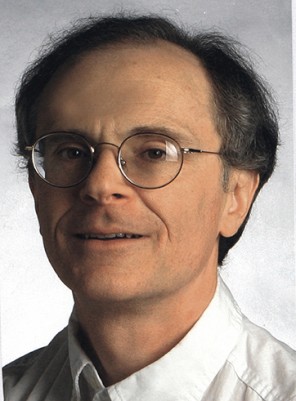
Mark Feeney was born on July 28, 1957. Raised in Reading, Massachusetts, he graduated from Harvard College in June 1979 with a magna cum laude degree in History and Literature.
He started as a researcher in The Boston Globe's library in October 1979. In February 1980, he began writing for the paper's book review section. In December 1981 he became acting assistant book editor, receiving the full title in June 1983. He was promoted to book editor in February 1985. In February 1991 he became editor of The Globe's Sunday section of analysis and commentary, Focus. In September 1993 he began a six-month in-house sabbatical as a staff writer for The Boston Globe Magazine, returning to Focus in March 1994. During 1996 and part of 1997, he was on leave from the paper, working on a book about Richard Nixon and popular culture. That book, Nixon at the Movies (University of Chicago Press), was published in 2004. Currently a writer and editor with The Globe's Arts section, Feeney has been a lecturer in American Studies at Brandeis University since 2004. In spring 2007, he was Robbins Professor of Writing at Princeton University. His work has appeared in The New Republic, Commonwealth, the Los Angeles Times, Newsday, Harper's, The American Scholar, The New York Observer, and The Washington Monthly.
A past vice president for publications of the National Book Critics Circle, he was a finalist for the 1994 Pulitzer Prize in feature writing for "Wing Tips on the Beach," an essay about Richard Nixon's life and career on the occasion of the former president's eightieth birthday.
He lives with his wife and their son in Cambridge, Massachusetts.