The Wall Street Journal, by Joe Morgenstern
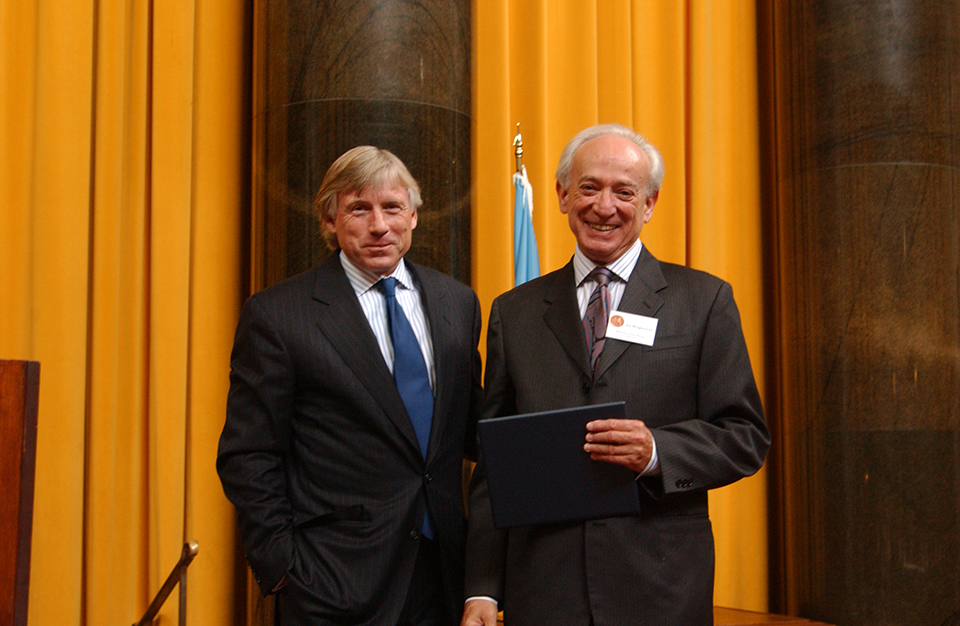
Columbia University President Lee C. Bollinger (left) presents Joe Morgenstern with the 2005 Pulitzer Prize in Criticism..
Winning Work
By Joe Morgenstern
Though Not Exactly Anti-Semitic, Its Gore Is Very Anti-Audience Is It Commerce or Self-Therapy?
Mel Gibson has said that he wanted "The Passion Of the Christ" to show the enormity of Christ's sacrifice through scenes so shocking as to push us "over the edge." The film does that, though where we land depends on who we are. Some will be inspired by the message of love and hope that emerges from torture depicted in hideous detail. I found myself stunned, then horrified, then defensively benumbed, by a level of violence that would, in another genre, be branded as pornographic. No one who watches Mr. Gibson's dramatization of Christ's final hours will come away unaffected by its intensity. His direction combines the fluency of modern techniques -- the craftsmanship is impressive -- with a central performance, by Jim Caviezel, that sometimes evokes the primal, ecstatic style of the silent era. Yet this work of manifest devotion, financed by Mr. Gibson himself, is overwhelmed by his obsession with physical suffering to the exclusion of social, political and metaphysical context.
Never has a movie -- at least a movie made for general audiences -- shown so graphically a human body being torn asunder. The second hour -- we'll get to the first one in a moment -- is an almost unrelieved bloodbath. Bestial Roman soldiers set upon Christ with canes and whips, then with scourges whose metal hooks rip his skin while the camera moves in to survey the results. Though the road to Calvary is nightmarishly slow and unspeakably punishing, the sequence is almost bearable to watch when compared to the process of crucifixion, in which each sledgehammer blow to each nail is meticulously documented, once again in unflinching, blood-soaked close-ups.
"The Passion Of the Christ" is in Latin and Aramaic, with English subtitles; the language strategy works well, lending mystery to the spectacle. The film begins with Jesus praying in Gethsemane, which the virtuoso cinematographer, Caleb Deschanel, has suffused with a lovely blue light, and into which Mr. Gibson has introduced an androgynous satanic figure with a woman's face and a dubbed male voice. Soon the Galilean is arrested at the behest of the Jewish temple priest Caiphas, and brought before Pontius Pilate with one of his eyes already closed, thanks to a preliminary beating by his Roman captors.
Was the young actor drawn to violent roles by what now seems to be his dark, Manichean vision of life on earth? Or was the intensity of his belief heightened by playing violent roles with such brilliant success?
The encounter is, of course, crucial to any telling of the story, since the interplay between the Roman governor and the Jewish temple priests will assign relative responsibility for Christ's death. Long before this week's opening (on some 4,000 screens), the film's supporters and detractors -- some having read purloined scripts and others having seen a pre-release version -- were dissecting the specifics of the encounter, and debating whether the production as a whole was anti-Semitic. Not as a whole. And not just because Mel Gibson was willing to excise a subtitle translating the Jewish crowd's cry "his blood be on us and our children" (Matthew 27:25), or because he told Diane Sawyer he didn't believe that all Jews were cursed for all time by God. Mr. Gibson, an ultraconservative Roman Catholic who takes the Gospels to be literal reportage, says he intended the film only as an expression of his faith, and so it seems to be.
Yet that's not to say the Jews come off well. According to this account, which Mr. Gibson wrote with Benedict Fitzgerald, Jews are indisputably the prime movers in the decision to kill Christ, while Pontius Pilate is a moderate, singularly sensitive precursor of Hamlet. Pilate isn't sure what to do with the admirable captive who stands before him -- the governor's wife, Claudia, calls the Jewish crowd "that filthy rabble out there" -- and he holds the manipulative toady Caiphas in obvious contempt. Still, he accedes to Caiphas's insistence that Jesus be crucified as the leader "of a large and dangerous sect." (That's as far as it goes in the context department.) Nor does the film convey its attitudes only through dialogue. At several points we see a powerful contrast between the wordless distress of Pilate and his wife, and the cool, pitiless pleasure of Caiphas and his cohorts as they watch Jesus taken off to meet his fate.
At many points in "The Passion Of the Christ" I wondered if I was watching a commercial movie -- a relentlessly publicized commercial movie -- a religious statement, or an elaborate example of self-therapy on the part of a man who has spoken openly of the personal despair he felt in the midst of vast fame and wealth. All of the above, I suppose, and more: The movie also raises intriguing questions about the interplay of commerce, art and belief in a remarkable career.
For decades Mel Gibson has been seen as a star with a great gift for sexy humor and, from the start, an affinity for great violence. In the climax of his first feature film, "Summer City," and also in his second, breakout film, the super-violent, post-apocalyptic "Mad Max," he wept movingly over the body of his best friend; now he invites his audience to weep over the body of Christ. Disemboweled in "Braveheart," tortured and or anguished to the breaking point in "Ransom," "Payback" and "Signs," he has stumbled at the box office only in "Conspiracy Theory," which had him playing an apparent crackpot who turned out to be something of a prophet. Where did all this come from? Was the young actor drawn to violent roles by what now seems to be his dark, Manichean vision of life on earth? Or was the intensity of his belief heightened by playing violent roles with such brilliant success?
I don't pretend to know the answer, any more than I know whether "The Passion Of the Christ" will become an instrument of anti-Semitism (though, on second thought, I suspect that it won't because its commercial appeal will prove limited; don't even think about taking young children). What I do know is that I was gripped for a while by the strength of Mr. Gibson's filmmaking, only to be repelled and eventually excluded by his literalist insistence on excruciation. There is watching in horror, and there is watching in horror.
© 2004, Dow Jones & Company
By Joe Morgenstern
Writer Kaufman's Grand Comedy Surreally Explores True Love
Winslet as a Vibrant Neurotic
"Eternal Sunshine of the Spotless Mind" goes by like a fevered dream of love, but one you remember vividly, with profound pleasure. A romantic comedy unlike any other, this gorgeous phantasmagoria, which was written by Charlie Kaufman, directed by Michel Gondry and shot by Ellen Kuras, takes a question that's been posed by poets across the ages -- of what is love compounded? -- and examines it, postmodern style, through fanciful high-tech scans of the memory traces in a scorned lover's brain.
The premise is fairly simple, though it's set forth in a Mobius-strip narrative that can be befuddling unless you open yourself to the surfeit of charged images, leaving matters of internal logic for later. Jim Carrey's shy guy, Joel, receives a notice from a mysterious company, Lacuna Inc. that his flaky girlfriend, Kate Winslet's Clementine, has chosen to have all memories of him erased from her brain. (If memory serves, Lacuna qualifies as a spinoff of the Lester Corp., that mysterious company situated between the seventh and eighth floors in Mr. Kaufman's script for "Being John Malkovich.") Undone by the rejection and desperate to forget her, Joel implores the people at Lacuna to perform the same service for him, which they do, though with mind-bending complications.
I must confess that I approached "Eternal Sunshine of the Spotless Mind" -- the title is taken from Alexander Pope's heroic poem "Eloisa to Abelard" -- with guarded expectations. Mr. Kaufman has written one audacious and/or precocious feature film after another: "Being John Malkovich" (which included an Eloise-and-Abelard puppet show); "Human Nature" (which Mr. Gondry directed); the intriguing if erratic "Adaptation" and the clever, cluttered "Confessions of a Dangerous Mind." In each case, though, the exhilaration of watching his wonderfully cockeyed ideas come to life has given way to frustration and/or letdown. Whether or not there are second acts in American lives, there have been no solid third acts in Charlie Kaufman scripts.
Until now. In "Eternal Sunshine," Mr. Kaufman rides his hobby horses -- whimsical surrealism, acrobatic or elastic time, science or psychology reshaped by blithe fantasy -- to a photo finish in which almost everything is worked out elegantly. And the best thing about the ending, which casts the beginning in an eerie new light, is its heart-stopping romanticism. I'm not going to tell you how, against all odds, the movie manages to pull this off, but part of the magic lies in an exquisite encounter in a hallway toward the end, after many convolutions of the plot. It's a generic romantic moment, up to a point. Clem is about to take her leave when Joel says "Wait," and she asks "Why?" In the standard version of the scene, he would tell her why, and she would respond, but not this time. "I don't know," Joel says quietly, baffled by his own confusion. "Just wait... for a while." The wait is worth its weight in gold.
So far I've concentrated on the writer's contributions to "Eternal Sunshine," which, unlike most machine-made productions these days, is a writer's movie. (Mr. Kaufman wrote the script from a story he developed with the director, and with the French artist Pierre Bismuth.) But it's also a director's movie, an actors' movie and a cinematographer's movie, as well as a movie that owes much to its editor, Valdis Oskarsdottir, its production designer, Dan Leigh, and to Jon Brion, who did the original score. In other words, it's one of those rare collaborations that artists dream of, and that film lovers crave. (Focus Features is taking a brave gamble by opening "Eternal Sunshine" wide, in some 1,200 theaters. I hope it will find the same sort of audience that embraced the elusive beauties of "Lost In Translation.")
In this film of flawless performances, the most important influence is the director's unseen hand. Michel Gondry seems to have created a playground in which his actors are free to be ardent, droll or cheerfully insane while Ellen Kuras's see-all camera darts and glides among them. Kate Winslet has never played anyone quite like the magnetic, vibrantly neurotic Clementine Kruczynski, although there were suggestions of scintillations to come when, in "Sense and Sensibility," she played Marianne as a proto-California girl. Clem, a self-described book slave working at a Barnes & Noble in New York, is determined to live her life to the fullest. (That includes coloring her hair with a rinse called Blue Ruin.) "Drink up, young man," she tells Joel with enchanting verve after picking him up on a train. "It'll make the whole seduction part less repugnant." Clem can afford to joke at her own expense, since she knows any man worth his neuroses would want to live his life with her.
Fresh Material
Jim Carrey, by contrast, has played a role somewhat similar to this one before. Like Truman Burbank in "The Truman Show," Joel Barish is the victim of invisible forces beyond his ken. In that earlier film Truman didn't know he was the star of his own reality TV series. In "Eternal Sunshine" Joel can't fathom the violence being visited on his most delicate synaptic connections by a couple of screw-up techies and a cute assistant who, during his erasure process, get stoned out of their skulls, and, worse still, out of his. (Mark Ruffalo, Elijah Wood and Kirsten Dunst make these scenes scarily hilarious, while Tom Wilkinson, as their boss, is the picture of avuncular lunacy.) Still, Mr. Carrey's material in this film is so fresh that he's able to reassert himself as an endearing dramatic actor with a great comic's trust in the expressiveness of his face -- even when his features are immobilized by Joel's grief or loss.
Loss is the subtext of the comedy -- the loss of precious memories that constitute the essence of love, as well as the core of personality. "Eternal Sunshine" plays on many fascinations and preoccupations of our time -- brain research, amnesia (which was noodled with only last month in Adam Sandler's "50 First Dates"), computer science, runaway technology, an eagerness for quick fixes, the issue of free will. Half a century ago, when Mary Martin's Navy nurse in "South Pacific" wanted to get over a love affair, she sang "I'm Gonna Wash That Man Right Outa My Hair." Now Clem pays Lacuna Inc. to delete that man right outa her brain.
Yet the film goes beyond techno-chic and psychobabble -- plus some funny but awfully fey stuff involving Joel as a little boy -- to find its own poetry. Sometimes the technique is indirect. For his first appointment at Lacuna, Joel has been told to bring all physical traces of the beloved to be forgotten; there he sits in the waiting room with photos and the like. But we also get a heartbreaking glimpse of a woman sitting near him with a bowl on her lap; the side of the bowl says 'Buster.' Sometimes an image will be as direct as the filmmakers know how to make it: Clem and Joel sharing a nighttime moment of ineffable happiness as they lie next to each other on their backs on an icy pond, looking up at the constellations. Most memorably, though, "Eternal Sunshine" uses Joel's cortical torture to make a case for love's all-pervasiveness. No matter what nook or cranny of his mind chances to light up, Clem is there.
© 2004, Dow Jones & Company
By Joe Morgenstern
Vivid Documentary 'Control Room' Goes Backstage at Al-Jazeera; A Tatty but Genial '80 Days'
"The Terminal" is a terminally fraudulent and all-but-interminable comedy starring Tom Hanks. He plays Viktor Navorski, a traveler from Eastern Europe who is forced to spend a year living in the international transit lounge at JFK. (A revolution back home has rendered him stateless, so he can't enter the United States.)
The film, directed by Steven Spielberg, means to inspire us with Viktor's indomitable, entrepreneurial spirit -- he manages to act out the American Dream in his little realm -- and with the kindness of airport workers who give him support or, in the case of Catherine Zeta-Jones's flight attendant, give him confused and confusing love. Maybe the strategy will succeed. More than ever these days, moviegoers want to feel good when they can. But "The Terminal" brought me crashing down in dismay at the realization that a film with Steven Spielberg's name on it could be calculated so unconscionably, and feebly. I didn't believe a single minute of this lame fable. I don't even believe that Mr. Spielberg directed it. He must have been a victim of identity theft on the part of a film-school student fixated by Frank Capra and Forrest Gump.
From an implausible start, the story meanders through a succession of perfunctory episodes. It's patently absurd that airport authorities, represented by a rigid bureaucrat named Frank Dixon (Stanley Tucci), can't provide an interpreter -- Viktor's English is rudimentary -- let alone cope with the urgent needs of a political refugee. But belief is strained to the breaking point throughout: by the explosive growth of the hero's vocabulary (Viktor learns English faster than Tom Cruise learned Japanese in "The Last Samurai"); by the ease with which he finds a good job inside the terminal; by the blossoming of his artistry (he builds a fancy decorative fountain out of love for the flight attendant, Amelia), and by Amelia's own pitiable plight. (She's been waiting seven years for a phone call of commitment from her boyfriend.)
Fables needn't be bound by logic, but they do need grace or charm. That's how Mr. Spielberg got by with his last picture, the lighter-than-air "Catch Me If You Can." This new one is heavier than lead and still won't hold water, even though it seems to have been prompted by the true if ambiguous story of Merhan Karimi Nasseri, an Iranian exile who's been living in Charles de Gaulle airport since 1988. (Given that Mr. Nasseri is free to enter France whenever he wants, his clarity of mind remains in doubt.)
The action takes place in a product-placement paradise; every store and restaurant you've ever seen at an airport terminal has its logo proudly displayed. (Janusz Kaminski did the dreary cinematography.) Yet the screenplay, by Sacha Gervasi and Jeff Nathanson, is a cluttered notions shop. There's a notion about Viktor as a little guy bucking Frank's totalitarian system, and a notion about the nobility of other little guys working in the terminal. (Eighty-five-year-old Kumar Pallana is endearing as a janitor named Gupta, though what his character finally decides to do with his life makes no sense.)
Even the climax, which explains why Viktor came to New York in the first place, hangs on nothing more than a sentimental notion having to do with Art Kane's celebrated 1958 group portrait of jazz musicians in Harlem. And the crucial encounter of the climax, the moment that might have been expected to carry the most emotional weight, barely happens at all; it's as if the filmmakers gave up on their own nonsense in the end. That's also the feeling you get from the stars: Tom Hanks, Catherine Zeta-Jones and Stanley Tucci look increasingly uncomfortable or disconsolate as the movie grinds on. Among the other cast members, the only standout is Zoe Saldana, who plays an amorous customs officer. Despite the repetitiveness of her role, Ms. Saldana actually seems to be enjoying herself.
'Control Room'
"Control Room" should be essential viewing, not just for journalists and news junkies but for regular people who want to expand their understanding of how the U.S. is seen in the Arab world. Jehane Noujaim's documentary is a perceptive -- and admittedly sympathetic -- appraisal of al-Jazeera, the Qatar-based satellite channel that is watched by some 40 million Arabic viewers around the globe. (Secretary of Defense Donald Rumsfeld has called al-Jazeera "Osama bin Laden's mouthpiece.")
What contributes to the film's importance is its timeliness: We see samplings of the network's coverage of the second Iraq war, and behind-the-scenes interviews with some of its journalists and news managers. News management is the main issue. "Control Room" shows how coverage is tailored to fit the audience, both by al-Jazeera and its Western counterparts. That leads to horrific footage being broadcast to Arab viewers -- civilians killed or mutilated by bombs, U.S. Army troops cursing and screaming as they go into Iraqi homes, interviews with terrified American POW's. Ms. Noujaim's documentary neither justifies this footage nor condemns it, but lets us judge al-Jazeera's clearly partisan approach against the consistently sanitized -- and partisan -- coverage on American TV.
Of those on al-Jazeera's staff, the most engaging is an articulate and cosmopolitan Sudanese journalist, Hassan Ibrahim; he opposes the U.S. presence in the Middle East as passionately as he admires the U.S. and its Constitution. Yet the most moving figure in "Control Room" is a bright young American, Lt. Josh Rushing, a press officer at Central Command. A man of honor who is struggling with the contradictions of his job, he conveys his government's positions to representatives of al-Jazeera and every other accredited news medium, but with a keen awareness of his own bias, as well as theirs. "It benefits al-Jazeera to play to Arab nationalism because that's their audience," he says at one point, "just like Fox plays to American patriotism." What's the opposite of the Ugly American? Josh Rushing fills the bill.
'Around the World In 80 Days'
If you compare "Around the World In 80 Days" to "Around the World In 80 Days," you'll make yourself needlessly grumpy. The new one can't hold a candle to the old one, which, in its time, was a pretty spectacular entertainment, with a cast headed by David Niven, Shirley MacLaine and the great Mexican clown Cantinflas; a script by S.J. Perelman, a narration by Edward R. Murrow and cameos by such notables as Marlene Dietrich, Frank Sinatra, Fernandel, Buster Keaton, Peter Lorre, George Raft and Red Skelton. It's less distressing, and more encouraging, if you think of the new one as a descendant of those old Road movies with Bob Hope, Bing Crosby and Dorothy Lamour -- a tatty but good-natured time-passer.
Jackie Chan is the valet Passepartout in this version, while Jules Verne's eccentric inventor Phileas Fogg is played by Steve Coogan. (If you don't know him from "24 Hour Party People," you should seek the film out on DVD; it's a glorious performance.) The movie was obviously built, however shakily, around Mr. Chan, and he delivers his usual goods with his usual energy, though some of his kung-fu derring-do-cum-undone is more energetic than imaginative.
The big surprise is Mr. Coogan's genial star quality. A sort of young Alistair Sim with good teeth, he holds the camera with unswerving authority, and holds the movie together whenever it loses its compass. Cecile de France makes her English-language debut as a French artist who wants to see the world. (She was lovely in Cedric Klapisch's fine "L'Auberge Espagnole.") In the cameo department, Kathy Bates is Queen Victoria, Luke Wilson and Owen Wilson are the Wright brothers (do you really want to know which is which?) and a bemuscled actor, now the governor of a large Western state, plays a bemuscled prince with lascivious eyes leering out of a face that looks more tanned than tan.
© 2004, Dow Jones & Company
By Joe Morgenstern
Overheated Polemic Trades Logic For a Couple of Good Zingers; A Lush and Lovely 'Notebook'
At one point in the course of Michael Moore's rambling, troubling and sometimes rousing "Fahrenheit 9/11," I recalled a remark that the media-savvy satirist Harry Shearer made years ago about the newspapers of the time in San Francisco. Reading them, he said, was "like getting your news from the crazy lady in the Laundromat." Well, watching Mr. Moore's film means getting your news from the media village's most famous or infamous bomb-thrower, self-promoter, used-theory salesman, glib falsifier, discomfiting truth-teller, aggrieved patriot, shrewd lampooner, serial ambusher and, in his latest feature-length polemic, Bush-beater with a seething vengeance. At its best, "Fahrenheit 9/11" is an impressionist burlesque of contemporary American politics that culminates in a somber lament for lives lost in Iraq. But the good stuff -- and there's some extremely good stuff -- keeps getting tainted by Mr. Moore's poison-camera penchant for drawing dark inferences from dubious evidence.
This movie isn't journalism, to be sure, or even a documentary in the traditional sense of the term. It's a postmodern, postliterary piece of agitprop, coming at a time when truth is often the first victim in supermarket tabloids, radio talk shows, campaign commercials on network TV and gabble-fests on cable. Yet Mr. Moore presents himself as a dispenser of significant news in a long, murky plot-theory passage that seeks to establish some sort of cause-and-effect relationship between the Bush family's well-established connections to Saudi oil interests, including members of the very large, very rich bin Laden family, and the Bush administration's supposed willingness to let 140 Saudis, including members of the bin Laden family, fly out of the country immediately after Sept. 11, when all other air traffic was grounded. The problem with the theory is it isn't true. The Saudis left, having been duly interviewed by the FBI, only after air traffic resumed.
To build its case against the Bush administration's decision to invade Iraq, "Fahrenheit 9/11" takes potshots, scattershots, cheap shots and at least one devastating shot in the process of some zestful character assassination. Most of us have seen the president in his now notorious moment of triumph aboard the aircraft carrier, and we see him there once again. Some of us have seen John Ashcroft singing, badly, a patriotic anthem of his own composition called "Let the Eagle Soar." But we have not seen, until now, Paul Wolfowitz preparing for a TV appearance by combing his hair with a saliva-drenched comb. And though we've also seen President Bush reading "My Pet Goat" in a Florida classroom on the morning of Sept. 11, Mr. Moore's film dwells on that bizarre snippet of American history with a long sequence, in slow motion with a superimposed clock, during which the president, after learning that the second tower has been hit, continues to read the children's book in what appears to be a state of extended bewilderment.
Bush-haters will love this, and Bush admirers will despise it, just as Michael Moore wants them to; he's made no bones about his hope that "Fahrenheit 9/11" will make a meaningful mark on this year's presidential campaign. That's not to say, however, that the film serves nothing but the cause of rabid partisanship. Its scenes of suffering in Iraq -- the victims include grievously wounded GIs as well as Iraqi civilians -- provide valuable counterpoint to the sanitized coverage on American TV. It's fair for Mr. Moore to remind us that our volunteer army depends heavily on a supply of youngsters from areas of high unemployment. (One sequence shows a couple of eerily hip Marine Corps recruiters trolling for recruits in a shopping center.) And exploitive though he may be in his interviews, Mr. Moore often traffics in real emotion. One of the most memorable passages reveals the deep grief of a mother who has lost her son to a war she can't comprehend.
The movie's title is a reference, made in spite of the author's objection, to Ray Bradbury's "Fahrenheit 451," a classic sci-fi novel set in a future when firemen burn books and libraries in a ceaseless campaign to suppress independent thought. Michael Moore isn't that kind of fireman, but he's certainly the arsonist auteur of an incendiary feature that has already won the top prize at this year's Cannes Film Festival; caused a rift between two American studios (Disney, which financed it, then disavowed it, and the company's Miramax subsidiary, which had planned to distribute it); captured the imaginations of lots of moviegoers in advance of today's opening, and will debut on DVD before the November election. Fahrenheit 451, by the way, is the kindling point of paper. For better and worse, "Fahrenheit 9/11" is a new kindling point for film.
'The Notebook'
"The Notebook" starts with an idyllic shot of a boat gliding over placid water at sunset. I took that as a warning that we were in for a syrupy successor to "On Golden Pond," but I'm happy to say I was wrong. The opening shot might better be called "On Crimson Creek," and the movie as a whole is a lovely surprise. Ripe with feeling and lush with physical beauty, it's a love story that swings confidently between age and youth, and, like the young Tiger Woods of old, avoids every trap along the way.
The focus is mainly on youth in a narrative that has James Garner and Gena Rowlands as Noah and Allie, a husband and wife near the end of their days -- her memory is almost gone -- and Ryan Gosling and Rachel McAdams as the passionate lovers they once were. "An improbable romance," the old man calls it, with good reason. (And with infectious feeling; it's one of Mr. Garner's best performances.) When Noah and Allie first meet at a carnival in a North Carolina town in 1940, he's a kid from the wrong side of the tracks, and she's a golden girl whose parents dismiss him as a passing summer fancy. They're wrong, of course, and if you didn't know that from the rules of romantic fantasy, you'd know it from the piercingly beautiful piece of music that sneaks in when the young lovers feel their first stirrings of love -- Billie Holiday's "I'll Be Seeing You."
It's no secret that Mr. Gosling is one of our most gifted young actors. (He played the covertly Jewish American Nazi in "The Believer.") Still, this is his first romantic lead, and he's superb -- interesting in his inwardness, endearing in his demonstrativeness. Ms. McAdams delivers, and then some, on the vivid promise of her work as the alpha manipulatrix in "Mean Girls" -- this movie marks her emergence as an enchanting star. Others in the excellent cast are Joan Allen, Sam Shepard, James Marsden and Kevin Connolly.
"The Notebook" was directed -- impeccably -- by Nick Cassavetes, from an adaptation, by Jeremy Leven and Jan Sardi, of a novel by Nicholas Sparks. Robert Fraisse did the sumptuous cinematography, and the production was designed by Sarah Knowles. When there's a choice between energy and sentimentality, Mr. Cassavetes and his actors (including his mother, Ms. Rowlands) almost always go for the energy. That's why we feel moved more often than manipulated, even by the borderline-cloying scenes of age and decline. The young lovers' story is so strong that I wondered, from time to time, how it might have played without our ever seeing them as old folks. Yet one element of the drama enhances the other, just as, on a far different scale, the bookend story about the old woman and her blue diamond gave "Titanic" much of its emotional resonance. Youth may be wasted on youth, but not in a movie where it's seen as a glorious rehearsal for age.
© 2004, Dow Jones & Company
By Joe Morgenstern
Rising Star Bernal Adds Glamour; In the Forgettable 'Forgotten,' More Ms. Moore Isn't Merrier
The biker is father to the man in "The Motorcycle Diaries," a remarkably buoyant, buddy-bonding road movie with Gael García Bernal as the young Che Guevara on a journey of discovery through Latin America. Mr. Bernal is the magnetic Mexican actor from another Spanish-language road movie, "Y Tu Mama Tambien," and he brings a star quality to this role. That's fair enough, since the young Che -- Ernesto Guevara de la Serna, a medical student from a bourgeois Argentinian family -- eventually became the Marxist-guerrilla equivalent of a rock superstar, his dark eyes burning beneath a beret on posters and T-shirts around the world.
A more important issue is whether the charming, open-hearted 24-year-old hero of Walter Salles's film could have grown into the ferociously ideological fomentor of revolutions. Yes, he could, with allowances made for the mysteries of personality, and for the occasional gauziness of a production that -- deftly for the most part -- subordinates ideology to richly textured human comedy. (The cinematographer was Eric Gautier. Gustavo Santaolalla did the lovely music.)
Deftness is evident from the start, when we hear, in voice-over, Ernesto's self-deflating preface: "This isn't a tale of heroic feats; it's about two lives running parallel for a while." "The Motorcycle Diaries" was adapted, by José Riva, from parallel sources: Guevara's journal of the same name, which begins with that preface and which was written -- with extraordinary eloquence -- in the course of an 8,000-mile adventure in 1952; and "Traveling With Che Guevara," the diary kept by Che's friend, Alberto Granado, a physician and biochemist who turned 30 while the two were on the road. (The real-life Granado, now in his early 80s, appears briefly at the movie's end.)
The bike was Alberto's, a 1939 Norton wryly nicknamed "La Poderosa," or "The Mighty One." A carbureted version of Don Quixote's Rocinante, the decrepit machine becomes a comic character in its own right, while its owner is played with raffish, infectious verve by Rodrigo de la Serna. If Che gives the film its reason for being, this screen version of Alberto (as opposed to the sharply ideological Alberto of the book), provides the animating spirit during much of a trip that ranges from the picaresque -- Easy-Riderish revels in bars or dance halls -- to encounters with peasants who've been uprooted from their land.
Alberto is the funny, fast-talking con man. He plays blackjack at a riverboat casino, and wins big, to pay for a night with a pretty whore. He plants a story in a small-town paper that represents the two scruffy wanderers as distinguished scientists doing research on leprosy. (In fact, both men studied leprosy, and lepers appear later in the movie, not only as victims of disease but as the damned of the damned, symbols of Latin America's hidden misery.)
Ernesto is no angel either. With bedroom eyes to go with his bedside manner, he's eager to be romanticized, not radicalized. Women adore him, even though he can't tell a tango from a mambo. At the same time, this raunchy pilgrim is sensitive, poetic and compassionate, just as the literary Che revealed himself to be in his journal. (He's a far more interesting character than the older Che played by Mr. Bernal in "Fidel," a Showtime mini-series two years ago.) Ernesto is fatefully affected by the plight of a married Chilean couple who are penniless because the husband, as a known communist, can't find work. He refuses to wear rubber gloves during a visit to a leper colony, choosing instead to shake bare hands with startled inmates. Though he knows, from his medical studies, that he can't catch leprosy from a handshake, the gesture is still meaningful as an impulsive reaching-out to society's outcasts.
I wish the director and his colleagues had been satisfied with meaningful gestures. At one point the narrative lapses into melodrama that's uncharacteristically manipulative, albeit effective, and fictional to boot. It's when the less-than-robust Che, who suffered from acute asthma attacks, also chooses to swim the Amazon River so he can celebrate his birthday with the lepers on their island, rather than spend it with the medical staff on shore. (We're meant to see it as Che crossing his own Rubicon.) And the softening of Alberto Granado's sensibilities strips the story of one likely reason for Che's political awakening. Read both books and it's clear that Alberto must have been a powerful influence on his friend.
As a whole, though, Walter Salles's film paints a convincing, entertaining portrait of the revolutionist as a young man. Mr. Salles is the filmmaker who directed "Central Station," a road movie in which an old woman and a young orphan boy crossed the vastness of Brazil. He's clearly sympathetic to Che's story, but focused on telling it relatively straight, rather than sanctifying his roguish subject. "The Motorcycle Diaries" really is about the journey rather than the destination.
'The Forgotten'
Forget "The Forgotten" unless you're curious to see how a feature film with a good cast and attractive locations can rattle on for 91 minutes without ever veering into plausibility. It's "The Sixth Sense" as nonsense, "Eternal Sunshine of the Spotless Mind" without the sunshine. Or the mind.
Julianne Moore plays Telly Paretta, a distraught New Yorker who, according to her shrink (played by Gary Sinise), has a death grip on the past. In that past, as Telly recalls it, her eight-year-old son, Sam, was killed in an airplane crash. Yet there's no evidence that she and her husband ever had a child. Is she delusional, or the perfectly lucid victim of invisible forces? Well, invisible forces are at work on all of us. They're called studios, and the studio that uncaged this wild turkey has a lot to answer for: repetitive chases through lower Manhattan (does every intersection have a view of the Brooklyn Bridge?); brainless tactics by brutes with National Security Agency badges (no wonder the intelligence community is in disarray); a script, by Gerald DiPego, that's simultaneously underwritten and overwrought.
The main victim of the underwriting is a boozy ex-hockey player named Ash (Dominic West). He, too, lost a child, according to Telly, who claims to have known him and his absent daughter from a local playground. But Ash doesn't believe a word she says, and he is not a man given to introspection. "How could I forget my little girl?" he asks obtusely when Telly presses him on the subject. When she presses harder, he says "Wait a minute, I'm having a National Enquirer moment." The whole movie is a National Enquirer moment, extended to ludicrous extremes. "The Forgotten," which was directed by Joseph Ruben, is supposed to be about an unbreakable bond between mother and child, but there's also a bond between film and filmgoer, and it's broken all too easily.
© 2004, Dow Jones & Company
By Joe Morgenstern
Payne Directs a Sheer Pleasure; 'Vera Drake' Is Powerful Tale Of Soulful British Abortionist
I won't mince any words about "Sideways" -- it's wonderful, just wonderful. And I won't add any wine adjectives, similes or metaphors of my own in telling you about a movie that's full of them -- not because there's anything wrong with the way Alexander Payne's comedy uses wine to reveal character, but because much of the movie's language is so funny and affecting that I don't want to risk diminishing it.
"Sideways" stars Paul Giamatti and Thomas Haden Church as Miles and Jack, two buddies on the road in California's wine country. (The title refers to how wine bottles should be stored, but it also describes the heroes' crabwise approach to happiness.) Jack, a charming fool of a TV actor with a fading career, is about to be married. Miles, a divorced and hilariously depressed oenophile, has responded to this signal event by taking his old friend on a week-long odyssey of wine-tasting, eating and golf. Along the way Jack is smitten by Stephanie, a laconic wine-pourer played by Sandra Oh. Miles is entranced -- and plunged into spasms of self-doubt -- by Virginia Madsen's Maya, a waitress with a gift for going straight to the heart of anything and anyone. If Oscars were given for ensemble acting, this quartet would be a shoo-in; there isn't a false note in their work from start to finish.
Yet each character is a vivid creation in a film that's as droll as it is wise about loneliness and the search for true love. The most earnest searcher is Miles. Last year Mr. Giamatti gave a gloriously prickly performance as the comic-book writer Harvey Pekar in "American Splendor." Now he has brought another flavor of perfection (that doesn't qualify as a wine reference) to the role of a middle-school English teacher who has too many fancy words at his disposal, and too few accessible feelings. Miles's verdict on one wine: "quaffable but far from transcendent." My verdict on Miles: Lovable and transcendent, thanks to Mr. Giamatti's ability to rise above the Woody Allen stereotype of nebbishy neurosis by playing Miles absolutely straight and fiercely smart.
Jack knows nothing about wine, or fidelity. Determined to have one more fling before his wedding, he tries to impress every woman he meets with his negligible celebrity, even though he's actually been reduced to doing occasional commercials. Thomas Haden Church, who played the mechanic, Lowell Mather, on TV's "Wings," varies his portrait of this classically childish American man quite remarkably. He's vaudeville-broad when Jack is behaving like a buffoon -- which is often -- yet subtle, even sweet, in revealing his vulnerability. And Sandra Oh, as the single mother who buys Jack's declaration of love, enriches the ensemble with a very different acting style. She's withholding at first, letting us sense for ourselves how often her character has been burned, then resplendent in Stephanie's fury when Jack deserves it.
Virginia Madsen's role is neither inward nor flashy, but forthright. Maya is a rare combination portrayed all too rarely in American films -- a lovely, intelligent woman with a lyrical soul -- and Ms. Madsen's exquisite performance is a pivotal part of the picture. Indeed, her scenes with Paul Giamatti are some of the most moving romantic encounters I've seen in years.
They're also notable for their equal-opportunity displays of polar opposites. Maya is direct. When Miles characterizes a wine with clichés of daunting complexity, she sums up what he's said with delicious concision: "Like, the alcohol overwhelms the fruit." Maya can also be eloquent. Her wine talk has to do with feelings -- what was going on in her life while the grapes were growing. Miles, by contrast, is brilliantly evasive; he's always frightened of being found out, and rejected. When Maya asks him why he's into Pinot, his reply, poetic in its turn, has to do with the qualities of the grape. Yet he's also talking about himself, with a heartbreaking urgency that Maya instantly grasps.
Alexander Payne directed "Sideways" from his adaptation, written with his longtime collaborator Jim Taylor, of Rex Pickett's novel of the same name. (Phedon Papamichael did the fine cinematography.) Longtime is a relative term. Their collaboration dates back only to 1996 and Mr. Payne's first feature, "Citizen Ruth." His next film, "Election," was small but stunning, a comedy, with Reese Witherspoon and Matthew Broderick, that used a high school class election as a metaphor for national politics. His third feature, "About Schmidt," starred Jack Nicholson and put him on the map as a mainstream director. "Schmidt" was certainly entertaining, but often facile, and stained by condescension for its middle-American characters. (Mr. Payne hails from Omaha, Neb., where the story starts.) Almost miraculously though, the director's style in "Sideways" has been swept clean of any attitude but abiding affection for his characters, and his skill in guiding his actors is so unerring as to be invisible. "Sideways" makes you glad about America, about movies, about life.
'Vera Drake'
Everyone who knows the stolid heroine of Mike Leigh's quietly masterful "Vera Drake" says the same thing about her: She's a good soul. She cares about people, so much so that she's constantly visiting sick neighbors or inviting hungry ones to dinner. If the story were confined to Vera's everyday life there wouldn't be a movie, because she cleans other people's homes, then returns to her own happy, untroubled family -- a loving husband and two adult children living in a modest flat in London in 1950. (Though the film was shot in color, by Mr. Leigh's veteran cinematographer Dick Pope, you recall it in black-and-white.) But Vera's avocation is another story. Unbeknownst to her family, she's a back-street abortionist. At a time when safe abortions are available only to the rich, she marches around town, bag in hand like a bleak Mary Poppins, bringing her service to poor young girls in trouble.
"Vera Drake" succeeds in combining both stories. As an evocation of English working-class life half a century ago, it feels utterly authentic, and is ennobled -- not too strong a word, I think -- by Imelda Staunton's performance in the title role. Ms. Staunton gives little away; her Vera is taciturn, sometimes monosyllabic, and outwardly austere in her plain cloth coats and little black hats. Yet you're drawn to this woman as she sings to herself in her kitchen, or offers cups of tea with unsugared cheer. At the same time, "Vera Drake" frames the secular aspects of abortion fairly, if not quite objectively, and it does so without recourse to familiar arguments or deadening rhetoric.
I say not quite objectively because Mr. Leigh has chosen to make his heroine an entirely altruistic abortionist. She accepts no fees for her services, and she's stunned by an accusation that she does. "I don't do it for money," she says. "That's not what I do. They need help." That accusation comes at the intersection of the two stories, after an abortion has led to lethal complications and the cops show up at Vera's door to arrest her. (Lest Vera's interrogation evoke that of Joan of Arc, Mr. Leigh also makes the investigating detective a kindly man, even an empathetic one.) Still, the film leaves no doubt about the squalor, or danger, of Vera's work, and it debates the abortion issue only indirectly, and artfully -- her arrest provokes widely divergent responses within her family. Ultimate judgments are left to the audience.
© 2004, Dow Jones & Company
By Joe Morgenstern
Pixar's Dazzling Satire of Suburbs Takes Flight With Director Bird; What's 'Alfie' All About? Zilch
"The Incredibles" is the year's best movie so far, and by far; it's hard to see what might still come along to surpass it. Pixar's latest animated feature, written and directed by Brad Bird, heaps delight on delight until you think you can't take any more without a pleasure break.
Mr. Bird's daring, bedazzling creation is, before anything else, a comic action-adventure about a former superhero forced to live a life of not-so-quiet desperation in suburbia. The comedy is irresistible, and the action sequences, exceptionally intense with spasms of violence, take the animator's art to -- if I may borrow a phrase from an earlier Pixar superhero -- infinity and beyond. You almost forget that you're watching animation, let alone computer animation, as you're swept up by the astounding graphics. But "The Incredibles," which carries a PG rating, is also a work of huge, if unobtrusive, ambition -- a vision of modern life, appropriate for sophisticated adults as well as for kids, that is both satirical and, of all things, inspirational. It's a great film about the possibility of greatness.
The disconsolate suburbanite, Bob Parr, once chased around saving the world, or significant parts of it, as the masked and red-underweared Mr. Incredible. Now, gone to fat and working as a clerk at an HMO, Bob (voiced by Craig T. Nelson) lives in a modest tract house with his wife, Helen (Holly Hunter), formerly the supersvelte Elastigirl, and their three superkids, who must pretend to be normal so as not to attract attention. What could account for such a comedown? Why, the litigiousness of our times. So many people saved by Mr. Incredible turned around and sued for damages that his government employers decided to cut their losses by putting him and his family into a relocation program.
That's only the prologue for adventures to come. Like the movie as a whole, though, it's laced with bracing social commentary and droll humor. (And blessed with a brilliant, eclectic score by Michael Giacchino.) Bob takes a dim view of his new community's bogus values. Refusing to attend his son's graduation from fourth to fifth grade, he grumbles, "They keep inventing new ways to celebrate mediocrity." Still yearning for another shot at heroism, he sneaks out at night, on the pretext of going bowling, to do good deeds and perform risky rescues with another defrocked superhero, his buddy Frozone (Samuel L. Jackson), who used to encase his enemies in ice. Sneaking back home from a collapsed building late at night, Bob is trapped in one of those scenes where the wife finds a strand of another woman's hair on her husband's clothes, except that here it isn't hair. Picking at his sweater, Helen asks suspiciously, "Is this... rubble?"
Bob Parr is clearly a man in midlife crisis, torn between family and a calling that no longer calls. When the call comes again, as clearly it must, his adventures are more perilous than he could have imagined, more enjoyable than some of the sources they spoof ("Mission Impossible," James Bond), and more significant than mere flights of kinetic fancy (though there's hardly a scene that doesn't vibrate with visual distinction).
Some have detected, in advance of the film's national release, a metaphor for Bush-era America, a superpower supposedly answering its own global call to greatness. That's not my reading. The story's most obvious -- and remarkably deep -- resonance comes from its simple humanity, from a series of personal transformations that avoid all the solemnities of the self-realization movement, while conveying a sense of joyous hope. Bob goes from Prometheus Bound to Unbound. Then he's re-bound when things go disastrously wrong, and eventually, triumphantly, unbound once again, but only with the help of his wife and kids, who, just as triumphantly, reclaim their own superpowers. If there's any agenda here, it's old-fashioned family values. Having freed himself from humdrum family life, Mr. Incredible finds that he can't save the world on his own.
"The Incredibles" tells its tale with a narrative force that's unrelenting, even though the movie is intricately plotted and uncommonly long for the genre -- the running time is one minute over two hours. It's also densely populated by delightful characters -- shovel-jawed Bob, of course, and, once she comes fully into her own, his faithful wife. (Wait until you see the twists and tortuous stretches that Elastigirl's flesh is heir to.) Two of my other favorites are Mirage (Elizabeth Peña), the mysterious platinum blonde who lures Bob back into action, and Edna Mode, aka E, the fashion designer who makes his new uniform. E seems to be part Japanese, part Strangelovian German and part Anna Wintour, and she's voiced, hilariously, by none other than the director, Mr. Bird. (I also noticed, as a little reminder of Pixar's collegial culture, that the long list of credits for "additional voices" includes Andrew Stanton, who most recently directed "Finding Nemo.")
With this, its sixth animated feature, Pixar will have its sixth megasuccess, both as art and commerce; there's never been a winning streak like it in the history of the movie business. And, to judge from the results, the studio couldn't have provided a happier home for Brad Bird, who needed and deserved one after the mishandling, by Warner Bros., of his marvelous first feature "The Iron Giant." "The Incredibles" is a marriage made in silicon heaven -- vast arrays of the highest-end computers, plus a veritable army of skilled colleagues, all harnessed to the genial will of a filmmaker with a master storyteller's gift. That's another definition of superpowers.
'Alfie'
Jude Law stars as a cheerfully sexy beast chasing beautiful women in "Alfie," Paramount's defanged remake of the 1966 English original, which starred a young Michael Caine in the title role. So what's it all about this time? Mainly conglomerate cowardice (don't offend anyone you don't have to), demographics (pick a target audience, then pander to it), and, of course, the very real appeal of Jude Law, who is good at doing what he's been asked to do here, even though it's wrong for the character and story from start to finish.
The only way to understand why the new version is so vacuous, and weirdly unmoored, is to go back to that original, which still seems startlingly nasty, as well as funny and, in flashes, affecting. Michael Caine's Alfie is a casually ironic, self-justifying misogynist who seethes with working-class anger as he talks directly to the camera, making it his confidant and unblinking accomplice. Only once does he feel anything like compassion for the women he woos, beds and dumps. That's when he looks off-screen, following a ladyfriend's squalid abortion, and sees what he describes as a fully formed fetus lying dead behind a curtain. It's a stunning scene that reveals, however briefly, the man's vestigial conscience.
In the new version, which was directed by Charles Shyer, there's nothing to reveal, since everything's on the bright surface. Jude Law's Alfie is basically a nice, needy guy who makes the camera his therapist. No longer a swine, he's a scamp with regrets. He talks cockily about shagging birds, seeming not to notice that he lives in contemporary Manhattan, rather than swinging London, and that he isn't Austin Powers. There's still the matter of an abortion, but it's been carefully and shamelessly finessed. (I've had to finesse that last sentence to avoid giving away a plot point.) This new Alfie is earnest -- irony is so last century -- and not angry at all, since working-class anger would mean nothing here, because class means nothing here. Nothing means anything here.
© 2004, Dow Jones & Company
By Joe Morgenstern
Law, Roberts Fall Flat in Lust; 'Flying Daggers' Hits Bulls-Eye With Action, Intrigue, Romance
Bring Zoloft and a tank of oxygen to "Closer," an airless, ultimately joyless drama of sexual politics with Julia Roberts, Jude Law, Natalie Portman and Clive Owen at the corners of a shifting, deceitful rectangle. Mike Nichols directed this screen version of Patrick Marber's play, which is set in contemporary London, and which remains a play despite conventional efforts to open it up - glossy exteriors, talky walkabouts on city streets. Indeed, the movie is insistently playlike, if rarely playful, thanks to the director's fondness for artificial, rat-a-tat-tat rhythms of speech that sound like parodies of drawing-room comedy. (Or like echoes of those wonderful old Nichols and May stage routines, minus the malicious, self-ironic glee.) The verbal swordplay is involving, for a while, in the lacerating tradition of "Who's Afraid of Virginia Woolf?" -- it's all about savagery just below the surface of modern relationships. But "Closer" is also about watching over-rehearsed actors play bloodless characters who work too hard at drawing blood.
The preface sets a mood of expectancy. Something fateful is clearly about to happen as Jude Law spots Natalie Portman gliding along a crowded London sidewalk in a state of radiant, slo-mo grace. He plays Dan, a writer of newspaper obituaries and an aspiring novelist, while she is Alice, a self-described waif from New York. Of the members of the acting quartet, only Ms. Portman manages to breathe some life and spontaneity into the convoluted tale of couplings, regroupings and betrayals. (Soon after the long, robotic arm of coincidence brings Alice and Dan together, there's a sweet, seductive moment on a bus when she reaches out to him, takes the glasses off his nose and calmly cleans his lenses.)
The other three stars are stuck with roles that may have sparkled on stage -- I haven't seen any of the productions -- but that serve as soul prisons here: Julia Roberts's Anna, an American photographer with a greater vocation for guilt than for love; Clive Owen's icy lover, Larry, a dermatologist whose heart is a rapacious hunter, and poor, confused Dan, the catalyst of the action who says at one point: "What's so great about the truth? Try lying for a change. It's the currency of the world."
Inconstancy is the currency of the script. These unpleasant people either do what they do as total strangers to their own motives, or discharge their guilt quite consciously by telling truths that cut deeper than swords.
Of course, unpleasantness can be a source of revelation in drama - and great enjoyment. "Who's Afraid of Virginia Woolf?" the four-character debut feature that put Mike Nichols on the movie map, was a venom volcano. "Carnal Knowledge," a sexual tragicomedy written by Jules Feiffer, was a study in hostility, doomed narcissism and despair. ("The Graduate," the classic comedy that came between them, and that spoke to a whole generation of anxious youngsters, wasn't filled with model citizens either.) But "Virginia Woolf," unlike "Closer," was fueled by high-octane dramatic energy -- Edward Albee's vituperations -- not to mention a spirited cast headed by Richard Burton and Elizabeth Taylor. And "Carnal Knowledge" benefited, at the very least, from a smirky star turn by Jack Nicholson. (Overpraised when it first appeared, the film plays today like a trudge through a musty museum.)
Mr. Nichols's new feature could succeed in spite of its failings. The movie is being marketed with a vengeance as the holiday season's prestige release -- one quote ad calls it a master class in directing. And there's always an audience for news about how awful human beings can be (as well as plenty of news events to prove the point). Still, "Closer" could hardly be farther from enjoyable. I'd call it a post-Graduate class in gloom.
'House of Flying Daggers'
Don't expect me to deliver a sober account of Zhang Yimou's "House of Flying Daggers." During most of this Chinese-language romantic adventure I was DUII -- delirious under the influence of images. If there's a more beautiful movie around I'm not aware of it, and can't imagine what it might look like. I know I felt the same way when I saw "Crouching Tiger, Hidden Dragon"; I may even have said some of the same things. And I was certainly smitten by the surface sumptuosities of Mr. Zhang's "Hero," which played in American theaters earlier this year. "House of Flying Daggers" is different, though. It doesn't have "Hero's" gravitas, which is a plus in my book; a little gravity can go a long way, as I suggested in the previous review. What "Daggers" does have is an astonishing combination of spectacle, suspense, martial-arts flash, sublime silliness, anti-gravity action and passionate intensity - before and after everything else, it's a grand love story.
The action is set in ninth-century China, although the setting that first grabs your attention is the Peony Pavilion, a rococo brothel in what seems to be the Las Vegas area of the Tang era. That's where the beautiful heroine, Mei, works as a top showgirl. Did I say that Mei is beautiful? Well, she is, even though the word gives little hint of her spirit; she's played by Zhang Ziyi, who was the young, headstrong aristocrat in "Crouching Tiger." Mei also reveals that she is blind, but her blindness is not an impediment -- to anything -- in a movie with such magical creations as the Echo Game, a sexually charged, call-and-response ballet in which a brothel patron flings dried beans at dozens of pedestal-mounted drums surrounding Mei, while she, clad in peach-and-white silk, tracks the echoes with superhuman sonar, flings out her weighted sleeves like some dervishy octopus and bangs the same drums in the same musical sequence.
As it happens, the bean-thrower, Jin, is a government spy who has come to the brothel in the belief that Mei is a member of the Flying Daggers, a rebel group that redistributes China's wealth from rich to poor. Assigned to flush Mei out and bring her in, Jin falls in love with her, as who wouldn't. Or does he? The complex plot involves shifting alliances and secret identities, but what it comes down to is two men in love with the same woman, and the central issue of sacrifice -- a willingness to give one's life for romantic love. "House of Flying Daggers" can be seen -- should be seen, according to its director -- as a companion piece to "Hero," a politically oriented martial-arts epic in which lives are sacrificed for the common good. And the director's career can be seen as a long, serpentine journey through a culture that is transforming itself. It's amazing to think that the man responsible for the deeply affecting 1992 drama "Raise the Red Lantern" made either of these martial-arts extravaganzas. "Daggers" is the greater surprise, since it's the more overtly entertaining of the two, or, for those who value "Hero's" solemnity -- I'm not among them -- the less substantial of the two. But seriously, now, what's wrong with entertainment, especially when it's staged with such elegance and expertise? In the new China -- and overseas, because films like "Flying Daggers" reach a huge global audience -- ancient China is starting to look like old MGM musicals, which were expert and elegant in their time. "Daggers" has it all -- great chases through virgin woods, great kisses in leafy glades, autogyro daggers finding their mark, combat troops slashing as they sway in bamboo treetops, autumn foliage, winter snow, and all of it almost, though never really, too much of so many good things. "You've mastered the flying technique," Mei says briskly after checking out Jin's musculature with her all-seeing fingers. Zhang Yimou has mastered it too. His new movie soars.
© 2004, Dow Jones & Company
By Joe Morgenstern
DiCaprio Can't Fill in the Blanks In This Sanitized Biography; 'Million Dollar Baby' Is No KO
Martin Scorsese's "The Aviator" stars Leonardo DiCaprio as Howard Hughes, the fabled industrialist, Hollywood playboy, movie tycoon, airline executive, obsessive-compulsive recluse and, yes, aviator who designed the Spruce Goose, a giant flying boat that lifted off the water only once, in 1947, with Hughes at the controls. Like that eight-engine behemoth, this account of Hughes's life is spruced up (his craziness sanitized to make him sympathetic), goosed up (with flashy techniques the director favors), wooden-winged (though the thing flies, it doesn't soar), and remarkable to behold as it goes by. (The production was designed by Dante Ferretti, and photographed by Robert Richardson.) Watching the actors and gorgeous trappings is an adventure in cognitive dissonance. I didn't believe a single minute in almost three hours, but enjoyed being there all the same.
His Howard comes on as a Gatsby with the gift of blunt gab and the passion of an Icarus for risky flight.
Enjoyment and disbelief coexist quite happily in the razzle-dazzle of the early reels. Mr. Scorsese has brought his love of old-fashioned Hollywood pageantry to a big, newish-fashioned saga of a thwarted visionary. (It's his version of Francis Coppola's "Tucker: The Man and His Dream.") Howard Hughes produced and directed movies, starting at the age of 22, so movie love provides the director of "The Aviator," and its writer, John Logan, with a perfect access route to Hughes's varied and storied career. But movie love in this case also means a production more concerned with theatricality than with realism or biographical truth.
When we first see Mr. DiCaprio's Howard Hughes as a baby-faced adult, the year is 1927, and he's directing his first film, the extravagant aviation epic "Hell's Angels." (Though the re-creation is terrific fun, no time is taken to suggest how the son of a Texas drill-bit tycoon learned to direct, or to note that other directors worked on the film.) Next, Howard is at the premiere, with flash bulbs exploding like grenades, pow! pow! pow!, and a bizarre Jean Harlow lookunalike at his side. Then Howard's life goes pow! pow! pow! He falls for Cate Blanchett's Katharine Hepburn! (Who wouldn't?) He teaches Kate how to fly! (Beautiful sequence.) He buys TWA! (The guy's a gambler.) He breaks the world's speed record, then walks away from a crash landing in a beet field! ("Fastest man on earth," Hughes tells Hepburn when he gets home, tapping himself boyishly -- and charmingly -- on the chest.)
This romantic interlude gives "The Aviator" a counterpart of the uplift that Hughes would later engineer, quite literally, into Jane Russell's bra. (She was his ultrabuxom star in "The Outlaw.") Ms. Blanchett's portrayal isn't just an astonishing soundalike -- she seems to have internalized all the rhythms as well as the timbre of Hepburn's voice -- but an enchanting creation in its own right. Mr. DiCaprio's initial jauntiness is entertaining too. His Howard comes on as a Gatsby with the gift of blunt gab and the passion of an Icarus for risky flight.
Yet a paradox shadows both performances. Cate Blanchett does what's asked of her wonderfully well, but it's still a trick, just like Jude Law's fleeting turn as Errol Flynn, or Kate Beckinsale's game impersonation of Ava Gardner. (Game but pallid, beneath Ava's sensational clothes.) Leonardo DiCaprio brings an impressive set of skills to his role, but they're the wrong skills, because he's wrong for the part. While he comes to look like the real-life Hughes as his character ages, he remains unconvincing as a man tortured by brain disease. It's as if the brilliant imposter Mr. DiCaprio played in "Catch Me if You Can" had somehow snagged this part and was going through the motions cleverly, even though the full range of the hero's emotions was beyond him.
And beyond, or apart from, the movie's intentions. "The Aviator" bites off only a slice of Hughes's story, choosing to avoid his unsavory sex life and crackpot politics, and ending before his move to Las Vegas, where he descended into the depths of solitary madness. That's fair enough: As Hepburn says here, "Movies are movies, Howard, not life." Martin Scorsese's movie gives us plenty to munch on: elegant airplanes; a shattering crash; zestful music; Alec Baldwin's smooth take on Pan American's Juan Trippe; Alan Alda's unctuous, unprincipled Owen Brewster, the senator who went after Hughes on Trippe's behalf when TWA tried to break Pan Am's stranglehold on international routes.
Still, movies try to simulate life, or heighten it, and this one succeeds only partly. Its hero may be a visionary, but he also displays alarming behaviors, and no one really talks about them; they're just for display. His career in aviation lacks context: World War II comes and goes with hardly a mention. His insanity lacks scale: the spectacle is intriguing, rather than commanding. In the Pixar extravaganza, "The Incredibles," the tiny costume designer Edna Mode, a takeoff on Hollywood's legendary Edith Head, laments: "I used to design for gods!" In "The Aviator," the stars playing gods -- and monsters -- seem all too mortal.
'Million Dollar Baby'
Clint Eastwood directed "Million Dollar Baby." It's a boxing film in which he plays a world-weary trainer, Frankie Dunn, who reluctantly takes on a female fighter played by Hilary Swank. She's very strong in her role, dramatically and physically, while his performance reminded me of something Art Carney said a long time ago about his stirring work in "The Late Show." All he tried to do in the role, Carney told me, was be "correct." An old-fashioned notion, and a fine one, it epitomizes Mr. Eastwood's work here -- nothing showy, nothing disproportionate. You can't even call his acting minimalist, since that would suggest artfulness. It's sufficientist -- just enough to give us privileged glimpses of Frankie's good, guilt-ridden soul.
"Million Dollar Baby" is a mood piece punctuated by powerful action, with a plot turn I won't discuss, except to say that only a star of Clint Eastwood's stature could have gotten a major studio to go along with the story's resolution, which is nothing if not forthright. For a while the dominant mood is muted melancholy. Though the world has passed Frankie by, he's found refuge in a neighborhood gym, which he owns, and a cherished friend in Morgan Freeman's Scrap, an ex-boxer who's no stranger to the source of Frankie's guilt. Then Ms. Swank's Maggie Fitzgerald comes in off the street to change everyone's life -- an earnest, desperate refugee from Ozark poverty who thinks she can succeed in the professional ring, even though she's no longer young, provided someone is willing to teach her, and believe in her.
The movie, which was adapted by Paul Haggis from the "Rope Burns" stories of F.X. Toole, is also a love story -- Maggie takes the place of Frankie's estranged daughter. If some of this sounds predictable or pat, it's because "Million Dollar Baby" constitutes, in form if not always in substance, a thoroughly conventional drama. It isn't the epic event being hailed by admirers who insist, as they did last year with "Mystic River," on elevating Mr. Eastwood's directorial style from conventional to classical. I say this because his new movie, for which he wrote the graceful score, should be appreciated for what it is, not overpraised and then seen as a disappointment. It is thoughtful, unfashionable, measured, mostly honest, sometimes clumsy or remote, often exciting, occasionally moving and eventually surprising. It's correct.
'The Sea Inside'
God bless great actors, and great acting. Javier Bardém shows how it's done in "The Sea Inside," a Spanish-language feature, directed by Alejandro Amenábar, about Ramón Sampedro, a quadriplegic who was the first person in Spain to request that his life be ended by euthanasia. (His wish was granted after a 30-year campaign.) One could argue that Mr. Bardém showed us everything about acting we could have wanted to know when he played the Cuban poet and novelist Reynaldo Arenas in "Before Night Falls." But "The Sea Inside" is different, since this time he can only act from the neck up. And so he does, to the point of updating half of an old theatrical joke that had John Gielgud as the world's best actor from the neck up, and Laurence Olivier from the neck down.
That's not to make light of the hero's plight, though one of the movie's many strengths is his self-ironic humor. Paralyzed as the result of a diving accident, Ramón can move only his head, and move those around him with his voice. Mr. Bardém's handsome face, changed substantially but not essentially by excellent older-age makeup, is partly buried in his neck, while his normally rich, robust voice is reduced to a soft but urgent flow of language that can be lilting, rueful, lyrical or ferocious. And those around him are both moved and moving: an ardent village woman played superbly by Lola Dueñas, a disabled-rights lawyer, with her own rather contrived disability, played by Belén Rueda (whose beauty mustn't be held against her; she gives a marvelous performance in what is, remarkably, her feature-film debut.) "The Sea Inside" has its share of contrivances, some more successful than others, but center stage is occupied by truth, and austere beauty.
'Lemony Snicket's A Series of Unfortunate Events'
One problem with "Lemony Snicket's A Series of Unfortunate Events" stems from an unfortunate phenomenon that kids understand very well. Grownups have a habit of going on too long. Jim Carrey is the prime offender here. He's such an unseemly showoff that the movie keeps stopping in its tracks. But how, and why, should kids be expected to understand that their beloved Daniel Handler books have been damaged by gratuitous darkness, a damage that can't be undone by design? Rich Heinrichs's production design is endlessly inventive, a retro vision of Jules Verne via Terry Gilliam, but who was this glum movie made for? Surely not young children in search of cheerful fun.
'Spanglish'
In "Spanglish," a social comedy by James L. Brooks, a good story about culture clash and the immigrant experience lies buried beneath layers of Bel-Air blather and bilious bombast. Paz Vega is Flor, a beautiful Mexican mother, innocent of English, who, with her beautiful, gifted daughter, enters California illegally and finds work keeping house for a wealthy family. Adam Sandler plays the master of the house, John Clasky, a preposterously saintly wimp. Téa Leoni is Deborah Clasky, his fiendishly narcissistic wife. I've enjoyed Ms. Leoni's comic gifts in the past, and I'll enjoy them again, but "Spanglish" asks her to play crazed, and she delivers with a performance of unremitting, crazymaking shrillness. In the tooth of Deborah's mouth storms, all subtlety is blown away.
© 2004, Dow Jones & Company
By Joe Morgenstern
Cheadle Is Urgent and Splendid; 'Meet the Fockers'? No, Thanks; Fine Acting Hoists 'Woodsman'
"Hotel Rwanda" is a case of much better late than never. In 1994 the world took note of a genocide under way in Rwanda -- the death toll eventually approached one million -- and did nothing to stop it. Terry George's dramatization, which the director wrote with Keir Pearson, examines a small part of that two-tiered display of man's inhumanity to man. Yet the film succeeds in evoking the whole, thanks in large part to a splendid, urgent performance by Don Cheadle as a man of honor in a society gone mad.
He plays Paul Rusesabagina, the manager of a Belgian-owned luxury hotel in Kigali, the Rwandan capital. Dapper in his pinstripe suits, Paul is an urban sophisticate in a Third World setting. He passes out Havana cigars, invents a lobster dish when one is needed. He stores up favors by pleasing this soldier or that diplomat, bribes suppliers with whatever it takes to keep things humming. (The currency of the realm is single-malt scotch.) Then madness descends in the form of tribal warfare, as Hutu extremists launch a campaign of extermination against their Tutsi countrymen, and any moderate Hutus who get in the way. Suddenly Paul, a Hutu himself, realizes that his skills can be used for a higher calling, just as Oskar Schindler did in World War II. By bribing, imploring, bluffing, shaming or outfoxing a succession of preening brutes and vile thugs, the hotel manager saves the lives of more than a thousand refugees who've taken shelter in his hotel.
Once you've seen what Don Cheadle does with this part, it's hard to conceive of anyone else playing it. Always quick-witted and mercurial, even in some of the lesser roles he's had to settle for, Mr. Cheadle gives his character the layers of behavior -- including airy affectation -- that he must finally drop in his desperate efforts to protect his wife (a lovely performance by Sophie Okonedo), his children and the terrified throng huddled inside the hotel compound.
The movie as a whole doesn't match the level of Mr. Cheadle's art; its style is stolid, and its dialogue scenes are sometimes stiff. (The cast includes Nick Nolte and Joaquin Phoenix.) But that's a small matter when measured against the achievement of getting the story to the screen, and telling it with a clarity that brings home the awful consequences of the international community's refusal to intervene -- its failure to see black Rwandans as part of the community. Movies can have this kind of impact, especially in our bizarre times, when we're besieged by news reports -- such as those about the current genocide in Sudan -- that are horrific and impersonal in equal measure. "Hotel Rwanda" isn't impersonal, even though it only hints at the story's full horror. It's stunning.
'Meet the Fockers'
"Meet the Fockers" may not be much of a comedy, but it's a real mystery. Why did the sequel to "Meet the Parents" have to be quite so coarse, or, to put a broader point on it, borderline crummy? The first film was hardly a classic, but it was consistently funny, and sustained by the conflict between Ben Stiller's self-ironic, self-destructing Jewish nurse, Greg Focker, and his prospective, and very Gentile father-in-law, Robert DeNiro's Jack Byrnes, who pretends to be a horticulturist while chasing spies for the CIA.
This time around, the mode is low-grade sitcom as the parents meet the parents during a Gentile expedition into subtropical Jewish turf. Barbra Streisand is Greg's mother, a sex-obsessed sex therapist who ministers to elderly Floridians. Dustin Hoffman is his father, a lawyer who hasn't practiced for decades, but who's dedicated to slapstick sexual practices with his wife. It's good to see Ms. Streisand back on the screen after an eight-year absence. Still, her comic gifts aren't exactly stretched by scenes like the one that has her and Mr. Hoffman slathering themselves with whipped cream while they cavort in bed. Does "Meet the Fockers" make you laugh? Sure it does, from time to time. Just lower your expectations to the altitude of the gag that's showcased in the trailer, the one in which Jinx the cat flushes a little dog named Moses down a toilet.
'The Woodsman'
Three fine performances lend distinction to "The Woodsman," a debut feature directed by Nicole Kassell from a script she wrote with Steven Fechter. Kevin Bacon is Walter, a pedophile and newly paroled sex offender who finds work in a lumber yard after 12 years in prison. Kyra Sedgwick is Vickie, a hard-shelled, tender-hearted forklift operator who befriends him. Mos Def is Sgt. Lucas, a detective who shows up periodically at Walter's apartment, across the street from an elementary school, to torture him with insults and innuendoes.
Walter is already tortured, by deep uncertainty about himself as well as by guilt, and Mr. Bacon's austere portrayal makes us care about him, even as we continue to have doubts about him. Mos Def's performance is anything but austere. Sgt. Lucas is one scary cat, with his sinister affect and seeming omniscience. In a film that's carefully crafted but also airless and overcalculated, Mos Def walks away with every scene he's in because we're never sure what his character is up to, and we're never told. Inwardness can be admirable in acting, but there's a lot to be said for throwing out a few surprises.
'The Keys to the House'
"The Keys to the House" chronicles a father's reunion with his disabled, 15-year-old son, Paolo, whom he'd rejected at birth. (The son is played by Andrea Rossi, who is disabled, and not a professional actor.) After seeing this Italian-language drama, I'm not sure how disabled Paolo really is, or how much acting he did, and that's all to the good. The boy's limitations and possibilities are presented as imponderables -- ecco Paolo in all his mystery, complexity and, though I was going to say tragedy, I think the right word is humanity.
Paolo, who walks with great difficulty, is clearly spastic, apparently retarded and sometimes beset by frustration that boils over into rage. At the same time he can be endearing (peering professorially over his specs), surprising (he disapproves of wheelchair basketball, insisting that the game should be played standing up) or, in his special way, observant. ("That girl isn't very normal," Paolo says of a severely retarded child, whose mother is played by Charlotte Rampling.) "The Keys to the House" is an unusual amalgam of formulaic feel-goodism and shocking tough-mindedness, a movie that allows us to decode the inner life of its hero while he's decoding the world around him.
Call me culturally impoverished, but I've never seen "The Phantom of the Opera" on stage.
'The Phantom of The Opera'
Call me culturally impoverished, but I've never seen "The Phantom of the Opera" on stage. Legions of those who have seen the live show will be making informed judgments on Joel Schumacher's film version. Let me make some uninformed observations, based only on watching the film, an experience best likened to being battered by hurricane-force winds generated by an organ with all stops pulled permanently out, along with an orchestra suffering from some shared anxiety disorder, and shattered by vocal cords vibrating in the service of a composer who knows neither restraint nor mercy.
Emmy Rossum plays, very well -- no kidding, really well -- the Fiancée of Dracula, while Gerard Butler has the Michael Crawford role of a bat-cave dweller anguished by what seems to be a serious but treatable complexion problem. Minnie Driver does a showy turn as the Carmen Miranda of 19th-century French opera, and much is made of a chandelier that looks like a malign version of the space ship in "Close Encounters Of the Third Kind." One passing shot reveals that the opera's charwomen use earplugs. They've got the right idea.
© 2004, Dow Jones & Company
Biography
Joe Morgenstern is the film critic for The Wall Street Journal. He writes the Friday "Review/Film" column in Weekend Journal. He joined the Journal in May 1995 and is based in Santa Monica, California.
In 2002, Mr. Morgenstern was a Pulitzer Prize finalist in the distinguished criticism category.
Mr. Morgenstern was a foreign correspondent for theNew York Times before he became a theater and movie critic for the New York Herald Tribune in 1959. He moved to Newsweek as movie critic in 1965 and was a columnist for the Los Angeles Herald Examiner from 1983 to 1988. He has written extensively for publications including the New Yorker, the New York Times Magazine, Newsweek, Rolling Stone, Esquire, the Columbia Journalism Review and the Los Angeles Times Magazine. He has written scripts for television, including "The Boy in the Plastic Bubble" and several episodes of "Law & Order," as well as the original story for the Showtime film, "10,000 Black Men Named George."
A member of the New York Film Critics Circle and the Los Angeles Society of Film Critics, Mr. Morgenstern is co-founder of the National Society of Film Critics.
A graduate of Lehigh University, Mr. Morgenstern received a bachelor's degree in English and graduated Phi Beta Kappa and magna cum laude.