Newsday, by Justin Davidson
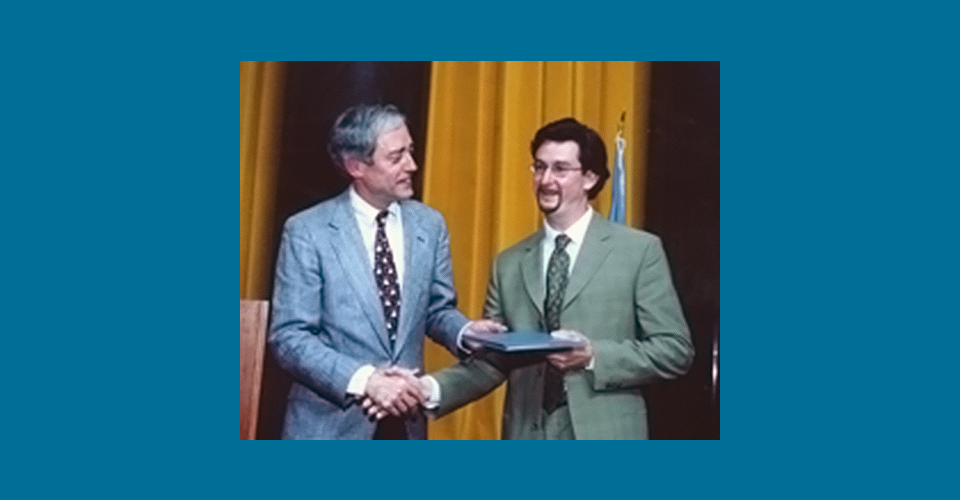
Columbia University President George Rupp (left) presents Justin Davidson with the 2002 Pulitzer Prize for Criticism.
Winning Work
By Justin Davidson
DOKTOR FAUST. Music and libretto by Ferruccio Busoni. Production by Peter Mussbach. With Katarina Dalayman, Robert Brubaker, David Kuebler and Thomas Hampson. Metropolitan Opera Orchestra and Chorus conducted by Philippe Auguin. Attended Monday's opening. Metropolitan Opera, Lincoln Center. Repeated on Friday, Tuesday and Jan. 20, 25 and 29.
Ferruccio Busoni's opera "Doktor Faust" is deeply respected and rarely seen. Seventeen years in gestation and still incomplete at the composer's death in 1924, an obsessive visionary's magnum opus finally emerged onto the stage of the Metropolitan Opera Monday night, in a production that seemed sure to send the work scuttling back into the shadows.
Busoni's libretto, based not on Goethe but on 16th-Century puppet plays, is grimly high-minded, his music belabored to the point of rigor mortis. The opera opens with more than an hour of throat- clearing-two prologues and an intermezzo before the first core scene (not counting a spoken introduction that Busoni wrote and the Met omitted). It then slouches reluctantly toward midnight, postponing the final curtain with oblique soliloquies and slow-motion processions. A few episodes might potentially come alive -the contrapuntal melee between drunken Protestant and Catholic students and the humorously stately cortege that ushers the Duke and Duchess of Parma toward a blighted wedding day.
New York City Opera staged this murderously difficult work with a certain ramshackle nobility and breathless flair in 1992, raising hopes that a little more money and a surer hand on the podium might really make it shine. The Met has spared no expense in stultifying the work, assiduously obscuring most of whatever qualities the score has.
Director Peter Mussbach introduced himself to the company with a wintry, slag-colored production first seen in Salzburg in 1999. Mussbach interprets "Doktor Faust" as a hallucination, which allows him to conjure up a surrealistic vision that doesn't square with the score's academic solidity. Faust and Mephistopheles wander stiffly through a black-and-white fantasyland dressed in long, gray coats and matching fedoras. Every so often, the stage spews smoke, snow or fire. On one painted flat, a dramatically foreshortened room is carpeted in fluffy clouds, on another, a nighttime landscape resembles an enlarged computer chip. Occasionally, a note of unintentional realism intrudes: The curtain comes up on graying piles of snow that look exactly like those currently decaying on the sidewalks of New York, which undercuts the dreaminess.
When James Levine pulled out of conducting "Doktor Faust," pleading sciatica, the opera lost the man who brought it to the Met and who might have made a more powerful case for the score. Philippe Auguin bravely agreed to make his company debut under these inauspicious circumstances, took over rehearsals with only a few weeks' notice and promptly caused the first performance to sink into quicksand. Busoni's frequently stark, nocturnal orchestration blurred into a mass of soft, velour sound. Intentionally or not, Auguin applied Mussbach's dream concept to the music, indulging in somnolent tempos and smudging the composer's exacting counterpoint.
Undeterred, Thomas Hampson sang the title role with his usual action-hero bearing, but his performance, like Busoni's music, wound up sounding lethally studied. Faust is alternately defeated and manically self-satisfied, but Hampson never abandoned his diplomatic equipoise. Robert Brubaker, his voice gaunt and angular, was more convincingly Mephistophelian, but the part's grueling demands got to him, and he spent a bad 10 minutes croaking.
Katarina Dalayman took the opera's only female part-the Duchess of Parma-and brought a welcome respite from so much baritonal sobriety, mooning over the unlovable Faust. The Met's intrepid chorus made most of its (sometimes inaudible) contributions from offstage, but when it materialized, it did so with customary gusto.
© 2001, Newsday
By Justin Davidson
Like a rock and roll auteur, the English composer Steve Martland has built for his music a tight, electrified corps of flexible musicians devoted to playing what he writes.
A composer doesn't have to be dead to be in the limelight. These days, some star soloists and conductors are pushing the works of composeres who are alive, well and still writing.
It's a granite fact of a composer's life that music doesn't take place on the page. Even after that last double bar has been written and the date of a work's completion ceremonially inscribed, the score exists only as an abstract idea. Desk drawers all over the world are filled with theoretical symphonies and silent operas, but the composer becomes a true creator only when symbols become sound.
For much of the last half-century, carrying out that metamorphosis was considered a secondary task, best left to specialized technicians. The bulk of new-music performances took place in cloistered settings, with audiences of connoisseurs and musicians who prided themselves on being able to satisfy the composers' most excruciating demands. But the last couple of decades have transformed that situation, as a perceived crisis in classical music has proved to be an opportunity. Some enterprising performers have interpreted the decline in the educated listener as license to assume that audiences have few preconceptions. Where nobody is famous, neither is anybody obscure. Suddenly, the unknown, living composer has a fighting chance.
The vast majority of performers still draw their repertoire from the ranks of the dead, but a few star soloists and conductors have yanked living composers into the limelight. The violinist Gidon Kremer tirelessly pushed the music of the late Alfred Schnittke while the Russian composer was alive. The cellist Yo-Yo Ma has championed some fresh voices, and his new Silk Road Project has commissioned pieces from a far-flung slew of unknowns. And while the orchestra world as a whole tends to be deeply suspicious of composers who still walk the Earth, several of America's leading conductors-Michael Tilson Thomas, Esa-Pekka Salonen, Christoph von Dohnnyi, Leonard Slatkin and James Levine-have powerful attractions to and strong tastes in today's music.
Even specialized new-music performers, who once had to eke out sustenance at the margins of the concert world, have now lured a public that comes to hear them play, regardless of what's on the program. It's the Kronos Quartet that sells tickets and CDs, not the legions of composers who have furnished the group with material. Most startlingly, the Scottish percussionist Evelyn Glennie has drawn new crowds into the concert hall for a novel genre: the percussion recital.
A phenomenal musician who crams the stage with instruments and then imbues them with an unsuspected expressive range, Glennie has made it clear to her public that living composers are indispensable to her art, since not many of the famous dead ones wrote for solo percussion. It helps that part of her appeal lies in sheer choreographic spectacle. She glides, barefoot, across the stage with motions as meditative and precise as those of a t'ai chi artist, glittering in her rocker pantsuit, her face obscured by effusive auburn hair. She prowls among her forest of instruments, finding objects to shake and tap and dunk in buckets of water, or else dances, dervishlike, from one end of an oversized marimba to the other, hurling mallets at the keys.
That visual theatricality is an inescapable part of Glennie's act, but others have adopted it as a deliberate strategy for packaging new music. Bathed in changeable dramatic lighting, loosely linked by a narrative thread and staged by a director, the concert now often becomes a show.
The Gogmagogs, a troupe of London-based string players, fiddle at full tilt while they skip, dip, contort, converse and clomp across the stage in flippers. In "Gobbledygook," which the group performed at Columbia University's Miller Theater last fall, bass player Lucy Shaw slings her oversized instrument on her hip and plunks it on the move, giving new meaning to the term walking bass. A cellist keeps placidly bowing as he slowly climbs a stepladder. The performance is a marvel to watch, and sometimes astonishing to hear as well, though the group has sacrificed a measure of musical finesse and commissioned easy scores.
In New York City, combining new music with theater is beginning to look like a movement. The 5-year-old ensemble Sequitur, run by lawyer- turned-composer-conductor Harold Meltzer, presents an annual cabaret of new and newish songs in a vast range of styles linked by a visceral theme: "Songs of Sex and Solitude" in 1999, "Money" in 2000 and "Power" next fall. Composers have gravitated to Sequitur's ethic of eclecticism and its strategy of visual music. For a Merkin Hall concert on Feb. 27, for example, Randall Woolf wrote "The Trick Is to Keep Breathing," a piece that involves a string quartet, a contralto, a "turntable artist" recruited from the club scene and a stage director.
Impurity is the point. Sequitur measures its success not by the approbation of new-music initiates, but by the number of unfamiliar faces in the crowd. Meltzer points with pride to the flocks of ticket buyers who migrate to his events from an interest in dance, theater and visual art.
In a similar vein, the pianist Anthony De Mare has spent 20 years trying to merge his powerful virtuosity at the keyboard with his training as a singer, dancer and actor. Had he been of a less experimental bent, DeMare might have gravitated to Broadway, but instead he has coaxed composers into expanding the repertoire for multitalented pianist. The ever-willing Woolf supplied him with "Limbs Akimbo," which asks the pianist to rise from the bench and tap- dance. De Mare's standard tour de force is Frederic Rzewski's
"DeProfundis," in which the pianist recites from Oscar Wilde's jailhouse journal and sings in a pale falsetto croon, all the while playing the dark, sometimes staggeringly virtuosic notes.
De Mare's extended pianism culminates in May with a solo show he describes as "concert theater" and that he has given the unfortunate title of "Playing With Myself." Working with a director, Sal Trapani, he has arranged a baker's dozen piano works-from avant-garde classics of the 1940s by Henry Cowell and John Cage to freshly inked music made to order-into a story of a man discovering the piano.
While a critical mass of performers has begun creating shows out of music rather than merely reproducing scores, composers, too, have gone onstage, either in the belief that they are their own best salesmen or because their inspiration emerges out of the physical act of making music. The Korean composer Jin Hi Kim came to the United States in 1980 bearing her komungo, a traditional Korean zither. Soon, she had adapted the instrument to its new surroundings- collaborating with electric guitarists, electrifying the komungo and composing music that bridges the Pacific Ocean. Her dark, meditative pluckings merge the blues with ancient lunar rites and sound like nothing else.
Like a rock and roll auteur, the English composer Steve Martland has built for his music a tight, electrified corps of flexible musicians devoted to playing what he writes. The Steve Martland Band is one of several griffinlike new-music ensembles (the Bang on a Can All-Stars in New York City and the Berkeley, Calif.-based Paul Dresher Electro-Acoustic Band are others) that combine the electric guitar, bass guitar and drum kit of a rock band with a selection of classical instruments. "Kick," on the band's debut CD (due out this spring on the Black Box label), opens with an explosive chord and a quiet, burbling marimba. Immediately, an Elizabethan fiddle melody cycles through a thickening, ever-more-raucous accompaniment, frantic with hiccupping rhythms and lurching changes of pace.
Like so much music in these eclectic times, the piece is saturated with influences. Echoes of Jethro Tull, minimalism, TV-show house bands and jazz-rock fusion groups such as Weather Report are held together by dint of sheer ensemble virtuosity. In a sense, Martland has picked up a tradition founded in the 1960s by such SoHo denizens as Philip Glass, Steve Reich and Meredith Monk, for whom writing music and performing it were intertwined activities.
Glass wrote simple, repetitive patterns that matched his own modest keyboard capabilities. Reich drew on his experience studying drumming in Ghana. Monk discovered that she could give her voice a remarkable gymnastic flexibility, and tailored vocal music to suit it. It took decades before other musicians absorbed their styles to the point that the composers did not actually need to be present for the performance to sound right.
The 32-year-old American composer and clarinetist Derek Bermel recalls the much earlier model of virtuosos such as Rachmaninoff and Kreisler, who kept themselves supplied with flattering showpieces. Bermel's "Theme and Absurdities" is a short, dizzying clarinet solo that spins off into fanciful pyrotechnics, weaving in bits of cartoon grotesquerie, angular modernist gestures, Benny Goodman swoops, baroque filigree, drunken glissandos, klezmer riffs, operatic high notes and theatrical dialogues between the high register and the low. The whole thing ends with a note of humor and hope, trailing off with the sunrise opening of Strauss' "Also Sprach Zarathustra."
This sort of activity inhabited the fringes of the concert world a generation ago, and much of it still takes place in the dingy basement spaces of lower Manhattan. But increasingly, even some formerly stodgy institutions have taken notice of new music. Bermel's "Theme and Absurdities" opened the first concert of "A Great Day in New York," an extended festival of recent music made in New York City that was co-produced by the Chamber Music Society of Lincoln Center and Merkin Hall. Perhaps the most significant thing about that event was that of the 50-odd featured composers, all local and alive, the majority also has had works performed at the quintessential establishment emblem: Carnegie Hall.
WHERE & WHEN
Evelyn Glennie appears in recital with pianist Emanuel Ax at Lincoln Center's Alice Tully Hall March 25 as part of the "Great Performers" series. For tickets and information, call 212-721-6500.
Sequitur presents a program Feb. 27 of "American Mavericks," including Randall Woolf's "The Trick Is to Keep Breathing" and Sam Shepard's play with percussion "Tongues," at Merkin Hall, Abraham Goodman House, 129 W. 67th St., Manhattan. For information, call 212-501-3330.
Derek Bermel's selected songs are featured in the Feb. 4 installment of the new-music festival "A Great Day in New York" at Alice Tully Hall. For information, call 212-875-5788. His music is also featured at The Kitchen, 512 W. 19th St., Manhattan, March 1-3 as part of the "House Blend" series. For information, call 212-255- 5793.
Anthony De Mare's solo concert theater work "Playing With Myself" takes place May 3-6 at Here, 145 Sixth Ave. (at Spring Street), Manhattan. For information, call 212-647-0202.
Jin Hi Kim will headline a program at Joe's Pub at the Public Theater, 425 Lafayette St., Manhattan, March 9, as part of the "Composers Out Front" series presented by the American Composers Orchestra. For information, call 212-239-6200.
© 2001, Newsday Inc.
By Justin Davidson
To rescue Vivaldi from his pastel ubiquity, the archaeologically minded mezzo brought to Carnegie Hall an anthology of excerpts from his hitherto utterly forgotten operas.
CECILIA BARTOLI, MEZZO-SOPRANO. Music by Vivaldi. Luca Pianca, lute. Il Giardino Armonico, Giovanni Antonini, conductor and flautino. Attended Tuesday night. Carnegie Hall.
Can the world's most famous baroque composer be underrated? Absolutely, which was the point behind Cecilia Bartoli's concert at Carnegie Hall on Tuesday. Antonio Vivaldi, who was considered a dangerous character in his day (the early 18th Century), has settled into pampered posterity. His craftily bizarre, mercurial music has become a form of corporate decoration. He has been popularized into oblivion.
To rescue Vivaldi from his pastel ubiquity, the archaeologically minded mezzo brought to Carnegie Hall an anthology of excerpts from his hitherto utterly forgotten operas. She was abetted by the Milan- based ensemble Il Giardino Armonico, with whom she breathes in synch. Theirs is an agitated, blistering baroque, with none of the prettified trills and greeting-card flourishes of standard shopping- mall Vivaldi.
Here, accents burst from the beat, dissonances gnash, violins dash into a scrimmage of sixteenth-notes. Everything is precise and delicately controlled, but with an undertow of violence. Tuesday's performances captured the unpredictable, natural ferocity of this music, which comes, after all, from Venice, a city separated from nature by the most fragile meniscus. But not all was disquiet: In the sweetly vernal "Zeffiretti che sussurate," the singer and a mimicking violinist engaged in a call-and-response, like the dialogue of coquettish birds or amorous breezes.
It's hard to overstate how fresh this music sounded, and how obscure it has been. The standard reference work on opera, Kobbe's, skips from Param Vir to Amadeo Vives, as if Vivaldi's 50-odd operas didn't even exist. It's safe to say that nobody in Tuesday's audience has ever seen a production-or even heard more than a few minutes-of "Griselda," "Il tamerlano" or "Ercole sul Termodonte." Yet to judge from Bartoli's concert (and last year's revelatory CD of the same repertoire), the 21 surviving stage works include some mesmerizing lengths of music.
Some of it is familiar from other guises. The "Winter" Concerto, from "The Four Seasons," metamorphosed into the extravagantly mournful set-piece aria "Gelido in ogni vena," from "Farnace," in which the protagonist contemplates the body of his dead son. Bartoli, riveting in misery and infectious in exhilaration, made it a tour de force of lively tragedy.
She was, as always, irresistibly ungraceful. Even in a long Venetian dress, Bartoli had the demeanor of an athlete in an evening gown. She strutted downstage and assumed a bodybuilder's stance, shoulders hunched, neck stretched forward, knees slightly bent, spine curved into the hint of a C. She accompanied feathery trills with a chicken-like jerking of her head and pushed out her chest for a particularly heroic climax. Afterward, she urged the ensemble toward its final, frantic shudder with a right hook into the air.
All this hurly-burly might be annoying if it did not feel like the irrepressible physical expression of a woman who has music pulsing through her limbs. Bartoli projected the songs' assorted agonies and fury, but beneath it all was a bodily, even carnal delight in singing and the confidence of consummate control.
© 2001, Newsday Inc.
By Justin Davidson
ST. MATTHEW PASSION. Music by J.S. Bach. Staged by Jonathan Miller. With Suzie LeBlanc, Phyllis Pancella, Daniel Taylor, Paul Agnew, Nils Brown, Andrew Schroeder and Stephen Varcoe. New York Collegium conducted by Paul Goodwin. Attended Tuesday night. Brooklyn Academy of Music Harvey Theater, 651 Fulton St. Repeated tonight and tomorrow.
In a roughened and scarified theater in Brooklyn, a scruffy group in jeans and rumpled shirts acts out the story of Jesus' last days as if its members had just heard the news. Musicians and listeners circle a tiny O of stage. Though some have come to sing and others just to listen, Matthew's story and Bach's music seem to emerge from among us all in an intense and informal rite. A solo violinist and a countertenor stand consolingly over Peter as he regrets his three pusillanimous denials. The chorus slumps and yawns in a Gethsemane made of chairs, jumping up to overflow its ranks in times of grief and indignation.
When Jonathan Miller's transfixing production of Bach's "St. Matthew Passion" first alighted at the Brooklyn Academy of Music in 1997, I neglectfully managed to miss it, so I am grateful for its second coming. This time, it follows Peter Sellars' staging of two Bach cantatas, deliriously delivered by Lorraine Hunt Lieberson, and with these two events the sound of a great ice floe of convention cracking was heard in the land.
Instead of voices squeezed from gowns and tuxedos, now there are characters, faith and pain.
To call Miller's "Passion" staged is a semi-truth, since there are no sets, no costumes and only the barest props. To call it semi-staged is equally misleading, since there is nothing halfway about it. It is certainly not opera, which, with its footlights and greasepaint and yawning pit, exaggerates the distance between the bustling world onstage and the passive rows of patrons. It is a concert shorn of its starchy trappings, music given a vernacular veneer - and performed in English.
Anyone who came to Bach first through this playful and profound experience would hardly guess at the tedious rigors to which he and his ilk are usually subjected. Those who object to the vulgarization of a sacred text recall those who insisted that the Bible be left in Latin. Surely Bach has nothing to fear from being better understood.
It would all amount to no more than a gimmick if the music were not performed with such persuasiveness.
Paul Goodwin, who helped conceive the project, conducted with all the urgency and devotion of a recent convert. His tempos never let grandeur get the better of drama, and the numbers nearly melted into each other, with each singer simply materializing from the shadows.
Paul Agnew, an Evangelist in a slovenly T-shirt, sang even the "And he saids" with spontaneous pathos.
Andrew Schroeder's Jesus was a man - manacled, terrified and proud, and possessed of a charismatic baritone.
The New York Collegium, a band of elite early musickers who sometimes gather under that name and sometimes under others, played with sensitivity and zeal.
The performance did have its nicks and ruts. A pair of period oboes remained immutably out of tune. Several vocal soloists coasted on the music's intrinsic beauty, without troubling to extract its expressive core.
For all the fresh directness of Robert Shaw's English translation, the vowels sometimes turn too soft and round to be identified. The bread Jesus breaks at the Last Seder is an impermissibly fluffy loaf, not a brittle, unleavened sheet of Passover matzo.
But even these imperfections had their place in a medium that eschewed slickness and that imbued a venerated masterpiece with a sense of sudden discovery.
© 2001, Newsday Inc.
By Justin Davidson
EOS ORCHESTRA. Music by H.K. Gruber, Hanns Eisler and Kurt Weill. Kurt Nikkanen and Joel Pitchon, violins. Ann Panagulias, soprano. H.K. Gruber, conductor. Thursday night. Ethical Culture Society, 2 W. 64th St., Manhattan.
The Eos Orchestra, a doggedly inventive ensemble that has until now been the private fiefdom of its founder and conductor Jonathan Sheffer, invited an outside agitator to its podium Thursday: the Viennese professor of irreverence H.K. Gruber.
A composer, conductor, chansonnier and all- around character, Gruber has the demeanor of a learned jester, an Abbie Hoffman of the concert hall. He has written an operatic "pig-tale" for children, "Gloria von Jaxtberg"; a wildly sinister and playful piece called "Frankenstein!!" involving toy instruments and the composer's own mordantly cabaret-style singing; and "Gomorra," a stage work of raucous satire.
Yet the Gruber who took the podium and the microphone at the Ethical Culture Society was an entertaining but more muted presence than his catalog suggests. With Eos, he and violinist Kurt Nikkanen performed his violin concerto "Nebelsteinmusik," a rickety structure made of 12-tone techniques and naive tunes that plays with the clash of sentiment and rigor. "Photo-Fit Pictures" tamely gathered strands of Bach, Bartok and cool jazz into a set of orchestral variations that eventually reveal a theme. Neither piece quickened the pulse.
Gruber also brought the music of his left-leaning idols, Kurt Weill and Hanns Eisler, the relentlessly Communist composer of proletarian anthems and robust agitprop. Eos' tightly strung performances of Weill's almost never-heard soliloquy for voice, violin and orchestra "Der Neue Orpheus" (with a stinging performance by soprano Ann Panagulias) and Eisler's only moderately hectoring "Kleine Sinfonie" formed the concert's backbone.
All this would have made the concert valuable; the finale made it memorable.
Expertise in Weill's songs now come in a variety of hues, from the classic suavity of Andrea Marcovicci to the neo-Lenya growl of Ute Lemper and the ravaged utterances of Marianne Faithfull. But none of those chanteuses sound more lean, authentic and funny than Gruber, who slices through to the song's brittle core with his unpretty voice and exact enunciation. There is comedy in his voice, and his roguish Viennese r's roll into merry little bursts of mortar fire.
Gruber mostly sang in German, conducting bandleader-style, waving one distracted hand behind him. In "l-Musik," ("Oil Music") he evinced rousing rage in the anti-corporate refrain ("Shell! Shell! Shell!"). In "Berlin Im Licht," he summoned the era's stirring pride in a newly electrified and suddenly brilliant quarter of the city. But he also ventured into English-and not just any English, but the "Cowboy Song" from "Johnny Johnson," in which he sounded much as Weill must have done, like a Mitteleuropischen cowpoke. Here's hoping he rides this way again.
© 2001, Newsday Inc.
By Justin Davidson
WHITE RAVEN. Music by Philip Glass. Libretto by Luisa Costa Gomes. Directed by Robert Wilson. With Lucinda Childs, Ana Paula Russo, Janice Felty, Herbert Perry and Vincent Dion Stringer. American Composers Orchestra and White Raven Opera Chorus conducted by Dennis Russel Davies. Attended at Tuesday's premiere. New York State Theater, Lincoln Center. Presented by Lincoln Center Festival. Repeated tonight through Saturday.
IT'S BEEN 25 years since Robert Wilson and Philip Glass made their reputations with the mammoth, mystifying and now classic opera "Einstein on the Beach," which distilled the genre to its abstract essence: objects, light, movement, song and sound. Now, with "White Raven," they have returned to Lincoln Center, fortified with a sense of their place in history and the license to think bigger than ever.
At the behest of the Portuguese government, which commissioned the opera, "White Raven" deals with the exploits of the 16th century Portuguese explorer Vasco da Gama, but also, more grandly, with seekers of all kinds and in all times. But it also represents only half of a vast, still uncompleted, operatic diptych. The other part, according to Glass' program note, will treat "the civilization and development of Islam from about 1000 A.D. to 1500 A.D." Why stop so early, I wonder?
The problem with an opera about everything is that it doesn't matter much what's in it. "White Raven" contains no characters, only emblems, singing stick figures with nothing to express. It has no plot, only roving allusions. Judy Garland's Dorothy and the Tinman wander into the exploits of da Gama - why? Oh, yes, because the Portuguese explorer and the girl from Kansas both have their eye on somewhere over the rainbow, but also, surely, because the ploy provides an irresistible opportunity for camp nostalgia.
Wilson's work is always permeated by wistfulness - for a time when surrealism was the latest thing, when cute meanderings a la Gertrude Stein still struck people as outr, when music videos had not yet harnessed all Wilson's techniques. Back-lit fantasies, period- pastiche garb, dreamy non sequiturs, mechanical dance - by the 1980s these had become the stuff of commercial music television. Even Glass' musical style has become a product, its repetitions endlessly recycled and comfortingly familiar. And so, "White Raven," half of it wordy the other half wordless, glides along the surface of its images, carried by the soothing burbles and incantations of Glass' score.
The second half begins with a storm at sea. Chains of flat, triangular waves bounce stiffly up and down. Behind them, giant, disembodied limbs - a naked leg, a grasping hand - bob in the storybook brine. Pornography is accused of reducing human beings to their body parts, but nobody de-personalizes people more dispassionately than Wilson. It hardly makes any difference who sings what. The only purpose of using a live cast, rather than, say, animated holograms, appears to be to provide figures on which to hang Moidele Bickel's costumes.
Granted, those are ravishing and fantastical: a pair of gilded Siamese twins who share a double-wide farthingale, an Inca prince daubed rain-forest green, an unidentified tribesman with one elephantine foot, assorted stock street-theater characters, a brace of human-size ravens with giant mesh heads and beaks, an ivy-covered dancer, a beauty-pageant winner in a spangled gown, a reptilian soprano with glowing dragon-head and fetchingly spiked tail.
Singers, dancers and orchestra fared well at the U.S. premiere, but the mechanical performers proved more capricious. A curtain refused to descend until manually yanked, the amplification system made even deeper murk of Lucinda Childs' narration and a lighting glitch caused an impromptu 10-minute pause. Perhaps that's what you get for creating an opera about human history and leaving out the humans.
© 2001, Newsday Inc.
By Justin Davidson
NEW YORK PHILHARMONIC. Memorial concert benefiting the World Trade Center disaster relief fund. Brahms' "German Requiem." Heidi Grant Murphy, soprano, Thomas Hampson, baritone, Kurt Masur, conductor. With the American Boychoir and the New York Choral Artists. Thursday night. Avery Fisher Hall, Lincoln Center. The event, telecast "Live From Lincoln Center," will be rebroadcast tonight at 9 on WNET/13.
There are moments when classical music, by common consent, ceases to be a marginal form of entertainment or the finicky preoccupation of the affluent and few, and becomes an essential source of nourishment. Or perhaps that is wishful thinking: Music now also seems more than ever beside the point, requiring an intensity of focus that few of us can muster. Our attention spans, never long to begin with, have been fractured, our thoughts crowded with looped images of ash and flame and plummeting steel. What room is there for art?
Yet for a beautiful hour Thursday night, Avery Fisher Hall became a haven of concentration. In lieu of a festive opening night gala, the New York Philharmonic offered a benefit performance of Brahms' "Ein Deutsches Requiem" as a balm, and it was reverently accepted. All the signs of distraction that usually accompany a concert here - muttering, shuffling, coughing and snoring - had vanished. Aside from one stray cell phone early on, an attentive silence reigned. At the end of the performance, by request of the orchestra's executive director, Zarin Mehta, the audience held its applause and filed out of the hall in silence, letting the music hang in the air for a few extra minutes.
Had the Philharmonic chosen only to remember the dead, it might have played a program of threnodies, beginning, perhaps with Richard Strauss' "Metamorphosen," a rending meditation on the destruction of World War II. But Kurt Masur, whose final season as music director began that night, did not choose to dwell on lamentation.
Instead, Brahms' "German Requiem" offered the first possibility of joy - not of simple-minded escapism, or indefinitely postponed redemption, but of someday shaking off the grim numbness of these past days. In this time, I have, without intending to, deprived myself of music, and I do not think I am alone. Radios are tuned to talk and news, some stores and public spaces have muted their PA's, and the constant, global clang of tunes that fill the air in New York City has been attenuated.
So the Philharmonic's return to the stage after a period of quiet echoed an earlier day, when concerts were rare and more momentous, and music was a live art. Brahms' Requiem can be a distant, brooding work, but this performance was detailed and fluid and full of motion, as if sculpted out of still-warm wax. Soprano Heidi Grant Murphy was exquisitely seraphic. Baritone Thomas Hampson supplied thoughtful thunder. And the orchestra discovered a trembling and fire I had not heard in this piece before. As a chorister told me on the subway afterwards: "The meaning of this piece has changed. It's not just about abstract death."
© 2001, Newsday Inc.
By Justin Davidson
THE RETURN OF ULYSSES. Music by Claudio Monteverdi, libretto by Giacomo Badoaro. Production by John Cox. With Leah Summers, Phyllis Pancella, Katharine Goeldner, Stephen Powell, John Mac Master and Keith Phares. New York City Opera ensemble conducted by Daniel Beckwith. Attended at Saturday's opening. New York State Theater, Lincoln Center. Repeated tonight, Thursday and Nov. 4 and 7.
In the last minutes of Monteverdi's opera "The Return of Ulysses," Penelope, the stubbornly loyal wife who for years has been sustained by an insane certainty that her husband would return from the void, must confront the fact that he actually has. She refuses to believe at first: Penelope has spent too long immersed in stubborn fantasy, keeping reality at bay.
It's a wrenchingly topical moment, though its outlines were written by Homer and though Monteverdi set it to music 350 years ago. Among the most powerful memories of September is that of thousands of New York Penelopes plastering the city with pictures of the disappeared, clinging to the wild hope that a spouse or a child could still walk out of the ash.
Everyone who has the capacity to be moved by opera should see New York City Opera's new production of Monteverdi's "Ulysses," not because of the story's sudden, unwanted relevance but because it demonstrates how vital and vivid the antique can be. In that final scene, the marvelous Phyllis Pancella stepped from crumbling stoicism to unfolding bliss, the choked outbursts of recitative giving way to full-blown melody. She is a singer of uncommon gifts: She conveyed extreme emotions with supreme restraint. Her singing was controlled, her voice not large but luxuriantly dark, and she revealed the role from somewhere deep inside the music, not by slathering on expressive mannerisms.
Stephen Powell, as Ulysses, sang with a muscular baritone and understated discipline, arriving at joy like a traumatized soldier coming home in a welter of frustration and nobility. It is rare in opera for a climactic embrace to be more than a mechanical body block. Here, at the end of a work in which the two protagonists hardly even share the stage, a kiss became a musical transformation.
"Ulysses," one of the few surviving Monteverdi scores and a product of his old age, possesses music of intimate beauty, which Daniel Beckwith conducted with straightforward grace. Performing it requires a certain amount of archaeological reconstruction, but there was not a whiff of mustiness to City Opera's blue-and-gold production. The opera is a series of solemn soliloquies, offset by moments of rowdy comedy. Deities address the audience by turn, making their cases for altering human lives like delegates at a convention. Each of Penelope's suitors tries to string the hero's unbending bow, but not before placing himself under the protection of an appropriate god. Penelope confides the grief to which she has become accustomed in bursts of tight-lipped lyricism.
All this stateliness can be deadly, and directors frequently fight it with too much stage business. But director John Cox has evidently understood the music well enough to rely on measured movement, the resplendent robes designed by Johan Engles, and Mark McCullough's endlessly inventive lighting. Brilliantly swathed gods enter on mechanical arms that swing silently above the stage. One level down, the people stumble through their destinies in unobtrusive choreography. Cox knows when to disappear.
The cast is large and the singing was not uniformly splendid, but enough of it was good enough to make this "Ulysses" a delight to hear again (the production had its premiere at Glimmerglass three years ago). Keith Phares as Ulysses' son Telemachus, Katharine Goeldner as Minerva, John Mac Master as the loyal shepherd Eumaeus and Wilbur Pauley as a useless suitor all stood out.
© 2001, Newsday Inc.
By Justin Davidson
When John Adams wrote his 1990 opera, "The Death of Klinghoffer," about the hijacking of a cruise ship in the Mediterranean, he was pilloried for having turned terrorism into art and making Palestinian gunmen sing. Adams had used the news too bluntly, his critics felt, and the flush of righteousness they experienced only intensified in the decade that followed, when other composers, too, wrote timely stage works, giving rise to a genre dismissively dubbed CNN Opera.
More recently, U.S poet laureate Billy Collins, asked for predictions about an artistic response to Sept. 11, warned against the danger of confronting events directly, quoting Emily Dickinson on the subject. " 'Tell the truth but tell it slant.' You have to go through a side door," he added.
Though Adams could not have known it at the time, the composer wound up following the advice of Collins and Dickinson in writing "El Nino," a staged Nativity oratorio that had its first performances in Paris nearly a year ago and recently has been released on compact disc. At its world premiere, the piece struck people as an apt and optimistic way to mark the 2,000th anniversary. Ten months later, it seems far more than that: a deeply anti-fundamentalist religious work, eclectic and ecumenical and, most important, the product of a dazzling imagination working with minimal constraints.
"El Nino" was crafted for the theater and intended to receive the visual ministrations of Peter Sellars. Eventually we will see it that way here, since one of the piece's co-commissioners was Lincoln Center. In the meantime, we have the CD, an ingot handed out by the label Nonesuch, which labors in the classical music recording business the way monasteries did in Europe's illiterate age. Other companies are losing money, shedding staff, winnowing artist rosters and resorting to ever more craven repackaging ploys. Nonesuch bestows on us "El Nino," sung by the original team of Dawn Upshaw, Lorraine Hunt Lieberson and Willard White, and conducted by Kent Nagano.
It opens with an Adams signature: pulsing minor chords, plushly orchestrated and spangled with the tinkle of a folk guitar. This is the work of a composer who long ago set aside the austerity and lengths of minimalism but still enjoys using its burbling harmonies, riverlike rolling and eddies and whirlpools of rhythm.
"I sing of a maiden," the anonymous medieval poem begins, but already things become more complicated. The "I" is actually a "we" - the chorus, splintering the text in a cascade of syllables. After a throbbing crescendo, enter the angel Gabriel - he, too, multiplied and divided among three countertenors, a heavenly barbershop trio. At times Mary is a soprano, at others a mezzo, and the baritone doubles as Joseph and Herod. The "I" is never fixed.
Assigning a voice to several different roles belongs to the conventions of oratorio, but Adams, who professes "shaky and unformed" religious beliefs, goes well beyond tradition to create a piece with a constantly shifting point of view. The heart of the first section is "The Annunciation," told not in biblical terms but in the first-person reflections - in Spanish - of Rosario Castellanos, a Mexican poet who died in 1974. "El Nino" is a pageant of motherhood as well as birth, and it draws on layers of female voices: Whose voice are we hearing here: Mary's, Castellano's or that of the stirringly expressive Lieberson?
Against a broad expanse of seamless string tremolos, dotted here and there by glinting notes like stars plucked on a guitar, a celesta or a harp, the vocal melody slowly unwinds, billowing gently. Adams is a master at playing a tune out like a fishing line; it's the same talent that gave Pat Nixon's aria in "Nixon in China" its dreamy charm.
But birth is also an act of violence committed from the inside out, as Castellano's poem notes - "Because you were to break my bones, my bones, at your arrival, break," the mother says to her god- child - and Adams smuggles pain into the score without breaking the reverie. "Me flagelaba" ("I was whipped") the mezzo sings in a snapping leap as the guitarist throws his fingers in a strum across the strings. The tremolos crest, the trombones come in, the basses take up urgent syncopations. Then the whole thing passes, and for the moment the singer is left with her tender rage, a rippling accompaniment and a more jagged vocal line. There are not many composers who can render ambivalence with so much grace.
"El Nino" joins the chain of European religious concert pieces extending back to Handel and beyond, and its sources are hardly hidden. As in "Messiah," which Adams confessed he wanted to write anew, its language is direct and its delivery crystalline - there is hardly a word that cannot be understood.
Like Handel, he has a natural feel for the qualities of showmanship in music, and the piece's sweep includes both the grandeur and intimacy of religious experience. He commands, too, a panoramic grasp of references, and this score is replete with disparate and familiar gestures: the emotion-packed recitations of Baroque opera, the punch of a well-made pop tune, the precisely articulated sentiments of a Schumann song, the grand choral canvases of Britten, Mozart and Verdi, the boogie-woogie bass lines of vintage jazz.
Adams sets mostly English words - from the Bible, the Apocrypha and a clutch of poets - but the second section, like the first, reaches its heart in Spanish, again through the words of Castellanos. "Memorial de Tlatelolco" comes right after Matthew's terse summary of the children's massacre that Herod ordered, and it juxtaposes ancient and recent iniquities of different totalitarian regimes.
Tlatelolco was Mexico's Kent State and Tiananmen Square: In October 1968, government soldiers attacked a crowd of restive students in a Mexico City square, killing several hundred. Castellanos' poem and the aria Adams wrote for soprano Dawn Upshaw are less about that bloody evening than about the morning after, when both the blood and the history had been expeditiously scrubbed away. The weather dominated the headlines, Castellanos writes, and on television no bulletins interrupted the flow of entertainment.
Adams knows how to portray a lie. Upshaw serenades the dawn in larklike tones, pleasantly describing a pleasant morning against a dewy lilt of plucked strings and harp. But four quiet blasts of tubas and trombones act like stubborn stains on the cobblestones. Indignation soon rises to the soprano's gorge, and while the plucking goes impassively on, she swoops to her lowest, throatiest tones.
Adams is a New Englander by birth and a Californian by choice, so Tlatelolco is not his battle, which is perhaps why it belongs in this oratorio. He can treat its story as he does the biblical tales - at one remove of passion.
Like Handel again, he depicts barbarity without indulging in it, filtering rage through a civilizing scrim. At key moments, string tremolos gather force, lifting the chorus, which then breaks off in a Bach-like stroke of silence. Dissonance sometimes washes in, adding brushstrokes of mystery, before subsiding. But there is nothing raw or jagged in his work, no primal orchestral shrieks, no wild-eyed whispers, no Wagnerian riptides of ecstasy.
Instead, Adams answers savagery with elegance, sublimating elemental emotions - pain, loss, terror - into a tapestry of shining threads. That is how an artist of great talent and uncertain faith confronts the sometimes ghastly histories of worship: by crafting an object whose glory is beyond doubt.
© 2001, Newsday Inc.
By Justin Davidson
LILITH. Music by Deborah Drattell, libretto by David Steven Cohen. Directed by Anne Bogart. With Beth Clayton, Lauren Flanigan, Dana Beth Miller, Marcus DeLoach and Tom Nelis. Danced by the SITI Company. New York City Opera Chorus and Orchestra conducted by George Manahan. Attended at Sunday's opening. New York State Theater, Lincoln Center. Repeated Thursday and Saturday.
New American operas get staged with such demoralizing infrequency that whenever one makes it to the opening curtain, it can count on an ample fund of good will. On Sunday afternoon, Deborah Drattell's "Lilith" squandered it all in the space of a few lugubrious minutes.
Allegedly about Adam's apocryphal and dangerously lustful first wife, Drattell's new opera, which New York City Opera gave its world premiere, is actually an impenetrable dance pageant featuring a chorus of men in Hasidic garb and a pair of female protagonists who are barely garbed at all.
According to Jewish folklore, Lilith is the original femme fatale, sapping the juice out of sleeping men so as to give birth to a race of demons. The combination of biblical and vampiric themes, plus Drattell's long orchestral interludes, gave director Anne Bogart the opportunity to choreograph her SITI dance company in some cabalistic soft-core. Dancers and singers, clad in modest black, do some lethargic faux-Fosse numbers with chairs: "A Stranger Among Us" meets "Cabaret."
Rarely has a score portended so much and delivered so little. Trombones mutter darkly. Strings shiver in awestruck tremolos. Dark- hallway-at-night chords keep pounding away until they have outlived their ominousness. Eerie vamps resolve into plain old oompahs. Semitic melodies announce their ancestry and then have nothing more to say. The orchestral textures are soupy, and the vocal lines jerk between chant-like monotony and thankless leaps. The mood never deviates from a sacramental fug.
As for the libretto by David Steven Cohen, an excerpt will suffice. Act II ends with a spasm of solemn nonsense that climaxes in a shudder of alliterative drivel: "Dark pleasure," Eve sings. "Sweet river past teeth and tongue, a river of want," her daughter sensibly replies. Then mother and child join together, singing "Wind Water Want. Washing away regret. Wind Water Want."
If anyone at City Opera had any doubts about the merits of this work, it was a well-kept secret: The company gave "Lilith" an enthusiastic and expert maiden run. Beth Clayton, making her debut with the company, slinked memorably through the title role, armed with a cloak of long, brown, shampoo-commercial hair, a fierce and glistening soprano and a shiny nightie.
Lauren Flanigan was Eve, and she gave a performance that was unstinting both in passion and in eccentricities. She staggered through the opera, trying to mimic Lilith's way with men, and eventually appeared to learn some of her dubious skills. The score brought out the worst of Flanigan - the epileptic agonies, the martyred looks, the close-your-eyes-and-swing approach to intonation, the whooping high notes launched into space. What Flanigan does best is give outrageous substance to a character, but not even she could put meat on an utter abstraction. Besides, some manager or close friend should have advised her against singing in a clingy slip.
Even in mourning uniform, Dana Beth Miller managed to stand out as Eve's nameless daughter, and Marcus DeLoach made a good son. Tom Nelis sang the Seer quite nicely, and he got extra points for spending much of the opera standing with the beatific immobility of a mannequin in a sage's beard and prayer shawl.
City Opera continues its tradition of taking admirable gambles and risking the painful flop in exchange for the bold success. This philosophy has led to some important moments in opera. But "Lilith," alas, isn't one of them.
© 2001, Newsday Inc.
Biography
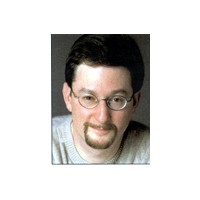
Justin Davidson is Newsday's classical music critic. A native of Rome, Davidson worked as a stringer at the Rome bureau of the Associated Press, before coming to the U.S. to attend Harvard as a music major. While in Massachusetts, he worked as a stringer for the Associated Press Boston bureau, studied classical guitar and began a career as a composer.
After spending a year on a music fellowship in Paris, Davidson moved the New York City to pursue a doctoral degree in music composition at Columbia University, where he also was instructor and later adjunct professor of music. His compositions, which have been performed in the U.S., Italy, China and Eastern Europe, have won him grants and awards from the American Academy/Institute of Arts and Letters, the Mellon Foundation, Meet the Composer, Columbia University and the Foundtion des Etats-Unis in Paris. While a graduate student, Davidson also commuted to Europe where he supervised the dubbing and subtitling of major Hollywood movies into French, German, Italian and Spanish. At the same time, he wrote regularly for the best-selling Birnbaum Guides to Europe.
Combining his interests in music and in writing, Davidson became Editorial director at Sony Classical in 1995. As a freelance writer, he has contributed regularly to the Los Angeles Times and Slate, as well as to The Washington Post, Opera News, Chamber Music, Stagebill, Piano & Keyboard, The St. Louis Post-Dispatch and Reader's Digest Books. He began contributing concert reviews to Newsday in 1995 and became staff classical music critic the following year. He was a 1999 Pulitzer Prize finalist for criticism and previously won a Press Club of Long Island award and an ASCAP-Deems Taylor Award for writing on music.
He lives in New York City with his wife, art historian Ariella Budick, and son, Milo.