Chicago Tribune, by Blair Kamin
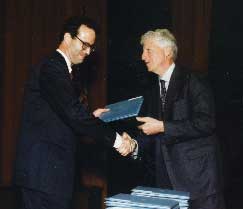
Columbia University Provost Jonathan R. Cole (right) presents Blair Kamin with the Pulitzer Prize for Criticism.
Winning Work
Nature didn't give Chicago its glorious shoreline. Good planning did. But today, the city faces the future without a clear vision for the lakefront. In a six-part series, Tribune architecture critic Blair Kamin offers a view of the problems and promise of our greatest public space.
By Blair Kamin
Tribune Architecture Critic
The lakefront is Chicago's undisputed crown jewel, a timeless treasure that brings dazzling images to mind: of fireworks and bandshells, sailboats dotting blue waters, museums rising like wedding cake from a sweeping expanse of green, skyscraper cliffs winking in the night sky. Our front yard, the lakeshore is, the face Chicago presents to the world.
But zoom in on the 30-mile stretch of beaches, harbors and parkland between Indiana and Evanston and troubling blemishes appear. What you see is a resource that is in serious imbalance, alternately overwhelmed and underachieving, a carelessly treated beauty that has lost much of its sheen.
The lakefront and its parks represent a legacy of incalculable value, a testament to visionaries such as Daniel Burnham, who, more than 100 years ago, recognized that public spaces made better democracies, better citizens and better lives. It is remarkable that what Burnham and others conceived so long ago still serves us in so many ways.
Yet, inexplicably, we have done little to build upon that legacy. The lakefront is at once a victim of our poverty of imagination and the crippling consequences of its own success.
As good as it is, the lakefront could be so much more. It could realize its vast potential if we just had a vision -- and the will -- to act on it.
Here is what new or revamped public space along Lake Michigan could do:
It could help bridge the racial chasm that has long split Chicago.
It could begin to lift entire neighborhoods out of oblivion.
It could heal us physically, especially as the population ages, and could be an ever-renewable source of peace and fulfillment.
It could be a democratizing influence, allowing people from diverse backgrounds to mix and come to appreciate one another.
It could celebrate not only dead presidents and generals, but also the so-called ordinary men and women who endured extraordinary hardships to build this nation.
All this, which would enrich our lives immeasurably, is within our grasp.
Yet we are missing our chance.
The lakefront, whose 3,000 acres of parkland, 29 beaches and 8 harbors attract an estimated 65 million visits a year, is off the public policy radar screen. The city has been lulled by a booming economy and the illusion that Mayor Richard M. Daley, well-known for beautifying the city, has everything in hand when, in reality, he doesn't.
"The people and the powers that be in Chicago came to take the lakefront for granted," says Lee Botts, former director of the Lake Michigan Federation, a not-for-profit group devoted to the lake. "They have continued to brag about it, tout its virtues and its values to the city while they continue to let it fall apart."
The lakefront needs more than the mayor's Martha Stewart-izing.
It deserves city planning as well as civic decorating.
It requires a forceful hand to bring together the Balkanized multitude of federal, state and local agencies that have split the people's shoreline into fiefdoms -- someone who can either coax or bully their leaders into pursuing a common vision.
Consider the state of the lakefront now, 25 years after the Oct. 24, 1973, passage of the city's Lakefront Protection Ordinance, a historic piece of legislation that stopped huge commercial projects such as McCormick Place from desecrating any more public land along Lake Michigan:
- If someone from a foreign land were to traverse the lakefront for the first time, that visitor would see two Chicagos. One north, the other south. One mostly affluent and white, the other largely poor and black.
The very park named for Burnham, which sits on the stretch of the south lakefront lined with high-rise public housing, is a monument to neglect and inequality, a rubble-strewn landscape that lacks the basic facilities, from restaurants to restrooms, that most parkgoers take for granted.
A few miles north, where luxury high-rises overlook Lake Shore Drive, Lincoln Park has everything one could ask for: a zoo, harbors, cafes and lagoons. Yet it is so overused and crowded that one sometimes risks life and limb by going there.
Next year's opening of the $30 million Peggy Notebaert Nature Museum at the already jammed intersection of Fullerton Parkway and Cannon Drive can only make things worse.
- Go to Grant Park and you find a lonely place with a world-famous fountain trapped behind a fence. When the city needs room for a million festival revelers, Grant Park fills the bill. But during the rest of the year, it is almost desolate because its spaces are not designed to a human scale.
- Go to the shoreline, where the revetments -- the blocks of stone that are supposed to guard the parks from the lake's pounding -- are partially in ruins. The great rocks also are intended to allow parkgoers to stroll or sit on their stairlike tiers. But in many spots they lie upended or splintered, recalling a landscape that has been bombed.
More than a third of Chicago's 30-mile shoreline -- 11 miles of beaches, breakwaters and revetments -- has been devastated by the lake and must be rebuilt by the U.S. Army Corps of Engineers at a cost of $269 million.
Yet the job's planned timetable is so leisurely as to be absurd. It is not scheduled to be completed until 2010. As a result, temporary concrete barriers, already being put in place along South Lake Shore Drive, are needed to stop winter storms from flooding the vital traffic artery.
Meanwhile, two beaches listed on the supposedly definitive Rand-McNally map of Chicago, beaches that the mapmaker says are available for sunbathing at 49th and 67th Streets, simply do not exist. They were allowed to vanish beneath the waters long ago. At 49th Street, there is even the bizarre sight of a beach house but no beach. To go swimming, adventurous teenagers must climb down a series of slippery, jagged rocks.
- Go down to 87th Street and peer behind a chain-link fence where an enormous chunk of land, bigger than the Loop, lies fallow. Once it was home to a huge U.S. Steel mill, the celebrated South Works, which forged the metal that undergirds Sears Tower and other Loop skyscrapers. Here, the potential to make a public space that preserves the history of working people and their contributions to the nation is as yet unrealized.
- Go to any part of the lakefront and you will run into a concrete curtain -- consisting of highways, ramps, the largest convention center in the U.S., and mall-sized parking lots -- that makes getting to the shoreline on foot either difficult or next to impossible. An egregious example: the sea of nearly 5,000 parking spaces, operated by the Chicago Park District, that surrounds Soldier Field.
"Is the Park District in the parking business or the parks business?" asks Erma Tranter, executive director of Friends of the Parks, a not-for-profit civic group.
Lincoln Park's crammed bicycle path, where cyclists, joggers, strollers, Rollerbladers and even mothers with baby strollers jostle for space on a strip of asphalt just eight feet wide, is a classic example of how changing trends in recreation have caught the Chicago Park District flat-footed.
As recently as the 1930s, bicycles weren't even allowed in Chicago's parks. When the lakefront bike path opened in 1963, no one foresaw the explosion of biking, running and in-line skating that has rendered the path more crowded -- and dangerous -- than many city streets.
New trends threaten to make the lakefront equally out of sync with the people using it.
Some examples:
- With the first of the Baby Boomers due to hit 60 in 2006, the lakefront will soon undergo a huge influx of elderly people. What sort of activities, tailored to their needs, will be available for them at shoreline parks?
- By 2010, Chicago is expected to have fewer whites and more Hispanics, Asians and blacks. That trend matters because, surveys show, different ethnic groups use park land differently. Whites typically come alone or in small groups while those from other cultures tend to arrive in larger contingents and prefer communal activities such as picnicking. How do we accommodate everyone?
- When Chicago was a city of tightly knit neighborhoods, and the pendulum of people's activities often swung between the local church and saloon, a trip to a major park was a special event. People dressed up and took stately promenades. Grant Park, which was modeled on the formal gardens of Versailles, was designed for such a society. But it is ill-suited to the casual, fitness-oriented, Frisbee-throwing lifestyle.
Treated creatively, such challenges represent a chance to make a better lakefront. Yet the city lacks the vision and tools to respond to them.
While the city, the Park District and the Cook County Forest Preserve District this year unveiled a citywide open space plan covering everything from the Chicago River to neighborhood parks, its chapter on the lakefront is a laundry list of vaguely worded policy goals.
One of them calls for "coordinating all lakefront planning and development," but doesn't say who will do the coordinating. Nor have any meaningful steps been taken in the 10 months since the plan was published.
In fact, control over the lakefront is fragmented among a Byzantine collection of agencies that jealously guard their turf. Worse, they often work at cross purposes:
- Lake Shore Drive comes under the purview of the Illinois Department of Transportation, whose top priorities are moving vehicles safely and speedily. But the expresswaylike character of the drive frustrates Park District planners, who want to make it easier for people to walk from the city to the lake.
- The giant McCormick Place convention center and popular Navy Pier are the province of the Metropolitan Pier and Exposition Authority, a quasi-public, city-state agency that seeks to maximize attendance at both facilities. Yet the convention center and pier, which are poorly served by public transit, cause huge traffic jams on the Drive.
- The revetments are the province of the U.S. Army Corps of Engineers, the primary construction agency of the federal government, which is charged with controlling flooding at the least possible cost to American taxpayers. Yet that mission sometimes puts the Corps at odds with the Park District, as when the Corps proposed replacing the shattered revetments with mounds of stone -- a configuration that would prevent parkgoers from walking or sitting on them.
The plan eventually was dropped, but endless delays in the rebuilding have frustrated Daley, who sent senior aides to lobby Vice President Al Gore to speed things up. City officials are now negotiating with the Corps to shift the target date from its original 2010 to 2005.
The list of agencies that control a piece of the lakefront goes on and on. There is the Chicago Transit Authority, which transports people to and from the shoreline. The Chicago Police Department, which patrols the lakefront. The Chicago Department of Transportation, which controls key lakefront roads. The Chicago Plan Commission, which monitors the Lakefront Protection Ordinance. The Chicago Department of Planning and Development, which is supposed to sketch out the future of big lakefront sites such as the former U.S. Steel mill. The Mayor's Office of Special Events, which choreographs city festivals. Commuter railroads, such as Metra, whose trains slice through the lakefront. Even the Federal Aviation Administration, which regulates the airspace around Meigs Field.
Granted, cooperation among some of these entities is possible, as shown by the $90 million rerouting of Lake Shore Drive's northbound lanes and the creation of the Museum Campus, the new cultural complex south of Grant Park. The project was chiefly funded by the Metropolitan Pier and Exposition Authority and carried out by both the city and the state.
But such efforts are the exception rather than the rule. And that has major implications for the shoreline.
During the next 12 years, more than $500 million in public and private funds will be spent on the lakefront, mostly to repair what is already there. Without a coordinated vision that pulls together the disparate efforts of the various players, the lakefront will continue to fall far short of its enormous potential.
Some changes could be made that would cost virtually nothing, such as moving the Chicago Air and Water Show from North Avenue Beach to 31st Street Beach. It would ease congestion in overcrowded Lincoln Park and add vitality to moribund Burnham Park. Granted, the boon would last just one weekend, but the germ of the idea could, to cite a noted planner, let a thousand flowers bloom if other attractions now in Lincoln Park are shifted to the south lakefront.
Other changes can be made by looking holistically at now-isolated projects, such as the $150 million Lakefront Millennium Park at the northwest corner of Grant Park. While the new park will cover an ugly railyard, it will do little to address one of the main reasons Grant Park is underused: giant roads, such as Columbus Drive, with eight lanes that slice through the park, frightening anyone on foot.
The fate of the lakefront transcends Chicago; this is a time when public space is under attack in America as never before.
You see it at sporting events, where the wealthy and powerful sit apart from everyone else in their skyboxes, or in the new gated subdivisions. Terrorist attacks at home and abroad, meanwhile, have turned federal buildings into fortresses rather than symbols of government's openness to the people.
But the lakefront is common ground, a ribbon of green that beckons to a rainbow of humanity -- black, white, red, yellow and brown.
It is what architects call an "edge," a dramatic meeting of two very different things, in this case the fluidity of the water and the solidity of the city.
We are lured to this "edge" for the same reasons that human beings have always beaten a path to oceans, rivers and lakes: At the shoreline, we drink in some of the best of life.
The lakefront is where we enact our secular rituals -- the social rites of summer festivals, tailgating at Bears games, smelt fishing and toasting Bulls championships. Yet for all that it brings us together, it is also a place where we go in search of solitude. As Herman Melville, the author of "Moby Dick," wrote: "Meditation and water are wedded forever."
The Chicago lakefront's importance to the region will only grow because there will be few chances in coming years to add large chunks of waterfront open to all -- even though by 2020 the population of the six-county area is expected to rise to 9.1 million from the current 7.6 million.
For example, at the former U.S. Army base of Ft. Sheridan, surrounded by the North Shore towns of Highland Park, Highwood and Lake Forest, just one mile of publicly accessible beachfront will be created as the base is transformed into housing.
In contrast to the North Shore suburbs, which have privatized their lakefronts, or other American cities, which have industrialized their waterfronts, Chicago has set aside 24 of 30 miles along Lake Michigan as public land.
In other words, Chicago has taken to heart Burnham's ringing declaration: "The lakefront by right belongs to the people."
While the lakefront looks utterly natural, as if a divine hand had reached down and drawn the softly undulating curves that provide a respite from the city's ramrod-straight street grid, the vast majority of the shoreline is, in fact, manmade.
Nearly all the parks along Lake Michigan were hewn from landfill dumped into the lake, beginning with debris from the Great Fire of 1871 and continuing through the creation of the northernmost extension of Lincoln Park in 1957 at Hollywood Avenue.
In a grand illusion, the fill was planted with trees, grass and shrubs, then armored with rocks against the fury of the lake.
Yet precisely because the lakefront is not a work of nature, we should not hesitate to reshape it to serve our needs, physical, emotional and social. The question is how.
Granted, the Lakefront Protection Ordinance has delivered the shoreline from further incursions of the kind represented by Outer Drive East, the T-shaped apartment complex built east of the old Lake Shore Drive S-curve in 1962 and Lake Point Tower, the undulating glass high rise constructed east of the Drive in 1968. But the ordinance's companion document, the 1972 Lakefront Plan, is as outdated as granny glasses and love beads.
Though not without merit, especially in the way it sought to curb pollution of the lake, the plan mostly remains trapped in the assumptions of its time, when Americans still believed traffic engineers held the keys to progress.
"It was a status quo plan, not a visionary plan," says Ald. Mary Ann Smith (48th), chairman of the City Council's committee on parks and recreation.
Without a map of the future, we're lost, as shown by the potential mishandling of two huge projects that offer a chance to dramatically remake the southern half of our front yard.
No master plan has been drafted to coordinate, in a larger context, the $122 million rebuilding of the revetments from 25th Street to 56th Street and the renovation of South Lake Shore Drive between 25th Street and 67th Street -- a job expected to cost about $50 million.
Such projects offer an extraordinary opportunity. The city could use the occasion of the revetment work to bulk up, with landfill, what is now a pencil-thin Burnham Park, making room for a host of new attractions.
The roadwork, meanwhile, could be combined with construction of a series of underpasses and overpasses that would allow safer, easier pedestrian access to the newly enlarged park.
A practical side benefit: a bigger Burnham Park would enhance flood control, sopping up the waters of the lake before they reach Lake Shore Drive.
But this chance to correct the historic imbalance between the north and south lakefronts will pass, perhaps forever, unless the powers that be come up with a detailed plan to coordinate the two projects.
The prospect of such planning gaffes and the overwhelming success of the Museum Campus -- which happened because public agencies worked together -- argue for the creation of a permanent lakefront commission, much like the now-dissolved entity that brought the campus into being.
Appointed by the mayor, the commission could be headed by a powerful civic figure, capable of pulling the levers of power in Chicago, Springfield and Washington -- someone on the order of former Gov. James Thompson, who has a keen interest in architecture and urban planning. Its leader would be charged with getting all the key players in the same room and on the same page.
Such a commission could supervise as well the rewriting of the outdated 1972 Lakefront Plan, drafting a new version for the entire lakefront while overseeing the creation of subplans for key areas such as the south lakefront.
The commission might even raise funds from the business community to underwrite those plans, a role the Commercial Club of Chicago played in the Burnham Plan. At the same time, it could lobby state and national legislators to provide financial support for what is no longer merely a regional attraction, but an international one.
Clearly, the costs of reinventing the lakefront will be huge.
The tab for projects in the works alone exceeds $500 million -- in addition to the $260 million rebuilding of the revetments, the $150 million Lakefront Millennium Park and the $50 million reconstruction of South Lake Shore Drive -- when projects such as a $30 million dedicated bus lane in Grant Park, the $30 million Nature Museum, a $7.5 million parking garage in Lincoln Park, $6 million in federal funds to improve roads leading to the U.S. Steel plant and Daley's $27 million proposal to turn Meigs Field into a park are toted up.
Dollars and cents aside, though, the coin of the realm is vision.
We need a new way of looking at the water's edge, one that represents a maturing of the emerging ecological consciousness that colored the 1972 lakefront plan. Just as in an ecosystem, the fate of one part of the lakefront cannot be separated from that of another.
Both the parts and the whole of Chicago's manmade shoreline must be designed to serve different users at different times of day and in different seasons. Based on that idea, the lakefront can grow out of the needs of our time, adapting to new expressions of our most enduring impulses.
"Our bodies and spirits need the fresh breezes that flow from the water," the architecture critic Wolf Von Eckhardt once said. "We need both its calm and its stimulus. We need the sense of community, the opportunities for festivity, for artistic expression, recreation and commercial bustle that urban waterfront offers. . . . In these often desperate times of anxiety and confusion, we need all this desperately."
© 1998, Chicago Tribune
The Great Divide: A critical assessment of the problems and promise of Chicago's shoreline
By Blair Kamin
Tribune Architecture Critic
Nothing is more shameful about the Chicago lakefront than the fact that it is really two lakefronts -- one for those who are black and poor, and another for everybody else.
Nothing is more important to the lakefront's future -- and perhaps, the city's -- than redressing this historic imbalance.
Now, there's a chance to do just that, using two massive public works projects to transform the thin strip of bedraggled parkland south of the Stevenson Expressway into a broad expanse of grass and beach. It could be dotted by windswept dunes, sparkling lagoons, sculpture gardens and serene peninsulas with spectacular views of the downtown skyline.
The impact of such a park would reverberate far beyond the South Side.
By serving up a menu of attractions not available on the North Side and drawing people from throughout the region, the new south lakefront would not only spread the wealth -- it would ease the crush of cars and people that makes Navy Pier and Lincoln Park victims of their own success.
In the bargain, it could accelerate the revival of once-battered, mid-South neighborhoods such as Oakland and Kenwood, with the prospect of increasing the city's tax base.
Given that all this is within our grasp, and notwithstanding the 44 years that have passed since the U.S. Supreme Court struck down separate-but-equal facilities, there is, incredibly, no detailed blueprint for the development of the south lakefront and an end to separate-and-unequal on the lake.
And Shirley Newsome is likely to remain angry at the yawning gap between the city's north and south shorelines.
Twenty years ago, Newsome moved from a high-rise condominium at 3950 N. Lake Shore Drive to a single-family home in the 4100 block of South Lake Park Ave. The Lincoln Park she remembers, across Lake Shore Drive from her old condominium, was a thriving, well-maintained place, with people of all ages and ethnicities strolling and playing. But Burnham Park, just east of where she now lives, is, in her view, empty, ugly, repulsive.
"Each time, I went over, I found something disgusting," Newsome, chairman of a North Kenwood/Oakland community group, recalls, an edge in her voice. There was trash on the ground, broken bottles, and so few bathrooms, she said, that people used trees to relieve themselves.
A close look at the four-mile strip between McCormick Place and the Museum of Science and Industry backs up her denunciations, especially when that parkland is compared to an equally long chunk of terrain in Lincoln Park between Fullerton and Hollywood Avenues.
Chicago Park District statistics, assembled at the Tribune's request, show that these two stretches -- one from 2400 south to 5700 south, the other from 2400 north to 5700 north -- are anything but mirror images:
-The northern stretch has twice as many acres of parkland (924 to 440), drinking fountains (58 to 26), playlots (9 to 4) and restrooms (10 to 5).
-It has three times as many food stands (20 to 6) and bird sanctuaries (3 to 1).
-It has five times as many umbrella stands (5 to 1); eight times as many outdoor sculptures (8 to 1).
-And it has three marinas, compared to Burnham's none.
Granted, some who venture to Burnham Park have devised ingenious ways to get around the paucity of facilities like the young black man who said that when he's hungry, he simply takes out his cellular phone and orders a pizza hand-delivered.
To many observers, however, the gap between Burnham Park and Lincoln Park is infuriating, and offers fresh evidence of how Chicago remains a city divided along the fault line of race.
"I'm positive that race made a difference in the decline in services (on the south lakefront)," says Christopher Reed, director of the St. Clair Drake Center for African and African-American Studies at Roosevelt University.
While the park district has taken some baby steps toward correcting this imbalance, adding a popular new playlot at 31st Street Beach, for example, and while Burnham Park's southerly neighbor, Jackson Park, has some extraordinary features, like the serene Wooded Island and its Japanese garden, a huge gap remains.
It is not just about the quantity of acreage and amenities, but the quality of the parks -- and how that impacts on people's lives.
Go to Lincoln Park on any summer weekend and you will see sand beaches teeming with volleyball players, sunbathers and swimmers.
Go to Burnham Park and it essentially looks as if someone has detonated a neutron bomb.
The condition of the south lakefront is all the more appalling when one realizes that Daniel Burnham sketched a dazzling vision for it in his 1909 Plan of Chicago: A 5-mile-long necklace of island parks stretching from 12th to 56th Streets.
Between this outer shoreline and an inner shoreline of landscaped parkland was to be a picturesque lagoon plied by boats, encircled by restaurants and decorated with such features as colorful aquatic plants bobbing on the water's surface.
"This possible paradise," Burnham called it.
So alluring was his design, and so masterful was the public relations campaign waged on its behalf by Chicago businessman Charles Wacker, that voters in 1920 approved a $20 million bond issue (the equivalent of $163 million in 1998 dollars) to do precisely what Burnham had proposed -- and build Soldier Field in the bargain.
Work began with the dumping of landfill into Lake Michigan, creating the inner shoreline of Burnham Park and the first of the islands, which was located off Roosevelt Road.
But then the Depression struck. And World War II.
By 1946, when the lone island was turned into a downtown airport and christened Meigs Field, no one cared any longer about living up to a bond issue passed in 1920.
So in contrast to the thick swath of parkland that Burnham had foreseen, the park that bears his name remains an anemic sliver of green.
Parts of Burnham Park, in fact, are less than 10 yards wide, measured between Lake Shore Drive and the water's edge. By contrast, Lincoln Park at Montrose Avenue is nearly a mile wide.
Even the narrower stretches of Lincoln Park, like those between North Avenue and Diversey Parkway, are blessed by the presence of parkland along Lake Michigan and, to the west of Lake Shore Drive, by the spacious inner park, with its playing fields, zoo and lagoon.
Together, this greenery subordinates the Drive, giving it the feel of a boulevard within a park. To the south, however, Burnham Park often seems like nothing more than a shoulder along the roadway.
Still, older South Side residents retain fond memories of Burnham Park, recalling picnics, softball games and walks on the beach in the years after World War II.
But things changed markedly in the 1950s and 1960s when working-class black families moved farther south along the lakefront and such massive public housing projects as the Robert Taylor Homes were built in the old "black belt" along South State Street and farther east.
"People would stop going (to the beach) because there was so much debris," says Timuel D. Black, a professor emeritus at the City Colleges of Chicago.
Eventually, the Chicago Park District under Supt. Edmund Kelly was hit with a federal lawsuit that charged a policy of "benign neglect" in minority parks. A 1983 consent decree forced the park district to spend more of its money in minority neighborhoods throughout Chicago.
Yet the legacy of "benign neglect" still defines Burnham Park. The net effect is to make the sparkling new Museum Campus at the park's northern end seem like a Potemkin Village hiding something less than noble.
Whereas Lincoln Park and its wealth of people-pleasing attractions and intricately designed landscape is a delightful piece of urban theater, Burnham Park represents a depressing theater of the absurd, a hall of urban planning horrors in which one problem simply compounds another.
From the Stevenson Expressway to 55th Street, the shoreline revetments --originally a series of tiered limestone blocks that, in addition to protecting the shoreline, allowed people to stroll or sit, gazing out on the blue waters of Lake Michigan -- are an utterly unusable mess of rocks.
Meanwhile, the raging waters of Lake Michigan have tossed loose rocks back into Burnham Park, rendering whole fields of grass the equivalent of those Colonial New England farms that had to be cleared of stone before they could be plowed. The rocks make the park, already pinched by Lake Shore Drive even narrower -- and more uninviting.
And while Lincoln Park is easily reached on foot, with streets feeding directly into it, Burnham Park is separated from the city by both Lake Shore Drive and the gash of commuter railroad tracks to its west.
Would-be park goers traveling on foot must cross this formidable barrier by means of overpasses and immensely long bridges set at intervals of between a half-mile and a mile. That departure from the 1973 Lakefront Protection Ordinance, which calls for bridges and underpasses to be placed at intervals of one-quarter mile, has never been corrected.
Worse, Burnham Park's bridges are blocky-looking, with daunting flights of stairs that are inaccessible to the disabled. Nothing could differ more from Lincoln Park's elegant North Avenue bridge, which has graceful, curving arches -- as well as ramps -- that beckon one to the lakefront.
"You want to go up there and see the view," observes the landscape historian Victorian Ranney. In contrast, the Burnham Park bridges "look like an ordeal to get up and over."
As a result of these obstacles, most people drive to Burnham Park, a practice that has dictated the construction of an inordinate number of parking lots set right along the shoreline, eating up already-scant parkland. Charles Reynolds, the director of the local advisory council at the Stateway Gardens public housing project, simply drives elsewhere -- North Avenue Beach in Lincoln Park.
"I go there because it gives my children exposure to different ethnic groups and they can go to the Lincoln Park Zoo," he says. "I have choices."
Yet it would be misleading, as well as unfair, to portray Burnham Park as a totally dismal landscape.
For there is an important exception to the rule of the park's barren, boring landscape -- Promontory Point at 55th Street.
Designed by the landscape architect Alfred Caldwell, created by landfill in the 1920s and completed in 1937, Promontory Point is a big bulge in the otherwise meager shoreline of Burnham Park. It consists of a meadow ringed by trees that break to reveal magnificent views of the downtown skyline and the steel mills to the south. Its focal point is a picturesque field house that suggests a castle or a lighthouse.
On a given day, the Point teems with people who sunbathe on its revetments, act out a play on its meadow, or take wedding vows in or outside the magnificently-renovated field house.
That's the ultimate test of a public space, isn't it? Would you want to get married there?
Perhaps the Point's success can be attributed to the fact that it is located just east of affluent Hyde Park.
But it still teaches a broader lesson: The extraordinary impact we can have by literally resculpting the shoreline -- beefing up skinny Burnham Park to make possible a whole range of landscape features and activities that would distinguish this stretch of the lakefront from the North Side.
It's a lesson that can be humanistically applied to the remaking of all of Burnham Park.
For years, the question was whether Chicago would pour money into the south lakefront. Now, the issue is how the city will use that money and whether it intends to create a new Burnham Park or a cosmetically improved version of the old one.
Right now, cosmetics appears to have the upper hand.
Pink roses have been planted in the median of South Lake Shore Drive. They look nice, but in light of the massive infrastructure problems facing Burnham Park, they inevitably have a "Let them eat cake" aspect, as if a few crumbs could satisfy a decades-old hunger for better parkland.
How about planting, instead, the seeds of urban revitalization?
Two big upcoming projects are handing Mayor Richard M. Daley that historic opportunity -- if the mayor and the Chicago Park District can come up with a detailed plan for the park and a way to coordinate the various agencies that must carry out such a plan.
The U.S. Army Corps of Engineers is scheduled to repair the battered revetments from the Stevenson Expressway to 56th Street at a cost of $122 million; the project is to start next year, with completion scheduled for 2010.
Meanwhile, the Illinois Department of Transportation will overhaul South Lake Shore Drive from the Stevenson to the southern end of Jackson Park at 67th Street. The project is expected to cost about $50 million and the target date for finishing is 2004.
Money like that is the urban planning equivalent of manna from heaven. Projects of this scope and cost present a once-in-a-century chance to literally reshape a park.
So the challenge is to look at them holistically -- as an exercise in city planning rather than as two isolated works of infrastructure.
Fixing the revetments should entail more than just rebuilding the stone wall in order to protect Lake Shore Drive from flooding.
Similarly, the road renovation should concern itself with more than promoting smoother, safer motoring.
Conceived as an interconnected whole, the two projects could transform what is now a third-rate park into a showcase of recreation and culture.
By following, for example, the model of Promontory Point and dramatically resculpting the shoreline as a series of broad peninsulas, the revetments project could make room for features that finally would give Burnham Park the dazzle envisioned for it by the man for whom it was named.
There could be dune grasses that would remind us of what the lakefront looked like in 1673 when the explorers Louis Joliet and Jacques Marquette paddled their canoe to Chicago from the French outpost at Mackinac.
There could be lagoons that would relieve the now-bland landscape of the park and provide a place for park goers to fish, as they do at the beautifully-restored Harlem Meer in New York City's Central Park.
And there could be public art that recognizes the contributions of African-Americans to Chicago's history -- perhaps even a grand sculpture garden that would extend all the way from McCormick Place to the Museum of Science and Industry.
Indeed, a comparable project already is underway on a 3.5 acre site at the mouth of the Chicago River west of Navy Pier.
There, the internationally-renowned sculptor Martin Puryear is designing a tribute to Chicago's first permanent settler, the trader Jean Baptiste Point DuSable.
Burnham Park might even become the new home of the Chicago Air and Water Show, a step that Lincoln Park activists areurging on the Mayor's Office of Special Events to relieve the massive overcrowding that annually occurs on the north lakefront.
Still, there's no point in creating a more enticing Burnham Park if people can't get to the park more easily on foot or by public transportation.
That underscores why it is so urgent for transportation planners to design in concert with park planners.
Collaboration could bestow on Burnham Park an inviting array of underpasses and graceful bridges (set at quarter-mile internals, as called for in the Lakefront Protection Ordinance).
Similarly, planners working in concert could design a number of turn-around areas for Chicago Transit Authority buses to give park goers alternatives to driving to the lakefront -- relieving the need for so many parking lots.
Finally, the collaborators could spruce up the neighborhoods to the west of Burnham Park, and turn the major east-west streets into boulevards that will complement existing north-south boulevards, such as the handsome Dr. Martin Luther King Drive. (One such project is already under way on Pershing Road.)
For all that to happen, however, there has to be a vision for Burnham Park and a way to transform it into reality.
That hasn't happened yet -- though to her credit, Park District General Supt. Carolyn Williams Meza has signaled that she will ask the district's board to approve a $140,000 "framework plan" for Burnham in December.
The prospect of a park district plan is heartening because it means the agency would take the lead in reshaping Burnham Park, a role it so far has ceded to the state Department of Transportation, which in June began convening meetings of various agencies, community organizations and consultants.
Yet "a framework plan" may not be the Rx Burnham Park needs.
Such a plan typically takes a long view, listing proposed improvements that may take many years. But it doesn't say what they will look like or how much they will cost, based on the sensible premise that conditions can change over the long haul.
But Burnham Park won't be shaped in the distant future, but in the near future; the rebuilding of the revetments, for example, is set to begin next year at 31st Street.
So instead of a framework plan that airs general goals, the south lakefront deserves a plan that spells out precisely what the landscape will look like -- how all of its different parts (recreation facilities, roads, revetments, pedestrian access and amenities) will work in sync.
It would specify how different projects being carried out by different agencies will work toward the same end -- and, most important, who will coordinate the work.
To ensure that the rebuilding proceeds cooperatively, the mayor should consider reconstituting the group that helped bring the Museum Campus into being: a committee known as the Burnham Park Task Force, which was led by the chairman of the Chicago Plan Commission and the chairman of the Chicago Park District.
The task force worked because it got all the key players in one room--business leaders, civic groups, city agencies -- to forge a coherent strategy for the Museum Campus.
More important, it secured funding, pressing the Metropolitan Pier and Exposition Authority to foot the cost of relocating Lake Shore Drive's northbound lanes, clearing valuable lakefront land for the 57-acre campus.
Now we're all enjoying the results -- a stunning greensward at the northern end of Burnham Park, where children can roll down a hill or lovers can snuggle on a bench overlooking a harbor.
The rest of Burnham Park deserves no less.
After all, when Daniel Burnham said the lakefront belongs to the people, he meant all the people, not just some of them.
In Burnham Park, city planning can resound with a millennial mission: to make the lakefront not just an edge between water and city, but a seam that joins black and white.
© 1998, Chicago Tribune
Grant Park's Double Life: A critical assessment of the problems and promise of Chicago's shoreline
By Blair Kamin
Tribune Architecture Critic
Much more can be done to add to the appeal of Grant Park.
Every park, like every person, has its own personality. Unfortunately, Grant Park's is schizophrenic.
This was all too apparent one June evening as Bob O'Neill pedaled his green, 21-speed bicycle through the most central of the city's parks, covering the same turf where, in just two weeks, millions of people would gather during the Taste of Chicago.
What confronted him was a scene of solitary grandeur, including a statue of Abraham Lincoln gazing out upon empty grass. Indeed, as O'Neill rode past a formal garden of hydrangeas near Buckingham Fountain, the lone living creature he encountered was not a human being but a duck.
O'Neill has a word for Grant Park when it isn't hosting hordes of visitors at the city's giant summer festivals. The word is "lonely."
His cure? Simple. "More everyday traffic."
The man making these pronouncements has a passion for this park. A 34-year-old educational consultant, O'Neill heads the Grant Park Advisory Council, a citizens' board that reports to the Chicago Park District. As an activist, he helped spur Mayor Richard M. Daley and the Park District into sprucing up Grant Park for the 1996 Democratic Convention by giving Daley and city officials his photographs of such unsightly park scenes as birds roosting in broken light posts.
His characterization of the park is right on. During festivals and other special events, Grant Park becomes the pulsing heart of Chicago's lakefront. It's where popes and queens and other world-renowned figures including a certain basketball player who wears No. 23, greet the adoring masses -- a spectacular setting for public spectacles.
But for much of the rest of the year, Grant Park just about drops dead.
In contrast to the joyful noise the festival crowds make, it's eerily quiet.
If the great American naturalist Henry David Thoreau were alive today, he wouldn't need to venture to Walden Pond for solitude. He could simply stroll through Grant Park's 323 silent acres.
This is the riddle of Grant Park: How can the same place that rocks and rolls during fests also be the perfect setting for Brahms' Lullaby?
Unraveling the answer means coming to grips with forces that have made entire stretches of the lakefront inaccessible and uninviting -- although facing up to such forces is something those in charge of the lakefront and Grant Park have been reluctant to do.
It is a tale of traffic engineers who tore up a public space with roads that make walking through it an intimidating ordeal.
It is a tale of architects who created a landscape of stunning visual power that lacks human scale.
And it is a tale of public officials, including Daley, who have been content to improve parts of the park instead of figuring out how to make all of it come alive.
Now, however, Chicagoans have a chance to resuscitate the heart of their lakefront.
Millions of dollars in public funds are about to be spent on the park for such improvements as creation of the Lakefront Millennium Park, a $150 million, 16-acre festival site that will be built on a deck over a railroad yard in the park's northwest corner, and a $30 million road in the park's railroad trench that will speed conventioneers between downtown hotels and McCormick Place.
If these unrelated projects become the impetus for a broader effort that looks at Grant Park as a single, integrated whole, then the park can become as alluring to the everyday visitor as it is to the festival reveler.
But that won't happen by adhering to the ideals of the turn of the century, when the park was conceived as a promenade ground for ladies carrying parasols and men in straw boaters. That won't do anymore, not in the age of Rollerblades and Spandex.
It will take looking to the future and imagining this very formal park with a lot less starch in its collar.
It will necessitate a new attitude in a city where bigger always has been synonymous with better: Small is beautiful too.
"When you look at a great park, it has lots of little spaces," says Fred Kent, president of the Project for Public Spaces, a New York City group that monitors parks nationwide. "It has a large community and small communities."
And it will require citizen activism, building on the efforts of past visionaries, namely the settlers who in 1836 decreed that what is now Grant Park should be "Public Ground -- A Common to Remain Forever Open, Clear and Free" and businessman Aaron Montgomery Ward, who in 1890 began 20 years of court battles that kept everything from stables to squatters' shacks from desecrating the people's park.
Modeled on Versailles
Grant Park is a populist symbol of Chicago, adorning postcards, book covers and tourist posters. Its place in our mind, says Walter Netsch, former president of the Chicago Park District board, "is as strong as Michael Jordan's."
Take away Grant Park, and downtown Chicago might as well be Cleveland or some other second-tier city along the Great Lakes. The park is simultaneously a grand forecourt for the wall of skyscrapers along Michigan Avenue and the equivalent of a royal estate, its lineage tracing back to the gardens of Versailles.
Built atop landfill dumped into the lake, the park consists of a series of rectangle-shaped outdoor "rooms" that increase progressively in size as they move east toward the lake: small along Michigan Avenue, bigger along Columbus Drive and biggest of all along Lake Shore Drive.
During the summer festivals, these formal, French-inspired rooms are incongruously filled with the wail of electric blues, the smoky scent of outdoor grills and thousands of casually dressed people chomping on ribs and every other kind of food imaginable.
From the vantage point offered by a helicopter, the scene is extraordinary: An ever-shifting, amoeba-like mass -- a people's army -- floods into the closed-off streets that divide the rooms and takes over the park, making the aristocratic pleasure ground its own.
In such moments -- or when it is host to dignitaries like Pope John Paul II, who celebrated mass in the park in 1979 -- Grant Park becomes an extraordinary example of creating common ground amid sprawling, diverse culture.
People of different races and classes meet. They share turf. They experience the same event. And though they may not become friends, at least they get along, if only for a few hours.
Here, public space plays a significant social role, acting as the glue that helps to hold an often-fractious metropolitan area together.
The trouble is, the special qualities that cause the park to become so vibrant -- the food, the musical acts and the presence of lots of people, which in turn attracts more people - aren't present the rest of the year.
But there's more to it than that.
Think about those closed-off streets and how they turn the park into the equivalent of a car-free zone.
Then contemplate what happens when the streets are reopened to vehicular traffic. Pedestrians going from the Loop to the lake must negotiate Columbus Drive, an eight-lane road where drivers routinely ignore the 30 m.p.h. speed limit, and then Lake Shore Drive, a 10-lane road whose 45 m.p.h. speed limit is just as regularly flouted.
Not exactly a walk in the park.
Along Lake Shore Drive, just east of Buckingham Fountain, people on foot are allowed just four seconds before a flashing red hand indicates that traffic will be resuming momentarily.
Seeing multiple lanes of vehicles speeding toward them, tourists such as Terry Greiner, a 53-year-old Keota, Iowa, farmer, scamper across the Drive, arms pumping, legs driving.
"It doesn't last very long, does it?" gasps Greiner, referring to the "walk" light.
Ironically, this is the very spot where a red carpet was rolled across Lake Shore Drive in 1959 to enable a visiting Queen Elizabeth II to cross decorously from her yacht to Buckingham Fountain. Ever since, the lakefront promenade across from the fountain has been known as "Queen's Landing."
But with the exception of festival weekends, when police operate the traffic lights between Queens Landing and Buckingham Fountain, pedestrians hardly ever get "Queen for a Day" treatment.
"If we weren't out here, a lot of these people would be dead," says one police officer. "I've seen so many close calls it's scary."
A lack of human scale
It's as if Grant Park's rooms were patches of green floating on a sea of asphalt.
And those rooms aren't furnished to welcome you, either, as a comparison between New York City's Central Park and Grant Park shows.
- Central Park has 4,486 park benches in its 843 acres, or 5.3 benches per acre. - Grant Park has only 482 benches on its 323 acres, or 1.5 per acre.
This isn't just nit-picking.
A park bench is like a sofa to which your host directs you to sit upon; it sets a tone of hospitality.
Grant Park's lack of benches doesn't beckon people. It repulses them, negating Daley's efforts to clean up the park's rooms along Michigan Avenue and adorn them with brightly colored flowers.
"It's a trying experience, not a comfortable experience, to eat lunch here," says Steve Sobczak, a 35-year-old commodities trader, sitting on a concrete step near the corner of Jackson Boulevard and Michigan.
Even a superlong gray picnic table placed on the grass between Randolph and Washington Streets across from the Chicago Cultural Center - it's actually a piece of public art -- draws as much criticism as praise, with some brownbaggers complaining that its rows of contiguous seats make it impossible to have a private conversation.
True, the Park District has made some positive moves, such as creating the handsome new restaurant pavilions around Buckingham Fountain, where parkgoers can sit and watch the fountain's geyser-like water jets spout skyward.
But that sort of people-friendly gesture is all too rare, as exemplified by the fence around the frilly fountain.
The fun of a fountain is getting close to the water, feeling its coolness warding off the summer heat.
That's what happens at the modern fountain at Navy Pier, where kids run through columns of water that shoot up from the ground, or at Central Park's Bethesda Fountain, where one can sit along the fountain's bluestone ledge.
In contrast, the curving metal fence around Buckingham Fountain, which has surrounded the fountain for at least 60 years, actually pushes people back.
It's a landscape seemingly designed in a mood of fear -- needlessly, according to James Reilly, chief executive officer of the Metropolitan Pier and Exposition Authority (and a lawyer), who says, when asked about legal liability and the Navy Pier fountain: "We've never worried about that."
Similarly, Douglas Blonsky, the administrator of Central Park, reports that no one has ever drowned at Bethesda Fountain, although one fellow temporarily lost his pet boa constrictor when the snake decided to go for a swim.
Park District Supt. Carolyn Williams Meza has promised to look into removing the fence around Buckingham Fountain.
She denied that the lack of benches in Grant Park is designed to prevent homeless people from sleeping in the park -- a charge made by some -- saying that it's not a high-priority issue because people aren't grousing about it.
Yet why not just fix the problem instead of waiting for complaints?
Indeed, looking at Grant Park proactively rather than passively is precisely what's needed to cope not only with small problems like fences and benches, but with the larger ones that make the park an underachieving public space.
That's because several big projects that are under way or on the drawing board offer a window of opportunity to reshape the park dramatically.
In addition to the Lakefront Millennium Park, which will feature a 2,500-space parking garage and a terminal for buses bound for Navy Pier beneath its surface-level parkland, they are:
- The $30 million busway in the park's sunken railroad trench, due for completion in late 2000.
- A $1.5 million plan that calls for using the dirt being excavated to create Millennium Park to raise the level of Grant Park's sunken and little-used northeastern corner, alongside easternmost Randolph Street and the Lake Shore Drive "S" curve (no completion date set yet).
- Decks that will cover the railroad trench immediately north and south of the Art Institute, allowing the museum to create more office and gallery space, as well as gardens open to the public (no cost or timetable yet).
- Construction of a parking lot with space for 850 to 1,580 cars in a pennant-shaped parcel of land at the level of the railroad tracks in the southwest corner of the park, with an estimated cost of anywhere from $14 million to $27 million (not funded yet).
By coordinating these and other projects, as well as the agencies involved with them -- the Art Institute; the Metropolitan Pier and Exposition Authority, which is the force behind the busway; the Chicago Department of Transportation, which is responsible for Millennium Park; and the Museum Campus authorities, who are pushing the pennant-shaped lot to create some much-needed close-in parking -- the Park District can heal what ails Grant Park.
Yet that will take a master plan, which the district doesn't have -- though Ed Uhlir, the project director for the Lakefront Millennium Park, says the mayor is "very interested" in putting one together.
The sooner the better.
If no thought is given to making Grant Park more pedestrian-friendly, then the new underground parking decks will simply turn the park into a glorified stopover point for getting to Navy Pier and the Museum Campus.
'Sunday in the Park'
To excel at the care and feeding of the pedestrian, Daley can take some simple, inexpensive steps that fall under the rubric of "traffic calming," a philosophy he already has practiced in Chicago's neighborhoods, putting trees and shrubs in the middle of intersections to slow down cars.
Emulating what Milwaukee has done on its lakefront, Chicago could create variable speed limits on the portion of Columbus Drive that cuts through Grant Park.
One speed limit, set at 35 m.p.h., would be for the morning and evening rush hours, as well as nighttime hours when the parks are closed.
The other, 25 m.p.h., would be for midday and weekends, when the needs of pedestrians rather than drivers should predominate.
With proper enforcement, the limits would turn Columbus from the equivalent of an expressway into a park drive, so pedestrians won't have to sprint across it.
Signs for drivers might help (perhaps something like "Welcome to Grant Park, Richard M. Daley, Mayor. SLOW DOWN!"), as would strips of cobblestones at key intersections.
Netsch broadens that idea with a valuable proposal of his own that he calls "Sunday in the Park," an allusion to the Art Institute's famous Georges Seurat painting, "Sunday Afternoon on the Island of La Grande Jatte," which is itself a celebration of public space, portraying a crowd of Parisians -- middle-class people, working-class folks, even prostitutes -- mingling on an island in the Seine.
To allow the heart of the park to beat again, Netsch suggests closing Congress Parkway between Michigan Avenue and Columbus Drive on Sundays, while also shutting down a portion of Columbus.
It's a wonderful idea, and it can be furthered, as Netsch proposes, with median planters in Columbus Drive -- if they can be made as graceful as those on Lake Shore Drive. Care also should be taken to ensure that the planters don't squeeze out metered parking now along Columbus, inconveniencing those attending Buckingham Fountain's nightly show and softball players who use Grant Park's ball fields.
Imagine Columbus Drive on Sundays "as a pedestrian mall without cars, a shady walkway with roving street vendors. It would even act as our shopping street for Taste of Chicago," Netsch writes in his plan, which he made public at a June symposium on the future of Grant Park.
"Imagine horse and buggy rides around the park," he continues. "Imagine a walkway without cars from Michigan Avenue to the lake."
Admittedly, the $11 million price tag for the Queens Landing underpass is not small. Yet when you look at how a comparable underpass -- bright, spacious and inviting -- has enabled people to walk to the Museum Campus in serenity rather than fear, the benefit justifies the cost.Also deserving a hearing are city proposals that would enable pedestrians to traverse the park's roads more easily, including a Monroe Drive underpass to link the Millennium Park and the Art Institute, a bridge that would join Millennium Park to the parkland to its east, and a 50-foot-wide underpass at Queen's Landing.
Grant Park's rooms can be humanized, too, following models that exist right in the park.
One can be found in the north and south gardens of the Art Institute, which offer an astounding variety of places to sit -- benches, ledges, steps -- as well as shade trees and sculptures like Alexander Calder's red-painted steel sculpture, "Flying Dragon."
As a result, people tend to linger here and come in groups more than they do in the park's other rooms along Michigan Avenue.
The other example is the popular outdoor dance program put on the past two summers by the city's Department of Cultural Affairs across Michigan Avenue from the Cultural Center.
At one of these events, dancers, mostly older folks, kicked up their heels as a chorus of strings played tunes like "In the Mood." Thought was given to providing places for them to sit; to get a chair, people turn in their driver's license or some other form of ID.
"People are writing me letters and saying, 'Thank you for the free chairs,'" says the city's Commissioner of Cultural Affairs, Lois Weisberg. "People are so grateful for any little amenities you can provide them."
Much more can be done to add to the appeal of Grant Park.
The Park District can:
- Build playgrounds and tot lots, like those at the edge of New York's Central Park, to serve families living in nearby developments such as Central Station.
- Create a "cultural mile" between Congress Parkway and Randolph Street that would extend the intimate, intricate landscapes of the Art Institute's gardens east and west.
- Promote the park's existing attractions, like Grant Park's formal gardens, or create new ones, such as a Halloween festival.
There's talk, too, about beautifying the new busway in the railroad trench. But why put some silly-looking murals there when the money would be better spent improving Grant Park's existing parkland?
What's more important is to heed Netsch's environmentally responsible call that the buses in the busway be as technologically advanced as possible, so as not to befoul Grant Park's air with clouds of dust and fumes.
Paying for these improvements won't be hard, not if the mayor builds on the effort to get Millennium Park created with the help of corporate contributions and marshals the support of downtown business leaders.
After all, it's their employees who are using Grant Park.
The little human details that make such a big difference pale in comparison to the cost of major infrastructure projects.
Besides, some of them can be paid for privately, following Central Park's lead of offering commemorative plaques on park benches in exchange for donations.
It all comes down to having a vision and the will to get it done -- and to citizens, like O'Neill, who push public officials to keep on improving the public realm.
Without a plan, Grant Park will get marginal, cosmetic improvements.
With a plan, the park with a split personality can become happy and whole, the centerpiece of the reinvention of the lakefront.
© 1998, Chicago Tribune
A Landmark of Labor: A critical assessment of the problems and promise of Chicago's shoreline
By Blair Kamin
Tribune Architecture Critic
Once it was a cathedral of Smokestack America, turning the night sky orange as molten ore was poured from huge ladles and, by day, making the air brown with smoke and dirt. That was fine with the men who worked there. Clean air meant layoffs.
Now, six years after the Pittsburgh-based USX Corp. shut down the massive South Works steel mill, the sprawling lakefront property has been cleared of everything but a working power plant, some little-used railroad lines and massive, half-mile-long walls that loom along a vast slip like the ruins of Stonehenge.
This is the ultimate post-industrial landscape; at 567 acres, the South Works site is bigger in area than the Loop. It presents a unique chance to accomplish two goals at once. Not only is it a vast canvas on which to paint a masterly vision of public space, but it also could power the recovery of Chicago's battered Southeast Side.
Unfortunately, the brushstrokes of city planners, who have sketched out some tepid possibilities for South Works, are hardly worthy of the Art Institute.
After months of meetings with community leaders, they have produced a solid but unremarkable plan that calls for an industrial park, a housing development and a strip of parkland along the lake. A first-year graduate student in urban planning could come up with something more scintillating than that.
Around the world, enlightened leaders are coming to recognize that there is another way to retool the Rust Belt: The new economic engine of cities is culture.
In the industrial Spanish city of Bilbao, the ship-shaped art museum designed for New York City's Solomon R. Guggenheim Museum by California architect Frank Gehry is the emblematic image of this idea, which holds that cities can create wealth by importing tourists as well as exporting widgets. The museum has drawn nearly 1.4 million visitors since opening in October 1997 -- three times as many as expected.
At South Works, though, there's no need to fly in crates of Kandinskys and Picassos, as the Guggenheim did to lure the world to its futuristic outpost in Bilbao.
Etched in the slag piles that cover the site is a heroic tale of men like Frank Stanley, men who built the steel that undergirds the Loop's skyscraper behemoths, the rocket assembly structures at Cape Canaveral, Iowa's farm plows and the railroads that crisscross a continent.
"Why were the foremen big and burly?" Stanley asks rhetorically of preunion days, when workers didn't have many rights. "To keep you in line. They'd tell you to do something. If you didn't, you got punched."
The South Works story speaks, literally and figuratively, to the great American myth of the melting pot.
As the journalist John Maclean put it in a 1992 Tribune Magazine article about the closing of South Works, the plant's roaring melting pots turned iron ore, limestone and coke into prime steel, and Scots, Irish, Poles, Czechs, Ukrainians, Mexicans, blacks and others into generations of Americans.
Could Hollywood come up with a better plot line than that?
So why not mine the raw material of South Works for all it's worth and extend the lakefront's great string of museums a little farther south?
A museum that would focus on the story of the steelworkers -- work, leisure, unions, strikes, camaraderie, community -- while exploring the grander theme of work in America is a natural for the City That Works.
True, the prospective location, 10 miles south of the Loop between 79th and 91st streets may seem remote.
But consider that the proposed museum would be just four miles south of the Museum of Science and Industry, which attracted almost 1.7 million visitors last year -- and that city planners are talking about extending South Lake Shore Drive through the western edge of the South Works site.
And think how the museum would jog our memories.
"We're suffering from national Alzheimer's disease," says Studs Terkel, Chicago's poet of the common man. "Much of what (organized) labor has accomplished has been forgotten." He cites such revolutionary innovations spawned by the union movement as Social Security and the eight-hour day.
A museum based on the story of the steelworkers could be the gateway to a new National Heritage Area that would sweep around the curve of Lake Michigan, reaching all the way to the towering sand dunes of northern Indiana. It's the brainchild of U.S. Rep. Jerry Weller (R-Ill.), whose district includes Chicago's Southeast Side.
Assuming he's re-elected Tuesday, Weller early next year will introduce legislation to create the Heritage Area, a series of related sites including South Works, the model industrial town of Pullman and Lake Calumet, where, amid working steel mills, one finds prized wetlands.
The Heritage Area would capitalize on a new trend in leisure time, as Americans make pilgrimages to shrines of everyday history, like the banks of the 150-year-old Illinois and Michigan Canal that transformed Chicago into one of the world's great cities.
Yet in a classic instance of one hand not knowing what the other is doing, there is not a word about Weller's proposed Heritage Area in the city's plan for South Works.
A value beyond tourism
That's too bad, and not just because it ignores the prospect of all those Hoosiers, Iowans, Michiganders and the like coming to the Heritage Area -- and dropping thousands of dollars into Chicago's coffers.
Seemingly ordinary urban landscapes -- union halls, produce markets, textile mills, steel mills -- have a value beyond tourism.
They have the power "to nurture citizens' public memory, to encompass shared time in the form of shared territory," as Dolores Hayden, professor of American studies at Yale University, writes in her 1995 book, "The Power of Place: Urban Landscapes as Public History."
So, to dig up the riches that lie hidden like buried treasure at South Works, we have to adjust our sights -- upward.
First, the city should go back to the drawing board and come up with a better plan for South Works that lays out the case for devoting prime lakefront land not to luxury high-rises, which developers must be salivating to build, but instead to parkland and cultural facilities open to everyone.
Second, we need to take a leap of mind comparable to the one Daniel Burnham made in the first decade of this century, when, in the Plan of Chicago, he envisioned that the lakefront, then mostly lined with railroads and freight cars, could instead be devoted to beaches, parks and museums. Yet today, rather than banishing industry from the lakefront, the task is to enfold it, at least in our memories, so it can tell the story of working Americans.
"There's been an ever-expanding definition of what is history," says Perry Duis, a historian at the University of Illinois at Chicago. "It's moved beyond presidents and national events to a broader appreciation of everyday life experience."
To North Siders and maybe even to some South Siders -- certainly to many who live in the suburbs - Chicago's Far Southeast Side needs an introduction.
It's not unlike a foreign country, cut off from the rest of the city by its location far south of the Loop, a lack of good road connections and a way of life alternately described as villagelike or insular.
Driving across the Chicago Skyway, the toll road that slices across the Far Southeast Side and connects the Dan Ryan Expressway with the Indiana Toll Road, you see a skyline dotted by church steeples and steel plants, some operating, some closed. It's a place that the rest of the world tends to drive over rather than stop at to do business.
Even Lynne Cunningham, president of the Southeast Chicago Development Commission, a non-profit community development group, refers to it as "the land under the Skyway."
When USX shuttered South Works in 1992, the impact reverberated far beyond the mill.
Suppliers, like those that provided alloys that went into the steelmaking process, shut down. So did industries that served the plant, like those that repaired ladles. Dry cleaners, grocers, department stores -- all went out of business or saw the ink on their profit statements go from black to red.
The number of crimes and other social problems rose as churches and other institutions had less money to deal with them. Property values stagnated. Today, neighbors say, you can buy a single-family home in the area just across the street from the mill for as little as $50,000, far below the Chicago median price of $122,500.
All the while, people like Susan Vega, 43, an organizer for the Illinois Campaign for Better Health Care, didn't pull up stakes and leave. They kept the backbones of their neighborhoods from breaking.
Walking toward the plant one warm June morning from her green two-flat in the 8400 block of South Mackinaw Ave., a block west of South Works, Vega remembers the constant hum emanating from the mill, the trains running over its narrow-gauge railroad tracks, and how her father, Teodulo Vega, a crane operator at the mill, would cooperate with others on his shift to make sure no one got killed.
She looks through a chain-link fence at those long walls along the slip, where the three essential materials for steelmaking (iron ore, limestone and coal) were stored before making their way into the blast furnaces and refining mills. But instead of seeing an eyesore, she sees a landmark.
"It's a constant reminder of what used to be here. Where 10,000 jobs used to be," she says. "It was part of the fabric of our lives, part of who we were."
Seen strictly as a real estate development, South Works is at once dazzling and daunting.
"Its biggest advantage is its location and its size. And its biggest disadvantage is its location and its size," acknowledges Thomas R. Ferrall, director of public affairs for the U.S. Steel Group.
There are other disadvantages to the parcel, which USX wants to sell -- to a single developer, it hopes -- for $85 million.
For example, the foundations of more than 100 South Works buildings remain embedded in the pile of slag on the site.
Part of the foundations must be removed if water mains, sewer lines and other utilities are to be built, according to Eileen Figel, Mayor Richard M. Daley's South Works project manager.
Buried chemical agents
And while the Illinois Environmental Protection Agency has approved the site for residential construction and city consultants downplay the chance of pollution-related problems, some environmental engineers say that buried heavy metals and chemical agents could mean polluted ground water -- as well as contamination at nearby beaches and the lake.
"There are some very real constraints to development," agrees Peter Skosey, the urban development director of the Metropolitan Planning Council.
Still, if these obstacles can be overcome, Chicago can seize upon an incredible chance.
In 1909, when Burnham unveiled his Chicago Plan, South Works had been in business for 29 years and wasn't about to move. So Burnham simply left a big gap at the site in his proposed chain of shoreline parks.
As recently as 1972, when Chicago published its last lakefront plan, South Works was spewing pollution into Lake Michigan. Park District employees still remember the lake water on the Far South Side turning red.
Yet now that the plant is history, the city can instantly add two miles of parkland to its 24 existing miles of publicly accessible lakefront.
But what kind of public space does Chicago want to create here? How will it relate to the rest of the lakefront? How will it link up with Weller's proposed National Heritage Area, which is expected to win congressional approval? Why would somebody who doesn't live on the Far Southeast Side want to come here?
The city's South Works plan, prepared by the Chicago architectural firm of Skidmore, Owings & Merrill and released in September, does little to address these questions. Nor does it explore in depth the idea of a steel museum, which Southeast Side residents had suggested in early planning sessions. However, it deals thoughtfully with other issues:
- To help reduce the area's isolation, the plan calls for rebuilding four existing Metra stations to the west of South Works, between 79th and 92nd Streets.
- To prevent new housing from turning South Works into enclaves of cul-de-sacs, it recommends continuing major east-west city streets through the site.
- To keep a southward extension of Lake Shore Drive from walling off the lakefront, it foresees extending Lake Shore Drive through the western edge of South Works, not as an expressway, but as a boulevard.
- To create a continuous strip of parkland running from Rainbow Park (7500 to 7900 South) to Calumet Park (9500 to 10200 South), it suggests new shoreline parkland at the South Works site and raises the prospect of adding landfill to state-owned land across the mouth of the Calumet River from the former plant.
Granted, there's a public vision percolating here, one that offers a solid base on which to build a community. But the plan fails to soar.
An injection of culture would enliven its prosaic mix of uses. And planners need to ponder the future of South Works not just from a bird's eye perspective, but from on the ground, where the people will be, so new parkland doesn't turn out to be an anemic, unexciting strip like the one in Burnham Park.
How about an outdoor concert stage that would provide an air of festivity? Or a small maritime museum, which would be appropriate because a lot of big ships pass by, going to and from the Port of Chicago? Maybe even a remote site of the Adler Planetarium, which would take advantage of the fact that South Works is so far from the bright lights of the Loop?
Whatever goes at South Works, the inherent toughness of the site should be allowed to speak.
You can hear its grit in the voices of men like Stanley, a 77-year-old former steelworker who now is the co-curator of the Southeast Historical Society museum.
It's a tiny operation, located in the field house at Calumet Park and open just two days a week. But it has a rich collection of photographs and objects, such as a 20-foot-long, glassed-in model of what Commercial Avenue, the South East Side's commercial hub, looked like in 1940.
Back then, Commercial had major department stores, clothing stores, ice cream parlors, movie houses and bakeries rather than the dollar stores it has now. The mill ran 24 hours a day, and when shifts changed, steelworkers would hit the bars and other places along Commercial.
"You could go to Commercial at 2 a.m. and it would be like noon," says Stanley. Stanley offers a different version of the slogan coined by U.S. Steel - "Safety First" -- which remains written on the massive walls at South Works. While over the years, safety features at the plant improved, he says, in the early part of the century "Safety First" was a hoax.
"People were crushed by trains," he says. "They fell into molten metal. People's hands got maimed."
It's a tale that ought to be heard by a broader public.
Think of how one could go to a museum and, as part of a broader series of exhibits about work in America, watch a video of the steelworkers recounting their experiences, hear about pivotal strikes, see historic footage of the plant, learn about its contributions to the nation, and touch massive objects -- melting pots, for example -- that would give one a sense of what heavy lifting really is.
On emerging from the museum, one could gaze north across the lake to the skyline, where South Works steel holds up Sears Tower, McCormick Place, the Amoco Building, the John Hancock Center and the Wrigley Building.
One might see the skyline with new eyes -- not just as a parade of skyscrapers, but as a symbol of the dignity of work.
Such a museum could be endowed by private philanthropy and by labor unions, as well as by a donation of land from the Park District.
Yet rather than being narrowly conceived as a "labor museum," it could have the broader mandate of documenting and vividly conveying the ongoing importance of work to Chicago and the nation.
The museum also could grow from the idea that South Works once was a virtual city within a city, with its own hospital, restaurants, stores, railroads, police and firefighters, even circuses.
If the institution were to be located along the great boat slip where ore ships once docked, it could form the centerpiece of the new South Works, gathering a range of smaller buildings -- shops, restaurants, beer gardens -- around it like a cathedral. They would lend a human scale to this vast waterfront site, turning it into an inviting city street like the one at Navy Pier.
While at first glance, the idea of commemorating a hulking steel mill along a lakefront chiefly noted for its green meadows and sandy beaches may seem implausible, the lakefront itself shows that industry and ecology aren't incompatible.
In the area around the mill, industry already has stamped its presence on parkland, and the parkland seems no worse for it.
At the northern edge of Calumet Park, next to South Works, there is a street called "Foreman Drive," an allusion to the men who ran the work gangs. Along the Chicago Skyway, there is Bessemer Park, named for the Bessemer furnaces used in the steelmaking process.
That industrial flavor doesn't have to stop at South Works.
It can extend through the National Heritage Area that Weller wants to create, emulating the Illinois and Michigan Canal National Heritage Corridor, which stretches 100 miles from Chicago to LaSalle-Peru. The corridor was designated the country's first National Heritage Area in 1984.
When the Illinois and Michigan Canal was completed in 1848, it helped turn Chicago from a frontier settlement into the metropolis of the Midwest by creating what historian Duis calls "the golden funnel," an enormously profitable connection, via the Great Lakes, between the commodity-based economy of the Midwest and the voracious markets of the East.
Yet 40 years ago, driven to irrelevance by railroads and interstate highways, the canal was decrepit and almost forgotten. Many of the cities and towns that grew up along it were dying.
Today, because of the cooperation that the National Heritage Corridor has spurred among different bodies of government, the canal is once again a spine of economic prosperity.
Paths from which mules used to tow canal boats are now bike trails. Picturesque towns along the canal, such as southwest suburban Lockport, have recovered, their handsome Joliet limestone buildings sparkling. In Joliet, a former steel plant site, with ruins of blast furnaces and other industrial buildings, now has a mile-long trail with interpretive signs.
There were an estimated 1.5 million visits to former industrial sites in the canal corridor in 1997, according to Ana B. Koval, the executive director of the Canal Corridor Association.
The broader import of the corridor couldn't be clearer: The industrial past is a cornerstone on which to build the post-industrial future.
Just as at the Guggenheim Museum in Bilbao, where Gehry inverted the conventional way of making museums with a flight of stairs that leads down rather than up to the main entrance, this new way of looking at public space turns conventional thinking on its head, seeing beauty in what seems ugly, and extraordinary meaning in what appears merely ordinary.
There's no reason we shouldn't apply it to the lakefront, using a range of mechanisms like the tax-increment financing district, or TIF, which earmarks increases in property taxes generated by rising property values to pay for public works.
Means aside, the ultimate issue is our creativity and how we use it to seize upon the biggest chance in years to expand and enhance the lakefront.
As the industrial era is supplanted by the Information Age, as smokestacks give way to microprocessors, we can transform the story of South Works into a new kind of lakefront story -- one that celebrates industry as well as nature, the heroism of the common man as well as the general on horseback.
That's the way to manufacture the revival of South Works.
© 1998, Chicago Tribune
By Blair Kamin
Tribune Architecture Critic
A review of an underground parking garage? My editor thought my glasses had fogged up.
But if a garage turns out to be as visually enticing and as significant to the cityscape as the one that will be dedicated at the Museum of Science and Industry on Thursday, then there is every reason to take it seriously.
Look closely and you realize that this is much more than a 1,500-space, three-level hole in the ground where you plunk your car or minivan while enjoying such perennial crowd pleasers as the Coal Mine and the U-505 Submarine.
It is a work of urban design and historic preservation, replacing an eyesore, the sprawling, 1,300-space surface parking lot that used to be in front of the grand Beaux Arts museum, with a big green carpet--six acres of parkland at the northern edge of Jackson Park.
It houses exhibition space, with a silvery, 197-foot-long train, the restored Burlington Pioneer Zephyr, set like a jewel in its center.
And it has prompted what is, in effect, an expansion of the museum, a towering underground entry hall just south of the garage that leads, via staggeringly long escalators, towards the museum's domed center. From the hall's wavy white ceiling hangs a dazzling piece of sculpture, a full-scale replica of the Cassini space probe now zooming toward Saturn. Once you arrive upstairs, it is much easier to orient yourself, a welcome change from the maze that used to confront you (and still does elsewhere in the building).
In other words, much more than a garage story has been unfolding at 57th Street and Lake Shore Drive.
The $57.6 million project is in many ways a cousin of the new Museum Campus at Roosevelt Road and the Drive, which unites Chicago's three natural science museums (the Field Museum, the Adler Planetarium and the Shedd Aquarium) on a greensward uninterrupted by high-speed expressway traffic. Both represent a boost for the lakefront, and a rejection of the thinking that let the automobile run roughshod over it.
The Museum Campus was made possible in 1996 when Chicago moved the Drive's northbound lanes west of Soldier Field and, thus, off the shoreline. The parkland that now graces the Museum of Science and Industry is there because the institution took that old surface parking lot and, in effect, stuffed it underground.
The big idea that unites both efforts is putting the car in its place--not banishing it from the lakefront, but diminishing its presence and thereby freeing precious land along Lake Michigan for strolling, picnicking, Frisbee-playing or whatever else people choose to do.
Credit for the Museum of Science and Industry addition goes to Boston architects E. Verner Johnson and Associates, who conceived the museum's master plan; Chicago landscape architects, Jacobs/Ryan Associates, who shaped the parkland; and Chicago architects A. Epstein and Sons International, who designed the garage, the space enclosing the Zephyr and the entry hall.
Epstein also did the structural engineering for the project, no small thing because the equivalent of a bathtub had to be built in concrete around the garage to keep ground water from seeping in.
Although the garage is underground, one of main design issues was the impact it would have above ground--specifically, how it would affect views of the 105-year-old museum, an official Chicago landmark built as the Palace of Fine Arts for the World's Columbian Exposition of 1893 and rehabilitated in the 1930s after a $5 million gift from Julius Rosenwald, president of Sears, Roebuck & Co.
Ionic colonnades, domed roofs and porches supported by column-like figures of women called caryatids make the museum a prime example of the classicism that predominated at the fair. Yet the museum's beauty has been concealed behind parking lots as well as additions such as the Henry Crown Space Center and outdoor exhibits such as the U-boat. The last thing it needed was to be liberated from the main parking lot, which had grown gradually over the years, only to have views of it marred by air vents and other above-ground protrusions of an underground parking garage.
The solution reached by the designers is appropriately respectful, deferring to the building rather than straining to make a statement of its own. Only underground, where they were less constrained by history, did they let loose with a dynamic contemporary design that still manages to be in keeping with the museum's Depression Moderne interior.
At street level, the grand symmetry of the Beaux Arts exterior is echoed in a pair of rectangular pavilions. Designed by Epstein, they allow those who park in the garage to ascend to ground level and to enter the museum via its grand stair.
Although the pavilions are somewhat boxy and their roofs are crudely designed, their low-slung proportions, Indiana limestone cladding and classical details don't get in the way as you eyeball the museum from 57th Street.
In the same modest spirit, Jacobs/Ryan has restored the landscape to the post-1893 world's fair look created by the Olmsted brothers, the successors to the great landscape architect Frederick Law Olmsted. A slightly sloping lawn without trees or shrubs ensures uninterrupted views from 57th Street. When they get a little fuller, a double row of sugar maple trees should provide a well-defined sense of enclosure for those taking a stroll.
As part of the project, 57th has been dressed up with replicas of the eclectic street lights used at the fair. Far from looking as though they belong in a theme park, they are, like the historic street lights on State Street and Michigan Avenue, handsome and human-scaled, with a ring of authenticity because they are based on what was there before.
The big question is whether people are going to use the parkland. Right now, it almost looks as if it is meant to be seen, not touched. But give it time.
Not only does the museum's president, David Mosena, realize the need for programs that will make this an active space, but also South Siders need a while to make it their own. More benches would help, particularly in the room-like outdoor spaces that flank the grand stair and offer splendid views of the caryatid porches.
Mainly, there is reason for optimism because that hideous parking lot, which acted like a moat that cut off passersby from the museum, is gone. Now, at least, the place seems more approachable. So pedestrians should start to wander in.
As for the garage, it's top-of-the-line--clean, brightly lit, with playful transportation-themed signs ("planes," "submarines" and "trains") to help you remember which level you stowed your vehicle on. And you don't have to go outside or travel far, as you do in the inconveniently located lots of the Museum Campus.
Mostly, the garage benefits from the presence of the Zephyr, which is set atop specially-built railroad tracks in a setting that resembles a train station. Its still-elegant streamlined shape is visible from all three levels of the garage. The train, which in 1934 set a land speed record by traveling non-stop from Denver to Chicago in 13 hours, has been put to excellent use by Epstein.
Because it bisects the garage, it breaks up what otherwise would have been huge floors into manageably sized chunks. That surely helps to orient visitors, a key part of the museumgoing experience. The train also elevates the garage into something more than utilitarian. The fun of scientific discovery, it says to kids and their parents (in a way that the imposing classical exterior does not), starts at the front door. When still-to-be-installed overhead lighting turns the train into a gleaming object, that message will be even more powerfully reinforced.
The Zephyr exhibition and the entry hall that begins at the train's gleaming nose are things to be thankful for. If the museum and the Chicago Park District had not come up with $14.9 million beyond the $42.7 million in garage funds allocated by the federal, state and city governments, there would have been no Zephyr space, and the entry hall would have been a visual disaster: a mean-spirited tunnel leading to the museum proper. Certainly no one would have called it the Great Hall, the name it now bears, without feeling foolish.
As built, however, the Great Hall conveys precisely the opposite impression. It is grandly scaled but not overwhelming. Even though there's not a hint of natural light in the three-story, subterranean space, the atmosphere couldn't be sunnier. You see the curvy, Space Age ceiling and you're tempted to say: "Roger, Houston, ready for liftoff!"
The architects have worked a neat fusion in this exuberant space. They have taken some visual cues from the rounded forms of the train (stainless steel-clad columns, admissions desks and the room itself are all oval shaped). Yet they have melded them with a dynamic series of forms, like that ceiling, that are strongly contemporary, if somewhat derivative of interiors such as the International Terminal at O'Hare.
But who's complaining? To ride up that long escalator is the late 20th Century equivalent of ascending the steps of a classical temple, and when you get to the dome on the ground floor, the building's cross-shaped floor plan is easily grasped. All that's missing are views through some now-closed south doors of the museum to the Jackson Park lagoon, which would bring natural light into the cavernous interior and further help to orient visitors.
Still, there's only so much you can reasonably expect from an underground parking garage, even one this good. Here, digging down has raised our sights, scientific and aesthetic.
© 1998, Chicago Tribune
By Blair Kamin
Tribune Architecture Critic
What does your home mean to you?
To 26-year-old Chonta White, it means lots of little things, like letting her two girls ride their bicycles on the sidewalk without worrying about them getting shot. It also means controlling the heat in her apartment so the temperature will be at the right level for 6-year-old Rayshawnda, who has asthma. That way, Rayshawnda won't have to go to the hospital emergency room, as she once did when the family lived in a Chicago Housing Authority high-rise, where someone at a central heating plant determined how hot or cold it would be.
Last August, White moved from a 14-story high-rise at 2245 W. Lake St., part of the Henry Horner Homes just north of the United Center, to a brown brick rowhouse with white trim in the 2100 block of West Maypole Avenue. Her new place also is public housing, but to hear her talk about it, it's a whole new world. Instead of hearing gunfire at night, she says, it's quiet, "like you're up in a suburb." When she comes home in the evening from her job as a Target cashier, she no longer must walk up a dark flight of stairs where a mugger might be lurking. She enters through her own front door.
A front door, a thermostat, a sidewalk lined with black wrought-iron fences, concrete stoops where people can sit on a warm spring day -- it all sounds pretty unspectacular, right? But that's precisely the point. Things like these, so commonplace, so easy to take for granted, were missing from public housing. Combined with decades of neglect by local housing officials and federal policies that packed the projects with the poorest of the poor, their absence created a huge stigma, making public housing the kind of place people would go miles out of their way to avoid.
Now, these small touches are being put back, part of a national effort to draw working families to public housing and to break up the deep concentration of poverty that is the root cause of the projects' litany of pathologies. Call it the architecture of normalcy. While it has yet to work a miraculous transformation at Henry Horner, which is the first large-scale redevelopment of public housing in Chicago, it nonetheless has made major strides toward turning around the lives of people like White. In the process, it is sending a powerful message about the essential role that design has to play in creating thriving communities.
That message is timely because other attempts to remake notorious housing projects here are gathering steam. By Tuesday, for example, real estate developers were to submit plans for the first stage of transforming Cabrini-Green into a racially diverse neighborhood with a mix of income groups that includes the very poor. While the circumstances vary from project to project, the mandate basically is the same: Break down the barriers between public housing and the rest of America.
The subtitle of Alex Kotlowitz's 1991 book about Henry Horner, "There Are No Children Here," went to the heart of this division: "The Story of Two Boys Growing Up in the Other America." The warped expectations formed by this "other America" were encapsulated in the words of the two boys, young brothers named Lafeyette and Pharoah Rivers. They would start conversations about the future by saying, "If I grow up," rather than "When I grow up."
Since 1991, things have taken a turn for the better at Henry Horner, and there are many reasons why: the 1994 opening of the United Center, which caused real estate investors to look at the neighborhood anew; a city push to improve streets and other infrastructure on the Near West Side, which culminated with the 1996 Democratic National Convention at the United Center; and the 1995 settlement of a lawsuit filed against the CHA by Horner tenants, which cleared the way for the current reconstruction and renovation.
In brief, this is what is happening as part of a redevelopment program that will cost more than $125 million. Two high-rises and three mid-rises, which once loomed like giants above the Lake Street elevated train tracks, have been demolished and are being replaced with brown-brick rowhouses, like White's, and townhouses along the L. Outside Henry Horner's borders, vacant lots that once resembled gaps in a row of teeth are being filled in with brick-faced apartment houses. A total of 466 new units are to be built, matching the number lost to demolition. The units are being split evenly between Horner tenants with very low incomes and working families whose incomes range from 50 percent to 80 percent of the median Chicago-area income (about $25,000 to $40,000 a year for a family of four). These units are being built by the Habitat Co., the court-appointed receiver for the CHA's scattered-site housing program.
At the same time, in the shadow of the United Center, the three-building Henry Horner Annex, which former CHA chairman Vincent Lane once vowed to tear down, is being renovated by the Walsh Construction Co. While the Annex's two low-rises remain untouched, the transformation of its seven-story midrise is almost complete, the old red-brick facade repainted beige, gray and white, a palette comparable to that of the United Center.
That, really, is what distinguishes the new public housing on Chicago's West Side: It strives to be indistinguishable from its surroundings.
Public housing once tried to stand apart. Its architects' motives were pure, even if racist politics confined their towers to urban ghettos. Move the towers back from filthy, packed slums, the architects said. Let them stand in the middle of oversized blocks, or "superblocks," made by closing off streets of the traditional city grid. Give everybody plenty of space, as well as access to light and air. Line the faces of the towers with breezeways, "streets in the sky," where mothers could rock their baby carriages.
The collapse of this tower-in-the-park utopia and the nightmarish conditions that put public housing on the national political agenda are well known even if the root causes aren't. The deterioration resulted as much from federal policies that restricted public housing to the poorest of the poor and a lack of maintenance by local officials as ill-conceived design. But architecture certainly exacerbated the basic problem: the social isolation of the very poor.
That's why the redevelopment plan for the new townhouses and rowhouses, drafted by San Francisco architect Peter Calthorpe and modified by the Chicago architectural firms of Solomon Cordwell Buenz & Associates and Johnson & Lee, is working: It physically reconnects public housing with the area around it. Streets, like Maypole, that were taken out to make way for the superblocks have been put back. So have alleys. So have sidewalks and street lights.
This sort of planning is called the New Urbanism, but in truth it is the old-fashioned way of making cities. Here, public space is treated not as a wide-open plain punctuated by freestanding towers, as in the original public housing, but as an outdoor room framed by the walls of its three-story buildings, which house duplexes above ground-floor apartments. By varying the colors of the bricks and the profile of the gables over each main entrance, the architects approximate the visual variety of a typical street and suggest the way detached single-family homes express the identity of their occupants.
Say goodbye, in short, to the faceless monotony of public housing.
The design serves practical purposes, too, like encouraging informal surveillance of the street by neighbors looking through windows or people sitting on stoops. Those are the "eyes on the street" absent from the old high-rises, as the urbanologist Jane Jacobs famously observed. Seemingly an ornamental touch, the wrought-iron fences demarcate where the sidewalk's public space ends and the home's private zone starts. They say, in effect: "Don't come in here unless you belong."
Not surprisingly, reported crimes at the Horner complex, which is roughly six blocks long and two blocks wide, dropped by 17 percent from 1996 to 1997, according to the CHA's Henry Horner redevelopment manager, John Tuhey, who also attributes the decline to more evictions, rigorous screening and the presence of additional CHA police and security personnel.
The new construction also helped to create a new way of thinking among public-housing residents. White, for example, now talks about living in a house rather than a project. In the past, residents would be ashamed to list their address on job applications, fearing that prospective employers would shun them. Now they can write down an address like 2213 W. Maypole and "hold their heads up high," says William Wilen, a lawyer for the tenants. Even though they're on the same land where the towers used to be, they are, in effect, "off the reservation."
There are still signs that this is public housing, like the fact that residents don't have mailboxes affixed to the front of their apartments; instead, they must walk to post-office boxes perched on pedestals at intervals along the street. In addition, there isn't a decent large grocery store for blocks. In short, though the area is moving toward a mix of income groups it still lacks the mix of uses that makes city neighborhoods lively and convenient.
Even so, much of the shame attached to living in public housing here has vanished; the waiting list for the rowhouses and townhouses is in the hundreds. Their design attracts the working families who shunned public housing in the past. Similarly, smartly designed detached apartment houses in the area south of Horner are proving a strong draw and are stimulating private investment, such as the rehab of a row of private Victorian homes along West Jackson Street.
The walls between the projects and the city also are coming down with the rehabilitation of the seven-story Horner Annex, although it may not seem that way at first glance. Instead of weaving new housing into the fabric of the city, as the rowhouses aim to do, the renovation creates a fenced and gated complex.
Does that strategy repeat the mistake of the early public housing? Not necessarily, when you realize this is the way scores of condominium complexes around Chicago and the nation are arranged today. This is middle-class high-rise living -- which is what residents are saying when they crow that the Annex "looks like condos."
A key aspect of the renovation is that the architects, the Chicago firm of VOA, designed with their ears as well as their eyes. Residents were consulted on almost every aspect of the redesign. For example, indoor hallways with tile floors replaced breezeways paved in concrete, making the corridors more like a hotel than a housing project. Apartment sizes were expanded, and kitchens got amenities like wood cabinets. "We wanted to give it a look that made it our house," says the building's president, 39-year-old Annette Hunt.
Much is still to be done at Horner, like ensuring that all of the units get built on time and on budget; already there have been delays. Disputes continue over the quality of construction as well as the screening of tenants; if these details are not attended to, Chicago will simply have replaced a high-rise ghetto with a low-rise ghetto. Even so, public officials, architects and Horner residents are taking the right first steps to erase the stigma that defined the "other America." It's all about bringing back the little things that turn "housing" into "home."
© 1998, Chicago Tribune
By Blair Kamin
Tribune Architecture Critic
"I fully intend to be involved in this building myself and to make sure that it's not a kind of hit-and-run situation."
It's been a decade since Chicago produced a major building that pushed the envelope of creativity and justified the claim that this is the first city of American architecture. But now that Rotterdam architect Rem Koolhaas has won the international competition for a new campus center at the Illinois Institute of Technology, such an outcome finally is within reach--if and only if Koolhaas can translate a brilliant idea into a finished building that upholds the Chicago tradition of elevating construction into art.
Tall enough at 6-foot-5 to be an NBA small forward, witty enough to be a talk-show quipster, the 53-year-old Koolhaas has rocketed to superstar status on the basis of books and buildings that articulate a vision for the post-industrial city that is equal parts chaotic and erotic. (The cover of his acclaimed 1978 book, "Delirious New York," wittily pictures two post-coital skyscrapers, the Empire State and Chrysler buildings, in bed.) No one else so vividly personifies the globalization of the practice of architecture and, perhaps, the danger inherent in that phenomenon.
One day, Koolhaas is in Chicago. The next day, he is in Ann Arbor, Mich. Then he's in New York. Then Germany. Then Rotterdam. Reached at a German hotel for a midnight (European time) telephone interview, he is savvy enough to say of the IIT campus center: "I fully intend to be involved in this building myself and to make sure that it's not a kind of hit-and-run situation." Yet Chicago architects who have seen his large-scale work say it lacks jewel-like precision. "He's known for doing crude details," says one, who has eyeballed Koolhaas buildings in France and Holland.
Such little things add up to a lot, especially on a campus like IIT's with 20 buildings by Ludwig Mies van der Rohe, who famously said: "God is in the details." They count for even more when you understand that the competition was no beauty contest but a way to provide a proud yet forlorn inner-city campus with a vibrant gathering place for its students, faculty and those who live nearby.
So I want to sound a cautionary note about a proposal that tempts a rush to judgment: Koolhaas' plan for the $25 million campus center may turn into a masterpiece, but it's not one yet. It ought to be assessed for what it is -- a concept that has miles to go before anyone can reasonably compare it to the epoch-defining modernist statement Mies made at IIT's Crown Hall, 3360 S. State St. Even James Ingo Freed, a distinguished New York architect who served on the four-member jury that picked Koolhaas, said as much when the winner was announced on Feb. 5.
In brief, Koolhaas proposes a blocklong building bounded by Wabash Avenue and State Street on the east and west, and 32nd and 33rd streets on the north and south. The low-slung glass-walled rectangle, which will be known as the McCormick Tribune Campus Center and is due to open in spring 2000, will reach beneath the Green Line elevated tracks. A stainless steel tube on its concrete roof will encircle the tracks and block out noise from the trains. (The unusual arrangement is permissible, according to a Chicago Transit Authority spokesman.) Diagonal passages will slice through the interior, leading to a bookstore, a barbershop, a Mies interpretive center, a copy center and much more.
There's a buzz in the air that Koolhaas and his Rotterdam-based firm, the Office for Metropolitan Architecture, got the job because of Harvard connections. He teaches at the Harvard University Graduate School of Design, where the jury's chair, Atlanta architect Mack Scogin, used to be chair of the architecture department, while another juror, K. Michael Hays, is a professor of architectural theory at Harvard. The buzz is balderdash. Koolhaas clearly devised the best design, the one that most thoughtfully addresses the needs of IIT's 6,100 students, graduate and undergraduate. None of the proposals by the other four teams -- Peter Eisenman; Zaha Hadid; Kazuyo Sejima and Ryue Nishizawa; and Werner Sobek and Helmut Jahn (whose 1988 United Airlines Terminal at O'Hare was the last great major building in Chicago) -- came close.
I realized this most vividly on Monday when I was in Mies' Commons Building, a brick, steel and glass box at 3200 S. Wabash Ave. that is perhaps the world's only Mies building with a 7-Eleven. (Koolhaas, incidentally, proposes to place the Commons under the roof of his campus center, where it will serve as a food court). A Rollerblader whizzed across the Commons' black terrazo tile floors, looking as out of place as the blue neon sign at one of the building's shops, Luigi's pizza stand. I have nothing but respect for the integrity and the quality of Mies' architecture, but it is certainly too stern, too institutional for teenagers and twenty-somethings. With Koolhaas, architecture accommodates human use rather than the other way around.
You can see that in the way Koolhaas created the diagonal passageways that cut through his building like the dirt paths on a village green, a clear departure from Mies' rigid, right-angled geometry. Yet the result could not be more different from the new but old-fashioned town squares of New Urbanist planners. By condensing the elements of a traditional downtown into a single building, the campus center promises to be a bustling indoor city, bursting with color and life.
There's another key difference between Koolhaas and Mies. Whereas the master modernist stripped everything to its essence, homogenizing urban space, Koolhaas accepts the hybrid impurity of city life. So he has no trouble cheekily mixing the sacred (a mosque and a chapel) with the secular (an open-air basketball court), the studious (a bookstore) with the social (a cafe). Nor does he start from zero, as Mies did in laying out a brave new world at IIT; a wall displaying images of Mies and his buildings snakes through the building. It will at once pay homage to the master and remind us that the past, imperfect, cannot be wished away.
There's a lot more to like about Koolhaas' plan. There are no arbitrarily tilting walls meant to express the frenzied state of contemporary culture; this is not a Deconstructivist train-wreck by the train tracks. It is, instead, the proverbial "dumb box," which I intend as a compliment even though it doesn't sound like one.
Chicago is filled with "dumb boxes," like Louis Sullivan's Carson Pirie Scott store on State Street, whose lack of showy zigs and zags allowed precious dollars to be spent on details that are the difference between architectural prose and poetry. Long a Mies devotee, Koolhaas effectively employs such simple geometry to relate respectfully to Mies' rational steel, brick and glass buildings at IIT. He does so even as he asserts himself on an urban scale with the stainless steel tube, a move reminiscent of another of his favorite architects, Wallace K. Harrison, whose boldly geometric Trylon and Perisphere forms were the romantic icons of the 1939 New York World's Fair.
Yet the campus center is about much more than imagery. Walk the site, a stretch of parking lots and grass beneath and alongside the elevated tracks, and you realize what is deeply appealing about Koolhaas' proposal. It is as much a work of urban design as architecture. It seeks to transform that no man's land, now a wall that divides IIT's academic buildings to the west from its dormitories to the east, into the equivalent of a bridge that brings the two sides together. An urban divide will become an urban center, a transition now in progress around the once-isolated Brandenburg Gate in Berlin. Surely it is no coincidence that Koolhaas, who knows Berlin well, equates re-urbanization with re-unification.
Thank goodness his plan has a broader importance; the last thing this competition needed to come up with was a one-off dazzler, like Frank Gehry's new Guggenheim Museum in Spain, that lesser talents cannot imitate. Especially in the growing cities of Asia and Africa, as Koolhaas states in his cinder block-sized 1995 book "Small, Medium, Large, Extra-Large," this is the era of urbanization without urban planning. That is the problem of our time, just as Mies and his followers confronted the problem of the postwar era: devising the means, both technical and aesthetic, to build the super-tall skyscrapers, airports and clear-span convention halls that were unimaginable at the dawn of the century.
We know, with the benefit of hindsight, that Mies raised pragmatism and problem-solving to an art; he was the poet of practice, as the Columbia University historian Joan Ockman observed at IIT last fall. Koolhaas' challenge is to heed that legacy so God is in his details. Take that steel tube he wants to wrap around the L tracks. If it isn't properly designed, it will recall nothing so much as a corrugated metal sewer pipe, and IIT's bid for a new image will go down the drain. The same goes for all other aspects of the building, from its exterior glass walls to the deftness (or lack thereof) with which old construction (Mies) meets new (Koolhaas). Finally, Koolhaas has to ensure that his lively mix of functions does not turn into an aesthetic jumble and that the building's diagonal passageways don't prevent it from adapting to future uses that cannot be anticipated.
What Koolhaas might do, as other renowned out-of-town architects typically have done when working here, is to associate with a respected Chicago firm (A. Epstein & Sons International, Holabird & Root, and Perkins & Will all come to mind) that excels at producing solidly detailed buildings and will help him do the same. In the meantime, Koolhaas deserves a salute for a plan that promises to rekindle the flame of innovation in Chicago. Even so, it's only a promise. He still has to make good.
© 1998, Chicago Tribune
By Blair Kamin
Tribune Architecture Critic
They have been unjustly painted with a broad brush, even turned into villains like those in old Victorian melodramas, the kind who wear black stovepipe hats and waxed, coiling mustaches. All too often, that's the way the game of architecture is played, as the proponents of one style stereotype another in order to advance their own agenda.
That certainly describes the fate that has befallen the followers of the late, great modernist Ludwig Mies van der Rohe, whose bare-boned steel and glass architecture -direct and strong, like Chicago itself -was honed to hard-edged perfection at the Illinois Institute of Technology. And perhaps they deserve it, because some of them, at least, did the same thing to the classical architects that they were ready to dump on the ash heap.
"The Miesians," they are called.
Back in the early 1980s, when I was in architecture school, the conventional wisdom about them went something like this: Mies was the master. The Miesians were copyists. Mies had an extraordinary grasp of materials, proportions and placement. The Miesians didn't. Mies' buildings would stand the test of time. The Miesians would be forgotten.
But time and experience have revealed this way of thinking to be a caricature. There is indeed terrible Miesian architecture out there -sterile stuff that looks like it parachuted in from another planet. Yet there is also plenty of very good work and, with the benefit of hindsight, we can see why it has stood up so well and assess the contribution it has made to modern Chicago, which is considerable.
Miesians designed such seminal structures as Sears Tower, the John Hancock Center, O'Hare International Airport, the second McCormick Place and others less well known but no less well conceived. Think of it -- the super tall skyscrapers, the airport that for years has claimed the title of world's busiest, the big convention hall with its acres of enclosed space. Buildings like these were inconceivable at the dawn of the century. Now, we simply take them for granted. Perhaps we do because, although the buildings were revolutionary, Miesians endowed them with familiarity, brilliantly expressing Chicago's traditional identity as an urban heavyweight.
This is a particularly good day to take the Miesians' measure because on Thursday IIT was scheduled to announce the winner of an international architecture competition for a $25 million campus center at State and 33rd streets. The center, which will include everything from an auditorium to a bowling alley, is supposed to introduce an architecture for the next century, much as Mies forged a framework for the one now drawing to a close.
He did so by breaking with previous styles and championing an austere, abstract architecture that was most perfectly realized in such structurally expressive tours de force as the apartment high rises at 860 and 880 North Lake Shore Drive and S.R. Crown Hall, home of the College of Architecture at IIT. These skin-and-bones buildings looked deceptively simple, as if anybody could do them. "What makes Mies such a great influence," architect Philip Johnson once said, "is that he is so easy to copy."
Easy to copy, we know now, but hard to match.
At worst, aided and abetted by real estate developers and public officials who wanted modernism on the cheap, Miesians produced an architecture of expediency: cold, sterile, could-be-anywhere boxes, like the three bland office buildings immediately north of the Spanish Revival Wrigley Building on North Michigan Avenue or the shlocky high rises that line Third Avenue in Manhattan. They were easy targets for criticism, which fast became an across-the-board condemnation of Mies' rational approach to building: It produced look-alike glass boxes. It was incomprehensible to the man on the street. It tore apart the fabric of cities, with banal towers that sat on windswept plazas.
This certainly was true in many American cities, especially those in the East, where the postmodern revolt against Mies embraced history, fantasy, decoration, populism -- all the things that Mies' version of modernism did not. Playing on the famous Mies aphorism, "Less is more," the Philadelphia postmodernist Robert Venturi cracked: "Less is a bore." (Venturi later took it back.)
But Chicago, at least, was different. It already had an esteemed tradition of modern design, the turn-of-the-century Chicago School of Architecture, whose leader, the great Louis Sullivan, coined the phrase "form follows function."
Moreover, many of Mies' best followers were here, architects and engineers like Jacques Brownson, Myron Goldsmith, Stanislav Gladych, Bruce Graham, Fazlur Khan, Gene Summers, and the trio of Louis Skidmore, John Merrill and Nathaniel Owings. (Their Chicago-based firm of Skidmore, Owings & Merrill, SOM for short, followed Miesian precepts so faithfully that it was dubbed "Three Blind Mies.") At their best, Miesians (who, with Mies, constituted the so-called Second Chicago School of Architecture) saw searchingly, not blindly, and the cityscape was better off for it.
A good neighbor
Take SOM's fine Equitable Building at 401 N. Michigan, which proves that all glass boxes are not created equal.
There's nothing flashy or attention-getting about the Equitable, but the way its architects have handled site planning, materials and proportions is nothing short of exemplary. First, the building is a good neighbor; it is set well back from the property line to preserve a view of the neo-Gothic Tribune Tower from the Michigan Avenue Bridge. Second, its steel frame is boldly and precisely articulated, with the columns extending beyond the wall plane to give the building a muscular, almost sculptural presence. Third, the rectangular panels beneath the Equitable's windows are made of black granite, a departure from the steel and glass norm that represents a subtle nod to the Beaux-Arts masonry facades of North Michigan Avenue. Along with the subtle green hue of the exterior, this detail gives the Equitable a quiet flair, like a custom-tailo olive suit.
Look around downtown and you'll find several buildings that represent a variation of this theme, like the Harris Trust and Savings Bank Tower at 115 S. LaSalle St. (also by SOM) or the CNA Center, 55 E. Jackson Blvd. (by C.F. Murphy Associates; its red exterior was originally painted black). Their frank expression of the structural steel frame gives them a mighty mien that could not be more different from the mirror-glass towers of the Sun Belt, whose glittering, smooth facades look like so much tin foil.
But what about the criticism that stripped-down Miesian architecture is unable to convey a message to the common man, as traditional buildings do with their decoration and reliance upon conventional forms -- church steeples that signal our intention to connect with the divine, for instance?
Undoubtedly, there is something to this view. Not everyone cottons to steel and glass architecture; it's like fine wine -- an acquired taste. But the best of these buildings exert an almost physical force on the viewer.
Who cannot stand before Jacques Brownson's Daley Center at Dearborn and Clark, the courts building with the cross-shaped columns and the bridge-like beams, and not feel himself in the presence of Chicago's industrial might? The self-weathering, reddish-brown Cor-Ten steel cladding actually was developed for railroad hopper cars.
The same muscularity is present in the tapering shape of the First National Bank of Chicago building at Dearborn and Madison, by Perkins & Will, and in SOM's John Hancock Center, the truncated black obelisk at 875 N. Michigan Ave. with its big X-braces. This is a building that can't communicate? Then why is it a beloved icon, drawn by thousands of schoolchildren as a series of stacked X's in a trapezoid?
Even SOM's Inland Steel building at 30 W. Monroe St., no macho monolith, forthrightly expresses itself, its gridded exterior of silvery stainless steel symbolizing the Eisenhower era's faith in the machine.
Respect for tradition
To be sure, superscale buildings like McCormick Place or the Hancock lend credence to the view that Miesians were insensitive to the scale of the pedestrian. The worst offender in this regard is Illinois Center, with its dreary plazas raised on a podium and surrounded by a forest of black office towers.
But the better Miesian buildings are profoundly respectful of the traditional city, just as Mies' own architecture was. Far from being a tower isolated on its plaza, for example, the Daley Center forms a modern version of a traditional European square, hosting every urban activity from polkas to protests. Similarly, the First National Bank Plaza has become downtown's equivalent of a sunken living room, enjoyed by brownbaggers by the score.
What is most apparent as you walk around the Loop is the way the Miesian architecture relates so well to the early skyscrapers of the First Chicago School and their gridded, but more decorated, facades. In both schools, the horizontal grid of the Loop's streets is replicated in the vertical dimension by a skeletal frame. In both, too, broad sheets of glass are the primary enclosing element. The result is an extraordinary coherence of right-angled forms and wide-open spaces. It is a distinctly Midwestern version of Metropolis, at once compact and spacious.
Buildings by Miesians also have stood the test of time for more practical reasons, such as durability, a quality you experience as you walk through Stanislav Gladych's high-ceilinged, column-free buildings (Terminals 2 and 3) at O'Hare. Their terrazzo floors shine. Light pours through the big expanses of glass. Even as the number of passengers has soared, these Miesian pavilions possess an ampleness of space and an overall sense of comfort that other airports conspicuously lack.
That the terminals have held up so well is no accident. The masonry floors, for example, are easy to clean. Spill a latte and someone can mop it up, as IIT architectural historian Kevin Harrington points out. Anywhere else, you'd have a coffee stain on a beige carpet.
Now that's God in the details, but the Miesians' legacy to Chicago amounts to much more.
While they remade the fabric of the city to a new and modern scale, they also sewed through it a thread of architectural continuity. On the whole, their buildings have endured exceedingly well. They are expressions of technology that transcend technology, adhering to Mies' ideal of a universal architecture yet adapting it to create a sense of place. If the buildings sometimes seem anonymous, perhaps we should recall the words of Mies himself:
"Greek temples, Roman basilicas and medieval cathedrals are significant to us as creations of a whole epoch rather than as works of individual architects. Who asks the names of these builders? Of what significance are the fortuitous personalities of their creators? Such buildings are impersonal by their nature. They are pure expressions of their time."
© 1998, Chicago Tribune
By Blair Kamin
Tribune Architecture Critic
It's too bad that our urban eyesores can't be exchanged as easily as unwanted Christmas gifts. They seem to stick around forever, like that holiday guest you can't wait to usher out the door. In the process, they give new and distressing meaning to the notion that architecture is the inescapable art.
For 20 years, no building more painfully exemplified this idea than the Chicago Marriott Hotel at 540 N. Michigan Ave., a concrete-clad monstrosity that blighted the Magnificent Mile. Even its designers, the otherwise talented firm of Harry Weese & Associates, deigned not to put a picture of this faceless clunker on their office walls lest the building scare off potential clients.
Yet now that the base of the Marriott has been given a long-awaited, $20 million makeover, it seems fair to ask whether there's a curse -- a design curse -- on this block, like the hex the owner of the Billy Goat tavern once put on the Cubs. For in its own, flashy way, the new Marriott is nearly as bad as its brutishly stolid predecessor -- the most garish, ill-composed addition to North Michigan Avenue in years.
At least the old Marriott was quietly ugly.
Its top didn't poke at you with shiny blades that resemble Cadillac tail fins. Its walls weren't covered with shiny green glass that creates distorted reflections of the buildings around it. It didn't have scores of silly-looking steel buttons protruding from its facade. It didn't look like it belonged in a Dallas shopping mall.
And that is the real trouble with this building -- that it could be anywhere, not just Dallas but Denver, or Seattle, or Boston.
We live in an age of interchangeable architecture that is eroding the regional differences that once lent a distinctive flavor to American cities. Lots of things account for this blurring of public places -- computers, jet travel, architects copying their peers. But the profusion of megastores, those temples to consumption that depend upon cast-in-chromium images to move merchandise, is the latest engine driving this trend. And the new Marriott, which has been reshaped to make room for a Virgin megastore that fairly bursts with Sun Belt glitz, is no exception.
Nothing could be more different from the unpretentious Art Deco building that graced the site before the old Marriott muscled in in 1978. Its jewel was a semicircular interior courtyard surrounded by shops on two levels. Diana Court, it was called, for its fountain of Diana, the goddess of hunting, by the sculptor Carl Milles.
Old timers still rue its loss, and for good reason: This was the kind of architecture that let you know that you were on North Michigan Avenue, and nowhere else.
High expectations
When the Marriott renovation was announced last year as part of John Buck's $500 million North Bridge development, which will include Chicago's first Nordstrom store, a Walt Disney Co. virtual-reality theme park and three hotels, the conventional wisdom was that putting a new face on the building would be a plus.
The architects, Chicago's DeStefano and Partners, planned to cover most of the nearly windowless, concrete base of the Marriott with different shades of a green granite that was supposed to harmonize with North Michigan's few remaining prewar limestone buildings. It sounded promising, even if the Marriott's 46-story hotel tower would go largely untouched.
But a change in materials alone does not a handsome building make, just as a single ingredient doesn't guarantee a perfect meal.
The recipe for delectable design nearly always calls for good proportions, pleasing rhythms, finely honed details and a creative intelligence skilled at fusing the disparate parts of a building into a satisfying whole. The latter quality, in particular, is absent here.
The Marriott used to have too little richness of detail. Now it has far too much, like a starving man who gorges at a smorgasbord.
To call this overdesigned mess "an improvement," as some charitable sidewalk critics are doing, is to acknowledge just how far expectations have fallen for a street that once was the most handsome boulevard this side of the Champs-Elysees. It's like saying that the Chicago City Council is having a pretty good year because you can count the number of aldermen sent to prison on a single hand.
To be fair, DeStefano and Partners were up against severe constraints.
First, it could only paper over the exterior of the building rather than fundamentally alter it. So while the new, dark-green granite base of the Marriott is reasonably dignified, the main entrance to the hotel and its arched hallway remain pitifully small.
Indeed, with Virgin's stainless steel signs dominating the facade, it's hard to tell there's a hotel here at all.
In addition, the architects could not punch real windows into the Marriott's concrete facade because the ballrooms and conference rooms behind it are supposed to be illuminated only by artificial light. So they had to trick up fake windows to lighten the Marriott's blocky mass.
The architects say Buck also declined their request to clad the entire bottom of the hotel in granite instead of refacing only the Michigan Avenue facade, the Rush Street entrance and parts of the Ohio Street and Grand Avenue facades (the last still unfinished). As a result, the granite, which is supposed to create the illusion of being several feet thick, is revealed for what it is -- a roughly inch-thick veneer. Along Ohio, where the new stone butts awkwardly against the old concrete, it looks like someone ran out of wallpaper.
Despite these obstacles, the architects still might have performed better. Certainly their basic idea -- splitting the Marriott's banal mass into three horizontal layers comparable to the base, shaft and capital of a classical column -- was sound. It's the way they handled it that grates.
Take the square, light-green granite panels affixed to the upper facade with shiny steel buttons. Not only is this one of the biggest design cliches of the 1990s, present also on the Museum of Contemporary Art, but it is totally mishandled here. The vast, unbroken expanses of stone at the Michigan-Ohio corner make the building practically indistinguishable from a mausoleum.
Or take those big projecting "windows" the architects have attached to the facade -- four along Michigan, two on Ohio. True, they endow the facade with some much-needed rhythm while the white ceramic stripes baked on their surface give a pleasing sense of texture.
But when the windows are lit from behind at night, they become more like signs whose real purpose is to draw attention -- and shoppers -- to the Marriott. It's a bigger version of a similar device at Buck's adjacent 600 North Michigan building, where four light fixtures are attached to the facade and hideous red neon glows from within a cinema lobby.
This show-off architecture reaches its nadir in the choice of materials for the top of the renovated base -- light-green reflective glass and a shiny aluminum tube punctuated by those tail-fin blades. These futuristic details, which already look dated, are at war with the traditional treatment of the bottom of the hotel, making the overall effect a bizarre mix of postmodern classicism and George Jetson modernism.
Rush Street entrance
A rare bright spot on the new exterior is the reconfigured Rush Street entrance, which has a handsome glass canopy. But coming at the base of the old Marriott's 46-story wall of concrete, its impact is negligible.
Inside, things are better, though not markedly.
The architects have skillfully transformed the lobby by removing escalators and lowering the ceiling about 20 feet. Not only did this change carve out room for the second floor of the two-level Virgin store, but it also made the lobby less of a dizzying atrium and more of a comfortable, roomlike space.
Unfortunately, the lobby was then turned over to decorators who gave it utterly banal furnishings, like chandeliers that seem right out of King Arthur's court and a laminated glass ceiling that is somebody's idea of faux alabaster. This has absolutely nothing to do with the hotel's new exterior.
Virgin, too, has its trademark look, a flashy, loftlike interior whose vast spaces are meant to symbolize an enormous selection of music titles. The idea, as the store's manager says, is that "you walk in and go, 'Wow! This place is huge.'"
It's a long way from the extraordinary elegance of Diana Court to a megastore whose prime selling point is the "wow" effect.
Yet that is what has become of the once-Magnificent Mile -- consumerist heaven, design nether world. The new Marriott sums it up: look-at-me architecture, glitz rather than good taste and the extinction of the regional differences that gave American cities their special sense of place. Won't somebody move this building to Dallas?
© 1998, Chicago Tribune
By Blair Kamin
Tribune Architecture Critic
Chicago's lakefront has a new landmark: a dark semicircle of steel and glass that seems to have descended from the clouds like a flying saucer. The $30 million Sky Pavilion of the Adler Planetarium and Astronomy Museum, which opened Saturday, is the most daring building in years along a shoreline dotted by gleaming white museums based on the temples of antiquity.
What is truly risky about the Sky Pavilion, however, is that it is an addition to one of Chicago's most underappreciated architectural gems - the original Adler, an Art Moderne masterpiece topped by a picturesque, shingled dome.
After the museum proposed an expansion a few years ago, some Chicago architects dubbed the chosen design, a C-shaped glass pavilion by Chicago's Lohan Associates, "the bra" for the way it cupped around the Adler's voluptuous dome. The only responsible course, these critics argued, was to build the addition underground.
Yet now that the Sky Pavilion has been completed, the fears that it would mar the old Adler have turned out to be groundless. The pavilion, which houses a new planetarium theater, exhibit spaces and a 200-seat restaurant with extraordinary skyline views, walks a nervy high-wire act, deftly taking its cues from its landmark predecessor without mimicking it.
In other words, the pavilion is not an instant replay of another spaceshiplike building, Helmut Jahn's 13-year-old James R. Thompson Center, which still seems like a brash intruder butting up against the classical dignity of Chicago's City Hall. This is futuristic architecture of a different sort: Yes, it makes a strong statement. No, it is not an alien that you wish would phone home - and go there too.
The addition also demonstrates a broader lesson: The present doesn't have to parrot the past to respect it. In fact, imitation may not be the greatest sign of flattery. It's far more adventurous -- and fulfilling -- when the architecture of one era plays off against another, as I.M. Pei did in his jewel-like glass pyramid at the Louvre.
True, bad things can happen to good buildings through such an approach; parts of the exterior of the Sky Pavilion, for example, are architecturally undistinguished and fail to honor the exquisite quality of the original Adler.
Yet overall, the pavilion speaks to the virtue of design dialogue. It is both a sensitive expansion and a spectacular addition to the lakefront -- every bit as much an expression of its era as its distinguished predecessor.
Shaped by Dirk Lohan and Al Novickas of Lohan Associates, the Sky Pavilion is markedly different from the Oceanarium addition to the neighboring John G. Shedd Aquarium that the same firm completed in 1991. Though the Oceanarium has a glassy lakeside facade, the white marble walls that flank it strive to be virtually indistinguishable from the original Shedd, which was completed in 1929.
To put things in musical terms, the aim at the Shedd is harmony; at the Adler, it's counterpoint.
But to anyone familiar with the history of the Adler, whose architect was Ernest Grunsfeld Jr., the decision to break decisively with the past was very much in keeping with the old building.
Instead of looking backward to Greek and Roman precedents, as did the architects of lakefront edifices such as the Field Museum, Grunsfeld sculpted an object without precedent: a 12-sided structure of straight, simple lines, clad in a dark, richly textured, granitelike stone.
Adorned at the corners by sculptor Alfonso Iannelli's bronze plaques picturing the constellations, the Adler was topped by a dome that perfectly punctuated the end of a land bridge reaching into Lake Michigan, now called Solidarity Drive.
Over the years, however, insensitive alterations took some of the luster off this diminutive jewel.
A 1972 underground addition, by C.F. Murphy Associates, and a 1980 glass pavilion just to the west of the Adler, by Hammond Beeby and Babka, had the combined effect of creating a bizarre entry sequence.
You did not enter the Adler, as Grunsfeld had intended, by ascending its magnificent, granitelike steps. You reached this shrine to the heavens by descending the stairs (or the elevator) of the glass pavilion and tunneling through a series of dark, dreary underground exhibition halls.
That literally was just the beginning of the Adler's problems.
Exhibition areas were far apart, making it a chore to move between them. And though the planetarium sat along the lake, the building gave visitors little opportunity to look out to the water -- or to the very skies that are the subject of its exhibits.
Meanwhile, the addition of the Oceanarium at the Shedd and blockbuster exhibitions at the already-giant Field made the Adler, way out there at the end of Solidarity Drive, seem like the little museum that couldn't.
Clearly, the addition attempts to change that. Pure and simple, it's a statement building, the kind meant to draw crowds and make contributors open their wallets -- not an easy thing to do with invisible, underground architecture.
Yet the Sky Pavilion is about more than look-at-me imagery. As with Pei's pyramid, the sexy part--the steel and glass pavilion--is merely the tip of the iceberg.
The core of the job is a planning exercise that will radically reshape the Adler when a revamp of the old building is complete in October 1999.
As part of that renovation, the 1980 glass pavilion will be demolished and the building again entered via its steps (or by ground-level doorways that will accommodate school groups and disabled).
Even now the benefits of this reshaping are apparent.
Much of the heretofore underground exhibition space has been moved to the bright and cheery Sky Pavilion, and there are other galleries, easily reachable, directly beneath it. To make room for the pavilion, upper-level offices that once hogged lakefront views have been put downstairs, though their inhabitants have been compensated with skylights.
Space for the pavilion also was made by removing a circular road that used to ring the planetarium; a side benefit is new parkland and a promenade on the building's lake side.
The below-ground exhibition space in the pavilion has a traditional post-and-beam structure and houses "black box" venues such as the planetarium theater.
In contrast, the above-ground portion has an utterly unconventional structure -- an off-kilter "A"-frame that provides a sweeping volume of column-free space as well as stunning vistas of the lake and the skyline.
At once serene and full of motion, the pavilion is one of the finest meldings of space and structure in Chicago since Jahn's masterful United Terminal at O'Hare International Airport was completed in 1988.
What truly makes it of our time--beyond the nervously tilting columns at the edge of the pavilion--is the fact that it would have been impossible to design without a computer that could calculate its innumerable complex angles.
In the pre-computer era, such an unconventional structure would likely have been "over-engineered," with massive and clunky-looking columns and beams, to ensure that it didn't collapse. But with computers, the structural members don't have to do any more heavy lifting than is absolutely necessary. So they can be light and lacy--and, thus, open to sunlight and views.
All these structural gymnastics would have been meaningless, however, if the form that resulted from such attention to function destroyed the jewel-like quality of the original Adler.
For the most part, however, the reverse is true: The new pavilion handsomely complements the old planetarium. For example, the C-shape of the pavilion subtly reinforces the symmetry of the original, creating the equivalent of bookends that set off the domed front.
A more explicit link is made with the reuse of the old planetarium's swirling, granitelike stone to clad the base of the new building. Even here, however, there's a subtle interchange going on between past and present, because the new stone is set horizontally rather than vertically, as in the original.
Seen from afar on Lake Shore Drive, the pavilion strikes up a powerful conversation, not merely echoing the curved profile of the dome, but playing off its stable, symmetrical shape with a dynamic, raking silhouette. From the new lakefront promenade, the pavilion is an extraordinary sight, seeming to hover above a new berm that weds the building to the park around it.
Yet the view is far less pleasing from other vantage points.
As early models made by the architects show, the glass of the pavilion was supposed to be a neutral membrane that revealed the structure supporting it -- transparent in contrast to the opaqueness of the original building.
However, the architects say, exhibition designers wanted the glass to be dark so the exhibits and computers would not be subject to blinding daylight. The museum went along, presumably because it also wanted to keep the pavilion from turning into a super-hot greenhouse with out-of-control air-conditioning bills.
Visually, the result is disappointing, though not disastrous. The structure is concealed rather than revealed, and the end walls of the pavilion are dark and glowering, as though this were Darth Vader's flying saucer.
Worse--and this cannot be blamed on the exhibition designers--those walls have banal detailing, especially in contrast to the exquisite stonework and crystal doors of the original building. They look like a typical suburban office building, hardly what is called for when adding to a building of such distinction.
What saves the pavilion, however, is the intelligence of its plan, the integrity of its structure and the art that infuses its architecture, albeit not in every detail. One of the best moments is a skylit corridor in the pavilion that nudges up alongside the old building. It allows the visitor a previously unobtainable closeup view of Iannelli's masterful bronze plaques of the constellations.
But the relationship between old and new is truly realized in the way the radiating structure of the pavilion, expressed on the exterior by sleek aluminum fins, seems to emanate from the dome of the original like the rays of the sun. Here, the Adler becomes a whole that is more than the sum of its parts, not two buildings merely set alongside each other.
In contrast to the wave of architectural conservatism that came in the wake of Jahn's glitzy Thompson Center, the Sky Pavilion is futuristic architecture that gives one faith in the future. Through both its exhibits and its architecture, it reminds us of the virtue of reaching for the stars. What better way to usher in the millennium?
© 1998, Chicago Tribune
Biography
Blair Kamin is a native of Red Bank, New Jersey. He graduated from Amherst College in 1979 with a Bachelor of Arts and from the Yale University School of Architecture in 1984 with a Master of Environmental Design. In 1999, he was a visiting fellow at the Franke Institute for the Humanities at the University of Chicago.
Kamin was a reporter for the Des Moines Register from 1984 to 1987. He joined the Tribune in 1987, covering suburban and cultural news. Since becoming the Tribune's architecture critic in 1992, he has written about the full range of the built environment-from skyscrapers to museums to parks to public housing. Kamin has lectured widely, with audiences including the American Institute of Architects' National Convention, the annual meeting of the Frank Lloyd Wright Building Conservancy, the Ravinia Festival and Steppenwolf Theatre. He has appeared on numerous radio and television programs about architecture, from National Public Radio to the History Channel to ABC's "Nightline."
Among his awards are the George Polk Award for criticism, the American Institute of Architects' Institute Honor for Collaborative Achievement and the Peter Lisagor Award for Exemplary Journalism, which he has won eight times. Kamin lives in Chicago with his wife, Chicago Tribune reporter Barbara Mahany, and their son, Willie, a student at the University of Chicago Laboratory School.