The Boston Globe, by Gail Caldwell
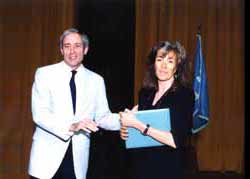
Columbia University President George Rupp presents Gail Caldwell with the 2001 Pulitzer Prize for Criticism.
Winning Work
By Gail Caldwell
Globe Staff
If you're reading these words on or about the first Sunday of 2000, chances are the infrastructure didn't fold. Thanks to a dedicated band of cyber-cassandras (most of whom were acting responsibly) and a pumped-up media (most of whom were trying to), we began taking Y2K seriously a few years ago, just in time to prevent the worst possible scenarios.
But what finally got the public's attention was not the binary-number explanations quoted by the experts, or the suggestion that Malaysia, say, might have failed to upgrade systems. It was the exponential scare factor, picked up on by popular culture and then reproduced, ad infinitum, through print and TV and computer screens across the land.
Apocalyptic gossip abounded. By the time Wall Street and the Pentagon announced they were Y2K-ready, a few folks had already moved their families and canned goods to Wyoming.
Having had a laptop crash on me in the late '80s, then flicker back on with a wiped-out hard drive and a blinking notice -- "January 1, 1900" -- I didn't need much convincing about impending perils. Others were more cavalier, certain that God or AT&T would light the trail. But wherever you were along the fear spectrum, there seemed to be a certain dark delight in all this anticipation of global mayhem. People began planning what to hoard (beef jerky, Starbucks' French roast) and where to wake up on January 1 (if the world broke apart, did you really want to be in Waltham?).
When Ken Olin showed up in late November, averting a nuclear disaster in Y 2 K: The Movie, NBC's own disclaimer seemed, well, sort of cheesy: "This program does not suggest or imply that any of these events could actually occur." Does that include having your mom save you from a really bad New Year's Eve date?
Not unlike the impulse toward gallows humor that can shield a doctor or journalist working a disaster, a lot of people turned the potential nightmare of Y 2 K into a lark -- sensing, probably instinctively, that foxhole camaraderie is a great armor. But what is it about human nature that makes us partly enjoy being frightened to death? Half the entertainment industry, from horror movies to catastrophe lit, exploits this premise, titrating trat ing our bad dreams into palatable doses in order to make them bearable. An ounce of terror, via Stephen King or Scream, may be homeopathic. And let's face it, Jon Krakauer's Into Thin Air didn't belay onto the bestseller list for months because those guys were up on Everest singing "Edelweiss."
If these defense mechanisms are irrational, so is fear itself; otherwise, we wouldn't need such elaborate counterphobic behavior to combat it. When the fight or flight instinct emerges from deep within the brain, it doesn't appear bearing analyses about why something in particular seems threatening. When horses spook or children scream, they don't stop for a moment to consider the options available to them. That ability to reflect is one of the gifts and burdens of mature human consciousness. Since a great deal of aggression is fear-based, our effort to out-think fear may be biologically protective -- it's one way the species avoids overt physical conflict. Instead, we theorize, dissect, and sublimate. Confronted with a horrid news headline or the threat of rioting in the streets, we turn it into urban legend, or tell a knock-knock joke.
The species has always had ways of psychologically diverting terrifying events: Cowering before an eclipse of the sun, ancient cultures assumed they had angered the gods, preferring their own complicity to the random unknowns of science. In the modern world -- postindustrial, postnuclear, and staggering under the weight of its own irony -- we've transformed those coping tools into a more secular form of grim equanimity. Where God used to bear the responsibility for natural cataclysms, now we've invented a few of our own; it's hard to blame a vengeful deity for a computer foul-up or a broken rope atop Mount Everest. And yet we're still transfixed by the drawing-room experience of these tales of strength-through-adversity, where somebody else gets (or has) to be the hero. Armchair expeditionists, we placate and deflect our fear by feeding it.
I was reminded of this when the EgyptAir flight went down last fall, and my mother -- a wise senior citizen who, in the landlocked Texas Panhandle, has always been suspicious of large bodies of water -- called me to express her alarm. The flight had disappeared, she said, in the ocean near Nantucket, not so far from the site of the Kennedy and Bessette tragedy months before. What did I think this meant?
Nothing, I said, eminently sensible. Thousands of flights a day take off from the Eastern Seaboard and pass over those waters; it was a simple matter of statistical odds. No fool about either weather or the laws of logic, my mother listened politely while I talked on about flight controllers, fog, margins of safety.
"Yes, dear, I know," she said. "But do you think it's something in the atmosphere up there?"
My mother was sticking to her guns; she didn't want to be talked out of her fear. She had already lost me to the Bermuda Triangle of the East Coast; who knew what other forces were at work? Later, I remembered that she had just finished reading Sebastian Junger's The Perfect Storm, which had scared her out of her wits and had confirmed the dangers of the northeastern seas, where fishermen (or daughters) could disappear with little warning. Like those people faced with a total eclipse, my mother reached out for mystery instead of reason. Better that than the cold reality of chance, where, in the formulas of computer chaos or climatology, humanity doesn't really factor in at all.
© 2000, The Boston Globe Newspaper Company
John Updike explores what was really rotten in the first family of Denmark.
By Gail Caldwell
Globe Staff
We tend to think of Shakespeare's Prince Hamlet as the first introvert of modern tragedy, with his theatrical domain - along with Wittenberg and rotten Denmark - as that of the first great Renaissance drama. But the prince's self-consciousness and madness, feigned or otherwise, couldn't by themselves give us the labyrinthine complexity of "Hamlet" - the brilliant ambiguities of the young man's soliloquies, the torturous sorrows of Ophelia's suicide, the play's explorations of good and evil and of humanity's moral obligation to understand both. With the ghost of Hamlet's dead father hovering over his son's conscience, we watch a tale unfold whose central action has already taken place: Claudius, King of Denmark and stepfather to the prince, has poisoned Hamlet's father and absconded with queen and crown. It will be Hamlet's role, of course, to unearth this lethal secret and then decide what to do about it. And while he spends the next five acts mostly thinking out loud, his meditations will end in a staggering last scene of consummate death.
Part of the play's timelessness lies in its dualities, about which volumes have been written, from the two dead kings to the collision between classical heroism and Reformation thought. This infinity of interpretation applies equally to the cast: Is Claudius really a vicious incorrigible, or has he straightened up since that Cain moment of weakness when he killed his brother? Is Queen Gertrude in fact a weak sister who sold out her only son, or is she an ermine-robed victim of ruthless patriarchy? And what of poor old Polonius? OK, so he's a self-serving bore and a hypocrite, both of which he pays for at the point of Hamlet's sword in the third act. But did any father ever love his daughter more?
And now, regarding the publication of "Gertrude and Claudius," dare one say it? What a piece of work is Updike! Our own king of erudition - a Renaissance writer if ever contemporary America could claim one - has gone back to the Hamlet story to imagine its inception: its offstage pre-story, when Claudius fell in love with his brother's queen and that first dastardly deed in the garden was set in motion. Wickedly replete with allusions, weaving the history of ideas with the lustier possibilities of adulterous coupling, "Gertrude and Claudius" is an intelligent little novel of whimsy. Opening with Gertrude's marriage, at 16, to King Hamlet, then following the building treachery of the next three decades, Updike's story ends with the stage set for the beginning of "Hamlet." It's the background case file, in other words, on the newlywed parents of the prince - their story exposed as a blended family in extremis, rife with the usual pitfalls of envy, boredom, and unleashed aggression.
You can feel Updike's pleasure and intellectual curiosity throughout this novel, for which he returned to several versions of the ancient Hamlet legend, in which Amleth, a Danish noble, takes revenge on his uncle for killing his father. Accordingly, Updike's characters are given the names drawn from Shakespeare's sources, including the 12th-century Latin text by Saxo Grammaticus and Francois de Belleforest's later adaptation in "Histoires tragiques." Thus Polonius appears as Corambis; Claudius as Feng and Fengon until he takes the reigning title of Claudius; and Gertrude as Gerutha, then Geruthe. This care has the added effect of making the story ageless as well as more intimate; in Updike's hands, at the story's lighter moments, what we have are a couple of unhappy campers who find their way into a second chance by way of each other's pre-silk undergarments.
Gertrude, in particular, is rendered with great sympathy. Deemed powerless by the men around her from the day she was born, she's cast here as a large-hearted, disappointed woman who must struggle to recognize her own desires. When Claudius gives her a blinded female falcon as a gift, he consoles Gertrude's worries: "It is for her own protection," he tells his beloved, "otherwise she will be frantic for the possibilities of freedom that she sees about her." Claudius hardly deserves such sympathy, roaming the Mediterranean and coveting his older brother's wife. But his passion for Gertrude is true, and the shadows of sibling rivalry that accompany it nonetheless coexist with a cosmopolitan, early-modern sensibility. By the time he enlists Polonius in that conspiracy to empty a vial of herbona into King Hamlet's ear, he has been pushed into desperation by circumstances of love as well as treachery.
Prince Hamlet himself is off in Wittenberg, naturally, reading philosophy in the place where Martin Luther nailed his "Theses" to the door. But the general discord he effects in "Gertrude and Claudius" would have us believe that this is a brooding boy who may turn out to be more trouble than joy: a "fragile, high-strung, quick-tongued child," his own mother thinks; she will come to believe that her son suffers from "the madness of detachment." None of which will slow Claudius in orchestrating the young man's return to Elsinore, of course - where Ophelia waits, Polonius plots, and Gertrude and Claudius happily reign.
The question at hand, though, is whether "Gertrude and Claudius" succeeds - as a self-contained story, a contemporary dramatic commentary, an elixir for the play itself. Well, yes, but only if you're keen to immerse yourself in "Hamlet" in order to partake of the pleasures Updike offers; otherwise, his reinterpretation may seem capricious or uninviting, as pedantic as Polonius to the uninitiated. The novel is written in prose correspondent to its history, which is authentic but hardly the stuff of Updike the splendid modern stylist. In an effort to place Gertrude and Claudius's love story in time, Updike has woven strains of intellectual history through the text - the rise of empiricism, say, or the collision between naturalism and the advent of Christianity. These strains worked for me; I can also imagine them seeming tedious to a reader in a less willing state of mind.
What seems luminescent about "Gertrude and Claudius" is its attendant passions - not those of the star-crossed, roguish lovers, but rather those authorial joys evoked by the tragedy of "Hamlet." There is something delightful about following Updike down this path, seeing his sentiments and sympathies unfold, watching him deftly handle the text of "Hamlet" and the spiritual ambiguities that surround it. Sometimes brilliant and sometimes thuddish, "Gertrude and Claudius" is an intellectual indulgence, but the indulgence is contagious. At its best, the novel will send you into the infinite luxuries of the play itself: its staircases of madness and wisdom, sorrow and pity. And so, in keeping with Updike's newfound heroine, we'll leave the final note of cunning to Queen Gertrude - who, when asked about her son's state of mind, replies, "Mad as the sea and wind when both contend / Which is the mightier." Give that woman a scepter!
© 2000, The Boston Globe Newspaper Company
Edna O'Brien sets her tragic Irish tale at the crossroads where the modern meets the rural.
By Gail Caldwell
Globe Staff
Ireland may be the only place in the world where talk is cheap and also priceless. The island's oral sensibility is one of gossip bumping into literature: a collision of pub fights, fence-hanging yarns, and the poetry of the gods. Joyce understood this first and best, of course; his exaltation of the ordinary simply and forever changed the face of fiction. His intrepid heiress-apparent, Edna O'Brien, has spent the last four decades celebrating a similarly fecund narrative world of the bawdy and sublime; for her efforts, she saw her first seven novels banned in her homeland - the first one toasted on the chapel grounds by her own parish priest.
And in "Wild Decembers," she has given talk itself the power of a sweet-tongued devil. It's there in the ancient legends that hover over rural Cloontha, "a locality within the bending of an arm," and there in the old grudges and new rumors that dictate the order of things. It's there in Cloontha's bars and beauty salons, in its misunderstandings and land disputes and murderous threats. Most of all, it's there in the evolution of narrative: the way we hear, interpret, then reweave the facts into intractably human truths - where fields "mean more than fields . . . fields lost, regained, and lost again in that fickle and fractured sequence of things."
In other words, this is a story about ceaseless rain and turf-cutting and tragedy, more Thomas Hardy than Joyce in its mists of preordained misery. The final volume of a trilogy, "Wild Decembers" follows "House of Splendid Isolation" and "Down by the River"; what links the novels is not a specific story line, but the shroud of Irish history, where passion begets violence and where honor generally commands the price of blood. You can tell from the first paragraph this is O'Brien country, with its sucking calves and golden bogs and too-sweet smells of earth and death. Few other writers take you inside a fictional realm so utterly and swiftly by way of language - by the sheer internal sounds and look of words upon the page.
The feuding sons of her classical story are Mick Bugler, returning from a few years of self-exile on a sheep farm in Australia, and Joseph Brennan, the elder brother of a sheltered young woman named Breege. The two men's ancestors fought for years over rights to their abutting lands, the history of which is recorded in pub talk and memory, and maybe in the dusty archives of a land office miles away. With the look and air of a dark-horse charmer, Bugler possesses the only tractor on the mountain - and, within a matter of weeks, the heretofore-unclaimed attentions of Breege. The Brennans' parents died when Breege was a young girl, and Joseph moved in to fill the void; his subsequent protectiveness of his sister her is only slightly mollified by his initial affection for Bugler.
Circumstances conspire to alter this fleeting harmony. Angry sentiments are exchanged over the tractor, which, for all its suggestion of modernity's forward march, winds up broken down on Joseph's land. Word arrives of a fiance, Rosemary, soon to join Bugler, thereby eclipsing any idea of a future for him and Breege. These embers of discord are transformed into a brushfire by the collective mischief of Cloontha's residents. A pair of conniving sisters, Rita and Reena, decide to torment and even ruin Bugler after they've failed to draw him into their web. The local misfit, known as the Crock, is a physically deformed man who has led a life of humiliation and rage; his bitterness has festered over the years into malevolence, and Breege - by the simple fact of her innocent disregard - becomes his target. Within a matter of months, rumor and malice have turned into allegations and court fights, with Joseph and Bugler each threatening the other through hired solicitors as well as physical assault. Breege, her loyalties divided but her heart resolute, finds herself alone in the barn with Bugler for one splendid moment - which is just long enough to change everything, forever, for them both.
This is an old, old story - I kept thinking of Alfred Noyes's "The Highwayman" and Hardy's "Tess" - with a darkness you can see coming from clear across the moors. And yet O'Brien has filled it with a resplendent ache that is hers alone. The novel breathes with animal symbolism: a martyred greyhound, named after her birthplace of Violet Hill; lowing calves, crying for their mothers; a lost and exquisitely fragile butterfly, hostage to the mercy of the man who holds it. These moments imbue the novel with a sense of mystical doom, as unstoppable as spilled blood or a setting sun. At such times the narration is Faulknerian in its alliterative march toward destiny; when Breege's voice occasionally takes over, the story feels stripped-down and piercing. This is an etching of a tragedy, perfectly delineated, its boundaries set by land rights and misdeeds and the very limitations of the human heart - an inner territory of beauty and imprisonment that is Ireland on the edge of time, what O'Brien calls "the confines of the place, back out to the far reaches of the mountain, the ballerina birch, and the fugitive amethyst river."
O'Brien has taken the title for "Wild Decembers" from an Emily Bronte poem, and with it she has brought the same heather-tinged heartache that clung to all those 19th-century heaths. It's testament to the old-fashioned feel of the novel that you hardly notice what decade it is until Rosemary arrives wearing thigh-high boots; much of rural Ireland, after all, is a stubbornly sovereign land of preindustrial passions. And when progress does arrive at little, well-insulated Cloontha, it does so with all the power and destructive possibility of a freight train. "You can go years and years of normal life," thinks Breege, "all day, every day, milking, foddering, saying the given things, and then one day something opens in you, wild and marvelous, like the great rills that run down the mountain in the rain, rapid, jouncing, turning everything they touch into something living; a mossy log suddenly having the intent and slither of a crocodile." It's that crocodile, heavy-eyed and treacherous, arriving at the end of a passage of great beauty, that sets Edna O'Brien apart. No mere lush romantic, she knows that great change and desolation are two different aspects of the same darkening sky.
© 2000, The Boston Globe Newspaper Company
Rosellen Brown sets a difficult tale of a mother and daughter in racially charged sprawl of Houston
By Gail Caldwell
Globe Staff
People who grew up knowing the place will tell you that Houston is nothing more than an old cotton and oil town that got too proud of itself. These days, it's a high-tack paradise of designer malls and cloverleafs, its atmospheric conditions dictated by sweltering heat and the smell of money.
The city has always been rife with irony: Yellow fever nearly took it down until people figured out how to kill mosquitoes, around the same time they discovered oil. Heading west during Reconstruction, a large black population settled in the center of Houston, near what would become the railroads and the Ship Channel; the white middle classes, poised for the promise of segregation by flight, responded by building ever outward. So the racial tensions of the city -- and they were legion -- were eased far more by sprawl than by accommodation. And the only thing black about all that lily-white money was the sludge from the petroleum industry that made it.
It's an excellent setting for a story of racial indignities and iniquities, in other words, and Rosellen Brown, who lived and taught in Houston for years, has made the place a cat's cradle of nuance and complexity for the mother-daughter domestic drama of "Half a Heart." This is her first novel since "Before and After" (1992), in which she carefully rendered the interior spaces of a family soldered together, for better or worse, by violence and loss. With its probing story of a white Jewish mother and the half-black daughter who was lost to her during infancy, "Half a Heart" has glimmerings of that psychic capability. But the novel, which opens in 1986, is more far-flung and garrulous than it is deep.
In following the arc of Miriam Vener's life over a couple of decades, it volleys back and forth through the civil rights movement in Mississippi and the Houston milieu of comfortable, all-white privilege where she now lives, with day trips to New Hampshire and New York. The connecting link is Veronica Reece, an 18-year-old now living with her black father, Eljay Reece, in Brooklyn -- a savvy, walnut-skinned girl who just graduated salutatorian from a private school and is on her way to Stanford. Then one day a letter arrives with a Houston postmark, which is the first of Miriam's heart-rending efforts to correct the great wrong (and void) of both women's lives.
To its credit, "Half a Heart" is hardly a romanticized portrait of a sweet reunion between tragic mother and lost duckling. The first meeting between Miriam and Ronnee, as she's now called, is more summit conference than celebration, with each wary of the other and of her own feelings of ambivalence. Married to a successful, kind-hearted ophthalmologist, Miriam has long since given up her academic career, and seems to have spent the last several years poised between effete liberal and alienated Houston matron. She and her husband, Barry, have two sons and a daughter, all preteens, whom she's just packed off to summer camp. (This detail, like too much of the novel, feels mechanically convenient: temporarily empty nest, Houston summer, ensuing void -- all conspire to get that letter in the mail within the novel's opening pages.) Ronnee, who grew up with only shades of the truth about her absent white mother, is languishing in Brooklyn with Eljay, a charismatic activist who whisked her away from Miriam when she was 8 months old. The girl is also trying to figure out how to pay her tuition at Stanford -- "White Folks' Heaven," according to Eljay -- and this olive branch from her rich Texas mama couldn't have come at a better time. "If she acted it well enough," she thinks with determination about her reunion with Miriam, "it would buy her a future, since it was too late for a past."
So we're set for all kinds of regret, disappointment, grim resentment, and dual agendas by the time Miriam shows up at Ronnee's door. Suffering through their first few days together at the Veners' summerhouse in New Hampshire, the two are called back to Houston when Miriam's mother, in the early stages of Alzheimer's, takes a turn for the worse. Thus thrust into an oppressive (and all-white) world of entitlement, secrecy, and mannered nouveau riche, Ronnee does what any self-respecting angry teenager would do: She finds a boyfriend who will shock everybody, and she herself gets into trouble. And Miriam does what any guilt-ridden mother would do, which is to alternate between hating her present life and mourning her old one, between adoring her long-lost daughter and wanting to strangle her. Barry, who could have easily wound up a lost soul among all this yeasty working through, emerges as a decent guy -- someone who soldiers on within a milieu of hypocrisy and satin-voiced racism.
Scene by scene, "Half a Heart" is an uneven book. It possesses moments of agonizing authenticity, as when Miriam returns to the first horrid months after she lost Veronica. Her civil rights days, when she traveled to Mississippi with so many other young white idealists, are mostly delivered with a convincing mix of grace and irony; Brown isn't afraid to confront the rocky terrain where good intentions meet interracial estrangement. But often this novel relies on mere sentimentality when it might have aspired toward greater literary and psychological sophistication. The novel it most calls to mind is Jacquelyn Mitchard's "The Deep End of the Ocean": a riveting family drama, but limited by its own free fall into one character's soul.
Some of the problem is structural: You can feel Brown hurrying her characters from one locale or emotional stage to the next, and it feels as though the train took off an hour ahead of schedule. And some of it is credibility: By using a lengthy soliloquy from Miriam to relay the story of Ronnee's birth, she introduces certain facts that no mother ever would or should tell a child (Oh, honey, I thought about having an abortion! Aren't we glad I didn't?), then leaves us to believe that such a revelation would have no consequence. And while Miriam herself was surely meant to be someone whose central torment has fostered her confusion and complexity -- a woman up against her own fears and human failures -- she's often delivered with a narrative dissonance that makes her seem irritatingly contradictory. When Miriam is fighting the good fight in Mississippi in the 1960s, she comes across as a familiar, even sympathetic character; when she starts making revolutionary waves in Houston in the '80s, you simply want to spritz her off with ice water and tell her to get a job.
These are mostly amateurish errors that are beneath Brown, who is admired for her resonant characters. But the weaknesses of the novel don't much affect its high-octane momentum, which will appeal to buckets of readers in search of a respectable domestic soap: one with plenty of mother-daughter anguish and mint julep bigotry. Brown has done her novel a great service by making its most persuasive character a sullen young woman with her heart in two worlds -- walking the wilds of Houston's upper-crust suburbs, and knowing she's on the wrong side of town.
© 2000, The Boston Globe Newspaper Company
By Gail Caldwell
Globe Staff
Their diligence was troubling because of what it obscured: the absence of much unalloyed argument.
A newsroom where I used to loiter in the early 1980s had, like many newsrooms, more than its share of eccentric brain power, and so it was that the beginning of a mysterious list appeared one day -- posted anonymously and entitled "The Age of Diminishing Literary Returns."
The culprit who started the list had written, underneath the title and on an otherwise blank sheet of paper, "#1. Stendhal's 'The Pink and the Grey.' Then, a coy #2. "inviting further contributions.
He or she had chosen wisely: By giving an ironic nod to the 1830 French classic The Red and the Black, commentary had been made (the world has paled since the age of Romanticism; the whimper has outdone the bang), the rules had been drawn, and the bar placed high. Now it was up to the rest of us.
Within 48 hours, the list was a marvel: Dickens's "A Tale of Two Strip Malls," Faulkner's "The Whisper and the Irritation," Dostoevski's "Misdemeanors and Reprimands." Finally, after the list had spilled over onto a second page and become modernized with entries like "Rabbit, Skip," somebody told us to go back to work.
But the greater point, about grandness being replaced by tepidity or mediocrity, has lingered over the years, with alarming reminders of it popping up recently in the hollow confines of advertising and cyber space. You might call it a dilution of cultural values: We now live in a society where information is available at the touch of a keyboard in half of the homes in America, and yet no one knows what to do with most of it. Everything is free, but nothing has much meaning; the instruction book that used to teach us such things -- that gave form and definition to raw data -- seems to have disappeared.
In the ensuing semantic void, hyperbole has rushed to fill the vacuum; the one sure way to rob something of its worth is to overstate it. Nowhere is this more evident than in advertising. Goods and services are being shilled with slogans that promise the moon, or at least space travel -- "Are you ready?" and "Where do you want to go today?" -- but offer only numbing uniformity. The worst of them have taken to appropriating great historical events: A soft-drink campaign alludes to the fall of the Berlin Wall (freedom of choice!); a local weekly newspaper, comparing its complimentary circulation to a sermon by Martin Luther King Jr., slaps a billboard with the ludicrous reference, "Thank God almighty, it's free at last."
This impoverishment of history, while disheartening and even offensive, is part and parcel of what the mass-culture soapbox of advertising has always been about -- using what's already there to sell you what you don't yet need. But the hipster soullessness of the message has been ratcheted up a notch with the onslaught of the new gimme economy and the hundred-car pileup on the information highway. And you can find softer, less public analogs -- with two-dimensional, linear thought replacing complexity -- in the classrooms and chat rooms of everyday life. In a cluttered realm where Internet access has made every screw ball's Web page a potential archive, style has ridden roughshod over content, and content itself is no guarantee of meaning. Just try executing a search online without benefit of ironclad parameters. You'll get triple-digit results that deliver only eyestrain. Signifying nothing, indeed.
Throughout history, jeremiads have accompanied technological innovation, usually until the new system -- railroads, industrialized labor, television -- has hauled society, however grudgingly, into a different and often better world. So it is and will be with the global village. The technology isn't to blame; it's the indiscriminate pitch accompanying it -- and the subsequent replacement of old-fashioned analytical skills with high-tech ones.
This trade-off came home to me last winter, when, giving a guest lecture on critical writing, I assigned a review of a well-known foreign film. The students were a bright group who had already shown they could write and do research; a review, I hoped, would demonstrate their abilities to think for themselves. It shouldn't have surprised me when, Web-savvy to a fault, they arrived with completed papers bearing every actor's name spelled correctly, as well as background information on the film. Their diligence was troubling because of what it obscured: the absence of much unalloyed argument. One of the best students drove home the point. "You mentioned something about aesthetic standards," he said. "And I really didn't know what you meant."
I believe this was my failure, not theirs: In seeking an unadulterated ideal of pure opinion, I had neglected to realize how rare such a thing is these days. I had wanted to teach my students how to establish their authority as writers: how to locate their beliefs on the epistemological map, then trust what they found there and crystallize it into prose. Set loose on a virtual sea of information and attitudes, they had no idea how to fish for the truth.
I might have insisted they turn off their computers and read Swift, or Orwell, though the writer this incident called to mind was more contemporary. In his 1995 novel, Galatea 2.2, Richard Powers has his tech-courant protagonist facing the bottomless depths of the Web. "When the terminal drop box brought the last barefoot abused child on line," he thinks, "and everyone could at last say anything instantly to everyone else in existence, it seemed to me we'd still have nothing to say to each other and many more ways not to say it."
Where do you want to go today? When you get there, will you have any idea where you are, or how to get back home?
© 2000, The Boston Globe Newspaper Company
Alan Lightman's new novel sends its hero on a black-comic descent into the modern maelstrom
By Gail Caldwell
Globe Staff
Any student of the physical world will testify to a certain elegance of form, applicable across the entire spectrum of natural law: that poetry, for instance, can possess an internal structure similar to that of a fine building or a cloud.
What happens, then, when you go mucking about with time and matter, manipulating them with industrial progress and split attention and the heretical demands of 24/7? Does the world, insistently entropic, simply dig in its heels and refuse to budge? Does human consciousness, taxed beyond its biological premise or capabilities, scatter into chaos?
If infinity times zero will always equal zero, what does that tell us about the less quantifiable components of output and desire? Alan Lightman, to his credit and ours, cares mightily about such things. A writer and physicist who teaches both subjects at MIT, he charmed a great number of readers with his 1993 fiction about time and possibility, "Einstein's Dreams." That fully imagined work brought the notion of a parallel universe further into the vernacular: perhaps each one of us was living out a mere fraction of a larger puzzle, where history went on performing a greater dance than any of us could see.
"The Diagnosis" is neither so eloquent nor as open-ended as "Einstein's Dreams"; it is instead a darkly allegorical novel about the human costs of a meaningless, high-tech work world run amok. Medical specialists (including psychiatrists) communicate with their patients by cell phone or e-mail; faced with the clock-breaking labyrinths of voice mail and information-processing services, time itself has pretty much collapsed. Trying to navigate this new order is a kind of Route-128 Everyman: Bill Chalmers, who just turned 40, loves his wife and son and home in Lexington, and who can't seem to find his way to work one ordinary morning.
Chalmers's story begins with terrifying authenticity, when the normal stresses of the toiling masses seem to converge into a chaotic underworld at Alewife Station. Cell phone in hand, briefcase bulging, Chalmers looks around him at the digitalized frenzy and just stumbles into circuit overload -- he forgets who he is and where he's going. By the end of a commuter nightmare in which the Red Line never looked scarier, he winds up in the ER at Boston City Hospital (he's headed for the psych wing until he steals a pair of pants and escapes). With his memory returning in fragments, Chalmers finds he's losing something else: He has no feeling beyond an inexplicable tingling in his hands and feet. As the condition progresses, it takes on the pathology of a carpal tunnel syndrome of the soul; instead of pain or pleasure, he feels nothing at all.
So unfolds a hellish little odyssey through modern life, with poor Chalmers trying valiantly to stay upright as his world collapses. While he's lost on the Red Line, his wife, Melissa, is lolling about having a cyber-affair at her laptop computer; Alex, their son, has long since resorted to reaching both parents by e-mail, even when they're all at home. Now faced with Chalmers's deteriorating health and job status, the family hunkers down -- Melissa disappearing into a bottle of Scotch, Alex going on-line to research his dad's conditions. Doctors and lawyers come and go, signifying nothing. Paychecks mostly go, Chalmers having blown it at his high-pressure company (a mysterious place where worthless information and deals get processed, toward mysterious ends). A phalanx of medical teams consult, subjecting the patient to invasive and useless tests. One kind but dotty psychiatrist plays Chalmers a background CD of waterfalls, then sends him home with Prozac.
Well, what we have here is the breakdown of the modern world, personified by a wounded anti-hero who never asked for what he got, deserved it no more or less than anybody else. But this is pretty much a one-trick pony of a plot: We know the cell phones will get louder, the corporate response more outlandish, the physical symptoms worse. Because "The Diagnosis" is a black-comic, surreal descent into the maelstrom, its focus is less on character development or emotional credibility than it is on dark symbolism; while Chalmers's alienation is a tale of anguish, its rendering through the inhuman flotsam of technospeak (e-mail chatter, nonsensical dialogues) becomes tedious after a while. More compelling and telling both are the fleeting moments when Chalmers's memory triumphantly displays its lifetime of treasures: the sound of Chopin, the pleasures of pizza with a beloved son, the riveting beauty of a leaf. These are the pastoral exceptions to Chalmers's present life, and to the absurdist milieu that "The Diagnosis" has chosen to present.
Woven throughout Chalmers's descent is a series of fictionalized chapters from Plato (downloaded by Alex!), concerning the trial and death of Socrates and the inner torment of one of his accusers, Anytus. Bill Chalmers has similarities to both men: Like Socrates, he has become a martyr to the cause of truth; like Anytus, his silence and anger may have cost him his son. Or perhaps the point belongs to Socrates, who, having been condemned in Plato's "Apology," asks his accusers to trouble his sons after he is gone: "If they pretend to be something when they are really nothing, then reprove them, as I have reproved you, for not caring about that for which they ought to care."
The intention behind this device seems more commendable than its execution. The Anytus passages don't really fit in the novel, but you can sense Lightman's passion for their story, and that makes them discretely compelling. But their inclusion here points to a larger problem in "The Diagnosis": it's a novel of ideas whose creator seems more comfortable with the ideas than with the imaginative elements that surround them. Because Lightman has made his Chalmers someone who once understood the sorrows of Chopin, his protagonist is a tragic figure -- a man defeated by life who nonetheless remembers its beauties. And because Lightman himself casts his vote with Chopin and Joyce, you can't help wishing he had given them the background score. Until its final pages, though, "The Diagnosis" isn't governed by such melodic laments. Instead, relentlessly exposing the techno-hell of the modern age, it must surrender to the squawk of cell phones, the ominous beep of cyber-cues, and those recorded waterfalls -- falling softly and softly falling, in stereo.
© 2000, The Boston Globe Newspaper Company
Joy Williams tries to build a novel around ideas - and around three wisecracking young furies
By Gail Caldwell
Globe Staff
"The Quick and the Dead" is fierce, lively, and shocking, and it possesses a tooth-and-claw beauty as dangerous and breathtaking as a cougar on the move.
Poet of the ironic and damned, Joy Williams delights in turning the world on its head: She can make a sunset into end-of-day carnage and the day's carnage into an act of natural grace.
Few writers choose to inhabit these high crevices, where the pitch is steep. But Williams could scarcely live anyplace else. Her writing is so infused with terrible truths and dark comedy -- imagine Cormac McCarthy bumping into Flannery O'Connor -- that it's difficult to imagine her on tamer ground.
Williams has applied her considerable intelligence over the years to the short story and novel as well as naturalist nonfiction, and "The Quick and the Dead" is her first novel in more than a decade. Its cast of characters has the familiar Williams stamp of transcendent idiosyncrasy: an eco-warrior teenager who's smarter than most adults; a dog more interesting than his human nemesis; a recently deceased woman who returns as a ghost to torment her husband (and give him stock tips). Together, they form a montage of the more colorful aspects of that great, pulsing monster we call life -- which is, for some people, a euphemism for the necessary condition preceding death.
Because really, "The Quick and the Dead" is a death trip writ large in gorgeous calligraphy: perfect scenes and dark intent and uproarious cosmic jokes, usually in search of sacred targets. Its loosely woven garment of a plot concerns three teenage girls, all motherless, who are thrust together by geographical circumstance one summer in the Arizona desert. There's Alice, the aforementioned genius-punk who understands corporate greed and imperialist mayhem better than most teenagers understand the Backstreet Boys. There's Annabel, her dialectical opposite, who thinks the world can be changed only by better nail polish or a daring tan. And finally there is Corvus, the heart of these three Furies: Corvus, who lost both her parents to drowning, takes dire action to purify her own life, then devotes herself to the half-living spirits at a nursing home called the Green Palms -- a place we are introduced to as "state-of-the-art End of the Trail."
Williams follows her wisecracking Furies through a web of intersecting journeys; if the novel seems willfully episodic, it's partly because everybody here is on his or her way to someplace else. Ruthlessly unsentimental and ruthlessly serious, "The Quick and the Dead" is, almost by necessity, held together by comedic ballast -- how else can you describe a world where a 300-pound, near-comatose patient is kept alive against his will, while a laboratoryful of animals are being tortured to test mascara? "God is the net," Alice's suicidal friend tells her. "We are the creatures within the net."
That image -- comforting and claustrophobic at once -- suggests Williams's vast, multilayered wit; she cracks jokes while quoting Dante and Schopenhauer, puts poetry and theology in the mouths of the unsuspecting (or guilty) to make her point. It's hard to get a purchase on "The Quick and the Dead," and the au courant picaresque milieu is both perplexing and frustrating. But sentence by sentence, scene by scene, the novel can be mesmerizing and even brilliant. These characters exist in order for Williams to deliver the startling consciousness within; when we meet Alice, at the opening of the novel, it's at the end of a baby-sitting job gone bad -- and within five pages of slate-gray sensibility and pitch-perfect dialogue, she's won us over for good.
Williams is equally smooth at depicting the even stranger folk who pass through the story: When Ginger, Annabel's dead mother, reappears in her husband's bedroom, it's a stand-up routine from the other side -- she makes fun of his new boyfriend and refuses to tell him what the afterlife is like. Ray Webb, a deluded young drifter with doom written all over him, is somebody out of a Robert Stone novel; accordingly, his appointment in the desert portends a certain bloody grace even before he gets there. That Williams is able to render both ends of this divide -- a Joan Rivers ghost and a wounded-boy sacrifice -- is eerie testament to the novel's dimension.
What's less convincing is her effort to turn all this spooky, astonishing prose into a novel. If you don't mind getting your hands dirty with the mysteries of life, "The Quick and the Dead" is daring enough to try to get near most of them. But sometimes Williams is too idea-laden for her own good. She puts opinions in the mouth of tough-talking Alice that sound suspiciously authorial, and thus veer more toward the polemical than the successfully creative. Williams ought to have known better: You can change more hearts with one wounded elephant than you can with an entire manifesto about poisoned oceans. Most good novelists are well aware of this central tenet, which is what leads them to write novels to begin with. When you can feel Williams's passions eking into dialogue and influencing her fictive structure, "The Quick and the Dead" stumbles instead of soaring.
Mostly it soars, or rather hang-glides, one brief flight at a time. There are moments of ghostly insight (Ginger notwithstanding) that are unparalleled in most contemporary fiction; line by line, the rewards here are great. A cruel, frighteningly articulate nurse at the Green Palms turns her guns on Corvus near the end of her quest: "You saw some cruddy thing," she accuses her, "that had within it all the importunate treasure of being, some cruddy thing that turned radiant in the light of your regard. So you've come back to wait without waiting, as one waits for the dead." The beauty in this novel is without mercy and the mercy often without beauty, and Joy Williams -- keenly, unwaveringly -- knows the difference.
In this memoir, Mary Karr recalls her teenage angst and her emergence in a wider - and wilder - world
By Gail Caldwell
Globe Staff
Karr graduated from sweet desire to full-fledged rebellion, glimpsing within those moments of hallucinatory splendor how scary life could be when the whole plan went south.
In the cultural and geographical low country that was East Texas in the 1960s, Mary Karr was a wild girl with poetry and LSD running through her veins -- somebody who scared mothers, infatuated friends, tested teachers and other town authorities far past their resolve.
She was skinny and smart and not a little crazy, with the melancholy worn by legions of teenaged girls as "a kind of cerebral accessory."
Fleeing the mad unreliability of her family, she migrated early on toward the promises of the printed word, finding there -- in "Tarzan" or "Charlotte's Web" or "To Kill a Mockingbird" -- a certainty of cause and effect that real life rarely delivered.
By the time she hit high school in Leechfield, Texas, this was a girl who had already seen her mother threaten suicide and her father start down that longer road of drinking himself to death, but her own life course -- "to write 1/2 poetry and 1/2 autobiography" -- had been thoughtfully set down in a diary entry. So, too, was a self-diagnosis heartrending in its laconic accuracy. "I am not very successful as a little girl," wrote the 11-year-old Karr. "When I grow up, I will probably be a mess."
Well, yes and no; the happy ending implicit in such a confession is that someone survived to tell the tale, and tell it well enough to have staked a fair claim in the territory of contemporary memoir. With two books of poetry behind her, Karr achieved a dark and wide recognition in 1995 for her first memoir, "The Liars' Club," which conveyed hair-raising (and sometimes hilarious) stories through the kaleidoscopic beauty of Karr's narrative consciousness. "The Liars' Club" took the considerable risk of relaying a life through only two prismatic years of childhood, and its emotional weight was supported by its structural authority. If Karr the child had come unarmed through a minefield of troubles, Karr the adult had triumphed with the fortitude of wit and steel-edged grace.
Cast in the role of sequel, "Cherry" lacks the dramatic urgency and singular focus of its predecessor; its story can be resonant and captivating one minute and dissonant the next, as though the narrator has momentarily forgotten what she is doing here. But one of the cruel, unerring tenets of memoir is that it demands a fixed and articulated purpose, no matter how fine the voice or crystalline the memories. Otherwise, stripped of that angle of light, what you get is merely The Life, which, unless you are Winston Churchill, can be a fairly tenuous affair.
Alluding to the ripening fruit of girlhood in every sense of the word, "Cherry" seeks to give us a story of burgeoning sensuality -- of a girl whose physical desires were as dangerous and liberating as the lines of poetry she devoured. It's a memoir of adolescence, in other words, with all the attendant temptations of the 1960s: "the vagueness of mind, the boys, the drugs." The music that accompanies this rhythmic descent is half Hendrix, half dirge; we know from the prologue, as Karr is leaving Leechfield for Los Angeles in 1972, that the near future for her road-trip gang will be littered with suicide, jail terms, and drug overdoses. Then "Cherry" cuts back to the preceding seven years, when Mary would walk the cliff-edge between innocence and reckless thrill, trying to locate some place inside herself that was worth holding onto.
Not that she had many other choices of refuge. The girl's mother, Charlie, was a painter who married seven times, took huge quantities of alcohol and pills, and occasionally noticed her two girls long enough to cheer them on -- the kind of mom who's larger than life in literature and must have been a horror show day by day. Pete Karr loved his daughters equally well, which is to say with all his heart, but not so you could see it in new sneakers or homework or a clasped hand into adulthood. Lecia, older by two years, was the thick link between Mary and a semblance of truth and sanity: the one who needled and disdained her little sister but finally gave her the goods on their parents. "These people don't have any sense, Mary," she tells her at the end of one long drama siege. "Hasn't that dawned on you? Not the sense God gave a goat."
Somewhere in all this Karr had found the mystical ardor of words, in her mother's volume of Shakespeare and in the library and classroom. Navigating through her home life and the stifling ennui of Leechfield with this arsenal of introspection, she also found something even warmer and more immediate -- the touch of a boy's kisses in a dark garage, where fear and desire conspired to offer a different kind of flight. Thus begins the real journey of the prodigal daughter, anchored by poetry but fueled by the ever-fiercer demands of sex, drugs, and rock 'n' roll. Karr graduated from sweet desire to full-fledged rebellion, glimpsing within those moments of hallucinatory splendor how scary life could be when the whole plan went south.
"Cherry" is an erratic book. The voice that propelled "The Liars' Club" defines this memoir as well, but its story feels desultory and sometimes forced. Oddly, the sexual awakening at the narrative's center can be evocatively told, but it doesn't add up to very much. What girl didn't thrill to those first encounters of shared longing, when the body galloped headlong toward what it wanted and the heart and mind cantered behind? These passages are lovely but familiar, and they are marred by Karr's insistent use of adolescent vernacular to talk about sex: By the time you're out of the ninth grade, "boning" ought to be a word reserved for fish.
More unfortunate is Karr's decision to write most of this memoir in the second person and present tense. One can imagine a litany of reasons for this device -- an aversion to "I," an implication of ironic distance or universality -- though none justifies what is effectively a distraction. In both memoirs, Karr's story has drawn its strength from two bountiful sources: its intrinsic intensity and the stone-smooth cadences of Karr's voice. A sentence like "you know that years of wandering lie ahead for you" belies those talents -- it sounds coy even when it isn't meant to, and it gets in the way of what ought to be the core of any memoir: its eternal (and individual) witness.
What comes through beautifully in "Cherry" is the emerging self that outlived its events: the flat-chested 11-year-old who, casting caution to the Texas wind, tore off her shirt and rode her bike around the block wearing nothing but red shorts. The poetry-quoting girl who, as her mother tells her, wants to have a secretary instead of be one. That combination of sass and sensibility is what made Mary Karr the writer she is, and I wish she had trusted its essence enough to give it the singular first person it deserves.
© 2000, The Boston Globe Newspaper Company
A new collection shows off the man, from tiny mummies to the bonfire of his own vanity.
By Gail Caldwell
Globe Staff
Wherever Tom Wolfe belongs in the pantheon of American letters, the man does know how to let the air out of a tire. Half vandal and half raconteur, he can deflate an entire city block of egos without getting winded -- managing, in the meantime, to spin out a sparkling diatribe about NASA (Space!) or SoHo (Art!) or the birth of Silicon Valley (the Future!).
And he does it all, of course, in that inimitable Wolfean blend of hype, insight, italics, and ellipses, where the jokes are so funny . . . the intelligence so eviscerating . . . the yarns so intriguing . . . that you forget, just for a minute, that maybe you've heard some of this before.
"Hooking Up" is Wolfe at his cavalier best and worst, roaming between wicked brilliance and self-serving crankishness, heaping insults on vast substrata of American culture (the media, the literati, the liver-spotted Left), then quieting down to tell a great story or two. A loosely organized cluster of essays and one novella, the collection is driven by the same devilish confidence that has been Wolfe's sine qua non for the past four decades. But one of the difficulties of being the architect of a singular style -- what used to fall under the rubric of the New Journalism -- is that you can wind up hostage to its reach. What Wolfe helped to do for nonfiction prose and the dissemination of ideas in modern American journalism can scarcely be overstated. Less clear is whether this particular brand of high-dollar smarts has anything new to say.
The finest work in "Hooking Up" belongs to the same sensibility that produced "The Right Stuff" and "The Electric Kool-Aid Acid Test": intelligent reportage that produces a story rich with perspective, synthesis, and fact. "Two Young Men Who Went West" particularly bears these marks. Roughly chronicling the rise of Bob Noyce, the Iowa preacher's son who developed the microchip and founded Intel, the story is a marvel of a nerd story made thrilling. It's the Wolfe with a Yale PhD in American Studies, Wolfe telling the scientific, theological, cultural, economic tale of frontier geekdom -- Protestants with slide rules! Who else could turn a young Silicon Valley genius into half Gary Cooper, half "American Gothic"? Who else could make the invention of the integrated circuit dramatic?
Not for nothing does Wolfe name-drop Zola every chance he gets. The French novelist helped changed the face of modern literature when he went into the mines to get the truth for his novel "Germinal"; Wolfe, in both his nonfiction and his fiction, has been equally reality-driven, arguing that what contemporary letters needs is more reporting and less soulful theorizing. The Noyce story contains this thesis beautifully, as does Wolfe's defense of the Harvard biologist Edward O. Wilson in "Digibabble, Fairy Dust, and the Human Anthill." For even more essential than Wolfe's considerable analytic skill is his unstoppable curiosity. This is a man so amused and so perpetually intrigued by what he calls the Human Carnival that he could (and did, in "A Man in Full") turn the science of refrigeration into a riveting tale.
Why then does Wolfe succumb to the snipe-and-carp school of writing in his forays here into literary gossip? (The body count of "Hooking Up" includes the following illustrious names: Susan Sontag, John Updike, Norman Mailer, Renata Adler, William Shawn, John Irving, Lionel Trilling, and E. B. White.) The worst offender is the 30-page essay "My Three Stooges," a counterattack against his critics -- notably Updike, Mailer, and Irving -- after the publication of Wolfe's second novel, "A Man in Full." For those who missed or have forgotten that particular fray, Updike's long, disappointed review in The New Yorker contended that the novel was not literature, but entertainment -- and further, sighed Updike, evoking Henry James's definition of literature, Wolfe's effort had failed to be exquisite. Mailer (in The New York Review of Books) and Irving (on a TV talk show) jumped in as well, complaining of Wolfe's limitations as a writer of fiction.
Well, so what? Writers of far less stature and wealth than Wolfe know how to take such reviews, but Wolfe's rebuttal is an endless recitation of his own sales figures and position on the bestseller lists and glossy magazine covers. The piece pretends to be a continuation of his call for the return of realism in the novel, but it winds up being a long-winded, puerile exercise in solipsism. This self-satisfied persona unfortunately sets the tone for the pieces that end "Hooking Up": a two-part article about The New Yorker written in 1964 for Wolfe's then-employer, the New York Herald Tribune, and reprinted here for the first time. The fact is that Wolfe's New Yorker screed was and is immensely clever and more than a little justified -- imagine Wolfe, at the time a 30-something street reporter, doing a sendup of the legendary Mr. Shawn. (Even the titles are ferocity-in-miniature: "Tiny Mummies! The True Story of the Ruler of 43rd Street's Land of the Walking Dead!" and "Lost in the Whichy Thickets: The New Yorker," which certainly describes the antecedent brambles of old New Yorker style.) But coming behind the brawling sensibility of "My Three Stooges," even the splendid treachery of these pieces manages to feel slightly more treacherous than splendid.
Which leaves us, really, with what Wolfe seems most intent upon defending: his own contribution to the world of fiction. Originally published in Rolling Stone, "Ambush at Fort Bragg" is a 75-page satirical novella gleaned from research Wolfe did for "A Man in Full"; the story focuses upon a media-sting operation of three good ol' boy soldiers on an Army base in Fayetteville, N.C. The men are probably responsible for the beating and murder of another soldier who was gay, but a case has yet to be proven against them. Sitting in a booth at a topless bar, jawing in redneck patois, they've no idea that a media production team has wired their booth for sound. Along with its reactionary criminal element, "Ambush at Fort Bragg" also caricatures a neurotic New York TV producer, a Southern girl gone media darling who mouths the copy put before her, and a Thai-American exotic dancer -- Lola Thong -- who gleefully sees the sting as her ticket to stardom.
Unsurprisingly, Wolfe has got the outer circumstances just right for sendup lit: the hard-core Southern dialect, the sweaty brows in the stakeout room, the hairdos and cashmere and Social Darwinism of the whole tableau. What he doesn't have are the inner lives -- the imagined, interior being of a racist or a debutante or an immigrant girl that will make us care about who these people are or what they've done. And so what we get instead is perfect portraiture: air-brushed description, hilarious, exclamatory interior monologue, a take-no-prisoners perspective where no empathy exists because none is deserved. This is cold comfort in the realm of literature, where empathy is the necessary atmospheric condition. "Ambush at Fort Bragg" is meticulously realized, about as superficially appealing to the eye as a three-piece white suit -- but it's hardly what you might call . . . exquisite.
© 2000, The Boston Globe Newspaper Company
An ode to the golden age of comic book heroics
By Gail Caldwell
Globe Staff
As an eloquent homage to the popular culture of mid-century America, "The Amazing Adventures of Kavalier & Clay" represents the finest in a whole new breed of contemporary fiction.
It's full of pizzazz and testosterone and street smarts, with a moral center that tethers its intelligence. Like the writing of Dave Eggers and David Foster Wallace, the novel is big and blustery and self-assured, and its reach and dynamism speak well to the future of the form.
This is boy fiction in the purest sense: like a young colty quarterback running, on an autumn night, for the love of the game.
Since the publication of his first novel, "The Mysteries of Pittsburgh," in 1988, Michael Chabon has been heralded for his imagination and narrative vigor, both of which are the divining rods that guide this story. In constructing a mammoth plot that focuses on the lives of two comic book artists, Chabon has written an ode to the comic book itself: to the golden age of pen-and-ink heroics, to the pulp fiction that translated and delivered so many of America's hopes and fears. It helps that the author knows a prodigious amount about this age, from the work of specific comic artists to the streets and smells of New York and Prague in the 1930s. But what brings the novel together is Chabon's intuitive grasp and reimagining of what mass culture really meant, or could mean: the manifestation and interpretation of an entire period of history, from Hitler's monstrosities to the everyday heroism of a world trying to hold him off.
The wonder boys who have earned the title credits of "The Amazing Adventures of Kavalier & Clay" are first cousins, introduced when Josef Kavalier arrives at his aunt's home in Brooklyn late one night in the fall of 1939. His family's last, best hope for escape, Joe has managed to get out of Prague by way of bribery, escape artistry, and serendipity; now he is standing in Sammy Klayman's bedroom, clutching a stack of New York newspapers -- including "The Women's Daily Wearing," as he tells his cousin -- with the hope he'll find some news of the Jews of Europe. Begrudgingly, Sammy makes room for his cousin in his bed; Joe sneaks him outside and shows him how to roll a cigarette. It is a meeting between two young men (Joe is 18, Sammy 17) that will shape, and in some ways save, the rest of their lives.
An exceptional student at the Academy of Fine Arts in Prague, Joe had earlier been trained in the stage arts of magic and illusion; his beloved mentor had seen in his young charge both the discipline and the self-destructive streak that were hallmarks of great escape artists. Having left that path behind, Joe finds that his skills -- to pick locks, to remain still and hidden for hours -- may get him out of Nazi-occupied Czechoslovakia. His old teacher has been recruited to smuggle out of Prague the famous Golem -- the earth-and-clay figure that, in Jewish lore, is bestowed with life once the word "truth" is written on its forehead. Through a series of sleights-of-hand, Joe survives his journey; now he's loose on the streets of New York, terrified about his family in Europe but at least anchored by the warmth of the Brooklyn Klaymans.
Endowed as it is with vast and mythic promise, the Golem will figure throughout this novel, as will Joe's tendencies toward flight, whether fantasy or escape. With his inarticulate heart and his charmingly worried English, he follows Sammy -- pen name, Sam Clay -- to his job at Empire Novelty, a whoopee-cushion house of delights where Sammy is a lowly clerk. Once Mr. Anapol, the mustache-twirling owner of the company, catches sight of Joe's artistic abilities, he knows he has a new Superman in his coffers -- and what Joe can draw, Sammy can plot. Thus begins the brilliantly imagined collaboration of Kavalier & Clay -- a round-the-clock world of cigarettes and inspiration, artistic genius and financial travesties, where villains and champions slug it out both on and off the page. There will be, of course, a damsel, though Rosa Luxemburg Saks is hardly in distress. She's the high-spirited, artistic daughter of a wealthy Greenwich Village eccentric; once Joe inevitably falls madly in love with her, they begin plotting a way to get his younger brother out of Prague.
Throughout this profoundly realized tale of adventurism and sacrifice are the creative fruits of Joe's and Sammy's labors -- moments from ordinary life turned into comic book characters (Miss Judy Dark, a.k.a. Moth Girl!), military gains and losses turned into illustrations of good and evil. Salvador Dali shows up at a cocktail party, trapped in a diving suit; their exposure to "Citizen Kane" helps Joe and Sammy reenvision the linear constraints of time and space in comic book frame. So even modernism and surrealism have walk-on parts in this cornucopia of special effects; and even Chabon's most outlandish subplots, which can be long-winded to the point of bombast, manage to be as entertaining as they are desultory.
Because really "The Amazing Adventures of Kavalier & Clay" wants to be a novel about everything, and almost is: history and censorship and art and love and the promises of God, whether or not he exists, and chance and the smell of perfume or a riverbed from childhood. A boy's lost hopes; a mother's lost letter to her son. A graphic artist who wins the Navy Cross for Distinguished Service (Joe) and a writer whose love for his imaginary boy heroes finally tells him who he is (Sammy). "Every golden age is as much a matter of disregard as of felicity," writes Chabon -- a typically wise-but-enigmatic sentence, tucked within the epic pop and creative calisthenics of this bountiful story.
Streaming blithely as it does between its earthbound plot and its infinite flights of fancy, "The Amazing Adventures" is unstoppably garrulous; Chabon loves the English language with as much stubborn good cheer as Joe uses trying to master it, and you can't help applauding them both. It is not a book for those who like their literature laconic and neat. But throughout the rousing, sometimes beautiful expedition that Chabon has charted here, there's the sense, both exhilarating and consoling, that he's given us a novel that actually matters. And that all those collective years spent in the company of Green Lantern and Spider-Man really mattered, too. Holy Toledo!
© 2000, The Boston Globe Newspaper Company
Biography
Gail Caldwell is chief book critic at The Boston Globe, where she has been a staff writer and critic since 1985. From 1992 to 1995, she served as the Globe's book editor. Her reviews and essays have also appeared in the Village Voice, the Washington Post, the Atlanta-Constitution and other publications.
She is a nominator for the Irish Times Fiction Prize and has served several times on the fiction jury for the Pulitzer Prize; she was chair of the jury in 1995 and 1997. She has been a finalist in criticism for both the Pulitzer Prize and the American Society of Newspaper Editors Award.
She holds a Master of Arts in American studies from the University of Texas, where she was an instructor in American Studies until 1981. She was born in Amarillo, Texas, in 1951, and currently lives in Allston, Massachusetts.