The Washington Post, by Henry Allen
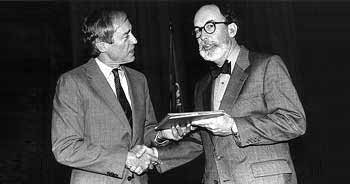
Columbia University President George Rupp (left) presents Henry Allen with The 2000 Pulitzer Prize for Criticism.
Winning Work
By Henry Allen
Washington Post Staff Writer
Martin Van Buren may have been president of the United States, but he might as well have run a bottle factory in Schoharie, N.Y., for all that his photograph reveals.
NEW YORK –– The famous are different from you and me--they look as if they expect to be photographed by strangers.
"That guy over by the elevator," you say. "He looks like he's somebody."
"He just looks like he's somebody," your date says.
"Then why were those people taking pictures of him?"
"I don't know. Maybe he's on a show I don't watch," your date says.
"That doesn't mean he's a nobody," you say.
"It doesn't mean he's a somebody, either."
"You got your pocket camera?"
The famous have the crisp grace of people walking onstage. They have eyes that wait for something and look for nothing. They seem to be suppressing smiles. Their faces are as gymnastic as an upper-middle-class British accent, right down to an affected stutter of shyness or agoraphobia. They seem to either bask or suffer in the sunlight of attention--either way, they look as if they expect to be photographed.
They know that if you're not staring at them, you're not staring at them on purpose. They never stare at you--they're wary as women on American sidewalks, never catching anyone's eye lest they seem to demand recognition, which you may deny them out of modesty, perversity or one-upmanship. They seem to strive for celebrity and anonymity at the same time in the manner of that ultimate exemplar of American celebrity, the Lone Ranger.
This look and this sort of fame would not exist without photography, a point made confidently by a happily vulgar show at the Museum of Modern Art. Guest-curated by Marvin Heiferman and Carole Kismaric, it explodes on the curved walls like a 1960s pop-hip, sensory-overload extravaganza inspired by Marshall McLuhan. Very un-MoMA--no high-church rectilinear modernism for this show.
Here are photographs of: Elvis Presley, Marilyn Monroe, Tom Thumb; Bob Hope on a Dixie Cup lid; Eleanor Roosevelt advertising Simmons mattresses in 1928; the Ronettes; Sylvester Stallone with his fist under the chin of Donald Trump, a big-guy shot we thought had died when Toots Shor's closed; Abraham Lincoln, the first presidential candidate to advertise himself with photographs by the thousands; Gary Cooper, beautiful with an unlit cigarette (why unlit?); O.J. Simpson in a mug shot as handsome as the passport photos of F. Scott Fitzgerald and actress Marilyn Miller (they all knew how to be photographed--they were famous); the desperately beautiful Greta Garbo; Monica Lewinsky looking tired and worldly as she stands before a huge studio camera, waiting to look perky, innocent and a little sad, as usual; Queens housewife Ruth Snyder, who would be forgotten if it weren't for the Daily News photograph of her electrocution; Friedrich Nietzsche and Frederick Douglass back when people believed that they should strike public poses in front of the camera, fiercely noble instead of pseudo-intimate, languishing on a couch like Jean Harlow with a nipple pressing against her dress, or grinning over his shoulder like Clark Gable.
Here are: baseball cards, posters, publicity stills, advertisements, newspaper photographs (or "art," as newspaper people say), a Marilyn Monroe necktie, a Joe DiMaggio Wheaties box, Natalie Woods's diary in a movie magazine, Michael Jordan batteries, and film and television clips.
Here's a clip of George Bernard Shaw strolling up a curved gravel path--photography's classic, can't-miss, winding-road composition. He ignores the camera--why do we all know that you should never look into a camera if you're walking toward it, whether you're famous or not? He then defies decorum by blowing his nose several times, vigorously, thereby attaining pseudo-intimacy with the viewer, an intimacy he toys with by giving a lecture on how to pose for the camera.
"It's not always as necessary for me to look as genial as I do now," he points out. "I shall put on the terrifying look, the Mussolini look." He covers his face with his hands, then spreads them like a curtain to reveal a profound frown, while pointing out that Mussolini has to look like that all the time, as opposed to Shaw, who can and does pose any way he pleases.
Like other famous people, Shaw understands that even--or especially--in his relationship with the camera, he is different from you and me. He manipulates his face and probably the photographer, the setting and the lighting to best imprint himself, not on film but in our minds. For the famous, photography is a technology they can use to their advantage (fame, money) in the medium of our psyches.
For the rest of us, photography is a technology that threatens to destroy the ideal we have of ourselves. Hence camera shyness and the sense that the camera is stealing our spirit. We fear that the photograph will be imprinted in our minds.
Do I really look like that? Why didn't somebody tell me my hair was a mess? Why are my eyes always closed in pictures?
When your photograph does happen to come back as the template of the secret you, the dream you--the wry downturn at the corner of your smile, your hair rising from your scalp as thick as DeKalb hybrid wheat--you know deep down that it's a lie. But please, no, let it be true.
"I like to think that I look like that on my better days," you say to your wife.
"You have moments like that," she says, after a thoughtful pause. "Sometimes right after you've tied your necktie."
Yes--possibly at the moment when you're imagining being looked at, even photographed at the annual company dinner.
(An aside: A simple solution to camera shyness, used with success by the author: Decide that all pictures of you are good because they are pictures of you.)
If you were famous, you'd probably just evaluate the pose and the lighting, and make a mental note to avoid that photographer again, the one who keeps looking for an expression of existential bewilderment, in the manner of Richard Avedon in Rolling Stone.
Avedon photographed a whole magazineful of celebrities, and almost all of them have the grim, suspicious and bewildered faces of people wondering just how long it's going to be before the shutter clicks. (What a satisfying noise that is, that liquid sliding finality that means something is either over or just beginning in your relationship with either your public or your dreams of yourself.)
Avedon persuaded viewers that he'd X-rayed the public persona of Hubert Humphrey and revealed the cancerous truth of a disappointed, bitter man. You can make anybody look like this if you wait long enough to take the picture. It's a trick. All Avedon did was to catch Humphrey in the pose that Avedon liked, rather than the one Humphrey liked. It was still a pose.
And why this exhausted pose? Because in Avedon's biggest years, the mark of truth was suffering, angst, futility, plaintiveness and so on. He shows us the illusion of truth, a pernicious undertaking. Walker Evans, a truth seeker, disliked photographing the famous. He understood that fame and photography were a vulgar, volatile and shallow combination. A famous face is "a cliche," he said.
Also, the power of a picture of a celebrity comes not from the photograph or the celebrity, but from us. We believe that President Kennedy's charisma and Madonna's protean charm are inherent in them. Instead, they're inherent in us, and only the power to elicit them belongs to the Kennedys of the world.
A bald and peckish Australian named Clive James is famous in England for his books and television shows. I saw him at a news conference once. He possessed the careful demeanor of the expectation of being photographed. There was something off-kilter, though, as if he'd overdressed a bit or had walked into the wrong news conference. The problem was that he was in America.
As he has said: "I'm a complete unknown in the U.S. I'm facing terminal anonymity. It feels insanely strange and abnormal. It feels like something has gone wrong. Elton John told me he almost went crazy in China--a thousand million people who didn't know who he was. He couldn't cope with China."
Fame is not something that travels with someone like type O blood or carry-on luggage. In other words, it's something that we confer. It exists in our creation of a face and persona in our minds.
Since the camera arrived around 1840, the face has become the blazon by which we know the famous. Before then, most people didn't know what their rulers looked like except from coins. Paintings and statues were seen mostly by the elite. Engravings of paintings circulated among 18th century people, but even then the famous and the ordinary were divided in appearance not by faces but by entourages and clothing. Kings wore crowns, queens wore tiaras, dukes wore silver buckles on their shoes. In ordinary clothes, Henry VIII would have been a nobody in the English countryside. Sumptuary laws forbade the lowers to dress like the uppers.
With the camera, the face and figure became the mark of fame. Until the 1870s, the subjects of daguerreotypes and other processes posed as if they were posing for portraits. (Lincoln was one of the first to understand that photography demanded an illusion of intimacy.) With faster film and subjects' savvy, ease replaced stiffness as a virtue, personality replaced character and, among politicians, charm gained ground on issues and ideology.
Also, the photograph gave us a piece of celebrities, a relic like the finger bone of a saint. You're looking at the actual chemistry altered by the actual light that bounced off Rita Hayworth like a million pool balls. What you're looking at is the final, dropping ball in a myriad-ball combination. Click, click, click, thump, and she's rocking in the leather netting of your brain.
By the 1930s, Vanity Fair would satirize the phony candor and intimacy of celebrity photographs. The piece was called "With Knife and Fork Through Celebrity-Land," and it's on display here, with some of the great ones hoisting chow toward hungry mouths: Herbert Hoover, Calvin Coolidge, Franklin Roosevelt, Jack Dempsey and Judge Kenesaw Mountain Landis, among others.
The camera not only erased the difference between public and private life, it erased it between fame and celebrity--fame being a reputation for achievement, celebrity being a reputation for being famous. It created fame as a consumer item. Elizabeth Taylor once said, "I am my own commodity," which is to say she is celebrated not for achievement or fame but simply for being Elizabeth Taylor, a figure whose essence is startlingly obscure considering all the publicity about her divorces and illnesses. It's this commodity status that Martha Stewart and Ralph Lauren strive for--mysterious and intimate at the same time, beyond achievement or media glitter.
There are lessons to be learned here: Martin Van Buren may have been president of the United States, but he might as well have run a bottle factory in Schoharie, N.Y., for all that his photograph reveals. Most photographs reveal nothing about achievement or character anyway, despite all the rubbish written to the contrary and a belief in face-reading that makes as much sense as phrenology. You don't learn from the face; you learn from the pose. What is this guy trying to tell you with his lifted brows and jutting chin?
(It's interesting to note that the physical freaks here don't care much about the way their faces look--they know you want to look only at their deformities.)
But all photographs of the famous are photographs of deformities of one sort or another. How hard they work to subliminally distort their faces into an ideal you'll install in your sad little soul. And how little fame it takes to start the posing and distorting.
A 1950s yearbook from Lewisville (Tex.) High School shows "the most handsome boy," Wayne Pennington, and "the most beautiful girl," Janice Dunne.
Like so many campus celebrities, they have acquired--almost against their will, it seems--the look of the famous, as if they expect to be recognized and photographed. Were they changed forever? Were those the best years of their lives? When they get off hotel lobby elevators nowadays, do people say, "That looks like somebody who's somebody"?
© 1999, The Washington Post Company
By Henry Allen
Washington Post Staff Writer
Annie Leibovitz is a Norman Rockwell of our time--which may say more about our time than it says about Leibovitz, whose show "Women" opens today at the Corcoran Gallery.
As Rockwell was once, with his paintings in the Saturday Evening Postand a thousand other magazines of a lost America, Leibovitz at 50 is our most famous commercial artist, with three decades of mind-kneading photographs: photo spreads, journalism and covers for Vanity Fair, Vogue and Rolling Stone, advertisements for American Express, the Gap, the dairy industry (the milk mustache series) ... on and on.
As for what this says about our time, Rockwell painted a nation that believed it could be saved by God, family and character. In the latter-day fading of those verities, Leibovitz has celebrated our belief that we can be saved instead by fame, uniqueness and personality.
Like Rockwell, she's more famous for her work than for her personality. What you think about are her subjects, imagination and craft.
You think of her older pictures of Whoopi Goldberg in a bathtub of milk, a naked John Lennon huddled against a preoccupied Yoko Ono hours before he was shot to death, model Lauren Hutton mostly naked and immersed in Mississippi mud, John Belushi standing by a nighttime road like a hitchhiker you pass by--a figure whose story you don't want to hear because the ending might include you; Robert Penn Warren with his bare old-man's chest, Clint Eastwood looking foolish wrapped in rope on the set of a western. (Her men have tended to look more troubled than her women -- weaker, vaguer, more endangered. Is that part of our time, too?)
And like Rockwell, she's at her best when she's over the top, giving us hyperreal photographs that are like framed theme parks, like advertisements for a reality we want to believe in--even though in Leibovitz's work the reality may be depravity, shallowness or doom. Rockwell supplied a demand for optimism and coyness, while Leibovitz has catered to the mayfly pessimism and irony of an age that values hipness. Both have understood their markets, and the America of their time. You find yourself rooting for them.
So you want Leibovitz's show at the Corcoran to be better than it is.
There are about 70 pictures of women here--famous, infamous, un-famous, rich, poor, dignified, foolish. Among the famous are: Hillary Rodham Clinton, Gloria Steinem, Katharine Graham, Lil' Kim, Eudora Welty, Joni Mitchell, Courtney Love, Toni Morrison, Barbara Bush, Betty Ford, Patti Smith, Madeleine Albright, Christiane Amanpour, Gwyneth Paltrow, Martina Navratilova, Martha Stewart, Oprah Winfrey, Drew Barrymore and three of the Flying Wallendas. Then there are: teachers, farmers, soldiers, a washerwoman, a mountain biker, two victims of domestic violence, a law professor, a go-go dancer and so on.
They are strong, assertive, confident, muscled, busy, enduring, patient, intelligent, dignified, aristocratic, wise, determined and beautiful, though seldom mysterious and rarely sexy.
Encountered separately inside a magazine, each of these pictures might look good. Witness the examples in the November Vogue. Assembled here in the show, and in the accompanying book, they come to have a disappointing deadness. Such is the affection that Leibovitz inspires, though, that you keep giving her the benefit of the doubt.
So what if the picture of the first lady looks like an advertisement for something, maybe for the fountain pen she holds as she appears to study a typewritten document on a porch at the White House? Or her gold-rimmed coffee cup? Isn't the commercial slickness here forgotten when you look at writer Jamaica Kincaid, slightly puzzled inside a picture of charming improvised formality based on the looping of a garden hose? And isn't the flatness of the Kincaid picture compensated by the bizarre beard and mustache on the naked performance artist Jennifer Miller? From the neck up she looks like a 19th-century dandy patronizing a New Orleans cathouse with flocked red wallpaper. From the neck down, she looks like the staff. Why did Leibovitz take this picture? As art? Propaganda? Document? Shock value?
You want to ignore your suspicions that if these prints were any smaller--the smallest is 3 by 4 feet, the biggest nearly 6 by 8--they would lose a lot of their impact and revert to the androgynous gloom of the book.
You want to ignore the seams--the pictures are so big that Leibovitz and Washington gallery owner David Adamson had to paste his Iris prints of them together, and even a team of painting conservators couldn't brush in enough color to keep some subjects from looking as if a sniper were watching them through cross hairs: the beautiful and ironic odalisque of performance artist Karen Finley, for instance.
You want to ignore a conceptual tremor induced by the strain of looking at a show assembled from work done variously as art, document, testament, illustration or journalism.
Rebecca Denison, head of an AIDS organization, is painted dark brown with words written in white: "wife," "daughter," "courage," "pain," "we remember," "Becky," "Katie," "love." Her fists are painted red, as if they were boxing gloves. The picture seems a relic of the confrontation politics of the '70s, of the days when anger was a virtue and an entitlement.
Haydee and Sahara Scull, twins and painters in Miami Beach, hold hands and wear identical yellow dresses and hats in a picture that Diane Arbus could have turned into a little vision of horror. But Leibovitz, with happier heart, turns it into a celebration of everything from color film to middle age to sisterhood. And are we supposed to find something in common between the painters and the AIDS woman, or any of the other pictures in the show?
Leibovitz has worked hard to make the show a statement with rhythm and meaning. In her New York studio, she built a model of the Corcoran's second-floor galleries and moved tiny pictures from wall to wall. She achieved the best possible hanging of what feels like a one-woman group show, or a collection of illustrations for a story that hasn't been written yet.
Yet, taken by themselves, these pictures keep failing to transcend something. What's holding them down? Technique? Intent? Printing? Subject matter? Vision?
Then you look at Ila Borders winding up to throw a baseball in a vast twilight of clouds and distant trees, and you know you're looking at a whole picture that stands by itself, no questions asked, the seams forgotten--art.
Sometimes Leibovitz cooperates in the pose--the picture of dancer Terese Capucilli gets its primal drama from fingers and face tightened with fight-or-flight ferocity. Leibovitz holds it all together with perfect little touches of red bordering cloth to one side, speckling Capucilli's skirt and lipsticked on her mouth.
Sometimes she subverts the pose--why that scatter of chairs behind Betty Ford, and why the scatter of expression on her face?
Sometimes you don't know who's in charge: Model Jerry Hall elected to wear gold lame slippers, an ankle bracelet and a fur coat while she nurses Gabriel, her son with Mick Jagger, and gives the camera the glance of an indignant old call girl. Hall must have known what the costume meant, but did she know the face that Leibovitz would select from the photographs she took? Maybe she did. Maybe the joke is on all the viewers who are horrified by the depravity of all these cheesy contradictions. In that case, Leibovitz and Hall have created a theater piece for still camera.
Perhaps there's a paradox at work: When you try to do a little of everything, there's always something missing. And to the extent that you may be disappointed in this show, you're proving how much you continue to believe in the work of Annie Leibovitz.
© 1999, The Washington Post Company
By Henry Allen
Washington Post Staff Writer
The darker reaches of the human soul had meaning when Brassai was making his most famous photographs--the early '30s when Freud was serving up naked lunches of id meat, when surrealism draped the crutches of reality with the melting watches of nightmare, when Peter Lorre scuttled through the movie "M" as a child molester flashing the whites of his eyes at the vaulting shadows of film noir, and young men and women in search of adventure and authenticity found it in the neighborhoods of crime, vice, drugs and lowlife.
Now, of course, the real horror is not meaning but meaninglessness-- motiveless movie monsters, the desecration of the Madonna at the Brooklyn Museum of Art.
There's another difference: When Brassai took his camera out into the Paris night, he was reveling in the humanity-- not the alienation--of the whores, thieves and gay demimonde he photographed: the naked brothel staff with dimpled bodies whose shapes remind you of Babe Ruth, the lurking darkness beneath bridges, the cafe girl with spit curls and a bad tooth lolling heavy-lidded between two sailors, the quarreling lovers in their adamance and sulk, the two thugs of the sort who robbed and beat Brassai during his nighttime investigations.
He's not a voyeur or an exhibitionist--so many 20th-century artists are one or the other. Instead, he's what the French call a flaneur, a spectator, a man who finds his satisfaction in observing the public scene. He doesn't reveal things because they are already revealed. Like some sort of perfect husband, he takes the world for granted and loves it madly at the same time.
The ultimate cosmopolitan, Brassai (a pseudonym taken from his Hungarian home city of Brasso) is surprised by nothing and fascinated with everything in these 113 images at the National Gallery of Art. Even darkness itself has a weight of its own in a silhouette of Saint-Germain-des-Pres rising over the meager lights of the Cafe des Deux Magots or the rooftops of Paris beneath the fairy lightness of the distant Eiffel Tower.
To take pictures of darkness, Brassai had to take pictures of lights as well--the muzzy lamps along the Pont Neuf, the lamp glowing over the bearded watchmaker, the gritty glow of light on wet paving stones. But unlike the photographic masters who captured light, Brassai saved his love for darkness.
He was born Gyula Halasz a hundred years ago. His father was a professor who loved Paris and took a very young Brassai there, a trip that left him with lifelong memories.
In World War I, Brassai fought against France and the Allies. Afterward, in the chaos of the postwar world's revolutions and redrawing of borders, he joined a number of other Hungarian writers and artists in Germany. He worked as a journalist and studied drawing and painting. He arrived in Paris in 1924, accomplished at the bohemian skills of ducking cafe bills, sleeping all day and rambling endlessly through Paris. He had big eyes on a sly face that reminded people of a turtle. He was famously charming.
He wrote to his parents about his early days in Paris: "Could I have done anything wiser in the first few months than to do nothing? . . . There is, indeed, an abundance of things that demand one's attention here, particularly for a person like me, who is intrigued by every particle of this living monster, its outside, its inside, the way it breathes, lives, and moves."
He had the animist's knack for seeing life in everything--bridges, chimneys, a cast of Picasso's hand, graffiti, a cobblestone, whatever.
In 1930, after years of despising photography, he began taking pictures under the name of Brassai--he saved "Halasz" for the paintings, which are forgotten now.
He recalled: "How I became interested in photography reminds me of a story Isadora Duncan once told me." It seemed Duncan had an accompanist she detested. He played well for her dancing, but "his face drove her to such distraction that she had a screen placed between them when she practiced." Her hatred grew. One day they were riding across from each other in a carriage. "The carriage came to an abrupt stop and she was catapulted into his arms. She said to me, 'I stayed there; I understood it was to be the greatest love of my life.' . . . So too with me and the camera. I once detested her."
So he loved what he hated, hated what he loved. He animated the inanimate, he looked at high and low society with the same eye--in other words, he was the sort of threshold creature who is most comfortable being in two worlds at once, reconciling these contradictions by simply accepting them as the nature of the great genius world he saw around him.
He studied technique, and used an eccentric collection of plate cameras, even after the 35mm Leica became the chosen camera of photographers with similar interests. He didn't care about taking endless shots of the same scene, 35mm-style, feeling that if he limited himself to two or three exposures, his picture would seem less accidental and more his.
He posed his cafe pictures, having his subjects wait while an assistant set up a reflecting screen and then held the flash powder that exploded into light that produced softer edges than flashbulbs--and earned him the nickname "The Terrorist" from Picasso. He made reality into a stage set, then waited and waited until his subjects' attention wandered back to their cafe concerns, their nightlife personas. The powder erupted, the shutter of his Voigtlander camera clicked. In other words, he waited till the people stopped posing for the camera and resumed posing for the world. He took no interest in photographing the secret souls of his subjects--he found their true life in public poses.
Still, secrets arise. The young Salvador Dali is not the later madman ringmaster leaping about with waxed mustache--he looks like a guilty, arrogant young man wishing his mother would spank him for being bad. Picasso, the demigod of 20th-century art and a genius at looking like a genius, has an unsettling humanity here. On the other hand, Henry Miller and Jean Genet pose with their cigarettes and their penetrating writers' stares--dust jacket stuff.
Knowing events to come, you have a hard time not seeing degeneracy and horror when you look at "Lesbian Couple at Le Monocle, Paris," from 1932. A wistful woman in an evening dress cuddles against a woman in necktie and man-combed hair, identified later as Violette Moriss, a weightlifting champion who had a double mastectomy. During World War II, she collaborated with the Gestapo and tortured women prisoners. The Resistance killed her in 1944.
Brassai's first great success came with a book called "Paris at Night" in 1933. He planned another book, "Secret Paris," but it wasn't published until 1976 as "The Secret Paris of the 1930s." Meanwhile, he sold his prints to magazines and published other books.
As he moved out of his lowlife period, Harper's Bazaar hired him to shoot the high society of Paris. The challenge of high and low society were much the same. He wrote: "Entry into both these exclusive societies, made up primarily of the idle, is not easy. Each has its regulations, its customs and usages, its moral code, its affairs of honor. . . . Even the languages are similar, both tainted with snobbery."
In "Evening at Longchamp Racetrack," he records the beauty and desperate calm of the rich as he might have recorded the brutalities and calm desperation of the poor. He staged pictures of the rich just as he did with the poor. "Leaving the Opera" shows a couple drifting happily down a staircase, with geometric shadows mounting the steps behind them in black-and-white squares.
Brassai verged on the surrealistic with his plunges into the depths of the everyday world. He photographed a loaf of bread baked as a face and wrote: "What I love, and passionately, is to give to a 'worthless' object a value, by the simple act of discovering it." The bread, he said, was "the spitting image of French life: optimistic in spite of it all, limited to immediate pleasures, egocentric, gourmand."
If he seems to be condescending to reality here, consider another statement, derived from the realism of Goethe, whom he admired: "The world is richer than I."
In other words: Who was he to judge? He photographed whimsy and damnation, bridges and nudes with the same dark delight. He was not above little puns: a group of policemen in serious parley beneath a picture of a kitten; or nuns in Monaco with their vast headdresses erupting with the same exotic delight as the cactuses along their path.
His sunlit pictures demonstrate his amazed modesty in the face of the world: a vast outdoor staircase breathing with a saturnine eternity, or his picture of the farmland geometries of the Isere Valley proclaiming a triumph of the good earth.
Nowadays, Brassai is a hero of a lost world, a world of modernist sensuality and modesty in the face of reality. He savors the world with a bohemian joy that would be undermined by irony, alienation and the puritanism of postmodernism and political correctness.
Brassai died in 1984. His wife Gilberte, whom he married in 1948, lives on in Paris. The show runs through Jan. 16.
'BRASSAI: THE EYE OF PARIS'
"Brassai: The Eye of Paris," celebrating the centenary of the artist's birth, opens today at the National Gallery of Art and runs through Jan. 16. The museum is on Constitution Avenue NW between Third and Seventh streets. It is open Monday through Saturday, 10 a.m. to 5 p.m. and Sundays 11 a.m. to 6 p.m. Admission is free. For information call 202-737-4215.
By Henry Allen
Washington Post Staff Writer
If Hemingway had been young in the '60s, he might have challenged himself with huge doses of LSD, in the manner of Ken Kesey, the charismatic novelist and near-Olympic heavyweight wrestler of the time. Instead, he did it with all his assaults on his own genius-monster soul, concussions, falls, manias, depressions, hyper-realities, airplane crashes, profound and prolonged drunkenness, rage, charm, paranoia and fame. The scars are obvious in the face you see here.
Ernest Hemingway took off most of his head with a shotgun 38 years ago, but he still has the power to make you feel like a failure.
He's the father you could never live up to or he's the father you wished you'd had, an alpha male, a master of charm, cruelty, celebration of life and the nerve-end clarity of modernist beauty.
It doesn't matter how much you've done of the boxing, bullfights, love, despair, drinking, war and all the other Hemingway experiences that young men have collected like items on a Hell Week scavenger hunt. No matter how hard you've tried, you've still failed to live up to Papa. Or you can decline to try--you can reject this persona as a mindless macho fantasy. Either way, it's hard not to have played his game.
He lingers in your psyche like an unquiet spirit. He has been one of the larger gods of the American pantheon in this century--his hundredth birthday is July 21.
Hollywood producer David O. Selznick said: "Hemingway is himself a star. He is box office." He was a star who performed not on stage or film, but in still photographs, back in the great age of the still photograph. There were thousands and thousands of them. Some are on view at the National Portrait Gallery in "Picturing Hemingway: A Writer in His Time."
Man Ray made art portraits of him in Paris. Robert Capa made combat portraits of him in the Spanish Civil War. Between 1941 and 1961, Life magazine ran 16 features on him. In 1957, Yousuf Karsh took the famous picture of Hemingway as the grizzled lion in what appears to be a fisherman's turtleneck sweater. (In fact, the sweater came from Christian Dior in Paris.) As that portrait was becoming the prime icon of Hemingway, John Bryson took the 1958-59 pictures that in hindsight seem to show the alcoholism, paranoia, depression and physical disintegration that would converge in his suicide in 1961.
If he was a god, you see it in some of these photographs--a modern god of contradiction, irony and hypocrisy. As classical scholar Caroline Dexter points out, the Greek gods embodied contradictions as a group. Hemingway did it in himself. Cover half of some of these portraits and you see cruelty; cover the other half and you see wistfulness. There's the hunter in one eye, the hunted in the other; a mouth sneering on one side and resigned on the other.
In a family picture from 1906, you see the bully in his mother's face and the melancholiac in his father's, while little Ernest stares unhappily away from them and his three sisters. (A brother would come later.)
In 1918, a jolly and wounded Hemingway leans on crutches in Italy. Behind him, by odd coincidence, is a mustachioed figure who looks like the darker, harder Hemingway of the 1920s.
His face is hard to resolve. You keep thinking about it. This is why he was a star of still photographs. And this is why you can't live up to him. He's too complicated to imitate. He was gourmet and gourmand, stoic and hedonist, the man of action and the man of letters. He was a grinning omnivore and he was a lonely samurai surrounded by an entourage he'd turn against, now and then, out of the sort of meanness or dark delight that would prompt him to shotgun sea gulls when the fishing was bad.
He charmed people and he bullied them. Sometimes there wasn't any difference.
Writer Nathan Asch recalled Hemingway in the 1920s, a celebrity in Paris's Anglo-American literary community even before he'd written much of anything. He'd lope past the Cafe Dome in his sneakers and his presumptuously handsome vitality, looking as if he were on his way somewhere else. "Arms waved in greeting and friends ran out to urge him to sit down with them. . . . He wouldn't quite recognize who greeted him. Then suddenly his beautiful smile appeared that made those watching him also smile."
In other words, Hemingway put his friends' dignity and status in jeopardy, and then rescued them from the jeopardy he'd put them in. They were threatened. They were saved. They were charmed.
The show is photographs, paintings, dust jackets, magazine coverage, bits of manuscript and adolescent writing. Exhibits become reliquaries: There are pieces of mortar shrapnel taken from his body after a few weeks on the front lines as a Red Cross ambulance driver handing out candy and cigarettes, and the medal he won for helping others after he was wounded. You see pictures of the people he cultivated--Ezra Pound, Gertrude Stein, Sherwood Anderson, John Dos Passos, and Sylvia Beach--owner of the Paris bookstore Shakespeare & Co. Ordinarily, they'd be the context in which he moved, but Hemingway has become the context in which they moved.
His coarseness and lying were repellent. His charisma was godlike.
Gen. Charles Lanham described a dinner near the German border in the fall of 1944: "We all seemed for the moment like minor gods, and Hemingway, presiding at the head of the table, might have been a fatherly Mars delighting in the happiness of his brood."
A correspondent-artist named John Groth recalled that when Hemingway left the front to go back to Paris, the place now seemed "like a French town that had lost its cathedral."
As long as 70 years ago, he made young men feel like failures because they did not live "well and truly" the way he did. But he neglected to mention that it helps if your wife has enough money to pay for the skiing at Schruns, the bullfighting at Pamplona, the villa in Key West, the farm in Cuba, the marlin fishing, the safaris, the decline into drunkenness and celebrity and the years after World War II when more was being published about him than by him, especially after he won the Nobel Prize in 1954.
He brutalized his body with booze and accidents, but didn't smoke because tobacco dulled his sense of smell. He was a big-shouldered aesthete who found meaning in nothingness. In "A Clean, Well-Lighted Place," a waiter thinks: "It was all a nothing and a man was nothing too. It was only that and light was all it needed and a certain cleanness and order."
He told F. Scott Fitzgerald that "we are all bitched from the start and you especially have to be hurt like hell before you can write seriously." Part of his gift was making the hurt seem beautiful, a gift comparable to Emily Dickinson's, a hyper-real vision like the world magnified through a drop of water.
A short story named "In Another Country," about a wounded officer in World War I, begins with what amounts to a hymn to death and bitchedness.
"In the fall the war was always there, but we did not go to it any more. It was cold in the fall in Milan and the dark came very early. Then the electric lights came on, and it was pleasant along the streets looking in the windows. There was much game hanging outside the shops, and the snow powdered in the fur of the foxes and the wind blew their tails. The deer hung stiff and heavy and empty, and small birds blew in the wind and the wind turned their feathers. It was a cold fall and the wind came down from the mountains."
This was Hemingway's style at its best: sensual, ironic, tough, sensitive. To the extent that his writing alone created the Hemingway who lives on in our imaginations, this is it.
To the extent that photographs created him, a lot of them are here. You may have seen them before, but the point of this show isn't the unearthing of hidden character but celebration of a cult-hero--a god, celebrity, icon and mystery. This mystery deepens when you study the darkness of Hemingway's persona even in pictures of him grinning. You sense a no-win game going on. It's a game in which the closest thing to winning is losing on your own terms, which he did with his shotgun, but didn't when you consider a promise he made to his son never to kill himself, and a Hemingway motto that biographer Michael Reynolds quotes in his perceptive catalogue essay: Il faut (d'abord) durer. (First, it is necessary to endure.)
By the end, Hemingway had worried for decades that like a god--Dionysus, Osiris--he would be torn apart by mortals in the form of critics, imitators, envy freaks and parasites. They tried. But Hemingway's real tragedy may have been a secret pride that only Hemingway was a hero worthy enough to destroy Hemingway. This is a match-up you lose, but it produces a hypnotic incandescence, "gives a lovely light," as Edna St. Vincent Millay said in her poem about the candle burning at both ends.
If Hemingway had been young in the '60s, he might have challenged himself with huge doses of LSD, in the manner of Ken Kesey, the charismatic novelist and near-Olympic heavyweight wrestler of the time. Instead, he did it with all his assaults on his own genius-monster soul, concussions, falls, manias, depressions, hyper-realities, airplane crashes, profound and prolonged drunkenness, rage, charm, paranoia and fame. The scars are obvious in the face you see here.
His suicide should have seemed fitting, and it should have absolved your failure to live up to him, but no.
It's not just the writing. He retains his power over ambitions of the American soul--his sons have brought out a Hemingway line of furniture that doesn't seem to resemble the slipcovered zebra-skin bohemian tackiness of his houses, but has the Hemingway name on it. Earlier, they brought out a line of sporting goods and a Hemingway shotgun. Catalogues like to throw in references to Hemingway as a paragon of knowing how to live. There are Hemingway conventions and contests (fishing, look-alike, writing), a PEN literary award, a Hemingway Mont Blanc pen (though he wrote with a pencil), a street named for him in Pamplona, a Hemingway Bar at the Paris Ritz, the Papa Doble daiquiri at the Floridita in Havana, and Hemingway houses open to the public.
Discussions of Hemingway tend to veer toward winnowing out the good stuff from the bad. "For Whom the Bell Tolls" goes, then "A Farewell to Arms," until the only novel you're left with is "The Sun Also Rises," until somebody points out that his short stories were better than his novels, anyway, and you pare them down until you're left with a half-dozen.
Odd. We don't do that with Faulkner, but then who would try to sell Faulkner furniture or fountain pens?
By Henry Allen
Washington Post Staff Writer
Think of ideas of Washington, of notions and sidelong glances, memory snapshots, sounds, smells . . . of this accidental city, this sly encampment with the sad ease, lawns and trees of an old colonial capital -- New Delhi, Saigon -- a sense that none of us quite belong here, that we're all obituaries waiting to happen; while at the same time the city of Washington feels like a conspiracy we're all in together, and nobody else in America quite understands, even though they pay for it.
Contradictions everywhere: the offhanded magnificence in democracy's real marble temples that have the poignance of the fake marble Parthenons at old-time world's fairs . . . something ephemeral about a city that looks like it's trying to be its own suburb; with avenues stretching out to the dark fields of the Republic, or, if you head back downtown, avenues converging on cautious monuments of office buildings where sentries guard the even darker doors of empire.
How glorious. How wistful. Neighborhoods of brownstones and bungalows are full of ordinary Washingtonians who've acquired the comfy fatalism of knowing that almost all who come here to be Somebody will end up like those walls of photographs at the Occidental Restaurant -- which is to say they will become Nobody with tidy hair and a frank, hopeful and earnest stare that no one recognizes. The Occidental is the Valhalla of former student council presidents.
Meanwhile, there are other true Washingtonians who live their lives with a Buddhistic acceptance rarely found elsewhere. For them, the frenzy of power and the dreams of judgeships or TV talk shows mean nothing, and they can see through the veils of ambition to Washington as the sensual city that outsiders say it isn't.
They savor its heat and its terrible sunsets mounted for hours over Rosslyn; its mornings of old men coming out to sit on old chairs on old sidewalks in old neighborhoods; the Jusserand bench in Rock Creek Park and other monuments to the forgotten (who was the statued Logan of Logan Circle?); a delicate and convoluted spring as long as a New Hampshire winter; the older generation of taxi drivers who don't so much drive as proceed through the city; the grip 'n' grin congressmen who look like they're wearing wigs even if they aren't; a glimpse of three little girls doing a time step in front of
a stoop on Florida Avenue, slide/clap, slide/clap; the exemplary grace of African Americans who know the secret is not merely looking good but moving well, too, through the endless layers of Washington.
In this city of so much imitation glory and grandeur, an authenticity resides in the black community, from its ancient aristocracy to its newcomers. With their old-family sophistication or rural energy, African Americans come closer than most to believing that they belong here. They seem to have a particular knack for being public people in this public city.
Once there was also an authenticity of seediness about Washington -- the gritty carpets of the Willard Hotel before its renovation; the frayed comforts of the Fairfax Hotel before it became the Ritz-Carlton and then something else and something else again. Biker bars nestled up to the town houses of Georgetown grandees. Drugstores here may have been among the last in America to close their lunch counters. At Schwartz's at Connecticut and R, Charlie the counterman always knew the score if the Senators were playing.
"How they doing?" you'd shout through the door.
"Two to five, bottom of the eighth," he'd say, always putting the Senators' score first.
White House guards looked like they needed to tuck their shirts in. Families slept in parks on hot nights. Pennsylvania Avenue was a promenade of cafeterias, fireworks stores and souvenir stands.
And there were smells, the most authentic experiences of all. What has happened to them? In Takoma Park, an activist complained about the smell of baking bread exuding from the bakery. The smell of baking bread!
And the vegetable smell of heat-wave Washington, the coolness breathing out of metal cellar doors in old sidewalks, the exhaust from Chinese restaurants; the mown grass of spring down on the Mall (why doesn't it smell as good in summer?); the dankness rising from the Potomac at night, a sort of attar of darkness; the wonderful wind that blows over the bluffs of Anacostia, through the trees of the lawns where you study the finest cityscape to be seen in all Washington, which is the view from St. Elizabeths mental hospital; the churches with their incense of colognes, powders, perfumes -- a scent that seems to arise from the floral magnificence of hats that church ladies for decades bought from a milliner named Vanilla Beane out by Coolidge High School; the earth smell of collard greens at an African Methodist Episcopal church lunch; the long-lost beer-funk and peanut-breath of the stands at Griffith Stadium, the vast mildew chill of empty Union Station back when there were pools of rainwater on the floor and birds flying under the vaulted ceiling; the perfume counter at Garfinckel's -- lamps with pleated shades, the Chanel No. 5 in wood-and-glass cases; the smell of tear gas back when riots were coming to seem a way of life, like the 1968 riot after the breakup of Resurrection City on the Mall.
Resurrection City had housed civil rights demonstrators in plywood and canvas, and finally the government tore it down, starting a riot. I remember walking up 14th Street, downtown. On one side of me a skinny black kid was extracting a pair of shoes from a small hole he'd broken in the store window. On the other, white commuters studied their Evening Stars while they prayed for the bus that would carry them away from the terror, the anarchy, the Black Power vengeance of one skinny kid. I seem to recall smelling fear, which there's a lot of in Washington.
There's fear of our minorities, fear of our majorities and fear that our myriad police forces won't keep the fears from coming true. Or will help them to.
Ever since the Soviets tested their first atom bomb, we have feared that our city would be turned into a charred crater at any moment. There's also fear of committee chairmen, judges, lawyers and some peevish beta-male assistant at the White House who decides to turn your life into hell because he can; fear of some young man who will decide to shoot you in the back even after he has your wallet because you disrespected him by running away; fear of ending up in the Superior Court holding cells (which smell so rank that lawyers splash themselves with cologne before they talk to their clients); fear of spending the rest of your life eating lunch in government cafeterias where the steam-table Swiss steak and Brussels sprouts etch themselves into your skin like an olfactory tattoo.
Anyway, things don't smell like much now, and fear is treated with prescriptions for anti-anxiety pills. Authenticity wanes and imitation waxes. We have a new and satanic form of imitation we might call Disneyfication, in which things don't imitate other things, they imitate themselves. In other words, the Washington Monument doesn't imitate an Egyptian obelisk, it imitates itself, as if it had been transported to a theme park as "the Washington Monument."
Washington is particularly susceptible to this, because so many people have ideas, notions and memory-snapshots of what "Washington" is, as opposed to our own pleasant, easy, authentic, real Washington.
It's as if Disney had moved in to clean up Pennsylvania Avenue, to give us John Kennedy's dream of a triumphal way between White House and Capitol. And sometime in the last decade or two, the Capitol dome at night, beneath its spotlights, began to look too perfect to me, as if it were made of plastic, like a full-scale model of itself, which is what Georgetown has looked like, too, ever since the rich people drove all the poor people out of it with that modern American relish for economic segregation.
The great halls of governance around the Mall now have the look of memorials to nothing more than themselves, as if there should be quotation marks around them. "The Justice Department." "The Labor Department." "The Lincoln Memorial." All this imitation perfection is unsettling. It looks a little dead. Couldn't we have saved just one fireworks store or cafeteria?
So much to fear. At the same time, Los Angeles traffic jams and New York manners crowd us, hurry us, frustrate us, but still, Washington remains a pleasant place to live -- adamantly pleasant, as if pleasantness were a founding principle of the city, like beauty in Paris or money in Las Vegas. It's a city of huge lawns and roomy sidewalks and hallways that provoke an impulse to stroll. We are not intimidated by skyscrapers because we don't have any. The huge trees, the fields of the Mall and the deer-thick forests of Rock Creek Park reassure us that we can live here and still partake of the virtues of the pioneers and Jefferson's yeoman farmers.
How pleasant. Please, God, says the Washington prayer, don't let the voters figure out what a good thing they've given us. Don't let us get caught. In other words, the modesty that some attribute to Washington is in fact slyness. No matter how much money we have, we choose to exhibit suburban taste, not big-city style. Big jewelry and big fur are not necessary or appropriate here. Lawyers have clothes tailor-made to look just like clothes that are off the rack. We walk slowly enough that if you're from up North you think we're small-towners, and we walk quickly enough that if you're from down South you think we're efficient. Jack Kennedy spoke the truth when he said that Washington is
a city of Southern efficiency and Northern charm.
At the same time, didn't Duke Ellington derive at least part of his fabulous grace, precision ease and genius of contradictions from Washington, his native city?
Some Americans don't care about Washington at all. To them, Washington isn't a city as much as a mailing address or a dateline or an abstract principle of power or scandal or foolishness. It isn't even a capital as much as the mother board of the American bureaucratic computer, suitable for class visits by high school students.
One suspects that citizens of New York or Chicago would be insulted if somebody in Pocatello talked about their cities as if they were irrelevant or almost invisible. Yet the true Washingtonian, hearing this dismissal in the speech of taxpayers, rejoices. Yes, we've fooled them again. They don't believe we really exist, so they won't stop sending us money. (It's just crazy enough to make political sense.)
Oh, let's not worry about this too much, this reality/unreality business. Reality has always kept a careful distance here, from the quaintness of notions of importance to the alleys full of shantytown ghosts, the single sculls on the Potomac at dawn, pulsing along with their acute aloofness . . . But the old unreality depended on our secret knowledge of how transitory it was. The new unreality depends on the insistence of permanence.
Stop it! Why bother? Except to say that Washington does greet undeniable reality with exhilaration, even a reality as life-snarling as a blizzard. On a hot night once at the Carter Barron Amphitheater, I was sufficiently impressed with the reality at hand that I took a note on it: "The spotlights hissing through the humidity, smoky tubes of light, and beyond them the little smears of fireflies -- it all seems heroic and exhausted, as if the city were under siege and you could hear the artillery in the distance, which you can, sometimes, when the thunderstorms gather over Virginia and Maryland. (And when
the thunderstorms hit, we race around closing windows, feeling so exultant. Hail the size of chickpeas! Golf balls! Canned hams!)"
You feel almost grateful for loony Lafayette Square demonstrators and the sullen weariness of neighborhoods so dangerous that whiskey and lottery tickets have to be sold through bulletproof plastic. The sirens reduce the melody of Washington to the lowest common denominator of stolen cars and heart attacks. The transvestite prostitutes are sad comedy, and the streets called the Riot Corridor 30 years ago are still reminders of the frailty of cultures, black and white, in the face of the sins of rage and covetousness.
And we sift through our private snapshots, incomprehensible to some outsiders -- the smell of air gliding out of underground parking lots on a summer night, the sound of two companies of Marine rifle butts coming to rest in a crash so perfect it is almost a single crack, the clatter of young heels running down the stairs of the Washington Monument, the private certainties and public fears, the temporary feeling that can become a lovely joke. Sometimes, at 4:30 in the morning, Massachusetts Avenue can be so empty of cars you worry that the moving men are about to arrive and remove the buildings, too.
Then it's morning. Smell the trees! Look at that airliner rising under a morning moon! The old men setting out their chairs and the wind stirring the leaves on the bluffs of Anacostia? With pleasures coming this easily, says the true and enlightened Washingtonian, why worry too much about reality?
© 1999, The Washington Post Company
By Henry Allen
Washington Post Staff Writer
Fascism was glamorous--the tailored uniforms, the coy viciousness of it all.
Communism was a gray, baggy-suit bureaucracy that went about its business of slaughtering tens upon tens of millions of people with the bleak arrogance of a state motor vehicle department.
Yes, there were May Day parades, and all the statues and propaganda posters with lifted faces looking at a future hovering like a blimp above a distant stadium. But the soul of communism was a bureaucracy so dingy and paranoid that you wanted to reverse Hannah Arendt's famous phrase and talk instead about the evil of banality.
Joseph Stalin, a hero of banality, is said to have said, "A single death is a tragedy, a million deaths is a statistic."
Sometimes, though, single cases were too important for mere statistics. They required the panoply of denunciation, torture, confession, show trial and a bullet in the head. Then their friends, wives and children were shot or imprisoned. They were tossed into what George Orwell's "1984" called "the memory hole." Their names could not be spoken. Their photographs were destroyed, their very existence denied so that Stalin could head toward the future each morning with a clean windshield and a shoeshine.
The photographs were a problem, because enemies of this importance had appeared in so many of them with Lenin or Stalin. Offices of airbrushers, razor wielders and croppers spent their days retouching photographic history. Is that the saboteur Leon Trotsky standing next to Lenin? Into the memory hole.
They might have come closer to success if an Englishman named David King hadn't spent the last 30 years collecting photographs of the sort now hanging in a passageway at the Newseum in Rosslyn There are only about 30 of them, but they hint powerfully at the story that King tells in his 1997 book, "The Commissar Vanishes: The Falsification of Photographs and Art in Stalin's Russia."
Here's a group shot of 10 high-ranking Communists at the 14th Party Conference in 1925. King tells and shows what happened to them. One named Lashevich committed suicide. Comrade Frunze died--possibly murdered--on the operating table. Smirnov was shot (along with his wife and daughter). Rykov was condemned as a right-wing opportunist and shot. Skrypnik was accused by Stalin of Ukrainian nationalism and shot himself. Bubnov died in the Gulag. Ordjonikidze killed himself at the height of the Great Purges, and Unschlicht was shot. By 1939, only four people were left in the photograph, and Stalin's hair had been tidied.
(Imagine the work that had to be done on photographs of the 17th Party Congress in 1934--out of 1,961 people attending, 1,108 were liquidated, King says.)
Speakers come and go in front of crowds that shrink and swell. Candelabra and pillars are touched in and out. Here's Stalin in a famous Soviet icon, "Friend of the Little Children." He holds a bouquet and a gleeful little girl, Gelya Markizova, while a first secretary of the party, M.I. Erbanov, grins in the background.
A year later, Gelya's father was shot for spying. Then her mother died in a murder that authorities never investigated. Then Erbanov was purged and deleted from the photograph. A sculpture was made, but when rumors about murder circulated, the propaganda value of the image fell, causing the sculptor to be denounced.
Stalin wanted Lenin to be sanctified, and himself shown as Lenin's chosen heir. The retouchers took care of it, erasing all enemies and ambiguities.
Trotsky, Stalin's rival to succeed Lenin, was wiped out of all photographs after Stalin won, though Trotsky himself wasn't killed until 1940, in his exile in Mexico. (In the late 1960s, American student radicals would chant "Off the Trots!" at anti-war demonstrations. Banality has a glamour all its own.)
You might point out that Lincoln credited Mathew Brady with helping him win the 1860 election by retouching a portrait to make his neck shorter and his face younger; that photographers rarely showed Franklin D. Roosevelt in his wheelchair. And advertisers, artists and photographers themselves have been superimposing and airbrushing photographs for more than a century. The famous film of Hitler dancing with glee at the surrender of France was a Western propaganda fraud. And the Postal Service took the cigarette out of Jackson Pollock's mouth when it printed his face on a stamp, thereby improving history. There's a touch of Stalin in us all, perhaps.
Mathew Brady didn't kill uncountable millions of people, however, and he did the retouching better. And he didn't threaten to kill us if we didn't join him in rewriting history in the name of revolutionary truth. We're still allowed to own a picture of Pollock with cigarette. (But should we let our children see it? Oh, the banality of prudery.)
Under the doctrine of "personal responsibility," good Soviet citizens would cut enemies of the people from their books and albums.
Even Alexander Rodchenko, a great photographer of the '20s and '30s, defaced his copy of his "Ten Years of Uzbekistan," leaving faces inked out with a sloppiness that gives them a postmodern touch, as if they were ironic comments on portraiture or photography.
Retouching of photographs and history went on long after Stalin died in 1953. Khrushchev restored people, Brezhnev blotted them out again.
Then when communism was overthrown, crowds throughout the Soviet Union pulled down statues of Stalin and Lenin and destroyed them, too.
The show runs through Nov. 21 at the Newseum in Rosslyn.
By Henry Allen
Washington Post Staff Writer
A century ago, you couldn't escape all the bull roar on what it meant to be a man, my son, with Jack London and Teddy Roosevelt rampaging through war, peace and wilderness--the whole Cold Shower and Dumbbell School of manliness and Arrow-collar profiles.
Nowadays--for the whole last third of this century--it's been women's turn, and the roaring has been about femininity, feminism, females. So it's no surprise that the National Museum of Women in the Arts would hang a show called "Defining Eye: Women Photographers of the 20th Century," with 81 photographs by 80 female photographers collected by psychotherapist Helen Kornblum, who "has an abiding concern for the broader topic of women's issues in our time," according to the catalogue.
This is a fine show of a lot of wonderful pictures. But before you've even gotten to see them, you say to yourself: Oy vey. You're mistaken in your fears, as it happens, but who could blame you? Survey shows are lame enough, and lamer still are stunts like showing only one work by each artist, and then loading the catalogue with gender analysis.
Not that the catalogue doesn't have good, if obvious, points to make. Essayist Olivia Lahs-Gonzales writes: "Women have a unique experience in the world and of the world." Indeed.
And yes, female photographers have been overlooked by collectors and art historians. However, given the fame of Berenice Abbott, Diane Arbus, Margaret Bourke-White, Imogen Cunningham,Gertrude Kasebier, Dorothea Lange, Annie Leibovitz, Mary Ellen Mark and Marian Post Wolcott, all of whom appear here, even a polemicist would have a hard time complaining about the obscuring of female photographers by patriarchal hegemonic discourse, etc., etc.
This kind of language does creep into the show occasionally, as in one wall text observation that the "triangular dynamic of the delineator (photographer/artist), the observed (subject) and the observer (consumer/viewer) leaves no opportunity for a woman's definition of herself."
Such hooey!
More important is: What about the pictures? Are they any good?
Yes, they're very good. And if you can get away from the chin music about triangular dynamics, you can see them jumping off the wall as graphic truths about reality, the human nervous system, cultural archetypes, beauty, horror, our animal lives as humans and our human lives as animals. And humanity's life as women, which is different than its life as men.
Besides thinking about women's issues, Kornblum has collected pictures that are beautiful, to use a word that may be coming back into fashion. They have form, contrast, balance, surprise, grace, wholeness and impact. They gather your awareness into a center, and the best of them are universes in themselves.
Joan Myers's dented "Pan and Cup" is more than a document of battered lives at a World War II Japanese internment camp. And even without the rush of nostalgia for Alfred Stieglitz's great New York gallery, Dorothy Norman's "Walls, an American Place," shot in an empty room full of art history, is a fine example of the most fundamental subject of black-and-white photography, which is light and darkness.
How did Nell Dorr get that soft-pencily grace in the shifts from light to shadow in "Mother and Child (Happiness)"?
How does Diane Arbus find doom and horror in the same subject of mother and child, entitled "Loser at a Diaper Derby"?
Here's Marion Post Wolcott's powerful, confident and womanly Vermont woman in a housedress, addressing a town meeting. She and her audience seem to be not just lit but dug up and dusted off by Wolcott's flash, like some archaeological archetype. A womanly" woman--interesting how, nowadays, the word has been consigned to the same dustbin of political awkwardness as "manly."
Here we wander away from formal considerations and into the subjects.
These pictures are about being, not doing; about women as objects and commodities rather than workers, mothers, bearers of culture, producers and organizers of human reality.
Women and girls sit, stand, wait and stare. Mannequins, costumes and masks hide humanity. Alma Lavenson vanishes in the infinite recesses of the "Self-Portrait" that shows her hands focusing a tripod-mounted camera taking a picture of her hands focusing the camera. Nan Goldin offers the alienated, preoccupied, bored and irritated "Gina at Bruce's Dinner Party, NYC," all by her heavy-lidded lipsticked self.
In one of the show's rare pictures of a male, Annie Leibovitz gives us "Jerry Garcia, NYC" in a hotel accompanied only by his guitar and his reflection in a big mirror. Inge Morath's "Siesta of a Lottery Ticket Vendor," in Madrid, shows a woman sitting next to a building with a newspaper covering her face. Ruth Orkin's "American Girl in Italy" endures the leers and whistles of a street full of men.
These women are. Few of them do, unless you count taking a photograph or posing for one.
Such terrible solitude! What happened to all of the sloganeering about how sisterhood is powerful with its sharing and caring and consensus politics? This show rejects that line, showing women alone (except for the women taking their pictures), and straddling lines between private and public lives, nature and pose, self and mirror, self and others.
Carrie Mae Weems has a woman and a girl putting on lipstick in portable mirrors ("Untitled," from the "Kitchen Table" series). Together in their aloneness, two females in private communicate. So many mirrors! So many women facing away from the camera to be unseen at all! And so many double exposures here, as if reality is never more absolute than the next layer or retake.
Sandy Skoglund shows woman as public, low-culture commodity in a photograph of bikinied Barbie dolls lying on a beach of french fries.
The loneliest picture of all may be the view of a featureless roadside in Barbara Ess's "Untitled." She looks at the Great Nothing that presents itself so often to long-distance drivers and the clinically depressed in America. The vision here appears as a fuzzy hole in a rectangle of blackness that seems to put the photographer inside something, a car, maybe, and the landscape outside this car, with an uncrossable distance between car and landscape, inside and outside.
Menace abounds. Soldiers search Martha Rosler's "Red Stripe Kitchen" in her Vietnam-era series, "Bringing the War Home: House Beautiful." Flor Garduno's "The Woman" holds a bundle of dead lizards that evoke primal horror of woman as witch or princess of the primeval, notions that were banned as male stereotype at one point, then revived at another, if memory serves. Elsewhere: Hands drip. Mouths drip. Age withers. Custom stales. The late and beautiful Hannah Wilke betrays her own beauty in a self-portrait with hair rollers and a face speckled with chewing gum shaped like vulvas.
The catalogue says: "Referring at once to scarification as practiced in Africa and its relationship to Western rituals of beauty, the gum forms also refer to the atrocities committed by Nazis on the bodies of Jewish women."
Maybe so, but let's have the picture speak for itself. It may once have succeeded as propaganda--as a confrontation with the mutilation of women--but now, as a work of art, it goes beyond confrontation to become a cruelty worked upon the viewer. It either condescends to people who don't take it seriously or pains the people who do, while amusing those who are in on the joke that it's really propaganda.
No big deal. The combined efforts of hooey-mongers can't obscure the fact that there are fine, beautiful, mysterious and thrilling pictures here that transcend gender-game tricks to reveal themselves as--dare we say it--art that happens to be by and about women.
Defining Eye: Women Photographers of the 20th Century, at the National Museum of Women in the Arts, 1250 New York Ave. NW, through Jan. 9.
© 1999, The Washington Post Company
By Henry Allen
Washington Post Staff Writer
All photographs are abandonings. Once there was a moment, the click of a shutter, and now it's gone, a framed ghost, abandoned by time and failing memory. This is the sentiment at the heart of photography's mechanical mystery.
In Maxwell MacKenzie's gigantic black-and-white landscapes, however, the moment in question isn't just the moment the shutter clicked, but a moment that slipped by decades or even a century before, when something went wrong and a farm began to edge toward ruin.
MacKenzie is a native of western Minnesota and he has driven uncountable thousands of miles across the West to photograph these ruins before they're all gone--leaning barns and windowless houses jutting up like wreckage in oceans of furrowed wheat and sorghum, architecture that looks more like a visible absence of something, like a missing tooth, than it looks like a presence of sun-curled clapboard and tatters of tar paper. It looks like ruins, in other words, relics of dreams that didn't work out.
America has decay but it's short on ruins. How odd that MacKenzie would find ruins in Minnesota, South Dakota, Montana and Idaho, out where there's nothing between you and Siberia but a barbed wire fence, as they say.
These pictures continue a theme MacKenzie has been exploring since he studied photography at Bennington College in the 1970s. He's a commercial photographer now, specializing in architecture, but when business gets slow, he heads for his home country and searches out what's left of a pioneer belief that it was possible to become Jefferson's yeoman farmer.
What's there now is mostly industrial farming, with its air-conditioned tractors with subwoofer sound systems, and huge metal sheds. But lingering amid the terrible economic truths of modern farming, MacKenzie will find an abandoned homestead. He shoots it with a Fuji Panorama camera and enlarges it with technology that produces prints up to eight feet long, prints so big he just pins them to the walls at the American Institute of Architects, unmatted and unframed.
In most of the 23 pieces in "Abandonings West," the building stands in the middle of the picture. Surrounding it is land, lots of land, with an armada of clouds above, proceeding through a sky often rendered black by the red and polarized filters he uses to control the strangeness of his infrared film.
Something about infrared film makes pictures feel like thoughts, a little spooky, as if the camera has recorded something going on inside your head and projected it onto a wall.
In a picture titled "Near Fish Lake, Otter Tail County, Minnesota," the white trees stand like wonderfully artificial 18th-century renderings of leaves hinting at bowers beneath, shelter from the prairie winds and the relentless horizon. Up a small hill stands a ruined house. You wonder what moment began its long decline. A leg broke, prices fell, an angel of the Lord appeared in flames and said, Go thou from this land.
The panoramic pictures themselves have the answer: the land. There's so much land, so little house. Everything is tiny here, including you. You're at the mercy of land and weather that are merciless. In the woods of the settled East, it's possible to imagine spirits and ghosts watching you, but the Great Plains don't care any more about you than the ocean does. They aren't dangerous as much as they're unforgiving. Pioneers may have thought: If I do everything right I'll be fine.
Wall text argues otherwise, quoting from memoirs and books about boredom, bad luck, debt, despair; about the blizzard that leaves you burning your inside walls to stay alive because if you go outside for firewood you'll vanish; about a summer erupting with wheat until the grasshoppers darken the sky and eat everything--wheat, vegetable garden, even the leaves on the trees; about a husband who tells his wife he'll be right back after he rides out to round up two cows--she watches him ride around the cows and keep going and he never comes back.
Every year now, country fire departments torch these ruins for practice sessions. Wheat and sorghum farmers fill the cellar holes and run their furrows over them. The abandonment itself is erased. MacKenzie is preserving not only the collapse of dreams, but also the architecture that arose to express them.
These buildings were cheap, balloon-frame things, put up quickly so that farmers could work on their plowing. They have a rectilinear naivete, a defiant quality insisting that 90-degree angles and plumb bobs will show the prairie who's boss.
We've had no shortage of photographers making pictures of barns in glorious, weathered color. MacKenzie used to work in color, though panorama gave his stuff an edge that wouldn't quite work on a bank calendar. Then he wondered how abandonings would look in black-and-white, and after a lot of experiments, he settled on the infrared film.
These pictures put you between nature and society, dreams and ruins, something and nothing. How American, except that they show ruins.
For so long we envied Europe its ruins. We studied paintings of Corinthian columns peeking from the rubble of lost cities where peasants and goats frolicked in a poignancy that verged on the smug. (Poignancy is what we had before irony.) We recited Shelley's "Ozymandias," about the folly of belief in architectural immortality, but we admired the Europeans' acceptance of their ruins, of the risings and fallings of civilizations as part of life and nature.
We admire Europe's sophistication, we condemn its decadence. We've tried to find what the Founding Fathers called a "middle ground" of the agrarian ideal between wilderness and civilization. Hard as we've tried to make it work with everything from homesteading to a Teddy Roosevelt investigation of the collapse of small towns to the back-to-the-land movement of the '60s and '70s, the dream keeps eluding us, maybe even betraying us. Hardly anyone lives on a farm anymore--about one in a hundred Americans.
Back when more than half did, some of them lived in the houses that MacKenzie photographs, driven by the hopes that he captures along with the architecture.
Abandonings West, photographs of the Dakotas, Idaho, Montana and Minnesota by Maxwell MacKenzie, is on exhibit on the first and second floors of the American Institute of Architects, 1735 New York Ave. NW. The building is open 8:30 a.m. to 5 p.m., Monday through Friday. Admission is free.
© 1999, The Washington Post Company
By Henry Allen
Washington Post Staff Writer
Jocks talk about being "in the zone," where every putt drops, every three-pointer swishes--they've got a "hot hand," as crapshooters say, and they can't lose for winning. Maybe everybody gets these streaks: Car salesmen will tell you that the salesman most apt to sell the next car is the one who sold the last car--he's in that no-money-down, hot-hand zone where Zen archers are supposed to be all the time.
Or Henri Cartier-Bresson, the 91-year-old hot hand who has 70 portraits on view at the National Portrait Gallery.
His photography is the art of the zone. Photography is an athletic endeavor, as it happens, demanding animal reflexes and instantaneous intuition, especially when you're playing the 35mm available-light game, bridging art and journalism, toe-dancing around the world with a Leica M3 tucked under your elbow, waiting for what Cartier-Bresson famously called "the decisive moment."
As a young man, the son of a rich businessman in Normandy, he consorted with surrealists and other rebels against bourgeois reality as we'd known it. What he took away from them was a belief in intuition and the wisdom of instant action.
In an introduction to one of his many picture collections, he wrote: "It is essential, therefore, to approach the subject on tiptoe--even if the subject is still life. A velvet hand, a hawk's eye--these we should all have. It's not good jostling or elbowing. And no photographs taken with the aid of flash light either, if only out of respect for the actual light. . . . Of all the means of expressions, photography is the only one that fixes forever the precise and transitory instant. What is there more fugitive and transitory than the expression on a human face?"
Here are 70 expressions on 70 faces, most of them famous:
William Faulkner, full of "furious immortality," to use his words, stares out the right side of a famous portrait, while two rat terriers (Faulkner wrote about them as "fyce dogs") stare to the left with a similar alacrity. One of those terriers is stretching, and the stretch gives the picture a flexed quality, a hint of impatience or arrogance, maybe. Behind them all a mud puddle, some flowers, a sun-spotted lawn, a clapboard house drift off into a day like a million other days.
Edith Piaf, who rallied the sick at heart with her anthems of sadness and defiance ("No, I Regret Nothing"), stands in checked jacket with blouse spread over her collar in the style of 1946. She was the daughter of a prostitute and a circus contortionist, a child of the streets. In other photographs she sometimes exhibits a drastic, vulnerable Gallic record-album face. Here, she seems to have surrendered her public demeanor to reveal an awareness of simple mortality, of the terrible truth that life is a more ordinary business than we like to think. An American master of the zone, Roy DeCarava, once took a picture of Billie Holiday that did the same thing this one does--tell you where her music came from, a squalor of cruelty and hope.
Somebody once said that Alfred Stieglitz controlled not only every picture he ever took but also every picture ever taken of him. Here, though, in 1946, the year of Stieglitz's death, Cartier-Bresson discovered an old man whose face seems to tote his magnificent and patriarchal chin the way his chest might have borne medals from forgotten wars. He's slouched on his bed, cleaning his glasses, with the look of a man who knows exactly how much good greatness does you, though there's no way he could explain to you the sad triumph of it all.
Walker Evans once said that he stayed away from photographing the famous because their faces were "cliches." He also said that he didn't think portraits revealed character. He may have been right. For one thing, character is motion, a series of decisions--unphotographable.
Fine. The greater joy of these Cartier-Bressons is neither the fame of the subjects nor the illusion that he has bared their souls. What he shows is faces changing, crossing thresholds of emotion. He arouses in you the piquancy of recognition, the sense that you've seen something important, something that has the small sharpness of a memory that otherwise seems pointless. It's as if you're seeing through Cartier-Bresson's eyes or he's seeing through yours--a comfortable camaraderie either way.
When Cartier-Bresson photographed him in 1961, Arthur Miller was author of "Death of a Salesman" and half of a doomed marriage to Marilyn Monroe. He had created an American myth, and then become part of one with Marilyn. This picture shows us a sad, suspicious, aloof and exhausted man. Knowing what we know about him, we can see the model of hubris, of someone who'd gone too far.
Without that knowledge we see an unhappy man, certainly, with his face, hand and sweater lit by diagonal stripes of sunlight from a window. Diagonals make strong pictures. They're like stripes on the banner of early 20th-century modernism--Duchamp's "Nude Descending a Staircase," the Russian constructivists and so on. Cartier-Bresson doesn't use them much as he might, though. It's almost as if he's decided they're too easy and obvious. So in the context of this show, they stand out--they have the emphatic quality of italic type, and make you feel that something is being insisted upon. A presence? An absence?
Cartier-Bresson gives you art, impact and reality in these portraits whether you know the subjects or not. Some of them you might not: Louis Aragon, Barbara Hepworth, Martine Franck, Robert Flaherty placed in calm temples of verticals and horizontals--table tops, doorways, wall and ceiling edges. The compositions tend toward the classical. They're lyrical and reassuring. Even the diagonals don't so much add force to the composition as guide your eye to the face in question: Albert Camus is nearly skewered like St. Sebastian with the casual angles of his coat collar, the cigarette in his mouth and the blurred lines in the background.
It's these compositions that are the forgotten miracles of Cartier-Bresson's decisive moments. He captures a face moving inside the happy Grecian-urn stillness of balance and proportion. He does it in a sixtieth of a second. Then he prints the picture full-frame, no cropping--like an infinite series of instant replays of the moment. He makes it all look so easy, which is to say there's a sort of perfection here, the perfection that 20th-century artists and writers have sought in the notion of epiphany, the whole truth in an instant.
It's the truth of the ordinary world.
Everyone looks normal, like the sort of people you might encounter on any given day, living in a world of form and completeness. Their humanity finds infinite room for expression in actual reality as we used to see it in the photojournalism magazines of Cartier-Bresson's heyday, the most famous being Life. After World War II, Cartier-Bresson, Robert Capa and some other photographers founded the Magnum agency to supply pictures for these magazines. You could make a living doing nothing else, back then.
The only freak on view is the poet and traitor Ezra Pound, a literary fan-dancer whose work continues to enthrall aging audiences at the burlesque house of high culture. He smolders in light and shadow, a freak of evil, the only figure here that the photographer might be said to have judged.
Cartier-Bresson believed in reality. He still does, to judge from the drawings he's been doing in recent years. He believed in reality with a good faith that warms these portraits--a faith we've spent decades deconstructing into subtexts of victimization, neurosis, mutation, monstrosity, deviation, solipsism, narcissism. Our artists nowadays tend to reveal reality as a collection of extremes whose shock value makes us mistake the authenticity of our alarm for the reality of their existence.
Now, the frauds of consumerism, politics, rage-as-virtue, niche marketing, arcane philosophy and esoteric literary criticism have made "reality" something you put in quote marks. Something good is supposed to come out of all this. While we wait, there are the comforts of Cartier-Bresson.
'TETE A TETE'
The portraits in "Tete a Tete: Portraits by Henri Cartier-Bresson," selected by the artist from work made over six decades, are on exhibit at the National Portrait Gallery through Jan. 9, when the building is scheduled to be closed for renovations.
The gallery, at Eighth and F streets NW, is open from 10 a.m. to 5:30 p.m. daily, except Dec. 25. Admission is free.
© 1999, The Washington Post Company
By Henry Allen
Washington Post Staff Writer
Time is a medium of photography, the way canvas is a medium of painting. A photograph isn't just paper and chemicals, it's also time, the instant and visible sense of something that happened in a moment Back Then--not a vision of the lost past as much as a vision of a lost and antique present.
That lost present is almost as antique as photography itself in a new show at the National Portrait Gallery called "A Durable Memento: Portraits by Augustus Washington, African American Daguerreotypist."
There are 33 of them--most of them 3 1/4 by 2 3/4 inches--in the brass frames and velvet cases that Washington sold along with his portraits in Hartford, Conn., and in Liberia, where he immigrated in late 1853.
The Hartford pictures look like biopsies of slightly awkward moments in the lives of the middle and upper classes.
Does this specimen quality derive from the occasional spots of tarnish on the silver coating of the plates that Louis Daguerre had invented in France only a few years before? Or from the rigid, seated poses that make couples look a little silly, like old folks riding a roller coaster with their grandchildren? From Victorian pomposity? From the fact that after the Virginian aristocracy faded from public life, few Americans had public faces that were at ease with fame and authority?
Here is the distinguished Eliphalet Adams Bulkeley in a circa-1853 portrait, looking like a man listening to a magazine salesman at his door. His wife, Lydia, has a preoccupied wariness about her. Son Charles may well have spent an hour practicing his look in front of a mirror. Daughter Sarah is most graceful of all, with her hair pulled straight and shiny as the silk on Christmas tree balls, and ribbons on each wrist. Talk about moments in time: She later sailed with her husband, a clipper ship captain, to China, where the ship was dismasted and fetched up on an island of pirates who killed them both and scuttled the ship, or so newspapers speculated at the time.
Perhaps the awkwardness of these and so many other daguerreotypes comes from the fact that people didn't know how to pose for the camera. They hadn't trained their faces to bounce light toward lenses with preferred shadows and angles. Now, we start our training as babies. Smile. Smile for Daddy. Just a li'l tiny smile.
Unlike painters, daguerreotypists couldn't create the proper pose on the canvas when the subject failed to provide it. Daguerreotypists couldn't light their subjects' way to nobility or ease, because they had to use windows or skylights for illumination--no bounce flashes or fills. And no darkroom manipulation. Daguerreotypes had no negatives. The plates they were shot on were the plates that were delivered to customers. And the exposures took up to 15 seconds--a long time to hold still any face but a tensed one.
Of course, a pose is just another attempt to defeat time, to express some eternal virtue, moral or aesthetic.
Washington knew this. The exhibition has at its center one of the small jewels of the Portrait Gallery's collection--the earliest known photograph of abolitionist John Brown, circa 1846 or '47.
In his left hand, Brown appears to be holding what may be the banner of his "Subterranean Pass Way," his plan for a more violent version of the Underground Railroad. He holds his right hand at shoulder height in a pose of vow and defiance. In fact, it was his left hand he held up. Daguerreotypes were mirror images: Right and left were reversed. A moment's study reveals the manipulation--his vest buttons appear on the left side. But the public pose and rhetorical gesturing took precedence over literal reality.
Or did the posing problem come from differences in white and black culture?
The portraits from Liberia show a group of Western-clad expatriates from America--wise, alert, thoughtful, admonitory, eager, confident. . . . Perhaps by the late 1850s, when these pictures were made, people had seen enough photographic portraits that they had taught themselves how to look in front of a camera. Perhaps these immigrant Liberians were confident enough in their authority, virtue and beauty that they could face down Washington's camera with ease, and forestall time with their certainties and nobilities. They succeed--these pictures are much less pieces of time than the Bulkeley portraits. (It was this sort of success that made popular what we used to call "candid" photography, which tried to defeat the poses that defeated time.)
Washington, the son of a former-slave father and a mother who was a "native of South Asia," was born in Trenton, N.J., in 1820 or 1821. He attended largely white schools until the early 1830s, when the rising outcry of abolitionists such as William Lloyd Garrison provoked a backlash that closed many schools to blacks. He fought his way through an education in various schools in New York state.
In 1841, Washington used his connections in the abolitionist community to get into Dartmouth College in Hanover, N.H. He didn't have the money to stay there. After a search for teaching jobs failed, he learned the new Daguerrean art, as it was known. He went back to Dartmouth, but found he couldn't both study and do portraits.
In 1844, he arrived in Hartford, where abolitionism had strong supporters, and began making portraits. His advertisements promised low prices, "distinctness, softness of light and shade," and so on. His pictures cost as little as 50 cents apiece.
Like other free blacks, he worried not only that white laws would enslave them, but also that African Americans would never be accepted by European Americans. He considered resettlement in Canada, the West Indies or South America before resigning himself to Liberia, which had recently become an independent republic.
He took his camera with him, and made portraits along the West African coast.
He also became a prosperous farmer and a government official, and established a family whose importance lasted until recent political upheavals. He died in 1875, in Liberia. There is no known portrait of him.
© 1999, The Washington Post Company
Biography
Henry Allen, culture critic for the Washington Post, is twice a finalist for the Pulitzer Prize, and winner of the American Society of Newspaper Editors prize for distinguished commentary. He has been Graham Hovey Lecturer at the University of Michigan and taught an honors course in culture and meaning at the University of Maryland.
Born in Summit, New Jersey in 1941, he is a Marine veteran of Vietnam, and a graduate of Hamilton College, where he won the American Academy of Poets prize. He covered the White House and Capitol Hill for the New York News, and joined the Washington Post's Style section in 1970. He was a National Endowment fellow at the University of Michigan in 1975-76.
He is author of a novel, Fool's Mercy, a collection of essays, Going Too Far Enough, a poetry chapbook, The Museum of Lost Air, and a hardcover version of his Washington Post series on living in the American century, That It Felt Like, forthcoming from Pantheon Books in September.
He lives in Takoma Park, Maryland, with his wife, Deborah, a caterer. He has three children.