The New York Times, by Holland Cotter (The New York Times)
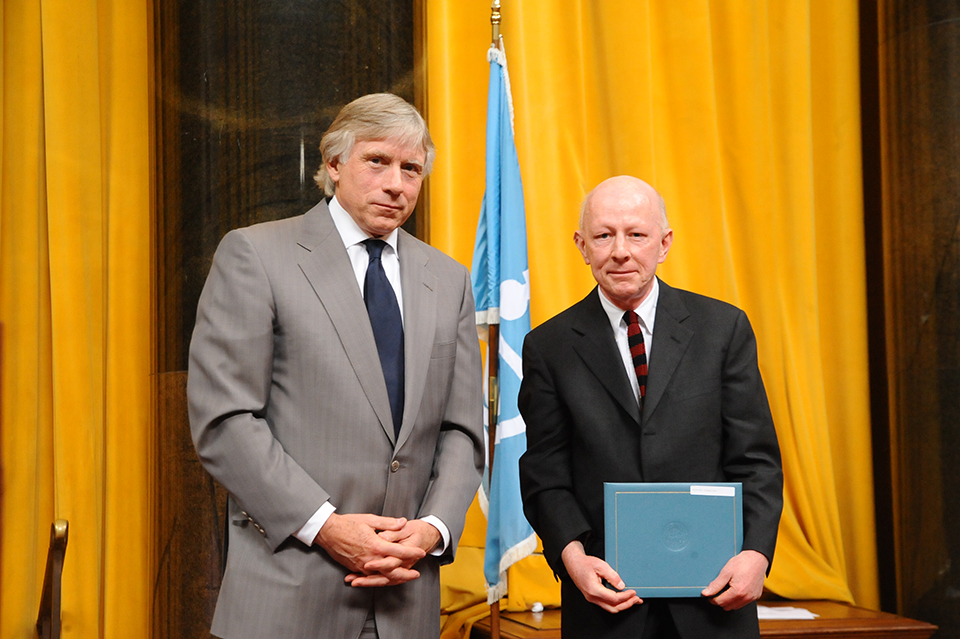
Lee C. Bollinger, President of Columbia University (left), presents the 2009 Criticism prize to Holland Cotter of The New York Times.
Winning Work
By Holland Carter
Michelangelo was a terrible kvetch. His back forever ached; popes were slow with the paychecks; the local food was always an insult, a disgrace. No one worked half as hard as he did, and slacker artists made him nuts. “Draw, Antonio; draw, Antonio; draw and don’t waste time,” he scrawled on a sketch he gave to a lackadaisical young pupil and studio assistant, Antonio Mini, in 1524.
He gave Mini many drawings — two trunks full, according to one account — as he did to several other pretty men he taught. You’ll find a choice example from the Mini cache — a stormy, swirling study of a muscular male leg — in “Michelangelo, Vasari and Their Contemporaries: Drawings From the Uffizi” at the Morgan Library & Museum. That sketch is just one of 79 16th-century Florentine works, shaped into a thematic exhibition that would give even the fault-finding master scant cause for complaint.
For Michelangelo drawing was the most practical and personal medium; it was a laboratory, a diary, an end in itself. If you could do a perfect drawing, he came to think, why bother to turn it into a painting or sculpture? Perfection in any form was the goal. One of the most famously perfect drawings he made, “Bust of a Woman, Head of an Old Man and Bust of a Child,” is in this show.
Of the three figures, the woman is the most vivid and polished. With her chiseled features bordering on masculine, her breast-baring gown and horned helmet of braids, she blends Renaissance neo-Classicism with proto-Mannerist fantasy. She looks completely at home in the mannerist phase of our own postmodernism, and was hugely influential in her time. Everyone wanted to make art this good and this strange.
The matter of influence is important. It is one reason that 16th-century Florence is usually cast in art history books as something like the Age of Michelangelo and the Michelangelettes, or Michelangelini if you prefer, referring to the many students and emulators who toiled in his shadow. The title of the Morgan show seems to echo this interpretation, though the curator, Annamaria Petrioli Tofani, a former director of the Uffizi in Florence, has done something more interesting. Through her selection of artists she has drawn a picture of Florentine art not as a heroic, strictly top-down hierarchy but as a collective endeavor. This was exemplified by the decorative plan organized by Giorgio Vasari for the Palazzo Vecchio, the hulking fortress-palace in the center of Florence that had been city hall since the 14th century and later a Medici residence.
Heroes come first, though. Among them was Jacopo Carucci, called Pontormo (1494-1556), who zealously scrutinized Michelangelo’s work, then took it in a new direction — away from a reliance on natural forms — to create an intensely personal, conceptual style known as Mannerism. In Pontormo’s hallucinatory altarpiece of the Entombment at Santa Felicita in Florence, mourning figures float around the body of Jesus like a funerary wreath of pink and blue clouds. We are in the zero-gravity realm of mind and spirit, not on earth.
At the Morgan two side-by-side studies of a seated male on a single sheet of paper illustrate the transition between these realms. The figure in red chalk on the right looks grounded enough; the figure in black chalk on the left, though, is a snarl of snaking lines. It’s as if Pontormo were drawing a constantly moving model and trying to record each motion in an overlaid stop-action sequence. We don’t see a solid figure; we see the vapor trails of moving atoms.
Pontormo was a difficult character who ended up living in paranoid isolation. But for art as a record of neurosis, nothing quite compares with the work of his exact contemporary, Giovan Battista di Jacopo, known as Rosso Fiorentino, or the Redheaded Florentine, who all but erased the line between spirituality and satire.
A Rosso drawing of the Virgin and Child surrounded by saints is a brittle, twisting affair of posturing figures in a depthless space. It looks the way Gesualdo’s music sounds. It could be sincerely devotional; it could be a satire of devotion. More peculiar still is a presumably secular image of a nude woman sketched on an oddly cut sheet of paper. Is she pregnant, or just out of shape? Or does she represent a foreign, Gothic standard of beauty? (Dürer was hot in cinquecento Florence.) And what act or thought has prompted her look of languidly shocked distress?
We’ll probably never know, just as we’ll never know where piety ends and devilry starts in Rosso’s religious art, or what led to his death, reportedly a suicide, in 1540.
With younger artists, like Bronzino (1503-72), we are in a more consciously stylized Mannerist phase. The subjective energies that charged the drawing of Rosso and Pontormo are all but gone. In their place we have the chilled, expensive exquisiteness of a court art. A Bronzino drawing of a buff male nude might as easily have been based on a sculpture as on a live model. It appears to be made of stone rather than flesh.
What links all of these artists is patronage. Each of them at one time or another worked for the Medici family, the ruling dynasty of Florence. And each of them, early or late, contributed to the decoration of the Palazzo Vecchio. And by focusing on this link Ms. Tofani transforms the show from a survey of Uffizi treasures into a concentrated historical essay, one in which Vasari (1511-74) assumes a leading role. Vasari is best known now for his “ Lives of the Artists,” the series of biographical essays that supply much of our firsthand knowledge of Italian Renaissance art from Giotto onward. But he was admired in his day as a cultural polymath, a painter, architect and writer who was also an entrepreneurial art-world insider.
He was a familiar type, one common in New York today. Professionally and socially ambitious, he made his way with shrewd judgment, acquired sophistication and engaging but dissembling charm, the charm of a back patter who is also a backbiter. His artistic talents were broad but thin, made up of well-schooled expertise and a knack for imitation. Because he lacked originality, he could mold himself to the needs of any patron, and he became house artist to rulers of the era.
It was largely for his connections that Cosimo I, the Medici grand duke of Tuscany, hired Vasari in 1555 to bring some order to the decoration of the Palazzo Vecchio interior. With a handpicked crew of artisans, Vasari began replacing the accumulation of older, piecemeal works — Michelangelo, Leonardo da Vinci, Pontormo and Rosso had all contributed to the palace — with a unified visual program that was essentially a walk-in piece of Medici propaganda.
Vasari was also a chief painter of the new scheme, and an entire wall of the Morgan’s gallery is devoted to his drawings, some for the Palazzo Vecchio. They range from sketches for an allegorical ceiling design to a swooning study for an altarpiece to a worked-up image of the young Cosimo dressed in Roman armor and lording it over his political foes.
To see so many Vasari drawings — there are 14 — makes for an interesting study in personal style, mostly because none is apparent. You can tell a Pontormo or Rosso at a glance. To scan a dozen Vasaris is to see a dozen artists, all related, all slightly different, some more imaginative than others.
This also applies to the selection of drawings by several artists who worked under Vasari on the Palazzo Vecchio, in the majestic civic halls or in the Mannerist jewel box called the Studiolo. Some of these artists are familiar to even beginning students of art history. Alessandro Allori, who had studied Michelangelo’s work in Rome, is one; Santi di Tito, leader of an anti-Mannerist, return-to-naturalism movement, is another. His murmurous art — a sketch of a sleeping child is as soft as a lullaby — stands out in a room of operatic voices.
Not all the artists display such assurance. Girolamo Macchietti (1535-92) had a fabulous hand, but could made mistakes. In his study of a male figure made for the Studiolo, the left leg is, to my eye, slightly off; it doesn’t quite belong to the body it’s attached to.
Michelangelo, of course, would have spotted this in a flash and delivered a rebuke. (Draw, Girolamo, draw!) And he might have had problems with another Michelangelino, a whippersnapper named Francesco Morandini (1544-97), known as Poppi, at least until he saw the drawing titled “The Punishment of Titius” in the Morgan show.
It is Poppi’s copy, exacting, almost stroke for stroke, of a drawing that Michelangelo had done decades earlier, in 1532, as a gift for Tommaso de’ Cavalieri, his inamorato at the time. Imitation may be the highest form of flattery, but copying is also a form of love, as Michelangelo knew. “Poppi?” you can almost hear him say, “He’s young. He’s got a lot to learn. But the kid’s all right.”
© 2008, The New York Times
By Holland Carter
If a painter can be judged by the love he inspires, Nicolas Poussin (1594-1665) was one of art history’s favorite valentines. Corot, Delacroix, Constable and Cézanne all adored him. So did Picasso and Matisse. Nor were artists his only fans. The 19th-century English critic William Hazlitt surpassed himself in his praise of Poussin and may well have introduced his work to an already deeply Poussinian John Keats.
And the romance continues. The wall labels in “Poussin and Nature: Arcadian Visions” at the Metropolitan Museum, one of the first major Poussin shows since the 1994 Paris Grand Palais survey and the first ever to focus on landscapes, read like mash notes, with paintings and drawings referred to, one after another, as “astonishing,” “enchanting,” “splendid,” “marvelously beautiful,” “sublime.”
In other circumstances the words would sound like hype. Here they have the ring of anxious rapture. It’s as if the exhibition’s curators — Keith Christiansen of the Met and Pierre Rosenberg, director emeritus of the Louvre — were saying, “You may not find these pictures gripping at first, but trust us, once you understand their moral passion and Classical poise, you will.”
Classical schmassical. Who cares about that? A century ago the Met’s Greek and Roman galleries would have been the most crowded rooms in the museum, shrines to purity and idealism. Today the 19th-century galleries get the heavy traffic. We don’t want to know where Western art came from; we’re interested in the less-than-ideal, time-stained places it ended up.
Besides, no one believes anymore that the Classical world was the sole source of Western culture. Art isn’t pure. Golden ages were not golden. Arcadia, that pollution-free rustic Eden, was a pipe dream, nothing more. And so the notion of Classicism, once so central to our thinking, has moved off to the side, where, too familiar to be exotic and too remote to feel alive, it is associated with outdated monuments and academic art.
This is where “Poussin and Nature” comes to the rescue. Deftly paced, modestly proportioned, it is the quietest, most intimate-feeling major exhibition in town. It is also one of the moodiest, with images of blue skies and battering storms, languid love and violent death, in tense coexistence. Together, the 40 paintings and dozens of drawings demonstrate an old but very modern truth: Classicism is the sun-facing side of Romanticism. Poussin encompassed both.
Mr. Christiansen and Mr. Rosenberg are right in thinking this may not be apparent at first. In the earliest paintings the artist is still feeling his way into a career, taking his cues from 16th-century Venetian painting, Titian in particular. That was in the early 1620s, after Poussin had left home in Normandy and established himself as a painter in Paris, where he found a patron who took him, via Venice, to Rome.
Even with glowing references, he had to scramble a bit in that competitive town. When commissions were scarce, he turned out erotic mythological scenes for the open market, “Venus (or a Nymph) Spied On by Satyrs” being one. The voyeuristic antics in the foreground are the picture’s obvious lure, but once you notice the stormy vista of fields and hills in the background, the picture gets interesting, acquires layers. Suddenly this is an image of sensuality under threat, bared flesh under darkening skies.
If Poussin borrowed the flesh from Titian and the forms from the antique sculptures that cluttered Rome, he experienced the landscapes firsthand on rural hikes outside the city. For all their delights, these were essentially working tours, mobile sketching sessions. Examples of landscape drawings that emerged from them, some polished, others notational, are in the show — they could easily be in a show of their own — though distinguishing exactly which are by Poussin and which by his various emulators is a scholarly problem. Enough to say there are fewer Poussin drawings today than there were a couple of decades ago.
Soon enough prestigious jobs, including an altarpiece for St. Peter’s, came his way, and in 1640 he was invited to return to France as official painter to Louis XIII. What should have been a peak professional moment turned into an unhappy interlude. Poussin disliked court life and balked at the decorative projects he was expected to engineer.
Within two years he was back in Rome, working for a small circle of patrons who shared his fascination with science, neo-Classical philosophy and politics and gave him his lead in art. Like the scholar-artists of ancient China, Poussin gradually detached himself from public life. He went into retreat and put his art into reverse, bringing what had once been background forward, concentrating on the subject he cared most about, nature.
What he produced, though, wasn’t nature painting in the strict sense. It wasn’t a physical transcription. It was painting as a mode of thinking, the way certain poetry is, like Keats’s late Romantic odes, with their antique references, modern speculation and sensual delirium, each element checking and fueling the others. Most of Poussin’s landscapes continued to be stage sets for mythological or biblical scenes. But the actors grew ever smaller, their actions more ambiguous, the settings more dynamic and enveloping, and more specific. They are fantasies with minutely observed realistic details.
In “Landscape With Orpheus and Eurydice,” depicting the marriage of the doomed couple, the figures in the wedding party suggest a generic ballet ensemble, all flying gowns and antigravitational grace. But why does that building on the horizon look familiar? Because it appears to be the Castel Sant’Angelo, a Roman landmark in Poussin’s day and our own. The other novelty here is that it seems to be going up in smoke. The Eternal City, it seems, isn’t so eternal after all.
In another fabulous later picture, we see the philosopher Diogenes discarding his drinking cup, his last worldly possession, as he transfixedly watches a youth sip water directly from a stream. The verdure that surrounds them seems almost surreally moist and fresh-budded — a mescaline vision of nature, each leaf and pebble individually defined and vivacious, as if viewed through the philosopher’s newly unburdened enlightened mind.
Not all the paintings read so clearly. Decades of research have failed to uncover a precise source or explanation for the story in “Landscape With a Man Killed by a Snake,” with its serpent-entwined corpse, livid light and grand-opera setting. It’s art as a declaration of psychic emergency.
And for a painting like “Landscape With a Calm,” no narrative seems intended. What we have instead is a Classical pastorale, an Arcadian souvenir, a golden-age snapshot of placid water, grazing flocks, palatial buildings and sun-brushed Olympian peaks. If the scene looks too good, too innocent of corruption, to be true, that is surely the point, and Poussin makes it clear.
In the near distance a mounted horseman streaks out of the picture. Where is he off to, and why the rush? Shadows are seeping from the stand of lush trees to the left, casting a watchful shepherd in shade, dimming the color of his poppy-red tunic. Even in Arcadia time is passing, noon moves toward night. That’s why the painting’s mood is both sweet and stabbing, almost shockingly elegiac, like the sound of certain music by Handel, like Lorraine Hunt Lieberson singing “Ombra mai fu.”
You’ll discover all of this, or your own versions of it, in the Met exhibition, along with the enchantments, splendors and marvelous beauties that the curators promise. If you have never associated Classicism with passion, or Romanticism with passions held in check, you may begin to after you spend time with Poussin. And if you spend enough time, you may even find yourself falling a little in love with an artist whose great paintings have the gravity of existential testaments and the sometimes startling intimacy of billets-doux.
“Poussin and Nature: Arcadian Visions” is at the Metropolitan Museum of Art through May 11; (212) 535-7710, metmuseum.org.
© 2008, The New York Times
By Holland Carter
In the 1970s the African-American artist Adrian Piper donned an Afro wig and a fake mustache and prowled the streets of various cities in the scowling, muttering guise of the Mythic Being, a performance-art version of a prevailing stereotype, the black male as a mugger, hustler, gangsta.
In the photographs that resulted you can see what she was up to. In an era when some politicians and much of the popular press seemed to be stoking racial fear, she was turning fear into farce — but serious, and disturbing, farce, intended to punch a hole in pervasive fictions while acknowledging their power.
Recently a new kind of Mythic Being arrived on the scene, the very opposite of the one Ms. Piper introduced some 30 years ago. He doesn’t mutter; he wears business suits; he smiles. He is by descent half black African, half white American. His name is Barack Obama.
On the rancorous subject of the country’s racial history he isn’t antagonistic; he speaks of reconciliation, of laying down arms, of moving on, of closure. He is presenting himself as a 21st-century postracial leader, with a vision of a color-blind, or color-embracing, world to come.
Campaigning politicians talk solutions; artists talk problems. Politics deals in goals and initiatives; art, or at least interesting art, in a language of doubt and nuance. This has always been true when the subject is race. And when it is, art is often ahead of the political news curve, and heading in a contrary direction.
In a recent solo debut at Nicole Klagsbrun Gallery in Chelsea a young artist named Rashid Johnson created a fictional secret society of African-American intellectuals, a cross between Mensa and the Masons. At first uplift seemed to be the theme. The installation was framed by a sculpture resembling giant cross hairs. Or was it a microscope lens, or a telescope’s? The interpretive choice was yours. So was the decision to stay or run. Here was art beyond old hot-button statements, steering clear of easy condemnations and endorsements. But are artists like Mr. Johnson making “black” art? Political art? Identity art? There are no answers, or at least no unambiguous ones.
Since Ms. Piper’s Mythical Being went stalking in the 1970s — a time when black militants and blaxploitation movies reveled in racial difference — artists have steadily challenged prevailing constructs about race.
As multiculturalism entered mainstream institutions in the 1980s, the black conceptualist David Hammons stayed outdoors, selling snowballs on a downtown Manhattan sidewalk. And when, in the 1990s, Robert Colescott was selected as the first African-American to represent the United States at the Venice Biennale, he brought paintings of figures with mismatched racial features and skin tones, political parables hard to parse.
At the turn of the present millennium, with the art market bubbling up and the vogue for identity politics on the wane, William Pope.L — the self-described “friendliest black artist in America” — belly-crawled his way up Broadway, the Great White Way, in a Superman outfit, and ate copies of The Wall Street Journal.
Today, as Mr. Obama pitches the hugely attractive prospect of a postracial society, artists have, as usual, already been there, surveyed the terrain and sent back skeptical, though hope-tinged, reports. And you can read those reports in art all around New York this spring, in retrospective surveys like “Wack! Art and the Feminist Revolution” currently at the P.S 1 Contemporary Art Center in Queens, in the up-to-the-minute sampler that is the 2008 Whitney Biennial, in gallery shows in Chelsea and beyond, and in the plethora of art fairs clinging like barnacles to the Armory Show on Pier 94 this weekend.
“Wack!” is a good place to trace a postracial impulse in art going back decades. Ms. Piper is one of the few African-American artists in the show, along with Howardena Pindell and Lorraine O’Grady. All three began their careers with abstract work, at one time the form of black art most acceptable to white institutions, but went on to address race aggressively.
In a 1980 performance video, “Free, White and 21,” Ms. Pindell wore whiteface to deliver a scathing rebuke of art-world racism. In the same year Ms. O’Grady introduced an alter ego named “Mlle Bourgeoise Noire” who, dressed in a beauty-queen gown sewn from white formal gloves, crashed museum openings to protest all-white shows. A few years later Ms. Piper, who is light skinned, began to selectively distribute a printed calling card at similar social events. It read:
Dear Friend,
I am black. I am sure you did not realize this when you made/laughed at/agreed with that racist remark. In the past I have attempted to alert white people to my racial identity in advance. Unfortunately, this invariably causes them to react to me as pushy, manipulative or socially inappropriate. Therefore, my policy is to assume that white people do not make these remarks, even when they believe there are not black people present, and to distribute this card when they do.
I regret any discomfort my presence is causing you, just as I am sure you regret the discomfort your racism is causing me.
Sincerely yours,
Adrian Margaret Smith Piper
Although these artists’ careers took dissimilar directions, in at least some of their work from the ’70s and ’80s they all approached race, whiteness as well as blackness, as a creative medium. Race is treated as a form of performance; an identity that could, within limits, be worn or put aside; and as a diagnostic tool to investigate social values and pathologies.
Ms. Piper’s take on race as a form of creative nonfiction has had a powerful influence on two generations of African-Americans who, like Mr. Obama, didn’t experience the civil rights movement firsthand, and who share a cosmopolitan attitude toward race. In 2001 that attitude found corner-turning expression in “Freestyle,” an exhibition organized at the Studio Museum in Harlem by its director, Thelma Golden.
When Ms. Golden and her friend the artist Glenn Ligon called the 28 young American artists “postblack,” it made news. It was a big moment. If she wasn’t the first to use the term, she was the first to apply it to a group of artists who, she wrote, were “adamant about not being labeled ‘black’ artists, though their work was steeped, in fact deeply interested, in redefining complex notions of blackness.”
The work ranged from mural-size images of police helicopters painted with hair pomade by Kori Newkirk, who lives in Los Angeles, to computer-assisted geometric abstract painting by the New York artist Louis Cameron. Mr, Newkirk’s work came with specific if indirect ethnic references; Mr. Cameron’s did not. Although “black” in the Studio Museum context, they would lose their racial associations in an ethnically neutral institution like the Museum of Modern Art.
Ethnically neutral? That’s just a code-term for white, the no-color, the everything-color. For whiteness is as much — or as little — a racial category as blackness, though it is rarely acknowledged as such wherever it is the dominant, default ethnicity. Whiteness is yet another part of the postracial story. Like blackness, it has become a complicated subject for art. And few have explored it more forcefully and intimately than Nayland Blake.
© 2008, The New York Times
By Holland Carter
XI’AN, China — This year, in a drive to promote awareness of China’s national heritage, the government introduced a free-admission policy at the country’s public museums. Officially the cultural establishment greeted the news with smiles.
But the look of anxious exasperation on the face of a curator watching crowds of schoolchildren swarm through a gallery of ancient ceramics here on a recent morning told a different story. They touched every exposed surface, leaned on glass cases and smeared them with fingerprints. Body contact and the art experience seemed to be inseparable.
A running joke is that once only a few people came to these institutions to see the art; now many will come, not for the art but for the air-conditioning.
Such are the growing pains of museums in a country that feels both older and newer than any place on the planet. Archaeology pushes its history ever deeper into the past; a racing market economy makes Chinese-ness a mutable identity, under continuous revision. The country and its art institutions seem caught in the tension between self-images: the sovereign civilization apart on one hand, the ambitious scrambler in the global game on the other.
Or so it feels to an art critic on a monthlong visit here, taking the measure of the Chinese art world against a panorama of devastating earthquakes and hectic preparations for the Olympic Games.
China’s museums come in all sizes and types, from the majestic Shanghai Museum to shabby rooms in small-town Confucian temples. The artifacts are fabulous; what looks from afar like a dim little nothing display can leave you floored. (Contemporary-art museums are for the most part in a separate, still shaky category, an amalgam of public and corporate, for-hire affairs and collectors’ vanity showcases.)
Yet most art is an unsettled category in China — “cultural relics” is the preferred term — and museums have complicated uses. They provide aesthetic delectation to be sure, but also moral education, pop entertainment and political propaganda. In a country that, culturally speaking, always has one foot on the gas and the other on the brake, art museums tend to be both innovative and conservative. They’re postmodern or premodern but skip the in between.
There are exceptions. The new city museum in Suzhou is a Modernist showcase par excellence, pitched to international consumption. Designed by I. M. Pei, who spent part of his youth in that city of canals and scholars’ gardens, its clean lines and cream-and-gray architecture would look equally at home in Paris or New York. So would the spartan galleries, which exude art-speaks-for-itself Western taste and are as suited to party giving as art viewing.
From outside, the splendid Shanxi Museum in Taiyuan looks far more exotic to the Western eye. Its inverted-pyramid shape is a kind of Chinese version of chinoiserie, like the New Agey mood music that emanates from fake rocks in public parks here. Yet the installation of archaic ritual bronzes will feel familiar to anyone who frequents the Metropolitan Museum of Art’s display of the same type of material in New York, so similar is the presentation.
Almost shocking in their fierce, ponderous delicacy, they are joined here by complete sets of caldrons for ancestral offerings, carillons of giant bells and entire herds of fantastically fashioned beasts. The sight of them lined up in spotless cases, as if in a celestial department store, is an experience of formal perfection that an art specialist dreams about and comes to China for.
The History of Chinese Art
But it is not necessarily a typical experience here. With the goal of emphasizing the history over the art, other museums reject this “pure” form-as-content mode. Instead they emphasize not the precious object but the glorious, time-honored civilization that produced it. And in a country that has no encyclopedic world-culture museums, or even significant pan-Asian museums, that civilization is almost invariably China’s.
To do so they call on exhibition devices — dioramas, stage props, ambient sound, films, interactive digital displays, extensive interpretive texts — often associated with museums of natural science, ethnology and archaeology. In utterly un-Met style, for example, the Shanxi Museum sets its magnificent group of Buddhist sculptures in a gallery of rough-textured, faux-sandstone walls honeycombed with niches.
The intent is to evoke the famous rock-cut grottoes at Yungang elsewhere in Shanxi Province and visually to reconnect a religious art to its original concept. While a handful of progressive art institutions in the West have experimented with this sort of approach, it is routine in museums in China.
Even less acceptable from a Western viewpoint is the casual approach some Chinese museums take toward exhibiting copies of artworks in place of originals. Fragile works that cannot survive gallery exposure may be represented by photographs. And when a well-known piece of art is unavailable, it may be considered preferable to display a copy — perhaps not acknowledged as such — rather than disappoint visitors.
One kind of art in short supply, except at major museums like the Shanghai Museum and the Palace Museum at the Forbidden City in Beijing, is old masterpiece ink-and-brush scroll painting. Its absence may seem odd, considering that for centuries traditional scholarship has celebrated painting and calligraphy as China’s peak aesthetic achievements. An explanation lies at least partly in politics.
The Political Aesthetic
In 1949 the Chinese Nationalist Army, retreating from Communist forces, packed up vast chunks of the art holdings amassed by the late Qing emperors in the Forbidden City and shipped the material to Taiwan, where it remains today as the National Palace Museum.
With that, China lost the cream of its national collection, most notably the ink-and-brush landscape paintings that defined its elite painting tradition. They were the classical canon, China’s power pictures. One might call them its equivalent to the Elgin Marbles, a Greek national treasure taken to England, although the comparison is inexact, and China would almost certainly not agree. To do so would be to acknowledge that Taiwan is no longer part of China, a concession that it refuses to make.
Art is about power; certainly it always has been in China, with its ancient tradition of collecting and connoisseurship. The power to say “mine”; the power to control and manipulate images and ideas in the present; the power to claim the touchstone authority of the past; the power to advertise power. So it was only natural that, after 1949, the need for a new art canon would arise. And it would be built on art that was readily at hand, meaning art that was in China’s earth, which archaeologists redoubled their efforts to reveal.
Ritual bronzes, long revered as links to imperial China’s mythic beginnings, became renewed emblems of national pride. Sculptures of a more perishable kind gained attention. The most abundant were from the Tang Dynasty (A.D. 618-906), earthen funerary figures of big-haired court beauties, snoozy servants and strutting demigods who populated a vivid “Upstairs, Downstairs” vision of the afterlife. The most spectacular figures, though, were the earliest: thousands of slightly larger than life-size terra-cotta soldiers made in the third century B.C. and buried at the tomb of the first Chinese emperor near Xi’an in central China.
The first figures were discovered by farmers in 1974. Today the Terra Cotta Museum that stands on the site is one of the country’s most popular tourist spots. It is still an active excavation, but it is also an art museum, an anthropology museum, a research center, a recreation center, a theater, a nationalist monument and a theme park. And like any theme park it gives you lots to do.
After lingering over the soldiers lined up in their original earthen trenches, you can watch a filmed re-enactment (wrap-around screen, thundering score) of the imperial tomb being built, then weave your way to lunch through a live army of Chinese tourists in baseball caps. This leaves time to visit gallery displays of weapons and coins from the site and to hit the gift shop, where Yang Peiyan, one of the farmers who first came upon the figures, occasionally presides. Elderly now, he will consent, for a modest tip, to autograph a catalog.
Particularly striking was the current of patriotic sentiment running through the museum’s mix of action-adventure and history. For anyone coming to Xi’an directly from Beijing, the terra-cotta army might bring to mind other images, like the soldiers in Tiananmen Square at Mao Zedong’s mausoleum.
Messages in the Medium
Where do aesthetics and history stop, and politics start, in museums? This is a universal question. All museums are purveyors of ideology. Art is by nature promotional, pushing beliefs, broadcasting status, aggrandizing personalities. In some cases the dynamic of persuasion is a subtle one; in others it is not.
The Zhejiang Provincial Museum in Hangzhou uses the marvelous objects in its collection to trace a grand swath of local history, from the Iron Age to the founding of the People’s Republic. The display is fairly straightforward until it arrives at the early 19th century, a period of humiliation for China at the hands of colonial Europe. At that point, in an installation titled “Resist Foreign Intrusion,” the gallery labels become aggressively polemical.
Popular awareness of intrusion in the form of cultural pillage has grown with time. In 1999 the Poly Art Museum in Beijing opened with the stated purpose of buying back important art objects that had, illegally or otherwise, left China. A few years ago it acquired at auction, for a steep price, three 18th-century sculptures believed to have been stolen in 1860 from the old Qing summer palace when it was plundered by marauding British and French troops.
The purchase set off a wave of public patriotism: the nation had reclaimed a piece of its stolen inheritance. The sculptures’ value as art was almost beside the point. Their political history invested them with an intense charisma.
If China’s effort to regain its patrimony is still in the testing stages, so are its efforts to preserve its treasures and promote its museums, which are growing in number, size and ambition. No one can predict what impact free admission will ultimately have, but museum officials express confidence that all will be right. People will learn proper behavior, they reason. Meanwhile, museums are experimenting with daily attendance limits and beefing up on guards.
Experimentation is integral to China’s public museums. The old is big news. Institutions are still excavating and discovering, still defining what art is and what it means. The city museum in Xi’an, which opened new quarters just last year, is a bracing example.
I recently spent an afternoon there touring its galleries of carved jades, porcelains and Tang gold work before studying objects up close with curators in a storage area. Afterward, as they walked me out through a back hall, we came across a large form lying under a blanket on the floor. What was it? No one was sure, so we all crouched and lifted the blanket to see.
It was a life-size sculpture of a Buddha or bodhisattva carved in a local stone, caked with dirt on one side but still brilliant with centuries-old vermilion paint on the other.
Oh, yes, someone said, this just arrived. Workers found it in an orchard outside town. We all bent close. One by one we gently touched its surface, as if feeling for a pulse. As if touch were a form of seeing, we touched the past.
© 2008, The New York Times
By Holland Carter
DUNHUANG, China -- Sand is implacable here in far western China. It blows and shifts and eats away at everything, erasing boundaries, scouring graves, leaving farmers in despair.
It’s one of many threats to the major tourist draw of this oasis city on the lip of the Gobi desert: the hundreds of rock-cut Buddhist grottoes that pepper a cliff face outside town. Known as Mogaoku — “peerless caves” — and filled with paradisiacal frescos and hand-molded clay sculptures of savior-gods and saints, they are, in size and historical breadth, like nothing else in the Chinese Buddhist world.
And Mogaoku is in trouble. Thrown open to visitors in recent decades, the site has been swamped by tourists in the past few years. The caves now suffer from high levels of carbon dioxide and humidity, which are severely undermining conservation efforts. The short-term solution has been to limit the number of caves that can be visited and to admit people only on timed tours, but the deterioration continues.
Plans are under way to recast the entire Dunhuang experience in a way that will both intensify and distance it. Digital technology will give visitors a kind of total immersion encounter with the caves impossible before now, but that immersion will take place 15 miles from the site.
The question of access versus preservation is a poignant one and is by no means confined to Mogaoku. It applies to many fragile monuments. What are we willing to give up to keep what we have? If you’re a Buddhist — I am not — you know that the material world is a phantom or a dream, “a flash of lightning in a summer cloud, a flickering lamp,” as the Buddha puts it in the Diamond Sutra.
As part of that world Mogaoku is a phantom too, but one that I had always wanted to see, one of my must-get-to-in-this-lifetime places. And finally I was here. With the permission of the Dunhuang Academy, the Chinese conservation and research body that oversees the caves, I stayed in quarters at the site rather than in Dunhuang itself, a city that doesn’t look like much now but certainly must have once.
Set between Mongolia and Tibet, it was a vital, cosmopolitan juncture on the Silk Road. Whether you traveled the northern branch east from Rome, or the southern one from Arabia, you ended up doing business here. And because of its gateway position, it was where Buddhism spilled out of India and Central Asia into China, leaving a residue of spectacular art.
The first cave at Mogaoku was carved in A.D. 366 by an itinerant monk named Yuezun who said that one night he saw flamelike lights pulsing across the cliff face and took them as a sign: Here you must stay. So he cut a hole in the sandstone wall and moved in.
The association of caves with religious devotion, ancient in India, caught on here. The earliest examples, small and plain, were used for shelter and meditation, occasionally for burials. From the window of my room in the academy’s guest house I could see dozens of these hollows set high up on the cliff, their low entrances black with shadows. They are hard to reach and, apart from archaeologists, few people visit them now. Probably few ever did. They were made for solitude.
Yet by the early fifth century, a cave boom was underway in the Dunhuang area, with activity concentrated at Mogaoku. Larger and larger grottoes were excavated as temples and monastic lecture halls: essentially, public spaces. Many had chapel-like niches and free-standing walk-around altars, all cut from stone. As with the Ajanta Buddhist caves in India, interiors were carved with architectural features — beams, eaves, pitched roofs, coffered ceiling — as if to simulate buildings.
Painting covered everything. Murals illustrating jatakas, tales from the Buddha’s past lives, were popular; they’re like panoramic comic-book storyboards spread across a wall. For imperially commissioned interiors, images of princeling saints and court fetes were the rule. Rock ceilings were covered with fields of decorative patterning to evoke an illusion of fabric pavilions. Any leftover space was filled with figures of tiny deities — Mogaoku was known as the Thousand Buddha Caves — painted directly on the plastered walls or stuck on as sculptural plaques.
Sculpture was where Dunhuang departed from the Indian model. In Indian caves figures were chiseled from the living rock. Everything was literally of a piece. Maybe because the sandstone at Mogaoku was too crumbly for fine work, the artists here used another method. They made figures from mud mixed with grass and molded over bundled branches and reeds.
Exceptionally large figures, in need of a solid core to keep them from collapsing, were made in a different way. The body of the 75-foot-tall Buddha in the cave known as the Nine-Story Temple is carved from the rock face and plastered over. His feet are planted at the cliff base; he looks out through a window, cut near the top.
Of the 800 or so caves created here from the 5th to 14th centuries, nearly half had some form of decoration. What survives adds up to a developmental timeline of Buddhist art in China, an encyclopedic archive of styles and ideas, of dashes forward and retreats to the past.
But of course much of it has not survived. By the 11th century Dunhuang’s fortunes were in decline. Sea trade had cut into Silk Road traffic. Regional wars left the town isolated. Monks, possibly panicked by rumors of an Islamic invasion, sealed up tens of thousands of manuscript scrolls in a small cave. The invasion didn’t happen, but the books, many of them already ancient, stayed hidden and forgotten, as Mogaoku itself was for centuries.
Nature went to work. Sand from the dunes swept into the grottoes. Rock facades gave way, leaving interiors exposed. When people finally reappeared, the damage only increased. In the late 19th century a wandering Taoist priest named Wang Yuanlu settled down and started a ruinous program of “conservation,” discovering the bricked-up library cave with its precious scrolls in the process. He didn’t know it, but he had made of one of the most important archaeological finds of modern times.
Other people soon knew. In 1907 the British explorer Aurel Stein arrived. For a pittance he bought around 5,000 silk and paper scrolls from Wang and sent them to England. Some were paintings and banners; the bulk were religious and secular books in Chinese, Sanskrit, Tibetan, Mongolian and other regional languages, evidence of the capacious ethnic melting pot that China has always been.
Of all Stein’s books the prize was a ninth-century woodblock copy of the Diamond Sutra, or the “Sutra of the Perfection of Wisdom of the Diamond that Cuts Through Illusion.” As if defying the scripture’s insistence on transience as the only reality, this marvelous scroll is the earliest known dated example of a printed book, six centuries older than the Gutenberg Bible.
After Stein came the French linguist and Sinologist Paul Pelliot. In one marathon reading session he eyeballed the entire remaining contents of the library cave, sorted out the cream and packed it off to Paris. Then a Japanese expedition arrived to claim a share, followed by a Russian one. In the 1920s the swashbuckling American art historian Langdon Warner sliced 26 murals from Mogaoku cave walls and gave them to Harvard, along with a pilfered sculpture. (You can still see the ghost-outlines of figures where he lifted off the thin plaster sheets.)
Whatever else can be said of them, these men fully understood the value of what they saw at Mogaoku. “There was nothing to do but gasp,” Warner wrote of his first glimpse of decorated caves. This is still a natural reaction. It was my reaction. Accompanied by a Dunhuang Academy researcher and guide, Liu Qin, I visited two dozen caves in a single day, and afterward couldn’t shake what I’d seen.
First there is darkness, intensified because of the blazing desert sun. When your eyes adjust to the dusky light filtering in, you see that you’re being observed by other eyes, those of a larger-than-life fifth century Northern Wei Buddha. He has a large broad head, soft limbs and a moony smile. Dressed in a hot-weather Indian dhoti, he looks like a giant toddler lost in a world of his own.
Further inside, the only illumination is Mr. Liu’s flashlight. Visions come and go. A small sculptured Buddha backed by a jade-green halo meditates in a niche. A standing divinity wreathed by a garland of maiden angels wears a flower-spattered robe of Persian brocade. Calligraphic figures, blue against white, tumble across the wall like swallows in a wind. Feathered, but with human faces, riding dragon-drawn chariots, they might be immortals from Chinese mythology, though in the flickering light it is hard to tell.
Then they are gone, replaced by court musicians with banjos and flutes. Soon these are gone too. Then a drama in several scenes about bandits being blinded for their crimes and rejoicing as the Buddha restores their sight. Gone. A corps of heavenly dancers, a hundred Maya Plisetskayas in saris. The flashlight sweeps a ceiling thick with colored patterns; they seem to stream toward a central lotus medallion like filings to a magnet. The total effect is riotous, hallucinatory, of another realm. No wonder Warner took chunks of it home.
China, engulfed in a long period of political disunity and chaos, couldn’t prevent the plundering. Finally in 1944 the Dunhuang Research Institute, formed by a band of young Chinese scholars, took control of the site. Now called the Dunhuang Academy, it is still here, stabilizing the caves structurally, conserving their sculptures and paintings and monitoring visitor access.
Mogaoku is charmed ground. In late spring and early summer the air is fragrant, the sky a lambent blue, the desert oceanically serene. And there is the art and the soaked-in atmosphere of devotion. The place leaves strong and alluring memories in the memories of visitors; in its caretakers it inspires lifelong loyalty.
The current director of the Dunhuang Academy, Fan Jinshi, arrived as a graduate student in 1963. At that time getting here was an ordeal; there were no planes, few trains. The academy’s headquarters had neither electricity nor running water. She married, but her husband worked elsewhere. Sometimes they didn’t see each other for months at a time, once for a full year. In 1998, after 35 years on the job, she was named director of the academy. At 70, she is still here, working as hard as ever.
During her time much has changed. The site has been brought technologically up to date. A once-bare-bones staff has grown to around 300 full-time conservators, researchers, groundskeepers and guards, supplemented since the late 1980s by training teams from the Getty Conservation Institute in Los Angeles, led by Neville Agnew. The ever-encroaching tide of sand has been slowed by a system of wind-breaking nets.
Transportation to Dunhuang has become relatively easy. A new train station has just gone up; the airport runway, once made of tar that was said to turn soft in the sun, has been reinforced. Yet from a plane window the town still has a marooned, precarious look, like a lone atoll at sea.
In 1980 the caves, or some of them, were opened to the public, although only a trickle of visitors came, most of them Japanese tourists in search of the roots of their own Buddhist tradition. Recently this pattern has radically changed. With a flourishing economy, a relaxation of the Cultural Revolution’s disapproval of religion and the central government’s strenuous promotion of a new nationalist pride, hundreds of thousands of tourists, 90 percent of them Chinese, are coming to Mogaoku each year, jamming into the caves.
The impact has been significant. The risk of direct contact with art is somewhat reduced by the installation of transparent screens, but the physical degradation caused by fluctuating atmospheric conditions — humid to dry to humid again — is acute. Although no one is saying so, it is possible that without major change, all the caves will eventually have to be closed to the public.
Plans for drastic remedial action are in place. Under Dr. Fan and the vice director, Wang Xudong, the academy will build by 2011 a new visitor reception center several miles from the caves, near the airport and railroad station. All Mogaoku-bound travelers will be required to go to the center first, where they will be given an immersive introduction to the caves’ history, digital tours of interiors and simulated restorations on film of damaged images. They will then be shuttled to the site itself, where they will take in the ambience of its desert-edge locale and see the insides of one or two caves before returning to where they started.
(About 70 percent of the money for the visitor center — the equivalent of $38 million — is coming from the Chinese government. The rest must be raised from private sources. Details related to the project can be found on friendsofdunhuang.org.)
For Chinese visitors a partly virtual approach may not feel unusual. Many museums in China give equal time to art objects and information technology. Multimedia evocations of sites are common: it is the only way to see excavated tomb frescos too sensitive to light and air to be removed from the underground. And it is common practice substitute copies of famous works of art in museums when the originals are unavailable.
For Westerners addicted to the concept of authenticity, to the romance of “the real thing,” the idea of a primarily digital experience of Mogaoku is hard, if not impossible to accept. Art is, after all, about the aura attached to uniqueness. The art experience depends on being there.
Paradoxically this insistence on authenticity is also the impulse driving contemporary conservation. At whatever cost, the integrity of the original must be preserved. Yet conservators know that often the only way to protect the “real thing” is by restricting access to it, by forcing an audience to accept a condition of not being there, by substituting virtual auras for actual ones. And so the contradictions pile up, and change inexorably goes on.
At dawn on the morning I am leaving Mogaoku, it is quiet. I watch the sun hit the hard-to-reach caves high up on the cliff. Then I watch buses of Chinese tourists arrive from hotels in town, coming early, before the heat of day. Several are teenagers or a little older, plugged into iPods, taking photos with cellphones, in an antic mood. Together they troop across the barrier bridge that leads to the caves. They’re wearing hard-soled shoes. They laugh, some inside joke. They do not mind making noise.
Exactly what they are looking for at Mogaoku, or will find, is hard to know; they seem so distracted, so somewhere else. Yet just before reaching the cave they stop and linger, as do other, older visitors, over a small text-and-photo display. It documents Wang Yuanlu’s presence here a century ago and describes the visits of Stein, Pelliot and Warner and what they took away. Maybe this is what Mogaoku means to its new audience: not art, not faith but cultural heritage with a loaded political history.
As for me, I’m heading to the airport. I consider making a quick return to the Nine-Story Temple before I leave, but head in the opposite direction, toward the desert. From afar I had noticed a scattering of small stupa towers and hutlike shrines just beyond Mogaoku’s boundaries. Mr. Liu said they were memorials to monks and priests who had died at Mogaoku, Wang Yuanlu being one. There were lots of markers once, but most have been worn down.
They are made from the same stuff as almost all of the cave sculptures, air-dried earth mixed with grass. Outdoors it cracks and breaks easily; chips from the memorials litter the ground. Two of the shrine huts have crude little frescos in shelflike niches, with sand silted up in the corners. I brush some away.
Well, I think to myself, you made it here, someplace you always wanted to go. Is it what you hoped it would be? Yes, exactly as I’d hoped. Will you return? Life is busy; time is a problem; the distance is great. Besides, if I did return, it wouldn’t be the same. It would change, wouldn’t it?
On some impulse I look back at the cliff, toward the face of the great stone Buddha behind his window, but I can’t see his eyes.
© 2008, The New York Times
By Holland Carter
BEIJING — On a February day in 1989, a young woman walked into a show at the National Gallery of Art here, whipped out a pellet gun and fired two shots into a mirrored sculpture in an exhibition called “China/Avant-Garde.” Police officers swarmed into the museum. The show, the country’s first government-sponsored exhibition of experimental art, was shut down for days.
The woman, Xiao Lu, is an artist. The sculpture she fired on was her own, or rather a collaborative piece she had made with another artist, Tang Song, her boyfriend at the time. Why she did what she did was not immediately clear, but this didn’t matter.
She had set off a symbolic explosion.
The international press saw a rebellion story. China’s political and cultural vanguard claimed a hero. The government reacted as if attacked. The renowned art critic Li Xianting has described the incident as a precursor to the Tiananmen Square crackdown four months later. Whatever the truth, Ms. Xiao made the history books. She was a star.
She is the first and last Chinese female artist so far to achieve that status. Contemporary art in China is a man’s world. While the art market, all but nonexistent in 1989, has become a powerhouse industry and produced a pantheon of multimillionaire artist-celebrities, there are no women in that pantheon.
The new museums created to display contemporary art rarely give women solo shows. Among the hundreds of commercial galleries competing for attention in Beijing, Shanghai and elsewhere, art by women is hard to find.
Yet the art is there, and it is some of the most innovative work around, even as visibility remains a problem. On a monthlong stay, I visited several women who live and work in and around Beijing and have important careers, although none of them top the auction charts, and few are represented by prestigious galleries. An alternative list of women doing strong but little-noticed work would be long.
If any woman qualifies as a power artist on the current male model, Lin Tianmiao probably comes closest. She was born in 1961, and like many artists of her generation who were raised during the Cultural Revolution but came of age professionally in its rocky aftermath, she had a difficult start.
In the mid-1990s, with money scarce, censors watchful and no gallery or market structure in place, she and her husband, the conceptual artist Wang Gongxin, lived and worked in cramped Beijing apartments where they mounted one-night shows that doubled as rent parties.
Ms. Lin’s work reflected these hand-to-mouth conditions. It was made from used household utensils — teapots, woks, scissors, vegetable choppers — that she laboriously wrapped in layers of cheap white cotton thread to create inventories of domestic life that looked both threatening and precious.
With the market boom, her career took off, and her work grew in scale and formal polish. Her floor-to-ceiling installations of self-portrait photographs anchored by braids of white yarn are fixtures in international shows. She and Mr. Wang live in one of Beijing’s many gated high-rises designed for urban professionals; their joint studio is an antiques-filled farmhouse on the outskirts of the city, where, with a small staff of seamstresses, Ms. Lin produces ghostly — and expensive-looking — soft sculptures swelling with egg- and breast-shaped forms in pristine white silk.
Critics have noted affinities in her art to the “women’s work” aesthetic of certain Western feminists. Ms. Lin, who lived in New York City during the late 1980s, would not disagree. And she acknowledges that women are treated like second-class citizens in China — like “inactive thinkers,” as she puts it. Yet she is cautious about applying the term feminist to herself or her work. Why? The concept is too Western. It is too vague. China is not ready for feminism. China has its own brand of feminism. You hear variations on these reasons often, just as you do in the West.
Making the Past Portable
Yin Xuizhen is Ms. Lin’s near-contemporary. Both are of the “apartment art” generation and worked with homely, personal materials. For a 1995 installation, Ms. Yin unraveled the woolen yarn from secondhand men’s and women’s sweaters and used it to knit new sweaters that merged the genders. She sealed her own clothes, including items dating to childhood, in a suitcase, as if to preserve the past and make it portable. She also began gathering architectural scraps from the streets of her native Beijing, as if to document and memorialize a city being destroyed around her.
The threat of destruction pervades her recent large-scale work too, though now the implications are global. For a continuing piece called “Fashion Terrorism,” she created a miniature airport baggage claim with mysterious parcels stalled on a carousel. They may hold the possessions of immigrants in transit; they may hold weapons. We cannot know.
She, like Ms. Lin, is married to an artist, Song Dong, a video maker and conceptualist with a strong international reputation. In fact, a fair number of successful female artists in China are halves of art-world couples.
No artist in China has a more powerful spouse than Lu Qing does. She is married to the artist-architect Ai Weiwei, who was a consultant on the design for the 2008 Olympic Stadium, known as the Bird’s Nest. Yet it’s hard to think of an artist whose work is more different from his.
Mr. Ai is a conceptualist who specializes in controversy and confrontation. For one piece he smashed ancient Chinese pots. For another he disassembled antique furniture to make it unusable. On the fifth anniversary of the Tiananmen Square massacre, he photographed a young woman standing in front of Mao’s portrait in the square and provocatively flipping up her skirt.
Ms. Lu was the woman in that picture. But her art is the opposite of exhibitionistic. Since 2000 she has made a single new work annually. At the beginning of each year she buys a bolt of fine silk 82 feet long. Over the next 12 months, using a brush and acrylic paint, she marks its surface with tight grid patterns. The results look like a cross between Agnes Martin’s grid drawings and traditional Chinese scroll painting, historically a man’s medium.
Some years she fills the cloth. Other years, when she can bring herself to work only sporadically, she leaves it half empty. At least one year, she painted nothing. But completion in any ordinary sense is not the goal. Whatever state the roll is in at year’s end, that is its finished state. She packs it away and buys a new bolt.
This is private, at-home work. “I don’t think what I’m doing is art,” Ms. Lu said. “In fact, it makes me forget what art is about.” Like Ms. Lin’s early wrappings and Ms. Yin’s knitting, this is art as performance and meditation.
Few if any of China’s lionized male artists are doing work as slow, private and hermetic. And by no means all women are.
In the 1990s the photographer Xing Danwen, born in 1967, documented the rough-and-tumble life of artists in the fringe squatter settlement here called the East Village. Her 1995 photographic series “Born With the Cultural Revolution” examined the status of her generation of women: heirs of a Maoist principle of gender equality now living in a market economy that undermines that equality. And the work did so with a complexity that makes Mr. Ai’s Tiananmen picture look like a one-liner.
Beyond Women’s Issues
What has been gained and lost in the transition between old and new ways of social thinking, between collectivism and individualism, is the subject of her recent “Urban Fiction” series. Here Ms. Xing digitally inserts miniature vignettes of domestic violence and isolation into photographs she has taken of tabletop models of Beijing high-rises. The original architectural models were made by real estate developers to sell new apartments like the spacious but unpalatial one that Ms. Xing lives in. Many of the tiny figures in her narratives have her face.
Clearly art by women in China is not confined to “women’s issues,” like family and home. Much of the art is about excavating a personal past and bringing it into the present, and about examining that present and how women are living it.
In 2000 Cui Xiuwen used a hidden camera to film a group of women, most of them prostitutes, talking, applying makeup, calling clients and counting cash in the bathroom of a Beijing karaoke bar. The video, titled “Lady’s Room,” was censored when it appeared in the 2002 Guangzhou Triennial, presumably because it presents realities — women as active agents in consumer eroticism — that contradict a spectrum of cultural ideals about gender, from a view of the sexes existing in harmonious balance to one of women as subservient. As the artist herself says of the video, “You can feel that it is a situation before a battle.”
More recently, Ms. Cui, who is in her late 30s, has produced highly finished photographs and paintings of adolescent girls dressed in uniforms of the Young Pioneers, a youth organization in China. Sometimes bruised and bloodied, the girls pose in what looks like the Forbidden City. And most recently, she has made pictures of older girls floating like somnambulant angels above Beijing rooftops. The theme of childhood and maternity recur almost obsessively, as they do in Ms. Lin’s new sculpture.
Xiong Wenyun, born in 1953, is on a different track. She has a cramped studio in the 798 District, a once-hot art neighborhood now overrun by second-tier galleries and tourists, but her best-known work, the 1998 photographic series “Moving Rainbow,” was shot far from Beijing and its art world.
For this project she traveled a bleak logging road that runs through westernmost China into Tibet. She photographed people she encountered, many of them residents of remote mountain villages, and talked to them about commercial development that threatened their way of life. She also took photographs of truck caravans and of shacklike truck stops that lined the route, after adorning both with fabric hangings keyed to the colors of Tibetan prayer flags.
A Different Role Model
Since Ms. Xiong finished her project, China has improved the trucking road and added a mountain tunnel to make Tibet more accessible to Chinese settlers and tourists. It has also prohibited logging in the region. As a result, the caravans and many of the truck stops that Ms. Xiong turned into temporary art installations are gone; her documents are what remains of them.
Ms. Xiong is well aware that “Moving Rainbow,” with its blend of activism, anthropology and abstraction, is an anomaly in new Chinese art, much of which, in addition to being only obliquely political, is product-oriented and studio-bound.
Not all of it is, though. A much-noticed young artist, Li Shurui, born in 1981, began her career while still an undergraduate with an ambitious outdoor installation. It consisted of a long line of fabric cubes that stretched across a lake in a remote part of Yunnan Province inhabited by a matriarchal ethnic minority.
Although she has since become best known for her paintings — air-brushed, semi-abstract images of music club interiors executed in a pleasing internationalist mode — she stood out in a recent gallery group show for an installation work that suggested a cross between a Minimalist environment illuminated by fluorescent lights and an open elevator stuck between floors. Some people spoke of savvy references to certain Western art; others noted a vague resemblance to the shot-up sculpture that caused so much fuss in 1989.
A few years ago Ms. Xiao revealed that the primary motivation behind the shooting had not been aesthetic or political, after all, but emotional. She was expressing anguish over her relationship with Mr. Tang, which was going sour. What she was firing at was not the sculpture per se, which was made from two telephone booths and titled “Dialogue,” but at her own image in its reflective surface.
For some people the significance of her action was diminished with that revelation, although to anyone viewing it through a Western feminist eye — meaning with the understanding that the personal is political — its significance increased.
As for feminism, Ms. Li, who is married to the painter Chen Jie, acknowledges the force of male chauvinism in the art world, both in China and elsewhere. But, she says, she is still too young, still too much in the stage of discovering herself, to figure out whether she considers herself a feminist or not.
It may say something about her present and future thinking, though, that when asked to name a cultural role model, she pointed neither to other artists nor to contemporary politics, but to the deep past: to the seventh-century ruler Wu Zetian, who through a combination of brains, beauty, unsparing ambition and tenacious hard work, became China’s first and only empress.
© 2008, The New York Times
By Holland Carter
BEIJING -- “I went to see the Great Wall. You know, you read about it for years. And actually, it was really great. It was really, really, really great.”
That was Andy Warhol after his only visit to China, in 1982.
He loved what he saw. He loved, he said, that everyone here dressed alike. He loved that the Great Wall, the world’s biggest Private Property: Do Not Enter sign, was in a Communist country. He loved that Mao Zedong, whose face he had painted because Life magazine called Mao the most famous man in the world, was still a superstar even though he had been dead for six years.
China was Pop. It still is. It’s still a nation of uniforms, but of more and more kinds of uniforms. I saw outfits with matching corsages on department store salesgirls, the slate-gray shirts of guards stationed at luxury high-rises and the Chloë Sevigny T-shirts that teenagers wear on Beijing streets.
Mao’s image is less conspicuous here than it once was. His status took a dip when the savageries of the Cultural Revolution began to be told. His face doesn’t appear on a new 10-yuan bank note issued for the Olympics, but it’s on all other currency above the small-change level. He remains omnipresent, like some Warholian multiple. Look and you’ll find him. His star power holds.
And there’s advertising on top of advertising. Next to the stretch of the Great Wall that Warhol visited — actually a modern reconstruction, fake history — there now stands a large billboard emblazoned with the Olympic slogan, “One World One Dream.” It simultaneously promotes an image of the New China and interrupts a view of the old one, a vista of a romantic landscape that has been kept, for travel-brochure purposes, development free.
arhol knew all about new-old. He didn’t paint Campbell’s soup cans because they were so cool and ’60s but because they were homely and ’30s, relics of his Depression-era childhood. He would have grasped in a flash that there’s something very old right in the center of the splashy new Beijing: a cemetery, a symbolic one but a cemetery nonetheless.
It has three parts: Mao’s mausoleum, where he lies in state; the Forbidden City, where the nation’s imperial past is embalmed; and, between them, Tiananmen Square, where the ghosts of a still-recent political trauma, the 1989 massacre of pro-democracy demonstrators, find no rest.
Of course Warhol had himself photographed with the Mao portrait in Tiananmen. Whether he toured Mao’s mausoleum — officially the Chairman Mao Memorial Hall — I don’t know. I knew I wanted to go. The problem was finding a companion. Several expatriate contacts begged off. None of them, it seemed, had ever made a visit, and they wondered why I would want to.
I tried to explain that, with my interests in popular culture, popular religion, power politics and the mechanics of propaganda, not to mention Pop Art and Chinese history past and present, the mausoleum was a must-see. Doubtful glances. Finally a young art consultant and translator named Megan Connolly, a native New Yorker living in Beijing, agreed to go. Warning me wryly that she had never been to the Statue of Liberty, she booked a car for an early morning pickup.
Our driver, Yang Jie, was a find. In her mid-30s, she reminded me of Diana Rigg as Emma Peel in “The Avengers.” Driving her own S.U.V., she handled traffic as one imagines Emma might, with bold but diffident grace. Firm of opinion, up on the news, she was an utterly cosmopolitan person, although she spoke only Chinese and had seldom left Beijing.
She drops us off a block from Tiananmen Square, where security, unrelenting since 1989, is tighter since the recent unrest in Tibet and protests over shoddy school construction after the May earthquake. Police officers, in and out of uniform, patrol the area. Soldiers of the People’s Liberation Army, in crisp olive-green, parade in front of Mao’s tomb as Ms. Connolly and I get in line.
Just the day before, I rubbed shoulders with olive-clad soldiers crowding a government-organized exhibition called “Tibet: Past and Present” at the Cultural Palace of Nationalities. The show, enthusiastically covered in the Chinese news media, was presented in two thematic parts.
The first, called “The History of Tibet and Feudal Serfdom in Old Tibet,” consisted mostly of old photographic images of what the labels said were peasants maimed and crippled at the hands of Tibetan lords and Buddhist lamas. The second, “New Tibet Changing With Each Passing Day,” was a full-color travelogue account of the country under Chinese rule, an idyll of progress and cheer.
The whole business was a classic exercise in propaganda, so blatant as to verge on kitsch. And it felt familiar. We get similar shows on Tibet and China in the West, in only slightly more nuanced form, with the good guys and bad guys switching roles.
At the mausoleum the entry line is long. Most of the people, it seems, are members of Chinese tour groups, out-of-town families or knots of friends on patriotic pilgrimage. No one projects Ms. Yang’s urbane internationalist flair. At the same time there are quite a few young people, students by the look of them, some in their teens, others a little older, casually dressed in slacks and jeans, and quiet.
Waiting gives us a chance to survey the mausoleum exterior. A colonnaded stone cube with a Chinese-red tiled roof, it was built in 1977 and has the bland, boxy, buttoned-up look of a Mao jacket. Its impression of grounded bulk seems exactly the opposite of what the new National Stadium, the “bird’s nest,” with its curves and transparencies, is out to convey, though at least one public figure in China disagrees.
The artist Ai Weiwei, who was a consultant on the stadium’s design and is one of the few anti-authoritarian voices in a politically docile Chinese art establishment, has said that the concoctions for the Olympics are only cosmetically different from official design. Both, in different ways, affirm the continuance of one-party rule, he says, and the repression that implies. “There is no New China,” he concludes.
The line at the mausoleum entrance starts to move. The guards are practiced at processing visitors, sizing them up, moving them forward. We enter a shedlike enclosure. Cameras and cellphones must be put away or left behind. We walk through metal detectors. Police in navy blue double-check us with scanners, then pat us down before directing us out the door.
We are in the entrance courtyard, where I am surprised to find a small floral concession, a kiosk selling two kinds of bouquets: one made up of a single rose wrapped in cellophane and thin as a baton; the other, a bunch of gladioluses also tightly wrapped. People dart over to make a purchase, one per customer, and dart back to take their places as the line moves ahead.
Then we are in a high-ceiling reception hall, and, somewhat startlingly, Mao is straight ahead: a white marble statue seated in a thronelike chair, face forward. The figure seems clearly modeled on the Abraham Lincoln by Daniel Chester French in Washington except that where Lincoln looks somber, aged and lost in thought, Mao is youthfully alert, his face raised and faintly smiling.
I flash back to the ocean of Mao statuettes I just saw at Panjiayuan, Beijing’s art flea market. White, red, green and pink Maos. Mao in plaster, stone and bronze. Mao sitting, standing, striding, waving. Mao relaxing with a cigarette; Mao in a bathrobe, ready for a dip. The figures were being hawked as Cultural Revolution-era collectibles, but most, I gathered, were new. So were copies of Mao-related paintings by hot contemporary artists like Wang Guangyi, whose “political pop,” much indebted to Warhol, put Chinese avant-garde art on the global map in the 1990s. Political pop is history-book fodder now, but new Mao images keep coming.
This summer the Beijing branch of the Swiss gallery Urs Meile is showing a life-size fiberglass Mao figure as part of a sculptural group by the artist Li Zhanyang. The tableau is a reworking of a famous socialist realist piece from the 1960s that dramatized a violent encounter between a landlord and peasants. In Mr. Li’s version all of the figures are contemporary art-world personalities — dealers, artists, critics — with Mao the passive observer of modern Chinese history re-enacted as a farce.
At the sight of the white marble Mao, the people who bought flowers at the kiosk break from line and bring their offerings to the statue. A young man supports an old man, possibly his grandfather, who wears a vintage blue worker’s suit. Both men bow three times to the statue and lay their flowers on a neatly stacked mound of similar bouquets. Other people come forward, including teenagers. They too bow and leave their offerings.
We move on. The big moment is soon to come, and the architecture, like most religious architecture, plays its part in building tension by shifting scale and baffling our sense of direction. After we leave the statue behind, we proceed down a long, plain corridor, guards urging us on.
Then we turn a corner and find ourselves in a tall, wide room with red and white walls. At its center, cordoned off by velvet ropes and sealed in a faceted see-through case, Mao lies on a bier. He seems to be wearing a version of the standard olive-green Army drab. He is covered with a red flag as big as a blanket and pulled up to his chest. But he feels far away and is hard to see, like an object on a high altar encased in a reliquary.
Alfreda Murck, a scholar of classical Chinese painting with a passion for Mao-era pop culture, has made a study of Maoist relics of a very particular kind. In 1968 Mao received a box of fresh mangoes as a gift from the foreign minister visiting from Pakistan, and he asked that the exotic fruits — they don’t grow in China — be distributed among groups of Communist Party workers. Meant as a friendly token, the fruit was received as material proof of a godlike ruler’s love for his subjects, and it was treated with religious awe.
Some of the mangoes were boiled down to yield a precious elixir; others were pickled in formaldehyde and placed on factory altars. When the actual fruits ran out, realistic wax facsimiles were made and locked in glass boxes, like the bones of saints. Mango images proliferated on mass-produced plates and teapots, towels and quilts. Mao was reportedly amused by all the fuss but let it take its course.
Then after a year or so, Ms. Murck writes in a recent article in the American-published journal Archives of Asian Art, the mango craze subsided, and before long the meaning of the symbol was forgotten. Mango pots and plates were tossed out. Some still survive, though, in Ms. Murck’s writings and in secondhand stands of Panjiayuan. There much of the mango material is probably authentic. There is no market, yet, for fakes.
As we pass Mao’s bier I think, “So, this was God.” I try to focus on his face, and I get a vague sense of something shiny and smooth. But it’s hard to form a conclusive impression because the line doesn’t stop; the guards make sure of that. They nudge us along gently but insistently, as if we were children needing mild supervision.
The situation soon becomes awkward because as you move, you want to keep looking but without giving the impression of gawking. I sense that for some people around me this is a large and solemn moment, a thrill, a goal reached.
I could be wrong. Maybe the mausoleum is just a de rigueur modern tourist stop, like the Statue of Liberty. If you’re Chinese, you haven’t been to Beijing till you’ve seen it. But the people who offer flowers suggest a different attitude, a reverence paid to a past. And maybe there are other people like me, mesmerized by the machinery of fate. The Warhol of the race riots and electric chair would have understand that.
But as you are weighing how to look back at Mao without seeming to stare, the whole thing is over. You’re moving down another corridor, this one short, then out the door and into the street, where the morning sun seems a little too bright.
At first you think, “Well, that was quick.” Then, “Clean operation; expertly handled; total control.” Then maybe you don’t know quite what to think, about politics and devotion, about patriotism tangled with nationalism, about old buried secrets still unrevealed.
Ms. Connolly knows what she thinks. “He wasn’t real,” she says emphatically. She is not alone in her opinion. The authenticity of the body has been a subject of debate. Judging from a passing glance, it could be wax, like a miraculous mango, or rubber, a sculpture that might exist in several versions — a multiple, like Mao’s portrait on Warhol’s wallpaper, always old, always new.
Imagining the mausoleum experience through Warhol’s eyes helps to lighten it up a bit. So does the sight of Ms. Yang waiting for us at the car, like a rock star in her shades and jeans. No, I say to myself, back to reality, to China today. And this feels good, as if life has moved on.
As we buckle up, I notice a little ornament swinging from the car’s rear-view mirror: a tiny portrait of Mao in a pretty frame. “Megan,” I say, “could you ask Ms. Yang what she thinks of Mao?”
The two exchange a few quick phrases in Mandarin before Ms. Yang, with barely a glance to the side or behind, pulls out into the Beijing traffic. Ms. Connolly leans over to me.
“She said, ‘I worship him.’ ”
© 2008, The New York Times
By Holland Carter
LOS ANGELES — Whoosh! You can practically hear the sound of satin flung over papal shoulders and the rustle and creak of silk against silk brocade in “Bernini and the Birth of Baroque Portrait Sculpture” at the J. Paul Getty Museum here.
You may imagine other sounds, too — murmurs, commands, sick-bed sighs and a single, startled intake of breath — as you walk past the 28 bronze and marble busts in this exhibition, which has to be one of the outstanding displays of 17th-century European sculpture in the United States in recent decades.
As the largest show yet of Gian Lorenzo Bernini’s portraits, it couldn’t be otherwise. Just look at the guest list: Scipione Borghese has come from Rome, Costanza Bonarelli from the Bargello in Florence, Cardinal Richelieu from the Louvre and Thomas Baker, he of the Steven Tyler mop, from the Victoria and Albert in London.
These people almost never travel, yet here they are in Los Angeles, cleanly installed and plexi-free, thanks in part to some upper-level deal cutting. (The Getty returned 40 works from its collection to Italy last year and was given the green light on the Italian loans in return.)
Although there are works in the show by artists other than Bernini, he is at its center just as he was at the center of the art we call Italian Baroque, a period style defined by virtuosic naturalism, kinetic emotionalism and high-flying formal glamour. It was an aesthetic of large personalities, and Bernini had one.
In fact he had it all: not just talent, ego and energy, but also brains (unhampered by troubling introspection), looks (evident in two 20-something self portraits, one painted, one drawn, in the show) and a careerist’s savvy that seldom let him down.
Born in 1598 and raised in Rome, he turned out preposterously sophisticated work when barely into his teens and continued to produce at peak form until his death in 1680. He adhered to the Renaissance model of the artist as polymath. In addition to being a sculptor, painter and draftsman, he had a major career as an architect; was a poet, playwright and stage designer; and still found time for a scandalous love life.
Like other successful artists of his day he was both a master and a servant, a celebrity and a functionary. He could be innovative to the point of sacrilege — one thinks of his orgasmic St. Teresa, or the crazed immensity of the baldacchino over the tomb of St. Peter in the Vatican — yet his invention was almost always at the service of a conservative political and religious elite. He pushed the spiritual potential of art in radical directions but was a propagandist for hire to the Church Triumphant.
A blend of novelty and caution marks many of the portrait busts by him in the Getty show, which was organized with the National Gallery of Canada in Ottawa. Almost all of his sitters were tied, through election or blood, to the ecclesiastical bureaucracy in Rome. One of his earliest commissions, from 1621, was for matched bronze portraits of two successive popes, Paul V, who had recently died, and Gregory XV, who had succeeded him.
The portraits are alike in being dense and compact, doing nothing special with sculptural space. Paul V, bullet-headed and blandly benign, seems locked in his mountainous cape. He is a monument. Gregory feels more alive. Aged and ill — he would be dead in two years — he leans forward within his armorlike vestments. His lips are parted as if hanging slack or caught in mid-utterance, an effect that Bernini would repeat, to dynamic effect, many times.
The naturalism that animates this sculpture is more pronounced in Bernini’s portraits in marble. A glance at them will tell you how much he loved this material, which he approached as a plastic, malleable substance, like wet clay or raw dough.
In his best marble portraits, every inch of the surface has been touched and touched again: chiseled and smoothed, tapped, scraped and brushed. Every facial feature sings, every fall of cloth is a luscious little aria. Each detail — the freshly shaved cheek, rolls of flesh under eyes, moisture gathered at the corners of lips — adds to the vivacious ensemble
This illusion of vivacity is remarkable given that, as often as not, Bernini lacked a live model to work from. A number of portraits were executed after — sometimes years after — the subject had died. Features had to be based on portraits or death masks, or on verbal descriptions. Yet the goal was always the same: to give an abstract, dimming memory the immediacy of life.
Certain subjects were very much alive but unavailable. Charles I of England ordered a portrait sculpture from Bernini and sent a painting of himself to Rome to serve as a model. The picture, which is in the Getty show, was custom made for the job: a triple portrait of the king seen face-on, in three-quarters view and in profile.
It was also painted by no less an artist than Anthony van Dyck. And its image of Charles as Trinitarian dandy wearing three silk outfits and a pearl-drop earring is a fabulous thing in itself. It is all that survives of the commission. Although Bernini shipped the requested bust to England, it was lost in a fire there.
Anyway, long-distance portraiture wasn’t his style. When possible he liked having his subjects in front of him, chattering, gesturing, carrying on, being whoever they were. The pleasure he took in on-the-spot observation shines through in chalk drawings as vivid as snapshots of unidentified but clearly unfancy sitters, each of whom received his close and loving attention.
Only one drawing seems to be a study for a sculptural portrait bust, but for a great one, the bust of Scipione Borghese, a cardinal with intimate links to the Vatican. A nephew of Paul V, he had given Bernini the nod for the 1621 papal bronzes, and to this commission he quickly added others, including a series of mythological and biblical tableaus — “Apollo and Daphne,” “David” — that caused a sensation.
If any of Bernini’s portraits can be said to convey affection, the one of Scipione does. Or maybe it’s just a sense of relaxation. He presents his old friend as he saw him — corpulent, loquacious, hat tipped back, lips pursed in a quip — but also as he envisioned him: the rock-solid source of stability he had been for a young artist making his way. And this blend of realism and idealism, of fleeting impressions and monumentality, instantly expanded the possibilities of sculptural portraiture.
The expansion is taken to an extreme in the bust of Costanza Bonarelli, done four years later, in 1636. The young woman was Bernini’s mistress at the time, and the likeness was a self-commission: Bernini kept it for private contemplation. If Scipione’s portrait is candid, this one is an exercise in psychological exposure, distilled in the look on the woman’s face: startled, feral, lips parted as if with a gasp.
Apparently she had cause to be on the alert. When Bernini suspected her of infidelity — the third party involved being his younger brother — he ordered a servant to slash her face.
But by the 1630s Bernini’s involvement with portraiture was sporadic. He had acquired an exacting new papal patron in Urban VIII and was deep into the decoration of St. Peter’s. In his absence other artists — Alessandro Algardi, Giuliano Finelli, François Duquesnoy — commandeered the portrait field. Examples of their work flesh out the show, which has been organized by Catherine Hess of the Getty, Andrea Bacchi of the University of Trento in Italy and Jennifer Montagu of the Warburg Institute, London. But Bernini himself has the final word.
The last gallery documents his apotheosis as artist to the rich and famous. His portrait of Richelieu is here, as are those of two additional popes and, in bronze replica, his bust of Louis XIV. And then there is Thomas Baker, a British nobody with a huckster’s mouth, a head of unruly hair and a ton of money. When he offered to pay Bernini more than Charles I had paid for a portrait, the artist agreed. And so it is with the sight of Baker’s blank eyes and absurd coiffure, and the clink of coins in the air, that we leave the Baroque portrait behind.
“Bernini and the Birth of Baroque Portrait Sculpture” remains at the J. Paul Getty Museum, Getty Center, Los Angeles, through Oct. 26. It travels to the National Gallery of Canada in Ottawa, from Nov. 28 to Mar. 8.
© 2008, The New York Times
By Holland Carter
Dynamic duo, gruesome twosome or just plain geeks in ties and tweeds, the British artists Gilbert & George don’t seem to care what you call them as long as you pay attention, which you couldn’t avoid doing if you tried in their suffocating and disordered wraparound survey at the Brooklyn Museum.
Partners in life and work for 40 years, the artists have had a major career, particularly in Britain, where they were a sensation long before “Sensation,” and now hold a kind of national monument status. Their new show at the Brooklyn Museum, “Gilbert & George,” originated at Tate Modern in London.
Yet popular is not really the word for them. They’re too strange for that. And to perpetually temperature-taking art-world eyes, they have always stood a little outside the coolness loop, a tad beyond the pale, a touch too much.
The look-alike personal style they’ve affected, a robotic blandness, has probably had something to do with this; they are certainly no one’s idea of a glamour couple. And their sleek, photo-based, politically incorrect across-the-spectrum art is as hard to love as it is to categorize. Even if you appreciate it, you may prefer not to spend time with it.
Then there’s the perversity factor. They have a funky sense of beauty and an appetite for unsightly things, things most people come to art museums not to see. They were using images of feces back in the 1980s, long before Andres Serrano got the idea. In the 1990s, when they had reached an age at which most exhibitionists put their clothes back on, Gilbert & George, then in their mid-50s, took theirs off. More recently, when the art establishment had declared blatantly topical political art to be anathema, that’s what they made.
And they keep making it. It’s as if they can’t stop. And digital technology has only upped the output, which is one reason the Brooklyn show looks the way it does: oppressively and exhaustingly busy and dense, without even a clarifying logic of chronology to offer relief.
At the same time, for exactly these reasons, the show is a vivid experience. First look may be best look, but it’s a memorable look. And it poses a genuine love-it-or-hate-it proposition, something in short supply these days, but one these artists have been offering for years.
Gilbert Proesch (born in northern Italy in 1943) and George Passmore (born in Devon, England, in 1942) met in art school in Swinging London in 1967. It was a wild time to be there. Mild-mannered male singing duos — Peter and Gordon, Chad and Jeremy — topped the charts while the Beatles dropped acid in India. Middle-class hippies and working-class kids faced off. Pop was already old; Conceptualism was starting.
Gilbert & George fed off all of this, but also backed away from it. Self-described country boys in the big city for the first time, and a committed couple, they stayed away from the art school set and instead moved to what was then a derelict East London, where they lived cheaply, saw almost no one and did their thing.
What was their thing? Some would call it performance art; Gilbert & George called it sculpture. An early piece, “Underneath the Arches,” was a kind of tableau vivant. It entailed their posing together for long stretches — eight hours in some cases — and barely moving as they lip-synched the recorded music-hall song of the title, about the melancholy joys of the homeless life.
In London in 1970 they presented it free on the street for passers-by. In galleries, they performed it standing on tables, their skin covered with blotchy bronze makeup that made them look diseased. You can see a 1974 performance in a video in the show. Like much of their art, it is striking, then maddening, an endurance test for artists and viewers alike.
By then they had fixed on the odd-couple look they would keep: Gilbert, short, dark-haired, cute; George, taller, spectacled, blond-going-bald. With their blank faces and matching, slightly too-tight suits, they suggested overgrown schoolboys or modish clerks, part of the present but also part of some undefined past.
In the early 1970s they translated their live sculpture into more permanent mediums, first large drawings — a gallery in the show is devoted to these — and then into photographic ensembles. Initially the photographs were small, but of varied sizes and differently arranged from piece to piece. Then a set format developed: four or more same-size framed pictures — black and white, sometimes dyed red — grouped edge to edge as a rectilinear unit.
This simple solution allowed the work to expand in size incrementally, and it let the artists focus on what really interested them: content more than form. The images they used, shot in and around their East London home, were a provocative mix: rotting buildings and empty rooms; homeless men and jobless youths; racist graffiti and street garbage; gray skies, spring flowers, drunken nights, hidden sex.
The ensembles they made from these images perfectly caught the look of mid-’70s London, a bone-cold, bad-air town. It also caught the social heat of years when an African and South Asian immigrant population and a violent, white-nationalist reaction were growing apace. The artists’ impassive recording of these tensions led them to be accused of racism and fascist sympathizing, although far from being politically prickly, their work comes across as elegiac, in a wry Philip Larkin-esque way: life is nuts; it has its beauties, but it’s a losing game.
Then, in the 1980s, prosperity returned, and art reflected that. The pictures grew to mural size; black and white gave way to punchy Pop color; the cast of characters grew. Gilbert & George continued to appear, now joined by ethnically mixed crowds of attractive young men, some fresh-scrubbed, others with the slouch of street hustlers.
The four-part “Death Hope Life Fear” (1984), big as an altarpiece, bright as a stained-glass window, has an army of them, with Gilbert & George soaring upward on either side like exuberant guardian angels.
In the early 1990s, when the full impact of AIDS became clear, the work changed further. The young men in the pictures decreased in number. Images of giant flowers and fields of tombstones recurred, as did the figures of the artists, now naked and self-consciously hugging and vamping. Emphasis fell on bodily fluids, with microscopic close-ups of blood, spit, tears, sperm and urine used as a decoratively patterned backdrop for everything else. Disease isn’t just inside us, the message seems to be; we are living inside it.
This perspective is fundamental to Gilbert & George’s art: existence as a pathological condition; prognosis, terminal. Only an invented, illusory state called normality protects us from sinking under this knowledge. And maybe this idea of normality as a sort of false state of grace helps explain the George & Gilbert persona: the unchanging look; the well-practiced routines; the crisp, clean art that makes chaos graphically readable.
And maybe the chaos has been gaining the upper hand. The newest works in the show, from 2005 and 2006, are crazy, end-of-time stuff. Black, white and blood red are back. Terrorism and religious fundamentalism are the themes. Gilbert & George have always trafficked in religious imagery: crosses, churches, people praying, rosy Edens, martyrdoms and ascensions. More recently, much enhanced by digital manipulation, the supernatural has grown almost comically monstrous.
In “Fates” (2005), the artists are howling gods or demons communicating through coded Masonic and hip-hop gestures. In “Bomb” (2006), they stand, rigid and staring, framed by dozens of headlines: “London Terror Bomb Plot,” “Bomb Victims’ Funeral,” “Bus Bomb: The Full Story.” They wear the same tailored suits they wore as the vaudevillian performers of “Underneath the Arches” almost 40 years ago, but now they have moved their act to Club Armageddon.
It is difficult to make such historical connections in the exhibition itself, as the work is, unusually for a retrospective, not arranged by date. Instead the emphasis seems to be on compare-and-contrast symmetries, thematic correspondences and so on, which together create a total-immersion visual experience rather than a coherent career narrative. Over all the approach is effective, making the show a series of symphonic crescendos. Stand in any one gallery and you get a concentrated hit of the big career picture.
And one gallery might be enough. A little Gilbert & George goes a long way. In even moderate doses — and this show is immoderately large, spread over two floors — the work wears you down, the way the obsession-driven work of certain self-taught, or outsider, artists does: Henry Darger’s convoluted erotic narratives; Madge Gill’s through-the-looking-glass filigree epic; Howard Finster’s symbolic sagas, at once ecstatic and accusatory, of salvation and perdition.
In the end Gilbert & George may be best understood within an outsider tradition. They are, of course, veteran and savvy insiders in the international art scene. They have been influenced by other contemporary artists, Joseph Beuys among them, and they have in turn had a significant effect on younger artists.
Yet at some level they have sustained the position of removal that they established in the 1960s as maverick artists, as a same-sex couple, as country boys. And this removal, this never-quite-fitting-in, is their strength.
It helps explain why they attract, in equal degree, admiration and hostility, and why the art world never really knows what to do with them. It may also explain how they have been able to keep their creative energy intact for so long, staying on track, but continually developing and enhancing the product. And it may explain the features — outlandish self-exposure, unmeasured moral outrage, and a belief in love, death and no heaven — that makes their art both all but unendurable and right for right now.
“Gilbert & George” runs from Friday through Jan. 11 at the Brooklyn Museum, 200 Eastern Parkway, at Prospect Park, (718) 638-5000, brooklynmuseum.org.
© 2008, The New York Times
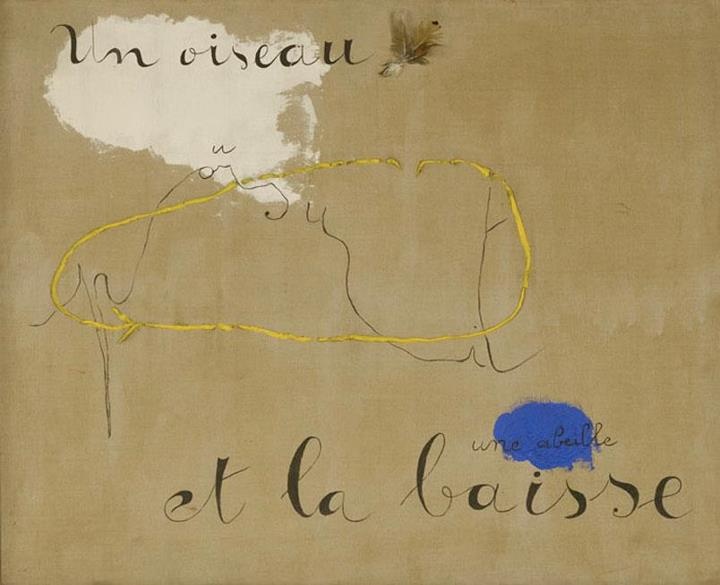
"Un Oiseau poursuit une abeille et la baisse," 1927, by Miro. (Museum of Modern Art)
Amputate tradition, torture the past, terrorize the present. The impulse to destroy was part of what made early Modern art the guerrilla movement it was.
Cubism sentenced illusionistic art to the Death by a Thousand Cuts. Dada unleashed an anti-aesthetic Reign of Terror: Beauty? Off with its head. Decay? Let’s have more. Surrealism, a slippery business, let the killer instinct run amok. Tossing manifestos, dreams and libidos like bombs, it aimed to bring Western civilization to its knees and keep André Breton in the news.
So in 1927, when Joan Miró said, “I want to assassinate painting,” he wasn’t saying anything new. What was new was the way he carried out his cutthroat task. That process is the subject of “Joan Miró: Painting and Anti-Painting 1927-1937,” an absorbing, invigorating and — Miró would be mortified — beautiful show at the Museum of Modern Art.
The exhibition illustrates, step by step, exactly how Miró stalked and attacked painting — zapped its conventions, messed up its history, spoiled its market value — through 12 distinct groups of experimental works produced over a decade. If, in the end, painting survived, that’s neither here nor there. The story’s the thing. Crisp, clear and chronological, the show reads like a combination of espionage yarn and psychological thriller set out in a dozen page-turning chapters.
In 1927 Miró was 34. He was a successful artist and an early devotee of Surrealism, working in a polished, fantastical-realist mode. But he had a restless temperament and lived in provoking times. The high-flying 1920s were winding down, the political climate was growing tense. Surrealism, he discovered, had limitations. He was ready for a radical change in art, but he realized that he would have to create it himself. He decided it would take the form of a crime. Painting would have to go. He would deliver the blow.
How to start? With dissection, which entailed taking painting apart, piece by piece, and throwing out essential things. This is what we see happening in the seven stark abstract paintings that open the show, all done in Paris in January to mid-February of 1927. The pictures look intact enough, with their handwritten phrases and clouds filled with dots, until you notice that something is missing: paint, or all but a minimal amount of it. Most of each picture is raw, untouched canvas on which the words and clouds drift like flotsam from a ship gone down.
A year later Miró gets rid of something else: skill. The wood panel used as a support in a piece called “Spanish Dancer I” is covered with a sheet of colored paper. A small rectangle of plain sandpaper is tacked on top of it. Glued to the sandpaper is a tiny cutout image of a woman’s shoe. That’s about it: no paint, almost no image, almost no artist.
Then in a third series the hands-on painter comes back with a vengeance to demolish art history. In a work called “Dutch Interior,” Miró takes an image of a lover serenading his lady, from a 17th-century painting, and turns it into a hostile clash of bloated, sluglike forms. So much for the golden age of Dutch realism. And you can kiss Renaissance idealism goodbye. In Miró’s version of the famous picture “La Fornarina,” Raphael’s beauteous sitter becomes a big brown blob with a leering red mouth and one yellow cat’s eye.
At least these paintings, with their bright colors and sharp outlines, are recognizably Miró-ish, which is not true of the collages that come next. If you happened to wander into this section cold, you’d think, “What drab, funky artist is this?” Not that the collages aren’t wonderful; they are, with their holes and glued-on circles, and stretches of industrial tar paper, which looks as if it might smell bad, yet suggests a starry sky.
By this point a certain pattern to Miró’s aggression becomes clear. In a rhythm of thrust and feint, he alternates direct attack on painting with turning his back on it, as if wishing it would go away. After the collages, he’s in attack mode again, wielding ridicule as a weapon in five oil paintings of preposterous size, seven feet high, the scale of altarpieces or imperial portraits but covered with scribbles, as if they were made by some cretinous child.
Who, in 1930, would have bought such daft things? Nobody, and the pictures went into storage. We can appreciate them now because they look so new and because we can see what Miró was up to. In these giant doodles, Kandinsky’s music-of-the-spheres abstraction takes a hit and falls to Earth.
There it is met — why not? we’ve seen everything else — by sculptures: squat, homely, nailed-wood things from 1931 and 1932. Although touched with grace notes of delicate painting — Miró was a fabulous brush technician — they are mostly about their baser accouterments: screws, chains, machine parts, sequins, a piece of bone, a single chickpea painted cobalt blue and encased in a tiny shrine.
By 1934, collage, assemblage, drawing and painting had blurred together into freakish hybrids that seem products less of objective experiment than of pathological obsession. Two drawing-collages on reflective paper from this time have an unhinged, fun-house look. A third, of uncertain date, combines ripped paper-doll figures with tied-on cardboard paint tubes resembling cartridge shells.
The whole piece looks derelict and must have even when new. That it survives is a miracle, though I wonder if Miró intended it to. Durability — timelessness, art is eternal and all that — was yet another aesthetic myth that he took pains to trash.
As Miró doggedly continued his assault on art in the 1930s, the world was assailing him. Fascism was on the rise across Europe. Events that would lead to the Spanish Civil War were brewing. At this time, he was living in the Catalan town of Montroig, a favorite retreat, but his anxiety was building. And as it grew, he returned to painting as if seeking solid ground.
In the fall of 1934 he finished a series of 15 extraordinary pastels on paper, most of them of single scowling, extravagantly sexualized figures so luridly colored and amorphously shaped that they look like walking cancers and oozing sores.
They were succeeded by small narrative paintings. Done in tempera on Masonite, and in oil on copper plates, like “The Two Philosophers,” their diminutive scale and assertive color gives them the toothsome innocence of fairy-tale illustrations. But they are not sweet or innocent: they are battle scenes from a psychic hell. They are also formally exquisite. For them Miró summoned all the virtuosity that in the cause of revolution he had labored so hard to suppress.
He makes just one more murderous lunge at tradition, in a series of paintings on Masonite panels from 1936. The attack is very physical and feels a bit desperate. In many ways this series brings him back to 1927. The pictures are abstract; he leaves the Masonite surface mostly bare. But what he adds has changed: oil stains, vomitlike substances and fecal-looking hunks of tar and dirt. In addition he hacks away at the surface, stabbing and gouging and leaving deep ruts and splintery scars.
At that point, with Spain in chaos, he leaves for Paris. The final picture in the show was done there. Titled “Still Life With Old Shoe, ” it is in a conventional oil-on-canvas medium, in semi-realist style, on a traditional theme. The search-and-destroy is over. Painting has survived and won. Miró as master painter, the new, oddly adorable artist of popular fame, more or less starts here.
He must have been exhausted. I was when I reached the last gallery, but exhilarated too because I felt I’d been through something: not the blockbuster slog but the experience of one artist’s creative process and the experience of an exhibition as a form of thinking. Like reading a book, the process makes you part of the trip, not just a witness to it.
In this case the trip is fairly demanding but one I suspect that audiences with even a casual interest in how art is conceived and made will enjoy. From beginning to end, the particular audience I had in mind was a special one, art students.
For them the show could serve as a manual of anti-authoritarian moves. Unpopular Mechanics of Painting, you might call it. But it could also be a guide to living a creative life. This is particularly true for students who are under pressure to choose a single medium (painting, say) and stay with it; to firm up a signature style and stay with it; to get to the market early and stay there.
To these requirements, the Miró show says: no, no, no. Change mediums, like habits, as often as possible. Make your signature look a no-look or every-look, and keep changing that. Get to the market early if you want, but then go home and stay there awhile and work. Then stay longer. Destroy the artist you think the world thinks you’re supposed to be, and you’ll start to find the artist you are.
“Joan Miró: Painting and Anti-Painting 1927-1937” opens on Sunday and remains through Jan. 12 at the Museum of Modern Art; (212) 708-9400, moma.org.
© 2008, The New York Times
Biography

Holland Cotter has been a staff art critic at the New York Times since 1998. Between 1992 and 1997 he was a regular freelance writer for the paper. During the 1980s he was a contributing editor at Art in America and an editorial associate at Art News. In the 1970s, he co-edited New York Arts Journal, a tabloid-format quarterly magazine publishing fiction, poetry, and criticism.
Art in New York City has been his regular weekly beat, which he has taken to include all five boroughs and most of the city’s art and culture museums. His subjects range from Italian Renaissance painting to street-based communal work by artist collectives.
For the Times, he has written widely about “non-western” art and culture. In the 1990s, he introduced readers to a broad range of Asian contemporary art as the first wave of new art from China art was building and breaking. He helped bring contemporary art from India to the attention of a western audience.
Born in Connecticut in 1947, and raised in Boston, Cotter received an A.B. from Harvard College, where he studied poetry with Robert Lowell and was an editor of the Harvard Advocate. He later received an M.A. from the City University of New York in American modernism, and an M. Phil in early Indian Buddhist art from Columbia University, where he studied Sanskrit and taught Indian and Islamic art.
He has served on the board of directors of the International Association of Art Critics. He is under contract with Alfred A. Knopf for a book on New York City modernism. He is also working on a study of contemporary Indian art, and on a poetry manuscript.
He lives with his partner, Joseph Rosch, in the Bronx.