The Philadelphia Inquirer, by Inga Saffron
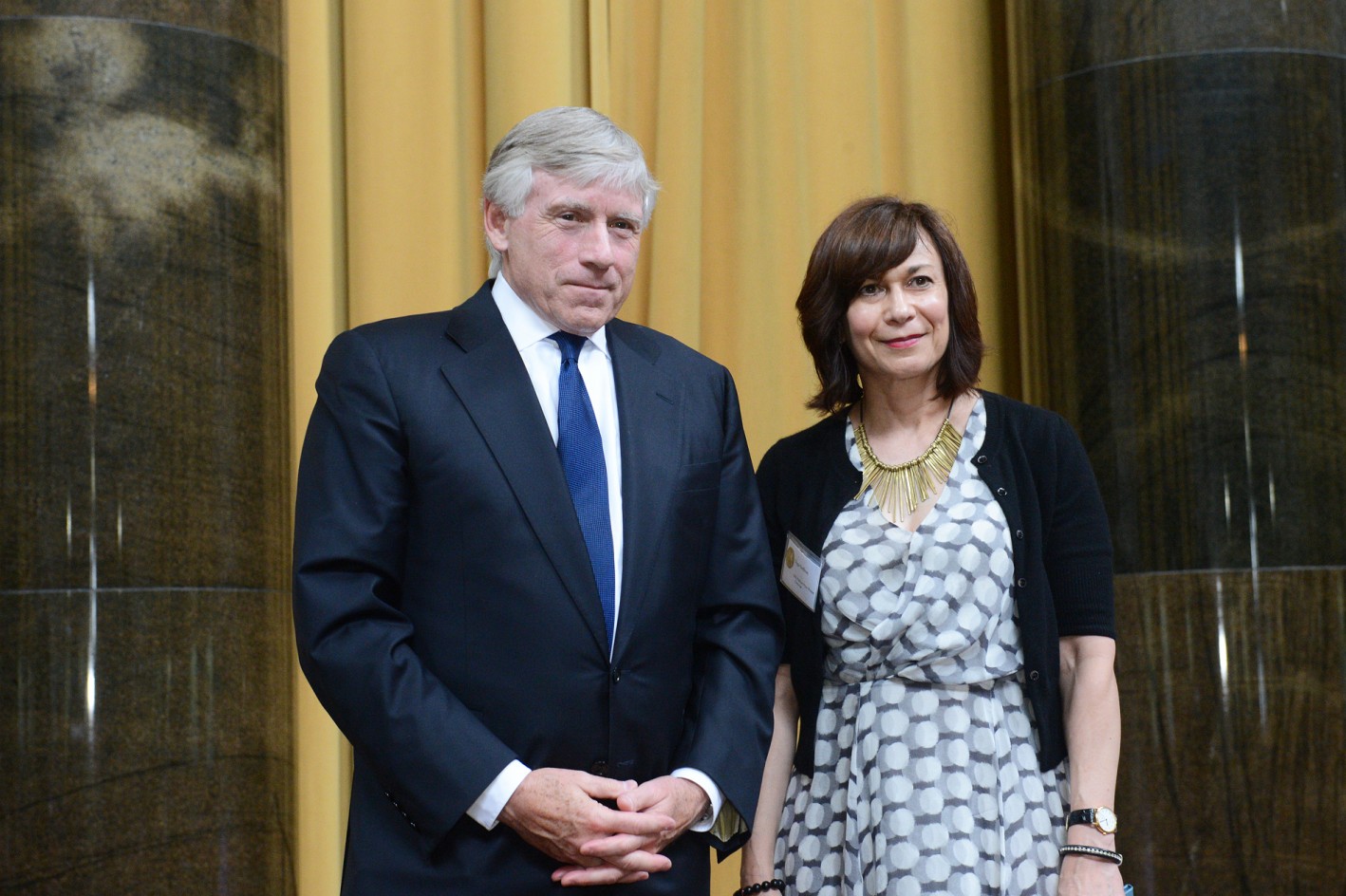
Lee C. Bollinger, President of Columbia University, presents the 2014 Criticism Prize to Inga Saffron of The Philadelphia Inquirer.
Winning Work
By Inga Saffron
In 1993, when Philadelphia’s downtown was hitting bottom, Ed Rendell launched a visionary revival strategy disguised as an arts initiative. First, create a Philadelphia version of Broadway by clustering cultural venues on South Broad Street. Then, pray that suburbanites and tourists would feel safe enough to venture there after dark and drop a wad on dinner and show tickets.
Twenty years on, as the organization that manages the Avenue of the Arts celebrates its accomplishments, South Broad Street between City Hall and Spruce Street is, indeed, a sparkling Great White Way, abuzz in the evenings with people rushing to events. And yet the original premise is outdated: Out-of-town visitors are no longer the key to the city’s salvation.
The challenge today isn’t to cajole suburbanites to come downtown for an evening; it’s making the city more livable for the thousands of new residents who are putting down roots in Philadelphia’s reviving neighborhoods. No one anticipated that population surge when the avenue was created.
Without a doubt, South Broad has come a long way from its pre-Avenue-of-the-Arts days when office buildings stood empty, prostitutes strutted near the corner of Lombard Street, and the gloomy husk of the Ridgeway Library served as the face of the city’s decline.
The Avenue of the Arts was first proposed by Paul Levy’s Center City District in 1990 as a way to clean up that mess, but it was Rendell who ran with the idea. Rendell’s laser focus, Levy says, enabled him to attract the public and private cash necessary to bankroll a dozen artsrelated projects and fund a major streetscape overhaul.
Glamorous new destinations like the Kimmel Center, which opened in 2001, helped rebrand the avenue as an entertainment district. Historic buildings were saved; that white-columned Ridgeway is now home to the Creative and Performing Arts High School. Developers responded by renovating their mothballed Class B offices and, ultimately, dotting the blocks south of Spruce with new, high-end apartments and restaurants.
But while the Avenue of the Arts has enjoyed a respectable run as the star of the city’s revival efforts, other, more sustainable trends have pushed it off the marquee. The most important is the rediscovery of the city by the millennial generation, which has dramatically repopulated the ring of neighborhoods around Center City, places with names that would have drawn blank stares in 1993, like Newbold, Old Richmond, and Spruce Hill. And their residents aren’t the people filling Kimmel’s balconies.
Ever since New York carved Lincoln Center out of the decaying Hell’s Kitchen neighborhood in the ’60s, cities around the country dreamed of having their own arts district. But concentrating culture is an old strategy that has run its course, says John D. Landis, chairman of Penn’s regional planning department.
What drives cities now are entrepreneurs and what he calls “the Brooklyn phenomenon.” The city, he explains, is where people go to “consume urbanism.” Jeremy Nowak, the former head of the William Penn Foundation, agrees: “We’ve moved on to other strategies.”
Some argue the Avenue of the Arts created the conditions that made the millennial boom possible. “Maybe the avenue isn’t 100 percent responsible, but it was the catalyst,” Rendell told me. “It got suburbanites to come in the city and eat.”
It is certainly true that the fear of the gritty city has lessened in the last two decades. But that seems more likely the result of a bundle of policies that helped the whole city to reset its image.
Attention to the so-called broken-windows crimes by Rendell and Levy was at least as important in making people feel comfortable downtown. Without the 10-year property-tax abatement as an incentive, it is hard to imagine that Philadelphia would have seen its entire stock of vacant, early-20th-century office buildings transformed into apartments, or the subsequent boom in infill housing.
And let’s not discount the profound changes in American life over the last 20 years. At the exact moment that the millennials — a generation, incidentally, with no memory of the urban upheavals of the ’60s and ’70s — were coming of age, the Internet gave them the flexibility to live wherever they like and work from home.
Since the branding of the avenue, Philadelphia has become a more multipolar place. While Broad Street is still filled on the weekends with people seeking food and entertainment, so is 13th Street, the high-style restaurant row developed privately by the late Tony Goldman. The same is true of East Passyunk Avenue and the Northern Liberties hipster cluster at Girard and Frankford Avenues. And soon, the avenue will have to compete with the Fringe Festival on the Delaware Waterfront.
It’s worth noting that most of the avenue’s culture is produced by legacy institutions like the Philadelphia Orchestra and theater companies whose audiences are rapidly graying. The new residents of Graduate Hospital and South Kensington tend to seek their amusements in nontraditional venues like the Fringe, Johnny Brendas, and the aptly named Underground Arts. No wonder several avenue stalwarts are struggling financially.
There are indications that the Avenue of the Arts Inc. recognizes that it needs to stretch its appeal beyond its core audience. This summer’s pop-up beer garden, organized by the Pennsylvania Horticultural Society on a vacant lot across from the Kimmel, drew millennials in droves to South Broad. Too bad, though, that the agency chose to celebrate its anniversary with a cocktail party this week for the city’s clubby (and elderly) elite, rather than a true, Philly-style block party for the masses.
The avenue’s future — like the rest of Philadelphia — rests on its growing residential population. Developer Carl Dranoff is completing his third building and has his eye on at least two other sites, including Spruce Street’s southeast corner.
With Philadelphia’s population on the rise, developers are scrambling to discover the next hot residential neighborhood. Who knows? It could be South Broad Street.
By Inga Saffron
What makes Philadelphia’s new zoning code such a landmark policy is that it embraces the modern view of cities first articulated by such urbanists as Jane Jacobs and William H. Whyte. They understood that cities couldn’t survive with fortified streets and blank ground floors. In the spirit of that movement, the code took the bold step of banning a particular local scourge: garagefronted rowhouses.
Apparently, the Zoning Board of Adjustment never got the memo.
The new rules went into effect eight months ago, and yet the board continues to conduct business as usual, handing out variances that allow rowhouse developers to install garages where the living rooms are supposed to be.
Last week, it was a pair of houses at 19th and Catharine Streets. Those variances came just weeks after five garage-fronted rowhouses were approved nearby at 19th and League. Across town, in Bella Vista, two more such houses on Eighth Street recently secured the board’s blessing.
Because no city agency tracks the board’s decisions, it’s impossible to know precisely how many of these Frankenhouses have been approved since the code debuted. I learned about the nine I mentioned from neighborhood groups. The city’s chief planner, Gary Jastrzab, told me he had identified eight others, bringing the known variances to 17. We should assume there are more.
Every one of these faceless garage doors is like a dagger in the body of the city. Because they occupy so much facade space on the ground floor, there is usually no room for a window and the sense of habitation that would convey. Garages make the street less friendly, less safe, less comfortable. After all the work by planners to stop their proliferation, the board’s actions are “demoralizing,” said Lawrence Weintraub, who cochairs Bella Vista Town Watch’s zoning committee. “I’m concerned that this makes the new zoning code look like a joke.”
The nine variances in the Graduate Hospital and Bella Vista sections are especially disturbing because they were opposed by a broad civic lineup: the Planning Commission, the neighborhood association, and the district councilman.
By disregarding their voices — not to mention the City Council-approved zoning code — the board is effectively setting its own planning policy. That’s not what a zoning board is supposed to do. And it’s certainly not the way a democracy is supposed to work.
High-handed decisions are hardly a new thing at the zoning board. Mayor Nutter campaigned in 2007 on a pledge to rein in the out-of-control board. He made good on that promise, in part, by supporting the citizen-led effort to update the ’60s-era zoning code, a process that took four years of grueling negotiations. The result is a civic compromise that deserves to be respected.
So why won’t the zoning board behave? The garage variances expose a fundamental weakness in the structure of Philadelphia’s government embedded in its 1951 Home Rule Charter. The Planning Commission can only recommend what should be built in the city; it’s the zoning board that has the power to issue the necessary permits. So, even though the Planning Commission oversaw every step of the code rewrite, it can’t force the zoning board to execute its policies.
The mayor can, through his appointments to the zoning board. Yet board members often seem to develop their own agendas. That was true of the strong-willed chair, Lynette Brown-Sow, who left last week after Nutter named her to run the Philadelphia Housing Authority board.
Jastrzab told me he hopes Brown-Sow’s replacement, Julia Chapman, will be more sympathetic to the Planning Commission’s wishes. “It’s very likely attitudes will change with Julia,” who ran Nutter’s Council office, he said. But unless Nutter lays out his expectations in no uncertain terms, expect Chapman to revert to type.
Garage-fronted rowhouses have, of course, afflicted the city’s streets for decades. But their numbers are growing as gentrification comes to once-blighted areas such as Graduate Hospital and Point Breeze, where there are large tracts of empty land for infill housing. You can already see blocks in Graduate Hospital deadened by lines of garages running end to end.
It may be hard to believe, but the city once required a garage in every new rowhouse. About a decade ago, policymakers began to understand the harm they caused Philadelphia’s charming rowhouse streets.
It is not an easy issue. Many developers are convinced they won’t be able to sell a new house without a garage. Of course, many buyers want garages, too. Because of the configuration of Philadelphia blocks, it is often impossible to tuck garages in the back of the house, where they would be less obtrusive.
It is worth remembering that most older rowhouses have no garages. Car owners park on the street. Yet every time a developer builds a garage-fronted rowhouse, the city loses an onstreet parking space. A scarce, public commodity is transferred to the private realm.
By approving garage-fronted rowhouses, the zoning board sends a message that the Nutter administration wants to encourage car use. It undermines his transportation staff, who are working hard to encourage SEPTA ridership. The variances go against Nutter’s stated promise to make Philadelphia the greenest city in the nation.
Along with property-tax reform, the new zoning code promises to be Nutter’s greatest legacy — unless he continues to allow the zoning board to sabotage it.
By Inga Saffron
What kind of building do you get when you cross the übercool, urban minimalism of the Apple stores with the indulgent, diet-busting excess of the Cheesecake Factory restaurants?
Would you believe an architectural confection that is as visually sublime as it is intellectually rich?
I’ll admit that when I first heard that the popular suburban temple of caloric overload was touching down at 15th and Walnut Streets, the news didn’t exactly stoke my appetite for good design. I imagined a generic box, done up in flat, lifeless stucco the color of American cheese, elbowing its way onto a corner that has been occupied for the better part of a century by three ordinary, but charming, commercial buildings.
But the architecture gods have smiled on Philadelphia.
When the Cheesecake Factory takes up residence here late next year, it will be one of several tenants in a dynamic new building designed by a top-notch firm, Bohlin Cywinski Jackson, which created Apple’s retail prototype and executes all its stores, including the one on Walnut Street. That BCJ’s building will house this particular dining chain is the least interesting thing about it.
Given the firm’s success with the famous — and now trademarked — Apple cube in Manhattan, some might be expecting a variation of that glass box here. But the architects, who work in BCJ’s Philadelphia office, have come up with something more gratifying: an original design that responds to its surroundings in a deeply informed way. Their sophisticated Philadelphia glass box promises to be one of the city’s finest new buildings.
It’s true that you can still see evidence of the Apple lineage in the three-story design, which received a green light last month from the zoning board. Like the New York cube, it is an allglass, modernist building. But the similarities end there.
Because the New York cube is meant to appear as weightless as a lone soap bubble on its open plaza, it is supported by nearly invisible glass fins. In contrast, the Cheesecake building will be hemmed in by masonry heavyweights from the early 20th century. The designers, Frank Grauman and Andrew Moroz, knew their bantam of a building needed to convey a toughness and gravitas if it were to hold its own against such formidable neighbors.
The most notable is the old Drexel & Co. headquarters across the street. That rusticated stone building, which now houses a health club on its lower floors, was modeled on Florence’s Strozzi Palace.
The Cheesecake building flexes its muscles in a modern way, by flaunting its bones and skin. Extra-thick, extra-clear glass panels appear to slide across the Walnut Street facade like barn doors, revealing the massive steel columns and beams that will support the building.
Most glass buildings are riffs on lightness, but here the architects intentionally emphasize the thickness of the transparent skin by making deep cuts into the surface.
At the eastern end, a two-story niche announces the entrance to the restaurant, which will occupy the entire second floor. The opening is balanced by a second-floor dining deck carved into the corner. Below, another notch in the surface will serve as a door for one, or possibly two, ground-floor retailers. Access to the third floor, which can be subdivided, is from a door on 15th Street.
These days, when so much retail has migrated to the Web, it’s rare to see a new commercial building on an urban street. Despite the Cheesecake Factory’s association with the building, it wasn’t the impetus for the project, being built by New York’s Midwood Investment & Development.
The company, which has been buying up Center City retail properties since the late 1990s, found it increasingly difficult to rent its three small buildings, which are narrow and eccentric. Eventually, Midwood decided it would be better off with one building with large open floors, company president John Usdan told me.
At that time, Cheesecake Factory hadn’t signed on, so Midwood told BCJ to design a generic interior that could handle a variety of tenants. The company briefly considered including a residential tower but concluded it would be uneconomic on the small site, 80 by 186 feet. In keeping with modern preferences, each floor is 20 feet high.
The Cheesecake Factory is not exactly the sort of tenant you would expect to be drawn to such a sleek building. Famous for its supersize portions, the restaurant has repeatedly won the “Xtreme Eating” award from the nonprofit Center for Science in the Public Interest for its “food porn” — dishes that exceed recommended daily allowances of salt and fat, like its 3,210-calorie Bistro Shrimp Pasta.
Though we may be loath to admit it, it was only a matter of time before the Cheesecake Factory colonized a patch of this fat- and salt-loving town. It is one of the most profitable restaurants in the country, yet like so many suburban chains, it is running out of acceptable highway and mall locations. The only way to maintain its growth is to migrate to the city.
No doubt, some here will mourn the loss of these three commercial buildings, which contribute to Walnut Street’s special character but are not considered historic. But cities change: That corner building previously was the nine-story Hotel Flanders, until it was cut down to a twostory retail building sometime in the ’40s or ’50s.
The new building is a rare case in which the architects have cooked up a replacement that is even better than what was there before.
By Inga Saffron
Richard Basciano and the late Samuel A. Rappaport were friends, business partners, and slumlords. Both rose from humble beginnings to become real estate speculators extraordinaire. They scooped up blighted properties in Philadelphia and sat on them for years while the structures crumbled, eventually selling them at huge markups to be developed by others.
Now they have something else in common. Both owned buildings that killed.
While the circumstances of the two fatal accidents are very different, the cases are linked by more than just the two men’s complex relationship; the tragedies reveal the city’s inability to enforce basic building safety. And it’s not just the Nutter administration. For more than 30 years, every mayor — Street, Rendell, Goode, Green — has exhibited a stunningly high level of tolerance for the blight the two men wrought.
Basciano, 87, who still likes to practice his boxing moves, was in the midst of razing a row of poorly kept properties on Market Street when an unsupported party wall gave way Wednesday and tumbled onto the Salvation Army thrift store next door, killing five people. Turns out Basciano’s contractor has a criminal record.
In Rappaport’s case, he was already in the grave when his killer building struck. In 1997, the bolts on an 18-foot-tall “Park” sign came loose from a garage his estate owned at Broad and Pine Streets. It plunged onto the sidewalk, striking Common Pleas Court Judge Berel Caesar, out for a walk. The judge died four days later. At the time, Basciano was the executor for Rappaport’s estate.
After the tragedy, the Department of Licenses and Inspections promptly announced it was launching an investigation into the condition of the estate’s hundreds of properties. We heard similar promises a year ago, after a blaze in a neglected Kensington mill owned by the Lichtenstein family claimed two firefighters’ lives. Want to bet we’ll hear the same clarion call again this week?
By the time of his death in 1994, Rappaport had racked up more than 200 violation notices from L&I. Not only did the department rarely follow up, another agency — the Philadelphia Industrial Development Corp. — lent him money to buy more vacant buildings. Rappaport, it should be noted, was generous to mayoral campaigns.
The city was just as kind to Basciano. In 2010, when the operator of the Forum Theater porn house wanted to enlarge one of Basciano’s Market Street properties, the city zoning board gave the green light for a bigger red-light district. The expansion was stopped only after neighborhood groups took the case to court.
Years after Caesar was killed by Rappaport’s building, Basciano moved into Symphony House on South Broad Street, which provided a straight-on view of the site but clearly no lessons.
Of course, Rappaport and Basciano are hardly the only speculators who have left a trail of neglect across the city. Given the thousands of hollowed-out structures gradually coming apart at the seams, it’s amazing that more lives haven’t been claimed over the years by killer buildings.
Rappaport and Basciano were never indiscriminate collectors of crumbling relics. They had a keen eye for identifying derelict diamonds in the right spot.
Rappaport (not to be confused with the former state representative of the same name) assembled whole blocks of rundown properties that were later acquired at hefty prices for the construction of the Convention Center, the commuter rail tunnel, and Liberty Place. He made $7.5 million on the Liberty towers alone.
Basciano was not quite so adept, although he did just fine in his speculation. Roughly two decades ago, he told me he’d acquired the better part of the 2100 and 2200 blocks of Market from Herman Benn, an owner of Nate Ben’s Reliable furniture store.
Just across the Schuylkill from 30th Street Station, the two blocks should have been a shining gateway to the rising office towers on Market Street. Instead, Basciano stuck with the Rappaport program.
Basciano, once involved in a Times Square porn business, tolerated his mini-red light district on Market Street until he had a change of heart last year. Explaining his plans in a December interview, he told me it was finally the right moment to cash in on Center City’s renaissance. But to market his property, he first had to clear away the mess. The city approved the demolition permits.
Then everything came crashing down, taking five more innocent lives.
By Inga Saffron
Vague renderings show little that’s inviting about the public park offered to link the surrounding neighborhood with Children’s Hospital’s huge research center on the Schuylkill’s east bank.
Developers use architectural renderings as a form of storytelling — highlighting what they want us to notice in their projects, obscuring what they don’t. Some buildings are shown standing alone in the world, while others appear as mere specks in a crowd. At night, the lights are always blazing, as if electric bills didn’t matter.
So it is with a plan by Children’s Hospital of Philadelphia for a high-rise research campus on the east bank of the Schuylkill, next to the South Philadelphia rowhouse neighborhood known as the Devil’s Pocket. The massive undertaking could ultimately house as much square footage as two Comcast towers. In June, Children’s expects to break ground on a 375-foot tower, a free-standing garage, a public park, and a waterfront promenade, and yet we hardly know what they will look like.
This is not for lack of renderings and plans. In the 18 months since Children’s announced it was establishing the satellite campus across from its home base in West Philadelphia, it has bombarded the community with images.
Those renderings have mainly shown views of the project from 30,000 feet. One illustrates how Children’s’ four towers would be arranged on the site. Another provides a diagram of traffic circulation. There have been colorful collages to suggest the landscaping planned for Schuylkill Avenue and something that the hospital insists on calling “the Spanish Steps.”
What they haven’t shared with the public is the actual architecture of the tower, or how human beings might interact with it at the ground level. Given the project’s sensitive location, between the popular Schuylkill Banks park and Devil’s Pocket, the absence of information is deeply troubling.
Children’s executives have spent the last year meeting with neighbors to talk up the project, which is being designed by a big-name cast that includes Pelli Clarke Pelli; Ballinger; and Cooper, Robertson & Partners. The hospital has been up front in acknowledging that its new skyscraper — where scientists will crunch data on computers—will be an abrupt shift in scale from the adjacent rowhouses. As compensation, hospital officials have promised to enrich the neighborhood with welcoming parks and improved access to the riverfront. (They’re also giving the city an easement along the water’s edge for the next segment of the Schuylkill Banks trail.)
But the public spaces depicted in the pictures look anything but inviting.
Last week, the hospital finally released the first renderings of the campus’ premiere public space, a wedge-shaped plaza that will provide pedestrian access from the South Street Bridge to the front door of the new tower. The plaza is, in essence, the project’s lifeline to the city, where the public realm and Children’s’ private world will come together. Such mixing occurs naturally on sidewalks all over the city, but rarely in the controlled world of hospital grounds.
While the rendering seems intentionally imprecise, it’s all too clear that the plaza is more of a landscaped entrance than a real park, and will be as sterile as an operating room. Enormous planters consume most of the space, forming a cattle-chute pathway straight to the front door of Children’s’ 22-story tower.
While scattered benches and planter walls will offer seating, everything about the design says, Look, don’t touch. You can see plenty of so-called green space just like it if you wander across the South Street Bridge to the tangle of driveways and porte cocheres that is the hospital district.
It doesn’t help matters that Children’s’ plan calls for a 30-foot-long garage ramp along the eastern edge of the plaza — although you wouldn’t know that from the rendering. The artist has disguised the planned 240-car garage with a 10-story tower that won’t be built for years. Ironically, the garage driveway is one of the few spots on the drawing where the rendering depicts a gathering of pedestrians.
All this worries Andrew Dalzell, programs coordinator for the South of South Street Neighborhood Association. “It’s fantastic to have all these public spaces,” he says, “but are we going to feel we are trespassing on CHOP property, or will we feel welcomed?”
From that plaza, Children’s employees and city residents are supposed to be able to continue south along an elevated promenade. On the renderings, the promenade appears as little more than a gray swath, but Children’s vice president Douglas E. Carney promises it will be a spectacular perch for enjoying views of the Schuylkill, “like an infinity pool.” Children’s plans to set aside space for a single food vendor and outdoor tables, probably a chain like Au Bon Pain.
Sigh. This promenade could become so much more. It is the only spot south of the Waterworks where there is room for outdoor dining.
Once the extension of Schuylkill Banks is finished next year, the South Street Bridge will become a major entrance to the park, attracting thousands of people. One can imagine families, runners and dog owners gathering on the promenade for Sunday brunch. Oh, wait. No dog owners. Children’s says it wants to discourage dogs in the plaza and promenade. That’s no way to make friends with the neighborhood.
The public space is just as disappointing below the bridge, at Bainbridge and Schuylkill Avenue. Located just off South Street, in the thick of the neighborhood, Schuylkill Avenue could, with some effort, become part of that walkable, commercial corridor. But Carney insists that Children’s will not create any spaces for cafés or retail. Instead, it plans an enormous circular driveway that it says might be used occasionally for farmers markets or events. Does an office building that will house 1,000 researchers really need such a big drop-off?
Carney defends the lack of meaningful retail by arguing that such things “are not part of CHOP’s core mission.” The neighborhood association is still negotiating with Children’s for improvements, and the hospital must still obtain several zoning planning approvals before construction. Will the city stand up to its secondlargest employer?
Children’s may do vital work, but it’s also a billiondollar nonprofit — one that will pay no property taxes on this huge site. The health of its new neighborhood deserves the same quality care as its patients.
By Inga Saffron
Modern architects have a long tradition of trying to reimagine the relationship between buildings and nature. Philip Johnson famously designed the walls of his Glass House so it appears that only the barest membrane separates its occupants from the rolling Connecticut countryside. At Fallingwater, Frank Lloyd Wright envisioned the house’s cantilevered terraces growing organically from the boulders over the thundering Bear Run torrent.
New York architects Marion Weiss and Michael Manfredi take an entirely different path with their Krishna P. Singh Center for Nanotechnology at the University of Pennsylvania. Instead of focusing on the boundaries between architecture and landscape, they fuse the two into a seamless whole. Their dazzling new project is like the mythical centaur; you can’t exactly say whether it is man or beast.
So, yes, what is clearly a large glass building now occupies a former Penn parking lot on Walnut Street, just east of 33d Street, enlivening the forlorn eastern edge of the university. But the way the Singh Center emerges from the ground and ascends in a series of crystalline switchbacks suggests the structure might be some longburied geological formation that just happened to erupt in the middle of West Philadelphia.
Call it a man-made landscape if you want, or call it topographical architecture, but the $92 million Singh Center is easily the most impressive new design in the city since the Barnes Foundation opened last year.
A lot of dense architectural theory went into its shape, which is interesting to the cognoscenti. But the interior spaces, as blissed-out as a mountain retreat, are what will win over the nanotech researchers, who started moving in this month. Modern science is as much about socializing as peering into microscopes, so there are many spots for exchanging ideas, from diner-like booths to nightclub-like lounges, done up in pops of paprika and marigold.
The most distinctive feature of Weiss/Manfredi’s shimmering outcrop is a daring, cantilevered glass box that juts out and over the building’s grass forecourt. You can’t look at the precarious, 68-foot-long extrusion and not think of the cantilevered terraces at Fallingwater, which the husband-and-wife architects consider a touchstone for their work.
But instead of hovering over a rushing mountain stream in Western Pennsylvania, the Singh’s cantilever floats 40 feet above the rushing flow of students along Walnut Street coming and going from Penn’s campus. Inside the glass box, there is a small auditorium and the modernist version of a sunporch. I imagine a huge competition for the porch’s custom-designed, paprikacolored armchairs, positioned at the precipice of the cantilever’s window wall. From there, you can survey nearly all of Penn’s domains.
For all the architectural spectacle on display, the Singh is essentially a souped-up lab building for the nanotechnology department at the School of Engineering. Nanotechnology is the rapidly expanding field in which scientists manipulate molecule-size particles to devise new products and medical treatments. The close work requires electron microscopes and other delicate machines that are sensitive to vibrations and ultraviolet light.
As one of the first Penn buildings people encounter from Center City, the Singh was envisioned as a campus gateway, greeting students after their trudge across the Walnut Street Bridge. But because of the need to insulate lab equipment from bone-rattling traffic, much of the L-shaped building had to be set back significantly from the sidewalk.
That took its toll on the idea of a welcoming portal. What visitors see instead are the rippling metal panels of the building’s side wall. Large windows on the upper floors supply a beacon of light at night, but the effect is not the same as being embraced by the sight of human activity on the ground.
Still, putting the Singh on the site does have the benefit of filling in what had long been a missing tooth in Walnut Street’s continuity. More than that, Weiss/Manfredi, who once worked for renowned Philadelphia architect Romaldo Giurgola, cannily use the rhythms of the wall’s vertical panels to create a dialogue with the adjacent parking garage — designed by Giurgola in 1963. It may be hard to believe, but its immense, diamond-shaped concrete trusses were once an architectural sensation, and even now exhibit a primal, sinewy beauty.
It is a testament to the talents of Weiss/Manfredi, who designed the Singh in collaboration with the M&W Group’s lab specialists and Severud Associate’s structural engineers, that the setback does not detract from the building’s real quality.
Once inside, visitors encounter an unusual paprika-colored glass wall. Chosen because the color blocks ultraviolet light into the labs, it set the palette for the entire building, which plays the paprika-marigold-orange accents off the white finishes.
The Singh is the last of a trio of notable building designs masterminded by Eduardo Glandt, the longserving dean of Penn’s engineering school, with the intention of luring top researchers. For $92 million, including a $20 million naming gift from Krishna Singh (one of the owners of Interstate General Media, parent company of The Inquirer), Glandt obviously could have packed a lot more labs on the site.
Instead, Glandt chose to invest in something less tangible but potentially more valuable: architectural magic. Just as nanotechnology enables researchers to see a miniature world never before glimpsed, the Singh’s design promises surroundings to help open their eyes to new ideas.
By Inga Saffron
Philadelphia’s recent casino hearings brought back memories of those giddy days in 2006 when gambling was new to Pennsylvania and no amenity was too extravagant for our city’s gaming halls. Once again, the applicants vied to seduce us with all kinds of extras. A 320-room resort hotel! Spas! Bike paths! Fishing piers! Skating rink! Luxury shops! A starchitect design!
For most people, the promises made during the first licensing round have been lost in the mists of time. But because I am a magpie of the filing cabinet, I only had to dust off SugarHouse’s 2006 proposal to see how it checked out against the 2013 reality.
That plan showed a sleek, low-slung casino design, inflected with a touch of Mad Men-era glamour in Phase 1. Of course, what we got instead was a Walmart-style box. For Phase 2, SugarHouse told us it would grow into a dramatic resort complex anchored by a prowshaped hotel tower overlooking the Delaware River, and equipped with a convention-quality ballroom and a concert venue.
As it happened, SugarHouse unveiled the expansion plan — which it now prefers to call Phase 1A — on the same day hearings were wrapping up for the city’s second casino. Notably absent from its proposal were the hotel and the theater. An open-deck garage will still loom over the river, however, three levels shorter than the original 10-story version.
Suckers that we are, we continue to speak of the fantasies that were presented last week to the Gaming Control Board as “plans.” What they are, in reality, is bait.
Steve Wynn, in particular, should have gotten the P.T. Barnum award. After declaring his special love for Philadelphia, where he spent his college years, and promising to tailor his Delaware River casino specifically to the city, it was revealed that he is two-timing us already. The rendering he has been showing to his Philadelphia fans is identical to the one he presented to the citizens of Everett, Mass.
The six proposals clearly do not deserve serious architecture reviews. How can you evaluate a mirage?
Yet where Philadelphia’s next casino ends up will have a lasting impact here. Rather than focus on computer-generated sleight-of-hand, we should concentrate now on determining which site will bring the most gain and do the least damage to the city.
The difficulty in evaluating these proposals is that every casino element — the gaming floor’s size, number of restaurants — is determined by industry formulas more than by local conditions. The industry has changed dramatically since the first round of licensing in Pennsylvania, when just a handful of states allowed gambling. Today, casinos have been approved in 40 states, and there are 979 gambling halls operating in the United States.
With so many flashing slot machines scattered along our highways, the market is nearly saturated, especially in the Northeast, explained Roger Gros, publisher of Global Gaming Business, and one of the most astute industry observers I’ve encountered.
Gamblers no longer need to turn a trip to a casino into a weekend getaway or summer vacation, the way they once did. Most people now treat casinos like supermarkets. They travel to the most convenient location, sometimes dropping in for an hour on the way home from work.
In the Philadelphia area, the nearest casino is often less than 10 miles from home. No wonder the three local gaming halls — SugarHouse, Parx in Bensalem, and Harrah’s in Chester — never bothered to build their promised hotels. And if they have no need for guest suites, what makes anyone think the winner of Philadelphia’s second license will?
Yet all six applicants tout hotels as major elements in their proposals. The Hollywood Casino, one of three applicants grouped near the Walt Whitman Bridge, claims it’s ready to build a 500-room hotel, which would make it one of the largest in the city. It’s hard to believe its clientele, hailing mainly from South Jersey, would need to stay over.
Even less plausible is Wynn’s plan for a 320- room resort on the Delaware. The project starts with a one-story garage that sprawls across 20 acres of the lush, 60-acre riverfront site. Deep in the belly of this beast, Wynn plans a windowless bunker of a casino — presumably safe from military attack. Corridors, similar to the spokelike arrangement at Eastern State Penitentiary, would funnel gamblers from their parking spaces to the slot machines. Fun! The upside is that the garage won’t be as visible as SugarHouse’s seven-story version.
Gros doesn’t believe the old model of the casino-hotel — with its full-service menu of entertainment, shops and spas — is dead. But it does seem that it can only work in locations with special draw, like places of natural beauty or cultural significance.
It won’t happen on a highway, where four of the six applicants hold sites. But the new kind of casino Gros imagines might be possible in Center City. That means the only applications worth considering are the Goldenberg Group’s Market8, at Eighth and Market Streets, and Bart Blatstein’s Provence, on the former Inquirer property at Broad and Callowhill Streets.
Both are within walking distance of the Convention Center and Center City’s restaurants and attractions. Of course, both promise to build the usual roster of hotels, shops, and entertainment as part of Phase I.
Which has the better site?
It’s almost a draw, but here are some factors to consider:
The Provence has easier highway access. Market8 has better transit. The Provence’s faux French architecture is tacky. Market8’ s architect, Enrique Norten, is a real designer, but his rendering is a total fake, eye candy whipped up in a blender. Blatstein has a record of building urban buildings; Goldenberg gave us suburban-style shopping centers like West Philadelphia’s Lowe’s and the Columbus Boulevard Ikea.
The Provence would preserve the historic Inquirer tower and occupy a hard-to-use site. Although Eighth and Market should be the most desirable vacant site in the city, Goldenberg has sat on it for 15 years. He claims to have rejected a proposal from Target because it would be a “two-story box.”
As Philadelphia continues to mull its choices, it’s important to remember that both developers are master salesmen. Of the handful of downtown casinos in the United States, only two — New Orleans and MGM Detroit — have made good on their hotel promises. Once the dazzling renderings fade, don’t be surprised if we’re left with a downtown version of the SugarHouse box.
By Inga Saffron
Less than two weeks before Christmas, Philadelphia is up for sale. School buildings. Roadside views. City parks. Pretty soon, we could be auctioning off naming rights to the years, like they do in David Foster Wallace's dystopian novel, Infinite Jest. How does "Year of the Depend Adult Undergarment" sound?
Unfortunately, the reality in what we are still calling 2013 is that tax revenue isn't nearly enough to pay the bills, and Philadelphia is under increasing pressure to come up with clever ways to fund services. Whether we like it or not, we can expect the future to bring more sponsorship deals and more private businesses in public places. But Council President Darrell L. Clarke's proposal to wring every last penny out of LOVE Park may be a textbook example of how not to leverage a public asset.
Last week, Clarke preempted Mayor Nutter's plans for the 2.4-acre park by unveiling his own design, one that would stuff commerce into that benighted square in City Hall's plaza-land. Clarke's proposal calls for installing seven free-standing restaurants, an unspecified number of retail kiosks, and a stage. He would use the rent to pay for the city's planned, $16.5 million reconstruction of the park, which calls for removing walls and modernizing the infrastructure.
As a general strategy, there is nothing wrong with Clarke's approach. Nor is it particularly groundbreaking. In the last few years, the city has transformed the lackluster Franklin Square and Sister Cities Park into wildly successful public spaces by installing concessions and using the rent for white-glove maintenance and free events. That public-private model was perfected 25 years ago at Manhattan's Bryant Park and is used today in cities around the country. As long as the emphasis is on the public part of the partnership, it's a good way for cities to get high-quality parks.
Clarke's plan, though, seems to be more about making money. If Philadelphia were actually able to secure leases for seven food vendors, there wouldn't be much room left for anyone else.
In Clarke's plan, 26,000 square feet is set aside for commerce, about 30 percent of the park. Compare that with Bryant Park, which is sometimes criticized for being too commercialized. Private uses occupy just 5 percent of the land, according to Daniel A. Biederman, who runs the Bryant Park Corp.
With LOVE Park packed with seven restaurants, it would be like Christmas Village every day. While a cafe overlooking the glorious Parkway vista certainly has appeal, what about the office worker who brings a homemade sandwich? When I mentioned the plan's paucity of unassigned space to Clarke, he pointed to the rendering, which showed a low wall around a sleek pavilion, and suggested the nonpayers could park their bottoms there.
But, according to Clarke, he wasn't actually the one who specified seven vendors when he commissioned the plan. It was the architect, Daroff Design's James Rappoport.
How did Rappoport fix on that number? Did he do a market analysis to determine demand in the LOVE Park vicinity?
No. Rappoport said he called a couple of people in the food business to find out the average size of a typical park cafe. Then he divided the available 26,000 square feet by that number. Seven cafes are what fits, not what the market can bear.
Rappoport, it's worth noting, is the same architect who created the bizarre, futuristic River City concept design for developer Ravi Chawla in 2006. His renderings showed 10 immense skyscrapers perched on the SEPTA viaduct near the Schuylkill, all linked by skybridges. At the time, there seemed no logical basis for specifying so many large towers, especially ones that would exceed the area's height limit. Chawla was later found liable in a civil case for trying to defraud investors.
Rappoport was not implicated in any wrongdoing, but the methodology behind his LOVE Park proposal seems just as fantastical. For instance, he told Clarke that the seven restaurants could generate $2 million in revenue.
Based on that figure, Clarke argues that the city won't need to spend its own money to renovate LOVE Park, because the income from food vendors will be enough. That position could have serious consequences.
To get Nutter to implement the Rappoport plan, Clarke has threatened to block a bill to approve the sale of LOVE Park's underground garage to InterPark Holdings, a Chicago company. Most city officials, Clarke included, consider InterPark's bid of $29.6 million a good deal.
It's Rappoport's $2 million revenue estimate that's out of whack. Bryant Park, which is in the densest part of Manhattan, just off ritzy Fifth Avenue, throws off only $2.5 million in annual revenue, Biederman said. He guessed LOVE Park might generate $1 million, tops.
But it could easily be much less. Stephen Starr's Square Burger in Franklin Square pays the park's not-for-profit operator $30,000 to $40,000 a year. Several people involved in these kind of ventures say such restaurants should be viewed as public amenities rather than cash cows. Clarke seems to think those businesses would generate enough money to pay for the entire $16.5 million renovation.
Bryant Park, incidentally, operates on a $12 million budget. Biederman supplements the restaurant rent by raising money from foundations, philanthropists, and nearby property owners. It plows earnings into activities, from ice skating to the game of pétanque.
Biederman has been so successful, he's been hired to run other parks, like Dallas' spectacular new, five-acre Klyde Warren Park, where you can sit in an outdoor library, play volleyball, or just lounge on the lawn, all for free. It has one restaurant and several food trucks.
Rappoport's plan essentially hews to the design guidelines the Planning Commission set two years ago, but it's a hocus-pocus design.
Of course LOVE Park should be renovated. Of course it should be improved with amenities that generate money for upkeep.
With the Convention Center and new Family Court nearby, there is sure to be more demand for a place to unwind.
But parks are meant to serve the people, not pay the city's bills.
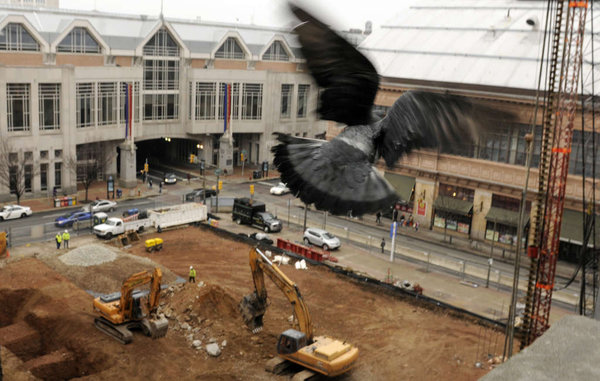
The start of construction of Home2Suites, across from the Convention Center, on the former site of 19th-century buildings that housed eclectic shops until 1998. They were razed for a parking lot. (TOM GRALISH / Staff Photographer)
In the heated competition for the worst new architecture in Philadelphia, the sickly yellow, synthetic-covered mid-rise across from the Reading Terminal Market is now the one to beat.
If the particular ugliness of the new Home2Suites at 12th and Arch Streets seems familiar, it is because this type of flimsy, style-challenged hotel is already a fixture at highway off-ramps across America. Grateful for shelter in far-flung places, we grudgingly accept the lack of architectural effort, even if we do slink off in the morning without so much as a backward glance.
It is a different matter entirely when a white-bread-loaf of a building like this makes its way onto a downtown street, into the company of chiseled stone centenarians like the Reading train shed. For people who have to walk by - and this includes the legions who visit the Convention Center - the effect is like being handed a plate of plastic play food at a fancy banquet.
Until now, even Philadelphia's most basic buildings have accepted the architectural requirement that they put on a tie and jacket when they've come into Center City. Their builders have employed respectable materials and tried to create something unique to the site. But Home2Suites is evidence that the postrecession building boom has altered the financial calculus.
Lenders are more cautious now, margins tighter. Big chains, once content to build on blank suburban sites, are finding that market saturated, and, instead, are swarming into the nation's reviving cities. Unfortunately, the chains are coming with their highway designs in tow. We can expect to see more architecture stamped out on the assembly line as new high-rises, retail chains, and casinos are built in cities.
Home2Suites, which opened Tuesday, was produced ( designed is too strong a word) by Cope Linder Architects, the Philadelphia firm responsible for SugarHouse. The nine-story exterior is slathered in an artificial stucco-like material called Eifs, often sold under the brand Dryvit. Unlike the real thing, which glows softly and puts us in a Mediterranean state of mind, Eifs absorbs light. The hotel facade is so flat and plasticky it makes Parkway Corp.'s adjacent brick-and-concrete garage look like a work of heft and dignity. Tap the hotel's surface - but not too hard! - and you will hear the hollowness.
Just as fashion has become a throwaway commodity, so has architecture. There's a reason highway chain buildings are constantly replaced. In a decade, Home2Suites' Eifs facade will start to look worn out. The exterior is unlikely to survive past 30.
All this would be bad enough if the developers - Parkway and the Wurzak Hotel Group - had built the hotel entirely on their own dime. But as often happens in Philadelphia, this $59 million plastic box was enabled by lavish subsidies from the city, state, and federal governments, including money allocated under the recent stimulus program.
Taxpayers handed the developers almost $14 million in cash grants. Millions more were made available in other forms, including $10 million in New Markets tax credits and a $5 million, low-interest HUD loan. In 1998, the Philadelphia School District agreed to sacrifice $17 million in future city taxes so Parkway could obtain tax-incremental financing and build the garage, which is now linked directly to the hotel.
It's also worth noting that the site was then occupied by an eclectic row of 19th-century buildings, home to small businesses that once dreamed of cashing in on the Convention Center's presence - a diner, a dry cleaner, a shoe store, and yes, a porn shop. Though not particularly remarkable, those brick structures were relics of the neighborhood's colorful past, when the area bustled with small-scale publishing and print shops.
But the businesses were all kicked out by the Rendell administration in 1998 through the use of eminent domain. The buildings, which predated the 121-year-old Reading train shed, were demolished, and the land was sold to Parkway, which proceeded to park cars on the surface lot at some of the highest rates in town.
My beef isn't with the subsidies. If government grants are necessary to kick-start economic development, fine. Given the public investment in the Convention Center, a case can also be made for replacing those small buildings on 12th Street with something grander.
But just because you're subsidizing economic development doesn't mean you should be subsidizing poor design.
Philadelphia has a long history of underwriting some of its worst architecture. Symphony House condos, a notorious contender in the race to the bottom, received government support. So did the bland, new glass apartment tower 2116 Chestnut. Both are beauties compared to the hotel.
The rationale for giving these projects a helping hand is that Philadelphia's labor costs are very high - almost as high as New York's - but the returns here are much lower. Government subsidies effectively kill two birds with one stone: They enable unions to maintain high wages while helping developers reduce their costs.
In theory, the subsidies should also ensure that the city gets better-quality buildings.
Based on several accounts, Planning Director Alan Greenberger did, in fact, intervene with the developer to improve the hotel's design. As a result of his tinkering, the ground floor now features a generous amount of retail space with large, well-proportioned windows. In addition, the building's 25-foot setback, specified decades ago in the area's urban-renewal plan, allows for table seating and wide sidewalks. There's a green roof, bike racks, and street trees.
The developers say they also are proud that they were able to step up the design in the lobby, using more-sophisticated furnishings and lighting than the chain's standard to create a "cosmopolitan" atmosphere. But given the $40 million in public concessions, the city should have gotten more.
"Philly is a tough town," Parkway President Robert Zuritsky said in an interview. Before his deal with Home2Suites, a Hilton brand, Parkway struggled to woo a higher-end chain to the site, including a W Hotel, he said. At one point, Parkway, which was a partner in building condos at 1706 Rittenhouse, produced an attractive rendering for a residential tower, but the project sank with the recession.
The developers now have signed up two of the three retail spaces for Home2Suites' ground floor, with Panera Bread and BurgerFi, which will have a bar. Both chains, they say, will stay open into the night and help bring life to the area after business hours.
Luckily for the customers, it should be too dark by then to see the hotel that houses them.
By Inga Saffron
Not only is the garden a homegrown Camden gem, it’s significant architecture. The state is unaware of that.
There isn't much of Camden on the Camden waterfront, but what little there is can reliably be found at the Camden Children's Garden.
Amid the lineup of high-priced venues that now front the Delaware, the horticulture-themed playground stands out as a lone homegrown attraction. Camden residents built it. Camden residents use it. Camden teenagers learn work skills there. Designed by the noted architect Steve Izenour, the city landmark celebrates South Jersey in all its wondrous variety: The billboard-style, corrugated-steel entrance gate is a whimsical love note to the region's truck gardens, seaside kitsch, and roadside signs.
But if the Christie administration gets its way, that remaining scrap of authentic Camden will be bulldozed from sight. The nonprofit Children's Garden is being evicted, so that the valuable waterfront property can be freed up for what a state treasury department official describes as an "economic development initiative."
What that initiative is precisely, no one in Christie's administration will say right now. Treasury spokesman William Quinn has refused to elaborate, but the plan already bears the hallmarks of a government-sanctioned land grab. The presumed beneficiary is the corporate Goliath that runs the Adventure Aquarium next door, says garden director Mike Devlin.
The saga of the Children's Garden could be the story of Camden in microcosm. While the state has poured millions into the private waterfront aquarium - at least $43 million since 2005 - the educational nonprofit has struggled to keep its Izenour-designed entrance gate open.
The aquarium, built by the state in 1992, and the garden were once partners that shared ticketing operations. Visitors to both attractions entered through the Izenour gate. But after the aquarium was privatized in 2002, the new operators created an entrance that bypassed the garden, cutting off a sizable portion of its revenue. Then, in 2010 Gov. Christie eliminated its state funding.
Partly as a result of the lost revenue, many of the original garden exhibits that Izenour created, like the wacky treehouse and checkerboard picnic area, are starting to show their age. Izenour, who coauthored the 1972 landmark treatise Learning From Las Vegas with Robert Venturi and Denise Scott Brown, favored the cheap and accessible in architecture over the high-end stuff. Of course, it's the garden that is now being blamed for the effects of years of disinvestment.
In a Jan. 14 ultimatum from the state, Devlin was told to remove all "property" from the garden's four-acre site by March 31. If he agrees to the state's terms, the letter continued, the garden will be allowed to continue operating, though on a limited scale, pushed back from the water to the area where its greenhouses now stand - a plot of land amounting to less than a single acre.
It's not much of a deal, and Devlin says the garden may challenge the eviction in court. A Children's Garden without children's attractions just isn't the same draw. Beyond that, removing the "property" would mean tearing up Izenour's entire design.
The ensemble, which he created with Timothy P. Kearney while working at Venturi Scott Brown & Associates, may be one of the fullest expressions of the firm's populist aesthetic. Even more than VSBA's namesakes, Izenour fell in love with America's exuberant jumble of roadside architecture - the cartoon colors, the come-hither signage, the oversized depiction of everyday objects - during the writing of Learning From Las Vegas.
He incorporated some of those elements when he designed the treehouse exhibit at the Philadelphia Zoo in the mid-'80s, but it was the garden commission in New Jersey that gave him the perfect platform for his highly graphic vernacular style. Izenour packed the garden with Alice-in-Wonderland shifts in scale, like giant teacups, that kids loved. As it turned out, notes VSBA's Daniel McCoubrey, the project was Izenour's last major undertaking. He died in 2001.
Quinn, the state spokesman, was surprised to be told in an interview that the Children's Garden is a significant work of architecture as well as an important Camden institution.
Such ignorance about New Jersey's cultural legacy is troubling. Only last August, the treasury department, which oversees the state's real estate holdings, announced its intention to raze a Trenton plaza designed by the award-winning sculptor Athena Tacha. In that case, too, the agency was unaware of the project's rich backstory. The plaza was saved only after Christie personally intervened.
It should be pointed out that the importance of the Children's Garden goes beyond Izenour's imaginative contributions. The idea for an educational garden for children was conceived in the late 1990s by the Camden City Garden Club, founded by Devlin and his wife, Valerie Frick. After the club surprised everyone by taking a first prize at the Philadelphia Flower Show, Devlin and Frick were able to raise $8 million to open the garden in 1999.
Over the years, city residents enriched the attraction by building their own exhibits. Many displays started out as designs for the Flower Show. The best were accorded a permanent home in the garden, a source of pride for the Camden residents who built them.
A few years ago, the Philadelphia Eagles Youth Partnership helped build one of the garden's most popular attractions, the Butterfly House. You can visit the Facebook page "Save Camden Childen's Garden" to read the testimonials from teenagers whose lives were turned around by the experience of digging in soil and working with plants.
For years, state officials have claimed that developing Camden's waterfront was the key to reviving the beleaguered city. More and more, though, the development has come to seem like an end in itself.
Our waterfronts are public places that exist for more than business undertakings. Surely there is room on the Delaware for a small civic enterprise like the Children's Garden to put down roots.
January 21, 2014
To: The Pulitzer Prize jury for Criticism
Her column is titled "Changing Skyline," and indeed, Inquirer architecture writer Inga Saffron's critical gaze often is cast upward, toward the rarefied reaches of Philadelphia's development titans. Yet the structures that make a city stand tall do not always poke the clouds. They need be no bigger than a child's quirky treehouse, or a posterior-friendly park bench.
In the past year, Saffron ardently, eloquently defended the place of both among the giants. She railed against a growing plague of garage-fronted row houses, each "a dagger in the body of the city," and hailed a cheesecake chain restaurant coming soon to a downtown corner, "a temple of caloric overload" in a glass box of such exceptional design that it "promises to be one of the city's finest new buildings." In other words, the measures of a people-centric community - Saffron's dream Philadelphia - are usually, for good or bad, in everybody's face.
In 2013, there was no telling what she would pull up next in her scope - a garden in jeopardy, a low-rise "cookie-cutter" hotel the yecchy color of old cheese, a bunch of intractable bureaucrats or, yes, a skyscraper. But there was no question that her opinion of it, grounded in 15 years of nationally esteemed architecture criticism (thrice a Pulitzer finalist), would matter. These days, that's saying a lot.
The Internet has turned a once-esoteric beat fiercely competitive. Hardly a rendering is drawn, a zoning meeting convened or a brick laid that is not posted, in real time, by a slew of websites dedicated to local planning and seized upon by a pack of bloggers. But rather than drown her out, they have proved Saffron's value, and enhanced her presence by copiously quoting her pronouncements - singularly rich in analysis, context, history, wry humor and a magnetic, mad-dog bite that makes reading her just plain fun.
Well, wait ... not fun for all. When the health-care behemoth Children's Hospital of Philadelphia decided to expand with a high..rise research campus, the blogosphere gave its blessing. It was left to Saffron to find in the voluminous renderings a troubling pattern of imprecision, and to call out CHOP officials for intentional muddling. One thing, though, was infuriatingly clear to her: The lovely public park the hospital had promised neighbors - the sort of space she treasures - had transmogrified into "a cattle-chute pathway straight to the front door." Forget that romp with Fido.
Saffron's bit list also included the entire city zoning board, which had been busily issuing variances for garage-front conversions and, in the process, undermining the new zoning code that Mayor Michael Nutter had promised and fought to deliver. "Why won't the zoning board behave?" she asked, before giving an answer that zeroed in on such favorite targets as the auto-obsessed Philadelphian.
Add to that roll the councilman who proposed reviving sad-sack LOVE Park, a landmark plaza at the city's heart, by installing cafes and retail kiosks. It sounded like a reasonable-enough plan with money-making potential - until she visited a similar park in Manhattan and did the math. The councilman, she concluded, was off his rocker.
Saffron's collected criticism did not stop bulldozers in their tracks this year, nor did she expect it to. Profound changes in the urban zeitgeist occur incrementally and move glacially into public view. Fifteen years ago, for instance, she began prodding developers to turn their ground floors into active spaces; now, they proudly point out to her, they're doing it, putting her, she says, "on the right side of history." For the time being then, suffice it to note that a chastened zoning board is more circumspect about permits for faceless garage-door fronts. With a second casino on the way, City Hall has echoed Saffron's top-two location picks. And that threatened garden with the wacky treehouse? Still there.
Bill Marimow
Editor
Biography

Inga Saffron writes about architecture, design and planning issues for The Philadelphia Inquirer. Her popular column, "Changing Skyline" has been appearing on Fridays in the paper’s Home & Design section since 1999. In 2012, she completed a Loeb Fellowship at Harvard University’s Graduate School of Design. She has been a finalist for the Pulitzer Prize three times, in 2004, 2008, and 2009, and in 2010 received the Gene Burd Urban Journalism Award.
Pushing beyond the usual boundaries of architectural criticism, her columns focus on the buildings and public spaces that Philadelphians encounter in their daily lives. Saffron applies a reporter's skills and sensibility to explore the variety of forces - political, financial, cultural - that shape the city. Her columns on waterfront development, zoning and parking issues have led to significant changes in city policy. This year, Saffron launched Built, an innovative new web page that allows her to curate Inquirer stories on architecture, development and transportation. By packaging this related content together and updating it daily, Saffron has focused attention on a group of inter-connected issues that are crucial to Philadelphia’s future.
Before assuming her current position, Saffron spent five years as a correspondent in Eastern Europe and the former Soviet Union for The Inquirer. She covered wars in the former Yugoslavia and in Chechnya, and witnessed the destruction of Sarajevo and Grozny. It was in part because of those experiences that she became interested in the fate of cities and began writing about architecture.
Saffron began her journalism career as a magazine writer in Ireland and worked for the Courier-News in Plainfield, N.J., before joining The Inquirer in 1985 as a suburban reporter. She is the author of "Caviar: The Strange History and Uncertain Future of the World's Most Coveted Delicacy," published by Broadway Books in 2002. She lives with her family in Philadelphia.