Finalist: The New Yorker, by Hilton Als
Nominated Work
Helen Mirren and Larry David on Broadway.
By Hilton Als
To watch Larry David make his Broadway début, in his self-penned “Fish in the Dark” (at the Cort), in the same week that Helen Mirren stars as Queen Elizabeth II,in Peter Morgan’s “The Audience” (at the Gerald Schoenfeld), is to learn something about the benefits and the limitations of shtick. Derived from the Yiddish word shtik, meaning “an act” or “a gimmick” (from the German Stück, for “piece”), it can also refer to an adopted persona that is consistently maintained. David’s shtick is familiar to legions of fans of his HBO show “Curb Your Enthusiasm,” in which he played a thin, sour-voiced TV writer and producer. Mirren’s shtick, on the other hand, is to transform herself into what she is not: in this case, Elizabeth II, a role she first took on in the 2006 movie “The Queen” (also written by Morgan), for which she won the Best Actress Academy Award. Mirren’s goal is not to reënact but to interpret; she has spent a considerable amount of time grappling with this real-life figure, and looking at the divide between what a famous woman is perceived to be and what she actually is—if she manages to hold on to some version of that.
It would be a mistake to walk into the Schoenfeld—or any other space where a so-called “historical drama” is playing these days—and expect a literal transcription of life. Veracity does not make excellent stage work; imagination and extrapolation do. Years ago, Broadway audiences flocked to melodramas like Rudolf Besier’s “The Barretts of Wimpole Street” (1931) or Henry Denker’s “A Far Country” (1961) less because they wanted to know the chronology of the lives of Robert Browning and Sigmund Freud than because they wanted a window into those famous souls, through which the view would, inevitably, be romantic: didn’t famous people live bigger, starrier lives than the rest of us? Many contemporary theatre artists have a similar romantic view but temper or critique it by applying it to anti-romantic characters—people we are fascinated by, but who can, at times, make our flesh crawl. Morgan borrows extensively from history—the TV interviewer David Frost’s notorious encounters with Richard Nixon were the basis of his 2006 smash, “Frost/Nixon,” for instance—to write stage and film essays about fame, sometimes featuring characters who represent ruin in the world (such as the Ugandan dictator Idi Amin, who figures so lushly and cruelly in the 2006 film Morgan co-wrote, “The Last King of Scotland”).
Morgan’s celebrities do double duty: they act out the complications of being human while coping, or not coping, with the public responsibility of fame—of inhabiting a narrative that the whole world reads and dumps its ideas into. While his English predecessor that genius scenarist Dennis Potter described the effect of fantasy on ordinary life, Morgan, a rational surrealist—his pacing recalls Buñuel’s late films—likes to burrow into the only thing that can remain obscure in a universe of the known: feelings. But what are feelings if they’re inseparable from rumor or gossip? Morgan suggests that the famous have to fight for the right to be “nobody,” in Emily Dickinson’s sense of the word (“How dreary to be somebody!/How public, like a frog /To tell your name the livelong day /To an admiring bog!”).
Queen Elizabeth’s personal equerry (the very fine Geofrey Beevers) may be a nobody beside the woman he serves, but it’s his access to her fame and power that accounts for at least part of his stifbacked, pissy hauteur. In black boots, jacket, and sash, he walks to center stage and addresses the audience:
Every week the Queen of the United Kingdom has a private audience with her Prime Minister. The meeting takes place in the Private Audience Room located on the first floor of Buckingham Palace. A large, duck-egg-blue room. High ceilings, a fireplace, a Chippendale bureau. Four gilt-framed paintings, two by Canaletto, two by Gainsborough. At the center of the room, two chairs made by François Hervé, acquired in 1826. Their original color was burgundy, but Queen Mary had them re-upholstered in more optimistic yellow Dupioni silk. . . . According to household records, they were last reupholstered . . . just in time for an audience with Her Majesty’s ninth Prime Minister, on the 17th January, 1995.
The director of “The Audience,” Stephen Daldry, knows that facts are essential to our understanding of myth. Working closely with Morgan’s long and essentially plotless script—during the course of the play, Elizabeth meets with eight of the Prime Ministers whose terms have coincided with her reign—he not only shows us how the scene is assembled but makes its construction part of his theatre magic, which is warmer than Brecht’s, but “alienated,” too. As the equerry talks, we see footmen position the chairs in a sort of Christian Bérard-influenced half-world. (Daldry is aided in the creation of his splendid world of illusions by the designer Bob Crowley and the lighting designer Rick Fisher.)
The first Prime Minister to visit Her Majesty is the Conservative John Major (a slightly frantic Dylan Baker), who is trying to turn the British economy around. As the two take their seats, Elizabeth sighs, her face a mask of weary tolerance. The conversation begins in absurdity:
MAJOR: I only ever wanted to be ordinary.
A silence. The Queen stares.
ELIZABETH: And in which way do you consider you’ve failed in that ambition?
MAJOR: What’s going on in my political life at the moment is just so EXTRAordinary. My government is tearing itself apart. . . . And now Margaret sniping at me all the time from the wings. Claiming I am betraying her legacy. . . . We’re just all caught up in a transition that none of us yet fully understands. And the papers are being so AWFUL. . . .
ELIZABETH: It’s a dangerous business reading newspapers. . . .
MAJOR: I know. I just can’t help myself. Can’t walk past one of the things without picking it up, hoping for a lift. And then I get crushed when they’re so . . . VILE. Most of my political life it was fine because I was generously overlooked. . . . Did you know eighteen months before I became Prime Minister just two per cent of the country had even heard of me? . . . When I walk into a room, heads fail to turn.
ELIZABETH: (sighs) How lovely. . . .
Obscurity may be a dream of Elizabeth’s, but she knows that it’s just that—a dream, which must be set aside in order for her to deal with the realities of her role as, she jokes, “a postage stamp with a pulse.”
There is nothing like watching a great director with a great star; the relationship can and often does transcend weak material. Morgan’s material is not lacklustre. There’s enough air in it for Mirren to interpret, and for Daldry to guide her interpretation and add an element that only the stage can contain: camp. (This is especially true when Elizabeth recounts the story of her coronation: she is aglitter with her own celestial light.) What artist who survived the Thatcher years—the vast divide between the haves and the have-nots, the racism, the willful ignorance about AIDS—can take royalty, let alone politics, to heart? Daldry and Mirren don’t ridicule Elizabeth II; they ridicule her job and its endless mundanities, while focussing on the moments when she sneaks out from behind the discipline, the steely hair, the perfunctory half-smile. Elizabeth behaves like a lady (legs crossed at the ankle, handbag at the ready), even as she refuses to perceive her gender as a limitation:
ELIZABETH: At least you HAD a formal education. I wasn’t that lucky. . . .
MAJOR: I’m curious. Was that because you were . . . female?
ELIZABETH: You’re ahead of me, Prime Minister. I was banking on the idea that I still AM.
MAJOR: I meant the home education.
ELIZABETH: You mean had my sister and I been boys, would we have been sent to boarding school? Probably.
MAJOR: So you were victims of gender discrimination?
ELIZABETH: I suppose we were. Do you think I should sue?
Mirren is not a coquettish queen, but she is a sexy one, because she is so controlled, and such a good comedienne behind her cardigan, her sensible shoes, and her pearls. She won’t let Elizabeth’s pale public persona neuter her, and she uses her impassive stare, sometimes, the way a dominatrix might when looking at a tiresome client. Must she whip him again? For Elizabeth, that would be about as exciting as brushing that piece of lint of her skirt.
Judith Ivey’s Thatcher could do with a bit of that control. She’s so anxious to define herself in opposition to the Queen—as the country lass resentful of privilege—that you can barely make out what she’s saying behind the prosthetic teeth. Still, you can see the chip on her shoulder. She’s desperate for the Queen’s attention, and resentful of her shopgirl’s need. The Queen understands that her Prime Ministers are aspirants. They don’t want to be royals, but they want to be royally treated. Morgan’s play is as much a treatise on class resentment as anything else, and Daldry knows that each of these characters is both more and less than human, representative of an aspect of life, rather than life itself.
But for a show-business figure like Larry David is there a difference? His dyspeptic humor is, as far as I can make out, most closely related to W. C. Fields’s anti-utopian view of the world. But there was a heart—a very real heart—in Fields’s best work, most of which took place in silence. The perennially modern Louise Brooks understood that Fields’s art was based on rejection. “As a young man, he stretched out his hand to Beauty and Love and they thrust it away,” she wrote. David stomps on Beauty and Love to the great delight of people who are too passive or polite to do it themselves. He’s not an anarchist in the Lenny Bruce mode, or a confused humanist, like Louis C.K. Instead, he preaches hatred through self-hatred, a strident “Jewish” minstrelsy.
The comedy in “Fish in the Dark,” such as it is, has to do with family. We meet Norman (David) in a Los Angeles hospital, where his father, Sidney (Jerry Adler), is dying; family members, including Norman, his brother Arthur (Ben Shenkman), and their mother, Gloria (Jayne Houdyshell), are taking turns at Sidney’s bedside. Soon, the secrets and revelations come crowding in, including the fact that the family maid, Fabiana (Rosie Perez), has borne Sidney’s child, Diego (Jake Cannavale). After the funeral, Norman and his brother argue over who should take care of their nag of a mother. In a bid to get her out of his house, Norman cooks up a scheme with Fabiana: Diego will go to Gloria as the ghost of Sidney’s younger self (he resembles the father he never knew) and persuade her to move in with Arthur.
Norman is a greedy, self-interested schlemiel, not unlike the one David played on “Curb Your Enthusiasm”—a stereotype of loathing, who views everything through the lens of his own vindictive cowardice. The director, Anna D. Shapiro, moves bodies around the stage with little visible evidence that she’s concerned about their inner lives, and rarely steps outside the Broadway machinery to reënvision the dreck she’s stuck with. (She staged last year’s poor revival of “Of Mice and Men.”) And still I can’t help wondering how she was able to reconcile herself to this script, with its cynical manipulation of sentimentality and humor, where even Grandma is craven, and it’s standard for a man to use the word “cunt” to describe a woman—and then use it again, for laughs, in his apology, as the woman, stuck in her conventional wifeshtick, looks on, disbelieving and silent.
Musical outsiders.
By Hilton Als
If American composers and lyricists were to jettison the idea of diference from their plotlines, would they still be writing American musicals? In genre-defining Broadway shows, from “Oklahoma!” (1943) and “West Side Story” (1957) to “Sweeney Todd” (1979) and “Bloody Bloody Andrew Jackson”
(2008), difference is usually synonymous with danger: it’s the outsider or the outcast who introduces sex and violence into the musical’s relatively moral world. (American musicals almost always argue in favor of the status quo.) Difference doesn’t have to be racial or sexual; sometimes the other looks like the devil you know. In “Oklahoma!,” for instance, it’s the seething, strong farmhand, Jud Fry, who so gets under the skin of Laurey, the female protagonist, that her sunny disposition darkens; she’s disturbed that she finds Fry’s bullying sort of thrilling. It’s only after he dies, leaving Laurey to the sanctity of her marriage to her good, socially acceptable sweetheart, Curly, that order returns to the world.
The order that Bruce (Michael Cerveris), a Pennsylvania mortician and schoolteacher, craves in the musical “Fun Home” (at the Circle in the Square) is also moral; he’s conflicted about his homosexual desires, and feels that the only way to keep the world from descending into chaos is to shut them out. But how can you shut out an existential crisis? It just goes on and on. Bruce lives in a large, perpetually unfinished Victorian house, which he shares, more or less, with his wife, Helen (Judy Kuhn), and their three kids. I say “more or less” because Bruce doesn’t really want to live in the life he’s built, and so he keeps trying to rebuild it. He is constantly searching for things that he can fix—objects, patches of garden, walls—in order to sidestep his own cracked and secretive heart.
Based on Alison Bechdel’s 2006 graphic memoir, with book and lyrics by the wise Lisa Kron, “Fun Home” is narrated by Alison (Beth Malone), a thin, bespectacled, gay forty-three-year-old cartoonist, who is trying to make sense of her past and of her father’s life, years after his death. (Bruce Bechdel was forty-four when he was run over by a truck, in 1980, two weeks after his wife asked him for a divorce; his daughter suspects that the death was a suicide.) Looking back, Alison casts a quizzical, humorous, and empathetic eye on Small Alison (the charming Sydney Lucas), who is periodically picked on by Bruce: he becomes enraged when she doesn’t want to wear frilly clothes or a barrette. His conservatism is part of his being closeted. Watching his queer daughter grow up is like hearing an alarm go of in his funereal house: the vibration will shatter something, in addition to his nerves, but what? His dreams of unimpeachable normalcy.
Cerveris plays Bruce’s dissatisfaction with prickly charisma. It’s as if he’d synthesized all those moments when your pop was curt, preoccupied, or unavailable, in order to make Bruce as cold and emotionally distant as possible. The performance feels true: Bruce cannot accept others because he cannot accept himself. And the only way that Helen can react to her husband’s unhappiness is by not reacting: if she doesn’t speak, it’s not happening. Indeed, Helen expresses herself fully only when she’s pretending; her one passion is her work as an actress with a local theatre company. Ofstage, she’s awash in the rank waters of disgust, pity, and anger that come with being ignored by a partner whom she loves but cannot forgive.
If Middle Alison (Emily Skeggs, a new and down-to-earth star) had her druthers when she returns home from Oberlin with her first girlfriend, Joan (the funny and present Roberta Colindrez), she’d take right of again. Bruce and Helen take a long time to acknowledge the fact that she has come out to them, in a letter, and it hurts. What she doesn’t understand is that her ability to speak—to articulate her choices and to follow them openly—makes her something of a miracle in this family. By virtue of her honesty and strength, Alison has become her own parent, uncrippled by the fiction of normalcy.
The director, Sam Gold, makes the most of the Circle’s theatre in the round. When I first saw the musical, at the Public, in 2013, Kuhn’s performance—the nuances of her rage, bewilderment, and loneliness—got lost on the proscenium stage. Not now. Her voice is perfectly suited to Jeanine Tesori’s score, which is reminiscent, in its shadings, lightness, and interiority, of the score Tesori wrote for “Caroline, or Change,” Tony Kushner’s exceptional 2004 musical about a black domestic working for a Southern Jewish family in the sixties. Like “Caroline, or Change,” “Fun Home” explores many issues that we’re grateful to see aired in a contemporary musical. Sometimes that can feel like a lot of responsibility for a small, personal show to bear, but just when you think “Fun Home” will topple over into consciousness-raising “sharing,” it rights itself and moves quietly, surely forward.
Despots can be outsiders, too. The King of Siam (Ken Watanabe), in Rodgers and Hammerstein’s 1951 musical, “The King and I” (in revival at Lincoln Center’s Vivian Beaumont), wears a scowl on his handsome face for much of the nearly three-hour-long show, because life as he has known it is changing. It’s the early eighteen-sixties, and trade is opening up in Asia. The King hires a British tutor, Anna Leonowens (Kelli O’Hara), to teach his children about the larger world so that they can, perforce, be part of it. (“The King and I” is based on Margaret Landon’s 1944 novel, “Anna and the King of Siam,” which itself was based on Anna Leonowens’s memoirs about her time in the Siamese court.)
A widow with a preternaturally upbeat attitude, Anna is initially unfazed by her new boss’s severity, but she is eventually disturbed by his plan to whip Tuptim (Ashley Park), a Burmese girl he was planning to marry, who has fallen in love with someone else. Freedom of choice—what’s that? In the character-revealing song “A Puzzlement,” the King sings, “When I was a boy/World was better spot./What was so was so,/What was not was not./Now I am a man/World has changed a lot:/Some things nearly so, others nearly not. . . ./Is a puzzlement.” The King’s consciousness—hitherto little exercised—gets a thorough workout with Anna. The two are worthy adversaries. They are also, after a fashion, in love, but before they can act on their feelings the King dies of a heart condition. This is a musical: the outsider must be defeated.
The director, Bartlett Sher, has done the right thing by casting Asian actors in Asian roles, though it takes a minute to shake the images that inevitably remain from the 1956 Yul Brynner film, in which the Puerto Rican Rita Moreno played Tuptim, and gauge what Sher is really up to. He wants the production
to be big, to give a sense of space and distance on the stage, through huge props and grand movements. (Christopher Gattelli’s dances, which are based on Jerome Robbins’s original choreography, owe a lot to Thai and Burmese dance.) This is a bid, I think, to assert the show’s importance. But “The King and I” is already important—delightful and moving and complicated—and creating a larger visual field doesn’t really change our response to it, or compete with the movie’s Panavision splendor.
Despite her hoopskirts, O’Hara is the most physically free I’ve ever seen her. Vocally, she’s on par, as always, and when she sings to the King we believe her—though it takes a lot of acting for her to convince us that she understands a word he’s saying. It’s not a matter of volume. Watanabe’s a good belter, but his diction is unlike anyone else’s. Whenever he admonishes
Anna, it sounds something like: “Avjfatujceahf, Miss Anna!” Is a puzzlement.
In “The Visit” (directed by John Doyle, at the Lyceum), Chita Rivera plays Claire Zachanassian, the richest woman in the world. Imperious but witty, Claire wears a diamond necklace and a white fur-trimmed coat; she carries a cane. Whether sitting or standing, she is erect. She has returned to Brachen, Switzerland, the town where she grew up, poor and marginalized as a Jew, to seek justice. Long ago, Anton Schell (Roger Rees) seduced her and then abandoned her when she got pregnant; now she wants to pay the town’s cold, hungry inhabitants more money than they could ever spend to kill him. In the beginning, the townspeople, who also act as a chorus to the proceedings, are outraged by Claire’s suggestion that you can trade souls for money. But after a while they see the wisdom behind her offer: human life is cheap, especially if you can sell it for what really matters—self-satisfaction and comfort. Claire discovered this for herself when she left this rotten place and married all those rich old men. Still, her real passion is for Anton, and, because she can’t bend him to her will, he remains her one true love—the one who got away.
“The Visit,” based on Friedrich Dürrenmatt’s 1956 play, is meant to be a fable, but it struck me as moderate realism: many people make careers of marrying up or exact revenge on former lovers by turning their friends against them. So I wasn’t quite sure what the production was trying to say, or even how it was trying to say it. The decor and costumes, by Scott Pask and Ann Hould Ward, respectively, are German Expressionist in feel, while the music and lyrics, by John Kander and Fred Ebb—this was their final collaboration, in 2001—sometimes reminded me of another place altogether: the nineteen-twenties Chicago that Kander and Ebb drew on so evocatively in “Chicago” (1975), which also starred Rivera.
“The Visit” never becomes even the sum of its parts. Doyle—who hasn’t done revolutionary work on the musical stage since his unbeatable revivals of Stephen Sondheim’s “Sweeney Todd” (2005) and “Company” (2006)—throws so much into the jumble that it obscures the production’s meaning, if it has one.Only the eighty-two-year-old Rivera—whose performance melds her professional longevity with Claire’s taste for survival (“I’m unkillable,” she says at one point, and her fans howl)—transcends the weirdness of the juxtapositions, when she sings the delicate and meaningful “You, You, You.” In her luxurious, hornlike voice, we can hear the woman Claire once was, and all the dark roads she’s travelled since, while hoping against hope that someone would find her beautiful, irreplaceable, different.
Dael Orlandersmith’s memory play.
By Hilton Als
The suffering-artist narrative is as old as Socrates chugging that hemlock, but you can’t blame dramatists for returning to the cracked-creator myth as often as they do. In theatrical terms, happiness—especially the powerful and inexpressible high that artists feel when creating a world—doesn’t play: conflict is the theatre’s lifeblood, and it’s the exploration of uncertainty and anger, fear and longing that makes most stage stories, not acceptance or contentment. Dael Orlandersmith, the author and the performer of “Forever,” an eighty-minute monologue (at New York Theatre Workshop, directed indulgently, but not unintelligently, by Neel Keller), is no stranger to chaos and conflict. There are many clouds in her life and few silver linings—certainly none that she could slip into easily, delight being as foreign to her as love and self-awareness were to the play’s other central character, Orlandersmith’s late mother, Beula.
Dressed all in black, like a modern-day Masha, Orlandersmith, when we first meet her, is not mourning her life but celebrating it. This she does in Paris, at Père Lachaise Cemetery, where she communes with the artists—Marcel Proust, Édith Piaf, Oscar Wilde, Jim Morrison—who inspired her and who form, for her, a kind of ideal family: they cannot speak and so cannot interfere with her fantasies about them. In Takeshi Kata’s spare set, bulletin boards run along the back of the stage (which also features a table, chairs, and a record-player); pinned to them are notes and photographs—mementos that Orlandersmith has collected in a lifetime of looking for love, or, at least, of trying to figure out what it might look like away from the twisted neediness and antagonism that she experienced at home. Watching a young girl walk through the cemetery, Orlandersmith wonders if “her mother like my mother (especially when my mother was drunk which was very Often) . . . said ‘I want you to look good because you’re a reflection of ME / you HAVE to be a reflection of ME.’ ” Without realizing or, at least, acknowledging it, Orlandersmith is doing exactly what her mother did: that nameless girl is interesting only insofar as she reflects Orlandersmith back to herself. It doesn’t take us long to realize that her will to dramatize, to claim center stage as a writer and as a performer, is, to a great extent, about upstaging the first performer in the family: her mother.
Because the monologue form is relatively static, its power lies both in its demand that we listen—the drama is in the words, not in exchanges with other actors—and in the battle that it often depicts between the true self and the false self. In “Forever”—as in Sylvia Plath’s “Three Women” (1962), Darryl
Pinckney’s adaptation of Virginia Woolf ’s “Orlando” (1989), and SuzanLori Parks’s “Pickling” (1990), among many others—the protagonist’s theatrical energy derives, at first, from the lies she tells the audience, and hence the world, especially about being a woman. Things heat up, though, when she starts to speak the truth—forceful, resilient, exposed. Orlandersmith’s false self was that of the good daughter, or, more precisely, her mother’s spousal equivalent, which was what she became after her father’s death, in 1963. It’s in the guilt she expresses as she describes the Dickensian misery that she and Beula shared in the Harlem house her father left them that we begin to hear her real voice:
There was always PAIN My birth was difficult/painful on her/ to her And The difficulty of my birth combined with my father’s passing . . . added to that pain The pain extended itself to the house where she and I lived till her death. . . . I wanted to know the SOURCE of this pain. I wanted to know
where it ALL began.
Most children feel that the world didn’t become the world until they arrived in it. But what if tremendous pain—or happiness—precedes them? Often, they fear that they can’t measure up to such enormous feelings. Sometimes they become detectives or artists, working to sleuth out what happened and why. When Orlandersmith asks her mother about her unhappiness, Beula brushes her of. “There was something she would not/ could not tell,” Orlandersmith says. “She was cut of/ closed of.” For Beula, to explain anything would mean admitting that she is an “I” with a story of her own; she cannot risk individuating herself from her daughter, her captive audience. (Orlandersmith imitates her mother’s New-York-by-way-of-South-Carolina accent by mocking it; it’s telling that, in the working script, the author writes “(does her)” when she imitates Beula, and then “(becomes self)” when she plays herself.)
“Forever” is about bodies as much as anything else—black female bodies at war with one another and with the inner self. Beula is a refugee from Toni Morrison’s “The Bluest Eye,” more comfortable with the idea of her body as a wasteland than as a nurturer or a creator of beauty. (Not surprisingly, Orlandersmith reveals that her mother, too, dreamed of being a performer, but was probably defeated by white ideals of beauty.) If Orlandersmith turns to Beula for answers about herself—Why am I different? Why am I bigger than everyone else?—her mother beats her, or exacerbates her self-doubt with more criticism. And, despite her best efforts, Orlandersmith can’t uncover her mother’s true self: drunks don’t have a real self or a fake self; they’re just drunk, forever replaying the only record that excites them—a pitiful and self-pitying song cycle about the insults and injuries they’ve suffered. Unlike her daughter, Beula is unable to stand outside her story long enough to tell it, but Orlandersmith is unable to stand outside hers long enough to transform it into a mystery—into art that will absorb an audience.
As a teen-ager, Orlandersmith finds some escape through music. (Taste is one way of separating herself from her mother.) Getting up from her seat onstage, she puts an LP on the portable turntable: the Doors. She seems drawn to Morrison, Jimi Hendrix, the Rolling Stones, and other male rock stars, because those guys have the authority that she longs for. She relates how once, when she was walking on the streets of Harlem, carrying the Doors’ album, she was chastised by a black man for “listenin to that white shit.” She recounts the exchange with verve and imagination, and in that flash of life outside Beula’s skewered reality we glimpse Orlandersmith’s gift for social comedy.
Ultimately, though, Orlandersmith remains married to her anger, which she wears as a sort of badge that also broadcasts her occasional smugness as a survivor. In her 2002 play, “Yellowman,” a large dark-skinned woman falls in love with a very light-skinned black man. Their relationship is defined by the racial tensions in the black community in the small South Carolina town where they live. It’s a textured work, in the quasi-realistic tradition of Adrienne Kennedy, Alice Childress, and Ntozake Shange. But those older writers used the stage to show how a black woman’s interiority can change the world even as the world changes her; Orlandersmith, in “Forever,” can’t give herself over to the alchemy, and everything ends up as an advertisement for the self—even the pain.
Toward the close of “Forever,” Orlandersmith talks, in harrowing detail, about being raped as a teen-ager—an abominable act that Beula, of course, used as a way of drawing attention to herself. While Orlandersmith describes the horrendous event and the tender cop who momentarily broke Beula’s hold on her during the investigation—the rapist was never caught—the show’s brilliant lighting designer, Mary Louise Geiger, shrouds her in Goyaesque shades of darkness; the lights go from gray to black and then to white again, as the performer observes her mother lying in a hospital bed, dying. But even death does not silence Beula’s voice, which is in Orlandersmith’s head “forever.” What’s missing as she does and does not say goodbye to her mother, the only audience that will ever really count for her, is the sort of joy that has nothing to do with anyone else, the gaiety to be found in the imagination as it goes about its business, making the known world both true and unfamiliar.
David Mamet and the art of the con.
By Hilton Als
Illusions generated a lot of talk in postwar American theatre. The truth is that no amount of reality could compete with the Holocaust. So there was a turning inward. In 1947, Tennessee Williams’s Blanche DuBois told audiences that she wanted not realism but “magic,” and that emotional honesty wasn’t necessarily synonymous with the truth. Six years later, in Arthur Miller’s “The Crucible,” a play inspired by the hysteria of the McCarthy era, a young girl’s fears and neuroses turned reality into fantasy, a weapon of suspicion and dread. When Mart Crowley’s “The Boys in the Band” opened Off Broadway, in 1968, it raised the curtain on certain aspects of gay male life, but it also showed that self-acceptance was still an illusion for gay people, who had spent too long struggling to breathe in the swamps of hatred and self-hatred.
Since the nineteen-seventies, David Mamet has been writing comedies and dramas in which illusion is less a subject than a quality of speech and character. Raised in Chicago during the Cold War, Mamet was still a young man when Saigon fell, in 1975. He grew up in a world defined by disassociation and violence, and many of his most interesting characters are con artists, who have no compunctions when it comes to doing what they have to do in order to survive and amass more—of anything, including dreams. They live by one fierce rule: fuck the other guy before he fucks you. By the time the scam-thick “Glengarry Glen Ross” premièred, in 1983, he had become the bard of the American *get*. His small-time crooks, hucksters, and real-estate agents were extreme or broken manifestations of Aristotle’s rule about what makes a play a play. In a 1997 interview in The Paris Review, Mamet said:
The main question in drama, the way I was taught, is always what does the protagonist want. . . . Do we see the protagonist’s wishes fulfilled or absolutely frustrated? That’s the structure of drama. . . . People only speak to get something. . . . They may use a language that seems revealing, but if so, it’s just coincidence, because what they’re trying to do is accomplish an objective.
Mamet’s characters set up a con whenever there’s something to be had, even if it’s only a person’s innocence—an innocence that the con artist rejects, because why should anyone get of the hook of existence without his fair share of existential disappointment? In “Edmond” (1982), the mild-mannered title character confronts and is beaten by a crooked card dealer and his shill. Being brutalized frees Edmond to pursue his own bloodlust; he comes to feel that politeness is for chumps and violence is justifiable—just as John, the professor accused of sexual harassment in Mamet’s 1992 piece “Oleanna,” learns that brute force might even be what his tormentor is looking for, in place of all that unmanly talking and thinking.
Like Saul Bellow’s Augie March, Mamet’s fast-talking guys are shysters in their own minds. They make conversations out of lists—of so-called facts or mundane details—and stories that never add up to anything, or come to an end, because liars and hysterics don’t know who they are unless they’ve got an audience. Like writers, they want to convince you by telling you the only story they think needs telling. “Prairie du Chien,” from 1979 (now in revival at the Atlantic Theatre Company, along with Mamet’s 1985 short play “The Shawl,” under the collective title “Ghost Stories”), stars a character who is called, simply, or not simply, Storyteller. The play opens in a train compartment. It’s 1910. The lights are low, and the locomotive is chugging west through Wisconsin. Stage left, two men sit at a table playing cards: the Card Dealer (Nate Dendy) and the Gin Player (Jim Frangione). Upstage right, the Storyteller (Jordan Lage) is talking to the Listener (Jason Ritter). The Listener has his back to us; his son (Henry Kelemen) isn’t visible, either—for most of the thirty-minute piece, he’s asleep on a bench beside the Listener. Originally written for the radio, “Prairie du Chien” is, first and foremost, a play about voices, but then what Mamet play isn’t? Or isn’t, ultimately, about Mamet’s voice? Still, the look of the show is as important as what’s being said, and the scenic designer, Lauren Helpern, and the lighting designer, Jeff Croiter, have built a world in which the physical limitations weigh on us as heavily as the words.
The Storyteller, who is thin-framed and handsome—he looks like an exhalation of mentholated cigarette smoke—is a monologuist, more or less, and the tale he tells is strange, racial, and sexual. It involves a white couple who owned a farm and ran a store in Council Blufs and had troubles. (The Storyteller never tells us what he does for a living, but it sounds like he is a travelling salesman.) One day in March, the wife—very pretty, kind-seeming—showed up in town with bruises on her hands. Her husband was jealous. The couple had words. Returning to the store in August, the Storyteller discovered the husband on his way to the farm to kill his wife, who he said was pregnant with someone else’s child. The Storyteller tried to stop the guy, but he knocked the Storyteller down and ran of. The Storyteller found the sheriff and they raced out to the farm. Then things got really weird. Not only was the barn burning but the farmer was hanging from a porch crossbeam, dead. Inside the house, a woman was crying; she told them to go to the burning barn, where they found a black man with a pitchfork stuck in his heart. “It was sickening,” the Storyteller says. “Five feet away there was the woman. In this lovely dress. This red dress. On her face. Her back was blowed away. . . . And the barn’s about to go.” But that’s not the end of the tale. Meeting the sherif outside the barn, the Storyteller described what he’d seen. The sherif argued that it wasn’t possible: the woman in the red dress was in the house, alive.
The Storyteller doesn’t impersonate the characters in his gothic tale. Instead, before each character speaks, he pauses for a moment, though not long enough to break the spell. But why is he weaving a spell, and out of such unpleasant material? When the Gin Player discovers that the Card Dealer has been cheating, he pulls a gun, the eerie calm of the scene explodes, and so do we—with questions. Is the Storyteller part of the Dealer’s con? Or is the Dealer working with the Listener? When the train stops in the prairie, the Dealer exits, and the Storyteller decides to stretch his legs. But first he asks, as he does at the beginning of the play, if the Listener’s son is asleep, saying, “I’d give a lot to sleep like that.” Perhaps the Storyteller, if he’s complicit in the Dealer’s con, feels guilt or remorse about how he makes a living. Or perhaps he just knows that the quickest way into any mark’s heart is to express concern for his child. Or is the child, too, part of the con? Presumed innocents are anything but. It’s all just another illusion.
Unlike Blanche DuBois, Mamet’s characters aren’t looking for magic. They’re looking to disabuse others of the ridiculous desire to believe in a trusting, loving world. Miss A (the always compelling Mary McCann), in “The Shawl” (which, like “Prairie du Chien,” is directed, with commitment, by Scott Zigler), is a lonely figure, who lives in her memories of childhood. To find out who she was—and what she might be— she visits a psychic named John (Arliss Howard) in his shuttered apartment. John sports a gray ponytail; his hands make little florid gestures whenever he gets excited about anything. He knows that Miss A is an unloved person; he can get to her—and to her money—by making her believe that he will be a kind of friend to her. (In order to get to her money herself, Miss A has to contest her mother’s will.) John also longs for companionship. He expresses his love for Charles (Jason Ritter) by revealing his secrets to him. No one is “psychic,” John explains. His insight into Miss A’s past life has everything to do with guesswork. For instance, she’s right-handed, right? When right-handed people fall, he says, they often break the fall with their left knee. So he guesses that Miss A has a scar on her left knee—and she does.
“The Shawl” is a portrait of exploitation and of how the con can become one’s identity. Con artists feel lonely, or lonelier, without it. Will Charles love John if he lets him in on how he conducts his business? Will Miss A trust John if he keeps getting her story right? (And will that trust lead to much-needed funds?) Eventually, Miss A confronts John with at least one truth: the photo she showed him on one visit wasn’t actually of her mother; she cut it out of a book. How could he be fooled like that? John can’t answer the question properly; in any case, he doesn’t have to. He draws Miss A back in with a vision of her mother wrapping her in a shawl, a moment of maternal tenderness that Miss A never forgot and never mentioned to anyone. How did John know about it? He can’t explain his insight, but it’s enough for Miss A to believe that, because he knows her past, he knows her. Miss A needs to believe in John, just as John must believe in the con in order to keep her enthralled in his world of illusions. Toward the end of the play, there’s this tense exchange:
MISS A: You *saw* her.
JOHN: *Did* I see her? . . .
MISS A: No. You must *tell* me. You *must* tell me. You *saw* her.
JOHN: Yes.
MISS A: You saw her wrap me in that shawl.
JOHN: Yes.
MISS A: And you say I *lost* it.
JOHN: You, yes, that is what I said. But you did *not* lose it. You *burnt* it. In rage. Standing somewhere by water, five years ago.
MISS A: Yes. And then I . . . ?
JOHN: I do not know. That is all I saw.
Italics are used to emphasize a point, and one of the points Mamet is making here is, again, about storytelling: Miss A, a kind of storyteller herself, wants to know what happened next. Was it this or that? Miss A and John are a grift-driven Mike Nichols and Elaine May, improvising the truth in ways that suit their shared, false spiritual awareness. In the end, we don’t know if Miss A stands to inherit any money, or if the lure of cash is just her way of keeping John interested. John and Miss A are victimized by their loneliness, and they want to victimize other people because of it.
These dense and elegant plays are exemplary not only of Mamet’s protean talent but of what can happen to you if you expect some kind of Aristotelian payoff—the usual Western dramatic con—before you leave the theatre. Neither play ends with a catharsis, and, by refusing us a satisfying release, Mamet turns us sideways and inward to look at his savage world view, in which the hunter becomes the game.
A young couple takes a detour in Annie Baker’s new play.
By Hilton Als
Annie Baker’s “John” (a Signature Theatre Company production, at the Pershing Square) is so good on so many levels that it casts a unique and brilliant light. It’s a handsome object, “old” in structure. While most new plays run for two hours or less—about the length of a TV movie—Baker’s fourth full-length original script clocks in at three hours and fifteen minutes, the running time of, say, a short, late-career Eugene O’Neill drama. By not rushing things—by letting the characters develop as gradually and inevitably as rain or snowfall—Baker returns us to the naturalistic but soulful theatre that many of her contemporaries and near-contemporaries have disavowed in their rush to be “postmodern.”
With “John,” Baker has done something exceptional on a political level, too: she has declared her ambition. The truth is that it’s still an anomaly for women artists to claim this kind of space for themselves and their work. In the past, Baker has distanced herself from that particular problem by writing about boys—mostly white boys. Unlike the women playwrights who have most changed the contemporary American stage—Adrienne Kennedy, María Irene Fornés, Alice Childress, and Suzan-Lori Parks come immediately to mind—Baker has produced only one play about a woman’s life, and it was a one-act comedy, a relative trifle compared with her other work. Sometimes, it has been difficult to distinguish between Baker’s world of guys and her own ethos. Her last play, “The Flick” (which won a Pulitzer Prize for Drama in 2014), put me off, because I didn’t know how to read the character of Avery, a twenty-year-old black man working in a movie theatre with a white girl he has a crush on and a boss who’s all hot air and “authority.” The character felt underdrawn to me, too willing to be a victim. I couldn’t figure out whether that quality was meant to be specific to him or was, in Baker’s view, a defining characteristic of his race. (Whenever black characters enter a largely white world in the present-day American theatre, I wince, and with reason, given such recent abominations as Douglas Carter Beane’s “Shows for Days” and Bruce Norris’s “The Qualms,” in which the black male characters are a source of putrid jokes and racist sight gags.) Of course, it’s foolish to walk into a play hoping that it will represent one’s race or sex; the playwright’s job is not to represent or stand up for anyone but to say something fascinating about humanity. Ultimately, Avery is a foil—the black “shadow” that Toni Morrison has written about—onto whom Baker projects her complicated, sometimes disappointing, but never less than human relationship to men, who interest her because they display their competitiveness more readily and openly, and thus more theatrically, than women do.
At first, you may think that “John” is going to be another Baker dude fugue, but it’s the women who quickly take and then hold the stage. The twenty-nine-year-old Elias Schreiber-Hoffman (rendered, with just the right amount of sourpuss passive-aggressiveness, by Christopher Abbott) enters, followed by his Asian girlfriend, the thirty-one-year-old Jenny Chung (Hong Chau). It’s late November, in Gettysburg, Pennsylvania, and the couple are en route to New York, where they live, from Ohio, where they spent time with Jenny’s parents. They’ve stopped off in Gettysburg because Elias, as a Jewish kid growing up with hippie parents in California, was “obsessed” with the Civil War and wanted to be a historian (not a musician, which is what he is now). So this little side trip is an indulgence—a visit to an enthusiasm of the past.
The bed-and-breakfast where the couple are staying is run by Mertis Katherine Graven (Georgia Engel), a seventy-two-year-old baby-voiced blonde. Mertis is fundamentally pleasant, and sees no reason not to litter her world with niceness. The sitting-room shelves are lined with dolls and miniature houses, all lit up invitingly; in the dining room, which she calls Paris, the tablecloths are white and lacy. By the time Mertis shows the couple to their room (the scene takes place offstage, but we can hear the three chatting overhead, just as we would if we were down below, waiting for the guests to get settled; it’s a fabulous real moment, among many to come), we’re already half in love with the trio’s voices. They combine two distinct styles of American playwriting: Richard Maxwell’s bone-dry, slow, humorous, and mundane speech and the excruciatingly beautiful, repressed-under-open-skies language of William Inge.
But Jenny and Elias are nothing like the frenzied lovers in Inge’s “Splendor in the Grass,” say; in fact, they’re getting on each other’s nerves. On their first morning at the B. and B., we see Elias eating cereal as Jenny tries to hide the fact that his slurping is irritating her. They’re at that point in a relationship when just seeing your partner eat can go through you like a drill. Picking up on Jenny’s discomfort, Elias uses the occasion to air his self-loathing, which, of course, makes the drama all about him:
JENNY: I can like hear you like breathing and smacking your tongue against the—
ELIAS: Sounds very Jewish.
JENNY: Wait, what?
ELIAS: Like, oh Jesus, the big loud hairy Jew is like smacking his lips again and chewing with his mouth open and it’s totally repulsive.
JENNY: It has nothing to do with you being Jewish.
ELIAS: That’s what you think.
But it doesn’t matter what Jenny thinks—or feels. Which may be partly why she cheated on him in the first place. Yes, Jenny fooled around with a guy named John, a fact that Baker reveals slowly in the first half of the piece. The playwright doesn’t give a reason for Jenny’s infidelity; instead, with the help of her director, Sam Gold, she illustrates, with no false notes, how people like Elias and Jenny were brought up not to acknowledge difference, while at the same time being attracted to it and competitive about it, too (my difference is greater than yours and deserves more attention—and sympathy). Baker brushes off the adolescent-boy porn-fantasy aspect of their relationship—the “sexy” trendiness of Jewish guys dating Asian girls, which was discussed, for instance, in Aaron Sorkin’s 2010 movie “The Social Network”—and shows us, instead, how people can wear their difference like a hair shirt or shed it like hot pants, depending on how much they need it to get ahead.
Jenny doesn’t exoticize herself as an Asian woman; she’s more into being a stereotypical girl and manipulating the world that way. She has cramps and feels too ill, she tells Elias, to hang out at the battlefield with him. Cutting her tour short, she goes back to the B. and B., where she finds Mertis sitting by a window writing in a notebook. The exchange that follows bears echoes of Baker’s outstanding 2012 adaptation of Chekhov’s “Uncle Vanya,” which starred Engel as Marina. Jenny asks Mertis how she ended up in Gettysburg:
MERTIS: My sister used to work at Hanover Hospital and when I was going through a difficult time about fifteen years ago she encouraged me to move here and take a job at the hospital with her. So I did.
JENNY: Were you a nurse?
MERTIS: Oh no. My sister was a nurse. I just cleaned bedpans.
JENNY: Oh. O.K.
MERTIS: A year or two ago I ran into one of the doctors. And he wasn’t always the nicest man when I worked there. I’m sure he was very busy and had a lot on his mind, but I think he wasn’t as kind to me as he could have been. Anyway, he recognized me and he said: “What are you up to now, Mertis?” And I said: “Well, sir, I’m running a B. and B. with my husband and I’m doing quite well.” And that was a nice little moment in my life.
Mertis’s humility is part of her old-fashioned grace. Next to her, Jenny, who earns a living writing questions for a game show, seems jangly, synthetic, “modern,” a texting creature who can’t attend to much beyond her needs and secrets. (Of course, she lives in Brooklyn.) It’s rare to find an actress of Chau’s beauty and youth who’s willing to go the distance and play a conniving cipher so unashamedly. Mertis, on the other hand, pushes past her own concerns, including a sick husband, to look forward. That’s all—she looks forward—but Engel’s performance is a wonder. And Baker writes magically for her. It’s hard to sit still as Mertis talks about birds, for instance; you feel airborne with the sheer effervescence of the sound she makes, building a world out of words and love. Mertis even loves her crusty, blind friend Genevieve (the consistently hilarious and true Lois Smith), who likes to describe how she committed herself to a mental hospital. When we meet her, in the second act—Elias is out, and Jenny and Genevieve are having a little white wine; Mertis doesn’t drink—she articulates what Jenny cannot, since Jenny lives in a world of tweets:
JENNY: Like I’m always worried about objects and what they’re thinking? . . . Elias thinks I have O.C.D. . . . When I was little I always worried about my dolls. I had this one doll, um, Samantha, and I always felt like she was incredibly angry at me.
GENEVIEVE: Of course she was angry.
MERTIS: What do you mean, Genevieve?
GENEVIEVE: Angry to be a doll! To be a piece of plastic or glass and to be shaped into a human form and trapped! With one expression on your face! Frozen! People manhandling you. And then put in a dress. Put in an itchy little dress!
Baker knows something about being an object. So do Jenny, Genevieve, and Mertis—they’re women, after all. And that’ s what allows Baker to go further as a writer in “John” than she did in her earlier plays; the female characters don’t have the luxury of not being held accountable, even when they’re crazy. But Baker isn’t presenting a reductive, “sisterhood is powerful” world. Mertis, Genevieve, and Jenny don’t even speak the same language:
MERTIS: I just remembered a phrase but I don’t remember who said it or if I read it somewhere. Forgive me if it was you, Genevieve, but it just keeps repeating itself in my head and I’ll be dipped if I know where I heard it.
GENEVIEVE: Say it.
MERTIS: Deep Calling Unto Deep.
GENEVIEVE: That’s definitely not me.
JENNY: I don’t know what it means but I like it.
Mertis knows its meaning: she wears her depth on her sleeve. When, toward the end of the evening, Jenny and Elias’s relationship reaches a breaking point, you know that Mertis will silently fold that sadness into her, as she has so many others. But for Mertis—and for us, too, thanks to Baker’s outstanding writing and empathy—that sadness does not defeat; it simply burnishes her belief. In the play’s final moments, she lights a candle that sends some chimes spinning around and around to the sound of their own music—a gesture that is, like almost everything she does, a bid for grace.
Elevator Repair Service follows a not-so-new script.
By Hilton Als
In July, I went up to Bard College to catch a performance of “Oklahoma!,” directed by Daniel Fish, whose 2012 production “A (radically condensed and expanded) Supposedly Fun Thing I’ll Never Do Again (after David Foster Wallace)” had met with critical acclaim. I wanted to see what Rodgers and Hammerstein’s legendary 1943 work would look like through the eyes of a director who had little, if any, direct relationship to the vanished America that produced it. The forty-eight-year-old Fish declared his production’s difference from the start. He had converted the theatre into a kind of barn: long wooden tables flanked the stage, bearing corn bread and drinks; gun racks hung from a wall; and when the performers moved they did so naturally, without the usual staginess of musical choreography. The show was, on the whole, very well cast. And yet I walked away feeling discouraged by the production’s “experimental” tropes. Like Jay Scheib, Benedict Andrews, and other theatre-makers of his generation, Fish used video to shift the audience’s relationship to the actors, providing a closeup view of their reactions and intimacies. But the device, instead of offering a new perspective on the action, simply underscored the limitations of theatre next to nearly every other, faster-moving form of presentation. Technology plays a big part in our lives, of course, and there’s no reason to excise it from the real life of the stage, but New York’s avant-garde theatre is so inundated with video, sound effects, deconstructed texts, and other gimmicks that it has become mired in its own self-consciousness. The fact that Elevator Repair Service, one of the more adventuresome troupes around, has greased the engine of its new spectacle, “Fondly, Collette Richland” (at New York Theatre Workshop), with the same oil feels like yet another letdown.
A few years ago, John Collins, who founded Elevator Repair Service in 1991 and is its artistic director, had a big success with “Gatz,” a show in which an actor read aloud the entire text of F. Scott Fitzgerald’s “The Great Gatsby” while drab office workers dramatized the story around him. The company also put on fascinating pieces based on William Faulkner’s “The Sound and the Fury” and Ernest Hemingway’s “The Sun Also Rises.” What unified these and other Elevator Repair Service productions was Collins’s pursuit of the physicalization of language: he’s less interested in stories that move in synch with words, like most traditional theatre, than in how bodies travelling through space at odd or unpredictable angles can make us hear and experience language differently.
In 2013, Collins presented “Arguendo,” at the Public. The script, based on Barnes v. Glen Theatre, a 1991 Supreme Court case in which a group of Indiana-based dancers fought for the right to perform nude, was drawn from interviews, transcripts, and other archival materials, which, rather than lending veracity to the enterprise, pointed to its paucity of invention. Dull and strained, “Arguendo” felt like a transitional work—of little importance, I thought, except as a bridge from the company’s “classic novel” phase to something else. But when artists are in trouble they’re liable to do strange things. “Fondly, Collette Richland” has an original script (albeit one that draws on Jane Bowles’s writing), by Sibyl Kempson, but the staging, which is riddled with familiar stylistic tricks, leads me to the conclusion that Elevator Repair Service, like many avant-garde companies, has hit a brick wall.
There are a lot of walls in “Fondly, Collette Richland”—or, more accurately, screens, no doubt Jean Genet-inspired, which stand in for the walls of an American home and a hotel in the Alps, where much of the play is set. At first, though, we find ourselves in an unidentified space dominated by Collette Richland (April Matthis). Collette speaks in the measured, nasal tones of a prewar radio personality. Indeed, she loves radio—loves storytelling—and how it used to bring people together. To her right sits Father Mumbles (Mike Iveson), who plays some piano tunes after Collette speaks in her elegiac way. This brief prologue has its charms. But then the lights dim and we’re at the home of Mabrel and “Fritz” Fitzhubert (Laurena Allan and Vin Knight). As the couple sit down to dinner, a man called Local Representative Wheatsun (Greig Sargeant) appears at their door. Mabrel is happy to invite him in; what she doesn’t want—she’s the opposite of Collette—is any storytelling. “Please keep in mind that we will prefer to have no dramatic action this evening,” she tells him. “We wish only to enjoy a quiet supper together.” Mabrel’s wish for no drama is, of course, an ironic comment on what is about to happen and what Collette wants: for us all to gather around that lovely communal fire, bright with tales.
Collins likes to make stage pictures that begin flat, then build, explode, and recede, like a party gone drunkenly wrong. Kempson gives him the opportunity to do that here, and this is when the problems start. Mabrel and “Fritz” have a cat named Cat-Self-Hating Cat Butler (Susie Sokol, cast in a “freaky” comedic part, as usual), who does some bits that are meant to be funny—spitting up a hairball and so on—while the couple engage the Representative in a conversation that mimics the astonishing dialogue in Jane Bowles’s stories and her unfinished play, “At the Jumping Bean”:
“FRITZ”: Mabrel has big dreams.
REPRESENTATIVE: Oh, mm hm . . .
MABREL: Yes, it’s true. What my husband says is true. It’s very, very true, Representative Wheatsun. . . . My life here with “Fritz” is stationary and conclusive. It is not a path. . . . And so I remain held fast to him, in spite of the icy winds within.
Kempson seems to want to write the plays that Bowles never got to. In her script, she occupies two (if not more) identities: she’s the “author,” who imagines being another author—Bowles.
When Mabrel’s sister, Winnifr’d Bexell (Kate Benson), enters and begins to interrogate the Representative, we’re amused, briefly, until we realize that we feel less than we should for Winnifr’d (or for Mabrel and the other characters). And that’s because Kempson has adopted Bowles’s interest in stereotypes: again and again in Bowles’s work, people try to understand others by reducing them to types. But what Kempson can’t quite get a handle on is how Bowles filled in those outlines by allowing her characters to explain themselves in their indelible and mysterious individual ways. That was her genius. In the end, Kempson’s imitation feels clamorous and hollow, especially when you consider how calmly yet hilariously Bowles rendered her fantastic and fanatical worlds: she didn’t manufacture her characters’ internal disorder so much as have them live it. Kempson is an artist, too, and she has a soul—you can’t love Bowles the way she does without one—but her anarchism feels contrived and academic, whereas Bowles’s just was. Kempson keeps tripping herself up with her ideas about the play—or what makes a play—and, in the process, she reduces her love for Bowles to a set of games and propositions and drains whatever feeling we should have for the characters, including that ridiculous cat.
Collins may love Bowles, too, but he has a more pressing problem to contend with: Elizabeth LeCompte, the director of the Wooster Group, where Collins was a sound designer from 1993 to 2007. LeCompte is the glorious monster that many theatre artists of Collins’s age and disposition feel they have to slay in order to get ahead. But they never quite manage it, because they can’t do what LeCompte did, which was to remake theatre out of what she didn’t know—from the first, Le Compte worked from a place of innocence and imagination. By plundering LeCompte’s gifts—her sense of structure, her ability to make dance and sound cohere into entertainment and idea—but rendering them less anarchic, safer, Collins frustrates his own talents. He doesn’t quite know what to do with Kempson’s erudition, so he trivializes it by turning much of what she’s up to into a slow, grinding gag, while showcasing his own “invention.” In the end, Collins and Kempson are not well served by their prominent position in New York’s fashionable avant-garde. To make real art, they will have to forget what they know and work in a new, avant la lettre space.
Sam Shepard’s “Fool for Love.”
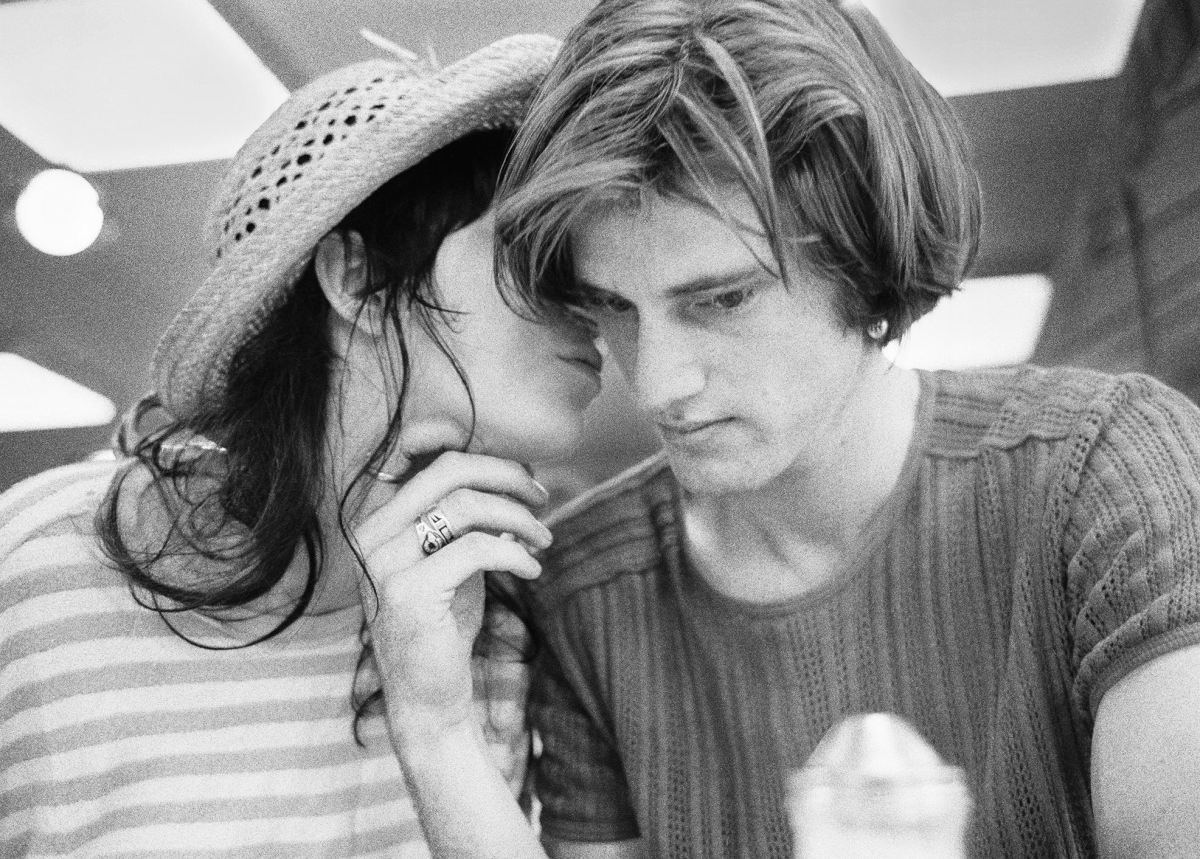
Patti Smith and Sam Shepard at Sutter's Bakery, New York, circa 1971.
By Hilton Als
For good or for ill, Sam Shepard is the most objectified male writer of his generation. People who have little interest in theatre have found themselves drawn to it, and to him, in part because of his looks, especially during the height of his fame as a screen actor. (He has appeared in more than forty movies and was nominated for an Oscar in 1984, for his performance in “The Right Stuff.”)
Born Samuel Shepard Rogers VII in Fort Sheridan, Illinois, in 1943, Shepard spent much of his childhood on a ramshackle avocado ranch in Duarte, California. Loneliness permeated the Shepards’ home. Samuel VI, an Army pilot turned schoolteacher, was an alcoholic and would disappear for days at a time. The surrounding landscape—Route 66, the dusty “Main Street of America,” ran alongside Duarte—was not a comfort. Tall, slightly snaggletoothed, and eagle-eyed, Shepard always looked like America, or a movie version of America: one could easily imagine him playing Tom Joad or Abraham Lincoln. His Western drawl was an additional attraction. Joan Didion’s essay about the charisma of John Wayne could just as easily apply to Shepard:
He had a sexual authority so strong that even a child could perceive it. And in a world we understood early to be characterized by venality and doubt and paralyzing ambiguities, he suggested another world, one which may or may not have existed ever but in any case existed no more: a place where a man could move free, could make his own code and live by it; a world in which, if a man did what he had to do, he could one day take the girl and go riding through the draw and find himself home free.
Shepard moved to New York in 1963 and roomed, for a time, with a friend from Duarte—Charles Mingus III, the son of the storied jazz musician. From Mingus, a mixed-race kid who painted, Shepard learned that the more straitlaced the woman the more she was attracted to difference. “Charles had this knack of picking up these amazingly straight women—stewardesses and secretaries,” Shepard said, in Don Shewey’s rich 1985 biography. “Charlie was always splattered with paint, and I didn’t take too many baths back then. And there were cockroaches all over the place. But these women would show up in their secretarial gear.”
Supporting himself as a security guard and a busboy, Shepard was encouraged to write plays by impresarios as diverse as Ellen Stewart, who established La MaMa, an experimental venue for new playwrights, in 1961, and Ralph Cook, who founded the Theatre Genesis, in 1964. They needed material, and the prolific Shepard soon needed as many stages as possible on which to present the voices he’d heard growing up—and the wound of rejection he’d experienced again and again in his own family.
Like many alcoholics, Shepard’s father wasn’t willing to share the stage, and, in a sense, Shepard’s fifty-odd plays are a bid for his attention, albeit from a distance. As expressive as Shepard’s characters are about their creator’s interior life, they also stand guard between him and the hurting world. Many of Shepard’s scripts—including “Buried Child” (1978), which won the Pulitzer Prize, “True West” (1980), and “A Lie of the Mind” (1985)—are about the adhesions that bruise even as they hold together the writer’s boozy, self-deluding, and crippled families. But some brilliant early works, such as “La Turista” (1967), Shepard’s first full-length play, “Cowboy Mouth” (1971), the first production of which starred Shepard and his sometime paramour Patti Smith, and the astounding “The Tooth of Crime” (1972), have a sharper, more intense focus, on couples and coupling. In these plays, the atmosphere is electric with disasters that seem to unfold in slow motion, or in the time it takes Shepard’s characters to express their hatred, longing, or disappointment, much the way drunks express themselves—through repetition.
In “La Turista,” we meet an American couple, Salem and Kent, who are travelling in Latin America. The pair speak bad Spanish and complain about the locals. Both severely sunburned when we meet them, they talk about the pros and cons of different skin tones. In their jumble of specious theories, what Kent and Salem share is their whiteness, which is to say their preconceptions about how and when the world turns. The aging rock star Hoss and the musical upstart Crow, in “The Tooth of Crime,” are white, too. But, more important, they’re male, and their masculinity informs all their actions. In the play’s second act, the two men have a verbal showdown, monitored by a referee. The argument, ultimately, is about how the younger artist must devour the older one in order to feed his own work, his own myths. Crow says, of Hoss, “Can’t get it together for all of his tryin’. Can’t get it together for fear that he’s dyin’. Fear that he’s crackin’ busted in two.”
The 1983 play “Fool for Love” (in revival at the Samuel J. Friedman and conscientiously directed by Daniel Aukin) displays all the skill that Shepard developed when crafting his longer family plays but sacrifices none of the intensity and oddness of the earlier work. The play is not so much about coupling as about the deep impulses that keep people together even when they’re apart. While writing “Fool for Love,” Shepard himself “busted in two,” in order to talk about objectification from both a male and a female point of view.
To look at Judy Linn’s 1971 photographs of Shepard (who was then married to the actress O-Lan Jones) with his lover Patti Smith, or to listen to Joni Mitchell’s 1976 song “Coyote,” which is ostensibly about the playwright—“There’s no comprehending / Just how close to the bone and the skin and the eyes / And the lips you can get / And still feel so alone / And still feel related”—is to witness something rare in American masculinity: a man who found in himself something those female artists could use. Shepard wasn’t averse to being taken over by a woman. (In a 1997 interview in The Paris Review, he said, “More than anything, falling in love causes a certain female thing in a man to manifest, oddly enough.”) Through these powerful women and their creativity, he experienced the very opposite of Dad’s disregard: validation and attention, the eyes of love that we all hope will help shape us.
Writing “Fool for Love,” during a time of emotional turmoil—Shepard’s marriage to Jones was dissolving, and he was falling for another actress, Jessica Lange, with whom he would be involved for almost thirty years—made him jumpy and suspicious of his work. “The play came out of falling in love,” he said, in The Paris Review. “It’s such a dumbfounding experience. In one way you wouldn’t trade it for the world. In another way it’s absolute hell.” The play, he added, baffled him. He felt close to his characters, the ex-lovers Eddie and May, but he didn’t know how to guide them satisfactorily for the stage, how to express what needed expressing:
I love the opening, in the sense that I couldn’t get enough of this thing between Eddie and May, I just wanted that to go on and on and on. But I knew that was impossible. . . . I had mixed feelings about it when I finished. Part of me looks at “Fool for Love” and says, This is great, and part of me says, This is really corny. This is a quasirealistic melodrama. It’s still not satisfying; I don’t think the play really found itself.
But when does love find itself? Eddie (Sam Rockwell) loves May (Nina Arianda), but he’s no good when it comes to love’s realities, which include staying put until passion either deepens or withers into something else. He’s always looking for the high of love: desire is his drug. And that addiction can be pretty wearing on a practical girl like May. When Shepard introduces us to Eddie and May, they’re in their thirties, but their stop-and-start story began long before, when they were kids, really. Life has taught them a thing or two, not least how impossible their connection, or any intimacy, can be.
To escape Eddie’s ambivalence, his need for attention, and his endless bullshit, May has moved to a dingy motel room on the edge of the Mojave Desert. She has just about caught her breath, started dating a nice guy named Martin (the sweet and stalwart Tom Pelphrey), and settled into a job as a restaurant cook, when Eddie shows up. He’s not interested in May’s urge to change her life; it doesn’t benefit him in any way, and he’s less of a person without her. The first words Eddie says are the words he thinks May wants to hear: “May, look. May? I’m not goin’ anywhere. See, I’m right here. I’m not gone.” May’s heard all that before. Still, she clings to him—literally—wrapping her arms around his legs as he speaks. Eddie digs her dependence—until he doesn’t. “Come on. You can’t just sit around here like this,” he says. “You want some tea? With lemon? Some Ovaltine?” May shakes her head. Outside, you can hear crickets singing in the night.
The dance of love and anger that Eddie and May are performing is choreographed; the furious partners know its steps. She knees him in the groin, and he falls to the floor. Recovering, he picks himself up and lays more charm over the hurt, like a kid holding a steak to a black eye. In jeans, boots, and a cowboy hat, Eddie is very confident when it comes to his charm: seduction is part of his lonesome-cowboy performance. Whether he’s pacing around May’s room or putting on his spurs to impress Martin, who shows up in the middle of this seventy-five-minute, Strindberg-like drama, he takes up a lot of psychic space.
Indeed, part of what May is fighting for is a little mental headroom. When she slams herself against a wall, she does so, in part, to set her incredulous brain straight: Did Eddie really say that? What does he want from her, now that he’s sniffing around someone else? Eddie’s other woman, whom May calls the Countess, hovers like a perfumed ghost over the couple’s conversations. She’s some sort of star—she was on the cover of a magazine, May tells us—and, although Eddie denies it, who else could own the huge black Mercedes-Benz that rolls up outside May’s door about halfway through the story? She, for sure, doesn’t know any women like that.
Even though May and Eddie are, for the most part, alone in her room, they’re never really alone. Besides the Countess and Martin, there is someone else present: the Old Man (incredibly well played by Gordon Joseph Weiss). He may not be physically in the action, but psychically he’s all over Eddie and May. For most of the play, he sits, in semi-darkness, downstage right, a short distance from May’s bed and the red neon sign that flickers just outside her front door.
“Fool for Love” is a kind of existential boxing match, but the Old Man is no referee; he’s grappling with his own problems and shadows. It turns out that Eddie and May are half siblings; the Old Man fathered them both, with different mothers, whom he abandoned. They are blood but also not blood. By the time they discovered this, it was too late. Love made them foolish, needy, bound by forces they couldn’t explain:
I was in love, see. I’d come home after school, after being with Eddie, and I was filled with this joy. . . . All I could think of was him. . . . And all he could think of was me. Isn’t that right, Eddie? We couldn’t take a breath without thinking of each other. We couldn’t eat if we weren’t together. We couldn’t sleep. We got sick at night when we were apart. Violently sick. And my mother even took me to see a doctor. And Eddie’s mother took him to see the same doctor but the doctor had no idea what was wrong with us.
Love also made them unsympathetic to their own mothers’ grief. May’s need to escape Eddie is also a need to escape her mother’s devastation—“Her eyes looked like a funeral”—but who ever achieves that?
Shepard adores May. You can feel him sitting back and wondering at her practical matter-of-factness; it makes him starry with longing, with words. “Fool for Love” begins as the story of a man’s seduction and betrayal, but it ends up being dominated by a woman’s truth-telling. The play reminds me of another Joan Didion remark: that, in the West, “men tend to shoot, get shot, push off, move on. Women pass down stories.”
Arianda and Rockwell pass down Shepard’s story in unexpected ways that are informed by their lionhearted fearlessness when it comes to failing. To understand Eddie and May is to understand that it’s nearly impossible to get those characters “right”; as written, they keep drifting, losing ground, walking away, or rushing toward emotions that Shepard treats like dunes of beautiful shifting Mojave sand. The only way to nail the doomed couple is to play them the way a jazz master plays a tune: differently from day to day, from moment to moment. I saw two performances of the play, and could have seen more, in order to appreciate the nuances that Arianda and Rockwell added or took away each time. At one performance, the energy was down, and Rockwell did everything he could to rev up the proceedings. Arianda, during the other show, created an atmosphere that explained, through movement and action, who May really was: a mother to the boy in Eddie—the only parent who could understand him. The actors did nothing for show, because they couldn’t: for all its high drama, the script demands an incredible level of focus and concentration that isn’t about “acting”—it’s organic. As May packed a suitcase and walked through the door at the end of the play, it wasn’t hard to imagine her meeting her literary predecessor out there in the dark world: the dogged Lena, in William Faulkner’s “Light in August.” You remember Lena’s great moment: she has just given birth to the child of her feckless lover, who immediately runs off. Staring after him, Lena tells herself, “Now I got to get up again.”
Robert O’Hara’s family satire.
By Hilton Als
Robert O’Hara’s new play, “Barbecue” (directed with vigor and understanding by Kent Gash, at the Public), is my idea of an American classic, or the kind of classic we need. Although its fecund imagination seems unlimited, the work wouldn’t exist if it didn’t have the junk of our times to feed on—and spit out. Set, for the most part, in a nameless public park in the middle of the country, “Barbecue” unfolds in a kind of electrified space, filled with leaf-curling light. There the characters gripe and argue as though their lives depended on it—and, ultimately, they do, at least from a financial point of view. The play opens with a thin, sour-faced, middle-aged white man, James T (Paul Niebanck), alone onstage, downing a beer and yakking loudly on his cell phone. He is surrounded by greenery, but the trees and leaves look fake, like an ugly wallpaper version of nature. James T is talking to one of his four sisters, the self-righteous but wrong-minded Lillie Anne (Becky Ann Baker):
This is the thing that I don’t seem to understand. WHY? On God’s green earth. Do we still give a damn. . . . Now you gat me out here this morning at the ass crack of dawn to secure this place so I’m here. . . . We know that she gonna get up in here and act the plum fool. Of course she gonna be liquored up. Liquored up. Cracked up. Something upped. She will be upped on something.
The “she” James T is talking about is another sister, Barbara (Samantha Soule), otherwise known as Zippity Boom. (James T: “She gat two modes. Zippity. Boom. Ain’t shit in between. . . . When she taste liquor she go Zippity. Boom! Period.”) Lillie Anne wants to stage an intervention at a family barbecue they have planned for that day, but her reasons are muddy. James T doesn’t buy it, for instance, when Lillie Anne argues that their mother, had she lived, would have wanted them to save Barbara; Mama, apparently, was no better at mothering than her kids are at being siblings. “We ain’t no normal gatdamn family and we ain’t never been no normal gatdamn family,” he says. “But all of a sudden y’all read a book or see a TV show and y’all wanna gather up and act like we a normal gatdamn family.” What James T says is true enough. The reality of his family is being superseded, in Lillie Anne’s mind, by a reality-TV version of a family, in which conflicts are forgotten or resolved after the commercial break.
But James T and his other siblings aren’t really interested in resolving anything. What would they have to talk about if they couldn’t complain? The constant whining gives their visceral, miserable words something to coast on, like plastic debris floating on an oily bay. When James T’s sisters Marie (Arden Myrin) and Adlean (Constance Shulman) turn up for the barbecue, they all go at it, finding fault not only with one another but with subsequent generations:
LILLIE ANNE: Adlean, didn’t I tell you not to come bringin’ them gatdamn badass grandkids of yours? . . .
ADLEAN: They stayin’ in the car. Is that a problem for you or should I just bag them back into the street and have them play in traffic?
JAMES T: You should have left them wherever the hell they woke up this gatdamn morning.
LILLIE ANNE: This ain’t no damn place for no gatdamn grandkids.
MARIE: It’s a gatdamn park ain’t it? . . .
ADLEAN (yelling off): BOOTY, IF YOU DON’T STOP BOPPIN YO’ HEAD UP IN AND OUT OF MY GATDAMN SUNROOF I’M GONNA COME OVER THERE AND SLAP THE FUCK OUT OF YOU WITH A HAMMER TILL YOUR THROAT CLAP! . . . AND I MEANS THAT! I’LL BEAT YOU TILL I SEE THE WHITE MEAT. Stupid ass fool.
Families make their own realities; rarely do the dynamics change, and, if anyone does succeed in getting out, he’s eyed with distrust or who-does-he-think-he-is contempt. But O’Hara, in two of his earlier plays—“Insurrection: Holding History” (1996) and “Etiquette of Vigilance” (2010)—was able to do something new with family satire: he turned it into fantasy. Like Jonathan Swift, he saw no reason not to indulge in a little time travel to imagined places while skewering contemporary mores. Although O’Hara’s language was somewhat influenced, early on, by that of his fellow-playwrights Adrienne Kennedy and George C. Wolfe, his stories and his viewpoint are his own: he is a gay black man who is interested in the parochialism of the black American family, and in his status as an outsider within it.
At first, “Barbecue” appears to be a whiteface take on O’Hara’s usual themes, but then, about fifteen minutes into the show, he flips the dramaturgical switch. As Lillie Anne, howling, tries to get everyone onto her intervention fantasy train—it’s one way to keep her siblings together—the lights go down. Before long, they come up again, and we are watching the same family dressed in the same way on the same set, but now they’re black. (Marc Damon Johnson, Kim Wayans, Heather Alicia Simms, Benja Kay Thomas, and Tamberla Perry play these versions of James T, Lillie Anne, Marie, Adlean, and Barbara, respectively. They couldn’t be more perfectly cast; Simms, as Marie, is especially exciting.) The new actors barely miss a beat as the conversation becomes even more fast-paced, insane, and comedically brilliant:
MARIE: You probably don’t even remember waking up this morning with all them damn pills you poppin.
ADLEAN: Heifa, you wait till you get you a disease in yo’ titty—
MARIE: I was the one who told you not to go eating no damn corn out no damn can. It’s them damn canned goods that gave you that damn cancer.
LILLIE ANNE: Marie, shut the hell up.
MARIE: I’m telling the truth. They put that damn cancer in all these damn canned goods.
JAMES T: Who the hell put it in there, Marie?
MARIE: Them damn Middle Easterners. . . .
JAMES T: We don’t get canned goods or CORN from no damn Middle Easterners.
Young Jean Lee, in her 2009 play, “The Shipment,” showed how speech—especially in the theatre—has been racialized. A cast of black actors used street slang and “white,” or “dicty,” language while dramatizing various stereotypes of race. The implicit question was: How does the idiom change the way we see the action? O’Hara has a similar interest in how race is performed, or how it informs a performance. The first family in “Barbecue” is white trash, but what do we call the second family? Black trash? Or does the black family get a free pass when it comes to that designation, because they’re acting out of “oppression”?
Other questions follow. O’Hara never specifies where his emotionally ragged, venal figures, with their Southern drawls—they’re like the Beverly Hillbillies on crack—are. They could be a generation removed from the South—Ohioans, say, who’ve inherited some of their parents’ ways, including a capacity for drink and a love of storytelling. Still, poor white people with Southern roots are liable to be looked on with pity or shame by the liberal white Northerners who make up much of “Barbecue” ’s audience, and who may meanwhile assume that the black characters aren’t pitiable—they’re just “talking black.”
O’Hara is too much of a showman to make any of this feel didactic. Plus, he’s a satirist, in love with that crooked jokester otherwise known as life. In the play’s scintillating second act, the laughs come less frequently and are overshadowed by deep character work and profound writing. We’re in the park again, and White Barbara is alone onstage. She seems nervous; she’s on her cell phone but ends the call when Black Movie Star Barbara (played with something akin to reckless genius by Perry) enters. With her hair loose and shoulder-length, Black Movie Star Barbara owes something to the late Whitney Houston—down to her white pants suit, reminiscent of the one Houston wore on the 2002 “Primetime” special, when she told Diane Sawyer she was too rich to smoke crack—but Perry takes it to another level. Black Movie Star Barbara behaves as if she were royalty taking a tour of a tacky public garden. Dipping, inexplicably, into and out of an English accent, she is rigid with false humility, paranoia, and self-regard.
She’s here to meet White Barbara, who made it to rehab and has written a book describing her “journey” from Zippity Boom to enlightened presence. Black Movie Star Barbara, a Hollywood veteran, wants to play White Barbara in a movie—she knows that audiences are more likely to believe in a black crack ho than in a white one, and she wants to “get some Oscars up in here.” O’Hara knows how crazy it is to be a woman, let alone a woman of color, in show business. Actors are paid to be other people, but what if you’re paid a lot of money to lie about who you are?
As the two Barbaras talk, they increasingly resemble each other, except that Black Movie Star Barbara is shinier: she knows the art of the con, while White Barbara is still catching up. What unites them, in the end, is their addiction. Sitting on the ground in the park, where the barbecue never happens, the ladies fire up some crack. Then there’s a blackout—both onstage and in the playwright’s mind. O’Hara mars what could have been a perfect ending—the Barbaras sitting down to face and not face each other—with a cheap and easy conclusion that puts too much emphasis on all the points he’s made before. We don’t need O’Hara to tell us that life rewards its most terrible creations with glittering prizes, or to make the tragedy easier to take by closing on a “comedic” note. He’s a much better artist than that, and compromise just looks silly on him, like a dunce cap on a monument.
Taylor Mac’s changing family.
By Hilton Als
It’s weird to realize that the great playwrights who came of age in New York in the nineteen-sixties and seventies—artists ranging from John Jesurun to Wallace Shawn, Sam Shepard, Mac Wellman, María Irene Fornés, David Rabe, Adrienne Kennedy, and Rosalyn Drexler—are now the elder statespeople of the American theatre. Weird because one never thinks of these writers as “old”; what made them stand out from the beginning was their youthful pushiness and zeal when it came to putting their unique visions of society onstage. Their early scripts continue to work our nerves because they’re meant to: the chaos, bitterness, and crackling moments of absurdity that defined their times are inseparable from the stories they needed to tell. Civil rights, the Vietnam War, and the fight for gay rights and women’s rights no doubt contributed to the sense of urgency. The violence and strife one finds in Shepard’s and Rabe’s dialogues about the post-Eisenhower-era family, for instance, call into question not only the idea of home but its presumed head: the great white father.
That father—the custodian of cruelties—is central to Taylor Mac’s “Hir” (sensitively directed by Niegel Smith, at Playwrights Horizons), a play that harks back to a time when politically driven narratives were the rule, not the exception. Actually, Arnold Connor, a fifty-something father (played, with beautiful timing, by Daniel Oreskes), predates Rabe’s and Shepard’s weak blowhard dads. He’s a sadder, muted brother to Edward Albee’s Daddy in “The American Dream” (1961). But Arnold doesn’t wear suits or cardigans—the kind of “Father Knows Best” costuming that would tip us off to his role and what to expect from it. Instead, when we first meet Arnold, he is dressed in a loud, frilly nightgown, his face covered with gobs of makeup, like a third-rate clown’s. Standing unsteadily amid piles of household debris—clothes, appliances, plastic containers, a makeshift bed—Arnold hardly knows how or when to move without instructions from his wife, Paige (Kristine Nielsen).
These she provides with condescending relish from the start of the strange spectacle, which the couple’s son Isaac (Cameron Scoggins), a marine who hasn’t spoken to his family for a year, finds as bewildering as we do. Isaac has been discharged from the military with post-traumatic stress disorder (though he never admits it). When on duty, “I,” as he’s sometimes called by his family, works in “mortuary affairs”: “I pick up guts. Exploded guts.” As death’s janitor, Isaac is always on the lookout for slime, the real and metaphysical messes that testify to the fact that life can change or end in an instant. Has his life with his parents—his life as a son—ended, too? His home is no longer recognizable to him. Paige tries to mother Isaac, but he doesn’t understand her language, let alone her intentions. He knows that Arnold had a stroke, but why is she feeding him estrogen? Tranquillizers?
ISAAC: The doctors prescribed him estrogen?
PAIGE: Oh, God, no. The doctors prescribed him poodle-diddle-wing-wang. The estrogen’s extra. . . . It keeps him docile.
ISAAC: He’s gonna grow tits.
PAIGE: Grammar!
ISAAC: He’s going to grow tits.
PAIGE: Language!
ISAAC: He’s going to grow breasts. . . . You can’t give him, Dad . . . men estrogen.
Oh, yes, you can. Arnold’s on this odd cocktail because he’s violent. Paige explains that when Isaac left home (he enlisted because he couldn’t afford college or find work) Arnold lost part of his audience. Other things were taken away from him, too: his job at Roto-Rooter, for example. The company got tired of fielding calls about this angry racist plumber guy and replaced him with a young Asian-American woman. With his power in the world dwindling, Arnold became more of a dick at home. “He doubled down on Max and me,” Paige says, referring to their teen-age son (energetically played by Tom Phelan), who used to be their daughter, Maxine. “Three times I had to take Max to the emergency room.”
But Maxine didn’t let Arnold’s rages deter her from buying testosterone online so that she could become the boy she felt herself to be. And now Arnold’s meds—including the estrogen that Paige mixes into his “shaky-shake”—have made him docile in the way that Paige likely was for most of her marriage. She and the world are different now. “It used to be you could be a mediocre straight white man and be guar-anteed a certain amount of success,” she says. “But now . . . the darkies have come. And the spics. And the queers. And those backstabbing bitches waiting to get at the mediocre straight white man the minute it becomes known he is barely lifting a finger but thinking he is lifting the world.”
Change, physical and otherwise, is at the center of “Hir.” And the most extreme evidence of that change is Max. Paige’s delighted descriptions of how the “ ’mones” are affecting Max’s body make Isaac retch, as does her wish to sell the family home and move on. Isaac is the straight man in his family’s painful comedy. (He is also the artistic progeny of David Rabe’s damaged Vietnam veterans.) He can’t deal with having the patriarchal rug pulled out from under him. Arnold was, to some extent, his ideal of manhood, and what happens when our ideals are rendered impotent? Paige, on the other hand, is enthralled by the transformations around her. Freed from her traditional role—if Arnold wants a neat cupboard, he can tidy it up himself—she has become, by the end of the first act, a warrior for change. She refuses to show Arnold the compassion that Isaac feels he deserves; she will not, she says emphatically, “rewrite his history with pity.” Before the tables turned, Arnold wouldn’t have, either.
In recent years, a number of young playwrights—Branden Jacobs-Jenkins and Young Jean Lee come to mind—have taken their critical shears to the white-male-dominated family living room that was so prevalent onstage and onscreen when they were growing up. By chopping apart that convention, Mac, like Lee and Jacobs-Jenkins, isn’t so much remaking the world in his own image as he is addressing subjects that remain, remarkably, underplayed on the American stage: what bodies mean and what stories women are allowed to tell or perform. “Hir” has a lot of ideas—necessary ideas, especially when it comes to flinging open closets in the “trans” world—which spill over the edges of the play, but I wouldn’t take much out in order to make the show dramaturgically tighter or easier to absorb. The rudeness of its form is part of its power: you can’t build a clearer future without making a mess of the past.
The show is saved from potential proselytizing by Mac’s awareness that his arguments have to grow in complexity in order for his characters to grow, and by Nielsen’s performance. She gives it everything she’s got. All her years of good and shitty show-biz experience have added up to this: playing a woman who, for much of her adult life, has been controlled by men—which is true of most actresses, too. It would have been easy for Mac to present Paige as a vengeful bitch goddess, devouring everything in her path and making the show all about her and the heights her language takes her to. But he shies away from using Paige as his heteronormative mouthpiece, as it were; she is not the Blanche to his Tennessee Williams. Instead, Mac shows us how desire can take many forms, including the urge to speak. Paige is high on her own long-stifled voice, whether or not her insights have a lasting effect on anything.
The second act gives Mac a chance to explore just how awful and ingrained our—and Isaac’s—need for a daddy is. Isaac will have nothing to do with Paige’s plan to sell the house. He sets to work cleaning, gets his father off the meds, and tries to return his family to some semblance of order, normalcy. In the Connor family, as in most families, that means keeping Dad front and center, the better to define other roles, like those of the subjugated son and the worshipful daughter. And since Max, who is Paige’s transcendent hope, has been both, it cuts her to the heart to see him using his maleness as an excuse to be obnoxious and demanding, just like Dad. It’s a brilliant narrative stroke on Mac’s part: does Max want to be male because he feels male or because he identifies with Arnold? And does Paige love Max because she perceives him to be the kind of man she could actually love, a man who has also been a woman? The ideas and questions proliferate and spawn others as the curtain comes down on Nielsen’s pained and profound performance, on Mac’s script, and on Smith’s direction, a trinity of beautifully youthful, experimental efforts that remind one of the freshness of the art they were all born out of so long ago.
Arthur Miller’s morality tales.
By Hilton Als
For some time after I saw the director Ivo van Hove’s interpretation of Arthur Miller’s 1956 play “A View from the Bridge” (at the Lyceum), I found myself pondering the production’s graphic hysteria and homoeroticism. (The show, like the Signature Theatre Company’s current revival of the 1964 play “Incident at Vichy,” marks the centennial of Miller’s birth, to Jewish parents, in Harlem in 1915.) On entering the theatre, one sees, center stage, an enormous phallic object. Blanketed in dark fabric, it brings to mind one of Barnett Newman’s totemic sculptures. As the houselights go down, the stage lights come up; the ambience is pearly gray. Offstage, one hears an undulating wave of Fauré’s “Requiem”; the music plays softly at first, then louder as the drapery is lifted from the object, which turns out to be a partly glassed-in platform. On it, two shirtless men are washing their arms, necks, and chests, shrouded in chiaroscuro lighting and steam. They are Brooklyn longshoremen: Eddie (Mark Strong), a tall, sinewy, bald man, and Louis (Richard Hansell), who is younger and smaller. As they slough off the sins and the earthly filth they’ve accumulated in the course of the workday, they resemble models in one of George Platt Lynes’s silvery Second World War-era images of men stretching, flexing, and otherwise glorying in the artist’s attention—which have become, over the years, emblems of the ways in which queerness was manifested in art long before Stonewall. (Van Hove, who is gay, is the partner of Jan Versweyveld, who designed the show’s set and lighting.)
The atmosphere of romanticized masculinity in van Hove’s production has little to do with the melodramatic, Clifford Odets-like realism of Miller’s script, which describes the opening scene this way:
The street and housefront of a tenement building. . . . The main acting area is the living room–dining room of Eddie’s apartment. It is a worker’s flat, clean, sparse, homely. There is a rocker down front, a round dining table at center, with chairs; and a portable phonograph. . . . As the curtain rises, Louis and Mike, longshoremen, are pitching coins against the building at left. A distant foghorn blows.
One of the few things that van Hove’s opening shares with Miller’s is its narrator, Alfieri (Michael Gould). Dressed in a white shirt and dark trousers—the actors don’t wear recognizably period clothes—Alfieri is a lawyer in the Red Hook section of Brooklyn, where Eddie and his family live; it’s a rough neighborhood, populated mostly by Italian immigrants. “This is the slum that faces the bay on the seaward side of Brooklyn Bridge,” Alfieri says, with a “dis”- and “dem”-laced Brooklyn inflection that does little to lend veracity to the dialogue. “This is the gullet of New York swallowing the tonnage of the world.” Alfieri is Miller’s Greek chorus; as he looks out at us from the semi-dark stage, he describes aspects of the tragedy we’re about to witness. (Miller wrote two versions of “A View from the Bridge.” The first, a one-act, premièred on Broadway in 1955; the two-act version, completed the following year, is what van Hove uses. It’s not necessarily better—the expansion doesn’t improve on any of the characters—but it fills out an evening.)
Eddie shares his flat with his wife, Beatrice (the laser-sharp Nicola Walker), and his beloved orphaned teen-age niece, Catherine (Phoebe Fox). His feelings for Catherine are overwhelming; she makes him shy, lovestruck, in a way that Beatrice does not—or, perhaps, that only Catherine can, largely because she’s unattainable. Supported by Eddie, Catherine has been taking stenography lessons and has just got a job working for a plumbing company. When Eddie hears the news, he tells Catherine that it wasn’t what he had in mind for her—the guys she’ll be working with are too rough, uncouth. He’s not interested in Beatrice’s two cents—her conviction that Catherine’s independence is important to her growth. What he does have in mind is keeping Catherine just the way she is, and the world as it is.
Eddie doesn’t know how to handle change. And yet it is change, emotional and otherwise, that he must contend with now that Catherine is growing up. And change that he must answer for: Beatrice wants to know why he no longer touches her or makes her feel like a loved and honored wife. As he turns away from the question, Eddie’s neck becomes a taut string; his body is pulled in the direction of something he has no language for. He can’t relate to what is happening around him. And he can’t relate to his true self, whoever that is.
Still, there are distractions to be had. Two of Beatrice’s cousins, Marco and Rodolpho (Michael Zegen and Russell Tovey, both of whom bring an important erotic energy to their roles), arrive from Italy to stay with the couple. Marco is destitute; he wants to earn some money and then return home to his wife and kids. Rodolpho, who is blond and talented and single, wants to build a life for himself in America. He and Catherine eventually fall in love and plan to marry.
In van Hove’s hands, Miller’s story of ethical betrayal becomes a story of how bodies look and move in a tragedy. One day, Eddie comes home drunk and finds Rodolpho emerging from Catherine’s bedroom. After ordering Rodolpho to pack and leave, Eddie grabs him, roughly, and kisses him. It’s meant to be a put-down: earlier, he has made fun of Rodolpho’s singing and faggy airs. Perhaps this is the sort of thing Rodolpho likes? But it may also be a scary breakthrough for Eddie. That Judas kiss betrays so much, including himself. Does it reveal what Eddie wants to be—embraced by someone who looks not like Beatrice but like himself? The way Strong plays these moments is interesting: you can’t tell whether Eddie desires Rodolpho because he’s beautiful and Eddie is repressed, or whether he simply identifies with Catherine and is attracted to what attracts her.
Eddie, as sketched by Miller, is dramaturgically confusing, because he’s a textbook Freudian mess: he’s twitchy with too many suppressed impulses and unexamined thoughts that don’t add up. His neurosis feels less organic than “theatrical”—an accumulation of tics that are meant to give him more presence. But he remains two-dimensional: he’s a catalyst for events, not a conduit for change, including his own. Indeed, when I saw Gregory Mosher’s traditional 2010 staging of the play, starring Liev Schreiber and Scarlett Johansson, I couldn’t quite understand it. Eddie, who was just another mouthpiece for Miller’s dry moralism, didn’t seem worth the effort around him. But van Hove is a showman. He makes the most of the moments in the play when maleness as event happens—when Marco, for instance, who is even stronger than Eddie, picks up a heavy chair by the leg with one hand—in order to show us how the old gladiator Eddie’s values are short-circuiting in this inchoate new world. Van Hove stuffs the production with Pina Bausch-like movement, lighting, and sound cues that scintillate whenever Eddie bores. As Eddie’s rage grows, the staging becomes almost operatic. Indeed, van Hove treats the text as a kind of libretto, punctuating Miller’s flat words with effects, such as the portentous beating of a small drum offstage as Eddie spins more and more out of control, like the frantic characters in Bausch’s 1975 rendition of Stravinsky’s “The Rite of Spring,” another piece about individuality and the community. Eventually, Eddie, in a vengeful move that’s more than a little influenced by his own death wish, betrays Rodolpho and Marco to an immigration officer—an act that leads to his death in a rain of blood.
Miller himself felt out of control when he started writing “A View from the Bridge.” In his 1987 memoir, “Timebends,” he relates, rather touchingly, how the seeds for the play were planted in the forties, when a friend told him a story about a dockworker who had ratted out two brothers. (Miller often based his plays on stories that other people told him or things that he read in the newspaper.) In 1951, he made a trip to Los Angeles to work on “The Hook,” a screenplay he was writing, with the director Elia Kazan. Through Kazan, he met Marilyn Monroe. Returning home, he couldn’t shake the effect that her emotional honesty and beauty had had not only on his stolid middle-class perspective but on his art and his imagination. (One of Miller’s biographers describes him as being emotionally constipated.) The nascent “A View from the Bridge” remained unfinished, as Miller grappled with the change in himself:
For I knew in my depths that I wanted to disarm myself before the sources of my art, which were not in wife alone nor in family alone but, again, in the sensuousness of a female blessing, something, it seemed, not quite of this world. In some diminished sense it was sexual hunger, but one that had much to do with truthfulness to myself and my nature and even, by extension, to the people who came to my plays. . . . Even after only those few hours with Marilyn, she had taken on an immanence in my imagination, the vitality of a force one does not understand but that seems on the verge of lighting up a vast surrounding plain of darkness.
It was Miller’s good fortune and bad luck that he had found someone who acted as a gateway to greater truthtelling for him as an artist, but who also demanded a degree of attention that took him away from his writing and thus away from a deeper self-examination. By the time he completed his one-act version of “A View from the Bridge,” Miller and Monroe were romantically involved, but the play still agitated him. “Something in me was disowning the play even as its opening approached,” he writes. “I was turning against myself, struggling to put my life behind me, order and disorder at war in me, in a kind of parallel of the stress between the play’s formal, cool classicism and the turmoil of incestuous desire and betrayal within it.” It’s not far-fetched to say that the intimacy Miller struggles with in the play—the intimacy he wants the audience to have with the characters, the intimacy he wants Eddie to have with himself—was due, in part, to the example of Monroe, who drew so much on her own life and feelings in her later roles. Her rawness often led to collapse or hysteria, and it’s that hysteria that sometimes emerges in “A View from the Bridge,” despite Miller’s attempts to suppress it.
Hysterics, of course, supply what theatre demands—words driven by emotions. Bloody with longing and schemes, they hope against hope while never losing their native intelligence; without it, their torrent of language would have no structure. Think about Maggie trying to get her husband, Brick, to sleep with her, in Tennessee Williams’s “Cat on a Hot Tin Roof,” which débuted the same year as “A View from the Bridge.” It’s Maggie’s blind faith in her marriage, even when faced with all the evidence—Brick’s alcoholism and rumored homosexual leanings, for starters—and her talk, talk, talk that make her an indelible character. In Williams’s 1961 play, “The Night of the Iguana,” T. Lawrence Shannon, a defrocked minister drunk on booze and fever, also can’t give up on words, or belief. Part of what the hysteric is crying out for, in wave after verbal wave, is a transformative experience—something that cannot be explained but which will change one’s body and soul and thus experience of the world. “Sometimes—there’s God—so quickly!” Blanche says, when she finally hits on a bit of good fortune, in Williams’s 1947 play, “A Streetcar Named Desire.”
But it’s fate, not God, that drives Miller’s characters. Miller was averse to a theatrical world in which emotion and mystery were prevalent. From his initial success—his first hit, “All My Sons,” premièred on Broadway in 1947—he was a draw for middle-class men who wanted to see their lives represented in theatre. Epic but real, or, more specifically, pointedly “realistic,” Miller’s male protagonists are, for the most part, good lads who grapple with the value of their goodness in a morally bankrupt world. For Miller, that’s God enough.
In “To the Actors Performing This Play: On Style and Power,” a 1964 essay addressed to the actors who were staging the first production of “Incident at Vichy,” he wrote:
Acting has come perilously close to being a species of therapy and has moved too far from art. A too great absorption in one’s own feelings is ordinarily called self-indulgence. . . . It is to be emphasized again that acting is not a private but a social occupation.
But if the great actors of the day, like Kim Stanley, Marlon Brando, Montgomery Clift, and Monroe—who was unforgettable in her last screen performance, in the 1961 film “The Misfits,” written by Miller—had put the social responsibility of art first, would they have made the mistakes and the discoveries that make them transcendent poets?
Miller saw the world in a grid: good was good, bad was bad, and the gray areas of existence were either unexplored in his work or handled clumsily. This weakness is especially clear in “Incident at Vichy” (directed by Michael Wilson, at the Signature). The play opens in Vichy, France, in 1942, in a detention center, where we see a group of men sitting, waiting, but for what? No one says a word until Lebeau, a young painter (well played by Jonny Orsini), engages Bayard, an electrician (realized with passion by Alex Morf), in matter-of-fact conversation:
LEBEAU: Cup of coffee would be nice. Even a sip. You wouldn’t have any idea what’s going on, would you?
BAYARD: I was walking down the street.
LEBEAU: Me too. Something told me—Don’t go outside today. So I went out. Weeks go by and I don’t open my door. Today I go out. And I had no reason, I wasn’t even going anywhere.
Lebeau and the rest of the men have no idea why they were picked up by the police: they’re ordinary citizens, not especially political, and now they find themselves in a land that Kafka might have invented, were it not so real. The Gestapo, in their efforts to destroy all Jewish vermin and to gain control of the region, are looking for collaborators who are willing to betray Jews, liberals, and other undesirables. One by one, the detainees are led off to a room, where they’re either extinguished or given papers that allow them to live “freely” in a world where there is no freedom. As in Miller’s 1953 play, “The Crucible,” his characters inhabit a community defined by suspicion and compromise: who will sell out his brother in order to survive?
Into this dire situation walks Von Berg (sincerely played by Richard Thomas). An Austrian prince, he is granted immunity by the Nazi officers, but what can his liberty mean when so many others are dying? Touched by the passion of a protesting fellow-detainee, a doctor named Leduc (Darren Pettie), Von Berg gives up his pass and agrees to stay in Leduc’s place. Von Berg’s ruse is discovered, however, and we hear the guards shooting at Leduc as we see, above the stage, a projected image of the train that will no doubt carry Von Berg to the camps and to his death.
Cause and effect: that was Miller’s primary mode as a playwright. By drawing out the illogic and the unpredictability in “A View from the Bridge,” van Hove stages a kind of gay man’s revenge on that point of view: gay artists, for the most part, live not in a world of clarity and logical outcomes but in one of fracture, in which things don’t always follow, in which they have to cope repeatedly with the kind of disparagement Eddie expresses when he kisses Rodolpho. Van Hove shows that kiss for what it is: the brutality inherent in unspoken love, the hysteria at the heart of strangled intimacies.
To The Pulitzer Judges
In two dozen or more print and online reviews a year, The New Yorker's theatre critic, Hilton Als, brings to the magazine a rigorous, sharp, and lyrical perspective on acting, playwrighting and directing, in New York and around the country. Whether he's introducing a new playwright, or taking on a theatrical eminence grise, for Als, no production exists in a vacuum. With his intricate knowledge of the history of performance--not only in theater, but in dance, music, and visual art--he provides much needed context for the reader, as well as critical analysis and illuminating personal response.
Week after week, Als shows us not only how to view a production, but how to place its director, its author, and its performance in the ongoing continuum of dramatic art. "It's fate, not God, that drives [Arthur] Miller's characters," he notes. "Miller's male protagonists are, for the most part, good lads who grapple with the value of their goodness in a morally bankrupt world. For Miller, that's God enough." David Mamet's fast-talking con men, Als writes, are "shysters in their own minds. They make conversations out of lists--of so-called facts or mundane details--and stories that never add up to anything, or come to an end, because liars and hysterics don't know who they are unless they've got an audience. Like writers, they want to convince you by telling the only story they think needs tellng." Of the contemporary playwright Annie Baker, he announces, "With 'John,' Baker has done something exceptional on a political level, too: she has declared her ambition. The truth is that it's still an anomaly for women artists to claim this kind of space for themselves and their work."
Als admires audacity and iconoclasm; he also prizes knowledge and transcendence. Whether the plays he sees are staged on Broadway, or in back rooms in Brooklyn, he has a profound understanding of what it takes to write, produce and perform dramatic works. His reviews are not simply reviews; they are provocative and poetic contributions to the discourse on theatre, race, class, sexuality, and identity in America. His work can be surprising, disturbing, enlightening, or cathartic, but it is never lazy or conventional. "The playwright's job," he concludes, in one piece, "is not to represent or stand up for anyone but to say something fascinating about humanity."
Sincerely,
David Remnick