Los Angeles Times, by Mary McNamara
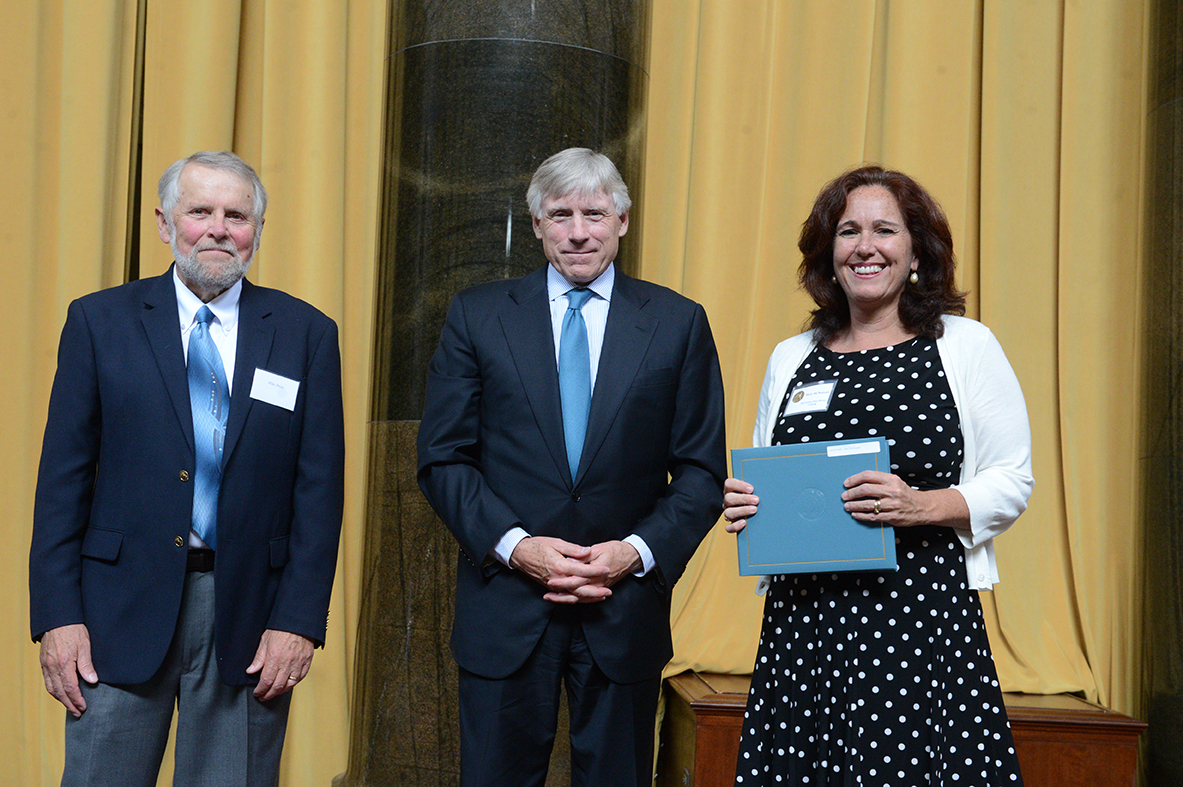
Mike Pride, Pulitzer Prize Administrator (left), and Lee C. Bollinger, President of Columbia University (center), present the 2015 Criticism Prize to Mary McNamara.
Winning Work
(Copyright: 2014, Los Angeles Times)
When viewers took control of the TV model, the small screen hit the big time
By Mary McNamara
These smaller audiences demand new revenue models from both the broadcast and cable sides, and once again many executives are in a panic, alarmed by the threat of saturation or a world of dim sum TV, in which viewers choose only what they want.
Here are a few things that did not exist in American television 10 years ago:
Binge-watching; recapping; scripted series on networks devoted to old movies, science and history; zombies; streaming services; popular series that end just because the story is done; film-franchise adjacency; shows that begin as miniseries and then continue indefinitely; multiplatform viewing; two concurrent versions of Sherlock Holmes; A-list film directors; television shows devoted to talking about television shows; live tweeting; micro-audiences; immediate remakes of British series; any remakes of European series; European series; subtitles; cord-cutting; horrific violence; series in which the cast stays the same but the story changes; series in which the title stays the same but the story and cast change; really good computer graphics; comedies more dark than funny; amazing international locations; an overabundance of stories characterizing the many ways in which television has changed in the past 10 years.
Here's the most important thing that did not exist in the television universe 10 years ago: ownership.
Technically, the citizens of these United States have always been the proprietors of the airwaves over which television was broadcast, but it didn't feel that way. We watched what the network executives offered us when they offered it. Good television was like good weather, fleet and ephemeral; you enjoyed it while it lasted. Maybe you watched it again in reruns while you were sick or sad or trying to get ahead on the ironing.
Sure, PBS geeks and HBO fans might buy the boxed sets of "Pride and Prejudice" or "The Sopranos," but for most people, television was something you did, not something you possessed.
Now, of course, TV is controllable, portable and permanent.
Many factors catalyzed television's recent efflorescence. HBO set the template for television that was "not television," with scripted dramas and comedies so fine no one could deny their artistic importance. Female stars, unable to find work in film, began what would become a mass talent migration to television; the successful rebranding of AMC spurred other outlets to pursue scripted drama; the rise of geek culture revitalized comic-book franchises, sci-fi, fantasy and even costume drama, while refined digital technology made the special effects required by these stories easier to achieve.
All of which contributed to the single biggest change in television: Like books, movies, music and art, it's now collectible.
Any viewer with a DVR can build her own lineup while anyone with a digital device can create his own television catalog. After it airs, a show no longer fades into the ether or migrates into reruns; it accrues, it accumulates. So much so that many conversations about television now revolve around how much there is and how far behind we are — never mind reading Ian McEwan's latest or catching the current cast of "Wicked," we all need to sit down and get through last season's "Mad Men" or "Orange Is the New Black," finally watch "Enlightened" or all of "The Wire."
"Need to" because now, more than ever, our choices in television define us. Our relationship with television has always been intimate. It comes into our homes, our bedrooms even, and now it stays. Like sports fans and cable news devotees, we are what we watch: Gladiators ("Scandal"), Truebies ("True Blood"), Whovians ("Doctor Who"), Colbert Nation ("The Colbert Report"), gleeks ("Glee"), Cumberbitches ("Sherlock's" Benedict Cumberbatch), or Clone Club ("Orphan Black.")
"When television became archivable, everything changed."
That's what veteran television writer Glen Mazzara said to me a couple of years ago during a conversation about the "new golden age" everyone was talking about with wearisome regularity at the time.
The show runner for "The Walking Dead" at the time, Mazzara had called me to say in the nicest way possible that it would be really great if television critics would stop comparing television to film and novels as if the comparison in itself were some huge compliment. Television was an independent art form, he said, and should be judged on its own terms.
But those terms were changing. Technology had granted the medium both a flexibility and a permanence it had lacked before. The idea that people could now watch a show in its entirety, that they could take entire seasons with them when they traveled and collect their favorites for further viewing, offered television writers a shot at something historically reserved for an anointed few: legacy.
An unexpected turn of events when you consider the dire predictions of less than 10 years ago, when many people assumed that reality would soon control almost every time slot on every network and that the television set itself would vanish, replaced by a forest of laptops and mobile phones. The scripted drama was dead, the sitcom was dead, the family hour was dead. Despairing critics and viewers imagined a world in which the broadcast networks were overrun with singing competitions, "Two and a Half Men" and the increasingly brutalized victims of "NCIS" and "CSI" while the Young People watched webisodically told narratives and YouTube.
Which, of course, they do. But they also watch television, perhaps less than previous generations and certainly on their laptops and mobile devices, but also on their flat screens; they watch it whenever they want to but also in real live-tweeting time (hello, "Pretty Little Liars.")
The mathematics of replacement became simple addition and then exponential multiplication. Scripted dramas and comedies began appearing everywhere in every form; even Bravo, reality central, is getting into the game next month with "Girlfriends' Guide to Divorce." Modern platforms such as Netflix and Hulu appeared, while the old became new again: PBS went viral with "Downton Abbey." The miniseries came back, NBC began experimenting with live performance, and Disney Channel turned the defunct "Boy Meets World" into "Girl Meets World," with the original child actors now playing the parents.
Even with the ability to build their own schedules and fast-forward through commercials, viewers can't keep up, at least not en masse. With so much competition every night, few shows can pull the enormous audiences that were once necessary for survival. Instead, the landscape is divided into smaller fiefdoms of fans who, aided by social media, comment on "their" shows with psych-student fervor; people who are not paid to do so now analyze television the way the women of "Sex and the City" analyzed their relationships.
And many shows are worthy of such analysis. Television, once the definition of popular entertainment, has subdivided like the bestsellers lists into literary and mainstream, into genre and targeted demographics.
These smaller audiences demand new revenue models from both the broadcast and cable sides, and once again many executives are in a panic, alarmed by the threat of saturation or a world of dim sum TV, in which viewers choose only what they want.
It's a rare moment in any industry when the creative developments outrun the financial constructs — a headache for those tasked with the bottom line but a joy for those of us who are not. In this moment, television feels more like "ours" than "theirs."
Viewers made a hit out of "Breaking Bad" and "Hatfields & McCoys," out of "The Walking Dead," "Game of Thrones" and "Scandal." We fueled this age of exploration. And if the electronic hearth has become more blazing firmament than home fire, well, the night sky may be vast and ever-changing, but it unites us all the same.
Matthew's death on 'Downton Abbey' allows the series to return to its origins
By Mary McNamara
Across the land, a great keening has arisen for the large number of main characters recently killed off on shows as disparate as "The Walking Dead," "Scandal" and "Game of Thrones." How ruthless have we become, the hand-wringers wail, how reckless and desperate in our need for tweetable moments and first-week ratings.
Honestly, it's as if no one in this country has ever read a classic novel or a poem by Edgar Allan Poe. People die, for heaven's sake, especially in fiction. Tragedy is a great catalyst, and even if the famous literary admonition to "kill your darlings" is impossible to trace to its origin, every gardener knows that pruning is an essential part of the job.
This is immediately and gratifyingly clear Sunday night on PBS in the Season 4 premiere of "Downton Abbey," that highly addictive meringue of Edwardian couture and socially tolerant politics that has sentimentalized British past beyond all recognition and done more for the "special relationship" between the U.S. and Britain than any president or prime minister.
Last year, in a finale that left women on two continents weeping into their "I'm a Lady Mary" T-shirts, Matthew Crawley (Dan Stevens) was killed in his motor car just moments after his wife, Lady Mary (Michelle Dockery), gave birth to their son, treating viewers to the sight of all Downton's denizen's rejoicing in pathetic oblivion to the tragedy that had just befallen them. Sob.
Except Matthew's was no tragedy. Stevens took a lot of flak for choosing to leave the show, but creator Julian Fellowes should cut him a posthumous check. Never has the death of a character so obviously cleared away the brambles that can choke even a popular show to death.
Not to speak ill of the dead, but Matthew was a walking, talking deus ex machina — whenever a miracle was required, there he was, inexplicably cured of his paralysis or inheriting the funds needed to keep Downton afloat or just saying the Absolutely Right Thing.
More important, he inadvertently dimmed the lights of the show's two most astringent, and therefore most interesting, characters: Lady Mary and Violet the Dowager Countess (Maggie Smith).
Who are now once again in the foreground, allowing "Downton" to return to its original themes of change and endurance.
On Season 1, "Downton Abbey" was presented as the story of two sorts of people, upstairs and down, on the cusp of cataclysm: The end of a class system that allowed places like Downton to operate along quasi-feudal lines; even improvements like the telephone and typewriter were perceived as a threat.
As the accidental heir to Downton, Matthew arrived in the hallowed halls reluctantly, a dismissive embodiment of the modern age. He worked for a living, disdained the old ways and so the obvious solution — that he should marry Mary to keep Downton in the family — was seen by both sides as a necessary evil.
Love, of course, changed all that, and by Season 2 the show had dissolved into a sugary tea of great costumes, gleaming interiors and a Kate-Middleton-infused view of Britain. Mary loved Matthew, Matthew loved Downton, the servants were treated as family and no one suffered from anything resembling social stricture. The biggest irritation seemed to be the need to dress for dinner.
With its admirable attention to accoutrement and remarkably fine cast, including the trio of unlikely male hotties (Hugh Bonneville's Earl of Grantham; Jim Carter's butler, Mr. Carson; and Brendan Coyle's valet, John Bates), "Downton Abbey" allows its audience a pleasant dalliance with history — all the fun and little of the consequence. What little of its original shape remained was thanks almost completely to Lady Mary and the Dowager Countess, who, along with Mr. Carson, have refused to bend completely to the changing times.
Now, with Matthew gone, Lady Mary and Violet are once again allowed to shine, as women who will not be rushed from one thing to another, possibly because they know only too well how difficult it is for women to find a foothold in any household, in any era.
There are, of course, many plots and subplots roiling throughout Season 4, some of which are subtle and affecting (Matthew's mother, Isobel [Penelope Wilton] and his valet, Molesley [Kevin Doyle], are both looking for a job), some of which seem more strained than usual (Lady Rose [Lily James] seems to wander briefly over into the new Starz show "Dancing on the Edge"). The ever-popular Bates' marriage undergoes yet another tremendous strain, and Lady Edith (Laura Carmichael) continues a very odd affair with her editor (never a good idea, Lady Edith!) that may turn out fascinating or ridiculous.
Nonetheless, all eyes are on Mary, who, having shed her shell for Matthew, is nearly catatonic with grief even six months after his death. Working to stir her into taking an interest in the running of the estate is chauffeur turned brother-in-law Tom (Allen Leech), who has "what next?" issues of his own and, more important, the Dowager Countess, a woman who has survived more change than all of the other characters combined and whom Smith continues to infuse with the potent grace of Considered Transformation.
Which is so much more interesting than its flighty cousin, Miraculous Transformation, so favored these days by even those wailing over the unlit pyres of the fictitious dead.
When Fellowes allows his characters to show that mettle and strength are not necessarily the prettiest things in the room, "Downton" transcends its soap bubbles and more than earns its histrionic plot twists.
When Violet goes, however, all bets are off.
By Mary McNamara
Despite the grim and often overtly political pre-Games coverage of what became known as Putin's Olympics, the only crises to have occurred in Sochi thus far are Shaun White's failure to medal in the half-pipe and Bob Costas' wicked eye infection.
The latter was apparent from Day 1 and grew so distracting to Costas and viewers that on Tuesday, the Olympic veteran turned the evening seat over to "Today's" Matt Lauer. (Who, it must be noted, seemed so unsurprised by the news he'd be the prime-time replacement that it is difficult not to wonder how, exactly, Costas got that infection.) Lauer brought his trademark boyish insouciance to his debut; though he did wear socks, he was not, by gosh, going to shave.
The anchor trade may have irritated some (memo to Lauer: Please shave), but it is certainly not the International Incident we have been repeatedly warned about.
For weeks, the media preamble to the Games leaned heavily on political criticism: For Russia's anti-gay laws, the expense of the facilities, the unsmiling tyranny of the president, the joylessness of the populace and the shoddiness of the accommodations. (If you want to ensure negative coverage, put journalists in bad hotel rooms.)
While the homophobic laws and comments from various Russian officials were outrageous, and concerns about President Vladimir Putin's still-repressive policies remain a necessary part of the coverage, the tone increasingly trended to near hysteria, especially when compared with the months-long Valentine to Britain of two summers ago. Stray Sochi dogs were being rounded up and possibly shot! The American athletes couldn't get their Chobani yogurt! Russia doesn't support gay rights the way all of America does! (Wait, what?)
Russia, so long considered America's arch-nemesis, was presented as being so vast and inscrutable that NBC hired the New Yorker editor and former foreign correspondent David Remnick to explain the mysteries of Russian history and make sure no one was having too much fun.
The day before the opening ceremony, Remnick sat down with journalist Vladimir Posner to figure out just what, exactly, ol' Putin was trying to do with these here Olympics. Prove that his country was now an international player, that's what, the two decided as if unmasking a conspiracy. And he'll consider them a success if the Games go off without a terrorist attack or some enormous technical snafu.
Not surprisingly, many thought the grim prophecy fulfilled by the now-infamous Fifth Snowflake Disaster. Early on in the opening ceremony, one of five large illuminated snowflakes refused to turn into an Olympic ring. The show included a young girl successfully suspended hundreds of feet in the air, enormous and flawlessly executed dance numbers, and a stadium floor that miraculously transformed into oceans, countries and Venetian-glass skies.
But did you see that malfunctioning snowflake?
Just when it seemed that all this strangely aggrieved and patronizing political subtext would ruin the event entirely, the Games actually began and things, mercifully, got back to normal.
The skaters are gorgeous, the luge looks really scary, and the commentators talk too much. (Seriously, guys, when the event you are covering includes music and sequins, we only need you to explain the super-complicated jumps.)
Jimmy Fallon showed up Tuesday night with a funny superlative list (including "Most Intimidating OK Cupid Profile Picture") and to remind everyone that as of Monday it's "The Tonight Show Starring Jimmy Fallon." NBC's "Today" anchors celebrated the winners, consoled the losers, teased each other about drinking too much vodka and did wacky things like try on the uniforms of the Norwegian curling team.
Mary Carillo, always an Olympic coverage high point, gamely ate a bunch of Russian food, told us how vodka is made and made some truly excellent reindeer game jokes from Siberia (causing many to remember and revisit her insanely hilarious diatribe against badminton from the 2004 Olympics.)
The American athletes have hit performance highs — Julia Mancuso's surprise bronze, Erin Hamlin winning the first U.S. medal ever in individual luge — and lows — especially White and speedskater Shani Davis failing to three-peat for the gold in their best events.
Canadian skier Alex Bilodeau won gold in the men's moguls, but more important became the soul of this year's Games with his touching admiration for his brother Frederic, who has cerebral palsy. Likewise, American skier Heidi Kloser and German speed skater Judith Hesse embodied the Games' heartbreak: Kloser tore her ACL during a practice run and Hesse was disqualified before ever skating for two false starts.
Social media gave us some lovely you-are-there moments ranging from Johnny Quinn's escape from his hotel bathroom (and again from a malfunctioning elevator), Hannah Kearney's very real disappointment over winning bronze and local girl Kate Hansen warming up to Beyoncé before placing a magnificent 10th in women's luge (La Cañada is in the house).
Weather has been a bit of a problem — warm temperatures on Rosa Khutor have made the snow mushier than most skiers would prefer — and all the snowboarders agree the halfpipe was a mess. But today's another day in Sochi where, one hopes, the drama will continue to be of the normal athletic variety.
In other words, business as usual.
Except, of course, Bob Costas' eye. Which does make you wonder: Is Matt Lauer working for the Russians?
In Season 2, Kevin Spacey and Robin Wright continue the climb to power
By Mary McNamara
The second season of the dark and dastardly inner-Beltway drama "House of Cards" dropped at 12:01 a.m. on Valentine's Day. If Netflix knows as much about its subscribers as we think they do, this pretty much proves what we've long suspected: Binge-watching has become the new sex.
Actually it makes some narrative sense. Despite its byzantine plots of power and politics, "House of Cards" is, essentially, a love story.
One between Americans and their carefully nurtured suspicions about government. Between Kevin Spacey and his character — as with the first season, Spacey is clearly having a ball with the sneering, scheming, fourth-wall-breaking Frank Underwood, and watching him remains the simplest joy of "House of Cards."
But mostly between Frank and his wife, Claire (Robin Wright), as intriguing a definition of "power couple" as you're going to find in fiction of any sort. They are also the only thing truly revolutionary about "House of Cards," aside from the full-season download and its birth-control potential.
Heralded as the flagship of Netflix's attempt to change the world, Beau Willimon's "House of Cards" opened big with lavish early episodes, two of which were directed by David Fincher, before settling into a fairly standard, if extremely well-produced, series that would have not been out of place on any broadcast network.
Which isn't surprising as it's a remake of a British TV trilogy of the same name. Like that series, "House of Cards" tells the tale of an ambitious but behind-the-scenes politician who, after being passed over for promotion, resolves to bring down the government he helped elect. And in the second season's first four episodes made available for review, Frank continues to drive the series' A-plot with his ruthless determination to replace the president he feels has disrespected him.
But it's Claire, and the Underwood marriage, that makes "House of Cards" more than just a better-than-average addition to the genre of Antihero Drama Being Used to Establish a New Fiefdom in the Television Landscape (see also "Nip/Tuck," "Dexter," "Mad Men," "Vikings" and "Klondike").
Still and chilly where Frank is ever-seething, Wright's Claire is a character we've never seen before. She's a political wife who seems neither scorned nor thwarted, though in actuality she is both of these things. But she is also plagued by doubts, and menopause; her decision to remain childless has seesawed her from one season to the next.
Claire sees Frank for precisely what he is — a man willing to commit any crime short of genocide to get what he wants. Should he falter, she will prod him back onto the twisted track toward power.
On the other hand, if she feels he is taking her for granted, she will run off to New York with a super-hot photographer (way better than the standard solution of eating your weight in frozen yogurt or complaining to your BFFs, of which Claire has none). But should the young congressman her husband has been mentoring/setting up be found dead of apparent suicide (ha-ha-ha), she will come back to preserve a united front.
Indeed, the new season, which includes episodes directed by Jodie Foster and Carl Franklin, picks up right where the old one left off — with Frank and Claire out for an evening run while the destruction they have left in their wake smokes behind them. Both return home confident that Frank, due to all his Season 1 machinations, will be named the new vice president.
Before he can take the next step — dropping "vice" from the title, Frank has to tie up a few loose ends, including reporter Zoe Barnes (Kate Mara), whom Frank bedded and used as his mouthpiece until she began to question his motives, and Rachel (Rachel Brosnahan), the call girl who knows too much. Each young woman has a male protector — Zoe is now seeing her former editor at the fictional Washington Herald and Frank's chief of staff Mike Kelly (Doug Stamper) has taken a shine to Rachel. Any of them could cause Frank's eventual downfall, but not if he gets to them first.
Claire, meanwhile, has a few loose ends to tie up as well, including an unwelcome but quite revelatory figure from her past. The creative efficiency with which she cinches those knots is breathtaking, as is the watchful way in which her husband circles her.
Is it fear in his eyes, or admiration? And can either of these people feel love?
------------------------------
'House of Cards'
Where: Netflix
When: Anytime
Rating: TV-MA (may be unsuitable for children under the age of 17)
The biggest strides in reflecting the audience are on the broadcast networks, not on ‘prestige’ cable
By Mary McNamara
When Fox's "Sleepy Hollow" became a hit this season, critics and viewers were so bowled over by its crazy-great premise — Ichabod Crane as a colonial war hero! Back to fight the Four Horseman of the Apocalypse! — that another revolutionary aspect of the show was often overlooked.
It has four non-white main characters.
Yes, Tom Mison's resurrected British-turned-Colonial soldier serves as the story's center, but "Sleepy Hollow" is also led by police detective Lt. Abbie Mills (Nicole Beharie), with Abbie's sister Jenny (Lyndie Greenwood), Capt. Frank Irving (Orlando Jones) and former-cop-turned-demon-acolyte Andy (John Cho), serving as supporting leads.
All on a show not created by Shonda Rhimes.
"Sleepy Hollow" is not alone. The 2013-14 season included a relatively large number of lead characters from categories previously considered "minorities" in the television universe: female, black, Asian, Indian, and/or gay. "Brooklyn Nine-Nine," has, amid its notably diverse characters, television's first married, gay, black police captain, played with deadpan perfection by Andre Braugher.
Not all of them worked — the Blair Underwood reboot of "Ironside" tanked, as did the Anglo/Latino comedy "Welcome to the Family" — but "Sleepy Hollow" and "Brooklyn Nine-Nine" got second seasons.
They joined several returning shows with similarly arrayed ensembles, including "New Girl," "Elementary," "Revolution" and, of course, Rhimes' "Scandal," for which Kerry Washington recently became the first black woman to be nominated for a lead actress in a drama series Emmy since 1995.
None of these shows, you may notice, is on cable networks. While premium and basic cable continues to get the lion's share of the credit for television's recent renaissance, it's the Big Four (and, it must be said, Netflix's "Orange Is the New Black") that are pushing the boundaries.
This broadcast trend flies in the face of conventional "wisdom," which has for years argued that shows featuring female, black, Latino, Asian or gay leads could only muster niche audiences. It has been taken as gospel that viewers in the heartland, i.e. Americans with conservative values, just aren't ready for anything beyond the pale of "traditional" programming.
So why is it that cable, with its more upscale demographic and boutique ratings-tolerance, remains so overpopulated with white men while broadcast, which lives and dies by big numbers, seems to be finally embracing the rainbow?
Certainly some of the credit goes to Rhimes. It was Rhimes, rather than one of the Big Boys of cable, who, as a first time creator / show runner, called out the industry for its inexplicable lack of diversity.
A decade ago, when the original auditions for "Grey's Anatomy" yielded mostly white actors, Rhimes demanded, and got, a wider array of color. "Grey's Anatomy" became a showcase for all manner of seldom-seen-on-TV diversity.
More important, it was a huge hit. Notable for her female-centric writers' room, something unheard of at the time (and still rare), Rhimes became a cause célèbre, the herald of a time when racial, gender and sexual diversity would soon become the norm.
Which it did, on any show created by Rhimes.
Everywhere else, white straight male leads continued to dominate to such an extent that other characters, including women, bordered on extinction. For several years, Tina Fey, Emily Deschanel and Mariska Hargitay seemed to stand alone.
The rise of "prestige drama" actually made things worse rather than better. While the tonal palette of HBO, Showtime, FX, and then AMC, History, Sundance and IFC, trended dark, the casts, with a few notable exceptions — the oeuvre of David Simon, the last season of "American Horror Story," "The Bridge" — remained very pale.
Very recently, shows specifically created to rectify the imbalance have appeared, including "Devious Maids" on Lifetime and several Tyler Perry series on OWN. But the anointed "important" shows, like "Mad Men," "Game of Thrones," "Girls," "Homeland" and "House of Cards," regularly experiment with story in every way possible except racial diversity.
Strangely, the creator who has gotten the most flak for the penchant for the homogenous is "Girls" creator Lena Dunham. Like Mindy Kaling, who has also recently been criticized for the number of white men on her show, the fact that Dunham is a demographic anomaly (young, female) among her peers seems to imply a personal responsibility that male writers don't share.
And that, of course, is the easy answer to cable's diversity issues: Most of the writers are white men. As Maureen Ryan recently pointed out on the Huffington Post, not one woman or person of color has written an hour-long drama for HBO in the post-"Sopranos" era.
But the problem may be more ephemeral, and troubling, than that.
The recent boom in television began when taste-makers decided that television could be "smart." For years, "The Sopranos" was the only exception to the pat proclamation among the elite that TV was for idiots and shut-ins.
Shows like "The Wire" and "Friday Night Lights" received similar dispensation, but it really wasn't until "Mad Men" that popular opinion began to turn. Yet even as many broadcast network shows also shone with fine performances and great writing, the snobbishness continued, perfectly encapsulated in the term "prestige" drama.
"Prestige" is just a half-step away from "elite," and our nation's president notwithstanding, we all know what color "elite" is.
As alarming as this may be, it does present a fine, and much needed, opportunity for the broadcast networks to finally pull out from cable's shadow. For years, the Big Four tried to chase HBO and then Showtime by upping the violence, the sex and the profanity.
Instead, it may turn out that populism is the answer. The stories television, broadcast and cable, tells still represent only a narrow band of its audience.
But if 200-year-old Ichabod Crane can adapt to a world in which white men aren't the only people whose lives matter, presumably TV can too.
By Mary McNamara
It's a long way from "Lysistrata" but in recent weeks, more than 2,400 years since Aristophanes gave voice to female discontent in a patriarchal society, the gender wars erupted once again in ways both refreshingly modern and disquietingly familiar.
Discontent with society's still-narrow female beauty standard, set to simmer in the last few years by performers including Amy Schumer, Melissa McCarthy, Mindy Kaling and Lena Dunham, boiled over following Sarah Baker's now famous fat-girl's lament on an episode of "Louie."
The firing of Jill Abramson, the New York Times' first female editor in chief, amid reports that she had been paid less than her male predecessors launched a renewed discussion of pay equity and the double standard many women leaders still face.
Several well-publicized rape and sexual assault cases caused many to protest the state of sexual hostility on college campuses, where rape, assault and harassment are often under-reported or handled by campus authorities rather than police. The increase of sexual violence on television, meanwhile, prompted some viewers and critics to question the use of rape as a narrative device.
Washington Post film critic Ann Hornaday created a media dust-up by suggesting that Hollywood's worship of frat-boy mentality, and its attendant portrayal of women as trophies that every man deserves, might have contributed to the horrific shootings in Isla Vista. Even this year's reshuffling of late-night shows sparked high words when it became clear that no female replacement for Jay Leno or David Letterman was even in the running.
Every question, protest or, in the case of "Louie," celebration was met with passionate and often furious response from both sides of the issue, fueled in part by the rush-to-judgment that social media now facilitates, but also the very real sense that these issues are not the nostalgia pieces many of our popular period dramas would have us believe.
A behind-the-scenes look at filming around the world for television and movies as seen from the streets.
In recent years, we've grown comfortable viewing the realities of sexism from a distance. We watch shows like "Mad Men" and "Masters of Sex" with self-righteous outrage — when will Joan realize she's got twice the business mind of any man around and how dare William Masters pay Virginia Johnson so little and then take credit for her ideas!
But as "Mad Men" inches to its close, it may well overlap with the current news cycle, which hearkens more and more to the mid-'80s, with its Take Back the Night marches, letters-to-the-editor campaigns against those Calvin Klein Obsession ads and rise of a reactionary men's movement.
For those who took part in those marches, it is dispiriting to see how many of these problems still plague us, and how deeply they have been buried under assumptions that they do not.
Whether or not a "frat boy" mentality was at work, there is no denying the misogyny of Elliot Rodger's UCSB-focused rampage; in chilling videos, he revealed a murderous hatred for the women who "rejected" him, particularly the sort of beautiful blond and popular women so often used as pat symbols of cruelty and/or sexual worthiness in film and television.
To argue that entertainment does not impact culture is absurd. Hollywood doesn't get to take credit for breaking ground with films such as "Philadelphia" and shows like "Will & Grace" or for that matter "Girls," only to wash its hands of more destructive attitudes.
The recent revelations about rape and other violence against women, and the often outrageous ways in which they are dealt with on college campuses shocked many, including President Obama, out of a vague assumption that sexual violence against women is no longer the problem it once was.
Likewise suggestions that Abramson had been fired for protesting an inequitable salary (which the New York Times denies), or for a managerial style that might have been acceptable in a man, caused many women to raise their heads from their cubicles and look around their own workplaces for discrepancies that still exist (women make, on average, 77 cents to a man's dollar) but no longer fuel the political conversation.
The good news is we're talking about it, and with a speed and diversity of voice once impossible to imagine.
Social media, despite its oft-deserved reputation for cyberbullying, is a huge factor in this renaissance of socio-political debate. News events and opinions from all over the world can be shared instantly by everyone; you don't have to be a member of the mainstream or even outlier media for your voice to be heard. Earlier this year a Twitter argument over the role of "provocative" clothing in rape (yes, these arguments still occur) led to hundreds of women tweeting photos of what they were wearing when they were raped. In the wake of the Isla Vista killings, women from all over the world shared their fears, outrage and experiences with sexism on #yesallwomen.
This instant access can be deceiving; controversy is so much easier to foment and categorize when it consists mainly of blog posts and retweets. As comforting and informative as it may be to watch social progress play out in the personal lives of characters on "Downton Abbey" or "Mad Men," those changes didn't occur organically, they were the result of sustained and often violent protest. Twitter is a platform, not a movement. It may have aided the Arab Spring, but it was people in the streets that made it happen.
But conversation, whether between the early abolitionists, a group of fed-up drag queens at the Stonewall Inn or online fans of Louis C.K., is where change begins. It is probably no accident that we are discussing issues formerly known as feminist at a time when it seems quite possible we will soon have a female candidate for the presidency.
In many ways the 1980s are distant as Lysistrata's famous protest over the Peloponnesian War; in others it could be yesterday.
A steady diet of TV shows fuels her teenage son’s recovery and eases his pain
By Mary McNamara
Instead, those hours spent in Dillon, Texas, seemed to make him stronger. Eventually, he let us watch with him; eventually, he started talking about the show, its characters and the actors.
Just as Scout Finch once realized that she never loved reading until she feared she would lose it, I didn't understand the importance of television until my child was too ill to watch it.
The continual complaint about television's negative impact on our health recently erupted into full blown clamor when a study published in the Journal of American Medicine seemed to indicate that too much television could shorten a person's life. But there are times when binge watching is not just excusable, it's restorative.
Last year, when my 15-year-old son learned he would spend his summer recovering from spinal surgery, the first thing we did was surrender to his request for a big screen in his room. As soon as he was out of anesthesia, he said, he planned to watch "Game of Thrones" again, from start to finish. It was almost as big a payoff as a straight back. How often does a kid get to watch as much television as he wants?
Danny got his straight back, but he spent almost a week in the hospital, either in debilitating pain or drugged up to his eyeballs. Even after we brought him home, days went by without a sign of my lighthearted, joke-cracking son. He slept a lot and only spoke when he needed something — to be turned over, to use the bathroom, to fix the pillows against his back. He didn't want to eat, had to be forced to drink, was not happy about having to stand and sit, and had no interest in seeing any of the friends and relatives who wanted to visit.
The flat screen just sat there, black and vacant, while we tried not to panic, to believe the doctor when he said it was all normal, Danny was doing fine, it would just take time. Then one day, about three weeks in, Danny opened his eyes and asked: "So when are we going to start watching 'Game of Thrones'?"
I have written often and long on the glories of modern television, but never have I been so appreciative of them as I was last summer. On a schedule dictated more by pain and medication than the traditional daily rhythms, Danny watched television round the clock. "Game of Thrones," "Falling Skies,""Ripper Street," "Breaking Bad," "Burn Notice" — series after series kept him company and gave him something to think about during those long days when too much conversation tired him, when he couldn't hold a book or sit comfortably enough to play a video game.
His room became the TV room, with friends and family circulating in and out to catch an hour or two of whatever he was watching. My husband, long dismissive of any story that featured dragons, became a "Game of Thrones" addict. And while I cannot claim to enjoy "Supernatural" with the same dedication that Danny feels, I do now appreciate how many dang episodes of it exist.
In the olden days, when Netflix still dealt solely in DVDs, most of us only binge watched when we were sick.
I remember devouring seasons of "Sex and the City" years ago after a surgical recovery myself. Movies are fine, but they end in two hours and then they're gone. When you're sick or weak or simply confined, you need consistency. You want a universe in which you can truly immerse yourself, people you can count on to be there, hour after hour after hour.
And not just to pass the time. Months later, when Danny was on his feet and back at school, the real blow fell: His doctor told him that though he could return to all of his regular activities, tackle football was out. Forever. A defensive lineman on the freshman team when he was diagnosed, Danny had dreamed of playing varsity football for years. While all the adults around us offered words of relief — now we wouldn't have to worry about concussions! — we watched our son droop once again, contorted now by something even more difficult to fix than a curved spine.
He grew silent once more, withdrawn; his school work suffered and he didn't care, he returned to his room and his flat screen. There he started watching "Friday Night Lights." Only this time, he didn't want any of us to watch with him; whenever one of us sat down next to him, he would pause the show and wait for us to leave.
Treading water in the doorway, trying to think of yet another way to ask him if he was all right, I worried for the first time about what he was watching and why. The hideously violent story of a chemistry teacher turned drug-dealing killer? Fine. But I was concerned that Jason Katims' finely drawn story of a small-town football team would exacerbate his sense of loss, would remind him of what he could no longer do and the fragility of even a simple dream.
Instead, those hours spent in Dillon, Texas, seemed to make him stronger. Eventually, he let us watch with him; eventually, he started talking about the show, its characters and the actors.
And eventually he spoke of his own pain and frustration, how lost he felt without a team and the sport he loved, without the hours spent practicing and playing to give his day, and his identity, a tangible form. But his voice rang with a passing tense, as if he were describing a place he was leaving even as he left it, the wreckage still visible in the rearview window, but growing smaller with every passing mile.
We watch television for many reasons, in many different ways, not all of them healthy. Certainly it can be a sedentary activity, especially when combined with mindless eating. In a society where most bodies are already at rest more than they are in motion, it's easy to target television, especially given the American belief that too much of a good thing is never quite enough.
But television, especially nowadays, is an art form, and there are times we need to lose ourselves in art. To open ourselves wide to the thoughts and emotions of others, to see different sides of the human story unfurl slowly before us.
The stories we tell ourselves about ourselves are among the most important things we create, and sometimes it takes a while for them to sink in.
The Netflix comedy’s inmates are flawed but sympathetic enough to earn 12 nods
By Mary McNamara
In this year's Emmy race, "Orange Is the New Black" embodies the most important change in television in recent years.
No, not Netflix. Women.
"Orange," with multiple-nominee "House of Cards," does give Netflix an Atlas-like stance over the television landscape; HBO is the only other outlet with both comedy series and drama series nominees.
But with 12 nominations, more than any other scripted comedy, "Orange Is the New Black" has a much bigger point to prove: Women, both as creators and characters, are changing the nature of comedy, and television.
Set in a Connecticut correctional facility, the series was created by a woman (Jenji Kohan), from a memoir by a woman (Piper Kerman) and features, with a few fine exceptions, an all-female cast.
Among the Emmy snubs and surprises: "The Good Wife," Ricky Gervais, Tatiana Maslany and "Masters of Sex."
A single episode follows more female performers in a wider variety of roles than could be seen a decade ago in all the Emmy-nominated shows put together.
Much has been made over the recent increase of female leads in television. Certainly, the great exodus from film to television began with women. When she couldn't find roles in movies, Sally Field came to television, as did Glenn Close, Holly Hunter, Kyra Sedgwick, Mary-Louise Parker and Geena Davis. Women still working prolifically in film soon followed — Laura Linney, Toni Collette, Anna Paquin, Kathy Bates, Melissa McCarthy.
Their presence is not just a question of gender equity. As any good sociologist might have foreseen, this shift has changed how television tells stories, often blurring the lines between comedy and drama, between satire and pathos.
There is no better example of this emerging hybrid than "Orange Is the New Black." Last year the show's star, Taylor Schilling, was nominated for a Golden Globe for lead actress in a drama series and lost. While some critics were surprised that Netflix considered "Orange" a drama, others saw the category switch to comedy for the Emmys as an odds-raising calculation. Compared with "Breaking Bad" and"Game of Thrones," "Orange," and its female-majority cast, could be dismissed as lightweight.
Certainly it is as funny as HBO's "Girls" or Showtime's "Nurse Jackie," two other Emmy-loved, female-centric comedies that do a lot of boundary-blurring.
There is plenty of drama in "Orange," and the laughter it provokes is often rueful, in recognition of shared pain and the dreadful absurdity of the personal choices that so often cause it. Indeed, the humor of "Orange," "Nurse Jackie," "Girls," or Showtime's "The Big C" and HBO's hospice comedy "Getting On," sometimes evokes a 12-step meeting. Or a consciousness-raising session in which the first step toward change is not just acknowledging the problems the characters face, but their universality.
This, of course, is the basis of all comedy. The shift is in the nature of the problems. Women have historically been able to laugh at their romantic foibles, their marital frictions, their familial imperfections and, more recently, their attempts to juggle all the demands on their time. But the flaws, and problems, of TV's female leads mostly remained skin-deep.
In this age of broken heroes and fractured worldviews, the women we watch are still held to a higher standard than men. Unfettered by either the whore or madonna template, men can exhibit a far greater range of "bad" behaviors. Male leads don't even have to be likable. In this age of the antihero, TV prefers its men broken, complicated, intriguing. Likability can actually be a drawback.
Not so for female characters, for whom likability remains key. As some less-than-perfect female characters — Lori on "The Walking Dead" and Skyler on "Breaking Bad" — have proved, women still must display some measure of warmth, some degree of compassion, or risk audience vitriol. Don Draper can essentially abandon his children and still be the subject of our empathy, not so ex-wife Betty. Claire Underwood on "House of Cards" may turn out to be even colder and more calculating than her husband Frank, but she isn't allowed to have nearly as much fun either.
Comedy, as viewers discovered with "Sex and the City," allows female characters freedom not yet found in the "real" life of drama. Carrie and company could have lots of diverse and meaningless sex without being considered sluts because the humor thwarted judgment, made room for the women to be more finely drawn.
Seven years after "Sex" premiered, Kohan planted the seeds of "Orange Is the New Black" with her Showtime series, "Weeds," in which a newly widowed suburban mom turns to drug dealing to pay the bills. Although much more traditionally comedic in its earlier seasons than "Orange," "Weeds" made it possible for a woman to engage in criminal, and increasingly violent, behavior without alienating the audience.
Now, as male comedians like Louis C.K. use humor to prove that men can be passive and bewildered and still be, you know, men, the women of "Orange Is the New Black" can do and say horrible things without being defined and diminished by them. As prison inmates, they are all considered criminals; some are violent, some are psychotic and all near-fatally self-obsessed. But the narrative leavens their actions and predicaments with humanity — which is also the basis of comedy.
Joan Rivers never shied from taking chances, and that’s no laughing matter
By Mary McNamara
Just as we long suspected, the only thing that could stop Joan Rivers was death.
Abrasive, raunchy, self-immolating and often unapologetically offensive, Rivers changed comedy, courted controversy, survived catastrophe and refused to give up or give in, even when either of those might have seemed the best option.
Known best for her grating, New York-afflicted tones, penchant for plastic surgery and willingness to tell anyone that they looked terrible, Rivers created a kind of in-your-face, self-deprecation that both exploited the tendency toward self-hatred in comedy, particularly women's comedy, and satirized it.
If as she grew older Rivers developed a reputation for being more mean than funny — in recent months, she was criticized for, among other things, her remarks regarding Adele's weight, Palestinians and the Holocaust — she remained true to the brassy image and take-no-prisoners attitude that allowed her to rise during a time when the term "female comedian" was almost an oxymoron.
Rivers famously wrote for Ed Sullivan and then Phyllis Diller, appeared on "The Tonight Show" when it was still hosted by Jack Paar, then became one of Johnny Carson's guest hosts. Of the few remaining glittering links to television's last golden age, she is the only one who managed to navigate the many changes in between. Talk shows, reality television, Twitter, webisodes, red carpet commentary — no job was too big or too small.
While the few remaining comedians of her generation retired, emerging only for special events, Rivers never stopped touring or taking chances. In addition to her own shows, she was a regular guest on talk shows, appeared as a contestant on "Celebrity Apprentice" (she won), guest-starred on "Louie" (she killed) and was the subject of the documentary "Joan Rivers: A Piece of Work," in which, in one segment, the then 75-year-old performed back-to-back shows in Toronto, Palm Springs and Minneapolis.
At the time of her death Rivers had a show on E! ("Fashion Police"), one on WeTV ("Joan and Melissa: Joan Knows Best?"), a third on the Web ("In Bed With Joan"), a recent bestselling memoir ("Diary of a Mad Diva") and a fall tour slated for Britain.
The woman was 81. With a fall tour slated for Britain.
And if the many plastic surgeries and insistently platinum hair made her look at times like a fright, well (insert profanity here) you.
For latter-day boomers who remember the early work, Rivers was like the drunk mom at the party, the one who told the truth and scandalized the room. Back in the last century, Rivers may have made her name by trashing herself, but she also fearlessly called out men, sex, childbirth (she would awaken her young sleeping daughter to say, "Melissa, you ripped me to shreds") and gynecology in general. Her remark that "when I need a pick-me-up, I put a little Fresca on a maxi-pad" makes me laugh to this day.
Joan Rivers was so fearless a comedian she even joked about her husband's suicide.
The modern Joan was a more divisive figure. Many found her persona irritating, her comedy predictably mean-spirited, her remarks intentionally provocative. Even so, it was impossible not to admire the indefatigable spirit, the refusal to let anything soften or sag, including her very sharp tongue.
I remember seeing Rivers at the 2007 Oscars, dressing down an official who was attempting to turn her away from the red carpet because she wasn't wearing her credentials.
"Oh, my God," she said, with that deep hollow squawk that made her sound like a world-weary and chain-smoking parrot. "If I wasn't who I [expletive] said I was, if I didn't have to [expletive] be here, do you think I would [expletive] be here? In this [expletive] dress and this [expletive] heat? Move that [double expletive] rope."
The man moved the rope.
Her death makes her appearance this year on "The Tonight Show Starring Jimmy Fallon" even more poignant and important. Long a friend and acolyte of Johnny Carson, Rivers famously fell from favor in the 1980s when she took a job hosting a show on another network. Carson never spoke to her again and banned her from "The Tonight Show," an edict both Jay Leno and Conan O'Brien obeyed.
She remained embroiled in controversy, of course, most recently with the writers of "Fashion Police" who turned to Rivers for support in their request to join the Writers Guild. Her refusal fueled yet another public feud.
But then Joan Rivers did not go gentle into any night, good or bad. She made some audiences laugh till they cried, and others fume with anger. She did what she did and then she did it some more.
"I wish I could tell you it gets better," she says to a disheartened Louis C.K. in that very funny and revealing episode of "Louie." "But it doesn't get better. You get better. I've gone up, I've gone down, I've been bankrupt, I've been broke, but you do it. And we do it because we love it more than anything else."
Overcome, Louie kisses her. Shocked, Rivers fights him off, then has a change of heart. "What the hell," she says, motioning to the bedroom. "Just don't tell anyone. I'm thinking of you, not me," she adds. "No one likes a necrophiliac."
Only one person in the world could land a joke like that. Only one person in the world would even attempt a joke like that.
And now she's gone.
By Mary McNamara
In 2006, Stephen Colbert performed at the White House correspondent's dinner. For almost 25 uncomfortably hilarious and immediately divisive minutes, Colbert performed as the titular character of his Comedy Central show, damning virtually all the attendees, including then-President George W. Bush, with praise faint and otherwise.
If neither the audience nor those covering the event knew exactly what had hit them, the millions who viewed the subsequently viral video did: Event planners thought they had invited a political comedian; what they got was America's Satirist Laureate.
It was an easy mistake to make, particularly at the time. "The Colbert Report," which comes to an end Dec. 18, was just beginning its nearly 10-year run. (Colbert will take over CBS' "The Late Show" after its longtime host, David Letterman, retires next year.)
A spin-off of "The Daily Show," which overtly deconstructs the hypocrisy, spin and blatant inaccuracies at work in politics and the media's coverage of it, "The Colbert Report" took on the far trickier task of satirizing same. Tweaking the inappropriate obliviousness of his correspondent on "The Daily Show," Colbert and his writers created a Bill O'Reilly-like commentator who, without any hint of guile, filtered the news through a prism of right-wing politics, self-righteous ignorance and complete narcissism.
The performance was so spot on that Colbert the performer quickly became virtually indistinguishable from his creation. For years, many viewers, and some guests, were not quite sure if "The Colbert Report" was a send-up of right-wing politics and the cult of personality or an example of it.
And that, of course, is the mark of truly brilliant satire: The baffled pause in which the audience is forced to think. About what is real, what is outrageous, and how often the two words refer to the same thing.
Is he really running for president and could he win? Is he really creating a super PAC, and is it actually legal to not disclose where campaign money comes from or how it is used? Did Daft Punk really last-minute ditch its appearance, forcing Colbert to put together an emergency song-of-the-summer video, and is that Henry Kissinger?
Comedy is tough, subversive satire is tougher, and sustained subversive satire is nearly impossible. To embody an object of ridicule that is itself a symbol of many larger themes requires a constant tension between opposing forces: sincerity and mockery, outrage and sentiment, wit and humanity.
Most great satire cloaks itself in other guises, running through classics as varied as Ovid, Austen, Dickens, Voltaire, Twain. Modern satirists like Vonnegut, Heller and Orwell grew less sentimental. Shows including "Laugh-In," "The Smothers Brothers Comedy Hour" and "MASH" brought political satire to television. Christopher Guest popularized the mockumentary that in turn gave us "The Office" and similar comedies. Garry Trudeau, certainly a fellow laureate, re-invented the cartoon; Matt Groening, Seth MacFarlane and others took the sensibility to television.
But no one has ever created a single character with both the continuity and elasticity of "The Report's" Stephen Colbert, much less kept it going it for nearly a decade.
By its very nature, satire is stinging and people can tire of being, or watching others get, stung. But Colbert, like Charles Dickens (who hit many of the same points about politics, social divisions and the perils of ignorance) understands that the point of satire is not pain, it's the desire for change. For the joke to really work, it has to start from a resting point of sincerity.
And no one on television is as sincere as Colbert. Unlike many modern performers, he does not approach his comedy as a wounded, jaded or discombobulated outsider.
Though he deals daily in the outrage, neither does he seem particularly angry. Geek culture may be generally ascendant, but it's difficult to imagine another white, liberal, 50-year-old Elvish-speaking Southern fantasy geek with kids and a decades-long marriage who could be so openly devoted to both Catholicism and his mother while still hitting all those Power/Hot lists.
Yet there is no reason to believe that Colbert is not a genuinely nice guy.
Which is exactly why he's been able to get away with one of the most scalding and significant satirical performances of this or any decade. Neither cruel nor kind, his performance was driven instead by the rare ability to harness passion without taking it personally.
No matter how off, convoluted or contradictory the screeds became, there was never the slightest gleam of viciousness, maliciousness or contempt in the performance. "The Report" could be brutal, but Colbert never was; the performer was happy to roll the character through the swamp of sanctimony and stupidity, to expose his toxicity, meanness as well as the environment in which they festered, but you sensed that, at some level, he loved him all the same.
It's useless to speculate what Colbert and his team will bring to "The Late Show." Under Letterman, "Late Night" has long been a dry and sardonic alternative to the celebratory showcase of "The Tonight Show," but it's not subversive and it's certainly not satire.
Watching as Colbert recently interviewed Jennifer Lawrence, whom he introduced by reading what appeared to be her IMDB listing, it was difficult not to feel a pang. He may succeed in re-inventing the show, or even the genre, but there will never be another "The Colbert Report," and it's hard to say goodbye.
To the Judges:
The television world was buzzing last year as favorite characters on shows from “Game of Thrones” to “Downton Abbey” were being killed off, one after another.
There was no hand-wringing from Mary McNamara, television critic of the Los Angeles Times.
“People die, for heaven’s sake,” she writes.
That’s McNamara, once again telling it like it is. She covers the dominant entertainment medium with insight and authority, in columns that are always smart and often wickedly funny. (That eye infection Bob Costas got during the Sochi Olympics? McNamara suggests Matt Lauer may have had a hand in it.)
But know her subject, she does. Her Nov. 23 piece laying out the myriad changes that have upended television is a masterful dissertation on the medium, yet one that reads as smoothly as a beach novel. McNamara is never stuffy, never opaque.
Like all great critics, McNamara holds our values and obsessions to the highest standards.
She proves that the sharpest critical pen is dipped not in vitriol but in lost possibilities.
In her assessment of the season’s most implausible hit, “Sleepy Hollow,” she avoids the easy shots and credits the show for its willingness to bring diversity into its casting. Then she asks the real question: “So why is it that cable, with its more upscale demographic and boutique ratings-tolerance, remains so overpopulated with white men…?”
Many wrote about Stephen Colbert’s retirement of his conservative persona, but few could match McNamara’s take on what it meant to the culture. “Satire demands a high level of discomfort from its audience, and Colbert is a comedian who does not blink, who believes that humor works best when it has something to say.” (After reading the piece, Garry Trudeau wrote McNamara a note in appreciation of her “sharp-eyed take on satire.”)
In each of the past two years, McNamara has been named a finalist for the Pulitzer Prize for Criticism. We are proud to submit for your consideration a fresh sample of her distinguished work.
Sincerely,
Davan Maharaj
Biography
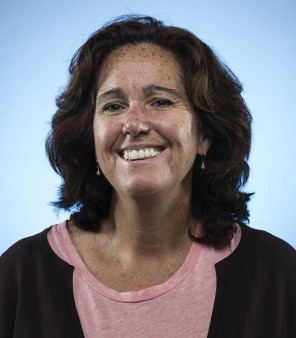
Mary McNamara is a television critic and cultural editor for the Los Angeles Times, where she has worked since 1990. Previously she was an editor at Ms. magazine and for Whittle Communications.
In her nearly 25 years at The Times, McNamara has worked as an assigning editor for the Los Angeles Times Magazine, a feature writer for Life & Style and a reporter and columnist for Calendar. She covered the film industry for four years before becoming a television critic eight years ago. She was a Pulitzer Prize finalist for criticism in 2013 and 2014 and has won numerous awards for her work as a feature writer and critic.
McNamara has also written for other publications, including Ms., Glamour, Mademoiselle and the New York Times. She is the author of the novels “Oscar Season” and “The Starlet,” both published by Simon & Schuster.
McNamara, a native of Maryland, attended the University of Missouri-Columbia and holds bachelor’s degrees in journalism and women’s studies. She lives in Los Angeles with her husband and three children.