The New York Times, by Staff
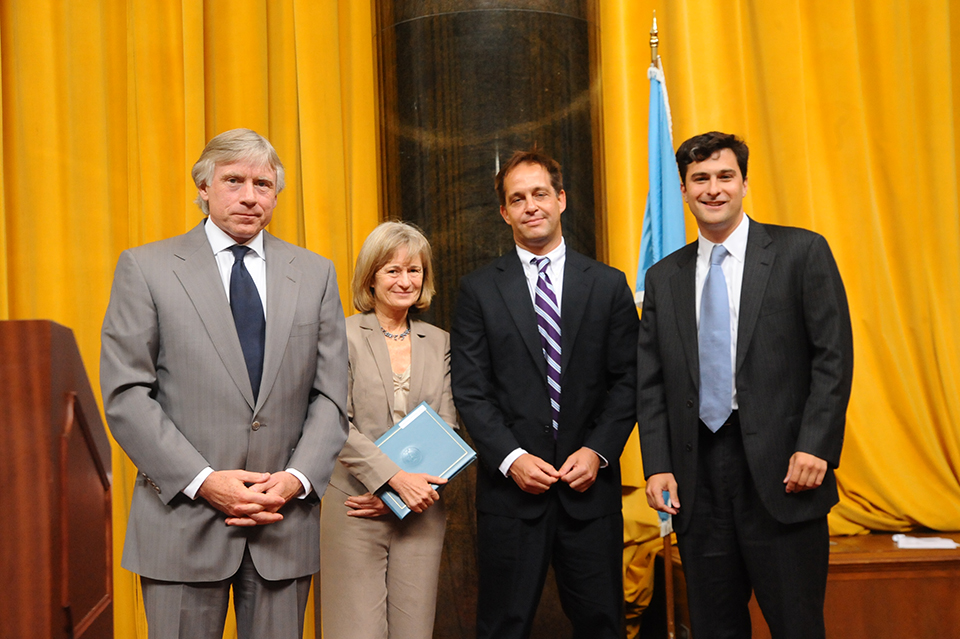
Lee C. Bollinger, President of Columbia University (left), presents the 2009 International Reporting prize to (l-r) Jane Perlez, Dexter Filkins and Mark Mazzetti of The New York Times.
Winning Work
Networks Nurtured by Intelligence Agency Post Threat to Security of Nation
By Carlotta Gall and David Rohde
ISLAMABAD, Pakistan — Pakistan’s premier military intelligence agency has lost control of some of the networks of Pakistani militants it has nurtured since the 1980s, and is now suffering the violent blowback of that policy, two former senior intelligence officials and other officials close to the agency say.
As the military has moved against them, the militants have turned on their former handlers, the officials said. Joining with other extremist groups, they have battled Pakistani security forces and helped militants carry out a record number of suicide attacks last year, including some aimed directly at army and intelligence units as well as prominent political figures, possibly even Benazir Bhutto.
The growing strength of the militants, many of whom now express support for Al Qaeda’s global jihad, presents a grave threat to Pakistan’s security, as well as NATO efforts to push back the Taliban in Afghanistan. American officials have begun to weigh more robust covert operations to go after Al Qaeda in the lawless border areas because they are so concerned that the Pakistani government is unable to do so.
The unusual disclosures regarding Pakistan’s leading military intelligence agency — Inter-Services Intelligence, or the ISI — emerged in interviews last month with former senior Pakistani intelligence officials. The disclosures confirm some of the worst fears, and suspicions, of American and Western military officials and diplomats.
The interviews, a rare glimpse inside a notoriously secretive and opaque agency, offered a string of other troubling insights likely to refocus attention on the ISI’s role as Pakistan moves toward elections on Feb. 18 and a battle for control of the government looms:
One former senior Pakistani intelligence official, as well as other people close to the agency, acknowledged that the ISI led the effort to manipulate Pakistan’s last national election in 2002, and offered to drop corruption cases against candidates who would back President Pervez Musharraf.
A person close to the ISI said Mr. Musharraf had now ordered the agency to ensure that the coming elections were free and fair, and denied that the agency was working to rig the vote. But the acknowledgment of past rigging is certain to fuel opposition fears of new meddling.
The two former high-ranking intelligence officials acknowledged that after Sept. 11, 2001, when President Musharraf publicly allied Pakistan with the Bush administration, the ISI could not rein in the militants it had nurtured for decades as a proxy force to exert pressure on India and Afghanistan. After the agency unleashed hard-line Islamist beliefs, the officials said, it struggled to stop the ideology from spreading.
Another former senior intelligence official said dozens of ISI officers who trained militants had come to sympathize with their cause and had had to be expelled from the agency. He said three purges had taken place since the late 1980s and included the removal of three ISI directors suspected of being sympathetic to the militants.
None of the former intelligence officials who spoke to The New York Times agreed to be identified when talking about the ISI, an agency that has gained a fearsome reputation for interfering in almost every aspect of Pakistani life. But two former American intelligence officials agreed with much of what they said about the agency’s relationship with the militants.
So did other sources close to the ISI, who admitted that the agency had supported militants in Afghanistan and Kashmir, although they said they had been ordered to do so by political leaders.
The former intelligence officials appeared to feel freer to speak as Mr. Musharraf’s eight years of military rule weakened, and as a power struggle for control over the government looms between Mr. Musharraf and opposition political parties.
The officials were interviewed before the assassination of Ms. Bhutto, the opposition leader, on Dec. 27. Since then, the government has said that Pakistani militants linked to Al Qaeda are the foremost suspects in her killing. Her supporters have accused the government of a hidden hand in the attack.
While the author of Ms. Bhutto’s death remains a mystery, the interviews with the former intelligence officials made clear that the agency remained unable to control the militants it had fostered.
The threat from the militants, the former intelligence officials warned, is one that Pakistan is unable to contain. “We could not control them,” said one former senior intelligence official, who spoke on condition of anonymity. “We indoctrinated them and told them, ‘You will go to heaven.’ You cannot turn it around so suddenly.”
The Context
After 9/11, the Bush administration pressed Mr. Musharraf to choose a side in fighting Islamist extremism and to abandon Pakistan’s longtime support for the Taliban and other Islamist militants.
In the 1990s, the ISI supported the militants as a proxy force to contest Indian-controlled Kashmir, the border territory that India and Pakistan both claim, and to gain a controlling influence in neighboring Afghanistan. In the 1980s, the United States supported militants, too, funneling billions of dollars to Islamic fighters battling Soviet forces in Afghanistan through the ISI, vastly increasing the agency’s size and power.
Publicly, Mr. Musharraf agreed to reverse course in 2001, and he has received $10 billion in aid for Pakistan since then in return. In an interview in November, he vehemently defended the conduct of the ISI, an agency that, according to American officials, was under his firm control for the last eight years while he served as both president and army chief.
Mr. Musharraf dismissed criticism of the ISI’s relationship with the militants. He cited the deaths of 1,000 Pakistani soldiers and police officers in battles with the militants in recent years — as well as several assassination attempts against himself — as proof of the seriousness of Pakistan’s counterterrorism effort.
“It is quite illogical if you think those people who have suffered 1,000 people dead, and I who have been attacked thrice or four or five times, that I would be supportive towards Taliban, towards Al Qaeda,” Mr. Musharraf said. “These are ridiculous things that discourages and demoralizes.”
But some former American intelligence officials have argued that Mr. Musharraf and the ISI never fully jettisoned their militant protégés, and instead carried on a “double-game.” They say Mr. Musharraf cooperated with American intelligence agencies to track down foreign Qaeda members while holding Taliban commanders and Kashmiri militants in reserve.
In order to undercut major opposition parties, he wooed religious conservatives, according to analysts. And instead of carrying out a crackdown, Mr. Musharraf took half-measures.
“I think he would make a decision when a situation arises,” said Hasan Askari Rizvi, a leading Pakistani military analyst, referring to militants openly confronting the government. “But before that he would not alienate any side.
There is little dispute that Pakistan’s crackdown on the militants has been at best uneven, but key sources interviewed by The Times disagreed on why.
Most Western officials in Pakistan say they believe, as Pakistani officials, including President Musharraf, insist, that the agency is well disciplined, like the army, and is in no sense a rogue or out-of-control organization acting contrary to the policies of the leadership
A senior Western military official in Pakistan said that if the ISI was covertly aiding the Taliban, the decision would come from the top of the government, not the agency. “That’s not an ISI decision,” the official said. “That’s a government-of-Pakistan decision.”
But former Pakistani intelligence officials insisted that Mr. Musharraf had ordered a crackdown on all militants. It was never fully carried out, however, because of opposition within his government and within ISI, they said.
One former senior intelligence official said that some officials in the government and the ISI thought the militants should be held in reserve, as insurance against the day when American and NATO forces abandoned the region and Pakistan might again need them as a lever against India.
“We had a school of thought that favored retention of this capability,” the former senior intelligence official said.
Some senior ministers and officials in Mr. Musharraf’s government sympathized with the militants and protected them, former intelligence officials said. Still others advised a go-slow approach, fearing a backlash against the government from the militants
When arrests were ordered, the police refused to carry them out in some cases until they received written orders, believing the militants were still protected by the ISI, as they had been for years.
Inside the ISI, there was division as well. One part of the ISI hunted down militants, the officials said, while another continued to work with them. The result was confusion.
In interviews in 2002, Kashmiri militants in Pakistan said they had been told by the government to maintain a low profile and wait. But as Pakistani military operations in the tribal areas intensified, along with airstrikes by C.I.A.-operated drones, militant groups there issued highly charged and sometimes exaggerated accounts of women and children being killed
The first suicide bombing attack on a military target outside the tribal areas came days after an airstrike on a madrasa in the tribal area of Bajaur in October 2006 killed scores of people.
Another turning point came last July when Pakistani forces stormed the Red Mosque in Islamabad, where militants had armed themselves in a compound less than a mile from ISI headquarters and demanded the imposition of Islamic law. Government officials said that more than 100 people died. The militants have insisted that thousands did.
Several weeks later, militants carried out the first direct attacks on ISI employees. Suicide bombers twice attacked buses ferrying agency employees, killing 18 on Sept. 4 and 15 more on Nov. 24. According to Pakistani analysts, the attacks signaled that enraged militants had turned on their longtime patrons.
The Militant
One militant leader, Maulana Masood Azhar, typifies how extremists once trained by the ISI have broken free of the agency’s control, turned against the government and joined with other militants to create powerful new networks.
In 2000, Mr. Azhar received support from the ISI when he founded Jaish-e-Muhammad, or Army of Muhammad, a Pakistani militant group fighting Indian forces in Kashmir, according to Robert Grenier, who served as the Central Intelligence Agency station chief in Islamabad from 1999 to 2002. The ISI intermittently provided training and operational coordination to such groups, he said, but struggled to fully control them.
Mr. Musharraf banned Jaish-e-Muhammad and detained Mr. Azhar after militants carried out an attack on the Indian Parliament building in December 2001. Indian officials accused Jaish-e-Muhammad and another Pakistani militant group of masterminding the attack. After India massed hundreds of thousands of troops on Pakistan’s border, Mr. Musharraf vowed in a nationally televised speech that January to crack down on all militants in Pakistan.
“We will take strict action against any Pakistani who is involved in terrorism inside the country or abroad,” he said. Two weeks later, a British-born member of Mr. Azhar’s group, Ahmed Omar Sheikh, kidnapped Daniel Pearl, a reporter for The Wall Street Journal who was beheaded by his captors. Mr. Sheikh surrendered to the ISI, the agency that had supported Jaish-e-Muhammad, and was sentenced to death for the kidnapping.
After Mr. Pearl’s killing, Pakistani officials arrested more than 2,000 people in a crackdown. But within a year, Mr. Azhar and most of the 2,000 militants who had been arrested were freed. “I never believed that government ties with these groups was being irrevocably cut,” said Mr. Grenier, now a managing director at Kroll, a risk consulting firm.
At the same time, Pakistan seemingly went “through the motions” when it came to hunting Taliban leaders who fled into Pakistan after the 2001 American invasion of Afghanistan, he said
Encouraged by the United States, the Pakistanis focused their resources on arresting senior Qaeda members, he said, which they successfully did from 2002 to 2005. Since then, arrests have slowed as Al Qaeda and other militant groups have become more entrenched in the tribal areas.
Asked in 2006 why the Pakistani government did not move against the leading Taliban commander Jalaluddin Haqqani, and his son Sirajuddin, who are based in the tribal areas and have long had links with Al Qaeda, one senior ISI official said it was because Pakistan needed to retain some assets of its own
That policy haunts Mr. Musharraf and the United States, according to American and Pakistani analysts. Today Pakistan’s tribal areas are host to a lethal stew of foreign Qaeda members, Uzbek militants, Taliban, ISI-trained Pakistani extremists, disgruntled tribesmen and new recruits.
The groups carried out a record number of suicide bombings in Pakistan and Afghanistan last year and have been tied to three major terrorist plots in Britain and Germany since 2005.
Mr. Azhar, who once served his ISI mentors in Kashmir, is thought to be hiding in the tribal area of Bajaur, or nearby Dir, and fighting Pakistani security forces, according to one former intelligence official. Militants who took part in the Red Mosque siege in Islamabad in July were closely affiliated with Mr. Azhar’s group. This fall, his group fielded fighters in the Swat Valley, the famous tourist spot, where the militants presented a challenge of new proportions to the government, seizing several districts and mounting battles against Pakistani forces that left scores dead.
One militant from a banned sectarian group who joined Mr. Azhar’s group, Qari Zafar, now trains insurgents in South Waziristan on how to rig roadside bombs and vests for suicide bombings, according to the former intelligence official.
Cooperation against the Taliban fighting in Afghanistan has improved since 2006, and three senior Taliban figures have been caught, according to Western officials and sources close to the ISI. Yet doubts remain about the Pakistani government’s intentions.
Senior provincial ISI officials continue to meet with high-level members of the Taliban in the border provinces, according to one Western diplomat. “It is not illogical to surmise that cooperation is on the agenda, and not just debriefing,” the diplomat said.
“There are groups they know they have lost control of,” the Western diplomat added. But the government moved only against those groups that have attacked the Pakistani state, the diplomat said, adding, “It seems very difficult for them to write them off.”
The Agency Now
Western officials say that before Mr. Musharraf resigned as army chief in December, he appointed a loyalist to run the ISI and appears determined to retain power over the agency even as a civilian president.
“For as long as he can, Musharraf will keep trying to control these organizations,” a Western diplomat said. “I don’t think we should expect this man to become an elder statesman as we know it.”
That puts Mr. Musharraf’s successor as army chief, Gen. Ashfaq Parvez Kayani, who headed the ISI from 2004 to 2007, in a potentially pivotal position. General Kayani, a pro-American moderate, is loyal to Mr. Musharraf to a point, according to retired officers. But he will abandon him if he thinks Mr. Musharraf’s actions are significantly undermining the standing of the Pakistani army.
Mr. Musharraf will maintain control over the agency as long as his interests coincide with General Kayani’s, they said, while the new civilian prime minister who emerges from February’s elections is likely to have far less authority over the agency. Opposition political parties already accuse the agency of meddling in next month’s election. The Western diplomat called the ISI “the army’s dirty bag of tricks.”
Since Ms. Bhutto’s assassination, members of her party have accused government officials, including former ISI agents, of having a hidden hand in the attack or of knowing about a plot and failing to inform Ms. Bhutto.
American experts played down the chances of a government conspiracy against Ms. Bhutto. They also said it was unlikely that low-level or retired officers working alone or with militants carried out the attack.
But nearly half of Pakistanis said in a recent poll that they suspected that government agencies or pro-government politicians had assassinated Ms. Bhutto. Such suspicion stems from decades of interference in elections and politics by the ISI, according to analysts, as well as a high level of domestic surveillance, intimidation and threats to journalists, academics and human rights activists, which former intelligence officials also acknowledged.
Pakistani and American experts say that distrust speaks to the urgent need to reform a hugely powerful intelligence agency that Pakistan’s military rulers have used for decades to suppress political opponents, manipulate elections and support militant groups.
“Pakistan would certainly be better off if the ISI were never used for domestic political purposes,” said Mr. Grenier, the former C.I.A. Islamabad station chief. “That goes without saying.”
Pakistani analysts and Western diplomats argue that the country will remain unstable as long as the ISI remains so powerful and so unaccountable. The ISI has grown more powerful in each period of military rule, they said.
Civilian leaders, including Mrs. Bhutto, could not resist using it to secure their political aims, but neither could they control it. And the army continues to rely on the ISI for its own foreign policy aims, particularly battling India in Kashmir and seeking influence in Afghanistan.
“The question is, how do you change that?” asked one Western diplomat. “Their tentacles are everywhere.”
© 2008, The New York Times
Bin Laden Network Thrives in Tribal Lands as American Frustration Mounts
By Mark Mazzetti and David Rohde
WASHINGTON — Late last year, top Bush administration officials decided to take a step they had long resisted. They drafted a secret plan to make it easier for the Pentagon’s Special Operations forces to launch missions into the snow-capped mountains of Pakistan to capture or kill top leaders of Al Qaeda.
Intelligence reports for more than a year had been streaming in about Osama bin Laden’s terrorism network rebuilding in the Pakistani tribal areas, a problem that had been exacerbated by years of missteps in Washington and the Pakistani capital, Islamabad, sharp policy disagreements, and turf battles between American counterterrorism agencies.
The new plan, outlined in a highly classified Pentagon order, was intended to eliminate some of those battles. And it was meant to pave a smoother path into the tribal areas for American commandos, who for years have bristled at what they see as Washington’s risk-averse attitude toward Special Operations missions inside Pakistan. They also argue that catching Mr. bin Laden will come only by capturing some of his senior lieutenants alive.
But more than six months later, the Special Operations forces are still waiting for the green light. The plan has been held up in Washington by the very disagreements it was meant to eliminate. A senior Defense Department official said there was “mounting frustration” in the Pentagon at the continued delay.
After the Sept. 11 attacks, President Bush committed the nation to a “war on terrorism” and made the destruction of Mr. bin Laden’s network the top priority of his presidency. But it is increasingly clear that the Bush administration will leave office with Al Qaeda having successfully relocated its base from Afghanistan to Pakistan’s tribal areas, where it has rebuilt much of its ability to attack from the region and broadcast its messages to militants across the world.
A recent American airstrike killing Pakistani troops has only inflamed tensions along the mountain border and added to tensions between Washington and Pakistan’s new government.
The story of how Al Qaeda, whose name is Arabic for “the base,” has gained a new haven is in part a story of American accommodation to President Pervez Musharraf of Pakistan, whose advisers played down the terrorist threat. It is also a story of how the White House shifted its sights, beginning in 2002, from counterterrorism efforts in Afghanistan and Pakistan to preparations for the war in Iraq.
Just as it had on the day before 9/11, Al Qaeda now has a band of terrorist camps from which to plan and train for attacks against Western targets, including the United States. Officials say the new camps are smaller than the ones the group used prior to 2001. However, despite dozens of American missile strikes in Pakistan since 2002, one retired C.I.A. officer estimated that the makeshift training compounds now have as many as 2,000 local and foreign militants, up from several hundred three years ago.
Publicly, senior American and Pakistani officials have said that the creation of a Qaeda haven in the tribal areas was in many ways inevitable — that the lawless badlands where ethnic Pashtun tribes have resisted government control for centuries were a natural place for a dispirited terrorism network to find refuge. The American and Pakistani officials also blame a disastrous cease-fire brokered between the Pakistani government and militants in 2006.
But more than four dozen interviews in Washington and Pakistan tell another story. American intelligence officials say that the Qaeda hunt in Pakistan, code-named Operation Cannonball by the C.I.A. in 2006, was often undermined by bitter disagreements within the Bush administration and within the C.I.A., including about whether American commandos should launch ground raids inside the tribal areas.
Inside the C.I.A., the fights included clashes between the agency’s outposts in Kabul, Afghanistan, and Islamabad. There were also battles between field officers and the Counterterrorist Center at C.I.A. headquarters, whose preference for carrying out raids remotely, via Predator missile strikes, was derided by officers in the Islamabad station as the work of “boys with toys.”
An early arrangement that allowed American commandos to join Pakistani units on raids inside the tribal areas was halted in 2003 after protests in Pakistan. Another combat mission that came within hours of being launched in 2005 was scuttled because some C.I.A. officials in Pakistan questioned the accuracy of the intelligence, and because aides to Defense Secretary Donald H. Rumsfeld believed that the mission force had become too large.
Current and former military and intelligence officials said that the war in Iraq consistently diverted resources and high-level attention from the tribal areas. When American military and intelligence officials requested additional Predator drones to survey the tribal areas, they were told no drones were available because they had been sent to Iraq.
Some former officials say Mr. Bush should have done more to confront Mr. Musharraf, by aggressively demanding that he acknowledge the scale of the militant threat.
Western military officials say Mr. Musharraf was instead often distracted by his own political problems, and effectively allowed militants to regroup by brokering peace agreements with them.
Even critics of the White House agree that there was no foolproof solution to gaining control of the tribal areas. But by most accounts the administration failed to develop a comprehensive plan to address the militant problem there, and never resolved the disagreements between warring agencies that undermined efforts to fashion any coherent strategy.
“We’re just kind of drifting,” said Richard L. Armitage, who as deputy secretary of state from 2001 to 2005 was the administration’s point person for Pakistan.
Fleeing U.S. Air Power
In March 2002, several hundred bedraggled foreign fighters — Uzbeks, Pakistanis and a handful of Arabs — fled the towering mountains of eastern Afghanistan and crossed into Pakistan’s South Waziristan tribal area.
Savaged by American air power in the battles of Tora Bora and the Shah-i-Kot valley, some were trying to make their way to the Arab states in the Persian Gulf. Some were simply looking for a haven.
They soon arrived at Shakai, a remote region in South Waziristan of tree-covered mountains and valleys. Venturing into nearby farming villages, they asked local tribesmen if they could rent some of the area’s walled family compounds, paying two to three times the impoverished area’s normal rates as the militants began to lay new roots.
“They slowly, steadily from the mountainside tried to establish communication,” recalled Mahmood Shah, the chief civilian administrator of the tribal areas from 2001 to 2005.
In many ways, the foreigners were returning to their home base. In the 1980s, Mr. bin Laden and hundreds of Arab and foreign fighters backed by the United States and Pakistan used the tribal areas as a staging area for cross-border attacks on Soviet forces in Afghanistan.
The militants’ flight did not go unnoticed by American intelligence agencies, which began to report beginning in the spring of 2002 that large numbers of foreigners appeared to be hiding in South Waziristan and neighboring North Waziristan.
But Gen. Ali Mohammad Jan Aurakzai, the commander of Pakistani forces in northwestern Pakistan, was skeptical. In an interview this year, General Aurakzai recalled that he regarded the warnings as “guesswork,” and said that his soldiers “found nothing,” even when they pushed into dozens of square miles of territory that neither Pakistani nor British forces had ever entered.
The general, a tall, commanding figure who was born in the tribal areas, was Mr. Musharraf’s main adviser on the border areas, according to former Pakistani officials. For years, he would argue that American officials exaggerated the threat in the tribal areas and that the Pakistani Army should avoid causing a tribal rebellion at all costs.
Former American intelligence officials said General Aurakzai’s sweeps were slow-moving and easily avoided by militants. Robert L. Grenier, the C.I.A. station chief in Islamabad from 1999 to 2002, said that General Aurakzai was dismissive of the reports because he and other Pakistani officials feared the kind of tribal uprising that could have been touched off by more intrusive military operations. “Aurakzai and others didn’t want to believe it because it would have been an inconvenient fact,” Mr. Grenier recalled.
Signs of Militants Regrouping
Until recent elections pushed Mr. Musharraf off center stage in Pakistan, senior Bush administration officials consistently praised his cooperation in the Qaeda hunt.
Beginning shortly after the Sept. 11 attacks, Mr. Musharraf had allowed American forces to use Pakistani bases to support the American invasion of Afghanistan, while Pakistani intelligence services worked closely with the C.I.A. in tracking down Qaeda operatives. But from their vantage point in Afghanistan, the picture looked different to American Special Operations forces who saw signs that the militants whom the Americans had driven out of Afghanistan were effectively regrouping on the Pakistani side of the border.
When American military officials proposed in 2002 that Special Operations forces be allowed to establish bases in the tribal areas, Pakistan flatly refused. Instead, a small number of “black” Special Operations forces — Army Delta Force and Navy Seal units — were allowed to accompany Pakistani forces on raids in the tribal areas in 2002 and early 2003.
That arrangement only angered both sides. American forces used to operating on their own felt that the Pakistanis were limiting their movements. And while Pakistani officials publicly denied the presence of Americans, local tribesmen spotted the Americans and protested
Under pressure from Pakistan, the Bush administration decided in 2003 to end the American military presence on the ground. In a recent interview, Mr. Armitage said he had supported the pullback in recognition of the political risks that Mr. Musharraf had already taken. “We were pushing them almost to the breaking point,” Mr. Armitage said.
The American invasion of Iraq in 2003 added another complicating factor, by cementing a view among Pakistanis that American forces in the tribal areas would be a prelude to an eventual American occupation.
To have insisted that American forces be allowed to cross from Afghanistan into Pakistan, Mr. Armitage added, “might have been a bridge too far.”
Dealing With Musharraf
Mr. Bush’s re-election in 2004 brought with it another problem once the president overhauled his national security team. By early 2005, Secretary of State Colin L. Powell and Mr. Armitage had resigned, joining George J. Tenet, who had stepped down earlier as director of central intelligence. Their departures left the administration with no senior officials with close personal relationships with Mr. Musharraf.
In order to keep pressure on the Pakistanis about the tribal areas, officials decided to have Mr. Bush raise the issue in personal phone calls with Mr. Musharraf.
The conversations backfired. Two former United States government officials say they were surprised and frustrated when instead of demanding action from Mr. Musharraf, Mr. Bush repeatedly thanked him for his contributions to the war on terrorism. “He never pounded his fist on the table and said, ‘Pervez you have to do this,’ ” said a former senior intelligence official who saw transcripts of the phone conversations. But another senior administration official defended the president, saying Mr. Bush had not gone easy on the Pakistani leader.
“I would say the president pushes quite hard,” said the official, who would speak about the confidential conversations only on condition of anonymity. At the same time, the official said Mr. Bush was keenly aware of the “unique burden” that rested on any head of state, and had the ability to determine “what the traffic will bear” when applying pressure to foreign leaders.
Tensions Within the C.I.A.
As attacks into Afghanistan by militants based in the tribal areas continued, tensions escalated between the C.I.A. stations in Kabul and Islamabad, whose lines of responsibility for battling terrorism were blurred by the porous border that divides Afghanistan and Pakistan, and whose disagreements reflected animosities between the countries.
Along with the Afghan government, the C.I.A. officers in Afghanistan expressed alarm at what they saw as a growing threat from the tribal areas. But the C.I.A. officers in Pakistan played down the problem, to the extent that some colleagues in Kabul said their colleagues in Islamabad were “drinking the Kool-Aid,” as one former officer put it, by accepting Pakistani assurances that no one could control the tribal areas.
On several occasions, senior C.I.A. officials at agency headquarters had to intervene to dampen tensions between the dueling C.I.A. outposts. Other intragovernmental battles raged at higher altitudes, most notably over the plan in early 2005 for a Special Operations mission intended to capture Ayman al-Zawahri, Mr. bin Laden’s top deputy, in what would have been the most aggressive use of American ground troops inside Pakistan. The New York Times disclosed the aborted operation in a 2007 article, but interviews since then have produced new details about the episode.
As described by current and former government officials, Mr. Zawahri was believed by intelligence officials to be attending a meeting at a compound in Bajaur, a tribal area, and the plan to send commandos to capture him had the support of Porter J. Goss, the C.I.A. director, and the Special Operations commander, Lt. Gen. Stanley A. McChrystal.
But even as members of the Navy Seals and Army Rangers in parachute gear were boarding C-130 cargo planes in Afghanistan, there were frenzied exchanges between officials at the Pentagon, Central Command and the C.I.A. about whether the mission was too risky. Some complained that the American commando force was too large, numbering more than 100, while others argued that the intelligence was from a single source and unreliable.
Mr. Goss urged the military to carry out the mission, and some C.I.A. officials in Washington even tried to give orders to execute the raid without informing Ryan C. Crocker, then the American ambassador in Islamabad. But other C.I.A. officials were opposed to the raid, including a former officer who said in an interview that he had “told the military guys that this thing was going to be the biggest folly since the Bay of Pigs.”
In the end, the mission was aborted after Mr. Rumsfeld refused to give his approval for it. The decision remains controversial, with some former officials seeing the episode as a squandered opportunity to capture a figure who might have led the United States to Mr. bin Laden, while others dismiss its significance, saying that there had been previous false alarms and that there remained no solid evidence that Mr. Zawahri was present.
Bin Laden Hunt at Dead End
By late 2005, many inside the C.I.A. headquarters in Virginia had reached the conclusion that their hunt for Mr. bin Laden had made little progress since Tora Bora.
Jose A. Rodriguez Jr., who at the time ran the C.I.A.’s clandestine operations branch, decided in late 2005 to make a series of swift changes to the agency’s counterterrorism operations.
He replaced Mr. Grenier, the former Islamabad station chief who in late 2004 took over as head of the agency’s Counterterrorist Center. The two men had barely spoken for months, and some inside the agency believed this personality clash was beginning to affect C.I.A. operations.
Mr. Grenier had worked to expand the agency’s counterterrorism focus, reinforcing operations in places like the Horn of Africa, Southeast Asia and North Africa. He also reorganized and renamed Alec Station, the secret C.I.A. unit formed in the 1990s to hunt Al Qaeda.
Mr. Grenier believed that the Counterterrorist Center and Alec Station had both grown very rapidly since 2001 and needed to be restructured to eliminate overlap.
But Mr. Rodriguez believed that the Qaeda hunt had lost its focus on Mr. bin Laden and the militant threat in Pakistan.
So he appointed a new head of the Counterterrorist Center, who has not been publicly identified, and sent dozens more C.I.A. operatives to Pakistan. The new push was called Operation Cannonball, and Mr. Rodriguez demanded urgency, but the response had a makeshift air.
There was nowhere to house an expanding headquarters staff, so giant Quonset huts were erected outside the cafeteria on the C.I.A.’s leafy Virginia campus to house a new team assigned to the bin Laden mission. In Pakistan, the new operation was staffed not only with C.I.A. operatives drawn from around the world, but also with recent graduates of “the Farm,” the agency’s training center at Camp Peary in Virginia.
“We had to put people out in the field who had less than ideal levels of experience,” one former senior C.I.A. official said. “But there wasn’t much to choose from.”
One reason for this, according to two former intelligence officials directly involved in the Qaeda hunt, was that by 2006 the Iraq war had drained away most of the C.I.A. officers with field experience in the Islamic world. “You had a very finite number” of experienced officers, said one former senior intelligence official. “Those people all went to Iraq. We were all hurting because of Iraq.”
Surge in Suicide Bombings
The increase had little impact in Pakistan, where militants only continued to gain strength. In the spring of 2006, Taliban leaders based in Pakistan launched an offensive in southern Afghanistan, increasing suicide bombings by sixfold and American and NATO casualty rates by 45 percent. At the same time, they assassinated tribal elders in Pakistan who were cooperating with the government.
Once again, Pakistani Army units launched a military campaign in the tribal areas. Once again, they suffered heavy casualties.
And once again, Mr. Musharraf turned to General Aurakzai to deal with the problem. Having retired from the Pakistani Army, General Aurakzai had become the governor of North-West Frontier Province, and he immediately began negotiating with the militants. On Sept. 5, 2006, General Aurakzai signed a truce with militants in North Waziristan, one in which the militants agreed to surrender to local tribes and carry out no further attacks in Afghanistan.
To help sell Washington on the deal, Mr. Musharraf brought General Aurakzai to the Oval Office several weeks later.
In a presentation to Mr. Bush, General Aurakzai advocated a strategy that would rely even more heavily on cease-fires, and said striking deals with the Taliban inside Afghanistan could allow American forces to withdraw from Afghanistan within seven years.
But the cease-fire in Waziristan had disastrous consequences. In the months after the agreement was signed, cross-border incursions from the tribal areas into Afghanistan rose by 300 percent. Some American officials began to refer to General Aurakzai as a “snake oil salesman.”
A Rising Terror Threat
By the fall of 2006, the top American commander in Afghanistan had had enough.
Intelligence reports were painting an increasingly dark picture of the terrorism threat in the tribal areas. But with senior Bush administration officials consumed for much of that year with the spiraling violence in Iraq, the Qaeda threat in Pakistan was not at the top of the White House agenda.
Mr. Bush had declared in a White House news conference that fall that Al Qaeda was “on the run.”
To get Washington’s attention, the commander, Lt. Gen. Karl W. Eikenberry, ordered military officers, Special Operations forces and C.I.A. operatives to assemble a dossier showing Pakistan’s role in allowing militants to establish a haven.
Behind the general’s order was a broader feeling of outrage within the military — at a terrorist war that had been outsourced to an unreliable ally, and at the grim fact that America’s most deadly enemy had become stronger.
For months, military officers inside a walled-off compound at Bagram Air Base in Afghanistan, where a branch of the military’s classified Joint Special Operations Command is based, had grown increasingly frustrated at what they saw as missed opportunities in the tribal areas.
American commanders had been pressing for much of 2006 to get approval from Mr. Rumsfeld for an operation to capture Sheik Saiid al-Masri, a top Qaeda operator and paymaster whom American intelligence had been tracking in the Pakistani mountains.
Mr. Rumsfeld and his staff were reluctant to approve the mission, worried about possible American military casualties and a popular backlash in Pakistan.
Finally, in November 2006, Mr. Rumsfeld approved a plan for Navy Seal and Army Delta Force commandos to move into Pakistan and capture Mr. Masri. But the operation was put on hold days later, after Mr. Rumsfeld was pushed out of the Pentagon, a casualty of the Democratic sweep of the 2006 election.
When General Eikenberry presented his dossier to several members of Mr. Bush’s cabinet, some inside the State Department and the C.I.A. dismissed the briefing as exaggerated and simplistic. But the White House took note of his warnings, and decided to send Vice President Dick Cheney to Islamabad in March 2007, along with Stephen R. Kappes, the deputy C.I.A. director, to register American concern.
That visit was the beginning of a more aggressive effort by the administration to pressure Pakistan’s government into stepping up its fight. The decision last year to draw up the Pentagon order authorizing for a Special Operations campaign in the tribal areas was part of that effort.
But the fact that the order remains unsigned reflects the infighting that persists. Administration lawyers and State Department officials are concerned about any new authorities that would allow military missions to be launched without the approval of the American ambassador in Islamabad. With Qaeda operatives now described in intelligence reports as deeply entrenched in the tribal areas and immersed in the civilian population, there is also a view among some military and C.I.A. officials that the opportunity for decisive American action against the militants may have been lost.
Pakistani military officials, meanwhile, express growing frustration with the American pressure, and point out that Pakistan has lost more than 1,000 members of its security forces in the tribal areas since 2001, nearly double the number of Americans killed in Afghanistan.
Some architects of America’s efforts in Pakistan defend the Bush administration’s record in the tribal areas, and vigorously deny that Washington took its eye off the terrorist threat as it focused on Iraq policy. Some also question whether Mr. bin Laden and Mr. Zawahri, Al Qaeda’s top two leaders, are really still able to orchestrate large-scale attacks.
“I do wonder if it’s in fact the case that Al Qaeda has really reconstituted itself to a pre-9/11 capability, and in fact I would say I seriously doubt that,” said Mr. Crocker, the American ambassador to Pakistan between 2004 and 2006 and currently the ambassador to Iraq.
“Their top-level leadership is still out there, but they’re not communicating and they’re not moving around. I think they’re symbolic more than operationally effective,” Mr. Crocker said.
But while Mr. Bush vowed early on that Mr. bin Laden would be captured “dead or alive,” the moment in late 2001 when Mr. bin Laden and his followers escaped at Tora Bora was almost certainly the last time the Qaeda leader was in American sights, current and former intelligence officials say. Leading terrorism experts have warned that it is only a matter of time before a major terrorist attack planned in the mountains of Pakistan is carried out on American soil.
“The United States faces a threat from Al Qaeda today that is comparable to what it faced on Sept. 11, 2001,” said Seth Jones, a Pentagon consultant and a terrorism expert at the RAND Corporation.
“The base of operations has moved only a short distance, roughly the difference from New York to Philadelphia.”
Mark Mazzetti reported from Washington, and David Rohde from Washington and Islamabad, Peshawar and Rawalpindi, Pakistan. David E. Sanger contributed reporting from Washington.
© 2008, The New York Times
By Pir Zubair Shah and Jane Perlez
ZIARAT, Pakistan — The mountain of white marble shines with such brilliance in the sun it looks like snow. For four years, the quarry beneath it lay dormant, its riches captive to tribal squabbles and government ineptitude in this corner of Pakistan’s tribal areas.
But in April, the Taliban appeared and imposed a firm hand. They settled the feud between the tribes, demanded a fat fee up front and a tax on every truck that ferried the treasure from the quarry. Since then, Mir Zaman, a contractor from the Masaud subtribe, which was picked by the Taliban to run the quarry, has watched contentedly as his trucks roll out of the quarry with colossal boulders bound for refining in nearby towns.
“With the Taliban it is not a question of a request to us, but a question of force,” said Mr. Zaman, a bearded, middle-aged tribal leader who seemed philosophical about the reality of Taliban authority here. At least the quarry was now operating, he said.
The takeover of the Ziarat marble quarry, a coveted national asset, is one of the boldest examples of how the Taliban have made Pakistan’s tribal areas far more than a base for training camps or a launching pad for sending fighters into Afghanistan.
A rare, unescorted visit to the region this month, during which the Taliban detained for two days a freelance reporter and a photographer working for The New York Times, revealed how the Taliban were taking over territory, using the income they exact to strengthen their hold and turn themselves into a self-sustaining fighting force. The quarry alone has already brought the Taliban tens of thousands of dollars, Mr. Zaman said.
The seizure of the quarry is a measure of how in recent months, as the Pakistani military has pulled back under a series of peace deals, the Pakistani Taliban have extended their reach through more of the rugged territory in northern Pakistan known as the Federally Administered Tribal Areas, or FATA.
Today the Taliban not only settle disputes in their consolidated domain but they also levy taxes, smuggle drugs and other contraband, and impose their own brand of rough justice, complete with courts and prisons.
From the security of this border region, they deploy their fighters and suicide bombers in two directions: against NATO and American forces over the border in southern Afghanistan, and against Pakistani forces — police, army and intelligence officials — in major Pakistani cities.
The quarry operation here in the Mohmand tribal district, strategically situated between the city of Peshawar and the Afghan border, is a new effort by the Taliban to harness the abundant natural resources of a region where there are plenty of other mining operations for coal, gold, copper and chromate.
Of all the minerals in the tribal areas, the marble from Ziarat is one of the most highly prized for use in expensive floors and walls in Pakistan, and in limited quantities abroad.
A government body, the FATA Development Authority, failed over the last several years to mediate a dispute between the Masaud and Gurbaz subtribes over how the mining rights to the marble should be allocated, according to Pakistani government officials familiar with the quarry who spoke on the condition of anonymity because of the effort’s failure.
A new government mining corporation, Pakistan Stone Development Company, offered last year to invest in modern mining machinery, but even with the lure of added value, the development authority could not sort out the feud.
The arguments were fierce because the tribes knew that the Ziarat marble was of particularly fine texture and purity, comparable to Italian Carrara marble, according to an assessment done for the FATA Development Authority.
The Taliban came eager for a share of the business. Their reputation for brutality and the weakness of the local government authorities allowed the Taliban to settle the dispute in short order.
The Taliban decided that one mountain in the Ziarat area belonged to the Masaud division of the main Safi tribe, and said that the Gurbaz subtribe would be rewarded with another mountain, Mr. Zaman, the contractor, said.
The mountain assigned to the Masauds was divided into 30 portions, he said, and each of six villages in the area was assigned five of the 30 portions. Mr. Zaman said the Taliban demanded about $1,500 commission upfront for each portions, giving the insurgents a quick $45,000.
The Taliban also demanded a tax of about $7 on each truckload of marble, he said. With a constant flow of trucks out of the quarry, the Taliban are now collecting up to $500 a day, Mr. Zaman said.
A senior Pakistani official and a Pakistani businessman who works in the marble industry, neither of whom wanted to be identified for fear of retaliation from the Taliban, confirmed the account.
Today the quarry runs as a relatively rudimentary affair using dynamite, which harms the marble and renders production extremely inefficient. Antiquated trucks grind their way up the steep, tiered roadways carved in the mountainside to ferry the rock away. But the quarry’s reopening has given something to everyone.
The local tribes are profiting along with the Taliban. Once the trucks reach the processing plants, the government, too, collects a hefty tax, nearly double that of the Taliban, Mr. Zaman said, though there was no way to verify the claim. The Taliban appeared to have no problem with the government taking a share, he said.
So far, he said, the Taliban were overseeing the operation with a light hand: a single armed Taliban fighter sat at a checkpoint not far from Mr. Zaman’s hut to ensure that the tax was paid.
The Taliban are today a loose organization of mostly ethnic Pashtuns divided in two wings, one on each side of the border. Their leader in Mohmand goes by the name Abdul Wali, a guerrilla fighter in his 30s who rose to prominence last year when his group occupied a famous shrine in the village of Ghazi Abad in Mohmand.
He is affiliated with the overall leader of the Pakistani Taliban, Baitullah Mehsud, a powerful ally of Al Qaeda who keeps his base in South Waziristan, another part of the tribal areas.
Working with Al Qaeda, the Taliban have steadily tightened their grip over much of the tribal areas in the last several years by cowing or killing hundreds of local tribal chiefs who were the area’s traditional authorities.
In Mohmand, the Taliban have speedily consolidated control in the last year. They have filled a vacuum left by a vacillating government, unable and unwilling to assert its authority, said Munir Orekzei, a member of Parliament from Kurram, southwest of Mohmand, one of the seven districts, or agencies, in the tribal areas.
“In every agency the most powerful man is the Taliban,” Mr. Orekzei said. “Because if someone says, ‘I’m in favor of the government,’ he will be killed.”
At the same time, people in the tribal areas believe some branches of the Pakistani government are encouraging the Taliban in their route to power, he said.
Mr. Orekzei said he recently attended a meeting with Rehman Malik, the Pakistani interior minister, and tribal leaders in Peshawar, capital of the nearby North-West Frontier Province.
“Rehman Malik asked why the people in the tribal areas were not figting back against the Taliban,” Mr. Orekzei said. “I told him the people believe the government is behind the Taliban. I said, you tell the public what you are doing, and if they believe the government is not behind the Taliban, they will fight.”
The Taliban’s authority had become so firm in the last two months, it was too dangerous for legislators from the tribal areas to return to their constituencies, Mr. Orekzei said.
Only the capital of Mohmand, the small town of Ghalanai, remains unequivocally in government hands. There, the political agent, the representative of the governor of North-West Frontier Province, keeps a house and offices. But his power barely extends beyond the town’s limits, and he is unable to offer government services to ease the region’s poverty, local people say.
Next door to his compound, a public hospital remains underused because doctors, put off by poor salaries and insecurity, refuse to work there. Health conditions are appalling.
The weakness of the government has left people helpless before the Taliban threat, Mr. Orekzei and other local officials said. Most families had given a man to the Taliban cause, often as a measure of protection against the militants.
The territory has become a magnet for other militants from farther afield as well. More and more of them are coming from abroad, American officials say. But Taliban fighters encountered in Mohmand said they had come from all over Pakistan, revealing the Taliban’s reach into the heart of the country.
Some Taliban fighters said that they had come for the summer from cities like Karachi and Rawalpindi, where they run food stalls or work in hotels, and that they would return home at the start of winter when freezing weather envelops the mountains.
The government security force, a paramilitary group called the Frontier Corps, which serves under the command of the Pakistani Army, does little to challenge the Taliban in the tribal areas, despite occasional skirmishes. On the road north of Ghalanai, there were no Frontier Corps patrols, and 25 miles from Ghalanai the Taliban were in firm control
With the government so weak, the Taliban are accepted as the ruling power in many places in the tribal areas, local officials say. They wield an unflinching hand, to the point of conducting public executions, against the lawlessness that prevails in the region.
In Mohmand, they have imposed extra restrictions on women in the already conservative society, forbidding them to venture into fields and ordering their heads shaved if they flout the edict, according to the handful of legislators who represent the tribal areas in Parliament.
In a place called Chinarai, a two-hour drive from the Afghan border, the Taliban maintain a prison, where the reporter and photographer were held. On a recent day, there were about a dozen people in the compound, all of them manacled and kept in dark small rooms.
In a sign that the internal workings of the Taliban were not entirely smooth, several of the detainees were Taliban, and one of the prisoners was a relative of top Taliban commanders.
Life for the prisoners was spare at best. They were denied cellphones, the most valued possession among the Taliban. Prison food consisted of poorly cooked rice and vegetables. Soap appeared to be used only for body washing, not for cleaning of cooking pots and utensils
Taliban officials reviewing the prisoners’ cases spent much time debating how they should be punished under the Shariah, or Islamic law, imposed by the Taliban. One of the prisoners was suspected of working with the Afghan Army; another was accused of tearing down a Taliban notice.
One man accused of kidnapping was taken out of the prison and beaten into confessing.
Recently, Mohmand has become a center of kidnapping for ransom, a new activity that appears to be another important source of revenue for the Taliban. But the Ziarat quarry will be far more profitable, many people here say.
Even in its current rough condition, the quarry is such a good deal for the Taliban that one tribesman, known as Bahadar, who works there, predicted, “If this continues for two more years, they will take on America itself.”
Pir Zubair Shar reported from Ziarat, and Jane Perlez from Peshawar.
© 2008, The New York Times
Spies Helped Militants
Blast at Indian Embassy Fuels Concern About Ally's Reliability
By Mark Mazzetti and Eric Schmitt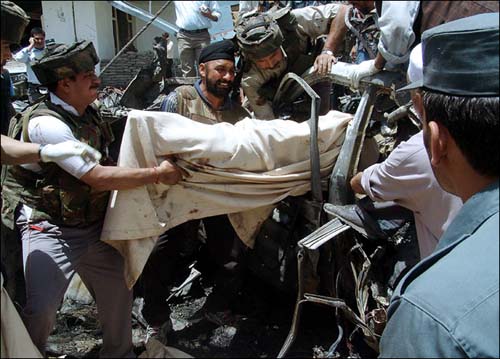
Afghan and Indian officials removed a body from the Indian Embassy in Kabul, Afghanistan, after a bombing there on July 7. (Agence France-Presse--Getty Images)
WASHINGTON — American intelligence agencies have concluded that members of Pakistan’s powerful spy service helped plan the deadly July 7 bombing of India’s embassy in Kabul, Afghanistan, according to United States government officials.
The conclusion was based on intercepted communications between Pakistani intelligence officers and militants who carried out the attack, the officials said, providing the clearest evidence to date that Pakistani intelligence officers are actively undermining American efforts to combat militants in the region.
The American officials also said there was new information showing that members of the Pakistani intelligence service were increasingly providing militants with details about the American campaign against them, in some cases allowing militants to avoid American missile strikes in Pakistan’s tribal areas.
Concerns about the role played by Pakistani intelligence not only has strained relations between the United States and Pakistan, a longtime ally, but also has fanned tensions between Pakistan and its archrival, India. Within days of the bombings, Indian officials accused the Directorate of Inter-Services Intelligence, or ISI, of helping to orchestrate the attack in Kabul, which killed 54, including an Indian defense attaché.
This week, Pakistani troops clashed with Indian forces in the contested region of Kashmir, threatening to fray an uneasy cease-fire that has held since November 2003.
The New York Times reported this week that a top Central Intelligence Agency official traveled to Pakistan this month to confront senior Pakistani officials with information about support provided by members of the ISI to militant groups. It had not been known that American intelligence agencies concluded that elements of Pakistani intelligence provided direct support for the attack in Kabul.
American officials said that the communications were intercepted before the July 7 bombing, and that the C.I.A. emissary, Stephen R. Kappes, the agency’s deputy director, had been ordered to Islamabad, Pakistan’s capital, even before the attack. The intercepts were not detailed enough to warn of any specific attack.
The government officials were guarded in describing the new evidence and would not say specifically what kind of assistance the ISI officers provided to the militants. They said that the ISI officers had not been renegades, indicating that their actions might have been authorized by superiors.
“It confirmed some suspicions that I think were widely held,” one State Department official with knowledge of Afghanistan issues said of the intercepted communications. “It was sort of this ‘aha’ moment. There was a sense that there was finally direct proof.”
The information linking the ISI to the bombing of the Indian Embassy was described in interviews by several American officials with knowledge of the intelligence. Some of the officials expressed anger that elements of Pakistan’s government seemed to be directly aiding violence in Afghanistan that had included attacks on American troops.
Some American officials have begun to suggest that Pakistan is no longer a fully reliable American partner and to advocate some unilateral American action against militants based in the tribal areas.
The ISI has long maintained ties to militant groups in the tribal areas, in part to court allies it can use to contain Afghanistan’s power. In recent years, Pakistan’s government has also been concerned about India’s growing influence inside Afghanistan, including New Delhi’s close ties to the government of Hamid Karzai, the Afghan president.
American officials say they believe that the embassy attack was probably carried out by members of a network led by Maulavi Jalaluddin Haqqani, whose alliance with Al Qaeda and its affiliates has allowed the terrorist network to rebuild in the tribal areas.
American and Pakistani officials have now acknowledged that President Bush on Monday confronted Pakistan’s prime minister, Yousaf Raza Gilani, about the divided loyalties of the ISI.
Pakistan’s defense minister, Chaudhry Ahmed Mukhtar, told a Pakistani television network on Wednesday that Mr. Bush asked senior Pakistani officials this week, “ ‘Who is in control of ISI?’ ” and asked about leaked information that tipped militants to surveillance efforts by Western intelligence services.
Pakistan’s new civilian government is wrestling with these very issues, and there is concern in Washington that the civilian leaders will be unable to end a longstanding relationship between members of the ISI and militants associated with Al Qaeda.
Spokesmen for the White House and the C.I.A. declined to comment for this article. Pakistan’s ambassador to the United States, Husain Haqqani, did not return a call seeking comment.
Further underscoring the tension between Pakistan and its Western allies, Britain’s senior military officer said in Washington on Thursday that an American and British program to help train Pakistan’s Frontier Corps in the tribal areas had been delayed while Pakistan’s military and civilian officials sorted out details about the program’s goals.
Britain and the United States had each offered to send about two dozen military trainers to Pakistan later this summer to train Pakistani Army officers who in turn would instruct the Frontier Corps paramilitary forces.
But the British officer, Air Chief Marshal Sir Jock Stirrup, said the program had been temporarily delayed. “We don’t yet have a firm start date,” he told a small group of reporters. “We’re ready to go.”
The bombing of the Indian Embassy helped to set off a new deterioration in relations between India and Pakistan.
This week, Indian and Pakistani soldiers fired at each other across the Kashmir frontier for more than 12 hours overnight Monday, in what the Indian Army called the most serious violation of a five-year-old cease-fire agreement. The nightlong battle came after one Indian soldier and four Pakistanis were killed along the border between sections of Kashmir that are controlled by India and by Pakistan.
Indian officials say they are equally worried about what is happening on the Pakistan-Afghanistan border because they say the insurgents who are facing off with India in Kashmir and those who target Afghanistan are related and can keep both borders burning at the same time.
India and Afghanistan share close political, cultural and economic ties, and India maintains an active intelligence network in Afghanistan, all of which has drawn suspicion from Pakistani officials.
When asked Thursday about whether the ISI and Pakistani military remained loyal to the country’s civilian government, Adm. Mike Mullen, the chairman of the Joint Chiefs of Staff, sidestepped the question. “That’s probably something the government of Pakistan ought to speak to,” Admiral Mullen told reporters at the Pentagon.
Jalaluddin Haqqani, the militia commander, battled Soviet troops during the 1980s and has had a long and complicated relationship with the C.I.A. He was among a group of fighters who received arms and millions of dollars from the C.I.A. during that period, but his allegiance with Osama bin Laden and Al Qaeda during the following decade led the United States to sever the relationship.
Mr. Haqqani and his sons now run a network that Western intelligence services say they believe is responsible for a campaign of violence throughout Afghanistan, including the Indian Embassy bombing and an attack on the Serena Hotel in Kabul earlier this year.
Somini Sengupta contributed reporting from New Delhi.
© 2008, The New York Times
By Dexter Filkins
I: The Border Incident
Late in the afternoon of June 10, during a firefight with Taliban militants along the Afghan-Pakistani border, American soldiers called in airstrikes to beat back the attack. The firefight was taking place right on the border itself, known in military jargon as the “zero line.” Afghanistan was on one side, and the remote Pakistani region known as the Federally Administered Tribal Areas, or FATA, was on the other. The stretch of border was guarded by three Pakistani military posts.
The American bombers did the job, and then some. By the time the fighting ended, the Taliban militants had slipped away, the American unit was safe and 11 Pakistani border guards lay dead. The airstrikes on the Pakistani positions sparked a diplomatic row between the two allies: Pakistan called the incident “unprovoked and cowardly”; American officials regretted what they called a tragic mistake. But even after a joint inquiry by the United States, Pakistan and Afghanistan, it remained unclear why American soldiers had reached the point of calling in airstrikes on soldiers from Pakistan, a critical ally in the war in Afghanistan and the campaign against terrorism.
The mystery, at least part of it, was solved in July by four residents of Suran Dara, a Pakistani village a few hundred yards from the site of the fight. According to two of these villagers, whom I interviewed together with a local reporter, the Americans started calling in airstrikes on the Pakistanis after the latter started shooting at the Americans.
“When the Americans started bombing the Taliban, the Frontier Corps started shooting at the Americans,” we were told by one of Suran Dara’s villagers, who, like the others, spoke on condition of anonymity for fear of being persecuted or killed by the Pakistani government or the Taliban. “They were trying to help the Taliban. And then the American planes bombed the Pakistani post.”
For years, the villagers said, Suran Dara served as a safe haven for jihadist fighters — whether from Afghanistan or Pakistan or other countries — giving them aid and shelter and a place to stash their weapons. With the firefight under way, one of Suran Dara’s villagers dashed across the border into Afghanistan carrying a field radio with a long antenna (the villager called it “a Motorola”) to deliver to the Taliban fighters. He never made it. The man with the Motorola was hit by an American bomb. After the fight, wounded Taliban members were carried into Suran Dara for treatment. “Everyone supports the Taliban on both sides of the border,” one of the villagers we spoke with said.
Later, an American analyst briefed by officials in Washington confirmed the villagers’ account. “There have been dozens of incidents where there have been exchanges of fire,” he said.
That American and Pakistani soldiers are fighting one another along what was meant to be a border between allies highlights the extraordinarily chaotic situation unfolding inside the Pakistani tribal areas, where hundreds, perhaps thousands, of Taliban, along with Al Qaeda and other foreign fighters, enjoy freedom from American attacks
But the incident also raises one of the more fundamental questions of the long war against Islamic militancy, and one that looms larger as the American position inside Afghanistan deteriorates: Whose side is Pakistan really on?
PAKISTAN’S WILD, LARGELY ungoverned tribal areas have become an untouchable base for Islamic militants to attack Americans and Afghans across the border. Inside the tribal areas, Taliban warlords have taken near-total control, pushing aside the Pakistani government and imposing their draconian form of Islam. And for more than a year now, they have been sending suicide bombers against government and military targets in Pakistan, killing hundreds of people. American and Pakistani investigators say they believe it was Baitullah Mehsud, the strongest of FATA’s Taliban leaders, who dispatched assassins last December to kill Benazir Bhutto, the former prime minister. With much of the North-West Frontier Province, which borders the tribal areas, also now under their control, the Taliban are increasingly in a position to threaten the integrity of the Pakistani state.
Then there is Al Qaeda. According to American officials and counterterrorism experts, the organization has rebuilt itself and is using its sanctuaries inside the tribal areas to plan attacks against the United States and Europe. Since 2004, six major terrorist plots against Europe or the United States — including the successful suicide attacks in London that killed 52 people in July 2005 — have been traced back to Pakistan’s tribal areas, according to Bruce Hoffman, a professor of security studies at Georgetown University. Hoffman says he fears that Al Qaeda could be preparing a major attack before the American presidential election. “I’m convinced they are planning something,” he told me.
At the center of all this stands the question of whether Pakistan really wants to control the Talibs and their Qaeda allies ensconced in the tribal areas — and whether it really can.
This was not supposed to be a major worry. After the attacks of Sept. 11, President Pervez Musharraf threw his lot in with the United States. Pakistan has helped track down Al Qaeda suspects, launched a series of attacks against militants inside the tribal areas — a new offensive got under way just weeks ago — and given many assurances of devotion to the antiterrorist cause. For such efforts, Musharraf and the Pakistani government have been paid handsomely, receiving more than $10 billion in American money since 2001.
But as the incident on the Afghan border suggests, little in Pakistan is what it appears. For years, the survival of Pakistan’s military and civilian leaders has depended on a double game: assuring the United States that they were vigorously repressing Islamic militants — and in some cases actually doing so — while simultaneously tolerating and assisting the same militants. From the anti-Soviet fighters of the 1980s and the Taliban of the 1990s to the homegrown militants of today, Pakistan’s leaders have been both public enemies and private friends.
When the game works, it reaps great rewards: billions in aid to boost the Pakistani economy and military and Islamist proxies to extend the government’s reach into Afghanistan and India.
Pakistan’s double game has rested on two premises: that the country’s leaders could keep the militants under control and that they could keep the United States sufficiently placated to keep the money and weapons flowing. But what happens when the game spins out of control? What happens when the militants you have been encouraging grow too strong and set their sights on Pakistan itself? What happens when the bluff no longer works?
II. Being a Warlord
Late in June, to great fanfare, the Pakistani military began what it described as a decisive offensive to rout the Taliban from Khyber agency, one of seven tribal areas that make up the FATA. “Forces Move In on Militants,” declared a headline in Dawn, one of Pakistan’s most influential newspapers. Reporters were kept away, but footage on Pakistani television showed troops advancing behind trucks and troop carriers. The Americans were pleased. “We think that’s a positive development and certainly hope and expect that this government will continue,” Tom Casey, the deputy spokesman at the State Department, said.
The situation was serious indeed: Peshawar, the capital of North-West Frontier Province and just east of Khyber agency, was almost entirely surrounded by Taliban militias, which had begun making forays into the city. The encirclement of Peshawar was the culmination of the Taliban’s advance: first they conquered the tribal areas, then much of the North-West Frontier Province, and now they were aiming for the province’s capital itself. The Talibs were cutting their well-known medieval path: shutting girls’ schools, banishing women from the streets, blowing up CD kiosks and beating barbers for shaving beards.
A few days into the military operation, the photographer Lynsey Addario and I, dressed in traditional clothes and with a posse of gunmen protecting us, rode into Khyber agency ourselves. “Entry by Foreigners Prohibited Beyond This Point,” the sign said on the way in. As we drove past the dun-colored buildings and corrugated-tin shops, every trace of government authority vanished. No policemen, no checkpoints, no guards. Nothing to keep us from our appointment with the Taliban.
It was a Friday afternoon, and our guides suggested we pull off the main road until prayers were over; local Taliban enforcers, they said, would not take kindly to anyone skipping prayers. For a couple of hours we waited inside the home of an uncle of one of our guides, listening to the muezzin call the locals to battle.
“What is the need of the day?” a man implored in Pashto over a loudspeaker. “Holy war — holy war is the need of the day!”
After a couple of hours, we resumed our journey, traveling down a mostly empty road. And that is when it struck me: there was no evidence, anywhere, of the military operation that had made the news. There were no Pakistani soldiers, no trucks, no tanks. Nothing.
After a couple of miles, we turned off the road and headed down a sandy path toward a high-walled compound guarded by young men with guns. I had come to my destination: Takya, the home village of Haji Namdar, a Taliban commander who had taken control of a large swath of Khyber agency.
Pulling into Namdar’s compound, I felt transported back in time to the Kabul of the 1990s, when the Taliban were at their zenith. A group of men and boys — jittery, clutching rifles and rocket-propelled grenades — sat in the bed of a Toyota Hi-Lux, the same model of truck the Taliban used to ride to victory in Afghanistan. A flag nearly identical to that of the Afghan movement — a pair of swords crossed against a white background — fluttered in the heavy air. Even the name of Namdar’s group, the Vice and Virtue brigade, came straight from the Taliban playbook: in the 1990s, bands of young men under the same name terrorized Afghanistan, flogging men for shaving their beards, caning women for walking alone and thrashing children for flying kites.
The young fighters were chattering excitedly about a missile that had recently destroyed one of their ammunition dumps. An American missile, the kids said. “It was a plane without a pilot,” one of the boys explained through an interpreter. His eyes darted back and forth among his fellows. “We saw a flash. And then the building exploded.”
His description matched that of a Predator, an airborne drone that America uses to hunt militants in the tribal areas. Publicly, at least, the Predator is the only American presence the Pakistani government has so far allowed inside its borders.
We walked into the compound’s main building. In a corner, Namdar sat on the floor, wearing a traditional salwar kameez, but also a vest that looked as if it had been plucked from a three-piece suit. He stood to shake my hand, and he gave a small bow. To break the ice, I handed him a map of Pakistan and asked him to show me where we were. Namdar peered at the chart for several seconds, his eyes registering nothing. He handed it to one of his deputies. He resumed his stare.
Trying again, I asked about the Pakistani military operation — the one that was supposed to be unfolding right now, chasing the Taliban from Khyber.
Why, I asked Namdar, aren’t the Pakistani forces coming after you?
“The government cannot do anything to us, because we are fighting the holy war,” he said. “We are fighting the foreigners — it is our obligation. They are killing innocent people.” Namdar’s aides, one of whom spoke fluent English, looked at him and shook their heads to make him speak more cautiously. Namdar carried on
“When the Americans kill innocent people, we must take revenge,” he said.
Tell me about that, I asked Namdar, and his aides again shook their heads. Finally Namdar changed his line. “Well, we can’t stop anyone from going across” into Afghanistan, he said. “I’m not saying we send them ourselves.” And with that, Namdar raised his hand, declining to offer any more details.
By many accounts — on the streets, among Western analysts, even according to his own deputies — Namdar was regularly training and dispatching young men to fight and blow themselves up in Afghanistan. An aide, Munsif Khan, told me that his group had sent “hundreds of people” to fight the Americans. At one point, he described for me how the Vice and Virtue brigade had recently set a minimum-age requirement for suicide bombers. “We are opposed to children carrying out suicide bombings,” Khan said. “We get so many young people coming to us — 15, 16 years old — wanting to go on martyrdom operations. This is not the age to be a suicide bomber. Any man who wants to be a suicide bomber should be at least 20 or 25.”
Khan himself, a former magazine reporter in Peshawar, had been gravely wounded in a car-bomb attack last year. His feet were mangled, and he could walk only with crutches. A bloody struggle for power rages among the many Taliban warlords of the FATA; Khan said his assailants had likely been dispatched by Baitullah Mehsud, the powerful warlord in South Waziristan, because Namdar had refused to submit to Mehsud’s authority.
Another of Namdar’s aides had spoken enthusiastically of his commander’s prowess in battle. “He is a great fighter!” the aide told me. “He goes to Afghanistan every month to fight the Americans.”
So here was Namdar — Taliban chieftain, enforcer of Islamic law, usurper of the Pakistani government and trainer and facilitator of suicide bombers in Afghanistan — sitting at home, not three miles from Peshawar, untouched by the Pakistani military operation that was supposedly unfolding around us.
What’s going on? I asked the warlord. Why aren’t they coming for you?
“I cannot lie to you,” Namdar said, smiling at last. “The army comes in, and they fire at empty buildings. It is a drama — it is just to entertain.”
Entertain whom? I asked.
“America,” he said.
III. Playing the Game
The idea that Pakistan’s military and intelligence agencies could simultaneously be aiding the Taliban and like-minded militants while taking money from the United States is not as far-fetched as it may seem.
The relationship dates to the 1980s, when, following the Soviet invasion of Afghanistan, Pakistan became the conduit for billions of dollars of American and Saudi money for the Afghan rebels. Pakistan’s leader, the fundamentalist Gen. Zia ul-Haq, funneled the bulk of the cash to the most religiously extreme guerrilla leaders. After the Soviet Union withdrew in 1989, Pakistani military and intelligence services kept on supporting Islamist militants, notably in the Muslim-majority Indian state of Kashmir, where they threw their support behind a local uprising. Through time, with the Pakistanis closely involved, the Kashmiri movement was taken over by Islamist extremists and foreign fighters who moved easily between Pakistan and Kashmir.
Then, in 1994, Pakistani leaders made their most fateful move. Alarmed by the civil war that engulfed Afghanistan following the Soviet retreat, Prime Minister Benazir Bhutto and her government intervened on behalf of a small group of former anti-Soviet fighters known for their religious fanaticism. They called themselves “the students”: the Taliban.
With Pakistan providing support and the United States looking the other way, the Taliban took control of Kabul in 1996. “We created the Taliban,” Nasrullah Babar, the interior minister under Benazir Bhutto, told me in an interview at his home in Peshawar in 1999. “Mrs. Bhutto had a vision: that through a peaceful Afghanistan, Pakistan could extend its influence into the resource-rich territories of Central Asia.” That never happened — the Taliban, even with Pakistani support, never completed the conquest of Afghanistan. But the training camps they ran, sometimes with the help of Pakistani intelligence officers, were beacons to Islamic militants from around the world.
By all accounts, Pakistan’s spymasters were never terribly discriminating about who showed up in their training camps. In 1998, when President Bill Clinton ordered missile strikes against camps in Afghanistan following Al Qaeda’s bombings of American embassies in East Africa, several trainers from Pakistan’s Inter-Services Intelligence, or ISI, were killed. Osama bin Laden was supposed to be there when the missiles struck but apparently had already left.
After 9/11, President George W. Bush and other senior American officials declared in the strongest terms that Pakistani leaders had to end their support for the Taliban and other Islamic militants. Pakistan’s military dictator, Pervez Musharraf, promised to do so.
Yet the game did not end; it merely changed. In the years after 9/11, Musharraf often made great shows of going after militants inside Pakistan, while at the same time supporting and protecting them.
In 2002, for instance, Musharraf ordered the arrest of some 2,000 suspected militants, many of whom had trained in Pakistani-sponsored camps. And then, quietly, he released nearly all of them. Another revealing moment came in 2005, when Fazlur Rehman, the leader of Jamiat Ulema-e-Islam, one of the most radical Islamist parties, denounced Musharraf for denying the existence of jihadi groups. Everyone knows, Rehman said in a speech before Pakistan’s National Assembly, that the government supports the holy warriors. “We will have to openly tell the world whether we want to support jihadis or crack down on them,” Rehman declared. “We cannot afford to be hypocritical any more.”
In 2006, a senior ISI official, speaking on the condition of anonymity, told a New York Times reporter that he regarded Serajuddin Haqqani as one of the ISI’s intelligence assets. “We are not apologetic about this,” the ISI official said. For a presumed ally of the United States, that was a stunning admission: Haqqani, an Afghan, is currently one of the Taliban’s most senior commanders battling the Americans in eastern Afghanistan. His father, Jalaluddin, is a longtime associate of bin Laden’s. The Haqqanis are believed to be overseeing operations from a hiding place in the Pakistani tribal agency of North Waziristan.
But such evidence, however intriguing, fails to answer the critical questions: Exactly who in the Pakistani government is helping the militants and why?
THE MOST COMMON THEORY offered to explain Pakistan’s continued contact with Islamic militants is the country’s obsession with India. Pakistan has fought three major wars with India, from which it split violently upon independence from Britain in 1947. To the east, the Pakistani military and intelligence services have long tolerated and sometimes directed militants moving into Indian Kashmir. To the west, Afghanistan has long been seen as a potentially critical arena of competition with India. After the U.S.-led invasion in the fall of 2001, for example, India lost no time in setting up consulates throughout Afghanistan and beginning an extensive aid program. According to Pakistani and Western officials, Pakistan’s officer corps remains obsessed by the prospect of Indian domination of Afghanistan should the Americans leave. The Taliban are seen as a counterweight to Indian influence. “We are saving the Taliban for a rainy day,” one former Pakistani official put it to me.
Another explanation is growing popular hatred of the United States. Pakistan’s leaders — whether Musharraf or the army chief, Gen. Ashfaq Pervez Kayani, or the country’s leading civilian politicians — are finding it more and more difficult to mobilize their own army and intelligence services to act against the Taliban and other militants inside the country. And while the Pakistan Army used to be a predominantly secular institution, increasingly it is being led by Islamist-minded officers.
The pro-Islamist and anti-American sentiments pervading the armed forces might help explain why a group of ill-trained, underpaid Pakistani Frontier Corps soldiers would open fire on American troops fighting the Taliban. Those same sentiments buttress the notion, offered by some American and Pakistani officials, that rogue officers inside the army and ISI are supporting the militants against the wishes of their superiors.
Finally, there is the problem of the Pakistan Army’s competence. For all the myths that officers like Musharraf have spread about the institution, the simple fact is that it isn’t very good. The Pakistan Army has lost every war it has ever fought. And it isn’t trained to battle an insurgency. Each of the half-dozen offensives the army has launched into the tribal areas since 2004 has left it bloodied and humbled.
For all these reasons, when it comes to the militants in their midst, it’s easier for Pakistan to do as little as possible.
“There is a growing Islamist feeling in the military, and it’s inseparable from anti-Americanism,” I was told by a Western military officer with several years’ experience in the region. “The vast majority of Pakistani officers feel they are fighting our war. There is a lot of sympathy for the Taliban. The result is that the Pakistanis do as little as they possibly can to combat the militants.”
These are reasonable explanations, offered by reasonable people. But are such explanations enough? The more Pakistanis I talked to, the more I came to believe that the most reasonable explanations were not necessarily the most plausible ones.
ONE SWELTERING AFTERNOON in July, I ventured into the elegant home of a former Pakistani official who recently retired after several years of serving in senior government posts. We sat in his book-lined study. A servant brought us tea and biscuits.
Was it the obsession with India that led the Pakistani military to support the Taliban? I asked him.
“Yes,” he said.
Or is it the anti-Americanism and pro-Islamic feelings in the army?
“Yes,” he said, that too.
And then the retired Pakistani official offered another explanation — one that he said could never be discussed in public. The reason the Pakistani security services support the Taliban, he said, is for money: after the 9/11 attacks, the Pakistani military concluded that keeping the Taliban alive was the surest way to win billions of dollars in aid that Pakistan needed to survive. The military’s complicated relationship with the Taliban is part of what the official called the Pakistani military’s “strategic games.” Like other Pakistanis, this former senior official spoke on the condition of anonymity because of the sensitivity of what he was telling me.
“Pakistan is dependent on the American money that these games with the Taliban generate,” the official told me. “The Pakistani economy would collapse without it. This is how the game works.”
As an example, he cited the Pakistan Army’s first invasion of the tribal areas — of South Waziristan in 2004. Called Operation Shakai, the offensive was ostensibly aimed at ridding the area of Taliban militants. From an American perspective, the operation was a total failure. The army invaded, fought and then made a deal with one of the militant commanders, Nek Mohammed. The agreement was capped by a dramatic meeting between Mohammed and Safdar Hussein, one of the most senior officers in the Pakistan Army.
“The corps commander was flown in on a helicopter,” the former official said. “They had this big ceremony, and they embraced. They called each other mujahids. ”
“Mujahid” is the Arabic word for “holy warrior.” The ceremony, in fact, was captured on videotape, and the tape has been widely distributed.
“The army agreed to compensate the locals for collateral damage,” the official said. “Where do you think that money went? It went to the Taliban. Who do you think paid the bill? The Americans. This is the way the game works. The Taliban is attacked, but it is never destroyed.
“It’s a game,” the official said, wrapping up our conversation. “The U.S. is being taken for a ride.”
IV. A New Government, A New Tack
In February, nationwide elections lifted to power Pakistan’s first full-fledged civilian government in nine years. The elections followed the tumultuous events of Benazir Bhutto’s return from exile and her assassination.
If there was any reason to hope that the government’s games with the Taliban would end, this was it: Pakistan’s new leaders declared they had a popular mandate to steer the country in a new direction. That meant, implicitly, reining in the military and the spy agencies. At the same time, the country’s new civilian leaders, led by Prime Minister Yousaf Raza Gilani, made it clear that they would not be taking orders from officials in the Bush administration, whom they resented for having supported Musharraf for so long. (Musharraf, facing impeachment, finally resigned from the presidency last month.) Instead of launching military operations into the tribal areas, Pakistan’s new leaders promised to embark on negotiations to neutralize the militants.
The leader of this new civilian effort in the tribal areas is Owais Ahmed Ghani, governor of the North-West Frontier Province. Since February, Ghani is said to have embarked on a series of negotiations in tribal areas.
I went to see Ghani earlier this summer at the governor’s mansion in Peshawar, inside a lovely compound built by the British at the height of their imperial power. Ghani seemed as if he might have stepped from the Raj himself: he gave off an air of faint amusement, a British affectation common in the upper tiers of Pakistani society. On his wall hung a British-made Enfield rifle, preserved from colonial days. Outside, peacocks strolled across the manicured lawn.
“You know the joke about the Pathans,” Ghani began, using the old British name for the Pashtuns, the ethnic group that dominates the tribal areas and the Taliban. “A Pathan’s heart hammers harder when he has a gun than a woman!”
Suddenly turning serious, Ghani spelled out a state-of-the-art counterinsurgency campaign to defeat the militants in control of the FATA. He emphasized that the purely military approach to the tribal areas had failed — not merely because the army has been unable to succeed militarily but also because it no longer could count on popular support. “No government can afford to make war on its own people for very long,” Ghani said.
The new approach, Ghani said, would entail negotiations and economic development. Under the plan, the government would pour billions into the region over the next five years to build schools, roads and health clinics. (The United States has agreed to pitch in $750 million.) The political negotiations, Ghani said, would be conducted by civilian members of the government and the region’s tribal leaders, not, as in the past, by military officers and Taliban militants. Ghani called this new strategy “Jang and Jirga” — the Pashto words for “war” and “tribal council.” Carrot and stick.
“The idea is to drive a wedge between the militants and the people,” Ghani said. “There will be no negotiations with the militants themselves.”
Ghani’s previous post had been as governor of Baluchistan Province, to the south, where he had weakened an ethnically based insurgency that had churned on for decades. He said he was confident he could do the same here. “Don’t underestimate the Pakistani desire to confront the militants,” he insisted. “Ninety percent of the country is behind us.”
It was sundown when Ghani and I finished talking. As I strolled across the grounds of the governor’s compound, a group of soldiers had just begun lowering the Pakistani flag. Another man blew into a bugle, playing “A Hundred Pipers,” a Scottish air.
FOR GHANI AND PAKISTAN’S civilian government, the crucial players in achieving peace are traditional tribal leaders whose power is independent of the Taliban or other militants. This method of governing the tribal areas — indirect rule through local chiefs — dates back to the British imperial period. The British put tribal leaders — known as maliks — on the payroll to stand in for the central government, which imposed no taxes or customs duties and, in turn, did very little. At the same time, imperial administrators reserved for themselves extraordinary powers of arrest and punishment that extended to collective reprisals against entire tribes. The purpose of the malik system was to keep the tribal areas quiet and at least nominally under the thumb of the imperial government. This preserved a feudal political structure, and feudal levels of economic development, into the 20th century.
The British system, with a little tinkering, has survived to this day: the FATA stands apart from the rest of Pakistan, with little or no government presence and little or no development. Not 1 person in 5 can read or write. Pakistani political parties are banned. Universal suffrage wasn’t allowed until 1997. Until recently, tribesmen could claim no protection by Pakistan’s Constitution or its courts. Inside the FATA, the locals do not even change the time on their clocks, as other Pakistanis do, when daylight savings begins. “English time,” it is called.
A few days after my talk with Ghani, I met an elder of one of the two main tribes of South Waziristan. He refused to give his name and insisted that I refer to him as Jan. South Waziristan is believed to contain the largest number of militant Arabs and other foreign fighters, possibly even bin Laden and his deputy, Ayman al-Zawahiri. To be more specific about Jan — to use his name, to identify the tribe he leads, to name the town where he lives — would almost certainly, he said, result in his death at the hands of the militants and Taliban fighters who control South Waziristan.
“There are many Arab fighters living in South Waziristan,” Jan told me. “Sometimes you see them in the town; you hear them speaking Arabic.
“But the important Arabs are not in the city,” he continued. “They are in the mountains.”
Important Arabs? I asked.
“They ride horses, Arabian horses; we don’t have horses like this in Waziristan,” Jan said. “The people from the town take food to the Arabs’ horses in the mountains. They have seen the horses. They have seen the Arabs. These horses eat better than the common people in the town.”
How do you know?
“I am a leader of my tribe. People come to me — everyone comes to me. They tell me everything.”
What about Osama? I asked. Is he in South Waziristan?
“Osama?” Jan said. “I don’t know. But they” — the Arabs in the mountains — “are important.”
The labor it took to persuade Jan to speak to me is a measure of what has become of the area over which his family still officially presides. Since it was not possible for me to go to South Waziristan — “Baitullah Mehsud would cut off your head,” the Taliban leader, Namdar, told me — I had to persuade Jan to come to Peshawar. For several days, military checkpoints and roadblocks made it impossible for Jan to travel. Finally, after two weeks, Jan left his home at midnight in a taxi so no one would notice either him or his car.
Jan had reason to worry. Seven members of his family — his father, two brothers, two uncles and two cousins — have been murdered by militants who inhabit the area. Jan said he believed his father was killed by Uzbek and Tajik gunmen who fled to South Waziristan after the American invasion of Afghanistan in 2001. His father had opposed them. Jan’s cousins, he said, were killed by men working for Baitullah Mehsud. Jan’s father was a malik, and thousands of Waziri tribesmen came to his funeral: “the largest funeral in the history of Waziristan,” Jan said.
The rise of the Taliban and Al Qaeda has come at the expense of the maliks, who have been systematically murdered and marginalized in a campaign to destroy the old order. In South Waziristan, where Mehsud presides, the Taliban and Al Qaeda have killed more than 150 maliks since 2005, all but destroying the tribal system. And there are continual reminders of what happens to the survivors who do not understand this — who, for example, attempt to talk with Pakistan’s civilian government and assert their authority. In June, Mehsud’s men gunned down 28 tribal leaders who had formed a “peace committee” in South Waziristan. Their bodies were dumped on the side of a road. “This shows what happens when the tribal elders try to challenge Baitullah Mehsud,” Jan said.
Like Taliban militias in other parts of Pakistan, Mehsud’s men have been strong-arming families into turning over their young sons to join. “They have taken my own son to be a suicide bomber,” Jan said. “He is gone.” The Talibs, he said, now control the disbursement of all government money that comes into the area.
The Taliban have not achieved this by violence alone. They have capitalized on the resentment many Pakistanis feel toward the hereditary maliks and the government they represent. Taliban leaders and their foot soldiers come mostly from the lower classes. Mehsud, the Taliban chieftain, was an unemployed man who spent his time lifting weights before he picked up a gun. Manghal Bagh, the warlord in Khyber agency whom the Pakistan military went after in June, swept public buses. “They are illiterate people, and now they have power,” Jan said.
EVERYWHERE I TRAVELED during my stay in the tribal areas and in Peshawar, I met impoverished Pakistanis who told me Robin Hood-like stories about how the Taliban had challenged the wealthy and powerful people on behalf of the little guys. Hamidullah, for instance, was an illiterate wheat farmer living in Khyber agency when, in 2002, a wealthy landowner seized his home and six acres of fields. Hamidullah and his family were forced to eke out a living from a nearby shanty. Neither the local malik nor the government agent, Hamidullah told me, would intervene on his behalf. Then came Namdar, the Taliban commander. He hauled the rich man before a Vice and Virtue council and ordered him to give back Hamidullah’s home and farm.
Now Hamidullah is one of Namdar’s loyal militiamen.
“There are so many guys like me,” he said, cradling a Kalashnikov.
The social revolution that has swept the tribal areas does not bode well for the plans, laid out by Governor Ghani, to oust the Taliban by boosting the tribal elders. Nor does it hold out much promise for the Americans, who have expressed hope that they could do in the FATA what they were able to do with the Sunni tribes in Iraq. There, local tribesmen rose up against, and have substantially weakened, Al Qaeda of Mesopotamia.
Indeed, in some cases the distinction between tribe and Taliban has vanished altogether. Baitullah Mehsud, for instance, comes from the Mehsud tribe, one of the two largest clans of South Waziristan. (“The Taliban is the Mehsud tribe,” Jan said. “They are one and the same now.”)
Mehsud is the most powerful of dozens of Taliban chieftains who control the tribal areas. Some of them answer to Mehsud; some do not. The others are no less brutal: in July, for instance, in Bajaur tribal agency, the Taliban leader Faqir Mohammed staged a public execution of two men “convicted” of spying for the United States. One was shot; the other beheaded. A photograph of the men’s last moments was displayed on the front page of The News, a Pakistani newspaper.
The chieftains’ rivalries are intense, too. Six weeks after I met Namdar, he was gunned down by one of his bodyguards, in the very house where I met him. It isn’t entirely clear who ordered the killing of Namdar, but many of his followers suspect it was Mehsud.
V. The Game Changes
While most of the Taliban chieftains do share a basic ideology, they appear to be divided into two distinct groups: those who send fighters into Afghanistan to fight the Americans and those who do not. And that is an important distinction for the Pakistanis, as well as for the Americans.
After the rout of the Taliban government in Afghanistan in the fall of 2001, many militants fled across the border, and the Taliban inside Pakistan grew. At first, they largely confined their activities to the tribal areas themselves, from where they could send fighters into Afghanistan. That started to change last year. Militants began moving out of the FATA and into the rest of Pakistan, taking control of the towns and villages in the neighboring North-West Frontier Province. Militants began attacking Pakistani police and soldiers. Inside the FATA, Mehsud was forming Tehrik-e-Taliban Pakistan, an umbrella party of some 40 Taliban groups that claimed as its goal the domination of Pakistan. Suddenly, the Taliban was not merely a group of militants who were useful in extending Pakistan’s influence into Afghanistan. They were a threat to Pakistan itself.
The turning point came in July last year, when the government laid siege to a mosque in Islamabad called Lal Masjid, where dozens of militants had taken shelter. The presence of the militants inside Islamabad itself, Pakistan’s stately, secular-minded capital, was shock enough to the country’s ruling class. Then, after eight days, on orders from Musharraf, security forces stormed the mosque, sparking a battle that left 87 dead. The massacre at Lal Masjid became a rallying cry for Islamic militants across the country. Mehsud and other Islamists declared war on the government and launched a campaign of suicide bombings; there were 60 in 2007 alone. In an act of astonishing humiliation, Mehsud’s men captured 300 Pakistan Army soldiers that came into South Waziristan; Mehsud eventually let them go. And then, in December, a suicide bomber, possibly dispatched by Mehsud, killed Bhutto.
The bloody siege of Lal Masjid, Western and Pakistani officials say, finally convinced senior Pakistani military and ISI leaders that the Taliban fighters they had been nurturing for so many years had grown too strong. “Now, the militants are autonomous,” one retired Pakistani official told me. “No one can control them anymore.”
IN JANUARY OF THIS YEAR, Pakistan opened an offensive into South Waziristan that was far fiercer than any that had come before. It inflicted hundreds of casualties on Mehsud’s forces and caused at least 15,000 families to flee. Then, after just three weeks, the operation ended. As they had before, Pakistani commanders and Mehsud struck a deal. But this time, remarkably, the deal seemed to stick. The army dismantled its checkpoints and pulled back its troops, and the suicide bombings all but stopped.
What happened? A draft of the peace agreement struck between the army and Mehsud may help explain. The agreement itself, which has not been officially released, provides a look into the Pakistani government’s new strategy toward the militants. According to the agreement, members of the Mehsud tribe agreed to refrain from attacking the Pakistani state and from setting up a parallel government. They agreed to accept the rule of law.
But sending fighters into Afghanistan? About that, the agreement says nothing at all.
And that appears to be the essence of the new Pakistani game. As long as the militants refrain from attacking the state, they are free to do what they want inside the tribal areas — and across the border in Afghanistan. While peace has largely prevailed between the government and the militants inside Pakistan since earlier this year, the infiltration of Taliban fighters from the tribal areas into Afghanistan has risen sharply. Even the current Pakistani offensive, according to Maj. Gen. Jeffrey J. Schloesser, the top American commander in eastern Afghanistan, has failed to slow the influx.
In short, the chaos has been redirected.
This must have been why Namdar told me with such confidence that “fighting the jihad” insulated him from the Pakistani government. The real purpose of the government’s Khyber operation became clear: to tame Manghal Bagh, the warlord who does not send men into Afghanistan and who was encroaching on Peshawar. Indeed, after more than a week of enduring the brunt of the army’s assault, Bagh agreed to respect the Pakistani state. Namdar had been left alone by government troops all the while.
If channeling the Taliban into Afghanistan and against NATO and the Americans is indeed the new Pakistani game, then one more thing is also clear: the leaders of the Pakistan Army and the ISI must still be confident they can manage the militants. And it is certainly the military and ISI officers who are doing the managing — not the country’s elected leaders. When I asked Jan, the tribal elder, about the negotiations that Ghani had described for me — talks between the country’s new civilian leaders and FATA’s tribal elders — Jan laughed. “The only negotiations are between the army and the Taliban, between the army and Baitullah Mehsud,” he said. “There are no government officials taking part in any negotiations. There are no tribal elders taking part. I’m a tribal elder. I think I would know.”
Western officials agreed that the influence of Pakistan’s new civilian leaders over strategy in the tribal areas was close to nil. “Until the civilians get their act together, the military will play the dominant role,” a Western analyst in Pakistan, speaking on the condition of anonymity, told me. The parliamentary coalition cobbled together earlier this year is already falling apart.
“It’s a very close relationship,” Jan said, describing the meetings between the Pakistan Army and the Taliban. “The army and the Taliban are friends. Whenever a Taliban fighter is killed, army officers go to his funeral. They bring money to the family.”
Indeed, American officials said in July that the ISI helped Jalaluddin Haqqani’s fighters bomb the Indian Embassy in Kabul. The attack killed 54, including an Indian defense attaché. American officials said the evidence of the ISI’s involvement was overwhelming. “It was sort of this ‘aha’ moment,” one of them said.
VI. The Path of Jihad
After I met Namdar, the Taliban commander, he ordered some of his young fighters to take me to the Afghan border. The mountains that ran along the border shimmered in the monsoon rains, and a new stream was running down from the peaks. It was this range, called the White Mountains, through which Osama bin Laden escaped from Tora Bora in December 2001. The Afghan frontier, the fighters told me, was a day’s walk over the hills.
It was along a similar route, two years ago, that an 18-year-old Pakistani named Mudasar trekked into Afghanistan to blow himself up. His family, who live in the town of Shakhas in Khyber agency, told me they learned of his fate in a telephone call. “Your son has carried out a suicide operation inside of Afghanistan,” a man said without identifying himself. There was no corpse to send home to Pakistan, so Mudasar’s family and the rest of the villagers of Shakhas gathered for a ghaibana, a funeral without a body.
“It is very respectable to die this way,” Abu Omar, Mudasar’s brother, told me one day at a cafe in Peshawar. Mudasar and Abu Omar were both part of the tide of young Pakistani men that has been surging across the Afghan border to fight the Americans. Abu Omar described his brother as intensely religious, without hobbies — unlike Abu Omar himself, whose passion was playing fullback on the soccer field. “Mudasar would lie awake at night crying for the martyred people in Afghanistan,” Abu Omar said.
What finally drove Mudasar to want to kill Americans was a single spectacular event. In January 2006, the Americans maneuvered a Predator drone across the border into Pakistan and fired a missile at a building they thought contained Ayman al-Zawahiri, Al Qaeda’s deputy leader. The missile reportedly missed Zawahiri by a couple of hours, but it killed his son-in-law and several other senior Al Qaeda members. A number of civilians died as well, including women and children. Television footage from the scene, showing corpses lying amid the rubble, sparked protests across Pakistan.
“My brother saw that and resolved to become a martyr,” Abu Omar told me.
Confiding in only his mother and brother, Mudasar enrolled in a local camp for suicide bombers. Abu Omar declined to tell me who ran the camp or where it was, saying such things were military secrets. “There are many such camps,” he said and shrugged.
It was during our second meeting, in Peshawar’s main shopping area, that Abu Omar agreed to talk about his own mission across the border. We sat in a shabby second-floor office in the Saddar bazaar. Last October, following the death of his brother, Abu Omar enrolled in one of the Taliban training camps inside Khyber agency operated by Mehsud’s organization. The camp, Abu Omar said, was split into three sections: one for bomb making, one for reconnaissance and ambushes and one for firing large weapons. Abu Omar’s section was given a heavy machine gun.
“Big enough to shoot down helicopters,” he said.
Abu Omar spoke listlessly but in great detail. The militant camp sat within a few miles of the Afghan border, he said, and only a few miles from a Pakistan military base. Most of the volunteers were Pakistani, he said, although foreigners trained, too, including a Muslim convert from Great Britain.
“He had blond hair, but a very long beard,” Abu Omar said, breaking into his only smile of the afternoon. “A good Muslim.”
When the time finally came, Abu Omar said, he and about 20 of his comrades moved at night to a safe house near the Afghan frontier, in Mohmand tribal agency. They were just across the border from Kunar, one of the most violent of Afghanistan’s provinces. There, he said, he and his comrades waited for two days until the way was clear. Then, when the signal came, they moved across. None of the men, Abu Omar said, were particularly worried about what would happen if they were spotted by Pakistani troops. “They are Muslims,” he told me. “They support what we are doing.”
Fighting in Afghanistan, Abu Omar said, was a hit-and-miss, sometimes tedious affair: once across the border, he and the other fighters sat inside another safe house for two days, waiting for word to launch their attack. Finally, Abu Omar’s commander told them that there were too many American and Afghan soldiers about and that they would have to return to Pakistan.
The second time, the mission worked. Crossing into Kunar once more, Abu Omar and the other fighters attacked a line of Afghan army check posts just inside the border. Omar put his heavy machine gun to good use, he said, and four of the posts were overrun. “We killed seven Afghan soldiers,” he claimed. “Unfortunately, there were no Americans.”
Their attack successful, Abu Omar and his comrades trekked back across the Pakistani border. The sun was just rising. The fighters saw a Pakistani checkpoint and headed straight for it.
“They gave us some water,” he said of the Pakistani border guards. “And then we continued on our way.”
VII. The Rose Garden
From the Rose Garden of the White House, you could just make out the profile of the Pakistani prime minister, Yousaf Raza Gilani, sitting across from President Bush inside the Oval Office. It was Gilani’s first official visit and, by all accounts, not a typical one. That same day, July 28, as Gilani’s plane neared the United States, a Predator drone had fired a missile into a compound in South Waziristan, killing Abu Khabab al-Masri, an Al Qaeda poison and bombing expert. The hit was a significant one, and Al Qaeda posted a eulogy to al-Masri on the Internet a couple of days later. Gilani, according to the American analyst who was briefed by officials, knew nothing of the incident when he arrived in Washington. “They just did it,” the analyst said. The Americans pressed Gilani, telling him that his military and security services were out of his control and that they posed a threat to Pakistan and to American forces in Afghanistan.
At the Rose Garden, though, appearances were kept up in grand style. Bush and Gilani strode from the Oval Office side by side. Gilani laughed as the two leaders stopped to face the assembled reporters. Over to the side, to the right of the reporters, the senior members of Bush’s foreign-policy team had gathered, including Secretary of State Condoleezza Rice and her deputy, John Negroponte.
“Pakistan is a strong ally and a vibrant democracy,” Bush said. “We talked about the common threat we face: extremists who are very dangerous people. We talked about the need for us to make sure that the Afghan border is secure as best as possible: Pakistan has made a very strong commitment to that.”
“Thank you,” Gilani said, hesitating, looking at Bush. “Now?”
“Please, yes, absolutely,” the president said.
Gilani played his part. “We are committed to fight against those extremists and terrorists who are destroying and making the world not safe,” Gilani said. “There are few militants — they are hand-picked people, militants, who are disturbing this peace,” he concluded. “And I assured Mr. President we’ll work together for democracy and for the prosperity and peace of the world.”
And then the two men walked together back into the White House, with Rice and Negroponte trailing after them.
Dexter Filkins, a correspondent for The Times, reported from Afghanistan and Pakistan from 1997 to 2002. He is the author of ‘‘The Forever War.’’
© 2008, The New York Times
By Carolotta Gall
AZIZABAD, Afghanistan — To the villagers here, there is no doubt what happened in an American airstrike on Aug. 22: more than 90 civilians, the majority of them women and children, were killed.
The Afghan government, human rights and intelligence officials, independent witnesses and a United Nations investigation back up their account, pointing to dozens of freshly dug graves, lists of the dead, and cellphone videos and other images showing bodies of women and children laid out in the village mosque.
Cellphone images seen by this reporter show at least 11 dead children, some apparently with blast and concussion injuries, among some 30 to 40 bodies laid out in the village mosque. Ten days after the airstrikes, villagers dug up the last victim from the rubble, a baby just a few months old. Their shock and grief is still palpable.
For two weeks, the United States military has insisted that only 5 to 7 civilians, and 30 to 35 militants, were killed in what it says was a successful operation against the Taliban: a Special Operations ground mission backed up by American air support. But on Sunday, Gen. David D. McKiernan, the senior American commander in Afghanistan, requested that a general be sent from Central Command to review the American military investigation in light of “emerging evidence.”
“The people of Afghanistan have our commitment to get to the truth,” he said in a statement.
The military investigation drew on what military officials called convincing technical evidence documenting a far smaller number of graves than the villagers had reported, as well as a thorough sweep of this small western hamlet, a building-by-building search a few hours after the airstrikes, and a return visit on Aug. 26, which villagers insist never occurred.
The repercussions of the airstrikes have consumed both the Afghan government and the American military, wearing the patience of Afghans at all levels after repeated cases of civilian casualties over the last six years and threatening to erode their tolerance for the presence of foreign forces in Afghanistan. President Hamid Karzai visited Azizabad on Thursday to pay his respects to the mourners, condemning the strikes, and vowing to arrest an Afghan he says misled American forces with false intelligence.
President Bush expressed his regrets and sympathy in a call to Mr. Karzai on Wednesday. And General McKiernan has issued several statements voicing sorrow for civilian casualties.
The Afghan government is demanding changes in the accords defining the United States military engagement in Afghanistan, in particular ending American military raids on villages and halting the detention of Afghan citizens.
“People are sick of hearing there is another case of civilian casualties,” one presidential aide said.
Differing Accounts
The accounts of the airstrike’s aftermath given by Afghans and Americans could not be further apart.
A visitor to the village and to three graveyards within its limits on Aug. 31 counted 42 freshly dug graves. Thirteen of the graves were so small they could hold only children; another 13 were marked with stones in the way that Afghans identify women’s graves.
Villagers questioned separately identified relatives in the graves; their names matched the accounts given by elders of the village of those who died in each of eight bomb-damaged houses and where they were buried. They were quite specific about who was killed in the airstrikes and did not count those who died for other reasons; one of the fresh graves, they said, belonged to a man who was killed when villagers demonstrated against the Afghan Army on Aug. 23.
At the battle scene, shell craters dotted the courtyards and shrapnel had gouged holes in the walls. Rooms had collapsed and mud bricks and torn clothing lay in uneven mounds where people had been digging. In two places blood was splattered on a ceiling and a wall. An old woman pushed forward with a cauldron full of jagged metal bomb fragments, and a youth presented cellphone video he said was shot on the day of the bombing; there was no time stamp.
The smell of bodies lingered in one compound, causing villagers to start digging with spades. They found the body of a baby, caked in dust, in the corner of a bombed-out room.
Cellphone images that a villager said that he shot, and seen by this reporter, showed two lines of about 20 bodies each laid out in the mosque, with the sounds of loud sobbing and villagers’ cries in the background.
An Afghan doctor who runs a clinic in a nearby village said he counted 50 to 60 bodies of civilians, most of them women and children and some of them his own patients, laid out in the village mosque on the day of the strike. The doctor, who works for a reputable nongovernmental organization here, at first gave his name but then asked that it be withheld because he feared retribution from Afghans feeding intelligence to the Americans.
The United States military, in a series of statements about the operation, has accused the villagers of spreading Taliban propaganda. Speaking on condition that their names not be used, some military officials have suggested that the villagers fabricated such evidence as grave sites — and, by implication, that other investigators had been duped. But many villagers have connections to the Afghan police, NATO or the Americans through reconstruction projects, and they say they oppose the Taliban.
The district chief of Shindand, Lal Muhammad Umarzai, 45, said he personally counted 76 bodies that day, and he believed that more bodies were unearthed over the next two days, bringing the total to more than 90. Mr. Umarzai has been praised for bringing security to the district in the three months since his appointment and is on good terms with American and NATO forces in the region.
American military investigators said that they had interviewed him and that he had told them that he had no access to the village. But Mr. Umarzai said Taliban supporters came into the village in midmorning after the airstrikes, forcing him and the police to leave the village, but that later he was able to return and attend the burials.
The United Nations issued a statement pointing to evidence it considered conclusive that about 90 civilians were killed, some 75 of them women and children. Villagers and relatives said that the bodies were scattered in different locations; many of the victims were visiting Azizabad for a family memorial ceremony, and their relatives took their bodies back to their home villages for burial. This reporter did not visit the other villages but was given a detailed list of names and places where the remaining victims were buried.
Accounts from survivors, including three people wounded in the bombing, described repeated strikes on houses where dozens of children were sleeping, grandparents and uncles and aunts huddled inside with them. Most of the village families were asleep when the shooting broke out, some sleeping out under mosquito nets in the yards of their houses, some inside the small domed rooms of their houses, lying close together on the floor, with up to 10 or 20 people in a room.
“I woke up when I heard shooting,” Zainab, a 26-year-old woman who doctors said was wounded in the attack, said in an interview in the Herat city hospital. “The shooting was very close to our house. We just stayed where we were because it was dangerous to go out. When the bombardment started there was smoke everywhere and we lay down to protect ourselves.”
Yakhakhan, 51, one of several men in the village working for a private security firm, and who uses just one name, said he heard shooting and was just coming out of his house when he saw his neighbor’s sons running.
“They were killed right here; they were 10 and 7 years old,” he said. In the compound next to his, he said, four entire families, including those of his two brothers, were killed. “They bombard us, they hate us, they kill us,” he said of the Americans. “God will punish them.”
A policeman, Abdul Hakim, whose four children were killed and whose wife was paralyzed, said she had told him how an Afghan informer accompanying the American Special Operations forces had entered the compound after the bombardment and shot dead her brother, Reza Khan; her father; and an uncle as they were trying to help her. She said she had heard her father plead for help and ask the Afghan: “Are you a Muslim? Why are you doing this to us?” Then she heard shots, and her father did not speak after that, he said.
A United States military spokeswoman, Lt. Col. Rumi Nielson-Green, said in an e-mail message that she was unaware of such an allegation, and that the American military did not have Afghan civilian informers accompanying its forces during the mission. Soldiers treated wounded people at the scene, which indicated that the Laws of Armed Conflict were followed, she said.
No Taliban, Villagers Say
While the American forces reported they had come under fire upon entering the village, it is not clear from whom. The villagers and the relatives of some of the people killed in the raid insisted that none of them were Taliban and that there were no Taliban present in the village. Eight of the men killed were security guards supplied by Reza Khan to a private American security company and did possess weapons, said Gul Ahmed Khan, Reza Khan’s brother. Two other security guards and three members of the local Afghan police were detained by United States forces during the raid. Four of them were released a week later.
The Khan brothers are from the most prominent family in the village and were hosting the memorial ceremony for their brother, Taimoor Shah, who was killed in a business dispute a year ago. They had cards issued by an American Special Forces officer that designated each of them as a “coordinator for the U.S.S.F.” Another brother, Haji Abdul Rashid, blamed a business rival for falsely telling the Americans that their family supported the Taliban.
American military officials in Afghanistan and Washington have stood by their much lower body count. Capt. Christian Patterson, an American military spokesman at Bagram Air Base north of Kabul, said that an investigating officer, a Special Forces major, visited the village after the airstrikes. Guided by aerial photographs, he visited six burial sites within a six-mile range of the attack; only one had any freshly dug graves, about 18 to 20 in total, Captain Patterson said. The 12-page investigative report does not indicate whether they were the graves of children or women. The officer did not interview villagers, he said.
Mr. Khan, whose house is just yards from the main graveyard, which contains 24 fresh graves, said no members of the American military had entered the village since Aug. 22. Villagers living around the graveyards would have seen them, he said.
The American military also said that it had found only two wounded people, a woman and a child, at the scene, and that in a survey of clinics, doctors and hospitals of the area it had found no other wounded.
U.S. Defends Operation
In a series of statements about the operation, the American military has said that extremists who entered the village after the bombardment encouraged villagers to change their story and inflate the number of dead. Yet the Afghan government and the United Nation have stood by the victims’ families and their accounts, not least because many of the families work for the Afghan government or reconstruction projects. The villagers say they oppose the Taliban and would not let them in the village.
“You can see our I.D. cards,” said a police officer, Muhammad Alam, 35, who was accused by the Americans of being a Taliban supporter and was detained for a week after the airstrikes, then released. “If the Taliban caught me, they would slaughter me.”
Two families in the village have lost men serving in the police during recent Taliban attacks. Reza Khan, whose house was the main target of the Special Operations Forces operation, and who was shot dead in the episode, was a wealthy businessman with construction and security contracts with the nearby American base at Shindand airport, and with a cellphone business in the town of Herat. A recent photo of him shows a clean-shaven, slightly portly man in a suit and tie — far from the typical look of a Taliban militant.
His brother, Haji Rashid, said the American forces “should question the people who gave them the wrong information.”
“We want them brought to trial and punished for what they have done,” he added.
His claim was supported by the district chief, Mr. Umarzai, who said, “The victims did not fire on the Americans.” He said he suspected that an informer falsely told the American forces that Taliban fighters were in the village and also staged the firefight. The gunmen first fired on the police checkpoint on the edge of the village that night, he said. “When the Americans came, they laid down heavy gunfire and then they left the area. Then the Americans called in airstrikes,” he said.
Villagers also challenged the American military’s claims that it successfully conducted its planned operation against a Taliban commander, Mullah Sadiq, and a group of his men.
A man claiming to be Mullah Sadiq called Radio Liberty several days after the raid and declared that he was alive and well and was never in the village of Azizabad that night. Reporters at the radio station, who asked not to be identified, said they knew his voice well and double checked the recording with residents of Shindand and they were sure the caller was Mullah Sadiq.
American military officials have said that the man who called the radio program was an imposter and that they are confident they killed their target.
A senior American officer who has been briefed on the military investigation’s findings said in an e-mail message: “I will simply say that the soldiers — U.S. and Afghan — reported what they saw and found at each building site as they looked for material, weapons, bodies. I cannot explain why later the numbers are so far apart.”
Members of the Afghan government investigation commission said that the Americans were just covering up the truth. “The Americans are guilty in this incident: it is much better for them to confess the reality rather than hiding the truth,” said Abdul Salam Qazizada, a member of Parliament and the government commission from Herat Province, where the village is located.
Villagers suggested that the soldiers just counted those who died in the open and did not try to dig under the rubble. A local journalist, Reza Shir Mohammadi, said that when he visited the village on the second day after the attack, women and children were still weeping at one collapsed house, saying they still had not found their mother and siblings.
The operation in Azizabad once again raises questions for the military about whether it is worth pursuing members of the Taliban with airstrikes inside a densely populated village where civilian casualties and property damage can be so high. A similar raid in the same district by American Special Forces in April 2007, which killed 57 people, led American and NATO commanders to tighten rules on calling in airstrikes on village houses.
“This is not fair to kill 90 people for one Mullah Sadiq,” said Mr. Umarzai, the district chief. “If they continue like this, they will lose the people’s confidence in the government and the coalition forces.”
Eric Schmitt contributed reporting from Washington, and Sangar Rahimi and Abdul Waheed Wafa from Afghanistan.
© 2008, The New York Times
Strategy Shift in July
Special U.S. Units May Act Without Seeking Ally's Approval
By Eric Schmitt and Mark Mazzetti
WASHINGTON — President Bush secretly approved orders in July that for the first time allow American Special Operations forces to carry out ground assaults inside Pakistan without the prior approval of the Pakistani government, according to senior American officials.
The classified orders signal a watershed for the Bush administration after nearly seven years of trying to work with Pakistan to combat the Taliban and Al Qaeda, and after months of high-level stalemate about how to challenge the militants’ increasingly secure base in Pakistan’s tribal areas.
American officials say that they will notify Pakistan when they conduct limited ground attacks like the Special Operations raid last Wednesday in a Pakistani village near the Afghanistan border, but that they will not ask for its permission.
“The situation in the tribal areas is not tolerable,” said a senior American official who, like others interviewed for this article, spoke on condition of anonymity because of the delicate nature of the missions. “We have to be more assertive. Orders have been issued.”
The new orders reflect concern about safe havens for Al Qaeda and the Taliban inside Pakistan, as well as an American view that Pakistan lacks the will and ability to combat militants. They also illustrate lingering distrust of the Pakistani military and intelligence agencies and a belief that some American operations had been compromised once Pakistanis were advised of the details.
The Central Intelligence Agency has for several years fired missiles at militants inside Pakistan from remotely piloted Predator aircraft. But the new orders for the military’s Special Operations forces relax firm restrictions on conducting raids on the soil of an important ally without its permission.
Pakistan’s top army officer said Wednesday that his forces would not tolerate American incursions like the one that took place last week and that the army would defend the country’s sovereignty “at all costs.”
It is unclear precisely what legal authorities the United States has invoked to conduct even limited ground raids in a friendly country. A second senior American official said that the Pakistani government had privately assented to the general concept of limited ground assaults by Special Operations forces against significant militant targets, but that it did not approve each mission
The official did not say which members of the government gave their approval.
Any new ground operations in Pakistan raise the prospect of American forces being killed or captured in the restive tribal areas — and a propaganda coup for Al Qaeda. Last week’s raid also presents a major test for Pakistan’s new president, Asif Ali Zardari, who supports more aggressive action by his army against the militants but cannot risk being viewed as an American lap dog, as was his predecessor, Pervez Musharraf.
The new orders were issued after months of debate inside the Bush administration about whether to authorize a ground campaign inside Pakistan. The debate, first reported by The New York Times in late June, at times pitted some officials at the State Department against parts of the Pentagon that advocated aggressive action against Qaeda and Taliban targets inside the tribal areas.
Details about last week’s commando operation have emerged that indicate the mission was more intrusive than had previously been known
According to two American officials briefed on the raid, it involved more than two dozen members of the Navy Seals who spent several hours on the ground and killed about two dozen suspected Qaeda fighters in what now appeared to have been a planned attack against militants who had been conducting attacks against an American forward operating base across the border in Afghanistan.
Supported by an AC-130 gunship, the Special Operations forces were whisked away by helicopters after completing the mission.
Although the senior American official who provided the most detailed description of the new presidential order would discuss it only on condition of anonymity, his account was corroborated by three other senior American officials from several government agencies, all of whom made clear that they supported the more aggressive approach.
Pakistan’s government has asserted that last week’s raid achieved little except killing civilians and stoking anti-Americanism in the tribal areas.
“Unilateral action by the American forces does not help the war against terror because it only enrages public opinion,” said Husain Haqqani, Pakistan’s ambassador to Washington, during a speech on Friday. “In this particular incident, nothing was gained by the action of the troops.”
As an alternative to American ground operations, some Pakistani officials have made clear that they prefer the C.I.A.’s Predator aircraft, operating from the skies, as a method of killing Qaeda operatives. The C.I.A. for the most part has coordinated with Pakistan’s government before and after it has launched missiles from the drone. On Monday, a Predator strike in North Waziristan killed several Arab Qaeda operatives.
A new American command structure was put in place this year to better coordinate missions by the C.I.A. and members of the Pentagon’s Joint Special Operations Command, made up of the Army’s Delta Force and the Navy Seals
The move was intended to address frustration on the ground about different agencies operating under different marching orders. Under the arrangement, a senior C.I.A. official based at Bagram air base in Afghanistan was put in charge of coordinating C.I.A. and military activities in the border region.
Spokesmen for the White House, the Defense Department and the C.I.A. declined to comment on Wednesday about the new orders. Some senior Congressional officials have received briefings on the new authorities. A spokeswoman for Senator Carl Levin, a Michigan Democrat who leads the Armed Services Committee, declined to comment.
American commanders in Afghanistan have complained bitterly that militants use sanctuaries in Pakistan to attack American troops in Afghanistan.
“I’m not convinced we’re winning it in Afghanistan,” Adm. Mike Mullen, the chairman of the Joint Chiefs of Staff, told the House Armed Services Committee on Wednesday. “I am convinced we can.”
Toward that goal, Admiral Mullen said he had ordered a comprehensive military strategy to address the border region between Pakistan and Afghanistan
The commando raid last week and an increasing number of recent missile strikes are part of a more aggressive overall American campaign in the border region aimed at intensifying attacks on Al Qaeda and the Taliban in the waning months of the Bush administration, with less than two months to go before November elections.
State Department officials, as well as some within the National Security Council, have expressed concern about any Special Operations missions that could be carried out without the approval of the American ambassador in Islamabad.
The months-long delay in approving ground missions created intense frustration inside the military’s Special Operations community, which believed that the Bush administration was holding back as the Qaeda safe haven inside Pakistan became more secure for militants.
The stepped-up campaign inside Pakistan comes at a time when American-Pakistani relations have been fraying, and when anger is increasing within American intelligence agencies about ties between Pakistan’s Inter-Services Intelligence Directorate, known as the ISI, and militants in the tribal areas.
Analysts at the C.I.A. and other American spy and security agencies believe not only that the bombing of India’s embassy in Kabul, Afghanistan, in July by militants was aided by ISI operatives, but also that the highest levels of Pakistan’s security apparatus — including the army chief, Gen. Ashfaq Parvez Kayani — had knowledge of the plot.
“It’s very difficult to imagine he was not aware,” a senior American official said of General Kayani.
American intelligence agencies have said that senior Pakistani national security officials favor the use of militant groups to preserve Pakistan’s influence in the region, as a hedge against India and Afghanistan.
In fact, some American intelligence analysts believe that ISI operatives did not mind when their role in the July bombing in Kabul became known. “They didn’t cover their tracks very well,” a senior Defense Department official said, “and I think the embassy bombing was the ISI drawing a line in the sand.”
© 2008, The New York Times
Outside the War Zones
Authorized Since 2004 to Hit Across Borders of 15 to 20 Nations
By Eric Schmitt and Mark Mazzetti
WASHINGTON — The United States military since 2004 has used broad, secret authority to carry out nearly a dozen previously undisclosed attacks against Al Qaeda and other militants in Syria, Pakistan and elsewhere, according to senior American officials.
These military raids, typically carried out by Special Operations forces, were authorized by a classified order that Defense Secretary Donald H. Rumsfeld signed in the spring of 2004 with the approval of President Bush, the officials said. The secret order gave the military new authority to attack the Qaeda terrorist network anywhere in the world, and a more sweeping mandate to conduct operations in countries not at war with the United States.
In 2006, for example, a Navy Seal team raided a suspected militants’ compound in the Bajaur region of Pakistan, according to a former top official of the Central Intelligence Agency. Officials watched the entire mission — captured by the video camera of a remotely piloted Predator aircraft — in real time in the C.I.A.’s Counterterrorist Center at the agency’s headquarters in Virginia 7,000 miles away.
Some of the military missions have been conducted in close coordination with the C.I.A., according to senior American officials, who said that in others, like the Special Operations raid in Syria on Oct. 26 of this year, the military commandos acted in support of C.I.A.-directed operations.
But as many as a dozen additional operations have been canceled in the past four years, often to the dismay of military commanders, senior military officials said. They said senior administration officials had decided in these cases that the missions were too risky, were too diplomatically explosive or relied on insufficient evidence.
More than a half-dozen officials, including current and former military and intelligence officials as well as senior Bush administration policy makers, described details of the 2004 military order on the condition of anonymity because of its politically delicate nature. Spokesmen for the White House, the Defense Department and the military declined to comment.
Apart from the 2006 raid into Pakistan, the American officials refused to describe in detail what they said had been nearly a dozen previously undisclosed attacks, except to say they had been carried out in Syria, Pakistan and other countries. They made clear that there had been no raids into Iran using that authority, but they suggested that American forces had carried out reconnaissance missions in Iran using other classified directives.
According to a senior administration official, the new authority was spelled out in a classified document called “Al Qaeda Network Exord,” or execute order, that streamlined the approval process for the military to act outside officially declared war zones. Where in the past the Pentagon needed to get approval for missions on a case-by-case basis, which could take days when there were only hours to act, the new order specified a way for Pentagon planners to get the green light for a mission far more quickly, the official said.
It also allowed senior officials to think through how the United States would respond if a mission went badly. “If that helicopter goes down in Syria en route to a target,” a former senior military official said, “the American response would not have to be worked out on the fly.”
The 2004 order was a step in the evolution of how the American government sought to kill or capture Qaeda terrorists around the world. It was issued after the Bush administration had already granted America’s intelligence agencies sweeping power to secretly detain and interrogate terrorism suspects in overseas prisons and to conduct warrantless eavesdropping on telephone and electronic communications.
Shortly after the Sept. 11 attacks, Mr. Bush issued a classified order authorizing the C.I.A. to kill or capture Qaeda militants around the globe. By 2003, American intelligence agencies and the military had developed a much deeper understanding of Al Qaeda’s extensive global network, and Mr. Rumsfeld pressed hard to unleash the military’s vast firepower against militants outside the combat zones of Iraq and Afghanistan.
The 2004 order identifies 15 to 20 countries, including Syria, Pakistan, Yemen, Saudi Arabia and several other Persian Gulf states, where Qaeda militants were believed to be operating or to have sought sanctuary, a senior administration official said.
Even with the order, each specific mission requires high-level government approval. Targets in Somalia, for instance, need at least the approval of the defense secretary, the administration official said, while targets in a handful of countries, including Pakistan and Syria, require presidential approval.
The Pentagon has exercised its authority frequently, dispatching commandos to countries including Pakistan and Somalia. Details of a few of these strikes have previously been reported.
For example, shortly after Ethiopian troops crossed into Somalia in late 2006 to dislodge an Islamist regime in Mogadishu, the Pentagon’s Joint Special Operations Command quietly sent operatives and AC-130 gunships to an airstrip near the Ethiopian town of Dire Dawa. From there, members of a classified unit called Task Force 88 crossed repeatedly into Somalia to hunt senior members of a Qaeda cell believed to be responsible for the 1998 American Embassy bombings in Kenya and Tanzania.
At the time, American officials said Special Operations troops were operating under a classified directive authorizing the military to kill or capture Qaeda operatives if failure to act quickly would mean the United States had lost a “fleeting opportunity” to neutralize the enemy.
Occasionally, the officials said, Special Operations troops would land in Somalia to assess the strikes’ results. On Jan. 7, 2007, an AC-130 struck an isolated fishing village near the Kenyan border, and within hours, American commandos and Ethiopian troops were examining the rubble to determine whether any Qaeda operatives had been killed.
But even with the new authority, proposed Pentagon missions were sometimes scrubbed because of bad intelligence or bureaucratic entanglements, senior administration officials said.
The details of one of those aborted operations, in early 2005, were reported by The New York Times last June. In that case, an operation to send a team of the Navy Seals and the Army Rangers into Pakistan to capture Ayman al-Zawahri, Osama bin Laden’s top deputy, was aborted at the last minute.
Mr. Zawahri was believed by intelligence officials to be attending a meeting in Bajaur, in Pakistan’s tribal areas, and the Pentagon’s Joint Special Operations Command hastily put together a plan to capture him. There were strong disagreements inside the Pentagon and the C.I.A. about the quality of the intelligence, however, and some in the military expressed concern that the mission was unnecessarily risky.
Porter J. Goss, the C.I.A. director at the time, urged the military to carry out the mission, and some in the C.I.A. even wanted to execute it without informing Ryan C. Crocker, then the American ambassador to Pakistan. Mr. Rumsfeld ultimately refused to authorize the mission.
Former military and intelligence officials said that Lt. Gen. Stanley A. McChrystal, who recently completed his tour as head of the Joint Special Operations Command, had pressed for years to win approval for commando missions into Pakistan. But the missions were frequently rejected because officials in Washington determined that the risks to American troops and the alliance with Pakistan were too great.
Capt. John Kirby, a spokesman for General McChrystal, who is now director of the military’s Joint Staff, declined to comment.
The recent raid into Syria was not the first time that Special Operations forces had operated in that country, according to a senior military official and an outside adviser to the Pentagon.
Since the Iraq war began, the official and the outside adviser said, Special Operations forces have several times made cross-border raids aimed at militants and infrastructure aiding the flow of foreign fighters into Iraq.
The raid in late October, however, was much more noticeable than the previous raids, military officials said, which helps explain why it drew a sharp protest from the Syrian government.
Negotiations to hammer out the 2004 order took place over nearly a year and involved wrangling between the Pentagon and the C.I.A. and the State Department about the military’s proper role around the world, several administration officials said.
American officials said there had been debate over whether to include Iran in the 2004 order, but ultimately Iran was set aside, possibly to be dealt with under a separate authorization.
Senior officials of the State Department and the C.I.A. voiced fears that military commandos would encroach on their turf, conducting operations that historically the C.I.A. had carried out, and running missions without an ambassador’s knowledge or approval.
Mr. Rumsfeld had pushed in the years after the Sept. 11 attacks to expand the mission of Special Operations troops to include intelligence gathering and counterterrorism operations in countries where American commandos had not operated before.
Bush administration officials have shown a determination to operate under an expansive definition of self-defense that provides a legal rationale for strikes on militant targets in sovereign nations without those countries’ consent.
Several officials said the negotiations over the 2004 order resulted in closer coordination among the Pentagon, the State Department and the C.I.A., and set a very high standard for the quality of intelligence necessary to gain approval for an attack.
The 2004 order also provided a foundation for the orders that Mr. Bush approved in July allowing the military to conduct raids into the Pakistani tribal areas, including the Sept. 3 operation by Special Operations forces that killed about 20 militants, American officials said
Administration officials said that Mr. Bush’s approval had paved the way for Defense Secretary Robert M. Gates to sign an order — separate from the 2004 order — that specifically directed the military to plan a series of operations, in cooperation with the C.I.A., on the Qaeda network and other militant groups linked to it in Pakistan.
Unlike the 2004 order, in which Special Operations commanders nominated targets for approval by senior government officials, the order in July was more of a top-down approach, directing the military to work with the C.I.A. to find targets in the tribal areas, administration officials said. They said each target still needed to be approved by the group of Mr. Bush’s top national security and foreign policy advisers, called the Principals Committee.
© 2008, The New York Times
By C.J. Chivers
COMBAT OUTPOST LOWELL, Afghanistan — The small stone castle, sandbagged and bristling with weapons and American soldiers, rises from a rock spur beside the Landai River. Mountains lean overhead.
Once a hunting lodge for Mohammad Zahir Shah, Afghanistan’s last king, the castle is home for a year for an American cavalry troop, an Afghan infantry company, a Navy corpsman and two American marines. In the deadly contest for Afghanistan’s borderlands, it plays what might seem a singularly unattractive role. The position lies exposed near the bottom of a natural amphitheater deep within territory out of government control.
Insurgents hide in caves surrounding it and in villages nearby, operating unhindered almost to the castle’s concertina wire and lobbing mortar shells toward it at will. The steep slopes facing the walls are littered with shattered boulders and trees blown to splinters by the artillery and airstrikes with which the soldiers have fought back.
The Americans’ mission is to disrupt the Taliban and foreign fighters on supply paths from Pakistan’s tribal areas. Col. John Spiszer, the commanding officer for the larger task force in the region, distilled how the mission often worked. The American presence, he said, is a Taliban magnet, drawing insurgents from more populated areas and enhancing security elsewhere.
First Lt. Daniel Wright, the executive officer of the American cavalry unit — Apache Troop of the Sixth Battalion, Fourth Cavalry — put things in foxhole terms.
“Basically,” he said, “we’re the bullet sponge.”
That analogy is a measure of the profound and enduring difficulties in the war in Afghanistan, which this year became more deadly for Americans than the Iraq conflict. President-elect Barack Obama has pledged to refocus the Pentagon on winning this war, now in its eighth year.
In roughly four months, Apache Troop has taken fire on at least 70 days. The attacks have come by rocket, mortar, machine gun and rifle fire. The troop’s patrols have been ambushed. Its observation posts have been hit by rocket fire.
On one day alone, the outpost was attacked four times.
The fighting is so frequent, and the terrain so rugged and heavily populated by insurgent spotters, that the outpost’s patrols dare not venture far.
On Saturday, insurgents fired on Apache Troop for an hour in the morning with a mix of mortar shells, rockets and large-caliber sniper fire. The soldiers fought back until they thought the attack had ended. Then the Taliban opened fire again.
Fighting broke out again at 1 p.m. During the exchange, a mortar round landed at the base of the castle’s southern wall and exploded with a thunderous crack, shaking the compound. About 15 long seconds later, a radio operator called to the other bunkers over the two-way radios. “Everyone’s O.K.,” he said.
Shortly before 5 p.m., the insurgents struck again with rocket and automatic rifle fire aimed at engineers who were moving equipment near an observation post. After a firefight that lasted about five minutes, they slipped away in the fading light.
Afghan Effort Undercut
The unvarnished consensus among soldiers here, many of them veterans of the war in Iraq, is that the Pentagon’s efforts in Iraq undermined its efforts in Afghanistan, where Al Qaeda plotted attacks on the United States. The military has been reviewing its Afghan strategy.
Before Election Day more soldiers had been ordered to Afghanistan to rejoin the fight. They are due to arrive soon. (The Army forbids disclosing deployment dates or troop numbers at outposts.)
For now, the soldiers of Apache Troop absorb and repel attack after attack. Sgt. Michael S. Ayres, a squad leader, summarized the practical mentality: standing watch behind heavy machine guns, the soldiers are waiting for reinforcements so they can change the nature of their fight.
“We need all the help we can get out here, so we can push out patrols and get out of the defensive,” he said.
Many also find they are managing their frustration at taking harassment fire from the heights overhead and ambushes from opposite ridges.
Because of the severity of the terrain, and the insurgents’ quickness, there is little ability to fight at close range.
“I’m just so tired of seeing muzzle flashes at 800 yards,” said Gunnery Sgt. Daniel McKernan, who trains and advises the Afghan Army here. “This is like Vietnam. Hike around these mountains and you never see them. But they are always out there. And they always attack you.”
While the soldiers wait, their days are filled by the routines of life in a hostile land. Soldiers stand guard around the clock. Each soldier is allowed to sleep in brief shifts, in crowded bunkrooms shared with bed bugs, flies and mice, while other soldiers man the guns.
By day the soldiers burn garbage and the stinking waste accumulated in latrine barrels. In the summer, many of their mattresses were so badly infested with parasites that they burned them, too.
At night the soldiers douse the smoldering pile so its red glow does not guide the Taliban’s aim.
The soldiers lift weights when they can, although incoming mortar shells have had an uncanny attraction for the weight room and the plywood hut that serves as the latrine.
Some soldiers exercise or visit the latrines only in darkness, when attacks are less common.
“Did you get the word?” a sergeant asked a reporter last month as they took cover and a mortar round exploded about 100 feet away, beside the latrine. “Stay out of there by day.”
Showers are an occasional luxury, when water is available. The tank above the shower heads is fed by a pipe carrying spring water from the mountains. The Taliban often disconnect the pipe near its source. Sometimes livestock step on it and break it, too. (Early on Monday, as this story went to print, the Taliban struck with mortars again. The second shell destroyed the showers.)
There is no Internet except at the troop’s command center, and no television. Limited electricity means the soldiers have far fewer comforts than veterans recall from other tours.
“We don’t have the same amenities they had in previous deployments, say to Iraq,” said Sgt. First Class Shawn Tiarks, platoon sergeant for the troop’s second platoon. “A lot of soldiers thought it was going to be identical to that, and it was a little shocking to find the environment we have.”
Resupply and troop rotation can come solely by helicopters, because the twisting dirt road to the castle has been made impassable for military vehicles by the destruction of two bridges — one that collapsed and another that was blown up by the Taliban. Barring an emergency, helicopters risk flying here only at night.
The limits on travel have meant shortages.
Several areas of the outpost remain dangerous because the troop lacks the supplies to harden the castle more fully.
“We don’t get enough sandbags, and at the present moment, we are plumb out,” Sergeant Tiarks said.
Foothold and Statement
Colonel Spiszer, the regional commander, said in an e-mail message that despite the difficulties, keeping the Taliban focused on the outpost had advantages, because the task force could mass firepower and fight with less risk to civilians than in other places.
“Due to the remoteness of the area we are better able to use our advantages in fires — mortars, artillery, attack helicopters and close air support — to fight and usually defeat the enemy pretty decisively,” he wrote.
The outpost, he suggested, was both a foothold in the region and a statement. Withdrawing from it, he said, would allow the Taliban to claim it had driven the Americans back, as they did when the task force closed another remote outpost earlier this year.
On Thursday, residents of Kamu, a nearby village, warned the outpost that insurgents were planning a larger assault. Twenty enemy fighters had been seen congregating in one village, one man said, and 40 in another.
The insurgents had at least six mortar tubes, he said, and were being helped by the Pakistani intelligence service, which is a common and unverifiable claim here. Their mortars were being moved into place by donkey, he added. (The man’s name was withheld to protect him from being killed as an American collaborator.)
The soldiers discussed the information. Six mortar tubes would be enough to pound the outpost, they said.
On several recent days, a single Taliban mortar tube, firing multiple rounds, had driven the soldiers for cover and had to be countered with mortar shells, artillery or low-flying fighter planes before going silent. The firing would resume the next day.
During one attack, soldiers took shelter in the castle, waiting to see where each incoming round would strike. “How’s a guy supposed to quit smoking?” said Staff Sgt. Josiah Coderellis, a scout, between explosions.
As intense as the fighting has been, the troop — and when this subject is raised they almost invariably tap on anything made of wood — has suffered only one serious injury since arriving: Pvt. First Class Evan Oshel, who was struck by shrapnel in August. He is recovering in Fort Hood, Tex.
“It’s hard to believe there’s only one,” said Capt. Frank Hooker, the troop commander, shaking his head.
In October, the attacks became more dangerous. On one day, a rocket-propelled grenade severed the right arm and part of the right foot of a local teenager working in the laundry. Several days later, a mortar round killed an Afghan guard and injured an Afghan cook, who remained in critical condition last week.
There were also close calls. One mortar round exploded by the open-air weight room, nearly killing a marine captain and a photographer for The New York Times, who crouched together against a stone wall about 15 feet away. The wall absorbed the shrapnel. The captain suffered a concussion.
Another round struck directly in front of a machine gun bunker, where soldiers huddled as it screamed down and exploded. Pvt. First Class William Solorzano described the unforgettable sound. “It’s a bad noise,” he said.
Then he reconsidered. “Actually, it’s a beautiful noise, if you get to hear it,” he said. “Because if you don’t hear it, that’s because you’re dead.”
Keeping Foe Off Balance
In an effort to keep the Taliban off balance, the troop and the Afghan Army conduct occasional patrols, varying the routine so insurgents will not anticipate them.
On one recent evening, a squad of Afghan soldiers and three American advisers left the castle and slipped out just before dusk. They picked their way up a rocky trail, wondering whether they had been seen.
The answer came quickly. A rocket-propelled grenade hissed through the air from an opposite ridge, passed the patrol and flew by the castle. It exploded in the riverbed with an ear-splitting crack.
A brief firefight ensued. Along the castle’s walls, the soldiers peered through their rifle scopes. A few shouted insults. The troop’s 120-millimeter mortar crew began shelling the Taliban firing position, a cave entrance on a ridge about 1,000 yards away.
First they fired explosive rounds, then white phosphorous, which set the vegetation by the cave on fire, marking it for an F-15 fighter jet that dropped a 500-pound guided bomb.
The detonation shook the valley. Quiet settled on the outpost. On the castle’s roof, voices floated in the darkness, and soldiers’ faces were briefly illuminated when they puffed on cigarettes. They wondered whether the insurgents had been killed.
“I don’t know if he’s dead,” Sergeant Coderellis said. “But he ain’t happy.”
“I think he’s dead,” Sergeant Tiarks said.
“At least his ears are ringing,” a third soldier said.
“They aren’t ringing,” Sergeant Coderellis said. “They’re bleeding.”
Like any other feeling, bravado here comes and goes. At other moments, servicemen were contemplative. They were waiting, they said, for many things.
They were waiting for the Afghan Army to become competent, so it could secure the country with less American help; this, the soldiers said, will take years.
They were waiting for a new strategy and for more American units to arrive, to allow soldiers in forward outposts to perform more ambitious operations; this will take at least several weeks, and probably longer.
Some were waiting for leave, and a chance to see home.
Meanwhile, as the Taliban set the pace, the soldiers waited to see what each hour would bring. Late on one recent night, Petty Officer Third Class Ramon Gavan arranged his rifle, helmet and flak jacket beside his bed, putting it all at arm’s reach.
“Living the dream,” he said, repeating a one-liner often heard here.
“This is where you realize not to take every breath for granted,” he said, and he swung his legs onto his bed, pulled a poncho liner across his face, and fell asleep. The next day, he was back on patrol.
© 2008, The New York Times
A Network of Tunnels
Army, in Largest Drive Since 2001, Tries to Retake Vital Area
By Jane Perlez and Pir Zubair Shah
LOE SAM, Pakistan — When Pakistan’s army retook this strategic stronghold from the Taliban last month, it discovered how deeply Islamic militants had encroached on — and literally dug into — Pakistani territory.
Behind mud-walled family compounds in the Bajaur area, a vital corridor to Afghanistan through Pakistan’s tribal belt, Taliban insurgents created a network of tunnels to store arms and move about undetected.
Some tunnels stretched for more than half a mile and were equipped with ventilation systems so that fighters could withstand a long siege. In some places, it took barrages of 500-pound bombs to break the tunnels apart.
“These were not for ordinary battle,” said Gen. Tariq Khan, the commander of the Pakistan Frontier Corps, who led the army’s campaign against the Taliban in the area.
After three months of sometimes fierce fighting, the Pakistani Army controls a small slice of Bajaur. But what was initially portrayed as a paramilitary action to restore order in the area has become the most sustained military campaign by the Pakistani Army against the Taliban and its backers in Al Qaeda since Pakistan allied itself with the United States in 2001.
President-elect Barack Obama has pledged to make the conflicts in Afghanistan and Pakistan a top priority. The Bajaur campaign serves as a cautionary tale of the formidable challenge that even a full-scale military effort faces in flushing the Taliban and Al Qaeda from rugged northern Pakistan.
Pakistani officials describe the area as the keystone of an arc of militancy that stretches across the semiautonomous tribal region of Pakistan and into Afghanistan.
Under heavy pressure from the United States, Pakistani officials are vowing to dislodge the Taliban fighters and their Qaeda allies who have taken refuge in the tribal areas.
But a two-day visit to Loe Sam and Khar, the capital of Bajaur, arranged for foreign journalists by the Pakistani military, suggested that Pakistan had underestimated a battle-hardened opponent fighting tenaciously to protect its mountainous stronghold.
Taliban militants remain entrenched in many areas. Even along the road to Loe Sam, which the army laboriously cleared, sniper fire from militants continues.
The Pakistanis have also resorted to scorched-earth tactics to push the Taliban out, an approach that risks pushing more of their own citizens into the Taliban’s embrace.
After the Frontier Corps failed to dislodge the Taliban from Loe Sam in early August, the army sent in 2,400 troops in early September to take on a Taliban force that has drawn militants from across the tribal region, as well as a flow of fighters from Afghanistan.
Like all Pakistani soldiers, the troops sent here had been trained and indoctrinated to fight in conventional warfare against India, considered the nation’s permanent enemy, but had barely been trained in counterinsurgency strategy and tactics.
A Heap of Rubble
To save Loe Sam, the army has destroyed it.
The shops and homes of the 7,000 people who lived here are a heap of gray rubble, blown to bits by the army. Scraps of bedding and broken electric fans lie strewn in the dirt.
As Pakistani Army helicopters and artillery fired at militants’ strongholds in the region, about 200,000 people fled to tent camps for the displaced in Pakistan, to relatives’ homes or across the border into Afghanistan.
The aerial bombardment was necessary, Pakistani military officials say, to root out a well-armed Taliban force.
The Pakistani Army and the Frontier Corps, the paramilitary force responsible for security in the tribal areas, say 83 of their soldiers have died and 300 have been wounded since early August. That compares with 61 dead among forces of the American-led coalition in Afghanistan in the first four months of 2008.
At some point, probably over a period of several years, though no official could explain exactly when, the militants dug the series of well-engineered, interconnected tunnels.
The military now believes such tunnels lace much of Bajaur, where the militants still control large swaths of territory, General Khan said in an interview at his headquarters in Peshawar, the capital of North-West Frontier Province.
Bajaur is no ordinary prize. The militants seized it because of its strategic location beside Kunar Province in Afghanistan, where American and coalition forces are fighting the Taliban.
The area serves as a gateway to Kunar for Taliban fighters from other parts of the tribal belt, particularly Waziristan, to attack American forces.
Bajaur provides access south to Peshawar, one of the nation’s major cities, which is under threat from the Taliban.
And it offers a land bridge to more settled parts of Pakistan, like the Swat Valley to the east, where the army is struggling to contain the Taliban.
The fight is now a test of strength between the army and Tehrik-i-Taliban, the umbrella group of the Pakistani Taliban, allied with Al Qaeda, General Khan said.
The army will fight until it has captured all of Bajaur, he said.
Arabs, Uzbeks, Tajiks and Afghans form the hard core of its opponents, enlisting young, unemployed local men who join the militants for money and the prestige of sitting armed with a rifle in a double-cabin pickup, the favored Taliban vehicle, General Khan said.
American officials have said they believe some important Qaeda leaders are hiding in Bajaur.
In 2006, a United States missile attack from a remotely piloted aircraft on the village of Damadola was aimed at killing the top deputy to Osama bin Laden, Ayman al-Zawahri.
Villagers in the Mohmand tribal agency, adjacent to Bajaur, said that they saw Mr. Zawahri in the northern part of Mohmand in September and that he had arrived with his wife to inspect a house, stayed the night, then left in a convoy of vehicles.
Advance of the Taliban
It was in response to the 2006 strike that the Taliban started taking over Bajaur, according to the government’s senior civilian official in the area, Shafirullah Khan.
Its methods were ruthless. Homeowners were coerced or paid to allow the militants to use their premises as bases, Mr. Khan said. Those who resisted were killed, often by beheading.
A well-known Afghan Taliban fighter, Zia ur-Rehman, directed and fortified the operation with his own men, bringing hundreds of fighters from Afghanistan last November, Mr. Khan said.
By last December, the Taliban had pushed government-armed local tribesmen, known as levees, out of their checkpoint at Loe Sam. By June, the Taliban had destroyed more than half of the 72 checkpoints in Bajaur.
The Taliban disrupted the workings of the civilian government, staging a suicide bombing of a truck carrying the salaries for teachers, and robbing a major bank, Mr. Khan said.
In August, as Pakistan’s resolve to take on the insurgents hardened, the army dispatched Maj. Ijaz Hussain and nearly 150 Frontier Corps troops to recapture the strategic junction of Loe Sam.
They had little idea what they were in for. With scarce ammunition and little water in fierce heat, they fought the Taliban in close combat but were quickly surrounded.
Two convoys sent to rescue them were decimated by militants, who attacked from their tunnels.
Ordered to retreat, the corpsmen escaped under cover of night through cornfields in sloshing rain, evading Taliban pursuers and gunfire from government helicopters.
In the failed recapture attempt, 29 Frontier Corps soldiers were killed and others were severely wounded, Col. Shahbaz Rasul of the Frontier Corps said.
Panic spread. A few days later, the crenellated fortress walls of the government compound in Khar were in danger of being overrun. More than 300 of the levees protecting the compound fled, leaving 35, Mr. Khan said.
“One of the basic problems of our fighting system is the intelligence failures,” said General Khan, the Frontier Corps commander. “Aggressive patrolling should have been done. It wasn’t done.”
Interviews with Pakistani Army officers, and a ride under army escort along the road from Khar to Loe Sam, showed that many of the soldiers seemed to be unprepared to fight a fast-moving, highly motivated and well-disguised insurgent force.
General Khan and other Pakistani military officials complained that they did not have the proper weapons and equipment to take on the militants, including radar and current intelligence.
The Taliban fighters, meanwhile, had heavy weapons and communications systems that could disguise their whereabouts, as well as the ability to home in on army radios.
Lt. Col. Javed Baluch, whose troops were sent to Bajaur in early September, said that even the terrain had surprised them. The khaki-colored earth dips and swerves every 25 yards; crevices suddenly become hillocks, and scattered clumps of trees and bushes can conceal snipers.
The militants were king, because the civilians had been ordered out of the area by the army in early August, in anticipation of the fight.
“The enemy had a lot of advantage,” Colonel Baluch said. “They knew the area completely. We were told we would meet foreign fighters and local fighters supporting them. The resistance unfolded differently.”
His mission was to clear Taang Khatta, a place thick with militants. It was a spot where the Frontier Corps forces had faced stiff resistance in August.
On the first day that his soldiers advanced on foot along the road to Taang Khatta, they were ambushed, he said.
The insurgents were invisible, hidden behind the thick mud walls of the compounds, their rifles poking through narrow slits.
“Small arms have no effect on the walls, and that’s what we were carrying,” Colonel Baluch said. “We did not know where to fire back.
The attack came from three directions, but the guerrillas made a mistake.
“When they shouted, ‘God is great,’ it was helpful to us,” Colonel Baluch said. The voices gave away their location.
In the end, it took five days and the loss of four men to conquer Taang Khatta, a mere bend in the road, just about a mile from the Khar headquarters.
Still, Colonel Baluch was lucky, he said. The push to capture another tiny place, Nisarabad, farther up the road, left 12 soldiers dead and 46 wounded.
The final assault on Loe Sam was led by Maj. Anwar Saeed, 37, who was experienced in fighting the Taliban in North Waziristan, the base of the most hardened militant fighters in the tribal belt.
It was ultimately captured on Oct. 21, and reduced to ruins in the process.
“When you capture a compound, the adjacent one becomes a firefight,” he said. “They were fighting and firing, and throwing grenades at us from 25 meters away.”
Yes, he knew the people who had lived here were now bereft. “I know many have suffered because of our actions,” Major Saeed said. “But the government is going to take care of them.”
What Lies Ahead
In Peshawar, however, some of the store owners from Loe Sam whose property was crushed said there were limits to their understanding.
They had heard no word about their return or about reconstruction, said Hajji Shakir, the owner of two stores in Loe Sam, as he sat on the floor of a crowded house with a group of fellow merchants, clutching the account books that he had escaped with.
“If the government doesn’t rebuild, we will be thieves, suicide bombers,” he said. “We will be forced to do these things.”
Mr. Khan, the chief government representative in Bajaur, said he had funds, provided by the United States Agency for International Development, for rebuilding. But he did not know when it would begin.
Some of the displaced said they were also angered by the high number of civilian deaths, many of them incurred when Pakistani jet fighters and helicopter gunships attacked Taliban redoubts.
The military said last week that 95 civilians had been killed in the Bajaur conflict, but the Human Rights Commission of Pakistan said that the number seemed low.
There is no reliable count, because the commission was barred from investigating.
Similarly, there is little agreement about how many militants the army has killed in the three months of the Bajaur campaign.
The army says 1,500. But two officers, speaking on condition of anonymity because they were contradicting their superiors, said that the number appeared excessive. One army captain involved in the fighting said 300 seemed closer.
While the resistance had been reduced on the flat land, one thing was certain: as the military prepares to fight the militants in the mountainous areas in Bajaur, progress will be more difficult.
In his wood-paneled office, Col. Nauman Saeed, the officer in charge of day-to-day operations at the headquarters in Khar, said he was mired in a classic guerrilla conflict.
In September, he said, Taliban leaders in Bajaur had replenished their forces with 950 more men from Afghanistan.
“You keep killing them,” Colonel Saeed said, “but you still have them around.”
© 2008, The New York Times