The New York Times, by Joseph Kahn and Jim Yardley

Columbia University President Lee C. Bollinger (left) presents Jim Yardley (center) and Joseph Kahn with the 2006 Pulitzer Prize in International Reporting.
Winning Work
Rule by Law: Articles in this series will periodically examine the struggle in China over the creation of a modern legal system.
By Joseph Kahn
ANYANG, China - For three days and three nights, the police wrenched Qin Yanhong's arms high above his back, jammed his knees into a sharp metal frame, and kicked his gut whenever he fell asleep. The pain was so intense that he watched sweat pour off his face and form puddles on the floor.
On the fourth day, he broke down. "What color were her pants?" they demanded. "Black," he gasped, and felt a whack on the back of his head. "Red," he cried, and got another punch. "Blue," he ventured. The beating stopped.
This is how Mr. Qin, a 35-year-old steel mill worker in Henan Province in central China, recalled groping in the darkness of a interrogation room to deduce the "correct" details of a rape and murder, end his torture and give the police the confession they required to close a nettlesome case.
On the strength of his coerced confession alone, prosecutors indicted Mr. Qin. A panel of judges then convicted him and sentenced him to death. He is alive today only because of a rare twist of fate that proved his innocence and forced the authorities to let him go, though not before a final push to have him executed anyway.
Justice in China is swift but not sure. Criminal investigations nearly always end in guilty pleas. Prosecutors almost never lose cases brought to trial. But recent disclosures of wrongful convictions like Mr. Qin's have exposed deep flaws in a judicial system that often answers more to political leaders than the law.
"Our public security system is the product of a dictatorship," Mr. Qin wrote his family when he was on death row. "Police use dictatorial measures on anyone who resists them. Ordinary people have no way to defend themselves."
The viability of China's Communist Party depends more than ever on its ability to create a credible legal system. The party needs the law to check corruption, which has eroded its legitimacy. The authorities want people to turn to the courts, rather than take to the streets, to resolve social discontents that have made the country more volatile than at any time since the 1989 democracy movement.
The law, in other words, has become a front line in China's struggle to modernize under one-party rule. Yet Mr. Qin's persecution and similar miscarriages of justice that have come to light this year suggest that China is struggling with a fundamental question of jurisprudence: Do officials serve the law, or do laws serve the officials? Or, to put it another way, is the Communist Party creating rule of law or rule by law?
Twenty-seven years after Deng Xiaoping declared at the outset of China's economic reforms, that "the country must rely on law," the Communist Party realizes that it cannot effectively govern a thriving market-oriented economy unless people trust in law. Hundreds of thousands of new lawyers, stronger courts and a blizzard of Western-inspired codes protect property, enforce contracts and limit police powers.
Disgruntled peasants, displaced urban homeowners and newly wealthy entrepreneurs demand that the authorities respect constitutional rights long treated as notional. Even inside the system, some policemen, prosecutors and judges have tried making the law into a more independent force.
But the transition has been arduous, and the outcome remains uncertain. Beijing draws the line at legal challenges to senior officials or important government agencies. The courts rarely if ever rule in favor of political protesters. Even in business cases, political influence often proves decisive.
Criminal law poses one of the biggest challenges -- and most pointed sources of discontent. The police and courts still rely mainly on pretrial confessions and perfunctory court proceedings to resolve criminal cases instead of the Western tradition of analyzing forensic evidence and determining guilt through contentious court trials.
China's criminal laws forbid torture and require judges to weigh evidence beyond a suspect's confession. But lawyers and legal scholars say forced confessions remain endemic in a judicial system that faces pressure to maintain "social stability" at all costs.
The police and government officials in Anyang, the northern Henan county seat where Mr. Qin was interrogated, and authorities in Zhengzhou, the provincial capital, declined repeated written requests to discuss his case.
But Mr. Qin, his family members and several people involved in his defense said the case showed how political motives and collusion among police, prosecutors and the courts could make the law a source of terror for people who lack the power or money to defend themselves.
A Suspect Investigation
Just after noon on Aug. 3, 1998, Jia Hairong, a 30-year-old peasant woman, was found murdered on her family's farm in the village of Donggaoping, an hour's drive from Anyang, according to court documents. Her pants had been cut off with a razor blade. She was raped and strangled, her body stashed behind tall cornstalks.
The police found a plastic alarm clock and the razor blade at the scene. They determined that both items were stolen from a nearby home just before the assault.
Court documents do not make clear whether physical evidence -- fingerprints, blood, semen, traces of clothing -- could have identified the killer. If there were such forensic leads, they were not followed.
Instead, the police relied on the accounts of three children who were playing outdoors in Qinxiaotun, a village about a mile east of Donggaoping, the records show. The children recalled seeing Mr. Qin, who lives in Qinxiaotun, walking from the direction of Donggaoping that afternoon.
Around midnight on Aug. 4, four officers arrived at the steel plant where Mr. Qin worked nights and took him away for questioning.
Mr. Qin is a tall, shy, doe-eyed man who rarely travels farther than a bicycle ride from his dirt-floored village home. When he speaks -- friends say he generally speaks only when spoken to -- he has a heavy local accent that even Anyang residents have trouble understanding.
The police would not tell him why he was being detained. But through the early morning hours, he was told to detail how he spent Aug. 1 to 3, and especially the afternoon of Aug. 3. He said he had stayed at home that day before going to work at night.
After the police said a witness told them that he walked through the village that afternoon he amended his story, recalling that he visited the family farm, a short distance from home, to fertilize the fields.
"The farmland is close, so it is not like leaving home," Mr. Qin said later. "But they thought they had caught me lying."
He was handcuffed and shackled. He still had no idea what he was suspected of doing. But he overheard some officers and drivers discussing a local murder. He wondered if his detention had some connection.
"I kept asking them what this was all about," Mr. Qin said. "No one would tell me."
A senior detective named Shen Jun took charge of his interrogation, court documents show. Mr. Qin described Mr. Shen's approach as polite, even conciliatory at first. The detective said he was investigating the theft of an alarm clock. He said Mr. Qin's fingerprints matched those found on the clock.
"He said it was a cheap little alarm clock and that there was no reason to lie," Mr. Qin said. "I should just confess. "Then everyone could go home."
Mr. Qin said he hoped his detention really was prompted by a petty theft. But instinct told him not to admit stealing something he did not steal. So the pressure intensified.
Mr. Shen organized four teams of two policemen each. The teams interrogated Mr. Qin in consecutive six-hour shifts, day and night, for three days.
The questioning quickly turned to torture. Mr. Qin said he was made to sit for many hours on the open metal frame of a chair without a back. His feet and arms were strapped to the chair legs and his body slumped through the frame, forcing the backs of his knees and his lower back against the sharp edges. The technique is known as "tiger stool."
Alternately, Mr. Qin's hands were handcuffed behind his back and cinched up until they were above his head and his arms felt as though they would separate from his shoulders. This was referred to as "taking a jet plane."
He described the pain as piercing. But he said he suffered even greater agony from lack of sleep. The police poured frigid water on his head and pounded him awake when he nodded off. They referred to this as "circling the pig." By his third day in detention, he said, he felt delirious.
"It would take a superman to resist," he recalled.
Finally, pressed to specify the color of the stolen alarm clock, he made a guess: "White." An officer whacked his head and asked again, "What color was the clock?" "Red," he offered, but he got another blow. Then he said, "Green." The beating stopped.
Soon thereafter, Mr. Shen told Mr. Qin his theft of the alarm clock proved he had killed Ms. Jia. The police now had all the evidence they needed, he said, but Mr. Qin must cooperate fully to avoid the harshest punishment. That meant he must volunteer every detail of the crime, three times over, and confess a complete narrative.
Still dazed, Mr. Qin hazarded guesses to every question -- was she wearing shorts or long pants? did he strangle her with his hands or with a rope? -- until he was allowed to sleep.
In the eight months between his arrest and his trial, Mr. Qin wrote a series of anguished letters home, urging his family to disregard the charges.
"Every word of the confession is a joke," he wrote in one letter to his older brother in early 1999. "To this day, I have no idea what the victim looks like, and I certainly didn't know the color of her pants."
Unwavering Conviction
In prison, Mr. Qin tutored himself in criminal law. His letters cited passages that he felt would aid his defense. Article 38 of the Chinese Constitution forbids extracting confessions by torture and "frame-ups." Article 46 of the 1996 revised Criminal Procedure Law declares that "oral confessions" are not sufficient grounds for conviction. Article 12 mandates that suspects must be presumed innocent until proven guilty.
His anger convinced his older brother, Qin Yanqing, who became his tireless champion. The elder Mr. Qin petitioned legal officials in Anyang and Zhengzhou to review the case. He exhausted the family savings on travel and lawyer fees.
He even sought out Mr. Shen. But the detective expressed unwavering conviction.
"I stake my 20 years of leadership experience as a guarantee," the elder Mr. Qin quoted Mr. Shen as telling him. "If your brother did not commit this crime, then I will accept punishment."
When the trial opened in April 1999, 50 relatives and villagers went to Anyang to testify on Mr. Qin's behalf. But the three-judge panel ordered the trial closed and excluded them from the courtroom, villagers said.
The prosecution brought no witnesses, and Mr. Qin said the judges prevented him from calling any. Mr. Qin vigorously recanted his confession. His lawyer argued that the prosecution's case, which depended wholly on the confession, was invalid. The trial was over before lunch.
Six months later, a judge visited Mr. Qin in prison and delivered the verdict: Mr. Qin was guilty of rape and murder, and would be executed. Mr. Qin had a right to appeal.
On death row, his cell contained 15 people and one toilet. He said that in his two years there, a dozen cellmates were escorted away in the early morning hours and executed with a bullet to the back of the head.
He was spared that fate not by his appeals, or by new DNA evidence, but by a stroke of luck that might count as a miracle.
One day in January 2001, a retired soldier named Yuan Qiufu walked into a police station in Linzhou, a town not far from Anyang, and told the officer on duty that he had raped, robbed and strangled 18 women. He provided voluminous details of his killing rampage that included an unerring account of the rape and murder of Ms. Jia and the theft of a green alarm clock.
Reversal of Fortune
Even in the world's most populous country, such definitive exonerations are not common. But this year alone about a dozen similar reversals of fortune have come to light, suggesting that legal officials and the state media are paying more attention to problems in the judicial system -- and that such problems run deep.
For example, last May, She Xianglin, a 39-year-old former security guard in Hubei Province, was released from jail after serving 11 years when his wife, whom he was convicted of murdering, returned for a visit. In 1994, she had run away and remarried in another province. The police decided that a body they found must be the wife's and that Mr. She must have killed her.
In June, a 30-year-old laborer in Shanxi Province was released from custody after a boy he confessed to killing and dumping into the Yellow River last year came back home. The boy had migrated to a city to find work.
In July, three police officers in Yunnan Province were convicted of torturing a man into saying he killed a prostitute. The man had been scheduled to go to trial for murder in 2002 when someone else admitted committing the crime.
Official statistics show such abuses are numerous. The Supreme People's Procuratorate, China's Justice Department, said in July that 4,645 criminal suspects had suffered human rights violations, including torture during inquisitions, in the previous 12 months.
Top officials are pushing to improve criminal procedures. Some legal scholars say one measure under consideration could give suspects the right to have a lawyer present during interrogations.
But such changes, if they come, will take time. China's Communist Party-run legislature has been urged to consider many new protections, like a right to remain silent. But such proposals have gone nowhere because the police steadfastly oppose them.
The last time the government overhauled criminal law procedures, in 1996, it toughened an existing ban on forced confessions, while declaring that suspects were entitled to a presumption of innocence. The current publicity campaign effectively acknowledges that the 1996 rules did not have the desired effect.
One obstacle is China's long history, in which criminal law was viewed as an extension of the power of the emperor rather than an objective code that applies to everyone. Confession amounted to a submission to authority, while a plea of innocence was viewed as a form of rebellion.
The legal code of the Tang Dynasty, for example, specified that guilt could only be finally assigned through confession, and that cases could not be officially recorded without a confession.
Li Bin, a defense lawyer and former government prosecutor in Yunnan, who was involved in the trial of the three policemen on charges of forcing a confession, said the problem was systemic.
In China's top-down political system, the police, prosecutors and judges respond mostly to incentives from above, Mr. Li said. They pay a much higher price for failing to maintain the appearance of social order than for torturing suspects, he said.
"The judicial system is set up to protect the authority of the government," he said. "It is not set up to protect the rights of suspects."
'No Hard Feelings'
The disclosure that Mr. Yuan, the serial killer, had murdered Ms. Jia set off alarm bells among Anyang officials. But the concern was the possibility that the wrongful arrest, prosecution and conviction of Mr. Qin could damage careers, Mr. Qin's family members and an investigator in the case who is based in Beijing said.
The officials' response was to suppress the new information -- and keep Mr. Qin on death row.
The investigator talked to the local officials involved, but asked to remain anonymous because of restrictions on speaking with reporters. He said that the authorities in Linzhou, who were handing the case of Mr. Yuan, and those in Anyang, responsible for Mr. Qin's incarceration, agreed between themselves to keep the crucial part of Mr. Yuan's confession secret. Mr. Yuan would be prosecuted for 17 murders instead of 18, leaving Mr. Qin's conviction intact.
"Their attitude was that if my brother was released, 20 officials would suffer," said Qin Yanqing, Mr. Qin's elder brother. "But if he was executed, only one person would suffer."
The agreement held for more than a year. It came to light only after an official in Linzhou joked about the matter to a reporter for a national legal affairs publication. Although the reporter did not publish an article on the subject, he did alert authorities in the capital, who ordered an inquiry.
In May 2002, a provincial-level legal investigation determined that Mr. Qin should be released. He was given a suite at a hotel. The Anyang County police organized a banquet.
"When I got back to my room, I cried and cried," he said. "I could not control myself."
A few days after his release, Mr. Qin went to the county police station and demanded to see Mr. Shen. The detective rushed out of a meeting to greet him, shaking his hand and apologizing profusely, Mr. Qin recalled.
"He said my case had been a severe lesson for them all," he said.
But whether they treated it that way is unclear. It took Mr. Qin and his brother several months to negotiate compensation. Local authorities eventually agreed to the equivalent of $35,000 in damages for four years of incarceration on false charges.
But the payment came with strict conditions. Mr. Qin had to agree not to talk about the matter with the news media or to petition higher authorities for more money.
He initially accepted those terms. But he broke the pledge this year, he said, because the authorities had refused to fully exonerate him. Although he has a notice from the police confirming that he was arrested in error, the notice attributes the arrest to a "work mistake." Mr. Qin has never been declared innocent of murder.
"They hope they can just make this disappear with no hard feelings and no problems for anyone involved," he said.
The last time Mr. Qin visited the police to press for a full restitution, he discovered that Mr. Shen had been promoted. He is no longer a detective team leader, but Anyang County's deputy chief of police.
© 2005 The New York Times Company
By Joseph Kahn
BEIJING, Oct. 31 - David Ji, a Chinese-American electronics entrepreneur, spent two months in custody enduring all-night interrogation sessions, but his stubbornness and occasional flashes of sarcasm infuriated his Chinese captors.
So in late December last year, according to a person who compiled a record of the encounter, guards emptied his pockets, removed his shoes and socks, and ripped the buttons off his oxford shirt. He was ushered disheveled and barefoot into the office of Zhao Yong, the chief executive of Sichuan Changhong Electric, Mr. Ji's onetime business partner and, more recently, his warden.
"Your only way out is to do what Changhong tells you to do," Mr. Zhao told him. "If I decide today I want you to die, you will be dead tomorrow."
Mr. Ji soon agreed to cooperate with Changhong. But a year after the Chinese police apprehended him in his hotel room during a business trip, he remains in China as a pawn -- Mr. Ji's colleagues say a hostage -- in a commercial dispute that pits Changhong, China's largest television manufacturer, against Apex Digital, Mr. Ji's electronics trading company based in Los Angeles.
Changhong, which declined repeated requests for comment over several weeks, claims that Apex owes it $470 million. Apex, which recruited Changhong to supply Wal-Mart, Best Buy and Circuit City with inexpensive television sets and DVD players, says it owes less than $150 million. The sums involved are large, but what is more significant about the case is the way Changhong, a major state-owned company in Sichuan Province, deployed the police, prosecutors and judges in a campaign to collect its debt.
China has attracted hundreds of billions of dollars in foreign investment and has become the world's third largest trading power. But its legal system, even when handling nonpolitical business cases, has progressed far more haltingly and still rarely backs investors or ordinary citizens against the state.
Difficulty enforcing contracts, rampant violations of copyrights and trademarks and protection of domestic industry champions have heightened trade tensions at a time when China is struggling to convince the outside world that its growing economic might poses no threat. Beijing is under heavy pressure to embrace global legal norms with the same fervor with which it has pursued foreign trade.
Courts and arbitration panels do resolve many business conflicts that arise from China's thriving market-oriented economy, and they can rule professionally and impartially. But when the fate of powerful companies like Changhong, which has 36,000 employees, lies in the balance, the judicial system does not act independently and offers no recourse for outsiders like Mr. Ji.
Ultimately, some legal scholars argue, China's legal system may not improve markedly until central and local government officials relinquish some control and stop putting short-term political goals, like protecting influential companies and suppressing dissent, above the law.
Mr. Ji and his Los Angeles-based partner, Ancle Hsu, are ethnic Chinese who became American citizens. They helped Changhong break into the American market, and its products outsold Sony and Panasonic, heralding China's arrival as an electronics powerhouse.
Relations with Changhong soured, however, over quality control problems and unpaid debts. And when they did, Changhong's first response was not to file a lawsuit, but to dispatch the police.
The police from Mianyang, the city in southwestern Sichuan province where Changhong has its headquarters, apprehended Mr. Ji in Shenzhen, near Hong Kong, on Oct. 23, 2004. He entered a legal netherworld in which Changhong decided where he would be held in custody, when to interrogate him, and how he could help Changhong take over Apex, according to court documents, video recordings, and taped witness accounts compiled by people sympathetic to Mr. Ji. The records, which were also submitted to the State Department, were obtained independently by The New York Times.
Mianyang is a company town. The legal ambiguity partly reflects the tight bond between local corporate and government officials. It also reflects a risk of doing business in China that applies mainly to ethnic Chinese, dozens of whom have faced criminal charges after falling out with government-backed business partners. Overseas Chinese are often treated as subject to local authority regardless of their country of citizenship.
But in this case, Changhong did not act like a rogue. It solicited and received financial and political support from the most senior levels of the central government, according to lawyers involved in the matter.
Changhong's executives said they could not discuss a pending legal matter. But Jack C. Auspitz, a lawyer with Morrison & Foerster in New York who represents Changhong in an ongoing court case against Apex, said the California company repeatedly failed to pay for goods Changhong delivered. He said that he did not have detailed information about Mr. Ji's conditions in Chinese custody, but that he had no reason to believe that he had been coerced.
The Chinese police accused Mr. Ji of fraud for writing bad checks to Changhong and have threatened to prosecute him. He has been released on a form of bail, with heavy restrictions on his freedom, while negotiations with Apex proceed. That has left the impression that his legal fate depends on debt talks between the companies.
"We have been doing business there for many years but could never imagine something like this happening," said Mr. Hsu, Mr. Ji's partner, in a recent interview. "They have turned a commercial dispute into a hostage situation and a human rights issue."
Trial and Error
Changhong and Apex seemed, for a time, a brilliant match.
The American company spotted the potential of the DVD player to replace the VCR in American living rooms if the price came down. Japanese makers dominated sales in the late 1990's, but often charged $400 or more, making it a luxury item. Apex thought that with the right Chinese partner it could change that.
The job fell to Mr. Ji, 53, who is also known by his Chinese name, Ji Longfen. He was born in Jiangsu Province in eastern China and learned English at Fudan University in Shanghai before emigrating to California. There he and Mr. Hsu, a native of Taiwan, sold scrap metal and car radios before testing the DVD market.
Retiring by American standards, Mr. Ji projects a polite deference that plays well in China. He wears his hair in a starchy wave, a style popular among Chinese officials. He toured industrial zones and small township enterprises for partners, a trial-and-error process that produced some embarrassing failures. A worker in one plant altered a chip on an Apex DVD player to make a message appear on the screen if a user loaded an X-rated film: "You dirty old man!"
Changhong, once a big defense contractor and now a publicly traded electronics maker, seemed more professional. The company, though majority owned by the Mianyang city and Sichuan provincial governments, had entrepreneurial drive. Under Ni Rongfen, its chief executive, Changhong became China's top television maker. It had its sights set on the American market.
Mr. Ji and Mr. Ni struck a deal in 2001. In the Chinese style, the agreement consisted of a simple three-page purchase order.
Changhong was not Apex's only vendor, but it rapidly became its largest. Its bulk production brought the retail price of its DVD players at Wal-Mart and Circuit City down to $59. In 2002, Apex became the top brand of DVD player in the United States.
Apex also began selling Changhong-made television sets and got the cost of a 27-inch color model below $100, a record. The company's total sales hit $1 billion in 2002 and nearly $2 billion in 2003.
But the two companies were on a collision course. Changhong received far less from its American sales than it initially recorded on its books. Fast growth covered that deficit for a time, but the Chinese company later claimed that half of what it sold ended up as unpaid debt.
The companies have different explanations of what happened. Apex says Changhong mismanaged its business, basing production on price forecasts that proved overly optimistic. It also did not time its shipments well, saddling Apex with high storage costs, the company says. Worse, the California company claims, Changhong provided low-quality goods, including a ill-fated foray into rear-projection televisions, which left Apex to deal with dissatisfied customers and defective products.
Changhong executives have told the Chinese news media that Apex played tricks with its vendors. It persuaded them to finance their own production and wait months for payment. Payments often lagged behind badly, raising suspicions of fraud.
Two other Chinese electronics makers, the Hongtu High Technology Company and the Tianjin Tiancai Company, say Apex owes them money. A third supplier, the China Minmetals Corporation, recently settled a dispute with Apex in arbitration.
Whatever the root causes of the dispute, Apex and Changhong initially tried to keep things on track, including by taking steps that came back to haunt Mr. Ji.
In early 2003, as debts piled up, Mr. Ni, the Changhong boss, came under pressure to explain the shortfall. He leaned on Mr. Ji, who wrote 37 company checks totaling $85 million. Apex said the checks, which do not bear the markings of having been deposited, were meant as promissory notes. It said it honored them and more by paying Changhong $370 million later in 2003.
Even so, Changhong's debt load worsened and its stock price plunged. Chinese state-run banks stopped advancing loans, Chinese news media reports said. That prompted a boardroom coup against Mr. Ni last summer. He was replaced by Zhao Yong, the deputy mayor of Mianyang.
Shortly after he took office, Mr. Zhao sent a mission to Apex's headquarters to demand payment of $470 million, a figure Apex claimed was three times what it owed. The business relationship froze.
Apex still had a sizable business in China. In October 2004, Mr. Ji visited to oversee progress on a Wal-Mart order for portable DVD players. He ignored warnings of a colleague at Apex, who felt the dispute with Changhong had reached a dangerous impasse, and decided to contact Changhong during the trip. He told his family he would be back in a week.
Mr. Ji phoned Changhong after he arrived and said he would like to meet Mr. Zhao after attending to business in Shenzhen. He hung up thinking that a dinner appointment had been arranged.
"I felt very happy because I thought the problem would finally be resolved by one person," Mr. Ji told a colleague.
Pursuit and Capture
Just after breakfast on Oct. 23, he answered his door at the Grand Skylight Hotel in Shenzhen. Seven men in civilian clothes identified themselves as police officers from Sichuan, 500 miles to the west. They interrogated Mr. Ji for most of the day. He was told he had committed fraud, though the charges were not spelled out and they had no warrant, according to the account compiled by people sympathetic with him.
Late that afternoon, Mr. Ji was taken to a private dining room, where a Changhong executive played host for a banquet, complete with champagne and abalone. The Changhong executive raised his glass to the policemen, congratulating them on their "pursuit and apprehension" of Mr. Ji.
Mr. Ji objected, saying he had never been on the run, according to the record of his detention. He was told not to speak for the rest of the meal.
The officers then took him to the airport for a flight to Sichuan. Changhong purchased all eight seats in the first-class section, so the group had the cabin to itself.
In Sichuan, he was handed over to Changhong. The company cordoned off a floor in one of its guesthouses and barred the windows, a makeshift jail. Guards kept watch. A television was left blaring day and night. For four days, Mr. Ji barely slept.
On the fifth day, he was put on the phone with a lawyer named Charlie Wang, known as Wang Xiaoling in Chinese, of Cadwalader, Wickersham & Taft, a white-shoe American law firm that Changhong had retained. Mr. Wang, who was based in Washington, D.C., told Mr. Ji that he had committed fraud and that his only way out was to sign documents that would help Changhong recover missing funds. Exhausted and afraid, Mr. Ji agreed to study the documents, the record of his detention says.
He was then presented with a stack of legal papers the size of a mini-bar. They pledged all of Apex's assets, real property, trademarks and bank accounts as well as Mr. Ji's personal assets to settle the claimed $470 million debt. The documents granted Changhong power of attorney to review Apex's books and remove Mr. Hsu from his position. In effect, he signed away his stake of Apex to Changhong.
Mr. Ji initially balked. A guard then asked, "Do you want this pen, or do you want your hand?" The guard made a motion of chopping off his hand. Mr. Ji took the pen.
'Business as Usual'
Changhong then began an attempt to take over Apex, Apex officials and the record of Mr. Ji's detention say. Mr. Ji was sent to Shanghai by train.
There he stayed in a Changhong-owned residence under guard. But he was instructed to visit Apex offices and act as if he were going about business as usual. He made frequent phone calls back home. As his Changhong guards listened, he repeatedly told Mr. Hsu to execute Changhong's instructions.
The calls did not persuade Mr. Hsu.
"He pretended that nothing was wrong and everything would be worked out," Mr. Hsu recalled. "But we knew he was not himself. Eventually, there was nothing we could say on the phone except, 'Yes David, O.K., yes.'"
Changhong dispatched accountants and investigators to Los Angeles in early December, but Apex refused access, arguing that Changhong lacked legal authority.
It was only then that Changhong took legal action. On Dec. 14, Changhong sued Apex in Los Angeles County Superior Court. The company alleged breach of contract and demanded access to Apex, citing the documents Mr. Ji had signed.
Apex contested the suit. In court documents, it said that Mr. Ji had been abducted and that the documents had been signed under coercion.
Changhong pressed Mr. Ji harder to make Mr. Hsu cooperate. Mr. Ji scoffed, saying he had already "fired" his partner on Changhong's orders so there was little more he could do, according to the record of his detention.
There were constant reminders, however, that his fate hung in the balance. A prosecutor and a judge from Mianyang visited Shanghai to talk with Mr. Ji. They told him that the 37 checks he had written to Changhong in early 2003 constituted a serious crime and that he could get life in prison or even be executed. His only choice was to cooperate with Changhong, the record said.
Changhong submitted the checks as evidence in its American lawsuit. There are no visible markings on the checks to show that they were deposited or sent through the banking system for payment. Apex says that proves Changhong treated the checks as they were intended -- as collateral to solve an accounting problem. They became obsolete when Apex made big payments to Changhong in April 2003, the company says.
Mr. Auspitz, Changhong's lawyer in New York, said that despite any other payments Apex may have made in 2003, those checks should have been honored. "There is no question that Apex should have paid and did not," he said.
To counter Apex's argument that Mr. Ji was a hostage, Changhong arranged to have Mr. Ji deposed in Apex's Shanghai offices. Mr. Wang, the Cadwalader lawyer, was present and conducted the videotaped inquiry. Mr. Ji had no lawyer present, and Apex later argued that that raised questions of whether the tape would have any value in an American court.
When taping began, Mr. Ji disputed Changhong's version of events, prompting a heated argument between Mr. Ji and Mr. Wang, according to people who saw the confrontation.
The next day, Mr. Ji was taken to meet Mr. Zhao, Changhong's boss. Buttons and belt removed, he had to hold his pants up with his hands. Mr. Zhao warned him that Changhong controlled the courts in Mianyang, that Mr. Ji would be tried there, and that Changhong would decide if he lived or died.
"Apex must give Changhong all the money. This is your only way out," Mr. Ji was told, according to the record of his detention.
A second taped deposition was arranged. Mr. Ji dressed neatly in a suit. He sat slumped in his chair and smiled wanly. Everything Mr. Wang asked him, he muttered agreement. As the camera rolled, he said Changhong had "invited" him to stay at its apartment in Shanghai while he sorted out the dispute about the checks.
"I am trying to run my company," Mr. Ji says on tape. "I am the majority shareholder and want to use my power to manage this situation."
High-Level Intervention Changhong's lawsuit has remained unresolved in court in Los Angeles. The taped deposition was never formally submitted, though Apex received a copy. Apex then complained that Changhong's lawyer, Mr. Wang, acted improperly by being a party to the detention of Mr. Ji.
Cadwalader subsequently withdrew from the case and Mr. Wang, who was made a partner just a few months earlier, left the firm. A spokesman for Cadwalader declined to comment on the case or on Mr. Wang, citing client confidentiality. Apex's business deteriorated as suppliers and customers learned of its troubles. Its sales this year are off sharply, and it has teetered on the verge of bankruptcy. It now claims it has no money to pay even the portion of the Changhong debt it acknowledges owing.
Internally, however, Changhong may have scored a political touchdown. According to lawyers involved in the case, Changhong submitted a report to Prime Minister Wen Jiabao shortly after it arranged to have Mr. Ji detained. The report claims that a fraud masterminded by Mr. Ji put its business, and its 36,000 workers, in grave peril.
It is unclear if Mr. Wen or other central government officials investigated the matter independently or endorsed Changhong's role in managing Mr. Ji's custody. But the lawyers involved said Changhong had boasted repeatedly about receiving Mr. Wen's support in the form of a three-point written instruction late last fall.
The prime minister praised Changhong's leadership, authorized the company to take legal actions at home and abroad to protect its interests, and ordered state banks to provide emergency financing totaling nearly $1 billion, roughly double the amount Changhong claimed Apex owed it, they said.
The ruling defused the crisis that prompted Changhong to pursue Mr. Ji. But it left the business dispute unresolved. And it left Mr. Ji in legal limbo, facing possible prosecution on the alleged fraud the company described to the leadership.
On May 28, seven months after Mr. Ji was first detained, he was handed over to the Mianyang police for formal arrest on charges of "financial instrument fraud," apparently a reference to the 37 checks he wrote Changhong.
In formal police custody, Mr. Ji's conditions improved, according to the detention record. He has been allowed to visit a hospital to get treatment for hypertension, a kidney problem and a bladder infection. The interrogations ceased. American diplomats have visited him regularly, though they have not spoken publicly about the case.
In June, Apex and Changhong signed a security agreement. Apex acknowledged a $150 million debt. The debt remains unpaid, however. Apex claims it has no money.
In August, the police released Mr. Ji on restricted bail. He is allowed to move around Chengdu, the capital of Sichuan Province, but he is under strict orders not to discuss his case with anyone. The police confiscated his passport and gave him a mobile phone that he must keep with him 24 hours a day. He has not been indicted, but the local authorities frequently remind him that they can prosecute at any time.
"They turned this into a criminal case, and now they don't know how to resolve it," says Mr. Hsu of Apex. "I'm afraid we need government intervention, maybe divine intervention, to help David return home."
© 2005 The New York Times Company
One Man vs. China
By Jim Yardley
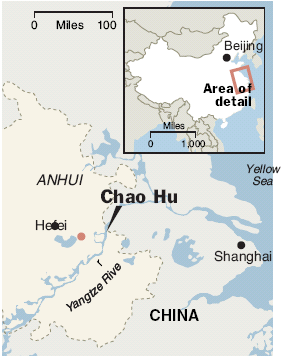
CHAOHU, China - At his most desperate, when he had no more borrowed money for his son's legal defense, Xie Yujun went to a hospital. He knew of China's black market in body parts. He wanted to sell his eyes. He was refused.
Mr. Xie, 60, is no stranger to desperate acts, if by necessity. His son was charged with a savage knife attack here in rural Anhui Province that left a mother and daughter badly wounded. The police suspected the son because of a property dispute between the families. But Mr. Xie believed the case was deeply flawed: the victims never identified the attacker. The only evidence was a questionable shoeprint. Police misconduct was blatant.
Mr. Xie's problem was convincing a court. His son's lawyers had no chance to question witnesses or, initially, to examine evidence. At one point, Mr. Xie himself sneaked into a prison to interview a witness. Even a tantalizing appeals court victory proved hollow. The son was tried again and sentenced to life in prison.
"There must be one person in the Communist Party who is honest and who believes in justice," Mr. Xie said. "If I can't even find one, then the party is not going to last long."
China's authoritarian government once relied on ideology and brute force to bind and regulate society. Now, it is asking citizens like Mr. Xie to have faith in the country's legal system to resolve disputes and mete out justice.
But Mr. Xie's plaintive cry poses a fundamental question about China's promise of rule of law: Is it possible for a criminal defendant to get a fair trial?
For most of the 56-year history of the People's Republic of China, the answer, by any standard, has been no. But in 1996, facing international and domestic pressure, China introduced reforms that expanded a criminal defendant's right to counsel and sought to create a more impartial judiciary.
Yet today the inadequacy of those reforms, and the reluctance of the ruling Communist Party to make meaningful change, is abundantly evident. The criminal trial of Mr. Xie's son was one of 770,947 adjudicated last year. Of that total, 99.7 percent ended in convictions.
Conviction rates are also high in the United States, especially in federal criminal cases. But legal experts say that American prosecutors more often decline to indict in weak cases, and that judges and juries retain the autonomy to deliver innocent verdicts in even the most high-profile cases.
The stark imbalance in China reflects a fundamental contradiction for China's top leaders. They want people like Mr. Xie to trust the legal system because public support is essential in ensuring social stability. But they believe the law should enhance, not erode, government power, and have shown little inclination to replace a system that guarantees convictions with one that guarantees the rights of the accused.
A quarter century ago, after the chaos of Mao's Cultural Revolution, China essentially had no legal system. In that context, it has made significant strides. The 1996 reforms were intended to shift toward an adversarial trial process, modeled in part after the American system. Instead, the reforms have become most notable for what was left out.
"They didn't put in rules of evidence," said Jonathan Hecht, deputy director of the China Law Center at Yale University. "They didn't put in requirements that witnesses appear at trial. Lawyers weren't given the ability to really prepare a case. They kind of created the shell of an adversarial process, but they didn't create the guts of it."
At the same time, the police, prosecutors and judges now often disregard the protections that Chinese law does offer. A defendant, for instance, has the right to see a lawyer after the initial interrogation, or usually within 24 hours. Yet a police survey in Beijing found that over the past two years, only 14.5 percent of defendants in the city had seen a lawyer in the first 48 hours.
Other obstacles facing defendants are abundant: defense lawyers deemed too aggressive can be indicted by the prosecutors opposing them in court; appellate courts rarely overturn convictions; rulings often are decided by unseen committees for whom political considerations can be as important as the law.
The problems are so flagrant that calls for reforms are coming from inside and outside the government. The National People's Congress is considering proposals for another major revamping of criminal procedure laws. In a handful of cities, experiments in reform are under way, like allowing defense lawyers to be present at interrogations. But it remains uncertain whether any changes will be approved, and, if so, what they will be.
In Chaohu, the police, prosecutors and court officials refused requests for interviews about the case of Mr. Xie's son, Xie Shude. The Chaohu Public Security Bureau described the case as "routine." The two victims of the attack declined to be interviewed.
But Mr. Xie's plight illustrates all the tensions and problems in the criminal justice system. He repeatedly demanded his son's rights, only to learn how circumscribed those rights were. He learned that if Chinese law does not explicitly treat a suspect as guilty until proven innocent, it does so in practice.
For more than a year, Mr. Xie navigated two trials and two appeals. Ultimately, he found his only recourse was outside the usual channels of modern jurisprudence and held a rare private meeting in June with two powerful judges.
It would be the modern equivalent of an audience with the emperor.
Father-and-Son Arrests
On the night of March 21, 2004, neighbors in the massive Xiyuan New Housing Village heard screams from a sixth-floor apartment. An intruder had repeatedly slashed a mother and daughter with a vegetable knife and escaped down the public stairwell. The case scandalized this city in the fertile, green fields of central China's breadbasket.
Two days after the attack, the police approached Xie Yujun, the father, and told him he was a suspect. He had had a property dispute with the husband of the woman who was attacked. The husband had bought an apartment from Mr. Xie but was delinquent in his payment. Mr. Xie had sued.
Mr. Xie, an emotional, combative man with a silver crew cut, said the police had demanded that he "prove that he is innocent." He had been jobless since being laid off by a state-owned construction company nearly a decade before. He and his wife survived on the $80 a month she earned selling vegetables. They had sold the apartment to raise money.
At the police station, investigators took Mr. Xie's fingerprints and pushed him into a bare cell for a night. Then a few minutes later, he recalled, the cell door slid open and another man was shoved inside.
"It was my son," Mr. Xie said.
The son, Xie Shude, 32, lived in the same apartment complex as the victim. Family members say he is the opposite of his father. If Xie Yujun can be loud and argumentative, Xie Shude is quiet and meek. Father and son had drifted apart after the son had married a peasant girl and moved out. The son sold grilled kebabs on the street and had opened a small shop.
"He has never done anything bad," said Huang Zeyun, 36, the son's wife. "He would rather get taken advantage of than be in a quarrel."
In the cell, father and son slept together on a wooden board. Both men had been fingerprinted and threatened by investigators. In an interrogation room, a detective had slammed a pistol on a table and warned Xie Shude, "If you don't confess, we will skin you alive."
But the son, like the father, maintained his innocence and the two men were released the next morning. Xie Yujun believes the fingerprints must not have matched.
The Chaohu attack came as unease about crime was rippling across China. Even as more Chinese were demanding legal rights, the public was also demanding that the government halt the steady rise of crime. A murder spree by a university student in western China had recently set off a nationwide manhunt and stoked public fears.
In Chaohu, the television station and newspaper gave the local knife attack a nickname, the 3/21 case, after the date it occurred. Every major government and Communist Party official in Chaohu demanded an arrest, according to the local newspaper.
Investigators must "devote all their energy to solving the case, ease people's worries and maintain social security and stability," said Chen Chunyu, head of the public security bureau, according to the Chaohu Daily.
In this atmosphere, on April 9, about two weeks after he was released from jail, Mr. Xie's son disappeared.
Mr. Xie heard from neighbors that men in dark clothes had pushed his son into a car. He went to police headquarters, but no one would discuss his son's whereabouts. Only when Mr. Xie filed a missing persons report did the police admit the son was in custody. They would hold him incommunicado for seven days.
The arrest of Xie Shude was later announced in the newspaper. The stated motive was revenge over the property dispute. The police had used those seven days to extract two pieces of evidence: a shoeprint and a confession.
A Taste of Chinese Justice
For Xie Yujun, the first obstacle to mounting his son's defense was money. He approached friends and relatives for loans, promising repayment after his son's exoneration. He was convinced of his son's innocence after their night together in jail.
"I thought telling the truth was the only way out," the father recalled. "I told him if he really did it, he would have to confess.
"My son said, 'Really, I did not do it.'"
Mr. Xie felt his obligation was not only to his son. In traditional Chinese society, where respect, or "face," is a paramount virtue, the arrest had stained the reputation of his entire extended family. Some elderly family members had even ceased their outdoor exercises to avoid seeing neighbors. As the father, Mr. Xie was obligated by Chinese tradition to cleanse the stain.
"It has put shame on the whole family," he said of the case.
Mr. Xie knew little about the law. As a teenager, he had missed an education when Mao ordered millions of city dwellers to labor in the countryside. But he started buying books on criminal procedure law. He also visited law firms to ask questions.
He concluded that the case against his son was riddled with flaws. The indictment accused the son of acting out of "revenge" over his father's property dispute. But the indictment failed to mention that Mr. Xie had already won the lawsuit. At the time of the attack Mr. Xie was waiting for the family to pay him about $600 and, he said, the payment period had not expired.
The police produced jailhouse witnesses who claimed to have overheard the son confess to the attack. But Mr. Xie pretended to be a relative and slipped into the prison. He recorded one of the witnesses saying that the police had coerced his testimony. Later, Mr. Xie handed the tape to the judge.
The son's confessions also proved coerced. The son had made eight confessions and one recantation. But he later told lawyers and family members that police beat him with sticks and kept him awake for seven days. He said he had confessed to end the torment.
"I told him I didn't blame him for going along with the confession," Mr. Xie said. "I understood."
The victims' account of the attack also raised questions. At the crime scene, the husband told the police that his wife had seen three attackers. But, later, the wife told the police she had seen only one. Court papers show she did not initially identify her attacker. Later, she said, "I suspect it must have been somebody in Xie Yujun's family," court documents show.
Ultimately, the prosecution's case depended on the shoeprint. Forensic evidence is often unreliable in China, partly because the country has no uniform forensic rules. In Chaohu, prosecutors would boast of ample forensic evidence, including fingerprints, but only the shoeprint was introduced in the trial. Court documents say the print was taken from the sole of a Yi'erkang brand leather shoe.
Investigators in Chaohu never found a shoe that matched the print. But the police bought an identical Yi'erkang shoe and ordered Xie Shude to make a fresh print to compare with the one they had. A police academy in northeast China then concluded that print matched the crime scene print because both were "slightly turned inward" and "landing on the outside."
Mr. Xie knew nothing about forensics but tried to hire a private firm in Shanghai for an independent analysis. The firm told him it worked only with the government. Eventually, Mr. Xie had to ask the Chaohu court to find him an expert. They found a retired government forensics specialist. He confirmed the prosecution's report.
Mr. Xie placed his hopes with Jiang Shengchao, a lawyer with political connections and a good reputation. But Mr. Jiang quickly met problems. The police blocked him from meeting his client. Desperate, Mr. Xie traveled to the provincial capital, Hefei, to petition higher officials to intervene. Two months after the arrest, the lawyer finally saw his client.
The trial was held in October 2004 in Chaohu Intermediate Court. It lasted a single day. Mr. Jiang was not allowed to review the evidence, nor did Mr. Xie's son have a chance to face his accuser. No witnesses were called. Their testimony was entered into the record, but Mr. Jiang was given no chance to question them. Chinese law requires that evidence be subjected to cross-examination, but legal analysts say this requirement is regularly overlooked.
In arguing the case, Mr. Jiang also faced restrictions. "I remember how the judge intervened every time the lawyer was trying to say something important," said Ms. Huang, the defendant's wife. "He would just say, 'Hurry up and make it simple.' "
On Oct. 12, the court found Xie Shude guilty and awarded compensation of nearly $10,000 to the victims. Mr. Xie responded by hiring a new lawyer, Li Ping, for his appeal to the Anhui Province High Court.
In December, the High Court overruled the guilty verdict, citing "insufficient evidence" and "certain unclear facts."
"I thought that showed justice," the father said.
But the ruling did not mean the case was over. Appellate courts in China rarely release defendants, even if ruling in their favor. Instead, the case was returned to Chaohu Intermediate Court for a new trial. The High Court also sent a confidential letter to prosecutors, a customary practice, with instructions on how to bolster their case.
Even so, the defense had made an unexpected discovery: Ms. Li had been allowed to examine the evidence and noticed that the digital photograph of the shoeprint from the crime scene was dated in April, a month after the attack.
It raised obvious questions: Did the police simply manufacture the shoeprint? If not, was the print reliable, given the number of people who had trampled through the crime scene during the month after the attack?
Ms. Li raised these questions to no avail. The trial lasted only a few hours and resulted in another guilty verdict. Mr. Xie was disappointed, but he assumed that the High Court would again overturn the verdict since the prosecutors had not presented any new evidence.
He would be wrong.
Kafkaesque Appeals
The High Court is the most powerful judicial body in Anhui Province, yet it should not be confused with appellate courts operating in the United States. The High Court is a political body as much as an arbiter of law.
This distinction would become apparent in Xie Shude's two appeals. The first, successful appeal had been reviewed by a panel of three judges. A provincial official familiar with the workings of the High Court said the three judges reviewed the case strictly on its legal merits.
But the second appeal, in April 2005, was different. Five judges were listed on the ruling. A second provincial official confirmed that those five judges were actually part of a much larger trial committee within the court that oversaw the review.
The two provincial officials, who asked not to be identified for fear of reprisals, said the judges were sharply divided over the case. Some thought it was without merit. Even so, their authority was limited: Chinese law does not allow judges to throw out evidence or overturn convictions on the basis of police misconduct.
More significant, the two officials said the High Court was reluctant to overturn any conviction because that might damage its relationships with prosecutors and police, as well as with Communist Party leaders eager to be seen as cracking down on crime.
Finally, the two officials said, judges sometimes simply ignore evidence and consider what they perceive to be the greater societal good -- in this case, a conviction to soothe public anxiety about a grisly crime.
"In China," said one of the provincial officials, "the rules sometimes do not matter." The official added, "If you go after legal justice, it might cause more harm to social stability."
The High Court handed down its second ruling in the case of Mr. Xie's son in May. This time, the court upheld the conviction and even seemed to switch the burden of proof. If before it blamed the prosecution for lacking evidence, it now blamed the defense for not introducing new evidence.
It was as if Xie Shude had been presumed guilty unless proven innocent.
A Last Hope
In June, Xie Yujun traveled to the High Court, clutching a ticket to meet with officials. His was not a formal legal appeal but rather a petition in the feudal tradition of ancient China.
He could no longer afford a lawyer. But he had fallen to his knees before a young law student and begged for help. The law student, joined by another student, met Mr. Xie at the High Court and later provided written accounts of the meeting.
The three rode an elevator to a private upstairs room and sat at a long table opposite two judges and their aides. Attendants poured glasses of hot water. Mr. Xie described the case until the older of the two judges chuckled. He said they knew the case because they had been involved in upholding the conviction.
The younger judge conceded the case had problems. He agreed the confession was coerced. But he defended the shoeprint and changed the subject when the law students peppered him with questions.
The older judge did not bother with intricacies of law. He advised Mr. Xie that he could eventually petition to reopen the case. But first he recommended that Mr. Xie regularly visit his son in prison. "Really get to know him," he said. "Make sure you are convinced he is innocent."
Mr. Xie boiled with anger as the judge offered his final advice.
"There's no hurry," the older judge added. "After all, it's a life sentence."
© 2005 The New York Times Company
Unintentionally Opens Debate on Autonomy
By Jim Yardley
LUOYANG, China - Judge Li Huijuan happened to be in the courthouse file room when clerks, acting on urgent orders, began searching for a ruling on a mundane case about seed prices. "I handled that case," Judge Li told the clerks, surprised that anyone would be interested.
But within days, the Luoyang Middle Court's discipline committee contacted her. Provincial officials had angrily complained that the ruling contained a serious political error. Faced with a conflict between national and provincial law, Judge Li had declared the provincial law invalid. In doing so, she unwittingly made legal history, setting in motion a national debate about judicial independence in China's closed political system.
In many countries, including the United States, a judge tossing out a lower-level law would scarcely merit attention. But in China, the government, not a court, is the final arbiter of law. What Judge Li had considered judicial common sense, provincial legislators considered a judicial revolt. Their initial response was to try to crush it. Judge Li, who had on the bench less than three years, feared her career might be finished.
"An order by those in power has forced local leaders, none of whom dared to stand on principle, to sacrifice me," she wrote in rebuttal. "I'm just an ordinary person, a female judge who tried to protect the law. Who is going to protect my rights?"
Faced with the complex demands of governing a chaotic, modernizing country, China's leaders have embraced the rule of law as the most efficient means of regulating society. But a central requirement in fulfilling that promise lies unresolved -- whether the governing Communist Party intends to allow an independent judiciary.
The 2003 ruling by Judge Li has become, quite unexpectedly, a landmark case for the evolving Chinese legal system. Her plight exposed the limits on judicial autonomy in China and the political retribution faced by judges. But it also revealed the rising influence of legal reformers. Scholars and lawyers rallied to Judge Li's defense and embraced her ruling as a test case, if an accidental one, for a more autonomous court system.
"For the first time, a judge announced a local law or regulation was void," said Xiao Taifu, a member of the Beijing Lawyers Association, which petitioned the central government on Judge Li's behalf. "It was historic. For the legal process in China, it was a first, and it carried deep meaning."
Today, China's court system is far from an independent entity that can curb government power. Often, the courts remain a pliable tool to reinforce that power. Many judges are poorly educated in the law and corrupt. Judges often must answer to government officials as much as to the law. Political pressure is common, and private trial committees often dictate rulings.
There are also signs of change. One of the busiest courts in Beijing announced in November that it would stop punishing judges if a ruling was later deemed politically or legally "wrong." A budding idealism about the law, and its potential to transform Chinese society, is evident not only in the number of new lawyers but also in the emerging civic belief that ordinary people have "legal rights."
The case of Judge Li illustrates how such changes continue to meet enormous resistance within the system. Judge Li, now 32, a Communist Party member, is among the new generation of younger judges expected to become the future backbone of a strengthened court system.
That Judge Li and others granted interviews for this article reflects, to some extent, the evolution of China's legal system and an effort by the judiciary to be more assertive. But the dispute over the seed case taught her that being a judge involved far more than simply interpreting laws. "When I look back on the cases I dealt with, I have no regrets," she said. "I don't think any of the parties involved can complain." But, she added, any judge who acts on conscience does so at a risk.
"I think my colleagues and supervisors think I'm naïve," she said. "And they think I'm not wise."
Youthful Ideals Meet Reality
As a teenager, Li Huijuan first saw a judge as a character in a television soap opera. She grew up in southern Henan Province in the city of Nanyang, where she watched dramas about judges in ancient China. Their passion for justice was scripted, but it inspired a young girl.
"I saw these images of judges and lawyers defending the people," she said. "I thought it was glorious."
She was one of three children, and her father was a government official who oversaw local markets to ensure that merchants and vendors abided by city rules and regulations. To curry favor with her father, vendors often visited the family's apartment at night, banging on the door with offers of gifts or bribes.
"My father never accepted," Judge Li recalled. "He lectured them and drove them out. I think I have the same stubbornness in my character. My parents taught me to be a straightforward, honest person."
Her two siblings became teachers, an honored profession in China, but Li Huijuan graduated from Henan University with a four-year degree in law. She later earned a master's degree in law at the prestigious University of Politics and Law in Beijing. Her qualifications placed her in an elite circle at a time when China was starting to introduce new, tougher standards for the legal profession. Even so, she said much of her education had been "more like legal theory."
"The teacher was telling us how it should be," she recalled of her undergraduate studies. "But they did not teach us how it really worked in China."
She began learning that lesson in 1996 after she started working at the Middle Court in Luoyang in Henan's north. She arrived at a courthouse dominated by older judges, some with limited legal education, including retired soldiers given judgeships to reward them for serving their country. Her naïve belief that judges ruled independently -- as they did on television -- was quickly dispelled.
Instead, she learned that cases were heard by panels of judges, whose rulings were often reviewed by supervisors or, in major cases, by private trial committees of court officials. Judges were held responsible for rulings that carried their name, even if others in the court actually made the decision. But if government officials or influential citizens complained about a ruling, a judge could be punished, fined or even fired.
Some judges tried to reduce the pressure of a potential mistake by taking on fewer cases. "The less you do," Judge Li said, "the fewer mistakes you make."
She began as a court secretary but quickly qualified as a judge and, later, as a presiding judge. In January 2003, she was named presiding judge over a three-judge panel hearing a dispute between two local companies over the price of seeds. The legal dispute revolved around a conflict between provincial and national law, but Judge Li never anticipated that that would bring her trouble.
Instead, the political subtext of the case -- the parochial interests of two local companies fighting over thousands of dollars -- infused the process. At one point, a city official forwarded a letter from one company to Judge Li's supervisor. In the margin, the official had written an instruction for the court: "Please pay attention."
"I felt quite uncomfortable when I received the letter," she said. "I felt they were making assumptions that I was already taking sides. I didn't do anything about it. I just put it in the files."
At another point, the director of the Luoyang court -- since replaced on an unrelated matter -- telephoned Judge Li. A representative from one of the companies was in his office. Could she meet with him?
"I considered this very inappropriate," Judge Li said. "But I couldn't say so because of the director. So I told the man to come to my office."
When he arrived, Judge Li said, she pretended to be stuck on a long telephone call. Exasperated, the man finally left.
A System Grappling With Reform
Legal experts say political pressure on judges is routine and derives, in part, from the subservient status of the court system within the Chinese bureaucracy. Nationally, the chief judge of the People's Supreme Court is not even a member of the Politburo, the inner decision-making entity of the Communist Party. By comparison, the head of the Ministry of Public Security is a member.
Locally, judges are appointed by their people's congresses, while the courts receive their budget from local governments. In addition, branches of the Communist Party operate committees that can apply pressure and exert influence on a court behind the scenes.
Earlier this year, a presiding judge in the northeastern city of Harbin told Workers' Daily, a state-controlled newspaper, that government officials had overruled three different innocent verdicts and ordered the courts to convict a local businessman of fraud. The presiding judge was later censured for publicizing the case.
The system also can make it easy for corrupt court officials to exploit their position. In April 2004, two vice directors of the Middle Court in Wuhan, a large city in central China, were sentenced to prison for selling verdicts in exchange for $500,000 in bribes. The directors paid judges to participate in the scheme.
Many legal reformers believe the court system must become more autonomous to eliminate corruption in the legal system. But in seeking more authority, they also are trying to rapidly modernize the system and improve judicial training to counter public perceptions that too many judges are corrupt or unqualified. "The public may be skeptical about judicial independence, given the quality of judges and judgments," said He Weifang, a prominent constitutional scholar. "But if you want accountability, you can only have accountability if you have independence. Otherwise, it is never clear who made a decision."
On the campus of the National Judges College on the outskirts of Beijing, the primary educational arm of the People's Supreme Court, roughly 10,000 judges spend a month of every year on professional training. In the past, judges were taught to serve the interests of the Communist Party, but now a different message is emphasized.
"We train them with a modern theory of law: that the courts are impartial, on the need for legal justice and of innocence until proven guilty," said Huai Xiaofeng, president of the college. "We stress that during a trial, you cannot favor the government or the National People's Congress. In the past, they told them to emphasize the political qualities.
"Now, we tell them to emphasize the law and the facts."
For Judge Li, the reaction to the ruling on the seed case proved how political considerations remained deeply embedded in the legal system. Because the case seemed likely to provoke controversy, she had submitted a draft ruling to the court director, who in turn forwarded it to a trial committee. Everyone signed off, and both parties were informed in June 2003.
But by October, word of the case had reached the Henan Province People's Congress, the provincial legislature. In the legal affairs office, the ruling was interpreted as a naked challenge to the lawmaking authority of the People's Congress. Provincial officials publicly described the ruling as "a serious breach of law."
"The authority of the National People's Congress system is not to be challenged," said Mao Yinduan, head of the legal office, in an interview. "The judge in this case was very young and had little experience. She had every right to choose which law to use. But courts have no right in a verdict to say which law is invalid."
The reaction stunned Judge Li. To research the verdict, she had studied Chinese law, as well as the speeches of senior political leaders. China's Law on Legislation stated that local laws that conflicted with national laws should be abolished. She thought including this point in her opinion was within her judicial purview.
She had not intended to challenge the political system, nor, apparently, did her director or anyone on the trial committee. "He read the verdict and didn't realize the significance of what it said," Judge Li said of the director. "I, at first, didn't realize the significance, either."
But Judge Li, not the court officials who had approved the decision, faced the possibility of serious punishment. "I felt persecuted," she recalled. "Everyone I talked to told me what I had done was wrong."
Job Saved but System Unchanged
Anxious and uncertain of her future, Li Huijuan telephoned her husband, Chang Jianyi. High school sweethearts, they married in 1999 but lived apart because Mr. Chang worked in Beijing as a software developer. His wife reached him on a business trip to Tibet, and he advised her to seek help in Beijing. He believed she had been wronged.
"She had to fight back to restore her reputation and her dignity," Mr. Chang said. "If she did not fight back, she would have to live with the stain."
She left for Beijing and planned to seek help from an association of women in the judiciary. She wrote a long passionate letter in which she promised to "undergo criticism and education" if she had erred. "But if I'm right, I will protect my integrity and defend the integrity of the law, even if it means being like a moth that flies into a flame."
At the association's office, a woman told her that she had been treated too harshly and agreed to contact someone at the People's Supreme Court. Then the case attracted the attention of the Chinese news media and of scholars and lawyers pushing for legal reform.
Mr. He, the constitutional scholar, rose to her defense in an op-ed article. In an interview, he characterized the seed case as one of the most important in the legal evolution of China because of the attention it focused on judicial independence.
"It may not be Marbury v. Madison," Mr. He said of the landmark case credited with establishing the authority of the United States Supreme Court, "but it is a very important case."
As it turned out, Judge Li had stumbled upon a fundamental contradiction. In the Chinese system, based loosely on European models and the old Soviet structure, judges are supposed to refer conflicts in law for review by the Standing Committee of the National People's Congress, the country's center of legislative power. Judges are then expected to follow the decision made by the Standing Committee.
Yet, in practical terms, those referrals rarely happen and when they do, the Standing Committee has rarely showed interest in the housekeeping role. As a result, judges have become accustomed to assuming this role, if doing so silently, and then simply leaving the conflicting law untouched.
To many lawyers, the system was grossly inefficient and outdated. Mr. Xiao, the Beijing lawyer, joined three other lawyers in formally requesting that the National People's Congress review the situation. Scholars organized a legal conference at the elite Tsinghua University to debate the seed case and other issues about judicial autonomy. The public attention, and the possible intervention on her behalf by the People's Supreme Court, apparently saved Judge Li's career. She returned to work in summer 2004 before leaving on maternity leave later that year. She is now in Beijing on a leave to continue her legal studies.
But the system remained largely intact. In summer 2004, the Standing Committee announced the creation of a new review panel to mediate conflicts of law. Some lawyers have hailed the panel as the equivalent of a constitutional court. Others are concerned about the panel's secrecy and believe the responsibility should belong to the courts.
Judge Li still believes in the rule of law, but she is no longer the impressionable teenager who watched soap operas about judges. "Judges are confused," she said. "It is not that they do not know how to do cases professionally. It is just all these relationships to coordinate. And they also have to weigh consequences."
In 2004, Henan's High Court reheard the seed case. It ruled exactly as Judge Li had, with one exception: it criticized her for invalidating the provincial law.
© 2005 The New York Times Company
By Joseph Kahn
BEIJING, Dec. 12 - One November morning, the Beijing Judicial Bureau convened a hearing on its decree that one of China's best-known law firms must shut down for a year because it failed to file a change of address form when it moved offices.
The same morning, Gao Zhisheng, the firm's founder and star litigator, was 1,800 miles away in Xinjiang, in the remote west. He skipped what he called the "absurd and corrupt" hearing so he could rally members of an underground Christian church to sue China's secret police.
"I can't guarantee that you will win the lawsuit -- in fact you will almost certainly lose," Mr. Gao told one church member who had been detained in a raid. "But I warn you that if you are too timid to confront their barbaric behavior, you will be completely defeated."
The advice could well summarize Mr. Gao's own fateful clash with the authorities. Bold, brusque and often roused to fiery indignation, Mr. Gao, 41, is one of a handful of self-proclaimed legal "rights defenders."
He travels the country filing lawsuits over corruption, land seizures, police abuses and religious freedom. His opponent is usually the same: the ruling Communist Party.
Now, the party has told him to cease and desist. The order to suspend his firm's operating license was expanded last week to include his personal permit to practice law. The authorities threatened to confiscate it by force if Mr. Gao fails to hand it over voluntarily by Wednesday.
Secret police now watch his home and follow him wherever he goes, he says.
He has become the most prominent in a string of outspoken lawyers facing persecution. One was jailed this summer while helping clients appeal the confiscation of their oil wells. A second was driven into exile last spring after he zealously defended a third lawyer, who was convicted of leaking state secrets.
Together, they have effectively put the rule of law itself on trial, with lawyers often acting as both plaintiffs and defendants.
"People across this country are awakening to their rights and seizing on the promise of the law," Mr. Gao says. "But you cannot be a rights lawyer in this country without becoming a rights case yourself."
Ordinary citizens in fact have embraced the law as eagerly as they have welcomed another Western-inspired import, capitalism. The number of civil cases heard last year hit 4.3 million, up 30 percent in five years, and lawyers have encouraged the notion that the courts can hold anyone, even party bosses, responsible for their actions.
Chinese leaders do not discourage such ideas, entirely. They need the law to check corruption and to persuade the outside world that China is not governed by the whims of party leaders.
But the officials draw the line at any fundamental challenge to their monopoly on power.
Judges take orders from party-controlled trial committees. Lawyers operate more autonomously but often face criminal prosecution if they stir up public disorder or disclose details about legal matters that the party deems secret.
The struggle of Mr. Gao and others like him may well determine whether China's legal system evolves from its subordinate role into something grander, an independent force that can curtail abuses of power at all levels and, ultimately, protect the rights of individuals against the state.
"We have all tried to shine sunlight on the abuses in the system," says Li Heping, another Beijing-based lawyer who has accepted political cases. "Gao has his own special style. He is fearless. And he knows the law."
An Air of Authority
Mr. Gao can cite chapter and verse of China's legal code, having committed it to memory in intensive self-study. He is an army veteran and a longtime member of the Communist Party.
On a recent trip to rural Shaanxi Province, where he sneaked into a coal mine to gather evidence in a lawsuit against mine owners, he wore a crisp white shirt and tie and shiny black loafers, as if preparing for a day in court.
He is also a flagrant dissident. Tall and big-boned, he has the booming voice of a person used to commanding a room. When he holds forth, it is often on the evils of one-party rule. "Barbaric" and "reactionary" are his favorite adjectives for describing party leaders.
"Most officials in China are basically mafia bosses who use extreme barbaric methods to terrorize the people and keep them from using the law to protect their rights," Mr. Gao wrote on one essay that circulated widely on the Web this fall.
After an early career that racked up notable courtroom victories, he has plunged headlong into cases that he knows are unwinnable. He has done pro bono work for members of the Falun Gong religious sect, displaced homeowners, underground Christians, fellow lawyers and democracy activists. When the courts reject his filings, as they often do, he uses the Internet to rally public opinion.
His fevered assaults have a messianic ring. But although he became a Christian this fall and began attending services in an underground church, the motivation to pursue the most sensitive cases -- and put his practice and possibly his freedom at risk -- began a couple of years earlier. It was then that his idealistic beginnings as a peasant boy turned big-city lawyer gave way to simmering rage.
Mr. Gao was born in a cave. His family lived in a mud-walled home dug out of a hillside in the loess plateau in Shaanxi Province, in northwestern China. His father died at age 40. For years the boy climbed into bed at dusk because his family could not afford oil for its lamp, he recalled.
Nor could they pay for elementary school for Mr. Gao and his six siblings. But he said he listened outside the classroom window. Later, with the help of an uncle, he attended junior high and became adept enough at reading and writing to achieve what was then his dream: to join the People's Liberation Army.
Stationed at a base in Kashgar, in Xinjiang region, he received a secondary-school education and became a party member. But his fate changed even more decisively after he left the service and began working as a food vendor. One day in 1991 he browsed a newspaper used to wrap a bundle of garlic. He spotted an article that mentioned a plan by Deng Xiaoping, then China's paramount leader, to train 150,000 new lawyers and develop the legal system.
"Deng said China must be governed by law," Mr. Gao said. "I believed him."
He scraped together the funds to take a self-taught course on the law. The course mostly required a prodigious memory for titles and clauses, which he had. He passed the tests easily. Anticipating a future as a public figure, he took walks in the early morning light, pretending fields of wheat were auditoriums full of important officials. He delivered full-throated lectures to quivering stalks.
By the late 1990's, though based in remote Xinjiang, he developed a winning reputation. He represented the family of a boy who sank into a coma when a doctor mistakenly gave him an intravenous dose of ethanol. He won a $100,000 payout, then a headline-generating sum, in a case involving a boy who had lost his hearing in a botched operation.
He also won a lawsuit on behalf of a private businessman in Xinjiang. The entrepreneur had taken control of a troubled state-owned company, but a district government used force to reclaim it after the businessmen turned it into a profit-making entity. China's highest court backed the businessman and Mr. Gao.
"It felt like a golden age," he said, "when the law seemed to have real power."
That optimism did not last long. His victory in the privatization case made him a target of local leaders in Xinjiang, who warned clients and court officials to shun him, he said. He moved to Beijing in 2000 and set up a new practice with half a dozen lawyers. But he said he felt like an outsider in the capital, battling an impenetrable bureaucracy.
The Beijing Judicial Bureau, an administrative agency that has supervisory authority over law firms registered in the capital, charged high fees and often interfered in what he considered his private business.
One of his first big cases in Beijing involved a client who had his home confiscated for a building project connected with the 2008 Summer Olympics. Like many residents of inner-city courtyard homes, his client received what he considered paltry compensation to make way for developers.
When Mr. Gao attempted to file a lawsuit on his client's behalf, he was handed an internal document drafted by the central government that instructed all district courts to reject cases involving such land disputes. "It was a blatantly illegal document, but every court in Beijing blindly obeyed it," he said.
In the spring of 2003, Beijing was panicking about the spread of SARS, a sometimes fatal respiratory affliction, and Mr. Gao was fuming about forced removals. He gave an interview to a reporter for The China Economic Times arguing that SARS was much less scary than collusion between officials and developers.
"The law is designed precisely to resolve these sorts of competing interests," he said in that interview. "But their orders strip away the original logic of the law and make it a pawn of the powerful and the corrupt."
An Empty Promise
Mr. Gao is not the first lawyer to test China's commitment to the law. Even in the earliest days of market-oriented economic reforms, when the legal system was still a hollow shell, a few defense lawyers quixotically challenged the ruling party to respect international legal norms.
One such advocate is Zhang Sizhi, a dean of defense lawyers, who has accepted dozens of long-shot cases that he views as advancing the law. He defended Jiang Qing, Mao's wife, when she faced trial after the Cultural Revolution. He also represented Wei Jingsheng, perhaps China's best-known dissident.
Mr. Zhang argues that lawyers have prodded the party to develop a more impartial judiciary. But, he says, they must do so with small, carefully calibrated jolts of legal pressure.
"The system is improving incrementally," he said. "If you go too far, you will only hurt the chances of legal reform, as well as the interests of your client."
That view may reflect a consensus among seasoned legal scholars. But Mr. Gao is 37 years younger than Mr. Zhang, far less patient, and after his initial burst of idealism, deeply cynical.
If Mr. Zhang's benchmark for progress is that every criminal suspect has the right to a legal defense, Mr. Gao's became the 1989 Administrative Procedure Law, which for the first time gave Chinese citizens the right to sue state agencies. By his reckoning, it remains an empty promise.
"The leaders of China see no other purpose for the law but to protect and disguise their own power," Mr. Gao said. "As a lawyer, my goal is to turn their charade into a reality."
Following his defeat in the Beijing land dispute he plunged into the biggest land case he could find, a prolonged battle over hundreds of acres of farmland that Guangdong Province had seized to construct a university. Legally, he hit another brick wall. But he fired off scores of angry missives about the "brazen murderous schemes" of Guangdong officials. The storm of public anger he helped stir up got his clients more generous compensation.
Mr. Gao said he was told later that the party secretary of Guangdong, Zhang Dejiang, had labeled him a mingyun fenzi, a dangerous man on a mission. "He was right," Mr. Gao said.
This summer, a fellow lawyer-activist named Zhu Jiuhu was detained for "disturbing public order" while representing private investors in oil wells that were seized by the government in Shaanxi, Mr. Gao's home province.
Mr. Gao rushed to Mr. Zhu's defense with fellow lawyers, local journalists and tape recorders. He camped out in local government offices until officials agreed to meet him. He told one party boss that "he would forever be on the wrong side of the law and on the wrong side of the conscience of the people" unless he let Mr. Zhu go, according to a recording of the conversation.
After the intensive publicity campaign, Mr. Zhu was freed this fall, though under a highly restrictive bail arrangement that prevents him from practicing law.
Most provocatively, Mr. Gao has defended adherents of Falun Gong, a quasi-Buddhist religious sect that the party outlawed as a major threat to national security in 1999.
Mr. Gao has been blocked from filing lawsuits on behalf of Falun Gong members. But in open letters to the leadership, he said the secret police had tortured sect members to make them renounce Falun Gong. He described a police-run, extra-judicial "brainwashing base" where, he said, one client was first starved and then force-fed until he threw up. Another of his Falun Gong clients, he says, was raped while in police custody.
"These calamitous deeds did not begin with the two of you," he wrote in a letter addressed to President Hu Jintao and Prime Minister Wen Jiabao. "But they have continued under your political watch, and it is a crime that you have not stopped them."
The Police Circle
The crackdown came first as a courtesy call.
Two men wearing suit jackets and ties, having set up an appointment, visited his office. They identified themselves as agents of State Security, the internal secret police, but mostly made small talk until one of them mentioned the open letter Mr. Gao had written on Falun Gong.
"They suggested that Falun Gong was more of a political issue than a legal issue and maybe it was best left to the politicians," Mr. Gao recalled. "They were very polite."
When they prepared to leave, however, one of them said, "You must be proud of what you have achieved as a lawyer after your self-study. Certainly you must be worried should something happen to derail that."
Mr. Gao said he talked to his wife and considered the future of his two children. He wondered whether he could still afford his Beijing apartment and his car if his business collapsed.
"Anyone who says he does not consider this kind of pressure is lying," Mr. Gao said. "But I also felt more than ever that I was putting pressure on this reactionary system. I did not want to give that up."
His resistance hardened. The Beijing Judicial Bureau handed him a list of cases and clients that were off limits, including Falun Gong, the Shaanxi oil case and a recent incident of political unrest in Taishi, a village in Guangdong. He refused to drop any of them, arguing that the bureau had no legal authority to dictate what cases he accepts or rejects.
This fall, he said, security agents have followed him constantly. He said his apartment courtyard has become a "plainclothes policeman's club," with up to 20 officers stationed outside. He and his wife bring them hot water on cold nights.
On Nov. 4, shortly after being warned to retract a second open letter about his Falun Gong cases, Mr. Gao received a new summons from the judicial bureau.
This time, the bureau provided a written notice that said it had conducted routine inspections of 58 law firms in Beijing. Mr. Gao's, it was discovered, had moved offices and failed to promptly register the new address, which it called a serious violation of the Law on Managing the Registration of Law Firms. He was ordered to suspend operations for a year.
When the requisite public hearing was held, Mr. Gao sent two lawyers to represent him. But he boarded a plane for Xinjiang, where he had a medical case pending and where he wanted to inquire about abuses against members of an underground Christian church.
The edict was not only not overturned after the hearing, it was broadened. By late November, the bureau issued a new notice demanding that Mr. Gao hand over his personal law license as well as his firm's operating permit. Both had to be in the hands of the bureau by Dec. 14. The authority would otherwise "use force according to law to carry it out."
When he received that second order, Mr. Gao had escaped his police tail and traveled to a location in northern China that he asked to keep secret. He was conducting a new investigation into torture of Falun Gong adherents. A steady stream of sect members visited him in the ramshackle apartment he is using as a safe house. He tries to meet at least four each day, taking their stories down long hand.
"I'm not sure how much time I have left to conduct my work," Mr. Gao said. "But I will use every minute to expose the barbaric tactics of our leadership."
© 2005 The New York Times Company
By Jim Yardley
XIAOSHABA, China - Far from the pulsing cities that symbolize modern China, this tiny hillside village of crude peasant houses seems disconnected from this century and the last. But follow a dirt path past a snarling watchdog, sidestep the chickens and ducks, and a small clearing on the banks of the Nu River reveals a dusty slab of concrete lying in a rotting pumpkin patch.
The innocuous concrete block is also a symbol, of a struggle over law that touches every corner of the country.
The block marks the spot on the Nu River where officials here in Yunnan Province want to begin building one of the biggest dam projects in the world. The project would produce more electricity than even the mighty Three Gorges Dam but would also threaten a region considered an ecological treasure. This village would be the first place to disappear.
For decades, the ruling Communist Party has rammed through such projects by fiat. But the Nu River proposal, already delayed for more than a year, is now unexpectedly presenting the Chinese government with a quandary of its own making: will it abide by its own laws?
A coalition led by Chinese environmental groups is urging the central government to hold open hearings and make public a secret report on the Nu dams before making a final decision. In a country where people cannot challenge decisions by their leaders, such public participation is a fairly radical idea. But the groups argue that new environmental laws grant exactly that right.
"This is the case to set a precedent," said Ma Jun, an environmental consultant in Beijing. "For the first time, there is a legal basis for public participation. If it happens, it would be a major step forward."
China's leaders often embrace the concept of rule of law, if leaving open how they choose to define it. For many people in China's fledgling "civil society" -- environmentalists, journalists, lawyers, academics and others -- the law has become a tool to promote environmental protection and to try to expand the rights of individuals in an authoritarian political system.
But trying to invoke the law is risky. Chinese nongovernmental organizations, few of which existed a decade ago, have taken up the Nu as a major cause. But the activism on the Nu and other issues has provoked deep suspicions by the Communist Party even as a broader clampdown against such NGO's has forced some to shut down. The government knows China has a drastic pollution problem and has passed new environmental laws. But top leaders also demand high economic growth and need to increase energy supplies to get it. The "green laws" are becoming a crucible to test which side will prevail and whether ordinary people can take part in the process.
The closed process that led to the Three Gorges Dam is what opponents of the Nu dams most want to avoid. In the late 1980's, a wide range of intellectuals and others tried in vain to force public hearings to discuss the environmental and social costs of a project that has flooded a vast region and forced huge relocations. Ultimately, opponents could only muster a symbolic victory as the final vote in the National People's Congress included an unusually high number of abstentions or nay votes.
The central government is still deliberating how to proceed on the Nu. Domestic media coverage has been banned in recent months. Three central government ministries refused interview requests, as did provincial officials in Yunnan. Local officials along the Nu River, after initially agreeing to an interview, failed to reply to a list of written questions.
Out in the jagged mountains along China's remote southwestern border, villagers in Xiaoshaba gather information about their future from rumors. In early December, a team of surveyors inventoried property and measured the narrow terrace of village farmland along the Nu. Several villagers say local officials have told them that everyone would be relocated around the upcoming Lunar New Year holiday, which ends in early February -- even if the dams have not yet been approved.
"If they tell me to move," said one villager, Zhang Jianhua, "I have no other choice."
A Legal Reprieve
In the spring of 2003, a slender, studious man named Yu Xiaogang learned that the hydropower industry was eyeing the rivers of southwestern China. Mr. Yu, an environmental resources manager, knew that China believed that hydropower was a cleaner alternative for its energy shortages and that the Nu was considered one of the country's richest, untapped resources. But he and others believed that the Nu would be untouchable.
The Nu, which translates as Angry River, roars out of the Tibetan Plateau east of the Himalayas and plunges through steep canyons just inside the border with Myanmar, formerly Burma, as it careers south before crossing the border.
In China, it passes through a mountainous region with more than 7,000 species of plants and 80 rare or endangered animals and fish. Unesco said the region "may be the most biologically diverse temperate ecosystem in the world" and designated it a World Heritage Site in the summer of 2003.
"We were very happy because we thought the Nu would be protected and would have no problems," said Mr. Yu, who also led Green Watershed, an environmental NGO.
But not long after the World Heritage designation, a state-run provincial newspaper announced that a public-private consortium planned to build 13 dams on the river. The project would be the largest cascade dam system in the world, and it appeared politically unstoppable.
The majority partner, the China Huadian Corporation, was a state-owned goliath; the local government was a minority partner. In Beijing, the State Development and Reform Commission, a powerful government ministry, had approved the dams in August and planned to present the plan to the State Council, or the Chinese cabinet, for final approval. Construction would begin in September 2003.
The environmental community was blindsided. More than 50,000 people, most of them from ethnic minority hill tribes, would be relocated. The Nu also was one of only two free flowing rivers in China. The State Environmental Protection Administration, or SEPA, the country's environmental watchdog, criticized the project in its official newspaper. But SEPA was considered one of the weakest ministries in the central government.
Then, a snag arose -- a bureaucratic delay, hardly uncommon in China. August became September and the proposal had not yet been presented for final approval. During the delay, a new environmental law took effect on Sept. 1. Based on an American model, the China Environmental Impact Assessment Law required comprehensive environmental reviews in the planning stages of major public and private development projects.
Decades of relentless economic growth had left China with dire pollution problems and squandered natural resources. President Hu Jintao had made "sustainable development" a new government mantra. The assessment law gave the environmental agency new powers to handle and approve environmental reviews before a project was approved. It also called for public participation, including hearings, as part of the review, though it did not detail specific guidelines.
But it would take public pressure to force action on the Nu case. Despite its uniqueness and natural beauty, the Nu was not well known, largely because of its isolated location.
In September 2003, an environmental conference in Beijing brought together academics, government environmental officials and NGO's to discuss the Nu. A month later, Pan Yue, the outspoken vice minister of the environmental agency, organized China's first "Green Forum," a public relations event that included Chinese music and film stars.
One person at the forum was a woman named Wang Yongchen, a member of Green Earth Volunteers, an environmental NGO in Beijing. Initially, the Green Earth Volunteers had concentrated on tree planting and teaching children about the environment. But in recent years, the group had participated in efforts to stop a dam proposal in Sichuan Province.
At the forum, Ms. Wang persuaded 62 celebrities and film stars to sign a petition in support of "natural" rivers. She would later donate money to build 30 libraries in poor villages along the Nu.
By early 2004, the controversy had attracted worldwide interest as 60 international organizations agreed to lobby the Chinese government about the Nu. Hundreds of volunteers in China called Unesco to protest the dam proposal. The country's most prominent NGO, Friends of Nature, embraced the cause, while an environmental group in Sichuan collected more than 10,000 signatures to stop the project.
But the crucial factor was the Sept. 1 law. As the project appeared to be nearing approval, biologists, academics and environmentalists all argued that the government had not properly conducted an environmental review.
In late winter, as Ms. Wang guided a tour of Chinese journalists, her cellphone rang. A friend informed her that Prime Minister Wen Jiabao had temporarily suspended the project so that it could be "carefully discussed and decided on scientifically."
Ms. Wang began to cry with joy. Later, some Chinese newspapers speculated that Mr. Wen's edict meant that the project was dead.
Mr. Yu thought otherwise.
"I thought this was the first success of public participation," he said. "But I did not think the decision was final."
Opening a Closed Process
Located a short drive from the city of Liuku, Xiaoshaba is like countless poor villages along the Nu. Peasants live in crude homes, some under the same roof as their livestock and chickens. Some villagers have never gone farther than Liuku; some have never left the village. But on a May afternoon in 2004, a bus arrived. Inside was Yu Xiaogang, and he wanted to take villagers on a trip.
The prime minister's order to suspend the project had stunned developers and provincial officials. A delegation had hurried to Beijing to try to restart the process. At the same time, the government's environmental agency focused on the assessment review.
Mr. Yu was anxious to get villagers involved because the law had highlighted public participation. Most villagers knew nothing about the project or how it would change their lives.
"I thought we must let the Nu River people have their voice," Mr. Yu said.
So he offered to take a small group of villagers to the site of the Manwan Dam on the upper reaches of Mekong River in the southern Yunnan. In 2002, Mr. Yu had written an assessment of the social costs of the Manwan project, a report later endorsed by the prime minister at the time, Zhu Rongji. Leaving from Xiaoshaba, Mr. Yu took 14 peasants on a daylong journey to the Manwan, where they found many people living as scavengers.
"They heard how the government made promises but didn't follow through," Mr. Yu said. "Ten years later, nobody cared about them. The Nu River people were shocked."
Mr. Yu later led a small group of peasants to a Beijing hydropower conference jointly sponsored by the United Nations and China's National Development and Reform Commission. As several speakers extolled the virtues of dams, the dusty group of peasants sat in the upper reaches of the auditorium. Mr. Yu was allowed to speak at a sub-session of the conference. The villagers had practiced giving speeches but were not granted a speaking slot.
Meanwhile, momentum seemed to be shifting in favor of dam supporters. Prime Minister Wen had visited Yunnan to confer with provincial officials. Two prominent scholars toured the Nu -- on a trip sponsored by dam developers -- and attracted wide public attention by attacking the environmentalists.
But that criticism was insignificant compared to a broader governmental crackdown under way against nongovernmental organizations.
In the spring of this year, President Hu ordered an intensive examination of NGO's because of concerns of the role that environmental groups had played in helping to topple governments in Central Asia. In a secret speech to top officials, Mr. Hu warned that the United States was using such groups to try to foment social unrest.
Before, NGO's had hoped that onerous licensing restrictions were about to be repealed. Instead, environmental groups and other NGO's across the country were closely scrutinized, with some losing their licenses. Some groups began to fear that the "legal space" granted to the civil society would be tightened, or closed.
In Yunnan, officials began to pressure opponents. Mr. Yu would not comment about whether he had come under pressure. But acquaintances say he that has been forbidden from traveling to international conferences and that officials have put pressure on him.
In Beijing, the environmental assessment report was finished by this summer. But the Ministry of Water Resources, noting that government reports about international rivers were considered proprietary information, declared a small section of the assessment to be a state secret and forbade its release.
Dam opponents said the section could remain secret but argued that publicizing the rest of the report was essential for public discussion of the project. The government still had not outlined the potential environmental risks or explained what would happen to relocated villagers.
So on Aug. 31, opponents mailed a letter to the State Council and later posted it on the Internet. It cited Chinese law and said any decision without public participation "lacks public support and cannot tolerate history's scrutiny."
Nearly four months later, the government had not responded.
An Uncertain Future
A traffic sign on the narrow, unpaved road that passes through Xiaoshaba carries a propaganda message: "A Model Village for Democratic Rule of Law." A short walk away, beside the concrete block marking the proposed first dam, Guan Fulin, 55, said she had spoken to the surveyors who measured the village land in early December.
"The officials told us it is definitely going to happen," Mrs. Guan said. She trusted that the government would take care of her but admitted that she did not yet know how she would be compensated or where she would go. Pointing to the village, she said, "All these people will be moving."
If so, it would likely signal the start of a hydropower gold rush in Yunnan Province. One study estimated that China might build enough new dams, most of them in Yunnan, to double its hydroelectric output in the next five years. One plan would inundate one of the most popular tourist attractions in China -- Tiger Leaping Gorge.
Part of the frenzied hydropower development is driven by the thirst for new energy supplies. But part of it is caused by the breakup of the state monopoly that once controlled electrical generation in China. That breakup left regional state-owned energy giants who were each assigned "assets" -- like rivers or coal deposits. Each faces competitive pressures to develop new power plants quickly in order to claim market share.
Mr. Ma, the environmental consultant in Beijing, said environmentalists understood that China faced a complex challenge in developing new energy sources even as it must reduce pollution. But he said this intense pressure to develop was why laws that provide oversight and public review must serve as safeguards.
"Before the Nu River proposal, you would hear about opposition to certain projects," Mr. Ma said. "But it was all based on the tremendous courage of individuals. This time, we see progress in Chinese law that makes it possible for a more systemic challenge."
He added: "There is now more awareness of environmental rights and the rights of people as citizens. For such a major problem, they believe they have the right to know about it and at least have their views heard."
The dispute over the Nu seems at a standstill. Ultimately, the decision on holding hearings may fall to the prime minister. Earlier this year, Unesco issued a statement expressing its "gravest concerns" about the potential damage to the World Heritage Site. In October, environmentalists boycotted a dam conference linked to the National Reform and Development Commission. Organizers had promised to show parts of the assessment report, but environmentalists believed it was an effort to avoid full public hearings.
Ms. Wang, of the NGO Green Earth Volunteers, described the dilemma in simple terms.
"If the law is not enforced, what shall we do?" she asked. "We have this law. Why doesn't this law work?"
© 2005 The New York Times Company
By Joseph Kahn
SHIQIAO, China - The peasants surrounded the clerk in the busy court anteroom, badgering him to let them sue the officials who had seized their land.
No, no, the clerk said, shaking his head and waving his hands, as the peasants recalled it. They were wasting his time and theirs. But as they withdrew, their legal papers remained on his desk in plain sight. Maybe, the peasants hoped, that meant the clerk had tacitly accepted their application to sue.
"In two years of trying every option under the law, this was a moment of optimism," said Li Huitang, a leader of peasant resistance in Shiqiao, a village in Hebei Province, in northern China. "We hoped he might rule on our request."
Even a written rejection would have been a bonanza, enabling them to appeal to a higher court. But it was not to be. The clerk soon called Mr. Li's home, ordering him to retrieve the documents. When Mr. Li declined, the clerk mailed them back in a plain manila envelope, unmarked, unprocessed and officially ignored.
China's legal system often hands down verdicts that the powerless consider unfair. But a bigger problem is that courts often refuse to issue any verdict at all -- or even acknowledge that some bothersome legal complaints exist.
The English translation is simply "put on the record" or "register a case," but in China "li'an" is so fraught with official meddling that for many with complaints against the government, the judicial system is closed for business.
Since Communist China first created the semblance of a modern legal system a quarter-century ago, criminal cases -- the state suing individuals -- mostly go through the courts. Private citizens and businesses now often resolve civil disputes in court. But the third and most sensitive use of the judicial system, a 1989 statute that entitles people to sue the state, remains a beguiling fiction, scholars say.
"The number of people wanting to sue the government is large and growing," says Xiao Jianguo, a legal scholar at People's University in Beijing who has studied the issue. "But the number of people who succeed in filing cases against the government is miniscule. So you could say there is a gap between theory and practice."
Though fast-rising China wants to persuade the outside world that it is governed by law, pressure to improve the system comes mainly from within. Protests are erupting around the country over land seizures, pollution, corruption and abuse of power, with 74,000 officially recorded incidents of mass unrest in 2004.
China's leaders know they need to manage such unrest. Indeed, President Hu Jintao says "democratic rule of law" is a crucial ingredient of his plan to build a "harmonious society."
Such pledges spread awareness of legal rights, but have yet to change legal procedures. It is not clear how many protests follow failed attempts to settle disputes in court. But lawyers say the judicial system bars its doors to so many contentious cases that it effectively forces people to take to the streets.
That is what happened here in Shiqiao, where residents protesting the loss of prime farmland for a government-backed road, office and residential development tried suing to protect their land-use rights.
They met Kafkaesque obstacles at every turn. The only party that used the courts successfully was the state-linked construction company. It won an injunction in March declaring peasants' protests illegal.
Every Man for Himself
On the scale of land deals in China today, where hundreds of thousands of acres of farmland are converted each year into factories, shopping malls and housing, Shiqiao's 33 acres are just a tiny window box along the bank of the muddy Fuyang River in southern Hebei Province.
Yet the dark, fertile soil and good irrigation made it prime land for growing vegetables. Scores of families depended on small plots there to earn a steady income selling cabbages, cucumbers and beans to city dwellers nearby.
That was true until early 2004, just before spring planting, when the Fengfengkuang district of Hebei instructed peasants in Shiqiao to stay off their land. The Binhai Construction Company, linked to the district's construction bureau, was to build a road and housing there to "raise the city's status." Farmers who lost land would be compensated according to the National Land Management Law, a government notice said.
For villagers, it was a call to arms. Peasants cannot own their land outright. Their land-use contracts remain firmly under the government's thumb, nominally to guard against the loss of arable land.
The controls actually provide a perverse incentive for local officials to seize and develop as much farmland as possible. Farmers need only be compensated for lost farm income, generally far below soaring real estate market values. Government-linked middlemen can make a fortune.
"It's every man for himself," says Li Yonglu, a 64-year-old resident who has taken part in the campaign against the Fengfengkuang district government. "You get what you fight for, and no more."
Officials in Fengfengkuang did not respond to requests to talk about the matter. But in official documents and propaganda posters, they said that the development of Shiqiao's land met all local and national requirements and that peasants were compensated fairly.
The district did offer compensation, from $2,500 to $5,000 a mu, a sixth of an acre. But local rumors had it that the market value exceeded $35,000 a mu and that government agents were pocketing the difference.
Some villagers took the money. Others refused to cooperate. Mr. Li, who wears a French-style beret and once served as the leader of a collective farming brigade in Shiqiao, spurred opposition. He was joined by Li Huitang, a heavyset, gregarious man of 45. They share a family name but are not directly related.
The two men filmed a short documentary praising their ancient alluvial soil. A narrator, speaking in a deep baritone, recited central government policies to prevent the loss of farmland.
Beijing seemed like a possible ally. In the spring of 2004, the National People's Congress, the party-controlled legislature, passed China's first property rights law. Newspapers and television broadcasts heralded the leadership's commitment to govern "according to law." In Shiqiao, the principles seemed abstract, but potent.
The local activists read national land laws and concluded that the laws protected their land-use contracts. The local government could not cancel those contracts against their will, they said.
They decided to sue. An attorney in a neighboring city drafted the lawsuit. The two Mr. Lis brought it to Fengfengkuang's court. A clerk read their application, then disappeared for consultations. When he returned, he said the court would take the case, but only if they paid a filing fee of $2,300.
The fee, several times their annual per capita income, seemed intended to scare them away. And in fact many villagers scoffed at paying even a small share. But the Lis rallied 11 families to join them. By the summer of 2004, they had the money. The case was established.
That proved to be the low hurdle. Months passed with no trial date. They demanded explanations. Finally, early this year, they were granted an audience with Chen Xiuying, the top local court official.
Ms. Chen, according to Li Huitang and two others who attended the meeting, struck a sympathetic tone. The court would like to see the case go to trial, but the matter was unfortunately too sensitive.
"She told us the court did not have the power to challenge the government," Li Huitang said. "It might be better for everyone if we withdrew the case. She said if we did, she would refund the fee."
Ms. Chen, reached in her court office, hung up the phone when asked about the exchange. Her phone was later answered by someone else, who said Ms. Chen had left town on business.
Mr. Li said he declined to withdraw: "I told her the law is either a tool that can be used by the people, or it isn't. You can't offer it and then take it away."
Street Justice
Binhai Construction did not wait on the courts. It laid a broad new road, paved in concrete, through Shiqiao's old vegetable plots. Other sections were cordoned off by a high wall, decorated with billboards that show a river flowing through rich fall foliage. Behind the wall, high-rise residences sprouted.
Frustrated by the court setback, the two Mr. Lis began a campaign of civil disobedience. They planted themselves in front of bulldozers, harassed workers and generally disrupted construction.
On March 18, Binhai filed its own civil lawsuit naming Li Yonglu as a defendant, seeking an injunction against his interference. Four days later, the court issued a peremptory ruling without trial. Li Yonglu's actions were declared illegal.
Local officials distributed copies of the ruling to every resident in Shiqiao, villagers said. A party boss read the text of the decision over the village's loudspeakers.
It did not stop the Lis. They and other villagers said they were outraged that the court acted so quickly after suppressing their own suit.
"I discovered that the law is what they say," Li Yonglu said. "What they practice is power."
On March 25, Fengfengkuang dispatched the local police and paramilitary troops to stop the interference. The deployment brought hundreds of villagers from their homes. A tense standoff turned into a minor riot when the police confiscated cameras some local residents were using to record the event, participants said.
Li Huitang's younger brother said he suffered a gash in his forehead when police officers ripped his camera off his neck. An elderly man fell and was trampled, photographs show.
Villagers turned unruly and began smashing windows and trying to overturn police cars. Fifteen local residents went to jail; three remain behind bars nine months later, relatives said.
Such conflagrations have become a fixture of rural life in boom-time China. Many go unnoticed or face reporting bans in the national news media.
But shortly after the Shiqiao protest, in nearby Dingzhou City, a government effort to quell a land protest captured attention all over China. Hundreds of hired thugs armed with hunting rifles and clubs forced villagers to give up land for a power station. Six farmers died and dozens were injured in a bloody crackdown captured by a farmer's video camera.
For Beijing, that went too far. The Communist Party boss in Dingzhou and 26 others went on trial for the killings in early December.
China's top judge, Xiao Yang, also inspected Hebei's courts following the Dingzhou incident. He told state news outlets that the courts too often treated important cases as "hot potatoes" better left untouched, marginalizing the judicial system. "If the courts bow to the government every time, the people will have no faith in the judicial process," he warned.
Neither Yes Nor No
Those sentiments seem to be widely held among officials at the top. There is little evidence, however, that Hebei heeded his warning, at least when cases threatening strong local interests came before the courts.
The two Mr. Lis gave the law another try. This time they found a prominent Beijing-based attorney, Zhou Shifeng, who often pursues difficult cases against the authorities.
After an investigation, Mr. Zhou concluded that the Binhai project violated national land laws, which require State Council approval to develop prime farmland. They could sue Hebei Province for allowing the project to proceed, he said.
Mr. Zhou had low expectations. China's administrative law stipulates that cases against a local government must be filed first in its jurisdiction, where local party bosses hold sway. It can be appealed, but only after the local court rules or rejects the case.
Courts legally must issue written rejection notices if they choose not take the case. But to avoid appeals, court clerks often decline to take possession of legal papers. No rejection notice is needed if the case does not, in China's political-legal cosmos, formally exist.
"The law is absurd," Mr. Zhou said. "But it is the only way."
In September Mr. Zhou, the two Mr. Lis and other villagers gathered at court in Shijiazhuang, Hebei's provincial capital. Qian Rendong, a court clerk, received them.
They pleaded their case: they had legal right to sue; local officials had violated national land laws; their hope of obtaining justice depended on him.
Mr. Qian, they said, was polite, but stubborn. He browsed through their papers and asked some questions, but in the end gave no ground. He urged them to appeal to higher authorities through the petition system rather than the courts.
But whether out of deference or a simple oversight, he did not, as their session ended, hand back their documents. Technically, it seemed, he had accepted their application to sue.
"We talked excitedly among ourselves as we left the court," Li Yonglu said. "It seemed like a first step."
Two days later, Mr. Qian called Mr. Li's home. The papers must be collected immediately or he could not guarantee their safety. The case would not be registered and there would be no rejection notice, either.
Mr. Zhou advised Mr. Li to stay home. They would press the clerk to reject the case in writing. Mr. Li said he was nervous -- original documents he had spent months compiling were in the clerk's possession -- but he held back.
The risk, though, was not that the documents would be destroyed, but rather that they would be disregarded. Two weeks later they arrived by mail, incognito, at Mr. Zhou's office in Beijing.
In Shiqiao's land case, it was the only verdict the court would render.
© 2005 The New York Times Company
By Jim Yardley
YUJIAGOU, China - From the prison cell where he contemplated an executioner's bullet, a migrant worker named Wang Binyu gave an anguished account of his wasted life. Unexpectedly, it rippled across China like a primal scream.
For three weeks, the brutal murders Mr. Wang committed after failing to collect unpaid wages were weighed on the Internet and in Chinese newspapers against the brutal treatment he had endured as a migrant worker. Public opinion shouted for mercy; lawyers debated the fairness of his death sentence. Others saw the case as a bloody symptom of the harsh inequities of Chinese life.
But then, in late September, the furor disappeared as suddenly as it had begun. Online discussion was censored and news media coverage was almost completely banned. Mr. Wang's final appeal was rushed to court. His father, never notified, learned about the hearing only by accident. His chosen defense lawyer was forbidden from participating.
"All of you are on the same side," Mr. Wang, 28, shouted during the hearing, his father said in an interview here in the family's home village in northern Gansu Province. "If you want to kill me, just kill me."
On Oct. 19, they did. Mr. Wang was executed so quickly, and quietly, that it took weeks for the word to fully trickle out that he was dead.
China executes more people every year than the rest of the world combined. By some estimates, the number of executions is more than 10,000 a year. The government's relentless death penalty machine has long been its harshest tool for maintaining political control and curbing crime and corruption.
But it has now become a glaring uncertainty about China's commitment to the rule of law. There is widespread suspicion, even within the government, that too many innocent people are sentenced to death. This year, a raft of cases came to light in which wrongful convictions had led to death sentences, or, in one well-publicized case, the execution of an innocent man.
Reforming capital punishment has become a priority within the Communist Party-controlled legal system, partly because of international pressure to reduce abuses. Within the party-run legislative system, there is a broader debate about how to improve criminal law.
But achieving those reforms is hardly certain. Hard-liners are loath to restrict the power of the police and the courts to take a tough line. Death penalty reforms announced by the People's Supreme Court -- and broadly trumpeted in the state news media -- are mostly just a return to the status quo of 1980.
The case of Wang Binyu lacked the moral clarity of an innocent man wrongly convicted. He killed four people in a rampage after a final dispute over wages. But his saga of abuse and disdain from his bosses resonated deeply with a public disgusted with corruption and inequality and resentful of a legal system perceived as favoring the wealthy and well connected.
"Wang was forced to fight against those who exploit and tread on the poor," one person wrote at a Chinese Web site. "Why is the law always tough on the poor?"
Mr. Wang's case also illustrates how a system built for convictions has few safeguards or protections for a defendant facing death. Officials in the High Court of Ningxia Autonomous Region, the area in western China where the case was heard, refused several requests for interviews. But Wu Shaozhi, the Beijing lawyer who tried to represent Mr. Wang, said the Ningxia courts obviously wanted fast results.
Before the appeal, the Wang family signed power of attorney to Mr. Wu. But Mr. Wu said court officials had initially lied, telling him the appeal was over. Then they refused to let him enter the case. Instead, Mr. Wang was represented by a lawyer approved by the court.
Meanwhile, Mr. Wu noted, the same judges who heard the appeal also concurrently handled a mandatory final review of the case. It meant that judges were reviewing their own ruling -- a practice that legal experts said is not uncommon and provided little real check and balance on the use of the death penalty.
"An unjust procedure will undoubtedly lead to unjust results," Mr. Wu said.
China is wary enough about its death penalty system that it has long designated its number of executions as a state secret. A hint at the number came last year when a high-level delegate to the National People's Congress publicly estimated that it was "nearly 10,000." In 2004, Amnesty International documented at least 3,400 executions -- out of 3,797 worldwide that year -- but cautioned that China's number was probably far higher. Outside scholars have put the annual number as high as 15,000.
In late October, the People's Supreme Court announced that it would reverse a decision from the early 1980's that ceded the final review on many death penalty cases to provincial high courts. Legal analysts say Deng Xiaoping, then the paramount leader, ordered the move out of anger that courts were moving too slowly to crack down on crime. The shift meant that provincial courts could often operate without any oversight.
Under the new policy, the People's Supreme Court will reclaim responsibility for reviewing all capital cases. The state news media have estimated that executions could drop by as much as 30 percent -- an estimate that could not be proved but that implied deep flaws within the current system.
"They feel that mistakes were made in so many cases," said Yi Yanyou, an associate professor at Tsinghua University Law School, in explaining the motive for the change. Mr. Yi said the new changes would be meaningful, but did not represent reform, because they merely re-established central control. One idea for a change that he offered was to require unanimous consent among judicial panels making final reviews.
He Weifang, a liberal constitutional scholar at Beijing University, said the new changes should improve the review process, but argued that only deeper constitutional reform, to establish a more independent judiciary, could remove the political pressures that can seep into many high-profile death cases.
Out in the arid hills of southern Gansu where farmers scratch a living from soil that seems as fertile as chalk, Mr. Wang's family is unaware of such legal debates. At age 15, Mr. Wang left home for migrant work after a childhood marred by poverty and tragedy. When he was a young child, his mother died after an infection from a botched sterilization. Family planning officials had ordered the procedure after she gave birth to Mr. Wang's younger brother. The family sued, without success.
Mr. Wang worked at a succession of migrant jobs until he took a job three years ago wrapping steel pipes in the power plant of a factory in Ningxia. His younger brother, Binyin, who also worked at the factory, described the bosses as brutal men who beat Binyu and later mocked him when he became sick with ulcers.
The bosses also withheld Binyu's salary for two years, a problem common to migrant workers. This spring, his father called to say he urgently needed surgery for a leg fracture. The brothers decided to quit and return home. But first they needed to collect more than $1,000 in unpaid wages.
For weeks, Wang Binyu approached the bosses to collect the money. At one point, Wu Hua, a foreman, promised to pay the brothers if they would work a few more weeks. They did so, but still were not paid. "Once, my brother went to the bosses and began crying and begging them to pay him," Wang Binyin said.
Finally this May, the factory boss, Chen Jiwei, relented and paid the 2004 salary, but only after making large deductions for fees and boarding expenses. He then refused to pay the 2005 wages until next year.
Frustrated, Wang Binyu sought help from the local labor bureau, but was told it had no jurisdiction. He went to the courts, but was told a legal case would take months. He then returned to the labor bureau, where a senior official agreed to intervene and persuaded a boss, Wu Xinguo, to pay the back wages within five days. It seemed like a victory.
But after leaving the labor bureau, Wu Xinguo barred the brothers from their dormitory. Later that night, locked out of their room, the brothers began beating on Wu Xinguo's door to demand payment. Wu Hua, the foreman, and others soon arrived and tried to run off the Wang brothers. The group began pushing and slapping Wang Binyu until a fight broke out. Wang Binyu, who was carrying a fruit knife, exploded in a rage that would end with four people dead and one injured.
Wang Binyin said he tried to pull his older brother away. He recalls saying: "You can't do this. We still have an old father at home. What am I going to do?" When the rampage ended, Wang Binyu tossed his knife in the Yellow River and turned himself in at a local police station. As it turned out, the two top bosses -- Mr. Chen and Wu Xinguo -- escaped harm.
Mr. Wang's initial trial, on June 29, ended with a death sentence. His family was not notified of the trial date and did not attend. He seemed destined to be one of the thousands of people executed each year with little public notice. But on Sept. 4, the New China News Agency, the government's news service, published a jailhouse interview with Mr. Wang that was astonishing for its content and for the mere fact that it was printed.
"I want to die," Mr. Wang said. "When I am dead, nobody can exploit me anymore. Right?"
Of his crime, Mr. Wang said, "I just could not take it any longer. I had taken enough from them." But, he later added, "I should not have killed the other people. I did not mean to let it happen."
Finally, he offered a lament for his fellow migrant workers. "My life is a small thing," he said. "I hope that society will pay attention and respect us."
Chinese journalists say the authors of the article picked the case because they thought it dovetailed with a campaign by Prime Minister Wen Jiabao to help peasants. Newspapers, assuming the interview signaled official approval, jumped on the story.
Interviews with legal scholars followed, with some arguing that the system should be nimble enough to give Mr. Wang a more lenient sentence. Internet discussion boards were filled with indignation.
But the coverage was put to a sudden stop. Internet search engines were ordered to censor Wang Binyu's name, and newspapers were told to drop the story before the appeal was heard in late September. Most likely, the public outrage had alarmed central government officials who did not want to see a death sentence so openly questioned. From his jail cell, Wang Binyu told his younger brother that he thought local officials were eager to execute him, because a reversal of the death sentence could harm their careers.
The appeal was held in secret. Mr. Wang's father, Wang Liding, happened to bring his son a pair of shoes a day earlier. Otherwise, he would not have known. At one point, the father said that he shouted out during the proceeding because prosecutors said his son's wages had been fully paid. The elder Mr. Wang was briefly removed after the outburst.
Now, the family has still not collected the unpaid wages owed the dead son. Donations have helped them build a new room on their crumbling house. The father has wrapped the green booklet certifying his son's cremation in folded paper. It is his last record of his son.
In October, before the execution, court officials in Ningxia called the father with what he thought was good news. He was told he could come collect his son's unpaid salary. He traveled for more than a day to Ningxia from Gansu. But when he arrived, he found that the lure of wages had been a lie. Officials wanted him to sign his son's execution warrant.
Illiterate, the father could only smudge the paper with his thumb.
"It was wrong of him to kill people," the father said. "But there was a cause."
Rule by Law: This is the last article in a series examining the struggle in China over the creation of a modern legal system. Seven previous articles examined flaws in the system, the lack of legal protections in criminal and civil cases, and pressures faced by judges and lawyers who question the system.
© 2005 The New York Times Company
Biography

Joseph Kahn became the Beijing bureau chief of The New York Times in July 2003. Previously, he was assigned to Shanghai. Mr. Kahn was also a reporter in the Washington bureau, covering international economics and trade, and he was a reporter on the business desk in New York, writing about Wall Street.
Before joining The Times in January 1998, Mr. Kahn spent four years as a China correspondent for The Wall Street Journal. He also worked as a city desk reporter and foreign correspondent for The Dallas Morning News, where he was part of a team of reporters awarded the Pulitzer Prize in 1994 for international reporting for their stories on violence against women around the world. In 2004, Mr. Kahn won the Robert F. Kennedy Journalism Award for international reporting for his series of stories on labor conditions in China's export factories. The same series received a citation from the Overseas Press Club. Last year, Mr. Kahn and his Beijing-based colleague, Jim Yardley, won the Harry Chapin Media Award in the newspaper category for a series of stories on the rising wealth gap and outbreaks of mass protests in China.
Born in Boston on Aug. 19, 1964, Mr. Kahn graduated from Harvard College in 1987 with a bachelor's degree in American history. In 1990, he received a master's degree in East Asian studies from the Harvard Graduate School of Arts and Sciences.

Jim Yardley has been a correspondent in the Beijing bureau of The New York Times since August 2003. He has traveled throughout China and written on a wide range of topics, including social unrest, rising inequality and the country's widespread pollution problems. His foreign assignment is his third reporting job at The Times. He joined the paper in 1997 as a metropolitan reporter in New York and moved to the national desk in August 1999 as bureau chief in Houston. He covered presidential politics, the collapse of Enron, the death penalty, water policy and even a town where the mayor is a beer- drinking goat. In the months after the Sept. 11 terror attacks, he wrote many investigative pieces about the hijackers.
Before joining The Times, Mr. Yardley worked as a national desk reporter forThe Atlanta Journal-Constitution from 1990 to 1997. Based in Atlanta, Birmingham and New Orleans, he covered stories in the Deep South as well as regional and national politics.
Mr. Yardley also worked for The Anniston Star in Alabama and The Times Community Newspapers in Fairfax County in Virginia. His magazine articles have appeared in The New York Times Magazine, Oxford American, Essenceand Redbook.
He was born in New York City on June 18, 1964. His family moved to North Carolina six weeks later. He graduated in 1986 with a Bachelor of Arts in history from the University of North Carolina at Chapel Hill.
Mr. Yardley is married and has three children.