The New York Times, by Barry Bearak
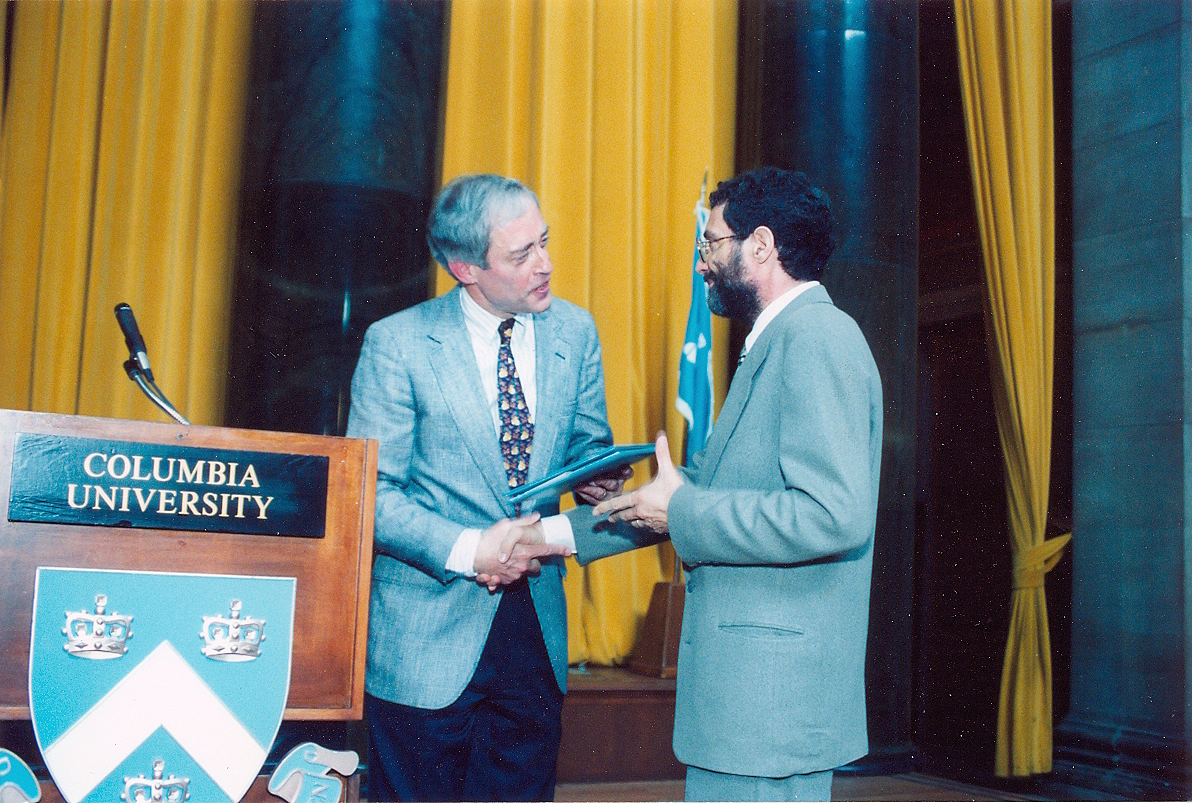
Columbia University President George Rupp (left) presents Barry Bearak with the 2002 Pulitzer Prize for International Reporting.
Winning Work
By Barry Bearak
HERAT, Afghanistan, Feb. 25 -- Three of Muhammad Uddin's sons froze to death along the narrow rim of the Sabzak Pass, where the elevation was steep and the truck tires could not hold. The snowfall was thick, the winds piercing. To one side was a yawning plunge. The eight families that had crowded into the vehicle's open flatbed thought it better to climb out and sleep on the wet ground than chance a mortal slide over the edge.
They were fleeing hunger, and their journey had begun with a three- day walk to the road through the mountains, carrying what they could, many of them burdened with exhausted children rather than extra clothing and blankets. Mr. Uddin's boys were 8, 6 and 3. In the morning's unfolding light, he saw that their faces had turned a bluish color and their jaws had gone slack. He poked at them. He poked again. And then he understood.
"The cold took their lives," he said listlessly, soon after reaching Herat, drawn here by a lodestone of food no more bountiful than a monthly ration of wheat flour.
Since fall, Afghan villagers have been making their way to this city by the hundreds, until the hundreds are now 80,000, and the 80,000 may well double as the snows melt in the distant peaks and gullies. They have buried their dead, mortgaged their land and sold the last of their possessions. Usually a proud and rugged people, they have dropped even the pretense of tenacity. They are begging.
Famine is a gradual disaster, slowly depleting crops and cupboards, and when it finally arrives in its fullness, the world looks at the skeletal victims and wonders: How did it happen? Where were the warnings?
In Afghanistan -- afflicted with unending war and without an effectual government -- famine has been regularly dispatching its heralds. For three years running, drought has parched the fields, starved the farm animals and dried up the rivers. Hungry people, deprived of yet another harvest, have eaten what little seed they had kept in reserve.
In all, more than 700,000 people -- about 4 percent of Afghanistan's population -- have been on the move in a desperate migration, according to aid groups. They have flocked to the bigger towns and cities or crossed the border into Iran and Pakistan. More than one million are "at risk of starvation," say, United Nations officials, pleading for emergency help.
Erick de Mul, the organization's relief coordinator for Afghanistan, defined "at risk" as "death by outright starvation or weakening or epidemic in the next few months."
For the most part, help is not on its way. The United Nations and many relief organizations have had trouble raising money for assistance. "Donor fatigue" is thought to be the problem, a weariness from two decades of Afghanistan's sequential woes.
"It's not a case of crying wolf; it's a case of the wolf always being at the door," said Hans-Christian Poulsen, who heads the United Nations humanitarian efforts in Herat.
Afghans have been at war for 22 years, first in an epic resistance against Soviet troops, then in factional, back-stabbing combat against each other. Most of the nation is now ruled by Taliban mullahs who offend the West with their stern interpretations of Islam and their unflagging hospitality to the accused terrorist Osama bin Laden.
Nations donating aid are also skeptical about the dimensions of the crisis. For now, estimating the endangered population involves guesswork, with most presumed victims living in remote villages, unreachable by aid workers either because of the winter or the war.
Then as well, in Afghanistan it is often hard to distinguish between the bad times and the worse. Even without famine, more than one in four children die before the age of 5 and the average life expectancy is 44. Hunger has become a helpmate to other causes of death.
"We're about knee-deep into a crisis now, and the potential of it becoming shoulder- deep is very great," said Simon Richards, who runs the office in Herat for the charity Christian Aid. "What we are seeing are displaced people pouring in, but they're actually the better off. They at least had the means to pay for transportation. Most people don't."
Mr. Uddin, with his three sons now buried and his spirit in atrophy, paid about $12 a person for his family's ride in that open truck, packed so tightly that people had to take turns to sit down. His home is a village in Badghis Province.
"People are starving there," he said. "I borrowed money to go, with my land as collateral." He tugged at a thin tawny blanket that was draped over his shoulders and again relived his worst memory. "It was very, very cold in the Sabzak Pass."
Day after day, the big trucks arrive, people and possessions piled in a disorderly heap. Six camps have been set up in and around Herat, the largest being Maslakh, 12 miles away in a treeless stretch of windswept land.
Another vehicle from Badghis rumbles in, this one with farmers from a different village but a story that was much the same. Muhammad Ramazan had lost two children, ages 5 and 3, during the frigid journey. He too was wrapped in a thin blanket. A safety pin substituted for buttons on his shirt.
"We were on top of the truck, and we could never cover ourselves properly," he said.
For the first time, he took a good look around, surveying where two weeks of hard travel had brought him: Maslakh, 40,000 people in a four-mile sprawl of small tents and mud shelters. A ragged line of the hungry -- their faces grim and their postures slumped -- were waiting for gruel.
Mr. Ramazan hoped that the recent misfortunes suffered by himself and his companions might merit special consideration. He led a frenzied tour of the distressed.
"That man lost a daughter," he cried out, pointing emphatically. "And here is another child who is dying. And this woman here, look at her. She will die, too, yes?"
He pulled a blanket off what had first appeared to be a satchel. Underneath was a woman on her knees, with her head bent down until it almost touched the ground. She was alive, if unmoving, her body petrified by days in the cold. He lifted her head by the hair.
"I cannot imagine she will not die," he insisted.
Finally, he displayed an 80-year-old man named Bismilla, who had fallen off the truck seven nights before and now no longer spoke. Much of his skin had turned black.
"Maybe he will die too, but God knows better," Mr. Ramazan said.
Herat, in western Afghanistan, is an ancient city on an historic trade route. Its architecture includes one of the world's great mosques and the remnants of several exquisite minarets. In the predawn of Feb. 21, as a cruel rain mocked people who had fled from drought, five children died in an impromptu camp beside those slender towers, near the center of the city.
The location, entirely without cover, held about 1,000 people, a backlog of the newly arrived who had yet to be "registered" for the meager entitlements of a dwelling and 15 pounds of wheat. None of the authorities distributing the food or tarpaulins seemed aware of their presence, though many of these haggard people had arrived a week before.
In the early morning chill, as women fed twigs into small fires and tried to make tea, shivering people huddled forlornly under damp blankets. There was a strange drone in the air, a blending of sobs and chatter and coughing.
"All my children are sick," moaned Abdul Aziz, a man too tired to stand. "We came here because we had nothing. We walked a great distance in the snow. And still we have nothing. Look at my little daughter shivering."
Nearby, a cadaverous old woman heard these laments and became envious. "No one is as sick as I am," she complained, wobbling to her feet. There were sores around her lips and holes in her shoes. She wheezed. "Come and see, I am barely alive."
Coordination between the Taliban and the aid groups has been a vexation for both. Government officials portray themselves as the good guys in white turbans, and they are quick to suspect that not all donations to the aid groups are properly spent.
Syed Raz Muhammad is the forceful man who oversees relief operations for the Taliban's ministry of martyrs and repatriation. He greets foreign guests with a welcoming hand over his heart and a cup of tea, but he can be abruptly dismissive about what he considers the paucity of international concern.
"Our people are given enough bread to stay alive, nothing more," he said, sitting before a kerosene-burning heater in his office. "Soon, we will have another 100,000 people coming to Herat, and when the weather gets hot, water and sanitation will be the problem instead of cold, and we will have cholera and tuberculosis and other diseases."
Overburdened international aid workers, themselves unsatisfied with their resources, kowtow to the Taliban's dictums and whimsies. Many of them say they have become resigned to paying bribes to perform their altruistic labor.
At present, the six camps here seem to have enough tents and hovels, though this was not so at the end of January when a freak storm smacked Herat with snow and sub-zero cold, killing at least 150 people -- most of them children. The disaster received media attention, with cameras aimed at the small graves in the rocky cemeteries. Soon after, both the United States and Norway sent in shipments of blankets and tents.
The amount of aid remains modest, however, and allocating the limited supplies has sometimes created peculiar difficulties. The 324 tents donated by Norway are outfitted with double insulation and heaters. They are "too nice to give out," said Mr. Poulsen of the United Nations. "People would fight over them. There might be a riot."
Spare as the camps are, relief workers are concerned about the "pull factor," worried that if too much aid is given, this will lure people who are less needy.
For the moment, neighboring Pakistan, a traditional catch basin for fleeing Afghans, has addressed this anxiety by shunting 60,000 refugees into the purposefully deplorable Jalozai camp, 25 miles south of Peshawar in Pakistan's northwest.
People there live in the stark openness under nothing more than thin plastic sheets strung to poles. Little is given them. They purchase the plastic from vendors at 20 cents a meter. Women spin wool into yarn to earn money, but a day's pay is only barely an antidote for hunger, enough for the purchase of five loaves of flat bread.
Traditionally, men do not do such work, so instead they stand around idly, waiting for something to fetch their attention away from the melancholia. "A tractor has run someone over!" one man yelled recently, initiating a stampede among the bored.
At Jalozai, the temperature still dips in the evenings, and almost any gust is enough to lift the plastic walls off their moorings. Still, Peshawar's weather is more benign than that of Herat, where the cold has been such an essential part of the mass grief.
Last Friday, just before morning prayers opened the day at Maslakh, Mir Ali used the dim glow of his flashlight to see how his ailing 1-year-old son, Abdullah, had fared during the night.
A few days before, the chill and wetness had conspired in the baby's chest and left him breathing with a rasp. A doctor had given the family some tablets and syrup with penicillin and told them to keep the boy warm. They bundled him in his hooded jacket, the one with pink roses on a field of green, then covered him with blankets. For a time, in the darkness after midnight, they kept a flame going with wood scraps in a metal pot.
But the boy did not survive. "I don't know exactly when he died," the father said quietly. His sorrow had transported him into a daze. "We must buy a shroud for the funeral, but we have no money."
He was surrounded by fellow villagers, from Jilga Mazar in Ghor province. They took up a collection to raise the required sum, about $1. Finally, with the proper white cloth in hand, Mr. Ali took his son from the family's mud hovel, leaving behind the baby's weeping mother and sisters who, by custom, could not attend the burial.
Abdullah looked like a child's doll in his perfect stillness. He was brought across the road and laid gently on a piece of yellow plastic. The father slowly tore off the boy's clothes -- the parka, a green shirt, a good luck charm worn around the neck. Another man washed the baby with shampoo, rinsing the suds with water poured from a black kettle. Dabs of perfume were applied from a little bottle. Abdullah was then wrapped, first in the shroud, then in a tan blanket.
The men carried this tiny bundle to one of the camp's four cemeteries. It was a mile walk through the breeze. There, the baby was set down on a flat patch of ground while the prayerful removed their shoes and faced West. A mullah, with appropriate gravity, chanted, "God is great," followed by another man who sang a verse from the Koran. The scriptural passage spoke of life's mortality and promised that the pious will ultimately know the blessings of Allah.
When it was time to lay Abdullah in his grave, it was already after 10 and the morning had turned bright. Wrapped in the shroud, and with the day pulsing with sunlight, the baby was finally warm when he was placed forever in the earth.
© 2001, The New York Times Company
By Barry Bearak
Blasphemy is a capital crime in this volatile Islamic nation, so Dr. Younus Shaikh, while teaching at a medical college, might have wisely avoided any discussion of the personal hygiene of the holy Prophet Muhammad.
But the topic came up during a morning physiology class. And the doctor talked briefly about seventh-century Arabia and its practices regarding circumcision and the removal of underarm hair. Some students found his remarks deeply offensive. "Only out of respect, because he was our teacher, did we not beat him to death on the spot," said Syed Bilal, 17.
Instead, they informed a group of powerful mullahs, who in turn filed a criminal complaint. Lest the matter be treated with insufficient urgency, these clerics dispatched a mob to the medical school and the police station, threatening to burn them down.
Precisely what Dr. Shaikh said in class last October is now a matter of mortal dispute, but he has been jailed ever since, awaiting trial and pondering the noose. Defending himself presents a conundrum. What can he safely say?
Pakistan, a nearly bankrupt nation with 150 million people, a military government and an expanding nuclear arsenal, is drifting toward religious extremism. Blasphemy cases are its version of the Salem witch trials, with clerics sniffing out infidels, and enemies using the law to settle personal scores.
Accurate crime statistics are a low priority here, but the number of those imprisoned on blasphemy charges is estimated in the hundreds. Only the most sensational cases get much notice: when vigilantes murder the accused, or the bold judge who set him free. When a man is condemned to die if a few pages in the Koran are torn. When a newspaper is shut down after publishing a sacrilegious letter.
Dr. Shaikh is charged under Provision 295-C of the law: the use of derogatory remarks about the holy Prophet Muhammad. Whether such an offense is intentional or not, the mandatory punishment is death.
"Please understand, I am a deeply religious man," Dr. Shaikh said recently, professing his Islamic faith through the tight wire mesh of a jail cell. A short, rumpled man, he had the weary look of someone trying to rub a disturbing dream from bleary eyes. "I cannot even imagine blaspheming our holy Prophet, peace be upon him."
Few Pakistanis have heard of Dr. Shaikh, but news of his woes has leapt the borders, flitting across the Internet. He is associated with the International Humanist and Ethical Union, which describes itself as an "umbrella organization for humanist, rationalist, agnostic, skeptic, atheist and ethical culture groups around the world." In 1999, he gave a presentation at the World Humanist Congress.
In an attempt to save the doctor, a global letter-writing campaign was quickly begun, with pleas aimed at Gen. Pervez Musharraf, Pakistan's military ruler. Publicity, on the other hand, has been discouraged.
The hope was that persistent statesmanship would outlast righteous anger, with the charges then quietly disappearing. This hushed approach has proved a frustration, however, and after declining earlier requests for an interview, Dr. Shaikh agreed to speak of his case.
"My statements about the holy Prophet, peace be upon him, were made in his praise only, and these have now been twisted out of context," he said in measured phrases.
Moments later, pressed for specifics, he said: "My students asked me about the shaving of pubic and armpit hair, and I, in describing the glory of Allah's revelations, said that before the arrival of Islam, the Arabs did not have these practices. And they did not."
Before his troubles, Dr. Shaikh lived alone in a small room in Islamabad. He had studied medicine in both Pakistan and Ireland but his practice had long periods of interruption. He preferred academic research and his passion has been "the history of nations." After the Koran, he said, the important books in his life have been the Encyclopedia Britannica and "The Story of Civilization," by Will and Ariel Durant.
Pakistan may have an ample supply of free thinkers, but free speakers have long been on the wane. Governments -- civilian or military -- tend to imprison opponents. Federal laws enforce a mix of mosque and state, and questions of religion are often presumed to have a single right answer, like arithmetic.
"Before saying anything in this country, you must always be aware of the forum, the place and the time," said Afrasiab Khattak, head of the Human Rights Commission of Pakistan. "If accused of blasphemy, you are in great difficulty. The mullahs are not known for their generosity. Even if exonerated, you will always be in danger."
Dr. Shaikh was a member of peace and environmental groups. But while he might have asked an occasional dissenting question at a public seminar, he was not a well-known activist. His few writings have appeared mostly in cyberspace, and at least some of them accuse organized religion of mass murder, bigotry and the degradation of women. (Supporters have now removed most of this material from the Internet.)
Last fall, as Dr. Shaikh worked part time at a small clinic, he accepted a teaching job at the Capital Homeopathic Medical College, on the second floor of a shopping plaza. He had no expertise in homeopathic cures, but his subject was physiology and he knew that well enough. He was paid $89 a month.
However badly it ended, Dr. Shaikh's brief tenure was not a contentious one. Students liked him. If he had a fault, they said, it was for lectures that meandered into irrelevancies like poetry or free sex in Western countries.
Occasionally, Dr. Shaikh's digressions embarrassed his students; occasionally, they seemed impious. One irksome topic was how Muslims had come to practice circumcision and, for purposes of cleanliness, the removal of pubic and underarm hair. A question arose: Had Muhammad been circumcised before receiving God's revelations at age 40?
The ensuing discussion brought on no great ado, and Dr. Shaikh said he only remembers saying, "The Prophet's tribe did not practice circumcision."
But the offended students repeat a different version.
"He told us the Prophet hadn't been circumcised before," insisted Majid Lodhi, 22. "We asked, 'In what book is this knowledge?' And he said, 'I'm telling you the way it was, and if you have evidence to the contrary, bring in your proof.' "
Outside of school, the students had begun talking about Dr. Shaikh. Was he uttering blasphemies? they asked each other. And if so, what should a good Muslim do?
"I had heard from the sermons in the mosques that those who blaspheme deserve to be killed immediately," said Asghar Ali Afridi, who at 28 was older than most students and whose views were persuasive. "It was a weakness of faith that we did not do it."
But 11 students, the entire class, did sign a letter that listed Dr. Shaikh's possible crimes. They claimed he had said that the Prophet was not a Muslim until age 40; that before then, he did not remove his underarm hair or undergo circumcision; that he first wed, at 25, without an Islamic marriage contract; that his parents were not Muslims.
Mr. Afridi was picked to deliver the letter to the Movement for the Finality of the Prophet, a group well known for pursuing blasphemers.
"For Dr. Shaikh's own protection, we sought his arrest," said Abdul Wahid Qasmi, secretary general of the organization's Islamabad chapter. "Otherwise, he might have been killed in the streets."
The Movement's vigilance is most often directed at Ahmadis, who regard themselves as Muslims but believe another prophet appeared after Muhammad. By law, they are barred from linking themselves in any way to Islam. Each year, many are arrested for simply reciting a Koranic verse or using the greeting "Salaam aleikum."
Non-Muslims make up about 3 percent of Pakistan's population, and while they have obvious reasons to fear the blasphemy statutes, there is no shortage of opposition among Muslims as well. Even a strong advocate, the minister for religious affairs, Mahmood Ahmad Ghazi, says the law requires revision. He has reviewed numerous cases and said the majority originate from "ill will and personal prejudice."
Last year, General Musharraf himself called for a procedural change, suggesting that the merits of blasphemy cases be reviewed by local officials before an arrest. But when fundamentalists took to the streets in protest, he backed down.
At the Movement's headquarters, the law also comes under criticism, though the complaint is of sluggish justice. Blasphemers may get locked up, but not one has been executed.
"Even if someone is only half-conscious when speaking against the Prophet, he must die," said Mr. Qasmi, who managed to sound amiable. "In Dr. Shaikh's case, his relatives have come to see us, saying the man is sorry and that he repents. But to be sorry now is not enough. Even if a man is sorry, he must die."
These days, Dr. Shaikh calls himself an "Islamic humanist," stressing the adjective. This surge in devotion is a return to his roots; he comes from a religious family in Bahawalnagar, and his father, a merchant, is a hafiz, a man who has memorized the Koran.
In hiring a lawyer, the family has steered away from human rights types. Its attorney takes a rather omnibus approach. First, there is a technicality to exploit. The students should have filed the charges instead of the mullahs, he asserts. Second, his client never said the things alleged, and even if he did, the words are not blasphemous.
A judge will decide. And customarily, the accusing party packs the courtroom with zealots in a show of righteous concern. The Shaikh family, however, has no intention of being steamrolled by hostile fundamentalists. At a recent hearing, they brought their own mullahs -- equally bearded, equally turbaned, equally able to quote from holy books.
"No blasphemy has been committed in this case," proclaimed Maulana Abdul Hafiz. An elderly, stern-faced man, he, too, heads a chapter of the Movement for the Finality of the Prophet, his being in Bahawalnagar. "Blasphemy can be committed only if issues are raised about the period after the holy Prophet declared his prophethood. These issues are pre-prophethood."
The mullahs from Bahawalnagar say they have tried to reason with the mullahs from Islamabad, but these efforts have failed. "They know we are right but they do not want to backtrack and lose face," said Maulana Hafiz, enraged by his adversaries.
How dare they? he declared: "They tell us that we ourselves should be cautious, that protecting a blasphemer is as bad as blaspheming itself."
© 2001, The New York Times Company
By Barry Bearak
KABUL, Afghanistan, Aug. 22 -- The evidence considered most damning includes Bibles translated into Farsi and Pashto, dozens of video and audio tapes about the life of Jesus and a book entitled "Sharing Your Faith With a Muslim."
Two weeks ago, 24 aid workers -- 2 Americans, 2 Australians, 4 Germans and 16 Afghans -- were arrested here in this nation's war-ravaged and hunger-racked capital. Some were accused of preaching the Christian Gospel. Others were accused of listening too well.
Death may be the punishment for these crimes -- or at least that is what officials from the ruling Taliban militia have announced. In Afghanistan, laws are in constant flux as austere mullahs fine-tune their ideas for creating the world's purest Islamic state.
"These foreigners were given visas as aid workers, not missionaries," said Abdul Ghafoor Afghani, the Taliban's chief of protocol. "In your country, if I am given a diplomat's visa and I am caught spying, I would not be spared, yes? This is the same."
"We have taken some confessions," he said. "The two American women were caught, as you say, red- handed, in an Afghan's house, where they know they were not to go. They were trying to show a video about Jesus, from his birth to his, what is the word, I think it is crucifixion."
In its fourth year of remorseless drought, in its 22nd year of relentless war, Afghanistan may well be the world's neediest country. The United Nations and hundreds of relief groups provide help that now amounts to more than $300 million a year. But those organizations and the Taliban are often incompatible caretakers, steeped in cultural conflicts and mutual distrust. One dispute follows another, and it seems that when the aid agencies are not threatening to pack it in, the mullahs are threatening to throw them out.
The Taliban are uncomfortable with much of what goes on behind the high walls of the aid workers' compounds: the mingling of unmarried men and women, the beat of rock 'n' roll, the ending of a hard day with a stiff drink. The unseen is often tolerated, though some activities worry the mullahs more than others. Repeatedly, the Taliban have warned against turning Afghan believers into Afghan apostates.
"These laws were well-known to everyone," said Fayaz Shah, head of the United Nations World Food Program in Kabul. "It's like walking in a minefield, and when one blows, you yell, `Why did this happen?' But you should know. You were in a minefield."
The arrested aid workers belong to Shelter Now, a German-based group. For months, its Kabul staff had been under the surveillance of the Taliban's whip-wielding religious police from the Department for the Promotion of Virtue and the Prevention of Vice. An intensive investigation has been opened, and the authorities have announced the possibility of "a larger conspiracy."
A prime suspect is the World Food Program itself, Foreign Minister Wakil Ahmed Mutawakil said on Tuesday. He did not specify how a reliable donor of wheat might be linked to the conversion of Muslims, but the mere mention of such misgivings is a grave matter. The program is the sole source of nourishment for three million Afghans, about 15 percent of the population. Those woebegone people survive on little more than flatbread and weak tea.
The potential of more arrests has left the aid agencies in fear. People say the Shelter Now episode could eventually lead to a huge withdrawal -- or expulsion -- of the agencies. That would be catastrophic for the needy.
That dreadful prospect complicates the moral judgments of aid workers who would ordinarily ache with sympathy for their jailed colleagues. As it is, commiseration often is coupled with anger. Many people here presume that the arrested foreigners were guilty of reckless proselytizing; however well-intentioned the preaching, that forbidden endeavor to save a few dozen souls has imperiled thousands of lives.
"Why did they break the law, especially this law?" asked an American who insisted on anonymity. "Worse yet, they dragged their Afghan workers into this. After some political games, the foreigners will probably be kicked out of the country as their punishment. But the Afghans, I am afraid they are going to be killed."
Peter Schwittek, who runs an aid group that operates schools in mosques, said he once spoke about proselytizing with George Taubmann, a fellow German who heads Shelter Now in Kabul. "If you discuss these things with Mr. Taubmann, he tells you, `No, we never formally evangelize, but if our staff feels compelled to do so, O.K., but it's not a policy of our agency.' "
The first to be arrested were the two American women, taken away on Aug. 3. Their names are Dana Curry and Heather Mercer, and they are said to be in their mid-20's. Anxious parents have arrived in Pakistan, hoping to get visas to Kabul. Still ahead will be heart-rending details about young and adventurous zealots aspiring to do good deeds.
On Aug. 5, Mr. Taubmann himself was arrested along with dozens of others, including a large assemblage of Afghan children who were later released.
"Some of the Shelter Now people have claimed that all their Christian materials were for personal use," said Mr. Afghani, the chief of protocol, "but I do not believe one needs thousands of audio cassettes to make a study of the Pashto language."
"Of the Afghans, some are said to have been teachers of the others, and to do that I would think they must be considered converts who by Shariat law face execution," he said.
Though the Taliban control nearly all of the country, most of the world declines to recognize them as a legitimate government. In return, the Taliban have now refused the customary right of consular access to the imprisoned foreigners.
On Tuesday, diplomats from the United States, Australia and Germany left Kabul in frustration after a week of fruitless attempts to see their countrymen. They were allowed only to pass on supplies from the aid workers' families: toiletries, writing materials, Oreo cookies, Pringles potato chips and a variety pack of Nature Valley crunchy granola bars.
"There doesn't appear to be a well- defined legal system here, at least for this case," said David T. Donahue, the exasperated American envoy. "We've been told that once the investigation is complete, it will be turned over to Mullah Omar, the supreme leader."
If the reclusive, one-eyed Mullah Muhammad Omar is indeed the last word, he might consult his own Edict No. 14, a July 31 decree concerning the behavior of foreign nationals. It regards "inviting Afghans to any religion apart from Islam" as a less serious offense than "taking photographs of living creatures" or "eating the meat of the pig." Punishment is 3 to 10 days in prison and then expulsion.
But the Islamic Emirate of Afghanistan is a work in progress, not yet five years old. The rules for behavior are singularly constraining, and yet there always seems more to add. In March, even small boys were commanded to wear turbans to school. In May, two giant statues of Buddha -- an ancient heritage -- were destroyed because they depicted the human form. In June, spectators at soccer matches were ordered to restrict their cheers to the chant "God is great!"
By and large, the Taliban leadership hails from refugee camps, religious schools and villages, and their education has focused on the ideology of jihad and the wisdom of the Koran. For them, governance has been a confounding puzzle.
But now as they grow more accustomed to the reins, they also more resent the independence of the aid groups in their midst. In the past, much of this criticism involved lifestyle. The Taliban thought the aid workers were spendthrifts with donated money, drawing high salaries, driving expensive vehicles, living in large houses.
These days, the Taliban seem as intent on overseeing budgets and planning as behavior. With millions being spent, they want to sign off on projects and look at the books. In a recent interview, Mullah Muhammad Hassan, the powerful governor of Kandahar Province, rebuked the United Nations for squandering money.
"The U.N. is paying $2,156 per tube well, and I can have them dug for $500," he said, rooting through his pockets for the scraps of paper that held his arithmetic.
In May, a beautiful and modern surgical hospital in Kabul closed within weeks of its opening. The builders, the Italian aid group Emergency, shut down to protest a raid by the religious police, who beat up some staff members after finding men and women lunching in the same room. But what has kept the hospital closed since then is a disagreement about whether the Afghan employees must be hired through the Ministry of Public Health.
"This is our country and we want things run with our consultation," said Mullah Muhammad Abbas Stanekzai, the deputy minister of health.
Kabul is a city of two million people, almost all destitute. In a civil war from 1989 to 1996, as many as seven armies blasted away at one another with artillery and rockets. Now much of the city looks like the detritus of an ancient ruin. At daybreak, the place seems ghostly until squatters lift themselves from the wreckage they use as nightly shelter.
These are people ordinarily grateful to the aid groups and slow to take the Taliban's side in conflicts. But they overwhelmingly support the arrest of the Christians and the jailing of any murtads, Muslims who have deserted their faith. If the price of bread and blankets is denial of the Holy Prophet, they say they would prefer to defiantly perish.
"These people supposedly came here to help the Afghan people, and instead they have used their position to do the dishonorable," said Ahmed, a young man with a beard already lengthy enough for a Biblical epic. "I think these people should die."
A 27-year-old soldier was equally emphatic about his deep beliefs. There is only one religion, he said. God sent Islam to refine the teachings of all other faiths. It is eternity's final word.
He then considered the gloriousness of this knowledge and said he wished to share it with all mankind. "Converting someone to Islam is the greatest thing a person can do," he said. "Such an act is a way to go straight to Heaven."
© 2001, The New York Times Company
THE AFGHANS
By Barry Bearak
The Taliban are credited with improving safety. They disarmed the population, they put an end to banditry. But the security has come at a steep price.
KABUL, Afghanistan, Sept. 12 -- If there are Americans clamoring to bomb Afghanistan back to the Stone Age, they ought to know that this nation does not have so far to go. This is a post-apocalyptic place of felled cities, parched land and downtrodden people.
The fragility of this country was part of the message the Taliban government conveyed in a plea for restraint issued late tonight.
It said in part, "We appeal to the United States not to put Afghanistan into more misery because our people have suffered so much."
Whatever Afghanistan's current cataclysm, its next one seems to require little time to overtake it. Wars fought by sundry protagonists have gone on now for 22 consecutive years, a remorseless drought for 4. Since 1996, most of the nation has been ruled by Taliban mullahs whose vision of the world's purest Islamic state has at least as much to do with controlling social behavior as vouchsafing social welfare.
The accused terrorist Osama bin Laden has found a home here, angering much of the world. In 1998, America fired a volley of more than 70 cruise missiles at guerrilla training camps reportedly operated by the Saudi multimillionaire. Now, there seems to be the prospect of another barrage, with Afghan hospitality to the same man as the cause.
As fear of an American attack mounted, the Taliban's senior spokesman in Kandahar, Abdul Hai Mutmain, called the few foreign reporters here to issue the statement, which in part defended Mr. bin Laden:
"These days, Osama bin Laden's name has become very popular and to an extent it has become a symbol. These days, even to the common people, Osama bin Laden's name is associated with all controversial acts. Osama bin Laden does not have such capabilities. We still hope sanity prevails in the United States. We are confident that if a fair investigation is carried out by American authorities, the Taliban will not be found guilty of involvement in such cowardly acts."
The statement also said, "Killing our leaders will not help our people any. There is no factory in Afghanistan that is worth the price of a single missile fired at us. It will simply increase the mistrust between the people in the region and the United States."
Whatever else there is to say about this entreaty, one part that is indisputably true is that this land-locked, ruggedly beautiful nation is in absolute misery.
Here in Kabul, the capital, roaming clusters of widows beg in the streets, their palms seemingly frozen in a supplicant pose. Withered men pull overloaded carts, their labor less costly than the price of a donkey.
Children play in vast ruins, their limbs sometimes wrenched away by remnant land mines. The national life expectancy, according to the central statistics office, has fallen to 42 for males and 40 for females.
The prolonged drought has sent nearly a million Afghans -- about 5 percent of the population -- on a desperate flight from hunger. Some have gone to other Afghan cities, others across the border. More than one million are "at risk of starvation," according to the United Nations.
Famine is the catastrophe Afghans are used to hearing about. Few yet know of the threat of an American reprisal. The Taliban long ago banned television, and the lack of electricity keeps most people from listening to radio.
The nation's 100 or so foreign aid workers suffer no such telecommunications handicaps, however, and today many of them began to flee their adopted home, fearing either the havoc of American bombs or the wrath of subsequent Afghan outrage.
Around noon, a special United Nations flight evacuated the first of the expatriates. The remaining foreigners are expected to leave on Thursday, as will three, and perhaps all four, of the American parents here to observe the trial of their children, among eight foreign aid workers accused by the Taliban of preaching Christianity.
As foreigners left, the Taliban took unusual precautions: they began searching every vehicle entering government compounds. Visitors were carefully frisked.
But however much the Taliban hierarchy was beginning to fret, streets and bazaars were a picture of normality. Word has spread slowly about the terrorist attacks in New York and Washington. And even when everyday Afghans heard the news, there were no accompanying video images to sear the horror into their memories. Personal conversations only carried the dull stimuli of abstract words: hijacked planes and collapsed buildings.
Khair Khana, a man selling fertilizer in a market, knew just a bit about the attack. He thought a plane had crashed into the White House. And he considered the perpetrators, whoever they are, to be "enemies of God," though he also felt "Americans should look into their hearts and minds about why someone would kill themselves and others" in such a way.
He had not thought much about an American retaliation against Afghanistan. When he did consider it, standing in a ramshackle collection of stalls, he shrugged and said: "Americans are powerful and can do anything they like without us stopping them."
Nearby, a tailor, Abdul Malik, saw God's justice in America's pain because, as he understands it, the United States has armed the Afghan resistance to fight against the Taliban. "So they at least now know how it feels in their own country," he said.
As for Mr. bin Laden, the tailor considered judgment of him to be God's affair. "If Osama is Islam's enemy, he should be gotten rid of," he said. "But if he is a good Muslim and wants Islam to prosper -- and if America wants him dead -- then we hope he destroys America."
The common people of Afghanistan are often circumspect with their opinions. As one man said today: "Nobody here talks wholeheartedly any more; it can be dangerous."
The Taliban are credited with improving safety. They disarmed the population, they put an end to banditry. But the security has come at a steep price.
Women have been forced into head-to-toe gowns known as burqas and evicted from schools and the workplace. Men are obligated to wear long beards or face jail. Banned are musical instruments, chessboards, playing cards, nail polish and neckties. Cheers at soccer matches are restricted to "Allah-u-akbar,"or God is great. Freedom of speech has bowed to religious totalitarianism.
Various Taliban police forces patrol the streets. Today, in a derelict building that is used as a precinct office, one 25-year-old constable sat on the floor beneath a single dangling light bulb. His name was Muhammad Anwar. He had heard something about the attack in America but he had no idea how many were killed or what cities were involved. Indeed, it seemed unlikely that he had ever heard of New York.
"Attacks like these are not a good thing because Muslims live all over the world and Muslims may have been killed," Mr. Anwar said hesitantly. By his reckoning, Americans were enemies of Afghanistan, as were Jews and Christians. He thought about this a bit more and retracted it partially. "There must have been all kinds of people in the building, not just bad Jews but good Jews, not just bad Christians but good ones."
He remembered something he had learned in his madrassa, or religious school. "It is un-Islamic to kill innocent people," he said.
© 2001, The New York Times Company
In Pakistan, A Shaky Ally
By Barry Bearak
For years, Pakistan has seemed a place about to blow. Bankruptcy is at the door; angry mullahs are at the gate. The corruption of the powerful is epic, the poverty of the masses crushing. The army has taken charge, again putting democracy on the shelf. More people own guns than refrigerators.
This country, then, may seem a strange choice as America's indispensable ally in the hunt for Osama bin Laden. Islamic guerrillas -- many would call them terrorists -- openly operate inside Pakistan's borders, with government support. But for the Bush administration, Pakistan it is -- a rediscovered crony from America's cold war days, forced back into friendship at gunpoint to fight terrorism. In his Sept. 19 speech to the nation, Gen. Pervez Musharraf, Pakistan's military ruler for the last two years, explained that he was facing an American ultimatum -- join us or fight us -- and that he felt that the country's very survival was at risk.
In many ways, it is. The country is polarized. On one side stand sympathizers with the West who have felt increasingly marginalized in recent years and believe that the current turmoil may be a rare stroke of fortune that halts the "Talibanization" of Pakistan, a drift toward the fundamentalist Islam of neighboring Afghanistan. On the other stand the holy warriors, the hope of the country's myriad dispossessed.
Pakistan, with a population between 140 million and 150 million, is the world's seventh most populous country. Like many nations in the third world, it seems to be simultaneously moving ahead and falling behind at frantic speeds. It is this dichotomy that explains some of the violence of the country's conflicts.
Today, someone claiming to be from one of the best-known of Pakistan's radical Islamic guerrilla groups, Jaish-e-Muhammad, took responsibility for a suicide bombing at the state legislature in Srinagar, in Indian-administered Kashmir. The attack killed at least 26 people.
One of this region's many open secrets is that the Pakistani government itself has armed Islamic militants, sending them off to fight the Indian authorities in Kashmir in an attempt to wrest the contested Himalayan territory, which is primarily Muslim, from Hindu control.
A Pakistani Foreign Ministry spokesman, in a statement today, condemned the Srinagar attack. "Pakistan condemns terrorism in all its forms and manifestations," he said.
But whatever the government's past relationship to Jaish-e-Muhammad, it seems clear that the United States, in its new determination to combat terrorism, has sided with a military government that has not been averse to backing insurgency in Kashmir.
Radical Muslim political parties, historically weak at the polls, are traditionally potent in the streets, where the number of poor and the number of refugees grow. Kalashnikovs are everywhere, as are men who know how to use them. Twin jihads -- one in Afghanistan, one in Kashmir -- save many from the idle hours of joblessness and fill them with lethal, self-righteous purpose.
But the radical Islamists drawn to holy war, however grateful for their supply of guns and grenades, very often despise the national leaders who provide them. The more those Pakistani leaders look like American cronies working to oust the Taliban government in Afghanistan, the more the hate may grow.
By drafting this fragile and fractious nation into a central role in the "war on terrorism," America runs the danger of setting off a cataclysm in a place where civil violence is a likely bet and nuclear weapons exist.
Pakistan has long been the speculated locale for one of the world's worst nightmare scenario, in which Islamic terrorists, in league with rogue elements of the military, seize control of the government and wield the vengeful sword of jihad with a nuclear tip.
Islam is a growing force here. Hundreds of religious schools, known as madrassahs, have eagerly sent their students to fight at the Taliban's side. Pakistani border guards wish them well as they head to the front lines.
Last Friday, in a drama repeated in hundreds of towns and cities across the country, mullahs at the Red Mosque in Islamabad followed the gentle chanting of afternoon prayers with frenzied threats of violence: Death to America! Let Americans come here to be buried!
A plea went out for 50,000 volunteers to defend Afghanistan against "the infidels." The entreaty was made with the desperate ardor of merchants at a going-out-of-business sale. Many of Pakistan's fundamentalist clerics endorse the Taliban's formula for a pure Islamic state. Without the Taliban, these mullahs would be without their rallying point.
An 18-year-old spectator, Tai Muhammad, said he had pledged his life to the anti-American jihad, enlisting at the mosque's sign-up table. "People like me will be the Americans' reception committee," he said, grinning in satisfaction.
Lambasted along with President Bush was General Musharraf, called a traitor to his country, his religion and 1,400 years of Islamic history.
Afghanistan, Mr. bin Laden's sanctuary, is not merely Pakistan's neighbor. Pakistani intelligence agents have been the Taliban's godfathers, turning a throng of self-righteous religious students into a militia of self-assured soldiers.
Until recently, the Taliban have been useful to Pakistan, providing an ally on its western flank as rival India lurks to the east, and a breeding ground for Islamic militancy that could be redirected toward Kashmir.
So to many at the Red Mosque, Pakistan's cooperation with America seems like a sellout.
American money, of course, is not an insignificant inducement, especially to a nation $37 billion in debt with virtually no prospects of climbing out of the hole.
So far, a windfall has yet to appear, though America -- suddenly forgiving of the testing of nuclear weapons and the eschewing of democracy -- has removed many economic sanctions against Pakistan. Together with the Japanese, the United States has rescheduled nearly $1 billion in debt and authorized $90 million in aid.
Indeed, renewed solvency is the hope of many Pakistanis who believe that a decisive battle has at last been joined.
"It's a wonderful thing," said a retired general, speaking on condition of anonymity. "We were in a state of drift. The silent majority was being dragged in a terrible direction by a very vocal minority. This is God-sent. We're saved."
That optimistic view is shared by much of a Westernized elite that would see the Taliban's overthrow as the logical halt to the onrushing fundamentalism in their own midst.
Many have long assumed that an upheaval was inevitable, with moderate Islam battling the religion's extremist, intolerant version.
That confrontation is better fought now than later, they say. "If there is a silver lining in this, it's that the radicals, the jihadists, will be de-fanged now instead of 10 years later when they'd be stronger," said Pervez Hoodbhoy, a physicist and peace activist.
But radicalism has deep social roots here. In the cities, the turn of a street corner can seem to be time travel between centuries. Wide boulevards clogged with expensive cars become narrow lanes where shrouded women carry jugs of water on their heads.
About 75 percent of all Pakistanis reside in rural areas. Most are sharecroppers, eking out a subsistence. In some areas, feudal families still hold sway, making private laws and operating private jails
While the wealthy send their children to college in America or Britain, many of the poor are deprived of even an elementary education. The literacy rate is below 40 percent. A fifth of Pakistan's government schools are "ghosts," with buildings but no students or teachers, General Musharraf himself admitted. This void increasingly has been filled by thousands of madrassahs. Considered a godsend by the destitute, they feed and house their pupils while teaching them the wisdom of the Koran and the moral requirement to fight in holy wars.
Islam is the great refuge of Pakistan's masses. In mosques, in the fields, on the roadsides, men drop to their knees and perform their daily prayers. However empty their pockets, they are equal in these genuflections before God.
But it is not a simple picture. Fundamentalist Muslims, like secular ones, are minorities. Between them are a multitude of gradations in the practices of faith -- one reason why recent polls suggest layers of ambivalence about the current crisis,
Before General Musharraf's address to the nation on Friday, the pollster asked people whom they would support in a war between America and Afghanistan. Seven percent said America and 67 percent Afghanistan, with about 26 percent neutral. Four days after the speech, those who said they would side with the United States remained the same, though 20 percent shifted from Afghanistan to neutrality.
Some of this sentiment reflects a general doubt that America has enough proof against Mr. bin Laden to warrant a punishing attack on Afghanistan. At the same time, many Pakistanis are merely wary of America, regarded as a companion of shallow sincerity.
"Unfortunately, America seems to be Pakistan's friend only when it suits America's needs," said Zahid Mahmood, a bank manager. "When the need is over, America deserts you."
In the 1980's, America had great needs in the region. In late 1979, the Soviet Union sent its troops into Afghanistan, getting itself closer to a warm-water port. Using Pakistan as a pipeline, the United States and other nations then financed the Afghan resistance. The Soviets soon found themselves bogged down in a crippling war against guerrillas adept at mountain combat. The cold war's end swiftly followed the Soviets' humbling retreat in 1989.
America's attention span, as well its affection, did not last much longer. That was a shock to Pakistan.
Money had seemed a token of friendship, and in 1990 the United States aid package to Pakistan was $564 million; only Israel and Egypt received more. But then the largesse was suddenly withdrawn, the penalty for Pakistan's continuing program to develop nuclear weapons in pace with its archenemy India.
"Looking out for No. 1, that's the American way, isn't it?" snickered Ajab Gul, a barber in Peshawar. "That is what Americans are proud of. We're different."
But the loyalties of Pakistanis are no simple matter, either.
In 1947, after a flurry of cartography, Pakistan and India were mapped out of the British Empire. Pakistan was devised with religious cohesion as a Muslim state. But it, rather than India, has been the one struggling for a national identity.
The country is split among several ethnicities and languages. Mr. Gul, the barber, is Pashtun and admits to feeling a greater affinity for the Pashtuns of Afghanistan than the Sindis of Karachi or the Punjabis of Lahore in his native land.
Democracy has never taken a firm foothold. The military has remained the dominant institution, and while it has failed in its three wars with India, it has had repeated success in overthrowing its own democratically elected governments.
During the 1990's, however, it was civilian governments that generally maintained control. The indefatigably corrupt governments of Prime Ministers Benazir Bhutto and Nawaz Sharif -- as well the stopped-up American spigot -- helped plunge the economy into the red while at the same time discrediting democracy in the eyes of the people.
Both Ms. Bhutto and Mr. Sharif now live in exile. Their political parties, the Pakistan Peoples Party and the Pakistan Muslim League, are in disarray. For now, public assembly is forbidden.
By order of the Supreme Court, a return to civilian government is supposed to occur by next October. General Musharraf, who recently assumed the title of president, has promised to abide by the timetable.
But his future, like his country's, is now linked to matters that could not have been foreseen a month ago: the number of American soldiers who will touch Pakistani soil, the amount of blood spilled in reflexive outrage, the havoc caused by the coming onrush of refugees and the furtive ability of a Saudi-born multimillionaire named Osama bin Laden.
© 2001, The New York Times Company
THE REFUGEES
By Barry Bearak
NEW SHAMSHATOO REFUGEE CAMP, Pakistan, Oct. 16 -- On Monday, during four exhausting hours, a man named Asadullah trudged through the mountains, leading his 10 children out of Afghanistan. His right leg, a prosthesis of plastic, was chafing against the stump. But his discomfort, however great, was less than his wife's: Malika, atop a mule, was in labor.
"It was a very steep mountain, and I had to hold on very tight," she said today, sitting on a hard cot in the stuffy little tent where she finally gave birth. Her new daughter, just a human smidgen, lay asleep, swathed in a blanket.
Outside, Asadullah, a cobbler, was describing the journey. He unstrapped his false leg, showing where the edge had rubbed away his skin. The family came from Angoor Bagh, a village near Jalalabad, a city with targets that the United States military considers strategic.
"We were living too near the airport, I think," he said. "One bomb shattered our windows. It was time to get out. The Pakistanis had announced they would open the border after the bombing began. We waited and waited for this. I was afraid to wait any more."
About 1,000 to 2,000 Afghans are crossing into Pakistan each day, the United Nations estimates. They travel a hundred different smuggler routes, enduring hardships and paying bribes. Subject to deportation, they most often hide out in the homes of earlier arrivals, the two million Afghans who fled before them during two decades of turmoil.
"That man there, he is my brother-in- law," said Asadullah, who uses only one name.
He was pointing to Chinar Gul, Malika's brother, who left Afghanistan last winter. He now lives in New Shamshatoo, population 52,500, one of the many refugee camps that have been built near Peshawar in Pakistan's northwest. Until recently Mr. Gul presided over two cramped rooms, home to an extended family of 13, including nephews and widows.
Then, with the unexpected arrival of his sister and her still growing family, the simple mud dwelling became a domicile for 26. Then again, this morning another man abruptly showed up with his wife and three children. He was the brother-in-law of Mr. Gul's niece, which gave him a legitimate claim on space. Suddenly the two rooms and two hastily erected tents were housing 31.
"For a man with nothing, I am responsible for a lot of people," said Mr. Gul, feeling thunderstruck. He surveyed all that was before him, which included two dozen children. "They have no bedding," he said. "They have no winter clothes."
Worst of all, neither they nor Mr. Gul had any food. Each refugee who was already registered at the camp -- something forbidden the newcomers -- was entitled to a monthly allotment of 33 pounds of wheat from the United Nations World Food Program. The family had nearly exhausted their ration and they had three more days to wait until they were allowed more.
That predicament, Mr. Gul said with assurance, was not a matter of overeating.
Rather, he blamed the quality of the wheat, which was reddish-brown and not very finely milled. It required sifting, he said. And once the husks were removed, only about two- thirds was left, the remainder being "fodder fit only for animals."
He brought out a nearly empty bag of the grain. On the outside it said "USA Wheat."
At Shamshatoo, a sprawling city of flat-roofed structures and dust-laden air, the complaint is a common one, whichever country has donated the wheat. People say they lose 10 to 50 percent of their ration in the sifting.
Commonly, nations donate money to help Afghan refugees, earmarking it for food. The wheat that is purchased is mostly grown and milled in Pakistan, said Azim Khan, who manages the assistance in the Shamshatoo camp for the World Food Program. "It is not A-1 wheat, but it is reasonably good," he insisted.
Abdelwahab Mahmoud Jeme, a senior coordinator for the United Nations program, said strict quality control was enforced and the amount of "whole meal," the undesired husk, was restricted to 3 to 5 percent.
Babar Samsoon, the project manager here for the aid group Shelter Now International, which distributes the wheat, said: "These people always complain. I know refugees, and you can never make them happy."
But today, as Shelter Now employees unloaded bag after bag, they themselves said some bags of wheat were of good quality while others were noticeably darker in color and contained a lot of husks.
Asadullah, exploring the camp, wondered what his new life as a refugee would bring.
"There are no bombs exploding here," he said. "But I don't know that this is such a good place for us."
He walked back up a hill to his brother-in-law's, where a decision had been made about food. They had pooled some money, using 40 cents to buy potatoes.
Between now and Thursday, this is what the 31 of them would eat.
© 2001, The New York Times Company
By Barry Bearak
PESHAWAR, Pakistan, Oct. 29 -- In the raw gloom, Haziza, 12, helped find her mother and baby brother, dead in the rubble of their collapsed home.
It was early October, the first night of the American bombing of Kabul. The electricity had been cut. Searchers were desperately lighting pieces of paper, one after another, trying to burn away small patches of darkness.
In her mind's eye, the girl said she recalls two still bodies, "their faces crushed and covered with blood."
As she spoke, her eyes drifted left and she flinched, as if again in that moment, whether conjured from the stamp of memory or the elastic of imagination. She is a refugee now, having left everything behind but her thoughts.
"She seems unable to concentrate for long," said her teacher, a woman named Mullalai. "Sometimes I look back at her and she is crying. So I go to her. But what is there to say?"
At the Ariana School here in Peshawar, the newly arrived students - the Afghans who have fled the American bombs - are easy to detect. They are anxious. They are mournful. They are withdrawn. And also, they are a head taller than the others in class.
Haziza is such a child. Five years ago, when the Taliban captured Kabul, she was in the first grade. The mullahs' inflexible rendering of Islam forbade girls to attend school. And so Haziza, with her education now hastily revived, is in the first grade still.
After a week, barely a page in her notebook is full. She lags behind her far smaller classmates. They already know the alphabet in Persian. Some know it in English as well.
"I feel very bad because I know less than the others and they are very much younger," Haziza said. "I don't remember the things I was taught five years back."
Visiting the school, there is an impulse to see a silver lining in Afghanistan's grim situation. For females, the fleeing from home, however sorrowful, comes with a counterweight of liberation. Girls can go back to school, women can again find work. For those who wish it, there is freedom from the mandatory head-to-toe sheathing of the burka.
But the cost of escape has been high, sometimes unbearably so.
As the new children at Ariana tell their stories, rueful themes repeat: the pummeling fury of the air raids, the uncoupling from all that is familiar, the exhausting journey over the mountains, the unremitting neediness of the refugee life.
Haziza's story is sad. "We lived near the airport and were afraid," the girl said. "My father took me and my brothers to a sturdier house nearby, but my mother said she was not afraid and only if things got dangerous, then she would come."
Her father, a candy vendor, is a rumpled and sullen man with a tremor in his hands that makes it hard for him to hold a cup of tea. He and Haziza'a older brother independently tell the same details of the bombing and its grim aftermath.
The family now lives in the wretchedness of Tajabad, one of Peshawar's many squatter colonies that teem with Afghan refugees. Haziza sleeps on the dank concrete of their single room, the dampness tempered only by thin bed sheets. Around them is poverty's familiar cavalcade - naked children wallowing in mud, grown men despairing in idleness, chickens foraging in garbage heaps, sewage odors spoiling each breeze.
A relief worker directed Haziza to the Ariana School, where she showed up in the clothes of a ragamuffin and a face that collapsed into grief. She was given a pupil's proper uniform and a seat in one of the rear rows of an overcrowded first-grade classroom.
"She has lost five or six years to the Taliban,'' said Fauzia Habibi, the school's principal. "Now she cannot concentrate. She and the other refugee children are always thinking about their country, where there is war. They tell us where America is attacking."
Actually, most of the 2,300 students at the school are refugees, though only 300 are of the post-bombing period. Peshawar, 40 miles from the border, is a city with one million Afghans, an accumulated reservoir of humans from 23 years of crises.
Ariana is a private school where most students pay tuition. The newer refugees, attending free, sit among the others in one of three buildings. Some classes meet outdoors, with canvas as a roof and the grass for chairs. Students squeeze together on benches in the rooms inside. They arrive in shifts, the morning pupils, then the afternoon.
Farishta, 14, fled Kabul during the second week of October. Bombs had flattened houses near her own and terrified her, she said. Her family's escape came over the mountains, and she is still stunned by the abundance in Pakistan, the food and the clothes and the cars. At Ariana, she has been put in the fifth grade, where she left off in 1996.
"I don't know how to solve all the problems,'' Farishta said meekly, tightly tugging on a shawl that covered all but the pale oval of her face. "I can do the plus and the minus, but the division seems too hard to understand.''
Farishta too lives in Tajabad. It is about an hour's walk from school, through the unfamiliar streets, around a corn field, across enormous ditches gouged into the earth. Her home, like most others in the slum, spills over with people. Her uncle is the main breadwinner, cutting pieces of rubber that are then shaped into cheap sandals.
On a clothesline in the yard hung a burka, now obsolete. Farishta's aunt, Mahtab, 20, had hated to don the Taliban's mandatory womenswear. She suffered eyestrain from looking out its meshed peephole, she said. It made her feel caged. She is glad to be done with it.
But it was the bombing that made her leave Kabul on Oct. 18. Her house was hit during a raid and her mother-in-law was killed by shrapnel, she said. "It pierced her heart."
She is angry at America, and when she is told that the United States is trying to minimize civilian casualties, she answered with a list of neighborhoods where innocents have been killed: Khuja Bughra, Maidan Hawai and others. Her patience wore away quickly at this subject. "It is easier to understand if it is you being bombed,'' she said.
The years of Taliban rule have not only denied girls an education but boys as well. Their schools may have been open but very little teaching was going on. And when teaching did occur, religion very often replaced reading, writing and arithmetic in the curriculum.
"We would only study the Koran, trying to recite with the right Arabian accent," said Murtaza, a 10-year- old boy with gentle dark eyes. He tolerated a short pop quiz, giving the right answer for two plus two but the wrong one for 10 plus 10.
"I don't know this math," he said humbly.
Along with the 300 new students have come six new teachers, all women who lost their jobs when the Taliban barred women from work outside their homes. Two of them sat for a while in the school's office, telling of their losses and regrets. They were unforgiving of the Taliban. One teacher said her son had been taken away a year ago for the crime of trimming his beard. Another described being beaten for momentarily showing her face.
But in Peshawar, during these difficult days, the target of the harshest rebukes often flip-flop, going from the Taliban to the Americans and then back again.
Suddenly, a third teacher entered, sitting quietly and beginning to weep.
"I have learned our house in Kabul has been bombed," Naheeda Kohistani said, resting her forehead in her palms. "I don't know if my brother and sister are still alive."
She attempted to stifle her sobs, then pulsed with anger. "How could the Americans think this was a military target?" she asked. "Or is it the Americans don't even care?"
An awkward silence hung in the room, and then she and the others finally returned to class, to rooms full of children eager to share in the rich knowledge of the world.
© 2001, The New York Times Company
By Barry Bearak
MAIDAN SHAHR, Afghanistan, Nov. 22 -- Troops of the Northern Alliance scrambled away in sudden retreat today after launching a misbegotten attack against a stubborn Taliban stronghold near the city of Maidan Shahr, just 12 miles west of Kabul.
While the defeat may be only a temporary setback, it exposes the vulnerability of the often disjointed alliance in terrain that is but a half- hour's drive from the capital.
Early this morning, as the sun nibbled away at the deep November chill, impatient soldiers from the alliance heard the command to attack, orders they had awaited all week.
Hundreds of men who had been huddling around wood fires since dawn quickly crowded aboard the nearest vehicles -- tanks, trucks and commandeered sedans -- advancing toward the occupied hills.
They were an enthusiastic lot as their first units circled the initial slope, supported by unanswered blasts of heavy artillery.
But then the Taliban abruptly hit back with small-arms fire from the hills and ridges beyond. The alliance's frontward soldiers dived for a series of ditches and gullies. They were pinned, inside the enemy's cross hairs.
A soldier named Amin was the first to die, taking a bullet in the right side of his chest. He collapsed backward as red began to glide down the green of his fatigues. Two of his comrades lifted the startled man to his knees.
He was then hoisted onto the back of another soldier who risked a similar fate to carry the dying man up the hill to their rear.
"Amin has 10 children," said a shaken soldier named Sherzai.
Within minutes, the faces of the alliance's troops, once so illumined with optimism, darkened with anxiety. The rear guard took cover behind the first hill, flattening themselves against the rocky steepness as bullets whistled over their heads and mortar fire hammered nearby.
They groused. "The commander should not have had us run in so fast," one man said. He and the others watched a few of their commandoes try to circle to the east and board an armored personnel carrier.
Even that basic maneuver was ill- conceived. The waiting vehicle loaded within the enemy's range. Another soldier was shot.
As the morning continued to brighten under the now fierce sun, the battle seemed a standoff. Few soldiers ventured into the open, though the alliance took another casualty when its own mortar fire struck too close to its own troops.
The dead man, whose name was Esmat, was carried down the hill by six impromptu pallbearers. The load was awkward, shifting as the men stumbled on the loose incline, and they stopped every 50 feet or so to rest.
"That injured man must surely be badly hurt," said one soldier, observing the chore.
"That injured man is surely dead," another soldier corrected him.
By 11 a.m., three hours into the combat, an American B-52 raced through the skies, leaving a trail of white in its wake. Men peered upward, shielding their eyes with a row of fingers against their foreheads. They expected bombs to begin falling on the Taliban, but the plane flew past, its only payload being disappointment.
The standoff would only end an hour later as the Taliban, already having proved their mettle, launched a ground attack from the villages to the west. If this assault were successful, the soldiers on the hill would themselves be surrounded.
The reality of this seemed to dawn in a flash, and the alliance forces hurried back toward the dirt road, their Kalashnikovs strapped tightly across their shoulders and their cumbersome ammunition packs jouncing up and down.
"We were just testing the Taliban's strength and morale," said a retreating commander named Mahboob, trying a cheerful description of a dismal morning. By his count, the alliance had lost but a single soldier, though at least three -- and perhaps more -- had died.
Other commanders were more honest with assessments, saying that Haji Shir Alam, the overall head of the force, had attacked without much thought to strategy.
All week, the alliance forces in Maidan Shahr had awaited news about negotiations between their leaders and those of the Taliban, led by a commander named Ghulam Muhammad, alternately denounced by his opponents as a brutal butcher and duplicitous scoundrel.
The Taliban occupy a large area, covering most of Jalrez and Tarkana districts in Wardak Province, abutting Kabul. They are in retreat from the Shamali Plain, north of the capital. Their numbers are said to be in the high hundreds or low thousands. Mostly Pashtuns, their legions also include a significant share of Arabs and Pakistanis.
For many of the Pashtuns, the villages around Maidan Shahr are home. They are not only defending themselves but also their families. There is desperation in their task.
"The Taliban are very afraid of us," said Zaryaly, a unit commander for the alliance. "They think the people from northern Afghanistan have come to take everything away from them. They don't want to give up. Certainly, they don't want to give up their guns." That seems to be one stumbling block in talks. The Taliban appear to prefer an arrangement typical in Afghanistan in which the losers switch sides, keep their weapons and agree to let bygones be bygones until there is adequate reason to fight again.
In this instance, according to leaders of the alliance, Ghulam Muhammad would also like to be named as governor of the province, a steep asking price by a surrounded man.
But today the alliance showed itself to be no juggernaut that could enforce demands. Another attack here on the Taliban will likely require a coordinated assault from all sides -- and possibly American air support as well. The next try may be days away.
Abdul Wali, an 18-year-old soldier who was one of the last to retreat, seemed reluctant to leave at all. "My good friend, he was wounded," he said. "He is still up on the hill."
That friend's name was Safiullah, and by Mr. Wali's telling, he, too, was hit by mortar fire from his own side. He looked back forlornly.
"So my friend is up there," he said, repeating himself and nodding toward the palette of browns in the distance. He looked back again, then again.
"I suppose he will die," he said, this time shrugging, his resignation now a match for his sorrow. "Yes, that is what I suppose."
© 2001, The New York Times Company
By Barry Bearak
Cars still maneuver around the pushcarts and donkey-led wagons. Withered old men carry bundles of firewood strapped to their shoulders. Shrouded women move through the bazaars like downtrodden ghosts. Children use the remnants of collapsed buildings as playgrounds.
Dr. Nazifa Tabibzada cut into the abdomen of someone named Abdul last week. It was a routine procedure for a reliable surgeon, remarkable only because she had not operated on a man in five years. Under the austere restraints of the Taliban, men and women were not permitted to mingle, even if one was under anesthesia.
Sabir Latifi, a businessman, also passed a threshold. Opening a cache in his home, he brought out 50 paintings that had been stolen from a storage room in the National Gallery. He had commissioned the theft after learning that the portraits were to be destroyed. The Taliban considered them sacrilegious. Art was not supposed to depict living things. Aziz Khaznavi, a renowned singer, freed himself from an imposed muteness. He rallied a dozen talented friends, and together they went to their hiding place for their dohls and surunders and other Afghan instruments. Then they breached the forbidden. They made music.
And so it continues, three weeks after the Taliban's exodus from Kabul. People are cauterizing the psychic wounds left by the religious police and resuming those parts of their lives outlawed by an uncompromising vision of Islamic purity.
Joy may be too strong a word for the common mood in Afghanistan's capital, for there is wariness of the future. The nation is once again riven into fiefs under the control of tribal chiefs and brutal warlords. What peace there is seems threadbare. But surely, at least for now, a shared sense of relief has embraced the city.
Gone are not only the Taliban but also the horrific American bombing raids that were meant to subdue them. There is fresh wreckage, though a guide is needed to locate it. Kabul was already a violated city.
In the early 1990's, the warlords used it as a battleground, their artillery swallowing entire neighborhoods that came to look like ancient ruins. The newer rubble from American air attacks blends seamlessly into the archaeology of the old.
Indeed, the essential look of the mountain-ringed city remains the same. Cars still maneuver around the pushcarts and donkey-led wagons. Withered old men carry bundles of firewood strapped to their shoulders. Shrouded women move through the bazaars like downtrodden ghosts. Children use the remnants of collapsed buildings as playgrounds.
Only with a second look come the sights that would have been unthinkable a month ago. Over there, some men are clean-shaven, the hat of the Northern Alliance substituting for the turbans preferred by the Taliban. Over here are a few courageous women, walking outdoors without the head-to-toe burka.
"For adult women like me, our houses had become our prisons because the Taliban said we could not go outside unaccompanied by a male relative," said Shahnaz Rasuol, 27, who on Wednesday applied for the medical college of Kabul University. She smiled, fingering the necklace that adorned her gold sweater. "We were barely alive."
But while some people's lives flood with change, the transformation for most others is barely a trickle. In this male-dominated society, families restricted the freedoms of their women long before the Taliban appeared. Only a very few of Kabul's women have shed the shrouds. Even Ms. Rasuol, seated in the university registrar's office, wore the required burka, though the front was pulled back around her forehead until the garment looked like the long, flowing habit of a nun. Before going outdoors, she covered herself completely.
"Women are still afraid," she said. "The Taliban are gone, yes, but our own community also enforces the burka."
Poverty also restricts. Kabul's population of 1.5 million is overwhelmingly destitute. Nearly half of its citizens are nourished from bread lines.
There may be a frenzied scene on Nadir Pashtun Street, with people -- long denied television -- carrying newly purchased sets out of the electronics stores. Aziz Ahmad, the young owner of one store, is selling 10 to 15 TV's a day. "Yes, I will be rich," he said cheerily. But Mr. Ahmad's customers, in their leather jackets and clean sneakers, are not the common folk. Most homes not only lack television, they also want for electricity and water.
And it may be nice that Mahbooba, a hairdresser, no longer has to run her beauty shop clandestinely, with those cans of German hair spray on the narrow shelves of her small apartment and the lipstick lined up like spices on a rack. But her clientele comes from the few who can afford $3.50 for a stylish haircut.
"Hats are now the fashion instead of turbans," observed Muhammad Asil, a vendor of vegetables. His beard was still long and scruffy. He still wears a turban. "I have no money to change what I put on my head."
Mr. Asil's tiny shop is on Butchery Street, where the meat cutters still skin whole cows at curbside. Last week, no one there was willing to offer a kind word for the Taliban. Instead, they showed off scars from beatings or told of time spent in jail because their beards were too short or mustaches too long. "These were crazy people," said Nisar Ahmad, trying to pre-empt any further discussion of the matter as he tossed a severed hoof into a metal pail.
Kabul, a city that the travel guides once considered cosmopolitan, was deemed a place of special wickedness by the Taliban. The thuggish zealots of the Department for the Promotion of Virtue and the Prevention of Vice patrolled the capital in their greatest numbers, sweeping through the streets in their Toyota pickups, stopping to give transgressors a taste of the whip.
Dr. Tabibzada, the surgeon, was once throttled for being outdoors during the time for prayer. The use of cosmetics also got her into trouble, once for lipstick, another time for nail polish. In deference to her position, her punishment was merely to be sent home.
Muhammad Naim, the owner of a photo studio, was imprisoned for 50 days. Passport-size snapshots were permissible, but he took a risk, taking a picture of a family that posed in his shop before the make-believe backdrop of a flowery meadow.
"While some Taliban locked me up, others wanted their pictures taken, holding their guns," Mr. Naim said. He pulled photographic proof from a drawer. "Here they are."
Welcomed into Kabul in 1996 as a pious remedy to crippling lawlessness, the Taliban gradually squandered the good will. The virtue-and-vice disciplinarians presented the movement's ugly face.
When people here rail against the Taliban, they most often mean the bullying religious police. There were two branches, one for the public, another for the military. They were despised by virtually everyone, including the Taliban rank and file.
At the top, the Taliban were led by Mullah Muhammad Omar, a mystic with a tendency to trust his prophetic dreams and persuasive Arabs. The bottom was diffuse. There were no card-carrying members of the Taliban. The average adherent kept a low flame under his zeal. Many soldiers were conscripts, sent to the front lines by their families in lieu of paying a tax.
The aggressiveness of the religious police varied over time. Last summer found it in a high gear of stubborn vigilance, part of the same quarrelsome lurch that had the Taliban destroying Buddhist statues and putting eight foreign aid workers -- two Americans, two Australians and four Germans -- on trial for the crime of trying to convert Muslims to Christianity. It was considered a capital offense.
A contingent of the international news media came to Kabul to cover the proceedings, which were difficult to observe. Under the Taliban, executions were usually open to the public but trials were not. Finally, an exception was made. Reporters crowded into the chambers of Mullah Noor Muhammad Saqib, chief justice of the Supreme Court. A young man with a black fluffy beard, he sat before a framed prayer mat, two long swords and a strap used for whippings.
He was devoted to Islamic jurisprudence, he said. He promised a fair trial, despite having proclaimed the accused guilty in a sermon at the city's biggest mosque. "Under the cover of humanitarian assistance, they offer bread to our poor people and then ask them to convert to a religion that was canceled out by the advent of Islam," he said.
The trial was still in progress on Sept. 11, when the world's attention veered elsewhere. The eight Christians eventually escaped during the Taliban's retreat.
Today, the courtroom is occupied by Maulvi Fazil Wahab, a chief justice appointed by the Northern Alliance. He also claims devotion to Islamic law. The swords and whip remain. He, too, believes that under certain circumstances, trying to convert a Muslim to Christianity is a crime punishable by death. "It would depend on the facts but this is a grave, grave matter," he said.
The various halls of government all have new men in charge. Little is known of what happened to their predecessors. Some of these erstwhile ministers were sincerely devoted to their work, though few had qualifications beyond their rigorous study of Islam and the rote memorization of the entire Koran. They were better ideologues than bureaucrats.
The Taliban's chief of statistics knew nothing of numbers; one education minister wishfully longed for all young men to be killed during jihad and spend eternity in paradise. The chief of Wazir Akhbar Khan public hospital was a mullah who knew nothing of medicine; so was the director of nursing.
"The Taliban were not from the masses," said Sabir Latifi, the businessman who saved the paintings. "They were like a raft on the river. They had no roots."
Mr. Latifi was able to get along with some of them. Self-righteous as most were, some understood the global body language of the greased palm. When it came to rescuing the 50 condemned artworks, the businessman dealt with "a big Taliban, very high up."
The two men haggled, Mr. Latifi said. There were portraits of naked women involved, which raised both the amount of the risk and level of the transgression.
"I started at $1,000," the businessman said, recalling the negotiation. He seemed to respect the shrewdness of the "big Taliban." Not all were honest, but each was obstinate.
"It took $5,000 to do the deal."
© 2001, The New York Times Company
By Barry Bearak
BAMIAN, Afghanistan, Dec. 5 -- The giant Buddhas perished in this storied valley. For 1,500 years, the two statues stood in their sandstone niches and stared across the rugged plain toward the snowy peaks of the Baba mountains. The Taliban destroyed them last spring, making precise incisions to strategically place the explosives.
But the Buddhas were only the best known and most visible of the Taliban's victims in this remote region of central Afghanistan. Within months, other terrible crimes were committed here. Ethnic hatred was the grisly wellspring for methodical murder and devastation.
For three and a half years, the Taliban have restricted entry into this battlefield. Only in recent days have outsiders traveled the mine- bedeviled roads to survey the havoc. What they see is scorched earth. Little is left of the hamlets on the heaving single lane west of Bamian except ashes and mud. Decomposed bodies are still being found on the frozen soil.
Squads of mainly Pashtun Taliban marauders went from village to village and house to house, gutting the dwellings of the Mongol-featured Hazaras, their main adversary in these narrow gorges and vaulting peaks, chasing them from even the meager livelihoods of their infertile land.
Now, with the Taliban gone, desperate Hazaras are slowly returning to mountainside homes in places like Shahidan, Shebertoo, Qarghanatoo, Aghrabat and Gulestan. Most often, they discover only the charred shell of a ransacked house. There are no roofs above their heads, no wheat or barley in their bins. Last week, as the season's first snowflakes were whipped by the wind, some wondered whether hunger or cold would be first to claim their children.
"Look at my boy, he has nothing on his bones," said Abdul Hussain, holding a feverish 2-year-old in his arms in Shebertoo. The child, wearing a sweater and vest but no shoes, was making faint, pitiful sounds: eh, eh. His legs were as thin as saplings. "He becomes weaker every day," the father said. "Maybe I have brought him home to die."
Soon the snow will block the roads, already difficult with axle-jarring ruts. Relief agencies, long endangered by war, have yet to fully mobilize. A few weeks ago, American bombers hit a Bamian-bound 22- truck convoy of the World Food Program, destroying 6 of the vehicles, witnesses said. The city's main hospital has just now reopened. There is one doctor and no medicine. The retreating Taliban stole the beds, the generator and the X-ray machine.
"So many are suffering from pneumonia and grippe and depression," said Dr. Ali Khan Sharifi, standing beside a dusty examination table. "People have no possessions, no pillows, no mattresses, no house, no wheat to harvest. This is why they are depressed."
As the Taliban retreat, disappearing abruptly after five years in power, the full weight of the devastation they wrought becomes apparent. Bamian and the places nearby are a shocking example.
The road west is as hard to traverse as it is spectacular to behold. The mammoth walls of brown rock seem partially molded by man, like giant sand castles once washed by the sea. Some are honeycombed like sponges. Some are sheared flat at the top. One has a great fissure made white by an icy spring that is said to be the frozen tears of a dragon.
As last Monday unscrolled its morning light, a man and his mule came around a bend. His name was Abdul Hamid, and by necessity his turban was partly unfurled so it could contest the wind as a mask and a scarf.
Two days ago, he had come back to his home in Shahidan. The Taliban vandals -- specially trained for arson and demolition -- had worked efficiently. The beams of his house had been eaten by fire. The roof now lay on the floor.
Still, he was a fortunate man. In June, as the Taliban approached, he had fled. Some others had not. "Let me tell you about Ghulam Sangzawar," Mr. Hamid said. "He stayed behind. He said he could live with the Taliban but on the second day they slit his throat."
A death toll is impossible to tally. It is early in the counting and people are dispersed, some gone to safety, others to eternity. But anecdotes accumulate -- stories of men slaughtered while hung upside down or bound with rope or piled in a heap like logs.
Muhammad Hussain returned to a nearly deserted Shebertoo 10 days ago. He surmised that many of his neighbors had been killed, though he only happened upon six bodies.
"What was left of them had rotted," he said, staring out at fallow barley fields. "We couldn't haul them to our cemetery. We buried them where they were without proper prayers."
Mr. Hussain, a village elder, appointed himself as guide, leading the way up a steep incline toward mud houses built on patches of flatness. He is a stocky man with a white beard made dingy by dust. His chief defense against the cold was a thin corduroy coat.
He stopped at a well. "This one is useless to us," he said gravely. "It smells bad, and we think the Taliban put chemicals in it. Something dreadful is down there."
Then there are the houses, ruin after ruin. Such destruction required skill. Mud walls blacken but do not burn. Nourished on wood, the fire had to follow a hopscotch path to consume both roofs and window frames. Long months later, the air is still acrid.
Mr. Hussain and his family escaped by suffering a three-day trudge through the mountains. They slept in the stables of a distant village. Upon their return, fearing the worst, they were surprised by the good fortune of an intact roof. Five families now huddle in two rooms, burning yellow-brown scrub for heat.
"You will not find a better place in Shebertoo," the man boasted.
Nearby was another livable space, with one room sheltered by a wood roof and a second one feebly protected with burlap. But this was a house full of sickness. Fatima, an old woman with swollen lips, emerged from the darkness, walking stooped over like a comma.
A lament substituted for a greeting. "I am dying," were her first words, accompanied by a rasp well- burrowed in her chest. "Do you have medicine?"
Her distress was shared. Bunched in a dank corner of a small room were two other women and five children. A thin line of light was arriving through a tiny window covered by plastic. The weak coughs of the youngsters interrupted the silence. "We have only tea and barley bread to eat and little of that," Fatima said.
She pointed to her best exhibit of affliction. Gulbakht, 25, seemed petrified in one position, her hands grasping her ankles. She did not move or speak. There was a blankness to her face as if she was already far along on the journey to her own demise. "She has no milk to feed this little baby," Fatima said, cradling a wiggly bundle in her arms. "She has been this way for a month. We had to bring Gulbakht here on a donkey."
Muhammad Hussain, the elder, had been listening. To him, this seemed a good time to curse the Taliban. "They want all the Hazaras to die," he said. "They are very bad people."
In the end, the Taliban turned out to be not just religious zealots but relentless conquerors. To complete their domination of the country they had to go where they were exceedingly unwelcome. The lairs of the Hazaras were such places.
History had provided the Taliban with precedent. One hundred years ago, the Pashtun emir Abdul Rahman made the massacre of Hazaras a central element of his autocratic rule. He was not only offended by their independence but also by their religion. The emir was a Sunni Muslim while the Hazaras were Shiites. He labeled them infidels.
Most of the Taliban are also Sunnis, and some of their leaders have similarly condemned the Hazaras. In 1998, during the conquest of Mazar-i- Sharif, the Taliban-appointed governor converted his religious prejudices into an ungodly massacre.
Thousands of Hazaras were murdered, often in ghastly fashion, their bodies then treated with additional contempt. Hundreds more were crammed into shipping containers that were placed in the sun to bake. Nearly all suffocated. To some Pashtuns, the killing was a fitting reply to a previous massacre in which the role of villain was reversed. Hazaras have committed their own atrocities. Some have nailed spikes through their enemies. Others have used beheadings as entertainment.
"Hazaras cannot pretend to be innocent," said one Pashtun who has worked in Bamian.
As with much of Afghanistan's political jigsaw, the pieces rarely fit neatly. There is a temptation to cite last summer's rampages -- as well as earlier ones in the town of Yakaolang and elsewhere -- as classic instances of "ethnic cleansing." But while the Taliban were murdering Hazaras in one place, they were accommodating them in others. One Hazara warlord, his chameleon colors on full display, remained a Taliban ally to the last.
The Taliban's scorched-earth tactics also served a military purpose. Their forces had superior weaponry but the Hazaras had popular support. "When we needed to, we could supply ourselves in Shahidan and other places," said Hajji Ali Yar, the Hazara commander in Bamian. "Without them, everything was harder. This was one reason the Taliban burned the villages."
Bamian, the provincial capital, changed hands repeatedly. The Taliban first captured it in September 1998, then were dislodged for three weeks in 1999. They lost the city again for three days earlier this year and were finally routed on Nov. 11.
"Look at Bamian now," said Sayed Muhammad Hussain Hashimi, a farmer whose family has fled from place to place since the Taliban raided his village. "War has left people with barely a space to live in, barely a building that has not come under the torch."
Ten days ago, Mr. Hashimi moved his family to somewhere fireproof. They now live in one of the grottoes that freckle the colossal sandstone cliff where the Buddhas stood. Many refugees from the ravaged villages live there. They are the mountain's new mendicants.
Centuries ago, these hundreds of caves were monastic cells. Bamian was a vital stop for camel caravans along the ancient Silk Route between China and Rome. Buddhism, once flourishing here, had given way to Islam. But ascetics still came here to ponder the ineluctable burden of human suffering and the Buddha's middle path to truth.
The smaller Buddha, 120 feet, was the first to fall. The bigger one, at 175 feet, required a greater injection of explosives. Men with chisels were then lowered by rope to chip away at bulging remnants.
Now, the surrounding niches look like molested keyholes. Only an imprint of the Buddha remains as if preserved in a fossil. Some of the bigger chunks rest in a heap, mingled with rubbish. The Taliban carted off smaller fragments in their pickups.
There was more, of course. The blasting sprayed the air with billions of granules. Those are now dust, freed by the wind and mixed into the soil.
The statues had been springboards of awe. They survived attacks from Genghis Khan and other Mongol conquerors. Their destruction belongs instead to men who found the portrayal of the human form an impiety. Hundreds of years from now this may be the single footnote the Taliban have carried into the annals of time.
© 2001, The New York Times Company
Biography
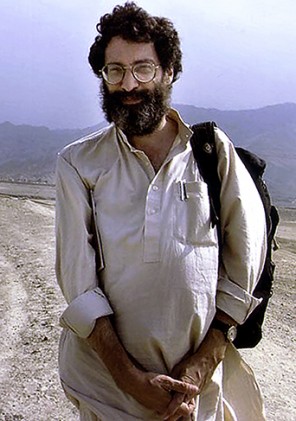
Barry Bearak, who joined The New York Times as a reporter on its Metropolitan desk in March 1997, became a co-bureau chief of The Times's New Delhi bureau in August 1998.
Before coming to The Times, he had been a roving national correspondent for the Los Angeles Times since 1982. From 1976 to 1982, he was a general assignment reporter for The Miami Herald.
Born on Aug. 31, 1949, in Chicago, Mr. Bearak received a B.A. in political science from Knox College in Galesburg, IL, in 1971. He received an M.S. in journalism from the University of Illinois in 1974.
He is married to Celia Dugger, who is also a co-bureau chief in New Delhi. They have two children.