The Wall Street Journal, by Staff
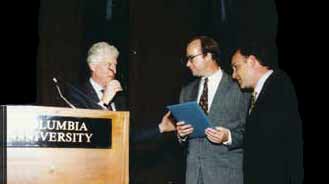
Columbia University Provost Jonathan R. Cole (left) presents Andrew Higgins (center) and Steve Liesman (right), of The Wall Street Journal, with the 1999 Pulitzer Prize for International Reporting.
Winning Work
Missteps by Moscow, New Asian Turmoil Set Off Russian Crisis
Officials' Remarks Rattled Investors Already Jittery About Emerging Markets
Back From the Precipice
By Steve Liesman
MOSCOW -- In the story of how Russia's markets collapsed in May, give at least a couple of paragraphs to a simple mistake by a provincial government aide.
It happened that Lawrence Summers, America's top international-finance official, was in Moscow in mid-May when worries growing out of renewed Asian troubles were rising, and Mr. Summers requested a meeting with Prime Minister Sergei Kiriyenko. But an aide to the youthful new prime minister, hailing from Mr. Kiriyenko's hometown 250 miles east of Moscow, knew only that this Mr. Summers was a deputy secretary of the treasury -- a title unworthy of an audience with a Russian prime minister.
Word leaked out that the two had failed to meet. Then, an International Monetary Fund team left town without agreeing with Russia on a 1998 austerity plan. Investors, already nervous that the country would be unable to pay its debts, feared a rift between Russia and its Western government financiers, despite public support by Mr. Summers for Russia's efforts. Over the next two weeks, a bad situation worsened, as ruble-holders rushed to convert to dollars, stock prices plunged, and a nearpanic brought Russia to the brink.
A look at how the crisis unfolded shows how long-brewing financial troubles combined with misunderstandings, bungled policy initiatives and unfortunate coincidences to undermine the Russian economy.
The nation has pulled back from the precipice, in part by successfully selling $1.25 billion of new Eurobonds and bringing down interest rates somewhat. The Central Bank yesterday slashed its overnight lending rate for banks to 60% from the sky-high 150% set a week earlier, and yields on one-year government bonds fell 6 1/2 percentage points to 48%. While plenty of disarray remains, Russia has recently put on an unusual display of coordination between the government, the Central Bank and the Kremlin.
Still, investors say the country is likely to need a support package worth billions of dollars from the West to emerge from its current financial hole, and it has to convince the world it has learned some lessons. Russia will need to show that its new promises of reform, such as to pass and implement a new tax code, are real. For this latest Russian crisis, while punctuated by things as simple as the misunderstanding involving Mr. Summers, is rooted more deeply: in a changed global outlook toward emerging nations, and in Moscow's repeated failures to follow through on reform pledges.
When the emerging markets of the world were flush, Asian nations got by on their track record of growth and Russia got by on good intentions. That no longer cuts it with global investors. Since the Asian debacle, they are more demanding, says Dirk Damrau, head of research at the Moscow brokerage firm MFK Renaissance. "And Russia has been found lacking," he says.
That is clear from the way investors, domestic and international, have punished Russia this spring. Its stock market, which skyrocketed in 1996 and part of 1997, is down 48% so far this year. For the month of May, it fell 39%. That puts stocks just above where they were in a frightening period two years ago before President Boris Yeltsin defeated a Communist candidate and won re-election.
Amid the latest crisis, government-bond yields briefly soared above 70% annually. The still-lofty rates threaten that unless investors come back into the bond market and drive down yields, the finance ministry will bankrupt itself paying interest. Already, a third of government revenue goes to interest, and billions of dollars in obligations are due in the coming months.
Until the most recent troubles in Asia -- riots in Indonesia, more evidence of Japan's deep ennui, a nuclear race on the Indian subcontinent -- Russia appeared to have escaped the ravages of the Asian monetary maelstrom. Its notoriously poor tax collection was improving. Economic data showed growth for the first time in seven years. Credit Suisse First Boston declared the country a buy. Boris Jordan, an American who has become one of the biggest players in Russia's stock market, went on vacation to Disney World.
Then all hell broke loose. Here is how it happened.
Russia's May crisis is broadly rooted in global conditions, but it traces as well to some blunders here in Moscow.
As markets around the globe stumbled in October, the Russian Central Bank made what many consider a critical mistake: Instead of defending the currency, it used reserves to intervene in the bond market to hold down interest rates. The end result was to wipe out a significant part of the country's gold and cash reserves.
Still, Russia experienced only collateral damage in the fall and winter. The government, then headed by Prime Minister Viktor Chernomyrdin, issued a series of reform pledges. Investors gave Russia a second chance. The ruble held steady, and yields on one-year government bonds, after rising as high as 40%, settled back below 30% by year end. The Russian stock market's fourth-quarter drop, while a jolting 21%, was little more than a dip compared with the butchery in some emerging markets.
Investors were reassured by news that the Russian gross domestic product, on the wane for seven years, actually rose slightly in 1997. The Communist-dominated parliament, known as the Duma, passed a budget that many thought was the most realistic ever, calling for spending cuts and a smaller deficit.
Indeed, in the first quarter of 1998, the deficit held to its target of below 4.6% of GDP, far smaller than the 8.1% of GDP a year earlier. In May, MFK Renaissance said that "since the end of January, more progress has been made on improving Russia's fiscal prospect than in the whole of 1997." The firm planned a lavish investor conference at the end of May, with entertainment by traditional folk dancers and champion U.S. jet-skiers.
Sensing Russia had escaped the emerging-market uncertainties posed by Asia's troubles, Mr. Yeltsin fired his entire government, including Mr. Chernomyrdin, the 60-year-old prime minister who had waxed hot and cold on market reforms in his six-year tenure. Mr. Yeltsin brought in Mr. Kiriyenko, a young, untested former banker who had been in government less than a year. The move boded well for the future, assuming the 35-year-old had time to get up to speed.
He didn't.
Mr. Kiriyenko's approval in late April was the last good day the Russian stock market would see for a while. Asia Again Just as Mr. Kiriyenko was forming his government, the Asian crisis was heating up again. Financial markets grew concerned that the U.S. Federal Reserve would tighten interest rates in response to strong U.S. growth. "The interest-rate story changed the bias of the marketplace," says Phillip Hildebrand, global strategist for Moore Capital Management in New York. With higher rates from the Fed, emerging-market debt could go nowhere but down. He recommended that his investment firm sell, among other assets, some of its Russian debt.
Unsettling news piled up. Riots erupted in Indonesia, and then the Suharto government fell. Rumors circulated of a German interest-rate increase. Credit agencies downgraded Korean banks. India shocked the world by conducting nuclear tests.
"Russia got attacked when Asia came back," says Zoran Konstantinovic, vice president at ED&F Man Global Markets Inc. in New York. "People's appetite for risk was shrinking, and they looked around at countries most likely to be affected."
The response wasn't merciless. The Russian stocks began to fall, but bond investors actually gave Russia two weeks to calm them down.
The opportunity, investors say, was missed. P.R. Stumbles The first in a series of public-relations gaffes began in early May. Central Bank Chairman Sergei Dubinin warned government ministers of a debt crisis looming within three years, a responsible thing for a central banker to inform ministers about. But the Russian press was in attendance. "Of course, it was not said for public consumption," says Sergei Alexashenko, first deputy chairman of the Central Bank.
That same week, while the Russian stock market was tumbling, Mr. Yeltsin had to sign a law limiting foreign ownership of Unified Energy Systems, the national electric-power monopoly and one of the country's few blue-chip stocks. The Duma had overridden his veto. Stocks fell further.
More jitters ensued when statements by Mr. Dubinin, the Central Bank chairman, were misinterpreted to mean the bank was considering devaluing the ruble. He actually was just restating bank policy, but investors' focus shifted to the currency's stability.
The miscues continued. Prime Minister Kiriyenko, in one of his first interviews, disclosed that tax revenue was 26% below target. Saying so was part of a policy change, to be frank and open. "We must realize that we're not wealthy enough," he said. "Moreover, we must honestly say that we're quite poor now."
The two-week-old government was in fact making plans to slash spending and raise revenue, but that word was never communicated adequately. "They did all they could," says Evegeny Yuriev, president of Aton, a Russian brokerage firm. "The only thing they undervalued was the value of P.R."
By the end of the second week in May, word had leaked out that the IMF and Russia were at odds over how to cut spending. Some investors within Russia also had heard that Mr. Summers of the U.S. had come and gone without seeing the prime minister. A lot of people started putting two and two together. Right afterward, some big investors "started to sell their [government-bond] portfolios and all Russian securities," says the Central Bank's Mr. Alexashenko. The following Monday, May 18, yields on government bonds soared to 47% as some investors bailed out.
The reaction caused Mr. Jordan, head of MFK Renaissance, significant concern. Normally, with inflation running below 10%, at least some Russian banks would step in to take the government paper at such high rates. Their poor appetite for the bonds was an ominous sign of a local lack of confidence and a liquidity problem in the banking system.
The reason for the lack of liquidity is just one of the ironies of the Russian crisis. It was in part the result of much-needed reforms that, at another time, would have been lauded by investors. "The crisis hit us exactly . . . when a number of good things have been happening," says Aleksei Mozhin, Russia's delegate to the IMF.
The government in 1998 had eliminated tax offsets-paper issued by government agencies to pay for goods and services, which the recipients could use to reduce their tax bills. Without offsets, banks and other companies had to come up with more cash to pay taxes, and that reduced liquidity. "They were doing all the right thingsthat's what makes this so irritating," says Jim Nail, senior analyst in London for Soros Global Research.
Another policy change also hurt. For years, the government had used commercial banks to pay its bills. Last year, it moved to a U.S.-style treasury system, with branches of its own. The change saved money, reduced corruption and made payments more timely. But an unforeseen result was a fall in the cash moving through banks that these banks once used to play the government bond market.
So when the crunch hit, the Russian banks couldn't help.
It can never be known whether Russia could have halted the forces gathering against its markets, but it might have had one last chance in the third week of May. When markets began to drop on Monday, May 18, the Central Bank responded by jacking up its lending rate for banks to 50% from 30%. It used $1 billion of its scarce reserves within two days trying to defend the ruble. The moves, Mr. Alexashenko concedes, were "still not enough."
An IMF team had landed in Moscow that week to complete negotiations with the government on resuming the country's $9 billion loan program with the fund. A deal would have been the first real good news. But the two sides couldn't come to agreement, and the team left. "This was interpreted as a sign of significant disagreement with the fund," says Mr. Mozhin, Russia's delegate to the IMF. An IMF official says the fund had little choice; substantial differences remained, and the fund wasn't going to lie about it.
It was only by Monday the 25th that the Central Bank appeared to realize there was a major loss of investor confidence in Russia. By then, events had a momentum of their own. Demand for government bonds plunged; their yields leapt above 50%.
By Wednesday the 27th, the situation was out of control. The government failed to sell enough bonds at its weekly auction to refinance debt coming due. In the baroque palace in the center of Moscow that is the Central Bank's headquarters, an emergency meeting was convened. A Breather The directors gathered and, for what appeared to be the first time, made a decision that would put the them ahead of the crisis. At first there was debate, but then an obscure board member, the head of the bank's legal department, made a shocking proposal: Raise the Central Bank's lending rate to commercial banks by 100 percentage points, to 150%.
There was silence, Mr. Alexashenko recalls. Then opposition. Then realization that it was the only feasible course.
The Kiriyenko government also began to understand the need for concerted action. It formed and publicized an anticrisis plan and began rare bankruptcy procedures against three companies with significant debts for back taxes. It dispatched Anatoly Chubais, well known in the West as the man behind many of Russia's most significant economic reforms, to Washington to sound out the West about assistance. The prime minister began meeting with foreign investors to reassure them.
The Clinton administration lent a hand by pledging to support an international aid package for Russia, although not promising any U.S. funds.
At this past Wednesday's bond auction, the Russian Central Bank held a firm line on interest rates. And the finance ministry in late afternoon took a gamble and gave Goldman, Sachs & Co. the go-ahead to sell the $1.25 billion in bonds. They sold in 25 minutes.
President Yeltsin, who sometimes disappears in a crisis, also got in on the act. He appeared nightly on Russian television and summoned the nation's financial elite to a well-publicized Kremlin meeting, jawboning them to invest in Russia. He fired the head of the state tax service and brought in Boris Fyodorov, the outspoken former finance minister known as an economic reformer.
All of this, some Russia experts say, just gives Russia breathing room. Without significant progress quickly, panic could come again as quickly as the recent stability has set in.
By the end of this September alone, $2.5 billion to $3 billion in loans from foreign lenders to Russian corporations and banks come due. If those loans aren't renewed, there could be another run on the ruble. Billions of dollars in ruble futures, used to hedge investments in rubles, will also mature by the fall.
The plan at the moment is to raise about $10 billion, but the source is unclear. In the past few days, the Russian government has said it doesn't want additional assistance from the IMF and would prefer to go to the public markets for the moneyanother attempt to show its confidence. The objective is to replace short-term Russian debt with long-term Eurobonds, which are denominated in dollars.
Still, Group of Seven finance officials are scheduled to meet in Paris next week to discuss Russian aid. They are likely to be asking the same question that is on the mind of investors: whether this time the Russian government means it when it talks about reform, or whether the recent pledges are one-time promises to muddle through the crisis.
"In the past, they would get themselves through the crisis and then relax," says Vladimir Potanin, one of the country's wealthiest businessmen. "This government will not have that opportunity."
© 1998, Dow Jones & Company
As Russia's Markets Swoon, the World Wonders What to Do
The U.S. Is Wary of Providing More Money, but Fears Global Crisis Without It
Painful Choices for Yeltsin
By Mark Whitehouse and Andrew Higgins in Moscow and Bob Davis in Washington
For seven years, the West has spent billions of dollars propping up Russia's economy and financial markets.
Yesterday, after months of tremors, that financial system buckled badly. Now, the world is wondering whether billions more are needed, where it would come from and whether it would do any good.
Russia's stock, bond and currency markets all snapped amid investor fears that the government would default on its domestic debt, devalue the ruble or do both. Trading froze as banks and brokers refused each other's business. Annual yields on ruble-denominated bonds soared to more than 200% from 150% as even the hardiest investors shunned the risk. The stock market had to be closed for 35 minutes as prices crashed. It ended down 6.5% on little volume because stocks simply couldn't be traded. So far this year, it has lost more than 75% of its value.
But the fears surrounding Russian markets go well beyond investors or the country's borders. From Washington to Bonn to London, world leaders are treating the crisis as their own.
Just five weeks after President Clinton helped Russia get a $22.6 billion aid package led by the International Monetary Fund -- one of several multibillion-dollar loan programs that the U.S. has spearheaded this decade -- his administration was busy yesterday figuring out what could be done now to avert more-serious problems.
Of course, the country's markets could snap back, as they have before, when Russia and the West have agreed upon combined action. Despite its current problems, the country has made considerable strides toward capitalism -- privatizing its state-run industries, inviting foreign investment, developing bond and stock markets and controlling hyperinflation. Investors had rewarded that progress by buying the country's securities. Just last year, in fact, Russia was the world's best-performing emerging market.
The need for action prompted high-level officials of the Group of Seven industrialized nations to hold an emergency conference call yesterday to discuss Russia's plight, which has become the Clinton administration's main economic worry. Said White House spokesman Michael McCurry: "It's critical that the Russian government act quickly to restore confidence in their economy."
U.S. Treasury Undersecretary for International Affairs David Lipton met in Moscow with Prime Minister Sergei Kiriyenko to determine whether Russia has the political resolve to salvage itself. The U.S. administration, facing a skeptical Congress, is skittish about discussing new money if Russia doesn't show that it can take drastic measures. Indeed, the past few weeks, during which the IMF has poured in $4.8 billion, have shown U.S. officials that the money goes out nearly as quickly as it has come in.
The main concern in Washington is that the lack of confidence about Russia will spread beyond its borders and be picked up by investors in Brazil, Argentina and South Africa, among other locales. After multibillion-dollar bailouts in Russia, Indonesia and South Korea, the IMF worries that it doesn't have the money to prop up other fallen economies.
And lurking not far beneath the surface, as it has since the collapse of the Soviet Union in 1991, is concern about Russian political stability, the future of the Yeltsin government and the safety of the country's thousands of nuclear weapons.
Says Anders Aslund, a former adviser to the Russian government who now is at the Carnegie Endowment in Washington: "This is a situation when you have to act fast."
Standard & Poor's Corp. downgraded Russia's foreign-currency debt, its banks and its local governments. The credit-rating agency cited "Russia's mounting liquidity problems, compounded by the banking crisis, and the likelihood that sharp declines in output and living standards will weaken domestic support for the Yeltsin administration's economic-reform program."
Much of the worry stems from the belief among some that Russia won't be able to muddle through this time, that it has only two choices: sharply devalue the ruble or default on some of its debt. Neither option bodes well. Devaluation would bring the crisis home to the Russian people, who so far have been spared its worst effects. The ability to purchase foreign goods is one of the benefits of post-Soviet economic reform. Devaluation would make even simple foreign products too expensive for the average Russian, who sees the stability of the currency as one of the few tangible fruits of more than six years of economic reform.
Devaluation might bring some immediate relief to major exporters such as oil companies and would reduce the cost of servicing ruble-denominated debt, but it would badly dent the government's credibility -- and President Boris Yeltsin's as well.
The central bank has repeatedly said it won't devalue the ruble. Irina Yasina, the central bank's chief spokesperson, contends that no one would benefit. "It wouldn't increase tax revenues, it wouldn't stimulate exports," she says. "It would lead only to social conflicts and inflation."
Defaulting on the debt -- put more politely, restructuring -- would buy Russia time. It would reduce the demands on its dwindling $17 billion in reserves and already-overstretched budget. But it would diminish the confidence of investors, both foreign and Russian, who will be needed to dig the country out of its deep hole.
A default would likely push Russia into recession and restrict its access to foreign capital for several years. The most likely form a default would take would be a declaration by the Kremlin that it would convert part of its $60 billion in short-term domestic debt into longer-term debt -- but at sharply reduced interest rates. The amount most likely to be restructured is the $18 billion of high-interest government debt that is estimated to come due by year end.
There is no talk of Russia defaulting on its $135 billion in foreign-currency obligations, much of which was restructured in the past several years, opening the way for Russia's return to foreign capital markets.
Nevertheless, say banking experts, foreign investors would likely avoid the Russian market after any kind of default, and capital flight by domestic investors would surge. Moreover, foreign banks would be unlikely to renew their credit lines with Russian banks. Short of the foreign exchange needed to purchase imports, Russia would risk recession.
Yet, a default probably wouldn't hurt Russia as severely as it did Mexico in 1982. Mexico essentially was unable to borrow on foreign markets for nearly eight years. Russia isn't likely to face that severe a consequence because it isn't as indebted as Mexico was. And the U.S. and other major industrial powers may feel more pressure to help Russia mend its finances than they did Mexico.
Marcel Cassard, a former IMF Russia specialist, says an additional $15 billion loan package is needed. Russia has "enough money to hold on for a few months," says Mr. Cassard, who now is Deutsche Bank's chief economist for Russia, "but there isn't enough money to create a level of comfort."
But the chances of putting together such a package are slim, especially if it calls for substantial funding from the U.S. and other major powers. The U.S. Congress, which is already hesitant to provide additional funding to the IMF, is likely to balk at yet another Russia package, especially because the Russians haven't carried out the terms of the one announced in July. That's why officials of the U.S., Germany and IMF have urged the Russians to adopt measures that would improve tax collection and overhaul the tax code, which are viewed as the minimum requirement to gain credibility.
How did Russia get in such a mess?
The easy answer, but not necessarily the most complete one, is dithering on economic reform and rampant corruption. But U.S. officials note that, while all that may be true, much of what troubles Russia has been outside its control. In fits and starts, the country has been trying to transform itself from a military-command economy to something resembling capitalism. Oil-export dollars and revenue from the country's other considerable commodities were going to pay for this transformation.
But this year, the bottom dropped out of commodity markets world-wide, with oil taking one of the biggest hits. Russia may have lost as much as $4 billion in revenue this year from lower oil prices alone, a number, coincidentally or not, that is close to what the IMF has disbursed from the latest loan package
In addition, the Asian economic crisis forced emerging-markets investors to monitor their investments closely, and Russia's messy political and economic foundation didn't hold up under scrutiny. In the spring and summer, the country's markets began to drop, and the IMF stepped in to lead a $22.6 billion loan package secured by promises that Russia would crack down on widespread tax evasion and step up privatization, among other measures.
But the Duma, the Communist-dominated lower house of Parliament, went on vacation after gutting crucial parts of an anticrisis program endorsed by the IMF. The government asked lawmakers to reconvene, but the Duma refused.
President Yeltsin has signed a raft of decrees to try to repair the damage, but Duma assent is still needed to enact a new tax code.
With Asia's markets falling again and Russia's response uncertain, the dam burst yesterday. Investors said their concern about devaluation was heightened by a letter, published yesterday in the Financial Times, from multibillionaire George Soros, one of the biggest investors in Russia. He proposed a "modest devaluation" of 15% to 25%, coupled with creation of a currency board to hold the ruble's value steady. He also proposed that the G-7 countries support Russia with billions more in reserves.
A major problem has been that Russia's political leaders didn't seem to understand the dire straits the country was in. When the market seizure hit, many top officials, including the central-bank chairman, Sergei Dubinin, were on vacation.
Mr. Yeltsin also is on vacation and has said nothing in public. Prime Minister Kiriyenko appeared briefly on television, but only to reiterate that the government will press on with a reform package agreed upon with the IMF last month. Still, many top officials "don't fully understand how domestic developments get linked to international events -- and how quickly capital moves," the senior U.S. official said.
They learned it yesterday if they didn't know it already. Russia's markets didn't just drop; they virtually ground to a halt. Volume on the Russian Trading System, which last year reached as high as $200 million a day, was a mere $10 million yesterday in a market with a capitalization of about $18 billion. Only about five of 51 issues saw any significant trading. Brokers, fearing other brokers could go bankrupt, refused to deal.
"We're not participating in this madness," said Dan Rapoport, director of sales at the CentreInvest brokerage in Moscow.
The market malaise has also exposed the weaknesses of Russia's commercial banks, many of which have built their fortunes on risky investments and large portfolios of high-yielding government debt. Now that the debt has depreciated to default levels, the banks are left without a source of ready cash, and this week some began reneging on their debts. As a result, Russian banks no longer trust each other, refusing to lend money or make currency deals. Western banks that have lent money to the Russians on the collateral of dollar denominated bonds are demanding payments, known as margin calls, to make up for the loss in value of the collateral. Some Russian banks haven't met the calls, and the Western creditors have liquidated the collateral, fueling a drop in prices.
Yesterday, Moody's Investors Services downgraded its long-term foreign-currency deposit ratings for 11 Russian banks. German banks have also been rocked by Russia's troubles because their Russian exposure dwarfs that of other lenders. German banks have about $30.5 billion in exposure to Russia -- about 13% of their total capital -- compared with only $7.1 billion for U.S. banks and $7 billion for French banks. Some German bank stocks fell as much as 4% before recovering toward the end of the day.
However, Matthew Czepliewicz, an analyst with Salomon Smith Barney, says investors are overreacting. For one thing, more than half of the German loans are either on the books of public-sector banks or are guaranteed by the German government. Besides, Deutsche Bank AG, Dresdner Bank and the others have already set aside reserves of 60 cents on the dollar for the portion of their Russian loans not guaranteed by the German government.
The only thing yet to plummet in Russia's markets is the ruble. Over the past few weeks, the central bank has spent nearly $2 billion of its precious international reserves to prop up the currency. Fearing an attack on the ruble, the central bank yesterday tightened emergency controls on currency trading, demanding that commercial banks prove that they are buying dollars for clients and not for their own accounts. Nonetheless, the ruble yesterday was trading at 6.4 to the dollar, below the target value set by the central bank.
Betsy McKay in Moscow and Carla Anne Robbins in Washington contributed to this article.
© 1998, Dow Jones & Company
At Russian Companies, Hard Numbers Often Are Hard to Come By
Many Accountants Still Use Old Soviet Standards; Profits Turn Into Losses
'Reality Is Very Complicated'
By Andrew Higgins
MOSCOW -- The Bratsk Aluminum Plant trumpeted its good news: a hefty $37 million profit. Then, nudged by auditors from Arthur Andersen, it mumbled a melancholy coda: Well, actually, the plant had a $7.4 million loss.
Puzzled? Foreign investors certainly are. So, too, are some of Russia's most numerically nimble minds.
Moscow has the gloss of a modern economy: financial markets, shopping malls and a burgeoning demand for exotic pets and psychiatrists. At the foundations, though, lie some very soggy numbers. Profits dissolve into phantoms; losses metamorphose into earnings. It all depends on who is doing the counting. A year ago, the muddle hardly seemed to matter; Russia had the world's best-performing emerging stock market.
Today, Cinderella's coach is again a pumpkin. Russia's market is down 77% so far this year and among the world's worst performers. Now, the swings in the ruble's value make it all the more difficult for multinational companies to assess the books in Russia. And the muddle over numbers has never mattered more.
While baffled investors scratch their heads, arithmetic contortions that enable companies to make and lose money simultaneously are vexing some of Russia's premier computer programmers as they try to write software that can straddle the two systems. "Russian profits are different from Western-style profits. The same data can give different results," says Sergei Nuraliev, head of the accounting-software department of 1C, a Russian computer company. "It gets very complicated. . . . Translation is sometimes difficult."
In a rented annex of Goskomstat, or the State Statistics Committee, 1C designs software to help companies convert their raw financial data into two, often contradictory sets of accounts: one Russian and one Western. The proximity to Goskomstat, custodian of Russia's gross domestic product and other major economic indicators, is perhaps less than auspicious: Its chief statistician was arrested in June for allegedly doctoring production figures.
"It is absolutely incredible that after this number of years, the system of accounting is largely unreformed," says Trevor Link of the Arthur Andersen office in Moscow. "It fit the Soviet era very well, but was never designed to account for things like profit."
The Finance Ministry wants this changed. So does the International Monetary Fund, which last month put together a $22.6 billion assistance package for Russia in return for promises of reform, including changes in accounting. Another powerful impetus is individual Russian companies' hunger for foreign money. Investors, tired by being mauled in Moscow's markets, want to see books they can trust.
The dry arcana of accounting has become the unlikely battleground for a critical struggle over Russia's economic future. Most of Russia's major oil companies, its natural-gas monopoly, RAO Gazprom, and some other large corporations have begun producing Western-style financial statements, in addition to statutory Russian accounts. But the vast majority of enterprises in Russia -- and in other former Soviet republics -- stick to the old ways. For Russia to integrate into the global economy, beyond the borders of the former Soviet Union, they also must change.
More often than not, the task of counting the money still falls to people such as Nadezhda Belobrovkina, chief accountant at the Moscow Electrode Factory. She learned her trade more than 20 years ago and keeps punctilious records by hand in a big white ledger. The crumbling factory has trouble paying its staff of about 1,500, has fallen heavily into debt -- including millions of rubles in unpaid energy bills -- but, according to Ms. Belobrovkina's calculations, still turns a profit. How? "This is a commercial secret," says the plant's director, Nikolai Ovchinnikov.
Mrs. Belobrovkina has never bothered with International Accounting Standards nor heard of the even-stricter Generally Accepted Accounting Principles used in the U.S. But she fantasizes about what they might bring: "I hear that accountants in the West go to work only once or twice a week. If such a system were introduced here, we would be very happy."
Russia's Chart of Accounts, the framework for corporate bookkeeping, dates from November 1991, just weeks before the Soviet Union fell apart. Since then, it has been patched up with laws, decrees and instructions, cataloged in a twice-monthly journal. But the grip of a fundamental Soviet-era principle remains firm: The purpose of accounts is to help the state -- formerly the central planners and now the tax police -- stop people from stealing by keeping tabs on inventories, -- not to help managers develop their businesses.
Soviet accountants served as the state's quartermasters. In a system driven by production rather than profit, they tracked the flow of inputs and outputs, heedless of whether value had been added or subtracted, money made or lost. But instead of perishing with the Soviet Union, homo sovieticus, that species peculiar to the decrepit Communist system, still lingers on in offices cluttered with carbon paper, dog-eared files and clunky adding machines.
Some younger Russians are appalled. In March, Rusaudit, a Moscow-based Russian auditing firm, sent economist Aleksandr Voiskoboinikov to review the accounts of a paper company in Perm, on the western edge of Siberia. The records for an entire year had vanished, and those that remained were of little help. "The chief accountant started drinking at noon, so we tried to catch her before 11 o'clock," he says. After interviewing staffers about dimly remembered barter deals and offbook transactions, Mr. Voiskoboinikov produced a report. But he admits he had little idea what was really going on.
The rot in Russian numbers starts at the top. Figures have always been a negotiable and frequently friable commodity. In the Soviet era, the State Statistics Committee pumped out dubious data. The agency has since been reorganized and stripped of responsibility for former Soviet territory outside Russia, but its data remain dubious. Authorities allege that its former chief, Yuri Yurkov, arrested in June, skewed the numbers on factory production and the like to help companies avoid taxes and sold confidential information. Investigators say they found about $1 million in cash and a trove of jewelry in his home. Mr. Yurkov, who unsuccessfully appealed his arrest, now is awaiting trial on corruption charges.
Pervasive mistrust undermines what in the West are the basic building blocks of bookkeeping. Soviet central planners, wary of giving accountants freedoms they might abuse, banned them, in effect, from thinking for themselves. Instead of allowing accountants to set depreciation rates according to real wear-and-tear, for example, the state published a weighty tome dictating the lifespan of everything from wooden chairs to machine tools. The index has been simplified, but state-set formulas still inhibit accurate evaluation of fixed assets and discourage replacement of obsolete equipment and buildings. Western accountants set the useful life of most buildings at less than 30 years; in Russia, they are decreed to last up to 100.
One company struggling to straddle the two systems is Bratsk Aluminum, Russia's biggest aluminum smelter. The chasm between Western and Russian accounting measures, between what the company's Russian accountants say it earned in 1997 and what Arthur Andersen says it lost, exceeds $44 million. "This loss is purely artificial," says Arkady Gaukhman, the plant's chief accountant. "I don't know where he is coming from," replies Marcus Rhodes, head of Arthur Andersen's audit-advisory division in Moscow. "The loss recorded in the financial statement is the loss as audited."
Arthur Andersen estimated Bratsk's depreciation at $56.3 million; Bratsk put the figure at only $19.4 million. Bratsk said its buildings last 40 to 50 years; Arthur Andersen put their useful life at 15 to 30 years. The Western and Russian versions of Bratsk's performance also diverge on estimates of doubtful debt, inventory reserves and subsidiaries' earnings.
Similar muddles bedevil Russian banking. Just as factories here keep obsolete equipment on their books far longer than those in the West, Russian banks do the same with dodgy loans. The Central Bank is trying to change this and is pressuring the banks to disclose the true state of their finances. Among reforms endorsed by the IMF is a requirement that, starting next year, all financial institutions report consolidated results. The move is designed to stop them from playing shell games with their bad loans.
Barnacled by the past, Russian accounting impedes the way business works in a market-driven economy. The Soviet system never really bothered with advertising or to account for costs of employee training or business travel. Today, such costs are an important part of doing business here but require elaborate arithmetic gymnastics to satisfy the tax collectors. Instead of regarding them as normal business costs, authorities see them more as camouflage for possible tax fraud and put strict and bafflingly complex limits on deductions. The Finance Ministry says a new tax code will help correct this flaw.
The Soviet legacy also prevents a clear reckoning of the money many Russian enterprises still spend on staff housing, clinics, kindergartens and other services. Russian accountants usually bury such "social costs" in murky "special purpose" funds that can take Western auditors months to unravel.
The confusion underscores a sobering fact. Communism collapsed seven years ago in Russia, but the transition to capitalism remains a chaotic work-in-progresss. "Change the name of the country, change the flag, change the border. Yes, this was done overnight," says Bruce Bean, head of the American Chamber of Commerce in Moscow. "But build a market economy, introduce a meaningful tax system, create new accounting rules, accept the concept that companies which cannot compete should go bankrupt and the workers there lose their jobs? These things take time."
© 1998, Dow Jones & Company
Lacking Money to Pay, Russian Firms Survive On Deft Barter System
It Keeps Commerce Going, But No Cash Prices Mean No Market Discipline
Blankets for Power for Taxes
By Andrew Higgins
KOSTROMA, Russia -- Away from the mayhem in Moscow, Igor Sizov, director of the Kostroma Textile Machinery Design Bureau, has more urgent matters to worry about: 6,000 pairs of thick woolen socks for the local police department.
No money will change hands. In the economic twilight zone inhabited by most Russians, it rarely does. Instead of rubles, Mr. Sizov will get a reprieve.
The deal is simple. Kostroma's police, among the millions who get paid late or never, will get warm toes. In return, they will take the heat off Mr. Sizov's decrepit plant over its unpaid taxes. "This is not a solution," says Mr. Sizov, "it is just a way to keep going."
But in which direction? Behind all the sound and fury in Moscow -- where the ruble, government debt and now the government itself have been cast to the wind -- lies a fundamental question about Russia: Is this market capitalism as it emerges from its chrysalis or the survival mechanism of a system unable to embrace real market forces?
In the saga of the socks lurks the dead soul of Russia's economy. The deal helps police to patrol the streets, and the Textile Machinery Design Bureau to stagger on. But, along with countless similar transactions, it hobbles Russia's clubfooted transition to capitalism.
Mr. Sizov's plant can't sell its products, it can't pay its taxes, it can't pay its electricity bills, and it often can't pay its workers. (They, too, get stuck with socks.) But like tens of thousands of crumbling Russian enterprises, it has survived, just.
Protected from the harsh discipline of money and markets, it finds shelter from bankruptcy in a ruble-free zone of barter, debt and favors. This sanctuary has saved Russia from mass unemployment, but it has dulled the promise, along with the pain, of the market.
A government report dissecting Russia's deformed economic anatomy calls it "Syndrome X." The International Monetary Fund refers to it coyly as Russia's "structural agenda." Clifford Gaddy, a Brookings Institution authority on Russian industry, dubs it "the virtual economy."
An official survey of 210 enterprises at the backbone of the economy estimated that barter, debt-swaps and other nonmonetary deals accounted for 73% of transactions in 1996 and 1997. The businesses surveyed paid only 8% of their taxes with real -- what Russians call "live" -- money.
An announcement yesterday by the central bank that it would curtail support for the rapidly dropping ruble will add another layer of unreality. The withering of Russia's currency, while making it easier for companies to pay off their bills and debts, is likely to further entrench barter.
For this surreal system to survive, however, every link in the chain must hold firm. In Moscow, markets and the government buckled under the strain. And in Kostroma, too, the chain is badly fatigued; city hall went dark for several days this summer. Across Russia, a showdown looms. The outcome will decide whether taxes, bills and wages get paid and whether the discipline of live money takes hold.
Until last week, foreign investors stood aloof from such woes. The markets were tumbling, but the causes seemed to lie elsewhere. Today, investors have been sucked into the virtual economy. They, too, might not get much more than socks. Last Friday, Sergei Kiriyenko, then prime minister, told parliament: "We are getting rid of a disease. It is called the habit of living in debt." Two days later, President Boris Yeltsin got rid of Mr. Kiriyenko.
The disease has spread to every vital organ, from the central government in Moscow to factories across the country. All live in debt. Workers are owed more than $11 billion in unpaid wages -- equal to what the IMF pledged in new loans to Russia for the entire year. The electricity network, RAO Unified Energy Systems, or UES, owes the government at least five billion to six billion rubles but says it is owed twice this by deadbeat customers. RAO Gazprom, Russia's natural-gas monopoly, owes 12 billion rubles in back taxes but says it is owed 13 billion itself.
"The blood of industry is cash," says Yuri Filippov, head of the Kostroma region's industry department. "There is not blood in our veins." Without money there are no real prices; without prices there can be no effective market.
Kostroma, 200 miles northeast of Moscow, has a peculiar relationship with cash. Five years ago, when the government canceled all Soviet-era money, it chose the region as the graveyard for notes bearing Lenin's portrait. A cavalcade of trucks lumbered through the city, carrying coffins of cash to a ballistic-missile base outside town. Billions of old rubles now sit rotting at the bottom of unused silos.
The region's Communist-backed governor, Viktor Shershunov, declares the cash-clogged missile silos an environmental danger and laments the irony: The place is jammed with useless rubles even as "our biggest headache is getting money." He hasn't had his power cut off yet but has taken precautions. "We have a stock of candles ready," he says.
The problem for Kostroma, and the country as a whole, is that while the currency of Lenin's realm has been buried, the economic system it oiled still rumbles on. Factories have been put in private hands, but not into a real market.
In the main workshop of Mr. Sizov's plant, a handful of men hammer chunks of metal in semidarkness. The lights are off to save money. Unable to sell the machine technology it was set up to develop for the Soviet Union, the plant now makes primitive spare parts, mostly nuts, bolts and washers. Payment for them clogs corridors and offices: plastic bags stuffed with wool from a textile mill in Uzbekistan; heaps of blankets from a Moscow manufacturer; a mountain of tablecloths and heaps of flax from a linen combine.
The flight from money began as a rational response to hyperinflation. Back in 1992, it made sense to accept solid goods, not withering rubles. But the habit became a crippling addiction.
Now, Russia's newly reinstated prime minister, Viktor Chernomyrdin, faces a critical decision: Feed the addiction or force cold turkey. His past makes the former more likely. As prime minister from 1992 until March, he nurtured the debt habit. Earlier, he ran Gazprom, the biggest pusher of economic painkillers.
Last year, Gazprom's Russian customers paid only 15% of their bills with cash, covering the rest with IOUs and barter. Gazprom, in turn, begged off paying taxes. Moscow has tried this year to halt the cycle. It told all companies to pay federal taxes with money. From Moscow to Magadan in the East, the virtual economy shuddered. And, in Kostroma, the lights went out in city hall.
Gazprom's domestic gas supplier, Mezhregiongaz, had passed the pressure to pay on to its local customers. In Kostroma, this meant KostromaEnergo, a branch of the UES electricity network. It acknowledged owing 173 million rubles for gas but said it couldn't pay until it got paid itself-by Mr. Sizov, by the police, by bureaucrats and by other customers.
Mezhregiongaz refused to budge. In May, it turned off the power company's gas. The power company got some fuel from a neighboring region that owed it a debt, but when that ran out it pulled the plug on city apparatchiks. "I warned them," says its director, Yuri Nazarov. "It was very simple: Pay up or we'll cut off your power."
Simple, but also revolutionary. "I've worked in this business for 37 years, and this is the first time anything like this has happened," he says, waving sheaves of paper listing his deadbeat customers. So novel is the notion of mandatory payment that the main power station last year raised output by 46%, while consumers paid only 1.8% of their bills with money.
At city hall, the lights went off, computers crashed and bureaucrats scurried to the canteen, the only room left with power. The mayor, Boris Korobov, rushed back from a trip and sent an SOS to the military. Russia's strategic rocket forces came to the rescue: The local commander provided an emergency generator. "Nobody likes this mess," the mayor says. "This is not the market. It is the Middle Ages."
After three days, the power came back on. Municipal authorities agreed to pay up in part. Gas and electricity companies reshuffled the pack of unpaid invoices. Gas supplies resumed. But while the blackout has left much bitterness, it solved nothing. The spiral of debts and counterdebts has begun again.
This Monday, KostromaEnergo struck a deal with Mr. Sizov's textile-machinery plant for 50,000 rubles' worth of electricity. "We didn't have to pay a single kopeck," said Alexander Dobrokhodov, the plant's deputy director. In return for power, the factory is giving 400 woolen blankets to a camp for handicapped children. Their value will be deducted from KostromaEnergo's local taxes, just as the socks for the local police will wipe out part of the machinery plant's own municipal tax bill.
And why does Mr. Sizov have blankets? He got them from a Moscow factory, in return for deliveries of wool, which he earlier got from a textile factory in Uzbekistan in return for equipment.
Meanwhile, the Kostromskie Vedomosty newspaper has just sold off the last of hundreds of linen sheets and pillowcases that for months cluttered its offices. It got them in return for money it had on deposit with a bank that closed after one of Mr. Sizov's old customers, the Big Linen Manufacturer, failed to repay a loan.
Under the socks and blankets hides both the tenacity and decrepitude of the past. The Kostroma Textile Machinery Design Bureau was once a flower of Soviet industry. It never had to look for customers: They were assigned. Today, "nobody is interested in buying my equipment," Mr. Sizov says. "All my customers are in a deep crisis. Their products cannot compete."
In a market economy, they and he would be out of business. A new bankruptcy law will encourage that, but only a tiny fraction of the estimated 800,000 technically bankrupt companies are expected to file. And even those that do rarely close. For some, the new law allows up to 10 years in court-administered limbo.
More important is political will: Can government embrace a discipline that throws millions out of work and into cold darkness?
More likely is slow-motion decay. Mr. Sizov has slashed his work force to less than 100 from 260 and evacuated all but the lower three floors of a seven-story building, to save on heat and power. (He rents the third floor to homeless soldiers.)
Production has shriveled to a few rudimentary parts and the odd lightweight weaving machine. The plant's only new product is socks -- made on equipment it can't sell, from the wool it gets from customers without cash.
Now that the federal government wants its taxes paid in money, Mr. Sizov has turned one of his offices into a cash-only emporium of barter flotsam. The system "is very difficult for people like me," says the 58-year-old engineer.
It is less so for people like Vladimir Zelentsov, a 39-year-old maestro of the barter system. Dressed in a black-denim jacket and jeans, wearing a chunky gold ring, he crisscrosses the country stitching together deals.
Recently he was in Kostroma to see an old friend, the director of a linen mill whose workers haven't been paid for two months. It has been closed for an extended summer break, though the director does have one achievement he is proud of: He recruited a 6-foot model from the local fashion school as secretary. "She was top of her class," he says.
Together, the director, 38-year-old Yevgeny Shibanov, and Mr. Zelentsov play the barter game, shuffling IOUs, electricity allowances and goods from one end of the country to the other. Chemicals for the linen mill come from a factory in Chuvash region at the end of long chain, while part of its electricity comes courtesy of a nuclear power station in Kursk that owed money to KostromaEnergo -- and needed linen to complete its own elaborate barter sequence. (KostromaEnergo, meanwhile, has three tractors and tons of Siberian lumber that it got in lieu of live money.)
"Americans won't understand this," says Kostroma's mayor, Mr. Korobov. "You have to have gone through the university of our market economy to understand what is going on."
The head of the region's industry department, Mr. Filippov, thinks someone should write a book on the bizarre and perilous system. "It will be more interesting than a horror film," he says.
© 1998, Dow Jones & Company
The Crunch Points: How Russia Staggered From There to Here
Some Astonishing Missteps Helped Grease the Slide Toward Financial Ruin
Mr. Gaidar's 'Terrible Choice'
By Steve Liesman and Andrew Higgins
MOSCOW -- For Vladimir Potanin, a tycoon now scrambling to keep afloat an empire that embraces banking, oil fields and a nickel smelter, the rot set into Russia's reforms a year ago with a brawl over a phone company.
Iosif Bakaleynik points instead to the years he struggled to drag a Russian tractor factory up to free-market speed. The lessons he had learned at Harvard's business school were ill-suited to Russia's treacherous terrain.
And for Yegor Gaidar, hindsight ranges over decades. The plump, squeaky-voiced economist who crafted Russia's exit from Soviet central planning in the winter of 1991-92 believes it was 70 years of communism, more than anything else, that hobbled the nation's rush to reform.
In the wake of Russia's financial debacle, the soul-searching over what went wrong runs as deep as the country's debts. What became of the promise engendered by the toppling of the Soviet Union is much more than a history or economics lesson, or an exercise in finger-pointing. The answers will guide the policies Moscow pursues in the coming critical weeks and months, how governments from Brasilia to Beijing will confront their own woes, and what, if anything, the West can do to help.
As the country gropes for direction after defaulting on its domestic debt and devaluing the ruble, basic questions arise: Was it wrong to believe that Russia could be so rapidly reconstructed? Is there something unique in Russia's history inimical to market economics? If so, do current events mark the end of another spasm of Westernization and the start of a slide back into Russia's own insular and authoritarian past?
A chronicle of the past seven years shows that the Russian reform effort, wildly ambitious in both scope and pace, suffered from a string of costly miscalculations. It was built on wobbly presumptions -- among them, that old state enterprises could become modern corporations -- and half-measures and compromises born of the country's struggle with its communist legacy. Corruption flourished, while efforts to establish fundamental laws and regulations withered. Inexperienced ministers drifted from indecision to bad decisions. Viktor Chernomyrdin, prime minister from 1992 until last March, provided perhaps the best summary of Russia's reform experiment, commenting on one of the country's earlier crises: "We had wanted the best, but things turned out as always."
The new prime minister, Yevgeny Primakov, a former foreign minister lacking any economic credentials, has put economic policy making in the hands of Yuri Maslyukov, onetime head of the Soviet planning agency Gosplan. The dangers are obvious: Russia has moved far enough since 1991 that the old system cannot be rebuilt; but the system remains close enough that some fragments of the past can be retrieved and pieced back together.
At the height of his authority in 1993, President Yeltsin mused on the failed reforms of czars and general secretaries. "Peter the Great's reforms have not been achieved to this day," he said. Nor have "Lenin's new economic policy, Stalin's industrialization and Khrushchev's thaw . . . changed anything fundamental in Russia."
His own attempt, he declared, would be different.
Where it was unique was the scale. The unraveling of the Soviet Union forced Russians to redraw their borders, both mental and geographic. History, it was said, had come to an end. Russia was its terminus.
When Mr. Gaidar freed prices in January 1992, he told the Russian people to brace for severe pain but promised that their suffering would be rewarded. The past had to be dismantled swiftly, he said, to ensure it would never return. Ever since, Russia and its backers in the West have lived this idea: Fortified by democracy and billions of dollars in aid, the nation would join the advanced world.
Russia's reformers saw themselves as agents of capitalism's inevitable triumph, not politicians selling a program to the masses. Brigitte Granville, a French economist who worked with the reformers from the beginning, recalled a 1993 meeting with many of the leading liberals and officials from the International Monetary Fund and the World Bank. She worried about the impact of reform on ordinary Russians and proposed a social-safety-net loan to cushion the blow. One of the Russians immediately scolded the foreign group, saying, "I didn't know you had a Marxist on your team."
The government made enemies even of the country's most energetic entrepreneurs, the so-called shuttle traders who bought cheap goods in Turkey, China and Dubai for sale in Russia, by saddling them with onerous taxes and duties.
As reform began to bite, many Russians perceived democracy and the free market as their new enemies. The disenchantment was especially deep among some of the country's keen young managers and the workers they tried to convert.
Mr. Bakaleynik, the Harvard graduate, returned to Russia in 1994 after a two-year stint with the International Finance Corporation in Washington and became a pioneer of Russia's privatization program. Backed by a Moscow bank, the then-43year-old businessman gained control of a tractor factory in the town of Vladimir, 120 miles northeast of Moscow. At a meeting with his thousands of workers in a local football stadium, he echoed the words of Mr. Gaidar, warning that "the market is cruel" but also that it would reward those willing to work hard.
For three years, he struggled with overstaffing, outdated equipment and a government more interested in macroeconomics than in the nuts and bolts of change on the shop floor. Last year he gave up. He had slashed his work force to 5,000 from an initial 13,000, but mainly because his markets dried up. Output slumped to 1,800 tractors a year from more than 8,000.
Looking back, Mr. Bakaleynik blames the gap between theory and practice for many of his woes. "The idea of the invisible hand doing the job in two or three years," he says, "was not workable." Instead of nurturing the revival of ailing factories, the government crippled industry through corruption, taxes, shifting policies and monetarist dogma that strengthened the ruble but strangled exports. He left the plant last year and became an oil-company executive in Moscow.
The muddle that came to characterize Russian reform began, oddly, with a decision of uncompromising clarity. By freeing prices only days after the collapse of the Soviet Union, Mr. Gaidar took a wrecking ball to the central tenet of central planning. Fixed prices had smothered incentive to either produce or sell. The only other way to put goods on store shelves was to revive the political terror that had sustained the command economy. "Either you started shooting or you liberalized prices," recalls Mr. Gaidar.
The economic impact was immediate. Prices rose by over 2,000% in 1992, and shop shelves filled up. The political impact was also swift. Their savings wiped out and the rubles in their pocket nearly worthless, many Russians blamed their pain on the country's young reformers, not the communist system that had created the problem.
The communists themselves began to regroup, after being routed the previous year when Mr. Yeltsin defeated a hard-line putsch. Coal miners, who only a few months earlier had been in the vanguard of support for Mr. Yeltsin, staged protests. Impoverished pensioners, many of them reduced to hawking stale Soviet-era cigarettes and old clothes on the street, joined small but angry demonstrations.
For Mr. Yeltsin, who had been basking in the approval of Western leaders and the lingering warmth of public regard that helped him unseat Mikhail Gorbachev, this was the first major challenge. Establishing a leadership style rooted in populism and frequently shifting between boldness and retreat, sickness and health, Mr. Yeltsin flinched this time. He fired Mr. Gaidar and replaced him with Viktor Chernomyrdin, the former head of the gas monopoly now known as RAO Gazprom, who immediately called for an end to Russia's market "bazaar."
Relations between Mr. Yeltsin and the parliament festered in a series of confrontations, and the legislators' opposition soon hardened into hostility. In late 1993, Mr. Yeltsin dissolved the parliament and ringed the chamber with barbed wire. When legislators rebelled, he broke them by sending tanks to shell the parliament building.
Underlying the conflict was a fundamental clash over economics: Should the state spend its money to prop up industry, and who should own property? Moscow only fueled the debate with its other major reform step.
If price reform aimed to put bread in the stores for the short-term, privatization was the long-term plan for turning around the economy. The idea behind the program was the product of a freshly minted theory: transfer ownership from the state to workers and managers to give them a stake in success; issue shares that Russian entrepreneurs would use to take over companies and make them profitable; instead of draining money from the state through subsidies, factories would instead help finance the government with taxes.
The theory's champion was Anatoly Chubais, then head of the State Property Committee. Like Mr. Gaidar, he spoke not only the language of free markets but also English. In them, the West invested its hopes for Russia.
In late 1992, the government launched the mass privatization program by issuing 144 million vouchers that entitled nearly every Russian to secure shares in newly privatized firms. The scheme was ingenious -- democratic in its original conception and conducive to the formation of a new industrial elite. But like many other good reform ideas, it mutated.
Entrepreneur Andrei Volgin was one of the first to try putting the theory of privatization into practice. He took over five state-run enterprises, but he achieved only mixed results. For a bread factory in Vladimir, in which he secured a 46% stake, Mr. Volgin says he needed only half the 600 workers. The plant's management and local government resisted cuts. The general director gave himself a loan to buy an apartment.
What the director did in his factory, the men who should have been Russia's Rockefellers, Mellons and Carnegies were doing on a far larger scale.
Privatization raised the profile of a group of new tycoons known to the Russians as the "oligarchs." Back when the Soviet Union fell apart, they set up banks and used them to help the government pay its bills. The state funneled billions of rubles through their hands. As a stop-gap measure, the arrangement made sense for a government that hadn't yet set up a treasury system. But instead of lending money to entrepreneurs, banks used the government funds to make bets on the ruble and bond markets.
"The 10 biggest banks went to the casino and put Russia on the table," says Mr. Volgin. "They lost."
Alexander Smolensky, president of SBS-Agro, Russia's largest private retail bank, derides talk of an oligarchy, saying, "The richest people here are the bureaucrats." He blames these officials for the financial crisis, which has broken his bank. Surrounded in his headquarters by oil paintings and other trophies of earlier success, he has defied an attempt by the Central Bank to place his enterprise under state administration. A 44-year-old former printer and construction manager, Mr. Smolensky dismisses Messrs. Gaidar and Chubais as "laboratory assistants" in an experiment gone haywire.
Even as Russia's financial collapse has pushed some of the tycoons to the wall, they still have connections. Mr. Potanin, for instance, is struggling with foreign creditors to salvage what remains of the banking arm of his Interros financial and industrial group. But he can point to three yellow telephones on his desk that give him direct access to the government's communications network. "This one is for the big officials, this is for the smaller ones and this is for the governors," he says.
Ahead of parliamentary elections in 1993, the emergent business elite helped finance the campaign of reformist candidates led by Mr. Gaidar. It was a critical time for domestic banks, coinciding with a push by foreign competitors to enter the Russian market. Even before the poll results were in, the government showed its gratitude by blocking the competition.
Despite spending far more than the communists and a party of pugnacious nationalists led by Vladimir Zhirinovsky, however, Mr. Gaidar's party secured only 16% of the vote. Mr. Chernomyrdin sniffed a shift in the prevailing winds of reform, immediately declared an end to the era of "market romanticism," and tried to reimpose some price controls. Although he soon abandoned that plan, he did allow another relic from the past, a group of Soviet-era factory directors, to reassert some of its influence.
Meanwhile, the bargain the state had struck with its bankers stuck, and paved the way for others. It was a cozy setup that took on many forms. Mikhail Khodorkovsky, who founded Bank Menatep, one of Russia's top 10 banks, when he was in his twenties, has described Russia's prime minister as "my boss." Sometimes, though, it was hard to tell who was really in charge. When the ruble crashed in 1994, Mr. Khodorkovsky picked up the phone and persuaded Mr. Chernomyrdin to pressure the Central Bank to inject cash into the banking system.
The most controversial bargain came in 1995. In December of the previous year, President Yeltsin had launched a brutal war against the breakaway republic of Chechnya that killed more than 50,000 and drained as much as $5 billion from state coffers just as the country's finances were beginning to stabilize. The huge outflow of public funds tightened the embrace between the state and a few well-connected businessmen. Desperate for cash, the government mortgaged some of its most lucrative assets for a fraction of their real value in return for loans from a handful of bankers. Meeting in secret, they carved up the spoils. Government bureaucrats colluded in the so-called loans-for-shares deals, allowing ownership of the stock-in-trust to be awarded at rigged auctions.
There wasn't even a semblance of propriety. At a news conference in 1996, a Menatep executive could hardly contain his laughter when he claimed, implausibly, that he didn't know who owned the subsidiary that had just bought Yukos, Russia's second-biggest oil company. Russian journalists, served cognac by the bank's staff, guffawed in disbelief. Menatep had run the auction and the bank, it would later disclose, controlled the firm that entered the winning bid.
Beneath the jaunty confidence, though, lurked a constant fear that the state might reclaim what it had relinquished. Mr. Khodorkovsky often joked to associates, "I don't own anything. I rent it."
To protect the lease, the bankers banded together. In 1996, Russia's tycoons went into overdrive in support of Mr. Yeltsin's successful re-election campaign against his communist rival Gennady Zyuganov. As well as providing funds, they mobilized their media interests -- newspapers and television -- to serve Mr. Yeltsin's campaign. Boris Berezovsky, a former mathematician who had parlayed a car dealership into one of Russia's biggest personal fortunes, was frank about his motives. If Mr. Yeltsin won, he said of his tennis partner and friend, "maybe my assets are worth billions of dollars"; if he lost, "maybe nothing."
All the while, the government was going broke. It couldn't collect the taxes it needed to pay its bills. So it built a rickety structure of domestic and foreign debt, creating the pyramid that collapsed in August and pushed Russia into default.
The speed with which the edifice crumbled reflected the speed with which it had been built. From the start, Russian reformers and their Western advisers wanted to move quickly, believing that financial markets, no matter how imperfect their construction or regulation, would entrench change and begin to work their magic on Russian enterprises and the economy. The West contributed billions of dollars and Russia quickly had a secondary market for stocks and bonds.
Foreign investors piled in. At one point, 80% of all trade in the stock market was from offshore investors. Bernard Sucher, one of the founders of Troika-Dialog brokerage house in Moscow, heard a knock on his door at 4 a.m. one day in 1994 from a drunken foreign hedge-fund manager desperate for a fix. "He said it didn't matter what stock or what price. He just had to have more."
The stampede blinded investors to the reality behind glossy brochures and lavish road shows. Russian accounting practices warped losses into profits. Regulation was virtually nonexistent. Companies diluted stockholding at will and trampled the interests of minority investors. The Russian Securities Commission had a mandate to prevent this and dollops of Western aid, but no real power.
The Central Bank fared no better in imposing order. Its chairman, Sergei Dubinin, claimed last year that $500 million in government bonds had been improperly diverted through two commercial banks. A week later, an unidentified gunman opened fire on Mr. Dubinin's home. (No one was hurt.)
According to Mr. Potanin, though, Russia's crisis sprang not from this chaos but from an attempt by the government to enforce some rules. A critical turning point, he says, was last's year's auction of the telephone company Svyazinvest. Embarrassed by the furor over loans-for-shares deals, the government organized a relatively fair and transparent sale. Forced to compete, instead of collude, Russia's barons went to war. Destroyed in the hostilities was the nonaggression pact that bound government and business together. The sale, says Mr. Potanin, was "100% correct, but led to disaster."
For all the shortcomings of reform, Russia still managed, on one level, to get things almost right. By last year, basic economic indicators held out the promise of recovery. Inflation had been tamed, the ruble was stable and gross domestic product grew for the first time in a decade, albeit by only 0.8%. Mr. Yeltsin defied the odds once again, surviving quintuple-bypass surgery and double pneumonia. The press and politicians pointed to the rising anger of workers over unpaid wages, which had ballooned to more than $10 billion. But predictions of widespread chaos in the streets and industrial unrest came to nothing.
Upon returning to the Kremlin in the spring of 1997, Mr. Yeltsin brought a clutch of reformers into the government. With parliamentary elections two years away, they had a rare opportunity to take tough decisions previously dodged -- such as cracking down on tax deadbeats, accelerating bankruptcies and laying off workers.
In December 1997, a special commission headed by Mr. Chubais to collect taxes decided to seize and sell the assets of two provincial oil refineries belonging to the empires of Mr. Berezovsky and Mr. Potanin. The tycoons, however, marshaled their forces, and a week later, with Mr. Chernomyrdin chairing a meeting of the commission, the decision was overturned.
A cascade of accidents, bad luck and blunders followed. The price of oil and other commodities that provided more than two-thirds of Russia's hard-currency earnings began to plunge. Mr. Yeltsin shattered the political equilibrium by abruptly firing Mr. Chernomyrdin and naming a 35-year-old political neophyte, Sergei Kiriyenko, as prime minister. The financial maelstrom that had begun in Asia the previous summer looked around for its next victim and found Russia, after seven years of muddle, ripe for disaster.
The International Monetary Fund and other lenders rushed in with a promise of $22.6 billion to try to break Russia's fall, but investors' confidence continued to plummet. As Russia's markets crumpled, Mr. Gaidar, Mr. Chubais and other no-longer-so-young reformers who had laid their foundations years before came together for a last desperate attempt to preserve what they had tried to build. On the weekend of Aug. 15-16, they huddled together in the White House, the seat of the Russian government. Also there were Mr. Potanin, Mr. Berezovsky and most of Russia's other business barons. The IMF's senior Russia expert had rushed to Moscow to add his voice, but left his checkbook in Washington.
Mr. Gaidar, though long out of office, found himself confronted with "a terrible, unpleasant choice," almost as fateful as the one he faced when the Soviet Union fell apart. Reformers, he says, had for years feared such an across-the-board financial collapse. Now it had come. "It was our worst nightmare," says Mr. Gaidar.
On the morning of Aug. 17, Prime Minister Kiriyenko and Central Bank Chairman Dubinin announced the result of the weekend conclaves. Russia would default on government debt, devalue the ruble and impose a moratorium on the repayment of foreign private debt.
As so many times before, the government wanted to offer something for everyone, except for foreigners who had no political clout. This time, though, the attempt at compromise led to disaster. The currency sank; the banks became insolvent; and the government ruined, probably for years, its ability to borrow. A week later, Mr. Yeltsin sacked Mr. Kiriyenko, Mr. Chubais and their colleagues. Instead of saving reform, Russia's reformers ceded the initiative to the communists. The new government headed by Mr. Primakov is now groping for a third way between the familiar tensions of the state vs. the market, economic populism vs. austerity, and Russian answers vs. Western solutions.
The man who launched Russia's reforms still clings to his convictions and believes the country, after another failed search, will return to his path. Says Mr. Gaidar: "I'm absolutely sure that I'm right."
© 1998, Dow Jones & Company
From Worry to Worse
Revisiting a Family In Russia 7 Years Later
The Starodubovs Bicker, Fret Under Reality's Grind; Meat Pies Pay the Bills
Like 'Claws on Your Soul'
By Betsy McKay
MOSCOW -- On the street, Svetlana Starodubov stifles her rage. In the privacy of her own apartment, she's falling apart.
As the ruble sags, prices climb and shops empty, the stocky 43-year-old meatpie vendor paces her apartment in the middle of the night. She calls her husband a "vampire" and "lazy drunk." He says she's a nag. The two spend many nights apart; he stays in their new apartment while she camps out at the communal flat where they used to live.
When Mrs. Starodubov and her husband, Vitaly, first appeared on these pages in 1991, communism was crumbling and the couple worried they wouldn't be able to provide for themselves in the harsh new market economy. For Mrs. Starodubov, "it was like being thrown into a boiling vat and told to find our own way out."
For a time, they thought that they had crawled at least to the rim. They got a new apartment, a color TV and Sony VCR. They found jobs in the private sector and learned to work long hours for extra pay.
But the market economy that the Starodubovs and other working-class families had fumbled their way through has imploded, leaving them more anxious and confused than ever. In 1991, they worried about keeping up as the country rushed toward capitalism. Now they have no idea where they or the country are going.
Russia's financial crisis has knocked them back into the vat. Their incomes are sinking, and prices are rising. They don't own stocks in privatized former state companies or have permanent jobs. But at one point, they benefited from those who did. Mr. Starodubov, a 40-year-old construction worker, laid polished Italian granite tiles for Moscow's new commercial banks. Most of the banks are now bust.
On one level, the Starodubovs' spats are like those of any couple whose marriage has gone wrong. Yet they also reflect the tensions of a society once again in turmoil. Times of economic stress increase rates of depression and disease, health experts say, and Russian newspapers in recent weeks have been filled with macabre reports: A locksmith in southern Russia burned himself to death after not receiving a paycheck for two years. In Moscow, a young man committed suicide after he lost his savings and his fiancee walked away.
Like most Russians, the Starodubovs aren't about to take their anger to the streets. They don't see what would be gained by overthrowing the system. But they yearn for someone to bring stability to their lives. The "democrats" in power have done as little for the common man, they think, as the Communists before them. "We're not ready for democracy," Mr. Starodubov says. "We just don't understand it. Russia needs a firm hand-not a Lenin or a Stalin, but still a firm hand."
A recent workday begins for Mrs. Starodubov at 9 a.m. Arriving at a teeming outdoor market, she dons a stained white frock. Tables are groaning with vegetables and fruits, and the air is thick with the odor of pickled garlic. In Soviet times, Mrs. Starodubov earned a paltry salary just for showing up at the state-run warehouse where she was a clerk. She had no idea how private business worked.
Today, the amount she earns depends on how much she sells. Her boss is no longer the state, but a middle-aged Tatar woman who runs a small meat-pie franchise in the Vykhino market, a gritty bazaar in a working-class neighborhood. To earn her 50 rubles a day, Mrs. Starodubov must sell 70 pies. It means hustling for eight hours on her feet with only a few short breaks. She says she sells more pies than anyone else. And when the pies sell slowly, she earns a few extra rubles packing cabbages in sacks. "Under the old system, only people who stole got ahead," she says. "Here, you can work for yourself. You smile at people and they smile back. People are learning to live life all over again."
For a time, she dreamed of starting her own business. But that hope has perished. Once again, the issue is survival. Her boss has raised the price of the pies to five rubles from three, but takes pity on Mrs. Starodubov, who she knows is supporting her family, and lets her sell them for four.
In the Soviet era, the Starodubovs spent hours in lines to buy cooking oil or milk. Now they can buy food on any street corner. But they can't afford much. Mrs. Starodubov's salary has stayed the same since the ruble started falling in mid-August, while prices have gone up 67%. In dollar terms, she earns about $3.75 a day.
Mr. Starodubov has been staying home of late. Normally, he works on two- to three-month construction jobs on contract for private firms. But no one has cash now to build.
They waited 16 years for the flat, a boxy two-room space on the 13th floor of a concrete housing block. The small elevator doesn't always work -- sometimes it will come down only to the third floor, so they must walk up and then take it.
Until they moved here, the Starodubovs were crowded with their two children into one tiny room of the communal apartment. After waiting on a Soviet-era list and finally getting the new apartment three years ago, they rented it out for a year to nine Ukrainian workers for $250 a month.
With the cash, they bought a "foreign" car, Mr. Starodubov jokes: A cheap Tavria sedan, made in neighboring Ukraine. The car is used only occasionally, as when the family goes to visit Mr. Starodubov's mother, who lives about 250 miles south of Moscow. Mr. Starodubov used to have a car he called his Rolls-Royce, but it was stolen soon after the Journal article in 1991.
By the time they moved into their apartment two years ago, construction was booming in Moscow and Mr. Starodubov was bringing home regular pay. For adorning their garish new offices well and quickly, some banks would give him bonuses of $100. He bought a big Russian-built, Western-style refrigerator to replace an old model that they used to open with thick gloves so as to avoid electric shock. They also replaced the Soviet black-and-white TV with a big Grundig color model.
He pilfered some pink and black granite tiles from one bank and used them to pave the floor of the apartment's dark, fetid bathroom. Another financial institution yielded some leftover gray industrial carpet for the floor, though Mr. Starodubov has yet to lay the carpet. Mrs. Starodubov bought shelves, wallpaper and light fixtures, "all the cheapest kinds," she says.
Sergei, their 19-year-old son, sleeps on a sofa in the living room, while the parents and Irina, age seven, sleep in the one bedroom. Just off the bedroom is a small balcony where the family keeps the potatoes, pickles and onions they brought back from the garden of Mr. Starodubov's mother to sustain them this winter.
In the kitchen, a makeshift shelf, held up by a chair on one end and a sink on the other, holds soap and drying dishes. The family uses bar soap to wash dishes to save on detergent.
Things were looking up until last year, when Mr. Starodubov started having trouble collecting his pay. After working at an office building owned by Tokobank, he got paid in installments of 500 to 1,000 rubles for three months. But the big Russian bank closed this summer. "It's humiliating," he says. "You give an honest effort, and they deceive you."
Then, lured by an offer of the ruble equivalent of $1,000 a month, he left his family for three months to help refurbish some buildings at the Baikonur space center in Kazakstan, about 1,800 miles away. He had arranged for his pay to be sent to his wife, but nothing came in.
So Mrs. Starodubov starting selling meat pies. She had hoped to rely on her husband's salary after quitting a 280-rublea-month job as a cleaning woman at a factory that makes ventilators. She had gone to work there after Irina turned three and her state stipend for new mothers ran out. But she hated it because the boss was a "self-important necktie" who she says treated her like a vassal.
Mr. Starodubov, looking since May for his salary from Baikonur, picks up his umbrella and goes outside to a pay phone. The Starodubovs don't have a phone in their apartment because, while the service itself is cheap, installing a phone means either waiting at least five years for the state to allocate a line, or paying around $2,000 for a private service.
He reaches the phone and dials the contractor. He is still owed 6,000 rubles. Back when he did the work, it was worth $1,000. Now it's about $375.
No one answers. He resolves to try again in a few hours, and heads for the store. He has only 250 rubles left from his last disbursement. He buys a loaf of bread, whose 2.70-ruble price tag is one of the few that hasn't been raised, a three-ruble beer and a pack of Russian cigarettes for 2.50 rubles. Normally he smokes L&M, but they cost 15 rubles a pack now, up from three rubles a month ago.
Mr. Starodubov's helplessness frustrates and angers his wife, whose salary is too little for the family to live on. At home that night, weary and sore, she yells at him to get a job. "Half of Moscow is under construction!" she barks.
Her anger overcomes her once in a while. She chased him around the apartment one night with a plastic rod, calling him a "vampire," he says, after watching a translated version of Quentin Tarantino's "From Dusk Till Dawn," which Sergei has brought home on video.
A few days later, she moves out to their old room in the communal apartment, which they have held on to for 50 rubles a month; the other apartment costs 144 rubles a month. They did this by deploying a bureaucratic ruse perfected by millions of couples in the Soviet era: As soon as they got the apartment three years ago, they divorced. Each is registered now at one of the state-owned properties. Because one is a communal flat slated to be broken up, they're in line for a second new flat, which might eventually be used by the children when they move out.
A few mornings after she has left, a co-worker drops by to tell Mr. Starodubov he can get his remaining salary from Baikonur that afternoon.
Mr. Starodubov picks up Irina from school. She has started first grade a year late because of developmental problems that are likely connected to trauma at birth that damaged a nerve in her neck. The car is broken, so they take a bus, the metro, a suburban train, and then another bus to get to the office where the money supposedly awaits. After a wait of an hour or so, the department director emerges, counts out 5,500 rubles, and tells Mr. Starodubov he'll have to come back another time for the other 500 rubles. "They do that just to keep you hanging," Mr. Starodubov says later in disgust.
To celebrate, he drinks heavily at home that night. The next day, he takes Irina shopping to a small grocery store. Inside, some worried women are asking the manager when he's going to raise prices again. Some brands of Russian sausage are 105 rubles a kilogram, which is $16.60 at the ruble's rate before it started to fall.
Mr. Starodubov spends 19 rubles for half a kilogram of the cheapest bologna. He wants some kasha or buckwheat, but most long-life staples have been bought out. Impulsively, he buys Irina a treat: For four rubles she gets some vanilla ice cream in a chocolate-coated roll. For himself, he buys a five-ruble beer.
At a farmers' market, Mr. Starodubov picks over some dill and peppers for two rubles each. He stands in line for a slab of fresh butter for 15 rubles, up from four rubles in just a week.
As noon approaches, Irina begs her father to buy her some shashlik, or grilled kebabs. He hesitates; it's 16 rubles for five pieces of beef from a sidewalk vendor. But he gives in.
Economizing has never been easy for him. When Journal readers sent the Starodubovs $350 back in 1991, they spent it all quickly. They wasted about $30 on a pair of Chinese-made sneakers for Sergei that turned out to be mismatched and quickly fell apart.
But Mr. Starodubov will have to watch his rubles now. Until his wife comes back, he will have to stay home and take care of Irina. Sergei, who spends a lot of his evenings either at discos or watching American horror or action films on television, has just finished vocational school and is waiting to be drafted into the army for a two-year stint. Once the money runs out, Mr. Starodubov says, he can sell the garage where he stores the Tavria and live on the proceeds for a while. The family has 1,000 rubles that Mrs. Starodubov has kept in the state savings bank-worth only $62 now.
But then he'll have to find some work. "I can't just lie on the railroad tracks," he says, referring to coal miners who staged protests earlier this year in Siberia.
Back at the apartment, he shows Irina how to unlock the door. She must learn, he tells her, because if he goes back to work, he may have to leave her alone. She struggles to turn the key in the lock. Finally, he turns it for her.
"You get by day to day and keep a smile on your face," he says. "But inside, you feel like cats are sharpening their claws on your soul."
© 1998, Dow Jones & Company
Disaffected Russians Turn for Advice To Voice of Belarus
Mr. Lukashenko's Broadcasts Tout Old Soviet Controls; Down With Free Markets
By Andrew Higgins
MOSCOW -- Russia is looking west.
Just ask Tomas Korganov, a Moscow musician who has cast his eyes --and ears -- westward and found a cure for Russia's ills. "They have shown us the way forward," he says.
During the Cold War, fed-up Russians turned for solace to the BBC, Radio Liberty and the Voice of America. Today, Mr. Korganov and others are tuning in to the voice of Alexander Lukashenko, former collective-farm manager, ice-hockey fanatic and political pinup for Russia's disaffected. Mr. Lukashenko is the president of Belarus, Russia's western neighbor and defiant outpost of opposition to Moscow's post-Soviet orthodoxy of free markets and free thinking.
"When you hear him, you know you can believe him. He does not cheat people's hopes like our politicians," says Mr. Korganov. "He does what he says."
As the roof fell in this past summer on Moscow's financial markets, Mr. Lukashenko's soothing voice entered a cacophonous debate over what to do. Courtesy of the Belarus Ministry of Communications, Russians can now hear six hours of news and views each day from the reluctantly former Soviet republic.
Beneath the shortwave static lies a message of compelling clarity for a swelling army of antimarket malcontents and pro-Soviet dreamers. Mr. Lukashenko has no time for Moscow muddle. His economic creed is simple: "State regulation. I repeat, state regulation."
He is firm on other issues, too. When two American balloonists drifted across his domain during an international race, his military shot them down. When foreign diplomats in Minsk, his capital, resisted an order to vacate their homes in a leafy compound, workmen welded shut the American ambassador's front gate. When a local pizza restaurant put too much ice in its margaritas, his officials shut it down.
For Yuri Bondarev, a Russian author whose books on the triumphs of the Red Army tormented Soviet schoolchildren, Mr. Lukashenko is a prophet whose time has come. "Every one of his statements is a new step forward in understanding of the nation," he says.
If this is the future, it looks a lot like the past. And that is its appeal for Russians looking for solid ground. Penetrating deep into western Russia, Belarus Radio offers a daily trip down memory lane into a cozy world free of chaotic debate, ear-shattering pop music and grim bulletins on the collapse of the ruble. The Belarus currency, nicknamed the "bunny rabbit," is even more sickly, but listeners are spared the bad news.
Instead, they get wholesome, uplifting fare -- how Belarus keeps streets clean and prices low, how it pays salaries on time and makes the enemies of the people do time, and how it dreams of one day putting the fragments of the Soviet Union back together again. It is not a formula with mass appeal, especially since announcers frequently lapse into Belarussian, a Slavic language close to Russian but not close enough. (For those eager to catch every word, Mr Lukashenko, who goes by the name of Batka or Daddy, has published a collection of speeches and aphorisms.)
Russians who prefer to look farther west than Minsk for guidance could once dismiss Mr. Lukashenko and his Russian fans as marginal and mostly geriatric oddballs. Mr. Korganov, for example, is 73. The fringe, though, is now filtering into the mainstream. Russia's new prime minister, Yevgeny Primakov, 68, began his career under Nikita Krushchev. His economic policy maker, Yuri Maslyukov, ran the Soviet planning agency, Gosplan.
But the old creed isn't confined to old-timers. Among new converts is Alexei Ulyanov, a 21-year-old economics major at the Moscow State Institute of International Relations. President Clinton visited a month ago and lectured students on the "failed policies of the past." Mr. Ulyanov wasn't impressed. Though too young to feel nostalgia for the Soviet Union, he is old enough to have decided he doesn't like what replaced it.
While a member of the generally middle-of-the-road Yabloko party, he says Russia needs a strong state and strong leader to run it. Mr. Lukashenko, he believes, could be the man. He also admires former Chilean dictator Augusto Pinochet. "At certain stages of development, democracy is not the answer," he says.
A procession of Russian politicians and regional governors has trekked to Minsk to watch, and often applaud, the clock being turned back. Mr. Primakov visited yesterday. Russian television crews have poured in to record what Mr. Lukashenko proclaims an "economic miracle."
The traffic out of Belarus has been equally heavy: The International Monetary Fund pulled out; most U.S. and European diplomats left this past summer after Mr. Lukashenko ordered them to vacate homes located near his own and find other accommodations.
For many Russians, Mr. Lukashenko is a Slavic Robin Hood. He regularly rounds up businessmen who try to obey the market instead of his orders. A recent opinion poll ranked him Russia's third-most-popular politician. With ambitions far bigger than his own 10 million people, he says he might run for the Russian presidency. He is unlikely ever to win, but he will help shape the campaign. His would-be voters don't mind that he has a foreign passport. "We all belong to the same big Soviet family," says Vyacheslav Shtruzhkov, a Moscow engineer who makes frequent visits to Belarus. He likes what he sees: factories fueled by cheap state credits and regular police roundups of troublemakers.
Belarus says its gross national product increased 10% last year, compared with an increase of less than 1% in Russia. Mr. Ulyanov, the economics student, points to empirical evidence, too: On a recent trip to his hometown on the edge of Siberia, he found that the only shoes he could buy came from Belarus. Western economists scoff at Belarus statistics and say the country is actually a model of what not to do. Mr. Lukashenko pioneered many of the things now feared in Russia: empty shelves, a burgeoning black market and long lines.
The more foreigners carp, though, the greater Mr. Lukashenko's appeal. He champions a robust pan-Slavic solidarity that brooks no nonsense from outsiders. Valery Ganichev, chairman of the Union of Writers of Russia, sees Belarus as an ideological guerrilla base for the reconquest of Russia. "During the war, Belarus partisans looked to Moscow for help." Now, he says, it is the other way around.
The Kremlin, anxious about Mr. Lukashenko's almost hypnotic appeal, tried, briefly, to keep him out of Russia. Last October, it withdrew landing permission for his plane to prevent a trip to the towns of Lipetsk and Yaroslav.
Nonetheless, the roadshow has rolled on. On a tour of Russia's far east, Mr. Lukashenko spoke at the Vladivostok Marine Academy and delighted his audience with a vow to protect the "glory of the Soviet army" and jokes about crushing protest rallies.
Russia's economic debacle has put him in a bind. It has helped spread the antimarket discontent on which he thrives. But it has also exposed the flaws of his "market socialism." Dependent on Russia for oil, gas and markets, Belarus is reeling.
Mr. Korganov, the Moscow musician, says he would still vote for Mr. Lukashenko, as a slap in the face to Moscow's post-Soviet order. He says he has never trusted fashion. In the Soviet era, he used to listen every day to radio broadcasts from the West. "They told us things we didn't know ... Now they just say the same thing as our government. It used to be a lot more interesting."
© 1998, Dow Jones & Company
Odd Borders Appear In Russia as Regions Face Poor Harvests
Shortages, Panic Buying Have Local Officials Building Walls and Fiefs
Scant Help From Moscow
By Andrew Higgins
VORONEZH, Russia -- As winter looms and food runs low, Russia's regions are growing hungry -- for power. Behind worries that Russia might not have enough to eat lies a more menacing shortage. The central government doesn't have enough authority to stop tree lines and hedgerows from turning into borders between rival fiefs and would-be statelets.
One of these ad hoc boundaries is a row of silver birch that marks the edge of Irina Radinskaya's farm, a former collective estate 375 miles south of Moscow. The molasses-black soil here is so potentially rich that when Hitler invaded, he wanted it dug up and sent back to Germany.
The harvest this year has been poor, but still good enough for traders across Russia to bombard Mrs. Radinskaya with telephone calls asking about her crop.
She has told them about the 250 tons of rye piled for over two months in a warehouse as long as a football field, the barley lying in a concrete shed, and the sunflower crop now being harvested. But she has also told them of the birches, the police post on a nearby highway and Ivan Shabanov, the former Communist Party boss who is now regional governor.
No matter how hungry Moscow, Murmansk or other cities get, Ms. Radinskya can't help them. Nor can she help herself.
Add another problem to Russia's long list. In an economically crippled country, Russians now find political weevils infesting the food chain and nettling Moscow. What haunts Russia today isn't the passionate separatism that galvanized the Baltic republics into revolt in the last years of the Soviet Union and fired Chechen fighters in their 1994-96 war with Moscow. It is instead the banal and often bungling defiance of Soviet-bred barons eager to keep bread cheap, sausages plentiful and their own interests secure.
They may be small potatoes so far, but not harmless. The danger, says Alexander Frolov, a Moscow-appointed public prosecutor in Voronezh, is that Russia, like the Soviet Union before, will unravel if local bosses are left to set their own economic policies.
The trees on the edge of Mrs. Radinskaya's farm trace not only the limit of her property, but also the boundary with the neighboring region of Lipetsk. Until last month, neither she nor anyone else paid any attention. Voronezh and Lipetsk were merely administrative units of a single nation governed from Moscow. Now she isn't sure who governs what. The last threads of certainty have snapped, says Mrs. Radinskaya, whose 123 workers labor to support nearly 450 pensioners and children. "They have already taken our trousers, now they want to leave us without our underwear, too."
The underlying problem is that Moscow leaders are offering no solutions, so regional officials feel they have to act themselves. Mr. Shabanov and at least four other governors have tried to ban the movement of food out of their domains; another governor has said he might introduce a regional currency to make up for a shortage of rubles; another has stopped paying taxes to the federal government, and many more threaten to do the same. "This kind of `fief' mentality must definitely be stopped," Prime Minister Yevgeny Primakov told a recent gathering of regional bosses, "Otherwise we lose Russia as a unified state and our descendants will never forgive us."
Mr. Frolov tries to preserve the country's fragile unity in Voronezh, working from a courthouse office that he refers to as "an island of Russian authority." He spends his days battling a flood of local directives and orders that "have neither law nor common sense." On his desk he keeps a small model guillotine, but after weeks of combat with regional officials, he says he is "thinking of also getting an electric chair."
His biggest headache has been Decree No. 890, the foundation stone of what critics mock as the "Voronezh Wall." The document, signed by Mr. Shabanov last month and titled "On Measures to Ensure Food Security for the Region," turned the trees that run along the edge of Mrs. Radinskaya's farm into an ersatz national border. The order made a smuggler of anyone moving regional food across the line and ordered security forces to halt trucks and railway wagons carrying grain and other essential goods out of Voronezh without a license.
Like most Russian decrees, whether issued by President Boris Yeltsin or regional barons, Mr. Shabanov's order was only patchily enforced. Local businessmen dubbed it the "150-ruble decree" after the bribes of about $11.50 they say they have to pay to get through police checkpoints. Even authorities concede that they can't stop illicit traffic. "There are too many connecting roads,"says Vladimir Pupynin, head of the Voronezh economic department.
But the decree still caused enough confusion and concern to deter Mrs. Radinskaya and many others from seeking markets for their goods outside the region, where food is scarcer and prices higher. "Everything might go smoothly, but it is too dangerous," she says, "I'm the one who gets punished if we get caught."
The food-related decrees stem from real concerns, as well as self-interest. Along with other parts of what should be Russia's breadbasket, Voronezh has suffered a serious drought. Nationwide, the grain harvest so far this year is only half what it was in the same period in 1997, prompting appeals for international food aid and the establishment of an emergency food reserve by the government. In Voronezh, the harvest is down at least 30%. The collapse of the ruble has added further woe, strangling a trade in American chickens, Ecuadorian bananas and other imports needed to keep shops stocked.
But more capricious and potentially far more dangerous than either the weather or the weak currency has been the response of Mr. Shabanov and other regional governors to the crisis. Meddling by local officials has both short-circuited market forces -- effectively reinstating price controls -- and corroded the economic ties that bind Russia together into a single nation.
"Separatism has many faces," says Boris Kuznetsov, President Yeltsin's representative in Voronezh. "What has happened here is very serious." But as an appointed official, he has no real power other than persuasion. He depends on Mr. Shabanov for office space in the headquarters of the regional administration.
Voronezh bureaucrats deny any desire to break away from Russia. "We are not trying to set up our own country," says Mr. Pupynin. "We are just taking special measures to protect our own interests." These interests, though, and those of many other regions, are increasingly at odds with those of Moscow, which Mr. Pupynin describes as a "powerful vacuum cleaner" that, if left unchecked, will suck Voronezh dry of the food and other goods it needs to feed the region's 2.5 million people.
The incentive to sell elsewhere is indeed great. At a recent meeting with other farm managers, Mrs. Radinskaya swapped intelligence on the prices offered for their crops in other regions. The head of a neighboring farm reported that sunflower-seed oil was selling outside for 5,000 rubles a ton, compared with less than 2,000 rubles in Voronezh. Eggs, sausage and bread all fetch less than in Moscow.
But critics say that the local government has only itself to blame. Alarmed by an outbreak of panic buying after the ruble's devaluation in August, Mr. Shabanov, the governor, issued a decree to try to calm a stampede that left shops without eggs and, in just two days, reduced stores of 600 tons of butter to just 48 tons.
The order effectively outlawed inflation, imposing price controls for bread, flour, milk, eggs and other staples. The response of the market was immediate. Some traders closed shop, while others began scouting for buyers outside the province. The black market flourished. The government responded by issuing Decree No. 890, which restricted the movement of "farm products, raw materials and foodstuffs."
Mr. Pupynin, the Voronezh economic-department chief, says the government faced a terrible dilemma: raise prices to Moscow levels or clamp controls on food leaving the region. "We don't want to close the market, but just want to make sure the people of Voronezh don't starve," Mr. Shabanov declined requests for an interview.
The measures, though, reflect the mind-set of many regional leaders, most of whom first came to power in the Soviet system. Some, like Mr. Shabanov, lost their footing after the failed hard-line putsch in Moscow in 1991 but are now back in their old offices.
"They are the old breed of apparatchiks. They work like they did before and think like they did before," says Nikolai Sukhanov, a former university lecturer who owns a private cheese-making factory near Mrs. Radinskaya's farm. He also was shocked by the intensity of panic buying, but more disturbing was the reaction of the local administration. "They are living in Wonderland," he says.
The mists of the past are particularly thick in the office of Vladimir Trunov, a ruddy-faced bureaucrat who heads a committee set up to control the movement of foodstuffs. Anyone wanting to move staples out of the region needs his approval, a laborious process watched over by Lenin, whose portrait decorates the wall. "I still believe in him," says Mr. Trunov, snarling at the notion that free-market trade can bring anything but ruin. "Buying for kopecks and selling for rubles is theft."
He insists, however, that the only formal restriction on trade is a demand that all farmers first clear their debts with the regional government and a quasistate combine that provides fuel and credits in return for crops. But since probably every farm is deep in debt, the criterion amounts to a blanket ban.
Mrs. Radinskaya is among those buried by debt. She took fuel and fertilizer on credit and promised to sell her crops to Agroresursi, the region's principal buyer of grain. After a bumper harvest last year, she got 715 rubles for each ton of rye. This year, despite widespread shortages, she is being offered only 280 rubles. She also got a threatening letter from the local government ordering her to pay off her debts or risk confiscation. "If I sell to them, I lose," she says. "If I sell to anyone else, I get punished." She decided to do neither and stored the harvested rye in her warehouse.
Some regions have camouflaged their defiance of Moscow. In Saratov, due east of Voronezh, one of the few places with a relatively good harvest, officials announced a convoluted scheme under which farmers are "invited" to keep their goods inside the province's boundaries. Other approaches are more blunt. Gov. Nikolai Kondratenko of Krasnodar, on the Black Sea, signed a decree simply prohibiting the shipment of all goods of "social significance," a highly flexible basket of goods.
Such barriers, though frequently breached, have provoked outcries from impoverished parts of Russia vulnerable to food shortages even in a good year. "If these restrictions take hold it will be the end for us in the north," says Boris Misnik, chairman of a parliamentary commission that looks after the interests of 12 million Russians living in remote northern settlements. The mayor of the arctic town of Murmansk recently phoned officials in Voronezh to plead for food supplies.
Moscow has also cried foul, ordering public prosecutors across the country to examine local decrees and take legal action against measures that risk carving the country into a jumble of regional autarkies. The counterattack has had some success, at least on paper. Many areas have lifted formal restrictions but can still deploy a vast army of tax collectors, transport police, health inspectors and other officials to ensure that local interests prevail over those of either the market or Moscow.
Aside from a few regions with large ethnic minorities, such as Dagestan and Kalmykia, Russia has been spared the nationalist fervor that destroyed the Soviet Union. And even a severe breakdown in food supplies would probably leave the formal structure of the state intact. But it would be a hollow state of regional baronies.
In the end, this is not a dispute about flags or emblems but something far more basic-bread. What happens to Mrs. Radinskaya's rye and other similar hoards across Russia's agricultural heartland will help decide who eats, how much and where. For Mr. Shabanov, what matters is keeping Voronezh fed cheaply. For Mr. Misnik, though, keeping Voronezh and other grain-rich regions content could mean starvation in Russia's arctic north.
"Unfortunately, baking bread is not a business. It is a form of social welfare," says Viktor Degtyarev, marketing director of Voronezh's Torbus Bread Factory. "If there is no cheap bread, there is no government."
© 1998, Dow Jones & Company
Fission for Cash: Money Hungry, Russia Finds a Foreign Market For Nuclear Knowledge
But Is It Selling More Than A Power Plant to Iran? U.S. Intelligence Says Yes
Days of Plutonium and Caviar
By Carla Anne Robbins and Andrew Higgins
What worries U.S. officials instead is the cover Bushehr may provide for more dangerous trade.
MOSCOW -- There was nothing secret about Yevgeny Adamov's visit last month to Iran: The Russian nuclear chief took a 20-member delegation of scientists and politicians for a triumphant inspection of Bushehr, the $800 million nuclear-power plant Russia is building on the Persian Gulf coast.
Back in Moscow, Mr. Adamov announced the work is going so well that Tehran may soon order another three civilian power reactors. "This is a good prospect, and there was every sense in going to Iran," he said
But it is what's going on in the shadows of Bushehr that has American proliferation experts truly worried.
According to U.S. intelligence reports, officials from at least two key Russian nuclear-research institutes are quietly negotiating to sell Iran a 40-megawatt heavy-water research reactor and a uranium-conversion facility. While the talks are in an early stage, the reports suggest Russian nuclear scientists are already secretly advising Iran on how to produce heavy water and nuclear-grade graphite. American officials believe the technology and information are building blocks for a long-range Iranian effort to manufacture plutonium or highly-enriched uranium for a nuclear bomb.
Perhaps even more extraordinary, the Russian researchers are selling their knowledge for incredibly little: a few hundred thousand dollars so far, according to U.S. officials. That the Russians would take such chances, and especially for such small amounts of cash, is a measure of both the desperation and the arrogance of Russia's once all-powerful Ministry of Atomic Energy, better known as Minatom.
Since the breakup of the Soviet Union the world has held its breath, waiting for Russia's nuclear arsenal to leak. So far there have been remarkably few confirmed incidents of fissionable material smuggled out of Russia or top scientists wooed away by rogue states. But the dangers of proliferation are growing as Russia's economic crisis shows no sign of abating. Moscow is months behind in salary payments to weapons designers and even the guards patrolling nuclear-weapons sites.
At least as worrisome these days is what appears to be Russia's deliberate proliferation. Minatom's Mr. Adamov believes that nuclear-reactor sales may be his cash-starved ministry's only hope for survival. A four-reactor deal with Iran could bring as much as $4 billion -- assuming Tehran pays its bills. The covert assistance may be an additional service intended to keep Iranian customers happy and in a buying mood. In marketing, the technique is known as a loss leader.
Viktor Mikhailov, Mr. Adamov's predecessor and now his first deputy, offered a similar sweetener during the 1995 Bushehr negotiations: a gas centrifuge that could manufacture nuclear fuel -- or enrich natural uranium to weapons-grade. "I needed to promise them a carrot and that's what I did," he explains. Moscow dropped the deal after the paperwork leaked and the White House protested.
"Minatom is like an empire. It needs money to survive," says Alexei Yablokov, a former top science adviser to President Boris Yeltsin and a longtime foe of the nuclear establishment. "It does not want proliferation. It just doesn't think about it. It cares only about its own survival."
Mr. Adamov flatly denies that his country is helping to create a nuclear-armed Iran and says the White House has been misled by its intelligence agencies. The Russians also are interested in cultivating closer ties with Tehran and appear skeptical that Iranian scientists can mount a successful nuclear-weapons program, even with Russian advice.
The situation presents the U.S. with some tough policy decisions. So far, the Clinton administration has been hesitant to press the Russians too publicly or too hard, fearing a backlash in Moscow and on Capitol Hill. To secure Russia's unraveling nuclear arsenal, officials argue, they need both Moscow's cooperation and millions in U.S. aid. This year alone, the U.S. has supplied more than $400 million in cash and services for nuclear security programs in Russia.
Choking off U.S. aid or interfering with Minatom's export trade could feed the ministry's economic decay, creating even greater proliferation problems. In recent months, the Clinton administration has quietly cut aid to one of the research institutes believed to be involved in supplying covert aid to Iran.
Yet so far, Washington's private protests and pleas have had little impact. After a U.S. special envoy recently presented him with what one official calls hard evidence of "people and blueprints being exchanged," Mr. Adamov wrote to Energy Secretary Bill Richardson to protest "the unproven and less-than-attractive discussions of the violations supposedly taking place." U.S. officials say the discussions have been especially rancorous because the institute believed to be taking the lead in the deal is Nikiet, the reactor-design institute headed up by Mr. Adamov until this spring.
The U.S. is also keeping a wary eye on recent Minatom negotiations with Syria to build a small light-water research reactor, and similar talks with Libya. This spring, Russia defied world opinion-and its own nonproliferation pledges -- when it decided to go ahead with a $2.6 billion nuclear-power plant sale to India. The announcement came just weeks after New Delhi set off nuclear tests. Mr. Adamov said he really had no choice: "The main thing is that there should be work and jobs."
Throughout the Cold War, Minatom's power and privilege was unrivaled. Its domain includes 10 secret cities where Russia's nuclear weapons were designed and built; scores of research facilities and institutes; 29 nuclear-power reactors; uranium, diamond and gold mines, and even farms to feed its estimated one million employees and family members. When Russian newspapers last year reported that the Soviet Politburo had once ordered Minatom to produce suitcase-size atomic bombs, ministry officials dismissed the notion as preposterous, not because such bombs don't exist, but because the Politburo would never have dared to order around Russia's nuclear barons.
Ivan Gradobitov, a technician who spent 30 years working at Arzamas-16, Russia's main secret warhead facility, has more personal memories of that golden age: a pride in defending the motherland, as well as special shops for Minatom workers filled with "red caviar, black caviar, everything . . . I used to say: `If only everyone in Russia could live like we did in Arzamas-16."' Mr. Gradobitov now works for a nuclear workers' trade union organizing strikes and protests.
On a recent evening, hundreds of Minatom stalwarts gathered to celebrate that past in Moscow's Hall of Columns, a majestic 18th century ballroom under whose chandeliers Lenin, Stalin and Brezhnev lay in state. They were there to honor Efim Slavsky, the late head of the Ministry of Medium Machine Building -- the nuclear ministry's Cold War cover name intended to deceive outsiders about its real purposes.
Cries of "comrade" boomed from the podium. A goose-stepping honor guard paraded a red velvet flag bearing Lenin's image. Bald pates and bemedalled breasts gleamed. Eyes moistened as two presidential hopefuls, Moscow Mayor Yuri Luzhkov and General Alexander Lebed, pledged that Minatom's star would rise again. At the end, the audience rose as a military band played the national anthem-not Russia's but that of the Soviet Union. The evening's master of ceremonies was Mr. Adamov.
Daily reality for Mr. Adamov is much harsher. Two days before he set off for Tehran, workers at Chelyabinsk-70, Russia's other premier bomb-making facility, went on strike to demand five months in back wages. (Two years ago, Chelyabinsk's despairing director shot himself in the head.) On the eve of his departure, Mr. Adamov appeared before Russia's lower house of parliament, the Duma, to detail his list of woes. The state electricity company pays only 1% of its bills in cash to Minatom power stations. The government coughs up only one-twentieth of the research funding it gave five years ago. Powerful financial interests are fighting for control of Minatom's dwindling cash. "A war is going on," he warned.
American officials briefly cheered when Mr. Adamov, 58 years old, took over the ministry in March. His hard-drinking, chain-smoking predecessor, Mr. Mikhailov, who made his career designing and testing nuclear warheads, was seen as a dangerous and uncontrollable cold warrior, a true baron of the old nuclear elite. Almost by definition, Mr. Adamov, who rose through the ranks designing civilian nuclear reactors -- including the kind found at the doomed Chernobyl plant -- had to be less powerful and more easily swayed.
Mr. Adamov's personal style is certainly very different. He is a taut, almost ascetic man who speaks good English, has published more than 150 scientific papers, and can talk knowledgeably about the arts. His wife is a former ballerina. A recent dining companion says he prefers gin and tonic, in moderation, to vodka.
But there is a brittle pride beneath the refined, cosmopolitan surface. After his first meeting with DOE's Mr. Richardson, Mr. Adamov complained that the American hadn't paid sufficient attention. "He yawned in such a way that I could study all the teeth in his mouth, and he had difficulty opening his eyes," he said.
Mr. Adamov's flare for commerce has also drawn harsh criticism at home, and sparked unproven rumors of corruption, especially from the Minatom old guard. "Atomic power and even atomic weapons are falling into the hands of people who see nothing but money," sniffs Georgi Kaurov, a former Mikhailov lieutenant.
For all of Mr. Adamov's enthusiasm, Russia was Iran's last choice for the Bushehr project. West Germany's Siemens first began building two light-water nuclear reactors for the Shah's government in 1974, only to have the project suspended in 1979 by Iran's new fundamentalist rulers. The site was badly damaged in a half-dozen bombing raids during the 1980s Iran-Iraq war.
Even before the bombing stopped, Tehran began shopping for a new contractor to build Bushehr. The U.S. managed to block a bid by a European consortium and then pressured the Spanish government's nuclear enterprises into canceling signed protocols. Washington also headed off smaller component sales by companies in Italy, the Czech Republic and Poland. Only then did Iran turn to Minatom. A January 1996 agreement called for the reactor to be finished by 2000 -- a deadline unlikely to be met.
Despite their public protests, American officials privately say they have few problems with Bushehr itself. For one, they aren't sure that the project, which has been plagued by financial and technical problems, will ever be finished. Minatom officials admit that so far they have been paid only $50 million for their work. The Iranians, who have already invested billions in Bushehr, have refused to allow the Russians to raze the existing structures, demanding instead that they fit their very different technology inside the German-built shell.
If Bushehr is completed, the light-water reactor -- much like an American -- sponsored plant for North Korea -- will be monitored by the International Atomic Energy Agency. Its spent fuel, even if diverted, would be difficult to reprocess for nuclear weapons.
What worries U.S. officials instead is the cover Bushehr may provide for more dangerous trade. Iran insists it has no interest in developing nuclear weapons. U.S. officials quietly acknowledge that any clandestine program is still in its infancy, in good part because of American efforts to frustrate their plans. But U.S. officials also cite a long history of Iranian efforts to procure weapons-related technology.
Iran has two possible routes if it wants to manufacture its own fissionable material: an enrichment plant, likely a gas centrifuge, for enhancing uranium to weapons grade, or a heavy-water or graphite-moderated nuclear reactor and reprocessing plant for producing plutonium. Iran has tried for both. In recent years it has attempted to buy a gas centrifuge from Russia and a conversion plant from China that could produce the uranium gas to feed a centrifuge or fuel for a heavy-water or graphite reactor. Both deals were blocked by the Americans.
Mr. Adamov makes no secret that he would like to sell Iran more than just power reactors. He has announced that he is personally lobbying the Kremlin to allow the export of a light-water research reactor, part of the original Bushehr deal that was canceled after U.S. protests. That is in addition to the potentially more dangerous uranium-conversion plant and 40-megawatt heavy-water research reactor that U.S. officials say Russian nuclear institutes have been secretly negotiating to provide Iran.
"One would expect a well-thought-out civilian cover story, and there could be a civilian use for these facilities," including nuclear research and medical-isotope production, says David Albright, president of the Washington-based Institute for Science and International Security. "But it could also give Iran the ability to make plutonium for nuclear weapons. Without Russian assistance they're at least 10 years away from building this technology on their own."
U.S. officials say the negotiations and giving of technical advice have been going on for at least six months but still seem to be in preliminary stages. As far as the U.S. can tell, no equipment has been shipped. Officials also say that they are baffled about how the sales could play out. It would be difficult, they admit, for Tehran to hide either a heavy-water reactor or a conversion plant. As a member of the IAEA, Iran would have to place any overt reactor plant under international monitoring, or break out of the inspection regime.
Inside the Clinton administration, a debate has raged for several months on how hard to press the Russians on the Iranian deals. U.S. officials admit that they aren't sure what, if any, leverage will work.
If money is indeed the issue, the administration should have considerable influence. This year, the U.S. spent $230 million on blended-down, highly enriched uranium removed from dismantled Russian nuclear warheads. The U.S. is also spending $430 million on dismantling warheads, improving the accounting and security of Russia's vast uranium and plutonium stockpile, and trying to find alternative work for Russian nuclear scientists.
The problem is that cutting back on that aid might only increase the dangers. "It's specifically not in America's interest if a Russian nuclear weapon is stolen or a Russian scientist is suborned," warns DOE's Mr. Richardson.
While some U.S. officials argue that more aid may be the only way to head off even greater proliferation dangers, it is far from clear that aid will head off Minatom's export decisions.
At a press conference after his return from Iran last month, Mr. Adamov angrily rejected a Russian journalist's suggestion that Minatom is jeopardizing American assistance by its continued dealings with Tehran. The U.S., he said, provided only "sops and handouts" to Russia. "The honorable way is to earn money. Begging and borrowing are dishonorable."
© 1998, Dow Jones & Company
Does Lone Car Bomber On Red Square Bode Unrest for Russia?
Many Say No: Discontent Is Rife, but It Breeds Apathy as Well as Anger
'Politics Poisoned His Soul'
By Andrew Higgins
Vladimir Putin, the director of the Federal Security Service, says Mr. Orlov probably acted alone but "reflected the tense situation in the country."
PODOLSK, Russia -- Ivan Orlov was a Russian Everyman. He grew up on a collective farm, served in the Soviet army, trained as a mechanic, married, had two children and bought a boxy Moskvich car. And, like many others, he endured a torrent of tribulation. He lost his job; his marriage soured; his pension stopped coming.
Neighbors in this decaying industrial town describe the 65-year-old as unusual only in the tireless attention he lavished on his ancient, canary-yellow car. "He kept it alive long after it should have died," says Vasily Lokolov, his next-door neighbor on Station Street.
Today, the car is a charred carcass.
On a bitterly cold night last month, Mr. Orlov prepared his cherished Moskvich for a final journey. According to police, he loaded in a homemade bomb and attached a crude detonator to a canister of gasoline; he then drove to Red Square and left the car. It exploded near Spassky Gate, the main entrance to the Kremlin, injuring three Kremlin guards.
Was this an isolated act of mad despair or a harbinger of a collective breakdown, the prospect of which has so long spooked the West? Despite an economic crisis that has left nearly a third of the population below the poverty line -- around $30 a month -- Russia shows scant signs of mass unrest. Nonetheless, the fringes are fraying.
"I am a kamikaze for the people," Mr. Orlov wrote in a rage-filled screed mailed to The Wall Street Journal shortly before the bombing. "I am acting as a patriot." In his smoldering Moskvich, police found copies of a virulently anti-Semitic newspaper and a placard protesting against unpaid pensions. Mr. Orlov was arrested on the spot and charged with terrorism. Two days before Christmas, he was found dead in his cell at Moscow's Butyrskaya prison. Authorities said the cause was heart failure.
Russia's extremist fringe has proclaimed Mr. Orlov a hero and plans to put up a plaque in his honor in Moscow. Authorities, meanwhile, portray him as an unhinged misfit. In his hometown of Podolsk, a city of 220,000 south of Moscow, the verdict is more muddled. Few cheer his methods, but many say they share his anger.
The Red Square bombing is just one of several traumas that have ruffled Russia's otherwise calm surface over the past two months. In St. Petersburg, a prominent liberal politician, Galina Staravoitova, was murdered in the stairwell of his apartment. The killers shouted "crush the filth" as they opened fire. In Yaroslav, an arsonist burned down 25 country houses belonging to Russia's nouveaux riches; local residents call him their Robin Hood. In Saratov, police arrested a jobless man for planning a bomb attack on an apartment block that housed officials, In Ulyanov, a teacher died after a hunger strike to protest against unpaid wages. In Moscow, a man who lost his savings in Russia's financial crash took employees of his downtown bank hostage at gunpoint. (He released them unharmed.)
Mr. Orlov's trajectory from banality to bomb maker illuminates the national discontent bubbling below the surface. On the wall of his threadbare apartment hangs a picture of Stalin and a wooden carving with the saying, "Easy to be God, easy to be the Devil." A family photo album recalls happier times: A snapshot shows Mr. Orlov next to his Moskvich, a bouquet of yellow flowers in his hand. Under his desk, he left a briefcase stuffed with wild polemics and a neatly typed manuscript that heaps invective on President Boris Yeltsin.
Mr. Orlov's scribblings reveal a disturbed, feverish mind. Before heading for Red Square, he worte a bitter lament expressing his frustration at not being able "to find, to buy or to invent a bigger bomb" to blow himself and President Yeltsin to a maximum of pieces." If killing Mr. Yeltsin was indeed his goal, however, more explosives wouldn't have helped: The day of the bombing, Nov. 4, the president was on holiday at the Black Sea.
It takes less than two hours to drive to Red Square from Podolsk. But Mr. Orlov's journey there stretched over years. It began more than a decade ago with the hopes unleashed by Mikhail Gorbachev's perestroika. A Communist Party member, Mr. Orlov cheered the promise of change. In 1991, he transferred his faith to Boris Yeltsin. Then, propelled by a volatile mix of personal and political frustration, he drifted into a squalid underworld of radical revolt.
When perestroika began, Mr. Orlov worked at the Podolsk auto school, teaching mechanics. Former colleagues remember him as conscientious and capable, but they say he annoyed his bosses by constantly complaining about their lack of zeal for reform. "He began fighting with everyone," says Julia Harylneva, the school's veteran bookkeeper. In the late 1980s, after years of squabbling, Mr. Orlov was fired. About the same time, his first marriage fell apart.
"I fell victim to Gorby's appeal. I was mesmerized by him and went astray," Mr. Orlov wrote in the document sent to this newspaper. "Carried away by his slogans, his perestroika, I started to fight actively against all that was defective in our life. I made Gorby portraits, gave them as presents to my friends and acquaintances. I urged people to follow Gorby, to listen to him."
After being fired, Mr. Orlov meandered between odd jobs and ever odder causes. His main source of income became selling newspapers, mostly radical ones, first in the lobby of parliament for Vladimir Zhirinovsky's Liberal Democratic Party and then on the steps of the former Lenin Museum, a favorite meeting point for disgruntled war veterans, neo-Stalinist punks and other disaffected casualties of Russia's stumbling shift from Marxism to the market. To supplement his earnings -- and publicize his fury -- he wrote two rambling tracts for Palaya, a small Moscow publishing house that specializes in incendiary, argumentative pieces. (Its other ventures include leather-bound Russian translations of works by Iraqi leader Saddam Hussein and the late North Korean dictator Kim Il-Sung.)
Mr. Orlov's editor was Nikolai Mishin, who runs a clearinghouse for extremist literature in the Union of Writers of Russia. Ragged pensioners and unemployed youths parade through his office scouting for books and pamphlets they can sell on the street. The current bestsellers, Mr. Mishin says, are a Stalinist tome and a collection of ribald jokes about President Yeltsin. Among other things, the president's initials sound in Russian very similar to a vulgar Russian word for sex.
Mr. Orlov's own published output -- a slim volume titled "Yeltsin Country" and a longer work called "Russia's Groan" -- are out of stock. Investigators from the Federal Security Service, successor agency to the KGB, and journalists took the last copies, Mr. Mishin says.
The immediate trigger of Mr. Orlov's trip to Red Square is hard to place. Some friends blame a bitter quarrel with his second wife, Nana, a refugee from the war-ravaged Black Sea region of Abkhazia, over the ownership of the flat on Station Street. Others say the last straw was his unpaid pension. Nana says he began to crack four months ago, just as Moscow's markets buckled, but she blames the overheated political polemics that followed the crash rather than any direct economic impact on him personally.
In recent months, she says, he became a devout reader of, and sometime contributor to, Russkaya Pravda, a rabidly anti-Semitic, anti-Christian and anti-American tabloid. "He didn't drink, he didn't smoke, but he became addicted to anger," she says.
Former Prime Minister Sergei Kiriyenko says Mr. Orlov was almost certainly mentally ill, but he worries that "frustration and the feeling of defeat" afflict much of the country. Mr. Kiriyenko, who was fired in August only five months after taking office with a mandate to inject energy into Russia's faltering reforms, says people's "ideals have been taken away." A big mistake of post-Soviet reform, he adds, was to "create too great expectations."
In Podolsk, these expectations crumbled with the town's largest employer, a sewing-machine plant once staffed by more than 18,000 workers. Taken over by Semi-Tech Corp. of Canada, the parent company of Singer sewing machines, the factory now employs only 2,000.
Among those fired was Tatyana Alpatikina. After 30 years making sewing machines, she now peddles Vietnamese-made garments from a snow-sprinkled stall. Until this fall, she could support herself and her jobless husband. Now she is desperate: Sales have shriveled while prices for the drugs she needs for a thyroid problem have skyrocketed. She says she understands the anger that drove Mr. Orlov to Red Square. "This was a cry from his soul," she says.
Mr. Orlov's next-door neighbor, Mr. Lokolov, says they never discussed politics, only their bad plumbing and plans by a local businessman to open a beer hall across the road. What shocks neighbors is not Mr. Orlov's violence but his belief that politics can change anything. For them, neither bombs nor ballot boxes offer any solution.
"Protest? Against whom? For what?" asks Mr. Lokolov, 41, a metalworker who hasn't been paid since September, hasn't voted since 1991 and hasn't a smidgen of trust in anyone outside his own family. "It's every man for himself. This is the law of the jungle." Upstairs, unemployed music teacher Galina Myachina frets about finding a job and about rumors that the heating might go off. But she, too, dismisses protest as pointless.
Such attitudes help explain why, rather than increasing, organized protest seems to be declining: A nationwide day of strikes and rallies led by the Communist Party and trade unions in October attracted fewer than a million people, compared with 1.8 million a year before. In Podolsk, only a hundred or so gathered to wave red flags next to a statue of Lenin. Communism's foes have fared no better. The Podolsk branch of Yabloko, a centrist liberal party, has withered to a handful of activists. "People don't believe in anything or anyone," sighs Ludmilla Krasnenkova, Yabloko's local chairman.
But there is a flip side to such indifference. It has created a vacuum in which the boundary between the mainstream and the marginal blurs. Few Russians embrace revolt, but equally few are those who feel invested in the status quo.
"People like Orlov will never take power themselves. But they can help start a fire," says Pyotr Kaznacheyev, head of the Youth Anti-Fascist Action Union, a group that monitors extremist politics. "When the government is weak and the population feels cut off, crazy people can provoke a very harmful process."
Russia's nationalist camp markets Mr. Orlov as an inspirational pin-up. A big fan is Andrei Fevilov, 28, a former engineer turned writer for the far-right newspaper Zavtra. He last saw Mr. Orlov shortly before a visit to Moscow by U.S. President Bill Clinton, in September, when they met to discuss plans for a protest at the U.S. Embassy. He gushes with admiration for the Red Square bombing. "This is the beginning of Russia's intifada," he claims, referring to the uprising of Palestinians on the West Bank.
Vladimir Putin, the director of the Federal Security Service, says Mr. Orlov probably acted alone but "reflected the tense situation in the country." Russia has spawned a plethora of extremist sects, ranging from the pugnacious fanatics of Russian National Unity to the Stalinist zealots of Working Russia.
While none of these groups has attracted a wide following, their violent rhetoric has spread far beyond their own thin ranks. On the day Mr. Orlov drove to Red Square, the Duma, or lower house of parliament, rejected a censure motion against Albert Makashov, a Communist Party legislator who had called for the extermination of Russia's Jews. The head of the Duma's security commission, Viktor Ilyukhin, complains that there are too many Jews in President Yeltsin's inner circle. Nikolai Kondratenko, governor of the southern region of Krasnodar, mutters about "Zionist nests."
Opinion polls suggest that such views have little popular support. Over 80% of those polled in a recent survey said they disapproved of Mr. Makashov's remarks. At the same time, attempts to rally the public against anti-Semitism and extremism have fizzled.
Mr. Orlov's second wife last saw him on the morning of the bombing. He left the house early, saying he was going to collect his sister from a town in southern Russia. Shortly before midnight, Federal Security Service agents arrived to tell her about the blast at Spassky Gate. A bomb-disposal team scoured the apartment for traces of explosives.
Of her husband, Nana says: "Politics poisoned his soul."
© 1998, Dow Jones & Company