Associated Press, by Mark Fritz
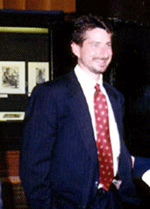
Mark Fritz winner of the 1995 Pulitzer Prize in International Reporting at the luncheon.
Winning Work
Villagers Defend Motives for Massacres
By Mark Fritz
MUSHA, Rwanda (AP) -- Juliana Mukankwaya is the mother of six children and the murderer of two, the son and daughter of people she knew since she herself was a child.
Last week, Mukankwaya said, she and other women rounded up the children of fellow villagers they perceived as enemies. With gruesome resolve, she said, they bludgeoned the stunned youngsters to death with large sticks.
"They didn't cry because they knew us," said the woman. "They just made big eyes. We killed too many to count."
Wearing a black shawl and a blank expression, the slightly built 35-year-old said she was doing the children a favor, since they were now orphans who faced a hard life. Their fathers had been butchered with machetes and their mothers had been taken away to be raped and killed, she said.
Mukankwaya is a member of the Interahamwe, the name for the innumerable Hutu tribal militias that have been blamed for slaughtering an estimated 100,000 to 200,000 people since April 6, when a mysterious plane crash killed the Hutu presidents of Rwanda and neighboring Burundi.
Most of the victims have been members of the minority Tutsi tribe and Hutus perceived as opponents of the government.
Mukankwaya was among 30 peasants from around Kigali, the capital, rounded up in recent days by the Rwandan Patriotic Front, the Tutsi-dominated rebel army that has captured large chunks of the country since the carnage began.
The people are being held in a former village community center at a small rebel base in Musha, 20 miles northeast of Kigali, the site of fierce artillery battles between the rebels and the government army backed by the Hutu militias.
The rebel commander of this strategic outpost north of Kigali agreed to let The Associated Press interview the militia members. All appeared healthy and there was no evidence of mistreatment.
Lt. Vincent Anyakarundi, a rebel officer, said the captives were being "re- educated" rather than punished because they were exhorted and coerced into killing their neighbors. The instigators, he said, were the government, local officials and army soldiers, who the prisoners said supplied them with weapons ranging from clubs to grenades.
"They are peasants" he said. "They are just puppets of the government."
In areas where rebels have seized control, they have appointed political officers to urge people not to listen to exhortations of violence against Tutsis or Hutu foes of the government. The "re-educators" have been preaching national unity and the official party line is no reprisals, no revenge and no punishment.
"People who would carry out such massacres, especially against children, are less than animals," said Tito Rutaremara, 49, a former party coordinator and leading political influence in the rebel movement. "You have to teach people to forgive and forget. It's like the Nazis. Most people were behind the Nazis, but you can't punish all the people."'
Although individual acts of revenge likely have taken place, there have been no independently confirmed instances of mass reprisals.
In Musha, captives gave detailed accounts of the horrors they helped to carry out in their villages, when one part of the community suddenly rose up and destroyed another part.
Virtually all of the prisoners recounted their horrific deeds in dull, emotionless voices, their faces a collection of impassive masks.
Mukankwaya blithely mentioned the names of the parents of the two children she killed during the killing spree that she said left hundreds dead in her village of Nyatovu, just north of Kigali.
Potato and sorghum farmer Alfred Kirukura, 29, said he joined in the murderous orgy in his village of Muhazi, 30 miles north of Kigali, on May 9. He said he took a machete to three childhood pals - one a Tutsi and the others Hutus branded by the locals as anti-government agitators.
As he killed them, "They said, `We are friends! We shared the same classroom!"' he said.
Maria-Devota Mukazitoni, 24, said she didn't kill anybody in her village of Rutonde, just north of Kigali, but organized the looting of homes after hundreds of people in her town were massacred.
Sixteen-year-old Kitazigurwa - who said he had no first name - said his job was to spy on people saying bad things about the government. People he named were killed.
Joseph Rukwavu, 74, said he was too old to kill anybody but acted as the key authority in his village of Mwuma on people who claimed to be Hutu but whose parents or grandparents were, in fact, Tutsi.
"Two hundred were killed in my sector, even my wife, because she would not join Interahamwe," he said in a dull monotone, his face unmoving even as he mentioned his wife's death.
"The militia gathered everybody up near a big hole," he said. "They were weeping, even the men. Even the week before we killed them they were weeping in fear."
He said the army supplied the villagers with the necessary killing tools and oversaw the slaughter.
"They (the victims) said, `Oh, we are the same people, we are your neighbors. Instead of hiding us you are killing us."'
Boniface Gasana, 52, said he invited 15 people on the local hit list into his home on the pretense of hiding them, then tipped the village killers of their whereabouts when the massacre began. A woman near him shouted that he also took part.
Even as they spoke, the evening air brought the stench of rotting corpses from the gentle hills around Musha, a common odor throughout the country.
At Kiramuruz, 60 miles northeast of Kigali, 20 bodies lay in a neat row in the woods just outside the seemingly sedate and bustling village.
Resident Vitali Rudasingwa said the people were killed by Hutu militias two weeks ago, even though rebels were in control of the town.
"These militias are still killing people," he said. "But now they are hiding in the corners."
© 1994, The Associated Press
By Mark Fritz
KARUBAMBA, Rwanda (AP) -- Nobody lives here any more.
Not the expectant mothers huddled outside the maternity clinic, not the families squeezed into the church, not the man who lies rotting in a schoolroom beneath a chalkboard map of Africa.
Everybody here is dead. Karubamba is a vision from hell, a flesh-and-bone junkyard of human wreckage, an obscene slaughterhouse that has fallen silent save for the roaring buzz of flies the size of honeybees.
With silent shrieks of agony locked on decaying faces, hundreds of bodies line the streets and fill the tidy brick buildings of this village, most of them in the sprawling Roman Catholic complex of classrooms and clinics at Karubamba's stilled heart.
Karubamba is just one breathtakingly awful example of the mayhem that has made beautiful little Rwanda the world's most ghastly killing ground.
Karubamba, 30 miles northeast of Kigali, the capital, died April 11, six days after Rwandan President Juvenal Habyarimana, a member of the Hutu tribe, was killed in a plane crash whose cause is still undetermined.
The paranoia and suspicion surrounding the crash blew the lid off decades of complex ethnic, social and political hatreds. It ignited a murderous spree by extremists from the majority Hutus against rival Tutsis and those Hutus who had opposed the government.
This awesome wave of remorseless mayhem has claimed 100,000 to 200,000 lives, say U.N. and other relief groups. Many were cut down while cowering in places traditionally thought safe havens: churches, schools, relief agencies.
One stroll past the bleached skulls, ripped limbs and sunbaked sinews on the blood-streaked streets of Karubamba gives weight to those estimates.
Almost every peek through a broken window or splintered door reveals incomprehensible horror. A schoolboy killed amid tumbling desks and benches. A couple splattered against a wall beneath a portrait of a serene, haloed Jesus Christ.
Peer into the woods every few hundred feet along the red-clay road to Karubamba and see piles of bodies heaped in decaying clumps.
News from Rwanda has been dominated by accounts of the carnage in Kigali or of millions of refugees living in mud and filth in vast encampments just outside the border. But what happened in Karubamba has happened - and is still happening - in villages across this fertile green nation of velvety, terraced hills.
Survivors from Karubamba say when early word came of the Hutu rampage, people from surrounding towns fled to the seemingly safe haven of the Rukara Parish complex here.
On the night of April 11, the killers swarmed among the neat rows of buildings and began systematically executing the predominantly Tutsi population with machetes, spears, clubs and guns.
"They said, 'You are Tutsi, therefore we have to kill you,'" said Agnes Kantengwa, 34, who was among dozens holed up inside the yellow-brick church.
"We thought we were safe in church. We thought it was a holy place."
It wasn't.
Her husband and four children were butchered amid the overturned pews. Bodies stretched to the ornately carved hardwood altar beneath a large crucifix.
Somewhere amid the stinking human rubble is the Rev. Faustin Kagimbura," who tried to protect us," Kantengwa said.
Down the road, outside the maternity clinic next to the hospital, about 25 bodies lie beneath a cluster of shade trees; most appear to be women, but it is difficult now to be sure.
"They were women waiting to have babies," Kantengwa said. "The killers made them go outside and kneel down, then cut them in the head with machetes and spears. They said, 'You are Tutsi.'"
Mrs. Kantengwa, her 6-year-old son and 6-month-old daughter survived with a mosaic of machete wounds. They share one hospital bed in nearby Gahini, a larger town that breathes bustling life as easily as Karubamba exudes the suffocating stench of month-old death.
At the primary school midway between the maternity clinic and the church, a man lies prone beneath a meticulously drawn blackboard sketch of Africa, the capitals of each nation listed alongside.
Serena Mukagasana, 16, said the man was teacher Matthias Kanamugire.
The girl also was in the church when the slaughter began. By the time it was over, she was an orphan.
"All my family was killed," she said. She fled outside during the slaughter and watched from the bushes.
"They just killed and killed," she said.
The Tutsi-dominated Rwandan Patriotic Front that has been battling the government since 1991 has made huge gains in the countryside since the rampage began.
Their secured areas are relatively stable and well-policed, though scores of villages remain empty and thousands of people line the roads looking for safe places to stop. More than 1.3 million people in this nation of 8 million are displaced.
The rebels took Gahini and set up a base just days after the massacre at Karubamba. It is one of the staging areas for what is believed to be an imminent rebel assault on Kigali, where guerrillas are battling government troops backed by Hutu militias.
Capt. Diogene Mugenge, the rebel commander in Gahini, said an estimated 1,500 to 2,000 people died in the carnage at Karubamba. The only sign of human life in the area is a lone sentry posted roughly where the fresh air begins.
When asked about the massacre, and the fact that mutilated, battered bodies remain frozen in the moment of agonizing death just a few miles from his base, Mugenge shrugs.
"It's happening everywhere," he said.
© 1994, The Associated Press
Refugee Rebels Battle to Conquer Hell
By Mark Fritz
To their supporters, the rebels are seen as the cavalry coming to the rescue of a country hemorrhaging rivers of blood.
RUGENDE, Rwanda (AP) -- Francois Rwagansana once took well-off Westerners on exotic but safe safaris throughout Africa. But he came home for the ultimate adventure tour: guerrilla warfare.
"It was exciting," said Rwagansana, 33, who plies his new trade at a rebel base here, five miles north of the divided capital. He has learned how to survive sickness, carry weeks of food on his back - and break the proper bones of rigid dead enemies to better remove their coveted clothing.
And he has learned how to kill.
"Sometimes I ask myself: What am I doing here?" said the tall, lanky Rwagansana, a university graduate in sociology smartly dressed in jungle fatigues and Adidas high-top sneakers.
What Rwagansana and others like him are doing is fighting a war against a government they believe has carefully orchestrated the slaughter of what the United Nations estimates is 100,000 to 200,000 people in the past five weeks.
The mind-boggling killing spree broke out after the Hutu president died in a mysterious plane crash. Government soldiers and civilian militias began massacring Tutsis and Hutus perceived as their allies.
At the time, the rebel Rwandan Patriotic Front had brokered a truce with the government. When the killings began, however, it mobilized its troops and launched a new offensive. It now controls most of this blood-drenched nation of 8 million people.
The complex ethnic and social tensions date to colonial days and the 1959 rebellion by the majority Hutus against the repressive minority Tutsi government.
Thousands of Tutsis fled to Uganda, Zaire, Kenya and Burundi to escape the reprisals that followed, and they raised a lost generation of Rwandan children who formed the core of the rebel army that launched the RPF invasion from Uganda in 1990.
"These young men hardly know their country, hardly know the difference between a Hutu and a Tutsi," said Tito Rutaremara, 49, a RPF political leader.
"Yet there they are, in the bush, fighting the war," he said, gesturing to the lovely green hills filled with thousands of corpses.
To their supporters, the rebels are seen as the cavalry coming to the rescue of a country hemorrhaging rivers of blood.
Human rights organizations and aid workers have uniformly held the Hutu-led militias responsible for most of the carnage in Rwanda The vast majority of victims have been Tutsis, most of them hacked to death with clubs and machetes.
The Tutsi-dominated rebel movement, which includes many Hutus and professes a platform of national unity, has ordered troops to refrain from seeking retribution against Hutu soldiers and civilian militias.
Revenge is officially prohibited, and there have been only scattered, isolated and unconfirmed reports of reprisals.
But Rwagansana, 33, admits the anti-vengeance edict is a hard code to live by.
"You see all those people dead because they were Tutsi, and you make them want to pay," said Rwagansana, who left Rwanda as a child and came home from Kenya three years ago. "Why don't they fight us instead of innocent peasants?"
Guerrilla Eric Ruhumuriza - a 16-year-old, baby-faced kid who looks closer to 12 - struggles with the same emotion. His parents were killed during a massacre in early April. The orphan was quickly adopted by the rebels, who gave him a small uniform and a big AK-47.
"I have a feeling of revenge, but the code prevents it," he said as he sat at the rebel base here on Sunday.
Mortar shells boomed in the background as the rebels fired on a government base on the outskirts of Kigali, the capital where large units of government soldiers are based.
The smell of rotting massacre victims in the surrounding fields wafted vthrough the base as the soldiers drank tea and ate rice and beans.
Suddenly a new song came on the radio, its lyrics urging people to kill RPF sympathizers.
"They're still killing innocent people," said Capt. Mark Sebaganji, a rebel commander.
Rwagansana says the worst problems he faced with his old job as a tour guide with the U.S.-based Overseas Adventure Travel, were quarreling tourists and broken-down safari vehicles.
"Imagine coming from a city like Nairobi (Kenya) and you find yourself in the bush," he said. "Suddenly, you're just there, and you're attacking people and they're attacking you.
"You sleep outside, there's mosquitoes - I've had malaria twice," he said. "You got a gun, people are shooting and bombs are falling."
Shortly after he joined the rebels in 1991, Rwagansana said he realized he was in a grim new world when he and a more seasoned rebel approached the body of a dead government soldier.
He found out it was time to resupply.
"He broke the bones at the elbow and took the shirt, then he took the pants and the boots," he said. "I asked myself: Could I do that?"
© 1994, The Associated Press
Planning for the Apocalypse
BYUMBA, Rwanda (AP) -- They were trained, armed and programmed to explode, a human doomsday device designed to detonate on command.
The extremist Hutu militias responsible for many of the 200,000 deaths in Rwanda were forged more than a year ago as a chilling final solution to ancient ethnic animosities and modern political pressures, former government officials say.
These secret civilian armies - which the government purportedly claimed at one point were being trained as park rangers - were the creation of Hutu President
Juvenal Habyarimana, who continued to arm them even as he negotiated peace with his Tutsi-dominated enemies.
When he died in a mysterious plane crash on April 6, his murder machine thundered to terrifying life in every corner of this crowded little country, killing minority Tutsis and Hutus deemed opponents of the government.
The switch has yet to be shut off.
"We warned the international community that this was happening, that these people were being trained and armed to kill great numbers of people," said former Finance Minister Marc Rugenera, one of the Social Democrats Habyarimana had been pressured to include in his Cabinet.
Holly Burkhalter, Washington director of Human Rights Watch, said it was well known that the massacres were carried out by people "armed and trained by the Rwandan army." She said the army training had gone on "for a couple of years and there were many, many reports that it was very organized."
The Rwanda massacres came at a time when post-Cold War pressures for multiparty democracy collided horribly with ingrained ethnic animosities and internal power struggles.
The majority Hutus were traditionally farmers whose dominance by the tall cattle herders known as the Tutsi - also known as the Watutsi - dates back centuries.
Belgium, which took control of the country after World War I, favored the Tutsis with better educations and jobs for 40 years, fanning the fires of the 1959 Hutu revolt that toppled the Tutsi government and led to bloody reprisals against the minority.
In 1990, Tutsi exiles led a well-equipped rebel army into the country from Uganda.
Many of them had become high-ranking soldiers in the army of former Ugandan dictator Idi Amin and the guerrilla army that put current Ugandan President Yoweri Museveni in power.
Habyarimana, a Hutu hardliner, came under international pressure to make peace with the rebels and open his government to opposition parties.
After bitter negotiations, Habyarimana gave 10 Cabinet posts to opposition parties in April 1992 and three months later opened talks with the rebel Rwandan Patriotic Front in Arusha, Tanzania.
The 34 months of negotiations were disrupted by repeated broken cease-fires, sporadic fighting, threats and acrimonious meetings, but ultimately resulted in a power-sharing agreement.
But the last year also marked the recruitment, training and arming of extremist Hutus from virtually every village, Rugenera said.
During one breakdown in peace talks in Arusha a year ago, Rugenera said opposition figures got an inkling of what was to come from a comment made by Col. Theoneste Bagosora of the elite presidential guard, which reputedly ignited the massacres.
"He said he was going back to Kigali to prepare for the apocalypse," Rugenera said.
There were numerous other threats by Hutu hardliners that Tutsis would be killed and float back to their ethnic homeland via the Kagera River, a warning borne out by the bodies that now fill Rwanda's waterways.
Opposition figures said they complained nearly a year ago that Hutu extremists were being trained at secret sites at the Kagera National Park in the northeast and the town of Gisenyi near the Zairean border.
Rugenera said at one point the government said the militias were learning to be park rangers.
"We knew something would happen. But we didn't know the day or the scope," said Joseph Nsengimana, 43, a member of the governing board of the opposition Liberal Party.
"Habyarimana said repeatedly that if the RPF were to take power, they would find their families dead."
Sporadic killings of Tutsis by terror groups broke out in mid-1993 and escalated in early 1994, including a massacre of hundreds in January.
Rwandans will debate for generations whether or how Habyarimana intended to use the militias had he lived. Rugenera believes they would have been used to disrupt multiparty elections or bring havoc if the opposition won an election or the rebels won the war.
Opposition parties and the rebels deny shooting down or blowing up the plane carrying Habyarimana, and contend that he was instead killed by his own people to thwart the Arusha accord he had signed.
"Habyarimana was caught in his own trap," contended Denis Polisi, a rebel spokesman. "He had to keep arming his militias and he had to accept democratic reforms, but he couldn't do both."
But while the rebels and opposition leaders say they had no reason to kill Habyarimana, they also paradoxically cite the militias as proof that he had no intention of honoring the power-sharing accord with the RPF.
Whoever killed him, his death plunged Rwanda into one of history's most incomprehensible series of massacres.
"The presidential guard began it when they went to kill the (opposition party) government ministers," Rugenera said. "First they killed their kids and wives."
Rugenera is a Hutu member of the Social Democrats and not affiliated with the Tutsi-dominated rebels. He was one of the few ministers who lived in his own house, rather than an official residence, and said he managed to escape to the home of a German neighbor.
He fled Kigali, taking advantage of the chaos when the rebels moved close to the city.
Militias, many of them operating in their own villages, pulled out their lists of names of Tutsis and anti-government Hutus and began separating women, men and children and killing them with guns, grenades, special knobby clubs, machetes, spears, bows and arrows and at least one sharpened umbrella.
"It was a plan of genocide that had been prepared a long time," said Polisi. "We warned the embassies, the (Roman Catholic) church, the EC (European Community) months before, but nobody listened."
Nsengimana, 43, a former university art professor, said he had a routine meeting with an RPF official inside the parliament building in Kigali when Habyarimana died. He said he was trapped inside while massacres erupted, followed by fighting between the approaching rebels and regular army soldiers.
"In the morning we were informed that important persons had been killed," he said. "I called my wife and she said her brother had been killed with all of his family."
Rebels took the parliament building and Nsengimana was escorted to Byumba, the rebel-held town north of Kigali where most of the opposition ministers now live.
Nsengimana said he is still waiting for word on his wife and children, who were at home.
"I asked the RPF to look at my home. It was empty. When they went to the house next door, it was filled with cadavers," he said, his face twisting into tears. "I have asked them to look again."
© 1994, The Associated Press
By Mark Fritz
"They say `It's me, I'm alive,"' she said. "But rarely do people come forward."
KIBUNGO, Rwanda (AP) -- Dad was drowned in a cattle dip and mom was taken away by a man with a machete. But 14-year-old Donata Nyinshimiye was singing as she walked to get water with her new family.
Twelve kids from different towns and ethnic backgrounds clanged their containers and their voices together as they trooped down main street toward the water pump in the center of this town 70 miles southeast of Kigali.
Singing, they walked to a mass grave sealed over with red soil by a yellow bulldozer - a single left arm reaching out from the ground.
Singing, they walked past the homes of the dead, ransacked by fanatical militias still looking for some reminder of their enemies to destroy.
They were children being children, oblivious for the moment to the signs of carnage around them and the ghastly personal losses they each suffered.
The massacres that broke out after President Juvenal Habyarimana died in an unexplained plane crash on April 6 have left few families intact among the minority Tutsis and anti-government Hutus who were targeted for slaughter.
Entire villages and neighborhoods were wiped out in the days that followed, their inhabitants killed with guns and hand grenades or hacked and clubbed to death by extremist Hutu militias bent on avenging the death of their president.
The remnants of tens of thousands of shattered families are frantically trying to reunite, wandering great distances in search of blood links. In some cases children themselves are building desperate little units without parents to watch over them.
Rose Kayumba, who runs an orphanage in Byumba, said nearly every day small groups of children show up at the gate, without parents or siblings, only each other.
Jennifer Wibabara, a reporter for a radio station run by the rebel Rwandan Patriotic Front, puts people on the air who are desperate to find somebody from the family.
"They say `It's me, I'm alive,"' she said. "But rarely do people come forward."
In Gahini, about 45 miles northeast of Kigali, the Bwakeyebute family now only consists of father Benoit and 6-year-old son David. Bwakeyebute watched as militias cut the throat of his wife four weeks ago. He tried to flee, but the killers hacked at his face and arms and then left him for dead.
"An old woman with a goat found me," said Bwakeyebute, his right arm in a cast and his left arm and face tattooed with wounds.
His son, spared by the killers, was standing nearby when he regained consciousness.
The 12 young people walking in a tight little knot down the main street of Kibungo ranged in age from 5-year-old Francine Mahoro, a wide-eyed waif in dirty white dress, to 17-year-old Cesare Nyirabashumba, a rail-thin woman who stood more than 6 feet tall.
"I'm the leader," Nyirabashumba, a Tutsi, said of her charges, who were both Hutu and Tutsi.
Some came from this town, where survivors say at least 1,000 people were massacred in the local Roman Catholic Church on April 17, loaded into trucks and buried in a pit atop one of the green hills nestling the city.
Others walked from as far away as Rusumo and Sake, towns near the Burundi border 50 miles away, to escape the militias.
All came together at a nearby hospital that was turned into a refugee camp. Asked how many had lost one or both parents, eight of the 12 raised their hands.
Donata Nyinshimiye was from Rusumo, where she had the living nightmare of watching men grab her cattle herder father, drag him into the deep trench of chemicals used to cure cattle of parasites, and hold him under until the bubbles stopped.
"I'm alone," she said.
Prosper Rudasingwa, 10, who comes from Kibungo, said he's the only male member of his family left alive. His three brothers and father were killed, and his mother is missing. He was with his two little sisters.
Kibungo, a modern-looking town of neat brick buildings, a post office and large electrical power plant that supplied power nationwide, was seized by rebels of the Rwandan Patriotic Front on April 20.
The Tutsi-dominated rebels have been battling the Hutu-led government they blame for inflicting the carnage across this nation the size of Maryland. Aid agencies say most of the massacres were carried out by the Interahamwe, the government-backed civilian militias that attacked in nearly every village.
The children said they have a deep fear of the Interahamwe. During their mile-long walk for water, a group of men they believed were militia members shouted obscenities at them.
"We're always worried they will finish us off," said Nyirabashumba, wearing a baseball cap with a BMW logo.
The raggedy youngsters then walked on down the road to fill their odd assortment of plastic containers. Trudging along, they started singing again.
© 1994, The Associated Press
By Mark Fritz
KINSHASA, Zaire (AP) -- Steve Shyaka and partners sell beans in the big city and beer in the boondocks, shuttling the goods aboard their own Boeing 727. They use profits earned in the chaos of Zaire to finance the war in Rwanda.
"We do our part. We are Tutsis. We are an RPF airline," said the smiling, bespectacled businessman, a Tutsi tribesman who was born in Zaire but considers himself a member of the rebel Rwandan Patriotic Front.
Shyaka, 27, is part of Zaire's large Rwandan community, made up of both Hutus and Tutsis with blood ties to the inflamed little nation dying horribly on this country's eastern border.
Now, the conflict in Rwanda threatens to spill into Zaire. It is a vast, virtually ungoverned land one-third the size of the United States with a bubbling stew of its own ethnic conflicts, marauding soldiers and breakaway provinces.
"Since Zaire shares a frontier with Rwanda, when there are problems there, there is insecurity here," said Leon Kengo wa Dondo, one of two men who claim to be prime minister of Zaire.
France's decision to send its troops through Zaire into Rwanda is just another complication in the slow but steady implosion of social and economic order in this nation of 40 million people.
The main opposition group in Zaire blames France for supporting the dictator Mobutu Sese Seko, just as the Tutsi-dominated rebels in Rwanda blame Paris for arming the majority Hutu government.
"France is instigating the situations in both countries," declared Frederic Kibassa Maliba, chairman of the main opposition coalition, Sacred Union. France insists its intentions in Rwanda are purely humanitarian.
Right now, though, Rwanda is just a blip on Zaire's radar screen.
Zaire has seen influxes of refugees from wars in neighboring Sudan, Uganda and Angola in addition to Rwanda and Burundi. But its most intractable problems remain within its own borders, where the political impasse between Mobutu and his opponents has left Zaire lawless and abandoned by its Western benefactors.
"We are in a complex emergency situation," said Isaac Gomez, director of the U.N. Children's Fund here. "Zaire is a failed state. Everybody does what he wants. Children are dying from numerous epidemics. You have looting all over the country. In the regions, all these ethnic conflicts. There is complete confusion."
Zaire seemed poised for progress in 1991, when a national conference elected opposition leader Etiene Tshisekedi as prime minister. Mobutu tried to fire him, and has named four men as prime minister in the last four years.
The most recent edition was Kengo, who served as prime minister for most of the 1980s under Mobutu and was elected to the post by Parliament last week.
Kengo said he is willing to compromise with Tshisekedi, who has enough public support to be an obstructionist but probably not enough to seize the country by sheer numbers.
"I have given my hand to Tshisekedi," Kengo said. "I am open to him. I am waiting for him to give me some members for my government."
Tshisekedi, whose rigid resistance to compromise has increasingly eroded his opposition coalition and alienated his Western supporters, will have none of it.
"He asked to see me, but I said 'No,"' said Tshisekedi. "If the people don't accept that government, it can't exist."
There is growing evidence that the people no longer care. In Kinshasa, the capital, the informal economy of bartering, bribing and begging flourishes even as social order, health and nutrition plunge.
Parents have pooled their money to persuade professors to return to the main university. Mothers are turning plots of urban earth into gardens. Neighborhoods are organizing road crews to patch potholes.
"The crisis has given way toa lot of creativity," Gomez said. "People are finding ways and means to survive."
Abruptly and somewhat inexplicably focusing on France rather than rallying the masses against Mobutu, Kibassa's pro-Tshisekedi group last month called for a boycott of French products. He said in an interview that the opposition will begin trying to "peacefully" persuade French people to leave the country.
Rwanda, meanwhile, looms on the eastern horizon. At the border, relief agencies are bracing for an influx of refugees.
The fleeing Hutu-led government reportedly has already moved to Gesenyi, just a few miles from the Zairean town of Goma.
Rwandans fleeing into Zaire probably could expect a brutal welcome.
Last year, ethnic Zairians launched a campaign of terror against ethnic Rwandans already living there who had clamored for land rights in the eastern Zairean region north of Lake Kivu.
Relief groups say an estimated 6,000 to 10,000 people died in the massacres and revenge killings that erupted in the hills of eastern Zaire from May to August 1993. An estimated 350,000 people were displaced.
UNICEF project officer Juan Carlos Espinola said aid groups had just succeeded in placating the situation and returning displaced people when neighboring Burundi exploded in violence last November, sending about 90,000 ethnic Hutus from that country into eastern Zaire south of Lake Kivu.
The ethnic killings in Burundi were followed by the carnage that erupted in Rwanda after the death of Hutu President Juvenal Habyarimana on April 6.
Only about 4,000 Tutsis have fled into the eastern Zaire town of Goma since then, but relief groups say they are starting to see more Hutus filtering in.
Rwandan President Theodore Sindikubwabo and his ministers visited Kinshasa last week and met with government officials. But Rwandan Ambassador Etienne Senegegera denied the Hutus were benefiting from Zairean aid, a claim made both by Zairean Tutsis and the anti-Mobutu opposition.
However, relief groups allege that arms are moving through Goma into Hutu territory near the border. The fact that French troops planned to enter Rwanda from Goma has raised suspicions that they are aiding the Hutu side of the war.
Shyaka and his two Tutsi business partners don't deny they are using part of the profits from their airline, Gomair, to help the rebels. The three men come from Goma, where their parents fled after the Hutu rebellion against Tutsi rule in Rwanda in 1959.
"We are businessmen, but we are also Tutsis," said Shyaka.
© 1994, The Associated Press
By Mark Fritz
RWANKUBA, Rwanda (AP) -- Lt. Col. Edward Gasarabwe is charged with keeping the government's shrinking piece of Rwanda from being cut in half by the rebels - a battle he expects to win if the French keep moving deeper into Rwanda.
France says it has come to Rwanda for humanitarian reasons. But the Hutu commander said the French army that once trained his officers could, by its mere presence, thwart the rebels' wildly successful tactic of indirect jabs and infiltration of the army's flanks.
"We won't have to retreat anymore," Gasarabwe said in an unusually frank interview Monday about his army's crippled supply lines and numerous retreats, its training of murderous civilian militias and its difficulties in smuggling adequate arms from neighboring Zaire.
Gasarabwe took over the command of four battalions of 2,800 troops at a critical front-line position in south-central Rwanda on Friday, part of a massive reshuffling of the beleaguered national army.
"The rebels are moving too fast," said Gasarabwe, 39. "I'm here to stop them. If I don't, I'm gone."
He has set up his command post in a small house on a hill just 2,000 yards from the nearest rebel position to send a message to a battered national army suddenly buoyed by the reassuring presence of France, which armed and trained the troops when the rebels first launched their rebellion four years ago.
"I set my command post so close to the front to keep my men from leaving," he said.
On Saturday, the rebels launched a raid on the command post and got within 1,000 yards, said Maj. Gerard Ntanagezo, Gasarabwe's aide.
The national army, dominated by the majority Hutu people, is battling the Rwandan Patriotic Front, the Tutsi-led rebel movement that launched an invasion from Uganda in December 1990.
Gasarabwe said he was the army's training instructor at the time and worked closely with the French military advisers.
The two sides reached a preliminary peace accord last year. But the April 6 death of Hutu President Juvenal Habyarimana in a mysterious plane crash ignited a wave of massacres.
An estimated 200,000 people, most of them Tutsis and many of them women and children, have been killed.
The RPF renewed its rebellion after the massacres began and has steadily pushed the government army to the western border. The national army only controls one- third of the country and lost key sections of the capital, Kigali, and the strategic city of Gitarama in the past month.
Gasarabwe was the commander of the former government stronghold of Byumba, which fell two months ago. He said the army "sacrificed" the city in order to send additional troops to Kigali, but it subsequently suffered serious setbacks there.
Rwankuba is a small village packed with troops about 13 miles from Gitarama and some 30 miles southwest of Kigali. Gasarabwe's troops are defending a critical area from just south of Gitarama to the southwestern city of Butare.
Soldiers are dug into the hills, trading machine gun and mortar fire with rebel forces on the nearby hills.
They are defending the key east-west road from Gitarama to the Zairean border town of Kibuye, which if captured would split the government territory in two.
Gasarabwe said he also is trying to recapture the main north-south road 12 miles away that connects Gitarama to Kigali and the capital to Uganda, the main rebel supply route.
A key to his success, he said, is the French troops. He said the army has been forced to retreat in order to protect civilian populations from the quick raids the rebel guerrillas have carried out on the army's flanks and infiltration of the civilian population behind the front-line troops.
With the French defending the civilian population and the flanks, he said the army could concentrate on the front.
"The French are going to take care of the people," he said. "If the French are protecting the population we won't have to back up. The French are not in the fighting zone yet, so we don't know what is going to happen.
"It depends on what the French mission actually is," he said - something wondered by much of the world.
Gasarabwe was blunt about the shape of his army. The rebel advances have crippled supply lines and the rebels have more weapons. He figures his force of 2,800 soldiers is facing three or four rebel battalions.
The arms being smuggled through Zaire, he said, "are not enough."
"I don't understand why there is an international blockade against my troops and not the RPF," he said. "They say we are massacring people, so there is a blockade. It's unfair that Uganda supplies the RPF."
The rebels have portrayed themselves as coming to save the nation from massacres of Tutsis and Hutus considered RPF supporters.
Most of the massacres have been blamed on the Hutu militias that Gasarabwe acknowledged were formed and trained by the military, but only to detect RPF infiltrators, he said.
"The military did organize the militias. It was necessary for civilian defense," he said. "The RPF infiltrated. It's not possible for the military to protect all the population. It was up to the militias."
"That was the reason for the massacres, to remove the infiltration threat," he said. "There are people who support the RPF even here."
Though massacre survivors disagree, he said the army did not take part in mass killings.
The appalling level of slaughter in villages across the country drew unprecedented attention to this tiny Central African country. Gasarabwe conceded that perhaps some innocent people were killed during the purported purges of RPF supporters.
"Yes. If someone goes into RPF territory to get food, then comes back, it's hard to say if they were RPF."
He said the rebels have killed more innocent people and have used skilled propaganda to win global support, installing a Hutu as its president to give the appearance that the rebellion is multiethnic.
"The RPF initially said it was fighting to return Tutsi refugees home, then they began incorporating Hutus so it wouldn't be said it was an ethnic problem," he said. "They were very smart to select as their president a Hutu. That man won't live long, because the Tutsis will kill him."
He said the national army also has Tutsis in its ranks, though none in command posts. He said there have been ethnic conflicts within the ranks.
"Some of their families were massacred, and they were angry," he said. "We're trying to sensitize people. The Hutu-Tutsi problem is not really a concern of the army. Historically, the Hutus and the Tutsis have never really understood each other."
© 1994, The Associated Press
By Mark Fritz
CYANGUGU, Rwanda (AP) -- With the arrival of French troops, relief agencies are moving deeper into the most forbidding parts of Rwanda and starting to find the mysterious half-million refugees they knew existed but couldn't locate.
But they say precious few of them are Tutsis, giving further weight to fears that the minority group was virtually wiped out in the one-third of the country controlled by the majority Hutu government.
"We find some minorities but not a lot," said Ariane Tombet, director of the International Committee of the Red Cross in Rwanda. "It's in the hundreds."
A United Nations report Thursday blamed the Rwandan government for planning a genocide of Tutsis and opposition Hutus and recommended international war crimes charges be brought against the Hutu forces.
In this oppressive border town, guarded by abusive and drunken government soldiers and customs authorities, few locals will talk frankly about the anti-Tutsi killings that erupted across Rwanda after April 6, when Hutu President Juvenal Habyarimana died in an unexplained plane crash.
"The militias are not killing civilians as such. What they are doing is looking for enemy soldiers," said Phocas Fashaho, 30, who said he was a former interpreter for U.N. peacekeeping units in Kigali, the besieged capital.
But across the narrow southern tip of giant Lake Kivu, in the Zairean resort town of Bukavu, witnesses and relief officials remember the carnage in Cyangugu.
"We documented about 16,000 to 17,000 killings," said N. Vander Eecken, head ofthe U.N. High Commissioner for Refugees delegation in Bukavu. "Outside of Kigali, this is the worst place. They are all killers there."
French troops last week launched their peace-keeping mission in Cyangugu, where Hutus cheered their arrival. They were pleased to see soldiers from a government that helped finance and run their defense of the 1990 Tutsi rebellion.
"We're dealing with the devil. They killed all Tutsis," said Vander Eecken, who has to deal on a regular basis with the Cyangugu authorities.
"Huts were burning in the hills. Trucks carried bodies," he said, describing the view of Cyangugu from Bukavu. "And people were still water-skiing on the lake."
The French troops' first action in Rwanda was to make a carefully publicized visit to a camp in Nyarushishi, where 8,000 Tutsis amazingly survived in the middle of extremist Hutu territory, under the guard of 11 policemen.
Vander Eecken said he believes the camp is probably the biggest anywhere in government territory, and that the people there were being kept as prisoners and bargaining chips.
French troops since then have found only small pockets of hiding Tutsis, none of whom lived among the general population.
Relief workers have complained about France's intervening in a conflict in which it has a historical bias. The aid group Doctors of the World was forced out by the Rwandan government for criticizing the French arrival.
But the aid agencies clearly have taken advantage of the slightly more relaxed atmosphere among the Hutu militias and government soldiers, who are happy to see their old allies just as the rebels had them on the run.
"Before the French came, the (militias) were more intense, more aggressive," said Alison Campbell, a CARE spokeswoman.
Relief agencies and aid workers are pumping one another and journalists for information on where to find the estimated 500,000 people who supposedly were on the run from the rebels' recent advances.
An estimated 250,000 mostly Hutu refugees were found in the past week in the Gikongoro region, most of them from the rebel-battered cities of Kigali and Gitarama. The Red Cross plans to begin a massive feeding program next week.
An estimated 2 million people have been driven from their homes in Rwanda either Tutsis fleeing Hutus or Hutus fleeing the Tutsi-led Rwandan Patriotic Front rebels.
The difference between the two territories is striking. In rebel territory, refugees are organized by civilian rebel officials who instruct village elders to assign specific jobs, such as food gathering and hut-building.
The many rebel checkpoints are organized, disciplined and sober, staffed by generally businesslike uniformed rebels.
"The RPF from the beginning got very involved with the agencies," Campbell said.
In government areas, great crosscurrents of refugees seem to alight en masse by collective decision, on the sides of hills and edges of towns, squeezed and scattered randomly. They generally fend for themselves and must pass the scrutiny of youthful Hutu militiamen who are little more than thugs.
Relief workers have to go through layers of corrupt bureaucracy to deliver critical food and medical supplies.
"It would be beneficial if we had some indication of the government's position on these huge numbers of people. Or will we have to continue to be involved in tedious negotiations with local officials?" Campbell said.
Some fear that the rebel push may eventually drive this Hutu heartland into Zaire, where many minority Tutsis have settled. Last year, resentful Zaireans massacred thousands of Tutsis.
Overlooked among the Rwandan refugees are 22,000 Zaireans who had been living and working in Rwanda when war and mass murder broke out.
Many came to Bukavu, like Aloys Sema, 35, who was teaching English at the main university in the southern Rwandan city of Butare when the mass hunt for Tutsis began.
Sema said he saw babies put into the massive mortars used to pound cassava and rice, then beaten to a pulp.
"It was horrible," he said. "I don't have words to describe it. Maybe there will be Tutsis hiding there, but I don't think they will find many."
© 1994, The Associated Press
By Mark Fritz
GOMA, Zaire (AP) -- Bernard Sebazzogue watched as cholera killed his daughter on Monday, his wife on Tuesday and his grandmother Thursday. By week's end, he gathered up his three remaining children and fled for help. To Rwanda.
What lay before him, rising from the dirt over the first 50 miles into his country, were five hospitals that began springing up just a few days before Sebazzogue's family began dying.
These outposts at Goma's doorstep are part of a quick and somewhat haphazard effort to create a corridor of health care in Rwanda from which more than 1 million people fled over several panicked days in early July.
This rapidly emerging row of waystations is meant to act both as an inducement for people to leave the fetid corpse factories in Goma for the relatively open and sparsely populated spaces over the border, and to stop them from spreading cholera - death by dehydration - deep into Rwanda.
Sebazzogue was one of a relative handful of Rwandan Hutus who allowed desperation to overcome fear of what might happen in Rwanda where a rebel army comprised mainly of minority Tutsis has won control of the country after Hutu massacres left between 350,000 and 500,000 people dead, most of them Tutsis.
"Help the world return the people!" Sebazzogue shouted angrily Friday as he and his daughters trudged down the road toward the first outpost, run by the French aid group Doctors Without Borders. "Otherwise they will all die!"
So far, the rate of returnees has been slow, and some medical relief workers fear the massive aid being poured into Goma may act as an inducement to keep people from returning. "In refugee situations, people just tend to stay where the help is," said Tom Turley, a logistics expert for the U.S. relief group AmeriCares. "The more the situation improves, the more refugee populations become permanent."
Refugees are also subjected to steady doses of propaganda and intimidation from officials in the former Hutu government, who are resisting repatriation efforts as long as the Tutsi-dominated Rwandan Patriotic Front holds power.
None of the refugees or relief workers spoken to had complaints about the former rebels, who now represent the government army. Their numerous road checkpoints were largely professional and organized, in contrast to the oppressive and threatening mood under the ousted government.
"It's becoming very clear that the countries putting all their efforts into the humanitarian situation should try and put the same effort into the political situation," said Panos Moumtzis, a U.N. High Commissioner for Refugees spokesman.
The scenic hills from the Rwandan border town of Gisenyi to just beyond the city of Ruhengeri 40 miles away are certainly seeing their share of humanitarian money, though so far only a relative trickle of refugees.
The stretch includes three clinics set up by Doctors Without Borders and the sites for two more facilities: a 300-bed unit that the British army planned to build on Sunday in Ruhengeri, and a clinic that the relief agency AmeriCares planned to erect by Monday. Further down the road is a barely functioning clinic that had been operated for years by Spanish nuns.
"You know, sometimes it seems that the left hand doesn't know what the right one is doing," said AmeriCares volunteer Mike Jones after he was told about the British hospital going up simultaneously just down the road.
The pace was slow at a clinic and dispensary run by Doctors Without Borders in Ruhengeri. At Murtura, about eight miles east of Goma, only a few dozen people were waiting at a Doctors Without Borders clinic that opened last week.
Nurse Maureen Mulhern, in Murtura, said about 200 patients were treated for a variety of afflictions, like dehydration and dysentery, but that the number per day had fallen to about 120 by later in the week.
There's not so many coming. The cholera epidemic is getting a little better under control in Goma, so the impetus for coming back has subsided a bit," she said.
But about 15 miles east of Ruhengeri, on a flat plateau at the top of a hill, AmeriCares workers were unloading and safeguarding $100,000 in medicines and the parts needed for an expandable, domed aluminum health clinic.
About 20 Rwandans looking frail and weak stood by, and one woman lay ill in the grass, all waiting for the hospital to go up.
"If all these people decide to come back home, we're gonna need as many hospitals as we can get," said AmeriCares volunteer Jones.
© 1994, The Associated Press
By Mark Fritz
BUTARE, Rwanda (AP) -- A lost nation of Tutsi exiles is returning by the thousands to the country that once meant death for them.
Some of the returnees haven't seen the country since 1959, when a violent rebellion by the majority Hutus ended centuries of domination and drove tens of thousands of Tutsis into neighboring nations.
Now, Tutsi exiles are flooding back, arriving by the bus-load and on foot, congregating at government processing centers, moving into abandoned homes and bringing with them the old fears of minority domination.
After surviving the April massacres that killed as many as 500,000 people, most of them Tutsis, and ousting the Hutu government with a rebel army last month, this returning diaspora is moving into areas largely abandoned by Hutus.
Hundreds of thousands of Hutus now live in misery and fear in the squalid, deadly camps in Zaire, Tanzania and in the section of southwestern Rwanda carved out by the French army.
There is very little traffic between the French security zone, populated overwhelmingly by Hutus, and the areas that surround it run by the Tutsi- dominated Rwandan Patriotic Front.
With the French preparing to leave on Aug. 22, relief agencies fear the Hutus in the security zone could flee en masse into Bukavu, in eastern Zaire, rivaling the catastrophe of last month's exodus into Goma, Zaire.
Very few Hutus in the French zone city of Gikongoro are willing to travel the 12 miles to the tilled fields and open spaces around Butare, which is filling up quickly with Tutsis.
Many are driven here both by the RPF victory and the worsening ethnic conflict between Tutsis and Hutus in Burundi to the south.
"The situation in Burundi has become unbearable, but even if it wasn't I would return to Rwanda," said Faustin Gesgona, 62, as he cleared rubble from a battered store in downtown Butare.
"This is where my family will live now that the RPF is in charge."
Gesgona arrived on Saturday for the first time since his family fled in 1960. He said the new local government assigned him the store as temporary living quarters.
In Gitarama to the north, Dr. Fred Tagwa, 34, came from Uganda last week and drifted among the empty buildings, looking for a place to bring his family. His parents fled the anti-Tutsi purges of 1959 and Tagwa was making his first visit to the country.
"My parents come from the villages in the hills, but I have no desire to go there," the physician said. "The killers are still there."
Though the Tutsis and Hutus are trying to negotiate an orderly aftermath to the French departure - the French soldiers already are being replaced by U.N. peacekeepers from Chad and Ghana - they also are waging a Cold War-style propaganda campaign against each other.
French officers in Gikongoro said there have been repeated instances of Hutus being killed when they tried to cross into the RPF zone.
"We know people are being killed," said Lt. Col. Erik de Stabenrath, the French commander in Gikongoro.
Last week, Stabenrath gave a U.N. human rights team reports of alleged RPF- sanctioned massacres of returning Hutus, including the purported killings of 63 people who had spent the night in the Butare veterinary school.
Each of the reports was based on an account by a Hutu refugee who claimed to have witnessed the killings and then fled back to the French zone.
Stabenrath also said he saw the bodies of 15 dead Hutu civilians he said were killed by RPF soldiers near the city of Kunin. Pressed for details, he said he saw the bodies from a helicopter and assumed they were killed by rebels because they had just seized the area.
The assistant prefect of Butare, Boniface Ukuri, called the allegations "malicious propaganda" from a French government that armed and financed the former Hutu government.
He also denied that the RPF was preventing Hutus from returning home or giving their homes to the arriving Tutsis.
He would not, however, allow a reporter to visit the veterinary school because he said his boss was out of town.
Ukuri and other national officials acknowledge there have been isolated and unauthorized reprisal killings, and that suspected killers have been arrested. But they deny there is an organized campaign of vengeance.
At the refugee camps north of Gikongoro, some Hutus say they tried to return to their homes in the RPF zone and instead narrowly escaped being murdered in their native villages.
At the Kaduha camp, Victor Rurangirwa, 36, said he returned last week to his village of Nyarugenge and was taken prisoner by RPF soldiers.
He said 20 people were slaughtered with garden hoes, but he managed to escape and return to the camp 50 miles away. He supplied a list of six victims he said he knew.
In Nyarugenge, where both returning Tutsis and Hutus were living in seeming calm, people from both groups said they were unaware of any reprisal killings.
"I feel safe with the soldiers here," said Evode Nodayisenga, 19, a Hutu from one of the small villages around Ntongwe, where many of the Kaduha camp dwellers say there have been bloody revenge killings.
He said he attended meetings where local Tutsis and Hutus gather so the survivors of killings can name the killers and take them off to jail.
"It's no problem here for the normal people. Only the killers," he said.
© 1994, The Associated Press
Biography
Mark Fritz, who covered West Africa from 1993 to 1994, was named AP national writer based in New York in May, 1994.
As a correspondent in Abidjan, Ivory Coast, he has traveled extensively in Africa and covered the U.S. mission in Somalia and the ethnic massacre in Rwanda.
Fritz, 39, joined the AP in Detroit in 1984, then became correspondent in Grand Rapids, Michigan, before transferring to the International Desk in New York. In 1990, he went to East Berlin, where he covered the fall of Communism and the reunification of Germany.
He and his wife, Karyn, live in Norwalk, Connecticut.