The New York Times, by Staff
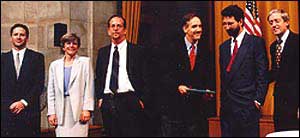
Columbia University President George Rupp (far right) presents (left to right) Tim Golden, Julia Preston, Craig Pyes, Sam Dillon and Steve Engelberg, of The New York Times, with the 1998 Pulitzer Prize for International Reporting.
Winning Work
By Julia Preston
MEXICO CITY, Feb. 19 -- Just days before he was detained on charges of collaborating with drug traffickers, the head of Mexico's antinarcotics program was given detailed briefings on what the United States knows about Mexico's cocaine cartels, Administration officials disclosed today.
The officials, speaking on condition of anonymity, said they had begun an immediate ''damage assessment'' to determine if secret information had been compromised or if United States drug informants have been placed in danger. One Administration official said tonight that the briefings had included ''really sensitive stuff.''
Another Administration official said the United States was especially concerned about possible threats to the informants who provided information to American drug and intelligence officers.
''If the information about them is closely held and only four people know about it, the way they work down there, they'll kill all four people,'' this official said.
American officials also said they feared that some ongoing operations intended to catch major Mexican cartel leaders might have been compromised.
''We're going to Plan B,'' one official said. ''You always have a contingency plan. You don't put all your eggs in one basket.''
American officials acknowledged they had no early warning that Gen. Jesus Gutierrez Rebollo, the former commissioner of the National Institute to Combat Drugs, was under suspicion of doing business with one of Mexico's most powerful drug lords.
Mexican authorities confronted General Gutierrez with the accusations against him, forced his resignation and detained him on Feb. 6, but American officials said they did not learn of the charges until Tuesday, when they were announced by the Mexican authorities.
''This points to a major intelligence community failure,'' one American official said. ''He was detained since Feb. 6 and we didn't know it. We had no idea.''
At a news conference on Tuesday night, Defense Minister Enrique Cervantes Aguirre disclosed that General Gutierrez had received gifts, payments and real estate from the cartel controlled by Amado Carrillo Fuentes, one of Mexico's most ruthless and aggressive drug lords, and had provided protection to cocaine shipments for as long as seven years.
General Gutierrez, along with two of his top aides, was remanded today to a maximum security prison near Mexico City to face charges of racketeering and aiding the traffic of cocaine, Attorney General Jorge Madrazo Cuellar said.
The general will also face a court-martial at which, top military commanders have suggested, he may be tried for treason.
The events leave Mexico's antidrug program in disarray only two weeks before President Clinton is expected to certify to Congress that Mexico is making significant strides in its drug effort.
As head of a special closed agency set up in 1993 to insulate drug operations from the corruption of the civilian police, General Gutierrez was privy to Mexico's most secret counter-narcotics operations and had access to the most confidential intelligence Mexico has gathered about its cartels.
General Gutierrez traveled to Washington in late January with Attorney General Madrazo to discuss the transfer of American helicopters to Mexico for counter-narcotics operations.
General Gutierrez was treated to closed briefings by White House, Drug Enforcement Administration and intelligence officials, Administration officials said.
One official said the Clinton Administration is now trying to determine ''what we gave them, what format it took, whether a source could be identified by the way we shared the information or if methods were exposed.''
The arrest on drug charges of the officer who had been named only two months earlier to lead the drug agency left United States officials wondering who in Mexico, if anyone, could be trusted to carry on the fight against a flood of narcotics flowing from Colombia across the border into the United States.
Mexican leaders, struggling to be optimistic, cited the general's arrest as an example of President Ernesto Zedillo's determination to combat narcotics traffickers even at the risk of exposing top-level officials.
Armed forces commanders, however, made it clear they are convinced that General Gutierrez took part in a long-term scheme to enrich himself by working with the Carrillo Fuentes operation, believed to be the dominant cartel in Mexico.
The news conference that Defense Minister Cervantes gave on Tuesday night to announce the the general's detention was his first. He summoned every senior commander in the armed forces to the Defense Ministry auditorium to hear that military investigators had discovered that General Gutierrez received payoffs, vehicles and even an apartment from Mr. Carrillo Fuentes.
In an unusually emotional speech today to top commanders, General Cervantes called General Gutierrez a ''bad soldier'' who ''betrayed all the values'' of Mexico. He called the arrest a ''severe blow'' to the armed forces but insisted that the military would not be ''tempted to conceal'' the general's alleged crimes.
Extensive security measures surrounded the detention of General Gutierrez. The military inquiry began not long after he took over as drug czar and moved into a stylish apartment in Mexico City that Mexican officials said was obviously more than he could afford on his public salary.
The Defense Minister said that when he confronted General Gutierrez on Feb. 6. the general suffered a ''an important physical alteration'' and was hospitalized under detention.
Even in good times the United States has difficulty obtaining information from Mexico's armed forces, which still regard the giant neighbor to the north as part friend and part adversary. But President Zedillo adopted a policy of cooperating with the United States against drugs, while he moved military officers increasingly into positions of responsibility in narcotics agencies in an effort to circumvent the notoriously corrupt and inefficient civilian police.
American officials believed the information-sharing was improving.
General Gutierrez's downfall is especially problematical for the White House Drug coordinator, Gen. Barry McCaffrey, who had publicly lauded the Mexican's integrity and patriotism.
General Gutierrez was named to the drug post by President Zedillo on Dec. 6, 1996. General Cervantes acknowleged that he personally recommended the general for the job because of the officer's record of tough measures against some of the major drug dealers in the central Mexican region where he served as commander for seven years.
But military investigators learned that General Gutierrez's Mexico City apartment was provided to him by one of Mr. Carrillo Fuentes' highest lieutenants. Using wiretaps, the investigators gathered evidence that top aides to the general had received large payoffs in dollars as well as vehicles and special encrypting devices from the Carrillo Fuentes organization.
An aide to General Gutierrez, Horacio Montenegro Ortiz, was accused of carrying out a kidnapping in September 1996 whose victim has never reappeared and is presumed dead. The armed forces also accused General Gutierrez of harboring army desertors and profiting from contraband operations in clothing and other goods besides drugs.
In an ingenious scheme, Mexican officials said, General Gutierrez protected his reputation as an effective anti-narcotics officer by attacking some drug organizations while working secretly with Mr. Carrillo Fuentes.
--Craig Pyes contributed reporting to this article from Washington.
© 1997, The New York Times Company
Drug Ties Taint 2 Mexican Governors
By Sam Dillon and Craig Pyes
In an unusual step for a State Department official assigned to an obscure consulate, Mr. Francisco began recruiting his own sources about the drug trade and Mr. Beltrones's role in it.
The Governor of the Mexican state that borders Arizona is collaborating with one of the world's most powerful drug traffickers, creating a haven for smugglers who transport vast quantities of narcotics into the United States, according to American officials and intelligence.
Officials said this conclusion was based on a wealth of evidence, including ''highly reliable'' informers' reports that the Governor, Manlio Fabio Beltrones Rivera, took part in meetings in which leading traffickers paid high-level politicians who were protecting their operations.
According to the accounts, Raul Salinas de Gortari, the brother of the former President, received suitcases full of cash and was responsible for distributing the money to those attending.
Present and former officials said the evidence of Mr. Beltrones's role was so detailed and compelling that the United States had included his name on a confidential document provided to the transition team of President Ernesto Zedillo listing more than a dozen officials suspected of corruption. Another Mexican Governor, Jorge Carrillo Olea, was also included on the American blacklist because of reported entanglements with major drug dealers.
While Mr. Zedillo did not name either man to a federal post, both continue to wield considerable power in their states and nationally through their prominence in Mexico's governing party. Both seem to enjoy a tacit immunity from concerted criminal investigation in Mexico and the United States.
Although Mexican governors are popularly elected, presidents have the power in practice to force their removal.
Mr. Beltrones, in an interview, denied any links to drug traffickers and disputed American law enforcement officials' assertions that Amado Carrillo Fuentes, one of Mexico's most wanted drug kingpins, was operating with impunity in his state, Sonora. In addition, Mr. Carrillo Olea, who presides over Morelos, the state just south of Mexico City, disputed charges that he had cooperated with traffickers.
In a four-month investigation that draws on intelligence documents and interviews in the United States and Mexico, The New York Times examined how both Governments handled the allegations against the two Governors.
The result is a picture of official frustration on both sides of the border and, several officials asserted, a case study of why traffickers' political patrons often go unpunished.
Despite the recent disclosures about official corruption, American officials say the Clinton Administration is planning to certify later this month that Mexico is cooperating with anti-drug efforts.
Senior Administration officials say that decision reflects a belief that Mexico's leadership is doing all it can against staggering odds.
But many law enforcement officials say it also shows that the Clinton Administration considers the narcotics fight less important than fostering commerce with this country's third-largest trading partner. Thus, these officials assert, intelligence reports suggesting corruption among Mexican politicians like Mr. Beltrones receive little attention in Washington. Similarly, agents working in Mexico feel they will get little support if they scrutinize the activities of powerful Mexican officials.
President Clinton praised Mexico last week for arresting the head of its anti-narcotics program on drug charges, citing the act as evidence that corruption, even ''at the highest levels,'' was not being tolerated.
Privately, however, American officials acknowledge that Mexican traffickers' political patrons are seldom the targets of law enforcement officials in either country, even though they play an important role in the drug trade.
In a previously undisclosed draft analysis, intelligence officials assert that Mexican traffickers take in as much as $10 billion annually, then spend as much as 60 percent of that money on bribes for officials at all levels. Officials say much of the derogatory information about Mr. Beltrones and Mr. Carrillo Olea, a former director of Mexico's anti-narcotics program, has been gathered through intelligence reports from informers, ranging from inside accounts to raw gossip. Their volume, specificity and persistence over time have persuaded many American officials that the allegations against the Governors are well founded.
But officials said such material was of little use to prosecutors, who build their cases around witnesses willing to testify in American courts.
In addition, American law enforcement officials acknowledge a reluctance to invest time and money in pursuing corrupt foreign officials.
The Protection Racket: Word May Be Out, But Proof Is Lacking
''In Mexico,'' said one American prosecutor in a border state, ''political protection is difficult to prove. If we could prove it, we'd have them all under indictment. There's a big difference between knowing something and proving it in a court of law.
''You have extremely reliable intelligence sources, but unless you can prove it, why burn your sources? You'd have their body parts spread all over Sonora.''
Mr. Beltrones, for his part, says the reports collected by American intelligence and drug agents were fabricated by political rivals. ''This sounds like a novel, filled with horror and error,'' he said. ''At what time of the day do I govern, if I'm spending my time on all these crimes?''
Wilburn Sears, a veteran agent with bulging forearms and a walrus mustache, took charge of the Drug Enforcement Administration's five-person office in Hermosillo, the capital of Sonora, in 1991. He soon came to the realization that the state was overrun by traffickers.
Mexico's second-largest state in size, Sonora was ideal terrain for smugglers, a sprawling region of cattle ranches and desert landing strips etched with rail lines and lonely roads leading north to more than 300 miles of remote border.
Vast quantities of marijuana were pouring up the highways. Passenger cars were ferrying methamphetamines over the line into Arizona. And the traffickers were traveling in and out of Hermosillo and other Sonoran cities in long convoys or in private jets, under the noses of state and federal police officers.
''The feds were protecting the airports,'' Mr. Sears said in a recent interview. ''They were doing everything out there except kick-starting the narcos' airplanes.''
It was in those years that Mr. Carrillo Fuentes began the ascent that would make him one of Mexico's shrewdest and most influential drug smugglers. The nephew of one of the country's narcotics pioneers, he had been building his organization in the late 1980's, wooing marijuana farmers to the south in Sinaloa, the heroin clans of Durango and especially the cocaine barons of Cali, Colombia. Most of all, he had cultivated the skills of Mexican narcotics diplomacy and knew what it took to buy protection from powerful politicians.
In a lengthy 1994 study, the Drug Enforcement Administration's analysts in El Paso, Texas, painted a detailed picture of how Mr. Carrillo Fuentes cultivated Mexican police officials and political leaders, including Mr. Beltrones and Mr. Carrillo Olea. According to the classified analysis, based on field reports from more than a dozen American agencies, the trafficker has ''purchased influence at various key levels in the Mexican Government,'' giving him ''powerful connections'' that insure safe passage of his drug loads through Mexico to the United States.
A Political Operator: Showing Potential For a Rapid Rise
In the early 1990's, Mr. Carrillo Fuentes was moving to make Hermosillo a strategic staging area, American officials said. He was living in a pink stucco mansion down the street from the American consul's residence in a palm-fringed neighborhood. He had begun construction of a much more extravagant, onion-domed house -- locals called it a Thousand and One Nights -- a few blocks north. And among other properties he or his associates had acquired was a communications center across town.
In August 1991 Mr. Beltrones was elected, and in October he moved into the colonial-style governor's palace in Hermosillo. He was a rising star in the Institutional Revolutionary Party, one of a handful of ambitious 40-something leaders sometimes called the ''babysaurs,'' to distinguish them from the older ''dinosaurs'' who have long ruled the party. During his early career, Mr. Beltrones had been the understudy to Fernando Gutierrez Barrios, Mr. Salinas's Interior Minister and one of the pioneers of Mexico's secret police. Some have seen Mr. Beltrones as a possible presidential candidate.
But about the time that he took the oath of office, United States officials began picking up reports from confidential informers documenting his ties to Mr. Carrillo Fuentes. In an interview, Mr. Beltrones raised his voice when reporters described D.E.A. reports alleging that he had accepted payments from Mr. Carrillo Fuentes.
''These reports are incredible in every sense, filled with fantasy and lies,'' Mr. Beltrones said. The D.E.A., he added, ''is completely out of focus.''
As evidence of his hostility to drug trafficking, Mr. Beltrones asserted that he had virtually driven Mr. Carrillo Fuentes from Hermosillo.
A high-ranking Mexican official said that Mr. Beltrones learned of Mr. Carrillo Fuentes's residences in Hermosillo shortly after he took office. Months later, the official said, Mr. Beltrones ordered aides to videotape Mr. Carrillo Fuentes's arrival at the local airport in a Lear jet, and his travels about the state capital in a convoy guarded by police vehicles. The Governor delivered the tape to President Carlos Salinas de Gortari, the official added, and federal authorities later confiscated four of Mr. Carrillo Fuentes's properties, including the onion-domed mansion.
''How would the D.E.A. explain that I'm the one who took away this man's houses?'' Mr. Beltrones asked.
American officials and reports acknowledge that four of Mr. Carrillo Fuentes's Hermosillo houses were seized. But they said his organization continued to use at least eight other properties, including the communications center. The officials maintain that Sonora remains one of Mr. Carrillo Fuentes's most important operating bases.
In the early 1990's, Mr. Carrillo Fuentes set out to increase his air smuggling operations, and for that he needed help at the highest levels of the federal bureaucracy. Under Mexican law the federal government enforces the drug statutes.
At the time, Mexican authorities were working with their American counterparts to perfect a radar network that tracked aircraft flying north from Colombia. The system allowed controllers to follow unidentified planes on a wall-sized screen in Mexico City and to scramble interceptor aircraft if the planes entered Mexico.
Mr. Carrillo Olea, a former army general whom President Salinas appointed to oversee the drug intelligence center created with American help, was in charge of the radar system. American officials spoke highly of him, and many reacted with disbelief to the first intelligence reports that he was helping the traffickers.
But by 1992, additional reports persuaded analysts at El Paso's intelligence center that Mr. Carrillo Olea was helping Mr. Carrillo Fuentes. (The two are not related.)
As one intelligence document reads: ''Reporting from 1992 indicates that the former Mexican coordinator against narcotics trafficking, Jorge Carrillo Olea, was at that time Amado Carrillo Fuentes's most influential associate in the Mexican Government. Carrillo Olea was in charge of controlling the radar detection in Mexico, and by utilizing the information provided to him, he was able to insure safe passage of Carrillo Fuentes's aircraft.''
In an interview last week, Mr. Carrillo Olea, now Governor of Morelos, called these accounts ''a complete barbarity.''
''What can I say about a thing like this,'' he asked ''except that it is a rotund and absolute lie?It has no foundation whatever.''
American officials say that reports about Mr. Beltrones's drug activities have come from nearly two dozen sources inside the Mexican Government and its law enforcement agencies.
The 1994 D.E.A. study of Mr. Carrillo Fuentes described how his smuggling organization, identified by his initials, A.C.F., expanded ''full force'' into Sonora.
''Manlio Fabio Beltrones Rivera is well documented as being associated with the A.C.F. organization,'' the report reads. It quotes a commander of the Federal Judicial Police as stating that Mr. Beltrones is ''involved in protecting drug traffickers passing through Sonora.''
In 1994, Mr. Sears searched D.E.A.'s computerized intelligence files and found numerous references to Mr. Beltrones and members of his family, according to a memo Mr. Sears wrote. ''The Governor,'' the document noted, is mentioned in cases ''from San Diego to Tucson.''
A Source Network: Informers Describe Meetings and Money
Among the most persuasive intelligence reports, officials said, are accounts of regular meetings at a ranch in which Mexico's most notorious traffickers gave cash to Raul Salinas, who in turn distributed it to the senior politicians present.
Mr. Salinas, whose brother was President of Mexico at the time, is now awaiting trial in Mexico City on charges of murder and financial wrongdoing, and investigators have found more than $100 million in his overseas bank accounts. He maintains that his fortune has legitimate sources.
Mr. Beltrones was said to have attended three meetings at the ranch from 1990 to 1993, and the officials said Mr. Carrillo Fuentes was present for at least one.
In August 1994, the State Department sent William Francisco, a former Army infantry officer, to serve as the senior diplomat at the American Consulate in Hermosillo.
Almost immediately he trained his sights on the Governor, raising questions about the reports of corruption and misconduct, which were being ignored by other American officials.
Mr. Sears and his D.E.A. staff in Hermosillo were busy trying to keep track of the five major mafias operating all across northwest Mexico. They spent much of their time traveling between Hermosillo and the distant border gateways of Tijuana or Ciudad Juarez.
''They gave me a new car,'' Mr. Sears said, ''and I put 35,000 miles on it in seven months. We were just keeping our heads above water. There were so many reports of corruption about everybody that most of the time we didn't even write it up. We just had to accept the fact that corruption exists.''
In Pursuit: An American Consul Seen as Overzealous
Mr. Francisco felt otherwise.
Shortly after his arrival, he received a briefing from Mr. Sears about the major Mexican traffickers and studied the intelligence report naming Mr. Beltrones as an associate of Mr. Carrillo Fuentes.
Then, Mr. Sears recalled, Mr. Francisco traveled south to the state of Sinaloa and came back with new reports about the pervasive influence of traffickers. At his request, Mr. Sears checked D.E.A.'s computerized intelligence files and found extensive references to Mr. Beltrones.
In an unusual step for a State Department official assigned to an obscure consulate, Mr. Francisco began recruiting his own sources about the drug trade and Mr. Beltrones's role in it.
When Mr. Francisco heard a report that Mr. Beltrones was being considered for a post in President Zedillo's Cabinet as head of Mexico's powerful Interior Ministry, he grew downright alarmed.
On Nov. 15, 1994, after just 12 weeks as consul, he stalked into his office and fired off an urgent cable to the embassy in Mexico City.
''Request for assistance to verify and further develop info of allegations of extensive criminal activities by Son. Gov. Manlio Fabio Beltrones Rivera, who may be under consideration to become the next Secretary of Gobernacion,'' Mr. Francisco headlined his dispatch, using the Spanish term for Mexico's Interior Ministry.
Mr. Francisco complained that the D.E.A. and customs agents in Hermosillo were too preoccupied with minor traffickers and should instead pursue political figures like Mr. Beltrones, whom he termed ''a truly major kingpin player.''
His cable -- which mixed drug intelligence with lurid tales about the personal lives of Sonoran officials -- stunned Mr. Sears and officials at the embassy in Mexico City. Although Mr. Francisco had no direct or specific evidence to document his allegations, he called for a criminal investigation that could lead to Mr. Beltrones's indictment in the United States.
The cable reached the desk of the American Ambassador, James R. Jones, and American officials said he viewed it skeptically. Mr. Jones was instinctively cautious about the reliability of law enforcement intelligence reports. In addition, several officials said, the criminal investigation of a foreign official poses daunting political and practical difficulties.
Collecting intelligence on an official like Mr. Beltrones is one thing. But several officials said that building a criminal case against him -- linking him to specific drug shipments or conspiracies that violate American law -- would be quite another.
Informers willing to whisper an allegation under cloak of confidentiality would have to be persuaded to travel to the United States to testify before a grand jury, and perhaps later at a public trial. That would endanger not only their careers but their lives.
Even if all these difficulties were overcome, the accused official would have to be extradited to the United States for trial. Mexico has never before extradited a Mexican citizen accused of narcotics trafficking. (Juan Garcia Abrego, a Mexican trafficker, was expelled to the United States a year ago, not extradited, and he holds American citizenship.)
''Indicting a public official of a foreign government is cumbersome to say the least,'' the official said. ''And then getting them out of Mexico -- it never happens.''
Mr. Francisco's recommendation was never seriously considered by the embassy's top officials. Virtually everyone there reportedly regarded it as quixotic, even ''goofy,'' as one put it. In fact, officials said, the idea of launching an American criminal inquiry into Mr. Beltrones's dealings was not raised with senior officials in Washington.
A Revelation: List of Suspects For Mexico's Leader
As it happened, Mr. Zedillo and his advisers, preparing to take office on Dec. 1, 1994, had already given American officials a less public means of dealing with allegations involving officials like Mr. Beltrones.
''The Zedillo administration wanted names of people believed to be corrupt, or possibly in the pay of traffickers, whom the United States would not like to see in the new Government,'' a former American official said.
Mr. Jones gave Mr. Zedillo's transition team a list of about 15 current and former Mexican officials. It included Mr. Beltrones and Mr. Carrillo Olea, three officials said.
A senior Mexican official said in an interview that neither Mr. Beltrones nor any other of Mexico's 31 active governors was ever considered for a post in Mr. Zedillo's Cabinet. The Zedillo Government apparently has never followed up on the American warning by investigating either Governor.
But embassy officials felt that delivery of the list had shifted all responsibility onto Mexican authorities, where it belonged.
Early in 1995 the embassy's No. 2 official, David Beall, telephoned Mr. Francisco and lectured him about the cables he had written, American officials said. Mr Francisco interpreted the call in subsequent conversations with associates as an order to stop reporting on the Governor.
A senior American official denied that. ''He may have been told, 'For your own safety and for the integrity of what law enforcement is trying to do, don't be a cowboy,' '' the official said. ''But he was not muzzled.''
Still, if he stopped filing cables, Mr. Francisco continued to voice suspicions about Mr. Beltrones's activities. He even shared his opinions of the Governor with Nicolas Escalante Barrett, Mexico's consul general in Phoenix, who reported the incident to the Mexican Foreign Ministry. American officials and Mr. Beltrones said they believed that the Foreign Ministry complained to the American Government about Mr. Francisco's conduct.
In September 1995, Mr. Francisco was transferred to Frankfurt. He declined to be interviewed for this article.
One senior American official insisted that Mr. Francisco's transfer was a ''routine rotation.''
Others disagreed. ''He was a loose cannon,'' an official said. ''He was probably going to get himself killed if we didn't get him out of there.''
Mr. Carrillo Fuentes has continued to consolidate power. His success at sending cocaine-laden aircraft undetected into Mexican airspace and his largess have led Mexicans to nickname him Lord of the Heavens.
In January, Mexican troops stormed a ranch in Sinaloa during a wedding reception for Mr. Carrillo Fuentes's sister, hoping to capture him. But word leaked, and he slipped away. In the days that followed, authorities acknowledged that three private jets, operating without flight plans, had ferried wedding guests to Sinaloa from the airport in Cuernavaca, the capital of Morelos state, where Mr. Carrillo Olea is Governor.
American narcotics officials say that Mr. Carrillo Fuentes has been living in Morelos, where he owns many properties, and that his fleet of narcotics jets frequently lands and takes off unchallenged from the Cuernavaca airport. Mr. Carrillo Olea said in an interview that his aides had traced ownership of all residences identified as belonging to the trafficker, without finding his name. Any further investigation, he said, is the responsibility of federal authorities.
Mr. Beltrones is wrapping up his six-year term as one of Mexico's more popular governors. He is working closely with Gov. Fife Symington of Arizona on a plan to improve cross-border commerce and investment. Recent developments have left Mexico's anti-narcotics program in chaos.
The commander of January's failed wedding raid was Gen. Jesus Gutierrez Rebollo, then the national anti-narcotics coordinator. He was arrested last week and accused of having accepted payments from Mr. Carrillo Fuentes for seven years, ever since he was put in a command post in the anti-drug program.
Mr. Carrillo Fuentes's capture was intended as a dramatic symbol of progress in the drug war weeks before March 1. By that deadline annually, President Clinton certifies that drug transiting or producing nations are pursuing serious anti-drug efforts. Instead, the trafficker is still at large and still spending his billions.
''Money corrupts,'' said Doug Wankel, who just retired as D.E.A. operations chief, ''and in Mexico it's getting to the point where the traffickers can corrupt absolutely.''
© 1997, The New York Times Company
By Julia Preston
MEXICO CITY, March 6 -- The owner of a department store in the provincial capital of Culiacan was driving to work one morning last September when three unmarked sedans without license plates surrounded his gray Oldsmobile.
As passers-by watched in terror, four men brandishing assault rifles hauled the man, Romulo Rico Urrea, from his car, forced him into one of theirs and sped away.
Mr. Rico has not been seen since Sept. 25, 1996. But a notebook dropped in his car by one of the kidnappers, as well as evidence gathered by military investigators, links the abduction to Gen. Jesus Gutierrez Rebollo, the former head of Mexico's anti-drug agency who was arrested last month on charges of collaborating with one of the country's most powerful cocaine barons.
Mr. Rico is one of at least 51 Mexicans who have disappeared in the last three years after kidnappings in which there were signs of Government security force involvement, according to lists compiled by relatives, human rights organizations and the press. Now, evidence is emerging to tie many of the abductions to the war against powerful drug traffickers, which has increasingly been under the command of Mexico's military.
''We are everyday citizens under attack, caught in the crossfire between narcos, authorities and narco-authorities,'' said Lucia Solis de Jurado, whose husband, a semiprecious-stone trader from the border city of Ciudad Juarez, was seized on the front step of his home on Oct. 6, 1996. ''It has gotten to the point where it can happen to anyone.''
A majority of the victims have no proven ties to drug traffickers or other criminal activities, relatives and human rights leaders contend, although a number have had brushes with the authorities.
''They tend to be businessmen, students and other citizens who were going about their lives,'' said Oscar Loza of the Commission for the Defense of Human Rights in the state of Sinaloa, where at least nine people have disappeared.
Mexico's military has traditionally played a supporting role in the fight against drug trafficking, mainly eradicating narcotics crops. Shortly after he took office in 1994, President Ernesto Zedillo, facing widespread corruption in the state and federal police, began to place military officers and troops in key positions in the battle against the drug cartels.
General Gutierrez was appointed Mexico's chief anti-drug official in December 1996, and army officers were given command of state and municipal police forces in Sinaloa, through which large quantities of drugs flow. Just last week, the army took over narcotics operations in the border state of Baja California.
A Growing Concern Over the Military's Role
Since the arrest of General Gutierrez, who was highly decorated, a number of families of missing Mexicans have come forward after enduring their anguish in silence for months and even years. The number of known victims is growing.
There is evidence that in addition to Mr. Rico, five men who disappeared since last September in northern Mexico were abducted in operations commanded by General Gutierrez and carried out by his deputies during his two-month tenure as head of the national drug agency or before that, when he was the senior commander of the Fifth Military Region in central Mexico.
The abductions in which General Gutierrez appears to have had a role are only a fraction of those reported. The general's lawyers did not respond to requests for comment.
The disclosures about the kidnappings raise new questions about General Gutierrez's ascent to the highest position in Mexico's war on drugs, and about Mr. Zedillo's moves to expand the role of the armed forces in the anti-narcotics campaign.
Several months before Defense Minister Enrique Cervantes Aguirre recommended General Gutierrez to the President for the top anti-drug job, the Mexican military had substantial evidence implicating the general's two closest aides in the kidnapping of Mr. Rico. Both aides were arrested with their commander on drug charges on Feb. 18.
The kidnapping allegations apparently never reached the highest levels. Mr. Cervantes acknowledged that neither he nor President Zedillo had had any doubts about General Gutierrez until about two weeks before his arrest.
Mr. Rico's relatives say they believe that he came under suspicion of drug trafficking because Miguel Angel Rico Urrea, his brother, was falsely accused on drug charges in 1992 and served prison time before he was cleared. A judge ordered his release, but the day he was to leave prison he was murdered.
Notebook Scribblings Reveal a Date and Place
On Sept. 16, 1996, soldiers in Culiacan swarmed into the home of Enrique Rico, another brother. The raid, conducted without a warrant, was led by a brash officer who identified himself with a name that later proved false. Romulo Rico was seized nine days later. At first, federal police agents told his relatives he was in custody at their headquarters.
But 24 hours later the same agents denied they had ever seen him, relatives said. At about the same time, Mr. Rico's wife of 33 years, Teresa, received an anonymous telephone call from a man who said her husband had been detained by someone named Horacio Montenegro Ortiz. The caller said he had seen Mr. Montenegro escorting his prisoner onto a military plane at the local airport.
The family did not recognize the name at the time, but it turned out to be significant. Mr. Montenegro, a former army captain, had long worked closely with General Gutierrez.
Later that day Mr. Rico's family discovered a notebook that one of his abductors had accidentally dropped between the front seats of his car. The scribbled, sometimes encoded phrases showed that the writer was a military officer who was in Sinaloa pursuing an inquiry into the murder in Mexico City on Sept. 14 of a leading anti-narcotics police commander, Ernesto Ibarra Santes.
The huge operation to find and capture Mr. Ibarra's killers was commanded by General Gutierrez, senior army commanders recently confirmed.
Unlike many families of the disappeared, the Ricos did not remain silent. They took the notebook to military and police authorities and human rights groups in the state and the capital, raising questions about the mysterious Mr. Montenegro.
In October, shortly before General Gutierrez was appointed commissioner of the National Institute to Combat Drugs, more than a hundred federal legislators signed a petition calling for a deeper investigation into Mr. Rico's kidnapping. And the military told the family that it was opening its own inquiry.
One man who took up the case was a newly appointed Attorney General, Jorge Madrazo Cuellar, a former human rights lawyer. But the Federal Judicial Police under his command steadfastly denied knowing anything about Mr. Rico, Mr. Madrazo said in an interview.
So he sent the Rico family to General Gutierrez, recently appointed to the drug agency at the time, thinking he was ''the right man to conduct the investigation.''
''We were surprised at how pleasant and friendly the general was,'' Mrs. Rico said bitterly in an interview. ''I thought I had finally found the person who was going to give me back my husband.''
In 10 meetings with her, Mrs. Rico said, General Gutierrez never acknowledged that he had directed the operations in Sinaloa at the time of her husband's kidnapping or that Mr. Montenegro had become his deputy in the drug institute, where the conversations took place.
As the Evidence Grows, Families Share Sorrows
Defense Minister Cervantes confirmed in a speech on Feb. 18 that Mr. Montenegro, ''a man with a disastrous reputation,'' was under military investigation for the Rico kidnapping. He added that last year General Gutierrez had disobeyed ''explicit orders'' from the high command to dissociate himself from Mr. Montenegro.
Another piece of evidence linking General Gutierrez to the kidnapping became clear after his arrest. Mexican television broadcast film of Capt. Javier Garcia Hernandez, an army intelligence officer and aide to General Gutierrez who was arrested on drug charges the same day as his commander.
Relatives who had witnessed the raid at Enrique Rico's home said they recognized Captain Hernandez as the brash officer who had commanded the search. In late February, military officials told the Rico family confidentially that the notebook in Romulo Rico's car belonged to Captain Hernandez.
In recent days, a half-dozen northern Mexican families, with nine disappeared relatives among them, have come together for somber meetings in the cramped Mexico City apartment where Teresa Rico and her children have taken refuge. They found one another through human rights organizations they had approached after General Gutierrez's arrest.
As they sadly share photographs of missing loved ones, they worry about their own safety. Human rights activists who helped them have received death threats, apparently to stop their publicizing disappearance cases. In interviews the activists confirmed the threats and asked not to be identified.
Gilberto Chaidez, the 22-year-old nephew of two hoteliers who were abducted from the border city of Tijuana, said he had broken down as he watched the televised announcement of General Gutierrez's arrest. Mr. Chaidez, a burly man with a buzz cut, had to stop to control his sorrow once again last week when he recalled his reactions.
''We were sure those men participated in kidnapping my uncles,'' Mr. Chaidez said. ''We thought it meant they would finally be released.''
Some Official Routes That Lead Nowhere
Rogelio Verber Mondaca, 39, is the father of two men who were kidnapped by uniformed army troops from a highway south of Tijuana on Jan. 6. Mr. Verber, who until a few years ago was the Deputy Police Chief of Tijuana, called on his friends in local law enforcement to help him mount a statewide search for his sons Rogelio and Raul, to no avail.
His son Rogelio, 28, suffers from advanced Hodgkin's disease and has a catheter in his heart for treatment, Mr. Verber said. He produced news photographs and clippings showing that General Gutierrez was conducting anti-drug operations in the area at the time his sons disappeared.
Mrs. Jurado and her family have become outraged about the official response to their quest for her husband, Ruben Guillermo Jurado, 39. A senior official of the state of Chihuahua, where the Jurados live, confirmed in an interview this week that Mr. Jurado had been seized by armed men wearing federal drug police uniforms.
Nevertheless the official, who insisted on anonymity, said state investigators believed that Mr. Jurado might have been kidnapped by drug traffickers, because of ''narcotics-related wrapping materials'' found in his home.
The Jurado family indignantly accused the authorities of inventing charges against Mr. Jurado. They point out that the police never searched his residence or workshop, before or since he disappeared.
Some relatives have nearly despaired of going through Mexican institutions. Maria de los Angeles de Beltran, whose husband, Manuel, disappeared in 1994, wrote to the United States Secretary of State, Madeleine K. Albright, pleading for help.
''Our Government doesn't fight drug trafficking,'' Mrs. Beltran wrote angrily. ''It just administers it.''
Correction (March 12, 1997): A picture caption on Sunday about a series of recent abductions in Mexico misidentified the group suspected of responsibility. The abductions have been linked to the Mexican military, not to the drug traffickers whom the military has been trying to suppress.
© 1997, The New York Times Company
By Sam Dillon and Craig Pyes
MEXICO CITY, May 23 -- Some of Mexico's most prominent anti-drug operations of the past year were undertaken at the behest of Mexico's biggest drug baron, who had enlisted corrupt generals in his war against a competitor, military officers have testified in secret court proceedings here.
The testimony, which came in parallel court-martial and criminal inquiries, shows how drug corruption has spread more widely through Mexico than previously thought, and offers a richly detailed account of how traffickers have undertaken to suborn even Mexico's highest-ranking leaders.
The testimony also raises questions about efforts by the Mexican and American Governments to rely on the military in the fight against drugs rather than on the police, which have already been tainted by corruption.
The new details are part of the case against Gen. Jesus Gutierrez Rebollo, who was arrested in February on corruption charges.
According to an 1,100-page record of the proceedings, at least 14 army captains, lieutenants and noncommissioned officers are cooperating with military and civilian prosecutors in their cases against General Gutierrez.
The officers testified that many of the manhunts, house-to-house searches and other efforts hailed by the Government as evidence of its cooperation in the war on drugs were collaborative ventures.
Units of the Mexican military, they said, worked closely with eavesdropping experts and gunmen working for Amado Carrillo Fuentes, a drug trafficker who helped pay for the attacks on his rivals, the officers said.
These operations, the officers said, included the army's wide sweep through Tijuana in March 1996, a nationwide dragnet last fall for the killers of a police commander and the navy's seizure of a cocaine-laden freighter in January.
The arrest of General Gutierrez in February came just as the United States was weighing its annual certification of Mexico's full cooperation in the drug war. The arrest drew scathing criticism in Congress as a revelation of the extent of corruption, even as American and Mexican officials portrayed it as an instance of Mexico's determination to clean up the military.
President Ernesto Zedillo, in an interview on the eve of President Clinton's visit here early this month, called the military ''the best people that Mexico has, in spite of Mr. Gutierrez Rebollo.''
But officers have named at least four generals, in addition to General Gutierrez, as collaborators with Mr. Carrillo Fuentes.
In one case, the trafficker was said to be using an air base commanded by one of his military associates to land drug planes. After another general died in an air crash in September 1995, Mr. Carrillo Fuentes and his wife were photographed at his funeral, according to the testimony.
By lifting the curtain on the inner workings of the Mexican Army, the court-martial is rocking an establishment that the American academic Roderic Ai Camp has called ''the most closed military in the world that I know of.''
General Gutierrez, who for seven years before his arrest was the commander in five central states and, starting in December, Mexico's anti-drug czar, has added to the fireworks. He has denied the charges against him and has argued in documents filed with the court that he kept the Secretary of Defense, Gen. Enrique Cervantes Aguirre, and his predecessor informed of all of his anti-drug efforts, including his dealings with Mr. Carrillo Fuentes's organization.
And apparently threatening to come up with even more sensational revelations, the general has reported that a trafficker whom he detained and turned into an informer accused ''senior officials of the Mexican Government as protectors and members'' of a Tijuana drug cartel.
Asked for comment about the testimony, an officer in the Defense Ministry's Office of Social Communication, who identified himself as Lieutenant Colonel Aguilar, said only, ''Our institution has no point of view on these proceedings, and so we have no comment.''
Since the arrest of General Gutierrez, the allegations of drug corruption have come to encompass other senior officers.
In March, the Defense Ministry announced the arrest of Gen. Alfredo Navarro Lara, accusing him of offering a $1-million-a-month bribe to the general who is leading anti-narcotics efforts in Tijuana. The army say he offered the bribe on behalf of the Arellano Felix organization, Mexico's second-largest drug cartel.
For several years Mr. Carrillo Fuentes and the Arellano Felix brothers have been pursuing a murderous rivalry that has come to divide Mexico as fully as the 1980's vendetta between the Medellin and Cali cartels did Colombia.
General Gutierrez, who is 63, rose from second lieutenant to division general in just 31 years, promotions that usually take at least 35 years. His appointment as commander of Military Region No. 5, in Guadalajara, Jalisco, and encompassing four surrounding states, capped what associates have called a brilliant military career as a cavalry officer, garrison commander and professor at Mexico's Senior War College.
Mr. Carrillo Fuentes, the testimony indicates, used General Gutierrez's love of horses as an early path to winning his cooperation.
The father of one of Mr. Carrillo Fuentes's top associates owned a farm adjacent to the base in Guadalajara commanded by the general, and starting in 1995, General Gutierrez began to buy alfalfa from the father, who soon began sending sweet corn and tomatoes as gifts.
Those early offerings paid off in late 1995, when gunmen working for the Arellano Felix organization ambushed the farmer's son and granddaughter, wounding them both.
After that attack, the son, Eduardo Gonzalez Quirarte, limping on crutches, visited General Gutierrez at his downtown Guadalajara offices and offered information on the Arellano Felix organization, the general's subordinates testified. At that time, Mr. Gonzalez Quirarte was not widely known as a drug trafficker.
From that beginning grew ties that went far beyond the normal relationship between an investigator and his informant: the general became the instrument of one drug organization against another and, prosecutors assert, he received a variety of gifts.
Immediately after Mr. Gonzalez Quirarte volunteered his services, the general ordered a team of his plainclothes officers to Tijuana, where they worked with Mr. Gonzalez Quirarte and others to spy on the Arellano Felix operations.
These actions culminated in March 1996 in a army sweep by hundreds of soldiers through several Tijuana neighborhoods. The raid was seen as one of Mexico's most important anti-drug operations last year.
In testimony, the general's aides have said that in Guadalajara he adopted a lavish style, assigning soldiers as cooks, drivers and gardeners not only to his wife's household but also to two lovers' homes. General Gutierrez acquired a fleet of cars and armored Jeeps and purchased two thoroughbreds.
Some of the general's subordinates testifed that they were bewildered by their commander's new alliance with a drug-trafficking organization.
But over the following months, the general's associates got an inside look at the Carrillo Fuentes organization -- luxury homes in Guadalajara and Mexico City where Mr. Gonzalez Quirarte's aides used sophisticated eavesdropping equipment to scan hundreds of phone calls. They saw that Mr. Gonzalez Quirarte traveled in a convoy of 18 armored Land Cruisers, Jeeps and sedans, guarded by dozens of men with credentials issued by Mexican military intelligence, according to the testimony.
The aides testified that they discovered that Mr. Carrillo Fuentes's influence extended elsewhere in the army.
During 1996, the aides arrested an Air Force flight specialist who, under interrogation, acknowledged that he had been guiding the trafficker's planes into Guadalajara airports. Other testimony indicates that at least two generals deployed at Base No. 5 in the city were intimate friends of Mr. Carrillo Fuentes.
After Arellano Felix gunmen killed one of General Gutierrez's closest intelligence aides last July, and later assassinated police commanders in Tijuana and Mexico City, the army's cooperation with Mr. Carrillo Fuentes deepened.
General Gutierrez's subordinates, working with Mr. Carrillo Fuentes's eavesdroppers and gunmen, detained and interrogated dozens of suspected Arellano Felix associates, the testimony indicates.
Several army officers described to prosecutors how Mr. Gonzalez Quirarte and other traffickers participated in questioning the suspects.
Before one joint operation, the traffickers briefed one of the general's subordinates, showing him a file of reconnaissance photos of Arellano Felix associates and their residences, as well as tape recordings of telephone conversations the traffickers had intercepted, the testimony indicates.
For all this cooperation, Mr. Carrillo Fuentes expressed his gratitude, providing General Gutierrez with nearly a dozen armored vehicles, delivering monthly payments to his personal secretary and signing over a Guadalajara restaurant to another of the general's top aides. However, the Government has not yet produced evidence that the general accumulated a great fortune.
Last October, the trust was so high between General Gutierrez and the Carrillo Fuentes organization that the traffickers delivered encrypted cellular phones that allowed Mr. Carrillo Fuentes and his aides to talk freely with the general, his driver and other military officers, the testimony indicates.
In December, when General Gutierrez was named to head Mexico's top anti-drug agency, his first reaction was to call Mr. Gonzalez Quirarte and ask the trafficker to arrange a Mexico City apartment for a young lover.
Mr. Gonzalez Quirarte agreed. When the general's driver went to the trafficker's Mexico City residence to pick up the keys, Mr. Gonzalez Quirarte introduced him for the first time, face to face, to his boss.
''This is Amado Carrillo Fuentes, the Lord of the Skies,'' Mr. Gonzalez Quirarte told the driver, the testimony indicates. ''Feel proud. Many would like to meet him, but you are among the few who've succeeded.''
The testimony leaves in dispute why General Cervantes, the Defense Minister, ordered General Gutierrez's arrest in February. Army prosecutors say that General Gutierrez's driver phoned military authorities on Feb. 6, offering to inform on his boss. But General Gutierrez's lawyers insist that the Defense Secretary ordered the arrest after General Gutierrez protested cancellation of an operation intended to detain members of the Arellano Felix organization in Tijuana.
Days before General Gutierrez's detention, Mr. Gonzalez Quirarte told the general's driver that he and Mr. Carrillo Fuentes were planning to leave Mexico. A week later, the driver received a call from the two traffickers, who claimed to be phoning from Russia. Their current whereabouts are unknown.
''They said they couldn't work here because they hadn't been able to cut a deal with the authorities, referring to some lawyers representing the army's general staff,'' the driver, an army lieutenant, told the court. ''But they said that once they'd arranged matters with the authorities, they were going to bring in cocaine by the boatload, 30 tons at a time.''
© 1997, The New York Times Company
Mexico and Drugs: Was U.S. Napping?
By Tim Golden
MEXICO CITY, July 10 -- Early last year, a handful of senior American officials in Washington received an alarming secret intelligence report on Mexico. It was on its face, officials said, the sort of document that can force policy makers to change the way they think about a country or a region.
In a matter of just weeks, the National Security Agency reported, Mexican drug traffickers had laundered some $6 billion in illicit profits through their country's financial system. The spy agency based its conclusion on an elaborate surveillance of the contacts between drug gangs and their business associates.
Almost immediately, State Department officials delivered an angry protest to the Mexican Ambassador over the apparently vast breach in his country's defenses against drug trafficking.
Then, however, American officials' outrage gave way to chagrin.
The agency, they realized, was asserting that Mexico had taken in a flood of dollars nearly equal to its entire foreign investment that year without any discernible impact on its economy. ''It just couldn't have happened,'' one official said. And he added, ''You have to ask: 'Which reports am I supposed to believe?' ''
An examination by The New York Times, based on scores of interviews and a review of classified documents, indicates that the agency's discredited assessment was by no means an isolated lapse in the annals of United States intelligence on drugs and corruption in Mexico.
Rather, as the United States weighed momentous decisions about Mexico in the 1990's -- from the North American Free Trade Agreement to the $12.5-billion bailout of the Mexican economy after a currency crisis -- American policy makers were blindsided by some important developments, misinformed about others and inattentive to many more.
After insisting for years that Mexican corruption was an old affliction being cured by a new generation of political leaders, senior American officials have begun to acknowledge that the growing power and influence of Mexico's drug traffickers have led to a law-enforcement crisis so deep that it threatens the stability of a country that shares almost 2,000 miles of border with the United States.
Yet a good deal of the information upon which that conclusion is based had languished in the files of American law-enforcement agents and intelligence officers for years, officials said. Only rarely did such intelligence command the time of senior policy makers.
Even less frequently did it prompt them to take any action. ''A lot of this information has been out there, in the bowels of the system,'' said Donald F. Ferrarone, who, before his recent retirement as head of the Drug Enforcement Administration's field office in Houston, oversaw investigations that dealt closely with the political protection of Mexican drug traffickers. ''But it has been ignored, because people don't want to believe it, the extent and degree of corruption.''
Allegations over almost two years of drug-related corruption in the inner circle of former President Carlos Salinas de Gortari have forced American officials to rethink the issue. The governing party's loss of control of the lower house of Congress in mid-term elections last week now raises the possibility that Mexican legislators will examine more closely than the ever the misdeeds of the ruling elite.
In recent weeks, senior Clinton Administration officials have begun to plot a wholesale reorganization of the Federal Government's drug-intelligence apparatus. Officials said the overhaul will seek to pool some information that is now tightly held by different agencies, disseminate important material more quickly, and thin out a vast intelligence bureaucracy in which different offices perform similar work.
But many officials argued that the failures of American intelligence on Mexico are even deeper and more serious than policy makers have acknowledged. And the problems, by all accounts, have been as much ones of demand as of supply.
Law-enforcement agents who worked in and on Mexico while Mr. Salinas was a prized ally of the United States said they were often discouraged by political pressure to keep the drug issue from jeopardizing improvements in the economic relationship between the two countries. At crucial moments, they asserted, intelligence struggled with policy and policy won.
For their part, many officials in Washington said they could not help but grow skeptical of the intelligence after being deluged with vague, uncorroborated informants' reports and analysis that was either so thin on evidence or so carefully hedged as to be of little use.
At the height of such problems, during the American debate over the free-trade accord that was approved in November, 1993, Mexico's strategic importance to the United States came into focus as never before. The personal reputations and political strength of Mexican leaders became central questions of American foreign policy.
Yet in the case of Mr. Salinas's influential elder brother, Raul, American investigators did little more than file away allegations that he was not only taking kickbacks on government contracts but cutting deals with cocaine traffickers, officials familiar with the reports said. Drug-enforcement agents said they dropped an inquiry into telephone calls by drug traffickers to the Mexican President's offices after they had trouble figuring out whom the traffickers had called.
American officials so thoroughly failed to share information on Carlos Salinas's Deputy Attorney General, Mario Ruiz Massieu, that three different agencies raised questions about his conduct without ever hearing of Customs Service reports that suitcase after suitcase of cash had been deposited in Mr. Ruiz Massieu's account in a Texas bank.
Nearly a year after Mr. Salinas left the presidency, a secret Central Intelligence Agency assessment of his own reported misconduct argued that at the least, his hands-on governing style made it ''unlikely that he had no knowledge of his brother's affairs or the shady dealings of other close associates.''
But while a fuller understanding of the drug traffickers' penetration of Mexican politics may await the outcome of criminal investigations that now extend from San Diego to Switzerland, the revelations of wrongdoing have already contributed to a reordering of United States policy.
In a recent interview, the newly departed American Ambassador to Mexico, James R. Jones, recalled his arrival here four years ago. His priorities were to manage trade, promote investment and push for more democratic politics. Then, the list began to change.
''The majority of my time,'' he said in May, as he prepared to leave the country, ''is now spent on administration-of-justice issues, corruption and narcotics trafficking.''
The Background
The Old Priorities: Trade and Politics
As Carlos Salinas took office at the end of 1988, the perspective of United States officials could hardly have been more different.
The Drug Enforcement Agency and the C.I.A. had traced a growing traffic in drugs through Mexico since the mid-1980's, when the United States began to increase pressure on Colombian smuggling routes through the Caribbean. But through the early 1990's, officials said, American experts remained convinced that Mexican traffickers had nothing close to the financial clout or political influence of their Colombian partners.
American officials also drew a sharp distinction between the young, American-trained technocrats whom Mr. Salinas brought to power and the more experienced, conservative -- and corrupt -- politicians whom he appointed in areas like law enforcement, national security and the ruling Institutional Revolutionary Party.
At the start of his six-year term, Mr. Salinas seemed to attack drug trafficking with a new zeal. Having been told by the Bush Administration that the problem could obstruct closer economic ties, Mr. Salinas ordered the seizure of more drug shipments, the eradication of more drug crops, and the capture of a powerful drug trafficker, Miguel Angel Felix Gallardo.
John D. Negroponte, the United States Ambassador to Mexico from 1989 to 1993, gave voice to the prevailing optimism.
In a confidential memorandum to law-enforcement officials at the embassy, Mr. Negroponte hailed Mr. Salinas's early steps as ''clear proof that Mexico is interested in meaningful cooperation with the United States to reduce this flow of drugs.''
In a recent interview, he recalled: ''I don't think we ever doubted Salinas's personal integrity. He was a very disciplined guy. He always wore that Casio sports watch. He worked like hell.''
Several law-enforcement officials who served at the embassy were more skeptical. But they said they also had trouble making their case when the drug problem, like other sources of friction between the two countries, was supposed to be ''managed'' so as not to threaten growing investment and trade.
As United States law enforcement officials had untangled a Mexican cover-up of the 1985 assassination of an American drug-enforcement agent, Enrique S. Camarena, many became convinced that drug corruption reached the highest levels of the Mexican Government. They believed that unless that system was dismantled, drug interdiction efforts were condemned to futility.
Now, American agents were being told to simply do the best they could.
''There was a sense that Mexico was a place that we were just going to have to deal with in the shape that it was in,'' said Matthew J. Maher, a veteran of the Camarena investigation who served as the Drug Enforcement Administration's international-operations chief until 1994. ''The only questions you asked were whom you could deal with and how far you could go. It was a matter of finding a path through the minefield.''
Moves toward the trade agreement increased contacts between the two Governments geometrically. But that only reinforced Washington's belief that a new political day had dawned in Mexico.
''Every American official who came through there met with the Mexicans involved with Nafta,'' Mr. Negroponte said. ''That was the prism through which the American Government was looking at the Mexican Government. We certainly felt that the reformers were in the ascendancy.''
Those bright, English-speaking officials seemed to sustain an American faith: that the more Mexico opened up to competition, the more its Government would have to scale back its economic role -- and the less chance Mexican officials would have to demand bribes in return for waiving rules or awarding contracts.
Drugs figured little in the equation. But just as Mr. Salinas embraced a trade deal with the United States, the scope of Mexican trafficking began to change as well.
Colombian cocaine producers had already made Mexico their main route to the thriving American market. Then Mexican traffickers, who had been working for fees of $1,000 or $2,000 for every kilogram of cocaine they smuggled, began to demand their cut in kind.
The economics were simple: by taking their payment in cocaine and greatly expanding their distribution network, especially in the western United States, the Mexicans began to increase their profits between 5 and 10 times, officials said. And as the value of their smuggling routes rose, so did their payments for protection to politicians, judges, prosecutors and the police.
New trade regulations began opening the already porous border even more. But drug-intelligence officials said it would still take several years before the implications of this change -- and the threat it posed to Mexican security -- were fully grasped by American policy makers.
The Warnings
Little Response To Early Reports
While Carlos Salinas was being celebrated in Washington and on Wall Street as the man who might lead Mexico into the developed world, American officials began hearing a very different picture of his inner circle from a source they knew well.
In 1991, a Mexican Federal police commander who had carried out sensitive operations for both Salinas brothers came forward with some startling, specific allegations. The commander, Guillermo Gonzalez Calderoni, spoke to officials from the Drug Enforcement Administration, the Federal Bureau of Investigation and a United States Attorney's office in Texas. And he told of drug payoffs and dirty political tricks at the highest levels of Government.
By 1993 at the latest, American officials said, Mr. Gonzalez Calderoni had told them that Luis Medrano, a close associate of one of Mexico's biggest drug traffickers, had told him of paying Raul Salinas two years earlier to help their trafficking group acquire two seaports that the Government was planning to sell to private investors.
American officials who dealt with the case said Mr. Gonzalez Calderoni's claims were strongly debated within Federal law-enforcement agencies because he was widely thought to have had his own corrupt ties to Mr. Medrano's boss, Juan Garcia Abrego, and because Mexico had unsuccessfully sought his extradition.
None of what Mr. Gonzalez Calderoni had to say fit readily into any active drug investigations, the officials said. None of it, without further confirmation, was enough to open a new inquiry into drug-related corruption. So in the end, they said, his reports were simply filed away.
''I don't think he was ever looked at as being a serious witness in corruption cases,'' one former official familiar with the debriefings said. ''Back in 1993, it was very unpopular to say anything against Mexico, basically because of Nafta. Who was going to go and do a direct investigation against the President's brother? You just put it away, and it goes into the batter.''
The Information
Charges Abounded; Evidence Was Scanty
Eventually, Mr. Gonzalez Calderoni's allegations circulated throughout the Government. The C.I.A., in particular, viewed him as a less than compelling source. One official said he came to personify, one official says, ''the difficulty of getting hard, reasonably credible information on these kinds of allegations.''
Several other knowledgeable officials put the C.I.A.'s struggle with Mexican corruption in a different light. Throughout the first half of the decade, they said, the agency that is supposed to be the primary source of information for American policy makers about internal workings of foreign governments spent relatively little time trying to verify the sort of charges that people like Mr. Gonzalez Calderoni made.
The C.I.A. station in Mexico City has generally been the agency's most important in Latin America. But former American intelligence officials said that during the latter half of the cold war -- when the city was a hub of Soviet espionage, a crucial base for Cuban agents and the common sanctuary for leftist Central American guerrilla groups -- turning a blind eye to the drug-related corruption in the Mexican internal-security apparatus was often a condition for securing its assistance.
The quid pro quo became evident as early as 1982, after Federal prosecutors in San Diego indicted the chief of Mexico's internal-security force on charges of helping to run a huge car-theft ring. The prosecutors promptly received a cable from the United States Embassy in Mexico City telling them to desist; the Mexican official, Miguel Nazar Haro, was an ''essential contact'' of the C.I.A. station there. Mr. Nazar Haro remains a fugitive from prosecution in the United States and his whereabouts are unknown.
Mexico is one of two dozen foreign nations where the agency is authorized by a 1986 Presidential decision directive to conduct covert anti-drug operations, intelligence officials said. One official said it is also among the handful of nations where the C.I.A. has even broader authority under a top-secret appendix to the Presidential order.
Yet until recently, several officials said, C.I.A. officers in Mexico have been far less active against the drug and corruption problems than their counterparts in Colombia, who trained elite anti-drug forces and guided operations against the leaders of the Medellin and Cali cocaine cartels.
''In Colombia, you had the agency pushing and clamoring and trying to get in on it,'' said a retired American official who worked in both countries. ''In Mexico, you had to go down there and try to get them jump-started. They were not focused on drugs. And a lot of the D.E.A. guys there didn't want them involved anyway.''
Mexico has also been something of a stepchild to the secret coordinating group that has orchestrated the increasingly cooperative efforts of United States law-enforcement, intelligence and military agencies in the Andes, officials said.
The existence of the panel, called the Linear Committee, has not been previously disclosed. But officials describe it as an unusually successful collaboration directed by the C.I.A.'s Counternarcotics Center and the Drug Enforcement Administration to find weak points in the linear chain of cocaine production and distribution.
Until late 1995, several officials who have sat in on its deliberations said, the Linear Committee's priorities were very much in the Andes. Only after most of the main Cali cartel leaders had surrendered or been arrested did it turn more intently to the major Mexican traffickers.
Some officials said that shift has already shown some results. Last year, the committee helped coordinate the pursuit of Jose Luis Pereira, the principal contact between the jailed Cali cocaine baron Miguel Rodriguez Orejuela and a powerful Mexican drug trafficker, Amado Carrillo Fuentes, whom Mexican officials confirmed today had died after plastic surgery last week to change his appearance.
Mr. Pereira, a Bolivian known by the code name Jota, was captured by the Mexican Army after a lengthy surveillance of his safe houses by the C.I.A., officials said. He was then deported home on a plane that stopped in Miami, where Federal agents were waiting for him. He pleaded not guilty and is now standing trial on Federal drug charges.
The Blind Spot
Signs of Trouble Got Little Attention
United States officials explain some of the lapses of intelligence efforts in Mexico by noting that probably nowhere else abroad do American officials deal with a more complicated mesh of economic interests, national-security concerns, law-enforcement problems and domestic political considerations.
But many officials also attributed some of the shortcomings to a chronic inattention by American policy makers.
In the months surrounding the agreement's approval in November 1993, officials said, few policy makers even noted reports by the Defense Intelligence Agency indicating that a shadowy armed group appeared to be active in the southern Mexican state of Chiapas.
Similarly, though some finance and intelligence officials were concerned in late 1994 about the overvaluation of Mexico's peso, C.I.A. analysts decided not to issue a warning about the problem just a few days before the currency collapsed, according to intelligence officials. At the State Department, copies of an intelligence report titled ''A Peso Problem'' sat mostly unread on the shelves.
''We have had, historically, a great deal of information from down there, but nobody wanted to look at it, because they didn't know what to do,'' said former Senator Dennis DeConcini, the Arizona Democrat who was chairman of the Senate Select Committee on Intelligence until the end of 1994.
''They were afraid of how bad it might be, and how they would be able to justify the economic policies,''said Mr. DeConcini, who, at his own request, received regular briefings on Mexico from the C.I.A.
Senior officials who dealt with Mexico under the Bush and Clinton Administrations said it was far easier to get the National Security Adviser or Secretary of State to focus on a short-term problem like Haiti's elections than to devote 20 minutes to a question of Mexico's long-term stability.
In early 1995, for instance, a powerful group of Deputy Secretaries ordered a far-reaching assessment of Mexico's turmoil and its implications for American policy. It was typical, officials said, that this effort was eventually forgotten, and the study never completed.
Nor have United States officials had much success in acting to stop Mexican corruption, even in the rare instances when they have had information they considered solid enough to act on.
One such case, in 1992, began when American drug-enforcement agents in El Paso raided the home of a mid-level cocaine trafficker and happened upon a fascinating video cassette.
Several officials who saw it said the tape showed the trafficker, his wife or girlfriend and several associates cheerfully shooting off automatic weapons with a friend in military fatigues. The friend turned out to be a Mexican Army general, Javier Escobedo.
When the video cassette reached the United States Embassy in Mexico City, Mr. Negroponte, the Ambassador, saw it as an unusual opportunity and he immediately delivered a copy to Mexico's Defense Minister.
After being confronted with the evidence by his superiors, however, General Escobedo chose neither to turn informant nor face a court martial. Instead, the officials said, he drove to the grave of his father, who had also been an army general, and shot himself to death.
The circumstances of his suicide were never disclosed.
The Alarm
Growing Turmoil South of the Border
In the fall of 1994, as Washington's Mexico specialists tried to make sense of a guerrilla uprising, a tumultuous presidential election campaign and the assassination of two major ruling-party political figures, many of them began to take the corruption problem more seriously.
So did many Mexicans. Ernesto Zedillo, who was elected President that August, pledged to clean up the country's judicial system, and Mr. Jones, the Ambassador, offered information that he said might help the new Government keep out corurupt officials.
Diplomats at the embassy saw the exchange of information as a unique opportunity to deal with the problem. But by the way it was handled, the episode seemed to demonstrate American ambivalence about the issue once again.
Mr. Jones asked several of the embassy's senior law-enforcement and intelligence officials to draw up a list of current and former Mexican officials who they thought should have no place in the upper ranks of an honest new regime.
The list they produced -- a copy of which was obtained by a reporter and confirmed in its contents by three knowledgeable American officials -- catalogues a much wider presumption of corruption at the senior levels of the Salinas Administration than United States officials have ever acknowledged publicly.
Among its 18 names are those of a former Interior Minister, a former Defense Secretary, and a former Attorney General; three officials who had been in charge of anti-drug efforts, Mr. Salinas's former national security chief and his former drug intelligence chief. It also includes several veterans of the Federal Security Directorate, the state-security force that collaborated closely with the C.I.A. until it was disbanded in 1985.
Those officials who could be contacted by a reporter uniformly denied having ever done anything wrong and said they had no idea that they had been included on the American blacklist.
In any case, United States officials did not press the point. Mr. Jones sent the list without first clearing the action with the State Department or White House. He later described it as a mere ''exchange of information.'' A second list of about 30 lower-ranking Mexicans, against whom the embassy officials felt they had weaker evidence, was never sent at all.
A senior American official said at the time that the list had been a great success because none of those it named were allowed into Mr. Zedillo's Government.
But that does not appear to be true. Among those on the list is Wilfredo Robledo, a senior operations official at Mexico's national-security agency, the Center for Investigations and National Security. Mexican officials who work with Mr. Robledo said he remains on the job and in good standing.
Officials at the center and the Interior Ministry, which controls the center, did not respond to telephone calls asking for comment.
The Bureaucracy
American Agencies Locked in Turf Battles
American law-enforcement and intelligence officials said one of their basic problems in understanding the growing political influence of Mexican drug traffickers stemmed from the failure of government agencies to share information.
While law-enforcement agents are building their cases, their practice is to guard what they know as closely as possible. After it comes out in court, they say, they generally have little time to try to evaluate the strategic significance of the information they have gathered.
C.I.A. analysts who want to borrow such files often have to go to another agency's offices to read them. Often as not, policy makers are the last to find out what law enforcement officials already know.
''There is an impenetrable firewall,'' one State Department official said, ''between what U.S. attorneys are doing and what the policy side of the house knows.''
Rarely, however, has the system appeared so uncommunicative as in the case of Mr. Ruiz Massieu, a Deputy Attorney General who was both a close aide to Carlos Salinas and a brother of a leading politician said to have been killed on the orders of Raul Salinas.
American officials began to suspect Mr. Ruiz Massieu of corruption after Mr. Garcia Abrego, the trafficker, escaped just ahead of a 1993 raid to which he was apparently tipped off.
That December, Mr. Ruiz Masseiu opened a bank account in Houston. A few months later, his closest aide began arriving there with suitcases and boxes stuffed with hundreds of thousands of dollars in cash.
Customs agents in Texas recorded shipments that would eventually leave more than $9 million in the bank. But even after a suspicious bank officer called them to inquire about the money, Customs officials said, the agents did not investigate further.
''Their sense was that there was something wrong there,'' the head of the Customs Service's financial investigations division, Alan Doody, said of the agents in Houston. ''But the realization came pretty quickly that this guy was part of the ruling elite. There was a whiff that something wasn't right. But in order to do something about it, you need more than a whiff.''
In Mexico City and Washington, other American law-enforcement officials were getting more. Some informants told of large gifts to Mr. Ruiz Massieu and his wife. Others described a huge smuggling case in which Mr. Ruiz Massieu and his deputy exonerated corrupt Mexican police agents. The success of Mexican anti-drug operations plummetted.
Even then, officials said, Customs, F.B.I. and drug-enforcement officials shared little information about the case. Senior officials in Washington and Mexico learned of Mr. Ruiz Massieu's Texas deposits only after he was arrested at Newark International Airport as he tried to flee to Europe in March 1995.
When word of Mr. Ruiz Massieu's fortune reached the American Embassy in Mexico City, Mr. Jones assembled law-enforcement and intelligence officers in ''the bubble,'' a secure room adjoining his office. He asked what evidence they might contribute to the case on Mr. Ruiz Massieu's apparent corruption.
''All of our great minds said they didn't have any evidence against him,'' one official at the meeting recalled.
The Mexicans
Political Rivals Traded Graft Charges
In explaining their belated apprehension of the traffickers' connections to the Salinas Administration, law-enforcement and intelligence officials make an insistent point: Mexican political tradition dictates absolute loyalty until a president steps down. The airing of corruption allegations almost always comes later.
Mr. Zedillo appeared to underscore that point as he began his term. Within little more than three months after he took office, Raul Salinas was arrested on murder charges, Mario Ruiz Massieu was accused of taking bribes from drug traffickers, and Carlos Salinas was forced into exile, his reputation in shreds.
As Mexico was being rocked by those tremors, American officials took inventory of the corruption allegations they had against leading members of the Mexican elite.
Perhaps the most comprehensive such search was ordered by senior law-enforcement officials in March 1995, as Republicans in Congress fought Mr. Clinton's plan to rescue the Mexican economy.
The review turned up all kinds of accusations, officials said, none of them entirely convincing.
''There was just no smoking gun,'' said Robert Nieves, who joined the search as the Drug Enforcement Administration's chief of international operations. ''That doesn't mean that it wasn't meaningful. But you couldn't go to court with that information.''
How deeply American agencies dug into such matters is unclear. Several officials who read much of the C.I.A.'s reporting on Mexican corruption between 1992 and 1995 said the reports rarely indicated that intelligence officers had done any significant investigation of the claims of their informants.
United States law-enforcement officials who were stationed in Mexico City said they had little choice but to look skeptically at the allegations they heard.
Within the Mexican police and security apparatus, they said, leaking negative information about one's political enemies to American officials was a basic weapon of bureaucratic struggle.
''Now, all of that information is almost 100 percent,'' said a former law-enforcement official who processed some of the most explosive accusations against Mexican officials, politicians and businessmen. ''But at the time, we had to ask ourselves, 'Is it possible that it goes this high up?' We were afraid to write it up sometimes because we thought people would say we were crazy.''
The Fiasco
A General's Arrest Humiliates U.S.
More recently, even as events in Mexico have forced the Clinton Administration to reassess drug trafficking and corruption here,, American intelligence efforts have continued to run into problems. The fall last February of Mexico's drug-enforcement chief was a case in point.
The official, Gen. Jesus Gutierrez Rebollo, was arrested on charges of working for Mr. Carillo Fuentes, the powerful cocaine trafficker who apparently died last week at a Mexico City clinic. Eight days earlier, the bald, rock-jawed Mexican officer had stood at attention in Washington as the White House drug-policy chief, Gen. Barry R. McCaffrey, described him as ''an honest man and a no-nonsense field commander.''
As commander of a five-state military region that has its headquarters in the western city of Guadalajara, General Gutierrez Rebollo had been credited with the capture of one major cocaine trafficker in 1995, the arrest of another last August and the seizure of a plane loaded with millions of dollars in drug profits in between. The prevailing view, said a White House official who reviewed background information about the general from the Central Intelligence Agency and the Defense Intelligence Agency, was that he was ''a soldier's soldier.''
That no other army commander had taken remotely so much initiative in the fight against drug trafficking did not stir much doubt among experts who assessed his appointment for the two intelligence agencies and the Drug Enforcement Administration. Rather, according to several officials familiar with their reports and briefings, the intelligence analysts appeared to take their main cues from American drug-enforcement agents stationed in Guadalajara. The agents, who had dealt with the general on several cases, thought he was all business.
Some of the analysts did note that General Gutierrez Rebollo had managed to avoid the regular rotations to which other commanders were subjected. But officials said that their reports and briefings raised no particular alarm that he had remained for more than six years in Guadalajara, the Beirut of Mexico's drug underworld.
It is an established pattern of Mexican corruption that successful police commanders sell protection to one trafficking group while attacking others. But it went unnoticed among drug-intelligence analysts, officials said, that General Gutierrez Rebollo had been vigorously attacking the Tijuana-based drug gang run by the Arellano Felix brothers while virtually ignoring their rival, Mr. Carrillo Fuentes.
Had United States officials queried senior Mexican law-enforcement officials, they might have confirmed that the general had balked at turning over suspected associates of the Arellano Felix gang whom his officers had captured, tortured and held incommunicado.
Had they asked officials in Guadalajara, they would have heard about serious allegations of misconduct against a close aide whom General Gutierrez Rebollo had placed as head of the state police. After the state government dismissed the aide, the general hired him back as chief of investigations at Mexico's drug enforcement agency.
''He was showing results,'' said one American official who dealt with General Gutierrez Rebollo. ''His methods were overlooked.''
By the time of his arrest in February, American drug enforcement officials had heard from several informants who questioned the general's honesty. The reports were not vigorously pursued, officials said.
Since the Gutierrez Rebollo episode, officials said, the C.I.A. has instituted a new system to warn of such problems.
Every biography the agency's analysts produce on a Mexican official now includes a caveat: just because no negative information has turned up does not mean that the official can necessarily be trusted.
The Solutions
Structural Changes Encounter Resistance
By late 1995, the new Director of Central Intelligence, John M. Deutch, was sufficiently dissatisfied with the agency's reporting on Mexico that he ordered intelligence officers and analysts to redouble their efforts.
Mr. Deutch, who lived briefly in the Mexican city of Cuernavaca as a boy, took over the post with the Clinton Administration still feeling the sting of Congressional and public anger over the peso crisis. Officials said he included Mexico for the first time on the list of strategic priorities for the C.I.A. He asked his officers to focus on the stability of Mr. Zedillo's Government and the threats it faced from both drug corruption and guerrillas.
Nearly two years later, the White House's drug-policy chief, General McCaffrey, suggested that the problems of intelligence on Mexico are still far from solved.
Fresh from his own embarrassment with the fall of General Gutierrez Rebollo, General McCaffrey said in an interview that he has begun an effort to create ''a newly defined architecture'' for the myriad agencies that collect information to support anti-drug efforts.
General McCaffrey said the goal of the redesign will be to establish new ''roles and missions and a hierarchy'' for such agencies as the Drug-Enforcement Administration's El Paso Intelligence Center, the C.I.A.'s Counternarcotics Center in Langley, Va., the Treasury Department's Financial Crimes Enforcement Network outside Washington, and the National Drug Intelligence Center in Johnstown, Pa.
''We need to make sure that this extraordinary amount of information that we've got supports real-world people involved in drug interdiction better than it does now,'' he said.
General McCaffrey said he had briefed the Secretaries of State, Defense, Justice and Treasury on the idea, described it to the Congressional intelligence committees, and gotten the acting Director of Central Intelligence, George J. Tenet, to join him in leading a study group that is to design a new structure by this fall.
But other officials said there is already strong opposition to the idea, particularly in the Justice and Treasury Departments. Some officials in those agencies said they were concerned about protecting sensitive or confidential information, such as the details of continuing investigations or income-tax returns. Other officials said that to pool any of their information would be to cede power.
''Call me when it happens,'' one senior official said. ''Something like that might work in the military, but those guys don't fight like they do in Washington.''
Chart: ''The Trail of Drug Corruption''
As Mexico's drug trade boomed, American officials received repeated warnings of high-level corruption among Mexican law-enforcement officials and politicians.
Dec. 1, 1988 -- Carlos Salinas de Gortari takes office as Mexico's President and promises to attack drug trafficking with renewed zeal.
January 1990 -- A Federal grand jury in Los Angeles indicts the former Mexican federal police chief and 18 others in the kidnapping, torture and murder of an American anti-drug agent, Enrique S. Camarena, in Guadalajara in 1985.
Fall 1991 -- A Mexican police commander, Guillermo Gonzalez Calderoni, begins a series of confidential interviews in which he tells American officials that high-level Mexicans, including the President's elder brother, Raul Salinas, are involved in drug-related corruption. After a long debate, American officials file the allegations away without further investigation.
November 1991 -- Mexican soldiers, apparently protecting a drug flight, gun down seven federal police agents who chase the traffickers with American radar assistance to a remote airstrip in the eastern state of Veracruz. Despite the evidence of military collusion with the traffickers, the United States Ambassador, John D. Negroponte, initially describes the incident ''a regrettable accident.''
April 1992 -- Mr. Salinas's Comptroller General, Mara Elena Vazquez Nava, tells the President of allegations that his elder brother, Raul, is involved in corrupt business activities. At the President's apparent insistence, Raul Salinas gives up his Government post and briefly leaves the country to take a research position at the University of California at San Diego.
March 1993 -- A convicted Mexican cocaine smuggler, Magdalena Ruiz Pelayo, begins offering testimony to American prosecutors. She claims that Mr. Salinas's father, for whom she says she once worked, has ties to drug traffickers.
Aug. 26, 1993 -- A top associate of one of Mexico's biggest cocaine traffickers, Juan Garcia Abrego, tells F.B.I. officials in Houston that his organization paid huge bribes to a Deputy Attorney General in charge of anti-drug efforts under Mr. Salinas, Javier Coello Trejo, and other senior Mexican law-enforcement officials.
Nov. 8, 1993 -- Mexican intelligence officers intercept telephone calls that reveal a relationship between Mr. Salinas's Communications and Transportation Minister, Emilio Gamboa Patron, and a woman under investigation as an associate of Mr. Garcia Abrego. Mr. Gamboa says the woman was a friend of his but denies any association with Mr. Garcia Abrego. The woman is also found to have carried on a long affair with Mr. Salinas's chief of staff, Jose Cordoba Montoya, but is never charged with wrongdoing.
Aug. 4, 1994 -- A Mexican federal police commander takes delivery of some eight tons of cocaine from a converted passenger jet that lands near the northern mining town of Sombrerete. The Deputy Attorney General in charge of anti-drug programs, Mario Ruiz Massieu, supervises an investigation that uncovers no wrongdoing.
Dec. 1, 1995 -- Ernesto Zedillo takes office as President, vowing to clean up Mexico's law-enforcement apparatus. Before his inauguration, an American diplomat gives his transition team a list of 18 current and former Mexican officials viewed as corrupt by the United States Embassy.
Feb. 28, 1995 -- Raul Salinas de Gortari is arrested on charges of having plotted the murder of Jose Francisco Ruiz Massieu, his former brother-in-law and the brother of the deputy attorney general. Raul Salinas is later found to have stashed more than $120 million in foreign bank accounts under a false name, with Citibank transferring much of the money. Carlos Salinas subsequently leaves Mexico and goes into exile.
March 3, 1995 -- Mario Ruiz Massieu is arrested at Newark International Airport on Customs charges. In 1997, he is forced to forfeit almost $8 million he had deposited in Houston bank accounts after the money is shown to have come from drug traffickers' bribes, including a large payoff for the Sombrerete cocaine shipment.
July 1996 -- Along with Magdalena Ruiz Pelayo, another convicted drug trafficker, Marco Enrique Torres, agrees to testify about drug payments made to Raul Salinas.
Feb. 6, 1997 -- General Gutierrez Rebollo, Mexico's newly appointed drug enforcement chief, is arrested in Mexico City and later charged with having secretly worked for Amado Carrillo Fuentes, a powerful drug trafficker who was reported dead on July 5.
© 1997, The New York Times Company
Drugs, Crime, Torture and the U.S.
By Julia Preston and Craig Pyes
MEXICO CITY -- As the man in the videotape begins to spill the inner secrets of Mexico's most violent drug gang, he appears nervous, chewing off pieces of his left thumbnail and gulping water.
Alejandro Enrique Hodoyan had been a minor though well-placed member of the drug organization, running guns and errands. On the tape, he sits center stage, recounting in a soft voice how his brother and a circle of their childhood friends joined a criminal enterprise that killed dozens of police commanders, prosecutors, drug rivals and innocent bystanders.
''Killing is a party for them, it's a kick,'' Mr. Hodoyan tells Mexican investigators. ''No remorse at all. They laugh after a murder, and go off and have a lobster dinner.''
His testimony, which produced eight hours of videotape and more than 200 pages of transcripts, is viewed on both sides of the border as a law enforcement triumph, a breakthrough in Mexico's flagging fight against drug traffickers. Mexican officials say his disclosures have already prompted the dismissal of ''several dozen'' detectives and police commanders accused of ties to the Tijuana-based organization, which is led by the Arellano Felix brothers.
But behind the image on the videotape is a tale of a middle-class family torn apart, with brother turned against brother in a violent drug culture. It is also a story of kidnapping and coercion that highlights some of the perils for the United States in working with the secretive Mexican military, which has been given a central role in the drug war despite its lengthening record of corruption and brutality.
Mr. Hodoyan, an American citizen who was born in San Diego and lived most of his life just across the border in Tijuana, was abducted and detained illegally for 80 days by Mexican military officers. Soldiers tortured him with cigarette lighters and electric shocks to the eyelids, according to an account he later gave his family.
The Mexican military eventually turned Mr. Hodoyan over to American officials who are preparing a major new indictment against the Arellano Felix organization. Some American officials involved in the case now acknowledge that they were too willing to turn a blind eye to the methods used by the Mexican military to secure Mr. Hodoyan's cooperation.
American diplomats in Mexico learned of Mr. Hodoyan's captivity shortly after he was imprisoned, but did nothing to help him. After his family reported him missing to United States officials, a law enforcement agent assigned to the American Embassy interviewed him at a unused barracks, where he was blindfolded and handcuffed to a steel bed.
The embassy official assigned to follow up on the agent's report of a captive American citizen took no action. United States officials later described that as an egregious failure to deliver the basic protections guaranteed citizens in trouble in foreign lands.
Donald R. Hamilton, the embassy's spokesman, otherwise defended its handling of the case, saying Mr. Hodoyan did not complain of torture to any American official in Mexico or suggest that he was under duress.
The account of Mr. Hodoyan's experiences was pieced together from interviews with his family, American officials in Mexico, and Mexican justice officials who knew him as an informant. It is also based on confidential Mexican court documents as well as tape recordings, obtained by The New York Times, of telephone calls he made to his family in Tijuana last year when he was a military prisoner.
In December 1996, the military officer who supervised his interrogation and hand over to the Americans was appointed Mexico's top antidrug official, in part because of successes he scored in the drug war using information supplied by Mr. Hodoyan.
Two months later, that officer, Gen. Jesus Gutierrez Rebollo, was jailed on charges of collaborating with another drug lord, a bitter rival of the Arellano Felix brothers. Mexican officials now suspect that much of the information the general extracted from Mr. Hodoyan went directly to the rival drug organization.
Since then, the military has dismissed and is investigating 33 other officers, including four generals, on corruption and narcotics charges, defense officials said.
In the end, Mr. Hodoyan was not much help to American prosecutors. After 10 days in San Diego, he suffered what family members described as a psychological breakdown. Under pressure to give evidence against his brother, he disappeared across the border to Mexico where he had numerous enemies, including the Arellano Felix gang, which, he was told, had put out a contract on his life.
The Setting: An Unlikely Family For a Crime Career
Alejandro Hodoyan, known to his family and friends as Alex, seemed an unlikely candidate for a career in crime. His mother Cristina, who is 55, is a prim, devoutly Catholic woman from an upstanding Mexican family. His father, Alejandro Hodoyan Ramirez, 63, is a respected Mexican civil engineer.
The Hodoyans hoped to raise their children with the best of the American and Mexican cultures. Their three boys and a girl were all born in San Diego, but the family lived just across the border in Tijuana, a city where the multibillion-dollar drug trade has in recent years become a lure even for privileged and educated young people.
The Hodoyan children came of age in Tijuana discos where teen-agers experimented with cocaine in the free-wheeling way of wealthy American youth. They also mingled with Mexican gang members who were rising stars in the cocaine business.
One of the flashiest was Ramon Arellano, a leader of the gang who met members of the Hodoyan family at a society wedding in Tijuana. It was a sweltering summer day, but Mr. Arellano sported a mink jacket and leather pants.
''He was wearing a big thick chain with a big gold cross encrusted with emeralds,'' said a Hodoyan relative, who asked not to be identified. ''Everything about him made you turn around and say, who is he?''
Mexican court documents describe Mr. Arellano as a compulsive murderer who has killed several times for sport and is implicated in more than 60 homicides. He and his brothers began their careers as provincial drug dealers, but shot and bullied their way to seize control of drug-smuggling along a western swath of the United States-Mexico border. One by one, friends the Hodoyans had known since childhood were drawn into the Arellanos' circle of riches and violence.
Fabian Martinez Gonzalez, a grade-school classmate of Alex Hodoyan's younger sister who teased the girls by lifting up their skirts, grew up to become El Tiburon, or the Shark. He is accused of being one of Mr. Arellano's most feared gunmen and is wanted for murder in Mexico.
Emilio Valdez Mainero was a boyhood buddy Mr. Hodoyan chose years later to be the godfather at his first daughter's baptism. Mr. Valdez became a top operative in the organization, arranging drug shipments and assassinations, the Mexican and American police have charged in court.
''In Tijuana the Arellanos bought their way into the cream of society,'' said a Mexican antidrug prosecutor who asked not to be identified. ''In a normal situation, a family like the Hodoyans would never find themselves involved with traffickers.''
The Detention: Claims of Torture, Then a 'Good Cop'
Mr. Hodoyan, the oldest of the Hodoyan children, is a 35-year old law school dropout and cocaine addict who never held a steady job. An even-tempered man with an amiable face, he started doing small favors for the Arellanos and eventually helped them import rifles and grenades to arm their hit squads. In return they gave him loads of cocaine and marijuana to move across the border, allowing him to keep the proceeds, he told Mexican prosecutors.
Alfredo Hodoyan, 25, the rakish and strong-willed brother who is Alex's youngest sibling, took on a more violent role in the gang, according to his brother and other associates. He joined one of the cartel's hit squads and is wanted on murder charges in Mexico.
On Sept. 10, 1996, the Arellano gang sent Alex Hodayan to Guadalajara, the central Mexican city that has emerged as a battleground for competing drug gangs. His mission, he later said, was to find a new ''safe house,'' a local base for the group's operations.
He was walking straight into a military trap.
Seven weeks earlier, gunmen for the Arellano organization had bungled a plot to assassinate Amado Carrillo Fuentes, the leader of a rival cartel. Instead they killed two army soldiers who were at the scene.
The killings infuriated the soldiers' commander, Gen. Gutierrez Rebollo, a bulldog of an officer with a shaven head who was in charge from his headquarters in Guadalajara of a vast military region encompassing much of central Mexico.
On the afternoon of Sept. 11, Alex Hodoyan went to an existing Arellano safe house in a working-class neighborhood. A squad of General Gutierrez Rebollo's intelligence troops, wearing black uniforms, was watching the house and seized him.
By law, the Mexican armed forces can hold criminal suspects for no more than 48 hours before turning them over to the civilian authorities. But General Gutierrez Rebollo kept Mr. Hodoyan incommunicado for the next two months, mainly in a vacant army base on the outskirts of Guadalajara. The troops had no arrest warrant and filed no report to the police.
Mr. Hodoyan's kidnapping and secret detention have been described in separate, mutually corroborating accounts by army officers who are now testifying against General Gutierrez Rebollo in two trials. Their statements are contained in confidential court records.
According to the officers, the windowless bunker where Mr. Hodoyan was shackled hand and foot to a bed was General Gutierrez Rebollo's private interrogation center, where illegally detained suspects were questioned for days and weeks.
After Mr. Hodoyan was released, he said the soldiers had tortured and threatened to kill him.
''They told me I had arrived in hell,'' he said in a statement he dictated to his parents months later.
According to Mr. Hodoyan, the soldiers forced soda water spiked with searing hot chile peppers up his nose until he was nearly asphyxiated. He said they had burned the soles of his feet with lighters and had applied electric shocks to his eyelids and toes.
Within days, several witnesses said, there was a change in Mr. Hodoyan's demeanor. He began to cooperate, almost too enthusiastically, with his captors. Drawing on his prodigious memory, he poured out what he knew about the Arellanos in manic bursts.
Mr. Hodoyan's claims of torture have not been confirmed by independent witnesses, and the statement he gave his family, which he never signed, remains the only record of his first days in captivity.
Two Mexicans who saw Mr. Hodoyan in later weeks of his detention say they noticed a fresh scar in the middle of his forehead. He told them that he had been tortured, but said he could not discuss the details. The scar, he said, was where skin peeled away when his duct tape blindfolds were changed.
General Gutierrez Rebollo played his prisoner with a maestro's touch, according to the officers who testified in the trials against him. He waited 13 days before visiting Mr. Hodoyan. Then he came on as the consummate good cop, pretending to scold his subordinates for treating the prisoner harshly and ordering them to loosen his manacles and upgrade his food.
Mr. Hodoyan soon became devoted to his jailer. When allowed, he trailed behind General Gutierrez Rebollo. A Mexican drug prosecutor who saw the two men together toward the end of Mr. Hodoyan's captivity said they were ''like father and son.''
General Gutierrez Rebollo had good reason to court Mr. Hodoyan. On Sept. 14, three days after Mr. Hodoyan was abducted by his soldiers, a hit squad linked to the Arellanos assassinated a top Mexican antidrug prosecutor in Mexico City.
Soon after, Mexican officials sent their American counterparts information developed by General Gutierrez Rebollo indicating that Alfredo Hodoyan, Alex's brother, was a triggerman in the killing. The Mexicans said Alfredo was hiding out near San Diego with Emilio Valdez, the godfather of Alex Hodoyan's daughter, who was wanted in Mexico on another murder charge.
American Federal agents arrested Mr. Valdez and Alfredo Hodoyan on Sept. 30 in San Diego, and at Mexico's request United States prosecutors opened an extradition case to return them to Mexico for trial.
General Gutierrez Rebollo set out to convince Alex Hodoyan to testify against his friend and his brother. In Mexico, where ties of blood and ritual kinship are nearly sacred and the law absolves suspects from incriminating immediate relatives, it was a formidable undertaking.
The Americans: A U.S. Agent Sees the Prisoner
As soon as the Hodoyan family realized Alex was missing, they turned to the American authorities for help. On Sept. 20, Adriana Hodoyan, Alex's sister, called the United States consulate in Guadalajara to say she believed that her brother, an American citizen, had vanished there.
Five days later, Adriana Hodoyan, who is 30, traveled to Guadalajara and gave the consulate a photo of Alex and a detailed account of the travel route he had planned.
On Oct. 7, when Alex Hodoyan had been missing for nearly a month, his sister called the consulate again. She was frantic. According to American officials, she said there were reports that Alex had been detained on Sept. 11 by the military authorities in Guadalajara.
American diplomats in Guadalajara made what they later described as routine phone calls to local police stations and jails to see if he was there. ''It was just a usual-suspects thing,'' a United States official in Guadalajara said, just another of the 71 cases the consulate handled in 1996 of Americans who went missing in that region.
No one at the consulate ever spoke with the Mexican military.
''We would have no reason to call the military,'' an American official said, explaining that the armed forces do not usually detain people under Mexico's legal system.
But on Oct. 7, the day of Adriana Hodoyan's most urgent appeal for help, one arm of the United States Government learned that the Mexican military knew exactly where to find Mr. Hodoyan.
Officers at the Defense Ministry in Mexico City invited an agent from the United States Bureau of Alcohol, Tobacco and Firearms to question an exceptional informant they had about arms smuggling to Mexican drug traffickers. Not long after General Gutierrez Rebollo had captured Mr. Hodoyan, he had informed his superiors about him.
The A.T.F. bureau declined to make the agent who questioned Mr. Hodoyan available for an interview. His account was relayed by officials in Washington and Mexico who said they had reviewed reports the agent filed at the time.
American officials said the Mexican armed forces had provided an airplane to fly the A.T.F. agent to Guadalajara. Two Mexican officers, in plain clothes, drove the agent to the base where Mr. Hodoyan was held and accompanied him into the meeting.
In the bare room, the agent introduced himself to Mr. Hodoyan, blindfolded and cuffed to a bed. The agent later told colleagues that it bothered him that he could not see the prisoner's eyes.
Nevertheless, for nearly two hours the American agent probed to find out what the prisoner knew about the traffic of weapons.
''The amazing thing is, the guy just doesn't shut up,'' said a United States official who questioned the A.T.F. agent about Mr. Hodoyan. ''He is talking, talking, talking. He immediately implicated his brother and himself in a number of crimes.''
Mexican officers told the A.T.F. agent that Mr. Hodoyan had been blindfolded to prevent him from seeing the American's face, since the prisoner, they said, was a ''dangerous and violent criminal.''
The echo-filled room and strangely empty military barracks struck the A.T.F. agent as an ''unusual but not inappropriate'' place for the meeting.
After two hours, the official said, the agent believed that he ''had a live one.'' He began to make mental plans to take Mr. Hodoyan to the United States as a witness in gun-running cases.
That was when Mr. Hodoyan, who had spoken throughout the interview in Spanish, announced that he would not need a visa.
''I was born in San Diego,'' he said. ''I am an American citizen.''
Mr. Hodoyan volunteered nothing about mistreatment by the soldiers, American officials said, and the statement he later gave his family suggests a reason.
General Gutierrez Rebollo's officers, he said, warned him before the interview that if he told the A.T.F. agent about his torture, ''he would be the last person I would ever cross a word with.''
The day after the interview, Mexican military officials told the A.T.F. agent that the general had changed his mind and was not ready to release Mr. Hodoyan.
The agent remained uneasy about what he had seen. He consulted with the No. 2 official in the embassy, Charles H. Brayshaw, who sent him to the consul general for Mexico City, a senior diplomat who handles problems involving United States citizens.
For half an hour, the agent described the American imprisoned in Guadalajara. According to American officials, the consul general, Thomas L. Randall, told the A.T.F. agent he believed that Mr. Hodoyan was probably one more Mexican trying to get out of a jam by claiming to be an American.
Then, several officials said, Mr. Randall did nothing further about Mr. Hodoyan. ''He didn't tell anybody above, below or alongside,'' a diplomat said later, calling Mr. Randall's performance ''a clear case of nonfeasance.''
''Had this person done even the minimum which duty, regulation, law and custom indicate, the consular service would not have been ignorant of Mr. Hodoyan's detention,'' said Mr. Hamilton, the spokesman for the embassy in Mexico City. Mr. Hamilton refused to identify the consul involved in the case.
A Washington spokesman for the A.T.F bureau, Patrick D. Hynes, said classified memos showed that the agent had met with the embassy's consul general, which was the position Mr. Randall held at the time. Other officials confirmed that it was Mr. Randall, who was recalled from Mexico to Washington late last year and retired from the Foreign Service in January 1997.
Reached by telephone at his southern California residence, Mr. Randall said he had no recollection of Mr. Hodoyan's case.
''I'm sure I would have done whatever needed to be done,'' he said, calling it ''convenient'' that embassy officials had heaped all of the blame on the one person involved who was no longer in government service.
Mr. Brayshaw did not inquire again what had become of Mr. Hodoyan because he assumed that the Consul General had done his job, Mr. Hamilton said.
The Family: His Daughters Come Before Brother
In late October, General Gutierrez Rebollo was sufficiently confident of his new informant's cooperation that he allowed him to call his family and tell them he was still alive.
They were elated but deeply worried. After the first contact, Mr. Hoyodan was allowed to call his parents regularly, and as he talked in guarded language, they realized that he was informing on the Arellano gang and was under pressure to turn on his own brother.
For his parents the conversations were agonizing. Their eldest son was in the custody of powerful Mexican military officers who, Alex hinted, would think nothing of killing him. The officers were trying to pit Alex against their youngest son, who was in jail in San Diego fighting extradition to Mexico on a murder charge that could put him in prison for decades.
Mr. Hoyodan's mother and father urged him to remain loyal to the family and his circle of childhood friends.
But Mr. Hodoyan was bitter that the Arellano gang had sent him into an ambush. And General Gutierrez Rebollo was leaning heavily on Mr. Hodoyan to talk by offering to place him in a Government witness program where his past criminal record would be erased.
Tape recordings of some of Mr. Hodoyan's phone calls to his family were made available to The New York Times by participants in the events who requested anonymity. They depict a man overwhelmed by irreconcilable pressures and dominated by a captor who both terrifies him and inspires his devotion.
Cooperating with General Gutierrez Rebollo, he argued, was the only way he could survive to see his two young daughters again.
''I love my brother, Mama,'' Mr. Hodoyan told his mother at one point. ''But my daughters come first.''
In one conversation his father asked him what he wanted to tell his brother Alfredo and his brother's lawyers.
''Tell them I made a deal with the general, and the general is keeping his word to me,'' Mr. Hodoyan said. ''He even bought new clothes for me.''
''He spared my life and I want to keep my word to him, too,'' he said later in the conversation.
At one point, the elder Mr. Hodoyan told his son that a Mexican lawyer who had defended the Arellanos was offering to help get Alex out of military custody.
Alex exploded, saying: ''I don't matter to them! I never did. They just want to help me now because they have problems with the military and the police. They see the end coming.''
''My stomach is starting to hurt,'' he said as he raged at the Arellanos. Finally he broke down in sobs. ''I don't want them using me,'' he said, cursing the Arrelanos.
Mr. Hodoyan made it clear that General Gutierrez Rebollo had promised him that his statements against Alfredo could not be used in any Mexican or American court because they were brothers.
''My son, it's a trap -- you're in a trap, try to understand,'' Cristina Hodoyan entreated in a phone call on Dec. 10. ''You are helping the man who is accusing your brother!''
''He can't,'' Mr. Hodoyan insisted. ''Alfredo is my brother. He can't.''
His parents hoped that if Alex was freed, he would testify in the effort to block Alfredo's extradition in San Diego. But they warned Alex that he would have to reveal that he had been tortured by the troops.
Alex Hodoyan panicked, afraid that General Gutierrez Rebollo would retaliate if he denounced him.
''No! No! They never did anything to me, Mama, please try to understand,'' he said. ''I thought I explained that to you. I can't say anything about that until I finish what I am doing here.''
Alex's father suggested to his son that he was suffering from Stockholm syndrome, which occurs when kidnap victims become attached to their kidnappers. Alex rejected the idea with a fervor that suggested he knew it could be true.
''Look, Papa, everything they promised me they have done,'' Alex Hodoyan said of the military. ''I don't want trouble. I don't want them to kill me. I don't want that.''
Mrs. Hodoyan said she felt torn apart by the clashing interests of her two sons.
''Alex, above all, we have to be united,'' Mrs. Hodoyan said, her voice taut with pain.
Alex replied: ''I am not sure if I can help Alfredo, but at least I am sure I will be free and clear for the rest of my life. But if they hurt me here, who will take care of my little girls? They will be left without a father.''
The Aftermath: General's Arrest Destroys His Hopes
General Gutierrez Rebollo won the fight for Alex Hodoyan's allegiance. In the last days of November 1996, he summoned Mexican civilian prosecutors to Guadalajara. In three days of declarations, including the sections on videotape, Mr. Hodoyan once again told all he knew about the Arellanos -- this time for the legal record.
Speaking to the police video camera in measured words and abundant detail, he accused his brother Alfredo of taking part in not one but several killings.
''Prior to the murder the witness's brother arrived at the hotel,'' the record of Mr. Hodoyan's testimony reads, referring to the April 1996 killing of a Mexican boxer said to have encroached on the Arellanos' turf. Alfredo Hodoyan and one other gunman ''were responsible for finding the victim, whom they murdered in the hallway that connects the restaurant and the bathrooms of the hotel.''
In December, after General Gutierrez Rebollo was promoted to head Mexico's antidrug agency, he offered agents from the United States Drug Enforcement Administration a chance to debrief his informant.
The D.E.A. had been told of Mr. Hodoyan's military detention more than a month earlier by the A.T.F. agent who questioned him. Still, the drug enforcement agents eagerly accepted the offer as a rare chance to cooperate with the Mexican military and improve their relations with the general.
''He was showing results,'' the law enforcement official said. ''He was a very confident guy who projected the sense that 'we're the military -- we're going to get the job done.' His methods, frankly, were overlooked.''
By February, Mr. Hodoyan had completed his transformation from hostage to informant. He had been granted formal immunity from prosecution in Mexico in exchange for his testimony. He moved freely about the headquarters of the federal drug agency in the capital, where General Gutierrez Rebollo had been transferred.
On Feb. 10, D.E.A. agents flew Mr. Hodoyan to the United States. They interviewed him, and hoped that he would eventually be a cooperating witness for the Government against the Arellanos. The D.E.A. did not allow its Mexico agents to comment about their role.
But James J. McGivney, the agency's spokesman, said Mr. Hodoyan had given no indication he had ever been mistreated. ''Every time the D.E.A. saw this guy, he was walking around having a good time,'' Mr. McGivney said. ''When we see him, he's not bruised, not beaten, no chili peppers up his nose, no signs of duress.''
Soon after he arrived in the United States, Mr. Hodoyan, his 32-year-old wife, Bertha Gastelum de Hodoyan, and his mother met with the American prosecutor who was handling the extradition of his brother.
The mother said she had prodded Alex to tell the Assistant United States Attorney, Gonzalo P. Curiel, about his torture in Mexico. But according to both women, Mr. Curiel was reluctant to listen. He replied, ''This is more than I want to hear.''
Mr. Curiel declined to be interviewed, noting that he is barred from discussing pending cases.
On Feb. 18, the fragile world Mr. Hodoyan built as an informant imploded. Mexican military officials announced the arrest of General Gutierrez Rebollo. They released photographs showing that as drug czar he had lived in a luxury apartment owned by Amado Carrillo Fuentes, the leading trafficker.
Mr. Hodoyan reeled. His savior was just another drug don. The information he had given to redeem himself had probably just gone to benefit another cartel.
Meanwhile, one of the Arellanos top gunmen, Fabian Martinez, ''the Shark,'' placed several calls from hiding to the Hodoyans, saying he knew Alex was a Government informant.
Then the American prosecutor, Mr. Curiel, said he intended to put Mr. Hodoyan before a grand jury investigating Arellano operatives, including his brother and his friend Mr. Valdez, Mr. Hodoyan's family said. He would have to go briefly to jail, but then he, his wife and daughters could join a witness protection program.
''I'll never forget what he said,'' recalled his wife, Bertha Hodoyan. '' 'You know what?' he said. 'I'd rather have them kill me.' ''
Before dawn on the morning of Feb. 20, Mr. Hodoyan committed what a United States official described as ''totally irrational and suicidal act.'' He bolted from San Diego and appeared, wild-eyed and disheveled, at his parents' home in Tijuana.
''He was crazy, loco, desperate,'' Bertha Hodoyan said. ''He was crying, telling us he was sorry. Completely neurotic. He was just like a little child, crying and crying.''
Thirteen days later, when Mr. Hodoyan was driving in downtown Tijuana with his mother, armed men blocked the path of their vehicle, dragged him out, shoved him into another car and sped away.
He has not been heard from since.
His brother Alfredo and his friend Mr. Valdez remain in prison in San Diego fighting extradition to Mexico. Their lawyers have asserted that the statements of Alex Hodoyan and other witnesses provided by Mexico were obtained through torture and are thus invalid.
Mr. Curiel acknowledged recently at a court hearing in San Diego that the allegations of torture were plausible and serious, but said they should be investigated by the Mexican authorities.
© 1997, The New York Times Company
By Sam Dillon
CIUDAD JUAREZ, Mexico -- The disappearance here earlier this year of Manuel Hernandez, a Texas drywall contractor and former marijuana dealer, with two relatives began like many others. Uniformed federal policemen smashed into a working-class home and dragged the men away, in full view of municipal police officers and frightened neighbors.
Then came the official denials. Mr. Hernandez's wife, Maria Elba, trudged for days from police stations to hospitals and morgues, everywhere getting the same brusque treatment: nobody knew anything about Mr. Hernandez. Although he is an American citizen, the United States Consulate was not much help either.
Nine months later, Mr. Hernandez is still missing. His case is part of a pattern unfolding just across America's southwest border: the disappearance of scores, perhaps hundreds, of people at the hands of Mexican security forces. Human rights groups say many of the disappearances appear to be part of a dirty war against people suspected of being drug traffickers.
In Juarez alone, a gritty border city that is a crossroads in a multibillion-dollar drug trade, nearly 90 people have vanished, including 8 United States citizens. Like Mr. Hernandez, many have had at least peripheral ties with the narcotics underworld.
The evidence in some cases suggests that the victims were arrested and killed by Mexican police officers or soldiers who were hired by traffickers to eliminate rivals or punish debtors. In other cases, the victims appear to have been detained for interrogation by anti-drug agents before they vanished.
The Mexican authorities say they are looking into the disappearances and have appointed a special investigator, but not one case has been resolved. Nowhere in the world have so many people disappeared in the context of drug-related violence, human rights groups say.
''There's just no parallel to what's happening in Mexico's northern states,'' said Morris Tidball Binz, who heads Amnesty International's programs in Latin America. ''We're seeing disappearances of the type seen in the 1970's, and the number of reported cases has shot up over the last year and a half.
''The person vanishes, and even though the police or the military are responsible, there is absolute denial from the authorities.''
To combat official stonewalling, relatives of scores of the missing have joined a newly formed Association of Relatives of Disappeared Persons. Its members include people from Juarez and El Paso, which together form one metropolitan area straddling the border. Their aim is to press the authorities for a full accounting, but they complain that officials have remained unresponsive.
Two Americans, Jaime F. Hervella, an El Paso accountant, and Saul Sanchez, a retired Labor Department employee from Laredo, Tex., founded the association after a fruitless three-year search for Mr. Sanchez's son, Saul Sanchez Jr. A 35-year-old United States Navy veteran, Mr. Sanchez Jr. disappeared in Juarez with his wife, Abigail, in May 1994 while selling microwave communications equipment to Mexico's federal police.
''The authorities treated us as if to say, 'Look, your relatives are gone, and that's just too bad,' '' said Mr. Hervella, the missing man's godfather.
This summer the two Americans placed newspaper advertisements inviting others with loved ones lost in Juarez to get in touch with the association's office, which is next to Mr. Hervella's accounting business in an El Paso shopping center.
The response has been stunning. In recent weeks, dozens of relatives, including Mrs. Hernandez, have called in to tell of the disappearance of more than 50 people in the last three years, most of them after detention by Chihuahua State or federal police.
A list of people who have disappeared in Juarez since 1993, compiled by a local newspaper, Norte, bears 56 names.
Reports of disappearances have emerged recently in other important drug marketplaces across northern Mexico as well. In the states of Baja California, Sonora and Sinaloa, families have reported that since mid-1996 about 20 relatives have vanished after detention.
But nowhere have so many cases been reported as in Ciudad Juarez, possibly because Mexico's largest drug cartel is based here. The Chihuahua authorities have compiled a list of 100 people who have disappeared in the state this year alone.
These disappearances are in addition to the scores of bodies dumped in ditches and fields around Juarez every year, most of them victims of drug or sexual violence.
The disappeared people include a wealthy onetime Government prosecutor whose wife now drives to association meetings in a Mercedes-Benz, an adviser to a congressman from Mexico's governing party, a recently retired Chihuahua state policeman, a former Mexican Army lieutenant and an assembly line worker whose grieving mother lives in a dirt-floor shack.
Opening the association's office in El Paso seems to have been crucial for its success. Many relatives say that they are terrified and that locating the association in Juarez would have been unthinkable, for fear that its offices would be attacked. But the association has registered with the Mexican Government and holds meetings in Juarez.
For its part, the Clinton Administration largely appears to have turned a blind eye toward the disappearances, consistently praising the Mexican Government's anti-drug efforts. Officials at the United States Consulate say their involvement has been limited because the families of only two of the eight missing Americans have sought help. In those two cases, family members said consular officials had acted sluggishly on their behalf.
But consular officials denied that. ''Protecting American citizens is the most important thing we do here,'' said David C. Stewart, the consulate's No. 2 official.
Who is responsible for the disappearances? ''I wish I knew,'' the Mayor of Ciudad Juarez, Juan Ramon Galindo, said in an interview. ''But I wouldn't be surprised to find that federal police are involved.
''One of our problems is that our officers can be bought. These are Mexican, not American police, and they reflect Mexico's problems: the lack of education, poverty. We can't hope that they will act like police from other places.''
Juarez is the main gateway used by the drug cartel controlled by Amado Carrillo Fuentes until his death in July. Many of the abductions appear to have been carried out by corrupt police officers on the cartel's behalf, to settle scores, punish informants or protect its turf against rivals. Other abductions appear to have been committed by Mexican security officials in overzealous anti-drug operations.
''What worries us enormously is the involvement of men with federal or state judicial police credentials or uniforms,'' said Alberto Medrano Villarreal, president of the Juarez Bar Association. ''Just because people are suspected of involvement in the drug trade does not mean you can allow them to be seized and killed without trial. Our entire system of law is being violated.''
The Bar Association published open letters in Juarez newspapers this year, including one during a recent visit by President Ernesto Zedillo, urging him to intervene.
Earlier this year, Jorge Madrazo, Mexico's Attorney General, quietly appointed a 72-year-old lawyer, Francisco Hernandez Vazquez, as a special prosecutor to investigate the disappearances.
''In the majority of cases, there are signs of the involvement of armed elements, who people believe belong to one of the police forces because they use uniforms or insignia or vehicles associated with the police,'' Mr. Hernandez Vazquez said in an interview.
But he added: ''There is nothing to prove that the disappearances reflect a policy of the Mexican state. They just appear to reflect the actions of certain police groups.''
The armed men appear to wield tremendous influence, however. No one interferes with them.
In February 1995, for example, after a Colombian man was acquitted of drug charges in a Federal trial in El Paso, American agents escorted him to the international bridge to Juarez and released him to his Mexican lawyer.
As the two men began walking toward Juarez, six men drove up, waved Mexican federal police credentials and dragged them into their car. Hours later, the federal police acknowledged to relatives of the men that they were in custody, but they were never seen again.
Agents of the National Institute to Combat Drugs, Mexico's now-defunct anti-narcotics agency, were implicated in the disappearance in November 1995 of two brothers who owned a Juarez steak house, along with an employee.
A man who washed cars in a police garage testified that two days after the three were reported missing, he saw federal agents shove the restaurant worker into a vehicle at the garage.
The Governor of Chihuahua, Francisco Barrio Terrazas, acknowledged the Government's involvement in that case. ''We've found that there were officers from the institute that carried them off, apparently without having an arrest warrant,'' Mr. Barrio said weeks after their disappearance.
In June 1996, Chihuahua police searching for a missing Juarez man found his Suburban parked outside a restaurant. Inside were several agents of the anti-drug institute -- as well as the missing man, who was lying on the floor in the rear.
It appeared that the federal agents were using him to identify the restaurant's customers. His family never received further information about his whereabouts.
In fact, no relatives have learned anything reliable about the whereabouts of their disappeared loved ones, although their fears have fueled speculation.
Several families said they believed that their relatives had been arrested and turned over to the Drug Enforcement Administration and were being held incomunicado in the United States.
James J. McGivney, a spokesman for the agency, said: ''That is an absurd claim, just nonsense.''
Mr. Hernandez Vazquez, the Government investigator, said police officers in Juarez had told him, ''The desert around Ciudad Juarez is a vast cemetery.''
And Manuel Hernandez's wife said a Government detective had told her that traffickers had murdered her husband on a distant ranch. ''He told me they use a big oven to cremate the disappeared,'' she said.
© 1997, The New York Times Company
U.S. Helps Mexico's Army Take A Big Anti-Drug Role
By Tim Golden
''That is characteristic of his accusations -- the lies, the infamy, the slander.''
MEXICO CITY, Dec. 27 -- Hoping to build a new bulwark against the flow of illegal drugs from Latin America, the United States is providing the Mexican military with extensive covert intelligence support and training hundreds of its officers to help shape a network of anti-drug troops around the country, United States and Mexican officials say.
The officials say the assistance has included training, equipment and advice from the Central Intelligence Agency to establish an elite army intelligence unit that has quietly moved to the forefront of Mexico's anti-drug effort, sometimes ahead of a new civilian police force that the United States is also pledged to support.
The effort has proceeded despite growing American concern that it may lead to more serious problems of corruption and human rights in one of Mexico's most respected institutions, United States officials say. A new United States intelligence analysis of the military's drug ties, for instance, will cite evidence of extensive penetration of the officer corps, two people who have seen draft versions of the assessment said.
Clinton Administration officials have described the American aid as a stopgap. Echoing Mexico's President, Ernesto Zedillo, they insist that the military's law-enforcement actions will be limited and temporary, helping to disrupt the country's thriving drug trade only until its badly corrupted federal police forces can be overhauled.
But according to many officials, the Pentagon and the C.I.A. have pressed their help partly out of their need to find new tasks after the cold war. They hope to use the aid to expand their roles in the anti-drug campaign in Mexico and to improve their relationships with a secretive, nationalistic neighboring army that has often looked at them with suspicion, the officials said.
''They didn't have anybody to play with on the Mexican end of the drug issue, so they went for the military,'' a former senior official who was involved in American policy in Mexico said, referring to the Defense Department and the C.I.A. ''They knew the risks, but they thought they could control the situation.''
Some of those risks have resounded in recent news reports: the jailing of army generals on charges of protecting major drug traffickers; allegations that military officers have been linked to the torture and disappearance of criminal suspects; failures of due process and proper legal procedure by soldiers stepping in for the police.
Other pitfalls have been less apparent. Some officials, for instance, worry that American intelligence officers may face conflicts in trying to build good relationships with Mexican Army officers to sustain the cooperation, and trying to remain watchful of military corruption at the same time.
A few other current and former United States officials date their unease to what they described as a disastrous C.I.A. program in the late 1980's to deploy a Mexican Army strike force against the traffickers. The force was disbanded after several failed operations, one of which resulted in the killing of four Mexican civilians.
Mexico has long stood out in Latin America for the sureness of its civilian control over the military. But American officials said they had been troubled by indications that some officers detailed to the federal police have operated with considerable independence from the judicial authorities. With the Mexican Army searching for new missions, many American officials doubt that it will limit its participation in law enforcement to the two-year deadline that Mr. Zedillo and his aides set last summer.
''The whole thing has snowballed,'' said a senior American official who, like others, would discuss the matter only on the condition that he not be identified. ''We are now seeing two separate anti-drug efforts in Mexico -- one by the military and one under the Attorney General. If I were in the Attorney General's office, I would be asking whether it has gone too far.''
To some degree, the policy debate is fueled by old rivalries between American law-enforcement agencies and their intelligence and military counterparts. But the two sides also have some philosophical differences, which center on the question of whether United States support for the military complements or competes with efforts to transform Mexico's crippled criminal-justice system.
''They have basically got to rebuild their entire police force,'' a senior drug-enforcement official said of the Mexican Government. ''You can't do that in a year or two. And the longer the emphasis is put on the military, the longer it is going to take to get the police up and running.''
The Pentagon spokesman, Kenneth H. Bacon, disputed the idea that the two directions of American anti-drug aid in Mexico were at cross purposes. ''There is no conflict,'' he said.
James R. Jones, who left Mexico City this summer after serving for four years as the United States Ambassador there, echoed that view, and denied that American officials had encouraged the Mexican military's new role.
''The temporary detailing of military officers to civilian law-enforcement was the Mexicans' and Zedillo's decision -- we had nothing to do with that,'' Mr. Jones said. ''Our efforts to improve the quality and exchange of intelligence information and our training programs for certain military units had nothing to do with their decision.''
The C.I.A.'s chief spokesman, Bill Harlow, declined to comment on the agency's activities in Mexico.
Past Experience: Corruption Seen In Old Program
Despite a widespread belief in the corruption of Mexico's federal and state police, Mexicans and their political leaders have been wary about seeking the help of the military to enforce civilian laws.
In the late 1970's, Mexican officials turned to the army to help drive marijuana and heroin-poppy growers from their sanctuaries in the rugged folds of the western Sierra Madre. Their sweep succeeded in temporarily dislodging the traffickers, and it institutionalized a program in which about 20,000 of the army's 150,000 soldiers are detailed to drug-crop eradication campaigns.
For an army that has relatively little to do in securing the country's borders, the drug eradication program has been a source of pride. Yet even while it avoided police-type activities, the military was shaken during the 1980's and early 1990's by public allegations that some senior officers -- including a former Defense Minister, a Secretary of the Navy and several senior army commanders -- colluded in the drug trade.
After Carlos Salinas de Gortari became President in late 1988, American officials said, they gave relatively little thought to the Mexican Army because of their hopes that at least one of the Government's many police-reform campaigns would succeed. Some also harbored cause for concern in the experience of the Mexican Army strike force created years earlier.
With anti-drug efforts stalled in 1987, American agents developed information that big traffickers were building nearly impenetrable compounds in the countryside. Working with the military, current and former officials said, C.I.A. officers helped form what they envisioned as an elite team of about 50 soldiers that would strike more effectively and operate more securely than the police. Mexican law-enforcement officials were told nothing of the plan, they said.
The team's first operation, against a stronghold of a cocaine smuggler in Sinaloa state, ended with one soldier's capture by a police agent working for the traffickers, two former officials said.
The next foray went considerably worse. On the morning of April 11, 1988, helicopters swung out of the dawn sky near the northern town of Caborca, a sanctuary of a reputed marijuana smuggler.
''The idea was that you could take a well-trained military unit and go in there and boom -- take everybody out,'' a former official said.
The soldiers did take everyone out, but they did so at what turned out to be a workshop in a residential neighborhood, killing four apprentice welders. Former officials said the Mexican Attorney General at the time, Sergio Garcia Ramirez, was so mystified that he asked whether American agents had carried out the raid themselves.
Eventually, the military issued a terse statement taking responsibility for the attack but not disclosing the C.I.A.'s involvement. After a third, unsuccessful raid on another suspected drug base, the program was shut down for good, the officials said.
Zedillo's Effort: Military Is Given A Bigger Role
Mexico was near the same point in its political cycle -- the end of a six-year presidential term, a period when corruption has historically flourished among outgoing officials -- when United States officials looked to the military again in 1994.
The idea of greater army support for the police was raised first by American diplomats and again during a visit by the United States Army Chief of Staff, Gen. Gordon Sullivan, current and former American officials said. But at the time, they said, it was rejected by Mexican justice officials.
Mr. Zedillo, who took office on Dec. 1, 1994, has called drug trafficking one of Mexico's most serious problems of national security. United States officials strongly endorsed that view, briefing his aides on such developments as the use of passenger jets to fly cocaine into Mexico from Colombia.
''The military was the only trained, disciplined force that you could use to deal with this situation in the short term,'' one of Mr. Zedillo's closest aides said. ''There was no one else.''
Mr. Zedillo first brought army commanders into the redesign of the Government's drug-control strategy. He then authorized them to work with United States officials in an ultimately abortive effort to deploy its aging F-5 fighters to chase drug jets. Finally, he began allowing military officers to replace federal police agents in several border cities plagued by smugglers.
In October 1995, when William J. Perry made the first official visit to Mexico in memory by an American Secretary of Defense, anti-drug aid was at the center of several cooperative ventures he proposed to Mexican military officials, Mexican and United States military officials said.
''You were looking for general ways to engage, military to military,'' a Pentagon official said. Within months, a first group of young Mexican Army officers were training in anti-drug operations at Fort Bragg, N.C.
Of some 3,000 Mexican soldiers who are expected to have passed through Defense Department training courses by next fall, 328 young officers will have completed special 12- and 13-week programs intended to create a corps of anti-drug specialists. Those trainers are being sent in turn to train air-mobile special forces units that are now stationed at the headquarters of the 12 regions and 40 zones that make up Mexico's military geography.
Defense Department officials said the anti-drug curriculum of the units, called Air-Mobile Special Forces Groups, ranged from air-assault operations and military policing to human rights. The Pentagon has also given Mexico 73 aging UH-1H helicopters to transport those troops.
The helicopters may be used only for anti-drug operations. But Mexican and United States military officials said there was nothing to stop the transfer of American-trained army officers to similar special forces units that might be deployed against leftist insurgents in southern states like Guerrero and Chiapas.
C.I.A. Support: Special Force Gets Mixed Reviews
American officials said that what is perhaps the most significant United States support for the Mexican military's anti-drug efforts is probably the least visible. It comes, they said, in the training, equipping and operational support of C.I.A. officers for a special force of the army intelligence section called the Center for Anti-Narcotics Investigations.
The unit, comprising some 90 carefully chosen young officers, began to come together about three years ago, officials said. Like the civilian intelligence groups the C.I.A. works with in Mexico, the military anti-drug force is not supposed to be an ''action'' unit like the group trained by the agency in the 1980's. But it does appear to sometimes take the lead in raids as well as surveillance actions.
Several American officials compared the program to the C.I.A.'s work in Colombia, where the agency has been credited with critical help in the capture of major drug traffickers. A key difference, they noted, has been Mexico's extreme sensitivity to anything involving the C.I.A.
Officials familiar with the operations of the intelligence team said that after a clumsy start -- at one point its agents lost track of an important Bolivian drug broker they had under surveillance because they insisted on asking a superior for instructions rather than simply follow him -- it has emerged as probably the most active of all Mexican anti-drug units.
Officials said the unit played a central part in the pursuit of Amado Carrillo Fuentes, then Mexico's most important trafficker, before he died during plastic surgery last summer. It also worked closely on the investigation of Mr. Carrillo Fuentes's organization after his death, and on a series of raids against the Tijuana-based drug mafia run by the Arellano Felix brothers.
Yet reviews of the unit, which is known by its initials in Spanish as the Cian, have been mixed.
Officials said some Mexican prosecutors have complained privately that the unit's officials have demonstrated spotty notions of the law, at times handing captured suspects over to the civilian authorities without ever gathering evidence to hold them. Some Mexican police investigators have also questioned why -- if the United States is willing to provide the sort of sophisticated surveillance and intelligence-gathering equipment that it is said to have given to the Cian -- it will not offer the same support to new anti-drug units created in the Attorney General's office.
American officials said questions had been raised about the unit's integrity after two of its agents were dismissed this year for what one official described as ''unprofessional conduct.'' Some have also wondered about its independence -- from both Mexican civilians and American intelligence officers.
''It could be a time bomb,'' a former intelligence official said, ''because they have a lot less control over that unit than they think they do.''
The Mexican Army's Chief of Staff, Gen. Juan Heriberto Salinas Altes, praised the unit, saying it has gathered important information for both army special-forces troops and the federal police. He denied, however, that the unit has any formal or continuing relationship with the C.I.A.
''There could have been some contact, but it was not any official contact,'' General Salinas Altes said in an interview, his first since becoming Chief of Staff three years ago.
Vulnerability: Can the Military Resist Temptation?
For their part, Clinton Administration officials said the closer military relationship that anti-drug cooperation had already paid dividends for the United States. In recent months, they noted, Mexican officials agreed to streamline procedures by which United States drug-surveillance planes are allowed to fly over Mexican airspace, and those by which Coast Guard ships can dock at Mexican ports.
The impact of American support on the Mexican military's anti-drug efforts remains somewhat to be seen. Thus far, Defense Department officials said they knew of no instance in which special forces officers trained in the United States had been sent off on an American-donated helicopter in the pursuit of a drug flight.
But many United States officials said it had already become evident that although the Mexican officer corps may be more resistant to the traffickers' bribes than the police, it faces a more serious threat than most American officials foresaw.
Clinton Administration officials were shocked this year when the army commander installed as the Zedillo government's drug-enforcement chief, Gen. Jesus Gutierrez Rebollo, was arrested for taking bribes from Mr. Carrillo Fuentes, the trafficker. Since then, though, it has become clear that the episode was not an isolated one.
Other high-ranking officers have been implicated in connection with Mr. Carrillo Fuentes's organization, including one retired general who was arrested after the wedding of the trafficker's sister. Several more senior officers have been arrested for their supposed ties to the rival trafficking organization run out of Tijuana by the Arellano Felix brothers; one has been charged with offering $1 million monthly bribes to another army general who serves as the Attorney General's representative there.
Still, United States officials are divided between those who see new proof of the military's vulnerability and those who see evidence of an institution fighting aggressively against temptation. Mexican officials, not surprisingly, side strongly with the latter camp.
''If there is action, there are going to be people hurt,'' General Salinas Altes said. ''We have people killed. We have people wounded. We have people in jail.''
General Salinas Altes has himself been a focus of the American scrutiny.
According to officials familiar with American intelligence reports in which the Chief of Staff is mentioned, he first came to the United States' attention after he moved from Baja California in 1988 to head the Ninth Military Region headquarters in the city of Acapulco. There, he spent six years in charge of drug-eradication efforts in Guerrero, the state that is Mexico's leading producer of heroin poppies.
After he became Chief of Staff in December 1994, two American officials said, General Salinas Altes was again briefly a subject of scrutiny when intelligence officials intercepted a drug trafficker's telephone call for a ''General Salinas.'' They described the report as disturbing but unclear.
Most recently, United States officials became concerned again this summer when it emerged that General Salinas Altes and several other senior officers had met with a top lieutenant of Mr. Carrillo Fuentes. According to a military document published in the Mexican magazine Proceso that appears to be notes from the Jan. 14 meeting, the lieutenant, Eduardo Gonzalez Quirarte, said the trafficker had offered essentially to clean up his business -- halting the sale of drugs in Mexico, eschewing violence, helping the economy -- if he was allowed to keep half his fortune and continue operating in peace.
General Salinas Altes was interviewed at his Mexico City offices on the condition that he not be questioned about the allegations against him, but only about the cooperative efforts he oversees as the military's representative to an anti-drug group of senior officials from the two countries.
But in a separate interview, Gen. Tomas Angeles Dauahare, a senior aide to Mexico's Defense Minister, Gen. Enrique Cervantes Aguirre, dismissed the allegations against General Salinas Altes vehemently.
General Angeles confirmed that Mexican military officials had received an unsigned American report forwarded from the Foreign Ministry. After an extensive investigation, in which United States officials did not answer repeated requests for supplementary information, he said, it was found that the guilty officer was in fact a Gen. Javier Salinas Payares, the commander of a military air base, and that he was eventually imprisoned in the case.
Similarly, General Angeles said there was no evidence that General Salinas Altes had acted inappropriately in meeting with Mr. Gonzalez Quirarte, who he said had posed as a young businessman with information about the Carrillo Fuentes mob.
''He spoke about Amado Carrillo,'' General Angeles said. ''He gave information about the drug organization internationally. It was only discovered later that this was Eduardo Gonzalez Quirarte.''
General Angeles also strongly denied a claim made by General Gutierrez Rebollo during his trial that Mr. Gonzalez Quirarte had two other meetings and that he paid a $6 million down payment on a promised gratuity of $60 million to Government officials.
''You can be fully certain that had he done that, he would have been arrested because that is bribery,'' General Angeles said.
Referring to General Gutierrez Rebollo, he added, ''That is characteristic of his accusations -- the lies, the infamy, the slander.''
One current and one former American official said there was credible information that Mr. Gonzalez Quirarte had been to see military officials more than once, and they added that a recent assessment of General Gutierrez Rebollo's testimony concluded that much of it was true.
© 1997, The New York Times Company