The New York Times, by John F. Burns
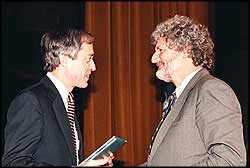
Columbia University President, George Rupp (left), presents John F. Burns with the Pulitzer Prize for International Reporting.
Winning Work
By John F. Burns
KABUL, Afghanistan -- Before the pink light of dawn could touch the snowy peaks of the Hindu Kush mountains around this ruined capital, five young Afghans met on a bitterly cold morning last week for the gamble of a lifetime.
On borrowed bicycles, they planned to cross siege lines to the south of the city, load up with sacks of flour, cans of gasoline and bundles of firewood, and be back home by noon.
From the 300 percent price difference between the Kabul bazaars and the traders outside the city, they calculated that they would make enough money to pay the bicycle owners and keep their families from the hunger and cold of Kabul for a month.
A few hours later, one of the five, a former professional boxer named Hamid, was near death in the intensive care unit of a hospital about a mile behind the front lines. Villagers who found him said four of the five young men had been killed by machine-gun fire that met them as they rounded a corner in the no man's land separating Afghan Government troops from the besieging forces of the Taliban, a militant Islamic force that pushed to within a mile of Kabul's outskirts last fall.
In the dim room where Hamid lay semiconscious, the only sounds were the groans and wheezing of others fighting for their lives from wounds suffered in bombing raids, mine explosions, artillery barrages and forays across the front lines by people like Hamid. At least 20 traders were killed last week alone.
Occasionally, one of the wounded cried out weakly: "Allah. Allah. Grant us mercy."
This spring, it will be 18 years since Marxist conspirators overthrew the Afghan President and set off a civil war. Next week, it will be seven years since the withdrawal of the last of the Soviet troops who invaded the country in December 1979, ostensibly in support of those Marxist rulers, only to be bludgeoned in a nine-year conflict with American-backed Muslim guerrillas that devastated much of the country and gravely weakened the Soviet Union itself.
In April, it will be four years since the puppet Communist Government that the Russians left behind in Kabul finally collapsed, giving way to a new civil war between rival Muslim groups whose enmity for one another turned out to be as great as their hatred of the Soviet invaders.
Ruinous Times: Wars Bring Misery And Exile to Millions
The miseries heaped on this ancient land by the years of fighting are captured in the grim statistics kept by United Nations officials who try to lessen the unending suffering with their relief efforts.
In a country that had a population of 15.5 million in the last census before the Communist takeover, at least one million people have been killed, and two million have been displaced from their homes to other towns and cities inside Afghanistan. Six million others have been driven across the borders into Pakistan and Iran. Less than half of those refugees have returned since the end of Communist rule in 1992.
About two million others, international relief agencies estimate, have been permanently disabled, either physically or mentally.
On the crumbling sidewalks of Kabul, in the overcrowded hospital wards and at the brick-oven bakeries that face clamoring crowds at first light each day, there is an angry consensus that no time since the Communist coup in April 1978 has been as bitter as now.
So dispirited is the mood that it is common to hear people say what would have been unthinkable in the years when the Soviet occupation was a synonym for brutality: that the "Russian time," as it is known, was not so bad after all, at least in Kabul.
"Ah, the Russian time -- that was golden, compared with this," said a doctor at the Karte Seh Hospital, watching stretcher bearers carrying in the body of a 14-year-old boy whose brain had been blown out of his skull by a Taliban bombing raid.
Partly, the gloom is a product of the winter, one of the harshest in memory, with temperatures that sink to near zero at night, chilling mud-walled homes that still stand amid the rubble that is all that remains of at least half of Kabul. Scores of people go to hospitals each morning with frostbite.
Partly, it is the scarcity of food, made worse than ever this winter by a tightening of the siege by the Muslim guerrilla groups that control the roads leading to Kabul from Mazar-i-Sharif in the north, Jalalabad in the east and Kandahar in the south.
These roads, lifelines that have never before been completely shut off for more than a few days, have been closed for much of the last month, creating a crisis as stocks of flour and cooking oil and other staples in United Nations warehouses dwindle.
On Saturday, the International Committee of the Red Cross began an emergency airlift from Peshawar in Pakistan, a 70-minute flight across the mountains to the east. With several shuttles a day, the Swiss-based relief agency plans to bring in more than 1,000 metric tons of wheat to Bagram, a former Soviet air base in a remote area 20 miles northeast of Kabul that is still under Government control.
The airlift planners hope to show the besieging guerrillas that they cannot starve out the city. But more than the privations of cold and hunger and gunfire, it is a sense of hopelessness that seems to gnaw at the 1.2 million people of this city.
"Afghanistan is no more," said Aysha, the mother-in-law of Hamid, the bicycle trader who took a bullet in the chest. "We have been abandoned by the world."
Aysha, who like many Afghans uses only one name, sobbed as she clutched the young man's hand. "The people who did this are no Muslims," she said. "They are the henchmen of Satan, and they will surely suffer in hell." Doctors said they did not expect Hamid to survive.
Islam's Liberators Pledge of Peace Soon Vanishes
A year ago, when the Taliban forces first pushed to the gates of Kabul, many in the city saw them as potential liberators, despite stories of their intolerance in the first city they captured, Kandahar, where the movement was formed and has its headquarters.
There, women were denied the right to work, ordered to wear full veils over their faces and punished if caught outside their homes with men other than their fathers or brothers.
Word of these strictures appeared to have less of an impact on the people of Kabul than the Taliban's success in overwhelming several of the contending guerrilla groups left over from the Soviet occupation.
But the Taliban's promise that it would end the war and the battering of the civilian population, then step aside for a popularly elected government, evaporated quickly.
Soon, the militants were following the example of the guerrilla groups they supplanted, pounding Kabul with heavy artillery. In May, throngs in the capital celebrated when the forces of Ahmad Shah Massoud, the military commander who is the power behind the Government of President Burhanuddin Rabbani, struck the Taliban combatants with a lightning offensive and drove them back 30 miles from the capital.
But in September, the Taliban was back. After capturing the western city of Herat from Ismail Khan, an ally of Mr. Massoud, the militants drove back up the road to Kabul and threatened to overrun the city before Mr. Massoud's defenses stiffened.
Since then, the daily artillery barrages have resumed, along with bombing attacks by the Taliban's embryonic air force. Thousands more have died, bringing the civilian toll in the capital since the Communist collapse in 1992 to at least 25,000, officials of the International Committee of the Red Cross say.
Government estimates put the death toll far higher, at least 45,000. But even at the lower figure, Kabul has suffered more in terms of sheer destruction and in the number killed than Sarajevo, where 10,000 to 15,000 people are said to have died during the 40 months of Serbian bombardments that ended last fall.
And because there is only a vestigial international presence here -- no United Nations military force of the kind that attempted to mitigate the conflict in Bosnia, and only skeleton staffs at the United Nations and other international relief agencies that distribute food, medical supplies and other aid -- the civilian population's distress seems more acute.
Last week, quieter than many since the fall, there were at least three attacks on bicyclists crossing the front lines in search of food, fuel and firewood, and a Taliban bombing attack in which two jets dropped four 1,000-pound bombs.
Two of the bombs exploded in a district of southern Kabul that was reduced to acres of rubble in bombardments that leveled much of the city from 1992 to 1995. Because much of the population still lives amid the rubble, the bombs fell in a busy street, killing at least 20 people and wounding many more. Hospital emergency rooms were awash with blood.
Government officials place blame for the carnage on Pakistan, which has backed the Taliban, apparently to win favor with two powerful Pakistani groups -- Islamic militants, and Pakistan's own population of ethnic Pathans, who are indistinguishable from the Afghan Pathans who predominate in the Taliban force.
Pakistan's role has angered Iran, Russia and India, which have given concerted support in recent months to the Rabbani Government even though it is led and dominated by members of the ethnic Tajik minority that has held power in Afghanistan only once before in the last 250 years.
Each night, planes carrying arms, ammunition, spare parts and other suppplies paid for by Teheran, Moscow and Delhi land at the Bagram air base, leaving telltale vapor trails in the starry skies over Kabul.
Almost as much opprobrium is directed at the United States, which poured more than $5 billion of money and arms into the Muslim guerrilla struggle against the Soviet forces, then virtually disappeared as a factor in Afghan affairs after the cold war ended.
A relief effort by the United States Agency for International Development ended in 1994, and American aid channeled through the United Nations and other relief groups has fallen to between $40 million and $60 million a year, the United States Embassy in Pakistan estimates. American diplomacy has been limited to encouraging a United Nations mediation effort that has never come close to persuading the contending Muslim groups to end the fighting.
Many in Kabul share the view of President Rabbani's Foreign Minister, Najibullah Lafraie, who said in an interview that the United States had a moral responsibility to re-engage in Afghanistan's affairs because of its role in the struggle against the Soviet occupation.
"We believed we were fighting for the freedom of the whole world, not just for the freedom of Afghanistan," said Mr. Lafraie, who was awarded a doctorate by the University of Hawaii in the 1980's. "We fought against the country that Ronald Reagan called the evil empire, and it was as a result of our sacrifices that the evil empire collapsed. But afterward we were forgotten."
Pointless Combat: A Society Beyond Despair
But political arguments seem lost on the poorest people of Kabul, who move through their days with an air of hopelessness that seems to be beyond despair.
Stories abound of mothers abandoning their children in mosques because they lack food. Foreigners are approached at every stop by women beggars wearing the full-face netted shrouds that are traditional among conservative Afghans. Packs of stray dogs howl in the streets at night as they move between street-corner garbage dumps.
To many people, the distinctions between the rival Muslim groups long ago lost significance, and the Rabbani Government has become virtually indistinguishable from its Communist predecessor.
Officials like Mr. Lafraie sit in the same offices, served by some of the same obsequious aides, and ride in the same curtained Mercedes-Benz sedans. Like the Communist Government, the Rabbani administration leaves most relief efforts to international organizations. When the Afghan currency loses half of its value in a matter of days, as it did when the roads were blocked in January, it is the ordinary people, not senior Government officials, who go hungry.
On the front lines, the war seems to have attained a purposeless momentum of its own. Young men, some in their mid-teens, take the winter sunshine on battered steel chairs, adorned in a bizarre mixture of American and Soviet camouflage fatigues, as if to emphasize the irrelevance of the political disinctions that once fueled the fighting.
For them, life has been reduced to rounds of banditry, exacting tolls from those who return with their modest bounty from Taliban-held territory on bicycles and horsecarts. Sometimes the day's round turns to seemingly mindless violence.
When two 10-year-old scavengers traipsed past one roadblock near the front lines carrying sacks filled with farming implements, one young soldier overheard one of the boys saying he did not understand what the war was about, and saw nothing to choose from between the Rabbani Government and the Taliban.
The soldier took the boy by the ear, twisted it and extracted a vow of loyalty to Mr. Massoud. Then he adjusted his Soviet tank crewman's helmet and smiled.
"This war will never end," he said.
© 1996, The New York Times Company
By John F. Burns
KERAT, Afghanistan -- When the crowds were summoned to the main stadium in Herat earlier this month, they went as Romans did to the Coliseum, to watch the grim ritual of death.
First, the crowd sat through a harangue by a Muslim cleric from the Taliban, the Islamic fundamentalist force that emerged from the chaos of civil war in Afghanistan to take control of more than half the country in the last 18 months.
Then Taliban officials turned their attention to an Afghan man who was said to have been convicted by a Taliban court of a triple murder. After his hands and feet were tied, and a noose put around his neck, he was hoisted slowly by a crane.
Afghans who saw the execution said the man died slowly, jerking spasmodically before finally going limp.
From the crowd, there were shouts of "Allah be praised!" Outside the stadium, slumped against a wall and wailing, were several women, relatives of the condemned man, covered head to foot in the manner the Taliban prescribes.
The new Afghanistan is a world where murderers and "enemies" of the Taliban are hanged from cranes and the barrels of tank cannon, where the execution of others found guilty of killing consists of being shot in the back with rifles by their victims' fathers, and where convicted thieves are subjected to surgical amputations of their hands and arms.
After the anarchy of recent years, many Afghans have welcomed the harsh punishments meted out by the Taliban to some violent criminals.
According to reports published recently in Pakistan, there was an execution carried out in the eastern Afghanistan city of Khost a few days ago.
A large crowd that had gathered on the grounds of a local hotel cheered when a retired Pakistani soldier named Faizullah Khattak fired a burst from a Kalashnikov rifle into the back of an Afghan named Mohammed Ullah who was convicted by an Islamic court of killing Khattak's son, a taxi driver who had crossed into Afghanistan with a passenger last year.
In another execution, the condemned man, an Afghan in his early 20s, was said to have begged forgiveness for killing his cousin, only to be cut down by two bursts of automatic rifle fire by his uncle.
Not since 1979, when Ayatollah Ruhollah Khomeini led an Islamic revolution in Iran, which borders on Afghanistan only 75 miles west of here, has this region been wrenched so abruptly toward the past. Nor, since the Soviet invasion of Afghanistan the same year, has there been anything to match the Taliban's potential threat of completing a 2,000-mile chain of animosity toward the West -- through Iraq, Iran, and Afghanistan.
The other macabre twist is that in Afghanistan this hostile force is a mutation of American cold war politics. For the Taliban emerged from the chaos of a war between American proxy warriors and Soviet troops, and is still supported by the arms network of American allies created to challenge Soviet power.
Only a year ago, the rise of the Taliban was greeted with widespread enthusiasm in areas of the country that they now control. Their sudden emergence as a political and military force, from a base in the southern city of Kandahar, was propelled by their pledge to "cleanse" Afghanistan of the killing, rape and pillage that became endemic under the cover of the civil war that ensued after Soviet troops were withdrawn in 1989.
But instead of the relief they promised, the Taliban have plunged millions of Afghans into a new chapter of brutality that echoes the harshness of Afghanistan's distant past.
It is a world where there has been a systematic drive to push women back into purdah, the traditional Muslim arrangement that prevents them from seeing any men outside their immediate families. In Herat, like other places the Taliban rule, this practice has meant a loss of rights most Afghan women had enjoyed for decades.
Under Taliban decrees, women have been forbidden to work outside their homes, except in hospitals and clinics, and then only if they work exclusively with women and girls. Girls have been expelled from schools and colleges, and told that, for now at least, education is for boys only. Girls who were only months from finishing high school, or young women graduating from college, have been told their career dreams are over.
Women wishing to go shopping in the bazaars, or to move anywhere outside their homes, must be accompanied by male kinfolk and wear the traditional burqa, a head-to-toe shroud with a netted slot over the eyes.
The regime imposed by the Taliban, across a 600-mile stretch of territory from Herat in the west to the Pakistan border in the east, is one of such hostility to "modern" influences that the secretive Muslim clerics who lead the movement have ordered public "hangings" of television sets, video-cassette players and stereo systems. In Herat, Taliban fighters have gone from house to house pulling down satellite dishes and antennas, and confiscating books judged to be tainted by Western influence.
As in the Iran of the ayatollahs, the Taliban's rule joins a harsh interpretation of the Muslim holy book, the Koran, with modern forms of enforcement. Herat bristles with Taliban "warriors" in long-tailed turbans carrying Kalashnikov rifles. Some watch suspiciously from rooftops, while others thunder through the narrow, crowded streets of the bazaars in Japanese pickup trucks that were bought for them by sympathetic Arab countries, Saudi Arabia among them.
Along with their puritanical beliefs, the Taliban, since winning control of Herat in September, have loosed a wave of banditry. In the privacy of their mud-walled courtyards, Herat's frightened townsfolk tell of Taliban men bursting in at night, stealing money and gold and cars, and press-ganging men, some as young as 15, for service in Taliban ranks. So far, the townsfolk say, there has been no known case of the Taliban punishing any intruder.
"For 18 years, we lived in hope that things would get better," said an elderly Afghan scholar, one of a minority of professional people who did not flee Herat in the exodus that followed the Soviet invasion.
In a home redolent of a richer past -- a glassed-in orangery looking onto a garden flanked by apricot trees -- the scholar added: "We are ruled now by men who offer us nothing but the Koran, even though many of them cannot read; who call themselves Muslims, and know nothing of the true greatness of our faith. There are no words for such people. We are in despair."
For some Afghans, the Taliban represent the end-product of a war that has worn away what little progress this intensely conservative country made before a Communist coup in 1978 led to the Soviet invasion, a decade of guerrilla conflict, and now, seven years after the Soviet forces left, a seemingly endless civil war. With its cities, towns and villages in rubble, and little left to destroy, these Afghans say, the country has finally reached, in the ascendancy of the Taliban, something close to a primal state.
Apart from their social and religious rigors, the Taliban, who mainly belong to the ethnic Pashtun group that accounts for nearly half the population of Afghanistan, are obtrusive outsiders in Herat. By their customs and by their language, Pashto, as well as by their appearance, they are set apart from the majority in Herat, where the population of 200,000 is mostly drawn from the ethnic Tajik minority, with its own language, Dari, which is a dialect of Persian.
The differences are deeply resented in Herat, a city that was once a major center for the arts and learning, with close ties to the Persian dynasties that were a fountainhead of culture and military skill. In the disdain many people in Herat show for the Taliban there is an element of the superiority people here have always felt towards those outside the Persian cultural tradition, particularly Pashto-speakers from Kandahar. In the bazaars of Herat, Taliban are frequently referred to as "donkey boys," a term commonly used to describe people who are considered crude and uncivilized.
But long before the Taliban seized control here, ethnic and linguistic strains had been sharpened by the war. For 250 years, since Afghanistan came together as a nation, Afghans have had a fierce sense of national pride that has overridden regional attachments. But since the war against the Soviet forces began in 1979, empowering local warlords who made strongholds of every plain and valley, the country has disintegrated into a mosaic of ethnic fiefs.
An Uzbek group, led by Abdul-Rashid Doestam a former leader of a Communist militia, controls much of the north around Mazar-i-Sharif. A predominantly Tajik group led by Ahmad Shah Massoud, a former Muslim guerrilla leader, controls the northeast and the capital, Kabul. A group of ethnic Hazaras, Shiite Muslims with strong links to Iran, dominate in the mountains northwest of Kabul. Ethnic Pashtun groups prevail almost everywhere else.
Of the Pashtun groups, the most powerful is the Taliban. Virtually unknown until September 1994, they gained power first in Kandahar, historically a center of Islamic conservatism. The name Taliban was taken from the Arabic word for students, a reference to the fact that the core group of Taliban came together at Muslim religious schools known as madrassahs in Kandahar and, before that, during the Soviet occupation, at similar institutions across the border in Pakistan.
Reinforced by defectors from the Communist government's armed forces, and backed by Saudi Arabia and Pakistan -- American allies -- the Taliban thrived on popular disillusionment with the war. After Kandahar, they drove rapidly east and west, meeting little resistance. Mostly, rival armed groups either handed over their weapons, or joined the Taliban. Within six months of taking Kandahar, the Taliban were at the gates of Kabul. Within a year, they had taken Herat.
The drive on Kabul went into reverse when it met with a stiff rebuff from Massoud. But since September, Taliban forces have once again threatened the capital, maintaining a tight siege in a loose alliance with Doestam, whose forces are pressing on Kabul from the north. To the east of the capital a Muslim guerrilla group led by Gulbuddin Hekmatyar, a Pashtun leader who was a favored recipient of American money and arms during the war against the Russians, has recovered from his own defeat by the Taliban a year ago to participate in the siege.
Massoud has predicted a major Taliban offensive, probably about Feb. 20, after the Muslim holy month of Ramadan ends, and has implied that he is planning his own pre-emptive strike against the fundamentalists. Many in Afghanistan say that the outcome of the next round of fighting between the two groups could be the decisive event in the civil war.
If the Taliban take the capital -- unlikely, but not impossible, in the view of Western diplomats in Islamabad -- the prospect would be for a Taliban government much like the administrations they have installed in 12 of Afghanistan's 31 provinces. In Kandahar, Herat and other places they have taken power, the Taliban rule through a shura, or council, composed of Muslim clerics known as mullahs. Decisions are reached in secret, and announced as decrees. Resistance is punishable by death.
For the moment, Taliban leaders in Herat appear keen to accentuate their reasonableness, at least to outsiders. A Western reporter who spent five days here, and an accompanying photographer, moved freely about the city and took photographs at will, something said to be almost impossible for foreigners in Kandahar. "We see no country in the world as our enemy, even if they want to consider us as their enemies," said Noor Mohammed Akhund, a 32-year-old mullah who is the third-ranking Taliban leader in Herat.
One reason for the less stringent attitude toward Westerners in Herat could be the growing hostility toward the Taliban in Iran, which has joined India and Russia in an airlift of arms, ammunition and other supplies to the Massoud forces in Kabul. The Taliban's brand of militant Islam, despite its superficial similarities with Iran, has done nothing to alleviate estrangements that grow from the 1,300-year-old schism in the Muslim world between Shiites, the majority in Iran, and Sunnis, who make up the overwhelming majority of the Afghan population.
But politics, more than religion, appear to underpin the Taliban's distrust of Iran. From the outset, the Taliban have been strongly backed by Pakistan, a fact that has prompted Iranian religious leaders to denounce the Taliban as part of an American plot to encircle Iran. Recent military preparations by the Taliban suggest that Taliban leaders fear an attempt by the Kabul government, with Iran's backing, to try to recapture Herat.
The Massoud ally who ruled here until September, Ismail Khan, who fled to the eastern Iranian city of Meshed with thousands of supporters, is said to have regained control of several strategic towns south and west of Herat, perhaps in preparation for a possible strike against Herat.
That the Taliban have reason to fear challenges seems clear. Herat residents, anxious to demonstrate the city's capacity to resist outsiders, take visitors on a journey into hills north of the city, where a shrine has been built at the site of one of the worst atrocities of the war against the Soviet occupation.
On a saddle in the hills overlooking Herat, glass canopies have been erected over pits where Afghan Communists massacred hundreds of Herat residents after an anti-Communist uprising in September 1979.
In local lore, the uprising has joined the challenges Herat offered to past conquerors, including Alexander the Great, Genghis Khan and Tamerlane. But if Taliban fighters visiting the shrine absorbed the message, they did not show it. As they peered into the pits where the victims were buried, taking in the bullet-fractured skulls and bones, the rotting clothing and shoes, and the scattered Afghan currency, they seemed unimpressed. "So? They died," one Taliban warrior said.
Some of the Taliban troops seemed to be as much victims of the situation as perpetrators. In a wrecked school that was rebuilt last year by the United Nations, a group of Taliban warriors huddled together in the cold, the bare concrete floor around them littered with vegetable peels. Among the men, all in their early 20s, there was not one who had ever been to school. "'I've been a fighter ever since I started to grow a beard," said Sher Ali, aged 20. "Since 14, I have been fighting. It's all I have ever known."
Although he has never read the Koran, Ali said he believed that the Taliban, by following its teachings, would be the salvation of Afghanistan. "Everything we do will be according to the Holy Koran," he said. "No negative actions will be allowed. Whatever Allah has commanded, as far as possible, we will do." As for those who defied the Koran, Ali said, tracing a finger first across his neck, then across his forearm, "We will cut!"
A short distance away, another group, this time of women and babies, sat shivering in another bare concrete room, the malnutrition ward of the main Herat hospital. In a city where one in every five babies dies before reaching its first birthday, professional care in the ward relied until recently on a French doctor assigned to Herat by a Paris-based medical charity, Medicins du Monde. But in January, the doctor, after a shoving match with armed Taliban, was ordered to leave the ward under Taliban strictures on the separation of men and women.
The doctor has kept busy working among refugees in a tented camp on the city's outskirts. But the memory of his banishment rankles the Afghan women staff members, many of them barely trained, who are left to cope with the patients. One woman with a small baby had her own concise opinion on the Taliban.
"I'd like to kill them," she said.
© 1996, The New York Times Company
By John F. Burns
KABUL, Afghanistan -- In the four days since Kabul fell to Taliban militias, the capital's one million people have been plunged into the medieval labyrinth that is Taliban rule.
Already, a secretive, six-man ruling council of Islamic clerics has reshaped the everyday lives of ordinary Afghans who, at least in Kabul, long enjoyed one of the most liberal lifestyles of any Muslim community in Central Asia. Cinemas have been closed, the Kabul television station shut down, and the playing of all music has been banned.
A decree on Sunday from the new Department for the Propagation of Virtue and the Prohibition of Vice ordered all men in government jobs to grow "proper beards" -- meaning untrimmed ones -- within 45 days. Western-style suits have been banned.
Women and girls have fared worse. Girls' schools have been closed while the clerics, known as mullahs, study the "issue" of education for females. Women with jobs have been told to stay at home, and ordered, when venturing out, to wear a full "chaderi," a gown that covers a woman from head to toe, allowing her to see only through a tightly-woven facemask.
On Sunday, there were several instances reported in which Taliban fighters stopped women on Kabul streets and beat them, in one instance with a radio antenna ripped from a car, accusing them of not covering their entire bodies.
The mullahs, who have already imposed changes on the parts of the country that have been under Taliban control, are introducing the capital to sharia, the harsh Islamic criminal code that prescribes stoning to death for adulterers and drug traffickers, amputations of hands and feet for thieves, and flogging for the sale or consumption of liquor. At least one man has already been paraded through the city on a truck, his face blackened, a weight attached to his lower jaw to keep his mouth open, and his left hand severed.
Still, the Taliban capture of the capital, after a 22-month siege, has brought a breath of relief to the people in Kabul. Before the dust storms blew up Monday, shrouding the city in a fine brown haze, the morning sunlight showed the capital in a rare state, with residents moving about without fear of the long-range artillery that has killed at least 30,000 people and reduced much of the city to rubble.
And the voice of the city is changing, too, with people talking about the possibility of an end to the seemingly eternal civil war all across Afghanistan, something many Afghans have long said they would sacrifice almost anything to achieve.
The war began when the Afghan Communist underground seized power in Kabul in a coup in April 1978. In 1979, Soviet paratroops seized Kabul airport to begin a decade-long military occupation. When they pulled out, Najibullah, the Soviet-backed Afghan leader, retained power until 1992. Since, then he had been sheltered in a U.N. compound in Kabul.
After the collapse of Communist rule in 1992, a jumble of guerrilla factions jostled for control of Afghanistan. Burhanuddin Rabbani, one of the faction leaders, became president in the government's most recent incarnation. The Islamic groups that succeeded Najibullah, have been picked off one by one by the Taliban, a movement that sprung out of Islamic religious schools called madrassahs in 1994. The Taliban's pledge was to rid the country of the anarchy fostered by the guerrilla factions.
With their victory at Kabul, the Taliban now control 70 per cent of the country and are fast closing in on the northern 30 per cent that remains under the control of two surviving ethnic militias.
Throughout the day Monday, Taliban fighters in Japanese pick-up trucks were said to be pouring north toward the Salang Tunnel, a Soviet-built feature high in the Hindu Kush mountains that is the last major barrier facing the Taliban before they confront the militias of Gen. Rashid Dostum, an Uzbek, and Ahmad Shah Massoud, a Tajik, who was the military commander in the Kabul government that the Taliban ousted in the offensive that culminated last week.
Dostum, a former communist commander, was reported to have rushed 2,000 troops to the northern end of the tunnel to stage a last-ditch battle for survival.
He is said to fear the same fate as Najibullah.
On Thursday night, fleeing officials of the ousted Rabbani government offered to take Najibullah with them, but he declined, apparently believing the Taliban would not breach the U.N. compound. Taliban fighters dragged Najibullah from the compound at 1.30 a.m. on Friday, and had killed him by 4.30 a.m., U.N. officials said. He had been tortured and shot and his mangled corpse was left hanging alongside his brother's.
It will be a long time before most people in Kabul can think of the Taliban, the Islamic fundamentalist militia force that captured Kabul last week, without jarring recollections of the bloody way in which the fundamentalists introduced themselves to this war-shattered capital.
"Najibullah was a bad Afghan, and a very cruel man," said one man who was once a prisoner of the communist secret police. "But what the Taliban did to him was quite horrible, and now we must think about the kind of people they must be to do such a brutal thing. Maybe our lives now will be even more difficult than before."
All across Kabul Monday, people lowered their voices when asked about the fate of Najibullah, who was as brutal a ruler as this harsh country has known, but who won grudging respect from many Afghans for his peaceful surrender to the council of former Muslim guerrilla leaders in 1992.
The stillness that came with the end of the fighting in the capital was compounded by an eery emptiness in many streets, partly the result of most women staying home and partly the consequence of a mass exodus to the north, said to have involved as many as 250,000 people, ahead of the Taliban's march into the city.
Traffic moving southwards across the arid plain that separates Kabul from the Hindu Kush suggested the exodus was reversing, but many shops remained shuttered.
One of the few busy spots was at the gates to the Arg Palace, once home to Afghan kings and, since Thursday, headquarters of the Taliban. Hundreds of heavily-beaded Taliban fighters carrying Kalashnikov rifles milled about, many of them southerners from the city of Kandahar, the original base for the Taliban. Kabul people who dare to talk about the Taliban often say that the new rulers' harsh brand of Islam is a product of the walled-off mentality which, these people say, has been characteristic for centuries of Kandahar.
Arabic lettering on the white Taliban flag fluttering atop the palace's clock tower spelled out the Taliban message. "There is no God but Allah," it said, in the most sacred words of the Koran.
Another message came from the Soviet-built tank lurking behind the gates, its barrel festooned with paper flowers. Beggars who are one of the legacies of the war, many of them men missing legs, moved among the Taliban fighters, some distinguishable by white turbans of the kind favored by the ruling mullahs.
After two decades, many people appeared to have decided that there is no choice but to go along with the mullahs, while reserving judgment on what their rule will bring. In the bazaar that crowds along the banks of the Kabul River in the heart of the city, Abdul Jabbar, an 85-year-old pensioner who practiced law under the Afghan monarchy, approached a foreigner to practice what he said was English grown rusty during years of war.
Jabbar, wearing a freshly purchased prayer cap in Taliban white, chose his words carefully. "We are perhaps a little happy that the Taliban have come, because the fighting is ended," he said. "But in future, we can only be happy if the Taliban do their work well. Everything is in the hands of Allah."
© 1996, The New York Times Company
By John F. Burns
KABUL, Afghanistan -- Since the Taliban militia forces overran this capital 10 days ago and proclaimed a Muslim fundamentalist government, a ghostly exodus has begun among the Kabul middle class.
Long before dawn, whole families have crept from their homes and headed down to the Kabul River, hauling tin trunks and burlap sacks full of clothing and household goods.
Their destination has been a stretch of broken ground lighted only by the glow from a crescent moon. There, flanked by miles of rubble that is all that is left of much of Kabul, doctors, lawyers and engineers and their fearful-looking families wait for daylight and the minibuses that go east across the mountains to Jalalabad. From there, many switch to camel routes across the mountains into Pakistan to complete their flight from the harsh new world of the Taliban.
The fleeing families have been frightened by decrees that threaten to return Afghanistan to village medievalism, especially for women and girls, whom the Taliban have forbidden to go to work or school.
On Saturday, in a new instance of the rigidities that issue each day from the shadowy Muslim clerics who control the Taliban, Western reporters were summoned to watch a Soviet-built tank roll across a cellar's worth of brandy and beer found in a Kabul hotel.
Taliban decrees range across the gamut of everyday life. Kite flying and marble playing, traditional pastimes among Afghan children, have been banned, as have music and dancing.
Men have been ordered to pray at their neighborhood mosques five times a day. A strict dress code requires women to be shrouded from head to toe and men to abandon Western suits. Other decrees have called for death by stoning for adulterers and amputation of hands and feet for thieves. To many educated Afghans who stuck it out in Kabul through 18 years of war, or who left but returned, the intolerance is the final straw.
While the fundamentalists have brought peace to the 75 per cent of Afghanistan that they control, their assumption of power in Kabul threatens a new and possibly more protracted ordeal -- a narrow, mosque-centered society modeled on life in the mud-walled villages from which many Taliban clerics and fighters have come.
"We don't want to live in a prison, which is what the Taliban are offering us," said a physician who was moving furtively through the crowd clamoring for space on the jam-packed minibuses to Jalalabad.
The doctor, who gave his first name as Habibullah, darted back into the crowd, anxious not to draw attention from the hard-eyed Taliban fighters cruising the area to enforce their ban on leaving the country.
Exactly what Taliban control will mean may take months, or even years, to determine. Little is known about their leaders, and in particular about the 38-year-old Muslim cleric, Mullah Mohammed Omar, who heads the Taliban ruling council in the conservative southern city of Kandahar.
Mullah Omar is a former guerrilla commander in the war against the Russians, but he has refused to meet foreigners since helping to establish the Taliban as a fighting force two years ago.
All Are Grateful For End to War
But one thing on which virtually all Afghans in areas under Taliban control can agree is that the fundamentalists have accomplished something that few would have believed possible: putting an end in most of the country to a conflict that evoked the waves of barbarism that swept across Asia in the distant past.
Only ruins are left of the Afghanistan of 1978, when a Communist coup set off a spiral that led to a Soviet combat role, a decade-long Muslim guerrilla struggle and then a savage civil war among more than a dozen guerrilla groups.
The fighting killed an estimated 1.5 million Afghans and severely disabled 500,000, destroyed 10,000 villages and turned the country into a vast scrapyard of abandoned, rusting weaponry.
Nor have many Afghans contested the extraordinary appeal of the Taliban promise to reunite the country. A force unknown to most Afghans only two years ago, they persuaded one regional faction after another to bow to their authority without a fight and achieved their triumph at Kabul as government soldiers abandoned their defenses without firing a shot.
Their successes have owed little to military prowess, since most Taliban fighters are poorly trained village youths with only light weapons. The force that took Kabul probably numbered no more than 1,000, of a total force of about 25,000.
Poor and Hungry Do Not Mind Change
For the vast majority of Afghans who are poor, hungry and illiterate, and who have never known the citified liberties the Taliban are stripping away, the fact that the fundamentalists have routed the warring guerrilla groups is almost the only important issue.
This view is voiced widely even in Kabul, the city considered modern by the standards of Afghanistan, a land where most people continue to live lives that are almost biblical in their adherence to ancient ways.
In Kabul, where the fighting by rival factions has killed tens of thousands of civilians in the last three years, desperation reached the point where people were prepared to pay almost any price to stop the war.
"All that matters is that the fighting has stopped," said Sameh, 20, who was begging in the bazaar by the Kabul River one afternoon last week.
Sameh, at one time a guerrilla with the group headed by Ahmad Shah Massoud, the military power behind the defeated government of President Burhanuddin Rabbani, lost a leg in the fighting but found like many former guerrillas that the group cared nothing for him once he was wounded. It brushed him aside while its commanders enjoyed the perks of power.
"Perhaps the Taliban will help me," he said. "Nobody else did."
But for the remnants of the Afghan middle class who were not among the tens of thousands who had already left, the end to the bombing, shelling and sniping has been only one aspect of the Taliban triumph.
While the Taliban have appealed to the professionals to remain and help rebuild Afghanistan, many have either left or are planning to leave because of their fears being trampled under Islamic totalitarianism.
Conciliatory Signals To Outside World
Aware of the menacing image that they have created among educated people at home and in many of the countries that will be needed to help pay for reconstruction here, the Taliban have begun sending out conciliatory signals. They have said they are open to ties with the United States and the rest of the outside world, pleaded for Western aid and hinted that they may review some of their decrees.
At a news conference in Kabul on Sunday, the foreign minister in the provisional government, Mohammed Ghaus Akhund, appealed to foreign aid agencies that support half of Kabul's million residents and many others throughout the country of 16 million for patience.
The aid agencies have appealed to the Taliban to ease the strictures against jobs and education for women. The agencies have been wrestling with how they can continue to feed, clothe and educate Afghans, as well as provide support for much of the country's medical care, without breaching Western human rights concepts by bowing to Taliban rules.
Some programs have been suspended because female aid workers have been forced to stay home, but Mullah Akhund, who appeared for his news conference wearing American-made aviator sunglasses, promised that the restrictions on women and girls would be reviewed once the Taliban controlled all of Afghanistan.
"I am hopeful these small questions will be resolved," he said.
But other evidence suggests that the Taliban's decisive voice will be the village mullahs, or clerics, who control the movement from Kandahar, not the more urbane officials who offer reassurance in Kabul.
Afghan Counterpart To Iran's Ayatollahs
Although the Taliban are Sunni Muslims, traditionally hostile to the Shiite Muslims who predominate in Iran, there are ominous signs that the Kandahar clerics could prove as intolerant of dissent as the ayatollahs who took control of Iran in 1979.
In Mullah Omar the Taliban appear to have their own counterpart to Ayatollah Ruhollah Khomeini, who combined religious and secular power in Iran until his death in 1989.
Mullah Omar was raised in a village outside Kandahar and spent years fighting the Russians, losing his left eye to a sniper bullet. He also studied to become a mullah in the deeply conservative Muslim religious schools called madrassahs.
It was in the madrassahs, some in Afghanistan and some across the border in Pakistan, that the Taliban imbibed a mix of fundamentalism and nationalism that in 1994 brought about a resolve to take up arms and clear Afghanistan of the factionalism and banditry spawned by civil war.
The Taliban took their name from an Arabic term that means religious students, but they were quickly joined by many guerrillas from outside the madrassahs who were equally disillusioned with what had become of the groups that fought the Russians.
As Taliban fighters have swept across Afghanistan, their ruling clerics have said repeatedly that they did not seek power for themselves, only a sort of guarantor's position that would allow them to insure the country's adherence to Islamic principles.
But Afghans say Mullah Omar's actions suggest that he may be planning to install himself as a sort of overlord. They say talk by Taliban officials of establishing a government representative of all groups and opinions in Afghanistan may only be a ploy to head off dissent while the Taliban consolidate their power.
Taliban proclamations identify Mullah Omar as Amir ul-Momineen, an Arabic term meaning prince of the believers that Muslim scholars trace to disciples of Mohammed, more than 1,000 years ago.
The use of the title has shocked many Afghans, as well as Muslims elsewhere, since it implies that he envisages himself as a leader for Muslims beyond Afghanistan. The notion has been further encouraged by his statements citing Taliban fundamentalist practices as an example for other Muslim countries.
Earlier this year, during a sacred festival in Kandahar, Mullah Omar shocked many Afghans by donning a cloak kept for centuries in the city's main mosque that Muslims believe to have been worn by Mohammed.
Moderate Muslims Express Concern
Much behavior has combined with measures likes banning women and girls from school to persuade more moderate Afghan Muslim leaders that Taliban practices are an extreme reaction to the suffering of the last two decades, and not a model for preserving the country's Islamic traditions.
"Islam is a moderate religion, and it does not permit such extremism," one of the country's most eminent Muslim scholars said in a private talk with visiting reporters.
The Taliban clerics have mixed calculations with outbursts of violence and anger. After Taliban fighters reached Kabul and summarily killed Najibullah, the country's last Communist president, the clerics said that this was "not the policy" of the Taliban and that henceforth opponents would be tried before an Islamic court.
But at other times the clerics themselves have seemed to be barely able to control their passions. Last week, Western reporters were interviewing a Taliban official when Mullah Turabi, put in charge of the Kabul city government by the Taliban, burst into the room wielding a cane.
The mullah, who lost an eye and a leg in the struggle against Soviet forces, berated the official, then struck him on the face. "How dare you talk to these journalist infidels!" he said.
Neighboring Lands Issue a Warning
Fear of the Taliban's fundamentalism has reached beyond Afghanistan's borders.
The concern prompted an emergency meeting on Friday among the Muslim-inhabited republics of the former Soviet Union in Almaty, the capital of Kazakstan. Attended by representatives of Turkmenistan, Tajikistan, Uzbekistan and Kyrgyzstan, the meeting issued a warning that the republics, now independent countries with military ties to Russia, would not stand by if a new Taliban offensive carried the fighting close to Afghanistan's northern borders.
Taliban leaders have said they have no intention of exporting fundamentalism. But Mullah Akhund, the provisional foreign minister, became agitated Sunday when he was asked about the warning issued at Almaty, calling it a "threat and interference" with overtones of the 1979 invasion.
"If the Russians are considering interfering in our affairs again, they will be making a huge mistake," he said.
© 1996, The New York Times Company
As a Savior or a Conqueror
By John F. Burns
"Are you so surprised we are back?" Oleg Nevelyaev, Russia's vice consul in Mazar-i-Sharif, said to a reporter as Dostum emerged from the Khinjan meeting and embraced his principal partner in the anti-Taliban alliance, Ahmad Shah Massoud.
MAZAR-I-SHARIF, Afghanistan -- If proof were needed that history takes curious turns, there is evidence in the heavyset warlord with the shoe-brush mustache whose portraits loom over this old Central Asian city. Once a Communist general, he is now spoken of by people in northern Afghanistan as Pasha, a title used by some of the region's ancient kings.
When the Soviet Union withdrew its troops from Afghanistan in 1989, Gen. Abdul Rashid Dostum seemed washed up.
He was by turns a Communist union boss on an Afghan gas field built by Soviet engineers, leader of an ethnic Uzbek militia that sided with the Soviet occupiers in their war with Muslim guerrillas, and ultimately a major battlefield commander for Afghanistan's Communist dictatorship who won honors for his campaigns against the guerrillas.
But now, long after the guerrillas drove the Russians out and overthrew their proxy government, Dostum seems more powerful than ever.
When he raced southward in his armored Cadillac on Thursday for a clandestine meeting at Khinjan in the Hindu Kush mountains, the 43-year-old general emerged as leader of a kind of ministate in northern Afghanistan.
His alliance hopes to resist the Islamic purists of the Taliban movement who have ousted the guerrillas who defeated the Soviets and overrun most of Afghanistan south of the Hindu Kush.
Some who have watched Dostum (pronounced doe-STUM) believe that his ambitions may run further than stopping the Taliban, who have imposed what they say are Islamic strictures in areas under their control, including bans on women's working and on girls' going to school.
A diplomat here believes the general may see himself emerging from Afghanistan's chaos as the country's new ruler, winning glory for the Uzbeks that has eluded them for 500 years.
"He thinks of himself as the new Tamerlane," the diplomat said, referring to the leader of the Uzbek horsemen who conquered Afghanistan in the 14th century, starting an empire that for 150 years controlled all the territory between Baghdad and the western frontier of China.
Dostum is widely popular in Mazar-i-Sharif, the dusty city of 2 million people where he makes his headquarters, and not only among ethnic Uzbeks, many of whom take pride in the martial state he has created, with tank barrels and anti-aircraft guns bristling from every mud-walled fort and hilltop.
For many others, it is the freedoms here, fast disappearing in areas under Taliban control, that make him an icon.
"I think he is a good leader, because people here can live as they want," said Latifa Hamidi, 18, who is in her first year of medical studies at Balkh University, an institution financed by Dostum.
Like perhaps half of the population of the city, Ms. Hamidi is a refugee. She comes from Kabul, where her father was killed by a shell five years ago. She has nightmares about what would happen if the Taliban defeated the general and took control here.
"I want knowledge and I want a useful life," she said. "I don't want to be forced to stay at home."
The state proclaimed at the Khinjan meeting exists mainly on the piece of scrap paper that was scrawled on by one of Dostum's aides, and signed by the general and other anti-Taliban leaders. It has been dismissed by the Taliban, but the rival government the leaders agreed to establish at Mazar-i-Sharif could prove crucial to the future of Central Asia.
Its backers include India, Iran and Russia, which borders on former Soviet republics with large Muslim populations.
Brushing aside the Taliban leaders' promises to live peacefully with their neighbors, the Russian national security adviser, Alexander Lebed, has said the Taliban intend to "annex" the former Soviet republics of Uzbekistan and Tajikistan, along with the sacred Muslim cities of Bukhara and Samarkand.
"Are you so surprised we are back?" Oleg Nevelyaev, Russia's vice consul in Mazar-i-Sharif, said to a reporter as Dostum emerged from the Khinjan meeting and embraced his principal partner in the anti-Taliban alliance, Ahmad Shah Massoud.
The embrace took place in front of an old Soviet guesthouse in a region of barren hills littered with rusting Soviet tanks where Massoud, regarded by Soviet commanders as the most effective Afghan guerrilla commander, harassed Soviet troops throughout the occupation.
If Dostum feels a sense of irony at finding himself a key player in a new Russian gambit in Afghanistan, he shows no sign of it.
He is a bullish man, in stature and in style. He almost always appears in a Soviet-style uniform, as he did at Khinjan, and he presides, from his headquarters in a 150-year-old mud-walled fort outside Mazar-i-Sharif, over a territory where he is as much an overlord as were any of the Communist rulers of the Soviet Union and its satellite states.
One way in which he has achieved his new stature is by letting his military might, based on an army of at least 50,000 men that is undoubtedly the best trained and equipped in Afghanistan, speak for him.
A man of few words, he declined to be interviewed for this article. But he has spoken dismissively of the Taliban, telling aides that he does not intend to submit to a government under which "there will be no whisky and no music."
But Dostum is a pragmatist, and when the Taliban overran Kabul last month, he said nothing to make an accommodation impossible. His move to create a new state came only after the Taliban issued a spate of fundamentalist decrees and opened an offensive against Massoud's stronghold north of Kabul, with the implied threat of moving against Dostum.
A willingness to switch sides helped the general survive the collapse of Communist rule. In April 1992 his defection to the Muslim guerrillas besieging the Soviet-backed government in Kabul doomed that government.
Then, after joining the first government established by the anti-Soviet guerrillas, he switched sides again and shelled Kabul for months, killing tens of thousands of people. Then he retreated to the north, consolidating his grip on an area that now covers six provinces, with perhaps 5 million people.
While many are Uzbeks, the population of the region also includes many ethnic Tajiks, Hazaras and Pathans, the largest group in Afghanistan, and the one from which the Taliban have drawn almost all their support.
Since the Taliban seized Kabul, a new wave of refugees has streamed north across the mountains, and what they have found here has entranced them.
While much of the rest of Afghanistan is in ruins, Mazar-i-Sharif, trading with the newly independent states of what was Soviet Central Asia, is thriving. Its bazaars are packed with imported goods, including such luxuries as satellite telephones.
Dostum, who has grown rich from taxing the new trade, has started his own airline, Balkh Air, with two British-made jets that fly to destinations in Central Asia and the Persian Gulf.
With its dusty streets and chromed pickup trucks and the macho mood of many Uzbeks, the city seems tailor-made for the general. When a visitor inquired about the price of a volume of plays at a bookshop in the bazaar, the merchant suggested that he buy a set of chest expanders instead.
And at Dostum's headquarters, fighters relaxing in the afternoon sun guffawed when a reporter suggested that future battles with the Taliban might be fierce.
"The Taliban?" said Mohammed Siddiq, one of the general's commanders. "Compared with us, they are a bunch of women."
© 1996, The New York Times Company
By John F. Burns
KOAB, Afghanistan -- When a band of Afghan fighters rose before dawn Monday at a smoky inn in this village high in the Hindu Kush mountains, the prospect before them was much the same as it has been since the war here began with a Communist coup nearly two decades ago.
From all that the fighters said during a night resting at the inn, the outlook is for more long, dusty days tramping across inhospitable hills or bouncing in open trucks down rocky roads, with little awaiting them but the next skirmish. For many of them, fighting is the only life they have ever known.
But during hours spent sharing the fighters' evening meal of boiled rice and their dormitory on a bare mud floor at the back of the inn, their nonchalance was striking.
Among the fighters, there seemed to be little sense of a life beyond their ragtag existence in the Afghan hinterland. There were no complaints, even from men with no laces for the battered street shoes that serve as combat boots, no openly expressed fears of death in a war that has killed hundreds of thousands like them, not even much that could be called hope.
There was only a general sense that a life spent roaming this ancient land in pursuit of battle was about all that any Afghan man could expect.
"We are fighters -- that is what we do," said a man who gave his name as Shamsuddin, 45, a commander in the guerrilla force of Ahmad Shah Massoud.
He spoke during a break from an evening spent listening to bulletins on the Afghan fighting squawking from a short-wave radio tuned to Radio Tehran. The Iranian broadcasts are much favored among the Persian-speaking men of the ethnic Tajik minority in Afghanistan who are the bulk of Massoud's force.
From the grins that the commander's remark prompted among fellow fighters grouped about him in the glow of a kerosene lamp, it seemed that they, too, considered questions about their personal feelings to be effete or irrelevant.
They did not even seem much interested in the complex politics of the war, which has provided them with a kaleidoscope of enemies, some of whom have been allies, then enemies, then allies again. The rule seemed to be that they fight whomever the commander chooses.
At the moment, the enemy is the Islamic movement known as the Taliban, which captured Kabul, the Afghan capital, from the Massoud forces last month, then set about imposing a strict system that includes bans on women working, on girls going to school and even on the playing of soccer.
The Massoud forces have taken the lead in counterattacking the Taliban north of Kabul, striking in recent days at targets as close as five miles from the capital's northern outskirts.
The Massoud forces are newly aligned with two other ethnic armies, the Uzbek-dominated force of Gen. Abdul Rashid Dostum and the Shiite Muslim force of Hazaras under Abdul Karim Khalily, which have pledged to resist the Taliban, who are mainly from the ethnic Pathan majority in Afghanistan.
But in this valley, as in many other regions of northeastern Afghanistan, there is plenty of evidence, in ruined villages and blasted bridges, of the fighting that pitted the Massoud forces against the fighters of Dostum and Khalily until only a month ago, before the Taliban united former enemies against them by taking Kabul.
For the Massoud men at Doab, Radio Tehran has provided the fighting rationale of the moment: that the Taliban have been armed and financed by Pakistan and the United States, and are therefore no better than the Russians who sent an occupying force to Afghanistan for a decade in the 1980s, or for that matter the British who invaded Afghanistan twice in the 19th century.
"The Taliban are puppets of Pakistan," the Massoud fighters said in a chorus that rang through the evening. "We will drive them out of Kabul."
But in the end, it seemed that it was the fighting, not the enemy, that mattered most. The evening was punctuated by bloodthirsty gestures that needed no translation, ranging from leveled Kalashnikov rifles and the staccato noises of automatic fire to hands strangling an imaginary foe.
It is a mood like this that has troubled the handful of Afghan psychologists who have not joined the middle-class exodus abroad. They have been saying for years that even if the fighting stops, Afghanistan will have to contend for decades with the tortured psychology of men who have known nothing but war.
The good-humored camaraderie of the Massoud fighters, some of whom gave up their own blankets to two Western reporters to ward off the night chill, seemed all the more remarkable for the hardships of the terrain they have been assigned to hold, and to recapture every time it has been lost.
Only three days ago, when the Massoud fighters were further up the valley, the village of Doab shifted its allegiances to the Taliban, posting a white Taliban flag on a pole atop a part of the main street that was bombed to a shell by Soviet aircraft a decade ago. The next day, as the Massoud forces approached, the village shifted back.
Doab -- the name means "two rivers" in Dari, the Persian dialect spoken by Afghanistan's Tajik people -- is in the heart of the Bamian region of the Hindu Kush, about 60 miles west of the Salang Highway that connects Kabul to northern Afghanistan through the mountains.
To reach here from the highway requires a 12-hour journey along a narrow, unpaved road made almost impassable by huge, knife-edged boulders, waist-high floods and bridges across plunging rivers that the fighting has reduced to little more than tangled masses of iron and wood.
To drive the road is to pass through a patchwork of territories, some only a mile or two along the riverbank, that are controlled by the different military factions belonging to the new anti-Taliban alliance.
At the checkpoints, trucks carrying cargos of rice and wheat -- and sometimes flatbeds full of Tajik, Uzbek and Hazara families fleeing Taliban rule in Kabul -- are charged tolls by teen-age fighters waving rifles.
Each halt has a commander who seems to report to nobody but himself, eager to show off his small band of fighters and his armory of battered Soviet weapons to passing foreigners.
Often there is enough bombast for a comic opera. "There is no way out for the Taliban fighters," Sherdat Fedayi, 50, a commander in the Dostum forces, said at a checkpoint a few miles east of Doab. "They will soon be surrounded by us to the north, the south, the east and the west."
As his men gathered around him, Fedayi pointed south toward Kabul and added, "The only escape for them is to the cemetery."
© 1996, The New York Times Company
By John F. Burns
SAR CHESHMA, Afghanistan -- In a country where at least 10,000 villages have been bombed, shelled and burned into rubble, the razing of one more hamlet can pass almost unnoticed. For hundreds of thousands of Afghan families who have lost their homes, the anonymity of the loss only adds to the pain.
So when a battered Kabul taxi arrived here Thursday morning, smoke still rising and the smell of torched ruins heavy in the air, villagers clamored to tell outsiders how Sar Cheshma had died.
Hastening down narrow lanes between fire-blackened houses, the handful of people remaining in the village abandoned for a moment their rush to board trucks waiting to carry them away as refugees.
The villagers' story has been a familiar one in the 18 years that Afghanistan has been at war. The twist this time was that the men who destroyed Sar Cheshma were the turbaned warriors of the Taliban, the ultra-conservative Muslims who have imposed a medieval social order across much of Afghanistan.
Two years ago, the Taliban sprang from religious schools with a promise to suppress the carnage that has killed an estimated 1.5 million Afghans and driven millions of others from their homes.
The villagers of Sar Cheshma say 30 Taliban fighters swept in at dawn on Tuesday, then spent several hours pouring canisters of gasoline into the 120 courtyard houses and setting them on fire.
Sar Cheshma lies barely five miles from the northern outskirts of Kabul, the capital, where the Taliban forces are fighting a village-by-village battle with the forces of Ahmad Shah Massoud, a less conservative Muslim leader whose troops used Sar Cheshma briefly on Monday as a base to fire on the Taliban.
A young mother and her three sons were killed by a Taliban rocket fired when the Massoud forces were in the village.
There were no further deaths in the torching that nearly obliterated the village. But in one mud-walled courtyard after another, where hundreds of people lived, little remains but buckled bed frames, melted kitchen utensils and charred piles of grain.
"Are we not humans?" sobbed a 45-year-old woman named Narwaz, rushing forward with others to greet visitors who had slipped past Taliban checkpoints posted to keep outsiders away.
Beside her, a villager named Khairuddin, 55, waved a bloodied burqa, the head-to-toe shroud that the Taliban force all women to wear outside their homes. The garment was all that remained of his daughter, the woman killed with her sons in the Taliban rocket attack.
In a home up one of the village's dusty pathways, another man, Najmuddin, 30, broke away from sifting through his blackened grain supply, hoping to find enough uncharred bits to carry away.
Suddenly, the grain forgotten, his face contorted, he rushed to fetch a metal bowl piled high with ashes that had been balanced on a section of broken wall. It was all that remained of a copy of the Koran that he said had been in his family for generations.
"Tyrants! Tyrants!" he shouted, referring to the Taliban. "This is the book of God. Kill us if you must, but don't burn our holy book!"
Their attention attracted by his cries, several neighbors rushed forward, one with a large metal plate sitting among the utensils that Najmuddin had saved from the fire. Reverentially, Najmuddin placed the bowl with the ashes onto the plate and carried it away.
"We honor these ashes," he said, weeping. "The Koran is the book of God."
The shock of what happened here appeared to be all the greater among the villagers because the perpetrators were the Taliban.
When they emerged as a fighting force in 1994, the Taliban presented themselves as the harbingers of a new Afghanistan, modeled on the teachings of the Koran and inspired by a burning zeal to reunify the country.
From their original base in the southern city of Kandahar, they swept east and west, suppressing local militias that had reduced much of the country to anarchy. The Muslim clerics who led the Taliban promised that their forces would set new standards of decency in the fighting.
Taliban units appear to have avoided raping and pillaging in the manner of most of the other Afghan forces that have fought in the civil war. But they have become widely hated for the draconian social order laid down by the Taliban leaders, which bans women from working outside the home and girls from going to school, requires men to grow beards and forbids children to fly kites or play soccer.
Since Kabul fell to the Taliban four weeks ago, there has been a series of uprisings against them in towns and villages north of the capital. Now the Taliban have gone a step further, using tactics indistinguishable from those of other forces that have contributed to the country's destruction.
Today, two days after the attack on Sar Cheshma, Taliban jets bombed Kalakan, a village under the control of the Massoud forces about 10 miles further north. According to an account by a reporter for the BBC who visited the village, the bombing killed 20 civilians.
Scene of Fighting Against Russians
In the case of Sar Cheshma, the Taliban attack was the latest in a series of disasters. The residents have repeatedly found themselves in the middle of the fighting because of the village's strategic position, hard up against the Ghoza mountain range, which runs like a shield across the northwestern flank of Kabul.
In the decade that Soviet forces were here, Sar Cheshma became a stronghold for the Muslim guerrillas who ultimately drove out the Soviet troops.
Soviet bombers pounded the village more than once, leaving jagged ruins where mudwalled homes once stood and forcing many villagers to flee to Pakistan and Iran as refugees. Some returned after the Russians left, but barely a third of the village's 300 homes were occupied this week.
In the atmosphere of panic that gripped Sar Cheshma Thursday, many villagers said the Taliban were worse than the Russians.
"We killed more than 40 Russian soldiers in this village, but they never burned our houses," said Nizamuddin, 35, who like most others here had supported his family by raising livestock and working a small plot of land.
Again and again the villagers voiced special loathing for the Taliban because of the religious movement's claim to be the true upholders of the Koran.
"Didn't they do a wonderful job here, these Muslims?" said Nizamuddin, leading the visitors on a house-by-house tour. "Wasn't this burning of our village a true act of faith? We should applaud them -- they are surely the best Muslims in the world."
If razing the village showed how none of the armies fighting for control of Afghanistan shows much mercy for civilians, it also demonstrated that the war has gone beyond a competition between faiths and ideologies and become little more than an ethnic struggle.
One reason the Taliban have been driven back so quickly from the northward advances they made after overrunning Kabul is that many villages dotting the dusty plain between Kabul and the Hindu Kush mountains 60 miles to the north are inhabited by ethnic Tajiks, the second-largest population group in Afghanistan.
All but a tiny minority of Taliban fighters are from the Pathan ethnic group, which is the largest in Afghanistan, accounting for about half the country's 16 million people.
As a Tajik village, Sar Cheshma was a natural attraction for Massoud's forces, and a natural target for Taliban suspicion. The villagers say Taliban fighters arrived last weekend, summoned them and ordered them to surrender all of their weapons. This done, the Taliban departed with a warning that any attempt by Massoud forces to enter the village should be reported immediately to a nearby Taliban post.
"We gave them our Kalashnikovs, and they said they would protect us," said the villager named Khairuddin.
On Monday, the villagers said, they awoke to find that a group of Massoud fighters under the command of a Muslim cleric from the village, Mullah Taj Mohammed, had slipped into Sar Cheshma overnight.
The Massoud fighters ordered the villagers to stay in their homes, making any warning to the Taliban impossible, the villagers said. A brief battle followed, they said, in which Khairuddin's family members were killed, then the Massoud fighters slipped away to the mountains, leaving the villagers to face the Taliban's wrath at first light on Tuesday.
For most of the villagers, the immediate future appears to lie in joining hundreds of thousands of refugees in Kabul, many of them so destitute that they wander the streets begging.
But one Sar Cheshma resident said she was finished with fleeing. Sajida, 40, a widow, clutched her son, Abdullah, 12, and said she would stay amid the ruins of her home.
Six years ago, her husband, an officer in the Communist army that disintegrated in 1992, was killed by a guerrilla rocket in Kabul. "I left Kabul to escape from the fighting," she said, "but the fighting has followed me wherever I have gone. Now, if I must, I will stay and die here."
© 1996, The New York Times Company
By John F. Burns
KANDAHAR, Afghanistan -- When the Taliban religious movement decided to stone to death a couple caught in adultery, it chose a blazing afternoon in late August.
The suffocating desert heat had pushed temperatures past 100 degrees, but those who were there remember how the townspeople came by the thousands to witness a spectacle not seen in Kandahar for decades.
Long before the condemned couple arrived on the flatbed of a truck, their hands and feet tightly bound, every vantage point around the forecourt of Id Gah Mosque was taken. Still, according to the Muslim traditions of Afghanistan, space was made so that relatives of the condemned pair, including small children, could have a clear view of the type of justice preferred by the Taliban, which now controls three-quarters of the country.
The condemned woman, Nurbibi, 40, was lowered into a pit dug into the earth beside the wall until only her chest and head were above ground. Witnesses said she was dressed in a sky-blue burqa, the head-to-toe shroud with a slit for the eyes that the Taliban require all women to wear when they are outside their homes.
Nurbibi's stepson and lover, Turyalai, 38, was taken to a spot about 20 paces away, blindfolded and turned to face the Muslim cleric who was their judge.
Those close enough to have heard said the cleric spoke briefly about the provisions for stoning adulterers in the Sharia, the ancient Muslim legal code imposed by the Taliban since they began their rise to power in Kandahar two years ago.
Then, those witnesses said, the judge, following tradition, stooped to pick up the first stone from one of two piles that had been prepared, one for each of the condemned pair.
The first stone, the witnesses said, was thrown at Nurbibi. Quickly, Taliban fighters who had been summoned for the occasion stepped forward and launched a cascade of stones, each big enough to fill the palms of their hands. A man who stepped forward from the crowd to join in the stoning, Rahmatullah, 25, said neither Nurbibi nor Turyalai had cried out.
Turyalai, he said, appeared to be dead after about 10 minutes, but the killing of Nurbibi took longer, past the point where one of her sons, stepping forward to check, turned to the judge to say his mother was still alive.
"The son was crying," Rahmatullah said. "I could see it."
At that point, several witnesses said, one of the Taliban fighters picked up a large rock, advanced toward Nurbibi and dropped it on her head, finishing her off.
Among the score of people who gathered before the mosque to offer their recollections of the stoning, none expressed dismay. To the contrary, all -- men and boys, since women in Kandahar are forbidden by Taliban rules to linger in public places or to speak to strangers -- spoke with enthusiasm of the killings.
"It was a good thing, the only way to end this kind of sinning," said Mohammed Younus, 60, a teacher.
Mohammed Karim, a 24-year-old Taliban fighter, picked up several stones and threw them in an impromptu re-enactment of the executions. "No, I didn't feel sorry for them at all," he said. "I was just happy to see Sharia being implemented."
Court-ordered executions of adulterers by stoning have been reported occasionally in revolutionary Iran, but since World War II this punishment has not been imposed in Afghanistan -- until the Taliban took power in Kandahar.
The Muslim mullah who led the investigation that resulted in the stoning of Nurbibi and Turyalai, Mohammed Wali, says the incident was at least the third stoning for adultery in the Kandahar region since the Taliban took power. Several others have been reported in other areas under Taliban control.
Wali heads the Taliban's religious police, the Office for the Propagation of Virtue and the Prohibition of Vice. Encountered by chance in the courtyard of a Taliban office building in Kandahar, where he was relaxing with some of his investigators in the shade of a mulberry tree, Wali, 35, said the stonings of Nurbibi and Turyalai had given him great satisfaction.
"When I see this kind of thing, I am very happy, because it means that the rule of Islam is being implemented," he said.
The Taliban take care to see that foreigners, especially non-Muslims, are kept away from stonings and amputations, which Taliban leaders like Wali describe as religious occasions not to be witnessed by nonbelievers. But the executions of Nurbibi and Turyalai were openly discussed with foreigners outside the mosque and in the Id Gah Bazaar, just down the road, where Turyalai had been a motorcycle salesman.
But a first attempt by Western reporters to talk to the family of the victims was angrily aborted by the Taliban. Making their way to the Naido district of the city, an area where thousands live among rubble left when Soviet aircraft carpet-bombed the southern districts of Kandahar in 1986, the reporters found a small boy who led them up an alleyway to a heavy wooden door in a 10-foot-high mud wall.
Moments later, an elderly woman, Sidiqa, who was Turyalai's aunt, appeared at the door and, with neighbors, began to relate the story of the stoning.
But two young Taliban fighters who had been posted to keep watch on the district, one armed with a Kalashnikov rifle, quickly arrived, ordering the foreigners to leave. When they delayed, one of the fighters turned to the gathering crowd. "Pick up stones," he said.
The visitors retreated, followed by angry youths throwing stones and rotting corncobs. But at dawn the next day, a second visit to the family went unnoticed by the Taliban. Family members and neighbors appeared eager to tell their story, gathering around to speak of Nurbibi and Turyalai and how their relationship led to death.
By the family's accounts, the events that led to the stoning began 13 years ago, when Turyalai's father died of a stomach ailment. Nurbibi, the father's second wife, was more than 20 years younger than her husband, and was left with two young sons. She remained in her husband's home, along with Turyalai, who was the son of her husband by his first wife.
Under Muslim tradition, any intimate relationship between Nurbibi and her stepson was forbidden, and in any event, Turyalai was married and had a growing family of his own.
Nazaneen, Turyalai's wife, who spoke from inside the family home through a half-opened door, said she had long known of the close relationship between her husband and Nurbibi but had not been concerned about it until recently.
"I knew that they were intimate with each other, but I felt it was the relationship of a mother and a son," she said. "But then I became suspicious of them, and finally my suspicions were confirmed."
"Of course," she added, "I know that Turyalai was not in love with her, but some evil force must have drawn them together."
Some neighbors hinted that the tipoff to the Taliban came from Nazaneen. But a man who said he was a cousin of Turyalai said the Taliban had been alerted by Nurbibi's two teen-age sons, Habibullah and Asmatullah, who were angered by their mother's infidelity.
"They went to the Taliban and told them that their mother was having a sexual relationship with her stepson," the man said.
A few nights later, several family members said, a group of men from the Taliban's religious police hid themselves on the roof of an adjoining house. In summer, many Afghans relax and sleep at night on the flat roofs of their homes, and Nurbibi and Turyalai were together on the roof when the Taliban sprang from their hiding place.
"They caught them red-handed," one man said. "There wasn't any doubt about it."
Under the Sharia, conviction for adultery requires four witnesses; in this case they were the men from the Taliban. Family members say the couple were imprisoned immediately and held for a month before the Thursday in August when they were taken out and stoned. Between them, Nurbibi and Turyalai left 10 children, and all eight of Turyalai's were under the age of 13.
The oldest of his children, Gulalai, 12, stood listening to accounts of the stoning with her youngest brother, Nadirjan, 3 months, swaddled in her arms, then burst out with her own account.
"I saw it," she said. "I was on a truck and I saw it." Then she turned, tears in her eyes, and fled into the house.
© 1996, The New York Times Company
By John F. Burns
KABUL, Afghanistan -- On a recent visit to the ruins of the National Museum of Afghanistan, where he served as curator, Najibullah Popal turned momentarily to pause beside a gaping hole in the masonry.
"Excuse me," Popal said, standing where a howitzer shell had punched a hole the size of a truck in a gallery wall. "Every time I come here I feel terrible. I wish to God I had never lived to see this."
After 18 years of war, Afghanistan's present lies in ruins. At the National Museum, its past does, too.
Off dank corridors lighted by shafts of daylight penetrating shell holes in the roof, galleries are littered with the rubble of ancient ceramics, statues and friezes. Broken display cabinets stand emptied of their ivories and paintings and frescoes, and of their kings' treasures of silver and gold.
Some rooms are filled with bearded young fighters from the Taliban religious movement, who in September became the latest of the Afghan armies to seize the capital, and the latest to set up a military post in what remains of the museum.
The war, and looting for illegal sales on the international antiquities market, have destroyed a museum that was a repository of Afghanistan's history and culture, the most comprehensive record anywhere of civilizations that thrived along the ancient Silk Road that crossed Afghanistan on its way from Europe to China.
The collection spanned more than 50,000 years -- from cave-dwelling tribes that lived along the Oxus River to early Hindu, Buddhist and Islamic dynasties that achieved soaring levels of scholarship and artistry at a time when much of Europe was seized with barbarism, and on to the Durrani kings, who ruled Afghanistan for 250 years before the current upheavals.
With at least 70 percent of the collection gone, experts like Popal believe that the museum can never be restored. His main hope, for now, is that what remains of the collection, packed up and removed from the museum by Afghanistan's communist rulers before the plundering began in earnest in 1992, can itself be saved from looting.
But after three governments in the four years since communist rule collapsed, Popal is not sure who controls that hoard.
"I spent 25 years here, and it has all come to nothing," he said.
The museum's destruction, and the scattering of thousands of its most prized objects into international art markets, have been little more than a footnote to the larger human miseries of the Afghan conflict, which has killed an estimated 1.5 million people since the first shots were fired in 1978.
But many people believe that the museum's loss symbolizes not only the barbarism that has overwhelmed the country, but also the ways in which the disaster has been manipulated by outside powers.
According to experts who are trying to trace the tens of thousands of items that have disappeared from the museum and to halt the plunder that continues at scores of other archaeological sites across Afghanistan, the various Afghan factions that have taken their turns in looting the museum, the Islamic guerrillas known as mujahedeen, have acted at the direction of an international network of middle-men, dealers and collectors.
Ignoring appeals from the United Nations Educational, Scientific and Cultural Organization, which helped to finance an abortive attempt to save the collection after the first outbreaks of looting, and from organizations in the international art world that monitor the sale of stolen treasures, these experts say, agents and buyers as far afield as London, Jidda and Tokyo have made millions of dollars from trading in the Afghan treasures.
"This wasn't just a case of mujahedeen running through the museum and filling their pockets," said Nancy Hatch Dupree, an American historian and writer on Afghanistan who worked on several major archaeological excavations in Afghanistan in the 1960s and 1970s with her late husband, the American archaeologist and historian Louis Dupree.
"We know that this was much more systematic, and it went on for a very long time," she said. "The people who did this, and the people for whom they were doing it, knew exactly what they were after."
Mrs. Dupree, 70, is part of a small group of people who have banded together as the Society for the Preservation of Afghanistan's Cultural Heritage, dedicated to spreading an awareness of what is being lost, and to efforts, so far largely unavailing, to halt the destruction.
The group operates from cramped offices in Peshawar, the Pakistani frontier city on the border with Afghanistan, which has become a sort of clearing house for the artifacts looted from the national museum and other sites.
For centuries, Peshawar, just east of the Khyber Pass, has been known for the skulduggery that stalks its sinuous bazaars. In one tiny storefront after another, turbaned merchants sit cross-legged on threadbare carpets, trading in gold and jewelry, in money and in spices, in guns and fighting bantams -- and, when the shutters are closed, in drugs, stolen antiquities and other contraband. It is here that contacts are made that eventually result in Afghan treasures reaching collectors homes around the world.
At hotels like the Pearl Continental in Peshawar, antiquities experts from London, Hong Kong and Tokyo entertain one another with stories of being led into Peshawar's bazaars, and on from there to remote frontier villages, to view ancient Buddha heads and jeweled caskets and exquisitely incised ivory panels, some of which eventually sell for half a million dollars and more.
Mrs. Dupree has herself been offered some items from the Kabul museum, still bearing the handwritten numbers and codes that identify them as part of the museum's collection.
"I have actually held some of these things in my hands," Mrs. Dupree said, paging through the illustrations in a Kabul museum guidebook she wrote with her husband in 1974. She paused at a photograph of one of the most prized of the museum's objects, a second century A.D. ivory coffer lid showing bare-breasted courtesans. It was from the so-called Bagram collection unearthed in the 1930s by an expedition that discovered the remains of the ancient city of Kapisa beneath the modern village of Bagram, 40 miles north of Kabul.
"I was offered this for $250,000," she said.
But the most that Mrs. Dupree and her associates have been able to offer for any of the plundered objects is a few thousand dollars, raised by private appeals to philanthropists with an interest in Central Asian art.
Meanwhile, stories flood in of powerful Pakistani politicians, Central Asian art experts of international renown, and even some of the best-known international art auction houses knowingly joining in the illicit trade in the looted Afghan pieces.
Naseerullah Babar, a retired Pakistan army general and former government official, has acknowledged publicly that he paid $100,000 for an ivory piece from the Bagram collection. When he was asked about the purchase by The Herald, a Pakistani news magazine, Babar said he intended to hold the piece "in safe-keeping" until peace is restored in Afghanistan.
Mrs. Dupree told of another case in which a noted British art historian was asked by a major auction house in London to evaluate an ancient Islamic piece from the Kabul museum.
Despite Unesco's appeal to art dealers and collectors to "respect scrupulously the interests of the Afghan people by refraining from acquiring objects that might have been stolen from them," Mrs. Dupree said, the art scholar completed the evaluation but never contacted the Afghan heritage group or Unesco. As for the auction house concerned, one with a worldwide reputation, Mrs. Dupree snorted.
"Those people are all nice on the outside, but you can't believe a word that they say," she said.
Mrs. Dupree has reports and photographs from widely scattered parts of Afghanistan indicating that the plunder has gone far beyond the Kabul museum. Mujahedeen commanders have been using pickaxes, bulldozers and even land mines to ravage sites like Balkh, an ancient city in northern Afghanistan that was once a crossroads of ancient civilizations.
While the conflict in Afghanistan began almost 20 years ago with a communist coup in 1978, and worsened rapidly after Soviet troops intervened to save the faltering communist government in December 1979, Popal said the museum was not damaged while Soviet troops remained in Kabul, up to their withdrawal in February 1989, and for three years afterward, while a communist government remained in power.
The problem began, he said, almost as soon as the Muslim guerrilla groups captured the capital in April 1992. These groups were armed with billions of dollars of weapons by the United States, Saudi Arabia and other countries that became part of the anti-Soviet coalition after 1979, but they proved incapable of governing, or of overcoming deep ethnic and religious differences, after the communists surrendered power.
A new civil war ensued, and the museum, in the heart of the strategic Darulaman district, was one of the early casualties.
On May 12, 1993, a rocket slammed into the the museum's roof, destroying a fourth-century A.D. wall painting from northern Afghanistan and burying much of the museum's ancient pottery and bronzes under tons of debris. In the three years since, every effort to limit further damage has been frustrated by the endless turns of the war, with first one guerrilla group, then another, taking control of the area and ransacking the museum.
While the looters have scattered much of the museum's collection, one part of it that they were denied was the so-called Tillya-Tepe collection of 21,000 Bactrian gold objects, unearthed by Russian archaeologists in northern Afghanistan in 1978.
Considered by experts to be beyond valuation, the collection was gathered from six burial mounds dating from the first century B.C. to the first century A.D. On the orders of President Najibullah, Kabul's last communist ruler, the entire collection was removed to storage vaults in the presidential palace in 1989.
Although rumors have spoken of some of the Bactrian pieces reaching international markets, Popal said he had been assured by Taliban leaders that the entire collection was still safe, in the vaults, and would remain there.
Popal says that its significance to Afghans is beyond price. "The rest is gone," he said. "But if we have the Bactrian gold, we have something left to prove to the world that there was a time when we were not barbarians."
© 1996, The New York Times Company
By John F. Burns
The Taliban have found favor with some American officials, who see in their implacable hostility toward Iran an important counterweight in the region.
KANDAHAR, Afghanistan -- When neighbors came to Mullah Mohammed Omar in the spring of 1994, they had a story that was shocking even by the grim standards of Afghanistan's 18-year-old civil war.
Two teen-age girls from the mullah's village of Singesar had been abducted by one of the gangs of mujahedeen, or "holy warriors," who controlled much of the Afghan countryside. The girls' heads had been shaved, they had been taken to a checkpoint outside the village and they had been repeatedly raped.
At the time, Omar was an obscure figure, a former guerrilla commander against occupying Soviet forces who had returned home in disgust at the terror mujahedeen groups were inflicting on Afghanistan.
He was living as a student, or talib, in a mud-walled religious school that centered on rote learning of the Koran.
But the girls' plight moved him to act. Gathering 30 former guerrilla fighters, who mustered between them 16 Kalashnikov rifles, he led an attack on the checkpoint, freed the girls and tied the checkpoint commander by a noose to the barrel of an old Soviet tank. As those around him shouted "God is Great!" Omar ordered the tank barrel raised and left the dead man hanging as a grisly warning.
The Singesar episode is now part of Afghan folklore. Barely 30 months after taking up his rifle, Omar is the supreme ruler of most of Afghanistan. The mullah, a heavyset 38-year old who lost his right eye in the war against the Russians, is known to his followers as Prince of All Believers. He leads an Islamic religious movement, the Taliban, that has conquered 20 of Afghanistan's 32 provinces.
Omar's call to arms in Singesar is only part of the story of the rise of the Taliban that emerged from weeks of traveling across Afghanistan and from scores of interviews with Afghans, diplomats and others who followed the movement from its earliest days in 1994.
It is a story that is still unfolding, with the Taliban struggling to consolidate their hold on Kabul, the capital. The city fell three months ago to a Taliban force of a few thousand fighters who entered the city with barely a shot fired.
But the Taliban, despite their protestations of independence, did not score their successes alone. Pakistani leaders saw domestic political gains in supporting the movement, which draws most of its support from the ethnic Pashtun who predominate along the Pakistan-Afghanistan border.
Perhaps more important, Pakistan's leaders, in funneling supplies of ammunition, fuel and food to the Taliban, hoped to advance an old Pakistani dream of linking their country, through Afghanistan, to an economic and political alliance with the Muslim states of Central Asia.
At crucial moments during the two years of the Taliban's rise to power, the United States stood aside. It did little to discourage support for the Afghan mullahs both from Pakistan and from another American ally, Saudi Arabia, which found its own reasons for supporting the Taliban in their conservative brand of Islam.
American officials emphatically deny the assertion, widely believed among the Taliban's opponents in Afghanistan, that the United States offered the movement covert support. American diplomats' frequent visits to Kandahar, headquarters of the Taliban's governing body, the officials insist, were mainly exploratory.
In fact, American policy on the Taliban has seesawed back and forth. The Taliban have found favor with some American officials, who see in their implacable hostility toward Iran an important counterweight in the region.
But other officials remain uncomfortable about the Taliban's policies on women, which they say have created the most backward-looking and intolerant society anywhere in Islam. And they say that the Taliban, despite promises to the contrary, have done nothing to root out the narcotics traffickers and terrorists who have found a haven in Afghanistan under the mujahedeen.
In its most recent policy statement on Afghanistan, the State Department called on other nations to "engage" with the Taliban in hopes of moderating their policies.
But the statement came as the Taliban were tightening still further their Islamic social code, particularly the taboos that have banned women from working, closed girls' schools, and required all women beyond puberty to cloak themselves head-to-toe in garments called burqas that are the traditional garb of Afghan village women.
The result, so far, is that not a single one of the member countries of the United Nations has recognized the Taliban government and none have come forward with offers of the reconstruction aid the Taliban say will be needed to rebuild this shattered country. In the words of Mullah Mohammed Hassan, one of Omar's partners in the Taliban's ruling council, "We are the pariahs of the world."
How the Taliban succeeded in pacifying much of a country that had spent years spiraling into chaos is not, as their progress from Singesar to Kabul attests, primarily a question of military prowess.
Much more, it was a matter of a group of Islamic nationalists catching a high tide of discontent that built up when the mujahedeen turned from fighting Russians to plundering, and just as often killing, their own people. By 1994, after five years of mujahedeen terror, the Taliban was a movement whose time had come.
One man who has seen more of the Taliban than any other outsider, Rahimullah Yusufzai, a reporter for The News in Pakistan, put it simply: "The story of the Taliban is not one of outsiders imposing a solution, but of the Aghans themselves seeking deliverance from mujahedeen groups that had become cruel and inhuman. The Afghan people had been waiting a long time for relief from their miseries, and they would have accepted anybody who would have freed them from the tyranny."
In any case, Omar contends that the decision to act at Singesar was not, at the time, envisaged as a step toward power.
Although he is universally known in Afghanistan as mullah, or giver of knowledge, he is a shy man who still calls himself a talib, or seeker after knowledge. He has met only once with a foreign reporter, Yusufzai. Omar said at their meeting in Kandahar that the men at Singesar intended originally only to help local villagers.
"We were fighting against Muslims who had gone wrong," he said. "How could we remain quiet when we could see crimes being committed against women, and the poor?"
But appeals were soon coming in from villages all around Kandahar. At about the time the two girls were being abducted in Singesar, which is in the Maiwand district 35 miles to the west, two other mujahedeen commanders had confronted each other with tanks in a bazaar in Kandahar, arguing over possession of a young boy both men wanted as a homosexual partner.
In the ensuing battle, dozens of civilians shopping and trading in the bazaar were killed. After the Taliban took control of Kandahar, those commanders, too, ended up hanging from Taliban nooses.
With each new action against the mujahedeen, the Taliban's manpower, and arsenal, grew. Mujahedeen fighters, and sometimes whole units, switched sides, so that the Taliban quickly came to resemble a coalition of many of the country's fighting groups. The new recruits included many men who had served in crucial military positions as pilots, tank commanders and front-line infantry officers in the Afghan Communist forces that fought under Soviet control in the 1980's.
After a skirmish in September 1994, at Spin Boldak on the border with Pakistan, netted the new movement 800 truckloads of arms and ammunition that had been stored in caves since the Soviet occupation, there was no force to match the Taliban. Moving rapidly east and west of Kandahar in the winter of 1994 and the spring of 1995, they rolled up territory. Sometimes, using money said to have come from Saudi Arabia, Taliban commanders paid mujahedeen commanders to give up.
But mostly, it was enough for Taliban units to appear on the horizon with the fluttering white flags symbolizing their Islamic puritanism. "In most places, the people welcomed the Taliban as a deliverance, so there was no need to fight," recalled Yusufzai, the Pakistani reporter.
Another event in Sept. 1994 gave the Taliban their most important external backer.
Naseerullah Babar, Pakistan's interior minister, had a vision for extricating his wedge-shaped country from the precarious position in which it was placed when it was created in 1947 by the partition of India from territories running along British India's frontiers with Afghanistan.
Babar saw a Pakistan linked to the newly independent Muslim republics of what had been Soviet Central Asia, along roads and railways running across Afghanistan. He believed that stability in Afghanistan would mean a potential economic bonanza for Pakistan and a strategic breakthrough for the West.
"It was in the West's overall interest," he said in an interview in Islamabad, Pakistan's capital. "Unless the Central Asian states have an opening to the sea, they will never be free from Russia."
With the rise of Taliban power around Kandahar, Babar spied a chance to prove the vision's practicability. Using Pakistani government funds, he arranged a "peace convoy" of heavily loaded trucks to run rice, clothing and other gifts north from Quetta in Pakistan, through Kandahar, and onward to Ashkhabad, the capital of Turkmenistan.
But outside the American-built airport at Kandahar, a mujahedeen commander guarding one of the thousands of checkpoints that had made an obstacle course of any Afghan journey seized the convoy, demanding ransom. Once again, the Taliban intervened, freeing the convoy and hanging, again from a tank barrel, the commander who hijacked it.
Babar's subsequent enthusiasm for the Taliban gave rise to a widespread belief among the the group's opponents that it was a Pakistani creation, or at least that its growing military power was sustained by large transfers of cash, arms and ammunition from Pakistan. Because of Pakistan's close ties with the United States, it was a short step for these Taliban opponents to conclude that Washington was also backing the Taliban.
After Kabul fell in September, Americans venturing into non-Taliban areas north of Kabul faced a common taunt from soldiers of the ousted government of President Burhanuddin Rabbani. "The Taliban are American puppets!" they said.
But while this was not accurate, there were ties between American officials and the growing movement that were considerably broader than those to any other Western country.
From early on, American diplomats in Islamabad had made regular visits to Kandahar to see Taliban leaders. In briefings for reporters, these diplomats cited what they saw as positive aspects of the Taliban, which they listed as the movement's capacity to end the war in Afghanistan and its promises to put an end to the use of Afghanistan as a base for narcotics-trafficking and international terrorism.
Unmentioned, but probably most important to Washington, was that the Taliban, who are Sunni Muslims, have a deep hostility for Iran, America's nemesis, where the ruling majority belong to the rival Shiite sect of Islam.
Along the way, Washington developed yet another interest in the Taliban as potential backers for a 1,200-mile gas pipeline that an American energy company, Union Oil of California, has proposed building from Quetta, in Pakistan, to Turkmenistan, a former Soviet republic that sits atop some of the world's largest gas reserves, but has limited means to export them.
The project, which Unocal executives have estimated could cost $5 billion, would be built in conjunction with Delta Oil Co., a Saudi Arabian concern that also has close links to the Taliban. Among the advisers Unocal has employed to deal with the Taliban is Robert Oakley, a former U.S. ambassador to Pakistan.
American officials, however, denied providing any direct assistance, covert or otherwise, to the Taliban.
Similar assurances were given to Russia and India, as well as indirectly to Iran, countries that were involved in heavy arms shipments of their own to the Taliban's main opponents, the armies of Gen. Abdul Rashid Dostum and Rabbani that control the 12 northern provinces that continue to resist the Taliban.
"We do not have any relationship with the Taliban, and we never have had," David Cohen, the CIA official who directs the agency's clandestine operations, told Indian officials in New Delhi in November.
Babar offered similar denials, asserting that "there has been no financial or material aid to the Taliban from Pakistan." But Western intelligence officials in Pakistan said this was a smokescreen for a policy of covert support that Babar, a retired Pakistani general, had extended to the Taliban after the convoy episode at Kandahar airport.
These supplies, the intelligence officials said, apart from ammunition and fuel, included the deployment at crucial junctures of Pakistani military advisers. The advisers were easy to hide, since they were almost all ethnic Pashtuns, from the same tribe that make up the overwhelming majority of the Taliban.
American officials like Robin Raphel, the top State Department official dealing directly with matters involving Afghanistan, have placed heavy emphasis on the hope that contacts with the new rulers in Kabul will encourage them to soften their policies, especially toward women.
They also say that the United States sees the Taliban, with its Islamic conservatism, as the best, and perhaps the only, chance that Afghanistan will halt the poppy growing and opium production that have made Afghanistan, with an estimated 2,500 tons of raw opium a year, the world's biggest single-country source of the narcotic. A similar argument is made on the issue of the network of international terrorists, many of them Arabs, who have set up bases inside Afghanistan.
But as the Taliban consolidate their power in Kabul, the signs of cooperation are not strong. In the week before Christmas, as bitterly cold winds from the 20,000-foot Hindu Kush mountains swept down on Kabul, senior Taliban officials seemed to be in a more pugnacious mood than in October, when a counteroffensive by the Rabbani and Dostum forces came within 10 miles of Kabul.
The attacking forces have since been driven back beyond artillery range, allowing the Taliban to concentrate on tightening their grip on Kabul's restive population of 1.5-million.
The sense that these Taliban leaders now give is that they see little reason to accommodate the West. Reports from U.N. officials monitoring drug flows suggest the Taliban have done nothing to impede the trafficking, and that in the key provinces of Helmand and Nangahar -- accounting for more than 90 percent of the opium production -- they are in league with the drug producers, taxing them, and storing some of the opium in Taliban-guarded warehouses.
Confronted with these reports, Taliban leaders have a stock response. "We intend to stop the drug trafficking, because it is against Islamic laws," they have said. "But until we can rebuild our economy, there are no other jobs, so now is not the time."
The Taliban position on those who support international terrorists is still more elusive. According to Western intelligence estimates, as many as 400 trained terrorists are living in areas under Taliban control, some of them with links to the groups that mounted the bombing of the World Trade Center in February 1993 as well as other major attacks.
One of the most-wanted terrorists of all, Osama Bin Laden, a Saudi Arabian businessman who praised the bombing last December that killed 19 American servicemen at an air force barracks in the Saudi Arabian city of Dahran, has been spotted within the past month at a heavily-guarded home in the Afghan city of Jalalabad, held by the Taliban since early September.
But it is on their treatment of women that Western governments' attitudes seem most likely to hinge, and on this, the Taliban show no sign of relenting. After a Taliban radio bulletin earlier this month celebrated the fact that 250 Kabul women had been beaten by Taliban forces in a single day for not observing the dress code, Ross Everson, an Australian working as a coordinator for private Western aid agencies in Kabul, visited one of the city's top Taliban officials, Mullah Mohammed Mutaqi, to appeal for a turn toward what Everson called "the doctrine of moderation that the Islamic faith is famous for."
Mutaqi stood up and waved his fist in Everson's face. "You are insulting us!," he said. Then, snuggling back into the blanket that Taliban officials wear around their shoulders for warmth in the unheated offices of Kabul, he made his clinching argument.
"I must ask you, are you the Muslim here, or am I?," he said. "If you westerners want to help us, you are welcome. Otherwise you are free to leave Afghanistan. You may think we cannot survive without you, but I can tell you, God will provide the Taliban with everything we need."
© 1996, The New York Times Company
Biography
John F. Burns became chief of The New York Times bureau in New Delhi in 1994. He was previously based in Sarajevo and, before that, Belgrade. In 1993 he was awarded the Pulitzer Prize for courageous coverage of the strife and destruction in Bosnia.
Mr. Burns was bureau chief in Toronto from 1987 to 1991. From 1984 to 1987, he served as chief of the Peking bureau. In July 1986, he was incarcerated by the Chinese Government for six days on charges of espionage. After an investigation, all charges were dropped, but he was expelled from the country.
From 1981 to 1984, Mr. Burns was bureau chief in Moscow. Between 1976 and 1981, he was assigned to the Johannesburg bureau.
In 1979, Mr. Burns and two other Times correspondents shared the George Polk Award for their reporting from Africa.
Mr. Burns joined The Times in 1975 after covering the life and politics of mainland China from his base in Beijing from 1971 to 1975 for The Toronto Globe and Mail. Before that he was a local and parliamentary reporter for The Globe and Mail.
Mr. Burns was born on Oct. 4, 1944, in Nottingham, England. His family moved to Canada when he was a boy, and he was educated at McGill University in Montreal. In 1980 and 1981 he studied Russian at Harvard, and in 1984 he studied Chinese at Cambridge University. He also speaks French and German.
He is married to Jane Scott-Long; they have two sons and a daughter.