Newsday, by Dele Olojede
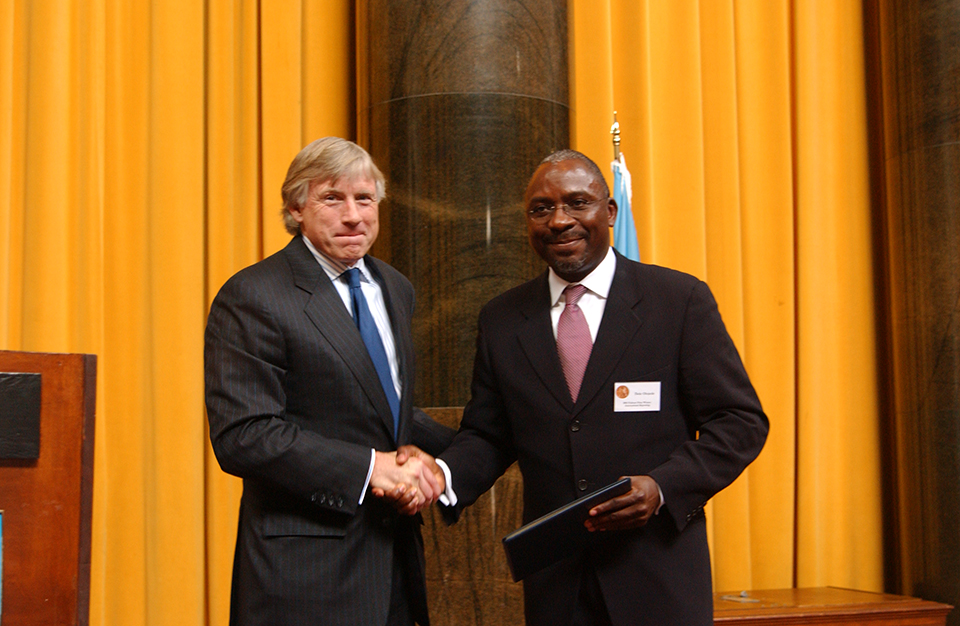
Columbia University President Lee C. Bollinger presents Dele Olojede with a 2005 Pulitzer Prize in International Reporting.
Winning Work
Newsday Foreign Editor Dele Olojede recently returned to Rwanda after covering the genocide in 1994. He was accompanied by staff photographer J. Conrad Williams Jr.
By Dele Olojede
Over a 100-day period in 1994, Rwanda's campaign of ethnic cleansing turned the country into one vast execution ground. For scale and speed, the genocide was the most efficient in recorded history, carried out mostly with machetes.
In April 1994, after the the plane carrying Rwanda's president was shot down, the government mobilized Rwanda's Hutu majority to physically eradicate the minority Tutsi, saying the Hutu faced the prospect of subjugation again if the descendants of their former Tutsi feudal lords were allowed to win a civil war.
When the killers flagged, government-controlled radio exhorted them to ever-more effort. "The graves are only half-full," one announcer proclaimed at the start of the massacres. "Who will help fill them?" When the genocide finally was halted with the defeat of the regime by mainly Tutsi rebel forces, about 800,000 Tutsi and moderate Hutu had been murdered.
Ten years later, encouraged by the government and often with the help of local churches, survivors and killers alike are trying to come to grips with living together in the same villages and towns, however awkwardly. In the long shadow of one of the century's great crimes, many seek to rebuild the broken bonds that once held communities together, to explore the possibility of restoring simple trust between neighbors and within families, so that the country can in time recover.
© 2004, Newsday
By Dele Olojede
Foreign Editor
KIGALI, Rwanda -- Gervais Tuyishime walks in from school. The 9-year-old boy drops his bag and shakes hands stiffly with his mother. Then he sits quietly on a wooden stool. No words are exchanged.
Most days are like that, says the mother, Alphoncina Mutuze. Her relationship with her son is an awkward one, characterized by bouts of anger out of proportion to the boy's perceived infractions, and frequently resulting in hard slaps to his face. On occasion, mother and child unexpectedly allow a hint of affection, and Mutuze embraces her only son, then quickly lets go, as if terrified of crossing a line she has willed herself to faithfully observe.
Gervais is the product of the gang rapes and sexual slavery his mother was subjected to 10 years ago during the Rwandan genocide, when the Hutu majority slaughtered about 800,000 of the minority Tutsi and their Hutu sympathizers. The dead included every member of Mutuze's family -- her parents as well as all eight siblings.
As a result, Gervais represents two irreconcilable symbols for his mother. He serves as a reminder of the terrible violation that drove her to attempt suicide by drowning. At the same time, the boy is the only known relative she has left.
"I really don't hate him but I feel this child is not mine," Mutuze says quietly, a constant refrain over several days of interviews in her one-room hilltop home in an empty-pockets neighborhood of this capital. "This child is not mine. I could not imagine how I would nurse this child. I wanted to kill this child. I looked at him and I wanted to kill him. I beat him even when I was still nursing him. I beat him even now.
"At times I try to will myself not to beat him up anymore, and I tell myself he is the only relative in the world I have. So yes, sometimes I feel that I am his mother."
Mutuze's fitful attempts to reconcile herself with her unwanted son offer a ground-level view of a larger struggle in Rwandan society, among individuals and between communities, to fashion a workable coexistence in a post-genocide society. Compelled to live together under conditions of grinding poverty, emotional turmoil and daily desperation, killers and survivors alike are feeling their way around the possibility that they could rebuild the everyday trust necessary for the normal functioning of a community shattered by genocide.
At its most fundamental, the genocide was an act of monumental betrayal, organized by the government in the service of the ideology of Hutu Power, which insisted there wasn't enough room in this small central African country for the Tutsi. The majority of the population proved to be willing executioners, and priest turned against parishioner, teacher against pupil, doctor against patient and, often, husband against wife.
"The challenge of the genocide is not simply the killing, but that husband killed wife and father killed son, and the whole moral foundation of the country was destroyed," says Domitira Mukantaganda, vice president of Rwanda's supreme court, who also oversees a grassroots quasi-judicial process designed to promote reconciliation more than the mere imposition of justice.
In this traumatized country, few groups are grappling with the legacy of the genocide with more difficulty than the thousands of women raped by the militia that spearheaded the mass killings of 10 years ago. While precise statistics are unavailable, largely because a public discussion of rape remains taboo and victims are loath to come forward, officials say about 250,000 Tutsi women were victimized.
Children born of such rapes are estimated at between 10,000 and 25,000.
Rape victims share in common with other genocide survivors the loss of family members and large-scale dispossession. But a majority of them also have to contend with HIV and the ravages of AIDS.
And many, like Mutuze, are struggling to accept the children from these unwanted encounters, and to answer uncomfortable questions from restless 9-year-olds dealing with neighborhood taunts regarding the peculiar details of their births.
The House on the Hill
Mother and son share a simple one-room house, a brick and mortar structure built four years ago with the help of a survivors' group. The main section holds simple furnishings -- two plastic chairs, a wooden table and bench. Pictures of Christ and a few choice quotes from the Book of Psalms, a staple of any Rwandan household, adorn the walls. Mother and son sleep in an alcove to the side. Corrugated iron sheets overhead provide some defense against the elements. Sunlight streams through a couple of perforations in the roof.
This was a step up from their temporary accommodations amid disdainful neighbors, an existence made worse by the arms-length treatment from old friends ashamed of the unspeakable circumstances of Mutuze's motherhood. The two had moved from dwelling to dwelling, occasionally even sleeping out in the open.
"Some of the people, they couldn't bear to look at the child because of who he was," Mutuze says. Neighborhood kids called him names. A favorite was "Little Interahamwe," after the feared militia of machete-wielding killers who hacked hundreds of thousands to death during the genocide. Interahamwe means "those who fight together" in the Kinyarwanda language.
"This boy leads a very difficult life," she says, her granite face softening briefly as she considers her son sitting on a low stool, impassive. "He's cheerful enough but everyone knows the circumstances of his birth. So other children call him Little Interahamwe. They call him this so constantly that he came to ask me what interahamwe means. I told him that these were people who killed a lot of people and were mass murderers."
Gervais just sits, quiet, speaking only when spoken to, and then only monosyllabically. A slight boy with a happy face, he exists in the straitened conditions of a child whose mother at once embraces and rejects him, and whose father is a rapist with an identity impossible to establish. With his mother's entire family murdered, the boy is even denied the protective embrace of the typical African extended family, which could have helped absorb the shocks of his young life.
In anger and perhaps in frustration, Mutuze at times similarly disparages her son, calling him Little Killer, "when I couldn't bear the sight of him." When he was 6, she wouldn't let him out to play for an entire year, even when she was out working and he was alone, because she was tired of the whispering and name-calling that his sight provoked in the neighbors.
"I was so ashamed of him," she says.
Her emotions boil over and she sobs, startling herself. "Sometimes I just cry unexpectedly," she says, "without knowing what has caused it."
One Day in April
On the afternoon of April 18, 1994, Mutuze ventured out of the Kigali confectionery factory where she had taken refuge for more than a week as a convulsion of killing seized hold of the city. She was desperate for food.
But this was a terrible time to walk around any neighborhood in Kigali. Since the genocide began April 7, following the killing in a plane crash of President Juvenal Habyarimana, the city had been completely overrun by the interahamwe, backed by government soldiers, who set up roadblocks everywhere and murdered and pillaged at will.
Mutuze came to a roadblock nearby, in the Kicukiro neighborhood.
"That was when I saw those people."
The roadblock was manned, she says, by five thugs, all of whom she knew peripherally at the factory where she worked packing cookies, candies and cooking oil. They were casual laborers there in more normal times, and went by nicknames such as Head Coach.
But now they were drunk on banana beer and the genocide had made them powerful, and they wanted her, at 20 a pretty, smooth-skinned woman, tall and slender. And alone.
"They all had machetes, and they raped me right there in the open," Mutuze says softly, her face hardening and her body rigid. She pressed her fingers and thumbs to her temple and squeezed. "It was broad daylight. As soon as the two of them were done with me, a car arrived and they told me to get up, and I ran off.
"It was the most horrific thing. They were taunting me. I was crying. I was sobbing, and thinking I was dead. I don't know how I found my way back to the factory."
Hearing the Story
As his mother describes the first of numerous times she was raped by the interahamwe, Gervais sits quietly on his stool, face in his arms, looking up to his mother without any particular expression and without a word. It is the first time, Mutuze says, that she'd told the story in his presence.
It is not a story she freely tells at any length, even at a support group she attends with other victims. In fact, when she first broached the scene at the roadblock, and was asked how many men were involved in the assault, Mutuze hit a wall. Physically and emotionally shaken, she fell into a dreadful silence, and the conversation was abandoned until the following day.
"It is taboo for women to even admit they had been gang-raped," says Mary Balikungera, executive director of Rwandan Women's Network, which tries to encourage rape victims to come forward to receive counseling and support. "The mothers don't want to be visible, and some have had their children absorbed in their wider families, so the children know they are members of a family but without knowing exactly who their parents are. Now the mothers are worried about whether to tell the children the truth."
Escape from Kigali
Not long after Mutuze's ordeal, her factory manager, an expatriate from the Indian Ocean island nation of Seychelles who was arranging to flee the carnage with his family, offered to take her, too. He got the governor of Kigali, Tharcisse Renzaho, an acquaintance, to write them a letter granting safe passage. Mutuze would pose as his daughter. They fled overland to Goma, in neighboring Congo (then called Zaire), running a gauntlet of roadblocks and easing their way with well-timed bribes.
But such was Mutuze's luck that Goma, which sits across the border on Lake Kivu, also was the destination weeks later for more than 2 million Hutu refugees and the defeated army and militias of Hutu Power. They had fled westward in July 1994, ahead of the rapid advance of the mainly Tutsi rebel forces of the Rwandan Patriotic Front, which had finally put a stop to the genocide.
For Mutuze, a young Tutsi woman in a sea of Hutu refugees herded into vast camps in the shadow of the Nyiragongo mountains, her nightmares had only just begun.
The refugee camps hastily erected in Goma spread out over an unyielding lunar landscape of volcanic rock. In the first few days the miserable multitudes, in shock at their sudden dislocation, milled about as if in a trance, hungry and exhausted. In their vulnerable condition, a cholera epidemic struck, killing as many as 7,000 every day for two hellish weeks. At dawn each day thousands of bodies wrapped in straw littered the camps or were stacked by roadsides. At dusk, smoke from tens of thousands of cooking fires rose in the fading light and the volcanoes bubbled menacingly in the distance, creating a surreal backdrop for the unfolding calamity.
'Lied to Save Myself'
In a section of Mugunga, the largest of he camps, Mutuze found herself in the company of 25 others, a lone Tutsi trying desperately to conceal her identity where exposure guaranteed death. Only she and six others in her corner of the camp survived the cholera outbreak. The question was whether she could survive the interahamwe and soldiers of the defeated Rwandan Armed Forces, who controlled the camp as they'd controlled the country they'd just abandoned.
"Most of the time I lied to save myself, telling the others I am Hutu," she says. "But some people would look at me and say, 'You're Tutsi.' Men took advantage of this and took me to their tents and protected me that way.
"Some men were claiming me. Because I was young some men were fighting over me. One soldier took me with him, and he always had to fight off the others who were trying to lay claim to me. That man was able to keep me for some time. I considered this lucky, because there was another Tutsi girl who was gang-raped and she died. Yes, she did die. My life was like that."
But inevitably the pressure built on the soldier to get rid of the Tutsi "snake," and that he should finish the "work" they had started and very nearly completed inside Rwanda by killing Mutuze.
"The man succumbed after some time and sent me away," she says. "He wanted to kill me at first, but then looked at me and said, 'Someone else can kill you.' Another man claimed me shortly afterwards." Thus was the young woman passed from hand to hand, essentially serving as a sex slave in exchange for permission to stay alive. Then, a few months later, came the telltale signs of pregnancy.
Driven Toward Suicide
"I started feeling sick. I had no desire to eat or do anything at all," she says. "When I realized I was pregnant, I first thought of suicide, then abortion. I had many bad thoughts on my mind constantly; abortion was the main thought. Unfortunately there was no way I could afford it because it could have been a death sentence if some of those in the camp found out. They would say that is our child; the child is Hutu."
Mutuze fell into a dark mood, brooding, looking for a way to end it all. Early in 1995, when she was about five months pregnant -- she's lost all precise recollection of time save the day she was first gang-raped -- Mutuze walked into nearby Lake Kivu, attempting to drown herself.
"I felt my youth had gone away and I was useless," she says. "I had no one to talk to. Those were terrible moments that I constantly wished for death. There was no one to confide in, not even God." Some fishermen nearby spotted Mutuze before she slipped beneath the waves, and thwarted her. With the cluster of refugees around her by then extra-vigilant, she carried the pregnancy to term and, in June or July of 1995 -- she couldn't tell for certain -- Mutuze gave birth to a son in a makeshift medical tent run by Doctors Without Borders, the relief agency.
What to call such a baby?
Aurea Kayiganwa, advocacy director for Avega, the main Rwandan association for genocide widows, says the anger, despair and shame felt by many a raped survivor can be measured in the names they have given -- or have allowed family members to give -- their children.
"In Rwandan culture, a baby's name must fit the circumstances of its birth," says Kayiganwa. This is equally true in almost any African society, where names mark a major event, usually heroic, or are aspirational, a yearning for the good and great things that parents everywhere wish for their children. But among the rape victims of Rwanda's genocide, children's names took on a gnarled and bitter quality. In addition to Little Interahamwe, many children born of rape are called Jiyamubandi ("The Intruder"); Niyigena ("It's God's Plan," given a child as if with a sigh of resignation); Mbuzukongira ("I am at a loss,") or Ntahobitabaye ("It's not only me.")
A 'Thanksgiving'
Such was Mutuze's aversion to her newborn son that she wanted to name him War, or at least Zaire, as a reminder of the nightmarish camp where she became a sex slave. But some of the women in the camp prevailed on her to do otherwise, and she was finally persuaded to accept a name they chose -- Tuyishime, which stands for "Thanksgiving."
"I wanted to call him something bad, but these women said that would not be good because it was not his choice to be born," she says, casting a sideways glance at the boy, who seems to be following the conversation with rapt attention, all the while without losing the gentle smile that appears to be a permanent feature of his handsome face.
If Gervais feels any emotion other than general happiness, it never is readily apparent. His is not a particularly active face, save for the eyes, which move constantly to take in his surroundings but almost never betray anything beyond blissful contentment.
And so his expression remains constant as his mother says as follows: "I thought of killing this baby. I did not feel even a single moment of affection for this baby. The thing that prevented me from killing it was that I would be killed myself, and killed badly, by those who claimed it was theirs.
"I would love to give him away to somebody else who can take care of him."
The instinct for rejection of a child born of rape is very powerful in victims, says Jean Damascene Ndayambaje, an associate professor of experimental psychology at the National University of Rwanda, who has seen many such patients over the past decade. He speaks of a young woman who was so insistent on abortion that she had to be tied down and given a Caesarian.
"She totally rejected the child and the child had to be taken to an orphanage," says Ndayambaje, who heads the university's department of mental health, in the southern city of Butare. "I counseled her for three months. Even the girl's family had to get some counseling so they could allow the woman and child to be reintegrated back into the family."
Mutuze says she thinks often how much lighter her load would be if any members of her family had survived the Rwandan Holocaust.
Little Girl Spoiled
She was born in 1974 in the village of Musange outside the central town of Gikongoro, the youngest of nine children of a cattle rearer, Petero Gasimba, and his wife, Atanasia Bwumgura, who nursed the young Mutuze until she entered first grade.
Mutuze was particularly close to her oldest brother, Pierre Hakizimana, who doted on his baby sister, fended off neighborhood bullies and bought her sweets. "He was a trader, and he had the means," she says, her voice a bit unsteady at the memory. "I am heartbroken when I think of him. He loved me so."
At the suggestion of her sister, Bridgette Mukamusoni, who had married and relocated to Kigali, Mutuze moved to the capital in 1987. She never had more than a sixth-grade education, and it took a while before she found a job at the factory, called Sakirwa, where she packed soap and other products. By this time, around 1991, the political temperature was rising in Kigali and around the country. After more than three decades of persecution, including periodic pogroms that had forced hundreds of thousands of the minority Tutsi into refugee camps in neighboring countries, the children of those refugees had formed a rebel army and invaded from Uganda, determined to reclaim their right to live in their homeland.
As the mainly Tutsi Rwandan Patriotic Front pushed steadily into Rwanda, the government mobilized the population into a genocidal frenzy, telling the Hutu that their very existence was in jeopardy. Between 1991 and 1993, killing a Tutsi was no longer seen as a crime. "Even in 1990 people were getting killed," Mutuze says. "At our factory things were getting worse by 1993. Senior Tutsi managers who were termed accomplices began to get killed. There was a lot of tension and we were very worried. We did not know what tomorrow would bring."
By 1994, the regime's killing machine was in full cry. The United Nations, at the active instigation of the Clinton administration, was resistant to intervention; Washington was still reeling from the killing U.S. Army Rangers in Somalia in October 1993.
When the downing of the Rwandan presidential jet on the night of April 6, 1994, provided the spark for the final conflagration, every Tutsi in Kigali was running for cover. Mutuze sought refuge at the factory. But as supplies ran low and desperation rose, she ventured out on the afternoon of April 18, and ran smack into the roadblock where the first of her many rapists awaited.
Driven to Goma with the help of her factory manager, she would endure the refugee camp for the next two years.
A Long Trek Home
With life increasingly intolerable in the camps in Goma, Mutuze decided in 1996 that she had to find a way back home.
"I was so fed up and decided to walk back to Rwanda," she says. "At that time I no longer cared whether I lived."
More than a million Hutu refugees would follow her footsteps within a few weeks, but when Mutuze set off for Rwanda by foot, she met only the occasional straggler. The year-old Gervais was strapped to her back for the trek east through the Virunga range, and then southward to Gikongoro, and her ancestral village. The journey took three months, and it was all for naught. Her entire family had been butchered in the genocide, as had much of the local Tutsi population.
The genocidaires of Gikongoro, as those in neighboring Kibuye province, were particularly thorough in their "work" of exterminating the Tutsi. Even now, the killing has not completely stopped. In October last year a survivor was brutally murdered to prevent any possibility of testifying against some of the killers. In early March, five people were sentenced to die for the murder.
"The whole place was empty; it was ghostly," Mutuze says now. "I did not spend even a single night in there. I kept walking." After various detours for another year, she ended back in Kigali.
Mother and Son
Seven years after mother and son arrived in Kigali, their relationship remains highly conflicted. Gervais is desperate to win his mother's love, according to caseworkers from Avega, the widows association. "You can see that the child unconditionally loves his mother," says Kayiganwa, who has worked closely with both, "even after the abuse she sometimes inflicts on him."
Mutuze admits to moments of intimacy shared with her son, though these are few, she says, and usually fleeting. She recalls taking him once to a wedding in the western town of Kibuye, and both stayed in a hotel for the first time and seemed to temporarily set aside their daily struggle. On occasion Gervais makes his mother breakfast porridge, and both sit down to share the meal. While she has no steady job and money is perennially scarce, now and then she finds enough to buy him candy -- "which he likes very much" -- just like her brother did when she was a child.
Kayiganwa, the Avega official, is not surprised by this. "I can tell you as a mother," she says. "There is one thing that cannot be erased, and that is a mother's love."
Nevertheless, Mutuze says, her urge to be physically separated from Gervais remains close to overpowering.
"I can't say this is a child that brings me joy," she says. "If you know anyone in America who would like to take this child, perhaps it would be better for him and for me." Then she feels compelled to add: "I feel like giving him away not just because I hate him but because I can't properly care for him. He could end up being a mayibobo [street child]. I don't feel that this is the life I would want for him."
Were Mutuze to actually give the child up for adoption, Kayiganwa says the mother would likely be miserably unhappy and most certainly lonely. "I think Gervais is someone that makes her life bearable," Kayiganwa says.
In all the many hours of conversations over several days, Mutuze never once refers to Gervais as "my son," or even by name. Throughout, she speaks of him in an arms-length way, calling him "this child," or "that boy." He is in third grade at an Italian-run school for orphans, but she doesn't know his teacher's name.
"Sometimes when I get annoyed with him I lash out about how he was born. I call him interahamwe, and it's out and too late before I can restrain myself," she says. "He asks, 'But you say interahamwe are killers,' and I have to tell him he is not interahamwe.
"I have never seen this child being sad, despite the fact that I beat him and sometimes tell him that I am not his mother. He is an obedient child, but I don't know why I beat him often. When I go out and have a little money and I buy him something, I don't know why I do that either."
To cope with her torment, Mutuze attends a support group of fellow survivors. Members of a Pentecostal congregation with whom she worships also drop by from time to time, she says, especially when she has recurring nightmares or thinks every other man she encounters in the street bears perfect resemblance to one of her assailants.
"It is comforting -- not really comforting, but you feel better," she says. "I still feel suicidal when I remember the events of 1994, with all my family dead. I can't say that I have overcome. It is still a daily struggle. I don't know how I have survived all this so far."
To fend off the attentions of men, she has worn a wedding band since 1999, like a crucifix that might ward off a vampire. Her opinion of men remains extremely low. "Every man is a selfish individual who is a liar and who wants to take advantage of me," she says, with some vehemence. "So I have decided I am never going that route in my life. Liars who only want to create problems for me. And I am not even beautiful. Why would anyone want someone like me?"
But even in the depths of her despair, she says she has reason to be thankful which, in retrospect, makes appropriate the choice of a name for her son. While sample studies have consistently shown a majority of rape victims were infected with HIV and thousands have died over the past decade, Mutuze is free of the virus. Her propensity to expect the worst out of life led her to distrust the initial negative test result. "I had myself tested many times since I couldn't believe it," she says. "But I don't have it." What she does have is a son she has convinced herself she needs to give up.
"I just wish someone will adopt him so he has a chance at a good life in the future," Mutuze says. "When he grows up and pursues a life of his own, I hope he will look at me as someone who tried to be a good mother, despite all the difficult circumstances."
© 2004, Newsday
By Dele Olojede
Foreign Editor
The first white man set foot in Rwanda only in the mid-1880s more than 400 years after Europeans landed on some parts of coastal Africa and well after the Atlantic slave trade had been brought to a merciful close.
This discovery was unfortunate for Rwandans, as the uninvited guest, a German, happened upon this mountain kingdom at a time when "race science" was all the rage in Europe.
As explorers, priests and Margaret Mead's ancestors trickled in over the next decade, they began to write extensively about their discovery of a superior race in the heart of Africa, whose supposedly "Semitic" physical features bore the closest resemblance to whites -- "golden-haired beauties in Ruanda-Urundi." One psuedo-scientist of the era speculated that these might even be citizens of the fabled lost continent of Atlantis.
The subject of this excitement were the Tutsi of Rwanda, a minority of the local population who largely exercised feudal authority and also were more prosperous, as herdsmen with a fungible asset, than the mainly pastoralist Hutu majority.
The Tutsi, tall and thin and not at all dissimilar from many other ethnic groups throughout central, east and West Africa, had wandered south into these mountains some 1,000 years ago and found the Hutu. The Hutu were a Bantu tribe, not at all dissimilar from any number of groups found throughout the continent. They had broader noses and thicker lips, and in the eyes of the visiting Europeans, were thus an inferior race. A much tinier aboriginal group, known as the Twa, completed the picture.
What the visitors failed to notice was that these were in fact not distinctive ethnic groups by any conventional definition. They spoke exactly the same language, observed the same rituals and followed the same system of social organization. They also observed a highly fluid system of social mobility, so that a Tutsi who fell on hard times could become Hutu, and vice versa. There were Tutsi chiefs and Hutu potentates. They also intermarried extensively, so that over time it became increasingly difficult to tell for sure who was what.
In 1885 at the Berlin Conference that partitioned Africa among European powers, Germany was allotted Rwanda. But the territory became a Belgian protectorate following the World War I. And that was when things really got messy.
The Belgians used the ruling elite to continue to run the country, but then instituted a system of identity cards that specified each person's ethnicity. The result was that this froze in place every Rwandan's identity, and social mobility was effectively halted.
The Hutu labored under the yoke of the feudalist Tutsi until after the World War II, when the independence movement in Africa influenced the Tutsi elite also to begin demanding the end of Belgian colonialism. The miffed Belgians shifted their allegiance to the Hutu, and in a bloody "Hutu Power" revolution in 1959 the Hutu began a decades-long purge of the Tutsi from all facets of Rwandan life.
Various pogroms forced hundreds of thousands of Tutsi into neighboring countries, especially Uganda and Burundi. In 1990, the children of those refugees formed the Rwandan Patriotic Front and invaded from Uganda, demanding power sharing and the return of the refugees.
The rebels' rapid advance steadily increased pressure on the Hutu government. Every Tutsi was seen as a collaborator, and the march toward a "final solution" to clear Rwanda of all Tutsi began in earnest.
© 2004, Newsday
By Dele Olojede
Foreign Editor
"I tried to impress the children that since the rapist did not kill me or the children, perhaps he was not irredeemably evil," she says. "For this reason, you should love this child, your sibling."
KIGALI, Rwanda -- The genocide was over, and Grace Chanzaire gathered her six children around her. Her husband was dead and other relatives were either dead or missing. She had something to tell the children, and she could count on no one else to help break the news.
Mother was pregnant, she told them, as a result of several weeks of rape by a neighbor, a member of the Hutu militia that spearheaded the nearly total extermination of members of her Tutsi minority. It was the price she had to pay, she said, to save the children and to save herself.
"I was in tears when I told them," Chanzaire says now, 10 years later. "They began crying too. They could see my pain, and we cried together."
Nadine Tumukunde turned 9 in February, and her six older siblings, ages 17 to 25, have over time formed her defensive line against a sometimes hostile world. She is being raised in a protective cocoon, made to understand she shares the same father with her siblings, and to feel that she is a normal child in every respect.
That her immediate family appears to have come to terms with the facts of Nadine's life is highly unusual in the charred emotional landscape of Rwanda, where an estimated 250,000 women were raped during the genocidal frenzy of 1994. Between 10,000 and 25,000 children were born of such rapes.
According to survivor groups and organizations tending to the country's rape victims, more typical for such women and their children has been social ostracism and familial dysfunction. An advocate for genocide widows speaks of a mother of two who was raped by her husband's killers. She then has to raise a child conceived from that rape along with the two older children, who knew that their father was killed by the biological father of their baby brother.
The most convoluted of Greek tragedies hardly begin to compare with such catastrophe.
"Many survivors get disappointed and feel quite depressed," says Adela Bamuzinre, a case worker with Avega, the association of genocide widows. "And they think life is not worth living."
In her Kigali neighborhood in 1994, some of Grace Chanzaire's Hutu neighbors, men and women alike, had joined the interahamwe militia, ready for the national assignment of wiping out every trace of the minority Tutsi from the land. Over 100 horrific days, some 800,000 people were murdered before the genocide was halted by Tutsi-led rebels.
But even as the capital turned into a necropolis, and dead bodies were stacked neatly on street corners and boulevard medians, a few of Chanzaire's neighbors remained loyal and sought to protect her and her children.
"Some good Hutu friends we used to go to church with took four of my children and pretended they were theirs," she says. But the other two children stayed with their mother because "they looked too Tutsi" to pass -- tall, thin, with the aquiline features of Somalis or the Fulani of West Africa.
They stayed home and cowered under beds while the genocidal fever raged on the outside. Chanzaire's Hutu tenant, a man named Mupanda, offered his protection, in exchange for her sharing his bed.
"This man was taking advantage of me, and after a while I discovered that I was pregnant," says Chanzaire, now 45. "I could not afford to upset him, because my life depended on him and so did my children's."
As with most pregnant rape victims, the Catholic woman at first felt shock, revulsion and panic, followed by shame and thoughts of abortion. "I asked myself, what would I tell my children?"
Unusually, even miraculously, all of Chanzaire's six children, including the four in the custody of kindly Hutu neighbors, survived the genocide. In late July 1994, when she had to break the news of her pregnancy to them, the very fact of their survival, and the hints of humanity shown by the rapist, became the basis for her plea for the children's understanding, and their eventual acceptance of their baby sister.
Chanzaire says the rapist in fact did not initially force himself on her, until other members of the neighborhood interahamwe began to demand that he do so lest they handle it themselves. And when he finally did, Mupanda had first to fortify himself with strong drink, she says. He was no longer so reticent after the first time.
"I tried to impress the children that since the rapist did not kill me or the children, perhaps he was not irredeemably evil," she says. "For this reason, you should love this child, your sibling." It was a nervous and unhappy time. Nonetheless, she says, once Nadine was born, her brothers and sisters rallied around her.
"The older ones are so protective of her that they would not allow anyone to tell her that she has a different father," Chanzaire says.
But in a neighborhood so congested that most everyone's window opens on a neighbor's, inevitably whispers about Nadine sometimes penetrate the family's protective shield. A neighborhood drunk once told the little girl of her "real" father, but when she asked her siblings they told her to disregard it as the rantings of a drunkard.
"But by now she's aware that something is not quite right," her mother says.
Still, Grace Chanzaire seems determined to leave as much of the past as possible behind, concentrating instead on the sunnier aspects of life. A tall woman with the bearing of one who considers herself exceptionally fortunate, she smiles often and tries to cry little. Her children are doing well and she expects to be a grandmother in the next few months, thanks to her eldest daughter, Claire Umutoni, who recently got married.
"I am thankful that God has chosen to spare me and all my children," she says finally. "I have to tell myself that I am not the worst off at the end of it all."
© 2004, Newsday
By Dele Olojede
Foreign Editor
SOVU, Rwanda -- As a young girl growing up here in the hills above the local monastery of the Benedictines, Regine Niyonsaba sometimes caught sight of the nuns, immaculate in their white habits, heads covered discreetly in the chocolate-brown scarves of the Belgian order.
While the nuns rarely left the monastery compound, each time Niyonsaba saw them she dreamed of one day entering the order, living in the impeccable monastery with like-minded sisters, and away from the uniform wretchedness of the poverty that otherwise defined life in this rural commune, barely five miles west of the southern university town of Butare.
At the age of 20, she enrolled as a novice.
But five years later her tranquil world of prayer and meditation was shattered at the outset of the Rwandan genocide of 1994, during which the government mobilized the Hutu majority to exterminate members of the minority Tutsi, such as herself.
Like thousands of other Tutsi fleeing the bloodbath, Niyonsaba's family had sought refuge in the monastery compound. But the mother superior, a Hutu whipped up by the official incitement to murder, had invited in the militias and local officials carrying out the genocide, saying the presence of the refugees was a threat to her domain.
The mother superior, Sister Gertrude Mukangango, insisted that the relatives of nuns also be expelled from their sanctuary in the monastery's guest quarters, knowing full well that she was sending them to their deaths, as numerous witnesses, human rights organizations and Belgian prosecutors would later establish.
Niyonsaba's father and brother already had been killed elsewhere in the monastery compound in the preceding 15 days, along with nearly 7,000 others.
And now, on May 6, 1994, under the gun of a police officer, Niyonsaba followed her mother and two younger sisters down a footpath to a banana grove on the far side of the compound. They were accompanied by another nun, Sister Fortunata Mukagasana, whose relatives also were slated for execution that Monday afternoon.
The police officer, Francois-Xavier Munyeshyaka, was in fact doing Niyonsaba's family a favor of sorts. In consideration for a sum of 7,000 Rwandan francs, he had agreed to shoot the novice's mother and sisters rather than leave their fates in the hands of the militia, who favored the use of machetes and nail-studded clubs.
"We asked him why he was killing our families. Why? He said the mission he was given was that no nun should be killed, but all the others must die," Niyonsaba recalled recently. "We buried them at the spot where they were killed."
Dazed from the execution, Niyonsaba stumbled back to her quarters and locked herself in. But since that afternoon in the banana grove, Niyonsaba knew that her days as a nun were numbered and, soon after the genocide ended, she walked away from it all.
"Ever since," says Niyonsaba, now 35, "I lost hope in the spiritual life. I lost faith in my life as a nun."
The massacre at Sovu monastery has recast the lives of many of its nuns who survived the genocide. The trauma cut some loose from their religious moorings and sent them to seek the less exalted experiences of the secular life. Yet others profess even more fervor for their faith, seeing it as the price to pay for having been spared. Nine of the original 36 nuns were killed during the genocide. Six remain, and the rest quit the order.
The travails of the nuns in many respects reflect the spiritual wilderness many Rwandans inhabit today.
Ten years after the genocide, in which an estimated 800,000 Tutsi and moderate Hutu were killed, the question of personal faith has become a profoundly disorienting one for many in Africa's most overwhelmingly Christian -- and overwhelmingly Catholic -- country. The moral crisis triggered by the decimation has compelled many survivors to re-examine their relationship with the church -- and with Christianity in general.
Aiding and Abetting
Some of the worst massacres occurred right inside churches and parish compounds, many with the active collaboration of priests.
Many other priests risked everything to save lives, and more than 200 of them were believed murdered along with their parishioners. One particularly courageous priest, Father Boniface Senyenzi, who was Hutu, stood steadfast with the thousands who sought refuge in the Roman Catholic Church in the lakeside city of Kibuye. He was killed, along with 11,400 people in the church.
But many more became foot soldiers in the extermination campaign or passively accepted its inevitability. Among the most notorious was Father Wenceslas Munyeshyaka, the first priest to be convicted of genocide by the International Criminal Tribunal in Arusha, Tanzania, which is trying a few of the leaders.
In his Kigali church Munyeshyaka presided gleefully over the mass murder, egged his congregation on to greater effort in their "work," and often read from a list of those Tutsi who must die. The mother superior at Sovu, too, is serving a 15-year sentence in a Belgian prison.
Throughout Rwanda the smashed skulls of the innocent are in church pews still as a memorial. In the church in Ntarama, south of Kigali, more than 5,000 perished at the hands of government armed killers. And at Nyarubuye, the priests gave up thousands of Tutsi parishioners who sought sanctuary at the only place they thought they could safely turn.
As a result of what many survivors see as treachery, the primacy of the Catholic church in civic and spiritual life in Rwanda has come under increasing strain. Estrangement from the church has pushed many into the willing arms of evangelicals. Others appear to have turned their backs on Christianity altogether, seeking refuge in Islam, which had few adherents as a percentage of this country's population of about 8 million. Yet others have abandoned religion entirely.
Accurate statistics are hard to come by in Rwanda. But experts say the genocide has helped demystify the Catholic Church, easing the way for many of its adherents to flock to the proselytizing evangelical churches whose revival tents sprout like toadstools throughout the Kigali metropolitan area.
"The evangelical Christians -- the born-agains -- they are growing very fast," says Privat Rutazibwa, a former Catholic priest who was inducted by John Paul II on Sept. 8, 1990, when the pope visited Rwanda. "They have attracted people who have been overwhelmed by problems and need an external force to help them." Rutazibwa felt compelled to quit the priesthood but remains a Catholic, though an openly skeptical one.
Archbishop's Response
The head of the Roman Catholic Church in Rwanda, Archbishop Thaddée Ntihinyurwa, acknowledged a flight from the church by an indeterminate portion of his flock. This, the archbishop hinted most certainly reflects poor judgment.
"If they think by leaving the church they can live better lives, it's their choice," he said one recent Saturday afternoon in his Kigali office. "Christianity is not about numbers, but about those who have accepted Jesus in their lives."
And despicable as the genocide was, said the archbishop, and as impermeable to Christ's teachings many citizens proved to be, in the end nothing that happened here in 1994 was unprecedented or even uniquely Rwandan.
"Many have asked, how can a Christian country do this? My answer is you can't talk only about Rwanda; talk about human beings who have not accepted Christ in their hearts," Ntihinyurwa says. "There have been genocides in other countries, and the first genocides happened in Christian countries also, like Germany and Armenia."
The official line laid down by the Vatican, and still followed by the church hierarchy in Rwanda, is that individual priests, and not the church, must be held accountable for the genocide.
Church and State
With the possible exception of the government, the Roman Catholic Church was the most powerful institution in Rwanda. It always had been intertwined with the political establishment. The church ran 60 percent of Rwandan schools, even enforcing strict quotas that limited Tutsi enrollment to their proportion of the overall population. It operated clinics and relief services. In the rural areas, which accounted for nearly 90 percent of the population, often the church functioned effectively like the social services department of the government.
Until the pope ended the practice in 1990, the archbishop was a member of the ruling council of the ruling party, whose primary ideology of Hutu Power defined itself as anti-Tutsi, and eventually metamorphosed into a campaign to turn Rwanda into the exclusive preserve of the Hutu majority.
Ntihinyurwa's predecessor, Archbishop Vincent Nsengiyumva, was a member of the Hutu Power cabinet that presided over the genocide. (He was killed in June 1994 in a revenge shooting by rebel soldiers, who held him responsible for the genocide.) Church documents show that priests even adopted the language of the genocidaires, routinely referring to Tutsi as inyenzi, or cockroaches.
Today the church co-exists warily with the government of President Paul Kagame, a Tutsi whose rebel Rwandan Patriotic Force halted the genocide by defeating the army of the old regime. Several priests have been found guilty of complicity in the genocide, and dozens remain in jail, along with some 100,000 genocide suspects. The most senior cleric charged so far, a bishop, was found not guilty.
"In the beginning the government blamed the church for not stopping the genocide," Archbishop Ntihinyurwa says. "The church defense was that our only weapon was the word of God, and the word of God was no longer being listened to."
Violence in Butare
The genocide commenced in earnest after the plane carrying President Juvenal Habyarimana was shot down on the night of April 6, 1994, as it approached Kigali airport. But the violence took nearly two weeks to spread to Butare province, alone of the country's 12 prefectures in initially resisting state-sanctioned murder.
Mild-mannered in its climate and moderate in its politics -- perhaps on account of the concentration of the country's intellectuals at the National University -- Butare set itself apart for a while from the genocidal frenzy radiating outward from Kigali to the rest of the country. Opposition Hutu politicians predominated in the province, which also had the country's only Tutsi prefect, Jean-Baptiste Habyarimana.
Hutu were reluctant to kill Tutsi and, so, on April 19, 1994, the interim president, Theodore Sindikubwabo, a Butare native, visited Butare to rally local officials. He expressed disappointment that they were failing to carry out their communal responsibility -- their umuganda -- by not mobilizing the population to de-Tutsify the prefecture. That same day, mass killings began throughout the region. The Tutsi were on the run. In April 1994, as the Tutsi of these parts were driven from their homesteads and sorghum fields by drunken members of the interahamwe militia, they began to funnel downhill toward the monastery, seeking refuge. Some had family there, but most simply acted on the assumption that the only inviolable sanctuary available to them was the house of God.
It was not an unreasonable assumption. In all the previous anti-Tutsi pogroms, in 1959 and then in 1961-63, there's no record of anyone ever killed within a church compound.
The monastery sits near the base of a series of hills. At its entrance is a large health center. An immaculately kept garden dotted with gazebos conveys a sense of tranquility. The administrative building complex, where the monastery intersects as needed with the secular world, sits at the end of the driveway. Church buildings and other facilities are scattered around and about. And partially hidden from view are the nuns' quarters.
Above the monastery the hills rise into the distance, covered by pine, stands of eucalyptus, and banana groves. The land, to paraphrase the South African writer Alan Paton, is green and rolling, and is beautiful beyond any singing of it.
A Malevolent Duo
The assumption by the frightened Tutsi of the inviolability of the monastery did not count on the simmering malevolence of the mother superior, Sister Mukagango, and her deputy, Sister Julienne Kisito.
"Our family members ran to the monastery expecting to find sanctuary," says Bernadette Kayitesi, a nun who also left the order in the aftermath of the genocide. "But what happened -- our mother superior was the one who began requesting for the militia to come and kill them."
Over the coming days, Kayitesi's two brothers hiding in the compound would be killed as the mother superior worked closely with the interahamwe -- "those who fight together" -- to clean the refugees out of the monastery compound. "I did not know," Kayitesi would marvel today, shaking her head, "how a person we thought was good came to be so evil."
Within two days, about 7,000 Tutsi were packed into the monastery compound, most at the health center near the main entrance. According to other nuns, the mother superior grew increasingly agitated, saying the militia should get rid of the refugees and insisting that she didn't want to jeopardize the monastery. In interviews in Belgium before she was convicted in June 2001, Mukangango denied collaborating with killers. "These charges against me are false because they attribute to me intentions I never had," she told Belgian television.
But like many other witnesses, Anunciata Mukagasana, one of the Sovu nuns who is Tutsi, says the mother superior acted promptly to turn the refugees over to the killers.
"As the refugees came, her heart hardened," she says of Mukangango. "She worked closely with Rekeraho, who was in the monastery every day."
For three months in 1994, Emmanuel Rekeraho was the most-feared man in Sovu. A retired army warrant officer, he took charge of the militia and directed the attacks on the refugees seeking shelter in the monastery. He also was given use of the monastery's minivan, and held meetings daily with the mother superior and her second in command, Sister Kisito.
"I had good relations with the sisters," he says in an interview on death row in Butare Central Prison. "We were working together as one."
Rekeraho described how he coordinated repeated attacks on the refugees barricaded inside the health center, using grenades and rifle fire, and then directing the militia to finish off survivors with studded clubs and cutlasses. A few hundred hiding in a nearby parking garage were simply burned alive, with gasoline allegedly supplied by Kisito, whose brothers were members of the interahamwe.
In his hot-pink prison uniform, Rekeraho affects the befuddlement of someone whose actions were so extreme they were a surprise even to himself. "In those days, people had been turned to animals," he says. "You should have seen the faces -- just like animals.
"I accept a role in the killings, by commanding the militia who were there," he adds, "but I cannot accept that I am one of the architects of the genocide."
Rekeraho, 65, is aware that the "architects" are the only ones the government is not prepared to grant amnesty. In 1999 he was sentenced to die, but the sentence has not been carried out by the government because officials are debating whether to ban capital punishment.
Refuge in Belgium
Like Regine Niyonsaba, whose family paid to be shot rather than hacked to death, Anunciata Mukagasana fled disillusioned from the monastery, unable to reconcile what she witnessed with the tenets of her faith.
"I couldn't imagine that people could be killed in a place like that, in God's house," she says. "The monastery was very big and it had many hiding places. But Sister Kisito and the mother superior, they were never merciful at all. They used ladders to check if people were hiding on the roofs. The did not have the hearts of Christians."
Once the mainly Tutsi forces overran the country and the genocide ended, the sisters were evacuated to the main abbey of the Benedictines in Maredret, Belgium. As they left the monastery, the surrounding countryside bore every evidence of the horror. "We drove away and there were dead bodies everywhere, by the roadside, everywhere," Mukagasana says. "We were just waiting for death. We could not imagine that we would survive."
But so distraught were many of the nuns that, as soon as they arrived in Belgium, they started denouncing the mother superior. They were shocked, however, by the reaction of the church authorities, who rallied behind Sisters Mukangango and Kisito and tried to suppress any information about their complicity.
"We were more than surprised that the church in Belgium was supporting her -- it was painful," Mukagasana says. "The whites thought that the mother superior was a saint, until they came here in 1995 to take testimony from witnesses. They had thought we just hated her."
Angered and demoralized by the attitude of the church leaders, Scholastique Mukangira, one of the Sovu nuns, demanded that she be allowed to return to Rwanda at once. She had lost two relatives in the monastery massacre, forced into the hands of the interahamwe by the mother superior. She had coped with the killings by praying with ever more dedication, at one point, she said, directly asking for divine intervention.
"I asked Jesus myself, 'Do you accept that all of us should be killed, and wipe out this order?'" she says one recent morning in the reception hall of the monastery. 'I know you are kind and you have power over everything. Use your power to save some of us, so that the order might not perish.'
"That gave me the strength to carry on. I was no longer afraid of death. I was strengthened throughout the war that, no matter what happened I shall be with Jesus."
'She Rebuilt Us'
That this serene compound was the scene of one of the worst atrocities of 10 years ago is today not readily apparent. That nascent recovery is the handiwork, in large part, of the current mother superior, Anastasie Mukamusoni.
Sister Mukamusoni took over the defiled institution in 1995, rallied the six remaining nuns to take eternal vows to rededicate their lives to the service of Christ, admitted nine new novices and methodically set about the task of revival.
A shy woman with a perpetually mournful look, the mother superior spoke softly and gazed constantly downward, talking with evident discomfort about the monastery's progress.
"When you are building the body you have to start with the soul," she says. "We have to start with the renewal of our faith with the church." Sister Mukangira returned home and found her way back to the monastery, where she remains today, working with the new mother superior to try to pick up the pieces of a ministry destroyed.
"During the genocide, because of what I saw, I can say that God did not have a role in the genocide," she says. "And we cannot say that all Christians failed their religion. There were many who did the right thing." At this, she cast a glance at the mother superior, who looked embarrassed and seemed to want to hide. Mukamusoni, then a 40-year-old nun, was away on church business in the border town of Gisenyi when the genocide came to the Sovu monastery. A Hutu, she is said to have arranged secret convoys to take Tutsi across the border to safety in neighboring Congo.
"She protected those who were being hunted," Mukangira says. "And she was the very person who called us back from Belgium. She rebuilt this place. She not only rebuilt the monastery but she rebuilt us."
While Mukangira has found reason to believe, and to continue life as a nun, Anunciata Mukagasana said she had no choice but to turn her back on the Benedictine Order.
"I just wanted to take a break from it because I would run mad if I stayed there," she says. Her family, which had fled to neighboring Burundi at the outset of the genocide, had returned home, and she wanted to care for her parents. So she cast off her habit and enrolled in nursing school, and today she is a pediatric nurse at University Hospital in Butare, the only one with a job in her extended family of 14, including her younger sister's three children.
The family lives in neat but cramped conditions in the Matyazo district of Butare, in a neighborhood of few means and multitudes of malnourished children. In Mukagasana's household, food is often in short supply. "It is a life of hardship, and sometimes it's hard to find milk for the children," she says with an embarrassed laugh. "The meals are not decent, but there is no other option."
At this, Mukagasana's voice caught just a bit, and she asked for a glass of water to steady herself. The living room was painted coral blue, the best to cheer up its threadbare condition. The walls were decorated with the inevitable portraits of Jesus, who is said to be constance -- eternal.
The portraits were an indication of the continuing hold of Christianity on Mukagasana's imagination. Despite everything, she said, she remained a good Christian and believed in God, even if she no longer quite trusted His earthly messengers.
"There are those who turned their backs on Christianity altogether, after what they experienced," she says. "I think to some extent they have reason. They've lost everything, and it seems God forgot them. But I go to church because whatever happened, God did not have a hand in it."
Besides, Mukagasana adds, "Other people died, but it was due to God's mercy that I survived. It was due to God's mercy that my family was able to escape to Burundi."
Reason to Believe
Regine Niyonsaba did not have the luxury of her family's company. Her father and brother had been killed at the monastery's health center, and she had witnessed the execution of her mother and two younger sisters, and buried them with her own hands. When she returned from Belgium with several of the other Sovu nuns, she concluded that her life had been permanently altered.
"Life at the monastery had become impossible for me," she says. "I couldn't see myself praying there anymore." Besides, she had one 11-year-old sister, Florentina Nwambaye, who survived the genocide, and she felt responsible for her. So she took a secretarial job at a local school, then later, at a pharmaceutical firm.
"One of the things that keeps me going is prayer," says the former novice, who packs every day with distractions to help her retain a hold on sanity. For spiritual support, she attends morning sessions of a charismatic Catholic community. She holds down a day job, and afterward rushes off to the university, where she's taking evening classes for a degree in sociology.
"I have had no time to think about the past," she says. "It took me a long time to adjust. It is not easy for me." After a decade-long struggle, including bouts of depression and moments of rage, Niyonsaba said she had reached an accommodation with her faith.
"Since the passage of 10 years, instead of demoralizing myself, I thought it was not only me who had lost relatives because of church leaders' role in the genocide," she says. "I was not the only witness to the scandals in the church. I thought God had helped me to survive. Genocide wasn't planned by God. He gave us knowledge, free will, to do the right thing. God never plans for bad things to happen."
But doesn't necessarily prevent them, either?
Prim in a checkered custard suit with a sensible skirt, Niyonsaba pondered the question for a moment, her charcoal-black face set off against the stark blankness of the wall, serene in the soft glow of the fluorescent light. She turned slowly away, silent.
"How can a Rwandan continue to identify as a Christian?," Rutazibwa, the former priest, asked rhetorically regarding the endurance of faith. "That is part of the mystery of the faith. Despite the horrors, people always need a relationship with a supreme being."
At the monastery, the current mother superior said all she could do now was carry on her calling, which is to serve God. "I saw others die, but I stayed alive," she says. "Since I took the eternal vow, the only thing to do was stay here and serve the Lord. That was the only way I could pay back the gift of life that I was given."
And with that, she rose and walked out to the garden, down a footpath, and to a mass grave in which nine of her fellow nuns killed during the genocide were buried. She observed a moment of meditative silence, did the sign of the cross, and headed back to the well-ordered sanctuary of her domain.
© 2004, Newsday
By Dele Olojede
Foreign Editor
KIGALI, Rwanda -- To get as far away as possible from her former life as a nun, Bernadette Kayitesi got married five years ago and had a son. The wedding, she noted, was at a registry, not a church. She even changed her first name from Marie-Bernard -- "that was my nun name" -- to leave no doubt in her own mind that this was anything but a fresh start.
Kayitesi is seeking refuge in the temporal world, which to her has every appearance of being superior to the life she had chosen as a nun of the Benedictine Order, sequestered away in the monastery at Sovu, in southern Rwanda.
The 1994 genocide stripped her of any illusions of the holy community of sisters that she had imagined when she entered the order in 1986.
"I thought this was a joyful place to be, a hopeful place to be, where I could serve God," she says, holding on to her 4-year-old son, Clement Gasangwa, in their Kigali home one recent evening. "I became a nun expecting that I would be in a place of sisters in the faith, of family members. But it did not turn out that way."
Ten years ago, as the government mobilized the majority Hutu to kill all members of the minority Tutsi in furtherance of a goal of a Hutu-only country, many Tutsi who lived in hilltop villages around the monastery, just outside the town of Butare, sought refuge on the grounds of the monastery. Among them were two of Kayitesi's brothers.
But the mother superior, acting as many religious leaders did, called in the killers instead. Kayitesi's brothers were butchered, along with about 7,000 others. Nine of the 36 nuns also were killed.
"This was a total betrayal of everything I believed in," she says. "It totally upset everything I had assumed."
Her shaken faith was delivered a final blow after the surviving nuns were evacuated to the headquarters of their order in Belgium at the end of the genocide. There, an embarrassed church hierarchy reacted to the scandal by rallying behind the accused mother superior, Gertrude Mukangango, and her deputy, Sister Julienne Kisito. The nuns denouncing them, including Kayitesi, were ostracized and many of them returned to Rwanda angry and disappointed.
In August 1995, the order sent a white priest, the Rev. Andre Comblin, who had once lived in Rwanda, to try to persuade the nuns to write a statement absolving the mother superior of any responsibility for the monastery massacre. They refused.
"This persuaded me that there was nothing about God going on here," Kayitesi says.
With attempts to cover up for the mother superior fast crumbling, Belgian authorities arrested her and Sister Kisito and held them in jail facing allegations of genocide. In June 2002, both were finally convicted and sentenced to 15 and 12 years respectively.
In January 1996, five months after the visit from Comblin, Kayitesi finally left the order and moved to Kigali to stay for a while with her sister, supporting herself with petty trading in consumer goods.
"When I walked out of there I felt a certain relief," she says, "but also sadness that what I had dedicated my life to was coming to an end."
She met Onesphore Gasangwa, who worked at an orphanage, after an aunt introduced them in 1998. A year later, they married. In May 2000, Clement was born. His mother was 41 then. While Kayitesi runs her stall in the local market, her husband is studying full-time for a degree in sociology.
Their home gives every appearance of a life restarted. It is sparsely furnished, but spacious and neatly kept. The only decorations on the walls are images of Jesus, suffering the children to come to him.
This new life, Kayitesi says, suits her just fine. "Compared with what others suffer, I am doing very well," she says. "I have not lost everything."
For this reason, she says, she clings to some faith that Christianity transcends its earthly representatives, that God remains good despite everything that happened. So she goes to church on Sunday, with Gasangwa and their little boy, close enough to her religion but, perhaps, not enough to be singed again.
She says she wished a way could be found to compensate the survivors, but that suing the church might be wishful thinking. "How can you sue the church?" she says, a tone of awe noticeable in her voice. "What court do you take the church to? The church is too powerful. It is beyond the reach of people like us."
© 2004, Newsday
By Dele Olojede
Foreign Editor
KIBUYE, Rwanda -- At times, a smoldering anger consumes Marguerite Mukabazanira. Her normally friendly face is contorted and she starts to hiss.
She is mad at the Rwandan government, which she regards as craven for letting killers walk free in the name of national reconciliation. She despises former neighbors, whom she holds responsible for the murder of her husband and all her five children.
But she reserves something akin to pure hatred for her former best friend and the godmother to her youngest child, Olive Mukarugagi, under whose protection Delphine Umutesi, 7, was placed, only to be handed over to the killers.
"She is the one who killed my youngest child," Mukabazanira declares, sitting stiff-backed in her temporary home in this southern town. "Ever since the war ended, I have never been at peace, because I always see people who killed my relatives, my family, roaming around. Many were close friends before the genocide. I was the teacher of their children. But no one lifted a finger to help us."
Mukarugagi, 40, sits for now in Butare Central Prison, where she has been held for the past seven years on charges of conspiring to murder little Delphine, as well as for the crime of genocide. Mukarugagi admits that the child had been placed in her care, but insists that her husband's family had taken her away to be killed in the street. She was powerless, she says, to stop them.
"Marguerite is furious and bitter, which is understandable," she says. "But I was not responsible. My husband's uncle killed her. I had nothing to do with it."
Perhaps sometime this month, Mukarugagi will walk out of Butare Central Prison. She will be freed provisionally as part of a government program to release most of the 130,000 genocide suspects who have been held for years in prisons so overcrowded that inmates take turns to sleep. Last year about 23,000 suspects deemed to be mere foot soldiers during the genocide, or who were seriously ill, were sent back to their villages. Any day now, another 30,000 will be similarly released conditionally. Only a few thousand regarded as the architects of the genocide, or who demonstrated especially depraved enthusiasm for killing, will eventually be tried in regular courts.
The vast majority of suspects, such as Mukarugagi, will be required to appear only before traditional open-air tribunals of village notables, who will begin to sit in judgment sometime this month in communities throughout Rwanda. In exchange for a full public confession, those found guilty will be sentenced mostly to time already served, community service and perhaps be required to pay compensation to survivors, such as helping to rebuild a home destroyed.
By resorting to this compromise, the Rwandan government is only facing the reality that the very magnitude of the crime committed 10 years ago puts it beyond the possibility of just sanction.
On April 7, 1994, a day after a plane carrying President Juvenal Habyarimana was shot down and he was killed, units of government soldiers, police and Hutu militia organized and funded by the government began implementing a carefully planned program of mass eradication directed at the country's Tutsi minority. The ruling party's ideology of Hutu Power saw no room for coexistence with the Tutsi, whose rebel forces eventually stopped the genocide, though too late to save about 80 percent of the Tutsi population. Within 100 days, an estimated 800,000 Tutsi, and Hutu opposed to the genocide, had been killed. From a distance, the world watched.
A 'Nation in Prison'
For scale and speed, the genocide was the most efficiently carried out in recorded history, with people being killed, mostly with machetes, at a rate seven times faster than in the Nazi Holocaust in which 6 million Jews were killed.
The total mobilization of the Hutu population, which accounted for about 85 percent of Rwanda's 8 million people, made it possible.
And made justice virtually impossible.
"There was never any real possibility of justice," says Rakiya Omaar, executive director of the London-based humanitarian group African Rights and a leading authority on the genocide. "The degree of popular participation was so deep and widespread that it would be like putting the whole nation in prison."
Rwanda's ministry of justice estimates that for every suspect detained, six others were left alone, which would put the number of direct participants in the genocide in the neighborhood of 1 million. At the current pace of judicial proceedings, Rwandan courts would literally still be trying genocide cases for the next century, long after the suspects are dead, officials say.
The situation is complicated by the fact Rwanda has a death penalty.
"It was a question of making a choice, whether to attempt real justice and thereby create legalized genocide, or attempt to balance the desire to eradicate impunity while allowing the country to move on," says Martin Ngoga, the deputy attorney general. "We were not in a position to enforce the law."
Rwanda's judicial system was at any rate destroyed during the genocide. Almost all the country's lawyers either were killed or fled into exile. Meanwhile, many of the suspects already are in their 10th year of detention, with no prospects of a trial date in the foreseeable future.
So the authorities reached into the country's past for a form of traditional conflict resolution that strives less for retribution than for reconciliation. "Our larger purpose is we want Rwandans to be Rwandans again," Ngoga says. "The genocide succeeded, but we want people, nevertheless, to live together. There is no other practical way."
Gacaca: On the Grass
After a two-year pilot program to adapt them to today's realities, 9,010 village tribunals, called Gacaca courts, will begin trying suspects from this month, says Charles Kayitana, spokesman for the program.
For a preparatory session of a Gacaca (pronounced gah-CHA-CHA) court near the southeastern town of Kibungo, villagers have gathered within a cluster of mango trees. Members of the tribunal, known as "the wise men and women," sit on a wooden bench while residents squat before them in a semicircle on the grass. Gacaca literally means "on the grass."
About two dozen suspects have been trucked in from the local prison. In their flamingo-pink uniforms, they stand out from their former neighbors, family and friends, who are all required to be in attendance so no one can pretend not to know the enormity of the crimes that were committed in their name.
The subject at hand stands in sharp contrast to the extravagant beauty of the surroundings. The hills roll off in the distance, all shades of green. The earth is red where turned or is otherwise carpeted in kikuyu grass and the inevitable profusion of banana trees and cassava. The sky is blue, like cobalt, and white and gray clouds drift over the land.
The presiding "wise woman" states the purpose of the gathering, leads the assembled in a moment of silence for the dead and starts the proceedings.
The sessions follow a more or less prescribed pattern: charges are read, survivors testify, naming some in the pink uniforms who allegedly used guns and sharp knives on their neighbors a decade ago. One by one the accused stand to state their case, invariably involving at least a partial confession. "It is participatory," Kayitana says. "It is by Rwandans, for Rwandans."
Justice Under Fire
But Gacaca has been criticized by some international human rights organizations for falling far short of the presumed balance and the protection of the accused's rights that regular courts afford. Significantly, the system does not allow for defense attorneys, and few suspects can resist the coercive power of the leniency promised in exchanged for a full confession. A presumption of innocence is not the system's strength.
Rwandan officials typically treat such criticism with dismissal.
"If there is a bar association somewhere that is willing to lend us 12,000 lawyers, we're happy to accept them," Ngoga says. "We have learned to ignore this nonsense. We decided to deal with our situation in the manner that suits our needs."
This homegrown solution offers little comfort to Cyriaque Habyarabatuma, the chief of police in Butare province under the old regime. For the past 10 years Habyarabatuma appeared to have pulled off an unusually seamless transition from serving the genocidal regime to serving the current one in similar capacities.
But a survivor denounced him at a recent Gacaca session for personally directing police officers a decade ago to mow down the innocent. On the evening of Feb. 6 police executed a warrant for his arrest, and now Habyarabatuma finds himself within the confines of the impossibly overcrowded Butare Central Prison, along with 10,814 other inmates.
Because of the importance of his position, Habyarabatuma may not qualify for trial under the more lenient Gacaca system, which cannot try "Category One" offenders. As a result, he disavows any involvement in the genocide, a position of moral heroism that a police commander almost certainly would have been unable to maintain during the genocide. Habyarabatuma says he is a victim of wrongful accusation.
"Not all who are in prison killed; sometimes there are false accusations," he says, suggesting strongly that this unfortunate state of affairs clearly applies to himself. "Problems arise when you release the guilty but hold the innocent."
A Reluctant Killer
By contrast, Cyriaque Sebera is counting the days to his return home for the first time in nine years. The farmer from Gashora, in southern Rwanda, first confessed six years ago to killing his neighbor, but the system was not ready to accommodate people like him. Now prison officials have notified him that he is on a list of those scheduled for provisional release, and might soon be allowed home to face a Gacaca court.
"I collaborated with others to kill the Tutsi of this area," he says. "There was a feeling we could get away with anything. In my area from 1992 to 1994, killing a Tutsi was not a crime."
Sebera, 50, confesses to direct responsibility for only one killing, the murder of a Tutsi neighbor and fellow farmer. But he killed only with reluctance, he swears, and only because he had no real choice. The pressure to join in the killing was severe, with the implied threat that whoever failed to participate was liable to be killed as a Tutsi-lover.
For this reason, he says hopefully, the Gacaca court will look kindly on him and, perhaps, his neighbors will accept him back. This has proved true for his son, who was released last year, he says.
"The survivors know that I tried hard to avoid killing," he says, "but there came a time when I could no longer resist."
During the genocide, the interahamwe militia, which carried out most of the killing, was indeed merciless with dissenters. Those hesitant to kill their neighbors, teachers or goddaughters were judged to be just as traitorous as the inyenzi, or cockroach, the name applied to all Tutsi. In this way, thousands of moderate Hutu were killed throughout the country in the last lunge by extremists to cleanse the land of the Tutsi.
"In April 1994," says Emile Rwamasirabo, rector of National University of Rwanda, "it was more dangerous to refuse to kill than to kill."
And while a confessed killer, such as Sebera, will probably be set free in exchange for time served, Gacaca courts still will be playing an invaluable role in the building of a new society of tolerance and rule of law, Rwamasirabo says.
"If you killed a Tutsi over the past 40 years in the name of Hutu Power there was no punishment," he says. "So today the simple act of recognizing it as a crime, of taking people to court, of public confession, already is a big leap forward."
The UN Tribunal
For its acknowledged sin of what can only be charitably described as moral cowardice, the international community, through the agency of the United Nations, also is hoping a similar public accounting will have a large symbolic impact.
Even its genocide tribunal's most bitter critics, including Ngoga, ascribe it significant value, however begrudgingly.
"This tribunal was not created to get us justice, but to nurse the guilt of the international community," says Ngoga, who was Rwanda's representative to the tribunal for four years. "But its mere existence has served a certain usefulness -- the international community officially recognized that a genocide occurred here."
Merely recognizing genocide now is counted as a virtue because the world's leading nations were reluctant to grant even that much in 1994. The French government supported and supplied the Hutu Power regime until the very end. The Clinton administration, smarting from the killing of two dozen U.S. Army Rangers in Somalia the previous October, actively dissuaded the UN from intervening. The UN itself turned a deaf ear to the desperate importunings of the commander of its peacekeeping force of 450 troops in Rwanda. After the genocide, the commander, Canadian Gen. Romeo Dallaire, fell into depression and tried several times to commit suicide.
In a nondescript building in the East African town of Arusha, in Tanzania, the genocide tribunal sits in judgment. After nine years and more than $1.5 billion maintaining a vast apparatus of administrators and lawyers, the tribunal has so far convicted fewer than two dozen genocide suspects. It is on course to fail even to prosecute all the 65 suspects now trickling through its chambers before its mandate expires in 2007.
Yet for all its bumbling the tribunal has in custody some of the most prominent planners of the genocide, including the former prime minister, Jean Kambanda, as well as the chief of the army and various cabinet ministers.
But none is more important than the man widely acknowledged as the genocide mastermind, Col. Théoneste Bagosora, deputy commander of the Armed Forces of Rwanda. His trial is finally under way and is expected to be concluded sometime this year.
In late January in a bulletproof courtroom in Arusha, Bagosora sits impassive, lips pursed and eyes vacant, listening to Dallaire testify against him.
The Canadian general, now retired, recently published "Shake Hands With the Devil," his best-selling account of his failure to persuade the world to act against Bagosora and his comrades. The "devil" refers to Bagosora, who Dallaire now describes as "the kingpin" of the Hutu Power leadership that planned and set the genocide in motion.
Bagosora had kept detailed plans of the genocide in a journal that was subsequently retrieved. He also organized and armed the interahamwe, and got his associates to import enough machetes from China to arm one-third of Rwanda's entire population.
But in the courtroom his UN-paid attorneys are doing their best to challenge the very idea that a genocide took place at all, let alone whether their client was its chief executioner. The entire proceedings -- the red-robed judges and black-gowned lawyers, the endless arguments about the finer points of semantics, the rhetorical detours -- seem completely disconnected from the reality of Rwanda's existence.
After a week of testimony, Dallaire is excused. The general stands ramrod at attention, stares for what seems like a full minute at Bagosora, then finally pivots and marches out of the room. Bagosora only looks straight ahead, constantly pushing his big round glasses up the bridge of his nose.
Dallaire expresses relief afterward. "I've been waiting a long time to testify," he says. "I will never be finished with Rwanda, and all those connected to it will never be finished. The horror and the destruction will not allow me to be finished with it."
Last month, during ceremonies to mark the start of the genocide, Dallaire returned to Rwanda for the first time, talking to young people, apologizing for failing to protect the innocent and wiping away tears.
Neighbor to Neighbor
The tears flow freely for Marguerite Mukabazanira, alone in the world but for six genocide orphans she has informally adopted, who keep her company and allow her, at age 50, to be a mother again.
"Who will give us justice?" she asks in the tone of someone who already knows the answer. "The government is too interested in reconciling with the killers."
A school teacher, she was married to Onesphore Murekezi on July 23, 1978, and the two made their home that very day in the hilltop village of Mpare, just outside Butare. Life was hard for Tutsi anywhere in Rwanda but less so in Butare, a temperamental equivalent perhaps of California, where the climate soothed and the citizens were relaxed in their habits and friendly in their ways.
The couple became close to many of their Hutu neighbors, especially Olive Mukarugagi's family. She and Mukabazanira taught at the same school, Musange Primary, and their husbands were both in the brick-making business.
"Before the genocide the two families were so close, and we often exchanged presents," Mukarugagi says during a prison interview.
In 1987, after Delphine was born, her parents naturally asked Mukarugagi to be her godmother. In fact, all four of her older siblings also had Hutu godparents.
Neighborhood ties began to fray from about 1990, after the Tutsi rebel force, the Rwandan Patriotic Front, invaded from neighboring Uganda with the objective of forcing Rwanda to take back hundreds of thousands of its Tutsi citizens who had been driven into exile in repeated pogroms since 1959.
Government propaganda began to characterize all Tutsi as ibiyitso -- collaborators -- who were to be shunned and, later, eliminated. In school, Tutsi children were made to sit in the back of the class and were otherwise made to realize that "it was a sin to be a Tutsi." At home, Tutsi parents sometimes were threatened. The odd rock would be hauled through windows and occasionally people were beaten.
But it always was just a touch less hateful in Butare, and even after full-bore genocide exploded on April 7, 1994, it took two full weeks, as well as personal intervention of the interim president, before the people of Butare succumbed to cold-blooded murder.
"We never thought of moving because we didn't imagine that level of violence," Mukabazanira says. "We never thought it would get to genocide."
On April 21, as a few soldiers fired in the air and the mobs began a house-to-house search, Mukabazanira and Murekezi grabbed their children and ran for the hills. All the Tutsi of Mpare and surrounding hills began to gather in public buildings in the area, as well as places of worship, thinking they'd be safe. But the bodies were piling up quickly, and Mukabazanira and Murekezi decided to send their children to their various Hutu godparents.
Mukarugagi took custody of Delphine. The little girl stayed alive for only the next two days, until April 23. None of the other children survived the massacre, and neither did their father.
Mukarugagi at first blames the whole thing on "the militia."
"We don't know who conspired to tell the militia that there were Tutsi children hiding in our home," she says. "The militia grabbed the children from our house and killed them in front of my husband's grandfather's house." The families all lived in close proximity: Mukarugagi's father-in-law lived two houses away, followed by her grandfather-in-law's, which was next door to hers. Mukabazanira and her family lived around the corner, their home visible just beyond the banana trees.
At length she admits that the culprit was family -- her brother-in-law, an interahamwe member she identifies as Sentama, who took Delphine away to be slaughtered. "We thought he was going to protect her," she says, having also offered that at that very moment other Tutsi children were being hacked to death next door in her grandfather-in-law's compound.
Accusations and Arrests
"I let the child go because we wanted to save her," she says repeatedly, as if, by repetition, somehow she can reassure herself that she did her very best.
On June 4, 1997, after an embittered Mukabazanira filed a complaint with local prosecutors, Mukarugagi was arrested and has been held ever since in Butare prison. Mukabazanira has similarly lodged charges of murder against other former friends, targeting the godparents with particular zeal.
"We thought no one could kill their godchildren, but they were the ones who did the killings," she says. One of them, Cleophas Rugizama, was sentenced to 20 years for the killing of Jocelyn Iribagiza, the oldest of the five children who was 15. The godmother of Aline Umujanyagwa, 14, the second born, was out of Mukabazanira's reach. The woman, Goreti Mukabuyenje, died in the refugee camps in Congo, where much of the Hutu population fled after the Rwandan Patriotic Front defeated the old regime.
For the past seven years of prison life, Mukarugagi misses most her own three children, who are being raised by their grandmother, though they visit occasionally. She says she has been isolated by her husband's family. "The killers are from my husband's family, but they are putting everything on my head," she says. "Even my husband's family is trying to blame me."
The only time Mukarugagi has met her old friend was during an investigative hearing four years ago in the prosecutor's office. She says she never had the chance to offer an apology or any expression of regret. "She never greeted me that day," Mukarugagi says, and being a prisoner, she was not permitted, she says, to speak unless spoken to.
Mukabazanira's anger is not limited to her close friends. Some of the other killers that she barely knew have been paroled and are back in the old neighborhood. Sometimes, just to eyeball them, Mukabazanira goes back up there from her new home in downtown Butare. She seems to relish the moment when, at her sight, they all scamper off into the brush.
A Turn of Luck
"I meet many of them around town, including one who had clubbed me on the shoulder. They are scared when they see me. One of them riding a motorcycle saw me and fell in front of my vehicle. I had to break hard to avoid running him over."
Ten years ago, by a stroke of luck she cannot now conclude was either good or bad, Mukabazanira survived the genocide. Her husband and two of the children were cornered while hiding with hundreds of others in the local dispensary. She was separated from them in the confusion, and hid in the pine bush and abandoned hospital buildings. Until finally the Rwandan Patriotic Front overran Butare and she was saved.
One recent afternoon, wandering around the field of millet that was once the site of her home, Mukabazanira kicks at the small pile of rubble that represents the only sign that her family ever existed on this patch of land. "They thought people like us who went to school were collaborators, so they not only killed us they destroyed our houses completely," she says. "They wanted to wipe away any trace of our existence."
In her sentimental moments, which admittedly are brief, Mukabazanira allows perhaps that if her former tormentors sincerely apologized, "then we will surely forgive them." Then she quickly catches herself.
"As for me, there is no reconciliation," she says finally. "What we have is tolerance, not reconciliation. We have no option; we cannot avoid them on the road.
"But it is too difficult to reconcile."
© 2004, Newsday
By Dele Olojede
Foreign Editor
The fact that she does not qualify for amnesty makes it difficult for her to come clean, Bemeriki says. "It is hindering any chance of my confessing."
GASHORA, Rwanda -- Valerie Bemeriki would like the world to know that, all in all, she was only doing her duty.
Hers was one of the most recognized and most effective voices on the so-called Hate Radio, known by its French acronym RTML, which helped mobilize Rwanda's Hutu majority to genocide 10 years ago. That voice, by turns shrill, seductive and authoritative, goaded and encouraged the country's Hutu, sometimes helpfully suggesting the names and hiding places of members of the minority Tutsi and their Hutu sympathizers who had yet to be murdered.
To make it easier for her listeners to see their victims as less than human, she made up vulgar stories about the inyenzi, or cockroaches, as Tutsi were called. She even accused them of cannibalism.
"They mutilate the body and remove certain organs, such as the heart, liver and stomach; they eat human flesh, the inyenzi," she declared in one broadcast, transcripts of which are now in the possession of Rwandan authorities as well as the United Nations tribunal trying the ringleaders of the genocide.
Bemeriki, 48, sits today in the bleak, isolated prison here in southern Rwanda, five years after she was arrested in neighboring Congo. At the time of her arrest, in June 1999, the shocked and disoriented Bemeriki had pronounced herself guilty of incitement to genocide and begged forgiveness of her fellow citizens.
But now, facing the death penalty from Rwandan courts, Bemeriki is recanting. She contends that, at worst, listeners may have misunderstood her enthusiasm, a failing for which she cannot now be held responsible. "I was only doing my job as a journalist," Bemeriki says. "When we were working we never used our radio to say they should go and kill people. But the listeners may have misunderstood. If we asked people to get rid of cockroaches, we did not mean they should kill people."
Which is clearly a lie, according to extensive transcripts of broadcasts during the genocide by RTML or Radio Television Libre Des Mille Collines. As the killings escalated, one announcer abandoned any pretense to figurative language, pleading: "The graves are only half full. Who will help fill them?"
The radio station had been founded in 1993 by members of the family and inner circle of President Juvenal Habyarimana, who opposed the president's compromise treaty to end civil war by sharing power with the mainly Tutsi Rwandan Patriotic Front. Two of the station's founders have been convicted of genocide by the UN tribunal sitting in Arusha, Tanzania.
As a Category One offender -- those accused of spearheading the genocide -- Bemeriki knows she does not qualify for the mass release of suspects currently under way. The current Tutsi-led government, which assumed power after defeating the "Hutu Power" regime in July 1994, released 23,000 detainees last year. Many had been held without trial for nearly a decade, and the government was bowing to the reality that it had no capacity to try them in regular courts and, if it did, had no desire to jail or execute more than 100,000 people.
The fact that she does not qualify for amnesty makes it difficult for her to come clean, Bemeriki says. "It is hindering any chance of my confessing."
A short and powerfully built woman, Bemeriki once was an elegant Kigali socialite who was to be found in the company of the country's Hutu elite and at diplomatic functions. But her features now are coarse from five years on the run in the Congolese rain forest and another five in Rwanda's notoriously overcrowded prisons. She limps on one leg, from an automobile accident. Her standard issue prison dress is pink and low cut. She wears massive round glasses, and a string of beads adorns her neck.
Bemeriki was recruited by RTML in 1993 from the ruling party's propaganda department. Her witty and conversational style soon made her one of the country's most prominent voices. After the extremist faction seized power following Habyarimana's death in a plane crash on April 6, 1994, they quickly arranged to have the moderate prime minister murdered -- along with the 10 Belgian peacekeeping forces guarding her. In announcing the takeover, Bemeriki sneered that none of the moderates could be "found," and then began to laugh uproariously.
She blames her superiors for any conduct that may somehow be construed as incitement to genocide. "As you well know, a journalist is like a soldier: he tells the story his editor tells him," she says. "We told the story as it was."
Although she is listed in the government's top-100 list of genocide offenders, Bemeriki has no court date yet. The judicial system, which had to be built from scratch after 1994, has only now managed to complete a catalog of prisoners and the charges against them. Lawyers are in short supply. Most offenders will be tried under the Gacaca court system, a quasi-judicial tribunal being established at the village level where local notables will listen to confessions and sentence most to community service and compensation to survivors.
"Myself, I have no hope," Bemeriki says.
© 2004, Newsday
By Dele Olojede
Foreign Editor
SOVU, Rwanda -- "In the village up there, there are a lot of killers," Domitira Mukabanza says. "Come, I will show you." With that, she sets off briskly across a sorghum field, up a footpath and toward the home of Johan Nturo.
Mukabanza lost her husband and five of her six children in a massacre at a monastery here 10 years ago. The youngest, 3-year-old Petronira Nzamukosha, was hacked to death right off her mother's back. The only surviving child is permanently crippled from machete blows. Mukabanza blames her neighbors, such as Nturo, who is accused of participating in the genocide.
It is early morning, and old man Nturo finds unexpected guests at his door. At 75 his sight is poor and his health is failing, which accounts for his recent parole after eight years in prison. Two of his sons remain behind bars.
"I am not guilty of anything," Nturo protests, despite the testimony of several survivors. "My sons, too, are completely innocent. They are good Christians who feared the sin of killing."
In part for this very denial, Mukabanza, 50, has far less faith than the government that Rwanda can be put back together again, that citizens can live together in peace, and that the genocide will not recur.
"It is very difficult to live in these circumstances, but we are poor and powerless," she says. "To live with these people means that you don't know whether you will survive the night."
It is a situation scarcely imaginable anywhere, as if most Jewish survivors were compelled to remain in Germany immediately after the Holocaust, living cheek by jowl with their erstwhile neighbors.
"Our first task is to reconstruct a nation -- to rebuild a people," says Tom Ndahiro, a member of the country's Human Rights Commission, one of the many official bodies charged with working with communities trying to stitch themselves back together. "It is not easy."
Slowly, a country that was left for dead in 1994 is staggering back to its feet. The current government inherited a nation where 70 percent of the population of 8 million either was displaced or dead. Almost all civic and governmental institutions, including schools and hospitals, had to be rebuilt from scratch. Though it still depends on foreign aid for much of its treasury, today Rwanda is experiencing a construction boom. Roads are being built, mobile telephones and Internet cafes are ubiquitous. New office towers and international hotels are going up in Kigali, the capital, which has gone from a necropolis to probably one of the safest cities in the world.
"You would have expected a failed state here, a Somalia of some sort," says Joseph Bidere, a Rwandan exile in Canada who moved back home after the genocide. "I would not have thought the country would get to this point." But physical recovery has not masked the continuing trauma of the genocide, the bitterness and suspicion that still to a large extent define life here.
By freeing tens of thousands of genocide suspects from prison, the government of President Paul Kagame is attempting a precarious balancing act between justice and reconciliation. Those who receive lenient treatment -- foot soldiers, not kingpins -- are required to confess their crimes and seek forgiveness from their victims. In time, officials say, people would re-establish ties that were rent by the genocide, and the country could slowly leave its bloody legacy behind.
Lending a hand in this project, in part to atone for its own catastrophic failure to protect the innocent, is the Roman Catholic Church, by far the most powerful institution in the country after the government. The church, like the government, is betting that it is still possible for lion and lamb to lie together in this mountain country, and has been encouraging ordinary people who participated in the genocide to ask forgiveness from survivors, and for survivors to grant it.
"Those who sinned against others and against God have to repent," says the head of Rwanda's Catholics, Archbishop Thaddée Ntihinyurwa, who touts a broad new effort by the church to re-engage its strayed flock. "The church, after 2,000 years of preaching, now has started having a conversation with the people."
Progress on the Surface
In public, a people notoriously obedient to authority -- the follow-the-leader culture in large part explains the willingness of millions to acquiesce in the genocide -- say the right things to conform to the official line. Many are loath now to talk about being Hutu or Tutsi, in accordance with official dictates. The government is hypersensitive to any flaunting of ethnic identity, and has thrown some leaders of the political opposition in jail ostensibly for engaging in a dangerous appeal to ethnic solidarity. So loud and frequent is the official condemnation of "divisionism" that many citizens make a show of minimizing ethnic identity as if it were already an ideology. According to one Kigali schoolteacher, who is Hutu, "We are no longer Hutu or Tutsi; we're all Rwandans now."
But in private, out of earshot in their living rooms or front yards, the level of bitterness people feel still has the capacity to shock, as in Tutsi survivors uniformly denouncing "Hutu murderers," and known killers, even some who have confessed, effectively denying that a genocide occurred at all.
"You can imagine how difficult it is for a victim to live with the killer -- not just a genocide survivor but any victim at all," says Benoir Kaboyi, an official of the influential survivor group Ibuka, which means "Remember" in the Kinyarwanda language. "How can you live with the person who has killed your children and your parents? When you have been raped and your property destroyed?
"Some survivors are trying to do their best, especially the young. But the elders?" Here Kaboyi pauses, himself a survivor of the massacre inside the cathedral at Nyamata, south of the capital. A look of resignation crosses his face.
As in the rest of the country, the personal nature of the massacres in the district around Sovu, including at the nearby monastery of Benedictine nuns, makes the aftertaste especially bitter. This was not at all long-distance annihilation by precision-guided bombs. No gas chambers were used.
The killings, on the contrary, had a graphic, even pornographic quality. Killer and victim knew each other, either in the neighborhood or the workplace. Most of the deaths were close-contact: using a machete to hack a baby off the back of its fleeing mother, or a nail-studded club to smash a neighbor's skull. Often when the killers got tired at day's end, they would cripple victims by severing their Achilles' tendons, the easier to restart the "work" next morning.
Tension on the Footpath
Adelis Mukabutera survived the massacre on the grounds of the Sovu monastery. But now she lives in fear of the genocidaires recently returned home from prison, or from years on the run in the rain forests of neighboring Congo.
"There are killers all over the place," she says. "They pass every day on that road you took here. We meet them in the market, in the hospital, and it is every day like that."
Unselfconsciously, Mukabutera peels off her dress at the shoulders to reveal extensive scars from cutlass and gunshot wounds sustained on the monastery grounds a decade earlier, when she was only 18. Her father and six siblings died in the siege. One recent afternoon she ran into a man she recognized as one of the monastery killers, "and there was not even a sign of guilt in his eyes."
"Of course you feel terrible when you run into a murderer you know, and who knows you know them," Mukabutera says. "It is very painful to see them walking around with impunity. They don't even look down. We are very bitter about this.
"All the time we are scared that they will come in the night to kill us."
In Mukabutera's section of the district, a de facto segregation exists. The survivors live in an enclave of houses set along narrow dirt roads not far from the paved thoroughfare leading to the nearby town of Butare. Their former homes having been destroyed during the genocide, they moved into the new ones six years ago, through the generosity of a church group from neighboring Burundi.
The hills above them are inhabited almost exclusively by Hutu. Both communities cross paths unavoidably in the market, at the local dispensary, and on footpaths. Some are even friends.
Sorry to Have Survived
Marie-Chantal Mukamisha lives alone with her life's sorrows, except for the kindness of Anastasie Akayesu, a Hutu neighbor who sometimes drops by to keep her company, and occasionally to run errands. Akayesu's husband is being held in the local prison for crimes of genocide committed against the innocent, such as Mukamisha's family. The two women hardly ever discuss the genocide, Mukamisha says, but simply help each other cope with the hand that fate had dealt them.
She also is supported from time to time by another Hutu neighbor, a man who, noticing the 32-year-old woman's desperation, gave her one of his cows to help her get started. And during the genocide, after she had escaped by climbing from underneath a pile of bodies, Mukamisha had been saved by a Hutu woman who lived alone in a hut in the woods, and who had nursed her until her dreadful wounds healed. The woman, whose name she cannot now remember, took her in until the genocidal fever receded. "She was a kind-hearted woman," she says.
But today she is no longer certain whether surviving the genocide was a good thing after all. With all seven brothers and both parents dead, and with her recent marriage effectively ended when her jobless husband walked away in December, Mukamisha admits to the torment of loneliness. And when she sees Hutu families, including the families of well-known killers, walking down the path, she admits to an acute sense of bitterness and helpless rage.
"Of course I feel very angry, but I don't have the strength to lash out," she says. "You think of these people who have left you destitute and without a family and you want to lash out, but I just don't have the strength." She disputes even her classification as a survivor, for how do you really survive a genocide? At the age of 32, Mukamisha sees a life of desolation stretching into the horizon, at the end of which comes death. "I think I should have died, because I don't see any way to deal with this loneliness," she says. "I just spend the days in no particular pattern. I don't see any hope. All I can see is survival until I die."
The Neighbor's House
Domitira Mukabanza is a little agitated, which accounts for her volunteering to point out a neighbor's house as the redoubt of unrepentant killers. She reels off names of accused genocidaires who have returned home from prison. Even more will return in coming weeks, as the government sends home another batch of up to 30,000 detainees, especially those who have confessed and were not adjudged to be principal organizers of the genocide. Mukabanza says she understands some of those who killed her children, and who left her for dead in a mass grave, would be among them.
"I was in the grave, and it began raining heavily," she recalls now, shivering involuntarily. "It was a shallow grave. The rain washed away the soil. The wild dogs that were eating the dead bodies came. Luckily the rain had softened the soil, and I was able to get out."
Stumbling around in the woods, bleeding from multiple wounds, she eventually made her way to her mother's family, who were Hutu, though being half-Hutu had not saved her from the mob. Her mother's people took her in for a while, eventually hiding her elsewhere to avoid exposing themselves to denunciation as collaborators, an offense that in 1994 was punishable by death.
But now the killers walk free, Mukabanza says, hissing in disgust that such a situation could have been allowed to develop. "When I go till my garden plot, I know only God is protecting me," she says. "I can be killed at any time."
Johan Nturo has a completely opposite view of things. Following his arrest in February 1995 for participation in the genocide, he had been held without charge until his conditional release last year, pending final determination of his status by a village tribunal that is expected to begin sitting here this month.
That two of his four sons remain behind in prison, to Nturo, is an outrage. He concedes nothing to the survivors. "Those who claimed that I killed have an ulterior motive," he says, with heat. "They claimed that I killed Alexandre [a local man] but it is only because they wanted me in jail so that, perhaps, they could take my cattle." Nturo is seated in his barebones living room. Behind him is a large wooden Jesus on the cross, and this religious symbol dominates the room. Nturo is quite agitated, frowning and gesticulating. His pants are patched; his skin dark and cracking.
During the "problems," he says, he never went anywhere -- never even left his compound. His sons merely cut grass for the cattle even as other men, young and old, took up arms and cleansed the hillside of Tutsi. In the end, he says, the government of the day was to blame for encouraging people to kill. "If the government decides that something is going to happen, I cannot do anything about it," he says. "I don't know what goes on in the minds of leaders that they would tell people to do something like that."
He softens a bit. "You can see that I am an old man. I wish I could have done something to help," he says. "I can tell you it was a very unfortunate event. Maybe it was a curse, the kind that brings famine and pestilence." Still, Nturo misses his sons, Stefan Sibimana and Gasper Gasasira, and wishes they were home to help care for the cattle and fend for the family. "I am an old man now," he says repeatedly, "and my days cannot be many. I am no longer strong. I have a bad knee. I am not in good health. I don't have very long."
He insists on his sons' innocence while obliquely conceding at least moral cowardice in not raising a finger in defense of his Tutsi neighbors. He appears to be suggesting, in his roundabout way, that he should not be judged too harshly, for who in all truth can be certain of his reaction when called upon to risk his own life in order to save another?
But denying the genocide, not calling it by name, and treating it as a phenomenon for which an abstract "government" is guilty but not individuals, remains a matter of great frustration for Ndahiro, of the Human Rights Commission. He calls it "the killing of memory."
"The genocide was conducted in plain sight," he says. "When you start justifying or denying a crime of such enormity, you're killing memory. You're also telling the survivors that they should not rest in peace."
Survival Is Paramount
But survivors are not foremost on Vincente Mutabazinga's mind -- survival is. Now 27, Mutabazinga was a hot-headed teenage member of the interahamwe militia that did most of the killing 10 years ago. After seven years in detention he was provisionally released last May, along with some 23,000 other genocide suspects.
But he has returned home to joblessness, his family's grinding poverty, and the ostracism of some of the neighbors.
Mutabazinga remains the very picture of the militia member, who favors a bandana, T-shirt and jeans. His eyes are bloodshot and, if possible, he may be even more hardened now than he was at 17. Locals still call him Gasiyete, his nickname from interahamwe days. His very carriage invokes dread.
"Some pretend they don't see me and cross to the other side of the road," he says. "Sometimes you think that killing yourself is the best way to end this terrible life."
Mutabazinga considers himself stuck in the hills, in his family compound that can only be charitably described as modest. Theirs is the face of poverty at its most elemental, and Mutabazinga's father, for one, couldn't care less about the genocide or the suffering of the survivors.
"I felt very bad about my son because he used to work down there in a shop with a Tutsi," says Gasper Rurinda, who is 60 going on 90, so abject is his physical condition. "When the killings were over some people decided that my son was a killer, for no good reason. So how can I feel anything but ill will towards those who have wrongly accused him?
"Even the survivors you are talking about, how can you be sure they are telling the truth? How can you be sure they are not trying to take somebody's cow? Just because they won the war?"
The father's denials are unequivocal, but not the son's. Mutabazinga says only that when he eventually appears before an open-air village court, known as Gacaca, "I will stand and say that I can't understand what made young men do that. I was young at the time. I was 17 years old."
For now, reconciliation between survivor and accused appears far away.
"The survivor and the detainees' families, to me there is no communication. There is no social dialogue in the hills," says Florien Ukizemwabo, a human rights activist. "Perhaps after the process of justice is finished, for the survivors and the detainees, we can have a proper dialogue about why the genocide was committed by Hutu against Tutsi."
Even Hutu who were known to have opposed the genocide, such as Ukizemwabo, often resent that they are made to feel the enormous weight of a crime committed in their name.
"I am not for this generalization of crime, of group guilt, because it really frustrates people," says Ukizemwabo, who runs the Rwandan League for the Promotion and Defense of Human Rights. "If we generalize, the feelings will also be generalized and this attitude is not helpful in building the society."
A thoughtful, soft-spoken man, Ukizemwabo says many Hutu feel frustration and an acute sense of isolation -- estrangement, even -- from their country.
A Growing Optimism
"Somebody who sees himself as a Hutu will say there is no hope for the future because the government is led by Tutsi," he says. "A Hutu in that sense does not see his place. He feels out of place because we haven't addressed the question of ethnicity. He feels a Hutu must be someone who lives in a Rwanda led by Hutu. Majority of Hutu feel this way. People feel things are Tutsi dominated."
"Minimizing ethnicity is a good thing to stabilize the country, especially after the genocide," Ukizemwabo, who ignores the relevance of being Hutu to the subject at hand, says carefully. "On the other hand, it is not healthy in the longer term to not talk about ethnic groups, since the genocide was conducted on an ethnic basis. You must prepare the society to talk honestly about ethnicity."
Although he speaks in the third person, Ukizemwabo, 40, may have been talking about none other than himself. A Hutu who opposed the genocide and lived to tell the tale, he has an abiding optimism about his country's prospects, despite the staggering problems it confronts.
"Overall we are going in the right direction," he says. "At the very minimum, we have a government that does not preach hate."
That optimism is not uncommon among Rwandans. Their government is heavy handed in dealing with dissent, but few Rwandans question the near miracle of its achievements, notably the revival of a literally dead nation.
"We Rwandans have a saying," says Manzi Kayihura, a former exile in Germany who returned home to help rebuild. "'By day God attends to the needs of his unruly children worldwide, but at night he comes home to Rwanda to sleep.'"
Kayihura is getting married in August and plans to raise a family in Kigali. In post-genocide Rwanda, that itself is an act of faith.
© 2004, Newsday
By Dele Olojede
Foreign Editor
RUHENGERI, Rwanda -- In another era, say only a decade or so earlier, Alice Nikuze and Eugene Shyaka would have made an utterly unremarkable couple.
But this was the end of 1997, and they were proposing to their families that they get married, which most certainly proved they were fools in love.
Rare is the Tutsi who marries a Hutu these days, as a union across the lines has become a social and psychological obstacle in a country struggling to recover from its apocalypse. The wounds still fester from the genocide of 1994.
The betrayal that the genocide represented was deep and all-encompassing, to the point where husband killed wife. And so, only three years after the country's decimation, the announcement from Nikuze, -- she is Hutu -- and Shyaka -- he is Tutsi -- of their plans for marriage was not exactly well received. Some relatives were indignant -- his more than hers. Friends were almost uniformly appalled, some of them attributing the announcement to temporary insanity and threatening to put a stop to such foolishness.
"My uncle asked me, 'In this entire district, can't you find someone else?' says Shyaka, 42. "He did not raise ethnicity directly, only in a roundabout way. But everyone understood what he meant."
Like millions of other Hutu who feared Tutsi reprisals after the defeat of the genocidal regime, most members of Nikuze's extended family had fled to the Congo, and only her immediate family and a few uncles and aunts were around for the announcement. This helped reduce the strength of the opposition which, she says, did not include her parents.
"My immediate family had no problems with it at all," Nikuze, 32, says. "If they'd expressed any reservations -- I respect my mother very much -- then I wouldn't have gone ahead with it. But some older relatives, their minds were closed against it. When you asked for a reason, they offered none by way of explanation."
In volume and intensity, the objections raised by Shyaka's friends and family were more significant. His mother was silent, offering neither support nor opposition. But it was his father, who had fled Rwanda with his family after the first anti-Tutsi pogrom of 1959, who eventually saved the day.
"Luckily I have a very understanding father who is very open-minded," says Shyaka, who grew up a refugee in neighboring Uganda. "He said if there was genuine love between us, he saw no reason to stop it."
Throughout Rwanda's history, intermarriage was common between Hutu and Tutsi, so that today it often is difficult to tell one group from another. Typically the Tutsi are characterized by more than average height, slender build and aquiline features common to groups sprinkled throughout East and West Africa. The Hutu tend to be shorter and broad-featured, also typical of groups throughout Africa. The commingling over time produced a substantial number of Rwandans who could "pass" either way, and errors in classification led to many unintended killings -- and lucky escapes -- during the genocide.
The suspicion that forms a by-product of the genocide has made intermarriages today extremely rare. Even the brave few who have scaled the social barrier are loath to draw attention to themselves, particularly in an environment where trumpeting one's ethnic identity is seen as an assault on the country's very existence. The government's mantra, in reaction to the genocide, is: Everyone's a Rwandan, neither Hutu nor Tutsi.
But group identity cannot be so easily wished away by official proclamation. "Government says you must be Rwandan first, after which you can be anything else," says Florien Ukizemwabo of the Rwandan League for the Promotion and Defense of Human Rights. "But this is not in everyone's hearts."
A shopkeeper in this town at the foot of the Virunga range, home of mountain gorillas, Nikuze met her future husband in 1997 at the provisions store she runs. He kept coming back, and it soon became clear that he was hanging around not just so he could buy canned milk.
Negotiations with family and friends led to moments of indecision.
"Sometimes I thought I might be making a big mistake," Shyaka readily admits. "And when my uncle objected, it also created doubts in me."
As for Nikuze, she was more afraid than reticent -- scared of potential attack by Hutu extremists who were still launching cross-border raids at the time, and who might regard her as consorting with the enemy. This was not mere paranoia: while attending high school in the early 1990s, her name appeared on a school list of collaborators simply, she says, because she had lots of Tutsi friends.
But all anxiety and fear eventually gave way by the wedding date, Jan. 17, 1998, and friends and family, including most of the objectors, were in attendance. The birth shortly thereafter of Mariella Uwicyeza, the first of their three children, won over any holdouts. Such occasions are a time of great feasting and gift giving in Rwanda, and old animosities and resentments tend to be set aside.
The children, finally, are the only hope of this damaged country, Nikuze says.
"I have hope that our children will live in harmony with other children, that they will be brought up in ways that children before them were not," she says. "In the past the children were taught in school to hate. That is no longer the case."
© 2004, Newsday
Biography
Dele Olojede, Newsday's Africa Correspondent, joined the newspaper June 6, 1988 as a summer intern. He later became a special writer covering minority affairs when, on loan to the foreign desk in 1992, he made his first of several trips to South Africa. His coverage drew high praise and prizes. Promoted to Newsday's United Nations Bureau Chief, he covered a range of international stories before his posting in Johannesburg, South Africa.
Prior to Newsday, Olojede was a reporter at the National Concord Newspaper in Lagos, Nigeria from 1982-84, and a founding staff writer and assistant editor at Newswatch, a Lagos weekly news-magazine, between 1984 and 1987. A 1986 award-winning investigative report by Olojede resulted in the freeing of the internationally known Nigerian musician, Fela Kuti, and the dismissal of the federal judge who had sentenced him to prison on trumped up charges.
After winning a $26,000 Ford Foundation Scholars grant, Olojede left Nigeria in 1987 to earn his Masters Degree at Columbia University, where he won the Henry N. Taylor Award as the outstanding foreign student.
Olojede's other awards include the 1995 Publisher's Award from Newsday; the 1995 Educational Press of America Distinguished Achievement Award for Excellence in Educational Journalism; the 1992 Unity Award from Lincoln University; the 1992 Clarion Award from Women in Communications; the Media Award the same year from the Press Club of Long Island; and several awards from the New York Association of Black Journalists.
Olojede was born in Nigeria in 1961, the 12th of 29 children. He lives with his wife. Amma, also a journalist and their two children in Johannesburg.
Olojede left Newsday in December 2004.