The Washington Post, by Anthony Shadid
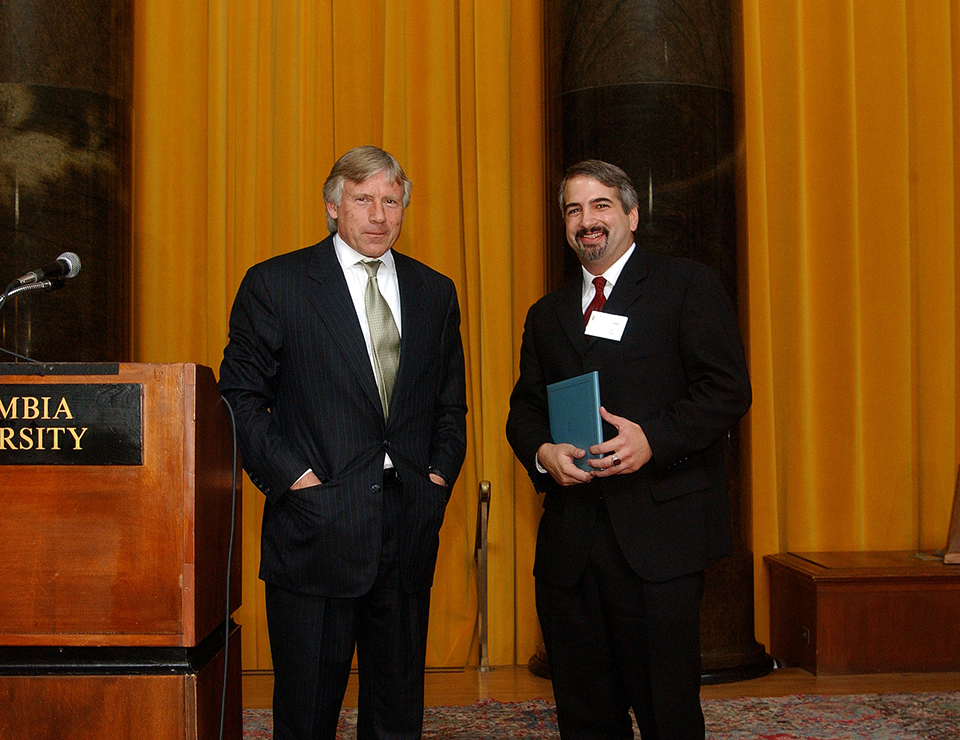
Columbia University President Lee C. Bollinger (left) presents Anthony Shadid with the 2004 Pulitzer Prize in International Reporting.
Winning Work
Family Weathers Attacks, Prepares for U.S. Siege
By Anthony Shadid
Washington Post Foreign Service
BAGHDAD, March 23 -- The melancholy wail sailed across the city and pierced the walls of the middle-class Baghdad home. The sleepless family listened in silence until the mother, her face lined with fear and pain, shook her head.
"Siren," she whispered.
At that, her daughter jumped up and threw open the door. She ran to open the windows next, fearful the blast would shatter them. The son sprinted outside, hoping to spot a low-flying cruise missile that would send the family huddling, yet again, in a hallway.
And they waited for the bombs.
"It's terrible," the mother said, as the minutes passed. "We really suffer, and I don't know why we should live like this."
Her daughter nodded. "I get so scared, I shake," she said. "I'm afraid the house is going to collapse on my head."
While the outside world has grown accustomed to detached images of fire and fury over Baghdad, and the government here boasts of victory over the invaders, this rattled family of five in the middle-class neighborhood of Jihad has watched war turn life upside down. Their world now is isolation, dread and a bitter sense that they do not deserve their fate.
"We're in a dark, dark tunnel, and we don't see the light at the end of it," the daughter-in-law said.
The family met privately with a journalist today, without the presence of a requisite government escort and with a promise that their identities would not be published. Over a lunch of Iraqi dishes -- pickled mango, kibbe, kufta and chicken cooked with rice, peanuts and raisins -- they spoke with unusual candor about politics and war. At times brashly, they discussed subjects that are usually hinted at, as if Baghdad were already in limbo between its past and its future.
"Iraq is ready for change," the father said. "The people want it; they want more freedom."
But family members expressed anger at the U.S. government, which has promised to liberate them. They criticized President Saddam Hussein and his dictatorial rule, but insisted that pride and patriotism prevent them from putting their destiny in the hands of a foreign power.
They spoke most fervently of a longing for routine -- the most mundane rituals of going to work, sharing dinner on a quiet night and sleeping at a set hour. They predicted little of that stability ahead. From a bloody battle for the capital, to lawlessness, to the humiliation of an occupation, they braced for a future that hardly anyone in Baghdad dares predict.
"Everything is turned around," the daughter-in-law said.
For weeks, the daughter-in-law helped prepare the house for war. She and her husband hauled a mattress downstairs, setting up their bedroom in the dining room. The family rearranged furniture so that they could sprint to open the windows. Sofas and tables were cloaked in dust cloths to protect them from flying glass and debris. Two rifles and bags of ammunition were propped against the wall.
Scattered around the two-story house were supplies to help them withstand a siege. Two tanks were filled with kerosene for cooking in case the electricity went out. The mother filled every pan, kettle and thermos with water, in case the pumps stopped working. Flour, sugar, rice, beans, powdered milk, biscuits, jam, cheese, macaroni, wheat, and cereal filled bag after bag.
"These will last three months," the son said, surveying the stockpile.
His wife interrupted to disagree. One month, no more. "The men in our family have very big appetites," she said.
It was a rare moment of levity in a city with little joy. The family members gazed out the window at a sky shrouded in black smoke from fires lit by Iraqi forces to conceal targets from U.S. strikes. The oil pits burned for a second day, turning a sunny, cloudless Baghdad sky into an eerie gauze. In vain, the family hoped the smoke would limit the air assault.
They had already had enough, they said. The worst so far was Friday, when U.S. and British forces fired 320 Tomahawk cruise missiles at Baghdad, wrecking the symbols of Hussein's rule. Ten of the missiles landed near their home, shattering the window in the front of the house. The shock waves threw open the refrigerator, tossing its drawers on the kitchen floor.
"They were powerful, really powerful," the mother said. "They came one after another."
Baghdad is a city that takes pride in its toughness. Residents are fond of listing the challenges history has thrown before them. The men in the family sounded a similar theme.
"We have 11,000 years of history. I know it sounds facetious, but it gives you resilience," the father said.
Of the bombs, his son added, "The bark is worse than the bite." But in private moments today, the suffering was close to the surface. Friends, they said, had fled to Syria in January, only to run out of money before the war started. Others had headed north to the city of Mosul, hoping to endure the war with relatives.
Those who stayed have struggled to negotiate the uncertainty. A pregnant friend of the daughter-in-law was supposed to have a Caesarean section within 10 days. But her doctor has vanished. Hospital after hospital has refused to admit her, overwhelmed with the task of preparing for the wounded. Another friend who is seven months pregnant has begun taking valium.
A neighbor said she stuffed cotton in the ears of her two young children every night. She fretted about finding diapers and milk.
"She's in a complete panic," the daughter-in-law said.
When it came to the cause of Iraq's predicament, family members pointed to Hussein, describing him as rash. He invaded Iran, trapping them in an eight-year war. He seized Kuwait, bringing on the Persian Gulf War and the devastation of sanctions that largely wiped out Iraq's middle class. After that war, they were ready to overthrow him themselves.
But they bitterly denounced the war the United States has launched. Iraq, perhaps more than any other Arab country, dwells on traditions -- of pride, honor and dignity. To this family, the assault is an insult. It is not Hussein under attack, but Iraq, they said. It is hard to gauge if this is a common sentiment, although it is one heard more often as the war progresses.
"We complain about things, but complaining doesn't mean cooperating with foreign governments," the father said. "When somebody comes to attack Iraq, we stand up for Iraq. That doesn't mean we love Saddam Hussein, but there are priorities."
A friend of the family interrupted. "Bombing for peace?" he asked, shaking his head.
"I don't even care about the leadership," the daughter-in-law said. "But someone wants to take away what is yours. What gives them the right to change something that's not theirs in the first place? I don't like your house, so I'm going to bomb it and you can rebuild it again the way I want it, with your money? I feel like it's an insult, really."
Gathered around the table, the family members nodded their heads.
"There are rumblings of dissent," the father said. "But these rumblings don't mean: Come America, we'll throw flowers at you."
The family is Sunni Muslim, a minority from which the government draws its strength. Sunnis appear to have the most to lose in a postwar Iraq that would undoubtedly devolve authority to Kurds in the north and the Shiite Muslim majority in the south. The son acknowledged that some Shiite friends had a different opinion of the U.S. attack. But Iraqi nationalism -- and a history replete with sometimes violent opposition to foreign intervention -- could influence the course of the war and its aftermath.
On this day, though, survival was the more pressing issue. By late afternoon, the thunder of bombing broke across the horizon. The son said he heard a rumor that B-52s were on their way, and the family members guessed at the time it would take them to arrive.
They were jittery, flinching at the slightest sounds. "That's wind, that's wind," the father said when the door slammed shut. When the son got up, his chair banged the wall and the mother jumped. A few minutes later, he did it again.
"Quit doing that," his mother said. "I'm so scared. Every little noise."
Outside, the sounds of ordinary life came from the street. A cart passed the house, its horn blowing. It had come to collect trash and refill kerosene tanks for cooking. As the cart passed, the routine it evoked seemed to anger the son.
"I should be able to live like other people are living," he said glumly. "I shouldn't fear bombs falling on my head, I shouldn't be hearing sirens. Why should I have to like this? Why should this be normal?"
Everyone looked to the floor, no one saying a word.
By Anthony Shadid
Washington Post Foreign Service
BAGHDAD, March 26 -- Shards of corrugated tin dangled from roofs like chimes, colliding on the winds of a savage sandstorm. Shattered pipes poured sewage into the streets. The charred carcasses of cars sat smoldering, hurled onto the sidewalk.
Ali Abdel-Jabbar watched helplessly as his friend, Mohammed Abdel-Sattar, lay on the ground, his legs torn off. He lived. Across the street was the severed hand of Samad Rabai, tossed gracelessly in a pool of blood and mud. He died.
In a moment, two explosions transformed a busy stretch of life today into a junkyard of mangled wires, uprooted trees, toppled lights, anguish and grief.
Iraqi officials said at least 14 people were killed and 30 injured in the blasts -- a count that matched hospital estimates -- in the biggest loss of civilian life in Baghdad since U.S. and British air attacks began last week. The explosions devastated a 100-yard swath of shops, homes and a restaurant in the working-class neighborhood of Shaab, on Baghdad's northern outskirts.
Pentagon officials denied responsibility for the bombing, saying there were no U.S. targets near the neighborhood. But U.S. military officials in Qatar said that U.S. aircraft targeting Iraqi surface-to-air missile launchers in a residential area in Baghdad had fired precision-guided weapons at about the same time as the bombing, possibly causing civilian damage.
In the Shaab neighborhood, the carnage spoke of the helplessness and dread that has enveloped the capital.
"Who accepts this?" shouted George Said, a mechanic whose store was littered with spilled oil, a door torn from its hinges onto the floor. "Does America like this, does Bush like this, do the American people like this? How can they accept the destruction?"
Crowds poured into the muddy, congested streets, shouting, "We will sacrifice our blood and souls for you, Saddam."
But in private, some residents complained bitterly that the Iraqi military had trucked missiles and other weapons to a grass-and-mud clearing at the neighborhood's edge. One neighbor said the trucks moved in from 11 p.m. to dawn, their movements shrouded to a degree by a two-day sandstorm that Iraqis said was the fiercest in years. Four tents and military equipment remained there today, concealed in part by trenches and dozens of industrial-size spools for cable. Down the road were at least four antiaircraft guns.
The neighbor said he blamed "both sides" for the destruction that sent shattered glass cascading through his apartment. His refrigerator and television rested against the pockmarked wall, tossed across the room by the force of the blast. Flying debris injured his mother, father, brother and sister, all of whom lived together in a cramped, two-room apartment.
"We are the simple people who get hurt. The government doesn't get hurt, but we end up getting hurt," the 35-year-old resident said. The government "is responsible for the people. They should take care of the people."
It was a day of menace in Baghdad, a capital forced to contend with around-the-clock bombing, smoke billowing from burning oil trenches that has compelled some to flee, and a sandstorm that has convinced many that divine intervention rules their fate.
On the storm's second day, the city of more than 5 million was coated in a film of dust, blown in from Iraq's deserts. The sky turned from a blinding yellow at dawn to blood-red in the afternoon. A dusk-like brown was followed by an eerie orange at nightfall. An occasional vegetable stand provided the city's few glimpses of color in its onions, tomatoes, eggplant and oranges. Rain fell throughout the day, bathing Baghdad in mud.
Cars drove with their headlights on at noon, and street lights cast a faint glow over the city streets. Residents complained of sleeplessness, some saying they had started taking Valium to ease the anxiety brought by the storms and the bombing. Few in the capital predicted that the worst was over; even fewer were willing to predict what the next few weeks would bring.
Shaab today was their worst fears made plain.
U.S. forces have, on the whole, waged their air assault on Baghdad with precision, targeting presidential palaces, government offices and intelligence headquarters since last week. At dawn, blasts shook the area that houses the Information Ministry, knocking Iraqi television off the air for several hours. But there have been errant strikes too, demolishing a student union building at Mustansiriya University, a laundry in a village outside Baghdad and clusters of homes in the neighborhoods of Adhimiya and Qadisiya.
In Shaab, the bombs struck at 11:30 a.m., a time that the streets, even in war, were crowded with mechanics, vendors of auto spare parts, customers at electric appliance stores and families sitting down to a late breakfast after a jarring night of bombing.
Residents said they heard the murmur of a bomber in a cloaked sky. Seconds later, the first explosion struck.
Abdel-Jabbar was in his workshop, putting together cardboard boxes. The blast collapsed the shop's entrance, showering the store with bricks and cinderblocks. He said the shock waves tossed cars and people several feet. One of them was Sattar, a 22-year-old friend repairing his car in the street. Sattar survived, Abdel-Jabbar said, but his legs were severed.
"Does he carry weapons of mass destruction?" Abdel-Jabbar shouted, as the sirens of ambulances, police cars and civil defense vehicles tried, in vain, to navigate traffic that had come to a standstill in the wrecked street. "Do his wife and children carry weapons of mass destruction?"
Next door, two workers had been scurrying around the Dulaimi Restaurant, preparing for lunchtime. Both were killed in an instant. The restaurant's red and blue tiles lay splintered on the sidewalk, plastic white tables and chairs were turned upside down, wires hung from the ceiling like a spider's web and its sign dangled overhead, giving perch to a bird.
Within moments, the second blast struck the other side of the street. Qais Sabah and his family of eight were sitting down to a breakfast of falafel, boiled eggs and bread. They jumped at the first explosion, then were thrown to the ground by the second.
Hours later, the 35-year-old day laborer looked out over the detritus of his house. A cracked porcelain plate that read "God" hung askew on the wall. On the sidewalk outside was the severed hand of Samad Rabai, 17, the owner of an appliance store.
"It's a crime against us," Sabah said. "There's nothing here to bomb."
Tareq Abdullah was making a halfhearted attempt to wash the dust off his white Lada sedan when the bombs struck. He was thrown several feet, then crawled to his car. He said he was desperate. His 4-year-old son, Ali, was still inside, screaming.
In the hospital, Abdullah lay in a bed with bandages covering wounds to his head, chest and both legs from flying debris. He had trouble hearing, his ears still ringing from the bomb's percussion. "I feel pain," he said, over and over.
Next to him, his brother Ahmed, wearing a soccer jersey smeared with dried blood, looked at the bed and started crying.
"Look at my brother," he said, shaking his head. "Look at my friends."
In another room, Alawi, the nickname given to young Ali by his relatives, lay in a bed with a bandage over his head. With deep brown eyes and the look of a young child struggling to make sense of disaster, he said the Americans were trying to kill his father. He pulled nervously on the threads of the blue-and-white blanket covering the cut on his shoulder, recounting his fear.
"But I'm not afraid anymore. I'm brave," he said meekly.
Hours after the attack, residents piled trucks with their belongings. One patriarch threw mattresses, red and pink blankets and pillows off a ledge to his children below, careful to keep their few belongings out of the mud and sewage. Another man carted a refrigerator, chairs, shelves and blue bedding in a pile along the street. Workers emptied a workshop of battered machinery, then slapped mortar on cinderblocks to build a wall across its door.
"We'll clean up," Sabah said. "We'll find our relatives. We have to go somewhere else. We have no place left."
By Anthony Shadid
Washington Post Foreign Service
BAGHDAD, March 27 -- The bombs crashed that morning on Baghdad, declaring war. At nightfall, Karima, a mother of eight, took her eldest son to the bus station, sending him off to fight in the north.
Their farewell was infused with the deeply religious idiom of Arabic, phrases at once formal and personal. "God be with you," she remembered saying, as her 20-year-old son boarded the rickety red bus for Mosul, a 30-cent fare in his hand. "God protect you."
Those words, spoken a week ago, were their last.
Her son, a tall, gaunt soldier known for his generosity, traveled five hours to man an antiaircraft battery in Bartalah, about 25 miles north of Mosul. She returned to her three-room apartment, tears running down her face, under a black veil.
"A mother's heart rests on her son's heart," she said. "Every hour, I cry for him."
In a city scarred on its surface by bombing and deep in its psyche by years of hardship, a week-old war is only her latest tragedy. The story of Karima is perhaps most remarkable for how unexceptional it is.
A short woman with worn hands, she has no money, no work other than selling chewing gum from a canvas mat in the street, and the dearth of hope that forces so many in this once-proud city to put their faith and future in God's hands.
Speaking to a journalist, without the presence of a government escort, Karima expressed sentiments in Baghdad today that seemed confusing, even contradictory. Yet they remain common, coloring the Iraqi capital as it enters its second week of war.
She is a Shiite Muslim in a land ruled by a relentlessly repressive government dominated by Sunni Muslims. She takes pride in her son's service in the army, but deems the war a waste and waits for news she hopes will never come. Her five daughters reflexively break into a chant in support of President Saddam Hussein, perhaps more out of fear than fealty. In more reflective moments, they speak not of defending his government, but of protecting their homes, their country and their faith from a war they consider an invasion.
Most telling are their priorities. They speak not of politics, not of ideology, but of survival.
"God willing, the war won't last long," Karima said. "I wish it wouldn't have lasted one day."
Sitting on mats lined against the wall, her daughters -- age 16, 15, 13, 12 and 11 -- giggled, awkward in the presence of a foreigner. Overhead was a portrait of the prophet Muhammad's grandson Hussein, a resonant symbol of suffering in Shiite theology. Hanging over a battered refrigerator, its white paint peeling and its rusted handle broken, was a porcelain blue plate that read "God."
"This war is such a loss," the mother whispered.
Karima's life has been a chain of tragedies, but she has proved resilient. Her husband died eight years ago. A driver for a Japanese company in Baghdad, he was killed in a wreck when another car's brakes malfunctioned. She lost her job as a maid when the Lebanese doctor she worked for left Iraq two years ago.
In January, she was evicted from her home, a garage in which the family had pirated running water and electricity. Her eldest son, the breadwinner, joined the army a year and a half ago. Another son, 18, got on the wrong side of the law and served five months in jail for stealing a car. She said the youngest son, 9, is too young to work.
She managed to find another apartment in a run-down building, wires hanging from the ceiling and tattered furniture stacked in the dilapidated hallways. But her rent is about $18 a month, a sum she has no chance of paying. She expects to be evicted again soon.
Now, she said, she is coping with war, and the dread it has brought. At first, many of her friends and relatives -- those with enough money -- fled the city. Her sister-in-law put only her children in a car for Syria, leaving everything else behind. "Whoever could, left," she said. "Whoever couldn't is sitting in their houses."
Then she dealt with spiraling prices, as residents made a run on stores to stock up on bottled water, rice, flour and beans, kerosene for cooking, and gas for their cars. A tray of 24 eggs went from 50 cents to $1.40. The price of slightly more than two pounds of potatoes -- a favorite for war-weary Baghdad because of their shelf life -- jumped more than three times in a week.
And then there's the seclusion. Schools were canceled three days before the war started, making Karima's children go stir-crazy in the suffocating confines of three rooms.
Karima said she was terrified of the bombing and afraid to go outside. When the explosions send shudders through their shoddily constructed building, she and her children run into the stairwell, joining another family huddled in darkness.
"We don't know what will happen. We don't know when it will happen," she said. "There's no life, there's no death. Only tension."
At night, they try to pick up the Arabic-language service of Radio Monte Carlo to hear what they consider unbiased reports on the war -- straining to hear the names of Umm Qasr, Nasiriyah, Basra and Najaf. In silence, they listen for any detail on fighting in the north, where the eldest son is stationed.
When the war started, he had been at home. For one week each month, soldiers get leave, and he was spending his week here, working as a plumber. Karima said he hesitated only briefly to rejoin his unit.
"He wasn't scared," one daughter insisted.
Her mother shot her a look of disapproval. "Of course, he was scared. He's anxious. And we're anxious for him. But God is present."
Her other son picked up a gun, as well. He was released in an amnesty ordered by Hussein in October that emptied Iraq's jails of their prisoners. A ne'er-do-well, even by the accounts of his family, he joined the motley crowd of militiamen patrolling Baghdad's streets. In street clothes and carrying a Kalashnikov assault rifle, he looks after an antiaircraft gun parked in front of a school.
The family's view: He's looking for a fight.
In conversations in Baghdad -- always framed by the lurking menace of an omnipresent police state -- the conflict is rarely if ever talked about in terms of liberation. Those sentiments may exist, cloaked in the silence that talk of politics here provokes. But far more dominant, even in private, is a view that the war is imposed on people against their will, an intervention they resent.
Karima's Shiite family was no different. They spoke not of freedom, but of defending their faith.
The mention of liberation prompted them to shake their heads. They seemed angry, even bewildered, by a conflict that has left them guessing uneasily as to its outcome.
"The United States is strong," she said, nodding her head. "But God willing, we'll be stronger. We have right on our side. They attacked us. We didn't attack them. They have weapons, but we have God."
Her daughter, a vivacious girl of 13, joined in. "If you were sitting in your house and somebody attacks you, would you accept that? We won't accept somebody coming into our country. We'll defend our country, and we'll defend our home."
Of Iraq's many aggrieved parties, Shiite Muslims, the majority in Iraq, have perhaps suffered the most. Through three decades of Baath Party rule, they have endured bloody crackdowns, the forced exile of tens of thousands to neighboring Iran and the underdevelopment of the southern region where they predominate. The government has executed their religious leaders and, at times, publicly questioned their loyalty, given the community's historic ties to Shiite Iran.
Beyond the tired rhetoric in support of the Iraqi president, Karima's family had little to say about Hussein, whose visage glares down on Baghdad residents from every street corner, intersection, ministry and monument that shapes Baghdad's skyline.
To them, Hussein is not Iraq, and Iraq is not Hussein. Their country was the sacred cities of Najaf and Karbala, where members of Muhammad's family are buried. It is the cities from which their relatives came. And it is Baghdad, which they call theirs.
"If a foreigner wants to enter Baghdad in peace, we will welcome him like a brother," one daughter said. "If a foreigner wants to enter as an enemy, every family will go out and confront them, even with stones. If they don't throw rocks, then they'll throw dirt.
"Not only the Iraqi army will fight, but the families, the children, even the elderly will," she said.
Karima looked on approvingly. But her life served as a note of caution. No one wants to be occupied, she said, and no one wants a war. No one asked foreigners, be they the Americans or others, to invade Iraq. But tragedy has visited her time and again, and in the powerlessness those calamities provoke, the only recourse is God. Being in his hands, she said, is their only comfort.
"It's true we have to fight for the sake of our nation, land and culture," she said. But using an Arabic expression that signifies fatalism and helplessness, she said: "There's no life or power that does not come from God. What God wants will be."
'The Sky Exploded' and Arkan Daif, 14, Was Dead
By Anthony Shadid
Washington Post Foreign Service
"It was awful and ugly," he said. "This is the first time I've ever seen anything like this."
BAGHDAD, March 30 -- On a cold, concrete slab, a mosque caretaker washed the body of 14-year-old Arkan Daif for the last time.
With a cotton swab dipped in water, he ran his hand across Daif's olive corpse, dead for three hours but still glowing with life. He blotted the rose-red shrapnel wounds on the soft skin of Daif's right arm and right ankle with the poise of practice. Then he scrubbed his face scabbed with blood, left by a cavity torn in the back of Daif's skull.
The men in the Imam Ali mosque stood somberly waiting to bury a boy who, in the words of his father, was "like a flower." Haider Kathim, the caretaker, asked: "What's the sin of the children? What have they done?"
In the rituals of burial, the men and their families tried, futilely, to escape the questions that have enveloped so many lives here in fear and uncertainty. Beyond some neighbors, family, and a visitor, there were no witnesses; the funeral went unnoticed by a government that has eagerly escorted journalists to other wartime tragedies. Instead, Daif and two cousins were buried in the solitude of a dirt-poor, Shiite Muslim neighborhood near the city limits.
The boys were killed at 11 a.m. today when, as another relative recalled, "the sky exploded." Daif had been digging a trench in front of the family's concrete shack that could serve as a shelter during the bombing campaign that continues day and night. He had been working with Sabah Hassan, 16, and Jalal Talib, 14. The white-hot shrapnel cut down all three. Seven other boys were wounded.
The explosion left no crater, and residents of the Rahmaniya neighborhood struggled to pinpoint the source of the destruction. Many insisted they saw an airplane. Some suggested Iraqi antiaircraft fire had detonated a cruise missile in the air. Others suggested rounds from antiaircraft guns had fallen back to earth and onto their homes.
Whoever caused the explosion, the residents assigned blame to the United States, insisting that without a war, they would be safe. "Who else could be responsible except the Americans?" asked Mohsin Hattab, a 32-year-old uncle of Daif.
"This war is evil. It's an unjust war," said Imad Hussein, a driver and uncle of Hassan. "They have no right to make war against us. Until now, we were sitting in our homes, comfortable and safe."
As he spoke, the wails of mourners pouring forth from homes drowned out his words. He winced, turning his head to the side. Then he continued. "God will save us," he said softly.
At the mosque, hours after the blast, Kadhim and another caretaker prepared Daif's body for burial -- before sundown, as is Islamic custom.
Bathed in the soft colors of turquoise tiles, the room was hushed, as the caretakers finished the washing. They wrapped his head, his gaze fixed, with red and yellow plastic. They rolled the corpse in plastic sheeting, fastening it with four pieces of white gauze -- one at each end, one around his knees and one around his chest.
Kadhim worked delicately, his gestures an attempt to bring dignity to the corpse. He turned Daif's body to the side and wrapped it in a white sheet, secured with four more pieces of gauze. Under their breaths, men muttered prayers, breaking the suffocating silence that had descended. They then moved toward the concrete slab and hoisted the limp body into a wood coffin.
"It's very difficult," said Kadhim, as the men closed the coffin.
On Friday, he had gone to another mosque, Imam Moussa Kadhim, to help bury dozens killed when a blast ripped through a teeming market in the nearby neighborhood of Shuala. The memories haunted him. He remembered the severed hands and heads that arrived at the Shiite mosque. He recalled bodies, even that of an infant, with gaping holes.
"It was awful and ugly," he said. "This is the first time I've ever seen anything like this."
In an open-air courtyard, the men set the coffin down on the stone floor of a mosque still under construction. In two rows, they lined up behind it, their shoes removed before them. Their lips moved in prayers practiced thousands of times.
"God is greatest," they repeated, their palms facing upward in supplication.
In the background, men discussed the war. In the repression and isolation that reigns in Iraq, rumors often serve as news, and the talk today was of carnage unleashed on a convoy taking the body of an 80-year-old woman to be buried in the southern city of Najaf, where U.S. forces are confronting Iraqi irregulars and soldiers.
For Shiite Muslims, Najaf is among their most sacred cities, housing the tomb of Ali, the son-in-law of the prophet Muhammad, whom Shiites regard as his rightful heir. Tradition has it that the dying Ali asked his followers to place his body on a camel and bury him wherever it first knelt; Najaf was the site. Millions of pilgrims visit each year, and devout Shiites will spend their life's savings for the blessings of being buried in the vast cemeteries that gird the city.
The woman from Rahmaniya never made it. Residents said U.S. forces attacked three cars, one carrying her body. It was another ignominy visited on the city, the men agreed. They insisted that infidels would never enter the city by force of arms. The U.S. siege of the city -- its severity accentuated as rumors circulated -- was an act of humiliation.
"It's a disgrace," said Hattab, one of Daif's uncles.
Hussein, another relative, echoed the words of others. "They didn't come to liberate Iraq," he said, "they came to occupy it."
In his words was a fear that strikes deep into the Iraqi psyche. Many worry that the U.S. invasion is a threat to their culture and traditions. They wonder if an occupation would obliterate what they hold dear, imposing an alien culture by force on a society that, in large part, remains deeply conservative and insulated.
"We don't want the Americans or British here. Our food is better than their food, our water is better than their water," he said.
With the prayers over, the men hoisted Daif's coffin over their heads. They left through the mosque's gray, steel gates and ventured into the desolate, dirt streets awash in trash. Some were barefoot and others wore sandals.
"There is no god but God," one man chanted. "There is no god but God," the pallbearers answered. Bombing on the horizon provided a refrain. The men crossed the street, past concrete and brick hovels, the Shiite flags of solid black, green, red and white flying overhead.
As they approached Daif's house, its door emblazoned with the names Muhammad and Ali, they were greeted with wails of women covered by black chadors. They screamed, waving their hands and shaking their heads. The cries drowned out the chants, as the coffin disappeared indoors. The despair poured out of the home, its windows shattered by the blast that killed Daif.
"My son! My son!" his mother, Zeineb Hussein, cried out. "Where are you now? I want to see your face!"
The men in Daif's family embraced each other, sobbing uncontrollably on their shoulders. Others cried into their hands. From within the house came the sounds of women methodically beating their chests in grief.
In the houses along the street, neighbors and relatives spoke of injustice -- a resonant theme in the lives of Shiites Muslims, whose saints and centuries of theology are infused with examples of suffering and martyrdom.
"We're poor. We can't go anywhere else. What is the fault of the families here? Where's the humanity?" asked Abu Ahmed, a 53-year-old neighbor sitting in a home with three pictures of Ali and a painting of his son, Hussein. "I swear to God, we're scared."
Their talk was angry, and they were baffled.
If the Americans are intent on liberation, why are innocent people dying? If they want to attack the government, why do bombs fall on civilians? How can they have such formidable technology and make such tragic mistakes?
In Hussein's Iraq, with a 30-year-political culture built on brutality, some were convinced the Americans were intent on vengeance for the setbacks they believed their forces were delivered in Basra and other southern Iraqi cities. Others, in moments of striking candor, pleaded for the United States and Britain to wage war against their government, but spare the people.
"If they want to liberate people, they can kick out the government, not kill innocent civilians," one relative said. "The innocent civilians are not in business with the government. We're living in our houses."
Before dusk, Daif's coffin was carried from his house. It was set on the back of a white pickup truck headed for the cemetery. As it drove away, kicking up clouds of dirt, some of the neighbors and relatives shouted, "God be with you." Other men waved, a gesture so casual that it suggested the strength of their faith, that they would eventually be reunited with Daif.
Hattab, the uncle, looked on at the departing coffin. His eyes were red, and his face was drawn.
"He has returned to God," he said. "It's God's wish."
© 2003, The Washington Post Company
U.S. Forces Move Triumphantly Through Capital Streets, Cheered by Crowds Jubilant at End of Repressive Regime
By Anthony Shadid
Washington Post Foreign Service
BAGHDAD, April 9 -- Swept aside by U.S. troops who drove through the streets of Baghdad, President Saddam Hussein's government collapsed today, ending three decades of ruthless Baath Party rule that sought to make Iraq the champion of a modern Arab world but left a legacy of fear, poverty and bitterness.
As U.S. Army troops occupied the west bank of the Tigris River and U.S. Marines rolled into the eastern part of the city, facing only scattered resistance, thousands of Baghdad residents poured into the streets to celebrate the government's defeat and welcome the U.S. forces in scenes of thanks and jubilation.
With pent-up fury, the crowds also rampaged through offices of the government and state-owned companies, lugging away everything from plastic chairs to Toyota pickups once doled out as patronage. In festive moments, others tested their newfound freedoms, engaging in noisy debates in the street and denouncing Hussein in words that would have brought a death sentence only days ago.
The feared Baath Party apparatus disappeared from the streets. Its junior officials and militia fighters, once posted at every intersection, were nowhere to be seen. Many were said to have changed into civilian clothes to escape detection. Party uniforms and weapons were scattered at sandbagged positions that only days ago had been vaunted as the heart of a bloody last stand. Along some streets, military vehicles stood bleak and deserted, testimony that a once-efficient administration had come to a halt.
The fall of Baghdad -- and its celebration by thousands of Iraqis eager to heap scorn on their leader -- marked a climactic moment and a clear turning point in the war launched by the Bush administration 21 days ago to take down Hussein's government and rid Iraq of what U.S. officials said was a store of weapons of mass destruction.
Since launching the invasion from Kuwait March 20, U.S. and British forces have seized control of all the country's important centers south of Baghdad and at least two-thirds of its territory. The Euphrates River city of Hilla came under U.S. Army control today, completing occupation of the Euphrates Valley. The seizure of Baghdad added to the list the seat of Hussein's government and the heart of Iraq's old and storied civilization.
But Hussein, 65, his family, his ministers and members of the ruling Revolutionary Command Council remained unaccounted for, having vanished from public view over the last several days as U.S. forces closed in. U.S. officials cited radio traffic from the remote town of Qaim, in the far west near the Syrian border, as an indication some Hussein followers might be hiding there. In addition, several major Iraqi cities have not yet been occupied by U.S. forces, including Tikrit, Hussein's home town, and Kirkuk and Mosul in the northern oil fields.
'This Is Not Over'
"There's a lot more fighting that's going to be done," Defense Secretary Donald H. Rumsfeld warned in Washington. "There are more people [who] are going to be killed; let there be no doubt. This is not over, despite all the celebrations on the street."
The Pentagon has identified 91 U.S. military personnel as killed in action or missing in action and about 400 wounded since the war began, a count that has often fallen behind reports from the field as information travels through the bureaucracy and families are notified. The number of Iraqi casualties has not been reliably compiled, but U.S. officials have estimated them in the thousands.
Although Hussein and his sons were targeted in an airstrike two days ago on the strength of intelligence that they were gathered at a meeting and vulnerable to attack, Rumsfeld said he did not know whether they were still alive.
"It is hard to find a single person," Rumsfeld said. "It is hard to find them when they're alive and mobile, it's hard to find them when they're not well, and it's hard to find them if they're buried under rubble. We don't know. And he's not been around. He's not active. Therefore, he's either dead or he's incapacitated, or he's healthy and cowering in some tunnel someplace, trying to avoid being caught. What else can one say?"
But in Baghdad, today was for merrymaking as, in quick succession, U.S. forces took control of the streets and the symbols of Hussein's rule fell. In Firdaus Square, dancing crowds aided by U.S. Marines toppled a 20-foot statue of the longtime leader, his arm raised in Stalinist fashion. With ropes, residents dragged its severed head through the streets, cheering along the way. Hussein's ubiquitous portraits, as early as this morning still gracing newspapers, were smashed. On one defaced picture, a devil's horns were scribbled in black.
"I can tell you the fear has lifted from people's hearts," said Faleh Hassan, sitting at Abu Ahmed restaurant in central Baghdad.
It was a startling collapse for a government that, only three weeks ago, had predicted Baghdad would become a quagmire for invading forces and declared, with bluster and bravado, that it was debating whether to bury U.S. and British troops in mass pits or individual graves. It followed one of the quietest nights of the war in Baghdad, with only sporadic shelling and the crackle of gunfire.
Government No-Shows
The fate of Hussein and his government was a mystery that intrigued Baghdadis as well as officials in Washington. But in Baghdad, there was no one to ask about it. For the first time since the war began, Information Minister Mohammed Saeed Sahhaf, whose comments had grown increasingly bizarre as the war unfolded, failed to arrive at the Palestine Hotel to deliver his daily briefing. Only a day earlier, he insisted -- with not a hint of irony -- that Baghdad was bracing "to pummel the invaders."
Other Iraqi officials, who appeared less and less in public as the war progressed, were also nowhere to be seen, including Hussein's sons, Uday and Qusay. Despite the bombing on Monday of a compound in the well-to-do Mansour neighborhood where Hussein was believed to be hiding, many residents of Baghdad expressed belief he survived and possibly went to Tikrit, the home base of his clan and many of his closest lieutenants.
Many spoke of settling scores with those officials. "If I see my enemy before my eyes, I will kill him," said Hassan, the restaurant owner. "To be honest, that goes for all Tikritis."
But scenes of celebration were more common. In images broadcast around the world, hundreds of Iraqis poured into Firdaus Square, where they headed for a statue of Hussein perched on a 20-foot pedestal of purple granite. First came a sledgehammer. Men took turns knocking chunks off the base, to the wild applause of the crowd. Then a rope, tied like a noose, went over the statue's head. Finally, Marines brought an M88 tank recovery vehicle. They tethered one leg, then two, before finally settling on a thick chain that went around the statue's neck. It fell halfway, then crashed to the ground.
All that was left was the twisted metal of his feet, two rusted pipes jutting out.
With the rage of grievances accumulated over a lifetime, members of the crowd beat the fallen statue with sledgehammers, rocks, chains and their feet. Some slapped their shoes on it. Others made off with its head, dragging it through the streets.
"It was a strong statue," said Stefan Abu George as he watched the scene unfold. "It's not strong anymore."
Conflicting Emotions
Down the street, crowds greeted U.S. troops with flowers, candy and, occasionally, kisses.
"We love you!" some shouted. Others, with more anger, cried out, "No more Saddam Hussein!"
Some scrambled for packaged meals-ready-to-eat the Americans handed out, almost setting off a riot near the tanks. Others picked flowers from a nearby park and distributed them to soldiers and anyone resembling an American. A few simply stood and stared, as curious as they were jubilant. For the first time in a half-century, troops were rolling down Baghdad's streets with a foreign flag.
Those conflicting emotions gave rise to odd moments.
"I'm not happy," George said. But when a tank rolled by, he waved. Then he declared, "I love Saddam, he's courageous, he's a hero." The words set off a boisterous debate in the streets, an argument of the sort not heard publicly in a generation.
"Saddam is a dog, a son of a dog," shouted Majid Mohammed, 47, an electrical engineer.
But even Mohammed's family bore the scars of a system that relentlessly tried to link its fate to Iraq's, its leader's destiny to its own.
"I'm sad," said Mohammed's 12-year-old daughter, Sara, as they left the scene. "They stole our freedom."
Her words pained Mohammed. "Until now, I haven't been able to speak my feelings about him."
Even during the jubilation, Hussein still felt present in Baghdad after such a long period as absolute ruler. He became the effective head of government soon after the Baath Party took over in a coup in 1968 and formally assumed the presidency in 1979. His sudden absence opened a horizon that was at once unknown and uncharted. Iraqis spoke freely, fascinated by saying words only expressed in private, and even then, in whispers. But there was a nagging sense that words were still monitored, that statements could come to haunt them.
"Are you sure the regime is gone?" asked Mohammed Abdel-Amir, 34, a Shiite Muslim from Karbala.
Others had more mundane worries. They asked when electricity and telephones would return, after a week-long interruption. For others, it was the more fundamental issue of their relationship to U.S. forces that arrived today as liberators. Even in the celebratory scenes in the streets, some expressed hope that the U.S. presence would not become an occupation. Others were unsettled by the presence of a U.S. flag atop a column of tanks and other armor in a city whose name still resonates across the Arab world for its medieval glory.
"They got rid of the oppression, there's no question about that. But we want to know how it turns out -- are they here for our sake or for the sake of oil?" said Shidrak George, 38, watching the crowds pull down Hussein's statue.
Reflection and Uncertainty
In a country where virtually every family has a tale of suffering at the hands of the Arab world's most brutal government, the day prompted reflection -- over the fate of a rich country left poor and over a dictatorship that proved relentlessly durable. After three decades of powerlessness, many braced for the claims that the disenfranchised Shiite majority would make.
The uncertainty revolved as well around the enormous task of U.S. forces in crafting a new government. Many asked whether Iraqi dinars, emblazoned with a portrait of Hussein, could still be used. If not, when would they change? Others asked when the United States would return telephone service, cut off last week in a move that left the city isolated and secluded.
The war began in Baghdad with a barrage of missiles at a compound on the city's western outskirts where Hussein was thought to be hiding. What followed was an air assault that, at times, terrified the population. Casualties stayed relatively light when bombing targeted the symbols of Hussein's rule -- largely deserted presidential palaces, intelligence headquarters and government offices. They rose dramatically a week later when the attacks broadened to include telephone exchanges and transmission towers in crowded neighborhoods and, even more spectacularly, when U.S. forces arrived in the city on Saturday.
Kindi Hospital, which treats many of Baghdad's civilian wounded, this morning reported one of its busiest days.
Some said they would not forget the toll the war has caused among civilians. But remarkably, many seemed to look past it.
That future seemed to make some Iraqis more anxious. How long would the Americans stay, what did they plan to do, what government would they bring and what were their real intentions? The questions suggested that the United States -- its credibility suffering in much of the Arab world -- had a window of goodwill in a capital that seemed genuinely thankful for the removal of Hussein's government. But how long that window lasts may become a more pressing question in time.
"It's up to the Americans what this becomes," said Nazir Mustafa, 46, watching the tanks roll down the street. "Maybe it will be colonialism, maybe it will be liberation from the regime. The truth will soon become apparent."
Staff writer Vernon Loeb in Washington contributed to this report.
© 2003, The Washington Post Company
By Anthony Shadid
Washington Post Foreign Service
NAJAF, Iraq -- By the standards of Iraq and its Shiite Muslim majority, Sayyid Muqtada Sadr is a blue blood.
He wears a black turban, signifying his privileged descent from the prophet Muhammad. For a century, his family has given Iraq its most revered clergy, men whose very word, blessed by God, goes unquestioned by their followers. Like a badge of honor, he bears the deep scars of ousted president Saddam Hussein's government, which assassinated his father and two brothers in 1999 in Najaf, one of the most sacred cities in Shiite Islam.
Now, by birth and choice, the 30-year-old Sadr, his hands soft from a life of religious study, has inherited his family's mantle of leadership.
In the void left by the precipitous fall of Hussein's government after a U.S.-led invasion, Sadr and his followers have overseen checkpoints to end looting and moved, with the force of arms and power of persuasion, to restore authority in the streets. They have kept a distance from U.S. forces, suspicious of their motives. Sadr and his men are cognizant that their authority derives from their independence. With little hesitation, Sadr has reached out to Iraq's powerful tribes for support and rallied his followers from the pulpit of Friday sermons.
In words lacking the usual subtlety of religious discourse, Sadr's message is clear: He is both a political and religious leader, carrying the still-resonant banner of the Sadr name. The future of Iraq, he insists, is in the hands of the Shiite majority he hopes to represent.
"I accept the burden and the responsibility," he said in a rare interview this week while in hiding here, fearful of conflicts with others in the Shiite community. "We are with God and God is with us."
Sadr and other clerics stand at the center of the most decisive moment for Shiite Muslims in Iraq's modern history. It is a revival from both the streets and the seminaries that will most likely shape the destiny of a postwar Iraq.
In the streets, the end of Hussein's rule has unleashed a sweeping and boisterous celebration of faith, from Baghdad to Basra, as Shiites embrace traditions repressed for decades. In politics, the prominence of clergy -- the major institution to survive the repression of Hussein's powerful Baath Party -- has signaled that in coming years, power may be reflected through a religious prism. And for Shiite populations abroad -- including in Iran -- the community's newfound freedom may reestablish the holy cities of Najaf and Karbala as centers of religion and politics, recasting an arc of Shiite activism that began with the 1979 Iranian Revolution.
But the community is already struggling with the challenges that will deepen as a new government is formulated. How will they interact with a United States that has done little to engage them? Will they relinquish the power they have seized to a more representative government, one that also includes Iraq's Sunni Muslims, Christians and Kurds? And how will they reconcile the deepening rivalries of personality and vision within the community that are already tearing away at the unity that the clergy so desire?
Some among Iraq's minority Sunni and Christian communities are gloomy, predicting sectarian strife reminiscent of Lebanon's civil war. They predict the United States will never accept a Shiite government, much less a religious one -- a concern shared by Sadr and many Shiite leaders. Others are more optimistic, hopeful that Iraq's diversity will temper the Shiite community's demands and that its moderation, so far, is a signal of intentions.
"Iraq could become an inspiration to the Shiite world," said Wamid Nadhme, a political science professor at Baghdad University.
Until then, much of Iraq, anxious and uneasy, is watching the writing on the wall -- graffiti that has exploded across Baghdad and other cities. The sentiments in those slogans chart the emergence, concerns and ambitions of the country's resurgent majority.
'The Tyrant Is Gone'
On the walls of Najaf, Karbala and Baghdad, the slogan was simple. The tyrant Saddam. The tyranny has ended.
Within hours of Hussein's fall, hundreds of Shiite Muslims poured into the Kadhimiya shrine in Baghdad in demonstrations that ballooned into thousands. In chants and banners, the symbolism was unmistakable -- a reclamation of a 1,300-year-old faith relentlessly repressed by Hussein since the 1970s.
"The oppression is gone, however long it took," the crowd chanted, louder as they approached the shrine. "The tyrant is gone."
They held the green flags of Imam Ali, the prophet Muhammad's son-in-law, who Shiites believe was his rightful heir. The 7th century dispute over leadership, deepened by centuries of disenfranchisement and discord, has formed the lasting division of Islam into its Sunni and Shiite branches. Others carried the black banner of Hussein, Ali's son who -- outnumbered, betrayed and deprived of water -- was martyred in a battle in 680 at Karbala, near the Euphrates River. He was decapitated, his head carried away on a stake. Yazid, the caliph blamed for his death, is known to Shiites as the tyrant.
The celebrations are building toward a climax on Tuesday in Karbala, where thousands have already begun marching to mark the traditional 40 days' mourning that follows the anniversary of Hussein's death.
In a pilgrimage that until weeks ago brought a year in prison, they have come from Baghdad and Najaf, Nasiriyah and Basra. Some walked barefoot, in a symbol of the suffering Hussein endured. Others walked in groups, waving black, green and red flags that speak to their faith. They have crowded the roads, passing the craters and wreckage of war.
As they entered Karbala this week, many pounded their chests, a drumbeat of mourning known as lutm.
From the Shiite leadership down, the message has been that these celebrations are religious, not political. In gestures that have won admiration from skeptical Sunnis in Baghdad, clergy have reached out to their counterparts, seeking to portray unity and deflect attention from the internecine strife that many expected would erupt after the government's fall.
"No Shiites, no Sunnis, Islamic unity, Islamic unity," read one slogan on a mosque in Baghdad.
But others worry what comes next when Shiites seek to claim their political role as the majority.
"There are no problems now, but there will be problems between Shiites and Sunnis in the future," said Abu Nouri, a 66-year-old Shiite resident of Baghdad, as he gazed at the slogan. "There will be competition for power."
In some cities in Iraq, that competition has already started.
Taking Control of Cities
Abdel-Mahdi Salami, a Shiite cleric, has risen to power in Karbala. With thick-framed glasses and a beard peppered in gray, Salami led a group of 25 clergymen who have effectively seized control of the city over the last month. They have deployed hundreds of armed men, keeping the streets remarkably quiet and stanching the looting that devastated Baghdad, Basra and other cities. They restarted the civilian administration, after expelling hundreds they deemed too tainted by the Baath Party. With banks under their control and donations they receive, they have paid salaries to Karbala city workers.
Their goal, he said, is simple. "We want to make Karbala an example."
It is a trait of Shiite clergy, from Lebanon to Iran, to disavow ambition; a lust for power is considered unseemly. Salami, who likes to call himself Karbalai, or "from Karbala," has adopted that modesty. When asked who led the city's new government, run out of a dilapidated hotel for pilgrims, he looked at the ground. "Many of us," he said softly.
"You're being modest," his followers cried.
"We work sincerely, and we have no ambition for power," Salami answered. "But what we want is an administration for Karbala and the other provinces of Iraq that represents the people and delivers them what they want."
Across southern Iraq, Shiite clerics have filled the vacuum left by Hussein's fall. Although they pay allegiance to the pre-eminent seminary in Najaf, led by Grand Ayatollah Ali Sistani, they speak with their own voices, some more bold in their independence than others. Like Sadr, they claim the birthright of their own families. The father and grandfather of Salami, for instance, were prominent clergy in their own right. Others tout themselves as favorite sons, carving out territory in neighborhoods of Baghdad, or entire cities.
In Kut, along the Tigris River, Sayed Abbas, a 52-year-old Shiite cleric, has seized the city hall, surrounded by legions of armed supporters who have promised to block the entrance of U.S. forces that have yet to recognize his right to rule the city. In poor Shiite swaths of Baghdad, Mohammed Fartousi, a cleric dispatched by the seminary in Najaf, has claimed authority over an unruly collection of Shiite preachers, some of whom have installed groups of armed men at their mosques. In Najaf, the seminary under Sistani and the followers of Sadr have each moved to administer a city whose very name speaks to centuries of Shiite religious authority.
Outside their offices, powerful tribes and local leaders have flocked to pledge their allegiance -- and seek their support.
"Most of the people listen to the clergy," said Hassan Mushin Hassan, a 53-year-old cement trader in Najaf. "They have great influence over the people, and they will support the clergy to be the government. Why not?"
Suspicion of U.S. Intentions
Among Shiites like Hassan, the symbol of religious authority in Iraq is the Hawza, a seminary established more than 1,300 years ago in Najaf and long the pre-eminent center of religious learning. Until recently, clergy fluent in Persian and Arabic -- Ayatollah Ruhollah Khomeini among them -- studied theology, law and logic there with its greatest living thinkers.
It then became a backwater, repressed by the secularist Baath Party and overshadowed by the prominence given to the seminary in the Iranian city of Qom after the revolution Khomeini led. But now, just weeks after the government's fall, the Hawza has again begun to flex its muscle, inspiring hope among some that its diversity of views will bring a new vibrancy to Shiite thought long dominated by Iran. Housing 3,000 students, the Hawza sprawls around the shrine of Ali here, a collection of low-slung, brown-brick buildings.
During the war, Sistani, a cleric of Iranian origin regarded as leader of the Hawza, urged Shiites to neither support nor oppose the U.S. invasion. In the chaos that ensued, he delivered religious judgments forbidding looting. Now, with U.S. forces on the outskirts of Najaf and Karbala, the seminary has begun saying that it does not view the American presence as welcome.
"The presence of foreigners in the country is rejected," said his son, Mohammed Ridda Sistani, who acts as his spokesman.
It is a refrain echoed by cleric after cleric. Many have boycotted any dealings with U.S. officials. Some of the clerics are still bitter over what they view as the failure of U.S. forces to support a Shiite uprising after the 1991 Gulf War and blame the U.S. troops for the recent looting and lawlessness. Many remain suspicious of U.S. intentions and, in more private moments, suspect it will hand-pick a government that will deprive them of power.
But there is sharp disagreement about the tactics to organize their opposition, a dispute at the heart of the growing differences among rival wings of Shiite leadership.
In a debate that has raged for decades, the clerics in Najaf say the seminary is deeply split between a traditional wing and an activist wing. They are divided over whether clerics have a role solely in the spiritual sphere or in secular affairs. The controversy generates such great sensitivity that senior leaders refuse to even discuss it. By all accounts, Sistani subscribes to the traditional wing that shuns politics, viewing it as beneath his religious calling.
"My father does not request authority and he's not concerned with politics in any form," said Mohammed Ridda, sitting in an office near the shrine of Ali with two simple wooden tables and thin mattresses laid across the floor.
Others, like Sadr, see the clergy as a force for change, their calling intertwined with politics. As Sadr put it, "One hand with the Hawza, one hand with the people." He is sharp in his criticism of Sistani's reserve.
"From Saddam until now, he has not intervened in anything," said Sadr, who requested and was refused a meeting with Sistani.
Rivalries May Grow
The split between Sadr and Sistani is only one among a slew of rivalries and allegiances that many expect to grow amid the competition for power and influence. By tradition, all Shiites look to a senior cleric --marja al-taqlid -- endowed with the ability to arrive at original decisions on theology and law. Sistani is among those. But he is not the only one.
Sadr, dismissed by some for his age and lack of religious learning, looks to Kadhim Husseini Haeri, an exiled religious leader considered a successor to his father.
Some pledge loyalty to Iran's supreme leader, Ayatollah Ali Khamenei, although some also question his scholarly credentials. Others, like factions of the shadowy Dawa Party, look to Lebanon's Mohammed Hussein Fadlallah, once a spiritual guide of Hezbollah.
Those rivalries were blamed in part for the killing of two clerics at the shrine in Najaf on April 10. Since then, Sistani and Sadr have gone into hiding, fearful of more violence, and some have suggested Sadr was behind a move to exile Sistani.
Sadr, sitting under a clock bearing a portrait of his assassinated father, makes clear his seclusion is temporary. He insisted he would follow the orders of his marja. "But if he gave me a choice to have a political role, I would accept it," he said, surrounded by a coterie of young advisers. "I'm ready if I receive permission."
In recent weeks, his leaflets, speaking in the name of his father and competing with Sistani's own, have gone up in Karbala. Next to them are statements from Haeri, urging Shiites to follow the teaching of Sadr's family. His followers have taken to calling the Baghdad slum of Saddam City after his father. Saddam Hospital in Najaf, where his father's body was taken, has been renamed Sadr Hospital. Across a portrait of Saddam in the capital reads the slogan, "The blood of Sadr will not go in vain."
In the interview, his son delivered his view of ties with the United States.
"I advise the Americans to ally with the Shiites, not to oppose them," he said.
He recalled what Shiites view as centuries of oppression and suffering. Added to that, he said, was the national character of Iraq -- of rebellion and dissent. "You can read history," he said The Shiites "will reject any government brought by America, any leader, any state. They have rebellion in their hearts."
Father and Brother Are Forced by Villagers to Execute Suspected U.S. Informant
By Anthony Shadid
Washington Post Foreign Service
THULUYA, Iraq -- Two hours before the dawn call to prayer, in a village still shrouded in silence, Sabah Kerbul's executioners arrived. His father carried an AK-47 assault rifle, as did his brother. And with barely a word spoken, they led the man accused by the village of working as an informer for the Americans behind a house girded with fig trees, vineyards and orange groves.
His father raised his rifle and aimed it at his oldest son.
"Sabah didn't try to escape," said Abdullah Ali, a village resident. "He knew he was facing his fate."
The story of what followed is based on interviews with Kerbul's father, brother and five other villagers who said witnesses told them about the events. One shot tore through Kerbul's leg, another his torso, the villagers said. He fell to the ground still breathing, his blood soaking the parched land near the banks of the Tigris River, they said. His father could go no further, and according to some accounts, he collapsed. His other son then fired three times, the villagers said, at least once at his brother's head.
Kerbul, a tall, husky 28-year-old, died.
"It wasn't an easy thing to kill him," his brother Salah said.
In his simple home of cement and cinder blocks, the father, Salem, nervously thumbed black prayer beads this week as he recalled a warning from village residents earlier this month. He insisted his son was not an informer, but he said his protests meant little to a village seething with anger. He recalled their threat was clear: Either he kill his son, or villagers would resort to tribal justice and kill the rest of his family in retaliation for Kerbul's role in a U.S. military operation in the village in June, in which four people were killed.
"I have the heart of a father, and he's my son," Salem said. "Even the prophet Abraham didn't have to kill his son." He dragged on a cigarette. His eyes glimmered with the faint trace of tears. "There was no other choice," he whispered.
In the simmering guerrilla war fought along the Tigris, U.S. officials say they have received a deluge of tips from informants, the intelligence growing since U.S. forces killed former president Saddam Hussein's two sons last week. Acting on the intelligence, soldiers have uncovered surface-to-air missiles, 45,000 sticks of dynamite and caches of small arms and explosives. They have shut down safe houses that sheltered senior Baath Party operatives in the Sunni Muslim region north of Baghdad and ferreted out lieutenants and bodyguards of the fallen Iraqi president, who has eluded a relentless, four-month manhunt.
But a shadowy response has followed, a less-publicized but no less deadly theater of violence in the U.S. occupation. U.S. officials and residents say informers have been killed, shot and attacked with grenades. U.S. officials say they have no numbers on deaths, but anecdotal evidence suggests that the campaign is widespread in a region long a source of support for Hussein's government. The U.S. officials declined to discuss specifics about individual informers and would not say whether Kerbul was one.
Lists of informers have circulated in at least two northern cities, and remnants of the Saddam's Fedayeen militia have vowed in videotaped warnings broadcast on Arab satellite networks that they will fight informers "before we fight the Americans."
No Protection From U.S. Troops
The surge of informants has also provoked anger in Sunni Muslim towns along the Tigris. Some residents say informants are drawn to U.S. field commanders' rewards of as little as $20 and as much as $2,500. The informants are occasionally interested in settling their own feuds and grudges with the help of soldiers, the residents said. Others contend that the informers are exploiting access with U.S. officials to emerge as power-brokers in the vacuum that has followed the fall of the government on April 9.
"Time's running out. Something will happen to them very soon," said Maher Saab, 30, in the village of Saniya.
The U.S. military says bluntly it does not have the means to safeguard those providing intelligence. "We're not providing any kind of protection at the local level," said Lt. Gen. Ricardo Sanchez, the U.S. military commander in Iraq.
In Saniya, where slogans still declare "Long Live Saddam Hussein," Abdel-Hamid Ahmed sat in a well-to-do house along dirt roads and arid fields of rolling hills where sheep graze. He proudly described himself as the first person to greet the invading Americans and ticked off the help he has offered since they arrived, most notably information on saboteurs of electricity wires.
Since then, he said, he has met U.S. soldiers at his house at least once a week, usually for no more than 15 minutes.
"I'm not an informer, but I help explain to the Americans the situation here," he said in a well-kept living room, adorned with a new Toshiba television, a stereo, karaoke machine and 15 vases of plastic flowers.
Ahmed, who works in the mayor's office, was on two lists of informers circulated in the village and in the nearby city of Baiji, 120 miles northwest of Baghdad. Under the heading, "In the name of God, the most merciful and compassionate," each list had about 20 names, and, over the past month, the leaflets were left before dawn on doorsteps and utility posts. On the first list, he was ranked 10th; on the second, he said, he was fourth. He said he told the Americans about two men who distributed the list, and they were arrested.
In the street, some people have heckled him as an agent -- "a grave word," he said. He has not been physically threatened, but a grenade was thrown at another person on the list, Kamil Hatroush, although neither he nor his family was hurt. Ahmed said he carries only a 9mm pistol, eschewing the almost standard AK-47s wielded by most Iraqis in the countryside.
"I'm not scared," Ahmed said, flicking his hand lazily and insisting that only a minority resent those working with the Americans. "If someone wants to kill you, why would they give you a warning first? They would just kill you right away."
Ahmed was kicked out of Baghdad's National Security College in 1983, the training ground for the government's sprawling apparatus of intelligence services. He said the disappointment led him to alcoholism, then part-time work, most recently at the mayor's office, where he earned the equivalent of about $2 a month.
"If the Americans offered me a job in security, I would work with them," he said. "Every person has to plan for the future."
U.S. military officials attribute most of their tips to good will, either out of an informant's desire to eliminate the vestiges of Hussein's rule that are unpopular even in the Sunni Muslim-dominated north, or to end attacks that have unsettled a region still reeling from the government's fall. Maj. Josslyn Aberle, a spokeswoman for the 4th Infantry Division, which is based in Hussein's home town of Tikrit, said only a "very small percentage receive money" and that the U.S. military vets intelligence before acting on it. Ahmed denied seeking money, saying he cooperates for the good of his town.
In Hussein's government, informers were encouraged, paid and protected by the intelligence services, a crucial but despised means of control in 35 years of Baath Party rule. Some residents contend today that at least some people in the new batch of informers -- those willing to defy mounting threats -- have charged protection fees or sold their services as perceived intermediaries with U.S. forces.
Outside Ahmed's house, a group of men sat in a battered white Toyota, as relatives sought an audience with Ahmed for help in getting back a car that was seized by the Americans.
Over the weekend, the family of five men arrested by U.S. forces near their base in Baiji said they gave Ahmed a sheep, worth about $30, to help secure the men's release. He denied it.
In Samarra, about 65 miles north of Baghdad, Abdel-Razzaq Shakr, the brother of the town's mayor, was on another list distributed in the town two weeks ago, with at least six names of suspected informers. Residents said people in the town had gone to Shakr for help with U.S. forces in getting their guns back and to deflect suspicion from friends and relatives.
Shakr acknowledged providing the Americans information on Baathists, but he denied taking money from residents.
"I haven't taken even a cent," said Shakr, 45, who is unemployed. "On the contrary, I want to leave a mark on our town so that our children will thank their fathers for what they did."
A grenade was thrown at his house on July 18. It landed in the courtyard near a tangerine tree, shattering windows but hurting no one. Another person on the list, Mustafa Sadeq Abboudi, was shot in the arm with an AK-47. Shakr said he has a pistol and a rifle, but his brother, Mayor Mahmoud Shakr, has urged him not to seek help from U.S. forces.
"The Americans cannot offer protection," the mayor said. "If the Americans stood outside the door, it would only cause more trouble because it would mean he is definitely working with them."
Sitting in a chair and holding a cup of sweet tea, the mayor expressed frustration. Suspicions have become so common that more than 100 Muslim clerics met last week and issued a statement that not all Iraqis working with U.S. forces should be considered informers. "When ever somebody talks to the Americans," he said, shaking his head, "they think he's an agent."
Calls for Revenge
Residents of Thuluya said they had no doubt about Kerbul. After the operation in the village, dubbed Peninsula Strike, a force of 4,000 soldiers rounded up 400 residents and detained them at an air base seven miles north. An informer dressed in desert camouflage with a bag over his head had fingered at least 15 prisoners as they sat under a sweltering sun, their hands bound with plastic. Villagers said they soon recognized his yellow sandals and right thumb, which had been severed above the joint in an accident.
"We started yelling and shouting, 'That's Sabah! That's Sabah!' " said Mohammed Abu Dhua, who was held at the base for seven days and whose brother died of a heart attack during the operation. "We asked his father, 'Why is Sabah doing these things?' "
In the raid, three men and a 15-year-old boy were killed, all believed by villagers to have been innocent. Within days, many focused their ire on Kerbul, who had served a year in prison for impersonating a government official and was believed to have worked as an informer after he was released. Young children in the street recited a rhyme about him: "Masked man, your face is the face of the devil." Calls for revenge -- tempered by the fear of tribal bloodletting getting out of hand -- were heard in many conversations.
Kerbul's family said U.S. forces took him to Tikrit, then three weeks later, he went to stay with relatives across the Tigris in the village of Alim. As soon as word of his release spread, his brother Salah and uncle Suleiman went there to bring him back.
"We sent a message to his family," said Ali, a retired colonel whose brother was among those killed during the operation. "You have to kill your son. If you don't kill him, we will act against your family."
His father appealed, Ali recalled, saying he needed permission from U.S. forces.
"We told him we're not responsible for this," Ali said. "We told him you must kill your son."
Kerbul's body was buried hours after the shooting, his father said, carried to the cemetery in a white Toyota pickup. He said he and Kerbul's brother accompanied the corpse. Salah, his son who fired the fatal shots, said he stayed home.
Neither U.S. military officials in Thuluya nor Tikrit said they were aware of the killing.
"It's justice," said Abu Dhua, sitting at his home near a bend in the Tigris. "In my opinion, he deserves worse than death."
By Anthony Shadid
Washington Post Foreign Service
KHALDIYA, Iraq -- In an austere room with concrete floors and walls adorned with two renderings of Islam's holiest shrine in Mecca, two brothers of Adnan Fahdawi pulled out a creased and torn green folder stuffed with the memorabilia of martyrdom.
There was a tag from the black body bag in which the 31-year-old Fahdawi's body had been delivered to the police station. "Multiple GSW," read the bloodstained card, using a shorthand label for gunshot wounds. Cause of death: "extrusion of brain matter." Next, a picture of Fahdawi's hard, bearded face. Smoldering eyes, hinting at determination, stared out over a caption that declared him a martyred hero. After that was a letter he and several others had written before they attacked U.S. forces under a full moon on July 15 near this Euphrates River town.
"Today, we have sacrificed ourselves to defend our honor and pride," read the typed statement, embossed with traditional religious invocations in floral, Arabic script. "We have sacrificed our souls for the sake of Islam, sacrificed our souls to get rid of the monkeys, pigs, Jews and Christians. To all our brothers and sisters, we prevail on you to be joyful with us."
In the guerrilla war that grips the provincial towns and weary villages of the Tigris and Euphrates valleys, the U.S. occupation is meeting resistance from those President Bush has described as foreign terrorists and "members of the old Saddam regime who fled the battlefield and now fight in the shadows." They have a common goal, he said in an address this month: "reclaiming Iraq for tyranny."
But in this Sunni Muslim town colored in shades of brown and intersected by canals of open sewage, Fahdawi and the others who died are celebrated as heroes. Neighbors and relatives call them defenders of faith, not supporters of former president Saddam Hussein. And in their words, actions and ideas, relatives say, the men represent a homegrown movement, grounded in a militant reading of religion, that augurs a new enemy for the occupation.
Fahdawi and the five others hailed from different families and tribes, their relatives say, but were united by the resurgent piety that followed the collapse of Hussein's government in April. They were devotees of a militant Syrian preacher, whose once-banned bootleg tapes and videos sell for less than $1 and intersperse calls for jihad with images of the Sept. 11, 2001, attacks on the United States. They congregated in a small mosque, with a tidy garden of periwinkles and jasmine, whose chalkboard at the entrance reads, "You, the ones who believe, do not take the Jews and Christians as guardians."
They went into the attack, relatives say, believing that their deaths would serve as a collective example.
"When the neighbors arrived, they said, 'We didn't come to give condolences, we came to give congratulations,' " said one of Fahdawi's brothers, Salah, 33. "He was a hero. We wish God would plant the faith in our hearts that He put in Adnan's."
As the brother spoke, U.S. helicopters whirred overhead, a familiar sound in a town where guerrillas have repeatedly attacked U.S. forces and where the police chief, considered by many a collaborator, was killed last week. Salah Fahdawi, filled with pride, ignored them.
"Adnan truly believed in God," he said.
A Formidable Presence
For weeks, Fahdawi's picture hung at the Mashaheer Barbershop, on Khaldiya's main drag. His portrait was bordered by roses. Written above it was the familiar Koranic saying: "Do not consider dead those killed for the sake of God. Rather they are living with God." Below it was inscribed the date of his death, July 15, and a caption saying he had been "martyred for the sake of raising the words 'there is no god but God.' "
The men at the barbershop said Fahdawi had been a formidable, even intimidating presence in this conservative town.
Born into a family of 14, he formed a construction crew after his discharge from the military, and he was a familiar sight on his battered red motorcycle in the serpentine alleys of Khaldiya. In his leisure time, he studied Islam with the town's elder cleric, 65-year-old Sheik Abed Saleh, and he brought religious fervor, they said, to almost every element of his life.
He never missed the obligatory five daily prayers, often performing them at the Nur Mosque. He fired his employees for not doing the same. He refused to eat with residents he suspected of looting in the war's chaotic, lawless aftermath. During the lunar month of Ramadan, when Muslims fast from sunrise to sundown, he would refuse to speak with those he suspected of having cheated.
At 31, the equivalent of middle age in Iraq, he had yet to start a family of his own.
"He preferred to be a martyr than to marry," said Salah, his brother.
Neighbors and relatives said Fahdawi was at the center of the cell that came together for the attack. Through construction jobs, he met Khalil Huzeimawi, a stocky, 32-year-old father of five who moved from neighboring Fallujah a year ago. Fahdawi shared a passion for sports with Omar Shaabani, a quiet, 24-year-old father of three. And he was a childhood friend of both Hamid and Raed Kirtani, cousins in their twenties who worked together selling poultry from a shack built of chicken wire and dried reeds.
Each had his own lifestyle. Fahdawi was nicknamed "the sheik," a reflection of his religious study and public demeanor. Shaabani and Huzeimawi were more mature, with families to raise. Hamid, the only one not to serve in the military, was working on obtaining a business degree in Baghdad, commuting 50 miles from Khaldiya on most days. Raed, who was supposed to marry last month, was obsessed with soccer, hanging pictures of Argentina's Javier Saviola, Gabriel Batistuta and his favorite, Diego Maradona, on his wall.
Relatives recalled that the men shared a growing piety after the war, along with new influences made possible by Hussein's fall.
The relatives said most of them enjoyed listening to Koranic recitation and began attending with devotion the Friday prayers at Khaldiya's Grand Mosque. At least three listened to the sermons of Mahmoud Quul Aghassi, the militant Syrian preacher. Relatives said two of them, upset and angry, went to the funeral in Fallujah for Sheik Laith Khalil, a fiery prayer leader who was killed June 30 together with six religious students in what U.S. officials said appeared to be a mistake during a "bomb manufacturing class" in his mosque.
While their neighbors complained of rising prices -- cooking gas that has gone from 16 cents to $2, cement that has gone from $20 to $90 a ton -- the men railed against the U.S. occupation, a presence they viewed through the prism of religion, not politics.
It was a message, relatives said, pronounced often at the Nur Mosque, a small worship hall down the street from a vegetable stand where the men often met. Inside the mosque, along freshly painted walls, is a picture of Jerusalem's al-Aqsa Mosque, one of Islam's holiest sites. Across the top, lettering reads, "Jerusalem, we are coming."
"The Americans are infidels," Sheik Aalam Sabar, a 33-year-old cleric, said as he sat on his mosque's spotless gray carpets. "It is legitimate to fight the Americans."
On the night of July 14, Fahdawi prepared for his death.
His brothers said he told his mother to put henna on the palms of her hands, a sign of joy and celebration often reserved for a wedding night. He told his family he wanted no grieving if he was killed -- not the tents set up for mourners, not the shooting in the air that traditionally marks funerals. As a martyr, they recalled him insisting, he believed he would be alive in heaven.
He sat down to a dinner of rice, tomatoes and eggplant. When the last call to prayer pierced the sweltering summer night, he got up from the table, said an abrupt goodbye and left through a yard of lotus trees. "He didn't return," said Salah.
The muezzin's sonorous call, at 9:30 p.m., was the signal for the others.
Raed Kirtani had taken a bath and put on cologne, then laughed with his mother before leaving. Shaabani simply bid his family farewell. Some of the men donned their dark tracksuits and tennis shoes before they left. Others wore them under their dishdashas, a traditional gown. Fahdawi, his family said, had put his clothes in a bag and taken them to the mosque a day earlier.
'I Had a Feeling'
They staged their attack near an ammunition depot where U.S. forces are still stationed, between Habanniya Lake and a canal that snakes along brown, rocky bluffs interspersed with scraggly eucalyptus trees and electric towers.
At about 1:30 a.m., Fahdawi and the others lay in wait as troops left the depot. U.S. officials at the time said the men might have been expecting Humvees. Instead, they met Bradley Fighting Vehicles. Armed with rocket-propelled grenades and AK-47s, they opened fire, but were outgunned. Fahdawi and four others were killed. A sixth fighter was captured. There were no U.S. casualties.
In central Khaldiya, a mile or so away, residents woke up and clambered onto their roofs to watch a battle that some said lasted 90 minutes, others three hours. But even before the fighting ended, relatives and friends said they knew what the outcome would be.
"I had a feeling," said Khaled Kirtani, Raed's brother.
As the sun rose, relatives went to the moonscape that was the battlefield. U.S. soldiers had taken the bodies to the hospital, a nearby base and finally Khaldiya. Left behind were 100-yard trails of blood, marking where relatives believed the bodies had been dragged away, along with spent rounds, soiled shoes and shreds of clothing. Muthanna, Shaabani's 19-year-old brother, found the bloodied, bullet-holed head scarves of Shaabani, Fahdawi and Huzeimawi. Nearby were the baseball hats, one emblazoned with the Nike logo, that had been worn by the Kirtani cousins.
"We delivered each one to their families," Muthanna said.
Sheathed in body bags and transported for hours in Humvees under a scorching sun, the bodies arrived at the police station in the afternoon. Khaled Kirtani said his brother's face was so mangled he could recognize him only by his hair. The belly of his cousin, he said, was ripped open. He thought Shaabani's body had been run over by a tank. Fahdawi's relatives said half his face was blown away.
Within hours, the relatives recalled, the men crossed the threshold from death to martyrdom in the eyes of the town.
Khaled said his brother's body seemed to retain a lifelike quality, as befitting a sacred death. "There was no odor," he recalled, surprised even now. "They had gone to meet God."
In the funerals held the same day, hundreds of relatives and neighbors paid their respects.
Shaabani's father, Ahmed, 45, displayed a yellow and black notebook with the names of 40 relatives and 318 friends. Carefully recorded in handwritten script, it noted their names and the sums they gave -- from $1 to $14 -- to mark his death.
In Fahdawi's house, the family heeded his wishes and refused to cry as they received mourners who numbered -- in Salah's words -- "200, 300, perhaps 1,000." Sheik Abed, his former teacher, told the family not to wash the body, but, as is customary for martyrs, to bury it as was. He bestowed on Fahdawi an honorific reserved for fathers, a symbol of the marriage that awaited him in heaven.
As they placed his body in a white shroud, then inside a wood coffin, the sheik declined to utter the funeral prayers.
"A martyr doesn't need the prayers," Salah recalled the sheik saying. "He's guaranteed to be in heaven. He's already there."
Sheik Abed, a pacific man with a gray and black beard, was long the most influential cleric in Khaldiya. In an interview, he acknowledged knowing Fahdawi and said they had sometimes studied together, but he declined to call him a martyr. That's God's judgment, the sheik said. While he said he understood their reasons for fighting -- as Muslims, they should not be ruled by infidels -- he described the men as reckless and impetuous. The occupation is too young, he said, and it is too early to take up arms.
"It's not time for jihad," he said.
But relatives of the men said Sheik Abed is no longer an unquestioned voice in Khaldiya. With Hussein's fall, they said, the city has opened to influences that were once underground, currents that have swept the Arab world for a generation.
For Fahdawi and the others, Aghassi, the preacher also known as Abu Qaqaa, was their cleric of choice. Based in Syria, the tall, lanky Aghassi refrains from criticizing his own government but delivers a stern message of jihad that views the United States and Israel as allies in a campaign against the Muslim world. As it does for other Islamic preachers, the Palestinian cause sits at the heart of Aghassi's rhetoric, which is framed as a struggle between religions. In a booming voice, he punctuates his speeches with talk of traitors and mercenaries.
His cassettes and videos are available in religious bookstores in Jordan, but were circulated only by hand in Iraq before the occupation. Now they are freely sold in neighboring Fallujah for less than $1 each. Relatives said the young men around Fahdawi rented them for 15 cents, sometimes watching them together and trading them among themselves.
A Love for Death
A gifted orator, Aghassi favors a style that builds to a crescendo, then softens, only to build again.
"We want manhood and heroism," he declared in one taped sermon, delivered to a crowd that broke into tears. "We want people to love death and yearn for heaven. We want the words 'no god but God' to shake the world."
Muslims, he said, should look to martyrdom "as a thirsty man looks to water."
In another video, he delivers his sermon as images are shown of planes flying into the World Trade Center, followed by pictures of the White House, Congress and Kremlin and sounds of loud explosions. In the background, the cleric stands clad in camouflage, with an M-16 rifle in one hand, a pistol in the other.
"America has tyrannized the Muslim nation," Aghassi said in a sermon titled "The Cadence of Justice in the Time of Defeat" and recorded last year. "Pour on it your anger and change its strength to weakness, its wealth to poverty, its unity into disunity."
On a cassette taped after Baghdad's fall, he railed against Arab leaders allied with the United States "who know nothing but palaces" and drew on Islamic history to make his points. While forgiving of Hussein and Syria's president, he suggested the conflict would unfold in a clearly religious context -- of infidels against believers, of Muslims against others.
"Show these mercenaries a black day," he intoned. "Like a dark night, drown them in the Euphrates and the Tigris."
Capt. Michael Calvert, a military spokesman in neighboring Ramadi, said U.S. troops along the Euphrates have yet to determine the motives for the guerrilla attacks that seem to be on the rise.
"If you can build us a profile," he said, "we'll hire you."
Little Doubt on Motives
But Khaled Kirtani, whose brother was buried with his cousin in a cemetery overlooking the green-domed Sheik Masoud shrine, has little doubt about the men's motives. Their tombstones called them "martyred heroes." Ribbons colored the green of Islam are tied at the base.
Kirtani, like other relatives whose conversations are peppered with the phrases of Aghassi, said they died for God, not Hussein. "Saddam Hussein put a tent over the Iraqi people," said Kirtani, 27. "He cheated the Iraqi people."
Slender and stern like his brother, Kirtani listed the former Iraqi leader's sins. He started the Iran-Iraq war, in which Muslim killed Muslim. He invaded Kuwait. He gave the Americans a pretext for occupying Iraq. And his army, he said, "dissolved in minutes."
"Saddam Hussein is behind all our problems," he said, wearing a black shirt inherited from his brother. "My expectation is that Saddam Hussein is in the United States on an island. They'll build a monument for him because he made their mission easy."
Some residents of this Sunni Muslim town express nostalgia for the days when their region was favored at the expense of the Kurdish north and the Shiite-dominated south. To many of them, Hussein stands as the embodiment of a recognized past as opposed to an uncertain future. But Kirtani angrily dismissed those sentiments, voiced most often by his parents' generation.
"The young people are waking up. I saw it with my brother and cousin," he said. "They're not Baathists, they're not party members. They did it for God. When they saw the Americans come, raid the houses, steal from the people, they didn't accept it."
He invoked the Koran. He quoted the prophet Muhammad's sayings. And he talked with the fervor of the converted.
"The American people should realize they're going to start receiving coffins," Kirtani said. "We're not their slaves." He stopped to catch his breath, shaking his head as if uttering a self-evident truth. "We accept death as easily as we drink water."
Shiite Clergy Build A Spiritual Capital
By Anthony Shadid
Washington Post Foreign Service
Staring down on the crowds of Najaf are portraits of men killed during 35 years of Baath Party rule. They were clergy, their families and followers who were assassinated or executed, often tortured first. Along the street's colonnade are leaflets celebrating the community's new freedoms. Signs announce the anniversary of the death of Shiite Islam's most revered saint, and rickety stands offer the beads and prayer stones of ritual long discouraged. On banners and posters are the demands of the resurgent community. Elections, some insist. Others urge loyalty to the clergy or call on the young to join the muammimeen, or turbaned ones.
Through the landscape walked Heidar Moammar, a gaunt, 25-year-old cleric in a white turban.
"What was forbidden is beloved," he said, smiling as he glanced at the signs of the city's reawakening.
Across a thousand-year history as a seat of Shiite Islam, Najaf has weathered pillaging by puritanical tribes from the desert, the tyranny of Sunni Muslim rulers in Baghdad and the ascent of rival seminaries in Iraq and Iran. But in the wake of the fall of former president Saddam Hussein, a rebirth is underway in a city that, by virtue of its religious stature, looks to Baghdad as its equal. Long-dormant Shiite seminaries are proliferating, hotels are being built to cope with tens of thousands of pilgrims, and the bazaars of Najaf are boasting of profits that have doubled, even tripled, despite growing frustration with a lack of basic services.
More than just a city's renaissance, Najaf's revival is a story of shifting fortunes and unintended consequences in the tumult of postwar Iraq. The U.S. invasion dismantled one system, the construction of another is lagging, and a vacuum of leadership has ensued. With renewed confidence, the clergy have begun fashioning their headquarters into the spiritual capital of the country, and their leaders as the guardians of Iraq's Shiite majority. Few endorse Iran's Islamic government and perhaps even fewer support the U.S. goal of a secular state. But in between are vigorous debates -- over law and religion, Islam and state -- that could resonate throughout the Shiite world, where Iran and its revolution have long held sway as the unchallenged model.
Moammar -- a religious student by age 13, a prisoner in Hussein's jails by 16 -- sees himself as a soldier in that struggle.
As the call to Friday's prayers floated along the Prophet's Street, he walked toward the shrine of Imam Ali, the gold-domed resting place that gives Najaf its sanctity. The melancholy call clashed with the city's vibrant sounds. Iranian pilgrims chattered in Persian. Television blared footage of a Shiite ceremony from Iran and the training of a Shiite militia. Vendors hawked cassettes of ritual chants of grief, near piles of yellow brick for construction. Along one wall, scrawled in red, was a slogan that declared, "Saddam is a criminal."
"This is the freedom that is available to the Shiites," Moammar said. "In the time of the tyrant Saddam, no one could let even a prayer fall from his tongue."
He glanced at leaflets announcing the opening of new religious centers -- Imam Mahdi, Imam Ali, Imam Sadiq. "Space is very limited," one said. An advertisement offered courses to memorize the Koran. The prize: a trip to the Iranian shrine of Mashhad.
And, in the tone that tolerates little compromise, politics were in the air. A poster pictured Iran's revolutionary leader, Ayatollah Ruhollah Khomeini, his fist raised. "Absolutely no to Israel, absolutely no to America," it said. In another, Mohammed Bakir Hakim, killed with dozens of others in a car bomb in August in Najaf, looked out with a halo around his head. "Our submission is out of the question," it read.
"The future of Najaf depends on the future of Iraq," Moammar said as he walked the street. He thought for a moment, then insisted the opposite was true as well. "Najaf is the only guarantee for the Shiites and for Iraqis."
'Money From God'
Sitting in a lobby smoking a water pipe, with a grin that comes with dazzling profit, Farhan Thijil celebrated his good fortune. For two months, busloads of Iranian pilgrims, seizing the opportunity of an open border, have kept his 45-room hotel booked solid. He has more than tripled his rates -- from $8 to $25. His revenue has jumped five times, he estimated, and he no longer pays taxes. His only inconvenience: angry pilgrims who, he said, feel they are being cheated. (They often are, but not by him, he insisted.) Who does he credit?
"It's money from God," said the ebullient Thijil. "And the thanks after that go to the shrine of Imam Ali."
"If it wasn't for the shrine," he added, blowing as he flicked his wrist, in a motion that suggested throwing it all away, "nothing."
Baghdad and Najaf are both cities of geographical coincidence. Baghdad was founded by a medieval Arab emperor, who chose the site after spending what a contemporary historian called "the sweetest and gentlest night on Earth." By tradition, Najaf was founded when a dying Ali -- a son-in-law and cousin of the prophet Muhammad whom Shiites consider his heir -- instructed his followers to put his body on a camel and bury him where it knelt.
To their residents, both are cities whose pasts outshine their present. But unlike Baghdad -- mired as it is in frustration and violence -- Najaf has showed signs of recapturing its luster.
"A million times better than Baghdad," as Thijil put it.
Real estate has skyrocketed. Next to Thijil's hotel, a 7,250-square-foot parcel has gone from a price of $25,000 in 1999 to $1.4 million today. Twenty hotels are under construction; the existing 120 hotels are all full.
In the covered market -- bombed by the Iraqi army after a 1991 Shiite uprising and then looted by Iraqi soldiers -- Iranian pilgrims haggled with vendors, nearly all of whom speak some Persian. "Visit me! Visit me!" a merchant shouted to visitors in English. Young boys pushed carts down alleys lined with goldsmiths, appliance and clothing stores, and pastry shops baking a Najaf specialty known as dahina.
"In Saddam's days, tomorrow was worse than today," said Aqil Rubaie, a jeweler. "Now tomorrow is better than today."
Like many in Najaf, Rubaie had a list of complaints. Electricity, as in much of Iraq, has become scarcer in past weeks. That, in turn, has hampered the water supply. A shortage of gasoline has made for hours-long waits in lines that snake down the street. Security remains a mantra among residents, who still shudder at the memory of the Aug. 29 car bombing, the worst in Iraq since the government's fall.
"We're a rose between the thorns," he said. "The scent is not enough. We want to grasp it in our hands."
No one in Najaf seems to know the precise number of pilgrims who have unleashed the boom. The overwhelming majority are from Iran, but others have come from Afghanistan, Pakistan and India. For the pilgrims, many of them elderly, Iraq is a journey of a lifetime. Six of the 12 most revered Shiite saints are buried within its borders, and pilgrims typically spend a few days in Najaf before making their way to Karbala, then on to shrines in the Kadhimiya neighborhood of Baghdad and Samarra to the north.
"There's 2,000 a day," said Najah Bahash, a jeweler whose family has worked in the market for 40 years.
"Maybe more," interjected his friend, Heidar Najafi.
"At night, they're sleeping in the street!" Bahash said, throwing up his hands.
Bahash runs a store selling rings of carnelian and other stones thought to bring blessings, and he speaks about traditions with the authority of his family's experience. This ring, he said, pointing to a particularly old stone from Yemen, stops bleeding. This one, he said, holding up a ruby, regulates the heartbeat. Jade, he added, settles the stomach.
His revenue from the rings has tripled, and he delights in telling stories about dozens of Sunni businessmen visiting him to ask about opportunities in Najaf. Like the rings, he said, his city is driven by tradition, and its traditions are the key to its future.
"Najaf is considered the capital of the Shiites," he said. "We expect Najaf to be the capital of the future."
Surviving Hussein
Adel Zirgani followed a circuitous path to the seminary.
Born to a family of eight in the southern city of Nasiriyah, he began his adult life as a reporter for the newspaper Babel, owned by Saddam Hussein's son Uday. In time, he was fired. He was a gadfly, he said, in a business that tolerated almost no dissent.
The Persian Gulf War followed, and after that came the Shiite uprising that was encouraged, then abandoned, by the first Bush administration. Scarred by its toll -- thousands killed, their bodies filling mass graves -- Zirgani chose to enter the clergy, splitting his time between study in Najaf and a mosque where he preached in Nasiriyah.
He estimated that he was detained 10 times in the decade that followed. Of his 30 fellow students, he said, 15 were arrested and 10 were executed. He suspected that of those who weren't detained, many were spying.
"I never slept well before the fall of Saddam," he said. "Now I sleep well."
On this day, he had registered for classes at the Imam Ali College, a new religious school set up by one of Iraq's leading religious parties, the Supreme Council for the Islamic Revolution in Iraq. In Hussein's time, he was afraid to openly accept stipends that serve as a student's income. Now, at the beginning of each month, he visits the offices of the four highest-ranking ayatollahs and collects a monthly subsidy -- about $12.50 from each, $50 in all. He was determined, he said, to restore respect for the clergy.
"This is the land of the prophets. This is an Islamic country," he said. "This is where the revival should happen."
For centuries, Najaf was the preeminent seat of Islamic scholarship. Its seminary, founded in the 11th century and known as the Hawza Ilmiya, often maintained an element of independence. In modern times, brilliant clerics such as Mohammed Baqir Sadr planted the seeds of Shiite religious activism in the 1950s and '60s. But Najaf was long feared for its influence, and Hussein's Baath Party was well aware of the decisive role the clergy had played in crucial moments of Iraq's history. Hundreds of clerics were arrested, expelled or killed, independent sources of income were stanched, and students were relentlessly harassed.
The best estimates say those students numbered in the thousands before the Baath Party seized power in 1968, and in the hundreds -- perhaps dozens -- when it fell. As Najaf emerged after the U.S.-led invasion this spring, it was left with little more than its reputation for past glory.
"It is still the mother of all Hawzas," said Hussein Sadr, a ranking cleric in Baghdad who was educated in Najaf, referring to the seminary-based fraternity of scholars.
Along the Prophet's Street, the new openness is everywhere. Mohammed Baqir Sadr's books -- imported from Lebanon and copied in bulk in Baghdad and Najaf -- line shelves. At the Imam Sadiq Center, down a winding alley, Majid Zeini shows off his stacks of books from Lebanon's most prestigious cleric, Mohammed Hussein Fadlallah, who once served as the spiritual leader of Hezbollah, a militant Shiite movement. Fadlallah's religious organization in Beirut sent dozens for free, adding another current to what has become an intellectual free-for-all unmatched anywhere in the Shiite world.
"The tyrant has collapsed," said Zeini, who returned in September from 23 years of exile, "and new horizons have opened."
Sitting on a green Persian carpet, leaning against pillows that match, Qassim Hashemi has emerged as a force in the expansion of the city's religious scholarship. A member of the Supreme Council, Hashemi has helped oversee the establishment of the Islamic University, with a student body of 200. Registration has begun for the Imam Ali College, which specializes in the Shiite equivalent of missionary work and staffing mosques with Friday prayer leaders. He said he expects 300 students, maybe more. A counterpart for women, the Zahra College, is planned to follow. About 160 women have already enrolled, he said, after they met the requirements -- age 17 to 30, high school graduate, their father's permission and a character evaluation.
The growth is no less dramatic in the more traditional seminary. At one point, lessons were offered to students in only three mosques and the homes of senior clergy. Renowned seminaries had become dormitories; studying there was considered too risky. Since the fall, however, the number of seminaries has grown to as many as 40, the most influential of them run by a group loyal to a radical cleric, Moqtada Sadr.
Along with their revival is the return of hundreds of students to Iraq. Hashemi estimated that at least 50 scholars had come from the prestigious Iranian seminary of Qom, which has eclipsed Najaf.
"Day after day, the Hawza is improving," said Hashemi, who himself returned to Iraq after 13 years studying in Qom. "The day is coming when we will be able to say, 'This is the Hawza. Pay attention to it.' "
Guidance and Direction
Assembled with brick but constructed by ideas, that Hawza is now being built. Its architects are steeped in tradition, endowed with prosperity and emboldened by ambition. In a contest for leadership, they view themselves as the arbiters of Iraq's future.
The judgments they make will echo across a country in ferment and pose the greatest challenges to U.S. aspirations for Iraq. At stake is the very essence of the nation's future -- the line between religion and law, between faith and government.
In the clerical families that have long held sway in Najaf, Mohammed Hussein Hakim claims proud parentage. His great-grandfather was Muhsin Hakim, a renowned marja al-taqlid, or source of emulation, the highest clerical rank. His father is Mohammed Saeed Hakim, who sits with three other clerics -- among them Ayatollah Ali Sistani -- as the four marjas in Iraq today. He speaks for his father. His message is that the marjas see this moment in history as theirs.
"Who will guarantee the rights of the people?" he asked, sitting in the courtyard of his home. "Who will prevent the exploitation of the people and prevent the repetition of the same experience we have already endured?"
The U.S.-led administration has proposed carrying out Iraq's transition to sovereignty, beginning with a basic law by February and a provisional government by June. The process -- cobbled together in hasty deliberations -- will play out over months.
Hakim and other clerics said they viewed the process in years, even decades. Many acknowledge the decisions they make will determine the legacy of the clergy and their city for future generations. Their perspective is shaped by the sense of betrayal and duplicity in the Shiite community's past. A conversation in Najaf rarely ends without mention of the 1991 uprising. Often referred to are the 1920 revolt against British occupation and battles over Iran's constitution in the 19th and 20th centuries.
"We have a previous experience with the foreigners," Hakim said. "Is it possible to trust them?"
The clerics see themselves as the last and perhaps only bulwark to protect what they call Iraq's Islamic identity. Suspicions abound -- that the Americans fear elections will show Shiites are an even greater majority, that elections will prevent U.S.-advocated secularism, that elections will give voice to the influential clergy, if only indirectly.
"America doesn't cross the seas and spend of millions of dollars for the purpose of leaving," said Bashir Hussein Najafi, the son and spokesman of another marja. Delaying elections, he said, "is another reason for them to remain here."
But even today, very few in Najaf advocate a direct role for clerics in Iraq's future government. Many see Iran's theocracy as an aberration of centuries of Shiite thought in which the clergy were not the rulers, but an effective counter-establishment. Instead, the phrase heard often in Najaf is "irshad wa tawjeeh" -- guidance and direction. Debate is underway over what guidance and direction mean.
"We believe in God, we believe in the Koran, and I am a Muslim, but there is a difference in claiming you represent God. The person who claims he is the legitimate representative of God is a liar," said Ayad Jamal Din.
Jamal Din, 42, is a cleric at one end of the debate -- in the clergy's context, admittedly extreme. He rejects any political role by the four marjas -- three of whom were born outside Iraq. He has no problem, he said, with guidance and direction, but it should amount to no more. Even he hesitates to use the word secularism, given the baggage it carries among clerics. But the concept is clear in his argument -- an unbreakable barrier should be established between religion and state.
"I've said more than once that I have no problem with the president of Iraq being an apostate, Christian or Jew," said Jamal Din, who returned after 24 years in exile. "I don't want to pray behind the president. I want the president to manage the country."
Moammar, the cleric walking down the Prophet's Street, bristled at the notion. The clergy should be able to dismiss the president, he insisted. They should be the final arbiters of what violates sharia, or Islamic law.
"Sharia is above the law," said another cleric, Mustafa Jabari. "Sharia is the law."
With Ghaith Shukur, Jabari edits the magazine Holy Najaf, sponsored by Iraq's marjas. Both have served in the clergy for nearly a decade. Both have weathered Hussein's repression, and both insist their role will be greater than that advocated by Jamal Din.
They listed the laws that would contradict sharia -- inheritance laws that did not generally grant male relatives twice as much as female relatives, interest on loans, artificial insemination and taxes beyond traditional religious levies. The marjas would decide when disputes arose. Sharia itself should be the only source of legislation.
Anything short of that, they said, endangers the country's Islamic identity.
Sitting in the magazine office, over cups of sweet, dark tea, Shukur compared the struggle between the Americans and the clergy over the law to two men walking in the desert. They have one piece of bread between them.
"Who gets it?" he asked.
© 2003, The Washington Post Company
Once Dominant, Minority Feels Besieged
By Anthony Shadid
Washington Post Foreign Service
"The seeds for civil war have been planted," he said, his tone matter of fact.
BAGHDAD, Dec. 21 -- The Bridge of the Imams draws together two Baghdads and divides two Iraqs.
Arching over the Tigris River, the overpass ends in Kadhimiya, a Shiite Muslim neighborhood built around the gold-domed shrine of a descendant of the prophet Muhammad. On Friday, the neighborhood pulses with promise. Pilgrims crowd its intersections, sidewalks overflow with money-changers, jewelers and kiosks brimming with hummus, cardamom and olives. Slogans written on the walls declare deposed president Saddam Hussein an infidel, and newspapers celebrate the capture of the man they call the tyrant.
At the other end of the bridge is Adhamiya, a grim Sunni Muslim neighborhood where the venerated Abu Hanifa Mosque is shielded behind eight steel barricades. Its twin minarets, clock tower and brick walls bear the scars of war. The slogans along the neighborhood's streets, where many of the shops are shuttered, convey nostalgia and anger. "Long live Saddam," reads one, scrawled in black. "Jihad is our way," declares another. A dozen or so men carrying AK-47 rifles sit atop the mosque's roof and patrol the street below, casting wary glances toward the bridge and the celebrations beyond.
"The future? What's the future?" asked one of the guards, Ammar Abu Nour Quds. "We don't have any future."
Of the emotions unleashed by Hussein's arrest, the darkest were those that gripped the country's Sunni minority, of which Hussein was a member. As a new Iraq unfolds, with Hussein's arrest the latest milestone, they are on the inside looking out -- a community besieged, leaderless and relentless in its refusal to accept the eight-month U.S. occupation. The Sunnis' reversal of fortune marks a spectacular shift for a group that for most of the country's modern history, and for centuries before that, guided Iraq through colonialism and coups, dictatorship and war.
In interviews across the Sunni Triangle, which gave Hussein much of his support and suffered the most with his fall, many insist they are no longer fighting for the privilege they enjoyed in previous decades, but rather for their community's survival in a country with a Shiite Muslim majority. Once divided and discredited clergy have stepped forward to try to end a crisis of identity, bringing a message of political Islam to a community that once embraced secular Arab nationalism and tribal traditions.
No longer kingmakers, the community's leaders vow that they still hold the key to stability. But casting a shadow over conversations with men such as Quds is a sense of dispossession, of a minority searching for a voice in the contest to create a new state.
"The people are waiting for something, to hear something, to see something," said Khaled Ahmed, a 23-year-old Sunni whose photo store is across the street from the Abu Hanifa Mosque. He listened for a moment to the sermon, a homily urging restraint and unity that was broadcast from loudspeakers. "They're waiting for some kind of hope," he said.
'A People Without'
Col. Abdullah Jassem and his brother, Gen. Abed Jassem -- two retired military officers from the northern town of Thuluya -- still espouse hope for what they admit is unlikely, that Hussein was somehow not captured.
It is the talk that swirls through towns in the Sunni Triangle and neighborhoods of Baghdad. In Tikrit, near Hussein's ancestral home town, young men insisted, without a hint of doubt, that the former Iraqi president visited Wednesday and doled out "10 papers" -- Iraqi slang for $1,000 -- to the sheik of the Bayt Habous mosque. His message: distribute it to the poor. They recounted another story, spread at a wedding last week, that Hussein was seen in the streets of Tikrit on the day of his capture, Dec. 13, greeting the people.
"I have some suspicions," Abdullah Jassem said while sitting in his home with a riverfront view of the meandering Tigris.
For the Jassem brothers, men of rural origins who rose to influence and prestige under the 35-year rule of Hussein's Baath Party, the suspicions derive as much from their fear of the future as from their loyalty to the past.
The Sunni Triangle stretches from the Iranian border in the east to Syria in the west, an arid region of central Iraq made livable by the Tigris and Euphrates rivers. But until Hussein took power, it was the Sunni elite in the capital -- not their poor, rural cousins -- who controlled the country. Blessed with wealth, education and the favor of overlords, they were the administrators and officers under the Ottoman Empire, then in large part through inertia, the favorites of the British who arrived after World War I.
To build the Baath Party, Hussein broke their hold on the country. Ever suspicious, he relied on the ranks of his fellow disenfranchised Sunnis, the neglected from cities such as Tikrit, Samarra and Thuluya. At first, he recruited from tribes, imbued with the fierce, often unforgiving traditions of the countryside. While, in time, he narrowed the ranks of his faithful to his family, men such as the Jassems profited, and today, the ranks of Thuluya's newly unemployed are filled with former military officers, intelligence agents and bureaucrats.
Hussein guaranteed their interests and provided their patronage. In a region given to prejudices against Shiites, he ensured that power would remain out of Shiite hands. Until Hussein's capture last week, when he crawled out of a dirt hole without resistance, the Jassems thought they shared with Hussein the ideals of dignity, pride and honor. After his arrest, they felt only shame, another reflection of their growing humiliation.
In Thuluya and elsewhere, the word that punctuated their conversations was ihana, insult.
"He's supposed to fight with honor, he's supposed to defend his honor," Abed lamented. His brother shook his head in dismay. He stretched out a leg crippled by shrapnel during the 1980-88 Iran-Iraq war. "We believed in him, that he would always resist," he said. "We can't believe that he would be reduced to his level, as a coward."
"Believe me, the day of his capture was the same as the collapse of Baghdad, maybe worse," Abdullah added.
Qahtan Jabbouri, a friend sharing small cups of bitter coffee, interrupted. "We are now a shaab biduun," he said. "A people without."
Feeling Disenfranchised
For generations, sect and ethnicity have cast a long shadow over Iraq, and under Hussein's clan-based rule, Shiites and Kurds were the most frequent victims of his government's brutal repression. But now, in the freewheeling, postwar era, sect and ethnicity have come to define politics almost exclusively, with explicit quotas determining the allotment of power and patronage under the U.S.-led occupation. In that contest, the Kurds are represented by the community's two traditional parties. The Shiites, comprising perhaps 60 percent of the population, have a voice through formerly exiled groups or clergy, both radical and mainstream, who emerged forcefully in the wake of Hussein's fall.
The Sunnis, about one-fifth of Iraq's people, find themselves largely disenfranchised, posing a formidable challenge to the U.S.-led administration that is trying to craft an inclusive political process to transfer power by June.
The Baath Party, its leadership traditionally dominated by Sunnis, was outlawed in May. The Sunni-led Iraqi Islamic Party, whose leader serves in the U.S.-appointed Governing Council, struggles for support among a constituency that, in overwhelming numbers, refuses to accept the status quo. In the words of one leading Sunni cleric, Abdel-Salaam Kubeisi, the party does little more than "market the occupation." The sheiks of Sunni Arab tribes, aggressively courted by the U.S. administration, are seen by many Sunnis as compromised.
"In the past they took money from Saddam," Jabbouri said. "Now they're taking money from the Americans."
The sense of disenfranchisement is powerfully felt among Sunnis. Even today, many are reluctant to identity themselves by sect. They insist they are Muslims and that sectarian differences are only a ploy to divide Iraqis. Others say they are Arabs, even as the Arab nationalism that gave them voice has receded. Often, they identify themselves in opposition -- against the occupation or, more commonly, as a besieged community, facing an escalating campaign of shadowy killings of Baathists and Sunni clergy.
"We were the heads of the Arabs, and the people were happy," said Mohammed Abed, 24, owner of a CD store in Tikrit, recalling an Arab proverb. "But by God, time has turned its face on us, and we've now been placed at the mercy of the villains."
The play list at Abed's store is a window on such sentiments. It points to a society that he and others believe is growing more radical and ceding ground to once-divided clergy that can claim independence and moral stature.
From a room decorated with posters of Arab and international pop stars -- Kadhim Saher, Assala and Britney Spears -- he points to the video that he has trouble keeping on the shelf. It is by Sabah Abu Hashim Jannabi, an Iraqi singer from the northern city of Mosul. It is titled "Wrath," and at about 50 cents a piece, he said he sells 40 or so a week -- by far his best seller.
The video is a wild mishmash of images -- scenes from "The Lion of the Desert," a movie starring Anthony Quinn as the famed Libyan guerrilla leader Omar Mukhtar, promotional video from U.S. armed forces and relentlessly violent footage taken from Arab satellite networks and Fox News of U.S. attacks and raids in Iraq.
To a heavy drumbeat, Jannabi sings: "America is losing in the thousands. Our paths are paved with bullets."
The Clergy's Role
Sheik Nadhim Khalil represents a new generation of leader. He has achieved influence by religious appeals and anti-occupation rhetoric. Only 25, he has led the Caliphs Mosque, Thuluya's oldest and most prominent, for seven years. Since the government's fall, he said, worshipers have tripled in number. Plans are underway, he said, to build a new floor to house them.
His followers, many of them young, point to his credentials. The Americans raided his house last month, they said -- a sure sign of his independence. Under Hussein, they recalled, he was questioned often for his sometimes explicit criticism of the government -- that it should build schools rather than palaces, that its administration lacked the justice of Islam's forebears.
"Now there's space. Now there's an opening," said Khalil, sitting atop red Persian carpets and leaning on pillows stacked against the wall, which was adorned with framed verses of the Koran. "Only the mosques represent the Sunnis."
While fearing their influence, many Sunnis express envy at the authority commanded by the most senior Shiite clergy. To religious Shiites, the pronouncements of the grand ayatollahs carry the force of law, and the clerics' ascent through a rigid hierarchy of scholarship is measured by their prestige among their followers. In times of change, the institution provides a voice of the community.
Through history, the Sunni clergy have lacked that status, tainted by what many view as subservience to the state and bereft of stature in a sect that, at its most orthodox, sees no intermediary between man and God.
Now, the Sunni clergy are trying to raise their standing. Just days after the government's collapse, several clerics established the Commission of the Muslim Clergy. Today, it claims 3,000 members, with offices in most provinces. Its advisory council of 41 scholars and clerics and secretariat of 11 meet weekly, and its statements speak explicitly on behalf of the sect. The most recent warned of consequences of more killings of Baathists and clergy.
"We have moral authority with the majority of the Sunni people," said the group's spokesman, Abdel-Salaam Kubeisi. "But there is no doubt now that things are boiling. The question is how long we can control the feelings of the people."
In his own way, Khalil has repeated the commission's experiment. Inside Thuluya, perched on a bend in the Tigris, he has convened weekly gatherings of the town's 17 clerics, the setting for the two-hour meeting rotating among the mosques. They have dealt with U.S. raids in Thuluya, sectarian strife in nearby Balad, with its mixed Shiite-Sunni population, and efforts to refurbish the mosques.
His message is harsh -- opposing the American occupation, defending Sunnis against Shiites.
Some worshipers recall a sermon Khalil delivered last month in which he spoke of three men competing to be the most vile. The first saw a woman carrying wood atop her head. He beat her. The second tore off her clothes and raped her. The third stood back. When the other two asked what he would do to prove his wickedness, he laughed. That was my mother, he said.
As the mosque fell silent, Khalil said the mother represented Iraq, and the men were those who betrayed the country.
"The occupation is like a cancer, and it has to be removed," he said. The clerics, he said, "are fighting with our tongues."
On this day, Khalil expounded on the need to form a Sunni militia to offset the armed presence of Shiites and Kurds. He said former military officers had started recruiting in Thuluya -- in his view, a welcome development.
"If you lose and cannot get a place in the government, you have something to fight with," said Nadhim, wearing a white skullcap. . "It's something to create a balance of power."
The future, he predicted, was grim. He saw no end to the occupation. He saw sectarian strife only mounting.
"The seeds for civil war have been planted," he said, his tone matter of fact. "I really think so."
© 2003, The Washington Post Company
Biography
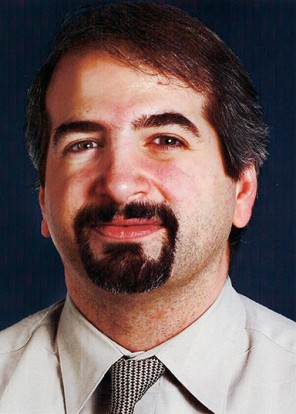
Anthony Shadid, 35, is the Islamic affairs correspondent for the Washington Post, based in the Middle East. Before that, he worked for two years in Washington with the Boston Globe, where he covered diplomacy and the State Department. Since September 11, he has traveled to Egypt, Lebanon, Iraq, the Persian Gulf, Europe, Afghanistan, Pakistan and Israel and the Palestinian territories. Prior to working for the Globe, he was news editor of the Los Angeles bureau of The Associated Press. Shadid worked as a Middle East correspondent for the AP in Cairo from 1995 to 1999, reporting and writing from most countries in the region.
Shadid, an American of Lebanese descent, speaks and reads Arabic, offering him insights not available to most Western journalists working in the Middle East. A native of Oklahoma City, Oklahoma, he studies Arabic at the University of Wisconsin and later was a recipient of a fellowship in 1991-92 at the American University in Cairo. He gained additional understanding of the region through graduate work at Columbia University in New York in 1993-94.